A Short-Term Wind Power Forecasting Method Based on Multi-Decoder and Multi-Task Learning

Abstract
1. Introduction
- (1)
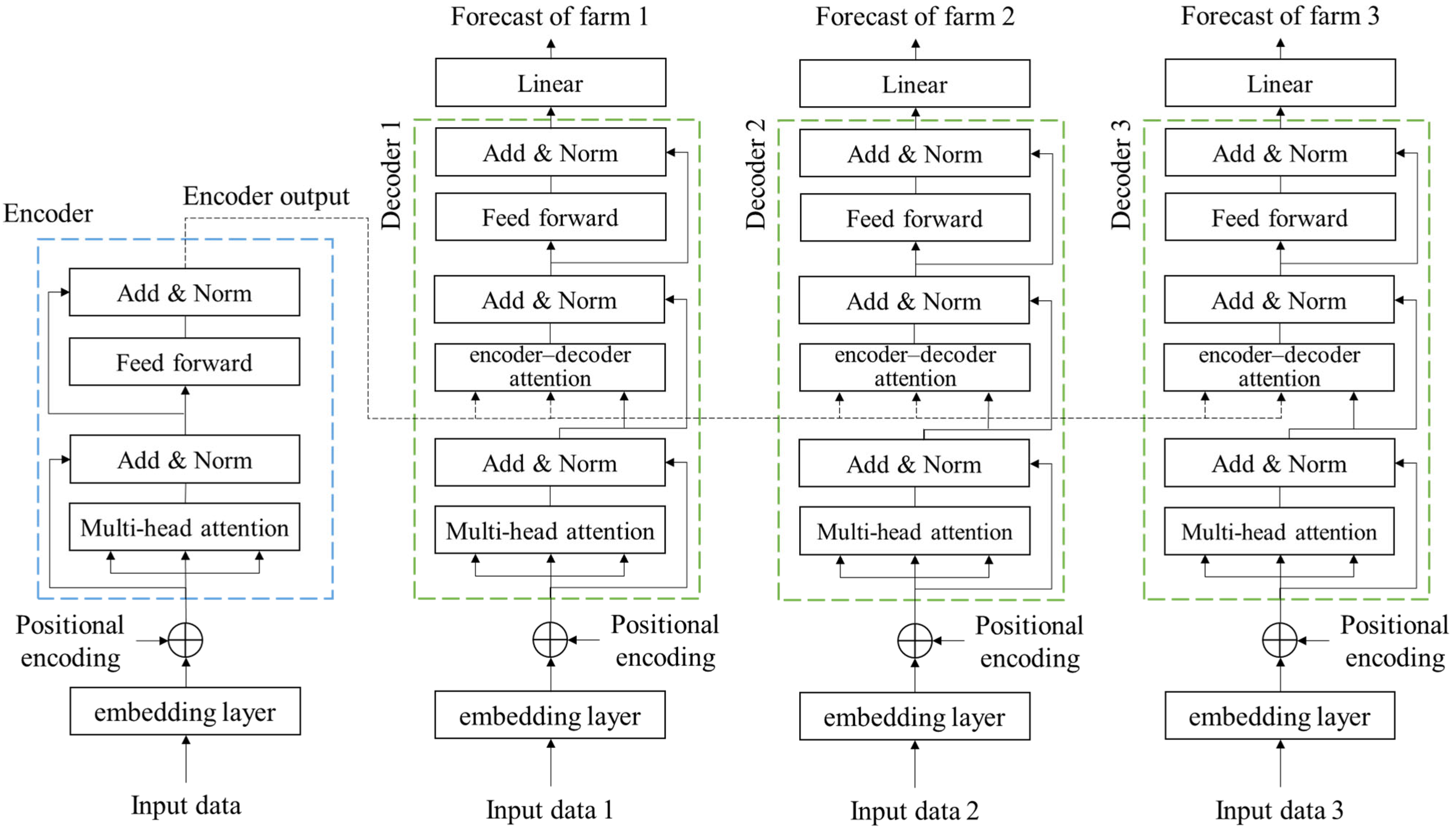
- We propose a multi-decoder, multitask learning model for short-term wind power forecasting, based on the Transformer architecture. The proposed model adopts a single-encoder–parallel-decoder structure, enabling joint forecasting of power outputs for multiple wind farms.
- (2)
- We design a unified encoder to map the input data into a latent representation matrix. Attention mechanisms are employed to extract high-dimensional interaction features from the correlated information across multiple farms. Each farm-specific decoder then combines the latent representation matrix with the input features specific to its forecasting task, enabling accurate predictions for each farm.
- (3)
- We conduct extensive experiments, including case studies using real wind farm data from Inner Mongolia, China. These experiments demonstrate that the proposed model significantly improves the accuracy of wind power forecasting.
2. Multi-Decoder and Multi-Task Learning Architecture
3. Transformer-Based Wind Power Forecasting Model
3.1. Positional Encoding
3.2. Attention Mechanism
3.3. Layer Normalization and Feedforward Neural Network
4. Case Study Analysis
4.1. Dataset Description
4.2. Evaluation Metrics
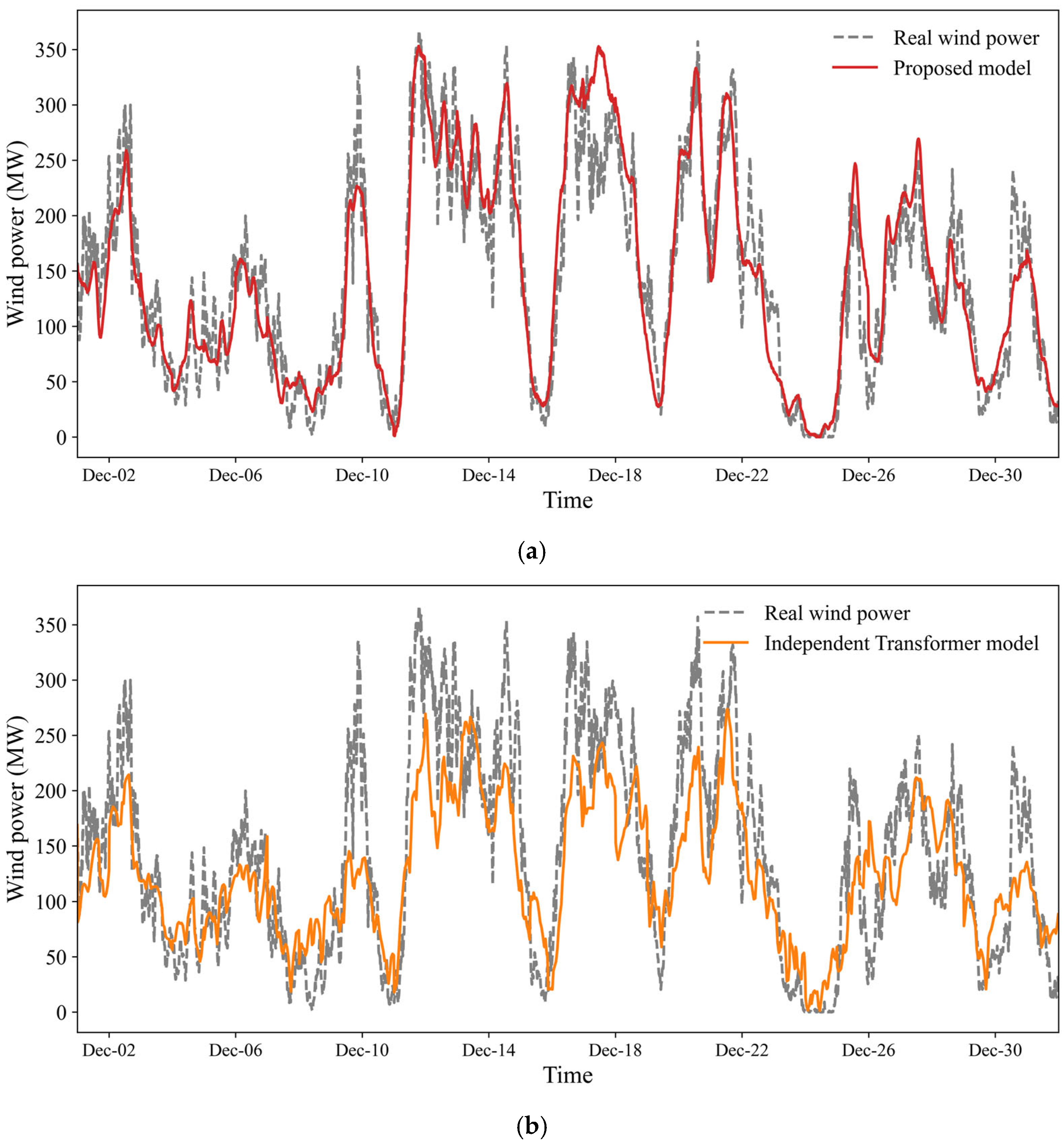
4.3. Comparison with the Independently Trained Transformer Model
- Scenario 1 evaluates the forecasting performance for wind farm 1,
- Scenario 2 evaluates the forecasting performance for wind farm 2,
- Scenario 3 evaluates the forecasting performance for wind farm 3, and
- Scenario 4 evaluates the metrics based on the total power output of wind farms 1, 2, and 3.
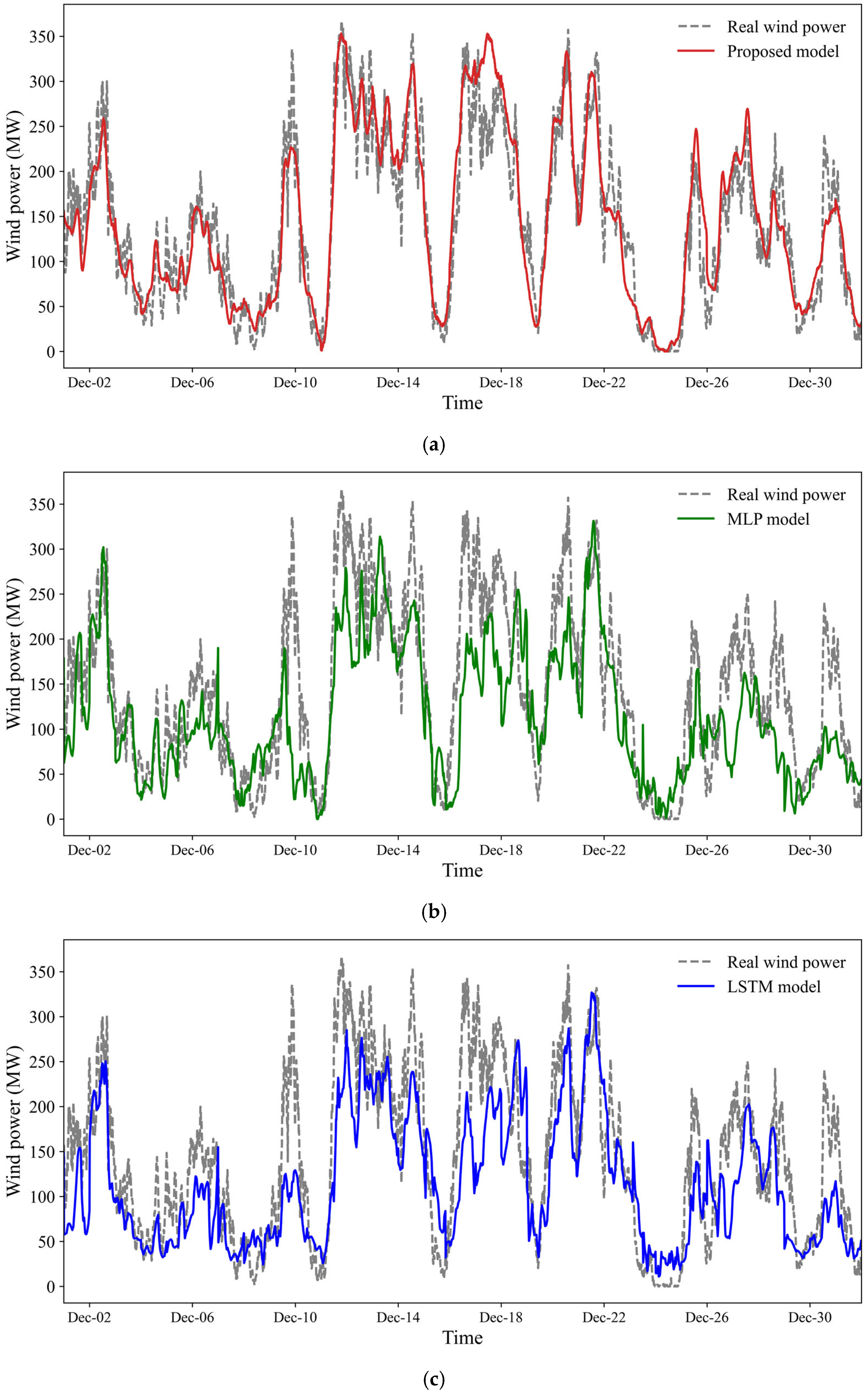
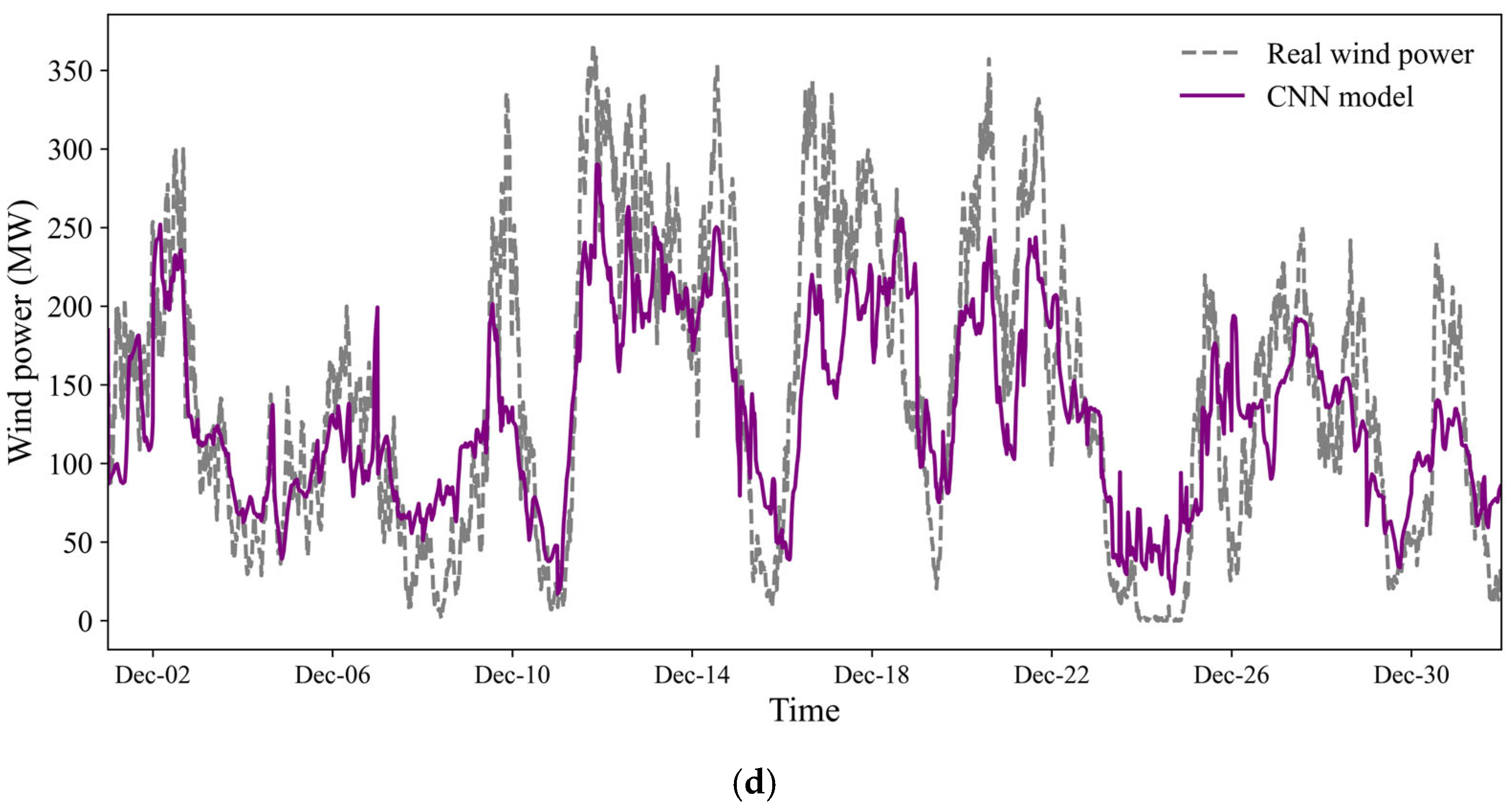
4.4. Comparison with Joint Forecasting Deep Learning Models
4.5. Overall Comparison of All Models
5. Conclusions
Author Contributions
Funding
Data Availability Statement
Conflicts of Interest
References
- Li, M.; Yang, M.; Yu, Y.; Lee, W.J. A wind speed correction method based on modified hidden Markov model for enhancing wind power forecast. IEEE Trans. Ind. Appl. 2021, 58, 656–666. [Google Scholar] [CrossRef]
- Konstantinou, T.; Hatziargyriou, N. Regional wind power forecasting based on Bayesian feature selection. IEEE Trans. Power Syst. 2024, 40, 113–124. [Google Scholar] [CrossRef]
- Jin, F.; Chen, X.; Yu, Y.; Li, K. An improved regularization stochastic configuration network for robust wind speed prediction. Energies 2025, 18, 6170. [Google Scholar] [CrossRef]
- Silva, T.; Costa, A.; Vilela, O.C.; Willmersdorf, R.; dos Santos Júnior, J.V.; Alves, L.H.B.; Tyaquiçã, P.; de Lima, M.F.S.; de Souza, H.R.B.; Veleda, D. Application of the WRF model for operational wind power forecasting in northeast Brazil. Energies 2025, 18, 5731. [Google Scholar] [CrossRef]
- Yang, M.; Huang, Y.; Wang, Z.; Wang, B.; Su, X. A framework of day-ahead wind supply power forecasting by risk scenario perception. IEEE Trans. Sustain. Energy 2025, 16, 1659–1672. [Google Scholar] [CrossRef]
- Gokce, B.; Kayakutlu, G. Agent-based energy market modeling with machine learning and econometric forecasting for the net-zero emissions transition. Energies 2025, 18, 5655. [Google Scholar] [CrossRef]
- Yunus, K.; Thiringer, T.; Chen, P. ARIMA-based frequency-decomposed modeling of wind speed time series. IEEE Trans. Power Syst. 2016, 31, 2546–2556. [Google Scholar] [CrossRef]
- Shahid, F.; Zameer, A.; Muneeb, M. A novel genetic LSTM model for wind power forecast. Energy 2021, 223, 120069. [Google Scholar] [CrossRef]
- Wan, C.; Xu, Z.; Pinson, P.; Dong, Z.Y.; Wong, K.P. Probabilistic forecasting of wind power generation using extreme learning machine. IEEE Trans. Power Syst. 2013, 29, 1033–1044. [Google Scholar] [CrossRef]
- Wu, Q.; Guan, F.; Lv, C.; Huang, Y. Ultra-short-term multi-step wind power forecasting based on CNN-LSTM. IET Renew. Power Gener. 2021, 15, 1019–1029. [Google Scholar] [CrossRef]
- Sarp, A.O.; Mengüç, E.C.; Peker, M.; Güvenç, B.Ç. Data-adaptive censoring for short-term wind speed predictors based on MLP, RNN, and SVM. IEEE Syst. J. 2022, 16, 3625–3634. [Google Scholar] [CrossRef]
- Xuan, W.; Shouxiang, W.; Qianyu, Z.; Shaomin, W.; Liwei, F. A multi-energy load prediction model based on deep multi-task learning and ensemble approach for regional integrated energy systems. Int. J. Electr. Power Energy Syst. 2021, 126, 106583. [Google Scholar] [CrossRef]
- Wang, S.; Zhang, Z. Short-term multivariate load forecasting of an integrated energy system based on a quantum weighted multi-hierarchy gated recurrent unit neural network. Power Syst. Prot. Control 2022, 50, 85–93. [Google Scholar] [CrossRef]
- Vaswani, A.; Shazeer, N.; Parmar, N.; Uszkoreit, J.; Jones, L.; Gomez, A.N.; Kaiser, Ł.; Polosukhin, I. Attention is all you need. In Proceedings of the 31st Conference on Neural Information Processing Systems (NIPS 2017), Long Beach, CA, USA, 4–9 December 2017; Available online: https://dl.acm.org/doi/10.5555/3295222.3295349 (accessed on 28 December 2025).
- Xiong, B.; Lou, L.; Meng, X.; Wang, X.; Ma, H.; Wang, Z. Short-term wind power forecasting based on attention mechanism and deep learning. Electr. Power Syst. Res. 2022, 206, 107776. [Google Scholar] [CrossRef]
- Bispo Junior, D.A.; Leite, G.d.N.P.; Droguett, E.L.; de Souza, O.V.C.; Lisboa, L.A.; Cavalcanti, G.D.d.C.; Ochoa, A.A.V.; Costa, A.C.A.d.; Vilela, O.d.C.; Brennand, L.J.d.P.; et al. Short-term wind power forecasting with Transformer-based models enhanced by Time2Vec and efficient attention. Energies 2025, 18, 6162. [Google Scholar] [CrossRef]
- Niu, Z.; Yu, Z.; Tang, W.; Wu, Q.; Reformat, M. Wind power forecasting using attention-based gated recurrent unit network. Energy 2020, 196, 117081. [Google Scholar] [CrossRef]
- Dvorkin, V.; Delikaraoglou, S.; Morales, J.M. Setting reserve requirements to approximate the efficiency of the stochastic dispatch. IEEE Trans. Power Syst. 2019, 34, 1524–1536. [Google Scholar] [CrossRef]



| Scenario | Model | R2 | RMSE | MAE | nRMSE |
|---|---|---|---|---|---|
| 1 | Proposed model | 0.60 | 23.76 | 17.59 | 0.14 |
| Independent Transformer model | 0.35 | 30.51 | 25.49 | 0.19 | |
| 2 | Proposed model | 0.63 | 7.43 | 5.70 | 0.15 |
| Independent Transformer model | 0.35 | 9.74 | 7.40 | 0.20 | |
| 3 | Proposed model | 0.86 | 23.26 | 16.33 | 0.12 |
| Independent Transformer model | 0.55 | 41.14 | 30.55 | 0.20 | |
| 4 | Proposed model | 0.87 | 33.52 | 25.25 | 0.09 |
| Independent Transformer model | 0.63 | 55.90 | 44.00 | 0.17 |
| Scenario | Model | R2 | RMSE | MAE | nRMSE |
|---|---|---|---|---|---|
| 1 | Proposed model | 0.60 | 23.76 | 17.59 | 0.14 |
| MLP model | 0.23 | 33.17 | 26.48 | 0.20 | |
| LSTM model | 0.25 | 32.82 | 26.31 | 0.20 | |
| CNN model | 0.30 | 31.50 | 25.21 | 0.19 | |
| 2 | Proposed model | 0.63 | 7.43 | 5.70 | 0.15 |
| MLP model | 0.23 | 12.35 | 9.29 | 0.25 | |
| LSTM model | 0.28 | 10.26 | 8.42 | 0.21 | |
| CNN model | 0.14 | 15.54 | 11.67 | 0.31 | |
| 3 | Proposed model | 0.86 | 23.26 | 16.33 | 0.12 |
| MLP model | 0.40 | 47.38 | 34.52 | 0.24 | |
| LSTM model | 0.48 | 44.06 | 31.75 | 0.22 | |
| CNN model | 0.51 | 42.96 | 34.08 | 0.21 | |
| 4 | Proposed model | 0.87 | 33.52 | 25.25 | 0.09 |
| MLP model | 0.51 | 64.07 | 48.53 | 0.15 | |
| LSTM model | 0.55 | 61.13 | 47.07 | 0.15 | |
| CNN model | 0.63 | 55.90 | 45.11 | 0.13 |
| Unit ID | Rated Capacity (MW) | Energy Price (CNY/MW) | Upward Reserve Capacity (MW) | Downward Reserve Capacity (MW) | Upward Reserve Price (CNY/MW) | Downward Reserve Price (CNY/MW) |
|---|---|---|---|---|---|---|
| 1 | 10,205 | 500 | 5000 | 5000 | 1200 | 1200 |
| 2 | 6480 | 480 | 2800 | 2800 | 1000 | 1000 |
| 3 | 3888 | 550 | 1600 | 1600 | 1250 | 1250 |
| 4 | 5184 | 460 | 2400 | 2400 | 1000 | 1000 |
| 5 | 2592 | 510 | 1200 | 1200 | 1200 | 1200 |
| 6 | 2592 | 500 | 1120 | 1120 | 1150 | 1150 |
| Scenario | Model | R2 | RMSE | MAE | nRMSE | Cost/(CNY/Day) |
|---|---|---|---|---|---|---|
| 4 | Proposed model | 0.87 | 33.52 | 25.25 | 0.09 | 7968 |
| Independent Transformer model | 0.63 | 55.90 | 44.00 | 0.13 | 8435 | |
| MLP model | 0.51 | 64.07 | 48.53 | 0.15 | 8990 | |
| LSTM model | 0.55 | 61.13 | 47.07 | 0.15 | 8804 | |
| CNN model | 0.63 | 55.90 | 45.11 | 0.13 | 8595 |
Disclaimer/Publisher’s Note: The statements, opinions and data contained in all publications are solely those of the individual author(s) and contributor(s) and not of MDPI and/or the editor(s). MDPI and/or the editor(s) disclaim responsibility for any injury to people or property resulting from any ideas, methods, instructions or products referred to in the content. |
© 2026 by the authors. Licensee MDPI, Basel, Switzerland. This article is an open access article distributed under the terms and conditions of the Creative Commons Attribution (CC BY) license.
Share and Cite
Li, Q.; Liu, Y.; Yan, X.; Zhang, H.; Wang, S.; Li, R. A Short-Term Wind Power Forecasting Method Based on Multi-Decoder and Multi-Task Learning. Energies 2026, 19, 349. https://doi.org/10.3390/en19020349
Li Q, Liu Y, Yan X, Zhang H, Wang S, Li R. A Short-Term Wind Power Forecasting Method Based on Multi-Decoder and Multi-Task Learning. Energies. 2026; 19(2):349. https://doi.org/10.3390/en19020349
Chicago/Turabian StyleLi, Qiang, Yongzhi Liu, Xinyue Yan, Haipeng Zhang, Siyu Wang, and Ran Li. 2026. "A Short-Term Wind Power Forecasting Method Based on Multi-Decoder and Multi-Task Learning" Energies 19, no. 2: 349. https://doi.org/10.3390/en19020349
APA StyleLi, Q., Liu, Y., Yan, X., Zhang, H., Wang, S., & Li, R. (2026). A Short-Term Wind Power Forecasting Method Based on Multi-Decoder and Multi-Task Learning. Energies, 19(2), 349. https://doi.org/10.3390/en19020349