Article

Optimal Reduced Network Based on PSO-OPF-Kron Algorithm for Load Rejection Electromagnetic Transient Studies


by
Kamile Fuchs
1,*,
Roman Kuiava
1,
Thelma Solange Piazza Fernandes
1,
Wagner Felipe Santana Souza
1,
Mateus Duarte Teixeira
1,
Alexandre Rasi Aoki
1,
Miguel Armindo Saldanha Mikilita
2 and
Rafael Martins
3
1
Department of Electrical Engineering, Federal University of Parana, Curitiba 81531-990, PR, Brazil
2
Independent Researcher, Curitiba 81531-990, PR, Brazil
3
Copel Generation and Transmission S.A, Curitiba 81200-240, PR, Brazil
*
Author to whom correspondence should be addressed.
Energies 2026, 19(2), 321; https://doi.org/10.3390/en19020321
Submission received: 10 November 2025 / Revised: 8 December 2025 / Accepted: 27 December 2025 / Published: 8 January 2026

Abstract

Modern power systems have become increasingly complex, making the detailed modeling and analysis of large-scale networks computationally demanding and often impractical. Therefore, network reduction techniques are essential for representing a smaller area of interest while preserving the electrical behavior of the complete system. For electromagnetic transient (EMT) studies, such as load rejection analysis, reduced networks are commonly derived using classical methods like Kron reduction under maximum power transfer conditions. However, this approach can lead to discrepancies in load flow and short-circuit levels between the reduced and complete systems. In addition, Kron reduction may introduce negative resistances in the reduced-order model, compromising system stability by producing non-passive equivalents and potentially causing unrealistic or numerically unstable EMT simulations. To address these limitations, this paper proposes an optimization-based approach, termed PSO-OPF-Kron, which integrates Optimal Power Flow (OPF) with the Particle Swarm Optimization (PSO) algorithm to refine the equivalent network parameters. The method optimally determines power injections, bus voltages, transformer tap settings, and impedances to align the reduced model with the full system’s operating point and short-circuit levels. Validation on the IEEE 39-bus system demonstrates that the proposed method significantly improves accuracy and numerical stability, ensuring reliable EMT simulations for load rejection studies.

1. Introduction

Electric power systems (EPS) have undergone significant expansion and transformation in recent years, driven by rising energy demand, technological progress, and the pursuit of greater efficiency and reliability. The development of large-scale industrial projects, long-distance transmission lines, hybrid AC/DC integration, and diversified energy sources exemplifies the growing complexity of modern power grids. In this context, accurately representing EPS operation requires continuous assessment of network behavior and equipment performance under multiple operating scenarios to ensure overall reliability and security [1,2,3,4].
The modeling and analysis of large-scale interconnected systems are inherently complex and highly dependent on the type of study. Electromagnetic transient (EMT) analyses, in particular, require detailed three-phase representations and sequence component formulations for each element, resulting in a large number of modeled components [5]. This level of detail leads to substantial computational costs in terms of memory and processing time, as EMT studies involve fast dynamics and microsecond-level integration steps. Consequently, fully modeling large networks is impractical and often unnecessary, as only a specific portion of the system is relevant to the analysis of interest. Therefore, it is essential to simplify the system by maintaining detailed modeling in a smaller internal area (IA) while representing the external area (EA) through equivalent networks that preserve the main electrical interactions observed in the complete system (CS), thereby obtaining reduced-order models or reduced systems (RSs) [6].
Several studies using RSs have focused on developing static equivalents at load buses to assess their economic and operational impacts on voltage regulation and stability, particularly in continuation power flow analyses [7,8]. Other works have extended this concept to bad data detection in real-time analyses [9], equivalents for protection [10], state estimation [11], and hydrothermal scheduling [12]. Moreover, optimization-based equivalents using optimal power flow (OPF) have shown high accuracy in voltage stability and network equivalence studies [13,14]. Among the various reduction techniques, classical methods such as Kron [15], Ward [16], and Radial Equivalent Injection (REI) [17] remain fundamental, providing reliable models under different operating and contingency conditions. Improvements such as the modified Ward equivalent [18], external system monitoring through power injections and boundary flows [19], and REI parameter estimation using genetic algorithms [20] have enhanced the accuracy and applicability of these classical approaches.
Methods based on the Power Transfer Distribution Factor (PTDF) have been extensively applied to develop accurate reduced-order models of power systems [21]. These methods address the challenges of maintaining electrical accuracy while simplifying the network, emphasizing the proper selection of boundary buses and preservation of topological integrity [21]. To improve model accuracy, nonlinear optimization techniques adjust network admittances to minimize power flow discrepancies relative to the full system [22]. Structure-preserving reductions using bus aggregation and quadratic optimization frameworks also ensure that the internal zones and boundary power flows remain consistent with the original network [23]. Collectively, these studies demonstrate that PTDF-based clustering combined with optimization or aggregation enables computationally efficient and electrically consistent equivalents that reliably replicate full-system power flow behavior [21,22,23].
Recent research has focused on integrating OPF formulations with the Kron-based network reduction to enhance the computational efficiency in large-scale analyses [24,25]. Kron reduction within zonal partitions identified through multicut optimization allows reduced-order models to preserve inter-area power transfers while reducing the computational effort [24]. Mixed-integer optimization frameworks, such as Opti-Kron, strategically aggregate nodes and subgraphs to minimize approximation errors and maintain OPF accuracy [26]. Graph-theoretic formulations express the Kron reduction as a Schur complement on graph Laplacians, ensuring the preservation of topological and spectral properties relevant to sensitivity analyses [27]. Despite these advantages, such methods depend on specific operating points and careful boundary selection to maintain model fidelity [26,27]. Overall, combining OPF with Kron-based reduction provides a reliable and efficient means of developing reduced-order network equivalents suitable for planning, contingency assessment, and large-scale simulation studies [28,29,30].
In conducting EMT electrical studies, it is imperative to derive a reduced-order network that provides a detailed representation of the internal area while accurately modeling the equivalents of the external system. Furthermore, for specific analyses, such as load rejection, the equivalent network must reflect the operating conditions associated with high power transfer in the transmission lines (TLs). Thus, Kron reduction can be employed to derive equivalent networks that accurately represent the steady-state behavior of the external system. This technique allows the determination of the active and reactive power, internal voltages, and equivalent impedances associated with the generators connected to the boundary buses, as well as the equivalent circuits (ECs) interconnecting these boundary nodes. The validation of the reduced-order system can be accomplished through comparative studies of load flow and short-circuits between the RS and the corresponding area in the full network.
However, owing to the simplifications introduced in representing the external system and depending on the selected study area, significant deviations or numerical instability problems may occur. In this context, Kron reduction may introduce negative resistances in the RS, particularly in fictitious branches between equivalent buses and equivalent generator (EG) impedances [31,32,33]. These negative resistances are purely mathematical artifacts with no physical meaning. Most importantly, they can significantly compromise system stability by producing non-passive network models, thereby undermining the reliability of EMT simulations. As a result, simulations may reveal incorrect unstable behavior of the system or even encounter numerical issues, leading to failure to converge [31,34].
Negative resistances typically arise when nonlinear or constant-impedance loads are present at the eliminated buses, particularly when the active component of the load is dominant [34]. In these cases, the equivalent conductance exceeds the susceptance, resulting in an unphysical and potentially unstable equivalent network model. This inherent limitation has motivated the development of advanced reduction techniques aimed at ensuring numerical stability, preserving passivity, and maintaining physical consistency in the resulting equivalents [35].
Several mitigation strategies have been proposed to address this issue. Conventional methods, such as ignoring negative resistances, adjusting load parameters, or applying delta-star transformations, are relatively simple. However, these approaches often result in increased computational complexity, altered short-circuit levels, and the necessity for case-specific tuning [36]. In recent years, advanced reduction techniques have been proposed to generate numerically stable and physically meaningful network equivalents that preserve passivity and enable accurate EMT simulations of large-scale power systems.
Among these advanced methods, ref. [31] proposed introducing a single zero-injection node into the Kron-reduced network and re-synthesizing it as a positive-real circuit. This approach effectively enforces passivity and eliminates the negative resistances. However, it requires the addition of fictitious buses in the network, increasing the network’s complexity. Moreover, the paper does not discuss the implications of this transformation on single-phase short-circuit levels. Similarly, ref. [34] proposed a PI-branch transformation combined with an equivalent power source to eliminate negative resistances while preserving the power-flow solution. While conceptually straightforward, this method relies on specific network assumptions and, like [31], does not address its impact on short-circuit levels.
Hence, although these mitigation techniques successfully eliminate negative resistances and thereby preserve passivity and numerical stability in reduced equivalent networks, none of the reviewed studies evaluated the potential adverse impact that removing these resistances may have on system single-phase short-circuit levels. This represents a critical gap in the literature, given that such alterations can directly influence fault current magnitudes and the accuracy of EMT studies.
In this context, to overcome the limitations of the traditional Kron reduction, this paper proposes an optimization-based approach that integrates OPF to determine the optimal parameters of the external equivalent network derived from the Kron-reduced model. The proposed method aims to obtain an internal network representation suitable for different operating points, enabling the assessment of various scenarios depending on the electrical study under consideration. Heavy-loading conditions required for EMT load rejection studies were investigated in this paper. Additionally, negative impedances that may arise during the Kron reduction process are replaced with physically consistent positive values through an optimization procedure implemented using the Particle Swarm Optimization (PSO) metaheuristic. Consequently, the proposed PSO–OPF–Kron algorithm determines the optimal active and reactive power injections, internal voltages, and phase angles of the equivalent generators, transformer tap settings, and the positive impedance values associated with the reduced equivalent network.
The methodology was validated on a selected area of the IEEE 39-bus system to evaluate the reliability and effectiveness of the optimization process in aligning power flows and short-circuit levels of the equivalent network with those of the CS for load rejection analysis. The results demonstrated that the adjustment of the equivalent network parameters using the PSO–OPF–Kron algorithm accurately reproduced both the steady-state voltage profiles and single-phase short-circuit currents of the CS, enabling reliable EMT simulations of load rejection scenarios. The proposed approach successfully eliminated the negative impedance values resulting from the Kron reduction and preserved the short-circuit current magnitudes at the study area buses. Moreover, the method proved to be a systematic and automated framework, eliminating the need for trial-and-error procedures or manual adjustments to the network topology or equivalent parameters, as required in previous studies. By optimizing the equivalent parameters, the PSO–OPF–Kron algorithm provided a more accurate and physically meaningful RS, thereby improving the fidelity of transient response simulations in load rejection studies.
The main contributions of this paper are summarized as follows:
  • A new optimization-based reduction framework, called PSO-OPF-Kron, has been proposed. This method combines OPF with the PSO metaheuristic to identify the optimal equivalent parameters for reduced network models. A systematic approach is introduced to eliminate negative impedance values by replacing them with positive and physically consistent parameters to ensure network passivity and numerical stability.
  • The method determines the optimal equivalent parameters for reduced network models across multiple operating points. A new reduced and optimized system can be generated for each operating condition of the network, as commonly required in electrical studies. Consequently, the automated optimal reduction process facilitates the systematic generation of reduced systems for different operating conditions.
  • The proposed algorithm maintains the steady-state voltage profile, power-flow in TLs, and single-phase short-circuit currents of the original system, achieving a high level of accuracy between the reduced and complete networks.
  • The method is validated through EMT load rejection studies, allowing accurate assessment of transient circuit breaker overvoltages and surge arrester energy absorption under heavy load conditions.
This paper is organized into six sections. Following the introduction and contextual background presented in this section, Section 2 formulates the detailed network reduction problem. Section 3 outlines the methodology for deriving the optimal reduced network, including the mathematical formulation of the optimization problem and the description of the proposed PSO–OPF–Kron algorithm. Section 4 presents the validation procedure of the reduced network and the EMT load rejection study, while Section 5 discusses the results and analysis of the case study. Finally, Section 6 provides the main conclusions and highlights the research contributions.

2. The Network Reduction Problem

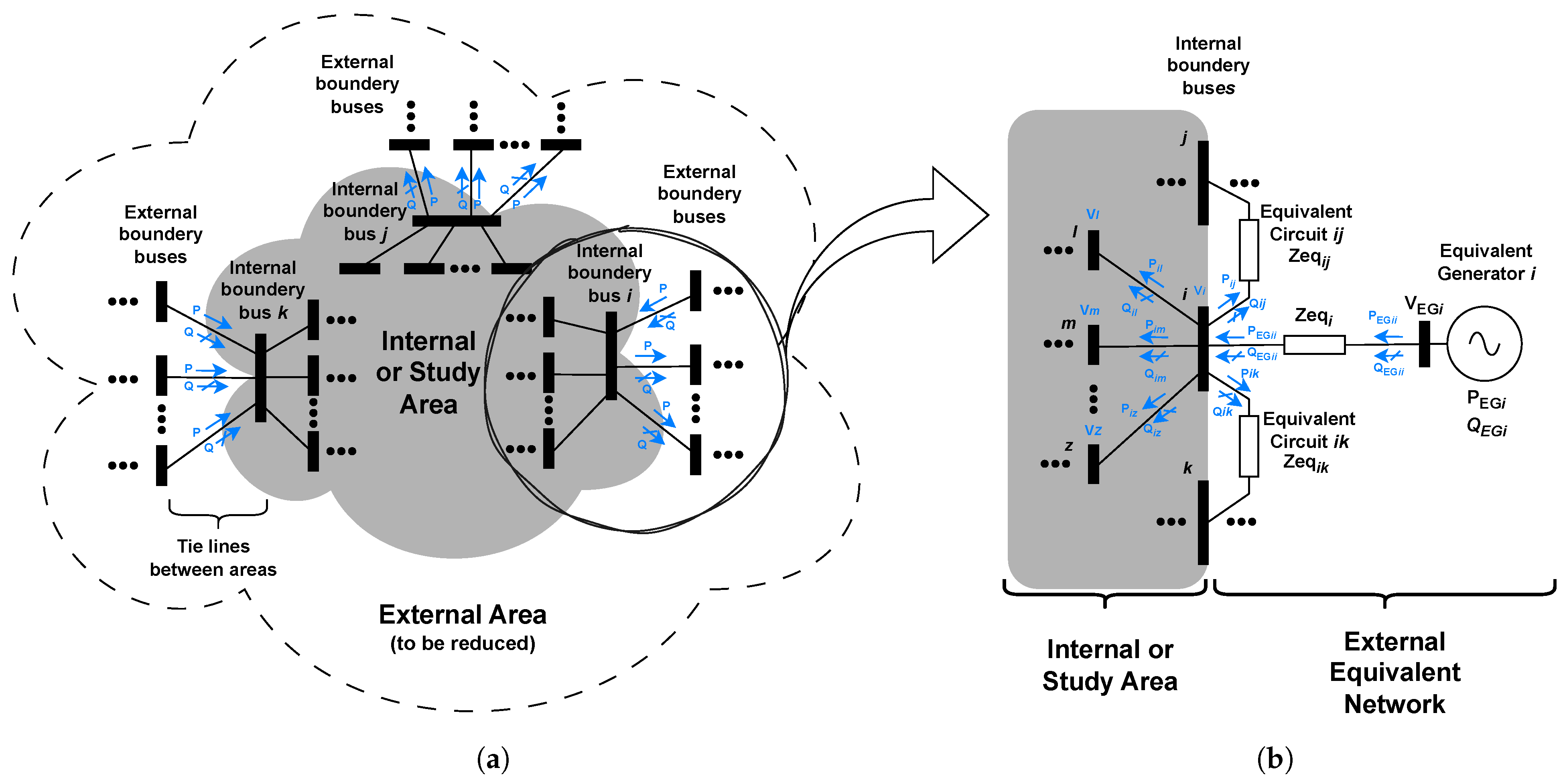
This section outlines the theoretical foundations and structural definitions commonly used in network reduction problems. The reduction process begins by partitioning the CS into two distinct regions: the internal area and the external area, as illustrated in Figure 1a. The internal area is where the original topology is preserved, and its components are modeled in detail based on the study of interest. The external area, on the other hand, is replaced by an equivalent representation. As illustrated in Figure 1a,b, the equivalent representation of the external area consists of an equivalent generator connected to the internal boundary buses through equivalent impedances. Additionally, the reduction process introduces fictitious lines (or transformers) that connect these internal boundary buses.
Consequently, there is a significant reduction in the complexity of the majority of the system (that is, the external area), while a high level of modeling accuracy and detail is preserved within the region of interest (that is, the internal area) for further analyses. The resulting RS, which is given by the internal area connected to the equivalent representation of the external area, must be validated. It can be considered equivalent to the CS only if, under comparative assessment, the operational parameters within the internal area and the mutual interactions at the interconnection boundaries between both areas exhibit a minimal acceptable deviation [1].
As discussed, the RS consists of a network equivalent model comprising two main components: an equivalent generator or voltage sources behind an impedance connected to the internal boundary bus, and circuits with equivalent impedances distributed between these internal boundary buses at the same voltage level of them. Additionally, if the internal boundary buses operate at different voltage levels, equivalent transformers may be considered between the boundary buses. Further details on the parameters associated with the network equivalents, intended for adjustment through the optimization problem solution, are provided in Figure 1b. These parameters include the internal voltage magnitude and angle ( V E G i ), dispatched active and reactive powers ( P E G i and Q E G i ), and impedance ( Z e q i ) connected to the equivalent generator. After the Kron reduction process, negative resistances may emerge in the impedances connected to the equivalent generators and those derived from equivalent circuits and transformers.
Network equivalent models are employed in relation to the structure, and subsequent parameter calculations can be categorized into static and dynamic network equivalents. These are directly associated with the phenomenon under investigation and the frequency range of the intended analysis post-reduction. This paper considers an ideal voltage source model to represent static equivalent generators based on the assumption that for the intended EMT studies, such as load rejection, the EA dynamics have a negligible influence on the IA.
In this context, the modeling of static network equivalents aims to replicate the steady-state characteristics of the system within the IA, thereby representing the static behavior of the network in the original system. The variables monitored to determine these equivalents include the voltage magnitudes and phase angles at the buses within the internal area, as well as the active and reactive power dispatched by the generating units located in that area. Additionally, it includes the active and reactive power flows in the TLs within the internal area (highlighted in blue in Figure 1b). To achieve accurate representation, the equivalent network model must precisely reproduce the power flows to maintain the variables of the internal area as close as possible to their original steady-state operating values in the CS.
The proposed methodology employs the Kron method (as presented in [15]) for network reduction and determination of network equivalent parameters. This approach promotes the reduction process and provides equivalent results in zero, positive, and negative sequence components. Therefore, it serves as a procedure applicable to various studies, including short-circuit calculations and EMT analyses.
However, after network reduction, it is occasionally necessary to adjust the parameters of the equivalent network model to enhance the accuracy of matching the monitored values in the area of interest and to validate the obtained RS. To achieve this objective, an optimization problem is formulated to minimize the deviations of the monitored variables in the IA relative to the original system operating under steady-state conditions. The proposed approach ensures power balance at all system buses within the specified limits and maintains the operating point under the required loading conditions, as discussed in the next section.

3. The Proposed Methodology for Optimal Network Reduction

The proposed optimization problem is delineated in two distinct stages. The first stage consists of formulating an OPF that adjusts the voltage magnitudes, phase angles, and the active and reactive power injections of the equivalent generators obtained through Kron reduction, while also adapting the transformer tap settings within the internal area. The second stage focuses on the adjustment of impedance parameters of generators and equivalent circuits through the application of the PSO metaheuristic technique. The subsequent sections provide a comprehensive discussion about each stage of the proposed optimization problem and its detailed mathematical formulation.

3.1. OPF for Voltage and Power Adjustment of Equivalent Generators and Transformer Tap Settings

OPF is a widely applied optimization technique for the planning and operational analysis of EPSs [37,38,39,40,41]. In this work, the technique employed to address the OPF was the Interior Point Method (IPM) in its Primal-Dual variant [42,43]. The proposed OPF solution aims to find the optimal values for voltage magnitude and phase angles at the internal buses of the equivalent generators, as well as the active and reactive power dispatches of these generators. In addition, it seeks the optimal tap settings for the transformers contained within the retained area. The adjustment of these variables is intended to match the voltage profiles, power flows, and generation between the internal area of the reduced system and the same area in the CS.
The OPF problem incorporates an objective function f ( u ) consisting of two distinct terms:
f ( u ) = g ( f 1 , f 2 ) ,
where,
f 1 : the quadratic deviations of voltage magnitudes in the buses within the IA relative to the specified voltage magnitudes for steady-state operation in the CS.
f 2 : the quadratic deviations of single-phase short-circuit current in the buses within the IA relative to the specified short-circuit currents for the same area in the CS.
Consequently, the equivalent system is expected to accurately reproduce the steady-state behavior of the CS in terms of bus voltages and short-circuit currents, thereby ensuring a faithful representation of the original system for the intended analysis. Therefore, the objective function in (1) can be mathematically represented as follows (2):
f ( V I A i , I s c 1 P I A i ) = ω a i = 1 n b I A ( V I A i V S P E i ) 2 + + ω b i = 1 n b I A ( I s c 1 P I A i I s c 1 P S P E i ) 2 ,
where:
V I A i : voltage magnitude of the i-th bus within the IA of the RS;
V S P E i : specified voltage magnitude of the i-th bus in the corresponding area in the CS;
I s c 1 P I A i : single-phase short-circuit current of the i-th bus in the IA of the RS;
I s c 1 P S P E i : specified single-phase short-circuit current of the i-th bus in the IA of the RS;
n b I A : number of buses in the IA of the RS;
ω a and ω b : weighting factors associated with f 1 and f 2 , respectively.
The single-phase short-circuit currents are calculated according to [44,45], based on the specified voltage magnitudes (obtained from the CS power flow) and the positive and zero-sequence Thevenin impedances. These impedances are determined by applying a single-phase short circuit to each bus separately within the IA in the RS.
The active and reactive power balance equations are formulated using the rectangular representation of the voltage phasors. A detailed explanation of this modeling can be found in [42]. In this context, the active and reactive power flow constraints are formulated as functions of the bus voltage phasors, expressed in rectangular coordinates and matrix form. The power balance equations are enforced over all buses of the reduced network, including the internal and external areas and the fictitious buses representing the equivalent generators. The vectors for active power injection ( P S R ) and reactive power injection ( Q S R ) are of dimensions ( n b S R × 1) and are described by Equations (3) and (4), respectively:
P R S = P G R S P D R S = real [ diag ( V R S ) ( Y b u s R S V R S ) ] ,
Q R S = Q G R S Q D R S = imag [ diag ( V R S ) ( Y b u s R S V R S ) ] ,
where:
P G R S : vector n b R S × 1 with the active power injections in each bus of the RS;
Q G R S : vector n b R S × 1 with reactive power injections in each bus of the RS;
P D R S : vector n b R S × 1 with the active power demands at each bus of the RS;
Q D R S : vector n b R S × 1 with the reactive power demands at each bus of the RS;
V R S : vector n b R S × 1 with the phasors of voltages at the buses of the RS;
Y b u s R S : bus admittance matrix n b R S × n b R S .
The inequality constraints of the optimization problem include the technical and operational limits of the reduced system in both the internal and external areas, which consist of generators and equivalent circuits. For the internal area, the variables were constrained to narrow operating ranges around the steady-state reference values. In contrast, for the external area, specifically, the optimal parameters associated with the generators and equivalent circuits between the boundary buses, broad operating limits were assigned to allow a wider range of variation. The active and reactive generation ( P G R S and Q G R S ), power flows ( P l R S and Q l R S ), voltage phasors ( V R S in rectangular coordinates), and transformer taps within the IA ( a A I R S ) are subject to the following constraints:
P G R S m i n P G R S P G R S m a x ,
Q G R S m i n Q G R S Q G R S m a x ,
P l R S m i n P l R S P l R S m a x ,
Q l R S m i n Q l R S Q l R S m a x ,
V R S m i n V R S V R S m a x ,
a R S m i n a R S a R S m a x ,
where:
P G R S m i n and P G R S m a x : vectors ( n g R S × 1 ) with the minimum and maximum active power capacities of the original and equivalent generators of the RS;
Q G R S m i n and Q G R S m a x : vectors ( n g R S × 1 ) with the minimum and maximum reactive power capacities of the original and equivalent generators of the RS;
P l R S m i n and P l R S m a x : vectors ( n c R S × 1 ) with the minimum and maximum active power flow capacities in the IA circuits and the external equivalent interconnection circuits with the equivalent generators and between boundary buses;
Q l R S m i n and Q l R S m a x : vectors ( n c R S × 1 ) with the minimum and maximum reactive power flow capacities in the IA circuits and the external equivalent interconnection circuits with the equivalent generators and between boundary buses;
V R S m i n and V R S m a x : vectors ( n b R S ) with the minimum and maximum limits of the voltage phasors of the IA buses ( V I A R S ) and fictitious buses associated with the equivalent generators;
a R S m i n and a R S m a x : vectors ( n t R S ) with the minimum and maximum limits of the taps values of the transformers in the IA.
For generated powers and active/reactive power flows within the internal area, where minimal deviation from the CS power-flow is desired, the reference values obtained from the CS load flow are scaled by a factor ϕ (in %). Accordingly, the minimum and maximum limits for variables associated with buses and lines in the internal area are defined as in Equations (11)–(18):
P G R S m i n = ( 1 ϕ P G ) P S P E ,
P G R S m a x = ( 1 + ϕ P G ) P S P E ,
Q G R S m i n = ( 1 ϕ Q G ) Q S P E ,
Q G R S m a x = ( 1 + ϕ Q G ) Q S P E ,
P l R S m i n = ( 1 ϕ P l ) P l S P E ,
P l R S m a x = ( 1 + ϕ P l ) P l S P E ,
Q l R S m i n = ( 1 ϕ Q l ) Q l S P E ,
Q l R S m a x = ( 1 + ϕ Q l ) Q l S P E ,
where the quantities P S P E , Q S P E , P l S P E , and Q l S P E denote the corresponding reference values obtained from the full-system (CS) load flow.
The maximum and minimum generation limits of the equivalent generators, as well as the active and reactive power flows associated with the interchange zones between the internal and external boundary buses, were not constrained. Instead, the algorithm assigned these limits with a broad search range, as they represented the optimal values needed to validate the reduced system.
In summary, the OPF minimizes the objective function (2), subject to Constraints (3) to (10).

3.2. PSO for Impedance Adjustment of the Equivalent Generators and Circuits

The process of simplifying the external network through the Kron reduction method may introduce negative impedances associated with generators and equivalent circuits, requiring adjustments to enhance the accuracy of load flow validation. These negative impedance values can lead to numerical conditioning issues for EMT analysis. The previously discussed OPF solution utilizing the IPM method modifies the internal voltages and manages the power dispatch of the equivalent generators. For the adjustment of impedance, particularly when it is negative, the adoption of a PSO metaheuristic technique is proposed to determine new optimal values. The conventional mathematical formulation of PSO, along with several applications, is detailed in [46,47,48,49].
In this study specifically, the output of the PSO is the vector of positive-sequence resistances and reactances derived from the Kron-reduced network, representing the equivalent generator and equivalent circuits among the boundary buses. Moreover, the fitness function ( F V A L ) is calculated for each particle based on the optimal solution given by OPF. Thus, it consists of four distinct components as follows:
F V A L ( u ) = g ( f 1 , f 2 , f 3 , f 4 ) ,
where:
f 1 : the deviations of voltage magnitudes in the buses within the IA relative to the specified voltage magnitudes for steady-state operation in the CS.
f 2 : the deviations of single-phase short-circuit current in the buses within the IA relative to the specified short-circuit currents for the same area in the CS.
f 3 : the deviations of active power flow in the TLs within the IA relative to the specified active power flow for the same area in the CS.
f 4 : the deviations of reactive power flow in the TLs within the IA relative to the specified active power flow for the same area in the CS.
Mathematically, it can be expressed as follows (20):
F V A L ( V I A i , I s c 1 P I A i , P I A i j , Q I A i j ) = ω 1 i = 1 n b I A V I A i V S P E i + ω 2 i = 1 n b I A I s c 1 P I A i I s c 1 P S P E i + + ω 3 i = 1 n c I A P I A i j P S P E i j + ω 4 i = 1 n c I A Q I A i j Q S P E i j
where:
P I A i j : active power flow in the circuit between the i-th and j-th buses in the IA of the RS;
P S P E C S i j : specified active power flow in the circuit between the i-th and j-th buses in the same area of the CS;
Q I A i j : reactive power flow in the circuit between the i-th and j-th buses in the IA of the RS;
Q S P E C S i j : specified reactive power flow in the circuit between the i-th and j-th buses in the same area of the CS;
n c I A R S : number of circuits in the IA of the RS;
ω 1 , ω 2 , ω 3 and ω 4 : the weighting factors associated with f 1 , f 2 , f 3 , and f 4 , respectively.
The weighting factors ( ω 1 , ω 2 , ω 3 , and ω 4 ) are determined through a normalization process found in [50,51], where the maximum values of each component are set to the maximum deviation adopted for the network validation.
To define the PSO search space and identify an optimal solution when negative impedances arise from Kron reduction, upper and lower bounds were imposed on the impedance values. The positive-sequence resistences ( r 1 R S ) and reactances ( x 1 R S ) are subject to the following constraints:
r 1 R S m i n r 1 R S r 1 R S m a x ,
x 1 R S m i n x 1 R S x 1 R S m a x .
Positive-sequence resistances and reactances that remain positive after the Kron reduction are kept unchanged. When negative values occur, PSO searches for an optimal value within minimum and maximum interval ([ r 1 R S m i n , r 1 R S m a x ] and [ x 1 R S m i n , x 1 R S m a x ]) to ensure strictly positive impedances. The zero-sequence equivalent impedances are retained exactly as obtained from the Kron reduction.

3.3. Network Reduction Based on PSO-OPF-Kron Algorithm

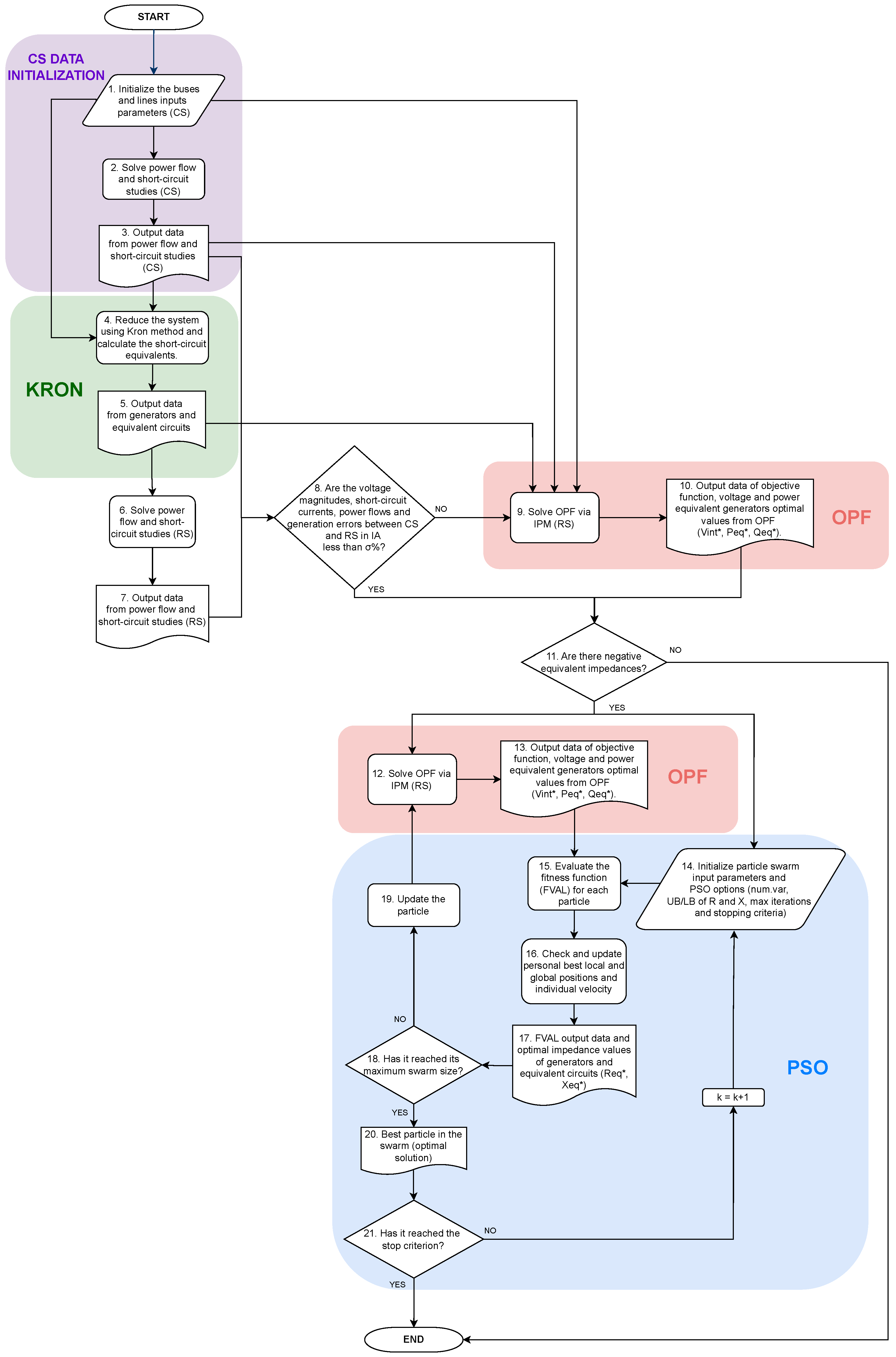
The proposed algorithm integrates the two previously presented optimization techniques, OPF and PSO, to determine the optimal parameters for network equivalents. The algorithm is structured into four main stages: CS data initialization, Kron reduction application, decision points, and PSO-OPF. Each of these processes is illustrated in the flowchart in Figure 2 and is discussed in detail as follows.
CS data initialization: CS bus and branch system data inputs for conducting power flow and short-circuit studies (steps 1 and 2). The resulting output serves as reference data for the Kron reduction process, considering the required operational point and load conditions of the system (step 3). Additionally, the load flow and short-circuit outputs of the CS will be the specified parameters necessary for OPF.
Kron reduction: The system is reduced using the Kron method, resulting in the calculation of external network equivalents (step 4). The output data of the generators and equivalent circuits are then used as specified and initialization data for the OPF. At this stage, the parameters of the reduced system, encompassing IA and external network equivalents, are determined (step 5). Subsequently, power flow and short-circuit analyses are conducted for the RS (steps 6 and 7).
Decision: The RS is validated by comparing voltages, power flows, and short-circuit currents in the internal area with those of the original system. If all deviations are within the predefined tolerance σ % (step 8), the RS proceeds to step 11; otherwise, an OPF is solved to update the equivalent parameters. In step 11, the algorithm ends if no negative impedances remain; if they do, it advances to the PSO-OPF block.
PSO-OPF: Particle initialization is performed using the PSO input parameters, such as the number of variables, bounds (UB and LB) of the equivalent impedances, maximum iterations, and stopping criterion (step 14). An OPF is then solved to obtain the FVAL for each particle (steps 12–13). The FVAL is evaluated, and the global and local best positions and particle velocity are updated (steps 15–16). The output provides the optimal impedance values for generators and equivalent circuits (step 17). The PSO–OPF combination includes two decision points (steps 18 and 21). In step 18, if the swarm has not reached its maximum size, the particle is updated (step 19) and the OPF is solved again. Otherwise, the best particle with the lowest FVAL is selected (step 20). In step 21, if the stopping criterion is not met, the algorithm returns to step 14; otherwise, it ends with the optimal solution.

4. EMT Load Rejection Study

For the EMT load rejection study, the transient response of the RS must be evaluated with respect to the TL of interest. The primary objective is to assess the maximum transient overvoltages experienced by the buses and terminal equipment, as well as the energy dissipated by the surge arresters, in order to verify their energy absorption capability at both ends of the TL.
The methodology adopted in this paper for the load rejection study follows the guidelines established for new transmission line projects and the operational procedures defined by the Brazilian Electrical System Operator (ONS, using the Portuguese acronym) [52]. Although this study is based on Brazilian technical standards, these procedures are consistent with internationally recognized practices for EMT analyses.
To perform the EMT simulations, the base case must be adapted to include circuit breakers and surge arresters at the terminals of the study transmission line. These modifications are essential for accurately assessing transient overvoltages and the corresponding energy dissipation in the equipment. According to the recommendations provided in [52,53], the main aspects to be considered in the load rejection study are:
  • Switching without the application of a prior defect (i.e., simple voluntary rejection);
  • Switching preceded by a single-phase fault;
  • Switching followed by a fault applied at the instant of maximum post-opening overvoltage;
  • Fault clearing times defined according to [52], as a function of the nominal voltage of the TLs;
  • Switching in both TL directions, with power flow near the line’s loading limit.
In accordance with these guidelines, Table 1 presents the simulation framework adopted in this study, summarizing the test cases and the sequence of events considered for the TL connecting the buses called BUS-A and BUS-B. The instants of time at which each event occurs, including fault initiation and circuit breaker operations, are defined based on the TL’s voltage level, following the network procedures and directives established by [52,53].
The consequences of load rejection become more severe when the TL under consideration is subjected to higher loading conditions. Therefore, it is crucial to adjust the power flow to ensure that the loading condition of the TL closely approximates its loading capacity. In the case study presented in this paper, the system was subjected only to heavy loading conditions.
EMT simulations must be performed to analyze the level of transient overvoltages affecting the equipment located at the TL terminals and the surge arresters. These must be designed to dissipate the energy generated during the energization and switching operations.
In this context, a comparative analysis was conducted on networks reduced by the traditional Kron process and the PSO-OPF-Kron method to assess the impact of the optimized model on transient response in load rejection studies. Initially, the deviations of these reduced networks from the CS were compared for both reduced models in the validation process through power flow and short-circuit analyses. Afterward, load rejection studies were performed, comparing the peak values of the transient overvoltages in the circuit breakers and the energies dissipated in the surge arresters, as well as the differences between the transient curves for both reduced networks.

5. Results and Discussion

A case study was conducted to assess the performance of the proposed algorithm in determining the optimal parameters of the network equivalents and validating the reduced network. Subsequently, the processes and outcomes of the load rejection study were performed for a TL located in the reduced network. The analysis of the results and discussions are presented in this section.

5.1. Case Study: IEEE 39 Buses—New England

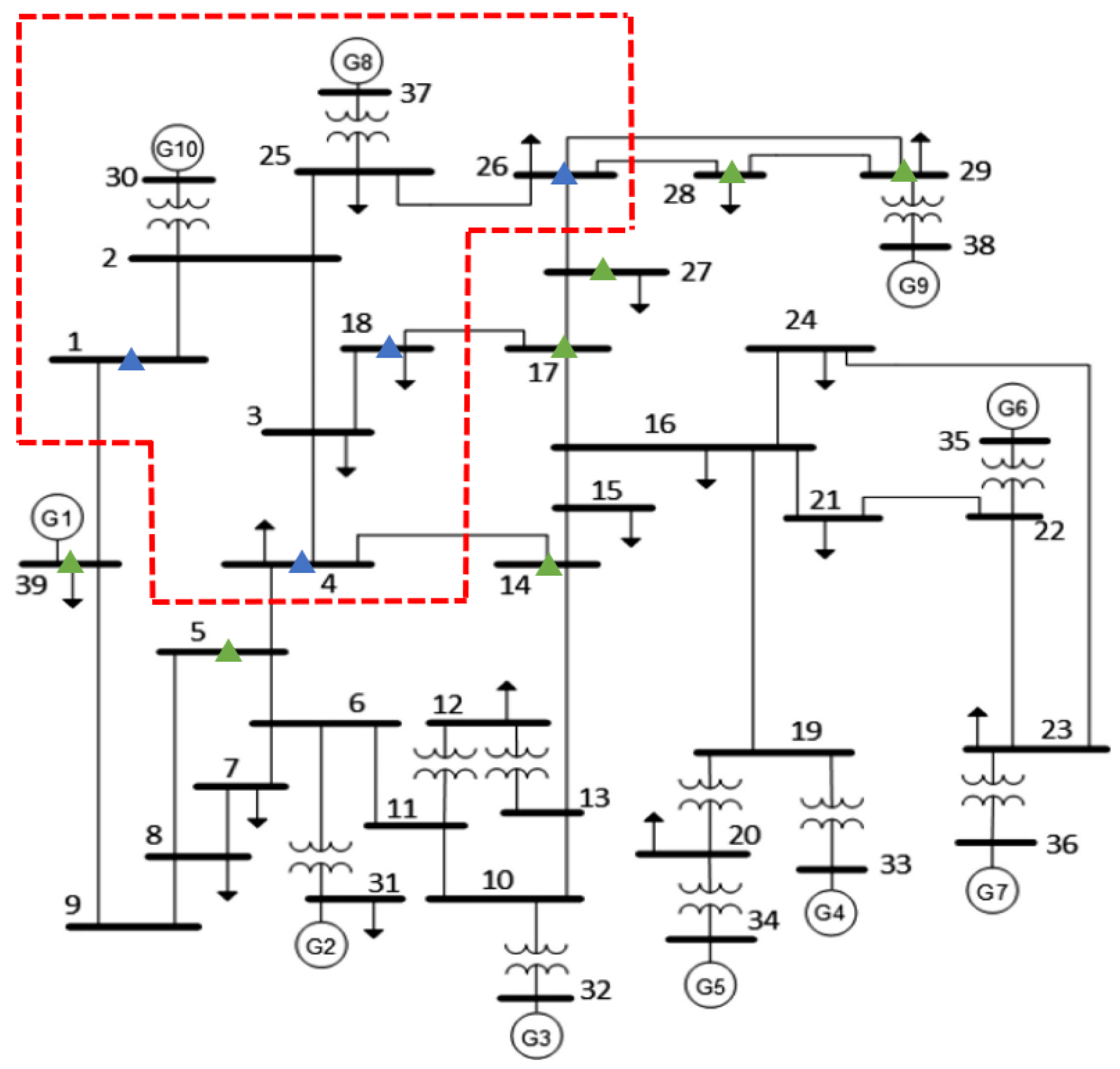
The IEEE 39-bus electrical system was employed to conduct tests and assess the performance of the proposed algorithm. The one-line diagram of this system is shown in Figure 3. The system operates at 500 kV and comprises a 60 Hz transmission network incorporating 10 generators, 12 transformers of 500 kV/20 kV, and 19 loads distributed across the network. Detailed bus and branch data are available in [54].
As previously discussed, the TLs must operate at their maximum power flow capacity. A heavy loading scenario was considered, with system demand increased 30% with respect to the base case. The generation dispatch was adjusted accordingly to accommodate this operating condition.
The load rejection analysis was conducted for a specific area of the system, as delineated by the dashed (red) line in Figure 3. The boundary buses are identified by blue and green triangles, indicating internal and external boundary buses, respectively. Thus, the internal area of interest comprises nine buses, two transformers of 500 kV/20 kV with a nominal tap of 1.025 , and two generators (G8 and G10) with nominal capacities of 540 MW and 520.8 MW, respectively.

5.1.1. Reduced Network Model

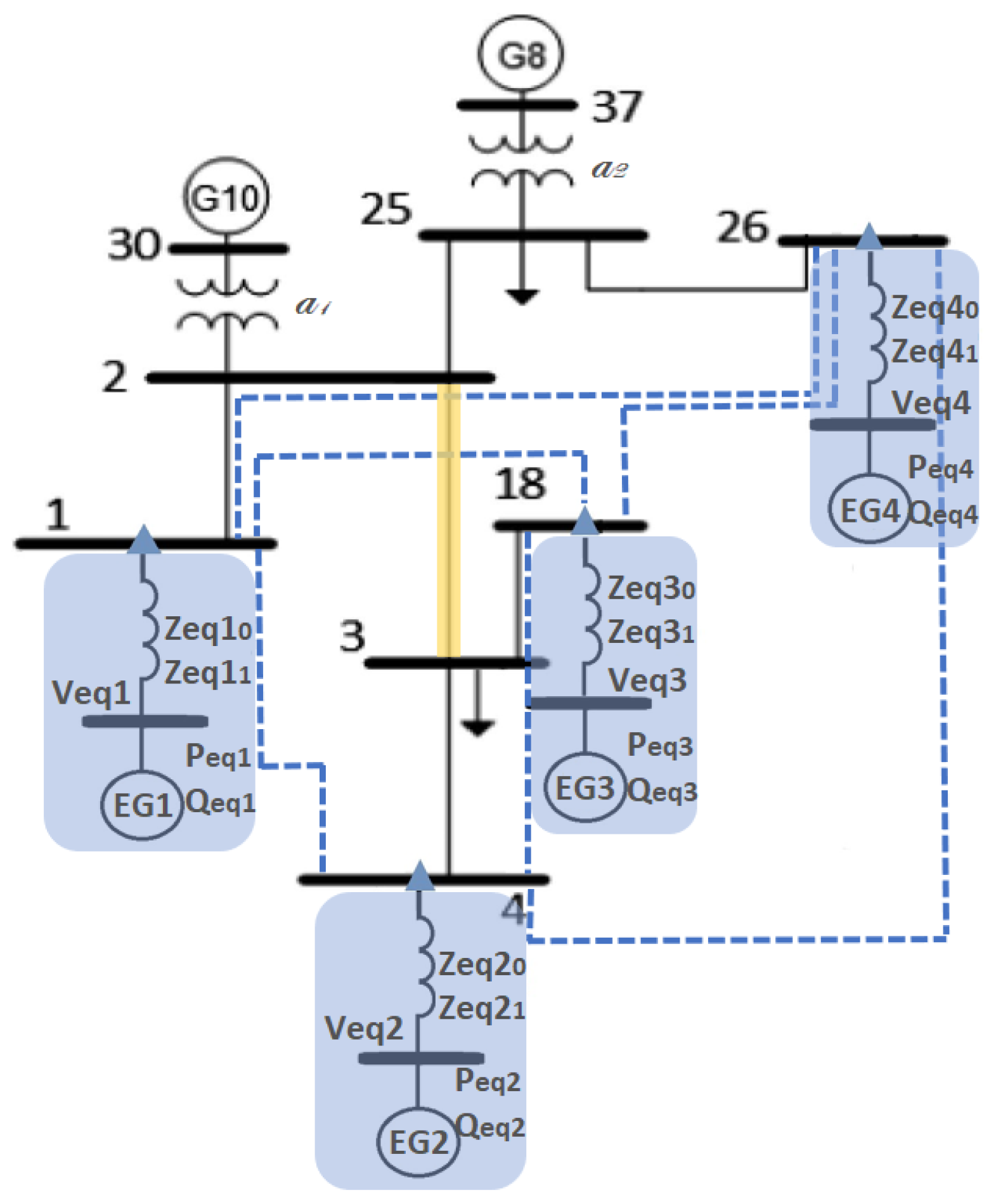
The reduction of the external area into equivalent networks using Kron’s method was achieved by modeling four equivalent generators positioned at the boundary buses and six equivalent TLs, as illustrated in Figure 4. The equivalent generators, highlighted in blue, are connected to the internal boundary buses through an equivalent impedance. The equivalent circuits, illustrated in blue dashed lines, are represented as fictitious branches between boundary buses operating at the same voltage level.
Consequently, the proposed network reduction algorithm aims to calculate the parameters of active and reactive power, internal voltage of the equivalent generators (identified in Figure 4 as P e q , Q e q , and V e q ), as well as the optimal parameters of the equivalent impedances in positive sequence component ( Z e q 1 ) associated with the generators and equivalent circuits. Additionally, the tap changers of the original transformers located in the system’s internal area (represented by a) is also considered to be a parameter to be adjusted by the algorithm.

5.1.2. Equivalent Network Parameters

First, the reduced network was obtained via Kron reduction; subsequently, its parameters were optimized using the proposed PSO-OPF-Kron-based algorithm, as detailed in Section 3.1. The software adopted to obtain the reduced network included ANAREDE, version 11.05.05 (Program for the EPS load flow analysis under steady-state conditions, developed by the Electric Power Research Center—CEPEL, Brazil) and ANAFAS, version 7.5.0 (Program for the short circuit calculation and network reduction in EPSs, developed by the Electric Power Research Center—CEPEL, Brazil). This algorithm refines the parameters derived from the traditional Kron reduction, providing optimal values for the generators and equivalent circuits. The entire implementation was conducted in MATLAB R2021a (The MathWorks, Inc., Natick, MA, USA).
The search ranges of the PSO-OPF-Kron for optimal operation concerning inequality constraints are delineated in Table 2, based on the ϕ factor selected for the IA, generators, and equivalent circuits (EG and EC, respectively). These values were determined following a parameterization process, which involved conducting multiple simulations to identify values that would enable the algorithm to converge with the smallest objective function.
The PSO algorithm was configured with a swarm size of 20 particles, indicating that 20 OPF solutions are needed to determine the optimal local and global positions during each iteration. The stopping criterion was set at a maximum of 200 iterations; however, the algorithm could be interrupted before this limit if there was a variation in the fitness function below a tolerance of 10 6 over 50 consecutive iterations.
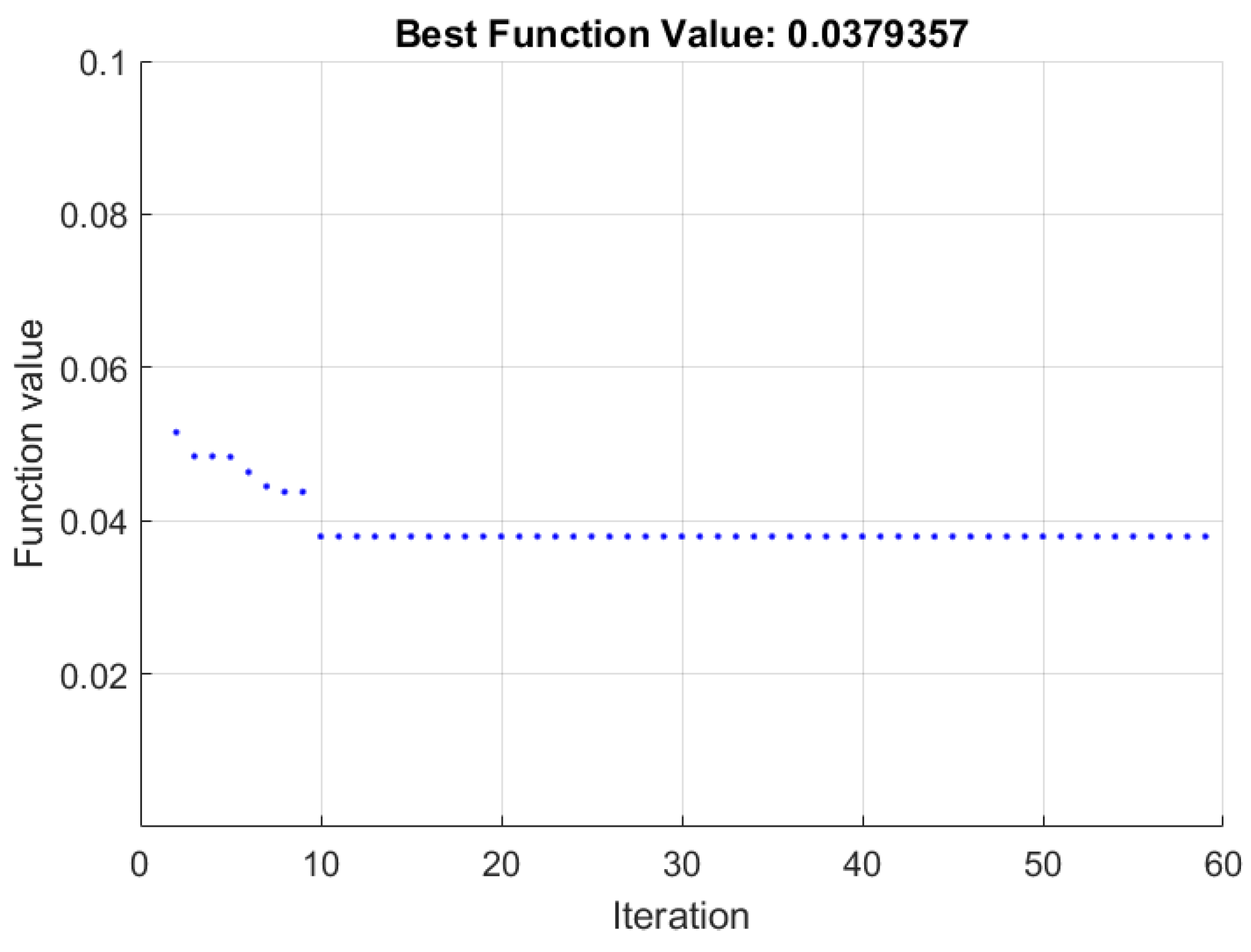
The weights of the objective function defined in Equation (2) (Section 3.1) were set to ω a = 100 and ω b = 1 . The best solution obtained by the PSO-OPF-Kron algorithm achieved a fitness function of 0.03793 , and the algorithm converged in 48 min with 58 iterations. Figure 5 shows the convergence curve and indicates that the algorithm stopped after 58 iterations, since there were no changes in the fitness function exceeding the tolerance occurred over 50 consecutive iterations.
The reduced networks obtained using the Kron and PSO–OPF–Kron algorithms were adapted for EMT modeling in the ATP-EMTP (Alternative Transients Program-Electromagnetic Transients Program) with ATPDraw (version 7.2) to evaluate the equivalent parameters and monitored variables. The EMT models employ a three-phase representation in sequence components, converted to physical units, with transmission lines modeled using distributed parameters. All programming and simulations were performed on a Dell computer equipped with an Intel Core i7 processor and 16 GB of RAM. The following results present the equivalent parameters obtained for both reduced networks in the ATP-EMTP software. The parameters indicated with superscript * are derived from the optimized method, whereas the remaining parameters are obtained through Kron reduction.
The equivalent positive sequence resistances and reactances ( r l 1 , x l 1 ) in the TLs after the network reduction process are presented in Table 3. The red bold values indicate the negative resistances resulting from the Kron reduction process, which were subsequently replaced by optimal positive values through the application of the PSO-OPF-Kron algorithm. In this particular case study, only the positive sequence values were optimized and replaced. The other values remained the same as those obtained via Kron reduction.
The results obtained for the transformers tap changes, active and reactive powers, and internal voltage and angles of the original and equivalent generations are shown in Table 4, Table 5 and Table 6.
The nominal tap value of 1.025 was retained for both transformers after the Kron reduction process, whereas the PSO-OPF-Kron algorithm determined the optimal tap values for the transformers, adhering to the specified search range.

5.2. Reduced Network Validation

The reduced network was validated through comparative analyses of the power flow and short-circuit deviations between the parameters of the internal area and the CS. The tolerance adopted for RS validation process was σ = 5 % . This analysis was conducted for both reduced networks described in Section 5.1 (applying the Kron method and PSO-OPF-Kron) under same loading conditions and performed in ATP-EMTP. The results and comparative analyses for the validation of the reduced network through load flow and short-circuit analyses are detailed as follows.

5.2.1. Load Flow Analysis

A load flow study was first performed for the CS to obtain the reference parameters used in the validation process. Subsequently, another load flow analysis was carried out to determine the operating variables of the reduced network and to evaluate the deviations (%) in bus voltage magnitudes and phase angles, active and reactive power generation, and load flows within the IA relative to the CS. These results are presented in Table 7, Table 8, Table 9, Table 10, Table 11 and Table 12 for the CS reference values, along with the corresponding errors relative to the CS for each reduced system under analysis.
The voltage magnitudes at the buses within the internal area exhibited minimal errors for both RS, with a maximum deviation of 0.290% at bus 25 for Kron RS and 1.963% at bus 30 (slack bus) in the PSO-OPF-Kron RS. Regarding the phase angles, the deviations decreased in the optimal model RS, as can be observed, reaching a maximum of 3.313% for the Kron reduction and 1.550% for the optimized model.
For the power generation of the original generators, the errors were minimal for both RS, with a maximum error of 1.186% for active power in the optimal RS and 1.921% regarding reactive power for Kron reduction RS. A slight increase in deviations for active power generation was observed in the optimized model, particularly at bus 30. Conversely, for the same bus, a slight reduction in error was noted for the PSO-OPF-Kron model when assessing reactive power generation.
In the context of active power flows, minor errors were noticeable in both reduced networks, with the most significant deviation occurring at TL10, where a 6.60% maximum error was observed in the network reduced by Kron. The highest errors in TLs decreased with implementation of the optimized network, reaching a maximum of 5.29% for TL9. For the reactive flows, a maximum error of 11.91% was observed in TL9 for Kron RS, while a reduction in deviation was noted at TL6 and TL10 after the application of the optimized RS.

5.2.2. Short Circuit Analysis

A short circuit analysis was conducted for both the CS and reduced network to comparatively evaluate the relative deviations of the single-phase and three-phase short-circuit currents at the buses in the RS. Reference values were calculated in the CS and compared with those short-circuit currents obtained from the original and optimized RS. The single-phase and three-phase short-circuit currents, as well as the errors relative to the CS for each reduced system, are presented in Table 13 and Table 14, respectively. The red bold values in the tables indicate the highest deviations found in the IA for both RS.
The errors for single-phase short-circuit currents in both RSs remained within a similar range and order of magnitude. The single-phase short-circuit currents exhibited slight variations, particularly at bus 30, with the highest deviation reaching 2.879% for the optimized RS. The three-phase short-circuit currents also demonstrated minimal errors, with a maximum deviation of 0.285% when the fault was applied at bus 25 in the original RS and 1.362% at bus 2 for the optimized RS.

5.3. Reduced Network Validation for a Different Load Condition and Reduction Method

The validation of the reduced network was also evaluated for additional operating points, including the system under normal loading conditions, which yielded the most relevant results. Furthermore, an alternative methodology for obtaining equivalent networks adapted from the traditional Kron reduction was assessed in comparison with the optimized RS. In this approach, the Kron-reduced equivalent model is first obtained, and the negative resistance values are subsequently set to zero. This practice is commonly reported in the recent literature (as discussed in Section 1) and is also frequently adopted by engineers performing EMT studies in the power sector.
For the same study area presented in Section 5.1, the network was reduced using both the adapted Kron-based method and the optimized approach, and the resulting errors were analyzed with respect to the complete system under normal load conditions. Table 15 presents the average errors associated with each monitored variable in the internal area, obtained from the load flow and short-circuit analyses. The average errors (in %) correspond to the Kron-reduced model with negative resistances set to zero (− R = 0) and to the optimized PSO-OPF-Kron model.
The results show that, under normal loading conditions, the optimized reduced model exhibits smaller average errors relative to the complete system for most of the monitored variables. This indicates that the PSO-OPF-Kron algorithm also performed effectively under this operating condition, providing better-adjusted equivalent parameters compared to the adapted Kron-reduced model.

5.4. Load Rejection Study

In this section, a load rejection analysis was conducted using ATP-EMTP. This investigation aims to evaluate the transient voltage responses at the circuit breakers, as well as the energy dissipated in the line surge arresters at the terminals of the transmission line under study. This analysis was performed for both reduced networks, that is, the original RS (without variable and parameter readjustment) and the optimized RS resulting from the application of the proposed PSO-OPF-Kron algorithm.
The transmission line selected for this study was TL6, 101.2 km in length, located between buses b 2 and b 3 (highlighted in yellow in Figure 4). The circuit breakers and surge arresters at both ends of this transmission line were modeled for both RSs, considering the heavy loading conditions. Surge arresters rated at 420 kV, Class 4, with a 20 kA capacity and an energy absorption capacity of 6.5 kJ/kV, were employed. Consequently, the load rejection analysis was performed according to the six cases and timing events described in Section 4, Table 1. The ATP–EMTP simulations were executed with an integration time step of 1 μ s over a total duration of 150 ms.
The maximum transient overvoltages at the circuit breakers (in p.u.) and the energies dissipated at the line surge arresters (in kJ) during the analyzed period for each case and reduced network are presented in Table 16 and Table 17, respectively. The variations (in %) of the maximum voltage and energy values of the optimized RS related to original RS were measured to assess the amplitude differences and the potential impact of the optimized model on the transient responses.
Cases 2 and 6 demonstrate the most critical values for transient overvoltages and evaluated energy, respectively. These cases reached a peak of 1.748 p.u. at b 2 and 67.068 kJ at b 3 , both observed in the optimized RS.
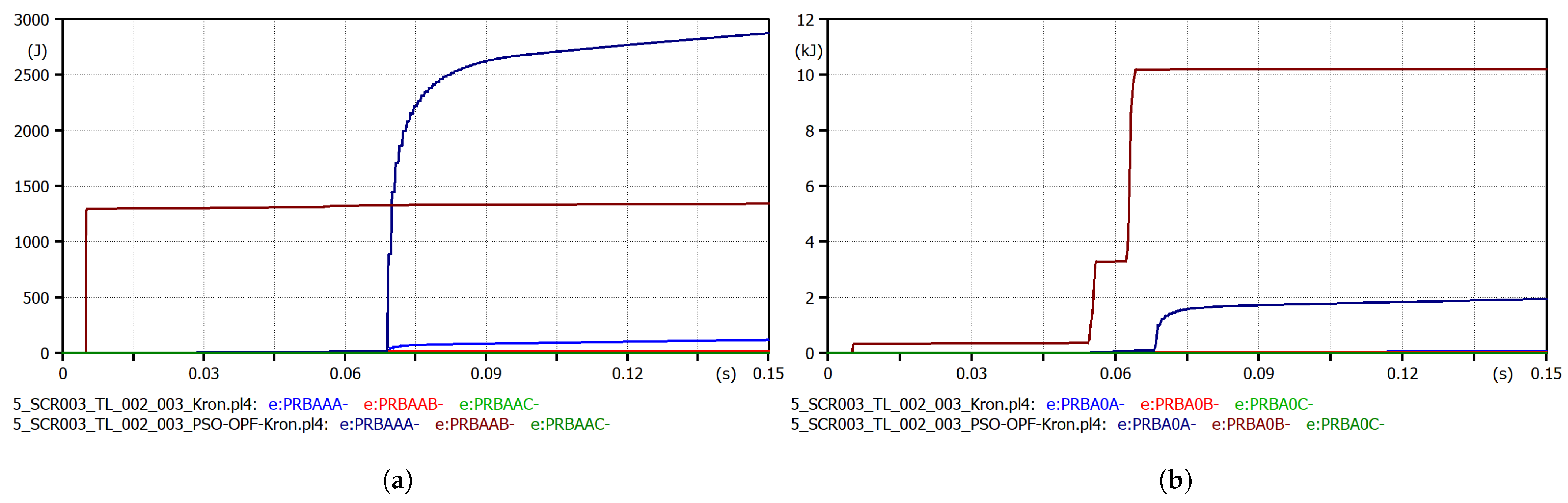
In case 5, the most significant deviations were observed between the reduced networks, with variations of 20.329% for overvoltages (in case 5 at b 2 ) and 27,491.9% for energy deviations (in case 5 at b 3 ).
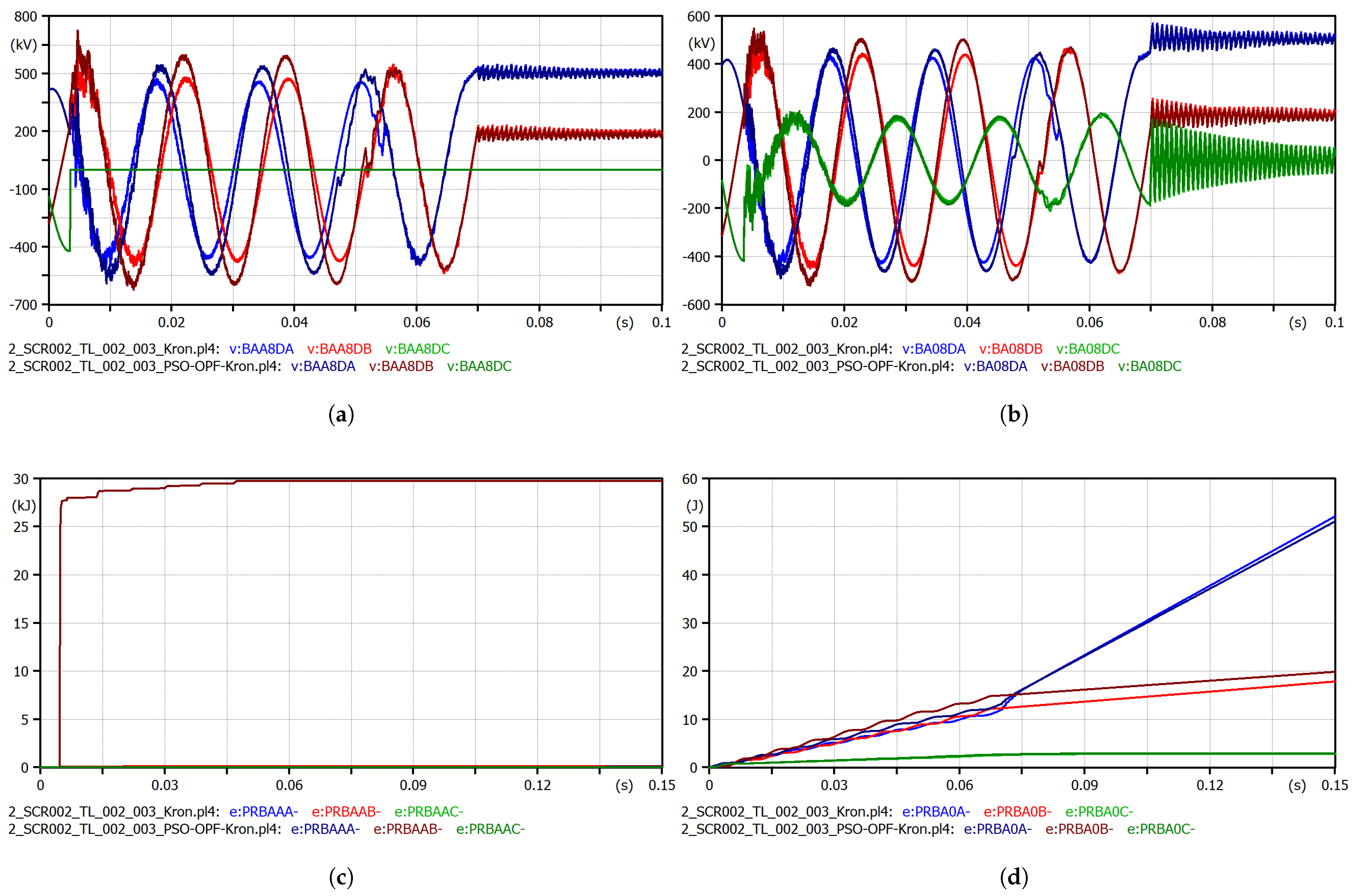
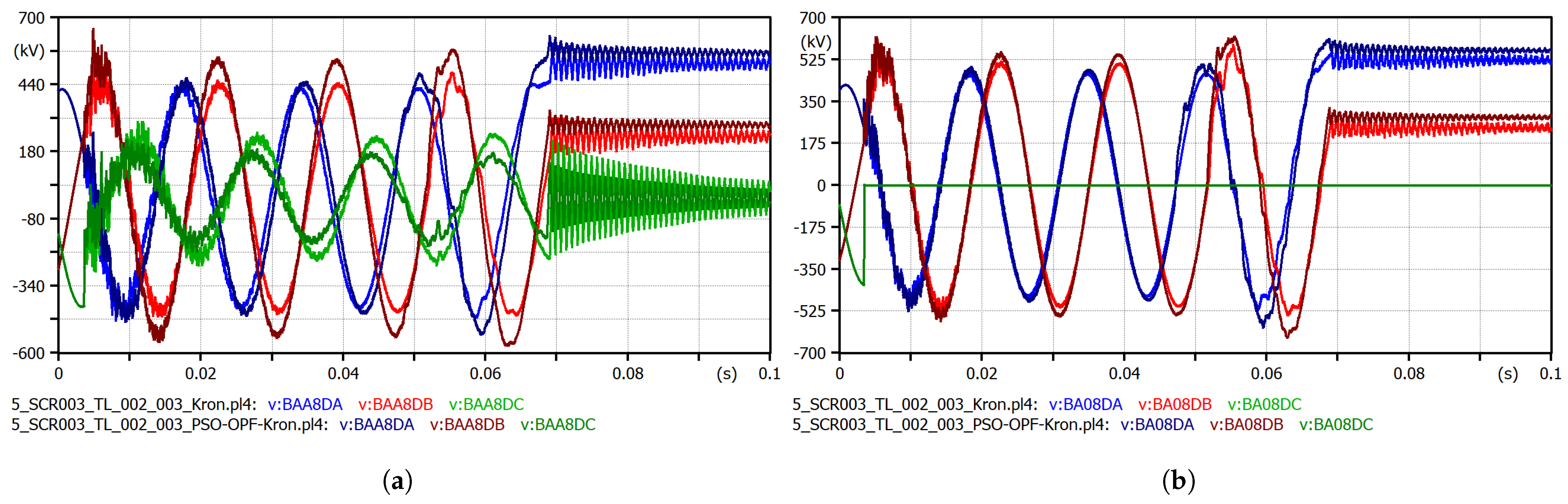
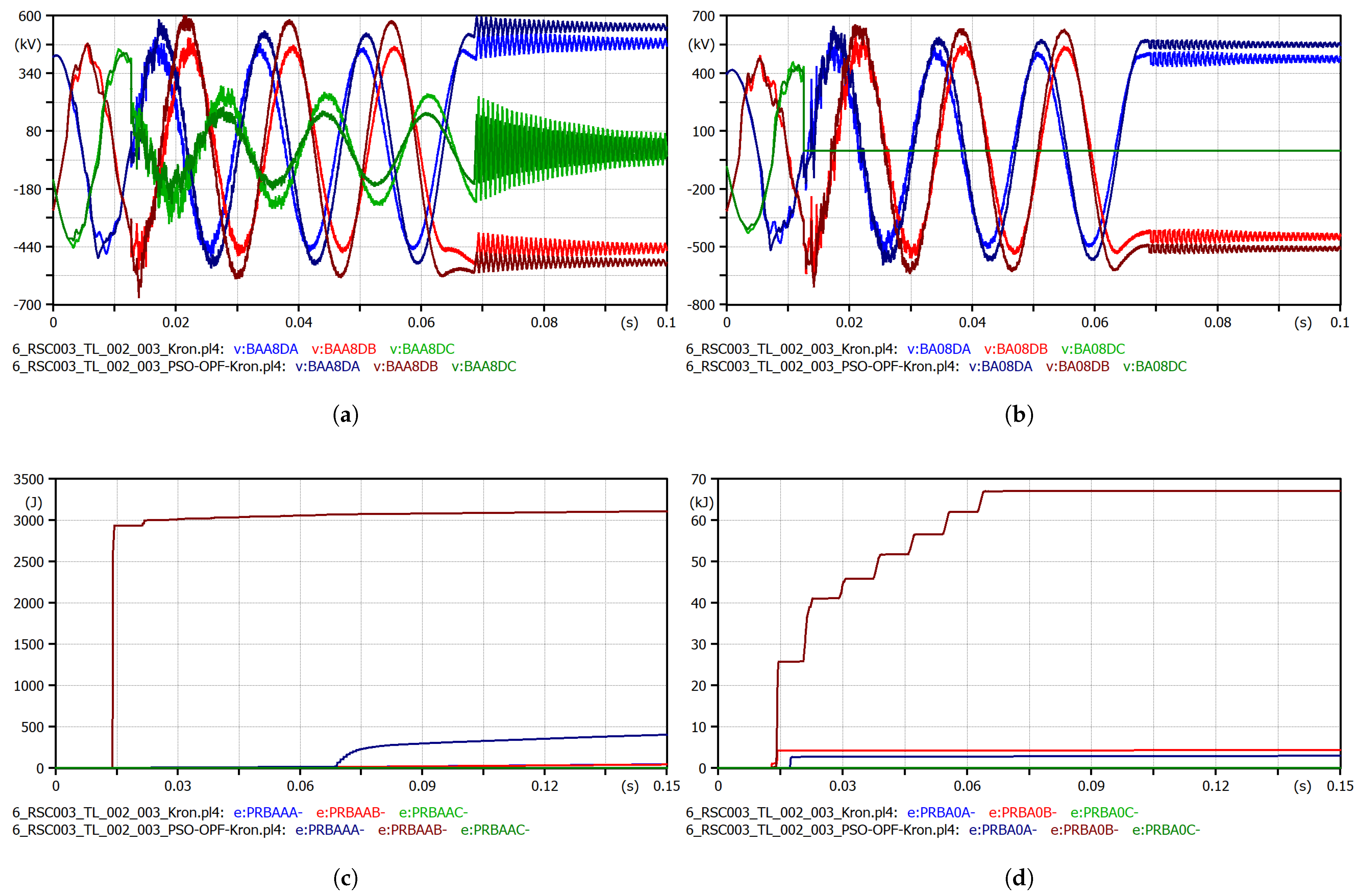
Figure 6, Figure 7, Figure 8 and Figure 9 show the transient responses of voltage (kV) and energy (J) over time (s), simulated using ATP-EMTP for the most critical cases. Each figure features six curves representing both RSs, for comparative analysis. The three phases (A-blue, B-red, and C-green) in lighter shades correspond to the original RS, while the darker shades represent the optimized RS. In the figures on the left side, (a) and (c), the analysis focuses on the circuit breaker and surge arresters connected to b 2 (BAA8D circuit breaker and PRBAA surge arrester), whereas the right side, (b) and (d), pertains to those connected to b 3 (BA08D circuit breaker and PRBA0 surge arrester).
The most significant voltage and energy peaks were observed in case 2 (Figure 6a) and case 6 (Figure 9b). In case 2, a single-phase fault was applied to the TL on phase C at 3.4 ms. The circuit breaker then opened at b 2 at 46.8 ms and subsequently on b 3 at 66.8 ms , with the fault being fully cleared at 120 ms. The curves in figure show a voltage of approximately 713.78 kV. In case 6, the circuit breaker first opened at b 3 at 0.14 ms . A single-phase fault was applied to the TL at 12.5 ms , and the breaker at b 2 operated at 63 ms . The fault was cleared at 120 ms . The figures present overvoltage and energy peaks of approximately 705.27 kV and 67.068 kJ at b 3 , respectively.
In the comparative analysis of the phase curves between the reduced models and their respective deviations, particular attention was given to case 5 (Figure 7a,b), which showed significant voltage deviations of 20.320% and 17.519% for b 2 and b 3 , respectively. Additionally, cases 2 (Figure 6c) and 5 (Figure 8b) demonstrated notable energy deviations in the phase B, with 24,493.4% and 27,491.9% for b 2 and b 3 , respectively.

6. Conclusions

This paper presented an optimization-based framework, termed PSO-OPF-Kron, for determining the optimal parameters of equivalent networks and improving the representation of the internal area in EMT load rejection studies. Load flow and short-circuit analyses demonstrated that the optimized model substantially reduced the discrepancies associated with the traditional Kron-based reduction, particularly in bus voltage phase angles and reactive power flows within the internal area. The PSO-OPF-Kron algorithm accurately reproduced the steady-state voltage profiles under heavy-load conditions and preserved the short-circuit current magnitudes at the study area buses, enabling more reliable EMT simulations. In addition, it effectively eliminated the negative impedance values inherent to the classical Kron reduction while maintaining physical consistency in the equivalent network.
The optimized reduced system also improved the accuracy of the transient simulations. The EMT base case obtained from the proposed approach produced more accurate circuit breaker voltage responses and surge arrester energy evaluations, as evidenced by the significant deviations in peak overvoltages and absorbed energy (20.33% and 27,491.9% higher, respectively, in the worst-case scenarios compared to the original reduced system). These results highlight the strong influence of parameter optimization on the transient behavior and confirm the ability of the proposed method to generate physically consistent and numerically stable reduced-order models suitable for reliable EMT analyses.

Author Contributions

Conceptualization, K.F., R.K., and T.S.P.F.; Methodology, K.F., R.K., and T.S.P.F.; Software, K.F., R.K., T.S.P.F., and W.F.S.S.; Validation, K.F., R.K., T.S.P.F., W.F.S.S., and M.A.S.M.; Formal analysis, K.F., R.K., and T.S.P.F.; Investigation, K.F., R.K., T.S.P.F., W.F.S.S., and M.A.S.M.; Resources, R.M.; Writing—original draft preparation, K.F.; Writing—review and Editing, K.F., R.K., T.S.P.F., W.F.S.S., M.D.T., A.R.A., M.A.S.M., and R.M.; Supervision, R.K. and T.S.P.F.; Project administration, M.D.T., A.R.A., and R.M. All authors have read and agreed to the published version of the manuscript.

Funding

The authors express gratitude for funding assistance from Companhia Paranaense de Energia—COPEL Generation and Transmission S.A. in the research and technological development (RTD) program, through the PD-06491-0563/2019 project, regulated by ANEEL.

Data Availability Statement

The original contributions presented in this study are included in the article; further inquiries can be directed to the corresponding author.

Conflicts of Interest

The authors declare no conflicts of interest.

Abbreviations

The following abbreviations are used in this manuscript:
EMTEletromagnetic Transient
EPSElectric Power System
REIRadial Equivalent Injection
PTDFPower Transfer Distribution Factor
OPFOptimal Power Flow
PSOParticle Swarm Optimization
TLTransmission Line
CSComplete System
RSReduced System
IAInternal Area
EAExternal Area
EGEquivalent Generator
ECEquivalent Circuit
IPMInterior Point Method

References

  1. Zhu, J.; Li, Y.; Ding, P. Review of Equivalent Methods for Power System. In Proceedings of the 2023 8th Asia Conference on Power and Electrical Engineering (ACPEE), Tianjin, China, 14–16 April 2023. [Google Scholar]
  2. Zhuo, Z.; Zhang, N.; Xie, X.; Li, H.; Kang, C. Key technologies and developing challenges of power system with high proportion of renewable energy. Autom. Electr. Power Syst. 2021, 45, 171–179. [Google Scholar]
  3. Xie, X.; He, J.; Mao, H.; Li, H. New issues and classification of power system stability with high shares of renewables and power electronics. CSEE J. Power Energy Syst. (JPES) 2021, 41, 461–475. [Google Scholar]
  4. Li, Y.; Zhang, X.; Hu, S.; Mu, Q. Modeling and simulation technology for stability analysis of power system with high proportion of power electronics. Autom. Electr. Power Syst. 2022, 46, 33–42. [Google Scholar]
  5. Xiong, Q.; Zhang, L.; Zhang, Q.; Zhang, D.; Fan, S.; Wang, L. High-performance electromagnetic transient simulation technology and application for new power system. Autom. Electr. Power Syst. 2022, 46, 43–52. [Google Scholar]
  6. Sowa, P.; Zychma, D. Dynamic Equivalents in Power System Studies: A Review. Energies 2022, 15, 1396. [Google Scholar] [CrossRef]
  7. Reddy, C.V.B.; Chakrabarti, S.; Srivastava, S. Reduced Network Based Voltage Stability Monitoring by Using PMU Measurements. Proceedings of 2016 IEEE Region 10 Conference (TENCON), Singapore, 22–25 November 2016. [Google Scholar]
  8. Ashraf, S.M.; Gupta, A.; Choudhary, D.K.; Chakrabarti, S. Voltage Stability Monitoring of Power Systems Using Reduced Network and Artificial Neural Network. Int. J. Electr. Power Energy Syst. 2017, 87, 43–51. [Google Scholar] [CrossRef]
  9. Angelos, E.W.S.; Asada, E.N. Bad Data Processing for Real-Time Equivalent Networks. In Proceedings of the 2015 IEEE Power & Energy Society General Meeting, Denver, CO, USA, 26–30 July 2015. [Google Scholar]
  10. Khodadadi, M.; Khalilifar, M.; Shahrtash, S. A Novel Static External Network Equivalencing Method for Protection Studies on Iran Transmission Grid. In Proceedings of the 9th Power Systems Protection and Control Conference (PSPC2015), Tehran, Iran, 14–15 January 2015. [Google Scholar]
  11. Dongare, K.; Chakrabarti, S.; Kyriakides, E. Power System State Estimation Considering Real-Time Equivalents of the External Networks. In Proceedings of the 2013 IEEE Innovative Smart Grid Technologies-Asia (ISGT Asia), Bangalore, India, 10–13 November 2013. [Google Scholar]
  12. Fujisawa, C.; Martins, L.; Azevedo, A.; Soares, S. Equivalent Networks for Medium-Term Hydro-Thermal Scheduling with Variable Head Cascaded Reservoirs and Transmission Constraints. In Proceedings of the 2014 Power Systems Computation Conference (PSCC), Wroclaw, Poland, 18–22 August 2014. [Google Scholar]
  13. Hao, S.; Papalexopoulos, A. External Network Modeling for Optimal Power Flow Applications. IEEE Trans. Power Syst. 1995, 10, 825–837. [Google Scholar] [CrossRef]
  14. Nagendra, P.; Dey, S.H.; Paul, S. OPF Based Voltage Stability Assessment of a Multi-Bus Power System Using Network Equivalencing Technique. In Proceedings of the 2009 International Conference on Power Systems, Kharagpur, India, 27–29 December 2009. [Google Scholar]
  15. Kron, G. Tensor Analysis of Networks and Systems, 2nd ed.; John Wiley & Sons: New York, NY, USA, 1959. [Google Scholar]
  16. Ward, J.B. Equivalent Circuits for Power-Flow Studies. Electr. Eng. 1949, 68, 794–796. [Google Scholar] [CrossRef]
  17. Wang, R.; Sun, Z. Modelling and Kron Reduction of Power Flow Networks in Directed Graphs. arXiv 2023, arXiv:2302.08896. [Google Scholar] [CrossRef]
  18. Shultz, R.; Smith, R.; Stevens, R. Incorporation of Linearized Sensitivities in the Ward Method of Equivalencing. IEEE Trans. Power Appar. Syst. 1983, 5, 1317–1323. [Google Scholar] [CrossRef]
  19. Debs, A. Estimation of External Network Equivalents from Internal System Data. IEEE Trans. Power Appar. Syst. 1975, 94, 1975. [Google Scholar] [CrossRef]
  20. Pavic, I.; Hebel, Z.; Delimar, M. Power System Equivalent Based on an Artificial Neural Network. In Proceedings of the 23rd International Conference on Information Technology Interfaces, Pula, Croatia, 22 June 2001. [Google Scholar]
  21. Gupta, A.P.; Mohapatra, A.; Singh, S.N. Power System Network Equivalents: Key Issues and Challenges. In Proceedings of the In Proceedings of TENCON 2018—2018 IEEE Region 10 Conference, Jeju, Republic of Korea, 28–31 October 2018. [Google Scholar]
  22. Fortenbacher, P.; Demiray, T.; Schaffner, C. Transmission Network Reduction Method using Nonlinear Optimization. In Proceedings of the 2018 Power Systems Computation Conference (PSCC), Dublin, Ireland, 11–15 June 2018. [Google Scholar]
  23. Shi, D.; Tylavsky, D.J. A Novel Bus-Aggregation-Based Structure-Preserving Power System Equivalent. IEEE Trans. Power Syst. 2015, 30, 1977–1986. [Google Scholar] [CrossRef]
  24. Ploussard, Q. Efficient Reduction Techniques for a Large-Scale Transmission Expansion Planning Problem. Ph.D. Thesis, Universidad Pontificia Comillas, Madrid, Spain, 2019. [Google Scholar]
  25. Goeritno, A.; Raharjo, J.; Murti, M.A.; Adam, K.B. Optimizing bus elimination with Kron reduction method: An experimental evaluation on the IEEE 14-bus system. Int. J. Comput. Methods Exp. Meas. 2025, 13, 427–440. [Google Scholar] [CrossRef]
  26. Chevalier, S.; Almassalkhi, R. Towards Optimal Kron-based Reduction Of Networks (Opti-KRON) for the Electric Power Grid. In Proceedings of the 2022 IEEE 61st Conference on Decision and Control (CDC), Cancun, Mexico, 6–9 December 2022. [Google Scholar]
  27. Dörfler, F.; Bullo, F. Kron Reduction of Graphs With Applications to Electrical Networks. IEEE Trans. Circuits Syst. I Regul. Pap. 2013, 60, 150–163. [Google Scholar] [CrossRef]
  28. Constante-Flores, G.E.; Conejo, A.J. Security-constrained unit commitment: A decomposition approach embodying Kron reduction. Eur. J. Oper. Res. 2024, 319, 427–441. [Google Scholar] [CrossRef]
  29. Huang, W.; Chen, M.; Low, S.H. Unsupervised learning for solving AC optimal power flows: Design, analysis, and experiment. IEEE Trans. Power Syst. 2024, 39, 7102–7114. [Google Scholar] [CrossRef]
  30. Mokhtari, O.; Chevalier, S.; Almassalkhi, M.R. Enhancing scalability of optimal Kron-based reduction of networks via decomposition with community detection. arXiv 2024, arXiv:2407.02679. Available online: https://arxiv.org/abs/2407.02679 (accessed on 12 January 2025).
  31. Samarawickrama, K.; Kariyawasam, A.; Kariyawasam, S. Investigation of Stability Issues Introduced by Network Reduction in EMT Simulations. In Proceedings of the International Conference on Power Systems Transients (IPST 2019), Perpignan, France, 17–20 June 2019. [Google Scholar]
  32. North American Electric Reliability Corporation (NERC). Reliability Guideline: Electromagnetic Transient Modeling for BPS-Connected Inverter-Based Resources—Recommended Model Requirements and Verification Practices; Document RG-MOD-0323-1; North American Electric Reliability Corporation: Atlanta, GA, USA, 2023; Available online: https://www.nerc.com/comm/RSTC_Reliability_Guidelines/Reliability_Guideline-EMT_Modeling_and_Simulations.pdf (accessed on 26 October 2025).
  33. Floriduz, A.; Tucci, M.; Riverso, S.; Ferrari-Trecate, G. Approximate Kron Reduction Methods for Electrical Networks with Applications to Plug-and-Play Control of AC Islanded Microgrids. IEEE Trans. Control Syst. Technol. 2019, 27, 2403–2416. [Google Scholar] [CrossRef]
  34. Zhu, L.; Huang, S.; Tang, Y.; Wang, Z.; Zeng, Y. Study on Negative Resistance Mechanism and Elimination Method of Network Simplification. IOP Conf. Ser. Mater. Sci. Eng. 2017, 199, 012118. [Google Scholar] [CrossRef]
  35. Campello, T.M.; Dicler, F.N.F.; Varricchio, S.L.; de Barros, H.M.; Costa, C.O.; Lima, A.C.S.; Taranto, G.N. Reviewing the Large Electrical Network Equivalent Methods Under Development for Electromagnetic Transient Studies in the Brazilian Interconnected Power System. Int. J. Electr. Power Energy Syst. 2023, 151, 107775. [Google Scholar] [CrossRef]
  36. Xia, C.J.; Liang, G.K.; Huang, H.Y. An Investigation of the Negative Resistance in Network Reduction and Electromagnetic Transient Modelling. Adv. Mater. Res. 2014, 1008–1009, 480–484. [Google Scholar] [CrossRef]
  37. Carpentier, J. Optimal power flows. Int. J. Electr. Power Energy Syst. 1979, 1, 3–15. [Google Scholar] [CrossRef]
  38. U.S. Federal Energy Regulatory Commission. History of Optimal Power Flow and Formulations; FERC: Washington, DC, USA, 2012.
  39. Pandya, K.S.; Joshi, S.K. A Survey of Optimal Power Flow Methods. J. Theor. Appl. Inf. Technol. 2005, 1, 1–9. [Google Scholar]
  40. Mohagheghi, E.; Alramlawi, M.; Gabash, A.; Li, P. A Survey of Real-Time Optimal Power Flow. Energies 2018, 11, 3142. [Google Scholar] [CrossRef]
  41. Skolfield, J.K. Operations Research in Optimal Power Flow: A Guide to Applications in Power Systems; Elsevier: Amsterdam, The Netherlands, 2022. [Google Scholar]
  42. Fernandes, T.S.P. Um Modelo de Despacho Ótimo de Potência para Sistemas Multi-Usuários. Ph.D. Thesis, UFSC, Florianópolis, Brazil, 2004. [Google Scholar]
  43. Fiacco, A.V.; McCormick, G.P. Nonlinear Programming: Sequential Unconstrained Minimization Techniques; John Wiley and Sons: New York, NY, USA, 1968. [Google Scholar]
  44. Kasikci, I. Short Circuits in Power Systems: A Practical Guide to IEC 60909; Wiley-VCH: Weinheim, Germany, 2017. [Google Scholar]
  45. Das, J.C. Short-Circuits in AC and DC Systems: ANSI, IEEE, and IEC Standards; CRC Press: Boca Raton, FL, USA, 2021. [Google Scholar]
  46. Zhou, Y.; Li, Z. The application of PSO in the power grid: A review. In Proceedings of the 2016 35th Chinese Control Conference (CCC), Chengdu, China, 27–29 July 2016. [Google Scholar]
  47. Kanata, S.; Sianipar, G.H.; Maulidevi, N.U. Hybrid Time Varying Particle Swarm Optimization and Genetic Algorithm to Solve Optimal Reactive Power Dispatch Problem. In Proceedings of the 2019 International Conference on Electrical Engineering and Informatics (ICEEI), Bandung, Indonesia, 9–10 July 2019. [Google Scholar] [CrossRef]
  48. Oumarou, I.; Jiang, D.; Cao, Y. Particle Swarm Optimization Applied to Optimal Power Flow Solution. In Proceedings of the 2009 Fifth International Conference on Natural Computation, Tianjian, China, 14–16 August 2009. [Google Scholar]
  49. Gomes, S.; Varricchio, S.L.; Martins, N.; Portela, C. Results on Modal Analysis to Speed-up Electromagnetic Transients Simulations. In Proceedings of the IEEE Power Engineering Society General Meeting, San Francisco, CA, USA, 12–16 June 2005. [Google Scholar]
  50. Grodzevich, O.; Romanko, O. Normalization and Other Topics in Multi-Objective Optimization; Fields Institute for Research in Mathematical Sciences: Toronto, ON, Canada, 2006. Available online: https://miis.maths.ox.ac.uk/233/1/fmipw1-6.pdf (accessed on 12 March 2025).
  51. He, L.; Ishibuchi, H.; Trivedi, A.; Wang, H.; Nan, Y. A survey of normalization methods in multiobjective evolutionary algorithms. IEEE Trans. Evol. Comput. 2021, 25, 1028–1048. [Google Scholar] [CrossRef]
  52. Brasilian Electrical System Operator (ONS, Using the Portuguese Acronym). Guidelines for the Development of Basic Design Projects for Transmission Facilities (Diretrizes para Elaboração de Projetos Básicos para Empreendimentos de Transmissão). 2019. Available online: https://www.ons.org.br/AcervoDigitalDocumentosEPublicacoes/Diretrizes%20para%20Projeto%20Basico_REV.1_2022_publica%C3%A7%C3%A3o.pdf#search=Diretrizes%20ONS (accessed on 1 December 2025).
  53. Brasilian Electrical System Operator (ONS, Using the Portuguese Acronym). Grid Procedures, Submodule 23.3—Guidelines and Criteria for Electrical Studies (Procedimentos de Rede, Submódulo 23.3—Diretrizes e Critérios para Estudos Elétricos). 2022. Available online: https://www.ons.org.br/ProcedimentosDeRede/M%C3%B3dulo%2023/Subm%C3%B3dulo%2023.3/Subm%C3%B3dulo%2023.3%202016.12.pdf#search=Procedimentos%20de%20rede%20submodulo%2023%2E3 (accessed on 1 December 2025).
  54. Cañizares, C.; Fernandes, T.C.C.; Geraldi, E.L., Jr.; Gerin-Lajoie, L.; Gibbard, M.; Hiskens, I.; Kersulis, J.; Kuiava, R.; Lima, L.; De Marco, F.; et al. Benchmark Models for the Analysis and Control of Small-Signal Oscillatory Dynamics in Power Systems. IEEE Trans. Power Syst. 2017, 32, 715–722. [Google Scholar] [CrossRef]
Figure 1. Network reduction: (a) General overview. (b) Equivalent network detail.
Energies 19 00321 g001
Figure 2. Flowchart of the PSO-OPF-Kron algorithm.
Energies 19 00321 g002
Figure 3. The IEEE 39-bus electrical system and the delimitation of the study area for the proposed scenario.
Energies 19 00321 g003
Figure 4. Proposed reduced network.
Energies 19 00321 g004
Figure 5. PSO-OPF-Kron convergence curve.
Energies 19 00321 g005
Figure 6. Case 2. Single-phase fault on TL6, followed by load rejection at b 2 terminal: (a) Voltage at b 2 circuit breaker (kV). (b) Voltage at b 3 circuit breaker (kV). (c) Energy dissipated in b 2 lightning arrester (J). (d) Energy dissipated in b 3 lightning arrester (J).
Energies 19 00321 g006
Figure 7. Case 5. Single-phase fault on TL6, followed by load rejection at b 3 terminal: (a) Voltage at b 2 circuit breaker (kV). (b) Voltage at b 3 circuit breaker (kV).
Energies 19 00321 g007
Figure 8. Case 5. Single-phase fault on TL6, followed by load rejection at the b 3 terminal: (a) Energy dissipated in b 2 lightning arrester (J). (b) Energy dissipated in b 3 lightning arrester (J).
Energies 19 00321 g008
Figure 9. Case 6. Simple rejection by b 3 terminal, followed by a single-phase fault at this terminal: (a) Voltage at b 2 circuit breaker (kV). (b) Voltage at b 3 circuit breaker (kV). (c) Energy dissipated in b 2 lightning arrester (kJ). (d) Energy dissipated in b 3 lightning arrester (kJ).
Energies 19 00321 g009
Table 1. Test cases and sequence of events for the EMT load rejection study.
CasesDescriptionSequence of Events
1Simple rejection at BUS-A1—Opening of the BUS-A circuit breaker (15.3 ms)
2Single-phase short circuit on the TL, followed by load rejection at the BUS-A terminal1—Single-phase short circuit at BUS-A (3.4 ms)
2—Opening of the BUS-A circuit breaker (46.8 ms)
3—Opening of the BUS-B circuit breaker (66.8 ms)
4—Single-phase short circuit clearing at BUS-A (120 ms)
3Simple rejection at the BUS-A terminal, followed by a single-phase fault at this terminal1—Opening of the BUS-A circuit breaker (0.14 ms)
2—Single-phase short circuit on BUS-A (12.5 ms)
3—Opening of the BUS-B circuit breaker (63.0 ms)
4—Single-phase short circuit clearing at BUS-A (120 ms)
4Simple rejection at BUS-B1—Opening of the BUS-B circuit breaker (15.3 ms)
5Single-phase short circuit at the TL, followed by load rejection at the BUS-B terminal1—Single-phase short circuit on BUS-B (3.4 ms)
2—Opening of the BUS-B circuit breaker (46.8 ms)
3—Opening of the BUS-A circuit breaker (66.8 ms)
4—Single-phase short circuit clearing at BUS-B (120 ms)
6Simple rejection at the BUS-B terminal, followed by a single-phase fault at this terminal1—Opening of the BUS-B circuit breaker (0.14 ms)
2—Single-phase short circuit on BUS-B (12.5 ms)
3—Opening of the BUS-A circuit breaker (63.0 ms)
4—Single-phase short circuit clearing at BUS-B (120 ms)
Table 2. Minimum and maximum OPF ans PSO limits.
LimitsIAEG and EC
P G R S m i n ϕ P G = 2.5 % 10  p.u.
P G R S m a x ϕ P G = 2.5 % 10 p.u.
Q G R S m i n ϕ Q G = 3 % 10  p.u.
Q G R S m a x ϕ Q G = 3 % 10 p.u.
P l R S m i n ϕ P l = 2 % 20  p.u.
P l R S m a x ϕ P l = 2 % 20 p.u.
V R S m i n 0.6  p.u. 0.6  p.u.
V R S m a x 1.2  p.u. 1.2  p.u.
a R S m i n 0.9 1.0
a R S m a x 1.1 1.0
r 1 R S m i n  and  x 1 R S m i n 0 p.u.
r 1 R S m a x  and  x 1 R S m a x 0.05  p.u.
Table 3. Positive sequence impedances of the internal area after network reduction using the Kron ( r l 1 K r o n e x l 1 K r o n ) e PSO-OPF-Kron ( r l 1 e x l 1 ) methods.
TLFROM BusTO Bus rl 1 Kron ( % ) xl 1 Kron ( % ) rl 1 ( % ) xl 1 ( % )
2001004−4.3375.910.9975.91
3001018−393.132485.042.732485.04
4001026−1837.019730.3309730.33
5001EG10.143.030.143.03
11004018−0.8612.020.212.02
12004026−4.7947.2047.2
13004EG20.962.360.962.36
140180260.125.180.125.18
15018EG32.164.542.164.54
18026EG42.995.052.995.05
The red bold values represent the negative resistances obtained from the Kron reduction process, which were replaced with optimal positive values by applying the PSO-OPF-Kron algorithm.
Table 4. Tap settings in the internal area transformers after network reduction using the Kron ( a K r o n = a N o m ) e PSO-OPF-Kron ( a ) methods.
TRFROM BusTO Bus a Kron a
80020301.0251.0009
170250371.0251.0111
Table 5. Active and reactive power dispatched by equivalent generators after Kron ( P G E K r o n , Q G E K r o n ) and PSO-OPF-Kron ( P G , Q G ) network reduction.
Bus PG Kron (MW) PG (MW) QG Kron (Mvar) QG (Mvar)
40−397.14−398.195.5195.7
41−381.08−377.4−0.96.9
42−327.61−328.233.8633.0
43−105.92−115.539.5736.9
Table 6. Internal voltage magnitudes and angles of equivalent and original generators after Kron ( V G K r o n , θ K r o n ) and PSO-OPF-Kron ( V G , θ ) network reduction.
Bus VG Kron (p.u.) VG (p.u.) θ Kron (Rad) θ (Rad)
401.08561.0843−0.4398−0.4346
410.99280.9931−0.4642−0.4572
420.98690.9852−0.4887−0.4834
431.03241.027−0.3019−0.3019
1001.10591.12360.22010.2127
3001.18701.19330.45200.4478
Table 7. Voltage magnitudes in the CS internal area buses ( V b C S ) and corresponding errors.
Bus Vb CS (p.u.) Vb Kron Error  (%) Vb Error  (%)
0011.0580.0600.195
0021.0350.1990.346
0031.0270.2310.363
0041.0260.1550.289
0181.0310.1930.311
0251.0510.2900.460
0261.0440.2190.379
0301.0300.1481.963
0371.0400.2070.900
The red bold values indicate the maximum deviations observed in the IA for each RS.
Table 8. Phase angles in the CS internal area buses θ b C S and corresponding errors.
Bus θ bCS (Rad) θ bKron Error  (%) θ b Error  (%)
001−0.33230.3921.362
002−0.17412.2541.546
003−0.30711.7300.373
004−0.37290.7311.103
018−0.33051.1810.561
025−0.13893.0551.550
026−0.23841.1540.654
030000
0370.079653.3131.262
The red bold values indicate the maximum deviations observed in the IA for each RS.
Table 9. Active power generation in the CS internal area ( P G C S ) and corresponding errors.
Bus PG CS (MW) PG Kron Error (%) PG Error (%)
030995.090.7411.186
037999.900.2900.420
The red bold values indicate the maximum deviations observed in the IA for each RS.
Table 10. Reactive power generation in the CS internal area ( Q G C S ) and corresponding errors.
Bus QG CS (Mvar) QG Kron Error (%) QG Error (%)
030202.611.9211.565
037151.021.7661.907
The red bold values indicate the maximum deviations observed in the IA for each RS.
Table 11. Active power flow in the CS internal area TLs ( P l C S ) and corresponding errors.
TLFROM BusTO Bus Pl CS (MW) Pl Kron Error (%) Pl Error (%)
1001002−408.921.511.25
6002003936.390.700.66
7002025−355.982.003.03
9003004325.074.335.29
10003018182.666.604.50
16025026337.981.760.11
The red bold values indicate the maximum deviations observed in the IA for each RS.
Table 12. Reactive power flow in the CS internal area TLs ( Q l C S ) and corresponding errors.
TLFROM BusTO Bus Ql CS (Mvar) Ql Kron Error (%) Ql Error (%)
100100289.241.221.86
600200323.547.412.84
7002025101.521.782.04
9003004−17.5511.9111.62
10003018−58.502.360.05
16025026−23.434.195.52
The red bold values indicate the maximum deviations observed in the IA for each RS.
Table 13. Single-phase short-circuit currents in the CS internal area buses ( I S C 1 P C S ) and corresponding errors.
Bus I SC 1 P CS (kA) I SC 1 P Kron Error (%) I SC 1 P Error (%)
0013.990.2780.279
0027.750.6722.650
0036.180.0100.409
0046.240.1480.141
0185.290.0140.108
0255.850.4151.594
0264.220.1620.043
030206.281.6122.879
037134.860.7371.348
The red bold values indicate the maximum deviations observed in the IA for each RS.
Table 14. Three-phase short-circuit currents in the CS internal area buses ( I S C 3 P C S ) and corresponding errors.
Bus I SC 3 P CS (kA) I SC 3 P Kron Error (%) I SC 3 P Error (%)
0016.290.0530.061
0029.50.1191.362
0038.430.1660.295
0048.070.1900.076
0187.440.1880.031
0257.760.2310.854
0265.790.2110.033
030205.450.1241.050
037138.820.1890.448
The red bold values indicate the maximum deviations observed in the IA for each RS.
Table 15. Average errors for the monitored variables in the internal area for the adapted Kron reduction ( K r o n R = 0 ) and optimized RS ( P S O O P F K r o n ) under normal load condition.
Variables Kron R = 0 Error Average ( % ) PSO OPF Kron Error Average ( % )
V b 0.04700.0567
θ b 2.16591.0243
P G 0.65890.4311
Q G 2.2360.610
P l 3.35131.5298
Q l 4.38273.027
I S C 1 P 12.21012.168
I S C 3 P 0.10250.1025
Table 16. Maximum transient overvoltage in the circuit breakers at TL6 terminals ( b 2 and b 3 ) in the original RS ( V m a x b K r ) and optimized RS ( V m a x b ) to the proposed cases and variations between them (%).
CaseDescription Vmax b 2 Kr (p.u.) Vmax b 2 (p.u.) Δ Vmax b 2 (%) Vmax b 3 Kr (p.u.) Vmax b 3 (p.u.) Δ Vmax b 3 (%)
1Simple rejection at b 2 1.1491.1470.1811.0321.0290.311
2Single-phase fault on the TL, followed by load rejection at the b 2 terminal1.5111.74815.7441.3811.3581.646
3Simple rejection by the b 2 terminal, followed by a single-phase fault at this terminal1.3181.3021.1901.2531.2520.051
4Simple rejection at b 3 1.1551.1983.7371.1731.2647.733
5Single-phase fault on the TL, followed by load rejection at the b 3 terminal1.3101.57620.3291.3261.55817.519
6Simple rejection by the b 3 terminal, followed by a single-phase fault at this terminal1.3171.57719.7021.6601.7284.057
The red bold values highlight the maximum transient overvoltages and the highest deviations observed in the EMT load rejection study.
Table 17. Maximum energy dissipated in lightning arresters at LT6 terminals ( b 2 and b 3 ) in the original RS ( E m a x b K r ) and optimized RS ( E m a x b ) to the proposed cases and variations between them (%).
CaseDescription Emax b 2 Kr (kJ) Emax b 2 (kJ) Δ Emax b 2 (%) Emax b 3 Kr (kJ) Emax b 3 (kJ) Δ Emax b 3 (%)
1Simple rejection at b 2 NegligibleNegligible-NegligibleNegligible-
2Single-phase fault on the TL, followed by load rejection at the b 2 terminal0.12129.75824,493.4NegligibleNegligible-
3Simple rejection by the b 2 terminal, followed by a single-phase fault at this terminalNegligibleNegligible-NegligibleNegligible-
4Simple rejection at b 3 NegligibleNegligible-NegligibleNegligible-
5Single-phase fault on the TL, followed by load rejection at the b 3 terminalNegligibleNegligible-0.03710.20927,491.9
6Simple rejection by the b 3 terminal, followed by a single-phase fault at this terminalNegligibleNegligible-4.34967.0681442.1
The red bold values highlight the maximum dissipated energies and the highest deviations observed in the EMT load rejection study.
Disclaimer/Publisher’s Note: The statements, opinions and data contained in all publications are solely those of the individual author(s) and contributor(s) and not of MDPI and/or the editor(s). MDPI and/or the editor(s) disclaim responsibility for any injury to people or property resulting from any ideas, methods, instructions or products referred to in the content.