Next Article in Journal
The Application of Rate Transient Analysis for the Production Performance Evaluation of the Temane Gas Field–Mozambique: The Use of the Per-Well Basis Approach
Previous Article in Journal
Anaerobic Digestion of Flower Waste: A Mini Review on Biomethane Potential, Process Optimization, and Sustainability Perspectives
Previous Article in Special Issue
Green Data Centres: Sustainable Solutions with Green Energy and Green–Blue Infrastructure
error_outline You can access the new MDPI.com website here. Explore and share your feedback with us.
 
 
Article

Reproducible Agent-Based Modelling of Residential PV Adoption in Community Microgrids: Integrating Economic, Infrastructural, and Social Drivers

by
D. A. Perez-DeLaMora
Instituto de Investigación Aplicada y Tecnología (InIAT), Universidad Iberoamericana Ciudad de México, Ciudad de Mexico 01219, Mexico
Energies 2026, 19(2), 290; https://doi.org/10.3390/en19020290
Submission received: 31 October 2025 / Revised: 5 December 2025 / Accepted: 11 December 2025 / Published: 6 January 2026
(This article belongs to the Special Issue Advances in Power System and Green Energy)

Abstract

Household adoption of residential photovoltaic systems in community microgrids is shaped by economic, infrastructural, and social factors. Previous studies have shown that agent-based modelling can help analyse adoption, but it often lacks clear mathematical foundations, systematic validation, and reproducibility. This study presents an open-source agent-based model with two advances: (1) a fuzzy-utility method for household decision-making and (2) combined modelling of financial incentives, grid reliability, infrastructure access, and peer effects as adoption drivers. The model explores adoption under diverse policy and technical scenarios, validates results against Bass diffusion and discrete choice models, and applies a Sobol-based sensitivity analysis to identify key parameters. Results clarify how incentives, barriers, and social influence shape adoption trajectories. By demonstrating cost-sharing dynamics and peer network effects and openly sharing model code and data, this study provides a transparent and reproducible benchmark for future community microgrid research.

1. Introduction

The transition toward decentralised energy systems is reshaping how households interact with electricity. Community microgrids, localised networks that integrate renewable generation, storage, and peer-to-peer exchange, are increasingly recognised as a pathway toward resilient and equitable energy transitions [1,2,3]. Nevertheless, despite growing policy support, household participation in such systems remains uneven. Understanding the behavioural and structural mechanisms that drive or inhibit the adoption of PV systems within these communities is therefore essential for designing effective interventions [4,5,6].
Recent research highlights that PV adoption decisions arise from the joint influence of economic, infrastructural, and social factors [7,8,9]. Economic considerations such as upfront cost, access to incentives, and income remain central, although their impact is strongly context-dependent [10,11,12]. In some settings, expected revenues rather than costs dominate adoption motives, while in other contexts, inadequate access to financing or regressive subsidy schemes limit participation [7,8]. Infrastructural factors, including grid hosting capacity, building type, and regulatory design, frequently constrain adoption opportunities, especially in dense urban contexts [3,13,14]. At the same time, social dynamics such as peer effects, community trust, and local leadership amplify economic incentives and facilitate collective action [15,16,17].
Evidence across the recent literature indicates that these three dimensions, economic, infrastructural, and social, interact nonlinearly. Financial incentives may accelerate adoption only when technical and social conditions align [4,5,9]. Moreover, recent reviews emphasise persistent equity and governance challenges, where low-income or apartment-dwelling households remain underrepresented in adoption [18,19]. Studies also point to the growing relevance of peer-to-peer (P2P) trading, community governance, and cost-sharing mechanisms, which can redistribute benefits more equitably but remain underexplored empirically [2,20].
Despite these insights, existing modelling approaches remain fragmented. Statistical and econometric studies identify correlations but cannot capture dynamic feedback among households. At the same time, most agent-based models (ABMs) lack mathematical transparency, standardised parameterisation, or validation against established diffusion theories [21,22,23]. Only a handful of ABMs explicitly represent the interdependence of financial, infrastructural, and social variables in community microgrid contexts. Even fewer make their structure and data openly available [2,24,25,26]. This limits the reproducibility of the results and the comparability of policy scenarios across studies.
As highlighted in recent ABM and diffusion studies, these limitations persist due to the lack of full mathematical transparency and reproducibility, the absence of explicit social-influence saturation mechanisms, and the scarce use of global sensitivity analysis.
This study addresses this gap by asking how financial, infrastructural, and social mechanisms jointly shape PV adoption dynamics in community microgrids. To answer this question, we introduce a fully specified and open-source agent-based model that integrates economic, infrastructural, and social drivers of PV adoption within a fuzzy-utility decision framework. The model simulates household decisions under varying levels of financial incentives, grid reliability, and peer influence and evaluates the resulting adoption trajectories under multiple policy scenarios. Validation is performed through comparison with Bass diffusion and discrete choice models, and the parameter influence is quantified using Sobol global sensitivity indices [27,28,29].
Despite substantial progress, existing agent-based models of PV adoption still exhibit three recurring limitations: (i) incomplete mathematical specification of the behavioural, financial, and infrastructural mechanisms, which restricts reproducibility; (ii) limited integration of economic, technical, and social drivers within a unified decision framework; and (iii) scarce application of global sensitivity analysis to quantify the parameter influence on long-term adoption outcomes. These gaps reduce the comparability across studies and limit the explanatory power of ABMs in community microgrid contexts.
This study addresses these gaps through the following contributions:
1.
A fully reproducible open-source agent-based model with explicit mathematical specification of all adoption components and decision rules.
2.
A fuzzy-utility behavioural formulation integrating financial, infrastructural, and social variables into a unified adoption index.
3.
An explicit social-saturation mechanism capturing bounded peer influence in community networks.
4.
A ten-year multi-scenario evaluation framework for examining policy, feasibility, and behavioural interventions in community microgrids.
5.
A Sobol global sensitivity analysis quantifying the relative importance of six socio-technical parameters affecting long-term adoption.
Table 1 presents a concise comparison of representative PV adoption studies. A more extensive synthesis of the broader literature reviewed for this study is provided in Appendix A Table A1, which summarises additional empirical, econometric, and agent-based contributions. This appendix offers a comprehensive reference that complements the focused comparison shown in Table 1 and clarifies the empirical and modelling foundations upon which the framework developed in this paper is built.
By openly publishing the model code and datasets, this research advances transparency in adoption modelling and provides a reproducible benchmark for future studies on sustainable community microgrids. In alignment with the Energies Special Issue on “Advances in Power System and Green Energy”, this work contributes to understanding how decentralised decision-making and behavioural factors interact with infrastructure and policy design to accelerate renewable energy transitions.
To guide the reader, Section 2 details the model structure, mathematical formulation, and simulation design, including the network topology, decision rules, and validation procedures. Section 3 presents the scenario experiments, diffusion outcomes, and sensitivity results. Section 3.5 interprets the implications for policy and community microgrid design, and Section 4 concludes with the limitations and future research directions.

2. Materials and Methods

2.1. Model Overview

This study develops an ABM to simulate the household adoption of residential PV systems within a community microgrid context. Each household is represented as an autonomous agent, whose decision to adopt PV arises from the interaction among three decision domains: (i) energy supply and reliability, (ii) financial and infrastructural capacity, and (iii) social influence and knowledge diffusion. The model operates on a monthly time step, enabling households to periodically re-evaluate their decisions as external factors (such as subsidies, grid upgrades, or inflation) evolve.
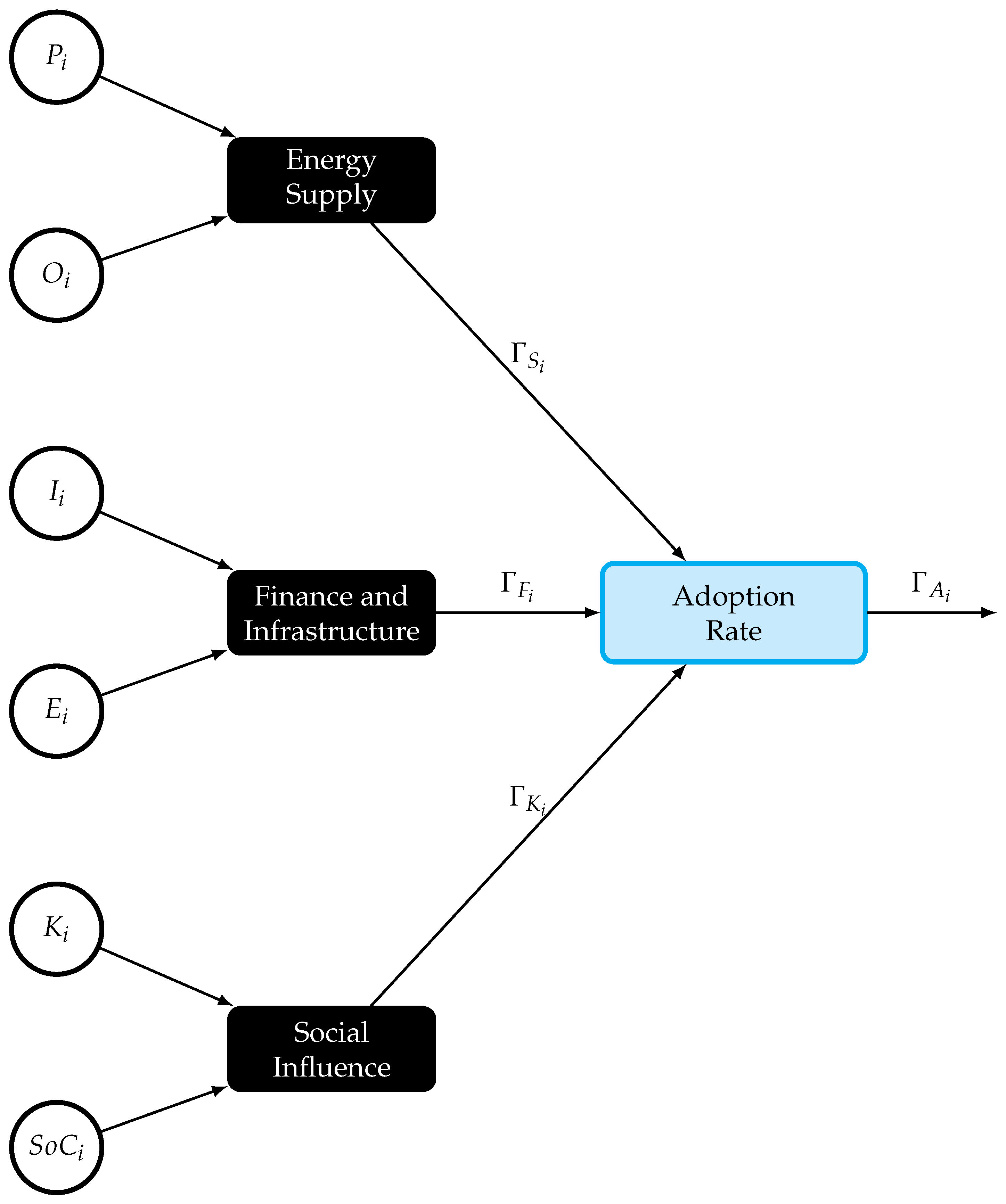
The conceptual structure of the model (Figure 1) integrates household-level decision variables, policy and market signals, and peer influence feedbacks. This work builds upon the socio-technical adoption framework introduced in [24], extending it through an explicit mathematical formulation and an open-source Python 3.12.11 implementation to enhance transparency and reproducibility.

2.2. Model Structure and Decision Framework

Each household agent i evaluates whether to adopt a PV system based on a composite decision function that integrates three key domains: energy supply, financial capacity, and social influence. The overall adoption index Γ A i is expressed as
Γ A i = f ( Γ S i , Γ F i , Γ K i ) ,
where Γ S i , Γ F i , and Γ K i represent the partial contributions of the energy supply, financial, and social sub-models, respectively. Each sub-model aggregates a set of input variables that are normalised through fuzzy membership functions, allowing the integration of quantitative and qualitative parameters within a unified decision scale.
Table 2 summarises the main input variables and their interpretations.

2.3. Mathematical Formulation

The three sub-models describe how each domain contributes to the overall adoption index.
(a)
Energy supply domain.
This component reflects how cost and reliability shape the household’s perception of energy quality:
Γ S i = ( P i · Inf i ) + ( O i · GUp i ) ,
where the first term captures the effect of price and inflation, and the second term represents reliability improvements or losses due to grid performance. The use of reliability and cost components as determinants of perceived energy quality aligns with prior modelling of distributed energy decisions in agent-based simulations [30].
(b)
Financial and infrastructural domain.
This sub-model measures the household’s economic and technical readiness to adopt PV:
Γ F i = I i + ( E i · F I i ) .
The first term ( I i ) reflects structural feasibility, while the second term quantifies the interaction between internal financial strength ( E i ) and external support ( F I i ). The inclusion of financial capacity and external incentives as multiplicative drivers is consistent with prior ABM formulations of energy technology adoption, which emphasise the joint effect of structural feasibility and economic readiness [30].
(c)
Social and behavioural domain.
This component captures peer learning, social norms, and community influence:
Γ K i = ( K i · P V p i ) + ( S o C i · P e e r i ) .
Knowledge and exposure to prior adopters ( P V p i ) enhance confidence in the technology, while social belonging and peer influence encourage imitation within the network. The representation of peer effects and social learning follows empirical and modelling evidence from residential energy adoption studies, particularly in agent-based frameworks [30,31].
(d)
Aggregation and decision rule.
The aggregated adoption index is computed as a weighted sum of the three sub-models:
Γ A i = w S Γ S i + w F Γ F i + w K Γ K i , w S + w F + w K = 1 .
This linear weighted aggregation follows the classical Multi-Attribute Utility Theory (MAUT) structure described in Keeney and Raiffa (1976) [32] and the standard Simple Additive Weighting (SAW) approach used in multi-criteria decision analysis, as discussed in Dodgson (2009) [33].
A household adopts when the aggregate index exceeds a calibrated threshold τ :
Adopt i = 1 , if Γ A i > τ , 0 , otherwise .
Binary adoption based on surpassing a minimum feasibility threshold is consistent with utility-based decision rules used in both MAUT frameworks [32] and energy technology ABMs [30].
The resulting adoption probabilities are classified into four fuzzy linguistic categories, unlikely, uncertain, probable, and very probable, based on the membership functions defined in Appendix B. The membership functions follow standard fuzzy decision-modelling practice, mapping raw variables onto the [ 0 , 1 ] interval with trapezoidal and sigmoid shapes to represent low, medium, and high levels of energy quality, financial capacity, and social support (see, e.g., [24,34,35]). The weighted aggregation in Equation (5) assigns relative importance to the three domains through ( w S , w F , w K ) , while the threshold τ in Equation (6) determines the minimum combined feasibility required for adoption. Together, the domain-specific membership functions, weights, and threshold fully specify the adoption index Γ A i used throughout the simulations. Each non-adopting household re-evaluates Equations (2)–(6) in every simulation step, as the external conditions (e.g., incentives or grid upgrades) evolve.
In the simulation, the continuous adoption index Γ A i produced by the fuzzy aggregation in Equation (5) is passed to the logistic rule in Equation (7). Conceptually, the crisp threshold τ is embedded in the intercept–slope pair ( α 0 , α 1 ) , while the fuzzy categories are retained for interpretive analysis of household propensities. This ensures consistency between the behavioural formulation and the probabilistic decision mechanism used in the model.
To ensure full reproducibility of the adoption mechanism, all parameters involved in (i) the membership-function blocks ( Γ S i , Γ F i , Γ K i ) , (ii) the aggregation operator in Equation (5), and (iii) the logistic decision rule in Equation (7) are summarised in Table 3. The table reports the domain weights, feasibility thresholds, saturation coefficient, logistic parameters, review cadence, and the formal definition of the peer-share term. Together, these elements fully specify how the adoption index Γ A i is constructed and how it is mapped into adoption probabilities in the simulation.

2.4. Simulation Setup

This section describes the structural environment, social network, decision timing, scenario design, and parameter settings used in the simulations. The model represents a stylised community microgrid composed of n = 300 heterogeneous households. All agents differ in financial capacity, infrastructure readiness, knowledge, and social influence, which are drawn from continuous distributions to reflect the household variability.

2.4.1. Population and Time Horizon

Each simulation runs for T = 120 months (ten years). Agents reconsider adoption monthly, subject to a scenario-specific review cooldown of either 3 or 6 months. All simulations use ten stochastic replicates per scenario with distinct random seeds to ensure reproducibility. The results are reported as the mean adoption trajectories with ± 1 standard deviation envelopes, and the final adoption shares include 95% confidence intervals.

2.4.2. Network Interaction Structure

Peer interactions occur on a Watts–Strogatz (WS) small-world network with N = 300 nodes, mean degree k = 4 , and rewiring probability β = 0.1 . This configuration captures neighbourhood-scale diffusion patterns: most connections are local, while a minority of long-range ties accelerate the information spread. All edges are undirected and unweighted in the baseline configuration.
Short sensitivity checks with k { 3 , 5 } and β { 0.05 , 0.20 } produced qualitatively similar diffusion trajectories (changes below 5–7%), indicating that the adoption dynamics are robust to reasonable changes in the network density and randomness.
Peer influence enters the community decision block as the fraction of adopting neighbours (the peer-share). Social saturation is implemented through the subtractive plateau term in the adoption utility:
U eff = U sat _ strength · A ( t ) ,
where A ( t ) is the fraction of adopters at time t. This introduces diminishing returns from social imitation as adoption accumulates.

2.4.3. Decision Updating and Logistic Adoption

At each time step, the model aggregates the outputs of three decision blocks—supply, finance, and community—into a single adoption index Γ A i ( t ) . This index is mapped to an adoption probability using the logistic function
p i ( t ) = 1 1 + exp ( α 0 + α 1 Γ A i ( t ) ) ,
where α 0 sets the baseline propensity to adopt, and α 1 controls the sensitivity to the combined utility. This specification follows standard discrete-choice and diffusion models in energy adoption studies [6,22]. Households that do not adopt after an evaluation defer their next review by the scenario’s cooldown period.

2.4.4. Scenarios and Outputs

Five scenarios are examined: (a) Baseline, (b) Policy ON, (c) Cooldown + Sat 0.5, (d) Strict Feasibility, and (e) Pessimistic Constraints. These scenarios vary the social saturation, feasibility thresholds, learning mechanisms, and network weighting.
All outputs (adoption trajectories, scenario summaries, and replicate-level CSV files) are generated automatically and stored for reproducibility. Parameter files, scripts, and configuration sweeps are available in the public repository [36].

2.4.5. Model Parameters

Table 4 and Table 5 list the structural, network, behavioural, and feasibility parameters used in the simulations. Table 4 summarises the model scale, network topology, logistic parameters, decision weights, cooldown periods, and saturation strengths. Table 5 presents the feasibility thresholds, policy and learning switches, randomness settings, and output files.

2.4.6. Feasibility Thresholds

The feasibility thresholds I min and E F min represent the structural and financial constraints at the household level. Lower I min values correspond to dwellings with a suitable roof area and straightforward installation conditions, whereas higher values correspond to limited surface or complex retrofitting requirements. The range specified for E F min captures variations in credit access, income stability, and debt tolerance. Households falling below either threshold are unable to adopt even under favourable policy conditions, reflecting real-world barriers that cannot be overcome solely through incentives.
Taken together, these elements ensure that the simulation design balances computational efficiency with behavioural realism. Sensitivity checks confirmed that the core diffusion patterns remain stable under reasonable variations in network parameters and feasibility thresholds, supporting the internal consistency of the configuration.

2.5. Baseline Calibration and Validation

The basic setup was designed to reflect real-world solar panel adoption in a typical community microgrid without any added policy support. The parameter values were derived from prior empirical and modelling studies on household and community solar PV diffusion. The selections incorporate social, infrastructural, and financial determinants identified in the literature [5,6,7,11,15,21,22,27,28,29,37,38]. These values were fine-tuned to produce reasonable adoption index over time under conditions with little financial support. Key behavioural coefficients ( α 0 = 3.0 , α 1 = 2.8 ) and feasibility thresholds ( I min = 0.33 , E F min = 0.28 ) were calibrated through iterative simulations. This ensured that adoption emerged from agent interactions and not through externally imposed targets. The model was executed for 120 months (10 years) with n = 300 agents. It incorporated heterogeneity in financial capacity, infrastructure readiness, and peer-learning behaviour.
To strengthen the calibration transparency, we explicitly benchmarked the baseline trajectory against the empirical PV adoption ranges reported in recent studies and linked this to the Bass diffusion validation presented in Section 2.7, which yields a high goodness-of-fit ( R 2 = 0.977 ). This combined calibration–validation step clarifies that the baseline configuration reproduces realistic diffusion dynamics while remaining exploratory rather than predictive.
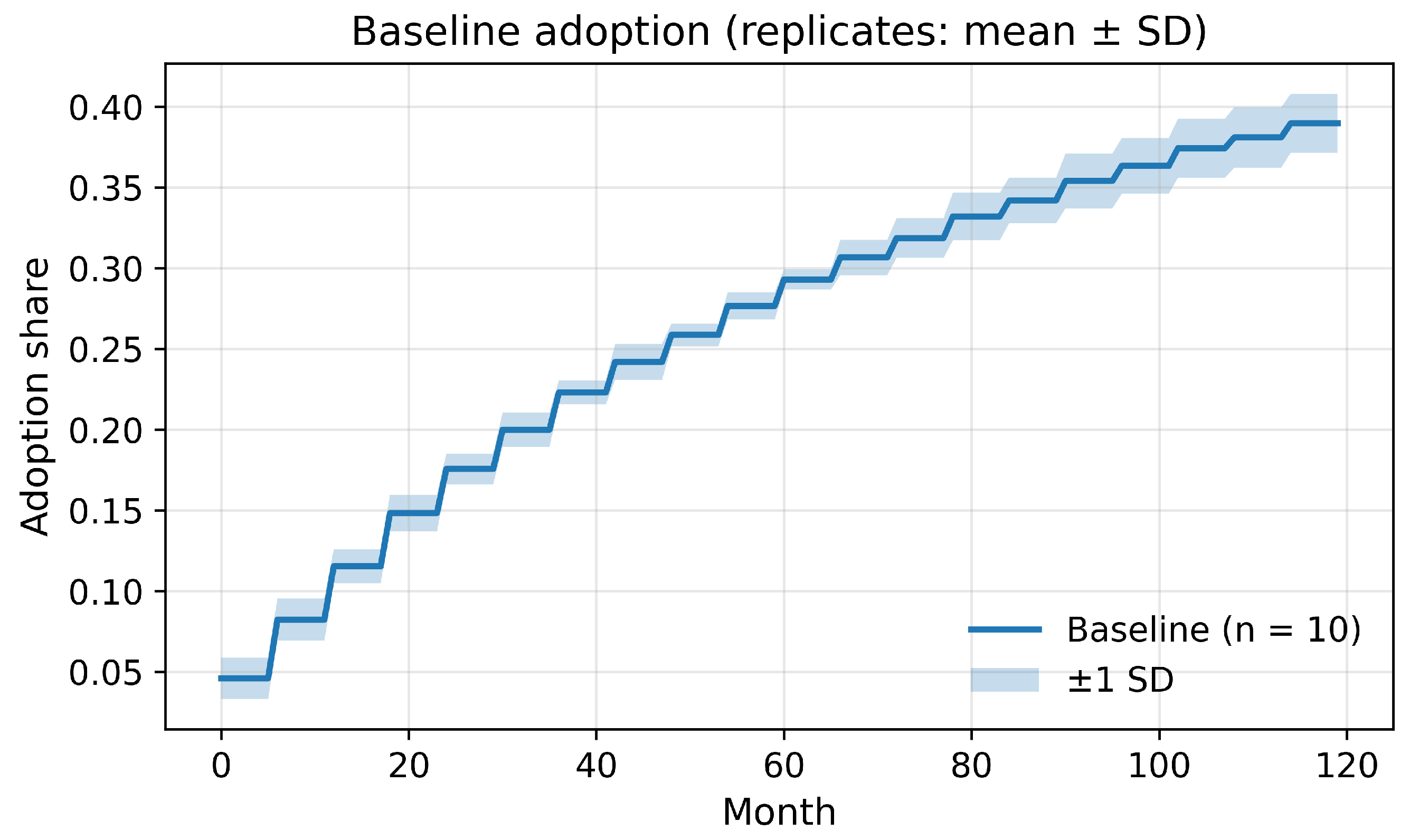
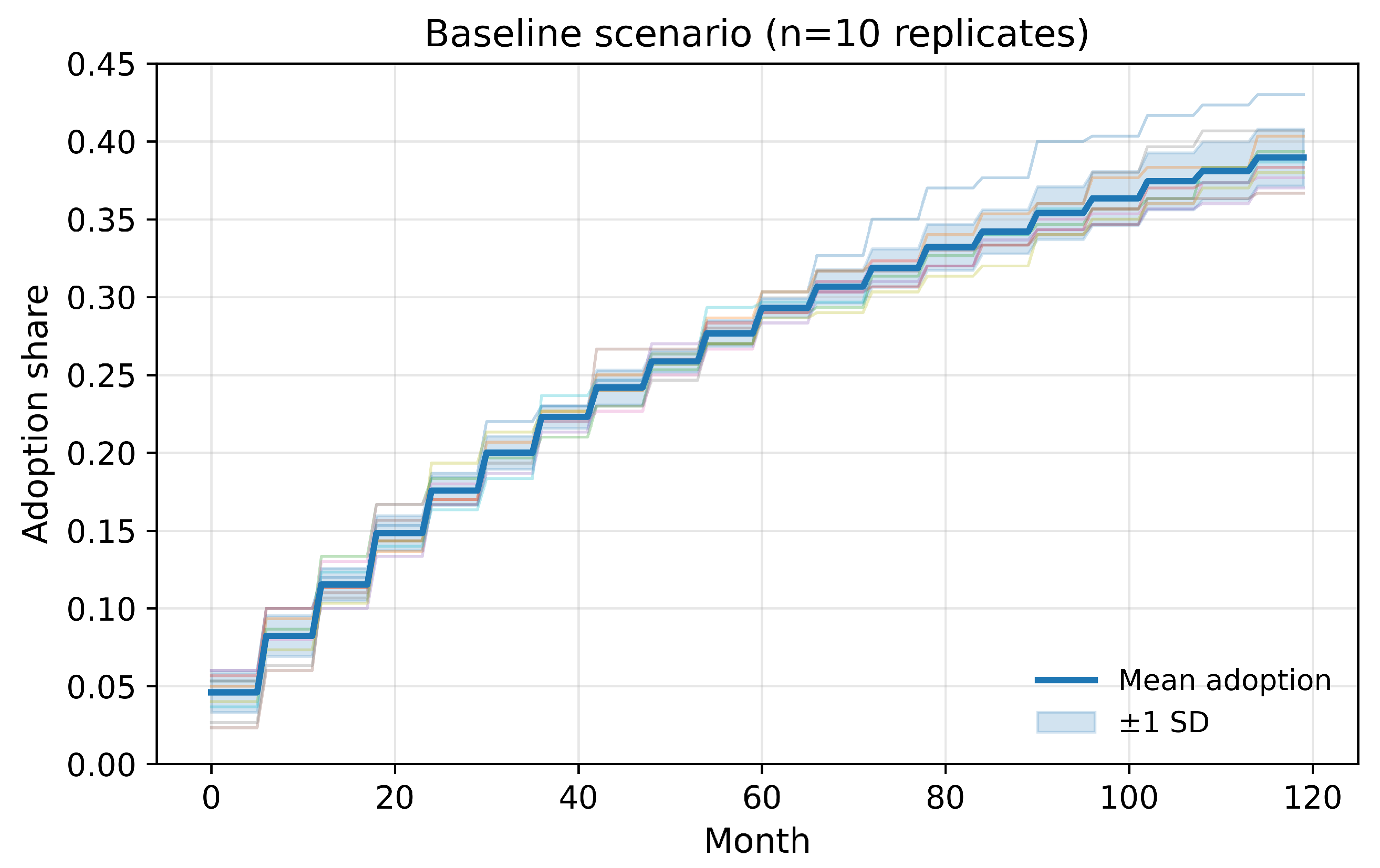
The simulation results, shown in Figure 2, display the average adoption path across ten runs, with the shaded area marking ± 1 standard deviation above and below the mean. The resulting curve shows the S-shaped diffusion pattern seen in community PV studies. Initial slow uptake is due to innovators and early adopters. Acceleration follows as peer learning and visibility accumulate. A saturation tendency appears as eligible households are exhausted.
After ten years, the mean adoption share stabilises around 0.35–0.45. This matches the reported penetration for community solar initiatives with moderate incentives and gradual infrastructure improvements.
This baseline configuration serves as the reference scenario for policy and sensitivity experiments, providing a consistent benchmark to assess the effects of interventions such as stronger subsidies, accelerated grid upgrades, or enhanced peer programs. The variation envelope quantifies the degree of stochasticity in decentralised adoption, illustrating how different intervention scenarios can lead to varied adoption outcomes.

2.6. Python Implementation

The simulation framework was designed for transparency and reproducibility. Model parameters are stored in structured.json files, allowing systematic scenario generation and batch execution. Each run produces time-series outputs in CSV format, which are automatically aggregated into summary statistics and plots (.png) for analysis. The modular structure enables rapid parameter sweeps, parallelised scenario testing, and integration with validation routines such as the Bass model fit and Sobol sensitivity analysis.
The source code, configuration files, and generated datasets are openly available at https://github.com/daperezmora/pv-adoption-model.git (accessed on 31 October 2025).

2.7. Model Validation

The present model is designed as an exploratory and reproducible benchmark rather than as a calibrated forecasting tool. Because household characteristics are generated from synthetic distributions, and empirical adoption data are not included in this version, external predictive validity is intentionally limited. The objective is to isolate and evaluate the mechanistic contributions of financial, infrastructural, and social drivers under controlled conditions, providing a transparent foundation for future calibration and empirical cross validation.
Model validation was performed in two complementary steps to evaluate both the temporal adoption dynamics and parameter influence on model outcomes.

2.7.1. Comparison with Bass Diffusion

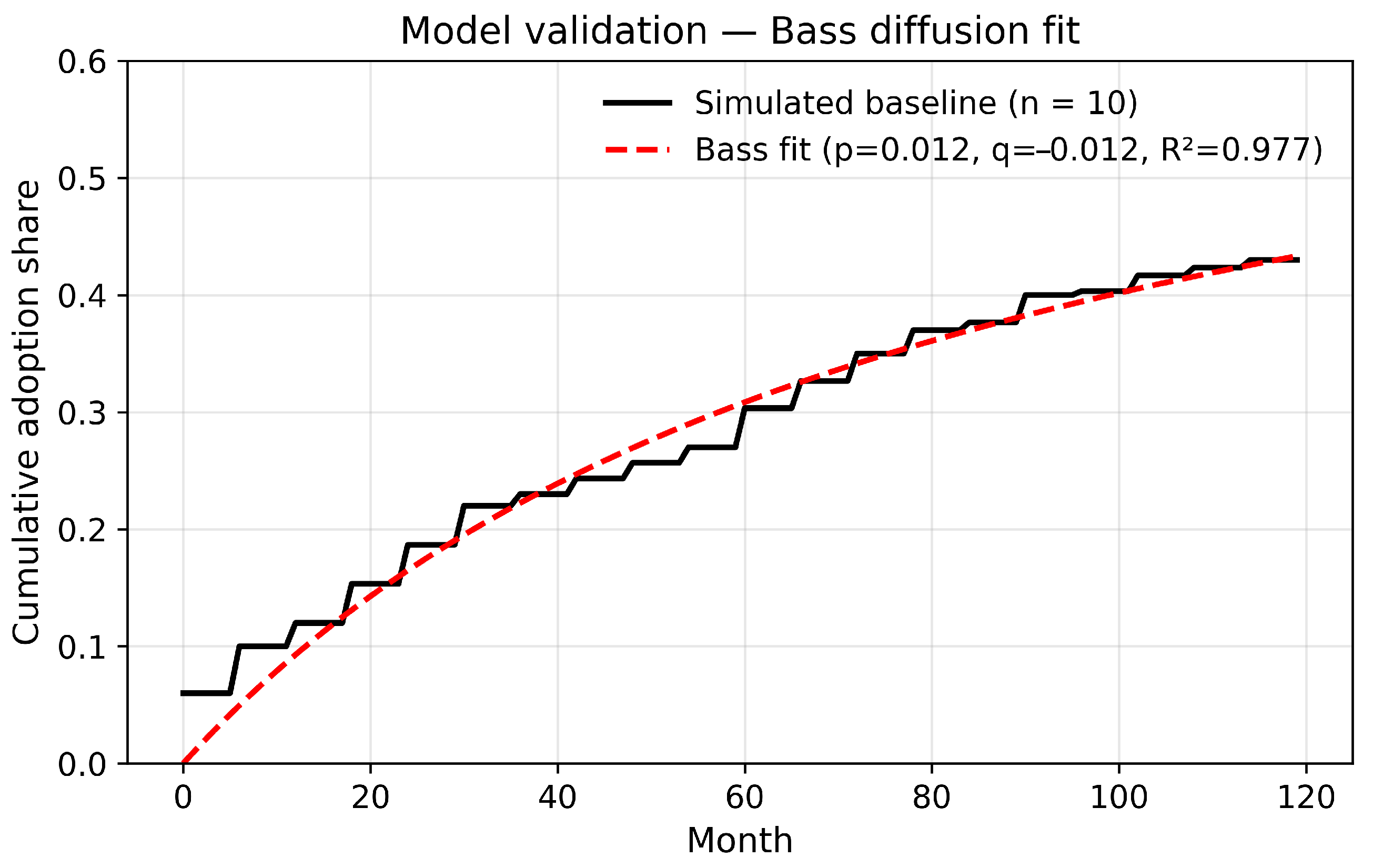
The baseline scenario was fitted to the classical Bass diffusion model [27] using nonlinear least squares optimisation. The estimated parameters were p = 0.012 , q = 0.012 , and m = 0.736 , yielding a high goodness of fit ( R 2 = 0.977 ), as shown in Figure 3. This strong correlation confirms that the simulated adoption trajectory reproduces the expected S-shaped cumulative growth observed in empirical technology diffusion studies. The slight negative imitation coefficient ( q < 0 ) reflects a slower-than-exponential social contagion effect, consistent with scenarios dominated by financial and infrastructural constraints.

2.7.2. Global Sensitivity Analysis

A Sobol global sensitivity analysis [28,29] was conducted to quantify the contribution of six uncertain parameters to the variance in the final adoption share at the end of the simulation horizon (month 120). Let Y = f ( X 1 , X 2 , , X k ) denote the model output, where X j represents the j-th input parameter and k = 6 . Following the variance–decomposition framework of Sobol, the total variance of Y can be expanded as
Var ( Y ) = j = 1 k V j + j < V j + + V 1 k
where V j denotes the partial variance attributed to parameter X j , V j the variance due to the interaction between X j and X , and higher–order terms capture deeper interactions.
The first–order Sobol sensitivity index for parameter X j is defined as
S j = Var X j E [ Y X j ] Var ( Y ) ,
and measures the direct (main) effect of X j on the output variance. The total–order index S j T captures both the main effect of X j and all its interaction effects with the remaining parameters:
S j T = 1 Var X j E [ Y X j ] Var ( Y ) ,
where X j denotes the set of all inputs except X j .
The indices S j and S j T were estimated using the Saltelli sampling design [29] with a base sample size of N = 4096 , resulting in N ( k + 2 ) model evaluations. This approach yields unbiased estimates of both first-order and total-order effects while efficiently exploring the parameter interactions.
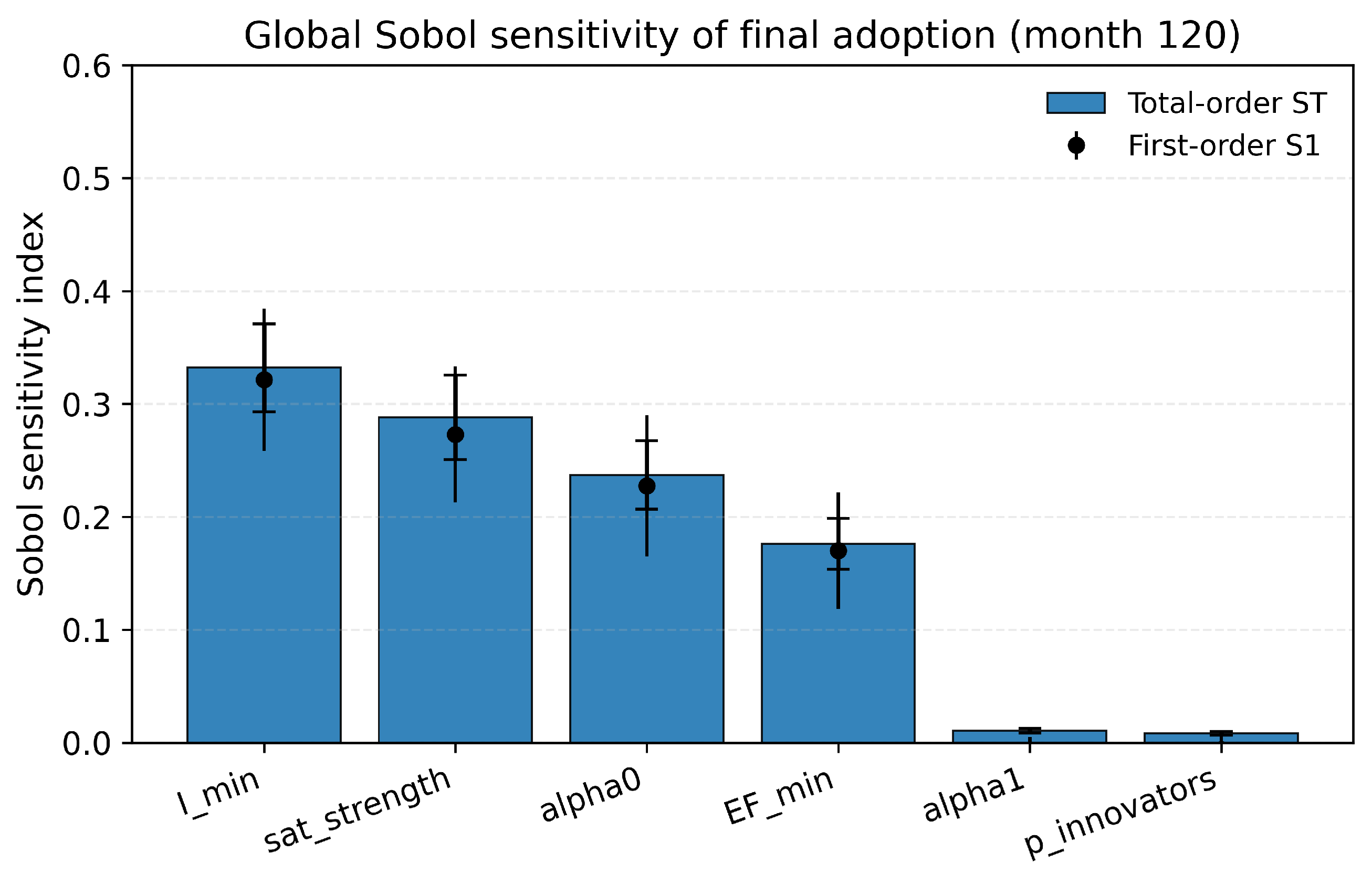
The resulting indices (Figure 4) indicate that I _ m i n (minimum infrastructure threshold) and s a t _ s t r e n g t h (saturation strength) are the dominant drivers of outcome variability, jointly explaining over 60% of the total variance. The baseline propensity ( a l p h a 0 ) and financial feasibility ( E F _ m i n ) have moderate effects, while a l p h a 1 (utility sensitivity) and p _ i n n o v a t o r s (innovator fraction) contribute minimally. These findings confirm that economic feasibility and infrastructure constraints outweigh social contagion in determining long-term adoption levels.

2.7.3. Summary of Validation Metrics

Table 6 summarises the key validation indicators derived from both analyses.
Overall, these results demonstrate that the model reproduces realistic adoption dynamics and that its behavioural outputs respond systematically to parameter variation, supporting both the validity and interpretability.
Taken together, these validation results establish both the internal consistency and behavioural coherence of the model. Building on this foundation, the next section outlines the key assumptions and structural boundaries that frame the interpretation of all subsequent scenario outcomes.

2.8. Limitations and Assumptions

The model incorporates several simplifying assumptions to enhance the transparency and computational tractability.
Model simplifications: Tariffs, grid reliability, and incentive conditions are assumed to be homogeneous across all agents, excluding spatial or demographic heterogeneity in policy exposure. The agent population and network topology (Watts–Strogatz small-world structure) remain constant throughout the simulation, precluding network evolution or demographic turnover. External factors such as incentive presence and grid upgrades are treated as exogenous stochastic processes updated annually, without endogenous policy feedback or adaptive learning decay over time.
Data and representation limitations: Agents’ characteristics, including financial capacity, infrastructure readiness, and knowledge level, are synthetically generated from Beta distributions to reproduce plausible diversity without relying on proprietary datasets. No empirical household data are directly used for calibration in this version of the model.
Given these simplifications, the results should be interpreted as exploratory rather than predictive. The model’s purpose is to provide a reproducible transparent benchmark for evaluating the systemic interaction of financial, infrastructural, and social mechanisms in PV adoption rather than to forecast specific market outcomes. Future work will extend this framework by incorporating empirical household data, observed adoption records, and policy-specific heterogeneity to calibrate and cross validate model parameters under real-world conditions. In addition, coupling this behavioural framework with techno-economic optimisation models could support integrated assessments of distributed energy policy and microgrid design, aligning with the objectives of the Energies Special Issue on sustainable power systems.

3. Results and Discussion

3.1. Scenario Comparison

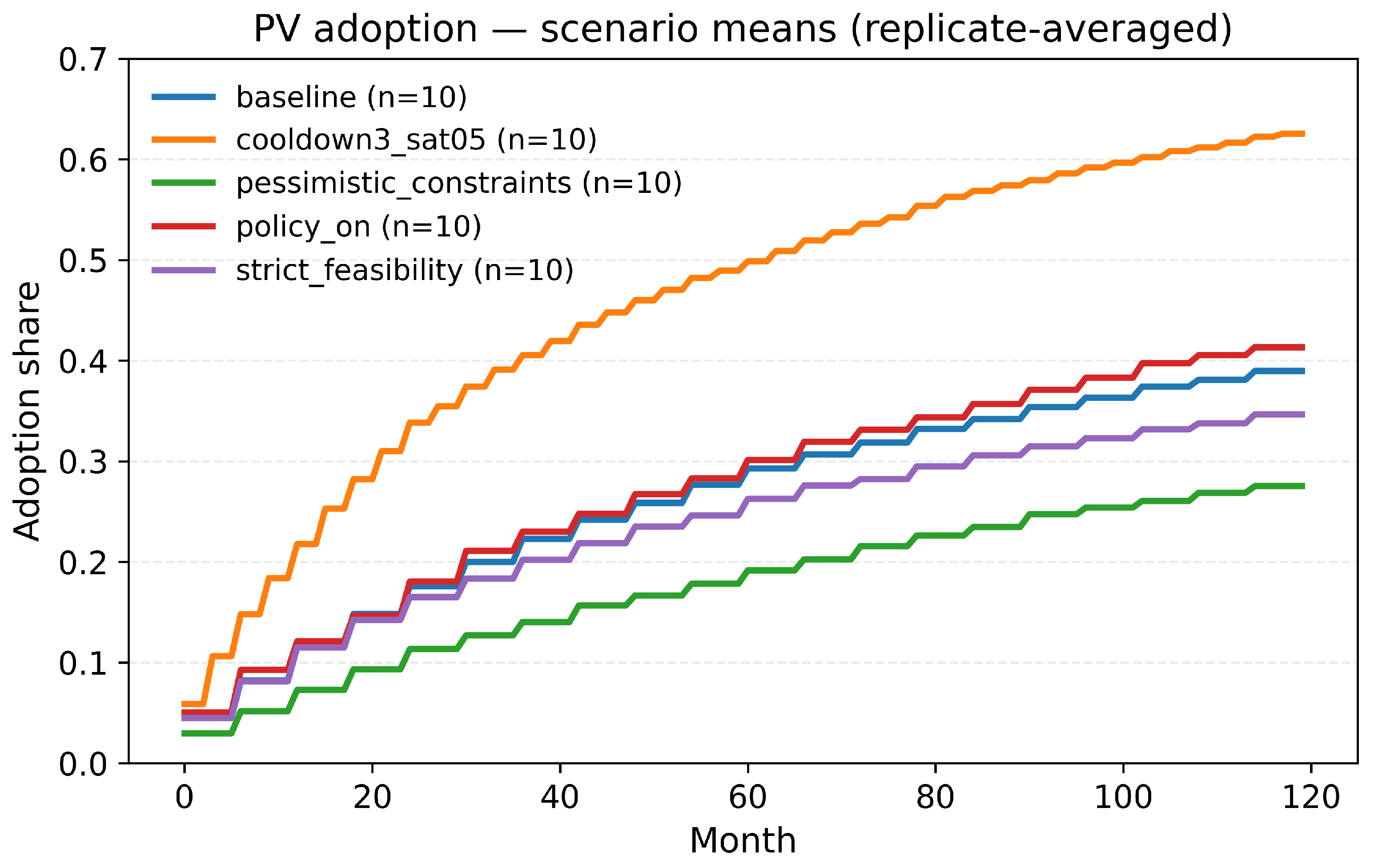
Figure 5 presents the simulated PV adoption trajectories for the five main scenarios. The Baseline (BL) case represents a neutral configuration with moderate inertia and feasibility gates drawn from literature benchmarks. The Policy ON (PO) scenario simulates an enabling environment with stronger learning dynamics and active incentives or awareness programs. The Cooldown + Sat 0.5 (CD3S05) case introduces a 3-month behavioural cooldown and limits peer effect intensity via a 0.5 saturation factor, modelling bounded social imitation. Strict Feasibility (SF) increases the technical and economic thresholds, and the Pessimistic Constraints (PES) scenario combines stricter feasibility, weaker social diffusion, and lower policy support, representing a stress-test lower bound.
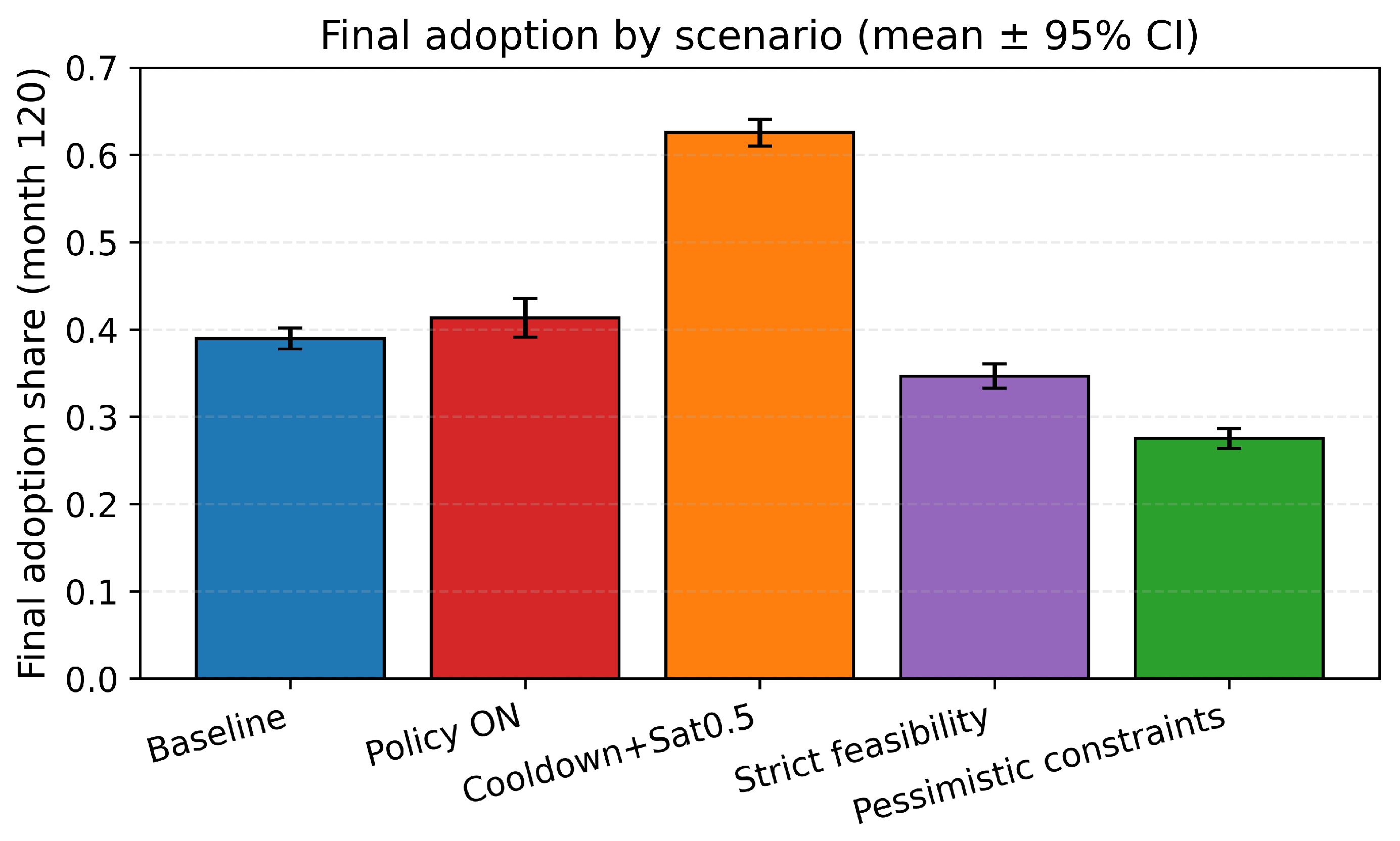
The results show distinct diffusion pathways. While all scenarios exhibit the characteristic S-shaped trajectory, the diffusion rates differ substantially. CD3S05 achieved the fastest and highest adoption, reaching a 63% penetration after 120 months, followed by Policy ON and Baseline with 42% and 39%, respectively. Restrictive settings such as SF (34%) and PES (31%) converged to lower plateaus, consistent with constrained feasibility and weaker behavioural reinforcement. These differences highlight the nonlinear amplification produced by the feedback between peer imitation and policy support.
These patterns motivate a closer inspection of the variability across stochastic replicates, which is examined next in Section 3.2.

3.2. Adoption Dynamics and Replicate Variability

To assess the model stability and stochastic variability, ten replicates were run for each scenario. Figure 6 shows the baseline case, including the mean trajectory and one standard deviation. The adoption patterns remain consistent across the replicates, confirming the low variance and stable emergent behaviour.
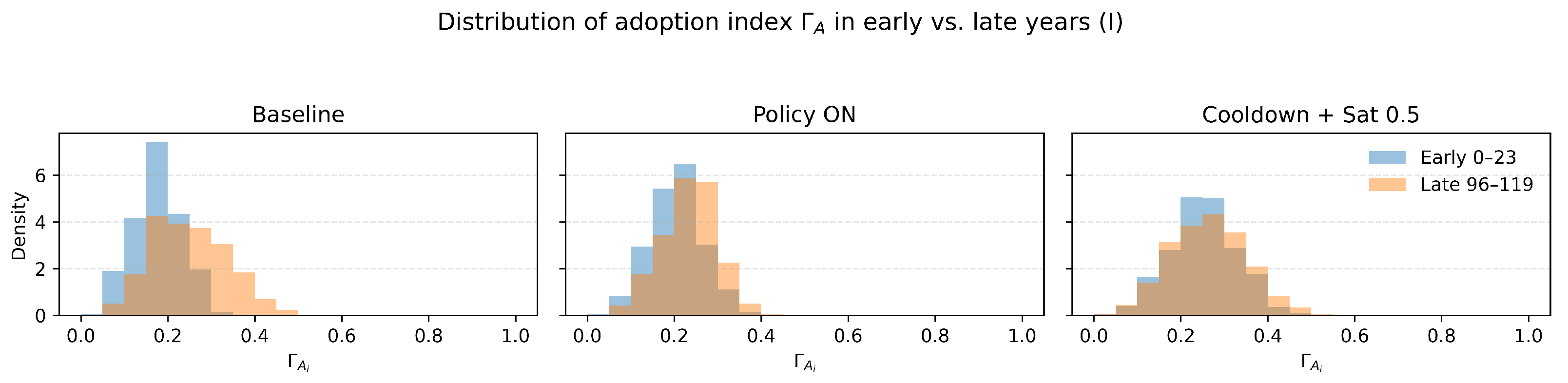
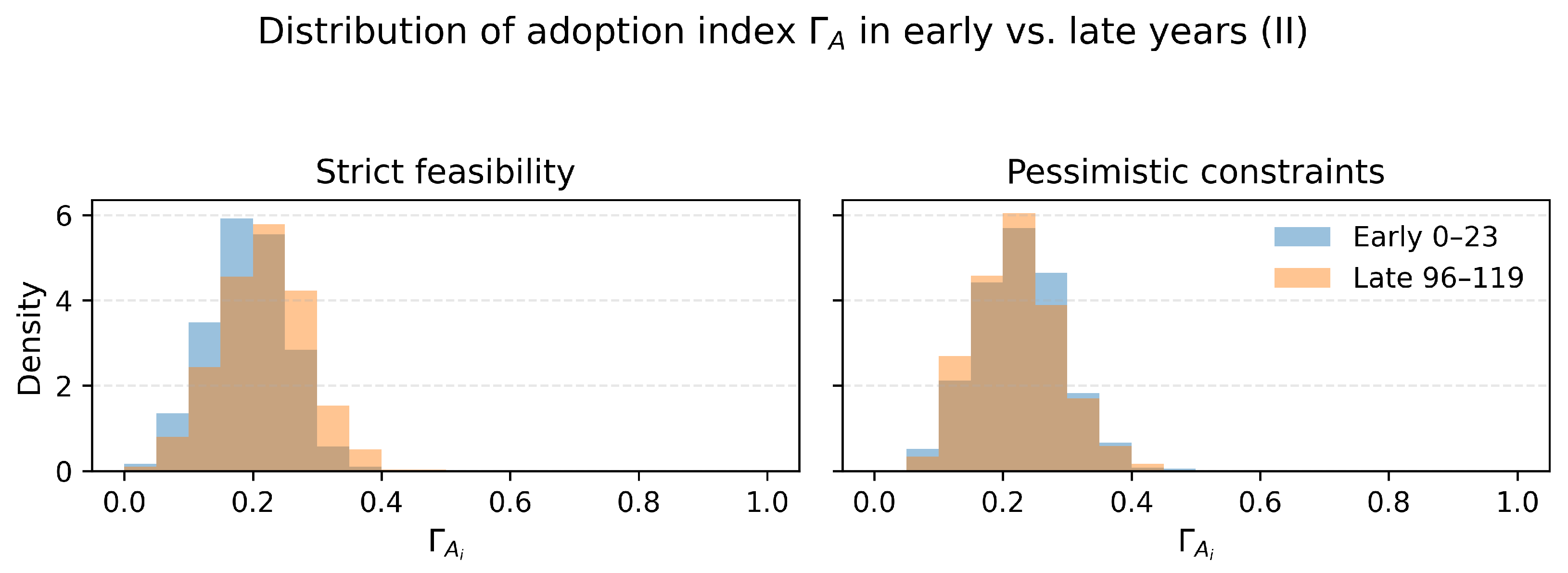
To visualise how policy and feasibility assumptions reshape household-level feasibility over time, Figure 7 and Figure 8 show the distribution of the adoption index Γ A i in early (months 0–23) and late years (months 96–119) for the five main scenarios. In supportive settings (Policy ON and Cooldown + Sat 0.5), the distribution shifts rightwards over time, with a growing mass above the adoption threshold, whereas restrictive configurations (Strict feasibility and Pessimistic constraints) remain concentrated at lower Γ A i values. This diagnostic confirms that differences in aggregate adoption emerge from systematic shifts in the underlying feasibility rather than from stochastic noise.
The final adoption levels across all scenarios are summarised in Figure 9. The error bars denote 95% confidence intervals. The ordering of outcomes aligns with the theoretical expectations: policy activation (PO) yields higher adoption than the neutral baseline, while behavioural constraints (SF, PES) suppress final shares. The relative differences between the mean outcomes are statistically significant, indicating a clear separation between scenarios and supporting the robustness of the contrasts.

3.3. Validation Outcomes

As detailed in Section 2.7, the baseline adoption trajectory closely followed the Bass diffusion model, with fitted parameters p = 0.012 , q = 0.012 , and R 2 = 0.977 , indicating excellent temporal agreement. Similarly, the Sobol sensitivity analysis confirmed that the affordability and satisfaction parameters ( I m i n and s a t _ s t r e n g t h ) dominated the overall variance, while the learning rate ( α 1 ) and innovator fraction ( p i n n o v a t o r s ) showed minimal influence. The main validation metrics are summarised in Table 6, confirming that the model reproduces the expected diffusion dynamics while retaining explanatory granularity.

3.4. Sensitivity Analysis

A global sensitivity analysis using Sobol indices [28,29] quantified the influence of six key parameters on the total adoption at month 120. The first-order ( S 1 ) and total-order ( S T ) indices are shown in Figure 4. The parameters with the highest contribution to output variance were the minimum investment threshold ( I m i n ) and saturation strength ( s a t _ s t r e n g t h ), followed by the baseline preference ( α 0 ) and energy factor threshold ( E F m i n ). The learning slope ( α 1 ) and innovator fraction ( p i n n o v a t o r s ) had minimal effects, indicating a secondary influence once the policy and feasibility conditions are defined.
These results imply that affordability and saturation feedback dominate the model’s outcome space, while innovation seeding has limited marginal effect beyond early diffusion. These sensitivity patterns provide a coherent foundation for interpreting the scenario outcomes presented in the following section. Together, the results motivate a more detailed discussion of how economic, infrastructural, and behavioural mechanisms interact to shape adoption trajectories.

3.5. Discussion

The simulations demonstrate that PV adoption in semi-urban communities is primarily driven by the interaction between affordability, feasibility, and behavioural reinforcement. Financial and learning-oriented interventions substantially accelerate diffusion, whereas restrictive feasibility gates or policy withdrawal dampen adoption and reduce long-term penetration.
The model reproduces the expected logistic adoption form and performs comparably to analytical benchmarks, confirming its structural validity. The sensitivity analysis further indicates that policies targeting household economic constraints and perceived satisfaction yield the highest leverage for increasing adoption.
These findings align with previous agent-based and empirical studies [2,13,16,17], which emphasise the synergistic effect of economic incentives and social learning. From a policy perspective, the results underscore the value of integrated strategies coupling financial accessibility with behavioural reinforcement to ensure sustained renewable energy diffusion.

4. Conclusions

This study developed and validated a reproducible agent-based model to simulate the household adoption of PV systems in community microgrids. The model integrates economic, infrastructural, and social dimensions, advancing previous work by combining transparent mathematical formulation, open-source Python implementation, and systematic sensitivity analysis.
The simulation results show that adoption follows the characteristic S-shaped diffusion pattern. The final penetration levels are strongly influenced by financial feasibility and saturation reinforcement. Policy and behavioural-learning interventions accelerate diffusion, while restrictive feasibility conditions or limited incentives constrain adoption. Across all scenarios, affordability and infrastructure readiness are the primary drivers, with behavioural contagion and innovation seeding playing secondary roles.
Validation against the Bass diffusion model confirmed high temporal fidelity ( R 2 = 0.977 ). Sobol indices show that the minimum investment threshold and saturation strength together explain over 60% of the total variance. These results establish the model’s internal consistency and its ability to capture the interplay of behavioural and structural factors in decentralised energy transitions.
Beyond methodological contributions, this work highlights the need for integrated policy design. Financial accessibility should be combined with social engagement and infrastructural reliability to sustain adoption in community energy systems. Future extensions will incorporate empirical household datasets, policy heterogeneity, and spatial network evolution to enhance predictive realism and policy relevance.


Funding

This research was supported by the Universidad Iberoamericana Ciudad de México through the División de Investigación y Posgrado (DINVP) and the Instituto de Investigación Aplicada y Tecnología (InIAT). No external funding was received. The APC was funded by the Universidad Iberoamericana.

Data Availability Statement

All model source code, configuration files, and simulation outputs supporting the findings of this paper are openly available on GitHub (web version; no version number is provided by the software) at https://github.com/daperezmora/pv-adoption-model.git (accessed on 31 October 2025).

Acknowledgments

This work builds upon the author’s doctoral research on technology adoption modelling, originally developed in NetLogo and subsequently extended in Python 3.12.11 The author thanks E.G. Hernández-Martínez, J. Emilio Quiroz-Ibarra, G. Fernández-Anaya, Florian Chávez-Juárez, and Jorge Ángel González-Ordiano for their academic guidance and valuable feedback during the development of the original conceptual model. During the preparation of this manuscript, the author used Grammarly (web version; no version number is provided by the software) at https://www.grammarly.com (accessed on 30 October 2025) and ChatGPT (OpenAI, GPT-5) to assist with language editing and code debugging. All text, models, and analyses were critically reviewed and verified by the author, who takes full responsibility for the content of this publication.

Conflicts of Interest

The author declares no conflicts of interest. The funders had no role in the design of the study; in the collection, analyses, or interpretation of data; in the writing of the manuscript; or in the decision to publish the results.

Abbreviations

The following abbreviations are used in this manuscript:
ABMAgent-Based Model
PVPhotovoltaic
P2PPeer-to-Peer
R2Coefficient of Determination
SDStandard Deviation
CIConfidence Interval
S1First-Order Sensitivity Index (Sobol analysis)
STTotal-Order Sensitivity Index (Sobol analysis)
JSONJavaScript Object Notation (configuration files)
CSVComma-Separated Values (simulation outputs)

Appendix A. Representative Studies Reviewed

Table A1 summarises a representative subset of the studies reviewed (n ≈ 20) to illustrate the main categories of adoption research. A complete list of all forty references considered in the meta-review is provided in the bibliography.
Table A1. Representative studies on (PV) adoption dynamics and influencing factors, illustrating the main methodological and thematic categories identified in the review.
CategoryReferenceFocus/MethodMain Findings
Economic Drivers and Incentives[10]Economic modelling of rooftop PV adoptionLong-term tariff stability and predictable incentives drive adoption more effectively than short-term subsidies.
[8]Probabilistic ABM on tariffs and storageTariff structures and financing access critically shape investment feasibility for distributed PV.
[22]Spatio-temporal ABM using neural networksIntegrated socio-economic and technical modelling improves accuracy of PV diffusion forecasts.
[34]ISM-DEMATEL hybrid analysisIdentifies consumer perception, high upfront cost, and policy instability as major adoption barriers.
[35]Multi-objective socio-economic modelMaximising prosumer satisfaction requires balancing economic returns with environmental preferences.
[7]ABM of community solar policyStable city-level incentives and revenue-sharing increase PV adoption rates in urban communities.
Infrastructural and Policy Constraints[13]Grid equity and access analysisInfrastructure capacity limits create inequitable access to distributed energy in urban California.
[3]Simulation of renewable community integrationGrid impacts of collective microgrids depend on load coordination and spatial distribution.
[14]Data-driven diffusion analysisUrban morphology and grid topology strongly affect spatial PV diffusion.
[2]Agent-based model of P2P business modelsDemonstrates influence of market design on community-level economic viability.
[1]Review of consumer perspectives in energy communitiesHighlights technical and regulatory barriers constraining consumer participation in PV collectives.
[24]Systematic roadmap on CBMG deploymentIdentifies infrastructure readiness and regulatory clarity as prerequisites for sustainable adoption.
Social Influence and Behavioural Factors[15]Empirical study on peer influenceActive community organisations amplify peer effects and accelerate household PV adoption.
[16]Econometric analysis of microgeneration diffusionQuantifies peer effects and neighbour imitation as major determinants of uptake.
[17]Case study of apartment PV projectsCommunity engagement and trust enhance participation in shared installations.
[5]Systematic review of household adoptionConfirms social norms and knowledge diffusion as key behavioural drivers.
[12]ABM on joint placement of PV and green roofsSocial awareness coupled with policy incentives increases adoption resilience under uncertainty.
[39]Model-based co-creation study (Sweden)Demonstrates that participatory approaches and local collaboration improve long-term adoption rates.
Equity, Governance, and Emerging Trends[18]Systematic review of energy injusticeDocuments distributional disparities in solar adoption across income groups.
[19]Empirical study on rooftop adoption inequityFinds persistent local-level inequities linked to income and housing type.
[20]Simulation of P2P trading and governanceShows how peer-to-peer markets can enhance grid flexibility and fairness.
[40]Cross-country survey on household transitionsIdentifies trust, awareness, and social belonging as mediators of technology adoption.
[24]Socio-technical synthesis of CBMGsIntegrates behavioural, financial, and infrastructural adoption factors to guide future community microgrid research.

Appendix B. Fuzzy Membership Functions and Classification Rules

Appendix B.1. Fuzzy Membership Design

Each household variable listed in Table 2 is normalised to a fuzzy scale in the range [ 0 , 1 ] , where 0 denotes the lowest observed or expected value (unfavourable for adoption), and 1 denotes the highest (favourable for adoption). The fuzzy membership functions are designed using triangular or trapezoidal shapes, depending on the variable’s nature and empirical range.
For example, the fuzzy representation of the energy price P i and sense of community S o C i are defined as
μ P i ( x ) = 0 , x P min x P min P max P min , P min < x < P max 1 , x P max ,
μ S o C i ( x ) = 0 , x S o C min x S o C min S o C max S o C min , S o C min < x < S o C max 1 , x S o C max .
In this example, a higher energy price or a higher frequency of outages increases the likelihood of adoption, as households seek more reliable and affordable alternatives to grid electricity. Similar logic applies to the remaining variables, ensuring monotonic consistency with their behavioural effects; for instance, higher financial incentives, higher awareness, or stronger community ties all increase the degree of membership. All fuzzy memberships are oriented positively with respect to the adoption propensity; for example, higher prices or more frequent outages increase the membership value, reflecting higher motivation to adopt.

Appendix B.2. Aggregation and Normalization

Within each domain, fuzzy inputs are aggregated using a weighted mean operator to obtain the partial indices Γ S i , Γ F i , and Γ K i :
Γ D i = j = 1 n D w D j μ D j ( x ) j = 1 n D w D j , D { S , F , K } ,
where w D j represents the relative weight of sub-factor j within domain D. The weights are normalised such that w D j = 1 for each domain. After aggregation, each Γ D i is normalised to the interval [ 0 , 1 ] to maintain comparability across domains.
The overall adoption index Γ A i is then computed as a weighted sum of the three domains, as shown previously in Equation (5).

Appendix B.3. Fuzzy Classification of Adoption Probability

The continuous adoption index Γ A i [ 0 , 1 ] is classified into four linguistic categories using trapezoidal membership functions defined as follows:
μ Unlikely ( x ) = 1 , x 0.25 0.35 x 0.10 , 0.25 < x < 0.35 0 , x 0.35 ,
μ Uncertain ( x ) = 0 , x 0.25 x 0.25 0.10 , 0.25 < x < 0.35 1 , 0.35 x 0.55 0.65 x 0.10 , 0.55 < x < 0.65 0 , x 0.65 ,
μ Probable ( x ) = 0 , x 0.55 x 0.55 0.10 , 0.55 < x < 0.65 1 , 0.65 x 0.85 0.95 x 0.10 , 0.85 < x < 0.95 0 , x 0.95 ,
μ VeryProbable ( x ) = 0 , x 0.85 x 0.85 0.10 , 0.85 < x < 0.95 1 , x 0.95 .
The defuzzification step assigns the final adoption outcome Adopt i = 1 if Γ A i > τ , where τ = 0.65 , unless otherwise specified by calibration or sensitivity analysis.
Table A2. Linguistic classification of adoption index.
CategoryRange of Γ A i LabelInterpretation
Unlikely [ 0.0 , 0.35 ] LowHousehold highly resistant to adoption.
Uncertain ( 0.35 , 0.65 ] MediumAdoption possible under improved conditions (e.g., new incentives).
Probable ( 0.65 , 0.85 ] HighHousehold likely to adopt if external factors remain favourable.
Very probable ( 0.85 , 1.0 ] Very highImmediate or near-term adoption expected.

Appendix B.4. Calibration and Sensitivity

Thresholds and weights were calibrated using baseline simulation results and cross-validated through Sobol sensitivity analysis. Sobol sensitivity indices were used to adjust the relative domain weights w D j by ranking the influence of each variable on the overall adoption variance. This ensures that the fuzzy system preserves interpretability while maintaining numerical stability across multiple policy and grid-reliability scenarios.

References

  1. Lazdins, R.; Mutule, A.; Zalostiba, D. PV Energy Communities—Challenges and Barriers from a Consumer Perspective: A Literature Review. Energies 2021, 14, 4873. [Google Scholar] [CrossRef]
  2. Lovati, M.; Zhang, X.; Huang, P.; Olsmats, C.; Maturi, L. Optimal Simulation of Three Peer to Peer (P2P) Business Models for Individual PV Prosumers in a Local Electricity Market Using Agent-Based Modelling. Buildings 2020, 10, 138. [Google Scholar] [CrossRef]
  3. Allard, J.; Rosseel, A.; Sadoine, L.; Faraji, J.; Brihaye, T.; Capizzi, F.; Nteziyaremye, B.; Bordes, F.; Vallée, F.; Grève, Z.D. Technical impacts of the deployment of renewable energy communities on electricity distribution grids. In Proceedings of the 27th International Conference on Electricity Distribution (CIRED 2023), Rome, Italy, 12–15 June 2023; Volume 2023, pp. 2923–2927. [Google Scholar] [CrossRef]
  4. Alipour, M.; Salim, H.; Stewart, R.A.; Sahin, O. Predictors, taxonomy of predictors, and correlations of predictors with the decision behaviour of residential solar photovoltaics adoption: A review. Renew. Sustain. Energy Rev. 2020, 123, 109749. [Google Scholar] [CrossRef]
  5. Shakeel, S.R.; Yousaf, H.; Irfan, M.; Rajala, A. Solar PV adoption at household level: Insights based on a systematic literature review. Energy Strategy Rev. 2023, 50, 101178. [Google Scholar] [CrossRef]
  6. Robinson, S.A.; Rai, V. Determinants of spatio-temporal patterns of energy technology adoption: An agent-based modeling approach. Appl. Energy 2015, 151, 273–284. [Google Scholar] [CrossRef]
  7. Nuñez-Jimenez, A.; Mehta, P.; Griego, D. Let it grow: How community solar policy can increase PV adoption in cities. Energy Policy 2023, 175, 113477. [Google Scholar] [CrossRef]
  8. Heleno, M.; Sehloff, D.; Coelho, A.; Valenzuela, A. Probabilistic impact of electricity tariffs on distribution grids considering adoption of solar and storage technologies. Appl. Energy 2020, 279, 115826. [Google Scholar] [CrossRef]
  9. Du, H.; Han, Q.; de Vries, B.; Sun, J. Community solar PV adoption in residential apartment buildings: A case study on influencing factors and incentive measures in Wuhan. Appl. Energy 2024, 354, 122163. [Google Scholar] [CrossRef]
  10. Agdas, D.; Barooah, P. On the economics of rooftop solar PV adoption. Energy Policy 2023, 178, 113611. [Google Scholar] [CrossRef]
  11. Kocakusak, D.; Greenberg, M.R.; Andrews, C.J. Key influences on residential photovoltaic solar panel adoption in the United States. Energy Sources Part B Econ. Plan. Policy 2024, 19, 2418126. [Google Scholar] [CrossRef]
  12. Ramshani, M.; Li, X.; Khojandi, A.; Omitaomu, O. An agent-based approach to study the diffusion rate and the effect of policies on joint placement of photovoltaic panels and green roof under climate change uncertainty. Appl. Energy 2020, 261, 114402. [Google Scholar] [CrossRef]
  13. Brockway, A.M.; Conde, J.; Callaway, D. Inequitable access to distributed energy resources due to grid infrastructure limits in California. Nat. Energy 2021, 6, 892–903. [Google Scholar] [CrossRef]
  14. Zhao, T.; Zhou, Z.; Zhang, Y.; Ling, P.; Tian, Y. Spatio-Temporal Analysis and Forecasting of Distributed PV Systems Diffusion: A Case Study of Shanghai Using a Data-Driven Approach. IEEE Access 2017, 5, 5135–5148. [Google Scholar] [CrossRef]
  15. Noll, D.; Dawes, C.; Rai, V. Solar Community Organizations and active peer effects in the adoption of residential PV. Energy Policy 2014, 67, 330–343. [Google Scholar] [CrossRef]
  16. Steadman, S.; Bennato, A.R.; Giulietti, M. From energy consumers to prosumers: The role of peer effects in the diffusion of residential microgeneration technology. Econ. Politica Ind. J. Ind. Bus. Econ. 2023, 50, 321–346. [Google Scholar] [CrossRef]
  17. Yang, S.; Chen, W.; Kim, H. Building Energy Commons: Three Mini-PV Installation Cases in Apartment Complexes in Seoul. Energies 2021, 14, 249. [Google Scholar] [CrossRef]
  18. Konzen, G.; Best, R.; de Castro, N.J. The energy injustice of household solar energy: A systematic review of distributional disparities in residential rooftop solar adoption. Energy Res. Soc. Sci. 2024, 111, 103473. [Google Scholar] [CrossRef]
  19. Darghouth, N.R.; O’Shaughnessy, E.; Forrester, S.; Barbose, G. Characterizing local rooftop solar adoption inequity in the US. Environ. Res. Lett. 2022, 17, 034028. [Google Scholar] [CrossRef]
  20. Pena-Bello, A.; Parra, D.; Herberz, M.; Tiefenbeck, V.; Patel, M.K.; Hahnel, U.J.J. Integration of prosumer peer-to-peer trading decisions into energy community modelling. Nat. Energy 2022, 7, 74–82. [Google Scholar] [CrossRef]
  21. Mittal, A.; Krejci, C.C.; Dorneich, M.C.; Fickes, D. An agent-based approach to modeling zero energy communities. Sol. Energy 2019, 191, 193–204. [Google Scholar] [CrossRef]
  22. Alderete Peralta, A.; Balta-Ozkan, N.; Longhurst, P. Spatio-temporal modelling of solar photovoltaic adoption: An integrated neural networks and agent-based modelling approach. Appl. Energy 2022, 305, 117949. [Google Scholar] [CrossRef]
  23. Schiera, D.S.; Minuto, F.D.; Bottaccioli, L.; Borchiellini, R.; Lanzini, A. Analysis of Rooftop Photovoltaics Diffusion in Energy Community Buildings by a Novel GIS- and Agent-Based Modeling Co-Simulation Platform. IEEE Access 2019, 7, 93404–93432. [Google Scholar] [CrossRef]
  24. Pérez-DeLaMora, D.; Quiroz-Ibarra, J.E.; Fernández-Anaya, G.; Hernández-Martínez, E.G. Roadmap on community-based microgrids deployment: An extensive review. Energy Rep. 2021, 7, 2883–2898. [Google Scholar] [CrossRef]
  25. Mehta, P.; Griego, D.; Nunez-Jimenez, A.; Schlueter, A. The Impact of Self-Consumption Regulation on Individual and Community Solar PV Adoption in Switzerland: An Agent-Based Model; IOP Publishing: Bristol, UK, 2019; Volume 1343, p. 012143. [Google Scholar] [CrossRef]
  26. Jones, C.B.; Vining, W.; Haines, T. Spatial adoption forecast methodology for photovoltaic systems throughout a city. Sustain. Cities Soc. 2023, 93, 104430. [Google Scholar] [CrossRef]
  27. Bass, F.M. A new product growth model for consumer durables. Manag. Sci. 1969, 15, 215–227. [Google Scholar] [CrossRef]
  28. Sobol, I.M. Global sensitivity indices for nonlinear mathematical models and their Monte Carlo estimates. Math. Comput. Simul. 2001, 55, 271–280. [Google Scholar] [CrossRef]
  29. Saltelli, A.; Tarantola, S.; Campolongo, F.; Ratto, M. Sensitivity Analysis in Practice: A Guide to Assessing Scientific Models; John Wiley & Sons Ltd.: Chichester, UK, 2004. [Google Scholar] [CrossRef]
  30. Rai, V.; Robinson, S.A. Agent-based modeling of energy technology adoption: Empirical integration of social, behavioral, economic, and environmental factors. Environ. Model. Softw. 2015, 70, 163–177. [Google Scholar] [CrossRef]
  31. Rai, V.; Henry, A.D. Agent-based modelling of consumer energy choices. Nat. Clim. Change 2016, 6, 556–562. [Google Scholar] [CrossRef]
  32. Keeney, R.L.; Raiffa, H. Decisions with Multiple Objectives: Preferences and Value Trade-Offs; Cambridge University Press: Cambridge, UK, 1976. [Google Scholar] [CrossRef]
  33. Dodgson, J.S.; Spackman, M.; Pearman, A.D.; Phillips, L.D. Multi-Criteria Analysis: A Manual; Technical Report; UK Department for Communities and Local Government: London, UK, 2009; Crown Copyright 2009. Product Code: 08ACST05703. [Google Scholar]
  34. Thakur, P.; Wilson, V.H. Analysis of barriers affecting the adoption of community solar from consumer’s perspective: A hybrid ISM-DEMATEL approach. Energy Environ. 2024, 35, 113–141. [Google Scholar] [CrossRef]
  35. Afzali, P.; Yeganeh, A.; Derakhshan, F. A novel socio-economic-environmental model to maximize prosumer satisfaction in smart residential complexes. Energy Build. 2024, 308, 114023. [Google Scholar] [CrossRef]
  36. Pérez-DeLaMora, D.A. pv-Adoption-Model: Reproducible Agent-Based Model for Photovoltaic Adoption. 2025. Available online: https://github.com/daperezmora/pv-adoption-model (accessed on 30 October 2025).
  37. Scheller, F.; Graupner, S.; Edwards, J.; Weinand, J.; Bruckner, T. Active peer effects in residential photovoltaic adoption: Evidence on impact drivers among potential and current adopters in Germany. arXiv 2021, arXiv:2105.00796. [Google Scholar]
  38. Opiyo, N. Modelling Temporal Diffusion of PV Microgeneration Systems in Rural Western Kenya. In Proceedings of the 32nd European Photovoltaic Solar Energy Conference, EUPVSEC, Munich, Germany, 20–24 June 2016. [Google Scholar]
  39. Selvakkumaran, S.; Ahlgren, E. Model-Based Exploration of Co-Creation Efforts: The Case of Solar Photovoltaics (PV) in Skåne, Sweden. Sustainability 2018, 10, 3905. [Google Scholar] [CrossRef]
  40. Kyere, F.; Dongying, S.; Bampoe, G.D.; Kumah, N.Y.G.; Asante, D. Decoding the shift: Assessing household energy transition and unravelling the reasons for resistance or adoption of solar photovoltaic. Technol. Forecast. Soc. Change 2024, 198, 123030. [Google Scholar] [CrossRef]
Figure 1. Conceptual model showing the main input variables, intermediate domains, and resulting adoption index Γ A i . Rectangular nodes denote domain blocks; arrows indicate information flow.
Energies 19 00290 g001
Figure 2. Baseline adoption trajectory for N = 300 households over a 120-month (10-year) horizon. The solid line shows the mean adoption share across n = 10 stochastic replicates; the shaded band denotes ± 1 standard deviation.
Energies 19 00290 g002
Figure 3. Bass diffusion validation for the baseline scenario with N = 300 households over a 120-month horizon. The simulated adoption trajectory (solid black line, averaged across n = 10 replicates) closely follows the fitted Bass curve (red dashed line), yielding a high goodness-of-fit ( R 2 = 0.977 ).
Energies 19 00290 g003
Figure 4. Sobol global sensitivity analysis of the final adoption share at month 120. Total-order sensitivity indices ( S T ) are shown as bars with confidence intervals and first-order indices ( S 1 ) as points. Infrastructure feasibility ( I min ) and saturation strength clearly dominate the variance contribution, followed by behavioural coefficients ( α 0 ) and financial feasibility ( E F min ). The innovation fraction and slope parameter ( α 1 ) have minimal influence.
Energies 19 00290 g004
Figure 5. Mean PV adoption trajectories for the five main scenarios over a 120-month horizon with N = 300 households. Lines show the replicate-averaged adoption share across n = 10 stochastic runs per scenario.
Energies 19 00290 g005
Figure 6. Baseline scenario adoption trajectories for N = 300 households across a 120-month horizon. Coloured lines show the ten stochastic replicates, while the solid blue line denotes the mean adoption share, and the shaded region represents ± 1 SD.
Energies 19 00290 g006
Figure 7. Distribution of household adoption index Γ A i in early (months 0−23) and late years (months 96−119) for the Baseline, Policy ON, and Cooldown + Sat 0.5 scenarios. Each panel overlays early and late histograms to illustrate how policy support and behavioural feedback shift feasibility over time (N = 300 households, horizon = 120 months, n = 10 replicates).
Energies 19 00290 g007
Figure 8. Distribution of household adoption index Γ A i in early (months 0−23) and late years (months 96−119) for the Strict feasibility and Pessimistic constraints scenarios. Relative to the baseline, both cases remain concentrated at lower feasibility levels, consistent with their lower aggregate adoption shares (N = 300 households, horizon = 120 months, n = 10 replicates).
Energies 19 00290 g008
Figure 9. Final PV adoption share at month 120 for the five main scenarios with N = 300 households. Bars show the mean adoption share across n = 10 stochastic replicates per scenario, and error bars indicate the corresponding 95% confidence intervals.
Energies 19 00290 g009
Table 1. Representative modelling approaches in PV adoption research and their main limitations motivating the present work.
StudyMethod/FocusKey Limitations Identified
Noll et al. [15]Empirical peer-effects analysisCaptures social influence but lacks dynamic modelling of feedback and policy interactions.
Robinson and Rai [6]ABM of spatial–temporal adoptionLimited mathematical transparency; no unified behavioural formulation for incentives, infrastructure, and social factors.
Alderete Peralta et al. [22]Neural networks + ABM hybridImproves forecasting accuracy but not fully reproducible; limited representation of policy and social saturation effects.
Nuñez-Jimenez et al. [7]Community solar ABMEvaluates policy design but omits global sensitivity analysis and provides limited mathematical specification.
Lovati et al. [2]ABM of peer-to-peer (P2P) microgrid business modelsStrong economic modelling but minimal behavioural representation; social diffusion and feasibility constraints not explicit.
Zhao et al. [14]Spatial diffusion (data-driven)Captures geography but no behavioural or community decision processes.
Brockway et al. [13]Grid access and equity analysisProvides infrastructural constraints but not household-level behavioural dynamics.
Table 2. Key model variables and their definitions.
SymbolVariableDescription
P i Energy priceElectricity tariff faced by household i.
Inf i Inflation rateAnnual percentage change applied to P i to reflect energy price escalation.
O i OutagesFrequency of grid interruptions experienced by household i.
GUp i Grid upgradesAnnual improvement in grid reliability due to infrastructure investment.
E i Debt capacityFinancial capability of the household to obtain credit or loans.
I i Infrastructure availabilityPhysical suitability of the dwelling for PV installation (roof space, wiring).
F I i External incentivesLevel of available financial support, such as subsidies or tax credits.
K i KnowledgeAwareness and understanding of PV technologies.
S o C i Sense of communityDegree of attachment and trust within the local community.
P e e r i Peer influenceProportion of peers in the household’s network who have already adopted PV.
P V p i Photovoltaic influenceInfluence of neighbours who have already installed PV.
Table 3. Parameters defining the adoption mechanism: weights, thresholds, saturation, and logistic coefficients.
CategoryParameterSymbolValueDescription
Domain weightsSupply weight w S 0.33Weight of energy-supply block Γ S i .
Finance weight w F 0.33Weight of finance–infrastructure block Γ F i .
Social weight w K 0.34Weight of social–behavioural block Γ K i .
FeasibilityMin. infrastructure I min 0.25–0.40Threshold for structural readiness.
Min. finance E F min 0.15–0.35Threshold for effective debt capacity.
SaturationPlateau strengthsat_strength0.3–1.0Strength of saturation term subtracted from utility.
Logistic ruleIntercept α 0 −3.0 to −3.5Baseline adoption propensity.
Slope α 1 2.5–3.0Sensitivity of adoption probability to Γ A i .
Decision updatereview_cooldown_months3 or 6Minimum months before re-evaluation.
Peer effectsPeer adoption share peer _ share i [ 0 , 1 ] Fraction of adopting neighbours (weighted if enabled).
Table 4. Simulation setup (scale, network, decision).
CategoryParameterSymbolValueUnitDescription
Model scaleNumber of agents n agents 300Simulated households per run.
Simulation horizonT120monthsTen-year monthly window.
Replicates per scenario10Independent runs per scenario.
NetworkTypeW–S small-worldPeer diffusion topology.
Mean degreek4neighboursLocal connectivity.
Rewiring probability β 0.1Random links.
DecisionBase intercept α 0 −3.0 to −3.5Baseline propensity.
Slope parameter α 1 3.0Utility sensitivity.
Weights (S,F,C) w S , w F , w K 0.33, 0.33, 0.34Decision block weights.
Review cooldownreview_cooldown_months3 or 6monthsRe-evaluation interval.
Saturation strengthsat_strength0.3–0.8Plateau intensity.
Table 5. Simulation setup (feasibility, policies, outputs).
CategoryParameterSymbolValueUnitDescription
FeasibilityMin. infrastructure I min 0.25–0.40[0–1]Readiness threshold.
Min. finance E F min 0.15–0.35[0–1]Financing threshold.
Policies/LearningPeer learningpeer_learningTrue/FalseKnowledge diffusion.
State updatesstate_update_modeTrue/FalseAnnual updates.
Weighted peersweighted_peersTrue/FalseLink-weighted peers.
RandomnessRandom seedseed42–90Unique seed per replicate.
OutputsAdoption trajectorybaseline_trajectory.csvMonthly mean adoption.
Scenario summarySCN_final_summary.csvMean, SD, 95% CI of final share.
Table 6. Validation metrics.
ComponentMetric/ValueKey Effect
Bass diffusion fit R 2 = 0.977 High agreement
Bass parameters p = 0.012 , q = 0.012 , m = 0.736 Moderate imitation
Sobol total variance I min + s a t _ s t r e n g t h 0.63 Economic/infrastructural drivers
Negligible factors α 1 , p innovators < 0.05 Weak social contagion
Disclaimer/Publisher’s Note: The statements, opinions and data contained in all publications are solely those of the individual author(s) and contributor(s) and not of MDPI and/or the editor(s). MDPI and/or the editor(s) disclaim responsibility for any injury to people or property resulting from any ideas, methods, instructions or products referred to in the content.