Monitoring Underground Hydrogen Storage: An Integrated Multi-Domain Framework

Abstract
1. Introduction
2. Materials and Methods
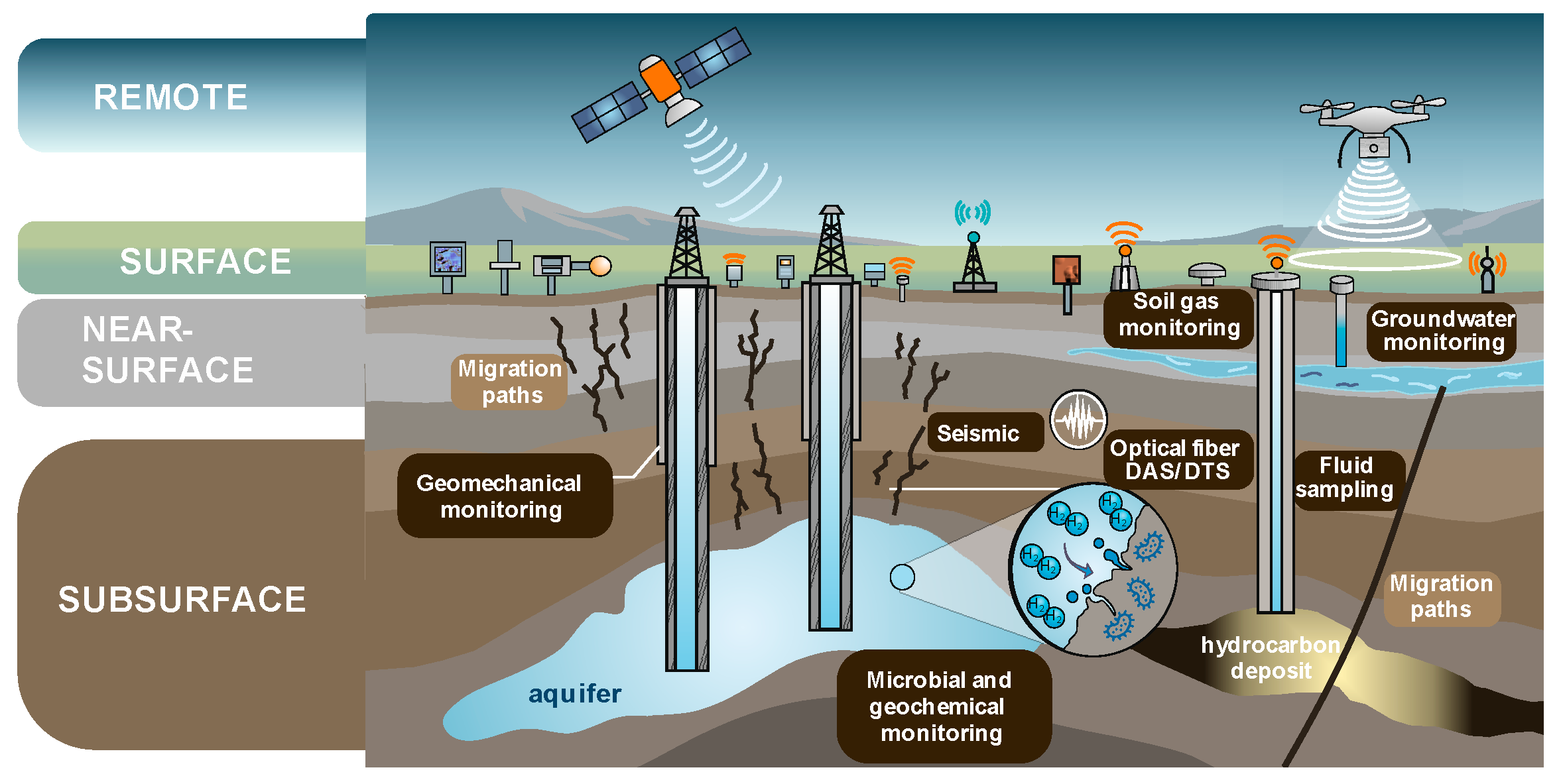
- The subsurface domain focuses on monitoring processes inside the storage formation and controlling the tightness and integrity of wells.
- The near-surface domain focuses on the analysis of gases and water in the transition zone to identify biochemical and geochemical processes and assess the effectiveness of sealing barriers.
- The surface domain covers the supervision of infrastructure and emissions in the vicinity of the installation for the early detection of hydrogen leaks.
- The remote domain uses satellite and drone observations to analyze terrain deformation and gas migration on a regional scale.
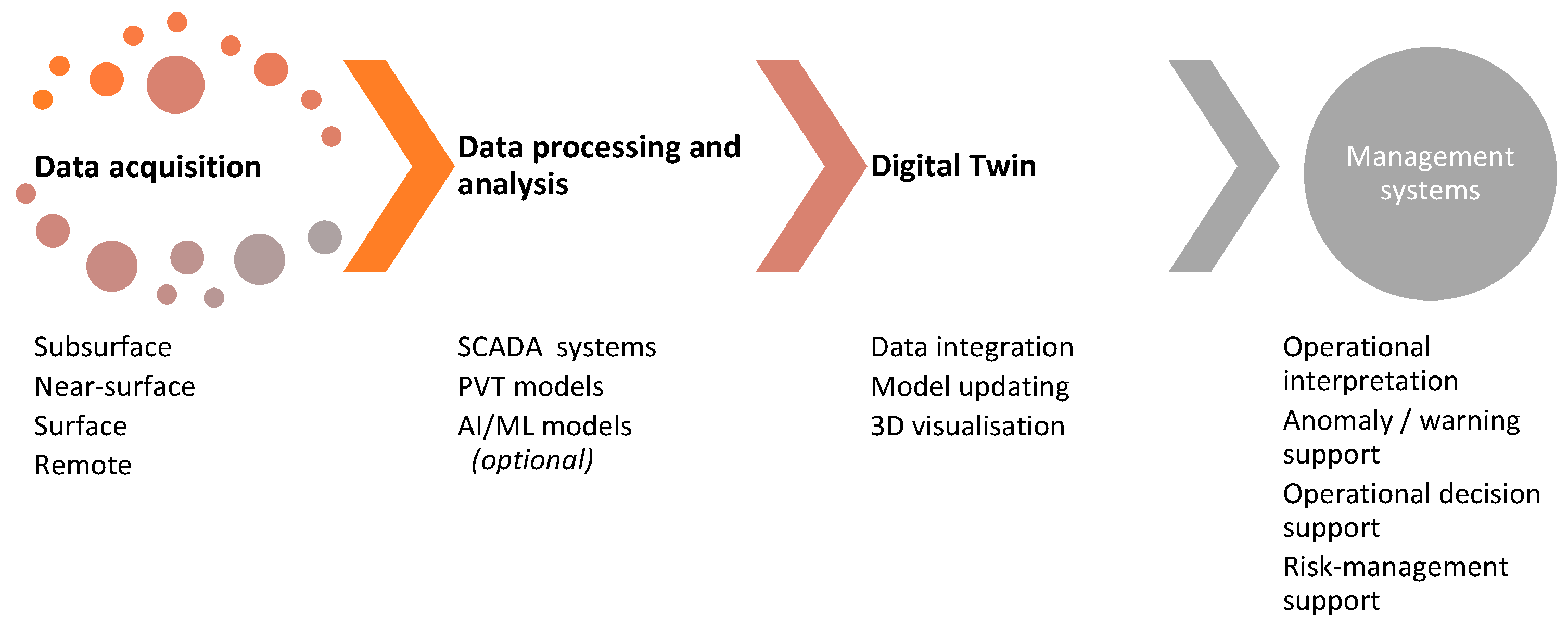
- The digital domain serves as an integration layer supporting data integration, model updating, anomaly screening, and operational interpretation.
3. Results
3.1. The Regulatory and Technical Basis for the Design of UHS Monitoring Systems
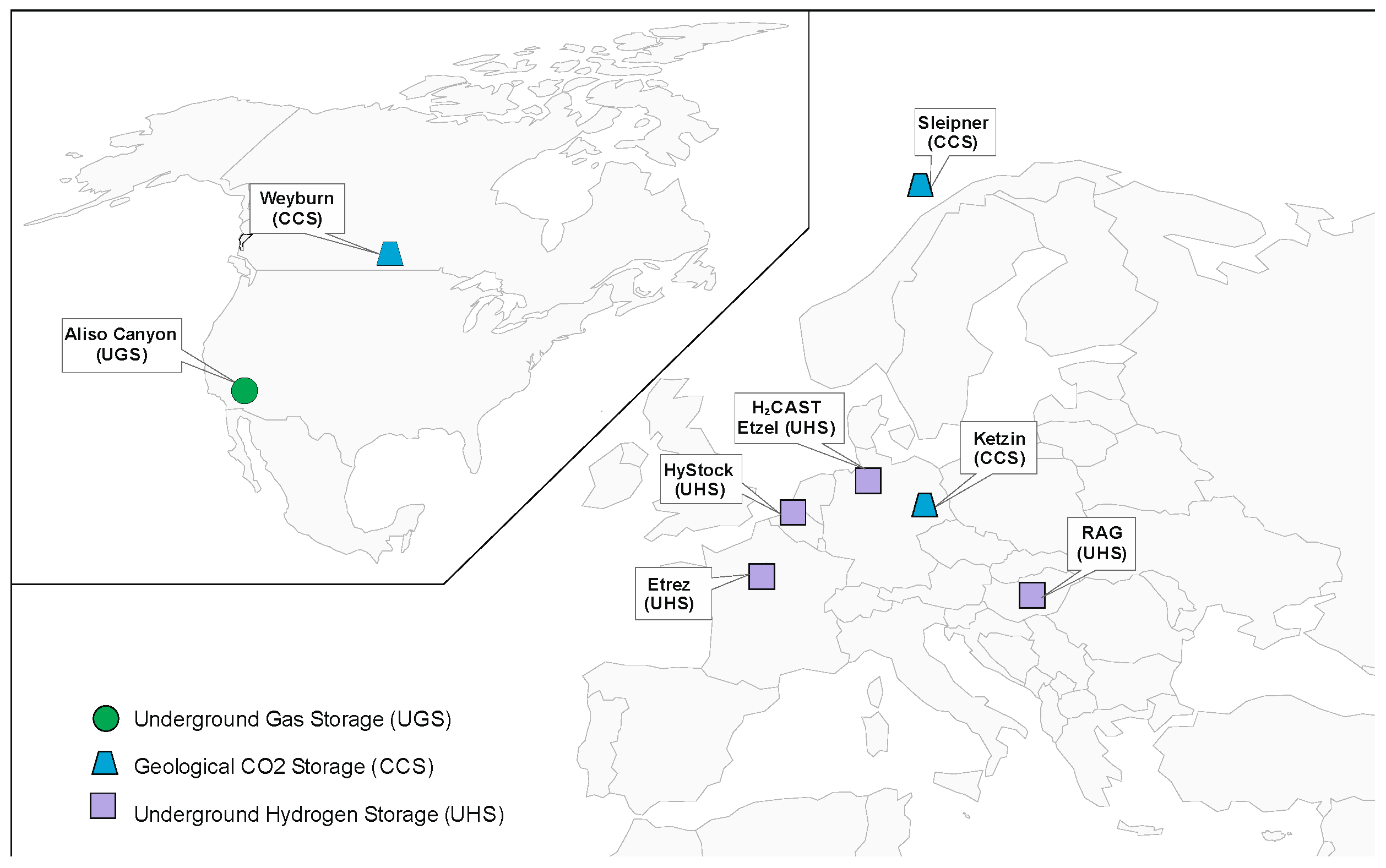
3.2. Case Studies: UGS, CCS, and UHS Projects
3.3. Monitoring Challenges for Hydrogen in Comparison to CCS and UGS Technologies
3.4. UHS Monitoring Model Proposal
- The subsurface domain includes reservoir monitoring and formation integrity control. It uses PT sensors, well logging, fiber optic DAS/DTS systems, and optical microphones to detect micro-vibrations and interlayer leaks. Its purpose is to continuously assess geomechanical stability and detect H2 microleaks in areas close to the wells.
- The near-surface domain covers the shallow subsurface transition zone in which gas migration and associated geochemical and microbiological changes can be monitored in soil, the unsaturated zone, and groundwater. Its vertical extent is site-specific and depends on local geological and hydrogeological conditions, transport processes, and monitoring objectives. Monitoring may include gas and water analyses, chromatography, mass spectrometry, and redox and pH measurements performed to identify gas migration and biogeochemical processes. It allows identification of microbiological transformations (e.g., methanogenesis) and evaluation of the effectiveness of natural sealing barriers.
- The surface domain covers monitoring of infrastructure and emissions in the vicinity of the installation. It uses MEMS/MPS sensors, TDLAS spectroscopy, and IR cameras for monitoring H2 emissions and local thermal or infrastructure anomalies. It supports the detection of H2 emissions and local temperature or infrastructure anomalies in the vicinity of wells and surface facilities.
- The remote domain uses remote-sensing and geodetic observations, including InSAR, GNSS, LiDAR, and UAV-based surveys, primarily to monitor surface deformation and other indirect surface expressions that are potentially associated with storage behavior. Data from this domain can support geomechanical-model validation and assessment of spatial deformation patterns associated with storage operations.
- The digital domain serves as an integration layer for information from the other four monitoring domains. It may combine SCADA data, PVT, reservoir and geomechanical models, GIS-based information, and, when appropriate, AI/ML-based analytical tools. Its function is to support data integration, model updating, anomaly screening, and operational interpretation.
4. Discussion
- The development of UHS-specific technical and regulatory guidance;
- The development and validation of hydrogen-sensitive detection methods and materials resistant to hydrogen-related degradation;
- Field-scale integration and validation of multi-domain monitoring data and models;
- Evaluation of digital twin and AI/ML applications using representative operational UHS datasets.
5. Conclusions
Author Contributions
Funding
Data Availability Statement
Conflicts of Interest
Abbreviations
| AI/ML | Artificial Intelligence/Machine Learning |
| CCS | Carbon capture and storage |
| DNV | Det Norske Veritas |
| PVT | Pressure–Volume–Temperature. |
| UGS | Underground natural gas storage |
| UHS | Underground hydrogen storage |
References
- Bhandari, R.; Adhikari, N. A Comprehensive Review on the Role of Hydrogen in Renewable Energy Systems. Int. J. Hydrogen Energy 2024, 82, 923–951. [Google Scholar] [CrossRef] [Scilit]
- Griffiths, S.; Sovacool, B.K.; Kim, J.; Bazilian, M.; Uratani, J.M. Industrial Decarbonization via Hydrogen: A Critical and Systematic Review of Developments, Socio-Technical Systems and Policy Options. Energy Res. Soc. Sci. 2021, 80, 102208. [Google Scholar] [CrossRef] [Scilit]
- Aneke, M.; Wang, M. Energy Storage Technologies and Real Life Applications—A State of the Art Review. Appl. Energy 2016, 179, 350–377. [Google Scholar] [CrossRef] [Scilit]
- van der Zwaan, B.; Fattahi, A.; Dalla Longa, F.; Dekker, M.; van Vuuren, D.; Pietzcker, R.; Rodrigues, R.; Schreyer, F.; Huppmann, D.; Emmerling, J.; et al. Electricity- and Hydrogen-Driven Energy System Sector-Coupling in Net-Zero CO2 Emission Pathways. Nat. Commun. 2025, 16, 1368. [Google Scholar] [CrossRef] [Scilit] [PubMed]
- Lord, A.S. Overview of Geologic Storage of Natural Gas with an Emphasis on Assessing the Feasibility of Storing Hydrogen; Sandia National Laboratories: Albuquerque, NM, USA, 2009. [Google Scholar]
- Tarkowski, R.; Uliasz-Misiak, B. Underground Hydrogen Storage: Insights for Future Development. Energies 2025, 18, 5724. [Google Scholar] [CrossRef] [Scilit]
- Mulky, L.; Srivastava, S.; Lakshmi, T.; Sandadi, E.R.; Gour, S.; Thomas, N.A.; Shanmuga Priya, S.; Sudhakar, K. An Overview of Hydrogen Storage Technologies—Key Challenges and Opportunities. Mater. Chem. Phys. 2024, 325, 129710. [Google Scholar] [CrossRef] [Scilit]
- Kumar, L.; Sleiti, A.K. A Comprehensive Review of Hydrogen Safety through a Metadata Analysis Framework. Renew. Sustain. Energy Rev. 2025, 214, 115509. [Google Scholar] [CrossRef] [Scilit]
- Romero, J.; Ravasi, M.; Luiken, N. Joint Inversion and Segmentation of the 4D Sleipner Seismic Dataset. In Proceedings of the 84th EAGE Annual Conference & Exhibition, Vienna, Austria, 5–8 June 2023; European Association of Geoscientists & Engineers: Bunnik, The Netherlands, 2023; Volume 2023, pp. 1–5. [Google Scholar] [CrossRef] [Scilit]
- Ajayi, T.; Gomes, J.S.; Bera, A. A Review of CO2 Storage in Geological Formations Emphasizing Modeling, Monitoring and Capacity Estimation Approaches. Pet. Sci. 2019, 16, 1028–1063. [Google Scholar] [CrossRef] [Scilit]
- Roberts, J.J.; Gilfillan, S.M.V.; Stalker, L.; Naylor, M. Geochemical Tracers for Monitoring Offshore CO2 Stores. Int. J. Greenh. Gas. Control 2017, 65, 218–234. [Google Scholar] [CrossRef] [Scilit]
- Tarkowski, R.; Uliasz-Misiak, B.; Tarkowski, P. Storage of Hydrogen, Natural Gas, and Carbon Dioxide—Geological and Legal Conditions. Int. J. Hydrogen Energy 2021, 46, 20010–20022. [Google Scholar] [CrossRef] [Scilit]
- Mahmoud, A.; Gajbhiye, R. Cementing Technologies for CO2 and Hydrogen Wells: A Critical Review of Degradation Mechanisms, Advanced Materials, and Long-Term Well Integrity. Renew. Sustain. Energy Rev. 2026, 226, 116268. [Google Scholar] [CrossRef] [Scilit]
- Jian Jun, E.C.; Foo, H.C.Y.; Ben Mahmud, H.K.; Wei, L.S.; Bennour, Z. Cement integrity challenges associated with underground hydrogen storage: A review of geochemistry and microbial activity. Renew. Sustain. Energy Rev. 2026, 228, 116567. [Google Scholar] [CrossRef] [Scilit]
- Wavrer, J.; Cerepi, A.; Loisy, C. Physicochemical footprint of an H2-enriched water leakage in a shallow freshwater aquifer. Int. J. Hydrogen Energy 2025, 193, 152317. [Google Scholar] [CrossRef] [Scilit]
- Shojaee, A.; Ghanbari, S.; Wang, G.; Gregory, S.; Dopffel, N.; Mackay, E. New Flow Simulation Framework for Underground Hydrogen Storage Modelling Considering Microbial and Geochemical Reactions. Int. J. Hydrogen Energy 2025, 159, 150453. [Google Scholar] [CrossRef] [Scilit]
- Dopffel, N.; An-Stepec, B.A.; Bombach, P.; Wagner, M.; Passaris, E. Microbial Life in Salt Caverns and Their Influence on H2 Storage—Current Knowledge and Open Questions. Int. J. Hydrogen Energy 2024, 58, 1478–1485. [Google Scholar] [CrossRef] [Scilit]
- Yekta, A.E.; Pichavant, M.; Audigane, P. Evaluation of Geochemical Reactivity of Hydrogen in Sandstone: Application to Geological Storage. Appl. Geochem. 2018, 95, 182–194. [Google Scholar] [CrossRef] [Scilit]
- Saeed, M.; Jadhawar, P.; Bagala, S. Geochemical Effects on Storage Gases and Reservoir Rock during Underground Hydrogen Storage: A Depleted North Sea Oil Reservoir Case Study. Hydrogen 2023, 4, 323–337. [Google Scholar] [CrossRef] [Scilit]
- Publications Office of the European Union. Directive 2009/31/EC of the European Parliament and of the Council of 23 April 2009 on the Geological Storage of Carbon Dioxide; Publications Office of the European Union: Luxembourg, 2009; Volume L140, pp. 114–135. [Google Scholar]
- Publications Office of the European Union. Directive 2012/18/EU of the European Parliament and of the Council of 4 July 2012 on the Control of Major-Accident Hazards Involving Dangerous Substances, Amending and Subsequently Repealing Council Directive 96/82/EC Text with EEA Relevance; Publications Office of the European Union: Luxembourg, 2012. [Google Scholar]
- ISO 27914:2026; Carbon Dioxide Capture, Transportation and Storage—Geological Storage. International Organization for Standardization: Vernier, Switzerland, 2026.
- ISO/TR 27923:2022; Carbon Dioxide Capture, Transportation and Geological Storage—Injection Operations, Infrastructure and Monitoring. International Organization for Standardization: Vernier, Switzerland, 2022.
- DNV-RP-J203; Geological Storage of Carbon Dioxide. Det Norske Veritas: Høvik, Norway, 2021.
- ISO/TS 15916:2026; Hydrogen Technologies—Basic Considerations for the Safety of Hydrogen Systems. International Organization for Standardization: Vernier, Switzerland, 2026.
- ISO/TR 27925:2023; Carbon Dioxide Capture, Transportation and Geological Storage—Cross Cutting. International Organization for Standardization: Vernier, Switzerland, 2023.
- INERIS. Launch of the HyPSTER Project—Ineris Secures the First Massive Hydrogen Storage Demonstrator. Available online: https://www.ineris.fr/en/ineris/news/launch-hypster-project-ineris-national-institute-industrial-environment-and-risks (accessed on 6 August 2025).
- Bauer, S. Underground Sun Storage: Final Report Public; RAG Austria AG: Vienna, Austria, 2017. [Google Scholar]
- Lumley, D. 4D Seismic Monitoring of CO2 Sequestration. ASEG Ext. Abstr. 2010, 2010, 1–4. [Google Scholar] [CrossRef] [Scilit]
- Ringrose, P.S.; Thorsen, R.; Zweigel, P.; Nazarian, B.; Furre, A.K.; Paasch, B.; Karstad, P.I. Ranking and Risking Alternative CO2 Storage Sites Offshore Norway. In Proceedings of the Fourth Sustainable Earth Sciences Conference, Malmö, Sweden, 3–7 September 2017; pp. 1–5. [Google Scholar]
- Rostron, B.; Whittaker, S. 10+ Years of the IEA-GHG Weyburn-Midale CO2 Monitoring and Storage Project: Successes and Lessons Learned from Multiple Hydrogeological Investigations. Energy Procedia 2011, 4, 3636–3643. [Google Scholar] [CrossRef] [Scilit]
- Preston, C.; Whittaker, S.; Rostron, B.; Chalaturnyk, R.; White, D.; Hawkes, C.; Johnson, J.W.; Wilkinson, A.; Sacuta, N. IEA GHG Weyburn-Midale CO2 Monitoring and Storage Project–Moving Forward with the Final Phase. Energy Procedia 2009, 1, 1743–1750. [Google Scholar] [CrossRef] [Scilit]
- Martens, S.; Liebscher, A.; Möller, F.; Henninges, J.; Kempka, T.; Lüth, S.; Norden, B.; Prevedel, B.; Szizybalski, A.; Zimmer, M.; et al. CO2 Storage at the Ketzin Pilot Site, Germany: Fourth Year of Injection, Monitoring, Modelling and Verification. Energy Procedia 2013, 37, 6434–6443. [Google Scholar] [CrossRef] [Scilit]
- Pan, L.; Oldenburg, C.M.; Freifeld, B.M.; Jordan, P.D. Modeling the Aliso Canyon Underground Gas Storage Well Blowout and Kill Operations Using the Coupled Well-Reservoir Simulator T2Well. J. Pet. Sci. Eng. 2018, 161, 158–174. [Google Scholar] [CrossRef] [Scilit]
- Fuel Cells Works Hydrogen Pilot Project H2CAST ETZEL: Cavern Filling Begins. Available online: https://fuelcellsworks.com/2025/01/27/fuel-cells/hydrogen-pilot-project-h2cast-etzel-start-of-hydrogen-filling-of-caverns-launched (accessed on 6 August 2025).
- van Gessel, S.; Hajibeygi, H. Hydrogen TCP-Task 42: Underground Hydrogen Storage—Technology Monitor Report 2023; International Energy Agency Hydrogen Technology Collaboration Program: Paris, France, 2023. [Google Scholar]
- Creasy, N.; Huang, Y.; Parsons, J.; Indro, A.; Malki, M.; Mao, S.; Mehana, M. Economic Assessment of Seismic Monitoring for Underground Hydrogen Storage. Int. J. Hydrogen Energy 2026, 207, 153524. [Google Scholar] [CrossRef] [Scilit]
- Akbari, A. Application of Machine Learning in Modelling Gas Dispersion Coefficients for Hydrogen Storage in Porous Media. Can. J. Chem. Eng. 2026, 104, 1137–1152. [Google Scholar] [CrossRef] [Scilit]
- Mwakipunda, G.C.; Yu, L.; Huang, J.; Tang, J. Progress in Machine Learning Applications for Underground Hydrogen Storage: A Review. Int. J. Hydrogen Energy 2026, 201, 152965. [Google Scholar] [CrossRef] [Scilit]
- Shabab, B.A.; Pandey, R. Experimental Evaluation of Wellbore Cement Integrity in Underground Hydrogen Storage Environments. Int. J. Hydrogen Energy 2026, 217, 153957. [Google Scholar] [CrossRef] [Scilit]
- Viveros, F.E.; Liu, N.; Fernø, M.A. Biogeochemical Interactions and Their Role in European Underground Hydrogen Storage. Minerals 2025, 15, 929. [Google Scholar] [CrossRef] [Scilit]
- Seyed Ghafouri, S.M.H.; Younes, J.; Grasselli, G. Geomechanics of Geological Storage of Hydrogen: Knowledge Gaps and Future Directions. Renew. Sustain. Energy Rev. 2026, 225, 116156. [Google Scholar] [CrossRef] [Scilit]
- Zhang, Y.; Dai, Z.; Thanh, H.V.; Cao, M.; Xu, L.; Zhang, X.; Yan, B.; Stauffer, P.H.; Yin, H.; Carroll, K.C.; et al. Innovations in Underground Hydrogen Storage with Multiphysics Simulations, Optimization, and Monitoring: A Review. Earth-Sci. Rev. 2026, 275, 105411. [Google Scholar] [CrossRef] [Scilit]
- Yurikov, A.; Tertyshnikov, K.; Yavuz, S.; Shashkin, P.; Isaenkov, R.; Sidenko, E.; Glubokovskikh, S.; Barraclough, P.; Pevzner, R. Seismic Monitoring of CO2 Geosequestration Using Multi-Well 4D DAS VSP: Stage 3 of the CO2CRC Otway Project. Int. J. Greenh. Gas. Control 2022, 119, 103726. [Google Scholar] [CrossRef] [Scilit]
- Wang, P.; Wang, X.; Ma, J.; Li, Z.; Wang, Y.; Yao, S.; Niu, Y.; Li, M.; Ding, K.; Sui, G.; et al. Digital and Intelligent Technology in Underground Gas Storage Operation Based on Digital Twin Technologies. In Proceedings of the 33rd International Ocean and Polar Engineering Conference, Ottawa, Canada, 19–23 June 2023. [Google Scholar]
- Utley, R.E.; Martin-Roberts, E.; Utting, N.; Johnson, G.; Györe, D.; Zurakowska, M.; Stuart, F.M.; Boyce, A.J.; Darrah, T.H.; Gulliver, P.; et al. Multi-Isotope Geochemical Baseline Study of the Carbon Management Canada Research Institutes CCS Field Research Station (Alberta, Canada), Prior to CO2 Injection. Earth Sci. Syst. Soc. 2023, 3, 10069. [Google Scholar] [CrossRef] [Scilit]
- Ma, J.; Zhou, Y.; Zheng, Y.; He, L.; Wang, H.; Niu, L.; Yu, X.; Cao, W. Advances in Geochemical Monitoring Technologies for CO2 Geological Storage. Sustainability 2024, 16, 6784. [Google Scholar] [CrossRef] [Scilit]
- Stork, A.L.; Verdon, J.P.; Kendall, J.M. The microseismic response at the In Salah Carbon Capture and Storage (CCS) site. Int. J. Greenh. Gas. Control 2015, 32, 159–171. [Google Scholar] [CrossRef] [Scilit]
- Otchere, D.A.; Latiff, A.H.; Tackie-Otoo, B.N. Distributed acoustic sensing in subsurface applications – Review and potential integration with artificial intelligence for an intelligent CO2 storage monitoring system. Geoenergy Sci. Eng. 2024, 237, 212818. [Google Scholar] [CrossRef] [Scilit]
- Daley, T.M.; Freifeld, B.M.; Ajo-Franklin, J.; Dou, S.; Pevzner, R.; Shulakova, V.; Kashikar, S.; Miller, D.E.; Goetz, J.; Henninges, J.; et al. Field testing of fiber-optic distributed acoustic sensing (DAS) for subsurface seismic monitoring. Lead. Edge 2013, 32, 699–706. [Google Scholar] [CrossRef] [Scilit]
- Verdon, J.P. Microseismic Monitoring and Geomechanical Modelling of CO2 Storage in Subsurface Reservoirs; Springer: Berlin/Heidelberg, Germany, 2012. [Google Scholar] [CrossRef] [Scilit]
- Shanafield, M.; Banks, E.W.; Arkwright, J.W.; Hausner, M.B. Fiber-Optic Sensing for Environmental Applications: Where We Have Come From and What Is Possible. Water Resour. Res. 2018, 54, 8552–8557. [Google Scholar] [CrossRef] [Scilit]
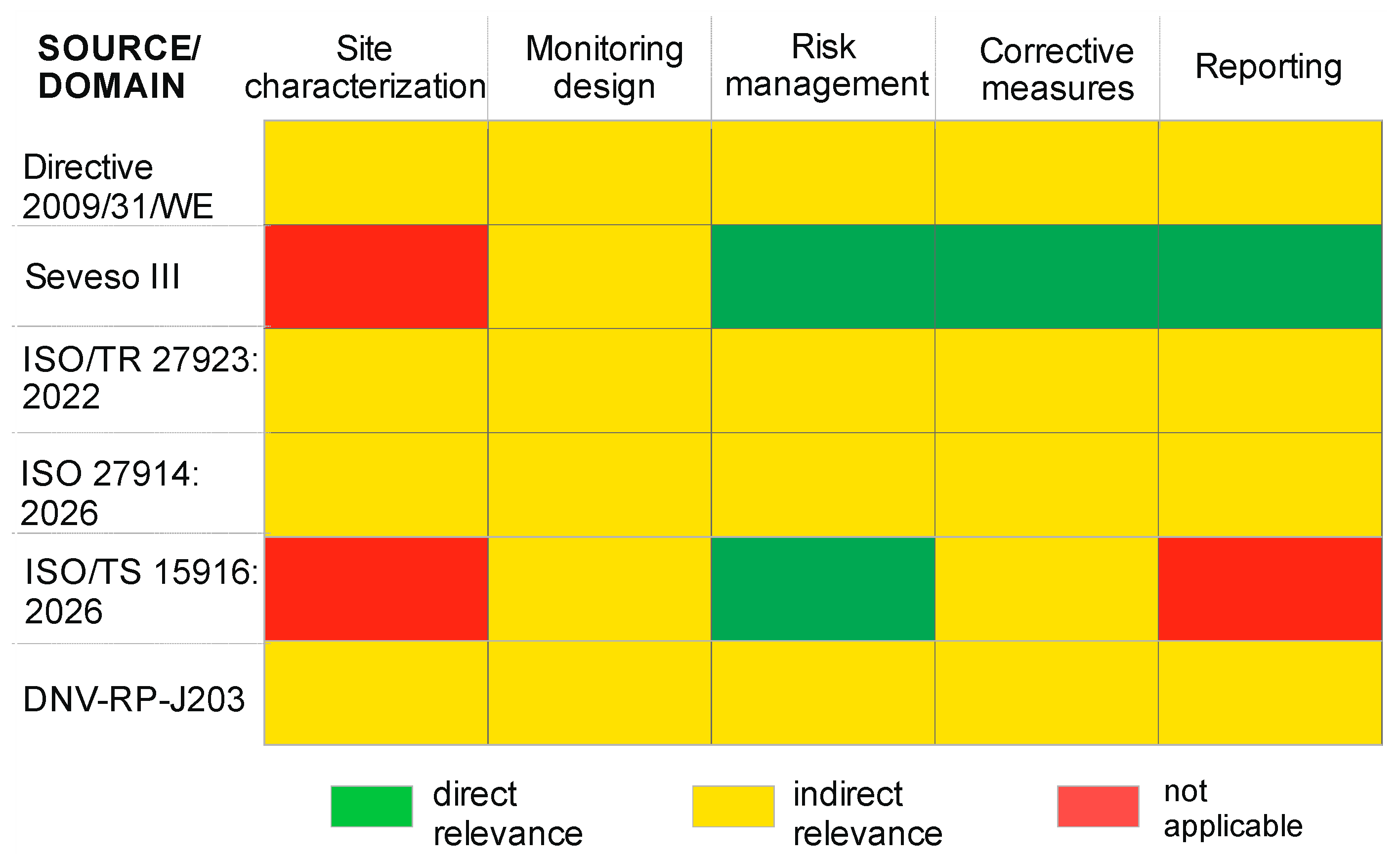



| Regulation/Standard | Scope of UHS Monitoring | Technical Transferability | Transferability Rationale | Recommendations |
|---|---|---|---|---|
| Directive 2009/31/EC—Monitoring plan | Injection, storage-complex, migration, and leakage monitoring | H2-specific adaptation required | Framework is applicable; high H2 diffusivity/mobility requires appropriate sensor sensitivity. | Adapt monitoring objectives and methods to H2 behavior and storage type. |
| Directive 2009/31/EC—Corrective measures | Leakage response and remediation procedures | H2-specific adaptation required | General response principles apply, but hydrogen-specific thresholds depend on the monitoring environment and context. | Adapt CCS corrective actions to hydrogen scenarios. |
| Directive 2012/18/EU—Major-accident prevention and emergency planning | Safety management and emergency response | Directly transferable | Hydrogen is explicitly covered by Seveso III. | Integrate monitoring with safety and emergency-response procedures. |
| ISO 27914:2026—Geological storage | Site characterization, storage design, operation, risk management, and containment | H2-specific adaptation required | Geological-storage principles are relevant but developed for CO2. | Adapt to H2 properties, storage type, and failure mechanisms |
| DNV-RP-J203:2021—Well integrity and monitoring | Storage-site qualification, risk management, monitoring, performance verification, and well assessment | H2-specific adaptation required | Risk-based principles are transferable but developed for CO2. | Adapt hazards, indicators, and well-integrity criteria to UHS. |
| ISO/TS 15916:2026—Basic considerations for the safety of hydrogen systems | Hydrogen properties, hazards, and general safety considerations | Directly transferable | It provides H2-specific general safety guidance. | Use it as a complementary H2-safety reference. |
| ISO/TR 27923:2022—Injection operations, infrastructure and monitoring | Injection operations, wells and infrastructure, baseline, surface and downhole monitoring | H2-specific adaptation required | Monitoring practices are relevant but require H2-specific evaluation. | Adapt methods and criteria to H2 and site conditions. |
| Project | Type | Main Monitoring Technologies | Key Project Experience | Relevance to UHS | Source |
|---|---|---|---|---|---|
| Sleipner (Norway) | CCS | 4D seismic, modeling | CO2 plume tracking | Geophysical monitoring; H2-specific evaluation needed | [30] |
| Weyburn–Midale (Canada) | CCS | Seismic, InSAR, and groundwater chemistry | Integrated long-term monitoring | Multi-domain monitoring; H2-specific adaptation needed | [31,32] |
| Ketzin (Germany) | CCS | 4D seismic, ERT, gas/water sampling | Integrated multi-method monitoring | Multi-method approach; H2-specific sensitivity assessment needed | [33] |
| Aliso Canyon (USA) | UGS | DAS/DTS, microseismic, gas/pressure sensors | Leakage and pressure monitoring | Relevant to well and operational monitoring; H2-specific adaptation needed | [34] |
| H2CAST Etzel (Germany) | UHS | Fiber optics, modeling, cavern deformation | Cavern integrity monitoring | Directly relevant to salt-cavern UHS | [35] |
| HyStock (The Netherlands) | UHS | H2 sensors, leak tests, water geochemistry | H2-specific monitoring tests | Directly relevant to UHS sensor and leak monitoring | [36] |
| Etrez (France) | UHS | Cyclic storage tests | Cyclic storage operation | Relevant to cyclic UHS monitoring | [27] |
| RAG (Austria) | UHS | Hybrid CH4/H2 storage, grid integration | H2-containing gas storage | Relevant to dynamic storage monitoring | [28] |
| Domain/Area | UGS | CCS | UHS |
|---|---|---|---|
| Regulatory framework | National gas/mining laws; Gas Directive 2009/73/EC | Directive 2009/31/EC; ISO 27914:2026; ISO/TR 27923:2022 | Emerging “read-across” from CCS/UGS; linked to Seveso III |
| Subsurface | 2D/3D seismic, PT logging, cement tests | 3D/4D seismic, microseismic, optical sensors | High-res 4D seismic, DAS/DTS, H2-selective sensors |
| Near-surface | Monitoring of groundwater and soil gas (CH4) | Geochemical monitoring (pH, Eh, gases) | Weak geochemical signal; biochemical process monitoring |
| Surface | Infrastructure cheques; methane detectors | Gas detection in emission risk zones | High-sensitivity H2 sensors (MEMS, TDLAS, IR) |
| Remote | InSAR, GNSS (used occasionally) | InSAR/GNSS for ground stability | Site-specific use of InSAR, GNSS and/or UAV-based observations for surface-deformation monitoring and model validation |
| Digital | Standard SCADA systems | Integrated monitoring and data-management platforms | Digital data integration; model updating and anomaly screening |
| Safety systems | Basic well and pressure control | Leakage response and pressure management | Redundant detection, automatic shutdown, ventilation, early-warning systems |
| Domain | Targeted Hazards/Diagnostic Functions | Main Parameters Monitored | Lifecycle Applications |
|---|---|---|---|
| Subsurface | Detection of H2 microleaks in well cement; assessment of caprock integrity and geomechanical stability Reservoir behavior; formation integrity; active and legacy well integrity; loss of zonal isolation; gas migration | Dynamic pressure/temperature, fracture activity, interlayer migration, pressure, temperature, flow rate, annular pressure, casing/cement integrity indicators, formation response | Baseline, operational, post-closure |
| Near-surface | Identification of biochemical H2 consumption; tracking geochemical signals of gas migration in the transition zone | H2, CH4, CO2, pH, Eh, dissolved gases, microbial indicators | Baseline, operational, post-closure |
| Surface | Early detection of H2 emissions near wellheads; monitoring of infrastructure integrity and fire risk | Gas concentration, emission flux, temperature, infrastructure condition | Operational |
| Remote | Validation of geomechanical models; regional observation of terrain deformation anomalies | Vertical displacement, surface deformation, spatial deformation patterns | Baseline and post-closure |
| Digital | Data integration; model updating; anomaly screening; and operational interpretation | Integrated monitoring variables, model–data consistency, anomaly indicators and data quality | Full lifecycle integration |
Disclaimer/Publisher’s Note: The statements, opinions and data contained in all publications are solely those of the individual author(s) and contributor(s) and not of MDPI and/or the editor(s). MDPI and/or the editor(s) disclaim responsibility for any injury to people or property resulting from any ideas, methods, instructions or products referred to in the content. |
© 2026 by the authors. Licensee MDPI, Basel, Switzerland. This article is an open access article distributed under the terms and conditions of the Creative Commons Attribution (CC BY) license.
Share and Cite
Uliasz-Misiak, B.; Tarkowski, R. Monitoring Underground Hydrogen Storage: An Integrated Multi-Domain Framework. Energies 2026, 19, 4437. https://doi.org/10.3390/en19184437
Uliasz-Misiak B, Tarkowski R. Monitoring Underground Hydrogen Storage: An Integrated Multi-Domain Framework. Energies. 2026; 19(18):4437. https://doi.org/10.3390/en19184437
Chicago/Turabian StyleUliasz-Misiak, Barbara, and Radosław Tarkowski. 2026. "Monitoring Underground Hydrogen Storage: An Integrated Multi-Domain Framework" Energies 19, no. 18: 4437. https://doi.org/10.3390/en19184437
APA StyleUliasz-Misiak, B., & Tarkowski, R. (2026). Monitoring Underground Hydrogen Storage: An Integrated Multi-Domain Framework. Energies, 19(18), 4437. https://doi.org/10.3390/en19184437