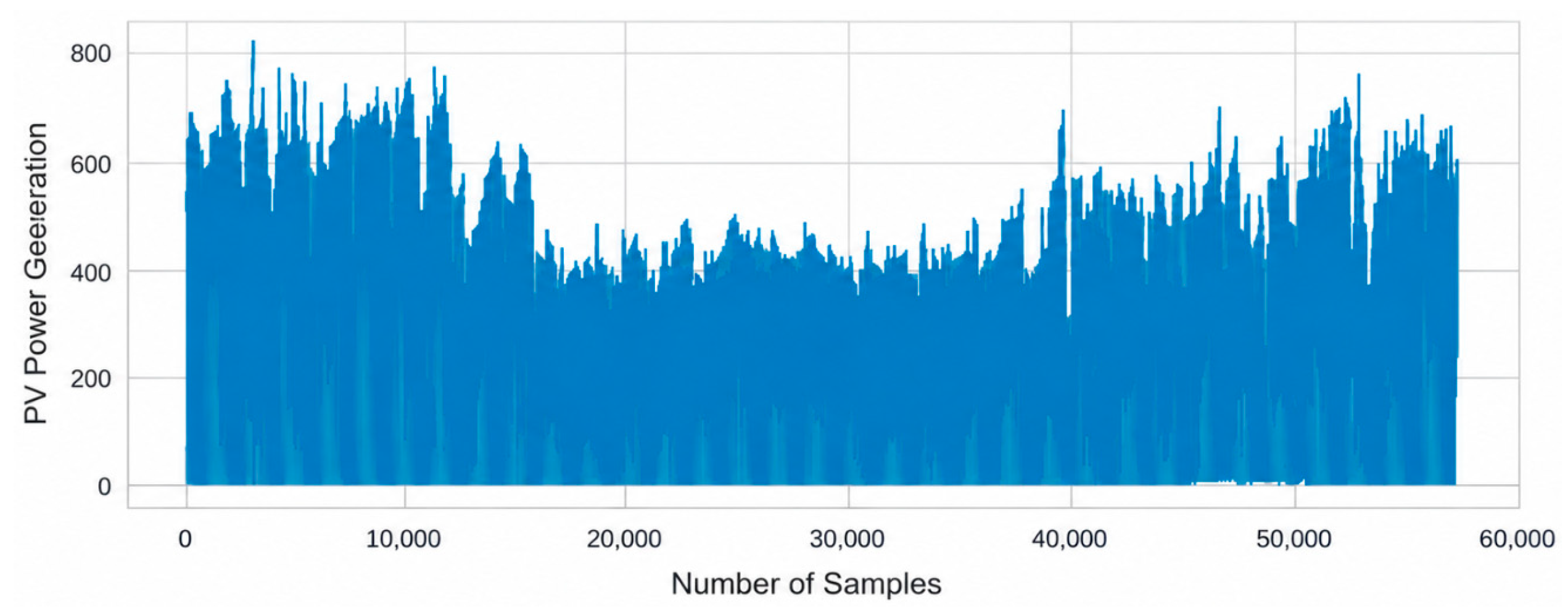
With the rapid advancement of new energy generation technologies, photovoltaic (PV) power has seen a continuous expansion in its installed capacity within power systems, owing to its advantages such as cleanliness, low carbon emissions, and renewability. Against the backdrop of large-scale integration of distributed photovoltaics, multiple PV stations are increasingly operating in clusters, gradually becoming a vital component of distribution networks and modern power systems. However, PV power output is influenced by various meteorological factors, including solar irradiance, ambient temperature, and cloud cover variations, exhibiting significant characteristics of randomness, volatility, and intermittency. The uncertainty is further superimposed and amplified at the cluster level, posing severe challenges to the safe and stable operation of the grid, power balance control, and dispatch decision-making. Accurate Photovoltaic Power Forecasting (PVPF) plays a crucial role in optimizing grid operations, minimizing energy waste, enhancing solar energy efficiency, and improving the profitability of PV power plants [
1]. Therefore, to effectively address these issues, it is imperative to develop high-precision forecasting methods for PV clusters. In particular, probabilistic forecasting approaches, which are specifically designed to characterize and quantify such uncertainty, hold profound theoretical significance and practical engineering value.
1.1. Literature Review
Existing PV power forecasting methods primarily include physical mechanism-based modeling, statistical analysis-based methods, and data-driven intelligent forecasting approaches. Physical models rely on complex meteorological parameters and system configurations, such as tilt angles and conversion efficiency, to directly calculate theoretical output [
2,
3]. These models involve high construction costs and exhibit poor adaptability. Statistical forecasting methods focus on mining time-series patterns from historical power data to establish mathematical models for prediction. Typical techniques include the Autoregressive Moving Average (ARMA) model, Autoregressive Integrated Moving Average (ARIMA) model, Grey Prediction Model, and Markov Chains [
4,
5,
6]. However, these methods demonstrate limited capability in handling the strong nonlinearity and non-stationarity inherent in PV power sequences.
With the advancement of artificial intelligence, neural network models have been gradually introduced into the field of PV power forecasting. Typical approaches include Back-Propagation neural networks (BP), Radial Basis Function neural networks (RBF), Artificial Neural Networks (ANN), and Support Vector Machines (SVM) [
7,
8,
9]. In recent years, deep learning techniques such as Recurrent Neural Networks (RNN) [
10], Long Short-Term Memory (LSTM), and Gated Recurrent Units (GRU) [
11] have been widely applied to PV power forecasting. Compared with traditional feed-forward neural networks, these deep learning models can capture complex time-series relationships within the data, making them suitable for nonlinear and dynamic load data.
Recent forecasting methods have further introduced hybrid CNN-LSTM structures [
12], which combine convolutional layers for local feature extraction with LSTM for capturing temporal dependencies, thereby achieving precise modeling of complex time series. Wang et al. [
13] use a hybrid forecasting framework that integrates LSTM-RNN with temporal correlation correction, leveraging the coupling relationship between the periodicity and randomness of PV output. This approach captures nonlinear fluctuation characteristics and refines preliminary results based on annual cycle patterns and neighborhood similarity, enhancing short-term forecasting performance. While neural network models demonstrate significant advantages in nonlinear modeling, they still suffer from diminished accuracy in long-term time-series forecasting.
In addition, the Transformer model captures global dependencies in time series through the self-attention mechanism, showing excellent performance in long-sequence forecasting tasks. Some studies have introduced the Transformer structure into PV power forecasting, effectively improving prediction accuracy. However, the computational complexity of the standard Transformer increases quadratically when modeling long sequences, making it difficult to meet the requirements of engineering applications. To address this, some researchers have adopted the Informer model [
14]. By using a ProbSparse self-attention mechanism and a distilling structure, Informer significantly reduces computational complexity while maintaining high accuracy. This model has achieved good results in fields such as power load and wind power forecasting. Despite its strengths in long-term forecasting, the application of Informer in medium-term forecasting remains relatively limited, as it struggles to effectively capture the more complex short-term fluctuations and seasonal variations inherent in medium-term predictions.
To achieve better performance in PV power forecasting, researchers have employed various hybrid approaches. Kushwaha and Pindoriya [
15] applied wavelet decomposition to split the original sequence into sub-sequences of different frequencies. They then established linear Seasonal ARIMA (SARIMA) models and nonlinear Random Vector Functional Link (RVFL) neural networks for each sub-sequence. The final forecast was obtained by summing and reconstructing the predictions of all sub-sequences, achieving superior accuracy compared with single models or other hybrid approaches, particularly under highly volatile weather conditions. Niu et al. [
16] utilized Complementary Ensemble Empirical Mode Decomposition (CEEMD) to decompose non-stationary power sequences into multiple Intrinsic Mode Functions (IMFs), reducing sequence volatility. They optimized the weights and thresholds of a Back-Propagation Neural Network (BPNN) using the Dynamic Inertia Factor Particle Swarm Optimization (DIFPSO) algorithm, effectively mitigating the model’s tendency to get trapped in local optima and significantly improving prediction accuracy under various weather types. Tang et al. [
17] proposed a hybrid model for short-term forecasting based on feature construction and an improved Transformer. They applied the FOX algorithm to optimize Complete Ensemble Empirical Mode Decomposition with Adaptive Noise (CEEMDAN) for modal decomposition and introduced a frequency-enhanced channel attention mechanism into the iTransformer architecture to emphasize frequency-domain information within multivariate time series. This approach notably enhanced both prediction accuracy and model generalization. Li et al. [
18] developed a combined model integrating CNN, Bidirectional Long Short-Term Memory (BiLSTM) networks, and an Attention Mechanism (AM), with global hyperparameter optimization performed using a Feature Optimization Algorithm (CFOA). The model first uses CNN to extract spatial features and BiLSTM to capture hidden temporal dependencies. A self-attention mechanism is then employed to automatically assign feature weights and model long-term dependencies, resulting in an optimized hybrid forecasting framework. Tian et al. [
19] proposed a SHAP-NMTCN-BiGRU-based model for short-term forecasting, incorporating nonlinear prediction and secondary error correction. This method first classifies weather types using the MCClear model and applies Random Forest to enhance features of abrupt weather subsets. SHAP values are employed to optimize weighting across models and feature dimensions, while Neural Architecture Search (NAS) automatically tunes the hybrid network structure. Finally, the initial prediction error is calculated, and a Transformer model is introduced for linear error prediction and secondary correction of power values. However, most existing studies focus on individual PV power stations and primarily model temporal features, often neglecting the spatial correlations within PV clusters. As a result, fully characterizing the power evolution patterns of PV clusters remains challenging.
In practical operation, the substations within a PV power plant cluster exhibit significant spatial correlations in terms of geographical location, meteorological conditions, and operating status. This spatial dependency has an important impact on the overall power output of the cluster. Ignoring the spatial coupling among plants may weaken the ability of forecasting models to characterize the overall behavior of the system. In recent years, some studies have introduced graph neural networks (GNNs) [
20] to model the spatial structure among plants, thereby improving cluster-level forecasting performance to some extent. Yang et al. [
21] used a graph convolutional network (GCN) to extract spatial features and then combined it with an LSTM for spatiotemporal joint forecasting. To address the low computational efficiency and limited feature extraction capability of deep learning methods in long-sequence photovoltaic power forecasting, Zhuang et al. [
22] proposed a medium-term forecasting model that integrates a GCN with Informer. In this approach, the Informer model is used to enable parallel generation for long time-series forecasting, while the GCN is introduced to model the correlation features among photovoltaic plant nodes, thus enhancing the representation of multi-factor coupling relationships in PV power. However, for temporal modeling, most existing methods still rely on RNNs, which suffer from gradient vanishing when processing long sequences, potentially limiting the forecasting accuracy of RNNs in long-term prediction scenarios. Although the LSTM model can be applied to ultra-short-term and short-term photovoltaic power forecasting and can significantly improve prediction accuracy, its performance tends to decline over longer time horizons [
23]. Overall, these methods generally face limitations in modeling long-term dependencies, along with high computational complexity and low forecasting efficiency in long-sequence prediction tasks, making them difficult to meet the engineering requirements of multi-plant and multi-timescale applications.
In addition, existing PV power forecasting studies still mainly focus on deterministic point forecasting, which provides only a single predicted value. This makes it difficult to reflect the inherent uncertainty of PV power generation and prevents the provision of reliable probabilistic information for grid dispatching decisions, reserve capacity allocation, and risk assessment. In contrast, probabilistic forecasting can characterize the distribution of power output in the form of prediction intervals or quantiles, which is more consistent with the practical needs of power system operation. At present, the probabilistic forecasting methods commonly used by researchers mainly include quantile regression (QR), kernel density estimation (KDE) [
24], and Gaussian process regression (GPR) [
25] to generate probabilistic forecasting results for PV power output.
The integration of QR, KDE, and hybrid neural networks has become one of the mainstream technical directions in probabilistic forecasting. Wang et al. [
26] further combined prediction results obtained through wavelet reconstruction and inverse normalization with QR to construct a probabilistic forecasting model. In this model, deterministic forecasting errors were represented as a series of quantiles based on B-spline functions to quantify the uncertainty of PV power output. Validation based on measured data from a PV power plant in Belgium showed that the probabilistic forecasting method achieved strong stability and high accuracy across different seasons and forecasting horizons. La et al. [
27] proposed a probabilistic forecasting model based on a genetic algorithm-optimized quantile regression neural network (QRNN). This model can generate day-ahead hourly quantile forecasts of PV output during daytime periods, thereby supporting bidding decisions in the day-ahead electricity market. Ma [
28] proposed an efficient probabilistic PV power forecasting model based on QR-BiMGM. This model integrates QR with a bidirectional minimal gated memory network, uses fuzzy C-means clustering to identify similar days, and combines improved KDE to generate probabilistic forecasting results. Studies have shown that models combining deep neural networks with QR can effectively construct prediction intervals under different confidence levels and thus provide reliable support for dispatching decisions. However, research on probabilistic forecasting for PV power plant clusters remains relatively limited. In particular, there is still a lack of a unified forecasting framework that simultaneously integrates spatial correlation modeling, efficient long-sequence modeling, and uncertainty quantification, and the forecasting accuracy across multiple time scales still needs further improvement.
1.2. Motivations and Contributions
Although significant progress has been made in recent years in terms of model architecture and forecasting accuracy for PV forecasting, existing studies still face many challenges due to the strong randomness, nonlinearity, and multi-scale coupling characteristics of photovoltaic output. First, traditional deep learning forecasting methods have difficulty effectively capturing long-range dependencies when dealing with long time-series forecasting tasks, resulting in insufficient long-term forecasting performance. Second, most existing PV power forecasting methods focus mainly on a single plant or short-term forecasting, while overlooking the spatial correlations among substations within a PV power plant cluster. As a result, the forecasting results may fail to accurately reflect the evolution pattern of the overall cluster power output, thereby affecting the accuracy and stability of grid dispatching. Finally, current research on PV power forecasting still mainly emphasizes deterministic forecasting that outputs a single value, making it unable to effectively capture the inherent randomness and volatility of PV power generation.
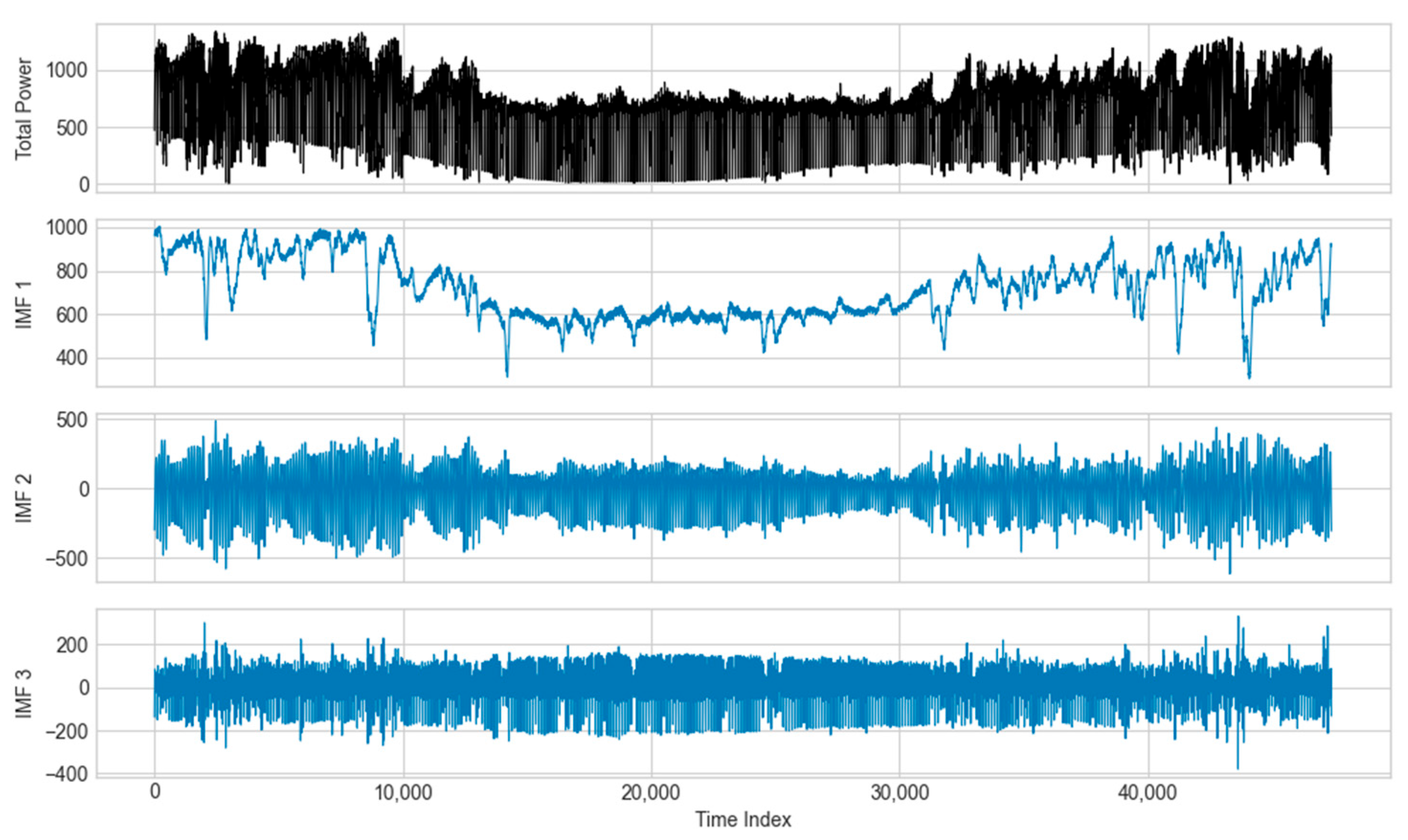
At the same time, PV power forecasting involves not only temporal variation but also fluctuations at different frequency levels. For example, short-term fluctuations, such as those caused by cloud cover, and long-term trends, such as seasonal changes, coexist within the same time series. Therefore, how to effectively separate and process signals at different frequency levels through multi-scale methods has become an important challenge. Although methods such as variational mode decomposition (VMD) can decompose PV power data into multiple intrinsic mode functions (IMFs), with each IMF corresponding to a different frequency level, it remains difficult to jointly model these decomposed components together with spatial and temporal features. In addition, using modern deep learning models, such as Informer, to effectively capture dependencies in long time series while efficiently handling multi-scale data still faces the dual challenge of high computational complexity and limited long-sequence modeling capability.
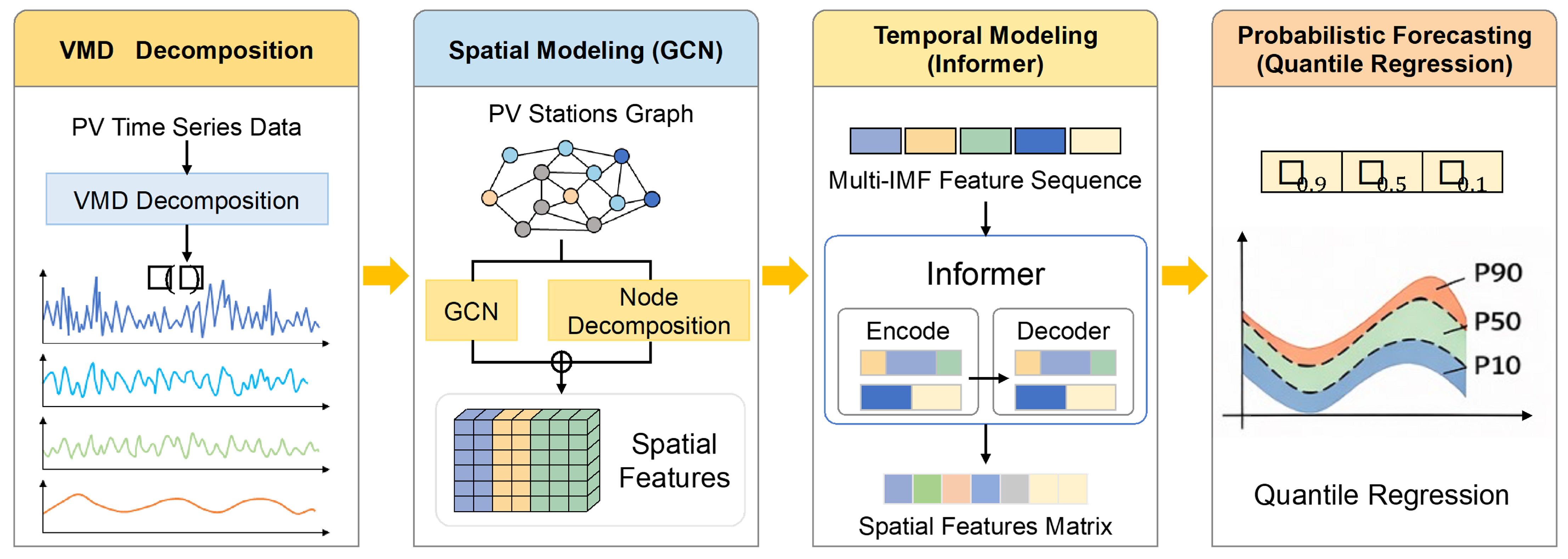
To address the above issues and challenges, this paper proposes a PV cluster power prediction method, which integrates multi-scale temporal decomposition, spatial graph modeling, and an efficient long-sequence forecasting mechanism. First, multi-source data are preprocessed, and clustering combined with variational mode decomposition is applied to reduce data non-stationarity and noise interference. Second, a graph convolutional network is used to extract spatial correlations among PV stations, while the Informer model is employed to efficiently model long-term temporal dependencies. Finally, probabilistic forecasting is conducted.
The main contributions of this paper can be summarized as follows:
(1) This study extends the forecasting target from a traditional single photovoltaic plant to an interconnected photovoltaic plant cluster. It also takes into account fluctuations at different frequency levels in photovoltaic power and further advances the forecasting objective from deterministic point values to probabilistic distributions.
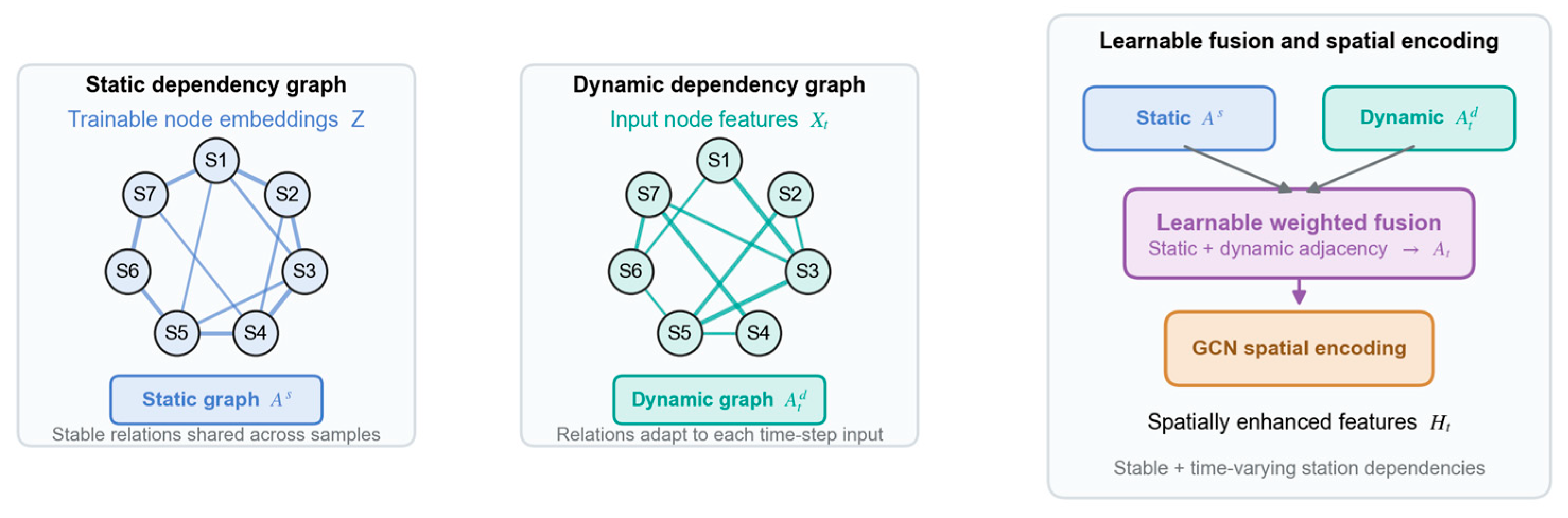
(2) A spatiotemporal joint probabilistic forecasting framework for PV plant clusters is proposed to achieve unified modeling of temporal characteristics, spatial correlations, and uncertainty in cluster power output. First, a graph-structured spatial modeling method for PV plant clusters is developed. By explicitly characterizing the spatial dependencies among plants, the proposed method improves cluster-level forecasting accuracy. Second, multi-scale time-series decomposition and an efficient long-sequence modeling mechanism are introduced, which enhance the model’s ability to capture nonstationary signals and long-term dependencies in PV power data. Finally, QR is employed to generate multi-quantile forecasting results, enabling a quantitative representation of uncertainty in PV power output and providing reliable decision support for grid dispatching and risk assessment.
(3) At the 5-min forecasting horizon, Persistence achieves the lowest MAE of 40.590 kW, while the proposed VMD-GCN-Informer-QR model obtains an MAE of 42.834 kW and the lowest RMSE of 72.182 kW. The proposed model also provides probabilistic forecasts, achieving a PICP of 89.682% and an MPIW of 201.818 kW. From 15 to 60 min, the proposed model consistently outperforms Persistence and the other benchmark models in terms of MAE and RMSE. Seasonal and external-region experiments further support its adaptability under different operating conditions.



 ,
,