Article

Probabilistic Power Forecasting for Photovoltaic Plant Clusters Using VMD-GCN-Informer

1
China Electric Power Research Institute, Beijing 100192, China
2
State Grid Anhui Electric Power Co., Ltd. Tongling Power Supply Company, Tongling 244000, China
3
State Grid Anhui Electric Power Co., Ltd. Electric Power Research Institute, Hefei 230000, China
4
School of Systems Science, Beijing Jiaotong University, Beijing 100044, China
*
Author to whom correspondence should be addressed.
Energies 2026, 19(18), 4423; https://doi.org/10.3390/en19184423 (registering DOI)
Submission received: 2 July 2026 / Revised: 1 September 2026 / Accepted: 8 September 2026 / Published: 18 September 2026

Abstract

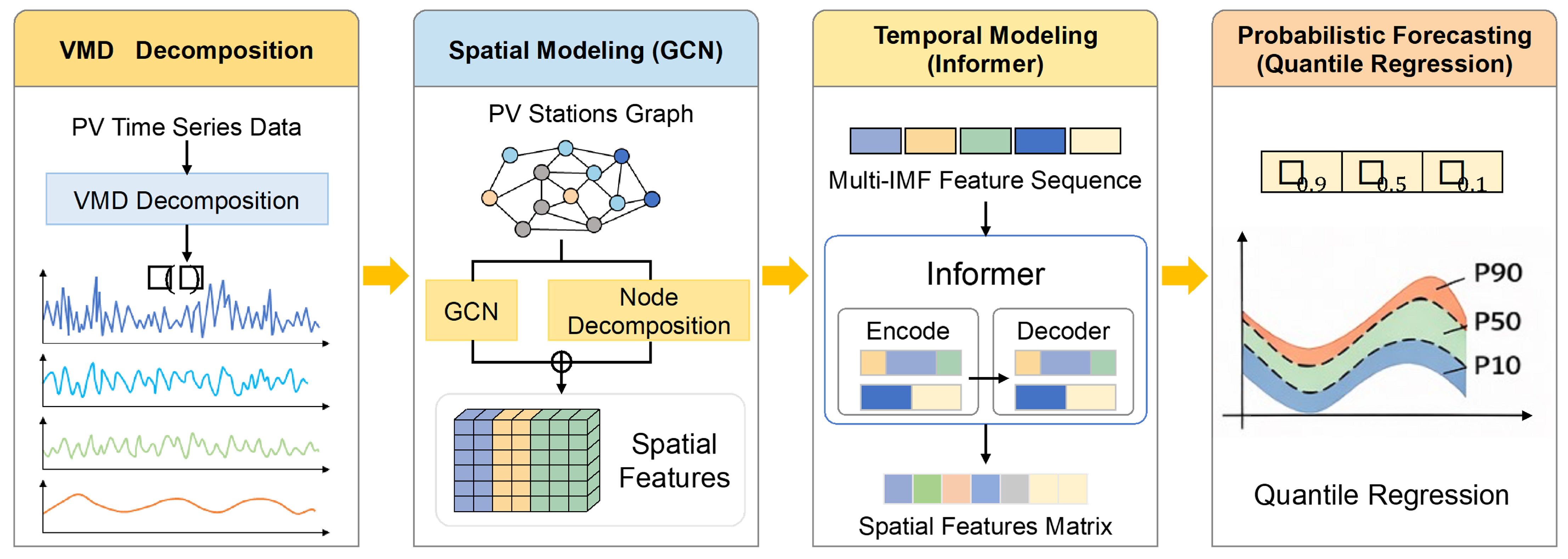
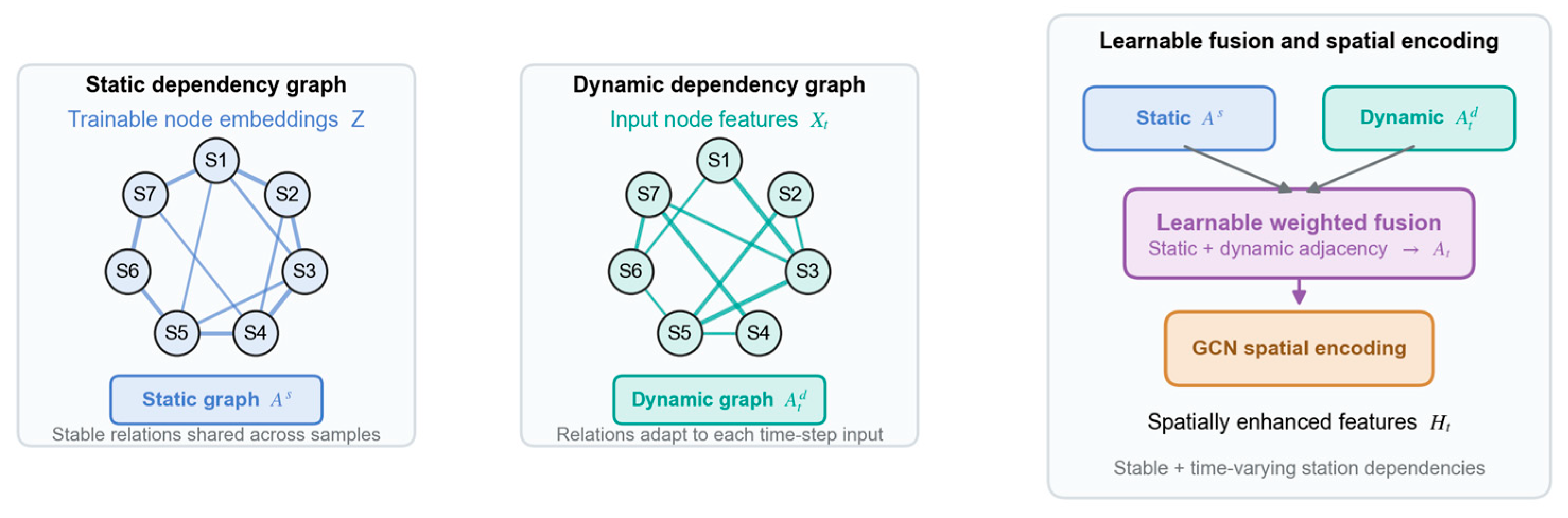
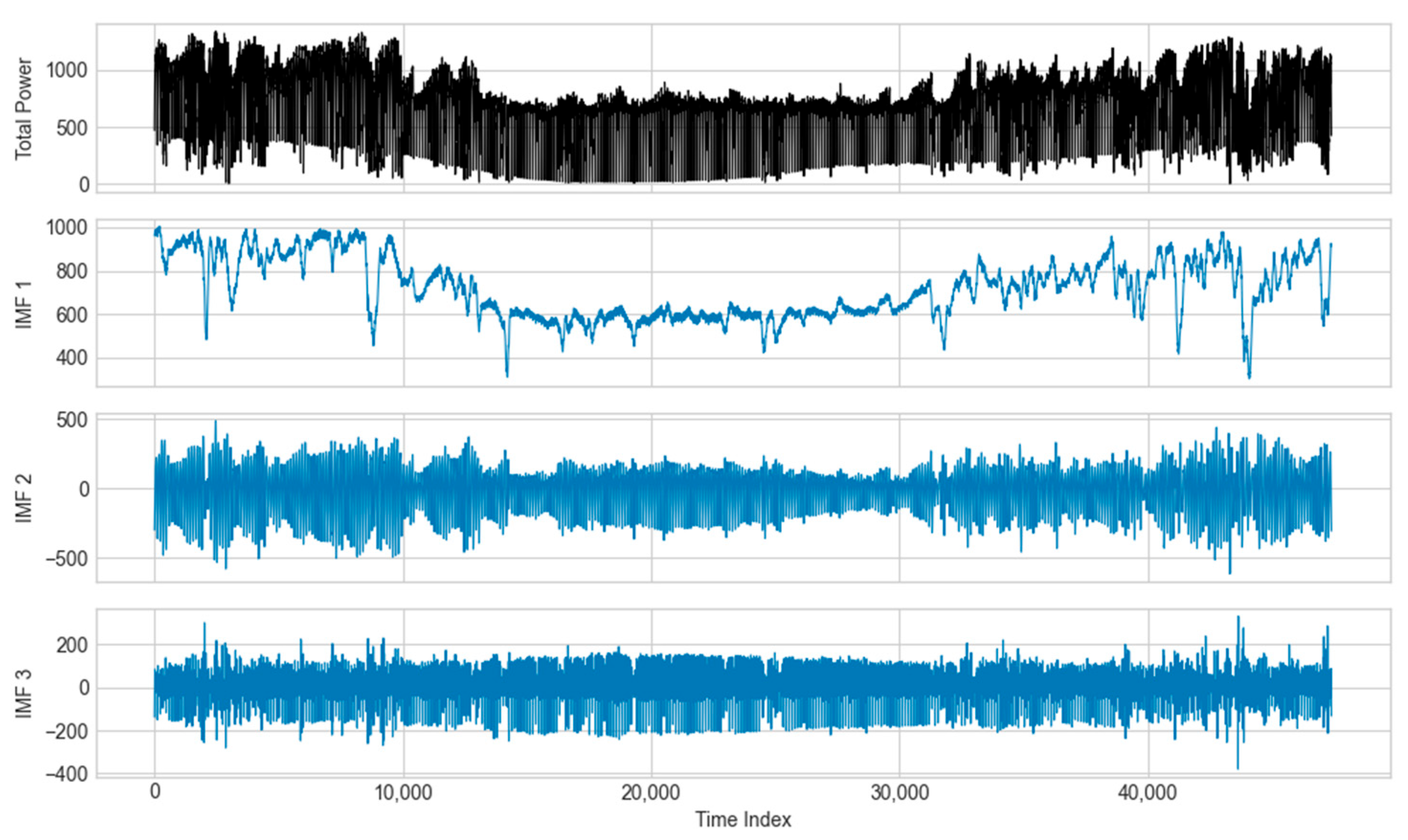
Existing photovoltaic (PV) power forecasting methods face challenges in simultaneously capturing multi-scale temporal characteristics, spatial dependencies among PV plants, long-term temporal correlations, and output uncertainty. To address these issues, this paper proposes a spatiotemporal probabilistic forecasting framework for PV plant clusters that integrates Variational Mode Decomposition (VMD), Graph Convolutional Networks (GCN), Informer, and Quantile Regression (QR). VMD decomposes non-stationary PV power series into components with different frequency characteristics, while GCN captures spatial dependencies among PV plants. Informer efficiently models long-term temporal dependencies, and QR generates probabilistic forecasts to quantify output uncertainty. The proposed VMD-GCN-Informer-QR model is evaluated using data from the Australian DKASC PV system. At the 5-min forecasting horizon, the proposed model obtains an MAE of 42.834 kW and the lowest RMSE of 72.182 kW. For probabilistic forecasting, the proposed model achieves a PICP of 89.682%, with an MPIW of 201.818 kW. Multi-step forecasting further shows that the proposed model outperforms Persistence from 15 to 60 min, with its relative advantage increasing as the forecasting horizon extends. Seasonal analysis also confirms the adaptability of the proposed model under different seasonal conditions. These results demonstrate the effectiveness of the proposed framework in limiting large forecasting errors, quantifying forecasting uncertainty, and maintaining robust performance over extended forecasting horizons.
Keywords: photovoltaic cluster forecasting; probabilistic forecasting; graph convolutional network; Informer; variational mode decomposition photovoltaic cluster forecasting; probabilistic forecasting; graph convolutional network; Informer; variational mode decomposition