The Effects of Secondary Air Supply on the In-Furnace Combustion Characteristics of Briquettes with Different Moisture Contents


Abstract
1. Introduction
2. Numerical Model and Computational Methods
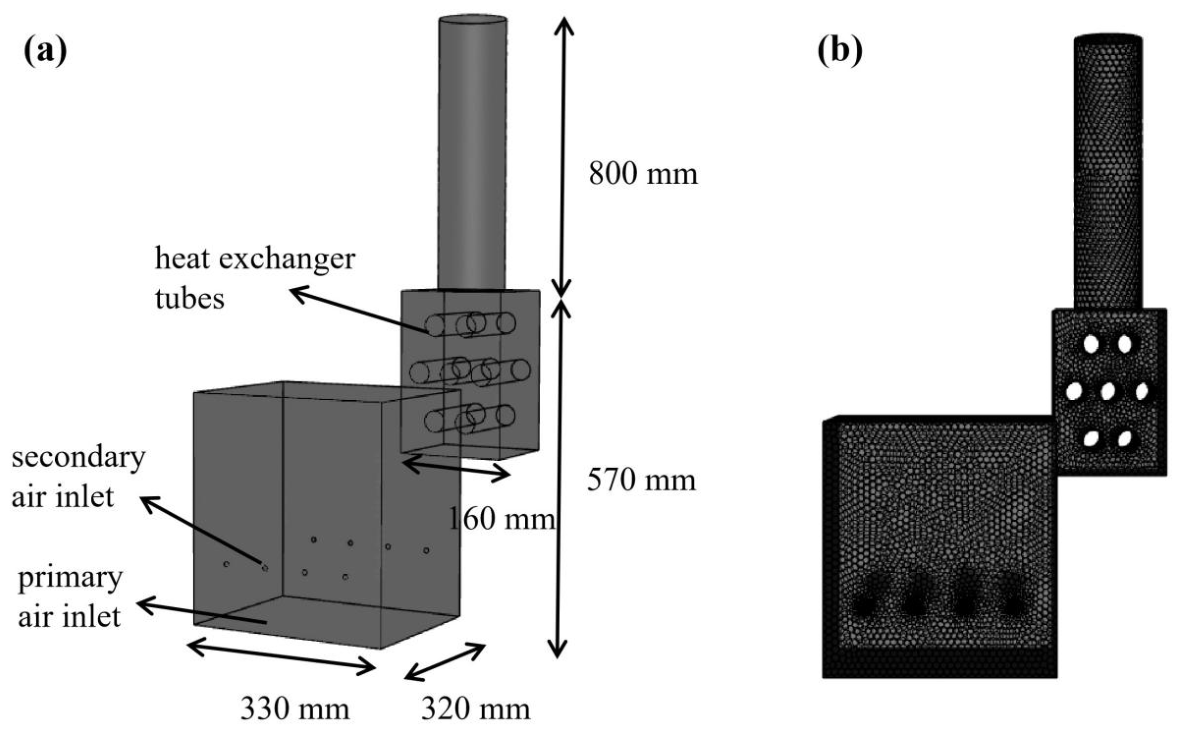
2.1. Furnace Structure and Computational Domain
2.2. Briquette Properties and Moisture Content Cases
2.3. FLIC Fixed-Bed Combustion Model
- (1)
- Moisture evaporation model
- (2)
- Volatile release
- (3)
- Volatile combustion
- (4)
- Char gasification model
2.4. Fluent Furnace Gas-Phase Combustion Model
2.5. Operating Conditions
3. Results and Discussion
3.1. Fixed-Bed Combustion Characteristics of Briquettes with Different Moisture Contents
3.2. Simulation Results Without Secondary Air
3.2.1. Furnace Temperature Field Distribution Without Secondary Air
3.2.2. Species Distributions in the Baseline Cases Without Secondary Air
3.3. Effects of Secondary Air on In-Furnace Combustion at Different Briquette Moisture Contents
3.3.1. Effects of Secondary Air on Furnace Temperature Field
3.3.2. Effects of Secondary Air on Distributions of Major Gas-Phase Species
3.4. Validation Against Experimental Data
4. Conclusions
- (1)
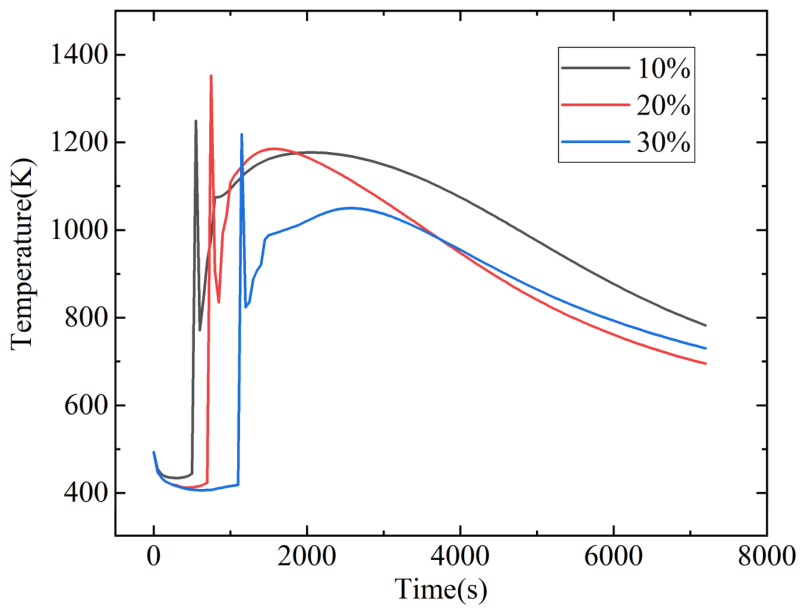
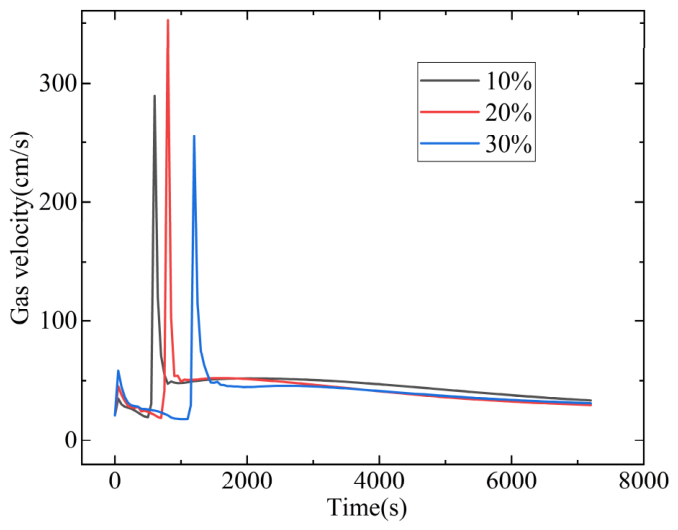
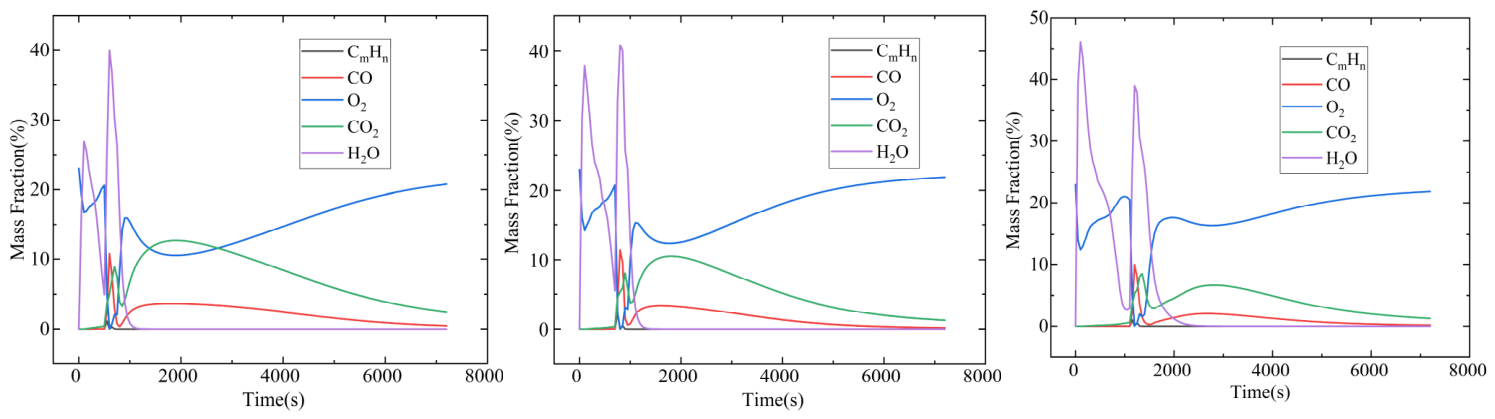
- Increasing briquette moisture content significantly prolongs the drying and preheating stages and delays subsequent combustion in the fixed bed. As the moisture content increases from 10% to 30%, the bed outlet temperature and gas velocity during stable combustion decrease overall, while the concentrations of carbonaceous species such as CO2 and CO decrease, and the residual O2 fraction increases. These results indicate that the additional heat demand for moisture evaporation, together with the reduced as-received fraction of combustible matter, progressively weakens fixed-bed combustion.
- (2)
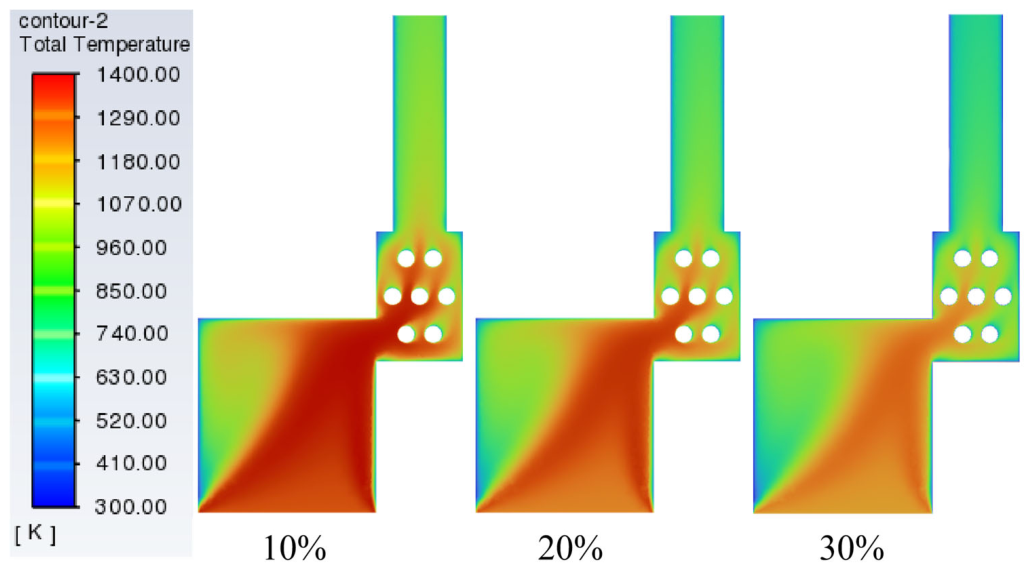
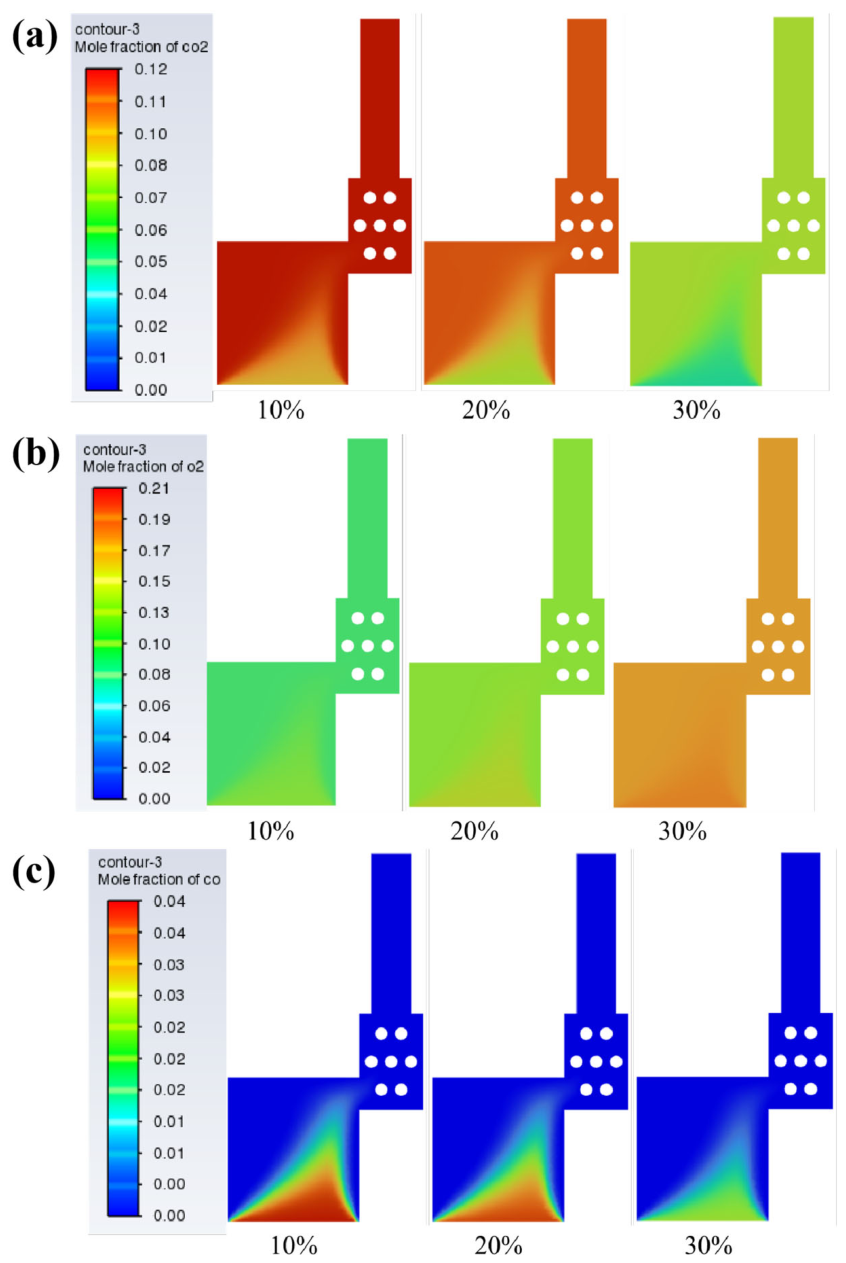
- Without secondary air, the furnace temperature field becomes increasingly unfavorable as the briquette moisture content increases. The high-temperature region within the main furnace chamber progressively shrinks, while the relatively low-temperature region expands. The mean furnace temperature decreases from 1125 K at 10% moisture to 960 K at 30% moisture. Although CO release from the fuel bed decreases with increasing moisture content, the lower gas temperature and insufficient mixing in the furnace suppress further CO oxidation, causing the furnace outlet CO concentration to increase from 820 to 1780 ppm. Therefore, the deterioration in combustion at high moisture content is governed not only by weaker fixed-bed combustion but also by reduced gas-phase burnout in the furnace.
- (3)
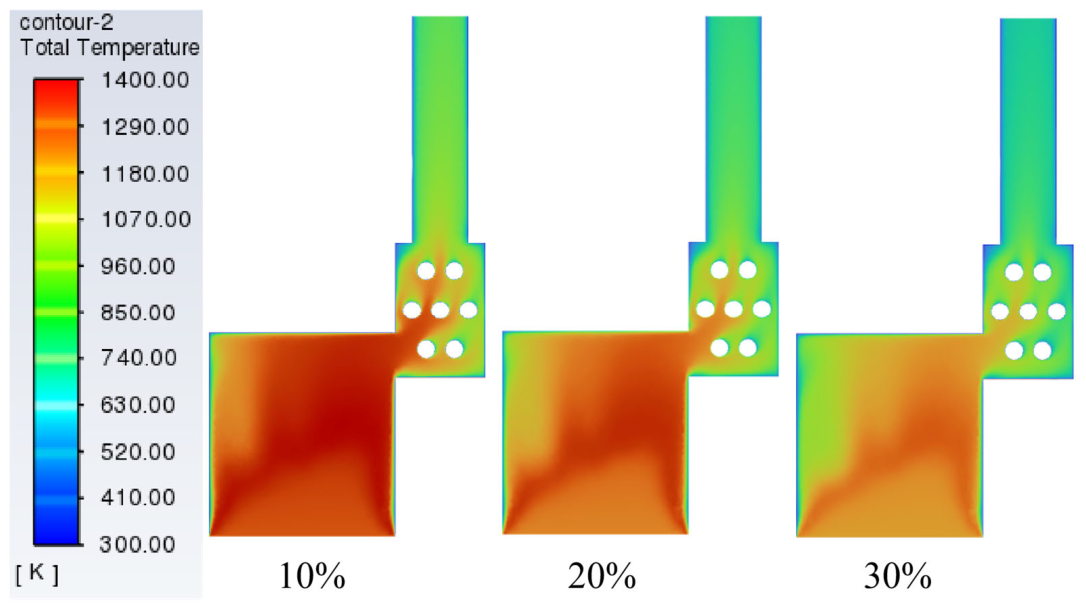
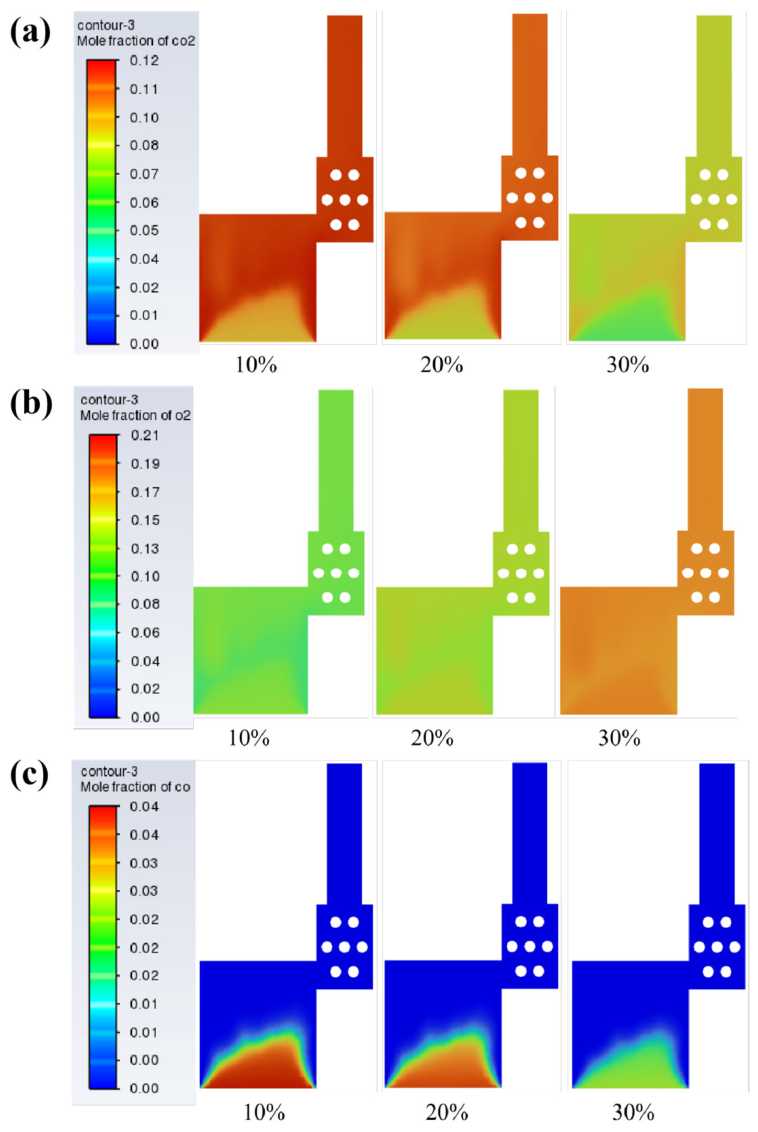
- With the total air supply held constant, reallocating 23.6% of the combustion air from primary to secondary air improves the spatial matching between oxygen supply and gas-phase combustion demand. Secondary air injection enhances turbulent mixing, makes the furnace temperature field more continuous and uniform, reduces the extent of relatively low-temperature regions, and promotes the further oxidation of incomplete combustion products. The enhancement becomes more pronounced as the briquette moisture content increases. For the 30% moisture case, secondary air increases the mean furnace temperature from 960 to 1045 K, reduces the outlet CO concentration from 1780 to 980 ppm by 44.9%, and increases the volume fraction of the region above 900 K by approximately 21%. These results demonstrate that the investigated air-staging configuration can effectively mitigate the adverse effects of high fuel moisture on furnace combustion.
- (4)
- The coupled FLIC–Fluent model shows good agreement with the experimental measurements over all investigated moisture contents and air distribution conditions. The relative error in mean furnace temperature remains below 1.0%, while the relative errors in furnace outlet CO and O2 concentrations remain below 5.0%. The model therefore reliably captures the effects of briquette moisture content and the investigated secondary air configuration on furnace combustion and provides a suitable numerical framework for further evaluating air-staging strategies and furnace operating conditions.
Author Contributions
Funding
Data Availability Statement
Conflicts of Interest
References
- Kebede, T.; Berhe, D.T.; Zergaw, Y. Combustion characteristics of briquette fuel produced from biomass residues and binding materials. J. Energy 2022, 2022, 4222205. [Google Scholar] [CrossRef] [Scilit]
- Schobing, J.; Meyer, A.; Leyssens, G.; Zouaoui, N.; Allgaier, O.; Cazier, F.; Dewaele, D.; Genevray, P.; Pusca, C.; Goutier, F. Inventory of the French densified log market: Characterization and emission factors measurement of twenty commercial briquettes. Fuel 2023, 335, 127060. [Google Scholar] [CrossRef] [Scilit]
- Zha, Z.; Ge, Z.; Wang, S.; Li, F.; Ma, Y.; Wu, Y.; Zeng, M.; Huang, C.; Zhang, H. Biomass combustion behaviors based on online monitoring system: Morphological, thermodynamic and kinetic analysis. Combust. Flame 2023, 252, 112750. [Google Scholar] [CrossRef] [Scilit]
- He, K.; Shen, Z.; Yang, Y.; Zhang, B.; Sun, J.; Xu, H.; Ho, S.S.H.; Qu, L.; Cao, J. Insight into emission reduction effect of coal and biomass mixed briquette fuel. J. Clean. Prod. 2024, 471, 143419. [Google Scholar] [CrossRef] [Scilit]
- Lomunyak, G.; Osodo, B.; Njoka, F.; Kombe, E. Characterization, optimization and emission analysis of manually-made charcoal dust briquettes with starch, paper and algae binders. Heliyon 2024, 10, e40991. [Google Scholar] [CrossRef] [Scilit] [PubMed]
- Umeocho, C.E.; Ezidi, C.O.; Nwosu, E.N.; Nwankwo, C.I.; Ezejiegu, K.C.; Onuegbu, T.U. Comparative study of the combustion properties of briquettes produced from blends of mung beans shell, uncarbonized and carbonized sawdust. Chem. Rep. 2024, 5, 285–290. [Google Scholar] [CrossRef] [Scilit]
- Paramonova, K.; Ivanova, T.A.; Muntean, A.; Passian, L.; Malaťák, J.; Hutla, P.; Ribintev, I. Assessment of quality and combustion characteristics of briquettes derived from giant hogweed biomass. Agronomy 2025, 15, 2213. [Google Scholar] [CrossRef] [Scilit]
- Mack, R.; Schön, C.; Kuptz, D.; Hartmann, H.; Brunner, T.; Obernberger, I.; Behr, H.M. Influence of pellet length, content of fines, and moisture content on emission behavior of wood pellets in a residential pellet stove and pellet boiler. Biomass Convers. Biorefinery 2024, 14, 26827–26844. [Google Scholar] [CrossRef] [Scilit]
- Morin, B.; Allen, G.; Marin, A.; Rector, L.; Ahmadi, M. Impacts of wood species and moisture content on emissions from residential wood heaters. J. Air Waste Manag. Assoc. 2022, 72, 647–661. [Google Scholar] [CrossRef] [Scilit] [PubMed]
- Lai, Y.; Liu, X.; Davies, M.; Fisk, C.; Holliday, M.; King, D.; Zhang, Y.; Willmott, J. Characterisation of wood combustion and emission under varying moisture contents using multiple imaging techniques. Fuel 2024, 373, 132397. [Google Scholar] [CrossRef] [Scilit]
- Milijašević, M.; Stojiljković, D.; Manić, N. Computational fluid dynamics study of biomass moisture content impact on particle matter emissions. Environ. Model. Assess. 2025, 30, 193–218. [Google Scholar] [CrossRef] [Scilit]
- Dickinson-Craig, E.; Bartington, S.E.; Watts, R.; Mandakhbayar, O.; Khurelbaatar, E.-O.; Ochir, C.; Boldbaatar, D.; Warburton, D.; Thomas, G.N.; Pope, F.D.; et al. Carbon monoxide levels in households using coal-briquette fuelled stoves exceed WHO air quality guidelines in Ulaanbaatar, Mongolia. Int. J. Environ. Health Res. 2023, 33, 1760–1771. [Google Scholar] [CrossRef] [Scilit] [PubMed]
- Junejo, A.; Al-Abdeli, Y.M.; Porteiro, J. Role of air staging in a batch-type fixed bed biomass combustor under constant primary air. J. Therm. Sci. 2024, 33, 284–299. [Google Scholar] [CrossRef] [Scilit]
- Junejo, A.; Chapela, S.; Porteiro, J.; Al-Abdeli, Y.M. Secondary air induced flow structures and mixing in a fixed bed combustor. Proc. Inst. Mech. Eng. Part A J. Power Energy 2023, 237, 1479–1492. [Google Scholar] [CrossRef] [Scilit]
- Kshirsagar, M.P.; Kalamkar, V.R. Hybrid draft direct-combustion with secondary air jets in cross-flow for reducing CO and PM2.5 emissions in biomass cookstoves. Sustain. Energy Technol. Assess. 2022, 51, 101913. [Google Scholar] [CrossRef] [Scilit]
- Muñoz, D.F.; Gutiérrez, J.; Pérez, J.F. Effect of the air flows ratio on energy behavior and NOx emissions from a top-lit updraft biomass cookstove. J. Braz. Soc. Mech. Sci. Eng. 2023, 45, 573. [Google Scholar] [CrossRef] [Scilit]
- Holubčík, M.; Kantová, N.Č.; Jandačka, J.; Čaja, A. The performance and emission parameters based on the redis-tribution of the amount of combustion air of the wood stove. Processes 2022, 10, 1570. [Google Scholar] [CrossRef] [Scilit]
- Kardaś, D.; Wantuła, M.; Pieter, S.; Kazimierski, P. Effect of separating air into primary and secondary in an integrated burner housing on biomass combustion. Energies 2024, 17, 4648. [Google Scholar] [CrossRef] [Scilit]
- Elsebaie, A.; Zhu, M.; Al-Abdeli, Y.M. Operational and design factors in air staging and their effects on fouling from biomass combustion. Sustainability 2024, 16, 8584. [Google Scholar] [CrossRef] [Scilit]
- Karlström, O.; Vainio, E.; Engblom, M.; Brink, A.; Hupa, M. Effect of air staging on NOx emissions in biomass combustion in a bubbling fluidized bed. Fuel 2022, 330, 125565. [Google Scholar] [CrossRef] [Scilit]
- Ghiwe, S.S.; Kalamkar, V.R.; Sharma, S.K.; Sawarkar, P.D. Numerical and experimental study on the performance of a hybrid draft biomass cookstove. Renew. Energy 2023, 205, 53–65. [Google Scholar] [CrossRef] [Scilit]
- Himanshu; Kurmi, O.; Jain, S.; Tyagi, S. Performance assessment of an improved gasifier stove using biomass pellets: An experimental and numerical investigation. Sustain. Energy Technol. Assess. 2022, 53, 102432. [Google Scholar] [CrossRef] [Scilit]
- Dutta, P.P.; Gohain, R.B.; Dutta, P.P. Performance assessment of an efficient biomass fired cook stove as a standby unit for community cooking. Biomass Convers. Biorefinery 2023, 13, 11609–11620. [Google Scholar] [CrossRef] [Scilit]
- Kashyap, S.R.; Pramanik, S.; Ravikrishna, R. A review of energy-efficient domestic cookstoves. Appl. Therm. Eng. 2024, 236, 121510. [Google Scholar] [CrossRef] [Scilit]
- Blank, M.; Obernberger, I. Novel packed-bed CFD model for pellet combustion: Validation and application to a stove. Biomass Bioenergy 2024, 190, 107362. [Google Scholar] [CrossRef] [Scilit]
- Zhang, J.; Li, T.; Ström, H.; Løvås, T. Computationally efficient coarse-graining XDEM/CFD modeling of fixed-bed combustion of biomass. Combust. Flame 2022, 238, 111876. [Google Scholar] [CrossRef] [Scilit]
- Álvarez-Bermúdez, C.; Anca-Couce, A.; Chapela, S.; Scharler, R.; Buchmayr, M.; Gómez, M.Á.; Porteiro, J. Validation of a biomass conversion mechanism by Eulerian modelling of a fixed-bed system under low primary air conditions. Renew. Energy 2023, 215, 119003. [Google Scholar] [CrossRef] [Scilit]
- Huang, Z.; Gong, D.; Peng, C.; Chen, J.; Luo, J.; Xu, Y.; Yang, L. Numerical simulation study on combustion of low calorific value waste blended with biomass. ACS Omega 2024, 9, 14297–14309. [Google Scholar] [CrossRef] [Scilit] [PubMed]
- Luo, H.; Du, Y.; Lin, W. CFD modeling of a modern wood stove—Soot formation. Renew. Energy 2024, 232, 121054. [Google Scholar] [CrossRef] [Scilit]
- Liu, J.; Xie, Z.; Guo, B.; Xu, Y.; Wang, Q.; Guo, X.; Bai, L.; Long, J. The effect of air distribution on the characteristics of waste combustion and NO generation in a grate incinerator. J. Energy Inst. 2024, 117, 101827. [Google Scholar] [CrossRef] [Scilit]



| Parameter | Value |
|---|---|
| Furnace height/mm | 360 |
| Furnace width/mm | 320 |
| Furnace length/mm | 330 |
| Number of secondary air ports | 8 |
| Flue gas outlet size/mm | 100 |
| Analysis Item | Name | Symbol | Unit | M1 | M2 | M3 |
|---|---|---|---|---|---|---|
| Elemental analysis (daf) | Carbon | C | % | 82.92 | 82.92 | 82.92 |
| Hydrogen | H | % | 3.46 | 3.46 | 3.46 | |
| Oxygen | O | % | 9.36 | 9.36 | 9.36 | |
| Nitrogen | N | % | 1.07 | 1.07 | 1.07 | |
| Sulfur | S | % | 3.20 | 3.20 | 3.20 | |
| Proximate analysis | Moisture content (ar) | M | % | 10.03 | 20.12 | 30.09 |
| Volatile matter (daf) | VM | % | 80.91 | 80.91 | 80.91 | |
| Fixed carbon (daf) | FC | % | 19.09 | 19.09 | 19.09 |
| Model Type | Model Selected |
|---|---|
| Solver | Pressure-based, steady-state |
| Turbulence model | Realizable k-ε model |
| Gas-phase combustion | Species transport model with eddy dissipation model |
| Radiation | P-1 radiation model |
| Case | Briquette Moisture /% | Primary Air Fraction /% | Secondary Air Fraction /% | Total Air Flow /(m3·min−1) |
|---|---|---|---|---|
| M1-P | 10 | 100.0 | 0 | 0.60 |
| M1-S | 10 | 76.4 | 23.6 | 0.60 |
| M2-P | 20 | 100.0 | 0 | 0.60 |
| M2-S | 20 | 76.4 | 23.6 | 0.60 |
| M3-P | 30 | 100.0 | 0 | 0.60 |
| M3-S | 30 | 76.4 | 23.6 | 0.60 |
| Case | Sim. temp./K | Exp. temp./K | Terr. | Sim. CO/ppm | Exp. CO/ppm | COerr. | Sim. O2/% | Exp. O2/% | O2err. |
|---|---|---|---|---|---|---|---|---|---|
| 10% moisture, no secondary air | 1125 | 1118 | 0.63% | 820 | 845 | 2.96% | 7.80 | 7.56 | 3.17% |
| 20% moisture, no secondary air | 1035 | 1027 | 0.78% | 1250 | 1298 | 3.70% | 8.65 | 8.31 | 4.09% |
| 30% moisture, no secondary air | 960 | 951 | 0.95% | 1780 | 1845 | 3.52% | 9.55 | 9.17 | 4.14% |
| 10% moisture, with secondary air | 1140 | 1134 | 0.53% | 620 | 645 | 3.88% | 7.55 | 7.31 | 3.28% |
| 20% moisture, with secondary air | 1085 | 1077 | 0.74% | 760 | 795 | 4.40% | 8.20 | 7.87 | 4.19% |
| 30% moisture, with secondary air | 1045 | 1037 | 0.77% | 980 | 1028 | 4.67% | 8.85 | 8.47 | 4.49% |
Disclaimer/Publisher’s Note: The statements, opinions and data contained in all publications are solely those of the individual author(s) and contributor(s) and not of MDPI and/or the editor(s). MDPI and/or the editor(s) disclaim responsibility for any injury to people or property resulting from any ideas, methods, instructions or products referred to in the content. |
© 2026 by the authors. Licensee MDPI, Basel, Switzerland. This article is an open access article distributed under the terms and conditions of the Creative Commons Attribution (CC BY) license.
Share and Cite
Lu, Q.; Shi, X.; Zhao, X.; Li, M.; Li, D.; Liu, L.; Ren, X. The Effects of Secondary Air Supply on the In-Furnace Combustion Characteristics of Briquettes with Different Moisture Contents. Energies 2026, 19, 4399. https://doi.org/10.3390/en19184399
Lu Q, Shi X, Zhao X, Li M, Li D, Liu L, Ren X. The Effects of Secondary Air Supply on the In-Furnace Combustion Characteristics of Briquettes with Different Moisture Contents. Energies. 2026; 19(18):4399. https://doi.org/10.3390/en19184399
Chicago/Turabian StyleLu, Qingmei, Xin Shi, Xiuhao Zhao, Mingdong Li, Dongxi Li, Liu Liu, and Xiaohan Ren. 2026. "The Effects of Secondary Air Supply on the In-Furnace Combustion Characteristics of Briquettes with Different Moisture Contents" Energies 19, no. 18: 4399. https://doi.org/10.3390/en19184399
APA StyleLu, Q., Shi, X., Zhao, X., Li, M., Li, D., Liu, L., & Ren, X. (2026). The Effects of Secondary Air Supply on the In-Furnace Combustion Characteristics of Briquettes with Different Moisture Contents. Energies, 19(18), 4399. https://doi.org/10.3390/en19184399