Article

Magnetic Saturation Parameter Identification of Hybrid Excitation Generator Based on Particle Swarm Optimization

National Key Laboratory of Electromagnetic Energy, Naval University of Engineering, Wuhan 430033, China
*
Author to whom correspondence should be addressed.
Energies 2026, 19(18), 4390; https://doi.org/10.3390/en19184390
Submission received: 15 June 2026 / Revised: 30 July 2026 / Accepted: 8 September 2026 / Published: 16 September 2026

Abstract

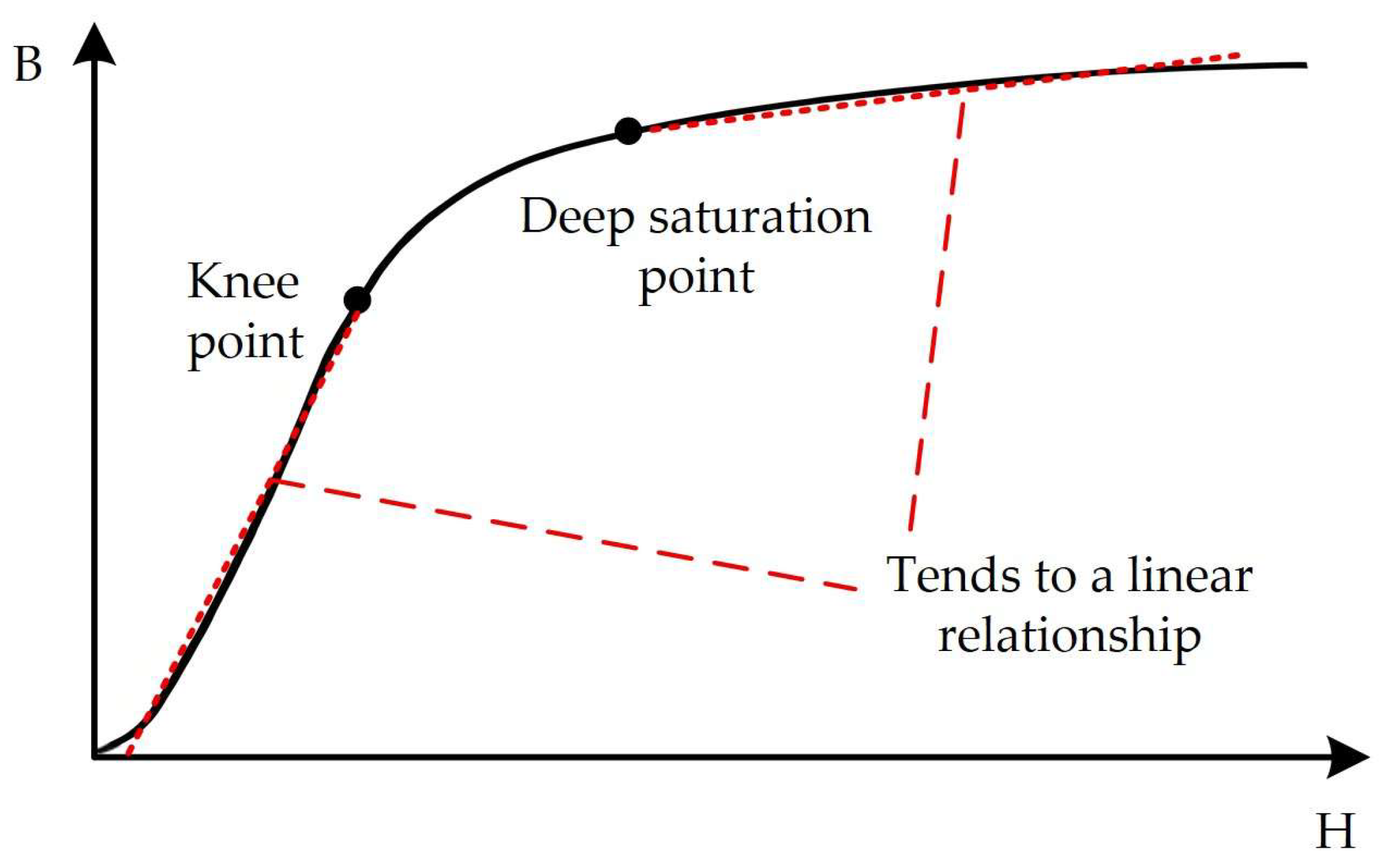
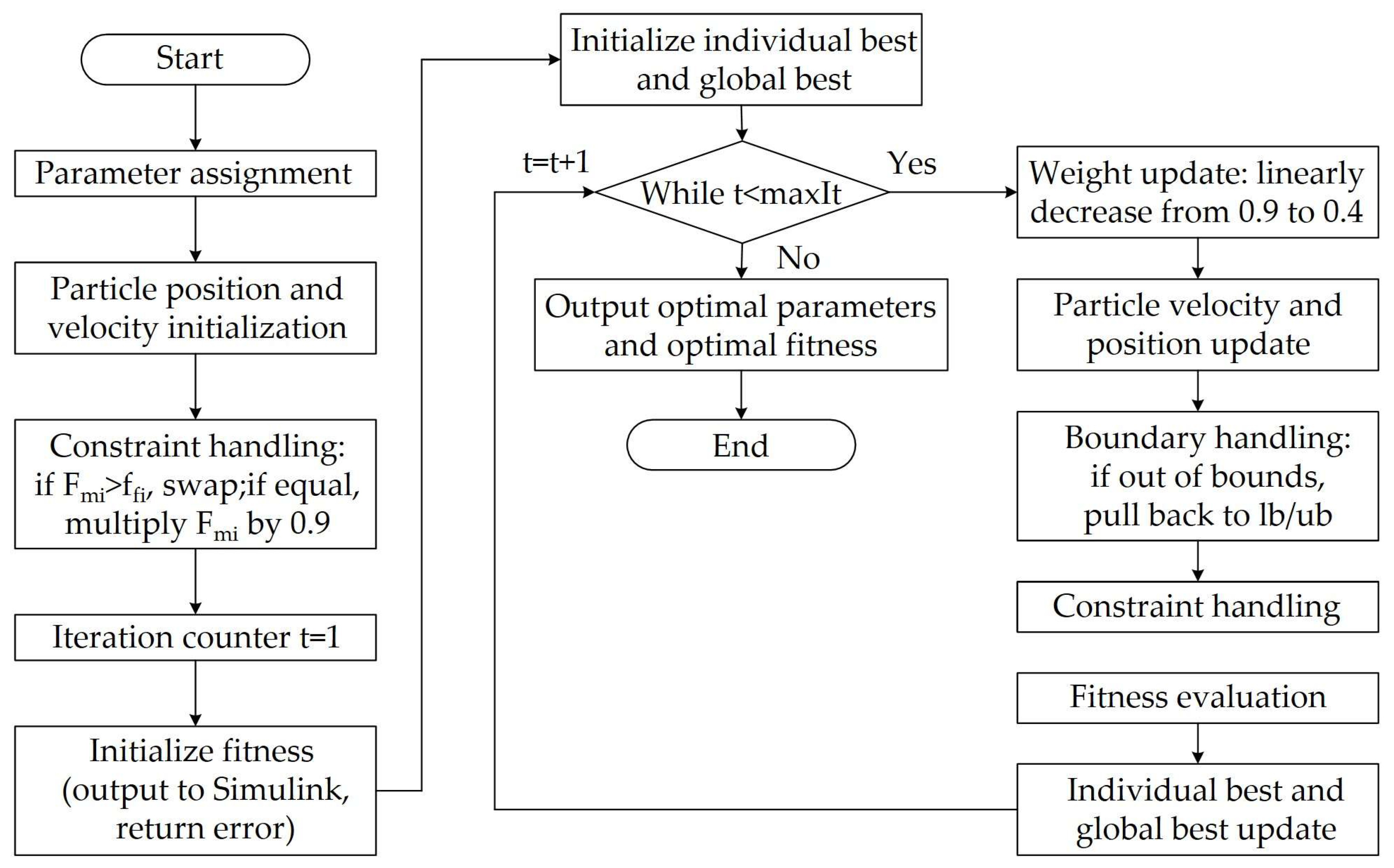
Hybrid excitation generators offer high power density and adjustable magnetic field, making them attractive for power generation applications with strict volume and weight constraints. However, under strong field excitation conditions, deep saturation of the iron core leads to a strongly nonlinear relationship between the resultant air-gap flux linkage and the field current, causing traditional linear models to exhibit large errors in the saturation region. To address this issue, this paper proposes a piecewise nonlinear function-based method for fitting magnetic saturation characteristics. The function’s nonlinear trend is exploited to construct an analytical model that describes the flux–current relationship in both the linear and deep saturation regions. The unknown model parameters are then determined by solving an optimization problem that minimizes the sum of squared output voltage errors. Particle swarm optimization (PSO) is employed for global search, overcoming the challenges of initial-value dependence and local optima in such multimodal parameter spaces. Experimental data from a hybrid excitation generator are used as samples for validation. The results show that the nonlinear model optimized by PSO accurately fits the flux linkage variation over the full current range, reducing the error from 7.78% to approximately 1%. The proposed model is concise in form, requires low computational effort, and can be directly used as an accurate analytical method for performance analysis of hybrid excitation generators, demonstrating good engineering application value.
Keywords: hybrid excitation generator; magnetic saturation; nonlinear fitting; particle swarm optimization; parameter identification hybrid excitation generator; magnetic saturation; nonlinear fitting; particle swarm optimization; parameter identification