Review

Integrated Offshore Oil and Gas–Renewable Energy Systems for China’s Low-Carbon Transition: Coupling Pathways and Integration Challenges


by
Yuchen Song
1,
Wei Yan
2,*,
Yifan Li
1,
Pibo Su
2,
Huai Cheng
2,
Guoqing Zhang
2,
Zuofei Zhu
2 and
Yaoyao Lv
2
1
Hainan Research Institute, China University of Geosciences (Beijing), Sanya 572024, China
2
Sanya South China Sea Geological Research Institute, Guangzhou Marine Geological Survey, Sanya 572024, China
*
Author to whom correspondence should be addressed.
Energies 2026, 19(17), 4201; https://doi.org/10.3390/en19174201 (registering DOI)
Submission received: 17 March 2026 / Revised: 19 May 2026 / Accepted: 25 May 2026 / Published: 5 September 2026
(This article belongs to the Section B: Energy and Environment)

Abstract

Driven by China’s carbon peaking and carbon neutrality goals and the low-carbon transition of offshore oil and gas operations, the integration of offshore oil and gas with wind, solar, marine, and hydrogen energy is emerging as an important pathway for balancing energy security, emission reduction, and operational efficiency. Focusing on system boundaries and positions along the energy chain, this paper classifies offshore oil and gas–renewable energy integration into four representative pathways: shore power electrification, platform microgrid integration, hydrogen production and export, and energy islands or regional hubs. This study provides a structured narrative review of the key technologies, major constraints, and feasible implementation approaches associated with these pathways from the perspectives of offshore microgrid architecture, energy storage and backup, energy management, and offshore engineering installation, operation, and maintenance. The results indicate that the coordinated use of multiple energy sources and microgrid-based integration is particularly relevant to single-platform and small-cluster scenarios requiring local power balancing and progressive electrification. However, wider deployment remains constrained by resource intermittency, the safety and lifetime of energy storage systems, cross-system coordinated control, offshore engineering reliability, and the lack of a comprehensive standards system. This study provides a reference for offshore platform electrification retrofits in China, the comparison and selection of integration schemes, and the planning of demonstration projects.

1. Introduction

Against the backdrop of the Global Net-Zero Transition (i.e., the worldwide shift toward achieving net-zero greenhouse gas emissions through deep decarbonization) and persistent geopolitical uncertainty, emission reduction in the oil and gas sector is increasingly shifting upstream from the consumption end to the production end. The IEA estimated that emissions from oil and gas extraction, transportation, and processing reached approximately 5.1 Gt CO2-equivalent in 2022, accounting for nearly 15% of energy-related greenhouse gas emissions, thereby accelerating the development of pathways such as shore power electrification and offshore wind power supply for platforms [1]. Demonstration projects in the North Sea, such as Hywind Tampen, have further shown that offshore wind can meet part of the electricity demand of offshore platforms and generate measurable emission-reduction benefits [2,3].
In the Chinese policy context, the dual-carbon goals refer to peaking carbon dioxide emissions before 2030 and achieving carbon neutrality before 2060. These goals, together with the development of a new-type energy system, underscore the need to advance clean energy substitution and enhance system resilience without compromising energy security. Key policy documents, notably the Opinions on Carbon Peaking and Carbon Neutrality, the Action Plan for Carbon Peaking Before 2030, and the white paper China’s Energy Transition, call for accelerating the establishment of a clean, low-carbon, safe, and efficient energy system [4,5]. The white paper further highlights offshore wind power as a source of green electricity for oil and gas platforms [6].
Against this background, this paper provides a comparative review of offshore oil and gas–renewable energy integration pathways, with emphasis on cross-pathway differences in system boundary, engineering feasibility, and deployment conditions in the context of China’s low-carbon transition. Existing reviews have examined offshore platform electrification, offshore hydrogen, offshore integrated energy systems, and energy hubs, including recent work on offshore wind–hydrogen integration and offshore hydrogen structures [7,8]. However, most of them focus on individual technologies or infrastructure types, with limited attention to cross-pathway comparison in offshore oil and gas production systems. This review addresses that gap by proposing a four-pathway comparative framework linked to system boundary, energy-flow configuration, and service scale, with a particular focus on offshore oil and gas production systems in China’s low-carbon transition.

2. Review Scope and Method

This paper adopts a structured narrative review approach to examine offshore oil and gas–renewable energy integration pathways in the context of China’s low-carbon transition. The review draws on peer-reviewed journal articles, industry reports, project documents, and policy publications. The literature search was conducted in Web of Science, Scopus, Google Scholar, and CNKI, supplemented by official publications from the International Energy Agency, the National Energy Administration of China, project developers, and industry organizations. The search mainly covered publications and documents from 2020 to 2026, while earlier studies were retained when they provided essential technical background or project-level information.
The search terms covered four main aspects: offshore oil and gas production scenarios, renewable energy technologies, enabling technologies, and conversion- or hub-oriented pathways. Representative terms included offshore platform electrification, offshore wind, floating photovoltaic systems, marine energy, offshore hydrogen, Power-to-X (P2X), energy storage, submarine cables, microgrids, energy islands, and offshore energy hubs. The retrieved materials were screened according to their relevance to offshore production scenarios, integration pathways, enabling technologies, engineering constraints, and China’s low-carbon policy context. Sources focusing only on onshore applications or lacking relevance to offshore engineering systems were excluded.
The selected materials were synthesized according to three criteria: the point at which renewable energy enters the offshore oil and gas system, whether energy-form conversion is involved, and the scale of the service target. Based on these criteria, the reviewed materials were grouped into four representative pathways: shore power electrification, platform microgrid integration, Power-to-X hydrogen production and export, and offshore energy islands or regional hubs. This classification provides the basis for the subsequent comparison of engineering feasibility, storage and backup dependence, export options, retrofit complexity, and deployment conditions.

3. Research Progress in Offshore Oil and Gas–Renewable Energy Integration

Internationally, decarbonization in the oil and gas sector is shifting from single-point substitution toward platform electrification coupled with system-level coordination. In mature offshore regions such as the North Sea, shore power and offshore wind are widely adopted to supply electricity to offshore platforms, supplemented by energy storage and digital dispatch systems to ensure continuous production [3]. At the same time, energy islands, offshore hydrogen production, and cross-regional interconnected export schemes are being explored, driving integration from the project level toward the system level. Practical experience indicates that large-scale deployment depends on clear rules for grid connection, capacity allocation, and operation and maintenance, thereby improving replication and cost sharing.
As China enters the planning window for the 15th Five-Year Plan, the integration of oil and gas with renewable energy needs to move beyond technical feasibility toward replicable deployment. In 2025, the National Energy Administration issued the Guiding Opinions on Promoting the Integrated Development of New Energy, emphasizing integrated multi-energy development and the expansion of application scenarios (where “new energy” in the Chinese policy context mainly refers to renewable energy, particularly wind and solar power). In the same year, the 2025 Energy Work Guidance called for the preparation of a comprehensive energy plan for the 15th Five-Year Plan period and further promoted the integration of oil and gas with renewable energy [9,10]. Considering China’s current progress in this field, priority should be given to direct green power supply for oilfield clusters, platform microgrids, and energy storage backup, followed by the gradual expansion of hydrogen production and energy export.

3.1. Wind Energy

Offshore wind is a priority option in the integration of oil and gas with renewable energy. Its technological maturity and scalability make it suitable for supplying offshore platforms with additional clean electricity through relatively limited system retrofits, thereby supporting platform electrification, emission reduction, and cost savings. Offshore wind can also be used locally to replace part of gas-turbine generation or combined with export infrastructure at the oilfield-cluster level to support both platform power supply and regional power export.
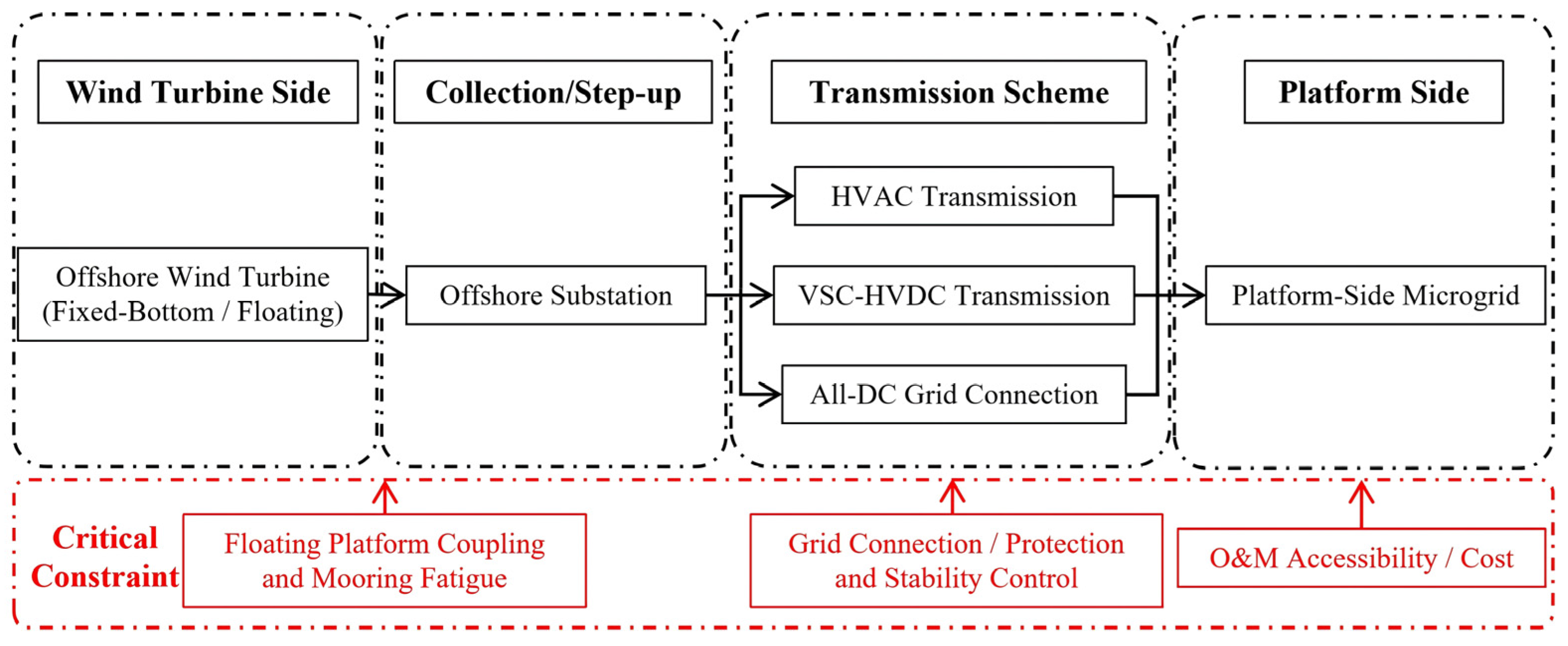
As offshore distances and water depths increase, offshore wind power is expanding from fixed-bottom systems to floating systems [11]. The integration chain can be summarized as “wind turbines–power collection and voltage transformation–high-voltage alternating current (HVAC), voltage-source-converter-based high-voltage direct current (VSC-HVDC), or all-direct-current (all-DC) transmission–platform microgrid”, thereby supporting both on-site utilization and power export [12]. The main bottlenecks to practical deployment lie in coupled loads and fatigue, as well as in grid-connection protection, stability control, and submarine-cable transmission constraints [13,14]. In addition, operation and maintenance in deep and distant offshore areas remain challenging because of limited accessibility and high intervention costs [15]. These challenges require early-stage coordination of power forecasting, energy storage and backup configuration, and energy management, with priority given to supply stability and power quality.
Figure 1 clarifies that offshore wind integration is not a simple one-step substitution of platform generation, but a multi-link coupling process involving collection, voltage transformation, transmission, and platform-side microgrid coordination. This also explains why the feasibility of wind-based integration depends not only on wind-resource conditions but also on export architecture, power-quality control, and the availability of storage and backup systems.
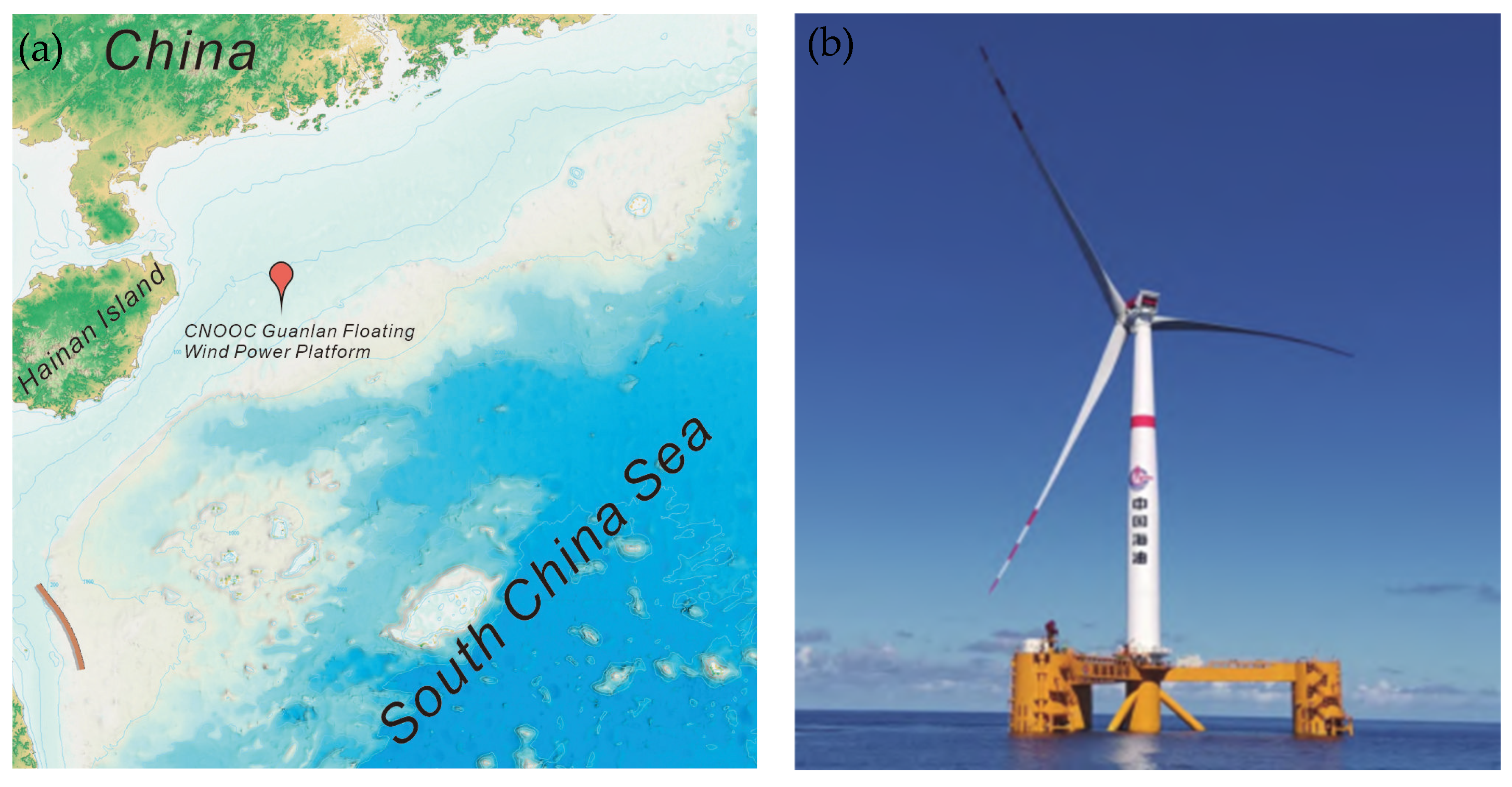
Internationally, projects in the North Sea have shown that wind farms, including floating wind installations, can be connected to oil and gas facilities through power collection systems, step-up substations, and submarine-cable transmission, thereby providing a replicable pathway for coordinated energy supply based on offshore wind and platform microgrids or shore power. In China, the CNOOC Guanlan Floating Offshore Wind Power Platform provides a representative example (Figure 2). Under conditions of approximately 120 m water depth and an offshore distance of about 136 km, wind power has been successfully integrated into the load demand of an oilfield cluster, demonstrating the system-integration potential of floating offshore wind in meeting the energy needs of far-offshore oil and gas operations [16].
Overall, offshore wind is generally more suitable for platform electrification and microgrid integration in fields with relatively stable load demand, sufficient wind resources, and feasible transmission or cable-routing conditions, whereas its deployment becomes more challenging in scenarios with highly constrained export corridors, severe offshore operating conditions, or limited platform-side integration space.

3.2. Solar Energy

In offshore oil and gas applications, solar energy is better suited to floating photovoltaic deployment and on-platform consumption. Its advantages lie in modularity, short construction periods, and flexible coupling with existing platform power systems, allowing it to serve as a supplementary power source alongside offshore wind and shore power for peak shaving, reducing gas-turbine loading, and increasing the share of green power. However, constrained by sea conditions and available installation area, the scale of individual solar installations generally cannot compete with offshore wind at a comparable scale. Therefore, its engineering value lies mainly in coordinated operation with platform microgrids, energy storage, and energy management systems, which can provide a controllable and reliable incremental power supply.
From the perspective of the integration chain, floating photovoltaic (PV) systems use buoyant structures to support solar modules, while mooring and anchoring systems stabilize the array. The generated electricity is then connected to the platform microgrid through collection and inverter systems or transmitted to an offshore substation for export. The engineering core is to ensure coordinated structural survivability, mooring integrity, and electrical safety. Floating structures can be categorized into rigid and flexible types to accommodate wave conditions [17]. Mooring design must account for wind, wave, current, and seabed conditions. Although shared mooring systems can reduce costs, they may introduce impact tension and peak anchor loads [18]. Offshore electrical layout and protection also impose stringent requirements. Rapid shutdown capability and improved equipment integration are essential for safety, while submarine cables must reserve sufficient displacement allowance and control fatigue damage [19].
Internationally, countries such as Norway have proposed offshore energy islands or hubs to support coordinated offshore wind development and power supply for oil and gas operations, while also advancing pilot tests of floating offshore photovoltaics [20]. In China, the 500 kW floating offshore photovoltaic project at the South No. 3 offshore wind farm off the Shandong Peninsula provides a representative example. Located about 30 km offshore in water depths of about 30 m, the generated electricity is collected and transmitted to the wind turbine platform within the same wind farm, and is then exported through an offshore step-up substation [21].
Overall, offshore solar is more suitable for nearshore or moderately sheltered offshore settings with manageable sea states and available installation space, where it can serve as a supplementary source within platform microgrids, whereas its large-scale standalone deployment is more constrained in harsh deepwater and far-offshore environments.

3.3. Marine Energy

Marine energy mainly includes wave energy, tidal energy, and ocean thermal energy conversion. Compared with wind and solar energy, these technologies are more strongly constrained by offshore engineering conditions. Therefore, in offshore platforms or island microgrids, they are better suited to early demonstration as supplementary power sources or as dedicated sources for specific operating conditions, in coordination with energy storage, power conversion systems, and existing offshore engineering infrastructure.

3.3.1. Wave Energy

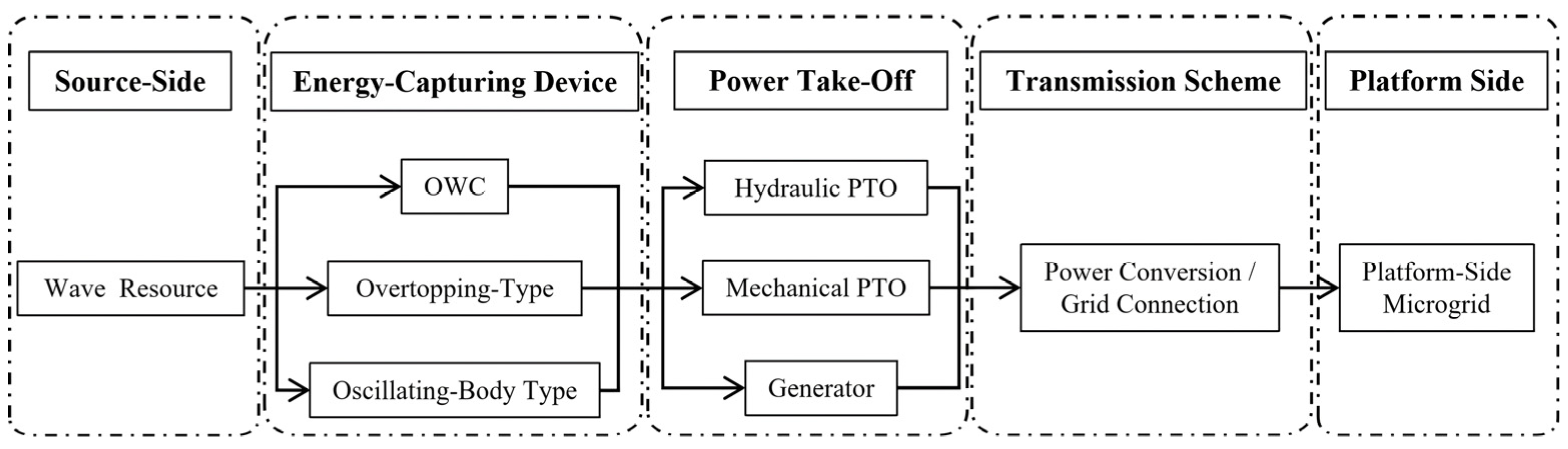
In the integration of oil and gas with renewable energy, wave energy is better suited to small- to medium-scale supplementary power supply and local resilience enhancement. Its main advantage lies in its ability to provide supplementary electricity during periods of low wind and solar output, such as at night and in winter; however, its engineering deployment is highly constrained by sea conditions and system reliability. The integration chain can be summarized as “wave resource–energy capture device–power take-off (PTO)–power conversion and grid connection–platform-side microgrid”, with representative capture devices including the oscillating water column (OWC), overtopping device, and oscillating body. To smooth output fluctuations and meet the continuous power supply requirements of offshore platforms, it must also be coordinated with energy storage and power quality control systems [22].
Figure 3 indicates that the engineering value of wave energy lies less in large-scale standalone generation than in its role as a supplementary source within a device–energy storage–power conversion–microgrid chain that can enhance local supply resilience under offshore operating conditions. As a representative example, a 500 kW-class offshore wave energy platform has been demonstrated in the Wanshan waters of Zhuhai, China. The platform reduces structural loads under storm conditions through mooring and active submergence strategies and is equipped with hydraulic energy storage units and power conversion devices to improve output stability [23].
Overall, wave energy is more suitable for supplementary power supply in offshore settings where local resilience enhancement is valued and integration with storage and power-conditioning systems is feasible, whereas its role is more limited in scenarios requiring large-scale standalone generation or long-term operation under highly demanding offshore reliability conditions.

3.3.2. Tidal Energy

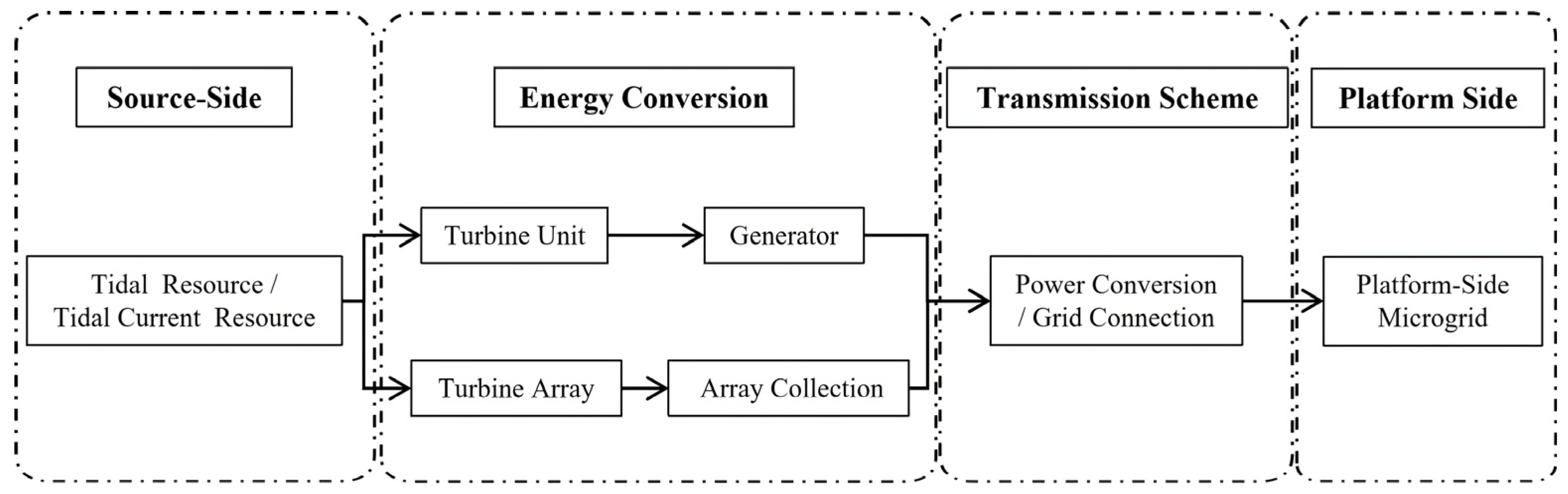
In the integration of oil and gas with renewable energy, tidal energy is better suited to serving as a predictable and stable supplementary power source. It can complement wind and solar energy and provide dispatchable baseload power for platform microgrids. Its integration chain can be summarized as “tidal/tidal current resources–single turbine or turbine array–generator–array collection–power conversion/grid connection” [24]. Key factors for deployment include site-specific hydrodynamic conditions, array effects, submarine-cable reliability, and operation and maintenance accessibility, together with environmental impact monitoring [25].
Figure 4 highlights that tidal energy is attractive for offshore platforms mainly because of its relatively high predictability, which makes it more suitable for providing stable supplementary power within multi-energy microgrids than for serving as a sole power source. A representative example is the Jiangxia Tidal Power Station in the East China Sea, with a total installed capacity of about 4.2 MW. It adopts a single-basin, bidirectional operation mode and is equipped with six bidirectional bulb tubular turbine-generator units. It also operates in conjunction with floating photovoltaic systems, demonstrating the application potential of combining a stable tidal power source with a grid-connected system within a multi-energy complementary framework [26].
Overall, tidal energy is more suitable for offshore settings with stable and well-characterized tidal resources, where its predictability can support local microgrid balancing and supplementary baseload supply, whereas its wider application is more limited in areas with insufficient tidal resource conditions, complex installation environments, or high operation and maintenance constraints.

3.3.3. Ocean Thermal Energy Conversion (OTEC)

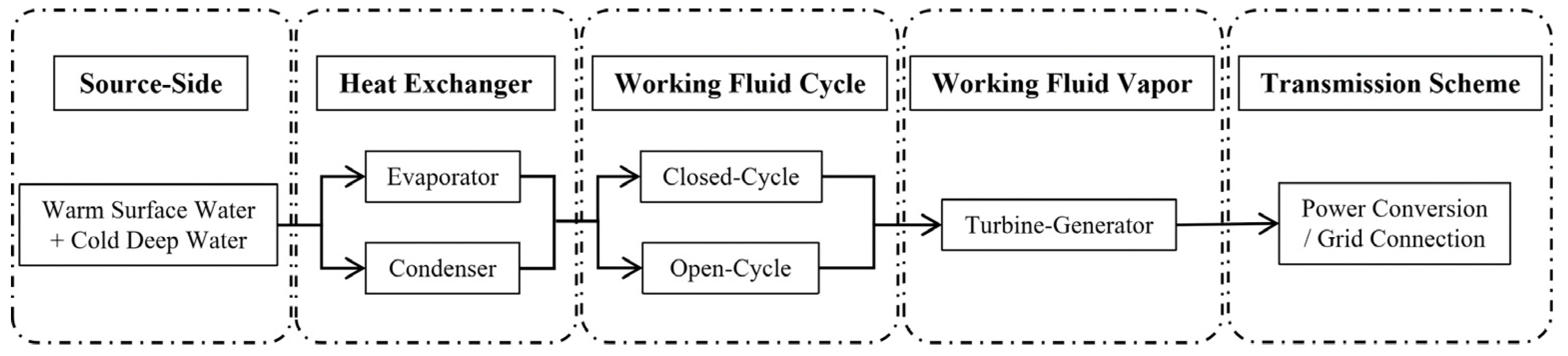
In the integration of oil and gas with renewable energy, OTEC is better positioned as a stable integrated energy-supply unit. Its main advantage lies not in large-scale power generation, but in its compatibility with the relatively stable energy demand of offshore platforms. By utilizing the temperature difference between warm surface seawater and cold deep seawater, heat exchange in evaporators and condensers drives either a closed-cycle or open-cycle process, generating working-fluid vapor that enters a turbine-generator system and is then connected to the platform-side power system through power conversion and grid integration [27]. Its engineering feasibility is constrained by the required temperature gradient, heat-exchanger and equipment demands, and overall cost. At the current stage, it is therefore better suited to coordination with platform cooling, process cooling needs, and energy management so as to improve overall system performance [28,29].
Figure 5 suggests that the relevance of OTEC to offshore oil and gas systems lies primarily in its compatibility with stable platform energy demands, especially where electricity supply can be coupled with cooling or process-related thermal management rather than pursued as a large-scale power option alone. As a representative example, Southeast University conducted offshore sea trials of a 30 kW OTEC prototype for a platform application in the South China Sea, verifying the feasibility of the cold seawater intake–heat exchange–power generation cycle under offshore operating conditions. This provides an engineering reference for coupling ocean thermal energy conversion with the integrated energy use of offshore platforms [26].
Overall, OTEC is more suitable for offshore settings with stable thermal gradients and relatively continuous platform energy demand, especially where electricity supply can be coordinated with cooling or process-related thermal management, whereas its wider deployment is more constrained in environments with insufficient temperature differences, high equipment complexity, and weak economic competitiveness.

3.4. Hydrogen Energy

In offshore oil and gas–renewable energy integration, hydrogen serves as a storable and exportable energy carrier derived from electricity. By converting intermittent renewable electricity into hydrogen or hydrogen-based fuels, platform electrification can extend beyond direct power use to include fuel conversion, long-distance transport, and end-use substitution, thereby creating new opportunities for emission reduction and energy export.
Recent reviews indicate that offshore hydrogen research is moving beyond conceptual power-to-hydrogen coupling toward system-level assessment of electrolyzer suitability, offshore structural adaptation, storage and transport pathways, and alternative deployment configurations under different offshore scenarios [7]. Recent studies also compare offshore and onshore electrolysis, centralized and decentralized layouts, and alternative export routes such as pipeline reuse and hydrogen-derived carriers, showing that offshore hydrogen is increasingly being evaluated as a system-integration option rather than only as a stand-alone electrolysis technology [8].
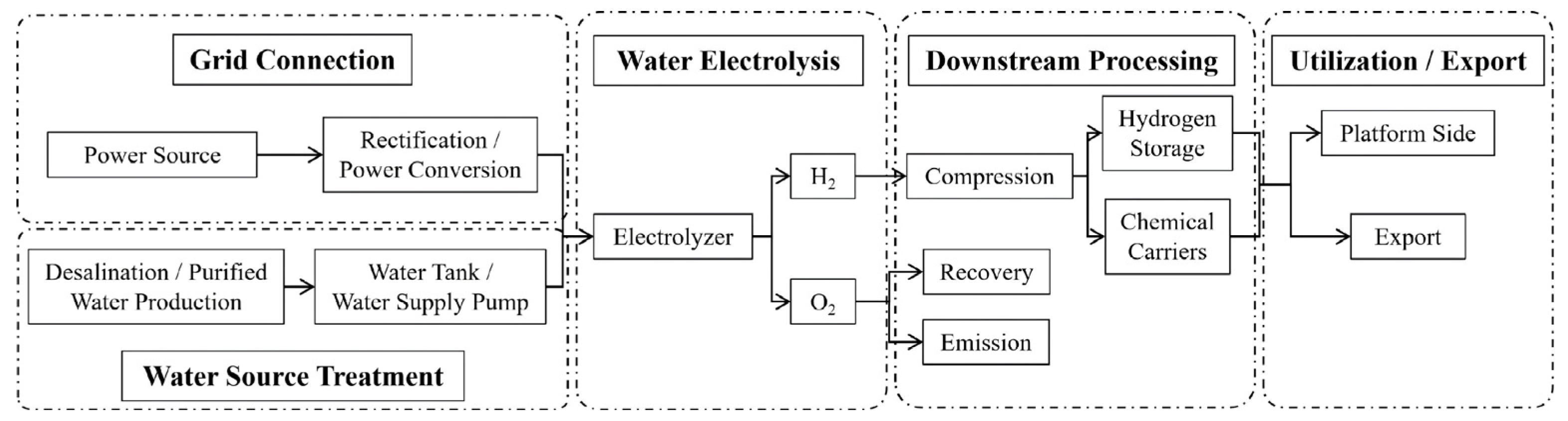
From the perspective of the engineering chain, the process can be organized as power input–water treatment–hydrogen production by electrolysis (with O2 as a by-product)–hydrogen storage or conversion into carriers such as ammonia and methanol [30]. In terms of pathway selection, nearshore projects may transmit electricity to shore for centralized electrolysis, whereas far-offshore projects tend to favor offshore electrolysis in order to alleviate constraints related to submarine-cable corridors and renewable-power integration; however, this option imposes higher requirements on space, operation and maintenance, and safety standards [31].
Figure 6 highlights that the hydrogen pathway differs fundamentally from direct electrification because it extends the integration chain from power supply to conversion, storage, transport, and end use. As a result, its engineering feasibility depends not only on electrolysis performance but also on the compatibility of offshore infrastructure, export arrangements, and safety management across multiple process stages.
As a representative example, the PosHYdon project plans to deploy a 1 MW-scale electrolyzer on the Q13a oil and gas platform in the Dutch North Sea, thereby converting an existing platform into an offshore hydrogen production node and exploring hydrogen-blended export through the reuse of existing natural gas pipelines. This project demonstrates a pathway linking platform retrofit, offshore hydrogen production, and pipeline reuse [32]. Based on continuous full-load operation and the publicly reported upper limit of hydrogen production of about 400 kg/d, the electricity consumption is estimated at about 60 kWh/kg H2 [33].
Overall, offshore hydrogen is more suitable for deepwater and far-offshore scenarios where direct electrification becomes less attractive and export-oriented development is required, whereas its application is less competitive in nearshore settings with accessible grid connection and limited platform space for additional conversion and safety systems.

4. Comparative Framework of Offshore Oil and Gas–Renewable Energy Integration Pathways

4.1. Integration Pathway Framework

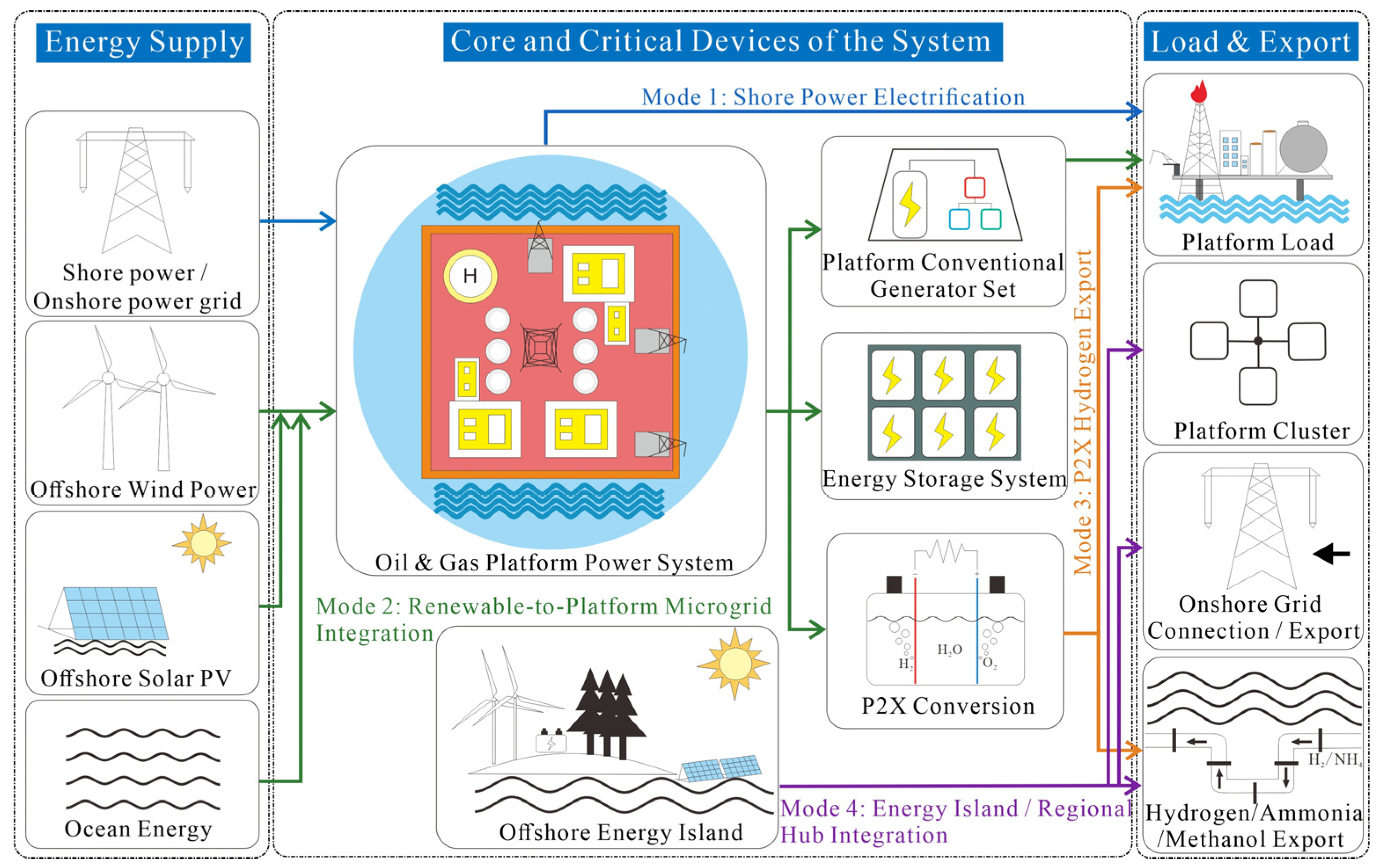
Current studies indicate that the integration of offshore oil and gas with renewable energy is expanding from single platforms to platform clusters, advancing from nearshore to deepwater and far-offshore areas, and evolving from simple power substitution toward multi-energy coordination and hub-based integration [34,35]. Based on the point at which renewable energy enters the system, whether energy-form conversion is involved, and the scale of the service target, this study proposes a comparative framework that summarizes the integration process as a chain linking supply-side access, platform power systems, key devices, and load or energy export.
In nearshore scenarios, integration is mainly realized by transmitting shore power or nearshore clean electricity to central platforms and surrounding installations through submarine cables, thereby progressively replacing on-platform gas turbines, achieving platform electrification, and maintaining continuous production. Meanwhile, offshore wind, photovoltaics, and certain forms of marine energy can be integrated into platform microgrids as incremental power sources, working in coordination with conventional generating units and energy storage systems to mitigate fluctuations and ensure power quality and reliability [36]. In some nearshore oilfield clusters, exploratory practices have already emerged in which photovoltaic demonstration projects were implemented first and subsequently coupled with wind farms and energy storage, providing a technically and operationally feasible pathway for integrated development [37].
For deepwater and far-offshore applications, as well as larger-scale service targets, integration places greater emphasis on energy-form conversion and hub-based development. At the platform level, P2X systems can convert intermittent electricity into hydrogen and its derivatives for on-platform fuel substitution, long-duration energy storage, or export, thereby expanding energy utilization pathways and enhancing system resilience [38]. When the service target extends to platform clusters or onshore grids, offshore energy islands or energy hubs can support power aggregation, converter-based transmission, energy storage deployment, and centralized dispatch, although their implementation remains constrained by cost, shipping, fisheries, and ecological considerations [39]. Recent studies increasingly use hub-based planning, multi-energy coordination, and integrated techno-economic assessment to compare these pathways under different offshore conditions.
Figure 7 presents a conceptual framework rather than a mathematical or simulation model. It illustrates four representative pathways for integrating offshore oil and gas systems with renewable energy. It links energy supply, platform power systems, key enabling devices, and load or export targets into a unified framework. Mode 1 represents shore-power electrification, Mode 2 platform microgrid integration, Mode 3 P2X hydrogen production and export, and Mode 4 offshore energy islands or regional hubs. These pathways differ mainly in system boundary, service scale, and export orientation, with shore power being more relevant to nearshore fields, platform microgrids to single platforms and small clusters, P2X to far-offshore export-oriented settings, and energy islands or hubs to regional-scale coordination.

4.2. Comparative Synthesis of Representative Cases

Hywind Tampen, Guanlan, PosHYdon, and energy island concepts represent different integration depths, from direct renewable power supply to hydrogen conversion and regional hub-based coordination. Table 1 summarizes the main evidence, transferable implications, and key limitations of these representative cases.
Table 1 shows that these cases should be understood as project-based references rather than directly transferable templates. Hywind Tampen and Guanlan demonstrate the feasibility of using floating offshore wind to reduce gas-turbine generation and supply platform or oilfield-cluster loads, but their application depends on wind resources, load demand, cable reliability, backup supply, and offshore operation and maintenance capability. PosHYdon extends the system boundary from electricity supply to hydrogen production and export, making platform space, water treatment, process safety, and pipeline compatibility key constraints. Energy island concepts further expand integration toward regional coordination, but they require stronger spatial planning, export infrastructure, investment mechanisms, and cross-sector governance. These cases suggest that near-term applications in China may focus on platform electrification, floating wind integration, microgrid control, and storage or backup coordination, while P2X hydrogen and energy-island pathways require longer-term validation.

5. Challenges

Based on the comparative framework established in Section 4, offshore oil and gas–renewable energy integration can be grouped into four typical pathways: shore power electrification, platform microgrid integration, P2X hydrogen production and export, and energy islands or regional hubs. These pathways involve not only the addition of renewable generation, but also a new engineering balance among production continuity, backup redundancy, hazardous-area safety, emission reduction, and life-cycle costs [40,41]. Under weak-grid conditions and strict power-quality requirements, the key challenge is whether system boundaries, export channels, control architectures, and safety constraints can be coordinated effectively. Across the four pathways, the most critical cross-cutting challenges are supply reliability, storage and backup adequacy, and offshore engineering feasibility, while pathway-specific risks are more strongly associated with export configuration, process safety, and large-scale deployment conditions.
  • External and Retrofit Constraints on Shore Power Electrification
For nearshore platforms or scenarios supported by onshore infrastructure, shore power electrification is generally one of the most readily deployable pathways because of its relatively mature technical route and direct decarbonization effect. However, its main constraints often originate outside the platform itself. Submarine-cable corridors, landfall conditions, grid-connection rules, and electricity pricing mechanisms all affect project economics and implementation pace. At the same time, shore power integration is not merely a change in the power source; it also requires substantial restructuring of the platform electrical system, including AC/DC architecture, interface compatibility, and protection coordination. If weak-grid stability control and fault-isolation capability are inadequate, the risk of production shutdown may increase [42]. Engineering practice indicates that modular grid-access architectures and HVAC/HVDC selection procedures tailored to transmission distances and capacity are important for improving replicability [43].
  • Stability and Safety Constraints in Platform Microgrid Integration
For single platforms and platform clusters operating under off-grid or weak-grid conditions, once wind, solar, and certain forms of marine energy are integrated into platform microgrids, the principal challenge shifts from power delivery to power stability. Because of renewable variability and intermittency, energy storage and backup generation remain essential for maintaining supply continuity. However, offshore platforms are constrained by space, weight, and safety requirements, so their system configurations often demand higher redundancy. Adeyemo et al. noted that battery systems must provide not only frequency regulation and backup capacity, but also adequate maintainability and safety protection [44]. At the same time, under high penetration of power-electronic equipment, limited fault current, complex protection coordination, and interactions among control strategies further intensify stability constraints [45]. Therefore, digital systems should extend beyond dispatch optimization to include zonal and hierarchical control as well as operational safety management [46].
  • Multi-Energy Flow Coordination Constraints in P2X Hydrogen Production and Export
For deepwater and far-offshore scenarios oriented toward energy conversion and export, the introduction of P2X shifts the core challenge from power balancing to the coordination of multiple energy flows. Electrolysis and synthesis processes require a stable power supply, long-duration regulation capability, and operational continuity, while hydrogen storage, blending, and conversion into carriers such as ammonia and methanol introduce additional constraints related to material compatibility, process safety, and system-boundary control. The economic viability of this pathway is also highly sensitive to capital intensity, equipment utilization, and revenue mechanisms. Studies show that carbon costs, start-up and shutdown constraints, and energy-storage strategies can significantly affect optimal dispatch results [47]. In addition, the choice between offshore hydrogen production and centralized onshore electrolysis is highly sensitive to transmission distance, export losses, and scale configuration [48]. Beyond electrolyzer performance, offshore hydrogen feasibility is strongly conditioned by site characteristics, available infrastructure, structural payload limits, and the choice between centralized and decentralized layouts, all of which affect platform complexity, export arrangements, and life-cycle cost [8]. Therefore, P2X evaluation should consider not only technological performance, but also revenue mechanisms, flexibility resources, and safety systems within a unified comparison framework [49].
  • Constraints on the Large-Scale Deployment of Energy Islands and Regional Hubs
For applications serving platform clusters or broader regional systems, energy islands or energy hubs can enable multi-source aggregation, centralized dispatch, and coordination across multiple operational sectors. They are therefore regarded as an important direction for integrated development in deepwater and far-offshore areas. However, compared with single-platform solutions, the main challenge lies in large-scale implementation. Project deployment is directly constrained by site selection, sea-area use, export costs, approval procedures, and business models. In addition, in deepwater and far-offshore settings, the life-cycle reliability of dynamic submarine cables and offshore engineering installation and maintenance directly affect system availability and maintenance costs; monitoring, predictive maintenance, and rapid repair strategies are therefore needed to reduce the risk of high-cost failures [50]. As facility density increases, conflicts over marine space involving fisheries, shipping, and ecological protection are also likely to intensify, thereby affecting project permitting and long-term operational stability [51,52].
Because the four pathways involve different energy chains, a single efficiency indicator is not applicable to all pathways. Therefore, Table 2 combines representative project-scale indicators with pathway-specific energy-loss indicators, including transmission-related losses, storage round-trip efficiency, and electrolysis electricity consumption.
Table 2 shows that system complexity and energy losses generally increase as the integration pathway becomes longer and more conversion-oriented. Shore power electrification and platform microgrid integration mainly involve electricity transmission and local balancing, whereas P2X hydrogen production introduces an additional electricity-to-hydrogen conversion step. Energy islands or regional hubs provide larger-scale coordination, but their overall efficiency and feasibility depend strongly on whether they are designed for direct power export, storage-based balancing, or hydrogen conversion.

6. Prospects and Suggestions

Driven by the combined imperatives of the dual-carbon goals and deepwater/far-offshore development, the integration of oil and gas with renewable energy is shifting from pilot applications on individual platforms toward coordinated deployment at the scale of platform clusters and wider offshore areas. Accordingly, greater emphasis should be placed on pathway-specific system design, life-cycle reliability, and coordinated market and policy support. Future priorities and policy recommendations can be organized around four dimensions: technology, operation and maintenance, spatial planning, and policy. A key requirement is to clearly define system boundaries, risks, and economic returns, while rigorously validating the critical links in the integration chain so as to achieve solutions that are both replicable and financeable.
  • Technology
The technological focus should shift from simple renewable integration toward stronger grid-forming capability and deeper multi-energy coupling. China’s National Development and Reform Commission has identified several priority areas, including the simulation and stability control of high-penetration power-electronics-based systems, offshore flexible DC submarine cables, multi-terminal DC islanded operation, grid-forming control, and updated grid-connection standards. These priorities directly address the weak-grid bottlenecks encountered in deepwater and far-offshore applications [53]. In parallel, power export from floating offshore wind systems requires integrated design across mooring systems, floating structures, and cables. The WFO white paper also emphasizes the need for standards for dynamic submarine cables and wet-mate connectors, together with an integrity-management and monitoring system beginning at the design stage [54].
  • Operation and Maintenance
The combination of limited maintenance windows and high failure costs makes it essential to prioritize life-cycle reliability from the outset. A closed-loop data framework should therefore be established across manufacturing, installation, and operational service, with condition monitoring, predictive maintenance, and rapid replacement or repair as its core elements. The WFO further emphasizes that monitoring and predictive maintenance can reduce failure rates and outage losses [54]. In parallel, intelligent control capabilities should be strengthened, including situational awareness and coordinated aggregation control across bulk power grids, distribution networks, and microgrids, so as to improve operational robustness under disturbed conditions.
  • Spatial Planning
As offshore facilities become more densely distributed, conflicts involving shipping, fisheries, and ecological protection are likely to intensify. Accordingly, coexistence should be treated as a core requirement at the site-selection and permitting stages. Bonsu et al. emphasized that the expansion of offshore wind is increasingly giving rise to spatial conflicts, while the co-location of fisheries and offshore wind remains constrained by insufficient regulatory frameworks and limited scientific evidence [55]. A report led by the Danish Energy Agency likewise highlights the need for continuous stakeholder engagement prior to environmental impact assessment, the establishment of fisheries liaison mechanisms, and explicit attention to issues such as safety distances, insurance, and legal compliance, so as to reduce conflict and outage risks [56].
  • Policy
A coordinated mechanism linking electricity markets, green certificates, and carbon pricing should be established to create stable revenue expectations for integrated development. China’s National Development and Reform Commission has proposed improving the green certificate market and strengthening coordination among the electricity, green certificate, and carbon markets [53]. In addition, the National Energy Administration’s interpretation of the 2026 implementation rules for green certificates further emphasizes life-cycle management of green certificates and coordination with policies such as CCER and dual control of carbon emissions [57]. Against the backdrop of increasingly stringent carbon-intensity constraints and renewable energy quota requirements during the 15th Five-Year Plan period, shore power electrification, offshore wind power, and green hydrogen value chains are expected to move from demonstration toward large-scale deployment. However, mechanisms such as capacity compensation, ancillary services, and offshore power export pricing still require further improvement in order to reduce revenue volatility and investment uncertainty.

7. Conclusions

In summary, the integration of offshore oil and gas with renewable energy is fundamentally about balancing low-carbon energy supply, production continuity, and operational safety within the constrained engineering setting of offshore platforms. Existing studies indicate that shore power electrification, platform microgrid integration, P2X hydrogen production and export, and energy islands or regional hubs can all reduce the carbon intensity of platform energy use and enhance supply resilience under different system boundary conditions. However, their applicability and replicability remain strongly constrained by transmission corridors, offshore engineering conditions, system reliability, safety requirements, and the coordinated performance of storage, backup, and control systems. Overall, the field is evolving from nearshore, single-platform, and single-substitution approaches toward platform-cluster development, deepwater and far-offshore deployment, and multi-energy coordination.
Future research should move beyond the optimization of individual technologies or isolated links toward system integration and life-cycle assessment for complex offshore application scenarios. Priorities should be given to clarifying the applicable boundaries and techno-economic thresholds of different integration modes, improving the long-term reliability of power-export systems and submarine cables in deepwater and far-offshore environments, enhancing protection and stability control in AC/DC hybrid microgrids, advancing key technologies for long-lifespan energy storage and hydrogen value chains, and establishing hierarchical energy-management and comprehensive evaluation frameworks capable of addressing resource variability and operational uncertainty. Only when technological feasibility, operational safety, and economic acceptability are brought into a stable closed loop can offshore oil and gas–renewable energy integration move from demonstration to large-scale deployment.

Author Contributions

Conceptualization, Y.S. and W.Y.; methodology, Y.S., W.Y. and Y.L. (Yifan Li); software, investigation, Y.S.; data, reduction and analysis, Y.L. (Yifan Li); writing—original draft preparation, Y.S. and W.Y.; writing—review and editing, Y.S., W.Y., Y.L. (Yifan Li) and P.S.; literature investigation, H.C., Y.L. (Yaoyao Lv) and G.Z.; technical support, Z.Z. and G.Z. All authors have read and agreed to the published version of the manuscript.

Funding

This research was funded by projects of Key Consultative Research Project of Hainan Institute of Strategic Studies on Engineering and Technology Development of China (Grant No. 25HNZX-06), Hainan Province Postgraduate Innovation and Scientific Research Project (Grant No. Hys2025-648), National Natural Science Foundation of China (Grant No. 42576253), Hainan Province Natural Science Foundation project (Grant No. 423MS132), Geological Investigation Programs of China Geological Survey (Grant No. DD202603303202), Key Project of the National Natural Science Foundation of China (Grant No. 42130408), Guangzhou City Supplementary Project for Basic and Applied Basic Research (2025MGMS-HBZ-009), Director General’s Scientific Research Fund of Guangzhou Marine Geological Survey, China (2023GMGSJZJJ00014), the Hainan Province Science and Technology Special Fund (ZDYF2024GXJS002), Key Research and Development Project of Hainan Province (ZDYF2026GXJS025).

Data Availability Statement

No new data were created in this study. The data and information discussed in this review are available from the cited literature and publicly available sources.

Acknowledgments

We would like to express our gratitude to the Sanya Institute of South China Sea Geology and the Guangzhou Marine Geological Survey for their valuable contributions and provision of data.

Conflicts of Interest

The authors declare no conflicts of interest.

References

  1. International Energy Agency. Emissions from Oil and Gas Operations in Net Zero Transitions: A World Energy Outlook Special Report on the Oil and Gas Industry and COP28; OECD Publishing: Paris, France, 2023. [Google Scholar] [CrossRef] [Scilit]
  2. Equinor. The World’s Largest Floating Offshore Wind Farm Officially Opened. 2023. Available online: https://www.equinor.com/news/20230823-hywind-tampen-officially-opened (accessed on 15 January 2025).
  3. Mirzadeh Phirouzabadi, A.; Thune, T.M. Plugging platforms into the wind: The innovation dynamics of Norway’s offshore oil and gas electrification. Energy Policy 2026, 208, 114931. [Google Scholar] [CrossRef] [Scilit]
  4. Central Committee of the Communist Party of China; State Council of the People’s Republic of China. Opinions on Fully, Accurately, and Comprehensively Implementing the New Development Philosophy and Doing a Good Job in Carbon Peaking and Carbon Neutrality. 2021. Available online: https://www.mee.gov.cn/zcwj/zyygwj/202110/t20211024_957580.shtml (accessed on 21 January 2026). (In Chinese)
  5. State Council of the People’s Republic of China. Action Plan for Carbon Dioxide Peaking Before 2030. 2021. Available online: https://www.mee.gov.cn/zcwj/gwywj/202110/t20211026_957879.shtml (accessed on 8 March 2026). (In Chinese)
  6. National Energy Administration. China’s Energy Transition. 2024. Available online: https://www.nea.gov.cn/2024-08/29/c_1310785406.htm (accessed on 12 February 2026). (In Chinese)
  7. Joyo, F.H.; Groppi, D.; Irfan, N.; Astiaso Garcia, D. Integrating Offshore Wind and Green Hydrogen: A Systematic Review of Technological Progress and System-Level Challenges. Energies 2026, 19, 696. [Google Scholar] [CrossRef] [Scilit]
  8. Rodríguez Castillo, C.A.; Yeter, B.; Li, S.; Brennan, F.; Collu, M. A Critical Review of Challenges and Opportunities for the Design and Operation of Offshore Structures Supporting Renewable Hydrogen Production, Storage, and Transport. Wind Energy Sci. 2024, 9, 533–554. [Google Scholar] [CrossRef] [Scilit]
  9. National Energy Administration. Notice of the National Energy Administration on Issuing the 2025 Energy Work Guidance. 2025. Available online: https://www.nea.gov.cn/20250227/b60fb4f51097434e8c5d7ee19b423651/c.html (accessed on 14 February 2026). (In Chinese)
  10. National Energy Administration. Guiding Opinions of the National Energy Administration on Promoting the Integrated Development of New Energy. 2025. Available online: https://www.nea.gov.cn/20251112/79210278a3184efea9ccf2d546fdf1b7/c.html (accessed on 10 March 2026). (In Chinese)
  11. Yan, X.R.; Zhang, N.N.; Ma, K.C.; Wei, C.; Yang, S.; Pan, B.B. Overview of Current Situation and Trend of Offshore Wind Power Development in China. Power Gener. Technol. 2024, 45, 1–12. (In Chinese) [Google Scholar] [CrossRef]
  12. Fan, X.J.; Chi, Y.N.; Ma, S.C.; Fan, Y.W.; Li, Y.; Wang, C. Research and Application of Key Technologies and Technical Standards for Large-Scale Offshore Wind Power Integration into the Power Grid. Power Syst. Technol. 2022, 46, 2859–2870. (In Chinese) [Google Scholar] [CrossRef]
  13. Li, D.; Sun, T.; Yi, C.; Gao, W.; Li, S.Z.; Lü, B.C.; Li, H.; Zhang, Y.M.; Bai, Z.L.T.; Wang, J.R.; et al. Development of Deep-Sea Floating Wind Power Technology. Strateg. Study CAE 2025, 27, 108–122. (In Chinese) [Google Scholar] [CrossRef] [Scilit]
  14. Chi, Y.N.; Xi, X.; Xue, A.C.; Liu, H.Z.; Huang, R.M. Review of Key Technologies for All-DC Grid Connection of Offshore Wind Power. Electr. Power Autom. Equip. 2025, 45, 3–14. (In Chinese) [Google Scholar] [CrossRef]
  15. Huang, Y.D. Discussion on Operation and Maintenance Risks and Countermeasures for Offshore Wind Power. China Plant Eng. 2026, 1, 42–44. (In Chinese) [Google Scholar]
  16. Cai, Y.L.; Zhang, F.F.; Yang, X.L.; Deng, S.; Qiu, Y.F.; Cheng, Z.S. Overall Design and Key Technologies of the Haiyou Guanlan Floating Wind Power Platform. China Offshore Oil Gas 2024, 36, 119–127. (In Chinese) [Google Scholar]
  17. Liu, G.; Guo, J.; Peng, H.; Ping, H.; Ma, Q. Review of recent offshore floating photovoltaic systems. J. Mar. Sci. Eng. 2024, 12, 1942. [Google Scholar] [CrossRef] [Scilit]
  18. Saincher, S.A.; Sriram, V.; Stoesser, T. Shared moorings for floating offshore renewable energy technologies: A review. Renew. Sustain. Energy Rev. 2025, 224, 116064. [Google Scholar] [CrossRef] [Scilit]
  19. Huang, L.; Elzaabalawy, H.; Sarhaan, M.; Sherif, A.; Ding, H.; Ou, B.; Yang, D.; Cerik, B.C. Developing reliable floating solar systems on seas: A review. Ocean Eng. 2025, 322, 120525. [Google Scholar] [CrossRef] [Scilit]
  20. Lüth, A.; Keles, D. Risks, strategies, and benefits of offshore energy hubs: A literature-based survey. Renew. Sustain. Energy Rev. 2024, 203, 114761. [Google Scholar] [CrossRef] [Scilit]
  21. Chen, J.P.; Li, G.; Liu, B.; Qiao, H. Current Status and Prospect of Membrane-Based Offshore Floating Photovoltaic Technology. South. Energy Constr. 2023, 10, 1–10. (In Chinese) [Google Scholar] [CrossRef]
  22. Li, H.; Shi, X.; Kong, W.; Kong, L.; Hu, Y.; Wu, X.; Pan, H.; Zhang, Z.; Pan, Y.; Yan, J. Advanced wave energy conversion technologies for sustainable and smart sea: A comprehensive review. Renew. Energy 2025, 238, 121980. [Google Scholar] [CrossRef] [Scilit]
  23. Ren, A.K.; Gu, H.B.; Wang, D.X.; Zang, J. Review of Wave Energy Utilization Research. Waterw. Harb. 2025, 46, 479–488. (In Chinese) [Google Scholar]
  24. Neill, S.P.; Haas, K.A.; Thiébot, J.; Yang, Z. A review of tidal energy—Resource, feedbacks, and environmental interactions. J. Renew. Sustain. Energy 2021, 13, 062702. [Google Scholar] [CrossRef] [Scilit]
  25. Coles, D.S.; Adcock, T.A.A.; Cornett, A.; Haas, K.; Jo, C.H.; Liu, H.; Miles, J.; Garcia Novo, P.; Thiébot, J. A review of global tidal stream energy resources. Proc. R. Soc. A 2025, 481, 20240841. [Google Scholar] [CrossRef] [Scilit]
  26. Li, W.; Shi, H.D.; Liu, Z.; Han, Z.; Cao, F.F.; Yu, T.S.; Wang, Y.Q.; Lun, Z.X.; Liu, H.W.; Sun, K. Current Status of Marine Energy Research in China and Suggestions for Future Development. Sol. Energy 2024, 7, 79–88. (In Chinese) [Google Scholar]
  27. Ascari, M.B.; Hanson, H.P.; Rauchenstein, L.; Van Zwieten, J.; Bharathan, D.; Heimiller, D.; Langle, N.; Scott, G.N.; Potemra, J.; Nagurny, N.J.; et al. Ocean Thermal Extractable Energy Visualization: Final Technical Report on Award DE-EE0002664; Lockheed Martin Mission Systems and Sensors: Washington, DC, USA, 2012. [Google Scholar] [CrossRef] [Scilit]
  28. Zou, C.N.; Li, S.X.; Xiong, B.; Yang, Z.; Liu, H.L.; Pan, S.Q.; Ma, F. Concept, connotation, path, and significance of integrated whole-energy system. Acta Pet. Sin. 2026, 47, 1–20. (In Chinese) [Google Scholar] [CrossRef]
  29. Fu, Q.; Wang, G.R.; Zhou, S.W.; Zhong, L.; Zhang, L.; Yu, X.Y.; Yang, P. Comprehensive utilization of temperature difference energy and low-temperature seawater resources. Strateg. Study CAE 2021, 23, 52–60. (In Chinese) [Google Scholar] [CrossRef] [Scilit]
  30. Ramakrishnan, S.; Delpisheh, M.; Convery, C.; Niblett, D.; Vinothkannan, M.; Mamlouk, M. Offshore green hydrogen production from wind energy: Critical review and perspective. Renew. Sustain. Energy Rev. 2024, 195, 114320. [Google Scholar] [CrossRef] [Scilit]
  31. Topolski, K.; Reznicek, E.P.; Erdener, B.C.; San Marchi, C.W.; Ronevich, J.A.; Fring, L.; Simmons, K.; Fernandez, O.J.G.; Hodge, B.-M.; Chung, M. NREL/TP-5400-81704; Hydrogen Blending into Natural Gas Pipeline Infrastructure: Review of the State of Technology. National Renewable Energy Laboratory: Golden, CO, USA, 2022. [CrossRef] [Scilit]
  32. Wang, Z.; Li, N.; Liu, Z.Y. Development of Integrated Energy Systems in the European North Sea and Implications for China. Pet. Sci. Technol. Forum 2024, 43, 8–17. (In Chinese) [Google Scholar]
  33. Iv. First Hydrogen Pilot: PosHYdon. Available online: https://www.iv.nl/en/projects/first-hydrogen-pilot-poshydon/ (accessed on 4 March 2026).
  34. Sun, D.Y. The Mode, Path and Strategy on the Integrated Development of Petroleum and New Energy Resources under the Dual-Carbon Goal. Nat. Gas Technol. Econ. 2024, 18, 72–78. (In Chinese) [Google Scholar]
  35. Sun, D.Y. Vigorously Promoting the Integrated Development of Oil and Gas with New Energy: Development Strategies and Pathways for the Oil and Gas Industry under the Dual-Carbon Background. Energy Conserv. Environ. Prot. 2024, 11, 29–36. (In Chinese) [Google Scholar]
  36. Hu, P.; Cao, B.H.; He, X.; Li, Z.H.; Gao, M. Development Pathways and Suggestions for Integrated Development of Marine Oil and Gas and New Energy. Oil Gas New Energy 2023, 35, 53–58. (In Chinese) [Google Scholar] [CrossRef]
  37. Feng, L.C.; Ma, P.N.; Liu, H.Q.; Zhou, X.Y.; Jiang, T.T.; Luo, Y.S. Research on Optimized System Capacity Allocation for Offshore Energy Island Wind-Solar-Hydrogen-Storage-Alcohol Project. Energy Eng. 2025, 45, 1–9. (In Chinese) [Google Scholar] [CrossRef]
  38. Shen, Q.; Li, O.P.; Liu, C.; Cheng, G.Y.; Yu, X.C. Adaptability Analysis of Offshore New Energy Storage Technology Under Dual-Carbon Background. Ocean. Eng. Equip. Technol. 2024, 11, 106–115. (In Chinese) [Google Scholar] [CrossRef]
  39. Ding, J. Development of Offshore Energy Islands in Europe: Experience and Implications for China. Nat. Resour. Inf. 2025, 6, 101–107. (In Chinese) [Google Scholar]
  40. Ray, A.; Rajashekara, K. Electrification of offshore oil and gas production architectures and power conversion. Energies 2023, 16, 5812. [Google Scholar] [CrossRef] [Scilit]
  41. Herrera Anchustegui, I.; Tscherning, R. Offshore oil and gas infrastructure electrification and offshore wind: A legal exploration. J. World Energy Law Bus. 2024, 17, 35–53. [Google Scholar] [CrossRef] [Scilit]
  42. American Bureau of Shipping. Requirements for Hybrid and All-Electric Power Systems for Marine and Offshore Applications. Available online: https://ww2.eagle.org/content/dam/eagle/rules-and-guides/current/conventional_ocean_service/319-requirements-for-hybrid-electric-power-systems-for-marine-and-offshore-applications-2024/319-hybrid-electric-power-systems-reqts-Apr24.pdf (accessed on 19 February 2026).
  43. Antunes, T.A.; Castro, R.; Santos, P.J.; Pires, A.J. Standardization of power-from-shore grid connections for offshore oil & gas production. Sustainability 2023, 15, 5041. [Google Scholar] [CrossRef] [Scilit]
  44. Adeyemo, A.A.; Tedeschi, E. Technology suitability assessment of battery energy storage system for high-energy applications on offshore oil and gas platforms. Energies 2023, 16, 6490. [Google Scholar] [CrossRef] [Scilit]
  45. Hasan, M.M.; Razmi, D.; Babayomi, O.; Davidson, I.; Terzija, V.; Zhang, Z. Advanced control and protection strategies for grid-forming inverters in microgrids—A review. Int. J. Electr. Power Energy Syst. 2025, 172, 111297. [Google Scholar] [CrossRef] [Scilit]
  46. Stouffer, K.; Pease, M.; Tang, C.; Zimmerman, T.; Pillitteri, V.; Lightman, S.; Hahn, A.; Saravia, S.; Sherule, A.; Thompson, M. Guide to Operational Technology (OT) Security; NIST Special Publication 800-82 Rev. 3; National Institute of Standards and Technology: Gaithersburg, MD, USA, 2023. [Google Scholar] [CrossRef] [Scilit]
  47. Wang, Z.; Mu, X.; Ma, Y.; Liao, P.; Ji, Y.; Han, F. Advanced energy management and optimal scheduling for integrated offshore gas-hydrogen-electricity-heat systems. Energy 2025, 319, 135091. [Google Scholar] [CrossRef] [Scilit]
  48. de Almeida, J.O.; Shadman, M.; Ramos, J.d.S.; Bastos, I.T.C.; Silva, C.; Hernandez Chujutalli, J.A.; Maali Amiri, M.; Bergman-Fonte, C.; Ferreira, G.R.L.; Carreira, E.d.S.; et al. Techno-economic analysis of hydrogen production from offshore wind: The case of Brazil. Energy Convers. Manag. 2024, 322, 119109. [Google Scholar] [CrossRef] [Scilit]
  49. Cho, S.-g.; Oh, S.; Lim, C.H.; Ko, T.K.; Park, S.; Kim, Y.; Cho, K.S.; Lee, K.S.; Kim, H.T.; Kim, K.H. Risk assessment of an offshore green hydrogen production system. Process Saf. Prog. 2025, 44, 368–378. [Google Scholar] [CrossRef] [Scilit]
  50. Young, D. Predicting Dynamic Subsea Cable Failure for Floating Offshore Wind; ORE Catapult, 2018. Available online: https://ore.catapult.org.uk/wp-content/uploads/2018/09/Predicting-Dynamic-Subsea-Cable-Failure-for-Floating-Wind-David-Young-AP-0016.pdf (accessed on 11 February 2026).
  51. European Court of Auditors. Offshore Renewable Energy in the EU: Ambitious Plans for Growth but Sustainability Remains a Challenge (Special Report 22/2023); European Court of Auditors: Luxembourg, 2023; Available online: https://www.eca.europa.eu/en/publications?ref=sr-2023-22 (accessed on 2 March 2026).
  52. Szostek, C.L.; Watson, S.C.L.; Trifonova, N.; Beaumont, N.J.; Scott, B.E. Spatial conflict in offshore wind farms: Challenges and solutions for the commercial fishing industry. Energy Policy 2025, 200, 114555. [Google Scholar] [CrossRef] [Scilit]
  53. National Development and Reform Commission; National Energy Administration. Guiding Opinions on Promoting New Energy Consumption and Regulation. Available online: https://www.ndrc.gov.cn/xxgk/zcfb/tz/202511/t20251110_1401469.html (accessed on 9 March 2026). (In Chinese)
  54. Marcollo, H.; Efthimiou, L. Floating Offshore Wind Dynamic Cables: Overview of Design and Risks; World Forum Offshore Wind e.V.: Singapore, 2024; Available online: https://wfo-global.org/wp-content/uploads/2024/02/WFO-Cables-and-FOSS-White-Paper.pdf (accessed on 4 March 2026).
  55. Bonsu, P.O.; Letschert, J.; Yates, K.L.; Svendsen, J.C.; Berkenhagen, J.; Rozemeijer, M.J.C.; Kerkhove, T.R.H.; Rehren, J.; Stelzenmüller, V. Co-location of fisheries and offshore wind farms: Current practices and enabling conditions in the North Sea. Mar. Policy 2024, 159, 105941. [Google Scholar] [CrossRef] [Scilit]
  56. Danish Energy Agency. Results Summary: Offshore Wind Law Drives Forward Brazil’s Sustainable Energy Transition. Available online: https://editor.openaid.um.dk/uploads/Danish_Energy_Agency_BR_2025_Offshore_wind_law_drives_forward_Brazil_s_sustainable_energy_transition_f4c5a80d9b.pdf (accessed on 4 March 2026).
  57. National Energy Administration. Interpretation of the Notice of the National Energy Administration on Issuing the Detailed Rules for the Administration of Renewable Energy Green Electricity Certificates (Trial). Available online: https://www.nea.gov.cn/20260107/3f7a58d6f6a54b1a96b29e0f50cbd04d/c.html (accessed on 6 March 2026). (In Chinese)
Figure 1. Schematic illustration of the coupling structure between offshore wind power and offshore oil and gas platforms.
Energies 19 04201 g001
Figure 2. The CNOOC Guanlan Floating Offshore Wind Power Platform transmits green electricity to surrounding oil and gas fields via dynamic submarine cables (a) Location of the CNOOC Guanlan Floating Offshore Wind Power Platform; (b) The Guanlan deepwater floating offshore wind power platform [16]. Note: The Chinese label on the turbine tower denotes CNOOC (China National Offshore Oil Corporation).
Energies 19 04201 g002
Figure 3. Schematic illustration of wave energy grid connection and its application structure on offshore platforms.
Energies 19 04201 g003
Figure 4. Schematic illustration of tidal energy grid connection and its application structure on offshore platforms.
Energies 19 04201 g004
Figure 5. Schematic illustration of ocean thermal energy conversion grid connection and its application structure on offshore platforms.
Energies 19 04201 g005
Figure 6. Schematic illustration of the hydrogen production–storage–utilization/export structure.
Energies 19 04201 g006
Figure 7. Conceptual framework of offshore oil and gas–renewable energy integration pathways and coupling methods.
Energies 19 04201 g007
Table 1. Comparative synthesis of representative offshore integration cases.
CasePathwayMain EvidenceTransferable ImplicationKey Limitation
Hywind TampenFloating wind → platform power88 MW; ~35% coverage; ~140 km offshore; 260–300 m depthGas-turbine reduction; clusters supplyWind resources; backup supply; power balancing; O&M
GuanlanFloating wind → oilfield-cluster power7.25 MW; 136 km offshore; 120 m depth; 22 million kWh/yearChina deepwater oilfield demonstrationLimited scale; dynamic cable; typhoons
PosHYdonOffshore P2X → H2 production/export1 MW electrolyser; up to 400 kg H2/dayPlatforms retrofit; pipeline reuseSpace; safety; water treatment; H2 compatibility
Energy island conceptsMulti-source power → hub/export/P2XDanish North Sea Energy Island: 3 GW–10 GWRegional wind/export/storage/P2X coordinationCapex; permitting; sea-use conflicts; business-model
Table 2. Semi-quantitative comparison of offshore oil and gas–renewable energy integration pathways.
ModeApplication and
Energy Flow
IndicatorsLoss IndicatorStorage/
Maturity
Constraints
① Shore Power ElectrificationNearshore platforms; grid/clean power → cable → loadHVAC: 60–100 km;
HVDC: longer distance
No conversion; cable, conversion, and reactive power lossesLow–Medium; high Cable corridor; landfall; grid access; tariff; protection; retrofit
② Platform Microgrid Power SupplySingle platforms/small clusters; RE + storage/backup → microgrid → loadMW–tens of MW; Hywind Tampen 88 MW; Guanlan 7.25 MWDirect use; battery cycling losses; RTE ~85%High; mediumIntermittency; storage sizing; weak grid; protection; power quality; O&M
③ P2X Hydrogen Production & ExportFar-offshore systems; RE → electrolysis/synthesis → H2/fuel exportPosHYdon 1 MW;
electrolysis: 50–55 kWh/kg H2
Electricity-to-H2 conversion lossMedium–High; emergingStable power; H2 safety; water treatment; platform space; export; capex
④ Energy Island HubRegional systems; multi-source power → hub/converter/P2X → clusters/gridGW scale; North Sea Energy Island: 3–10 GWExport/converter loss; P2X losses if convertedMedium; emergingSite selection; sea use; permitting; export cost; dynamic cable; business model
Note: RTE = round-trip efficiency. The indicative values are representative ranges or project-level references rather than strict techno-economic thresholds.
Disclaimer/Publisher’s Note: The statements, opinions and data contained in all publications are solely those of the individual author(s) and contributor(s) and not of MDPI and/or the editor(s). MDPI and/or the editor(s) disclaim responsibility for any injury to people or property resulting from any ideas, methods, instructions or products referred to in the content.