Article

Design and Deployment of Blockchain-Enabled Peer-to-Peer Distributed Solar Energy Trading Market for an Urban Energy Community


1
The School of Property, Construction and Project Management, RMIT University, Melbourne, VIC 3000, Australia
2
Science, Technology, Engineering and Mathematics (STEM) College, RMIT University, Melbourne, VIC 3000, Australia
3
School of Computing Technologies, RMIT University, VIC 3000, Australia
4
School of Management, Harbin Institute of Technology, Harbin 150001, China
*
Author to whom correspondence should be addressed.
Energies 2026, 19(17), 3966; https://doi.org/10.3390/en19173966
Submission received: 10 July 2026 / Revised: 7 August 2026 / Accepted: 19 August 2026 / Published: 24 August 2026

Abstract

Adoption of peer-to-peer (P2P) trading is very challenging, mainly due to numerous issues and limitations such as lack of trust in the concept and awareness of the technical, economic and social benefits. This paper aims to understand how blockchain technology can address the current issues/limitations of P2P distributed solar energy (DSE) trading. A series of semi-structured interviews were conducted with 23 community energy stakeholders to confirm and expand the stakeholder issues identified in the literature review. A case representing community energy projects was selected to (1) develop and implement a blockchain system and (2) evaluate its ability to eliminate (or reduce) stakeholder issues and meet stakeholder expectations. A blockchain-enabled P2P trading platform was developed using an Ethereum backend. The system clearly demonstrated its ability to deliver full or partial solutions to 12 stakeholder issues. Two stakeholder issues are unable to be addressed via the blockchain platform since they uncovered the weaknesses of blockchain technology. The P2P trading platform has also demonstrated its ability to facilitate decentralized trading and data management. The outcome of this study indicates the areas of P2P trading projects that can be improved by the application of blockchain technology.

1. Introduction

The rooftop PV sector is increasingly exploring community energy models that facilitate local consumption and peer-to-peer (P2P) trading of locally generated solar energy, while also creating new investment opportunities for prosumers [1]. However, the P2P trading concept remains a niche market, constrained by a lack of legal recognition for commercial implementation, the complicated nature of trading without a governing third party, and consequently reduced end-user trust, attraction, and social acceptance [1,2,3,4]. The above-mentioned issues should be eliminated to move P2P trading from its current niche level to the commercial growth level. Hence, it is crucial to identify methods, technologies and applications that can provide trustworthy, secure and transparent trading environments for energy communities [5].
Blockchain is a novel emerging information communication technology (ICT) which facilitates decentralized trading and information sharing with maximum transparency, security, and accountability [6]. Blockchain has been described as an incorruptible digital ledger capable of recording not only financial transactions but virtually any transaction of value [7], and this capability enables secure information sharing with a significantly reduced risk of tampering [8]. This technology can be effectively used in connecting energy consumers, prosumers, and small-scale generators to enable them to trade solar energy without the involvement of a central authority [9]. Further, it delivers a common platform for stakeholder communication and information sharing by providing open/restricted access to project information as required [10]. The special features of blockchain technology, such as distributed ledger technology (DLT) and smart contracts, ensure secure information sharing and transactions without the involvement of a governing body [11].
Digital assistance is very effective in eliminating most community energy issues hindering its uptake, such as lack of trust, transparency and reliability [10]. Blockchain technology has the appropriate characteristics to provide this digital assistance [12], making it a promising, though not the only, candidate solution for information management and secure P2P trading. Recent literature on blockchain-enabled P2P energy trading, however, remains concentrated primarily on trading mechanisms and business model design. For example, game-theoretic pricing strategies determine how energy is priced and exchanged between peers [13], while comparatively fewer studies engage directly with the trust and governance issues that limit adoption. Where trust and governance are addressed, the treatment tends to be narrow. Ref. [14] review regulatory and institutional barriers to blockchain-based trading without evaluating specific trust-building mechanisms; Ref. [15] propose a permissioned blockchain marketplace with a regulator role to address privacy and governance, but as a single technical implementation rather than a systematic account of the issues blockchain can resolve; and Ref. [16] explores trust in blockchain-enabled energy trading, but as an exploratory study focused on the trade-off between scalability and trust rather than a comprehensive treatment of community energy issues. Comparatively little attention has been paid to (1) the specific techniques blockchain uses to solve community energy-related issues, (2) the types of issues it can address, (3) how these issues are addressed, and (4) whether they are eliminated or only partially addressed by blockchain technology. This fragmented treatment represents a clear research gap: existing studies rarely combine breadth (the full range of community energy issues) with depth (systematic evaluation of whether and how each issue is actually resolved). This study intends to fill this gap by exploring the opportunities for blockchain adoption in P2P trading communities.
The paper structure is as follows: Section 2 explains the research methods used to conduct this study. Section 3 describes the issues/limitations of designing and maintaining a P2P trading community and the characteristics of blockchain technology. Section 4 explains the development of a blockchain-enabled P2P trading system, and Section 5 discusses its ability to address the identified issues/limitations. Finally, Section 6 provides the conclusion and future research directions.

2. Research Method

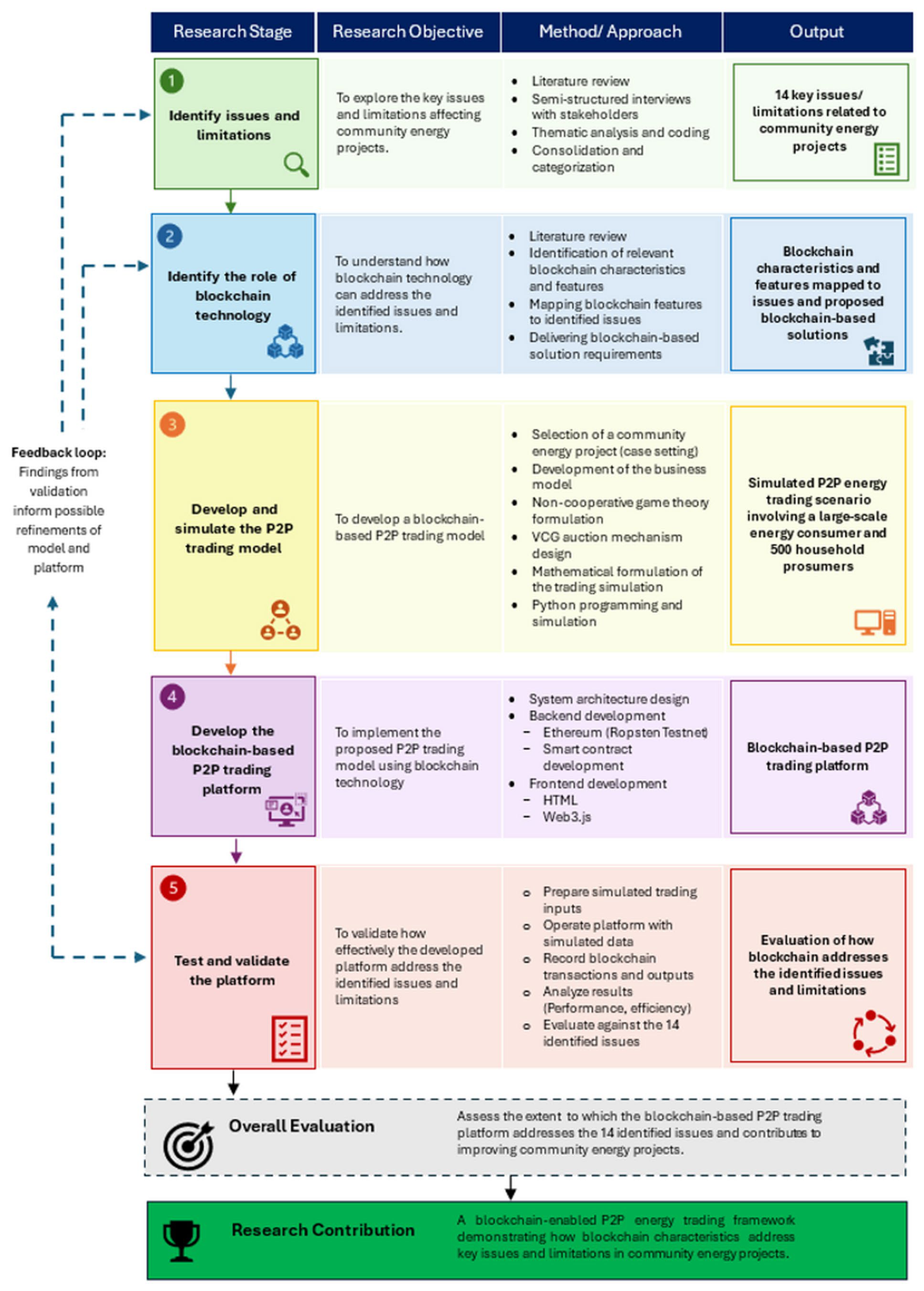
The research design is presented in Figure 1. The study commenced with a comprehensive review of the literature, drawing on journal articles, conference papers, books, magazines, and websites of relevant professional institutions to identify key issues and limitations associated with community energy projects. The characteristics and capabilities of blockchain technology were then examined to assess their potential to address the identified issues and limitations. To validate and further explore the findings from the literature review, 23 semi-structured interviews were conducted with stakeholders involved in community energy projects. The profiles of the interview participants are presented in Table 1. The interview data were subsequently analyzed using content analysis in NVivo. This analysis resulted in the identification of three additional issues and limitations, which were incorporated into the findings.
The findings from the literature review and semi-structured interviews were used to develop a comprehensive table on how blockchain can be used to address the identified issues/limitations, considering its characteristics and features. This table is used as the basis for developing a blockchain-based P2P trading platform.

2.1. P2P Trading Simulation

A community energy project in Victoria, Australia, is selected to (1) develop and implement blockchain systems and (2) evaluate its ability to eliminate (or reduce) stakeholder issues/limitations. P2P trading was conducted between a selected large-scale energy consumer and household prosumers. The aim is to meet a significant proportion of the large-scale energy consumer’s energy requirements using surplus household solar energy generation. Using the PV energy generation of households, the energy demand of households, the energy demand of the large-scale energy consumer, FiT rates and the wholesale price of energy for the large-scale energy consumer, the study simulates P2P trading between the two parties. The simulation is conducted using the Python programming language. Game theory and auction-based mechanisms are used to set up the market for simulation.

2.2. Blockchain-Based P2P Trading Platform Development and Validation

The study developed a blockchain-based P2P trading platform to facilitate payment transactions between the large-scale energy consumer and household prosumers. Its operation was demonstrated using simulated P2P trading information. The simulated results of each household prosumer and the large-scale energy consumer were transferred to the blockchain platform to follow predefined rules on how to execute the transaction between the parties. The study selected the Ethereum platform to execute P2P trading. Accordingly, a smart contract was developed and tested in the Etherscan Ropsten Testnet Network, which provides a simple and user-friendly interface to test, learn, and interact with smart contracts on the Ethereum blockchain. The researcher also designed the front end of the P2P trading platform, which allows communication between large-scale consumers and household prosumers. The front end is also connected to a database providing necessary information (i.e., FiTs, wholesale rates) and smart meter data from all peers. The front-end interface was developed using HTML and Web3.js.

3. Application of Blockchain to Address Stakeholder Issues and Limitations

A comprehensive literature review was conducted to identify the stakeholder issues and limitations related to the P2P trading community. The literature findings were confirmed and further elaborated via a series of semi-structured interviews with community energy stakeholders. The study found 14 stakeholder issues and limitations related to the P2P trading community. The possibilities for future improvements and blockchain-enabled opportunities were also investigated. Table 2 summarizes these findings.
Three blockchain applications can be identified in P2P trading: (1) financial transactions, (2) record-keeping and (3) cryptocurrency use. P2P trading involves numerous concurrent transactions. Energy transactions in every specific time slot create numerous ledger entries [38]. P2P trading generates numerous data, such as PV generation, PV consumption, bidding prices, retail prices, PV sales to consumers, financial transactions, bidding round details and unique IDs of participants. These data should be carefully recorded and shared with all participants in the network. P2P trading also involves many participants who are unknown to each other [39]. Therefore, a secure, transparent and open platform is required for energy trading and data management. Blockchain technology can provide a decentralized information network to P2P community participants [40]. It integrates network participants to maintain a shared economy [41]. It has many characteristics that make it suitable for dealing in a trustless environment such as a P2P trading community [42]. Some of these characteristics include provenance; immutability; no information gaps; no reconciliation, friendly relationships or trust required; time stamping of every action; real-time monitoring and auditing; and open/controlled access based on the P2P community’s requirement [10,43].

4. Design and Development of Blockchain-Enabled P2P Trading Platform

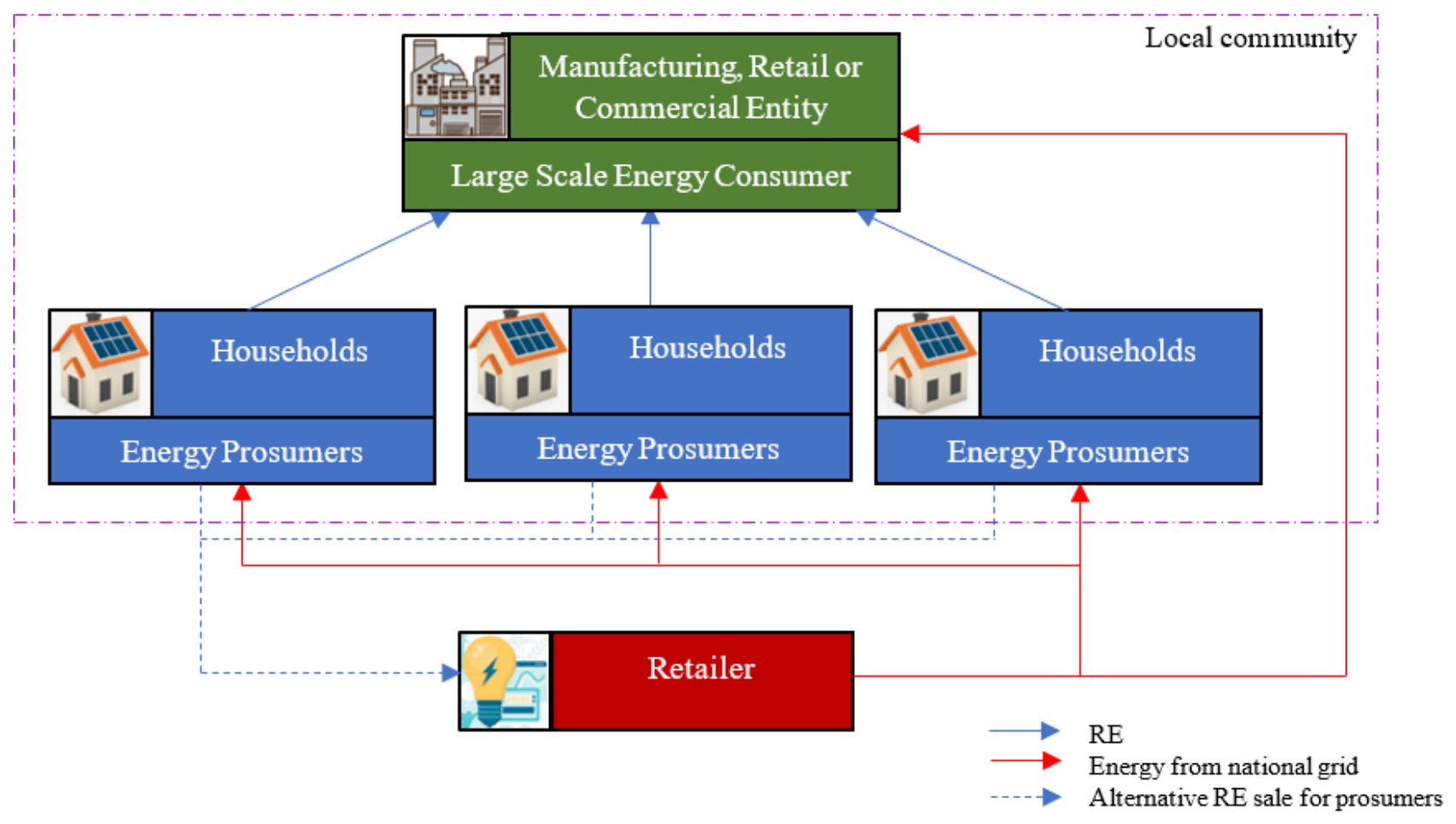
The selected project (referred to as Project 1 hereinafter) is interested in reducing the energy intake of high energy-consuming companies from the national grid and the respective energy bills. It has hence considered the feasibility of using P2P DSE trading as an alternative energy supply method for the manufacturing, retail, and commercial sectors. This study proposes an appropriate business model for the above P2P DSE trading process, as demonstrated in Figure 2.

4.1. Simulation Process

The study uses non-cooperative game theory with the Vickrey–Clarke–Groves (VCG) auction mechanism to simulate P2P trading between the large-scale energy consumer and household prosumers. Non-cooperative game theory is used for the following reasons: (1) households’ aim of participating in P2P trading is to maximize their individual revenues, (2) households have no concerns about benefits of other households, (3) the selected business model does not target aggregating the benefits as a community, (4) the large-scale energy consumer’s aim is to reduce their energy bills and (5) it is practical to explore an independent market when P2P trading is adopted for the first time and later consider achieving common benefits as a community [44,45]. VCG is selected considering the market context and the selected business model. In a new market where participants have no previous dealings with each other, truthfulness is required to build trust [46]. Further, to achieve participants’ acceptance, P2P trading should offer every participant more benefits than their current energy arrangement. Therefore, the trading mechanism should facilitate exchanging energy in a way that delivers maximal social value [47]. This means that the total sum of the values of all participants should be the best possible. VCG is the only trading mechanism that delivers truthfulness (called incentive compatibility—IC) and maximum social value (called economic efficiency—EE) [37]. In addition, it delivers individual rationality (IR), whereby no person would lose by joining the P2P market [48]. Therefore, the study uses the combination of non-cooperative game theory and the VCG trading mechanism to set up the most effective market for the selected business model.
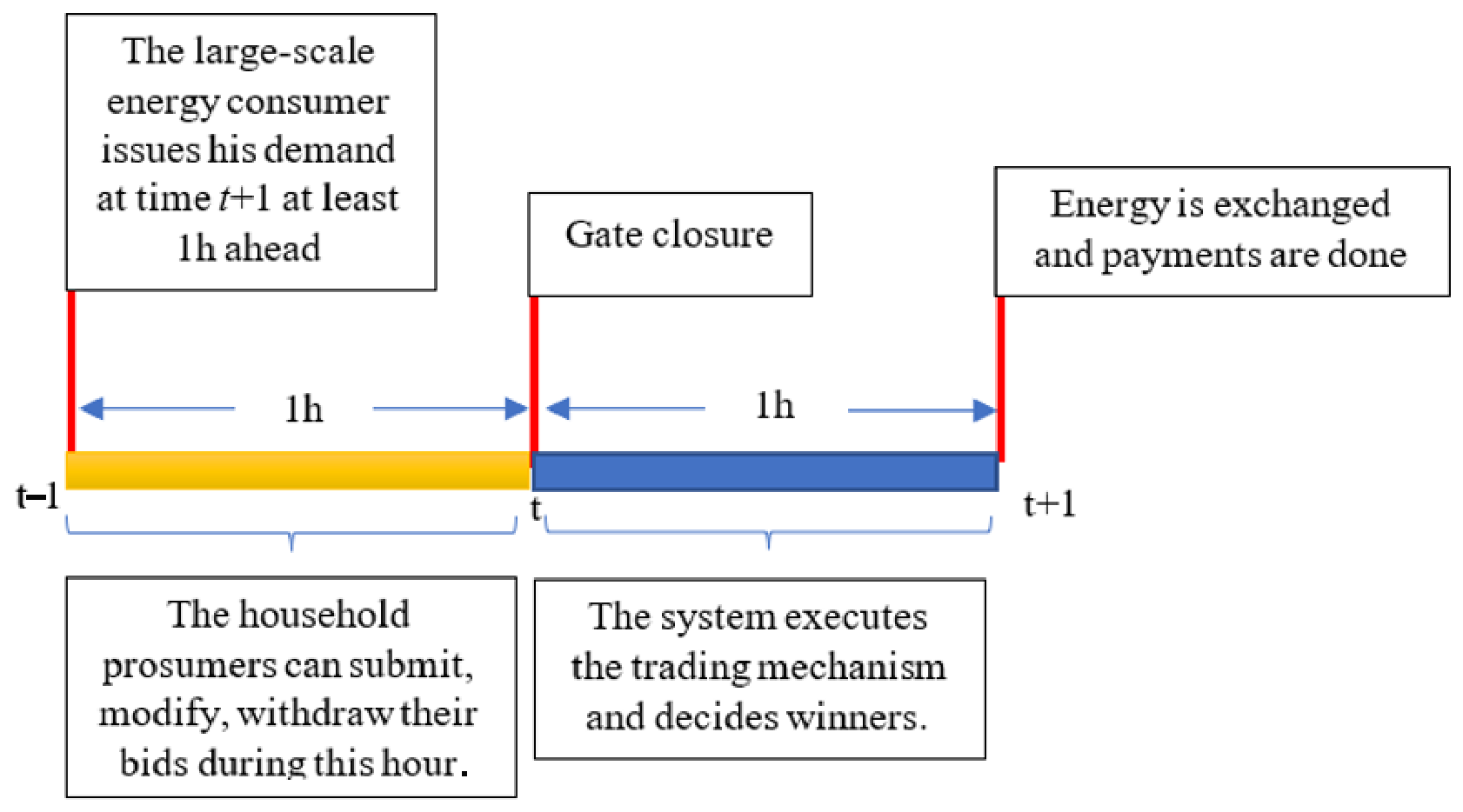
The P2P trading community of Project 1 consists of a large-scale energy consumer and 500 household prosumers. At each time interval of a day (bidding round), trading proceeds at time t0, t1, t2, …, tk. The length of each interval is t ( t = tm+1tm when m = 0, …, k − 1), which is one hour [49]. The large-scale energy consumer issues its energy demand at least 1 h before the processing of bids (gate closure). The prosumers note the energy demand, then submit their bids on the trading platform preferably at least 45 min ahead of the bidding round. Prosumers can modify or withdraw their bidding before gate closure. Once bidding closes, the auction system calculates the winners based on the mechanism. Figure 3 explains the timeline of bidding, trading, and settlement.

Mathematical Formulation of the P2P Trading Simulation

This subsection provides the complete mathematical formulation of the VCG-based trading model, together with the winner determination and overall simulation algorithms. Table 3 defines the notation used.
Individual rationality: Every submitted bid must satisfy:
p G b t p i t P w t   ( o r   p G s t )
This bounds each bid so that trading is never worse than a prosumer’s or the large-scale consumer’s existing grid arrangement.
Bidding strategies: Each prosumer updates its bid p i t between rounds under one of three heuristics shown in Table 4.
Equation (2) below summarizes the Preference and Additional information update rules formally.
Δp = 0.05 × (pGstpGbt)
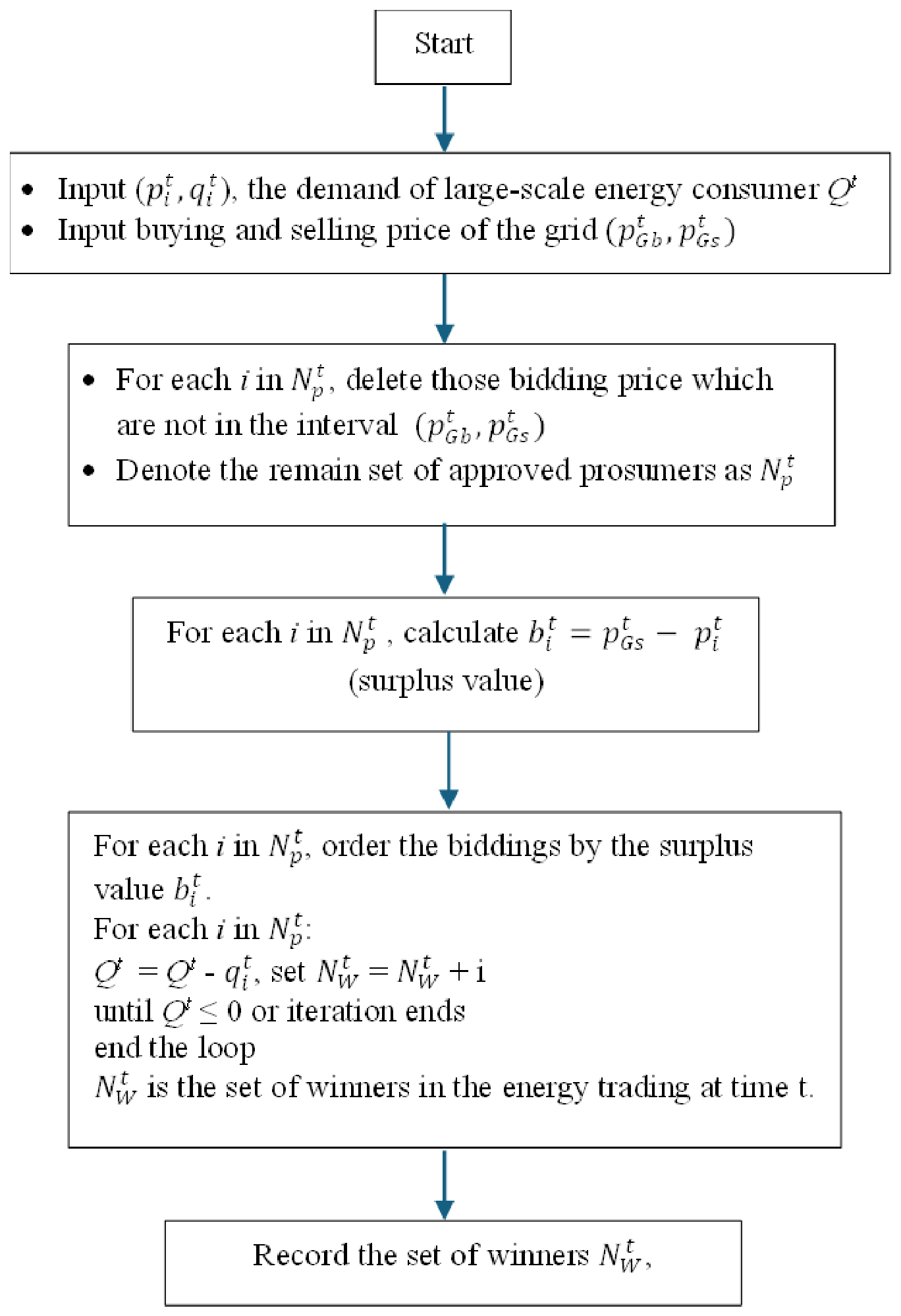
Winner determination: For each bidding round, bids are first filtered on individual rationality (Equation (1)). The surplus value of each remaining bid is then computed:
bit = pGstpit
Bids are ranked in descending order of bit (ascending order of price) and accepted greedily, decrementing the remaining demand at each step:
QtQtqit
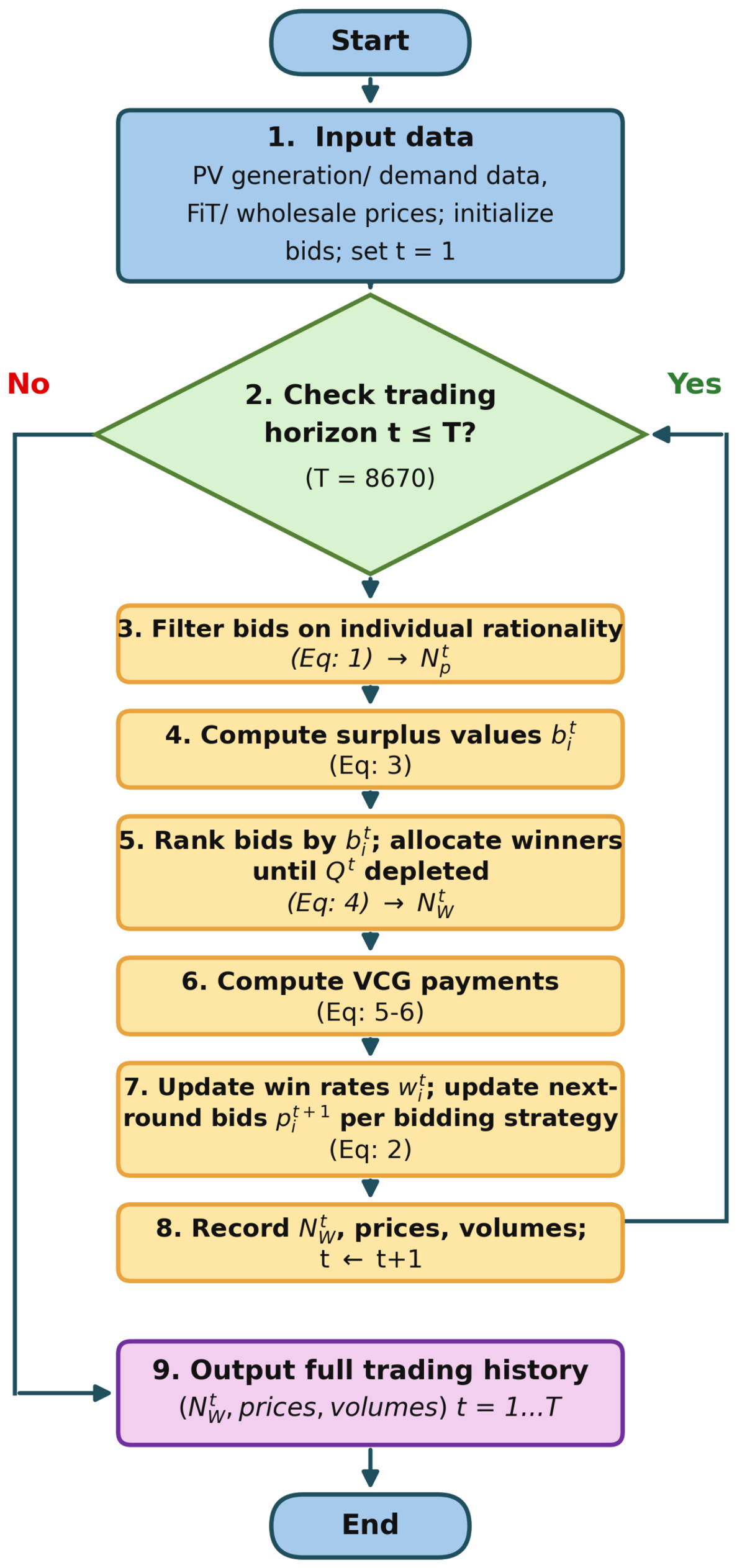
Until Qt ≤ 0 or all approved bids have been considered, producing the winner set N W t . Figure 4 presents this procedure as a flow chart.
VCG payment: For each winner j    N W t , the payment is based on the marginal externality (“damage value”) that winning imposes on the rest of the market [50]:
D a m a g e V a l u e j t   =   V ( N p t \ { j } ,   Q t )     V ( N p t \ { j } ,   Q t W j t * ) ,   j N W t ,
The real price prosumer j receives at time t is calculated by Equation (6), as follows:
p j t * = p G s t D a m a g e V a l u e j t * W j t *
where V denotes the total quantity of surplus value allocated by re-applying the winner-determination procedure in Equations (3) and (4) to the specified bidder set and residual demand.
Overall simulation algorithm: Equations (1)–(6) are executed once per bidding round, repeated for T = 8760 hourly rounds (Section 4.1) to produce the full year-long trading history. Figure 5 summarizes the overall algorithm, showing how the winner-determination procedure of Figure 4 is embedded within the round-by-round bid-update loop.
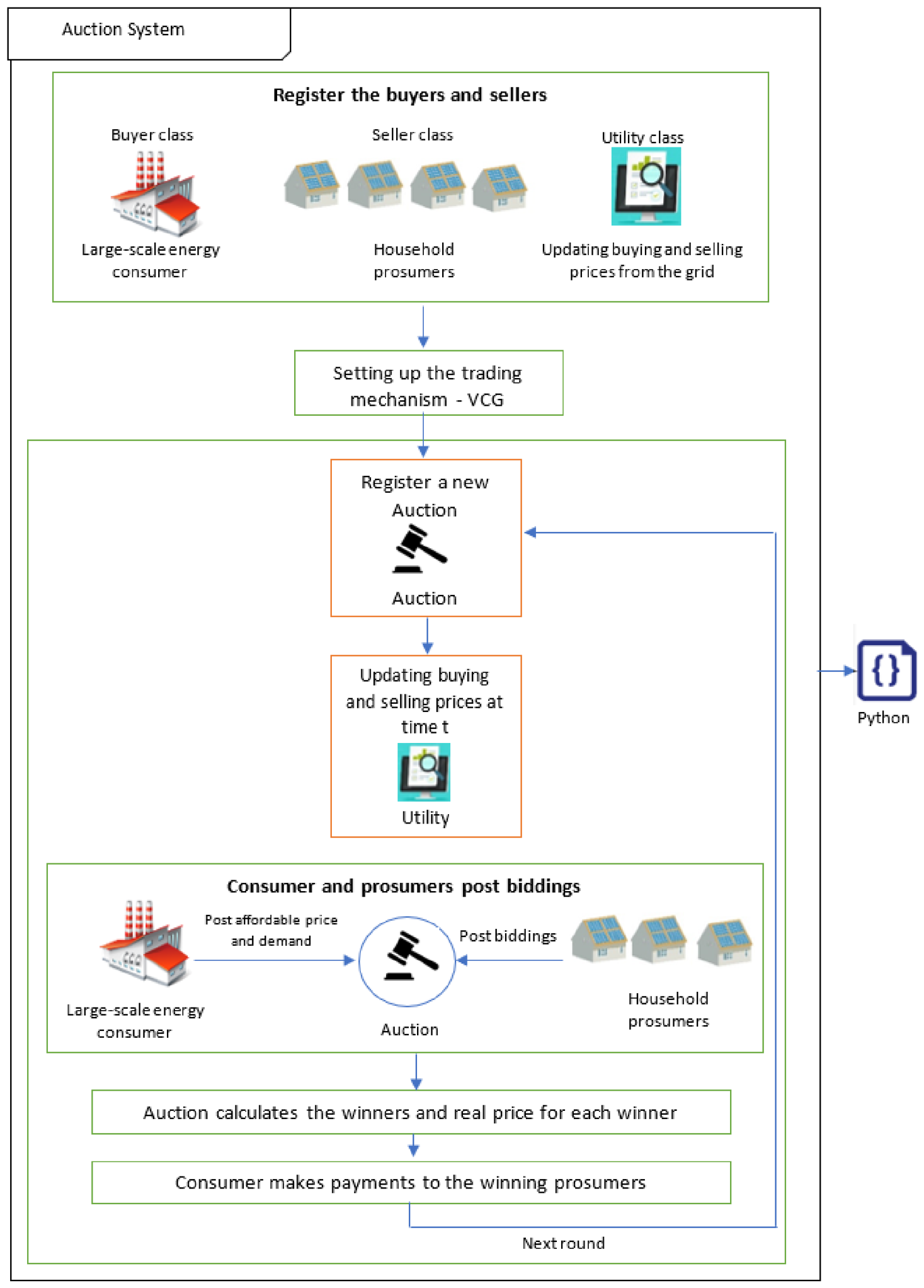
Using the above modeling, the study simulated P2P trading between the large-scale energy consumer and household prosumers in Python 3.8 software. Figure 6 demonstrates the simulation process.
The simulator was given the rules and computations of the VCG trading mechanism. The simulation was done for one year at 1-h intervals. Therefore, a total of 8760 (24 intervals per day × 365 days = 8760) bidding rounds were simulated by the system. For each bidding round, a new auction object was registered in the system. Based on the time of the day, the relevant FiT and wholesale prices are updated automatically by the system. The system then conducts the auction between the large-scale energy consumer and household prosumers for each bidding round. The system performs the necessary calculations and identifies the winners and the real price of each winner. Based on the results, the large-scale energy consumer makes payments to all winning prosumers. This process was repeated 8760 times to obtain the results of P2P trading between the two parties for one year.
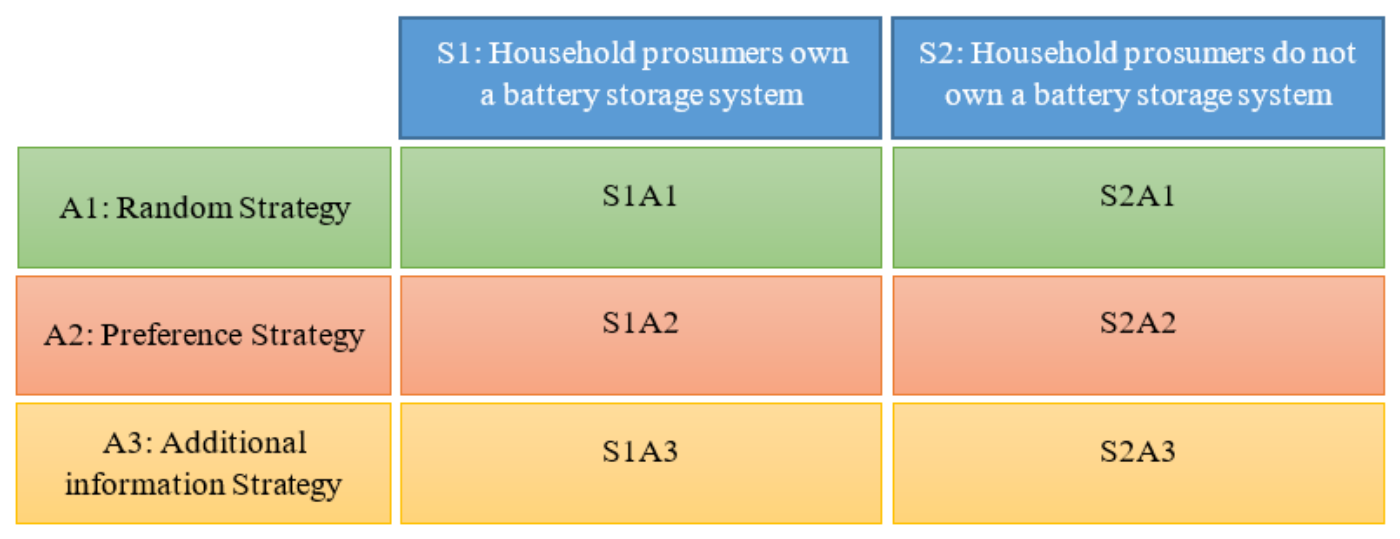
The simulation was conducted considering three strategies in two scenarios. The three strategies are based on prosumer behavior: (1) random, (2) preference, and (3) availability of additional information. The random strategy indicates a situation where a prosumer bids a completely random price. The preference strategy indicates changing the bidding based on winning/losing by adding or deducting 5% of the difference between the grid buying price of the large-scale energy consumer and the grid selling price of the household prosumers. The additional information strategy implies the availability of more information, such as the win rate, to facilitate the prosumer’s decision-making. The two scenarios considered in the study are (1) prosumers own a battery storage system and (2) prosumers do not own a battery storage system. Figure 7 shows the matrix of each strategy–scenario combination.
The above simulation results were used to demonstrate the performance of a blockchain-based P2P trading platform and how it can address the stakeholder issues and limitations.

4.2. Development of Blockchain-Based P2P Trading Platform

The simulated results of each household prosumer and the large-scale energy consumer are transferred to the blockchain platform to follow the predefined rules on how to execute a transaction between the parties. Every transaction is recorded in the system, whether a win or a loss in the P2P trading round. The development of the blockchain platform is discussed under three headings: (1) system architecture design, (2) system development, and (3) operational outcome.

4.2.1. System Architecture Design

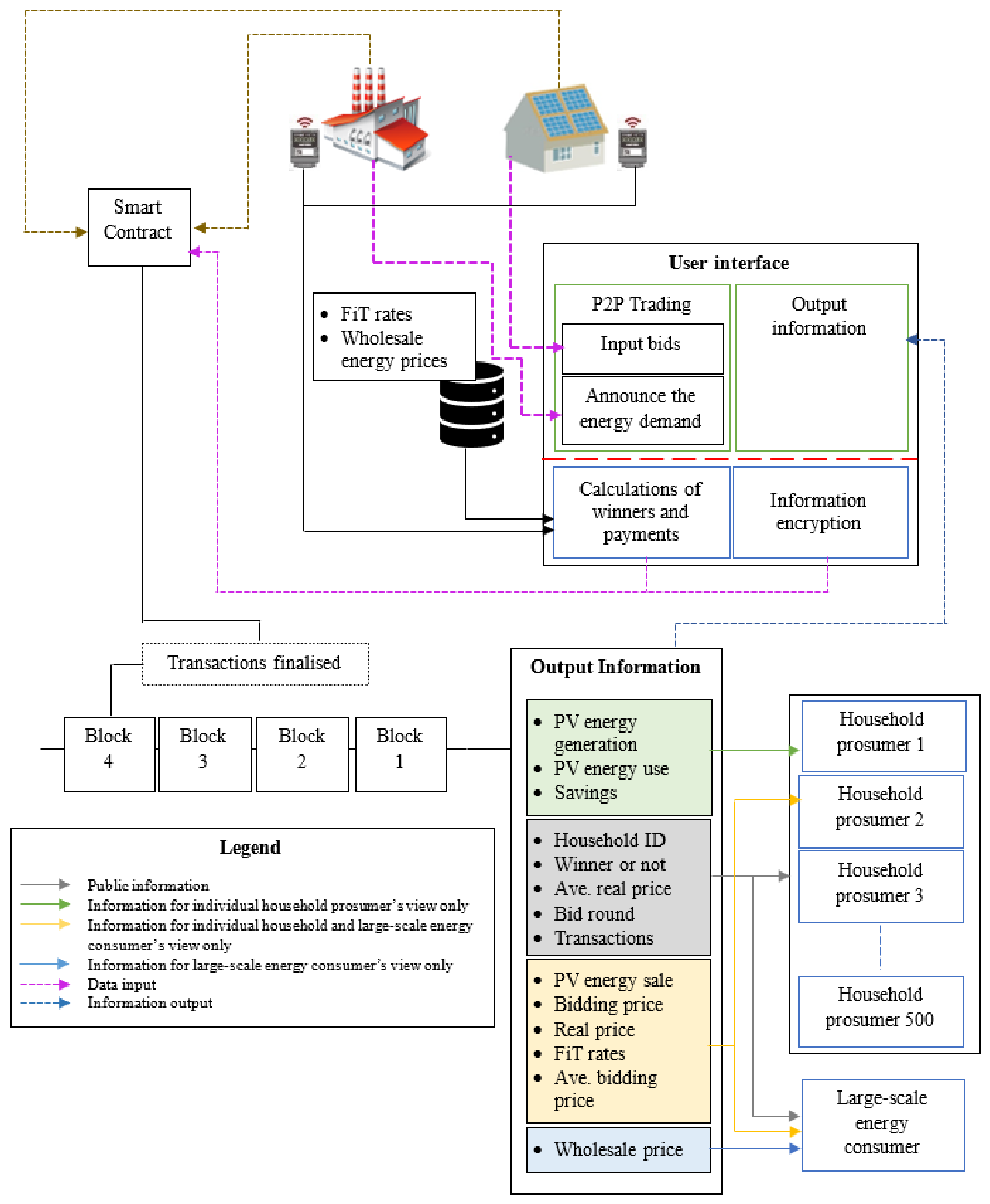
Based on the participants and the nature of P2P trading, the most suitable type of blockchain for Project 1 is a public blockchain. Therefore, it was decided to develop the system on a public blockchain platform named Ethereum for the conduct of transactions and data recording. As the initial step, the types of information that should be recorded on the Ethereum platform were identified. There are four categories of information: (1) public information, (2) information for individual household prosumers’ eyes only, (3) information for individual household and large-scale energy consumers’ eyes only, and (4) information for large-scale energy consumers’ eyes only. Providing access to information in the above four categories protects privacy and offers adequate security. Table 5 provides the list of information delivered by the system in the above four categories.
Figure 8 shows the system architecture of the P2P trading platform. The front end of the system (interface) is designed to collect data (e.g., bidding information, energy data, etc.), perform necessary computations (e.g., encryption of sensitive data), and upload to the Ethereum blockchain (via smart contract). Since the study defines different forms of access to information, the information is encrypted by the system interface. A database is linked to the system to deliver information regarding the wholesale prices of the large-scale energy consumer and the FiT rates of Victoria to facilitate calculations. The smart meter data from the peers are also collected via the interface.
The results of calculations about the winners and their payments are then sent to the smart contract. All information included in Table 3 and its encrypted status are also sent to the smart contract. The large-scale energy consumer and household prosumers are included in a smart contract that defines how transactions should be conducted between the two parties. The smart contract has a set of predefined rules and corresponding functions describing how to proceed with payments based on the calculations. The transactions are then confirmed and recorded in a new block. Blockchain is a chain of blocks, and these blocks are connected to each other via the hash values, which enable record-keeping in chronological order.

4.2.2. System Development

The proposed P2P trading platform was used to record the transactions between the household prosumers and the large-scale energy consumer. It is a comparatively large energy trading network with much transaction information. The participants are unknown to each other and do not necessarily belong to a single organization or project. Therefore, high transparency and limited risk are required. It is important to provide permissionless access for this kind of platform to encourage and increase the uptake of P2P trading. In addition, the key transaction details should be public knowledge to participants so they can have a full understanding of how P2P trading works. Considering all the above facts, the Ethereum platform was selected to execute P2P trading in Project 1. Accordingly, a smart contract was developed and tested on the Etherscan Ropsten Testnet Network. It provides a simple and user-friendly interface to test, learn, and interact with the smart contract on the Ethereum blockchain [54].
Prior to the design of the system, the following inclusions in the smart contract were made: (1) conditions on payment transactions, and (2) conditions on information recorded in the system. These conditions were transferred to the programming code. This code has several conditional statements on how transactions are to occur and how information is to be stored. Once the smart contract is deployed on Ethereum, it is duplicated among the participants. The system requires the verification of all participants in the blockchain network to execute a condition in the smart contract.
The researcher also designed the front end of the P2P trading platform, which allows communication between the large-scale consumer and household prosumers. The functions include input bids by household prosumers, announcement of the energy demand by the large-scale consumer, the automated calculation process, information encryption, and delivery of results to users. The front end is also connected to a database providing necessary information (i.e., FiT, wholesale rates). The front-end interface was developed using HTML and Web3.js, which allows connection with a local or remote Ethereum node.

4.2.3. System Operation

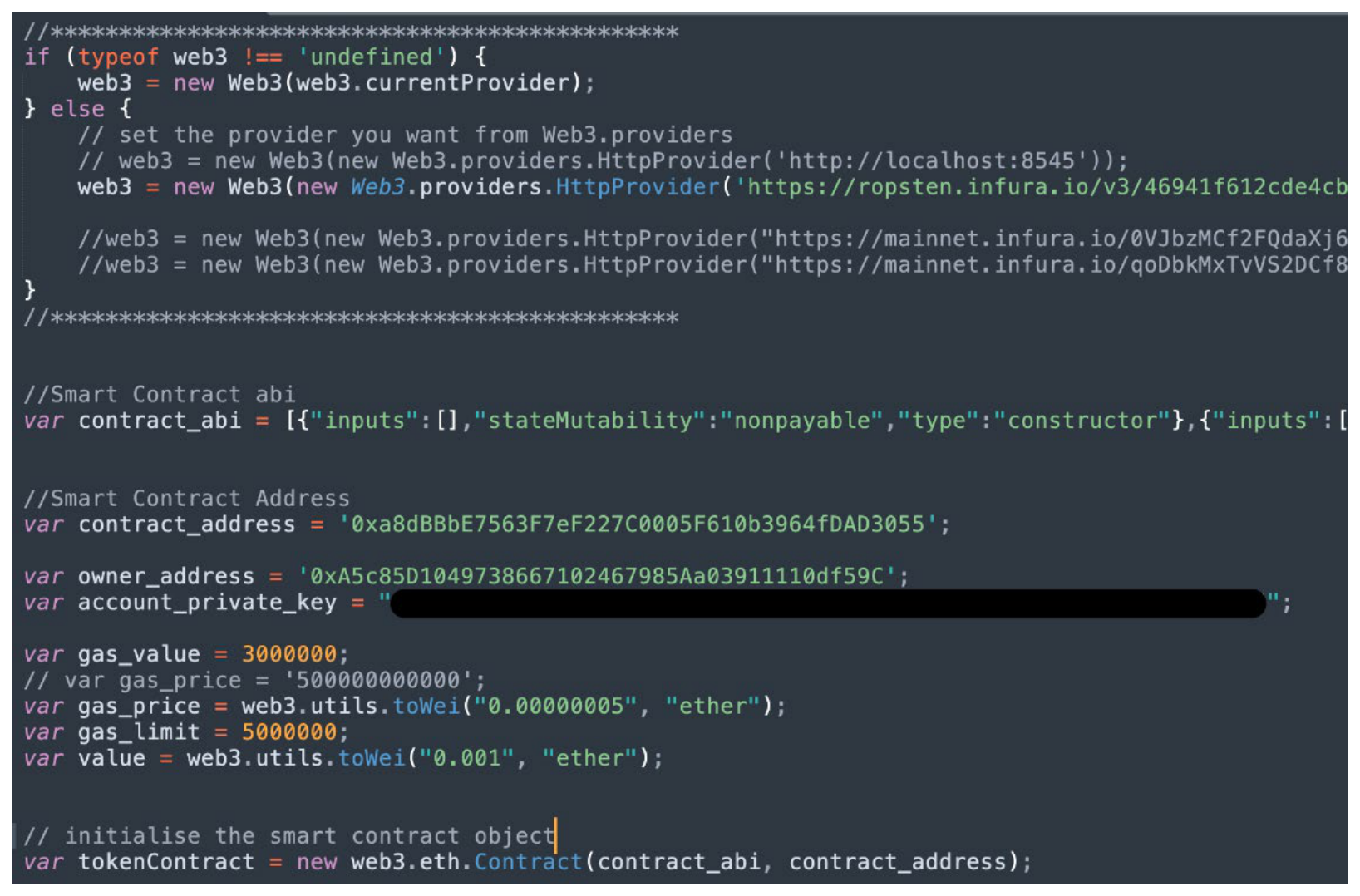
As the initial step, each household prosumer develops a smart contract with the large-scale energy consumer, signed with digital signatures. The digital signatures are sent to the blockchain network to confirm the transaction and consensus. Every participant has a public key to verify the authorisation of transactions. Figure 9 shows the connection to the smart contract and blockchain via Web3.js.
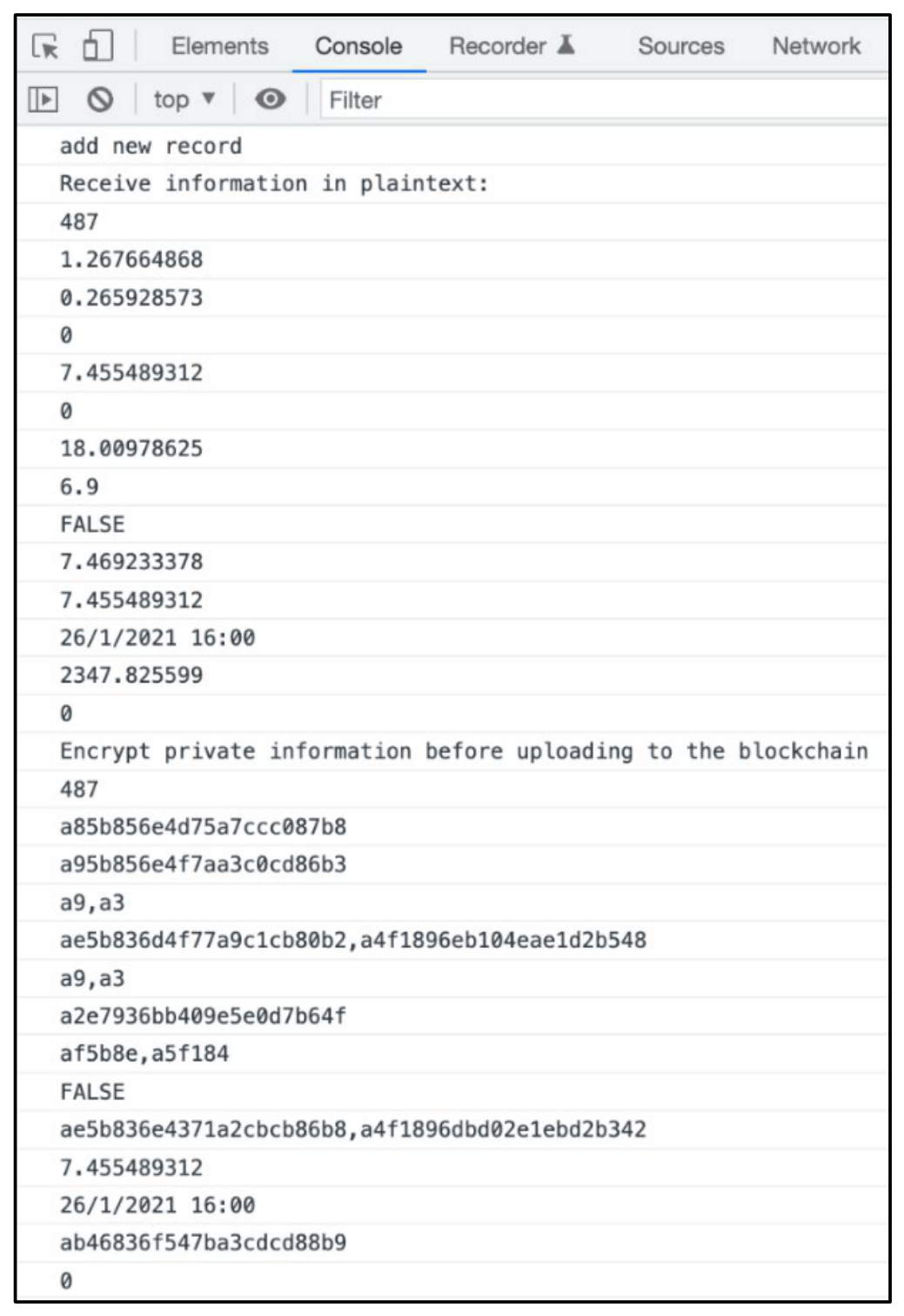
The study has identified the importance of encrypting information. Although encryption is possible via the smart contract after the information is uploaded to the blockchain network, there is a possibility that unauthorized parties could see the encrypted information, since the selected platform is a public blockchain. Therefore, it was decided to encrypt the information before uploading it to the Ethereum platform. Hence, information encryption occurs in the front end, as shown in Figure 10.
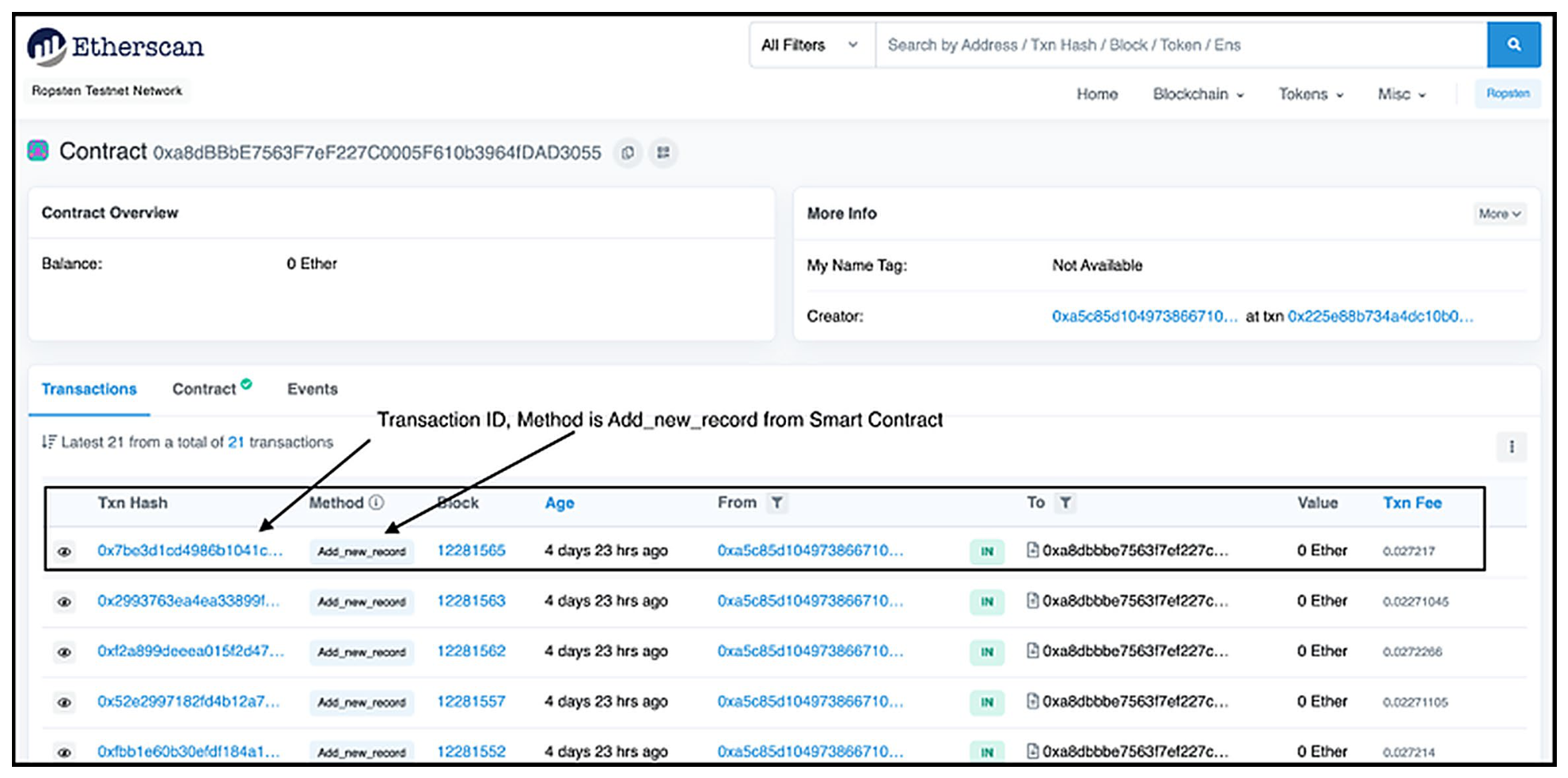
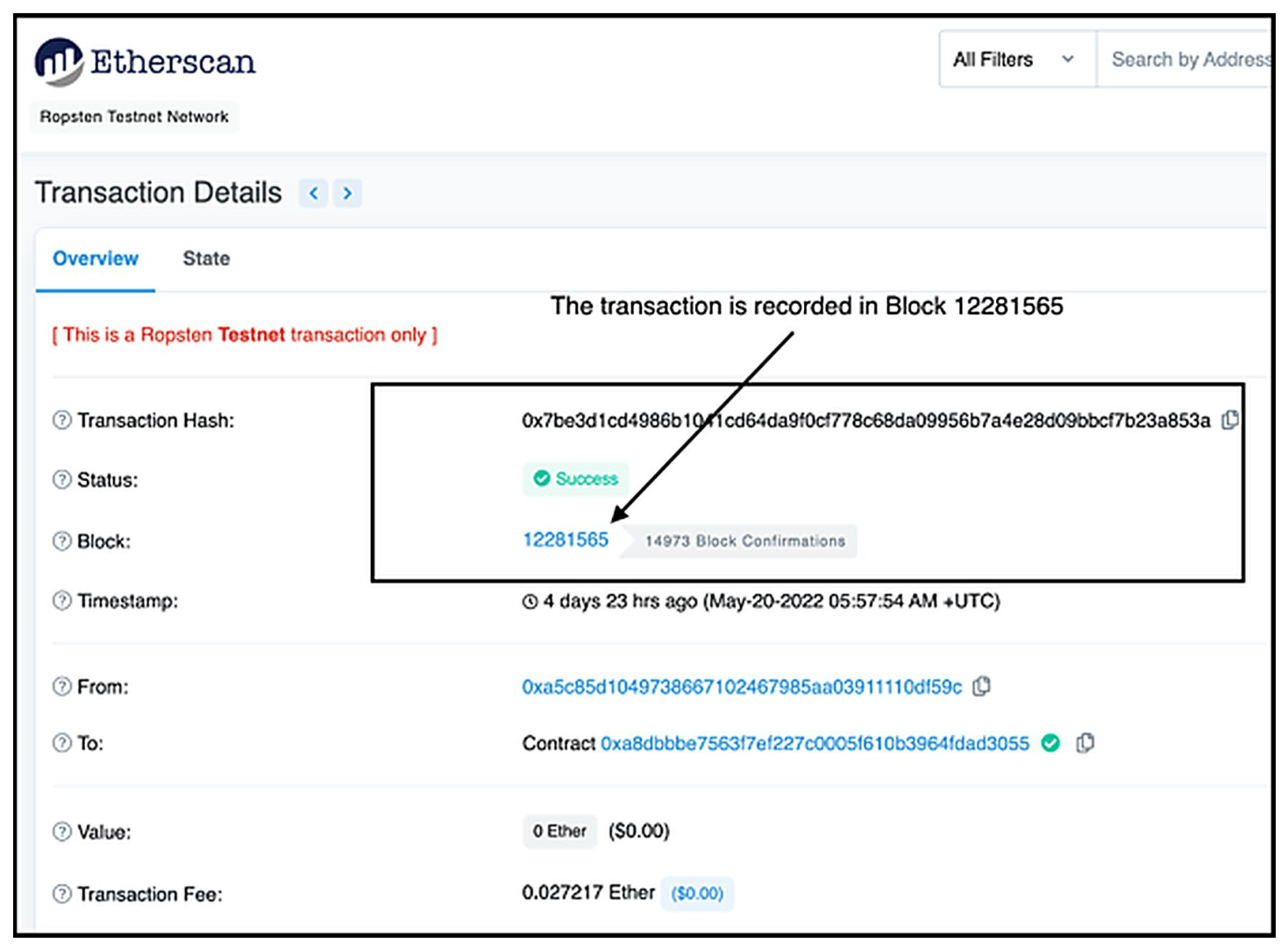
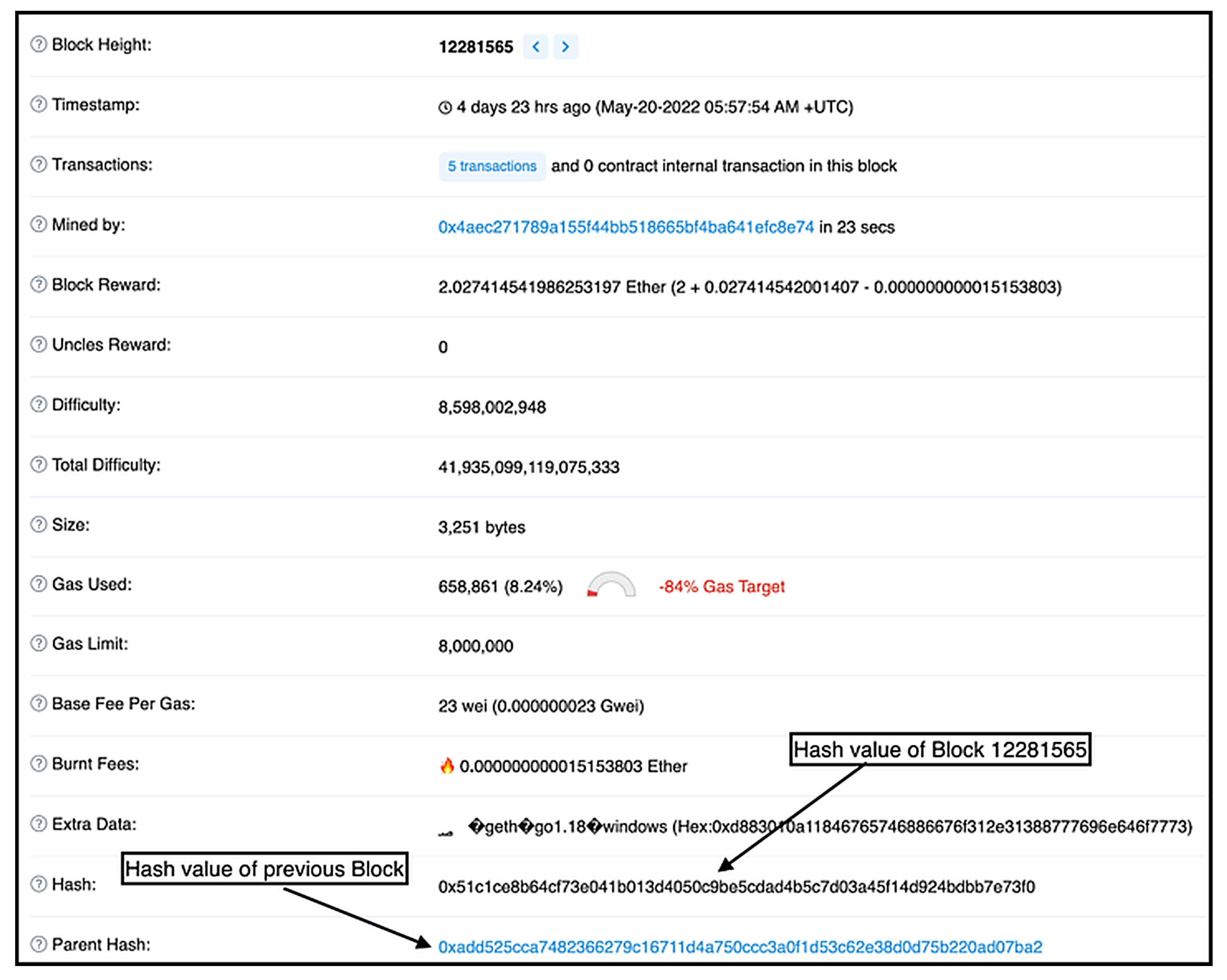
When the information is recorded, every participant can see the key transaction information, as shown in Figure 11. Every transaction is given a unique account ID (which can be seen as a string of letters and numbers) and a dedicated block (refer to Figure 12). This block is connected to the previous block via the hash values, as shown in Figure 13, to avoid information tampering and provide systematic record-keeping.
The researcher has designed a simple platform for P2P trading to demonstrate the key tasks. This system can be improved with a user-friendly interface. Further, the interface can be an existing platform available for different management purposes. The blockchain platform can be linked to such an interface, where it acts as an effective backend for online decentralized trading. The main requirement is to develop the appropriate smart contract and incorporate it with the existing interface. Once there is a user-friendly interface, any person (even one without IT knowledge) can use the system effectively. Nevertheless, it should be noted that the main purpose of the blockchain platform is to record transactions and other relevant information securely and with no information gaps. In addition, the blockchain platform can facilitate the tracking of transactions. The interface is responsible for online bidding and processing the bids to identify the winners and their payments.

4.2.4. Critical Evaluation of System Operation

Benefits of the Developed Platform: The demonstration in Section 4.2.3 highlights several key benefits of the proposed blockchain-enabled platform. The five-stage trading process operates continuously from demand announcement to blockchain-based settlement, with digital signatures, hash-linked blocks, and chronological records supporting transaction authentication, data integrity, and traceability. The platform also addresses data privacy concerns associated with public blockchains by encrypting sensitive information before it is uploaded. In addition, the integration of real-time FiT and wholesale electricity prices enables prosumers to make trading decisions based on current market conditions. The automated bidding, winner selection, and payment processes further reduce user involvement and technical complexity, helping to address barriers related to limited technical knowledge and community participation identified in Section 3. Overall, the findings demonstrate the potential of a permissionless blockchain architecture to support an auditable, traceable, and user-accessible P2P energy trading platform without requiring a central governing authority.
Quantitative Context for Economic Savings, Prosumer Benefits, and Self-Consumption: Given the qualitative, case-based research design adopted in this study (Section 2), the economic and energy performance of the developed platform was not quantitatively evaluated. However, findings from related P2P and blockchain-enabled energy trading studies provide useful benchmarks for the potential benefits of such approaches. Aoun et al. [55], for example, reported annual gains of approximately $1065 compared with net metering and $280 compared with feed-in tariffs for solar prosumers participating in P2P trading, while consumers also benefited through reduced energy costs. Similarly, Ref. [56] found that blockchain-based auction and bidding mechanisms could improve the financial outcomes of both prosumers and consumers, although high Ethereum gas costs were identified as an important economic constraint. In terms of self-consumption, Ref. [57] reported a 10% improvement in PV self-consumption and a 23.24% reduction in prosumer costs through P2P energy trading; although their framework was not blockchain-based, it provides a useful indication of the potential benefits of P2P trading more broadly. These results are presented as the literature-based benchmarks rather than direct evidence of the performance of the platform developed in this study. Quantitative evaluation of the platform’s economic, prosumer, and self-consumption benefits is therefore identified as an important direction for future research (Section 6).
Limitations of the Current Operation: Despite the benefits discussed above, several limitations should be considered when interpreting the operation and applicability of the proposed platform. Importantly, these limitations should be considered in the context of the research aim and design. The primary objective of this study was not to demonstrate that the proposed platform is more reliable, efficient, or economically advantageous than existing P2P trading systems, but to qualitatively examine the extent to which blockchain technology can address key issues and limitations associated with P2P distributed solar energy trading in a community. Accordingly, the platform was developed and evaluated primarily through a qualitative, case-based research approach (Section 2), supported by the literature and operational demonstration, rather than through quantitative benchmarking against alternative systems.
Several technical limitations remain in the current implementation. First, the winner determination and VCG payment calculations are performed off-chain before the results are recorded on the blockchain (Section Mathematical Formulation of the P2P Trading Simulation). Thus, the blockchain primarily provides tamper-evident recording and auditability rather than fully trustless computation. Similarly, electricity-related inputs, including FiT rates, wholesale electricity prices, and PV generation data, are obtained from external sources such as databases and smart meters. This creates exposure to the blockchain oracle problem, whereby blockchain immutability cannot ensure the accuracy or reliability of external data before it is recorded on-chain [58]. The platform also relies on a large-scale energy consumer to host the system, introducing a degree of structural centralization and potential influence over platform availability and off-chain processes. In addition, the prototype was developed and tested using the Ethereum Ropsten testnet, which was deprecated and subsequently shut down in 2022 [59], limiting direct reproducibility without migration to an active network. Although the case study considers 500 prosumers, systematic scalability testing was not undertaken. In particular, execution time, system latency, blockchain growth, transaction costs, and computational requirements associated with increasing the number of users were not quantitatively measured. These aspects therefore require further investigation before the platform can be assessed for large-scale or production deployment.
The study also did not directly quantify economic savings, prosumer benefits, or improvements in self-consumption. This is consistent with qualitative research objectives, which focus on examining the capacity of blockchain technology to address identified P2P trading issues rather than empirically demonstrating the magnitude of performance improvements relative to existing systems. Where quantitative evidence was relevant to interpreting the potential benefits of the proposed approach, findings from the current literature on P2P and blockchain-enabled energy trading were used to provide indicative context. These literature-based findings should therefore not be interpreted as direct measurements or validation of the performance of the developed platform. Similarly, the validation of the proposed system was primarily undertaken by examining its ability to address the issues identified through research and by positioning its functions and characteristics against findings from the existing literature, rather than through quantitative comparison with alternative blockchain platforms, centralized markets, or other P2P trading mechanisms. A comprehensive benchmarking exercise involving these alternatives was beyond the scope of the present research.
Further limitations relate to the absence of detailed documentation of the cryptographic algorithm and encryption key-management procedures used to protect sensitive information. Although the prototype encrypts selected information, including bidding prices and energy data, before uploading it to the public blockchain to protect prosumer privacy, the specific encryption algorithm, key generation, distribution, recovery, and associated computational overhead were not systematically evaluated. The prototype also provides limited evidence regarding system resilience and fault tolerance, while the interface described in Section 4.2.3 represents a simplified demonstration rather than a production-ready application. These factors limit the extent to which conclusions can be drawn regarding the platform’s operational reliability, security, usability, and readiness for real-world deployment.
Overall, the proposed platform should therefore be understood as a proof-of-concept developed to qualitatively demonstrate how blockchain-enabled mechanisms can address identified challenges in community-based P2P distributed solar energy trading, rather than as a quantitatively validated or benchmarked alternative to existing systems. The absence of quantitative scalability, economic, self-consumption, transaction cost, security, and comparative performance assessments does not undermine the primary objective of the study but defines the boundary of the conclusions that can be drawn from the current research. Future research should extend the platform through systematic quantitative testing, including scalability and computational performance assessment, transaction-cost analysis, economic and self-consumption evaluation, comparison with alternative trading and blockchain architectures, and detailed assessment of encryption, key management, resilience, and security (Section 6).

5. Discussion on Prototype’s Ability to Address Stakeholder Issues

The core reason for adopting blockchain technology in P2P energy trading is to establish a secure, transparent, and decentralized trading environment. Blockchain components such as distributed ledger technology (DLT), smart contracts, consensus mechanisms, cryptographic hashes, and digital signatures enhance system integrity and trust. The prototype also encrypts sensitive data to ensure privacy, directly addressing the issue of trust in P2P trading. The choice of Ethereum in this study reflects a balance between network openness and transaction performance. Alternative blockchain platforms designed specifically for energy applications, such as Energy Web Chain, use Proof-of-Authority consensus, where transactions are verified by a selected group of authorized organizational validators [60]. While this approach can improve transaction processing capacity, restricting validation to approved organizations introduces an element of institutional control that may not align with the open participation intended for community-based P2P energy trading. In the context examined in this study, where household prosumers may participate without affiliation to a particular organization, maintaining unrestricted access was considered more important than achieving the higher throughput associated with a permissioned validator structure. The developed platform therefore adopts a permissionless blockchain architecture to support broader participation, while recognizing the associated trade-off in transaction performance.
Information sharing is the platform’s primary function, aimed at minimizing inconsistencies and improving transparency. Project 1’s P2P trading platform presents data in a user-friendly and systematic manner. Using DLT, transactions are recorded chronologically, ensuring no data gaps. The interface displays energy requirements of large-scale consumers, and prosumer households submit bids accordingly. FiT and wholesale prices are integrated through a live database that updates based on market trends, promoting accurate and timely communication. To improve usability, additional features such as stakeholder maps, business models, annual energy performance reports, and technical details could be displayed via the interface.
Regulatory gaps in P2P trading and community energy remain a challenge. Although the prototype cannot influence formal regulation, it provides internal governance through smart contracts and consensus mechanisms that define operational rules.
Financial uncertainty is a recurring concern. The system addresses this by displaying payment details and accumulated savings of prosumers, offering clear insights into economic benefits. Calculations within the system ensure properties like economic efficiency, individual rationality, and incentive compatibility, maximizing user value. To further enhance transparency, graphical representations of annual transactions and profit generation can be added. While some argue P2P trading lacks proven financial returns, the system’s blockchain records support detailed assessments of earnings, enabling ROI calculations and financial planning. Features such as net profit, payback period, and other economic metrics could be integrated into the interface for better evaluation.
Role clarity among stakeholders is another common issue. The system addresses this partially by defining basic participant functions such as submitting bids or declaring energy needs and limiting data access based on permissions. The large-scale consumer acts as the system host, avoiding service charges, while a basic usage guide supports user interaction. However, a clearer outline of roles and responsibilities is still needed and could be provided under a dedicated “Project Information” tab. Business model structuring is often vague in P2P projects. The model used in Project 1 is tailored to community needs, considering local conditions and stakeholder engagement. Future implementations should draw from successful case studies to further strengthen model design. Alam et al. [61] provided a relevant example that could inform the development of more comprehensive business models in future research. Their Ethereum-based P2P trading framework is integrated with a virtual power plant (VPP), bringing together a central control center, prosumers, and service operators. The framework also applies mixed-integer linear programming to optimize the management of distributed energy resources at both laboratory and larger proposed scales. Compared with this more complex arrangement, the selected project in this study adopts a simpler, single-layer structure in which household prosumers trade directly with a large-scale energy consumer. Although this limits the scope of the proposed framework, the simplified structure is consistent with the exploratory purpose of this study, which is primarily to examine whether blockchain can address the trust and governance challenges identified by stakeholders, rather than to optimize energy resource allocation across an integrated energy system.
Technical challenges also limit P2P adoption. Project 1 supports automated trading and offers technical assistance where needed. Backup systems ensure uninterrupted energy flow. Although integration with advanced technologies like AI and cloud computing is not yet implemented, these offer future opportunities. The system’s reliance on technology reduces manual workload and errors. The interface is intuitive, and all trading calculations are automated, freeing users from complex technical concerns, which are managed by professionals. Community reluctance, often due to perceived additional workload, is addressed through automation. Participants only need to place bids, while winner selection and transaction recording occur automatically. Blockchain ensures transparent record-keeping and traceability, reducing disputes and administrative overhead. The limitations identified in the Project 1 prototype are also evident in the broader P2P energy trading literature. Sivaram and Saravanan [62] identify transaction costs, scalability, privacy, and the lack of well-established regulatory frameworks as continuing challenges for blockchain-enabled P2P energy trading. These challenges are consistent with the findings of this study, particularly the unresolved issues associated with technical dependency and limited regulatory recognition (Section 6). Therefore, the identified limitations should not be viewed solely as shortcomings of the developed platform, but also as challenges that remain relevant to the wider development and application of blockchain-based P2P energy trading systems. Limited community experience is also a barrier. However, minimal human intervention is required as the trading mechanism is pre-configured. Blockchain ensures security and reliability, and technical support is available. Participants need only a basic understanding of P2P trading, not technical expertise, to engage in the system.
Diverse community capacities such as financial, technical, or motivational may limit participation. While not directly addressed in the prototype, blockchain’s decentralized nature could support features like energy donations to underprivileged groups, though this is not currently implemented. Tanis et al. [63] classify P2P energy trading arrangements into several structures, including direct individual trading, energy cooperatives, and multi-energy systems. As discussed further in Section 5.2, Project 1 adopts a direct P2P trading structure, while cooperative and community-ownership models may offer greater flexibility in accommodating variations in community capacity [63]. Government support for community energy remains limited. Although the prototype cannot influence policy, it recognizes current incentives like FiT rates. In many cases, internal P2P energy rates outperform retail prices. In the absence of formal regulation, the system’s automated governance via smart contracts and consensus mechanisms offers a functional alternative.
Competition from centralized energy suppliers is another challenge. The Project 1 prototype is designed to optimize trading for maximum economic gain, giving P2P communities a competitive edge. The inclusion of battery storage is considered to enhance resilience, though practical deployment is hindered by regulatory and technological constraints. The competitive position of the proposed platform can be further clarified by comparing it with the two non-blockchain approaches that it seeks to improve. In a conventional arrangement, prosumers and large-scale consumers rely on existing feed-in tariff (FiT) and retail mechanisms to conduct their transactions. In contrast, the individual rationality constraint incorporated into the proposed model (Equation (1), Section Mathematical Formulation of the P2P Trading Simulation) establishes a structural condition that prevents a transaction from being executed unless it offers a more favorable price to both parties than their respective existing non-blockchain alternatives. This represents a design feature of the model rather than an empirically demonstrated economic outcome. The proposed platform also differs from centralized energy markets, including the wholesale market used to obtain the grid-price benchmarks in this study. While centralized markets generally determine a common market-clearing price through a market operator, the VCG mechanism employed in the proposed framework calculates payments for each successful prosumer individually (Equation (6), Section Mathematical Formulation of the P2P Trading Simulation). This approach is intended to account more explicitly for the marginal contribution of each prosumer to meeting the energy demand. A systematic comparison of Project 1 with the broader generalized frameworks proposed in the recent literature such as Mazrae et al. [64] (see Section 5.2), as well as with the Energy Web and centralized-market alternatives discussed above, would provide a useful basis for future quantitative validation.

5.1. Quantitative Context from Comparable Blockchain-Enabled P2P Trading Studies

This study uses a qualitative, case-based research approach, as described in Section 2. The platform developed for the study was intended as a functional prototype to demonstrate the feasibility of the proposed approach, rather than as a fully operational commercial system. Therefore, platform-specific quantitative performance results, such as actual transaction costs or financial savings, were not generated as part of this study. Nevertheless, findings from previous empirical and simulation-based research on similar blockchain-enabled P2P energy trading systems can provide useful benchmarks. These studies offer additional context for understanding the operational, financial, and technical outcomes identified through the qualitative analysis presented above.
From a financial perspective, Bhavana et al. [65] examined the deployment of the Power Ledger platform in a community of 24 apartments equipped with shared solar generation and battery storage. Their study reported annual savings of approximately $540 per household, together with a reduction of 36.9 tonnes of CO2 emissions. Other research has examined auction-based P2P pricing mechanisms, including approaches conceptually comparable to the VCG mechanism used in this study (Section 4.1). Sahih et al. [66], for example, reported that sellers could achieve profit increases of up to 88% compared with conventional retail billing, although buyers experienced an increase in costs of approximately 13%. These findings demonstrate that P2P auction-based pricing can improve overall market efficiency while also changing how financial benefits and costs are distributed between participants.
From a technical perspective, previous research has also identified scalability challenges associated with using Ethereum for P2P energy trading. Comparative assessments have highlighted limitations in transaction throughput as the number of transactions increases, particularly when systems need to support a large volume of small energy-related transactions [67]. These limitations have encouraged research into more lightweight distributed ledger solutions. In the present study, the Ethereum-based prototype was sufficient for demonstrating the feasibility of the proposed system at the modeled scale of 500 household prosumers (Section 4.1). However, its performance and scalability in much larger P2P energy communities would require further investigation.
Table 6 brings together these findings from previous studies and compares them with the relevant qualitative findings of the present study, providing an indicative basis for interpreting the results.
It is important to note that these figures are based on studies of platforms different from the one developed in this research. They are therefore presented only as indicative evidence from the existing literature and should not be interpreted as direct empirical validation of the proposed platform. A dedicated quantitative evaluation of the Project 1 prototype, incorporating transaction cost, settlement time, and measured financial outcomes, is identified as a priority for future research (Section 6).

5.2. Comparison with State-of-the-Art Solutions

This section compares the design choices adopted in this study, including the P2P trading framework, VCG mechanism, and Ethereum platform, with similar blockchain-based solutions and alternative trading approaches reported in the recent literature.
Comparison with other blockchain-based trading frameworks: The framework proposed in this study focuses on a relatively simple setup in which household prosumers trade directly with a large energy consumer. Other recent studies have considered more comprehensive arrangements. For instance, Alam et al. [61] developed an Ethereum-based P2P system within a virtual power plant, with multiple layers and optimization of distributed energy resources. Mazrae et al. [64] proposed a broader framework covering areas such as smart contracts, consensus mechanisms, privacy, and interoperability.
The proposed framework therefore addresses a more specific problem and does not include features such as virtual power plant coordination, DER optimization, or cross-platform interoperability. This level of scope was appropriate for the exploratory purpose of this study, which focused on examining blockchain’s potential to address stakeholder concerns around trust and governance. However, incorporating these additional capabilities could be considered in future development of the framework.
Comparison with alternative trading mechanisms: The VCG mechanism was chosen in this study because it can satisfy three important properties: incentive compatibility (IC), economic efficiency (EE), and individual rationality (IR) [37]. Results from other P2P trading mechanisms provide a useful basis for comparison. Sahih et al. [66] reported fairness scores of 94% for the coalition-based model (CBM), 96% for the innovative coalition business model (ICBM), and 88% for the hybrid auction–coalition mechanism (HAC), compared with 77% for the uniform-price double auction (UPDA). The study also found that seller profits increased by up to 88% with ICBM and 66% with HAC compared with traditional billing. However, these mechanisms resulted in 13% higher prices for buyers. These results show that improving seller returns and market efficiency can involve higher costs for buyers or additional coordination requirements. In contrast, the VCG approach used in this study provides the desired theoretical properties through a sealed-bid mechanism without requiring coalition formation.
Comparison with alternative blockchain platforms: Ethereum was used for the proposed platform because the intended P2P community consists of participants who may not know or trust each other and therefore require open, permissionless access. Hyperledger Fabric, as a permissioned blockchain, can provide higher transaction throughput and lower latency than permissionless platforms such as Ethereum [67,68]. However, this advantage depends on limiting participation to known and authorized users, which does not align with the open-access model considered in this study. IOTA’s Tangle is another potential alternative, with previous research showing better performance than Ethereum and Hyperledger Fabric for high-volume, small-scale transactions such as those expected in hourly P2P energy trading [67]. IOTA could therefore be considered in future work to improve the scalability of the proposed platform.
Positioning within broader P2P market structures: Tanis et al. [63] identify several P2P energy trading structures, including direct trading between individuals, energy cooperatives, and multi-energy systems operating across virtual and physical settings. The framework developed in this study fits within the direct P2P model, linking household prosumers with a single large-scale consumer. While this reflects the scope of the current study, future research could explore cooperative or community-owned models to further address the community participation and governance issues identified by stakeholders (Section 3).

5.3. Technology Acceptance Model (TAM) for Blockchain-Enabled P2P Trading Platform

Technical feasibility alone does not ensure that technology will be accepted by its intended users. Therefore, this study extends the evaluation of the proposed platform by examining its potential acceptance using the Technology Acceptance Model (TAM). Developed by Davis [69,70], TAM suggests that technology adoption is primarily influenced by two factors: perceived usefulness and perceived ease of use. Perceived usefulness refers to the extent to which users believe that technology will improve their performance, while perceived ease of use refers to the extent to which users believe that technology can be used with minimal effort. These perceptions influence users’ behavioral intention to adopt technology, which subsequently affects actual system use.
Although TAM provides a strong foundation for evaluating technology acceptance, it does not fully capture the factors influencing the adoption of blockchain-enabled P2P energy trading identified in this study. The literature review and stakeholder interviews consistently identified trust as a key factor affecting users’ willingness to participate (Section 3). In addition, evaluation of the developed prototype showed that while blockchain features improve trust, they also introduce risks associated with technical errors and dependence on automated processes, which cannot be completely eliminated.
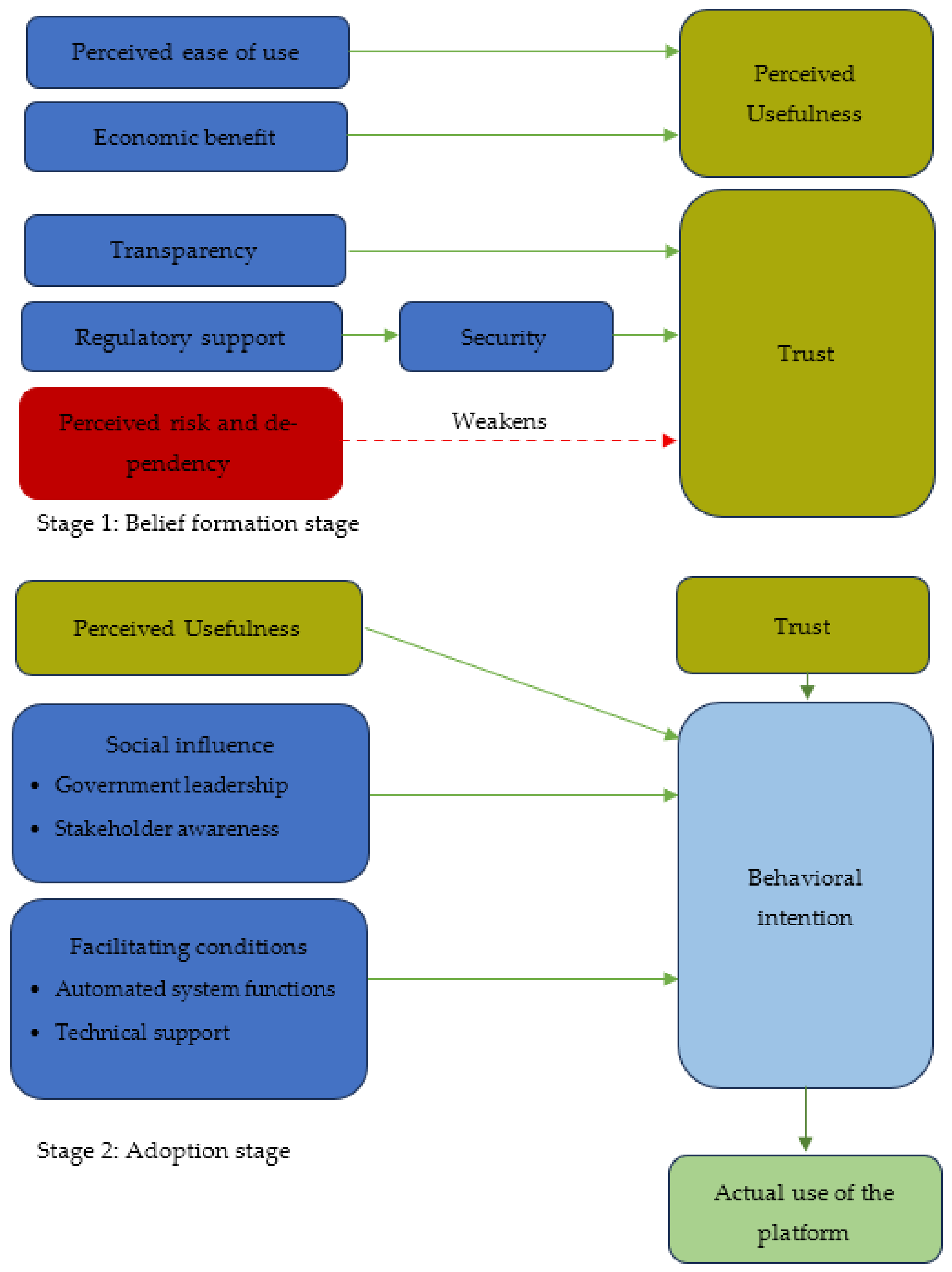
To account for these findings, this study extends the standard TAM into a blockchain-specific acceptance model (B-TAM), incorporating trust as a direct antecedent of behavioral intention, consistent with prior augmentations of TAM for blockchain-based system adoption [71], alongside two further sets of constructs derived from the study’s findings: environmental and regulatory antecedents that shape trust, and contextual antecedents, adapted from the Unified Theory of Acceptance and Use of Technology [72], that act directly on behavioral intention. Critically, the model also incorporates perceived risk arising from technical dependency as a construct exerting a countervailing, negative influence on trust, reflecting a finding largely absent from prior blockchain-TAM applications, which tend to treat blockchain as a uniformly trust-enhancing technology. The proposed B-TAM consists of two stages, illustrated in Figure 14.
The first stage, the belief formation stage (Stage 1), explains how users develop their perceptions of the platform. Perceived usefulness is influenced by both perceived ease of use and economic benefit, reflecting the platform’s automated bidding and pricing functions as well as the financial benefits available to prosumers. Trust is influenced by two pathways. The first is transparency, which is supported by the platform’s combination of open and restricted access blockchain ledgers. The second is a regulatory support–security–trust pathway, where regulatory support enhances users’ perceptions of security, which in turn strengthens trust. This reflects the finding that blockchain-enabled smart contracts can provide confidence through predefined transaction rules, partially compensating for the limited regulatory framework currently available for P2P energy trading [2]. In contrast, perceived technical risk negatively influences trust by capturing stakeholder concerns about system failures and dependence on automated processes, two challenges that the blockchain platform was unable to fully eliminate.
The second stage, the adoption stage (Stage 2), explains how users’ beliefs influence their intention to adopt the platform. Perceived usefulness and trust, developed during the belief formation stage, directly influence behavioral intention. In addition, two contextual factors are included. The first is social influence, which reflects the importance of government leadership and stakeholder awareness in encouraging community participation. The second is facilitating conditions, which represent the availability of automated system functions and technical support that make the platform easier to use. Together, these factors determine users’ behavioral intention, which subsequently leads to the actual use of the platform, consistent with the Technology Acceptance Model.
The proposed model suggests that public acceptance of the platform is feasible but is likely to depend on several conditions. The platform addresses key barriers to P2P trading adoption identified in previous studies by using ledger-based transparency to reduce reliance on trusted third parties [6], automating processes that may otherwise require specialized technical knowledge, and providing real-time financial information to make potential economic benefits more transparent to prosumers. These features are intended to address two major barriers to adoption identified in the literature: trust and usability [3,4]. However, acceptance is unlikely to be automatic or consistent across all users. While blockchain-based features can strengthen trust, they may also create concerns about dependence on technical systems, particularly where users rely heavily on automated processes. In addition, the proposed regulatory support–security–trust relationship may be limited by the current lack of formal legal recognition of P2P trading communities [2]. Therefore, user acceptance is likely to depend not only on the technical characteristics of the platform but also on broader regulatory support and government-led stakeholder engagement, which extend beyond the technical design of the platform. The model presented in this study is conceptual and is based on qualitative findings. Further empirical research, using survey-based measures and structural equation modeling, is required to assess the proposed relationships and determine their strength and statistical significance.

6. Conclusions and Future Research Directions

The P2P trading platform prototype of this study has demonstrated its ability to solve stakeholder issues and deliver expectations on P2P trading community uptake. The functions of the prototype deliver direct solutions to five issues. These five issues are related to decentralized P2P transactions and information management and are therefore fully addressed by the prototype. The prototype provides partial (secondary) solutions to seven issues. These issues are only partially addressed since they are more related to P2P trading community deployment, rather than energy trading. The prototype is unable to solve the remaining two issues since they relate to technical errors and high dependence on technology. Since blockchain is a highly automated system, it is more prone to technical errors rather than solving them. The study demonstrated that the use of blockchain for P2P trading can deliver (1) information accuracy and reliability, (2) information security, (3) necessary access to information, (4) systematic record-keeping, (5) adequate governance of the system, and (6) secure and transparent P2P trading. A critical evaluation of the platform’s operation further identified limitations beyond the stakeholder-issue framing, including its reliance on off-chain computation for winner determination, exposure to the blockchain oracle problem, and dependence on the now-deprecated Ethereum Ropsten testnet. These limitations indicate that the platform’s current contribution is best characterized as demonstrating auditable and tamper-evident record-keeping within a permissionless architecture, rather than constituting a fully trustless or production-ready trading system.
P2P trading communities and blockchain technology are comparatively novel concepts in research. Therefore, many unexplored areas remain related to the above research areas. This study explored opportunities for applying blockchain technology in BIPV and P2P trading community projects. The following further research opportunities are available related to this study:
Quantitative and comparative validation: The current study evaluates the proposed blockchain-based P2P platform qualitatively, with comparisons to other technologies based on findings reported in previous studies. Future research should quantitatively compare the prototype with alternatives such as Hyperledger Fabric and IOTA in terms of transaction cost, settlement time, and throughput. The VCG pricing mechanism could also be tested against other auction approaches using the same case study data.
Empirical validation of technology acceptance: The proposed B-TAM is based on qualitative stakeholder findings and has not yet been empirically tested. Future studies should validate the model through surveys and statistical methods such as structural equation modeling to examine the proposed relationships and assess whether the findings apply to a wider group of prosumers and stakeholders. Social acceptance and regulatory support: The implementation of P2P energy trading remains constrained by uncertainty surrounding its legal and regulatory status. Conventional electricity markets generally rely on established intermediaries and regulatory arrangements, whereas P2P models introduce direct transactions between participants through digital marketplaces. The lack of regulatory provisions specifically addressing such arrangements can create uncertainty for market participants and hinder wider adoption. For instance, the regulatory complexity and limited policy support reported in China have presented challenges for the demonstration and deployment of P2P trading initiatives. Developing appropriate policy instruments, regulatory mechanisms, and incentives could facilitate the establishment of community-based P2P energy markets. Further investigation is therefore needed to understand consumer acceptance and to develop regulatory and policy approaches that can support the responsible expansion of P2P energy trading.
Integration of conventional energy stakeholders: Although P2P energy trading is commonly associated with direct interactions between market participants and reduced dependence on traditional intermediaries, the complete exclusion of established energy-sector organizations may not be practical as these markets develop. The participation of utilities, distribution network operators, energy authorities, and government agencies could support the technical, institutional, and regulatory requirements associated with larger-scale P2P markets. Such collaboration may also contribute to market reliability, renewable energy integration, and public confidence. Future research should examine how responsibilities and decision-making authority can be distributed among P2P participants and conventional energy stakeholders. It is also important to assess the opportunities and potential conflicts that may arise when organizations with different objectives and interests participate in the same trading ecosystem, including the appropriate role of government and regulatory bodies in facilitating P2P energy initiatives.

Author Contributions

Conceptualization, C.L.G.; Methodology, C.L.G., K.W., X.Y. (Xun Yi), X.Y. (Xuechao Yang), F.Z. and Z.Z.; Software, K.W., X.Y. (Xun Yi) and X.Y. (Xuechao Yang); Formal analysis, C.L.G.; Investigation, C.L.G., S.J. and K.W.; Resources, C.L.G., S.J., K.W., X.Y. (Xun Yi), X.Y. (Xuechao Yang), F.Z. and Z.Z.; Writing—original draft, C.L.G.; Writing—review & editing, S.J.; Visualization, X.Y. (Xuechao Yang); Supervision, S.J. and X.Y. (Xun Yi). All authors have read and agreed to the published version of the manuscript.

Funding

This research received no external funding.

Data Availability Statement

The original contributions presented in this study are included in the article. Further inquiries can be directed to the corresponding author.

Acknowledgments

We acknowledge the project titled “Transitioning Bendigo’s energy economy—a feasibility study of renewable energy transition across an entire regional city” (Funded by the Centre for New Energy Technologies (C4NET) and the City Council of Greater Bendigo, Victoria, Australia) for the support, guidance and for letting us use their project information.

Conflicts of Interest

The authors declare no conflict of interest.

References

  1. Hall, S.; Roelich, K. Business model innovation in electricity supply markets: The role of complex value in the United Kingdom. Energy Policy 2016, 92, 286–298. [Google Scholar] [CrossRef] [Scilit]
  2. Tushar, W.; Yuen, C.; Saha, T.K.; Morstyn, T.; Chapman, A.C.; Alam, M.J.E.; Hanif, S.; Poor, H.V. Peer-to-peer energy systems for connected communities: A review of recent advances and emerging challenges. Appl. Energy 2021, 282, 116131. [Google Scholar] [CrossRef] [Scilit]
  3. Brilliantova, V.; Thurner, T.W. Blockchain and the future of energy. Technol. Soc. 2019, 57, 38–45. [Google Scholar] [CrossRef] [Scilit]
  4. Li, Z.; Ma, T. Peer-to-peer electricity trading in grid-connected residential communities with household distributed photovoltaic. Appl. Energy 2020, 278, 115670. [Google Scholar] [CrossRef] [Scilit]
  5. Wu, L.; Lu, W.; Xue, F.; Li, X.; Zhao, R.; Tang, M. Linking permissioned blockchain to Internet of Things (IoT)-BIM platform for off-site production management in modular construction. Comput. Ind. 2022, 135, 103573. [Google Scholar] [CrossRef] [Scilit]
  6. Christidis, K.; Devetsikiotis, M. Blockchains and smart contracts for the Internet of Things. IEEE Access 2016, 4, 2292–2303. [Google Scholar] [CrossRef] [Scilit]
  7. Golosova, J.; Romanovs, A. Overview of the blockchain technology cases. In Proceedings of the 2018 59th International Scientific Conference on Information Technology and Management Science of Riga Technical University (ITMS), Riga, Latvia, 10–12 October 2018; IEEE: Piscataway, NJ, USA, 2018; pp. 1–6. [Google Scholar]
  8. Sharma, A.; Kaur, P. Tamper-proof multitenant data storage using blockchain. Peer-To-Peer Netw. Appl. 2023, 16, 431–449. [Google Scholar] [CrossRef] [Scilit] [PubMed]
  9. Pop, C.; Cioara, T.; Antal, M.; Anghel, I.; Salomie, I.; Bertoncini, M. Blockchain based decentralized management of demand response programs in smart energy grids. Sensors 2018, 18, 162. [Google Scholar] [CrossRef] [Scilit] [PubMed]
  10. Das, M.; Tao, X.; Liu, Y.; Cheng, J.C. A blockchain-based integrated document management framework for construction applications. Autom. Constr. 2022, 133, 104001. [Google Scholar] [CrossRef] [Scilit]
  11. Lee, D.; Lee, S.H.; Masoud, N.; Krishnan, M.S.; Li, V.C. Integrated digital twin and blockchain framework to support accountable information sharing in construction projects. Autom. Constr. 2021, 127, 103688. [Google Scholar] [CrossRef] [Scilit]
  12. Zhang, Y.; Wang, T.; Yuen, K.V. Construction site information decentralized management using blockchain and smart contracts. Comput. Aided Civ. Infrastruct. Eng. 2022, 37, 1450–1467. [Google Scholar] [CrossRef] [Scilit]
  13. Dong, J.; Ning, P.; Zhao, H.; Song, C. Decentralized peer-to-peer energy trading: A blockchain-enabled pricing paradigm. J. King Saud. Univ. Comput. Inf. Sci. 2025, 37, 10. [Google Scholar] [CrossRef] [Scilit]
  14. Karumba, S.; Sethuvenkatraman, S.; Dedeoglu, V.; Jurdak, R.; Kanhere, S.S. Barriers to blockchain-based decentralised energy trading: A systematic review. Int. J. Sustain. Energy 2023, 42, 41–71. [Google Scholar] [CrossRef] [Scilit]
  15. Tkachuk, R.V.; Ilie, D.; Robert, R.; Kebande, V.; Tutschku, K. Towards efficient privacy and trust in decentralized blockchain-based peer-to-peer renewable energy marketplace. Sustain. Energy Grids Netw. 2023, 35, 101146. [Google Scholar] [CrossRef] [Scilit]
  16. Testi, N. An exploratory study on trust in blockchain-enabled energy trading. In European Dependable Computing Conference; Springer Nature: Cham, Switzerland, 2024; pp. 108–122. [Google Scholar]
  17. Almeida, L.D.; Cappelli, V.; Klausmann, N.; van Soest, H. Peer-to-Peer Trading and Energy Community in the Electricity Market: Analysing the Literature on Law and Regulation and Looking Ahead to Future Challenges; International Energy Agency: Paris, France, 2021. [Google Scholar]
  18. Junlakarn, S.; Kokchang, P.; Audomvongseree, K. Drivers and challenges of peer-to-peer energy trading development in Thailand. Energies 2022, 15, 1229. [Google Scholar] [CrossRef] [Scilit]
  19. Karami, M.; Madlener, R. Business models for peer-to-peer energy trading in Germany based on households’ beliefs and preferences. Appl. Energy 2022, 306, 118053. [Google Scholar] [CrossRef] [Scilit]
  20. Neves, D.; Scott, I.; Silva, C.A. Peer-to-peer energy trading potential: An assessment for the residential sector under different technology and tariff availabilities. Energy 2020, 205, 118023. [Google Scholar] [CrossRef] [Scilit]
  21. Ahl, A.; Goto, M.; Yarime, M.; Tanaka, K.; Sagawa, D. Challenges and opportunities of blockchain energy applications: Interrelatedness among technological, economic, social, environmental, and institutional dimensions. Renew. Sustain. Energy Rev. 2022, 166, 112623. [Google Scholar] [CrossRef] [Scilit]
  22. Valdivia, A.D.; Balcell, M.P. Connecting the grids: A review of blockchain governance in distributed energy transitions. Energy Res. Soc. Sci. 2022, 84, 102383. [Google Scholar] [CrossRef] [Scilit]
  23. Cárdenas-Álvarez, J.P.; España, J.M.; Ortega, S. What is the value of peer-to-peer energy trading? A discrete choice experiment with residential electricity users in Colombia. Energy Res. Soc. Sci. 2022, 91, 102737. [Google Scholar] [CrossRef] [Scilit]
  24. Lovati, M.; Zhang, X.; Huang, P.; Olsmats, C.; Maturi, L. Optimal simulation of three peer to peer (P2P) business models for individual PV prosumers in a local electricity market using agent-based modelling. Buildings 2020, 10, 138. [Google Scholar] [CrossRef] [Scilit]
  25. Kapassa, E.; Themistocleous, M.; Quintanilla, J.R.; Touloupos, M.; Papadaki, M. Blockchain in smart energy grids: A market analysis. In European, Mediterranean, and Middle Eastern Conference on Information Systems; Springer: Cham, Switzerland, 2020; pp. 113–124. [Google Scholar]
  26. Soto, E.A.; Bosman, L.B.; Wollega, E.; Leon-Salas, W.D. Peer-to-peer energy trading: A review of the literature. Appl. Energy 2021, 283, 116268. [Google Scholar] [CrossRef] [Scilit]
  27. Kajaan, N.A.M.; Amidi, N.H.N.; Salam, Z.; Radzi, R.Z.R.M. Blockchain-based smart contract for P2P energy trading in a microgrid environment. J. Phys. Conf. Ser. 2022, 2312, 012020. [Google Scholar] [CrossRef] [Scilit]
  28. Muzumdar, A.; Modi, C.; Madhu, G.M.; Vyjayanthi, C. A trustworthy and incentivized smart grid energy trading framework using distributed ledger and smart contracts. J. Netw. Comput. Appl. 2021, 183, 103074. [Google Scholar] [CrossRef] [Scilit]
  29. Azim, M.I.; Tushar, W.; Saha, T.K. Coalition graph game-based P2P energy trading with local voltage management. IEEE Trans. Smart Grid 2021, 12, 4389–4402. [Google Scholar] [CrossRef] [Scilit]
  30. Borges, C.E.; Kapassa, E.; Touloupou, M.; Legarda Macón, J.; Casado-Mansilla, D. Blockchain application in P2P energy markets: Social and legal aspects. Connect. Sci. 2022, 34, 1066–1088. [Google Scholar] [CrossRef] [Scilit]
  31. Chen, X.; Hu, X.; Ben, S. How individual investors react to negative events in the FinTech era? Evidence from China’s peer-to-peer lending. J. Theor. Appl. Electron. Commer. Res. 2021, 16, 52–70. [Google Scholar] [CrossRef] [Scilit]
  32. Pena-Bello, A.; Parra, D.; Herberz, M.; Tiefenbeck, V.; Patel, M.K.; Hahnel, U.J. Integration of prosumer peer-to-peer trading decisions into energy community modelling. Nat. Energy 2022, 7, 74–82. [Google Scholar] [CrossRef] [Scilit]
  33. Park, C.; Yong, T. Comparative review and discussion on P2P electricity trading. Energy Procedia 2017, 128, 3–9. [Google Scholar] [CrossRef] [Scilit]
  34. Zhang, C.; Wu, J.; Long, C.; Cheng, M. Review of existing peer-to-peer energy trading projects. Energy Procedia 2017, 105, 2563–2568. [Google Scholar] [CrossRef] [Scilit]
  35. Uhde, H. Peer-to-peer electricity trading in China and the EU–a comparative evaluation of key policy documents. Res. Glob. 2022, 4, 100078. [Google Scholar] [CrossRef] [Scilit]
  36. Gjorgievski, V.Z.; Cundeva, S.; Georghiou, G.E. Social arrangements, technical designs and impacts of energy communities: A review. Renew. Energy 2021, 169, 1138–1156. [Google Scholar] [CrossRef] [Scilit]
  37. Lin, W.T.; Chen, G.; Li, C. Risk-averse energy trading among peer-to-peer based virtual power plants: A stochastic game approach. Int. J. Electr. Power Energy Syst. 2021, 132, 107145. [Google Scholar] [CrossRef] [Scilit]
  38. Wongthongtham, P.; Marrable, D.; Abu-Salih, B.; Liu, X.; Morrison, G. Blockchain-enabled peer-to-peer energy trading. Comput. Electr. Eng. 2021, 94, 107299. [Google Scholar] [CrossRef] [Scilit]
  39. Aitzhan, N.Z.; Svetinovic, D. Security and privacy in decentralized energy trading through multi-signatures, blockchain and anonymous messaging streams. IEEE Trans. Dependable Secur. Comput. 2016, 15, 840–852. [Google Scholar] [CrossRef] [Scilit]
  40. Elghaish, F.; Rahimian, F.P.; Hosseini, M.R.; Edwards, D.; Shelbourn, M. Financial management of construction projects: Hyperledger Fabric and chaincode solutions. Autom. Constr. 2022, 137, 104185. [Google Scholar] [CrossRef] [Scilit]
  41. Hawlitschek, F.; Notheisen, B.; Teubner, T. The limits of trust-free systems: A literature review on blockchain technology and trust in the sharing economy. Electron. Commer. Res. Appl. 2018, 29, 50–63. [Google Scholar] [CrossRef] [Scilit]
  42. Khalid, R.; Javaid, N.; Almogren, A.; Javed, M.U.; Javaid, S.; Zuair, M. A blockchain-based load balancing in decentralized hybrid P2P energy trading market in smart grid. IEEE Access 2020, 8, 47047–47062. [Google Scholar] [CrossRef] [Scilit]
  43. Tao, X.; Das, M.; Liu, Y.; Cheng, J.C. Distributed common data environment using blockchain and Interplanetary File System for secure BIM-based collaborative design. Autom. Constr. 2021, 130, 103851. [Google Scholar] [CrossRef] [Scilit]
  44. Lin, J.; Pipattanasomporn, M.; Rahman, S. Comparative analysis of auction mechanisms and bidding strategies for P2P solar transactive energy markets. Appl. Energy 2019, 255, 113687. [Google Scholar] [CrossRef] [Scilit]
  45. Mediwaththe, C.P.; Shaw, M.; Halgamuge, S.; Smith, D.B.; Scott, P. An incentive-compatible energy trading framework for neighborhood area networks with shared energy storage. IEEE Trans. Sustain. Energy 2019, 11, 467–476. [Google Scholar] [CrossRef] [Scilit]
  46. Xu, S.; Zhao, Y.; Li, Y.; Zhou, Y. An iterative uniform-price auction mechanism for peer-to-peer energy trading in a community microgrid. Appl. Energy 2021, 298, 117088. [Google Scholar] [CrossRef] [Scilit]
  47. Cong, M.; Weng, X.; Yu, H.; Qu, J.; Yiu, S.M. Optimal procurement auction for cooperative production of virtual products: Vickrey-Clarke-Groves meet Cremer-McLean. arXiv 2020, arXiv:2007.14780. [Google Scholar]
  48. Sessa, P.G.; Walton, N.; Kamgarpour, M. Exploring the Vickrey-Clarke-Groves mechanism for electricity markets. IFAC-PapersOnLine 2017, 50, 189–194. [Google Scholar] [CrossRef] [Scilit]
  49. Zhang, C.; Wu, J.; Zhou, Y.; Cheng, M.; Long, C. Peer-to-peer energy trading in a microgrid. Appl. Energy 2018, 220, 1–12. [Google Scholar] [CrossRef] [Scilit]
  50. Blum, A. Lecture 14: Algorithms, Games and Networks; Carnegie Mellon University: Pittsburgh, PA, USA, 2013; Available online: https://www.cs.cmu.edu/~arielpro/15896/docs/notes14.pdf (accessed on 5 May 2022).
  51. Amin, W.; Huang, Q.; Afzal, M.; Khan, A.A.; Umer, K.; Ahmed, S.A. A converging non-cooperative & cooperative game theory approach for stabilizing peer-to-peer electricity trading. Electr. Power Syst. Res. 2020, 183, 106278. [Google Scholar] [CrossRef] [Scilit]
  52. Guerrero, J.; Gebbran, D.; Mhanna, S.; Chapman, A.C.; Verbič, G. Towards a transactive energy system for integration of distributed energy resources: Home energy management, distributed optimal power flow, and peer-to-peer energy trading. Renew. Sustain. Energy Rev. 2020, 132, 110000. [Google Scholar] [CrossRef] [Scilit]
  53. Ali, L.; Muyeen, S.M.; Bizhani, H.; Ghosh, A. A peer-to-peer energy trading for a clustered microgrid–game theoretical approach. Int. J. Electr. Power Energy Syst. 2021, 133, 107307. [Google Scholar] [CrossRef] [Scilit]
  54. Alkhoori, O.; Hassan, A.; Almansoori, O.; Debe, M.; Salah, K.; Jayaraman, R.; Arshad, J.; Rehman, M.H. Design and implementation of CryptoCargo: A blockchain-powered smart shipping container for vaccine distribution. IEEE Access 2021, 9, 53786–53803. [Google Scholar] [CrossRef] [Scilit]
  55. Aoun, A.; Adda, M.; Ilinca, A.; Ghandour, M.; Ibrahim, H. Comparison between blockchain P2P energy trading and conventional incentive mechanisms for distributed energy resources—A rural microgrid use case study. Appl. Sci. 2024, 14, 7618. [Google Scholar] [CrossRef] [Scilit]
  56. Divya, G.; Supraja, P. Bids and asks: Blockchain-based peer-to-peer trading platform. Comput. Electr. Eng. 2024, 119, 109511. [Google Scholar] [CrossRef] [Scilit]
  57. Aznavi, S.; Fajri, P.; Shadmand, M.B.; Khoshkbar-Sadigh, A. Peer-to-peer operation strategy of PV equipped office buildings and charging stations considering electric vehicle energy pricing. IEEE Trans. Ind. Appl. 2020, 56, 5848–5857. [Google Scholar] [CrossRef] [Scilit]
  58. Caldarelli, G. Understanding the blockchain oracle problem: A call for action. Information 2020, 11, 509. [Google Scholar] [CrossRef] [Scilit]
  59. Ethereum Foundation. Ropsten Shutdown Announcement; Ethereum Foundation Blog; Ethereum Foundation: Zug, Switzerland, 2022; Available online: https://blog.ethereum.org/2022/11/30/ropsten-shutdown-announcement (accessed on 25 May 2022).
  60. Energy Web Foundation. The Energy Web Chain: Accelerating the Energy Transition with an Open-Source, Decentralized Blockchain Platform [White Paper]. 2019. Available online: https://github.com/energywebfoundation/paper (accessed on 25 May 2022).
  61. Alam, K.S.; Kaif, A.D.; Das, S.K. A blockchain-based optimal peer-to-peer energy trading framework for decentralized energy management within a virtual power plant: Lab scale studies and large scale proposal. Appl. Energy 2024, 365, 123243. [Google Scholar] [CrossRef] [Scilit]
  62. Sivaram, T.; Saravanan, B. Recent developments and challenges using blockchain techniques for peer-to-peer energy trading: A review. Results Eng. 2024, 24, 103666. [Google Scholar] [CrossRef] [Scilit]
  63. Tanis, Z.; Durusu, A.; Altintas, N. A comprehensive review on peer-to-peer energy trading: Market structure, operational layers, energy cooperatives and multi-energy systems. IET Renew. Power Gener. 2025, 19, e70075. [Google Scholar] [CrossRef] [Scilit]
  64. Mazrae, A.K.; Naderian, H.; Baghaee, H.R.; Sheikh-El-Eslami, M.K.; Karimi, M. Transactive energy and peer-to-peer energy trading based on blockchain: A comprehensive review and a generalized cyber-physical framework. Energy Strategy Rev. 2025, 62, 101949. [Google Scholar] [CrossRef] [Scilit]
  65. Bhavana, G.B.; Anand, R.; Ramprabhakar, J.; Meena, V.P.; Jadoun, V.K.; Benedetto, F. Applications of blockchain technology in peer-to-peer energy markets and green hydrogen supply chains: A topical review. Sci. Rep. 2024, 14, 21954. [Google Scholar] [CrossRef] [Scilit] [PubMed]
  66. Sahih, A.Z.; Abbasi, A.; Ghasri, M. Blockchain-enabled solutions for fair and efficient peer-to-peer renewable energy trading: An experimental comparison. J. Clean. Prod. 2024, 455, 142301. [Google Scholar] [CrossRef] [Scilit]
  67. Pradhan, N.R.; Singh, A.P.; Verma, S.; Wozniak, M.; Shafi, J.; Ijaz, M.F. A blockchain based lightweight peer-to-peer energy trading framework for secured high throughput micro-transactions. Sci. Rep. 2022, 12, 14523. [Google Scholar] [CrossRef] [Scilit] [PubMed]
  68. Dabbagh, M.; Choo, K.K.R.; Beheshti, A.; Tahir, M.; Sohrabi Safa, N. A survey of empirical performance evaluation of permissioned blockchain platforms: Challenges and opportunities. Comput. Secur. 2020, 100, 102078. [Google Scholar] [CrossRef] [Scilit]
  69. Davis, F.D. Technology acceptance model: TAM. In Information Seeking Behavior and Technology Adoption; Al-Suqri, M.N., Al-Aufi, A.S., Eds.; University of Michigan: Ann Arbor, MI, USA, 1989; pp. 205–219. [Google Scholar]
  70. Davis, F.D. Perceived usefulness, perceived ease of use, and user acceptance of information technology. MIS Q. 1989, 13, 319–340. [Google Scholar] [CrossRef] [Scilit] [PubMed]
  71. Shrestha, A.K.; Vassileva, J.; Joshi, S.; Just, J. Augmenting the technology acceptance model with trust model for the initial adoption of a blockchain-based system. PeerJ Comput. Sci. 2021, 7, e502. [Google Scholar] [CrossRef] [Scilit] [PubMed]
  72. Venkatesh, V.; Morris, M.G.; Davis, G.B.; Davis, F.D. User acceptance of information technology: Toward a unified view. MIS Q. 2003, 27, 425–478. [Google Scholar] [CrossRef] [Scilit]
Figure 1. Research design of the study: qualitative, case-based approach integrating the literature review, stakeholder interviews, blockchain analysis, and development and evaluation of the P2P trading platform.
Energies 19 03966 g001
Figure 2. Proposed business model for P2P distributed solar energy trading in Project 1, showing energy trading between a large-scale energy consumer and multiple household prosumers. According to Figure 2, P2P trading is conducted between a selected manufacturing, retail, or commercial entity (hereinafter called a large-scale energy consumer) and household prosumers. The plan is to meet a significant amount of the large-scale energy consumer’s energy requirements using surplus household solar energy generation. The initial steps of the P2P trading process are to (1) identify a large-scale energy consumer (the sole consumer of the P2P network), (2) identify an adequate number of neighboring households (prosumers of the P2P network), and (3) set up primary market conditions and P2P community boundaries.
Energies 19 03966 g002
Figure 3. Timeline of P2P distributed solar energy trading, showing demand announcement, prosumer bidding, auction processing, and transaction settlement within each hourly trading interval. The modeling was conducted based on the previous literature such as Blum [50], Zhang et al. [49], Lin et al. [44], Amin et al. [51], Li and Ma [4], Guerrero et al. [52], Ali et al. [53].
Energies 19 03966 g003
Figure 4. Winner-determination process for a single P2P trading round, showing bid filtering, surplus-value calculation, bid ranking, demand allocation, and identification of winning prosumers.
Energies 19 03966 g004
Figure 5. Overall simulation algorithm for the VCG-based P2P trading model, showing the repeated bidding, winner determination, payment calculation, and trading process across the simulation period.
Energies 19 03966 g005
Figure 6. Simulation process for P2P energy trading between the large-scale energy consumer and household prosumers, incorporating hourly market conditions, bidding strategies, winner determination, and payment outcomes.
Energies 19 03966 g006
Figure 7. Strategy–scenario matrix used in the P2P trading simulation, combining three prosumer bidding strategies with scenarios with and without household battery storage.
Energies 19 03966 g007
Figure 8. System architecture of the blockchain-enabled P2P energy trading platform, showing the interaction between the user interface, smart meters, market-price database, encryption functions, smart contract, and Ethereum blockchain.
Energies 19 03966 g008
Figure 9. Connection between the P2P trading interface, smart contract, and Ethereum blockchain through Web3.js, supporting transaction authorization and blockchain-based record-keeping.
Energies 19 03966 g009
Figure 10. Front-end encryption process for protecting sensitive P2P trading information before it is uploaded to the public Ethereum blockchain. P2P trading in a blockchain platform has five main stages: (1) announcing the energy demand, (2) bidding, (3) processing of bids, (4) uploading bidding round information to the blockchain platform, and (5) completion of transactions. Trading is initiated by the large-scale energy consumer announcing its energy requirements for a specific time interval. Then the household prosumers offer their bids via the interface until bidding is closed. When bidding is completed, the system performs the necessary calculations to identify the winners and the price. Data such as PV generation, household PV energy use, and surplus PV energy amount are delivered by the smart meters connected to each household. The additional information required for calculations, such as FiT rates at the specific bidding time and the wholesale price of the large-scale energy consumer, is supplied by the database linked to the system. When the calculations are completed and the winners and the real prices are decided, the system uploads the information to the blockchain platform for payment transactions and record-keeping. The smart contract processes the transaction and adds it to the platform as a new record, as shown in Figure 11.
Energies 19 03966 g010
Figure 11. Blockchain-based transaction recording process, showing how the smart contract processes completed P2P transactions and records them as new blockchain entries.
Energies 19 03966 g011
Figure 12. Blockchain transaction record showing key details of a completed P2P energy trading transaction, including the transaction identifier and associated payment information.
Energies 19 03966 g012
Figure 13. Hash values linking the current and previous blockchain blocks to support chronological record-keeping and tamper-evident transaction history. All information relevant to the specific bidding round can be found on the blockchain platform. In addition, the interface provides this information to all participants via encryption.
Energies 19 03966 g013
Figure 14. B-TAM for the proposed blockchain-enabled P2P trading platform, illustrating the two-stage process of belief formation and adoption.
Energies 19 03966 g014
Table 1. Interviewee profile.
GroupStakeholder CategoryInterviewee IDNumber of ParticipantsYears of Experience
Energy SectorGreen energy technology providers1, 7210–15
Utility companies8, 9210–25
DSE products and services suppliers10, 1125–10
RegulatorsRepresentatives of city councils2, 3230–40
Representatives of government departments4110
Community GroupsResidential12, 13, 1433–5
Commercial and industrial buildings6, 15, 1635–10
Agricultural properties1715
Health care and aged care communities1814
Office buildings19, 2025–10
Educational buildings21110
R&DUniversities22, 2323–5
Green energy research institutes5119
Table 2. Summary of the literature and interview findings.
Stakeholder Issues/LimitationsOpportunities for Future ImprovementBlockchain-Enabled OpportunitiesReference
Lack of P2P trading and community energy-based regulations
  • Government involvement and leadership
  • Automated system governance
  • Automated governance (smart contracts)
  • Predefined rules (consensus mechanism)
  • Systematic record-keeping
[17,18]
Undefined financial benefits for main stakeholders
  • Clearly defined stakeholder roles, duties, and responsibilities
  • Well-structured business models
  • Flawless information communication
  • Distributed ledger applications
  • Systematic record-keeping
[18,19]
No evidence of achieving real value for money
  • Comprehensive cost-benefit analysis
  • Green-energy rewards
  • Project-based tariffs
  • New business opportunities for investors and hosts
  • More public investments
  • Systematic record-keeping
[19,20]
Unclear stakeholder roles, responsibilities and duties
  • Stakeholder ecosystem mapping
Blockchain system architecture defines stakeholder roles, duties and responsibilities[21,22]
Ineffective information sharing
  • Common platform for information communication and management
  • Distributed ledger applications
  • Systematic record-keeping
[18,23]
Lack of clearly structured business models
  • Introducing scenario-based business model options
Blockchain system architecture is developed based on a preferred business arrangement[18,24]
Technical issues related to community energy applications
  • Technical advancement
  • Technology integration such as cloud, IoT, blockchain and artificial intelligence (AI)
  • Energy management system (EMS) for automated assistance
[25,26]
High dependency on technology
  • Stakeholder awareness
  • Blockchain system is user-friendly
  • Automated system functions
[25,26]
Limited trust in P2P trading
  • Government leadership
  • Rules and regulations
  • Blockchain features for trust and transparency
  • Smart contract-based automated governance
  • Recording information in chronological order
  • Immutability of information
  • Equal and open access to all recorded information
  • Append-only data configuration
  • Digital signature
[27,28]
Reluctance of community groups to engage in community energy projects due to extra workload
  • Automated assistance
  • Automated system functions for trading and data recording
[29,30]
Limited experience of community energy
  • Stakeholder awareness
  • Automated system functions
  • Automated guidance
[31,32]
Economic diversity across different communities
  • Donating and gifting energy
  • Distributed ledger applications
  • Anonymous trading
[33,34]
Limited government support
  • Government leadership
  • Government-involved business models
  • Community energy specific incentives
  • Automated governance (smart contracts)
  • Predefined rules (consensus mechanism)
  • Ability to set up the market to receive maximum benefits (via smart contracts and consensus mechanism)
[22,35]
Competitive centralized energy suppliers
  • More financial benefits
  • Stakeholder awareness
  • More jobs
  • Blockchain’s distinctive features enable secure, transparent, and traceable energy trading.
[36,37]
Table 3. Notation used in the mathematical formulation.
SymbolDefinition
N p t Set of prosumers at time t     ( i N p t )
C Large-scale energy consumer
N t Set of all trading players, N t = N p t C
s i t = p i t q i t Prosumer i ’s bid at time t : unit price p i t , quantity q i t
p i t * Prosumer i ’s realized selling price at time t
Q t Demand of C at time t
W i t Volume prosumer i actually sells at time t , W i t q i t
p G s t Grid selling price at time t   (AEMO standard rate)
p G b t Grid buying price at time t (minimum FiT)
w i t Prosumer i ’s win rate at time t
P w t Price C can afford at time t ; assumed P w t = p G s t
b i t Surplus value of bid i , b i t = p G s t p i t
N W t Set of winning prosumers at time t
Damage ValuejtMarginal externality (“damage”) that winner j’s bid imposes on other bidders
Table 4. Bounded rationalities.
StrategyUpdate Rule
Random p i t is drawn each round independently from a uniform distribution over p G b t , p G s t .
PreferenceAt the beginning, each prosumer chooses his selling strategy s i t = ( p i t , q i t ), after he notices the large-scale energy consumer C’s demand Qt. Initial bid set to the midpoint ( p G b t + p G s t )/2; the bid is reduced by Δp if rejected, or increased by Δp if accepted, where Δp = 0.05 × [ p G b t , p G s t ].
Additional informationFrom round 2 onward, the win rate w i t is incorporated: if rejected, the prosumer reverts to its last winning price with probability w i t , or holds its current price otherwise; if accepted, the prosumer increases its price by Δp with probability w i t , or holds its current price otherwise.
Table 5. Information recorded in the Ethereum platform.
CategoryInformationExplanation
Public informationHousehold IDEach household is given an ID in the system for individual recognition. This ID can be seen by all participants.
Winning/losing bidAll the participants can see whether a particular household ID has won or not in a specific bidding round.
Average real price of the bid roundThe average real price of a specific bid round is visible to the participants, which they can use as a reference when deciding their bids for the next round.
Bidding round (date and time)The date and time interval in which the bidding was conducted is public information.
Transaction of the bid roundThe money transactions in each bid round are common knowledge to all participants.
Information for individual household prosumer’s eyes onlyPV energy generationPV generation of an individual household prosumer
PV energy usePV energy use of an individual household prosumer
SavingsThe accumulated amount of money received from P2P trading (personal account)
Information for individual households’ and large-scale energy consumers’ eyes onlyPV energy saleThe amount of energy available for selling to the large-scale energy consumer
Bidding priceThe bid of the household
Real priceThe actual price per unit (cents/kWh) paid to the household prosumer
FiT ratesThe PV energy sale rates to the grid (according to the FiT policy)
Average bidding priceThe average bidding price of the specific bid round. This is available for household prosumers to use as a reference when bidding in the future.
Information for large-scale energy consumers’ eyes onlyWholesale priceThe energy wholesale price relevant to the large-scale energy consumer is only visible to him.
Table 6. Indicative quantitative benchmarks from comparable blockchain-enabled P2P trading studies.
Benefit DimensionComparable StudyReported Quantitative OutcomeCorresponding Findings in This Study
Financial (real-world deployment)Bhavana et al. [65]~$540/household/year savings; 36.9-tonne CO2 reductionPlatform designed to optimize trading for maximum economic gain. (Further research required.)
Market mechanism efficiencySahih et al. [66]Seller profit +88%, buyer cost +13% vs. traditional billingVCG mechanism selected for incentive compatibility, economic efficiency and individual rationality. (Section 4.1)
Technical/scalabilityPradhan et al. [67]Ethereum/Hyperledger throughput bottleneck at high transaction volumesEthereum-based prototype tested via Ropsten testnet (Section 4.2), not benchmarked at scale.
Disclaimer/Publisher’s Note: The statements, opinions and data contained in all publications are solely those of the individual author(s) and contributor(s) and not of MDPI and/or the editor(s). MDPI and/or the editor(s) disclaim responsibility for any injury to people or property resulting from any ideas, methods, instructions or products referred to in the content.