Review

Influence of Severe Plastic Deformation on Kinetics and Thermodynamics of Various Kinds of Hydrogen Storage Materials: Significance of Grain Boundaries and Lattice Defects


1
Department of Materials Physics, Eötvös University, P.O. Box 32, H-1518 Budapest, Hungary
2
WPI International Institute for Carbon-Neutral Energy Research (WPI-I2CNER), Kyushu University, Fukuoka 819-0395, Japan
*
Author to whom correspondence should be addressed.
Energies 2026, 19(15), 3564; https://doi.org/10.3390/en19153564
Submission received: 29 June 2026 / Revised: 24 July 2026 / Accepted: 27 July 2026 / Published: 29 July 2026
(This article belongs to the Section A5: Hydrogen Energy)

Abstract

Solid-state hydrogen storage is considered a promising and environmentally friendly approach for energy storage. However, several challenges, including sluggish hydrogen absorption/desorption kinetics and high dehydrogenation temperatures, continue to limit the practical implementation of many hydrogen storage materials. This review summarizes recent advances in the application of severe plastic deformation techniques to improve the hydrogen storage performance of some of the most promising material systems, including TiFe-based intermetallic compounds, titanium alloys such as Ti–V-based alloys and Ti–Mg-based alloys, LaNi5, niobium, palladium, high-entropy alloys, and magnesium and Mg-based materials. Processing routes such as high-pressure torsion, equal-channel angular pressing, fast forging, accumulative fold-forging, and intensive cold rolling have been widely employed to introduce lattice defects, promote grain refinement, and generate a high density of grain boundaries in bulk materials to enhance their hydrogen storage kinetics, activation and air resistance. In addition to enhancing hydrogen absorption and desorption kinetic properties, these techniques offer potential pathways for synthesis of hydrogen storage materials with suitable thermodynamics for hydrogen storage at room temperature. There are also attempts to scale up material production by these techniques. This review paper discusses how plastically deformed materials generally exhibit superior hydrogen storage performance and improved cycling stability compared with their undeformed counterparts.

1. Introduction

The continuously growing global demand for energy has intensified the search for sustainable technologies for energy generation and delivery. Among the available alternatives, renewable energy sources have emerged as promising substitutes for fossil-fuel-based systems, and their installed capacity continues to increase worldwide [1]. However, the strong dependence of many renewable technologies on weather conditions poses significant challenges for their large-scale integration into existing energy infrastructures. This is particularly evident for solar and wind power, whose intermittent nature results in fluctuations in energy generation. Consequently, the development of efficient large-scale energy storage technologies is essential to enable the reliable and seamless integration of renewable energy sources into future power grids.
Among the various energy storage technologies under development, hydrogen-based systems are considered one of the most promising options for enabling a sustainable energy economy [2,3]. Hydrogen possesses a high gravimetric energy density (~140 MJ/kg), is widely available, and produces no harmful emissions when converted into electricity in fuel cells [4]. Although hydrogen can be produced through various pathways, the long-term goal is the widespread adoption of “green hydrogen”, generated using electricity from renewable energy sources. Following its production, hydrogen must be efficiently stored and transported to the point of use, where its chemical energy can subsequently be converted into electrical energy by means of fuel cells. The typical conversion efficiency ranges from 40 to 80%. Each stage of this hydrogen value chain presents distinct scientific and technological challenges [5]. A hydrogen storage system must meet several necessities in order to be effectively implemented in practical applications.
Conventional hydrogen storage approaches, including compressed gaseous and liquid hydrogen systems, are associated with several drawbacks, such as safety concerns and unavoidable energy losses during storage and handling, among other challenges [6,7,8]. In contrast, many of the desired targets related to safety, as well as gravimetric and volumetric energy density, can potentially be achieved using solid-state hydrogen storage materials [9,10,11]. Consequently, extensive research efforts over the past few decades have been devoted to the development of efficient solid-state hydrogen storage systems with suitable hydrogen storage capacities, spanning both fundamental and applied research [12,13]. Material-based hydrogen storage is generally achieved through either physisorption [14], where hydrogen is adsorbed onto the surface of a material, or chemisorption, in which hydrogen is stored within the bulk of the material in the form of a solid solution or various hydride phases [15,16,17,18,19].
To further improve the performance of hydrogen storage materials, particularly the kinetics of hydrogen absorption and desorption, various nanostructuring approaches have been extensively explored [20,21]. Nanostructured materials are characterized by grain sizes typically below 100 nm and a high specific surface area, resulting in a substantially increased fraction of grain boundaries compared with their coarse-grained counterparts. These characteristics can facilitate hydrogen uptake at the material surface and enhance hydrogen diffusion through the microstructure. Among the available processing routes, high-energy ball milling (HEBM) [22] is one of the most widely employed techniques for producing nanostructured hydrogen storage materials [23]. Although HEBM is widely recognized as an effective approach for enhancing the hydrogen storage performance of materials, it also presents several limitations with respect to large-scale implementation and industrial application. The process is typically time-consuming, energy-intensive, and often requires operation under a protective atmosphere to prevent contamination and oxidation. Consequently, there is a growing interest in alternative processing routes that can deliver comparable improvements in material performance while offering greater scalability, higher air resistance, lower processing costs, and easier integration into industrial manufacturing.
Over the past few decades, a wide range of severe plastic deformation (SPD) techniques has been developed and successfully applied to the processing of various hydrogen storage materials with the aim of enhancing their hydrogen storage performance [21,23,24,25,26,27,28]. In general, defect engineering by SPD introduces large plastic strains into bulk materials through a top-down approach, resulting in the formation of nanocrystalline or ultrafine-grained microstructures of 100–500 nm crystallite size [29,30]. Simultaneously, a high density of lattice defects, including vacancies, dislocations (typical density can reach ~1015 nm−1), phase boundaries, and deformation twins, is generated throughout the material volume [21]. These zero-, one-, and two-dimensional defects, together with deformation-induced cracks, can enhance diffusion pathways for hydrogen by approximately one order of magnitude, thereby enhancing the overall hydrogen absorption and desorption performance of H-storage materials. Depending on the material system, SPD has been shown to reduce hydrogen activation time from several hours or days to only a few minutes, lower hydrogen desorption temperatures by several tens of degrees, and decrease the apparent activation energy of hydrogen release by more than 50% [20,25]. The microstructural modifications can also contribute to excellent cyclic stability over hundreds to more than one thousand hydrogen absorption/desorption cycles.
In contrast to HEBM, SPD processing produces bulk specimens with a relatively low specific surface area, which can significantly improve their resistance to oxidation and degradation upon air exposure [31]. Among the different SPD methods, high-pressure torsion (HPT), equal-channel angular pressing (ECAP), fast forging (FF), accumulative fold-forging (AFF), and intensive cold rolling (CR) are the techniques most commonly applied to improve the performance of bulk hydrogen storage materials [26,27].
In the present review, we first introduce the principal SPD techniques used in hydrogen storage research (Section 2) and subsequently discuss their applications in the major classes of hydrogen storage materials (Section 3). We summarize recent advances, primarily from the 2020s when possible, regarding the development of SPD strategies for enhancing the hydrogen storage performance of a wide range of material systems. The reviewed materials include TiFe-based intermetallic compounds, Ti–V-based alloys, Ti–Mg-based alloys, LaNi5, Nb, Pd, high-entropy alloys (HEAs), and Mg-based systems processed via various SPD techniques. The review particularly discusses how lattice defects and grain boundaries generated by SPD can affect the hydrogen storage kinetics properties, although attempts to synthesize materials with appropriate thermodynamics are also discussed (Section 4).

2. Severe Plastic Deformation Methods

2.1. High-Pressure Torsion

Among the various SPD techniques, HPT is capable of imposing the highest shear strains in bulk materials [32]. According to the review by Edalati and Horita, the HPT method traces its origins to the pioneering work of Bridgman in 1935 [33]. In this process, a bulk specimen or a pre-compacted disk is positioned between two hardened steel anvils and subjected simultaneously to a compressive pressure of several GPa and torsional deformation. The shear strain accumulated during HPT increases with the distance from the disk center and can be expressed as
γ = 2 π   N r L ,
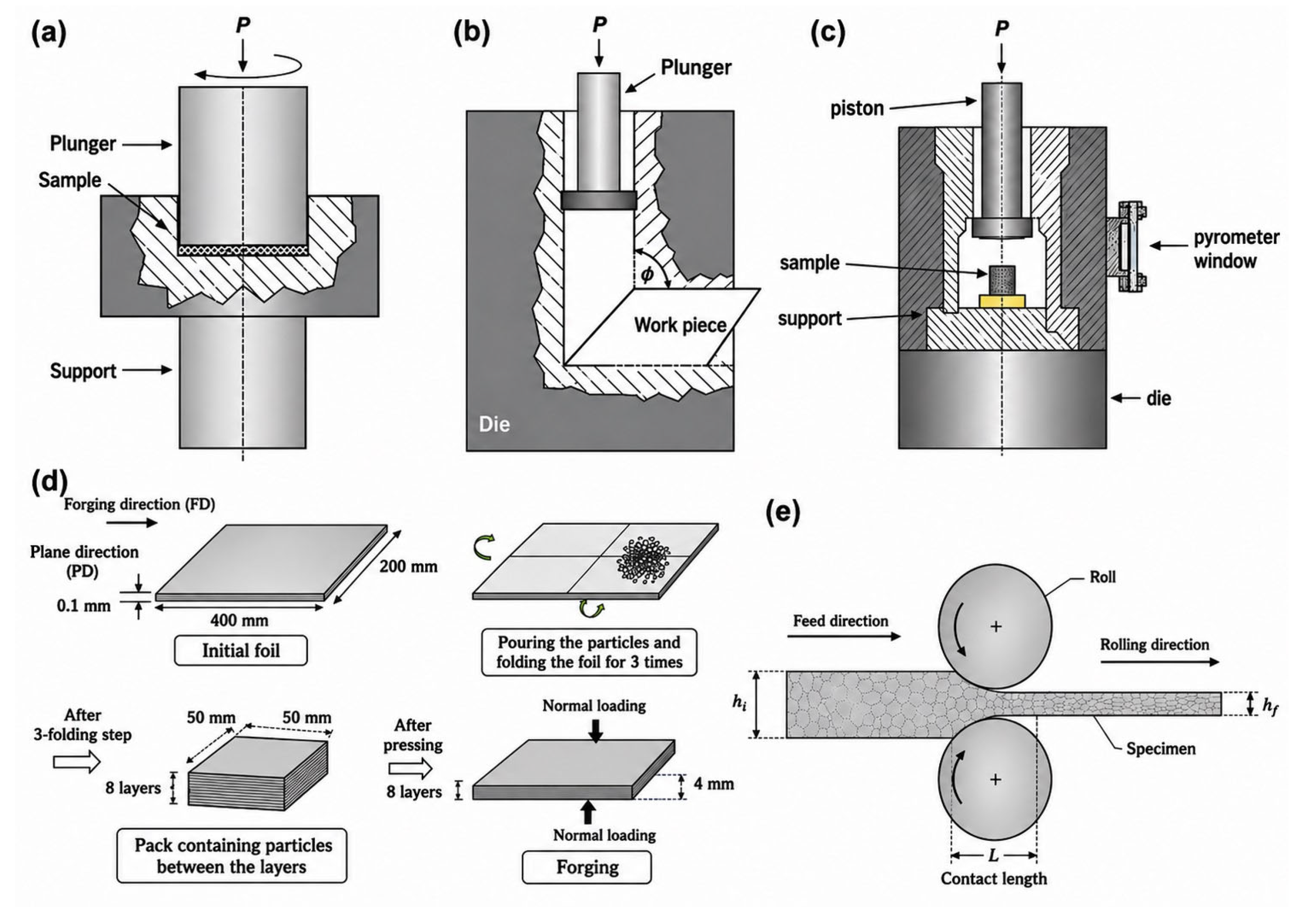
where L and r are the thickness of the disk and the distance from the rotation axis, respectively [33]. At the outer edge of the disk, after several rotations, the imposed shear strain can exceed γ ~ 100. Typically, HPT processing is performed under a closed and constrained geometry, where the specimen is confined between the anvils without free surfaces (Figure 1a). Recent reviews have highlighted the successful application of high-pressure torsion to the development of a broad range of hydrogen storage systems [34,35,36,37].

2.2. Equal-Channel Angular Pressing

ECAP is a severe plastic deformation technique in which a specimen is forced through two channels of identical cross-section that intersect at a specific angle, as shown in Figure 1b. The geometry of the channel intersection is defined by two characteristic angles [38]. During processing, the specimen is pressed through the die by a plunger and can pass through the channel intersection only by undergoing intense plastic deformation. The resulting equivalent strain introduced during a single pass can be expressed as [39]
ε N = N 3 [ 2 c o t ( Φ 2 + Ψ 2 ) + Ψ c o s e c ( Φ 2 Ψ 2 ) ] ,
where Φ and Ψ are the angles defined by the two channels and N is the number of passes. By repeating the ECAP process over multiple passes, substantially higher strains can be accumulated, leading to enhanced microstructural refinement. Between passes, the billet is often rotated about its longitudinal axis by specific angles, and the chosen processing route strongly influences the resulting microstructure.

2.3. Fast Forging

Fast forging is a less conventional SPD technique that can be applied on larger scales and within significantly shorter processing times than many other SPD methods, making it particularly attractive for practical applications and large-scale production. In this process, a free-falling hammer with a mass of approximately 100 kg is released from a height of several meters and impacts a piston in direct contact with a cylindrical specimen positioned on an anvil inside a chamber, as schematically illustrated in Figure 1c [40]. The deformation event occurs within a fraction of a second, resulting in extremely high strain rates. Under typical processing conditions, the specimen is forged into a flat disk with a thickness of only a few millimeters. Because the impact energy is distributed throughout the bulk of the material, substantial plastic deformation can be introduced, leading to pronounced grain refinement and the generation of a high density of lattice defects.

2.4. Accumulative Fold-Forging

Accumulative fold-forging is an SPD-based processing technique in which repeated folding and forging steps are used to impose large plastic strains, see the schematic illustration in Figure 1d. Each processing cycle increases the number of layers within the material while introducing substantial deformation, leading to grain refinement and the generation of lattice defects [41]. As a result, AFF can produce ultrafine-grained microstructures and improve phase dispersion in composite materials. The method is particularly attractive because it can be applied to relatively large samples using conventional forging equipment, making it a promising route for both laboratory-scale investigations and industrial-scale production of advanced hydrogen storage materials.

2.5. Intensive Cold Rolling

Intensive cold rolling is one of the most widely used techniques for introducing SPD into bulk materials at or below room temperature [42]. In this process, the material is repeatedly passed through the gap between two counter-rotating rolls, as schematically illustrated in Figure 1e. As the specimen traverses the roll gap, its thickness is progressively reduced, resulting in substantial plastic deformation and the accumulation of strain throughout the material. The imposed equivalent strain can be expressed as [42]
ε = 2 3 l n ( h 0 h f ) ,
where h0 and hf are the initial and final thickness of the sample, respectively. To further increase the accumulated strain, the rolling process is repeated over multiple passes. Between successive passes, the specimen may be folded or cut into sections that are subsequently stacked and rolled again. These procedures enable the introduction of progressively higher plastic strains while promoting microstructural refinement and enhancing the homogeneity of the material.
Table 1 summarizes the applicability of the major SPD techniques to the hydrogen storage materials discussed below in this review. It compares the maturity of each processing route for different material systems, together with the principal improvements achieved in hydrogen storage performance.

2.6. Comparison of SDP with Other Processing Methods

Although several processing routes have been successfully employed to improve the hydrogen storage performance of metallic materials, SPD possesses several distinctive advantages. SPD introduces a high density of lattice defects and significantly refines the grain structure, both of which accelerate hydrogen diffusion and enhance sorption kinetics. However, unlike HEBM, which generally produces powders that may suffer from contamination, oxidation, and limited control over microstructural homogeneity during prolonged milling, SPD is capable of producing bulk or sheet materials with refined microstructures while preserving mechanical integrity. Furthermore, SPD enables precise control over grain size, crystallographic texture, and defect density, making it particularly suitable for systematic investigations of structure–property relationships. Compared with rapid solidification techniques such as melt spinning, SPD is not restricted to specific alloy compositions or ribbon geometries and can be applied to a wide range of commercially available alloys. Another unique advantage of SPD, particularly high-pressure torsion, is its ability to synthesize metastable phases, supersaturated solid solutions, and high-entropy alloys that are difficult or impossible to obtain by equilibrium processing methods. such as conventional casting. Nevertheless, SPD also has certain limitations. Some techniques, especially HPT, are currently limited to relatively small specimen dimensions and require specialized equipment capable of generating extremely high pressures. Moreover, processing large-scale components remains challenging, although the other SPD methods provide significantly better scalability. Therefore, rather than replacing established processing techniques, SPD should be regarded as a complementary microstructure-engineering strategy that provides unique opportunities for tailoring hydrogen storage materials and developing advanced alloy systems.

3. Materials Systems Processed by SPD for Hydrogen Storage

3.1. TiFe-Based Intermetallics

TiFe is a classical room-temperature hydrogen storage intermetallic with a CsCl-type (B2) structure. It absorbs hydrogen to form TiFeH2 with a gravimetric capacity of ~1.9 wt% at ambient temperature, as first reported by Reilly and Wiswall in 1974 [43]. However, its practical use has been severely limited by the need for a high-temperature activation treatment (typically at ~673 K under vacuum or hydrogen) to deal with a native surface oxide layer that impedes hydrogen transport to the bulk [44,45,46]. SPD, particularly high-pressure torsion [33,34], has proven highly effective in overcoming this activation barrier.
Early work demonstrated that HPT processing of as-cast TiFe produces a heterogeneous nanostructure comprising nanograins, coarse grains, and amorphous-like regions [47]. This severely deformed material absorbed 1.7 wt% hydrogen at room temperature without prior activation, and remained active even after 400 days of storage in air [47]. The mechanism of activation was elucidated through detailed surface analysis: HPT induces surface segregation of Fe-rich islands and the formation of microcracks [48]. The Fe-rich islands act as catalytic sites for hydrogen dissociation, while cracks and nanograin boundaries serve as fast diffusion pathways through the oxide layer. It was suggested that rapid atomic diffusion facilitated by HPT promotes enhanced surface segregation and facilitates hydrogen transport [48].
A subsequent comparison between groove rolling and HPT showed that both methods introduce lattice defects that facilitate activation, but HPT is more effective because it generates a higher fraction of grain boundaries and cracks [49]. The groove-rolled sample with a subgrain structure absorbed hydrogen progressively (reaching 1.7 wt% after the fourth cycle), whereas the HPT-processed sample with a nanograined structure absorbed 1.7–2 wt% in every cycle from the first [49]. No surface segregation was detected after groove rolling, whereas the HPT-processed sample exhibited pronounced surface segregation, further highlighting the unique effects of SPD [49].
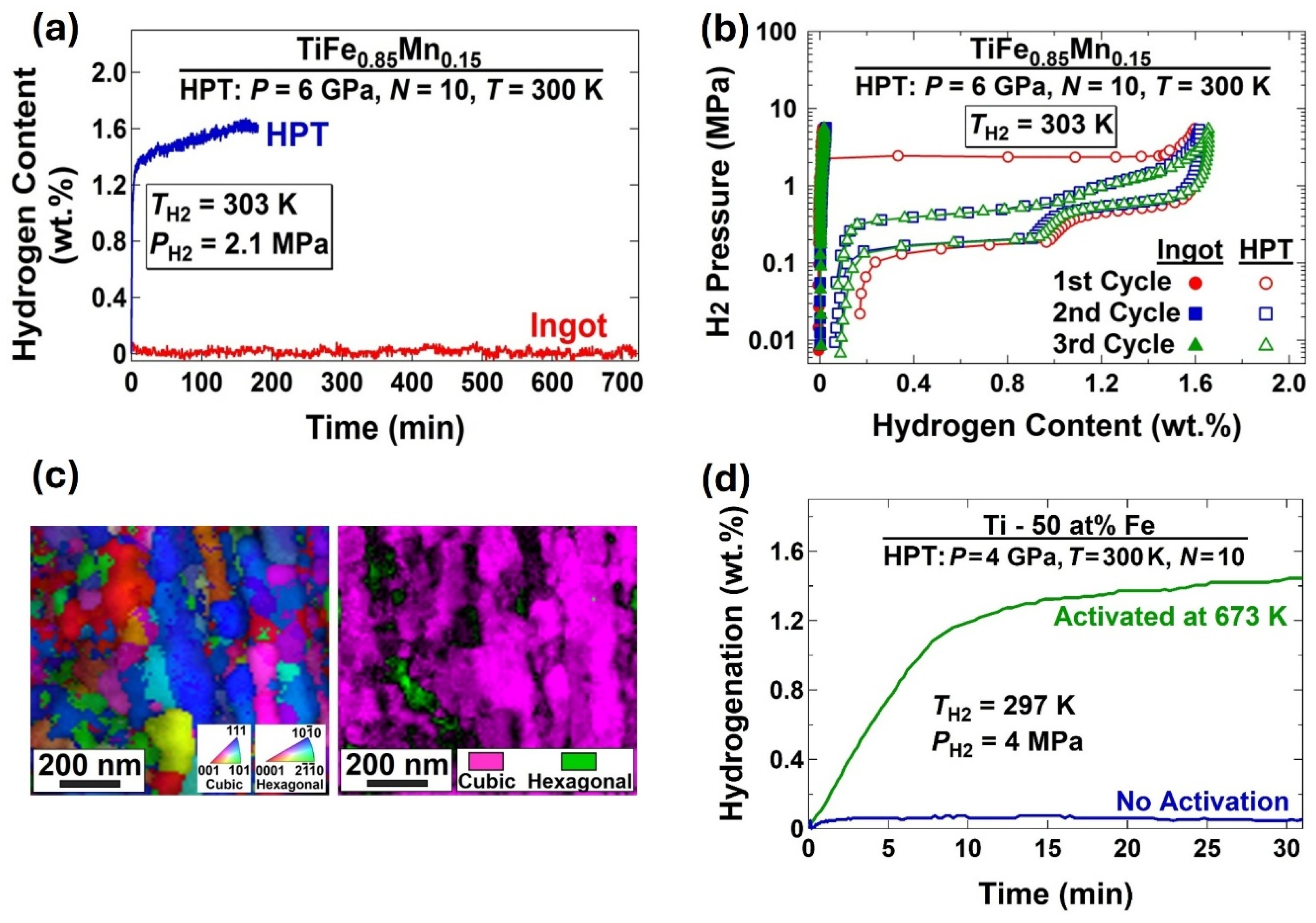
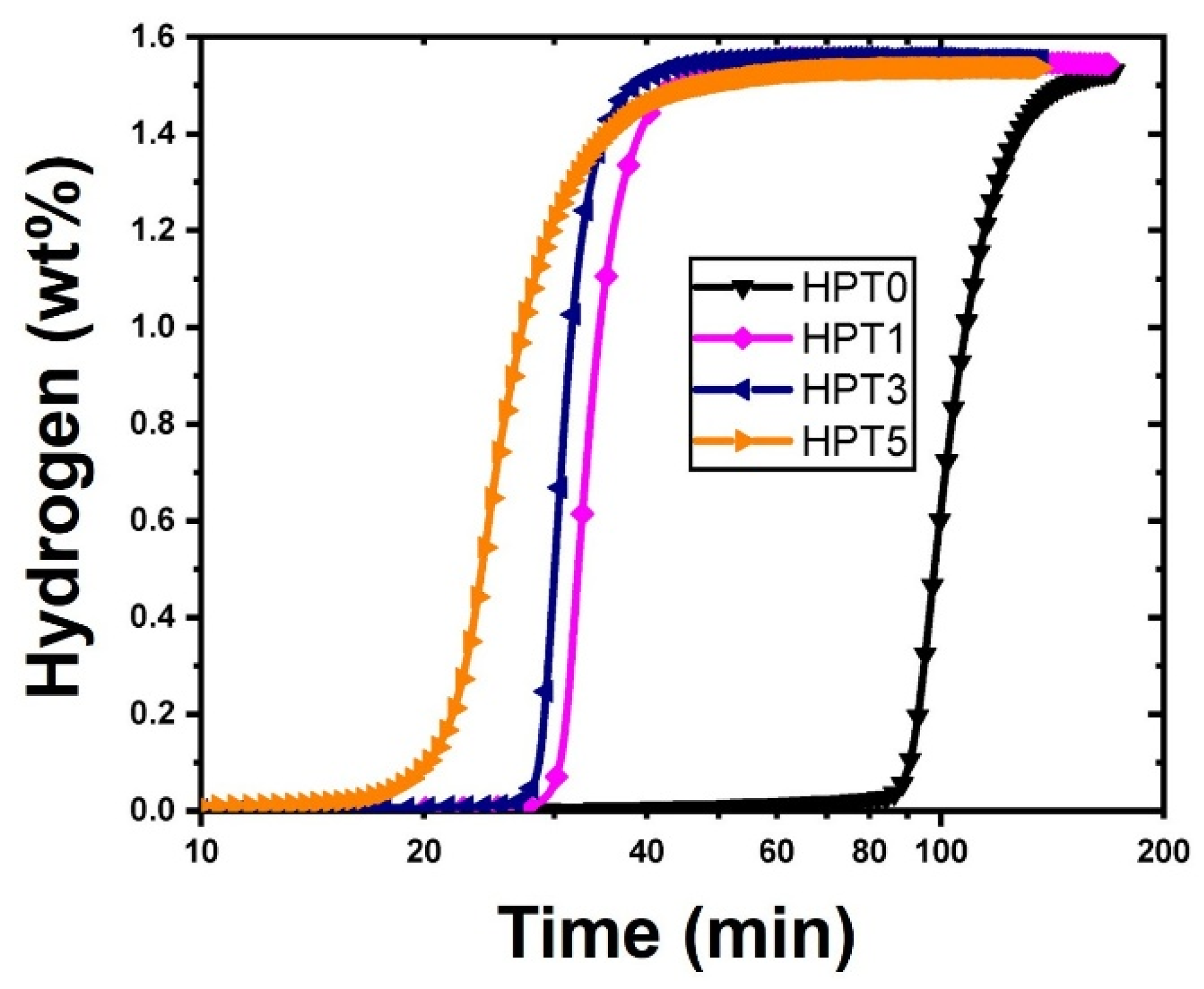
Earlier studies on TiFe had shown that activation requires either high-temperature treatment, chemical modification or mechanical disruption of the oxide. The HPT approach achieves the latter by generating cracks and Fe-rich catalytic islands [48]. It was shown that manganese addition improves TiFe activation by expanding the lattice and reducing hydride formation energy [50]. Edalati et al. [51] processed TiFe1−xMnx (x = 0, 0.15 and 0.3) by HPT. While as-cast ingots hardly absorbed hydrogen, all HPT-processed samples absorbed hydrogen quickly at room temperature, even after air exposure, as shown in kinetic curves and pressure–temperature composition (PCT or PCI) isotherms of Figure 2a and Figure 2b, respectively [51]. The improvement was due to lattice defects and amorphous regions acting as hydrogen diffusion channels. Rietveld analyses and first-principles calculations confirmed that Mn addition expands the lattice and reduces hydride formation energy [51].
More recently, the high-pressure sliding (HPS) method, a variant of SPD, was applied to TiFe0.7Mn0.3 [52]. The hydrogen storage kinetics and activation of the HPS-processed sample were significantly improved if compared with the as-received ingot without HPS processing [52]. Collectively, these studies establish that SPD is a powerful strategy to activate TiFe-based intermetallics without high-temperature thermal activation. A summary of all these studies suggested that despite changing many factors by SPD, the main reason for activation of TiFe by HPT is the formation of grain boundaries [53].
In addition to processing as-cast ingots, HPT has been used to synthesize TiFe-based alloys directly from elemental Ti and Fe powders [14]. Mechanical alloying via HPT produced nanograined TiFe, as shown in ASTAR crystal orientation and phase maps of Figure 2c. However, surprisingly, this directly synthesized material still required activation (Figure 2d) because of severe oxidation during the powder processing, whereas a combination of ingot casting followed by HPT gave superior activity to the bulk sample [54]. This finding suggests that a two-step approach for bulk samples (casting + SPD) is more beneficial than SPD synthesis from powders.
Figure 2. (a) Hydrogenation kinetic curves at 303 K under an initial hydrogen pressure of 2.1 MPa and (b) PCT isotherms at 303 K for TiFe0.85Mn0.15 after casting and HPT processing without any activation [51]. (c) ASTAR crystal orientation and phase maps and (d) hydrogenation kinetic curves under initial hydrogen pressure of 2.1 MPa without and with thermal activation for TiFe synthesized from titanium and iron powders by HPT [54].
Energies 19 03564 g002

3.2. Ti-V-Based Alloys

Ti-V-based alloys with body-centered cubic (BCC) structures are attractive for hydrogen storage because they can absorb up to ~4 wt% hydrogen at room temperature due to the high affinity of vanadium for hydrogen. Nagel and Perkins [55] conducted one of the first experiments on the hydrogenation behavior of metastable Ti-V-based alloys in 1975, showing two-step hydrogenation: first to a body-centered cubic tetragonal (BCT) monohydride with high stability at room temperature and then to a face-centered cubic (FCC) dihydride with a lower stability appropriate for room-temperature hydrogen storage. However, similar to TiFe, Ti-V-based alloys require a sophisticated activation process to initiate hydrogen absorption because both titanium and vanadium produce passive oxides in air [56,57].
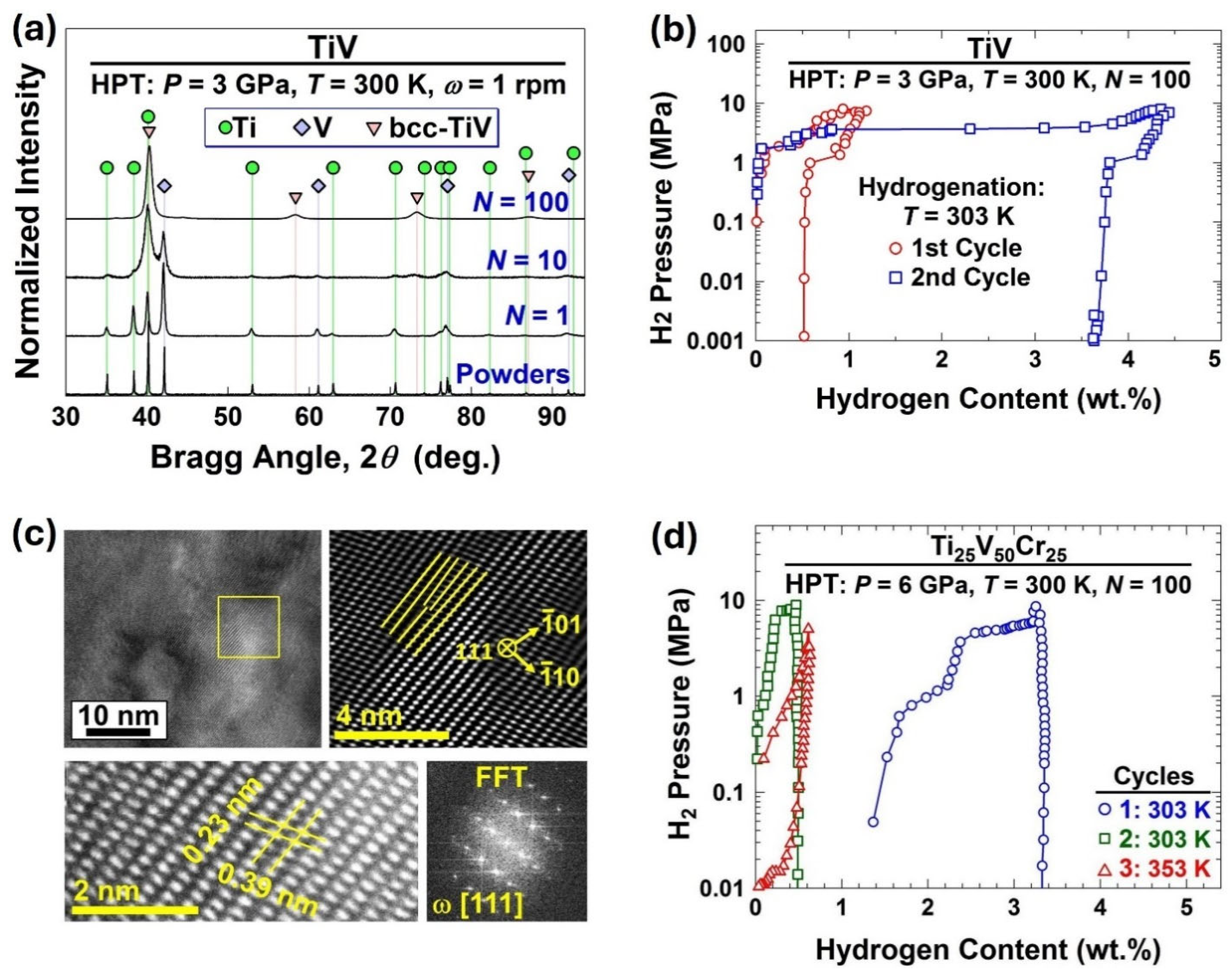
Edalati et al. [58] synthesized a supersaturated BCC TiV alloy directly from elemental Ti and V powders using HPT, as shown in X-ray diffraction profiles of Figure 3a. The as-processed material exhibited a nanograined structure with an ultrahigh density of edge dislocations (>1016 m−2). Critically, this HPT-processed TiV absorbed ~4 wt% hydrogen at room temperature after an incubation period, whereas conventionally prepared TiV does not absorb hydrogen without activation, as shown in PCT isotherms of Figure 3b [58]. The high density of grain boundaries and dislocations, which serve as effective pathways for hydrogen diffusion, facilitated the activation of TiV. Kinetic measurements suggested that hydrogen absorption during the incubation period is controlled by the slow rate of hydrogen dissociation on the surface, whereas the subsequent stage is governed by diffusion of hydrogen atoms [58].
The work on TiV was then extended to the more complex Ti-V-Cr system, which is more attractive for hydrogen storage. Some researchers, including Cho et al. [59] and Iba and Akiba [60], had established that Ti-V-Cr alloys with BCC structure can reversibly absorb and desorb ~2 wt% hydrogen at room temperature, but they require thermal activation. Edalati et al. [61] compared two microstructural strategies: uniform nanostructuring via HPT and gradient-structure formation via surface mechanical attrition treatment (SMAT) [62]. Both SMAT- and HPT-processed materials readily absorbed hydrogen at room temperature [61]. However, while SMAT-processed samples with gradient microstructures showed good reversibility, HPT-processed materials, rich in dislocations (Figure 3c) exhibited poor reversibility (Figure 3d) because bulk defects contributed to trapping hydrogen [61]. The authors also observed crack formation (both elongated subsurface cracks and fine surface cracks) after SMAT, which is beneficial for hydrogen storage. After HPT processing, they reported partial strain-induced ω phase formation (Figure 3c) with unknown effects on hydrogen storage [61]. The phase transformation has been previously reported after HPT processing of other hydrogen storage alloys [63]. Subsequent microstructural investigations by Novelli et al. [64] on the same Ti-V-Cr alloys processed by SMAT and HPT provided further details. SMAT-processed samples exhibited intragranular fracture upon hydrogenation, while HPT-processed samples exhibited intergranular fracture [64]. Hydrogen diffusion in HPT samples occurred mainly along grain boundaries, whereas diffusion in SMAT samples was predominantly intragranular.
Figure 3. (a) XRD profiles of titanium and vanadium processed by HPT for N = 1, 10 and 100 turns, and (b) PCT isotherms at room temperature for the resulting BCC-TiV synthesized by N = 100 turns [58]. (c) High-resolution TEM micrographs of Ti25V25Cr25 processed by HPT for N = 10 turns, and corresponding (d) PCT isotherms at room temperature [61].
Energies 19 03564 g003

3.3. Ti-Mg-Based Alloys

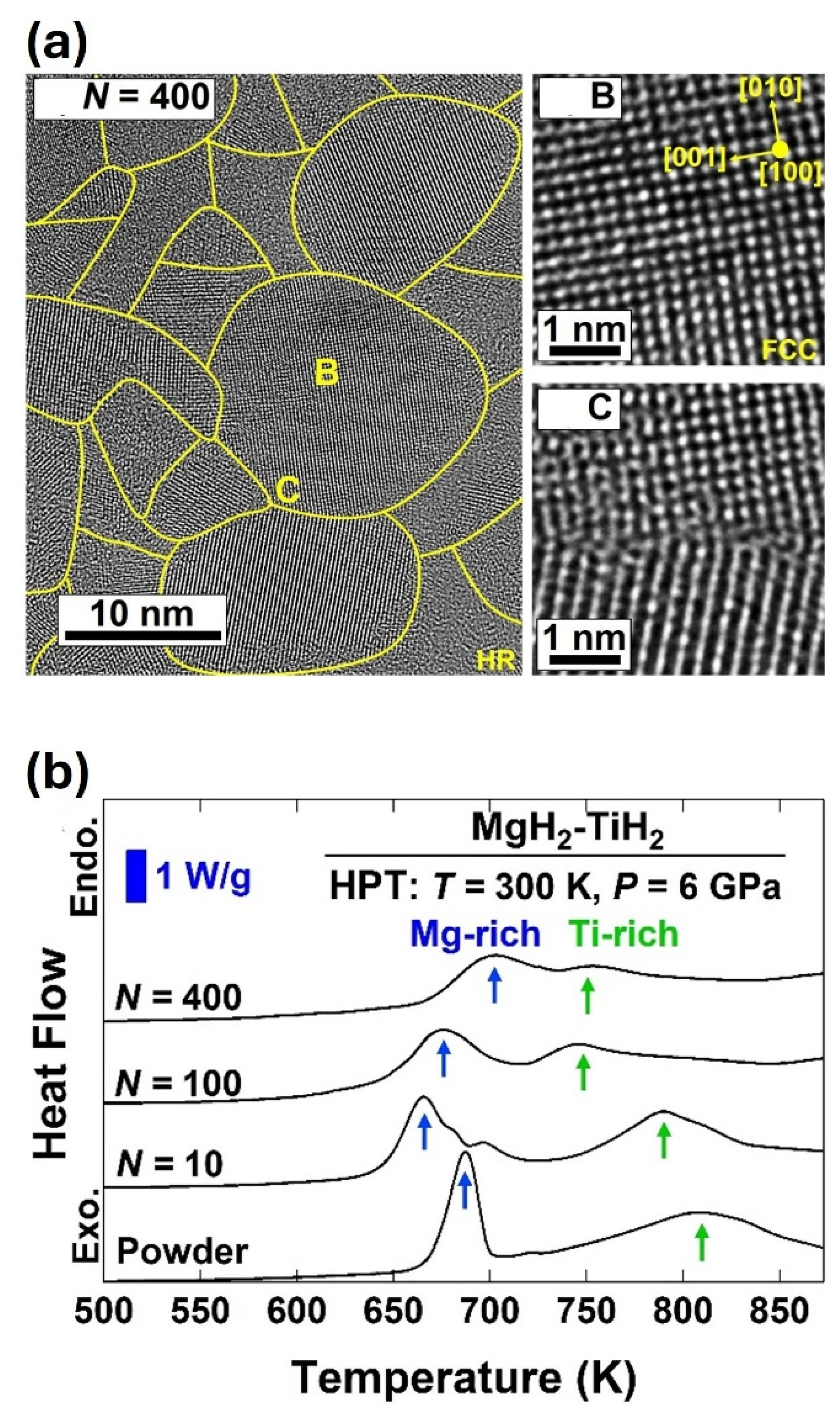
Although titanium and magnesium are immiscible even in the liquid phase, some studies have investigated the formation of metastable FCC hydrides in the Mg-Ti-H system by ball milling [65,66], while first-principles calculations predicted the low stability of cubic hydrides in the Mg-Ti-H system [67]. Kitabayashi et al. [68] applied HPT to the MgH2-TiH2 composite to synthesize metastable hydrides with lower dehydrogenation temperatures. At the early stages of straining, while MgH2 transformed from the stable α tetragonal phase to the high-pressure γ orthorhombic phase after HPT processing, TiH2 exhibited no cubic-to-tetragonal phase transformation even when HPT was conducted at cryogenic temperature in liquid nitrogen (77 K) [68]. However, application of ultra-SPD (shear strains over 1000 [69]) using 400 HPT turns resulted in atomic-scale mixing of the two hydrides, and led to the formation of a nanostructured ternary Mg-Ti-H hydride with a metastable FCC structure (Figure 4a) [68]. The dehydrogenation temperature of the Ti-rich regions decreased due to the dissolution of MgH2 in TiH2, consistent with first-principles calculations showing that Mg addition reduces the formation enthalpy of Ti-rich FCC hydrides, as shown in differential scanning calorimetry profiles of Figure 4b [68]. This study demonstrated that at earlier stages of straining, phase transformation occurs mainly in MgH2 (α → γ) in good agreement with an earlier study on HPT processing of MgH2 [70], but later, mechanical alloying between TiH2 and MgH2 proceeds to form a ternary FCC hydride.
Edalati et al. [71] processed Ti-Mg powder mixtures by HPT and successfully synthesized four metastable phases with average grain sizes of 5–10 nm: (i) a BCC phase, (ii) an FCC phase, and two HCP phases (one Mg-rich and one Ti-rich) with different lattice parameters [71]. The formation of these metastable phases was attributed to two factors: (i) atomic-scale mixing of immiscible elements under severe shear strain, and (ii) grain size stabilization of high-temperature phases (BCC and FCC) at the nanometer level. Despite the successful synthesis of these metastable Ti-Mg binary phases, they decomposed to pure magnesium and titanium at about 643 K during heating before any significant hydrogenation could occur, and no ternary Mg-Ti hydride was formed under 2 MPa H2 pressure [71]. First-principles density functional theory (DFT) calculations showed that the hydrogen binding energy increases and the thermodynamic stability of hydrides undesirably increases compared to pure magnesium with mixing titanium and magnesium, making Ti-Mg-based alloys poor hydrogen storage materials [71]. Further details about the effect of HPT on Ti-based materials can be found in a recent review paper [72].

3.4. LaNi5

LaNi5 is a prototypical hydrogen storage material discovered in the 1970s that absorbs and desorbs hydrogen reversibly at room temperature with a capacity of ~1.4 wt% [73]. Unlike TiFe and Ti-V alloys, LaNi5 does not typically suffer from a difficult activation problem because nickel on the surface catalytically dissociates hydrogen. However, LaNi5 suffers from degradation upon cycling due to disproportionation and pulverization [74].
Strozi et al. [75] systematically studied the effect of HPT on the first hydrogenation of LaNi5. They found that for loose powder, reduction of particle size through HPT processing increased the incubation time and decreased the hydrogen capacity [75]. A higher number of HPT turns only marginally reduced the incubation time but had no effect on capacity (see Figure 5). In all cases, the first dehydrogenation and subsequent hydrogenations exhibited the same kinetics, regardless of particle size or number of HPT turns [75]. Therefore, for LaNi5, HPT has limited benefits for hydrogen storage. These results contrast with the dramatic improvements seen for TiFe and Ti-V alloys, highlighting that SPD is most beneficial for materials whose activation barrier is surface-oxide-limited rather than intrinsically kinetic-limited.

3.5. Niobium

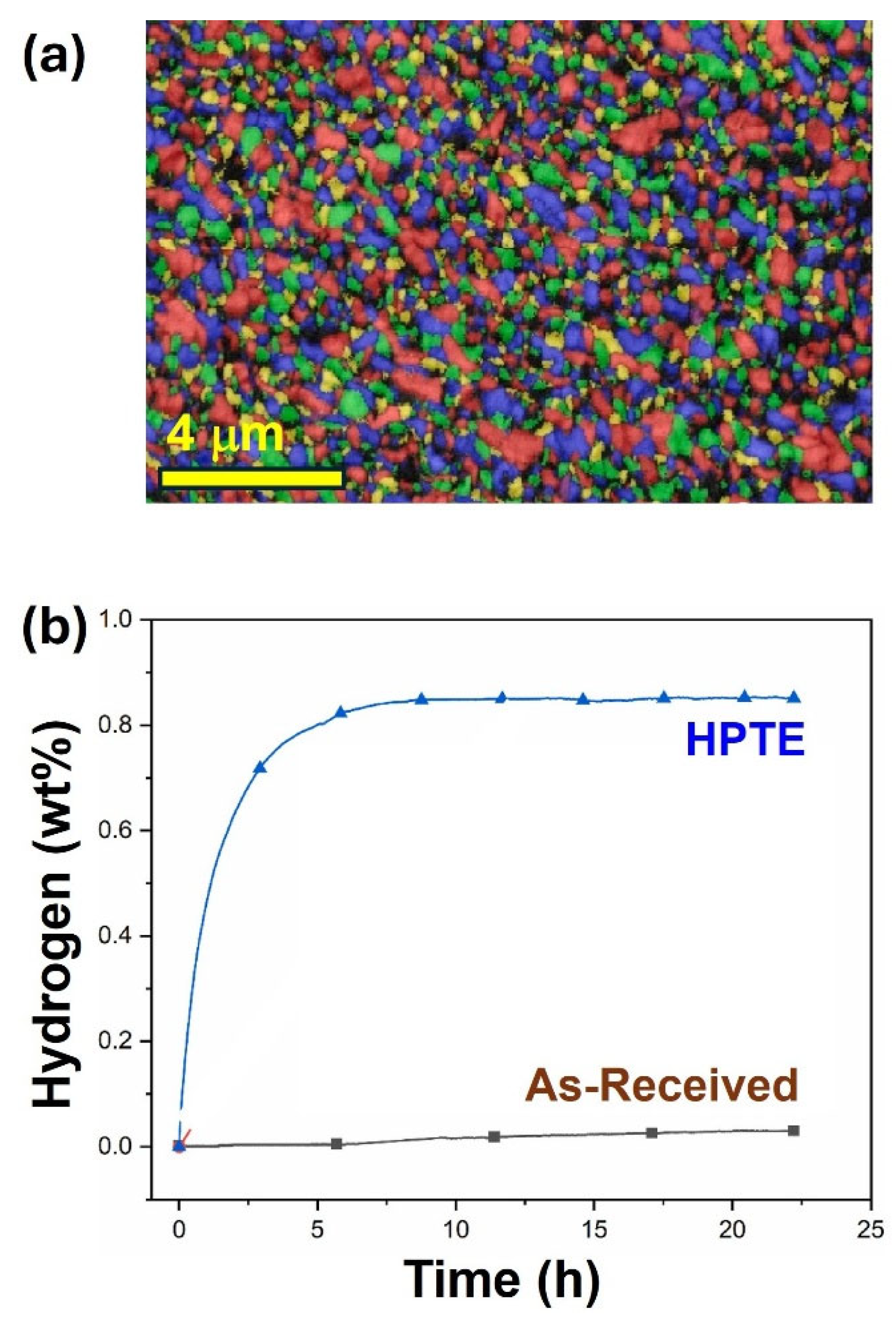
Niobium is a ductile refractory metal that forms a metal hydride at room temperature and has been used as a catalyst to improve the hydrogenation kinetics of other hydride-forming metals such as magnesium [76]. However, like many metal hydrides, niobium suffers from slow activation due to the presence of a native surface oxide layer that hinders hydrogen dissociation and diffusion. Omranpour Shahreza et al. [77] applied an SPD technique called high-pressure torsion extrusion (HPTE) to niobium to enhance its activation behavior. After one pass of HPTE with an extrusion speed of 7 mm/min, the initial grain size of 16.5 μm was refined to 600 nm, and the fraction of high-angle grain boundaries increased from 51% to 91%, as shown in crystal orientation maps achieved by back-scatter electron diffraction (EBSD) in Figure 6a [77]. The HPTE-processed niobium absorbed hydrogen to its full capacity (0.84 wt%) within ~6 h at 573 K under 2 MPa hydrogen pressure, while the as-received sample did not absorb any hydrogen even after one day of exposure (Figure 6b) [77]. Rate-limiting step modeling revealed that the hydrogen absorption mechanism changed from a constant-interface-velocity model in the moderately deformed sample to a decreasing-interface-velocity model in the most severely deformed sample, indicating that the high density of nucleation sites (grain boundaries and dislocations) caused interference between growing hydride phases and reduced the interface velocity. Similar enhancements in hydrogenation kinetics have been reported for other SPD-processed materials such as magnesium [78], Mg-based alloys [79] and Mg-based nanoglasses [80].

3.6. Palladium

Palladium is a model hydrogen storage material that absorbs hydrogen at room temperature and low pressures to form PdHx, with a maximum hydrogen-to-metal atomic ratio near 0.7. It exhibits a well-understood α (dilute solid solution, paramagnetic) to β (hydride, diamagnetic) phase transformation [81]. SPD processing of palladium has been explored to understand how severe deformation affects hydrogen absorption/desorption thermodynamics, hydride stability, and diffusion behavior.
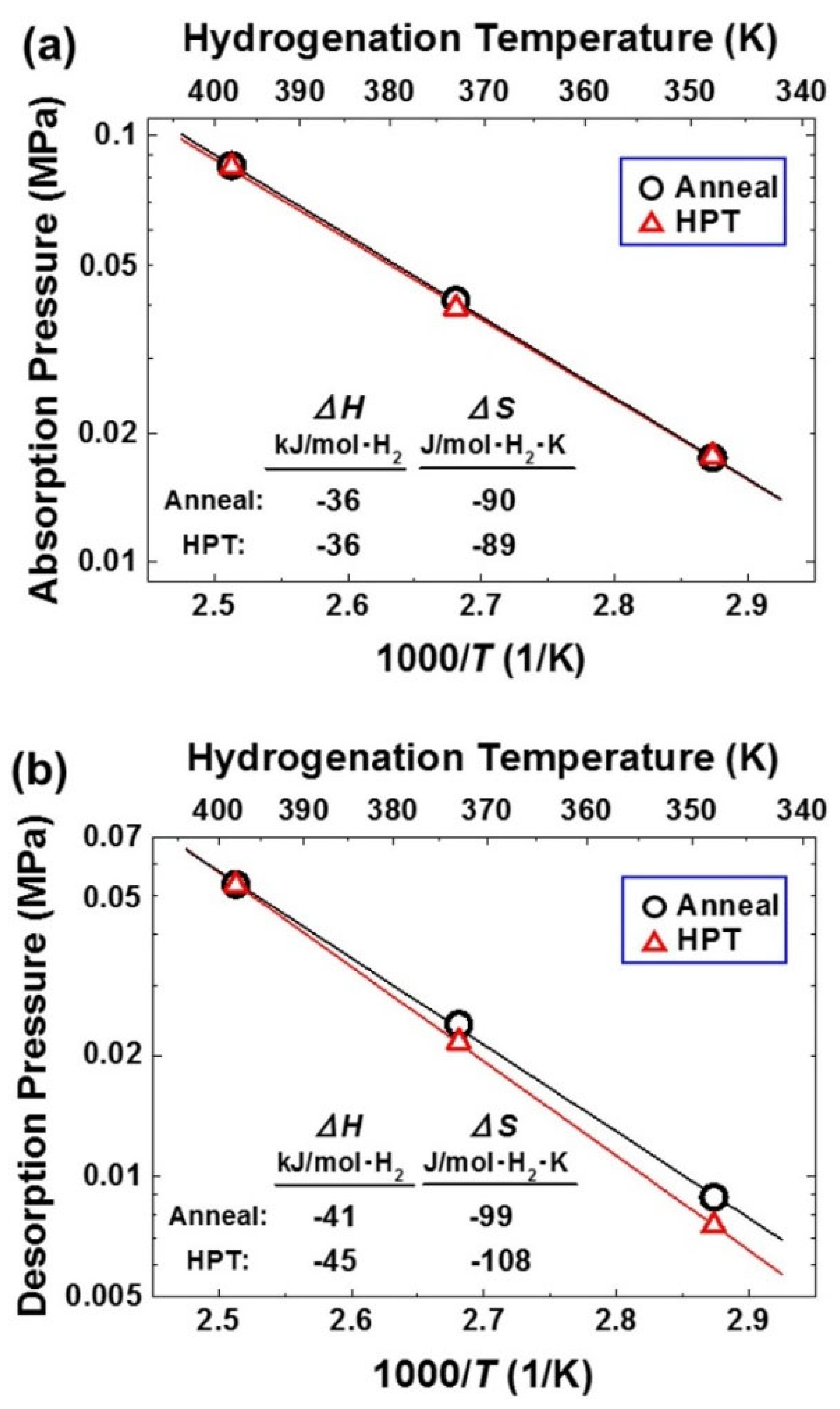
Hongo et al. [82] processed pure palladium (99.9%) by HPT to synthesize an ultrafine-grained (UFG) structure with an average grain size of ~220 nm. PCT isotherms measured at 348–398 K showed that both the annealed coarse-grained and HPT-processed UFG samples absorbed ~0.65 wt% hydrogen (PdH0.6), but the absorption pressure remained unchanged while the desorption pressure was slightly smaller after HPT processing, especially at lower temperatures [82]. Thermodynamic analysis using the van’t Hoff method (Figure 7) revealed that the changes in enthalpy and entropy of hydrogen absorption and desorption by HPT processing were minor (<10%), indicating that the thermodynamics of hydrogen storage is independent of grain size even when grains are refined to ~220 nm [82]. However, X-ray diffraction (XRD) analysis showed that the fraction of β-phase hydride formed under low hydrogen pressure (0.1 MPa) was higher after HPT processing than after annealing, and the hydride phase remained stable for a longer time in the HPT-processed sample when stored in air [82]. This enhanced hydride stability and accelerated formation were attributed to the high density of grain boundaries and dislocations introduced by HPT, which act as fast diffusion pathways for hydrogen atoms.
Mito et al. [83] employed a novel approach to study hydrogen desorption in PdH0.6 prepared by HPT using time- and temperature-dependent magnetic measurements. Since the β-phase (PdH0.6) is diamagnetic and the α-phase (Pd + H) is paramagnetic, the transformation from β to α during hydrogen desorption can be quantitatively tracked by monitoring magnetization. The magnetic measurements revealed an antiferromagnetic correlation between paramagnetic moments of palladium at low temperatures, and a huge discrete change in magnetization appeared due to collective hydrogen desorption above room temperature (~350 K) [83]. This hydrogen desorption was more pronounced in HPT-processed PdH0.6 than in annealed PdH0.6, indicating that the severe lattice strain introduced by HPT modifies the surface barrier height for hydrogen desorption and allows hydrogen to be retained in the specimen for longer periods [83]. The study demonstrated that magnetic measurements provide a powerful quantitative tool to investigate hydrogen diffusion and desorption phenomena, complementing conventional techniques such as PCT isotherms, calorimetry, and thermogravimetry [83].

3.7. High-Entropy Alloys

High-entropy alloys (HEAs) and medium-entropy alloys (MEAs) have emerged as a new class of hydrogen storage materials. The concept of HEAs was first put forward by Yeh et al. [84] and Cantor et al. [85] in 2004. Sahlberg et al. [86] later reported superior hydrogen storage in HEAs in 2016. SPD has played a dual role in the field of high-entropy hydrogen storage materials: synthesizing new multicomponent alloys; and enhancing activation and kinetics.
The power of SPD as a synthesis tool was demonstrated first by creating new Mg-based multicomponent alloys [87]. Edalati et al. [88] employed first-principles calculations to design a Mg-based alloy with low hydrogen binding energy. The designated material, highly homogeneous Mg4NiPd with a BCC-based CsCl-type structure, was successfully produced by HPT [88]. This alloy exhibited reversible hydrogenation and dehydrogenation at room temperature with high phase stability, introducing binding energy engineering [88]. Similarly, the first Mg-V-Cr BCC alloys were synthesized from elemental powders by HPT [89]. Magnesium is immiscible in vanadium and chromium under equilibrium conditions, but SPD forced atomic-scale mixing. The best performance was achieved for MgVCr with maximum configurational entropy [89]. de Marco et al. [90] further synthesized MgVCr BCC and MgVTiCrFe HEA by mechanical alloying followed by HPT. MgVCr exhibited fast kinetics with 0.9 wt% reversible capacity, whereas MgVTiCrFe showed low hydrogen affinity and partial decomposition upon cycling [90].
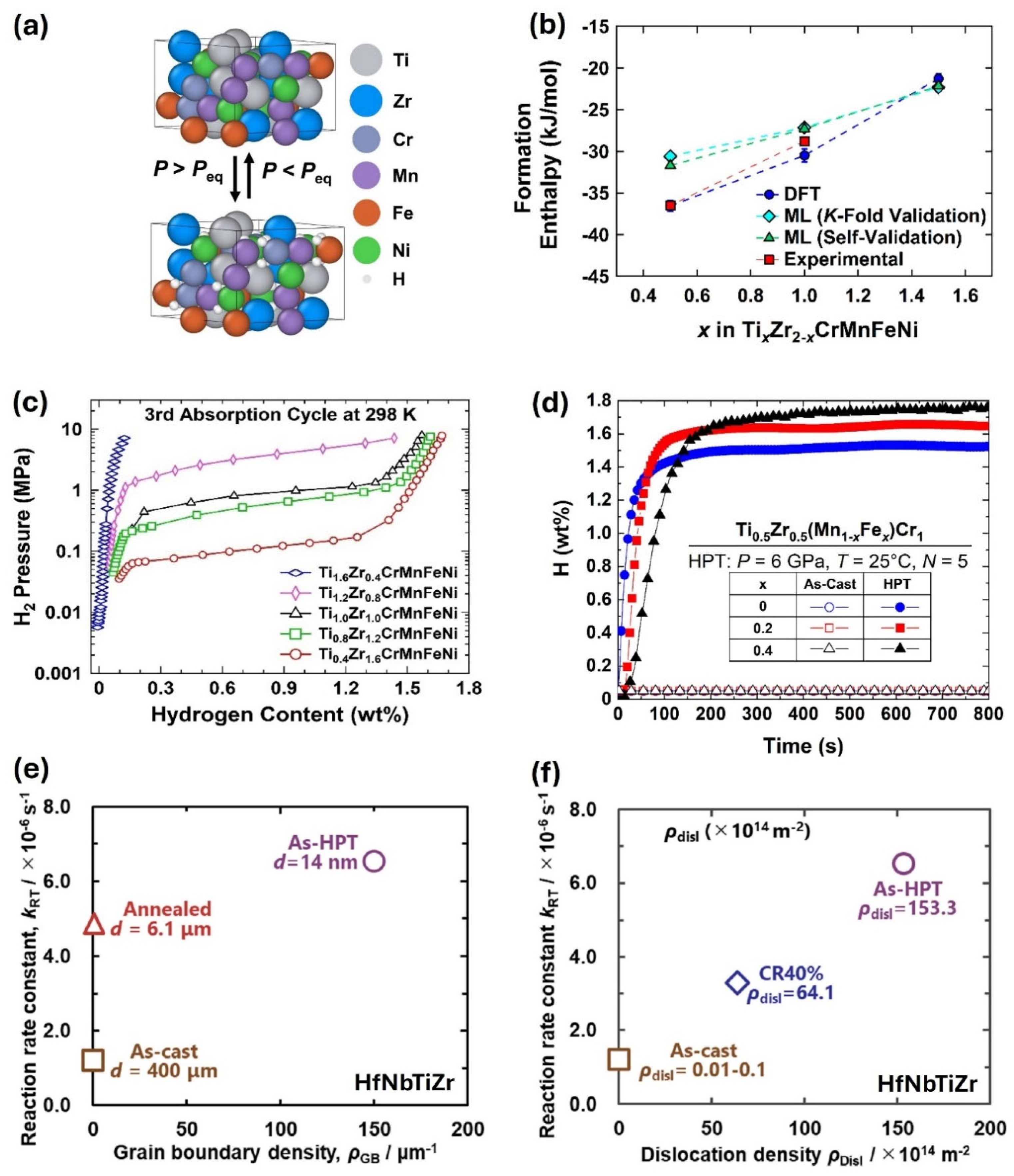
A major breakthrough came with the design of a HEA for room-temperature hydrogen storage based on three criteria: VEC of 6.4, single-phase thermodynamic stability (determined via calculation of phase diagram, CALPHAD), and AB2H3 hydride formation [91]. TiZrCrMnFeNi containing 95 wt% C14 Laves phase absorbed and desorbed 1.7 wt% hydrogen with enhanced kinetics at room temperature and without activation treatment [91]. This alloy was preliminarily synthesized by HPT, but it was found later that arc melting can be used more effectively to synthesize the alloy. The plateau pressure for this alloy was slightly high, about 1 MPa, but it was found by Mohammadi et al. [92] using DFT calculations (Figure 8a) and by Dangwal et al. [93] using machine learning (Figure 8b) that the plateau pressure can be adjusted easily by changing the Ti/Zr ratio, a fact that was confirmed by experiments (Figure 8c) [92].
Hidalgo-Jimenez et al. [94] investigated the effect of HPT on first hydrogenation of Laves phase HEAs Ti0.5Zr0.5(Mn1−xFex)Cr1 (x = 0, 0.2 and 0.4). While as-cast alloys became inert to hydrogen after air exposure, HPT-processed samples were active and absorbed 1.6–1.8 wt% hydrogen at room temperature in seconds, even after 2 months of air exposure (Figure 8d) [94]. Easy activation was attributed to the effect of grain boundaries on hydrogen transport. Motivated by this study, Dangwal and Edalati [95] investigated the role of interphase boundaries on activation of HEAs. They found that while the dual-phase alloy (C14 + 4 vol% BCC) readily absorbed hydrogen at room temperature without activation, the single-phase C14 alloy with similar composition required high-temperature activation [95]. Interphase boundaries provide pathways for hydrogen transport and act as sites for heterogeneous hydride nucleation. Dangwal and Edalati [96] later compared six dual-phase HEAs and found interphase boundaries are effective for activation only if: (i) their fraction is high enough, and (ii) they are not coherent. Coherent boundaries have lower free volume and lower boundary energy, making them less favorable for hydrogen diffusion and nucleation [96]. The benefits of interphase boundaries were used recently to design HEAs, such as TiV2ZrCrMnFeNi, for room-temperature hydrogen storage [97], or to enhance the kinetics of hydrogen storage in HPT-processed magnesium-graphene composites [98].
Schweiger et al. [99] nanostructured TiVZrNbHf by HPT to investigate its hydrogenation behavior. A homogeneous single-phase nanocrystalline structure was obtained by HPT processing. However, under hydrogen pressure at 773 K, the material decomposed into hexagonal close-packed (HCP), BCC, and C14 Laves phases. The material retained its nanocrystalline structure under hydrogen, while significant grain growth occurred under vacuum [99]. In a similar attempt, Naderi et al. [100] processed TaTiVCrFe and ZrTiVCrFe refractory HEAs by HPT. Excellent hydrogenation was detected up to 1.04 and 2.53 wt%, respectively, with no incubation time. They suggested that structural defects, interfaces, and nano/microcracks provided diffusion pathways and nucleation sites [100].
Ueda et al. [101] systematically investigated the effect of different types of lattice defects on the hydrogen storage properties of a model HfNbTiZr alloy with BCC structure. By applying HPT, cold rolling, and subsequent annealing, the authors precisely tailored the densities of grain boundaries, dislocations, and vacancies in the alloy. The as-HPT specimen exhibited an ultrafine-grained structure (grain thickness of 14 nm, grain length of 53 nm) with an ultrahigh dislocation density of 1.54 × 10¹⁶ m−2, while cold rolling (10–40% thickness reduction) introduced mainly dislocations without significant grain refinement, and annealing of HPT-processed samples produced fully recrystallized microstructures with varying grain sizes (6.1–39.7 μm) and negligible dislocation densities [101]. They found that the absorption reaction rate constant increases with increasing both grain boundary density (Figure 8e) and dislocation density (Figure 8f). The as-HPT specimen exhibited the fastest hydrogenation kinetics, reaching saturation after ~48 h, while the cold-rolled specimen showed faster kinetics only in the initial stage, and the annealed (fine-grained) specimen exhibited enhanced kinetics in the later stage, eventually reaching hydrogen contents comparable to the as-HPT specimen [101]. Using Kissinger analysis, the hydrogen binding energies for different trapping sites were quantitatively determined: 50.7 kJ/mol for interstitial lattice sites (as-cast), 42.1 kJ/mol for grain boundaries (annealed specimen), and 68.5 kJ/mol for dislocations and vacancies (cold-rolled specimen) [101]. The authors concluded that grain boundaries act as highly efficient pathways for hydrogen transport during both absorption and desorption due to their relatively low binding energy and interconnected three-dimensional nature [101], whereas dislocations and vacancies act as strong but isolated trapping sites that impede long-range hydrogen transport and lead to irreversible hydrogen storage. This study provided a quantitative demonstration that high grain boundary density with minimal dislocation/vacancy density is the ideal microstructure for achieving both fast kinetics and good reversibility in hydrogen storage alloys. These findings are consistent with earlier reports on the effect of grain boundaries on hydrogen diffusion in BCC metals [102,103] and with first-principles calculations showing that grain boundaries with large free volumes serve as low-energy trapping sites for hydrogen [104,105].
A very recent study by Ha et al. [106] on a Ti24Nb10Cr6Mn25V35 alloy provided extra insights into the role of grain boundary density versus dislocation density in controlling hydrogenation kinetics after SPD. The alloy consists of a BCC matrix with a secondary C14 Laves phase. The authors processed the alloy by HPT followed by annealing at 1423 K and 1523 K for 5 min to systematically vary the grain boundary density [106]. The key finding was that the sample annealed at 1423 K, which exhibited the highest grain boundary density, showed the fastest hydrogenation kinetics, reaching saturation in only 133 s, compared to 838 s for the as-cast sample [106]. In contrast, the post-HPT sample (without annealing) exhibited unusually slow kinetics (3150 s to saturation) due to excessive hydrogen trapping at dislocations, which hindered inward diffusion. Grain boundaries were proposed to serve as preferential diffusion pathways rather than dominant trapping sites [106]. Kinetic modeling using solid–gas reaction models revealed a mechanistic transition: the as-cast sample followed the diffusion-controlled Ginstling–Brounshtein model, whereas the annealed samples were described by the surface-controlled chemisorption model, indicating that hydrogen atoms became localized at near-surface regions due to the high density of grain boundaries [106].
In summary, SPD has enabled the synthesis of novel multicomponent and high-entropy alloys for hydrogen storage, revealing the critical role of grain boundaries and incoherent interphase boundaries in activation and transport. The emerging understanding that excessive dislocation defect densities can trap hydrogen and slow down the kinetics, while optimized grain boundary densities accelerate transport and heterogeneous hydride nucleation, represents a key fundamental understanding and a key design principle that has been realized by SPD. The significance of various kinds of defects on functional properties of materials was discussed in two major interdisciplinary reviews [107,108], while a recent review showed that such defects can affect the performance of materials in the whole hydrogen cycle from hydrogen production to hydrogen utilization [109].
Figure 8. (a) Lattice of TiZrCrMnFeNi and TiZrCrMnFeNiH6 modeled using first-principles calculations [92]. Influence of Ti/Zt ratio in TixZr2−xCrMnFeNi on (b) formation of hydride estimated by DFT, machine learning (ML) and experiments [93], and (c) experimental PCT isotherms [92]. (d) Hydrogenation kinetic curves at room temperature under an initial hydrogen pressure of 2 MPa for Ti0.5Zr0.5(Mn1−xFex)Cr1 (x = 0, 0.2 and 0.4) before and after processing by HPT [94]. Hydrogenation reaction rate constants versus (e) grain boundary density and (f) dislocation density for HfNbTiZr processed by casting, rolling and HPT [101].
Energies 19 03564 g008

3.8. Magnesium

Among metallic hydrides, MgH2 is widely recognized as one of the most promising materials for the hydrogen economy owing to its high hydrogen storage capacity (7.6 wt%), low mass density and low cost [110,111]. Since the activation energy for the hydrogenation sorption of elemental Mg is rather high (Eact ~ 140 kJ/mol), the absorption/desorption kinetics is relatively sluggish at ambient thereby limiting its practical implementation in on-board hydrogen storage systems [112]. To address these limitations, it is essential to achieve simultaneous enhancements in both the kinetic and thermodynamic performance of Mg-based hydrogen storage systems [113].
A promising strategy for improving the thermodynamic properties while minimizing capacity loss is the reduction of crystallite size to the nanometric regime; however, studies have shown that a substantial decrease in the hydride formation enthalpy occurs only in extremely small clusters comprising approximately 10 Mg atoms [114]. Nevertheless, nanocrystallization has a much more pronounced effect on hydrogen sorption kinetics, as it increases the specific surface area and promotes the formation of lattice defects, such as dislocations and vacancies. These features facilitate hydrogen diffusion along grain boundaries and into the bulk of Mg particles, thereby enhancing hydrogen absorption and desorption kinetics [115,116]. The enhanced kinetic performance of Mg nanoparticles can be attributed to the lower coordination numbers of Mg and H atoms in grain-boundary regions [117]. Another strategy for reducing formation enthalpy involves alloying Mg with selected elements. Identifying additives capable of destabilizing MgH2 while preserving its high hydrogen storage capacity remains a key research challenge [118,119].
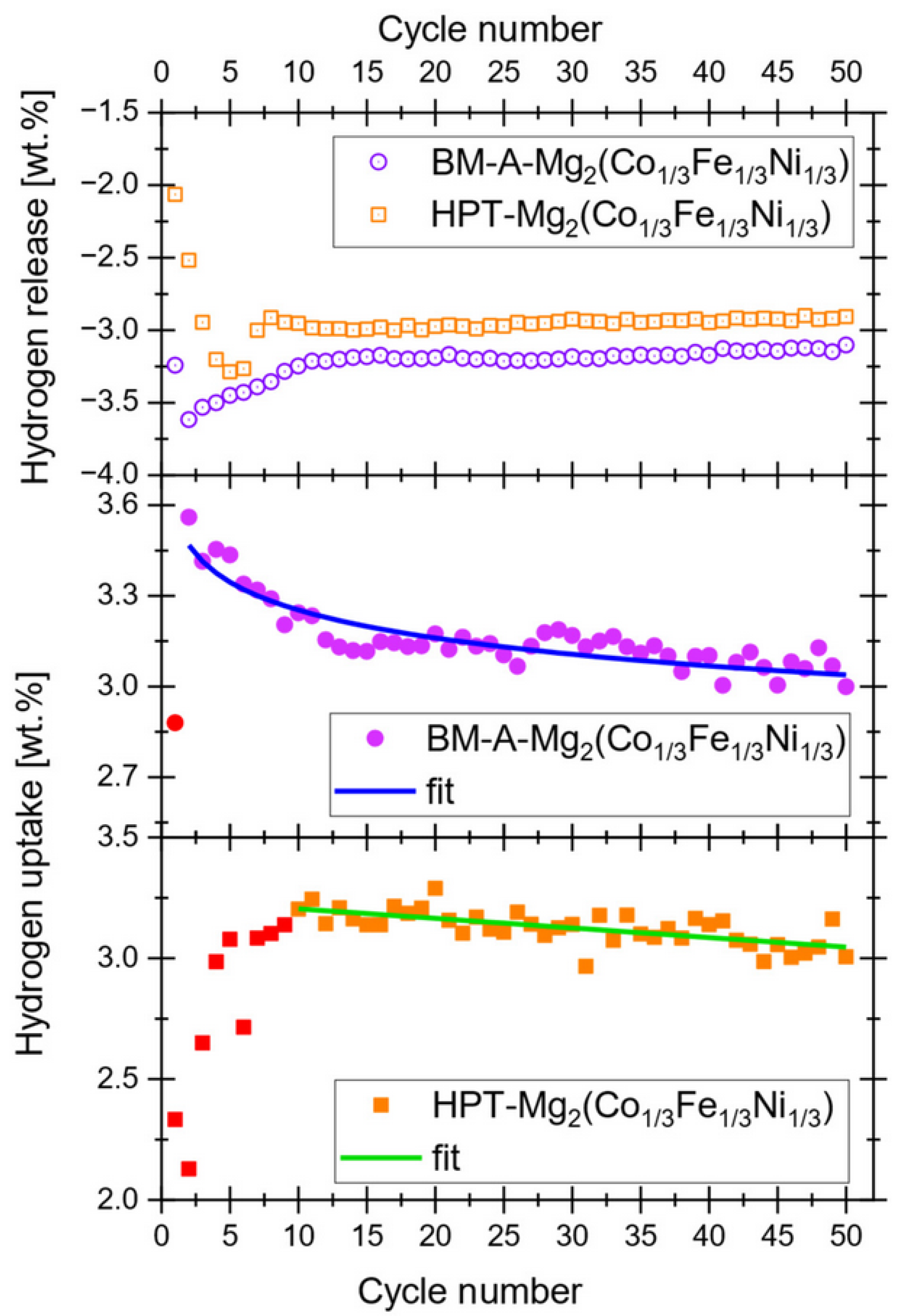
Intermetallic Mg2Ni is a favorable solid-state hydrogen storage material due to its low high storage capacity [120]; however, its synthesis is a great challenge due to the high melting point of Ni (1455 °C) and the low boiling point of Mg (1090 °C) [121]. López Gómez et al. performed HPT on Mg–30 at % Ni and found that samples with N = 100 turns show a maximum capacity of 3.8 wt% of hydrogen at 350 °C, which is close to the nominal capacity of this system (3.9 wt%) [121]. Coupled XRD analysis revealed the solid state formation of nanocrystalline Mg2Ni and its amount increases with the number of revolutions. In addition, the hydrogenation kinetic measurements were performed several weeks after the HPT-treatment, indicating a strong air resistance of these bulk disks. A recent study on the multicomponent Mg2(Co1/3Fe1/3Ni1/3) alloys processed by ball milling and annealing (BM-A) and subsequent HPT. Hydrogenation performance was tested during 50 absorption/desorption cycles, demonstrating that both samples exhibit excellent cyclic stability; however, the material processed by HPT reaches an almost constant hydrogen uptake after 10 cycles, while the BM-A alloy was fully activated only after two cycles, see Figure 9 [122]. The hydrogen sorption temperature can usually reduce substantially, as was demonstrated by Osorio-Garcia, when metallic nickel and niobium oxide were added as catalysts to Mg [123]. Specifically, when the powder mixture of Mg+5 wt% Ni+2 wt% Nb2O5 is subjected to HPT, remarkable hydrogen sorption can be detected at a temperature as low as 423 K. In addition, the application of HPT processing can substantially enhance the hydrogenation kinetics over those shown by milled powders.
Recent research established that carbon-based additives during HPT-deformation can significantly improve the hydrogenation performance of Mg. For example, multiwall carbon nanotubes (MWCNTs) provide fast diffusion channels during hydrogen soprtionfor the hydrogen atoms through the passivated surface layer into the bulk material [124]. Gajdics et al. [125] have shown that a combined HEBM + HPT synthesis route strongly affects the sorption kinetics of nanocrystalline Mg catalyzed by Nb2O5 +MWCNT, due to two independent effects. First, the observed kinetic improvement is attributed to a texture that developed during the uniaxial compression under the HPT-conditions, which is preserved during cycling. Second, despite the extreme deformation occurs during torsional straining, the mechanically very hard MWCNT sections are still preserved, providing easier diffusion for hydrogen during the repetitive sorption cyclings [125].
As a continuation of the concept of co-catalyzing Mg with metal oxides MWCNTs, a recent study demonstrated that this synergistic catalytic effect can be achieved using a single metal-oxide nanotube additive [126]. When titanate (TN) nanotubes are incorporated into Mg via a combined HEBM+HPT processing route, a significant reduction in the average crystallite size is observed, accompanied by the development of a strong crystallographic texture. Furthermore, the hydrogenation performance is strongly influenced by the processing conditions. In particular, prolonged co-milling results in a more homogeneous dispersion and partial fragmentation of the titanate nanotubes, which substantially enhances the hydrogen sorption kinetics.
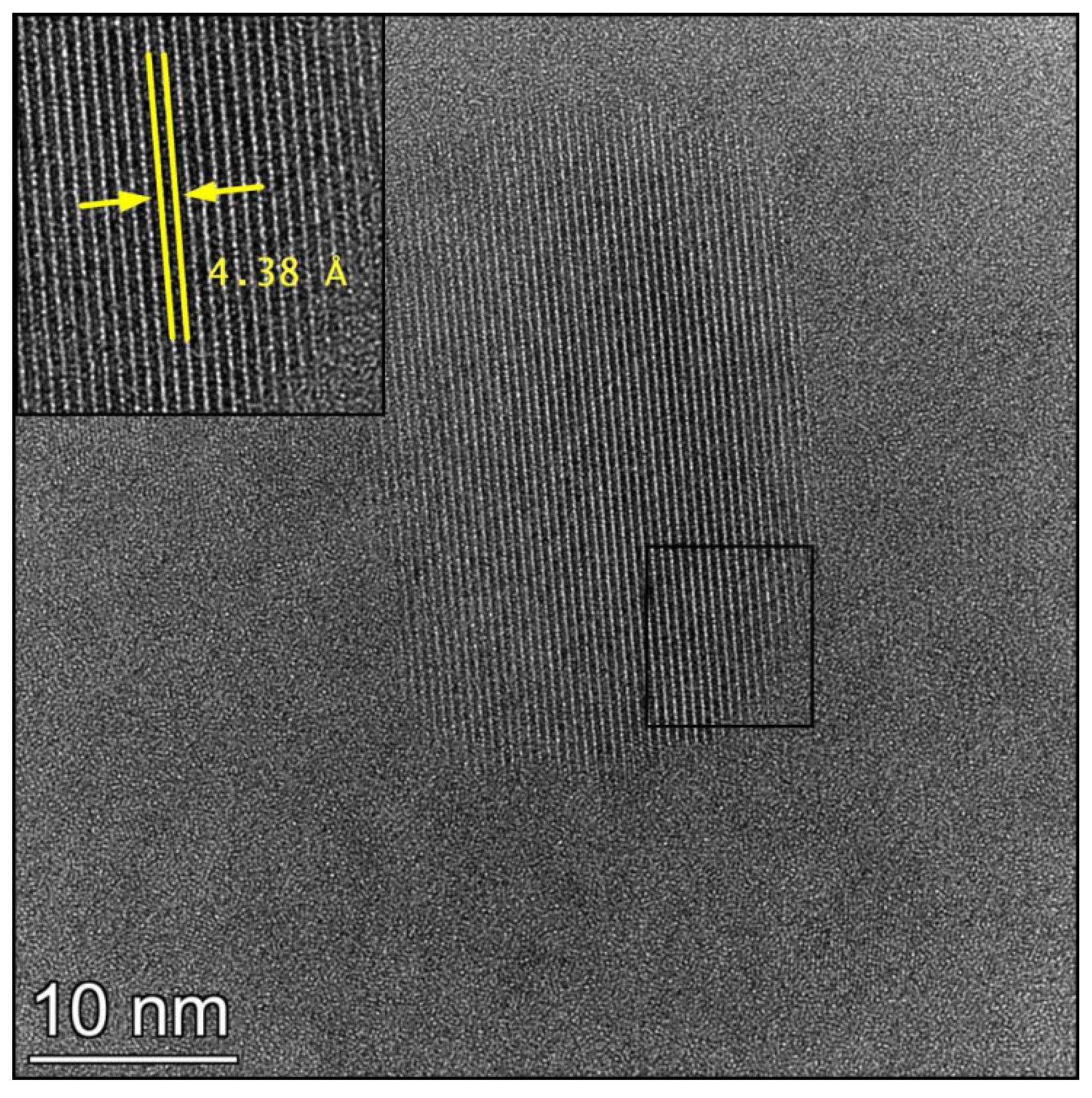
The hydrogenation performance of fully disordered materials, such as metallic glasses, can be markedly enhanced by the application of severe shear deformation via HPT. Metallic glasses are generally produced through non-equilibrium processing routes, including melt spinning and copper mold casting, which suppress crystallization and preserve their amorphous structure [127,128]. HPT following melt-spinning can induce structural order in an amorphous Mg80Ce10Ni10 alloy [80]. Although both the as-spun ribbon and HPT-processed samples retain their amorphous structure, the hydrogen absorption rate increases significantly from 1.61 wt%/h for the ribbon to 2.60 wt%/h for the HPT-processed disk, due to the effective modulation of the degree of structural order in the amorphous matrix by HPT. Révész et al. demonstrated that the addition of MWCNTs to the highly stable melt-spun Mg65Ni20Cu5Y10 amorphous alloy during HPT processing for five revolutions (N = 5) leads to the formation of deformation-induced Mg2Ni nanocrystals of a few nanometers in size embedded in the amorphous matrix, see Figure 10 [129]. At the same time, the presence of lattice fringes associated with both tubular and onion-like carbon nanostructures confirmed the structural integrity and morphological stability of the MWCNTs during HPT processing. The electrochemical hydrogen absorption capacity of the system increases substantially, confirming that the rigid nanotubes play a crucial role in enhancing hydrogen uptake in Mg-based metallic glasses subjected to SPD [129].
ECAP processing at an elevated temperature (300 °C) resulted in microstructure refinement in commercial AZ31 Mg-based alloy coupled with the absorption of 6.6 wt% hydrogen as the maximum capacity [130]. The absence of hysteresis during PCI measurements was attributed to the high density of defects generated during plastic deformation by ECAP. In addition to introducing lattice defects and refining the microstructure, ECAP often induces a preferential (001) texture in Mg, as reported by Fruchart et al. [131]. Mathematical simulations have demonstrated that the dislocation network surrounding the hydride nucleus plays a dual role during hydrogenation, particularly when hydride precipitation is accompanied by high levels of stress and strain around the interface of the newly formed phase. The addition of mischmetal to Mg promotes the formation of abundant lattice defect, multiple precipitates and refines the microstructure to the nanometric scale during ECAP processing, thereby increasing the density of grain boundaries available for hydrogen diffusion and providing a greater number of active sites for hydrogen absorption [132].
Other additives, such as various carbonaceous materials, have also been investigated in combination with ECAP processing. Huang et al. studied the hydrogen storage performance of commercial AZ31 Mg alloys combined with different carbon allotropes and processed using various SPD techniques, including ECAP [133]. Their results showed that carbon black effectively enhances grain refinement during deformation, leading to faster hydrogen sorption kinetics and a maximum hydrogen storage capacity of 6.7 wt%. Outstanding hydrogen storage capacities can be achieved in commercial ZK60 alloy subjected to ECAP processing at 300 °C for 12 passes when it is further milled with 5 wt% graphene or 5 wt% MWCNTs [134]. The ZK60 alloy with 5 wt% MWCNTs and 5 wt% graphene has maximum hydrogen capacities of 7.21 wt% and 7.28 wt%, respectively. Furthermore, the incorporation of graphene and MWCNTs significantly lowers the hydrogenation temperature, facilitating hydrogen uptake and improving the overall hydrogen storage performance. When ECAP-deformed ZK60 alloy powder was co-catalyzed with activated carbon and different transition metals, such as Ag, Pd, Co, Ti and V, a synergetic effect on the hydrogenation characteristics takes place [135].
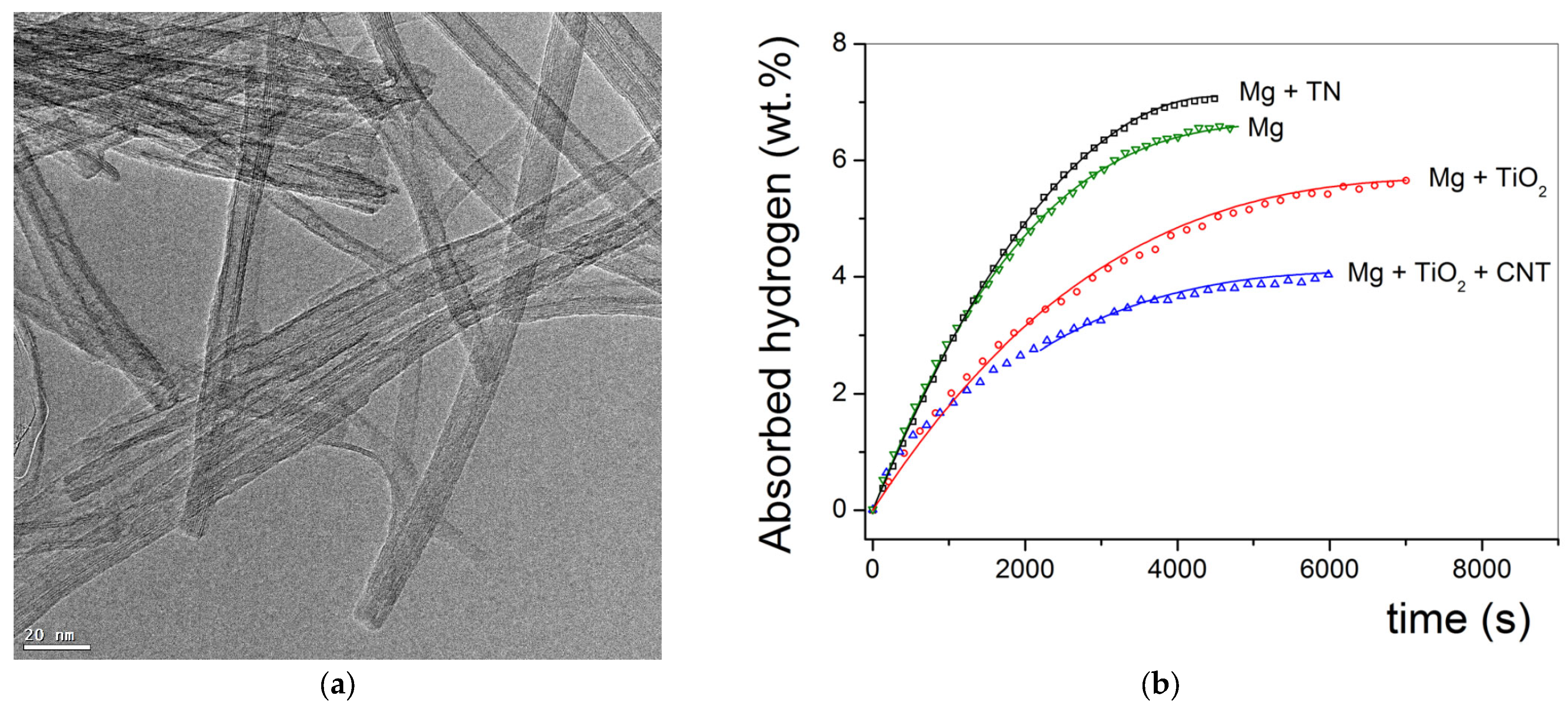
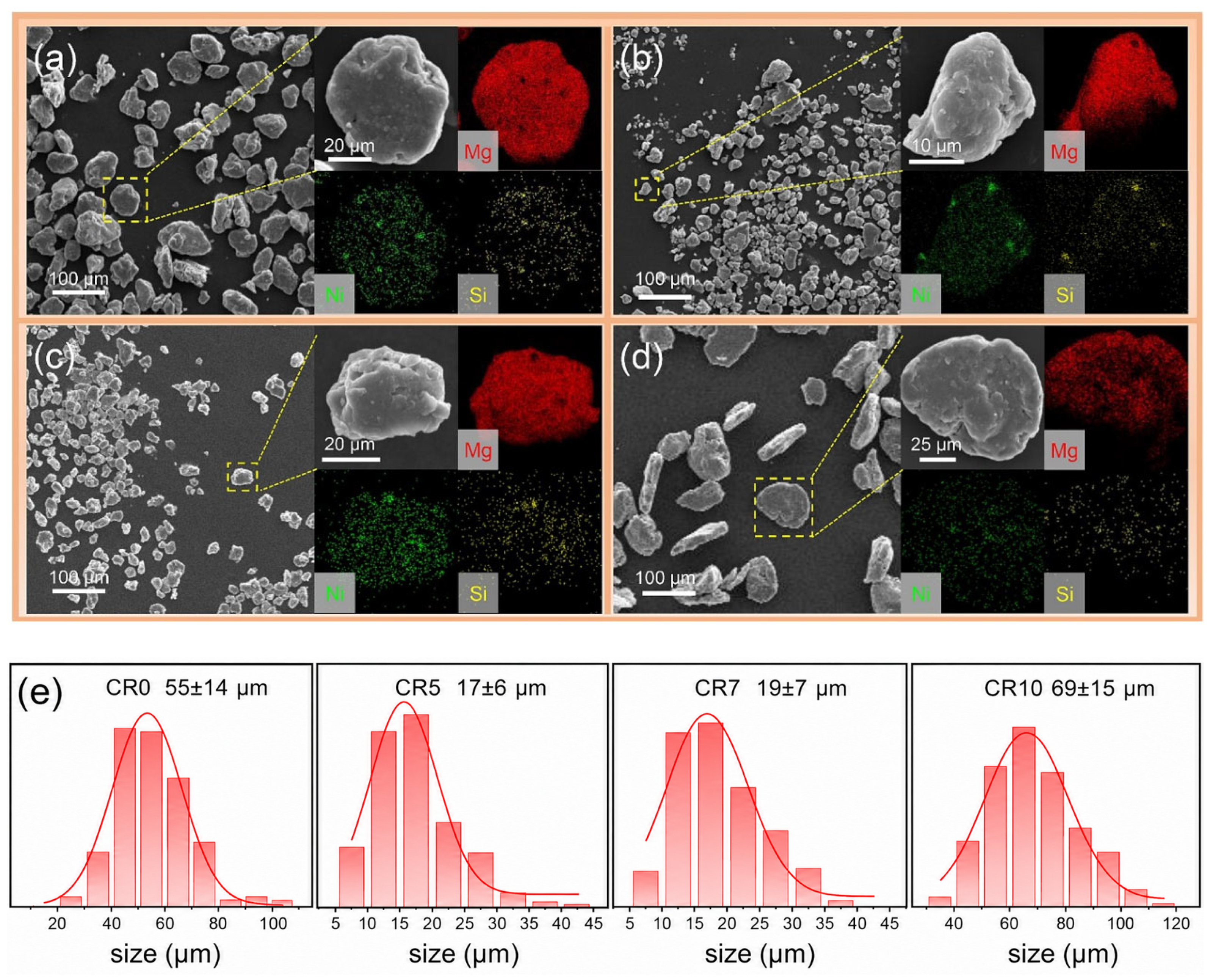
In a recent study, a combined HEBM+ECAP processing route was applied to nanocrystalline magnesium catalyzed with TiO2 powder, TiO2 combined with MWCNTs and titanate nanotube. A TEM image of the titanate nanotube sections is shown in Figure 11a [136]. It was found that a remarkable (002) texture develops in the hexagonal Mg lattice structure for all the investigated composites. The average dislocation density reaches 1014 m−2, indicating SPD and substantial defect generation. Among the investigated materials, the composite containing titanate nanotubes exhibited the best overall hydrogen storage performance, achieving a maximum hydrogen storage capacity of 7.1 wt% (Figure 11b). As also shown in Figure 11b, the hydrogen absorption curves can be accurately described using the contracting-volume model. Analysis of the fitted kinetic parameters confirmed that the titanate nanotube additive provides the most favorable hydrogenation behavior, including the highest hydride-front propagation velocity and the fastest absorption kinetics among the investigated composites [136]. The hydrogen storage performance of ECAP-deformed Mg98.5Y1Zn0.5 alloy and the underlying mechanisms were systematically investigated using a combination of experimental techniques and first-principles calculations [137]. The computational results revealed that Y doping not only lowers the activation energy for H2 dissociation on the Mg surface but also reduces the energy required for hydrogen removal from the MgH2 bulk phase. These effects facilitate both hydrogen absorption and desorption processes, thereby accounting for the excellent hydrogen sorption kinetics exhibited by the alloy.
Room-temperature forging of compacted powders represents a straightforward method for enhancing the hydrogen sorption performance of Mg–Ni compounds. While the imposed true strain is lower than that achievable by HPT, FF offers significant advantages in terms of safety, economic viability, and suitability for large-scale industrial production [138]. Besides microstructural refinement, FF is capable of inducing solid state reactions in Mg-based hydrogen storage materials. Skryabina et al. reported that increasing the forging temperature above a threshold value of 400 °C results in the complete transformation of the Mg+Ni powder mixture into a Mg+Mg2Ni bulk alloy [139]. Hydrogen absorption below the threshold temperature is primarily governed by the formation of defects and cracks within the Mg particles, which enhance hydrogen diffusion into the bulk material. In contrast, forging at elevated temperatures promotes the formation of Mg2Ni nanocrystals that act as catalysts, thereby improving the hydrogen sorption performance [140]. The most favorable hydrogen sorption performance was achieved for the Mg–22 wt% Ni alloy after annealing followed by fast forging deformation. This processing route promotes the formation of cracks, combining with the formation of fine Mg2Ni nanocrystals, and textured Mg grains, which collectively enhance hydrogen storage behavior [141]. In contrast to HPT-processed alloys, FF provides a more homogeneous distribution of plastic deformation throughout the material, as confirmed by hardness measurements performed along the diameter of the f Mg–22 wt.% Ni alloy [142]. These findings confirm that the FF technique is an efficient SPD route enabling mass production of hydrogen storage materials.
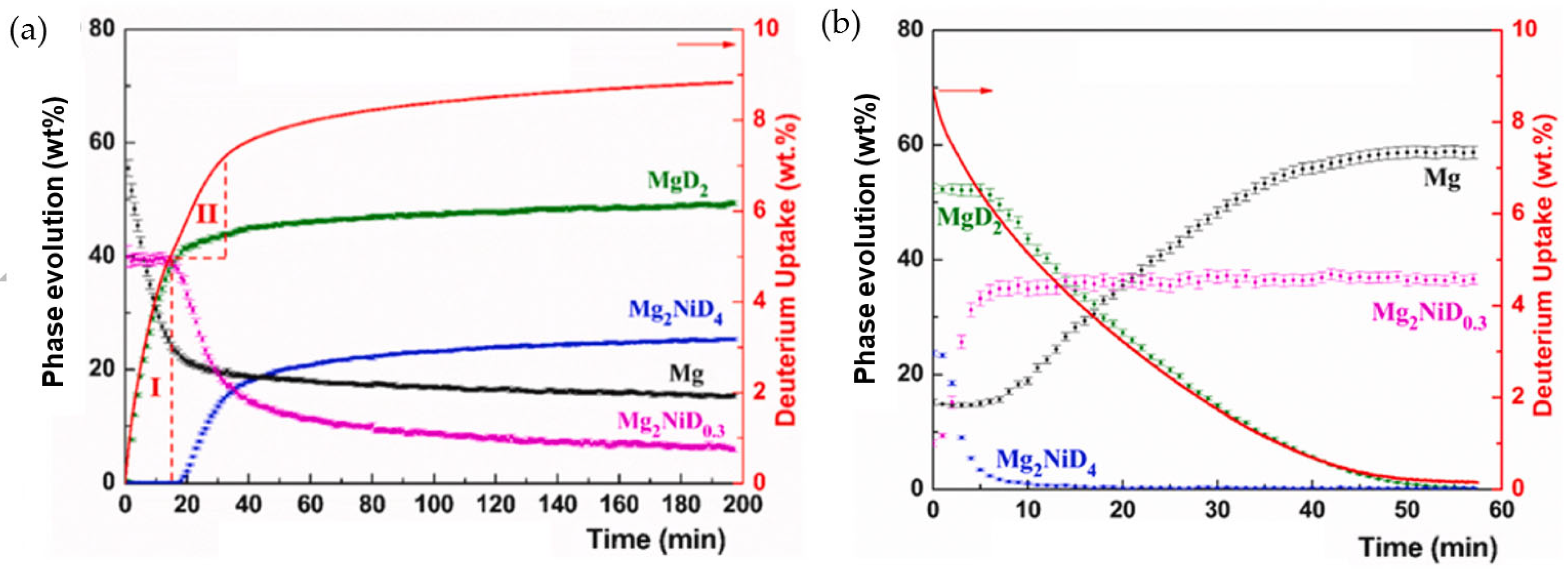
Combined in situ neutron diffraction with microstructural and kinetic analyses were carried out by Wen et al. to elucidate the sorption mechanism of deuterium (D2) in a Mg–Mg2Ni composite processed by FF [143]. The first absorption involves the rapid formation of Mg2NiD0.3−x followed by the simultaneous formation of MgD2 and Mg2NiD4, as presented in Figure 12a. Kinetic modeling indicates that the nucleation of the MgD2 phase occurs at the Mg–Mg2NiD0.3−x interfaces, while the formation of Mg2NiD4 is kinetically controlled by deuterium diffusion through growing Mg2NiD4 plates. During desorption, deuterium release commences by rapid decomposition of Mg2NiD4 into Mg2NiD0.3−x, followed by slower MgD2 decomposition into Mg, see Figure 12b [143].
A recently developed SPD method, termed accumulative fold-forging (AFF), involving repetitive stacking and forging of metallic layers, has been employed to fabricate nanostructured Mg–Ni layered composites [144]. Since Mg does not possess sufficient ductility to be processed in foil form, it was instead used as a powder, while Ni foil served as a supporting component during the successive steps of the AFF processing. Repeated AFF steps for up to 20 cycles generated an ultrafine multilayered composite structure containing more than one million individual layers. This highly refined architecture resulted in a substantial enhancement of the hydrogen storage capacity of the Mg–Ni composite, primarily due to the formation of a large density of nanometric interfaces. In addition, the hydrogen desorption characteristics could be tailored by adjusting the Mg:Ni stoichiometric ratio [145].
Hydrogen storage materials typically require an activation procedure to disrupt the passivation layer that forms on their surface, often despite careful material preparation. One of the primary advantages of intensive cold rolling is its ability to accelerate the initial hydrogenation process by significantly reducing, or even virtually eliminating, the activation time [146]. Another major motivation for employing CR is its potential for straightforward and cost-effective scale-up, making it more attractive for industrial applications than many other SPD techniques. El-Eskandarany et al. showed that the hydrogenation cyclic stability of as-received solid waste Mg-rods can improve significantly when it is cold-rolled 200 times due to the increased amount of lattice imperfections [147]. Besides refining the microstructure of the primary Mg phase, CR has also been shown to promote the fragmentation and homogeneous dispersion of secondary-phase particles, such as the MgZn2Ce intermetallic phase in ZK60 Mg alloy containing 2.5 wt.% mischmetal [148].
A combination of ECAP and CR was also applied to produce highly deformed ZK60+2.5 wt.% mischmetal alloys [149]. The maximum capacity during H2 uptake as well as the sorption kinetics are significantly enhanced when rolling is performed at liquid nitrogen temperature, owing to the increased surface-area-to-volume ratio, higher defect density, and larger number of interfaces generated during cryogenic deformation. The work of Parviz et al. provides a novel strategy for the design and development of high-performance hydrogen storage systems through the combined application of ECAP and CR. This approach exploits the synergistic effects of in situ formed NiO, MgO, and Mo catalytic phases within a layered and porous Mg-based composite structure, resulting in enhanced hydrogen storage performance [150]. Mg93Ni5Si2 alloys with varying cold rolling mild deformations (0%, 5%, 7%, 10%) and not intensive deformation have also been studied by Sun et al. [151], which is worth mentioning here. Notably, the CR-5% specimen exhibited the best hydrogenation performance, retaining 86% of its initial hydrogen storage capacity after 50 absorption–desorption cycles. This superior cycling stability was attributed to the increased brittleness of the alloy, which facilitated particle refinement (Figure 13), increased the density of phase interfaces, and promoted a more homogeneous dispersion of the Mg2Ni and Mg2Ni3Si catalytic phases. These microstructural features collectively enhanced hydrogen diffusion and accelerated MgH2 nucleation. In contrast, excessive deformation (CR-10%) resulted in the development of a pronounced basal texture and the detachment of second-phase particles, leading to a deterioration of the hydrogen storage properties due to the loss of catalytically active interfaces [151]. The influence of low alloying and plastic deformation by CR on the microstructure and hydrogen storage kinetics of Mg100−xMnx-0.5Al alloys (x = 0, 0.5, 1, 2) were investigated in detail by Li et al. [152]. The co-addition of Mn and Al was found to introduce second-phase particles, like Al8Mn5 and Mn, which effectively pin grain boundaries and dislocations, facilitate hydrogen diffusion, and act as heterogeneous nucleation sites for Mg to promote dehydrogenation kinetics.
The addition of 1.5 wt.% mischmetal (Mm) to the ZK60 alloy promotes the formation of high-melting-point intermetallic compounds, thereby enhancing the thermal stability of the alloy [153]. Silva and co-workers reported that friction stir processing (FSP) effectively refines the microstructure through the formation of recrystallized grains and the fragmentation and dispersion of intermetallic compounds. As a result of these microstructural modifications, the FSP-treated alloy exhibits improved hydrogen storage performance. A comprehensive study by Li et al. investigated the relationship between the mechanical properties and hydrogen storage behavior of various Mg-based alloys processed by FSP [154]. The results revealed that the maximum hydrogen absorption and desorption rates are positively correlated with strength and hardness, while showing a negative correlation with elongation. Furthermore, FSP was found to induce significant grain refinement, generate a high density of dislocations, increase the specific surface area, and promote the formation of microcracks. These microstructural features facilitate hydrogen diffusion and accelerate hydrogen sorption kinetics.
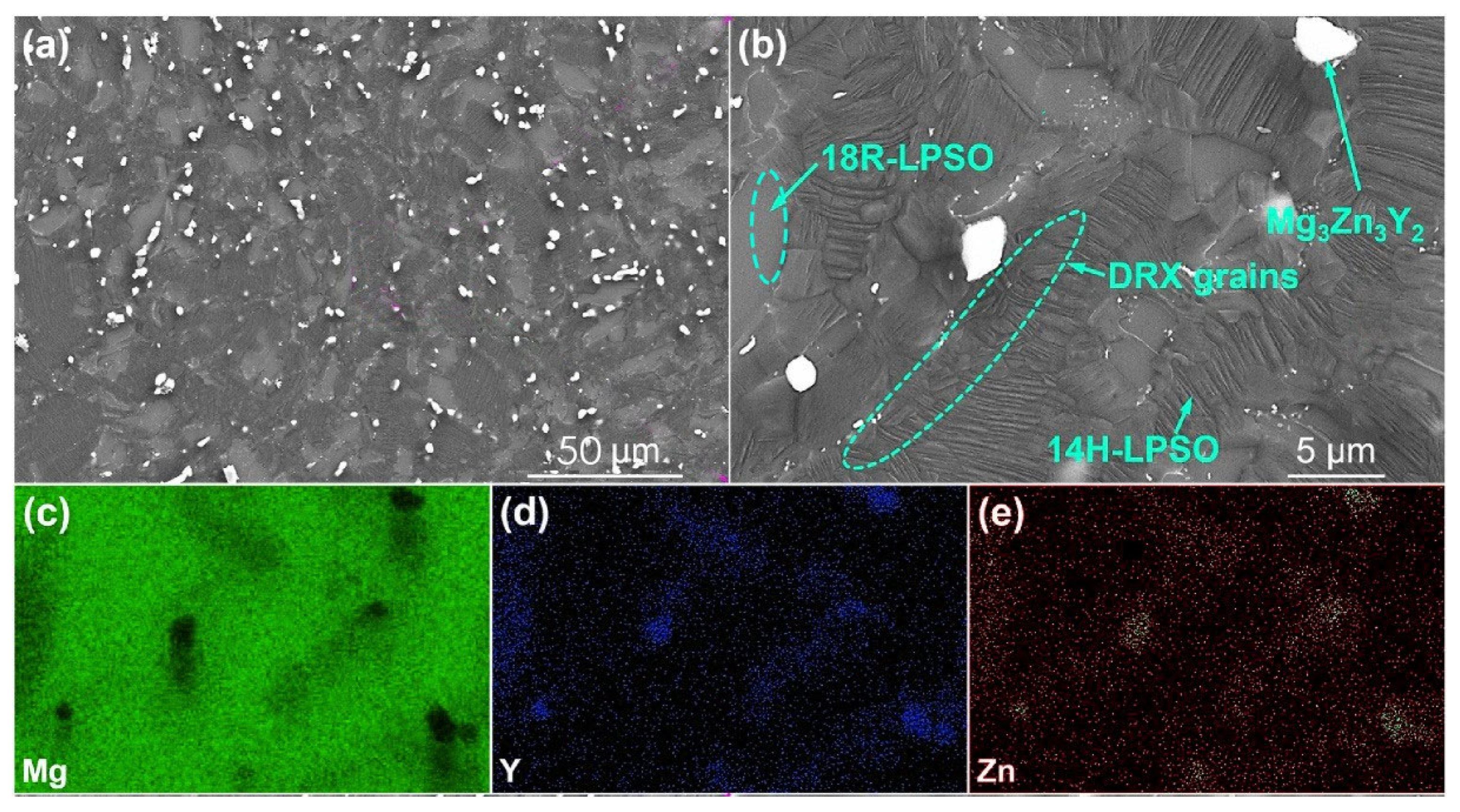
Mechanical processing of mold-cast near-eutectic Mg–Mg2Ni alloys stored in air has been shown to yield outstanding hydrogen sorption properties despite the surface oxidation of the as-prepared flakes [155]. These alloys exhibit excellent long-term cycling stability, with no noticeable degradation in hydrogen storage capacity observed over 1000 absorption–desorption cycles, highlighting their strong potential for large-scale applications. Another scalable processing technique, accumulative roll bonding (ARB), has been applied to pre-milled 2Mg–Fe powder mixtures to enhance their hydrogen storage performance [156]. In a separate study, a combination of solid-solution treatment and hot extrusion, although not SPD, was employed to tailor the hydrogen storage properties of a Mg96Y2Zn2 alloy [157]. The observed improvement in hydrogen storage capacity was directly associated with the increased formation of a long-period stacking-ordered (LPSO) structure (Figure 14). Notably, the volume fraction of the LPSO phase was found to exert a more pronounced influence on hydrogen storage performance than microstructural refinement alone.

4. Comparative Discussion of the Reviewed Systems

Although the individual hydrogen storage materials have been discussed separately in the preceding sections, it is useful to compare their overall response to SPD. Direct comparison between published studies is complicated by differences in alloy composition, processing parameters, hydrogenation conditions and testing methodologies. Nevertheless, the representative data summarized in Table 2 provide a qualitative comparison of the principal improvements achieved by the different SPD–material combinations and help identify the systems with the greatest potential for practical hydrogen storage applications.
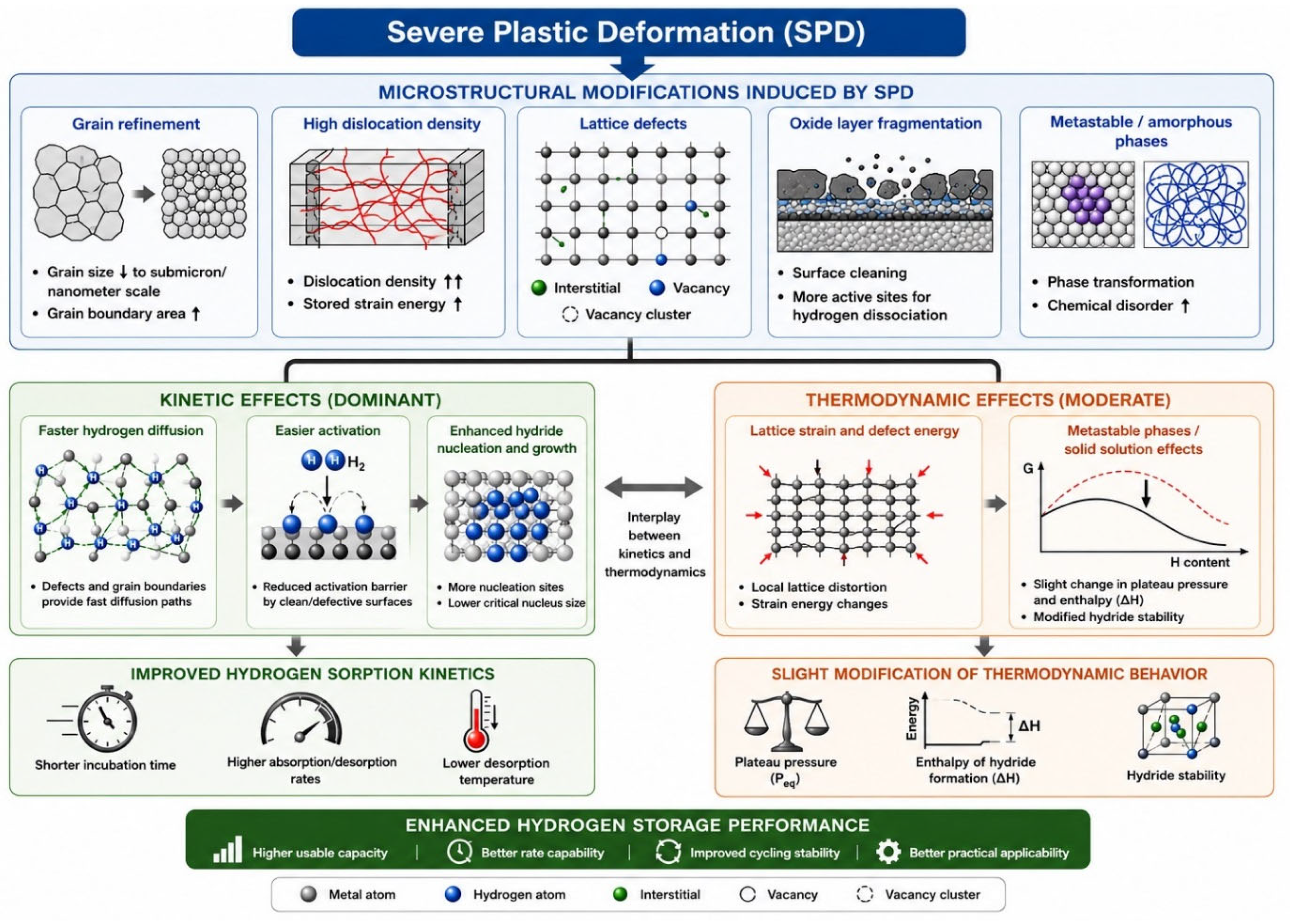
SPD primarily improves the kinetics of hydrogen absorption and desorption rather than fundamentally altering the thermodynamic properties of hydrogen storage materials [21]. The accelerated sorption kinetics originate from the introduction of ultrafine grains, high densities of grain boundaries, dislocations and vacancies, which provide fast diffusion pathways for hydrogen and increase the number of preferential nucleation sites for hydride formation [26]. In addition, fragmentation of surface oxide layers facilitates the initial activation of many intermetallic compounds, particularly TiFe- and Ti–V-based alloys, substantially reducing incubation times during the first hydrogenation cycle.
In contrast, the equilibrium thermodynamic properties, including hydrogen equilibrium pressure, plateau pressure and the enthalpy of hydride formation, are governed primarily by the chemical composition and crystal structure of the hydrogen storage material [21]. Consequently, SPD alone generally produces only modest changes in these parameters. Small variations in equilibrium pressure or hydride stability have occasionally been reported and are commonly attributed to lattice strain, grain-boundary energy, defect-induced elastic distortions or the formation of metastable phases generated during SPD processing [109]. The stabilization of the high-pressure hydride phase by SPD promotes a significant decrease in dehydrogenation temperature in MgH2 [70]. Nevertheless, these effects are usually significantly smaller than the kinetic improvements and often disappear after thermal recovery or prolonged hydrogen cycling. Although the influence of SPD on thermodynamic properties is generally limited, indirect modifications may arise through the stabilization of non-equilibrium microstructures or metastable phases that are inaccessible by conventional processing methods. Such effects have been reported for several nanostructured alloys and high-entropy alloys, where severe plastic deformation may slightly modify the hydrogen absorption enthalpy or equilibrium pressure by altering the local atomic environment [84]. Future studies combining advanced thermodynamic modeling with in situ experimental characterization are expected to clarify the complex interplay between microstructure, defect structure and hydrogen storage thermodynamics. The schematic image in Figure 15 summarizes the discussed effects of SPD on the hydrogen storage kinetics and thermodynamics.
Despite the significant improvements in hydrogen storage performance achieved by SPD, the large-scale implementation of these techniques remains one of the major challenges for their industrial application [29]. Among the available SPD methods, HPT has become the most widely employed technique for fundamental studies because it enables the introduction of extremely large plastic strains, leading to exceptional grain refinement and high densities of lattice defects [33]. These characteristics make HPT an invaluable research tool for investigating the relationship between microstructure and hydrogen storage behavior [35]. However, its practical application is currently restricted by the relatively small specimen dimensions, discontinuous processing, limited throughput, and the requirement for specialized high-pressure equipment, all of which result in relatively high processing costs and restrict large-scale production.
In contrast, alternative SPD techniques offer considerably better prospects for industrial implementation. For example, ECAP allows the processing of significantly larger billets while maintaining the original cross-sectional dimensions, enabling multiple deformation passes and making continuous or semicontinuous production feasible [39]. Similarly, FF, AFF, and intensive CR are based on well-established metal-forming technologies that are already widely used in industrial manufacturing. These techniques require less specialized equipment, provide substantially higher throughput, and can be more readily integrated into existing production lines, making them attractive candidates for large-scale processing of hydrogen storage materials [25]. Nevertheless, although these methods generally produce somewhat lower accumulated strains than HPT, they still provide sufficient grain refinement and defect generation to considerably improve hydrogen sorption performance in many material systems.
Another important consideration is the influence of the degree of plastic deformation itself. As reviewed in this study, several research have demonstrated that increasing the imposed strain through additional HPT revolutions, ECAP passes or repeated forging generally enhances grain refinement and increases the density of lattice defects, resulting in faster hydrogen absorption and desorption kinetics. However, these improvements do not increase indefinitely. Beyond a certain deformation level, the microstructure approaches a saturation state, where further processing produces only marginal additional refinement. Excessive defect densities may even become detrimental by promoting hydrogen trapping, increasing residual stresses or accelerating recovery during subsequent thermal exposure. Therefore, optimizing the amount of plastic deformation is as important as selecting the appropriate SPD technique, and future studies should aim to establish quantitative relationships between imposed strain, microstructural evolution and long-term hydrogen storage performance.
Besides scalability, the long-term stability of SPD-processed materials is another critical factor determining their practical applicability. While the ultrafine-grained microstructures and high defect densities introduced by SPD substantially enhance hydrogen sorption kinetics, these non-equilibrium microstructures may gradually evolve during repeated hydrogen absorption/desorption cycling. Recovery and grain growth can reduce the density of lattice defects and grain boundaries, thereby diminishing the beneficial effects of SPD. Furthermore, repeated lattice expansion and contraction associated with hydride formation may promote crack initiation, particle pulverization, surface oxidation, and local redistribution of catalyst particles, all of which may adversely affect hydrogen storage performance during long-term operation [24].
Nevertheless, numerous studies reviewed in this paper demonstrate that SPD-processed materials generally exhibit excellent cyclic stability, maintaining their hydrogen storage capacity and improved kinetics over hundreds of cycles [122]. This remarkable stability indicates that, despite some degree of microstructural recovery, a significant fraction of the refined grain structure and beneficial lattice defects remains preserved throughout extended cycling [116]. The long-term stability of SPD-processed materials can be further enhanced by optimizing processing parameters and alloy composition. Careful control of the imposed strain, grain size and defect density is essential to maximize hydrogen diffusion while avoiding excessive defect concentrations that may promote hydrogen trapping or accelerate recovery processes. In addition, alloying strategies, catalytic additives and stable secondary phases may effectively suppress grain coarsening, stabilize the ultrafine-grained microstructure and improve resistance to cyclic degradation. Such approaches are expected to play an increasingly important role in the development of durable hydrogen storage materials suitable for practical applications.
From an economic perspective, the overall feasibility of SPD processing depends not only on the processing costs but also on the balance between the performance improvements achieved and the added manufacturing complexity. Enhanced hydrogen absorption kinetics, easier activation, reduced operating temperatures, and improved cyclic durability may compensate for the additional processing costs. However, for large-scale stationary hydrogen storage, further optimization of SPD processing routes will be required to reduce production costs while maintaining the beneficial microstructural features generated during deformation [158]. The combination of optimized processing parameters, improved process automation, and integration with conventional metallurgical manufacturing routes is expected to facilitate the industrial adoption of SPD-processed hydrogen storage materials. Continued efforts toward scalable processing technologies will be essential for translating the outstanding laboratory-scale performance of SPD materials into practical hydrogen energy systems.

5. Conclusions and Outlook

Hydrogen is expected to play a prominent role in a sustainable energy future owing to its exceptionally high gravimetric energy density. However, one of the major challenges of the emerging hydrogen economy remains the development of efficient, safe, and practical hydrogen storage systems.
  • Key findings
Despite the wide variety of materials capable of storing hydrogen, their large-scale application is often limited by unfavorable kinetics, thermodynamic constraints, or poor reversibility. Consequently, considerable research efforts have been devoted in recent years to the development of strategies for enhancing hydrogen storage performance. These efforts have led to the application and further development of advanced SPD techniques for the synthesis and design of novel promising hydrogen storage materials.
  • Major outcomes
This paper presents a review of the latest advances in ongoing fundamental research on the hydrogen storage performance of a broad range of materials processed by various severe plastic deformation methods. In general, SPD techniques improve hydrogen absorption/desorption kinetics by promoting grain refinement and introducing high-angle grain boundaries, and lattice defects, as demonstrated in TiFe-based intermetallics, Ti-V-based alloys, Ti-Mg-based alloys, LaNi5, Nb, Pd, high-entropy alloys and Mg-based materials. Moreover, SPD can be used as a synthesis route to produce hydrogen storage materials with appropriate thermodynamics for low-temperature reversible storage.
  • Future perspectives
Despite the significant progress achieved to date, further improvements are still necessary before the materials and technologies presented in this study can be widely implemented in practical applications. Although the available laboratory studies demonstrate excellent cyclic stability, systematic investigations under realistic service conditions, including variable temperatures, impurity-containing hydrogen, extended cycling over several hundred cycles, and large-scale prototype operation, remain limited. Addressing these issues represents an important prerequisite for the commercial deployment of SPD-processed hydrogen storage materials. In this context, the strategic combination of different deformation techniques may offer a promising approach in the coming years.

Author Contributions

Writing, editing, Á.R.; writing, editing, K.E. All authors have read and agreed to the published version of the manuscript.

Funding

The authors acknowledge the support of the National Research, Development and Innovation Fund of Hungary under project No. NKFIH-ADVANCED-153100, the Japan Light Metal Educational Foundation, the Magnesium Research Center of Kumamoto University, and the Japan Science and Technology Agency (ASPIRE Project JPMJAP2332).

Data Availability Statement

No new data were created or analyzed in this study. Data sharing is not applicable to this article.

Conflicts of Interest

The authors declare no conflicts of interest. The funders had no role in the design of the study; in the collection, analyses, or interpretation of data; in the writing of the manuscript; or in the decision to publish the results.

References

  1. International Energy Agency. Key World Energy Statistics. 2021. Available online: https://iea.blob.core.windows.net/assets/52f66a88-0b63-4ad2-94a5-29d36e864b82/KeyWorldEnergyStatistics2021.pdf (accessed on 23 June 2026).
  2. Mulky, L.; Srivastava, S.; Lakshmi, T.; Sandadi, E.R.; Gour, S.; Thomas, N.A.; Shanmuga Priya, S.; Sudhakar, K. An Overview of Hydrogen Storage Technologies—Key Challenges and Opportunities. Mater. Chem. Phys. 2024, 325, 129710. [Google Scholar] [CrossRef]
  3. Abe, J.; Popoola, P.; Ajenifuja, E.; Popoola, O. Hydrogen Energy, Economy and Storage: Review and Recommendation. Int. J. Hydrogen Energy 2019, 44, 15072–15086. [Google Scholar] [CrossRef]
  4. Abdalla, A.M.; Hossain, S.; Nisfindy, O.B.; Azad, A.T.; Dawood, M.; Azad, A.K. Hydrogen Production, Storage, Transportation and Key Challenges with Applications: A Review. Energy Convers. Manag. 2018, 165, 602–627. [Google Scholar] [CrossRef]
  5. Ahmad, S.; Ullah, A.; Samreen, A.; Qasim, M.; Nawaz, K.; Ahmad, W.; Alnaser, A.; Kannan, A.M.; Egilmez, M. Hydrogen Production, Storage, Transportation and Utilization for Energy Sector: A Current Status Review. J. Energy Storage 2024, 101, 113733. [Google Scholar] [CrossRef]
  6. Zhang, L.; Jia, C.; Bai, F.; Wang, W.; An, S.; Zhao, K.; Li, Z.; Li, J.; Sun, H. A Comprehensive Review of the Promising Clean Energy Carrier: Hydrogen Production, Transportation, Storage, and Utilization (HPTSU) Technologies. Fuel 2024, 355, 129455. [Google Scholar] [CrossRef]
  7. Dewangan, S.K.; Mohan, M.; Kumar, V.; Sharma, A.; Ahn, B. A Comprehensive Review of the Prospects for Future Hydrogen Storage in Materials-Application and Outstanding Issues. Int. J. Energy Res. 2022, 46, 16150–16177. [Google Scholar] [CrossRef]
  8. Zhang, T.; Uratani, J.; Huang, Y.; Xu, L.; Griffiths, S.; Ding, Y. Hydrogen Liquefaction and Storage: Recent Progress and Perspectives. Renew. Sustain. Energy Rev. 2023, 176, 113204. [Google Scholar] [CrossRef]
  9. Chen, Z.; Ma, Z.; Zheng, J.; Li, X.; Akiba, E.; Li, H.-W. Perspectives and Challenges of Hydrogen Storage in Solid-State Hydrides. Chin. J. Chem. Eng. 2021, 29, 1–12. [Google Scholar] [CrossRef]
  10. Chen, K.; Lau, M.Y.; Luo, X.; Huang, J.; Ouyang, L.; Yang, X.-S. Research Progress in Solid-State Hydrogen Storage Alloys: A Review. J. Mater. Sci. Technol. 2026, 246, 256–289. [Google Scholar] [CrossRef]
  11. Meda, U.S.; Raikar, O.M. Advances and Perspectives in Material-Based Hydrogen Storage Technologies Considering Materials Challenges and Future Directions. Renew. Sustain. Energy Rev. 2026, 233, 116844. [Google Scholar] [CrossRef]
  12. Schlapbach, L.; Züttel, A. Hydrogen-Storage Materials for Mobile Applications. Nature 2001, 414, 353–358. [Google Scholar] [CrossRef] [PubMed]
  13. Altaf, M.; Demirci, U.B.; Haldar, A.K. Review of Solid-State Hydrogen Storage: Materials Categorisation, Recent Developments, Challenges and Industrial Perspectives. Energy Rep. 2025, 13, 5746–5772. [Google Scholar] [CrossRef]
  14. Le, T.H.; Kim, M.P.; Park, C.H.; Tran, Q.N. Recent Developments in Materials for Physical Hydrogen Storage: A Review. Materials 2024, 17, 666. [Google Scholar] [CrossRef] [PubMed]
  15. Klopčič, N.; Grimmer, I.; Winkler, F.; Sartory, M.; Trattner, A. A Review on Metal Hydride Materials for Hydrogen Storage. J. Energy Storage 2023, 72, 108456. [Google Scholar] [CrossRef]
  16. Drawer, C.; Lange, J.; Kaltschmitt, M. Metal Hydrides for Hydrogen Storage—Identification and Evaluation of Stationary and Transportation Applications. J. Energy Storage 2024, 77, 109988. [Google Scholar] [CrossRef]
  17. Scarpati, G.; Frasci, E.; Di Ilio, G.; Jannelli, E. A Comprehensive Review on Metal Hydrides-Based Hydrogen Storage Systems for Mobile Applications. J. Energy Storage 2024, 102, 113934. [Google Scholar] [CrossRef]
  18. Lin, H.J.; Lu, Y.S.; Zhang, L.T.; Liu, H.Z.; Edalati, K.; Révész, Á. Recent Advances in Metastable Alloys for Hydrogen Storage: A Review. Rare Met. 2022, 41, 1797–1817. [Google Scholar] [CrossRef]
  19. Bishnoi, A.; Pati, S.; Sharma, P. Architectural Design of Metal Hydrides to Improve the Hydrogen Storage Characteristics. J. Power Sources 2024, 608, 234609. [Google Scholar] [CrossRef]
  20. Pasquini, L. Design of Nanomaterials for Hydrogen storage. Energies 2020, 13, 3503. [Google Scholar] [CrossRef]
  21. Edalati, K.; Akiba, E.; Botta, W.J.; Estrin, Y.; Floriano, R.; Fruchart, D.; Grosdidier, T.; Horita, Z.; Huot, J.; Li, H.W.; et al. Impact of Severe Plastic Deformation on Kinetics and Thermodynamics of Hydrogen Storage in Magnesium and Its Alloys. J. Mater. Sci. Technol. 2023, 146, 221–239. [Google Scholar] [CrossRef]
  22. Suryanarayana, C. Mechanical Alloying and Milling. Prog. Mater. Sci. 2001, 46, 1–184. [Google Scholar] [CrossRef]
  23. Cao, Y.; Dong, X.; Zhu, Y.; Huang, T.; Jiang, B.; Zhang, C. Recent Advances in Manufacture and Application of Mg/Mg Alloy Powder: A Comprehensive Review. J. Mater. Sci. Technol. 2026, 263, 140–155. [Google Scholar] [CrossRef]
  24. Ding, X.; Chen, R.; Zhang, J.; Cao, W.; Su, Y.; Guo, J. Recent Progress on Enhancing the Hydrogen Storage Properties of Mg-Based Materials via Fabricating Nanostructures: A Critical Review. J. Alloys Compd. 2022, 897, 163137. [Google Scholar] [CrossRef]
  25. Edalati, K. Superfunctional Materials by Ultra-Severe Plastic Deformation. Materials 2023, 16, 587. [Google Scholar] [CrossRef] [PubMed]
  26. Révész, Á.; Gajdics, M. The Effect of Severe Plastic Deformation on the Hydrogen Storage Properties of Metal Hydrides. Mater. Trans. 2023, 64, 1387–1400. [Google Scholar] [CrossRef]
  27. Botta, W.J.; Zepon, G.; Ishikawa, T.T.; Leiva, D.R. Metallurgical Processing of Mg Alloys and MgH2 for Hydrogen Storage. J. Alloys Compd. B 2022, 897, 162798. [Google Scholar] [CrossRef]
  28. Vijayananth, K.; Pudhupalayam Muthukutti, G.; Naher, S. Enhancing Hydrogen Storage in Mg Alloys: Role of Alloying, Reinforcements, and Severe Plastic Deformation Techniques. Next Mater. 2026, 11, 101741. [Google Scholar] [CrossRef]
  29. Valiev, R.Z.; Estrin, Y.; Horita, Z.; Langdon, T.G.; Zehetbauer, M.J.; Zhu, Y. Producing Bulk Ultrafine-Grained Materials by Severe Plastic Deformation: Ten Years Later. JOM 2016, 68, 1216–1226. [Google Scholar] [CrossRef]
  30. He, J.; Tian, J.; Hou, X.; Zhao, Y.; Li, W.; Huang, B.; Liu, H. Dehydrogenation Thermodynamic and Kinetic Challenges of Mg-Ni-Based Alloy. Rare Met. 2026, 45, e70208. [Google Scholar] [CrossRef]
  31. Mengistie, T.S.; Lamb, K.E.; Zhong, Y.L.; Gray, E.M. Approaches for Air Stability, Impurity Resistance and Safe Containment of Metal Hydrides. Int. J. Hydrogen Energy 2025, 153, 150192. [Google Scholar] [CrossRef]
  32. Valiev, R.Z.; Islamgaliev, R.K.; Alexandrov, I.V. Bulk Nanostructured Materials from Severe Plastic Deformation. Prog. Mater. Sci. 2000, 45, 103–189. [Google Scholar] [CrossRef]
  33. Edalati, K.; Horita, Z. A Review on High-Pressure Torsion (HPT) from 1935 to 1988. Mater. Sci. Eng. A 2016, 652, 325–352. [Google Scholar] [CrossRef]
  34. Zhilyaev, A.P.; Langdon, T.G. Using High-Pressure Torsion for Metal Processing: Fundamentals and Applications. Prog. Mater. Sci. 2008, 53, 893–979. [Google Scholar] [CrossRef]
  35. Révész, Á.; Gajdics, M. High-Pressure Torsion of Non-Equilibrium Hydrogen Storage Materials: A Review. Energies 2021, 14, 819. [Google Scholar] [CrossRef]
  36. Yin, R.; Hou, J.; Li, D.; Sun, W.; Qiao, X.; Xiao, X.; Liang, X.; Zeng, D.; Valiev, R.Z.; Zheng, M. A Review on Microstructure, Mechanical and Functional Properties of Ultrafine-Grained Magnesium Alloys Processed by High-Pressure Torsion. J. Magnes. Alloys 2026, 17, 102034. [Google Scholar] [CrossRef]
  37. He, L.; Shi, X.; Li, X.; Huang, J.; Cheng, T.; Wang, X.; Li, Y.; Lin, H.; Edalati, K.; Li, H.-W. Severe Plastic Deformation through High-Pressure Torsion for Preparation of Hydrogen Storage Materials—A Review. Mater. Trans. 2023, 64, 1575–1584. [Google Scholar] [CrossRef]
  38. Nakashima, K.; Horita, Z.; Nemoto, M.; Langdon, T.G. Development of a multi-pass facility for equal-channel angular pressing to high total strains. Mat. Sci. Eng. A 2000, 281, 82–87. [Google Scholar] [CrossRef]
  39. Iwahashi, Y.; Wang, J.; Horita, Z.; Nemoto, M.; Langdon, T.G. Principle of Equal-Channel Angular Pressing for the Processing of Ultra-Fine Grained Materials. Scr. Mater. 1996, 35, 143–146. [Google Scholar] [CrossRef]
  40. Fruchart, D.; Skryabina, N.; de Rango, P.; Fouladvind, M.; Aptukov, V. Severe Plastic Deformation by Fast Forging to Easy Produce Hydride from Bulk Mg-Based Alloys. Mater. Trans. 2023, 64, 1886–1893. [Google Scholar] [CrossRef]
  41. Khodabakhshi, F.; Gerlich, A.P. Accumulative Fold-Forging (AFF) as a Novel Severe Plastic Deformation Process to Fabricate a High Strength Ultra-Fine Grained Layered Aluminum Alloy Structure. Mater. Charact. 2018, 136, 229–239. [Google Scholar] [CrossRef]
  42. Bachmaier, A.; Hafok, M.; Schuster, R.; Pippan, R. Limitations in the Refinement by Severe Plastic Deformation: The Effect of Processing. Rev. Adv. Mater. Sci. 2010, 25, 16–22. [Google Scholar]
  43. Reilly, J.J.; Wiswall, R.H. Formation and properties of iron titanium hydride. Inorg. Chem. 1974, 13, 218–222. [Google Scholar] [CrossRef]
  44. Schlapbach, L.; Seiler, A.; Stucki, F.; Siegmann, H.C. Surface effects and the formation of metal hydrides. J. Less-Common Met. 1980, 73, 145–160. [Google Scholar] [CrossRef]
  45. Schlapbach, L.; Riesterer, T. The activation of FeTi for hydrogen absorption. Appl. Phys. A 1983, 32, 169–182. [Google Scholar] [CrossRef]
  46. Lee, J.Y.; Park, C.N.; Pyun, S.M. The activation process and hydriding kinetics of FeTi. J. Less-Common Met. 1983, 89, 163–168. [Google Scholar] [CrossRef]
  47. Edalati, K.; Matsuda, J.; Iwaoka, H.; Toh, S.; Akiba, E.; Horita, Z. High-pressure torsion of TiFe intermetallics for activation of hydrogen storage at room temperature with heterogeneous nanostructure. Int. J. Hydrogen Energy 2013, 38, 4622–4627. [Google Scholar] [CrossRef]
  48. Edalati, K.; Matsuda, J.; Arita, M.; Daio, T.; Akiba, E.; Horita, Z. Mechanism of activation of TiFe intermetallics for hydrogen storage by severe plastic deformation using high-pressure torsion. Appl. Phys. Lett. 2013, 103, 143902. [Google Scholar] [CrossRef]
  49. Edalati, K.; Matsuda, J.; Yanagida, A.; Akiba, E.; Horita, Z. Activation of TiFe for hydrogen storage by plastic deformation using groove rolling and high-pressure torsion: Similarities and differences. Int. J. Hydrogen Energy 2014, 39, 15589–15594. [Google Scholar] [CrossRef]
  50. Nagai, H.; Kitagaki, K.; Shoji, K. Microstructure and hydriding characteristics of FeTi alloys containing manganese. J. Less-Common Met. 1987, 134, 275–286. [Google Scholar] [CrossRef]
  51. Edalati, K.; Matsuo, M.; Emami, H.; Itano, S.; Alhamidi, A.; Staykov, A.; Smith, D.J.; Orimo, S.; Akiba, E.; Horita, Z. Impact of severe plastic deformation on microstructure and hydrogen storage of titanium-iron-manganese intermetallics. Scr. Mater. 2016, 124, 108–111. [Google Scholar] [CrossRef]
  52. Horita, Z.; Tang, Y.; Matsuo, M.; Edalati, K.; Yumoto, M.; Takizawa, Y. Enhancement of activation and hydrogen storage kinetics of TiFe(Mn) using high-pressure sliding (HPS) process. Mater. Trans. 2023, 64, 1920–1923. [Google Scholar] [CrossRef]
  53. Edalati, K.; Akiba, E.; Horita, Z. High-pressure torsion for new hydrogen storage materials. Sci. Technol. Adv. Mater. 2018, 19, 185–193. [Google Scholar] [CrossRef] [PubMed]
  54. Lopez-Gomez, E.I.; Edalati, K.; Antiqueira, F.J.; Coimbrão, D.D.; Zepon, G.; Leiva, D.R.; Ishikawa, T.T.; Cubero-Sesin, J.M.; Botta, W.J. Synthesis of nanostructured TiFe hydrogen storage material by mechanical alloying via high-pressure torsion. Adv. Eng. Mater. 2020, 22, 2000011. [Google Scholar] [CrossRef]
  55. Nagel, H.; Perkins, R.S. Crystallographic investigation of ternary titanium vanadium hydrides. Z. Met. 1975, 66, 362–366. [Google Scholar] [CrossRef]
  56. Yu, X.B.; Wu, Z.; Xia, B.J.; Xu, N.X. The activation mechanism of Ti-V-based hydrogen storage alloys. J. Alloys Compd. 2004, 375, 221–223. [Google Scholar] [CrossRef]
  57. Yu, X.B.; Wu, Z.; Li, F.; Xia, B.J.; Xu, N.X. Body-centered-cubic phase hydrogen storage alloy with improved capacity and fast activation. Appl. Phys. Lett. 2004, 84, 3199–3201. [Google Scholar] [CrossRef]
  58. Edalati, K.; Shao, H.; Emami, H.; Iwaoka, H.; Akiba, E.; Horita, Z. Activation of titanium-vanadium alloy for hydrogen storage by introduction of nanograins and edge dislocations using high-pressure torsion. Int. J. Hydrogen Energy 2016, 41, 8917–8924. [Google Scholar] [CrossRef]
  59. Cho, S.W.; Han, C.S.; Park, C.N.; Akiba, E. The hydrogen storage characteristics of Ti-Cr-V alloys. J. Alloys Compd. 1999, 288, 294–298. [Google Scholar] [CrossRef]
  60. Iba, H.; Akiba, E. Hydrogen absorption by Laves phase related BCC solid solution. Intermetallics 1998, 6, 461–470. [Google Scholar] [CrossRef]
  61. Edalati, K.; Novelli, M.; Itano, S.; Li, H.W.; Akiba, E.; Horita, Z.; Grosdidier, T. Effect of gradient-structure versus uniform nanostructure on hydrogen storage of Ti-V-Cr alloys: Investigation using ultrasonic SMAT and HPT processes. J. Alloys Compd. 2018, 737, 337–346. [Google Scholar] [CrossRef]
  62. Lu, K.; Lu, J. Nanostructured surface layer on metallic materials induced by surface mechanical attrition treatment. Mater. Sci. Eng. A 2004, 375–377, 38–45. [Google Scholar] [CrossRef]
  63. Edalati, K.; Emami, H.; Ikeda, Y.; Iwaoka, H.; Tanaka, I.; Akiba, E.; Horita, Z. New nanostructured phases with reversible hydrogen storage capability in immiscible magnesium-zirconium system produced by high-pressure torsion. Acta Mater. 2016, 108, 293–303. [Google Scholar] [CrossRef]
  64. Novelli, M.; Edalati, K.; Itano, S.; Li, H.W.; Akiba, E.; Horita, Z.; Grosdidier, T. Microstructural details of hydrogen diffusion and storage in Ti-V-Cr alloys activated through surface and bulk severe plastic deformation. Int. J. Hydrogen Energy 2020, 45, 5326–5336. [Google Scholar] [CrossRef]
  65. Asano, K.; Enoki, H.; Akiba, E. Synthesis of Mg–Ti FCC hydrides from Mg–Ti BCC alloys. J. Alloys Compd. 2009, 478, 117–120. [Google Scholar] [CrossRef]
  66. Asano, K.; Kim, H.; Sakaki, K.; Page, K.; Hayashi, S.; Nakamura, Y.; Akiba, E. Synthesis and structural study of Ti-rich Mg–Ti hydrides. J. Alloys Compd. 2014, 593, 132–136. [Google Scholar] [CrossRef]
  67. Pauw, B.R.; Kalisvaart, W.P.; Tao, S.X.; Koper, M.T.M.; Jansen, A.P.J.; Notten, P.H.L. Cubic MgH2 stabilized by alloying with transition metals: A density functional theory study. Acta Mater. 2008, 56, 2948–2954. [Google Scholar] [CrossRef]
  68. Kitabayashi, K.; Edalati, K.; Li, H.W.; Akiba, E.; Horita, Z. Phase transformations in MgH2-TiH2 hydrogen storage system by high-pressure torsion process. Adv. Eng. Mater. 2020, 22, 1900027. [Google Scholar] [CrossRef]
  69. Edalati, K. Metallurgical alchemy by ultra-severe plastic deformation via high-pressure torsion process. Mater. Trans. 2019, 60, 1221–1229. [Google Scholar] [CrossRef]
  70. Edalati, K.; Kitabayashi, K.; Ikeda, Y.; Matsuda, J.; Li, H.W.; Tanaka, I.; Akiba, E.; Horita, Z. Bulk nanocrystalline gamma magnesium hydride with low dehydrogenation temperature stabilized by plastic straining via high-pressure torsion. Scr. Mater. 2018, 157, 54–57. [Google Scholar] [CrossRef]
  71. Edalati, K.; Emami, H.; Staykov, A.; Smith, D.J.; Akiba, E.; Horita, Z. Formation of metastable phases in magnesium-titanium system by high-pressure torsion and their hydrogen storage performance. Acta Mater. 2015, 50, 150–156. [Google Scholar] [CrossRef]
  72. Edalati, K. Review of advances in high-pressure torsion of titanium and Ti-based materials (alloys, intermetallics, oxides and high-entropy compounds). Mater. Trans. 2025, 66, 464–478. [Google Scholar] [CrossRef]
  73. van Vucht, J.H.N.; Kuijpers, F.A.; Bruning, H.C.A.M. Reversible room-temperature absorption of large quantities of hydrogen by intermetallic compounds. Philips Res. Rep. 1970, 25, 133–140. [Google Scholar]
  74. Cohen, R.; West, K.; Wernick, J. Degradation of LaNi5 hydrogen-absorbing material by cycling. J. Less-Common Met. 1980, 73, 273–279. [Google Scholar] [CrossRef]
  75. Strozi, R.B.; Ivanisenko, J.; Koudriachova, N.; Huot, J. Effect of HPT on the first hydrogenation of LaNi5 metal hydride. Energies 2021, 14, 6710. [Google Scholar] [CrossRef]
  76. Huot, J.; Pelletier, J.F.; Lurio, L.B.; Sutton, M.; Schulz, R. Investigation of dehydrogenation mechanism of MgH2–Nb nanocomposites. J. Alloys Compd. 2003, 348, 319–324. [Google Scholar] [CrossRef]
  77. Omranpour Shahreza, B.; Ivanisenko, J.; Sergejev, F.; Omranpour, H.; Huot, J. A novel approach in mechanical nanostructuring synthesis of metal hydride: Hydrogen sorption enhancement by High Pressure Torsion Extrusion. Int. J. Hydrogen Energy 2024, 51, 133–142. [Google Scholar] [CrossRef]
  78. Edalati, K.; Yamamoto, A.; Horita, Z.; Ishihara, T. High-pressure torsion of pure magnesium: Evolution of mechanical properties, microstructures and hydrogen storage capacity with equivalent strain. Scr. Mater. 2011, 64, 880–883. [Google Scholar] [CrossRef]
  79. Skripnyuk, V.M.; Rabkin, E.; Estrin, Y.; Lapovok, R. The effect of ball milling and equal channel angular pressing on the hydrogen absorption/desorption properties of Mg-4.95 wt% Zn-0.71 wt% Zr (ZK60) alloy. Acta Mater. 2004, 52, 405–414. [Google Scholar] [CrossRef]
  80. Wang, K.; Edalati, K.; Lu, Y.; Huang, L.; Wang, H.; Lin, H.-J. Tailoring structural order and hydrogenation properties of a Mg-based amorphous alloy by high-pressure torsion. J. Alloys Compd. 2025, 1049, 185393. [Google Scholar] [CrossRef]
  81. Flanagan, T.B.; Oates, W.A. The palladium-hydrogen system. Annu. Rev. Mater. Sci. 1991, 21, 269–304. [Google Scholar] [CrossRef]
  82. Hongo, T.; Edalati, K.; Iwaoka, H.; Arita, M.; Matsuda, J.; Akiba, E.; Horita, Z. High-pressure torsion of palladium: Hydrogen-induced softening and plasticity in ultrafine grains and hydrogen-induced hardening and embrittlement in coarse grains. Mater. Sci. Eng. A 2014, 618, 1–8. [Google Scholar] [CrossRef]
  83. Mito, M.; Fukuyama, T.; Kitamura, Y.; Deguchi, H.; Edalati, K.; Horita, Z. Magnetic measurements of hydrogen desorption from palladium hydride PdH0.64 prepared by severe plastic deformation. J. Appl. Phys. 2020, 127, 215109. [Google Scholar] [CrossRef]
  84. Yeh, J.W.; Chen, S.K.; Lin, S.J.; Gan, J.Y.; Chin, T.S.; Shun, T.T.; Tsau, C.H.; Chang, S.Y. Nanostructured high-entropy alloys with multiple principal elements: Novel alloy design concepts and outcomes. Adv. Eng. Mater. 2004, 6, 299–303. [Google Scholar] [CrossRef]
  85. Cantor, B.; Chang, I.T.H.; Knight, P.; Vincent, A.J.B. Microstructural development in equiatomic multicomponent alloys. Mater. Sci. Eng. A 2004, 375–377, 213–218. [Google Scholar] [CrossRef]
  86. Sahlberg, M.; Karlsson, D.; Zlotea, C.; Jansson, U. Superior hydrogen storage in high entropy alloys. Sci. Rep. 2016, 6, 36770. [Google Scholar] [CrossRef] [PubMed]
  87. Emami, H.; Edalati, K.; Staykov, A.; Hongo, T.; Iwaoka, H.; Horita, Z.; Akiba, E. Solid-state reactions and hydrogen storage in magnesium mixed with various elements by high-pressure torsion: Experiments and first-principles calculations. RSC Adv. 2016, 6, 11665–11674. [Google Scholar] [CrossRef]
  88. Edalati, K.; Uehiro, R.; Ikeda, Y.; Li, H.W.; Emami, H.; Filinchuk, Y.; Arita, M.; Sauvage, X.; Tanaka, I.; Akiba, E.; et al. Design and synthesis of a magnesium alloy for room temperature hydrogen storage. Acta Mater. 2018, 149, 88–96. [Google Scholar] [CrossRef]
  89. Fujiwara, K.; Uehiro, R.; Edalati, K.; Li, H.W.; Floriano, R.; Akiba, E.; Horita, Z. New Mg-V-Cr BCC alloys synthesized by high-pressure torsion and ball milling. Mater. Trans. 2018, 59, 741–746. [Google Scholar] [CrossRef]
  90. de Marco, M.O.; Li, Y.; Li, H.W.; Edalati, K.; Floriano, R. Mechanical synthesis and hydrogen storage characterization of MgVCr and MgVTiCrFe high-entropy alloy. Adv. Eng. Mater. 2020, 22, 1901079. [Google Scholar] [CrossRef]
  91. Edalati, P.; Floriano, R.; Mohammadi, A.; Li, Y.; Zepon, G.; Li, H.W.; Edalati, K. Reversible room temperature hydrogen storage in high-entropy alloy TiZrCrMnFeNi. Scr. Mater. 2020, 178, 387–390. [Google Scholar] [CrossRef]
  92. Mohammadi, A.; Ikeda, Y.; Edalati, P.; Mito, M.; Grabowski, B.; Li, H.W.; Edalati, K. High-entropy hydrides for fast and reversible hydrogen storage at room temperature: Binding-energy engineering via first-principles calculations and experiments. Acta Mater. 2022, 236, 118117. [Google Scholar] [CrossRef]
  93. Dangwal, S.; Ikeda, Y.; Grabowski, B.; Edalati, K. Machine learning to explore high-entropy alloys with desired enthalpy for room-temperature hydrogen storage: Prediction of density functional theory and experimental data. Chem. Eng. J. 2024, 493, 152606. [Google Scholar] [CrossRef]
  94. Hidalgo-Jimenez, J.; Cubero-Sesin, J.M.; Edalati, K.; Khajavi, S.; Huot, J. Effect of high-pressure torsion on first hydrogenation of Laves phase Ti0.5Zr0.5(Mn1−xFex)Cr1 (x = 0, 0.2 and 0.4) high entropy alloys. J. Alloys Compd. 2023, 969, 172243. [Google Scholar] [CrossRef]
  95. Dangwal, S.; Edalati, K. Significance of interphase boundaries on activation of high-entropy alloys for room-temperature hydrogen storage. Int. J. Hydrogen Energy 2024, 50, 626–636. [Google Scholar] [CrossRef]
  96. Dangwal, S.; Edalati, K. Influence of interphase boundary coherency in high-entropy alloys on their hydrogen storage performance. J. Alloys Compd. 2025, 1036, 182070. [Google Scholar] [CrossRef]
  97. Dangwal, S.; Edalati, K. High-entropy alloy TiV2ZrCrMnFeNi for hydrogen storage at room temperature with full reversibility and good activation. Scr. Mater. 2024, 238, 115774. [Google Scholar] [CrossRef]
  98. Zhou, R.; Edalati, P.; Alhayek, A.; Dangwal, S.; Novelli, M.; Islam, M.A.; Saha, B.B.; Grosdidier, T.; Edalati, K. Magnesium-graphene interphase boundaries created by high-pressure torsion enhance hydrogen storage kinetics: Mechanisms and significance of activation energy and frequency factor. Int. J. Hydrogen Energy 2026, 240, 155520. [Google Scholar] [CrossRef]
  99. Schweiger, L.; Römer, F.; Gizer, G.; Burtscher, M.; Kiener, D.; Pistidda, C.; Schökel, A.; Spieckermann, F.; Eckert, J. Mechanical processing and thermal stability of the equiatomic high entropy alloy TiVZrNbHf under vacuum and hydrogen pressure. Appl. Phys. Lett. 2024, 124, 241903. [Google Scholar] [CrossRef]
  100. Naderi, F.; Shahmir, H.; Zareipour, F.; Huang, Y.; Ismail, M. Microstructure and hydrogen sorption of severely deformed TaTiVCrFe and ZrTiVCrFe refractory high-entropy alloys. Intermetallics 2026, 190, 109148. [Google Scholar] [CrossRef]
  101. Ueda, T.; Yoshida, S.; Dangwal, S.; Gondek, Ł.; Fukami, K.; Kučerová, L.; Saksl, K.; Edalati, K.; Tsuji, N. Effect of lattice defects on hydrogen storage properties of HfNbTiZr medium entropy alloy. Int. J. Hydrogen Energy 2025, 155, 150292. [Google Scholar] [CrossRef]
  102. Koyama, M.; Yamasaki, D.; Nagashima, T.; Tasan, C.C.; Tsuzaki, K. In situ observations of silver-decoration evolution under hydrogen permeation: Effects of grain boundary misorientation on hydrogen flux in pure iron. Scr. Mater. 2017, 129, 48–51. [Google Scholar] [CrossRef]
  103. Kakinuma, H.; Ajito, S.; Hojo, T.; Koyama, M.; Akiyama, E. In situ visualization of misorientation-dependent hydrogen diffusion at grain boundaries of pure polycrystalline Ni using a hydrogen video imaging system. Acta Mater. 2024, 263, 119536. [Google Scholar] [CrossRef]
  104. Zhou, X.; Mousseau, N.; Song, J. Is hydrogen diffusion along grain boundaries fast or slow? Atomistic origin and mechanistic modeling. Phys. Rev. Lett. 2019, 122, 215501. [Google Scholar] [CrossRef] [PubMed]
  105. Zhou, X.; Ou, P.; Mousseau, N.; Song, J. Critical assessment of hydrogen pipe diffusion at dislocations in metals. Acta Mater. 2024, 268, 119758. [Google Scholar] [CrossRef]
  106. Ha, H.; Ha, S.V.; Gu, G.H.; Chun, D.W.; Edalati, K.; Kim, H.S. Controlling the crystalline architecture of Ti-Nb-Cr-Mn-V hydrogen storage alloy via high-pressure torsion for enhanced hydrogenation kinetics. J. Mater. Res. Technol. 2026, 42, 3213–3225. [Google Scholar] [CrossRef]
  107. Edalati, K.; Bachmaier, A.; Beloshenko, V.A.; Beygelzimer, Y.; Blank, V.D.; Botta, W.J.; Bryła, K.; Čížek, J.; Divinski, S.; Enikeev, N.A.; et al. Nanomaterials by severe plastic deformation: Review of historical developments and recent advances. Mater. Res. Lett. 2022, 10, 163–256. [Google Scholar] [CrossRef]
  108. Edalati, K.; Ahmed, A.Q.; Akrami, S.; Ameyama, K.; Aptukov, V.; Asfandiyarov, R.N.; Ashida, M.; Astanin, V.; Bachmaier, A.; Beloshenko, V.; et al. Severe plastic deformation for producing superfunctional ultrafine-grained and heterostructured materials: An interdisciplinary review. J. Alloys Compd. 2024, 1002, 174667. [Google Scholar] [CrossRef]
  109. Edalati, K. Contribution of severe plastic deformation via high-pressure torsion to the hydrogen cycle: From hydrogen production and storage to hydrogen embrittlement. Hydrogen 2026, 7, 23. [Google Scholar] [CrossRef]
  110. Révész, Á.; Gajdics, M. Improved H-Storage Performance of Novel Mg-Based Nanocomposites Prepared by High-Energy Ball Milling: A Review. Energies 2021, 14, 6400. [Google Scholar] [CrossRef]
  111. Liu, S.; Wu, Z.; Zhao, S.; Huang, P.; Liu, D.; Wang, Y.; Zhou, Z.; Wang, J. A Review on Mg-Based Materials for Hydrogen Storage Tanks: Development and Mechanism. Int. J. Hydrogen Energy 2025, 135, 121–145. [Google Scholar] [CrossRef]
  112. Li, Z.-Y.; Sun, Y.-J.; Zhang, C.-C.; Wei, S.; Zhao, L.; Zeng, J.-L.; Cao, Z.; Zou, Y.-J.; Chu, H.-L.; Xu, F.; et al. Optimizing Hydrogen Ad/Desorption of Mg-Based Hydrides for Energy-Storage Applications. J. Mater. Sci. Technol. 2023, 141, 221–235. [Google Scholar] [CrossRef]
  113. Liu, Y.; Guo, Y.; Jiang, Y.; Feng, L.; Sun, Y.; Wang, Y. Recent Progress in Thermodynamic and Kinetics Modification of Magnesium Hydride Hydrogen Storage Materials. Mater. Rep. Energy 2024, 4, 100252. [Google Scholar] [CrossRef]
  114. Pasquini, L. The Effects of Nanostructure on the Hydrogen Sorption Properties of Magnesium-Based Metallic Compounds: A Review. Crystals 2018, 8, 106. [Google Scholar] [CrossRef]
  115. Fátay, D.; Spassov, T.; Delchev, P.; Ribárik, G.; Révész, A. Microstructural Development in Nanocrystalline MgH2 during H-Absorption/Desorption Cycling. Int. J. Hydrogen Energy 2007, 32, 2914–2919. [Google Scholar] [CrossRef]
  116. Révész, Á.; Fátay, D. Microstructural Evolution of Ball-Milled MgH2 during a Complete Dehydrogenation–Hydrogenation Cycle. J. Power Sources 2010, 195, 6997–7002. [Google Scholar] [CrossRef]
  117. Paidar, V. Magnesium Hydrides and Their Phase Transitions. Int. J. Hydrogen Energy 2016, 41, 9769–9773. [Google Scholar] [CrossRef]
  118. Liu, C.; Yuan, Z.; Li, X.; Sun, Y.; Zhai, T.; Han, Z.; Zhang, L.; Li, T. Review on Improved Hydrogen Storage Properties of MgH2 by Adding New Catalyst. J. Energy Storage 2024, 97, 112786. [Google Scholar] [CrossRef]
  119. Tan, X.F.; Kim, M.; Yasuda, K.; Nogita, K. Strategies to Enhance Hydrogen Storage Performances in Bulk Mg-Based Hydrides. J. Mater. Sci. Technol. 2023, 153, 139–158. [Google Scholar] [CrossRef]
  120. Jung, S.J.; Sohn, S.S.; Lee, D.H.; Ko, W.-S.; Ha, T.J.; Kwak, R.-H.; Suh, B.-C.; Kim, Y.M.; Park, H.-K. Study on the Correlation between Microstructural Evolution and Hydrogen Storage Properties in Hyper-Eutectic Mg-xNi (x = 15, 20, 25) Alloys. J. Mater. Res. Technol. 2025, 35, 2068–2074. [Google Scholar] [CrossRef]
  121. López Gómez, E.I.; Gonzalez, J.; Cubero-Sesin, J.M.; Huot, J. Synthesis of Nanostructured Mg2Ni for Hydrogen Storage by Mechanical Alloying via High-Pressure Torsion. Reactions 2024, 5, 651–663. [Google Scholar] [CrossRef]
  122. Suárez-Alcántara, K.; Torres-García, N.L.; Cintron-Núñez, P.d.C.; González-Hernández, J.E.; Cubero-Sesin, J.M.; Martínez-Aguilar, E.; López-Juárez, R. Mg2(Co1/3Fe1/3Ni1/3) Processed by Ball-Milling/Annealing and High-Pressure Torsion for Hydrogen Storage, a Hydriding/Dehydriding Cycling Stability Testing. Metals 2026, 16, 435. [Google Scholar] [CrossRef]
  123. Osorio-García, M.; Suárez-Alcántara, K.; Todaka, Y.; Tejeda-Ochoa, A.; Herrera-Ramírez, M.; Hernández-Silva, O.; Cruz-Gandarilla, F.; Cabañas-Moreno, J.G. Low-Temperature Hydrogenation of Mg-Ni-Nb2O5 Alloy Processed by High-Pressure Torsion. J. Alloys Compd. 2021, 878, 160309. [Google Scholar] [CrossRef]
  124. Révész, Á.; Spassov, T.; Kis, V.K.; Schafler, E.; Gajdics, M. The Influence of Preparation Conditions on the Hydrogen Sorption of Mg-Nb2O5-CNT Produced by Ball Milling and Subsequent High-Pressure Torsion. J. Nanosci. Nanotechnol. 2020, 20, 4587–4590. [Google Scholar] [CrossRef] [PubMed]
  125. Gajdics, M.; Spassov, T.; Kis, V.K.; Schafler, E.; Révész, Á. Microstructural and Morphological Investigations on Mg-Nb2O5-CNT Nanocomposites Processed by High-Pressure Torsion for Hydrogen Storage Applications. Int. J. Hydrogen Energy 2020, 45, 7917–7928. [Google Scholar] [CrossRef]
  126. Gajdics, M.; Spassov, T.; Kovács Kis, V.; Béke, F.; Novák, Z.; Schafler, E.; Révész, Á. Microstructural Investigation of Nanocrystalline Hydrogen-Storing Mg-Titanate Nanotube Composites Processed by High-Pressure Torsion. Energies 2020, 13, 563. [Google Scholar] [CrossRef]
  127. Inoue, A. Stabilization of Metallic Supercooled Liquid and Bulk Amorphous Alloys. Acta Mater. 2000, 48, 279–306. [Google Scholar] [CrossRef]
  128. Miller, M.; Liaw, P. (Eds.) Bulk Metallic Glasses; Springer: Boston, MA, USA, 2008. [Google Scholar]
  129. Révész, Á.; Gajdics, M.; Alifah, M.; Kovács Kis, V.; Schafler, E.; Varga, L.K.; Todorova, S.; Spassov, T.; Baricco, M. Thermal, Microstructural and Electrochemical Hydriding Performance of a Mg65Ni20Cu5Y10 Metallic Glass Catalyzed by CNT and Processed by High-Pressure Torsion. Energies 2022, 15, 5710. [Google Scholar] [CrossRef]
  130. Huang, S.-J.; Rajagopal, V.; Skripnyuk, V.; Rabkin, E.; Fang, C. A Comparative Study of Hydrogen Storage Properties of AZ31 and AZ91 Magnesium Alloys Processed by Different Methods. J. Alloys Compd. 2023, 935, 167854. [Google Scholar] [CrossRef]
  131. Fruchart, D.; Skryabina, N.; Aptukov, V.N. Why Mechanical Texture Improves Magnesium Hydrogenation Kinetics? Int. J. Hydrogen Energy 2025, 149, 150061. [Google Scholar] [CrossRef]
  132. Chiu, C.; Lee, H.-W.; Yeh, M.-T.; Yen, H.-W.; Lin, H.-C. Effects of Short-Term Mechanical Milling and Catalyst on the Hydrogen Storage Performance of ZK60 Alloy Modified by Mischmetal and Severe Plastic Deformation. Int. J. Hydrogen Energy 2025, 160, 150626. [Google Scholar] [CrossRef]
  133. Huang, S.-J.; Rajagopal, V.; Chen, Y.L.; Chiu, Y.-H. Improving the Hydrogenation Properties of AZ31-Mg Alloys with Different Carbonaceous Additives by High Energy Ball Milling (HEBM) and Equal Channel Angular Pressing (ECAP). Int. J. Hydrogen Energy 2020, 45, 22291–22301. [Google Scholar] [CrossRef]
  134. Abbas, A.; Lin, Z.-B.; Ma, R.-L.; Lin, K.-M.; Lin, H.-C. Effects of CNTs, Graphene, and Organic Additives on Hydrogen Storage Performance of Severely Deformed ZK60 Alloy. Int. J. Hydrogen Energy 2024, 52, 1175–1184. [Google Scholar] [CrossRef]
  135. Abbas, A.; Hsu, T.-C.; Lin, J.-Y.; Ho, H.-C.; Lin, K.-M.; Lin, H.-C. Investigating the Effects of Transition Metals and Activated Carbon on Hydrogenation Characteristics of Severely Deformed ZK60 Processed by High-Energy Ball Milling. Materials 2024, 17, 4562. [Google Scholar] [CrossRef] [PubMed]
  136. Révész, Á.; Fodor, D.G.; Krállics, G.; Spassov, T.; Gajdics, M. Structural and Hydrogen Storage Characterization of Nanocrystalline Magnesium Synthesized by ECAP and Catalyzed by Different Nanotube Additives. Rev. Adv. Mater. Sci. 2021, 60, 884–893. [Google Scholar] [CrossRef]
  137. Zhang, J.; Yao, Y.; He, L.; Zhou, X.J.; Yu, L.P.; Lu, X.Z.; Peng, P. Hydrogen Storage Properties and Mechanisms of As-Cast, Homogenized and ECAP Processed Mg98.5Y1Zn0.5 Alloys Containing LPSO Phase. Energy 2021, 217, 119315. [Google Scholar] [CrossRef]
  138. Wen, J.; Laversenne, L.; Novelli, M.; Grosdidier, T.; DeRango, P. In Situ Analysis of Phase Constituents Evolution upon Hydrogen Cycling of Cold-Forged Mg-Ni Powders. J. Alloys Compd. 2023, 947, 169543. [Google Scholar] [CrossRef]
  139. Skryabina, N.; Aptukov, V.; de Rango, P.; Fruchart, D. Effect of Temperature on Fast Forging Process of Mg-Ni Samples for Fast Formation of Mg2Ni for Hydrogen Storage. Int. J. Hydrogen Energy 2020, 45, 3008–3015. [Google Scholar] [CrossRef]
  140. de Rango, P.; Wen, J.; Skryabina, N.; Laversenne, L.; Fruchart, D.; Borges, M. Hydrogen Storage Properties of Mg-Ni Alloys Processed by Fast Forging. Energies 2020, 13, 3509. [Google Scholar] [CrossRef]
  141. Wen, J.; de Rango, P.; Allain, N.; Laversenne, L.; Grosdidier, T. Improving Hydrogen Storage Performance of Mg-Based Alloy through Microstructure Optimization. J. Power Sources 2020, 480, 228823. [Google Scholar] [CrossRef]
  142. de Rango, P.; Fruchart, D.; Aptukov, V.; Skryabina, N. Fast Forging: A New SPD Method to Synthesize Mg-Based Alloys for Hydrogen Storage. Int. J. Hydrogen Energy 2020, 45, 7912–7916. [Google Scholar] [CrossRef]
  143. Wen, J.; de Rango, P.; Allain, N.; Novelli, M.; Grosdidier, T.; Laversenne, L. In Situ Observation and Kinetic Modeling of the Fundamental Mechanisms Underlying Hydrogen Sorption in Forged Mg–Mg2Ni Composites. Int. J. Hydrogen Energy 2024, 94, 1160–1173. [Google Scholar] [CrossRef]
  144. Abdi, M.; Khodabakhshi, F.; Gerlich, A.P.; Ebrahimi, R. Characterization of Accumulative Fold-Forged Magnesium-Nickel Multilayered Composite Structures. Mater. Char. 2020, 167, 110478. [Google Scholar] [CrossRef]
  145. Khodabakhshi, F.; Ekrt, O.; Abdi, M.; Gerlich, A.P.; Mottaghi, M.; Ebrahimi, R.; Nosko, M.; Wilde, G. Hydrogen Storage Behavior of Mg/Ni Layered Nanostructured Composite Materials Produced by Accumulative Fold-Forging. Int. J. Hydrogen Energy 2022, 47, 1048–1062. [Google Scholar] [CrossRef]
  146. Kudriashova, N.; Huot, J. Effect of Cold Rolling on Magnesium-Based Metal Hydrides. Mater. Trans. 2023, 64, 1879–1885. [Google Scholar] [CrossRef]
  147. El-Eskandarany, M.S.; Ali, N.; Al-Ajmi, F.; Banyan, M.; Al-Duweesh, A.A. Hydrogen Storage Behavior and Performance of Multiple Cold-Rolled MgH2/Nb2O5 Nanocomposite Powders. Processes 2022, 10, 1017. [Google Scholar] [CrossRef]
  148. Silva, E.P.; Leiva, D.R.; Floriano, R.; Oliveira, V.B.; Pinto, H.C.; Botta, W.J. Hydrogen Storage Properties of Filings of the ZK60 Alloy Modified with 2.5 Wt% Mischmetal. Int. J. Hydrogen Energy 2020, 45, 5375–5383. [Google Scholar] [CrossRef]
  149. Silva, W.B.; Leiva, D.R.; Floriano, R.; Vega, L.E.R.; Oliveira, V.B.; Gallego, J.; Figueroa, S.J.A.; Miqueles, E.X.; Silva, E.P.; Ishikawa, T.T.; et al. Magnesium Alloys for Hydrogen Storage Processed by ECAP Followed by Low Temperature Rolling. Mat. Res. 2022, 25, e20210214. [Google Scholar] [CrossRef]
  150. Parviz, R.; Heydarinia, A.; Nili-Ahmadabadi, M. Enhanced Hydrogen Storage via In-Situ Formation of Oxide, Metallic and Intermetallic Catalysts in a Mg-Based Porous-Layered Composite. Int. J. Hydrogen Energy 2025, 111, 220–227. [Google Scholar] [CrossRef]
  151. Sun, S.; Qiu, J.; Guo, Z.; Wan, H.; Li, Y.; Yang, H.; Peng, Q.; Chen, Y. Tailoring Hydrogen Storage Properties in Cold Rolled Mg-Ni-Si Alloys: Microstructural Evolution and Low-Temperature Performance Optimization. Chem. Eng. J. 2025, 521, 166822. [Google Scholar] [CrossRef]
  152. Li, B.; Peng, X.; Yang, Y.; Wei, G.; Li, Q.; Chen, Y.; Pan, F. Enhancement Mechanism of Low Alloying (Mn, Al) and Plastic Deformation for Hydrogen Storage Kinetics of Mg Alloy. Sep. Purif. Technol. 2025, 353, 128350. [Google Scholar] [CrossRef]
  153. Silva, E.P.; Silva, G.N.L.; Knupp, D.C.; Leiva, D.R.; Bastos, I.N.; Botta, W.J.; Pinto, H.C.; Oliveira, V.B. Effect of the Addition of 1.5 Wt.% of Mischmetal in the ZK60 Alloy Processed by Friction Stir Process (FSP) Followed by Filing on the H-Absorption/Desorption Kinetics. Int. J. Hydrogen Energy 2024, 50, 1542–1554. [Google Scholar] [CrossRef]
  154. Li, B.; Ma, S.; Li, G.; Wei, G.; Chen, H.; Chen, W. Revealing the Interrelationships among Mechanical Properties, Chip Morphology and Hydrogen Storage Properties of Mg Alloys from the Materials Processing Perspective. J. Alloys Compd. 2025, 1045, 184601. [Google Scholar] [CrossRef]
  155. Fadonougbo, J.O.; Kim, H.-J.; Suh, B.-C.; Yim, C.D.; Na, T.-W.; Park, H.-K.; Suh, J.-Y. On the Long-Term Cyclic Stability of near-Eutectic Mg–Mg2Ni Alloys. Int. J. Hydrogen Energy 2022, 47, 3939–3947. [Google Scholar] [CrossRef]
  156. de Lima-Andreani, G.F.; Fazan, L.H.; Baptistella, E.B.; Oliveira, B.D.; Cardoso, K.R.; Travessa, D.N.; Neves, A.M.; Jorge, A.M. The Effect of Air Exposure on the Hydrogenation Properties of 2Mg-Fe Composite after Mechanical Alloying and Accumulative Roll Bonding (ARB). Metals 2023, 13, 1544. [Google Scholar] [CrossRef]
  157. Zhang, J.; Ding, X.; Chen, R.; Cao, W.; Zhang, Y.; Su, Y.; Guo, J. Comparative Study of Solid-Solution Treatment and Hot-Extrusion on Hydrogen Storage Performance for Mg96Y2Zn2 Alloy: The Nonnegligible Role of Elements Distribution. J. Power Sources 2022, 548, 232037. [Google Scholar] [CrossRef]
  158. Segal, V. Review: Modes and Processes of Severe Plastic Deformation (SPD). Materials 2018, 11, 1175. [Google Scholar] [CrossRef] [PubMed]
Figure 1. Schematic illustration of different SPD techniques: (a) high-pressure torsion, (b) equal-channel angular pressing, (c) fast forging, (d) accumulative fold-forging and (e) intensive cold rolling [29,32].
Energies 19 03564 g001
Figure 4. (a) High-resolution TEM micrographs of FCC-TiMgH4 synthesized from TiH2 and MgH2 powders by HPT for N = 400 turns, and (b) DSC profiles under an argon atmosphere for TiH2 and MgH2 powder mixtures processed by HPT for N = 10, 100 and 400 turns [68].
Energies 19 03564 g004
Figure 5. Hydrogenation kinetic curves at room temperature under an initial hydrogen pressure of 1.5 g MPa for LaNi5 without HPT (HPT0) and after processing by HPT for N = 1, 3 and 5 turns [75].
Energies 19 03564 g005
Figure 6. (a) EBSD crystal orientation map of niobium processed by HPTE, and (b) hydrogenation kinetic curves at 573 K under an initial hydrogen pressure of 2 MPa for niobium before and after processing by HPTE [77].
Energies 19 03564 g006
Figure 7. van’t Hoff analysis and corresponding enthalpies and entropies for (a) hydrogenation and (b) dehydrogenation from palladium processed by annealing and HPT [82].
Energies 19 03564 g007
Figure 9. Maximum hydrogen uptake (lower and medium frames) and release (upper frame) as a function of cycle number for ball-milled and annealed (BM-A) and HPT-deformed Mg2(Co1/3Fe1/3Ni1/3) materials [122].
Energies 19 03564 g009
Figure 10. High-resolution TEM micrograph of an Mg2Ni crystal embedded in the amorphous matrix of a MWCNT containing MgNiCuY composite processed by HPT. The lattice distance (see inset) matches reasonably well with a d-value of Mg2Ni [129].
Energies 19 03564 g010
Figure 11. (a) TEM image of the titanate nanotubes (TNs). (b) Absorption kinetic curves of Mg-based composites processed by HEBM+ECAP. The fitted functions belong to the contracting-volume model of hydrogen sorption. Reproduced from Ref. [136] under the Creative Commons CC BY 4.0 License.
Energies 19 03564 g011
Figure 12. (a) Deuterium kinetics coupled with phase evolution during (a) second deuterium absorption and (b) second deuterium desorption of a Mg–Mg2Ni composite processed by FF [143].
Energies 19 03564 g012
Figure 13. Scanning electron microscopy (SEM) images and energy-dispersive X-ray spectroscopy (EDS) images of (a) CR0, (b) CR5, (c) CR7 and (d) CR10 Mg93Ni5Si2 powder particles (e) Statistical distribution of particle sizes of CR0, CR5, CR7 and CR10 (0, 5, 7 and 10 indicate the deformation in %) [151].
Energies 19 03564 g013
Figure 14. Microstructures of hot extruded Mg96Y2Zn2 alloy: (a,b) perpendicular to extrusion direction, (ce) EDS mapping results of (b) [157].
Energies 19 03564 g014
Figure 15. Schematic illustration of the principal mechanisms by which SPD enhances the hydrogen storage performance of different material systems. SPD introduces ultrafine grains, lattice defects and metastable microstructures that facilitate hydrogen diffusion, activation and hydride nucleation, thereby substantially improving hydrogen sorption kinetics. In contrast, thermodynamic properties are generally affected to a much smaller extent and are mainly modified through the formation of metastable phases or strain-induced changes in the local atomic structure.
Energies 19 03564 g015
Table 1. Applicability of different SPD techniques to various hydrogen storage materials reviewed in this paper.
HPTECAPFFAFFCRPrincipal Improvements
TiFe-based intermetallics+Elimination or significant reduction of activation barrier; enhanced kinetics; oxide-layer disruption.
Ti–V-based alloys+Faster activation; improved hydrogen absorption kinetics; refined microstructure.
Ti–Mg composites+Enhanced hydrogen diffusion; formation of new phases.
LaNi5-based alloys+Moderate improvement in kinetics; limited effect on capacity.
Nb-based materials+Improved hydrogen diffusion; enhanced defect density; modified hydride formation activation behavior.
Pd-based materials+Accelerated hydrogen permeation and absorption; improved defect-assisted diffusion; no change in thermodynamics.
HEAs+Synthesis of new phases; positive or negative changes in activation.
Mg-based materials+++++Significant grain refinement; accelerated sorption kinetics; reduced desorption temperature; improved cycling stability.
Table 2. Comparative hydrogen storage performance after SPD processing of the materials systems reviewed in this paper.
Material SystemPrincipal SPD TechniqueMain Effect of SPDKineticsThermodynamicsCycling StabilityIndustrial Potential
TiFe-based intermetallicsHPTActivation barrier eliminatedVery highLowExcellentModerate
Ti–V-based alloysHPTFaster activation and absorptionVery HighLowVery GoodModerate
Ti–Mg compositesHPTEnhanced hydrogen diffusionVery HighLowModerateLow
LaNi5-based alloysHPTModerate improved activationHighModerateExcellentModerate
Nb-based materialsHPTIncreased activity for hydrogen diffusivityModerateLowVery GoodLow
Pd-based materialsHPTEnhanced hydrogen transportModerateModerateExcellentLow
HEAsHPTNew phase formationHighModerateModerateModerate
Mg-based materialsHPT/ECAP/FF/CRLarge overall improvementHighHighVery GoodHigh
Disclaimer/Publisher’s Note: The statements, opinions and data contained in all publications are solely those of the individual author(s) and contributor(s) and not of MDPI and/or the editor(s). MDPI and/or the editor(s) disclaim responsibility for any injury to people or property resulting from any ideas, methods, instructions or products referred to in the content.