Review

Control Strategies and Intelligent Optimization for Ammonia–Hydrogen Dual-Fuel Engines: A Control-Oriented Review


1
School of Mechanical and Vehicle Engineering, Changsha University of Science and Technology, Changsha 410114, China
2
College of Excellent Engineers, Changsha University of Science and Technology, Changsha 410114, China
3
Datang International Power Generation Co., Ltd., Zhangjiakou Power Generation Branch, Zhangjiakou 075100, China
*
Author to whom correspondence should be addressed.
Energies 2026, 19(14), 3444; https://doi.org/10.3390/en19143444
Submission received: 8 June 2026 / Revised: 30 June 2026 / Accepted: 11 July 2026 / Published: 22 July 2026

Abstract

Ammonia is increasingly regarded as a carbon-free energy carrier for hard-to-electrify power sectors, including marine propulsion, heavy-duty transport, and distributed generation. Its direct use in internal combustion engines, however, is constrained by high ignition energy, low laminar flame speed, narrow flammability limits, slow low-temperature chemistry, and strong trade-offs among efficiency, nitrogen-containing emissions, and unburned ammonia slip. Hydrogen enrichment is one of the most effective routes for improving ammonia combustion reactivity, but it also introduces a multivariable control problem: hydrogen fraction, ammonia injection timing, injection mode, air-path dilution, ignition strategy, and aftertreatment operation are tightly coupled and strongly condition-dependent. This review synthesizes recent progress in ammonia–hydrogen and ammonia-based dual-fuel engine control from a control-oriented perspective. The discussion first summarizes application scenarios, nonlinear combustion-mode transitions, emission-formation pathways, and control-relevant metrics. It then compares actuator-level strategies, including ammonia injection timing and staging, port and direct injection, hydrogen energy-fraction scheduling, excess-air-ratio and EGR control, high-energy ignition, and turbulent jet ignition. Advanced optimization methods are further reviewed, with emphasis on model predictive control, control-oriented combustion and emission models, artificial-intelligence-based virtual sensors, and reinforcement-learning control. The analysis shows that the central challenge is no longer whether ammonia can burn in an engine, but how a controller can keep the system inside a narrow moving window bounded by misfire, knock, NOx, N2O, and NH3 slip. Finally, future research priorities are proposed, including engine–aftertreatment co-optimization, physics-informed virtual sensing, digital-twin-assisted calibration, lightweight deployment on electronic control units, and robust control under fuel and aging uncertainty.

1. Introduction

The transition toward low-carbon and carbon-neutral energy systems is reshaping the role of internal combustion engines (ICEs). Although battery electrification is advancing rapidly in passenger transport, several sectors remain difficult to electrify directly, especially ocean-going shipping, heavy-duty long-haul transport, emergency power, off-road machinery, and distributed generation. These applications require high energy density, rapid refueling, long endurance, and high continuous power. In this context, ammonia has received renewed attention because it contains no carbon atoms, can be produced from renewable hydrogen and nitrogen, and benefits from a mature global infrastructure associated with fertilizer production and transport [1,2,3]. Compared with compressed or liquefied hydrogen, ammonia is easier to store at moderate pressure or temperature and provides a practical route for transporting hydrogen in chemically bound form.
The use of ammonia in ICEs is nevertheless far from straightforward. Ammonia has a high auto-ignition temperature, low laminar burning velocity, high minimum ignition energy, and narrow flammability limits. These properties make pure-ammonia combustion vulnerable to slow flame development, incomplete oxidation, cyclic dispersion, cold-start difficulty, and misfire [4,5,6]. In spark-ignition (SI), compression-ignition (CI), and advanced low-temperature-combustion concepts, ammonia therefore requires either a strong ignition source, a reactive pilot fuel, hydrogen enrichment, thermal assistance, or a combination of these measures. Hydrogen is particularly attractive because even small additions accelerate radical-pool formation, enhance flame propagation, shorten ignition delay, and widen the stable operating range [7,8,9]. Ammonia–hydrogen dual-fuel combustion has consequently become one of the most promising routes for carbon-free or near-carbon-free engine operation.
However, hydrogen enrichment does not simply “solve” the ammonia-combustion problem. Instead, it changes the problem into a tightly coupled control task. The combustion state depends simultaneously on ammonia energy fraction, hydrogen energy or volume fraction, equivalence ratio, EGR rate, injection timing, injection pressure, ignition energy, charge motion, thermal boundary conditions, and aftertreatment state. Small changes in one actuator can move the system across mode boundaries, alter heat-release phasing, or shift the dominant emission-formation pathway. Recent studies have shown that ammonia-based dual-fuel engines may switch abruptly between diffusion-dominated, partially premixed, and strongly premixed combustion regimes as ammonia injection timing or ammonia energy ratio changes [10,11,12,13]. Such transitions are not merely thermodynamic details; they directly determine pressure-rise rate, cyclic variability, NOx formation, N2O generation, and NH3 slip.
Traditional calibration methods are poorly suited to this type of operating space. Conventional engine development often relies on design-of-experiments (DoE) campaigns followed by static map-based calibration. This workflow remains useful for steady, low-dimensional problems, but it becomes expensive and fragile when applied to ammonia engines, where stable operation is bounded by multiple moving constraints. Moreover, key feedback signals are difficult to measure in real time. Exhaust-gas sensors are delayed by gas transport and aftertreatment dynamics, while conventional NOx sensors can be cross-sensitive to ammonia [14,15,16]. Under high NH3 slip, sensor cross-sensitivity may lead to biased feedback and even destabilizing control actions. Thus, ammonia–hydrogen engine control requires not only better actuators, but also better state observation, faster optimization, and more robust decision-making.
Several recent reviews have summarized ammonia combustion chemistry, ammonia engine development, liquid-ammonia injection, ammonia–hydrogen combustion, and emission-reduction strategies [3,5,6,17,18,19,20]. These works provide valuable foundations, but most emphasize fuel properties, combustion feasibility, or component-level technologies. The distinct contribution of the present review is to reorganize the field around a control question: how can an engine controller coordinate fuel, air, ignition, and aftertreatment variables to maintain efficient, stable, and clean ammonia–hydrogen combustion over steady and transient operation? Accordingly, this paper links combustion chemistry and engine experiments with control-oriented metrics, virtual sensing, model predictive control (MPC), and artificial intelligence (AI)-based optimization.
Compared with recent ammonia-engine reviews, the contribution of this paper is not a new experimental dataset or a new numerical mechanism, but a control-oriented synthesis intended to support deployable engine development. Specifically, this review: (i) separates the evidence basis of key figures and tables so that experimental, numerical, kinetic, and author-synthesis results are not conflated; (ii) interprets hydrogen fraction, ammonia injection timing, air-path dilution, ignition assistance, and aftertreatment state as coupled actuators in a constrained control problem; (iii) connects NOx, N2O, and NH3 slip with measurement delay, sensor cross-sensitivity, uncertainty, and robustness requirements; and (iv) distinguishes near-term deployable roles of MPC, virtual sensors, and AI-assisted calibration from more speculative direct AI control.
The remainder of the paper is organized as follows. Section 2 explains the review methodology and positions the paper relative to existing reviews. Section 3 summarizes application scenarios, combustion-mode transitions, emission chemistry, and monitoring metrics. Section 4 reviews actuator-level control strategies. Section 5 synthesizes the control effects of the major actuators. Section 6 discusses MPC, virtual sensing, and AI-based closed-loop control. Section 7 identifies remaining challenges and future research directions, and Section 8 concludes the review.

2. Review Methodology and Positioning

This review adopts a targeted, control-oriented literature-survey strategy. The core literature was identified from Web of Science, ScienceDirect, SpringerLink, ACS Publications, MDPI, and related publisher databases using combinations of the following terms: “ammonia engine”, “ammonia hydrogen engine”, “ammonia dual fuel”, “ammonia diesel engine”, “ammonia combustion control”, “hydrogen enrichment”, “ammonia slip”, “NOx sensor cross sensitivity”, “model predictive control engine”, “virtual sensor engine emissions”, and “reinforcement learning engine control”. The emphasis was placed on peer-reviewed studies published after 2020, while earlier foundational studies were retained when they clarified ammonia properties, sensor limitations, or control methodology. The final corpus was screened according to four criteria: relevance to engine or engine-like combustion conditions, relevance to ammonia or ammonia–hydrogen operation, explicit discussion of control variables or control-oriented observables, and relevance to emission or stability constraints.
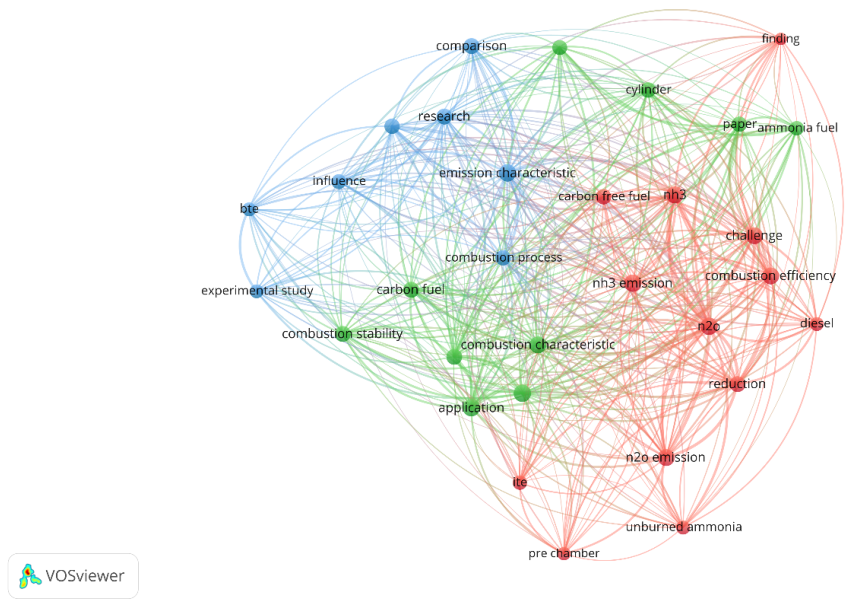
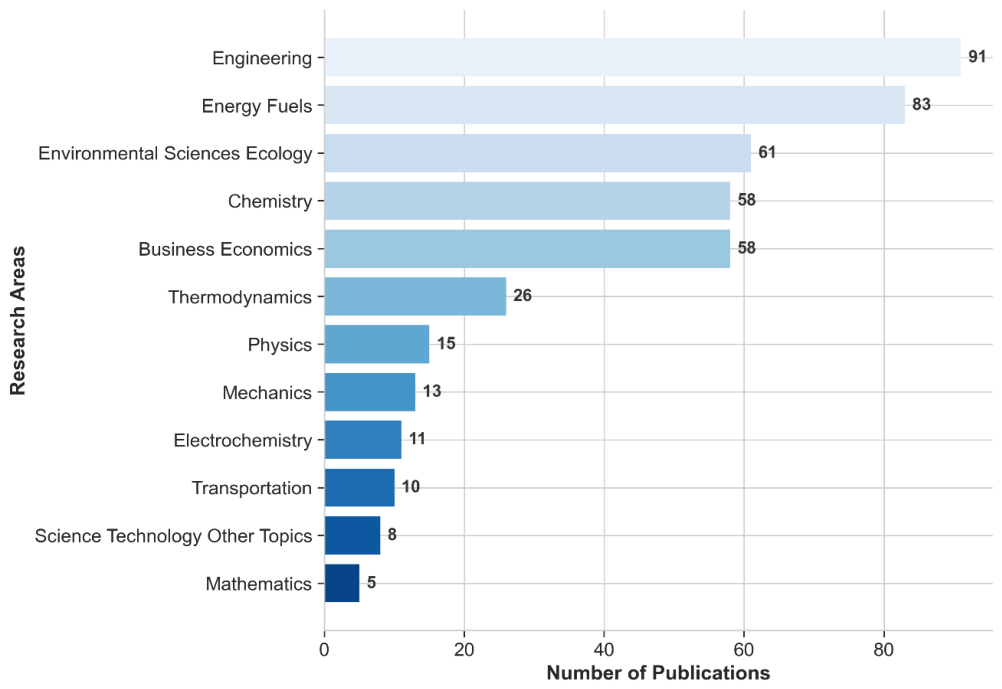
Bibliometric mapping was used as a supporting tool rather than as a substitute for technical assessment. Figure 1 summarizes the research-area distribution of publications related to ammonia–hydrogen engine control, showing that the topic is distributed across engineering, energy fuels, environmental science, and chemistry. Figure 2 further shows a semantic co-occurrence network based on titles and abstracts. The central nodes are ammonia, hydrogen, combustion, NOx, efficiency, model, and control, indicating a shift from basic feasibility studies toward emission management and system-level optimization. Figure 1 and Figure 2 are therefore used only to document the search landscape and topic positioning; they are not treated as technical evidence for the control trends synthesized later in the paper.
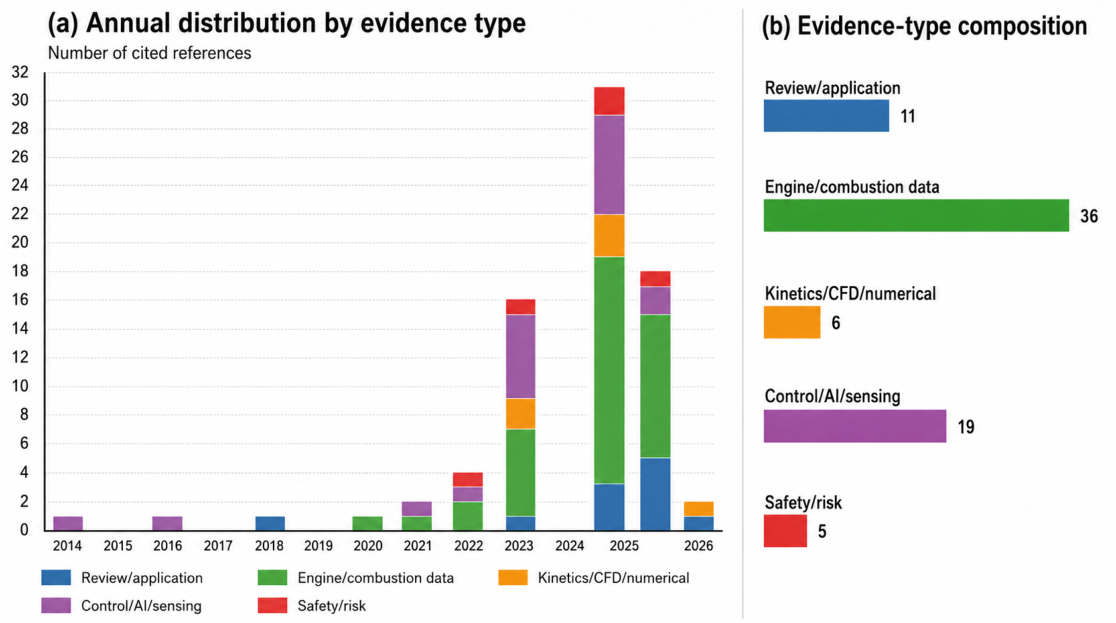
To further clarify the technical evidence base, the final cited corpus was coded by publication year and primary source type. This coding is not intended as a field-wide bibliometric indicator; rather, it is an internal evidence audit of the references actually used in this review. Figure 3 shows that the manuscript relies mainly on recent engine/combustion data, with additional support from control/AI/sensing studies, review/application papers, kinetics/CFD/numerical studies, and safety/risk-assessment literature.
Table 1 positions this paper relative to representative recent reviews. Existing reviews have clarified ammonia as an energy carrier, ammonia combustion mechanisms, dual-fuel strategies, and liquid-ammonia injection. The present review differs by treating these topics as elements of a closed-loop control problem. This framing is important because a practical ammonia–hydrogen engine must satisfy multiple constraints simultaneously: stable ignition, acceptable COVIMEP, controlled pressure-rise rate, low NOx, limited N2O, low NH3 slip, and deployable real-time computation.
To make the evidence base more explicit, Table 2 compares representative studies from different research groups. The table is not intended to rank the studies directly, because they involve different engines, boundary conditions, fuels, and metrics. Instead, it identifies which findings are directly ammonia-specific and which insights are transferred from related dual-fuel or low-temperature-combustion platforms.

3. Applications and Control-Relevant Combustion Characteristics

3.1. Application Scenarios

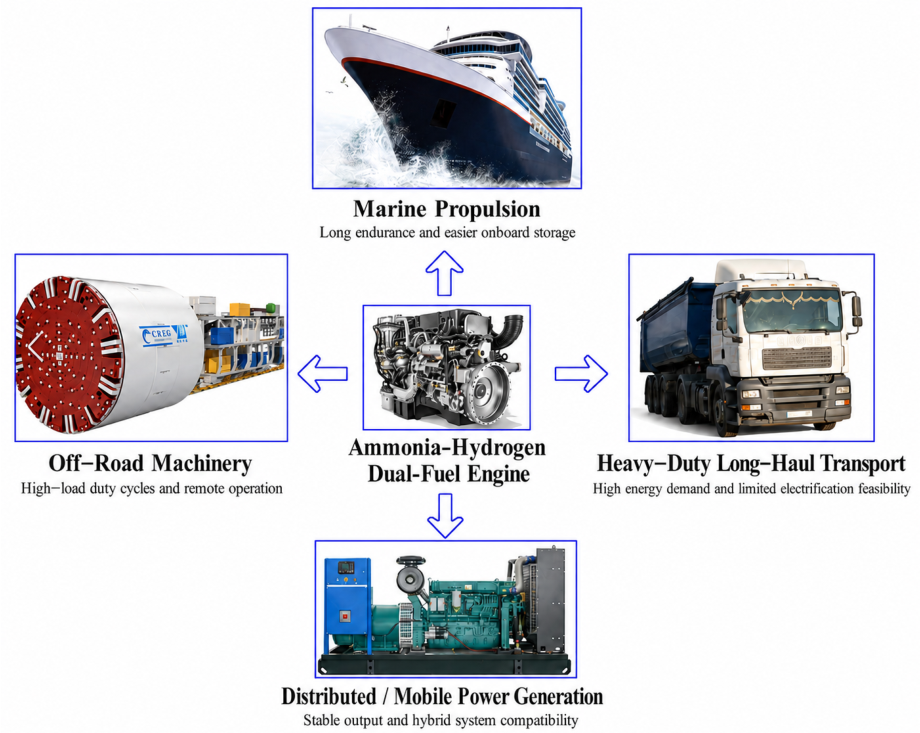
Ammonia–hydrogen dual-fuel engines are mainly relevant where full electrification is constrained by energy density, duty cycle, infrastructure, or continuous-power requirements. Representative applications include marine propulsion, heavy-duty road transport, distributed generation, hybrid power systems, and large off-road machinery (Figure 4). In these sectors, ammonia provides carbon-free chemical energy storage, whereas hydrogen supplies the local reactivity required for reliable ignition and stable flame development [2,27,29,40,41].
The control implication is application dependent. Marine engines emphasize high ammonia substitution, high-load efficiency, greenhouse-gas reduction, safety redundancy, and aftertreatment integration; heavy-duty vehicles require faster transient response and cold-start robustness; distributed generation may tolerate slower transients but requires long-duration reliability. A universal calibration is therefore unlikely. Instead, hydrogen fraction, ammonia injection timing, air dilution, ignition assistance, and aftertreatment operation must be scheduled according to duty cycle and safety constraints.

3.2. Nonlinear Mode Transitions

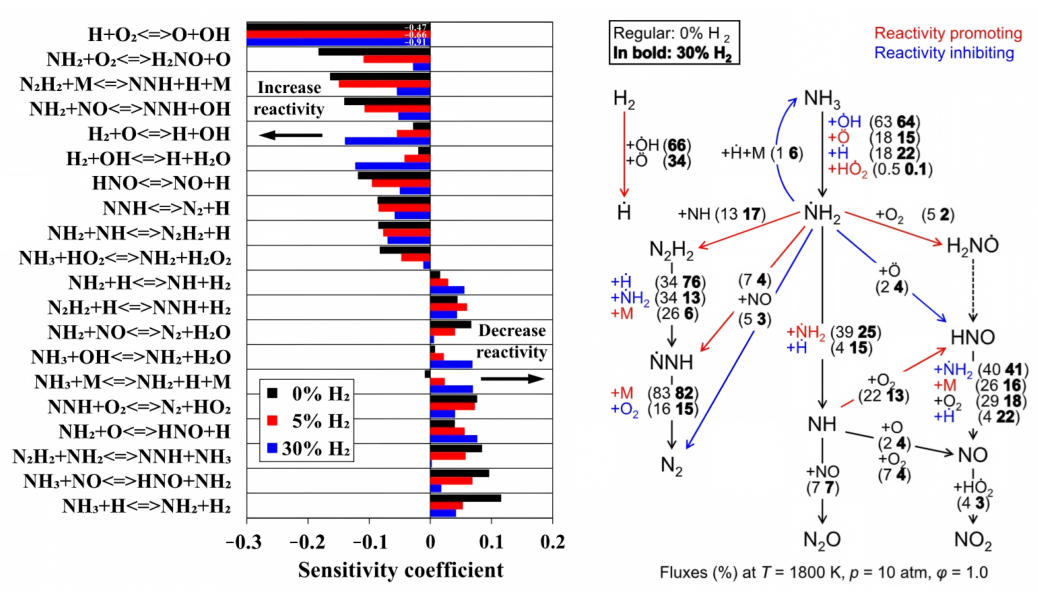
Combustion of ammonia–hydrogen mixtures cannot be treated as a linear superposition of ammonia and hydrogen behavior. The mixture response is governed by coupled chemical kinetics, turbulent flame propagation, thermal stratification, charge motion, and wall heat transfer. Chemical-kinetic studies show that ignition delay, radical production, and fuel-nitrogen pathways vary strongly with pressure, temperature, equivalence ratio, and H2/NH3 ratio [21]. Figure 5 illustrates sensitivity and flux analyses for representative ammonia–hydrogen mixtures, highlighting how hydrogen addition changes dominant reaction channels.
The three mixture ratios in Figure 5 were selected to illustrate a mechanistic span rather than to define universal engine operating points. The 100/0 case provides the pure-ammonia baseline, the 95/5 case represents a small hydrogen addition that can already perturb the radical pool and ignition chemistry, and the 70/30 case represents a strongly hydrogen-enriched limit in which the dominant chain-branching and oxidation routes become substantially different. The figure is therefore used to explain sensitivity trends and reaction-pathway shifts; it should not be interpreted as a calibrated optimum for a specific engine architecture.
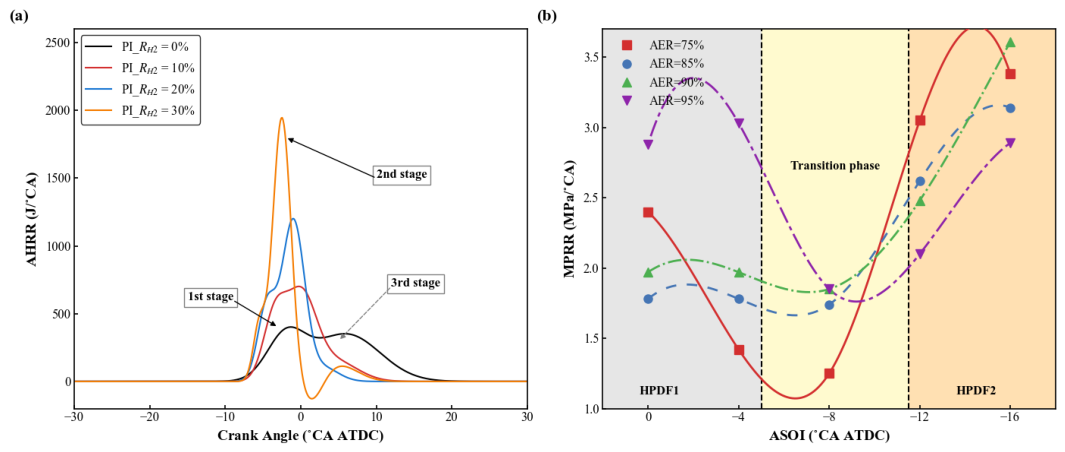
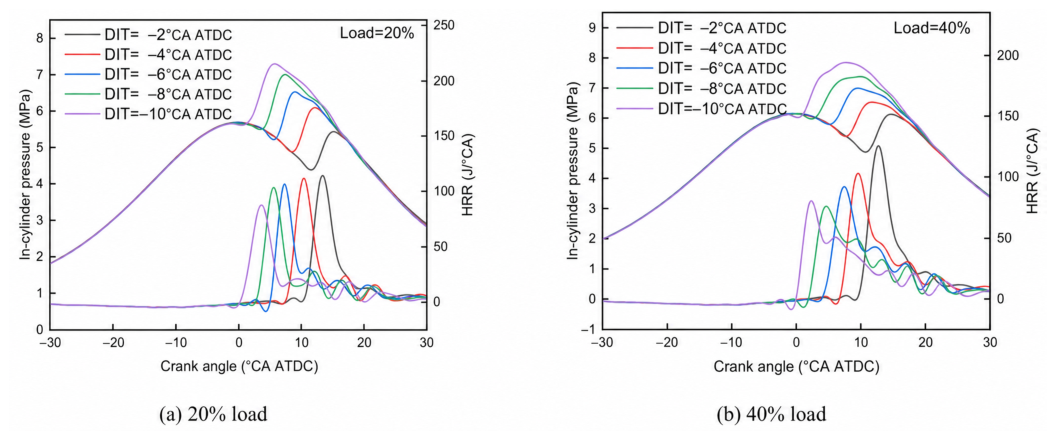
At engine scale, small changes in ammonia injection timing, ammonia energy fraction, hydrogen fraction, or equivalence ratio can induce abrupt combustion-mode transitions. Optical and numerical studies show that ammonia–hydrogen SI combustion may move from slow and unstable flame development at low hydrogen addition to fast combustion or knock-prone behavior at high hydrogen addition [8,9,26]. In ammonia/diesel high-pressure dual-fuel systems, ammonia start of injection (ASOI) can shift combustion between diffusion-dominated and partially premixed modes, changing apparent heat-release rate (AHRR), maximum pressure-rise rate (MPRR), and emissions [11,12,13]. Figure 6 summarizes this control-induced mode switching.
These observations have two implications. First, ammonia–hydrogen engine calibration should not be based only on monotonic response surfaces. Near a mode boundary, a small timing or fuel-ratio change may produce a disproportionate shift in heat-release phasing and emissions. Second, a controller must be able to recognize combustion state, not merely actuator position. The relevant control problem is therefore hybrid and constrained: the system may operate in different combustion modes, and each mode has its own stability, emission, and pressure-rise limits.

3.3. Emission Chemistry and the  NH 2 *  Branching Problem

Ammonia combustion is unique because the fuel itself contains nitrogen. This makes nitrogen-containing emissions central rather than secondary. NOx can form through fuel-nitrogen pathways even when carbon emissions are eliminated, while N2O and unburned NH3 slip may increase under low-temperature, rich, or quenched conditions. A control strategy that minimizes only one emission may therefore worsen another.
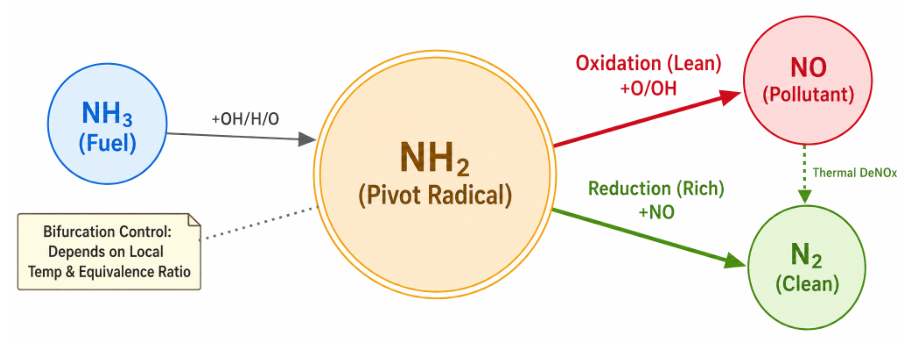
The amino radical  NH 2 *  is a useful conceptual pivot for understanding this trade-off. Under lean or high-temperature conditions, oxidative radicals such as O and OH promote pathways from NH3 decomposition toward NO formation. Under richer or locally oxygen-deficient conditions,  NH 2 *  can participate in NO-reduction chemistry and promote N2 formation through DeNOx-like pathways [18,42,43]. Figure 7 illustrates this competitive branching mechanism. The same local control action that suppresses NOx by reducing temperature or oxygen availability may increase NH3 slip or N2O if oxidation becomes incomplete.
This chemistry explains why ammonia-engine emission control is intrinsically multi-objective. Delayed injection, stronger EGR, or lean dilution can reduce thermal NOx formation, but excessive dilution can slow flame propagation, increase quenching, and raise NH3 slip. Conversely, hydrogen enrichment improves oxidation completeness and stability, but excessive hydrogen can advance combustion, increase peak temperature, raise MPRR, and increase NOx or knock tendency [9,26,44]. The feasible region is therefore a moving Pareto front rather than a single optimum.

3.4. Control-Oriented Metrics and Monitoring Challenges

The most basic control-oriented performance metric is indicated thermal efficiency (ITE), defined as
ITE = W i Q fuel ,
where  W i  is the indicated cycle work and  Q fuel  is the total chemical energy input. For ammonia–hydrogen operation,
Q fuel = m NH 3 LHV NH 3 + m H 2 LHV H 2 .
On a per-cycle basis, ITE can also be written as
ITE = IMEP V d m NH 3 , cyc LHV NH 3 + m H 2 , cyc LHV H 2 ,
where IMEP is the indicated mean effective pressure and  V d  is displacement volume.
Combustion stability is commonly evaluated through the coefficient of variation of the IMEP:
COV IMEP = σ IMEP IMEP ¯ × 100 % .
A COVIMEP threshold of approximately 5% is often used as a practical stability boundary [45,46]. For ammonia-rich combustion, this limit is especially important because slow flame propagation and incomplete oxidation can produce large cycle-to-cycle variations. A point with apparently acceptable efficiency may still be unacceptable if it lies close to misfire or excessive dispersion.
For closed-loop control, the ideal feedback set would include combustion phasing, pressure-rise rate, COVIMEP, NOx, N2O, NH3 slip, and aftertreatment ammonia-storage state. In practice, only a subset is measured directly and quickly. Cylinder pressure can provide fast combustion information, but it is expensive for production engines. Exhaust sensors are delayed and may be cross-sensitive. Amperometric NOx sensors are known to respond to NH3 under some conditions, which can bias feedback in ammonia-rich exhaust streams [14,15,16]. On-board emission monitoring concepts also show that diagnostic reliability depends on sensor placement, operating conditions, and uncertainty treatment [47]. This measurement problem motivates virtual sensing, discussed in Section 6.

4. Actuator-Level Control Strategies

4.1. Injection Timing and Combustion-Mode Selection

Ammonia injection timing is a primary variable for controlling mixture preparation and combustion mode. Earlier injection increases residence time before ignition, promotes evaporation and mixing, and tends to move the system toward premixed or partially premixed combustion. This can improve combustion completeness and ITE but may also increase heat-release intensity and NOx formation if combustion becomes too rapid or too hot. Later injection shortens mixing time, preserves stronger stratification, and can produce a more diffusion-controlled heat-release process. In ammonia/diesel HPDF operation, this distinction has been associated with HPDF1 and HPDF2 modes [11,12,13].
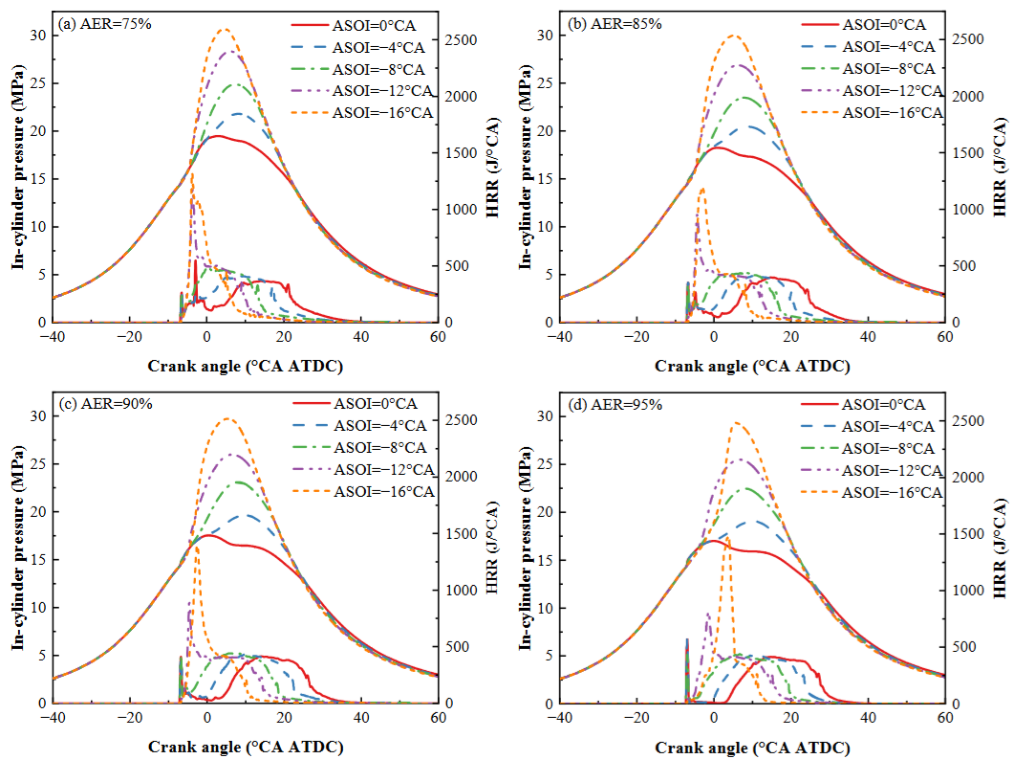
The control significance of ASOI is therefore not limited to phasing. It is a mode-selection variable. Around the transition boundary, small ASOI changes may alter AHRR shape, MPRR, CA50, NOx, and NH3 slip. Figure 8 shows representative in-cylinder pressure and AHRR responses under different ammonia energy ratios (AERs) and ASOIs. The key lesson is that injection timing should be scheduled jointly with ammonia fraction, hydrogen fraction, load, and air-path variables rather than calibrated as an isolated parameter.
Staged injection adds another degree of freedom. Pilot injection can create a robust ignition kernel and reduce misfire risk for low-reactivity ammonia mixtures. Experiments on diesel-piloted ammonia combustion show that a small amount of pilot fuel can strongly influence ignition reliability and early heat release [48,49]. Post-injection, in contrast, mainly affects late-cycle oxidation. In ammonia/diesel marine-engine studies, diesel post-injection has been reported to reduce unburned ammonia and greenhouse-gas impact while maintaining comparable efficiency [50,51]. A rational injection architecture should therefore assign pilot injection to ignition support and early heat-release shaping, while using post-injection primarily for late oxidation management and slip reduction.

4.2. Spatial Fuel Distribution: PFI, DI, and HPDI

Port fuel injection (PFI) and direct injection (DI) offer different control trade-offs. PFI promotes external mixture preparation and can generate a more homogeneous charge, which is beneficial for low-reactivity ammonia–hydrogen SI combustion [52,53]. However, gaseous PFI displaces intake air and reduces volumetric efficiency. When hydrogen is present in the intake port, PFI also increases the risk of backfire because a reactive fuel–air mixture exists upstream of the intake valve. Hydrogen PFI studies show that injection timing, residual gas, hot spots, and intake dynamics are central to backfire mitigation [54]. These issues remain relevant for ammonia–hydrogen blends, even though ammonia itself is less reactive than hydrogen.
DI avoids some PFI limitations by introducing fuel directly into the cylinder, improving charge efficiency and enabling stratified combustion. Hydrogen DI can improve mixture formation, reduce backfire risk, and support higher compression or boost levels [55,56,57]. Figure 9 illustrates how hydrogen injection timing affects ITE and NOx emissions in DI hydrogen engines. Although these data are not ammonia-specific, they are relevant because hydrogen distribution controls local reactivity in ammonia–hydrogen operation. DI also enables local enrichment near the spark plug or pre-chamber while keeping the global mixture lean, a strategy that can reduce hydrogen consumption and control knock risk.
High-pressure direct injection (HPDI) of liquid ammonia is especially relevant for heavy-duty and marine applications. It can reduce wall wetting, improve ammonia substitution ratio, and support diffusion or partially premixed combustion modes [19,58]. The main control challenge is that injection pressure, spray penetration, evaporation cooling, ignition assistance, and local equivalence ratio all interact. HPDI therefore requires coordinated control of spray targeting, pilot energy, injection timing, and air management.

4.3. Hydrogen Blending Ratio Control

Hydrogen fraction is the strongest reactivity control variable in ammonia–hydrogen engines. Under low-load or cold-start conditions, cylinder temperature and pressure are insufficient for reliable ammonia oxidation. A higher hydrogen fraction is then required to shorten ignition delay, increase flame speed, and reduce COVIMEP. Experiments have reported that hydrogen addition around or above 20%, depending on the definition and operating condition, can substantially improve low-load stability [59,60]. Onboard ammonia reforming is another route; Koike et al. showed that a high H2/NH3 molar ratio from a reformer could support cold-start operation [60].
At medium and high load, the control objective changes. The in-cylinder thermal state becomes more favorable for ammonia oxidation, and excessive hydrogen can become harmful. It may advance combustion, increase peak pressure and heat-release rate, raise MPRR, increase knock tendency, and elevate NOx emissions [26,44]. Hu et al. reported that a limited hydrogen energy ratio could provide favorable efficiency under stoichiometric or near-stoichiometric conditions, while further hydrogen addition increases NOx [9]. Hydrogen stratification may extend the stable boundary to much lower global hydrogen fractions by placing reactivity where it is most useful [61]. Thus, the high-load strategy should not maximize hydrogen; it should minimize hydrogen while maintaining ignition reliability, combustion phasing, and stability.
Transient operation adds another layer. During acceleration or load steps, ammonia-rich combustion may respond slowly because fuel flow, air path, and cylinder reactivity cannot change instantaneously. A practical strategy is to treat hydrogen as a fast stabilizer and ammonia as the slower main energy carrier. In the first few cycles after a disturbance, the controller can temporarily increase hydrogen injection to restore local reactivity and phasing. After stability recovers, the hydrogen fraction can be ramped back toward the new steady-state optimum. This dynamic hydrogen-boost concept is consistent with experimental load-control studies in ammonia–hydrogen engines [27,28,29].

4.4. Air-Path and EGR Control

Lean operation and EGR are conventional tools for reducing high-temperature NOx formation, but ammonia combustion makes their use more delicate. Increasing the excess-air ratio  λ  lowers mean flame temperature and reduces the high-temperature-zone volume. However, ammonia flames are already slow, and excessive dilution can lengthen combustion duration, increase wall quenching, raise COVIMEP, and increase NH3 slip. Experiments have shown that the relationship between  λ , ammonia energy ratio, NOx, N2O, and NH3 slip is non-monotonic [9,62]. Thus, lean operation is better understood as bounded temperature management rather than a one-way path toward lower emissions.
EGR has a similar double effect. It lowers oxygen concentration and adiabatic flame temperature, thereby suppressing NOx, but it also reduces burning velocity and may intensify incomplete oxidation. Masoumi et al. reported substantial reductions in laminar burning velocity under artificial EGR dilution for ammonia–hydrogen mixtures [63]. Pandey et al. showed that moderate EGR could reduce NOx and improve some combustion indicators, whereas excessive EGR led to unstable combustion and longer burn duration [64]. Therefore, EGR and hydrogen fraction should be scheduled together: EGR suppresses temperature-driven NOx, while hydrogen compensates for reactivity loss. The optimum lies in a Pareto region rather than at the extreme of either variable.

4.5. Ignition-System Control

Ignition-system design is a central control issue for ammonia engines. Conventional spark ignition relies on a single flame kernel, which is often insufficient for pure ammonia or low-hydrogen mixtures. Multiple-spark strategies and high-energy ignition can improve flame-kernel development, reduce cyclic dispersion, and support pure-ammonia operation under selected conditions [65,66,67]. In low-reactivity mixtures, the primary function of ignition control is not simply to advance spark timing; it is to provide sufficient initial energy and flame-kernel robustness.
Turbulent jet ignition (TJI) provides a higher-level strategy. In TJI, a small pre-chamber creates high-temperature, radical-rich jets that penetrate the main chamber and initiate multi-site ignition. Hydrogen addition in the pre-chamber can strongly enhance ammonia combustion, shorten ignition delay, and improve flame propagation [31,32,33]. The most important advantage is topological: TJI changes the main-chamber ignition process from single-point propagation to distributed, jet-driven ignition. This makes it particularly attractive for lean, ammonia-rich, high-efficiency engines. It also suggests a control strategy in which hydrogen is concentrated in the pre-chamber rather than distributed uniformly through the main chamber, reducing total hydrogen demand while maintaining ignition authority.

5. Control-Variable Synthesis

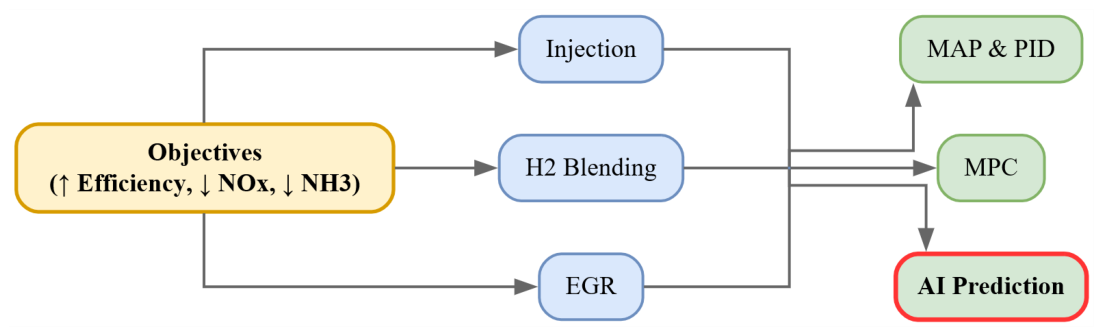
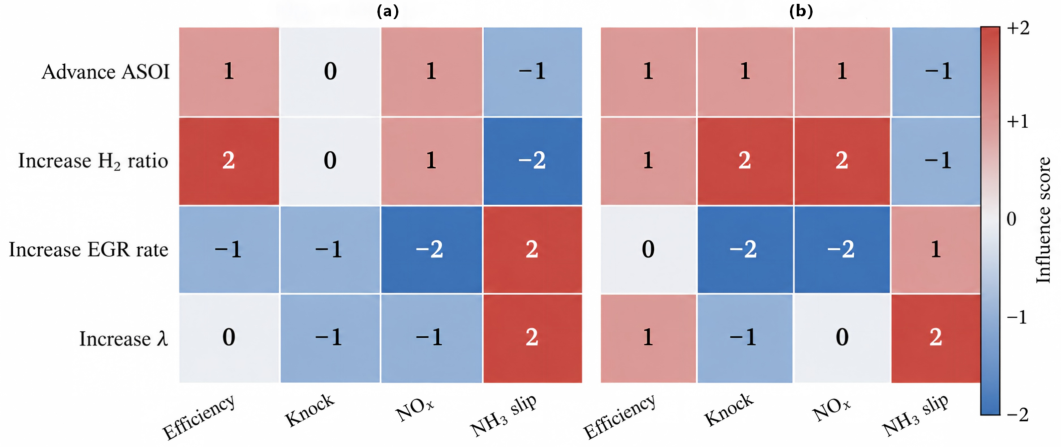
Figure 10 summarizes the control taxonomy of ammonia–hydrogen engines. The control objective is not a single scalar optimum, but simultaneous management of efficiency, stability, pressure-rise rate, NOx, N2O, and NH3 slip. Figure 11 further illustrates the semi-quantitative effects of major control variables under low-load/cold-start and medium-to-high-load conditions.
The synthesis in this section does not introduce new experimental data. Its purpose is to translate heterogeneous literature results into control-relevant directionality and boundary conditions. Because engine geometry, injection strategy, load, equivalence ratio, EGR rate, ignition system, and aftertreatment layout differ substantially among studies, universal numerical correlations are not defensible at present. The signs in Figure 11 and Table 3 should therefore be interpreted as literature-supported tendencies that require engine-specific calibration and validation.
Table 3 provides a compact synthesis. The signs are qualitative because the direction and magnitude depend on engine architecture, load, injection mode, and combustion regime. Nevertheless, several robust trends emerge. Hydrogen fraction is the strongest reactivity actuator. EGR and  λ  are temperature-management actuators. ASOI is primarily a mixture-formation and mode-selection actuator. Ignition energy and TJI are stability and topology actuators. In a practical controller, these variables must be coordinated instead of tuned independently.

6. Advanced Control Algorithms and Intelligent Optimization

6.1. From Static Maps to Constrained Predictive Control

The control problem described above exceeds the natural capability of static maps and independent PID loops. Map-based calibration remains valuable for production implementation because it is transparent and computationally inexpensive. However, ammonia–hydrogen combustion contains strong nonlinear coupling, operating-mode transitions, delayed emission feedback, and multiple hard constraints. In such a system, a locally optimal steady-state calibration point may become unsafe during transients or near mode boundaries.
MPC is attractive because it explicitly optimizes future actuator trajectories under constraints. For ammonia–hydrogen engines, the objective function can include efficiency, IMEP tracking, CA50 tracking, hydrogen consumption, NOx, NH3 slip, and aftertreatment state. Constraints can include MPRR, knock index, COVIMEP, actuator limits, equivalence-ratio bounds, and emission limits. The key barrier is not the MPC concept itself, but the control-oriented model. A full CFD or detailed-chemistry model is far too expensive for online use. The practical route is to compress combustion behavior into gray-box, LPV, neural, or hybrid models that retain the relevant state and constraint information.
For such models to be useful in closed loop, four technical questions must be checked explicitly. Model validity defines the operating range over which the reduced model reproduces phasing, heat-release shape, pressure-rise rate, and emissions with acceptable error. Observability determines whether hidden states such as local reactivity, NH3 slip, N2O, SCR storage, or combustion-mode proximity can be inferred from available sensors and actuator histories. Controllability determines whether ASOI, hydrogen fraction, EGR,  λ , ignition timing, and aftertreatment actions can move the system away from knock, misfire, and high-emission boundaries quickly enough. Real-time feasibility determines whether the estimator and optimizer can run within ECU sampling and worst-case execution-time limits.
Related dual-fuel and low-temperature-combustion studies provide a technical pathway. Sitaraman et al. developed data-driven model learning and control based on heat-release-rate features for RCCI engines [34]. Batool et al. used machine learning to identify heat-release shapes and embed them into control-oriented models [35], and later demonstrated closed-loop SI–RCCI mode-transition control [36]. Zhang et al. proposed an emission-constrained LPV-MPC for marine RCCI engines based on hybrid gray-box modeling [68]. In ammonia-based engines, Chen et al. developed control-oriented emission prediction for ammonia/diesel dual-fuel operation using combustion identification [22]. These studies suggest that future ammonia–hydrogen MPC should combine combustion-mode recognition, low-order heat-release representation, and emission prediction rather than relying on a single global model.
High-fidelity CFD and detailed chemical-kinetic simulations remain essential, but their role is mainly offline. They can identify dominant pathways, generate hypotheses, support sensitivity analysis, and define reduced-order model structures. They cannot normally be embedded directly into an ECU-level controller. The control problem is therefore one of model hierarchy: detailed chemistry and CFD provide mechanistic anchors, while reduced gray-box, LPV, or hybrid models provide real-time estimates and constraints.

6.2. Virtual Sensing for Emission and Combustion-State Observation

Closed-loop control requires fast and reliable state information, but several important variables are difficult to measure directly. NOx, N2O, NH3 slip, and SCR ammonia-storage state are delayed or uncertain. This motivates virtual sensors: algorithms that infer soft variables from fast and robust signals such as cylinder pressure, crank angle, injection timing, intake pressure and temperature, engine speed, lambda signal, and actuator commands.
Virtual-sensor development in engine research can be grouped into three classes. The first includes classical machine-learning regressors such as random forests, support vector regression (SVR), radial-basis networks, and back-propagation neural networks. These methods are attractive when datasets are limited and interpretability or computational cost matters. Nogueira et al. showed that optimized random forests combined with feature engineering could predict NOx and CO2 in a dual-fuel engine [37]. Mao et al. compared neural-network architectures for NOx prediction in two-stage NH3–H2 combustion [38]. Gu et al. combined deep autoencoding with SVR to improve real-time fuel-consumption and emission prediction from cylinder-pressure-based features [23]. Recent natural-gas engine work also illustrates how virtual sensors can support active pre-chamber emission management, although ammonia-specific validation is still required [69].
The second class includes dynamic deep-learning models such as recurrent neural networks, GRU, LSTM, temporal convolutional networks (TCN), and Transformer variants. These models are more suitable for transient emissions because they can represent memory, delay, and peak formation. Liao et al. compared several advanced methods for transient diesel-emission prediction and found that no single architecture dominates all pollutants, although GRU and TCN performed well for transient NOx in their dataset [24]. This result is important for ammonia engines: the best virtual sensor may depend on the emission species, operating regime, and available signals.
The third class includes physics-informed and hybrid models. Pure black-box models may interpolate well but extrapolate poorly when fuel quality, engine aging, ambient conditions, or hardware configuration changes. Physics-informed models can embed conservation laws, heat-release constraints, simplified kinetics, or monotonic relations into the learning process. For ammonia–hydrogen engines, this is particularly valuable because chemical branching, radical-pool dynamics, and aftertreatment storage introduce strong structure that should not be ignored.

6.3. AI-Based Closed-Loop Control and Reinforcement Learning

AI can also participate directly in control-policy generation. Reinforcement learning (RL) and deep reinforcement learning (DRL) formulate control as a state–action–reward problem. This is attractive for ammonia engines because the action space is high-dimensional and the reward must balance efficiency, stability, hydrogen consumption, emissions, and safety constraints. Norouzi et al. demonstrated safe DRL for diesel-engine emission control [25]. Xu et al. used model-free RL for combustion-engine start-up speed control [70], and Omran et al. applied DQN to idle-speed control [71]. Wimer et al. used DRL to discover multi-fuel injection strategies for compression-ignition engines under NOx constraints [72].
Direct transfer to ammonia–hydrogen engines is not immediate. Real engines cannot tolerate unsafe trial-and-error learning near knock, misfire, or high-emission boundaries. Therefore, RL deployment will likely require a digital-twin workflow: train policies in simulation, constrain exploration with safety filters, validate on hardware-in-the-loop systems, and deploy only compressed and verified policies to the ECU. Continuous-action algorithms such as DDPG, TD3, and SAC are theoretically well matched to injection timing, fuel split, EGR, and throttle control, but experimental evidence for direct closed-loop ammonia-combustion control remains limited. In the near term, DRL may be more realistic as an offline calibration assistant or supervisory optimizer than as the sole real-time controller.
It is therefore important to separate three evidence levels. Ammonia-engine studies have directly demonstrated the importance of actuator scheduling, combustion-mode identification, and emission constraints, but direct closed-loop AI control of ammonia combustion remains rare. Related diesel, RCCI, natural-gas, and hydrogen-engine studies provide transferable methods for MPC, virtual sensing, and safe learning, but their validity for ammonia–hydrogen operation must be re-established because fuel-nitrogen chemistry, NH3 slip, and aftertreatment interaction introduce additional constraints. Finally, digital-twin-assisted RL and end-to-end AI control should be regarded as prospective research directions rather than mature production-ready solutions.

6.4. Comparison of Control Methods

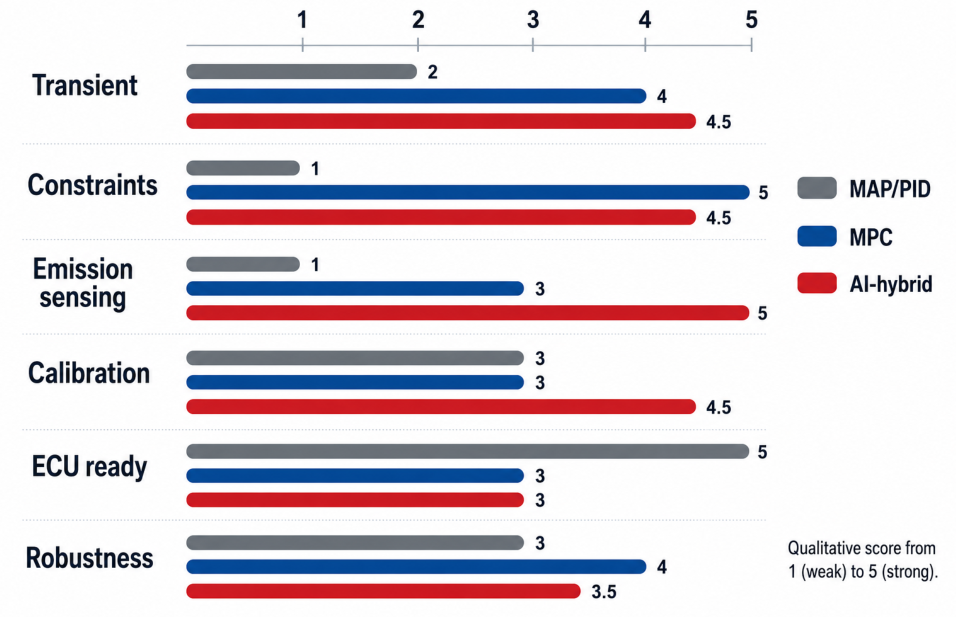
Figure 12 compares conventional calibration, MPC, and AI-driven control across representative dimensions. The comparison should be interpreted qualitatively. MAP/PID control remains attractive because of maturity and low computational cost. MPC provides explicit constraint handling and is well suited to multi-input multi-output control but depends heavily on model quality and solver speed. AI-based methods offer strong nonlinear approximation and soft-sensing capability but require high-quality data, careful validation, and robust deployment.
Table 4 summarizes algorithmic options. The most promising future architecture is not a pure AI controller, but a layered system: fast inner-loop combustion and air-path control, MPC or rule-based supervisory coordination, virtual sensors for emissions and combustion state, and cloud/digital-twin tools for periodic model update. Because the reviewed studies use different fuels, engines, sampling rates, sensors, and validation metrics, algorithmic accuracy and computation time cannot be compared by a single universal number. The table therefore reports representative quantitative or deployment-relevant evidence where available and distinguishes mature production tools from methods that remain mainly transferable or prospective for ammonia–hydrogen engines.

6.5. A Hierarchical Control Architecture for Deployable Systems

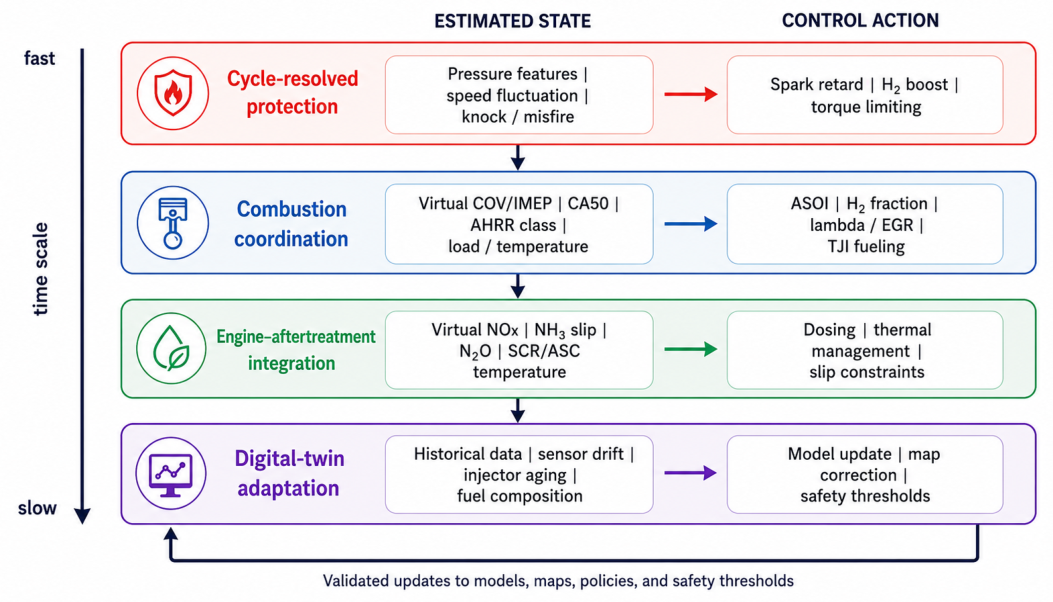
The preceding sections indicate that ammonia–hydrogen engine control should be treated as a hierarchical problem rather than as a single optimization layer. A practical architecture can be divided into four interacting time scales. At the fastest scale, cycle-resolved combustion monitoring uses cylinder-pressure-derived features, ion current, crank-speed fluctuation, or other fast proxies to detect misfire, knock tendency, pressure-rise rate, and phasing drift. This layer should retain conservative fallback logic because it is responsible for immediate safety. At the next scale, actuator coordination schedules ASOI, hydrogen fraction, ignition timing or pre-chamber fueling, EGR, and  λ  to keep the combustion state inside the admissible region. MPC is most suitable at this level if a sufficiently reliable control-oriented model is available.
At the slower exhaust and thermal scale, the controller should coordinate in-cylinder NH3 slip with SCR/ASC state, exhaust temperature, and ammonia storage capacity. This layer is essential because the same NH3 molecule can be interpreted either as an emission penalty or as a potential reductant for downstream NOx conversion, depending on aftertreatment temperature and storage state. At the longest time scale, an offline or cloud-assisted digital twin updates virtual-sensor parameters, recalibrates maps, tests candidate policies, and diagnoses drift caused by injector aging, fuel-quality variation, or catalyst degradation. Figure 13 and Table 5 summarize this proposed architecture.
This hierarchy also clarifies the role of AI. AI should not be presented as a replacement for all conventional control logic. Its most credible near-term roles are virtual sensing, mode recognition, calibration acceleration, anomaly detection, and supervisory optimization under safety filters. Direct AI control of combustion may become feasible, but only after robust digital twins, uncertainty quantification, hardware-in-the-loop validation, and fail-safe fallback strategies are established. In this sense, the central research target is not merely higher prediction accuracy on a test dataset; it is a certifiable control stack that remains stable when sensors age, injectors drift, fuel composition changes, and aftertreatment efficiency declines.

7. Remaining Challenges and Future Research Directions

7.1. Engine–Aftertreatment Co-Optimization

Ammonia engines blur the boundary between in-cylinder combustion and exhaust aftertreatment. In conventional diesel systems, ammonia is introduced downstream as a reductant for SCR. In ammonia-fueled engines, NH3 slip is often treated as a harmful by-product, but it may also be used as a controllable reductant if accurately predicted and coordinated with SCR ammonia storage. This suggests a system-level control architecture in which combustion phasing, NH3 slip, SCR storage, ASC conversion, and tailpipe emissions are optimized together. The challenge is to prevent slip from exceeding storage and conversion capacity while exploiting it to reduce external urea or ammonia dosing.

7.2. Safety, Toxicity, and Failure-Mode Constraints

Safety is not a peripheral issue for ammonia–hydrogen engines; it is a control and system-integration constraint. Recent safety reviews and risk-assessment studies for ammonia as a marine fuel identify toxicity, corrosiveness, ventilation, storage integrity, bunkering procedures, emergency response, and regulatory compliance as central deployment barriers [73,74]. CFD-based engine-room studies further show that ammonia dispersion depends strongly on leak position, leak area, release direction, pressure, temperature, obstructions, and ventilation, with toxicity generally posing a more severe onboard risk than flammability [75]. Quantitative risk-assessment studies also show that release scale, wind speed, hose diameter, storage conditions, and fuel-preparation-room layout can strongly alter toxic cloud footprints and crew exposure risk [76,77].
For engine control, these safety findings imply that ammonia–hydrogen operation should include failure-mode-aware logic rather than only efficiency and emission optimization. Relevant abnormal conditions include ammonia leakage, hydrogen backfire or flashback, knock, misfire, excessive NH3 slip after misfire, SCR/ASC ammonia breakthrough, sensor failure, actuator sticking, ventilation failure, and emergency shutdown transients. A practical controller should therefore coordinate leak detection, fuel isolation valves, purge procedures, ventilation status, torque derating, fallback maps, and aftertreatment protection. In particular, a command that is optimal for in-cylinder NOx reduction may be unacceptable if it increases NH3 slip beyond the storage or conversion capacity of the exhaust system during a transient or fault. Safety constraints should therefore be embedded explicitly in supervisory control and digital-twin validation.

7.3. Reliable Virtual Sensors for NH3 Slip and N2O

Most engine virtual-sensor studies focus on NOx, soot, CO, or fuel consumption. Ammonia engines require additional observables: NH3 slip and N2O. These species are strongly affected by local quenching, incomplete oxidation, aftertreatment temperature, and fuel-nitrogen chemistry. Developing virtual sensors for them will require datasets with synchronized cylinder pressure, fast emissions, exhaust temperature, and aftertreatment state. Physics-informed learning is likely necessary because purely data-driven models may fail when operating conditions move outside the training set.

7.4. Mode-Aware Control-Oriented Modeling

The nonlinear mode transitions discussed in Section 3 imply that a single global model may be inadequate. Future models should include mode recognition, mode-dependent dynamics, and transition logic. Possible approaches include hybrid automata, LPV models scheduled by combustion features, clustering of heat-release shapes, and neural networks with explicit regime classification. The controller must know not only where the operating point is, but also how close it is to a boundary separating stable, slow, knock-prone, or slip-prone combustion.

7.5. Uncertainty Quantification and Robustness

The feasible operating region of an ammonia–hydrogen engine should be interpreted as uncertain rather than fixed. Five uncertainty sources are especially relevant. First, measurement uncertainty arises from cylinder-pressure drift, exhaust-gas transport delay, and NOx sensor cross-sensitivity to NH3. Second, kinetic-mechanism uncertainty affects predicted NOx, N2O, and NH3 pathways, especially outside the validation range of detailed mechanisms. Third, model-structure uncertainty appears when high-dimensional combustion, spray, turbulence, wall-quenching, and aftertreatment dynamics are compressed into 0D/1D, LPV, gray-box, or neural control models. Fourth, actuator uncertainty results from injector aging, fuel-pressure variation, valve dynamics, EGR-flow error, and ignition-energy variation. Fifth, scenario uncertainty is introduced by transients, ambient conditions, fuel-composition variation, catalyst aging, and safety-system degradation.
For control development, these uncertainties should be represented through sensitivity rankings, robustness envelopes, constraint margins, or probabilistic validation rather than through a single nominal map. A semi-quantitative trend map such as Figure 11 can support control reasoning, but it should not be used as a predictive calibration surface without engine-specific validation. Robust controllers should therefore preserve margins to knock, misfire, excessive MPRR, high NOx, N2O, and NH3 slip boundaries; virtual sensors should report confidence or validity indicators; and digital twins should be updated when sensor drift, injector aging, or fuel-quality variation is detected.

7.6. Transient Control and Hydrogen Economy

Hydrogen is valuable but costly. A practical ammonia–hydrogen engine should use hydrogen where it provides the largest control benefit: cold start, load transients, local ignition assistance, pre-chamber enrichment, and operation near stability limits. This implies dynamic hydrogen scheduling rather than fixed blending. Future experiments should quantify the minimum hydrogen demand as a function of load, temperature,  λ , EGR, ignition strategy, and injection mode. Metrics should include not only efficiency and emissions, but also hydrogen consumption per unit of stability improvement.

7.7. ECU Deployment, Robustness, and Certification

Advanced control algorithms must run under ECU constraints. Neural networks and optimization solvers need pruning, quantization, code generation, and worst-case execution-time guarantees. Robustness must be verified under fuel-composition variation, injector aging, sensor drift, ambient changes, and aftertreatment degradation. For safety-critical actions near knock, misfire, or high-NOx boundaries, controllers should include fallback maps, safety filters, and diagnostic monitors. Without such engineering discipline, AI-based control will remain a promising laboratory concept rather than a deployable technology.

8. Conclusions

This review leads to several practical takeaways for ammonia–hydrogen engine development. First, hydrogen should be treated as a fast reactivity actuator rather than as a fixed blending component. It is most valuable during cold start, low-load operation, transient response, local ignition assistance, and operation near stability limits; at medium and high load, excessive hydrogen may increase NOx, MPRR, and knock tendency. Second, ASOI is not merely a phasing variable. In ammonia/diesel and related dual-fuel architectures, it can select or destabilize combustion modes, so it should be scheduled together with ammonia fraction, hydrogen fraction, load, air dilution, and ignition strategy.
Third, NOx, N2O, and NH3 slip must be co-optimized. A control action that suppresses one species may worsen another because fuel-nitrogen chemistry, local temperature, oxygen availability, wall quenching, and aftertreatment state are coupled. Fourth, qualitative trend maps and actuator tables are useful for control reasoning, but they are not predictive calibration maps. Engine-specific validation, uncertainty margins, and evidence-source labels are necessary before these trends are translated into controller limits.
Fifth, AI should enter deployment through constrained and verifiable roles first. Near-term value is expected from virtual sensing, combustion-mode recognition, calibration acceleration, anomaly detection, and digital-twin updating. Direct end-to-end AI control remains premature unless it is protected by safety filters, uncertainty monitoring, hardware-in-the-loop validation, and fallback maps. Finally, safety and toxicity constraints must be embedded in the control architecture. Leak detection, ventilation status, fuel isolation, purge procedures, misfire-induced NH3 slip, hydrogen backfire, and aftertreatment ammonia breakthrough are not external operational details; they define admissible control actions.
The most credible route to deployable ammonia–hydrogen engines is therefore a layered control stack: cycle-resolved safety protection, predictive actuator coordination, aftertreatment-aware emission management, and digital-twin-assisted adaptation. Progress in these areas will determine whether ammonia–hydrogen engines can move from promising laboratory demonstrations to reliable, efficient, and low-emission energy-conversion systems.

Author Contributions

Conceptualization, J.Z., G.W. and Y.C.; methodology, J.Z. and G.W.; investigation, J.Z.; resources, G.W., Y.C. and H.Z.; writing—original draft preparation, J.Z.; writing—review and editing, G.W., Y.C. and H.Z.; visualization, J.Z.; supervision, G.W. and Y.C.; project administration, Y.C.; funding acquisition, G.W. and Y.C. All authors have read and agreed to the published version of the manuscript.

Funding

This work was funded by the Hunan Provincial Natural Science Foundation of China (Grant No. 2026JJ60447), the National Natural Science Foundation of China (Grant No. 52476103), the Hunan Provincial Natural Science Foundation (Grant No. 2023JJ10043).

Institutional Review Board Statement

Not applicable.

Informed Consent Statement

Not applicable.

Data Availability Statement

No new data were created or analyzed in this study. Data sharing is not applicable to this article.

Acknowledgments

The authors thank their institutions for supporting this review work.

Conflicts of Interest

Haoran Zong was employed by Datang International Power Generation Co., Ltd. The remaining author declare that the research was conducted in the absence of any commercial or financial relationships that could be construed as a potential conflict of interest.

References

  1. Valera-Medina, A.; Xiao, H.; Owen-Jones, M.; David, W.I.F.; Bowen, P.J. Ammonia for power. Prog. Energy Combust. Sci. 2018, 69, 63–102. [Google Scholar] [CrossRef] [Scilit]
  2. Zhou, X.; Li, T.; Chen, R.; Wei, Y.; Wang, X.; Wang, N.; Li, S.; Kuang, M.; Yang, W. Ammonia marine engine design for enhanced efficiency and reduced greenhouse gas emissions. Nat. Commun. 2024, 15, 2110. [Google Scholar] [CrossRef] [Scilit] [PubMed]
  3. Cheng, Q.; Muhammad, A.; Kaario, O.; Ahmad, Z.; Larmi, M. Ammonia as a sustainable fuel: Review and novel strategies. Renew. Sustain. Energy Rev. 2025, 207, 114995. [Google Scholar] [CrossRef] [Scilit]
  4. Lhuillier, C.; Brequigny, P.; Contino, F.; Mounaim-Rousselle, C. Experimental study on ammonia/hydrogen/air combustion in spark ignition engine conditions. Fuel 2020, 269, 117448. [Google Scholar] [CrossRef] [Scilit]
  5. El-Adawy, M.; Nemitallah, M.A.; Abdelhafez, A. Towards sustainable hydrogen and ammonia internal combustion engines: Challenges and opportunities. Fuel 2024, 364, 131090. [Google Scholar] [CrossRef] [Scilit]
  6. Qi, Y.; Liu, W.; Liu, S.; Wang, W.; Peng, Y.; Wang, Z. A review on ammonia-hydrogen fueled internal combustion engines. eTransportation 2023, 18, 100288. [Google Scholar] [CrossRef] [Scilit]
  7. Figueroa-Labastida, M.; Zheng, L.; Streicher, J.W.; Hanson, R.K. Ammonia/hydrogen laminar flame speed measurements at elevated temperatures. Int. J. Hydrogen Energy 2024, 63, 1137–1146. [Google Scholar] [CrossRef] [Scilit]
  8. Li, J.; Zhang, R.; Pan, J.; Wei, H.; Shu, G.; Chen, L. Ammonia and hydrogen blending effects on combustion stabilities in optical SI engines. Energy Convers. Manag. 2023, 280, 116827. [Google Scholar] [CrossRef] [Scilit]
  9. Hu, X.; Li, J.; Pan, J.; Zhang, R.; Wei, H.; Shu, G. On combustion and emission characteristics of ammonia/hydrogen engines: Emphasis on energy ratio and equivalence ratio. Fuel 2024, 365, 131183. [Google Scholar] [CrossRef] [Scilit]
  10. Li, Y.; Cao, H.; Meng, X. Optical investigation on low-temperature lean combustion characteristics for diesel pilot-ignited premixed ammonia. Fuel 2024, 371, 132047. [Google Scholar] [CrossRef] [Scilit]
  11. Li, C.; Yang, S.; Li, Y. Impact of Ammonia Energy Ratio on the Performance of an Ammonia/Diesel Dual-Fuel Direct Injection Engine Across Different Combustion Modes. Processes 2025, 13, 1953. [Google Scholar] [CrossRef] [Scilit]
  12. Sun, X.; Meng, Q.; Liang, Y.; Jia, Y.; Ma, T. Evaluating combustion modes of ammonia/diesel two-stroke marine engine with multiple criteria decision making. Int. J. Hydrogen Energy 2025, 186, 151959. [Google Scholar] [CrossRef] [Scilit]
  13. Chen, Y.; Zhang, J.; Zhang, Z.; Zhang, B.; Hu, J.; Zhong, W.; Ye, Y. Optimization of ammonia energy ratio and injection timing for ammonia diesel dual-fuel engines based on RSM. Fuel 2025, 381, 133660. [Google Scholar] [CrossRef] [Scilit]
  14. Bonfils, A.; Creff, Y.; Lepreux, O.; Petit, N. Closed-loop control of a SCR system using a NOx sensor cross-sensitive to NH3. J. Process Control 2014, 24, 368–378. [Google Scholar] [CrossRef] [Scilit]
  15. Aliramezani, M.; Ebrahimi, K.; Koch, C.R.; Hayes, R.E. NOx sensor ammonia cross sensitivity analysis using a simplified physics based model. In Proceedings of the Combustion Institute—Canadian Section Spring Technical Meeting, University of Waterloo, Waterloo, ON, Canada, 10–12 May 2016. [Google Scholar]
  16. Kang, L.; Lou, D.; Zhang, Y.; Fang, L.; Luo, C. Research on cross sensitivity of NOx sensor and Adblue injection volume in accordance with the actual situation based on cubature Kalman filter. Energy 2023, 284, 128666. [Google Scholar] [CrossRef] [Scilit]
  17. Abubakar, S.; Li, Y. Ammonia-fueled internal combustion engines: A review of research trends. Fuel 2026, 406, 137016. [Google Scholar] [CrossRef] [Scilit]
  18. Zhang, X.; Zhao, S.; Zhang, Q.; Wang, Y.; Zhang, J. A Review of Ammonia Combustion Reaction Mechanism and Emission Reduction Strategies. Energies 2025, 18, 1707. [Google Scholar] [CrossRef] [Scilit]
  19. Wu, H.; Almatrafi, F.; Ben Houidi, M.; Fang, T.; Roberts, W.L. A review on liquid-ammonia injection and combustion for engine applications. Engineering 2025, 59, 82–117. [Google Scholar] [CrossRef] [Scilit]
  20. Tornatore, C.; Sementa, P.; Catapano, F. Enhancing ammonia combustion in internal combustion engines: A review on dual-fuel strategies with hydrogen. Energies 2025, 18, 3159. [Google Scholar] [CrossRef] [Scilit]
  21. Zhu, Y.; Curran, H.J.; Girhe, S.; Murakami, Y.; Pitsch, H.; Senecal, K.; Yang, L.; Zhou, C.-W. The combustion chemistry of ammonia and ammonia/hydrogen mixtures: A comprehensive chemical kinetic modeling study. Combust. Flame 2024, 260, 113239. [Google Scholar] [CrossRef] [Scilit]
  22. Chen, Z.; Ju, P.; Gong, M.; Shi, X.; Qin, C.; Shi, L. Study on control-oriented emission predictions of ammonia-diesel dual-fuel engine with combustion identification. Energy 2025, 333, 137390. [Google Scholar] [CrossRef] [Scilit]
  23. Gu, J.; Wang, Y.; Hu, J.; Zhang, K.; Shi, L.; Deng, K. Real-time prediction of fuel consumption and emissions based on deep autoencoding support vector regression for cylinder pressure-based feedback control of marine diesel engines. Energy 2024, 300, 131570. [Google Scholar] [CrossRef] [Scilit]
  24. Liao, J.; Hu, J.; Yan, F.; Chen, P.; Zhu, L.; Zhou, Q.; Xu, H.; Li, J. A comparative investigation of advanced machine learning methods for predicting transient emission characteristic of diesel engine. Fuel 2023, 350, 128767. [Google Scholar] [CrossRef] [Scilit]
  25. Norouzi, A.; Shahpouri, S.; Gordon, D.; Shahbakhti, M.; Koch, C.R. Safe deep reinforcement learning in diesel engine emission control. Proc. Inst. Mech. Eng. Part I J. Syst. Control Eng. 2023, 237, 1440–1453. [Google Scholar] [CrossRef] [Scilit] [PubMed]
  26. Li, J.; Zhang, R.; Mao, X.; Wang, L.; Wei, H.; Pan, J. Ammonia and hydrogen blending effects on knocking characteristics in an optical SI engine. Fuel 2025, 385, 134067. [Google Scholar] [CrossRef] [Scilit]
  27. Xin, G.; Ji, C.; Wang, S.; Hong, C.; Meng, H.; Yang, J.; Su, F. Experimental study on the load control strategy of ammonia-hydrogen dual-fuel internal combustion engine for hybrid power system. Fuel 2023, 347, 128396. [Google Scholar] [CrossRef] [Scilit]
  28. Hong, C.; Ji, C.; Wang, S.; Qiang, Y.; Liu, Q. A comprehensive experimental study to analyze the cyclic variation of a hydrogen-blended ammonia engine with the Miller cycle. Int. J. Hydrogen Energy 2024, 55, 1335–1346. [Google Scholar] [CrossRef] [Scilit]
  29. Hong, C.; Ji, C.; Wang, S.; Xin, G.; Meng, H.; Yang, J.; Su, F. An experimental study of various load control strategies for an ammonia/hydrogen dual-fuel engine with the Miller cycle. Fuel Process. Technol. 2023, 247, 107780. [Google Scholar] [CrossRef] [Scilit]
  30. Wu, G.; Gan, H.; Li, Y. Low-temperature lean combustion and emissions characteristics of pilot diesel-ignited premixed ammonia in a constant volume chamber. Int. J. Hydrogen Energy 2024, 93, 158–168. [Google Scholar] [CrossRef] [Scilit]
  31. Li, J.; Wang, L.; Shu, G.; Pan, J.; Wei, H.; Hu, X.; Zhang, R. Jet ignition characteristics of ammonia-hydrogen passive pre-chamber: Emphasis on equivalence ratio and hydrogen/ammonia ratio. Energy Convers. Manag. 2024, 315, 118785. [Google Scholar] [CrossRef] [Scilit]
  32. Zhu, J.; Liu, R.; Lin, H.; Jin, Z.; Qian, Y.; Zhou, D.; Yin, Y.; Li, Z.; Lu, X. Computational insights into flame development and emission formation in an ammonia engine with hydrogen-assisted pre-chamber turbulent jet ignition. Energy Convers. Manag. 2024, 314, 118706. [Google Scholar] [CrossRef] [Scilit]
  33. Meng, X.; Zhu, W.; Yin, S.; Tian, J.; Cao, J.; Long, W.; Bi, M. Study for improving ammonia combustion and emissions using different hydrogen addition strategies in pre-chamber turbulent jet ignition mode. Energy 2025, 323, 135814. [Google Scholar] [CrossRef] [Scilit]
  34. Sitaraman, R.; Batool, S.; Borhan, H.; Velni, J.M.; Shahbakhti, M. Data-Driven Model Learning and Control of RCCI Engines based on Heat Release Rate. IFAC-PapersOnLine 2022, 55, 608–614. [Google Scholar] [CrossRef] [Scilit]
  35. Batool, S.; Naber, J.D.; Shahbakhti, M. Machine learning approaches for identification of heat release shapes in a low temperature combustion engine for control applications. Control Eng. Pract. 2024, 144, 105838. [Google Scholar] [CrossRef] [Scilit]
  36. Batool, S.; Naber, J.D.; Shahbakhti, M. Closed-loop Control of SI–RCCI Mode Transitions in a Multi-Mode Combustion Engine. IFAC-PapersOnLine 2023, 56, 79–84. [Google Scholar] [CrossRef] [Scilit]
  37. Nogueira, S.C.d.L.; Och, S.H.; Moura, L.M.; Domingues, E.; Coelho, L.d.S.; Mariani, V.C. Prediction of the NOx and CO2 emissions from an experimental dual fuel engine using optimized random forest combined with feature engineering. Energy 2023, 280, 128066. [Google Scholar] [CrossRef] [Scilit]
  38. Mao, G.; Shi, T.; Mao, C.; Wang, P. Prediction of NOx emission from two-stage combustion of NH3-H2 mixtures under various conditions using artificial neural networks. Int. J. Hydrogen Energy 2024, 49, 1414–1424. [Google Scholar] [CrossRef] [Scilit]
  39. Sok, R.; Jeyamoorthy, A.; Kusaka, J. Novel virtual sensors development based on machine learning combined with convolutional neural-network image processing-translation for feedback control systems of internal combustion engines. Appl. Energy 2024, 365, 123224. [Google Scholar] [CrossRef] [Scilit]
  40. Duong, P.A.; Kang, H. Decarbonizing maritime transportation: Ammonia as a promising candidate for green shipping. Energy 2025. Advance online publication. [Google Scholar]
  41. Huang, Y.; Yu, J.; Zhao, Z.; Hu, S.; Zhang, H.; Li, J. Modeling and control strategy analysis of ammonia-hydrogen engine and fuel cell hybrid powertrain for heavy-duty vehicles. Energy 2026, 346, 139605. [Google Scholar] [CrossRef] [Scilit]
  42. Zhang, Y.; Zhou, W.; Liang, Y.; Yu, L.; Lu, X. An experimental and detailed kinetic modeling study of the auto-ignition of NH3/diesel mixtures: Part 1- NH3 substitution ratio from 20% to 90%. Combust. Flame 2023, 251, 112391. [Google Scholar] [CrossRef] [Scilit]
  43. Suresh, R.; Kalvakala, K.C.; Aggarwal, S.K. A numerical study of NOx and soot emissions in ethylene-ammonia diffusion flames with oxygen enrichment. Fuel 2024, 362, 130834. [Google Scholar] [CrossRef] [Scilit]
  44. Liang, Y.; Wang, Z.; Dong, D.; Wei, W.; Zhang, H.; Li, G.; Zhang, Z. Effects of hydrogen volume fraction, air fuel ratio, and compression ratio on combustion and emission characteristics of an SI ammonia-hydrogen engine. Energy 2024, 308, 132858. [Google Scholar] [CrossRef] [Scilit]
  45. Wang, X.; Li, T.; Chen, R.; Li, S.; Kuang, M.; Lv, Y.; Wang, Y.; Rao, H.; Liu, Y.; Lv, X. Exploring the GHG reduction potential of pilot diesel-ignited ammonia engines-Effects of diesel injection timing and ammonia energetic ratio. Appl. Energy 2024, 357, 122437. [Google Scholar] [CrossRef] [Scilit]
  46. Pyrc, M.; Gruca, M.; Tutak, W.; Jamrozik, A. Assessment of the co-combustion process of ammonia with hydrogen in a research VCR piston engine. Int. J. Hydrogen Energy 2023, 48, 2821–2834. [Google Scholar] [CrossRef] [Scilit]
  47. Barbier, A.; Salavert, J.M.; Palau, C.E.; Guardiola, C. Analysis of the Euro 7 on-board emissions monitoring concept with real-driving data. Transp. Res. Part D Transp. Environ. 2024, 127, 104062. [Google Scholar] [CrossRef] [Scilit]
  48. Scharl, V.; Sattelmayer, T. Ignition and combustion characteristics of diesel piloted ammonia injections. Fuel Commun. 2022, 11, 100068. [Google Scholar] [CrossRef] [Scilit]
  49. Lang, M.; Su, Y.; Wang, Y.; Zhang, Y.; Wang, B.; Chen, S. Experimental study on the effects of pilot injection strategy on combustion and emission characteristics of ammonia/diesel dual fuel engine under low load. Energy 2024, 303, 131913. [Google Scholar] [CrossRef] [Scilit]
  50. Lee, J.; Park, C.; Jang, I.; Kim, M.; Park, G.; Kim, Y. Experimental research on the effect of diesel post-injection conditions on the efficiency and global warming potential in a single-cylinder four-stroke marine engine fueled with ammonia and diesel. Energy 2025, 314, 134244. [Google Scholar] [CrossRef] [Scilit]
  51. Wang, X.; Li, T.; Zhou, X.; Huang, S.; Chen, R.; Yi, P.; Lv, Y.; Wang, Y.; Rao, H.; Liu, Y.; et al. Reductions in GHG and unburned ammonia of the pilot diesel-ignited ammonia engines by diesel injection strategies. Appl. Therm. Eng. 2025, 260, 124967. [Google Scholar] [CrossRef] [Scilit]
  52. D’Antuono, G.; Lanni, D.; Galloni, E.; Fontana, G. Numerical modeling and simulation of a spark-ignition engine fueled with ammonia-hydrogen blends. Energies 2023, 16, 2543. [Google Scholar] [CrossRef] [Scilit]
  53. Lanni, D.; Galloni, E.; Fontana, G.; D’Antuono, G. Assessment of the operation of an SI engine fueled with ammonia. Energies 2022, 15, 8583. [Google Scholar] [CrossRef] [Scilit]
  54. Khalid, A.H.; Said, M.F.M.; Veza, I.; Abas, M.A.; Roslan, M.F.; Abubakar, S.; Jalal, M.R. Hydrogen port fuel injection: Review of fuel injection control strategies to mitigate backfire in internal combustion engine fuelled with hydrogen. Int. J. Hydrogen Energy 2024, 66, 571–581. [Google Scholar] [CrossRef] [Scilit]
  55. Molina, S.; Novella, R.; Gomez-Soriano, J.; Olcina-Girona, M. Impact of medium-pressure direct injection in a spark-ignition engine fueled by hydrogen. Fuel 2024, 360, 130618. [Google Scholar] [CrossRef] [Scilit]
  56. Kim, S.; Lee, J.; Lee, S.; Lee, S.; Kim, K.; Min, K. Effects of various compression ratios on a direct injection spark ignition hydrogen-fueled engine in a single-cylinder engine. Int. J. Automot. Technol. 2024, 25, 1159–1172. [Google Scholar] [CrossRef] [Scilit]
  57. Huang, Z.; Yuan, S.; Wei, H.; Zhong, L.; Hu, Z.; Liu, Z.; Liu, C.; Wei, H.; Zhou, L. Effects of hydrogen injection timing and injection pressure on mixture formation and combustion characteristics of a hydrogen direct injection engine. Fuel 2024, 363, 130966. [Google Scholar] [CrossRef] [Scilit]
  58. Zhang, Z.; Di, L.; Shi, L.; Yang, X.; Cheng, T.; Shi, C. Effect of liquid ammonia HPDI strategies on combustion characteristics and emission formation of ammonia-diesel dual-fuel heavy-duty engines. Fuel 2024, 367, 131450. [Google Scholar] [CrossRef] [Scilit]
  59. Liu, Y.; Liu, Y.; Guo, Z.; Xie, F.; Wang, Z.; Zhang, H.; Li, X. Experimental study on the combustion and emission characteristics of ammonia-hydrogen dual-fuel engines under low load conditions with respect to ammonia energy ratio and excess air coefficient. J. Clean. Prod. 2024, 479, 144092. [Google Scholar] [CrossRef] [Scilit]
  60. Koike, M.; Suzuoki, T.; Takeuchi, T.; Homma, T.; Hariu, S.; Takeuchi, Y. Cold-start performance of an ammonia-fueled spark ignition engine with an on-board fuel reformer. Int. J. Hydrogen Energy 2021, 46, 25689–25698. [Google Scholar] [CrossRef] [Scilit]
  61. Li, J.; Zhang, R.; Wang, L.; Shu, G.; Wei, H.; Pan, J. Hydrogen stratification improving ammonia combustion and emission performance in SI engines. Energy Convers. Manag. 2025, 344, 120332. [Google Scholar] [CrossRef] [Scilit]
  62. Zhang, R.; Shu, G.; Zhao, H.; Chen, L.; Wei, H.; Pan, J. A comparative study on NH3/H2 and NH3/CH3OH combustion and emission in an optical SI engine. Fuel 2024, 369, 131731. [Google Scholar] [CrossRef] [Scilit]
  63. Masoumi, S.; Houshfar, E.; Ashjaee, M. Experimental and numerical analysis of ammonia/hydrogen combustion under artificial exhaust gas recirculation. Fuel 2024, 357, 130081. [Google Scholar] [CrossRef] [Scilit]
  64. Pandey, J.K.; Dinesh, M.H.; Kumar, G.N. A comparative study of NOx mitigating techniques EGR and spark delay on combustion and NOx emission of ammonia/hydrogen and hydrogen fuelled SI engine. Energy 2023, 276, 127611. [Google Scholar] [CrossRef] [Scilit]
  65. Uddeen, K.; Tang, Q.; Shi, H.; Magnotti, G.; Turner, J. A novel multiple spark ignition strategy to achieve pure ammonia combustion in an optical spark-ignition engine. Fuel 2023, 349, 128741. [Google Scholar] [CrossRef] [Scilit]
  66. Braun, A.; Gruninger, M.; Back, D.; Carlsson, T.; Angeby, J.; Toedter, O.; Koch, T. Development of a Spark-Ignited Combustion Strategy for 100% Ammonia (NH3) Operation in Internal Combustion Engines. Energies 2025, 18, 5051. [Google Scholar] [CrossRef] [Scilit]
  67. Lanni, D.; D’Antuono, G.; Galloni, E.; Fontana, G.; Contino, F.; Brequigny, P. Improving Ammonia Combustion in Spark-Ignition Engines Coupling Hydrogen Enrichment with Multiple Spark Plugs. Energy Fuels 2025, 39, 7137–7145. [Google Scholar] [CrossRef] [Scilit]
  68. Zhang, X.; Song, E.; Yan, Y.; Han, Z.; Zhao, X. Emission-constrained LPV-MPC control for marine RCCI engines based on hybrid grey-box modeling. Energy 2025, 338, 138792. [Google Scholar] [CrossRef] [Scilit]
  69. Del-Valle-Echavarri, J.; Lopez-Guede, J.M.; Estevez, J. Harnessing NOx emission management: A virtual sensor model for natural gas power generation engines with active pre-chamber. Internet Things 2024, 27, 101259. [Google Scholar] [CrossRef] [Scilit]
  70. Xu, Z.; Pan, L.; Shen, T. Model-free reinforcement learning approach to optimal speed control of combustion engines in start-up mode. Control Eng. Pract. 2021, 111, 104791. [Google Scholar] [CrossRef] [Scilit]
  71. Omran, I.; Mostafa, A.; Seddik, A.; Ali, M.; Hussein, M.; Ahmed, Y.; Aly, Y.; Abdelwahab, M. Deep reinforcement learning implementation on IC engine idle speed control. Ain Shams Eng. J. 2024, 15, 102670. [Google Scholar] [CrossRef] [Scilit]
  72. Wimer, N.T.; Henry de Frahan, M.T.; Yellapantula, S. Deep reinforcement learning to discover multi-fuel injection strategies for compression ignition engines. Int. J. Engine Res. 2023, 24, 3985–4007. [Google Scholar] [CrossRef] [Scilit]
  73. Duong, P.A.; Ryu, B.R.; Song, M.K.; Nguyen, H.V.; Nam, D.; Kang, H. Safety assessment of the ammonia bunkering process in the maritime sector: A review. Energies 2023, 16, 4019. [Google Scholar] [CrossRef] [Scilit]
  74. Pocitarenco, N.; Aneziris, O.; Koromila, I.; Nivolianitou, Z.; Gerbec, M.; Maras, V.; Salzano, E. A systematic literature review on safety of ammonia as a marine fuel. Chem. Eng. Trans. 2025, 116, 733–738. [Google Scholar] [CrossRef]
  75. Yadav, A.; Jeong, B. Safety evaluation of using ammonia as marine fuel by analysing gas dispersion in a ship engine room using CFD. J. Int. Marit. Saf. Environ. Aff. Shipp. 2022, 6, 99–116. [Google Scholar] [CrossRef] [Scilit]
  76. Abubakirov, R.; Yang, M.; Scarponi, G.E.; Moreno, V.C.; Reniers, G. Towards risk-informed design and operation of ammonia-powered ships: Critical aspects and prospective solutions. Ocean Eng. 2024, 314, 119753. [Google Scholar] [CrossRef] [Scilit]
  77. Yang, M.; Lam, J.S.L. Risk assessment of ammonia bunkering operations: Perspectives on different release scales. J. Hazard. Mater. 2024, 468, 133757. [Google Scholar] [CrossRef] [Scilit] [PubMed]
Figure 1. Distribution of publications related to ammonia–hydrogen engine control across research areas. Source type: bibliometric support only.
Energies 19 03444 g001
Figure 2. Semantic keyword co-occurrence network based on titles and abstracts of publications related to ammonia–hydrogen dual-fuel engines. Source type: bibliometric support only.
Energies 19 03444 g002
Figure 3. Cited-evidence map of the revised manuscript based on the 77 references cited in this review. Panel (a) shows the annual distribution of cited references by primary source type; panel (b) summarizes evidence-type composition. Source type: author coding of the cited reference corpus for evidence-traceability support.
Energies 19 03444 g003
Figure 4. Representative application scenarios for ammonia–hydrogen dual-fuel engines. Source type: author synthesis based on application-oriented literature.
Energies 19 03444 g004
Figure 5. Sensitivity analyses for 100/0, 95/5, and 70/30 NH3/H2 mixtures at  ϕ = 1.0 T = 1800  K, and  p = 10  atm, and corresponding flux analyses for NH3 consumption. Source type: detailed chemical-kinetic calculation used as mechanistic support.
Energies 19 03444 g005
Figure 6. Nonlinear combustion-mode switching caused by control variables: (a) influence of the hydrogen energy fraction in the pre-chamber on AHRR stages; (b) regulation of ammonia injection timing between HPDF1 and HPDF2 modes. Source type: author synthesis based on engine experimental and numerical studies.
Energies 19 03444 g006
Figure 7. Competitive switching mechanism of amino-radical oxidation and reduction pathways. Source type: conceptual mechanism synthesized from detailed-chemistry literature.
Energies 19 03444 g007
Figure 8. In-cylinder pressure and apparent heat-release rate under different AERs and ASOIs. Source type: representative engine-data synthesis from ammonia/diesel dual-fuel studies.
Energies 19 03444 g008
Figure 9. Indicated thermal efficiency and NOx emissions of direct-injection hydrogen engines under different injection timings. Source type: representative hydrogen-DI engine data used for transferable control insight.
Energies 19 03444 g009
Figure 10. Taxonomy of control strategies and optimization algorithms for ammonia–hydrogen dual-fuel engines. Source type: author taxonomy based on reviewed literature.
Energies 19 03444 g010
Figure 11. Semi-quantitative influence of main control variables on the performance–emission trade-off of ammonia–hydrogen engines: (a) low load/cold start; (b) medium-to-high load. Source type: qualitative author synthesis; signs indicate expected tendencies rather than predictive calibration maps.
Energies 19 03444 g011
Figure 12. Radar chart comparing conventional calibration, model predictive control, and AI-driven control across core control dimensions. Source type: qualitative author comparison based on deployment requirements.
Energies 19 03444 g012
Figure 13. Proposed hierarchical control architecture for deployable ammonia–hydrogen engines. Source type: proposed control architecture synthesized by the authors.
Energies 19 03444 g013
Table 1. Position of this review relative to representative ammonia-engine review literature.
Reference FocusMain ContributionGap Addressed by This Review
Ammonia as fuel and energy carrier [1,3]Fuel properties, production, storage, and broad application pathwaysLinks fuel properties to engine control variables and actuator constraints
Ammonia-fueled ICE trends [5,6,17]Research trends, engine configurations, and development challengesReorganizes engine studies around closed-loop control and state observation
Combustion mechanisms and emission reduction [18,21]Chemical kinetics, radical pathways, and emission-control mechanismsConnects chemical branching to real-time control constraints for NOx, N2O, and NH3 slip
Liquid-ammonia injection and dual-fuel combustion [19,20]Injection technologies, dual-fuel concepts, and performance-emission trendsCompares injection, air-path, ignition, and hydrogen-fraction control within one control framework
Engine control and AI studies [22,23,24,25]Control-oriented models, virtual sensors, and reinforcement learning in related engine systemsSynthesizes their transferability to ammonia–hydrogen engines and identifies deployment barriers
Table 2. Representative evidence used in this review and its control relevance.
Study or GroupPlatform/Source TypeMain Control VariableControl-Relevant FindingMain Limitation for Generalization
Lhuillier et al. [4]SI engine experimentNH3/H2 fractionHydrogen enrichment improves ammonia flame development and expands stable SI operation.Single-engine conditions; limited transient information
Li, Hu, and co-workers [8,9,26]Optical SI engine experimentsHydrogen ratio and equivalence ratioHydrogen improves stability but may increase NOx and knock tendency when excessive.Optical-engine boundary conditions differ from production engines
Xin, Hong, and co-workers [27,28,29]Ammonia–hydrogen engine experimentsLoad-control and hydrogen schedulingHydrogen can act as a fast reactivity actuator during load changes and stability-limited operation.Controller implementation and safety constraints remain limited
Wu, Li, Sun, and Chen groups [11,12,13,30]Ammonia/diesel dual-fuel engine and chamber studiesAER and ASOIAER and ASOI shift ignition, heat-release mode, pressure-rise behavior, efficiency, and emissions.Diesel-pilot systems are not directly equivalent to SI ammonia–hydrogen engines
Li, Zhu, and Meng groups [31,32,33]Pre-chamber/TJI numerical and engine-oriented studiesPre-chamber fueling and jet ignitionHydrogen-assisted pre-chamber ignition can stabilize ammonia-rich mixtures and reduce global hydrogen demand.Design-specific jet dynamics and thermal boundary conditions
Chen et al. [22]Control-oriented ammonia/diesel modelingCombustion identification and emission predictionCombustion-state recognition can support emission prediction for constrained control.Model transfer to other architectures requires validation
Sitaraman and Batool groups [34,35,36]RCCI/multi-mode engine control studiesLPV modeling and MPCMode-aware predictive control can track CA50/IMEP while constraining MPRR during mode transitions.Methodological transfer; not ammonia-specific
Nogueira, Mao, Liao, and Sok groups [24,37,38,39]Virtual-sensor studies in related engines or combustion systemsML and temporal emission predictionML can infer difficult-to-measure emissions from pressure, operating, or image-derived features.Accuracy, latency, and extrapolation depend on dataset and species
Table 3. Control-oriented effects of major actuators in ammonia–hydrogen engines. Arrows indicate common qualitative trends; the actual response is condition-dependent. Evidence-basis labels distinguish engine data, numerical studies, chemical-kinetic analysis, and author synthesis.
Control VariablePrimary Control RoleTypical BenefitMain Risk or Trade-OffEvidence Basis
ASOIMixture preparation and combustion-mode selectionCan shift between diffusion and premixed modes; improves combustion completeness when optimizedAbrupt mode transition; higher MPRR or NOx if heat release becomes too concentratedEngine experiments and numerical HPDF studies
Pilot injectionIgnition support and early heat-release shapingReduces misfire and improves ammonia ignitionExcess pilot fuel reduces carbon-reduction benefit and may increase soot/CO2Engine and constant-volume combustion studies
Post-injectionLate-cycle oxidation and slip cleanupCan reduce unburned NH3 and incomplete productsMay reduce efficiency if poorly phased; increases calibration complexityMarine-engine experimental studies
Hydrogen fractionReactivity controlImproves cold start, flame speed, and COVIMEPExcess hydrogen increases NOx, MPRR, and knock tendencySI engine experiments and optical studies
Hydrogen stratificationLocal reactivity placementReduces global hydrogen demand; improves ignition authorityRequires precise injection and mixing controlOptical engine and numerical studies
  λ Global dilution and temperature controlLowers combustion temperature and NOx in bounded rangeExcessive dilution increases misfire and NH3 slipEngine experiments; condition-dependent synthesis
EGROxygen and temperature dilutionSuppresses NOx and can smooth combustion at low ratesSlower burning, higher COVIMEP, more slip under excessive dilutionEngine experiments and flame-speed studies
High-energy ignitionFlame-kernel robustnessEnables ammonia-rich or pure-ammonia operationHigher hardware cost and electrode durability concernsEngine experiments and ignition studies
TJIMulti-site jet-driven ignitionEnhances lean combustion and low-reactivity mixturesPre-chamber design, jet variability, and thermal management complexityCFD, pre-chamber, and engine-oriented studies
Table 4. Control and optimization methods relevant to ammonia–hydrogen engine deployment.
MethodStrengthRepresentative Metric or EvidenceLimitationDeployment Readiness
Static MAP/PIDMature, transparent, low computational costReal-time capable; performance depends on offline calibration density and safety marginsWeak under strong coupling and mode transitionsProduction-ready baseline and fallback
DoE/RSM optimizationEfficient offline calibration and response-surface explorationProvides fitted response surfaces for selected variables; validity is bounded by the design spaceLimited extrapolation and transient abilityMature offline calibration tool
Gray-box/LPV modelsControl-oriented, interpretable, compatible with MPCRCCI studies report CA50/IMEP tracking with MPRR constraints; ammonia/diesel studies report control-oriented emission predictionRequires mode scheduling and validationNear-term if ammonia-specific validation is available
MPCExplicit multi-objective and constrained optimizationRelated dual-fuel studies explicitly constrain MPRR, including limits around 8 bar/CAD, while tracking CA50 or IMEPSolver burden and model dependencePromising supervisory controller
Classical ML virtual sensorsGood for limited data; moderate interpretabilityRandom forest, SVR, and neural-network studies report NOx, CO2, and fuel-consumption prediction using pressure or operating featuresMay miss transient memory and extrapolate poorlyUseful for steady or slowly varying operation
Deep temporal modelsCapture dynamics, delay, and transient peaksGRU, LSTM, TCN, and related models have been tested for transient diesel-emission predictionData-hungry and harder to certifyTransferable but needs ammonia-specific datasets
Physics-informed AIBetter physical consistency and extrapolation potentialCan embed conservation, heat-release, monotonicity, or simplified-kinetic constraints into learningRequires careful formulation of constraints and lossesHigh potential for robust virtual sensing
DRLCan search high-dimensional policiesDemonstrated in related diesel-emission, start-up, idle-speed, and multi-fuel injection studies; direct ammonia-engine evidence remains limitedSafety, validation, and sample-efficiency barriersProspective offline calibration or supervisory tool
Table 5. Proposed hierarchical control architecture for ammonia–hydrogen engines.
LayerMain InformationMain DecisionsKey Risk to Manage
Cycle-resolved protectionPressure features, crank-speed fluctuation, misfire and knock indicatorsSpark retard, hydrogen boost, torque limiting, fallback mapsKnock, misfire, excessive MPRR, unstable combustion
Combustion coordinationVirtual COVIMEP, CA50, AHRR-shape class, load, temperatureASOI, hydrogen fraction, ignition strategy,  λ , EGRMode switching, NOx–NH3 slip trade-off, hydrogen overuse
Engine–aftertreatment integrationVirtual NOx, NH3 slip, N2O, SCR storage, ASC temperatureCombustion phasing, ammonia slip allowance, reductant dosing, thermal managementTailpipe NOx, ammonia breakthrough, catalyst temperature window
Digital-twin adaptationHistorical data, sensor drift, injector aging, fuel composition, catalyst degradationModel update, map correction, policy validation, diagnostic thresholdsDataset shift, unsafe extrapolation, unverified AI policies
Disclaimer/Publisher’s Note: The statements, opinions and data contained in all publications are solely those of the individual author(s) and contributor(s) and not of MDPI and/or the editor(s). MDPI and/or the editor(s) disclaim responsibility for any injury to people or property resulting from any ideas, methods, instructions or products referred to in the content.