Substantiation of the Concept of Object-Oriented Digital Twins of Electrotechnical Systems in Rolling Mills

 , , ,
, , ,  , ,
, ,  and
and 
Abstract
1. Introduction
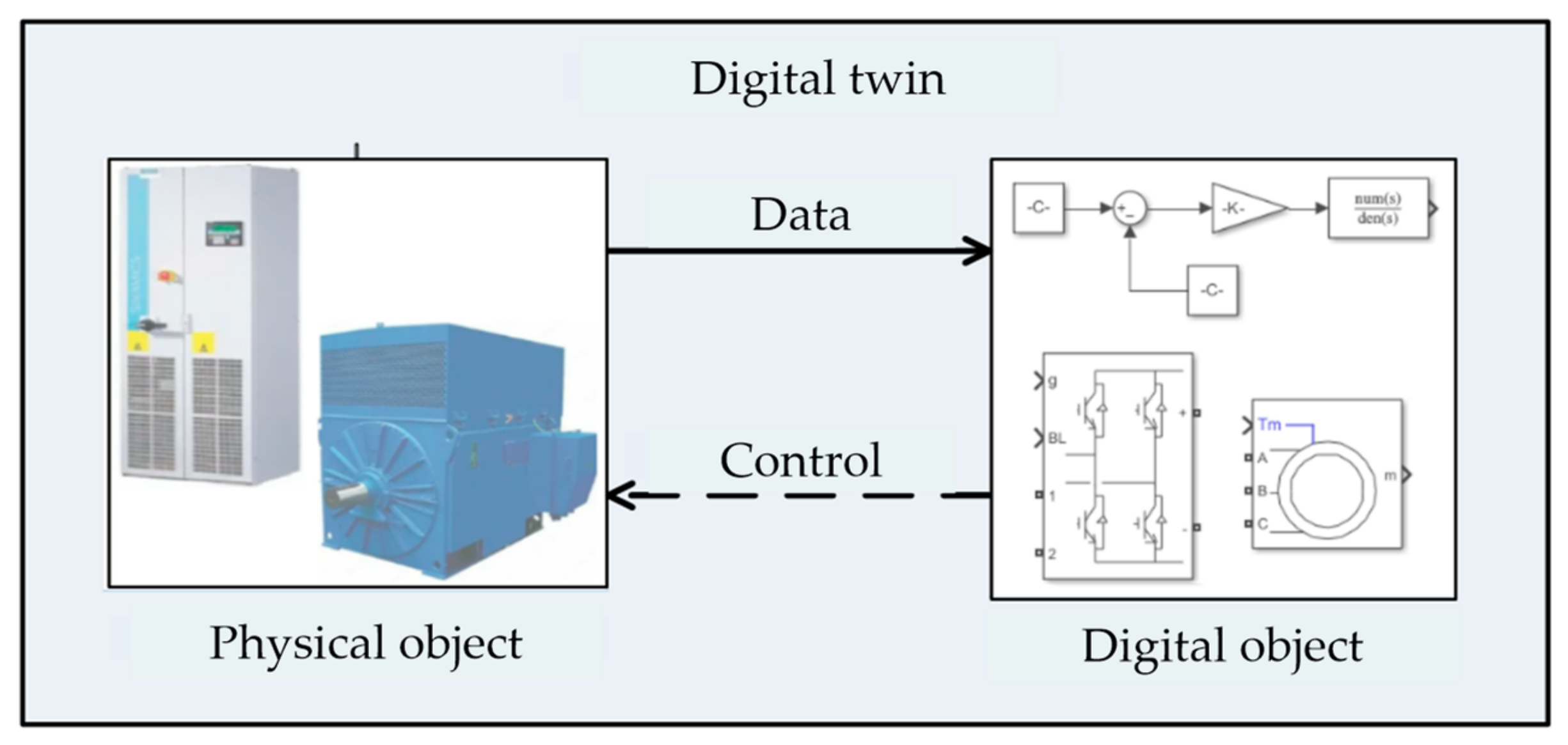
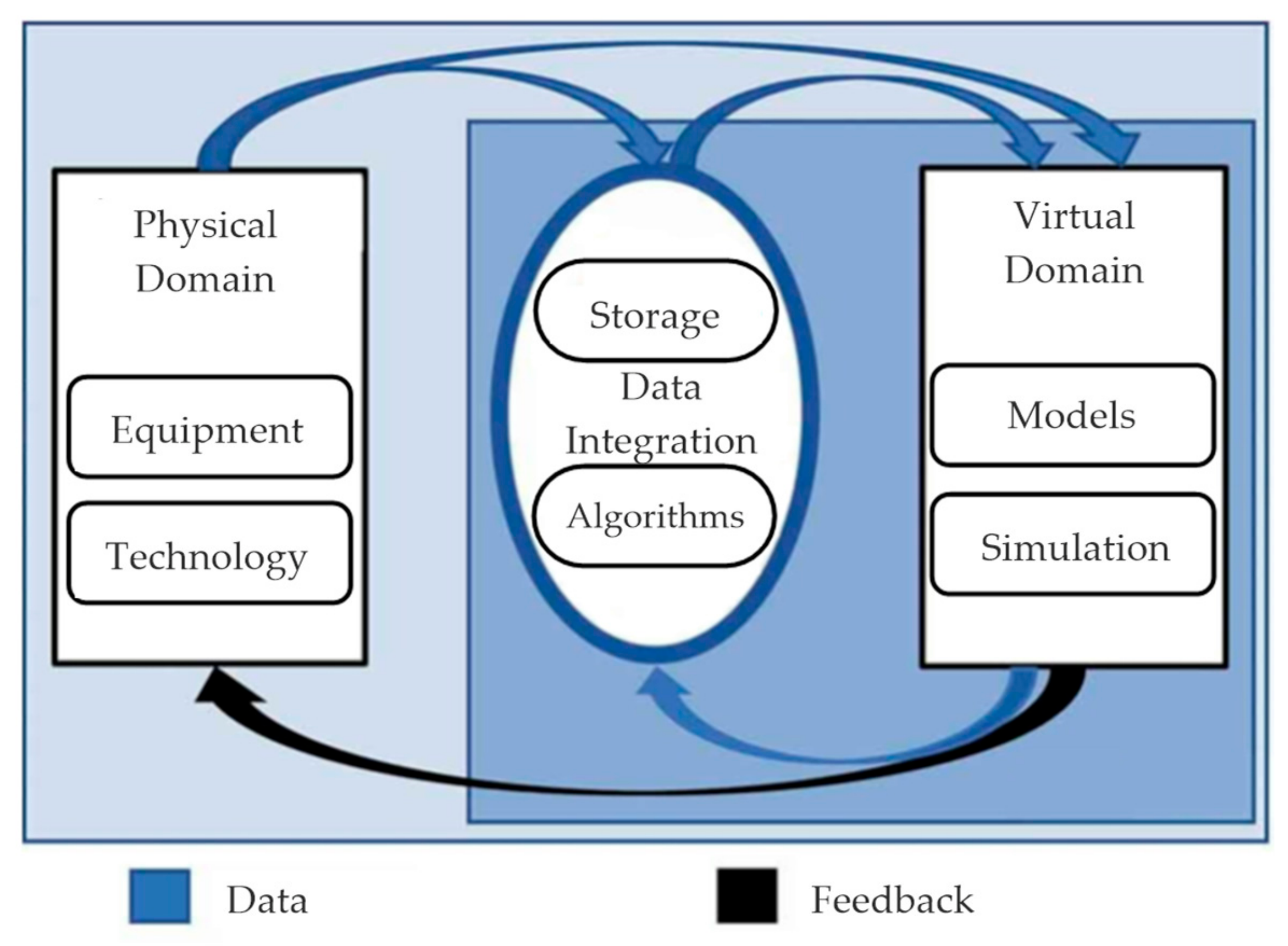
1.1. Definition of the Digital Twin
1.2. Digital Twins of Rolling Mills
- At the modeling stage during the development and design of equipment and automation systems;
- At the commissioning stage through the creation of virtual models of the object;
- During operation for system retuning and condition monitoring;
- Within monitoring systems for real-time condition assessment.
1.3. Virtual Commissioning
- –
- Testing and debugging algorithms in a virtual environment;
- –
- Virtual investigation of equipment operation, identification of possible problems, and rapid assessment of alternative solutions;
- –
- Rapid modification of operating procedures and control algorithms;
- –
- Training of operators and personnel under protected conditions, which is important for electrical installations in metallurgical production;
- –
- Simulation of the impact of new equipment on existing equipment in order to identify bottlenecks and eliminate them before installation.
- Reduced development time. Modular design and reusable components can significantly shorten development cycles.
- Improved maintainability. Owing to the principle of encapsulation, changes or updates to individual components can be made without affecting the entire system.
- Improved performance. Accurate models and simulations can lead to improved control strategies and higher system performance.
- Cost savings through process optimization and reduced downtime.
- Preliminary coarse justification of the control system structure and the controller transfer function;
- Tuning using HIL.
2. Problem Formulation
2.1. Characteristics of Digital Platforms for the Development of Industrial DTs
2.2. Object-Oriented Approach to the Development of Digital Twins
- Orientation toward a specific object (for rolling mills, this may include the electromechanical system of a stand or coiler, an individual motor, or a power converter).
- Development based on accessible software without the use of specialized digital platforms.
- Application not across the entire lifecycle, but only at specific stages for which the given DT is created.
- Modular architecture—individual components (motors, mechanical transmissions, hydraulic devices, etc.) are considered as independent objects, which simplifies design, modification, and reuse of system elements.
- Encapsulation (restricted access)—this is the process of separating the elements of an object that define its structure and behavior. Its purpose is that “no part of a complex system should depend on the internal structure of another part. Each object encapsulates its own data (e.g., motor speed, torque) and methods (speed control, torque calculation), ensuring data integrity and reducing unintended side effects.”
- 3.
- Inheritance and polymorphism. Complex systems can be created by inheriting properties of base classes (e.g., electric machine classes) and defining specialized behavior for different types (synchronous, asynchronous drives, etc.).
- 4.
- Modeling and analysis. Object-oriented models can be effectively created using tools such as Simulink, enabling analysis of system processes under various conditions.
2.3. Conclusions Based on the Analysis
- Substantiation of the concept of relatively simple object-oriented digital twins, the distinguishing features of which include:
- The possibility of developing DTs using accessible software without relying on digital platforms;
- Application for solving practical tasks at specific stages of the lifecycle, in this case at the stages of virtual commissioning (or commissioning activities) and the improvement of control algorithms for interconnected electric drives.
- Presentation of examples of practical implementation and industrial deployment of object-oriented DTs in operating rolling mills.
3. Materials and Methods
3.1. Implementation of the Object-Oriented Approach During Commissioning of a Tandem Mill
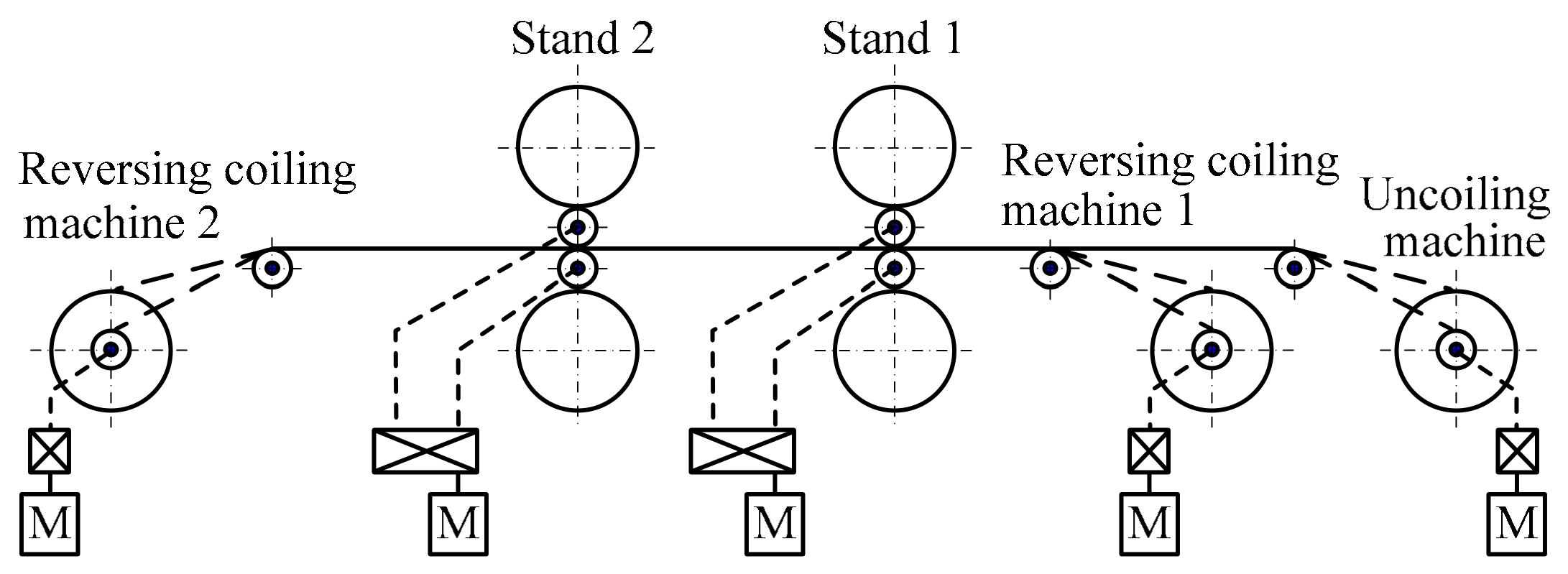
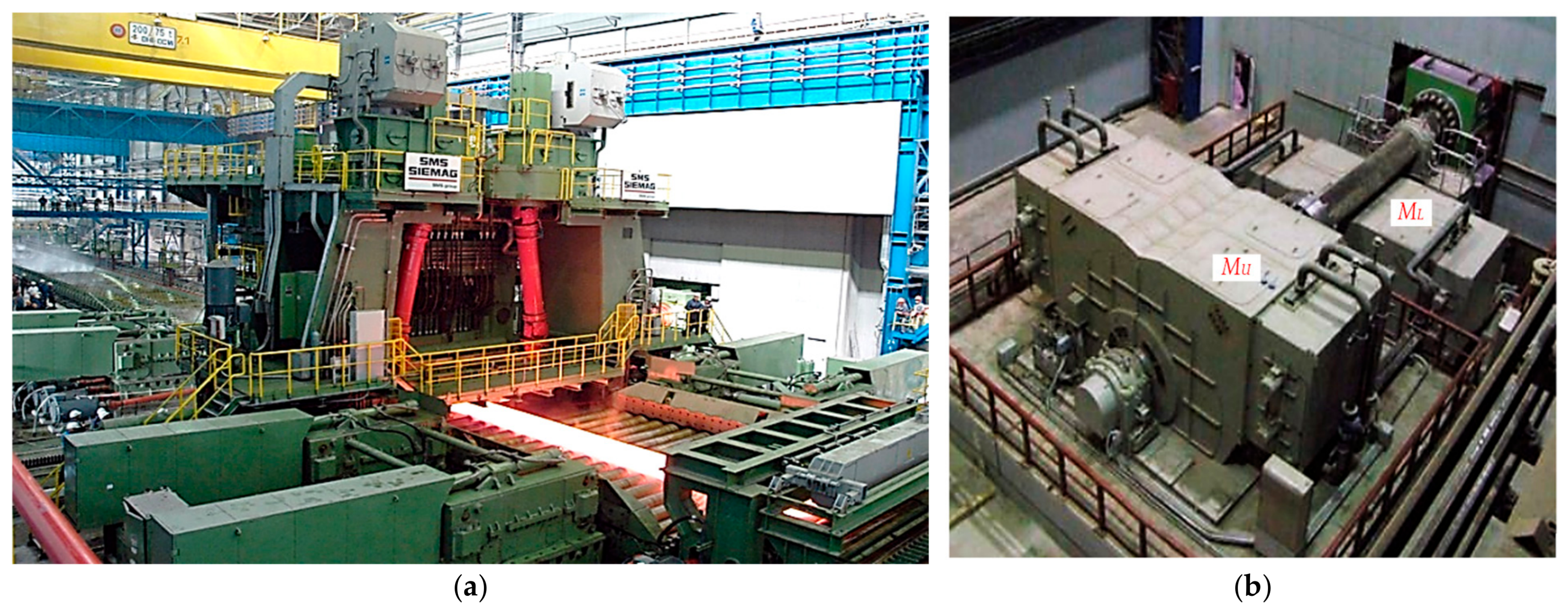
3.2. Mill Characteristics
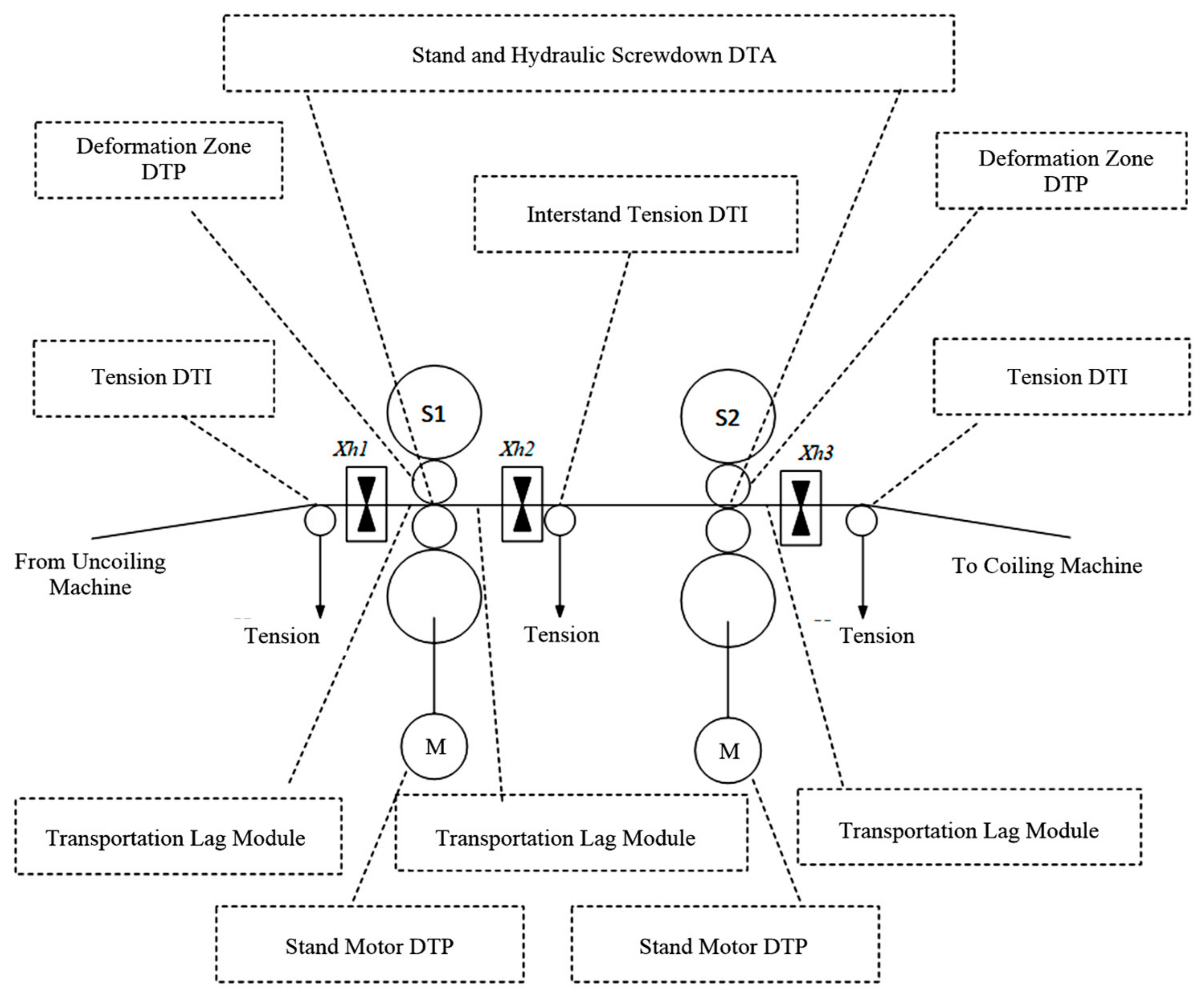
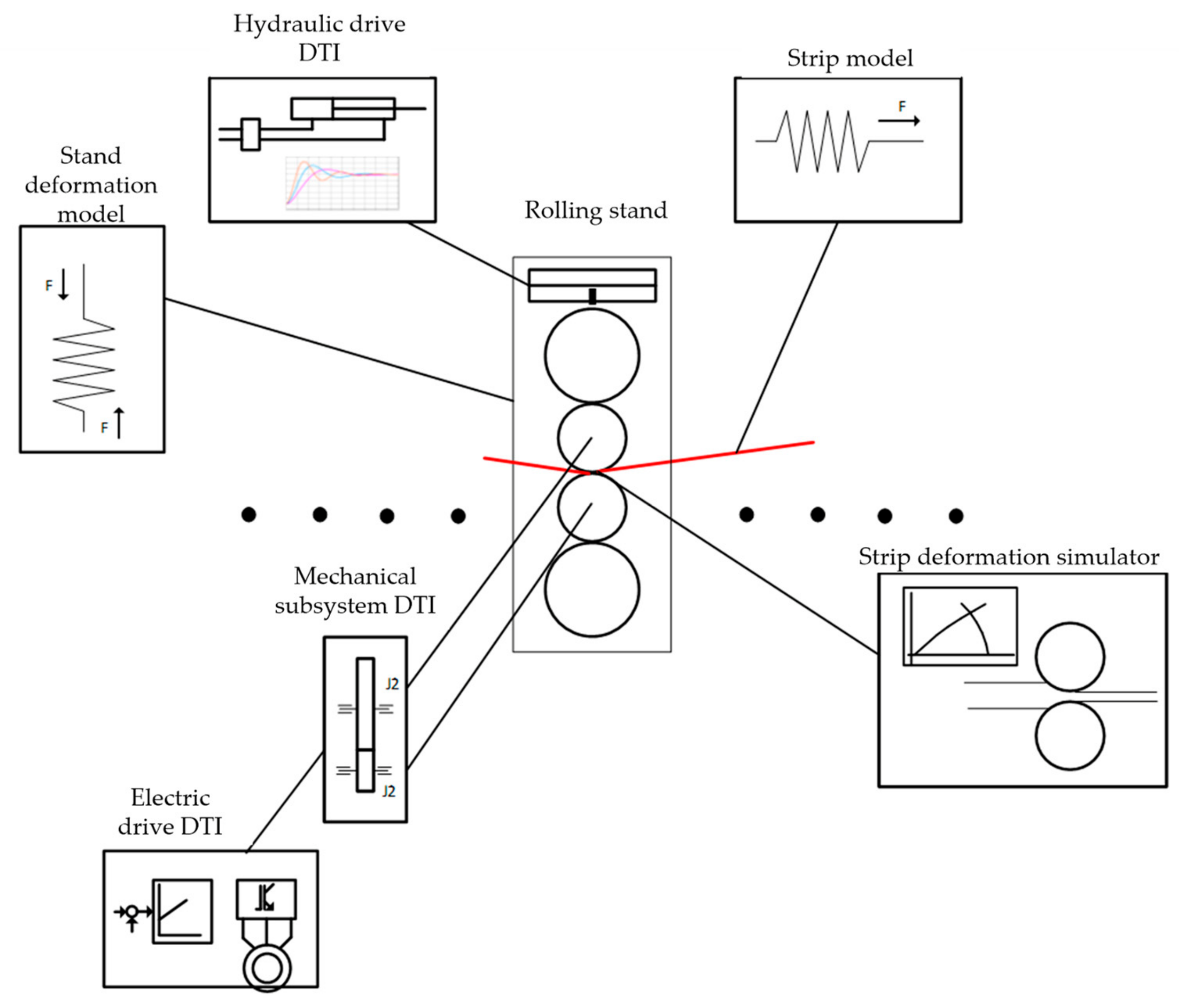
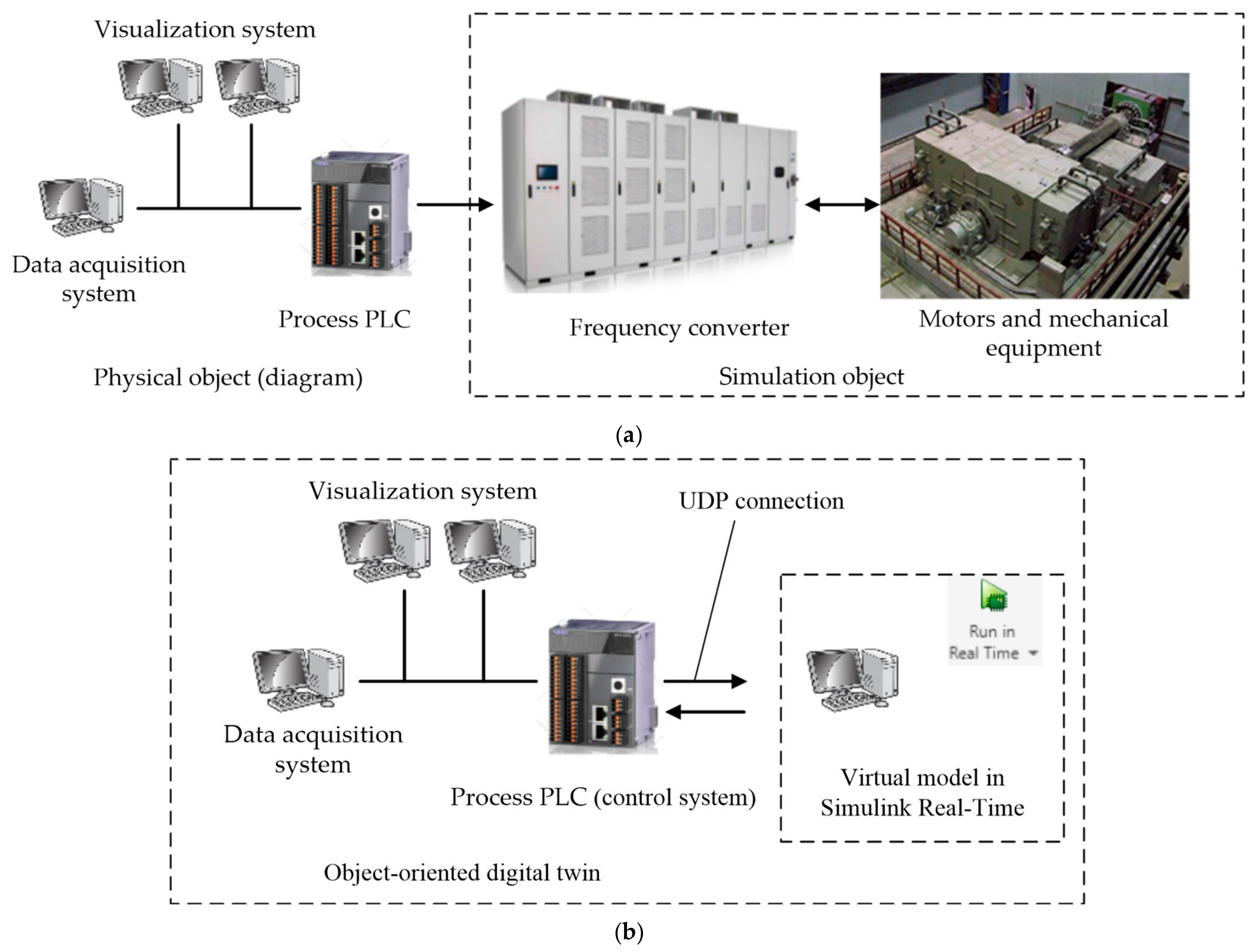
3.3. Digital Twin Structure
- DTP of stand electric drives;
- DTP of hydraulic devices;
- DTI modeling the deformation zone and rolling force;
- DTI of the strip between stands, i.e., the interconnection of stands through the strip;
- DTI modeling the relationship between the last stand and the coiler;
- Thickness measurement devices (Digital Shadows, DS);
- Flatness measurement devices (DS).
4. Implementation
4.1. Characteristics of the Electric Drives of the 5000 Mill Stand
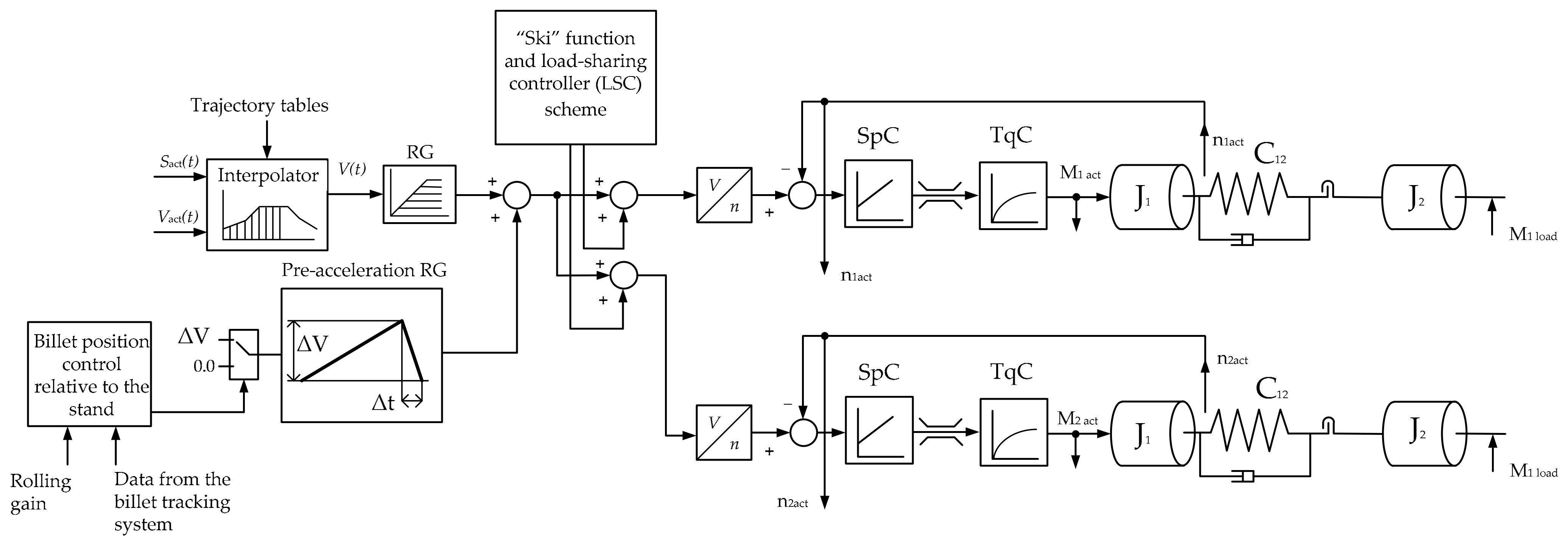
4.2. Example of Constructing Object-Oriented DTs of a Rolling Stand
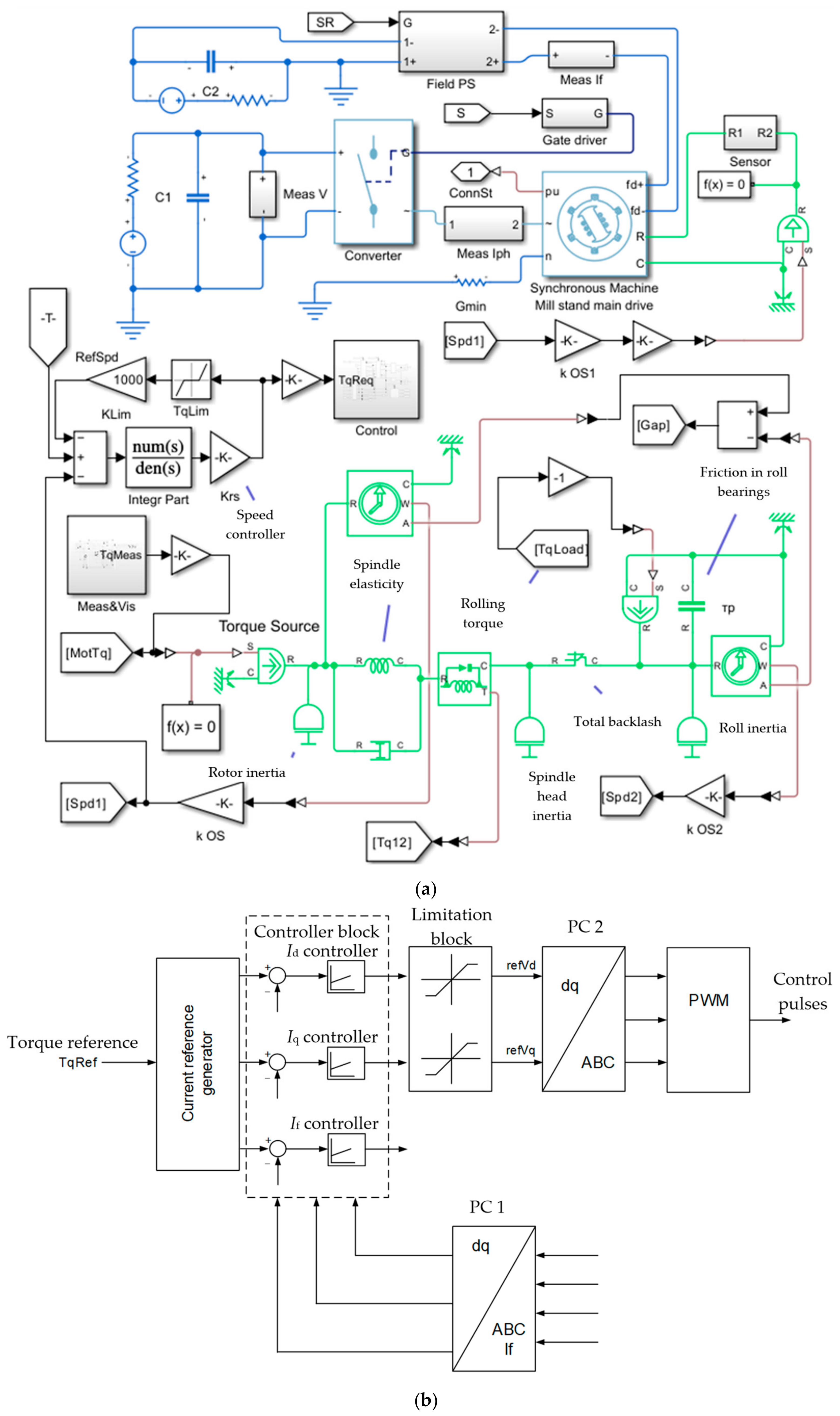
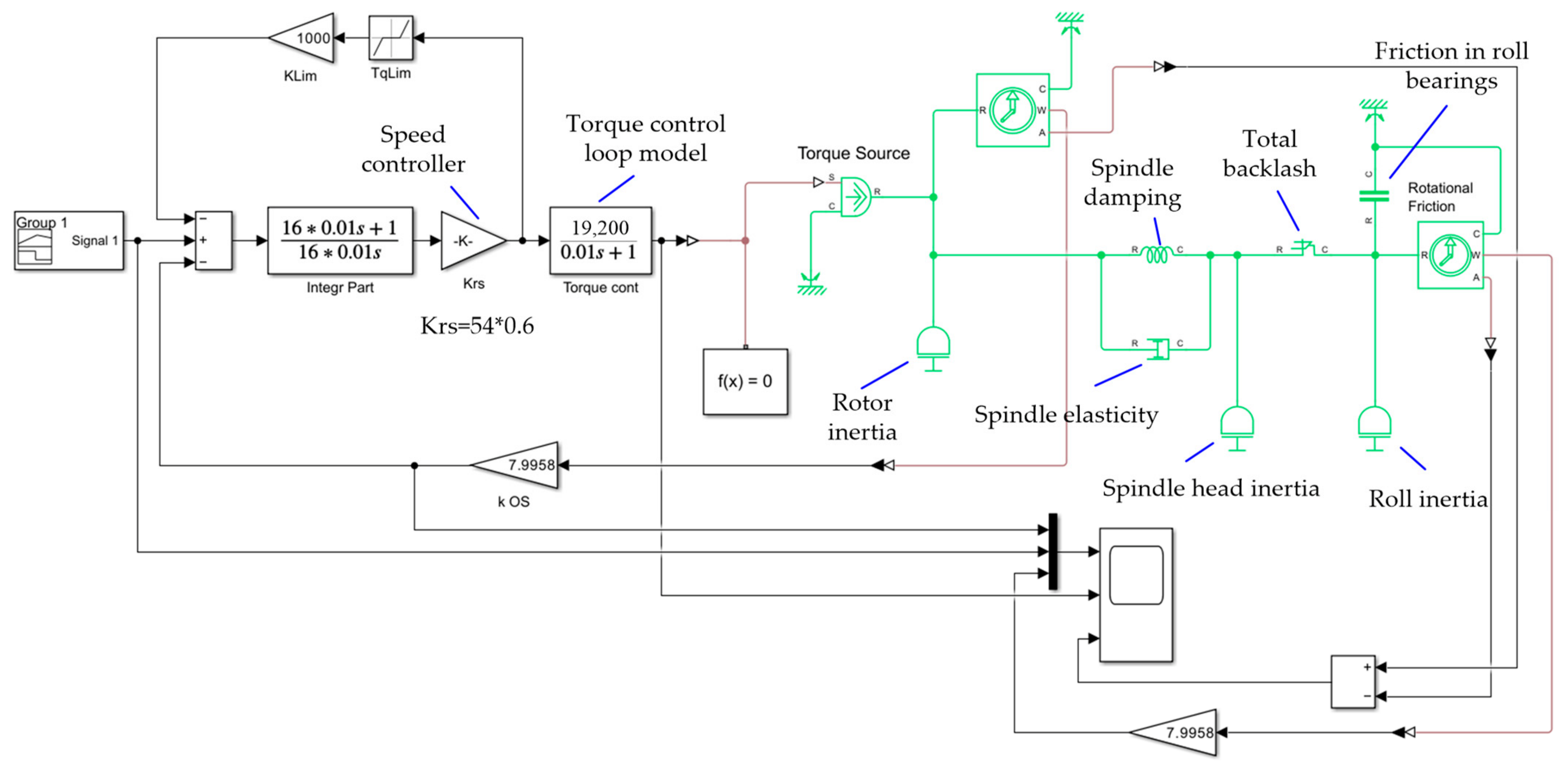
4.3. Virtual Models of Electromechanical Systems
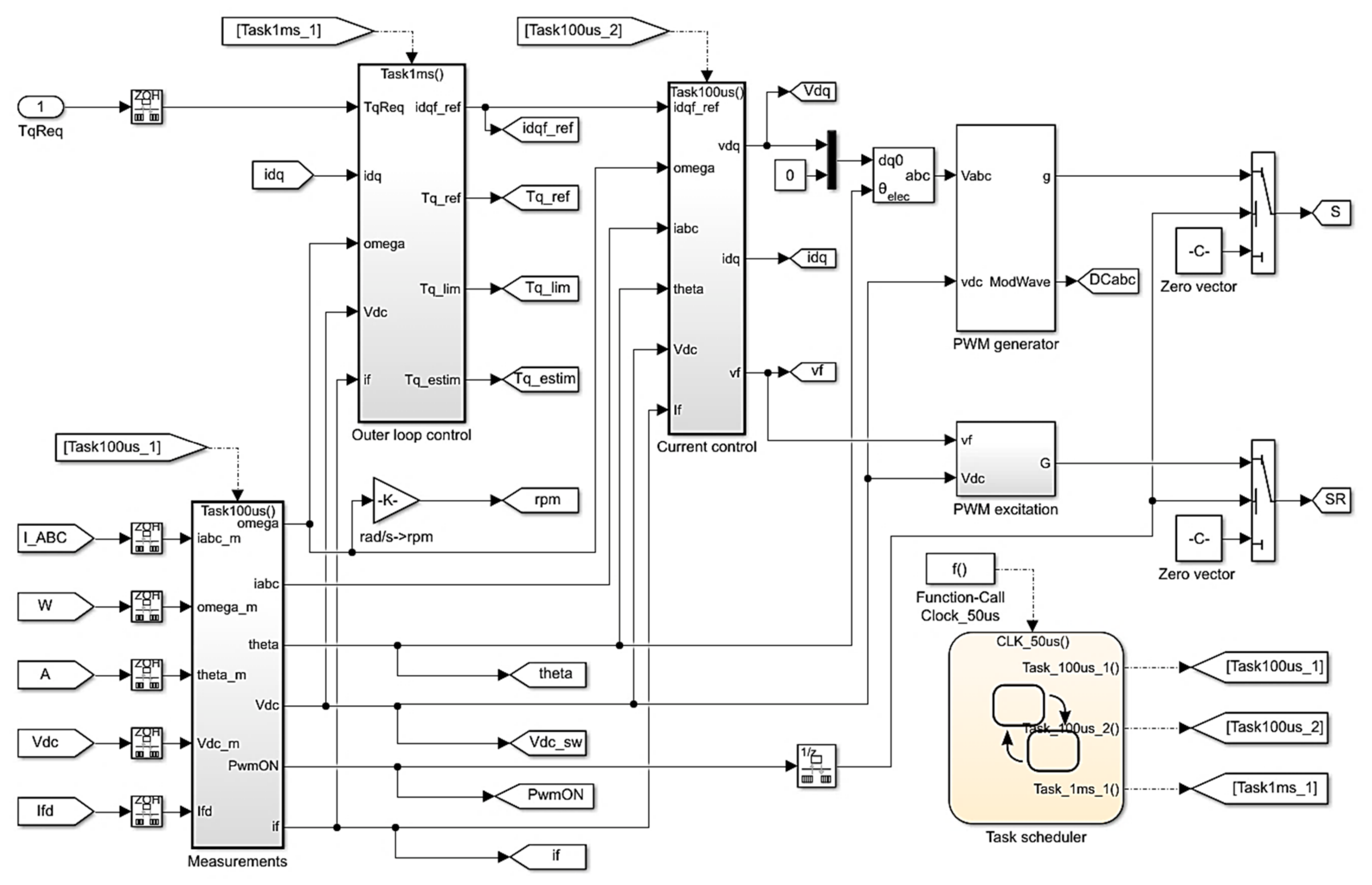
4.3.1. Detailed Electric Drive Model (Simscape Model)
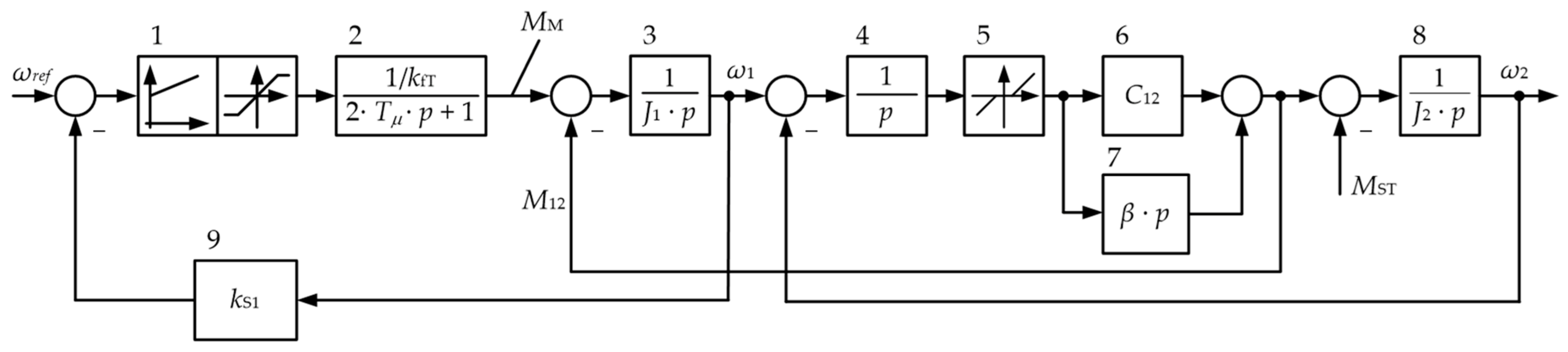
4.3.2. Simplified Model (Simulink Model)
5. Results
5.1. Analysis of Processes Under Impact Load Application
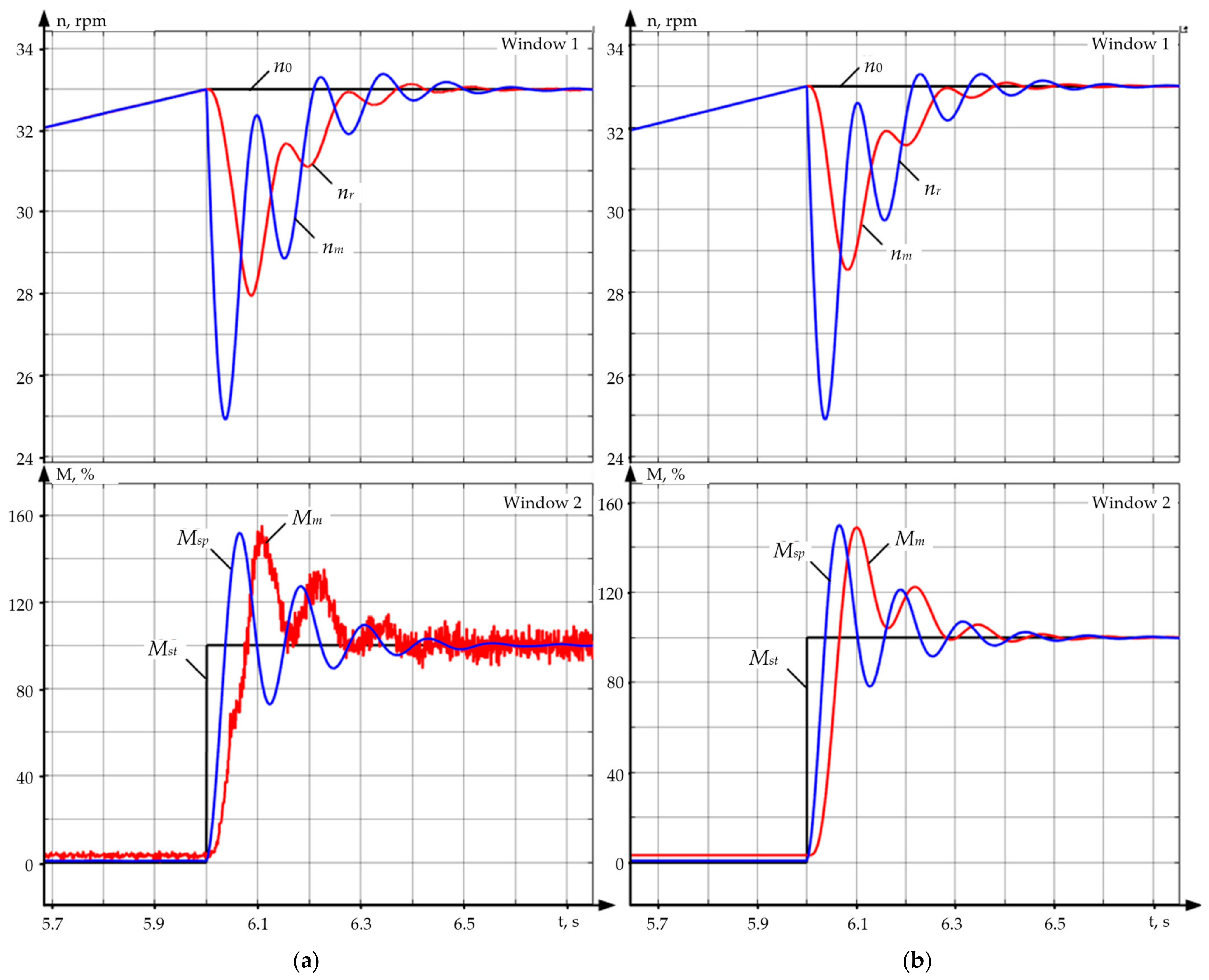
- Window 1—speed reference n0, roll speed nr, motor speed nm (all in rpm);
- Window 2—load torque Mst, spindle torque Msp, motor torque Mm (all in %).
- The motor torque curve obtained using the detailed model contains high-frequency noise caused by switching in the power converter.
- When high-frequency noise is neglected, the processes are equivalent.
5.2. Limits of Engineering Applicability of the Models
- A model with a detailed description of the power section imposes high requirements on the cycle time of the real-time simulation program. The cycle time ranges from 10 μs to 100 μs, and such requirements lead to a high load on the real-time PLC.
- For simplified models, experiments were carried out with real-time model cycle times from 500 μs to 10 ms. It was established that a two-mass model with a simplified torque loop requires a calculation cycle of no more than 3 ms.
- Computational experiments were carried out with the inertia of the torque loop excluded by representing it as a proportional element while preserving the mechanical part of the model as a two-mass system. This representation of the torque loop is not considered here. The model remains operable with calculation cycle times of up to 10 ms while maintaining satisfactory accuracy. The estimate of the root-mean-square deviation between the two-mass model with the torque loop represented by an inertial element and the model with the torque loop represented by a proportional element is no more than 7% over 300 ms from the beginning of the transient process caused by load application.
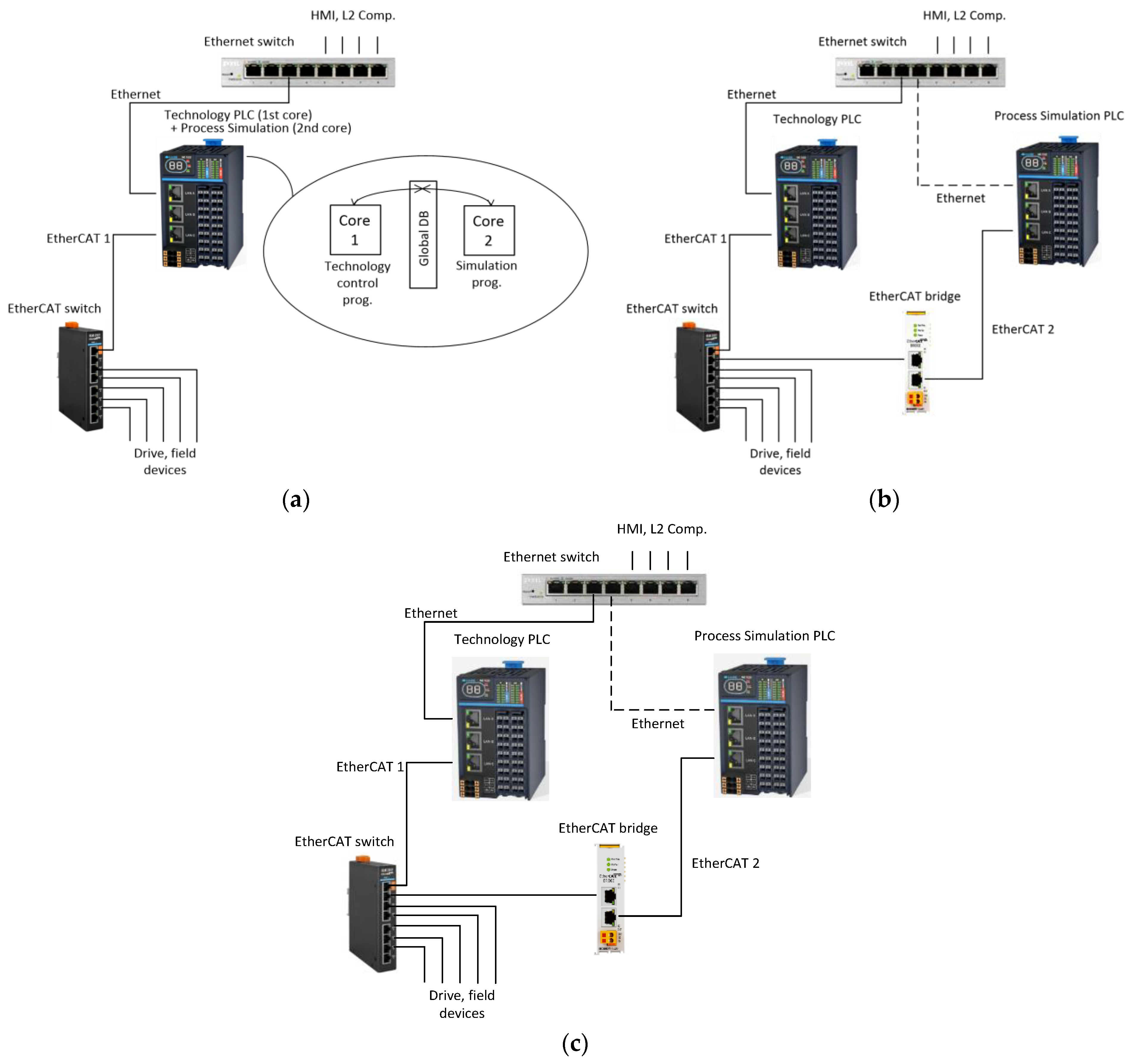
5.3. Digital Twins on PLCs with Multicore Processors
6. Summarizing Research Results
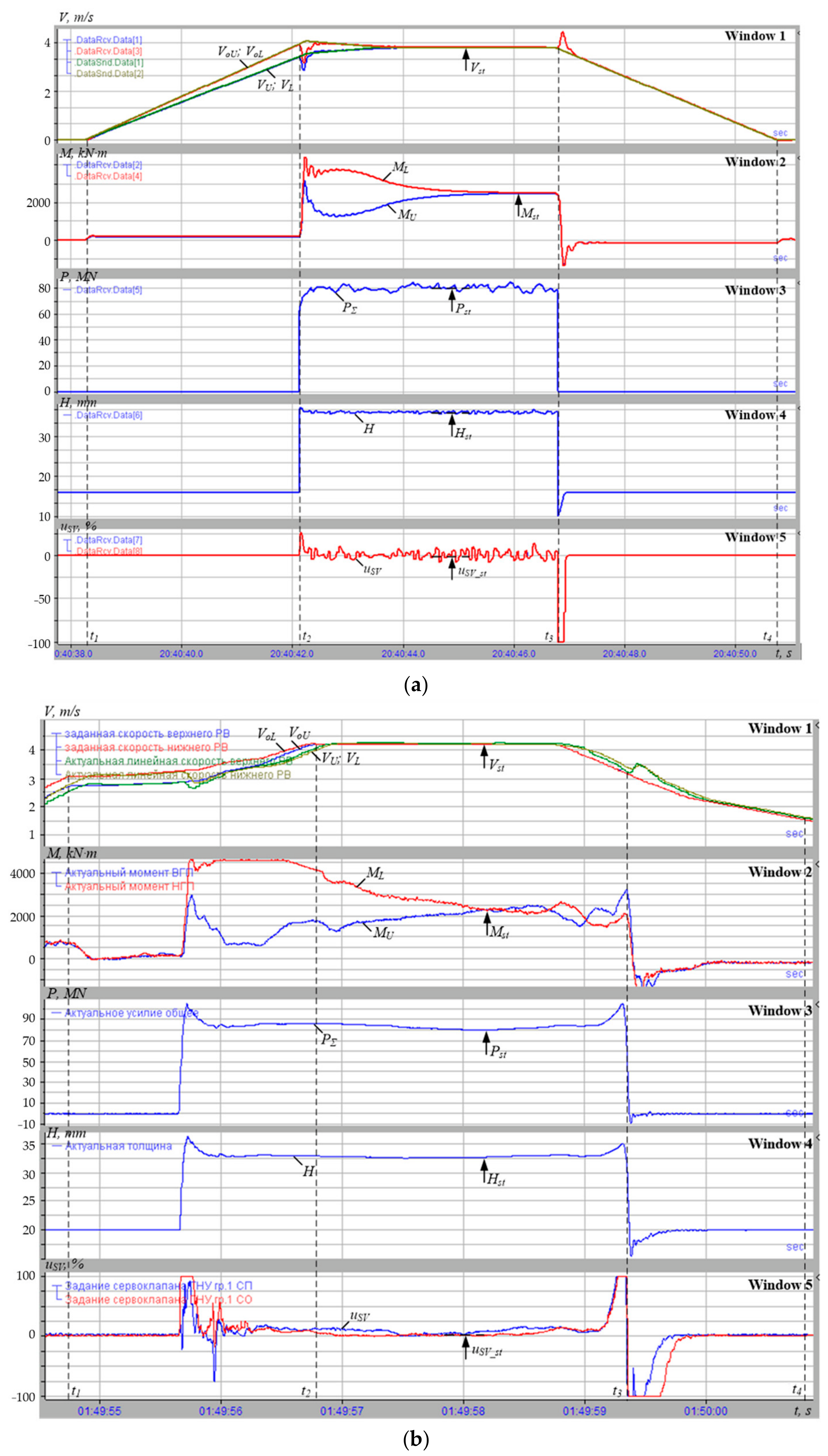
6.1. Validation of the Results of Virtual Tuning of Electric Drives of the 5000 Mill Stand
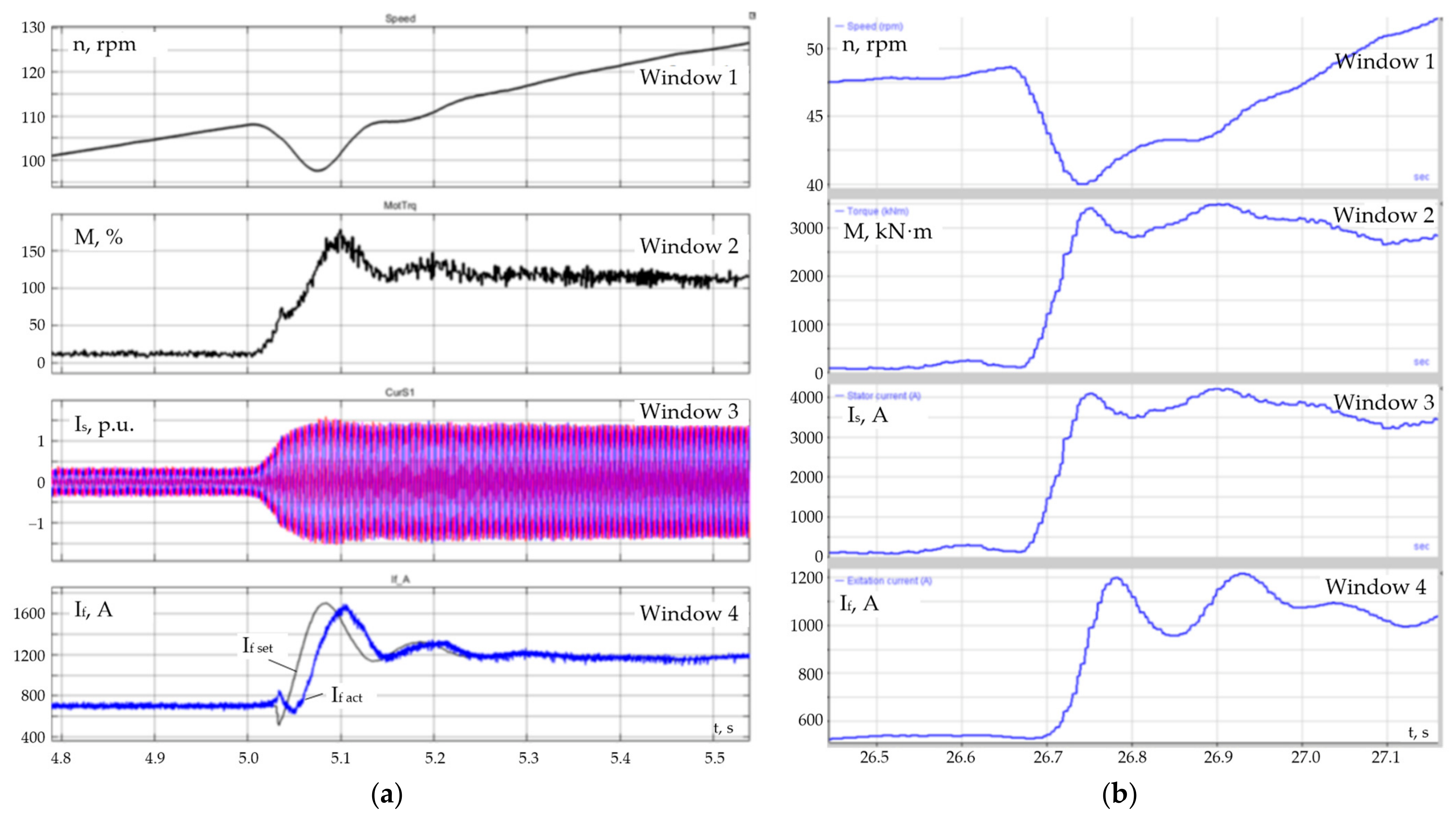
- The controlled variables recorded in both figures coincide with an error not exceeding 13%.
- The maximum dynamic values observed at strip biting (time t2) and at strip exit from the rolls (time t4) differ. This is explained by the fact that, during the development of virtual models included in the DT structure, it is not possible to account for the full range of factors influencing transient processes.
6.2. Advantages and Limitations of the Object-Oriented Approach
- Reusability. Object-oriented models are intended for reuse in different electrical systems or components. This means, for example, that a basic control system model can be extended to represent control systems with similar functions.
- Adaptability. Object-oriented models can be easily adapted to changes in the physical system or its components. This makes it possible to perform updates and modifications without redeveloping the entire model.
- Modularity. By dividing the electrical system into separate modules, the development process becomes more organized and easier to maintain.
- Inheritance and polymorphism. These properties make it possible to create specialized object-oriented digital twins by inheriting the functions of a base class and using common functions.
- Real-time programming. The use of Simulink Real-Time in combination with hardware–software simulation makes it possible to create a real-time model of an electromechanical system with control signals from the PLC controlling the physical object.
- –
- –
- Difficulties in modeling interconnected physical processes. Digital twins require multi-domain modeling, for example thermal, mechanical, and electrical modeling. A strictly defined object cannot easily adapt to changing physical interactions unless this is explicitly programmed. This leads to parameter uncertainty and high complexity in model maintenance [91].
- –
- Excessive simplification for integration into artificial intelligence (AI). Object-oriented DTs reflect specific programmed properties, whereas artificial intelligence relies on the representation of statistical properties and data-based patterns. Combining the physical requirements of object-oriented objects with data inference within AI is a complex task [92].
7. Conclusions
- Known definitions of digital twins have been analyzed. The DT structure and a conceptual diagram explaining information exchange between its elements have been presented. Known digital platforms intended for DT development have been characterized. The development of DTs based on MATLAB and its Simulink Real-Time and Simscape applications, as well as CODESYS 3.5, has been substantiated. The direction of creating DTs based on available software without the use of digital platforms forms the basis of the object-oriented approach to creating DTs.
- A methodology for creating industrial DTs based on HIL has been substantiated, and an object-oriented approach to creating DTs of electrotechnical systems has been presented. The key aspects of the approach have been considered: modular design, encapsulation, restricted access, inheritance, and polymorphism. It has been concluded that this approach makes it possible to simplify modeling and improve the control of complex systems.
- Using the example of interconnected electrotechnical systems of the 1700 reversing cold rolling mill, the relationship between object-oriented DTs and M. Grieves’ classification system (DTP/DTI/DTA/DTE) has been demonstrated. The proposed approach was applied during virtual commissioning of the mill. As a result, a multiple reduction in VC time was achieved, which confirms the effectiveness of using object-oriented DTs.
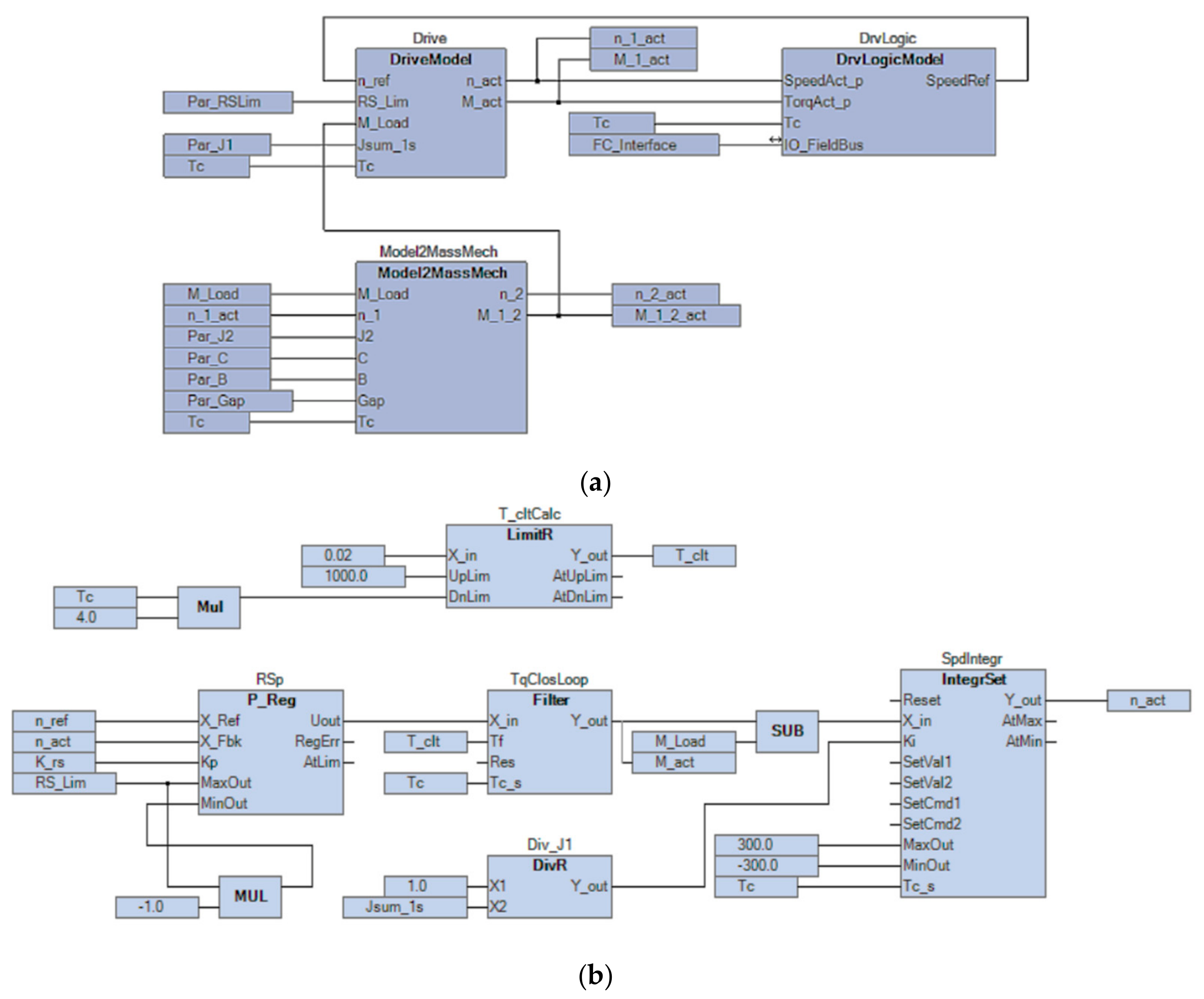
- Block diagrams of an object-oriented DTA of the electromechanical system of the horizontal stand of the 5000 plate rolling mill have been developed. A virtual model with a complete torque loop implemented on the basis of Simscape domains and a simplified digital model in which the complete torque control loop is replaced by a first-order inertial element, i.e., a model in Simulink Real-Time, have been presented. It has been shown that the “simple” Simulink model provides higher dynamic response during data exchange, while the “complex” Simscape model provides maximum accuracy in reproducing dynamic processes. By comparing transient processes and numerical values, the acceptable accuracy of the results obtained in both cases has been confirmed.
- Using a PLC based on a multicore processor and CODESYS 3.5 software, a simulator program was tested to study transient processes of interconnected electric drives of the 5000 mill stand. Industrial electric drives were studied, and a multiple “reserve” in dynamic response was confirmed for each of them.
- In general, the object-oriented approach to digital twin development makes it possible to create reusable and adaptable models that can be tuned for different electrotechnical systems and their components. The use of properties such as encapsulation, inheritance, and polymorphism makes it possible to develop DTs of varying complexity based on M. Grieves’ classification system and available software without using digital platforms.
Author Contributions
Funding
Data Availability Statement
Conflicts of Interest
References
- GOST R 57700.37–2021; Computer Models and Simulation. Digital Twins of Products. General Provisions: National Standard of the Russian Federation: Approved and Enacted by Order of Rosstandart No. 979-st Dated 16.09.2021. Russian Institute for Standardization: Moscow, Russia, 2021; 15p.
- Grieves, M. Digital Twin: Manufacturing Excellence through Virtual Factory Replication. Available online: https://www.3ds.com/fileadmin/PRODUCTS-SERVICES/DELMIA/PDF/Whitepaper/DELMIA-APRISO-Digital-Twin-Whitepaper.pdf (accessed on 12 June 2025).
- Pronost, G.; Mayer, F.; Camargo, M.; Dupont, L. Digital Twins along the Product Lifecycle: A Systematic Literature Review of Applications in Manufacturing. Digit. Twin 2024, 1, 3. [Google Scholar] [CrossRef] [Scilit]
- Value Creation with Plant Modelling and Simulation. AFRY and Siemens Showcase Real Digital Twins. Available online: https://afry.com/sites/default/files/2020-11/siemens_afry_-_value_creation_with_plant_modelling_and_simulation.pdf (accessed on 24 August 2024).
- Oztemel, E.; Gursev, S. Literature Review of Industry 4.0 and Related Technologies. J. Intell. Manuf. 2020, 31, 127–182. [Google Scholar] [CrossRef] [Scilit]
- Digital Twins in Industry: Origins, Concepts, Current State of Development and Implementation Examples. Available online: https://digitaltwin.ru/articles/digital-twins-in-industry/ (accessed on 19 March 2024).
- Kunath, M.; Winkler, H. Integrating the Digital Twin of the Manufacturing System into a Decision Support System for Improving the Order Management Process. Procedia CIRP 2018, 72, 225–231. [Google Scholar] [CrossRef] [Scilit]
- Park, C.Y.; Kim, J.W.; Kim, B.; Lee, J. Prediction for Manufacturing Factors in a Steel Plate Rolling Smart Factory Using Data Clustering-Based Machine Learning. IEEE Access 2020, 8, 60890–60905. [Google Scholar] [CrossRef] [Scilit]
- Qu, Y.J.; Ming, X.G.; Liu, Z.W. Smart Manufacturing Systems: State of the Art and Future Trends. Int. J. Adv. Manuf. Technol. 2019, 103, 3751–3768. [Google Scholar] [CrossRef] [Scilit]
- Zhang, F.; Wang, X.; Zong, S.; Xiang, X. Research and Application of Computer Control System for Aluminium Single-Stand 4-High Cold Rolling Mill. J. Eng. 2016, 2016, 415–422. [Google Scholar] [CrossRef] [Scilit]
- Kritzinger, W.; Karner, M.; Traar, G.; Henjes, J.; Sihn, W. Digital Twin in manufacturing: A categorical literature review and classification. IFAC-PapersOnLine 2018, 51, 1016–1022. [Google Scholar] [CrossRef] [Scilit]
- Iliuţă, M.-E.; Moisescu, M.-A.; Pop, E.; Ionita, A.-D.; Caramihai, S.-I.; Mitulescu, T.-C. Digital Twin—A Review of the Evolution from Concept to Technology and Its Analytical Perspectives on Applications in Various Fields. Appl. Sci. 2024, 14, 5454. [Google Scholar] [CrossRef] [Scilit]
- Schleich, B.; Anwer, N.; Mathieu, L.; Wartzack, S. Shaping the digital twin for design and production engineering. CIRP Ann. Manuf. Technol. 2017, 66, 141–144. [Google Scholar] [CrossRef] [Scilit]
- Stouffer, K.; Lightman, S.; Pilliteri, V.; Abrams, M.; Hahn, A. Guide to Industrial Control Systems (ICS) Security. Available online: https://csrc.nist.gov/pubs/sp/800/82/r2/final (accessed on 5 April 2024).
- Slevin, B. How Do You Create a Digital Twin? Available online: https://blogs.opentext.com/how-do-you-create-a-digital-twin/ (accessed on 28 April 2020).
- Yao, J.-F.; Yang, Y.; Wang, X.-C.; Zhang, X.-P. Systematic Review of Digital Twin Technology and Applications. Vis. Comput. Ind. Biomed. Art 2023, 6, 10. [Google Scholar] [CrossRef] [Scilit] [PubMed]
- Vachálek, J.; Bartalský, L.; Rovný, O.; Šišmišová, D.; Morháč, M.; Lokšík, M. The Digital Twin of an Industrial Production Line within the Industry 4.0 Concept. In Proceedings of the 2017 21st International Conference on Process Control (PC), Strbske Pleso, Slovakia, 6–9 June 2017; pp. 258–262. [Google Scholar] [CrossRef] [Scilit]
- Zhang, H.; Liu, Q.; Chen, X.; Zhang, D.; Leng, J. A Digital Twin-Based Approach for Designing and Multi-Objective Optimization of Hollow Glass Production Line. IEEE Access 2017, 5, 26901–26911. [Google Scholar] [CrossRef] [Scilit]
- Bao, J.; Guo, D.; Li, J.; Zhang, J. The Modelling and Operations for the Digital Twin in the Context of Manufacturing. Enterp. Inf. Syst. 2018, 13, 534–556. [Google Scholar] [CrossRef] [Scilit]
- Graessler, I.; Poehler, A. Integration of a Digital Twin as Human Representation in a Scheduling Procedure of a Cyber-Physical Production System. In Proceedings of the 2017 IEEE International Conference on Industrial Engineering and Engineering Management (IEEM), Singapore, 10–13 December 2017; pp. 289–293. [Google Scholar] [CrossRef] [Scilit]
- Cai, Y.; Starly, B.; Cohen, P.; Lee, Y.-S. Sensor Data and Information Fusion to Construct Digital-Twins Virtual Machine Tools for Cyber-Physical Manufacturing. Procedia Manuf. 2017, 10, 1031–1042. [Google Scholar] [CrossRef] [Scilit]
- Martinez, G.S.; Sierla, S.; Karhela, T.; Vyatkin, V. Automatic Generation of a Simulation-Based Digital Twin of an Industrial Process Plant. In Proceedings of the IECON 2018—44th Annual Conference of the IEEE Industrial Electronics Society, Washington, DC, USA, 21–23 October 2018; pp. 3084–3089. [Google Scholar] [CrossRef] [Scilit]
- Lattanzi, L.; Raffaeli, R.; Peruzzini, M.; Pellicciari, M. Digital Twin for Smart Manufacturing: A Review of Concepts towards a Practical Industrial Implementation. Int. J. Comput. Integr. Manuf. 2021, 34, 567–597. [Google Scholar] [CrossRef] [Scilit]
- Bécue, A.; Maia, E.; Feeken, L.; Borchers, P.; Praça, I. A New Concept of Digital Twin Supporting Optimization and Resilience of Factories of the Future. Appl. Sci. 2020, 10, 4482. [Google Scholar] [CrossRef] [Scilit]
- Kravchenko, A.A. Nature, Essence, and Classification of Digital Twins. Econ. Manag. 2025, 31, 125–134. [Google Scholar] [CrossRef] [Scilit]
- Huang, H.; Ji, T.; Xu, X. An adaptable Digital Twin model for manufacturing. Manuf. Lett. 2024, 41, 1163–1169. [Google Scholar] [CrossRef] [Scilit]
- What is Polymorphism, Encapsulation, Data Abstraction and Inheritance in Object-Oriented Programming? Available online: https://dev.to/fusion_reactor/polymorphism-encapsulation-data-abstraction-and-inheritance-in-object-oriented-programming-14cc (accessed on 19 March 2026).
- Java OOP(Object Oriented Programming) Concepts. Available online: https://www.geeksforgeeks.org/java/object-oriented-programming-oops-concept-in-java/ (accessed on 19 March 2026).
- Ma, N.; Zhao, P.; Xu, W.; Liu, A.; Zhu, H.; Shi, Z.; Wang, J. A multi-level isobaric hydrogen-electric coupled energy storage system with a wide-range operational strategy: Enhancing efficiency and flexibility in renewable-dominated power grid. Appl. Energy 2025, 401, 126783. [Google Scholar] [CrossRef] [Scilit]
- Ma, N.; Zhao, P.; Xu, W.; Liu, A.; Wang, J. Assessment on the coupling effect and economic viability of a novel hydrogen-electric coupled energy storage system combining hydrogen-fueled CAES and oxy-combustion CCES driven by a power-to-gas device: A pathway for synergistic enhancement. J. Energy Storage 2025, 135, 118178. [Google Scholar] [CrossRef] [Scilit]
- Allmeling, J. Model Continuity: From Offline Simulation to Real-Time Testing. Available online: https://www.powerelectronicsnews.com/model-continuity-from-offline-simulation-to-real-time-testing/ (accessed on 17 February 2025).
- Gasiyarov, V.R.; Bovshik, P.A.; Loginov, B.M.; Karandaev, A.S.; Khramshin, V.R.; Radionov, A.A. Substantiating and Implementing Concept of Digital Twins for Virtual Commissioning of Industrial Mechatronic Complexes Exemplified by Rolling Mill Coilers. Machines 2023, 11, 276. [Google Scholar] [CrossRef] [Scilit]
- Riches, P. Rolling into the Future, Long Rolling Control System Utilizing the Changing Trends in Technology and Digitalization. In Proceedings of the Technical Contribution to the 21 Seminário de Automação e TI, Part of the ABM Week, São Paulo, Brazil, 2–6 October 2017; Volume 21, pp. 255–267. [Google Scholar] [CrossRef] [Scilit]
- Digitalization in the Steel Industry. Available online: https://www.sms-group.com/sms-group-magazine/overview/digitalization-in-the-steel-industry/ (accessed on 14 March 2025).
- The Digital Twin–More than a Virtual Representation of the Real World. Available online: https://www.sms-group.com/jp/sms-group-magazine/overview/the-digital-twin-more-than-a-virtual-representation-of-the-real-world/ (accessed on 14 March 2025).
- MathWorks Simulink Real-Time Simulation and Testing. Available online: https://www.windows-soft.ru/catalog/product/kupit-mathworks-simulink-real-time-simulation-and-testing-po-dostupnoy-tsene (accessed on 18 December 2024).
- Bouscayrol, A. Different Types of Hardware-in-the-Loop Simulation for Electric Drives. In Proceedings of the 2008 IEEE International Symposium on Industrial Electronics, Cambridge, UK, 30 June–2 July 2008; pp. 2146–2151. [Google Scholar] [CrossRef] [Scilit]
- Baghdadi, M.; Elwarraki, E.; Ayad, I.A. FPGA-Based Hardware-in-the-Loop (HIL) Emulation of Power Electronics Circuit Using Device-Level Behavioral Modeling. Designs 2023, 7, 115. [Google Scholar] [CrossRef] [Scilit]
- Aravena, J.; Carrasco, D.; Diaz, M.; Uriarte, M.; Rojas, F.; Cardenas, R.; Travieso, J.C. Design and Implementation of a Low-Cost Real-Time Control Platform for Power Electronics Applications. Energies 2020, 13, 1527. [Google Scholar] [CrossRef] [Scilit]
- Herrera, L.; Li, C.; Yao, X.; Wang, J. FPGA-Based Detailed Real-Time Simulation of Power Converters and Electric Machines for EV HIL Applications. IEEE Trans. Ind. Appl. 2015, 51, 1702–1712. [Google Scholar] [CrossRef] [Scilit]
- Cimino, C.; Negri, E.; Fumagalli, L. Review of Digital Twin applications in manufacturing. Comput. Ind. 2019, 113, 103130. [Google Scholar] [CrossRef] [Scilit]
- Noga, M.; Juhás, M.; Gulan, M. Hybrid virtual commissioning of a robotic manipulator with machine vision using a single controller. Sensors 2022, 22, 1621. [Google Scholar] [CrossRef] [Scilit] [PubMed]
- Segovia, M.; Garcia-Alfaro, J. Design, Modeling and implementation of Digital Twins. Sensors 2022, 22, 5396. [Google Scholar] [CrossRef] [Scilit] [PubMed]
- Ding, B.; Flanagan, C.; Gamboa, M.A. Reducing commissioning time by 40% with a Digital Twin. Available online: https://kalypso.com/viewpoints/entry/reducing-commissioning-time-by-40-with-a-digital-twin (accessed on 19 March 2026).
- Konstantinov, S.; Assad, F.; Ahmad, B.; Vera, D.A.; Harrison, R. Virtual engineering and commissioning to support the lifecycle of a manufacturing assembly system. Machines 2022, 10, 939. [Google Scholar] [CrossRef] [Scilit]
- Radionov, A.A.; Karandaev, A.S.; Loginov, B.M.; Khramshin, V.R. Developing Digital Twin for Electromechanical System of Rolling Stand in Simulink Real Time. In Proceedings of the 2024 International Ural Conference on Electrical Power Engineering (UralCon), Magnitogorsk, Russia, 27–29 September 2024; pp. 225–230. [Google Scholar] [CrossRef] [Scilit]
- Tanegue, H.B.D.; de Paula Ferreira, W.; de Assis, R.F.; Brodeur, D. Synergies Between Virtual Commissioning and Digital Twins. Eng. Proc. 2025, 89, 12. [Google Scholar] [CrossRef] [Scilit]
- Bombardier Transportation Implements Model-Based Design to Accelerate Rail Propulsion System Development. Available online: https://www.mathworks.com/company/user_stories/bombardier-transportation-implements-model-based-design-to-accelerate-rail-propulsion-system-development.html (accessed on 19 March 2026).
- Lechler, T.; Fischer, E.; Metzner, M.; Mayr, A.; Franke, J. Virtual Commissioning–Scientific review and exploratory use cases in advanced production systems. Procedia CIRP 2019, 81, 1125–1130. [Google Scholar] [CrossRef] [Scilit]
- Shahim, N.; Moller, C. Economic justification of Virtual Commissioning in automation industry. In Proceedings of the 2016 Winter Simulation Conference (WSC), Washington, DC, USA, 11–14 December 2016; pp. 2430–2441. [Google Scholar] [CrossRef] [Scilit]
- Lim, K.Y.H.; Zheng, P.; Chen, C.-H. A State-of-the-Art Survey of Digital Twin: Techniques, Engineering Product Lifecycle Management and Business Innovation Perspectives. J. Intell. Manuf. 2020, 31, 1313–1337. [Google Scholar] [CrossRef] [Scilit]
- Prokhorov, A.N.; Lysachev, M.N.; Borovkov, A.I. (Eds.) Digital Twin: Analysis, Trends, Global Experience; AlliancePrint LLC: Moscow, Russia, 2020; 401p. [Google Scholar]
- Digital Commissioning of Automation Systems with X-Pact Plug & Work Integration Test. Available online: https://www.sms-group.com/insights/all-insights/digital-commissioning-of-automation-systems-with-x-pactr-plug-work-integration-test (accessed on 18 February 2024).
- Grega, W.; Kolek, K. Simulation and Real-Time Control: From Simulink to Industrial Applications. In Proceedings of the IEEE International Symposium on Computer Aided Control System Design, Glasgow, UK, 20 September 2002; pp. 104–109. [Google Scholar] [CrossRef] [Scilit]
- Shao, N.; Zhang, S.; Liang, H. Model-Based Safety Analysis of a Control System Using Simulink and Simscape Extended Models. MATEC Web Conf. 2017, 139, 00219. [Google Scholar] [CrossRef] [Scilit]
- Petru, C.-D.; Morariu, F.; Breaz, R.-E.; Crenganiș, M.; Racz, S.-G.; Gîrjob, C.-E.; Bârsan, A.; Biriș, C.-M. Development of a Small CNC Machining Center for Physical Implementation and a Digital Twin. Appl. Sci. 2025, 15, 5549. [Google Scholar] [CrossRef] [Scilit]
- Simscape. Available online: https://exponenta.ru/simscape (accessed on 18 February 2024).
- Nazarov, M.M. Mass Communication in the Modern World: Methodology of Analysis and Research Practice; URSS Editorial: Moscow, Russia, 2002; 239p. [Google Scholar]
- Liu, M.; Fang, S.; Dong, H.; Xu, C. Review of digital twin about concepts, technologies, and industrial applications. J. Manuf. Syst. 2021, 58, 346–361. [Google Scholar] [CrossRef] [Scilit]
- Grieves, M.; Vickers, J. Digital Twin: Mitigating Unpredictable, Undesirable Emergent Behavior in Complex Systems. In Transdisciplinary Perspectives on Complex Systems; Springer: Cham, Switzerland, 2017; pp. 85–113. [Google Scholar] [CrossRef] [Scilit]
- Digital Twins with MATLAB and Simulink. Available online: https://nl.mathworks.com/discovery/digital-twin.html#digital-twins-with-matlab-and-simulink (accessed on 10 December 2022).
- Virtual Commissioning with Simulink. Available online: https://nl.mathworks.com/videos/virtual-commissioning-with-simulink-part-2-1508187504454.html (accessed on 10 December 2022).
- Philipp, M.; Schwenzfeier, W.; Fischer, F.D.; Wodlinger, R.; Fischer, C. Front End Bending in Plate Rolling Influenced by Circumferential Speed Mismatch and Geometry. J. Mater. Process. Technol. 2007, 184, 224–232. [Google Scholar] [CrossRef] [Scilit]
- Fan, L.P.; Liu, Y. A Control Method for Load Balance between Upper and Lower Roll of Four-High Hot Rolling Mill. Appl. Mech. Mater. 2014, 687–691, 167–170. [Google Scholar] [CrossRef] [Scilit]
- Gasiyarov, V.R.; Radionov, A.A.; Loginov, B.M.; Karandaev, A.S.; Gasiyarova, O.A.; Khramshin, V.R. Development and Practical Implementation of Digital Observer for Elastic Torque of Rolling Mill Electromechanical System. J. Manuf. Mater. Process. 2023, 7, 41. [Google Scholar] [CrossRef] [Scilit]
- Gasiyarov, V.R.; Radionov, A.A.; Loginov, B.M.; Zinchenko, M.A.; Gasiyarova, O.A.; Karandaev, A.S.; Khramshin, V.R. Method for Defining Parameters of Electromechanical System Model as Part of Digital Twin of Rolling Mill. J. Manuf. Mater. Process. 2023, 7, 183. [Google Scholar] [CrossRef] [Scilit]
- Gasiyarova, O.A.; Karandaev, A.S.; Erdakov, I.N.; Loginov, B.M.; Khramshin, V.R. Developing Digital Observer of Angular Gaps in Rolling Stand Mechatronic System. Machines 2022, 10, 141. [Google Scholar] [CrossRef] [Scilit]
- Klyuchev, V.I. Theory of Electric Drives: Textbook for Universities; Energoatomizdat: Moscow, Russia, 2001; 760p. [Google Scholar]
- Radionov, A.A.; Petukhova, O.I.; Erdakov, I.N.; Karandaev, A.S.; Loginov, B.M.; Khramshin, V.R. Developing an Automated System to Control the Rolled Product Section for a Wire Rod Mill with Multi-Roll Passes. J. Manuf. Mater. Process. 2022, 6, 88. [Google Scholar] [CrossRef] [Scilit]
- Karandaev, A.S.; Gasiyarov, V.R.; Radionov, A.A.; Loginov, B.M. Development of Digital Models of Interconnected Electrical Profiles for Rolling–Drawing Wire Mills. Machines 2021, 9, 54. [Google Scholar] [CrossRef] [Scilit]
- Lerche, J. Virtual Commissioning with Simulink. Desktop Real-Time Run Simulink Models in Real Time on Your Computer. Available online: https://www.mathworks.com/products/simulink-desktop-real-time.html (accessed on 18 December 2023).
- Simscape Block Libraries. Available online: https://docs.exponenta.ru/physmod/simscape/ug/introducing-the-simscape-block-libraries.html (accessed on 18 December 2023).
- Voronin, S.S.; Kravchenko, O.A.; Petukhova, O.I.; Karandaev, A.S.; Kulmukhametova, A.S. Matrix Model of Continuous Rolling Mill as Automatic Control Object. In Proceedings of the International Russian Automation Conference (RusAutoCon), Sochi, Russia, 10–16 September 2023; pp. 1127–1132. [Google Scholar] [CrossRef] [Scilit]
- Radionov, A.A.; Gasiyarov, V.R.; Karandaev, A.S.; Loginov, B.M.; Khramshin, V.R. Advancement of Roll-Gap Control to Curb the Camber in Heavy-Plate Rolling Mills. Appl. Sci. 2021, 11, 8865. [Google Scholar] [CrossRef] [Scilit]
- ibaPDA Scalable Basic Software for Measured Data Acquisition. Available online: https://www.iba-ag.com/ru/ibapda (accessed on 7 October 2023).
- Zherebtsov, A.L.; Chuikov, V.Y.; Shulpin, A.A. Method for Controlling Excitation Current as a Means of Ensuring Stable Operation of a Synchronous Motor. Bull. Ivanovo State Power Eng. Univ. 2018, 2, 21–31. [Google Scholar] [CrossRef] [Scilit]
- Maximum Torque Per Ampere (MTPA). Available online: https://microchiptech.github.io/mcaf-doc/7.0.2/algorithms/flux_control/mtpa.html (accessed on 18 December 2023).
- HESM Torque Control. Available online: https://www.mathworks.com/help/physmod/sps/ug/hesm-torque-control.html (accessed on 18 December 2023).
- SM Current Controller. Available online: https://www.mathworks.com/help/physmod/sps/ref/smcurrentcontroller.html (accessed on 18 December 2023).
- White, D.C.; Woodson, H.H. Electromechanical Energy Conversion; Energiya Publishing House: Moscow, Russia, 1964; 528p, (Translated from English). [Google Scholar]
- Sadovoi, O.; Nazarova, O.; Bondarenko, V.; Pirozhok, A.; Hutsol, T.; Nurek, T.; Glowacki, S. Modeling and Research of Electromechanical Systems of Cold Rolling Mills; Traicon: Krakow, Poland, 2020; 138p. [Google Scholar]
- Klyuchev, V.I. Limitation of Dynamic Loads in Electric Drives; Energiya: Moscow, Russia, 1971; 320p. [Google Scholar]
- Voronin, S.S.; Loginov, B.M.; Gasiyarova, O.A.; Evdokimov, S.A.; Karandaev, A.S.; Khramshin, V.R. Telemetry System to Monitor Elastic Torque on Rolling Stand Spindles. J. Manuf. Mater. Process. 2024, 8, 85. [Google Scholar] [CrossRef] [Scilit]
- Xu, Y.; Yuan, X.; Ye, F.; Wang, Z.; Zhang, Y.; Diab, M.; Zhou, W. Impact of High Switching Speed and High Switching Frequency of Wide-Bandgap Motor Drives on Electric Machines. IEEE Access 2021, 9, 82866–82880. [Google Scholar] [CrossRef] [Scilit]
- Soltani, A.; Assadian, F. A Hardware-in-the-Loop Facility for Integrated Vehicle Dynamics Control System Design and Validation. IFAC-PapersOnLine 2016, 49, 32–38. [Google Scholar] [CrossRef] [Scilit]
- Voronin, S.S.; Loginov, B.M.; Khramshin, V.R.; Bovshik, P.A.; Karandaev, A.S.; Filimonova, A.A. Assessment of Signal Delay in Digital Twins for Electromechanical and Hydraulic Systems. In Proceedings of the International Ural Conference on Electrical Power Engineering (UralCon), Magnitogorsk, Russia, 29 September–1 October 2023; IEEE: New York, NY, USA, 2023; pp. 796–800. [Google Scholar] [CrossRef] [Scilit]
- Zech, P.; Barat, S.; Nast, B.; Oakes, B.; Michael, J.; Zschaler, S.; Barn, B.; Breu, R. Model-based digital twin engineering: Insights, challenges, and future directions. Softw. Syst. Model. 2026. [Google Scholar] [CrossRef] [Scilit]
- Beigel, A.; Strauss, A.; Frangopol, D.M.; Cao, M. Limits of digital twin modelling. In Bridge Maintenance, Safety, Management, Digitalization and Sustainability; CRC Press: Boca Raton, FL, USA, 2024; pp. 777–784. [Google Scholar] [CrossRef] [Scilit]
- Sleiti, A.K.; Kapat, J.S.; Vesely, L. Digital Twin in Energy Industry: Proposed Robust Digital Twin for Power Plant and Other Complex Capital-Intensive Large Engineering Systems. Energy Rep. 2022, 8, 3704–3726. [Google Scholar] [CrossRef] [Scilit]
- Hatziargyriou, N.D.; Meliopoulos, A.P.S. Distributed Energy Sources: Technical Challenges. In Proceedings of the 2002 IEEE Power Engineering Society Winter Meeting, New York, NY, USA, 27–31 January 2002; Volume 2, pp. 1017–1022. [Google Scholar]
- Mchirgui, N.; Quadar, N.; Kraiem, H.; Lakhssassi, A. The Applications and Challenges of Digital Twin Technology in Smart Grids: A Comprehensive Review. Appl. Sci. 2024, 14, 10933. [Google Scholar] [CrossRef] [Scilit]
- Tahmasebinia, F.; Lin, L.; Wu, S.; Kang, Y.; Sepasgozar, S. Exploring the Benefits and Limitations of Digital Twin Technology in Building Energy. Appl. Sci. 2023, 13, 8814. [Google Scholar] [CrossRef] [Scilit]



| Company | Platform | |
|---|---|---|
| Name | Description | |
| Siemens AG | NX, Simcenter, Technomatix, Teamcenter, as well as TIA Portal (Totally Integrated Automation Portal) |
|
| SMS group | Strategies for advancing digitalization in the steel industry |
|
| General Electric (GE) | Asset Performance Management/APM |
|
| ABB (Asea Brown Boveri Ltd.) | ABB Ability Advanced Process Control |
|
| Schneider Electric | AVEVA, RIB and IGE-XAO |
|
| Conwertim (part of GE Energy) | “Technological Regulation System (TER)” |
|
| Engineering Center of SPbPU & CompMechLab | CML-Bench |
|
| Name | Abbreviation | Description | Note |
|---|---|---|---|
| Digital Twin Prototype | DTP |
| consists of designs, analyses, and processes required for the production of a physical asset. |
| Digital Twin Instance | DTI |
| contains data describing a specific physical object. |
| Digital Twin Aggregate | DTA |
| aggregates all DTIs, and its combined data can be used for predictive maintenance of DTIs and for improving future designs. |
| Digital Twin Environment | DTE |
| provides:
|
 |  |  |
 |  |  |
| Characteristic | Value or Description |
|---|---|
| Type | Paired |
| Manufacturer | VEM Sachsenwerk GmbH |
| Main drive power | 2 × 12 MW |
| Motor shaft speed | (0–60)/115 rpm |
| Rated torque | 2 × 1.91 MN·m |
| Maximum torque during rolling | 2 × 3.82 MN·m (200% of nominal) |
| Maximum overload torque of the motor | 2 × 4.23 MN·m (240% of nominal) |
| Torque at motor shutdown | 2 × 5.25 MN·m (275% of nominal) |
| Parameter | Unit | Value |
|---|---|---|
| Motor moment of inertia | kg·m2 | 125,000 |
| Mass of work roll | kg | 63,000 |
| Diameter of work roll | m | 1.2 |
| Mass of backup roll | kg | 226,400 |
| Diameter of backup roll | m | 2.3 |
| Parameter | Symbol | Dimensions | Value |
|---|---|---|---|
| Moment of inertia of the first moving mass (the motor) | J1 | kg∙m2 | 125,000 |
| Moment of inertia of the second moving mass (the roll) | J2 | kg∙m2 | 114,571 |
| Elastic coupling rigidity | c12 | N∙m/rad | 5,934,842 |
| Eigenfrequency of elastic oscillations | ω12 | rad/s | 9.96 |
| Electric drive acceleration | ε0 | rad/s2 | 1–3 |
| Transmission gap | δ | rad | 0.017–0.051 (1–3°) |
| Mean elastic torque | M12 | MN∙m | 1.9 |
| Damping ratio | β | - | 2.817 |
| Attenuation decrement | ξ | - | 0.172 |
| Speed controller gain | ks | - | 19.5 |
| Speed controller time constant | Tsc | s | 0.0041 |
| Comparison Criterion | System Variants | ||
|---|---|---|---|
| Variant 1 (Figure 15a) | Variant 2 (Figure 15b) | Variant 3 (Figure 15c) | |
| System configuration | Deployment of the main control program and the simulation program on different processor cores | Use of an additional PLC for modeling technological processes as a separate computing unit. Data exchange between the main program and the simulator is carried out via an Ethernet network, for example, using the UDP protocol | Similarly to Variant 2, an additional PLC is used. Data exchange between the main program and the simulator is carried out via a fieldbus using a special EtherCAT bridge device |
| Complexity of the real-time model | Medium, limited by the available cores | High, all resources of the PLC allocated for simulation are used; a combination of several PLCs is possible | |
| Delay in information transfer between the control PLC and the real-time process model | Minimal, exchange delay time of 0.4 ms | Medium, estimated minimum exchange delay time of 2–5 ms | Minimal, estimated minimum exchange delay time of 0.4 ms |
| Amount of information transmitted between the control PLC and the real-time process model | Large, tens of kB | Medium, up to 1 kB | Low, several hundred bytes |
| Need for additional equipment | No additional equipment is required | Required: additional PLC; Ethernet network equipment; connection means, such as cables | Required: additional PLC; network equipment with EtherCAT support; EtherCAT bridge device, comparable in cost to a PLC; connection means |
| Cost in relative units, depending on the specific PLC | 1 | 2–2.2 | 3.5–4 |
| Simulator program cycle time | Depends on the PLC type, from 0.2 ms | ||
| Recommendations for application | Models of medium complexity | Complex models in which information exchange delays satisfy the 2–5 ms time requirement | Complex models with a limited amount of transmitted data and high exchange rate |
Disclaimer/Publisher’s Note: The statements, opinions and data contained in all publications are solely those of the individual author(s) and contributor(s) and not of MDPI and/or the editor(s). MDPI and/or the editor(s) disclaim responsibility for any injury to people or property resulting from any ideas, methods, instructions or products referred to in the content. |
© 2026 by the authors. Licensee MDPI, Basel, Switzerland. This article is an open access article distributed under the terms and conditions of the Creative Commons Attribution (CC BY) license.
Share and Cite
Radionov, A.A.; Voronin, S.S.; Litvinov, A.V.; Karandaev, A.S.; Gasiyarov, V.R.; Gasiyarova, O.A.; Loginov, B.M.; Khramshin, V.R. Substantiation of the Concept of Object-Oriented Digital Twins of Electrotechnical Systems in Rolling Mills. Energies 2026, 19, 3443. https://doi.org/10.3390/en19143443
Radionov AA, Voronin SS, Litvinov AV, Karandaev AS, Gasiyarov VR, Gasiyarova OA, Loginov BM, Khramshin VR. Substantiation of the Concept of Object-Oriented Digital Twins of Electrotechnical Systems in Rolling Mills. Energies. 2026; 19(14):3443. https://doi.org/10.3390/en19143443
Chicago/Turabian StyleRadionov, Andrey A., Stanislav S. Voronin, Artem V. Litvinov, Alexander S. Karandaev, Vadim R. Gasiyarov, Olga A. Gasiyarova, Boris M. Loginov, and Vadim R. Khramshin. 2026. "Substantiation of the Concept of Object-Oriented Digital Twins of Electrotechnical Systems in Rolling Mills" Energies 19, no. 14: 3443. https://doi.org/10.3390/en19143443
APA StyleRadionov, A. A., Voronin, S. S., Litvinov, A. V., Karandaev, A. S., Gasiyarov, V. R., Gasiyarova, O. A., Loginov, B. M., & Khramshin, V. R. (2026). Substantiation of the Concept of Object-Oriented Digital Twins of Electrotechnical Systems in Rolling Mills. Energies, 19(14), 3443. https://doi.org/10.3390/en19143443