Review

Control Strategies and Intelligent Optimization for Ammonia–Hydrogen Dual-Fuel Engines: A Control-Oriented Review


1
School of Mechanical and Vehicle Engineering, Changsha University of Science and Technology, Changsha 410114, China
2
College of Excellent Engineers, Changsha University of Science and Technology, Changsha 410114, China
3
Datang International Power Generation Co., Ltd., Zhangjiakou Power Generation Branch, Zhangjiakou 075100, China
*
Author to whom correspondence should be addressed.
Energies 2026, 19(14), 3444; https://doi.org/10.3390/en19143444
Submission received: 8 June 2026 / Revised: 30 June 2026 / Accepted: 11 July 2026 / Published: 22 July 2026

Abstract

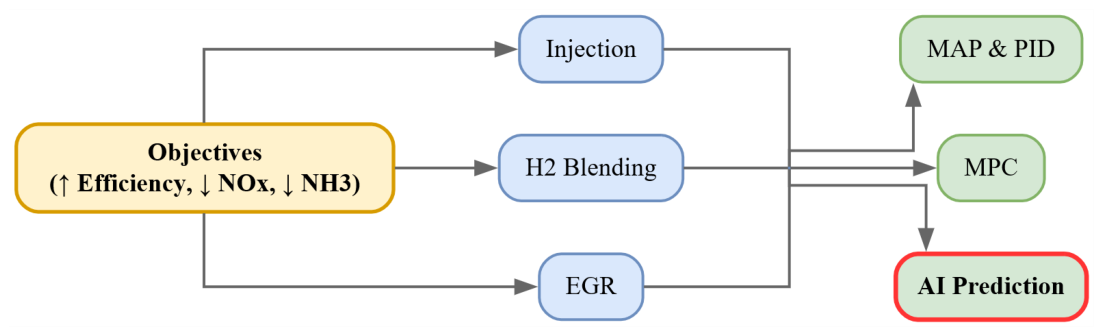
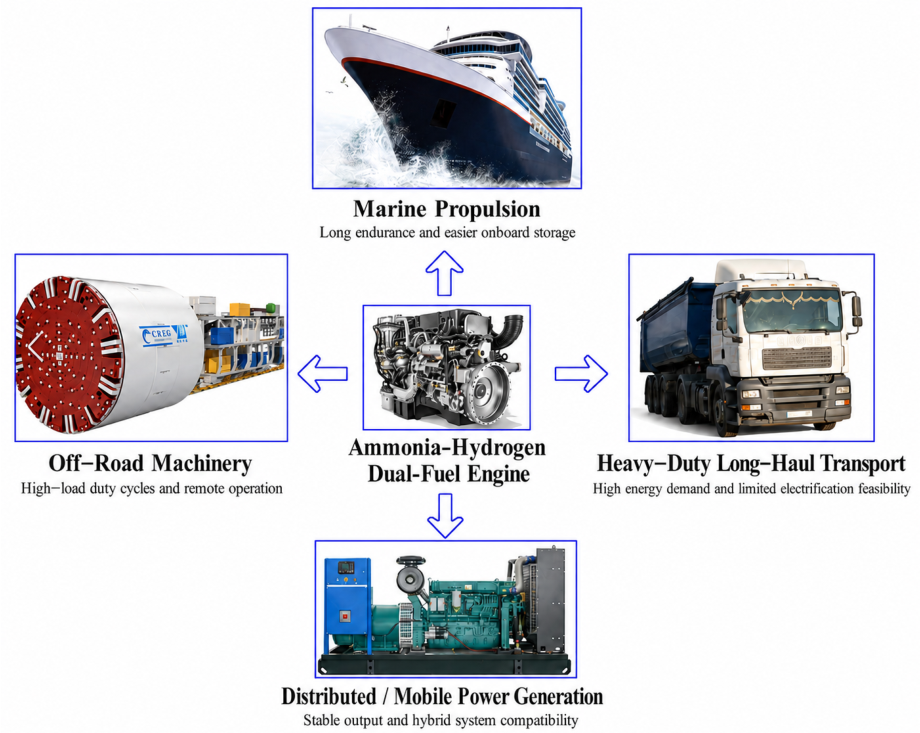
Ammonia is increasingly regarded as a carbon-free energy carrier for hard-to-electrify power sectors, including marine propulsion, heavy-duty transport, and distributed generation. Its direct use in internal combustion engines, however, is constrained by high ignition energy, low laminar flame speed, narrow flammability limits, slow low-temperature chemistry, and strong trade-offs among efficiency, nitrogen-containing emissions, and unburned ammonia slip. Hydrogen enrichment is one of the most effective routes for improving ammonia combustion reactivity, but it also introduces a multivariable control problem: hydrogen fraction, ammonia injection timing, injection mode, air-path dilution, ignition strategy, and aftertreatment operation are tightly coupled and strongly condition-dependent. This review synthesizes recent progress in ammonia–hydrogen and ammonia-based dual-fuel engine control from a control-oriented perspective. The discussion first summarizes application scenarios, nonlinear combustion-mode transitions, emission-formation pathways, and control-relevant metrics. It then compares actuator-level strategies, including ammonia injection timing and staging, port and direct injection, hydrogen energy-fraction scheduling, excess-air-ratio and EGR control, high-energy ignition, and turbulent jet ignition. Advanced optimization methods are further reviewed, with emphasis on model predictive control, control-oriented combustion and emission models, artificial-intelligence-based virtual sensors, and reinforcement-learning control. The analysis shows that the central challenge is no longer whether ammonia can burn in an engine, but how a controller can keep the system inside a narrow moving window bounded by misfire, knock, NOx, N2O, and NH3 slip. Finally, future research priorities are proposed, including engine–aftertreatment co-optimization, physics-informed virtual sensing, digital-twin-assisted calibration, lightweight deployment on electronic control units, and robust control under fuel and aging uncertainty.
Keywords: ammonia engine; hydrogen enrichment; combustion control; NOx emissions; NH3 slip; virtual sensor; model predictive control; artificial intelligence ammonia engine; hydrogen enrichment; combustion control; NOx emissions; NH3 slip; virtual sensor; model predictive control; artificial intelligence