Article

Research on Optimization of Horizontal Well Fracturing Parameters Based on Numerical Simulation

1
Sanya Institute of South China Sea Geology, Guangzhou Marine Geological Survey, China Geological Survey, Sanya 572024, China
2
Institute of Experimental Testing, Guangzhou Marine Geological Survey, China Geological Survey, Guangzhou 510075, China
3
College of Geology and Environment, Xi’an University of Science and Technology, Xi’an 710000, China
*
Author to whom correspondence should be addressed.
These authors contributed equally to this work.
Energies 2026, 19(14), 3309; https://doi.org/10.3390/en19143309
Submission received: 20 May 2026 / Revised: 16 June 2026 / Accepted: 25 June 2026 / Published: 14 July 2026

Abstract

The deep coalbed methane in the SSL block is characterized by strong in situ stresses, elevated thermal conditions, and over-pressured reservoirs. These conditions lead to poor adaptability of vertical-well fracturing technology for CBM extraction. Due to the high investment cost of staged fracturing of horizontal wells, it is necessary to optimize the well type and fracturing process parameters before the experiment, in order to find the optimal horizontal section length and fracturing process parameters. On the basis of in-depth analysis of the characteristics of deep coalbed methane reservoirs, numerical simulation technology was used to carry out optimization research on segmented fracturing horizontal well technology from the aspects of horizontal section length, number of fracturing fractures, fracturing conductivity, fracturing length, and fracturing pattern. Research has shown that segmented fracturing of horizontal wells can communicate the coal seam cleavage fracture system, with a large drainage area and good pressure reduction and gas production effects. The optimal wellbore structure parameters for segmented fracturing of horizontal wells are a horizontal section length of 1000–1200 m, divided into 4–6 sections for fracturing, with a spacing of 120–150 m and uniform distribution of fractures. This well type has been applied in adjacent blocks and has shown good development benefits.

1. Introduction

According to the latest national assessment of coalbed methane (CBM) resources, China possesses vast reserves of deep CBM, particularly at depths exceeding 1000 m. The CBM resources within the depth range of 1000–2000 m are estimated at approximately 22 × 1012 m3, accounting for about 61% of the total shallow CBM resources (above 2000 m) [1,2,3,4]. Furthermore, CBM resources in coal seams buried at depths between 2000 and 3000 m are estimated to be around 18 × 1012 m3 [5,6]. A significant breakthrough in deep CBM exploration was achieved in 2019 in the Daning-Jixian block on the eastern margin of the Ordos Basin, leading to the discovery of China’s first CBM field with burial depths exceeding 2000 m and proven reserves exceeding 1000 × 108 m3. Thirty horizontal wells put into production in this field have demonstrated an average daily gas output of 10 × 104 m3, with some wells reaching initial production rates exceeding 16 × 104 m3, indicating strong reservoir performance [7,8]. Similar exploration successes have also been reported in other basins, including the Junggar and Tuha Basins.
Deep coal seams are typically characterized by a challenging strong in situ stresses, elevated thermal conditions, and over-pressured reservoir environments, which distinguish them markedly from shallow coal seams [9]. Theoretical research on the geological aspects of these deep CBM reservoirs remains limited, and development technologies are relatively underdeveloped and often poorly adapted to these extreme conditions. This technological gap poses a significant obstacle to the commercial exploitation of deep CBM resources [10]. Previous studies on deep coalbed methane (CBM) primarily focused on resource estimation and basic fracturing simulations, lacking theoretical understanding and effective optimization methods for the challenging high-stress, high-temperature, and high-pressure environment. The heterogeneous nature of deep coal reservoirs and complex interactions between hydraulic and natural fractures remain poorly addressed. Consequently, optimizing the development engineering of horizontal wells is crucial for achieving commercial production from deep CBM reservoirs [11].
Numerical simulation software such as comet3 (2014 version) and Abaqus (free version) has been employed to establish hydraulic fracturing models specific to CBM horizontal wells [12]. These models simulate the influence of complex factors, including in situ stress and rock mechanical properties, on hydraulic fracture parameters, providing critical insights for optimizing fracturing designs. By combining numerical simulation with orthogonal experimental design, researchers have investigated the impact of various staged fracturing parameters on the productivity of CBM horizontal wells. Key parameters include the number of fractures, fracture length, fracture spacing, fracture conductivity, fracture distribution pattern, and fracture morphology. Results indicate that the number of fractures, fracture length, and fracture spacing exert the most significant influence on well productivity.
A multi-objective optimization methodology based on genetic algorithms has been proposed to maximize collapse resistance and minimize the skin factor of slotted liners. Corresponding optimization design models suggest that for horizontal wells in deep coal seams, liners with low slot density, long slot length, and two or three internal slot units are preferable. Horizontal well staged fracturing technology effectively interconnects the cleat system within the coal seam, enabling efficient drainage analogous to the combined gas production of horizontal and vertical wells. By leveraging well inclination and gravitational forces to facilitate drainage to the well bottom, this technology enhances the conductivity of the coal reservoir and increases single-well CBM production [13]. Therefore, optimizing the design of staged fracturing horizontal wells, coupled with a comprehensive understanding of the controlling factors of CBM enrichment and production, is of considerable theoretical and practical importance for enhancing the production efficiency of deep CBM resources in the southern SSL region and similar areas [14].
Despite recent progress, several challenges persist in the development of deep CBM. The accurate prediction of fracture propagation under high-stress conditions remains complex due to the heterogeneous nature of coal reservoirs [15]. Additionally, the interaction between hydraulic fractures and pre-existing natural fractures requires further investigation to optimize fracture network formation and maximize reservoir contact [16]. Future research should focus on integrating multi-scale data, including seismic interpretation, core analysis, and real-time monitoring, to improve the accuracy of fracturing models.
The optimization of process parameters for hydraulically fractured horizontal wells is pivotal for the commercial development of deep CBM. Advances in numerical simulation and experimental design have provided valuable tools for understanding and improving fracturing effectiveness. This study focuses on optimizing process parameters in hydraulic fracturing of horizontal wells through numerical simulation tools, with application simulations conducted in the SSL block. By adjusting fracture parameter settings to achieve optimal fracturing performance, this research aims to help overcome the geological and technological challenges associated with deep CBM reservoirs and unlock the full potential of deep CBM resources.

2. Coalbed Methane Geology

2.1. Tectonic Setting

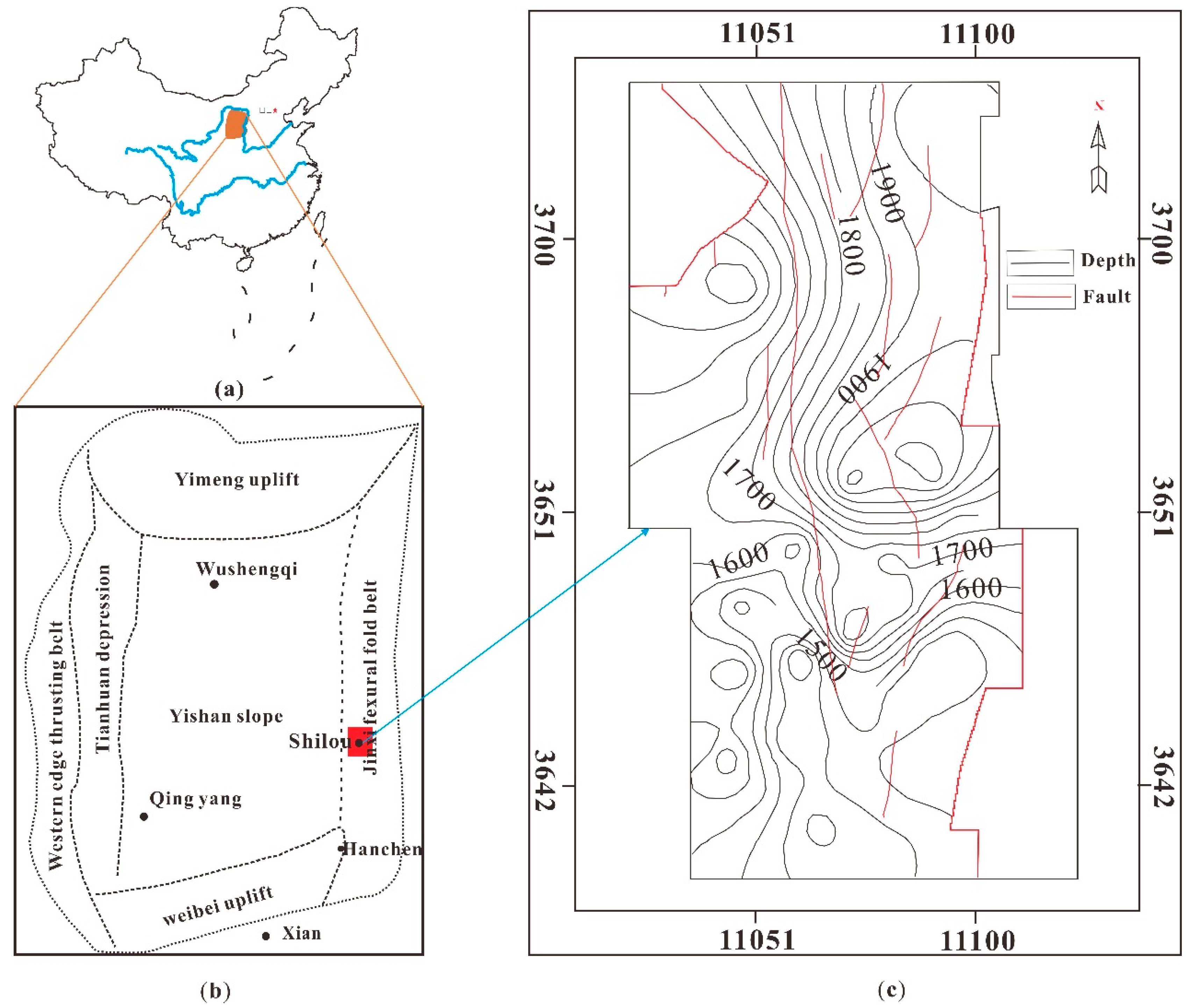
The SSL block is situated in the central-southern segment of the Jinxi Fold Belt along the eastern margin of the Ordos Basin. It extends approximately 46 km from north to south and 22 km from east to west, covering a total area of nearly 1000 km2 (Figure 1). The geographic coordinates range from 110°46′30″ E to 111°04′00″ E in longitude and 36°40’00” N to 37°05′00″ N in latitude.
Influenced by the Yanshan Movement and regional east-west compression, the area developed a series of north–south trending fold structures. The block features two synclines and two anticlines: the SSL East Syncline, Caocun East Xixian East Syncline, SSL Anticline, and Caocun-Xixian Anticline. This results in a general “two highs and two lows” structural framework, trending approximately north–south. Overall, the structural character of the block is relatively simple, dipping gently toward the northwest as a monocline. The folds are underdeveloped, strata exhibit mild inclination, and faults are scarce.

2.2. Coal Seam Burial Depth and Thickness

The coal seams within the Shanxi Formation occur at burial depths ranging from 1250 to 2000 m, with an average of approximately 1500 m. Those in the Benxi Formation are buried between 1300 and 2050 m, averaging 1590 m. Overall, influenced by the structural framework, the burial depth of the coal seams exhibits a consistent spatial pattern, gradually increasing from south to north (Figure 1c).
The Shanxi Formation contains five coal seams, with a cumulative thickness ranging from 2 to 8 m and averaging 5.6 m. The Benxi Formation comprises three coal seams, having a total thickness of 3–7 m and an average of 5.4 m.

2.3. Characteristics of Coal Reservoirs

2.3.1. Coal Rock Characteristics

The coal seams within the Shanxi, Taiyuan, and Benxi Formations are predominantly classified as block coal. Macroscopically, the lithotypes are mainly bright and semi-bright coal, with bright coal being the principal component followed by dark coal. The dark coal exhibits a banded structure, appearing grayish black with brown streaks, and possesses a vitreous luster. Its fracture is irregular, and it is characterized by being relatively lightweight, yielding slightly when handled, with a face cleat density of 3–15 per 5 cm and an end cleat density of 4–16 per 5 cm.
Microscopic analysis reveals that the organic matter content of the coal seams ranges from 75% to 90%. Vitrinite constitutes the majority, accounting for 68% to 84% of the organic composition, with matrix vitrinite being the dominant type followed by homogeneous vitrinite. Inertinite comprises between 16% and 21% of the maceral composition, predominantly in the form of oxidized fusinite, with subordinate amounts of coarse-grained and detrital fusinite. Contents of fusinite and semifusinite are notably low.

2.3.2. Coal Characteristics

Proximate analysis results indicate that the fixed carbon content of the coal seams in the block ranges from 53% to 72%, with an average value of 65%. The moisture content varies between 0.4% and 0.7%, averaging 0.5%. Ash content is observed to range from 14% to 34%, with a mean of 20%, while the volatile matter content falls within the interval of 12% to 16%, with an average of 14%.

2.3.3. Degree of Coal Metamorphism

The maximum vitrinite reflectance (Ro,max) of the Shanxi Formation coal ranges from 1.90% to 1.97%, with an average value of 1.94%. In the Benxi Formation, Ro,max values vary between 1.7% and 2.2%, averaging 1.9%. These reflectance values indicate that the coals have reached the rank of lean coal to meagre coal.

2.4. Coal Seam Gas Content and Isothermal Adsorption Performance

Gas content measurements were performed on five wells within the block to evaluate the gas-bearing characteristics of the coal seams in different formations. The test results indicate that the gas content of the Benxi Formation coal ranges from 13 to 24 m3/t, with an average value of 19 m3/t. In the Taiyuan Formation, specifically in the western well area, the gas content exhibits a relatively wide variation, spanning from 8 to 35 m3/t, and averaging 21 m3/t. Meanwhile, the coal seams of the Shanxi Formation demonstrate a gas content between 13 and 26 m3/t, with an average of 17 m3/t.
Furthermore, isothermal adsorption experiments were conducted on four wells to determine the adsorption capacity and pressure-dependent behavior of the coal reservoirs. The tests revealed that the Langmuir volume (VL) of the Benxi Formation coal varies from 21 to 31 m3/t, with a mean value of 25 m3/t. The Langmuir pressure (PL), which reflects the affinity of coal for gas adsorption, was found to range between 2.0 and 3.0 MPa, averaging 2.4 MPa. These parameters are critical for understanding the gas storage capacity and desorption characteristics of the coal seams, providing essential insights for the evaluation of coalbed methane development potential in the region.

2.5. Coal Seam Pressure and Temperature

No direct measurements of coal seam temperature and pressure have been conducted within the SSL block. Based on data from adjacent blocks, the constant temperature layer is located at approximately 200 m depth. Below this depth, the geothermal gradient ranges between 2.15 °C and 2.55 °C per 100 m. Based on this gradient, it is estimated that the temperature of coal seams buried between 1200 m and 2000 m in the SSL block ranges from 40 °C to 60 °C.

2.6. Numerical Model Setup

To systematically investigate the influence of horizontal well fracturing parameters on gas production, a three-dimensional numerical model was established using a finite-difference simulator tailored for coalbed methane (CBM) reservoirs. The model integrates the key physical processes of gas desorption, diffusion, and flow within the coal matrix and cleat system. All simulations were run for a production period of 8 years, with time steps progressively increasing from 1 day to 30 days.

2.6.1. Initial and Boundary Conditions

The initial reservoir pressure is uniformly set to Basic Geological Parameters, corresponding to a coal seam depth of 1550 m (Table 1). The initial temperature and isothermal conditions are assumed due to the relatively slow thermal equilibration process [17,18]. The outer boundaries of the model are treated as closed (no-flow boundaries), representing a finite reservoir extent with no fluid exchange across the boundaries. A constant bottomhole pressure of 0.5 MPa is imposed at the horizontal wellbore during production, simulating a constant drawdown condition. This boundary condition reflects the typical practice of maintaining a fixed suction pressure at the pump intake [19].

2.6.2. Methane Desorption and Diffusion Model

Methane desorption from the coal matrix is described by the Langmuir isotherm, which relates the adsorbed gas volume to reservoir pressure. The gas content V (m3/t) is expressed as:
V = V L P P L + P
where VL is the Langmuir volume (31 m3/t) and PL is the Langmuir pressure (2.7 MPa), as given in Table 1. Gas diffusion from the matrix to the cleat system follows Fick law, and a pseudo-steady-state diffusion equation is employed:
V t = 1 τ ( V V E ( P ) )
where τ is the desorption time (related to the diffusion coefficient and characteristic matrix size), and VE(P) is the equilibrium gas content at pressure P. The effective diffusion coefficient is 1.0 × 10⁻⁹ cm2/s.

2.6.3. Fracture Conductivity Model

Under the high in situ stress conditions characteristic of deep coal seams, fracture conductivity is assumed to be constant during the production period, as proppant crushing and embedment are minimized by using high-strength proppants. The baseline fracture conductivity is set to 20 D·cm, which is representative of typical field treatments in the Ordos Basin [20]. Sensitivity analysis indicates that daily and cumulative gas production vary by less than 3% when conductivity is increased from 10 D·cm to 40 D·cm, implying that conductivity is not a dominant optimization parameter under the given reservoir conditions. Therefore, a constant conductivity value is adopted in all main simulations.
The coal seam is represented as an equivalent dual-porosity medium, where the matrix blocks store adsorbed gas and the cleat network provides primary flow pathways for free gas. The cleat system is characterized by an initial porosity of 0.85% and a permeability of 0.5 mD. The cleat spacing is assumed to be 1 cm, which is consistent with the face cleat density of 3–15 per 5 cm and end cleat density of 4–16 per 5 cm. The shape factor for matrix–cleat transfer is calculated using the Kazemi formulation, which accounts for the orthogonal cleat geometry typical of high-rank coals.

2.6.4. Stress Shadow Effect and Fracture Interaction

For closely spaced hydraulic fractures, the stress shadow effect, the alteration of local stress due to the opening of adjacent fractures, can suppress further fracture propagation and reduce the effective fracture half-length. In this study, the interaction between fractures is accounted for by reducing the stress intensity factor for fractures with spacing less than 150 m. Following the approach to corrected half-length, this is expressed as:
L f c = L f ( 1 α · e β ( S / h f ) )
where Lf is the designed half-length, S is the fracture spacing, hf is the fracture height (assumed equal to the coal seam thickness, 5.5 m), α = 0.3 is the maximum reduction factor, and β = 2.0 is a decay coefficient. For spacings greater than 150 m, the reduction is negligible (<5%).
The combined effect of stress shadow and fracture interaction is also reflected in the fitted relationship between cumulative gas production Q (in 104 m3) and the number of fractures N, derived as follows:
Q = a ln ( N ) + b
where a and b are empirical fitting coefficients that depend on the specific relationship between the number of fractures N and the resulting gas production.
The limitations of the model include the assumption of planar, bi-wing fractures (rather than complex fracture networks) and the neglect of geomechanical feedback on permeability, which may be addressed in future studies.

3. Results and Discussions

3.1. Basic Geological Parameters

In the analysis of factors influencing gas production from fractured horizontal wells in coalbed methane reservoirs, the geological parameters were maintained constant to isolate the effects of engineering and completion variables. With the exception of the baseline parameters referenced, the key reservoir properties were set as follows: a gas content of 20 m3/t, permeability of 0.5 mD, coal seam thickness of 5.5 m, and a Langmuir volume of 31 m3/t (see Table 1). The productivity of the CBM wells was evaluated by systematically varying several design parameters related to the well architecture and stimulation strategy. These include the length of the horizontal section, the number of hydraulic fractures, and the spacing between individual fractures. The analysis aims to quantify the sensitivity of gas production to these completion parameters and to identify optimal configurations for enhancing well performance under the given geological conditions. Due to the absence of direct temperature and pressure measurements in the SSL block, the initial pressure and temperature presented in Table 1 were derived through inversion based on adjacent field measured data, geological models, and reservoir engineering methods.

3.2. Horizontal Section Length

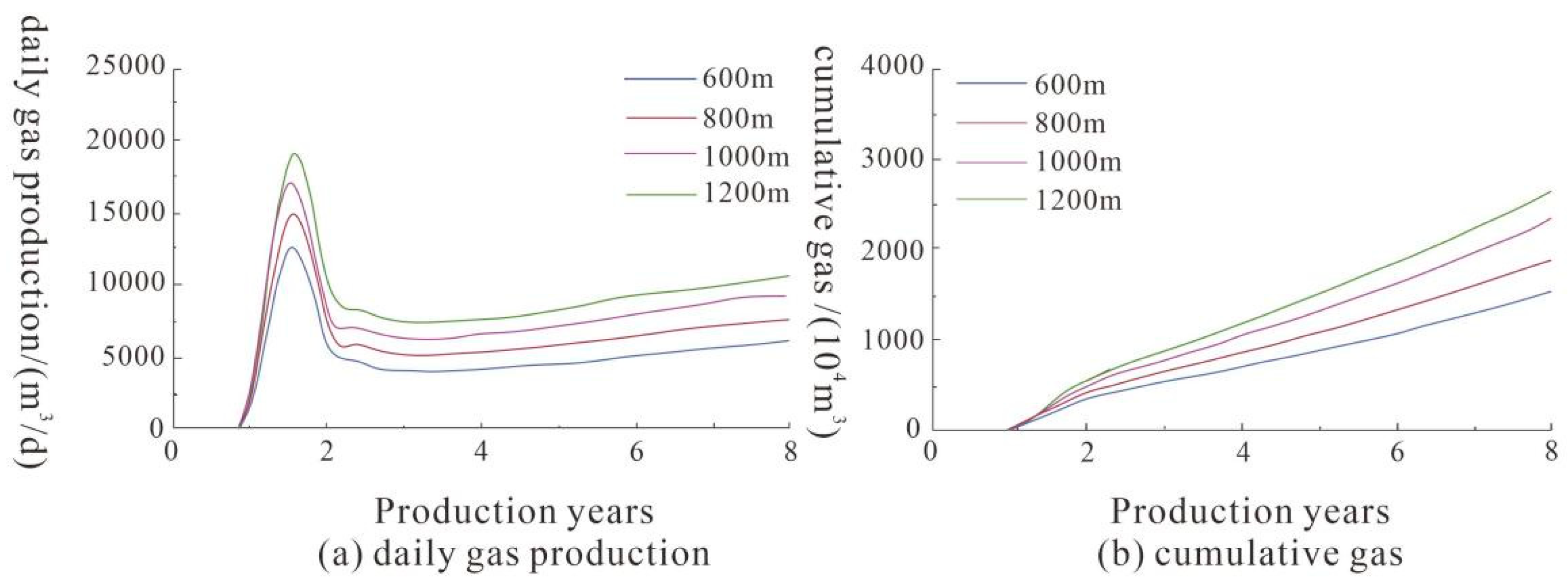
To evaluate the impact of horizontal section length on gas production performance, simulations were conducted for lengths of 600 m, 800 m, 1000 m, and 1200 m, under the condition that wellbore friction effects were neglected. The simulation results demonstrate a clear positive correlation between the horizontal section length and key production indicators, including peak daily gas production, stable gas production rate, and cumulative gas production. Specifically, as the horizontal section length increased from 600 m to 1200 m, the peak daily gas production rose from 13,489 m3/d to 23,200 m3/d. Correspondingly, the stable gas production rate increased from 7605 m3/d to 13,523 m3/d, while the cumulative gas production over the simulated period increased from 19.34 × 10⁴ m3 to 36.42 × 10⁴ m3 (Figure 2). These findings are consistent with previous studies. Zhang et al. reported that the stable productivity of horizontal coalbed methane wells in the northern Zhengzhuang block was positively correlated with horizontal section length [21]. In addition, Li et al. found that horizontal wells in the Shenfu block achieved favorable economic performance when the horizontal section length ranged from 800 m to 1500 m [22]. Together, these studies indicate that horizontal well geometry plays an important role in improving coalbed methane recovery and that wellbore length should be optimized according to reservoir conditions and development objectives.
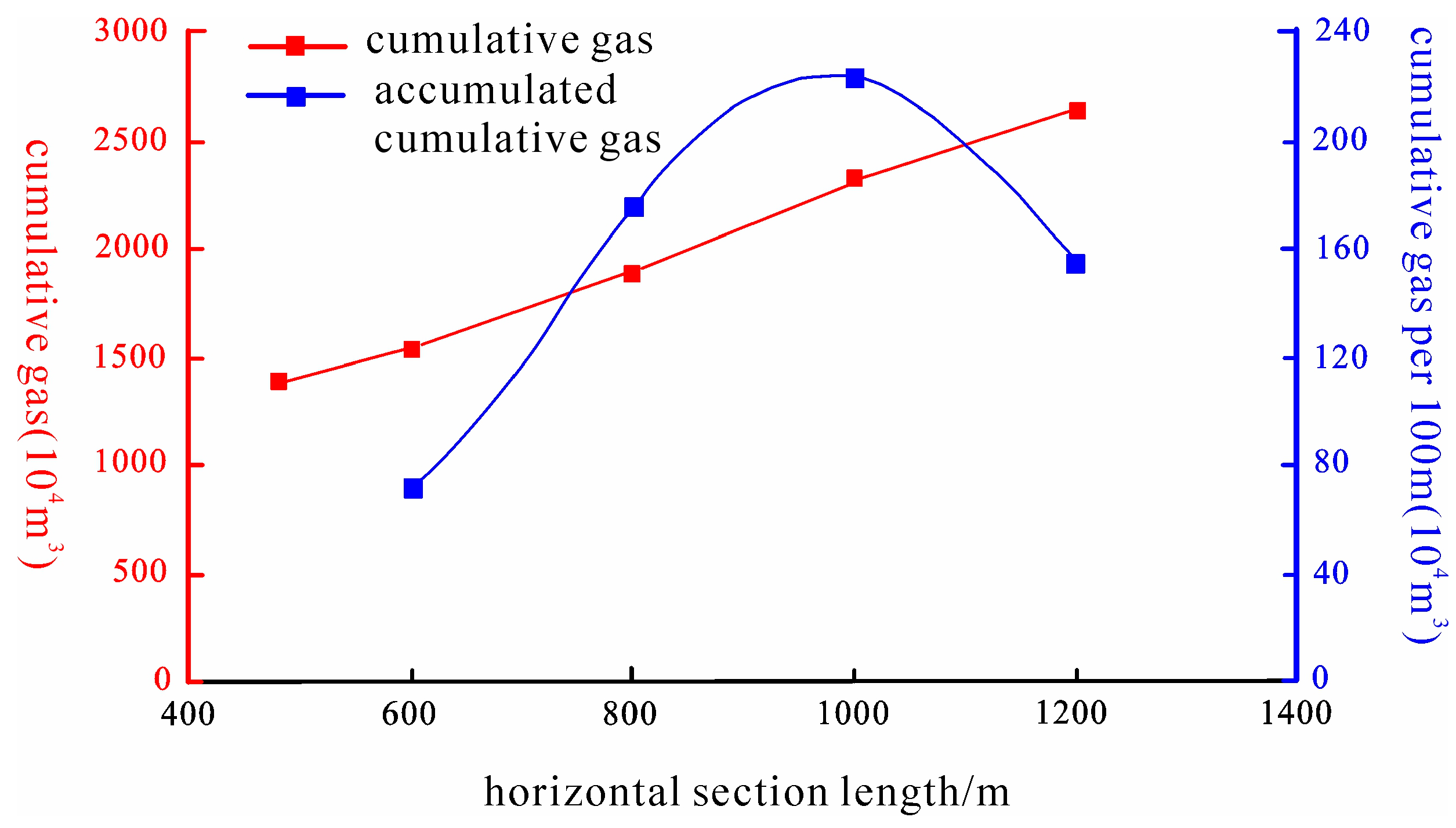
As illustrated in Figure 3, cumulative gas production exhibits a positive correlation with the length of the horizontal section. However, the incremental gain in cumulative production varies nonlinearly with increasing length. Specifically, when the horizontal section is extended from 600 m to 1000 m, the incremental gas production continues to rise. In contrast, further increasing the length from 1000 m to 1200 m results in a gradual decline in the marginal increase of cumulative production. This trend is consistent with the findings of Zhang et al., who reported that encouraging reservoir stimulation performance in CBM horizontal wells can be achieved when the horizontal section length is 1000 m or below [21]. It is also in line with Li et al., who suggested that the economically favorable horizontal section length for deep CBM production in the Shenfu block lies within 800–1500 m, implying that the optimal length is reservoir-dependent rather than unbounded [22].
A key limitation of the model is the assumption of negligible wellbore friction effects. In reality, for horizontal sections exceeding 1000 m, friction can cause a non-uniform bottom hole pressure distribution along the wellbore, potentially reducing the effectiveness of heel-side fractures. This assumption may therefore overestimate production gains at longer lengths. Additionally, the model assumes homogeneous reservoir properties; heterogeneities in cleat permeability or gas content along the wellbore could further affect the optimal length. Uncertainties also arise from the lack of direct in situ stress measurements in the SSL block, which may influence the actual drainage radius.
Moreover, longer horizontal sections introduce significant engineering challenges and operational risks. These include higher torque requirements during drilling, increased demands on the technical capabilities of drilling equipment, and greater exposure to complex geological formations. Extended drilling periods also prolong the completion cycle and increase the time during which the borehole is exposed to drilling fluid, thereby elevating the risk of wellbore collapse and formation damage. From an economic perspective, increasing the horizontal section length from 800 m to 1200 m adds approximately 30–40% to drilling and completion costs (based on typical rates in the Ordos Basin), while the incremental cumulative gas production beyond 1000 m is only about 8% [23]. A simple net present value calculation indicates that the optimal economic horizontal length for the SSL block is approximately 1000 m. Extending to 1200 m yields marginal economic returns that may not justify the additional investment and operational risks. Therefore, combining technical performance and economic considerations, a horizontal section length of 1000–1100 m is recommended as the preferred range for future development in the SSL block.
Therefore, it is not always advantageous to maximize horizontal length indiscriminately. Based on current technical standards and economic considerations for coalbed methane horizontal drilling, it is generally recommended to limit the horizontal section length to within 1000–1200 m to optimally balance production performance and operational feasibility.

3.3. Hydraulic Fracture Parameters

3.3.1. Number of Hydraulic Fracture

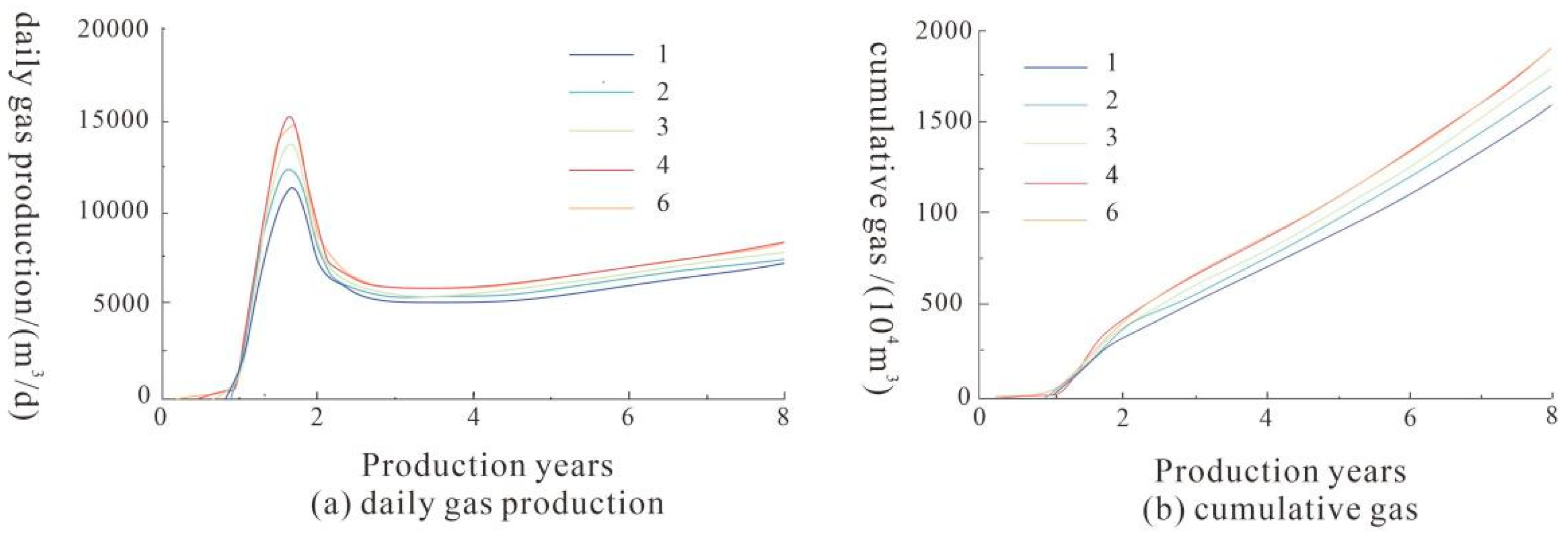
Simulations were conducted to evaluate gas production and pressure reduction performance under varying numbers of fractures: specifically, one to six fractures. The results indicate that the profile of daily gas production remains consistent across all cases. As the number of fractures increases from one to four, both daily and cumulative gas production show a significant rising trend. However, when the number of fractures is further increased from four to six, gas production exhibits a plateau, with minimal change in both daily and cumulative output (Figure 4). This trend is consistent with previous studies on fractured horizontal wells in deep CBM reservoirs. For example, Zhu et al. showed that fracturing parameters in CBM horizontal wells must be optimized under complex flow mechanisms, indicating that excessive fracturing intensity does not necessarily translate into proportional production gains [24]. In addition, work on deep CBM horizontal wells in the Ordos Basin has shown that stimulation effectiveness is governed by fracture interaction and reservoir response rather than fracture number alone, which supports the observed diminishing return behavior in the present study [25,26,27].
From a mechanical perspective, the plateau beyond four fractures likely reflects pressure interference among closely spaced fractures and the limited incremental drainage area created by additional fractures. This interpretation is also consistent with studies showing that fracture geometry, spacing, and interference control productivity in CBM reservoirs, especially when permeability is low and fracture communication becomes nonuniform. Accordingly, the present results suggest that an intermediate fracture number may provide the best balance between reservoir contact area and fracture interference. In practical terms, adding fractures beyond a certain threshold may increase completion complexity and cost without producing a commensurate gain in gas recovery.
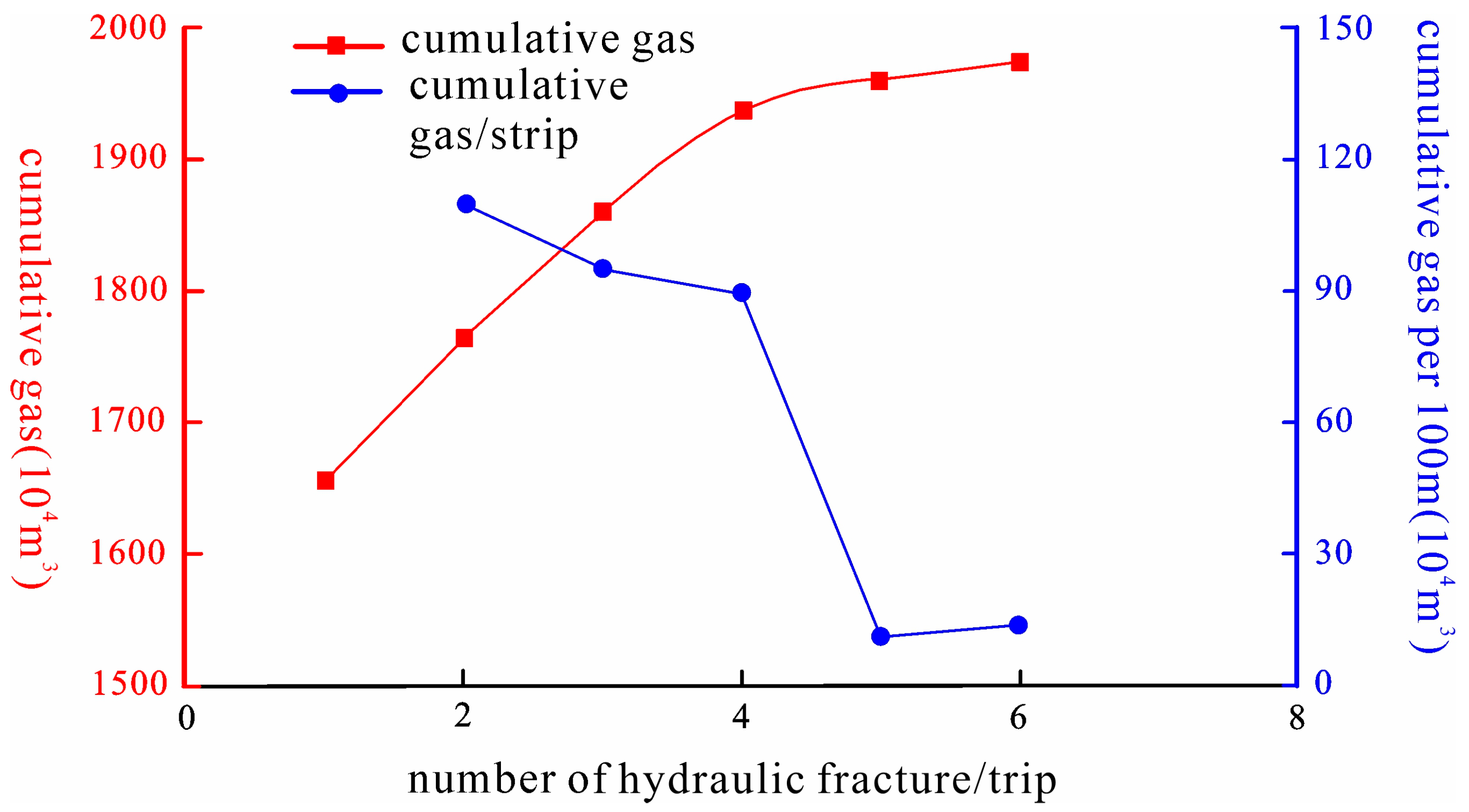
As illustrated in Figure 5, a positive correlation is observed between cumulative gas production and the number of fracturing fractures, and this relationship can be described by a specific relational equation. When the number of fractures is increased from one to four, the cumulative gas production rises markedly, with an average increase of 92 × 104 m3 for each additional fracture. However, as the number of fractures continues to increase from four to six, the incremental gain in cumulative production diminishes significantly, yielding an average increase of only 11 × 104 m3 per additional fracture. These results suggest that while adding fractures enhances production initially, a point of diminishing returns is reached beyond four fractures, likely due to fracture interference or limited drainage volume. This nonlinear response underscores the importance of optimizing fracture number to maximize economic efficiency and resource recovery. A key limitation of the analysis is the assumption of identical fracture properties and uniform spacing, which may not hold in real operations where fracture geometry can be heterogeneous due to in situ stress variations or natural fracture networks. Additionally, the model does not account for stress shadow effects beyond a simplified correction, potentially underestimating interference at higher fracture densities. Uncertainties also arise from the lack of direct in situ stress measurements in the SSL block, which may affect the calibrated threshold for diminishing returns.
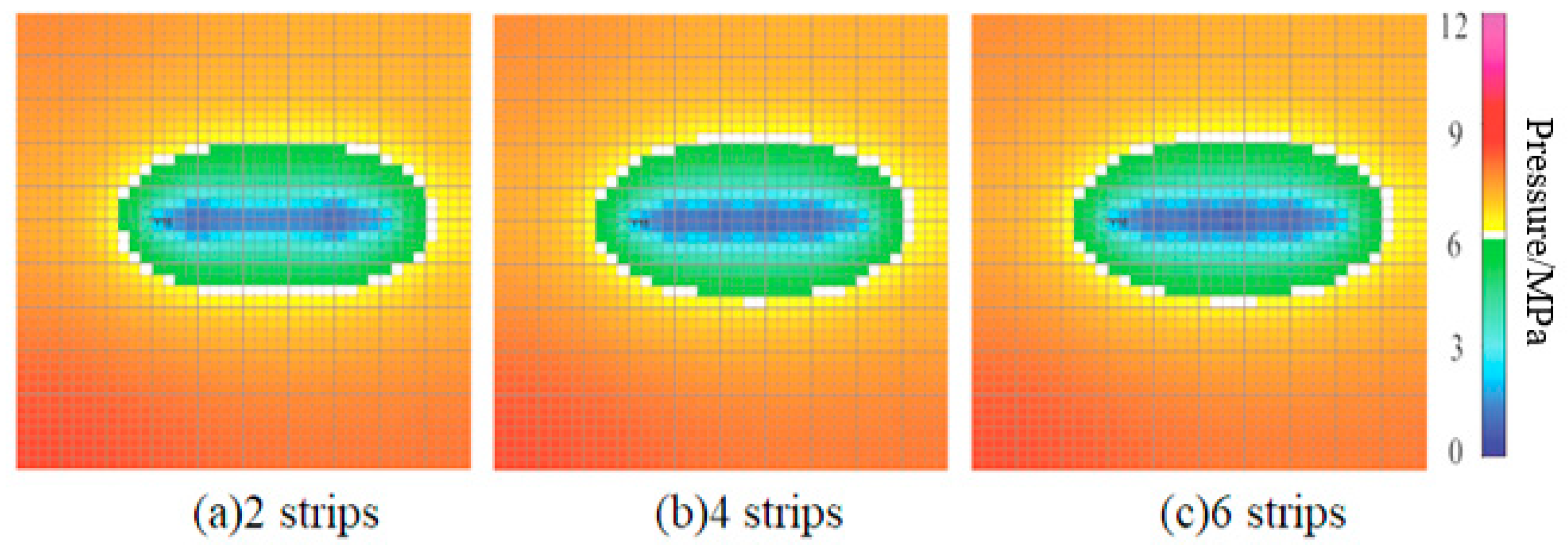
As observed from the pressure distribution map of the coal seam at the end of the 8th year (Figure 6), the drainage area and the extent of pressure depletion, along with the desorption radius, gradually expand as the number of fractures increases from one to four. However, when the number of fractures is further increased from four to six, both the pressure depletion area and the desorption radius remain largely unchanged. From an economic perspective, the diminishing returns beyond four fractures have direct implications for fracturing costs. Based on typical completion expenses in the Ordos Basin (approximately 0.8–1.2 million RMB per stage), the additional two stages (from four to six fractures) would incur an extra cost of 1.6–2.4 million RMB while yielding only marginal production gains (~22 × 104 m3). A net present value analysis suggests that for the SSL block, the optimal economic fracture number is four to five stages, rather than six. Operators should consider that exceeding four fractures may not be cost-effective unless gas prices rise significantly or fracturing costs decrease. Therefore, from both technical and economic standpoints, a fracture number in the range of four–six is recommended, with a strong preference for the lower end under current economic conditions.

3.3.2. Half-Length of Hydraulic Fracture

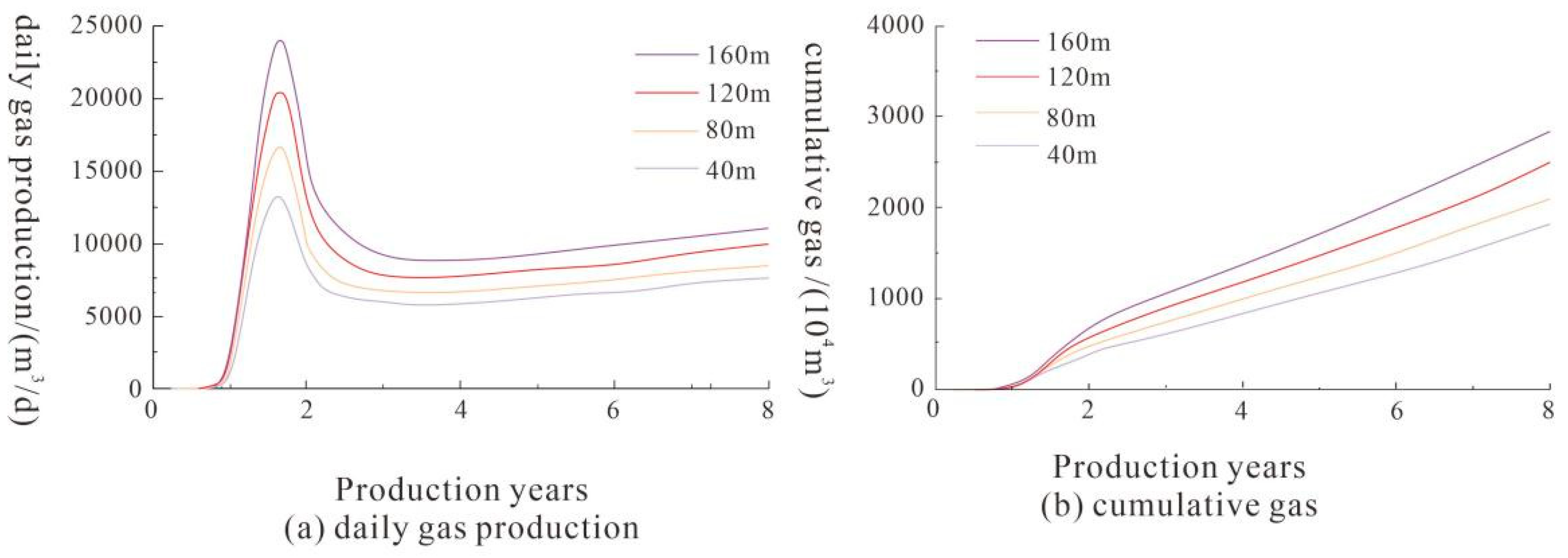
To quantitatively investigate the influence of fracture half-length on gas production in fractured horizontal wells, simulations were conducted with fracture half-lengths of 40 m, 80 m, 120 m, and 160 m. The results show that both daily and cumulative gas production increase nearly linearly with fracture half-length over the evaluated range, as shown in Figure 7. No obvious inflection point is observed up to a half-length of 160 m. This trend is consistent with previous studies indicating that longer fractures can improve reservoir contact and production performance. For example, a numerical simulation of fractured CBM reservoirs reported that gas production increases with fracture half-length, and that fracture half-length is a key controlling parameter in CBM development [26]. Similarly, another study on hydraulic fracturing in CBM wells found that fracture length positively affects production rate, confirming the importance of fracture geometry in controlling methane flow to the wellbore [27]. In addition, field- and simulation-based work on coalbed methane horizontal wells has suggested that the optimal fracture half-length generally falls within the range of approximately 80–120 m, which is broadly consistent with the technical range evaluated here [28].
The observed linear trend can be explained by the fact that longer fractures intersect more cleats and natural fractures, thereby enlarging the drainage area and promoting pressure depletion in the coal reservoir. However, beyond a critical fracture half-length, the incremental production gain is expected to decline gradually because of reservoir boundary effects, stress shadow interference, and limited connectivity to additional fracture networks. Although no clear inflection point was identified up to 160 m in the present simulations, previous studies have shown that fracture effectiveness is constrained by in situ stress conditions and coal plasticity, which can limit further extension of effective fracture length. From an engineering perspective, the present results extend the evaluation range to 160 m and suggest that a fracture half-length of approximately 100–120 m may provide a reasonable balance between production improvement and economic efficiency for the SSL block.
A key limitation of the present model is the assumption of planar bi-wing fractures with constant conductivity, which neglects the potential influence of complex fracture networks and non-uniform proppant placement. In addition, stress shadow effects were only represented through a simplified correction, and the absence of direct in situ stress measurements in the SSL block introduces uncertainty into the calibrated parameters. Future studies should therefore incorporate coupled geomechanical simulation and microseismic monitoring to better capture nonlinear fracture growth and improve parameter reliability.
From an operational and economic standpoint, achieving longer fracture half-lengths requires larger-scale fracturing treatments, which increase proppant consumption, pump horsepower demand, and fluid usage, thereby raising completion costs. Although extending fracture half-length can enhance cumulative production, the marginal benefit per additional meter is expected to diminish once the fracture system approaches the effective drainage limit. Therefore, considering both technical performance and economic return, a fracture half-length in the range of 100–120 m appears to be the most practical option for the SSL block under the current reservoir and cost conditions.
Therefore, while increasing fracture half-length enhances production, optimization within geomechanical and economic constraints is essential for effective reservoir development.

3.3.3. Hydraulic Fracture Spacing

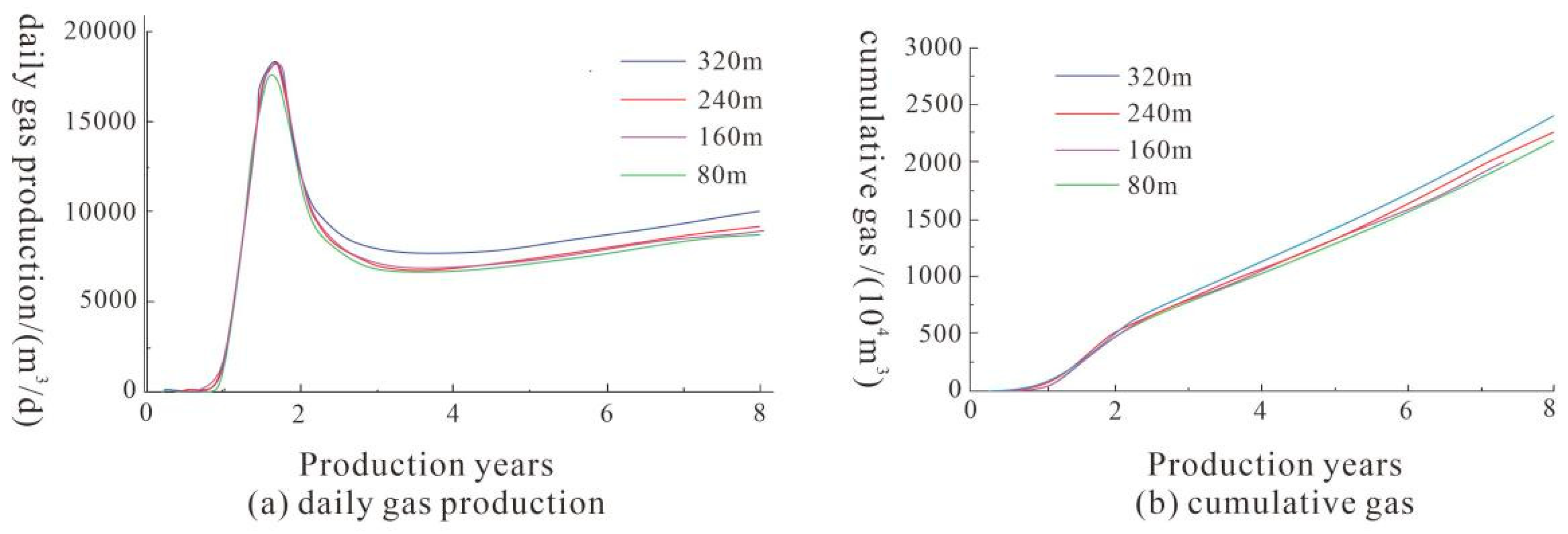
To evaluate the impact of fracture spacing on gas production performance, a series of simulations was conducted with a constant fracture half-length of 80 m, while all other parameters were maintained at their reference values. Fracture spacings of 80 m, 160 m, and 320 m were investigated. The results indicate that, during the initial production stage, wells with smaller fracture spacing exhibit higher daily and cumulative gas production. However, as production continues, wells with larger fracture spacing maintain gas production for a longer period, and their cumulative production eventually surpasses that of wells with tighter spacing (Figure 8). This time-dependent crossover behavior is consistent with previous studies on fractured horizontal wells, where fracture interference was shown to intensify as spacing decreased, while wider spacing helped preserve effective drainage and delayed pressure interference [29,30].
This trend can be explained by the fact that smaller fracture spacing promotes faster local pressure depletion, which increases early production but limits the reservoir volume effectively contacted by each fracture. In contrast, wider spacing reduces fracture-to-fracture interference and allows a broader drainage area to contribute over a longer period, thereby improving ultimate recovery. Similar conclusions have been reported in the literature. For example, Wang et al. demonstrated that stress interference and fracture spacing strongly influence the propagation behavior and productivity of multiple transverse fractures in horizontal wells [31]. In addition, Yuan et al. reported that horizontal section length and fracture parameters jointly control CBM production, and that the optimal fracture number and half-length in the studied block were 4–5 and 80–120 m, respectively, suggesting that fracture spacing must be coordinated with the overall completion design [32]. Field-based numerical work in eastern Ordos Basin further showed that multi-fractured horizontal wells with six stages can significantly improve CBM recovery, supporting the practical importance of spacing optimization in deep CBM development.
From an engineering and economic standpoint, the results indicate that fracture spacing must balance early production gains against long-term recovery efficiency. Excessively tight spacing, such as 80 m, increases the number of fracturing stages and the completion cost without guaranteeing proportional long-term benefit, while spacing above 200 m may delay interaction among stimulated zones and reduce near-term deliverability. For the SSL block, the simulation results suggest that a fracture spacing of 120–150 m is a reasonable design window under the current reservoir and economic conditions. This range is consistent with the notion that optimal fracture spacing is reservoir-specific and should be selected by jointly considering interference effects, drainage area, and project economics.
Analysis indicates that reduced fracture spacing leads to earlier fracture interference. During the initial production phase, closer spacing enhances pressure depletion in the coal seam between fractures, resulting in higher daily and cumulative gas production. However, narrowly spaced fractures control a more limited volume of reservoir resources. As production continues, widely spaced fractures eventually experience interference, initiating large-scale gas desorption from a broader area and leading to a more sustained increase in daily gas production. This allows the cumulative gas output from wells with larger fracture spacing to surpass that of wells with tighter spacing.
Consequently, fracture spacing must be optimized: too close a spacing limits the resource volume accessed, whereas too wide a spacing delays fracture interference and prolongs production plateau periods. Neither scenario is conducive to maximizing the productivity of horizontal wells. When the horizontal section length is fixed at 1000 m with six to eight fractures, the optimal fracture spacing is determined to be 120–150 m.
From an economic perspective, this optimal range also reflects a trade-off between capital expenditure and long-term profitability. Tighter spacing would increase the number of fracturing stages per well, nearly doubling completion costs based on typical rates in the Ordos Basin (approximately 0.8–1.2 million RMB per stage), without providing a corresponding long-term production benefit. Conversely, spacing above 200 m delays fracture interference excessively, reducing the net present value of future gas revenues. Thus, the recommended spacing of 120–150 m not only maximizes reservoir contact but also balances short-term investment with long-term economic returns.
These conclusions are consistent with previous studies on deep CBM horizontal wells in the Ordos Basin. Recent field-based analysis in the Daning-Jixian Block showed that fracturing interference significantly affects gas production and that the main factor controlling the production of interfering wells is their own fracturing parameters, including fracture spacing and stage volume. Finite-element simulations of hydraulic fracturing in the No. 8 deep coal seam of the Ordos Basin also demonstrated that fracture propagation and effective stimulated volume depend strongly on perforation position and in situ stress conditions, indicating that fracture spacing must be coordinated with stress and mechanical properties. In addition, geomechanical and economic studies on multistage hydraulic fracturing have shown that the number of fractures and spacing between fractures control operational cost and are governed by in situ stress and reservoir permeability, and that economic evaluation determines the optimum spacing where the benefit of increasing fractures is balanced with the cost of additional stages. For the Shenfu block along the eastern margin of the Ordos Basin, field practice and optimization studies have identified an optimal horizontal well spacing and fracturing mode that yield high production under a specific well pattern, further supporting the importance of spacing optimization in deep CBM development.
The present results suggest that a fracture spacing of 120–150 m provides a reasonable balance between early production and long-term recovery for the SSL block under the current reservoir and economic conditions. This range is consistent with the concept that optimal fracture spacing is reservoir-specific and should be selected by jointly considering interference effects, drainage area, and project economics.

3.4. Geological Parameters

In addition to the engineering parameters of hydraulic fracturing, geological factors present critical challenges for deep coalbed methane (CBM) development. These include high in situ stress, elevated temperature, well-developed cleats, and variations in coal rank. High in situ stress significantly reduces coal reservoir permeability, with the initial permeability of most deep coal seams being less than 0.1 mD. Elevated stress levels can also lead to a severe reduction in fracture conductivity; in deep coal seams, stress-induced permeability loss is a dominant constraint on hydraulic fracturing effectiveness. The adverse impact of high in situ stress on fracturing efficiency has been well established for deep CBM in China, which highlights that elevated stress and complex mechanical parameters of deep coal seams can greatly hinder hydraulic fracturing.
Elevated reservoir temperatures degrade fracturing fluid performance and may induce thermal cracking, thereby influencing the propagation of fracture networks. Cleats, which are widely developed natural micro-fractures in coal seams, serve as initial pathways for gas migration; however, their spatial distribution density and orientation exert substantial control over the direction of hydraulic fracture growth. Cleats can suppress longitudinal extension of the primary fracture while enhancing fracture network complexity. In addition, in situ stress determines the development of cleats and micro-fractures in coal, which is closely related to coal type, rank, maceral composition, and coal thickness.
Coal rank variations directly affect cleat density and the connectivity of fracture networks. Under high-rank conditions, cleats are abundant but frequently occluded by mineral infillings, which reduces the effective fracture aperture. In contrast, medium- to low-rank coals typically exhibit better cleat connectivity; however, their lower mechanical strength predisposes them to more severe proppant embedment, leading to rapid long-term conductivity decline. The aperture of cleats and micro-fractures shows a decreasing trend with increasing coal rank, and the contribution of cleats to reservoir permeability decreases as rank increases, while the contribution of micro-fractures increases.
Therefore, the coupling effects of these geological factors must be adequately addressed in hydraulic fracturing design to enhance the commercial viability of deep CBM production. Key influential factors of deep CBM production include coal structure, developmental degrees of pores and fractures, reservoir temperature, in situ stress, and effective stress. The influence of these factors on horizontal well fracturing efficiency requires more complex geomechanical modeling for simulation and analysis, which is identified as a direction and objective for further research. In particular, in deep seams, the interaction between hydraulic fractures and natural fractures can result in fracture penetration, arrest, or deflection, and the stress regime strongly controls fracture length and complexity, underscoring the need for coupled geomechanics and reservoir modeling in fracturing design [33,34].

4. Conclusions

(1)
The geological conditions in the study area, located on the eastern margin of the Ordos Basin, are characterized by deep, thick coal seams; abundant groundwater; high-rank metamorphic coal; and well-developed cleats. These conditions are highly favorable for the application of fractured horizontal wells in coalbed methane (CBM) extraction. Horizontal well technology has proven effective for enhancing single-well gas production in this context.
(2)
A linear positive correlation was observed between the length of the horizontal section and gas production. Specifically, for every 100-meter increase in horizontal length, gas production increased by 29.1 × 10⁴ m3. Without considering wellbore friction, longer horizontal sections generally result in improved production performance.
(3)
Numerical simulations indicate that the number of fractures and fracture half-length exert a significant influence on gas production, whereas fracture spacing and conductivity have a relatively minor impact. The simulation-derived parameters were successfully applied to engineering wells in the study area. Fracturing operations designed according to these parameters led to effective stimulation and a noticeable increase in gas production.
(4)
Field practice demonstrates that fracturing is essential for achieving commercial gas flow in high-rank, low-permeability CBM reservoirs. An optimal configuration involves four to six fracturing stages within a horizontal section of 1000–1200 m, with a fracture half-length of 120–150 m. This design has been shown to yield favorable economic returns.

Author Contributions

Conceptualization, Y.F. and C.Z.; methodology, J.L.; software, J.L.; validation, Y.F., L.W. and J.G.; formal analysis, J.G.; investigation, J.G.; resources, Y.F. and C.Y.; data curation, R.Z. and C.Y.; writing—original draft preparation, Y.F.; writing—review and editing, J.L.; visualization, J.X.; supervision, L.W.; project administration, J.G.; funding acquisition, Y.F. All authors have read and agreed to the published version of the manuscript.

Funding

This research was funded by the Director General’s Scientific Research Fund of Guangzhou Marine Geological Survey, China (Grant No. 2023GMGSJZJJ00029, 2023GMGSJZJJ00024).

Data Availability Statement

The original contributions presented in this study are included in the article. Further inquiries can be directed to the corresponding author.

Acknowledgments

The authors also thank the generative AI tools DeepSeek V3.5 and Perplexity for their assistance in refining the language expression of this manuscript and searching for the references. The authors have reviewed and edited the output and take full responsibility for the content of this publication.

Conflicts of Interest

Authors Yutong Fu, Congyu Zhong, Jingjing Liu, Ruosi Zhao, Jinting Xiong, Chao Yang, and Luyi Wang were employed by the company Guangzhou Marine Geological Survey, China Geological Survey. The remaining author declares that the research was conducted in the absence of any commercial or financial relationships that could be construed as potential conflicts of interest. The authors declare that this study received funding from the Guangzhou Marine Geological Survey. The funder was not involved in the study design, collection, analysis, interpretation of data, the writing of this article, or the decision to submit it for publication.

References

  1. Xiao, D.; Keita, M.; Zhang, C.; Wang, E.; Diaz, N.D.; Wu, J.; He, H.; Ma, J.; Julien, E.O. Dataset of coal bio-gasification and coalbed methane stimulation by single well nutrition injection in Qinshui anthracite coalbed methane wells. Data Brief 2022, 43, 108353. [Google Scholar] [CrossRef] [Scilit] [PubMed]
  2. Jang, I.; Oh, S.; Kim, Y.; Park, C.; Kang, H. Well-placement optimisation using sequential artificial neural networks. Energy Explor. Exploit. 2018, 36, 433–449. [Google Scholar]
  3. Liu, S.; Tang, S.; Yin, S. Coalbed methane recovery from multilateral horizontal wells in Southern Qinshui Basin. Adv. Geo-Energy Res. 2018, 2, 34–42. [Google Scholar] [CrossRef]
  4. Luo, C.J.; Zhang, D.F.; Lun, Z.M.; Zhao, C.P.; Wang, H.T.; Pan, Z.J.; Li, Y.H.; Zhang, J.; Jia, S.Q. Displacement behaviors of adsorbed coalbed methane on coals by injection of SO2/CO2 binary mixture. Fuel 2019, 247, 356–367. [Google Scholar] [CrossRef] [Scilit]
  5. Guo, X.; Deng, C.; Fan, Y.; Mu, Y.; Fan, N. Experimental research on leaf vein geometric characteristics of multibranch horizontal well for coalbed methane recovery. Energy Sci. Eng. 2019, 7, 2921–2935. [Google Scholar] [CrossRef] [Scilit]
  6. Li, S.; Tang, D.; Pan, Z.; Xu, H.; Tao, S.; Liu, Y.; Ren, P. Geological conditions of deep coalbed methane in the eastern margin of the Ordos Basin, China: Implications for coalbed methane development. J. Nat. Gas Sci. Eng. 2018, 53, 394–402. [Google Scholar] [CrossRef] [Scilit]
  7. Jiang, J.; Cheng, Y.; Zhang, P.; Jin, K.; Cui, J.; Du, H. Coalbed methane drainage engineering challenges and the technology of mining protective coal seam in the Dalong Mine, Tiefa Basin, China. J. Nat. Gas Sci. Eng. 2015, 24, 412–424. [Google Scholar] [CrossRef] [Scilit]
  8. Mohammadreza, R.Z.; Mohammad, S.; Manouchehr, H. Stress and permeability modelling in depleted coal seams during CO2 storage. Fuel 2022, 325, 124958. [Google Scholar] [CrossRef] [Scilit]
  9. Hoang, S.K.; Abousleiman, Y.N.; Al-Tahini, A.M. Multilaterals drilling and sustainable openhole production from theory to field-case studies. SPE J. 2008, 15, 878–892. [Google Scholar]
  10. Zhou, D.; Wu, C.; Song, Y.; Xian, B.; Gao, B.; Zhang, Z.; Liu, G. Evolution characteristic and implication of coalbed methane desorption stages division for tectonically deformed coals. Transp. Porous Media 2022, 141, 713–736. [Google Scholar] [CrossRef] [Scilit]
  11. Zou, M.; Wei, S.; Huang, Z.; Lv, X.; Guo, B. Simulations on recoverability performances for a coalbed methane field in SE edge of Ordos Basin, China. Fuel 2018, 233, 354–360. [Google Scholar] [CrossRef] [Scilit]
  12. Fan, Y.; Deng, C.; Zhang, X.; Li, F.; Wang, X. Numerical study of multi-branch horizontal well coalbed methane extraction. Energy Sources Part A Recovery Util. Environ. Eff. 2018, 40, 1342–1350. [Google Scholar] [CrossRef] [Scilit]
  13. Wang, D.; Wang, Z.; Zeng, Q. An experimental study on gas/liquid/solid three-phase flow in horizontal coalbed methane production wells. J. Pet. Sci. Eng. 2018, 174, 1009–1021. [Google Scholar]
  14. Zhao, J.; Zhao, J.; Hu, Y.; Zhang, S.; Huang, T.; Liu, X. Numerical simulation of multistage fracturing optimization and application in coalbed methane horizontal wells. Eng. Fract. Mech. 2020, 223, 106738. [Google Scholar] [CrossRef] [Scilit]
  15. Ningbo, C.; Keying, W.; Jiang, D. Geological occurrence and productivity prediction for coalbed methane of central Hunan depression, China. Front. Earth Sci. 2022, 10, 1018465. [Google Scholar] [CrossRef] [Scilit]
  16. Guo, Z.; Zhao, J.; You, Z.; Li, Y.; Zhang, S.; Chen, Y. Prediction of coalbed methane production based on deep learning. Energy 2021, 230, 120847. [Google Scholar] [CrossRef] [Scilit]
  17. Zhang, J.; Feng, Q.; Zhang, X.; Hu, Q.; Wen, S.; Chen, D.; Zhai, Y.; Yan, X. Multi-fractured horizontal well for improved coalbed methane production in eastern Ordos Basin, China: Field observations and numerical simulations. J. Pet. Sci. Eng. 2020, 194, 107488. [Google Scholar] [CrossRef] [Scilit]
  18. Zheng, Q.; Jiao, J.K.; Duan, C.R.; Wu, J.X.; Yu, G.F.; Luo, Y. Distribution characteristics and evolution process of in-situ stress field in Huainan Mining Area. China Min. Mag. 2023, 32, 133–140. [Google Scholar]
  19. Jing, J.; Tang, K.; Qiu, C.; Qiu, Z.; Wang, G.; Hu, G. Large physical simulation test of cavitation reservoir stimulation. Geoenergy Sci. Eng. 2023, 227, 211708. [Google Scholar] [CrossRef] [Scilit]
  20. Liu, J.; Zhu, G.; Liu, Y.; Chao, W.; Du, J.; Yang, Q.; Mi, H.; Zhang, S. Breakthrough, future challenges and countermeasures of deep coalbed methane in the eastern margin of Ordos Basin: A case study of Linxing–Shenfu block. Acta Pet. Sin. 2023, 44, 1827–1839. [Google Scholar]
  21. Zhang, C.; Li, K.; Jia, H.; Zhang, W.; Yang, R.; Li, J.; Wang, Q.; Hou, W. Factors influencing the productivity and technology optimization of horizontal wells for moderately deep coalbed methane in the northern Zhengzhuang block. Coal Geol. Explor. 2024, 52, 21−32. [Google Scholar] [CrossRef]
  22. Li, B.; Yang, F.; Zhang, H.; Feng, L.; An, Q.; Hao, Z. Technology for efficient production of deep coalbed methane in the Shenfu block. Coal Geol. Explor. 2024, 52, 57–68. [Google Scholar] [CrossRef]
  23. Yang, F.; Li, B.; Wang, K.; Wen, H.; Yang, R. Extreme massive hydraulic fracturing in deep coalbed methane horizontal wells: A case study of the Linxing Block, eastern Ordos Basin, NW China. Pet. Explor. Dev. 2024, 51, 389–398. [Google Scholar] [CrossRef] [Scilit]
  24. Zhu, W.; Zhen, H.; Liu, Y.; Zhang, T.; Gao, D.; Sun, W.; He, D. Study on optimization of fracturing parameters for coalbed methane horizontal wells under complex flow mechanism. China Pet. Explor. 2019, 24, 822–830. [Google Scholar] [CrossRef]
  25. Li, P.; Liu, Q. A dual porous and fractures medium CBM numerical model development and analysis. J. Petrol. Sci. 2022, 214, 110511. [Google Scholar] [CrossRef] [Scilit]
  26. Hu, G.; Sun, C.; Sun, M.; Qin, W.; Linghu, J. The case for enhanced coalbed methane using hydraulic fracturing in the geostructural belt. Energy Explor. Exploi. 2018, 36, 1629–1644. [Google Scholar] [CrossRef] [Scilit]
  27. Fan, Y.; Shu, L.; Huo, Z.; Hao, J.; Li, Y. Numerical Simulation Research on Hydraulic Fracturing Promoting Coalbed Methane Extraction. Shock Vib. 2021, 2021, 3269592. [Google Scholar] [CrossRef] [Scilit]
  28. Zhang, L.; Lu, G.; Chang, C.; Wu, J.; Zhao, Y.; Liu, W. Numerical simulation of a coupled gas flow and geomechanics process in fractured coalbed methane reservoirs. Energy Sci. Eng. 2019, 7, 1095–1105. [Google Scholar] [CrossRef] [Scilit]
  29. Fang, X.; Wu, C.; Jiang, X.; Liu, N.; Zhou, D.; Ju, Y. Characteristics of in situ stress and its influence on coal seam permeability in the Liupanshui Coalfield, Western Guizhou. Energy Sci. Eng. 2023, 11, 1–15. [Google Scholar] [CrossRef] [Scilit]
  30. Huang, Q.; Du, Z.; Liu, H.; Niu, Q.; Fang, H.; Yang, J.; Lou, M. Investigation of cleat and micro-fracture and its aperture distribution in the coals of different ranks in North China: Relative to reservoir permeability. Front. Earth Sci. 2022, 10, 1048042. [Google Scholar] [CrossRef] [Scilit]
  31. Roussel, N.P.; Sharma, M.M. Optimizing fracture spacing and sequencing in horizontal well fracturing. SPE Drill. Complet. 2011, 26, 173–184. [Google Scholar] [CrossRef] [Scilit]
  32. Chen, S.; Tao, S.; Tang, D. In situ coal permeability and favorable development methods for coalbed methane (CBM) extraction in China: From real data. Int. J. Coal Sci. Technol. 2024, 284, 104472. [Google Scholar] [CrossRef] [Scilit]
  33. Feng, X.; Wang, C.; Zhang, X.; Liu, N.; Zhou, D.; Ju, Y. In-situ stress and permeability causality model of a low-rank coalbed methane reservoir in southwestern Ordos Basin, China. Int. J. Min. Sci. Tech. 2021, 31, 469–479. [Google Scholar] [CrossRef] [Scilit]
  34. Du, Z.; Tao, Y.; Zhang, X.; Ding, W.; Huang, Q. CBM exploration: Permeability of coal owing to cleat and connected fracture. Energy Explor. Exploit. 2022, 40, 38–56. [Google Scholar] [CrossRef] [Scilit]
Figure 1. The location and geological setting of the SSL block. (a,b) block location diagram; (c) contour map of coal seam vertical depth.
Energies 19 03309 g001
Figure 2. Effect of horizontal section length on gas production.
Energies 19 03309 g002
Figure 3. Effect of horizontal section length on cumulative gas production.
Energies 19 03309 g003
Figure 4. Influence of the number of fractured strips on gas production.
Energies 19 03309 g004
Figure 5. Influence of the number of fractured strips on the cumulative gas production.
Energies 19 03309 g005
Figure 6. Distribution of pressure drop at different fractured strips.
Energies 19 03309 g006
Figure 7. Relationship between gas production and half crack length.
Energies 19 03309 g007
Figure 8. Relationship between gas production and crack spacing.
Energies 19 03309 g008
Table 1. Basic parameters of coalbed methane reservoir.
DescriptionValue
Initial coal reservoir pressure, MPa14.65
Initial fracture porosity of coal seam, %0.85
Coal seam density, t/m31.50
Compressibility coefficient, 10−6 kPa−14.50
Diffusion coefficient, cm2/s1.0 × 10−6
Langmuir pressure, MPa2.7
Langmuir volume, m3/t31
Temperature of coal seams, K315
Coal seam vertical depth, m1550
Coal seam thickness, m5.5
Coal seam permeability0.5
Disclaimer/Publisher’s Note: The statements, opinions and data contained in all publications are solely those of the individual author(s) and contributor(s) and not of MDPI and/or the editor(s). MDPI and/or the editor(s) disclaim responsibility for any injury to people or property resulting from any ideas, methods, instructions or products referred to in the content.