1. Introduction
In recent years, energy transition has become one of the key economic and social challenges in Europe. Rising energy prices, the need to reduce greenhouse gas emissions, and the growing importance of energy security are contributing to the dynamic development of renewable energy sources (RES). In this context, households are no longer perceived solely as passive energy consumers and are increasingly becoming active participants in the energy market, making investment decisions regarding micro-RES installations.
Investment decisions in renewable technologies are complex and determined by a combination of economic, social, and behavioral factors. Although environmental aspects play a significant role, research indicates that economic motivations—such as cost reduction, expected rate of return, and protection against rising energy prices—are the main drivers of household investment decisions. At the same time, the development of decentralized energy systems increases the importance of individual agency and a proactive approach to energy management.
In this context, household entrepreneurship is receiving increasing attention. Individuals characterized by higher levels of entrepreneurial competencies—such as proactivity, risk-taking, or openness to innovation—may more often perceive investments in renewable energy sources as a strategic economic decision, rather than merely technological modernization. These investments can be interpreted as a manifestation of consumer entrepreneurship, focused on resource optimization, cost reduction, and increased energy independence.
Besides economic and entrepreneurial factors, social factors also play a significant role in the adoption of renewable energy technologies. The so-called neighborhood effect indicates that observing renewable energy installations in the immediate vicinity and the experiences of other users can significantly reduce perceived risk and increase the willingness to undertake similar investments. As a result, the process of disseminating renewable technologies often takes on a cascading nature within local communities.
Despite the growing number of studies on the use of renewable energy sources, the literature still relatively rarely analyzes the combined impact of entrepreneurial competencies, economic motivations, and social factors. Existing studies typically focus on these determinants separately, limiting a comprehensive understanding of the mechanisms shaping household investment decisions in the field of renewable energy sources. The aim of this article is to identify the key economic, entrepreneurial, and social determinants of the use of renewable energy sources in households. It contributes to the literature in three ways. First, it proposes an integrated analytical approach combining entrepreneurial competencies, economic motivations, and social factors. Second, it uses quantitative methods, including chi-square tests, logistic regression, and linear regression, to analyze the relationships between the studied variables. Third, it provides empirical results based on household survey data, offering insight into the mechanisms shaping the energy transition process at the microlevel.
The article is structured as follows. Part two presents a literature review and develops research hypotheses. Part three presents the data and methodology. Part four contains the empirical results, and Part five discusses the obtained results and their implications. It is worth emphasizing that the results should be interpreted in the context of Poland’s specific institutional conditions, including support systems for prosumers (e.g., subsidy programs), regulatory changes and the structure of the energy mix, which is largely based on fossil fuels.
2. Literature Review
2.1. Household Entrepreneurship and Investments in Renewable Energy Sources
The role of households in the energy transition is steadily growing. They are no longer merely passive energy consumers. They are increasingly becoming active participants in the energy market. The literature emphasizes that the development of renewable energy micro-installations, especially photovoltaic installations, is leading to the emergence of a prosumer model [
1,
2,
3,
4,
5,
6]. In this model, households make investment decisions. They also participate in generating energy for their own needs [
7,
8]. This process increases households’ energy autonomy and allows for the reduction in long-term energy costs [
9,
10].
Decisions regarding investments in renewable energy sources are complex. They depend on many factors. The literature indicates that households can exhibit entrepreneurial traits. These include investment initiative, a willingness to take risks, and the search for innovative technological solutions [
11,
12,
13,
14,
15].
From this perspective, investing in a renewable energy installation can be considered entrepreneurial behavior. It involves identifying new opportunities. It also encompasses their use to achieve economic and environmental benefits [
7,
10,
16,
17,
18,
19,
20].
The literature emphasizes that this phenomenon is widely analyzed. Many authors point to its significance for the development of this field [
16,
21,
22,
23].
Empirical studies show that households investing in renewable technologies are more information-intensive. They seek knowledge about available technologies. They are also interested in investment financing options and analyze the potential benefits resulting from their use.
At the same time, these investments require high initial capital expenditures and long-term profitability assessments. Therefore, they are primarily undertaken by households with a higher propensity for innovation. These are also more likely to be risk-takers [
24,
25,
26].
The literature also indicates that the adoption of renewable technologies can be analyzed in the context of entrepreneurial behavior. This behavior involves the active search for new solutions. Their goal is to increase energy efficiency and reduce dependence on traditional energy sources.
Consequently, households play an important role in the diffusion of energy innovations. They also support the development of decentralized energy systems [
14,
27,
28,
29].
2.2. Entrepreneurial Competencies and the Propensity for Energy Innovation
The literature on energy transition increasingly emphasizes the importance of entrepreneurial competencies in the process of adopting new energy technologies [
30,
31,
32]. These competencies include proactivity, the ability to identify new opportunities, a willingness to take risks, and openness to innovation.
In the context of households, entrepreneurial competencies manifest themselves in the active search for solutions. These competencies concern increasing energy efficiency, reducing energy costs, and utilizing new energy production technologies [
33,
34,
35,
36].
Households engaging in energy investments acquire knowledge and share it with other households. Sharing experiences with renewable energy sources fosters the development of entrepreneurial competencies [
13,
28,
36,
37,
38].
The adoption of renewable energy technologies by households is often analyzed in light of the innovation diffusion theory [
39,
40,
41]. According to this theory, decisions to implement new technologies depend on the characteristics of users. The level of knowledge and the perception of benefits and risks are also important.
In this perspective, households with higher levels of entrepreneurial competencies identify investment opportunities more quickly. They also demonstrate a greater propensity to implement innovative solutions [
42,
43].
Empirical studies indicate that individuals with higher proactivity and a greater focus on innovation are more likely to invest in renewable energy micro-installations [
44,
45,
46,
47,
48]. Entrepreneurial competencies facilitate the analysis of available information, including information about technologies, support programs, and potential savings. At the same time, households with a greater entrepreneurial orientation are more likely to make investment decisions under uncertainty, particularly regarding future energy prices and regulatory changes [
49,
50].
This attitude stems from risk management skills. It allows them to perceive market volatility not as a barrier, but as a stimulus for action. These households are more likely to seek alternative sources of financing and are also more likely to assess the long-term rate of return on investment.
As a result, proactive investors become opinion leaders in their communities, accelerating the diffusion of energy innovations at the local level [
51,
52,
53,
54].
A crucial element of energy innovation adoption is the ability to assess long-term benefits. Renewable energy installations require significant upfront capital expenditures. In the long term, however, they can generate savings and increase household energy independence. Therefore, entrepreneurial competencies play an important role in investment decision-making. They also foster a greater willingness to implement innovative energy technologies [
55]. Research shows that this issue is widely analyzed in the literature, encompassing both theoretical and empirical approaches. Its significant impact on the functioning of the studied area is also indicated.
2.3. Economic Motivations for Investing in Renewable Energy Sources
Economic factors are among the most frequently analyzed determinants of household investment decisions regarding renewable energy sources. The literature emphasizes that rising electricity prices and energy market volatility are driving households to seek alternative solutions.
These solutions are intended to reduce long-term energy costs. Investments in renewable energy micro-installations, particularly photovoltaic installations, are often seen as a way to increase energy security. They also reduce dependence on external energy suppliers [
7,
27,
56].
Assessing the profitability of investments in renewable energy sources is a crucial element of economic analyses. Many studies indicate that household decisions are strongly influenced by the installation cost. The expected payback period and the availability of public support systems are also important.
These systems include subsidies, tax breaks, and billing mechanisms for energy generated by prosumers [
57,
58,
59,
60,
61]. Support mechanisms can significantly shorten the payback period. This increases the economic attractiveness of renewable energy installations and promotes their wider adoption. The literature also emphasizes the importance of expectations regarding future energy prices. Households often consider them when making investment decisions. The prospect of further increases in electricity costs may encourage investments in renewable energy sources.
These investments are then treated as a form of long-term protection against rising costs [
62,
63,
64]. In this perspective, renewable energy installations serve more than just a technological function. They also serve as a tool for rationalizing household expenses [
27,
65,
66].
Previous studies highlight diverse approaches to this issue. The authors emphasize the need for further research in this area.
At the same time, research indicates that economic factors do not operate in isolation. Other determinants also influence investment decisions. These include social factors, the level of knowledge, and individual attitudes toward innovation [
15,
67,
68].
Therefore, the analysis of economic motivations requires a broader approach. It is necessary to consider the social and behavioral context of household decisions [
69,
70,
71].
2.4. Social Factors and the Neighbor Effect in the Adoption of Renewable Energy Sources
The literature on the adoption of renewable energy technologies increasingly emphasizes the importance of social factors. These can influence household investment decisions.
Besides economic conditions and individual user characteristics, social mechanisms play a significant role. These include social norms, behavioral patterns, and neighborly relationships. In this context, investment decisions can be partially shaped by observing the activities of other households operating in the same social environment [
7,
69,
72,
73,
74,
75,
76].
One of the most frequently analyzed phenomena is the so-called neighborhood effect. This phenomenon states that the likelihood of installing renewable technologies increases with the number of similar installations in the immediate vicinity [
77,
78,
79].
Observing photovoltaic installations or other renewable energy technologies among neighbors increases the level of trust in these solutions. It also reduces uncertainty related to investment costs and the efficiency of energy systems [
80,
81,
82,
83]. As a result, investment decisions are not based solely on economic calculations. They are also shaped by the experiences and opinions of other users. The literature review indicates a growing interest in this issue. The need for further research in this area is also emphasized.
Social norms and local social networks are also crucial. Information about the operation of renewable energy installations is often disseminated through informal communication channels, including neighbors, family relationships, and local communities.
As a result, households make investment decisions based on the experiences of those in their immediate surroundings. This is especially true when other users have previously implemented similar solutions [
84,
85,
86,
87]. Research also highlights the importance of the visibility of renewable energy installations. Photovoltaic installations and solar collectors are easily visible. They can serve as demonstrations and encourage others to invest.
As a result, the adoption of renewable energy technologies often follows a cascading pattern, leading to a gradual increase in the use of renewable energy in local communities [
88,
89].
2.5. Research Gap and Hypotheses
The literature review indicates that household decisions regarding investments in renewable energy sources are widely analyzed. Previous studies have paid particular attention to economic factors, including investment costs, payback periods, and the availability of public support instruments. At the same time, the importance of social factors is increasingly being analyzed. These include social norms and the neighborhood effect. The literature also points to the role of individual attitudes toward innovation. The level of technological knowledge in the investment decision-making process is also significant [
90,
91]. Many publications emphasize the significance of the analyzed phenomenon. At the same time, they point to the need for further research and verification of existing findings.
Despite the growing number of studies, an integrated approach is still rarely used. The number of analyses that simultaneously consider various groups of factors is limited. This applies particularly to household entrepreneurship, their competencies, economic motivations, and social factors. Combining these areas, however, may enable a more comprehensive understanding of decision-making mechanisms. An integrated approach allows for a better analysis of investment decisions in the context of the energy transition. Therefore, this article attempts to fill this research gap. The analysis covers the determinants of household investment in renewable energy sources. Entrepreneurial, economic, and social factors were considered. Based on this, research hypotheses were formulated concerning the relationships between the indicated variables. The hypotheses are presented in the table below. They were also subjected to empirical verification later in the article.
3. Materials and Methods
3.1. Research Objective and Approach
The aim of the study was to identify factors influencing the use of renewable energy sources (RES) by households. Particular attention was paid to the role of entrepreneurship, economic motivations, and social factors. The study was conducted using a quantitative approach, employing a diagnostic survey method. The research tool was a questionnaire containing primarily closed-ended questions [
92,
93,
94,
95,
96,
97]. The study was conducted in the third quarter of 2025.
3.2. Characteristics of the Research Sample
The study was conducted among 326 households in Poland. The sample included farms conducting both agricultural and non-agricultural activities. Purposive sampling was used. Respondent diversity was considered in terms of age, gender, and education level. Only complete observations were analyzed.
The sample structure is presented in
Table 1. To assess its representativeness, the distribution of basic socio-demographic characteristics was compared with data for the Polish population.
The sample structure is broadly consistent with the population structure of Poland, but certain deviations are evident. In particular, individuals aged 36–55 are overrepresented in the sample, while those aged 60+ are underrepresented. Regional differences also exist. The purposive sampling method limits the ability to fully generalize the results to the national population, which should be considered when interpreting the results. To assess the sample’s representativeness, its structure was compared with statistical data for Poland (GUS 2025).
3.3. Operationalization of Variables
Based on the literature review, dependent and independent variables were distinguished and presented in
Table 2 [
98,
99].
Dependent variables:
Independent variables:
Running a business (NO_BUS—binary variable denoting no business activity)
Entrepreneurial competences (ENT_COMP; scale F27–F31)
Economic motivations (MOT_INC; scale K51–K55)
Social inspiration (SOC_INSP; scale K66–K68)
Perceived cost benefits (RES_COST)
Control variables:
Multi-item variables were aggregated into a scale.
3.4. Measurement Scales
The study used a five-point Likert scale [
100,
101,
102]. The scales were used to measure:
Scale reliability was assessed using Cronbach’s alpha.
3.5. Statistical Analysis
Data analysis employed a set of statistical methods appropriate to the nature of the variables being analyzed and the research hypotheses. All analyses were conducted using the IBM SPSS Statistics 26 package.
In the first stage, descriptive statistics were analyzed, including mean values, standard deviations, and frequency distributions, which allowed for a general characterization of the study sample and the variables being analyzed. The reliability of multi-item measurement scales was assessed using Cronbach’s alpha [
103,
104].
The Pearson chi-square test of independence (χ
2) was used to analyze the relationships between qualitative variables. This test was used to verify the hypothesis regarding the relationship between running a business and the use of renewable energy sources (RES). The χ
2 test allowed us to determine whether the observed differences between the analyzed groups were statistically significant [
105].
Logistic regression was used to identify factors influencing the likelihood of using renewable energy sources. This method is appropriate for a binary dependent variable and allows for the simultaneous assessment of the impact of multiple explanatory variables on the probability of the analyzed phenomenon, while controlling for other predictors. The model includes entrepreneurial and economic variables, as well as social variables and control variables.
The logistic regression model takes the form:
Furthermore, linear regression was used to determine the impact of social factors on the level of interest in investing in renewable energy sources. This allowed us to assess the strength and direction of the relationship between social motivation and the level of interest in renewable energy technologies.
The linear regression model is written as:
The models were estimated stepwise—from simpler models to extended models—which enabled the assessment of the stability of the obtained results after including subsequent groups of variables. Standard diagnostic procedures were performed to assess the validity of the estimated models. Multicollinearity of explanatory variables was assessed using VIF (Variance Inflation Factor) coefficients and tolerance values. For logistic regression, model fit was also assessed using appropriate measures of goodness of fit, while for the linear regression model, basic assumptions regarding the distribution of residuals and homoscedasticity were verified. A p-value of <0.05 was considered statistically significant.
3.6. Research Model
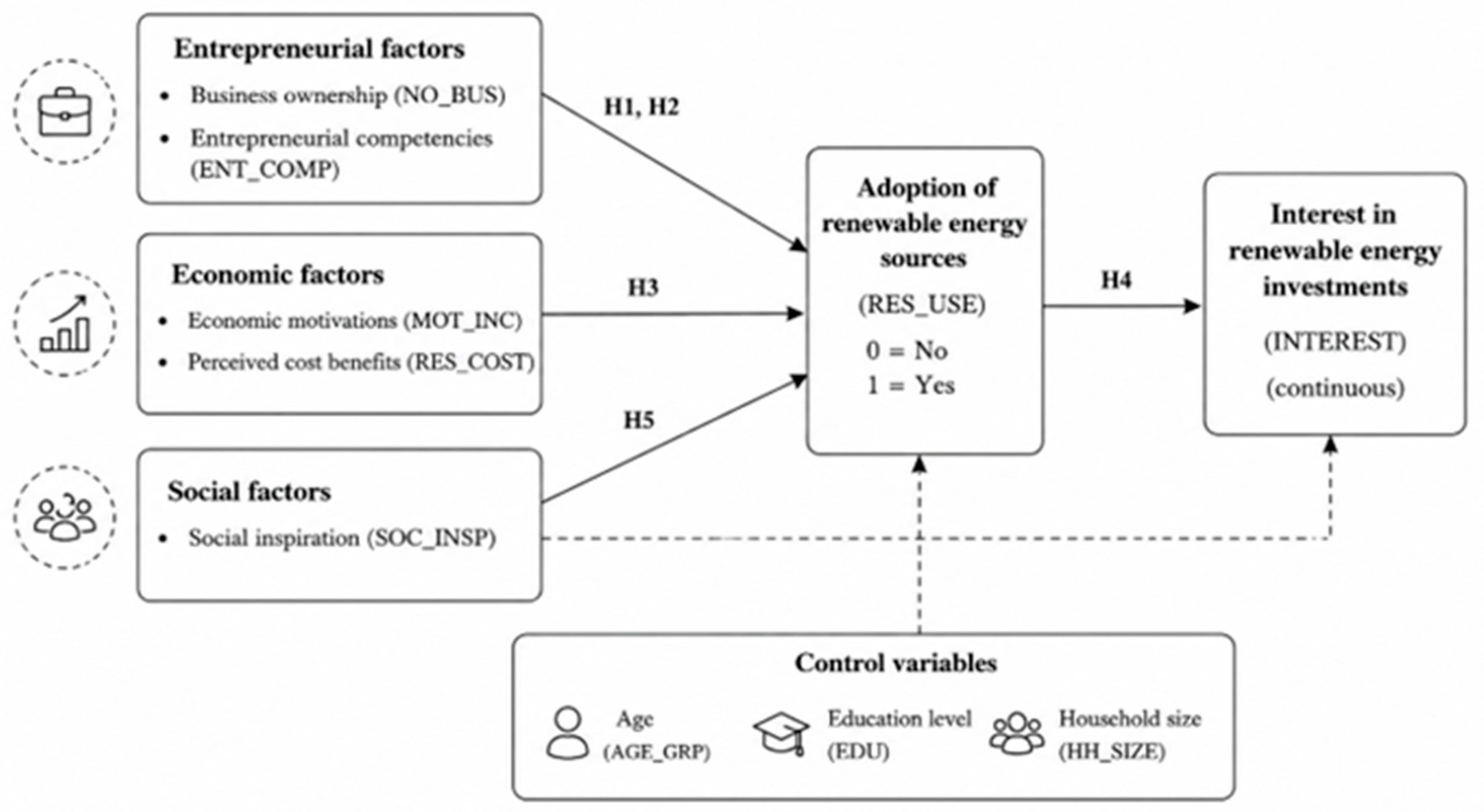
Based on a literature review, a research model was developed, assuming that the use of renewable energy sources by households is determined by entrepreneurial, economic, social, and selected demographic factors.
The model assumed that the dependent variable was the use of renewable energy sources (RES_USE), while the explanatory variables included running a business (NO_BUS), level of entrepreneurial competence (ENT_COMP), economic motivations (MOT_INC), social inspiration (SOC_INSP), and perceived cost benefits (RES_COST). Additionally, the analysis included control variables including respondents’ age (AGE_GRP), education level (EDU), and household size (HH_SIZE).
The analysis process was carried out in stages. First, the relationships between selected qualitative variables were verified using the chi-square test. Then, logistic regression models were estimated to identify factors influencing the likelihood of using renewable energy sources.
The final step was linear regression, used to assess the impact of social motivation on the level of interest in investing in renewable energy sources. The research model is presented in
Figure 1.
3.7. Research Hypotheses
Based on the literature review, the following research hypotheses were formulated:
H0. The scales used in the study are reliable.
H1. Business households are more likely to use renewable energy sources.
H2. Higher entrepreneurial competencies increase the likelihood of using renewable energy sources.
H3. Economic motivations favor the use of renewable energy sources.
H4. Social factors increase interest in renewable energy sources.
H5. Selected sociodemographic characteristics influence the use of renewable energy sources.
4. Research Results
4.1. Descriptive Statistics
The first stage of the analysis was to present descriptive statistics for the main variables used in the study. These statistics provide a general overview of respondents’ attitudes towards entrepreneurship and the use of renewable energy sources. This analysis provides the basis for further conclusions regarding the relationships between variables.
The results indicate that the average level of entrepreneurial competence (ENT_COMP) among respondents was 3.42 (SD = 0.81), indicating a moderate level of perceived entrepreneurial skills (
Table 3). A slightly higher mean value was observed for economic motivations (MOT_INC), with a mean of 3.67 (SD = 0.74). This suggests that financial factors play a significant role in decisions regarding investments in renewable energy sources.
For social inspiration (SOC_INSP), the mean value was slightly lower at 3.11 (SD = 0.88), indicating a moderate influence of the social environment on interest in renewable energy technologies. In contrast, the perceived cost benefits of renewable energy sources (RES_COST) reached a mean value of 3.55 (SD = 0.79). The analysis of binary variables also shows that 36.4% of respondents declare the use of renewable energy sources, while 28.7% run a business.
4.2. The Relationship Between Business Activity and the Use of Renewable Energy Sources (H1)
To determine whether non-agricultural business activity is associated with the use of renewable energy sources (RES_USE), a Pearson chi-square test of independence was conducted. The independent variable was non-agricultural business activity (NO_BUS) and the dependent variable was the use of renewable energy sources (RES_USE) (
Table 4).
The chi-square test results indicated a statistically significant relationship between running a business and the use of renewable energy sources (χ2 = 6.87; p = 0.009). Among households running a business, the percentage of renewable energy users was higher than among households not running a business, confirming hypothesis H1.
4.3. Results of Multivariate Logistic Regression
After confirming the existence of a significant relationship between running a business and the use of renewable energy sources, a multivariate logistic regression analysis was conducted. The aim was to determine which of the analyzed factors most significantly influenced the likelihood of using renewable energy sources.
Dependent variable: RES_USE (0 = no use of renewable energy sources; 1 = use of renewable energy sources). Exp(B) denotes the odds ratio.
The results presented in
Table 5 indicate that, among the analyzed predictors, entrepreneurial competences (
p = 0.012), economic motivations (
p = 0.021), running a business (
p = 0.012), and education level (
p = 0.041) demonstrated a statistically significant impact on the use of renewable energy sources. All of these variables increased the likelihood of using renewable energy technologies. However, the age of respondents and the number of household members did not demonstrate a significant effect on the analyzed dependent variable (
p > 0.05).
Before interpreting the results, the basic assumptions of the logistic regression model were verified. The diagnostic procedures performed did not indicate any multicollinearity issues between the explanatory variables. The model fit assessment confirmed its suitability for further interpretation of the results.
4.4. The Impact of Social Factors on Interest in Renewable Energy Sources (H4)
Unlike previous analyses, the test of hypothesis H4 focused on a different dependent variable: the level of interest in renewable energy sources (INTER-EST). This variable was adopted based on the assumption that interest in investment is an earlier stage of the decision-making process, preceding the actual use of renewable energy technologies.
Hypothesis H4 assumed that social factors, particularly inspiration from the experiences of other households, increase the level of interest in investing in renewable energy sources. To test this hypothesis, a linear regression model was used, with social inspiration (SOC_INSP) as the explanatory variable and the level of interest in renewable energy technologies (INTEREST) as the dependent variable. The results of the analysis are presented in
Table 6.
Dependent variable: INTEREST. Beta denotes the standardized regression coefficient.
The obtained results indicate that social inspiration significantly and positively influences the level of interest in renewable energy sources (β = 0.29; p = 0.003). This means that observing the positive experiences of other households increases respondents’ willingness to consider investing in renewable energy technologies. These results confirm hypothesis H4 and indicate the significant role of social mechanisms in shaping attitudes towards renewable energy sources.
The basic assumptions of linear regression were also verified. The diagnostic analysis did not reveal any violations of the homoscedasticity assumption or other significant deviations that would affect the interpretation of the obtained regression coefficients.
4.5. Verification of Research Hypotheses
The statistical analyses conducted allowed for the verification of all research hypotheses. The results indicate that household decisions regarding the use of renewable energy sources are determined primarily by entrepreneurial and economic factors. The significant role of social factors influencing the level of interest in investing in renewable energy technologies, which is an earlier stage of the decision-making process, was also confirmed. Hypothesis H1 was confirmed based on the results of the chi-square test, which indicated a significant relationship between running a business and the use of renewable energy sources (
Table 7). Hypotheses H2 and H3 were confirmed based on the results of multivariate logistic regression, indicating a significant influence of entrepreneurial competencies and economic motivations on the likelihood of using renewable energy technologies. Hypothesis H4 was confirmed by linear regression analysis, which demonstrated a positive influence of social motivation on the level of interest in renewable energy sources. Hypothesis H5 was partially confirmed, as only education level showed a significant effect among the analyzed socio-demographic variables.
5. Discussion of Results
The obtained statistical analysis results indicate that household decisions regarding investments in renewable energy sources are determined by entrepreneurial, economic, and social factors. The use of multivariate logistic regression allowed for the simultaneous assessment of the significance of these groups of factors, while linear regression enabled the identification of determinants of the level of interest in renewable energy technologies. The obtained results are consistent with the conclusions presented in the literature.
5.1. Household Entrepreneurship and the Use of Renewable Energy Sources
The results indicate a significant relationship between running a business and the use of renewable energy sources. Households running a business are more likely to invest in energy technologies. The obtained results are consistent with an approach that treats households as active economic entities. In this approach, investments in renewable energy sources are a manifestation of entrepreneurial behavior. They include taking initiative, analyzing profitability, and implementing new solutions.
The results confirm that economic activity promotes a greater propensity to invest in energy innovations.
However, it should be emphasized that in this study, household entrepreneurship was approached multidimensionally. It encompasses both entrepreneurial status (running a business) and entrepreneurial competencies and the propensity to undertake innovative activities. The adopted approach is consistent with the approaches found in the literature, which view entrepreneurship as a complex construct encompassing both resources and the attitudes and behaviors of economic entities. It is worth emphasizing, however, that the operationalization of entrepreneurship encompasses its various dimensions—business status and entrepreneurial competencies. This means that the study does not address a single construct, but rather interrelated yet distinct aspects of household entrepreneurship. The adopted approach aligns with the research trend of viewing entrepreneurship as a complex phenomenon encompassing both resources and attitudes and behaviors.
5.2. The Importance of Entrepreneurial Competencies in the Adoption of Energy Technologies
The analysis showed that entrepreneurial competencies significantly increase the likelihood of using renewable energy sources. This result is consistent with the diffusion of innovation theory. Households with higher competencies are better at analyzing available information and more likely to identify investment opportunities. They are also more likely to make decisions under uncertainty.
This indicates that entrepreneurial competencies play a key role in the implementation of new energy technologies.
5.3. Economic Motivations
The results confirm the significant importance of economic motivations. Financial factors, such as energy cost savings and the payback period, influence household decisions. In an environment of rising energy prices, investing in renewable energy sources is perceived as a way to reduce expenses and increase energy security. These results are consistent with previous studies, which indicate the dominant role of economic factors in the adoption of energy technologies.
5.4. Social Factors
The analysis showed that social motivation influences interest in renewable energy sources. This indicates that household decisions are partially shaped by the social environment. This result confirms the importance of the neighborhood effect. The visibility of renewable energy installations increases trust in the technology and reduces investment uncertainty. The adoption process can be cascading. Each new installation increases the likelihood of subsequent investments in a given community. Using the variable “interest in renewable energy” as the dependent variable captures an earlier stage of the decision-making process, preceding the actual adoption of the technology.
5.5. Demographic Factors
Among the demographic variables analyzed, education was significant. A higher level of education increased the likelihood of using renewable energy. The remaining variables were not statistically significant. This may suggest that entrepreneurial and economic factors are more important than basic demographic characteristics.
5.6. Summary of Results
The empirical analyses confirmed most of the formulated research hypotheses. The obtained results indicate that the use of renewable energy sources in households is determined by both entrepreneurial, economic, and social factors. Entrepreneurial competences of households and economic motivations related to reducing energy costs play a particularly important role. The research findings also confirm the importance of social mechanisms in the diffusion of energy technologies. Observing the installation of renewable energy sources in one’s immediate surroundings can increase interest in these solutions and foster their further dissemination. The results indicate that the development of renewable energy sources in the household sector can be supported not only through economic instruments but also through activities that increase technological knowledge and promote positive examples of renewable energy use in local communities.
5.7. Study Contribution and Limitations
This study contributes to the literature by simultaneously considering entrepreneurial, economic, and social factors in the analysis of household adoption of renewable energy sources. Unlike some previous studies, which focus on selected groups of determinants, this study allows for their direct comparison within a single empirical model.
An additional value of the study is the use of a single multifactor model enabling the simultaneous assessment of the relative importance of entrepreneurial, economic and socio-demographic factors influencing the use of renewable energy sources.
The obtained results are consistent with previous studies demonstrating the importance of economic and social factors in renewable energy adoption, but they add value by simultaneously considering the entrepreneurial component. Unlike some studies that analyze these factors separately, this study allows for their direct comparison within a single empirical model.
Thus, the article does not identify new determinants, but rather expands existing knowledge by integrating various analytical approaches and assessing their relative importance.
In particular, it demonstrates that both business status and entrepreneurial competencies are significant predictors of renewable energy use. The contribution of this article, therefore, lies not so much in the identification of new factors, but in the integration of various analytical perspectives and the empirical assessment of their relative importance within a single research model. At the same time, the study has certain limitations. First, the reliability of the scales was assessed solely using Cronbach’s alpha, without the use of more advanced construct validation methods such as factor analysis or the AVE index. Second, the model did not include some potentially important variables, such as household income, property type, or energy literacy. These limitations suggest directions for further research, which should incorporate more advanced validation procedures and an expanded set of explanatory variables. The use of a multivariable model allowed us to mitigate the problem of omitted variables and increase the reliability of the obtained results.
Furthermore, the models used partially limit the possibility of interpreting the results as causal effects, which is due to the cross-sectional nature of the data.
5.8. Summary
The results of the conducted analyses confirm that the use of renewable energy sources in households is a multifactorial process. Entrepreneurial competencies, economic motivations, and running a business are of paramount importance, significantly increasing the likelihood of using renewable energy technologies. Educational level also plays a significant role, while social factors primarily influence the earlier stages of the decision-making process, expressed by the level of interest in renewable energy sources. The obtained results confirm the need to simultaneously consider entrepreneurial, economic, and social determinants in research on the development of renewable energy sources.
6. Conclusions
The aim of this article was to analyze the factors determining the use of renewable energy sources by households, with particular emphasis on entrepreneurial, economic, and social aspects. Empirical research confirmed that investment decisions in this area are multifactorial in nature.
This article contributes to the literature by integrating entrepreneurial, economic, and social factors into the analysis of renewable energy adoption at the household level, enabling an assessment of their relative importance within a single empirical model.
The obtained results indicate that entrepreneurial competencies and economic motivations play a key role. These factors are significantly associated with a higher likelihood of using renewable energy sources. Running a business is also important, as it is associated with a greater propensity to implement energy technologies.
The results also confirm the role of social factors. Inspiration from the environment increases interest in renewable energy sources and can foster their further diffusion. This means that the process of renewable energy adoption is not solely the result of economic calculations, but also of social impacts.
The study results indicate that effectively supporting the adoption of renewable energy sources by households requires a multidimensional approach. These concerns, in particular, the scope of scale validation methods used and the availability of variables describing the economic situation of households. Future research should employ more advanced analytical methods and consider a broader set of explanatory variables.
In addition to financial instruments, such as subsidies and tax relief, initiatives aimed at developing households’ decision-making and investment competencies are crucial. Supporting educational programs and information initiatives that enhance the ability to assess the profitability of renewable energy investments is particularly important. The results also highlight the importance of social mechanisms—promoting visible examples of renewable energy installations and supporting local experience-sharing networks can strengthen the neighborhood effect and accelerate the technology diffusion process. It is also important to emphasize that the obtained results should be interpreted in the context of Poland’s specific institutional conditions, including support systems for prosumers (e.g., the “Mój Prąd” program), regulatory changes, and the structure of the energy mix, which may influence the scale and direction of the observed relationships.
The results suggest that public policies should not only focus on financial instruments but also develop educational programs that enhance households’ investment decision-making competencies. It may also be important to support local information exchange networks and promote visible examples of renewable energy installations, which can strengthen the social impact and accelerate the diffusion of technology.
The study has several limitations that should be considered when interpreting the results. First, the study was based on a purposive, non-random sample, which limits the generalizability of the results to the entire household population in Poland. Although the sample structure was compared with national statistics, some differences were observed, particularly in terms of age distribution and regional representation.
Second, the study relies on self-reported data, which may be susceptible to response bias and social desirability effects. Third, the cross-sectional nature of the data does not allow for the identification of causal relationships, only associations between variables.
Third, although the statistical methods used are appropriate, the models do not account for all possible determinants of renewable energy adoption, such as institutional or technological factors, which may also play a significant role.
Future studies should consider using longitudinal data and more representative sampling techniques to improve the robustness and generalizability of the results.
Moreover, despite performing basic model diagnostic procedures (including multicollinearity and fit assessment), the results should be interpreted with caution, as not all potential estimation problems can be completely eliminated.