


Abstract
Due to the small size of defects, partial occlusion, and cluttered background, insulator defect detection in transmission lines remains challenging. To address these issues, this paper proposes an improved Single Shot MultiBox Detector (SSD) framework. Firstly, a feature pyramid network is introduced for bidirectional multi-scale feature fusion to enhance the representation of small defects. Secondly, after fusing the feature maps, a convolutional block attention module is embedded to suppress background interference and highlight responses related to defects. Thirdly, focus loss replaces the original confidence loss to alleviate the imbalance of foreground and background during the training process. The proposed method achieved 99.03% insulator AP, 98.27% defect AP, and 98.65% mAP on a self-built dataset, which is 9.97 percentage points higher than the baseline SSD. The ablation study confirmed the complementary contributions of the three modules. The proposed detector significantly improves the detection reliability and robustness in complex detection scenarios, providing effective technical support for intelligent maintenance of transmission equipment.
1. Introduction
Power transmission systems constitute essential infrastructure for modern society. Their safe and stable operation depends critically on the condition of key components [1]. Among these components, insulators play an important role in providing both electrical insulation and mechanical support for transmission lines. Once defects such as damage, contamination, or deterioration occur, the insulation performance and mechanical reliability of the line may degrade significantly, potentially resulting in equipment failure, increased maintenance costs, and even large-scale power outages [2,3]. Therefore, accurate and efficient defect detection of insulators is of great importance for ensuring the reliability of power systems and promoting intelligent maintenance of transmission equipment.
In recent years, many methods have been developed for insulator defect detection [4]. Early studies mainly relied on traditional image processing techniques, such as edge extraction, threshold segmentation, texture analysis, and handcrafted feature matching. Although these methods can achieve acceptable performance in relatively simple environments, they are often sensitive to illumination variation, viewpoint change, and background clutter, which limits their robustness in practical inspection tasks [5]. With the development of deep learning, object detection methods have gradually become the mainstream solution. Two-stage detectors, represented by Faster R-CNN, usually provide high detection accuracy because they generate region proposals before classification and localization. However, such methods often involve relatively high computational cost and are less favorable for practical deployment scenarios with efficiency requirements [6,7,8]. In contrast, one-stage detectors, such as SSD and the YOLO series, directly perform classification and localization in a single forward pass and thus offer a better balance between speed and accuracy [9]. In addition, to address the characteristics of power equipment inspection, many improved detection methods have been proposed for small targets and complex backgrounds by introducing multi-scale feature fusion, attention mechanisms, or enhanced loss functions [10,11].
Despite these advances, reliable detection of insulator defects is still far from trivial [12,13]. One major difficulty is that the defect area is usually much smaller than the insulator body, so discriminative visual cues may disappear after repeated downsampling [14]. Another difficulty arises from complex surroundings. Structures such as towers, cables, roofs, or vegetation may produce textures and contours similar to the target, which increases the chance of false alarms [15]. In addition, some high-accuracy detectors introduce substantial computational burden, which weakens their practicality in engineering applications [16,17]. Although SSD is computationally efficient and structurally simple, its original design is not sufficiently robust when facing small defects, cluttered scenes, and strongly imbalanced positive and negative samples [18].
In summary, existing insulator defect detection models face three main challenges: small defect sizes, cluttered backgrounds, and severe foreground-background imbalance. As summarized in Table 1, previous SSD-based methods typically address only one or two of these challenges—for instance, some introduce feature fusion for multi-scale representation, others employ attention mechanisms to suppress background interference, and a few adopt focal loss to mitigate sample imbalance—but none tackle all three simultaneously. To overcome these limitations, our improved SSD framework differs from existing models in three corresponding ways: (1) a bidirectional FPN module for multi-scale feature fusion to preserve small-defect details; (2) CBAM attention strategically inserted on fused prediction feature maps to suppress background interference; and (3) focal loss replacing the original confidence loss to focus on hard defect samples. As verified in our ablation study, these three components are complementary and together achieve substantial gains over the baseline SSD and state-of-the-art detectors like YOLOv8 and EfficientDet, reaching 98.65% mAP on the CPLID and self-built mixed dataset.
Table 1.
Comparison of previous SSD-based methods for insulator defect detection.
2. Materials and Methods
2.1. Baseline SSD Detector
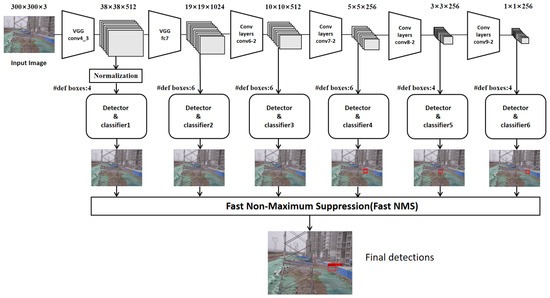
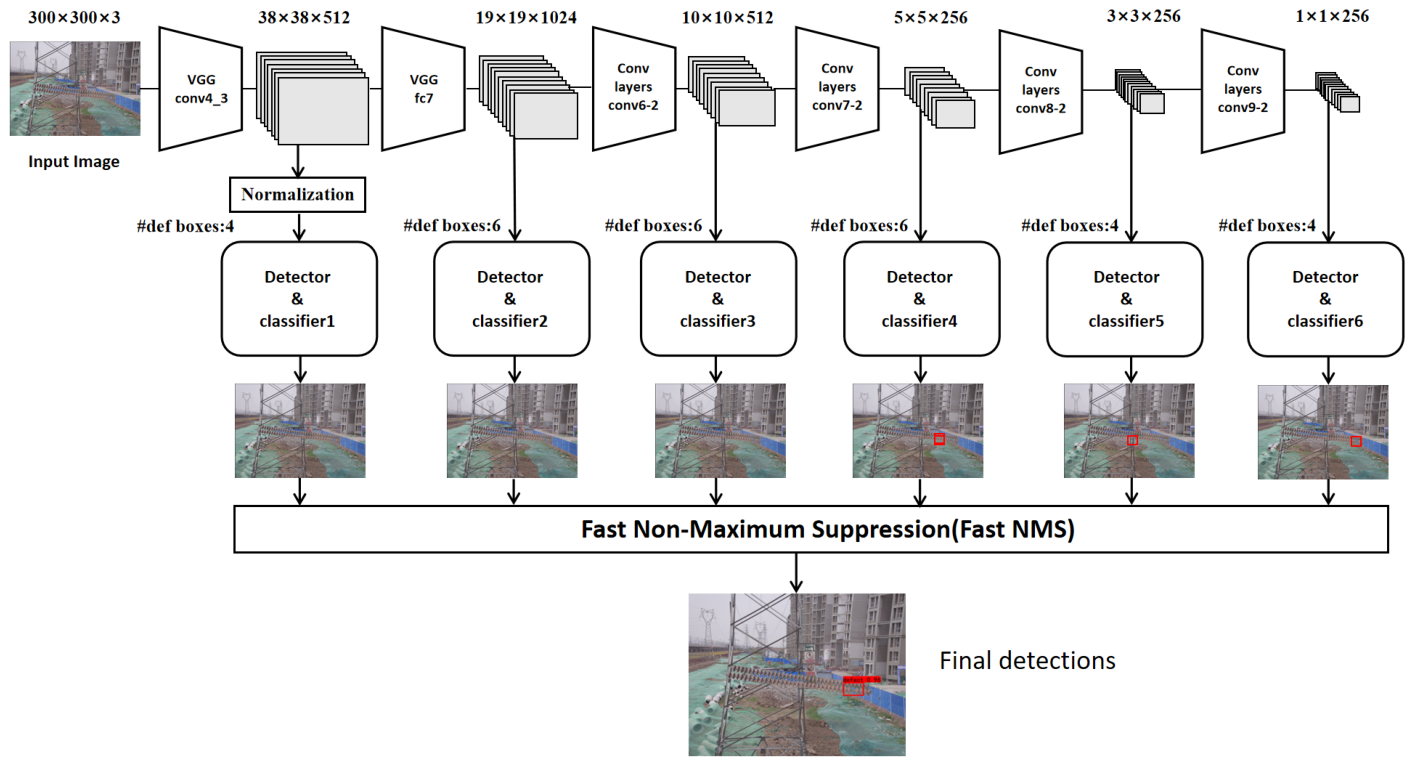
SSD belongs to the family of one-stage detectors, in which category prediction and box regression are completed within a unified forward process. The backbone network first extracts hierarchical representations from the input image, and several feature maps at different resolutions are then connected to detection heads for dense prediction over predefined anchor boxes. The final outputs are obtained after removing redundant boxes through non-maximum suppression.The SSD backbone network architecture is shown in Figure 1.
Figure 1.
Illustrates affect reading the architecture of the SSD backbone network.
A key characteristic of SSD is that objects of different sizes are handled by prediction layers with different spatial resolutions, which makes the framework efficient and suitable for real-time detection tasks. In the present study, the SSD variant with a VGG16 backbone is selected as the baseline model. Pretrained weights are used for network initialization through transfer learning. Although this baseline is efficient, its original feature representation is still not sufficiently discriminative for subtle defect patterns appearing in visually cluttered inspection images.
2.2. Overall Framework of the Proposed Method
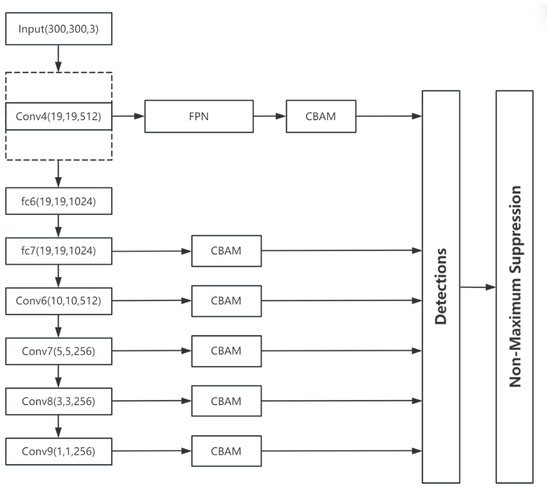
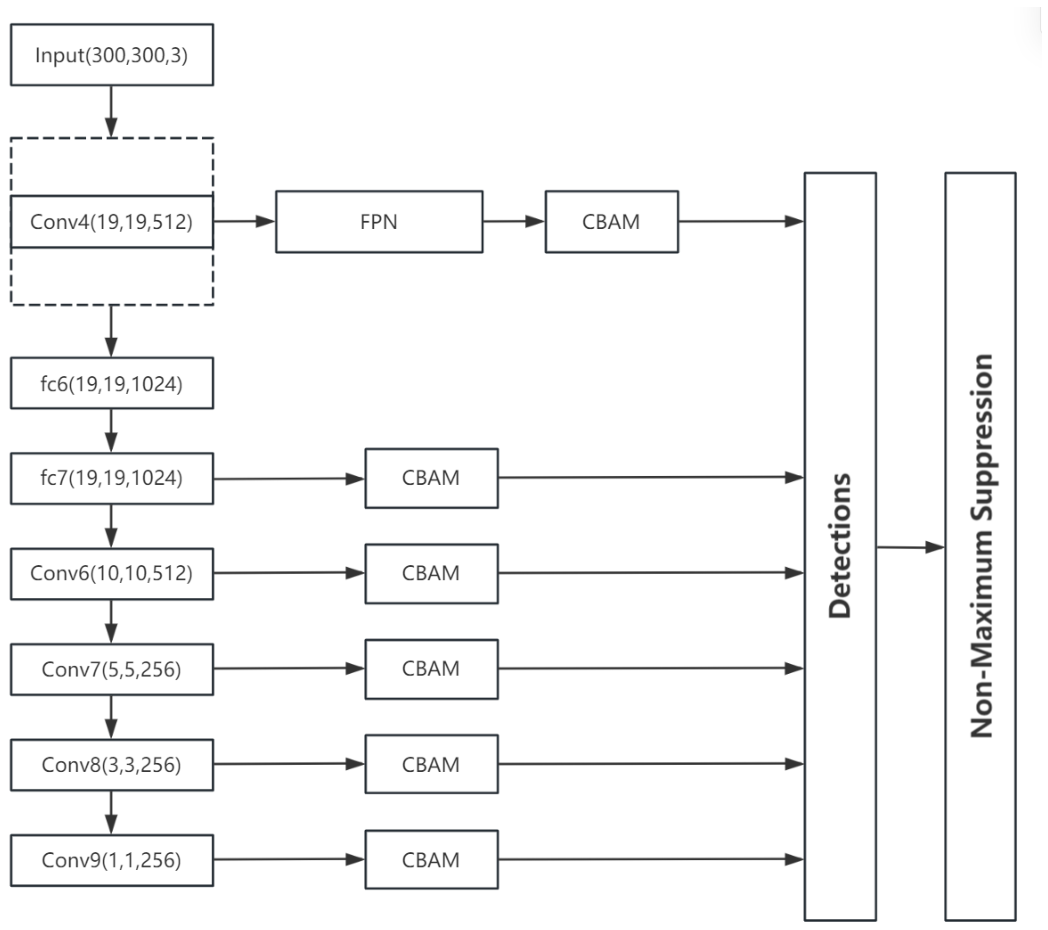
To enhance SSD performance in insulator defect detection, the baseline network is modified in three complementary aspects. First, a feature aggregation module is introduced to strengthen information exchange between shallow and deep layers, thereby improving the description of small defect regions. Second, an attention refinement mechanism is incorporated so that the detector can concentrate more on informative defect-related patterns and reduce responses to distracting background structures. Third, the original classification loss is replaced with focal loss in order to lessen the effect of severe foreground–background imbalance during optimization. The overall architecture of the proposed detector is illustrated in Figure 2.
Figure 2.
Architecture of the improved SSD model.
Through the above modifications, the detector is expected to become more effective in identifying insulator defects in practical transmission-line inspection scenes, where the targets are often small and the background is cluttered with towers, wires, vegetation, and buildings.
2.3. FPN-Based Feature Fusion
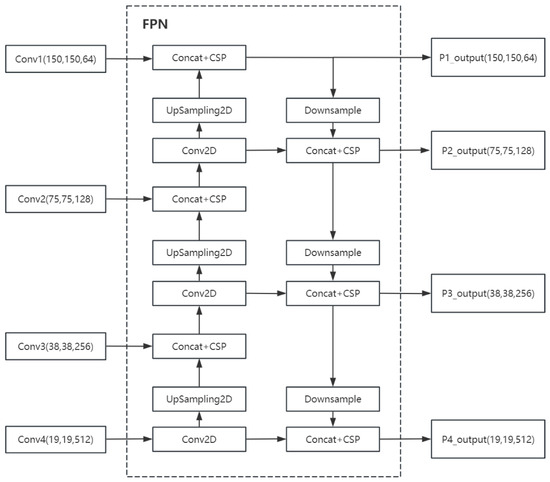
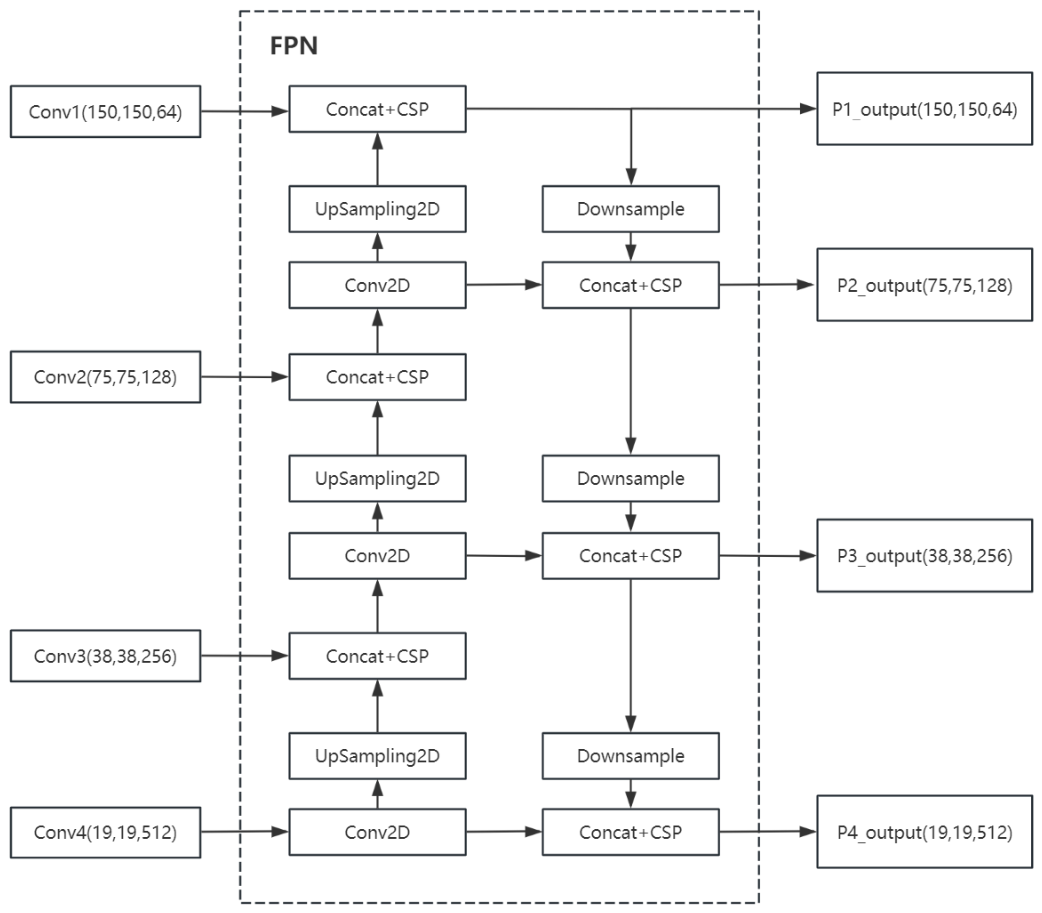
In insulator defect detection, defect regions often occupy only a very small portion of the input image. Shallow features preserve more local texture and edge information, whereas deeper features contain stronger semantic representations but tend to lose fine-grained defect details due to repeated downsampling [23]. To improve the detection of small defects, a multi-scale feature fusion module is introduced into the SSD backbone.
In this study, SSD with a VGG16 backbone is adopted as the baseline detector, and the input image size is set to . Four backbone feature stages are selected for fusion, namely Conv1_2, Conv2_2, Conv3_3, and Conv4_3, whose feature sizes are , , , and , respectively. To facilitate cross-scale aggregation, each selected feature map is first projected to a unified channel dimension of 256 through a convolution.
After channel alignment, a top-down fusion path is constructed [24]. Starting from the deepest feature map, the higher-level feature is upsampled by a factor of 2 using bilinear interpolation and then fused with the adjacent lower-level feature by element-wise addition. This process is repeated progressively from Conv4_3 to Conv1_2 so that high-level semantic information can be propagated to the shallower layers. Compared with the original SSD, this design improves the semantic expressiveness of shallow features, which is beneficial for identifying small defect regions.
To further strengthen the interaction between adjacent scales, a bottom-up aggregation path is introduced after top-down fusion [25]. Specifically, the fused lower-level feature is downsampled by a convolution with stride 2 and 256 output channels, and then added to the adjacent higher-level fused feature. Through this bottom-up refinement, deeper features can be supplemented with more detailed spatial cues while preserving their semantic abstraction capability.
After bidirectional feature aggregation, four enhanced feature maps are obtained, denoted as , , , and , corresponding to spatial sizes of , , , and , respectively, and all with 256 channels. Since the original SSD prediction heads are mainly built on medium- and high-level feature maps, only the fused feature maps and are used to replace and enhance the original low-level prediction sources. The subsequent extra SSD feature layers are retained to preserve the original multi-scale prediction mechanism. Therefore, the proposed method does not completely redesign the SSD prediction structure, but rather enhances the original prediction layers by replacing the front prediction sources with fused feature representations.The detailed configuration of the multi-scale feature fusion module is shown in Table 2.
Table 2.
Detailed configuration of the multi-scale feature fusion module.
In the top-down path, bilinear interpolation is used for upsampling. In the bottom-up path, a convolution with stride 2 is used for downsampling, and the output channel number is fixed at 256 for all fused scales. This unified design simplifies feature alignment and reduces the complexity of subsequent prediction heads.
By introducing the above bidirectional multi-scale fusion strategy, the detector can better combine detailed local patterns and high-level semantic cues, which is particularly important for insulator defect detection under small target, partial occlusion, and cluttered background conditions.
2.4. CBAM Attention Mechanism
Although the multi-scale fusion module improves feature continuity across different resolutions, inspection images still contain many background structures that may interfere with defect localization and classification. To further refine the fused representations, the convolutional block attention module (CBAM) is introduced into the proposed framework [26,27].
In this study, one CBAM block is inserted after each fused prediction feature map, namely after and , before they are fed into the SSD classification and localization heads. In other words, CBAM is not applied to all backbone layers, but only to the fused feature maps that are directly used for detection. This design improves feature discrimination at the prediction stage while avoiding unnecessary computational overhead on early high-resolution layers.The structure of the multi-scale feature fusion module is shown in Figure 3.
Figure 3.
Multi-scale feature fusion module.
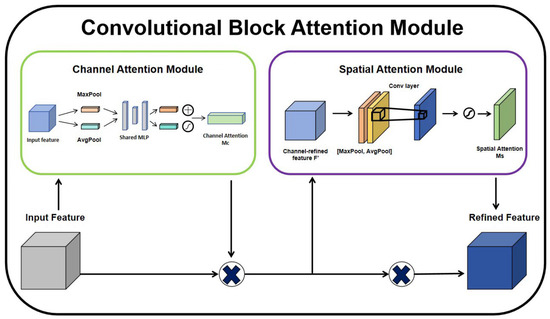
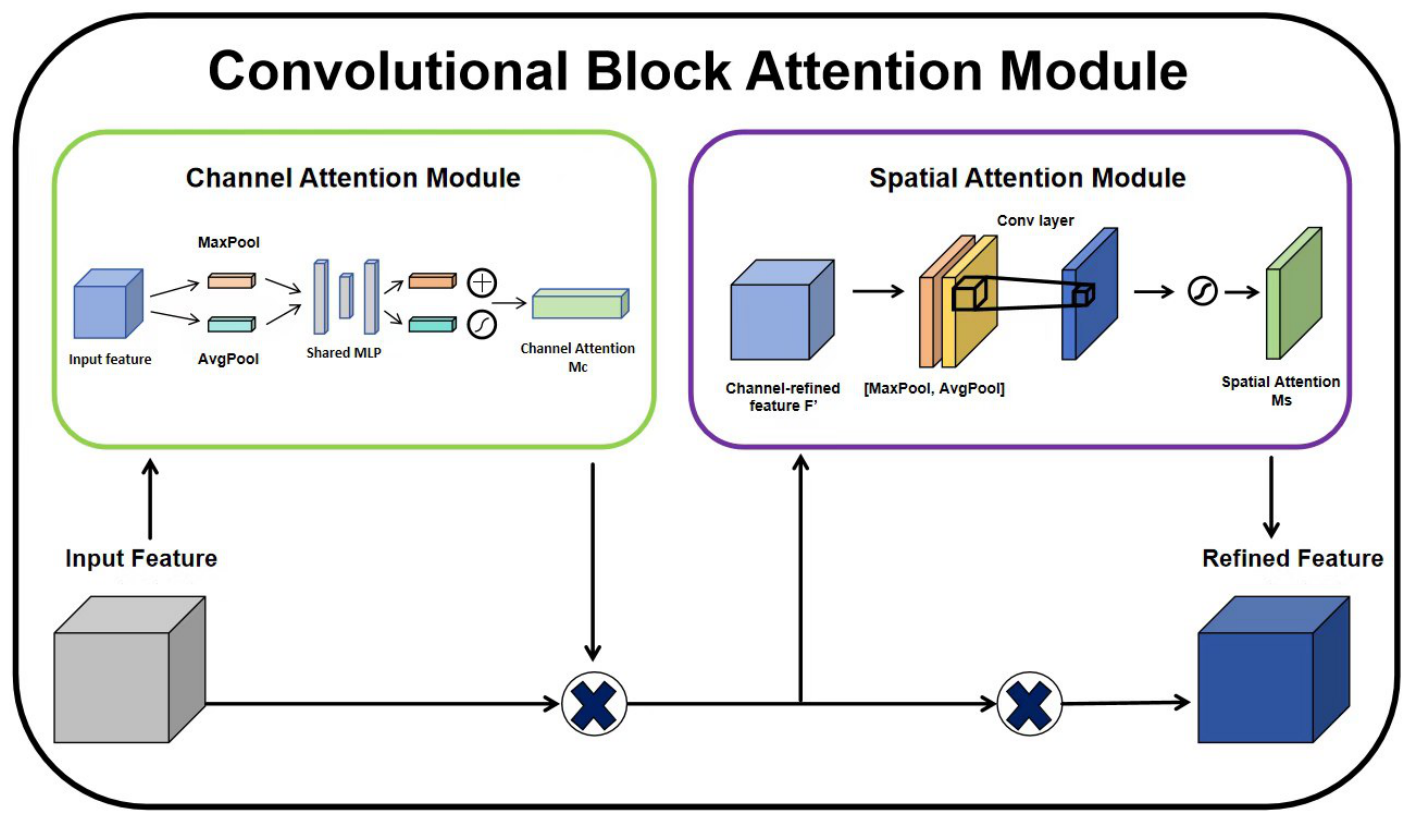
For each inserted CBAM block, the implementation follows the original CBAM design without structural modification. Specifically, the channel attention module first applies both global average pooling and global max pooling to the input feature map, and the pooled descriptors are passed through a shared multilayer perceptron. The reduction ratio is set to 16, which is the standard setting in the original CBAM. The resulting channel attention map is multiplied with the input feature to emphasize informative channels. After channel refinement, the spatial attention module is applied. It concatenates the average-pooled and max-pooled feature maps along the channel dimension and then uses a convolution to generate the spatial attention map, which is also consistent with the original CBAM configuration.
Let the fused feature map be denoted as , where . The refined feature map is obtained by sequentially applying channel attention and spatial attention:
where and denote the channel attention and spatial attention operations, respectively, and ⊗ represents element-wise multiplication.
By applying CBAM to the fused prediction features, the network can further enhance defect-related responses while suppressing distracting regions such as towers, wires, vegetation, and buildings. Compared with directly using the fused features for prediction, this attention-guided refinement improves the sensitivity of the detector to subtle defect regions and reduces the probability of false detection under complex backgrounds.
The insertion strategy of CBAM in the proposed framework is summarized as follows:
- The backbone feature maps from Conv1_2 to Conv4_3 are first processed by the bidirectional multi-scale fusion module.
- The fused feature maps and are then individually refined by CBAM.
- The refined features are finally sent to the SSD classification and regression heads.
Therefore, the proposed method combines multi-scale feature enhancement and attention-guided refinement in a sequential manner, which provides stronger feature discrimination for insulator defect detection in complex inspection scenes.The CBAM attention mechanism structure diagram is shown in Figure 4.
Figure 4.
CBAM attention mechanism structure diagram.
2.5. Focal Loss Formulation
A major difficulty in one-stage object detection is the imbalance between positive and negative samples. In insulator inspection images, the number of background anchors is much larger than that of true defect anchors [28]. When standard cross-entropy loss is used for classification, the optimization process can easily be dominated by a large number of easy negative samples, which weakens the learning of small defects and hard samples [29].
To address this issue, focal loss is adopted in the classification branch of the proposed detector [30]. Focal loss introduces a modulating factor to reduce the contribution of well-classified samples and focus training on misclassified or hard samples. Therefore, it is particularly suitable for the insulator defect detection task, in which defect instances are sparse and often difficult to distinguish from the background.
The focal loss can be expressed as follows:
where denotes the predicted probability of the ground-truth class, is the balancing factor between positive and negative samples, and is the focusing parameter that controls the degree to which easy samples are down-weighted.
In the original SSD, the total loss consists of localization loss and confidence loss. In the proposed method, the localization loss is retained, while the original confidence loss is replaced by focal loss. As a result, the detector becomes more sensitive to hard positive samples and small defect targets, which improves classification robustness under severe sample imbalance [31,32].
By optimizing the classification branch with focal loss, the proposed detector can better learn difficult defect instances and reduce the negative impact of overwhelming background anchors during training.
3. Results
3.1. Experimental Environment
All experiments were conducted on a workstation running Windows 11. The hardware platform was equipped with an NVIDIA GTX 5070Ti GPU and an Intel Core i9-9750H CPU. The proposed detector was implemented in Python 3.8.11 using TensorFlow-GPU 2.2.0 under the Anaconda environment. The experimental platform is summarized in Table 3.
Table 3.
Experimental platform configuration.
3.2. Dataset and Data Augmentation
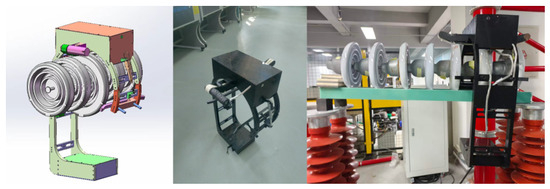
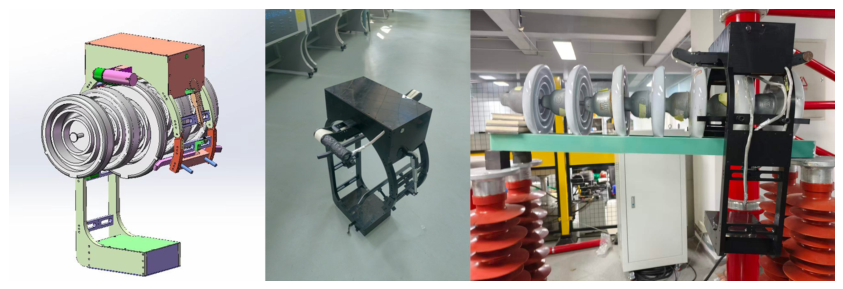
The dataset used in the experiment is a mixed data set composed of the CPLID dataset and the dataset collected by the self-developed detection device. The CPLID dataset is a public insulator detection dataset published by State Grid and hosted by IEEE Datasort. This dataset contains 600 real transmission line inspection images captured by a drone equipped with an FC550 camera under actual outdoor conditions. These images cover various inspection scenarios, with differences in line of sight, focal length, lighting, and background complexity, making this dataset suitable for evaluating the robustness of detectors in real-world environments. The self-built dataset contains 200 images, which are composed of image data of 110 kV voltage level insulator strings, different insulator models, and different degradation conditions through detection devices. The detection device is shown in the Figure 5.
Figure 5.
Self-developed insulator detection device.
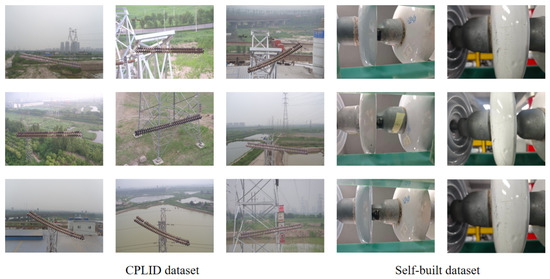
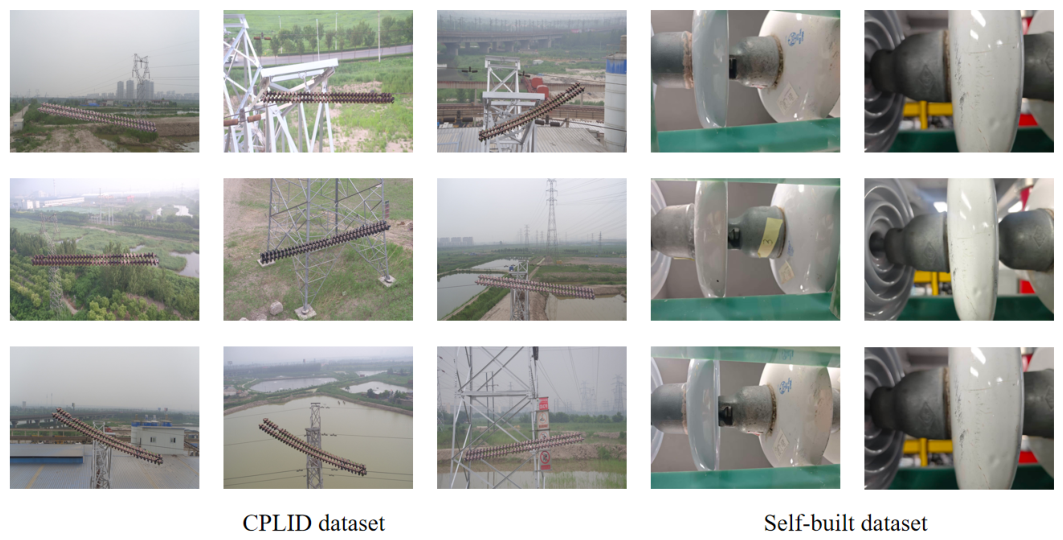
To increase the number of defect samples and reduce overfitting, data augmentation was applied to the defect images, including horizontal flipping, translation, and brightness adjustment. Data augmentation expanded the number of defect samples to 1689. Afterwards, the dataset was partitioned into training, validation, and testing subsets according to a 5:3:2 proportion. To maintain consistency in evaluation, all competing methods were trained and tested using the identical dataset partition. The example of mixed dataset is shown in Figure 6.
Figure 6.
Mixed dataset examples.
3.3. Training Settings
Optimization of the proposed detector was carried out with the SGD optimizer. The starting learning rate was 0.002, the network input size was , and each mini-batch contained 16 images. To stabilize early-stage learning, the backbone initialized by transfer learning was first kept fixed, after which all layers were released for full-network fine-tuning. The frozen stage lasted for 50 epochs and the unfrozen stage continued for 200 epochs. The momentum factor was set to 0.937, and the minimum learning rate was limited to . The main hyperparameter settings are listed in Table 4.
Table 4.
Main training parameters.
The training parameters in Table 3 were selected based on three considerations: (1) established practices from the SSD literature; (2) empirical tuning on the validation set; (3) hardware constraints.The input size of 300 × 300 follows the standard 300 × 300 configuration proposed by Liu [33]. which achieves a favorable trade-off between detection accuracy (74.3% mAP on VOC2007) and inference speed (59 FPS). This resolution has been widely adopted in subsequent SSD-based applications, including insulator defect detection. The SGD optimizer with momentum is consistent with the original SSD implementation. The initial learning rate of 0.002 was determined through grid search on the validation set. The batch size of 16 was set according to the available GPU memory. The two-stage training strategy—freezing the backbone for 50 epochs followed by full-network fine-tuning for 200 epochs—follows standard transfer learning practice, where the initial freezing stage preserves the generic features learned from ImageNet pre-training while the subsequent fine-tuning stage adapts the entire network to the specific defect detection task. The momentum of 0.937 and the minimum learning rate of follow common practices in SGD-based optimization for object detection.
3.4. Evaluation Metrics
The proposed method’s detection performance was thoroughly assessed by taking precision, recall, F1-score, average precision (AP), and mean average precision (mAP) as the primary metrics.
The proportion of accurately predicted positive samples among all predicted positive samples is known as precision, while recall is the amount of ground-truth positive samples that are successfully identified. Their definitions are given by
where , , and correspond to true positive, false positive, and false negative predictions, respectively.
The F1-score is the harmonic mean of precision and recall, and it provides a balanced measure of missed detections and false alarms. It is defined as follows:
In object detection tasks, overall performance can also be characterized by the precision–recall (P-R) relationship. For each category, the area enclosed by the corresponding P-R curve is taken as the average precision.
A detection result was counted as correct only when the overlap between the predicted box and its matched ground-truth box, measured by intersection over union (IoU), was higher than the specified threshold. In the present study, the IoU threshold was set to 0.5.
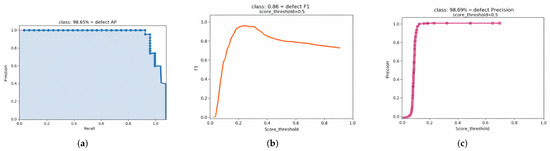
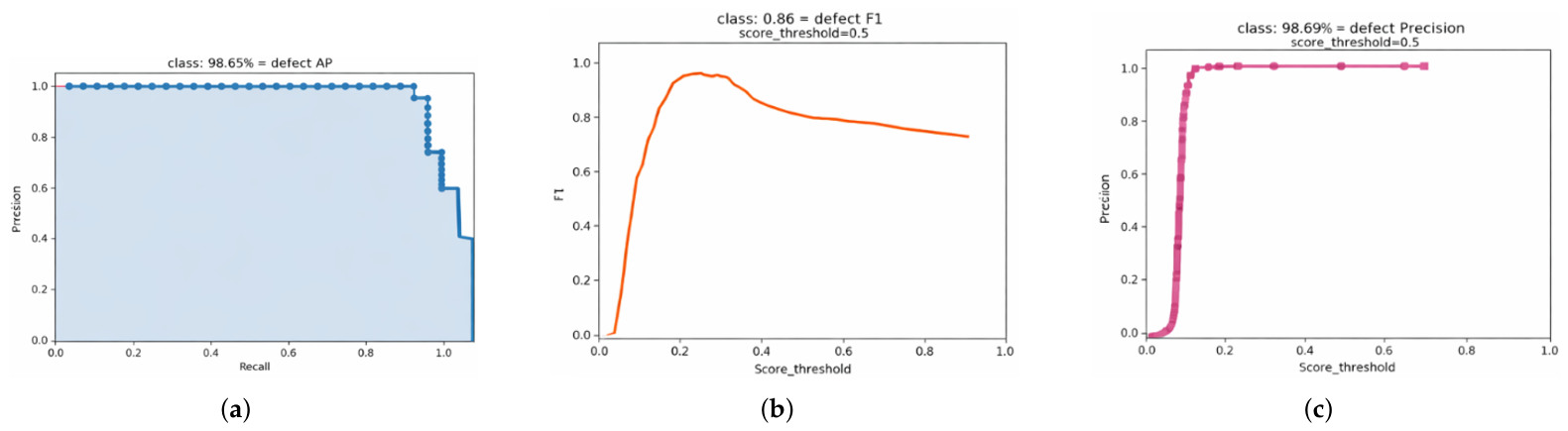
Accordingly, precision, recall, and F1-score were adopted to reflect the trade-off between false positives and missed targets, while AP and mAP were employed to measure the overall detection performance of the proposed model on the mixed dataset.The evaluation curves of the proposed model is shown in Figure 7.
Figure 7.
Evaluation curves of the proposed model: (a) AP curve, (b) F1-score curve, and (c) precision curve.
3.5. Quantitative Results
The comparison results are presented in Table 5. The proposed detector achieves the highest overall accuracy among the evaluated methods, with 99.03% AP for insulators, 98.27% AP for defects, and 98.65% mAP. Relative to the baseline SSD, the gain in mAP is 9.97 percentage points, which indicates that the introduced modifications substantially improve detection quality in challenging inspection scenes.
Table 5.
Performance comparison of different detection algorithms.
To evaluate the model’s generalization across different imaging domains, we separately computed the detection performance on the CPLID test images and the self-built test images. The results are presented in Table 6.
Table 6.
Subset-wise performance breakdown on CPLID and self-built dataset.
The proposed method achieves 98.25% mAP on the outdoor CPLID subset and 98.01% mAP on the ground-based self-built subset, with a performance gap of only 0.24 percentage points. This minimal difference confirms that the model successfully handles outdoor background clutter (towers, cables, vegetation) and does not over-fit to controlled indoor data. The consistent performance across domains validates the effectiveness of our data augmentation strategy and the CBAM attention mechanism in suppressing domain-specific distractions while focusing on defect-relevant structural features.
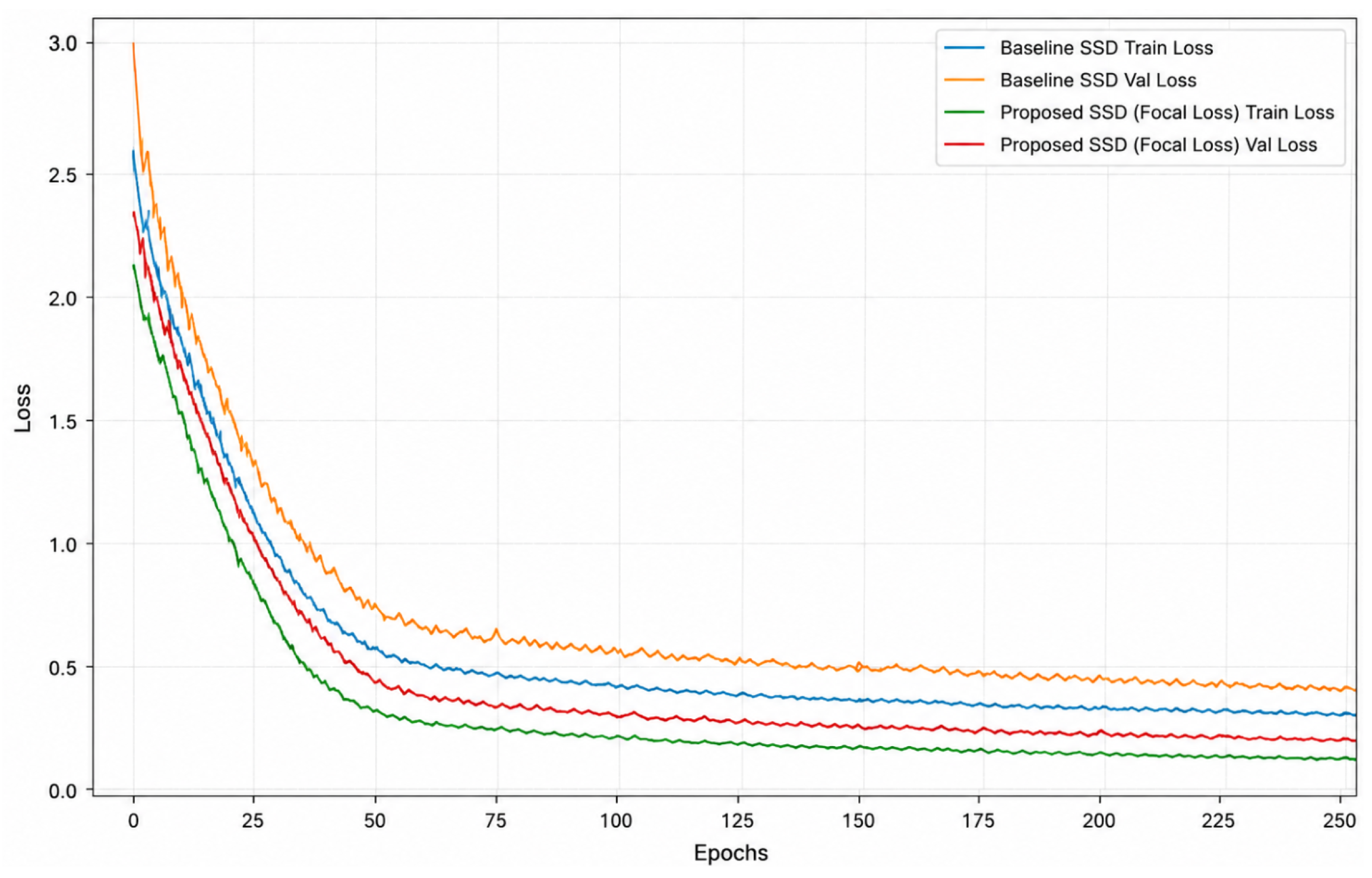
The training process typically consists of a rapid convergence stage in early epochs followed by a gradual refinement stage. To further verify the optimization behavior introduced by focal loss, we analyze the convergence trends of training and validation loss over 250 epochs and compare them with the baseline SSD model.
As shown in Figure 8, the proposed method exhibits faster initial convergence, smoother optimization trajectory, and lower final loss values, demonstrating improved stability under severe foreground–background imbalance.
Figure 8.
Training and validation loss curves of baseline SSD and proposed SSD.
3.6. Ablation Study
To systematically evaluate the contribution of each proposed component, we conducted an ablation study on the mixed dataset. The baseline model is the original SSD with a VGG16 backbone. Starting from this baseline, we progressively integrated the FPN-based multi-scale feature fusion module, the CBAM attention mechanism, and the focal loss. All ablation variants were trained and tested under identical settings as described in Section 3.3.
Table 7 reports the detection results in terms of insulator AP, defect AP, and mAP. Several observations can be made. First, adding any single component improves the baseline performance, indicating that each modification addresses a distinct limitation of the original SSD. Specifically, the FPN module brings a significant gain of 3.47% in mAP, demonstrating its effectiveness in preserving small defect details through cross-scale feature interaction. Second, introducing CBAM alone yields a 2.86% mAP improvement, confirming that channel-wise and spatial attention help suppress background clutter. Third, replacing the original classification loss with focal loss alone increases mAP by 2.12%, mainly by alleviating the foreground–background imbalance.
Table 7.
Ablation study results on the mixed dataset.
Furthermore, combining two components leads to further improvements. The FPN + CBAM variant achieves an mAP of 96.42%, outperforming any single-component model. This suggests that multi-scale feature enhancement and attention-based refinement complement each other: the former enriches defect-related representations, while the latter filters out irrelevant responses. Similarly, FPN + focal loss and CBAM + focal loss also outperform their single-component counterparts, indicating that focal loss generalizes well across different feature representations.
Finally, the full model integrating all three components achieves the highest mAP of 98.65%, surpassing the baseline by 9.97 percentage points. This confirms that the three proposed modules are not redundant but collaboratively improve the detector’s robustness and accuracy in complex insulator inspection scenarios. In particular, the full model shows the most substantial gain in defect AP (98.27% vs. 86.24% of the baseline), highlighting its effectiveness in detecting small, partially occluded, and hard-to-distinguish defect regions.
To better understand the effectiveness and computational implications of attention mechanisms within the feature pyramid network, it is necessary to analyze not only whether the introduction of CBAM improves detection performance, but also how its placement at different feature scales affects the overall accuracy–efficiency trade-off. Since feature maps at different pyramid levels vary significantly in spatial resolution and semantic abstraction, the impact of applying attention modules is expected to be non-uniform across layers. Based on this consideration, we conduct a comparative ablation study by inserting CBAM modules into different feature pyramid levels, including shallow layers (F1/F2) and deeper layers (F3/F4). The goal is to systematically evaluate how different placement strategies influence both detection accuracy and computational cost.
As shown in Table 8, applying CBAM to shallow feature layers (F1/F2) slightly improves detection accuracy but introduces significant computational overhead due to high-resolution feature maps. In contrast, applying CBAM to deeper layers (F3/F4) achieves comparable mAP while maintaining near-baseline computational cost, demonstrating a better trade-off between accuracy and efficiency.
Table 8.
Effect of CBAM placement on detection performance and efficiency.
3.7. Visualization Results
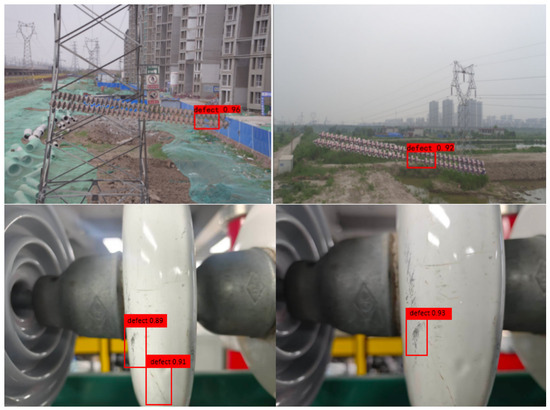
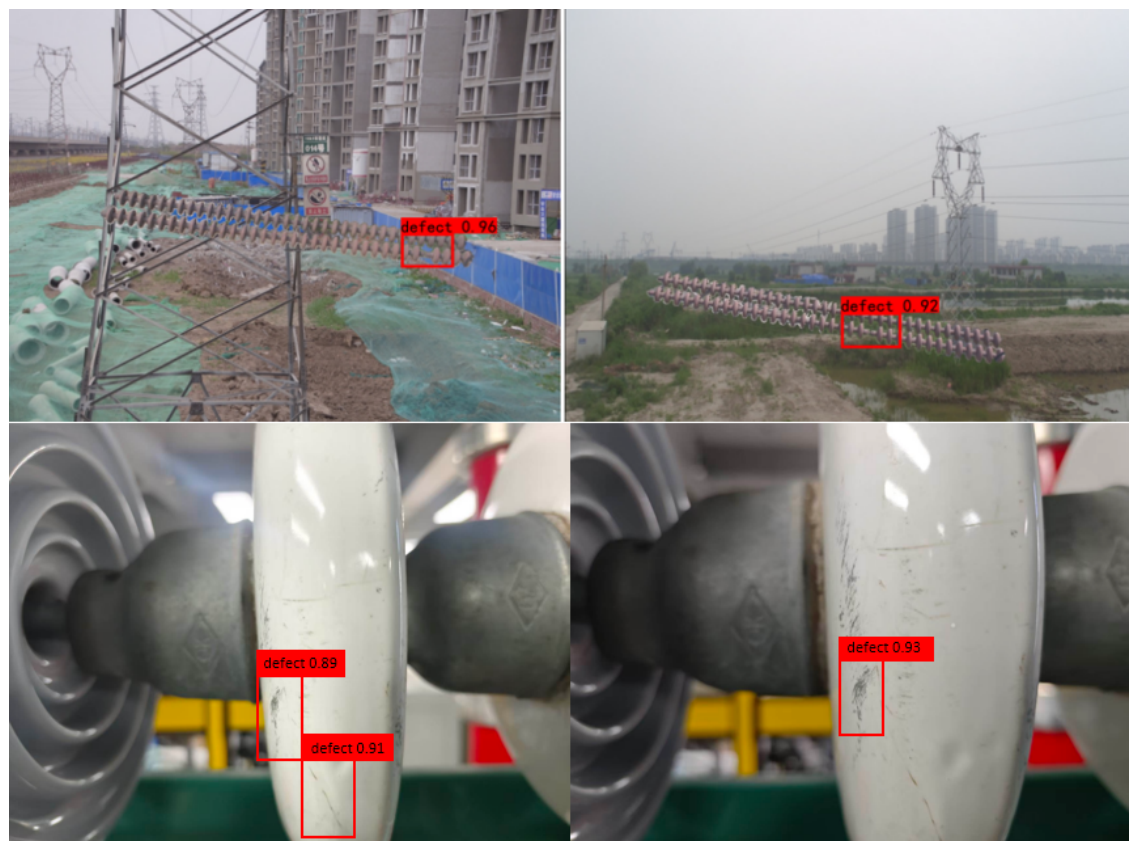
The visualization results further indicate that the proposed model can identify insulator defects under complex backgrounds. Compared with the original SSD, the improved detector shows stronger sensitivity to small defect regions and better robustness against distracting background structures.The visualization of model detection results are shown in Figure 9.
Figure 9.
Visualization of model detection results.
4. Discussion
The effectiveness of the proposed method can be interpreted from a unified perspective of feature representation enhancement, attention refinement, and optimization strategy improvement. Overall, the improvements are not independent but complementary, jointly contributing to more robust detection performance in complex insulator inspection scenarios. First, the proposed bidirectional multi-scale feature fusion module enhances the representational capability of the backbone network by integrating semantic information from deep layers with detailed texture information from shallow layers. Unlike the original SSD, which suffers from weak semantic expression in early layers, the proposed fusion strategy ensures that both spatial detail and high-level context are preserved. This is particularly beneficial for insulator defect detection, where target regions are typically small and partially occluded, requiring precise localization supported by multi-level feature interaction.
Second, the CBAM attention mechanism further refines the fused feature representations by explicitly modeling inter-channel dependencies and spatial importance. In real transmission-line inspection scenes, background structures such as towers, vegetation, and wires often introduce strong visual interference. By applying channel and spatial attention only to the fused prediction features (F3 and F4), the network selectively enhances defect-related responses while suppressing irrelevant activations. Importantly, restricting CBAM to deeper feature maps avoids unnecessary computational overhead on high-resolution shallow layers, achieving a favorable balance between accuracy and efficiency, as validated in the ablation study.
Third, the adoption of focal loss addresses the severe class imbalance inherent in one-stage detection frameworks. In insulator inspection images, the number of background anchors significantly exceeds that of defect-related anchors, causing standard cross-entropy loss to be dominated by easy negative samples. By down-weighting well-classified samples and emphasizing hard examples, focal loss improves the learning process for rare and difficult defect instances, leading to more stable optimization and improved classification robustness.
From a holistic perspective, these three components are tightly coupled rather than independent. The multi-scale fusion module improves feature quality, CBAM enhances feature selectivity, and focal loss improves optimization dynamics. Their combination leads to a consistent improvement in both detection accuracy and robustness, as demonstrated in the quantitative and ablation results. This synergy explains why the full model significantly outperforms variants using only partial components.
From an engineering application standpoint, although the proposed method does not explicitly model the reliability of the power transmission system, it improves the practical reliability of visual inspection by reducing missed detections and false alarms. More accurate defect localization enables earlier identification of potential risks, thereby supporting preventive maintenance strategies and reducing the likelihood of fault propagation in transmission-line equipment.
We also acknowledge potential limitations of the current work. While the model performs well under diverse outdoor and ground-view conditions, performance may still degrade in extreme scenarios such as severe occlusion, very small defect regions, or low-illumination environments. In addition, although preliminary evaluation suggests good generalization across aerial and ground-based data, more systematic cross-domain validation is required.
Future work will focus on developing lightweight deployment strategies for edge devices, improving robustness under extreme environmental conditions, and conducting large-scale cross-domain validation with more diverse imaging perspectives. These efforts will further enhance the practical applicability of the proposed method in real-world UAV-based and ground-based inspection systems.
5. Conclusions
This paper presents an improved SSD framework for insulator defect detection in complex inspection scenes. By integrating FPN-based multi-scale fusion, CBAM attention, and focal loss, the detector becomes more capable of representing small targets, suppressing background interference, and learning from hard samples.
The experimental results on the mixed dataset demonstrate clear performance gains over the baseline SSD and two representative comparison methods. The proposed method achieved an mAP of 98.65%, with AP values of 99.03% for insulators and 98.27% for defects.
These results demonstrate the effectiveness of the proposed method in achieving accurate defect identification under challenging inspection conditions. More importantly, by reducing missed detections and false alarms, the proposed detector improves the reliability, consistency, and robustness of inspection results. This makes early defect discovery more dependable and helps reduce the risk of defect accumulation or fault propagation in transmission-line equipment. Therefore, although this study does not directly model system reliability, the proposed method provides meaningful technical support for enhancing the operational reliability and maintenance quality of power transmission systems. Future work will focus on improving lightweight deployment and extending the approach to more diverse weather, viewpoint, and occlusion conditions.
Author Contributions
Conceptualization, P.L. and H.L.; methodology, P.L., L.W. and Z.W.; software, Z.W. and J.L.; validation, Z.Z., Z.X. and L.W.; formal analysis, P.L. and L.W.; investigation, J.L. and Z.Z.; resources, H.L. and L.W.; data curation, Z.W. and Z.X.; writing—original draft preparation, P.L. and L.W.; writing—review and editing, H.L., L.W. and L.W.; visualization, Z.W. and Z.X.; supervision, H.L.; project administration, H.L.; funding acquisition, H.L. All authors have read and agreed to the published version of the manuscript.
Funding
This research was funded by the Research Projects of State Grid Sichuan Electric Power Research Institute, grant number SGSCDK00SDJS2400093.
Institutional Review Board Statement
Not applicable. This study did not involve humans or animals.
Informed Consent Statement
Not applicable. This study did not involve humans.
Data Availability Statement
The CPLID dataset analyzed in this study is a public insulator inspection dataset. The experimental data and implementation details supporting the findings of this study are available from the corresponding author upon reasonable request.
Acknowledgments
The authors would like to thank the State Grid Sichuan Electric Power Research Institute for supporting this research. The authors also thank the providers of the CPLID dataset for making the insulator inspection images available for academic research.
Conflicts of Interest
Author Pinlei Lv, Zhichuan Wang, Jinkui Lv, Zongxi Zhang and Zhihang Xue were employed by State Grid Sichuan Electric Power Research Institute. The remaining authors declare that the research was conducted in the absence of any commercial or financial relationships that could be construed as a potential conflict of interest. The authors declare that this study received funding from State Grid Sichuan Electric Power Research Institute The funder was not involved in the study design, collection, analysis, interpretation of data, the writing of this article or the decision to submit it for publication.
Abbreviations
The following abbreviations are used in this manuscript:
| AP | Average precision |
| CBAM | Convolutional block attention module |
| CNN | Convolutional neural network |
| CPLID | China Power Line Insulator Dataset |
| F1-score | Harmonic mean of precision and recall |
| FN | False negative |
| FP | False positive |
| FPN | Feature pyramid network |
| IoU | Intersection over union |
| mAP | Mean average precision |
| NMS | Non-maximum suppression |
| P-R | Precision–recall |
| SSD | Single Shot MultiBox Detector |
| TP | True positive |
| VGG | Visual Geometry Group network |
References
- Liu, J.; Hu, M.M.; Dong, J.Y.; Lu, X. Summary of insulator defect detection based on deep learning. Electr. Power Syst. Res. 2023, 214, 109688. [Google Scholar]
- Tan, M.; Pang, R.; Le, Q.V. EfficientDet: Scalable and Efficient Object Detection with Bi-directional Feature Pyramid Networks. arXiv 2019, arXiv:1911.09070. [Google Scholar] [CrossRef] [Scilit]
- Lin, T.Y.; Goyal, P.; Girshick, R.; He, K.; Dollár, P. Focal Loss for Dense Object Detection. arXiv 2017, arXiv:1708.02002. [Google Scholar] [CrossRef] [Scilit]
- Xia, G.S.; Bai, X.; Ding, J.; Zhu, Z.; Belongie, S.; Luo, J.; Datcu, M.; Pelillo, M.; Zhang, L. DOTA: A Large-Scale Dataset for Object Detection in Aerial Images. arXiv 2018, arXiv:1711.10398. [Google Scholar] [CrossRef] [Scilit]
- Hu, J.; Shen, L.; Sun, G. Squeeze-and-Excitation Networks. arXiv 2018, arXiv:1709.01507. [Google Scholar] [CrossRef] [Scilit]
- Zhang, H.; Wang, Y.; Dayoub, F.; Sunderhauf, N. VarifocalNet: An IoU-Aware Dense Object Detector. arXiv 2021, arXiv:2008.13367. [Google Scholar]
- Chen, Q.; Wang, Y.; Yang, T.; Zhang, X.; Cheng, J.; Sun, J. You Only Look One-Level Feature. arXiv 2021, arXiv:2103.09460. [Google Scholar]
- Li, Y.; Chen, Y.; Wang, N.; Zhang, Z. Scale-Aware Trident Networks for Object Detection. arXiv 2019, arXiv:1901.01892. [Google Scholar]
- Li, X.; Wang, W.; Hu, X.; Yang, J. Selective Kernel Networks. arXiv 2019, arXiv:1903.06586. [Google Scholar]
- Zhang, X.; Wan, F.; Liu, C.; Ji, R.; Ye, Q. FreeAnchor: Learning to Match Anchors for Visual Object Detection. arXiv 2021, arXiv:1909.02466. [Google Scholar]
- Tian, X.; Lin, S. Insulator defect detection based on feature extraction and dynamic convolution. J. Phys. 2026, 3174, 012039. [Google Scholar] [CrossRef] [Scilit]
- Miao, X.; Liu, X.; Chen, J.; Zhuang, S.; Fan, J.; Jiang, H. Insulator Detection in Aerial Images for Transmission Line Inspection Using Single Shot Multibox Detector. IEEE Access 2019, 7, 9945–9956. [Google Scholar] [CrossRef] [Scilit]
- Zheng, R.; Duan, G.; Cao, X.; Wang, H. Transmission line insulator defect detection method based on YOLO-MLSL model. Energies 2026, 19, 2305. [Google Scholar] [CrossRef] [Scilit]
- Xu, D.; Ouyang, W.; Ricci, E.; Wang, X. Learning Multi-Modal Feature Fusion for Object Detection. IEEE Trans. Image Process. 2020, 29, 7769–7780. [Google Scholar]
- Hao, K.; Chen, G.; Zhao, L.; Li, Z.; Liu, Y.; Wang, C. An Insulator Defect Detection Model in Aerial Images Based on Multiscale Feature Pyramid Network. IEEE Trans. Instrum. Meas. 2022, 71, 3522412. [Google Scholar] [CrossRef] [Scilit]
- He, W.; Yang, B.; Guo, Y.T. Research on power insulator self-explosion fault detection based on embedded YOLO network. Trans. China Electrotech. Soc. 2025, 40, 7806–7818. [Google Scholar]
- Wang, J.; Chen, K.; Xu, R.; Liu, Z.; Loy, C.C.; Lin, D. CARAFE: Content-Aware Reassembly of Features. arXiv 2019, arXiv:1905.02188. [Google Scholar]
- Chen, K.; Wang, J.; Pang, J.; Cao, Y.; Xiong, Y.; Li, X.; Lin, D. Hybrid Task Cascade for Instance Segmentation. arXiv 2019, arXiv:1901.07518. [Google Scholar]
- Zeng, B.; Zhou, Y.; He, D.; Zhou, Z.; Hao, S.; Yi, K.; Li, Z.; Zhang, W.; Xie, Y. Research on Lightweight Method of Insulator Target Detection Based on Improved SSD. Sensors 2024, 24, 5910. [Google Scholar] [CrossRef] [Scilit] [PubMed]
- Li, Y.; Wei, S.; Liu, X.; Luo, Y.; Li, Y.; Shuang, F. An Improved Insulator and Spacer Detection Algorithm Based on Dual Network and SSD. IEICE Trans. Inf. 2023, E106-D, 662–672. [Google Scholar] [CrossRef] [Scilit]
- Yu, Z.; Liao, Q.; Yang, S. Detection and Classification of Transmission Line Insulator Defects with Res-SSD Optimization Method. In Advances in Natural Computation, Fuzzy Systems and Knowledge Discovery; Springer: Berlin/Heidelberg, Germany, 2020. [Google Scholar]
- Liu, X.; Li, Y.; Shuang, F.; Gao, F.; Zhou, X.; Chen, X. ISSD: Improved SSD for Insulator and Spacer Online Detection Based on UAV System. Sensors 2020, 20, 6961. [Google Scholar] [CrossRef] [Scilit] [PubMed]
- Wang, C.Y.; Liao, H.Y.M.; Wu, Y.H.; Chen, P.Y.; Hsieh, J.W.; Yeh, I.H. CSPNet: A New Backbone That Can Enhance Learning Capability of CNN. arXiv 2020, arXiv:1911.11929. [Google Scholar]
- Zhang, H.; Chang, H.; Ma, B.; Wang, N.; Chen, X. Dynamic R-CNN: Towards High Quality Object Detection via Dynamic Training. arXiv 2020, arXiv:2004.06002. [Google Scholar]
- Liu, W.; Anguelov, D.; Erhan, D.; Szegedy, C.; Reed, S.; Fu, C.Y.; Berg, A.C. SSD: Single Shot MultiBox Detector. arXiv 2016, arXiv:1512.02325. [Google Scholar] [CrossRef] [Scilit]
- Gao, S.; Cheng, M.M.; Zhao, K.; Zhang, X.Y.; Yang, M.H.; Torr, P.H. Res2Net: A New Multi-Scale Backbone Architecture. IEEE Trans. Pattern Anal. Mach. Intell. 2019, 43, 652–662. [Google Scholar] [CrossRef] [Scilit] [PubMed]
- Liu, B.; Jiang, W.Q. LA-YOLO: Bidirectional Adaptive Feature Fusion Approach for Small Object Detection of Insulator Self-Explosion Defects. IEEE Trans. Power Deliv. 2024, 39, 3387–3397. [Google Scholar]
- Cao, Y.; Xu, H.; Su, C.; Yang, Q. Accurate Glass Insulators Defect Detection in Power Transmission Grids Using Aerial Image Augmentation. IEEE Trans. Power Deliv. 2023, 38, 956–965. [Google Scholar] [CrossRef] [Scilit]
- Woo, S.; Park, J.; Lee, J.Y.; Kweon, I.S. CBAM: Convolutional Block Attention Module. arXiv 2018, arXiv:1807.06521. [Google Scholar]
- Zheng, B.; Angkawisittpan, N.; Huang, L.; Sonasang, S. An improved YOLOv11n algorithm with Conv2Former and PW-IoU for UAV inspection of power line insulators. Eng. Technol. Appl. Sci. Res. 2025, 15, 30267–30276. [Google Scholar]
- Zhao, Z.Q.; Zheng, P.; Xu, S.T.; Wu, X. Object Detection with Deep Learning: A Review. IEEE Trans. Neural Netw. Learn. Syst. 2019, 30, 3212–3232. [Google Scholar] [CrossRef] [Scilit] [PubMed]
- Farooq, U.; Yang, F.; Shaikh, J.A. Transformer enhanced based YOLOv8 integration: A hybrid deep learning framework for intelligent insulator defect detection in high-voltage transmission systems. Front. Artif. Intell. 2025, 8, 1732616. [Google Scholar] [CrossRef] [Scilit] [PubMed]
- Liu, W.; Anguelov, D.; Erhan, D.; Szegedy, C.; Reed, S.; Fu, C.-Y.; Berg, A.C. SSD: Single Shot MultiBox Detector. In Computer Vision—ECCV 2016; Leibe, B., Matas, J., Sebe, N., Welling, M., Eds.; Lecture Notes in Computer Science; Springer: Berlin/Heidelberg, Germany, 2016; Volume 9905. [Google Scholar]

Disclaimer/Publisher’s Note: The statements, opinions and data contained in all publications are solely those of the individual author(s) and contributor(s) and not of MDPI and/or the editor(s). MDPI and/or the editor(s) disclaim responsibility for any injury to people or property resulting from any ideas, methods, instructions or products referred to in the content. |
© 2026 by the authors. Licensee MDPI, Basel, Switzerland. This article is an open access article distributed under the terms and conditions of the Creative Commons Attribution (CC BY) license.