Project Risk Assessment of Renewable Energy Projects in Electricity Market Structures: A Systematic Literature Review

 ,
, 
Abstract
1. Introduction
1.1. Context and Motivation
1.2. Indonesia as a Theoretically Representative Case
1.3. Theoretical Positioning
- Institutional Theory [10]: North’s framework explains why risk profiles differ systematically across market structures. Single-buyer markets create institutional risk asymmetry through centralised investment incentives and regulatory discretion.
- Socio-Technical Transition Theory [11,12]: The Multi-Level Perspective explains how risk categories and optimal methods evolve along the transition pathway. Kitzing et al. [13] apply an evolving risk perspective to policy instrument choice; this paper extends that logic to the full risk assessment methodology.
- Risk Governance Theory [14]: Renn’s framework bridges quantitative risk models and practical risk register integration under ISO 31000/COSO.
1.4. Research Gaps and Objectives
- RQ1: What risks are most frequently reported, and how do risk profiles differ across market structure types?
- RQ2: Which assessment methods are applied, and which are most suitable for which market structures?
- RQ3: What research gaps exist, and what future research agenda follows from the synthesis?
2. Methodology
2.1. Search Strategy
(“Electricity Market” OR “Competitive Market” OR “Hybrid Market” OR “Liberalized Market” OR “Monopoly Market” OR “Single Buyer Market”) AND (“Renewable Energy Projects” OR “Clean Energy Projects” OR “Energy Transition Projects” OR “Green Energy Projects” OR “Low-carbon Energy Projects” OR “Sustainable Energy Projects”) AND ((“Quantitative Risk Assessment” OR “Numerical Risk Assessment” OR “Quantitative Risk Analysis” OR “Risk Modelling” OR “Statistical Risk Assessment”) OR (“Qualitative Risk Assessment” OR “Descriptive Risk Assessment” OR “Expert-based Risk Evaluation” OR “Qualitative Risk Analysis” OR “Subjective Risk Assessment”)) AND (“Risk Impact” OR “Risk Consequesnce” OR “Risk Effects” OR “Risk Outcome” OR “Risk Severity”)
2.2. Inclusion and Exclusion Criteria
- Studies addressing electricity market contexts for renewable energy projects.
- Studies discussing quantitative and/or qualitative risk assessment methods.
- Peer-reviewed journal articles and conference papers in English, 2015–2026.
- Studies not framed within an electricity market context.
- Studies unrelated to RE projects or risk assessment.
- Duplicates, grey literature, editorials, and non-empirical book chapters.
- Non-English publications.
2.3. Study Selection

2.4. Quality Assessment
2.5. Data Extraction and Bibliometric Analysis
3. Results
3.1. Overview of Included Studies
Publication Trend and Thematic Evolution
3.2. RQ1—Risk Categories and Market-Structure Differentiation
3.2.1. Electricity Market Structure Definitions
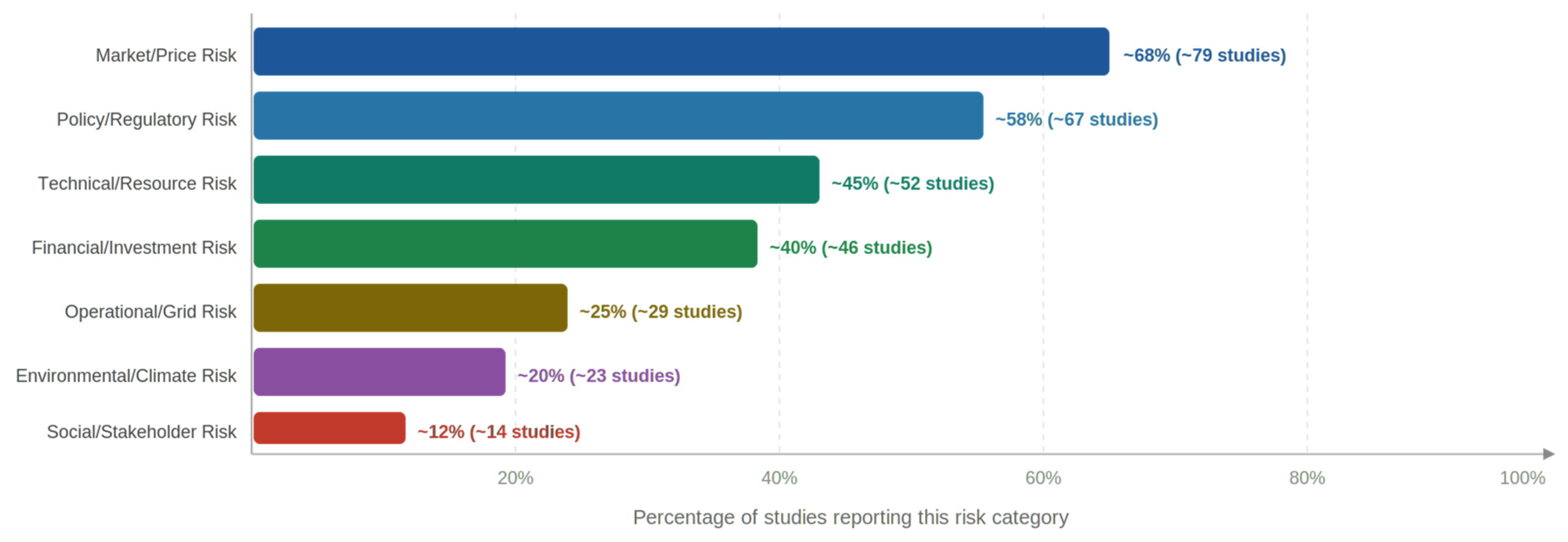
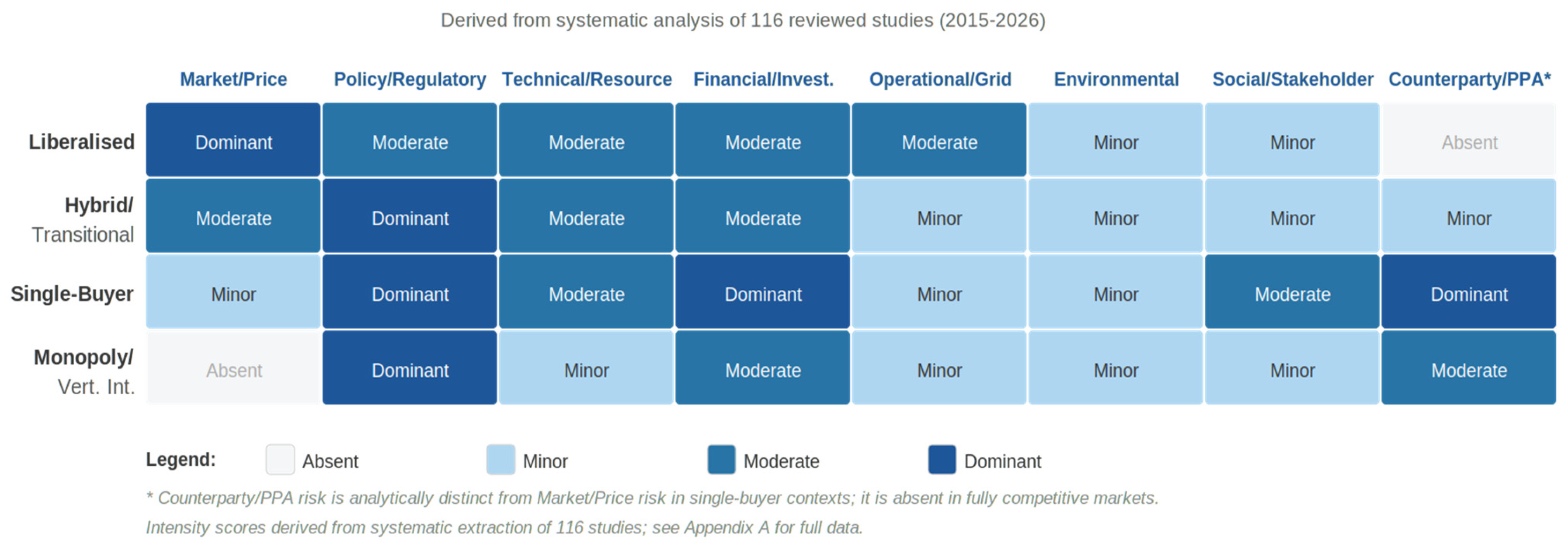
3.2.2. Risk Category Frequency and Market-Structure Analysis

3.2.3. Market/Price Risk (~68%)—Dominant but Institutionally Partial
3.2.4. Policy/Regulatory Risk (~58%)—Transition-Dependent
3.2.5. Technical, Financial, Operational, Environmental, and Social Risks
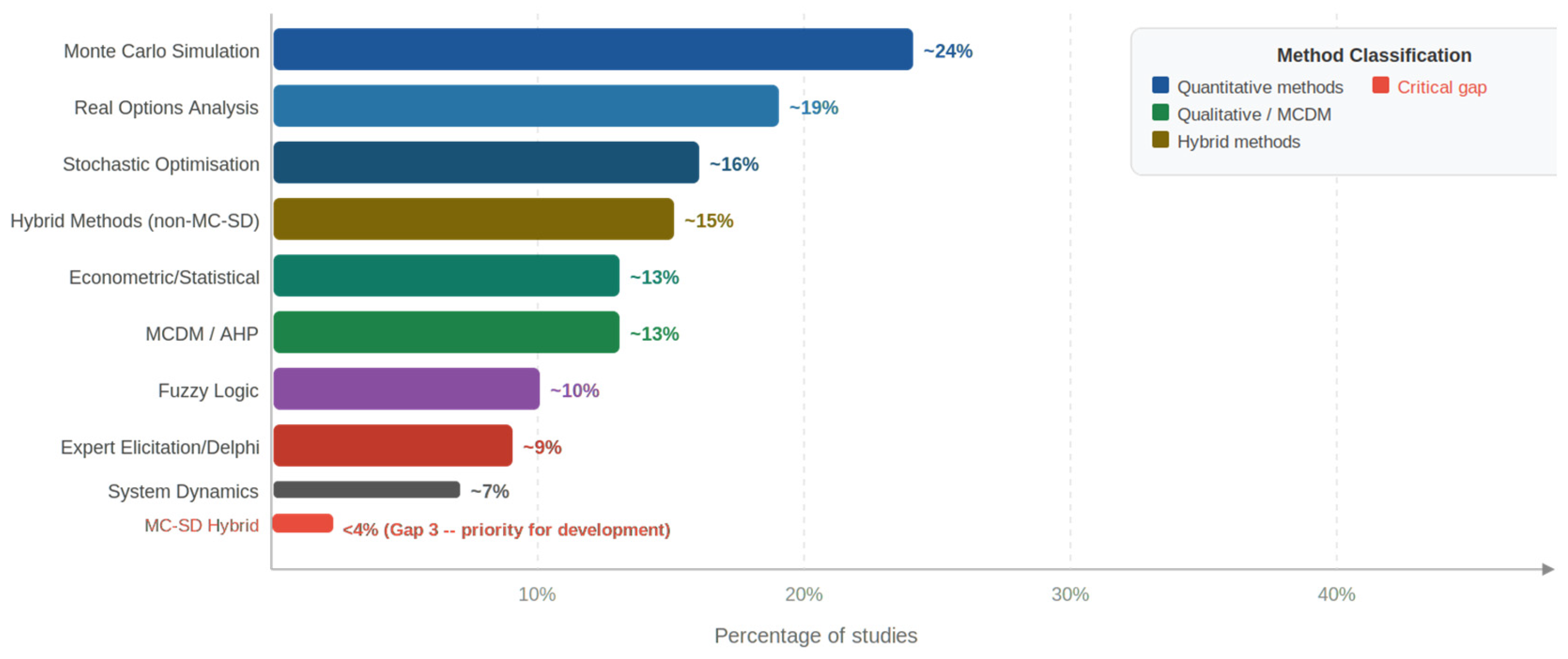
3.3. RQ2—Risk Assessment Methods and Market-Structure Fit
3.3.1. Quantitative Methods—Powerful but Market-Constrained
3.3.2. Qualitative Methods—Dominant in Single-Buyer Contexts
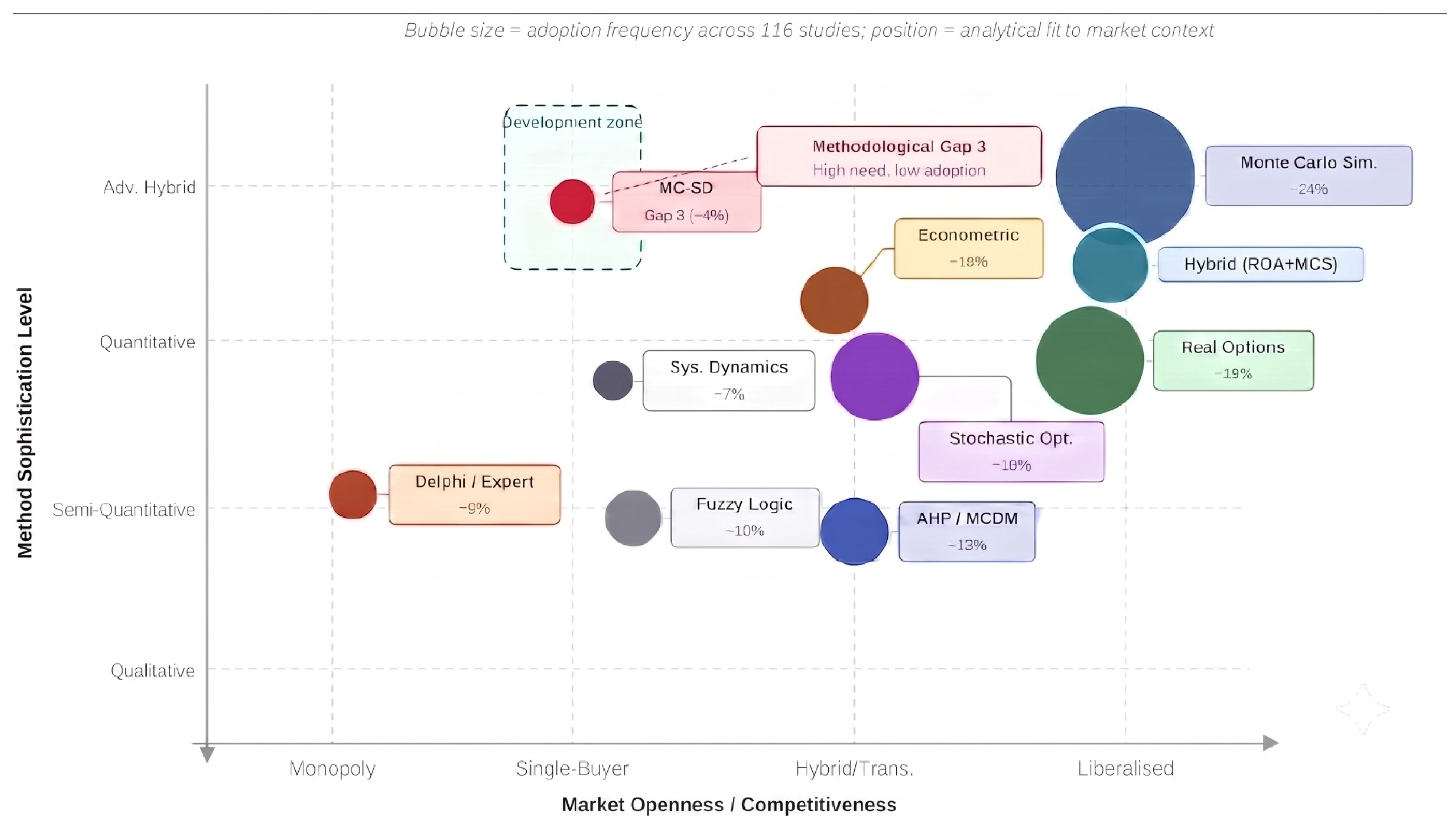
3.3.3. The MC-SD Gap
3.4. Analytical Synthesis—Market Structure vs. Risk Profile
3.5. RQ3—Research Gaps
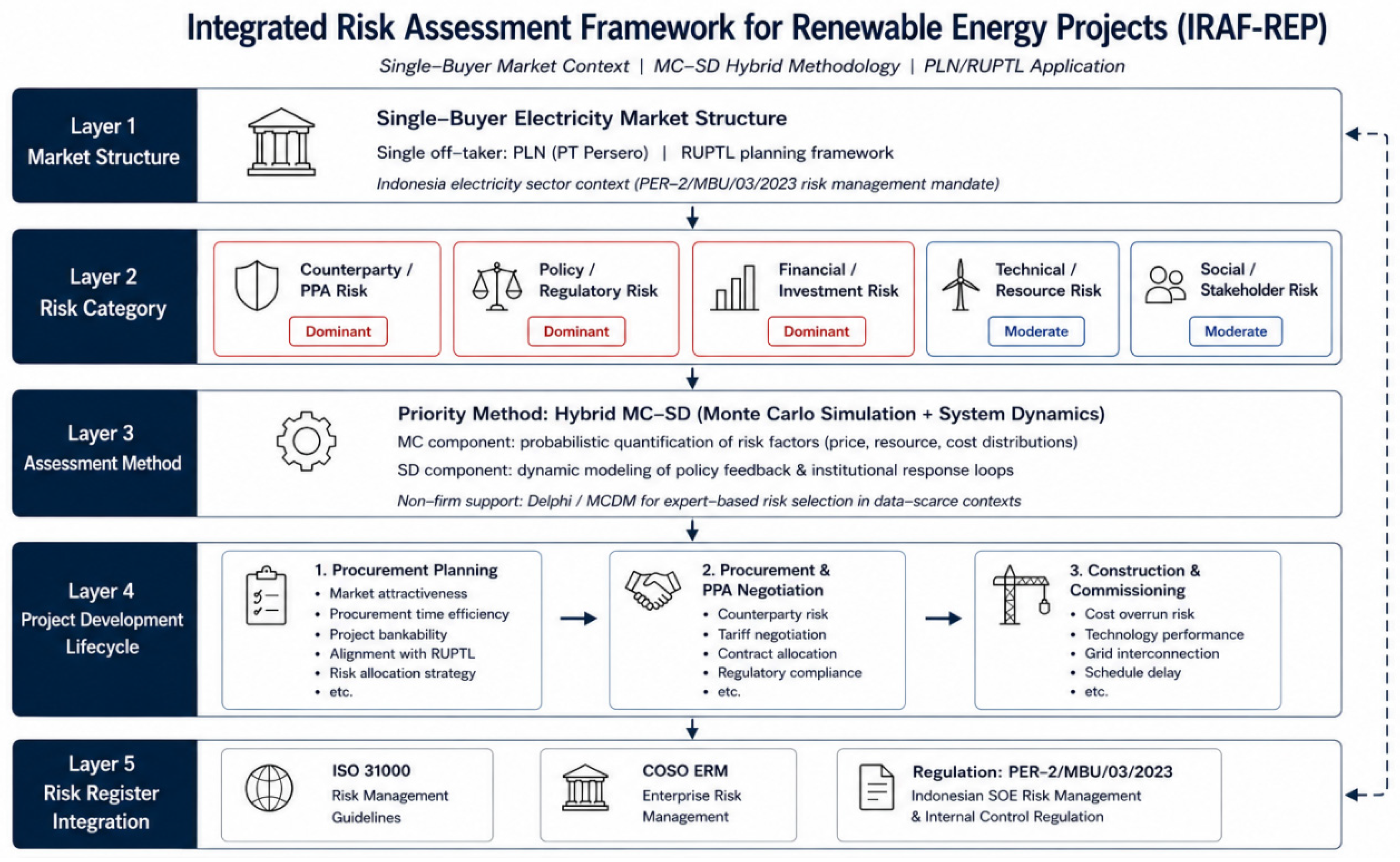
4. The IRAF-REP: Integrated Risk Assessment Framework for Renewable Energy Projects
4.1. Framework Description
- Layer 1—Market Structure Context: The entry point. Market structure type determines the institutional risk environment and pre-conditions which risk categories and methods are most relevant.
- Layer 2—Risk Category Taxonomy: The seven risk categories are applied with market-structure weighting. Single-buyer contexts weight counterparty, policy/regulatory, and financial risks most heavily. Cross-risk interaction modelling (Gap 4) is embedded as a connecting element.
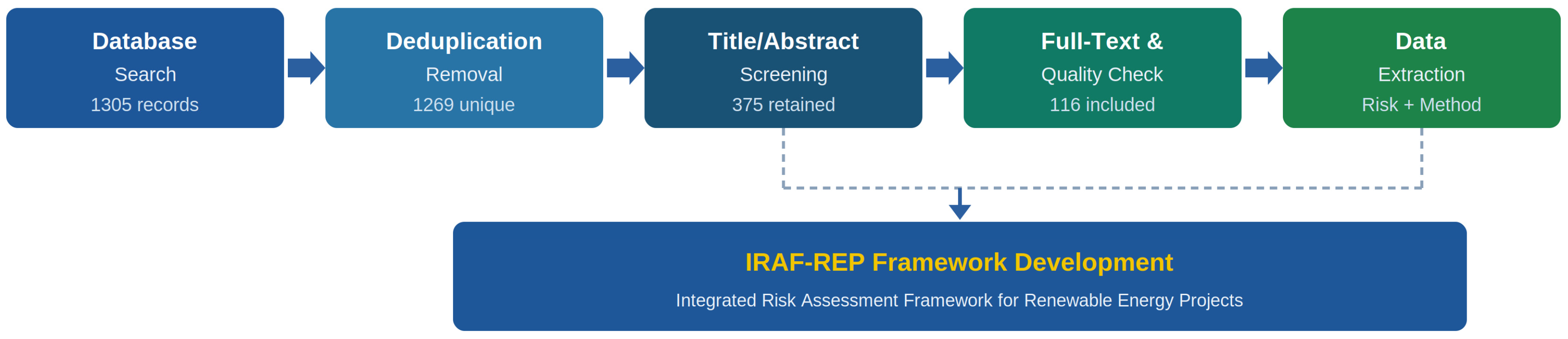
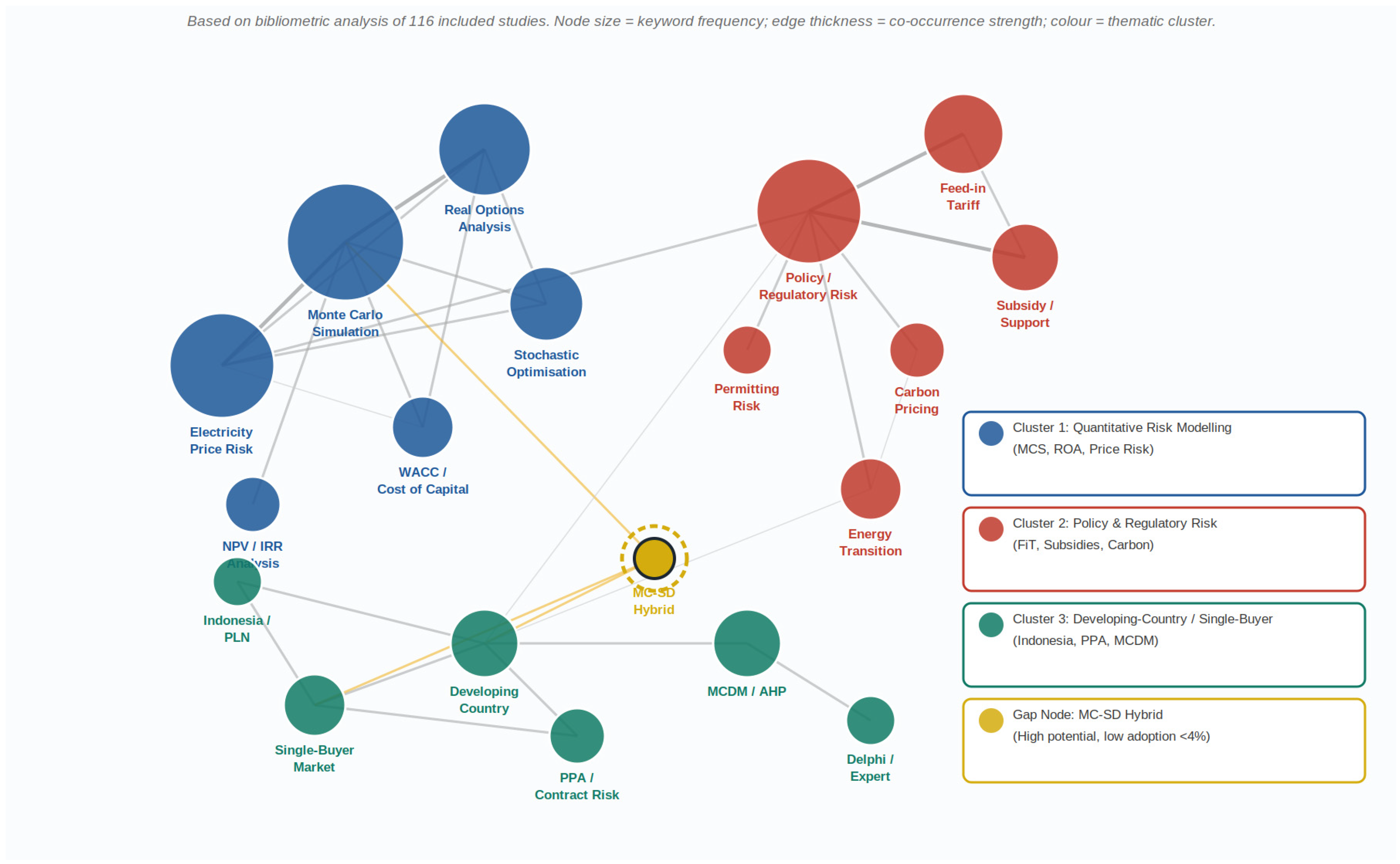
- Layer 3—Risk Assessment Methods: Methods are selected based on market structure and data availability. For single-buyer and monopoly markets, MCDM/Delphi is recommended near-term; MC-SD integration is the priority medium-term development (highlighted in Figure 9).
- Layer 4—Project Lifecycle Phase: Risk profiles are sequenced across planning/development, construction/commissioning, operation/maintenance, and decommissioning. Political and permitting risks dominate planning; counterparty and curtailment risks dominate operations.
- Layer 5—Risk Register Integration: Outputs from Layers 2–3 are mapped into ISO 31000 probability x impact matrices, COSO ERM enterprise frameworks, and specifically the PLN/RUPTL national planning instrument, producing a RUPTL-integrated probabilistic risk register as mandated by PER-2/MBU/03/2023.

4.2. IRAF-REP Application to Indonesia/PLN—Illustrative Risk Register

| Risk Category (Layer 2) | Risk Identification | IRAF Layer | Prob. (1–5) | Impact (1–5) | Risk Level | Mitigation |
|---|---|---|---|---|---|---|
| Counterparty/PPA | Mismatch Between Electricity Demand Growth and RUPTL Projections | L2, L3, L4, L5 | 5 | 5 | 25 (High) | Periodically review electricity demand projections; Strengthen marketing programs and partnerships |
| Policy/Regulatory | Changes in Sectoral Regulations/Policies Affecting PLN’s Going Concern | L2, L4 | 3 | 5 | 23 (High) | Conduct regulatory impact analysis for existing and upcoming regulations; Maintain active coordination with regulators |
| Technical/Resource | Delays in Generation, Transmission, and Substation Project Completion | L2, L3 | 5 | 5 | 25 (High) | MCS on resource data; P90 design basis; O&M reserve fund |
| Financial/Investment | Limitation of investment capability | L2, L3, L4, L5 | 5 | 5 | 25 (High) | Prioritise capital expenditure allocation; Align project priorities with load growth and system needs |
| Social/Stakeholder | Delays in Rural Electrification Programs | L2, L4 | 4 | 3 | 14 (Moderate) | Early community engagement; Strengthen coordination with the Ministry of Environment and Forestry |

4.3. Conceptual Status and Validation Pathway
5. Discussion
5.1. Institutional Situatedness of Risk Assessment—Why the Method-Market Mismatch Persists
5.2. The Precision-Comprehensiveness Tension—Why It Cannot Be Resolved by Method Selection Alone
5.3. Indonesia as a Global South Governance Model
5.4. SDG Alignment and Policy Implications
6. Limitations
7. Future Directions
8. Conclusions
Supplementary Materials
Author Contributions
Funding
Institutional Review Board Statement
Informed Consent Statement
Data Availability Statement
Conflicts of Interest
Abbreviations
| AHP | Analytic Hierarchy Process |
| COSO | Committee of Sponsoring Organizations |
| ERM | Enterprise Risk Management |
| IRAF-REP | Integrated Risk Assessment Framework for Renewable Energy Projects |
| IPP | Independent Power Producer |
| ISO | International Organization for Standardization |
| LCOE | Levelised Cost of Electricity |
| MAS | Multi-Agent System (agent-based simulation paradigm) |
| MC-SD | Monte Carlo Simulation—System Dynamics (hybrid) |
| MCS | Monte Carlo Simulation |
| MCDM | Multi-Criteria Decision-Making |
| NZE | Net-Zero Emissions |
| NPV | Net Present Value |
| PLN | PT PLN (Persero)—Indonesia state-owned electricity utility |
| PPA | Power Purchase Agreement |
| PRISMA | Preferred Reporting Items for Systematic Reviews and Meta-Analyses |
| RE | Renewable Energy |
| ROA | Real Options Analysis |
| RUPTL | Rencana Umum Penyediaan Tenaga Listrik (Electricity Supply Business Plan) |
| SD | System Dynamics |
| SLR | Systematic Literature Review |
| VRE | Variable Renewable Energy |
| WACC | Weighted Average Cost of Capital |
Appendix A. Data Extraction Table (Representative Studies)
| Ref. | First Author | Year | Study Objective | Methodology | Risk Categories | Risk Methods | RE Type | Key Finding/Gap |
|---|---|---|---|---|---|---|---|---|
| [18] | Alonso-Travesset | 2023 | Review economic and regulatory uncertainty in RE system design | SLR, 130 articles | Economic, regulatory | ROA, optimisation | Multiple | Electricity price most modelled; 6 equally influential uncertainties typically isolated |
| [19] | Venizelou | 2024 | Analyse cross-border electricity trading trends in Pan-European network | Trend ssanalysis, quantitative | Market/price, regulatory | Econometric, trend | Multiple | Market integration reduces price volatility; regulatory barriers remain key risk |
| [20] | Chebotareva | 2022 | Reveal RE perspectives via wholesale electricity market analysis | Statistical analysis | Market/price, policy | Comparative, statistical | Multiple | Wholesale market structure shapes RE investment attractiveness |
| [21] | Nur | 2023 | Identify optimal risk allocation for Indonesian geothermal PPP | Delphi study | Political, financial, technical | Delphi, risk matrix | Geothermal | Optimal risk-sharing identified; limited to geothermal single-buyer context |
| [22] | Sakakibara | 2025 | Assess risk valuations for wave power generation investment | Real options modelling | Market/price, technical | ROA, probabilistic | Wave | ROA identifies optimal investment thresholds under resource uncertainty |
| [15] | Salm | 2018 | Analyse investor-specific pricing of RE project risk | Survey, empirical analysis | Financial, policy | Empirical, regression | Multiple | Investor type significantly affects risk pricing; retail investors underweight policy risk |
| [16] | Romano | 2018 | Understand role of uncertainty in greening power generation sector | Scenario analysis | Policy, market/price | Scenario, analytical | Multiple | Regulatory stability key to investment acceleration; uncertainty costs quantified |
| [17] | Ioannou | 2017 | Review risk-based methods for sustainable energy system planning | SLR | Multiple | Review, comparative | Multiple | No integrated lifecycle risk framework found; methods largely project-specific |
| [23] | Kim | 2018 | Decision-making model for offshore wind under climate uncertainties | Simulation, MCS | Technical, financial, environmental | MCS, decision model | Offshore wind | MCS captures resource uncertainty; climate change scenarios increase risk significantly |
| [24] | De Oliveira | 2020 | Evaluate economic feasibility of PV projects | Financial modelling | Financial, market/price | NPV, sensitivity | Solar PV | Economic viability strongly dependent on policy support and grid tariff structure |
| [25] | Guerin | 2017 | Evaluate expected vs. observed risks on large-scale solar PV construction | Comparative case study | Technical, operational | Risk register, case study | Solar PV | Observed risks differed significantly from planned; operational risks underestimated |
| [26] | Steffen | 2018 | Examine importance of project finance for RE projects | Empirical analysis | Financial, policy | Regression, empirical | Multiple | Project finance reduces WACC; policy certainty critical for lender confidence |
| [27] | Nie | 2017 | Risk management of energy system for optimal power mix | Stochastic optimisation | Market/price, financial | Stochastic opt., LP | Multiple | Joint financial-cost and environmental optimisation under uncertainty achievable |
| [31] | Gatzert | 2021 | Portfolio optimisation with irreversible RE investments under policy risk | Portfolio optimisation | Market/price, policy | MCS, stochastic opt. | Multiple | Policy risk significantly alters optimal portfolio composition; irreversibility amplifies exposure |
| [32] | Mobius | 2023 | Analyse risk aversion and flexibility options in electricity markets | Game theory, analytical | Market/price, operational | Analytical, game theory | Multiple | Risk aversion increases value of flexibility options; liberalised markets amplify price risk |
| [33] | Gabrielli | 2022 | Mitigate financial risk of corporate PPAs via portfolio optimisation | Portfolio optimisation | Financial, market/price | MCS, portfolio opt. | Multiple | Diversified PPA portfolios reduce revenue risk; concentration increases counterparty exposure |
| [34] | Salm | 2016 | Assess retail investor risk-return preferences for RE projects | Survey | Financial, policy | Survey, empirical | Multiple | Retail investors accept lower returns for lower risk; policy instruments shape preferences |
| [35] | Gatzert | 2016 | Evaluate RE investments under policy risks | Stochastic modelling | Policy, financial | MCS, analytical | Multiple | Policy risk has larger impact than technology risk on investment returns |
| [36] | Angelopoulos | 2017 | Risk-based analysis and policy implications for RE investments in Greece | Scenario analysis | Policy, market/price, financial | Scenario, comparative | Multiple | Policy instability primary barrier; retroactive changes destroy investor confidence |
| [37] | Bruno | 2016 | Risk neutral and risk averse multistage RE investment planning | Stochastic programming | Market/price, policy, financial | Stochastic prog., scenario | Multiple | Risk aversion significantly changes optimal investment timing and scale |
| [72] | Thapar | 2016 | Economic and environmental effectiveness of RE policy instruments in India | Policy analysis | Policy, financial | Comparative, analytical | Multiple | Feed-in tariffs more effective than REC mechanisms for risk reduction in developing contexts |
| [73] | Kim | 2017 | Real options analysis for RE investment decisions in developing countries | ROA | Financial, policy, technical | ROA | Multiple | ROA captures option value lost in NPV analysis; critical for developing country contexts |
| [89] | Tu | 2020 | Assess collusion potential in electricity markets considering generation flexibility | Game theory, MCS | Market/price, operational | MCS, game theory | Multiple | Flexibility reduces collusion risk; market design significantly affects competition |
| [90] | Bao | 2021 | Review and suggest risk assessment and management for electricity markets | SLR | Market/price, operational | Review, comparative | Multiple | Comprehensive risk management frameworks absent for non-liberalised markets |
| [91] | Tao | 2021 | SSO risk evaluation for grid-connected PMSG wind farms | Monte Carlo simulation | Technical, operational | MCS, sequential | Wind | Sequential MCS identifies subsynchronous oscillation risk; grid integration critical |
| [92] | Centre for Electric Power | 2017 | Review RE system trends and experience in Denmark | Case study, review | Technical, operational, policy | Review, case study | Multiple | Flexibility markets essential; grid integration risk increases with RE penetration |
| [93] | Zhejiang University | 2018 | Analyse distributed PV in electricity market: status, mode, strategy | Policy analysis | Market/price, policy | Analytical, policy review | Solar PV | Market participation mode shapes risk profile; regulatory clarity reduces investment risk |
| [94] | Ghose | 2019 | Risk assessment of microgrid aggregators with demand response and VRE | Stochastic programming | Technical, market/price, financial | Stochastic prog., scenario | Multiple | Aggregator risk significantly affected by DR responsiveness and VRE variability |
| [95] | Zheng | 2019 | Stochastic optimisation of cost-risk for integrated energy system | Stochastic optimisation | Market/price, financial, technical | Stochastic opt., CVaR | Wind, solar | CVaR-based optimisation balances cost and risk effectively; wind-solar correlation matters |
| [96] | Chen | 2019 | Overview of interlinked technical, environmental and socio-economic challenges for RE | Review, analytical | Technical, environmental, policy | Review, comparative | Multiple | Cross-category risk interactions undermodelled; systems perspective needed |
| [74] | Chebotareva | 2023 | Role of state in managing wind energy projects: risk assessment | Statistical, comparative | Policy, financial, operational | Risk assessment, statistical | Wind | State involvement reduces risk for investors but may reduce market efficiency |
| [104] | Carozzani | 2025 | SLR of ROA in hybrid RE investment decisions | PRISMA SLR | Financial, technical | ROA, MCS, binomial | Hybrid | GBM dominant (61.3% of studies); MC-SD integration gap identified |
| [116] | Hess | 2026 | Review factors influencing RE investment in energy transition | SLR | Policy, financial, market/price | Review, comparative | Multiple | Policy uncertainty most cited barrier; institutional quality moderates investment risk |
| [75] | Sahin | 2025 | Review economic and policy considerations for floating PV systems | SLR | Financial, technical, policy | Review, case study | Solar PV | Floating PV faces unique grid integration and technical risks; policy frameworks lagging |
| [117] | Simoes | 2025 | Efficiency assessment of corporate PPA structures via DEA | DEA, efficiency analysis | Financial, market/price | DEA, comparative | Multiple | PPA structure significantly affects efficiency; corporate off-takers face counterparty risk |
| [118] | Gohdes | 2025 | Analyse investment risk for contracted renewables using trade-off theory | Analytical, empirical | Financial, market/price | Analytical, regression | Multiple | Contracted revenues reduce financial risk; capital structure optimisation critical |
| [76] | Chung | 2026 | Portfolio effect in power sector of RE-prioritising economies | Portfolio analysis | Market/price, policy | Portfolio theory, simulation | Multiple | RE portfolio diversification reduces systemic risk; market structure affects diversification benefit |
| [4] | Sirin | 2025 | Single-buyer model as barrier to clean energy deployment | Panel data, econometric | Market, regulatory, political | Econometric, comparative | Multiple | Single-buyer model statistically reduces RE deployment; risk allocation asymmetry confirmed |
| [82] | Wijesinghe | 2025 | Modelling disruptive events in renewable energy supply | SLR | Technical, operational | Review, simulation | Multiple | Disruptive event modelling underdeveloped; stochastic approaches needed |
| [38] | Kayser | 2016 | High investment risks and need for institutional response in Chinese solar PV | Case study, institutional analysis | Policy, financial, market/price | Case study, qualitative | Solar PV | Institutional risk dominant; contractual safeguards insufficient without enforcement capacity |
| [39] | Shrimali | 2016 | Design of RE auctions for India | Policy analysis | Policy, financial | Analytical, policy design | Multiple | Auction design significantly affects risk transfer; developer risk increases with competitive bidding |
| [40] | Sisodia | 2016 | Modelling business risk of regulatory revision on RE investment in Iberia | Stochastic modelling | Policy, market/price, financial | Stochastic, scenario | Multiple | Retroactive regulatory change significantly increases investment risk; scenario analysis essential |
| [41] | Bustos | 2016 | Sensitivity analysis of photovoltaic solar plant in Chile | Sensitivity analysis | Financial, technical, market/price | Sensitivity, NPV | Solar PV | Irradiation and electricity price most sensitive parameters; grid tariff risk underestimated |
| [42] | Karatayev | 2016 | RE technology uptake in Kazakhstan: policy drivers and barriers | Mixed methods | Policy, financial, institutional | Survey, case study | Multiple | Transitional economies face unique institutional risks absent from standard frameworks |
| [43] | Ahmad | 2016 | System dynamics approach in electricity sector modelling: a review | SLR | Policy, technical, operational | SD, review | Multiple | SD captures feedback dynamics but rarely applied to risk quantification |
| [44] | Gottschamer | 2016 | Interactions of factors impacting RE electricity implementation and sustainability | Systems analysis | Policy, technical, social | Systems, causal | Multiple | Complex factor interactions produce emergent risks not captured by linear models |
| [45] | Kucukali | 2016 | Risk scorecard concept in wind energy projects | Scorecard, MCDM | Policy, technical, financial, environmental | MCDM, scorecard | Wind | Integrated scorecard captures multi-dimensional risk; weighting subjectivity remains limitation |
| [46] | Strantzali | 2016 | Decision making in RE investments: a review | SLR | Financial, policy, technical | Review, comparative | Multiple | MCDM and ROA dominant; hybrid approaches underutilised |
| [47] | Locatelli | 2016 | Investment and risk appraisal in energy storage systems: real options | ROA | Financial, technical, market/price | ROA | Storage | ROA captures flexibility value; uncertainty in storage costs limits application |
| [48] | Doci | 2016 | Energy policy meets community: risk perceptions of RE in Germany/Netherlands | Qualitative, interviews | Social, policy | Qualitative, comparative | Multiple | Community risk perceptions diverge from technical assessments; social risk underweighted |
| [49] | Guerrero-Liquet | 2016 | Decision-making for risk management in sustainable RE facilities: Dominican Republic | MCDM, case study | Policy, financial, technical | MCDM, AHP | Multiple | AHP identifies policy risk as dominant; developing country context amplifies all risk categories |
| [50] | Zhang | 2019 | Sustainability evaluation of hybrid energy system using fuzzy approach | Fuzzy MCDM | Environmental, financial, technical | Fuzzy, MCDM | Hybrid | Fuzzy MCDM handles uncertainty in sustainability evaluation; environmental risk most variable |
| [51] | Stanitsas | 2024 | Stakeholder engagement in hybrid RE PPAs for sustainable development | Mixed methods | Social, policy, financial | Case study, qualitative | Hybrid | Stakeholder failures can terminate fully financed projects; social risk systematically underweighted |
| [52] | Berrada | 2017 | Profitability, risk, and financial modelling of energy storage | Financial modelling | Financial, market/price, technical | NPV, sensitivity, MCS | Storage | Storage project profitability highly sensitive to market price assumptions and cycle degradation |
| [53] | Zafar | 2018 | Overview of implemented RE policy in Pakistan | Policy review | Policy, financial, market/price | Review, analytical | Multiple | Policy instability primary risk; inconsistent implementation undermines investor confidence |
| [54] | Papapostolou | 2017 | Opportunities and risks for RES-E deployment under EU-Western Balkans cooperation | Scenario analysis | Policy, financial, regulatory | Scenario, comparative | Multiple | Cross-border mechanisms create new regulatory risks; institutional alignment critical |
| [55] | Liu | 2017 | RE investment risk evaluation model based on system dynamics | System dynamics | Financial, policy, market/price | SD, scenario | Multiple | SD captures investment-policy feedback dynamics; deterministic limitation noted |
| [56] | Perez Odeh | 2018 | Portfolio applications in electricity markets: private investor perspective | SLR, portfolio analysis | Market/price, financial | Review, portfolio theory | Multiple | Portfolio diversification underutilised for RE risk management; market structure shapes options |
| [57] | Schallenberg-Rodriguez | 2017 | Renewable electricity support systems: feed-in systems analysis | Policy analysis | Policy, financial | Comparative, analytical | Multiple | FiT systems reduce investor risk most effectively; retroactive changes most damaging |
| [58] | deLlano-Paz | 2017 | Energy planning and modern portfolio theory: a review | SLR, portfolio analysis | Market/price, financial | Review, portfolio theory | Multiple | Portfolio theory applicable to energy planning; electricity market structure affects implementation |
| [59] | Punda | 2017 | Integration of RE sources in Southeast Europe: incentive mechanisms and feasibility | Policy analysis | Policy, financial | Analytical, comparative | Multiple | Policy incentive design significantly affects investment risk in transitional economies |
| [60] | Moya | 2018 | Pre-feasibility study of geothermal power plants using RETScreen in Ecuador | Feasibility, financial modelling | Financial, technical, environmental | NPV, sensitivity, RETScreen | Geothermal | Technical and financial risks dominant; environmental permitting risk underestimated |
| [61] | Lopez Prol | 2018 | Regulation, profitability and diffusion of grid-connected PV in Germany/Spain | Empirical, regression | Policy, market/price, financial | Regression, empirical | Solar PV | Retroactive regulatory changes in Spain destroyed investor confidence; Germany’s stability key lesson |
| [62] | Blazquez | 2018 | Economic policy instruments and market uncertainty: impact on RE adoption | Analytical, modelling | Policy, market/price | Analytical, scenario | Multiple | Market uncertainty significantly reduces effectiveness of policy instruments |
| [63] | Espinosa | 2018 | Cost-effective mitigation via RE in Spanish electricity market | Optimisation, empirical | Market/price, policy, financial | LP, empirical | Multiple | RE cost-effectiveness depends heavily on market price; support mechanisms buffer market risk |
| [64] | Maulidia | 2019 | RE sector reform in Indonesia: private sector perspective | Qualitative, interviews | Policy, regulatory, market | Qualitative, case study | Wind, solar | Regulatory risk dominant in Indonesia; limited quantitative risk register application |
| [65] | Kruger | 2019 | De-risking solar auctions in sub-Saharan Africa: South Africa and Zambia | Comparative case study | Policy, financial, technical | Case study, comparative | Solar PV | Auction design and site selection significantly affect risk; institutional capacity critical |
| [66] | Luth | 2024 | Risks, strategies, and benefits of offshore energy hubs: a survey | SLR | Technical, financial, policy, operational | Review, comparative | Offshore wind | Offshore hub risks multi-dimensional; grid integration and political risks dominant |
| [67] | Hu | 2018 | Barriers to investment in utility-scale VRE generation projects | Survey, empirical | Policy, financial, technical, social | Survey, regression | Multiple | Policy and financial barriers dominate; social acceptance risk underreported in quantitative studies |
| [68] | De Freitas | 2020 | Stochastic model for decision making on RE investment | Stochastic modelling, ROA | Financial, market/price, technical | Stochastic, ROA | Multiple | Stochastic model outperforms deterministic NPV; real options premium significant for delay option |
| [69] | Liu | 2020 | Risk management of RE compressed air energy storage using downside risk | Downside risk constraints | Financial, technical, market/price | CVaR, downside risk | Storage | Downside risk constraints effectively limit loss exposure; hybrid storage-RE portfolios reduce risk |
| [70] | Bangjun | 2022 | Investment decisions in PV projects based on renewable portfolio standard | Optimisation, policy analysis | Policy, market/price, financial | Optimisation, scenario | Solar PV | RPS policy significantly affects PV investment risk; penalty structure shapes developer behaviour |
| [71] | Farheen | 2026 | Impact of RE and non-RE energy aid on energy poverty in developing Asia | Panel data, econometric | Financial, policy, social | Econometric, panel | Multiple | Energy aid reduces energy poverty risk; RE aid more effective than fossil fuel aid in long run |
| [98] | Aquila | 2020 | Wind energy investments under uncertainties in Brazilian electricity spot market | ROA, stochastic | Market/price, financial, policy | ROA, MCS | Wind | Brazilian spot market price risk highest; ROA captures investment timing flexibility |
| [99] | Farias-Rocha | 2019 | Solar PV policy review and economic analysis for Philippines | Policy review, financial analysis | Policy, financial, technical | NPV, sensitivity | Solar PV | Policy uncertainty primary barrier; grid connection risk underestimated in Philippines context |
| [100] | Wang | 2020 | Sustainability of RE in EU countries | Panel data, index analysis | Policy, environmental, financial | Panel data, composite index | Multiple | Policy coherence and institutional quality improve RE sustainability; market structure mediates |
| [101] | Wang G. | 2024 | Impact of RE on extreme volatility in wholesale electricity prices | Econometric, GARCH | Market/price, operational | GARCH, econometric | Multiple | High RE penetration reduces average prices but increases tail risk and extreme volatility events |
| [102] | Heidari | 2023 | Policy assessment in PV development using system dynamics in Iran | System dynamics | Policy, financial, market/price | SD, simulation | Solar PV | SD captures policy feedback loops; deterministic SD insufficient for probabilistic risk assessment |
| [77] | Aziz | 2025 | Investment risks and policy solutions for RE electricity in Bangladesh | Mixed methods | Policy, financial, market/price, social | Survey, case study, analytical | Multiple | Bangladesh faces compound risks: weak institutions, financing gaps, and grid infrastructure; single-buyer market amplifies all categories |
| [103] | Ramiah | 2026 | Solar energy project bankability through stakeholder engagement in Mauritius | Case study, qualitative | Social, financial, policy | Case study, qualitative | Solar PV | Stakeholder engagement significantly improves project bankability; social risk underprice in financing models |
| [13] | Kitzing | 2020 | Evolving risk perspective for policy instrument choice in sustainability transitions | Theoretical framework | Policy, financial | Analytical, comparative | Multiple | Dynamic risk requires changing optimal instruments over transition period |
| [119] | Lei | 2020 | Investment risk evaluation and optimisation for RE in China (wind) | Multi-objective optimisation | Financial, technical, environmental, social | MCDM, optimisation | Wind | Multi-objective optimisation balances risk and return; environmental risk often underweighted |
| [105] | Zhou | 2020 | Risk management in distributed wind energy using AHP | AHP with PEST criteria | Policy, market, technical | AHP, MCDM | Wind | Policy change risk ranked highest; temporal risk evolution not addressed |
| [120] | Kruger | 2018 | RE auctions in sub-Saharan Africa: South Africa, Uganda, Zambia | Comparative, case study | Policy, financial, technical | Comparative, case study | Multiple | Auction design transfers risk to developers; institutional capacity determines risk realisation |
| [121] | Levesque | 2019 | Impact of low consumption practices on energy demand reduction | Modelling, scenario | Policy, technical | Scenario, modelling | Multiple | Demand-side risk affects RE investment feasibility; policy signals shape consumption behaviour |
| [122] | Leveque | 2025 | De-risking RE investments: quantifying impact of de-risking instruments | Analytical, financial modelling | Financial, policy | Analytical, financial model | Multiple | Partial risk guarantees most cost-effective de-risking instrument; blended finance reduces WACC |
| [123] | Kromer | 2018 | RE investments with storage: a risk-return analysis | Financial modelling, MCS | Financial, technical, market/price | MCS, risk-return | Storage | Storage reduces revenue risk; technical degradation risk significant over project lifetime |
| [124] | Maggauer | 2025 | Monte Carlo simulation-based risk assessment in energy communities | MCS, simulation | Financial, technical, market/price | MCS | Multiple | MCS effectively quantifies risk in energy communities; spatial and temporal correlations matter |
| [125] | Shen | 2020 | Comprehensive review of VRE levelised cost of electricity | SLR, comparative | Financial, technical | Review, LCOE analysis | Multiple | LCOE risk driven by resource variability and financing costs; market structure shapes revenue risk |
| [29] | Cabo-Rodriguez | 2026 | Economic valuation under uncertainty in offshore wind investments: SLR | PRISMA SLR | Financial, technical, market/price | Review, ROA, MCS | Offshore wind | ROA and MCS dominate; lifecycle integration and social risk absent from most offshore studies |
| [126] | Yeter | 2023 | Macroeconomic impact on risk management of offshore wind farms | Financial analysis, modelling | Financial, market/price, policy | Financial modelling, sensitivity | Offshore wind | Macroeconomic conditions significantly affect offshore wind risk; WACC most sensitive parameter |
| [127] | Botor | 2021 | Information shocks and profitability risks for RE investments: policy instruments | LP equilibrium model | Market, policy | Optimisation, scenario | Multiple | FiTs reduce risk most; quantity instruments effective for deployment |
| [81] | Dukan | 2023 | Impact of risk reduction on RE support payments in Europe | Multi-country WACC analysis | Financial, policy | WACC analysis | Onshore wind | 10–40% WACC reduction achievable via de-risking; limited to Europe |
| [28] | Murgas | 2021 | Evaluation of wind investment under uncertainty: state of the art review | SLR, meta-analysis | Multiple | ROA, MCS, stochastic | Wind | MCS preferred (51.6%); no social/NIMBY risk quantification found |
| [97] | Yuksel | 2024 | Comprehensive risk analysis model for hydroelectricity investments | Spherical fuzzy entropy-MAIRCA | Environmental, financial, technical | MCDM, fuzzy | Hydropower | Environmental risk highest weight (0.2478); limited to hydropower context |
| [128] | Steffen | 2020 | Estimating cost of capital for RE projects | Empirical, regression | Financial, policy | WACC, regression | Multiple | Policy certainty reduces cost of capital by 2–3 percentage points; market structure significant |
| [129] | Stetter | 2020 | Competitive and risk-adequate auction bids for onshore wind in Germany | Optimisation, stochastic | Market/price, financial, policy | Stochastic opt. | Wind | Risk-adequate bidding under auction uncertainty reduces developer profitability; policy design critical |
| [130] | Pombo-Romero | 2024 | Assessing value and risk of renewable PPAs | Analytical, financial | Financial, market/price, policy | Analytical, financial model | Multiple | PPA risk profile depends on off-taker creditworthiness; single-buyer structures amplify counterparty risk |
| [131] | Pan | 2023 | Risk evaluation in green electricity market using multi-dimensional cloud model | Cloud model, MCDM | Market/price, policy, financial | Cloud model, MCDM | Multiple | Multi-dimensional cloud model captures fuzziness; applicable to transitional electricity markets |
| [132] | Bian | 2024 | Optimal bidding strategy for PV and BESSs in joint energy markets | Optimisation, stochastic | Market/price, financial, technical | Stochastic opt., LP | Solar PV, storage | Joint energy-ancillary market participation reduces market risk; storage enhances revenue stability |
| [133] | Duan | 2021 | Risk evaluation of electric power grid investment using hybrid MCDM | MCDM, hybrid | Financial, technical, policy | MCDM, AHP, TOPSIS | Multiple | Hybrid MCDM integrates quantitative and qualitative risk; applicable to regulated grid contexts |
| [79] | Othman | 2023 | RE PPP projects in Egypt: barriers and key success factors | Survey, qualitative | Policy, financial, social, technical | Survey, MCDM | Multiple | Political and regulatory barriers dominate Egyptian RE PPP risk; institutional capacity gap critical |
| [134] | Delapedra-Silva | 2023 | Dual-market strategy for evaluating wind investment in Brazil: ROA | ROA, financial modelling | Market/price, financial, policy | ROA | Wind | Dual-market exposure creates novel risk combinations; ROA captures switching option value |
| [135] | Xu | 2025 | Assessment of residential RE investment under dynamic market environment | Financial modelling, scenario | Market/price, financial, policy | Scenario, financial model | Multiple | Dynamic market conditions significantly increase residential RE investment risk |
| [136] | Xie | 2025 | Investment analysis and risk management of RE greenfield in Brazil | Financial analysis, qualitative | Financial, policy, technical, social | Risk matrix, scenario | Multiple | Greenfield RE in developing countries faces compound risk; social and political risks undermodelled |
| [137] | Alcorta | 2024 | Investment risk under different RE support policies | Analytical probabilistic | Market, regulatory | Analytical, probabilistic | Multiple | Support obligations become liabilities in high-price contexts; limited to Spain |
| [83] | Qudrat-Ullah | 2024 | Framework for developing and implementing FIT policies for RE | SD, policy analysis | Policy, financial | SD, analytical | Multiple | SD framework captures FIT policy feedback; risk implications of FIT design explored |
| [78] | Choi | 2025 | Drivers of offtake contract adoption in RE project financing | Empirical, regression | Financial, policy, market/price | Regression, empirical | Solar, wind | Off-taker creditworthiness and contract terms are primary drivers of project financing risk |
| [84] | Jadidi | 2025 | Risk mitigation in project finance for utility-scale solar PV | Financial modelling, empirical | Financial, policy, technical | Financial model, sensitivity | Solar PV | Project finance risk mitigation instruments reduce financing cost; institutional quality moderates effectiveness |
| [85] | Gupta | 2025 | Modernising India’s electricity market: opportunities for PPAs and CfDs | Policy analysis | Policy, market/price, financial | Analytical, comparative | Multiple | PPA and CfD design significantly affects risk transfer; transitional markets face dual-regime risk |
| [86] | Abada | 2025 | Risk-sharing in energy communities | Analytical, game theory | Financial, social, market/price | Analytical, game theory | Multiple | Risk-sharing mechanisms reduce individual exposure; community scale affects optimal allocation |
| [87] | Gandhi | 2022 | Strategic investment risks threatening India’s RE ambition | Risk analysis, empirical | Policy, financial, technical, social | Risk matrix, empirical | Multiple | Multiple compound risks threaten India’s RE targets; single-risk frameworks inadequate |
| [88] | Zhuang | 2026 | Evolutionary game analysis on cooperative mechanism for RE risk mitigation | Game theory, evolutionary | Policy, financial | Game theory | Multiple | Government subsidies and market instruments interact dynamically; evolutionary game captures adaptation |
| [80] | Leiva Vilaplana | 2024 | Review of guidelines and methodologies for cost-benefit analysis in electricity sector | SLR | Financial, policy, market/price | Review, CBA | Multiple | CBA methodologies inconsistent across market structures; risk integration absent from most frameworks |
| [9] | Isnandar | 2024 | Multiparadigm approach for generation dispatch optimisation in regulated Indonesian market | MAS + SD simulation | Technical, operational, policy | MAS, SD, LP | Multiple (Java–Madura–Bali) | Carbon policy reduces emissions while increasing cost of electricity; MAS-SD captures multi-stakeholder dynamics in single-buyer PLN market |
References
- International Energy Agency. Southeast Asia Energy Outlook 2022; IEA: Paris, France, 2022. [Google Scholar]
- International Renewable Energy Agency. Renewable Energy Outlook for ASEAN; IRENA: Abu Dhabi, United Arab Emirates, 2022. [Google Scholar]
- International Energy Agency. World Energy Investment 2023; IEA: Paris, France, 2023. [Google Scholar]
- Sirin, S.M.; Abuouf, S.; Elshurafa, A.M. Is the single-buyer model a barrier to clean energy deployment? Energy Policy 2025, 206, 114753. [Google Scholar] [CrossRef]
- PLN. Rencana Umum Penyediaan Tenaga Listrik (RUPTL) 2025–2034; PT PLN (Persero): Jakarta, Indonesia, 2024. [Google Scholar]
- Ministry of State-Owned Enterprises, Republic of Indonesia. PER-2/MBU/03/2023: Risk Management for State—Owned Enterprises; Ministry of SOE: Jakarta, Indonesia, 2023. [Google Scholar]
- ISO 31000:2018; Risk Management—Guidelines. ISO: Geneva, Switzerland, 2018.
- Committee of Sponsoring Organizations of the Treadway Commission (COSO). Enterprise Risk Management—Integrating with Strategy and Performance; COSO: Durham, NC, USA, 2017. [Google Scholar]
- Isnandar, S.; Simorangkir, J.F.; Banjar-Nahor, K.M.; Paradongan, H.T.; Hariyanto, N. A multiparadigm approach for generation dispatch optimization in a regulated electricity market towards clean energy transition. Energies 2024, 17, 3807. [Google Scholar] [CrossRef]
- North, D.C. Institutions, Institutional Change and Economic Performance; Cambridge University Press: Cambridge, UK, 1990. [Google Scholar]
- Geels, F.W. Technological transitions as evolutionary reconfiguration processes: A multi-level perspective and a case-study. Res. Policy 2002, 31, 1257–1274. [Google Scholar] [CrossRef]
- Markard, J.; Raven, R.; Truffer, B. Sustainability transitions: An emerging field of research and its prospects. Res. Policy 2012, 41, 955–967. [Google Scholar] [CrossRef]
- Kitzing, L.; Fitch-Roy, O.; Islam, M.; Mitchell, C. An evolving risk perspective for policy instrument choice in sustainability transitions. Environ. Innov. Soc. Transit. 2020, 35, 369–382. [Google Scholar] [CrossRef]
- Renn, O. Risk Governance: Coping with Uncertainty in a Complex World; Earthscan: London, UK, 2008. [Google Scholar]
- Salm, S. The investor-specific price of renewable energy project risk. Renew. Sustain. Energy Rev. 2018, 82, 1364–1375. [Google Scholar] [CrossRef]
- Romano, T.; Fumagalli, E. Greening the power generation sector: Understanding the role of uncertainty. Renew. Sustain. Energy Rev. 2018, 91, 272–286. [Google Scholar] [CrossRef]
- Ioannou, A.; Angus, A.; Brennan, F. Risk-based methods for sustainable energy system planning: A review. Renew. Sustain. Energy Rev. 2017, 74, 602–615. [Google Scholar] [CrossRef]
- Alonso-Travesset, A.; Coppitters, D.; Martin, H.; De La Hoz, J. Economic and regulatory uncertainty in renewable energy system design: A review. Energies 2023, 16, 882. [Google Scholar] [CrossRef]
- Venizelou, V.; Poullikkas, A. Trend analysis of cross-border electricity trading in Pan-European network. Energies 2024, 17, 5318. [Google Scholar] [CrossRef]
- Chebotareva, G.; Tvaronaviciene, M.; Gorina, L.; Strielkowski, W.; Shiryaeva, J.; Petrenko, Y. Revealing renewable energy perspectives via the analysis of the wholesale electricity market. Energies 2022, 15, 838. [Google Scholar] [CrossRef]
- Nur, S.; Burton, B.; Bergmann, A. Evidence on optimal risk allocation models for Indonesian geothermal projects under PPP contracts. Util. Policy 2023, 81, 101511. [Google Scholar] [CrossRef]
- Sakakibara, K.; Kanamura, T. Risk valuations and investment strategies of wave power generation in the ocean and marginal sea. Dev. Sustain. Econ. Financ. 2025, 6, 100043. [Google Scholar] [CrossRef]
- Kim, K.; Kim, B.; Kim, H. A decision-making model for the analysis of offshore wind farm projects under climate uncertainties: A case study of South Korea. Renew. Sustain. Energy Rev. 2018, 94, 853–860. [Google Scholar] [CrossRef]
- de Oliveira, L.G.; Aquila, G.; Balestrassi, P.P.; de Paiva, A.P.; de Queiroz, A.R.; de Oliveira Pamplona, E.; Camatta, U.P. Evaluating economic feasibility and maximization of social welfare of photovoltaic projects. Renew. Sustain. Energy Rev. 2020, 123, 109786. [Google Scholar] [CrossRef]
- Guerin, T.F. Evaluating expected and comparing with observed risks on a large-scale solar photovoltaic construction project. Renew. Sustain. Energy Rev. 2017, 74, 333–348. [Google Scholar] [CrossRef]
- Steffen, B. The importance of project finance for renewable energy projects. Energy Econ. 2018, 69, 280–294. [Google Scholar] [CrossRef]
- Nie, S.; Li, Y.P.; Liu, J.; Huang, C.Z. Risk management of energy system for identifying optimal power mix with financial-cost minimization and environmental-impact mitigation under uncertainty. Energy Econ. 2017, 61, 313–329. [Google Scholar] [CrossRef]
- Murgas, B.; Henao, A.; Guzman, L. Evaluation of investments in wind energy projects, under uncertainty. State of the art review. Appl. Sci. 2021, 11, 10213. [Google Scholar] [CrossRef]
- Cabo-Rodriguez, A.; Calvo-Silvosa, A.; DeLlano-Paz, F. Economic valuation under uncertainty in offshore wind farms investments: A systematic literature review. Appl. Energy 2026, 409, 127520. [Google Scholar] [CrossRef]
- Kitchenham, B. Procedures for Performing Systematic Reviews; Keele University Technical Report TR/SE-0401; Keele University: Keele, UK, 2004. [Google Scholar]
- Gatzert, N.; Martin, A.; Schmidt, M.; Seith, B.; Vogl, N. Portfolio optimization with irreversible long-term investments in renewable energy under policy risk. Eur. J. Oper. Res. 2021, 290, 734–748. [Google Scholar] [CrossRef]
- Mobius, T.; Riepin, I.; Musgens, F.; Van Der Weijde, A.H. Risk aversion and flexibility options in electricity markets. Energy Econ. 2023, 126, 106767. [Google Scholar] [CrossRef]
- Gabrielli, P.; Aboutalebi, R.; Sansavini, G. Mitigating financial risk of corporate power purchase agreements via portfolio optimization. Energy Econ. 2022, 109, 105980. [Google Scholar] [CrossRef]
- Salm, S.; Hille, S.L.; Wustenhagen, R. What are retail investors’ risk-return preferences towards renewable energy projects? Energy Policy 2016, 97, 310–320. [Google Scholar] [CrossRef]
- Gatzert, N.; Vogl, N. Evaluating investments in renewable energy under policy risks. Energy Policy 2016, 95, 238–252. [Google Scholar] [CrossRef]
- Angelopoulos, D.; Doukas, H.; Psarras, J.; Stamtsis, G. Risk-based analysis and policy implications for renewable energy investments in Greece. Energy Policy 2017, 105, 512–523. [Google Scholar] [CrossRef]
- Bruno, S.; Ahmed, S.; Shapiro, A.; Street, A. Risk neutral and risk averse approaches to multistage renewable investment planning under uncertainty. Eur. J. Oper. Res. 2016, 250, 979–989. [Google Scholar] [CrossRef]
- Kayser, D. Solar photovoltaic projects in China: High investment risks and the need for institutional response. Appl. Energy 2016, 174, 144–152. [Google Scholar] [CrossRef]
- Shrimali, G.; Konda, C.; Farooquee, A.A. Designing renewable energy auctions for India. Renew. Energy 2016, 97, 656–670. [Google Scholar] [CrossRef]
- Sisodia, G.S.; Soares, I.; Ferreira, P. Modeling business risk: The effect of regulatory revision on renewable energy investment—The Iberian case. Renew. Energy 2016, 95, 303–313. [Google Scholar] [CrossRef]
- Bustos, F.; Toledo, A.; Contreras, J.; Fuentes, A. Sensitivity analysis of a photovoltaic solar plant in Chile. Renew. Energy 2016, 87, 145–153. [Google Scholar] [CrossRef]
- Karatayev, M.; Hall, S.; Kalyuzhnova, Y.; Clarke, M.L. Renewable energy technology uptake in Kazakhstan: Policy drivers and barriers in a transitional economy. Renew. Sustain. Energy Rev. 2016, 66, 120–136. [Google Scholar] [CrossRef]
- Ahmad, S.; Mat Tahar, R.; Muhammad-Sukki, F.; Munir, A.B.; Abdul Rahim, R. Application of system dynamics approach in electricity sector modelling: A review. Renew. Sustain. Energy Rev. 2016, 56, 29–37. [Google Scholar] [CrossRef]
- Gottschamer, L.; Zhang, Q. Interactions of factors impacting implementation and sustainability of renewable energy sourced electricity. Renew. Sustain. Energy Rev. 2016, 65, 164–174. [Google Scholar] [CrossRef]
- Kucukali, S. Risk scorecard concept in wind energy projects: An integrated approach. Renew. Sustain. Energy Rev. 2016, 56, 975–987. [Google Scholar] [CrossRef]
- Strantzali, E.; Aravossis, K. Decision making in renewable energy investments: A review. Renew. Sustain. Energy Rev. 2016, 55, 885–898. [Google Scholar] [CrossRef]
- Locatelli, G.; Invernizzi, D.C.; Mancini, M. Investment and risk appraisal in energy storage systems: A real options approach. Energy 2016, 104, 114–131. [Google Scholar] [CrossRef]
- Doci, G.; Gotchev, B. When energy policy meets community: Rethinking risk perceptions of renewable energy in Germany and the Netherlands. Energy Res. Soc. Sci. 2016, 22, 26–35. [Google Scholar] [CrossRef]
- Guerrero-Liquet, G.; Sanchez-Lozano, J.; Garcia-Cascales, M.; Lamata, M.; Verdegay, J. Decision-making for risk management in sustainable renewable energy facilities: A case study in the Dominican Republic. Sustainability 2016, 8, 455. [Google Scholar] [CrossRef]
- Zhang, L.; Xin, H.; Kan, Z. Sustainability performance evaluation of hybrid energy system using an improved fuzzy synthetic evaluation approach. Sustainability 2019, 11, 1265. [Google Scholar] [CrossRef]
- Stanitsas, M.; Kirytopoulos, K. Navigating the nexus: Stakeholder engagement in hybrid renewable energy power purchase agreements (PPAs) for sustainable development. Sustainability 2024, 16, 7381. [Google Scholar] [CrossRef]
- Berrada, A.; Loudiyi, K.; Zorkani, I. Profitability, risk, and financial modeling of energy storage in residential and large scale applications. Energy 2017, 119, 94–109. [Google Scholar] [CrossRef]
- Zafar, U.; Ur Rashid, T.; Khosa, A.A.; Khalil, M.S.; Rashid, M. An overview of implemented renewable energy policy of Pakistan. Renew. Sustain. Energy Rev. 2018, 82, 654–665. [Google Scholar] [CrossRef]
- Papapostolou, A.; Karakosta, C.; Nikas, A.; Psarras, J. Exploring opportunities and risks for RES-E deployment under Cooperation Mechanisms between EU and Western Balkans. Renew. Sustain. Energy Rev. 2017, 80, 519–530. [Google Scholar] [CrossRef]
- Liu, X.; Zeng, M. Renewable energy investment risk evaluation model based on system dynamics. Renew. Sustain. Energy Rev. 2017, 73, 782–788. [Google Scholar] [CrossRef]
- Perez Odeh, R.; Watts, D.; Negrete-Pincetic, M. Portfolio applications in electricity markets review: Private investor and manager perspective trends. Renew. Sustain. Energy Rev. 2018, 81, 192–204. [Google Scholar] [CrossRef]
- Schallenberg-Rodriguez, J. Renewable electricity support systems: Are feed-in systems taking the lead? Renew. Sustain. Energy Rev. 2017, 76, 1422–1439. [Google Scholar] [CrossRef]
- deLlano-Paz, F.; Calvo-Silvosa, A.; Antelo, S.I.; Soares, I. Energy planning and modern portfolio theory: A review. Renew. Sustain. Energy Rev. 2017, 77, 636–651. [Google Scholar] [CrossRef]
- Punda, L.; Capuder, T.; Pandzic, H.; Delimar, M. Integration of renewable energy sources in southeast Europe: A review of incentive mechanisms and feasibility of investments. Renew. Sustain. Energy Rev. 2017, 71, 77–88. [Google Scholar] [CrossRef]
- Moya, D.; Paredes, J.; Kaparaju, P. Technical, financial, economic and environmental pre-feasibility study of geothermal power plants by RETScreen: Ecuador’s case study. Renew. Sustain. Energy Rev. 2018, 92, 628–637. [Google Scholar] [CrossRef]
- Lopez Prol, J. Regulation, profitability and diffusion of photovoltaic grid-connected systems: A comparative analysis of Germany and Spain. Renew. Sustain. Energy Rev. 2018, 91, 1170–1181. [Google Scholar] [CrossRef]
- Blazquez, J.; Nezamuddin, N.; Zamrik, T. Economic policy instruments and market uncertainty: Exploring the impact on renewables adoption. Renew. Sustain. Energy Rev. 2018, 94, 224–233. [Google Scholar] [CrossRef]
- Espinosa, M.P.; Pizarro-Irizar, C. Is renewable energy a cost-effective mitigation resource? An application to the Spanish electricity market. Renew. Sustain. Energy Rev. 2018, 94, 902–914. [Google Scholar] [CrossRef]
- Maulidia, M.; Dargusch, P.; Ashworth, P.; Ardiansyah, F. Rethinking renewable energy targets and electricity sector reform in Indonesia: A private sector perspective. Renew. Sustain. Energy Rev. 2019, 101, 231–247. [Google Scholar] [CrossRef]
- Kruger, W.; Stritzke, S.; Trotter, P.A. De-risking solar auctions in sub-Saharan Africa: A comparison of site selection strategies in South Africa and Zambia. Renew. Sustain. Energy Rev. 2019, 104, 429–438. [Google Scholar] [CrossRef]
- Luth, A.; Keles, D. Risks, strategies, and benefits of offshore energy hubs: A literature-based survey. Renew. Sustain. Energy Rev. 2024, 203, 114761. [Google Scholar] [CrossRef]
- Hu, J.; Harmsen, R.; Crijns-Graus, W.; Worrell, E. Barriers to investment in utility-scale variable renewable electricity (VRE) generation projects. Renew. Energy 2018, 121, 730–744. [Google Scholar] [CrossRef]
- De Freitas, R.A.; Vogel, E.P.; Korzenowski, A.L.; Oliveira Rocha, L.A. Stochastic model to aid decision making on investments in renewable energy generation. Renew. Energy 2020, 162, 1161–1176. [Google Scholar] [CrossRef]
- Liu, H.; Yu, D.; Wang, R.; Alizadeh, A.; Nojavan, S.; Jermsittiparsert, K. Risk management of a renewable-based compressed air energy storage system using downside risk constraints. Renew. Energy 2020, 161, 470–481. [Google Scholar] [CrossRef]
- Bangjun, W.; Feng, Z.; Feng, J.; Yu, P.; Cui, L. Decision making on investments in photovoltaic power generation projects based on renewable portfolio standard. Renew. Energy 2022, 189, 1033–1045. [Google Scholar] [CrossRef]
- Farheen, M.; Nasreen, S.; Mefteh-Wali, S. The impact of renewable and non-renewable energy aid on energy poverty in developing Asian countries. Renew. Energy 2026, 257, 124737. [Google Scholar] [CrossRef]
- Thapar, S.; Sharma, S.; Verma, A. Economic and environmental effectiveness of renewable energy policy instruments: Best practices from India. Renew. Sustain. Energy Rev. 2016, 66, 487–498. [Google Scholar] [CrossRef]
- Kim, K.; Park, H.; Kim, H. Real options analysis for renewable energy investment decisions in developing countries. Renew. Sustain. Energy Rev. 2017, 75, 918–926. [Google Scholar] [CrossRef]
- Chebotareva, G.; Čábelková, I.; Strielkowski, W.; Smutka, L.; Zielińska-Chmielewska, A.; Bielski, S. The role of state in managing the wind energy projects: Risk assessment and justification of the economic efficiency. Energies 2023, 16, 4807. [Google Scholar] [CrossRef]
- Sahin, A.D.; Kara, T.; Mut, A.O.; Korkmaz, M.S.; Kaymak, M.K.; Guloglu, B. A comprehensive review of economic and policy considerations for floating photovoltaic systems. Renew. Sustain. Energy Rev. 2025, 223, 116024. [Google Scholar] [CrossRef]
- Chung, C.; Lee, J.; Yang, J.S. The portfolio effect in the power sector of economies prioritizing renewable energy. Energy Policy 2026, 208, 114934. [Google Scholar] [CrossRef]
- Aziz, S.; Chowdhury, S.A.; Alauddin, M. Investment risks and policy solutions for renewable electricity in Bangladesh. Energy Sustain. Dev. 2025, 85, 101605. [Google Scholar] [CrossRef]
- Choi, B.; Kim, J.; Yang, M. Drivers of offtake contract adoption in project financing deals: The case of solar and wind power plants. Energy Policy 2025, 198, 114491. [Google Scholar] [CrossRef]
- Othman, K.; Khallaf, R. Renewable energy public-private partnership projects in Egypt: Perception of the barriers and key success factors by sector. Alex. Eng. J. 2023, 75, 513–530. [Google Scholar] [CrossRef]
- Leiva Vilaplana, J.A.; Yang, G.; Ackom, E. From investment to net benefits: A review of guidelines and methodologies for cost-benefit analysis in the electricity sector. Energy Res. Soc. Sci. 2025, 124, 104052. [Google Scholar] [CrossRef]
- Dukan, M.; Kitzing, L. A bigger bang for the buck: The impact of risk reduction on renewable energy support payments in Europe. Energy Policy 2023, 173, 113395. [Google Scholar] [CrossRef]
- Wijesinghe, L.; Weinand, J.M.; Hoffmann, M.; Stolten, D. Modeling disruptive events in renewable energy supply: A review. Sustain. Energy Technol. Assess. 2025, 83, 104561. [Google Scholar] [CrossRef]
- Qudrat-Ullah, H. A framework for developing and implementing FIT policies for renewable energy. Sustain. Futures 2024, 7, 100170. [Google Scholar] [CrossRef]
- Jadidi, H.; Firouzi, A.; Rastegar, M.A.; Zandi, M.; Eicker, U. Risk mitigation in project finance for utility-scale solar PV projects. Energy Econ. 2025, 143, 108221. [Google Scholar] [CrossRef]
- Gupta, G.; Singh, A. Modernizing India’s electricity market: Opportunities for PPAs and contracts for difference. Electr. J. 2025, 38, 107505. [Google Scholar] [CrossRef]
- Abada, I.; Ehrenmann, A.; Lambin, X. Risk-sharing in energy communities. Eur. J. Oper. Res. 2025, 322, 870–888. [Google Scholar] [CrossRef]
- Gandhi, H.H.; Hoex, B.; Hallam, B.J. Strategic investment risks threatening India’s renewable energy ambition. Energy Strategy Rev. 2022, 43, 100921. [Google Scholar] [CrossRef]
- Zhuang, J.; Wang, Y.; Yan, Z.; Liu, J. Evolutionary game analysis on the cooperative mechanism of government subsidies and market-based risk mitigation institutions. J. Constr. Eng. Manag. 2026, 152, 04025270. [Google Scholar] [CrossRef]
- Tu, T.; Ding, Y.; Ji, P.; Bao, M.; Shang, N.; Song, Y.; Zeng, D. Collusion potential assessment in electricity markets considering generation flexibility. CSEE J. Power Energy Syst. 2020, 9, 1551–1566. [Google Scholar] [CrossRef]
- Bao, M.; Ding, Y.; Zhou, X.; Guo, C.; Shao, C. Risk assessment and management of electricity markets: A review with suggestions. CSEE J. Power Energy Syst. 2021, 7, 1322–1333. [Google Scholar] [CrossRef]
- Tao, S.; Liu, Y.; Yan, Y.; Zhao, L. SSO risk evaluation for grid-connected PMSG-based wind farm based on sequential Monte Carlo simulation. CSEE J. Power Energy Syst. 2021, 9, 1348–1358. [Google Scholar] [CrossRef]
- Pinson, P.; Mitridati, L.; Ordoudis, C.; Østergaard, J.; Centre for Electric Power and Energy. Towards fully renewable energy systems: Experience and trends in Denmark. CSEE J. Power Energy Syst. 2017, 3, 26–35. [Google Scholar] [CrossRef]
- Jiang, S.; Wan, C.; Chen, C.; Cao, E.; Song, Y. Distributed photovoltaic generation in the electricity market: Status, mode and strategy. CSEE J. Power Energy Syst. 2018, 4, 263–272. [Google Scholar] [CrossRef]
- Ghose, T.; Pandey, H.W.; Gadham, K.R. Risk assessment of microgrid aggregators considering demand response and uncertain renewable energy sources. J. Mod. Power Syst. Clean Energy 2019, 7, 1619–1631. [Google Scholar] [CrossRef]
- Zheng, J.; Kou, Y.; Li, M.; Wu, Q. Stochastic optimization of cost-risk for integrated energy system considering wind and solar power correlated. J. Mod. Power Syst. Clean Energy 2019, 7, 1472–1483. [Google Scholar] [CrossRef]
- Chen, X.; McElroy, M.B.; Wu, Q.; Shu, Y.; Xue, Y. Transition towards higher penetration of renewables: An overview of interlinked technical, environmental and socio-economic challenges. J. Mod. Power Syst. Clean Energy 2019, 7, 1–8. [Google Scholar] [CrossRef]
- Yuksel, S.; Eti, S.; Dincer, H.; Gokalp, Y. Comprehensive risk analysis and decision-making model for hydroelectricity energy investments. J. Soft Comput. Decis. Anal. 2024, 2, 28–38. [Google Scholar] [CrossRef]
- Aquila, G.; de Queiroz, A.R.; Balestrassi, P.P.; Junior, P.R.; Rocha, L.C.S.; Pamplona, E.O.; Nakamura, W.T. Wind. energy investments facing uncertainties in the Brazilian electricity spot market: A real options approach. Sustain. Energy Technol. Assess. 2020, 42, 100876. [Google Scholar] [CrossRef]
- Farias-Rocha, A.P.; Hassan, K.M.K.; Malimata, J.R.R.; Sanchez-Cubedo, G.A.; Rojas-Solorzano, L.R. Solar photovoltaic policy review and economic analysis for on-grid residential installations in the Philippines. J. Clean. Prod. 2019, 223, 45–56. [Google Scholar] [CrossRef]
- Wang, Q.; Yang, X. Investigating the sustainability of renewable energy in European Union countries. J. Clean. Prod. 2020, 268, 121940. [Google Scholar] [CrossRef]
- Wang, G.; Sbai, E.; Wen, L.; Sheng, M.S. The impact of renewable energy on extreme volatility in wholesale electricity prices. J. Clean. Prod. 2024, 484, 144343. [Google Scholar] [CrossRef]
- Heidari, M.R.; Heravi, G. Policy assessment in photovoltaic development using system dynamics: Case study of power generation in Iran. Sustain. Cities Soc. 2023, 94, 104554. [Google Scholar] [CrossRef]
- Ramiah, C.; Ramgolam, Y.K.; Dookhun, V.; Sultan, R. Optimising solar energy project bankability through stakeholder engagement: A case of Mauritius. Energy Sustain. Dev. 2026, 92, 101924. [Google Scholar] [CrossRef]
- Carozzani, R.; D’Alpaos, C. The real option approach to investment decisions in hybrid renewable energy systems: A systematic literature review. Energies 2025, 18, 5535. [Google Scholar] [CrossRef]
- Zhou, S.; Yang, P. Risk management in distributed wind energy implementing Analytic Hierarchy Process. Renew. Energy 2020, 150, 616–623. [Google Scholar] [CrossRef]
- PT PLN (Persero)—Direktorat Manajemen Risiko. Profil Risiko Rencana Umum Penyediaan Tenaga Listrik (RUPTL) Tahun 2025–2034; PT PLN (Persero): Jakarta, Indonesia, 2024. [Google Scholar]
- Roberts, C.; Geels, F.W.; Lockwood, M.; Newell, P.; Schmitz, H.; Turnheim, B.; Jordan, A. The politics of accelerating low-carbon transitions: Towards a new research agenda. Energy Res. Soc. Sci. 2018, 44, 304–311. [Google Scholar] [CrossRef]
- Turnheim, B.; Geels, F.W. Regime destabilisation as the flipside of energy transitions: Lessons from the history of the British coal industry. Energy Policy 2012, 50, 35–49. [Google Scholar] [CrossRef]
- Fouquet, R.; Pearson, P.J.G. Past and prospective energy transitions: Insights from history. Energy Policy 2012, 50, 1–7. [Google Scholar] [CrossRef]
- Loorbach, D.; Frantzeskaki, N.; Avelino, F. Sustainability transitions research: Transforming science and practice for societal change. Annu. Rev. Environ. Resour. 2017, 42, 599–626. [Google Scholar] [CrossRef]
- Sovacool, B.K.; Turnheim, B.; Hook, A.; Brock, A.; Martiskainen, M. Dispossessed by decarbonisation: Reducing vulnerability, injustice, and inequality in the lived experience of low-carbon pathways. World Dev. 2021, 137, 105116. [Google Scholar] [CrossRef]
- Kern, F.; Smith, A. Restructuring energy systems for sustainability? Energy transition policy in the Netherlands. Energy Policy 2008, 36, 4093–4103. [Google Scholar] [CrossRef]
- International Renewable Energy Agency. Renewable Energy Prospects: Indonesia; IRENA: Abu Dhabi, United Arab Emirates, 2017. [Google Scholar]
- International Energy Agency. An Energy Sector Roadmap to Net Zero Emissions in Indonesia; IEA: Paris, France, 2022. [Google Scholar]
- Matukhno, O.; Stanytsina, V.; Dobrovolska, O.; Artemchuk, V. An exploratory protocol for sustainability-oriented cross-index assessment of national climate policy effectiveness. Sustainability 2026, 18, 3444. [Google Scholar] [CrossRef]
- Hess, P.; Schonecker, J.; Weibelzahl, M.; Wolf, L. Navigating the energy transition: A review of factors influencing renewable energy investments. Renew. Sustain. Energy Rev. 2026, 228, 116416. [Google Scholar] [CrossRef]
- Simoes, F.; Henriques, C.; Figueiredo, N.C.; Da Silva, P.P. Efficiency assessment of simulated corporate power purchase agreement structures via data envelopment analysis. Energy Econ. 2025, 148, 108625. [Google Scholar] [CrossRef]
- Gohdes, N. On spot revenues, capital structure and trade off theory: Analysing investment risk for contracted renewables. Energy Econ. 2025, 148, 108703. [Google Scholar] [CrossRef]
- Lei, X.; Shiyun, T.; Yanfei, D.; Yuan, Y. Sustainable operation-oriented investment risk evaluation and optimization for renewable energy project: A case study of wind power in China. Ann. Oper. Res. 2020, 290, 223–241. [Google Scholar] [CrossRef]
- Kruger, W.; Eberhard, A. Renewable energy auctions in sub-Saharan Africa: Comparing the South African, Ugandan, and Zambian programs. WIREs Energy Environ. 2018, 7, e295. [Google Scholar] [CrossRef]
- Levesque, A.; Pietzcker, R.C.; Luderer, G. Halving energy demand from buildings: The impact of low consumption practices. Technol. Forecast. Soc. Change 2019, 146, 253–266. [Google Scholar] [CrossRef]
- Leveque, C.; Shirizadeh, B.; Truby, J. De-Risking Renewable Investments: Internalizing the Risks and Quantifying the Impact of De-Risking Instruments. Renew. Sustain. Energy Rev. 2026, 227, 116570. [Google Scholar] [CrossRef]
- Kromer, S.; Gatzert, N. Renewable energy investments with storage: A risk-return analysis. Int. J. Energy Sect. Manag. 2018, 12, 714–736. [Google Scholar] [CrossRef]
- Maggauer, K.; Fina, B. Monte Carlo simulation-based economic risk assessment in energy communities. Energy Rep. 2025, 13, 987–1003. [Google Scholar] [CrossRef]
- Shen, W.; Chen, X.; Qiu, J.; Hayward, J.A.; Sayeef, S.; Osman, P.; Meng, K.; Dong, Z.Y. A comprehensive review of variable renewable energy levelized cost of electricity. Renew. Sustain. Energy Rev. 2020, 133, 110301. [Google Scholar] [CrossRef]
- Yeter, B.; Garbatov, Y.; Brennan, F.; Kolios, A. Macroeconomic impact on the risk management of offshore wind farms. Ocean Eng. 2023, 284, 115224. [Google Scholar] [CrossRef]
- Botor, B.; Bocker, B.; Kallabis, T.; Weber, C. Information shocks and profitability risks for power plant investments: Impacts of policy instruments. Energy Econ. 2021, 102, 105400. [Google Scholar] [CrossRef]
- Steffen, B. Estimating the cost of capital for renewable energy projects. Energy Econ. 2020, 88, 104783. [Google Scholar] [CrossRef]
- Stetter, C.; Piel, J.H.; Hamann, J.F.H.; Breitner, M.H. Competitive and risk-adequate auction bids for onshore wind projects in Germany. Energy Econ. 2020, 90, 104849. [Google Scholar] [CrossRef]
- Pombo-Romero, J.; Ruas-Barrosa, O.; Vazquez, C. Assessing the value and risk of renewable PPAs. Energy Econ. 2024, 139, 107861. [Google Scholar] [CrossRef]
- Pan, W.; Qiao, S.; Ruan, T.; Luo, R.; Li, Z. Risk evaluation and management mechanism of green electricity market based on multi-dimensional cloud model. Front. Energy Res. 2023, 11, 1203633. [Google Scholar] [CrossRef]
- Bian, J.; Song, Y.; Ding, C.; Cheng, J.; Li, S.; Li, G. Optimal bidding strategy for PV and BESSs in joint energy and frequency regulation markets. J. Mod. Power Syst. Clean Energy 2024, 12, 427–439. [Google Scholar] [CrossRef]
- Duan, Y.; Sun, Y.; Zhang, Y.; Fan, X.; Dong, Q.; Guo, S. Risk evaluation of electric power grid investment in China employing a hybrid novel MCDM method. Mathematics 2021, 9, 473. [Google Scholar] [CrossRef]
- Delapedra-Silva, V.A.; Ferreira, P.; Dranka, G.G.; Cunha, J. A dual-market strategy for evaluating wind energy investments in Brazil: A real options approach. Energy Syst. 2023, 1–23. [Google Scholar] [CrossRef]
- Xu, Q.; Chen, C.; Huang, X.; Yang, W. Assessment of residential renewable energy investment under dynamic market environment. J. Environ. Manag. 2025, 374, 124060. [Google Scholar] [CrossRef] [PubMed]
- Xie, Z.; Liu, A.; Robatto, L.B.; Li, C.; Lin, T.; Pan, J.H. Investment analysis and risk management of renewable energy greenfield in Brazil. Discov. Sustain. 2025, 6, 1449. [Google Scholar] [CrossRef]
- Alcorta, P.; Espinosa, M.P.; Pizarro-Irizar, C. Right and duty: Investment risk under different renewable energy support policies. Environ. Resour. Econ. 2024, 87, 3163–3204. [Google Scholar] [CrossRef]


| Market Structure | Dominant Risks | Common Methods | Main Limitations | Evidence | Institutional Logic |
|---|---|---|---|---|---|
| Liberalised | Price volatility; merchant revenue; portfolio risk | MCS, ROA, Stochastic Optimisation | Ignores institutional centralisation; limited counterparty analysis | Europe, N. America [31,32,33,34,35,36,37,38,39,40,41,42,43,44,45,46,47,48,49,50,51,52,53,54,55,56,57,58,59,60,61,62,63,64,65,66,67,68,69,70,71] | Market pricing logic: investors face price competition directly; risk is stochastic and distributional |
| Single-Buyer | Counterparty/PPA risk; tariff risk; offtake reliability; currency risk | MCDM, Delphi, qualitative scenario | Lacks stochastic treatment; no joint risk modelling; no lifecycle view | Indonesia, MENA [4,21,64,77,78] | Monopsony governance logic: state utility holds procurement power; risk is contractual and relational |
| Hybrid/Transitional | Regulatory uncertainty; subsidy phaseout; dual-market exposure | Hybrid (ROA-MCS, MCDM-probabilistic) | Weak lifecycle integration; limited dev.-country application | SE Asia, Africa [72,73,74,75,76] | Transition instability logic: competing regimes create mixed risk signals; uncertainty is structural |
| Monopoly/Vert. Integrated | Political risk; procurement monopoly; tariff risk | Qualitative, expert elicitation | Severely underrepresented; no hybrid quantitative frameworks | Selected dev. countries [77,79,80] | State planning logic: risk is politically determined; probabilistic modelling requires institutional buy-in |
| IRAF-REP Layer | ISO 31000:2018 Correspondence | COSO ERM 2017 Correspondence | Contextual Implementation in IRAF-REP (RUPTL/Single-Buyer) |
|---|---|---|---|
| Layer 1—Market Structure Context | Clause 6.3/5.4.1: establish external context, but market structure is not specified as a variable | Strategy & Objective-Setting: business context considered, but market-structure types not differentiated | Implements the context-setting step by operationalising electricity market structure as the explicit context variable for RE projects, distinguishing liberalised, hybrid, single-buyer, and monopoly systems |
| Layer 2—Risk Category Taxonomy | Clause 6.4.2: risk identification, method-agnostic | Performance: identifies risks across the entity | Implements risk identification as a seven-category taxonomy weighted by market structure, with cross-risk links made explicit for the single-buyer context |
| Layer 3—Risk Assessment Methods | Clause 6.4.3: risk analysis, technique not prescribed | Performance: assesses and prioritises risks | Implements risk analysis by conditioning method choice on market structure and data availability (MCDM/Delphi near-term; MC-SD medium-term) |
| Layer 4—Project Lifecycle Phase | Clause 6.6: monitoring and review over time | Review & Revision: reassessment as context changes | Implements monitoring and review by sequencing risk profiles across planning, construction, operation, and decommissioning phases |
| Layer 5—Risk Register Integration | Clauses 6.4.4 and 6.7: evaluation (P × I) and recording/reporting; continuous monitoring | Information, Communication & Reporting | Implements evaluation and recording/reporting by mapping outputs onto the PER-2/MBU/03/2023 risk matrix and the RUPTL planning instrument, with a feedback loop for dynamic updating |
| Horizon | Research Priority | Focus Area | Data Requirements |
|---|---|---|---|
| Short Term (1–3 yrs) | MC-SD hybrid framework development, Cross-risk correlation modelling; probabilistic social risk methods; lifecycle risk profiling Practitioner Delphi validation of the IRAF-REP: structured expert consultation with PLN risk managers, IPP developers, and DFI officers to validate layer definitions and risk-category weightings | Studies: Implementation of Renewable Energy Project in Indonesia. Expert-validated layer definitions and risk-category weights; documented face and content validity | Empirical PLN project data; expert panels; ISO 31000-aligned risk registers Expert panel; Delphi instrument; PLN institutional access |
| Medium Term (3–6 yrs) | Dynamic lifecycle risk models | Comparable single-buyer markets and validation across three or more developing-country electricity market structures | System data from grid operators; long-run PPA contract performance databases |
| Long Term (6–10 yrs) | AI-enhanced adaptive risk assessment; digital twin frameworks; climate-resilient market modelling Cross-country IRAF-REP validation across at least three single-buyer markets beyond Indonesia (e.g., Bangladesh, Egypt, Vietnam), with transferability treated as a hypothesis rather than assumed | Globally transferable risk governance frameworks for state-dominated sectors Empirically tested transferability; a cross-market risk taxonomy | Cross-country datasets; ML training corpora; climate scenario archives Country regulatory documents; PPA performance databases; in-country expert panels |
Disclaimer/Publisher’s Note: The statements, opinions and data contained in all publications are solely those of the individual author(s) and contributor(s) and not of MDPI and/or the editor(s). MDPI and/or the editor(s) disclaim responsibility for any injury to people or property resulting from any ideas, methods, instructions or products referred to in the content. |
© 2026 by the authors. Licensee MDPI, Basel, Switzerland. This article is an open access article distributed under the terms and conditions of the Creative Commons Attribution (CC BY) license.
Share and Cite
Tampubolon, D.K.F.; Khayam, U.; Isnandar, S.; Banjar-Nahor, K.M.; Inkaresa, A.; Laksono, F.A.; Sinurat, R.; Pamungkas, A.S.; Sipahutar, J.A. Project Risk Assessment of Renewable Energy Projects in Electricity Market Structures: A Systematic Literature Review. Energies 2026, 19, 3179. https://doi.org/10.3390/en19133179
Tampubolon DKF, Khayam U, Isnandar S, Banjar-Nahor KM, Inkaresa A, Laksono FA, Sinurat R, Pamungkas AS, Sipahutar JA. Project Risk Assessment of Renewable Energy Projects in Electricity Market Structures: A Systematic Literature Review. Energies. 2026; 19(13):3179. https://doi.org/10.3390/en19133179
Chicago/Turabian StyleTampubolon, Daniel Karmel Fernando, Umar Khayam, Suroso Isnandar, Kevin Marojahan Banjar-Nahor, Ardian Inkaresa, Ferdi Adi Laksono, Rechman Sinurat, Aditya Sage Pamungkas, and Jhon Andreas Sipahutar. 2026. "Project Risk Assessment of Renewable Energy Projects in Electricity Market Structures: A Systematic Literature Review" Energies 19, no. 13: 3179. https://doi.org/10.3390/en19133179
APA StyleTampubolon, D. K. F., Khayam, U., Isnandar, S., Banjar-Nahor, K. M., Inkaresa, A., Laksono, F. A., Sinurat, R., Pamungkas, A. S., & Sipahutar, J. A. (2026). Project Risk Assessment of Renewable Energy Projects in Electricity Market Structures: A Systematic Literature Review. Energies, 19(13), 3179. https://doi.org/10.3390/en19133179