Decarbonization Assessment of External Wall Systems: Thermal Transmittance and Cradle-to-Gate Embodied Carbon Comparison of Conventional and Modular Configurations



Abstract
1. Introduction
1.1. Building Decarbonization and the Increasing Importance of Embodied Carbon
1.2. Circular Retrofit Strategies and SIP-Based Modular Systems
1.3. Life Cycle Assessment and Whole-Life Carbon Trade-Offs
2. Materials and Methods
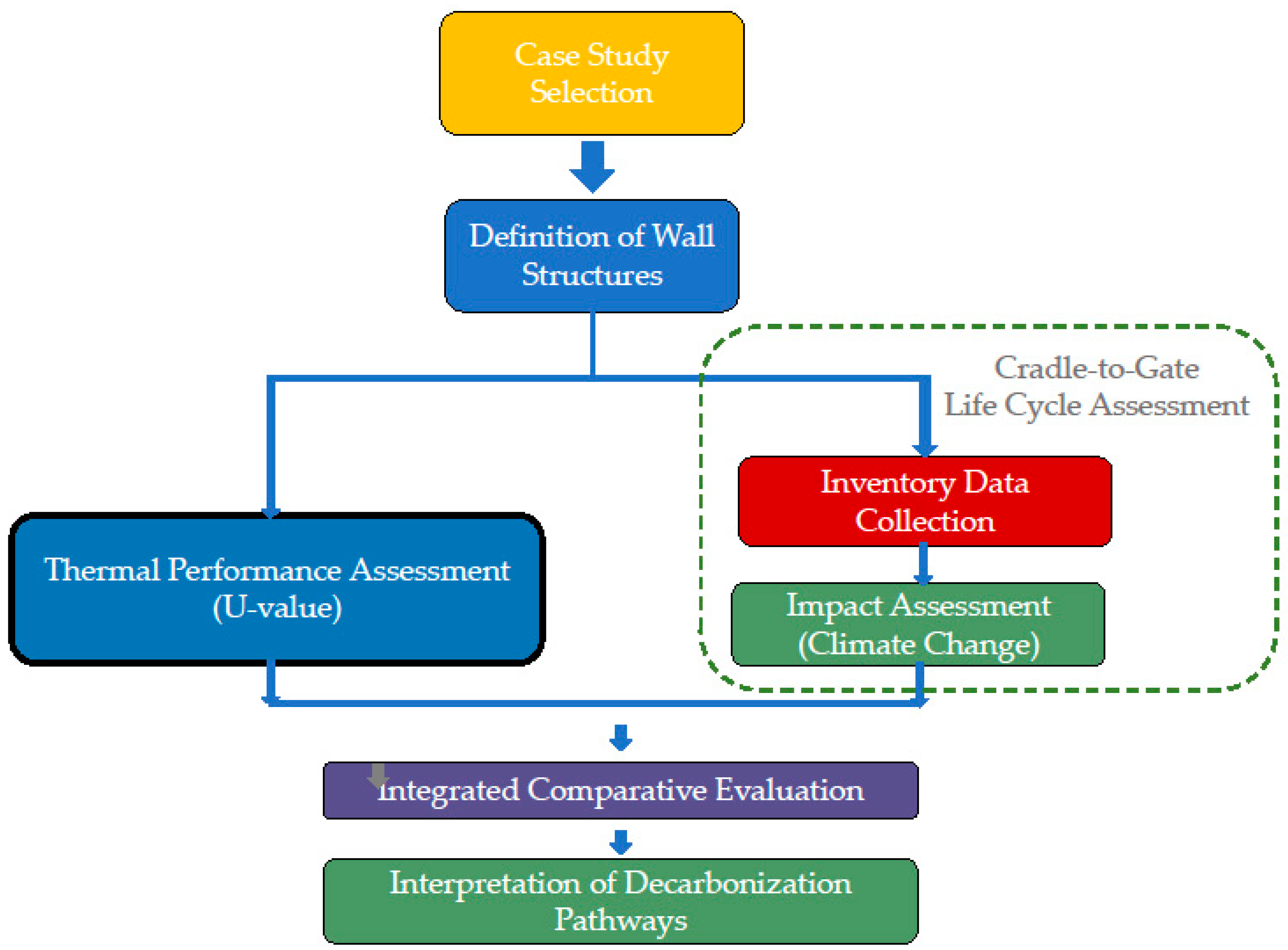
2.1. Research Design and Scenario Definition
- The original uninsulated masonry wall;
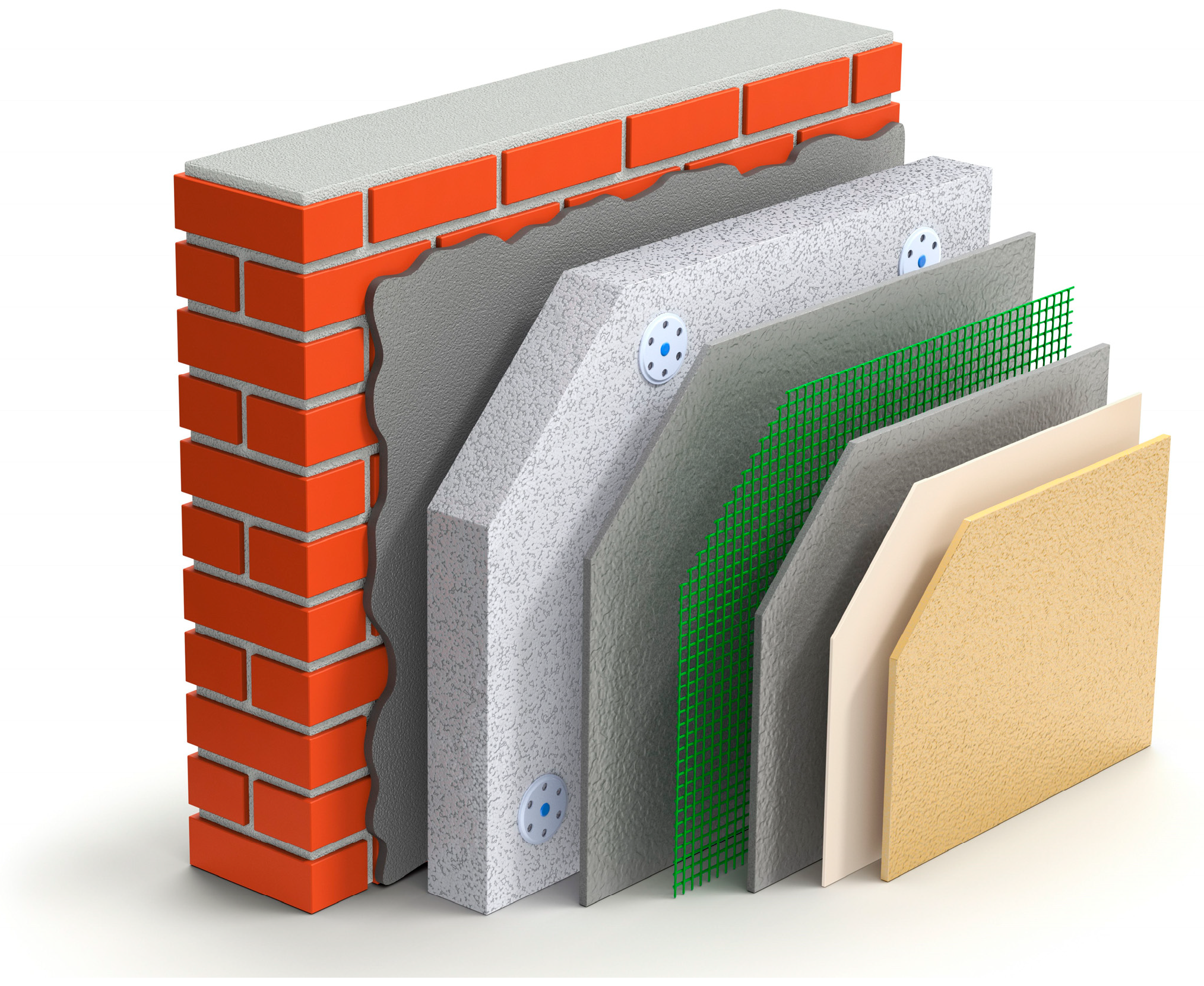
- A conventional retrofit solution based on External Thermal Insulation Composite Systems;
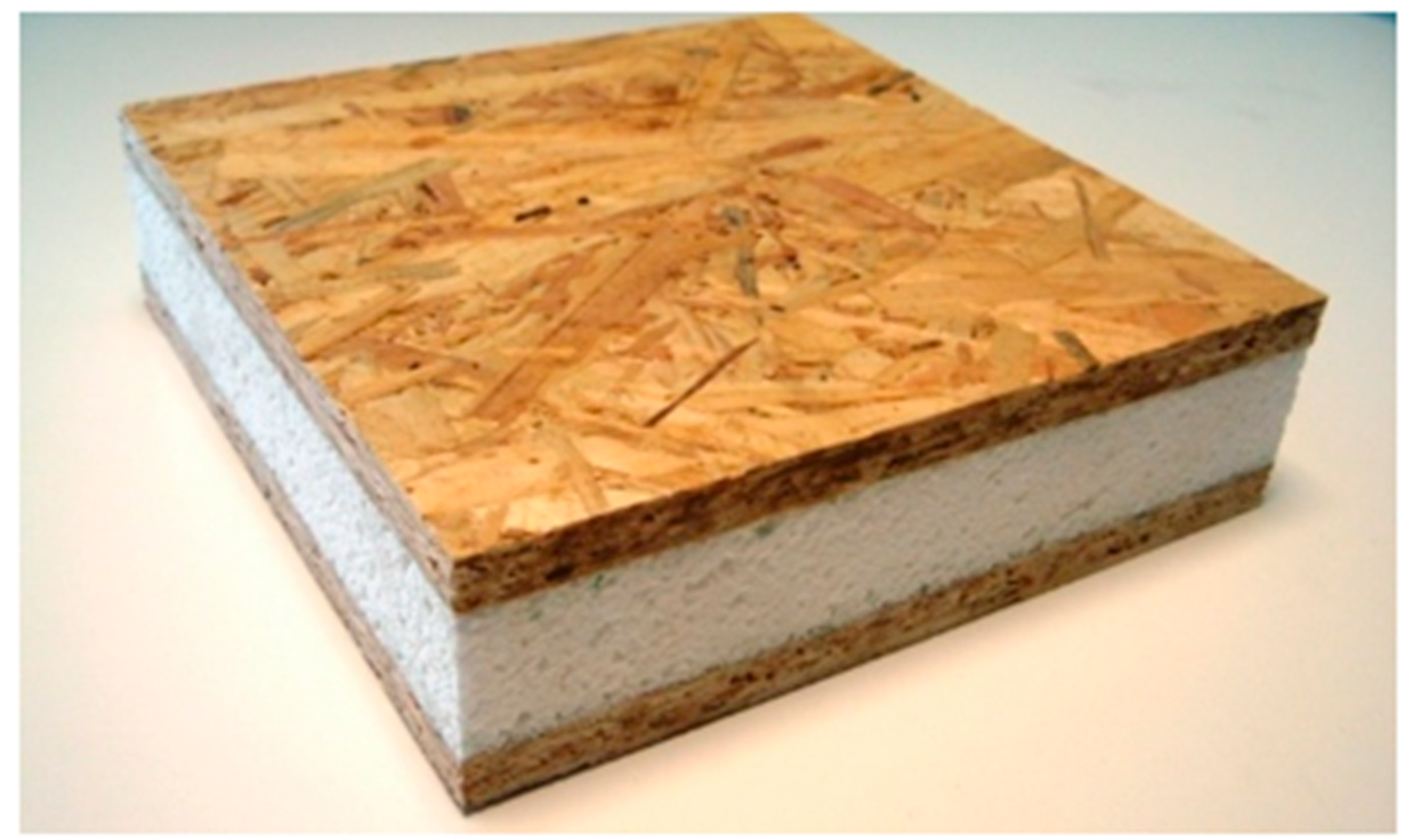
- A modular reconstruction solution utilising SIPs.
2.2. Thermal Performance Evaluation
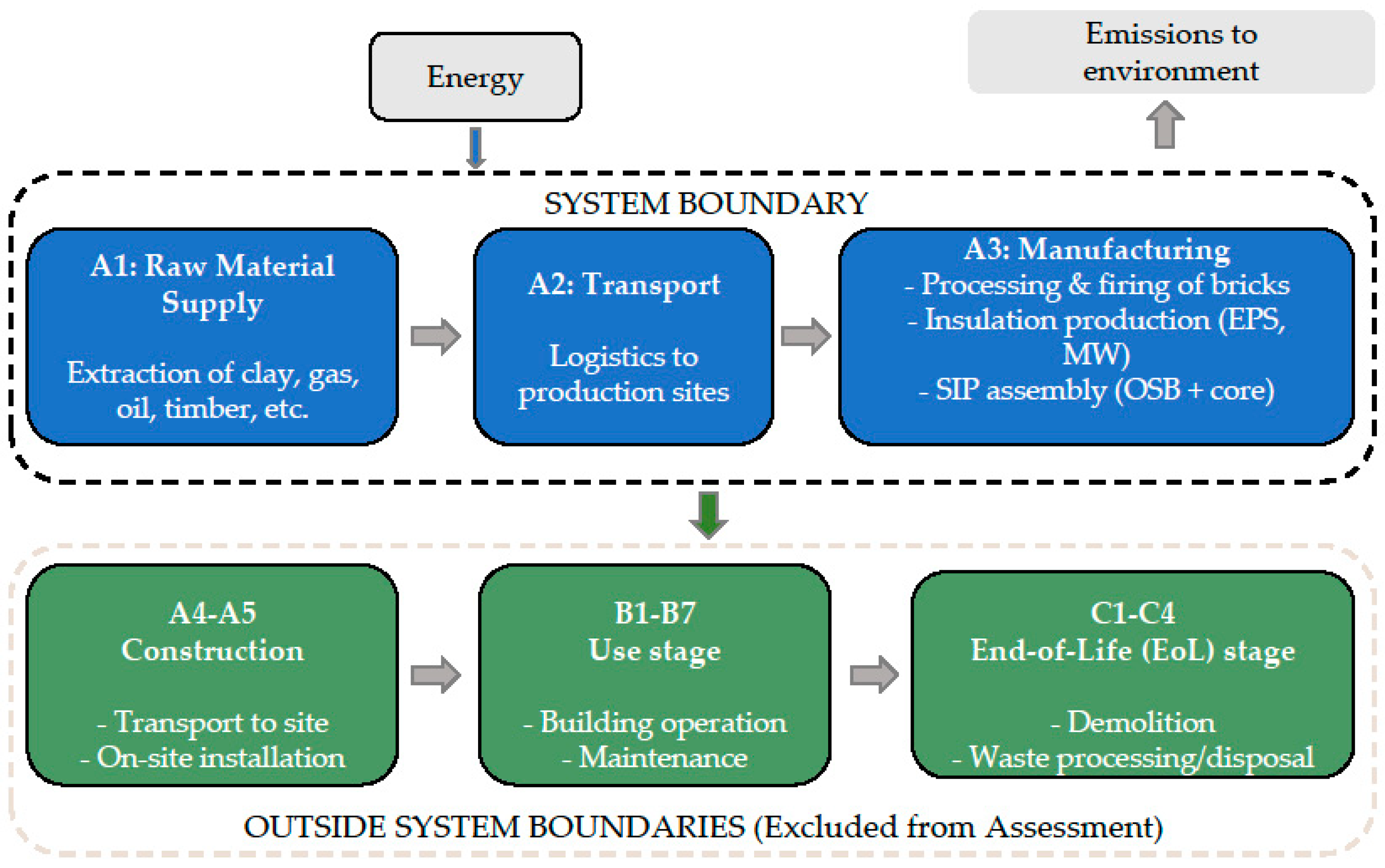
2.3. Life Cycle Assessment Framework
- Optimal balance between energy efficiency and embodied impacts;
- Effectiveness of modular vs. conventional retrofit solutions;
- Contribution of envelope design to overall decarbonization pathways.
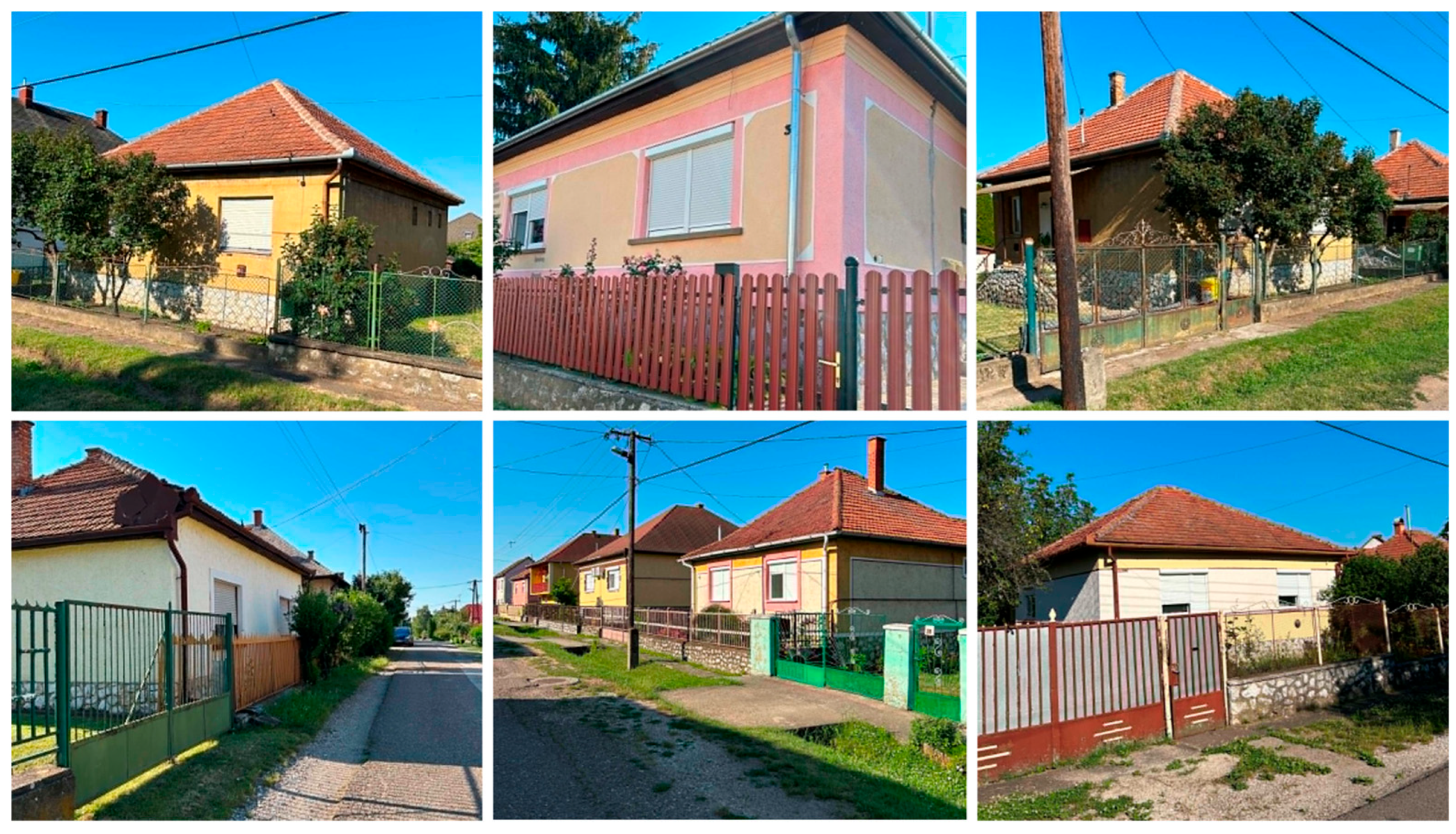
2.4. Reference Building Typology and Market Context
2.5. Wall Structure Scenarios
- Case A: original uninsulated masonry wall.
- Case B: conventional ETICS-based retrofit solution.
- Case C: SIP-based modular reconstruction system.
2.6. Life Cycle Inventory
- Relative improvement compared to the baseline case;
- Comparative performance between retrofit and modular solutions;
- Identification of performance trade-offs.
2.7. Scenario-by-Module Accounting Matrix
2.8. Material-to-Dataset Mapping
2.9. Limitations
3. Results
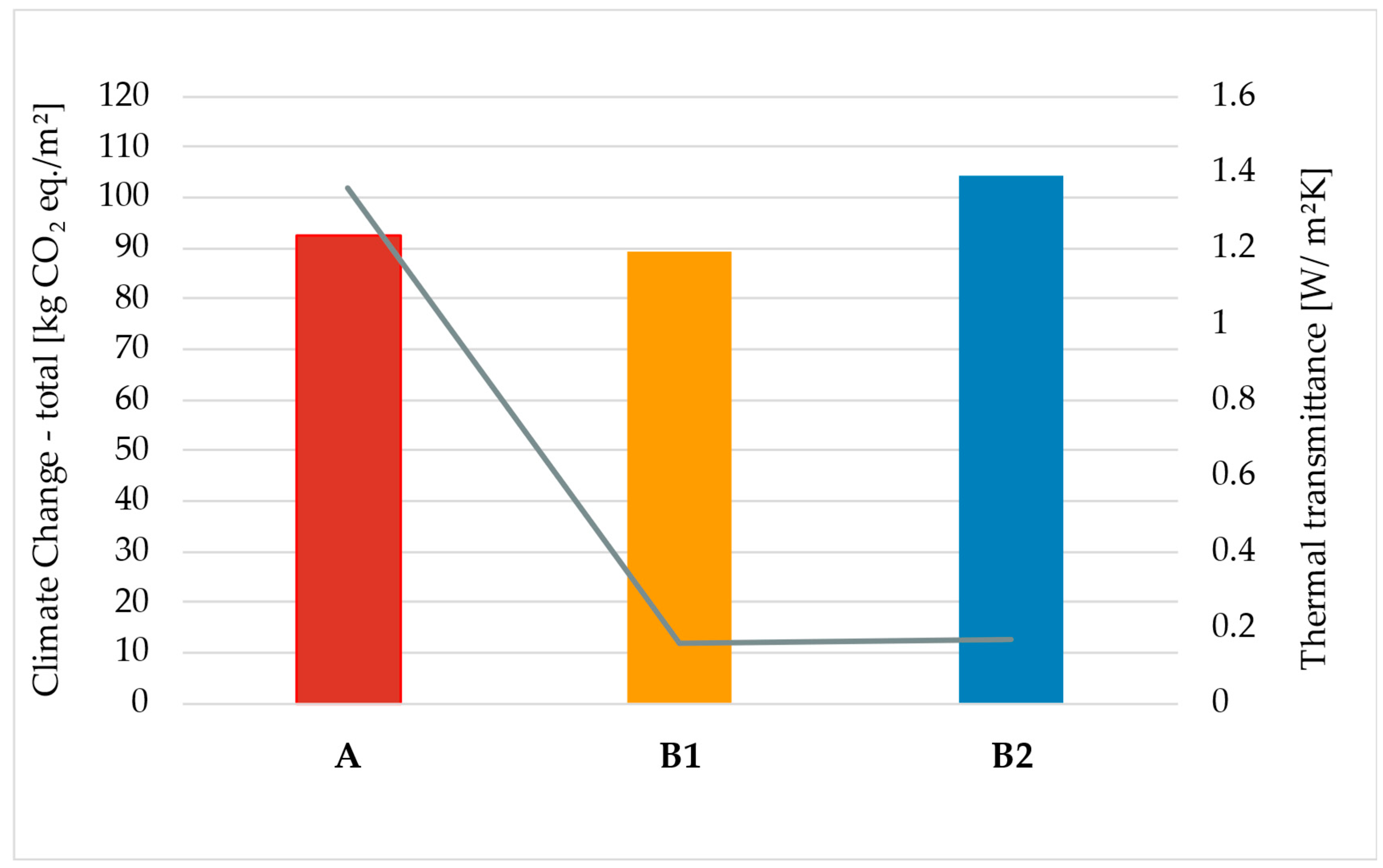
3.1. Thermal Performance of Wall Structures
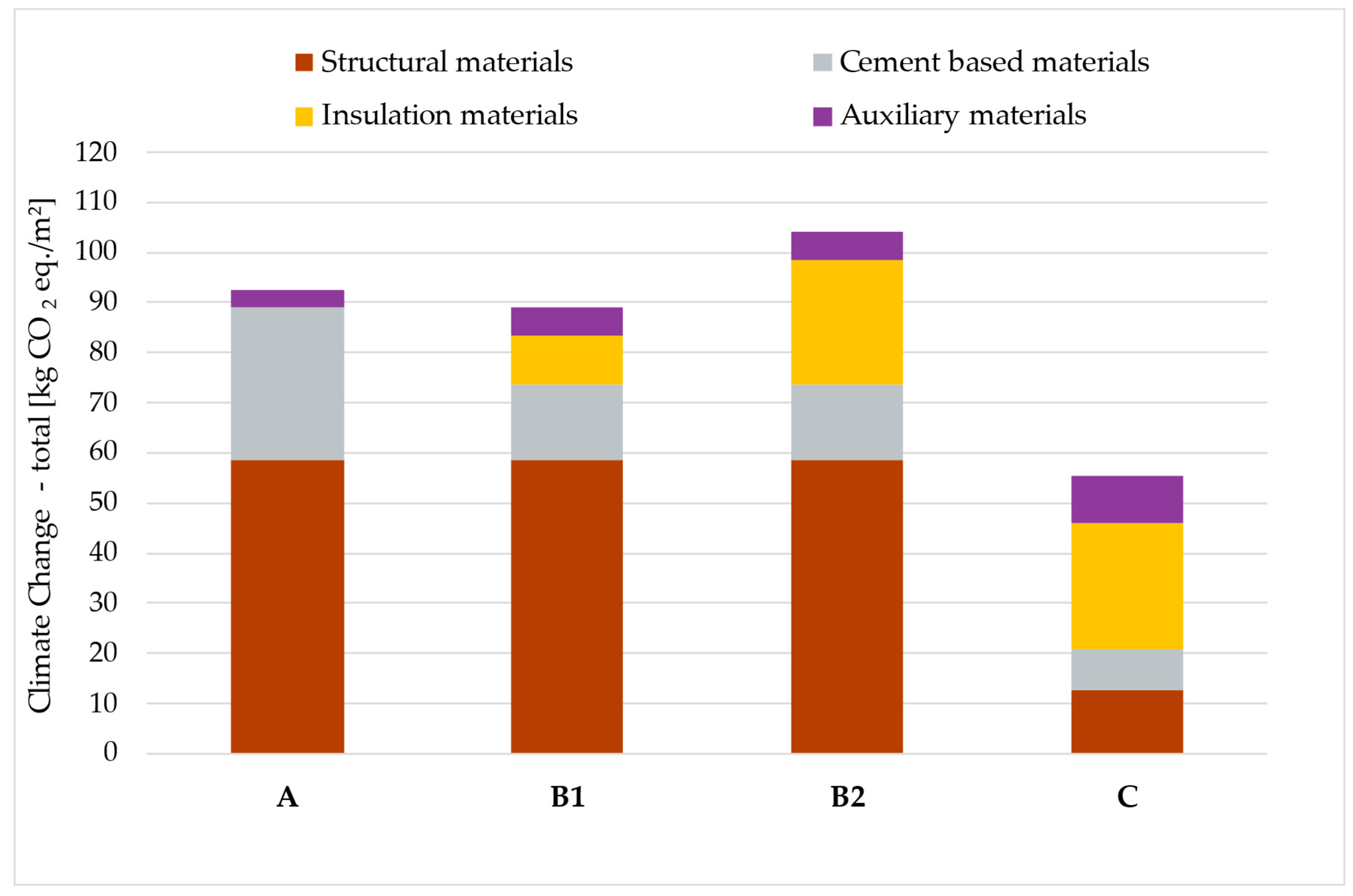
3.2. Embodied Carbon of Wall Structures
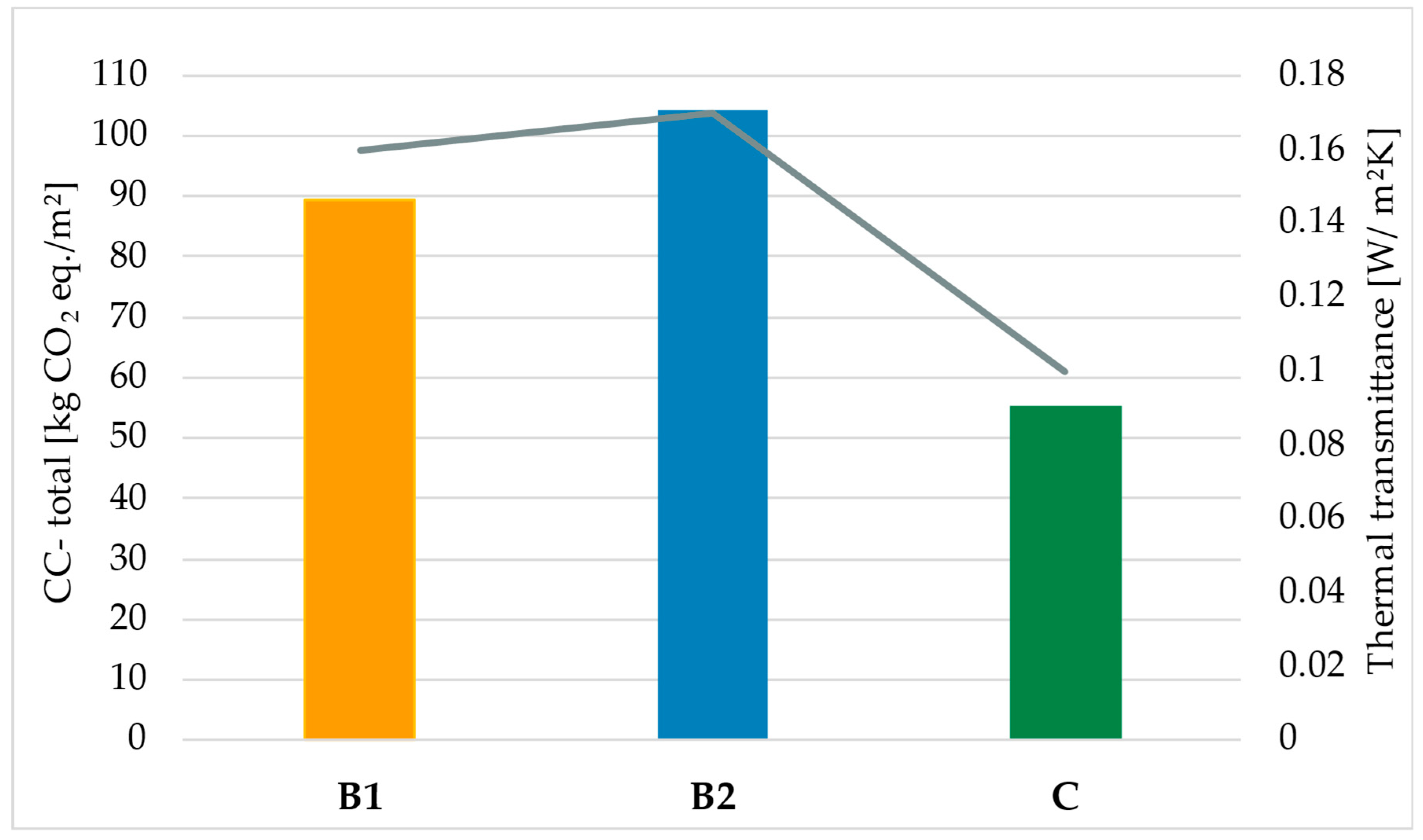
3.3. Comparative Evaluation of the Three Scenarios
- The baseline wall performs poorly in terms of energy efficiency and does not support decarbonization goals.
- The retrofit solution offers a significant improvement in thermal performance with moderate additional embodied impacts, making it a viable and widely applicable solution.
- The modular SIP-based solution provides the best performance under the assumption of reconstruction, highlighting its potential in scenarios where replacement of the existing building is feasible.
4. Discussion
4.1. Thermal Performance Improvements and Their Implications
4.2. Embodied Carbon Differences and Material Efficiency
4.3. Retrofit vs. Reconstruction: Conceptual Asymmetry
4.4. Synthesis of Thermal and Embodied Environmental Impacts
4.5. Broader Context and Limitations
5. Conclusions
Author Contributions
Funding
Data Availability Statement
Acknowledgments
Conflicts of Interest
Abbreviations
| CC | Climate Change |
| CO2 eq. | Carbon Dioxide Equivalent |
| ECE | Embodied Carbon Emission |
| EPS | Expanded Polystyrene |
| EPD | Environmental Product Declaration |
| ETICS | External Thermal Insulation Composite System |
| GHG | Greenhouse Gas |
| GWP | Global Warming Potential |
| LCA | Life Cycle Assessment |
| LCI | Life Cycle Inventory |
| LCIA | Life Cycle Impact Assessment |
| MW | Mineral Wool |
| nZEB | Nearly Zero-Energy Building |
| OSB | Oriented Strand Board |
| PP | Polypropylene |
| PUR | Polyurethane |
| SIP | Structural Insulated Panel |
| U-value | Thermal Transmittance |
References
- United Nations Environment Programme (UNEP). Not Just Another Brick in the Wall: The Solutions Exist-Scaling Them Will Build on Progress and Cut Emissions Fast. Global Status Report for Buildings and Construction 2024/2025; UNEP: Nairobi, Kenya, 2025; Available online: https://www.unep.org (accessed on 13 June 2026).
- United Nations Environment Programme (UNEP). Global Status Report for Buildings and Construction (Buildings-GSR); UNEP: Nairobi, Kenya, 2022; Available online: https://www.unep.org (accessed on 13 June 2026).
- European Commission. A Renovation Wave for Europe—Greening Our Buildings, Creating Jobs, Improving Lives; COM (2020) 662 Final; European Commission: Brussels, Belgium, 2020. [Google Scholar]
- International Energy Agency (IEA). Net Zero by 2050: A Roadmap for the Global Energy Sector; IEA: Paris, France, 2021; Available online: https://www.iea.org (accessed on 13 June 2026).
- Duan, Z.; Omrany, H.; Zuo, J. Embodied versus Operational Emissions: A Life Cycle Optimization Framework for Building Envelope Design under Climate Change. Build. Environ. 2026, 297, 114598. [Google Scholar] [CrossRef] [Scilit]
- Li, Y.; Pittau, F.; Masera, G. Global Embodied Carbon in Buildings: Meta-Analysis and Science-Based Decarbonization through Technological Solutions. J. Build. Eng. 2026, 117, 114909. [Google Scholar] [CrossRef] [Scilit]
- Maduta, C.; D’Agostino, D.; Tsemekidi-Tzeiranaki, S.; Castellazzi, L.; Melica, G.; Bertoldi, P. Towards Climate Neutrality within the European Union: Assessment of the Energy Performance of Buildings Directive Implementation in Member States. Energy Build. 2023, 301, 113716. [Google Scholar] [CrossRef] [Scilit]
- European Commission, Directorate-General for Energy. In Focus: Energy Efficiency in Buildings; European Commission: Brussels, Belgium, 2020. [Google Scholar]
- European Union. Directive (EU) 2018/844 of the European Parliament and of the Council of 30 May 2018 Amending Directive 2010/31/EU on the Energy Performance of Buildings and Directive 2012/27/EU on Energy Efficiency; European Union: Brussels, Belgium, 2018. [Google Scholar]
- Röck, M.; Saade, M.R.M.; Balouktsi, M.; Rasmussen, F.N.; Birgisdottir, H.; Frischknecht, R.; Habert, G.; Lützkendorf, T.; Passer, A. Embodied GHG Emissions of Buildings—The Hidden Challenge for Effective Climate Change Mitigation. Appl. Energy 2020, 258, 114107. [Google Scholar] [CrossRef] [Scilit]
- Csoknyai, T.; Hrabovszky-Horváth, S.; Georgiev, Z.; Jovanovic-Popovic, M.; Stankovic, B.; Villatoro, O.; Szendrő, G. Building Stock Characteristics and Energy Performance of Residential Buildings in Eastern-European Countries. Energy Build. 2016, 132, 39–52. [Google Scholar] [CrossRef] [Scilit]
- KSH (Hungarian Central Statistical Office). Microcensus 2016: Population Enumeration; KSH: Budapest, Hungary, 2016. [Google Scholar]
- Cabeza, L.F.; Rincón, L.; Vilariño, V.; Pérez, G.; Castell, A. Life Cycle Assessment (LCA) and Life Cycle Energy Analysis (LCEA) of Buildings and the Building Sector: A Review. Renew. Sustain. Energy Rev. 2014, 29, 394–416. [Google Scholar] [CrossRef] [Scilit]
- Malmqvist, T.; Nehasilova, M.; Moncaster, A.; Birgisdottir, H.; Nygaard Rasmussen, F.; Houlihan Wiberg, A.; Potting, J. Design and Construction Strategies for Reducing Embodied Impacts from Buildings—Case Study Analysis. Energy Build. 2018, 166, 35–47. [Google Scholar] [CrossRef] [Scilit]
- Jørgensen, B.; Ma, Z. Energy Efficiency and Decarbonization Strategies in Buildings: A Review of Technologies, Policies, and Future Directions. Appl. Sci. 2025, 15, 11660. [Google Scholar] [CrossRef] [Scilit]
- Ma, L.; Arras, M. Promoting Global Energy System Transformation Toward Carbon Neutrality: A Four-Stage Pathway of System Integration. Engineering 2026, 59, 11–15. [Google Scholar] [CrossRef] [Scilit]
- Lu, H.; You, K.; Feng, W.; Zhou, N.; Fridley, D.; Price, L.; de la Rue du Can, S. Reducing China’s Building Material Embodied Emissions: Opportunities and Challenges to Achieve Carbon Neutrality in Building Materials. iScience 2024, 27, 109028. [Google Scholar] [CrossRef] [Scilit] [PubMed]
- Zhang, Y.; Sattar, S.; Cook, D.; Johnson, K.; Fung, J. Systematic Review of Embodied Carbon Assessment and Reduction in Building Life Cycles; National Institute of Standards and Technology: Gaithersburg, MD, USA, 2024.
- Fernandes, J.; Ferrão, P. Bridging Circular Economy and Embodied Carbon: A Quantitative Assessment Method for Building Refurbishment Design. Dev. Built Environ. 2025, 24, 100801. [Google Scholar] [CrossRef] [Scilit]
- Orsatti, F.; Mariella, M.; Sperduto, G.; Dal Chiele, F.; Locatelli, G. A Novel Method for Assessing the Impacts of Energy Monitoring Systems Adoption in Building Energy Efficiency Retrofitting Projects. Energy Build. 2026, 361, 117438. [Google Scholar] [CrossRef] [Scilit]
- Bacheva, T.S.; Raposo Grau, J.F. Embodied Impacts in Buildings: A Systematic Review of Life Cycle Gaps and Sectoral Integration Strategies. Buildings 2025, 15, 1661. [Google Scholar] [CrossRef] [Scilit]
- Pomponi, F.; D’Amico, B.; Moncaster, A. A Method to Facilitate Uncertainty Analysis in LCAs of Buildings. Energies 2017, 10, 524. [Google Scholar] [CrossRef] [Scilit]
- Sarıca, K.; Harputlugil, G.U.; İnaner, G.; Kollugil, E.T. Building Sector Emission Reduction Assessment from a Developing European Economy: A Bottom-up Modelling Approach. Energy Policy 2023, 174, 113429. [Google Scholar] [CrossRef] [Scilit]
- Fernandez, M.I.; Go, Y.I.; Wong, D.M.L.; Früh, W.-G. Review of Challenges and Key Enablers in Energy Systems towards Net Zero Target: Renewables, Storage, Buildings, & Grid Technologies. Heliyon 2024, 10, e40691. [Google Scholar] [CrossRef] [Scilit] [PubMed]
- Evola, G.; Lucchi, E. Thermal Performance of the Building Envelope: Original Methods and Advanced Solutions. Buildings 2024, 14, 2507. [Google Scholar] [CrossRef] [Scilit]
- Ahmed Mohamed, N.; El-Dash, K.M.; Attia, T.M.; Abdel-Monem, M. Analysis of Alternative Building Envelope Solutions to Improve Energy Efficiency. Innov. Infrastruct. Solut. 2024, 9, 251. [Google Scholar] [CrossRef] [Scilit]
- European Commission. Supporting Life-Cycle Approaches to Decarbonise European Buildings; European Commission: Brussels, Belgium, 2026. [Google Scholar]
- Kumar, D.; Maurya, K.K.; Mandal, S.K.; Mir, B.A.; Nurdiawati, A.; Al-Ghamdi, S.G. Life Cycle Assessment in the Early Design Phase of Buildings: Strategies, Tools, and Future Directions. Buildings 2025, 15, 1612. [Google Scholar] [CrossRef] [Scilit]
- Oni, B.A.; Oni, O.Y.; Sunday, O.; Ojo, V.O.; Odofin, O.L. Synergizing Climate Mitigation and Circular Economy: A Comprehensive Review for Achieving Carbon Neutrality. Green Technol. Sustain. 2026, 4, 100319. [Google Scholar] [CrossRef] [Scilit]
- Boskovic, A.; Cullen, J.M. Barriers, Enablers, and Opportunities for Scaling-up Innovative and Circular Domestic Retrofit Business Models in the UK. J. Clean. Prod. 2025, 520, 146153. [Google Scholar] [CrossRef] [Scilit]
- CRREM Foundation; Institut für Immobilienökonomie Institute for Real Estate Economics. Embodied Carbon of Retrofits: Ensuring the Ecological Payback of Energetic Retrofits; CRREM Foundation: Wörgl, Austria, 2023. [Google Scholar]
- Mugahed Amran, Y.H.; El-Zeadani, M.; Huei Lee, Y.; Yong Lee, Y.; Murali, G.; Feduik, R. Design Innovation, Efficiency and Applications of Structural Insulated Panels: A Review. Structures 2020, 27, 1358–1379. [Google Scholar] [CrossRef] [Scilit]
- Dani, A.A.; Feng, R.; Fang, Z.; Roy, K. Life Cycle Assessment of a Structural Insulated Panel Modular House in New Zealand. Buildings 2025, 15, 146. [Google Scholar] [CrossRef] [Scilit]
- Szita, K.T.; Terjék, A.; Mannheim, V. Environmental Impact of PUR- and Polystyrene-Based Structural Insulated Panels. Polymers 2026, 18, 518. [Google Scholar] [CrossRef] [Scilit] [PubMed]
- Mučková, V.; Kalús, D.; Muhič, S.; Straková, Z.; Mudrá, M.; Predajnianska, A.; Füri, M.; Bolček, M. Energy Sustainability, Resilience, and Climate Adaptability of Modular and Panelized Buildings with a Lightweight Envelope Integrating Active Thermal Protection. Part 1—Parametric Study and Computer Simulation. Coatings 2025, 15, 756. [Google Scholar] [CrossRef] [Scilit]
- Zhang, Z.; Tan, T. Advancing Modular Design Generation: A Review of Modularization Workflows and Computational Design Approaches. J. Build. Eng. 2025, 116, 114646. [Google Scholar] [CrossRef] [Scilit]
- Kim, S. Prefabricated and Modularized Residential Construction: A Review of Present Status, Opportunities, and Future Challenges. Buildings 2025, 15, 2889. [Google Scholar] [CrossRef] [Scilit]
- Ozarisoy, B.; Altan, H. Handbook of Retrofitting High Density Residential Buildings; Springer International Publishing: Cham, Switzerland, 2022; ISBN 978-3-031-11853-1. [Google Scholar]
- Schwartz, Y.; Raslan, R.; Mumovic, D. Refurbish or Replace? The Life Cycle Carbon Footprint and Life Cycle Cost of Refurbished and New Residential Archetype Buildings in London. Energy 2022, 248, 123585. [Google Scholar] [CrossRef] [Scilit]
- ISO 14040:2006; Environmental Management—Life Cycle Assessment—Principles and Framework. ISO: Geneva, Switzerland, 2006. Available online: https://www.iso.org (accessed on 13 June 2026).
- ISO 14044:2006; Environmental Management—Life Cycle Assessment—Requirements and Guidelines. ISO: Geneva, Switzerland, 2006. Available online: https://www.iso.org/standard/38498.html (accessed on 13 June 2026).
- EN 15978:2011; Sustainability of Construction Works—Assessment of Environmental Performance of Buildings—Calculation Method. CEN: Brussels, Belgium, 2011.
- EN 15804:2012+A2:2019+AC:2021; Sustainability of Construction Works—Environmental Product Declarations—Core Rules for the Product Category of Construction Products. CEN: Brussels, Belgium, 2021.
- Llatas, C.; Soust-Verdaguer, B.; Passer, A. Implementing Life Cycle Sustainability Assessment during Design Stages in Building Information Modelling: From Systematic Literature Review to a Methodological Approach. Build. Environ. 2020, 182, 107164. [Google Scholar] [CrossRef] [Scilit]
- Soust-Verdaguer, B.; Palumbo, E.; Llatas, C.; Velasco Acevedo, Á.; Fernández Galvéz, M.D.; Hoxha, E.; Passer, A. The Use of Environmental Product Declarations of Construction Products as a Data Source to Conduct a Building Life-Cycle Assessment in Spain. Sustainability 2023, 15, 1284. [Google Scholar] [CrossRef] [Scilit]
- Olanrewaju, O.I.; Enegbuma, W.I.; Donn, M. Challenges in Life Cycle Assessment Implementation for Construction Environmental Product Declaration Development: A Mixed Approach and Global Perspective. Sustain. Prod. Consum. 2024, 49, 502–528. [Google Scholar] [CrossRef] [Scilit]
- Olanrewaju, O.I.; Enegbuma, W.I.; Donn, M.; Oyefusi, O.N. Assessment of Environmental Product Declaration and Databases: Towards Ensuring Data Quality Assurance Practices. Environ. Impact Assess. Rev. 2025, 112, 107803. [Google Scholar] [CrossRef] [Scilit]
- Barbhuiya, S.; Das, B.B. Life Cycle Assessment of Construction Materials: Methodologies, Applications and Future Directions for Sustainable Decision-Making. Case Stud. Constr. Mater. 2023, 19, e02326. [Google Scholar] [CrossRef] [Scilit]
- Moghayedi, A.; Awuzie, B.O.; Mehmood, A. Evaluating the Sustainability Performance of Sustainable, Innovative, and Affordable Housing. Int. Plan. Stud. 2026, 31, 1–36. [Google Scholar] [CrossRef] [Scilit]
- Nazari, F.; Dixit, M.; Yan, W.; Aryal, A. Building Shape Optimization Based on Interconnected Embodied and Operational Energy and Carbon Impacts. Energy Build. 2024, 325, 114933. [Google Scholar] [CrossRef] [Scilit]
- IS-SusCon Project. Case Study—Energy Modernization of a Family House; IS-SusCon Project: Brussels, Belgium, 2021; Available online: www.howtobuildgreen.eu (accessed on 30 December 2021).
- EN ISO 6946:2017; Building Components and Building Elements—Thermal Resistance and Thermal Transmittance—Calculation Methods. CEN: Brussels, Belgium, 2017.
- Gaudelas, A.; Blanchet, P.; Gosselin, L.; Cabral, M.R.; Giorgio, B. Design of a Structural Insulating Panel Based on Wood-Based Corrugated Panels as an Alternative to Light-Frame Construction. Constr. Build. Mater. 2024, 457, 139346. [Google Scholar] [CrossRef] [Scilit]
- Sphera. LCA for Experts (Formerly GaBi), Version 2026; Sphera: Leinfelden-Echterdingen, Germany, 2026. [Google Scholar]
- Simon, M. Modernity and Context—Hungarian Architecture at the Beginning of the Kádár-Era. Period. Polytech. Arch. 2007, 38, 25–32. [Google Scholar] [CrossRef] [Scilit]
- Kornai, J. Innovation and Dynamism. Econ. Transit. 2010, 18, 629–670. [Google Scholar] [CrossRef] [Scilit]
- Fehérváry, K. Politics in Color and Concrete: Socialist Materialities and the Middle Class in Hungary; Indiana University Press: Bloomington, IN, USA, 2013. [Google Scholar]
- Tamáska, M. Social Acceptance of Rural Dwellings. Results of a Sociological Research Related to Rural Dwellings. Period. Polytech. Arch. 2010, 40, 87–92. [Google Scholar] [CrossRef] [Scilit]
- Kármán-Tamus, É.; Pálvölgyi, T. Social Dimensions of Sustainable Energy Management. Sci. J. Agric. Econ. 2022, 4, 324–341. [Google Scholar]
- Roters, K.; Szolnoki, J. A Gulyásmodern. Építészfórum 2021. Available online: https://epiteszforum.hu/a-gulyasmodern (accessed on 23 May 2026).
- Ministry of Energy. National Energy and Climate Plan—Hungary; Ministry of Energy: Budapest, Hungary, 2024. [Google Scholar]
- KSH (Hungarian Central Statistical Office). Estimating the Primary Energy Demand of the Hungarian Housing Stock; KSH: Budapest, Hungary, 2026. [Google Scholar]



| Parameter | Typical Value/Description |
|---|---|
| Plan shape | Square (regular quadrilateral) |
| Floor plan dimensions | 9 × 9 m or 10 × 10 m |
| Net heated floor area | ~64–80 m2 (ground floor) |
| Storey height (clear) | ~2.5–2.7 m |
| Building volume | ~160–220 m3 |
| ID | Case Name | Description |
|---|---|---|
| Case A | Existing wall | Reference state; original construction, as-built baseline |
| Case B | Retrofitted wall | Original wall retrofitted by installing ETICS, thermal insulation can be EPS or rock wool |
| Case C | Modular SIP wall | Replacement of the existing building with a modular new-build structure maintaining identical geometry and streetscape characteristics |
| Layers | Thickness [mm] | Total Thickness [mm] | Density [kg/m3] |
|---|---|---|---|
| Interior lime plaster | 15 | 335 | 1600 |
| Hollow fired clay brick masonry (B30) | 300 | 850 | |
| Exterior cement-lime plaster | 20 | 1800 |
| Layers | Thickness [mm] | Total Thickness [mm] | Density [kg/m3] |
|---|---|---|---|
| Interior lime plaster | 15 | 527 | 1600 |
| Hollow fired clay brick masonry (B30) | 300 | 850 | |
| Adhesive layer (cement-based adhesive mortar) | 5 | 1900 | |
| EPS rigid foam boards | 200 | 16.5 | |
| Fibreglass reinforcement mesh embedded in base coat | 4 | 1900 | |
| Mineral render (exterior finish) | 3 | 1800 | |
| Mechanical anchors from polypropylene (PP) (25 g/piece) | 7 pcs/m2 | 910 |
| Layers | Thickness [mm] | Total Thickness [mm] | Density [kg/m3] |
|---|---|---|---|
| Interior lime plaster | 15 | 527 | 1600 |
| Hollow fired clay brick masonry (B30) | 300 | 850 | |
| Adhesive layer (cement-based adhesive mortar) | 5 | 1900 | |
| Mineral wool boards | 200 | 100 | |
| Fibreglass reinforcement mesh embedded in base coat | 4 | 1900 | |
| Mineral render (exterior finish) | 3 | 1800 | |
| Mechanical anchors (PP) (25 g/piece) | 7 pcs/m2 | 910 |
| Layers | Thickness [mm] | Total Thickness [mm] | Density [kg/m3] |
|---|---|---|---|
| Interior gypsum plaster | 10 | 467.6 | 1200 |
| Gypsum board cladding (2 × 12.5 mm) | 25 | 800 | |
| Internal service cavity (50 mm timber lath) | 50 | 500 | |
| Polyamide foil | 0.2 | 950 | |
| OSB board | 15 | 650 | |
| Adhesive polyurethane (PUR) | 0.2 | 1200 | |
| EPS core | 140 | 16.5 | |
| Adhesive PUR (0.5 kg/m2) | 0.2 | 1200 | |
| OSB board | 15 | 650 | |
| Adhesive PU foam | 5 | 27.5 | |
| Mineral wool boards | 200 | 100 | |
| Fibreglass reinforcement mesh embedded in base coat | 4 | 1900 | |
| Mineral render (exterior finish) | 3 | 1800 |
| Layers | Thickness [mm] | Volume (m3/m2) | Mass (kg/m2) | Water (kg/m2) | Waste/Loss (kg/m2) |
|---|---|---|---|---|---|
| Interior lime plaster | 15 | 0.0150 | 24.00 | 4.80 | 3.60 |
| Hollow fired clay brick masonry (B30) | 300 | 0.3000 | 255.00 | - | 12.75 |
| Mortar joints | 10 | 0.0185 | 21.00 | 3.24 | 1.80 |
| Exterior cement-lime plaster | 20 | 0.0200 | 36.00 | 6.48 | 5.40 |
| Total (all layers) | 336.00 | 14.52 | 21.75 |
| Layers | Thickness [mm] | Volume (m3/m2) | Mass (kg/m2) | Water (kg/m2) | Waste/Loss (kg/m2) |
|---|---|---|---|---|---|
| Interior lime plaster | 15 | 0.0150 | 24.00 | 4.80 | 3.60 |
| Hollow fired clay brick masonry (B30) | 300 | 0.3000 | 255.00 | - | - |
| Mortar joints | 10 | 0.0185 | 21.00 | 3.24 | 1.80 |
| Adhesive layer (cement-based adhesive mortar) | 5 | 0.0050 | 9.50 | 2.09 | 0.95 |
| EPS rigid foam boards | 200 | 0.2000 | 3.30 | - | 0.17 |
| Fibreglass mesh embedded in base coat | 4 | 0.0040 | 7.60 | 1.67 | 0.76 |
| Mineral render (exterior finish) | 3 | 0.0030 | 5.40 | 0.54 | 0.54 |
| Mechanical anchors (PP) 25 g/pcs | - | 7 pcs | 0.175 | - | 0.01 |
| Total (all layers) | 325.975 | 12.34 | 6.03 |
| Layers | Thickness [mm] | Volume (m3/m2) | Mass (kg/m2) | Water (kg/m2) | Waste/Loss (kg/m2) |
|---|---|---|---|---|---|
| Interior lime plaster | 15 | 0.0150 | 24.00 | 4.80 | 3.60 |
| Hollow fired clay brick masonry (B30) | 300 | 0.3000 | 255.00 | - | - |
| Mortar joints | 10 | 0.0185 | 21.00 | 3.24 | 1.80 |
| Adhesive layer (cement-based adhesive mortar) | 5 | 0.0050 | 9.50 | 2.09 | 0.95 |
| Mineral wool boards | 200 | 0.2000 | 20.00 | - | 1.00 |
| Fibreglass mesh embedded in base coat | 4 | 0.0040 | 7.60 | 1.67 | 0.76 |
| Mineral render (exterior finish) | 3 | 0.0030 | 5.40 | 0.540 | 0.54 |
| Mechanical anchors (PP) 25 g/pcs | - | 7 pcs | 0.175 | - | 0.01 |
| Total (all layers) | 342.675 | 12.34 | 6.86 |
| Layers | Thickness [mm] | Volume (m3/m2) | Mass (kg/m2) | Water (kg/m2) | Waste/Loss (kg/m2) |
|---|---|---|---|---|---|
| Interior gypsum plaster | 10 | 0.0100 | 12.00 | 6.00 | 1.80 |
| Gypsum board cladding (2 × 12.5 mm) | 25 | 0.0250 | 20.00 | - | 1.60 |
| Polyamide foil | 0.2 | 0.0002 | 0.19 | - | 0.02 |
| Internal service cavity (50 mm timber lath) | 50 | 0.0500 | 5.00 | - | 2.50 |
| OSB board | 15 | 0.0150 | 9.75 | - | 0.78 |
| Adhesive PUR (0.5 kg/m2) | 0.2 | - | 0.50 | - | 0.03 |
| EPS core | 140 | 0.1400 | 2.31 | - | 0.12 |
| Adhesive PUR (0.5 kg/m2) | 0.2 | - | 0.50 | - | 0.03 |
| OSB board (15 mm) | 15 | 0.0150 | 9.75 | - | 0.78 |
| Adhesive PU foam | 5 | 0.0050 | 0.14 | - | 0.01 |
| Mineral wool insulation | 200 | 0.2000 | 20.00 | - | 1.00 |
| Fibreglass mesh embedded in base coat | 4 | 0.0040 | 7.60 | 1.672 | 0.76 |
| Mineral render (exterior finish) | 3 | 0.0030 | 5.40 | 0.540 | 0.54 |
| Total (all layers) | 93.14 | 8.212 | 9.95 |
| Case | Material/Component | Module A1 | Module A2 | Module A3 | Notes |
|---|---|---|---|---|---|
| A—Existing masonry wall | Fired clay brick (B30) | ✔ | ✔ | ✔ | Baseline wall; no intervention materials |
| Interior lime plaster | ✔ | ✔ | ✔ | Original construction | |
| Exterior cement-lime plaster | ✔ | ✔ | ✔ | Original construction | |
| B1—ETICS with EPS | EPS insulation board (200 mm) | ✔ | ✔ | ✔ | Retrofit intervention only |
| Adhesive mortar | ✔ | ✔ | ✔ | Applied on existing wall | |
| Base coat + fibreglass mesh | ✔ | ✔ | ✔ | Included as ETICS system | |
| Mineral render | ✔ | ✔ | ✔ | Exterior finish | |
| PP mechanical anchors | ✔ | ✔ | ✔ | 7 pcs/m2 | |
| Existing masonry wall | - | - | - | Excluded (background condition) | |
| B2—ETICS with MW | Mineral wool board (200 mm) | ✔ | ✔ | ✔ | Retrofit intervention only |
| Adhesive mortar | ✔ | ✔ | ✔ | Same as B1 | |
| Base coat + fibreglass mesh | ✔ | ✔ | ✔ | Same as B1 | |
| Mineral render | ✔ | ✔ | ✔ | Same as B1 | |
| PP mechanical anchors | ✔ | ✔ | ✔ | Same as B1 | |
| Existing masonry wall | - | - | - | Excluded (background condition) | |
| C—SIP modular wall | Gypsum plaster | ✔ | ✔ | ✔ | New-build reconstruction |
| Gypsum board (2 × 12.5 mm) | ✔ | ✔ | ✔ | Interior cladding | |
| Timber service cavity (50 mm) | ✔ | ✔ | ✔ | Structural cavity | |
| Polyamide foil | ✔ | ✔ | ✔ | Vapour barrier | |
| OSB board | ✔ | ✔ | ✔ | SIP facing | |
| PUR adhesive | ✔ | ✔ | ✔ | SIP bonding | |
| EPS core (140 mm) | ✔ | ✔ | ✔ | SIP insulation | |
| Exterior render system | ✔ | ✔ | ✔ | Applied on SIP panel |
| Material/Component | Dataset Name (GaBi/MLC) | Geographical Scope | Database Version | Unit | Waste/Loss Assumption | Biogenic Carbon Treatment |
|---|---|---|---|---|---|---|
| Fired clay brick (B30) | Brick, fired, at plant | RER | GaBi 10.9.6.1 | kg | 2% | Not applicable |
| Lime plaster | Plaster, lime-based, at plant | RER | GaBi 10.9.6.1 | kg | 2% | Not applicable |
| Cement-lime plaster | Plaster, cement-lime, at plant | RER | GaBi 10.9.6.1 | kg | 2% | Not applicable |
| EPS insulation | EPS board, expanded polystyrene, at plant | RER | MLC Premium Construction | kg | 3% | Fossil carbon only |
| Mineral wool | Mineral wool board, at plant | RER | MLC Premium Construction | kg | 3% | Not applicable |
| Adhesive mortar | Mortar, cement-based, at plant | RER | GaBi 10.9.6.1 | kg | 2% | Not applicable |
| Fiberglass mesh | Glass fibre fabric, at plant | RER | GaBi 10.9.6.1 | kg | 1% | Not applicable |
| Mineral render | Render, mineral-based, at plant | RER | MLC Premium Construction | kg | 2% | Not applicable |
| PP anchors | Polypropylene (PP), injection moulding | RER | GaBi 10.9.6.1 | kg | 0% | Fossil carbon only |
| Gypsum plaster | Gypsum plaster, at plant | RER | GaBi 10.9.6.1 | kg | 2% | Not applicable |
| Gypsum board | Gypsum plasterboard, at plant | RER | MLC Premium Construction | kg | 2% | Not applicable |
| Timber lath | Sawn timber, kiln dried | RER | GaBi 10.9.6.1 | kg | 5% | Biogenic carbon included |
| Polyamide foil | Polyamide film, at plant | RER | GaBi 10.9.6.1 | kg | 0% | Fossil carbon only |
| OSB board | OSB board, at plant | RER | MLC Premium Construction | kg | 5% | Biogenic carbon included |
| PUR adhesive | Polyurethane adhesive, at plant | RER | GaBi 10.9.6.1 | kg | 0% | Fossil carbon only |
| Exterior render (SIP) | Render, mineral-based, at plant | RER | MLC Premium Construction | kg | 2% | Not applicable |
| Layers | Thickness, d [m] | Thermal Conductivity, λ [W/mK] | Thermal Resistance, R [m2K/W] |
|---|---|---|---|
| Interior lime plaster | 0.015 | 0.80 | 0.019 |
| Hollow fired clay brick masonry (B30) | 0.300 | 0.57 | 0.526 |
| Exterior cement-lime plaster | 0.020 | 0.80 | 0.025 |
| Layers | Thickness, d [m] | Thermal Conductivity, λ [W/mK] | Thermal Resistance, R [m2K/W] |
|---|---|---|---|
| Interior lime plaster | 0.015 | 0.80 | 0.019 |
| Hollow fired clay brick masonry (B30) | 0.300 | 0.57 | 0.526 |
| Adhesive layer (cement-based adhesive mortar) | 0.005 | 1.00 | 0.005 |
| EPS rigid foam boards | 0.200 | 0.036 | 5.556 |
| Base coat + fibreglass reinforcement mesh | 0.004 | 1.00 | 0.004 |
| Mineral render (exterior finish) | 0.003 | 0.87 | 0.003 |
| Layers | Thickness, d [m] | Thermal Conductivity, λ [W/mK] | Thermal Resistance, R [m2K/W] |
|---|---|---|---|
| Interior lime plaster | 0.015 | 0.80 | 0.019 |
| Hollow fired clay brick masonry (B30) | 0.300 | 0.57 | 0.526 |
| Adhesive layer (cement-based adhesive mortar) | 0.005 | 1.00 | 0.005 |
| Mineral wool boards | 0.200 | 0.039 | 5.128 |
| Base coat + fibreglass reinforcement mesh | 0.004 | 1.00 | 0.004 |
| Mineral render (exterior finish) | 0.003 | 0.87 | 0.003 |
| Layers | Thickness, d [m] | Thermal conductivity, λ [W/mK] | Thermal resistance, R [m2K/W] |
|---|---|---|---|
| Interior gypsum plaster | 0.010 | 0.40 | 0.025 |
| Gypsum board cladding (2 × 12.5 mm) | 0.025 | 0.21 | 0.119 |
| Internal service cavity (50 mm timber lath) | 0.050 | 0.03 | 0.180 * |
| Polyamide foil | 0.0002 | 0.25 | 0.001 |
| OSB board | 0.015 | 0.13 | 0.115 |
| Adhesive PUR | 0.0002 | 0.25 | 0.001 |
| EPS core | 0.140 | 0.036 | 3.889 |
| Adhesive PUR | 0.0002 | 0.25 | 0.001 |
| OSB board | 0.015 | 0.13 | 0.115 |
| Adhesive PU foam | 0.005 | 0.03 | 0.167 |
| Mineral wool boards | 0.200 | 0.039 | 5.128 |
| Base coat + fibreglass reinforcement mesh | 0.004 | 1.00 | 0.004 |
| Mineral render (exterior finish) | 0.003 | 0.87 | 0.003 |
| Wall Structures | Design Thermal Resistance of the Layers, Ri [m2K/W] | Total Thermal Resistance, Rtot [m2K/W] | Thermal Transmittance, U [W/ m2K] |
|---|---|---|---|
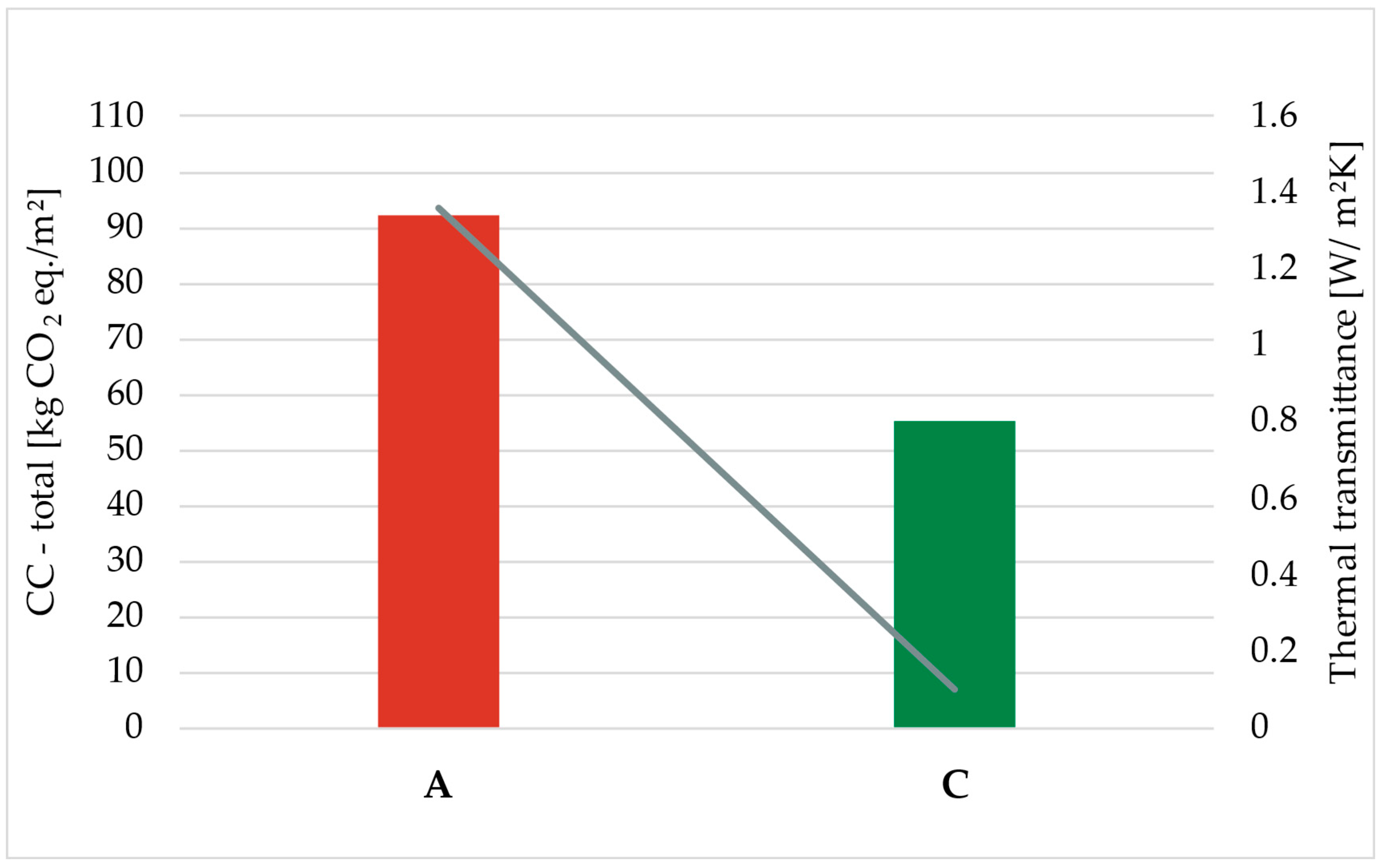
| Case A | 0.570 | 0.740 | 1.35 |
| Case B1 | 6.113 | 6.283 | 0.16 |
| Case B2 | 5.686 | 5.856 | 0.17 |
| Case C | 9.748 | 9.918 | 0.10 |
| Wall Structures | Climate Change—Total [kg CO2 eq./m2] |
|---|---|
| Case A | 92.35 |
| Case B1 | 89.49 |
| Case B2 | 104.40 |
| Case C | 55.27 |
Disclaimer/Publisher’s Note: The statements, opinions and data contained in all publications are solely those of the individual author(s) and contributor(s) and not of MDPI and/or the editor(s). MDPI and/or the editor(s) disclaim responsibility for any injury to people or property resulting from any ideas, methods, instructions or products referred to in the content. |
© 2026 by the authors. Licensee MDPI, Basel, Switzerland. This article is an open access article distributed under the terms and conditions of the Creative Commons Attribution (CC BY) license.
Share and Cite
Terjék, A.; Szita, K.T.; Mannheim, V. Decarbonization Assessment of External Wall Systems: Thermal Transmittance and Cradle-to-Gate Embodied Carbon Comparison of Conventional and Modular Configurations. Energies 2026, 19, 3159. https://doi.org/10.3390/en19133159
Terjék A, Szita KT, Mannheim V. Decarbonization Assessment of External Wall Systems: Thermal Transmittance and Cradle-to-Gate Embodied Carbon Comparison of Conventional and Modular Configurations. Energies. 2026; 19(13):3159. https://doi.org/10.3390/en19133159
Chicago/Turabian StyleTerjék, Anita, Klára Tóthné Szita, and Viktoria Mannheim. 2026. "Decarbonization Assessment of External Wall Systems: Thermal Transmittance and Cradle-to-Gate Embodied Carbon Comparison of Conventional and Modular Configurations" Energies 19, no. 13: 3159. https://doi.org/10.3390/en19133159
APA StyleTerjék, A., Szita, K. T., & Mannheim, V. (2026). Decarbonization Assessment of External Wall Systems: Thermal Transmittance and Cradle-to-Gate Embodied Carbon Comparison of Conventional and Modular Configurations. Energies, 19(13), 3159. https://doi.org/10.3390/en19133159