


Abstract
To address the effective dispatch and coordinated control of ESS, EV, and HVAC resources in building parks participating in grid frequency regulation under the virtual power plant (VPP) architecture, this paper proposes a multi-time scale frequency regulation strategy based on state priority and the Stackelberg game. First, a state-based upward and downward frequency regulation priority model is established to dynamically dispatch ESS, EVs, and HVAC systems according to their operating states. Second, a multi-time-scale frequency regulation Stackelberg game model considering priority incentives is constructed with the goal of economic optimality. A comprehensive utility function integrating the startup threshold and regulation rigidity is designed to achieve a balanced optimization that considers both the operational economy of the VPP and the user comfort of the underlying devices. Finally, considering the frequency regulation response characteristics of the resources, a multi-time-scale dynamic weight optimization and reconstruction method is proposed. Case study results show that the proposed strategy can efficiently dispatch park resources, track automatic generation control (AGC) commands with high precision, and significantly reduce system frequency fluctuations. It ensures the safe operation of the system and user comfort while achieving economic optimality.
1. Introduction
Traditional automatic generation control (AGC) mainly relies on the rotor inertia and governor systems of synchronous generators to adjust the output of thermal or hydro power units [1]. However, with the increasing proportion of new energy sources such as wind and solar power, the gradual phase-out of traditional thermal power units has led to a reduction in traditional frequency regulation resources, making it difficult to meet the growing demand for frequency regulation by relying solely on generation-side regulation [2]. As an effective carrier for aggregating massive distributed resources, the virtual power plant (VPP) can integrate heterogeneous flexible resources such as energy storage systems (ESSs), electric vehicles (EVs), and heating, ventilation, and air conditioning (HVAC) loads into a whole to participate in grid ancillary services, which has become an important approach to enhance grid frequency regulation capabilities [3,4,5]. However, there are significant differences among massive heterogeneous resources in terms of response speed, regulation cost, and user willingness [6], making it a core problem in the current VPP frequency regulation field to construct a coordinated control strategy that considers both economy and response characteristics. ESS, EV, and HVAC resources in building parks are important dispatchable resources for VPPs to participate in frequency regulation, which have the advantages of large capacity and low price, showing great application potential [7].
Corresponding to the primary and secondary frequency regulation of the power grid, a multi-time-scale frequency regulation strategy is widely adopted when park ESS, EV, and HVAC resources participate in frequency regulation. In the primary frequency regulation stage, distributed ESS with second- or even millisecond-level response times participate in fast frequency regulation [8], while in the secondary stage, the participation of minute-level EV and HVAC can improve the frequency regulation capability of the VPP [9,10]. Reference [11] utilizes the complementary characteristics of heterogeneous resources to achieve optimal power decomposition among resources, improving the economy of the VPP. However, current research on park resources participating in multi-time scale frequency regulation is relatively limited.
Under the VPP architecture, since game theory has distributed attributes consistent with the cloud, network, edge, and terminal scheduling technology architecture of VPPs, game-based approaches can be adopted to dispatch resources to participate in grid ancillary services. Among them, potential games, Stackelberg games, and cooperative games are commonly used in VPP frequency regulation strategies [12,13,14,15]. The participation of park resources in frequency regulation is mainly carried out through load aggregators, and adopting the Stackelberg game approach can achieve the efficient dispatch of park resource clusters. Reference [14] coordinates the conflict of interest between EVs and aggregators through a Stackelberg game, improving the economic efficiency of frequency regulation services. Reference [15] constructs a Stackelberg game model for the multi-agent conflict of interest problem in VPPs, significantly improving system revenue and calculation efficiency.
Regarding the dispatch of heterogeneous resources in VPPs, due to the massive number of underlying resources making direct centralized control difficult, dynamically clustering devices based on real-time states and evaluating their bidirectional response priorities can improve resource dispatch efficiency [16,17,18]. References [19,20] studied the optimal frequency regulation strategy considering EV charging power demand and owner satisfaction. References [21,22] investigated the impact of temperature comfort constraints on the frequency regulation capability of air conditioning systems, verifying that the HVAC regulation ability is limited by the building’s thermal state. However, existing VPP frequency regulation strategies mostly focus on a single device or a single dimension, ignoring the differences in upward and downward frequency regulation capabilities and costs of devices in different states, which affects the overall economy of the VPP and user comfort. References [23,24,25] showed that VPPs must evaluate upward and downward regulation capabilities separately, and different frequency regulation directions will affect the revenue optimization results. Reference [26] considered the state priority index during resource dispatch in frequency regulation, achieving fast and accurate frequency regulation. Park resources are characterized by highly differentiated states. However, there are currently few research results considering the comfort demands of park resources during frequency regulation, making it highly necessary to consider their state priorities.
To address the shortcomings of the above research, this paper proposes a Stackelberg game coordinated frequency regulation strategy for ESS, EV, and HVAC clusters in building parks based on state priority. First, a bidirectional frequency regulation priority evaluation model for ESS, EV, and HVAC based on dynamic dispatch is constructed to quantify the priority levels of different resources participating in frequency regulation. Second, a VPP Stackelberg game model considering state incentives is established, and the frequency regulation participation weights of each cluster are solved. Then, a multi-time scale frequency regulation relay mechanism for ESS, EV, and HVAC is designed to achieve a smooth transition among the fast response of ESS, the long-term output of EV and HVAC, and the later output reduction of ESS under the premise of optimal economy. Finally, the effectiveness and economy of the strategy are verified through case simulations.
2. Dynamic Dispatch and State Priority Evaluation of ESS, EV, and HVAC
Based on the device states, this paper dynamically dispatches the equivalent clusters formed by aggregating similar resources with similar physical characteristics, and establishes a bidirectional frequency regulation priority model oriented to the second-level automatic generation control (AGC) frequency regulation signals of the power grid.
2.1. Dynamic Dispatch of Resource Clusters
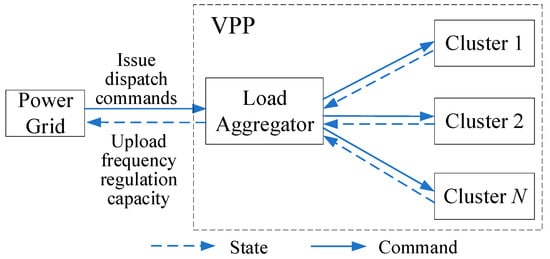
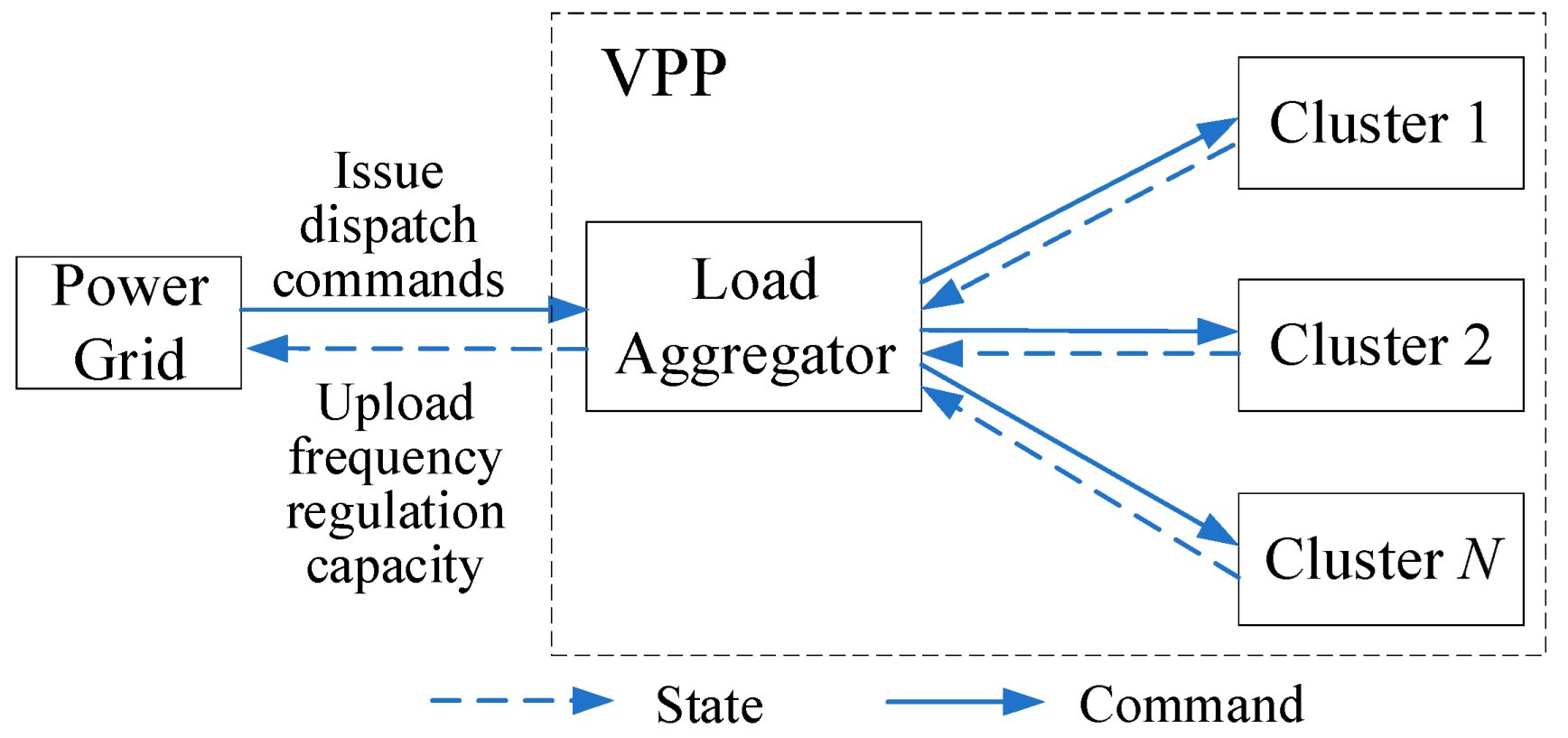
The building park managed by the VPP contains massive resources such as ESS, EVs, and HVAC systems. To improve the dispatch efficiency of these massive resources, this paper distinguishes the response differences of various devices in frequency regulation and classifies them according to the device states during dynamic dispatch, finally forming N equivalent control clusters. The process of the VPP participating in frequency regulation ancillary services is shown in Figure 1:
Figure 1.
Park VPP participation in frequency regulation ancillary services.
- (1)
- ESS cluster classification: according to the initial state of charge (SOC), they are divided into power-deficit clusters with low SOC that urgently need charging, balanced clusters with medium SOC and balanced bidirectional regulation capabilities, and nearly fully charged clusters with high SOC and large discharge potential.
- (2)
- EV cluster classification: according to the users’ charging urgency and parking preferences, they are divided into fast-charging clusters with strong charging rigidity that do not participate in discharging, slow-charging clusters with certain regulation flexibility, and saturated clusters that are nearly fully charged and have a high willingness to regulate.
- (3)
- HVAC cluster classification: comprehensively considering the differences in building thermal inertia and the tolerance boundaries of user comfort, HVAC systems are divided into 6 typical clusters formed by the cross-combination of “small/medium/large heat capacity” and “within the comfort deadband/at the limit margin”.
2.2. ESS Cluster Priority Model
2.2.1. Bidirectional Frequency Regulation Priority
ESSs have bidirectional regulation capabilities, and their willingness to participate in frequency regulation is strongly coupled with the current SOC. During upward frequency regulation, when the power grid lacks electricity and requires ESS to discharge, ESS with high SOC exhibits a strong willingness to discharge. Conversely, during downward frequency regulation, when the power grid has surplus electricity and requires ESS to charge, ESS with low SOC exhibits a strong willingness to charge. The normalized upward and downward frequency regulation priorities of the i-th ESS cluster are defined as follows:
where and are the upward and downward frequency regulation priority coefficients of ESS cluster i, respectively. SESS,i(t) is the real-time SOC of the ESS cluster at time t. SESS,max and SESS,min are the upper and lower SOC limits for the safe operation of the ESS.
2.2.2. ESS Cluster Physical Constraints
The dynamically dispatched ESS clusters must satisfy the upper and lower power limits, energy balance, and SOC constraints.
- (1)
- Power constraints
The charging and discharging power of the cluster is limited by the sum of the rated power of the current online devices. It is defined that a frequency regulation power of P > 0 indicates upward frequency regulation, meaning the device discharges or reduces its load. P < 0 indicates downward frequency regulation, meaning the device charges or increases its load.
where Pi,cha,max and Pi,dis,max are the maximum charging and discharging power of the i-th ESS cluster, respectively.
- (2)
- ESS SOC constraints
2.3. EV Priority Model
2.3.1. Bidirectional Frequency Regulation Priority
The frequency regulation potential of EVs is deeply constrained by their charging modes and expected off-grid states. A charging and discharging preference factor is introduced to represent user willingness, and its bidirectional priority model is defined as follows:
where and are the upward and downward frequency regulation priority coefficients of EV cluster i, respectively. γi is the charging and discharging state preference factor. SEV,i is the real-time average SOC of the EV cluster. Sreq,i is the user’s expected target off-grid power level. SEV,min is the lower power limit of the EV cluster.
2.3.2. EV Physical Constraints
- (1)
- Power constraints
The aggregated EV clusters must satisfy the power boundary constraints:
where Pi,ch,max and Pi,di,max are the maximum charging and discharging power limits of the i-th EV cluster at time t, respectively.
- (2)
- EV SOC constraints
This paper considers the baseline charging demand inherent to the EVs. The frequency regulation power is essentially a fine-tuning or reversal of this baseline power. The actual charging power is formed by superimposing the baseline demand and the frequency regulation command, and its SOC evolution model is as follows:
where Pbase,i is the baseline charging power demand of EV cluster i. PEV,i is the frequency regulation power undertaken by EV cluster i. ηEV is the comprehensive conversion efficiency of the EVs. EEV,i is the total battery capacity of the online vehicles in cluster i.
2.4. HVAC Cluster Priority Modeling
2.4.1. Bidirectional Frequency Regulation Priority
HVAC systems participate in frequency regulation at the cost of sacrificing some temperature comfort. The closer the indoor temperature is to the set target, the larger the regulation margin and the stronger the willingness to respond. Under cooling conditions, its bidirectional priority is defined as follows:
where and are the upward and downward frequency regulation priority coefficients of HVAC cluster i, respectively. Ti(t) is the current equivalent indoor temperature of HVAC cluster i. Tset,i is the set target temperature of HVAC cluster i. Tmax,i and Tmin,i are the upper and lower temperature limits tolerated by users.
2.4.2. HVAC Operational Constraints
To address the pain points of the traditional equivalent thermal parameter (ETP) model, such as its high dependence on building environmental parameters, difficulty in identification, and complex calculations [27], this paper proposes a simplified temperature change model oriented to high-frequency regulation. This model equates the role of the HVAC’s own temperature controller to a first-order inertia recovery element, and treats the frequency regulation command as an external power disturbance:
where βi is the HVAC working temperature recovery coefficient. αtem,i is the power disturbance sensitivity coefficient. PHVAC,i is the frequency regulation power undertaken by HVAC cluster i.
Among them, the HVAC working temperature recovery coefficient and the power disturbance sensitivity coefficient are not based on the data-driven identification of a specific physical building. Instead, they are typical representative values derived from the reduced-order approximation of the Taylor expansion of the ETP model for standard commercial buildings at specific operating points, aiming to provide reasonable basic physical boundaries.
To ensure user comfort, the operation of the HVAC must be strictly limited by the maximum frequency regulation power and the temperature deadband constraints:
where PHVAC,i,max is the maximum frequency regulation power that the air conditioning units of HVAC cluster i can provide at the current time.
Regarding the temperature calculation errors that the simplified model may introduce, since this strategy is oriented toward the real-time high-frequency dispatch of AGC, the massive thermal inertia of commercial buildings will greatly smooth out severe, sudden changes in indoor temperature during the short-term frequency regulation cycle from seconds to minutes. Therefore, the transient temperature calculation error introduced by this first-order inertia simplified model is extremely small, fully meeting the accuracy requirements of system-level engineering dispatch, while avoiding the computational complexity and parameter acquisition difficulty of the traditional ETP model.
3. Frequency Regulation Model
To address the multi-agent conflict of interest and privacy protection requirements within the VPP, a two-layer frequency regulation model based on the Stackelberg game is constructed [28]. This section constructs a Stackelberg game model with the load aggregator as the leader and each resource cluster as the follower. To solve the problem of inconsistent physical dimensions of different devices, a cross-resource universal comprehensive utility function considering state incentives is designed, and a fast bisection solution strategy is proposed based on the monotonicity principle.
3.1. Upper-Level VPP Optimization Model
Taking the minimization of its own economic cost as the objective function, the upper-level objective function JVPP consists of two parts: the frequency regulation deviation penalty cost and the energy purchase cost paid to internal resources.
where αgrid is the penalty weight coefficient for frequency regulation power deviation. Preq is the AGC frequency regulation command shortfall issued by the power grid. Pi,t is the actual response power of the i-th cluster. λ is the internal settlement electricity price issued by the VPP load aggregator.
To prevent vicious bidding or excessively high prices, electricity price boundaries must be set:
where λmin and λmax are the lower and upper limits of the settlement electricity price, respectively.
The total output power of the VPP must satisfy the deviation range ε allowed by the power grid dispatch:
where ε is a very small positive threshold.
3.2. Lower-Level Frequency Regulation Resource Response Model
3.2.1. Cross-Resource Universal Comprehensive Cost Model
To achieve a fair game among ESS, EVs, and HVAC, this paper constructs a universal virtual operating cost model that includes the startup threshold, regulation rigidity, and state incentives. For the i-th resource cluster, its comprehensive operating cost for participating in frequency regulation is defined as follows:
where Ci (Pi,t) is the comprehensive operating cost of the i-th resource cluster participating in frequency regulation. Pi,t is the frequency regulation response power of the i-th cluster at time t. ci is the device startup threshold cost coefficient. αi is the regulation rigidity coefficient. θi is the state incentive intensity coefficient. πi is the bidirectional state priority of the i-th resource cluster at time t.
ci represents the minimum compensation lower limit for the device to participate in frequency regulation. For the ESS, it is estimated based on the Levelized Cost of Storage and the battery cycle life degradation model. Since frequent charging and discharging cause significant life loss to lithium batteries, a higher threshold cost needs to be set to avoid ineffective dispatch. For HVAC systems, it is estimated based on typical commercial demand response compensation standards. Thanks to the massive thermal inertia of buildings, short-term frequency regulation has a minimal impact on human comfort, so its ci is set to the lowest. For EVs, it is dynamically estimated based on the time opportunity cost of the owner’s travel default.
αi represents the marginal discomfort that increases with the device’s output. The αi for HVAC can be fitted with an economic penalty based on the Predicted Mean Vote thermal comfort index recommended by the American Society of Heating, Refrigerating and Air-Conditioning Engineers, combined with user questionnaires. The αi for EVs can be dynamically estimated through the remaining parking time margin and the range anxiety model.
θi determines the degree to which the priority offsets the rigid cost, and its value can be calculated by evaluating the default fine or the irreversible equipment damage cost faced when the physical state of the system exceeds the limit.
To ensure that the cost function is strictly convex, meaning the game has a solution, the parameters must satisfy αi > θi > 0.
3.2.2. Follower Utility Function
The lower-level model takes the profit maximization of the frequency regulation resource clusters as the objective function Ui,t:
where Ui,t is the net utility of the i-th resource cluster.
3.2.3. Optimal Response Strategy Solution
Derived from the first-order KKT conditions of convex optimization theory, the optimal response power of the follower to the internal settlement electricity price can be obtained:
where P*i,t(λ) is the optimal response power of the follower under the electricity price λ(t). Pi,max is the maximum adjustable power of the i-th resource cluster.
3.3. Stackelberg Game Model Solution
This paper constructs the Stackelberg game model as follows:
where the VPP is the leader. USER = {1, 2, 3, …, N} is the set of followers, corresponding to the ESS, EV, and HVAC clusters divided in Section 2. SVPP and SUSER are the strategy sets of the game subjects VPP and followers, respectively. JVPP and UUSER are the objective functions of the VPP and followers, respectively.
The sequence of the game is as follows: the VPP first publishes the internal incentive electricity price at time t; each resource cluster determines its optimal response power according to the electricity price and its own state; and the VPP adjusts the electricity price according to the total response power until supply and demand are balanced.
Based on the global monotonic and convex characteristics of the comprehensive cost model, this paper abandons heuristic intelligent algorithms, which are prone to falling into local optima and are computationally time-consuming, and adopts a distributed bisection method for the solution. The upper-level VPP only needs to publish a tentative intermediate electricity price within the reasonable price range between λmin and λmax, and can quickly shrink the search boundary by comparing the magnitude relationship between the total output and the grid demand: If the supply falls short of the demand, the lower price limit is raised; conversely, the upper price limit is lowered.
This method can strictly converge to the unique Stackelberg equilibrium solution within logarithmic time complexity, fully meeting the computational power requirements of the second-level high-frequency AGC dispatch. At the same time, during the calculation process, the lower-level devices only need to upload the power response value P*i,t(λ). There is no need to upload privacy data such as physical boundaries of devices, utility coefficients, and battery states throughout the entire process, achieving a dual guarantee of computational efficiency and information security.
4. Multi-Time Scale Coordinated Control
Section 3 solves the optimal response power of each resource cluster under the ideal steady-state assumption based on the Stackelberg game model. During the real-time frequency regulation process, subject to communication delays and mechanical inertia, some resources find it difficult to achieve an instantaneous response. If the upper-level commands are executed directly, it is highly likely to cause a power support shortfall at the initial stage of the disturbance or excessive overdraw of the ESS.
This section proposes a dynamic weight reconstruction strategy based on time-varying availability. By converting the upper-level game results into baseline weights and making real-time corrections based on the device response status, the multi-time scale coordination of different resources is achieved.
4.1. Time-Varying Availability Modeling
After the park VPP receives the AGC command, EVs need to go through protocol parsing and communication handshakes, generally having a communication delay of several seconds. HVAC systems are limited by the compressor start-stop protection mechanism and building thermal inertia, presenting a mechanical response deadband of dozens of seconds. In contrast, relying on power electronic grid-connected converters, the ESS has millisecond-level response capabilities. However, due to its limited capacity, it is not suitable to undertake low-frequency, high-power regulation tasks for a long time.
Therefore, this paper defines the relative time variable tlocal = t − ttrig, where ttrig is the trigger time of the last game optimization. It also constructs a time-varying availability factor ρi ∈ [0, 1] for different clusters to describe the actual dispatchable capability of the cluster at time tlocal after being triggered.
- (1)
- EV and HVAC availability model
Considering the delay characteristics of EVs and HVAC in the initial response stage, their availability factors are modeled as delayed step functions:
where Tdelay,EV is the equivalent communication delay time constant of the EV cluster. Tdelay,HVAC is the equivalent mechanical response time constant of the HVAC cluster.
- (2)
- ESS availability model
The ESS has millisecond-level response capabilities and is the main force for smoothing high-frequency disturbances. However, limited by its high life depreciation cost and limited capacity, an availability attenuation mechanism with full-load support in the early stage and linear ramp-down in the later stage is designed:
where Texit,ESS is the time threshold when the ESS starts to exit. Tgame is the fixed update cycle of the Stackelberg game. κ is the attenuation slope coefficient. ρESS,min is the minimum availability retained by the ESS.
4.2. Multi-Time Scale Relay Control
According to the optimal response power of each cluster, its proportion in the total response power of the VPP is calculated and defined as the baseline weight:
where wbase,i is the baseline weight determined by the game. N is the total number of clusters participating in frequency regulation within the building park.
Combined with the time-varying availability factor, the effective weight weff,i of the cluster is corrected in real-time:
When the grid frequency regulation shortfall is small, the Stackelberg game will allocate all baseline commands to EV and HVAC loads with low threshold costs out of economic optimality considerations. However, both have a response delay in the early stage of frequency regulation. If directly normalized, the system will lose its response capability. This paper designs a deadband ESS mandatory requisition mechanism. When it is detected that the sum of the effective weights is zero, the system immediately interrupts the economic priority principle, activates the currently only ESS clusters capable of taking action, and allocates weights according to the internal state priority and capacity of the ESS.
The weight allocation coefficient of the real-time frequency regulation command finally issued to the i-th cluster is calculated as follows:
where wfinal,i is the final allocation coefficient of cluster i.
Considering the device’s physical power constraints, the final real-time power command for the i-th cluster is as follows:
4.3. Event-Triggered Mechanism
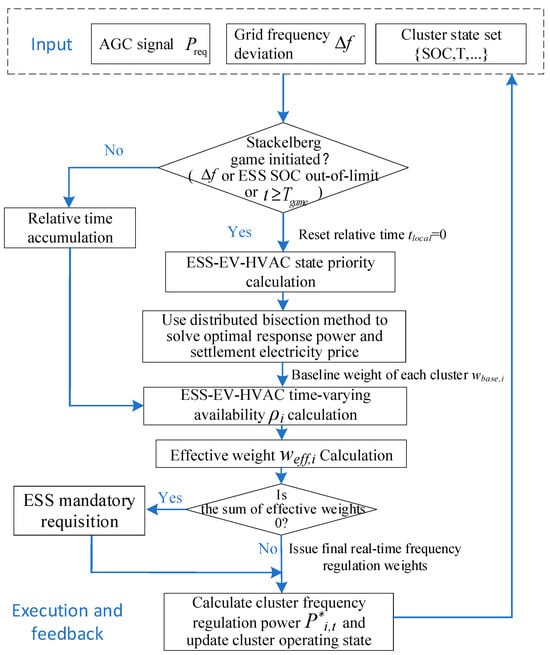
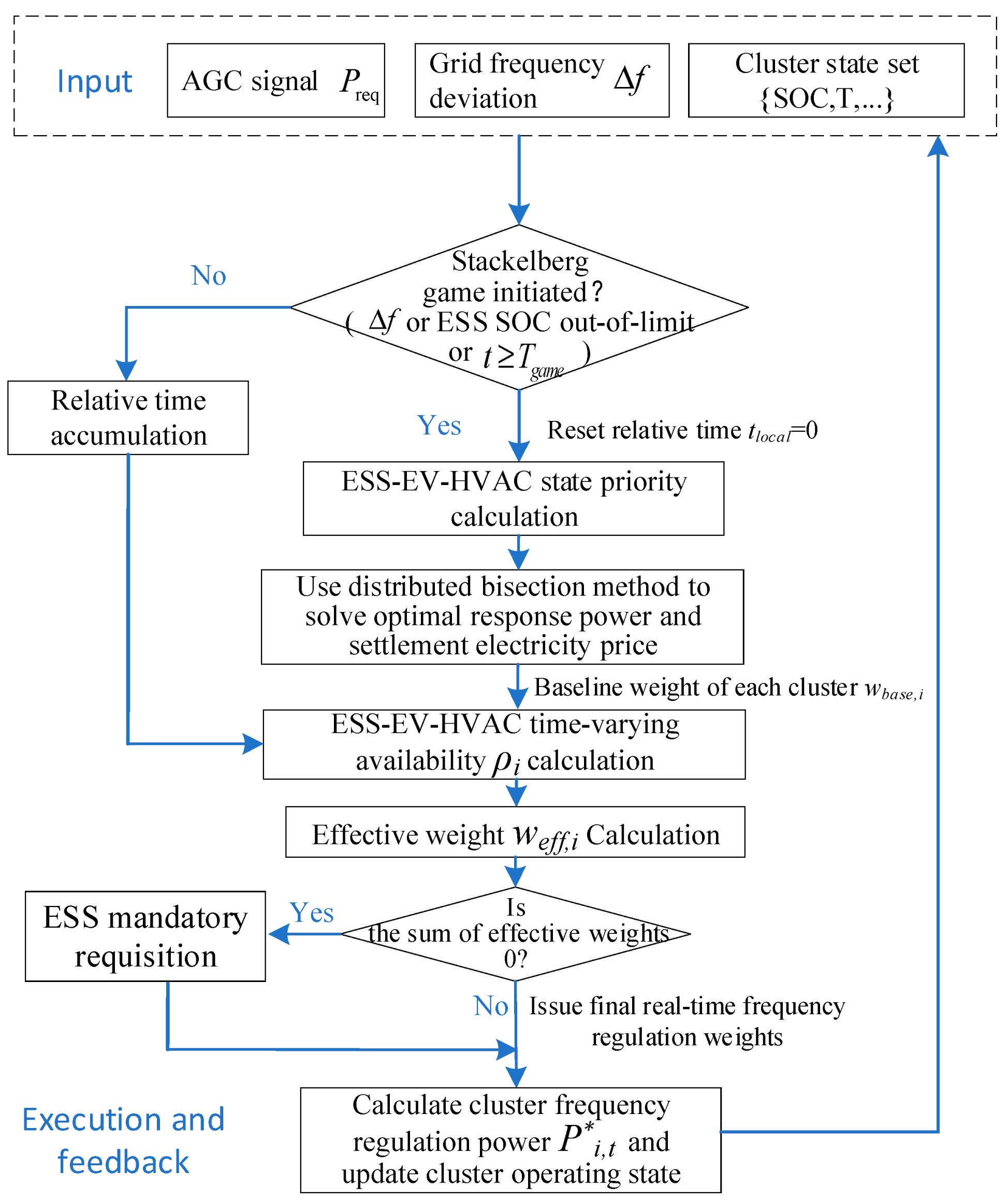
To balance control precision and computational burden, and to improve upon the single fixed-cycle scheduling, a time and event dual-mode triggered mechanism is designed to dynamically determine when to recall the Stackelberg game to update the baseline weight wbase,k.
- (1)
- Time-triggered mode
It is triggered once every fixed cycle Tgame to update the baseline weight of the Stackelberg game and correct the cumulative deviation of the system.
- (2)
- Event-triggered modeIt is triggered when the following emergency events are monitored and the cooling time Tc is satisfied:
- (1)
- Frequency out-of-limit: the grid frequency deviation exceeds the safety threshold ϵ.
- (2)
- State emergency: the ESS SOC is lower than the warning threshold, and the command remains discharging.
When the triggered mechanism takes effect, the Stackelberg game is initiated to update the baseline weights, and the relative time axis is reset to tlocal = 0. This operation will reset the ramp-down state of the ESS, achieving the emergency response of the ESS to large disturbances.
The specific frequency regulation process is shown in Figure 2.
Figure 2.
Frequency regulation flowchart.
5. Case Study
5.1. Case Study Parameters
A VPP simulation model is built on the MATLAB R2023a platform. The simulation is executed on a personal computer equipped with an AMD Ryzen 7 8845HS processor and 32 GB of RAM. The total simulation duration is set to 180 min. The update cycle Tgame for the dispatch of ESS, EV, and HVAC clusters and the Stackelberg game are both 5 min, and the lower-level real-time control step is 1 s. The power grid system inertia constant M = 40, the damping coefficient D = 10, the emergency trigger frequency out-of-limit threshold is ±0.15 Hz, and the ESS equivalent SOC warning value is 0.1.
The building park VPP aggregates a total of 12 equivalent resource clusters, including 3 ESS clusters, 3 EV clusters, and 6 HVAC clusters. To reflect the effectiveness of the state priority game, the initial states and physical preferences of different echelons are set. The SOC operating boundaries of the ESS are uniformly set to [0.05, 0.95]. The target temperature of the HVAC systems is uniformly set to 24 °C, and the tolerable temperature range is [22 °C, 26 °C]. The electricity price search interval for the Stackelberg game is set to [1, 10] CNY/kWh.
The Stackelberg game parameters of each cluster are shown in Table 1, Table 2 and Table 3, and the time-varying weight parameters are shown in Table 4.
Table 1.
Stackelberg game parameters of ESS clusters.
Table 2.
Stackelberg game parameters of EV clusters.
Table 3.
Stackelberg game parameters of HVAC clusters.
Table 4.
Time-varying weight parameters.
5.2. Case Study Results
5.2.1. Frequency Regulation Performance
To verify the impact of the proposed state priority, Stackelberg game, and multi-time scale relay logic on the overall system performance, this section designs comparative experiments under the same operating conditions. The combinations of mechanisms included in each control strategy are shown in Table 5.
Table 5.
Design of comparative experiments.
To comprehensively evaluate the frequency regulation capability and the ability to ensure comfort of each scheme, this paper designs the following five evaluation metrics:
where RMSE is the root mean square error (RMSE) of frequency, which evaluates the tracking accuracy of the system to AGC commands. Ttotal is the total simulation duration. ∆f(t) is the system frequency deviation at time t.
where MFD is the maximum frequency deviation of the system.
where RSOC is the proportion of time the ESS SOC exceeds the limits, quantifying the cycle life degradation of the ESS battery caused by excessive dispatch. 𝕀(·) is the indicator function, which equals 1 when the condition is true and 0 otherwise. 0.1 and 0.9 are the preset safe charging and discharging warning boundaries.
where ∆Tmax,viol is the maximum out-of-limit temperature difference of the HVAC clusters, evaluating the degree of damage to the users’ thermal comfort. Ti,max is the highest equivalent indoor temperature of the HVAC clusters. Ti,min is the lowest equivalent indoor temperature of the HVAC clusters.
where EEV,curt is the cumulative reduction of fast-charging power of the EV clusters, evaluating the degree of damage to the charging experience of the fast-charging EV clusters. PEV,fast(t) is the upward frequency regulation power allocated to the fast-charging EV clusters.
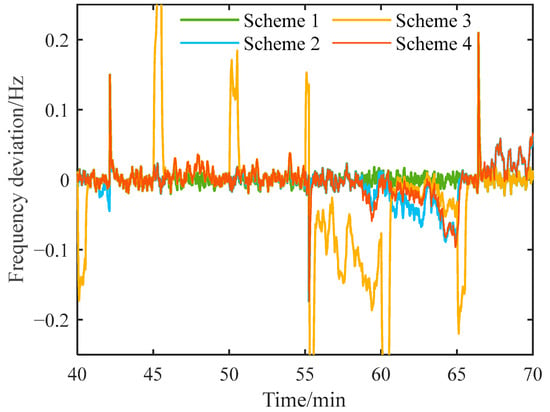
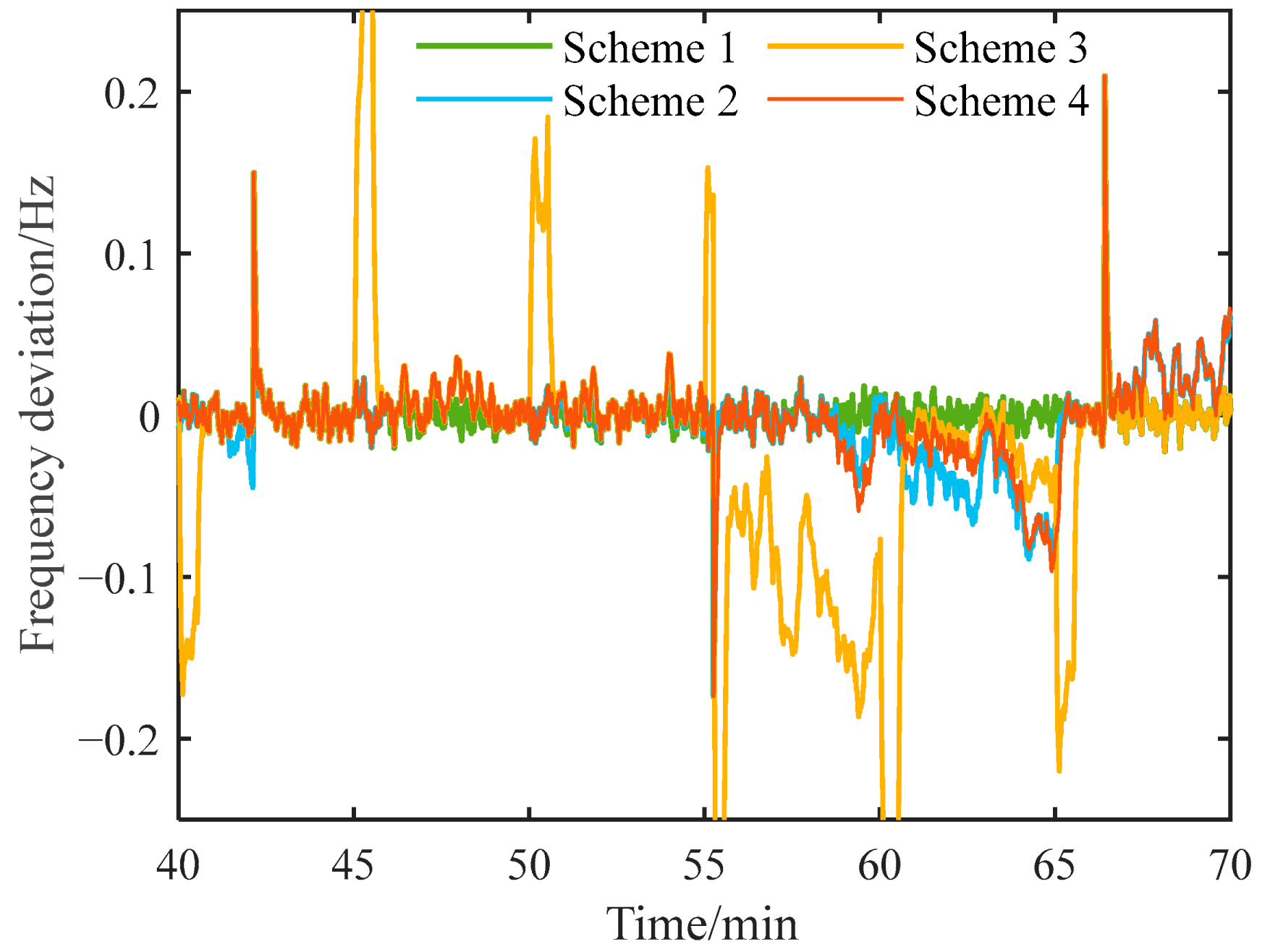
The frequency regulation effects of the four schemes under the same working conditions are shown in Figure 3, and the performance comparison across different dimensions is shown in Table 6.
Figure 3.
Frequency comparison under different control strategies.
Table 6.
Comprehensive performance comparison of different control strategies.
Combining Figure 3 and Table 6, it can be seen that although traditional frequency regulation strategies, such as the capacity proportional allocation strategy and the game strategy without priority, perform excellently in reducing frequency deviations, they greatly damage the comfort of various devices.
Specifically, the capacity proportional allocation method blindly extracts ESS power while ignoring the real-time SOC, resulting in deep power deficits during frequency regulation, with an SOC out-of-limit rate as high as 1.93%. Moreover, its cumulative reduction of charging power for the fast-charging EV clusters reaches up to 626.41 kWh, which greatly damages the charging experience of fast-charging users. The game strategy without priority focuses only on economic optimality and relies excessively on cheap HVAC resources, causing the maximum indoor temperature to break through the tolerable range and rise to 27.23 °C. This indicates that the lack of a state priority evaluation mechanism will lead to impaired comfort for the park devices during actual operation.
On the other hand, the strategy ignoring response delay verifies the necessity of multi-time scale coordination. Although it protects the physical states of the devices through the game, the system experiences a severe power shortfall at the initial stage of the disturbance because it ignores the mechanical deadband of the HVAC systems and the communication delay of EVs. This causes the maximum frequency deviation to surge to 0.4125 Hz, resulting in the loss of transient impact resistance capability. It being seemingly the lowest EEV,curt is merely a false advantage caused by the initial response failure.
In contrast, the proposed strategy limits the output of devices approaching their physical limits through the state priority mechanism, achieving zero out-of-limit occurrences for the ESS and HVAC systems. During the frequency regulation period, the highest equivalent indoor temperature of the HVAC clusters is controlled at 25.98 °C. At the same time, the proposed strategy significantly reduces EEV,curt and decreases the maximum frequency deviation of the system through the multi-time scale relay. The results prove that the proposed strategy can balance the comfort requirements of ESS, EV, and HVAC systems while ensuring the frequency regulation capability.
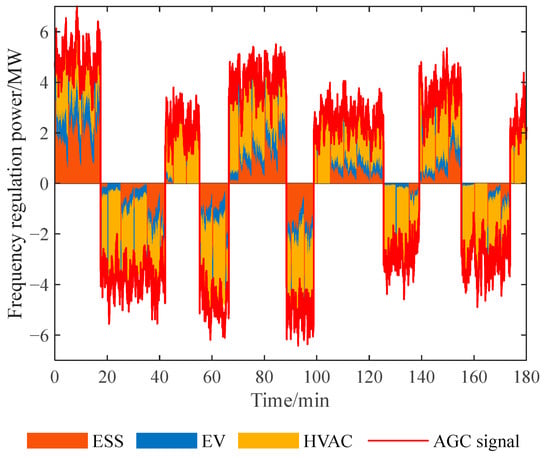
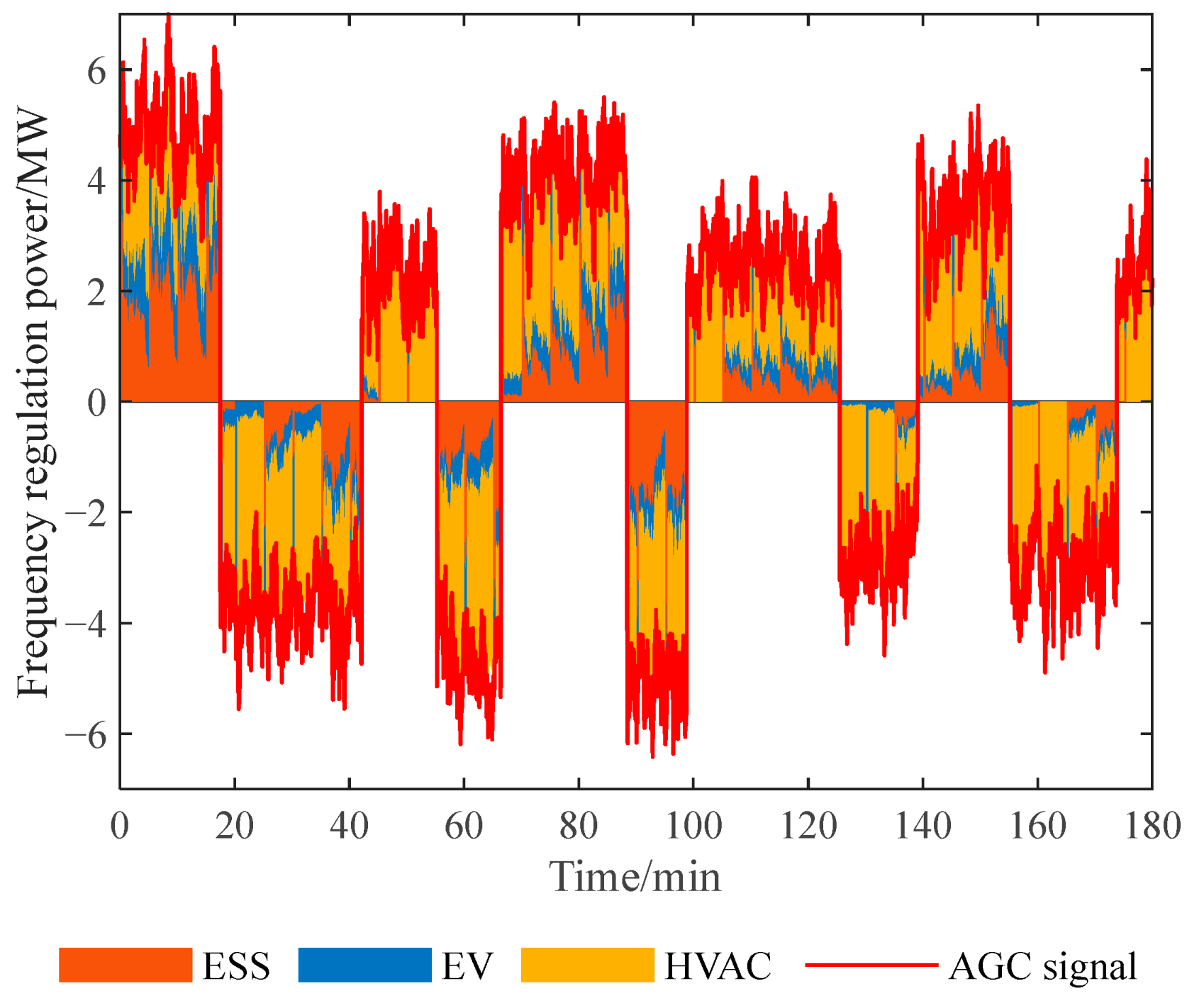
Figure 4 shows the real-time response output of heterogeneous resources within the VPP and the dynamic following of AGC command under the proposed control strategy. The outer envelope of the total system output, formed by superimposing ESS, EVs, and HVAC, maintains an extremely high degree of fit with the target AGC command issued by the power grid over the 3 h simulation period, achieving accurate tracking of the AGC signal.
Figure 4.
Response of ESS, EV, and HVAC resources.
The hierarchical distribution of the output of ESS, EVs, and HVAC in Figure 4 reveals the collaboration and division of labor mechanism of heterogeneous resources under multiple time scales. Relying on the lower startup threshold cost, HVAC systems obtain a higher baseline weight during the economic optimizing stage of the Stackelberg game, undertaking the vast majority of low-frequency and large-energy frequency regulation tasks. However, when the power grid encounters sudden large disturbances or command reversals, limited by the response delay of HVAC and EVs, cheap resources cannot achieve an instantaneous response. At this time, the ESS is rapidly awakened. This is manifested by the ESS instantly taking the dominant position within a very short period at the beginning of the frequency regulation, accurately filling the power response vacuum of the slow resources and shaving the high-frequency peaks. As the command duration extends, the ESS cluster triggers the linear ramp-down mechanism, and its output proportion gradually shrinks. Simultaneously, the HVAC and EVs that have successfully passed the physical response deadband smoothly expand their output scale and fully take over the remaining regulation demands.
Through the coordinated mode of the ESS responding to high-frequency fluctuations for short-term peak shaving, and EVs and HVAC relaying low-frequency fluctuations for long-term valley filling, the deep depletion of the expensive ESS is avoided. This effectively utilizes the flexibility potential of different loads, overcomes the response lag disadvantages caused by physical boundaries such as mechanical deadbands and communication delays among various resources internally, and effectively verifies the spatiotemporal coupling and complementary support capabilities of heterogeneous resources under the VPP architecture.
5.2.2. Electricity Price Variation and Multi-Time Scale Relay
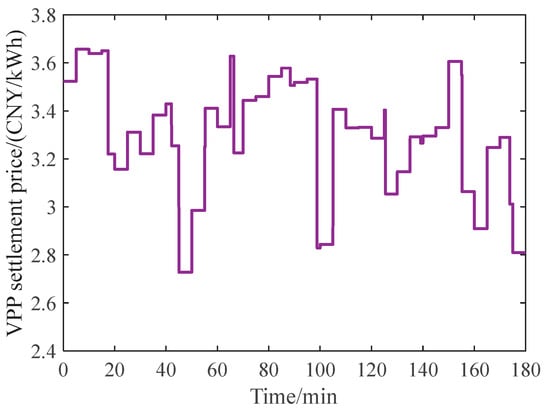
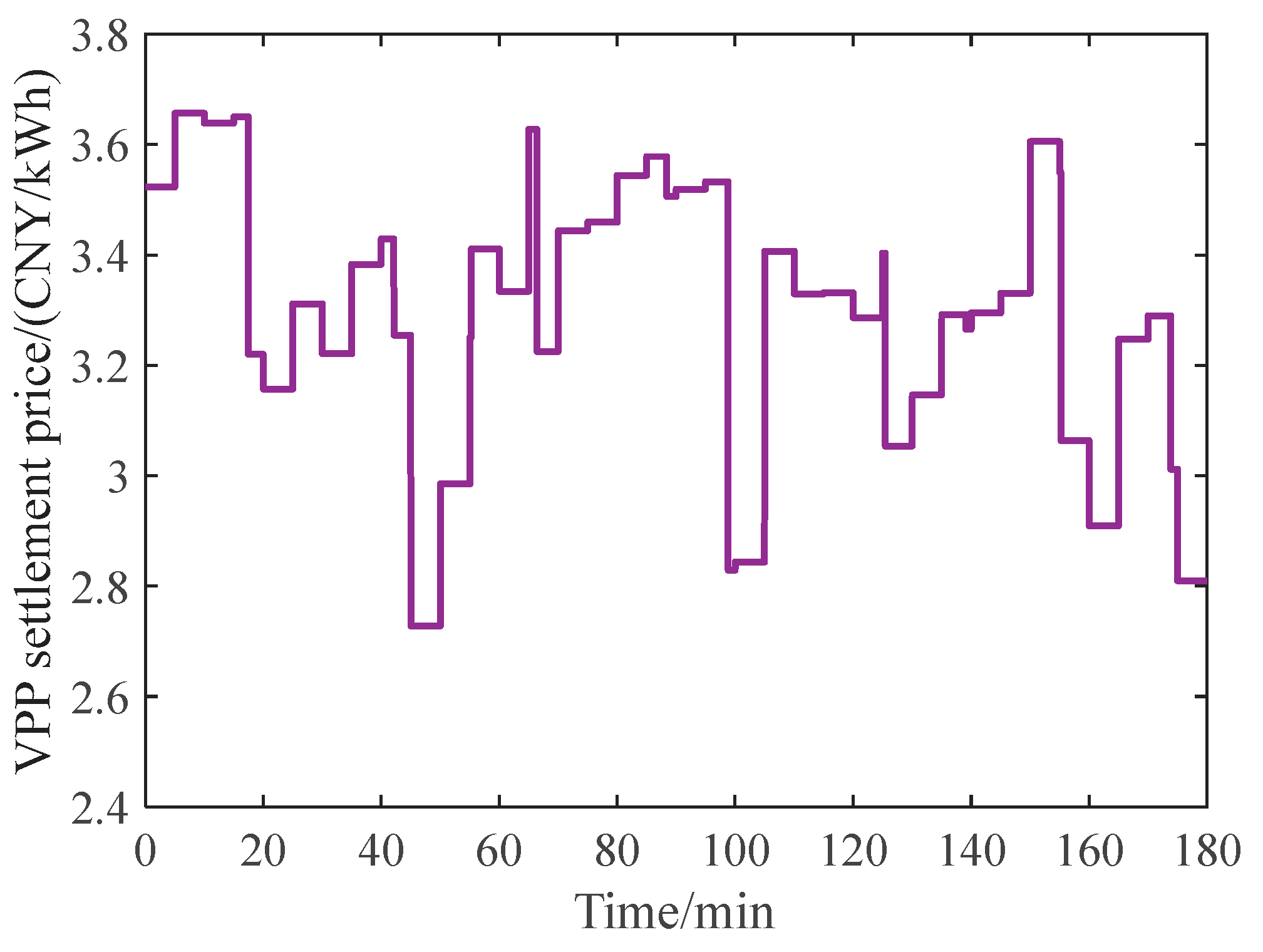
Figure 5 shows the dynamic change process of the internal settlement electricity price of the VPP under the Stackelberg game architecture. The overall electricity price fluctuates in a step-like manner within the range of 2.5 to 3.6 CNY/kWh, and this fluctuation range highly matches the threshold cost setting of the underlying heterogeneous resources. The startup thresholds of HVAC, EVs, and ESS are 2.3 CNY/kWh, 3.0 CNY/kWh, and 3.2 CNY/kWh, respectively. When the grid frequency regulation command shortfall is small, the system only needs to pay a lower marginal price to meet the power balance. The electricity price is between 2.5 and 3.0 CNY/kWh. At this time, the ESS is exempted from action because it does not reach the startup threshold cost, achieving adaptive physical isolation based on the economic game. When the frequency regulation demand surges or the low-cost resources approach their physical limits, causing the regulation rigidity to increase sharply, the electricity price rises rapidly to above 3.2 CNY/kWh. The system relies on high incentives to awaken EVs and ESS to connect to the grid to provide power support. The rise and fall patterns of electricity prices intuitively reflect the adaptive dispatch capability of the market-oriented pricing mechanism to the response of underlying heterogeneous resources.
Figure 5.
Electricity price fluctuation chart.
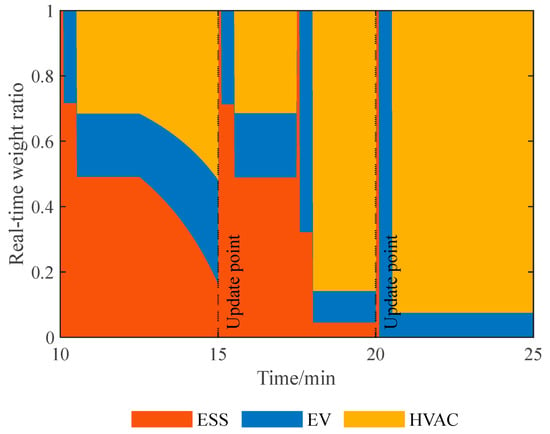
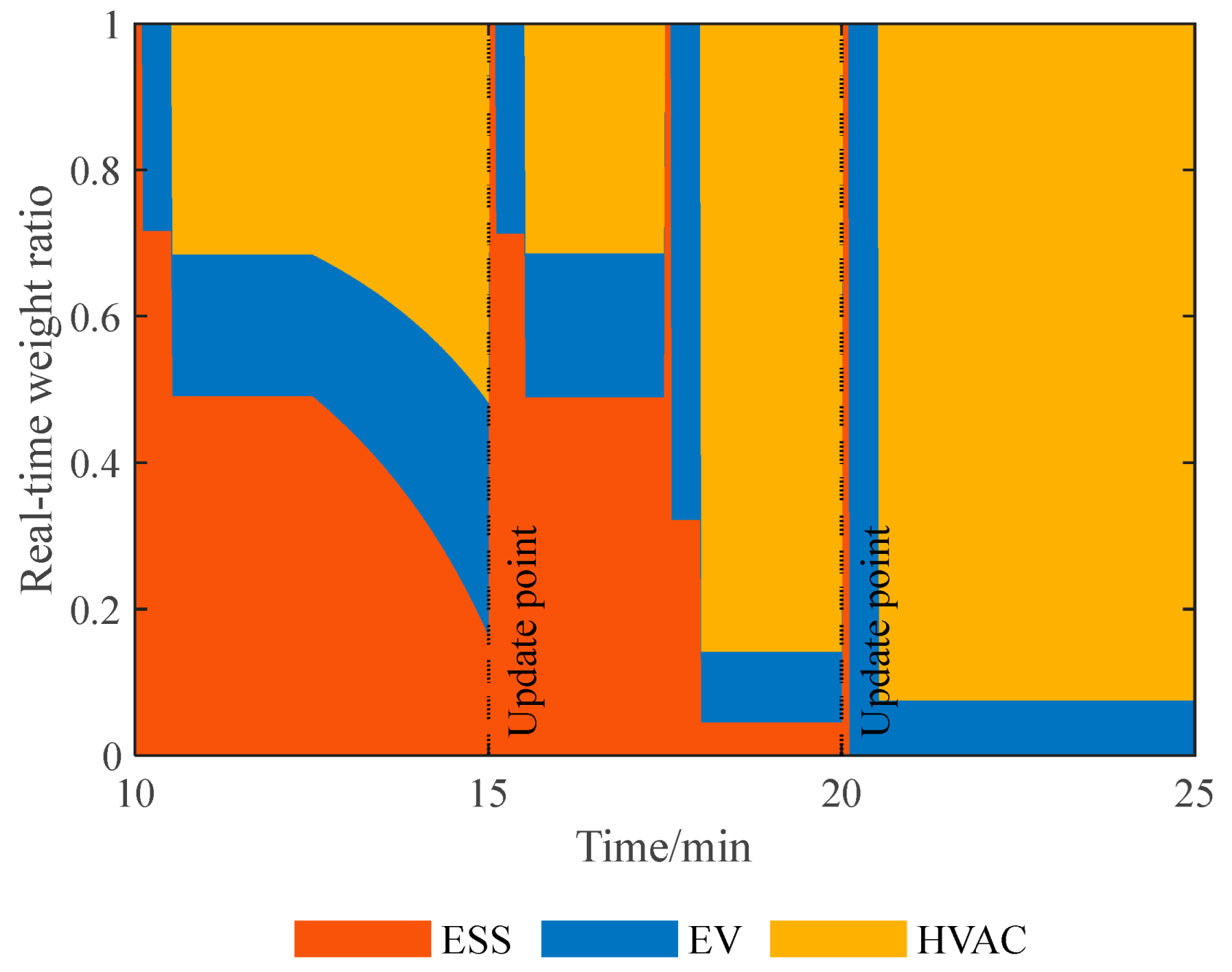
Figure 6 reflects the changing process of device weights under multiple time scales. In the 10 to 15 min interval, each cluster strictly follows the game weights to output cooperatively. When the duration of frequency regulation in this cycle crosses the 150 s limit, the ESS triggers the capacity protection mechanism, and its output weight begins to decay linearly. Under the dynamic normalization constraint, the weight proportions of EVs and HVAC systems passively and smoothly increase, achieving a sequential handover of frequency regulation responsibilities from power-type fast resources to energy-type slow resources. In the 15 to 20 min interval, the system encounters a frequency out-of-limit event at the 18th minute. The event-triggered mechanism is activated, and the system restarts the game to calculate the optimal output weights of each cluster in the new environment. The ESS immediately regains the maximum response weight, effectively curbing further deterioration of the grid frequency.
Figure 6.
Time-varying weight proportion chart of ESS, EVs, and HVAC.
In the 20 to 25 min interval, the weight evolution demonstrates the working logic of the physical deadband mandatory requisition mechanism. At the cycle update node of the 20th minute, the Stackelberg game algorithm allocates all baseline weights to HVAC systems and EVs, which have cost advantages, and the economic allocation weight of the ESS drops to zero. However, limited by the response delays of EVs and HVAC systems, the purely economic optimal allocation faces a regulation vacuum in the initial stage of strategy execution. At this time, the ESS mandatory requisition mechanism automatically intervenes. Within 5 s after the command is issued, the ESS takes over all frequency regulation tasks. As time goes by, the slow resources successively cross the physical deadband barrier, the system automatically cancels the emergency requisition state, the ESS quickly exits the response, and other load resources fully take over and restore to the economically optimal proportion. While ensuring the optimal economic benefits of the VPP, this mechanism makes up for the physical tracking blind spot under an extremely short time scale.
5.2.3. Internal Response Characteristics of Clusters Based on State Priority
To analyze the output allocation mechanism of state priority among the same type of device clusters, this paper intercepts the data within the first 50 min of the simulation for verification. Within this interval, the system experiences a typical operating condition transition from continuous upward frequency regulation to downward frequency regulation, and various heterogeneous resources show significantly differentiated response trajectories in the game relying on their real-time physical states.
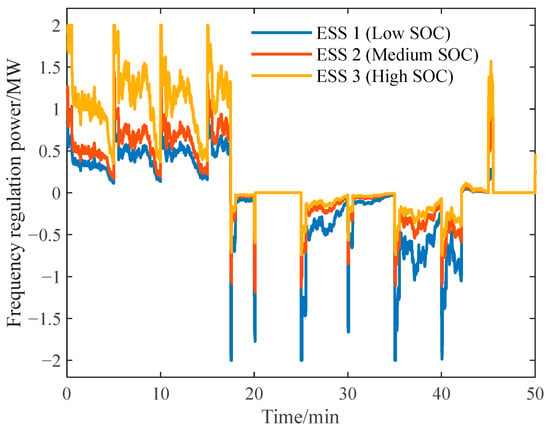
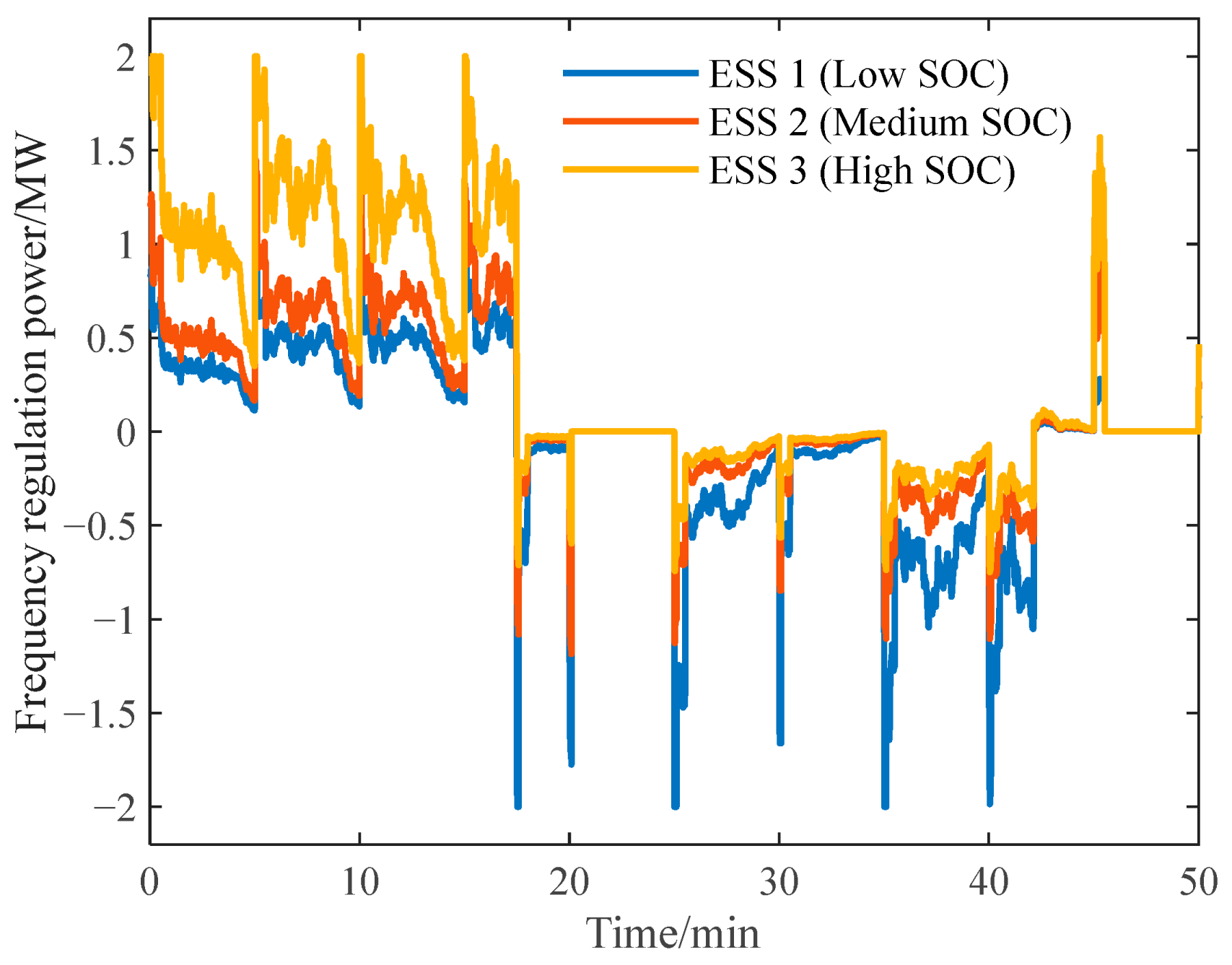
Figure 7 shows the frequency regulation power curves of three ESS clusters with different SOC states. In the upward frequency regulation stage, there is a power shortfall in the grid. At this time, the high SOC cluster has extremely high upward frequency regulation priority, which can effectively offset the rigid regulation cost in the Stackelberg game, thereby winning the bid with a strong competitive advantage and undertaking the highest discharging power. In contrast, the low SOC cluster in a power-deficient state has lower priority, and its output curve is suppressed at the bottom.
Figure 7.
Comparison of frequency regulation power among three types of ESS clusters.
In the downward frequency regulation stage, the grid power is in surplus, and the priority pattern is reversed. The downward frequency regulation priority of the low SOC cluster instantly jumps, turning to actively absorb the surplus power of the grid and undertaking the largest charging power. Meanwhile, the high SOC cluster automatically retreats to the last place in terms of output due to the lack of charging space. This dynamic allocation mechanism, based on bidirectional priority, abandons the rigid traditional mode of proportional allocation by capacity. While responding to grid commands, it achieves the adaptive balance of SOC within the clusters. This process proves that the proposed strategy does not need to rely on artificially set rigid deadbands. It can achieve adaptive SOC balance among clusters and protect battery life by relying on the market-oriented priority game.
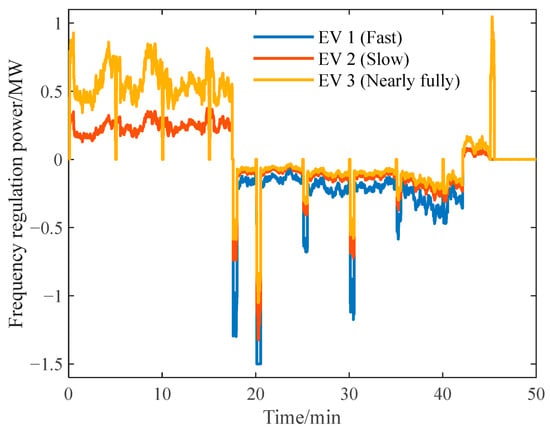
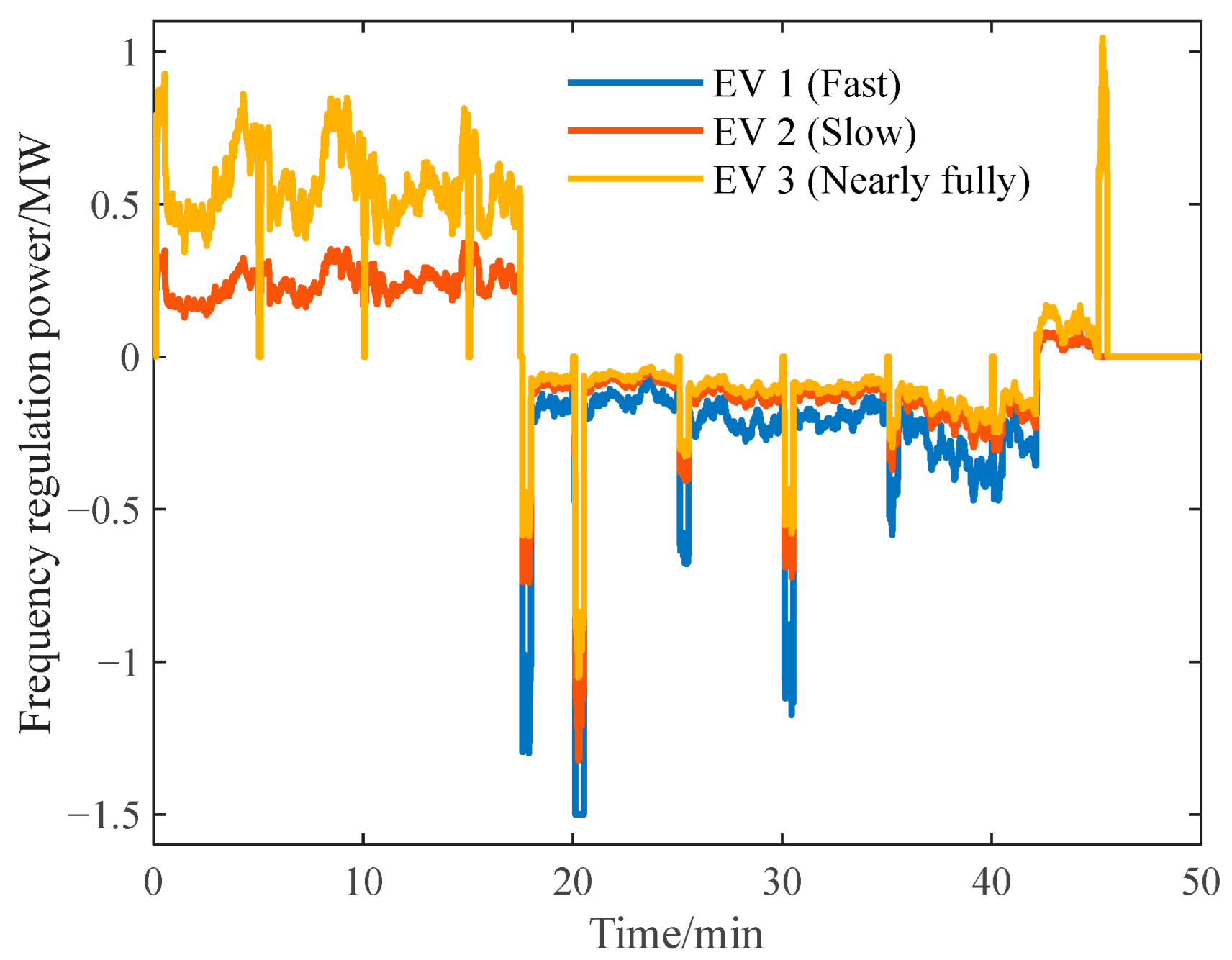
Figure 8 shows the frequency regulation power curves of EV clusters under multiple preference constraints. Different from the traditional centralized average allocation strategy, the strategy in this paper considers the rigid charging demands and range anxiety of car owners. Cluster EV 1 actively absorbs power during downward frequency regulation. However, when facing upward frequency regulation commands, its state priority is extremely low, and it refuses to participate in reverse discharging, thereby guaranteeing the users’ fast energy replenishment needs.
Figure 8.
Comparison of frequency regulation power among three types of EV clusters.
In contrast, for cluster EV 3, its upward frequency regulation priority is fully amplified because its power level has reached expectations, and it has ample parking time on the grid. During upward frequency regulation, cluster EV 3 exhibits extremely high response activity and large discharging power, fully utilizing the mobile energy storage potential of vehicle-to-grid interactions. This adaptive allocation mechanism, based on the coupling of state and preference, greatly enhances the willingness and safety of users to participate in frequency regulation ancillary services.
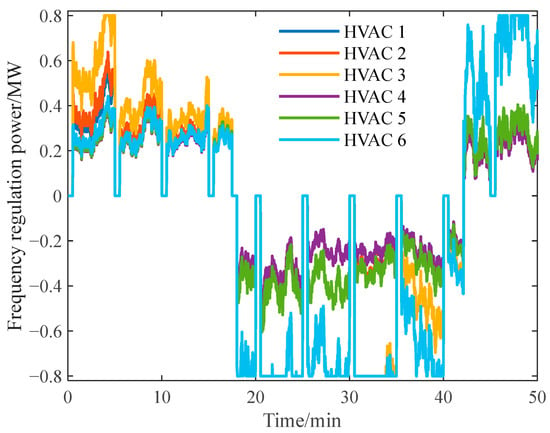
Figure 9 shows the response patterns of HVAC clusters under the influence of indoor temperature and building thermal inertia. Stimulated by the same frequency regulation commands, HVAC clusters with different characteristics exhibit highly differentiated power-sharing proportions.
Figure 9.
Comparison of frequency regulation power among 6 types of HVAC clusters.
Observed from the temperature margin dimension, clusters with an initial temperature in the center of the comfort zone have ample upward and downward frequency regulation space, and thus consistently undertake the largest proportion of the power response within the first 50 min. For clusters whose initial temperature approaches the upper limit margin, their upward frequency regulation priority decays significantly. The system automatically reduces the load shedding commands for these clusters to prevent the indoor temperature from breaching the baseline of human comfort.
Observed from the dimension of building thermal inertia, under the same temperature state, clusters with larger heat capacities are less sensitive to temperature changes. Therefore, they are assigned higher state incentive intensity coefficients in the game model. As a result, clusters with large heat capacities exhibit larger power response amplitudes, while the action amplitudes of clusters with small heat capacities are significantly flattened.
Under the upward frequency regulation conditions, HVAC clusters need to reduce their cooling power, which will cause indoor temperatures to rise. At this time, the cluster with its temperature near the set temperature and large heat capacity characteristics has an ample regulation margin and a strong ability to resist temperature rise. Its state priority is the highest, and the allocated output weights show a rule of large heat capacity > medium heat capacity > small heat capacity. Specifically, Cluster 3 serves as the main force of the HVAC systems throughout the upward frequency regulation stage. Due to its largest building thermal inertia, the indoor temperature rises most slowly when providing the same frequency regulation power, resulting in an extremely gradual attenuation of its state priority. Therefore, in the game allocation, the output curve of Cluster 3 always remains at the top, widening a significant power response gap with small heat capacity clusters that are highly susceptible to temperature fluctuations, such as Cluster 1, and undertaking the long-time scale frequency regulation base load. Meanwhile, the three types of HVAC clusters whose initial temperatures have approached the upper limit margin have extremely low priorities due to the exhaustion of their temperature rise margins. The system strictly limits their participation in upward frequency regulation to prevent user comfort from being compromised.
Under the downward frequency regulation condition, HVAC clusters need to increase their cooling power. At this time, the clusters with temperatures approaching the upper limit margin have a strong cooling demand. Their downward frequency regulation priorities increase, and they actively participate in power absorption according to their own heat capacities, thereby accelerating the return of the indoor temperature to the set baseline value. The initial temperature of Cluster 6 approaches the upper limit and has the largest heat capacity, thus exhibiting the strongest frequency regulation potential during the downward frequency regulation stage. Although its output is strictly limited by the system during upward frequency regulation due to temperature risks, after entering the downward frequency regulation stage, because the cooling process of buildings with a large heat capacity is particularly slow, its physical demand for urgent cooling to restore comfort is transformed into an extremely high downward frequency regulation priority. This enables Cluster 6, when absorbing the surplus power from the grid, to have a response magnitude that far exceeds that of the small heat capacity Cluster 4 under the same temperature conditions, achieving a global win-win situation of deep valley surplus power absorption for the grid and rapid cooling at the underlying level. This response logic fully utilizes the frequency regulation potential of the building’s inherent thermal inertia while achieving imperceptible protection of user temperature comfort.
Based on the comprehensive response characteristics in Figure 7, Figure 8 and Figure 9, it can be seen that the Stackelberg game architecture for heterogeneous resources constructed in this paper not only meets the second-level dispatch requirements of the power grid at the system level, but also achieves the optimal configuration of device state loss, rigid user charging demand, and temperature comfort at the device level through the dynamic correction of state priority parameters.
5.2.4. Sensitivity and Scalability Analysis
To explore the impact of parameter selection in the comprehensive cost model on the results and the application potential of the algorithm under massive resource integration, this section conducts sensitivity and scalability tests.
- (1)
- Sensitivity analysis of the HVAC regulation rigidity coefficient
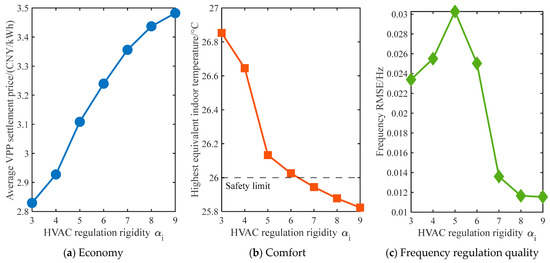
Figure 10 shows the variation trends of system economy, environmental comfort, and RMSE under different settings of the HVAC regulation rigidity coefficient αi.
Figure 10.
Sensitivity test of the HVAC regulation rigidity coefficient.
As shown in Figure 10a,b, as αi increases, which indicates a decrease in users’ tolerance for temperature deviation, the willingness of HVAC systems to participate in frequency regulation declines. To make up for the power shortfall, the VPP must dispatch EVs and ESS with higher threshold costs, causing the average settlement electricity price of the system to show a monotonically increasing trend. At the same time, the reduction in the equivalent discharge power of HVAC systems significantly decreases their highest indoor temperature. When αi > 6, the highest indoor temperature is strictly suppressed below 26 °C. This verifies that the proposed strategy can effectively achieve a soft constraint on physical out-of-limit behaviors by adjusting the underlying economic parameters.
Figure 10c shows that the system frequency RMSE exhibits a trend of initially increasing and then decreasing as αi increases. In the low αi stage, HVAC systems, which have low response costs but mechanical delays, dominate the frequency regulation, generating a certain tracking error. In the medium αi stage, the frequency regulation responsibility begins to shift to EVs and the ESS. The deadband overlap among devices with different response speeds leads to brief coordination friction, causing the frequency RMSE to reach a peak. In the high αi stage, due to the excessively high cost of HVAC systems, the system mainly dispatches the fast-responding ESS and EVs to participate in frequency regulation, which significantly reduces the frequency RMSE. The above analysis demonstrates that the parameters selected in this paper effectively balance the control precision of grid frequency regulation and the comfort requirements of the devices.
- (2)
- Computational burden and scalability analysis
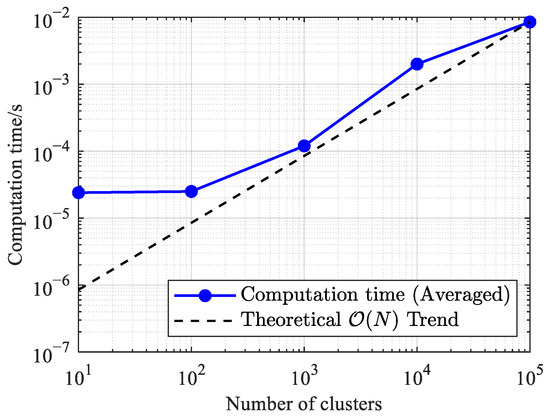
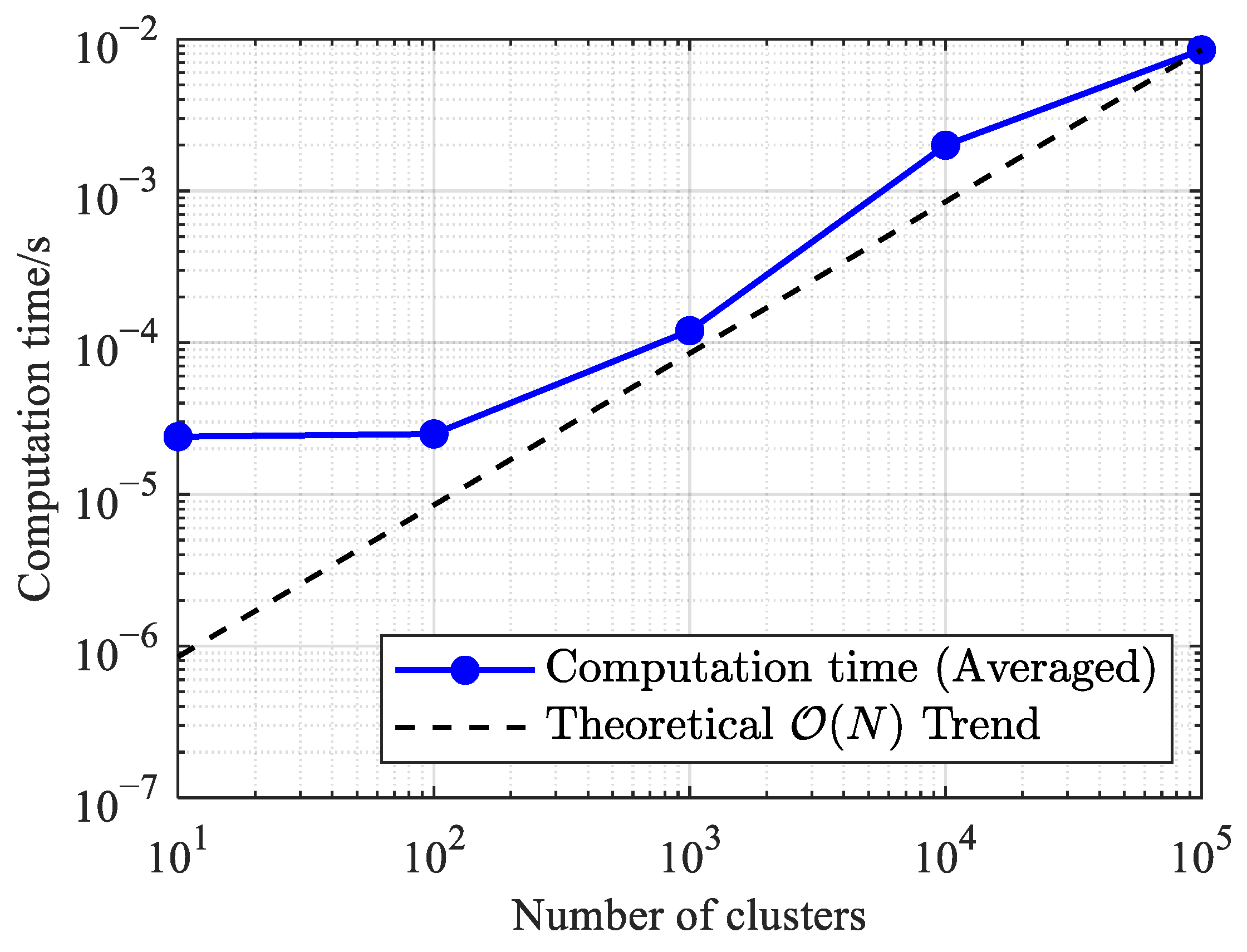
Figure 11 shows the computation time for solving a single price game under different numbers of building park clusters, ranging from 10 to 105.
Figure 11.
Computation time test of the game algorithm.
In the log-log coordinate system, the actual computation time curve is nearly parallel to the theoretical (N) complexity dashed line. This is because the number of iterations for the adopted bisection game solution depends solely on the tolerance precision of the electricity price search interval, while the inner-layer response calculation is strictly linearly independent. Even under the extreme scale of a hundred thousand nodes, the computation time remains at the millisecond level, perfectly satisfying the real-time high-frequency dispatch requirements of the power grid.
Regarding communication requirements, the proposed distributed Stackelberg game architecture does not require the central node to collect the nonlinear physical parameters of all devices. The VPP aggregator only needs to issue a one-dimensional electricity price signal, and the underlying devices return a one-dimensional power intention signal after calculating based on their local states. This lightweight star-topology communication interaction effectively protects user privacy while avoiding massive data throughput, proving that the control framework possesses excellent scalability in large-scale plug-and-play scenarios.
6. Conclusions
To address the difficulties of physical differences and conflicts of interest faced by park ESS, EV, and HVAC resources participating in grid frequency regulation, this paper proposes a multi-time scale coordinated frequency regulation strategy based on state priority and the Stackelberg game. The main conclusions are as follows:
- (1)
- A bidirectional priority model for ESS, EVs, and HVAC based on state priority is constructed. By converting the operating states of different types of devices into normalized bidirectional priority indicators, it breaks the traditional static capacity allocation barrier, achieving accurate quantification of the frequency regulation potential within the clusters and adaptive protection of the devices.
- (2)
- The Stackelberg game model considering state incentives can minimize the frequency regulation cost of the building park VPP while fully considering the rigid energy demands and comfort of device users. This achieves an optimal balance between physical states and economic benefits.
- (3)
- A multi-time-scale weight reconstruction mechanism based on time-varying weights and ESS mandatory requisition is designed. It achieves the seamless coordination of the short-term strong support from the ESS and the long-term relay from EVs and HVAC systems. This makes up for the power tracking blind spots of the steady-state economic game at the transient execution level.
Although the proposed frequency regulation strategy demonstrates excellent performance in balancing frequency regulation accuracy and device comfort through simulation, there remain certain limitations regarding experimental validation. Considering that this framework is specifically designed for large-scale heterogeneous resources in building park VPPs, it is practically difficult to fully simulate the complex physical environments and communication dynamics of such a scale in a pure software laboratory environment. Therefore, future research will focus on developing a hardware-in-the-loop real-time simulation platform and conducting field tests in small-scale power grids to systematically verify the hardware execution efficiency and physical feasibility of this strategy under actual deployment scenarios.
Author Contributions
Conceptualization, Z.D. and Z.H.; methodology, Y.L. and L.M.; writing—original draft preparation, Z.D., and Y.L.; writing—review and editing, Z.H. and L.M. All authors have read and agreed to the published version of the manuscript.
Funding
This research was funded by (1): the Science and Technology Project of Guangdong Yejian Construction Drawing Review Center Co., Ltd.: x2jzD9254650. (2): the Science and Technology Innovation Plan of the Department of Housing and Urban-Rural Development of Guangdong Province, grant number 20250226K0006.
Data Availability Statement
The raw data supporting the conclusions of this article will be made available by the authors on request.
Conflicts of Interest
Author Zhiying Du was employed by the company Guangdong Yejian Construction Drawing Review Center Co., Ltd. Author Zhihui He was employed by the company Yuanzhu Engineering Design Co., Ltd. Author Lili Mo was employed by the company Architectural Design & Research Institute of SCUT Co., Ltd. The authors declare that this study received funding from Guangdong Yejian Construction Drawing Review Center Co., Ltd. The funder was not involved in the study design, collection, analysis, interpretation of data, the writing of this article or the decision to submit it for publication. The remaining authors declare that the research was conducted in the absence of any commercial or financial relationships that could be construed as a potential conflict of interest.
Abbreviations
The following abbreviations are used in this manuscript:
| Abbreviations | |
| VPP | Virtual power plant |
| ESS | Energy storage system |
| EV | Electric vehicle |
| HVAC | Heating, ventilation, and air conditioning |
| AGC | Automatic generation control |
| SOC | State of charge |
| ETP | Equivalent thermal parameter |
| RMSE | Root mean square error |
| Nomenclature | |
| M | Power grid system inertia constant |
| D | Power grid damping coefficient |
| Tc | Cooling time for the event-triggered mechanism |
References
- Lam, L.H.; Nam, L.K.; Dung, N.K.T.; Hieu, N.H. Two-Area Automatic Generation Control for Power Systems with Highly Penetrating Renewable Energy Sources. Electronics 2024, 13, 2907. [Google Scholar] [CrossRef] [Scilit]
- Varhegyi, G.; Nour, M. Integrating fast frequency response ancillary services: A global review of technical, procurement, and market integration challenges. Clean Energy 2025, 9, 204–218. [Google Scholar] [CrossRef] [Scilit]
- Jin, W.; Wang, P.; Yuan, J. Key role and optimization dispatch research of technical virtual power plants in the new energy era. Energies 2024, 17, 5796. [Google Scholar] [CrossRef] [Scilit]
- Qin, Y.; Rao, Y.; Xu, Z.; Lin, X.; Cui, K.; Du, J.; Ouyang, M. Toward flexibility of user side in China: Virtual power plant (VPP) and vehicle-to-grid (V2G) interaction. eTransportation 2023, 18, 100291. [Google Scholar] [CrossRef] [Scilit]
- Esfahani, M.; Alizadeh, A.; Cao, B.; Kamwa, I.; Xu, M. A stochastic-robust aggregation strategy for VPP to participate in the frequency regulation market via backup batteries. J. Energy Storage 2024, 98, 113057. [Google Scholar] [CrossRef] [Scilit]
- Ruan, G.; Qiu, D.; Sivaranjani, S.; Awad, A.S.; Strbac, G. Data-driven energy management of virtual power plants: A review. Adv. Appl. Energy 2024, 14, 100170. [Google Scholar] [CrossRef] [Scilit]
- Wu, Q.; Li, C.; Bai, J. Optimal bidding strategy for multi-energy virtual power plant participating in coupled energy, frequency regulation and carbon trading markets. Int. J. Hydrogen Energy 2024, 73, 430–442. [Google Scholar] [CrossRef] [Scilit]
- Zhou, D.; Zou, Z.; Dan, Y.; Wang, C.; Teng, C.; Zhu, Y. An integrated strategy for hybrid energy storage systems to stabilize the frequency of the power grid through primary frequency regulation. Energies 2025, 18, 246. [Google Scholar] [CrossRef] [Scilit]
- Zhang, K.; Xie, Y.; Liu, N.; Wang, Y. Secondary Frequency Regulation via EV Aggregation-Based Virtual Power Plants: A Mean Field Game Strategy. IEEE Trans. Smart Grid 2025, 16, 3919–3933. [Google Scholar] [CrossRef] [Scilit]
- Lu, X.; Adetola, V.; O’Neill, Z. What are the impacts on the HVAC system when it provides frequency regulation?—A comprehensive case study with a Multi-Zone variable air volume (VAV) system. Energy Build. 2021, 243, 110995. [Google Scholar] [CrossRef] [Scilit]
- Chen, Q.; Lyu, R.; Guo, H.; Su, X. Real-time operation strategy of virtual power plants with optimal power disaggregation among heterogeneous resources. Appl. Energy 2024, 361, 122876. [Google Scholar] [CrossRef] [Scilit]
- Mo, L.; Lan, J.; Chen, Z.; Yang, H.; Liao, X.; Chen, H.; Chen, S. Multi-time scale frequency regulation control of virtual power plant based on fuzzy sets. IEEE Trans. Smart Grid 2025, 16, 2361–2374. [Google Scholar] [CrossRef] [Scilit]
- Sun, X.; Xie, H.; Qiu, D.; Xiao, Y.; Bie, Z.; Strbac, G. Decentralized frequency regulation service provision for virtual power plants: A best response potential game approach. Appl. Energy 2023, 352, 121987. [Google Scholar] [CrossRef] [Scilit]
- Wang, J.; Wang, Z.; Yang, B.; Liu, F.; Wei, W.; Guan, X. V2G for Frequency Regulation Service: A Stackelberg Game Approach Considering Endogenous Uncertainties. IEEE Trans. Transp. Electrif. 2025, 11, 463–475. [Google Scholar] [CrossRef] [Scilit]
- Shui, J.; Peng, D.; Zeng, H.; Song, Y.; Yu, Z.; Yuan, X.; Shen, C. Optimal scheduling of multiple entities in virtual power plant based on the master-slave game. Appl. Energy 2024, 376, 124286. [Google Scholar] [CrossRef] [Scilit]
- Liu, X.; Li, Y.; Wang, L.; Tang, J.; Qiu, H.; Berizzi, A.; Valentin, I.; Gao, C. Dynamic aggregation strategy for a virtual power plant to improve flexible regulation ability. Energy 2024, 297, 131261. [Google Scholar] [CrossRef] [Scilit]
- Zhan, J.; Huang, M.; Sun, X.; Chen, Z.; Zhang, Y.; Xie, X.; Chen, Y.; Qiao, Y.; Ai, Q. Aggregation Method and Bidding Strategy for Virtual Power Plants in Energy and Frequency Regulation Markets Using Zonotopes. Energies 2025, 18, 2458. [Google Scholar] [CrossRef] [Scilit]
- Huang, M.; Lin, W.; Ma, J.; Wang, Y. Performance-Integrated Virtual Power Plant Management in the Frequency Regulation Market. IEEE Trans. Smart Grid 2025, 16, 5111–5127. [Google Scholar] [CrossRef] [Scilit]
- Zhang, J.; Wang, Y. Coordinated Frequency Control for Electric Vehicles and a Thermal Power Unit via an Improved Recurrent Neural Network. Energies 2025, 18, 533. [Google Scholar] [CrossRef] [Scilit]
- Ma, S. Optimal scheduling of electric vehicle aggregators for frequency regulation and cost efficiency in renewable-powered grids. Comput. Electr. Eng. 2024, 118, 109317. [Google Scholar] [CrossRef] [Scilit]
- Zhu, G.; Bao, Y.; Yu, Q. A control strategy for air-conditioning loads participating in frequency regulation based on model predictive control. Sustain. Energy Grids Netw. 2024, 38, 101369. [Google Scholar] [CrossRef] [Scilit]
- Wu, W.; Lei, S.; Sun, Q.Z.; Mathieu, J.L. Energy Efficiency of Commercial HVAC-Based Virtual Batteries for Load Shifting. IEEE Trans. Power Syst. 2026, 41, 454–467. [Google Scholar] [CrossRef] [Scilit]
- Qin, W.; Li, X.; Jing, X.; Zhu, Z.; Lu, R.; Han, X. Multi-Temporal Optimization of Virtual Power Plant in Energy-Frequency Regulation Market Under Uncertainties. J. Mod. Power Syst. Clean. Energy 2025, 13, 675–687. [Google Scholar] [CrossRef] [Scilit]
- Zhu, X.; Zhou, S.; Xu, F.; Chen, Y.; Yu, H.; Cui, X.; Yang, J.; Li, Z.; Yang, L.; Lin, Z. Robust optimal operating strategy for photovoltaic-storage-load virtual power plant considering dual uncertainties of photovoltaic output and electricity prices. Energy Convers. Econ. 2026, 7, 17–36. [Google Scholar] [CrossRef] [Scilit]
- Song, Y.; Chu, Y.; Yoon, Y.; Jin, Y. Virtual Power Plant Bidding Strategies in Pay-as-Bid and Pay-as-Clear Markets: Analysis of Imbalance Penalties and Market Operations. Energies 2025, 18, 1383. [Google Scholar] [CrossRef] [Scilit]
- Yang, X.; Qiao, Y.; Ai, Q.; Li, J.; Wang, D.; Gao, Y. Frequency regulation command decomposition strategy for virtual power plants considering dispatch priority of flexible resources. Distrib. Util. 2025, 42, 16–27. (In Chinese) [Google Scholar] [CrossRef]
- Shi, S.; Wang, P.; Zheng, Z.; Zhang, S. Two-Layer Optimization Strategy of Electric Vehicle and Air Conditioning Load Considering the Benefit of Peak-to-Valley Smoothing. Sustainability 2024, 16, 3207. [Google Scholar] [CrossRef] [Scilit]
- Yang, N.; Zhu, L.; Wang, B.; Fu, R.; Qi, L.; Jiang, X.; Sun, C. A Master–Slave Game-Based Strategy for Trading and Allocation of Virtual Power Plants in the Electricity Spot Market. Energies 2025, 18, 442. [Google Scholar] [CrossRef] [Scilit]

Disclaimer/Publisher’s Note: The statements, opinions and data contained in all publications are solely those of the individual author(s) and contributor(s) and not of MDPI and/or the editor(s). MDPI and/or the editor(s) disclaim responsibility for any injury to people or property resulting from any ideas, methods, instructions or products referred to in the content. |
© 2026 by the authors. Licensee MDPI, Basel, Switzerland. This article is an open access article distributed under the terms and conditions of the Creative Commons Attribution (CC BY) license.