Review

Stainless Steel and Seawater Electrolysis for Hydrogen Production: A Critical Review of Current Evidence and Knowledge Gaps


1
Department of Chemistry, Faculty of Informatics and Sciences, University of Oradea, 1 Universitatii Str., 410087 Oradea, Romania
2
Department of Energy Engineering, Faculty of Energy Engineering and Industrial Management, University of Oradea, 1 Universitatii Str., 410087 Oradea, Romania
3
Department of Inorganic Chemistry, Physical Chemistry and Electrochemistry, Faculty of Chemical Engineering and Biotechnology, National University of Science and Technology Politehnica Bucharest, 313 Splaiul Independentei, 060042 Bucharest, Romania
4
Department of International Economic Relations, Faculty of International Economic Relations, Bucharest University of Economic Studies, Piata Romana 6, 010374 Bucharest, Romania
*
Authors to whom correspondence should be addressed.
Energies 2026, 19(13), 3150; https://doi.org/10.3390/en19133150
Submission received: 17 May 2026 / Revised: 20 June 2026 / Accepted: 30 June 2026 / Published: 2 July 2026
(This article belongs to the Section A5: Hydrogen Energy)

Abstract

Stainless steels are increasingly explored as low-cost electrodes for seawater electrolysis, yet their role in hydrogen production remains insufficiently defined due to fragmented data on reaction mechanisms, corrosion behavior, and system-level performance. This review addresses these knowledge gaps by integrating mechanistic insights into HER/OER/ClER in chloride-rich media with a critical assessment of stainless-steel stability under artificial seawater conditions. Literature evidence is combined with experimental results to clarify performance limits, passive-film breakdown, and degradation pathways. The analysis further links electrode behavior with energy efficiency, material durability, techno-economic constraints, and environmental impacts. By connecting fundamental electrochemistry with practical engineering considerations, this review outlines the conditions under which stainless steels can realistically support robust and sustainable seawater-based hydrogen production.

1. Introduction

The accelerating transition toward low-carbon energy systems has positioned green hydrogen as a central vector for future sustainable infrastructures [1,2]. As a carbon-free energy carrier with high gravimetric energy density and clean combustion products, hydrogen is increasingly regarded as a strategic solution for decarbonizing power generation, transportation, and industrial processes [3]. Among the available production routes, water electrolysis stands out for its ability to deliver high-purity hydrogen while integrating seamlessly with renewable electricity sources such as wind, solar, hydro, or wave-based systems [4,5,6]. The rapid growth of the scientific literature on electrochemical water splitting reflects this global momentum and the substantial research investment directed toward hydrogen technologies [7]. Within this context, direct electrolysis of seawater has emerged as a particularly attractive pathway, motivated by the abundance of seawater as a natural resource and the desire to avoid competition with freshwater supplies [8].
The strategic relevance of seawater electrolysis becomes evident when considering both environmental and economic constraints. Conventional hydrogen production—dominated by steam methane reforming, coal gasification, and methane pyrolysis—accounts for nearly 95% of global output and remains heavily carbon intensive [1,3]. Even when hydrogen is used in fuel cells, upstream emissions from fossil-based production limit its sustainability. In contrast, coupling electrolysis with renewable electricity enables a fully decarbonized hydrogen cycle [2,9]. However, the use of purified or alkaline water introduces additional costs and resource burdens. Seawater, by comparison, is the largest freely available water reservoir on Earth, and its direct utilization could significantly reduce the environmental footprint of hydrogen production [8]. Early concepts such as wave-powered seawater electrolysis illustrate the potential for integrating local renewable resources with decentralized hydrogen generation [4].
Despite these advantages, seawater electrolysis presents unique scientific and technological challenges that differentiate it from pure or alkaline water electrolysis. The presence of chloride ions introduces competing anodic reactions—most notably the chlorine evolution reaction (ClER)—which can dominate over the desired oxygen evolution reaction (OER) depending on electrode material, potential, and electrolyte composition [7,8]. Furthermore, chloride accelerates localized corrosion, pitting, and passive-film breakdown on metallic electrodes, complicating long-term stability. These issues underscore the need for electrode materials that can simultaneously support efficient hydrogen evolution reaction (HER) at the cathode and resist degradation under harsh saline conditions [6,10,11].
In this landscape, stainless steels occupy a distinctive position. Traditionally used as structural materials in industrial electrolyzers, stainless steels combine low cost, mechanical robustness, wide availability, and established manufacturing routes [12]. Their intrinsic corrosion resistance—derived from the formation of a chromium-rich passive film—makes them suitable for operation in aqueous environments, although chloride-induced depassivation remains a critical concern [8]. Importantly, stainless steels are not only structural components but can also function as electrodes, particularly as HER cathodes, where their performance can be enhanced through surface modification, alloying, or catalytic coatings [13]. Compared to noble metals such as platinum, which remains the benchmark HER catalyst but is economically prohibitive for large-scale deployment, stainless steels offer a pragmatic balance between activity, durability, and cost [2,13]. Nickel-based materials and Ni-containing stainless steels have already demonstrated promising HER performance in alkaline and saline environments, reinforcing their relevance for seawater applications [13,14].
However, the literature addressing seawater electrolysis remains fragmented. As highlighted in the earlier review corpus, only a small fraction of studies explicitly investigates seawater systems, and these are predominantly focused on electrocatalysts for HER rather than on integrated system behavior [8]. Most energy-oriented analyses rely on data from pure or alkaline water electrolysis, which cannot be directly extrapolated to seawater due to differences in conductivity, ionic composition, buffering capacity, and corrosion mechanisms [7,15,16]. This gap underscores the need for a comprehensive perspective that unifies electrochemical fundamentals, material behavior, and system-level considerations specific to seawater.
Although stainless steels are widely used as structural materials in electrolyzers, systematic studies on their direct electrochemical performance in seawater are surprisingly scarce, with most literature focusing instead on nickel-based catalysts or corrosion behavior in non-electrolytic conditions [8,13].
The present review addresses the identified knowledge gap by examining stainless steels in artificial seawater as both structural and functional materials for hydrogen production. The analysis is organized along three complementary dimensions that together define the performance and viability of seawater electrolysis systems. First, we explore the reaction chemistry and electrochemical mechanisms governing seawater splitting, with emphasis on the hydrogen evolution reaction (HER) at the cathode and the competition between oxygen evolution (OER) and chlorine evolution (ClER) at the anodic interface. Particular attention is given to how chloride-rich electrolyte composition, ionic speciation, and interfacial processes influence kinetics, selectivity, overpotential, and ultimately the energetic efficiency of stainless-steel electrodes [2,7,8,10].
Second, we examine the corrosion behavior, passivity breakdown, and long-term stability of stainless steels under seawater electrolysis conditions [7,8]. This dimension integrates mechanistic insights into passive-film instability, pitting and crevice corrosion, transpassive dissolution, and the interplay between anodic reactions and chloride chemistry. Literature data are complemented by dedicated experimental results on AISI304 stainless steel in artificial seawater, highlighting how alloy composition, surface state, and operating parameters govern durability and failure modes during sustained electrolysis.
Third, we evaluate the system-level implications of employing stainless steels in seawater electrolyzers, encompassing energy efficiency, techno-economic performance, and environmental impact [1,3,12,17]. This includes the relationship between overpotential and power demand, material cost and replacement cycles, integration with renewable energy sources, and the environmental consequences associated with chlorine generation and corrosion products. By linking electrode-level behavior with system-scale considerations, this review positions stainless-steel-based seawater electrolysis within the broader landscape of sustainable, renewable-driven hydrogen production.
By coupling these three dimensions, this review provides an integrated framework for assessing the viability of stainless steels in seawater-based hydrogen production systems. This approach aligns with the growing interest in sustainable, decentralized, and resource-efficient hydrogen generation, where material selection must balance performance with economic and environmental constraints. This discussion also situates seawater electrolysis within the broader context of green hydrogen strategies, emphasizing its potential role in coastal regions, offshore renewable installations, and hybrid energy–water infrastructures.
Overall, this work aims to deliver a coherent and multidisciplinary perspective on the electrochemical behavior and performance of stainless steels in artificial seawater, bridging fundamental science with practical engineering considerations. By synthesizing the existing literature with new experimental evidence, this review contributes to a more complete understanding of how stainless steels can support the development of robust and sustainable seawater electrolyzers for green hydrogen production.

1.1. Distinction from Existing Reviews

Existing reviews on seawater electrolysis mainly focus on catalyst development, ClER suppression strategies, or system-level engineering aspects such as pretreatment, membrane selection, fouling, scaling, and balance-of-plant design. However, none of these works provide a dedicated and integrated analysis of stainless-steel electrodes, despite their relevance as low-cost, industrially scalable materials. The present review is intentionally focused on the electrochemical behavior, HER/OER/ClER mechanisms in chloride-rich media, corrosion processes, and durability considerations specific to stainless steels. This targeted perspective addresses a clear gap in the current literature and clarifies the practical challenges associated with using stainless steel in seawater electrolysis, without duplicating the broader system-level discussions already covered extensively in general reviews.

1.2. Scope Clarification

This review is intentionally focused on the electrochemical behavior, corrosion mechanisms, and durability of stainless-steel electrodes in seawater electrolysis. Practical data on stainless-steel-based systems under real seawater conditions remain extremely limited, which defines the specific gap addressed here. Broader system-level aspects—such as pretreatment requirements, membrane selection, fouling and scaling control, gas purification, and balance-of-plant design—are extensively covered in general reviews on seawater electrolysis and are not the objective of the present work. Conventional PEM, alkaline, and AEM electrolyzers operate with purified water and under fundamentally different design constraints, so their performance metrics are not directly transferable to seawater-based operation and therefore fall outside the scope of this analysis.

2. Reaction Chemistry and Mechanisms in Seawater Electrolysis

Seawater electrolysis involves a network of coupled electrochemical reactions governed by electrode surface chemistry, electrolyte composition, and competitive anodic pathways [18]. At the cathode, the primary process is the hydrogen evolution reaction (HER), while at the anode two reactions may occur: the desired oxygen evolution reaction (OER) and the parasitic chlorine evolution reaction (ClER) [15,19]:
C   ( )   2 H 2 O + 2 e H 2 + 2 O H
A ( + )   6 H 2 O O 2 + 4 H 3 O + + 4 e
2 C l C l 2 + 2 e
The balance between these pathways is strongly influenced by chloride concentration, local pH, the structure and stability of passive films on stainless steel, and the presence of multivalent cations such as Mg2+ and Ca2+ [15]. In addition, the high conductivity and weak buffering capacity of seawater shape the interfacial environment and affect reaction kinetics, selectivity, and energy efficiency [20].

2.1. Hydrogen Evolution Reaction (HER) in Seawater

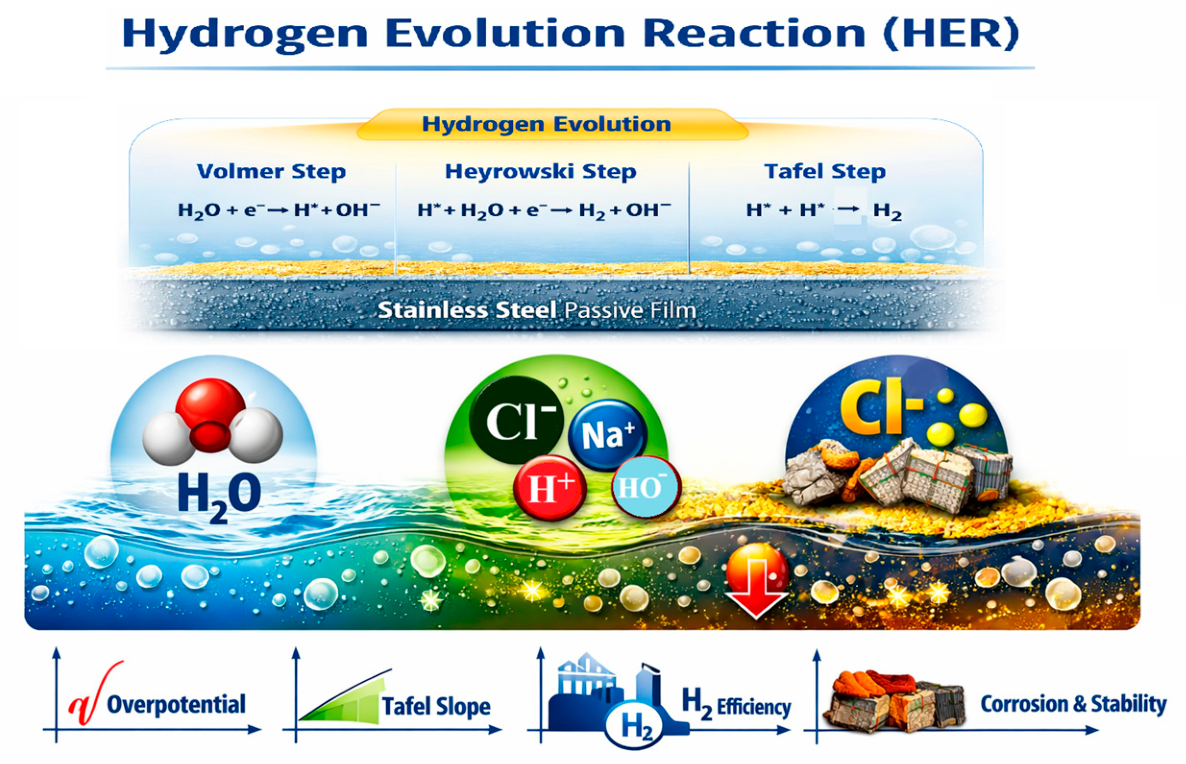
HER on stainless steel proceeds through the classical Volmer–Heyrovsky–Tafel sequence (Figure 1), with adsorbed hydrogen (H*) as the key intermediate [15,21,22]:
-
Volmer step: H2O + e → H* + OH
-
Heyrovsky step: H* + H2O + e → H2 + OH
-
Tafel step: H* + H* → H2
Figure 1. Illustration of HER mechanism with Volmer–Heyrovsky–Tafel sequence.
Energies 19 03150 g001
In pure water, HER is limited by low ionic conductivity and slow water dissociation. In alkaline electrolytes, the reaction is controlled by the energetics of H* formation and the kinetics of OH removal. In seawater, the situation is more complex: the high conductivity (≈50–60 mS/cm) reduces ohmic losses, but the weak buffering capacity leads to rapid accumulation of OH near the cathode, increasing the local pH [23]. This promotes precipitation of Mg(OH)2 and CaCO3, which can partially block active sites and modify the interfacial electric field. The passive film on stainless steel also influences HER by altering the density of active sites and the electron transfer pathway [24].

2.2. Oxygen Evolution Reaction (OER) in Seawater

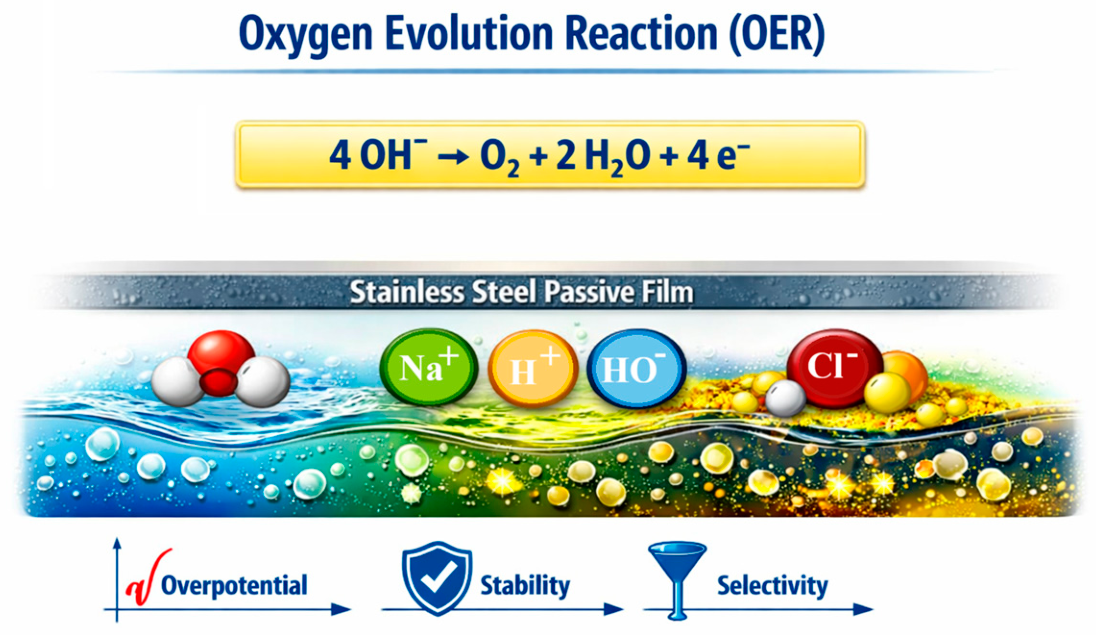
OER is the target anodic reaction for seawater electrolysis (Figure 2), but on stainless steel it requires high overpotentials and competes directly with ClER [25]. The overall reaction in alkaline media is:
4OH → O2 + 2H2O + 4e
The passive film composed of Fe-, Cr-, and Ni-oxides mediates electron transfer and provides catalytic sites for OH oxidation [26]. However, chloride ions can penetrate or destabilize this film, reducing OER selectivity. The balance between OER and ClER depends on: passive-film composition and defect density, interfacial pH (higher pH favors OER), applied potential (ClER becomes competitive above ~1.5–1.6 V vs. RHE), temperature and hydrodynamics [27].

2.3. Chlorine Evolution Reaction (ClER)

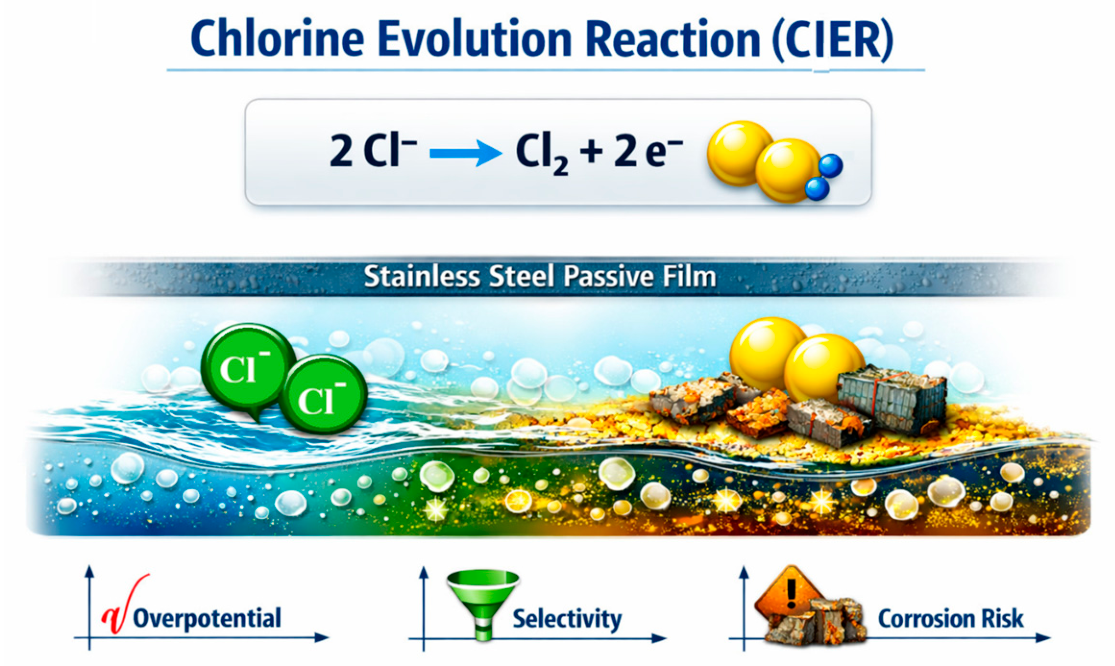
ClER is the major parasitic anodic reaction in seawater (Figure 3), with the global reaction:
2Cl → Cl2 + 2e
Because seawater contains ~0.5 M Cl, ClER can occur at potentials close to those of OER [28]. Chlorine formation is strongly favored when the passive film is defective, when the local pH is low, or when the electrode is exposed to high anodic polarization. The generated Cl2 and hypochlorite species can further attack the passive film, promoting pitting corrosion, film thinning, and long-term degradation [29]. Thus, controlling ClER is essential for durable seawater electrolysis.
Seawater is a chemically active electrolyte, and its major ionic components affect both kinetics and surface stability [18]: Cl promotes ClER and destabilizes passive films; Mg2+ and Ca2+ precipitate at high pH, forming insulating layers that hinder mass transport; HCO3/CO32− contribute to weak buffering and carbonate scaling; and Na+ and K+ enhance conductivity and reduce ohmic losses. These interactions make seawater a challenging medium, where reaction selectivity and electrode durability must be optimized simultaneously [20].
Electrode performance in seawater electrolysis is quantified through several fundamental descriptors [15]: overpotential (η), meaning extra potential required to drive HER or OER, and Tafel slope, a mechanistic indicator of the rate-determining step. Together, these parameters determine the energy efficiency and operational stability of seawater electrolysis systems [18].

2.4. Artificial vs. Natural Seawater Environments

Artificial seawater provides a controlled and reproducible electrolyte composition, allowing the isolated study of chloride-induced corrosion, HER/OER kinetics, and passive-film behavior. However, natural seawater introduces additional complexity due to biofouling, microbial activity, suspended particulates, colloids, and dissolved organic matter, all of which can influence electrode stability and degradation pathways. Natural seawater typically exhibits higher variability in pH, alkalinity, and trace-ion content, and biofilm formation can modify local electrochemical conditions at the electrode surface. These factors often lead to accelerated fouling, altered reaction kinetics, and more severe localized corrosion compared with artificial seawater. Acknowledging these differences is essential for translating laboratory results to real-world seawater electrolysis systems.

3. Electrochemical Behavior of Stainless Steels in Seawater Electrolysis

Stainless steels have long been employed as structural and functional materials in electrochemical systems due to their mechanical robustness, cost-effectiveness, and intrinsic corrosion resistance. In seawater electrolysis, their role becomes more complex: the alloy must simultaneously sustain the hydrogen evolution reaction (HER) at the cathode while resisting chloride-induced degradation. Artificial seawater introduces a multicomponent ionic environment—Na+, Mg2+, Ca2+, SO42−, HCO3, and especially Cl—that affects both electrochemical kinetics and surface stability.
The performance of stainless steels in such media depends strongly on alloy composition, passive-film chemistry, microstructure, and operational parameters such as potential, pH, temperature, and hydrodynamics. These factors determine the balance between catalytic activity and corrosion susceptibility, making systematic evaluation essential for seawater-based hydrogen production (Table 1).
The electrochemical behavior of stainless steels in chloride-rich environments is governed by the stability of the passive film, typically composed of Cr2O3 enriched with Fe- and Ni-oxides/hydroxides. Chromium content above ~12 wt.% is required for passivity, while molybdenum and nitrogen enhance resistance to pitting and crevice corrosion. Nickel influences both corrosion resistance and HER kinetics, particularly in a near-neutral electrolyte such as artificial seawater.
In artificial seawater, HER proceeds through Volmer–Heyrovsky or Volmer–Tafel pathways, depending on alloy composition and surface state. Nickel-containing stainless steels generally exhibit lower overpotentials due to Ni’s intrinsic catalytic activity, while ferritic grades show higher activation barriers. Surface treatments, such as polishing, pickling, electrochemical activation, or coating, modify the passive film and influence HER kinetics.
Chloride ions promote localized corrosion through adsorption, passive-film thinning, and pit initiation. Under anodic polarization, competition between oxygen evolution reaction (OER) and chlorine evolution reaction (ClER) accelerates transpassive dissolution. Even at the cathode, where HER dominates, stainless steels may undergo hydrogen-assisted degradation or passive-film alteration.
The dual role of stainless steels—as HER electrodes and as structural materials—requires a holistic evaluation. Alloys with high HER activity may exhibit lower corrosion resistance, while highly corrosion-resistant grades may show limited catalytic performance. The optimal choice depends on the intended operating regime, electrolyte composition, and system design.
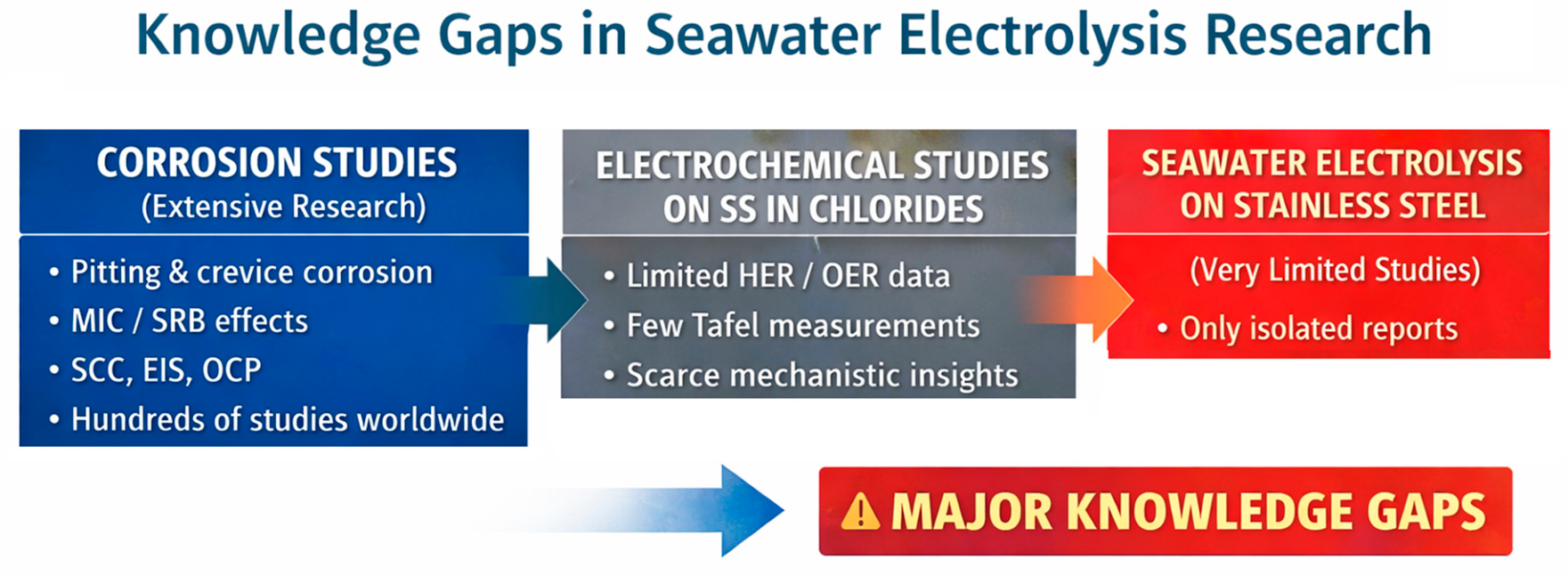
A striking observation emerging from the literature survey is the disproportion between the extensive body of research on the corrosion behavior of stainless steels in seawater and the extremely limited number of studies investigating their performance as electrodes for seawater electrolysis. Systematic studies specifically addressing the hydrogen evolution reaction (HER) on stainless-steel electrodes under seawater electrolysis conditions remain limited, although several recent works have examined related aspects of OER and passive-film behavior [38,39]. This gap does not stem from a lack of relevance but rather from a long-standing technical assumption: the susceptibility of stainless steels to chloride-induced degradation has led to the widespread belief that these alloys are unsuitable for electrochemical applications involving seawater. Chloride ions are known to destabilize the Cr2O3 passive film, promote pitting and crevice corrosion, and participate in competitive surface reactions, especially under the strongly cathodic conditions required for the hydrogen evolution reaction. As a result, research efforts have historically shifted toward materials perceived as more robust in chloride environments—such as Ni-based alloys, Ti and its oxides, or noble metal catalysts—while stainless steels have been largely overlooked.
However, this perception ignores a critical practical aspect: stainless steels are significantly more affordable than high-performance alloys or noble-metal-based catalysts, are readily available in industrial form, and are already widely used in marine infrastructure. For large-scale hydrogen production, where electrode cost becomes a decisive factor, stainless steels represent an attractive and potentially transformative option. The scarcity of electrolysis-focused studies therefore reflects a knowledge gap rather than an intrinsic limitation of the material. Systematic investigation of stainless steels under realistic seawater electrolysis conditions is essential to reassess their viability and to determine whether their economic and structural advantages can be leveraged in practical systems (Figure 4).
The knowledge gaps diagram summarizes the current state of research on stainless steels in seawater. Extensive studies exist on classical corrosion mechanisms—such as pitting and crevice corrosion, microbiologically influenced corrosion (MIC), sulphate-reducing bacteria (SRB) activity, stress corrosion cracking (SCC), and electrochemical techniques including electrochemical impedance spectroscopy (EIS) and open circuit potential (OCP) measurements. A smaller number of studies address the electrochemical behavior of stainless steels in chloride-containing media, focusing mainly on hydrogen evolution reaction (HER), oxygen evolution reaction (OER), and limited Tafel analysis. In contrast, research specifically dedicated to seawater electrolysis on stainless steel is almost absent, with no systematic kinetic data, no durability studies, and no mechanistic understanding. This highlights a clear knowledge gap that motivates the present review.
Stainless steels are widely used as structural materials in marine environments, yet their direct electrochemical behavior as functional cathodes for seawater electrolysis has been only marginally explored in the literature [21,22]. Most contemporary studies focus on nickel-based catalysts, transition-metal alloys, or engineered surfaces designed to enhance hydrogen evolution reaction (HER) activity, while stainless steels are typically discussed only in terms of corrosion resistance or passive-film stability. As a result, there is a significant knowledge gap regarding the intrinsic HER kinetics of stainless steels in chloride-rich media, particularly under realistic seawater conditions.
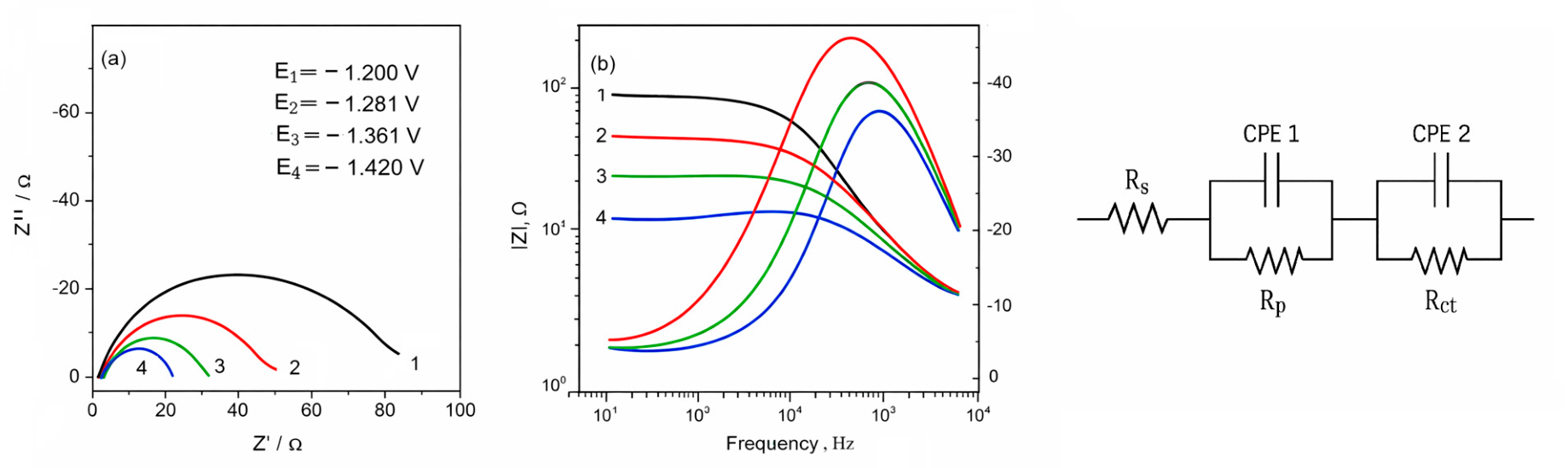
For example, a case study [21,22] addresses precisely this gap. Using AISI304 stainless steel, two complementary investigations were performed: the influence of electrode potential on HER kinetics at 295 K, and the influence of temperature in the range 295–333 K, using polarization and electrochemical impedance spectroscopy (EIS), enabling a rigorous evaluation of electrochemical parameters (Figure 5).
Overall, the influence of kinetic parameters and activation energies determined here closely match those reported for nickel electrodes in alkaline media [14] indicating that AISI304 is a viable low-cost cathode material for seawater electrolysis, offering predictable kinetics, stable mechanistic behavior, and performance levels that support its use as a low-cost cathode material for seawater electrolysis.
Recent studies have investigated OER behavior of stainless steels in chloride-rich or seawater environments, focusing on passive-film evolution, surface oxidation pathways, and chloride-induced modifications of catalytic activity.
A stainless-steel-based bifunctional electrode (Ru-PSS) was developed and its performance was reported at industrially relevant current densities. At 500 mA·cm−2, an HER overpotential of 248 mV was achieved, while the OER overpotential reached only 353 mV. In addition, an anion-exchange-membrane electrolyzer assembled with Ru-PSS electrodes was shown to operate at 500 mA·cm−2 with a cell voltage of 1.82 V. These results were attributed to the in situ formation of FeP4/Ni2P heterostructures and subsequent Ru doping, which were found to optimize the hydrogen adsorption free energy and activate a more favorable OPM pathway, as supported by FTIR and DFT analyses [38].
An OER catalyst derived from stainless steel was reported to exhibit high activity across a wide current-density range. Overpotentials of 186, 355, and 421 mV were achieved at 10, 500, and 1000 mA·cm−2, respectively, and long-term testing at industrial current density demonstrated a two-stage behavior consisting of an initial self-optimizing activation period of approximately 800 h followed by a stable operation phase of equal duration. The performance was attributed to efficient O–O coupling via the oxide pathway mechanism (OPM), enabled by dual-metal active sites and an optimized electronic structure [39].
Despite extensive corrosion research and several recent studies reporting OER performance on modified stainless-steel electrodes [38,39], systematic investigations of HER kinetics and mechanistic behavior on unmodified stainless-steel electrodes in natural seawater remain scarce. This gap represents a significant and long-standing limitation in the field, which the present review aims to clarify.

4. Corrosion Behavior of Stainless Steels Under Seawater Electrolysis Conditions

To provide a clearer separation of the different degradation pathways relevant to seawater electrolysis, the corrosion behavior of stainless steels is discussed in terms of cathodic processes, anodic processes, and general corrosion mechanisms.

4.1. Cathodic Corrosion Behavior in Seawater

At cathodic potentials, the local pH near the electrode surface increases sharply due to OH generation during HER. This promotes precipitation of Mg(OH)2 and CaCO3, forming porous, poorly adherent deposits. Long-term alkaline seawater electrolysis studies demonstrate that these deposits accumulate progressively, altering mass transport, blocking active sites, and increasing overpotential [40]. Although scaling does not directly corrode the metal, it modifies the interfacial chemistry and can trap chloride ions, indirectly promoting localized attack.
Cathodic polarization during HER affects stainless steel stability in two ways. First, hydrogen adsorption and absorption can induce hydrogen-assisted cracking, especially in high-strength steels or cold-worked regions [35,41]. Second, the high local pH generated by HER alters the passive-film composition, promoting the formation of Fe(OH)2 and Cr(OH)3 phases that are less protective in chloride media. Temperature fluctuations further exacerbate these effects by modifying film solubility and microstructure. In alkaline seawater, duplex stainless steels show reduced corrosion rates under moderate cathodic polarization, but prolonged exposure still leads to film destabilization and localized attack [34].

4.2. Anodic Corrosion Behavior in Seawater

Under sustained anodic polarization, stainless steels may undergo selective dissolution of Fe or Cr, leading to local dealloying and weakening of the passive film. High-entropy and multi-principal element alloys show similar behavior, where compositional inhomogeneities promote localized dissolution pathways [42,43]. In seawater electrolysis, dealloying is often coupled with ClER, which accelerates the removal of less noble elements and destabilizes the oxide/hydroxide layer [44].
Under anodic polarization, stainless steel surfaces may enter the ClER regime, where chloride oxidation competes with oxygen evolution. ClER generates hypochlorite and chlorine species that destabilize the passive film and increase metal dissolution rates. Recent work shows that sacrificial corrosion strategies can temporarily widen the anodic stability window, but the underlying degradation mechanisms remain dominated by chloride-induced film breakdown [44].
Stress corrosion cracking (SCC) susceptibility also increases under anodic potentials, particularly in duplex and super-duplex grades exposed to chloride-rich environments [31].

4.3. General Corrosion Behavior in Seawater

Stainless-steel electrodes operating in seawater electrolysis environments are exposed to a combination of aggressive chloride chemistry, fluctuating potentials, and local pH gradients that collectively drive complex degradation pathways. These mechanisms involve both classical corrosion modes characteristic of saline media and electrochemically induced transformations associated with HER and ClER. The following sections summarize the dominant degradation processes relevant to long-term operation.
Pitting corrosion is the primary degradation mode for stainless steels in seawater due to the strong ability of chloride ions to penetrate and destabilize the passive film. Local acidification inside metastable pits, combined with the accumulation of Cl, accelerates metal dissolution and suppresses repassivation. Recent reviews confirm that chloride-driven pit initiation remains the most critical failure mode for stainless steels in marine environments [45,46]. Additively manufactured or compositionally complex alloys show similar susceptibility when exposed to aqueous chloride solutions, despite their enhanced passivity in other environments [42]. Under anodic polarization, pit propagation is further intensified by the competitive chlorine evolution reaction (ClER), which locally increases acidity and chloride concentration at the interface [44].
Crevice corrosion develops in shielded regions such as gasket interfaces, weld geometries, or surface defects. The restricted mass transport inside crevices leads to oxygen depletion, acidification, and chloride enrichment, creating a microenvironment far more aggressive than bulk seawater. Marine exposure studies consistently report crevice corrosion as a dominant degradation mode for stainless steels in coastal and offshore conditions [46,47]. In alkaline seawater, even duplex grades exhibit crevice-type attack when local alkalinity collapses under fluctuating potentials [34].
Stainless steels rely on a thin Cr-rich passive film for corrosion resistance. In chloride media, this film undergoes continuous cycles of breakdown and repair. Mechanical, thermal, or electrochemical perturbations can trigger depassivation, while repassivation depends on local pH and oxygen availability. Studies on 316L and related alloys show that passive-film stability is highly sensitive to electrolyte composition and thermal history [47], and machining-induced surface defects further reduce repassivation efficiency [32]. During seawater electrolysis, these cycles are intensified by the dynamic potential environment and by the presence of gas bubbles that disrupt the interfacial chemistry.
The passive film on stainless steel consists primarily of Cr(III) oxides/hydroxides, with contributions from Fe and Ni species. Chloride ions penetrate this film by competitive adsorption and by forming soluble metal–chloride complexes. Elevated anodic potentials promote the formation of less protective FeOOH and NiOOH phases, which are more susceptible to chloride-induced dissolution [48,49]. Heat-treated Cr-Ni-Mo alloys in alkaline seawater show similar film destabilization, with chloride accelerating the transition from protective to defective oxide structures [30].
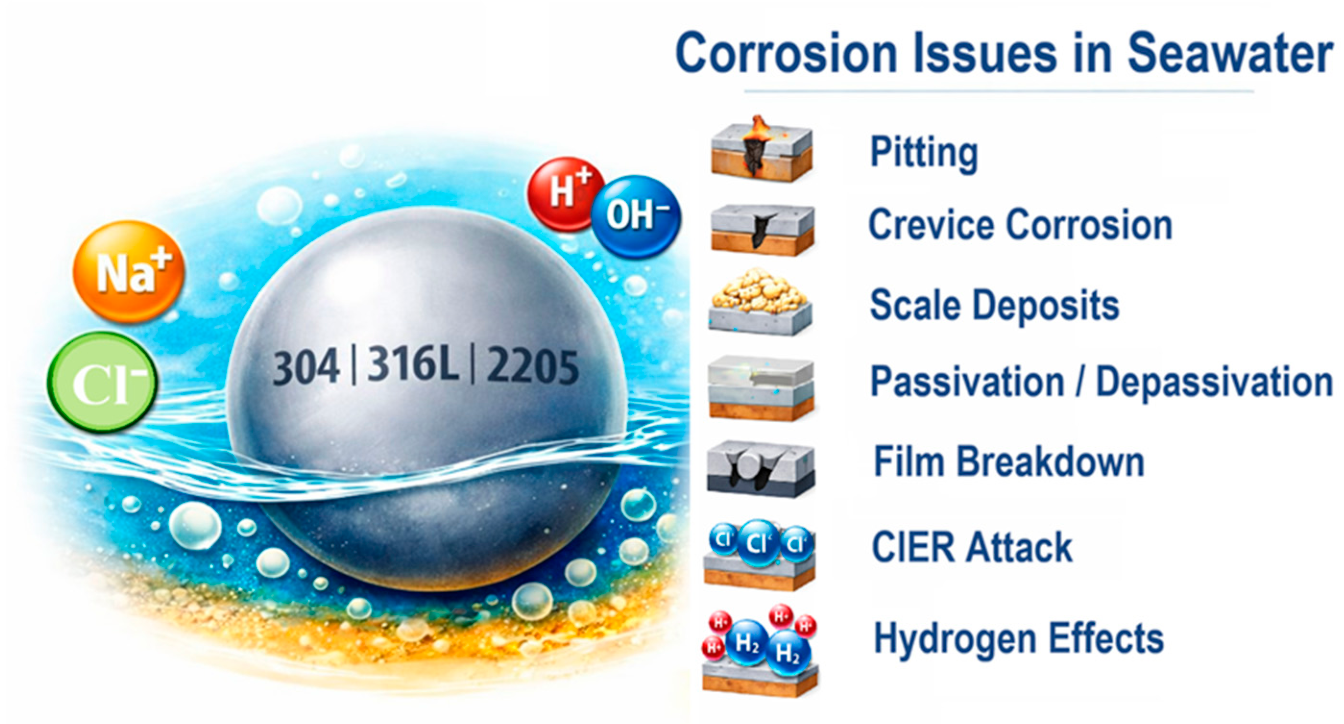
The main degradation phenomena discussed above are summarized schematically in Figure 6, which illustrates the interaction of seawater ions with stainless steel surfaces and the resulting corrosion modes. This visual overview highlights the interplay between chloride attack, film instability, and hydrogen evolution during long-term seawater electrolysis.
The combined action of chloride-induced pitting, crevice corrosion, dealloying, passive-film breakdown, scaling deposits, and hydrogen-related effects defines the long-term degradation landscape for stainless-steel electrodes in seawater electrolysis. While certain alloying strategies (Cr, Mo, N, Cu) improve resistance, no stainless steel remains fully immune under extended operation. Long-term studies demonstrate that stable performance over thousands of hours requires careful control of potential windows, electrolyte alkalinity, and surface condition [33,50]. Understanding these degradation pathways is essential for designing durable, low-cost electrodes [51] for seawater-based hydrogen production.

5. System-Level Energy, Economic, and Environmental Factors in Seawater Electrolysis

Seawater electrolysis coupled with renewable electricity—solar, wind, marine or hybrid systems—represents a promising pathway toward genuinely green hydrogen, avoiding fossil inputs and reducing dependence on freshwater resources. Within this context, the performance of the electrodes, and in particular stainless-steel-based architectures, directly governs the overall energy efficiency of the electrolyzer: higher overpotentials translate into increased cell voltage and, consequently, higher specific energy consumption per kilogram of hydrogen. System-level analyses of water-splitting and integrated green energy systems consistently highlight that minimizing kinetic and ohmic losses at the electrode level is essential to make renewable-powered hydrogen competitive with conventional routes [52,53,54]. When seawater is used as the feed, additional penalties associated with chloride chemistry and corrosion further tighten the efficiency window, reinforcing the need for robust, low-overpotential electrode designs [55].
From a techno-economic perspective, material selection becomes a central design variable. Stainless-steel grades such as 304, 316L and duplex alloys offer an attractive compromise between cost, mechanical integrity and corrosion resistance, especially when compared with more expensive substrates like titanium or nickel foam, which are often used as benchmarks in advanced electrocatalytic systems [54,56]. However, in chloride-rich environments, the effective lifetime of these materials is controlled by pitting, crevice corrosion and surface degradation, which determine the frequency of electrode replacement and the associated maintenance burden. Studies on integrated water-splitting and seawater-splitting systems show that the economic viability of green hydrogen hinges not only on catalyst activity, but also on durability under realistic operating conditions and the ability to maintain low cell voltages over extended periods [55,57,58]. In this sense, surface engineering, protective layers and optimized operating windows must be evaluated not only in terms of performance gains, but also in terms of fabrication complexity and long-term stability (Table 2).
In practical seawater electrolysis systems, chlorine evolution and hypochlorite formation may introduce environmental burdens related to gas handling, discharge limits, and local water chemistry. Stainless-steel electrodes may additionally release trace metal ions through pitting or transpassive dissolution, although quantitative data for real-scale operation are not yet available. These aspects should be evaluated in future system-level studies once operational prototypes become accessible.
The integration of seawater electrolysis with renewable energy sources introduces additional system-level constraints and opportunities (Table 3). Photovoltaic-driven and photo-assisted seawater splitting configurations demonstrate how intermittent solar input can be harnessed to drive hydrogen production, provided that the electrochemical system tolerates fluctuating currents and voltages without accelerated degradation [57,58]. Marine renewable energy—such as wave, tidal and offshore wind—offers a particularly natural synergy with seawater electrolysis, enabling on-site hydrogen generation in coastal or offshore environments and reducing the need for large-scale electricity transmission [59]. Conceptual and experimental studies on marine wet solar cells and photo-electrochemical devices further illustrate how direct coupling between light harvesting and electrochemical conversion can reduce balance-of-plant complexity, while simultaneously imposing stricter requirements on electrode stability in real seawater [60]. In all these configurations, stainless-steel-based electrodes must be assessed not only as isolated materials, but as components embedded in dynamic, renewable-powered systems. Wave-energy systems [61] are increasingly considered for coupling with seawater electrolysis, since coastal and offshore environments provide both the saline feedstock and the mechanical energy resource; in such settings, the corrosion behavior and long-term stability of stainless-steel electrodes remain critical factors, as highlighted in recent marine corrosion studies [33,46].
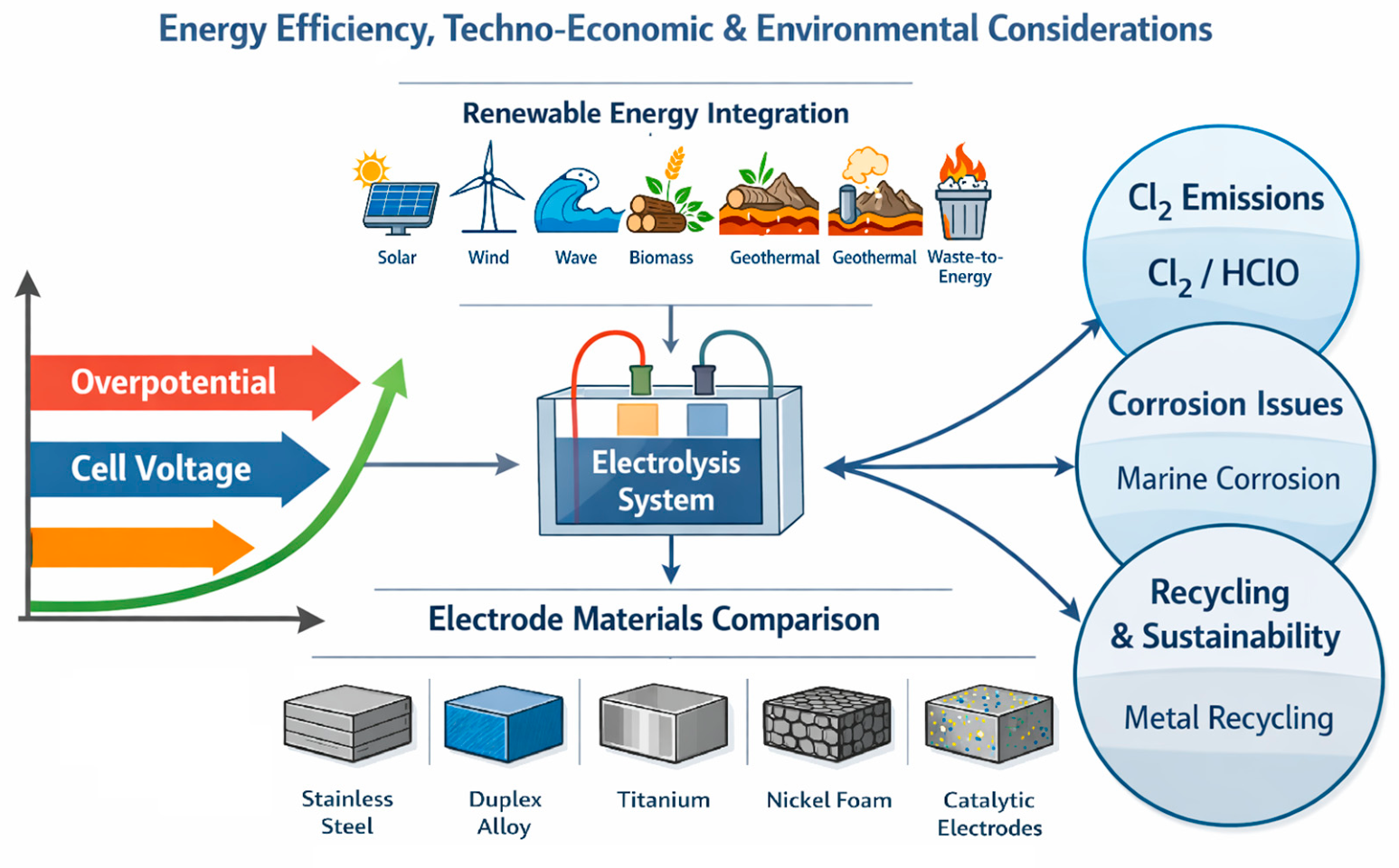
Figure 7 provides a concise conceptual overview of the key elements discussed in this chapter, illustrating how overpotential and cell voltage shape the overall energy consumption, how renewable sources such as solar, wind and wave energy can be coupled with seawater electrolysis, how different electrode materials influence performance and durability, and how chloride chemistry and corrosion define the main environmental constraints.
A technical–economic analysis of hydrogen production by water or seawater electrolysis should integrate both engineering and financial perspectives. It must assess the efficiency and durability of electrolytic systems, the investment and operational costs, and the scalability of the technology. In parallel, environmental impact, sustainability potential, and socio-economic benefits should be examined to determine the overall viability of hydrogen as a clean energy vector. Such an approach ensures a balanced evaluation of technological performance and economic feasibility within the context of green hydrogen development [63,64,65,66,67,68,69].
Environmental considerations add a further layer of complexity to the evaluation of seawater electrolysis as a green technology [64,65,66]. While hydrogen itself is a clean energy carrier, the co-production of chlorine, hypochlorite and other reactive chlorine species in chloride-rich media can pose risks to marine ecosystems if not properly managed [55]. Corrosion processes generate metal ions and particulate corrosion products that may accumulate in the local environment, raising questions about long-term ecological impact and the need for appropriate mitigation or treatment strategies. At the same time, stainless steels are inherently recyclable and benefit from well-established recycling streams, which can reduce the life-cycle environmental footprint compared with more exotic electrode materials [56]. Broader work on bio-electrochemical systems, environmental remediation and electrocatalytic processes underscores the importance of designing electrochemical technologies that simultaneously address energy conversion and environmental protection, rather than treating them as separate objectives [56,70]. When seawater electrolysis is powered by low-carbon electricity and designed with corrosion control, emission management and recyclability in mind, it can form part of an integrated, environmentally responsible hydrogen economy.
Viewed against the wider landscape of green hydrogen production—from photocatalytic systems to biomass-derived routes and hybrid water-splitting schemes—the role of seawater electrolysis with stainless-steel electrodes is to offer a scalable, infrastructure-compatible option that leverages abundant saline resources while remaining compatible with intermittent renewables [52,53,54,59]. The key message of this chapter is that electrode performance, energy efficiency, techno-economic viability and environmental impact are tightly interlinked: lowering overpotentials and improving durability reduces energy demand, extends component lifetime, and mitigates both costs and environmental burdens. Subsequent sections will therefore focus on quantifying these relationships—overpotential to cell voltage to specific energy consumption—and on positioning stainless-steel-based seawater electrolysis within the broader framework of sustainable, renewable-driven hydrogen systems [55,57,59].

6. Strategies and Future Directions for Stainless-Steel Electrodes in Seawater Electrolysis

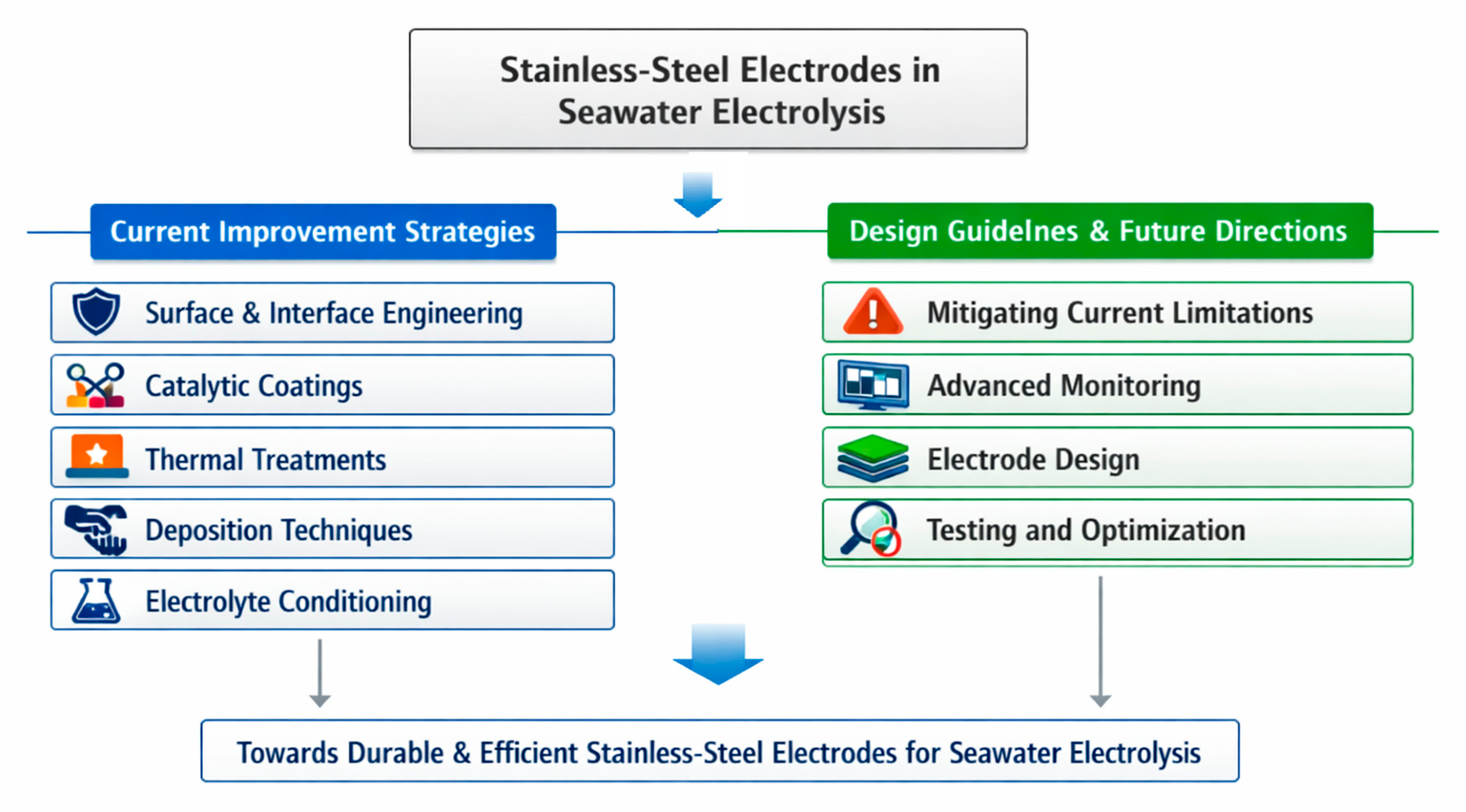
Stainless-steel-based electrodes remain among the most attractive candidates for practical seawater electrolysis due to their low cost, mechanical robustness, large-scale availability, and compatibility with industrial fabrication routes. However, their deployment in real seawater environments is still limited by the intrinsic coupling between electrocatalytic reactions (HER/OER) and corrosion processes driven by chloride ions, biofouling, mineral scaling, and dynamic surface reconstruction. Recent literature demonstrates that stainless steel can be transformed from a passive structural material into a competitive electrocatalytic platform through surface/interface engineering, catalytic coatings, electrolyte conditioning, and hybrid pretreatment strategies [71,72,73,74]. This chapter integrates current improvement strategies with forward-looking design guidelines [64], providing a unified perspective for the development of durable, selective, and economically viable stainless-steel electrodes for seawater electrolysis (Figure 8).

6.1. Current Improvement Strategies for Stainless-Steel Electrodes

A major research direction focuses on surface and interface engineering, which directly modulates the passive film, adsorption energetics, and reaction pathways. Ion-selective interfacial layers have recently been shown to suppress chloride penetration while maintaining high catalytic activity, enabling long-term operation in impure or saline water [71]. Vacancy engineering—particularly Fe and O vacancies—has been demonstrated to tune lattice oxygen participation and accelerate OER kinetics, offering a promising route for stainless-steel-derived catalytic surfaces [75]. Texturing, polishing, and controlled oxidation/nitridation further modify bubble dynamics, wettability, and local pH, improving HER efficiency and reducing bubble blockage [73].
Representative quantitative benchmarks from techno-economic and environmental assessments help contextualize these considerations. Current estimates place the cost of hydrogen produced via seawater or brine electrolysis in the range of 4–7 USD per kg H2, depending on system efficiency and electricity price. Life-cycle analyses report that replacing conventional alkaline systems with chloride-resistant stainless-steel electrodes can reduce CO2 emissions by 0.5–1.2 kg CO2 per kg H2 due to longer component lifetime and lower replacement frequency. In terms of durability, stainless-steel electrodes typically retain 70–90% of their initial performance after 500–1000 h of operation in chloride-containing electrolytes, whereas non-alloyed steels often fail within 50–200 h. These numerical indicators illustrate the practical relevance of material selection for seawater electrolysis applications [36,38,39,71,72,73,75].
Representative quantitative improvements reported in the literature further illustrate the effectiveness of these modification strategies. For example, Ni-enriched or Ni-activated stainless-steel surfaces have shown reductions in HER overpotential of 80–150 mV at 10 mA·cm−2 in chloride-containing electrolytes, together with increases in exchange current density by up to one order of magnitude. Oxide-based surface treatments (e.g., Fe–Cr–Ni mixed oxides) have been reported to decrease OER overpotentials by 120–200 mV while improving stability under anodic polarization. In addition, surface passivation or molybdenum-containing coatings can reduce pitting-corrosion current densities by 50–70% in artificial seawater. These numerical values highlight the practical benefits of surface modification for enhancing both catalytic activity and corrosion resistance [36,38,39,71,72,73,75].
Another widely explored strategy is the application of catalytic coatings. Transition-metal oxides (NiFeOx, CoOx, MnOx), phosphides, and sulfides have been deposited on stainless steel to enhance HER/OER activity and mitigate ClER competition [36,72]. These coatings act as both catalytic layers and physical barriers, reducing chloride-induced depassivation. Recent studies on MOx-coated 304/316 stainless steel show significant improvements in OER selectivity and corrosion resistance in natural seawater [36,37]. High-entropy alloy coatings obtained by electrodeposition also exhibit promising catalytic stability due to their sluggish diffusion and multi-element synergy [76].
Thermal treatments represent another effective approach to stabilize the passive film. Controlled annealing can thicken Cr-rich oxide layers, reduce defect density, and improve resistance to pitting and crevice corrosion under anodic polarization. When combined with catalytic coatings, thermal pretreatment enhances adhesion and reduces interfacial delamination during long-term operation.
Deposition techniques allow precise control over coating thickness, porosity, and composition; ALD-grown ultrathin layers, for example, provide conformal protection without significantly increasing charge-transfer resistance. Laser texturing can create superaerophobic microstructures that facilitate bubble release and improve HER kinetics [73].
Finally, electrolyte conditioning—including pH adjustment, addition of inhibitors, or selective ion management—can shift the competitive balance between OER and ClER. Ion-selective membranes or interfacial layers can further suppress chloride access to the electrode surface, improving durability and selectivity [71].
Several recent analyses have emphasized the need for improved corrosion-resistant materials and more selective OER catalysts in real seawater environments: the potential of carbon semi-tube nanostructures for HER and OER electrocatalysis was highlighted, owing to their high surface area, open morphology, and favorable electronic conductivity [77], and also recent advances in PEM-based water electrolysis were summarized, with emphasis on membrane degradation mechanisms and the performance limitations of current OER and HER electrocatalysts [78].
Together, these strategies demonstrate that stainless steel can be systematically engineered to achieve high activity, suppress ClER, and improve long-term stability in seawater electrolysis.

6.2. Design Guidelines and Future Directions for Practical Seawater Electrolysis Systems

Despite significant progress, several critical gaps remain before stainless-steel electrodes can be deployed in industrial seawater electrolysis systems. One major limitation is the lack of long-term durability data in real seawater, where biofouling, organic contaminants, and fluctuating salinity strongly influence performance [79]. Most studies rely on artificial seawater, which does not capture the complexity of natural marine environments. Future work must integrate real seawater testing, including seasonal variations and biological activity.
Another challenge is the insufficient correlation between corrosion metrics and electrocatalytic performance. Traditional corrosion tests (pitting potential, impedance, mass loss) are rarely linked to HER/OER selectivity or surface reconstruction. Digital-twin approaches and virtual–real evaluation frameworks have recently emerged as powerful tools to predict deep-sea corrosion and dynamic surface evolution [80]. These methods should be extended to stainless-steel electrodes under operational electrolysis conditions.
Scaling up seawater electrolysis also requires addressing mineral scaling and biofouling, which block active sites and alter bubble dynamics. Hybrid strategies combining pretreatment (e.g., thermal oxidation, nitridation) with thin catalytic films may offer optimal performance by balancing catalytic activity, corrosion resistance, and cost [74].
Freshwater availability is increasingly recognized as a constraint for large-scale hydrogen deployment, particularly in regions where electrolysis-based projects are expanding. Although this review focuses on seawater electrolysis, recent techno-economic analyses have shown that freshwater supply can influence the feasibility of renewable hydrogen systems, motivating interest in alternative water sources and integrated desalination concepts. In this context, seawater-based approaches and improved corrosion-resistant electrode materials may contribute to reducing the pressure on freshwater resources while enabling scalable hydrogen production [81,82]. A techno-economic evaluation of a renewable hydrogen system integrated with a double-pass reverse osmosis unit was presented, indicating a hydrogen production cost of 40.5 $/kg, supported by 4148.9 MWh/year of excess electricity that yielded 63,110 kg of H2 and required 1073 m3 of freshwater. The DP-RO unit operated with specific energy consumptions of 5.96 kWh/m3 in the first pass and 1.69 kWh/m3 in the second pass, while the resulting water production cost ranged between 4.34 and 6.90 $/m3 depending on system parameters [81]. In [82], the feasibility of using 300 W of electrolyzer and fuel-cell waste heat for seawater desalination was demonstrated, producing 1.16 kg m−2 h−1 of permeate with only 13.81 µS cm−1 conductivity and 5.415 mg L−1 TDS, meeting commercial electrolyzer water-quality requirements.
From a design perspective, future stainless-steel electrodes should follow several guidelines:
-
Grade selection: alloys with higher Cr/Mo content (e.g., 316L, duplex grades) offer improved chloride resistance and should be preferred for anodic operation.
-
Surface state: polished, textured, or laser-modified surfaces can enhance bubble release and reduce local acidification.
-
Operating window: maintaining potentials below the ClER threshold is essential for long-term stability.
-
Coating architecture: multilayer or gradient coatings combining catalytic and protective functions are promising.
-
Hybrid strategies: pretreatment and ultrathin catalytic films provide a balance between durability and cost.
-
System-level integration: offshore hydrogen production platforms require optimized porous transport layers, corrosion monitoring, and energy–water co-integration strategies [59,63].
Although this review focuses primarily on the production side—specifically on the electrochemical performance and durability of stainless-steel electrodes in seawater—it is worth noting that the long-term viability of seawater-based hydrogen production also depends on the downstream transport infrastructure. A recent systematic literature [77] on pipeline transport losses of hydrogen, methane, and their mixture (hythane) shows that repurposing existing natural gas networks for hydrogen introduces additional challenges, such as hydrogen embrittlement, increased pressure losses, and higher leakage risks due to the small size of the hydrogen molecule. These issues indirectly influence material selection and system design already at the production stage, because any efficiency loss or additional cost incurred during electrolysis must be balanced against transport-related performance. Including such considerations in the assessment of stainless-steel electrodes offers a more complete, value-chain-oriented perspective—from seawater electrolysis to final hydrogen delivery [83].
Finally, future research should focus on coupled corrosion–catalysis mechanisms, real-time monitoring, biofouling-resistant surfaces, and scalable deposition methods compatible with industrial stainless-steel manufacturing. These directions align with the long-term objectives of sustainable hydrogen production and the technological roadmap promoted by Energies. Recent advances in high-performance catalytic materials further highlight the importance of optimizing surface chemistry and reaction pathways for efficient hydrogen production [15,16,83].

7. Conclusions

Seawater electrolysis remains a technically challenging but strategically relevant route for sustainable hydrogen production, where the interplay between HER, OER and competing chloride oxidation reactions dictates both efficiency and material stability. Stainless steels, although not high-activity electrocatalysts, offer a practical balance between cost, mechanical robustness and predictable electrochemical behavior in saline environments. The case study on AISI 304 confirms that stainless steels can sustain reproducible HER kinetics in artificial seawater, with performance primarily governed by temperature, applied potential and the evolution of corrosion films.
Material durability remains a central limitation, as chloride-induced corrosion, pitting susceptibility and surface film instability directly influence long-term operation and energy consumption. Nevertheless, the overall behavior of 304, 316L and duplex grades demonstrates that stainless steels can operate reliably within controlled potential windows, making them suitable for systems where structural integrity and low cost outweigh the need for high catalytic activity.
From a system perspective, seawater electrolysis coupled with renewable energy—solar, wind or marine wave/tidal resources—benefits from the mechanical resilience and availability of stainless-steel electrodes, particularly in coastal or offshore environments. While efficiency improvements require further optimization of surface chemistry and operating conditions, the present results show that stainless steels remain viable and scalable materials for practical hydrogen generation from seawater.
Overall, several challenges remain before seawater electrolysis can be deployed at scale, including chloride-induced corrosion, competitive ClER pathways, catalyst deactivation, the limited long-term stability of stainless-steel electrodes in complex natural seawater environments, and the intrinsically sluggish OER kinetics that further constrain system efficiency. Future progress will require the development of more selective and corrosion-resistant electrode materials, improved strategies for suppressing ClER, and a deeper understanding of biofouling and organic-matter interactions under real seawater conditions. Integrating advanced surface-modification techniques with realistic durability testing will be essential for translating laboratory findings into practical, industrial-scale systems.
Additional uncertainties persist regarding the long-term evolution of stainless-steel surfaces during continuous operation in natural seawater, particularly the transitions from passive behavior to localized breakdown under sustained chloride exposure. The conditions that favor chlorine-related pathways over oxygen evolution also remain insufficiently resolved, limiting the ability to design reliably selective operating windows. Moreover, the lack of prototype- or pilot-scale demonstrations prevents a realistic assessment of system reliability and integration under variable, renewable-driven power profiles. Clarifying these aspects will be essential for establishing the practical feasibility of stainless-steel-based seawater electrolysis.

Author Contributions

Conceptualization: G.E.B., I.M. and S.D.; methodology: G.E.B., A.C., C.H. and C.B.; software: I.M. and S.D.; validation: A.C., C.H. and I.P.; formal analysis: A.C. and I.M.; investigation: A.C., C.H., C.B. and I.P.; resources: G.E.B. and C.B.; data curation: I.M. and S.D.; writing—original draft preparation: G.E.B., I.M. and S.D.; writing—review and editing: G.E.B., S.D., C.H. and C.B.; visualization: G.E.B., S.D., I.M., A.C., C.H., C.B. and I.P.; supervision: G.E.B. All authors have read and agreed to the published version of the manuscript.

Funding

This research was funded by the University of Oradea, Romania.

Data Availability Statement

Data is contained within the article.

Acknowledgments

During the preparation of this manuscript, the authors used Microsoft Copilot (AI-assisted graphic tool, https://www.microsoft.com/en-us/microsoft-365/copilot (microsoft.com in Bing) Access date: 15 May 2026) for generating preliminary schematic elements in Figure 1, Figure 2, Figure 3 and Figure 6. The tool used was Microsoft Copilot within Microsoft 365. Website: https://www.microsoft.com/en-us/microsoft-365/copilot (microsoft.com in Bing) Access date: 15 May 2026. The authors have reviewed and edited the output and take full responsibility for the content of this publication.

Conflicts of Interest

The authors declare no conflicts of interest.

References

  1. Osman, A.I.; Mehta, N.; Elgarahy, A.M.; Hefny, M.; Al-Hinai, A.; Al-Muhtaseb, A.H.; Rooney, D.W. Hydrogen production, storage, utilisation and environmental impacts: A review. Environ. Chem. Lett. 2021, 20, 153–188. [Google Scholar] [CrossRef]
  2. Wang, S.; Lu, A.; Zhong, C.-J. Hydrogen production from water electrolysis: Role of catalysts. Nano Converg. 2021, 8, 4. [Google Scholar] [CrossRef] [PubMed]
  3. Dawood, F.; Anda, M.; Shafiullah, G.M. Hydrogen production for energy: An overview. Int. J. Hydrogen Energy 2020, 45, 3847–3869. [Google Scholar] [CrossRef]
  4. Jenkins, B.; Squires, D.; Barton, J.; Strickland, D.; Wijayantha, K.G.U.; Carroll, J.; Wilson, J.; Brenton, M.; Thomson, M. Techno-Economic Analysis of Low Carbon Hydrogen Production from Offshore Wind Using Battolyser Technology. Energies 2022, 15, 5796. [Google Scholar] [CrossRef]
  5. Kuang, Y.; Jia, Q.; Ma, G.; Hisatomi, T.; Minegishi, T.; Nishiyama, H.; Nakabayashi, M.; Shibata, N.; Yamada, T.; Kudo, A.; et al. Ultrastable low-bias water splitting photoanodes via photocorrosion inhibition and in situ catalyst regeneration. Nat. Energy 2017, 2, 16191. [Google Scholar] [CrossRef]
  6. Chen, Z.; Wei, W.; Song, L.; Ni, B.-J. Hybrid Water Electrolysis: A New Sustainable Avenue for Energy-Saving Hydrogen, Production. Sustain. Horiz. 2021, 1, 100002. [Google Scholar] [CrossRef]
  7. Khan, M.A.; Zhao, H.; Zou, W.; Chen, Z.; Cao, W.; Fang, J.; Xu, J.; Zhang, L.; Zhang, J. Recent Progresses in Electrocatalysts for Water Electrolysis. Electrochem. Energy Rev. 2018, 1, 483–530. [Google Scholar] [CrossRef]
  8. Wang, H.-Y.; Weng, C.-C.; Ren, J.-T.; Yuan, Z.-Y. An overview and recent advances in electrocatalysts for direct seawater splitting. Front. Chem. Sci. Eng. 2021, 15, 1408–1426. [Google Scholar] [CrossRef]
  9. Prieto, C.; Sánchez, A.; Martín, M. Coupling renewable energy and storage technologies with hydrogen-based steel production: A design and scheduling optimization approach. J. Clean. Prod. 2026, 567, 148588. [Google Scholar] [CrossRef]
  10. Lee, C.H.; Lee, S.U. Theoretical Basis of Electrocatalysis. In Electrocatalysts for Fuel Cells and Hydrogen Evolution; IntechOpen: London, UK, 2018. [Google Scholar] [CrossRef]
  11. Łosiewicz, B. Advanced Electrode Materials for Water Electrolysis: Design Principles, Performance Trade-Offs, and Technology Pathways Across ALK, PEM, SOEC, and AEM Systems. Materials 2026, 19, 2259. [Google Scholar] [CrossRef] [PubMed]
  12. Saba, S.M.; Müller, M.; Robinius, M.; Stolten, D. The investment costs of electrolysis—A comparison of cost studies from the past 30 years. Int. J. Hydrogen Energy 2018, 43, 1209–1223. [Google Scholar] [CrossRef]
  13. Gong, M.; Wang, D.-Y.; Chen, C.-C.; Hwang, B.-J.; Dai, H. A mini review on nickel-based electrocatalysts for alkaline hydrogen evolution reaction. Nano Res. 2015, 9, 28–46. [Google Scholar] [CrossRef]
  14. Badea, G.E.; Maior, I.; Cojocaru, A.; Corbu, I. The Cathodic Evolution of Hydrogen on Nickel in Artificial Seawater. Rev. Roum. Chim. 2007, 52, 1123–1130. [Google Scholar]
  15. Badea, G.E.; Hora, C.; Maior, I.; Cojocaru, A.; Secui, C.; Filip, S.M.; Dan, F.C. Sustainable Hydrogen Production from Seawater Electrolysis: Through Fundamental Electrochemical Principles to the Most Recent Development. Energies 2022, 15, 8560. [Google Scholar] [CrossRef]
  16. Hora, C.; Dan, F.C.; Rancov, N.; Badea, G.E.; Secui, C. Main Trends and Research Directions in Hydrogen Generation Using Low Temperature Electrolysis: A Systematic Literature Review. Energies 2022, 15, 6076. [Google Scholar] [CrossRef]
  17. Esmaeilion, F. Hybrid renewable energy systems for desalination. Appl. Water Sci. 2020, 10, 84. [Google Scholar] [CrossRef]
  18. Zhang, Y.; Zhang, Y.; Li, Z.; Yu, E.; Ye, H.; Li, Z.; Guo, X.; Zhou, D.; Wang, C.; Sha, Q.; et al. A Review of Hydrogen Production via Seawater Electrolysis: Current Status and Challenges. Catalysts 2024, 14, 691. [Google Scholar] [CrossRef]
  19. Yan, Z.; Song, L.; Tang, M.; Feng, Z. Oxygen Evolution Efficiency and Chlorine Evolution Efficiency for Electrocatalytic Properties of MnO2-based Electrodes in Seawater. J. Wuhan Univ. Technol.-Mat. Sci. Ed. 2019, 34, 69–74. [Google Scholar] [CrossRef]
  20. Kaensakol, R.; Srisiriwat, A.; Srisiriwat, N. The analysis of electrode material efficiency in hydrogen production through electrolysis from seawater solution. Przegląd Elektrotechniczny 2024, 100, 45–49. [Google Scholar] [CrossRef]
  21. Badea, G.E.; Maior, I.; Cojocaru, A.; Pantea, I.; Badea, T. Kinetics of the Hydrogen Evolution Reaction on 18Cr–10Ni Stainless Steel in Artificial Seawater. Part II. Influence of Temperature. Rev. Roum. Chim. 2009, 54, 55–61. [Google Scholar]
  22. Cojocaru, A.; Badea, G.E.; Maior, I.; Cret, P.; Badea, T. Kinetics of the Hydrogen Evolution Reaction on 18Cr–10Ni Stainless Steel in Artificial Seawater. Part I. Influence of Potential. Rev. Roum. Chim. 2009, 54, 49–54. [Google Scholar]
  23. Wang, T.; Yuan, Y.; Shi, W.; Li, G.; Rao, P.; Li, J.; Kang, Z.; Tian, X. Hydrogen Production from Seawater Electrolysis. Chem. Commun. 2025, 61, 1719–1723. [Google Scholar] [CrossRef] [PubMed]
  24. Raza, N. Challenges and solutions in suppressing chlorine evolution reaction in seawater electrolysis. J. Power Sources 2025, 659, 238331. [Google Scholar] [CrossRef]
  25. Wang, B.; Tang, X.; Sun, F.; Wang, S.; Liu, X.; Lai, J.; Chi, J.; Wang, L. Oxygen Evolution Reaction Electrocatalysts for Green Hydrogen Production in Seawater: Enhancement Mechanism in Catalytic Activity and Durability. Green Chem. 2025, 27, 13607–13631. [Google Scholar] [CrossRef]
  26. Li, J.; Wu, Q.; He, B.; Guan, Z.; Hong, H.; Zhang, G.; Lei, L.; Zhu, M.; Zhuang, L.; Chen, J.; et al. An Integrated Stainless Steel-Based Electrode for Durable Direct Natural Seawater Electrolysis. Adv. Mater. 2026, 38, e18307. [Google Scholar] [CrossRef] [PubMed]
  27. Jiang, S.; Liu, Y.; Qiu, H.; Su, C.; Shao, Z. High Selectivity Electrocatalysts for Oxygen Evolution Reaction and Anti-Chlorine Corrosion Strategies in Seawater Splitting. Catalysts 2022, 12, 261. [Google Scholar] [CrossRef]
  28. Guan, Z.; Yang, L.; Wu, L.; Guo, D.; Chen, X.; Wang, S. Non Noble Metal Catalysts for Preventing Chlorine Evolution Reaction in Electrolytic Seawater Splitting. Sustain. Energy Fuels 2023, 7, 4051–4065. [Google Scholar] [CrossRef]
  29. Zhao, C.; Ding, Z.; Zhang, K.; Du, Z.; Fang, H.; Chen, L.; Jiang, H.; Wang, M.; Wu, M. Comprehensive Chlorine Suppression: Advances in Materials and System Technologies for Direct Seawater Electrolysis. Nano-Micro Lett. 2025, 17, 113. [Google Scholar] [CrossRef] [PubMed]
  30. Li, H.; Jiang, Q.; Liu, X.; Lu, D.; Zhai, X.; Wang, J.; Li, C.; Duan, J.; Hou, B. Corrosion behavior and electrochemical properties of heat-treated Fe-20Cr-18Ni-6Mo-0.8Cu-0.2N-La alloys in alkaline seawater. npj Mater. Degrad. 2025, 9, 136. [Google Scholar] [CrossRef]
  31. Saithala, J.R.; Ubhi, H.S. Effect of electrochemical potential on pitting and stress corrosion cracking of super duplex stainless steel. J. Mater. Sci. 2026, 61, 8968–8986. [Google Scholar] [CrossRef]
  32. Ren, Z.; Ernst, F. Stress–Corrosion Cracking of AISI 316L Stainless Steel in Seawater Environments: Effect of Surface Machining. Metals 2020, 10, 1324. [Google Scholar] [CrossRef]
  33. Gudić, S.; Ćorić, M.; Vrsalović, L.; Nagode, A.; Krolo, J.; Jakić, J. Effect of Natural Seawater Salinity on Stainless Steel Corrosion: Enhanced Resistance in Seawater Bittern. Appl. Sci. 2026, 16, 109. [Google Scholar] [CrossRef]
  34. Tran Thi Thuy, T.; Kannoorpatti, K.; Padovan, A.; Thennadil, S. Effect of Alkaline Artificial Seawater Environment on the Corrosion Behaviour of Duplex Stainless Steel 2205. Appl. Sci. 2020, 10, 5043. [Google Scholar] [CrossRef]
  35. Yang, X.; Sun, F.; Li, Q.; Zhu, R.; Liu, Z.; Du, C.; Li, X. Effect of Hydrogen Charging on the Stress Corrosion Cracking Behavior of X70 Steel in Simulated Deep Seawater Environment. Metals 2022, 12, 334. [Google Scholar] [CrossRef]
  36. Lyu, X.; Yang, X.; Serov, A. Investigation of MOx (M = Cr, Mn, Re, and Mo) coated stainless-steel electrodes for oxygen evolution reaction in natural seawater electrolysis. J. Environ. Chem. Eng. 2025, 13, 117867. [Google Scholar] [CrossRef]
  37. Lyu, X.; Bai, Y.; Li, J.; Tao, R.; Yang, J.; Serov, A. Investigation of oxygen evolution reaction with 316 and 304 stainless-steel mesh electrodes in natural seawater electrolysis. J. Environ. Chem. Eng. 2023, 11, 109667. [Google Scholar] [CrossRef]
  38. Hou, C.; Xue, L.; Zhou, L.; Chen, C.; Lv, X.; Dang, J. Efficient stainless steel-based bifunctional water electrolysis electrode: Activating the OPM mechanism in OER and enhancing HER performance. Acta Mater. 2025, 297, 121361. [Google Scholar] [CrossRef]
  39. Xue, L.; Wang, B.; Hu, J.; Hou, C.; Chen, C.; Zhu, Z.; Lv, X.; Dang, J. Dynamic Self-Optimizing Reconstruction of Stainless Steel Fe-Ni Dual Sites Accelerates Catalytic Intermediate Coupling for High-Efficiency Oxygen Evolution Reaction at Industrial Current Density. Adv. Funct. Mater. 2026, 36, e16748. [Google Scholar] [CrossRef]
  40. Sha, Q.; Wang, S.; Yan, L.; Feng, Y.; Zhang, Z.; Li, S.; Guo, X.; Li, T.; Li, H.; Zhuang, Z.; et al. 10,000-h-stable intermittent alkaline seawater electrolysis. Nature 2025, 639, 360–367. [Google Scholar] [CrossRef] [PubMed]
  41. Dan, W.-J.; Shi, H.; Tang, C.-W.; Wang, X.-Y. Effects of Electrochemical Hydrogen Charging Parameters on the Mechanical Behaviors of High-Strength Steel. Materials 2024, 17, 4290. [Google Scholar] [CrossRef] [PubMed]
  42. Ghorbani, M.; Laleh, M.; Gharbi, O.; Charpagne, M.A.; Fraser, H.L.; Gupta, R.K.; Taheri, M.L.; Birbilis, N. Aqueous corrosion of additively manufactured multi principal element alloys: A critical review. npj Mater. Degrad. 2025, 9, 159. [Google Scholar] [CrossRef]
  43. Arango, D.; De Crisci, A.G.; Gieleciak, R.; L’Abbe, M.; Chen, J. Electrodeposited high-entropy alloys as electrocatalysts in water electrolysis for hydrogen production: A review on impacts of composition and synthesis parameters. Front. Chem. Sci. Eng. 2025, 19, 119. [Google Scholar] [CrossRef]
  44. Zhang, X.; Tong, L.; Huang, Q.; Liang, X.; Shi, X.; Bai, X.; Wang, C.Z.; Liu, Y.; Lin, S.; Zou, X. Substrate-adaptive sacrificial corrosion strategy enables 700 mV oxygen evolution window for enhanced seawater electrolysis. Nat. Commun. 2026, 17, 757. [Google Scholar] [CrossRef] [PubMed]
  45. Alao, T.O.; Alao, K.T.; Alara, O.R.; Ola, V.D. A Comprehensive Review of Corrosion Failure Mechanisms in Advanced Materials: Microscopic Insights and Durability Under Extreme Conditions. High Temp. Corros. Mater. 2026, 103, 2. [Google Scholar] [CrossRef]
  46. Kassinis, C.; Aresti, L.; Koronides, M.; Christodoulides, P.; Michailides, C.; Onoufriou, T. A review on the environment’s influence on coastal marine steel corrosion and in-situ monitoring. J. Mater. Sci. Mater. Eng. 2025, 20, 125. [Google Scholar] [CrossRef]
  47. Altınsoy, Ş.; Kaftan, W.S.S.; Üllen, N.B.; Kızılbey, K. Investigation of corrosion behavior in SBF, hank, and ringer solutions of heat-treated 316L stainless steel using different cooling media. J. Mech. Sci. Technol. 2025, 39, 1835–1846. [Google Scholar] [CrossRef]
  48. Zhang, L.; Wu, W.; Li, L.; Wei, Z. Recent advances in electrocatalysts toward industrialized alkaline electrolysis. Sci. China Chem. 2026, 69, 2681–2714. [Google Scholar] [CrossRef]
  49. Wang, J.; Li, J.; Yuan, S. Challenges and optimization strategies of nickel-based catalysts for practical alkaline water electrolysis. Res. Chem. Intermed. 2026, 52, 4769–4801. [Google Scholar] [CrossRef]
  50. Sun, X.; Shen, W.; Liu, H.; Xi, P.; Jaroniec, M.; Zheng, Y.; Qiao, S.Z. Corrosion-resistant NiFe anode towards kilowatt-scale alkaline seawater electrolysis. Nat. Commun. 2024, 15, 10351. [Google Scholar] [CrossRef] [PubMed]
  51. Zi, Y.; Zhao, J.; Zhang, C.; Hu, J. Review of d-band electron modulation in transition metals for water electrolysis. Discov. Electrochem. 2025, 2, 53. [Google Scholar] [CrossRef]
  52. Younus, H.A.; Al Hajri, R.; Ahmad, N.; Al-Jammal, N.; Verpoort, F.; Al Abri, M. Green hydrogen production and deployment: Opportunities and challenges. Discov. Electrochem. 2025, 2, 32. [Google Scholar] [CrossRef]
  53. Kumar, R.; Chakraborty, P.; Singh, P.K.; Chakrabortty, S.; Tripathy, S.K.; Saratale, G.D.; Kumar, M.; Ghosh, A.K.; Jeon, B.H. Emerging approaches on biomass and water-based hydrogen production and downstream recovery pathways: A review on recent challenges and prospects. Rev. Env. Sci. Biotechnol. 2025, 24, 957–1018. [Google Scholar] [CrossRef]
  54. Li, X.; Zhao, L.; Yu, J.; Liu, X.; Zhang, X.; Liu, H.; Zhou, W. Water Splitting: From Electrode to Green Energy System. Nano-Micro Lett. 2020, 12, 131. [Google Scholar] [CrossRef] [PubMed]
  55. Ying, J.; Chen, J.B.; Dong, Y.; Yang, X.Y. Electrocatalytic Seawater Splitting. In Photo-Driven Seawater Splitting for Hydrogen Production; Yang, X.Y., Ed.; Springer: Singapore, 2023. [Google Scholar] [CrossRef]
  56. Medina, M.; Carvalho, V.J.; da Silva, L.A.; Borges, G.G.; Capelupi, T.; Piani, A.; Mauriz, P.P.; Gomes, J.V.; de Brito, J.F. Electrocatalytic contributions from Brazilian research groups for clean energy conversion and environmental remediation. J. Solid State Electrochem. 2025, 29, 795–835. [Google Scholar] [CrossRef]
  57. Xiao, Y.X.; Yu, F.; Yang, X.; Yang, X.Y. Photovoltaic Electrocatalytic Seawater Splitting. In Photo-Driven Seawater Splitting for Hydrogen Production; Yang, X.Y., Ed.; Springer: Singapore, 2023. [Google Scholar] [CrossRef]
  58. Sari, W.R.; Gunawan, G.; Waskito, K.T.; Muzhoffar, D.A.F. Integrating Marine Renewable Energy with Green Hydrogen Production from Seawater: Feasibility and Future Prospects for Sustainable Energy Development in Indonesia. J. Mar. Sci. Appl. 2025, 24, 925–946. [Google Scholar] [CrossRef]
  59. Asif, S.; Said, K.A.M.; Khan, N.A.; Muzhoffar, D.A.F. A comprehensive review of photocatalytic hydrogen evolution incorporating mechanisms and key parameters accompanying future outlook. Discov. Appl. Sci. 2026, 8, 500. [Google Scholar] [CrossRef]
  60. Wunn, H.N.; Motoda, S.; Morita, M. Fabrication and Characterization of a Marine Wet Solar Cell with Titanium Dioxide and Copper Oxides Electrodes. Catalysts 2022, 12, 99. [Google Scholar] [CrossRef]
  61. Aderinto, T.; Li, H. Ocean Wave Energy Converters: Status and Challenges. Energies 2018, 11, 1250. [Google Scholar] [CrossRef]
  62. Yu, Y.; Shi, S.; Peng, Z.; Wang, L.; Wang, S.; Liu, C. Advanced Development of Diverse Photovoltaic-Driven Water Electrolysis for Hydrogen Production: A Review on Coupling Mechanisms, Technological Evolution and Economic Analysis. Nanomaterials 2026, 16, 579. [Google Scholar] [CrossRef] [PubMed]
  63. Mao, X.; Cheng, Y.; Lin, W.; Lian, J.; Kang, Z. Practical applications of offshore hydrogen production and innovations in porous transport layers for water electrolyzers. Discov. Electrochem. 2025, 2, 63. [Google Scholar] [CrossRef]
  64. Jaradat, M.; Almashaileh, S.; Bendea, C.; Juaidi, A.; Bendea, G.; Bungau, T. Green Hydrogen in Focus: A Review of Production Technologies, Policy Impact, and Market Developments. Energies 2024, 17, 3992. [Google Scholar] [CrossRef]
  65. Jaradat, M.; Alsotary, O.; Juaidi, A.; Albatayneh, A.; Alzoubi, A.; Gorjian, S. Potential of Producing Green Hydrogen in Jordan. Energies 2022, 15, 9039. [Google Scholar] [CrossRef]
  66. Khosravi, M.; Thomas, H.; Peeters, L.; Holland, K.; Hosseini, T.; Carter, L.; Bayatsarmadi, B.; Hou, Y. Sustainable seawater electrolysis: Evaluating environmental impacts and technological development opportunities. Sustain. Energy Fuels 2025, 9, 4238–4261. [Google Scholar] [CrossRef]
  67. Wu, L.; Xu, Y.; Wang, Q.; Zou, X.; Pan, Z.; Leung, M.K.H.; An, L. Direct seawater electrolysis for green hydrogen production: Electrode designs, cell configurations, and system integrations. Energy Environ. Sci. 2025, 18, 4596–4624. [Google Scholar] [CrossRef]
  68. Wang, Y.; Li, F.; Zhao, L.; Wang, Y.; Yang, G.; Tian, J.; Heng, S.; Sun, X.; Zhao, J.; Chen, M.; et al. Strategies for industrial-grade seawater electrolysis: From electrocatalysts and device design to techno-economic analysis. Nanoscale 2025, 17, 11101–11132. [Google Scholar] [CrossRef] [PubMed]
  69. Menin, L.; Benedetti, V.; Patuzzi, F.; Baratieri, M. Techno-economic modeling of an integrated biomethane-biomethanol production process via biomass gasification, electrolysis, biomethanation, and catalytic methanol synthesis. Biomass Convers. Biorefin. 2020, 13, 977–998. [Google Scholar] [CrossRef]
  70. Choudhary, M.; Verma, P.; Ray, S. A comprehensive review on bio-electrochemical systems for wastewater treatment: Process, electricity generation and future aspect. Environ. Dev. Sustain. 2024. [Google Scholar] [CrossRef]
  71. Gao, F.Y.; Xu, J.; Shen, H.; DuanMu, J.W.; Jaroniec, M.; Zheng, Y.; Qiao, S.Z. Ion-selective interface engineering for durable electrolysis of impure water. Nat. Commun. 2025, 16, 11625. [Google Scholar] [CrossRef] [PubMed]
  72. Wang, Y.; Pan, T.; Li, Q.; Pang, H. Surface/interface engineering and the induced reconstruction of MOFs-based electrocatalysts for alkaline oxygen evolution reaction. Sci. China Mater. 2025, 68, 2601–2622. [Google Scholar] [CrossRef]
  73. He, A.; Chen, F.; He, J.; Zhang, X.; Xie, S.; Yao, N.; Guo, Z.; Xu, W. Advances in Surface/Interface Engineering of Under-Water Superaerophobic Electrodes for Hydrogen Evolution Reaction by Manipulating of Bubbles. Nano-Micro Lett. 2026, 18, 352. [Google Scholar] [CrossRef] [PubMed]
  74. Mo, J.; Shi, J.; Cai, W.; Feng, L. Surface-Engineering strategies for chloride-resistant oxygen evolution electrocatalysts in direct seawater electrolysis. J. Mater. Chem. A 2026, 14, 10487–10504. [Google Scholar]
  75. Tao, X.; Hou, L.; Wang, X.; Jin, J.; Li, H.; Gao, F. Iron and oxygen vacancies co-modulated adsorption evolution and lattice oxygen dual-path mechanism for water oxidation. Nat. Commun. 2025, 16, 8788. [Google Scholar] [CrossRef] [PubMed]
  76. Rafiq, S.; Gondal, M.A.; Arshad, F.; Almessiere, M.A. Electrodeposited Medium- and High-Entropy Alloys: A Review of Recent Advances in Electrochemical Energy-Related Applications. Arab. J. Sci. Eng. 2026, 51, 353–393. [Google Scholar] [CrossRef]
  77. Rao, X.; Zhang, S.; Zhang, J. Carbon Semi-Tubes for Electrochemical Energy Catalysis. Electrochem. Energy Rev. 2025, 8, 7. [Google Scholar] [CrossRef]
  78. Zhang, R.; Zhang, S.; Zhang, J. Polymer Electrolyte Membrane Water Electrolysis for Hydrogen Energy: Advanced Electrocatalysts, Membranes, and Functional Mechanisms. Electrochem. Energy Rev. 2026, 9, 14. [Google Scholar] [CrossRef]
  79. Tong, W.; Forster, M.; Dionigi, F.; Dresp, S.; Erami, R.S.; Strasser, P.; Cowan, A.J.; Farras, P. Electrolysis of low-grade and saline surface water. Nat. Energy 2020, 5, 367–377. [Google Scholar] [CrossRef]
  80. Peng, W.; Hou, J.; Guo, W.; Li, J.; Duan, T. Virtual-real combination evaluation method and digital twin technology exploration for deep-sea corrosion. npj Mater. Degrad. 2025, 9, 125. [Google Scholar] [CrossRef]
  81. Kumar, P.; Date, A.; Shabani, B. Techno-economic analysis of an integrated desalination-renewable-hydrogen system for zero-emission freshwater and electricity production. Energy Convers. Manag. 2026, 353, 121231. [Google Scholar] [CrossRef]
  82. Kumar, P.; Date, A.; Das, R.K.; Shabani, B. Electrolyser and fuel cell waste-heat-powered desalination enabling water–energy circularity in renewable hydrogen systems: An experimental proof of concept. Appl. Therm. Eng. 2026, 293, 130429. [Google Scholar] [CrossRef]
  83. Hora, C.; Dan, F.C.; Secui, D.-C.; Hora, H.N. Systematic Literature Review on Pipeline Transport Losses of Hydrogen, Methane, and Their Mixture, Hythane. Energies 2024, 17, 4709. [Google Scholar] [CrossRef]
Figure 2. Illustration of OER mechanism.
Energies 19 03150 g002
Figure 3. Illustration of ClER mechanism.
Energies 19 03150 g003
Figure 4. Knowledge gaps diagram.
Energies 19 03150 g004
Figure 5. EIS spectra, Nyquist (a) and Bode (b) plots of AISI 304 stainless steel in artificial seawater, and corresponding EIS equivalent circuit.
Energies 19 03150 g005
Figure 6. Schematic overview of corrosion mechanisms affecting stainless-steel electrodes during seawater electrolysis.
Energies 19 03150 g006
Figure 7. Conceptual schematic of energy, materials and environmental factors in seawater electrolysis.
Energies 19 03150 g007
Figure 8. Integrated View of Improvement Strategies and Future Design Directions for Stainless-Steel Electrodes in Seawater Electrolysis.
Energies 19 03150 g008
Table 1. Summary of stainless-steel studies relevant to seawater electrolysis.
Stainless SteelCompositionElectrolyteKey Observations[Ref.]
18Cr–10Ni
stainless steel
standard 304artificial seawaterHER kinetics—effect of temperature[21]
18Cr–10Ni
stainless steel
standard 304artificial seawaterHER kinetics—effect of applied potential[22]
Fe–20Cr–18Ni–6Mo–0.8Cu–0.2N–La alloysuper austeniticalkaline seawatercorrosion + electrochemical behavior[30]
Super duplex stainless steel-seawaterpitting + stress corrosion cracking[31]
AISI 316L stainless steelstandardseawatereffect of surface machining on SCC[32]
Stainless steel (likely 304/316)-natural seawater/bitterneffect of salinity on corrosion resistance[33]
Duplex stainless steel 2205standardalkaline artificial seawatercorrosion behavior[34]
X70 steel-simulated deep seawaterhydrogen-assisted SCC[35]
304/316 stainless steel (MOx-coated)standardnatural seawaterOER on coated SS electrodes[36]
304/316 stainless steel (mesh)standardnatural seawaterOER behavior in seawater[37]
Stainless steel (unspecified grade)Fe–Cr–Ni alloynatural seawaterefficiency for H2 production[20]
Stainless-steel-based integrated electrodeFe–Cr–Ni substrate with protective oxide layernatural seawaterstability and corrosion[27]
Stainless steel (various grades)Fe–Cr–Ni alloysseawaterOER and durability mechanisms[25]
Stainless steel 316LFe–Cr–Ni alloyseawater/chloride mediaOER activity and passive-film behavior[38]
Stainless steelFe–Cr–Ni alloyseawater/chloride mediaOER kinetics and surface oxidation mechanisms[39]
Table 2. Comparative advantages and limitations of electrode materials for seawater electrolysis.
MaterialAdvantagesLimitationsRelevant Context [Ref.]
304
Stainless Steel
Low cost, widely available, good mechanical strengthSusceptible to pitting and crevice corrosion in chloride media; moderate overpotentialsDurability and corrosion issues discussed in seawater systems,
general material performance
[15,21,22,30,33,54,55]
316L Stainless SteelImproved corrosion resistance due to Mo content; good stability in mildly aggressive seawaterStill vulnerable under high chloride load and at anodic potentials; requires surface modificationCorrosion resistance and material selection considerations [15,32,38,39,47,55,56]
Duplex Stainless SteelHigh strength, superior pitting resistance, good long-term stabilityHigher cost than 304/316L; fabrication more complexMaterial durability and performance in harsh environments [15,31,34,56]
Titanium Excellent corrosion resistance; stable anode substrate; long lifetimeVery high cost; requires catalytic coatings for activityUsed as benchmark substrate in advanced systems,
seawater splitting context
[16,54,55]
Nickel Foam
Nickel
High surface area, good conductivity, excellent HER activityExpensive; mechanically less robust; prone to chloride-induced degradationElectrode architectures and activity–durability trade-offs [13,14,35,41,49,54,56]
Catalytic Electrodes High electrocatalytic activity for HER/OER; reduced overpotentials; adjustable surface properties for improved selectivity and stabilityOften require noble metals or complex synthesis; stability issues in chloride-rich media; degradation of active sites; higher cost compared to stainless steelsUsed in advanced water-splitting systems; relevant for performance benchmarking and future materials development[7,8,10,18,19,25,27,29,43,55,56]
Table 3. Summary of renewable energy sources that can be integrated with seawater electrolysis, including their main advantages, limitations, and representative literature references.
Renewable SourceIntegration ModeAdvantagesLimitations[Ref.]
Solar PVDirect coupling or via DC–DC converterMature technology, scalable, widely availableIntermittency, voltage fluctuations affecting electrode stability[57,58,62]
Photoelectrochemical solar systemsDirect light-to-hydrogen conversionEliminates power electronics, conceptually high efficiencyLow stability in seawater, photocorrosion[57,60]
Offshore windPower-to-hydrogen offshore platformsHigh power density, suitable for marine environmentsVariability, infrastructure complexity[59,63]
Wave / tidal energyDirect marine energy electrolysisStable resource, ideal for islands/coastal regionsEmerging technology, high installation cost[59,61]
Hybrid solar–wind systemsComplementary day–night operation, offshore and onshoreImproved energy stability, reduced intermittencyMore complex control and system integration[52,59,64,65]
Solar (PV, CSP)Direct coupling to electrolysis; grid-connected systemsHigh availability; rapidly decreasing costs; strong scalabilityIntermittent; requires storage; weather-dependent[15,64,65]
HydropowerContinuous electricity supply for electrolysis; grid stabilizationVery stable 24/7 output; mature technologyGeographically limited; ecological impact[15,64]
Biomass Thermochemical/biochemical conversion + electrolysis supportUses waste streams; low net emissionsLogistics chain required; variable feedstock quality[64]
GeothermalConstant baseload power for electrolysisNon-intermittent; small land footprintStrongly location-dependent; high drilling costs[15,64]
Waste-to-EnergyEnergy recovery integrated with electrolysisReduces waste; provides additional renewable inputNot fully carbon-neutral; limited availability[64]
Disclaimer/Publisher’s Note: The statements, opinions and data contained in all publications are solely those of the individual author(s) and contributor(s) and not of MDPI and/or the editor(s). MDPI and/or the editor(s) disclaim responsibility for any injury to people or property resulting from any ideas, methods, instructions or products referred to in the content.