Deep Risk Assessment of Gas Storage Based on Coupling Network and Game Theory
 and
and
Abstract
1. Introduction
2. Materials and Methods
2.1. Systemic Risk Identification Framework
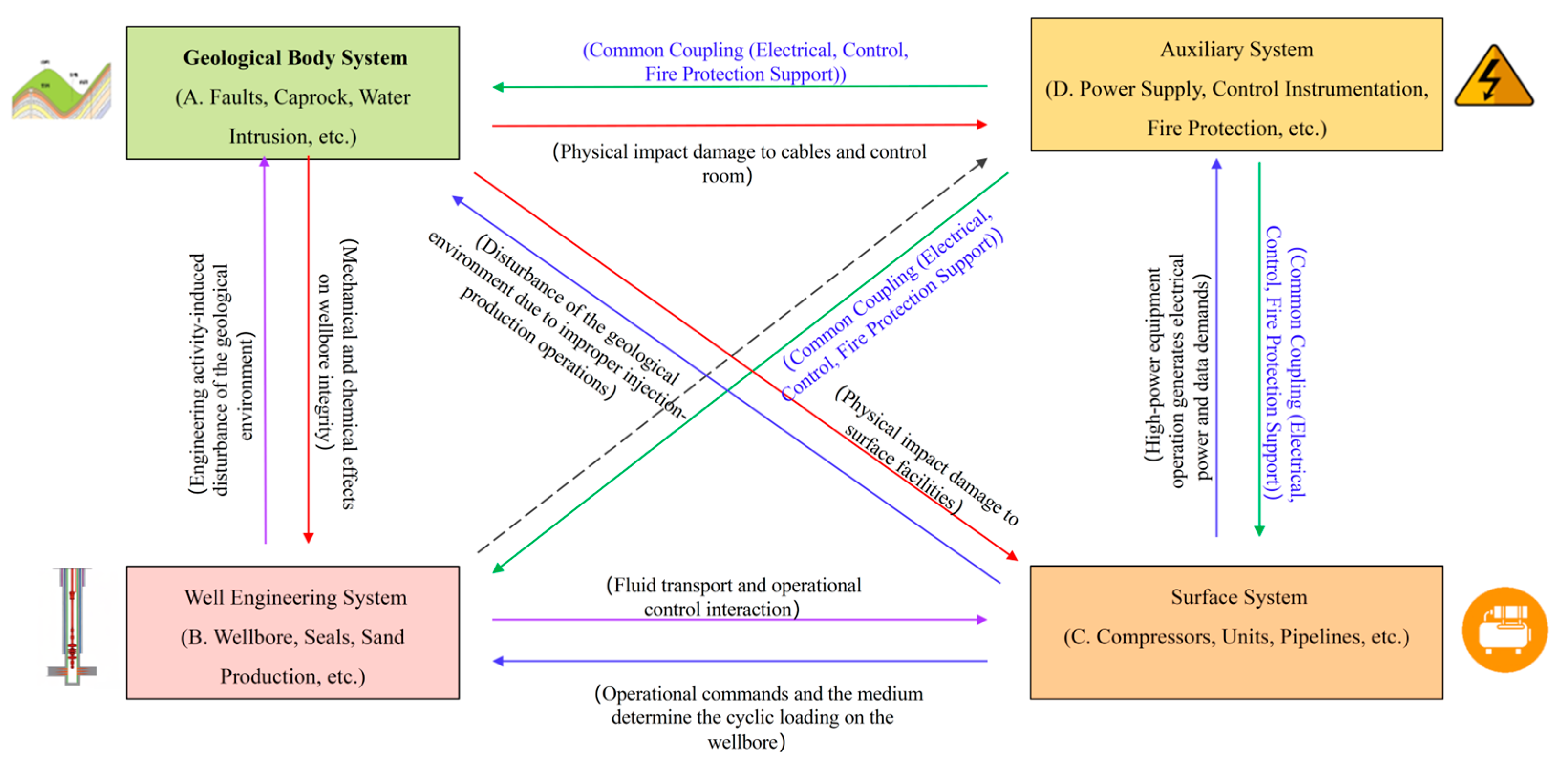
2.2. Risk Transmission Analysis Based on System Coupling Theory
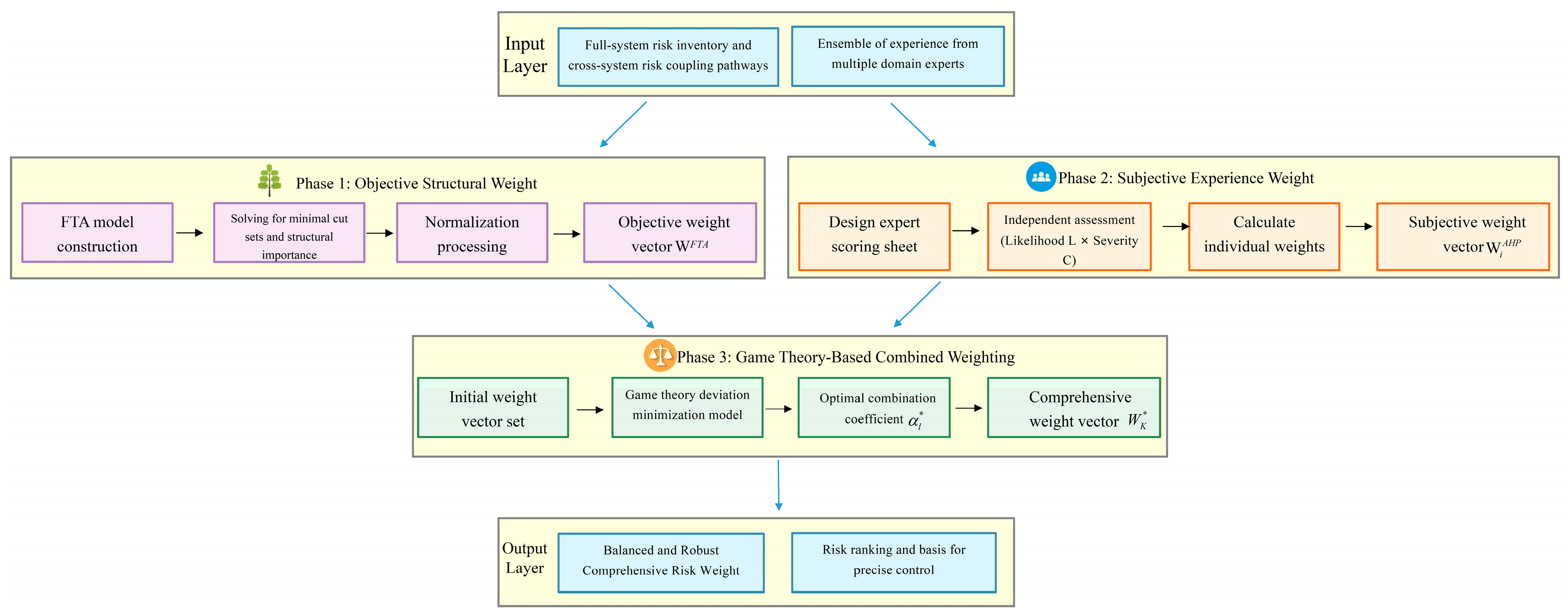
2.3. FTA-ERS-Game Theory Combined Weighting Model Integrating Coupled Network Analysis
2.3.1. Phase 1: Objective Weight Calculation Based on FTA
2.3.2. Stage 2: Subjective Weight Calculation Based on ERS
2.3.3. Stage 3: Combined Weighting Optimization Based on Game Theory
2.3.4. Stage 4: Cross-System Risk Weight Integration Based on Coupling Network
2.4. Case Application: In-Depth Safety Risk Assessment of the Xiangguosi Gas Storage Facility
2.4.1. Case Overview
2.4.2. Risk Identification and Coupling Analysis Results
3. Results
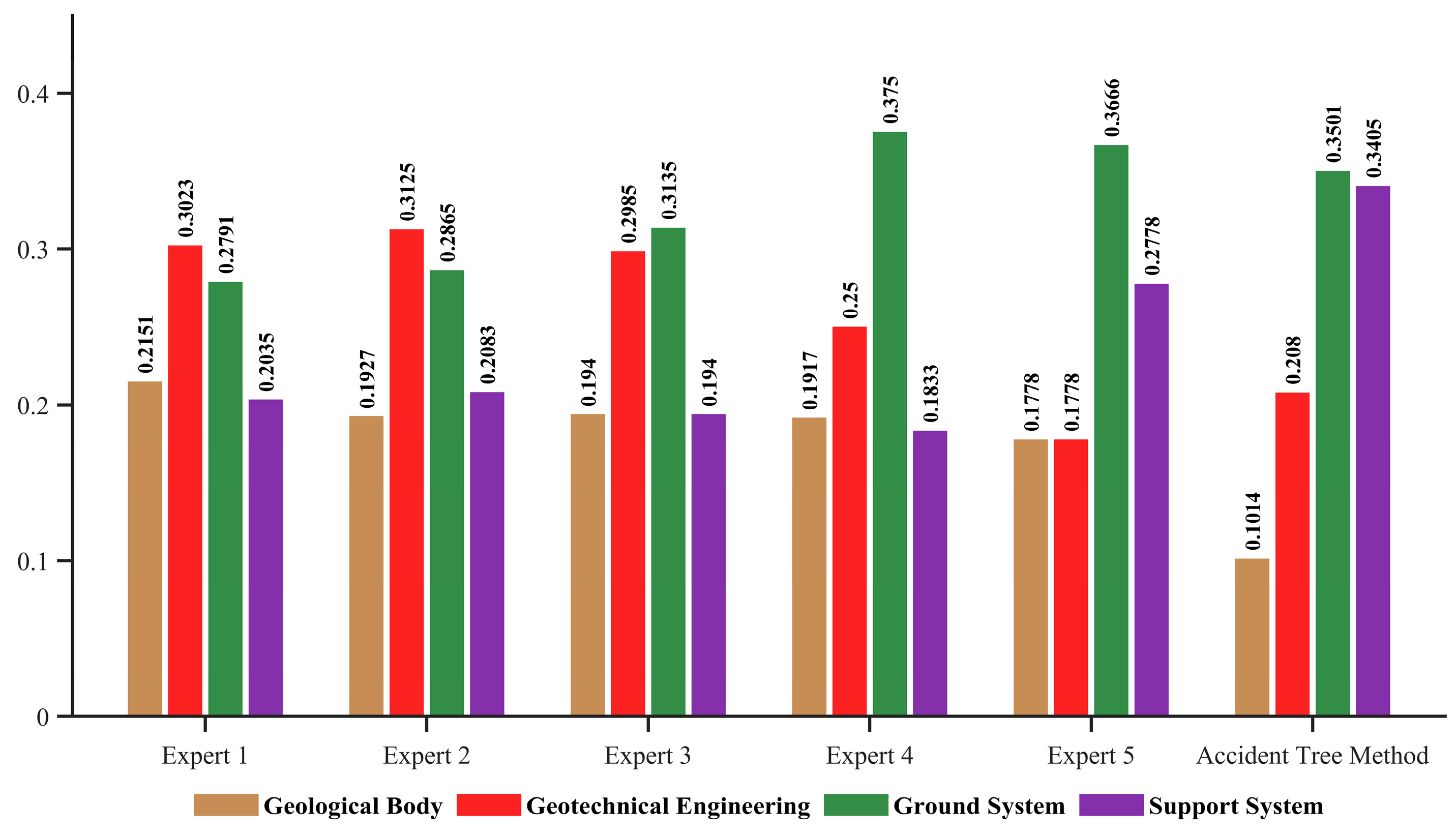
3.1. Subsystem Comprehensive Weight
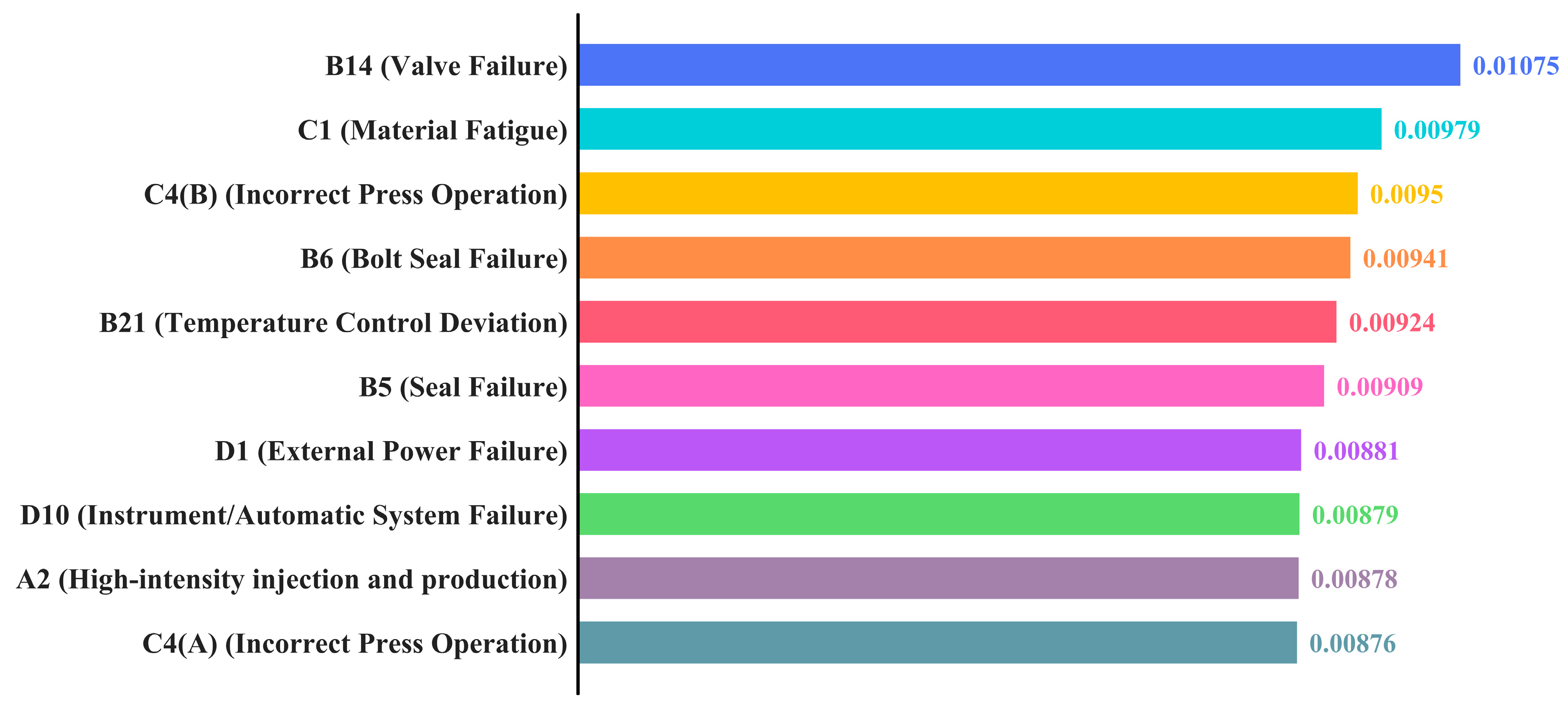
3.2. Overall Risk Factors Prioritization
3.3. Coupling-Induced Weight Adjustment Outcomes
4. Discussion
4.1. Verification of the Necessity of Coupling Correction
4.2. Comparative Analysis with Existing Risk Assessment Methods
4.3. Limitations and Future Directions of Quantitative Comparison
4.4. From Static Assessment to Dynamic Control Design
5. Conclusions
Supplementary Materials
Author Contributions
Funding
Data Availability Statement
Acknowledgments
Conflicts of Interest
Abbreviations
| ERS | Expert Risk Scoring |
| CG-NT | Couping Network-guided Game Theory |
| FTA | Fault Tree Analysis |
References
- Nie, C.; Gu, X.; Liu, L.; Zhang, J.; Nie, Z.; Wang, Y.; Zhou, R.; Liang, X. Joint Peak Shaving Mechanism of Pipeline Gas Storage: Case Study of West-East Gas Pipeline. E3S Web Conf. 2024, 520, 7. [Google Scholar] [CrossRef]
- Liu, J.X.; Liu, Y. Development Status and Prospect of Underground Gas Storage Construction in China. Appl. Chem. Ind. 2022, 51, 1136–1140+1145. [Google Scholar]
- Ministry of Emergency Management of China. Guidelines for Safety Risk Assessment of Underground Gas Storage (Trial); Ministry of Emergency Management of China: Beijing, China, 2025.
- Xu, Q.; Liu, H.; Song, Z.; Dong, S.; Zhang, L.; Zhang, X. Dynamic risk assessment for underground gas storage facilities based on Bayesian network. J. Loss Prev. Process Ind. 2023, 82, 104961. [Google Scholar]
- Hu, Y. Study on Leakage Accident Evolution Mechanism of Depleted Oil and Gas Reservoir Underground Gas Storage. Ph.D. Thesis, Southwest Petroleum University, Chengdu, China, 2022. [Google Scholar]
- Yu, J.; Ding, H.; Wu, S.; Zeng, Q.; Ma, W. Risk assessment of domino effects under fire and explosion accidents in LNG storage tank farms based on Bayesian network. J. Loss Prev. Process Ind. 2025, 93, 105201. [Google Scholar] [CrossRef]
- Hu, J.Q.; Dong, S.H.; Wang, R.H.; Zhang, X.Y. Construction of a typical accident forward model for LNG reserve depot based on STAMP-STPA. Pet. Sci. Bull. 2021, 6, 481–493. [Google Scholar]
- Xie, S.; He, B.; Chen, L.; Xu, K.; Luo, J.; Li, L.; Wang, B. Key Elements in Integrity Management of Underground Gas Storage: A Framework for Energy Safety. Energies 2025, 18, 378. [Google Scholar] [CrossRef]
- Baronio, E.; Busollo, C.; Abdo, E. Implementation of a Risk Assessment Procedure to Manage Well Integrity in Underground Gas Storage. In Proceedings of the SPE Europe Energy Conference and Exhibition, Turin, Italy, 26–28 June 2024. [Google Scholar]
- Sun, Y.B.; Liu, J.W.; Li, W.J. Risk assessment of pressure reduction and blowdown operations in gas transmission stations based on 2GW-HAZOP and deviation degree. J. Saf. Sci. Technol. 2021, 17, 97–102. [Google Scholar]
- Huang, A.D.; Li, C.J.; Wu, X.; Wang, Y.J. Quantitative risk assessment of failure probability for petrochemical rotating equipment based on polymorphic fuzzy Bayesian network. Saf. Environ. Eng. 2021, 28, 36–43. [Google Scholar]
- Li, J.; Sun, M.J.; Jin, Z.L.; Ju, J.Q.; Chen, Y.Y.; Han, L.X.; Wu, M.Y. Identification method of critical risk factors during design phase of oil and gas reservoir underground gas storage based on C-FRAM. Saf. Environ. Eng. 2024, 31, 88–95. [Google Scholar]
- Akni, A.; Bidi, M. Quantitative risk assessment of hazardous chemical discharges and simulation of threat zones in hydrocarbon storage systems. Bull. Pol. Acad. Sci. Tech. Sci. 2025, 73, 152705. [Google Scholar] [CrossRef]
- Zhang, R.; Song, S. Bayesian network approach for dynamic fault tree with common cause failures and interval uncertainty parameters. Eksploat. Niezawodn. Maint. Reliab. 2024, 26, 190379. [Google Scholar] [CrossRef]
- Zhang, L.G.; Li, J.J.; Qian, B.; Ying, Y.N. Discussion on application of HAZOP method in risk identification of salt cavern gas storage. In Proceedings of the China Gas Association Safety Committee Member Conference and Gas Safety Exchange Seminar, Jiaxing, China, 16–17 March 2023. [Google Scholar]
- Luo, J.H.; Li, L.F.; Zhao, X.W.; Wang, K.; Cai, K.; Li, X.; Yang, H.J. Risk assessment method and application of salt cavern underground gas storage. Nat. Gas Ind. 2011, 31, 106–111+140. [Google Scholar]
- Agarwal, A.; Ayello, F.; Raghunathan, V.; Demay, V.; Sridhar, N. Quantitative Assessment of Failure Probability of Underground Natural Gas Storage Wells Using an Integrated Bow-Tie Bayesian Network Approach. J. Fail. Anal. Prev. 2021, 21, 107–123. [Google Scholar]
- Sun, M.; Han, L.; Zhang, L.; Yin, H.; Liao, K.; Hu, J.; Fan, X. A study on risk propagation and traceability of gas storage based on complex network. In Proceedings of the 2023 International Conference on Artificial Intelligence, Systems and Network Security, Mianyang, China, 22–24 December 2023; pp. 343–348. [Google Scholar]
- Guo, H.; Chen, Y.; Cheng, L.; Li, S. Analysis and measurement of multi-factor coupling risk in underground coal mine gas explosion based on system dynamics. Sci. Rep. 2025, 15, 42252. [Google Scholar] [CrossRef] [PubMed]
- Zhang, J.; Wu, L.; Zhang, T.; Wu, D. Systemic and dynamic risk analysis of drilling construction based on bayesian network and system dynamics model. Sci. Rep. 2025, 15, 27989. [Google Scholar] [CrossRef] [PubMed]
- Durukan, O.; Akyuz, E.; Destanoğlu, O.; Arslanoğlu, Y.; Sezer, S.I. Quantitive HAZOP and D-S evidence theory-fault tree analysis approach to predict fire and explosion risk in inert gas system on-board tanker ship. Ocean Eng. 2024, 308, 117512. [Google Scholar]
- Kalathil, M.J.; Renjith, V.R.; Augustine, N.R. Failure mode effect and criticality analysis using dempster shafer theory and its comparison with fuzzy failure mode effect and criticality analysis: A case study applied to LNG storage facility. Process Saf. Environ. Prot. 2020, 138, 337–348. [Google Scholar] [CrossRef]
- Zheng, Q.; Tang, J.; Wang, W.; Deveci, M.; Mardani, A. Analyzing the risk of the ammonia storage facility using extended FMEA model based on probabilistic linguistic GLDS method with consensus reaching. Int. J. Hydrogen Energy 2024, 62, 1231–1244. [Google Scholar] [CrossRef]
- Lukinskiy, V.; Lukinskiy, V.; Bazhina, D. Refining the analytic hierarchy process: A statistical and methodological exploration of expert judgments. Alex. Eng. J. 2025, 125, 526–536. [Google Scholar] [CrossRef]
- Sun, F.Q.; Yan, Y.F.; Zhang, S.Y.; Yan, X.Z.; Liu, Y.P. Annulus pressure monitoring and risk classification of injection-production wells in gas storage. Pet. Tubul. Goods Instrum. 2021, 7, 38–43. [Google Scholar]
- Zheng, W.; Xu, S.; Wang, Z. Fuzzy Comprehensive Evaluation of Collapse Risk in Mountain Tunnels Based on Game Theory. Appl. Sci. 2024, 14, 5163. [Google Scholar] [CrossRef]
- Jin, T.; Zhang, P.; Niu, Y.; Lv, X. Integrating Combination Weighting of Game Theory and Fuzzy Comprehensive Evaluation for Selecting Deep Foundation Pit Support Scheme. Buildings 2024, 14, 619. [Google Scholar] [CrossRef]
- Chen, B.; Zang, Z.; Xiao, Y.; Ding, H.; Lin, S.; Dong, M. Research on the AHP-EWM-VIKOR Model and Comprehensive Evaluation Method for Selecting Sites for Artificial Caverns in CAES. Processes 2025, 13, 4048. [Google Scholar] [CrossRef]
- Mao, H.; Zhang, H.; Chen, B.; Zhu, R.; Yu, H.; Li, X. The Analysis of Deep Energy Storage Rock Mass Stability Assessment Based on Fuzzy Evaluation. Procedia Comput. Sci. 2025, 261, 954–961. [Google Scholar] [CrossRef]
- Liu, C.; Li, J.; Zhang, D. Fuzzy Fault Tree Analysis and Safety Countermeasures for Coal Mine Ground Gas Transportation System. Processes 2024, 12, 344. [Google Scholar] [CrossRef]
- Wang, Z.; Chen, F.; Shi, X.; Ma, H.; Dong, Z.; Yang, C. Construction and application of a safety risk assessment system for salt cavern gas storage based on simulation and monitoring. Tunn. Undergr. Space Technol. 2025, 164, 106838. [Google Scholar] [CrossRef]
- Bi, A.; Luo, Z.; Kong, Y.; Zhao, L. Comprehensive weighted matter-element extension method for the safety evaluation of underground gas storage. R. Soc. Open Sci. 2020, 7, 191302. [Google Scholar] [CrossRef] [PubMed]
- Yang, C.; Jing, W.; Daemen, J.; Zhang, G.; Du, C. Analysis of major risks associated with hydrocarbon storage caverns in bedded salt rock. Reliab. Eng. Syst. Saf. 2013, 113, 94–111. [Google Scholar] [CrossRef]
- Ban, S.; Liu, H.; Wei, X.; Shi, X.; Mao, H.; Song, Y.; Tan, H. The Application of the Fuzzy Comprehensive Evaluation Method in the Sealing Evaluation of Caprocks in Underground Gas Storage. Appl. Sci. 2023, 13, 9753. [Google Scholar] [CrossRef]
- Jing, W.J.; Yang, C.H.; Chen, F. Risk assessment of salt cavern oil/gas storage based on accident statistical analysis. Rock Soil Mech. 2011, 32, 1787–1793. [Google Scholar]
- Lackey, G.; Mundia-Howe, M.; Pekney, N.J. Underground natural gas storage facility operations and well leakage events in the United States. Geoenergy Sci. Eng. 2024, 234, 212630. [Google Scholar] [CrossRef]
- Kaya, G.; Taleghani, A.D. Integrity Issues for Underground Gas Storage Wells. ASME Open J. Eng. 2025, 4, 4067764. [Google Scholar] [CrossRef]
- Wickenhauser, P.L.; Wagg, B.T.; Barbuto, F.A. Quantitative Risk Assessment: Underground Natural Gas Storage Facilities. In Proceedings of the 2006 International Pipeline Conference, Calgary, AB, Canada, 25–29 September 2006. [Google Scholar]
- Cao, J.; Dong, Y.; Li, R. Qualitative and Quantitative Risk Assessment Method for Fire Safety Accident in Liquefied Natural Gas Storage. Control Syst. Eng. 2018, 1. [Google Scholar] [CrossRef]
- Ridolfi, R.M.; Azzaro, S.; Beaubien, S.E.; Da Pra, A.; Pontiggia, M.; Bigi, S. Development of a site-screening method for hydrogen storage purposes and its application to an industrial dataset of Italian reservoirs. In Proceedings of the European Geosciences Union General Assembly 2024 (EGU24), Vienna, Austria, 14–19 April 2024. [Google Scholar]
- Wang, C.J.; Guo, H. SD simulation of safety vulnerability in oil and gas stations based on game theory combination weighting. Oil Gas Storage Transp. 2022, 41, 55–62. [Google Scholar]



| Failed System | Failure Type | Specific Risk Factors |
|---|---|---|
| Compressor failure | Piston wear/breakage | C1 Material fatigue, C2 Insufficient lubrication, C3 Foreign matter entering cylinder, C4 Compressor improper operation (e.g., frequent start/stop) |
| Lubrication system failure | C5 Low lube oil pressure or failure of oil pump auto-start in compressor unit, C6 Insufficient heat exchange efficiency or clogging of lube oil cooler, C7 Deterioration of lube oil quality, C8 Lube oil leakage, C9 No online lube oil monitoring instrument | |
| Compressor failure | C10 Cooler clogging, C11 Fan failure, C12 Insufficient coolant, C13 Temperature sensor failure, C14 Circulating water pump failure | |
| Safety monitoring and protection failure | C15 No pulsation analysis or anti-surge device installed, C16 No pressure alarm or shutdown device at inlet/outlet, C17 No vibration monitoring or overspeed shutdown device at outlet |
| Coupling Type | Source System/Factor | Transmission Path | Target System/Consequence |
|---|---|---|---|
| Transmission coupling | Ground system (C4 compressor improper operation, e.g., frequent start/stop) | → Wellbore alternating load | Wellbore engineering (seal failure) |
| Common coupling | Auxiliary system (D1: external power failure) | → Simultaneously causes | Ground shutdown, well control failure, monitoring interruption |
| Risk Receiving System | Primary Risk Source System | Key Coupling Pathway Description |
|---|---|---|
| Geologic Body | Well Engineering Surface Facilities | (1) Wellbore barrier failure → formation of flow pathways → loss of geologic sealing integrity (2) Improper compressor operation → disturbance of in-situ stress field → fault activation |
| Well Engineering | Geologic Body Surface Facilities Auxiliary Systems | (1) In-situ stress/corrosive media → tubular deformation/corrosion (2) Alternating loads → tubing thread loosening/seal failure (3) Power supply failure → downtime of protective fluid systems → accelerated corrosion |
| Surface Facilities | Auxiliary Systems, Well Engineering, Geologic Body | (1) Power supply failure → compressor shutdown/paralysis of lubrication, cooling and dehydration systems (2) Sand production/corrosion products → equipment blockage and wear (3) Earthquake → pipeline rupture and leakage |
| Auxiliary Systems | Surface Facilities Geologic Body | (1) Large equipment startup/shutdown → power grid voltage fluctuation (2) Earthquake/landslide → damage to power infrastructure |
| Risk Factor | M1 Rank (Without Coupling Correction) | M2 Rank (Proposed CN-GT Model) | Rank Change |
|---|---|---|---|
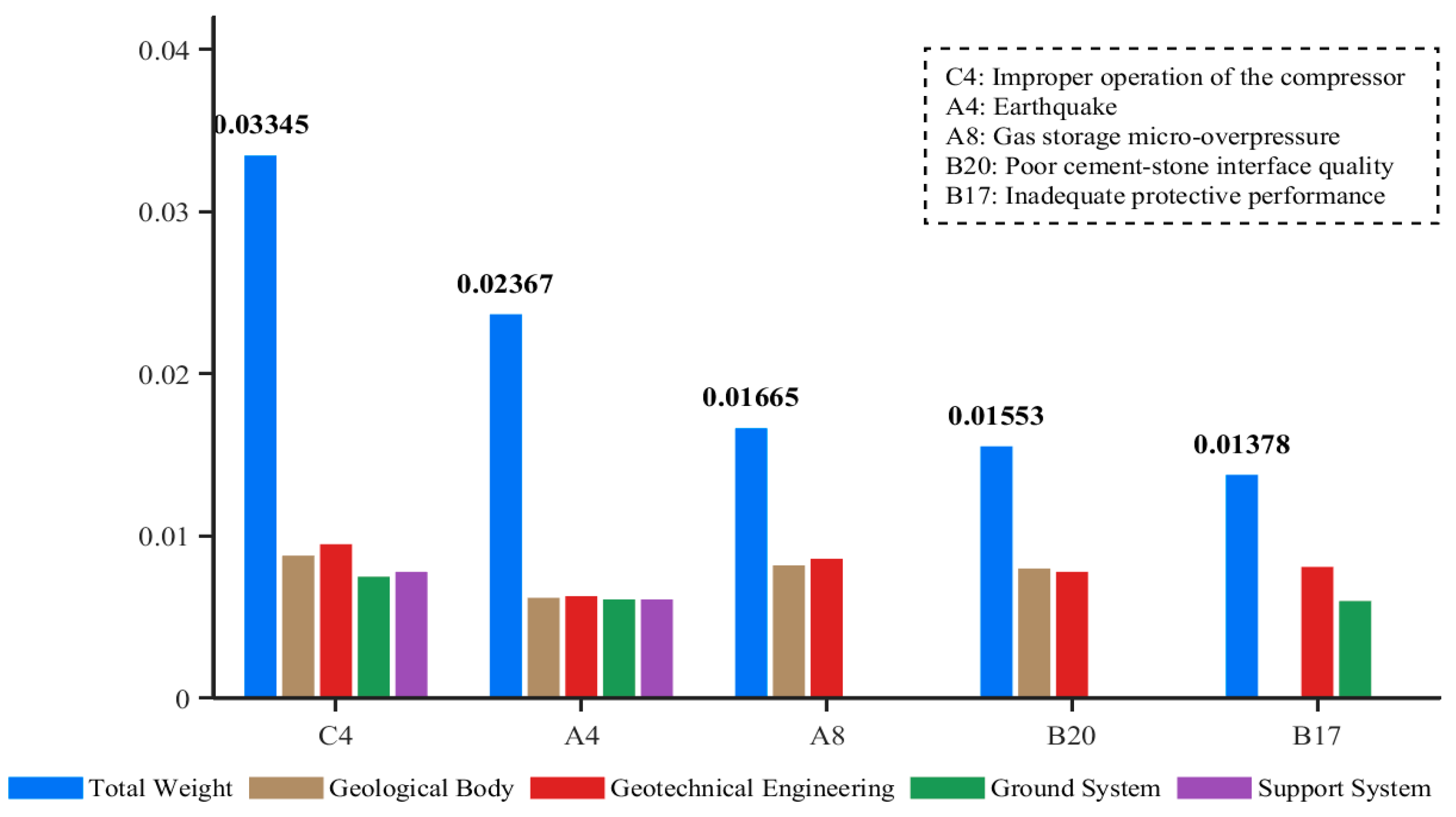
| C4 Improper Compressor Operation | 36 | 1 | ↑ 35 |
| B14 Valve Failure | 1 | 17 | ↓ 16 |
| A4 Reservoir-Induced Seismicity | 82 | 2 | ↑ 80 |
| B20 Poor cement-stone interface quality | 32 | 5 | ↑ 27 |
| Comparison Dimension | Traditional Risk Matrix | FTA-Fuzzy Comprehensive Evaluation | Conventional Combination Weighting Method | The Proposed CN-GT Model |
|---|---|---|---|---|
| Common Coupling Characterization | Weak. Ignores parallel attack effects. | Moderate. Qualitative expression available, but cannot quantify coupling contributions. | Weak. Weight fusion does not consider coupling structures. | Strong. Explicitly aggregates multi-system weights. |
| Transmissive Coupling Characterization | None. Limited to single-system evaluation. | Weak. Fault tree logic is complex, cannot quantify transmission increments. | None. Still treats subsystems as independent units. | Strong. Tracks propagation paths and quantifies amplification effects. |
| Risk Discrimination Capability | Low. Difficult to rank risks within the same level. | Moderate. Depends on membership function design. | Moderate. Combines subjective and objective weights, but does not reflect coupling. | High. Continuous numerical weights enable fine-grained differentiation. |
| Data Dependency | Low. Relies on expert grading. | Moderate. Requires fuzzy numbers for basic event probabilities. | Moderate. Depends on data input; no need for precise probabilities. | Moderate. Combines structural and empirical information; no need for precise probabilities. |
Disclaimer/Publisher’s Note: The statements, opinions and data contained in all publications are solely those of the individual author(s) and contributor(s) and not of MDPI and/or the editor(s). MDPI and/or the editor(s) disclaim responsibility for any injury to people or property resulting from any ideas, methods, instructions or products referred to in the content. |
© 2026 by the authors. Licensee MDPI, Basel, Switzerland. This article is an open access article distributed under the terms and conditions of the Creative Commons Attribution (CC BY) license.
Share and Cite
Mao, W.; Zeng, J.; Deng, Y.; Liu, J.; Huo, D.; Zhong, K.; Liu, J.; Liu, G.; Hu, J. Deep Risk Assessment of Gas Storage Based on Coupling Network and Game Theory. Energies 2026, 19, 3041. https://doi.org/10.3390/en19133041
Mao W, Zeng J, Deng Y, Liu J, Huo D, Zhong K, Liu J, Liu G, Hu J. Deep Risk Assessment of Gas Storage Based on Coupling Network and Game Theory. Energies. 2026; 19(13):3041. https://doi.org/10.3390/en19133041
Chicago/Turabian StyleMao, Wei, Juan Zeng, Yumeng Deng, Jiayi Liu, Dongyuan Huo, Ke Zhong, Jie Liu, Gang Liu, and Jinqiu Hu. 2026. "Deep Risk Assessment of Gas Storage Based on Coupling Network and Game Theory" Energies 19, no. 13: 3041. https://doi.org/10.3390/en19133041
APA StyleMao, W., Zeng, J., Deng, Y., Liu, J., Huo, D., Zhong, K., Liu, J., Liu, G., & Hu, J. (2026). Deep Risk Assessment of Gas Storage Based on Coupling Network and Game Theory. Energies, 19(13), 3041. https://doi.org/10.3390/en19133041