

Electrical Demand Uplift and Coil Performance Constraints in Air-Source Heat Pump Retrofits for Commercial Office Buildings


Abstract
1. Introduction
- Quantify electrical uplift associated with ASHP retrofit;
- Analyse the transformation of thermal demand into electrical demand;
- Evaluate the implications of low-temperature operation on the AHU coil performance.
2. Literature Review
2.1. Electrification and Infrastructure Constraints
2.2. Heat-Pump Performance and Variability
2.3. Load Dependency and System Interaction
2.4. Hydronic Constraints and Coil Performance
2.5. Research Gap
3. Materials and Methods
3.1. The Case-Study Building and Baseline Definition
3.2. Peak Load Derivation and Data Sources
3.3. Overview of Analytical Framework
- Hydronic system transformation, in which the thermal demand is converted to the required water flow rates and pumping energy.
- Heat pump electrical demand calculation, based on peak heating demand and ASHP coefficient of performance (COP).
- Terminal-unit reassessment, in which existing AHU heating coils are re-rated under low-temperature operation.
3.4. Hydronic System Representation
3.5. Heat Pump Electrical Demand
3.6. Electrical Infrastructure Impact Assessment
3.7. Heating Coil Re-Rating and Terminal-Unit Assessment
3.8. Modelling Approach and Assumptions
- (1)
- Determine the peak heating and cooling loads using suitable software-based feasibility models, such as IES VE-informed models, design-day heat-balance calculations, or BMS time-series data where available.
- (2)
- Establish heat-pump performance under design ambient conditions, including COP degradation at low temperatures.
- (3)
- Convert the thermal demand to electrical demand using temperature-dependent COP relationships and hydronic pumping requirements.
- (4)
- Use the resulting peak electrical demand to quantify plant-level electrical uplift and assess the potential implications for existing switchboard and transformer capacity.
- (5)
- Re-rate existing AHU heating coils under reduced entering water temperatures (40–55 °C) using NTU–effectiveness methods to quantify capacity shortfall.
- (6)
- Determine enabling measures, including flow rate increases, coil modification, envelope improvements, and hybrid system configurations.
4. Results
4.1. Overview of Analytical Outputs
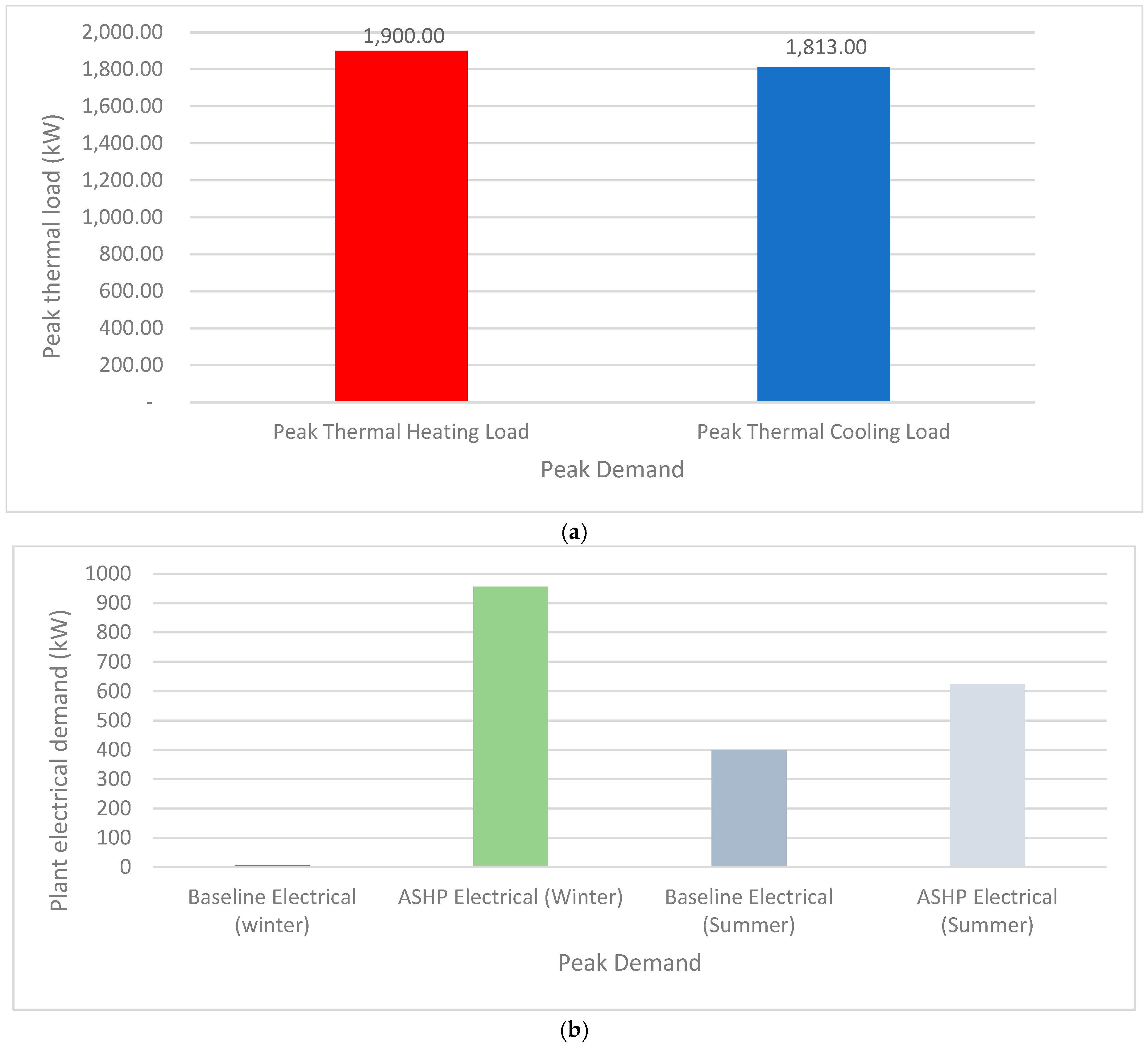
4.2. Peak Thermal-to-Electrical Demand and COP Sensitivity
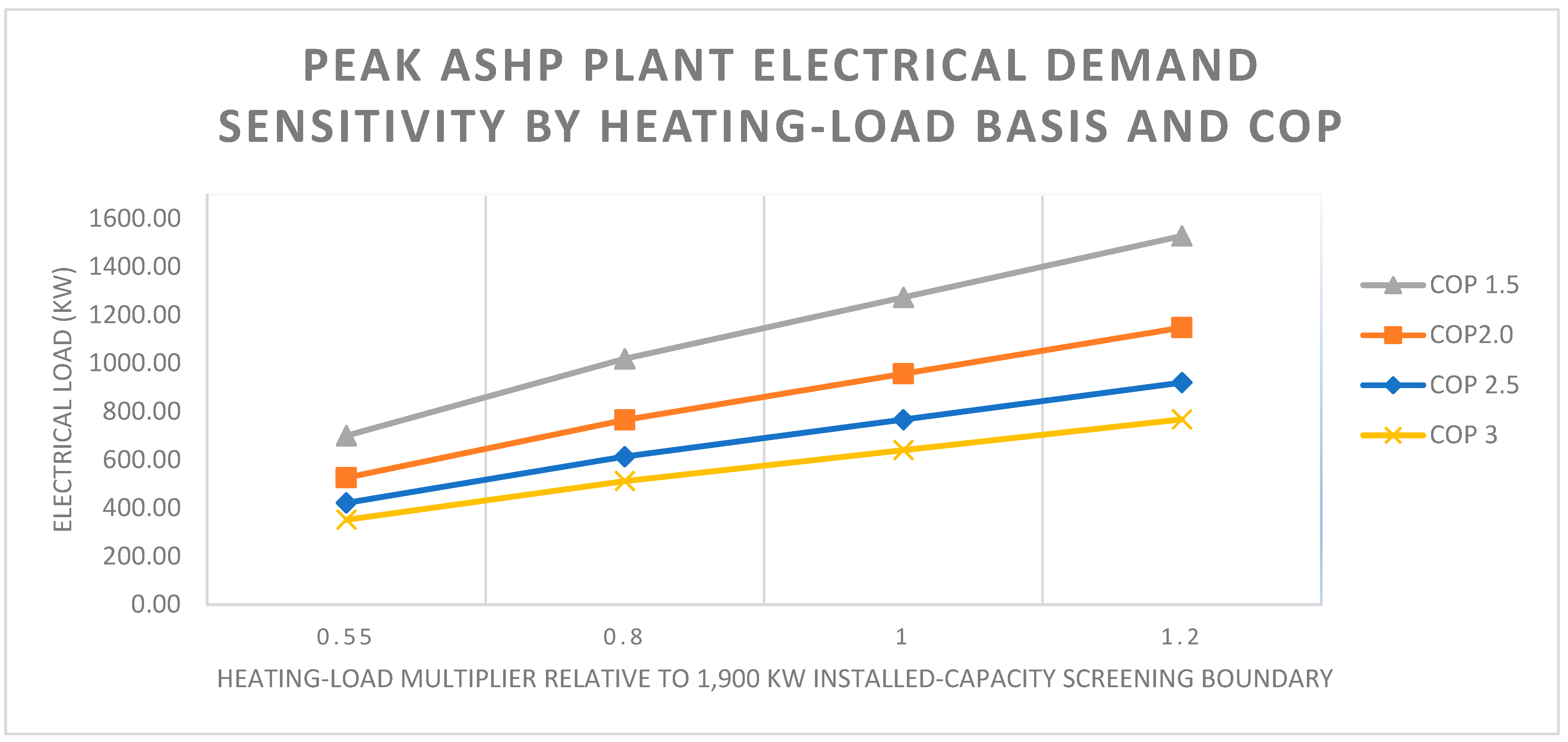
4.3. Parametric Sensitivity of Peak Electrical Uplift
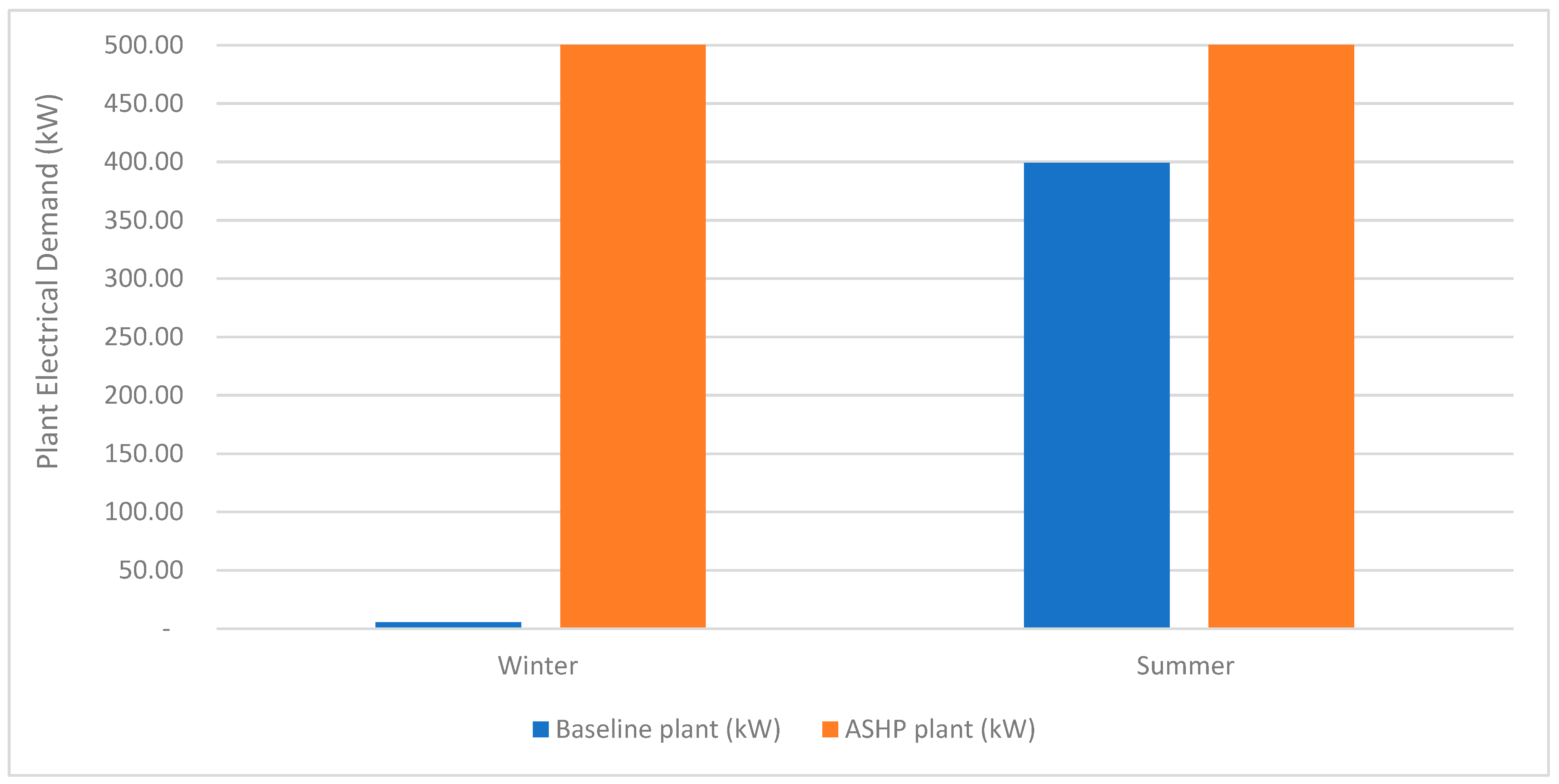
4.4. Baseline and Electrified Peak Demand Comparison
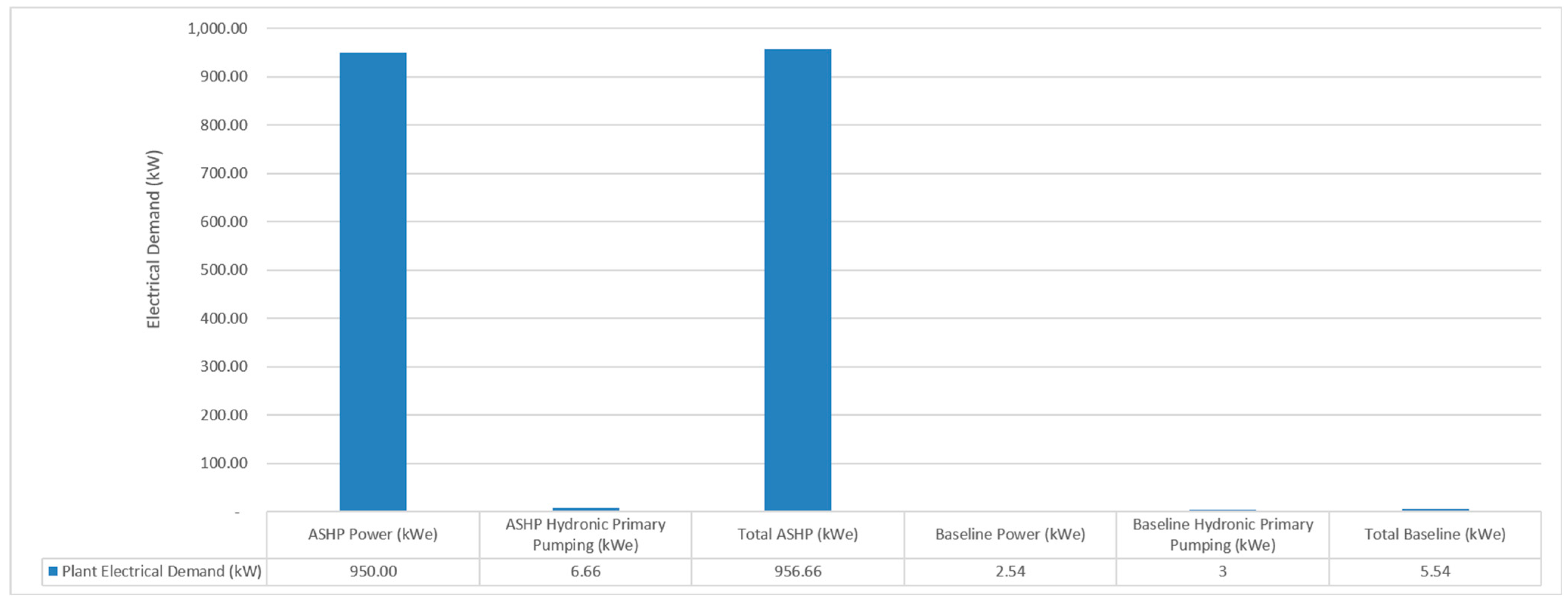
4.5. Electrical Demand Breakdown
4.6. AHU Heating Coil Performance
4.7. Summary of Key Results
5. Discussion
5.1. Alignment with and Extension of Electrification Literature
5.2. Hydronic and Terminal-Unit Constraints in Context
5.3. Integrated Implications for Electrification Practice
5.4. Policy and Industry Implications
- Incentives for switchboard, transformer, and feeder upgrades;
- Support for hydronic system adaptation;
- Requirements for peak-load-based feasibility assessments;
5.5. A Generalisable Framework for Broader Application
6. Conclusions
Author Contributions
Funding
Data Availability Statement
Conflicts of Interest
Abbreviations
| AHU | Air handling unit |
| ASHP | Air-source heat pump |
| COP | Coefficient of performance |
| GHG | Greenhouse gas |
| HVAC | Heating, ventilation, and air-conditioning |
| LMTD | Logarithmic mean temperature difference |
| NABERS | National Australian Built Environment Rating System |
| NCC | National Construction Code |
| NTU | Number of transfer units |
| N + 1 | Redundant plant arrangement with one additional unit beyond the required duty |
Nomenclature
| Symbol | Definition | Units |
| Heat transfer surface area | m2 | |
| Specific heat capacity of water | kJ·kg−1·K−1 | |
| Air-side heat capacity rate | W·K−1 | |
| Water-side heat capacity rate | W·K−1 | |
| Minimum heat capacity rate | W·K−1 | |
| Maximum heat capacity rate | W·K−1 | |
| Capacity ratio, | – | |
| Mass flow rate | kg·s−1 | |
| Volumetric flow rate | m3·s−1 | |
| Number of transfer units | – | |
| Peak plant electrical demand under ASHP operation | kW | |
| Maximum baseline plant electrical demand | kW | |
| Compressor electrical demand | kW | |
| Electrical power input | kW | |
| Pump electrical demand | kW | |
| Heat transfer rate or thermal load | kW | |
| Coil heating capacity at 55 °C entering water condition | kW | |
| Coil heating capacity at legacy high-temperature condition | kW | |
| Peak heating load | kW | |
| Peak cooling load | kW | |
| Ambient outdoor temperature | °C | |
| Supply water temperature | °C | |
| Return water temperature | °C | |
| Overall heat transfer conductance | W·K−1 | |
| Electrical uplift, | kW | |
| Hydraulic pressure differential | Pa or kPa | |
| Water temperature differential | K | |
| Logarithmic mean temperature difference | K | |
| Pump and motor efficiency | – | |
| Heat exchanger effectiveness | – | |
| Density of water | kg·m−3 |
Appendix A
Appendix A.1. Purpose of This Appendix
Appendix A.2. Analytical Boundary
Appendix A.3. Case-Study Building Description
Appendix A.4. Baseline Operational Assumptions
Appendix A.5. Envelope, Infiltration, and Control Assumptions
Appendix A.6. Baseline Model Status and Load Definition
Appendix A.7. AHU Schedule Used in the Terminal-Unit Assessment

| AHU Reference | Description | Airflow (L/s) | Cooling Duty (kW) | Heating Duty (kW) |
|---|---|---|---|---|
| AHU-G.1 | Main lobby | 2544 | 40.6 | 46.4 |
| AHU-G.2 | Main lobby | 908 | 17.4 | 15.9 |
| AHU-G.6 | Main lobby | 345 | 7.2 | 4.2 |
| AHU-Lift | Lift 3 | 1020 | 23.9 | 24.1 |
| AHU-C1 | Central zone 1 | 13,674 | 291.4 | 222.1 |
| AHU-C2 | Central zone 2 | 12,699 | 276.2 | 173.1 |
| AHU-E | Eastern zone | 8458 | 133.0 | 77.1 |
| AHU-N1 | Northern zone 1 | 4365 | 69.6 | 50.1 |
| AHU-N2 | Northern/eastern zone 2 | 4353 | 69.6 | 50.1 |
| AHU-OA1 | Supplementary outside air | 2606 | 35.1 | 61.8 |
| AHU-OA2 | Supplementary outside air | 2491 | 35.1 | 61.8 |
| AHU-S | Southern zone | 10,431 | 193.2 | 184.3 |
| AHU-W | Western zone | 9036 | 142.1 | 75.3 |
Appendix A.8. Baseline Central Plant Assumptions
Appendix A.8.1. Cooling Plant
Appendix A.8.2. Heating Plant
| System | Parameter | Value | Unit | Use in Manuscript |
|---|---|---|---|---|
| Heating plant | Boiler nominal capacity | 2 × 950.2 | kW | Baseline gas-fired heating plant capacity |
| Heating plant | Heating-water reset low-outside-air setpoint | 80 | °C | Baseline heating-water operating condition |
| Heating plant | Heating-water reset high-outside-air setpoint | 40 | °C | Baseline heating-water reset condition |
| Heating pumps—baseline primary | Flow rate | 10.23 | L/s | Existing baseline heating-pump schedule |
| Heating pumps—baseline primary | System pressure differential | 101 | kPa | Existing baseline heating-pump schedule |
| Heating pumps—baseline primary | Motor rating | 2.1 | kW | Existing baseline heating auxiliary load |
| Heating pumps—baseline primary | Pump-and-motor efficiency | 70 | % | Existing baseline heating-pump schedule |
| Heating pumps—baseline secondary | Flow rate | 8.7 | L/s | Existing baseline heating-pump schedule |
| Heating pumps—baseline secondary | System pressure differential | 203 | kPa | Existing baseline heating-pump schedule |
| Heating pumps—baseline secondary | Motor rating | 3.3 | kW | Existing baseline heating auxiliary load |
| Heating pumps—baseline secondary | Pump-and-motor efficiency | 70 | % | Existing baseline heating-pump schedule |
| ASHP retrofit heating case | Heating load basis | 1900 | kW | Stage 3 installed-capacity screening boundary |
| ASHP retrofit heating case | Hydronic regime | 55/45 | °C | Low-temperature ASHP heating condition |
| ASHP retrofit heating case | Water temperature differential | 10 | K | Basis for calculated heating water flow |
| ASHP retrofit heating case | Calculated heating water flow | 45.39 | L/s | Flow used for ASHP retrofit pumping calculation |
| ASHP retrofit heating case | Equivalent retrofit heating-circuit pressure differential | 88 | kPa | Retrofit-screening pressure differential used in Equation (3) |
| ASHP retrofit heating case | Combined pump-and-motor efficiency | 60 | % | Retrofit-screening efficiency used in Equation (4) |
| ASHP retrofit heating case | Calculated pump electrical demand | 6.66 | kW | Winter ASHP heating pump demand used in the main results |
| ASHP retrofit heating case | Design-point heating COP | 2 | – | Conservative winter ASHP screening assumption |
| ASHP retrofit heating case | Compressor electrical demand | 950 | kW | 1900 kW/COP 2.0 |
| ASHP retrofit heating case | Total winter ASHP plant electrical demand | 956.66 | kW | Compressor demand plus heating pump demand |
| Cooling plant baseline | Chiller nominal capacity | 866.5; 946.6 | kW | Existing baseline cooling plant capacity |
| Cooling plant baseline | Chilled-water flow per chiller | 41.3 | L/s | Existing baseline cooling-plant schedule |
| Cooling pumps baseline primary | Flow rate, pressure differential and motor rating | 41.3 L/s, 230 kPa, 16.2 kW | – | Existing baseline chilled-water pump schedule |
| Cooling pumps baseline secondary | Flow rate, pressure differential and motor rating | 17.58 L/s, 280 kPa, 8.1 kW | – | Existing baseline chilled-water pump schedule |
| Baseline electrical reference | Baseline winter auxiliary electrical load | 5.54 | kW | Baseline winter heating auxiliary electrical load |
| Baseline electrical reference | Governing baseline plant electrical demand | 399 | kW | Cooling-governed baseline electrical reference |
| Comparative ASHP cooling case | Cooling load basis | 1813.10 | kW | Comparative reversible-operation ASHP cooling case |
| Comparative ASHP cooling case | Design-point cooling COP | 3 | – | Assumed cooling-mode ASHP performance |
| Comparative ASHP cooling case | Compressor electrical demand | 604.37 | kW | 1813.10 kW/COP 3.0 |
| Comparative ASHP cooling case | Chilled-water regime | 7/14 | °C | Comparative ASHP cooling hydronic condition |
| Comparative ASHP cooling case | Water temperature differential | 7 | K | Basis for calculated cooling water flow |
| Comparative ASHP cooling case | Calculated cooling water flow | 61.87 | L/s | Flow used for comparative ASHP cooling pumping calculation |
| Comparative ASHP cooling case | Equivalent cooling-circuit pressure differential | 192 | kPa | Cooling-mode retrofit-screening pressure differential |
| Comparative ASHP cooling case | Combined pump-and-motor efficiency | 60 | % | Cooling-mode retrofit-screening efficiency |
| Comparative ASHP cooling case | Calculated pump electrical demand | 19.80 | kW | Comparative ASHP cooling pump demand |
| Comparative ASHP cooling case | Total summer ASHP plant electrical demand | 624.17 | kW | Compressor demand plus cooling pump demand |
| Ventilation | Minimum outside air | 11.25 | L/s per person | Baseline ventilation assumption |
| Infiltration | Perimeter infiltration | 0.5 | ACH | Baseline envelope/infiltration assumption |
Appendix A.9. Plant Staging Basis and Relationship to the 1900 kW Heating Load
Appendix A.10. Relationship to the Main Paper Results
- Peak heating load: 1900 kW;
- Peak cooling load: 1813.10 kW;
- Baseline winter auxiliary electrical load: 5.54 kW;
- Governing baseline plant electrical demand: 399 kW;
- Base-case ASHP winter plant electrical demand: 956.66 kW;
- Electrical uplift: 557.7 kW;
- Base hydronic regime for terminal-unit re-rating: 55/45 °C.
Appendix A.11. Limitations of Appendix A
- Built form or architectural information;
- Formal long-term utility calibration statistics;
- Measured whole-building switchboard headroom, transformer spare capacity, or feeder capacity;
- Detailed manufacturer capacity maps for the assumed ASHP;
- Transient defrost modelling;
- Full techno-economic optimisation.
References
- Wells, L.; Rismanchi, B.; Aye, L. A review of Net Zero Energy Buildings with reflections on the Australian context. Energy Build. 2018, 158, 616–628. [Google Scholar] [CrossRef] [Scilit]
- Lamb, W.F.; Wiedmann, T.; Pongratz, J.; Andrew, R.; Crippa, M.; Olivier, J.G.J.; Wiedenhofer, D.; Mattioli, G.; Al Khourdajie, A.; House, J.; et al. A review of trends and drivers of greenhouse gas emissions by sector from 1990 to 2018. Environ. Res. Lett. Correction in Environ. Res. Lett. 2022, 17, 049502. https://doi.org/10.1088/1748-9326/ac5b3c.. 2021, 16, 073005. [Google Scholar] [CrossRef] [Scilit]
- Ibrahim, M.; Harkouss, F.; Biwole, P.; Fardoun, F.; Ouldboukhitine, S. Building retrofitting towards net zero energy: A review. Energy Build. 2024, 322, 114707. [Google Scholar] [CrossRef] [Scilit]
- Chen, L.; Darko, A.; Adegoriola, M.I.; Chan, A.P.C.; Yang, Y.; Tetteh, M.O. Challenges to energy retrofitting of existing office buildings in high-rise high-density cities: The case of Hong Kong. Energy Build. 2024, 312, 114220. [Google Scholar] [CrossRef] [Scilit]
- Żelazna, A.; Pawłowski, A. Review of the Role of Heat Pumps in Decarbonization of the Building Sector. Energies 2025, 18, 3255. [Google Scholar] [CrossRef] [Scilit]
- Mukhtar, M.; Ameyaw, B.; Yimen, N.; Zhang, Q.; Bamisile, O.; Adun, H.; Dagbasi, M. Building Retrofit and Energy Conservation/Efficiency Review: A Techno-Environ-Economic Assessment of Heat Pump System Retrofit in Housing Stock. Sustainability 2021, 13, 983. [Google Scholar] [CrossRef] [Scilit]
- Kumar, R.; Mukhopadhyaya, P.; Froese, T.; Dekin, A.; Prince, M. Emerging HVAC Technologies and Best Practices for Energy-Efficient, Low-Carbon Buildings: A Review. Energies 2026, 19, 1296. [Google Scholar] [CrossRef] [Scilit]
- Carroll, P.; Chesser, M.; Lyons, P. Air Source Heat Pumps field studies: A systematic literature review. Renew. Sustain. Energy Rev. 2020, 134, 110275. [Google Scholar] [CrossRef] [Scilit]
- Byrne, P. Research Summary and Literature Review on Modelling and Simulation of Heat Pumps for Simultaneous Heating and Cooling for Buildings. Energies 2022, 15, 3529. [Google Scholar] [CrossRef] [Scilit]
- Deng, J.; Wei, Q.; Liang, M.; He, S.; Zhang, H. Does heat pumps perform energy efficiently as we expected: Field tests and evaluations on various kinds of heat pump systems for space heating. Energy Build. 2019, 182, 172–186. [Google Scholar] [CrossRef] [Scilit]
- Lund, H.; Werner, S.; Wiltshire, R.; Svendsen, S.; Thorsen, J.E.; Hvelplund, F.; Mathisen, B.V., 4th. Generation District Heating (4GDH): Integrating smart thermal grids into future sustainable energy systems. Energy 2014, 68, 1–11. [Google Scholar] [CrossRef] [Scilit]
- Østergaard, D.S.; Svendsen, S. Costs and benefits of preparing existing Danish buildings for low-temperature district heating. Energy 2019, 176, 718–727. [Google Scholar] [CrossRef] [Scilit]
- Lämmle, M.; Bongs, C.; Wapler, J.; Günther, D.; Hess, S.; Kropp, M.; Herkel, S. Performance of air and ground source heat pumps retrofitted to radiator heating systems and measures to reduce space heating temperatures in existing buildings. Energy 2022, 242, 122952. [Google Scholar] [CrossRef] [Scilit]
- Ma, Z.; Wang, S. Energy efficient control of variable speed pumps in complex building central air-conditioning systems. Energy Build. 2009, 41, 197–205. [Google Scholar] [CrossRef] [Scilit]
- Johnson, R.K. Measured Performance of a Low Temperature Air Source Heat Pump; Tech. Rep. NREL/SR-5500-56393, DOE/GO-102013-3788; U.S. Department of Energy, Office of Energy Efficiency and Renewable Energy: Washinton, DC, USA, 2013. Available online: https://www1.eere.energy.gov/buildings/publications/pdfs/building_america/low_temp_air_source_heat_pump.pdf (accessed on 22 June 2026). [CrossRef] [Scilit]
- Wan, S.; Ding, G.; Runeson, G.; Liu, Y. Sustainable Buildings’ Energy-Efficient Retrofitting: A Study of Large Office Buildings in Beijing. Sustainability 2022, 14, 1021. [Google Scholar] [CrossRef] [Scilit]
- Jafri, A.; Villenuve, E.; Agelin-Chaab, M.; Hangan, H. Experimental investigation of building mock-ups and air source heat pumps in cold climates. Energy Built Environ. 2025, 7, 654–671. [Google Scholar] [CrossRef] [Scilit]
- Xu, X.; Zhang, L.; Chen, J.; Lin, Q.; Chen, J. Device Modeling Method for the Entire Process of Energy-Saving Retrofit of a Refrigeration Plant. Energies 2025, 18, 4147. [Google Scholar] [CrossRef] [Scilit]


| COP | Electrical Demand (kW) | Electrical Uplift (kW) | Relative Uplift (%) |
|---|---|---|---|
| 1.5 | 1273 | 874 | 219.13 |
| 2 | 957 | 558 | 139.76 |
| 2.5 | 767 | 368 | 92.14 |
| 3 | 640 | 241 | 60.40 |
| Heating-Load Multiplier | Peak Heating Load (kW) | COP | Peak ASHP Plant Demand (kW) | Electrical Uplift (kW) | Relative Uplift (%) |
|---|---|---|---|---|---|
| 0.55 | 1046.30 | 1.50 | 701.20 | 302.20 | 75.74 |
| 0.55 | 1046.30 | 2.00 | 526.82 | 127.82 | 32.04 |
| 0.55 | 1046.30 | 2.50 | 422.19 | 23.19 | 5.81 |
| 0.55 | 1046.30 | 3.00 | 352.43 | −46.57 | −11.67 |
| 0.80 | 1520.00 | 1.50 | 1018.66 | 619.66 | 155.30 |
| 0.80 | 1520.00 | 2.00 | 765.33 | 366.33 | 91.81 |
| 0.80 | 1520.00 | 2.50 | 613.33 | 214.33 | 53.72 |
| 0.80 | 1520.00 | 3.00 | 511.99 | 112.99 | 28.32 |
| 1.00 | 1900.00 | 1.50 | 1273.32 | 874.32 | 219.13 |
| 1.00 | 1900.00 | 2.00 | 956.66 | 557.66 | 139.76 |
| 1.00 | 1900.00 | 2.50 | 766.66 | 367.66 | 92.14 |
| 1.00 | 1900.00 | 3.00 | 639.99 | 240.99 | 60.40 |
| 1.20 | 2280.00 | 1.50 | 1527.99 | 1128.99 | 282.95 |
| 1.20 | 2280.00 | 2.00 | 1147.99 | 748.99 | 187.72 |
| 1.20 | 2280.00 | 2.50 | 919.99 | 520.99 | 130.57 |
| 1.20 | 2280.00 | 3.00 | 767.99 | 368.99 | 92.48 |
| Unit | Scheduled Duty (kW) |
Capacity 55 °C
(kW) |
Capacity Ratio
(Q55/Q70) |
Indicative Shortfall
(%) |
UA Uplift
Factor (×) |
Modification
Required |
|---|---|---|---|---|---|---|
| AHU—1 | 46.40 | 32.91 | 0.71 | 29 | 1.82 | Yes |
| AHU—2 | 15.90 | 11.64 | 0.73 | 27 | 1.65 | Yes |
| AHU—3 | 4.20 | 3.26 | 0.78 | 22 | 1.36 | No |
| AHU—4 | 24.10 | 18.38 | 0.76 | 24 | 1.53 | Likely |
| AHU—5 | 222.10 | 168.71 | 0.76 | 24 | 1.56 | Yes |
| AHU—6 | 173.10 | 131.49 | 0.76 | 24 | 1.49 | Likely |
| AHU—7 | 77.10 | 54.60 | 0.71 | 29 | 1.70 | Yes |
| AHU—8 | 50.10 | 35.81 | 0.71 | 29 | 1.69 | Yes |
| AHU—9 | 50.10 | 35.81 | 0.71 | 29 | 1.69 | Yes |
| AHU—10 | 61.80 | 48.96 | 0.79 | 21 | 1.44 | Moderate |
| AHU—11 | 61.80 | 48.96 | 0.79 | 21 | 1.44 | Moderate |
| AHU—12 | 184.30 | 133.11 | 0.72 | 28 | 1.70 | Likely |
| AHU—13 | 75.30 | 53.28 | 0.71 | 29 | 1.69 | Yes |
Disclaimer/Publisher’s Note: The statements, opinions and data contained in all publications are solely those of the individual author(s) and contributor(s) and not of MDPI and/or the editor(s). MDPI and/or the editor(s) disclaim responsibility for any injury to people or property resulting from any ideas, methods, instructions or products referred to in the content. |
© 2026 by the authors. Licensee MDPI, Basel, Switzerland. This article is an open access article distributed under the terms and conditions of the Creative Commons Attribution (CC BY) license.
Share and Cite
Kelly, D.; Kalam, A.; Wang, S. Electrical Demand Uplift and Coil Performance Constraints in Air-Source Heat Pump Retrofits for Commercial Office Buildings. Energies 2026, 19, 3018. https://doi.org/10.3390/en19133018
Kelly D, Kalam A, Wang S. Electrical Demand Uplift and Coil Performance Constraints in Air-Source Heat Pump Retrofits for Commercial Office Buildings. Energies. 2026; 19(13):3018. https://doi.org/10.3390/en19133018
Chicago/Turabian StyleKelly, Darren, Akhtar Kalam, and Shasha Wang. 2026. "Electrical Demand Uplift and Coil Performance Constraints in Air-Source Heat Pump Retrofits for Commercial Office Buildings" Energies 19, no. 13: 3018. https://doi.org/10.3390/en19133018
APA StyleKelly, D., Kalam, A., & Wang, S. (2026). Electrical Demand Uplift and Coil Performance Constraints in Air-Source Heat Pump Retrofits for Commercial Office Buildings. Energies, 19(13), 3018. https://doi.org/10.3390/en19133018