

Thermal Resilience of Residential Buildings Under Climatic Extremes and Power Outages: An Integrated Review of Metrics, Passive Mechanisms, Energy Systems, and Design Frameworks


Abstract
1. Introduction
2. Metrics and Approaches for Assessing Thermal Resilience in Buildings
2.1. Evolution of Approaches to Thermal Resilience Assessment
2.2. Comfort, Health, and Resilience as Distinct Assessment Logics
2.3. Classes of Metrics Used in Thermal Resilience Assessment
2.4. Thermal Resilience Metrics: Systemic Perspective and Research Gaps
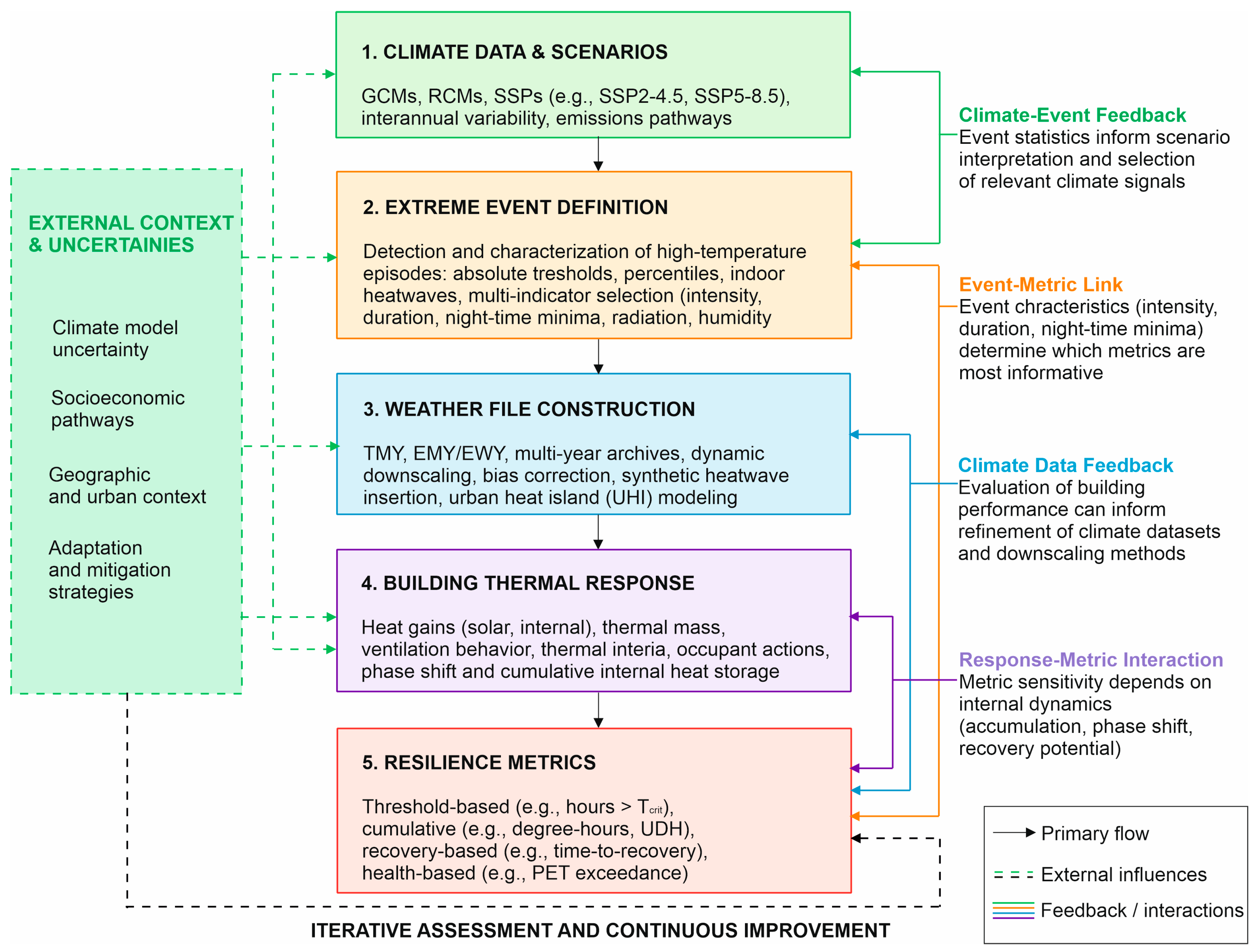
3. Extreme Heat Event Definition and Weather File Construction for Thermal Resilience Assessment
3.1. Defining High-Temperature Episodes for Building-Oriented Analysis
3.2. Weather File Construction and Future Climate Trajectories
3.3. Dynamic Internal Response, Metric Sensitivity, and Methodological Gaps
4. Passive Strategies for Thermal Resilience: Mechanisms and Performance
4.1. From Energy Efficiency to Thermal Resilience: A Reframing of Passive Strategies
4.2. Solar Control, High-Albedo, and Vegetative Strategies as Heat-Gain Reduction Mechanisms
4.3. Thermal Mass and Phase Change Materials as Buffering and Stabilisation Mechanisms
4.4. Ventilative Cooling as a Regeneration Mechanism
4.5. Integrated Passive Strategies as a System of Thermal Resilience
4.6. Research Gaps: From Passive Strategies to Systemic Thermal Resilience
5. Micro-Autonomy and Collective Thermal Resilience: From Building to System
5.1. Limits of Passive Stability Under Prolonged Disturbance
5.2. Micro-Autonomy as a Mechanism for Maintaining Thermal Safety
5.3. From Individual Autonomy to Relational Resilience: Collective Design as a Systemic Task
5.4. Research Gaps in Thermal Resilience Under Micro-Autonomy and Community Coordination
6. Implications for Design Practice, Policy Frameworks, and Future Research
6.1. From Comfort Standards to Survival Standards: Reframing Regulation
6.2. Defining Thermal Resilience Objectives Under Full Design Trade-Offs
6.3. Operational Validation and Adaptive Learning: Digital Infrastructure as a Resilience Instrument
6.4. Toward Outcome-Oriented Thermal Resilience: From Design Logic to Long-Term Accountability
6.5. Research Gaps in Integrated Thermal Resilience Design
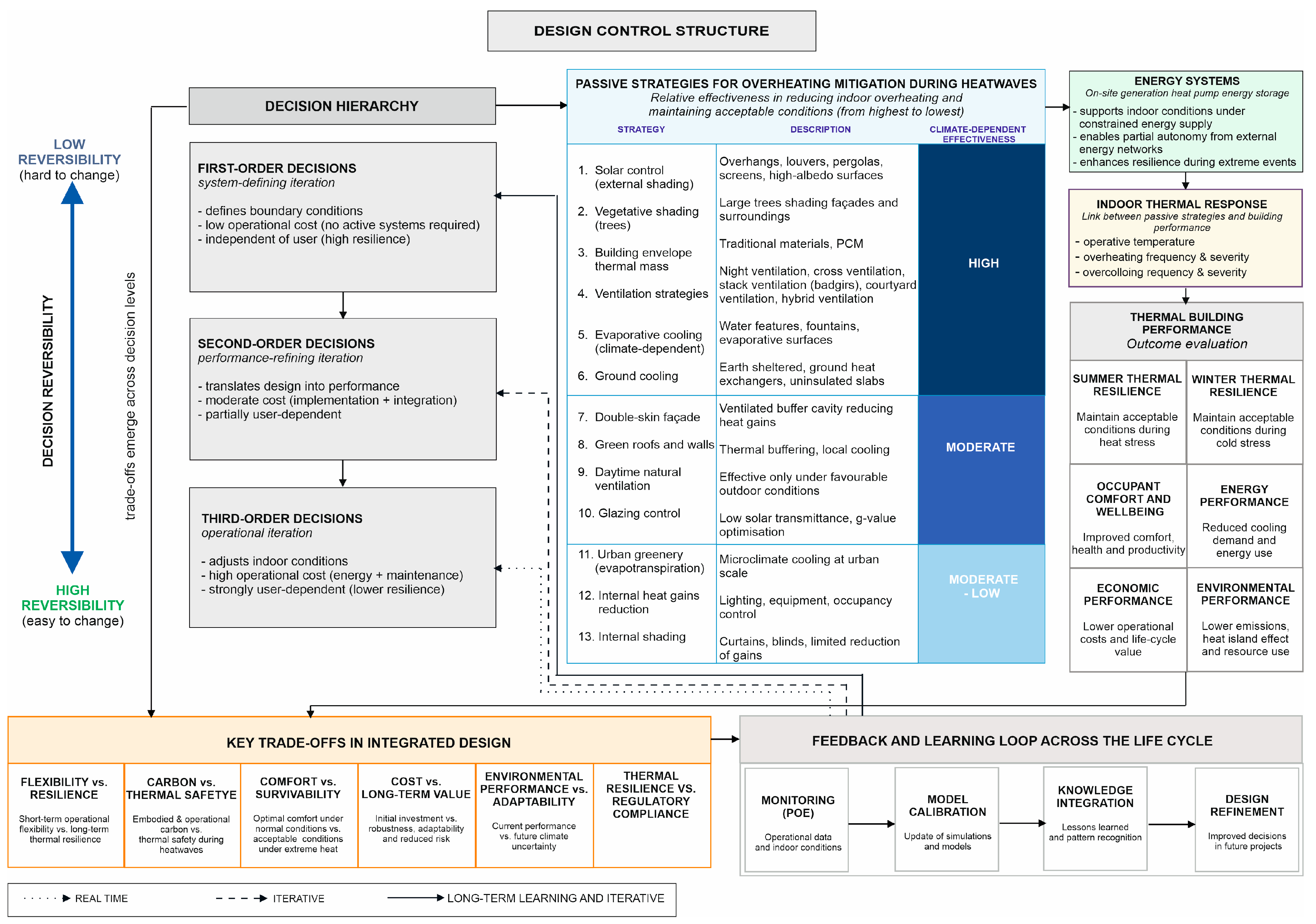
7. From Performance to Design: Decision-Making Frameworks for Thermal Resilience
7.1. Introduction: From Single Indicators to Thermal Resilience-Oriented Design
7.2. Decision Leverage, Reversibility, and Operational Dependence
- First-order decisions
- Second-order decisions
- Third-order decisions
- The hierarchy as a dependency-based framework
7.3. Temporal and Systemic Trade-Offs in Design
7.4. Integration Gap: From Tools to Decisions
8. Conclusions
Author Contributions
Funding
Data Availability Statement
Conflicts of Interest
References
- Attia, S.; Levinson, R.; Ndongo, E.; Holzer, P.; Kazanci, O.B.; Homaei, S.; Zhang, C.; Olesen, B.W.; Qi, D.; Hamdy, M.; et al. Resilient cooling of buildings to protect against heat waves and power outages: Key concepts and definition. Energy Build. 2021, 239, 110869. [Google Scholar] [CrossRef] [Scilit]
- Hong, T.; Malik, J.; Krelling, A.; O’BRien, W.; Sun, K.; Lamberts, R.; Wei, M. Ten questions concerning thermal resilience of buildings and occupants for climate adaptation. Build. Environ. 2023, 244, 110806. [Google Scholar] [CrossRef] [Scilit]
- Homaei, S.; Hamdy, M. Thermal resilient buildings: How to be quantified? A novel benchmarking framework and labelling metric. Build. Environ. 2021, 201, 108022. [Google Scholar] [CrossRef] [Scilit]
- Flores-Larsen, S.; Filippín, C.; Bre, F. New metrics for thermal resilience of passive buildings during heat events. Build. Environ. 2023, 230, 109990. [Google Scholar] [CrossRef] [Scilit]
- Sun, K.; Specian, M.; Hong, T. Nexus of thermal resilience and energy efficiency in buildings: A case study of a nursing home. Build. Environ. 2020, 177, 106842. [Google Scholar] [CrossRef] [Scilit]
- Tao, M.; Gou, Z.; Ma, N. Assessment of thermal comfort and thermal resilience in dwellings during heat waves: A case study of a near-zero energy house. J. Build. Eng. 2025, 109, 113052. [Google Scholar] [CrossRef] [Scilit]
- Wijesuriya, S.; Kishore, R.A.; Bianchi, M.V.; Booten, C. Enhancing thermal resilience of U. S. residential homes in hot humid climates during extreme temperature events. Cell Rep. Phys. Sci. 2024, 5, 101986. [Google Scholar] [CrossRef] [Scilit]
- Liyanage, D.R.; Hewage, K.; Ghobadi, M.; Sadiq, R. Thermal resiliency of single-family housing stock under extreme hot and cold conditions. Energy Build. 2024, 323, 114809. [Google Scholar] [CrossRef] [Scilit]
- Lin, C.J.; Crawley, D.B.; Coudert, M.; Niyogi, D.; Nagy, Z. From comfort to survival: Indoor heat vulnerability during extreme events. Build. Environ. 2026, 289, 114070. [Google Scholar] [CrossRef] [Scilit]
- Krelling, A.F.; Lamberts, R.; Malik, J.; Hong, T. A simulation framework for assessing thermally resilient buildings and communities. Build. Environ. 2023, 245, 110887. [Google Scholar] [CrossRef] [Scilit]
- Nik, V.M.; Hosseini, M. CIRLEM: A synergic integration of collective intelligence and reinforcement learning in energy management for enhanced climate resilience and lightweight computation. Appl. Energy 2023, 350, 121785. [Google Scholar] [CrossRef] [Scilit]
- Sheng, M.; Reiner, M.; Sun, K.; Hong, T. Assessing thermal resilience of an assisted living facility during heat waves and cold snaps with power outages. Build. Environ. 2023, 230, 110001. [Google Scholar] [CrossRef] [Scilit]
- Gortych, M.; Kuczyński, T. Winter thermal resilience of lightweight and ground-coupled medium-weight buildings: An experimental study during heating outages. Energies 2025, 18, 4022. [Google Scholar] [CrossRef] [Scilit]
- Weilnhammer, V.; Schmid, J.; Mittermeier, I.; Schreiber, F.; Jiang, L.; Pastuhovic, V.; Herr, C.; Heinze, S. Extreme weather events in Europe and their health consequences: A systematic review. Int. J. Hyg. Environ. Health 2021, 233, 113688. [Google Scholar] [CrossRef] [Scilit] [PubMed]
- Siu, C.Y.; O’BRien, W.; Touchie, M.; Armstrong, M.; Laouadi, A.; Gaur, A.; Jandaghian, Z.; Macdonald, I. Evaluating thermal resilience of building designs using building performance simulation: A review of existing practices. Build. Environ. 2023, 234, 110124. [Google Scholar] [CrossRef] [Scilit]
- Li, Y.; Tsouknida, E.; Collins, T.; Bateson, A.; Tang, R.; Burman, E. Thermal resilience in the built environment: A critical review. Sustain. Cities Soc. 2026, 138, 107180. [Google Scholar] [CrossRef] [Scilit]
- Rahif, R.; Kazemi, M.; Attia, S. Overheating analysis of optimized nearly zero-energy dwelling during current and future heatwaves coincided with cooling system outage. Energy Build. 2023, 287, 112998. [Google Scholar] [CrossRef] [Scilit]
- Gortych, M.; Staszczuk, A.; Kuczyński, T. Empirical assessment of passive thermal resilience in buildings with varying heat storage capacity during heatwaves and power outages. Energies 2025, 18, 4871. [Google Scholar] [CrossRef] [Scilit]
- Peri, G.; Cirrincione, L.; Mazzeo, D.; Matera, N.; Scaccianoce, G. Building resilience to a warming world: A contribution toward a definition of integrated climate resilience specific for buildings. Energy Build. 2024, 315, 114319. [Google Scholar] [CrossRef] [Scilit]
- Peri, G.; Licciardi, G.R.; Cirrincione, L.; Scaccianoce, G. On the active involvement of occupants for improving the thermal resilience of buildings: An opportunity still overlooked. Energies 2025, 18, 5201. [Google Scholar] [CrossRef] [Scilit]
- Lu, Y.; Ma, N.; Arsano, A.Y.; Brown, N.; Chung, J.; Dilsiz, A.D.; Dong, B.; Franconi, E.; Han, X.; Jiang, Z.; et al. Towards high-performance buildings for thermal resilience and health. Energy Build. 2025, 347, 116367. [Google Scholar] [CrossRef] [Scilit]
- Ayyagari, S.; Gartman, M.; Corvidae, J. Hours of Safety in Cold Weather: A Framework for Considering Resilience in Building Envelope Design and Construction; Rocky Mountain Institute: Boulder, CO, USA, 2020; Available online: https://rmi.org/insight/hours-of-safety-in-cold-weather/ (accessed on 10 May 2026).
- Hamdy, M.; Carlucci, S.; Hoes, P.-J.; Hensen, J.L.M. The impact of climate change on the overheating risk in dwellings: A Dutch case study. Build. Environ. 2017, 122, 307–323. [Google Scholar] [CrossRef] [Scilit]
- Rahif, R.; Amaripadath, D.; Attia, S. Review on time-integrated overheating evaluation methods for residential buildings in temperate climates of Europe. Energy Build. 2021, 252, 111463. [Google Scholar] [CrossRef] [Scilit]
- Amaripadath, D.; Azar, E.; Singh, M.K.; Attia, S. Heat exposure mitigation in renovated nearly zero-energy dwellings during concurrent heat waves and power outages. J. Build. Eng. 2024, 91, 109655. [Google Scholar] [CrossRef] [Scilit]
- Rehman, H.U.; Nik, V.M.; Ramesh, R.; Ala-Juusela, M. Quantifying and rating the energy resilience performance of buildings integrated with renewables in the Nordics under typical and extreme climatic conditions. Buildings 2024, 14, 2821. [Google Scholar] [CrossRef] [Scilit]
- Zhang, G.; Li, L.; Yu, Y.; Liu, J.; Zhang, Q. Thermal resilience of public building atriums under different states during heatwaves. Buildings 2025, 15, 598. [Google Scholar] [CrossRef] [Scilit]
- Baba, F.M.; Ge, H.; Wang, L.; Zmeureanu, R. Do high energy-efficient buildings increase overheating risk in cold climates? Causes and mitigation measures required under recent and future climates. Build. Environ. 2022, 219, 109230. [Google Scholar] [CrossRef] [Scilit]
- Sengupta, A.; Breesch, H.; Steeman, M. Defining an indicator to assess thermal resilience to overheating in residential and small non-residential buildings. Build. Environ. 2026, 298, 114668. [Google Scholar] [CrossRef] [Scilit]
- Qian, B.; Yu, T.; Zhang, C.; Heiselberg, P.K.; Lei, B.; Yang, L. Suitability of heat wave event definitions for assessing indoor overheating in current and future climate: A case study in China. Build. Environ. 2023, 241, 110487. [Google Scholar] [CrossRef] [Scilit]
- Krelling, A.F.; Lamberts, R.; Malik, J.; Zhang, W.; Sun, K.; Hong, T. Defining weather scenarios for simulation-based assessment of thermal resilience of buildings under current and future climates: A case study in Brazil. Sustain. Cities Soc. 2024, 107, 105460. [Google Scholar] [CrossRef] [Scilit]
- Bracht, M.K.; Melo, A.P.; Lamberts, R. Heat waves in buildings: A review of detection methods and performance assessment. Build. Environ. 2026, 290, 114205. [Google Scholar] [CrossRef] [Scilit]
- Yan, D.; Wu, Y.; Malik, J.; Hong, T. Ten questions on future and extreme weather data for building simulation and analysis in a changing climate. Build. Environ. 2025, 269, 112461. [Google Scholar] [CrossRef] [Scilit]
- Kotharkar, R.; Dongarsane, P.; Ghosh, A. Quantification of summertime thermal stress and PET range in a tropical Indian city. Urban Clim. 2024, 53, 101758. [Google Scholar] [CrossRef] [Scilit]
- Toesca, A.; David, D.; Johannes, K.; Lussault, M. Generation of weather data for the assessment of building performances under future heatwave conditions. Build. Environ. 2023, 242, 110491. [Google Scholar] [CrossRef] [Scilit]
- Zeng, Z.; Kim, J.-H.; Tan, H.; Hu, Y.; Cameron-Rastogi, P.; Villa, D.; New, J.; Wang, J.; Muehleisen, R.T. A review of future weather data for assessing climate change impacts on buildings and energy systems. Renew. Sustain. Energy Rev. 2025, 212, 115213. [Google Scholar] [CrossRef] [Scilit]
- Moazami, A.; Nik, V.M.; Carlucci, S.; Geving, S. Impacts of future weather data typology on building energy performance—Investigating long-term patterns of climate change and extreme weather conditions. Appl. Energy 2019, 238, 696–720. [Google Scholar] [CrossRef] [Scilit]
- Duan, Z.; de Wilde, P.; Attia, S.; Zuo, J. Challenges in predicting the impact of climate change on thermal building performance through simulation: A systematic review. Appl. Energy 2025, 382, 125331. [Google Scholar] [CrossRef] [Scilit]
- Cao, J.; Yang, X.; Li, M. A new approach for selecting extreme meteorological years to support building energy simulation. Energy 2025, 341, 139541. [Google Scholar] [CrossRef] [Scilit]
- Hostein, M.; Musy, M.; Moujalled, B.; El Mankibi, M. Generating meteorological files of future climates with heatwaves in urban context to evaluate building overheating: An energy-efficient dwelling case study. Build. Environ. 2024, 263, 111874. [Google Scholar] [CrossRef] [Scilit]
- Shen, P.; Li, Y.; Gao, X.; Zheng, Y.; Huang, P.; Lu, A.; Gu, W.; Chen, S. Recent progress in building energy retrofit analysis under changing future climate: A review. Appl. Energy 2025, 383, 125441. [Google Scholar] [CrossRef] [Scilit]
- Aliabadi, A.A.; McLeod, R.M. The Vatic Weather File Generator (VWFG v1.0.0). J. Build. Eng. 2023, 67, 105966. [Google Scholar] [CrossRef] [Scilit]
- Duan, Z.; de Wilde, P.; Attia, S.; Zuo, J. Prospect of energy conservation measures (ECMs) in buildings subject to climate change: A systematic review. Energy Build. 2024, 322, 114739. [Google Scholar] [CrossRef] [Scilit]
- Bellamy, L.A.; Mackenzie, D.W. Thermal Performance of Buildings with Heavy Walls (Study Report No. 108); Building Research Association of New Zealand: Porirua, New Zealand, 2001. [Google Scholar]
- Kuznik, F.; Virgone, J. Experimental assessment of a phase change material for wall building use. Appl. Energy 2009, 86, 2038–2046. [Google Scholar] [CrossRef] [Scilit]
- Yang, F.; Yuan, F.; Qian, F.; Zhuang, Z.; Yao, J. Summertime thermal and energy performance of a double-skin green facade: A case study in Shanghai. Sustain. Cities Soc. 2018, 39, 43–51. [Google Scholar] [CrossRef] [Scilit]
- Schossig, P.; Henning, H.; Gschwander, S.; Haussmann, T. Micro-encapsulated phase-change materials integrated into construction materials. Sol. Energy Mater. Sol. Cells 2005, 89, 297–306. [Google Scholar] [CrossRef] [Scilit]
- Kuznik, F.; Virgone, J.; Johannes, K. In-situ study of thermal comfort enhancement in a renovated building equipped with phase change material wallboard. Renew. Energy 2011, 36, 1458–1462. [Google Scholar] [CrossRef] [Scilit]
- Castell, A.; Martorell, I.; Medrano, M.; Pérez, G.; Cabeza, L. Experimental study of using PCM in brick constructive solutions for passive cooling. Energy Build. 2010, 42, 534–540. [Google Scholar] [CrossRef] [Scilit]
- Coma, J.; Pérez, G.; de Gracia, A.; Burés, S.; Urrestarazu, M.; Cabeza, L.F. Vertical greenery systems for energy savings in buildings: A comparative study between green walls and green facades. Build. Environ. 2017, 111, 228–237. [Google Scholar] [CrossRef] [Scilit]
- Tsoka, S. Investigating the effect of summer night ventilation on the urban buildings’ thermal and energy performance using numerical approaches. IOP Conf. Ser. Earth Environ. Sci. 2021, 899, 012013. [Google Scholar] [CrossRef] [Scilit]
- Sage-Lauck, J.S.; Sailor, D.J. Evaluation of phase change materials for improving thermal comfort in a super-insulated residential building. Energy Build. 2014, 79, 32–40. [Google Scholar] [CrossRef] [Scilit]
- La Roche, P.; Yeom, D.J.; Ponce, A. Passive cooling with a hybrid green roof for extreme climates. Energy Build. 2020, 224, 110243. [Google Scholar] [CrossRef] [Scilit]
- Sengupta, A.; Al Assaad, D.; Kazanci, O.B.; Shinoda, J.; Breesch, H.; Steeman, M. Building and system design’s impact on thermal resilience to overheating during heatwaves: An uncertainty and sensitivity analysis. Build. Environ. 2024, 265, 112031. [Google Scholar] [CrossRef] [Scilit]
- Albayyaa, H.; Hagare, D.; Saha, S. Energy conservation in residential buildings by incorporating passive solar and energy efficiency design strategies and higher thermal mass. Energy Build. 2019, 182, 205–213. [Google Scholar] [CrossRef] [Scilit]
- Palma, R.M.; Medina, D.C.; Delgado, M.G.; Ramos, J.S.; Montero-Gutiérrez, P.; Domínguez, S.Á. Enhancing the building resilience in a changing climate through a passive cooling roof: A case study in Camas (Seville, Spain). Energy Build. 2024, 321, 114680. [Google Scholar] [CrossRef] [Scilit]
- Wang, R.; Xin, X.; Liu, J.; Lu, S.; Sun, Y.; Zhao, W. Quantitative method and influencing factors analysis of demand response performance of air conditioning load with rebound effect. Build. Simul. 2025, 18, 295–320. [Google Scholar] [CrossRef] [Scilit]
- Tan, H.; Kotamarthi, R.; Wang, J.; Qian, Y.; Chakraborty, T. Impact of different roofing mitigation strategies on near-surface temperature and energy consumption over the Chicago metropolitan area during a heatwave event. Sci. Total Environ. 2023, 860, 160508. [Google Scholar] [CrossRef] [Scilit] [PubMed]
- Hao, X.; Xing, Q.; Long, P.; Lin, Y.; Hu, J.; Tan, H. Influence of vertical greenery systems and green roofs on the indoor operative temperature of air-conditioned rooms. J. Build. Eng. 2020, 31, 101373. [Google Scholar] [CrossRef] [Scilit]
- Kuczyński, T.; Staszczuk, A.; Gortych, M.; Stryjski, R. Effect of thermal mass, night ventilation and window shading on summer thermal comfort of buildings in a temperate climate. Build. Environ. 2021, 204, 108126. [Google Scholar] [CrossRef] [Scilit]
- Kuczyński, T.; Staszczuk, A. Experimental study of the influence of thermal mass on thermal comfort and cooling energy demand in residential buildings. Energy 2020, 195, 116984. [Google Scholar] [CrossRef] [Scilit]
- CIBSE. TM52: The Limits of Thermal Comfort: Avoiding Overheating in European Buildings; Chartered Institution of Building Services Engineers: London, UK, 2013. [Google Scholar]
- Brambilla, A.; Jusselme, T. Preventing overheating in offices through thermal inertial properties of compressed earth bricks: A study on a real-scale prototype. Energy Build. 2017, 156, 281–292. [Google Scholar] [CrossRef] [Scilit]
- Sun, H.; Calautit, J.K.; Jimenez-Bescos, C. Examining the regulating impact of thermal mass on overheating, and the role of night ventilation, within different climates and future scenarios across China. Clean. Eng. Technol. 2022, 9, 100534. [Google Scholar] [CrossRef] [Scilit]
- Kuczyński, T.; Staszczuk, A.; Gortych, M. Comparison of heavy building envelopes and PCM: Impact on indoor temperature peaks and cooling energy use during heat events. Energy 2025, 325, 136213. [Google Scholar] [CrossRef] [Scilit]
- Zhang, W.; Yang, H.; Cao, X.; Bao, X.; Cui, H. A review of building energy resilience for maintaining indoor thermal stability during extreme weather events. Energy Build. 2025, 342, 115908. [Google Scholar] [CrossRef] [Scilit]
- Cabeza, L.; Castell, A.; Medrano, M.; Martorell, I.; Pérez, G.; Fernández, I. Experimental study on the performance of insulation materials in Mediterranean construction. Energy Build. 2010, 42, 630–636. [Google Scholar] [CrossRef] [Scilit]
- Attia, S.; Hammouma, T.; Galeone, D.; Zhang, Z.; Zhang, N.; Corrado, V.; Yuan, Y. From lab to building: Real-world integration of phase change materials for comfort, energy, and flexibility. Energy Build. 2026, 352, 116813. [Google Scholar] [CrossRef] [Scilit]
- Rajput, M.; Augenbroe, G.; Stone, B.; Georgescu, M.; Broadbent, A.; Krayenhoff, S.; Mallen, E. Heat exposure during a power outage: A simulation study of residences across the metro Phoenix area. Energy Build. 2022, 259, 111605. [Google Scholar] [CrossRef] [Scilit]
- Staszczuk, A.; Wojciech, M.; Kuczyński, T. The effect of floor insulation on indoor air temperature and energy consumption of residential buildings in moderate climates. Energy 2017, 138, 139–146. [Google Scholar] [CrossRef] [Scilit]
- Kuczyński, T.; Staszczuk, A. Impact of uninsulated slab-on-grade and masonry walls on residential building overheating. Energies 2023, 16, 7558. [Google Scholar] [CrossRef] [Scilit]
- Shaviv, E.; Yezioro, A.; Capeluto, I.G. Thermal mass and night ventilation as passive cooling design strategy. Renew. Energy 2001, 24, 445–452. [Google Scholar] [CrossRef] [Scilit]
- Zhang, Y.; Wang, X.; Hu, E. Optimization of night mechanical ventilation strategy in summer for cooling energy saving based on inverse problem method. Proc. Inst. Mech. Eng. Part A J. Power Energy 2018, 232, 1093–1102. [Google Scholar] [CrossRef] [Scilit]
- Guo, R.; Heiselberg, P.; Hu, Y.; Zhang, C.; Vasilevskis, S. Optimization of night ventilation performance in office buildings in a cold climate. Energy Build. 2020, 225, 110319. [Google Scholar] [CrossRef] [Scilit]
- Du, J.; Yang, D.; Guo, X.; Wei, H. Experimental evaluation of cooling effects and energy efficiency of summer night ventilation induced by EAHE coupled with internal thermal mass. Appl. Therm. Eng. 2026, 294, 130596. [Google Scholar] [CrossRef] [Scilit]
- Al Niyadi, S.; Elnabawi, M.H. Optimizing hybrid ventilation in arid climates: A systematic review and Dubai case study. City Environ. Interact. 2025, 26, 100191. [Google Scholar] [CrossRef] [Scilit]
- Stasi, R.; Ruggiero, F.; Berardi, U. Influence of cross-ventilation cooling potential on thermal comfort in high-rise buildings in a hot and humid climate. Build. Environ. 2024, 248, 111096. [Google Scholar] [CrossRef] [Scilit]
- Amaripadath, D.; Paolini, R.; Sailor, D.J.; Attia, S. Comparative assessment of night ventilation performance in a nearly zero-energy office building during heat waves in Brussels. J. Build. Eng. 2023, 78, 107611. [Google Scholar] [CrossRef] [Scilit]
- Aqilah, N.; Rijal, H.B.; Zaki, S.A. Indoor thermal environment and effect of air movement on comfort temperature in Malaysian naturally ventilated dwellings. J. Build. Eng. 2025, 104, 112151. [Google Scholar] [CrossRef] [Scilit]
- Nik, V.M.; Perera, A.T.D.; Chen, D. Towards climate resilient urban energy systems: A review. Natl. Sci. Rev. 2021, 8, nwaa134. [Google Scholar] [CrossRef] [Scilit] [PubMed]
- Kolokotroni, M.; Webb, B.C.; Hayes, S.D. Summer cooling with night ventilation for office buildings in moderate climates. Energy Build. 1998, 27, 231–237. [Google Scholar] [CrossRef] [Scilit]
- Mantesi, E.; Hopfe, C.J.; Mourkos, K.; Glass, J.; Cook, M. Empirical and computational evidence for thermal mass assessment: The example of insulating concrete formwork. Energy Build. 2019, 188–189, 314–332. [Google Scholar] [CrossRef] [Scilit]
- Li, Y.; Shah, K.W.; Li, W.; Xiong, T. Experimental investigation on indoor thermal environment improvement and energy-saving of electrochromic window under Singapore’s tropical climate. J. Build. Eng. 2023, 73, 106779. [Google Scholar] [CrossRef] [Scilit]
- Liu, S.; Kwok, Y.T.; Lau, K.K.-L.; Ouyang, W.; Ng, E. Effectiveness of passive design strategies in responding to future climate change for residential buildings in hot and humid Hong Kong. Energy Build. 2020, 228, 110469. [Google Scholar] [CrossRef] [Scilit]
- Amores, T.P.; Sarria, F.R.; Medina, D.C.; Valera, T.C.; Ramos, J.S.; Domínguez, S.Á. Experimental validation of the potential of cross-ventilation strategy as a natural cooling technique integrated in a real historic building. Appl. Sci. 2025, 15, 2174. [Google Scholar] [CrossRef] [Scilit]
- Chandrasekaran, K.S.; Madhumathi, A. Energy-efficient retrofitting with exterior shading device in hot and humid climate—Case studies from fully glazed multi-storied office buildings in Chennai, India. J. Asian Archit. Build. Eng. 2023, 22, 2209–2223. [Google Scholar] [CrossRef] [Scilit]
- Detsi, M.; Atsonios, I.; Mandilaras, I.; Founti, M. Effect of smart glazing with electrochromic and thermochromic layers on building’s energy efficiency and cost. Energy Build. 2024, 319, 114553. [Google Scholar] [CrossRef] [Scilit]
- Es-Sakali, N.; Kaitouni, S.I.; Laasri, I.A.; Mghazli, M.O.; Cherkaoui, M.; Pfafferott, J. Static and dynamic glazing integration for enhanced building efficiency and indoor comfort with thermochromic and electrochromic windows. Therm. Sci. Eng. Prog. 2024, 52, 102681. [Google Scholar] [CrossRef] [Scilit]
- Verbeke, S.; Audenaert, A. Thermal inertia in buildings: A review of impacts across climate and building use. Renew. Sustain. Energy Rev. 2018, 82, 2300–2318. [Google Scholar] [CrossRef] [Scilit]
- Xu, Y.; Zhao, B.; Yu, J.; Yin, X.; Chang, W.-S.; Guo, H. Integrating phase-change materials to reduce overheating risk in residential buildings in cold regions of China. Constr. Build. Mater. 2025, 475, 141153. [Google Scholar] [CrossRef] [Scilit]
- Zhao, Y.; Yu, J.; Zhao, B.; Xu, Y.; Chang, W.-S.; Guo, H. Potential of phase change materials to mitigate overheating in residential blocks in severe cold regions of China. Sustain. Cities Soc. 2025, 119, 106114. [Google Scholar] [CrossRef] [Scilit]
- Khdair, A.I.; Aburumman, G.A.; Tahmasbi, F.; Tahmasebi, M.; Kalbasi, R.; Afrand, M. Advancing natural ventilation in sustainable architecture: Mechanisms, innovations, and climate-responsive design for energy-efficient buildings. Renew. Sustain. Energy Rev. 2026, 226, 116314. [Google Scholar] [CrossRef] [Scilit]
- Hwang, R.-L.; Huang, A.-W.; Chen, W.-A. Considerations on envelope design criteria for hybrid ventilation thermal management of school buildings in hot–humid climates. Energy Rep. 2021, 7, 5834–5845. [Google Scholar] [CrossRef] [Scilit]
- Santamouris, M. Cooling the cities: A review of reflective and green roof mitigation technologies to fight heat island and improve comfort in urban environments. Sol. Energy 2014, 103, 682–703. [Google Scholar] [CrossRef] [Scilit]
- Delgado, M.G.; Ramos, J.S.; Amores, T.R.P.; Medina, D.C.; Domínguez, S.Á. Improving habitability in social housing through passive cooling: A case study in Mengíbar (Jaén, Spain). Sustain. Cities Soc. 2022, 78, 103642. [Google Scholar] [CrossRef] [Scilit]
- Nik, V.M.; Moazami, A. Agility factor: A new metric to assess building thermal resilience. Energy Build. 2021, 251, 111312. [Google Scholar] [CrossRef] [Scilit]
- Xu, W.; Ruan, Y.; Li, Y.; Xiao, F.; Xu, T.; Yao, Y.; Meng, H. Investigation and evaluation of strategic residential heat and transport electrification for supporting deep grid decarbonization. Renew. Energy 2026, 256, 124566. [Google Scholar] [CrossRef] [Scilit]
- Gatt, D.; Caruana, C.; Yousif, C. Building energy renovation and smart integration of renewables in a social housing block toward nearly-zero energy status. Front. Energy Res. 2020, 8, 560892. [Google Scholar] [CrossRef] [Scilit]
- Vahidinasab, V.; Ardalan, C.; Mohammadi-Ivatloo, B.; Giaouris, D.; Walker, S.L. Active building as an energy system: Concept, challenges, and outlook. IEEE Access 2021, 9, 58009–58024. [Google Scholar] [CrossRef] [Scilit]
- Osawa, J. Optimizing technological configurations in residential energy systems with vehicle-to-home integration and community-level power sharing. Energy Rep. 2024, 12, 3533–3547. [Google Scholar] [CrossRef] [Scilit]
- Lind, J.; Möllerström, E.; Averfalk, H.; Ottermo, F. Energy flexibility using the thermal mass of residential buildings. Energy Build. 2023, 301, 113698. [Google Scholar] [CrossRef] [Scilit]
- Dawes, G.; Kirant-Mitic, T.; Jiang, Z.; Le Dréau, J.; Cai, H.; Cui, J.; Townsend, J.; Bampoulas, A.; Li, R.; Lopes, R.A.; et al. Energy flexibility at multi-building scales: A review of the dominant factors and their uncertainties. Energy Build. 2025, 346, 116157. [Google Scholar] [CrossRef] [Scilit]
- Rodrigues, L.; Coelho, F.; Mello, J.; Villar, J. Digital platforms to support the flexibility value chain, run flexibility markets, and manage energy communities. Curr. Sustain./Renew. Energy Rep. 2025, 12, 15. [Google Scholar] [CrossRef] [Scilit]
- Paule, D.; Pakere, I.; Pubule, J.; Blumberga, D. Optimising multi-energy community hubs for decarbonisation and energy system flexibility. Smart Energy 2025, 20, 100214. [Google Scholar] [CrossRef] [Scilit]
- Ahmed, S.; Ali, A.; D’angola, A. A review of renewable energy communities: Concepts, scope, progress, challenges, and recommendations. Sustainability 2024, 16, 1749. [Google Scholar] [CrossRef] [Scilit]
- Rossi, M.; Jin, L.; Ferrario, A.M.; Di Somma, M.; Buonanno, A.; Papadimitriou, C.; Morch, A.; Graditi, G.; Comodi, G. Energy hub and micro-energy hub architecture in integrated local energy communities: Enabling technologies and energy planning tools. Energies 2024, 17, 4813. [Google Scholar] [CrossRef] [Scilit]
- Krug, M.; Di Nucci, M.R.; Schwarz, L.; Alonso, I.; Azevedo, I.; Bastiani, M.; Dyląg, A.; Laes, E.; Hinsch, A.; Klāvs, G.; et al. Implementing European Union provisions and enabling frameworks for renewable energy communities in nine countries: Progress, delays, and gaps. Sustainability 2023, 15, 8861. [Google Scholar] [CrossRef] [Scilit]
- Feldhofer, M.; Healy, W.M. Improving the energy flexibility of single-family homes through adjustments to envelope and heat pump parameters. J. Build. Eng. 2021, 39, 102245. [Google Scholar] [CrossRef] [Scilit] [PubMed]
- Perera, A.T.D.; Coccolo, S.; Scartezzini, J.-L. The influence of urban form on the grid integration of renewable energy technologies and distributed energy systems. Sci. Rep. 2019, 9, 17756. [Google Scholar] [CrossRef] [Scilit] [PubMed]
- Banihabib, R.; Fadnes, F.S.; Assadi, M. Techno-economic optimization of microgrid operation with integration of renewable energy, hydrogen storage, and micro gas turbine. Renew. Energy 2024, 237, 121708. [Google Scholar] [CrossRef] [Scilit]
- Staudt, P.; Richter, B. Empirical case study of a digitally enabled energy community with prosumers and P2P trading. Energy Sustain. Soc. 2025, 15, 6. [Google Scholar] [CrossRef] [Scilit]
- Hill, M.; Duffy, A. A digital support platform for community energy: One-stop-shop architecture, development and evaluation. Energies 2022, 15, 4763. [Google Scholar] [CrossRef] [Scilit]
- Hoggett, R.; Lowes, R.; Ugalde-Loo, C.E.; Khosravi, F. Hot and cold: Policy perspectives on overheating and cooling in United Kingdom homes. Energy Res. Soc. Sci. 2024, 118, 103803. [Google Scholar] [CrossRef] [Scilit]
- Yu, J.; Zhao, B.; Xu, Y.; Jin, M.; Wang, Y.; Chang, W.-S.; Guo, H. Overheating causes in cold regions’ residences under evolving building regulations: Focusing on field investigation and simulation of envelope performance. Build. Environ. 2025, 281, 113180. [Google Scholar] [CrossRef] [Scilit]
- Arriazu-Ramos, A.; Bes-Rastrollo, M.; Gutiérrez, A.S.-O.; Monge-Barrio, A. Building parameters that influence overheating of apartment buildings in a temperate climate in Southern Europe. Build. Environ. 2023, 228, 109899. [Google Scholar] [CrossRef] [Scilit]
- Arriazu-Ramos, A.; Izquierdo, J.J.P.; Ruiz, G.R.; Sánchez-Ostiz, A.; Monge-Barrio, A. Facing climate change in a temperate European city: Urban-scale diagnosis of indoor overheating and adaptation strategies for residential buildings. Buildings 2024, 14, 1423. [Google Scholar] [CrossRef] [Scilit]
- Sarabia-Escriva, E.-J.; Jiménez-Navarro, J.-P.; Soto-Francés, V.-M.; Pinazo-Ojer, J.-M. Assessing the energy performance certification effectiveness for the Spanish building stock in response to recent climate change data. Energy Build. 2024, 323, 114816. [Google Scholar] [CrossRef] [Scilit]
- D’AGostino, D.; Congedo, P.M.; Albanese, P.M.; Rubino, A.; Baglivo, C. Impact of climate change on the energy performance of building envelopes and implications on energy regulations across Europe. Energy 2024, 288, 129886. [Google Scholar] [CrossRef] [Scilit]
- Andersen, S.C.; Birgisdottir, H.; Birkved, M. Life-cycle assessments of circular economy in the built environment: A scoping review. Sustainability 2022, 14, 6887. [Google Scholar] [CrossRef] [Scilit]
- Lei, H.; Li, L.; Yang, W.; Bian, Y.; Li, C.-Q. An analytical review on application of life-cycle assessment in circular economy for built environment. J. Build. Eng. 2021, 44, 103374. [Google Scholar] [CrossRef] [Scilit]
- De Wilde, P. The gap between predicted and measured energy performance of buildings: A framework for investigation. Autom. Constr. 2014, 41, 40–49. [Google Scholar] [CrossRef] [Scilit]
- Khabbazi, A.J.; Pergantis, E.N.; Premer, L.D.R.; Papageorgiou, P.; Lee, A.H.; Braun, J.E.; Henze, G.P.; Kircher, K.J. Lessons learned from field demonstrations of model predictive control and reinforcement learning for residential and commercial HVAC: A review. Appl. Energy 2025, 399, 126459. [Google Scholar] [CrossRef] [Scilit]
- Li, P.; Froese, T.M.; Brager, G. Post-occupancy evaluation: State-of-the-art analysis and state-of-the-practice review. Build. Environ. 2018, 133, 187–202. [Google Scholar] [CrossRef] [Scilit]
- de Wilde, P. Building performance simulation in the brave new world of artificial intelligence and digital twins: A systematic review. Energy Build. 2023, 292, 113171. [Google Scholar] [CrossRef] [Scilit]
- Petri, I.; Amin, A.; Ghoroghi, A.; Hodorog, A.; Rezgui, Y. Digital twins for dynamic life-cycle assessment in the built environment. Sci. Total Environ. 2025, 993, 179930. [Google Scholar] [CrossRef] [Scilit] [PubMed]
- Baset, A.; Jradi, M. Data-driven decision support for smart and efficient building energy retrofits: A review. Appl. Syst. Innov. 2025, 8, 5. [Google Scholar] [CrossRef] [Scilit]
- Hu, S.; Yan, D.; Azar, E.; Guo, F. A systematic review of occupant behavior in building energy policy. Build. Environ. 2020, 175, 106807. [Google Scholar] [CrossRef] [Scilit]
- Siu, C.Y.; Brown, S.; Brideau, S.; Ji, L.; O’bRien, W.; Ferguson, A.; Greco, E.; Touchie, M.; Mclellan, C.; Lepage, R.; et al. Exploring the role of building codes in protecting occupants from overheating: A Canadian perspective. Energy Build. 2025, 338, 115673. [Google Scholar] [CrossRef] [Scilit]
- Piras, G.; Agostinelli, S.; Muzi, F. Digital twin framework for the built environment: A review of key enablers. Energies 2024, 17, 436. [Google Scholar] [CrossRef] [Scilit]
- Kuczyński, T.; Gortych, M.; Staszczuk, A.; Bocheńska-Skałecka, A. Time-dependent performance of residential buildings under climate change: Thermal resilience, seasonal asymmetry and life-cycle carbon design consequences. Energy 2026, 347, 140448. [Google Scholar] [CrossRef] [Scilit]
- Shi, Q.; Luo, W.; Xiao, C.; Wang, J.; Zhu, H.; Chen, X. Urban-scale thermal resilience under compound heat waves and outages. Build. Environ. 2025, 276, 112747. [Google Scholar] [CrossRef] [Scilit]
- Tu, S.; Roberts, M.; Zhuang, W. Climate impact reduction strategies in early architectural design. J. Build. Eng. 2026, 117, 114621. [Google Scholar] [CrossRef] [Scilit]
- Wang, X.; Teigland, R.; Hollberg, A. Identifying influential architectural design variables for early-stage building sustainability optimization. Build. Environ. 2024, 252, 111295. [Google Scholar] [CrossRef] [Scilit]
- Kumar, D.; Maurya, K.K.; Mandal, S.K.; Mir, B.A.; Nurdiawati, A.; Al-Ghamdi, S.G. Life cycle assessment in the early design phase of buildings: Strategies, tools, and future directions. Buildings 2025, 15, 1612. [Google Scholar] [CrossRef] [Scilit]
- Roberts, M.; Allen, S.; Coley, D. Life cycle assessment in the building design process—A systematic literature review. Build. Environ. 2020, 185, 107274. [Google Scholar] [CrossRef] [Scilit]
- Häkkinen, T.; Kuittinen, M.; Ruuska, A.; Jung, N. Reducing embodied carbon during the design process of buildings. J. Build. Eng. 2015, 4, 1–13. [Google Scholar] [CrossRef] [Scilit]
- Shi, Y.; Cao, X.; Yang, X. Assessment and reduction of embodied carbon emissions in buildings: A systematic literature review of recent advances. Energy Build. 2025, 345, 116058. [Google Scholar] [CrossRef] [Scilit]
- Kuczyński, T.; Gortych, M.; Staszczuk, A. Life cycle carbon impacts of thermal mass and ground coupling in residential buildings. Energy 2025, 340, 139142. [Google Scholar] [CrossRef] [Scilit]
- Kuczyński, T.; Staszczuk, A.; Gortych, M. Passive Design Strategies to Adapt to Heat Waves: Thermal Comfort, Energy Efficiency, and Building Resilience; CRC Press: Boca Raton, FL, USA; Taylor & Francis: Abingdon, UK, 2026. [Google Scholar]
- Olgyay, V. Design with Climate: Bioclimatic Approach to Architectural Regionalism; Princeton University Press: Princeton, NJ, USA, 1963. [Google Scholar]
- Givoni, B. Climate Considerations in Building and Urban Design; Wiley: Hoboken, NJ, USA, 1998. [Google Scholar]
- Deb, K.; Pratap, A.; Agarwal, S.; Meyarivan, T. A fast and elitist multiobjective genetic algorithm: NSGA-II. IEEE Trans. Evol. Comput. 2002, 6, 182–197. [Google Scholar] [CrossRef] [Scilit]
- Marler, R.T.; Arora, J.S. Survey of multi-objective optimization methods for engineering. Struct. Multidiscip. Optim. 2004, 26, 369–395. [Google Scholar] [CrossRef] [Scilit]
- Depecker, P.; Menezo, C.; Virgone, J.; Lepers, S. Design of building shape and energetic consumption. Build. Environ. 2001, 36, 627–635. [Google Scholar] [CrossRef] [Scilit]
- Attia, S.; Gratia, E.; De Herde, A.; Hensen, J.L. Simulation-based decision support tool for early stages of zero-energy building design. Energy Build. 2012, 49, 2–15. [Google Scholar] [CrossRef] [Scilit]
- Napps, D.; Staudt, J.; Saluz, U.; Chen, X.; Steiner, D.; Zong, C.; Deghim, F.; Lang, W.; Geyer, P.; Schnellenbach-Held, M.; et al. Evaluation of building design variants in early phases on the basis of adaptive detailing strategies. Buildings 2026, 16, 685. [Google Scholar] [CrossRef] [Scilit]
- Bocheńska-Skałecka, A.; Kuczyński, T. Interpreting life cycle assessment across architectural decision orders: Environmental conflict, circularity and temporal responsibility. Buildings 2026, 16, 811. [Google Scholar] [CrossRef] [Scilit]
- Hong, T.; Yan, D.; D’OCa, S.; Chen, C.-F. Ten questions concerning occupant behavior in buildings: The big picture. Build. Environ. 2017, 114, 518–530. [Google Scholar] [CrossRef] [Scilit]
- Yan, D.; Hong, T.; Dong, B.; Mahdavi, A.; D’oCa, S.; Gaetani, I.; Feng, X. IEA EBC Annex 66: Definition and simulation of occupant behavior in buildings. Energy Build. 2017, 156, 258–270. [Google Scholar] [CrossRef] [Scilit]
- Pisello, A.L.; Saliari, M.; Vasilakopoulou, K.; Hadad, S.; Santamouris, M. Facing the urban overheating: Recent developments. Mitigation potential and sensitivity of the main technologies. WIREs Energy Environ. 2018, 7, e294. [Google Scholar] [CrossRef] [Scilit]
- Baniassadi, A.; Sailor, D.J.; Krayenhoff, E.S. Passive survivability of buildings under changing urban climates across eight US cities. Environ. Res. Lett. 2019, 14, 124013. [Google Scholar] [CrossRef] [Scilit]
- Seto, K.C.; Davis, S.J.; Mitchell, R.B.; Stokes, E.C.; Unruh, G.; Ürge-Vorsatz, D. Carbon lock-in: Types, causes, and policy implications. Annu. Rev. Environ. Resour. 2016, 41, 425–452. [Google Scholar] [CrossRef] [Scilit]
- Fenoglio, E.; Fantucci, S.; Serra, V.; Carbonaro, C.; Pollo, R. Life cycle option appraisal in retrofit buildings. Energy Build. 2018, 178, 82–91. [Google Scholar] [CrossRef] [Scilit]
- Le, D.M.; Christopher, P.; Ngo, T. Optimising building envelope retrofits under future climates. Case Stud. Therm. Eng. 2025, 72, 106219. [Google Scholar] [CrossRef] [Scilit]
- Akbari, S.; Sheikhkhoshkar, M.; Pour Rahimian, F.; El Haouzi, H.B.; Najafi, M.; Talebi, S. Sustainability and building information modelling: Integration, research gaps, and future directions. Autom. Constr. 2024, 163, 105420. [Google Scholar] [CrossRef] [Scilit]
- Lu, Y.; Wu, Z.; Chang, R.; Li, Y. Building information modeling (BIM) for green buildings: A critical review. Autom. Constr. 2017, 83, 134–148. [Google Scholar] [CrossRef] [Scilit]



| Metric Class | Analytical Dimension | Example Indicators | What It Captures | Typical Application | Limitations | Representative Studies |
|---|---|---|---|---|---|---|
| Threshold-based exceedance | Boundary detection | HE (Hours of Exceedance), % exceedance | Frequency and duration of threshold violation | Regulatory compliance, overheating screening | Does not capture intensity or temporal dynamics | [1,15,24] |
| Survival-oriented | Temporal endurance | Time-to-threshold, HST (Hours of Safety) | Duration of safe indoor conditions under disruption | Blackout scenarios, emergency planning | Captures only initial failure point | [7,15,22] |
| Accumulation-based | Cumulative exposure | IOD, UDH, degree-hours | Integrated thermal stress (intensity + duration) | Health risk assessment | Sensitive to thresholds; may mask short peaks | [3,6,24] |
| Dynamic/process-based | System response dynamics | Degradation rate, recovery rate, time-to-maximum | Temporal evolution of indoor conditions | Advanced simulation studies | Lack of standardisation | [3,4] |
| Composite indices | Integrated performance | WUMTP, resilience scores | Multi-criteria evaluation of system behaviour | Design comparison, portfolios | Depends on weighting assumptions | [6,27] |
| Strategy | Climate Context | Building Type | Key Metric (s) | Reported Effect | Limitation | Key References |
|---|---|---|---|---|---|---|
| External shading | Hot-humid, Mediterranean | Office, glazed buildings | Peak temperature, cooling demand | peak temperature ~2–4 °C; cooling demand 18–24% | Reduced effectiveness under multi-day exposure without buffering | [83,86,87,88] |
| Thermal mass (heavyweight) | Temperate, continental | Residential and non-residential buildings | Peak temperature, overheating hours | peak temperature ~3–4 °C; overheating hours > 60% | Requires night-time regeneration to avoid accumulation | [61,63,89] |
| High-albedo surfaces | Urban, temperate, Mediterranean, hot arid | Residential, district scale | Surface temperature, cooling demand | ambient temperature ~1–1.5 °C; cooling demand up to ~16% | Limited impact on indoor conditions without envelope integration | [61,63,90,91] |
| Vegetative systems | Hot-humid, Mediterranean | Experimental and residential buildings | Indoor temperature, cooling demand | indoor temperature ~1–3 °C; cooling demand up to ~50% (controlled cases) | Potential increase in nocturnal temperature under humid conditions | [46,50,65] |
| Ground coupling | Temperate | Residential | Threshold exceedance | Elimination of overheating; indoor temperature up to ~5 °C | Climate-dependent effectiveness | [18,70,71] |
| PCM (latent storage) | Mixed climates | Residential and non-residential buildings | Peak temperature, cooling demand | peak temperature ~1–3 °C; cooling demand ~1–30% | Depends on full charge–discharge cycle | [48,68,90,91] |
| Night ventilation | Mediterranean, temperate, hot-humid | Residential and non-residential buildings | Peak temperature, cooling demand | cooling demand 5–40%; delay of peak by 2–3 h | Strongly reduced under high night-time temperatures | [51,75,78,92] |
| Hybrid ventilation | Arid climates | Office | Cooling demand | energy use ~20% | Limited effect during extreme heatwaves | [66,81,93,94] |
| Integrated strategies | Multi-climate | Residential and non-residential buildings | Peak temperature, cumulative exposure | indoor temperature up to ~4–9 °C; cooling demand up to ~65% | Requires coordination of delay–buffer–recovery mechanisms | [55,60,83,95] |
Disclaimer/Publisher’s Note: The statements, opinions and data contained in all publications are solely those of the individual author(s) and contributor(s) and not of MDPI and/or the editor(s). MDPI and/or the editor(s) disclaim responsibility for any injury to people or property resulting from any ideas, methods, instructions or products referred to in the content. |
© 2026 by the authors. Licensee MDPI, Basel, Switzerland. This article is an open access article distributed under the terms and conditions of the Creative Commons Attribution (CC BY) license.
Share and Cite
Gortych, M.; Kuczyński, T.; Bocheńska-Skałecka, A. Thermal Resilience of Residential Buildings Under Climatic Extremes and Power Outages: An Integrated Review of Metrics, Passive Mechanisms, Energy Systems, and Design Frameworks. Energies 2026, 19, 3006. https://doi.org/10.3390/en19133006
Gortych M, Kuczyński T, Bocheńska-Skałecka A. Thermal Resilience of Residential Buildings Under Climatic Extremes and Power Outages: An Integrated Review of Metrics, Passive Mechanisms, Energy Systems, and Design Frameworks. Energies. 2026; 19(13):3006. https://doi.org/10.3390/en19133006
Chicago/Turabian StyleGortych, Marta, Tadeusz Kuczyński, and Anna Bocheńska-Skałecka. 2026. "Thermal Resilience of Residential Buildings Under Climatic Extremes and Power Outages: An Integrated Review of Metrics, Passive Mechanisms, Energy Systems, and Design Frameworks" Energies 19, no. 13: 3006. https://doi.org/10.3390/en19133006
APA StyleGortych, M., Kuczyński, T., & Bocheńska-Skałecka, A. (2026). Thermal Resilience of Residential Buildings Under Climatic Extremes and Power Outages: An Integrated Review of Metrics, Passive Mechanisms, Energy Systems, and Design Frameworks. Energies, 19(13), 3006. https://doi.org/10.3390/en19133006