


Abstract
Recent developments and trends in power systems have increased the importance of dynamic modeling and monitoring of system components. Increased penetration of renewable energy sources and battery storage systems makes grid operation challenging. Being environment-friendly and fast-responding, hydroelectric power plants will participate in the generation as a balancing factor while introducing inertia. They will operate dynamically—as a reserve in frequency regulation and load-generation balancing— due to the intermittent characteristics of wind and photovoltaics (PVs). Therefore, their condition monitoring and health assessment should be performed regularly or in real time to ensure that the plant is ready whenever needed. In this research, a data-driven condition monitoring method is introduced in which the health status of the water conduit system is assessed from the turbine’s startup process. The proposed “PbyGate Analysis” method briefly obtains the expected behavior and healthy/anomalous operation regions from the historical data. Then the unit is monitored in real time with the online SCADA measurements. The method is developed and tested on three different hydroelectric turbine data. Startups are tagged as healthy or anomalous with 84.5% accuracy.
1. Introduction
As a result of global warming and climate change concerns, significant changes are happening in power systems worldwide. The shutdown of fuel-based generation plants (coal, natural gas, and even nuclear) and increased penetration of renewable energy sources in the form of inverter-based resources (IBRs) are occurring in the generation side. Different from conventional synchronous generators, IBRs are not directly connected to the grid and do not provide inertia. The demand side is also evolving with the introduction of battery energy storage systems (BESSs) and electric vehicles (EVs). The rate at which distributed generation is being added is so high that some extreme cases can result in grid congestion and overloading. An example of such an occurrence was experienced in the Dutch grid, where the number of PV installations and EV charging stations have increased rapidly [1]. Because renewable energy sources and demand patterns are intermittent and not fully controllable, generation planning must incorporate larger reserves to maintain balance. In addition to the typical demand change during the day, these reserves are now kept ready in case of an unexpected generation drop from the renewables and sudden demand increase from the prosumers. As a result, the base load has decreased and fast-responding power plants (hydroelectric, natural gas) are kept in reserve.
Another aspect is related to the protection scheme of the power systems. In the event of a fault, the conventional synchronous machines are capable of supplying high fault current during the fault. And today’s protection equipment is designed to detect these high-magnitude fault currents and then act accordingly. On the other hand, IBRs have current limitations and usually limit their fault current in order to protect the converter/inverter equipment. Recent regulations are being introduced for the fault current requirements; grid-forming IBRs should supply fault currents for protection action through and after the fault [2]. Therefore, hydroelectric power plants will be playing an important role in future grids, not only as a balancing reserve but also as a source of inertia and fault current.
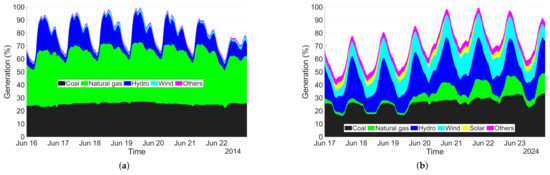
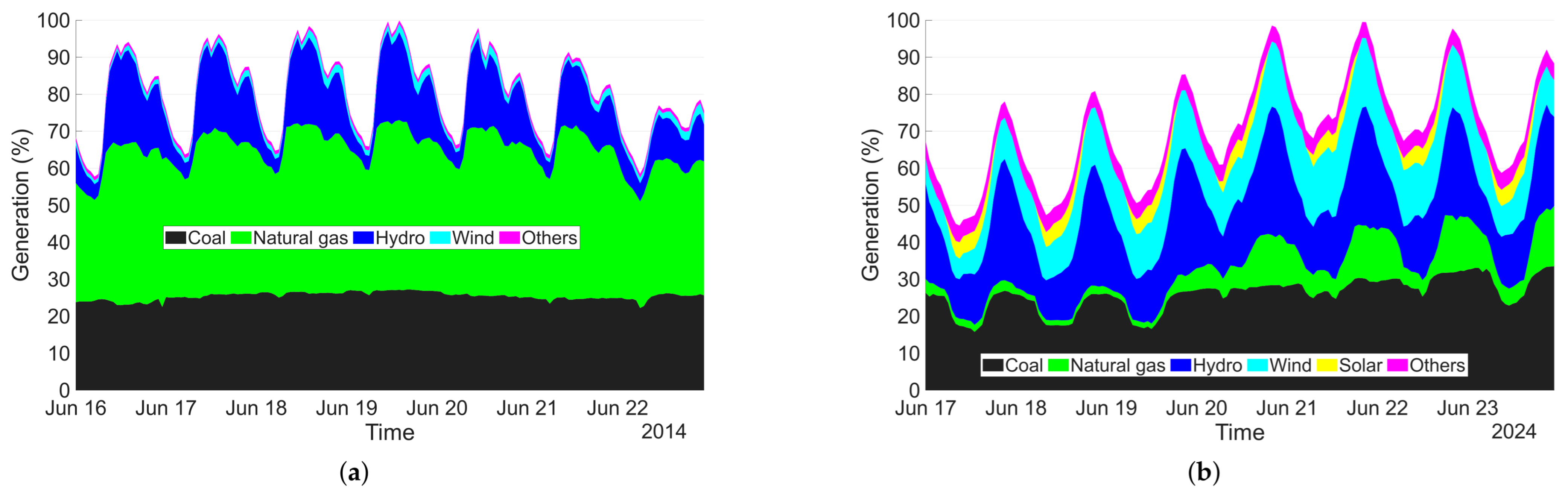
Figure 1 shows the 10-year change in the weekly generation profile of Turkey [3]. The generation data is gathered in the form of hourly generation from the power plants throughout the day, seen from the transmission level. Then the data is separated into the given resource types. Finally, it is normalized on the generation peak of the given week. For Figure 1a, the peak generation is at 35.5 GW, whereas the peak of Figure 1b is at 44 GW in its peak hour. From the figures, it can be easily seen that the base load has dropped from 50% to 15% as a result of changes in the grid. Due to regulations and intentions regarding renewable energy, fuel-based generation has dropped drastically. Instead, wind and solar generation have increased. There is no significant observation in solar generation; however, it shows its effect from the distribution by reducing the off-peak percentage. The lowest generation was below 50% in 2024, whereas, it was above 60% in 2014. In the Turkey case, coal is still cheap and used effectively, but in the future, it will be decreased further to meet the zero-carbon targets. The crucial information hidden in the figures is that the remaining conventional generation is hydroelectric and it is operated more dynamically than ever.
Figure 1.
Weekly generation profiles of Turkey: (a) 2014; (b) 2024 [3].
Hydroelectric power plants are fast-responding and easy-to-control generation units. Their startup and synchronization procedures are much faster than the fuel-based plants. Therefore, they are preferred as reserve units and used in load-generation balancing throughout the day. However, resulting dynamic operation puts the plant components under stress. Their mechanical parts and water conduit systems are subject to wear and tear due to frequent startups and shutdowns, resulting in more frequent component failures or maintenance requirements. Usually, the plant components are taken into periodic maintenance once or twice a year. However, equipment faults can happen earlier than expected and cause more severe problems if not detected early. For a proper system operation with a high percentage of IBRs, the health and readiness of the hydroelectric power plants are crucial. Therefore, the condition monitoring of the power plant should be carried out in real time, and preventive control or maintenance actions should be performed to increase the lifetime of the plant components.
For a hydroelectric power plant, the plant components can be listed as the water conduit system, turbine, generator, machine transformer, excitation, governor, and cooling systems. In condition monitoring of these components, the health status of the plant equipment is monitored online via the plant measurements and dynamic simulation. A plant’s current operation is investigated and compared with both the past measurement data and the dynamic simulation results. For the same operation point, the behavioral differences like water flow rate, casing pressure, winding temperature, etc., from the power plant are analyzed and the health assessment is performed. Some of the related studies in the literature are summarized as follows: in Ref. [4], the condition of the winding isolation in generators and transformers is monitored via partial discharge measurements. In addition to the electrical components, some studies related to the mechanical parts are presented in the literature. Ref. [5] presents an online cavitation monitoring system for Kaplan-type hydroelectric turbines. Researchers monitored both audible and ultrasounds to detect turbine cavitations. The study in Ref. [6] utilizes the vibration data for fault diagnosis. Furthermore, online temperature monitoring of the rotor and early detection of overheated rotor poles are introduced in Ref. [7]. Lastly, a new maintenance information system is introduced in Ref. [8], with vertical and horizontal integration levels to the hydropower plant components. It can be observed that the literature studies depend on the installation of new instruments and their interference with normal plant operation. Plant operators can be conservative in some of the cases.
In addition to these studies, improvements in the phasor measurement units (PMUs) enabled the system operators to perform better dynamic state and parameter estimation with more precise and frequent field measurements. Such studies are included in Refs. [9,10,11,12,13]. These studies mainly focus on the dynamic model calibration and state estimation of the power plant with the help of PMU measurements. As indicated in the literature, PMUs give more reliable measurements (frequency, precision, and time synchronization) than those provided by the SCADA measurements. Therefore, the PMU data is preferable in the case of state and parameter estimation studies. Resulting calibrated models are then used for condition monitoring and health assessment studies of the power plants in a way that the plant’s simulation results and actual measurements are compared and the roots of the differences are investigated.
Although there are enough and well-performing studies regarding the condition monitoring and state estimation in hydroelectric power plants, the amount of studies related to the water conduit system is found to be limited. Also, the lack of enough measurements from the water conduit system makes the condition monitoring more difficult. As the water conduit systems are the parts that the mechanical power flows through, a problem in a water conduit system directly affects the hydropower plant operation since there is no second alternative to it. A general method that is applicable to all hydropower plants with access to past SCADA measurements is needed. Therefore, in this study, a data-driven method for the condition monitoring of the water conduit system is introduced. The simplicity of the method enables implementation in other plant components as well. Furthermore, the method does not require new equipment installation; it can be installed to the SCADA network and operate in real time. Briefly, the method analyzes the turbine startup sequence and obtains expected behavior with operation zones (healthy, acceptable, warning). With the available information and SCADA measurement data provided from two different power plants, the method is implemented and tested. Some discussions are done related to PMU installation to the studied power plants in this research. Considering the nature of the water conduit systems and condition monitoring methods, the measurements provided from SCADA are decided to be enough for this study. Furthermore, the method requires the extraction of the historical startup data; therefore, the already stored SCADA measurements were very useful in this study.
This paper is structured as follows: Section 2 gives the basic modeling of the water conduit and turbine mechanics, the startup of the generating unit, and the synchronization procedure are explained. The proposed “PbyGate Analysis” method is presented in Section 3. Separate analyses for three different turbines are implemented and tested in the related subsections. Then the test results are presented and discussed in Section 4. Crucial information related to the power plants is concealed as requested by the plant operators. Finally, this paper is concluded with future work.
2. Water Conduit System and Turbine Mechanics
In this section, the general structure of the water conduit system, its block diagram, and modeling equations are presented. Then, a brief explanation of how the turbines start operating is given. An example startup operation is illustrated on the power plant measurement data.
2.1. Conduit and Turbine Dynamics
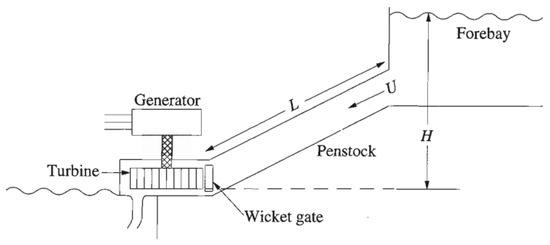
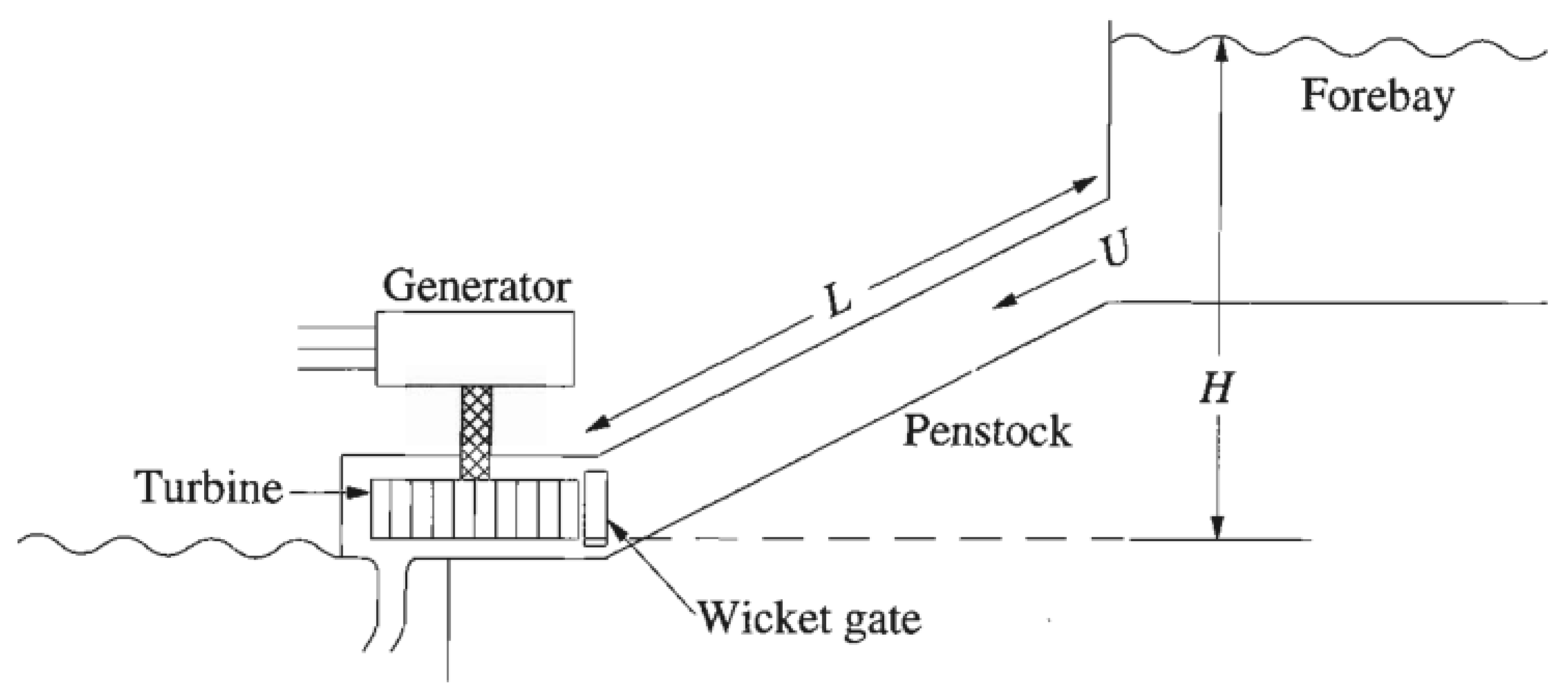
The electricity in hydroelectric power plants is produced by the controlled release of accumulated water from the dam, first turning its potential energy into kinetic energy, then electrical energy on the turbine-generator part. The produced electrical energy is fed into the 3-phase electricity grid. The system part starting from the dam gates to the wicket gates of the turbine is called the water conduit system. Figure 2 illustrates the simplified form of such a system. In the figure, the penstock, wicket gate, and turbine-generator parts are shown. In addition to these main components, practical power plants are equipped with a surge tank, control and safety valves, etc. The water flow and mechanical power generation are controlled by a turbine governor via the wicket gate opening.
Figure 2.
Simplified water conduit structure.
Referencing [14], basic formulations of a simple water conduit structure is given below. , and H are the water flow velocity (), wicket gate position (%), and net head of the system (m), respectively. Mechanical power is calculated from the multiplication of head and flow velocity. and are the conduit constants, depending on the design and construction of the power plant. The derivative of the water velocity is dependent on the difference between net head and steady-state head . Water flow Q (m3/s) is calculated from the multiplication of flow velocity and the effective cross-section area A of the conduit.
After the large signal analysis of the conduit and per-unit normalization, the equations take the following form:
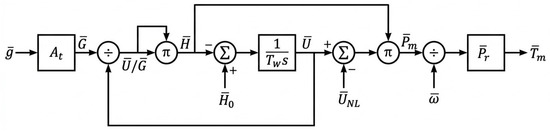
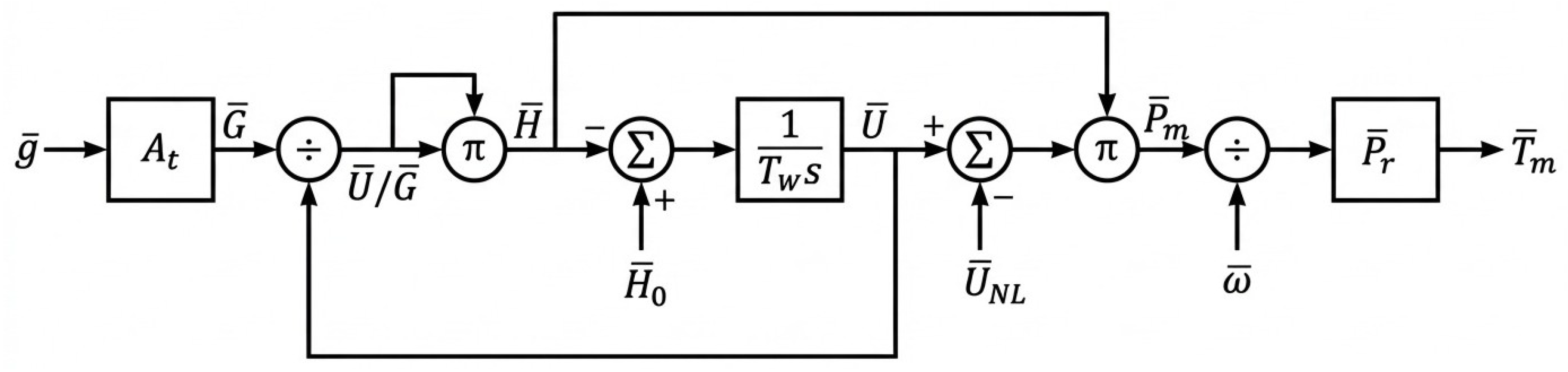
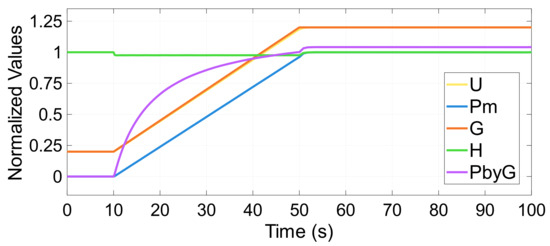
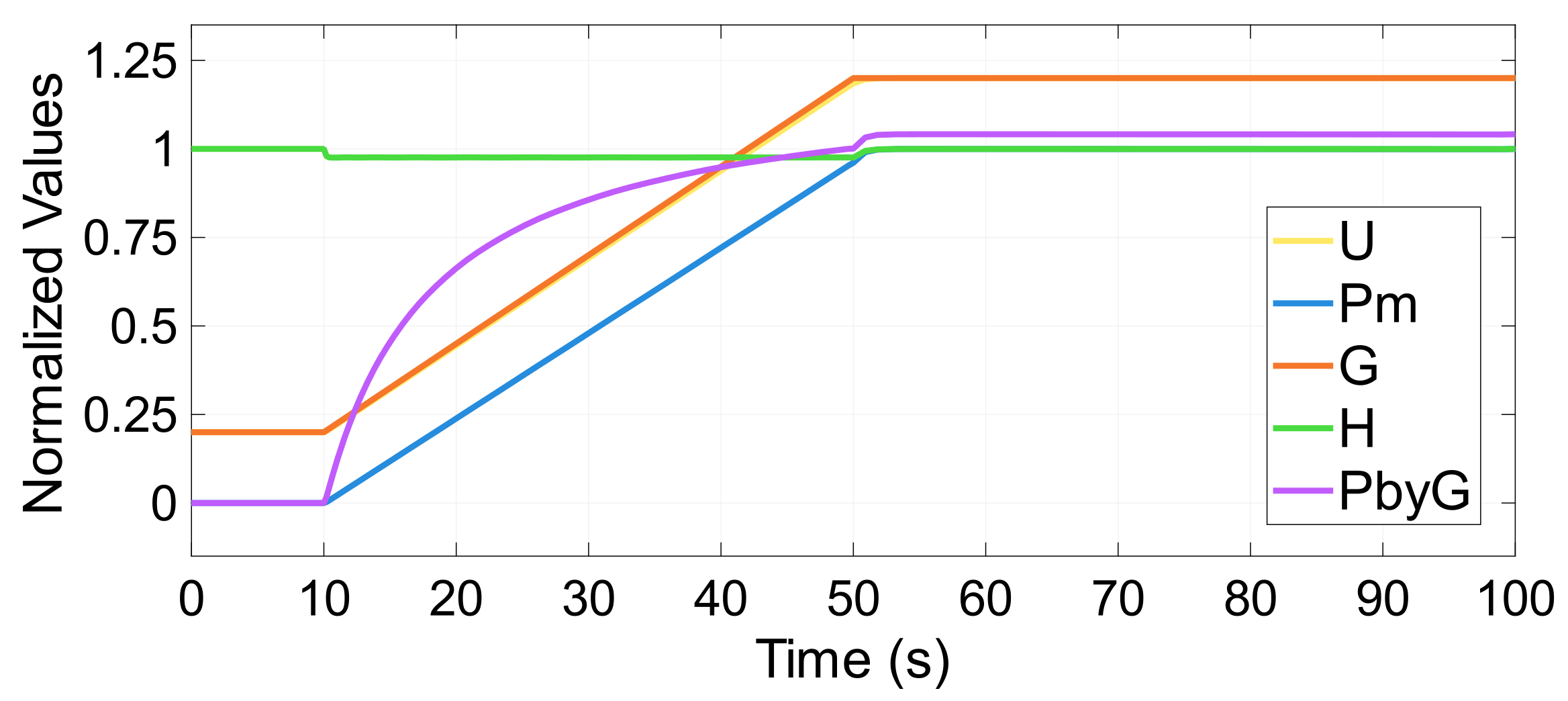
where is the water starting time constant, and L and are the effective pipe length and water acceleration, respectively. Subscript r denotes the rated value of the given variables. Bars on the variables stand for per-unit depiction. is the no-load water flow velocity of the conduit that gives zero mechanical power to the turbine. It counts for the losses in the conduit. Figure 3 shows the transfer function block diagram, while Figure 4 shows the system response against a ramp input in the gate position of the turbine.
Figure 3.
Water conduit simplified block diagram [14].
Figure 4.
Gate ramp response of the system in Figure 3.
As observed in Figure 4, the gate position is gradually increased from a no-load position to a full-load position within a time interval of 40 s. The water flow velocity U and mechanical power follow the gate increase. A small change in the net head H is observed around 1, and it can be ignored. The derived “” variable can be seen in the purple curve. The calculation of this variable is explained in Section 3. For a simple water conduit, as shown in Figure 2, the response is a simple exponential saturation curve. On the other hand, practical hydropower plants are equipped with more complex structures like surge tanks, multi-turbine penstock configuration, protection valves, and high-order governor control mechanisms. These structures make the system modeling more complex and hard to analyze for condition monitoring purposes.
2.2. Turbine Startup and Synchronization
Hydroelectric power plants are used as peak loads (or non-base loads) due to their fast startup and shutdown characteristics. Compared to other conventional power plants, hydroelectric plants can be started and taken into synchronous generation in minutes. In contrast, a typical coal power plant has a startup time in the range of hours.
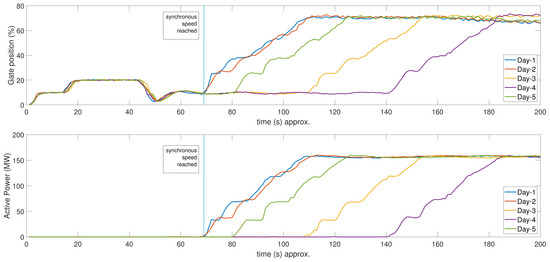
In Figure 5, 5 different startup examples from the measurement data from the studied power plant are given. In the upper and lower plots, the gate position and electrical power measurements are given, respectively. The measurement frequency is around 1 sample per second. This approximate sampling is due to measurement synchronization, time-skew errors in data collection, and timestamping inside the SCADA of the power plant. Since the time constants of the water conduit are in the order of seconds, there is no loss of information with the provided data resolution. As can be seen from the figure, the unit is accelerated from zero to rated speed in 1 min. Then, the synchronization sequence happens automatically. When the synchronization is achieved, the electrical connection is completed and the turbine starts supplying active power by increasing its mechanical power input. The whole startup process takes approximately 2–3 min depending on the synchronization process. Looking at the gate and electrical power movements after the synchronization, one can see the similarity between the startup operations. At around 40 s, the unit reaches its target power. In the next section, the developed numerical method of “PbyGate Analysis” is explained.
Figure 5.
Turbine startup examples for 5 different days.
3. Proposed PbyGate Analysis
The mechanical power input is controlled by the governor that adjusts the gate position of the turbine. The targeted mechanical power is obtained with the desired gate inputs. However, in the case of a problem like a water flow decrease/increase or a pressure drop/rise on the conduit, the governor will try to correct the problem by increasing/decreasing the gate input. From the generator side, mechanical power is as expected but with an abnormal mechanical operating point. This abnormality can be detected by looking at the supplied power and gate position in the following way. Returning to the water flow velocity and mechanical power formulations,
where and are the proportionality multipliers. At a steady state and certain operating points, these multipliers are constant. In addition to that, the net head H for a large power plant is also constant for an operation day. As a result of the governor action and controlled opening of the wicket gates, the net head H does not change significantly during the startup (see Figure 4). However, the multiplier terms are dependent on the plant-turbine design and the operating point . For instance, during the unit startup, steady-state, or frequency changes, these multipliers change according to turbine starter/governor actions and current system variables:
The terms related to the water conduit and turbine dynamics are the proportionality multipliers and they can be easily monitored during the startup process. The ratio of power to the gate position () is then calculated:
The calculation of requires the power and gate position measurements. On the right side of Equation (13), the term can be considered constant throughout the startup period. Therefore, it can be taken as constant for this process. The measurement of the mechanical power is not performed directly in the power plants. Rather, it is calculated from the mechanical torque and turbine speed. However, the electrical power is directly measured from the electrical quantities and the margin of error is smaller compared to the mechanical power. When the machine is in synchronous operation, its speed is nearly constant. Therefore, one can replace the mechanical power with the electrical power since the mechanical losses will be constant. The effect of losses can be put inside the normalization, and the per-unit values will be considerably similar. Resulting PbyGate calculation is given below where the time dependence of the parameters is also shown:
With this calculation, the effect of the instrument calibration is also taken into account. Note that each unit has its own characteristic due to its installment, plant configuration, instrument calibration, governor control method, etc. Therefore, the analyses are performed separately. The main difference is based on the curve fitting of the expected startup behavior. Exponential curve fitting and data averaging are utilized in Plants 1 and 2, respectively. This way, a comparison of the methods’ performances is achieved. Three turbine units from two different power plants are analyzed in this paper. The following steps are performed for the selected turbine units.
In the studied power plants, the instrument measurements are updated in their own resolution and format. But all the measurement updates are not reflected in the SCADA delivery to the control and monitoring panels. Rather, SCADA delivers the measurement data with the same timestamp, putting the current data in a single package. Therefore, the resolution of the measurements is decided by the SCADA, and it is all the same for the collected measurements unless specified otherwise. Since the study focuses on the water conduit system with time constants higher than the SCADA resolution, it will not cause a loss of information. After the synchronization is detected from the SCADA, the active power and gate position measurements are extracted. Then, the measurements are normalized on their rated value. Then, as shown above, the is calculated for each measurement instance, and the data is aligned on the synchronization moments. The aligned is used to select healthy startup data with the assistance of plant operators.
3.1. PbyGate Analysis on Units 1 and 2
For Units 1 and 2, which are from the same power plant, an exponential curve fitting is applied. The composed behavior of governor and conduit system is modeled with a piecewise exponential function . Explicit forms of are given in Section 4. With the mean deviation and a properly selected decay function (being another exponential), the upper and lower health/danger limits for the operational zones are defined. The choice of and thresholds is based on Gaussian error limits [15,16]. The 99.7% confidence level implied by is selected for the upper and lower healthy region limits. The envelopes of define the acceptable and dangerous anomaly regions. t is the time variable in seconds.
The region between is specified as the healthy zone. The acceptable regions are the ones that are between and . The startup instances falling in these regions will be classified as acceptable. Other regions will be called the danger zones, and the startup behaviors in these regions will be marked as anomalies. The technical information on the water conduit and turbine design of Units 1 and 2 is given in Table 1.
Table 1.
Water conduit and turbine parameters of Plant 1.
3.2. PbyGate Analysis on Unit 3
In Unit 3, the research team selected a different approach, where the expected behavior of the turbine is directly obtained from the averaging of the healthy startup behaviors. Also, the decay function is not utilized in this unit for comparison. Then, similar to Units 1 and 2, the upper/lower health/danger limits and the operation zones are defined accordingly.
Table 2 gives the technical information on Unit 3. The turbine type of Unit 3 is similar to Units 1 and 2; however, the rated power, speed, and gate position ratings are different. Also, one can see the difference in the governor control mechanism by looking at the figures in Section 4.
Table 2.
Water conduit and turbine parameters of Plant 2.
4. Test Results
In this section, the results of the separate analyses are given. Units 1 and 2 belong to Plant 1, whereas Unit 3 is from Plant 2. As requested from the plant operators, the data is anonymized. The measurement data is retrieved from the plants’ SCADA systems in 1 s resolution. The used measurements are the electrical power (in ) and wicket gate position (in %).
4.1. Unit 1 Results
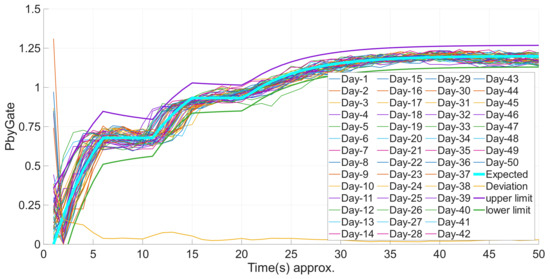
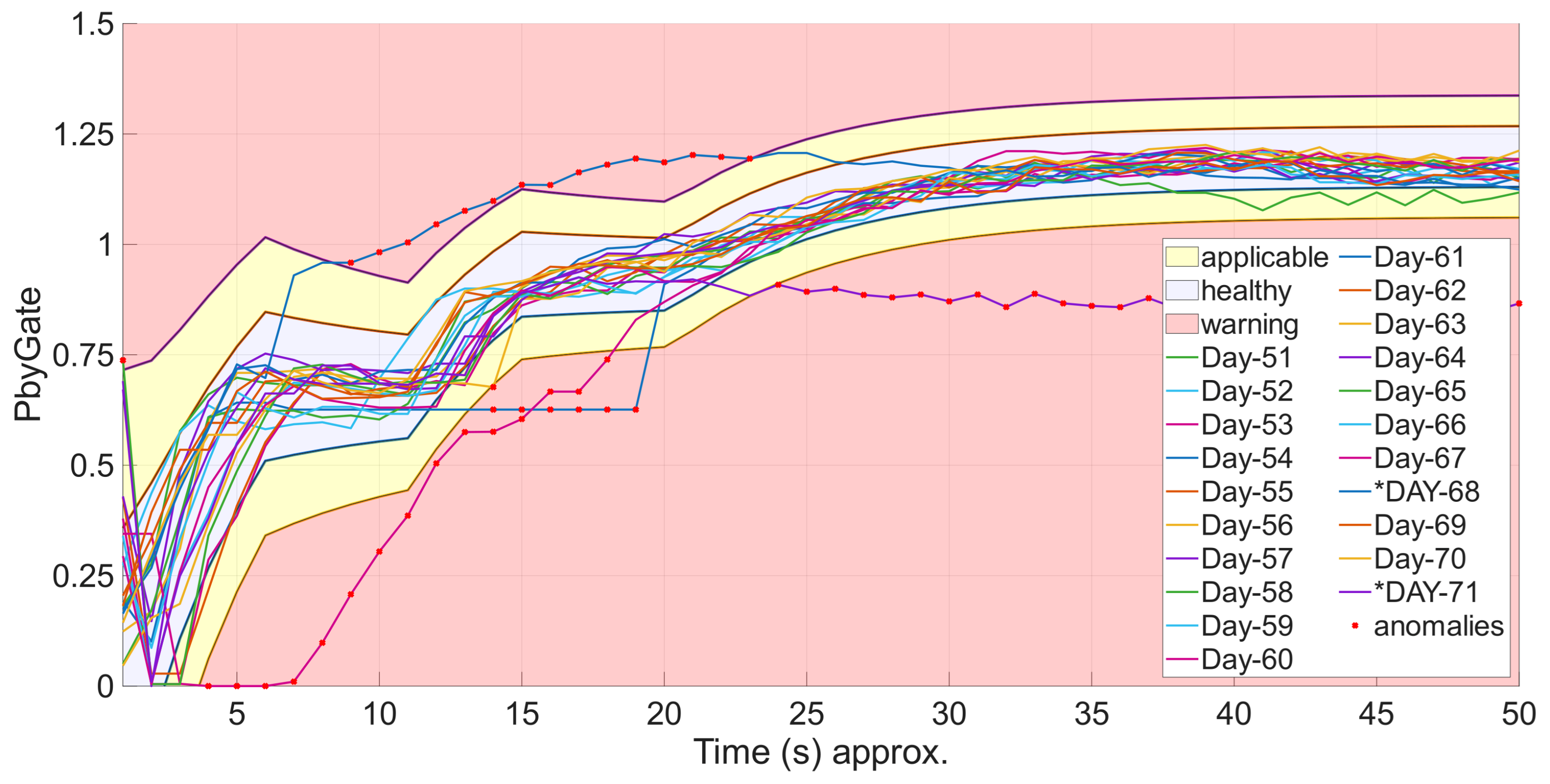
For the analysis of Unit 1, the collected data consists of 71 startup measurements. The first 50 measurements are used for the expected behavior calculation. The calculated PbyGate measurements are aligned on the synchronization instance and the expected behavior is found with exponential curve fitting. Iteratively, the magnitude and time constants of the exponential parts in the expected behavior are obtained. The resulting formulation for Unit 1 is given. The expected behavior curve, used data, and healthy operation limits are plotted in Figure 6. Figure 7 shows the test results of the condition monitoring on Unit 1.
Figure 6.
Unit 1 expected behavior and std. calculation.
Figure 7.
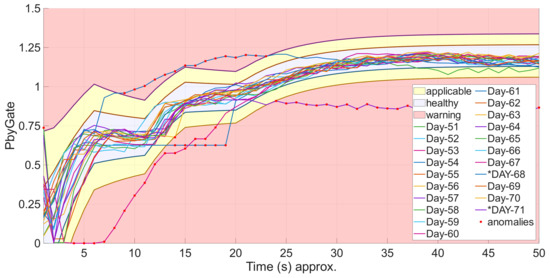
Unit 1 anomaly detection test results, the days with * are tagged as anomalous.
As seen in Figure 6, initial values vary significantly, resulting in a high deviation at the beginning of the startup. Therefore a decaying exponential is introduced to the method. Rather than having a constant magnitude channel centered on the expected behavior, the analysis offers a much higher healthy region at the beginning. Then, the channel gets narrower as the unit reaches the designated operation point. Looking at Figure 6, most of the selected startup data fits into the desired healthy region. Therefore, the standard deviation curve (at the bottom of the plot, yellow-colored) is as expected. Then, the specified regions are tested with the rest of the collected data. When analyzing the test results, one should keep in mind that healthy turbine starter and governor operation is assumed in this study. This means that the desired power output is achieved during the startup and steady-state operation.
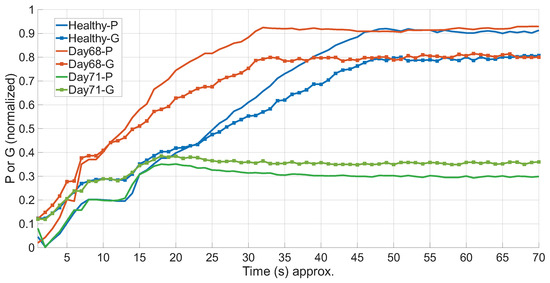
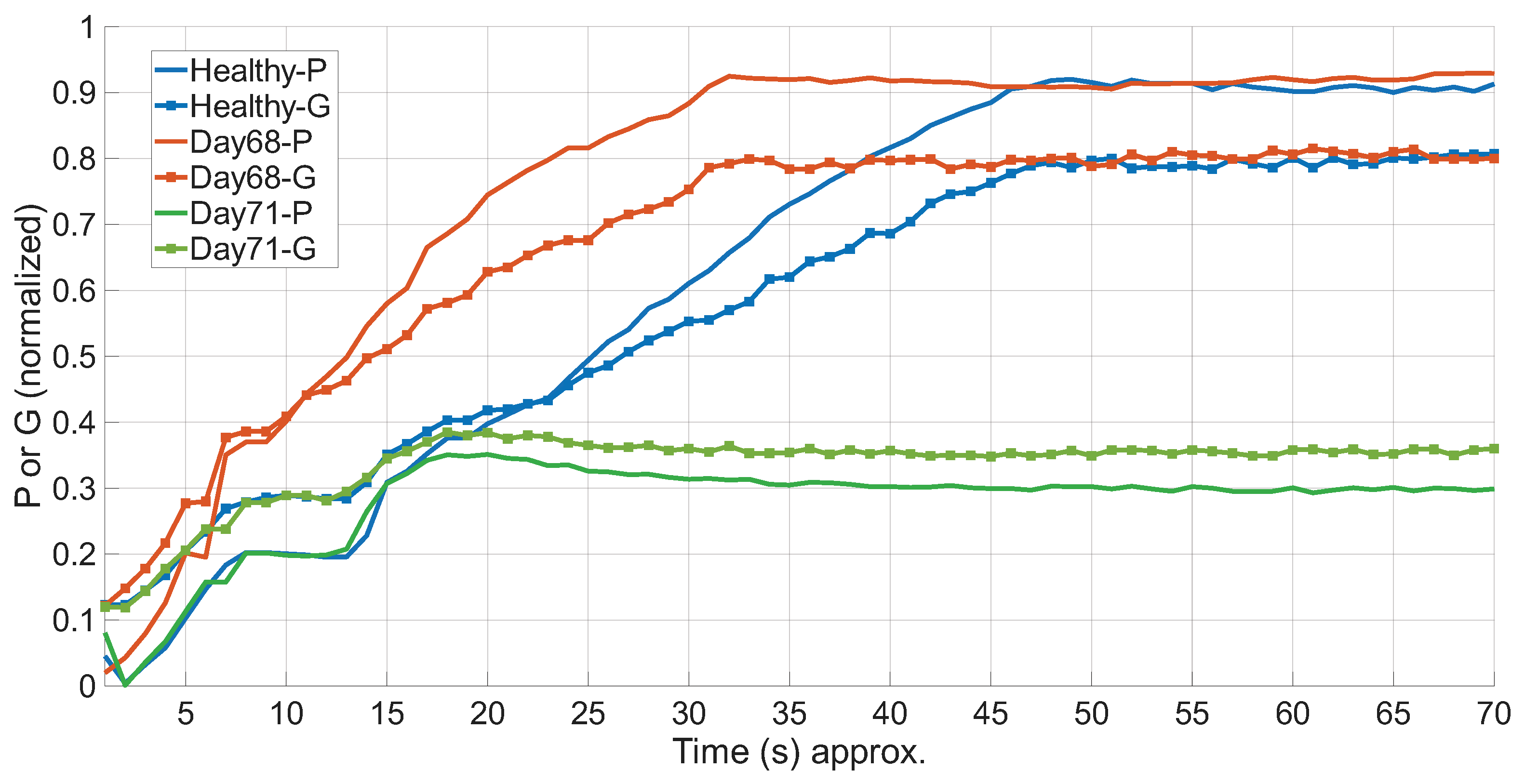
Figure 8 shows the investigation of the detected anomalies on Unit 1 test data. As can be seen, the detected anomaly operations considerably differ from the healthy behavior, which is depicted with blue curves. Table 3 shows the information on the anomalous operations of Unit 1. Day 68 violates the upper limits but it returns back to the healthy region after. On the other hand, Day 71 violates the lower limits and does not return to the healthy region, which results in an emergency turbine shutdown. Looking at the test data, two startup instances are tagged as anomalies out of 21 samples. One of the tagged anomalies did not end up in emergency shutdown, meaning it was a false alarm. Therefore, the method’s accuracy is for Unit 1.
Figure 8.
Unit 1 investigation of detected anomalies.
Table 3.
Unit 1 detected anomaly days.
4.2. Unit 2 Results
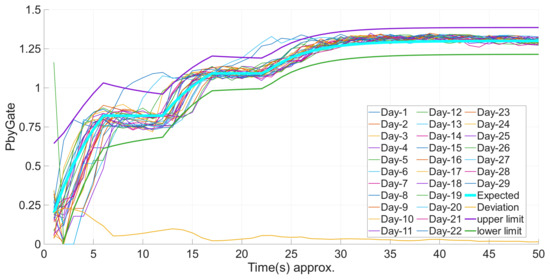
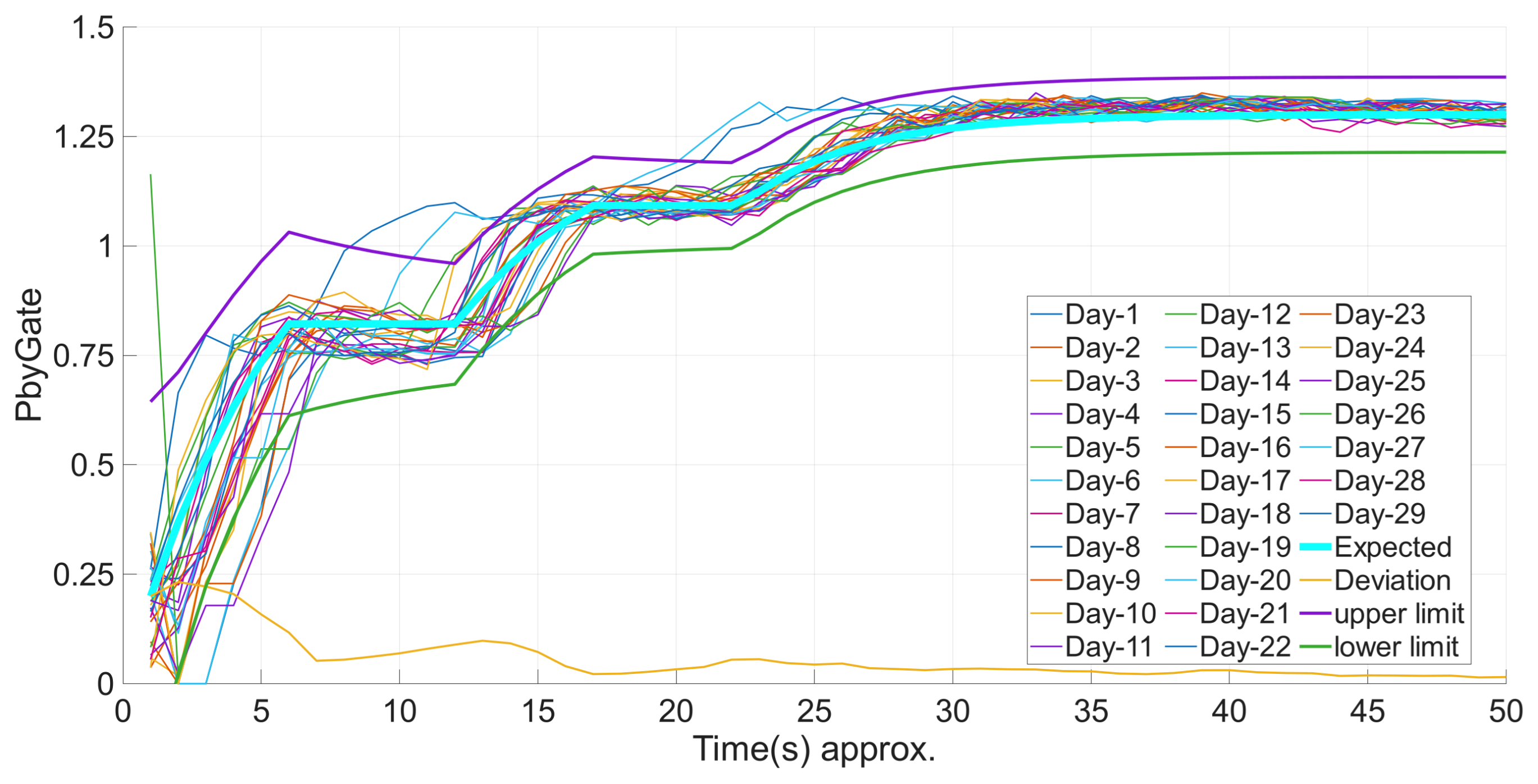
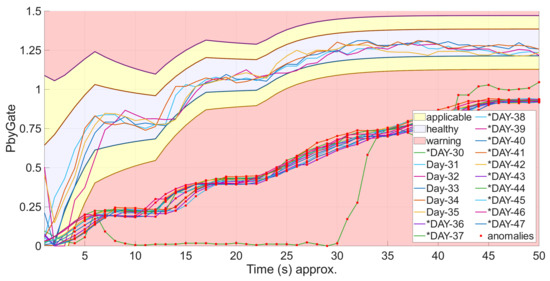
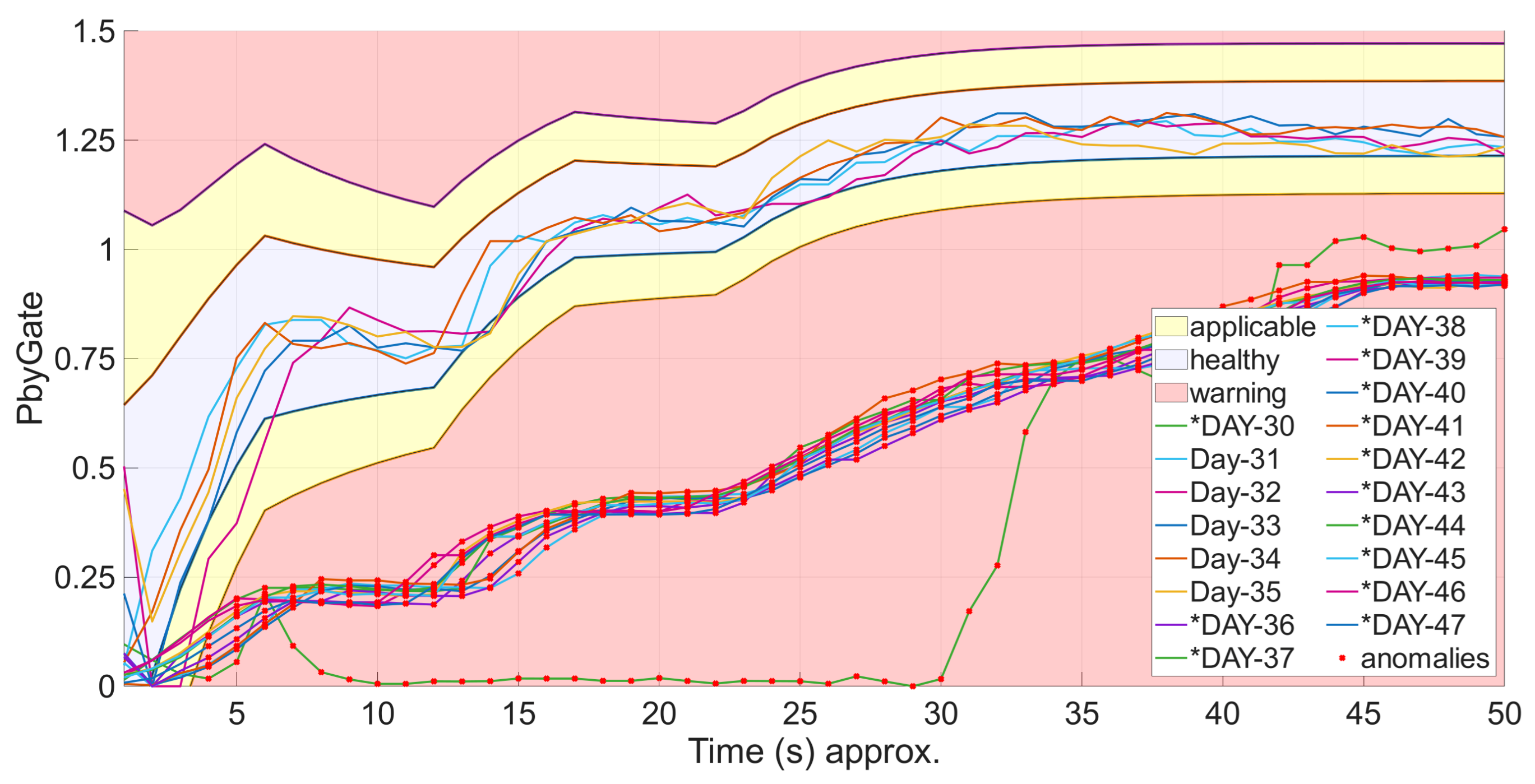
A similar analysis is performed for Unit 2 of the studied power plant with less data compared to Unit 1. In total, 47 startup data were collected during the same operational period, and for the initial step of the analysis, 29 of the startups were selected. The Unit 2 behavior has a similar shape to that of Unit 1. However, the time constants and magnitudes differ. The results of the initial analysis are given in Figure 9. Most of the startup data fits into the healthy region. A couple of startup events move slightly beyond the healthy region limits. But as illustrated above, these behaviors are not classified as dangerous anomalies. After the operational regions are specified from the Unit 2 calculations, the analysis is tested with the unseen startup data. Results are given in Figure 10.
Figure 9.
Unit 2 expected behavior and std. calculation.
Figure 10.
Unit 2 anomaly detection test results, the days with * are tagged as anomalous.
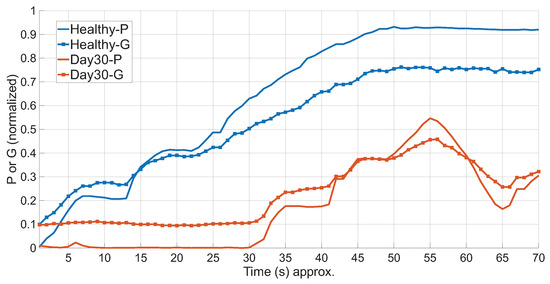
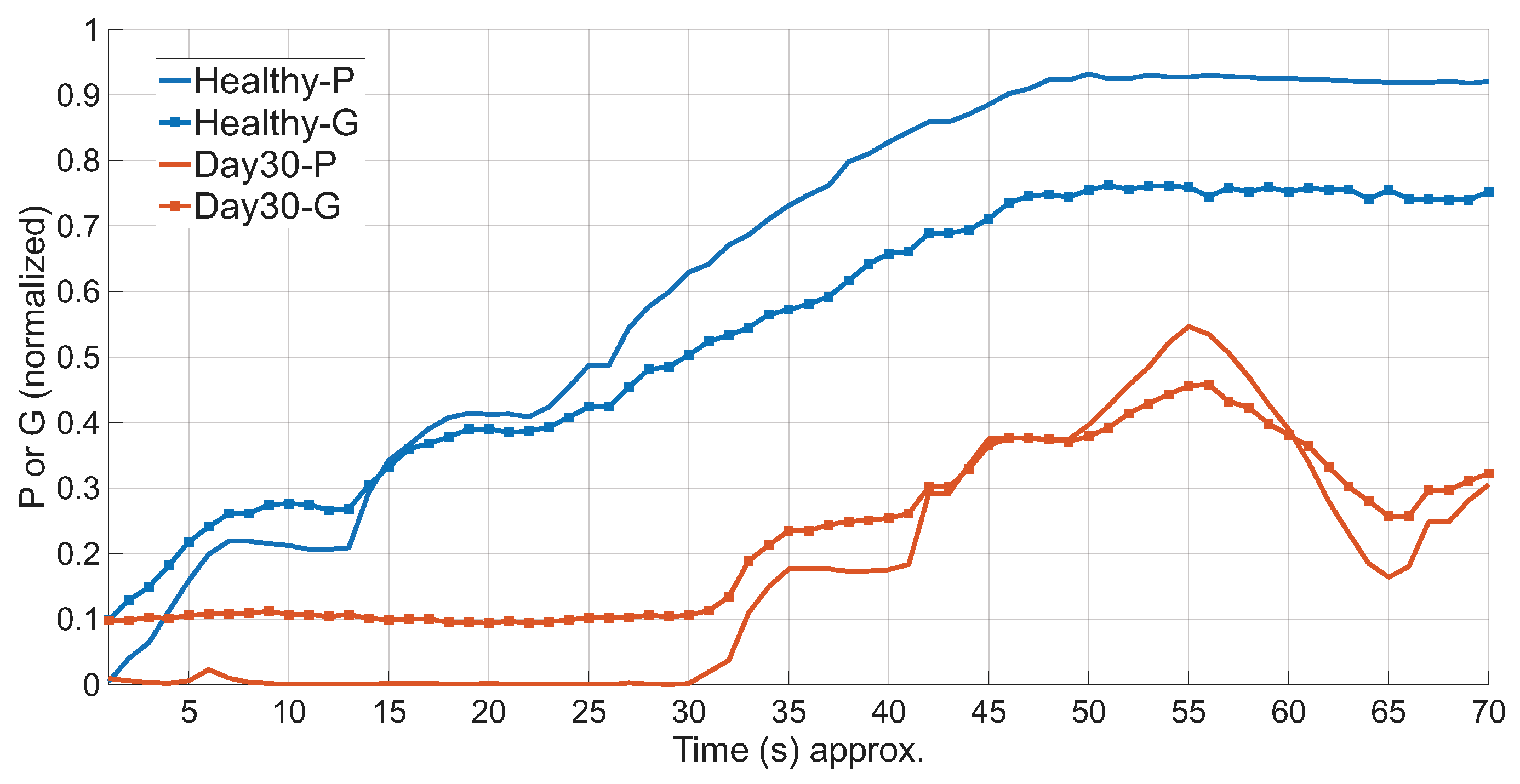
Looking at Figure 10 of the Unit 2 results, 18 startup test data are presented. Again, assuming a healthy startup and governor operation, similar results to those of Unit 1 are obtained. The water hammer effect [14] at the beginning is observed again at the beginning of the startup. Due to this effect, the values initially drop, then start to increase due to a step change in the gate position (increase in ). Also, it is seen that there are lots of startups tagged as anomalies in the danger zone. Since the behavior was repeated multiple times, the logbook from the power plant officers was requested. This group of startups was found to be belonging to the operation period in which the gate position reading was erroneous. The gate position measurement of Unit 2 was constantly at 100%. The behavior had normalized after the measurement device was repaired. In addition to these startups, another startup behavior of Day 30 was tagged as an anomaly. Its active power and gate position data are plotted in Figure 11. Again, to compare, a healthy behavior is presented in the figure as well. As can be seen, the gate position and active power data deviated from the healthy behavior, and the power plant officers were informed accordingly. Other behaviors stayed in the healthy region. Again, the detected anomalies from Unit 2 test data are classified in Table 4. Accuracy of the method is significantly low in this unit due to false data. Only five of the test samples are tagged correctly and the other test startups are falsely tagged due to the 100% gate position measurement. The false data comes from the SCADA, not the instrument, since the unit was able to operate healthily.
Figure 11.
Unit 2 investigation of detected anomalies.
Table 4.
Unit 2 detected anomaly days.
4.3. Unit 3 Results
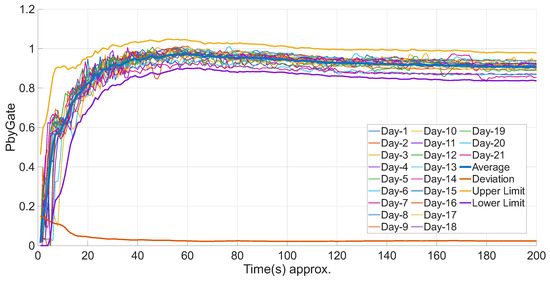
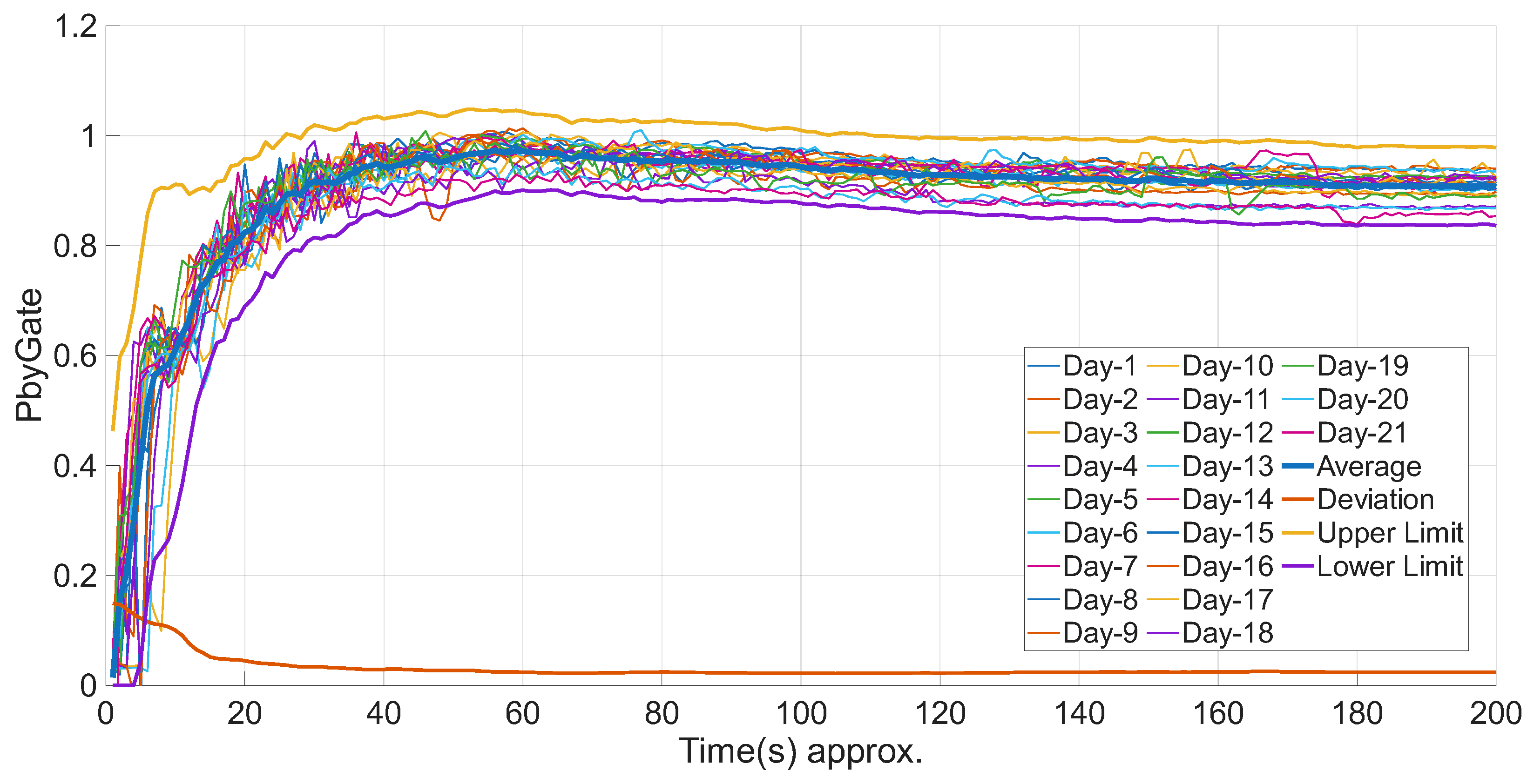
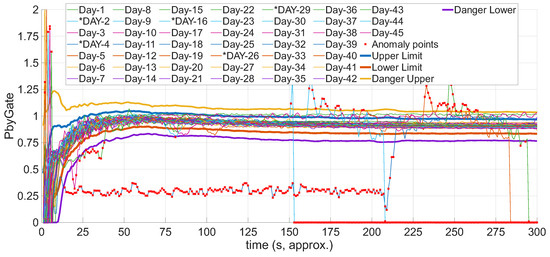
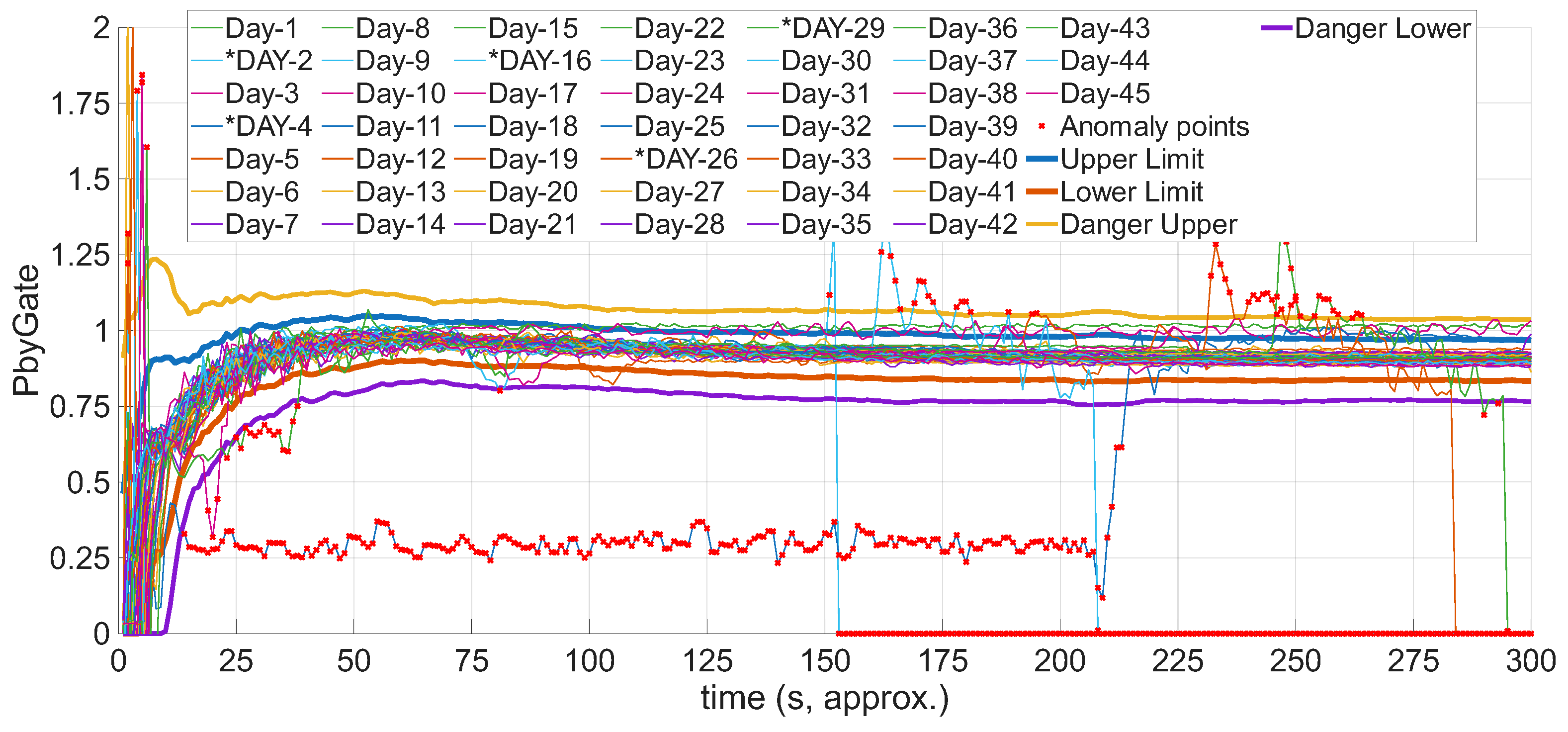
This unit belongs to a different power plant with its information given in Table 2. Also in this unit, the research team looked further into the steady-state operation after the turbine startup process. The time interval for the analysis of this turbine is 300 s. In total, 21 days of healthy startup information is used to obtain expected behavior and operation zones. Different from Units 1 and 2, the healthy startups are averaged for each time step along the time interval, and the expected PbyGate response is retrieved. Then, from the average behavior, the standard deviation and upper and lower acceptable and danger limits are calculated. These can be observed in Figure 12. After that, the test data of 45 days is utilized for anomaly detection. The results can be observed in Figure 13. Again, there are some initial jumps in some of the PbyGate values of the startups. These jumps might be due to measurement errors or the water hammer effect caused by the sudden gate position change. Detected anomalous startup behaviors are listed in Table 5 with their anomaly information. Days 2, 16, 26, and 29 exhibit an upper limit violation and result in an unsuccessful operation with a shutdown of the unit. The shutdown deduction can easily be done by the zero value as the delivered active power goes to zero. Day 4, however, violates the lower limit and then returns back to the healthy region after some time. There is no record of an emergency shutdown on Day 4. The method’s accuracy reaches 97.7% in this unit, where the 44 startup samples are tagged correctly.
Figure 12.
Unit 3 expected behavior and std. calculation.
Figure 13.
Unit 3 anomaly detection test results, the days with * are tagged as anomalous.
Table 5.
Unit 3 detected anomaly days.
5. Discussion and Future Work
In Units 1 and 2, the tagged anomalies are mostly due to post-maintenance trials and measurement failure. However Unit 3 results present successful detection cases. In the detected anomalous startups, the calculated variable violated the operational limits. The false detections are mostly due to post-maintenance startups where the units do not operate at rated power and the false data retrievals from the plant SCADA. The method solely depends on the SCADA measurements, and the false data injections significantly reduce the method’s accuracy. As future work, the studied power plant or a reference plant will be modeled in a simulation environment and the actual fault scenarios will be obtained synthetically. Also, the type of anomalies or which parts of the conduit system or the controller cause such anomalies will be investigated via the simulation environment. With investigation and additional measurements (water flow rate, lake water level, turbine case pressure readings, etc.), the aging and efficiency of the water conduit system and turbine can be analyzed. Also, the sudden or incoming failures can be detected. In simulation environment and detailed modeling of the power plant units, these detection and identification aspects will be further studied.
The interaction between the units is another aspect of this study. The effect of an ongoing operation of one unit on another unit’s startup will be investigated in the future. The inclusion of other measurements related to the water conduit system will increase the method’s accuracy in the early detection of faults. Co-monitoring of measurements like pressure readings, voice recording around the penstock, etc., will improve the overall assessment. Furthermore, the seasonal differences on the net head and the water flow and the compensated governor action will be further studied in upcoming work.
Although fuel-based generation units will participate less in the future, their dynamic operation against system uncertainties still matters. Therefore, the method can be useful in the condition monitoring of fuel-based power plants as well. For instance, the steam generation and turbine connection parts in the fuel-based power plants have complex structures. Similar to the water conduit system in a hydropower plant, the condition monitoring of these structures might be of importance in the future. The developed method can be modified to the steam unit measurements, and condition monitoring of the unit can be implemented.
6. Conclusions
In this study, a condition monitoring method for the water conduit system of a hydroelectric power plant is introduced where a lack of water conduit measurements is present. To summarize, the expected behavior and the healthy and dangerous operation zones are defined from past operation data. Then, the method is deployed with the online SCADA measurements from the power plant. The method is fully data-driven and the required data is generally available from the plant measurements. The test results from three different turbine units are presented and discussed in detail. Looking at the results, the method is promising for the early detection of anomalies in the water conduit system and turbine operation. As seen in the results of Unit 3, four emergency shutdown occurrences were detected before they happened. The overall method accuracy is 84.5%. False taggings are mostly due to false data injections from the SCADA. As future work, the inclusion of additional measurements and detailed modeling of the power plant units will be used in the identification of the detected anomalies. After the method’s detection and identification accuracies are improved, the method will be implemented on other synchronous generation units like fuel-based power plants.
Author Contributions
Conceptualization, F.E. and M.G.; methodology, F.E. and M.G.; software, F.E.; validation, F.E. and M.G.; formal analysis, F.E. and M.G.; investigation, F.E.; resources, M.G.; data curation, F.E.; writing—original draft preparation, F.E.; writing—review and editing, F.E. and M.G.; visualization, F.E.; supervision, M.G.; project administration, M.G.; funding acquisition, M.G. All authors have read and agreed to the published version of the manuscript.
Funding
This research received no external funding.
Institutional Review Board Statement
Not applicable.
Data Availability Statement
The raw data supporting the conclusions of this article will be made available by the authors on request.
Acknowledgments
The authors would like to thank the Electricity Generation Company (EÜAŞ) of Turkey for the support of this research.
Conflicts of Interest
The authors declare no conflicts of interest.
References
- IEA. Grid Congestion is Posing Challenges for Energy Security and Transitions; IEA: Paris, France, 2025; Available online: https://www.iea.org/commentaries/grid-congestion-is-posing-challenges-for-energy-security-and-transitions (accessed on 23 April 2026).
- UNIFI-2026-2-1; UNIFI Specifications for Grid-Forming Inverter-Based Resources—Version 3. UNIFI Consortium: Golden, CO, USA, 2026.
- EPİAŞ Transparency Platform. Available online: https://seffaflik.epias.com.tr/transparency/ (accessed on 13 November 2024).
- Yuan, W.; Chuangli, G.; Zhipeng, W.; Pengcheng, D. Partial Discharge Online Monitoring for Hydro-generator. In Proceedings of the 2011 International Conference on Computer Distributed Control and Intelligent Environmental Monitoring, Changsha, China, 19–20 February 2011; pp. 111–114. [Google Scholar] [CrossRef] [Scilit]
- Shi, H.; Li, Z.; Bi, Y. An On-line Cavitation Monitoring System for Large Kaplan Turbines. In Proceedings of the 2007 IEEE Power Engineering Society General Meeting, Tampa, FL, USA, 24–28 June 2007; pp. 1–6. [Google Scholar] [CrossRef] [Scilit]
- Weiming, G.; Ming, Z.; Xinfeng, G.; Yongsheng, D.; Jinqi, D.; Yizhong, Z. Vibration Data Acquisition and Fault Diagnosis System of Hydro Turbine Based on CompactRIO. In Proceedings of the 2017 5th International Conference on Mechanical, Automotive and Materials Engineering (CMAME), Guangzhou, China, 1–3 August 2017; pp. 319–323. [Google Scholar] [CrossRef] [Scilit]
- Milić, S.D.; Žigić, A.D.; Ponjavić, M.M. Online Temperature Monitoring, Fault Detection, and a Novel Heat Run Test of a Water-Cooled Rotor of a Hydrogenerator. IEEE Trans. Energy Convers. 2013, 28, 698–706. [Google Scholar] [CrossRef] [Scilit]
- Li, Z.; Ai, Y.; Shi, H. Optimal Maintenance Information System of Gezhouba Hydro Power Plant. In Proceedings of the 2007 IEEE Power Engineering Society General Meeting, Tampa, FL, USA, 24–28 June 2007; pp. 1–5. [Google Scholar] [CrossRef] [Scilit]
- Wang, P.; Zhang, Z.; Huang, Q.; Zhang, W.; Lee, W.-J. PMU Based Problematic Parameter Identification Approach for Calibrating Generating Unit Models. IEEE Trans. Ind. Appl. 2021, 57, 4520–4527. [Google Scholar] [CrossRef] [Scilit]
- Zhao, J.; Netto, M.; Huang, Z.; Yu, S.S.; Gómez-Expósito, A.A.; Wang, S. Roles of Dynamic State Estimation in Power System Modeling, Monitoring and Operation. IEEE Trans. Power Syst. 2021, 36, 2462–2472. [Google Scholar] [CrossRef] [Scilit]
- Paul, A.; Joos, G.; Kamwa, I. Dynamic State Estimation of Full Power Plant Model from Terminal Phasor Measurements. In Proceedings of the 2018 IEEE/PES Transmission and Distribution Conference and Exposition (T&D), Denver, CO, USA, 16–19 April 2018; pp. 1–5. [Google Scholar] [CrossRef] [Scilit]
- Huang, R.; Diao, R.; Li, Y.; Sanchez-Gasca, J.; Huang, Z.; Thomas, B.; Etingov, P.; Kincic, S.; Wang, S.; Fan, R.; et al. Calibrating Parameters of Power System Stability Models Using Advanced Ensemble Kalman Filter. IEEE Trans. Power Syst. 2018, 33, 2895–2905. [Google Scholar] [CrossRef] [Scilit]
- Krupa, E.; Rezvaya, K.; Makarov, V. Parameter Estimation of Hydraulic Equipment of Hydro-Electric Power Station Based on Numerical Simulation of the Spatial Flow. In Proceedings of the 2021 IEEE 2nd KhPI Week on Advanced Technology (KhPIWeek), Kharkiv, Ukraine, 13–17 September 2021; pp. 681–685. [Google Scholar] [CrossRef] [Scilit]
- Kundur, P. Power System Stability and Control; McGraw-Hill: New York, NY, USA, 1994. [Google Scholar]
- Vysochanskij, D.F.; Petunin, Y.I. The justification of the 3σ rule for unimodal distributions. Theory Probab. Math. Stat. 1980, 21, 25–36. [Google Scholar]
- Bothe, D. Statistical Reason for the 1.5σ Shift. Qual. Eng. 2002, 14, 479–487. [Google Scholar] [CrossRef] [Scilit]

Disclaimer/Publisher’s Note: The statements, opinions and data contained in all publications are solely those of the individual author(s) and contributor(s) and not of MDPI and/or the editor(s). MDPI and/or the editor(s) disclaim responsibility for any injury to people or property resulting from any ideas, methods, instructions or products referred to in the content. |
© 2026 by the authors. Licensee MDPI, Basel, Switzerland. This article is an open access article distributed under the terms and conditions of the Creative Commons Attribution (CC BY) license.