1. Introduction
Wind energy in the built environment emerged from the idea of sustainable development and the urgent need to reduce greenhouse gas emissions in cities, which are both major energy consumers and significant emission sources [
1,
2]. Initially, renewable energy systems were perceived in architecture as add-ons to buildings, used primarily to improve energy efficiency or meet ecological certification requirements. Over time, however, the concept of deep integration of energy systems with building form emerged, in which building-integrated wind turbines (BIWTs) become an integral component of architectural identity [
3,
4]. Contemporary projects increasingly treat wind turbines not only as technical devices but also as expressive symbols of ecological transition and a manifestation of commitment to sustainable development [
5]. The evolution of architecture understood in this way has also revealed a tension between design aspirations and the actual aerodynamic conditions of the built environment [
6]. Within the design community, there is a prevailing belief that new development inevitably degrades aerodynamic conditions around existing installations, leading to reduced flow velocity, increased turbulence, and lower energy performance of turbines [
7,
8,
9,
10,
11,
12]. Previous analyses have primarily focused on identifying and mitigating the negative effects of increased building density, such as aerodynamic shading or local reductions in aerodynamic potential. In particular, CFD studies and industry reviews emphasize that the complexity of airflow in built environments, resulting from interactions between buildings, leads to significant challenges for predicting and optimizing turbine performance [
13]. At the same time, an increasing number of studies highlight the need to shift from a reactive approach—aimed at minimizing losses—to a proactive strategy, in which the deliberate shaping of new building geometries can not only limit negative effects but even generate favorable airflow conditions, thereby influencing the quality of architectural solutions [
14,
15,
16,
17]. The latest research shows that parameters such as layout, height, roof shape, and building orientation can be optimized with respect to turbine energy performance, and that appropriately designed building ensembles are capable of locally increasing flow velocity and improving the operating conditions of wind installations [
16]. Nevertheless, systematic analyses of aerodynamic interactions between buildings in the context of turbine siting in built environments remain rare and represent a significant research gap in the literature [
18,
19].
While many existing studies address airflow phenomena at the urban scale, the present study focuses on inter-building interactions, with particular emphasis on the immediate rooftop environment. In light of the above, there is a need for studies that not only diagnose and minimize losses but also explore the potential for optimizing building configurations with the aim of supporting the development of building-integrated wind energy systems [
20]. Such an approach requires the integration of advanced CFD tools, geometric parameterization, and multi-aspect flow analysis. These elements enable the design of building configurations that actively support turbine operation and improve performance under defined flow conditions [
21,
22].
The integration of wind turbines with buildings requires accounting for the specific aerodynamic conditions that distinguish the built environment from open terrain and significantly complicate the design process. The dense and heterogeneous building configurations generate highly non-uniform flows that directly affect turbine operating parameters. Wind dynamics at this scale are characterized by lower mean velocities, greater directional variability, and higher turbulence levels than in open areas. This necessitates the use of analytical methods capable of capturing subtle aerodynamic effects [
23,
24].
In the literature, airflow phenomena are often analyzed from the perspective of interactions between the Urban Canopy Layer (UCL) and the Urban Boundary Layer (UBL), which allows the wind dynamics of the entire system to be described [
25]. In this study, however, references to these issues serve only as a conceptual framework—the primary domain of analysis remains the immediate rooftop environment, which constitutes a typical turbine location and simultaneously the area most sensitive to geometric modifications of buildings [
26]. It is within this zone that differences in building height, roof slope, spacing between structures, and orientation with respect to the incoming flow generate significant variations in local velocities, pressure gradients, and turbulence intensity [
27]. These factors directly determine the operating conditions of a turbine, which is highly sensitive to flow disturbances. Under such conditions, CFD simulations are especially important, as they enable the reproduction of complex aerodynamic phenomena with the accuracy required for assessing the wind microclimate [
20]. Recent studies on airflow in built environments increasingly emphasize the importance of validating CFD-based approaches using experimental data, including wind-tunnel measurements and field studies. In particular, rooftop wind regimes have been investigated through combined numerical and experimental methods, demonstrating that steady-state RANS models are capable of reproducing mean flow characteristics in complex urban environments [
10]. At the same time, higher-fidelity approaches, such as Large Eddy Simulation (LES), are increasingly applied to capture transient flow structures and turbulence effects, especially in more complex or multi-scale configurations. Despite these advancements, detailed analyses of direct aerodynamic interactions between buildings at the microscale, particularly in the context of wind turbine integration, remain limited. Numerical modeling makes it possible to identify zones of favorable accelerations, stagnation regions, and vortex structures, as well as to evaluate the influence of geometric parameters on flow stability and performance [
28,
29]. This is essential because the integration of turbines into architecture requires simultaneous consideration of spatial and technical aspects: building height, roof shape and slope, volumetric proportions, and neighboring relations that influence the formation of aerodynamic interactions. The specific characteristics of wind resources in built environments also mean that the design of wind installations requires an iterative approach and precise diagnostics of local conditions [
8,
14]. Even relatively small changes in roof angle, the displacement of a neighboring structure, or modifications to its height can generate significant differences in velocity distributions, which directly affect device performance. The complexity of these phenomena constitutes one of the key barriers to the implementation of wind technologies in the built environment. This results not only from technical challenges, but also from decision-making constraints that require close collaboration between architectural designers, environmental engineers, and numerical modeling specialists [
17,
30]. Consequently, the research problem becomes not only the diagnosis of existing aerodynamic disturbances but also understanding the extent to which geometric parameters of new development can locally generate favorable microscale flow conditions [
16,
18].
In this study, it is assumed that the impact of new development on the performance of wind installations in existing buildings does not have to be unequivocally negative. Three working hypotheses were formulated: (H1) any new development deteriorates flow conditions; (H2) there exist development forms that are aerodynamically neutral; and (H3) it is possible to design development that enhances the flow and improves the aerodynamic conditions around a turbine installed on an existing building [
18]. This approach makes it possible to determine whether new development negatively affects the functioning of existing wind installations integrated with buildings and, consequently, to establish whether the design process can incorporate design principles that support the integration of wind energy systems within building form [
15]. In contrast to prevailing reactive strategies, such as relocating turbines, changing their type (e.g., from horizontal-axis wind turbines (HAWT) to vertical-axis wind turbines (VAWT)), or limiting the height of neighboring structures, this study proposes a preventive approach based on the deliberate shaping of space. The key assumption is to treat airflow as a design parameter that can be optimized at the conceptual design stage of building development [
15,
30]. In this context, aerodynamic interactions between buildings become particularly important. Previous studies rarely consider these phenomena as a potential source of aerodynamic benefits—they are more commonly analyzed in the context of pedestrian comfort or pollutant dispersion [
31]. The proposed approach assumes that the geometry of new development can be designed in a way that actively shapes the flow environment to the advantage of nearby wind installations [
29]. It points to the rationale for redefining the relationship between wind energy systems and building form: the turbine is not a passive infrastructure element, but a component integrated with the aerodynamic system of its surroundings [
32]. Such a perspective opens new possibilities for the application of wind technologies.
The direct aim of the presented study is the quantitative evaluation of how geometric variability within a building ensemble influences airflow characteristics in the vicinity of a wind turbine [
10]. The analysis focuses on the interaction between two objects: a reference building (existing), over whose roof the flow is examined—representing a potential turbine location—and a neighboring building (planned), whose geometry (roof pitch and height) constitutes the variable shaping the aerodynamic conditions of the system. The study aims to identify development configurations that—depending on the adopted geometry of the ensemble—may lead either to a reduction in aerodynamic losses or to the generation of local effects supporting turbine operation. Particular emphasis is placed on distinguishing building forms that are detrimental as well as potentially beneficial from the perspective of energy performance, which enables the formulation of practical recommendations for design that incorporate the integration of renewable energy systems. The study highlights the importance of architectural context as a key decision-making filter. The selection of the analyzed geometric variants was not accidental—both spatial composition constraints and functional and aesthetic considerations were taken into account [
3,
5,
30]. This made it possible to maintain a balance between aerodynamic optimization and the realities of design practice, in which architectural decisions result from a compromise between multiple, often conflicting criteria. The formulated research assumptions and the identified limitations in previous studies constitute the basis for establishing a methodology capable of verifying the proposed hypotheses. The proposed methodology is intended as a decision-support tool for the conceptual design stage, focusing on the influence of new building configurations on airflow conditions over existing buildings. The presented analysis focuses exclusively on airflow characteristics and does not constitute a direct assessment of energy production or turbine performance. The contribution of this study is threefold. First, it provides a systematic CFD-based evaluation of aerodynamic interactions between two-building configurations at the microscale, focusing on conditions relevant to wind turbine integration. Second, it introduces a structured methodology for the selection of geometrically optimized configurations based on combined statistical and flow-visualization criteria. Third, it demonstrates that building geometry can be deliberately used to enhance flow conditions, challenging the prevailing assumption that new development inevitably deteriorates the aerodynamic environment.
2. Materials and Methods
2.1. Research Objective
The conducted study is based on a numerical analysis of airflow around two simplified building shapes: object A, serving as the reference structure, and object B, whose shape is subject to modification [
33]. The aim is to determine the influence of variable geometric parameters of building B on the distribution of the wind flow field over the roof of building A, which is analyzed as a potential location for building-integrated wind turbines [
14,
15,
16]. The research process comprises two complementary phases, enabling both the identification of general aerodynamic tendencies and the tuning of the system toward configurations that promote optimal flow conditions [
18,
29].
2.2. Research Workflow
In the first phase, within the reference scenario, a series of CFD simulations was carried out involving only building A, without the presence of object B [
7]. The analysis included both visualization of the flow fields and point-based diagnostics within the measurement grid located above the roof plane of building A. The focus was placed primarily on the velocity component aligned with the incoming flow direction (Vy) and, when necessary, also on the Vx and Vz components, which allow assessment of local transverse and vertical phenomena [
11]. The results obtained enabled the establishment of a reference flow configuration that serves as a baseline for subsequent evaluation of velocity and pressure distributions, as well as for the identification of aerodynamic phenomena typical of built-up areas. This configuration functions as a comparative reference for interpreting the influence of the presence and geometry of object B in the later stages of the study.
After establishing the reference conditions, building B was introduced into the model, defining three variants differing in roof pitch angle. For each variant, a complete set of CFD simulations was conducted to assess the modifications of the airflow over building A resulting from the influence of object B [
16]. The analysis was carried out within the context of three architectural scenarios with differing aerodynamic priorities (described in detail later in the article). The obtained results made it possible to identify general tendencies and to evaluate the justification for continuing the study by parameterizing the height of building B within each roof-angle variant [
34]. Since each variant generated favorable aerodynamic effects under specific conditions, all were deemed suitable for further analysis. The applied selection criteria ensured the retention of a broad spectrum of solutions permissible from the perspective of design practice, in which different scenarios may require distinct flow characteristics.
Based on the conclusions from this part of the study, simulations were conducted that included varying heights of building B while maintaining a constant roof pitch angle within each considered family of variants. The aim was to determine the influence of height on the airflow over building A and to verify the direction and monotonicity of the resulting changes [
9,
27]. The analysis made it possible to establish whether increasing height leads to a systematic improvement or deterioration of aerodynamic conditions, or whether it induces nonlinear effects such as local extrema or optimal heights. The assessment also included flow stability in the context of the potential integration of a hypothetical wind installation located above the roof of building A, as well as the examination of geometric interactions between the height of building B and the roof pitch [
32]. The point-based data were subjected to statistical processing, enabling the ranking of variants within each roof-angle family and the identification of configurations optimal for different design objectives.
In the final phase, the reference configuration was compared with the results of both analysis stages, taking into account statistical measures (mean (Vy)), coefficient of variation CV(Vy), as well as the interpretation of flow fields. This allowed the assessment of the balance of aerodynamic benefits and costs, including trade-offs between the intensity and homogeneity of the flow over the roof of building A. For each family of variants, optimal configurations were identified along with variants serving as interpretative background.
2.3. Model Geometry
The analysis was carried out for two simplified building masses: building A, serving as the reference object, and building B, whose geometry is modified across successive study variants. Building A has the form of a slender cuboid with dimensions of 25 m × 15 m × 50 m (width × depth × height). These dimensions correspond to proportions characteristic of typical high-rise buildings [
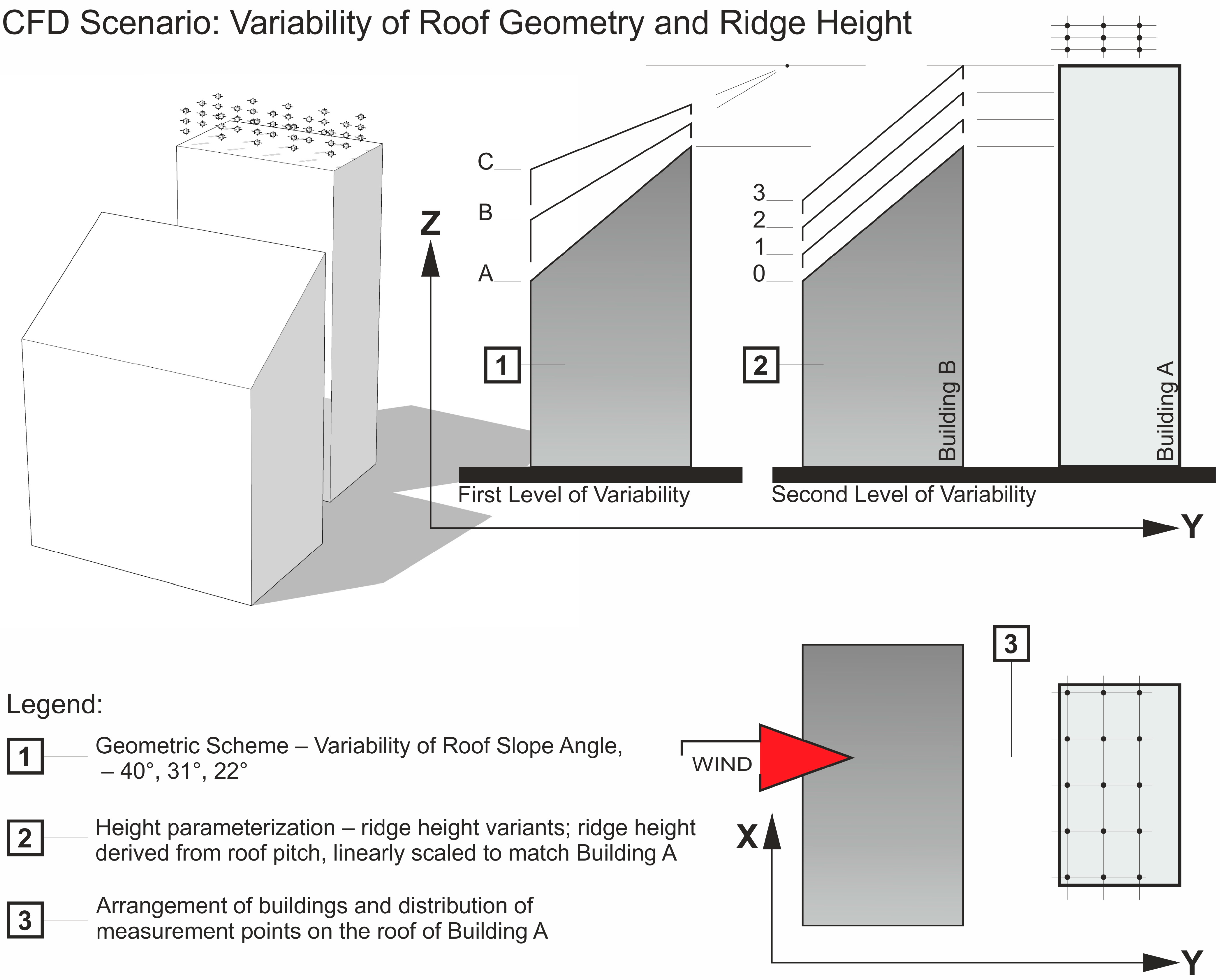
13]. Building B has a parallelogram-shaped footprint with dimensions of 35 m × 20 m, while its height and roof pitch angle constitute variable parameters in the analysis, as shown in
Figure 1 [
14,
15].
To structure the research framework, a two-level geometric notation system was applied, based on the concepts of a ‘geometric scheme’ and its ‘height parameterization’. The geometric scheme corresponds to the roof pitch angle and constitutes the first level of variability, denoted by the letters A, B, and C. The second level includes four ridge-height variants assigned to each scheme, denoted by the numbers 1, 2, 3, and 4. Each geometric case of building B is therefore uniquely identified by a combination of a letter and a number. For example, the notation B_2 refers to the second height variant within geometric scheme B. This structure enables systematic and coherent comparison of the influence of geometry on flow parameters in the CFD analysis.
Within the geometric scheme, three roof pitch angles of building B were considered: 22°, 31°, and 40°. In each case, the following construction principle was adopted: the extension of the roof slope line of building B in a vertical section intersects the windward edge of the roof of building A. With a fixed distance between the buildings, this relationship unambiguously determines the height of building B. The height defined in this way constitutes the base value, resulting directly from the adopted geometric relationship between the roof slope and the position of building A, and serves as the reference for the height parameterization carried out in the second stage of the study. For each of the considered angles, four height variants were analyzed, starting from this base value, progressing through intermediate configurations, and culminating in the case where the heights of buildings A and B are equal. The adopted arrangement ensures geometric consistency of all variants and enables the analysis of the influence of height on the intensification of airflow over building A [
15].
For both analyzed objects, coaxial alignment with respect to the flow direction and symmetry of the system were maintained, while the 12 m distance between the buildings corresponds to typical values observed in developments with varying density [
35].
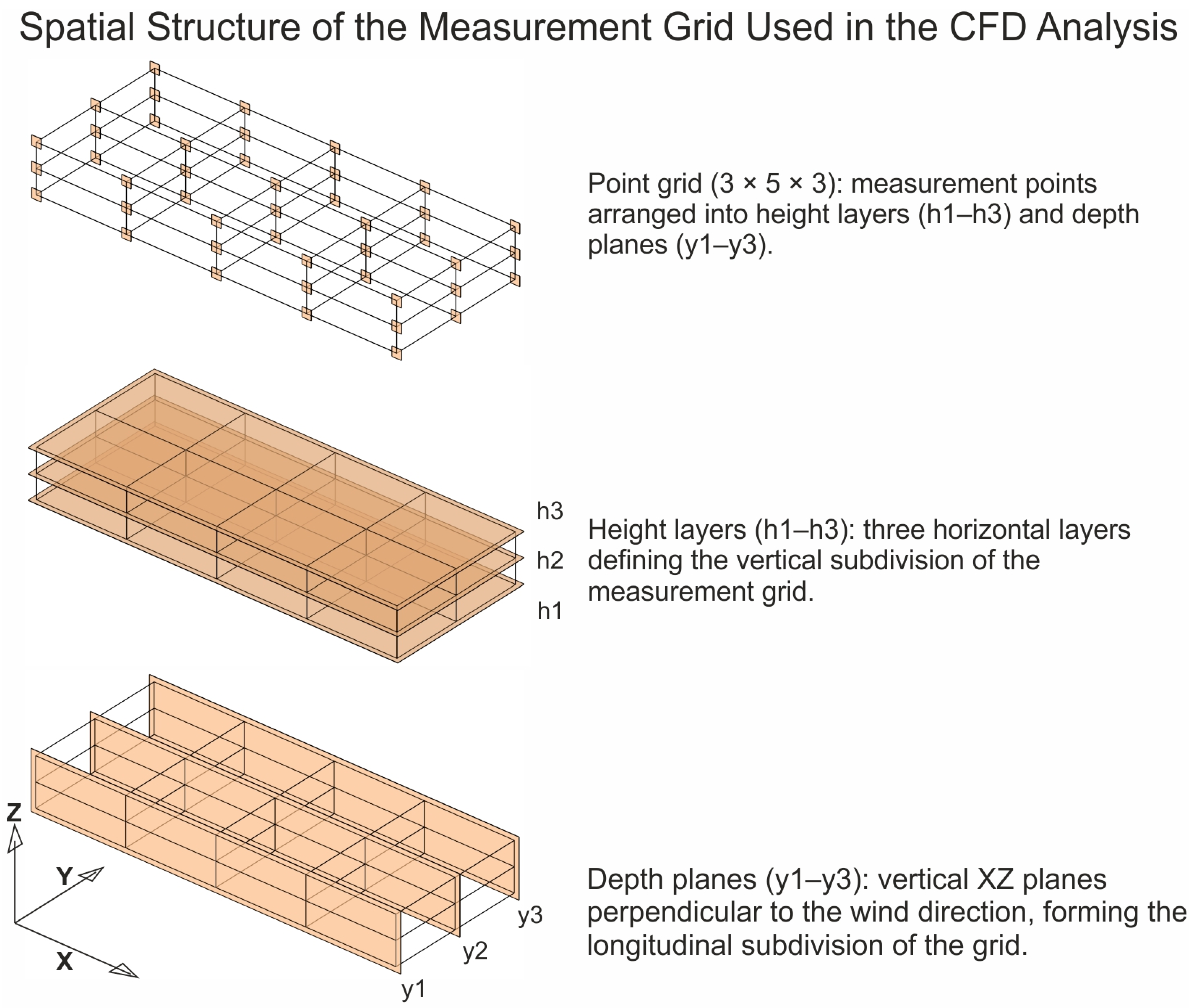
The measurement-point grid was designed as a layout exhibiting axial symmetry with respect to the flow direction and the geometry of the objects. Velocity measurements were carried out in three coordinate measurement planes located above the roof of building A, arranged in a manner enabling the analysis of the three-dimensional velocity distribution, as shown in
Figure 2. The points were arranged in a regular grid with the following dimensions: in the x-direction—5 rows spaced 5.75 m apart (23 m total), in the y-direction—3 rows spaced 4.5 m apart (9 m total), and in the z-direction—3 rows spaced 1.5 m apart (3 m total), yielding a total of 45 measurement points. The grid was positioned 2 m above the roof plane and 1 m from its windward and lateral edges, corresponding to the typical installation zone for building-integrated wind systems [
12]. This measurement configuration enables the analysis of velocity gradients in space and the identification of local flow maxima within the area relevant from a design perspective.
2.4. Statistical Measures and Notation
In this study, a unified notation was applied for the flow quantities and the basic statistical measures used to describe the velocity field within the measurement grid above the roof of building A. All values are expressed in SI units. The velocity components are denoted Vx, Vy, and Vz, corresponding, respectively, to the cross-wind direction, the nominal inflow direction, and the vertical direction. The vector magnitude of the total velocity is denoted by V, and the static pressure by p [
34,
36]. The measurement grid consists of 45 points arranged in three height layers h1–h3 and three depths y1–y3, shown schematically in
Figure 2. A single point is denoted by the index i, while N represents the number of points used in the calculation of a given statistic.
For the quantitative characterization of the flow, the following measures were used:
- -
Mean value of the useful component
- -
Standard deviation (unbiased estimator)
- -
Coefficient of variation
The quartiles Q
1, Q
2, and Q
3 were determined based on the ascendingly ordered set of values for the given quantity, in accordance with the classical definition of positional statistics [
34]. The above notation is applied throughout all parts of the analysis, and the statistical measures used are selected appropriately for the adopted scenario and the scope of the analyzed set of points [
33].
2.5. CFD Analysis
All numerical simulations were performed using ANSYS Fluent 2023R2 (Ansys Inc., Canonsburg, PA, USA). The airflow was modeled as a steady-state, incompressible turbulent flow using the Reynolds-Averaged Navier–Stokes (RANS) approach. A steady-state RANS framework is widely adopted in urban wind studies because it enables efficient prediction of mean flow fields around buildings while maintaining significantly lower computational cost compared to LES or URANS, making it suitable for parametric and multi-scenario analyses commonly applied in engineering practice [
13,
37]. Numerous studies have demonstrated that RANS models can reliably reproduce mean velocities and global flow structures in complex urban geometries when compared with both wind-tunnel and field measurements [
37]. The steady-state assumption is commonly justified in cases focused on time-averaged or quasi-steady boundary conditions, where transient effects are of secondary importance to the spatial distribution of mean flow variables. This is consistent with the objectives of the present study, which evaluates statistical measures of the velocity field such as mean Vy and flow variability. The SST k-ω model is particularly suitable due to its improved capability to predict flow separation and reattachment under adverse pressure gradients typical of bluff-body urban flows and has been shown to perform reliably in building-scale applications in comparison with both conventional RANS models and higher-fidelity approaches such as LES [
38,
39]. Overall, the application of a steady-state RANS approach with the SST k-ω model represents a computationally efficient and physically consistent methodology for comparative analysis of mean wind flow over buildings in an urban environment. The SST k–ω turbulence model was employed due to its proven capability in capturing flow separation and adverse pressure gradients, which are characteristic of urban environments and roof-level flows [
40,
41,
42]. This model provides a suitable balance between computational efficiency and accuracy and is widely applied in building aerodynamics studies.
The computational domain comprised a system of objects arranged symmetrically with respect to the flow direction, and its dimensions were selected in accordance with recommended proportions for flow analyses under built-environment conditions [
13]. These proportions were implemented by defining the domain as a rectangular prism with dimensions of 470 m × 350 m × 250 m (length × width × height), corresponding respectively to ten times the length and width of the building ensemble and five times its height [
12]. A logarithmic inlet velocity profile was applied, with a reference velocity of 5 m/s at a height of 10 m, corresponding to typical urban terrain conditions [
24,
39].
The inlet turbulence intensity was set to 10%, representing characteristic conditions for built environments. Based on this assumption, the turbulent kinetic energy (k) and specific dissipation rate (ω) were calculated from the inlet velocity and the specified turbulence intensity (10%) based on standard turbulence modeling relations.
The ground and building surfaces were modeled as no-slip walls. The near-wall region was resolved using 10 prism layers, resulting in an area-averaged y+ value of approximately 60, with most values falling within the range of 50–80. Local extrema were observed only in limited regions near geometric discontinuities. The computational mesh was generated as an unstructured grid with local refinement in critical regions, including roof edges and flow acceleration zones [
36]. The baseline grid consisted of approximately 3.4 million cells. Mesh quality was assessed using standard metrics: the average skewness remained below 0.7, while maximum values did not exceed 0.85, indicating acceptable mesh quality for engineering CFD simulations. A grid independence study was conducted to evaluate the sensitivity of the results to mesh resolution and is presented in
Section 2.5.1.
The governing equations were solved using a pressure-based solver with the SIMPLE algorithm for pressure–velocity coupling. Second-order discretization schemes were applied for both pressure and momentum equations. Convergence was achieved when residuals for all equations dropped below 10−5, and additional monitoring of key flow variables confirmed the stability of the solution.
The simulations were performed on a standard workstation, requiring several hours per case, with higher computational cost observed for refined meshes in the grid independence study.
The present study adopts a controlled inflow condition to isolate the effect of geometric parameters on airflow behavior and to ensure direct comparability between the analyzed configurations. A single wind direction and a reference inlet velocity were intentionally applied, as the objective is not to reproduce site-specific wind conditions but to identify relative aerodynamic effects resulting from variations in building geometry. The inclusion of multiple wind directions and velocities would significantly expand the parameter space and obscure the primary objective of the analysis, while not significantly altering the key relationships between geometry and flow behavior relevant to the comparative assessment. Therefore, such effects are beyond the scope of the present study and are identified as a subject for future work. It should be noted that the present study focuses on comparative evaluation of flow characteristics, and does not aim to provide case-specific validation or prediction of real-world performance.
2.5.1. Grid Independence Study
To ensure the numerical reliability of the CFD simulations, a grid independence test was conducted for representative geometric configurations. Three mesh resolutions were considered: coarse, medium, and fine.
The medium mesh corresponds to the baseline grid used throughout the study (approximately 3.4 million cells), while the coarse and fine meshes contain approximately 2.0 million and 6.5 million cells, respectively. All meshes include 10 near-wall layers with comparable growth rates to ensure consistent treatment of the boundary layer.
The evaluation of mesh independence was based on two parameters relevant to the aerodynamic assessment: the mean velocity in the main flow direction (Vy) and the coefficient of variation (CV), calculated over the measurement grid. The results of the grid independence study are summarized in
Table 1.
The results show a clear convergence trend. The transition from the coarse to the medium mesh leads to noticeable differences (approximately 2–3%), indicating the influence of grid resolution on capturing flow gradients. In contrast, the variation between the medium and fine meshes remains below 1% for the mean velocity (Vy) and shows similarly limited changes in the coefficient of variation (CV).
This behavior confirms that the medium mesh provides sufficient spatial resolution to accurately capture the key flow characteristics while maintaining computational efficiency. Therefore, all subsequent simulations were performed using the medium mesh.
2.5.2. Justification of the CFD Approach
The present study does not include direct experimental validation or case-specific benchmarking of the analyzed configurations; instead, the adopted CFD methodology is justified on the basis of well-established findings reported in the literature. Previous research has demonstrated that steady-state RANS simulations, including formulations based on the SST k–ω model, can reproduce mean wind velocities and global flow structures in urban environments with good agreement with wind-tunnel experiments and field measurements [
43]. In particular, rooftop wind conditions—being directly relevant to the present study—have been investigated through combined numerical and experimental approaches, demonstrating that RANS-based methods are capable of capturing key aerodynamic phenomena such as flow acceleration, separation, and recirculation around buildings [
10]. It is also recognized that higher-fidelity approaches, such as Large Eddy Simulation (LES), may provide improved representation of transient turbulence structures and unsteady flow effects. However, steady-state RANS models remain widely used in engineering applications and parametric studies due to their computational efficiency and their suitability for analyzing time-averaged flow characteristics, which constitute the primary focus of the present study [
43]. Within this context, the modeling approach applied in this work is consistent with methodologies that have been previously validated in the literature for similar categories of urban-flow problems. The interpretation of the results is therefore limited to a comparative aerodynamic assessment of geometric variations, rather than to the prediction of site-specific flow conditions or absolute performance values.
Accordingly, the present study does not claim case-specific validation of the model, but applies a modeling framework aligned with approaches that have been extensively verified in prior research. This ensures that the obtained results remain methodologically grounded within the established scope of RANS-based urban flow analysis.
2.6. Characteristics of the Analyzed Flow Parameters
The flow analysis considered five primary parameters: the total wind velocity (V), its spatial components in the longitudinal (Vy), transverse (Vx), and vertical (Vz) directions, and the pressure distribution (p) [
7,
33]. These variables were evaluated with respect to their influence on the aerodynamic characteristics and flow conditions above the roof of building A, which was considered the area for integrating a wind turbine array.
The Vy component, corresponding to the main inflow direction, constitutes a key parameter describing the availability of the kinetic energy of the wind in the analyzed area. Its mean value, variability level, and local extrema determine the assessment of the aerodynamic efficiency of the investigated location. Depending on the architectural scenario, both flow homogeneity—expressed by averaged values within the measurement-point grid—and local accelerations indicating areas of the highest flow intensity were analyzed. The Vy parameter is presented in units of m/s as absolute values resulting from the adopted logarithmic wind profile and the boundary conditions of the domain. In the design context, Vy serves as the primary indicator of a building’s suitability for wind turbine integration, and its interpretation is closely linked to pressure distributions and the remaining velocity components.
The Vx component, transverse to the nominal flow direction, is treated as an indicator of disturbances in the flow structure. In an ideal configuration, its value should be close to zero, whereas deviations from this value, increasing with distance from the axis of symmetry of the object, may indicate boundary interactions or unfavorable effects resulting from the geometry of the analyzed area.
The Vz component, related to vertical air movements, serves an auxiliary role in identifying aerodynamic phenomena accompanying the flow over the building mass. Increases in Vz may result, among other factors, from flow stagnation in front of an obstacle, leading to local disturbances in the windward zone, particularly in the vicinity of roof edges. Such phenomena are important in assessing flow stability in the context of the operation of building-integrated wind turbines [
24].
The pressure distribution (p) constitutes a complementary variable that enables the identification of acceleration zones, stagnation regions, and local aerodynamic extrema. Pressure was presented as relative values referenced to the domain outlet (0 Pa). The objective of the analysis was not to determine classical aerodynamic coefficients, but primarily to identify phenomena that are critical from the perspective of optimizing turbine placement, in particular areas of overpressure and underpressure, and the associated pressure gradients [
33]. This parameter, when combined with velocity components, supports the assessment of flow conditions and operating performance of building-integrated systems. The literature also indicates that combining velocity analysis with pressure non-uniformities can support the identification of geometric configurations conducive to flow intensification and improved efficiency of wind energy conversion systems [
15].
2.7. Architectural Determinant
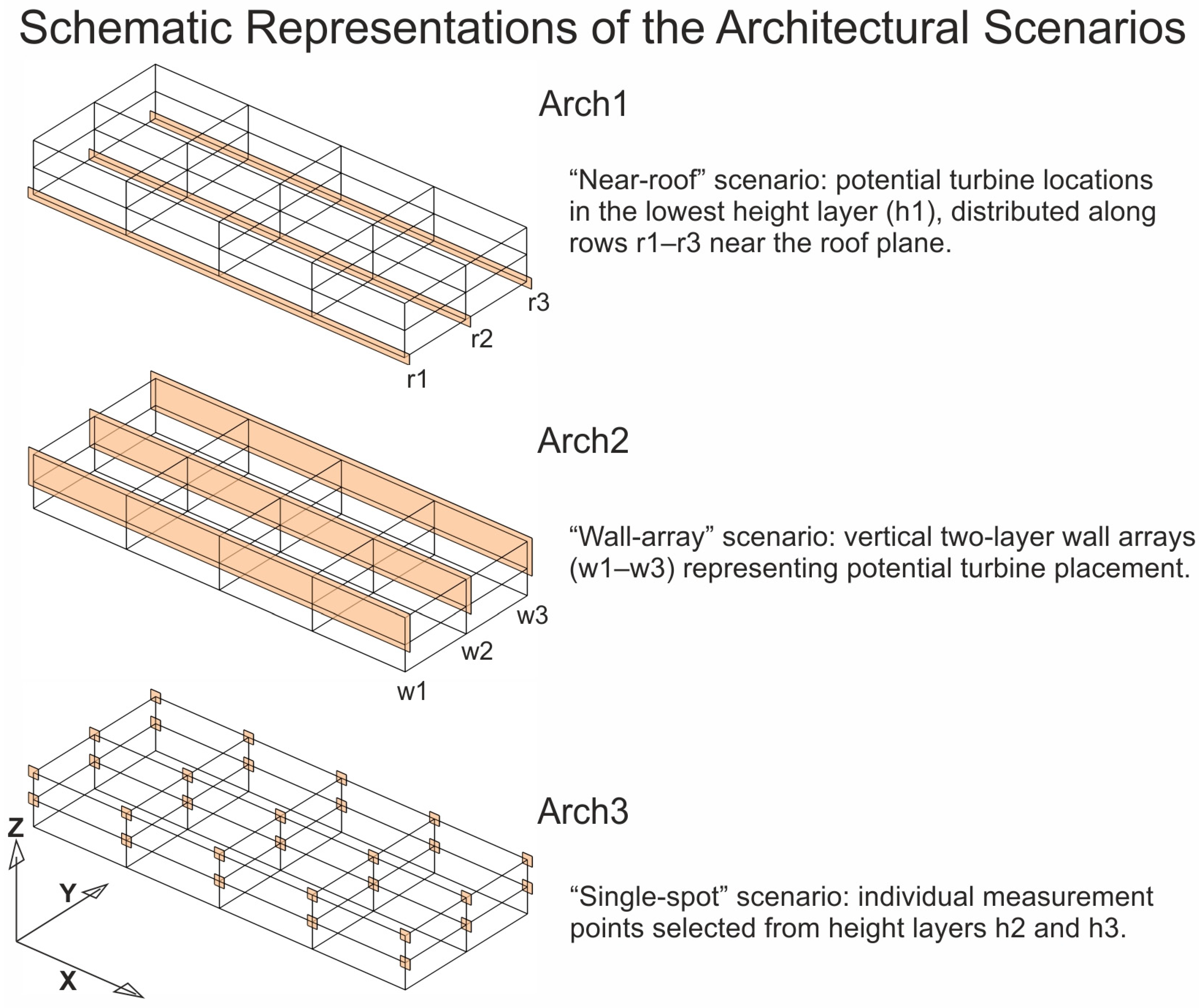
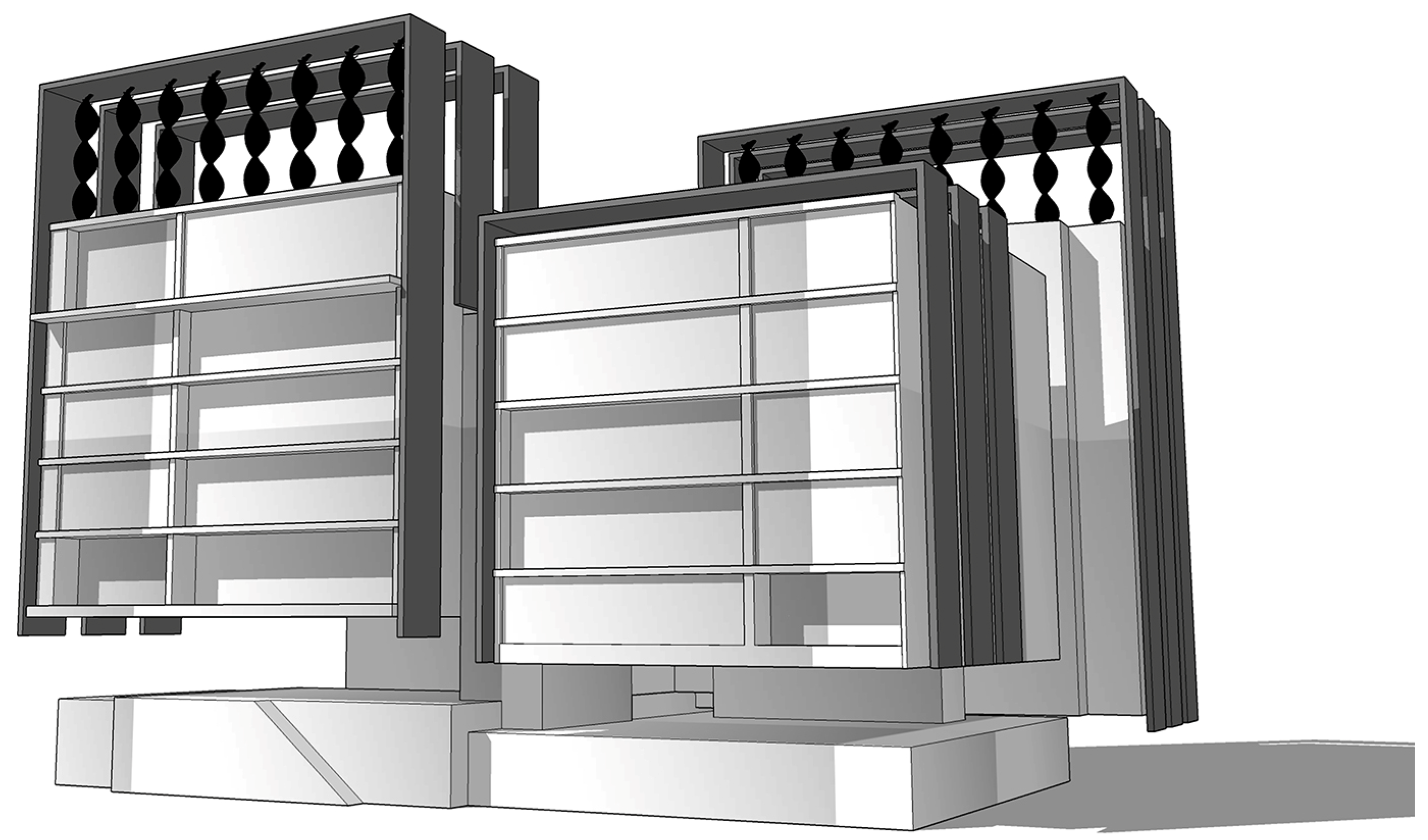
The analyzed configurations are illustrated in
Figure 3, which presents the geometric setup and the layout of the measurement points used in the study. In the analysis of scenarios for integrating wind turbine arrays with building architecture, three principal approaches were distinguished, resulting from different architectural, formal determinants and flow-related preferences [
3,
5]. Each approach implies a different method of turbine placement, structural type, and expected flow profile [
44]. The literature also emphasizes that turbine integration can be treated as an element in shaping the architectural identity of a building, encompassing compositional and aesthetic aspects [
45]. To ensure terminological clarity, a naming convention based on the domain-specific prefix
Arch and a numerical index was adopted. The
Arch prefix refers exclusively to architectural scenarios (distinguishing them from geometric variants), while the number identifies a specific configuration. As a result, three designations were applied: Arch1 (Near Roof), Arch2 (Wall Array), and Arch3 (Single Spot).
2.7.1. Arch1 (Near Roof)—Visual Separation: Turbines Located in the Near-Roof Zone h1
This approach assumes the placement of turbines in the lowest flow layer (h1), directly above the roof surface. The key aerodynamic parameters are the maximum useful velocity and flow homogeneity within this zone, which enable efficient operation of turbines installed immediately above the roof surface [
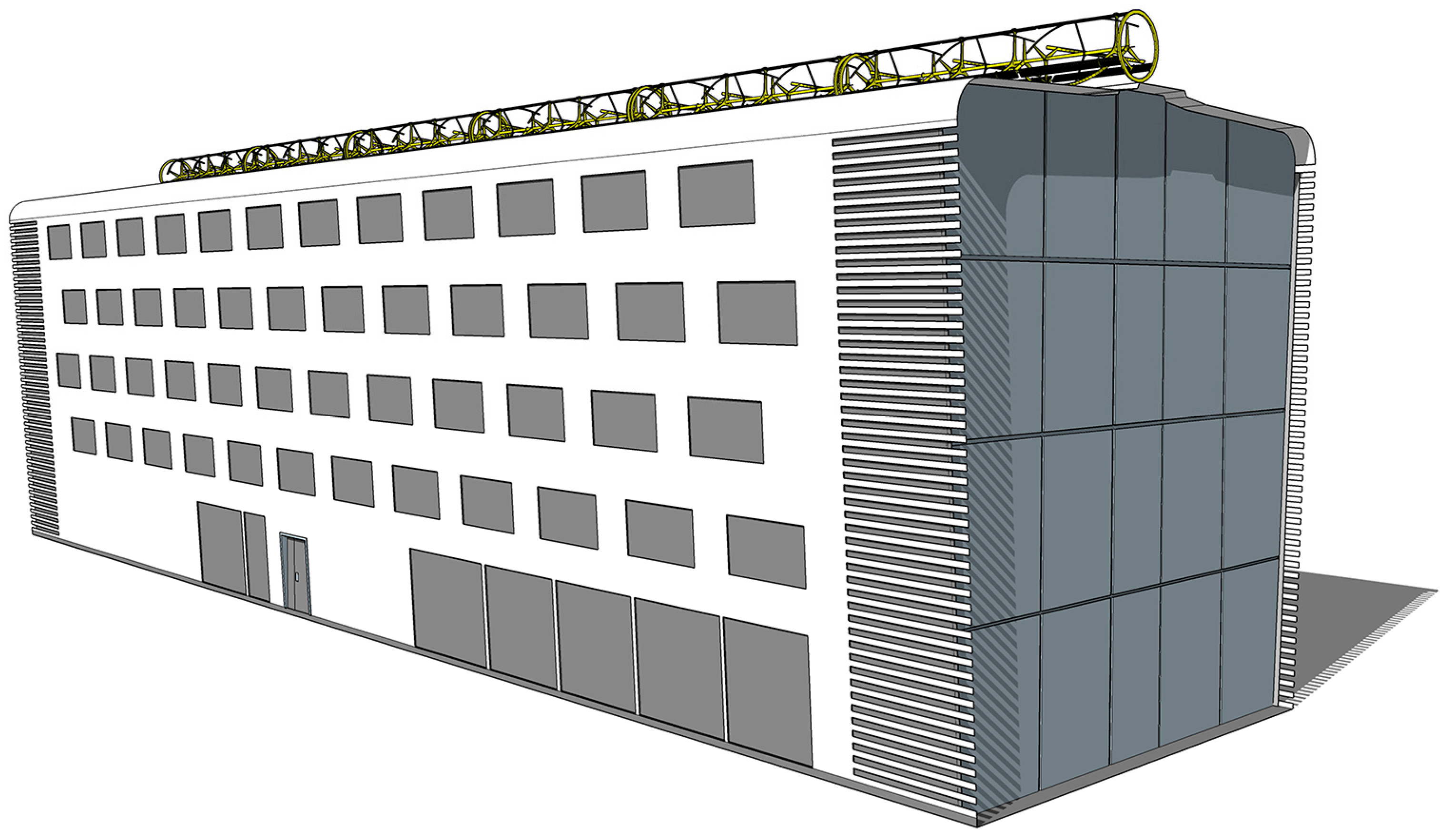
7]. From an architectural perspective, minimal structural intervention is essential—the elimination of additional supports and cantilevers—which allows the preservation of a clean façade line and building crown. The turbines remain invisible from ground level, enhancing the visual separation effect and enabling discreet integration of the installation into the surroundings. Small turbine arrays of HAWT or VAWT type are preferred. An example of a building that fits these assumptions is the Near North Apartments located in Chicago, shown in
Figure 4.
2.7.2. Arch2 (Wall Array)—Technological Façade/Vertical Flow Wall in Layers h2–h3
In this scenario, turbines may occupy two upper height layers (h2 and h3), with the condition for their effective operation being the relative uniformity of the horizontal velocity Vy between these layers. Such a distribution supports stable operation of turbine arrays, particularly VAWT systems, which perform well under conditions of varying wind direction and a vertically uniform flow structure [
46]. From an architectural perspective, this solution enables the integration of turbines as façade elements, giving the building a ‘high-tech’ character based on rhythm, repetition, and compositional order. An example of a realization corresponding to the Arch2 scenario is the OMRF Tower, located in Oklahoma, shown in
Figure 5.
2.7.3. Arch3 (Single Spot)—Formal Dominant/Point of Maximum Flow Acceleration
In this scenario, the turbine is treated as a central compositional element, constituting the formal culmination of the building. The turbine location results from the identification of the point of maximum flow acceleration—that is, the maximum value of the Vy component with minimal values of Vx and Vz [
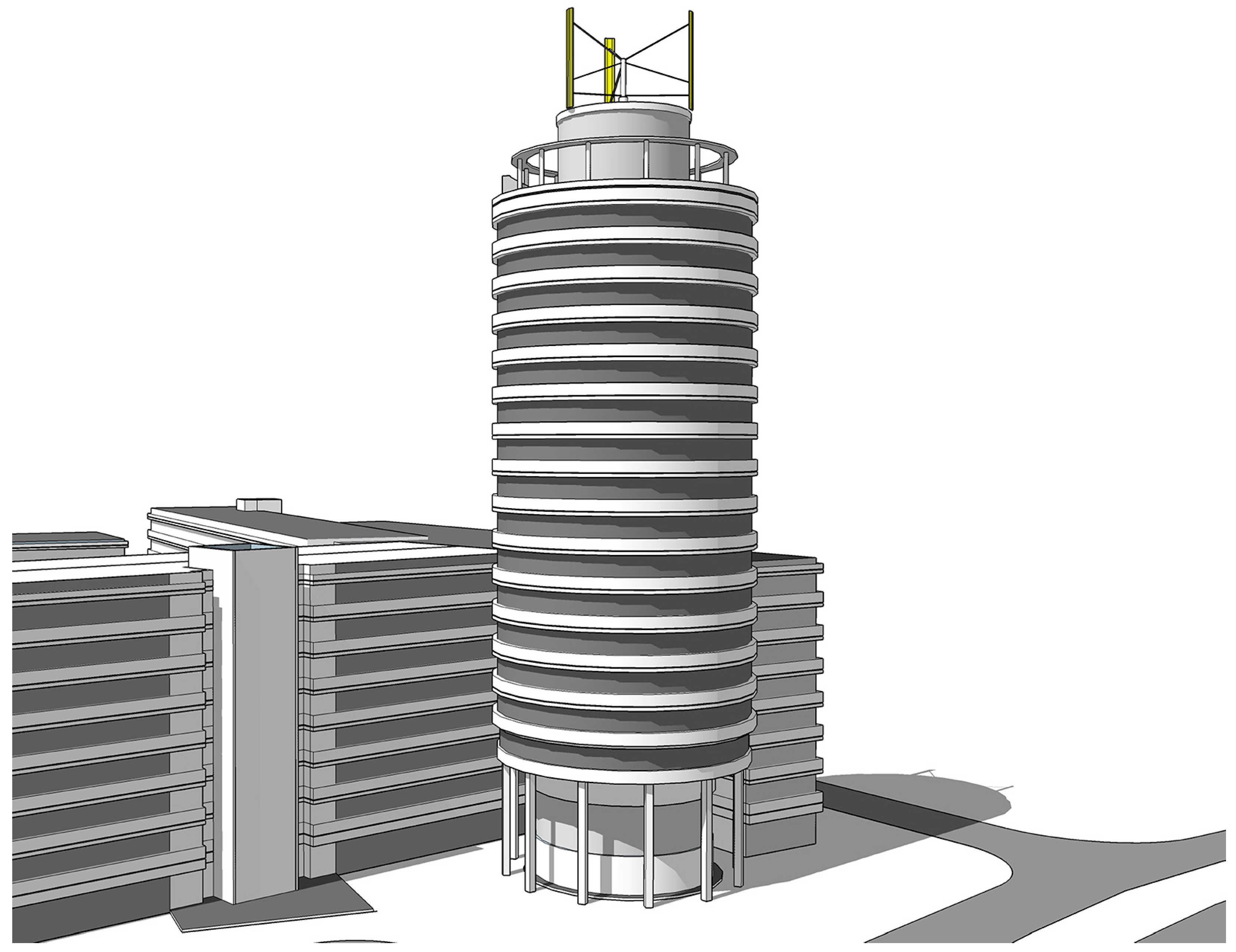
32]. Such a flow configuration corresponds most closely to the nominal wind direction and, from an architectural standpoint, allows the turbine to be exposed as a strong, symbolic formal accent. Large HAWTs are preferred, installed singly or in pairs, in a configuration symmetric with respect to the building axis, or VAWT systems continuing the axis of symmetry of the built form. This solution aligns with the stylistic framework of avant-garde BAWT (Building Augmented Wind Architecture), in which wind technology becomes an integral element of spatial and aesthetic composition. A representative example of architecture consistent with the Arch3 scenario is the Technisches Rathaus in Munich, shown in
Figure 6.
A summary of the architectural scenarios considered in the study is presented in
Table 2.
2.8. Statistical Evaluation Procedure
This section describes the statistical framework adopted for the evaluation and selection of architectural variants in the considered scenarios. Due to differences in flow objectives and spatial assumptions, separate selection procedures were defined for scenarios Arch1–Arch2 and Arch3 and are presented in the following subsections.
2.8.1. Selection Criteria for the Architectural Variants Arch1 and Arch2
Due to the similar flow characteristics and identical logic of aerodynamic evaluation in the Arch1 and Arch2 variants, a unified statistical procedure was applied, differing only in the scope of the analyzed set of measurement points. In both cases, the selection process included a pre-selection stage based on dynamic quartile thresholds and a final selection stage employing a compromise rule. The introduction of quartile thresholds resulted from the analysis of data distributions and arose from the need to define quality boundaries in a non-arbitrary manner [
47]. The Q
1 and Q
3 quartiles constitute natural thresholds within the statistical distribution and allow the identification of variants exhibiting above-average flow quality without imposing external values [
7,
34].
In the pre-selection of variants, two critical values were considered: Vy ≥ Q
3, corresponding to high flow intensity, and CV ≤ Q
1, indicating above-average flow homogeneity. Both conditions had to be satisfied simultaneously (Vy ≥ Q
3 ∧ CV ≤ Q
1), which allowed a balance to be maintained between flow intensity and flow stability. The applied selection criteria are summarized in
Table 3. In the analysis, Vy and CV refer not to individual measurements but to statistics calculated for the set of characteristic points of a given architectural scenario: layer h1 for Arch1 and layers h2–h3 for Arch2. The mean value of Vy represents the level of useful velocity, whereas CV describes the internal variability of the flow. The application of two-dimensional pre-selection enabled the rejection of configurations with low aerodynamic quality already at this stage.
The next stage involved final selection based on a compromise rule. If the relative difference in mean velocities between variants was small (ΔVy < 5%), flow stability became the dominant criterion, represented by a lower CV value. This means that when differences in flow intensity were minor, the more homogeneous variant was preferred. Conversely, when the difference exceeded 5% (ΔVy ≥ 5%), flow intensity became decisive, represented by a higher Vy value. The threshold ΔVy = 5% serves as a limiting value: below this threshold, the aerodynamic gains resulting from slightly higher velocity are minor, whereas above it, the aerodynamic effect becomes significant and outweighs a potential increase in flow variability [
48]. The criteria for the final selection based on the compromise rule are presented in
Table 4. The selection of the 5% threshold is heuristic in nature and results from analysis of the result distribution within the sample as well as an engineering assessment of the relationship between flow intensity and flow stability.
2.8.2. Selection Criteria for the Arch3 Architectural Scenario
In the case of the Arch3 scenario, it was necessary to apply a different selection procedure, resulting from the nature of this approach, in which the turbine serves as the architectural dominant and is located at a single point with the highest flow intensity. For this reason, the analysis included only measurement points from layers h2 and h3, while layer h1 was omitted as being inadequate for this scenario.
At the pre-selection stage, points were qualified for further analysis based on three conditions: a nominal velocity Vy not lower than the third quartile (Vy ≥ Q
3) and transverse component values not exceeding the median (Vx ≤ Q
2 ∧ Vz ≤ Q
2). The applied combination of thresholds ensured that only points characterized by high flow intensity and simultaneously minimal directional deviations were included in further analysis. Greater restrictiveness of the selection would have led to the elimination of the entire sample, whereas excessively low thresholds would have resulted in a set of points with insufficient aerodynamic quality; the chosen thresholds provided a balance between selectivity and representativeness. In the final selection, among the points satisfying the conditions Vy ≥ Q
3 ∧ Vx ≤ Q
2 ∧ Vz ≤ Q
2, the point for which the Vy value reached its maximum was selected. The full set of selections and selection criteria for the Arch3 scenario is presented in
Table 5. This stage is one-dimensional in nature: after prior limitation of directional deviations, the priority becomes the maximization of velocity in the nominal inflow direction [
24]. Such an approach corresponds to the assumptions of the Arch3 scenario, in which the turbine serves as a compositional and formal accent and should be located at the point of highest flow acceleration [
15].
2.9. Methodology for the Evaluation of Geometric Variants
The methodology for evaluating geometric variants was based on both quantitative and qualitative analyses, which enabled a consistent interpretation of flow parameters and, consequently, the identification of design determinants. This approach demonstrated consistency with current research directions focused on optimizing architectural form through the use of flow conditions.
In the first phase, a screening analysis was conducted with the purpose of identifying configurations that failed to meet the minimum criteria for improving aerodynamic efficiency relative to the reference scenario (a standalone building A) [
10]. This part relied exclusively on statistical flow measures, without the use of CFD visualizations. Variants in which the introduction of building B resulted in a decrease in mean velocity or an increase in flow variability were considered non-promising and were excluded. The screening analysis, therefore, functioned as an initial filter, eliminating solutions that were unjustified from the perspective of improving aerodynamic effects, in line with approaches commonly used in the evaluation of flow-quality indicators.
Subsequently, a multi-criteria evaluation was conducted, combining statistical analysis with the interpretation of phenomena observed in CFD visualizations [
33]. In the quantitative part, an approach based on the Vy velocity value and its variability was applied, using quartile thresholds and the compromise rule, which enabled the identification of variants exhibiting a favorable balance between flow intensity and homogeneity. In parallel, a qualitative assessment of flow structures was performed, focusing on flow separation phenomena associated with adverse pressure gradients, recirculation zones leading to local flow losses, stagnation regions determining pressure distribution, and the formation of vortex structures, which are significant from the perspective of flow stability [
11,
27]. The inclusion of these observations in the analysis process broadened the interpretation of the results and supported design-related arguments in the context of integrating wind turbines with architectural form.
In the final phase of the procedure, a comparison with the reference scenario was performed by juxtaposing the best variants with the baseline configuration (building A without building B). This allowed both quantitative and qualitative determination of the benefits resulting from geometric modifications and identification of the design potential of deliberate architectural form shaping [
12]. The overall methodology aligns with trends in energy-efficiency-oriented design and with the concept of architecture supported by simulation-based analyses, in which CFD tools play a generative role in the creative process.
The above methodology constitutes the basis for the subsequent part of the study. The following section presents the results obtained for all geometric scenarios, in accordance with the described scope of analysis.
3. Results
3.1. Screening Selection
The selection of geometric variants, whose methodological assumptions were presented in the
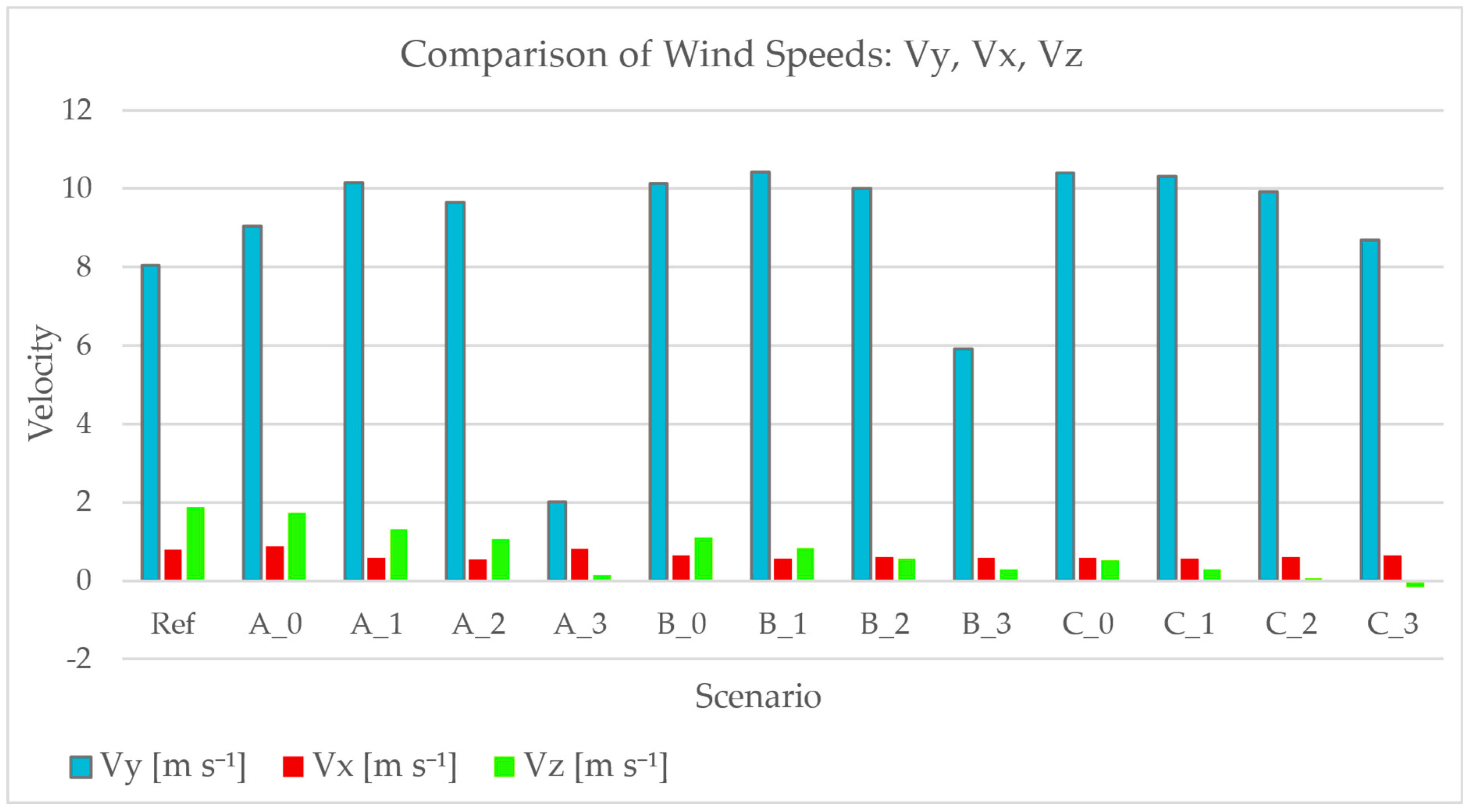
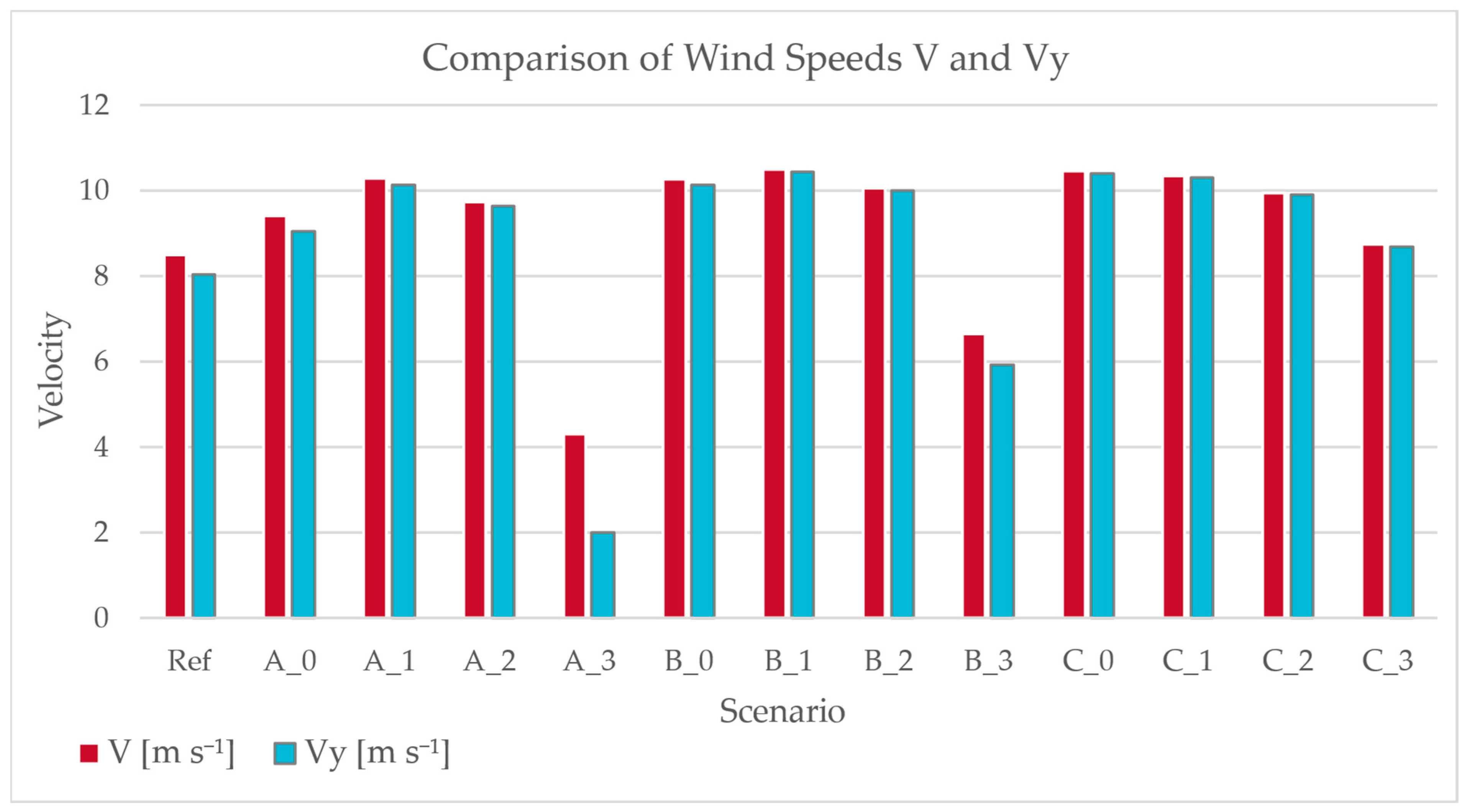
Section 2, was carried out on the basis of three complementary sets of statistical data representing flow intensity, directionality, and homogeneity. This subsection presents a synthetic interpretation of the numerical results, including relationships among the three diagnostic tools, namely: the relationship between velocity components, the relationship between total and horizontal velocity, and the analysis of statistical variability of the Vy component.
The applied datasets enabled the simultaneous assessment of three aspects of the flow: the degree of stream organization along the nominal wind direction, the intensity of the useful horizontal component, and the variability of the velocity field within the study area. Although each chart represents a different statistical dimension of the flow, a comprehensive interpretation of the results emerges from their mutual relationships. The relationship between
Figure 7 and
Figure 8 is complementary in nature: an increase in the contribution of lateral and vertical components translates into a systematic reduction in the share of the horizontal component in the total velocity, indicating internal consistency between the directional and intensity analyses. The simultaneous observation of these three metric categories makes it possible to capture both the distortion of the velocity vector and its flow-related and statistical consequences, which constitute the basis for further pre-selection of variants. In the subsequent part of the analysis, these relationships become clearly visible in the distribution of individual metric values across scenarios.
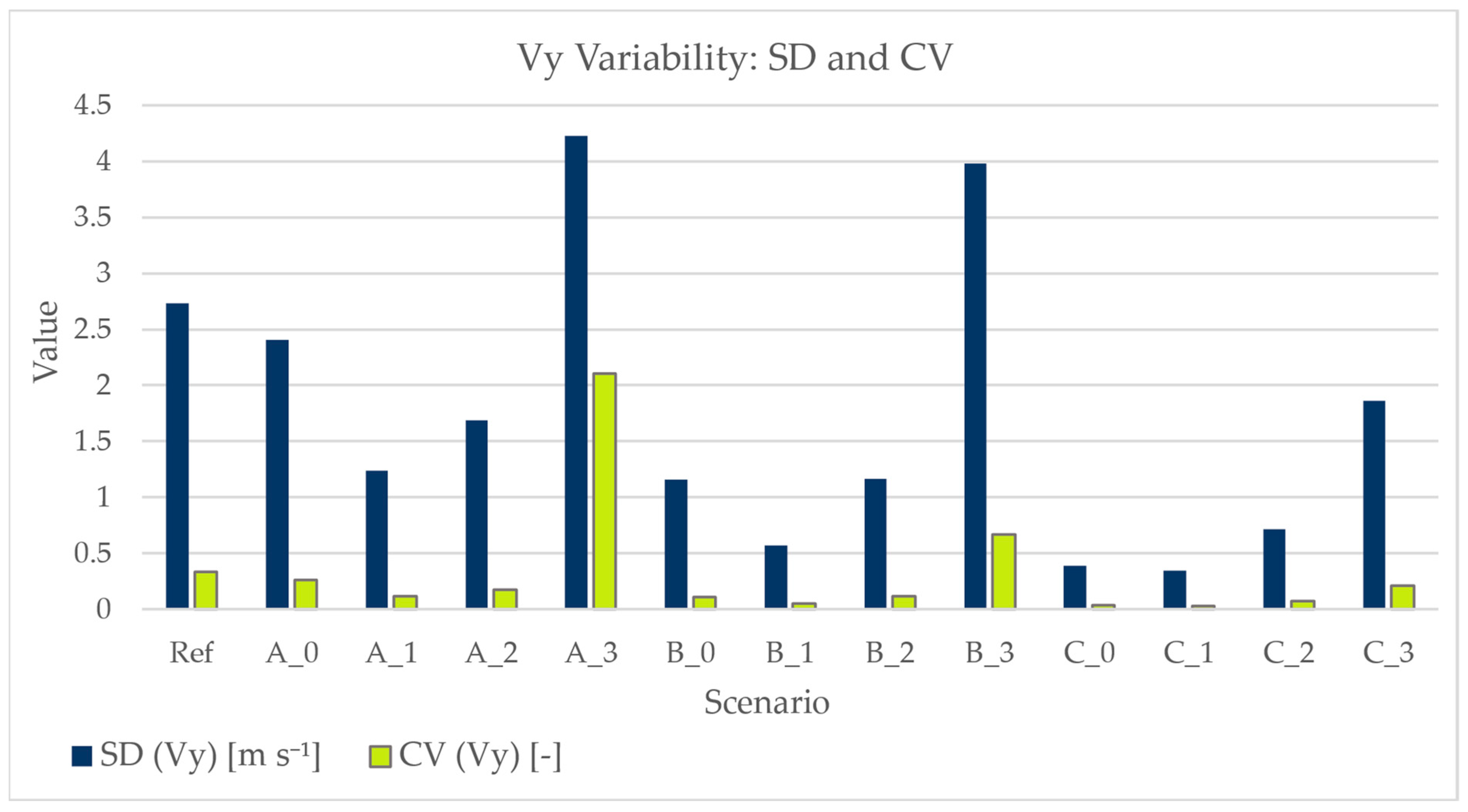
The results indicate that scenarios with elevated values of disturbance components (Vx, Vz) are simultaneously characterized by a greater difference between the total velocity and the useful horizontal component (V–Vy). This relationship is a consequence of velocity-vector distortion: an increase in lateral and vertical components reduces the share of the horizontal component in the flow structure, which directly translates into a reduction in Vy. At the same time, these same variants exhibit an increase in statistical variability measures (SD and CV), as shown in
Figure 9. This indicates that directional disturbances are coupled with non-uniformity in the velocity field across the entire measurement area—the flow is not only deflected from the nominal direction but also less stable in energetic terms. Geometric variants exhibiting lower directional coherence of the flow, therefore, display a characteristic set of features: relatively larger deviations of the Vx and Vz components, lower Vy relative to V, and an increased coefficient of variation. This triad of relationships is key in the pre-selection process, as it makes it possible to identify not only scenarios that achieve lower mean values, but also those characterized by an unfavorable dispersion structure—that is, insufficient spatial representativeness of the flow.
Based on the combined assessment of all three categories of metrics, a group of variants with the lowest statistical quality was identified, simultaneously characterized by an increased share of disturbance components, a clearly reduced share of Vy relative to V, and the highest variability within the analyzed points. The convergence of these three criteria unambiguously indicated scenarios that, in subsequent stages of the analysis, could not serve as aerodynamically promising solutions. As a result of the pre-selection process, two variants were excluded from further consideration: A_3 and B_3. Both are characterized not only by a markedly reduced level of Vy, but above all by the highest values of the coefficient of variation and the strongest increase in the Vx and Vz components, which confirms their deviation from the general trend observed in the remaining configurations. Particularly noteworthy is the fact that the high variability occurred consistently across all three diagnostic charts, indicating that the deterioration of parameters is systematic in nature rather than point-specific. Variant C_3, although yielding unfavorable values in some of the metrics, does not meet the elimination criterion because its horizontal component remains higher than in the reference scenario. Accordingly, in line with the pre-selection principle, which restricts elimination exclusively to configurations weaker than the baseline variant, C_3 remains within the set admitted to subsequent stages of evaluation.
The results of the above selection provide the basis for narrowing the analyzed set of variants to configurations that meet minimum statistical requirements in terms of flow intensity and homogeneity.
3.2. Cross-Sectional Characterization of Results and Analysis of Flow Structures
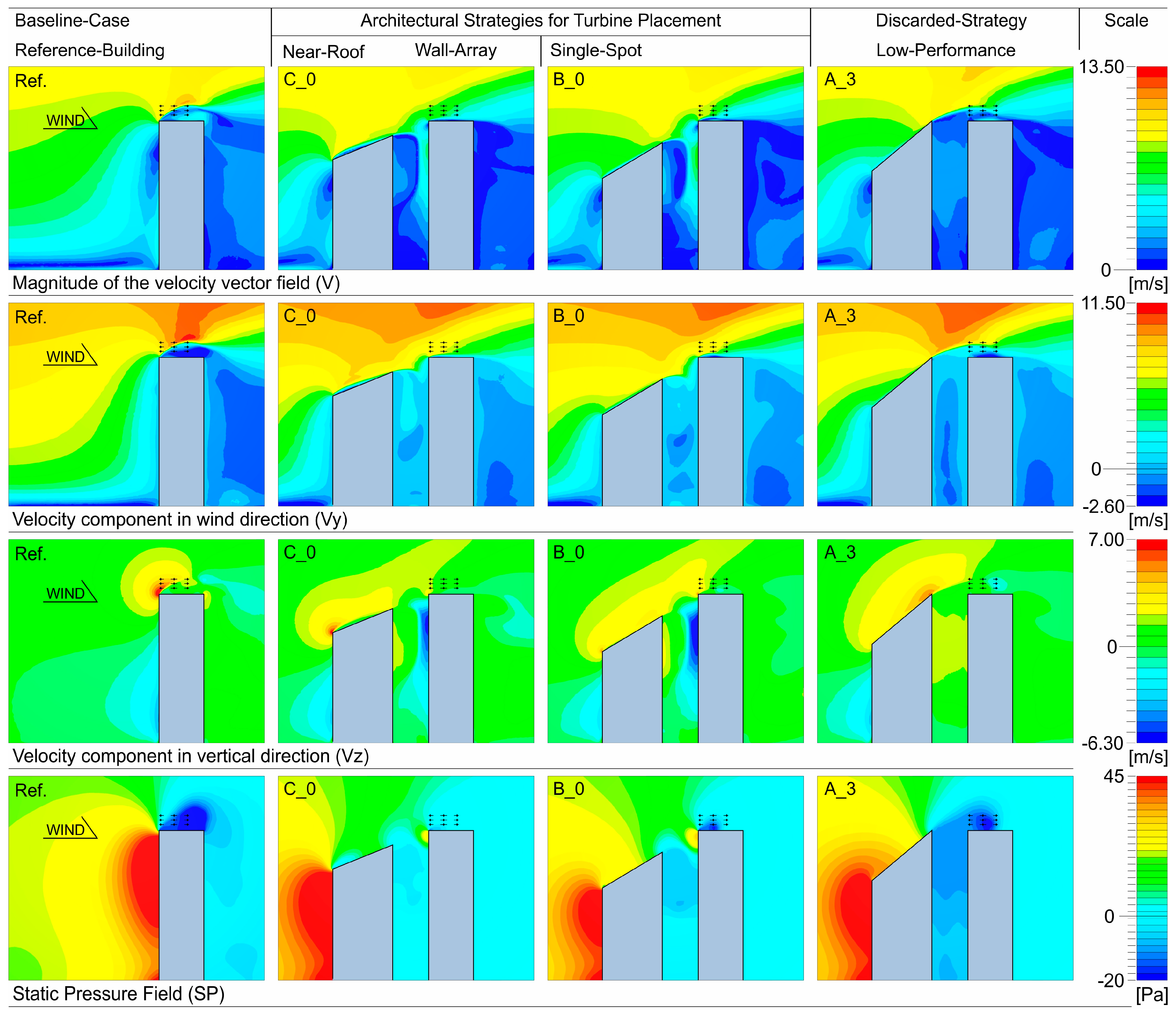
This section presents a synthetic overview of the flow results for four configurations selected to represent the full spectrum of aerodynamic behavior observed in the analyzed sample: the reference variant (Ref.), two configurations assessed as the most favorable within the architectural scenarios (Arch1: C_0; Arch2: C_0; Arch3: B_0), and variant A_3, which was rejected at the stage of statistical pre-selection. This comparison enables a comprehensive assessment of the diversity of flow structures and serves as a reference point for the detailed analyses presented in the subsequent subsections.
Figure 10 presents visualizations of the velocity and pressure fields in the area above the roof of building A, highlighting characteristic differences between scenarios with distinct aerodynamic properties. The use of a consistent color palette and discrete value levels enables direct comparison of flow structures, while individual scale ranges for each quantity preserve full readability. These images constitute a qualitative complement to the statistical results, reflecting both flow intensity and its spatial organization.
Based on the comparison, two groups of configurations with distinct flow characteristics can be identified. The first group comprises the reference variant and scenario A_3, which, despite differing geometry, exhibit similar patterns of disturbances in the zone above the roof. They are characterized by a pronounced deflection of the flow and the presence of unstable structures accompanied by a reduced share of the horizontal component. The observed vortical structures and local changes in flow direction indicate a persistent reduction in useful flow intensity within the operational layer. Although the causes of these phenomena differ—being associated with façade-induced stagnation in the reference variant and with the interaction of the second building in the case of A_3—their spatial effect is similar and manifests itself through a disturbed velocity structure and reduced pressure above the roof surface.
The second group consists of variants assessed as the most favorable in the statistical analyses. Both C_0 in the Arch1 and Arch2 scenarios, as well as B_0 in the Arch3 scenario, exhibit coherent flow characteristics that distinguish them from unfavorable configurations. These variants are characterized by the preservation of flow continuity above the roof and lower pressure gradients, reflecting a more stable organization of the flow. In their case, an ordered pattern of momentum exchange between the buildings is also evident, as evidenced by a consistent structure in the vertical component: negative values in the vicinity of building A’s façade and positive values near the façade of building B. This pattern appears exclusively in configurations classified as favorable variants and constitutes one of the spatial features supporting flow stability above the roof.
The observations presented in
Figure 10 therefore provide a basis for a general classification of flow behavior within the analyzed sample and confirm the consistency between qualitative CFD visualizations and the conclusions derived from statistical analysis. In the subsequent subsections, results for the Arch1–Arch3 scenarios are presented according to a unified scheme, comprising first a statistical analysis followed by an evaluation of CFD visualizations.
3.3. Arch1—Statistical Analysis and Evaluation of Flow Structures
The detailed rules for variant selection were described in the
Section 2.
In the Arch1 scenario, quartile thresholds determined on the basis of the distributions of Vy and CV values in layer h1 were applied:
Q1 (CV) = 0.015531,
Q3 (Vy) = 10.31208 m/s.
Variants meeting the conditions Vy ≥ Q
3 and CV ≤ Q
1 were subjected to further evaluation using the compromise rule (difference in Vy < 5% → preference for lower CV; difference ≥ 5% → preference for higher Vy). The ranking of variants after statistical selection is presented in
Table 6.
Due to symmetry, the mean Vx values remain close to zero and therefore cannot describe the magnitude of transverse flow disturbances; for this reason, |Vx| is used as a complementary indicator of lateral velocity intensity.
The statistical analysis unequivocally indicates that variant C_0 achieves the best balance between flow intensity and homogeneity in layer h1. Although the Vy values in variant B_0 are the highest in the ranking, its coefficient of variation CV is more than four times higher than that of C_0, which, in accordance with the compromise rule, results in a lower final assessment when the velocity difference is below 5%. Variant B_1 maintains high Vy values across the three measurement depths (y1–y3), demonstrating spatial stability of flow intensity; however, its increased CV distinguishes it from configuration C_0 and limits its evaluation in the selection process.
The comparison of results confirms that C_0 simultaneously meets the criterion of a high Vy value and the lowest variability across the entire sample, which justifies its selection as the reference variant for further flow analysis within the Arch1 scenario.
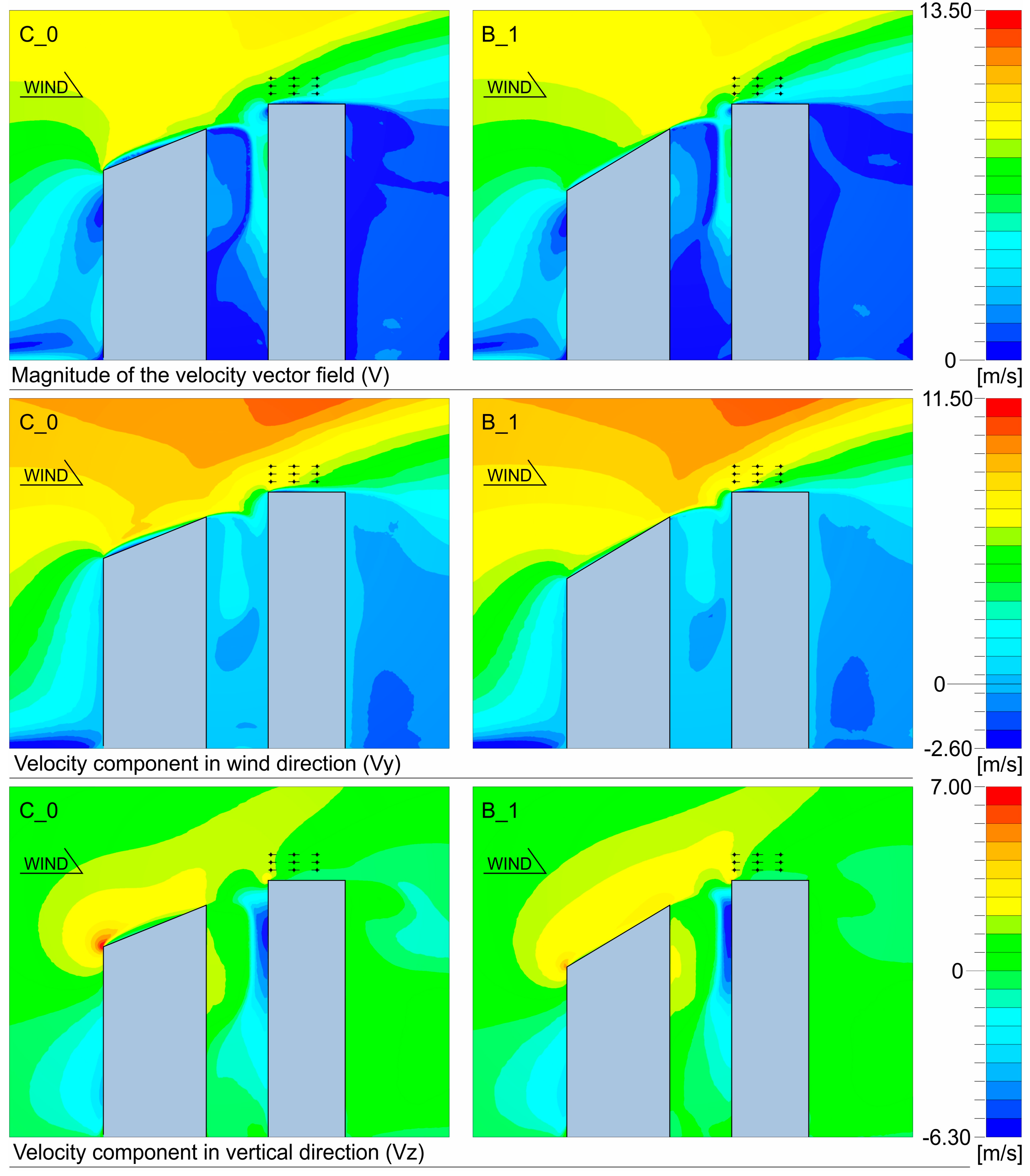
To verify the relationships revealed by the statistical analysis, the fields of V, Vy, and Vz were compared for variant C_0, selected as the configuration with the highest statistical rating, and for variant B_1, serving as an interpretative background.
The visualizations presented in
Figure 11 confirm the differences identified in the statistical analysis: configuration C_0 is characterized by a stable and well-organized flow structure in layer h1. The stream maintains continuity over the roof surface, and Vz values remain limited, indicating reduced susceptibility to vertical disturbances and consistency of the flow character with the nominal direction. The pronounced flattening of the velocity profile translates into low variability (CV) observed in the statistical analysis.
Variant B_1 maintains comparable Vy values; however, it is accompanied by greater changes in flow structure: local recirculation zones and larger vertical gradients are evident, which correlate with the increased flow non-uniformity observed in the statistical evaluation. Differences in the Vz structure confirm that the increase in flow intensity in the deeper part of the roof occurs at the expense of flow stability, resulting in higher CV values.
The CFD results thus provide qualitative confirmation of the statistical relationships: variant C_0 exhibits the most ordered flow profile, whereas variant B_1, despite relatively high Vy intensity, is characterized by greater structural variability.
3.4. Arch2—Statistical Analysis and Evaluation of Flow Structures
The rules for variant selection are presented in the
Section 2.
For the Arch2 scenario, the following quartile thresholds were applied:
Q1 (CV) = 0.037011531,
Q3 (Vy) = 10.37392883.
The quartile filter and the compromise rule were applied in the same manner as in the Arch1 scenario, ensuring consistency of the selection criteria. The results of the statistical ranking are summarized in
Table 7.
The ranking of variants after selection indicates that configurations at depth y1 dominate the final set, confirming that the highest and most stable Vy values occur in the windward zone. Variant C_0 (depth y1) achieves the highest flow homogeneity, obtaining the lowest CV across the entire sample while simultaneously maintaining a high Vy value. Variant B_1 (depth y1) maintains a comparable flow intensity (difference of approximately 0.5%), but its higher CV results in a lower ranking in the selection process, in accordance with the compromise rule. Subsequent configurations, C_1 and A_1, also at depth y1, maintain comparable Vy levels; however, their variability increases with the variant, systematically shifting them to lower positions in the ranking.
Variants at depth y2 appear in the final ranking only as supplementary cases and are characterized by higher CV values than their counterparts at depth y1. No variant at depth y3 simultaneously satisfied the conditions Vy ≥ Q3 and CV ≤ Q1, indicating a progressive degradation of flow quality with increasing measurement depth. As a result, configurations C_0 and C_1 at depth y1 achieve the highest evaluation when jointly considering Vy intensity and flow homogeneity, which together form the overall assessment of flow quality within the analyzed wall of points.
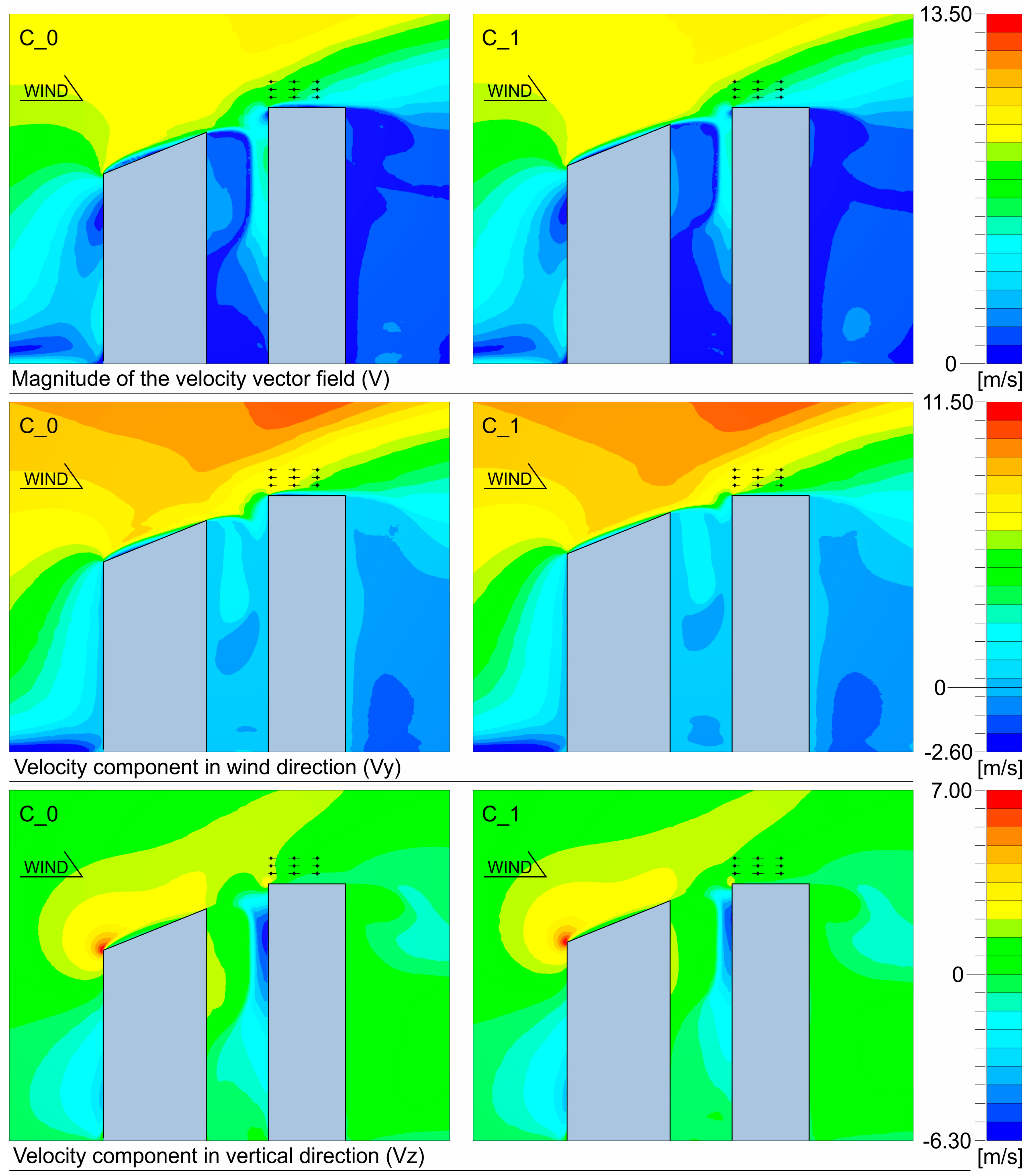
The flow arrangements shown in
Figure 12 include variants C_0 and C_1, which constitute the basis for comparative analysis in the Arch2 scenario. Variant C_0 is characterized by the most ordered flow structure within the operational region. The Vy component maintains an elevated level across the entire analyzed plane, while Vz remains strongly suppressed, particularly in the vicinity of the windward edge. The limited amplitude of vertical disturbances enables the preservation of high coherence of the velocity field, which is consistent with the lowest CV value within the dataset.
Variant C_1, serving as an interpretative background, exhibits a similar overall flow arrangement; however, increased Vz values are visible in the upper parts of the operational region, leading to greater vertical differentiation of the velocity profile. These differences result in higher flow variability compared with variant C_0, which is reflected in the relationship between CV values in the selection ranking.
Variant B_1 achieves the highest Vy intensity among the configurations qualified for selection; however, its flow structure, analyzed within the layers corresponding to the turbine location (h2–h3), exhibits more pronounced vertical disturbances and greater Vz dynamics. These phenomena increase the degree of flow non-uniformity and lead to an elevated CV, which explains its lower ranking despite a favorable Vy value.
Configurations at depth y2 are characterized by a higher amplitude of vertical disturbances and fragmentation of zones with elevated Vy, resulting in weakened flow continuity and failure to meet the CV criterion. The juxtaposition of CFD analyses with statistical results confirms the hierarchy of variants: C_0 represents the most stable flow arrangement, C_1 exhibits moderate vertical non-uniformity, whereas B_1 and the variants at depth y2 demonstrate increased susceptibility of the flow to disturbances. Configurations at depth y3 were not included in the analysis because they did not satisfy the quartile-selection criteria, which excluded them from further evaluation.
3.5. Arch3—Statistical Analysis and Evaluation of Flow Structures
The selection rules are presented in the
Section 2. In the Arch3 scenario, a single point with the highest flow intensity within the operational area was analyzed. Only points simultaneously meeting three quartile-based conditions determined for layers h2–h3 were qualified for the evaluation stage:
Vy ≥ Q3y = 10.70725,
Vx ≤ Q2x = 0.601477,
Vz ≤ Q2z = 0.6226255.
The ranking of variants is presented in
Table 8.
The ranking of points meeting the Vx and Vz filter requirements is headed by two configurations with the highest flow intensity:
B_0 (h3, y3) achieved the highest Vy value of 11.08 m/s with a very low Vx of 0.0223 m/s. The Vz value of 0.6122 m/s remains below the Q2z threshold, which keeps this point within the acceptable set.
A_1 (h3, y3) obtained the second-highest Vy value of 11.0018 m/s, with moderate Vx and Vz values remaining within the required thresholds.
The remaining configurations exceeded the Vx threshold, which excluded them from further analysis.
Statistical conclusion: B_0 was identified as the reference variant in the Single Spot scenario; A_1 serves as an alternative configuration.
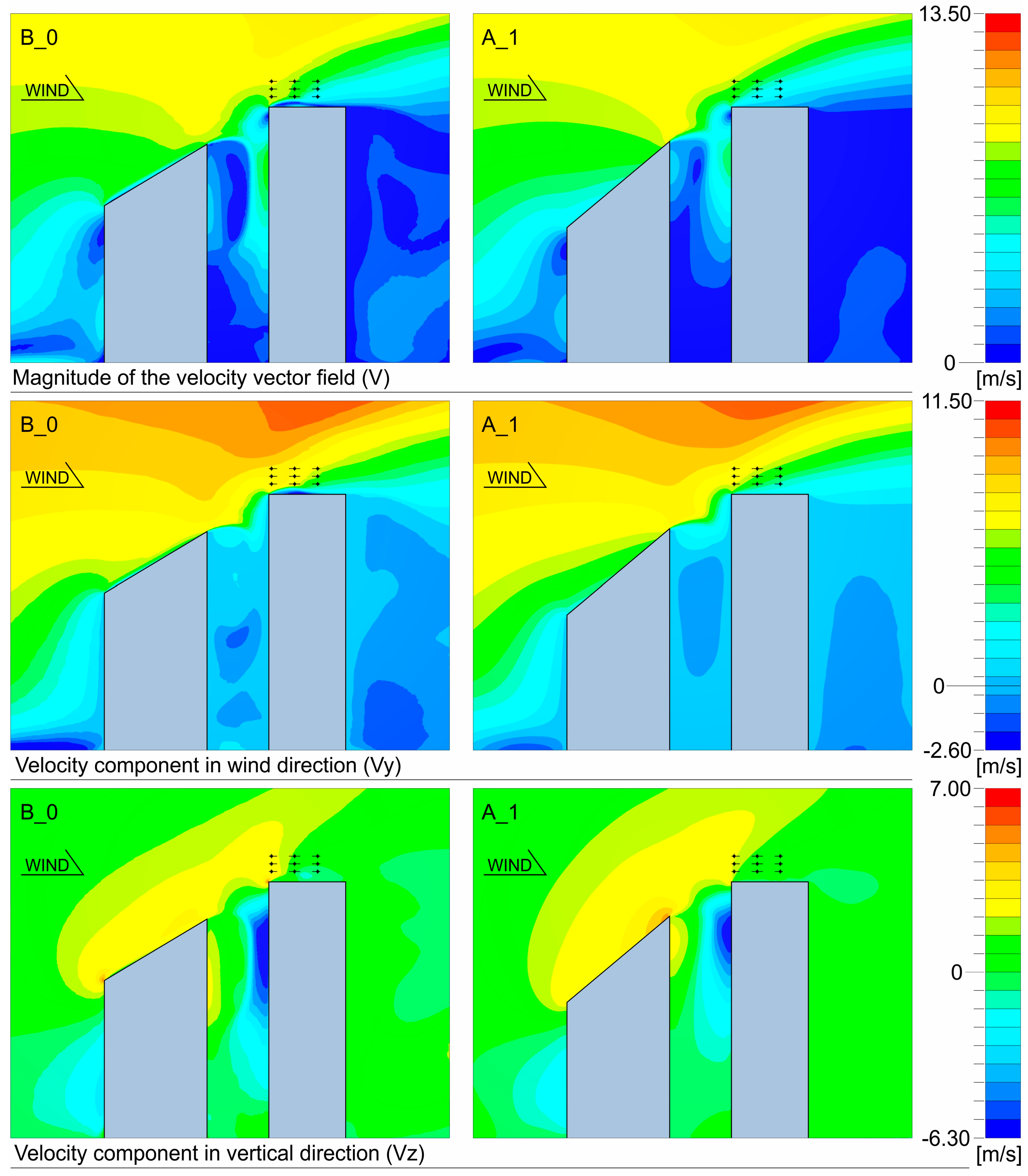
The flow configurations presented in
Figure 13 include variants B_0 and A_1, which form the basis for flow analysis in the Arch3 scenario. Variant B_0 reveals a strong concentration of the stream in the rear depth y3, with dominance of the Vy component in the vicinity of the operational point. The elevated Vy value co-occurs with locally positive Vz values, indicating enhanced momentum exchange along the vertical axis; however, the amplitude of these disturbances remains below the filtering threshold and does not disrupt the directional stability of the flow.
Variant A_1, used as an auxiliary configuration for interpretation, is characterized by lower Vy intensity and a more dispersed velocity profile within the y3 region. The Vx and Vz values remain below the selection thresholds, while recirculation zones present in the lower parts facilitate momentum transfer toward the operational point, enhancing Vy to a degree sufficient for statistical qualification.
The juxtaposition of CFD visualizations with selection results confirms that in the Arch3 scenario the key parameter remains Vy intensity, provided that directional constraints on Vx and Vz are satisfied. Variant B_0 achieves the highest Vy values, making it the configuration with the highest flow intensity at the analyzed point. Variant A_1, despite lower Vy intensity, maintains a stable directional profile and serves as a supporting configuration for interpreting the velocity distribution in layer h3 and depth y3.
3.6. Comparative Summary of Representative Variants for the Arch1–Arch3 Scenarios with Respect to the Reference Variant (Ref.)
The comparison was performed for the variants identified through statistical selection in the Arch1–Arch3 scenarios, juxtaposed with the Ref. configuration within their corresponding operational areas. The evaluation was carried out exclusively on the basis of aerodynamic measures relevant to each scenario: Vy and CV for linear and surface-based layouts (Arch1, Arch2), and Vy, Vx, and Vz for point-based analysis (Arch3).
3.6.1. Arch1 (C_0) vs. Ref.
In the Arch1 scenario, a significant improvement in flow parameters was observed relative to the Ref. variant. The Ref. configuration was characterized by a reduced Vy level and increased flow variability, indicating an unstable velocity distribution along the h1 measurement row. Variant C_0 achieved a clearly higher Vy while simultaneously exhibiting a markedly lower CV, which confirms stabilization of the velocity profile and a reduction in point-wise fluctuations. The difference in flow character between the two variants is unambiguous: whereas the Ref configuration exhibits vertical and lateral disturbances leading to flow dispersion, variant C_0 maintains a continuous and ordered flow structure. The juxtaposition of these features indicates that configuration C_0 provides more favorable aerodynamic conditions within the measurement area of the Near Roof scenario, both in terms of flow intensity and homogeneity.
3.6.2. Arch2 (C_0) vs. Ref.
In the Arch2 scenario, the flow structure was compared within the vertical wall of measurement points h2–h3. The Ref. variant did not satisfy the selection criteria in two of the three analyzed planes, reflecting high velocity variability and increased amplitude of vertical disturbances. Variant C_0, identified through the selection process, exhibits an increased Vy value and a lower CV relative to Ref., which translates into a more homogeneous velocity distribution along the analyzed wall. At the same time, a reduction in Vz fluctuations is observed, indicating a more stable organization of the flow within layers h2–h3. As a result, configuration C_0 outperforms Ref. both in terms of flow intensity and directional stability, confirming the consistency of the numerical results with the flow characteristics of the Wall Array scenario.
3.6.3. Arch3 (B_0) vs. Ref.
In the Arch3 scenario, a single flow point was evaluated, which distinguishes it from the previous scenarios based on the analysis of point arrays. The Ref. variant did not meet two of the three selection criteria: its Vy was lower than the threshold value Q3y, and Vx exceeded the allowable level Q2x, indicating both insufficient intensity and a lack of directional stability. Variant B_0, qualified as the reference variant, achieved Vy = 11.08 m/s, outperforming Ref. while maintaining Vx and Vz values within the filtering thresholds. Configuration A_1, used as an interpretative background, also met the selection criteria and exceeded Ref in terms of directional parameters. The comparison of values reveals a clear advantage of variant B_0 over Ref.: the operational point in the Single Spot scenario is characterized by both higher flow intensity and a more stable vector arrangement, which the Ref variant did not provide.
3.6.4. Comparative Overview and Interpretation of Results (Arch1–Arch3 vs. Ref.)
The aggregated analysis indicates that the optimal variants obtained across the three architectural scenarios lead to a consistent improvement in flow quality relative to the reference configuration, while the character and extent of this improvement are determined by the configuration of the analyzed operational area. In the Arch1 scenario, the strongest flow response is observed, encompassing both an increase in the intensity of the longitudinal component Vy and a significant reduction in flow variability. The reference configuration is characterized by a dispersed Vy profile and an elevated amplitude of local fluctuations, whereas variant C_0 stabilizes the near-wall layer and provides a coherent velocity distribution along the measurement point row. This effect indicates a reformation of the flow structure in the vicinity of the roof, leading to a leveling of the horizontal velocity profile.
In the Arch2 scenario, the improvement takes the form of vertical stabilization of the Vy distribution within layers h2–h3. The reference variant exhibits increased directional interactions (particularly in the form of higher Vz values) and greater non-uniformity along the Z-axis, which leads to fragmentation of the velocity field within the measurement wall. Variant C_0 reduces the amplitude of vertical disturbances and ensures a more homogeneous Vy profile across the entire operational plane. This phenomenon indicates the formation of a stable flow structure with limited inter-layer variability, which is characteristic of configurations favorable to attached flow in systems composed of two building masses.
The Arch3 scenario provides a complementary perspective on geometric effects: the improvement is point-based and directional rather than spatial. The reference variant does not simultaneously meet the intensity (Vy) and directionality (Vx) thresholds, demonstrating insufficient stream alignment at the culmination point. Variant B_0 achieves a higher Vy value while maintaining Vx and Vz below threshold values, which unequivocally confirms local enhancement of flow quality within layer h3 at depth y3. This mechanism is not analogous to linear or surface-based results: the effects do not concern homogeneity, but rather the maximization of intensity at a specifically defined location.
The integrated comparison of the three analyses indicates three distinct yet complementary mechanisms of flow improvement relative to the reference configuration:
Smoothing of the horizontal profile (Arch1): stabilization of the near-wall layer, reduction in local directional disturbances, and dominance of the Vy component within layer h1.
Vertical stabilization (Arch2): limitation of Vz amplitude, attenuation of differences between h2 and h3, and formation of a coherent profile along the Z-axis.
Pointwise culmination of intensity (Arch3): a local maximum of Vy while maintaining acceptable values of Vx and Vz.
These differences do not result from different physical phenomena, but from distinct domains of aerodynamic assessment (line → plane → point). In each case, the mechanisms of flow improvement can be reduced to geometrically induced reorganization of the stream, including local accelerations, controlled recirculations facilitating momentum supply, stabilization of the near-wall layer, and reduction in transverse and vertical disturbances.
From a hierarchical perspective, the most profound improvement was achieved in Arch1, where both intensity increases and variability decreases simultaneously; a moderate yet distinct improvement is observed in Arch2, whereas Arch3 provides an improvement of a directional and local nature. The common conclusion for all scenarios is that the introduction of a flow-modifying object can lead to systematic and repeatable enhancement of flow parameters relative to the reference variant.
3.7. Synthesis
The optimal Arch1–Arch3 configurations represent three distinct types of favorable aerodynamic interactions: linear smoothing of the velocity profile (Arch1), stabilization of the vertical velocity structure (Arch2), and local flow intensification (Arch3). The results clearly demonstrate that the geometry of building B acts as a determinant of the quality of the velocity field, leading to improvements in flow intensity and organization across all analyzed domains. This synthesis closes the
Section 3, providing a coherent overview of the mechanisms responsible for flow deviations relative to the reference configuration and establishing a framework for further interpretation of the obtained results.
4. Discussion
The obtained results clearly indicate that new development does not necessarily lead to a deterioration of flow conditions above the roof of the reference building. In all three analyzed architectural scenarios, an improvement was observed in at least one of the two key flow metrics: intensity (Vy) or homogeneity (CV). The Arch1 variant enabled an increase in Vy of 24.28% and a reduction in CV of 94.53%; the Arch2 variant achieved improvements of +10.40% in Vy and −23.16% in CV, while the Arch3 variant resulted in a local increase in Vy of 4.29%, with controlled Vx and Vz components [
49]. These results challenge hypothesis (H1), which assumed a deterioration of wind conditions in areas subjected to architectural transformations. The results indicate that a two-building configuration may serve as an actively flow-enhancing system, provided that its geometry is appropriately selected.
These results gain particular significance in the context of flows over built environments, where the flow structure is exceptionally sensitive to changes in shape and the mutual positioning of building masses. Although detailed large-scale processes were not the subject of the present study, it is worth noting that the analyzed zone operates within the transitional UBL/UCL region, in which local geometric modifications—even small differences in height, roof pitch, or distance between objects—have a documented ability to shape flow velocity and turbulent characteristics [
11,
24]. It is precisely this susceptibility of the flow to geometric interventions that explains well why even minor adjustments to the form of building B can generate distinct and measurable aerodynamic effects above the roof of building A [
50].
In this light, the observed phenomena are not incidental. They confirm that a properly shaped building mass can modify the pressure field, generate local accelerations, stabilize the flow, and produce coherent recirculations that facilitate momentum transfer into the operational zone. It is precisely this set of physical mechanisms—rather than general assumptions—that explains why geometric tuning of the built form leads to improved aerodynamic conditions [
28].
Thus, the results fit within the established understanding of building aerodynamics, in which object geometry constitutes a flow-controlling parameter rather than a merely passive element [
51,
52]. In standards addressing wind actions, such as EN 1991-1-4 [
39], building form and mutual relations are treated as factors that directly influence local wind velocities and turbulence intensity. At the same time, contemporary CFD analyses show that even simple modifications of multi-building configurations can amplify, smooth, or destabilize the flow depending on the shape and orientation of the building masses [
52].
The analysis of the results allows for a consistent evaluation of the three hypotheses formulated at the design stage. The first hypothesis (H1), which assumed that any new development deteriorates aerodynamic conditions, was shown to be inconsistent with reality. The results indicate that there are configurations that are unequivocally beneficial, particularly within the Arch1 and Arch2 scenarios, as well as locally in Arch3. Both quantitative metrics (Vy, CV) and CFD visualizations confirm that a properly shaped building mass can enhance aerodynamic performance in the analyzed zone. At the same time, the study revealed the existence of configurations that are clearly unfavorable—primarily those in which the height of building B becomes equal to the height of building A (variants A_3, B_3, C_3). These configurations lead to a reduction in the Vy component, an increase in CV, and the emergence of unfavorable vertical components, which unequivocally diminish their aerodynamic value.
The second hypothesis (H2), which assumed the existence of configurations neutral with respect to flow conditions, was confirmed at a conceptual level but was found to have limited practical relevance. Within the analyzed continuum of variants, both clearly beneficial and unequivocally unfavorable configurations occur; from this, it follows that there must exist an intermediate zone in which the presence of building B does not cause a significant change in flow parameters relative to the reference case. These configurations were not identified quantitatively, as their selection would not add design value—neutrality implies merely the absence of degradation rather than improvement. Consequently, neutral configurations may be regarded as aerodynamically acceptable, yet they exhibit limited design attractiveness, because in light of the results, it is possible to shape development in a manner that leads to actual improvement of flow conditions, rendering neutral solutions merely an intermediate state between optimal and unfavorable variants [
15].
The third hypothesis (H3), which assumed the possibility of designing for development that supports airflow, was clearly confirmed. The variants identified as optimal—C_0 in Arch1, C_0 and C_1 in Arch2, and B_0 in Arch3—consistently exhibit a set of aerodynamic mechanisms leading to improved flow conditions. These include stabilization of the near-wall layer, momentum redistribution resulting from roof-geometry shaping, and coherent recirculations between building masses that facilitate momentum transfer into the operational zone. These mechanisms are consistent with the findings in the literature, which highlight the key role of shape, proportions, and spatial context in modulating velocity and turbulence, as well as the growing need to shift from reactive strategies—focused on minimizing losses—to proactive strategies in which geometry is used as a tool for flow enhancement [
18,
28]. For the Arch2 scenario, it is additionally important to emphasize the role of interactions between aerodynamic wakes and the mutual arrangement of rotors in clustered VAWT systems; in this context, the results are consistent with observations concerning straight-bladed and helical turbines as well as multi-rotor configurations [
53,
54].
The results of the conducted analyses indicate the validity of a design-oriented approach, understood as designing geometry in a way that enables the deliberate shaping of flow quality and homogeneity. In this interpretation, proactivity means treating parameters such as roof pitch, height, axial relationships, spacing, or depth of placement as design tools influencing airflow, rather than merely as consequences of architectural composition [
30]. From an application perspective, particularly in residential environments favorable to VAWT systems, realistic scenarios of efficiency improvement can be identified, as confirmed by applied studies [
55].
The extent of influence of this strategy differs among the determinants: in Arch1, it assumes a systemic character (improvement of the Vy profile in h1), in Arch2—a spatial and vertical character (stabilization of the profile along the height), whereas in Arch3—it is precisely localized (point-wise culmination of Vy). This makes it possible to treat airflow as a fully legitimate design determinant, the control of which leads to measurable benefits in the Vy and CV parameters for the analyzed building [
8].
For the transition to a proactive strategy to be implemented in design practice, it was necessary to formulate an operational decision-making pathway derived directly from the conducted analysis. It comprises four steps:
In the first stage, configurations that do not meet the developed flow-quality criteria are excluded. The analysis focuses on variants exhibiting flow stability and a favorable relationship between Vy and CV, taking into account the characteristics of the architectural scenario [
7,
34].
- 2.
Compromise rule.
When the difference in Vy is small (ΔVy < 5%), priority is given to the lower CV value. In the case of a larger difference (ΔVy ≥ 5%), variants with higher flow velocity are preferred. This approach enables maintaining a balance between flow intensity and homogeneity [
20].
- 3.
CFD verification.
Variants are evaluated based on CFD visualizations with respect to directional and structural stability. Configurations exhibiting directional fluctuations, destabilization of the velocity profile, or stagnation zones are excluded, as these may negatively affect turbine operation.
- 4.
Selection of geometry and technology.
In the final stage, analytical results are translated into design decisions concerning the form of building B and the selection of turbine type (VAWT/HAWT). In this process, the flow characteristics and the specificity of the architectural determinants are taken into account [
32].
The application of the described selection procedure makes it possible to derive differentiated recommendations that are at the same time consistent with aerodynamic and architectural logic. In the Arch1 scenario, where flow quality in the lowest measurement layer h1 is of key importance, configurations ensuring a uniform and flat profile of the horizontal Vy component prove to be particularly advantageous, as they support stable operation of both VAWT and HAWT systems; in this mode, the greatest value is attributed to arrangements characterized by low CV variability, ensuring load predictability and limiting aerodynamic fluctuations. In the case of Arch2, whose essence lies in the formation of a vertical ‘flow wall’ encompassing layers h2–h3, a stable vertical distribution of Vy plays a decisive role, enabling the placement of turbine arrays in rhythmic façade configurations. This type of configuration is particularly favorable for VAWT systems, while the implementation of HAWT remains possible provided that sufficient inflow uniformity is ensured and, if necessary, flow-collimating or stream-organizing elements are applied. Finally, in the Arch3 scenario, whose objective is the identification of a single flow-culmination point, the most favorable conditions occur where the flow exhibits a local maximum of Vy accompanied by simultaneously low values of Vx and Vz. Such flow characteristics clearly favor HAWT as the dominant solution, while in situations involving moderate axial deviations, it becomes justified to apply dual configurations or additional inflow-conditioning elements that stabilize the trajectory of the flow in the turbine zone [
9].
At the implementation stage, acoustic and vibrational aspects also play a key role, including compliance with standards (e.g., IEC 61400-11) and the application of vibration-mitigation technologies such as tuned mass dampers (TMDs) or adaptive systems. Only by incorporating these factors can the design process be completed, leading from CFD modeling, through geometric form shaping, to the integration of wind turbine technologies within building-integrated systems [
56].
The applied RANS model, widely used in analyses of building aerodynamics, enabled consistent representation of geometry-driven flow mechanisms that are key from an architectural perspective: changes in inflow intensity, flow stability, and the relationships between horizontal and vertical components [
57]. In the present study, the model was used to consistently capture effects resulting exclusively from geometry, which was necessary to distinguish situations in which form enhances flow from those in which it weakens it. The simplification of building masses and the adoption of a single inflow direction do not constitute a limitation in the strict sense, but rather a deliberate element of the research design aimed at revealing relationships of a general nature [
58]. Complex building configurations and variability in wind conditions may affect the absolute values of velocity and turbulence; however, they do not alter the fact that the relationships between building height, roof pitch, and flow organization remain robust and interpretable independently of a specific location. The results should therefore be read as an analysis of mechanisms rather than as a prediction of conditions at a particular site or wind sector [
59].
The significance of these relationships becomes evident in their implications for design practice. The results demonstrate that wind flow can be treated as a design parameter in shaping architectural form. Building geometry is not merely a recipient of flow, but rather its active generator and moderator. Depending on the adopted architectural determinant—linear, surface-based, or point-based—form can organize aerodynamic space in different ways, imparting either a homogeneous or culminative character. In this interpretation, each of the three scenarios analyzed in the study represents a distinct type of relationship between architecture and flow: the near-roof scenario reveals the ability to equalize and smooth the stream within layer h1, the façade scenario demonstrates the organization of the vertical velocity structure above the façade, while the point-based scenario highlights the possibility of locally intensifying the stream through a selected mass configuration [
60]. These three types of aerodynamic interactions constitute distinct design strategies that may be applied independently or combined within a single building or building configuration. This interpretation also opens research perspectives extending beyond the scope of the present study. The results suggest that analogous mechanisms may emerge in more complex configurations—such as clusters of several or a dozen buildings—where the effects of recirculation, momentum redistribution, and shear-layer stabilization may accumulate or overlap in a compositionally predictable manner. In this sense, the study provides a foundation for a design approach based on flow control, in which development is not an aerodynamic barrier but a structure shaped to enhance flow performance. The study shows that wind flow over buildings is neither a random event nor solely a physical phenomenon subject to description—it is a design domain [
60,
61]. Thus, through the use of building geometry, it is possible to regulate the intensity, direction, and homogeneity of the flow, and its influence is repeatable and predictable. Across different architectural determinants, distinct physical mechanisms are revealed; however, all of them are amenable to deliberate modeling [
12,
24].
In future studies, it will be justified to extend the adopted model to include additional geometric and environmental aspects that were deliberately omitted in the present work in favor of interpretative clarity of first-order aerodynamic mechanisms. These aspects include directional variability of inflow, more complex building configurations, and the influence of building micro-geometry, expressed through edge rounding and façade-surface non-uniformity, which may modify the local structure of the near-wall layer, the intensity of flow separation, and the nature of turbulent fluctuations. However, incorporating these factors leads to a significant increase in model complexity and to the risk of configurations in which unambiguous attribution of observed effects to individual geometric parameters becomes difficult. For this reason, their exclusion in the present study constituted a deliberate methodological compromise, enabling the identification of regular and repeatable relationships between architectural macro-form and flow organization. Extending the analysis to include deviations from idealized, smooth planar forms should be regarded as a subsequent level of geometric description, particularly relevant in the context of field validation, dense building configurations, and fully developed flows within the UCL. Such an approach would make it possible to assess the robustness of the identified mechanisms under conditions of increased geometric realism, while maintaining continuity between model-based analysis and design applications [
18,
62].
5. Conclusions
The results of the conducted study indicate that the geometry of new development can be deliberately designed to improve aerodynamic conditions above the roof of an existing building. Across all three architectural determinants, configurations were identified that increase the useful wind-velocity component Vy and reduce flow variability CV, thereby creating a more stable and aerodynamically favorable flow environment within the operational layers. The most pronounced effects were obtained in the Arch1 scenario (C_0). In the Arch2 scenario, a particularly clear ordering of the relationship between flow intensity and homogeneity was observed (C_0/C_1), whereas the Arch3 scenario (B_0) demonstrated the possibility of localized velocity intensification while maintaining control over transverse and vertical components. Configurations in which the heights of the two buildings were equal (A_3/B_3/C_3) should be regarded as unequivocally unfavorable due to reduced Vy values, increased CV, and directional flow disturbances.
The results support a shift in design approach, in which building form is treated as a tool for shaping airflow rather than as a passive obstacle. The proposed decision-making pathway—quartile-based pre-selection, compromise rule, CFD-based visual verification, and the selection of geometry and wind-energy technology—proved to be an effective and repeatable method for identifying aerodynamically advantageous configurations. The study also confirmed that parameters such as roof pitch, height, axial relationships, and spacing between building masses can be employed as fully fledged design variables, enabling the deliberate modulation of airflow velocity, homogeneity, and directionality over building configurations.
Geometry, therefore, plays a key role in shaping aerodynamic performance: when properly shaped, it not only limits aerodynamic losses but also enables the formation of locally favorable flow conditions effects that support the integration of wind systems with building form. These findings indicate that wind-related flow characteristics can be incorporated into design decisions at the scale of individual buildings and multi-building configurations.