


Abstract
Ireland was an early offshore wind pioneer, with Arklow Bank Phase 1 commissioned in 2004 as one of the world’s first commercial offshore wind farms (OWFs). Despite this early start, offshore wind development (OWD) in Ireland remained limited for almost two decades. In recent years, however, the Government of Ireland has declared ambitious offshore renewable energy (ORE) targets, aiming to deliver up to 37 GW of capacity by 2050. One of the key constraints during this period has been the absence of a coherent and integrated marine planning and consenting framework capable of supporting large-scale ORE. This paper examines the evolution of Ireland’s ORE planning and consenting regime, tracing the transition from fragmented, largely “developer-led” arrangements toward a more coordinated and “state-led” framework. It reviews key legislative and policy developments, including the National Marine Planning Framework, the Maritime Area Planning (MAP) Act 2021, the establishment of the Maritime Area Regulatory Authority (MARA), and the introduction of Designated Maritime Area Plans (DMAPs), particularly the South Coast DMAP. The paper also situates Ireland’s recent reforms within selected leading European jurisdictions, highlighting persistent challenges related to governance coordination, permitting complexity, and regulatory sequencing in offshore wind deployment in Ireland.
1. Introduction
Climate change is placing increasing pressure on energy systems worldwide. Since rapid decarbonisation is recognised as essential to reduce the severe impacts of carbon emissions, wind energy has become an integral part of any low-carbon energy transition strategy. Offshore Renewable Energy (ORE) technology has gained growing attention due to its potential to deliver large-scale, low-carbon electricity and to integrate effectively with national power systems. A recent study by von Jouanne et al. [1] reports that offshore wind alongside hybrid energy systems and storage integration can help meet long-term climate and energy objectives globally, provided that appropriate regulatory and planning frameworks are in place.
Wind energy plays an important role in Ireland’s energy and climate policy, particularly in reducing its dependence on imported fossil fuels and supporting the transition to a lower-carbon energy system. In the past, onshore wind has been the dominant renewable energy source for Ireland; however, in more recent years, offshore wind energy (OWE) has increasingly been recognised by the government as strategically critical to achieving its energy and climate goals. The relationship between marine spatial planning (MSP) and offshore renewable (especially wind) energy development is now well established throughout Europe, as MSP is seen to provide the framework and opportunities for the large-scale implementation and proliferation of offshore renewable energy [2]. Recent studies illustrate the use of MSP in Germany and the U.K. to manage spatial conflict and coordinate sectoral interests, resulting in a structured deployment of offshore wind energy in these countries [3,4,5], as well as at the global level [6]. Jones and Carpenter [7] highlight several significant limitations, including social, political and governance limitations, in the establishment of ecologically coherent marine protected area (MPA) networks.
In addition to mitigating climate change, offshore wind generation is increasingly being recognised in Ireland as relevant to both its energy security and economic objectives. Ireland’s high dependence on imported fossil fuels exposes the energy system to both price volatility and external supply chain risks. Consequently, ORE is an integral component of the national strategy to diversify Ireland’s energy portfolio and build on its energy independence [8]. At the same time, the offshore wind industry offers multiple economic benefits to Ireland, including the development of new ports, the growth of supply chains, and the creation of employment in regional areas. This focus on the OWE sector is being amplified in Ireland’s national industrial strategy and in the regional development policies [9].
The offshore wind ambitions of Ireland have evolved rapidly over the past decade. The initial policy targets outlined in the first Climate Action Plan (CAP), released in 2019, envisaged 3.5 GW of offshore wind capacity by 2030 [10]. This target was subsequently revised to 5 GW under the Programme for Government (PfG) in 2020 [11] and later increased to 7 GW in the updated CAP [12]. Long-term targets have also been articulated, with ORE capacity targets of 20 GW by 2040 and up to 37 GW by 2050 [13,14]. These escalating targets underscore the scale of offshore wind deployment now anticipated within Ireland’s energy transition.
Despite aggressive policy targets, Ireland’s operational offshore wind capacity is still quite limited compared to that of European counterparts. So far, only one offshore wind farm (OWF), Arklow Bank Phase 1, is operating, and that has been running since 2004. Even though the country has a long coastline and strong winds, it has fallen behind places like Denmark, Germany, the Netherlands, and the UK. There has been some movement recently, mainly through the introduction of the Offshore Renewable Energy Support Scheme (ORESS). The first auction, ORESS 1, happened in 2023, which included several projects [15]. More auctions are planned, aiming to expand offshore wind capacity and push ahead with projects under the South Coast Designated Maritime Area Plan (SC-DMAP) [14].
Recent progress has been made in the development of offshore wind in Ireland; however, significant challenges remain regarding its future growth. The consenting process for ORE projects remains somewhat unclear and lacks adequate coordination between agencies. This has contributed to uncertainty regarding approval pathways and timelines, as well as delays during the early stages of project development. Similar challenges relating to regulatory complexity, consenting timelines, and institutional coordination have been widely discussed in the offshore wind literature, particularly in relation to MSP and governance arrangements in Europe [2,3,4,16,17]. As consent and planning processes are necessary to involve the broader public for environmental protection, public engagement and policy coherence, uncertainty regarding their duration and sequencing has created challenges for offshore wind developers. Thus, knowledge of how these processes have evolved and the latest responses to these previously identified obstacles will allow us to maximise the growth potential of offshore wind in Ireland.
Previous research has examined several dimensions of offshore wind development (OWD) in the Irish and wider European context, although these have been examined separately rather than as part of an integrated analytical framework. Empirical studies highlight the importance of public attitudes and social acceptance in shaping the feasibility of offshore wind projects in Ireland [18]. Alongside this, policy-focused work has repeatedly drawn attention to institutional and political constraints which, in practice, have limited offshore wind deployment, even in settings characterised by favourable resource conditions and high levels of policy ambition [19]. At the same time, work on MSP has emphasised its potential to coordinate competing sectoral interests and manage spatial conflict, particularly in more mature offshore wind jurisdictions [20]. The patterns of governance and planning processes shape how OWD issues arise; therefore, OWD is not simply a technological/economic issue. There is, however, little information available regarding the impact of Ireland’s recent institutional reforms on the practical implementation of ORE planning and consenting, and how this has compared with similar processes adopted across Europe over the past decade.
This paper explores how Ireland’s approach to ORE planning and consenting has developed over time. The focus is on those legislative and policy modifications that have had the greatest influence on the governance of OWE in Ireland. These include the introduction of MSP, the enactment of the Maritime Area Planning (MAP) Act 2021, the establishment of the Maritime Area Regulatory Authority (MARA), and the development of Designated Maritime Area Plans (DMAPs). The Irish experience is then considered alongside offshore wind consenting and governance arrangements in a number of leading European jurisdictions. Utilising this comparative perspective allows us to illustrate both shared challenges and differing institutional approaches. Finally, the paper discusses a number of ongoing issues regarding OWD in Ireland, as well as ways in which reforms may assist in enabling a more coherent and efficient consenting framework.
2. Research Methodology
The present study adopts a qualitative policy and regulatory analysis to examine the evolution of ORE planning and consenting in Ireland. The study focuses mainly on the legislative and institutional reforms introduced during the past decade and considers how these reforms may influence the future development of offshore wind energy in Ireland.
The research is based on a review of publicly available policy and regulatory documents, including legislation, government policy documents, marine spatial planning frameworks, regulatory guidance documents and reports published by relevant state authorities. Particular attention is given to reforms associated with the MAP Act 2021, the establishment of the MARA, and the development of DMAPs. These documents form the basis for assessing the evolution of Ireland’s offshore wind planning and consenting framework.
In addition to the Irish case, the paper examines offshore wind planning and consenting arrangements in four European jurisdictions: the UK, the Netherlands, Denmark and Germany. These four nations were selected on the basis of three criteria: (i) substantial offshore wind deployment experience, (ii) differing planning and consenting arrangements, and (iii) governance challenges comparable to those emerging in Ireland. At the same time, the selected countries represent differing institutional approaches to marine spatial planning, environmental assessment, grid coordination and state involvement in offshore wind development.
The comparative analysis is organized around several recurring themes identified throughout the literature and policy documents. These include marine spatial planning arrangements, consenting procedures, institutional coordination, environmental assessment requirements and mechanisms intended to support offshore wind deployment. Rather than attempting to provide a quantitative evaluation of regulatory performance, the study aims to identify broader governance trends, institutional differences and common implementation challenges across the selected jurisdictions.
The study therefore adopts an interpretive comparative approach, with the objective of situating recent Irish reforms within the wider European experience of offshore wind governance and regulatory transition.
3. Evolution of ORE Planning and Consenting in Ireland
3.1. Early Approaches to Offshore Wind Development in Ireland
In the early stages of offshore wind development in Ireland, the regulatory system lacked a clearly defined and consistent set of processes. As a result, a number of offshore wind development proposals were advanced with limited strategic guidance and were largely driven by developers, often relying on planning approaches originally designed for onshore development. Decision-making authority was distributed across multiple government bodies, and the relationship between spatial planning and project-level consent was poorly articulated. The lack of clarity regarding institutional roles, timelines, and sequencing contributed to an unpredictable and often prolonged development process for offshore wind development activities in Ireland.
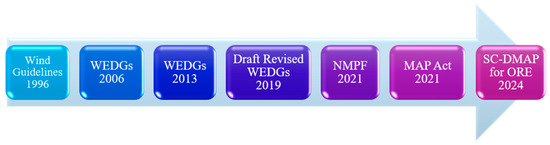
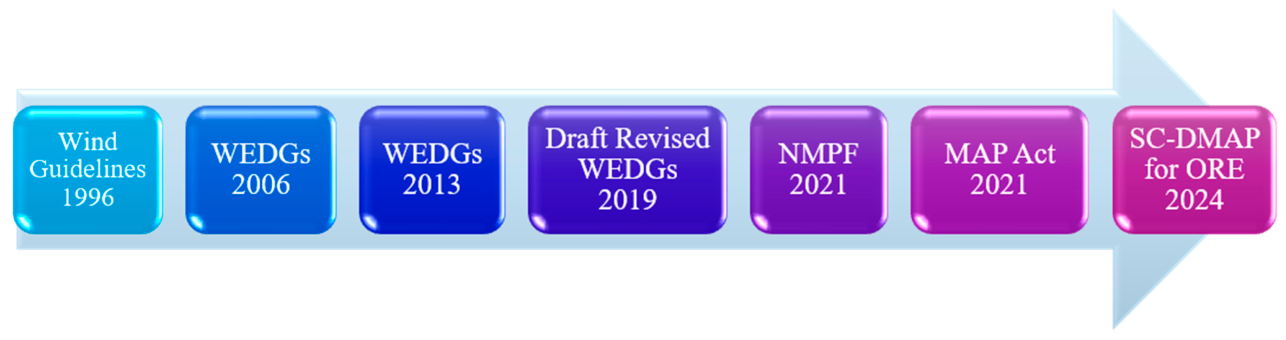
The early fragmented method for developing offshore wind energy should also be viewed in relation to the overall historical evolution of wind energy planning and policy in Ireland. Figure 1 shows Ireland’s wind energy policy discourse, with the Wind Energy Development Guidelines (WEDGs) implemented in 1996. The WEDG, first introduced in 1996 and subsequently revised in 2006 and 2013, together with the draft revision published in 2019, were primarily focused on onshore wind development, meaning that their scope did not incorporate the development of offshore wind farms. However, it is essential to understand and contextualise this decision in terms of how wind energy policy evolved over time, when offshore development occurred on an incremental basis and outside a dedicated offshore planning structure [2,4]. The transition from onshore planning to a dedicated offshore framework was gradual rather than immediate. Ireland’s MSP framework progressively developed through the implementation of the EU MSP Directive (2014), the publication of the NMPF Roadmap (2017), and successive consultation and review stages (2018–2020), and the adoption of the NMPF in 2021. This transition was further reinforced by the introduction of the MAP Act in 2021 and the subsequent development of the SC-DMAP for offshore renewable energy in 2024.
Figure 1.
Evolution of wind energy and ORE planning and consenting policy (1996–2024).
3.2. Emergence of Offshore-Specific Marine Planning and Consenting Frameworks
Offshore-specific marine planning represents a significant shift in Ireland’s approach to ORE development when compared to its earlier practices. Before the introduction of a structured marine planning framework, offshore wind projects in Ireland were considered individually, without a clear national strategy. Developers and regulators often faced uncertainty, especially around environmental limits, other maritime activities, and the order of approvals. As a result, projects moved forward without a coordinated spatial vision, which could lead to delays or conflicts during consenting.
This situation began to evolve with the adoption of the National Marine Planning Framework (NMPF) [21]. The NMPF introduced a statutory, whole-of-government approach to marine spatial planning across Ireland’s maritime area and represents the country’s first comprehensive national marine spatial plan. Positioned at the top of the marine planning hierarchy, it provides the strategic context within which ORE development is to be considered. Importantly, the NMPF differs from earlier guidance by virtue of its legal status: public authorities are required to carry out their functions in a manner consistent with its policies and objectives. As a result, the framework functions not merely as a high-level policy statement but as a binding instrument that directly shapes decision-making in offshore renewable energy planning and consenting.
From an ORE perspective, the NMPF sets out high-level goals and policies to facilitate the expansion of offshore wind, while also seeking to balance energy development with environmental protection, fisheries, navigation and other maritime uses. Incorporating ORE into an integrated marine spatial planning framework, the NMPF seeks to address the fragmented and reactive nature of earlier approaches. Importantly, the NMPF encourages the identification of spatial and policy issues related to energy development and marine resources at a strategic level, prior to the submission of individual project applications. Through this framework, the NMPF provides a necessary foundation for a more coordinated and state-led model of offshore development, in which spatial suitability and policy alignment are established in advance rather than negotiated on a project-by-project basis.
Beyond its strategic function, the NMPF provides direction for subsequent planning instruments, such as DMAPs, and is considered during project-level consenting. Through this role, it connects national policy priorities with regulatory decision-making and supports the coordinated consideration of multiple uses of maritime space over the course of development. At the same time, the NMPF is deliberately broad. It lays out general policy directions and highlights priority areas, but does not specify exact sites for development. Detailed environmental assessments and public consultation remain necessary at the project level. The degree to which the NMPF reduces consenting risk depends on how effectively its guidance is applied in subsequent plans and regulatory decisions, as seen in early experiences with the South Coast DMAP [14].
In addition to the NMPF, the enactment of the MAP Act 2021 [22] further formalised Ireland’s approach to offshore renewable energy development. The Act established a revised institutional framework for marine planning and clarified regulatory roles within the maritime area. As part of this framework, the Maritime Area Regulatory Authority (MARA) was created to manage access to maritime space through the administration of Maritime Area Consents (MACs).
The establishment of MARA presents an attempt to develop a more streamlined and coordinated governance process that had previously been fragmented across multiple regulatory regimes. By separating the allocation of rights to occupy the maritime area from the consenting of downstream development, the MAP Act introduced greater regulatory clarity and consistency at an earlier stage of project development. This approach is consistent with best practices in other jurisdictions (the UK, the Netherlands, Denmark, Germany, etc.) that employ state-led offshore governance models, where early-stage spatial planning and the allocation of site access are utilised to reduce uncertainty for project developers and to facilitate coordination.
Taken together, these reforms reflect a shift away from earlier ad hoc and developer-led approaches towards a more coordinated marine planning and consenting system for offshore renewable energy. While the planning architecture is defined, the practical operation of the associated consenting processes is discussed in Section 3.4.
3.3. Designated Maritime Area Plans and Spatial Coordination
DMAPs were introduced to provide a more formal and coordinated approach to marine spatial planning for a range of activities, including offshore renewable energy development. DMAPs are intended to identify maritime areas that are considered suitable for ORE in advance of project-level authorisation. By doing so, they seek to reduce uncertainty surrounding the use of marine space and to minimise potential future conflicts with existing marine activities. This represents a fundamental shift away from earlier practices, where site preference for ORE development was largely driven by developer-led considerations in the absence of predefined spatial priorities.
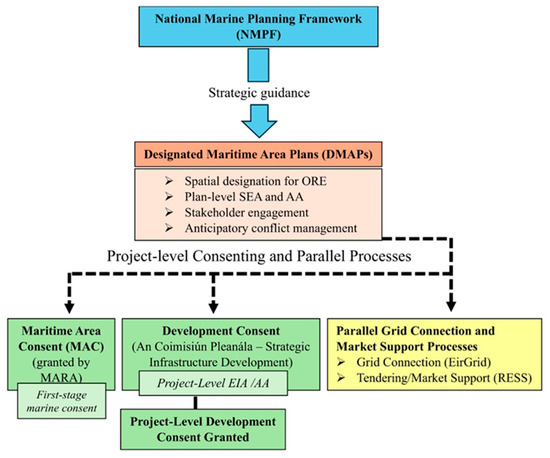
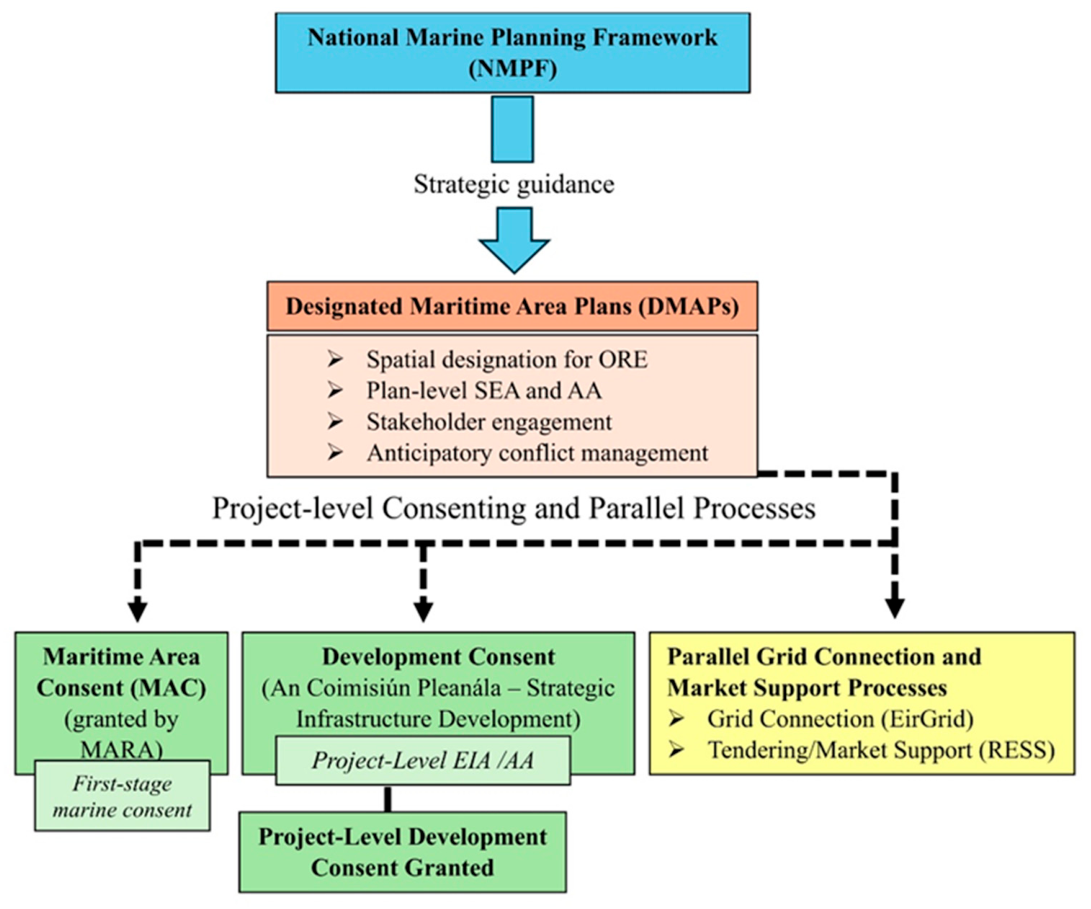
The SC-DMAP is the first DMAP to be developed under Ireland’s new maritime area planning framework. Its development was informed by environmental assessments, stakeholder engagement and aligned with the national energy policy goals [14]. The plan designated precise maritime areas for the development of ORE. At its core, by conducting spatial analyses and environmental assessments at the beginning of the SC-DMAP process, the SC-DMAP seeks to support subsequent consenting processes for developers through a more anticipatory approach. The position of DMAPs within Ireland’s ORE planning system and their role as a strategic spatial planning layer between the NMPF and subsequent project-level consenting processes are shown in Figure 2.
Figure 2.
Role of DMAPs in Ireland’s ORE, planning and consenting process.
DMAPs are prepared following the strategic guidance of the NMPF, ensuring that national spatial priorities are reflected in more detailed planning. By designating suitable areas for ORE, DMAPs have the potential to reduce consenting risks for subsequent projects. However, as these plans are relatively new, the extent to which they streamline project-level approvals and mitigate conflicts with other marine activities is still being assessed in practice.
Although DMAPs provide a more strategic approach to spatial planning, their role in project-level consenting continues to be examined. Questions persist regarding the impact of DMAP designations on consenting risk, particularly in relation to environmental assessment requirements and public participation. The contribution of DMAPs to accelerating offshore wind deployment depends on the coordination between spatial planning and consenting in practice.
3.4. Offshore Consenting Under the Maritime Area Planning Act
Alongside the introduction of marine spatial planning instruments, the MAP Act 2021 established a new consenting regime specifically designed for offshore development [22]. A central feature of this regime is the separation between consent to occupy and use the maritime area and consent to undertake development activities. This distinction represents a departure from earlier approaches, where offshore projects were advanced through adapted terrestrial planning processes without a clearly defined consenting sequence.
The pre-designation of areas under DMAPs, guided by the NMPF, provides the spatial context for this consenting process. Under the current framework, a MAC is required as the first stage of the consenting process. MACs are administered by the MARA and confer a legal right to occupy and use a defined area of the seabed [22]. Importantly, a MAC does not constitute development consent; rather, it establishes access to maritime space and allows a project to proceed to subsequent stages of assessment and authorization.
After a MAC is awarded, ORE projects must proceed to the development consent under the Planning and Development Act 2024 [23] via the Strategic Infrastructure Development statutory process. It is the responsibility of An Coimisiún Pleanála (previously An Bord Pleanála) to approve the development consent request. At this stage of the development process, the project has undergone a detailed technical assessment, including a comprehensive assessment of the project’s environmental effects, compliance with planning policy, and public engagement requirements.
Environmental assessments are conducted at multiple stages throughout offshore wind projects. Strategic Environmental Assessments (SEAs) are undertaken during plan-making, including during the preparation of the NMPF and DMAPs [14,21]. At the project phase, the Environmental Impact Assessment (EIA) and, where relevant, Appropriate Assessment (AA) are required in accordance with EU environmental legislation. Together, these assessments for offshore wind projects are required for gaining consent and significantly impact all aspects of the design, risk mitigation, and development phases throughout the project’s completion process.
Furthermore, offshore wind projects also need to navigate the grid connection process managed by EirGrid. The process runs alongside both consenting and environmental assessment stages, which adds an extra layer of complexity to project development. The relationship between MACs, development consent, environmental assessment, and grid connection procedures creates a regulatory landscape that is both interdependent and multifaceted for the offshore wind sector.
The MAP Act 2021 has provided more clarity regarding institutional roles and the overall structure of offshore consenting. However, it is still too early to demonstrate how effective this framework will be in shortening consenting timelines. Since the system is relatively new, questions remain about how well planning, consenting, environmental assessment, and grid connection stages are coordinated, and whether they can collectively support the timely rollout of offshore wind projects in Ireland.
The principal legislative and consenting instruments governing offshore renewable energy development in Ireland are summarized in Table 1. Secondary instruments such as commencement orders and circulars are not included, as they do not constitute primary legislation.
Table 1.
Principal legislation and consent instruments governing offshore renewable energy development in Ireland.
These legislative and institutional reforms represent a significant restructuring of Ireland’s offshore renewable energy planning and consenting framework. However, given the recent implementation of many of these measures, it remains difficult to assess their effectiveness in facilitating timely project delivery. Therefore, a comparison with more established European offshore wind jurisdictions provides a useful basis for evaluating the strengths and potential limitations of the Irish approach.
4. Comparative Perspectives on Offshore Wind Planning and Consenting in Selected Jurisdictions
Building on the analysis of Ireland’s offshore renewable energy planning and consenting framework, this section places the Irish experience within a comparative European context. Several European countries have demonstrated significantly higher rates of offshore wind deployment over the past two decades, supported by more established planning systems, clearer consenting pathways and, in many cases, a stronger role for the State in site selection, environmental assessment and grid coordination. A review of how these nations implement and administer their respective planning and consenting systems provides a useful benchmark against which recent reforms in Ireland can be assessed.
In this section, we focus on four jurisdictional areas: the UK, the Netherlands, Denmark and Germany. As outlined in the research methodology, these four nations were selected because of their extensive experience in offshore wind development and the relevance of their planning and consenting systems to the Irish context. In addition, they provide a useful basis for examining how different institutional models address issues relating to environmental assessment, grid integration and marine spatial planning. They represent a spectrum of governance approaches, ranging from more state-led systems, such as those adopted in Denmark and the Netherlands, to more developer-led or hybrid approaches in the UK and Germany. While other European jurisdictions, including France, Poland and the Baltic States, also offer valuable comparative insights, the focus here is on jurisdictions with longer implementation experience and more mature consenting systems from which lessons for institutional design and regulatory reform can be drawn. Consequently, these four jurisdictions provide a robust comparative basis for evaluating recent reforms in Ireland [24,25,26].
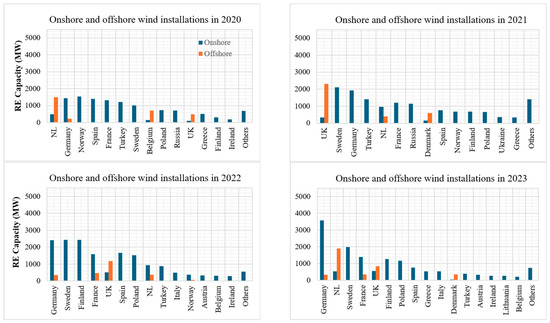
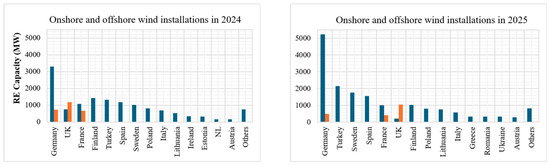
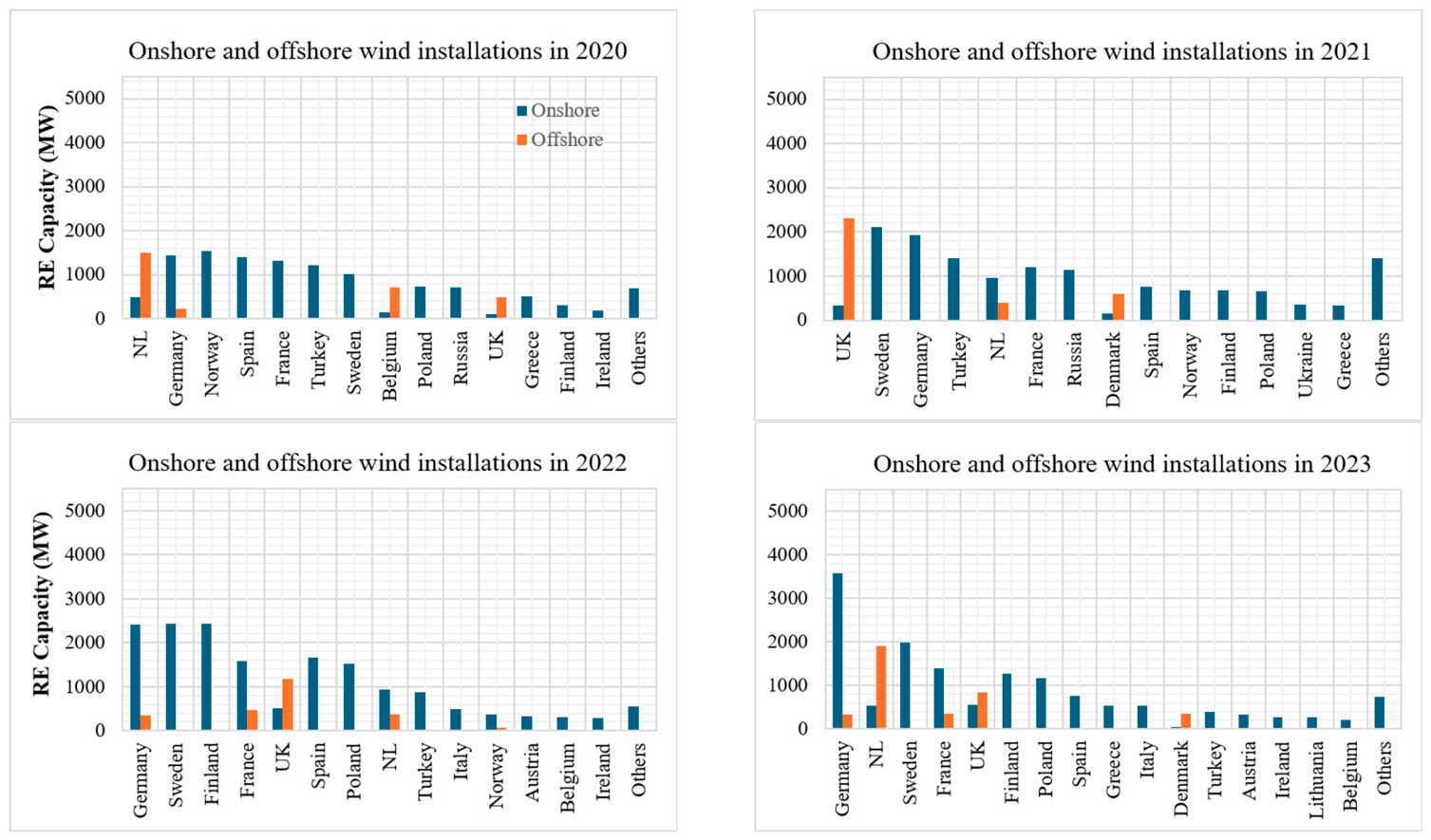
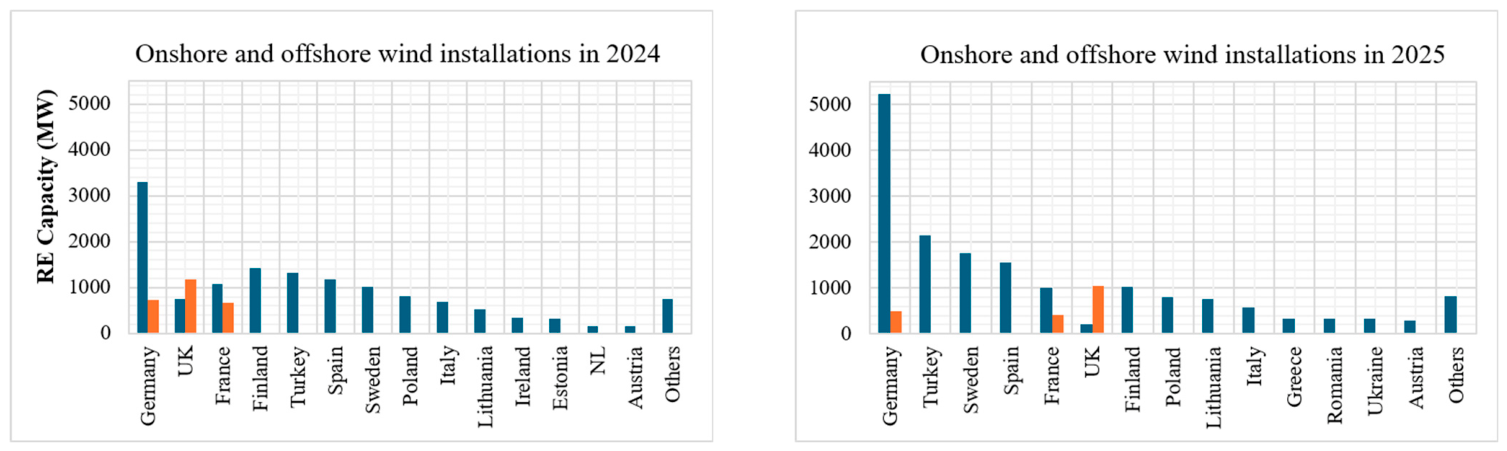
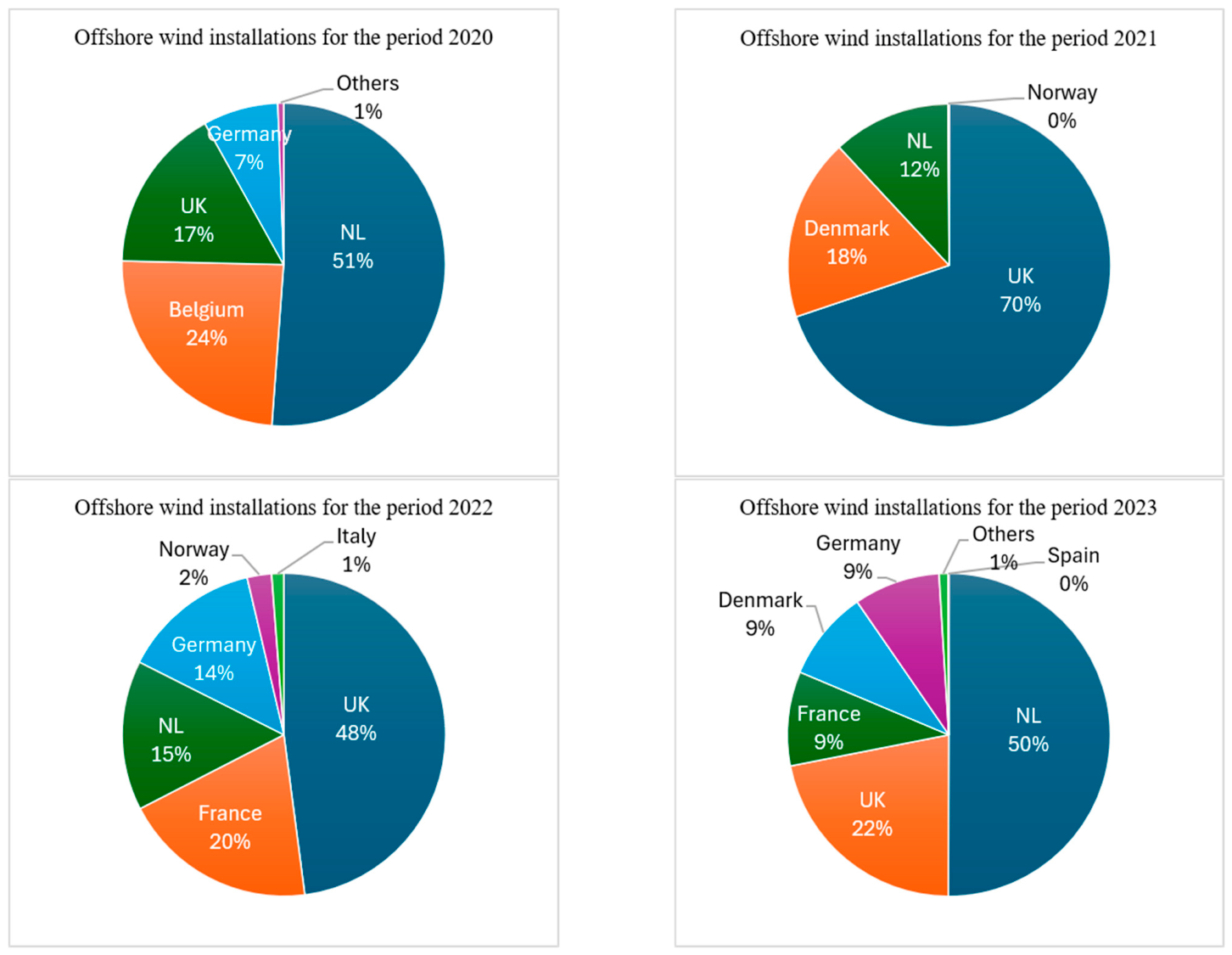
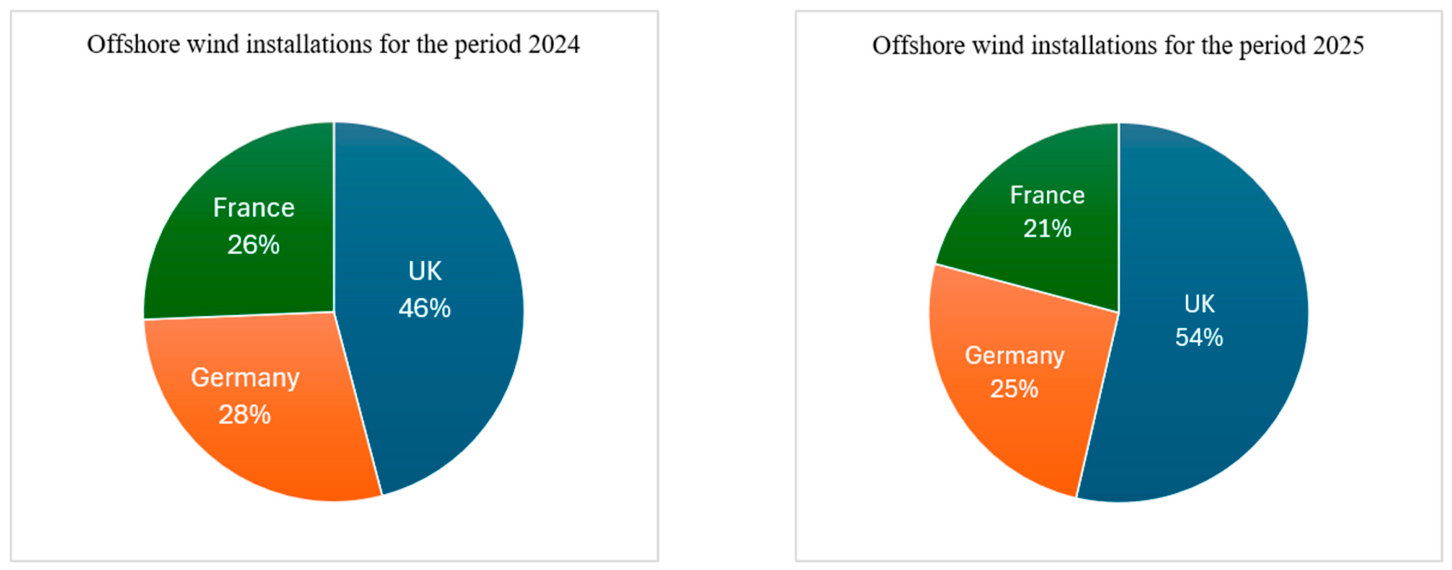
Recent trends in wind energy deployment across Europe highlight substantial variation in both the scale and pace of onshore and offshore wind development. According to WindEurope’s annual statistics covering the period 2020–2025 [27,28,29,30,31,32], Germany, the UK and the Netherlands have consistently led new wind capacity additions in Europe, particularly in the offshore sector. Offshore deployment during this period remained concentrated within a relatively limited number of jurisdictions, while onshore wind growth was more geographically widespread across Europe.
Figure 3 illustrates the amount of new onshore/offshore wind capacity installed in European countries between 2020 and 2025. These data demonstrate notable year-to-year variation in deployment patterns across Europe. In 2020 and 2023, the Netherlands was the largest contributor to offshore wind capacity additions, while the UK recorded the highest offshore deployment levels in 2021, 2022 and 2024. Germany maintained consistently high levels of overall wind capacity growth during this period and recorded the largest combined onshore and offshore additions in 2023–2025. In contrast, onshore wind deployment was distributed across a broader range of countries, including Sweden, France, Spain, Finland and Poland.
Figure 3.
Onshore/offshore wind installations in Europe for the period 2020–2025 [27,28,29,30,31,32].
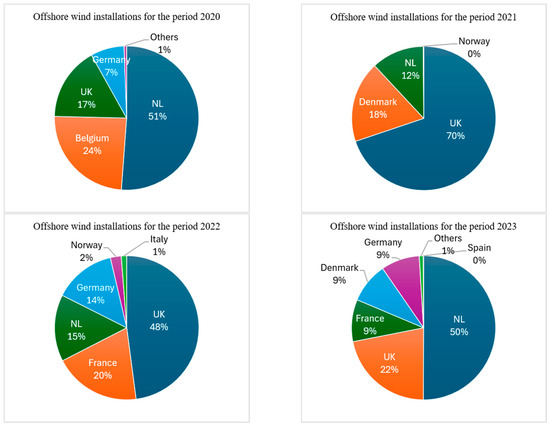
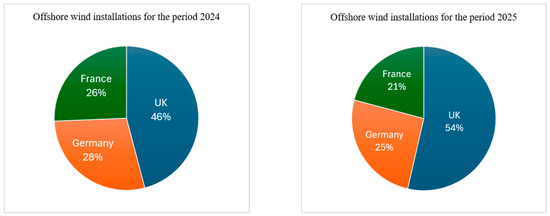
Figure 4 shows the changing geographic distribution of offshore wind farm installations across Europe for the years 2020–2025, revealing that offshore deployment remains concentrated within a relatively small group of countries with more mature planning, tendering and consenting systems. Moreover, the emergence of countries such as Poland, Lithuania and Estonia within recent deployment statistics indicates the gradual expansion of offshore wind development into newer European markets. The absence of the Netherlands in 2024 and 2025 reflects annual variability in commissioning cycles rather than a structural change in offshore wind deployment. These trends highlight both the continued dominance of established offshore jurisdictions and the increasing diversification of offshore wind development across Europe.
Figure 4.
Offshore wind installations in Europe for the period 2020–2025 [27,28,29,30,31,32].
Wind energy consumption across the EU-27 has been trending upwards since 2020 and accounted for nearly 19% of total electricity use in 2023, 2024 and 2025 [30,31,32]. Over the period 2020–2025, (i) Denmark remained the leading country in terms of wind energy’s contribution to national electricity demand, consistently exceeding 50%, (ii) Ireland ranked second, contributing between 30% and 38%, (iii) Germany and the UK followed, with the shares ranging between 21 and 38%.
Wind generation in Ireland has been derived primarily from onshore installations; however, both Ireland’s current market share and Denmark’s historical track record demonstrate a strong foundation for developing offshore wind projects, supported by appropriate planning and consenting processes.
A comparison of the onshore/offshore renewable energy targets for Ireland and other jurisdictions is presented in Table 2. The most ambitious offshore target for 2030 is set by the UK, followed by Germany (30 GW) and the Netherlands (21 GW), with Denmark setting a moderate target (18 GW). The middle (long-term) future ORE targets reach aggressive levels with 70 GW by 2045 in Germany, 30–40 GW (70 GW) by 2040 (2050) in the Netherlands, and 35 GW by 2050 in Denmark. Compared with other leading nations, Ireland’s near-, middle- and far-future ORE targets are relatively modest, aiming to reach 7 GW by 2030, 20 GW by 2040 and 37 GW by 2050. In the present study, detailed investigations and comparisons were performed regarding the planning, tendering, and permitting processes in four leading countries (the UK, the Netherlands, Germany and Denmark) with respect to existing facilities and future facility establishment targets.
4.1. The UK
The issuing of licenses for the generation of electricity and the regulation of the grid connection of ORE projects is governed by the Electricity Act 1989 [33]. The planning and consenting of large-scale energy infrastructure projects, over 100 MW, are regulated under the Planning Act 2008 [34]. Such projects are classified as Nationally Significant Infrastructure Projects (NSIPs), requiring a Development Consent Order (DCO) before construction. Moreover, the framework for marine management is governed by the Marine and Coastal Access Act 2009.
As part of its renewable energy responsibilities arising from the Energy Act 2004, TCE (The Crown Estate) is responsible for managing seabed leases for offshore wind development projects in England, Wales and Northern Ireland. TCE arranges lease agreements for wind farms situated on the UK Continental Shelf offshore these jurisdictions; the relevant energy regulatory grants licences for the electricity to be generated from these projects. TCE’s facilitating role in offshore renewable energy development projects has been further strengthened by the Marine and Coastal Access Act 2009 [35] and the Sustainable Energy Act 2003 (c30) [36]. By contrast, in Scotland, responsibility for seabed assets was devolved to the Scottish Government under the Scotland Act 2016, and from 2020 onwards [37,38], the Crown Estate Scotland (CES) has managed these assets.
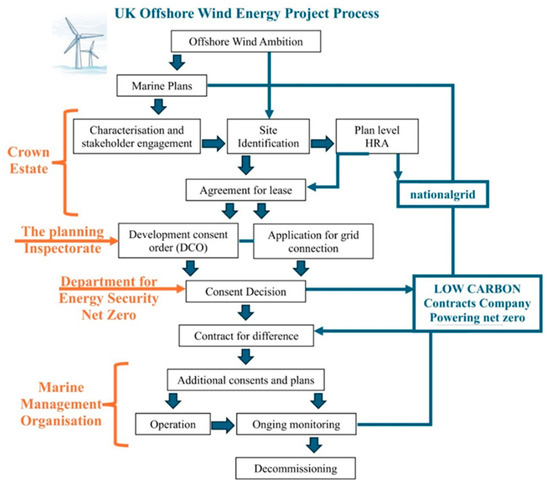
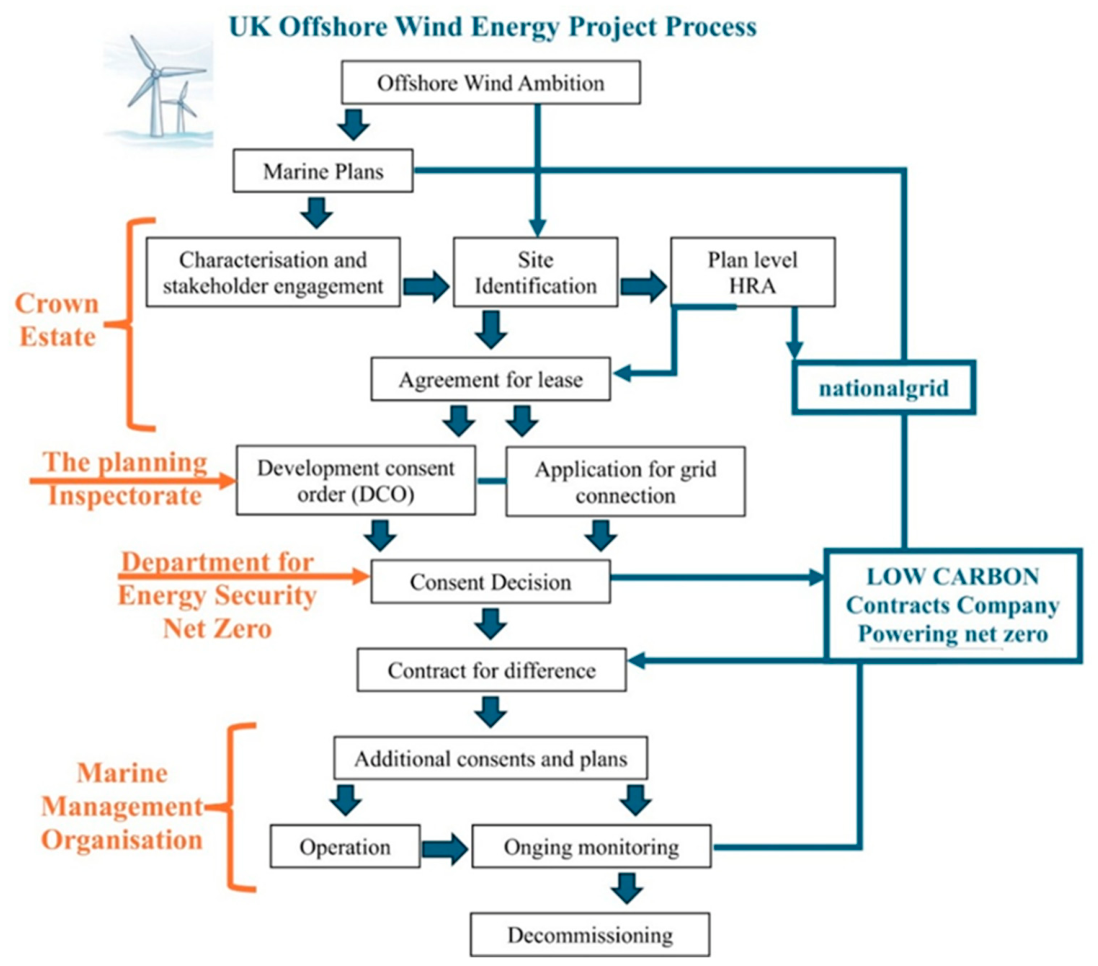
Different marine governance assessments exist within the UK. The Marine and Coastal Access Act (2009) provides for the regulation of both marine licensing and management in relation to England and Wales. The Marine Act (Northern Ireland) 2013 [39] provides a similar structure for Northern Ireland, but is separate in terms of jurisdiction. The Marine (Scotland) Act (2010) [40] was introduced in Scotland to provide regulatory functions for both the management and licensing of offshore wind energy facilities. Despite the jurisdictional differences, all offshore wind development activities throughout the UK follow a hybrid governance approach. This means that both the State and private sector companies participate in the governance of the offshore wind development process. The State has a major role in seabed leasing and strategic planning, while the developers are responsible for environmental assessment and consent applications. The overall UK offshore wind development process is illustrated in Figure 5.
Figure 5.
Planning, tendering, and permitting processes for the wind project in the UK.
The UK has already constructed around 30.7 GW of offshore wind energy generation with an additional award of approximately 7.2 GW through the recent auction and leasing processes, indicating that the UK has made substantial advances towards reaching its goal of achieving 43–50 GW of offshore renewable energy capacity by 2030 [41]. The scale of development achieved so far reflects the degree of development attained within the UK offshore wind industry regarding its regulatory framework, albeit that challenges do remain in respect of the connection of offshore wind farms to existing onshore electrical grids and also due to the continuing complexities associated with the environmental permitting requirements. In the UK, offshore grid connections are governed by the Offshore Transmission Owner (OFTO) regime, under which transmission assets are developed and operated by licensed third parties, separate from electricity generation. This institutional separation has contributed to delays associated with onshore grid reinforcement and coordination between generation and transmission development.
4.2. The Netherlands
ORE development in the Netherlands is mainly governed by the Offshore Wind Energy Act (OWE Act), which entered into force in 2015 and has since been amended to strengthen a state-led approach to offshore wind development. The Electricity Act (1998) [42] provides the legal framework governing the Dutch electricity market, including the operation of electricity generation and supply.
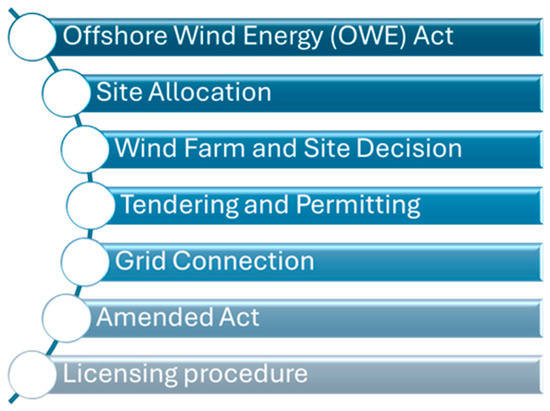
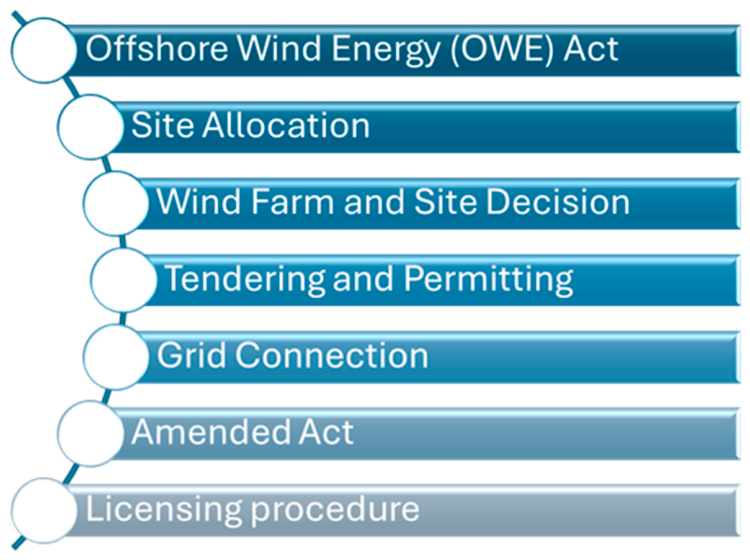
The Dutch Government takes a leading role in OWF development through site identification within marine spatial planning processes, the coordination of environmental assessments and the provision of offshore grid connections. Offshore grid connections in the Netherlands are developed and operated by the national transmission system operator, TenneT, under a centrally coordinated, state-led framework. This approach ensures that key elements such as site selection, permitting and grid access are addressed at the national level. The principal legislative instruments and processes governing ORE development in the Netherlands are presented in Figure 6.
Figure 6.
Principal legislation in the Netherlands [43].
In addition to the OWE Act, offshore wind development in the Netherlands is subject to several complementary legal frameworks. The Water Act and the associated Water Decree regulate activities affecting water systems and the marine environment, including construction and operational activities at sea. Environmental protection, including the conservation of marine habitats and species in the Dutch sector of the North Sea, is governed by nature conservation legislation. These regulatory regimes are applied alongside the OWE Act during the planning and consenting of offshore wind projects. Since 2024, the Environment and Planning Act (Omgevingswet) has provided an integrated framework for regulations affecting the physical living environment, consolidating a range of sectoral laws, including water and environmental legislation. While the OWE Act remains the primary legal instrument specific to offshore wind development, the Environment and Planning Act plays an increasingly important role in coordinating environmental and spatial considerations across offshore and onshore domains [43].
To date, the Netherlands has an operational offshore wind capacity of approximately 4.5 GW and projects a total of 21 GW by 2032 [44]. Beyond its 2030 target, the national ambitious aims for 30–40 GW by 2040 and 70 GW by 2050 [45].
4.3. Denmark
The Danish Energy Agency (DEA) primarily oversees the operation of several OWFs operating in Denmark under the Promotion of Renewable Energy Act, enacted in 2009 [46]. The offshore wind projects are authorized via a well-established “one-stop-shop” permitting system administered by the DEA. This system includes the issuance of three sequential licenses: (i) a license for preliminary investigations, (ii) a construction license for the installation of OWTs (granted if investigations indicate compatibility with other offshore interests), and (iii) a license for electricity production and operational use for a defined period, issued once the conditions of the construction license have been fulfilled.
OWF developments are also subject to EIA requirements, and Danish offshore wind projects have consistently undergone EIA before construction. Under the “one-stop-shop” system, the DEA acts as the central coordinating authority, issuing the principal permits, streamlining the consenting process and coordinating input from other relevant authorities.
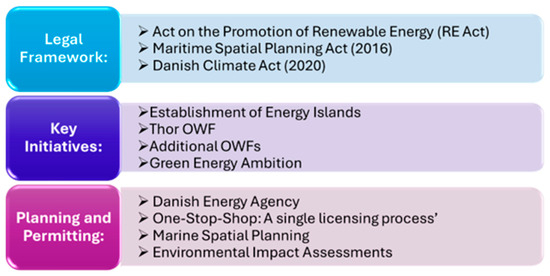
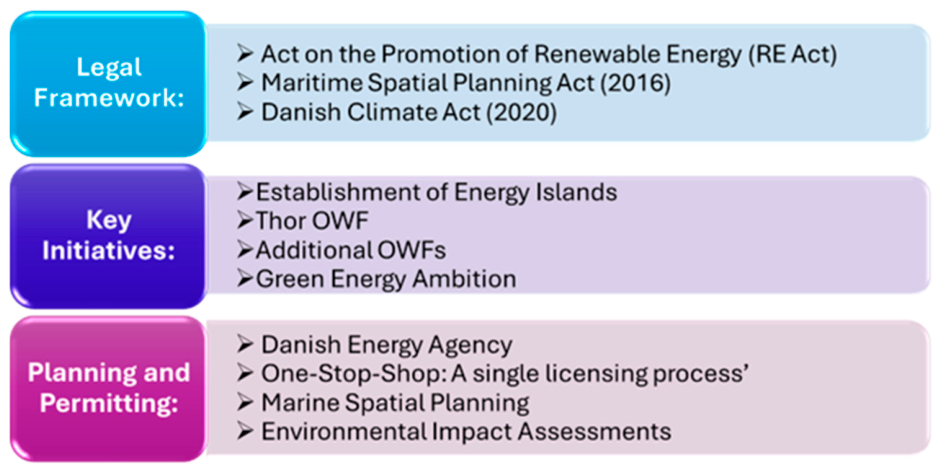
DEA governs site designation for offshore wind development within Danish waters under the Maritime Spatial Planning Act (2016), which provides the statutory basis for marine spatial planning and for identifying suitable areas for ORE development [47]. The overall legal and institutional framework governing offshore wind development in Denmark is summarised in Figure 7.
Figure 7.
Legal framework for Danish OWF development.
The Danish Climate Act adopted Denmark’s climate policy, approved in 2019 and came into force in 2020, which commits the country to reducing greenhouse gas (GHG) emissions by 70% by 2030 relative to 1990 levels [48]. In Denmark, the offshore wind capacity targets are 12.9–18 GW by 2030 and 35 GW by 2050 [49]. Currently, Denmark has 2.7 GW of installed offshore wind capacity. Denmark has extensive experience with deploying OWTs; however, the increasing difficulty with expanding onshore wind projects was recognised in recent policy reports, thereby making the area of offshore wind a critical element in fulfilling the overall renewable energy objectives for Denmark [50].
4.4. Germany
Renewable energy policy and regulation in Germany are mainly managed at the federal level through the Renewable Energy Act (EEG) [51], which covers the overarching legal framework for electricity generation from renewable sources, including hydropower, wind, solar, geothermal energy, and biomass. The Federal Climate Protection Act (KSG), enacted in 2019, envisions substantial GHG emissions reduction targets of at least 65% and 88% by 2030 and 2040, respectively, within the context of achieving net GHG neutrality by 2045 [52].
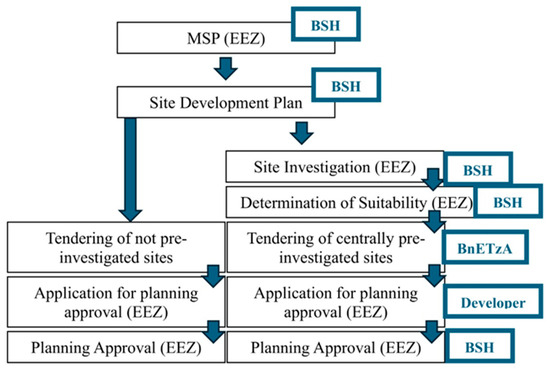
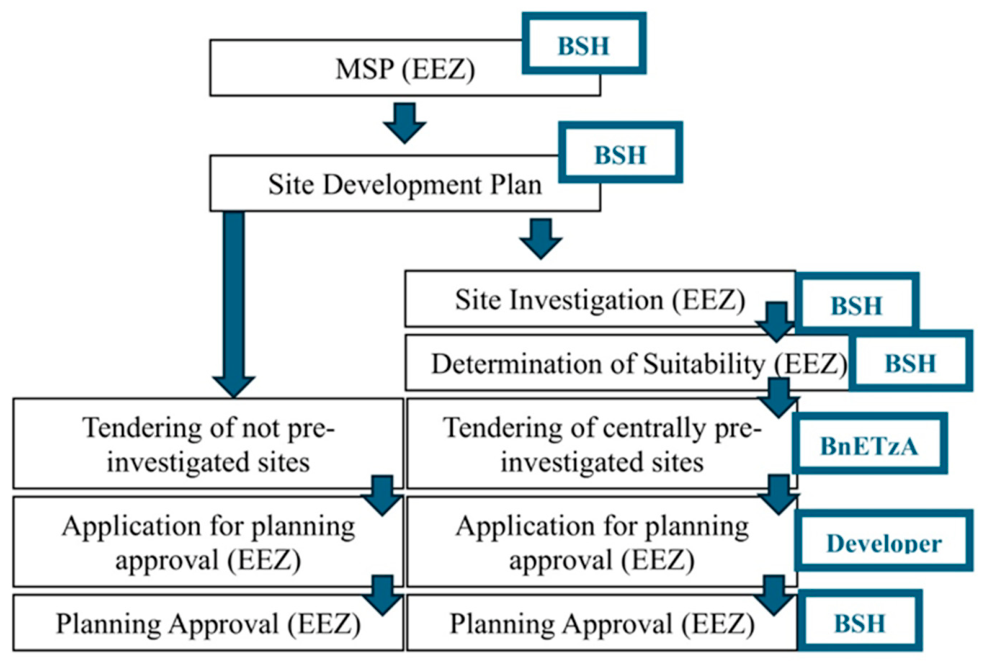
OWE law is primarily regulated by the Offshore Wind Energy Act (WindSeeG) along with the EEG and the Federal Nature Conservation Act. The Federal Maritime and Hydrographic Agency, BSH, oversees the planning, permitting, environmental assessment, and operation of OWE projects within Germany’s Exclusive Economic Zone (EEZ). The Federal Network Agency (BNetZa) is responsible for competitive tendering processes for offshore wind sites and regulatory oversight of offshore grid connections, while the Federal Ministry for Economic Affairs and Climate Action (BMWK) retains responsibility for overall offshore wind policy, strategic planning and legislative development.
In simpler terms, BSH is the entity that identifies appropriate maritime areas and provides environmental permits under WindSeeG. BNetzA conducts competitive tenders for the areas identified by BSH and regulates grid connections under WindSeeG and EEG. BMWK provides strategic direction and policy coordination across the offshore wind sector [53,54]. The principal legislative instruments and regulatory processes governing OWE development in Germany are outlined in Figure 8.
Figure 8.
German offshore wind project lifecycle and regulatory framework.
Germany’s OWE targets include 30 GW of installed capacity by 2030, 40 GW of capacity by 2035 and 70 GW of capacity by 2045 [54,55].
Table 2.
Onshore and offshore RE targets for Ireland and other jurisdictions (Targets reflect the latest national policy revisions available up to 2025).
5. Discussion
5.1. From Developer-Led to State-Led Offshore Wind Governance in Ireland
This paper outlines the transition in ORE development in Ireland from a largely “ad hoc” and developer-led approach to a more organised and state-based structure. Policies that were previously introduced for offshore wind development existed without a clearly defined marine planning system, with limited strategic guidance and fragmented institutional responsibilities. As highlighted previously in this study, such governance arrangements create uncertainty in respect of both the regulatory environment and the timeframes for deploying ORE projects [2,4].
The introduction of the National Marine Planning Framework and the subsequent development of the MAP Act 2021, as well as the establishment of the MARA, represent important steps taken to address these issues. Collectively, these initiatives are intended to provide clearer direction for the spatial planning aspects of marine energy development, greater definition of regulatory responsibilities, and greater certainty with respect to offshore wind development processes [2,17].
This transition broadly reflects developments observed across several European countries, where MSP has increasingly been used alongside complementary regulatory mechanisms to facilitate more coordinated ORE deployment. It is important to note that this paper is not suggesting that there were no regulations applied to earlier offshore wind development initiatives; rather, we note that the lack of a coordinated marine planning and consenting process limited Ireland’s ability to scale up its offshore wind development potential, notwithstanding the presence of favourable natural resources.
5.2. Persisting Challenges in Consent Complexity and Regulatory Coordination
Recent reforms have provided a clearer offshore governance structure in Ireland through the establishment of more clearly defined institutional arrangements. However, challenges remain regarding coordination and the sequencing of planning, consent, and regulatory processes. Although the separation of the MAC from the development consent brought legal clarity regarding access to maritime space, it also introduced a multi-stage consenting pathway that requires considerable coordination among institutions and assessment processes.
Environmental assessment obligations play a vital role in this process. Combining SEA with the project-level EIA and AA at the plan-making stage provides important safeguards for environmental protection and public participation. The concern identified in this research is not the existence of such procedures, but the amount of complexity arising from their interaction with the consent stages and grid connection. Similar challenges regarding sequencing and institutional coordination have been documented in offshore wind planning systems elsewhere in Europe [56,57].
The parallel progression of development consent and grid connection arrangements may create additional uncertainty for developers in Ireland. As the current system is still at an early stage of implementation, its effectiveness in shortening consenting timelines and facilitating timely offshore deployment remains to be demonstrated in practice.
5.3. Lessons from European Practice and Implications for Ireland
The present study compares Ireland’s approach to OWE with internationally recognised approaches to ORE regulation, which include strategic spatial planning and the early consideration of environmental assessment requirements. Northwestern European countries such as Denmark, the Netherlands and Germany illustrate alternative approaches characterised by earlier strategic spatial planning, clearer institutional responsibilities and greater coordination across different stages of offshore wind development.
The use of DMAPs in Ireland represents an improvement over previous approaches, providing opportunities for spatial clustering (or locating) and conducting earlier environmental assessments. However, unlike those of the UK, Denmark, the Netherlands, and Germany, Ireland’s planning, consenting, environmental assessment, and grid connection processes are still evolving. The extent to which Ireland can successfully deliver OWE projects is likely to depend on effective coordination across planning, consenting, environmental assessment, and grid connection processes. In this regard, the principal legislative and institutional components of the offshore wind framework are now largely in place. Consequently, future progress is likely to depend less on the introduction of additional legislative instruments and more on the practical implementation and coordination of the existing planning and consenting system.
Overall, this paper highlights the substantial progress that Ireland has made in establishing the legal and institutional framework necessary to support ORE development. One of the key challenges facing Ireland is not a lack of regulations, but rather ensuring that the newly established planning and consenting procedures operate together in a coordinated, coherent, and predictable manner to facilitate OWE development and support Ireland’s offshore wind ambitions.
As shown in Table 3, jurisdictions characterised by more strongly state-led approaches to site selection and grid coordination appear to encounter a different set of implementation challenges compared with systems retaining a stronger developer-led element, as is currently the case in Ireland. The present comparison is intended to illustrate these differing governance configurations rather than to establish the relative efficiency of individual consenting systems.
Table 3.
Governance structures and key challenges for OWE in selected jurisdictions.
6. Conclusions
This paper has explored the evolution of offshore renewable energy planning and consenting in Ireland. The shift from a largely ad hoc and developer-led system to a more structured and state-led governance framework is particularly notable. By reviewing the evolution of marine spatial planning, institutional reform(s), and offshore-specific consenting arrangements, it becomes, in fact, how Ireland’s regulatory framework for offshore wind has sought to respond to persistent governance and coordination challenges.
The introduction of the NMPF, the pre-designation of maritime areas through DMAPs, and the enactment of the MAP Act 2021 represent important steps in creating a coherent planning and consenting system for ORE. All of these reforms together clarify institutional responsibilities, introduce a plan-led approach to spatial designation, and establish a more transparent sequence for accessing maritime space and obtaining development consent. At the same time, they provide developers with a clearer pathway through a complex regulatory environment, which can, in practice, support timelier and more effective project implementation.
The results also show that there are still significant challenges ahead. A key challenge in this regard is that offshore wind development still faces many complexities, ambiguities and uncertainties arising from the interaction of various regulatory frameworks, including MSP, the multi-stage consent process, environmental assessment obligations, and grid connection arrangements. The majority of these new reforms have only recently begun to be implemented, and thus, their effectiveness in reducing timescales and supporting the timely delivery of projects has yet to be demonstrated in practice.
Overall, Ireland has made important progress in establishing the legal and institutional foundations required to support offshore wind development. The extent to which Ireland can realise its ambitious OWE targets is likely to depend on how effectively the existing planning and consenting framework is coordinated and implemented in practice, rather than solely on the introduction of further legislative instruments.
Author Contributions
Conceptualization, F.I., M.S. and A.M.; methodology, F.I., M.S. and A.M.; formal analysis, F.I.; investigation, F.I., M.S. and A.M.; resources, M.S. and A.M.; data curation, F.I.; writing—original draft preparation, F.I.; writing—review and editing, M.S. and A.M.; visualization, F.I. and A.M.; supervision, M.S. and A.M.; project administration, M.S. and A.M.; funding acquisition, M.S. and A.M. All authors have read and agreed to the published version of the manuscript.
Funding
This research was supported by the Marine Institute under the award Grant-Aid Agreement No. RPA/23/03/02. This award is carried out with the support of the Marine Institute under the Marine Research Programme and funded by the Government of Ireland.
Data Availability Statement
No new data were created or analyzed in this study.
Conflicts of Interest
The authors declare no conflicts of interest.
Abbreviations
The following abbreviations are used in this manuscript:
| AA | Appropriate Assessment |
| BMWK | Federal Ministry for Economic Affairs and Climate Action |
| CAP | Climate Action Plan |
| CES | Crown Estate Scotland |
| DCO | Development Consent Order |
| DEA | Danish Energy Agency |
| DMAP | Designated Maritime Area Plan |
| EEG | Renewable Energy Act (Erneuerbare-Energien-Gesetz) |
| EEZ | Exclusive Economic Zone |
| EIA | Environmental Impact Assessment |
| EirGrid | Electricity Transmission System Operator of Ireland |
| GHG | Greenhouse Gas |
| KSG | Federal Climate Protection Act |
| MAC | Maritime Area Consent |
| MAP | Maritime Area Planning |
| MARA | Maritime Area Regulatory Authority |
| MPA | Marine Protected Area |
| MSP | Marine Spatial Planning |
| NMPF | National Marine Planning Framework |
| NSIP | Nationally Significant Infrastructure Project |
| OFTO | Offshore Transmission Owner |
| ORE | Offshore Renewable Energy |
| ORESS | Offshore Renewable Energy Support Scheme |
| OWD | Offshore Wind Development |
| OWE | Offshore Wind Energy |
| OWF | Offshore Wind Farm |
| PfG | Programme for Government |
| SC-DMAP | South Coast Designated Maritime Area Plan |
| SEA | Strategic Environmental Assessment |
| TCE | The Crown Estate |
| UK | United Kingdom |
| WEDG | Wind Energy Development Guideline |
References
- von Jouanne, A.; Agamloh, E.; Yokochi, A. A Review of Offshore Renewable Energy for Advancing the Clean Energy Transition. Energies 2025, 18, 4798. [Google Scholar] [CrossRef] [Scilit]
- Jones, P.J.S.; Lieberknecht, L.M.; Qiu, W. Marine spatial planning in reality: Introduction to case studies and discussion of findings. Mar. Policy 2016, 71, 256–264. [Google Scholar] [CrossRef] [Scilit]
- Aschenbrenner, M.; Winder, G.M. Planning for a sustainable marine future? Marine spatial planning in the German exclusive economic zone of the North Sea. Appl. Geogr. 2019, 110, 102050. [Google Scholar] [CrossRef] [Scilit]
- Scarff, G.; Fitzsimmons, C.; Gray, T. The new mode of marine planning in the UK: Aspirations and challenges. Mar. Policy 2015, 51, 96–102. [Google Scholar] [CrossRef] [Scilit]
- Szostek, C.L.; Watson, S.C.L.; Trifonova, N.; Beaumont, N.J.; Scott, B.E. Spatial conflict in offshore wind farms: Challenges and solutions for the commercial fishing industry. Energy Policy 2025, 200, 114555. [Google Scholar] [CrossRef] [Scilit]
- Chen, Y.-S.; Hu, C.-Y.; Li, C.-Y.; Lin, J.-B.; Shih, Y.-C. Marine Spatial Planning for Offshore Wind Firms: A Comparison of Global Existing Policies and Data for Energy System Storage. Sustainability 2025, 17, 5884. [Google Scholar] [CrossRef] [Scilit]
- Jones, P.J.S.; Carpenter, A. Crossing the divide: The challenges of designing an ecologically coherent and representative network of MPAs for the UK. Mar. Policy 2009, 33, 737–743. [Google Scholar] [CrossRef] [Scilit]
- Sustainable Energy Authority of Ireland. SEAI Interim National Energy Balance for 2024. 2025. Available online: https://www.seai.ie/news-and-events/news/seai-interim-national-energy-balance-2024 (accessed on 15 June 2026).
- Department of Enterprise, Trade and Employment. Powering Prosperity: Ireland’s Offshore Wind Industrial Strategy; Department of Enterprise, Trade and Employment: Dublin, Ireland, 2024. Available online: https://enterprise.gov.ie/en/publications/publication-files/powering-prosperity.pdf (accessed on 15 June 2026).
- Department of Climate, Energy and the Environment; Department of the Taoiseach. Climate Action Plan 2019. 2019. Available online: https://www.gov.ie/en/department-of-climate-energy-and-the-environment/publications/climate-action-plan-2019/ (accessed on 15 June 2026).
- Department of the Taoiseach. Programme for Government: Our Shared Future. 2020. Available online: https://www.gov.ie/en/department-of-the-taoiseach/publications/programme-for-government-our-shared-future/ (accessed on 15 June 2026).
- Department of Climate, Energy and the Environment. Climate Action Plan 2023. 2022. Available online: https://www.gov.ie/en/department-of-climate-energy-and-the-environment/publications/climate-action-plan-2023/ (accessed on 15 June 2026).
- Department of Climate, Energy and the Environment. Future Framework for Offshore Renewable Energy. 2024. Available online: https://www.gov.ie/en/department-of-climate-energy-and-the-environment/publications/future-framework-for-offshore-renewable-energy/ (accessed on 15 June 2026).
- Department of Climate, Energy and the Environment. The South Coast Designated Maritime Area Plan for Offshore Renewable Energy (SC-DMAP). 2024. Available online: https://www.gov.ie/en/department-of-climate-energy-and-the-environment/publications/the-south-coast-designated-maritime-area-plan-for-offshore-renewable-energy-sc-dmap/ (accessed on 15 June 2026).
- Department of Climate, Energy and the Environment. Government Approves Terms and Conditions for the First Offshore Wind Auction Under the Renewable Electricity Support Scheme. 2022. Available online: https://www.gov.ie/en/department-of-climate-energy-and-the-environment/press-releases/government-approves-terms-and-conditions-for-first-offshore-wind-auction-under-the-renewable-electricity-support-scheme/ (accessed on 15 June 2026).
- Cowell, R.; Bristow, G.; Munday, M. Wind Energy and Justice for Disadvantaged Communities; Joseph Rowntree Foundation: York, UK, 2012; pp. 1–33. Available online: https://static1.squarespace.com/static/536b92d8e4b0750dff7e241c/t/53b57af1e4b01811829dadfc/1404402417513/wind-farms-communities-summary.pdf (accessed on 15 June 2026).
- Jay, S. Planners to the rescue: Spatial planning facilitating the development of offshore wind energy. Mar. Pollut. Bull. 2010, 60, 493–499. [Google Scholar] [CrossRef] [Scilit] [PubMed]
- Cronin, Y.; Cummins, V.; Wolsztynski, E. Public perception of offshore wind farms in Ireland. Mar. Policy 2021, 134, 104814. [Google Scholar] [CrossRef] [Scilit]
- Roux, J.-P.; Fitch-Roy, O.; Devine-Wright, P.; Ellis, G. “We could have been leaders”: The rise and fall of offshore wind energy on the political agenda in Ireland. Energy Res. Soc. Sci. 2022, 92, 102762. [Google Scholar] [CrossRef] [Scilit]
- Smith, S.L.; McCann, J.; Bingham, J.A.; Diederichsen, S.; Gröndahl, F.; Guyot, J.; Rebours, C.; Thomas, J.-B.E.; Weiss, C.V.C.; Walsh, J.P. Advancing multi-use in offshore wind energy planning: Perceived opportunities and barriers in southern New England, U.S. Policy 2025, 181, 106851. [Google Scholar] [CrossRef] [Scilit]
- Department of Climate, Energy and the Environment. National Marine Planning Framework. 2021. Available online: https://www.gov.ie/en/department-of-climate-energy-and-the-environment/publications/national-marine-planning-framework/ (accessed on 15 June 2026).
- Government of Ireland. Maritime Area Planning Act 2021; No. 50 of 2021; Irish Statute Book: Dublin, Ireland, 2021; Available online: https://www.irishstatutebook.ie/eli/2021/act/50/enacted/en/html (accessed on 15 June 2026).
- Government of Ireland. Planning and Development Act 2024; No. 34 of 2024; Irish Statute Book: Dublin, Ireland, 2024; Available online: https://www.irishstatutebook.ie/eli/2024/act/34/enacted/en/html (accessed on 15 June 2026).
- International Energy Agency (IEA). Offshore Wind Outlook 2019; IEA: Paris, France, 2019; Available online: https://www.iea.org/reports/offshore-wind-outlook-2019 (accessed on 15 June 2026).
- European Commission. An EU Strategy to Harness the Potential of Offshore Renewable Energy for a Climate Neutral Future; COM (2020) 741 Final; European Commission: Brussels, Belgium, 2020; Available online: https://eur-lex.europa.eu/legal-content/EN/TXT/?uri=CELEX:52020DC0741 (accessed on 15 June 2026).
- deCastro, M.; Salvador, S.; Gómez-Gesteira, M.; Costoya, X.; Carvalho, D.; Sanz-Larruga, F.J.; Gimeno, L. Europe, China and the United States: Three different approaches to the development of offshore wind energy. Renew. Sustain. Energy Rev. 2019, 109, 55–70. [Google Scholar] [CrossRef] [Scilit]
- WindEurope. Wind Energy in Europe: 2020 Statistics and the Outlook for 2021–2025. 2021. Available online: https://windeurope.org/data/products/wind-energy-in-europe-2020-statistics-and-the-outlook-for-2021-2025 (accessed on 15 June 2026).
- WindEurope. Wind Energy in Europe: 2021 Statistics and the Outlook for 2022–2026. 2022. Available online: https://windeurope.org/data/products/wind-energy-in-europe-2021-statistics-and-the-outlook-for-2022-2026 (accessed on 15 June 2026).
- WindEurope. Wind Energy in Europe: 2022 Statistics and the Outlook for 2023–2027. 2023. Available online: https://windeurope.org/data/products/wind-energy-in-europe-2022-statistics-and-the-outlook-for-2023-2027 (accessed on 15 June 2026).
- WindEurope. Wind Energy in Europe: 2023 Statistics and the Outlook for 2024–2030. 2024. Available online: https://windeurope.org/data/products/wind-energy-in-europe-2023-statistics-and-the-outlook-for-2024-2030 (accessed on 15 June 2026).
- WindEurope. Wind Energy in Europe: 2024 Statistics and the Outlook for 2025–2030. 2025. Available online: https://windeurope.org/data/products/wind-energy-in-europe-2024-statistics-and-the-outlook-for-2025-2030 (accessed on 15 June 2026).
- WindEurope. Wind Energy in Europe: 2025 Statistics and the Outlook for 2026–2030. 2026. Available online: https://windeurope.org/data/products/wind-energy-in-europe-2025-statistics-and-the-outlook-for-2026-2030 (accessed on 15 June 2026).
- legislation.gov.uk. Electricity Act 1989. 1989. Available online: https://www.legislation.gov.uk/ukpga/1989/29/contents (accessed on 15 June 2026).
- legislation.gov.uk. Planning Act 2008. 2008. Available online: https://www.legislation.gov.uk/ukpga/2008/29/contents (accessed on 15 June 2026).
- legislation.gov.uk. Marine and Coastal Access Act 2009. 2009. Available online: https://www.legislation.gov.uk/ukpga/2009/23/contents (accessed on 15 June 2026).
- legislation.gov.uk. Sustainable Energy Act 2003. 2003. Available online: https://www.legislation.gov.uk/ukpga/2003/30/contents (accessed on 15 June 2026).
- legislation.gov.uk. Scotland Act 2016. 2016. Available online: https://www.legislation.gov.uk/ukpga/2016/11/contents (accessed on 15 June 2026).
- Scottish Government. The Scottish Crown Estate (Marine Planning Policy). Available online: https://www.gov.scot/policies/marine-planning/the-scottish-crown-estate/ (accessed on 15 June 2026).
- legislation.gov.uk. Marine Act (Northern Ireland) 2013. 2013. Available online: https://www.legislation.gov.uk/nia/2013/10/contents (accessed on 15 June 2026).
- legislation.gov.uk. Marine (Scotland) Act 2010. 2010. Available online: https://www.legislation.gov.uk/asp/2010/5/contents (accessed on 15 June 2026).
- UK Government. Essential Reforms to Pave the Way for Clean Power by 2030. GOV.UK. 2025. Available online: https://www.gov.uk/government/news/essential-reforms-to-pave-the-way-for-clean-power-by-2030 (accessed on 15 June 2026).
- Netherlands Electricity Act 1998. Climate Change Laws of the World. 1998. Available online: https://climate-laws.org/document/electricity-act_6942 (accessed on 15 June 2026).
- Noordzeeloket. Laws and Regulations, International Treaties and Policy. Available online: https://noordzeeloket.nl/en/functions-use/offshore-energy-transition/laws-regulations-international-treaties-policy/ (accessed on 15 June 2026).
- Buljan, A. Offshore Wind Common Goal in Netherlands as 75 Pct of Electricity in 2032 Expected to Come from Wind Farms in Dutch North Sea. OffshoreWIND.biz. 2025. Available online: https://www.offshorewind.biz/2025/02/03/offshore-wind-common-goal-in-netherlands-as-75-pct-of-electricity-in-2032-expected-to-come-from-wind-farms-in-dutch-north-sea/ (accessed on 15 June 2026).
- Buljan, A. Dutch Gov’t Lowers 2040 Offshore Wind Target: ‘50 GW Unrealistic and Unnecessary’. OffshoreWIND.biz. 2025. Available online: https://www.offshorewind.biz/2025/07/17/dutch-govt-lowers-2040-offshore-wind-target-50-gw-unrealistic-and-unnecessary/ (accessed on 15 June 2026).
- Danish Parliament. Promotion of Renewable Energy Act (Lov om Fremme af Vedvarende Energi). Act No. 1392 of 27 December 2008. Available online: https://ens.dk/media/5175/download (accessed on 15 June 2026).
- Inquiry Commission on Offshore Wind Power. Regulations and Procedures for Offshore Wind Power in Denmark, Finland, Germany and the United Kingdom/England; KN 2023:01; Swedish Government: Stockholm, Sweden, 2024. Available online: https://www.sou.gov.se/contentassets/ac6cb0d4637e433cb406fbbb3860d688/study-2024-02-22-of-regulations-in-denmark-finland-germany-and-the-uk.pdf (accessed on 15 June 2026).
- European Parliamentary Research Service. Denmark's Climate Action Strategy: Roadmap to EU Climate Neutrality—Scrutiny of Member States; (PE 767.173); European Union: Brussels, Belgium, 2025; Available online: https://www.europarl.europa.eu/RegData/etudes/BRIE/2024/767173/EPRS_BRI%282024%29767173_EN.pdf (accessed on 15 June 2026).
- Saferland. Climate Policy Brief for Danish Politicians. Available online: https://saferland.net/policy-makers (accessed on 15 June 2026).
- NedZero Danish Onshore Wind Targets ‘Very, Very Difficult’ to Achieve. Available online: https://nedzero.nl/en/news/danish-onshore-wind-targets-very-very-difficult-to-achieve (accessed on 15 June 2026).
- Bundesverband WindEnergie e.V. (BWE). Renewable Energy Act (EEG). Available online: https://www.wind-energie.de/english/policy/rea/ (accessed on 15 June 2026).
- Federal Republic of Germany. Federal Climate Action Act (Bundes-Klimaschutzgesetz—KSG) 2019; Amended 2024. Available online: https://www.gesetze-im-internet.de/englisch_ksg/englisch_ksg.html (accessed on 15 June 2026).
- Federal Republic of Germany. Offshore Wind Energy Act (Windenergie-auf-See-Gesetz, WindSeeG). 2017. Available online: https://www.gesetze-im-internet.de/windseeg/ (accessed on 15 June 2026).
- Federal Republic of Germany. Offshore Wind Energy Act (Windenergie-auf-See-Gesetz, WindSeeG), Section 1. 2017. Available online: https://www.gesetze-im-internet.de/windseeg/__1.html (accessed on 15 June 2026).
- German Offshore Wind Energy Foundation. Status of Offshore Wind Energy Development in Germany: First Half of 2025. 2025. Available online: https://www.offshore-stiftung.de/en/status-quo-offshore-windenergy.php (accessed on 15 June 2026).
- Bailey, H.; Brookes, K.L.; Thompson, P.M. Assessing environmental impacts of offshore wind farms: Lessons learned and recommendations for the future. Aquat. Biosyst. 2014, 10, 8. [Google Scholar] [CrossRef] [Scilit] [PubMed]
- Jay, S. Strategic environmental assessment for energy production. Energy Policy 2010, 38, 3489–3497. [Google Scholar] [CrossRef] [Scilit]
- O’Hanlon, Z.; Cummins, V. A comparative insight of Irish and Scottish regulatory frameworks for offshore wind energy—An expert perspective. Mar. Policy 2020, 117, 103934. [Google Scholar] [CrossRef] [Scilit]
- Pandit, A.; Islek, F.; Malekjafarian, A.; Salauddin, M.; O'Shea, M. Strengthening Ireland's offshore wind policy: A review of international practices in offshore wind governance. Energy Strategy Rev. 2026, 65, 102275. [Google Scholar] [CrossRef] [Scilit]
- Nieuwenhout, C. Developing Offshore Wind Farms: A Comparison and Analysis of the Legal and Governance Frameworks of the North Sea Coastal States. Eur. J. Comp. Law Gov. 2023, 10, 518–542. [Google Scholar] [CrossRef] [Scilit]
- Bains, H.; Madariaga, A.; Troffaes, M.C.M.; Kazemtabrizi, B. An economic model for offshore transmission asset planning under severe uncertainty. Renew. Energy 2020, 160, 1174–1184. [Google Scholar] [CrossRef] [Scilit]
- Dedecca, J.G.; Hakvoort, R.A.; Herder, P.M. The integrated offshore grid in Europe: Exploring challenges for regional energy governance. Energy Res. Soc. Sci. 2019, 52, 55–67. [Google Scholar] [CrossRef] [Scilit]
- Gorenstein Dedecca, J.; Lumbreras, S.; Ramos, A.; Hakvoort, R.A.; Herder, P.M. Expansion planning of the North Sea offshore grid: Simulation of integrated governance constraints. Energy Econ. 2018, 72, 376–392. [Google Scholar] [CrossRef] [Scilit]
- Töller, A.E.; Garske, B.; Rasch, D.; Weigel, A.; Hahn, H. Failing successfully? Local referendums and ENGOs’ lawsuits as challenges to wind energy expansion in Germany. Z. Vgl. Polit. 2024, 18, 273–301. [Google Scholar] [CrossRef] [Scilit]
- Vasconcelos, R.M.d.; Silva, L.L.C.; González, M.O.A.; Santiso, A.M.; de Melo, D.C. Environmental licensing for offshore wind farms: Guidelines and policy implications for new markets. Energy Policy 2022, 171, 113248. [Google Scholar] [CrossRef] [Scilit]

Disclaimer/Publisher’s Note: The statements, opinions and data contained in all publications are solely those of the individual author(s) and contributor(s) and not of MDPI and/or the editor(s). MDPI and/or the editor(s) disclaim responsibility for any injury to people or property resulting from any ideas, methods, instructions or products referred to in the content. |
© 2026 by the authors. Licensee MDPI, Basel, Switzerland. This article is an open access article distributed under the terms and conditions of the Creative Commons Attribution (CC BY) license.