1. Introduction
Power system stability is a key factor affecting the secure, reliable, and economical operation of interconnected power grids. With the rapid global increase in the installed capacity and generation share of renewable energy, the continuous expansion of ultra-high-voltage direct current (UHVDC) transmission, and the widespread application of power electronic technologies, the structure, operational characteristics, and stability mechanisms of power systems are undergoing profound changes [
1,
2]. The integration of a high proportion of renewable energy through inverter-based interfaces reduces system inertia and weakens frequency and voltage support capabilities, giving rise to new stability challenges [
3,
4,
5].
In recent years, the weakening of inertia support capability in power systems with a high penetration of renewable energy has contributed to several large-scale blackout events. Examples include the United Kingdom blackout on 9 August 2019 [
6]; the “8.15” blackout in Brazil in 2023 [
7]; the South-East Europe grid incident on 21 June 2024, which led to a major disruption in the Continental Europe power system and resulted in a blackout affecting Albania, Bosnia and Herzegovina, Montenegro and Croatia [
8]; the “2.25” nationwide blackout in Chile in 2025, which affected over 90% of the country’s regions [
9]; and the widespread blackout on 28 April 2025, affecting Spain, Portugal, and parts of France [
10]. These incidents highlight the growing risks to secure and stable grid operation under high levels of converter-based integration. Improving the stability of new-type power systems has therefore become a major research focus and technical challenge in the fields of renewable energy and power systems.
Devices commonly used to enhance power system stability include static var compensators (SVCs), static synchronous compensators (STATCOMs), grid-forming (GFM) converters, and synchronous condensers (SCs). A comparison of their specific performance characteristics is presented in
Table 1.
SCs feature large single-unit capacity and strong overload capability. They can increase the short-circuit ratio of grids connected to high-voltage direct current (HVDC) transmission systems and enhance the system short-circuit capacity. In addition, they provide inherent dynamic reactive power response, offering strong dynamic reactive power support and transient voltage regulation capability. They can also supply mechanical rotational inertia and inherent inertial response, thereby improving the system inertia level and enhancing frequency response performance. Furthermore, SCs exhibit good operational stability, simple control strategies, low harmonic emissions, high reliability, and long service life [
18].
Consequently, SCs demonstrate unique advantages in suppressing transient overvoltage at the sending end of HVDC transmission, mitigating commutation failures at the receiving end, improving system frequency characteristics, and enhancing overall voltage and frequency stability of the power system.
The main contributions of this paper are summarized as follows:
(1) This paper provides a systematic review of current mainstream synchronous condenser technologies based primarily on their machine structures and operating principles, including conventional synchronous condensers (CSCs), superconducting synchronous condensers (SSCs), dual-excited synchronous condensers (DESCs), high-inertia synchronous condensers (HISCs), energy storage synchronous condensers (ESSCs), and phase modulation conversion of power units.
(2) The characteristics of these mainstream SC technologies are comparatively analyzed in terms of cost, performance, technical advantages, and typical application scenarios, thereby clarifying the selection criteria and technical rationale for different SC solutions in specific power system applications.
(3) On the basis of the reviewed research status and engineering applications of SC technologies, four promising avenues for future research are proposed.
Many examples in this review are drawn from China, as its power system has achieved a high penetration of renewable energy, with renewable energy accounting for approximately 38% of total electricity generation and about 60% of total installed power capacity in 2025 [
19]. This large-scale integration of renewable energy has created strong demand for dynamic reactive power support, voltage regulation, and system stability enhancement, thereby promoting the engineering applications and technological development of SCs in China. At the same time, international cases from countries such as the United States, Germany, and Japan—including applications by ABB, Siemens, and GE—are also discussed to provide a broader perspective.
2. Conventional Synchronous Condensers
Research on SCs in the United States began in the early 20th century. In 1913, two 15 MVA air-cooled SCs were commissioned at the Eagle Rock substation in Los Angeles, USA [
20]. In 1928, a 20 MVA hydrogen-cooled SC was commissioned at the Turner substation of the Appalachian Power Company near Charleston, USA [
21]. These units represent the earliest commissioned air-cooled and hydrogen-cooled SCs, respectively. After several decades of development, ASEA successfully developed a 345 Mvar fully water-cooled SC—the largest capacity at that time—in 1971, which was commissioned at the Dumont substation of the Indiana & Michigan Electric Company [
22]. During the same period, the capacity of hydrogen-cooled SCs also increased to approximately 300 Mvar.
During this period, several electrical machinery plants in China also developed and commissioned SCs with capacities ranging from tens to several hundred Mvar, employing cooling methods including air cooling, hydrogen cooling, and water cooling. For example, in January 1988, a 120 Mvar dual internal water-cooled SC manufactured by the Shanghai Electric Machinery Co., Ltd. was commissioned at the Huangdu substation in Shanghai.
SCs were also widely used in the Soviet power grid. At the 1972 CIGRE conference, a paper from the Soviet Union emphasized the advantages of SCs and suggested that they were most suitable for installation in receiving-end substations of long-distance transmission lines. To increase the transmission capacity of the ultra-high-voltage network, the Soviet 1150 kV grid installed six and two 350 Mvar SCs at two substations along the transmission route, respectively. By 1981, SCs accounted for 23.6% of the total capacity of reactive power compensation devices in the Soviet grid [
23,
24].
Canada has also extensively utilized SCs due to the widespread deployment of extra-high-voltage transmission systems. To improve the stability of the 735 kV system, seven 250 Mvar SCs were installed in the Quebec 735 kV grid to provide voltage support for transmission lines. In Brazil, four 300 Mvar SCs were installed at the receiving end of the ±600 kV HVDC transmission system to increase the short-circuit ratio, thereby reducing power-frequency dynamic overvoltage and preventing voltage instability [
24,
25].
These traditional synchronous condensers (TSCs) are classified as steady-state SCs, which primarily provide steady-state reactive power compensation for the power grid and regulate system voltage. They improve the power factor, reduce line losses, and enhance transmission efficiency, and can respond to short-term voltage fluctuations through excitation adjustments [
26]. However, due to the high investment cost and relatively complex operation and maintenance of SCs, their application gradually declined after the 1970s with the development of power electronics and the widespread deployment of reactive power compensation devices such as SVC. In some cases, they were even replaced by power-electronic-based compensation devices such as SVC and STATCOM [
27]. In recent years, with the rapid development of renewable energy and the increasing proportion of long-distance power transmission, issues related to power supply reliability and power quality have gradually emerged worldwide. Devices such as SVC and STATCOM are no longer sufficient to meet the growing requirements of power users for high-quality power supply. In contrast, SCs have regained attention due to their strong dynamic reactive power support capability and their ability to provide mechanical rotational inertia [
28].
2.1. New Large-Capacity Synchronous Condensers
In September 2015, the State Grid Corporation of China initiated a new-generation large-capacity SC project characterized by superior transient and dynamic performance, high safety and reliability, and convenient operation and maintenance. In September and November 2017, Shanghai Electric Power Generation Equipment Co., Ltd. Generator Plant and Harbin Electric Machinery Company Limited, respectively, completed the development of the TTS-300-2 300 Mvar dual internal water-cooled SC and the QFT-300-2 300 Mvar fully air-cooled SC. In March 2018, Dongfang Electric Machinery Co., Ltd. also completed the development of a 300 Mvar fully air-cooled SC. Subsequently, in January 2023, the development of the second-generation 300 Mvar SC was initiated, and after two years of research and testing, it successfully passed type tests in December 2024.
Unlike CSCs of the last century, which predominantly adopted 6-pole or 8-pole salient-pole rotor structures, the new large-capacity SCs employ a 2-pole cylindrical rotor structure. This design reduces the number of poles and increases the rotational speed, thereby decreasing the overall size, improving power density, reducing costs, and enhancing operational efficiency. Owing to the optimization and improvement of electromagnetic structure and performance, the capacity has been significantly increased. Meanwhile, the design value of the d-axis sub-transient reactance (Xd″) has been substantially reduced to enhance the instantaneous reactive power output capability during the sub-transient period.
Since the reactive power response speed of SCs under grid faults is mainly determined by the d-axis transient short-circuit time constant (
Td′) and the excitation system forcing capability, the excitation system forcing factor of new-generation SCs has been increased from approximately 2 in conventional units to 3.5. In addition, the design value of the
Td′ has been significantly reduced. These improvements markedly enhance the reactive power response speed, enabling the new SC to deliver more than twice its rated reactive power within 1 s [
29].
Therefore, in HVDC transmission systems, new large-capacity SCs, as dynamic reactive power compensation devices, can effectively mitigate voltage instability issues caused by short-circuit faults in weak AC systems.
2.2. New-Type Distributed Synchronous Condensers
In large-scale renewable energy HVDC transmission scenarios, renewable generation is typically integrated through a step-by-step voltage escalation and aggregation process. Under such conditions, the centralized installation of large-capacity SCs on the high-voltage side of the converter station, or their deployment in nearby substations, can effectively suppress transient overvoltage at the converter bus. However, these measures may not adequately mitigate transient overvoltage issues at renewable energy grid connection points located far from the converter station.
To comprehensively address transient overvoltage in the sending-end system of renewable energy transmission, researchers have proposed a coordinated configuration scheme in which a certain number of large-capacity SCs are installed on the high-voltage side, while distributed SCs are deployed on the low-voltage side of individual renewable energy collection stations [
30].
In 2018, research institutions such as the China Electric Power Research Institute and the State Grid Economic and Technological Research Institute Co., Ltd. proposed the use of new-type distributed SCs to address voltage stability issues in renewable energy stations and to provide inertia support [
31]. In May 2021, 50 Mvar distributed SCs developed by Harbin Electric Machinery Company Limited, Dongfang Electric Machinery Co., Ltd., and Shanghai Electric Power Generation Equipment Co., Ltd. Generator Plant successively passed type tests, marking the successful completion of their development.
On 23 January 2022, the world’s first and largest cluster of distributed SCs for renewable energy applications, constructed by State Power Investment Group Huanghe Hydropower Development Co., Ltd. in Qinghai, China, was officially commissioned. The installation consists of 21 units of 50 Mvar new-type distributed SCs. These units exhibit excellent dynamic performance and strong overload capability, with dynamic voltage support capability approximately twice that of conventional machines, a 50% reduction in temperature rise, and a 4.5-fold increase in overload capability.
Since new large-capacity and distributed conventional synchronous condensers have already achieved commercial application, their technical and economic characteristics are relatively well documented.
Table 2 summarizes the typical parameters, costs, and application scenarios of representative conventional SCs, including 300 Mvar dual internal water-cooled SCs, 300 Mvar fully air-cooled SCs, and 50 Mvar distributed SCs.
As shown in
Table 2, 300 Mvar large-capacity SCs are mainly applied in converter stations and substations, where strong dynamic reactive power support and short-circuit capacity enhancement are required. Compared with the 300 Mvar units, the 50 Mvar distributed SC has a higher short-circuit ratio (SCR) and lower
Xd″, indicating stronger voltage support capability relative to its rated capacity. Therefore, distributed SCs are particularly suitable for renewable energy stations and local substations, where transient overvoltage suppression and local voltage support are needed. However, the unit cost of the 50 Mvar distributed SC is approximately 50% higher than that of the 300 Mvar large-capacity SCs, mainly due to its smaller unit capacity and distributed deployment requirements.
In addition, although the new distributed SCs employ technologies such as global vacuum pressure impregnation (GVPI) insulation and fully air-cooled operation without water to reduce the operation and maintenance workload, they still cannot achieve completely maintenance-free operation. This is mainly due to the presence of slip rings and brush assemblies in the rotor excitation system, which inevitably experience wear and contact degradation during long-term operation, requiring periodic inspection and maintenance. Furthermore, their relatively higher cost and ongoing maintenance requirements limit their further deployment in renewable energy stations.
2.3. High-Voltage Direct-Connected Synchronous Condensers
The rated voltages of the aforementioned new large-capacity synchronous condensers and new-type distributed synchronous condensers are typically 20 kV and 10.5 kV, respectively. Therefore, they need to be connected to the high-voltage AC bus of the power grid through step-up transformers. However, the presence of transformer short-circuit reactance (Xk) limits the dynamic reactive power output capability of the condenser. To address this issue, high-voltage direct-connected synchronous condensers have been proposed. Compared with conventional configurations, high-voltage direct-connected synchronous condensers adopt a direct grid connection topology without a step-up transformer, offering prominent advantages such as reduced losses, faster response, and higher reactive power output efficiency. As a result, this topology has become an important research focus.
On 10 April 2026, the world’s first 35 kV high-voltage direct-connected synchronous condenser, independently developed by Dongfang Electric Machinery Co., Ltd., successfully passed the complete machine type test, marking the successful development of 35 kV high-voltage direct-connected synchronous condenser technology. During the development process, Dongfang Electric Machinery Co., Ltd. collaborated with research institutions and universities, including the China Electric Power Research Institute and Tsinghua University, to overcome two key technical challenges related to insulation and cooling at high voltage levels. As a result, the rated voltage of the machine was increased from the previous industry maximum of 27 kV to 35 kV, enabling direct matching with the grid voltage level and eliminating the need for a step-up transformer and its auxiliary systems.
Compared with the conventional “synchronous condenser + transformer” configuration, the 35 kV high-voltage direct-connected synchronous condenser demonstrates significant advantages. In terms of performance, a single unit can provide short-circuit capacity equivalent to that of two existing distributed synchronous condensers with the same capacity, with its dynamic support capability increased by more than 200%. In terms of cost, the initial investment for users can be reduced by approximately 35%, while the required footprint can be reduced by 50%. In terms of power consumption, when providing the same short-circuit capacity, its operating loss is only about 45% of that of existing distributed synchronous condensers. In terms of operation and maintenance, the number of devices is substantially reduced, system connection is simplified, potential fault points are significantly decreased, and the operation and maintenance cost can be reduced by approximately 50% [
32].
3. Superconducting Synchronous Condensers
In CSCs, the excitation windings are made of copper conductors, which introduce resistance and lead to excitation losses during operation. As a result, the efficiency of the condenser is relatively low under low power output conditions. Moreover, during forced excitation, excessive rotor heating may occur, accelerating insulation aging and shortening service life, thereby requiring frequent maintenance. High-temperature superconducting (HTS) materials exhibit high current density and low loss characteristics. Their application in SCs can significantly reduce rotor copper losses and thermal generation, thereby improving system efficiency, reducing operating costs, and enhancing reliability. Moreover, the high current density of HTS materials enables a more compact electromagnetic design and higher power density, which can substantially reduce the size and weight of synchronous condensers [
33].
In terms of electromagnetic structure, superconducting machines can adopt a non-magnetic tooth structure in the stator, resulting in a relatively large physical air gap. This feature leads to a substantial reduction in synchronous reactance compared with CSCs, thereby enhancing reactive power compensation capability [
34]. Furthermore, for large CSCs, the stator reactive power overload ratio is typically lower than the variation rate of excitation current. In contrast, SSCs exhibit the opposite characteristic: a small variation in excitation current can result in a significant increase in reactive power output. Meanwhile, the temperature of the excitation winding remains nearly constant during forced excitation, indicating superior overload performance compared to conventional units [
33,
35].
Research on superconducting electrical machines began as early as the 1970s and 1980s in countries such as the United States and Japan. In 1977, Japan initiated the development of a 30 Mvar low-temperature superconducting (LTS) SC, jointly undertaken by Mitsubishi Electric Corporation and Fuji Electric Co., Ltd. Rotor structure design and validation were first carried out in 1981 [
36], followed by the completion of the full machine design, manufacturing, and testing in 1985 [
37]. The rotor of this machine employed titanium alloy and pure titanium materials, featuring high mechanical strength, low thermal conductivity, and light weight. The excitation winding was made of NbTi and Nb
3Sn LTS materials and cooled using liquid helium.
In the 1990s, the Super-GM research group in Japan developed a 70 MW superconducting generator based on NbTi LTS windings and conducted tests under SC operating mode [
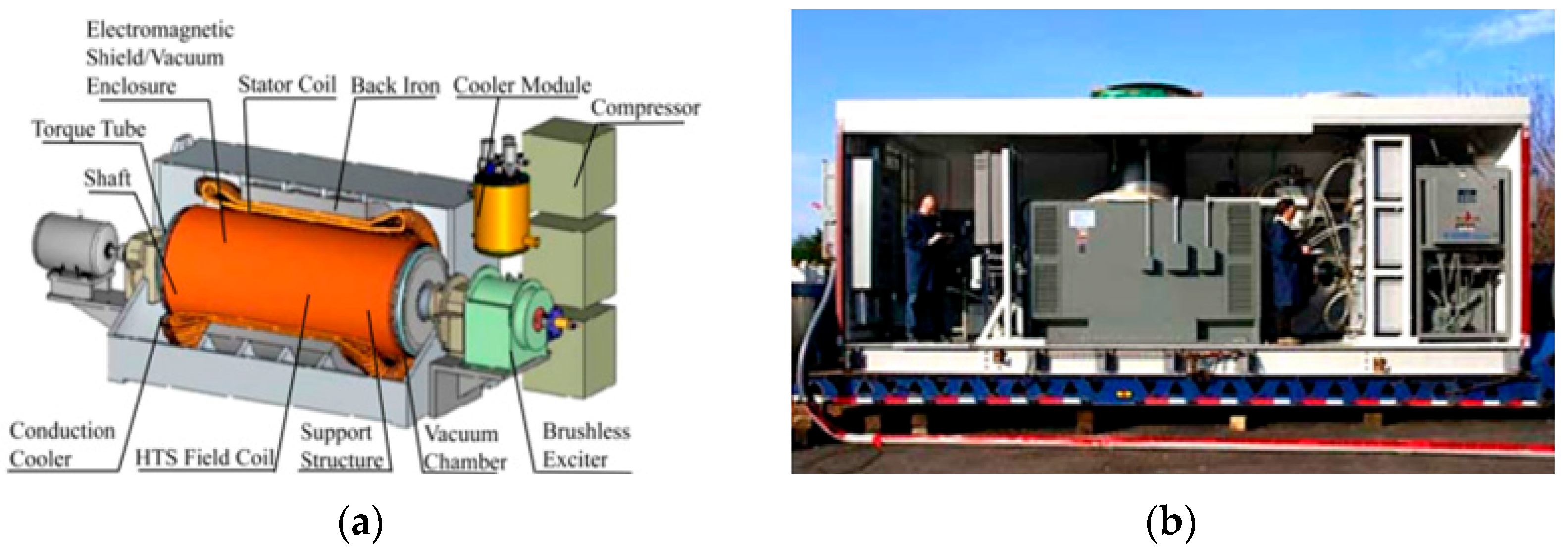
38]. In 2003, American Superconductor Corporation collaborated with Alstom to develop a 5 MW-class HTS synchronous machine. In the same year, American Superconductor designed and developed a ±8 Mvar HTS SC for the Tennessee Valley Authority (TVA), as shown in
Figure 1. The first prototype was connected to the TVA grid on 10 October 2004. This condenser was used to serve an electric arc furnace, helping to mitigate flicker caused by the furnace. Its successful operation marked the first commercial application of HTS technology for improving power system reliability [
39].
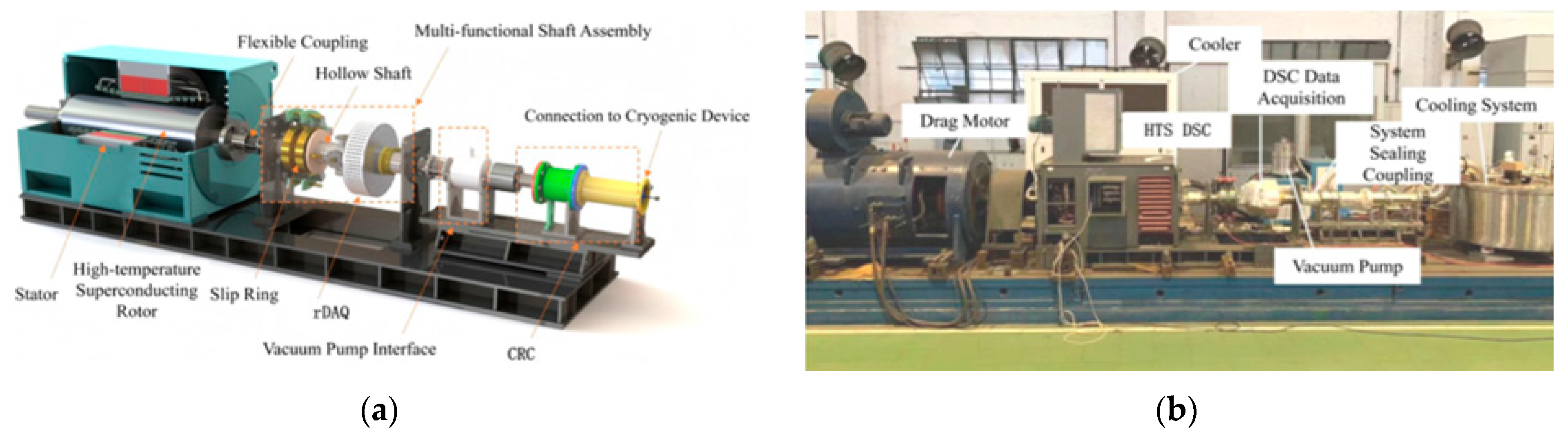
In 2018, China Southern Power Grid Company Limited initiated the development of a 10 Mvar SSC prototype. To investigate the key technologies associated with 10 Mvar HTS SCs, the project team developed a 300 kvar HTS SC prototype, as shown in
Figure 2. In collaboration with the State Key Laboratory of Tribology at Tsinghua University, comprehensive analysis and experimental validation were carried out on the prototype, providing valuable experience for the subsequent development of a 10 Mvar-class SC [
41].
Following the high-voltage direct-connected concept discussed above, similar efforts have also been extended to SSCs to further improve their dynamic voltage support capability. For SSCs, this configuration not only eliminates the need for a step-up transformer, but also takes advantage of the low synchronous reactance and high power density enabled by superconducting technology.
In 2024, the Institute of Electrical Engineering, Chinese Academy of Sciences, initiated research on a 15 Mvar/35 kV HTS SC directly connected to the grid without a step-up transformer [
40]. Meanwhile, research on a 30 Mvar/35 kV high-voltage SSC has been carried out by teams led by Xiao Shiyong from Northeast Electric Power University and Ge Baojun from Harbin University of Science and Technology. By integrating superconducting rotor technology with a high-voltage stator structure, the research team proposed a high-voltage stator topology based on cross-linked polyethylene (XLPE) cable windings and non-magnetic teeth. This approach significantly increases the voltage rating of the stator winding, thereby enabling direct grid connection of the SC [
42]. At present, the research team has developed a 170 kvar/5 kV SSC prototype and preliminarily validated the feasibility of the proposed scheme through experimental testing [
43].
SSCs provide very high power density and low steady-state losses, which enhances system efficiency and reliability. However, their cost is significantly higher than that of conventional SCs, and the requirement for cryogenic cooling increases operational complexity and maintenance demands. These factors may limit the large-scale deployment of SSCs in modern power systems.
4. Dual-Excited Synchronous Condensers
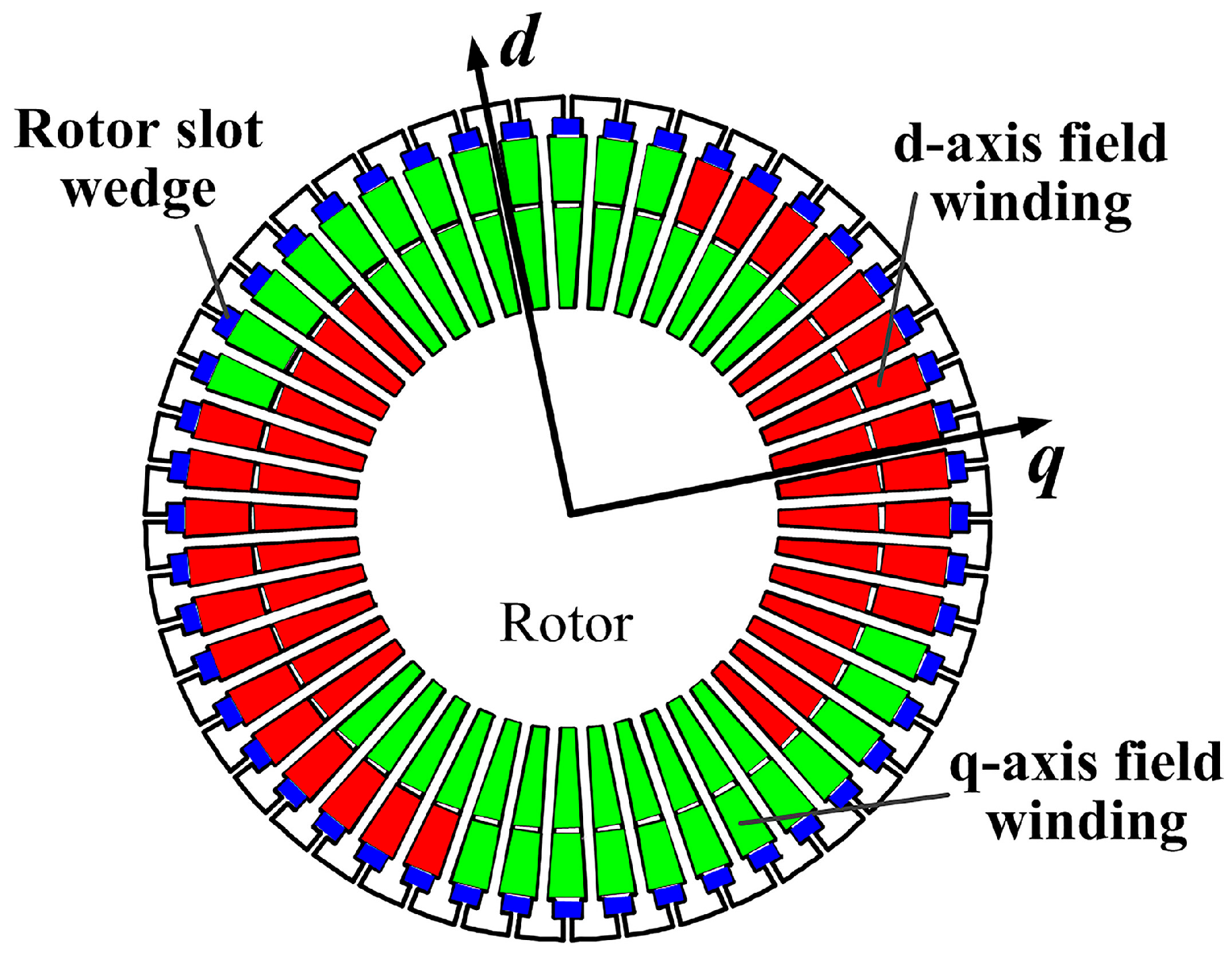
In CSCs, the rotor excitation winding is located along the d-axis, and the maximum leading-phase reactive power capability is limited by the rotor excitation current. Depending on the rated capacity, the leading-phase operation capability is typically about 50~80% of the lagging-phase operation capability. In contrast, DESCs are equipped with excitation windings on both the d-axis and q-axis of the rotor, as shown in
Figure 3. Through the excitation regulator, the magnitude and direction of the currents in the two sets of excitation windings can be independently controlled, enabling decoupling between the rotor position angle and the power angle. This allows the machine to achieve decoupled control of active power, reactive power, and rotational speed [
44].
Based on these characteristics, DESCs can significantly enhance short-term leading-phase reactive power capability without loss of synchronism by employing reverse excitation on the d-axis and coordinated control of active power via the q-axis. In this operating mode, the maximum reactive power output capability of the DESC is constrained by the maximum allowable temperature of stator and rotor materials. As the reactive power output increases, the stator and rotor temperature rise accordingly. For a 300 Mvar DESC, under the constraint that the maximum stator core temperature is 130 °C, the maximum leading-phase reactive power capability can reach 482.26 Mvar, which is more than twice that of a CSC with the same rated capacity. This demonstrates the unique advantage of the DESC in mitigating transient overvoltage [
44]. In addition, coordinated control of the d-axis and q-axis excitation can provide additional virtual inertia and improved transient stability performance [
31].
The research on dual-excited machines can be traced back to 1935, when the German engineer E. Tuxen proposed the concept of dual excitation for generators. However, it was not until the 1950s and 1960s that the concept of dual excitation and the operating characteristics of dual-excited machines began to attract academic attention, primarily to address power system stability issues and power-frequency overvoltage. In 1962, Hamdi-Sepen from Istanbul Technical University, Turkey, presented the work reported in Ref. [
46] at the CIGRE conference. Subsequently, extensive studies were conducted on the stability, damping characteristics, and excitation control of dual-excited synchronous generators. These studies mainly focused on improving transient stability of power systems. The typical approach involved adopting two-phase excitation windings on the generator rotor: under normal operation, the q-axis excitation winding remains open-circuited, while during transient disturbances, excitation voltage is applied to the q-axis winding to restore the power angle, thereby enhancing system transient stability.
Research on dual-excited machines in the Soviet Union was conducted under the leadership of Yury G. Shakaryan and his collaborators. Since 1955, Soviet research institutes, universities, and manufacturing enterprises have jointly undertaken systematic investigations into dual-excited machines. Based on in-depth studies, Soviet researchers established the fundamental theory of asynchronous synchronous machines and proposed a dual-channel excitation control strategy, successfully resolving the imbalance issue of two-phase excitation currents. Compared with the dual-excited generators proposed by E. Tuxen and Hamdi-Sepen, these asynchronous synchronous machines differ fundamentally in operating principles, electrical structure, operational characteristics, and excitation control. Owing to successful solutions to key challenges in machine design, manufacturing, and grid integration, asynchronous synchronous generators were practically implemented in the Soviet Union.
After 2010, multiple papers on dual-excited generators were published in the journal “Russian Electrical Engineering”, systematically summarizing research progress in this field [
47,
48,
49]. Subsequently, research on dual-excited machines and their control systems also expanded in Western Europe and North America, leading to a growing body of related publications.
In April 2012, the Research & development center of Federal Grid Company and Power Machines jointly developed and commissioned two ASC-100-4 DESCs at the Beskudnikovo substation in Moscow. The unit has a rated capacity of 100 MVA, and its leading-phase reactive power capability was increased from −40 Mvar (typical of CSCs) to −100 Mvar, enabling a full-range reactive power regulation capability of ±100 Mvar [
50].
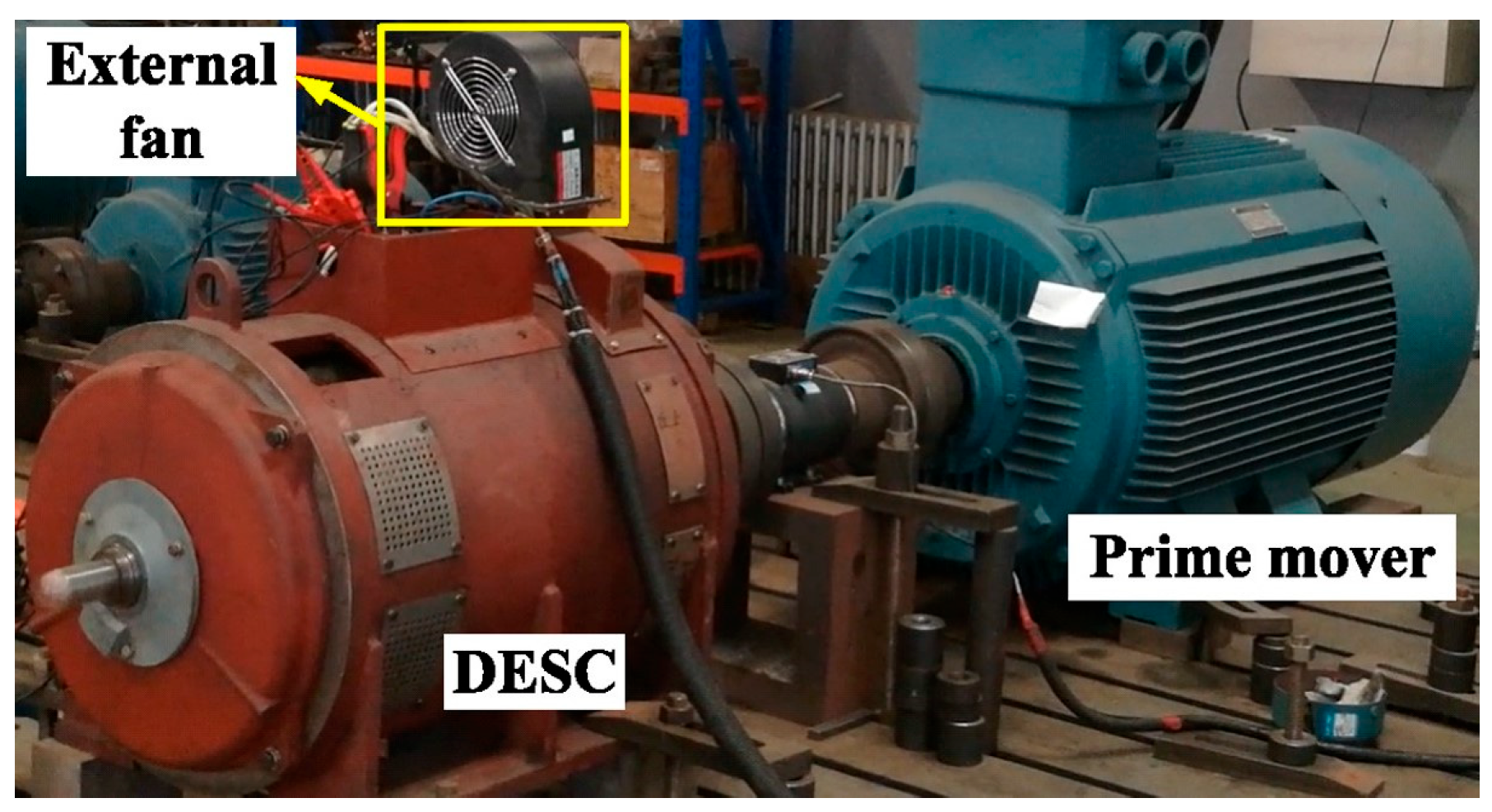
In 2019, the China Electric Power Research Institute, in collaboration with Shanghai Electric Power Generation Equipment Co., Ltd. Generator Plant and other organizations, undertook a State Grid science and technology project on DESCs and their control technologies, marking the beginning of engineering-oriented research in this area. At present, a 100 kVA DESC prototype has been developed and has passed type tests. In addition, the research group led by Xu Guorui at North China Electric Power University, supported by the key program of the joint fund of the National Natural Science Foundation of China and the State Grid Corporation of China, has conducted studies on dual-excited generators/synchronous condensers and their control strategies, and has completed the design, manufacturing, and testing of a 10 kVA prototype, as shown in
Figure 4 [
51].
DESCs enable variable-speed operation and virtual inertia control, which can enhance frequency stability in grids with high renewable penetration. However, achieving this requires careful management of rotor heating and the design of damping systems during slip operation. Repeated thermal cycling caused by varying excitation levels, together with additional eddy current losses induced by harmonic and transient magnetic fields, may accelerate insulation aging, thereby affecting long-term operational reliability. Additionally, maintaining stable operation when operating beyond the static stability limits of conventional units, particularly under deeply leading-phase conditions, poses a significant technical challenge [
31].
5. High-Inertia Synchronous Condensers
With the widespread application of CSCs in power systems, their important role in providing dynamic reactive power support and short-circuit capacity has been widely recognized. However, the rotational inertia of the condenser rotor is relatively small, typically only 30–50% of that of a generator unit with the same capacity. In addition, the capacity of a SC is usually only 20–25% of the rated capacity of the associated power station, resulting in relatively limited inertia support capability for the power system [
52].
In this paper, stored kinetic energy and inertia constant are distinguished when discussing inertia-related performance. The stored kinetic energy Ek, expressed in MW·s, represents the kinetic energy stored in the rotating mass, whereas the inertia constant H, expressed in seconds, is defined as H = Ek/Srated, where Srated is the rated apparent power. Therefore, MW·s and seconds are different but related quantities.
To increase the rotational inertia, researchers have combined SCs with flywheels, in which the flywheel is directly connected to the condenser shaft or coupled via a gearbox. In particular, configurations employing a speed-increasing gearbox and a high-speed vacuum flywheel can increase rotational speed while reducing air friction losses, thereby decreasing the mass and volume of the flywheel and reducing system losses [
53].
In 2020, GE announced the supply of two HISCs to the Italian transmission system operator Terna S.p.A. for the Brindisi substation in southern Italy. Each unit can provide up to +250/−125 Mvar reactive power and an inertia energy contribution of 1750 MW·s, thereby enhancing grid stability. In 2021, Siemens installed two SCs equipped with vacuum flywheels at the Robertstown substation operated by ElectraNet in South Australia. In 2023, Siemens supplied a HISC with a capacity of +245/−111 Mvar for the Moneypoint power station owned by ESB. This unit was equipped with the largest flywheel of its kind at that time and was capable of providing an inertia energy contribution of 4000 MW·s. In 2024, Shanghai Electric Power Generation Equipment Co., Ltd. Generator Plant supplied a distributed HISC for the second phase of the Peñasco photovoltaic power plant in Mexico, featuring a reactive power regulation capability of +25/−12.5 Mvar and a doubled inertia constant H through flywheel integration. ABB has also proposed a HISC solution consisting of a 70 Mvar SC with an integrated flywheel, achieving an inertia constant greater than 6 s and stored kinetic energy of up to 450 MW·s. With modular configurations, this solution can meet different grid requirements and has been applied in the Lister Drive Greener Grid project in Liverpool, UK.
6. Energy Storage Synchronous Condensers
6.1. Energy Storage Synchronous Condenser Based on Conventional Synchronous Condenser with Variable-Speed Flywheel
Although HISCs provide greater inertia than CSCs, their rotational speed is essentially synchronized with grid frequency, resulting in limited mechanical energy variation during grid frequency fluctuations. Consequently, they do not possess primary frequency regulation capability. If the gearbox is replaced by a variable-speed device, the flywheel speed can vary over a wide range to release or absorb more mechanical energy. This not only provides higher inertia support but also enables participation in primary frequency regulation. When coordinated with energy storage systems, it can effectively improve active power regulation performance in renewable energy stations [
54].
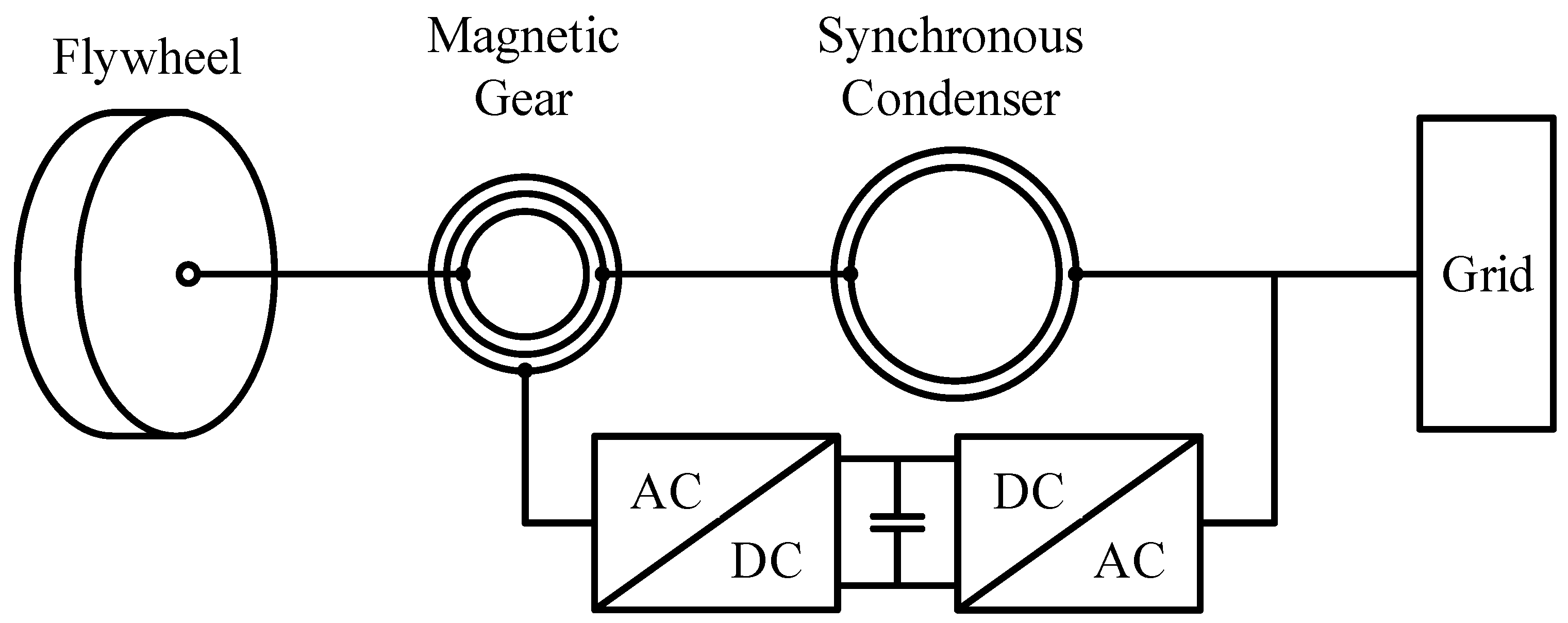
Based on this concept, Li Zhiqiang et al. from the China Electric Power Research Institute proposed a flywheel energy storage SC system based on a magnetic-geared speed regulator [
54], as shown in
Figure 5. In this system, the SC and the flywheel are connected to the modulation ring and inner rotor of the magnetic gear, respectively. By controlling the current frequency of the stator winding via a converter, stepless speed regulation between the condenser and the flywheel can be achieved, enabling the system to function as an integrated energy storage system with both reactive power support and active power regulation capability.
Ref. [
55] proposed another flywheel energy storage SC system based on permanent magnet variable-frequency speed regulation. The structure and operating principles are similar to those of the magnetic-geared SC system, except that a dual-rotor permanent magnet machine replaces the magnetic gear. The condenser rotor is connected to the armature rotor, while the flywheel is connected to the permanent magnet rotor. Wide-range active regulation of the flywheel speed is achieved through a frequency converter connected to the armature winding. However, the slip rings between the armature rotor and the converter impose higher maintenance requirements on the system.
6.2. Energy Storage Doubly-Fed Synchronous Condensers
Doubly-fed machines exhibit variable-speed constant-frequency characteristics and can achieve a wide speed regulation range of up to ±30% through AC excitation. This enables efficient conversion between mechanical and electrical energy via rotor speed variation, allowing for the provision of frequency regulation power or virtual inertia to the grid [
31]. In addition, inertia and energy storage capacity can be increased by enlarging the rotor size or integrating a flywheel. Through virtual inertia control, DFSCs can emulate a control-equivalent inertia exceeding 100 s under specific control settings, rather than an intrinsic mechanical inertia constant
H [
56]. This capability makes them promising candidates for ESSC applications.
As early as 2002, studies proposed the use of doubly-fed machines as variable-speed SCs. By employing vector control strategies, decoupled control of active and reactive power can be achieved. During voltage drops, reactive power can be injected into the grid to maintain voltage stability, while the kinetic energy stored in the rotor can provide short-term active power support [
57].
In 2004, Yang Hao et al. [
58] from Huazhong University of Science and Technology proposed a multifunctional flexible power regulator based on a doubly-fed synchronous condenser (DFSC) and developed a prototype. The system consists of a doubly-fed machine and a coaxial flywheel with large rotational inertia, enabling fast and wide-range bidirectional regulation of both active and reactive power. Experimental studies conducted on a small-scale system demonstrated that the device can perform multiple functions, including energy storage, power generation, and reactive power compensation, with good dynamic and steady-state performance [
59].
In 2021, the China Electric Power Research Institute, in collaboration with the State Grid Electric Power Research Institute, developed a 3 MVA ESSC combining a doubly-fed machine with a flywheel, which was commissioned at the Zhangbei renewable energy base.
Ref. [
60] proposed a composite ESSC system in which an energy storage unit is added to the DC side of the converter of the DFSC. This configuration allows for integration with hybrid energy storage systems such as supercapacitors and lithium batteries for frequency regulation. During grid frequency disturbances in renewable energy stations, the energy storage modules, including lithium batteries, can provide power support, thereby improving the response speed and capacity of primary frequency regulation.
However, due to the absence of damping windings, the rotor excitation system of DFSCs is more susceptible to impact during grid faults, resulting in poorer fault ride-through capability compared to CSCs [
31]. To address this issue, researchers have proposed the use of conductive slot wedges to introduce equivalent damping effects through eddy currents generated between conductive slot wedges and end rings.
Xie Xianfei et al. [
61] from Huazhong University of Science and Technology investigated the impact of such equivalent damping windings on DFSC performance and grid support capability. The results show that appropriately designed conductive slot wedges can enhance the inherent support capability of the condenser during frequency disturbances and improve voltage support performance under extreme conditions such as short circuits. In addition, the effects of magnetic slot wedges with both electrical conductivity and magnetic permeability on DFSC performance were investigated, showing that magnetic slot wedges with suitable electrical and magnetic properties can mitigate slotting effects, improve air-gap flux distribution, significantly reduce no-load excitation current and losses, and effectively suppress harmonic torque under load conditions [
62].
ESSCs and HISCs can provide enhanced rotational inertia and improved frequency stability, making them valuable for grids with high renewable penetration. However, the inclusion of flywheels and other devices increases overall system losses, cost, and mechanical complexity. In particular, for ESSCs, additional rotor and power electronics losses may occur during variable-speed operation, further contributing to relatively high system losses.
7. Phase Modulation Conversion of Power Units
Since the 1960s, in addition to installing dedicated SCs, China has also converted steam turbine generators and hydroelectric generators into SC operation to stabilize grid voltage and improve power quality. A representative example is the TTSS-250-2 250 Mvar dual internal water-cooled SC, converted from a steam turbine generator and commissioned in 1977 at the Weijiatun substation in Anshan. This unit was once the largest SC in China and remained in stable operation for more than 20 years.
With the rapid development of renewable energy sources such as wind and photovoltaic power, traditional thermal power units are facing early retirement. Converting retired or idle thermal power units into SCs, or flexible units capable of both generation and phase modulation operation, can provide dynamic voltage support and inertia support to the power system, thereby improving voltage and frequency stability. At the same time, this approach enhances the utilization efficiency of retired units and offers significant economic benefits [
63,
64].
In 2010, the Comisión Federal de Electricidad in Mexico converted a 14 MW gas turbine unit at the CTG Universidad power plant in northern Monterrey to enable both generation and phase modulation operation. In 2016, in Akron, Ohio-based utility FirstEnergy converted five large generators at the Eastlake coal-fired power plant near Cleveland to operate as SCs, providing both dynamic and static voltage support to the regional grid [
65]. In 2018, GE completed the first conversion of a 625 MVA liquid-cooled steam turbine generator into a SC in Europe. In 2021, the Deeside power station in the UK converted two gas turbine units to provide inertia and reactive power support to the grid.
In 2022, Unit 2 of the Nanyang Yahekou power plant, Henan, China, was converted to add phase modulation function. The upgraded unit retains power generation capability while providing a reactive power capacity of 300 Mvar. In 2024, Henan China Resources Power Gucheng Co., Ltd. converted its in-service 300 MW-class thermal power unit to add phase modulation function. The upgraded unit operates in power generation mode during peak demand periods and in peak shaving and phase modulation modes during off-peak periods, thereby facilitating renewable energy integration, ensuring grid stability, and improving economic performance through enhanced equipment utilization and reactive power compensation benefits.
In addition to economic benefits, the long-term mechanical reliability of retired thermal power units operating in continuous phase modulation mode is a critical concern. Taking phase modulation conversion of Unit 2 of the Nanyang Yahekou Power Plant as an example, it has been demonstrated that the mechanical risks under continuous phase modulation operation mainly originate from changes in lubrication systems, shafting configuration, and sealing alignment conditions. These include increased complexity of the lubrication system, altered shafting dynamic behavior, and deviations in sealing alignment, all of which directly affect the long-term operational reliability [
66]. These factors highlight the importance of mechanical system redesign in turbine generator-based synchronous condenser applications.
Furthermore, preliminary studies have also explored the application of phase modulation capability in hydropower and pumped storage units. However, representative large-scale engineering applications are still lacking. Overall, phase modulation conversion of power units lacks a well-established systematic engineering framework and thus remains underdeveloped, presenting significant opportunities for further research and application.
8. Conclusions
With the increasing penetration of renewable energy in power systems, issues related to voltage and frequency stability have become increasingly prominent. Owing to their unique advantages in enhancing dynamic voltage support, improving voltage regulation characteristics, and providing rotational inertia [
31], SCs have attracted significant research attention in recent years.
This paper reviews the development history and current research status of six main types of SCs. A comparison of their key technical indicators, characteristics, and application scenarios is presented in
Table 3. The comparison indicates that each type of SC has distinct advantages and application boundaries, and that the selection of an appropriate technology should depend on grid strength, renewable energy penetration, inertia requirements, reactive power demand, available installation space, and economic constraints. CSCs feature low cost and mature technology, and their rotational inertia can be further enhanced by integrating flywheels, enabling a wide range of applications. However, the additional flywheel system may increase investment, losses, and mechanical complexity, and should therefore be evaluated according to specific system requirements. Compared with conventional units, DESCs exhibit stronger leading-phase reactive power capability and improved stability, with only a slightly higher cost, making them particularly suitable for suppressing transient overvoltage in regions with high renewable energy penetration. DFSCs without additional slot-wedge damping measures have relatively weaker dynamic reactive power support capability; however, they possess large rotational inertia and can participate in primary frequency regulation, showing strong application potential in systems with insufficient inertia and frequency regulation capacity. It should also be noted that the integration of flywheels, rotor-side converters, and variable-speed operation may increase system losses, cost, and mechanical complexity, and therefore requires careful evaluation in practical applications. SSCs offer high power density and low losses, making them suitable for space-constrained applications. Nevertheless, their high cost, cryogenic cooling requirements, and limited engineering maturity may restrict their near-term large-scale deployment. In addition, converting retired or idle generator units into SCs, or enabling dual operating modes, improves equipment utilization and yields considerable economic benefits. However, this approach still requires systematic standards for retrofit design, grid connection assessment, and operational coordination. Therefore, the selection of SC technologies for specific power system applications should be based on a comprehensive evaluation of technical performance, engineering maturity, system requirements, and economic constraints.
Based on the review of current SC technologies, the following four promising avenues for future research are proposed:
(1) High-voltage direct-connected synchronous condensers. This configuration eliminates the need for step-up transformers, thereby avoiding the impact of Xk on SC performance, increasing the short-circuit capacity of a single unit, and enhancing its dynamic reactive power support capability. Compared with the conventional “synchronous condenser + transformer” configuration, high-voltage direct-connected SCs can simplify the system topology, reduce the number of devices and potential fault points, and reduce initial investment, the required land footprint, as well as operation and maintenance costs and operating losses. In addition, increasing the voltage level for the same capacity reduces the rated current, thereby further decreasing copper losses during operation.
(2) Hybrid synchronous condenser systems and coordinated control strategies. Combining SCs with technologies such as SVCs, STATCOMs, GFM converters, and energy storage devices can fully leverage the complementary advantages of different resources. In such hybrid systems, SCs can provide mechanical rotational inertia, short-circuit capacity, and dynamic reactive power support, while power-electronic devices and energy storage systems can provide fast active power regulation, flexible control, and rapid damping support [
69,
70,
71]. For example, the coordinated use of SCs and wind power synthetic inertia can improve frequency stability in low-inertia systems [
72], while the joint planning of SCs and GFM converters can enhance both system strength and fault current support in systems with high penetration of inverter-based resources (IBRs) [
73]. In addition, the combination of SCs with hybrid energy storage systems can support coordinated active and reactive power management, especially in renewable energy-dominated or isolated power systems [
74]. However, these hybrid configurations require appropriate coordination and control strategies, including optimal sizing and placement, active/reactive power coordination, control time-scale coordination, and fault response coordination, to ensure stable, reliable, and economically efficient operation.
(3) Standardized design for phase modulation conversion of power units. For the retrofitting of power units to provide phase modulation function, clear technical standards should be established regarding the retrofitting process and grid integration scheme. Specifically, these standards should cover the retrofit procedures for generator bodies, excitation systems, cooling systems, shafting systems, lubrication oil and jacking oil systems, and the evaluation criteria for the dynamic performance of retrofitted units. This is of great significance for ensuring that the retrofitted units can achieve high reactive power performance and long-term safe and reliable operation, while providing voltage and frequency support for power systems [
75].
(4) Research on SCs based on novel machine structures and operating principles. At present, the machine structures and operating principles used for SC applications are still mainly concentrated on electrically excited synchronous machines, dual-excited machines, doubly-fed machines, and superconducting machines. Slip ring–brush structures, as well as cryogenic cooling systems in superconducting machines, reduce system operational reliability and significantly increase maintenance complexity and operational requirements. To overcome these limitations and further enhance system reliability and operational robustness, researchers have begun to explore alternative machine structures and operating principles for SC applications. For example, an SC concept based on a wound-field flux-switching machine has been proposed [
76]. This machine topology may offer advantages because its stator-mounted excitation windings eliminate the need for brushes and slip rings while retaining a robust rotor structure; these features can enhance thermal management, reduce maintenance complexity, and support robust grid performance through high inertia and relatively low per-unit reactance. These machine concepts, when applied as synchronous condensers and combined with advanced insulation technologies such as GVPI, are expected to provide a promising pathway toward long-term low-maintenance or approaching maintenance-free operation in future power systems.
At present, CSCs have been widely deployed in power systems. In contrast, the commercial application of other types remains limited due to factors such as cost and technological maturity. Nevertheless, with the coordinated efforts of grid operators, manufacturers, and research institutions, and with the continuous increase in the penetration of non-synchronous generation as well as ongoing advancements in SC technologies, these diverse types of SCs are expected to achieve broader application in the future and become key equipment for ensuring the development, security, and stable operation of modern power systems.