1. Introduction
Demand-side management (DSM) is no longer a purely economic scheduling issue. As residential loads become increasingly controllable through Home Energy Management Systems (HEMSs), aggregators, smart meters, and low-latency communication links, DSM has become a cyber–physical control loop, requiring decisions based on data reliability and actuation timeliness. This evolution creates a central tension: the same connectivity that enables flexibility also creates new paths for cyber attacks and communication failures that distort scheduling decisions [
1]. Two disturbances are particularly consequential: False Data Injection (FDI) attacks corrupt the load information used by the aggregator, leading to economically inefficient and operationally misleading procurement and scheduling decisions. Price Manipulation Attacks (PMAs) distort the price signal received by prosumers, causing loads to shift at the wrong times and overreact to artificial price spikes. In both cases, damage is caused not only by the attack itself but also by the implicit assumption of schedulers that the received signals are reliable [
2,
3]. The degradation of communication brings with it another, but equally important, form of fragility. Latency and packet loss do not necessarily corrupt the objective function; instead, they reduce the probability that a computed control action is implemented in a timely manner. This distinction applies to thermally limited loads, such as HVAC systems, in which delayed control packets can cause comfort errors that cannot be completely fixed in the same scheduling horizon. When QoS is treated only as a network-layer metric, its operational effect on scheduling is lost, specifically its role in changing the value of flexibility and the risk of delayed actuation [
4]. This study addresses this gap by redefining DSM as a risk-aware orchestration problem. The proposed CQ-DSM framework incorporates the likelihood of cyber risk and communication quality as first-class schedule signals, rather than optimizing nominal scheduling first and applying cyber or QoS corrections after observing deterioration.
The contributions of this work are summarized as follows:
(C1) A unified MILP formulation that embeds a continuous cyber-risk likelihood and QoS degradation index directly into the scheduling objective, producing proportionate, proactive load adjustments without requiring attack detection to cross a binary threshold. This is technically distinct from post-hoc reactive mitigation (RS-DSM) and robust optimization approaches (RC-DSM, CC-DSM), which handle uncertainty through set-based conservatism rather than probabilistic trust pricing.
(C2) A privacy-preserving hierarchical coordination protocol in which the aggregator broadcasts only three scalar signals—the real-time price λ(t), adaptive comfort weight, and risk likelihood—while each HEMS solves its own sub-problem using the local state. The adaptive weight rule (Equation (1)) couples system-level risk to household-level scheduling without revealing appliance-level data to the aggregator.
(C3) Empirical demonstration, via an ablation study, that cyber-risk pricing and QoS-aware fallback address distinct failure modes: the cyber penalty reduces FDI-induced cost overrun by 44% relative to AU-DSM, while the QoS fallback reduces thermal-violation penalty by 81% under degraded communication, with neither mechanism substituting for the other.
(C4) A scalable hierarchical architecture in which all HEMS sub-problems are solved independently in parallel, with measured solve times below 0.8 s per HEMS and aggregate scheduling within the 5 min control interval for P = 500 prosumers on a 16-core server, establishing practical feasibility without a centralized mixed-integer problem.
The objective of this study is not to propose a new cyber-attack detector in isolation. The detector functions as a modular risk estimation layer that is supplied to the scheduler. The broader contribution lies in demonstrating how a probabilistic signal can be translated into an economically and physically meaningful scheduling behavior.
The remainder of this paper is structured as follows: In
Section 2, we discuss related work in direct comparison with the state-of-the-art.
Section 3 describes the system architecture.
Section 4 describes the system model and provides details of the MILP optimization framework.
Section 5 presents the cyber threat model and risk estimation mechanisms. The solution approach and hierarchical coordination protocol are described in
Section 6.
Section 7 describes the simulation setup used in this study.
Section 8 presents and discusses experimental results, including ablation and sensitivity analyses. Finally,
Section 9 concludes the paper.
2. Related Work
Literature relevant to CQ-DSM can be read through a simple lens: prior work has made DSM economical, robust, or secure in separate ways, but rarely treated economic scheduling, cyber trust, and communication reliability as mutually interacting parts of the same control problem. In this section, the relevant literature is organized along four axes: DSM scheduling and HVAC control, cyber-resilient control, communication awareness for smart grid operation, and learning-assisted frameworks.
2.1. DSM Optimization and HVAC Control
The classical DSM problems have led to the well-known MILP, model predictive control and heuristic scheduling methods as effective tools for residential appliance coordination [
5]. This is typically done using first-order thermal/HVAC dynamics, which facilitate tractable comfort-constrained optimization [
6]. These approaches lay the mathematical foundation for appliance scheduling, but they largely presume that prices, measurements, and control signals are trustworthy and timely. Consequently, their flexibility is optimized under nominal information but not cyber–physical uncertainty. CQ-DSM retains the tractability of MILP scheduling while extending its objective to account for the trust and delivery conditions under which a schedule will be executed.
2.2. Cyber-Attack Modeling and Robust Control
The overall field of smart grid cyber-resilience has already produced significant models of FDI attacks, PMA impacts, and detection-based mitigation [
7,
8,
9,
10,
11,
12,
13]. Much of this work, though, is done at the transmission level, and is detector-centric or reactive: an anomaly is detected then a remediation response is applied. This creates a significant gap for residential DSM. Recent work has extended cyber-resilience to electric vehicle (EV) communication networks [
14], mobile resource scheduling under security constraints [
15], multi-layer security architectures for smart grid protection [
16], and mobile energy storage with variable-speed transmission [
17], collectively underscoring the breadth of adversarial surfaces that residential DSM must eventually address. CQ-DSM therefore treats cyber risk not merely as an alarm state, but as a continuous scheduling price that discourages vulnerable load configurations during high-risk intervals. It is further positioned relative to IEC 62443, the widely deployed industrial cyber-security standard for operational technology [
18]. IEC 62443 defines security levels (SL 1–4) and zone–conduit models that govern access control and patch management at the device and network level; CQ-DSM is complementary rather than competing: it operates within those access-control boundaries and translates the residual probabilistic risk—information that IEC 62443 does not propagate into the scheduler—into economically meaningful scheduling adjustments.
2.3. Communication QoS in Smart Grid Control
The impact of latency and packet loss on smart grid actuation and demand-response reliability has been demonstrated for communication-aware control studies [
4,
19]. Yet in many DSM formulations, QoS remains outside the scheduler or appears only as a feasibility threshold. Such separation hides the fact that lower quality communication alters the physical value of the comfort margin: if a control signal can be delayed or dropped, then the system should try to avoid schedules where HVAC corrective action is just-in-time. This intuition is made explicit in CQ-DSM with QoS degradation tied to both the objective function and a local fallback policy.
2.4. Learning-Based Methods and Joint Architectures
Methods that are based on learning for DSM and anomaly detection provide flexibility, but they may hide the causal chain between an identified anomaly and the final control action decided upon [
11,
20,
21]. CQ-DSM adopts a hybrid design: learning is used only to estimate a probabilistic risk signal, while the final scheduling decision remains an interpretable MILP. This way, the framework can take advantage of test time data-driven early warning without losing the transparency and constraint handling essential for residential energy control.
2.5. Positioning of This Work
Recent HVAC energy-modeling and MPC reviews emphasize the maturity of predictive building-control formulations [
22], while robust optimal-control approaches for multi-carrier microgrids demonstrate the broader relevance of uncertainty-aware DSM formulations [
23]. The resultant position of CQ-DSM is shown in
Table 1. Existing methods generally tackle one or two of the dimensions—robust optimization under uncertainty, attack detection, PMA resiliency or HVAC coordination—without offering a joint price of cyber-risk likelihood and QoS of communication within a comfort-aware HEMS scheduling problem. Thus, there is no single module that defines CQ-DSM and instead it is the integration pathway where a risk signal, a QoS signal and the MILP local scheduler all relate to an adaptive coordination rule preserving privacy/scalability by changing the schedule before damage becomes observable.
3. System Overview
3.1. Overall Architecture
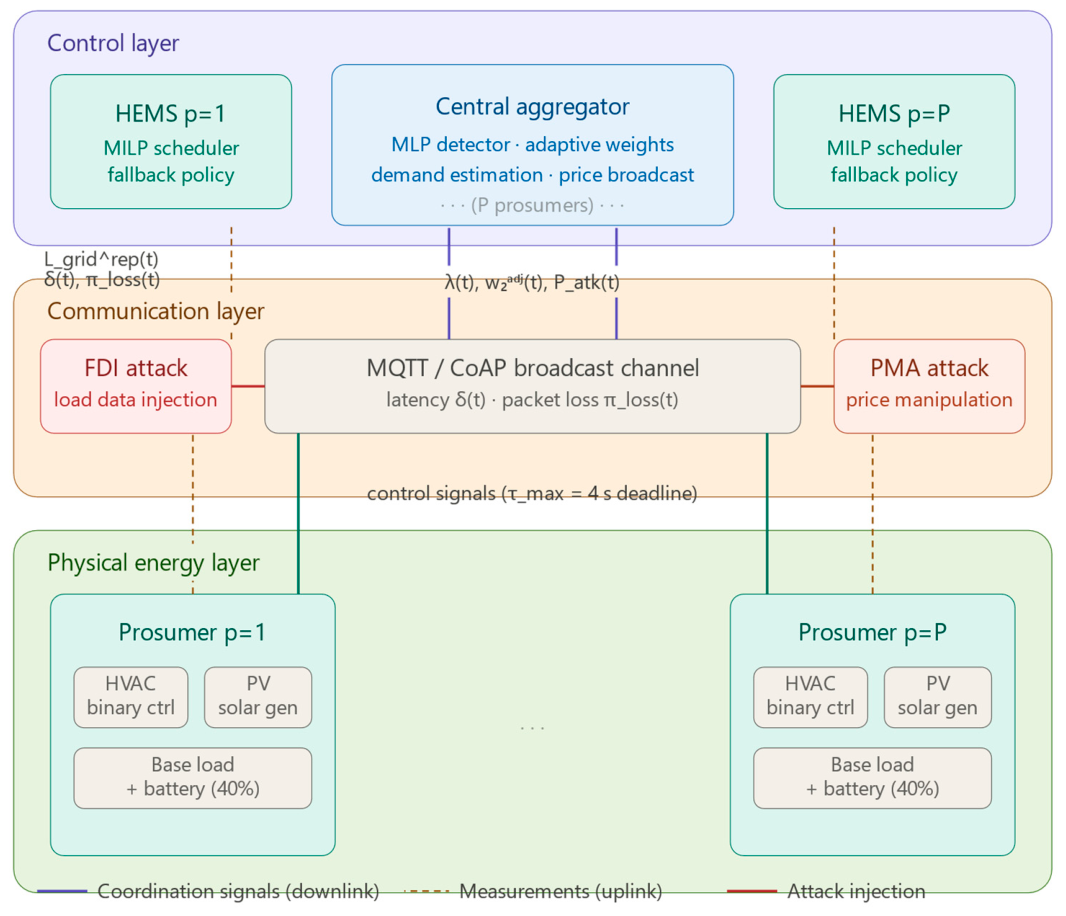
CQ-DSM is organized as a three-layer cyber–physical control architecture. The physical layer contains residential prosumers with base demand, HVAC loads, optional PV generation, and optional battery storage. The communication layer carries coordination signals and measurements, but is itself imperfect: latency and packet loss shape whether a computed action can be implemented on time. The control layer contains two decision levels: local HEMS units that optimize appliance schedules, and an aggregator that estimates risk and broadcasts coordination signals.
Figure 1 summarizes how energy flows, information flows, and attack surfaces interact in the proposed architecture.
3.2. Decision-Making Layers
3.2.1. Local Decision Layer (HEMSs)
At the local layer, each HEMS solves a rolling-horizon MILP that converts system-level signals into household-level appliance decisions. Its task is intentionally local and it uses the received price, the adaptive comfort weight, local temperature measurements and appliance states to schedule HVAC and shiftable loads. In situations where the communication channel becomes unreliable, the HEMS does not wait passively for the aggregator: it triggers a fallback policy in which it focuses on a narrower comfort band. This design provides each household a safety mechanism against delayed coordination without requiring the aggregator to observe private appliance details.
3.2.2. Global Decision Layer (Aggregator)
The aggregator at the global layer coordinates rather than commands. Every , it estimates cyber risk, monitors QoS, updates demand estimates, and broadcasts the coordination tuple (, , ).
The adaptive weight
is the main mechanism to increase the value of comfort preservation when the data stream appears less trustworthy or the control channel becomes less reliable.
Clipping is important because it treats heterogeneous communication impairments as a bounded scheduling signal; under worst-case conditions, the adaptive weight is capped at (1 + + ) = 1.44. This rule essentially raises the price of comfort violations when trust and actuation reliability deteriorate, while maintaining the MILP linear form. If the communication network is completely unavailable for an extended period (i.e., no coordination tuple is received within τmax = 4 s across consecutive scheduling intervals), the HEMS activates its local fallback policy indefinitely, targeting the tightened comfort band [Tp,low + 0.5, Tp,high − 0.5] °C. In this case, is no longer updated from the aggregator; the HEMS operates autonomously on a local thermal state until network recovery is signaled. No aggregator-level cyber penalty is applied during the outage because no price signal is received, ensuring the household remains in a purely comfort-preserving mode.
3.3. Proactive Risk-Aware Operation
The central idea of CQ-DSM is temporal: resilience is more valuable before a disturbance has already produced cost or comfort damage. Conventional DSM ignores cyber and QoS indicators; reactive DSM waits until degradation is visible. CQ-DSM instead treats , computed from a 60 min sliding window, as a leading signal. This enables pre-conditioning, deferral, and procurement adjustments during the early stages of an attack or communication degradation, when the schedule still has degrees of freedom.
3.4. Communication Standards, Privacy, and Edge Deployment
The CQ-DSM architecture can be implemented using the already-established smart grid communication stacks. The aggregator-to-HEMS broadcast of the coordination tuple is well suited to lightweight publish–subscribe protocols such as MQTT or CoAP. The signal generated by the MLP can be incorporated within current IDS/IPS pipelines that comply with IEC 62351 and NISTIR 7628. At the device security level, CQ-DSM aligns with the IEC 62443 zone–conduit model: the aggregator and HEMS reside in separate security zones, and only the three-scalar coordination tuple crosses the conduit boundary, minimizing the attack surface at the communication interface.
The coordination protocol is deployable as well. The aggregator only broadcasts (scalar) signals and receives aggregate QoS information; appliance states, indoor temperatures, and detailed household load profiles all remain local. For the 12-step rolling horizon, this means the HEMS MILP has 72 binary variables and is solved with the CBC (Coin-OR Branch-and-Cut) solver through Python-MIP (Python version 3.11), with measured solve times below 0.8 s. Therefore, the proposed architecture is not dependent on cloud-side appliance control or the continuous reporting of household-level data.
4. System Model and Optimization Framework
4.1. System Model
4.1.1. Prosumers and Energy Resources
The modeled system consists of P residential prosumers connected through an aggregator. Each prosumer has non-controllable base demand, controllable appliances, HVAC flexibility, optional PV generation, and optional battery storage. The optimization horizon is a 24 h day divided into T = 288 five-minute intervals. This resolution is fine enough to capture HVAC and communication effects, while remaining tractable for rolling-horizon MILP scheduling.
4.1.2. HVAC Thermal Dynamics
The indoor temperature of prosumer p evolves according to a first-order thermal model:
Here captures passive heat exchange with the outdoor environment, translates electrical HVAC energy into a cooling effect, and is the binary on/off decision. The negative HVAC term corresponds to the cooling-dominated scenario that was assumed from the actual experiments.
The first-order model (Equation (3)) is deliberately parsimonious: it captures the dominant thermal inertia of a building envelope without introducing the multi-zone, moisture, and infiltration effects present in high-fidelity building energy models (e.g., EnergyPlus). This entails two practical limitations. First, buildings with very low thermal mass (e.g., lightweight manufactured housing) may exhibit faster temperature swings than the model predicts, potentially underestimating the frequency of comfort violations. Second, the single lumped parameter α_p does not capture room-to-room temperature heterogeneity or the asymmetric insulation profiles of older versus modern housing stock. These effects are acknowledged as a boundary of the current simulation scope; incorporating multi-zone thermal models is identified as a direction for future validation.
4.1.3. Communication Network and QoS Model
The communication model links cyber–physical reliability to control execution [
4,
26]. A signal may be lost with probability
, and even a received signal is useful only if it arrives before the deadline
. Thus, communication degradation is not merely a network statistic—it directly changes the probability that a scheduled action translates into a real physical action.
If latency or packet loss exceeds the prescribed threshold, the HEMS falls back to a local comfort-preserving policy.
4.1.4. Cyber-Risk Awareness
The cyber-risk likelihood
is treated as an exogenous scheduling signal produced by the detector described in
Section 5. Rather than making a hard attack/no-attack decision, the optimizer uses the continuous
allowing mild, moderate, and severe risk levels to produce proportionate scheduling responses.
4.2. Objective Function Formulation
4.2.1. Economic Cost
The energy term reflects the well-known economic objective of DSM: shift controllable demand away from expensive periods while accounting for PV export via symmetric net metering.
4.2.2. User Comfort Disutility
For prosumer
p at time
t, thermal violation is given by:
The scheduling inconvenience for shiftable appliance a is given by:
The comfort term monetizes two forms of user inconvenience: temperature excursions outside the preferred band and deviation from preferred appliance timing. This makes comfort comparable with energy and resilience costs without imposing unrealistic hard feasibility whenever a small transient thermal deviation occurs. The coefficients μ
p = 0.5 USD/(°C·slot) and ν
p = 0.1 USD/slot are listed in the Abbreviations table and represent moderate residential comfort valuations consistent with demand-response literature [
5].
4.2.3. QoS Degradation Cost
The QoS term introduces an economic cost for degradation of communication. It discourages operating large flexible loads when control delivery is less reliable. To retain MILP linearity, aggregate-load terms in CQoS and Ccyber are evaluated with the aggregator’s current demand estimate during rolling-horizon implementation.
4.2.4. Cyber-Risk Penalty
The cyber-risk penalty discourages high load exposure during time periods more likely to involve compromised reporting data or price signals. acts as a trust discount: as risk rises, the scheduler becomes less willing to rely on aggressive load-shifting decisions that could amplify the impact of corrupted information.
4.2.5. Unified Optimization Problem
The overall CQ-DSM optimization problem can be formulated as:
The four terms capture the essence of CQ-DSM: economic efficiency is co-optimized with comfort, communication reliability, and cyber trust. Nominal weights are
,
,
, and
. These weights were selected through a grid search over candidate values {0.3, 0.5, 0.6, 0.8, 1.0, 1.2} for each weight independently, evaluated on a held-out validation day (NYISO August 14). The selected values represent a Pareto-efficient point that balances cost reduction (w
1 and w
4 dominant) with comfort protection (w
2 dominant) and QoS responsiveness (w
3). A formal sensitivity analysis in
Section 8.8 confirms that performance changes modestly within ±50% of these nominal values, indicating that exact calibration is not critical within the tested range. Battery degradation and imbalance procurement costs are included for the relevant prosumer and aggregator components, respectively. Imbalance procurement costs represent the aggregator’s real-time market cost to correct deviations between scheduled and actual aggregate demand. Specifically, whenever the reported (potentially corrupted) load L
gridrep(t) differs from the true aggregate demand, the aggregator must procure balancing energy at an imbalance penalty price λ
imb = 1.5 · λ(t) to cover the shortfall or spill the surplus. The imbalance cost is thus C
imb = Σ
t λ
imb(t) · |L
est(t) −
gridrep(t)| · Δt. Under FDI attacks, this term grows because the corrupted reported load inflates the forecast error; the cyber-risk penalty (Equation (9)) and the blended demand estimator (
Section 6.1) jointly reduce this exposure.
5. Cyber Threat Model and Risk Estimation
5.1. Attack Models
5.1.1. False Data Injection (FDI) Attacks
In FDI attacks, the adversary manipulates metering data so that the aggregator observes a distorted aggregate demand. The reported load at time t under FDI is:
where
is drawn from U(−0.2·
, 0.2·
) throughout the attack window [96, 192], (hours 8–16) consistent with FDI literature [
7].
5.1.2. Price Manipulation Attacks (PMAs)
The attack window [96, 192] (hours 8–16) uses (t) [−0.3, +0.5]. Upward PMA tests the tendency of loads to over-curtail during artificially high prices; downward PMA tests the tendency to over-consume during artificially cheap intervals. The attack model is intentionally non-adaptive, providing a controlled setting in which the scheduling consequences of corrupted prices can be isolated.
5.1.3. Stealthy Low-Magnitude FDI Attacks
Also included is a stealthy variant FDI to investigate the regime where perturbations are too small to consistently trigger a strong detector response. Here,
is bounded to 30% of the maximum standard FDI amplitude. The stealthy FDI scenario is explicitly evaluated in
Section 8.5 in terms of its cost-efficiency impact: under stealthy perturbations, CQ-DSM incurs a small premium over AU-DSM due to the always-on cyber penalty, while the benefit-to-cost ratio improves as attack magnitude increases toward the full FDI level. This result confirms that proactive risk pricing is conservative at low threat intensities but increasingly valuable as attacks become operationally significant.
5.2. Cyber-Risk Likelihood Estimation
The risk estimator converts recent measurements into
using a sliding window of reported load, broadcast price, latency and packet loss encoded through a GRU feature extractor before being passed to a two-layer MLP. The detector is trained using a day-split protocol to ensure no leakage between days, and synthetic FDI/PMA scenarios are used for training. The GRU feature extractor processes a window of W = 12 slots (60 min) with a hidden state of 32 units. The MLP consists of two fully connected layers of [64, 32] neurons with ReLU activation, followed by a sigmoid output. The model is trained for 50 epochs using the Adam optimizer (learning rate 1 × 10
−3, batch size 64) with binary cross-entropy loss. Training uses 80% of synthetic scenario days, with 10% for validation (early stopping, patience = 5) and 10% as the held-out test set. These hyperparameters are fixed prior to all scheduling experiments and are not tuned on the scheduling evaluation data. The detector obtains AUC = 0.9423, FPR = 18.1% and FNR = 8.6% at the default threshold on the held-out synthetic test set. These values must be understood as in-distribution performance; the detector here is used to provide a calibrated leading signal, not to assert universal attack-detection generalization [
27].
Data poisoning during training is a recognized adversarial threat. In the current implementation, the training corpus consists of synthetically generated benign and attack traces produced by the authors under controlled conditions, which substantially limits the adversary’s opportunity to inject poisoned samples before deployment. At inference time, the scheduling framework provides a secondary layer of robustness: even if the detector’s P
atk(t) estimate is temporarily suppressed by a poisoning event, the HEMS fallback policy and the demand-blending mechanism (
Section 6.1) preserve conservative operation based on the flat-load prior. Formal evaluation of data-poisoning robustness—including backdoor and label-flipping attacks on the training corpus—is identified as important future work.
5.3. Role of in CQ-DSM
influences CQ-DSM through two complementary mechanisms. First, it appears directly in the cyber-risk penalty, reducing exposure to suspicious operating intervals. Second, it increases the adaptive comfort weight so that the HEMS maintains the thermal margin when system confidence in the information stream fidelity diminishes. That dual use transforms risk estimation from a binary alarm into a scheduling posture.
6. Solution Approach
CQ-DSM is solved using a hierarchical rolling-horizon procedure that separates aggregator-level coordination from local HEMS optimization. The aggregator updates cyber risk, monitors QoS, adjusts the comfort weight, and broadcasts the coordination tuple, while each HEMS solves its local MILP and applies fallback control when communication is degraded. Algorithm 1 summarizes the CQ-DSM hierarchical scheduling procedure.
| Algorithm 1 CQ-DSM Hierarchical Scheduling Procedure |
Input:}, MLP detector, and QoS threshold parameters.
Output:}.
Initialization:
← initial indoor temperatures for all p ∈ P.
(0) ← 0.
← 0.5 × for prosumers with battery storage.
Aggregator Update Loop):
).
∈ .
( + , 1).
).
← (1 −,.
) to all HEMS units.
HEMS Update Loop = 5 min, for each p ∈ P in parallel):
and appliance states.
[, ].
to actuators.
Step 10. Advance t ← t + 1; repeat until t = T. |
6.1. Hierarchical Coordination Protocol
The hierarchical algorithm alternates between aggregator-level coordination and local HEMS execution. The flat-load prior is a slot-indexed demand profile derived from benign training days. When is high, gives a conservative anchor to the demand estimate, lowering reliance on potentially corrupted reported load without needing a full robust state estimator.
The household solves its local rolling-horizon MILP using the latest coordination tuple and local sensor state. Only the first decision is executed, and then the horizon advances. If the tuple is stale or missing, then a fallback policy takes over to maintain comfort until reliable coordination can be restored.
6.2. HEMS MILP Formulation
The HEMS MILP minimizes the rolling-horizon cost:
subject to constraints (3), (5), (6), and (11)–(14). The local sub-problem includes the cyber-risk penalty using the prosumer’s own net load, while aggregate QoS costs are computed by the aggregator using
. All symbols in Equation (18) are defined in the Abbreviations section: λ(τ) is the electricity price [USD/kWh], L
p,net(τ) is prosumer net load [kW], Δt = 1/12 h, w
1 = 1.0, w
2adj(τ) is the adaptive comfort weight [dimensionless], μ
p = 0.5 USD/(°C·slot), ν
p = 0.1 USD/slot, and w
4 = 0.6.
6.3. Computational Scalability
Since each HEMS solves its own independent MILP, computation scales primarily with the number of households rather than with the size of a single centralized mixed-integer problem. In the P = 500 prosumer scalability test, parallel execution on a 16-core server completes all sub-problems within 4.2 s on average, well inside the five-minute control interval. As P grows beyond 500 prosumers toward large-scale urban distribution network sizes (P ≳ 5000), the hierarchical decomposition continues to benefit from parallelism, since the HEMS sub-problems remain independent. However, the aggregator’s GRU-MLP inference time and demand-blending step scale linearly with the number of reporting units, potentially approaching the 15 min aggregator update interval for very large P. For P > 1000, a practical mitigation is to cluster prosumers into geographic sub-aggregators, each running its own coordination loop, which reduces the effective P per aggregator while preserving the privacy and scalability properties of the proposed architecture. Formal characterization of sub-aggregator cluster sizes and inter-cluster coordination overhead is identified as future work.
7. Simulation Setup
7.1. System Configuration
The simulation environment models residential prosumers over a 24 h horizon time slots, in). Each prosumer includes: a non-controllable base load N(1.5, 0.32) kW, one HVAC system with Ep,HVAC ∈ [2.0, 3.5] kW, two shiftable appliances (dishwasher: 1.2 kW; washing machine: 0.8 kW), an optional PV system (50% penetration peaks @3.0 kW; forecast uncertainty of 5%). An additional 40% of prosumers are with a 10 kWh battery storage unit (Pmax = 3 kW, ηch = ηdis = 0.95, SOC ∈ [10%, 90%]), fully optimized together with the HVAC schedule. All methods have access to the same battery resource; they differ only in their price/risk signal and procurement strategy. Thermal parameters: , . Comfort bounds: = 20 °C, = 26 °C (fallback band tightened to [20.5, 25.5] °C when communication is stale).
7.2. Electricity Price Data
We use NYISO Real-Time LBMP data for the New York City zone as our price signal [
28], choosing August 15 as a representative peak-summer trace. Seven price day types are generated by scaling the measured trace and adding independent slot-level noise. The August peak-summer period was selected because it produces the most demanding combination of high electricity prices and elevated outdoor temperatures, representing a stress test for the HVAC scheduling and cyber-resilience mechanisms. Under winter pricing, load patterns differ substantially—space heating rather than cooling dominates—and price volatility is typically lower. While we expect the qualitative benefit of proactive risk pricing to generalize across seasons, the quantitative gains reported here are specific to the summer peak scenario. Multi-season and multi-region validation using independently measured pricing data is identified as an important direction for future work, and results based solely on the August NYISO trace should not be extrapolated to winter or shoulder-season operating conditions without further evaluation.
7.3. Attack and QoS Scenarios
FDI Scenario: Attack window t ∈ [96, 192] (08:00–16:00), ~ U(−0.2, +0.2)·. The value = 0.85 is the mean detector output during the attack window on the held-out test set, not a scripted override; all scheduling experiments utilize the live online output of the detector at every time step.
PMA Scenario: Attack window t ∈ [96, 192] (08:00–16:00), For upward PMA, ; for downward PMA, .
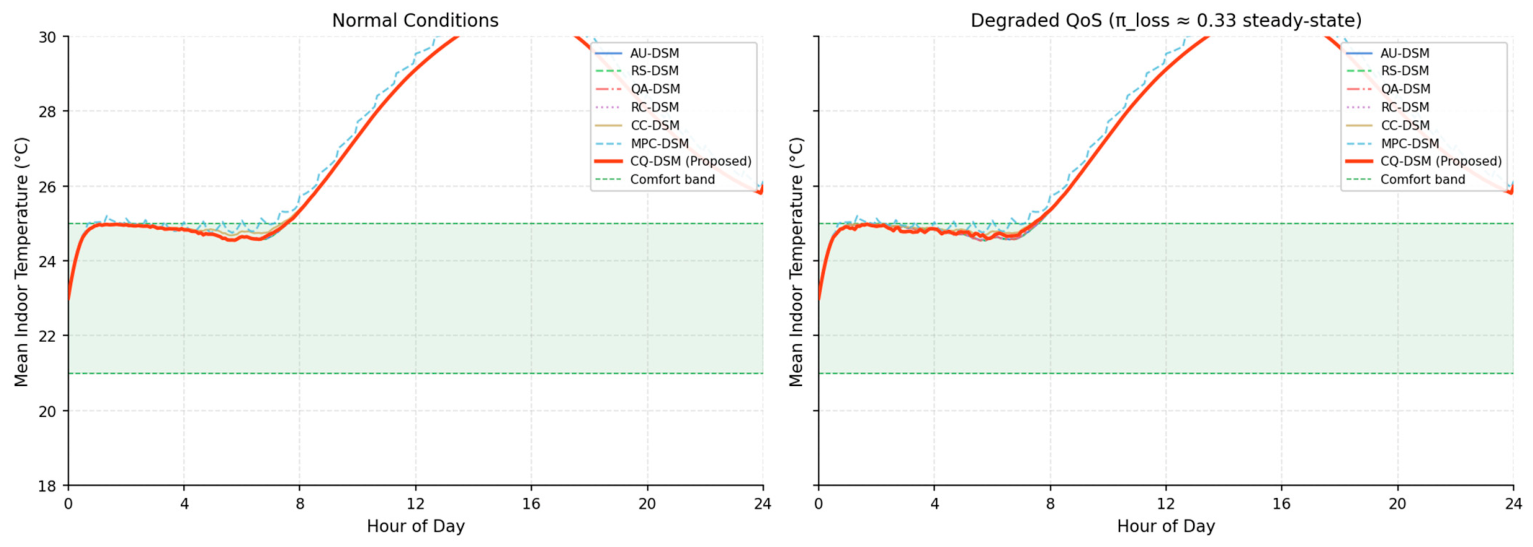
Under degraded QoS: latency is log-normal (mean 2 s, std 1 s); packet loss follows a two-state Markov chain (steady-state ≈ 0.33).
7.4. Baseline Methods
Seven baselines are selected to isolate the value of the proposed components. AU-DSM is a traditional economic-comfort scheduler that lacks cyber or QoS awareness. RS-DSM adds a post-hoc attack response using a binary threshold detector. QA-DSM enables proactive cyber-risk pricing without the QoS fallback. RC-DSM and CC-DSM represent robust and chance-constrained alternatives. MPC-DSM provides a full-horizon planning benchmark with perfect price foresight. Since all baselines use the same physical model and resources, performance differences are attributable solely to differences in risk, uncertainty and communication reliability handling. To evaluate the proposed CQ-DSM framework, several baseline DSM methods were selected for comparison, as summarized in
Table 2.
8. Results and Discussion
Section 8.1,
Section 8.2,
Section 8.3,
Section 8.4,
Section 8.5,
Section 8.6,
Section 8.7 and
Section 8.8 report single-seed results (Seed 42) for interpretability and reproducibility of individual scenario traces. Total system cost includes energy expenditure, imbalance/procurement cost, and modeled comfort, QoS, and cyber-risk penalties. Two comfort measures are reported: thermal-violation penalty in °C·slot (lower is better) and normalized comfort score (higher is better). The 81% comfort improvement reported under degraded QoS refers to the °C·slot penalty.
8.1. Normal Operating Conditions
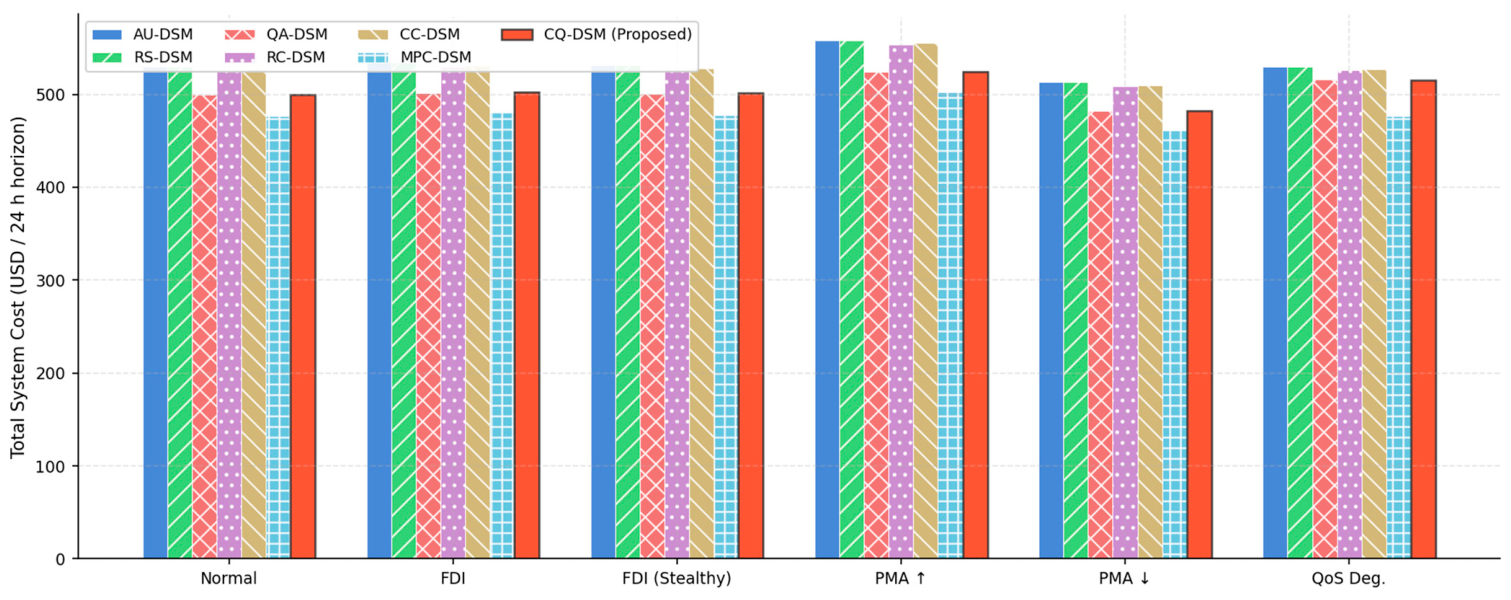
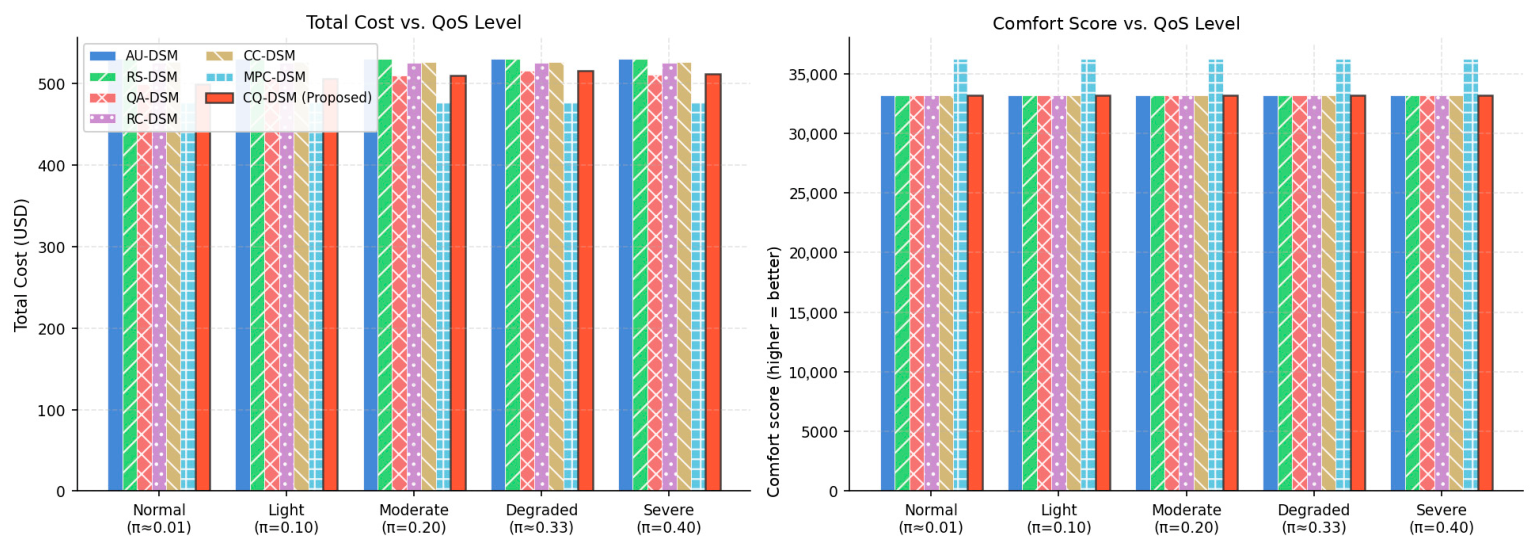
Under normal operation, CQ-DSM reduces total system cost from USD 530.12 to USD 499.66 relative to AU-DSM, a 5.75% improvement. Importantly, energy cost changes minimally (USD 246.43 → USD 245.60, −0.34%), and the larger system-level gain arises from lower imbalance procurement cost, indicating that risk-aware procurement improves robustness without sacrificing benign-condition efficiency. MPC-DSM achieves the lowest cost due to its full-horizon planning assumption, but this benchmark is less responsive to online cyber and QoS signals. The total system cost across the evaluated DSM strategies and operating scenarios is presented in
Figure 2.
8.2. Performance Under FDI Attacks
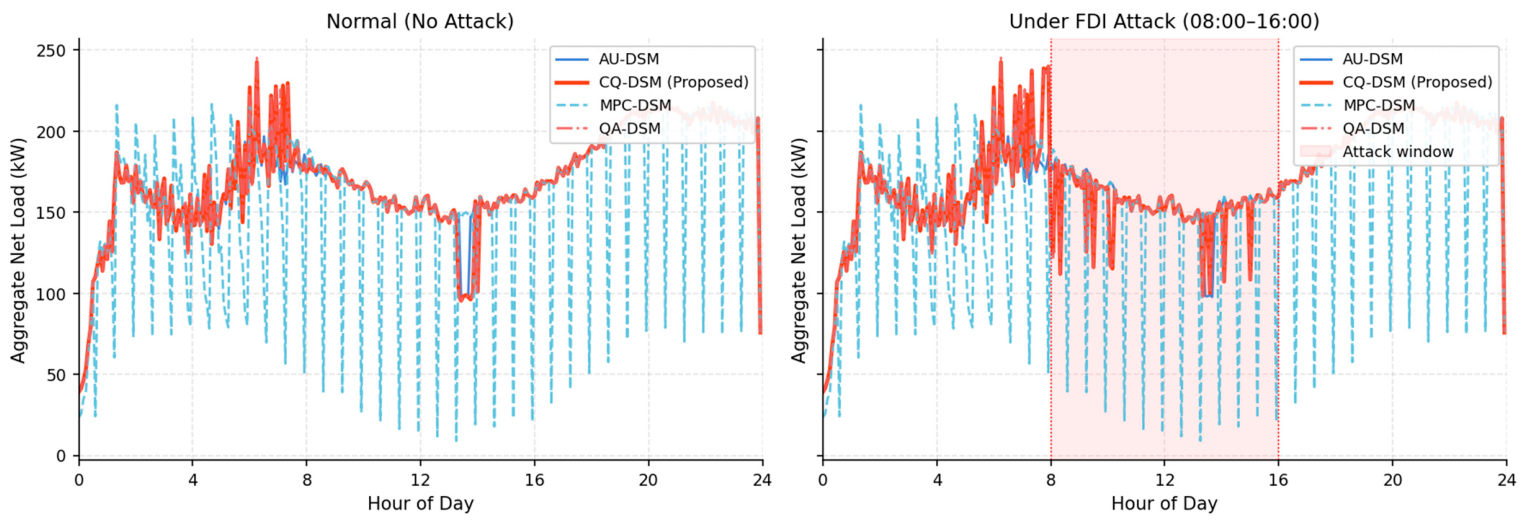
The FDI scenario illustrates the economic value of treating risk as a scheduling signal. AU-DSM and RS-DSM both experience a 0.83% cost increase as their schedules remain exposed to the distorted load measurements. CQ-DSM limits the cost increase to 0.46%, matching QA-DSM, and reduces cost overrun by 44% relative to AU-DSM. The equal QA-DSM and CQ-DSM FDI cost response clarifies the division of labor: the cyber-risk penalty drives FDI cost resilience, while the QoS module primarily protects comfort under communication degradation. The aggregate load profiles under FDI attacks are shown in
Figure 3.
8.3. Performance Under PMAs
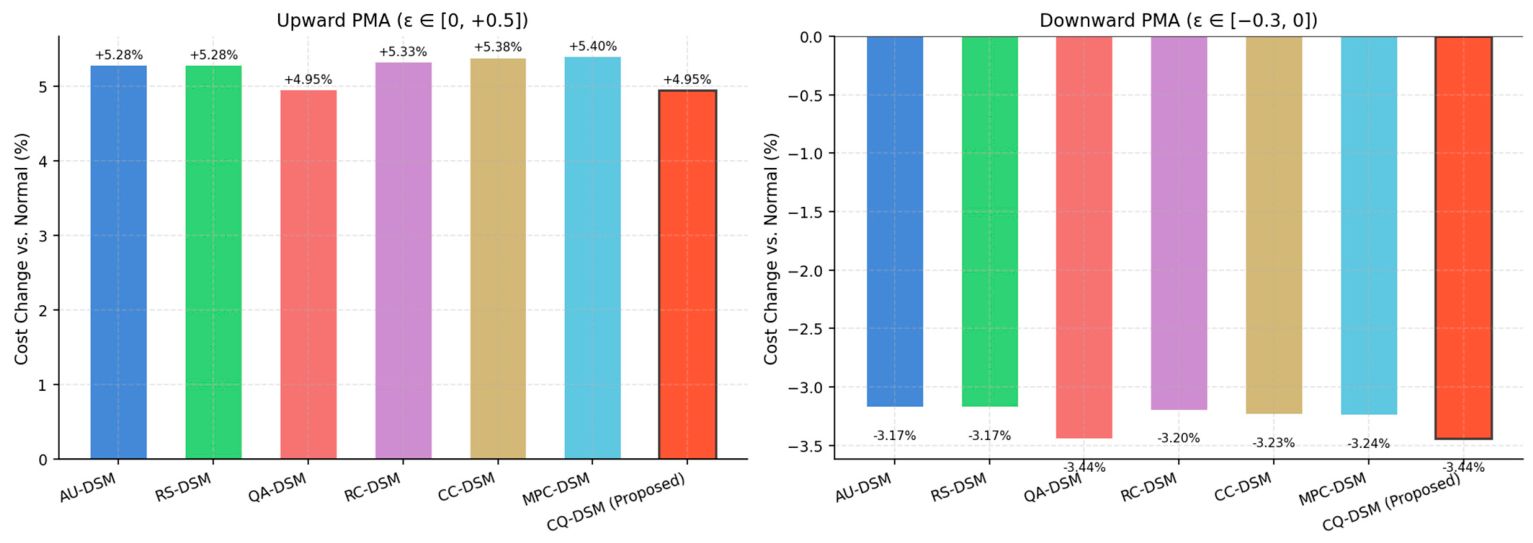
Under upward price manipulation, CQ-DSM reduces the total-cost increase from +5.28% for AU-DSM to +4.95%. This result clarifies CQ-DSM’s design objective: it is not calibrated solely to reduce cost under price uncertainty, but balances price response against comfort preservation and communication-aware operation. With downward PMA, CQ-DSM achieves a cost change of −3.44%, limiting over-consumption during artificially cheap periods while remaining competitive with robust methods. The cost changes under upward and downward PMA scenarios are presented in
Figure 4.
8.4. Performance Under Degraded Communication QoS
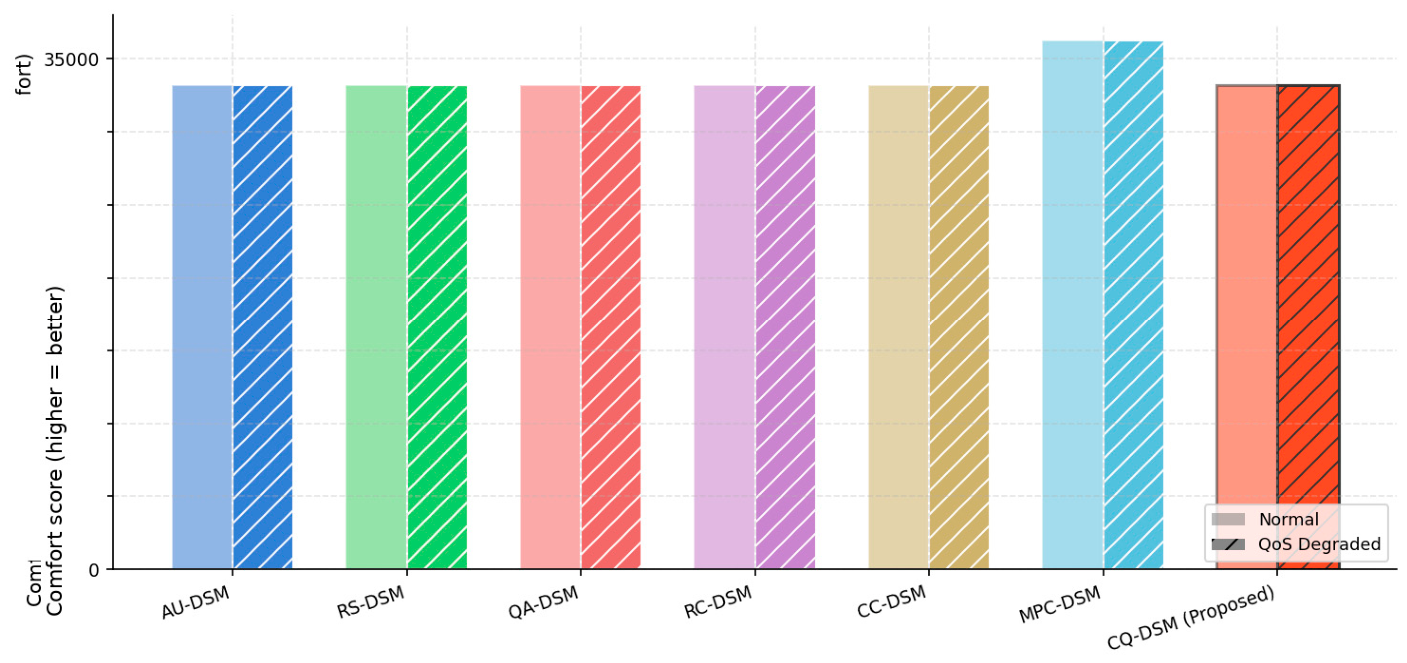
Packet loss and latency reduce confidence that scheduled HVAC actions will arrive on time. CQ-DSM responds through two mechanisms: the adaptive comfort weight assigns higher importance to the thermal margin when communication suffers, and the local fallback policy targets a tighter comfort band whenever coordination cannot be trusted. The thermal-violation penalty is consequently reduced from 3.84 to 0.74 °C·slot—an 81% decline. Because comfort is modeled through a soft violation penalty rather than a hard infeasibility constraint, temporary excursions outside the 20–26 °C band remain possible. The comfort score comparison under degraded QoS is shown in
Figure 5. The indoor temperature trajectories for a representative prosumer under degraded QoS are illustrated in
Figure 6.
8.5. Performance Under Stealthy FDI Attacks
The stealthy FDI scenario tests the cost of proactive conservatism. When the perturbation magnitude is 30% of the standard FDI amplitude, CQ-DSM incurs a slight cost premium relative to AU-DSM. This is the expected trade-off: always-on cyber-risk pricing has a measurable but small cost when the threat is weak, while the same mechanism provides substantial protection under full-magnitude FDI.
Section 5.1.3 provides additional context on how this result relates to detector sensitivity in the low-magnitude regime.
8.6. Scalability Analysis
Increasing prosumer count from P = 50 to P = 500 produces approximately linear cost growth and keeps solve times within the five-minute control interval, confirming that the hierarchical decomposition avoids the combinatorial bottleneck of a monolithic centralized MILP.
Section 6.3 discusses scalability implications for P > 500.
8.7. Ablation Study
The ablation study separates the two mechanisms under the combined FDI+QoS scenario. The cyber-only variant lowers the cost increase from 0.83% to 0.70% with minimal comfort improvement. The QoS-only variant reduces thermal violations from 4.82 to 2.31 °C·slot but slightly increases the cost to 0.90%. Full CQ-DSM achieves both the lowest cost increase (0.46%) and lowest comfort penalty (0.74 °C·slot), confirming that cyber-threat pricing and QoS-aware fallback are complementary rather than interchangeable. The ablation study results under the combined FDI and QoS adversarial scenario are summarized in
Table 3.
8.8. Sensitivity Analysis
CQ-DSM shows limited sensitivity to parameter variation within the tested ranges. For w2 ≥ 0.6, the thermal-violation penalty stays below 3 °C·slot while total cost grows at most 3% as w2 increases from 0.8 to 1.6. Sweeping γcyber, γQoS, κδ, and κπ individually within ±50% of their nominal values produces only modest performance changes, indicating the framework is not critically sensitive to exact calibration within the evaluated ranges. The detector sensitivity analysis confirms the expected FPR/FNR trade-off; the probabilistic Patk(t) signal outperforms a logistic regression baseline on the synthetic held-out test set.
Regarding worst-case cyber-risk operation: as P
atk(t) → 1.0, the adaptive weight reaches its cap w
2(1 + γ
cyber + γ
QoS) = 1.44 and the demand estimator fully shifts to L
flat. Under these conditions, the scheduler maximizes the comfort margin at the expense of price optimization, effectively entering a fully conservative mode. The 5 min rolling-horizon MILP remains feasible as long as the thermal dynamics permit the fallback comfort band [T
p,low + 0.5, T
p,high − 0.5] to be maintained—which requires the outdoor temperature to remain within the range that HVAC capacity can offset. Beyond this envelope (e.g., extreme heat events), the soft comfort penalty absorbs the infeasibility rather than causing solver failure, but thermal violations would increase. The sensitivity of total cost and comfort score to packet loss probability is presented in
Figure 7.
8.9. Discussion
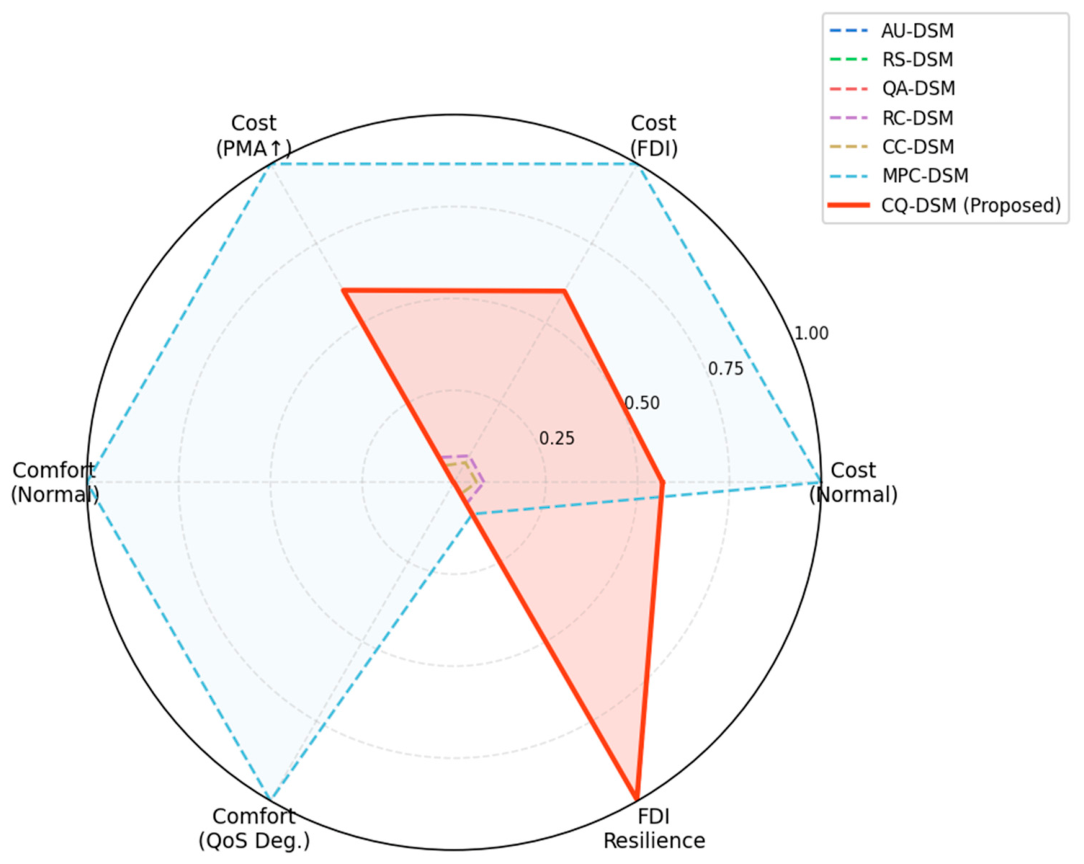
Taken together, the results show that CQ-DSM changes the role of resilience in residential scheduling. Cyber resilience is not treated as a separate detector placed beside the optimizer, and QoS is not treated as a passive network statistic. Instead, both are translated into scheduling incentives.
Figure 8 visualizes this integrated profile: CQ-DSM does not dominate every single metric (notably, robust baselines perform slightly better under upward PMA), but it provides a balanced operating point across cost, FDI resilience, QoS robustness, and privacy-preserving scalability.
Several limitations should be acknowledged. First, the results are based on seven price day types derived from one measured NYISO trace and one simulation seed. Second, the detector is trained and tested on synthetic attack scenarios, and generalization to real-world attacks remains unproven. Third, the imbalance model uses a detector-guided blend toward a historical load prior rather than a full robust state estimator. Fourth, the adaptive weighting rule is empirically calibrated without formal optimality guarantees. These limitations define a path for future work rather than undermining the contribution.
9. Conclusions
This paper presented CQ-DSM—a cyber-resilient and QoS-aware framework for residential demand-side management. The main contribution is that cyber-risk likelihood and communication reliability function as scheduling signals that shape the value of load flexibility, rather than as external disturbances addressed after scheduling. By combining a probabilistic risk estimator, an adaptive comfort weight, local MILP scheduling, and hierarchical aggregator–HEMS coordination, CQ-DSM links data trust, actuation reliability, cost, and comfort within one operational framework.
The empirical results demonstrate the integration’s value. Under normal operation, CQ-DSM reduces total system cost by 5.75% relative to AU-DSM while remaining nearly neutral in energy expenditure. For FDI, it reduces cost overrun by 44%. Under degraded QoS, thermal-violation penalties are reduced by 81%. The ablation study confirms that the cyber and QoS modules address distinct failure modes and produce their strongest benefit when combined.
Future work should strengthen three dimensions: validation, adversarial realism, and formal guarantees. Multi-season and independently measured price and building data would extend generalizability beyond the August NYISO trace. Detector evaluation should be extended to real or high-fidelity cyber-attack traces to assess transfer beyond synthetic scenarios. Finally, the empirical adaptive weight rule could be substituted or enhanced with certified robust or learning-based policies offering stability and performance guarantees while preserving the privacy advantages of the hierarchical architecture.
Author Contributions
Conceptualization, A.G. and M.M.; Methodology, A.G. and A.A.; Software, A.G. and D.B.N.; Validation, A.G. and N.B.H.; Formal Analysis, A.G.; Investigation, A.G. and A.A.; Data Curation, A.G.; Writing—Original Draft Preparation, A.G.; Writing—Review and Editing, A.A., M.M. and N.B.H.; Visualization, A.G. and D.B.N.; Supervision, A.A.; Project Administration, N.B.H. All authors have read and agreed to the published version of the manuscript.
Funding
This research received no specific grant or funding from any public, commercial, or not-for-profit funding agency.
Data Availability Statement
Conflicts of Interest
The authors declare no conflicts of interest.
Abbreviations
| Symbol | Description | Unit/Type |
| T | Total number of time slots (T = 288 for 24 h, = 5 min) | Dimensionless |
| P | Number of residential prosumers (P = 50 in simulation) | Dimensionless |
| Ap | Set of controllable appliances for prosumer p | Dimensionless |
| Binary ON/OFF decision for appliance a of prosumer p at time t | {0,1} |
| Ep,a | Rated power of appliance a of prosumer p | kW |
| Non-controllable base load of prosumer p at time t | kW |
| Stochastic PV generation for prosumer p at time t | kW |
| Aggregate grid-facing net demand at time t | kW |
| Electricity price at time t (NYISO LBMP) | USD/kWh |
| Indoor temperature of prosumer p at time t | °C |
| , | Comfort temperature bounds (20 °C, 26 °C) | °C |
| Thermal conductance coefficient, ∈ [0.05, 0.15] | Dimensionless |
| HVAC cooling efficiency, ∈[0.8, 1.2] | °C/kWh |
| End-to-end communication latency at time t | Seconds |
| Packet loss probability at time t | [0, 1] |
| Latency penalty coefficient | USD/(kWh·s) |
| Packet loss penalty coefficient | USD/kWh |
| MLP-estimated cyber-attack likelihood at time t | [0, 1] |
| , , , | Objective weighting factors | Dimensionless |
| = 0.5 | Thermal comfort monetization coefficient | USD/(°C·slot) |
| = 0.1 | Scheduling inconvenience monetization coefficient | USD/slot |
| , | Adaptive weight scaling factors in (1) | Dimensionless |
| W = 12 | MLP sliding window size (=60 min) | Time slots |
| H = 12 | HEMS rolling horizon (=60 min) | Time slots |
| Aggregator update interval | Minutes |
| Maximum tolerated latency before fallback (=4 s = 2 × LAT_μ,deg; fallback band tightened by ΔT_margin = 0.5 °C) | Seconds |
| Cimb | Imbalance procurement cost | USD |
| λimb | Imbalance penalty price (=1.5·λ(t)) | USD/kWh |
References
- Wadhawan, Y.; AlMajali, A.; Neuman, C. A comprehensive analysis of smart grid systems against cyber-physical attacks. Electronics 2018, 7, 249. [Google Scholar] [CrossRef]
- Bakare, M.S.; Abdulkarim, A.; Zeeshan, M.; Shuaibu, A.N. A comprehensive overview on demand side energy management towards smart grids: Challenges, solutions, and future direction. Energy Inform. 2023, 6, 4. [Google Scholar] [CrossRef]
- Liu, Y.; Ning, P.; Reiter, M.K. False data injection attacks against state estimation in electric power grids. ACM Trans. Inf. Syst. Secur. 2011, 14, 13. [Google Scholar] [CrossRef]
- Reddy, G.P.; Kumar, Y.V.P.; Chakravarthi, M.K. Communication technologies for interoperable smart microgrids in urban energy community: A broad review of the state of the art, challenges, and research perspectives. Sensors 2022, 22, 5881. [Google Scholar]
- Mimi, S.; Ben Maissa, Y.; Tamtaoui, A. Optimization approaches for demand-side management in the smart grid: A systematic mapping study. Smart Cities 2023, 6, 1630–1662. [Google Scholar] [CrossRef]
- Zhang, D.; Li, C.; Luo, S.; Luo, D.; Shahidehpour, M.; Chen, C.; Zhou, B. Multi-objective control of residential HVAC loads for balancing the user’s comfort with the frequency regulation performance. IEEE Trans. Smart Grid 2022, 13, 3546–3557. [Google Scholar]
- Habib, A.A.; Hasan, M.K.; Alkhayyat, A.; Islam, S.; Sharma, R.; Alkwai, L.M. False data injection attack in smart grid cyber physical system: Issues, challenges, and future direction. Comput. Electr. Eng. 2023, 107, 108638. [Google Scholar] [CrossRef]
- Hu, P.; Gao, W.; Li, Y.; Hua, F.; Qiao, L.; Zhang, G. Detection of false data injection attacks in smart grid based on joint dynamic and static state estimation. IEEE Access 2023, 11, 45028–45038. [Google Scholar] [CrossRef]
- Khalaf, M.; Ayad, A.; Tushar, M.H.K.; Kassouf, M.; Kundur, D. A survey on cyber-physical security of active distribution networks in smart grids. IEEE Access 2024, 12, 29414–29444. [Google Scholar] [CrossRef]
- Hussain, H.M.; Narayanan, A.; Sahoo, S.; Yang, Y.; Nardelli, P.H.; Blaabjerg, F. Home energy management systems: Operation and resilience of heuristics against cyberattacks. IEEE Syst. Man Cybern. Mag. 2022, 8, 12–22. [Google Scholar] [CrossRef]
- Sinha, A.; Vyas, R.; Alasali, F.; Holderbaum, W.; Vyas, O.P. A deep reinforcement learning-based approach for cyber resilient demand response optimization. Front. Energy Res. 2025, 12, 1494164. [Google Scholar] [CrossRef]
- Jha, A.V.; Appasani, B.; Gupta, D.K.; Ramavath, S.; Khan, M.S. Machine learning and deep learning approaches for energy management in Smart Grid 3.0. In Smart Grid 3.0: Computational and Communication Technologies; Springer: Cham, Switzerland, 2023; pp. 121–151. [Google Scholar]
- Dayaratne, T.; Rudolph, C.; Liebman, A.; Salehi, M. Guarding the grid: Enhancing resilience in automated residential demand response against false data injection attacks. arXiv 2023, arXiv:2312.08646. [Google Scholar]
- Al Isawi, O.A.; Al Jaafari, K.A.; Al-Sumaiti, A.S. Electric vehicles CAN bus cyber attacks detection using adaptive neuro fuzzy inference system. IEEE Access 2025, 13, 90862–90874. [Google Scholar] [CrossRef]
- Sui, Q.; Sun, L.; Yao, S.; Liang, J.; Li, Z.; Liu, C.; Xie, Z. Scheduling of mobile rail generators capable of uninterrupted power supply for load rescue. IEEE Trans. Power Syst. 2025, 40, 3993–4005. [Google Scholar] [CrossRef]
- Chen, J.; Mohamed, M.A.; Dampage, U.; Rezaei, M.; Salmen, S.H.; Obaid, S.A.; Annuk, A. A multi-layer security scheme for mitigating smart grid vulnerability against faults and cyber-attacks. Appl. Sci. 2021, 11, 9972. [Google Scholar] [CrossRef]
- Gargari, M.Z.; Hagh, M.T.; Zadeh, S.G. Preventive scheduling of a multi-energy microgrid with mobile energy storage to enhance the resiliency of the system. Energy 2023, 263, 125597. [Google Scholar] [CrossRef]
- Leander, B.; Čaušević, A.; Hansson, H. Applicability of the IEC 62443 standard in Industry 4.0/IIoT. In Proceedings of the 14th International Conference on Availability, Reliability and Security, Canterbury, UK, 26–29 August 2019; pp. 1–8. [Google Scholar]
- Muyizere, D.; Letting, L.K.; Munyazikwiye, B.B. Effects of communication signal delay on the power grid: A review. Electronics 2022, 11, 874. [Google Scholar] [CrossRef]
- Yuan, Q. Residential demand response online optimization based on multi-agent deep reinforcement learning. Electr. Power Syst. Res. 2024, 237, 110987. [Google Scholar] [CrossRef]
- Abudin, M.J.; Thokchom, S.; Naayagi, R.T.; Panda, G. Detecting false data injection attacks using machine learning-based approaches for smart grid networks. Appl. Sci. 2024, 14, 4764. [Google Scholar] [CrossRef]
- Kim, D.; Lee, J.; Do, S.; Mago, P.J.; Lee, K.H.; Cho, H. Energy modeling and model predictive control for HVAC in buildings: A review of current research trends. Energies 2022, 15, 7231. [Google Scholar] [CrossRef]
- Carli, R.; Cavone, G.; Pippia, T.; De Schutter, B.; Dotoli, M. Robust optimal control for demand side management of multi-carrier microgrids. IEEE Trans. Autom. Sci. Eng. 2022, 19, 1338–1351. [Google Scholar] [CrossRef]
- Yuan, Z.P.; Li, P.; Li, Z.L.; Xia, J. Data-driven risk-adjusted robust energy management for microgrids integrating demand response aggregator and renewable energies. IEEE Trans. Smart Grid 2022, 14, 365–377. [Google Scholar]
- Yang, S.; Lao, K.W.; Chen, Y.; Hui, H. Resilient distributed control against false data injection attacks for demand response. IEEE Trans. Power Syst. 2023, 39, 2837–2853. [Google Scholar] [CrossRef]
- Suhaimy, N.; Radzi, N.A.M.; Ahmad, W.S.H.M.W.; Azmi, K.H.M.; Hannan, M.A. Current and future communication solutions for smart grids: A review. IEEE Access 2022, 10, 43639–43668. [Google Scholar] [CrossRef]
- Zohdi, T.I. A note on rapid genetic calibration of artificial neural networks. Comput. Mech. 2022, 70, 819–827. [Google Scholar] [CrossRef]
- New York Independent System Operator (NYISO). Real-Time Locational Based Marginal Price (LBMP) Data. Available online: https://www.nyiso.com/real-time-dashboard (accessed on 14 March 2026).
| Disclaimer/Publisher’s Note: The statements, opinions and data contained in all publications are solely those of the individual author(s) and contributor(s) and not of MDPI and/or the editor(s). MDPI and/or the editor(s) disclaim responsibility for any injury to people or property resulting from any ideas, methods, instructions or products referred to in the content. |




 ,
,