Article

Integrated Multi-Period Optimization of Electric Bus Transition Planning in Urban Mobility

Department of Industrial Engineering, American University of Sharjah, Sharjah P.O. Box 26666, United Arab Emirates
*
Author to whom correspondence should be addressed.
Energies 2026, 19(13), 2961; https://doi.org/10.3390/en19132961 (registering DOI)
Submission received: 23 April 2026 / Revised: 14 June 2026 / Accepted: 18 June 2026 / Published: 23 June 2026
(This article belongs to the Section B: Energy and Environment)

Abstract

The transition to electric bus (EB) fleets is a critical step towards sustainable urban transportation, offering substantial reductions in greenhouse gas and pollutant emissions relative to diesel buses. However, transit authorities face multifaceted challenges in this transition, including limited driving ranges of EBs, the need for widespread charging infrastructure, and potential strain on the electric grid, alongside opportunities such as governmental subsidies and increased fare revenues. This paper proposes a comprehensive multi-period mixed-integer programming model seeking to optimize long-term EB fleet transition plans in urban contexts while jointly accounting for all inherent financial, technical, and operational factors impacting such a transition. The model is operationalized using real data acquired from Dubai’s Roads & Transport Authority (RTA), encompassing 71 bus routes and a 25-year planning horizon to meet a 100% electrification target by 2050. A scenario-based analysis evaluates the robustness of the transition plans under variations in key operational parameters. The results illustrate that optimized long-term planning yields substantial cost savings and emissions reductions, where the incorporation of environmental and social externalities and revenue shifts causes profit maximization to emerge as a more appropriate objective. In addition, it turns out that adequate dwell time is crucial for cost containment and full fleet electrification feasibility. While RTA targets 100% electrification by 2050, the base case is deliberately relaxed to 90% as certain routes, notably double-decker lines, are incompatible with currently available EB configurations. Nevertheless, full electrification is restored under the minimum dwell scenario. Also, a policy of purchasing only EBs accelerates full fleet electrification by roughly a decade with only a marginal increase in total cost, unlike imposing strict interim electrification targets. The optimized transition plans provide actionable insights for transit authorities balancing economic efficiency with sustainability goals.

1. Introduction

Urban transit authorities worldwide are increasingly prioritizing the electrification of bus fleets to mitigate the environmental impacts of public transportation. The transportation sector is a major contributor to urban air pollution and greenhouse gas emissions, generating 15% of total CO2 emissions [1], and as such, replacing diesel buses with electric buses (EBs) can significantly reduce these emissions. Many cities and transit agencies across the globe have announced targets for transitioning to 100% EB fleets over the coming decades. Establishing sustainable cities through efficient public transportation is paramount [2] to cater for the world’s urban population, which is projected to rise significantly by 2050 [3], and sustainability goals. For instance, Dubai’s Roads & Transport Authority (RTA) has set a goal to fully electrify its public bus fleet by 2050, aligning with broader sustainability initiatives [4]. Achieving such ambitious targets requires strategic long-term planning, as transit agencies must balance environmental objectives with financial and operational realities.
While the transition to EBs promises substantial benefits, it also presents several challenges that must be addressed in a comprehensive transition plan [5,6]. EBs have limited driving ranges compared to diesel buses, necessitating careful scheduling and charging strategies to maintain service levels. Developing a robust charging infrastructure is essential to support an electrified fleet whereby agencies must determine the number, type, and locations of chargers (e.g., depot vs. en-route fast chargers) to meet energy demands without causing excessive vehicle downtime. Moreover, large-scale electrification will introduce significant loads on the electrical grid, potentially requiring grid upgrades or smart charging management to avoid capacity issues [7,8]. These technical and operational hurdles occur in parallel with financial considerations. EBs typically have higher upfront costs than diesel buses, including vehicles and batteries, as well as infrastructure investments for charging stations. On the other hand, EBs promise lower fuel (energy) and maintenance costs over their lifetimes. Transit agencies often operate under tight budget constraints, so the capital expenditures for EBs and chargers must be planned alongside operating costs and revenues. Opportunities exist to offset costs where government subsidies can reduce purchase costs [9], and transit authorities may consider modest fare increases given the improved service sustainability [10,11,12]. Additionally, the societal and environmental benefits of electrification, such as improved air quality, curbed carbon emissions, and reduced noise levels, have economic value that can be monetized through incentive mechanisms (e.g., carbon trading) or considered as part of a broader cost–benefit setting.
Existing studies on bus fleet electrification have typically focused on specific subsets of these issues, such as optimizing charging infrastructure placement, establishing bus-to-route assignment given a fixed fleet composition, or minimizing vehicle and energy costs, in lieu of integrating all aspects into a single decision-making framework. In practice, the transition plan must be holistic, coordinating financial planning, technical requirements, operational considerations, and multi-stakeholder perspectives over a several-year planning horizon. A financial plan must include not only capital and operating costs but also potential revenue changes (e.g., fare policies) and budget limitations. Technical requirements involve selecting appropriate bus types (battery capacity, size) and charger technologies, as well as deciding where to deploy chargers (depots or opportunity charging at terminals). Operational factors include the characteristics of existing bus routes (length, frequency, passenger demand) and fleet utilization. A multi-stakeholder perspective needs to be incorporated as well, including government agencies that might provide subsidies or set electrification mandates, and utility companies that need to coordinate grid capacity and electricity supply for charging infrastructure. Finally, modeling elements such as the temporal dimension (planning over several periods or years) and fleet age dynamics (phasing out old buses and introducing new ones) are crucial for capturing long-term effects.
There is a pressing need for a scalable optimization framework that can simultaneously handle these diverse elements to guide EB fleet transition planning. To that end, this paper aims to develop a comprehensive multi-period mixed-integer linear programming (MILP) model that integrates all key transition planning elements. The specific objectives of the study are to:
(1)
Identify and integrate the critical planning elements (financial, technical, operational, and stakeholder-related) influencing EB fleet transitions;
(2)
Formulate a comprehensive optimization model that jointly optimizes fleet electrification schedules, charging infrastructure deployment, and operational allocation over a long-term horizon;
(3)
Apply the model to a real-world case drawn from Dubai’s RTA and validate its effectiveness toward producing a feasible, cost-effective transition strategy;
(4)
Analyze various scenarios to test the model’s robustness and derive practical insights on how changes in key input parameters impact the optimal transition plan.
The primary contribution of this work is a unified planning model for EB fleet transition that combines financial analysis, technology selection, strategic fleet deployment, infrastructure planning, and policy levers in one optimization framework. To the authors’ best knowledge, this level of integration exceeds that of prior studies, which have not concurrently addressed all these dimensions. Notably, this comprehensive integration is coupled with three specific advances. First, rather than relying on the fixed charger-to-bus ratios common in prior work, this work embraces an endogenous demand-linked energy aggregation approach at depots and terminals that determines the number, type, and placement of chargers from route energy demand. Second, the proposed model explicitly incorporates system feasibility constraints within the strategic planning framework, particularly dwell time availability and charging grid-capacity limits, ensuring that infrastructure deployment and fleet transitions remain consistent with physical and operational service requirements. Third, the proposed model adopts a profit-maximization-based objective that internalizes fare revenue, governmental subsidies, and monetized environmental and social externalities within the fleet transition decision-making process.
The UAE’s 2050 net-zero initiative [4] provides an excellent case study that demonstrates how transit agencies can use the model to evaluate trade-offs. For example, the model can determine the cost of accelerating electrification versus the environmental benefits and can help strategize the timing of investments. The scenario analysis provides further insights into the sensitivity of the transition’s outcomes to critical factors, guiding agencies on what external support or operational adjustments have the greatest impact. Overall, this work offers a practically applicable yet methodologically rigorous decision support tool that would aid policymakers and transit authorities in planning the complex transition to EBs in an efficient and cost-effective manner.
The remainder of this paper is organized as follows. Section 2 provides an overview of EB research, describes the transition planning elements in more detail and reviews the relevant modeling-based literature on EB transition planning, highlighting this paper’s unique contributions. Section 3 presents the mathematical formulation of the optimization model and a detailed description of the problem context. Section 4 provides the practical case study used for implementing the optimization model. Section 5 presents the results of the base case along with a scenario-based assessment and a one-way sensitivity analysis validating the model’s effectiveness and practical relevance. Finally, Section 6 presents concluding remarks, draws some managerial implications and outlines potential avenues for future work.

2. Literature Review

Research on EBs has expanded significantly in recent years, driven by declining battery costs and technological advancements that have improved operational and economic feasibility [13]. Manzolli et al. [14] reported a substantial rise in EB-related publications, with the number of studies reaching 486 by 2020. Extending this analysis using the same search string, the total rose to 1113 by 2024, highlighting the growing relevance of EBs in sustainable transport research. Their bibliometric analysis identified five major research clusters: vehicle technology, sustainability, battery technology, energy management, and fleet operation. These streams address diverse challenges, from improving battery chemistries and charging strategies to reducing environmental impacts and optimizing fleet scheduling. According to [2], the EB planning process spans three key stages: operational (daily adjustments), tactical (months in advance), and strategic (years in advance). Strategic transition planning entails multi-year decisions on fleet electrification scale, charging infrastructure deployment, technology selection, financial forecasting, and alignment with long-term goals. However, despite the growth of research across various streams, most studies focused on operational and tactical domains, with relatively limited attention given to long-term strategic decisions, such as transition planning [15].

2.1. Transition Planning Elements

To ensure a successful transition to EBs, transit authorities must address several transition planning elements, where such elements, along with their sub-elements and components, are depicted in Table 1. Beyond enumerating these elements, the review that follows emphasizes their interdependence and the principal trade-offs they embody, since a decision taken for one element, for example, the charging strategy, propagates into battery sizing, grid load, operating cost, and feasible route assignment.

2.1.1. Financial Planning

Financial planning for EB adoption is a complex process that requires careful consideration of various factors affecting the transition over time. This includes internal costs where such costs constitute the largest share of the total cost of ownership (TCO). They include bus purchase cost [16], infrastructure investments for chargers and grid upgrades [17], and operating costs such as energy, battery replacements, and maintenance, where EB operating costs are typically lower than those of diesel buses [13,18]. Environmental and social costs also play a critical role, representing broader societal and environmental impacts, such as adverse public health effects from air pollution and noise (e.g., premature death and respiratory diseases) and climate effects due to greenhouse gas (GHG) emissions [9,19]. These are often overlooked but significantly reduced by EBs. Revenue generation primarily stems from bus fares and fleet salvage, with EBs potentially increasing public willingness to pay and enhancing social welfare [10,11,12,20]. Finally, budget constraints are a significant factor driving phased electrification, as high initial costs often exceed transit agency capabilities [12,21], necessitating long-term forecasting of costs and revenues for a smoother transition. As it stands now, the financial literature remains fragmented, where most studies optimize a subset of these components, typically internal costs, while holding externalities, revenue, or budgets exogenous. Moreover, monetized externalities rely on damage, avoidance, and replacement cost approaches, and their values vary across regions, rendering their transferability an inherent source of uncertainty.

2.1.2. Technical and Infrastructure Requirements

Ensuring operational feasibility of EBs critically depends on a thorough understanding of their technical and infrastructure requirements. This begins with selecting appropriate EB types like BEBs for zero emissions, hybrid electric buses (HEBs) for extended range, or fuel cell buses (FCBs) for longer ranges despite complex infrastructure [1]. Complementing the bus choice is the battery technology, where Lithium Nickel Manganese Cobalt Oxide (NMC)-based batteries suit depot charging, while Lithium Titanate (LTO)-based batteries facilitate rapid opportunity charging [20,22], with capacity directly influencing cost, weight, and range [13]. Seamless operation then relies on the strategic implementation of charging infrastructure, which involves carefully selecting appropriate battery types and their placement to meet specific operational needs efficiently and cost-effectively [29]. Depot charging (slow, overnight) typically occurs at bus depots [20], whereas opportunity charging (fast, during service breaks) requires placement at terminals [23]. Further solutions include in-motion charging and battery swapping [2]. Regardless of the chosen type and placement, adequate electrical supply and potentially significant grid upgrades at these locations are essential. A recurring weakness across the modeling literature is that charger requirements are approximated by fixed charger-to-bus ratios, decoupled from route energy demand, battery size, and charging rate. This simplification underestimates the interaction between fleet composition and infrastructure and is precisely where strategic plans tend to lose accuracy.

2.1.3. Existing Bus Network and Operations

To effectively integrate EBs, understanding the existing bus network and operations is of paramount importance [24]. This commences with an analysis of route characteristics such as service frequency, run cycle length and time, and dwell time, which are all vital for determining energy consumption and range requirements for EB deployment and ensuring continuous passenger demand satisfaction [2,9,14]. Furthermore, detailed data on current fleet characteristics, including vehicle size, age, powertrain type, and mileage, alongside existing charging infrastructure characteristics, is essential for analyzing operational capacity and assessing electrification feasibility and future replacement needs [13,25]. A thorough analysis of both route and fleet characteristics enables the prioritization of routes best suited for electrification, facilitates efficient EB deployment, and ensures adequate charging infrastructure for the transition. The central methodological tension here lies between granularity and tractability. Disaggregated trip-level representations capture route heterogeneity but do not scale to city-wide multi-decade horizons, whereas highly aggregated representations scale but may overlook route-specific incompatibilities, leaving the question of which routes are genuinely electrifiable inadequately addressed.

2.1.4. Multi-Stakeholder Perspectives

Successful planning and implementation of EB systems hinges on considering the perspectives of multiple stakeholders [30]. Government entities, for instance, play a pivotal role by providing financial incentives, such as subsidies and tax breaks, to offset high EB and charging infrastructure costs [26]. They also devise supportive policies and raise public awareness, facilitating a smoother transition [12]. Concurrently, electric utilities are essential partners in charge of assessing power grid capabilities and identifying limitations, ensuring necessary upgrades, especially for fast-charging stations [14,15]. Their provision of grid readiness data enables effective charging infrastructure planning, prevents operational disruptions and enhances EB operational efficiency. This collaborative effort is crucial for reducing initial costs, creating a supportive regulatory environment, and ensuring energy availability for growing EB charging demand. These levers are typically studied in isolation, where incentive-focused models rarely incorporate explicit grid constraints, while grid-focused models rarely account for policy instruments such as subsidies. This separation limits the practical applicability of existing approaches, particularly under aggressive electrification mandates, necessitating coordinated planning of subsidies and grid investment to ensure feasible and cost-effective fleet transitions.

2.1.5. Modeling Elements

To facilitate data-driven decision-making in bus-fleet transition planning, key modeling elements are fundamental. These include tracking elements such as time, which is crucial due to the dynamic nature of costs and technological advancements [13], and age, which significantly impacts operating costs, maintenance, and salvage value [9]. A longer planning horizon enhances the benefits of electrification, enabling more realistic and gradual transition plans that account for budget limitations and help identify optimal bus replacement timing for cost-effectiveness [21,27]. An optimization model is then essential for determining optimal transition strategies. Linear programming is particularly effective due to its computational simplicity, which grants superior scalability necessary for modeling extensive, city-wide bus networks [28]. The incorporation of integer variables is inevitable to account for discrete financial and technical choices pertaining to the determination of fleet composition and charger placement, which renders the MILP model the most suitable optimization framework to use. In the existing literature, two relevant issues are seldom addressed explicitly. First, a long horizon magnifies both end-of-horizon distortions and the uncertainty attached to long-range parameters. Secondly, richer nonlinear formulations that capture grid and charging physics quickly become intractable for realistic large-scale instances. The unresolved challenge is therefore to integrate all of the above elements without compromising the scalability that real networks demand.

2.2. Electric Bus Transition Planning Models

Several studies developed optimization models for the EB fleet transitions, despite overlooking some of the aforementioned relevant transition planning elements. Table 2 categorizes the modeling-based studies in light of the key elements, positions this work, and identifies existing research gaps. This section reviews these studies, focusing on each paper’s unique approach to EB transition planning. Rather than describing each study in isolation, the following synthesis groups the work by what it optimizes and, more revealingly, by what it omits, using the classification in Table 2 to make these omissions explicit (empty cells) and to identify the gap addressed here.
Dirks et al. [18] proposed an integrated mixed-integer programming (MIP) approach that simultaneously accounts for strategic decisions (such as fleet composition and charging facility locations) and operational constraints (like bus assignments). Their findings indicate that a comprehensive integration of BEBs is not only feasible but also economically beneficial. He et al. [27] examined time-dependent BEB and charging station deployment, proposing a bi-objective integer linear programming model minimizing total electrification costs and non-BEB mileage. It generates a Pareto curve to aid transition planning. Islam and Lownes [31] optimized DB replacement with alternative technologies, primarily BEBs and HEBs. They devised a MIP model to minimize Life-Cycle Cost (LCC) under operational and environmental constraints. Findings show that an optimized fleet (79% BEBs, 21% HEBs) achieves the lowest costs and emissions. The multi-period bus electrification considering seasonal variations and budget constraints is tackled by Zhang et al. [21]. Their MILP model optimizes charging, locations, and fleet transitions. Their findings indicate that optimized long-term planning yields a reduction of the total costs by 17.8% and CO2 by 39.3%. Li et al. [32] also considered the two objectives of cost minimization and emissions reduction for mixed bus fleets, considering routing and operational constraints. Using a new life additional benefit–cost (NLABC) analysis and integer programming, they identified optimal fleet size, composition, and routing for multi-lines or interlining. This first cluster establishes the value of optimized multi-period planning, but it largely treats fare revenue and monetized externalities as outside the model and sizes charging infrastructure coarsely. As such, its financial picture is partial, and the link between fleet decisions and charger requirements remains approximate.
In another work, Feng and Figliozzi [33] devised a cost minimization model that seeks to determine HEB/DB replacement considering factors such as purchase costs, maintenance costs, and subsidies, which significantly influence the optimal bus type and replacement age. Findings reveal that government subsidies greatly affect optimal replacement periods and the total costs. Tang et al. [34] optimized multi-type EB fleet transition, assuming replacement rates and crowding costs influence strategy. Their mixed-integer nonlinear programming (MINLP) model minimizes life-cycle costs while accounting for subsidies and operational constraints. The findings reveal that larger EBs initially reduce crowding while smaller EBs are advantageous at a later stage. Although this second group sharpens the understanding of when to replace and how incentives aid in this regard, it typically holds the network and charging infrastructure in the background, leaving operational feasibility and grid implications unresolved.
In the existing literature, three studies are particularly relevant to the work presented in this paper. Pelletier et al. [13] tackled the EB Fleet Transition Problem (EBFTP) and proposed a flexible ILP model integrating many transition planning elements. However, it overlooks environmental/social costs, government incentives, and detailed charger placement/maintenance. Furthermore, charger requirements are not accurately estimated due to neglected factors such as battery size or charging rate. In a different approach, Zhou et al. [9] modeled Bus Fleet Replacement (BFR) as an integer programming model, incorporating external costs and incentive impacts. Yet, it ignores existing bus network/operational elements (routes, fleet composition) and falls short of ensuring operational feasibility or accounting for electric utility constraints. Addressing some of these gaps, Hanna et al. [15] proposed a two-stage MINLP model specifically addressing utility constraints and optimizing annual bus/charger purchases. However, its complex and computationally intensive formulation limits scalability and practical use in large-scale networks. The model also does not account for environmental/social costs and government incentives. Moreover, while charger placement at depots/routes is addressed, a more efficient mechanism could involve placing chargers at terminals to improve utilization and electrical grid capacity at each terminal. These three works reveal a consistent pattern whereby models that broaden financial scope thin out operational and grid detail, models that capture grid physics sacrifice scalability, and none derive charging needs from route-level energy demand. This is precisely the combination that this work targets.
To the authors’ best knowledge, and based on a thorough review of the literature, no existing study simultaneously integrates all transition planning elements within a large-scale, strategic, long-term framework (as seen in Table 2). This work addresses these gaps with a scalable profit-maximization model that focuses exclusively on strategic transition planning issues, rather than operational-level decisions, thereby maintaining tractability and the long-term perspective. More specifically, the proposed framework is distinguished by three advances relative to prior work: (i) an endogenous demand-linked determination of charger number, type, and placement that replaces the fixed charger-to-bus ratios common in earlier studies; (ii) the explicit embedding of system-feasibility constraints, namely dwell time availability and grid-capacity limits; and (iii) a profit-maximization objective that internalizes fare revenue, government subsidies, and monetized environmental and social externalities. This claim is made to the best of our knowledge and on the basis of the reviewed literature rather than a systematic review. The strategic outputs of the model, namely fleet composition, charger numbers, types, and locations, and route-class assignments, are intended to serve as inputs to downstream tactical models (timetabling, vehicle blocking and rotation) and operational models (daily dispatch, real-time charge scheduling), where the aggregated route-assignment approximation is adequate at the long-term planning level.

3. Model Formulation

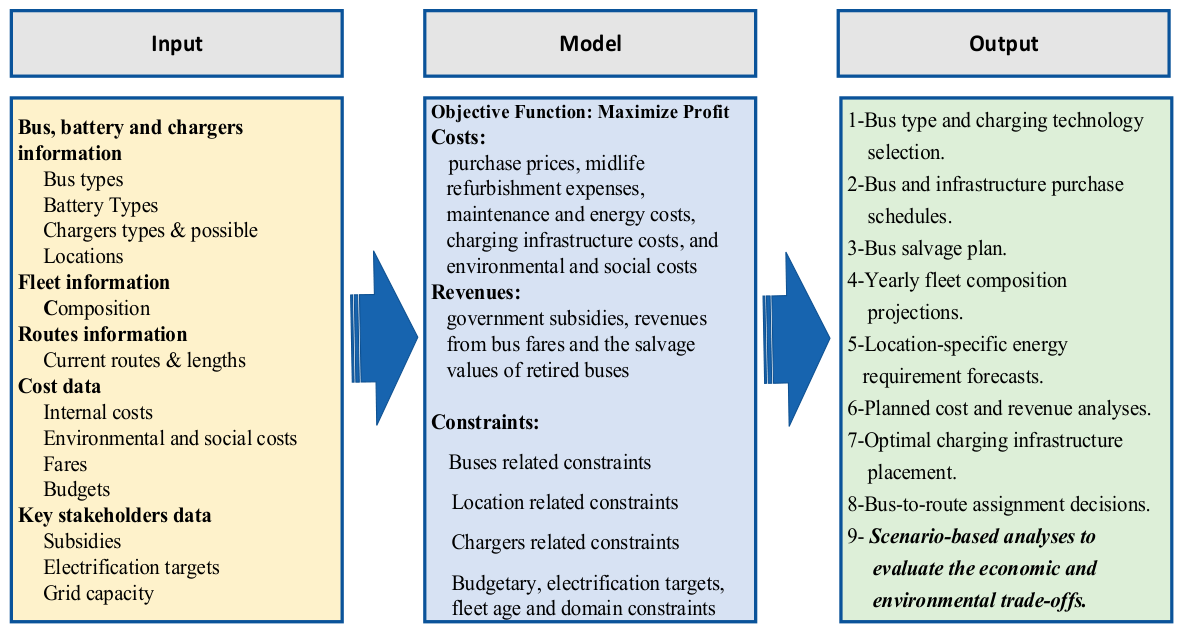
This section presents the MILP model seeking to optimize the EB transition plan for urban transit authorities as depicted in Figure 1. Consider a transition plan taking place over a planning horizon composed of T = { 1 , , T f } years, and let J = { 0 , 1 , , B J b + 1 } represent all possible ages for a bus of type b . It is assumed that the transit authority makes replacement decisions at the beginning of each year, where age j = 0 corresponds to a new bus, and a bus of type b can operate until it reaches an age of B J b + 1 , at which point it must be salvaged. In order to address technical and infrastructure requirements, we introduce sets for bus types B and charging technologies C . Bus types encompass various fuel technologies, models, configurations, and sizes. Let E B B denote the subset of E B types, with an example being EB 250 40, referring to a 40-foot electric bus with 250 kWh battery capacity. Charging technologies are primarily categorized into fast chargers F C C , which are used in terminals and are associated only with fast-charging electric buses FEB ⊆ B, and depot chargers D C C that support all types of EBs.
To realistically capture the complexities of EB operations, the model includes route-bus assignment with compatibility constraints. These constraints account for factors such as distance, battery capacity, energy consumption, dwell time, and load requirements. As indicated by [13], using an aggregated approach to route assignment helps balance traceability and demand granularity. Let R denote the set of routes, where compatibility between routes and bus types is captured by a binary parameter x j t r b (1 if bus b of age j is eligible for route r in period t ). Furthermore, suitable locations for charging infrastructure are identified by set L , which includes subsets D L for depots and M L for terminals. Building on the existing network, L r l r represents the route–location relationship parameter (1 if connected, 0 otherwise). Electric utility constraints are modeled by grid capacity limitations L g t l at every location. At the beginning of the planning horizon, the fleet consists of B o j b buses of type b and age j , while the charging infrastructure comprises C o l c chargers of type c at location l .
Financial planning encompasses various costs and revenue calculations associated with replacement decisions. These costs cover bus purchases, midlife refurbishments (such as engine or battery replacements), operations (including maintenance and energy), and charger purchase and maintenance. Environmental and social costs are integrated based on the work of [9], capturing the negative externalities of diesel buses in terms of air pollution, noise, and climate change. These costs were estimated using established methodologies, including damage cost, avoidance cost, and replacement cost approaches, and are assigned to each bus type based on its fuel technology. The model also incorporates two government subsidies, including a one-time purchase subsidy, o s b , reducing initial bus purchase costs, and an annual operational subsidy a s j b based on active buses of type b and age j . The annual budget b t available for purchasing buses and charging infrastructure in period t may be increased by subsidies and salvage revenues. To account for the time value of money, let i be the periodic discount rate, and let V = ( 1 + i ) 1 be the corresponding one-period discount factor. All cash flows gradually incurred over the course of a period, such as bus fare revenues or maintenance and energy costs, are assumed to be made at the beginning of the period. Thus, an amount incurred in period t will be discounted by V t 1 .
On the revenue side, the salvage value s v j t b for retired buses of type b and age j in period t represents the monetary return, influenced by transit authority policy (sell, scrap, or donate). Research also indicates a higher customer willingness to pay for EBs, leading to the bus fare R b f r b for route r when using bus type b as a significant revenue source. As the fleet transitions to more EBs, annual bus fare revenue is expected to rise, contingent on factors such as the number of trips, passenger capacity B p b and the route’s average load factor R l r .
As detailed below, eight sets of decision variables are used in the model, seven of which are integers, and one is continuous. These include the number of buses and chargers purchased, salvaged, available and assigned, as well as the allocation of buses to routes and locations. Given that routes connect two terminals, the model allows for flexibility in distributing the number of buses across these terminals, which then influences the number of fast chargers required for EBs. The continuous variable estimates total daily energy demand at each route–location pair, depending on factors such as route distance R k r , energy consumption E B x b , and battery capacity E B c b , which is then used to determine the required number of chargers. This approach directly addresses the shortcomings in existing studies that often rely on the oversimplified fixed charger-to-bus ratios.
A comprehensive list of all sets, parameters and decision variables used in the development of the mathematical model is included in Appendix A. The model’s objective function and constraints are developed next.
  • Objective function:
The objective function maximizes the total discounted profit of the entire transition plan by incorporating all relevant revenues and costs. The overall structure builds on the formulation in [13] by including internal bus costs such as purchase prices, midlife refurbishment expenses, ongoing maintenance and energy costs, charging infrastructure costs covering charger purchase, installation, and maintenance, and the salvage values of retired buses. It is then extended by incorporating the one-time subsidy that reduces initial purchase costs, the annual subsidy based on the number of operational buses, and the environmental and social cost terms related to air pollution, noise, and climate change as presented in [9]. In addition to these elements, this work adds the revenue generated from bus fares to obtain the profit-based formulation. The profit objective is best interpreted not as commercial profit but as a net social benefit, or public-sector planning objective. Once fare revenue and monetized environmental and social externalities are internalized, it nets the agency’s costs against user-borne fares and society-borne externalities, and it reduces to cost minimization when the revenue and externality terms are switched off, as in the base case. Profit maximization was adopted deliberately so that revenue-side levers, fare adjustments (Scenario 6) and subsidy design (Scenario 7) could be assessed, which a pure cost-minimization framework cannot capture.
Maximize t T V t 1 b B ( o s b B c t b ) P t b r R j = 0 B J b m o c j t r b Z j t r b m c t b A J m b t b + b B j = 0 B J b A j t b a s j b b B C c c W t c + l L C m t l c C L t l c b B j = 0 B J b r R ( a e b + c e b ) R d r   Z j t r b   B p b   R l r + n e b   Z j t r b R d r + b B j = 0 B J b r R Z j t r b R y r 2 B p b R l r R b f r b + b B j = 1 B J b + 1 s v j t b S j t b
  • Bus-related constraints:
The following constraints represent standard practice for fleet assignment, availability, and aging throughout the planning horizon, based on the approach in [13]. Constraint (1) ensures that the number of assigned buses matches the required amount over time. Constraint (2) stipulates that route assignments respect bus type and age compatibility, ensuring that only suitable buses operate on specific routes. Additionally, Constraint (3) states that all available buses of a given type and age during a specific period must be assigned to runs to prevent idle capacity. However, the model is flexible enough to accommodate overcapacity by adding dummy routes, ensuring there are sufficient spare buses available for emergencies or scheduled maintenance without incurring additional costs or generating revenue from them. Constraints (4) and (5) determine the availability of new buses of each type based on purchases made at the beginning of each period, including any already owned buses considered new for the first period. The model tracks fleet aging through Constraint (6), which updates the number of buses of each type and age annually, taking into account those that have been salvaged. Once buses reach the maximum age, Constraints (7) and (8) mandate that all buses, whether purchased or preowned, be automatically salvaged, and Constraint (9) ensures that the initial fleet composition accounts for buses already owned minus those salvaged at the start of the planning horizon.
b B j = 0 B J b Z j t r b = R q t r       r R , t T
Z j t r b x j t r b A j t b         j B J b \ { B J b + 1 } , r R , t T , b B
r R Z j t r b = A j t b         j B J b \ { B J b + 1 } , t T , b B
P t b = A 0 t b       t T \ { 1 } , b B
P 1 b + B o 0 b = A 01 b       b B
A j t b = A j 1 , t 1 b S j t b       j B J b { 0 , B J b + 1 } , t T \ { 1 } , b B
S B J b + 1 , t b = A B J b , t 1 b       t T \ { 1 } , b B
S B J b + 1,1 b = B o B J b + 1 b       b B
A j 1 b = B o j b S j 1 b       b B , j B J b \ { 0 , B J b + 1 }
  • Location-related constraints:
To link buses to their respective locations and account for the resulting energy demand, this study introduces constraints that aggregate daily energy use at depots and terminals and ensure it stays within grid capacity limits. Constraints (10) and (11) assign buses to locations in each period by using L r l r , a binary parameter that establishes the link between routes and their corresponding locations. However, since routes connect two terminals, this may lead to a varying distribution of energy demands, resulting in different grid capacity and fast charger requirements. Consequently, for terminals specified in Constraint (11), the model manages the assignments to ensure maximum utilization and cost-effectiveness. Constraint (12) calculates each depot’s total daily energy demand by combining the energy consumption of EBs that charge solely at the depot with the battery capacity of buses that utilize fast-charging at terminals and depot charging. Constraint (13) calculates each terminal’s total daily energy demand by determining the energy consumption of EBs using terminal fast chargers, subtracting the battery capacity that has already been charged at the depot. Constraint (14) ensures that the total daily energy demand does not exceed grid capacity limits at each location.
L A trl b = j = 0 B J b Z j t r b       b E B , l D , r R | LR lr = 1 , t T
l M | L R l r = 1 L A t , r , l b =   j = 0 B J b Z j t r b     b F E B , l M , r R   |   LR lr = 1 ,   t T  
L X t r l = b E B | b F E B L A t r l b R k r E B x b + b F E B L A t r l b E B c b   l D , r R | L R l r = 1 , t T
L X t r l = b F E B L A t r l b ( R k r E B x b E B c b ) l M , r R | L R l r = 1 , t T
r R | L R l r = 1 L X t r l L g t l l L , t T
  • Charger-related constraints:
To coordinate the allocation of chargers at depots and terminals and meet the corresponding energy requirements, this study introduces constraints that establish the number, type, and assignment of chargers over time. Constraints (15) and (16) ensure that the number and type of chargers at each location (depot chargers at depots and fast chargers at terminals) are sufficient to meet energy demands. This is based on their charging rate and the available charging time, which is constant at depots but differs at terminals due to factors such as the number of trips and the dwell time of each route. Contrary to the assumption that fleet growth always requires more fast chargers, Constraint (16) leverages a strategic trade-off, where increasing the number of EBs can reduce the demand on terminal fast chargers by shifting the required energy supplement to cheaper, more available overnight depot charging. Constraint (17) yields feasible fast terminal charging schedules by limiting bus assignment per charger. By calculating the ratio of required charging duration to available operational hours, it determines the minimum number of chargers needed to serve buses during their dwell time, which aligns charging duration with the operational hours of routes connected to that terminal within which charging can be scheduled. Constraints (18) and (19) track the number of EB chargers over time. Constraint (20) prevents the reassignment of chargers to different locations.
C L t l c r R | L R l r = 1 L X t r l C r c D h       t T , l D , c D C
C L t l c r R | L R l r = 1 L X t r l C r c R q t r R o r R w r       t T , l M , c F C
c F C C L t l c r R | L R l r = 1 b F E B L A t r l b R o r R w r R h r l M , t T
l L C L 1 l c = l L C o l c + W 1 c       c C
l L C L t l c = l L C L t 1 , l c + W t c       c C , t T \ { 1 }
C L t l c   C L t 1 , l c       c C , l L , t T \ { 1 }
  • Budgetary, electrification targets, fleet age and domain constraints:
Constraint (21) ensures that the electrification targets are satisfied. The model assumes that the targets dictate a minimum percentage of buses that should be electric each year. Constraint (22) states that the total purchasing funds available at the beginning of a period are the sum of the budget and salvage revenues from that period, along with any one-time subsidies and annual subsidies. Constraint (23) prevents the excessive accumulation of aging buses by setting a maximum allowable average bus age in the final period Tf. This ensures long-term fleet renewal and sustainability, while also mitigating the end-of-horizon effect, where the model assumes operations will cease at the final period and make decisions without considering any future operations. Finally, Constraints (24)–(30) define the non-negativity and integrality restrictions on the respective decision variables. In practice, this end-of-horizon effect is further mitigated by re-solving the model on a rolling-horizon basis, whereby the average age constraint acts as a terminal condition, and each re-optimization captures updated parameter values and any change in fleet requirements.
b E B j = 0 B J b A j t b e t b B j = 0 B J b A j t b       t T
b B ( ( B c t b o s b ) P t b j = 1 B J b + 1 s v j t b S j t b ) + c C C c c W t c b B j = 0 B J b A j t b a s j b b t       t T
b B j = 0 B J b j A j T f b J a b B j = 0 B J b A j T f b
P t b     Z +             t T , b B
W t c   Z +         c C , t T
S j t b , A j t b   Z +       j B J b \ { B J b + 1 } t T , b B
Z j t r b   Z +         j B J b \ { B J b + 1 } , r R , t T , b B
L A t r l b   Z +         l   i n   L , r R , t T , b B
L X t r l 0         l   i n   L , r R , t T
C L t l c   Z +         l   i n   L , c C , t T

4. Case Study

To assess the performance and applicability of the proposed MILP model, a comprehensive experimental environment is configured, carefully sourcing and processing data to reflect real-world operations in Dubai’s bus network. The practical data, including route specifications, were obtained from Dubai’s official RTA sources. Additional parameters such as maintenance and energy costs were acquired from relevant studies in the literature (as detailed below). The MILP model for the base case and for the different variants of input parameters was solved to optimality via the CPLEX optimizer within reasonable computational time (as seen below) using commercial hardware (Intel Core i7-11800H processor, 16GB RAM). The use of Microsoft Excel facilitated the input and output data management, alongside the organization and analysis of scenario results. The base-case model comprises 286,681 decision variables and 294,760 constraints, and solution times are reported per scenario in the corresponding results tables.
The study adopted a 25-year planning horizon (2026–2050) in alignment with predetermined electrification targets [4]. While emphasizing the importance of long-term planning, we also recognize the need for accurate and up-to-date data inputs, especially given the rapid advancements in EB technology. Therefore, to maintain the model’s relevance and effectiveness, it should be solved periodically whenever changes occur. The case study is bounded to 71 of the 77 RTA lines, a fixed 406-bus fleet, year-round operation, and a 10 min dwell assumption. When the model is re-solved periodically, an agency would refresh the timetables and route distances, load factors, grid-capacity limits, the battery-cost trajectory, energy and diesel prices, and the fare-response parameters. For reproducibility, the optimization model implementation (solved with CPLEX), the full input dataset, and the route-vehicle compatibility matrices are made available at https://doi.org/10.5281/zenodo.20598731. An explanation of the acquired data for the base-case scenario is provided next.
Network and Route Data: The obtained data comprises detailed schedule and routing information for 71 of the RTA’s 77 urban bus lines directly from the Dubai RTA’s online timetable portal [35]. Six low-volume or data-incomplete routes were consolidated to avoid distortions in demand estimation. For each route, we extracted the number of daily departures, average trip frequency, average trip duration, first-and-last service times, with the difference indicating operational hours ( R h r ), and nominal trip lengths. Geographic distances between stops were computed via a GIS tool, enabling precise calculation of per-trip energy requirements. Depot charging windows (i.e., the time during which buses are idle and available for charging) were inferred from non-operational hours, as reported in RTA depot operational manuals. Using this data, the number of required buses per route, R q t r , was calculated using the formula R q t r = D u r a t i o n + d w e l   l t i m e f r e q u e n c y , where x indicates the smallest integer greater than or equal to x . We assumed that the dwell time is 10 min, which is sufficient for passengers to board and alight the bus. Consequently, we derived the daily and annual number of trips per bus ( R o r and R y r ), as well as the daily and annual distance traveled per bus ( R k r and R d r ), assuming year-round operation. Different bus fares ( R b f r b ) were allocated for each route, with longer routes assigned higher fares [36]. Typically, higher-passenger-capacity buses are designated for routes with fewer stops, resulting in higher speeds. For bus size distribution, sources indicate allocations of 64% for standard models, 24% for articulated, and 12% for double-decker buses [37].
Fleet and Vehicle Characteristics: The existing fleet consists of 406 Diesel buses with ages following a normal distribution, having a mean of 7 years and a standard deviation of 2 years, with zero EBs or charging installations initially deployed. Ten candidate vehicle configurations were selected, three diesel and seven electric variants, based on a combination of published technical specifications such as [38] and manufacturer data [39]. Electric variants differ by battery capacity (ranging from 250 kWh to 650 kWh), on-route charging capability (depot-only vs. depot + terminal fast-charging), and vehicle length. Compatibility matrices were constructed to ensure that each bus type could satisfy the minimal range requirements of every route under both peak and off-peak load factors. The fleet size is kept constant at 406 throughout the planning horizon. The specific bus types considered in this analysis include 40 ft standard and double-decker buses and 60 ft articulated diesel buses with specifications as indicated in Table 3. The specifications of the EBs are summarized in Table 4.
This constant fleet assumption is justified on two grounds. First, UAE’s population is roughly 10% nationals and 90% expatriates, and projected growth is concentrated in the national segment, whose public bus ridership is extremely low or nonexistent, rendering the ridership base served by the network relatively stable over the planning horizon. Second, as noted above, the model is intended to be re-solved on a rolling-horizon basis, allowing demand drift and any fleet-size adjustment to be absorbed at each re-optimization, whereas the explicit modeling of demand growth is left to future work.
The bus specifications detailed in Table 3 and Table 4 were gathered from various reliable sources. We based our figures on the recent work of [9], which referenced median prices reported by [38]. For EBs, costs are divided into battery and vehicle costs. Diesel bus and vehicle costs are assumed to remain constant throughout the planning period. However, Battery cost is projected to decline annually by 9%, driven by ongoing technological advancements. This decline begins with a baseline cost of 858 AED per kWh in year 0 (initial year), reflective of the 2017 figure of 1825 AED per kWh reported by [40] and adjusted according to market projections from [41]. Bus passenger capacity was obtained from [39], with EB energy consumption figures. For diesel buses, fuel consumption data was sourced from [42] for standard buses and from [38] for both articulated and double-decker buses. It is noted that the assumed lifetime for diesel buses is 15 years [41], while EBs are estimated to have a lifetime of 12 years [18], reflecting the shorter battery life compared to diesel engines.
Environmental and social cost, subsidies, bus fare and load factor: The environmental and social costs for air pollution, noise, and climate change by bus type are presented in Table 5, with values sourced from [9], who cited [43]. These costs reflect only the operational externalities and exclude life-cycle emissions associated with electricity generation for EBs or the production and disposal of the buses themselves. To establish a baseline, these costs were set to zero in the base-case scenario. Since the average load factor influences passenger demand, fare revenue, and related environmental and social costs, we calculated it to be 0.727. This value was based on the RTA’s reported 2023 ridership of 173.5 million passengers [44] and the assumption that the selected routes in this study, representing 40% of the total, also constitute 40% of the demand. Although the load factor, along with subsidies, fares, and environmental and social costs, does not affect the base-case scenario, their individual impacts are evaluated in later scenarios. The environmental and social cost values are adopted from [9], which draws on the European Commission external-cost handbook [43], and are assigned by fuel technology. Therefore, their transferability to the UAE is approximate since the local grid mix, climate-driven health burden, and valuation parameters may shift the magnitudes. Consistent with [9], these values capture operational (tailpipe and noise) externalities only and exclude upstream electricity generation emissions for EBs as well as battery production and disposal. Note that this treatment biases the comparison modestly in favor of EBs, and a more carbon-intensive grid would narrow but not reverse the gap. The load factor of 0.727 is a system average estimate derived from 2023 ridership under a proportional demand assumption where route-level load factors vary around this value and constitute a further source of uncertainty examined in the sensitivity analysis section.
Charger-related information: Two charger types are considered: a 100 kW depot charger (292,000 AED) and a 250 kW terminal fast charger (548,000 AED) [41], with maintenance costs set at 1% of the purchase cost [18].
Maintenance and energy cost: Building upon the methodology of [13], total energy and maintenance costs for each bus type and age over the planning horizon were calculated based on the approximate annual distance of each route. For 60 ft diesel buses, maintenance costs were derived from a regression analysis using real transit agency data [33], which modeled maintenance cost per mile as a function of vehicle age. Maintenance costs were assumed to be consistent across different bus sizes of the same type. For EBs, ref. [45] estimated maintenance costs to be 20% to 60% lower than those of diesel buses. In this study, a midway value of 40% reduction in EB maintenance costs is adopted. Energy costs were calculated by multiplying the fuel or energy consumption of diesel and EBs by the route’s annual distance, using diesel and electricity prices of 2.77 AED per liter [46] and 0.38 AED per kWh [47], respectively. This facilitated the estimation of energy cost per unit distance for each bus type.
Electrification targets and discount rate: The electrification targets were established in accordance with the RTA’s strategic plan [4], outlining the following progression: 10% electrification by 2030, 20% by 2035, 40% by 2040, 80% by 2045, and 100% by 2050. However, due to the identified incompatibility of certain routes with all considered EB types, the base-case scenario was adjusted to achieve 90% electrification by 2050. This adjustment reflects realistic operational constraints and will be further evaluated and refined in subsequent scenario analyses. Furthermore, a yearly discount rate of 3.4% accounts for the time value of money, reflecting regional economic considerations within the UAE [48].

5. Results and Scenario Analysis

In this section, we present and discuss the outcomes of the optimization model under seven distinct scenarios. The purpose is to identify the impact of key parameters, such as technology choice, policy constraints, operational parameters and economic incentives, on the electrification timing, fleet composition, and total cost over the 25-year horizon. Table 6 below provides an overview of all seven scenarios and two sensitivity analyses, listing the key assumptions changed, the electrification year reached, the total discounted cost or profit, and the main fleet and charger takeaways.

5.1. Scenario 1: Base Case

In the base-case scenario, we employ the acquired values for all input parameters and impose the relaxed 90% electrification target by 2050 to reflect real-world route compatibility constraints. Under these assumptions, the model gradually replaces diesel buses with EBs, achieving 50% electrification by 2032 and the 90% milestone in 2050. Table 7 presents the 25-year bus purchase plan, while Table 8 outlines the categorized costs, objective function value, and solution time.
The optimization results consistently favored EBs with fast terminal chargers (FCs), primarily due to their extended range compared to depot-only charging EBs. However, depot-only charging EBs were increasingly selected after 2038, when most of the existing fleet is salvaged and battery costs decline, improving their economic viability relative to diesel buses. EBs demonstrated a significant advantage in maintenance and energy costs, which together exceeded the total bus purchase cost, leading to diesel buses being assigned to routes with lower annual distance. Additionally, the plan includes diesel double-decker buses due to route incompatibilities identified in the base-case scenario. While other bus types appear in smaller quantities, the inclusion of a diverse fleet supports cost optimization efforts. The purchase and maintenance costs of the charging infrastructure accounted for only 4% of the total bus purchase cost. This balanced transition path demonstrates viability under moderate policy targets and realistic cost trajectories. Table 9 depicts the optimal fleet configuration, while Table 10 displays the number of chargers and buses assigned to the top five locations, including the central depot and four terminals.
It is noted that range compatibility played a crucial role in the selection of EBs. For instance, 40 EB 250 FC buses were compatible with all 40 standard routes, whereas 40 EB DD 650 buses could only serve one route, underscoring the limitations of certain configurations, particularly for double-decker EBs, which remained mostly diesel throughout the transition. Cost was another key factor, where although 40 EB 350 buses were compatible with more routes than 40 EB 250 buses, their higher battery prices made them less favorable. Fast-charging at terminals improved range feasibility and reduced costs through shared charger use, with average charger-to-bus ratios of 1 to 2.2 at depots and 1 to 9.3 at terminals. High-traffic locations such as Al Ghubaiba and Gold Souq bus stations further enhanced operational efficiency, although they present a scheduling challenge for operators who must coordinate dwell times to ensure timely and adequate charging.

5.2. Scenario 2: Dwell Time Extremes

To assess the sensitivity of charger utilization, we examine two extreme dwell time scenarios at depots and terminals. Dwell time directly influences the number of buses and chargers required. Longer dwell times can increase the number of buses needed to maintain route frequency but also provide more charging time for terminal-charged EBs, which can reduce the overall fleet size. As shown in Table 11, the minimum dwell time scenario reduced charger purchase and maintenance costs by 10% due to 16 fewer fast chargers made possible by shorter charging times. Compared to the base-case scenario, which resulted in higher total costs and incomplete electrification, the minimum dwell time scenario achieves full electrification and attractive financial performance, making it the selected baseline for further analysis. Moreover, the findings highlight the critical role of operational scheduling in maximizing infrastructure efficiency and demonstrate that the long-term total cost of ownership for EBs remains lower than that of diesel alternatives.

5.3. Scenario 3: Pure Eb Fleet

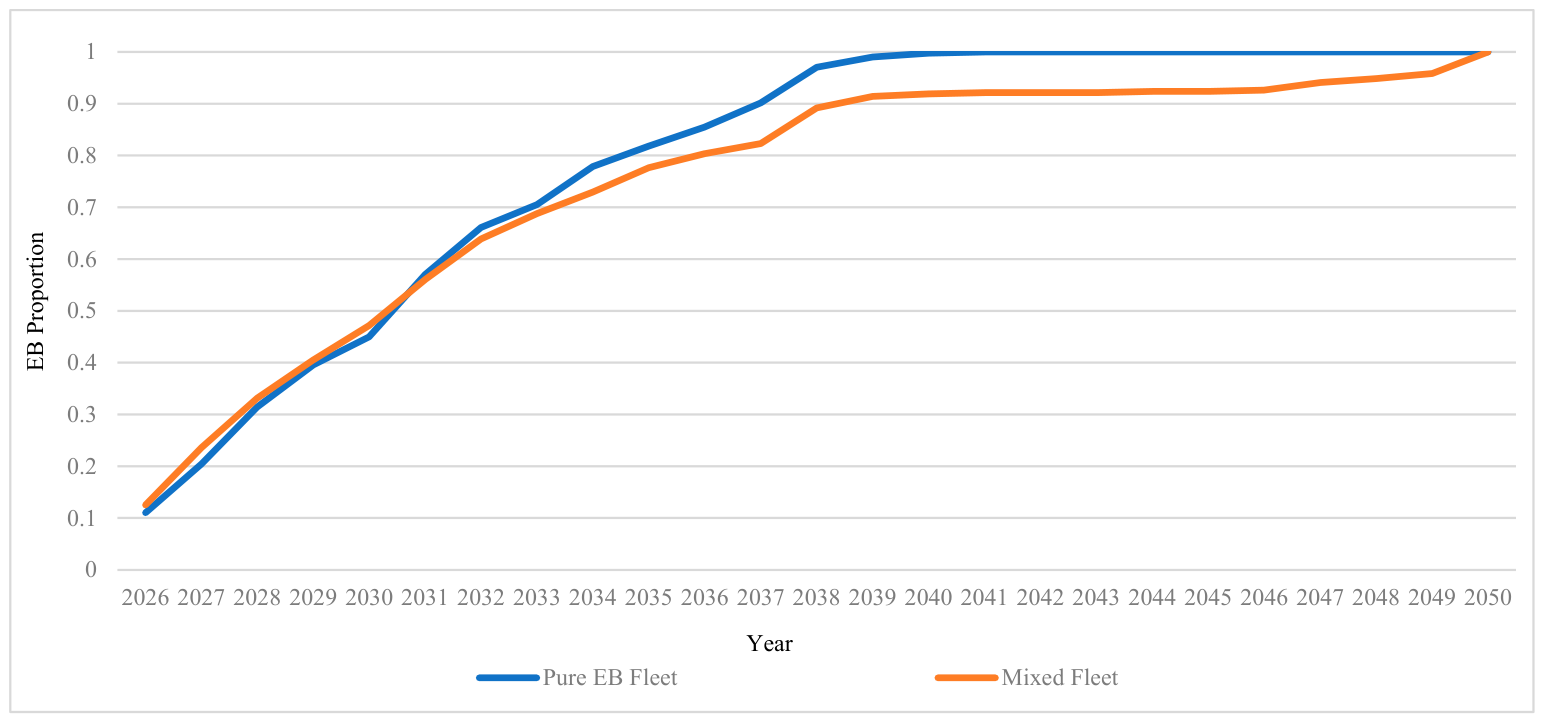
The Pure EB fleet scenario enforces 100% EB acquisitions from year 1 onward, removing replacement with diesel options entirely. Figure 2 illustrates that although adoption begins gradually, the transition accelerates after five years and achieves full electrification by 2040.
This aggressive mandate accelerates full electrification by 2040, ten years earlier than in the base case. Despite the accelerated timeline, total discounted profit declines by 8 million AED (representing a mere 0.24% reduction). The outcome associated with retiring diesel buses more quickly reduces the average salvage age from 12.93 to 12.83 years for standard diesel buses. While the solution increases early-period purchases, it yields long-term savings through reduced fuel and maintenance costs. This scenario underscores the economic feasibility of an all-electric procurement policy when supported by robust charging infrastructure and favorable battery cost figures, even without subsidies and fare increases. The costs are shown in Table 12.

5.4. Scenario 4: Restricted Transition Plan

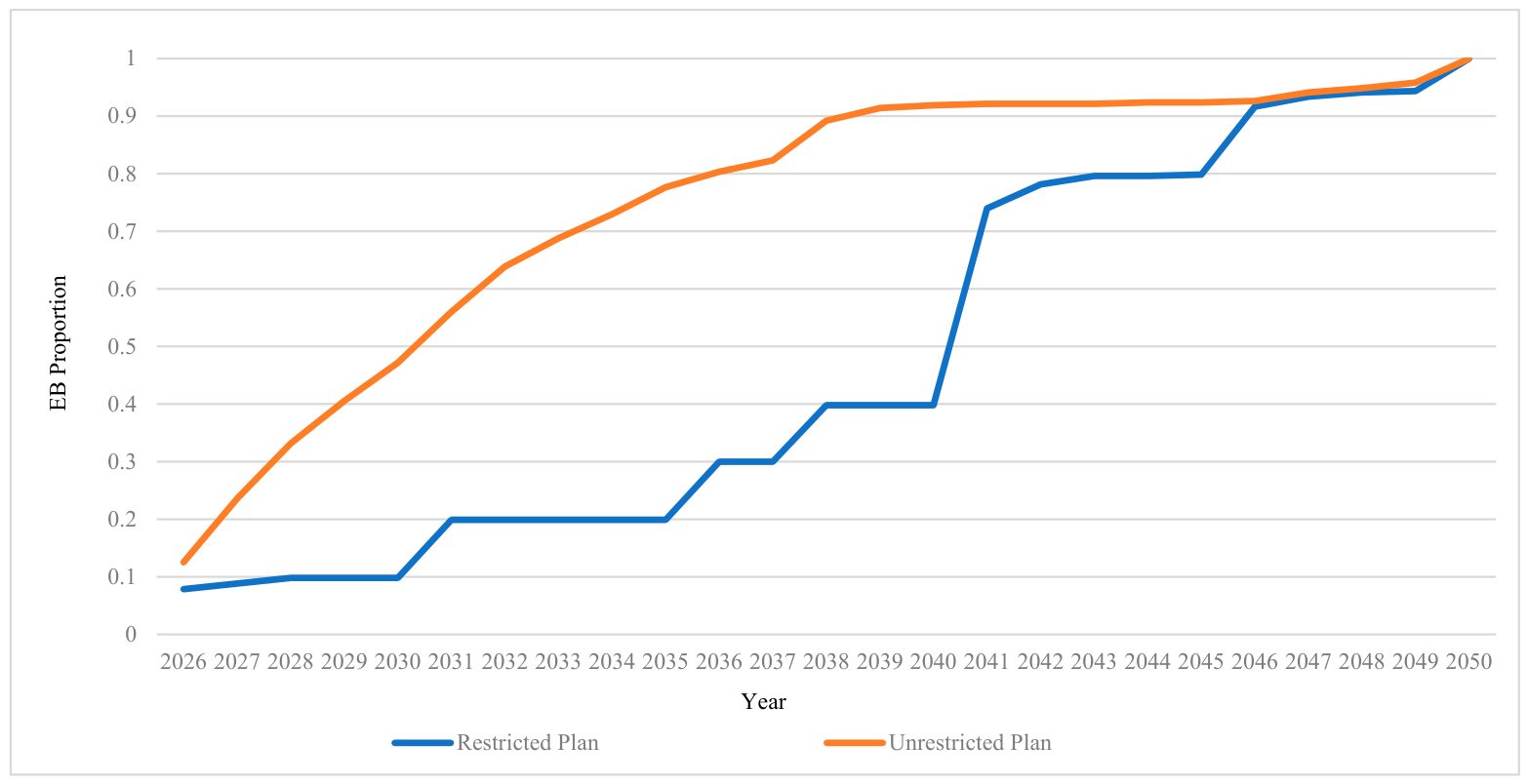
While previous scenarios presented optimal transition plans under specific conditions, they did not consider budget and electrical grid capacity limitations. These constraints can restrict operator purchasing power and charger installation and slow down electrification. Therefore, assuming that the RTA’s electrification targets account for such limitations, we enforced these targets within the model, ensuring they were not achieved before their designated dates. The impact of the enforced targets is clearly visible in Figure 3, where the resulting electrification rates differ substantially from the unrestricted scenario, demonstrating a maximal deviation of nearly 60% in the year 2036. The fleet configuration in Table 13 reveals that the adoption rate of double-decker EBs is highest in the initial periods, followed by a surge in standard EBs after 2030, with articulated EBs being introduced last, after 2040. This phased approach aligns with realistic operational strategies, allowing operators to focus on one bus size at a time and incrementally adjust tactical and operational planning. Interestingly, the 350 kWh battery EB seems to be favored over the 250 kWh model, which contrasts with the findings from the base-case scenario in Table 7. This indicates that the choice of battery capacities in EBs can vary, and there is no universal capacity that fits all needs. However, it is evident that the preference for fast-charging EBs remains consistent across scenarios. Table 14 shows an additional cost of 100 million AED for the scenario with a restricted plan. Operators need to consider this difference and may want to allocate more budget or expedite electrical grid development to facilitate faster EB adoption and mitigate these financial effects. In policy terms, this roughly 100 million AED premium (about 3% of total costs) is the budgetary cost of rigid and date-specific milestones as compared to letting the model choose the timing. Policymakers should therefore either build flexibility into milestone dates or pre-allocate additional budget and accelerate grid development in order to avoid it.

5.5. Scenario 5: Environmental and Social Costs

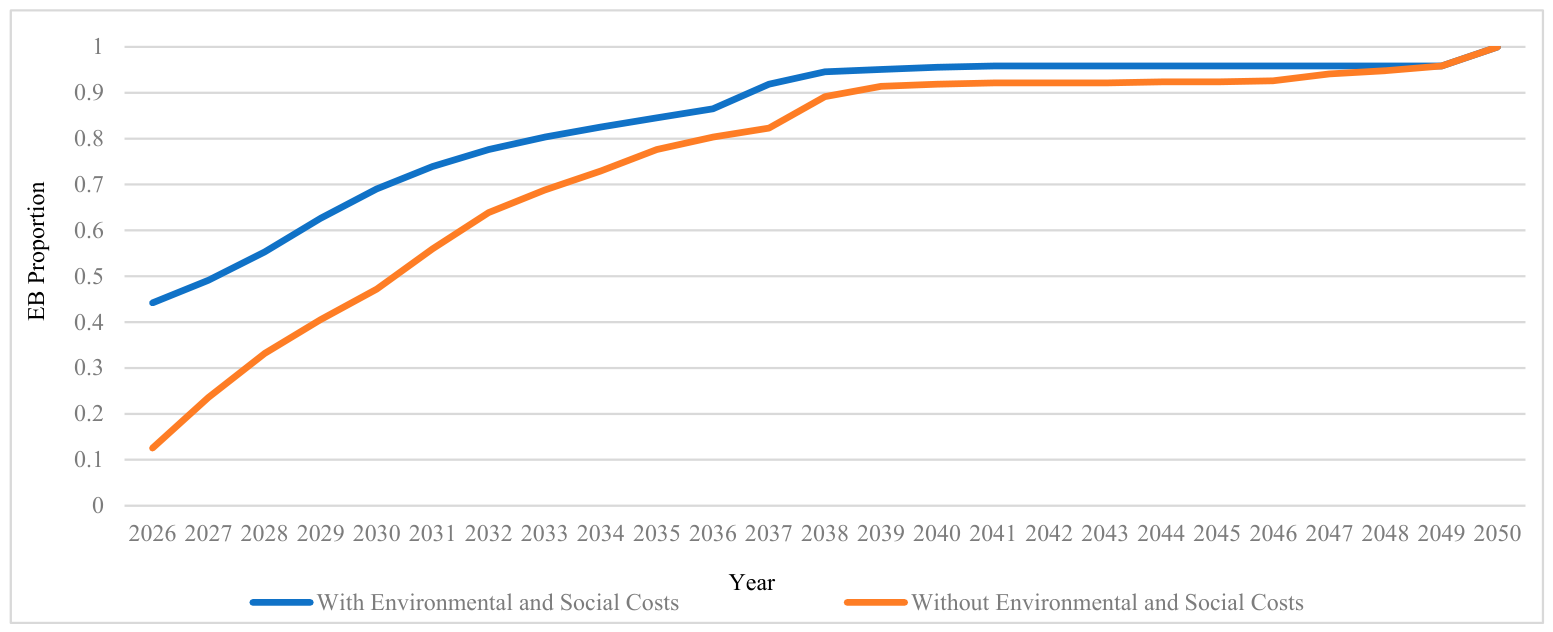
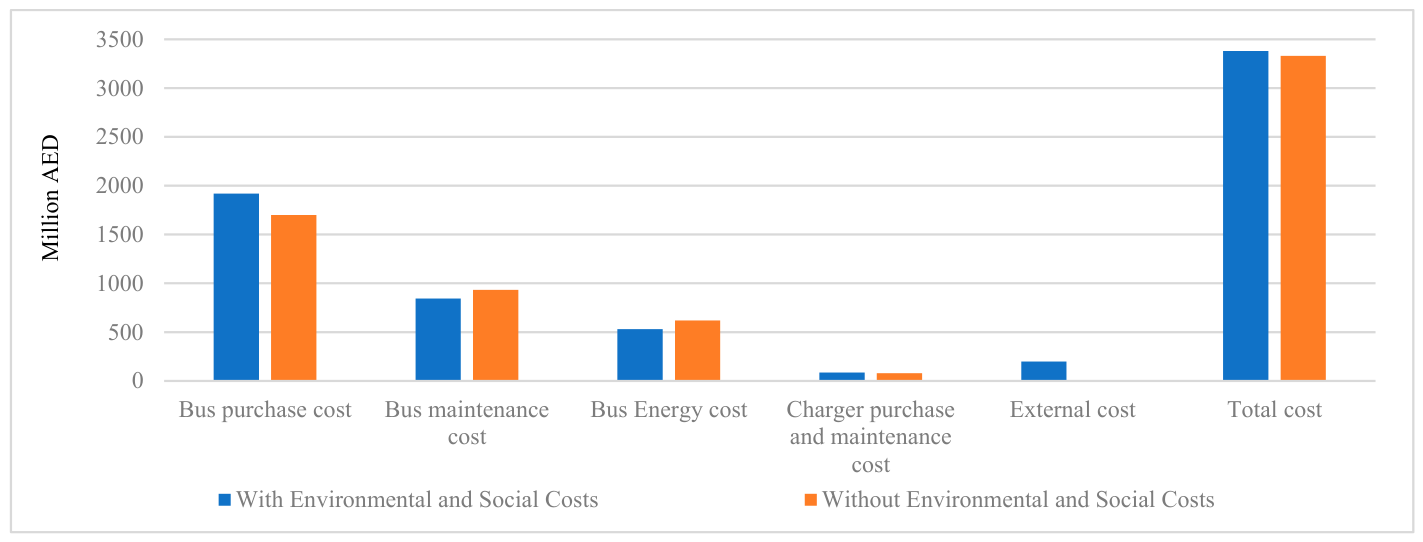
In this scenario, we introduce monetized environmental and social externalities (e.g., emissions, noise) into the objective function using values from Table 5. As shown in Figure 4, the inclusion of these costs accelerates EB adoption by 30% from the start of the planning horizon, increasing EB numbers to reduce environmental impacts and improve passenger comfort and community well-being. Figure 5 depicts the breakdown of the total cost with and without environmental and social costs. Contrary to expectations of significantly higher costs, Table 15 shows only a 50 million AED increase in the total cost over the planning horizon. Additionally, the earlier retirement of diesel buses could have generated higher salvage revenues, though this was not included in the analysis. The table also illustrates that environmental and social costs (external costs) account for just 6% of the total costs, yet their inclusion substantially influences fleet decisions, highlighting their crucial role in fostering cost-effective and welfare-enhancing transition plans.

5.6. Scenario 6: Bus Fare Increase

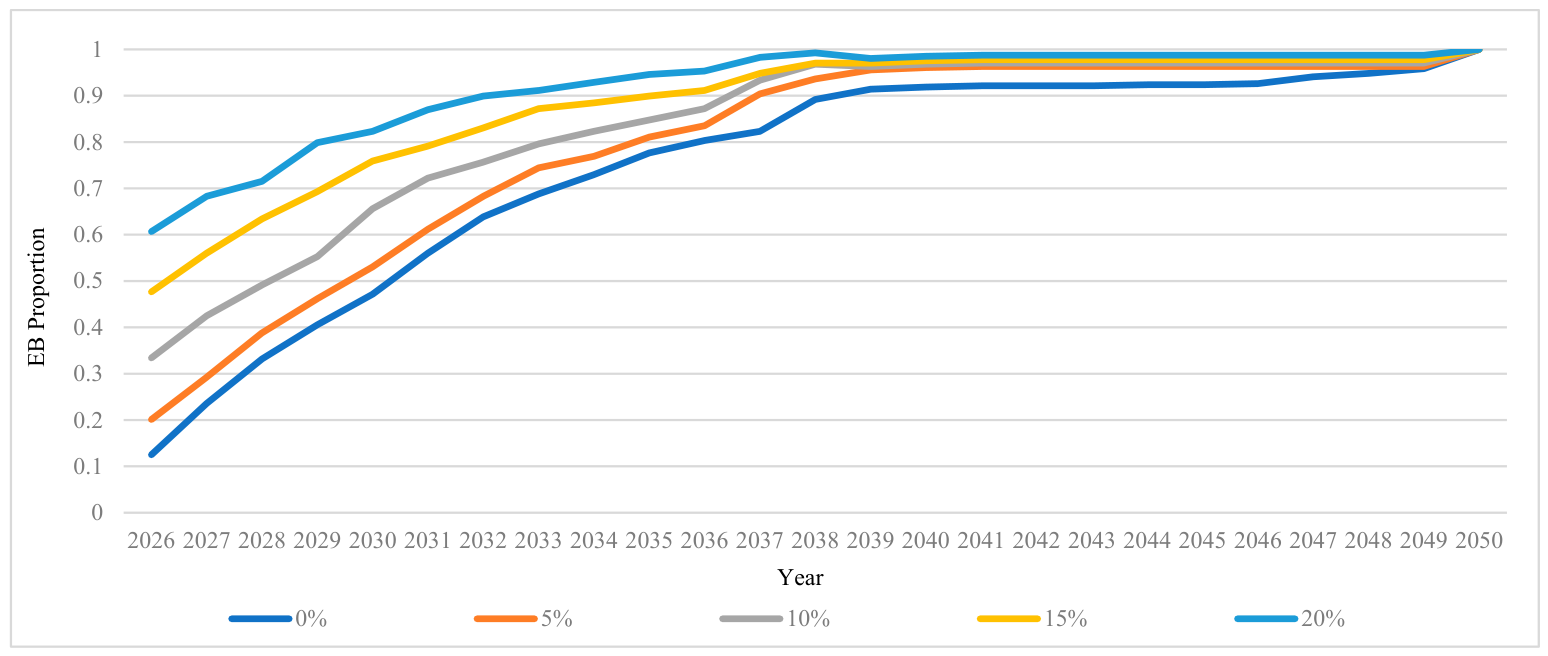
This section examines the impact of increasing fares on EB routes, considering Dubai RTA’s current fares, which range from 3 to 7.5 AED. Recognizing passengers’ willingness to pay more for EBs, we analyze incremental fare increases of 5% up to 20%, applied only to routes served by EBs and designed to remain reasonable for passengers. As shown in Figure 6, each 5% increase significantly accelerates EB adoption, with a 20% increase enabling 60% electrification in the first year, well ahead of the RTA’s current plan to achieve this only after 2040. These results highlight the importance of integrating potential revenue streams from fare adjustments, advertising, and government support into transition planning to avoid missing valuable opportunities. In essence, this suggests that judicious fare differentiation can serve as a powerful mechanism to drive rapid adoption of cleaner technologies. In the model, fare revenue is computed from route fares, trip counts, passenger capacity, and the route load factor. The fare scenarios apply a flat percentage uplift (5%, 10%, 15%, and 20%) to base fares on EB-served routes only, bounded at 20% to remain reasonable for passengers and motivated by documented higher willingness-to-pay for EBs [11]. Ridership is held fixed (no demand elasticity), which is a conservative assumption, where the explicit modeling of fare elasticity stands out as a future research avenue. Costs and profit results are shown in Table 16.

5.7. Scenario 7: Subsidy Mechanisms

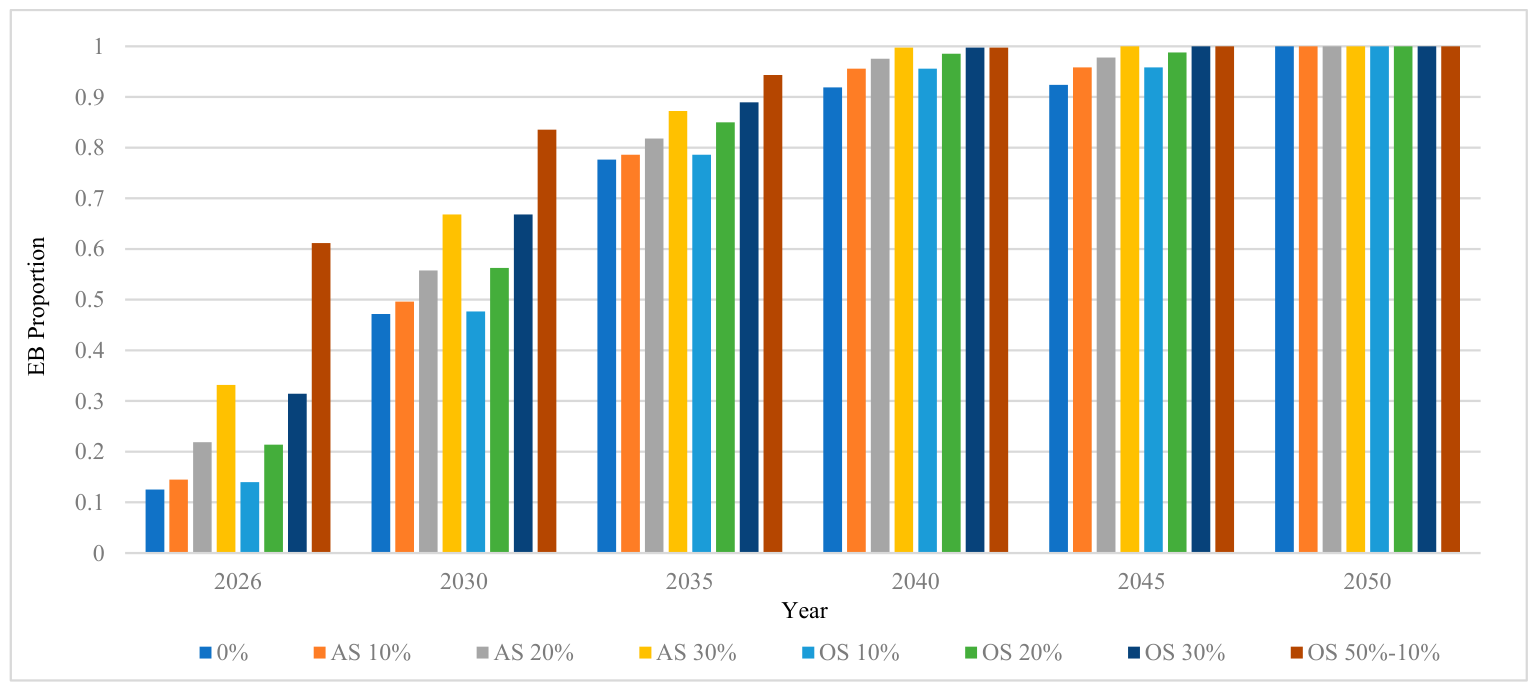
Lastly, we assess how targeted fiscal incentives, both lump-sum (one-time) and distributed (annual) subsidies, can expedite the transition to an EB fleet. In this analysis, one-time subsidies of 0–30% of each bus’s purchase price were made available in year 0, alongside an alternative “declining block” subsidy that starts at 50% in 2026 and phases down linearly to 10% by 2050 (for an average subsidy rate equivalent to 30% over the period). In contrast, annual subsidies were calibrated so that their net present value over the 12-year service life of an EB matches that of the equivalent one-time package but were disbursed in equal installments each year. Figure 7 illustrates that by the end of the first decade, the fleet share of EBs under a 30% lump-sum subsidy exceeds the no-subsidy case by nearly 20%, while the steady annual subsidy yields similar early uptake but with smoother budgetary impacts. The declining block subsidy produces the most dramatic early adoption effect, resulting in differences of 50% by 2026, 35% by 2030, and 15% by 2035 relative to the other subsidy schemes. However, as battery costs fall and baseline adoption accelerates, all subsidy regimes converge to virtually identical electrification levels after 2040.
Table 17 confirms that more aggressive subsidies lower net authority expenditures and enhance profitability. In particular, the declining block subsidy generates the highest discounted profit (151 million AED greater than the uniform 30% one-time subsidy). This is attained by concentrating support when marginal cost savings and deployment impact are greatest. These findings highlight that carefully designed subsidy profiles can both accelerate early electrification and optimize long-term financial returns.

5.8. Sensitivity Analysis

To further assess the robustness of the transition plan, we conducted a one-way sensitivity analysis on two influential inputs: the annual battery cost decline rate, which is one of the most consequential long-horizon drivers, and the average load factor, which governs fare revenue.

5.8.1. Battery Cost Decline Rate

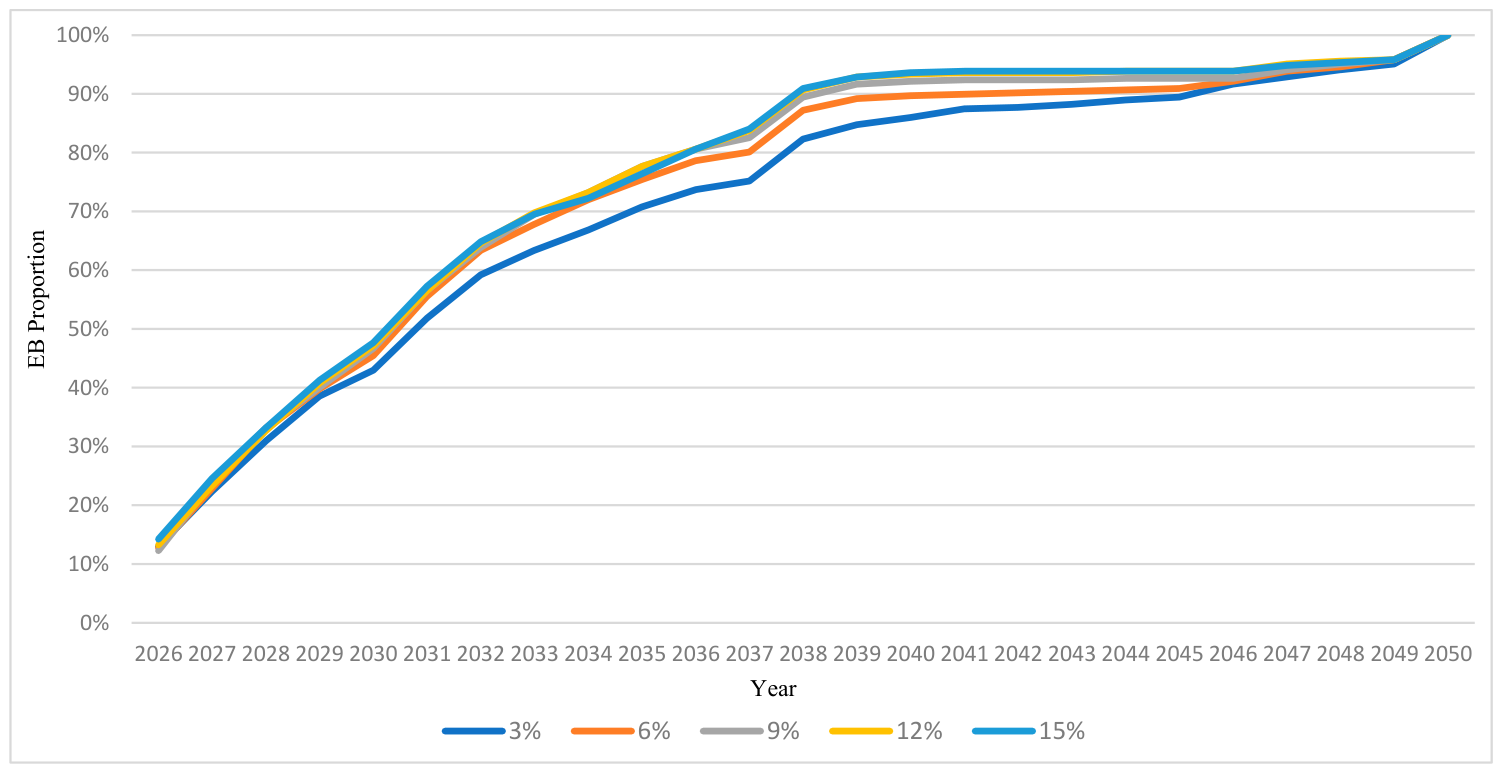
Since the long-term evolution of EB technology introduces significant capital risk and market volatility, we evaluated the model’s sensitivity to the battery cost trajectory. Building on the minimum-dwell plan as the analytical baseline, the annual battery cost decline rate—originally set at 9%—was tested at 3%, 6%, 12%, and 15%. As shown in Figure 8, the rate of technological advancement exerts a clear leverage effect on the optimal transition timeline, particularly during the main adoption phase between 2028 and 2045. Under a slow 3% decline, the model suppresses early- and mid-stage EB procurement, lagging the other regimes by up to 10% in the mid-2030s as it extends reliance on diesel buses to shield the operator from high upfront premiums. As the decline rate rises from 9% to 12% and 15%, the trajectories exhibit diminishing returns in adoption speed, evidenced by the tight convergence of the 9%, 12%, and 15% curves. Beyond a 9% annual decline, procurement pacing is governed by vehicle lifespans and capacity replacement limits rather than by battery asset premiums. All five rates converge to full (100%) electrification by the year 2050.
Table 18 reports the corresponding cost components and objective values. The total discounted system cost scales inversely with the decline rate, falling from 3.456 billion AED under a 3% decline to 3.285 billion AED under a 15% decline, a drop of 171 million AED. This confirms that, while long-term full electrification is robustly feasible across all technology landscapes, the pace of battery cost decay acts as a fiscal optimizer that raises the objective value and protects the transit authority against prolonged, high-cost operational liabilities.

5.8.2. Load Factor

We further varied the average load factor by ±15% and ±30% around its baseline value of 0.727. As Table 19 shows, the optimal transition plan is invariant to this assumption, where the individual cost components and the total discounted cost remain essentially unchanged at about 3.330 billion AED in every case, and only the objective value moves. This invariance is structural since the load factor enters the model solely through the fare revenue term and does not appear in the operational, technical, or cost constraints that determine procurement, charger sizing, and timing. Varying it therefore scales total revenue and profit from 1.388 billion AED at −30% to 5.430 billion AED at +30% while leaving the procurement, charging, and timing decisions intact. The plan is thus insensitive to ridership level uncertainty, indicating that an agency uncertain about future ridership can adopt the recommended plan knowing that only the realized profit, not the optimal decisions, will change.

5.9. Benefit–Cost Analysis (BCA)

To assess the economic viability of transitioning to an EB fleet relative to maintaining the existing diesel fleet, we conducted a BCA summarized in Table 20. The cost of each alternative is the total discounted cost over the planning horizon, which amounts to 3.38 billion AED for the EB transition and 3.53 billion AED for the no-transition (diesel) scenario. The benefits comprise the total discounted revenue from bus fares, equal to 6.73 billion AED in both scenarios. For the EB transition, we additionally monetize the environmental and social benefits, computed as the difference in environmental and social costs between the two alternatives, amounting to 0.79 billion AED. The resulting benefit–cost ratio (BCR) is 2.23 for the EB transition and 1.91 for the no-transition scenario. The higher BCR indicates that, once monetized environmental and social benefits are included, each AED invested in electrification returns substantially more than continuing with the diesel fleet. Although the upfront investment in electrification appears substantial, its long-term returns, particularly when environmental and social benefits are accounted for, make it the more economically efficient pathway for urban transportation.

6. Concluding Remarks and Future Research Avenues

This study presented a comprehensive and data-driven optimization model to support transit authorities in planning a cost-effective and operationally feasible transition to EB fleets. We formulated a multi-period MILP model that jointly integrates key inherent transition planning elements, including financial planning, technical and infrastructure requirements, existing bus network operations, multiple stakeholder perspectives, and essential modeling elements (as seen in Table 1). By combining these dimensions, the model better mimics real-world practices, fills a critical gap in the existing literature and offers a practical decision-support tool for transit agencies navigating the shift to zero-emission transport. Beyond this integration, the framework is distinguished by three specific advances: an endogenous, demand-linked determination of charger number, type, and placement in place of fixed charger-to-bus ratios; the explicit embedding of system-feasibility constraints, namely dwell time availability and grid-capacity limits; and a profit-maximization objective, which is interpreted as a net social benefit or public-sector planning objective, that internalizes fare revenue, government subsidies, and monetized environmental and social externalities. The scalability and practical relevance of the proposed model were illustrated via a case study of Dubai’s RTA, where the model generated an actionable transition plan that aligns financial prudence with operational feasibility. The optimized strategy includes a phased bus procurement schedule, prioritization of terminal-based fast-charging infrastructure, deployment of a mixed fleet tailored to route diversity, and a financing structure that evolves alongside battery cost declines and policy shifts. To assess the robustness of this plan, seven different realistic scenarios reflecting technological, economic, operational, and policy variations were developed. Collectively, the scenario analyses demonstrate the model’s capacity to quantify complex trade-offs among technology, policy, and operations. Rather than relying on a single solution, transit authorities can benefit from integrated, scenario-based planning frameworks that adapt to shifting market dynamics, stakeholder goals, and operational constraints, enabling them to design effective electrification roadmaps that balance financial performance, environmental objectives, and operational realities.
In particular, the results of the scenario analysis reveal that charging strategy and dwell time assumptions significantly influence both cost and feasibility. Scenarios with shorter dwell times and terminal-based fast-charging achieved full electrification with reduced infrastructure investment by enabling higher charger utilization and faster vehicle turnover. Furthermore, it turned out that technology choice plays a pivotal role. In range-constrained conditions, fast-charging standard EBs consistently offered better performance than depot-only models. However, as battery prices declined, the model favored more flexible fleet compositions, which demonstrates how cost trajectories can broaden viable options over time.
Policy-related scenarios illustrate that ambitious procurement mandates, such as transitioning to an EB-only fleet, can bring forward full electrification by a decade with minimal financial impact, provided that infrastructure expansion is coordinated. In contrast, scenarios characterized by specific time-phased electrification targets resulted in significant financial implications, highlighting the importance of maintaining flexibility in target-setting, budget allocations, and grid development timelines.
While the incorporation of environmental and social costs contributes a relatively small portion of total direct cost, it did trigger a shift in procurement timelines and technology choices. Notably, profit maximization emerged as a suitable planning objective, as it encompasses both cost savings and revenue generation and yields outcomes well-aligned with public benefit. Revenue-enhancing policies, such as modest EB-specific fare increases and carefully crafted subsidy structures, showed strong potential to improve financial outcomes and accelerate adoption, offering transit agencies an internally sustainable lever for funding cleaner fleets. Over time, as EB technology becomes more economically viable and electrification targets become more ambitious, the relative influence of subsidies diminishes. This highlights the importance of aligning policy support with the most financially sensitive phases of the transition. In this sense, the objective is best read as a net social benefit, or public-sector planning, objective rather than commercial profit, and the framework reduces to cost minimization when the revenue and externality terms are excluded.
For practitioners, these findings translate into several direct recommendations. One shall prioritize terminal-based fast-charging supported by adequate dwell time buffers, favor an all-electric procurement rule over rigid interim milestones, as this brings full electrification forward by roughly a decade at negligible additional cost, concentrate subsidies early through a declining-block design where their marginal impact is greatest, and either build flexibility into milestone dates or pre-allocate budget and accelerate grid development to avoid the cost premium associated with rigid targets.
Several future research avenues can further enhance the model’s applicability and depth. One priority is analyzing the interaction between bus requirements, dwell time, and route frequency, particularly as evolving passenger demand may influence fleet sizing and deployment strategies. Furthermore, moving beyond a one-to-one replacement logic toward network-wide optimization could reveal more efficient solutions. In addition, extending the model to account for a broader range of cost and revenue sources, along with the consideration of emerging technologies such as hydrogen fuel cell buses or alternate charging options such as battery swapping (see Fang et al. [49]), would allow for a more holistic evaluation framework. Lastly, closing the loop by considering secondary uses of retired EB batteries and accounting for that as an integral part of the transition optimization framework stands out as a promising avenue for future research. Given that all results reported in this work above are deterministic, the framework could be extended to handle parameter uncertainty in electricity prices, battery cost, and ridership through two-stage stochastic programming or robust optimization, which stand out as a promising avenue for future research. Lastly, further priorities may consider extending the cost accounting to a full life-cycle basis that incorporates upstream electricity-generation emissions as well as battery production and disposal.


Author Contributions

M.A.: Conceptualization, Data Curation, Formal Analysis, Investigation, Software, Writing—Original Draft. R.A.: Conceptualization, Formal Analysis, Methodology, Supervision, Validation, Writing—Review and Editing. M.B.-D.: Conceptualization, Supervision, Validation, Writing—Review and Editing. M.H.: Investigation, Methodology, Writing—Review and Editing. All authors have read and agreed to the published version of the manuscript.

Funding

This research was funded by the Open Access Program (OAP) at the American University of Sharjah.

Data Availability Statement

The original data presented in the study are openly available in Zenodo at https://doi.org/10.5281/zenodo.20598731.

Acknowledgments

This paper represents the opinions of the authors and does not mean to represent the position or opinions of the American University of Sharjah.

Conflicts of Interest

The authors declare no conflict of interest.

Appendix A. Notation

Table A1. Sets, parameters, and decision variables used in the model.
SymbolDescription
Sets
D Set of depots where buses are stored, maintained, and dispatched.
M Set of terminals where buses stop for boarding and alighting.
L Set of locations, consisting of depots and terminals.
R Set of bus routes.
T Set of time periods (years) in the planning horizon.
C Set of charging technologies available for EBs.
D C Set of depot chargers.
F C Set of fast chargers.
B Set of bus types.
E B Set of EB types.
F E B Set of fast-charging EBs.
J Set of possible bus ages.
Parameters
C c c Cost of purchasing and installing charger type c .
C m t l c Maintenance cost for charger type c at location l in period t .
a s j b Annual subsidy for buses of type b and age j .
o s b One-time subsidy for purchasing bus type b .
a e b Air pollution environmental and social cost for bus type b .
n e b Noise environmental and social cost for bus type b .
c e b Climate change environmental and social cost for bus type b .
B c t b Cost of purchasing bus type b in period t .
m c t b Midlife cost of bus type b in period t .
s v j t b Salvage value of bus type b of age j in period t .
m o c j t r b Maintenance and energy cost for bus type b of age j on route r in period t .
B o j b Number of buses of type b and age j in the fleet at the start of the planning horizon.
B p b Passenger capacity of bus type b .
B J b Maximum age of bus type b .
J m b Midlife age of bus type b .
E B c b Battery capacity of bus type b (kWh).
E B x b EB energy consumption of bus type b (kWh/Km).
e t Electrification target in period t .
C o l c Number of chargers of type c owned at location l at the start of the planning horizon.
C r c Charging rate of charger type c (kW).
D h The total time available each day for charging buses at depots.
R h r Operational hours of route r .
R d r Annual distance of route r .
R k r Daily distance of route r .
R o r Daily number of trips per bus of route r .
R y r Annual number of trips of route r .
R w r Dwell time of route r .
R l r Average load factor for route r .
R b f r b Bus fare for route r using bus type b .
R q t r Number of buses required for route r during period t .
L g t l Grid capacity in period t at location l (kWh).
L r l r Binary parameter set to 1 if route r is assigned to location l , and 0 otherwise.
x j t r b Binary parameter set to 1 if a bus of type b and age j is compatible with the assignment of route r during period t , and 0 otherwise.
b t Annual budget in period t .
T f Final period in the planning horizon.
J a Maximum average bus age in the final period.
V One-period discount factor.
Decision variables
P t b Number of buses of type b purchased in period t .
W t c Number of chargers of type c purchased in period t .
S j t b Number of buses of type b and age j salvaged in period t .
A j t b Number of available buses of type b and age j in period t .
Z j t r b Number of buses of type b and age j assigned to route r in period t .
L A t r l b Number of buses of type b assigned to route r and location l in period t .
L X t r l The total daily energy demand at location l and route r in period t (kWh).
C L t l c Number of available chargers of type c installed at location l in period t .

References

  1. Alamatsaz, K.; Hussain, S.; Lai, C.; Eicker, U. Electric bus scheduling and timetabling, fast charging infrastructure planning, and their impact on the grid: A review. Energies 2022, 15, 7919. [Google Scholar] [CrossRef]
  2. Perumal, S.S.G.; Lusby, R.M.; Larsen, J. Electric bus planning & scheduling: A review of related problems and methodologies. Eur. J. Oper. Res. 2022, 301, 395–413. [Google Scholar] [CrossRef]
  3. United Nations, Department of Economic and Social Affairs. World Urbanization Prospects 2018. United Nations. 2018. Available online: https://population.un.org/wup/Publications/ (accessed on 28 April 2025).
  4. RTA Government of Dubai. Strategy to Transition to Zero-Emissions Operations by 2050. 2023. Available online: https://www.rta.ae/wps/portal/rta/ae/home/news-and-media/all-news/NewsDetails/strategy-to-transition-to-zero-emissions-operations-by-2050 (accessed on 19 July 2025).
  5. Verbrugge, B.; Hasan, M.M.; Rasool, H.; Geury, T.; El Baghdadi, M.; Hegazy, O. Smart integration of electric buses in cities: A technological review. Sustainability 2021, 13, 12189. [Google Scholar] [CrossRef]
  6. Sclar, R.; Gorguinpour, C.; Castellanos, S.; Li, X. Barriers to Adopting Electric Buses. 2019. Available online: https://www.wri.org/research/barriers-adopting-electric-buses (accessed on 19 July 2025).
  7. Khalid, M.R.; Alam, M.S.; Sarwar, A.; Asghar, M.S.J. A comprehensive review on electric vehicles charging infrastructures and their impacts on power-quality of the utility grid. eTransportation 2019, 1, 100006. [Google Scholar] [CrossRef]
  8. Das, H.S.; Rahman, M.M.; Li, S.; Tan, C.W. Electric vehicles standards, charging infrastructure, and impact on grid integration: A technological review. Renew. Sustain. Energy Rev. 2020, 120, 109618. [Google Scholar] [CrossRef]
  9. Zhou, Y.; Ong, G.P.; Meng, Q. The road to electrification: Bus fleet replacement strategies. Appl. Energy 2023, 337, 120903. [Google Scholar] [CrossRef]
  10. Ribeiro, P.; Dias, G.; Mendes, J. Public transport decarbonization: An exploratory approach to bus electrification. World Electr. Veh. J. 2024, 15, 81. [Google Scholar] [CrossRef]
  11. Lin, B.; Tan, R. Are people willing to pay more for new energy bus fares? Energy 2017, 130, 365–372. [Google Scholar] [CrossRef]
  12. Rodrigues, A.L.P.; Seixas, S.R.C. Battery-electric buses and their implementation barriers: Analysis and prospects for sustainability. Sustain. Energy Technol. Assess. 2022, 51, 101896. [Google Scholar] [CrossRef]
  13. Pelletier, S.; Jabali, O.; Mendoza, J.E.; Laporte, G. The electric bus fleet transition problem. Transp. Res. Part C Emerg. Technol. 2019, 109, 174–193. [Google Scholar] [CrossRef]
  14. Manzolli, J.A.; Trovão, J.P.; Antunes, C.H. A review of electric bus vehicles research topics–Methods and trends. Renew. Sustain. Energy Rev. 2022, 159, 112211. [Google Scholar]
  15. Hanna, M.O.; Shaaban, M.F.; Salama, M.M.A. Comprehensive transition plan for battery-electric bus fleets considering utility constraints. IEEE Trans. Ind. Appl. 2024, 60, 887–899. [Google Scholar]
  16. Basma, H.; Haddad, M.; Mansour, C.; Nemer, M.; Stabat, P. Evaluation of the techno-economic performance of battery electric buses: Case study of a bus line in Paris. Res. Transp. Econ. 2022, 95, 101207. [Google Scholar] [CrossRef]
  17. Åslund, V.; Pettersson-Löfstedt, F. Rationales for transitioning to electric buses in Swedish public transport. Res. Transp. Econ. 2023, 100, 101308. [Google Scholar] [CrossRef]
  18. Dirks, N.; Schiffer, M.; Walther, G. On the integration of battery electric buses into urban bus networks. Transp. Res. Part C Emerg. Technol. 2022, 139, 103628. [Google Scholar] [CrossRef]
  19. Botzen, W.J.W.; van den Bergh, J.C.J.M. How sensitive is Nordhaus to Weitzman? Climate policy in DICE with an alternative damage function. Econ. Lett. 2012, 117, 372–374. [Google Scholar] [CrossRef]
  20. Giagnorio, M.; Börjesson, M.; D’Alfonso, T. Introducing electric buses in urban areas: Effects on welfare, pricing, frequency, and public subsidies. Transp. Res. Part A Policy Pract. 2024, 185, 104103. [Google Scholar] [CrossRef]
  21. Zhang, L.; Liu, Z.; Wang, W.; Yu, B. Long-term charging infrastructure deployment and bus fleet transition considering seasonal differences. Transp. Res. Part D Transp. Environ. 2022, 111, 103429. [Google Scholar] [CrossRef]
  22. Deng, R.; Liu, Y.; Chen, W.; Liang, H. A survey on electric buses–energy storage, power management, and charging scheduling. IEEE Trans. Intell. Transp. Syst. 2021, 22, 9–22. [Google Scholar]
  23. Dreier, D. Transition Technologies for Electrification and Optimisation of Bus Transport Systems. Ph.D. Thesis, KTH Royal Institute of Technology, Stockholm, Sweden, 2020. [Google Scholar]
  24. Zhou, Y.; Liu, X.C.; Wei, R.; Golub, A. Bi-objective optimization for battery electric bus deployment considering cost and environmental equity. IEEE Trans. Intell. Transp. Syst. 2021, 22, 2487–2497. [Google Scholar]
  25. Coppola, P.; Bocciolone, M.; Colombo, E.; De Fabiis, F.; Sanvito, F.D. Multi-criteria life-cycle assessment of bus fleet renewal: A methodology with a case study from Italy. Case Stud. Transp. Policy 2023, 13, 101044. [Google Scholar]
  26. Clairand, J.-; Guerra-Terán, P.; Serrano-Guerrero, X.; González-Rodríguez, M.; Escrivá-Escrivá, G. Electric vehicles for public transportation in power systems: A review of methodologies. Energies 2019, 12, 3114. [Google Scholar] [CrossRef]
  27. He, Y.; Liu, Z.; Zhang, Y.; Song, Z. Time-dependent electric bus and charging station deployment problem. Energy 2023, 282, 128227. [Google Scholar] [CrossRef]
  28. Hillier, F.S. Linear and Nonlinear Programming. 2008. Available online: https://web.stanford.edu/class/msande310/310trialtext.pdf (accessed on 23 June 2025).
  29. Hu, H.; Du, B.; Liu, W.; Perez, P. A joint optimisation model for charger locating and electric bus charging scheduling considering opportunity fast charging and uncertainties. Transp. Res. Part C Emerg. Technol. 2022, 141, 103732. [Google Scholar] [CrossRef]
  30. González-García, A.; Díaz-Pastor, S.J.; Moreno-Romero, A. A comprehensive approach to the governance of universal access to sustainable energy. Sustainability 2023, 15, 15813. [Google Scholar] [CrossRef]
  31. Islam, A.; Lownes, N. When to go electric? A parallel bus fleet replacement study. Transp. Res. Part D Transp. Environ. 2019, 72, 299–311. [Google Scholar] [CrossRef]
  32. Li, L.; Lo, H.K.; Xiao, F.; Cen, X. Mixed bus fleet management strategy for minimizing overall and emissions external costs. Transp. Res. Part D Transp. Environ. 2018, 60, 104–118. [Google Scholar] [CrossRef]
  33. Feng, W.; Figliozzi, M. Vehicle technologies and bus fleet replacement optimization: Problem properties and sensitivity analysis utilizing real-world data. Public Transp. 2014, 6, 137–157. [Google Scholar] [CrossRef]
  34. Tang, C.; Li, X.; Ceder, A.A.; Wang, X. Public transport fleet replacement optimization using multi-type battery-powered electric buses. Transp. Res. Rec. 2021, 2675, 1422–1431. [Google Scholar] [CrossRef]
  35. Dubai RTA. Journey Planner. 2025. Available online: https://www.rta.ae/wps/portal/rta/ae/public-transport/journeyplanner/ (accessed on 9 August 2025).
  36. dubizzle. Dubai Buses. Available online: https://www.dubizzle.com/blog/cars/buses-dubai-rta/ (accessed on 9 August 2025).
  37. Dubai RTA. Dubai Bus. 2025. Available online: https://www.rta.ae/wps/portal/rta/ae/public-transport/dubaibus (accessed on 9 August 2025).
  38. Ambrose, H.; Pappas, N.; Kendall, A. Exploring the Costs of Electrification for California’s Transit Agencies. 2017. Available online: https://cloudfront.escholarship.org/dist/prd/content/qt0fn8s2jh/qt0fn8s2jh.pdf (accessed on 5 June 2025).
  39. BYD Motors. K11 Electric Transit Bus. 2018. Available online: https://en.byd.com/bus/k11-electric-transit-bus/ (accessed on 9 June 2025).
  40. Schmidt, O.; Hawkes, A.; Gambhir, A.; Staffell, I. The future cost of electrical energy storage based on experience rates. Nat. Energy 2017, 6, 17110. [Google Scholar]
  41. Bloomberg New Energy Finance. Electric Buses in Cities: Driving Towards Cleaner Air and Lower CO2. 2018. Available online: https://data.bloomberglp.com/professional/sites/24/2018/05/Electric-Buses-in-Cities-Report-BNEF-C40-Citi.pdf (accessed on 13 August 2025).
  42. Liu, J.; Wang, Y.; Shang, L. Research on Driver Model of Public Transportation Energy Consumption System Based on Computer Cloud Computing Analysis. J. Phys. Conf. Ser. 2020, 1650, 032047. [Google Scholar] [CrossRef]
  43. European Commission. Handbook on External Costs of Transport; European Commission: Brussels, Belgium, 2019. [Google Scholar] [CrossRef] [PubMed]
  44. Dubai RTA. 702 Million Riders Used Public Transport in 2023. 2024. Available online: https://www.rta.ae/wps/portal/rta/ae/home/news-and-media/all-news/NewsDetails/702-million-riders-used-public-transport-in-2023 (accessed on 13 August 2025).
  45. Blynn, K. Accelerating Bus Electrification: Enabling a Sustainable Transition to Low Carbon Transportation System. Ph.D. Thesis, Massachusetts Institute of Technology, Cambridge, MA, USA, 2018. [Google Scholar]
  46. Al Zeer, A.R. Petrol Price in UAE: March 2025 Fuel Prices in UAE Today. 2025. Available online: https://www.yallamotor.com/news/petrol-price-in-uae-9408 (accessed on 15 August 2025).
  47. Dubai Electricity and Water Authority (DEWA). Slab Tariff. 2025. Available online: https://www.dewa.gov.ae/en/consumer/billing/slab-tariff (accessed on 3 September 2025).
  48. Trading Economics. United Arab Emirates Interest Rate. 2025. Available online: https://tradingeconomics.com/united-arab-emirates/interest-rate (accessed on 3 September 2025).
  49. Fang, S.C.; Ke, B.R.; Chung, C.Y. Minimization of construction costs for an all battery-swapping electric-bus transportation system: Comparison with an all plug-in system. Energies 2017, 10, 890. [Google Scholar]
Figure 1. EB transition planning model.
Energies 19 02961 g001
Figure 2. Pure EB fleet scenario electrification rate.
Energies 19 02961 g002
Figure 3. Restricted plan scenario electrification rate.
Energies 19 02961 g003
Figure 4. Environmental & social scenario electrification rate.
Energies 19 02961 g004
Figure 5. Environmental & social scenario direct total cost.
Energies 19 02961 g005
Figure 6. Bus fare scenario electrification rates.
Energies 19 02961 g006
Figure 7. Subsidy scenario electrification rates.
Energies 19 02961 g007
Figure 8. Fleet electrification trajectories under different annual battery cost decline rates.
Energies 19 02961 g008
Table 1. EB transition planning elements.
Transition ElementsSub ElementsComponentsReferences
Financial PlanningInternal CostBus Purchase Cost[13,16,17,18]
infrastructure Cost
Operating cost
Environmental and Social CostClimate Costs[9,19]
Health Costs
RevenueSalvage Revenue[11,12,20]
Bus Fare Revenue
Budget ConstraintsBudget[12,21]
Technical and Infrastructure RequirementsEB TypesBus Technology Selection[1]
Battery TypesBattery Size Selection[13,20,22]
Charging InfrastructureCharging Infrastructure Placement[15,20,23]
Charging Infrastructure Types[2]
Existing Bus Network and OperationsRoute CharacteristicsRoute Assignment[2,9,14,24]
Demand Fulfilment
Current Fleet CharacteristicsAvailable Buses and chargers[25]
Multi-stakeholder PerspectivesElectric UtilitiesElectric Utilities Constraints[14,15]
Government EntitiesGovernment Incentives[12,26]
Electrification Target
Modeling ElementsTracking ElementsTime Tracking[9,13,21,27]
Age Tracking
Optimization ModelScalable Model[28]
Table 2. A classification of modeling-based research on EB transition planning.
ReferenceFinancial PlanningTechnical and Infrastructure RequirementsExisting Bus Network and OperationsMulti-Stakeholder PerspectivesModeling Elements
Internal CostEnvironmental and Social CostRevenueBudget ConstraintsEB TypesBattery TypesCharging InfrastructureRoute CharacteristicsCurrent FleetElectric UtilitiesGovernment EntitiesTracking ElementsOptimization Model
Pelletier et al. [13]
Hanna et al. [15]
Dirks et al. [18]
He et al. [27]
Islam and Lownes [31]
Zhang et al. [21]
Li et al. [32]
Feng and Figliozzi [33]
Tang et al. [34]
Zhou et al. [9]
This work
Table 3. Diesel bus (DB) data.
EB TypeBus Cost (Million AED)Passenger CapacityEnergy Consumption
(Liter/km)
40 DB Standard1.643420.48
60 DB Articulated2.665550.67
40 DB Double-Decker2.373700.67
Table 4. Electric bus (EB) data.
EB TypeBus CostBattery CostPassenger CapacityCharging ModeEnergy Consumption
(kWh/km)
40 EB 250 *2.4460.19542Depot only1.24
40 EB 3502.4460.27342Depot only1.3
60 EB 6504.4710.50855Depot only1.85
40 EB DD 6503.2850.50870Depot only2.2
40 EB 250 FC2.4460.19542Depot + fast at terminals1.24
60 EB 550 FC4.4710.4355Depot + fast at terminals1.67
40 EB DD 550 FC3.2850.4370Depot + fast at terminals1.9
* 40 EB 250 means 40 ft EB with 250 kWh battery; DD: double-decker; FC: fast-charging, costs in million AED.
Table 5. Environmental and social costs by bus type.
Bus typeAir Pollution Cost (AED per pax km)Noise Cost (AED per Vehicle km)Climate Change Cost (AED per pax km)
40 DB0.005840.1008130.02482
60 DB0.0040150.1008130.028105
40 DB DD0.0040150.1008130.028105
40 EB 2500.002190.0651680
40 EB 3500.002190.0651680
60 EB 6500.001460.0651680
40 EB DD 6500.001460.0651680
40 EB 250 FC0.002190.0651680
60 EB 550 FC0.001460.0651680
40 EB DD 550 FC0.001460.0651680
Table 6. Summary of the scenario analysis.
Scenario/Sensitivity AnalysisKey Assumption ChangedElectrification ReachedTotal Discounted Cost/Profit
(Billion AED)
Main Fleet & Charger Takeaways
Scenario 1:
Base case
Relaxed 90% target by 2050 (double-decker routes incompatible with available EBs); subsidies and externalities neutralized; unbound budget and grid constraints.50% by 2032; 90% by 2050 (100% not reached).Total cost 3.388; objective (profit) 3.33.Fast-charging EBs preferred for long-range routes; depot-only EBs adopted after 2038 as battery costs fall; diesel buses are isolated to low-mileage routes to shield the operator from high operational costs; charger-to-bus ratios ≈ 1:2.2 (depot) and 1:9.3 (terminal); chargers ≈ 4% of bus purchase cost.
Scenario 2: Dwell-time extremesDepot/terminal dwell time set to minimum and maximum extremes.Minimum dwell achieves full (100%) electrification; selected as the baseline for Scenarios 3–7.Min dwell:
Total cost 3.33, objective 3.409. Max dwell:
3.339/3.40.
Longer operational dwell times allow terminal-charged EBs to draw power over extended windows, making 100% electrification operationally viable; shorter dwell needs 16 fewer fast chargers (−10% charger cost); highlights the role of operational scheduling in charger utilization.
Scenario 3: Pure EB fleet100% EB purchases from year 1; diesel replacement removed.Full electrification by 2040 (about a decade earlier than the base case).Objective ≈ 3.401 (−8M AED or −0.24% vs min-dwell baseline).All-electric procurement is economically feasible given robust charging and falling battery costs, even without subsidies or fare increases; diesel buses retired slightly faster (avg. salvage age 12.93 → 12.83 yr).
Scenario 4: Restricted transition planRTA interim milestones enforced (10%, 20%, 40%, 80%, 100% by 2030, 2035, 2040, 2045, 2050) to reflect budget and grid limits.Follows the mandated schedule; up to ≈60% slower than the unrestricted path in 2036.Total cost 3.431 vs 3.330 unrestricted (+100M AED, ≈ 3%).Phased out one bus size at a time (double-decker EBs first, standard after 2030, articulated after 2040); 350 kWh battery favored over 250 kWh; fast-charging preference persists.
Scenario 5: Environmental & social costsMonetized air pollution, noise, and climate externalities (Table 5) added to the objective.Adoption accelerated by ≈30% from the start of the horizon.+≈50M AED direct cost over the horizon; externalities ≈5% of total cost.A small share of total cost but a substantial shift toward earlier EB adoption; improves passenger comfort and community welfare.
Scenario 6: Bus fare increase5–20% fare uplift applied only to EB-served routes (base fares 3–7.5 AED); ridership held fixed.20% uplift → ≈60% electrification in year 1 (vs after 2040 under the RTA plan).Discounted profit rises with each 5% step (revenue-positive).Fare differentiation is a powerful, internally funded lever for accelerating adoption of cleaner buses.
Scenario 7: Subsidy mechanismsOne-time subsidies; 0–30% of purchase price; an NPV-matched annual subsidy; and a declining-block subsidy (50% in 2026 → 10% by 2050, ≈30% average).Declining block → 50% higher electrification rate in 2026, 35% in 2030, and 15% in 2035 compared to other subsidy types; all policies exhibit minimal impact after 2040.Objective from 3.409 (no subsidy) to 4.109 (annual 50–10%); declining block +151M AED vs uniform 30% one-time.Front-loaded subsidies cut net authority expenditure and raise profit; subsidy influence fades after 2040 as battery costs decline.
Sensitivity 1:
Battery Cost Decline
Annual battery cost decline tested at 3%, 6%, 12%, and 15% variants (min-dwell baseline remains 9%).100% by 2050 for all decline variants; 3% trace lags by up to 10% in the mid-2030s; 12% and 15% trajectories closely overlap the 9% baseline curve.For 3%, 6%, 9%, 12%, 15% decline: cost/obj = 3.456/3.28, 3.378/3.36, 3.330/3.409, 3.303/3.43, 3.285/3.45, respectively.Total system cost drops by 171M AED as decline rate accelerates from 3% to 15%; 12% and 15% traces show diminishing returns on adoption pacing, proving fleet deployment becomes capped by vehicle lifespans rather than battery asset premiums once decline exceeds 9% annually.
Sensitivity 2:
Load factor
Baseline load factor (0.727) varied by ±15% and ±30% boundaries (0.509 to 0.945).100% by 2050; trajectories are entirely identical across all five demand variations.1.388 at 0.509 up to 5.43 at 0.945 (Total cost remains identical across all variants).Demonstrates absolute plan robustness where physical fleet rollout and charger infrastructure are entirely invariant to demand volatility. The fuel and maintenance advantages of EBs safely insulate the transition plan from ridership risk, meaning changes in load factor only affect profit linearly.
Table 7. Base-case scenario purchase plan.
Year40 DB60 DB40 DB DD40 EB 25040 EB 35060 EB 65040 EB DD 65040 EB 250 FC60 EB 550 FC40 EB DD 550 FC
2026000000027311
202700000002853
2028002000025100
2029001000012121
203000200001751
2031605000025141
203230600001990
203330300001750
2034120500001120
203520300001300
203630000001100
20370870000800
203800013011463
2039001701027311
204000024002453
2041000120023100
2042002000012121
204300300001751
2044004000025141
204500700001990
204600500001750
204700300001720
204800030001300
204900030001100
205000017003800
Table 8. Base-case scenario model’s output.
CategoryValue
Bus purchase cost (billion AED)1.578
Bus maintenance cost (billion AED)1.014
Bus Energy cost (billion AED)0.731
Charger purchase and maintenance cost (billion AED)0.065
Total cost (billion AED)3.388
Objective function (billion AED)3.33
Solution time (s)348
Table 9. EB base-case scenario fleet configuration.
Year40 DB60 DB40 DB DD40 EB 25040 EB 35060 EB 65040 EB DD 65040 EB 250 FC60 EB 550 FC40 EB DD 550 FC
20262427845000027311
20272147342000055814
202818963420000801814
202917751410000923015
2030160464000001093516
2031135323900001344917
2032116233900001535817
203399183900001706317
203488163900001816517
203575163900001946517
203664163900002056517
203756163900002136517
203839935130112177120
203932835200212177120
204030835224212137120
204129835236212117120
204229835236212117120
204329835236212117120
204429835236212117120
204529835236212117120
204629835236212117120
204723835236212177120
204820835266212177120
204917835296212177120
20500832466242177120
Table 10. Base-case scenario: charger and bus counts at the top 5 locations
LocationBus CountCharger Count
Central Depot366166
Al Ghubaiba Bus Stn553
Gold Souq Bus Stn232
Al Rashidiya Bus Stn172
Oud Metha Bus Stn222
Table 11. Dwell time extremes scenario model’s output.
CategoryBase CaseMax DwellMin Dwell
Bus purchase cost (billion AED)1.5781.6941.699
Bus maintenance cost (billion AED)1.0140.9350.933
Bus Energy cost (billion AED)0.7310.6230.619
Charger purchase and maintenance cost (billion AED)0.0650.0870.079
Total cost (billion AED)3.3883.3393.330
Objective function (billion AED)3.333.403.409
Solution time (s)3482008958
Table 12. Scenario 3 results.
Category *Pure EB FleetMixed Fleet
Bus purchase cost17151699
Bus maintenance cost931933
Bus energy cost612619
Charger purchase and maintenance cost8079
Total cost33383330
Solution time (s)369958
* All costs are in million AED.
Table 13. Restricted plan scenario fleet configuration.
Year40 DB60 DB40 DB DD40 EB 25040 EB 35060 EB 65040 EB DD 65040 EB 250 FC60 EB 550 FC40 EB DD 550 FC
2026261813300008024
2027261812900008028
2028261812500008032
2029261812500008032
2030261812500008032
20312358110000034047
20322358110000034047
20332358110000034047
20342358110000034047
20352358110000034047
2036195819000074048
2037195819000074048
20381697240000100953
20391697240000100953
20401697240000100953
204187154028701545953
204274114028701676353
20437274028701696753
20447274028701696753
20457174028701706753
20463310028942087153
204727000281042147153
204824000281042177153
204923001281042177153
205000024281042177153
Table 14. Restricted plan scenario model’s output.
CategoryRestricted PlanUnrestricted Plan
Bus purchase cost (billion AED)1.4281.699
Bus maintenance cost (billion AED)1.0880.933
Bus Energy cost (billion AED)0.8520.619
Charger purchase and maintenance cost (billion AED)0.0630.079
Total cost (billion AED)3.4313.330
Solution time (s)1130958
Table 15. Scenario 5 results *.
CategoryWith Environmental and Social CostsWithout Environmental and Social Costs
Bus purchase cost19191699
Bus maintenance cost844933
Bus Energy cost531619
Charger purchase and maintenance cost8679
External costs1980
Total cost33803330
Solution time (s)323958
* All costs are in million AED.
Table 16. Scenario 6 results *.
Category0%5%10%15%20%
Bus purchase cost16991765187219902086
Bus maintenance cost933903859819793
Bus Energy cost619590552516489
Charger purchase and maintenance cost7982858890
Total cost33303340336834133458
Profit margin50.59%52.33%53.94%55.40%56.82%
Solution time (s)958339320349310
* All costs are in million AED.
Table 17. Subsidy scenario results.
Subsidy Type0%AS 10%AS 20%AS 30%OS 10%OS 20%OS 30%OS
50–10%
Subsidy00.1530.3210.5190.1770.3740.5910.830
Cost without subsidies3.3303.3343.3473.3763.3323.3493.3733.460
Total cost3.3303.1813.0262.8573.1552.9752.7822.630
Profit3.4093.5583.7133.8823.5843.7643.958 4.109
Solution time (s)958 527334384354330383356
AS: annual subsidies; OS: one-time subsidy; all data in billion AED.
Table 18. Sensitivity of the transition plan to the annual battery-cost decline rate *.
Category3%6%9%12%15%
Bus purchase cost17701730169916751661
Bus maintenance cost954939933931930
Bus energy cost655630619617614
Charger purchase and maintenance cost7779798080
Total cost34563378333033033285
Objective (profit)32853362340934373455
Solution time (s)367389348363363
* All costs are in million AED.
Table 19. Sensitivity of the transition plan to the average load factor *.
Category−30%−15%0%+15%+30%
Bus purchase cost16991697169916991697
Bus maintenance cost933934933933933
Bus energy cost619621619620620
Charger purchase and maintenance cost7980797980
Total cost33303332333033313330
Objective (profit)13882398340944205430
Solution time (s)2490348348539351
* All costs are in million AED.
Table 20. Benefit–cost analysis for the EB transition.
AlternativesCost (AED)Benefits (AED)Benefits/Cost
EB Transition3.380 × 1097.533 × 1092.23
No Transition3.530 × 1096.739 × 1091.91
Disclaimer/Publisher’s Note: The statements, opinions and data contained in all publications are solely those of the individual author(s) and contributor(s) and not of MDPI and/or the editor(s). MDPI and/or the editor(s) disclaim responsibility for any injury to people or property resulting from any ideas, methods, instructions or products referred to in the content.