Article

Negative Capacitive and Virtual Resistive Loop-Based Composite Control Strategy for Grid-Forming Inverters

1
Nanjing Guodian Nanjing Automation Co., Ltd., Nanjing 211100, China
2
Hebei Provincial Key Laboratory of Power Electronics Energy Conservation and Drive Control, Yanshan University, Qinhuangdao 066004, China
*
Author to whom correspondence should be addressed.
Energies 2026, 19(13), 2951; https://doi.org/10.3390/en19132951 (registering DOI)
Submission received: 24 February 2026 / Revised: 22 April 2026 / Accepted: 16 June 2026 / Published: 23 June 2026
(This article belongs to the Section F2: Distributed Energy System)

Abstract

To address the potential oscillation instability issues of grid-forming (GFM) inverter systems integrated into grids with reactive power compensation devices, an impedance-based model of the grid-connected system is established. The impedance analysis reveals that the compensation capacitors alter the grid impedance characteristics, leading to impedance crossover points with insufficient phase margin in the mid-to-high frequency range, thereby inducing oscillations. To address this, a negative capacitive and virtual resistive loop-based composite control strategy is proposed. The grid-side capacitive effects can be neutralized through the virtual negative capacitance, and the system damping is enhanced by a virtual resistive loop to maintain stable operation under varying short-circuit ratios. Hardware-in-the-loop experiments validate that the proposed scheme maintains stable operation under various capacitance switching and grid strengths, thereby enhancing the robustness of the GFM inverter in complex distribution network environments.

1. Introduction

Under the objectives of building a new-type power system, renewable energy resources are integrated into the grid through power electronic converter interfaces [1,2,3,4]. Currently, a mainstream approach for integrating photovoltaic (PV) systems and energy storage units into the grid relies on output current-controlled grid-following (GFL) inverters [5,6,7]. However, with the accelerated evolution of the new power system characterized by dual-high features, namely high penetration of renewable energy and high penetration of power electronic devices, the conventional thermal-power-dominated grid is progressively transitioning toward a renewable-energy-dominated architecture. Consequently, grid strength and voltage support capabilities are progressively weakened [8,9,10,11]. In such weak-grid scenarios, existing mainstream grid-following control schemes become susceptible to oscillatory instabilities, such as the West China 30-Hz oscillation event, the Hydro One 20-Hz oscillations in solar PVs, the Australia 7-Hz oscillations, etc. [12].
To address oscillation issues caused by grid weakening, reference [13] represented grid-connected inverters with Norton models and large power grids with Thevenin models, thereby proposing an impedance-based method for stability assessment of grid-connected systems. A dq-axis impedance model of a grid-following inverter incorporating the main circuit, control, and phase-locked loop (PLL) circuit is proposed in [14], and the impact of the PLL proportional-integral controller coefficients on oscillations in weakened grids is analyzed. In [15], it is indicated that the point of common coupling (PCC) voltage contains a series of background harmonics under weak grid conditions. Consequently, the proportional feedforward of the PCC voltage can reduce the stability margin of grid-connected systems in weak grids, since such feedforward introduces an additional feedback path related to grid impedance and the feedforward factor into the control structure [16,17]. The resonance characteristics and stability problems arising from interactions among multiple parallel inverters were investigated in [18]. Existing current and voltage control strategies for inverters were reviewed in [19,20], which also evaluated the advantages and limitations of various control architectures under different operational modes. Based on the grid-voltage feedforward scheme in [21], current distortion caused by grid-voltage harmonics is effectively suppressed. Furthermore, a weighted-average current control method was proposed in [22], which enhances the suppression capability against grid-background harmonic voltages by increasing the control-loop gain and bandwidth.
Impedance models for grid-following and grid-forming inverters were established, and their characteristics were compared in [23,24]. It has been shown that grid-forming inverters exhibit better stability under weak grid conditions dominated by renewable energy sources [25,26]. In response to the application requirements of grid-forming inverters in weak grids, reference [27] provided a systematic review of control strategies and stability issues, highlighting that grid-forming control offers improved weak-grid stability and grid-support capability compared with grid-following control, though challenges in small-signal stability and optimal control remain. In [28], an impedance model of a virtual synchronous grid-forming inverter was developed, incorporating reactive power loops and mirror frequency effects, and system stability was evaluated using the Nyquist criterion. A grid-connected inverter model based on a PI current controller and virtual impedance was constructed in [29], where the influence of grid impedance and controller parameters on stability was analyzed. A set of parameter-tuning guidelines and an improved LCL filter design procedure were also proposed, which can ensure stable operation under a wide range of grid conditions. Reference [30] analyzed the interaction mechanism between grid-connected inverters and grid-following inverters in hybrid systems as well as the impact of power variations and proposed a power-adaptive active damping strategy to enhance system passivity, effectively suppressing oscillations under diverse power and grid impedance conditions. In [31], an equivalent model of a parallel inverter system considering inter-inverter interactions was established, and the influence of key control parameters on the stability region was investigated. A decentralized adaptive transient control strategy requiring no communication or prior system information was proposed, which ensured transient stability and low-voltage ride-through capability.
Furthermore, the diverse application of advanced control strategies is one of the important approaches for ensuring the reliable operation of renewable energy-dominated power systems. In self-powered dynamic systems, integrated frameworks utilizing quasi-Z-source inverters have been developed to achieve stable power management under fluctuating environmental energy [32,33]. To address the nonlinearities and uncertainties inherent in modern power networks, model-free control paradigms, such as the intelligent PID strategy enhanced with nonlinear disturbance observers proposed in [34], have significantly improved frequency regulation and stability in multi-area systems. These strategies demonstrate that tailoring advanced control schemes for various energy infrastructures is also a core approach to ensuring overall system stability.
Currently, scholars have conducted in-depth research on the stability issues of grid-connected inverters. The existing research has achieved significant results in impedance modeling, parameter optimization, and stability analysis of grid-forming inverters under inductive weak-grid conditions. However, in practical distribution networks, switchable reactive power compensation capacitors are typically installed near loads to maintain voltage levels. The switching of compensation capacitors can significantly alter the capacitive-inductive characteristics of the original inductive grid impedance. This interaction with the output impedance of grid-forming inverters can trigger new oscillatory instability issues. Currently, most active damping and impedance reshaping schemes for grid-forming inverters are designed for inductive-dominant weak grids, typically utilizing virtual resistors or impedance feedforward to provide phase lead. When capacitive impedance characteristics are introduced by the switching of reactive power compensation capacitors, these conventional methods often exhibit limited compensation ranges and high sensitivity to parameter variations. Simple damping enhancement schemes may fail to restore sufficient phase margin at high-frequency resonance points induced by inductive-capacitive interactions, thereby restricting the applicability of existing methods.
Distinct from existing approaches, the composite control strategy proposed in this paper explicitly addresses the capacitive nature of the grid. By introducing the virtual negative capacitance loop, the grid-side capacitive impedance is actively neutralized. It is designed to counteract the impact of sudden variations in grid impedance, which is caused by the switching of reactive power compensation capacitors. Combined with the virtual resistive loop, this approach fundamentally reshapes the inverter’s output impedance to enhance system damping, ensuring that the grid-forming inverter maintains stable operation under varying short-circuit ratios. Compared with traditional active damping, the proposed method can essentially achieve oscillation suppression within complex grid environments characterized by fluctuating short-circuit ratios and the switching of reactive power compensation capacitors.
Based on this, the rest of this paper is organized as follows. Section 2 establishes the impedance-based model of the distribution network and the grid-forming inverter. Section 3 proposes the composite control strategy, including the design rationale of the virtual negative capacitive and resistive loops, as well as the selection principles for compensation parameters. The effectiveness of the proposed method under various grid conditions, compensation parameter mismatches, and multi-inverter parallel scenarios is evaluated. Section 4 presents the experimental results based on the RTDS platform. Finally, Section 5 concludes the paper and discusses potential future research directions.

2. Oscillation Mechanism Analysis of GFM Inverters with Reactive Power Compensation Devices

2.1. Distribution Networks with Reactive Power Compensation Devices

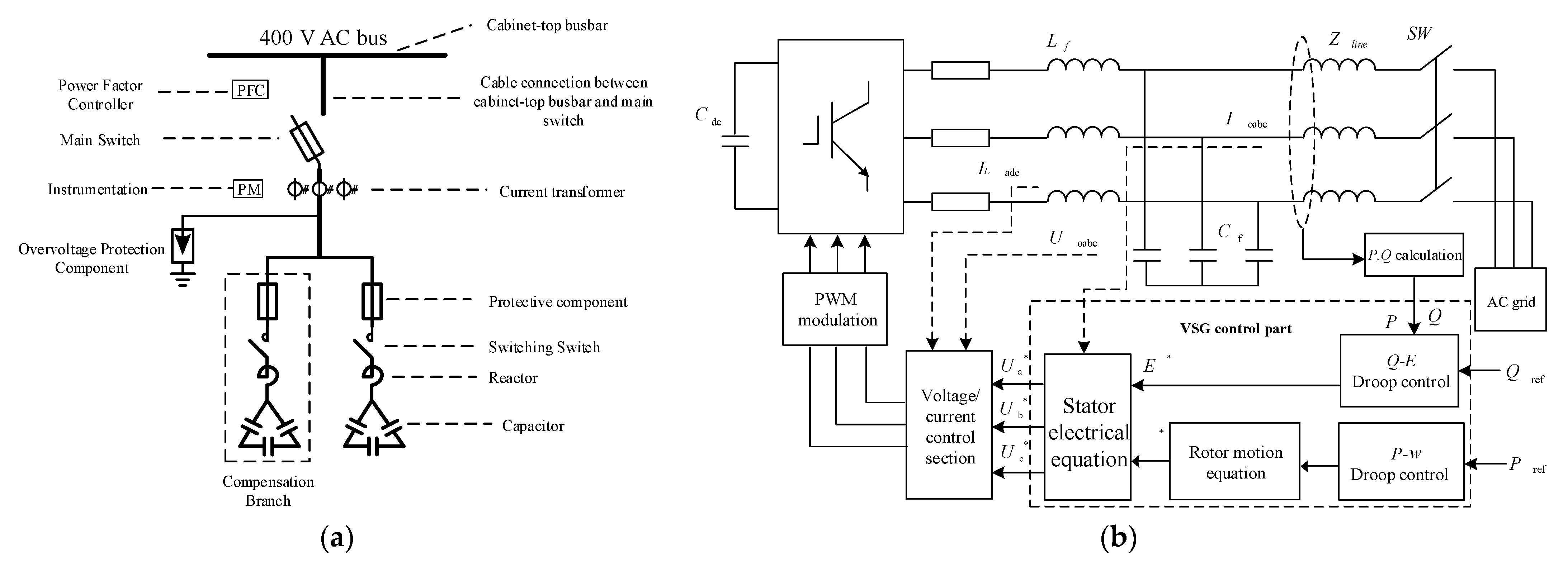
The diagram for the distributed energy storage inverter connected to the distribution network is shown in Figure 1.
To suppress voltage fluctuations and prevent voltage collapse, following the principle of proximity to load and low-voltage dominance, switchable reactive power compensation capacitor banks are typically installed on the secondary side of distribution networks, as shown in Figure 1a. Simultaneously, to enable renewable generation units to support the grid, distributed energy storage inverters employing virtual synchronous generator (VSG) outer-loop and voltage-current inner-loop control are connected to the network from the end nodes of the distribution system. Their control block diagram is illustrated in Figure 1b.

2.2. Distribution Network Impedance Model with Reactive Power Compensation Device

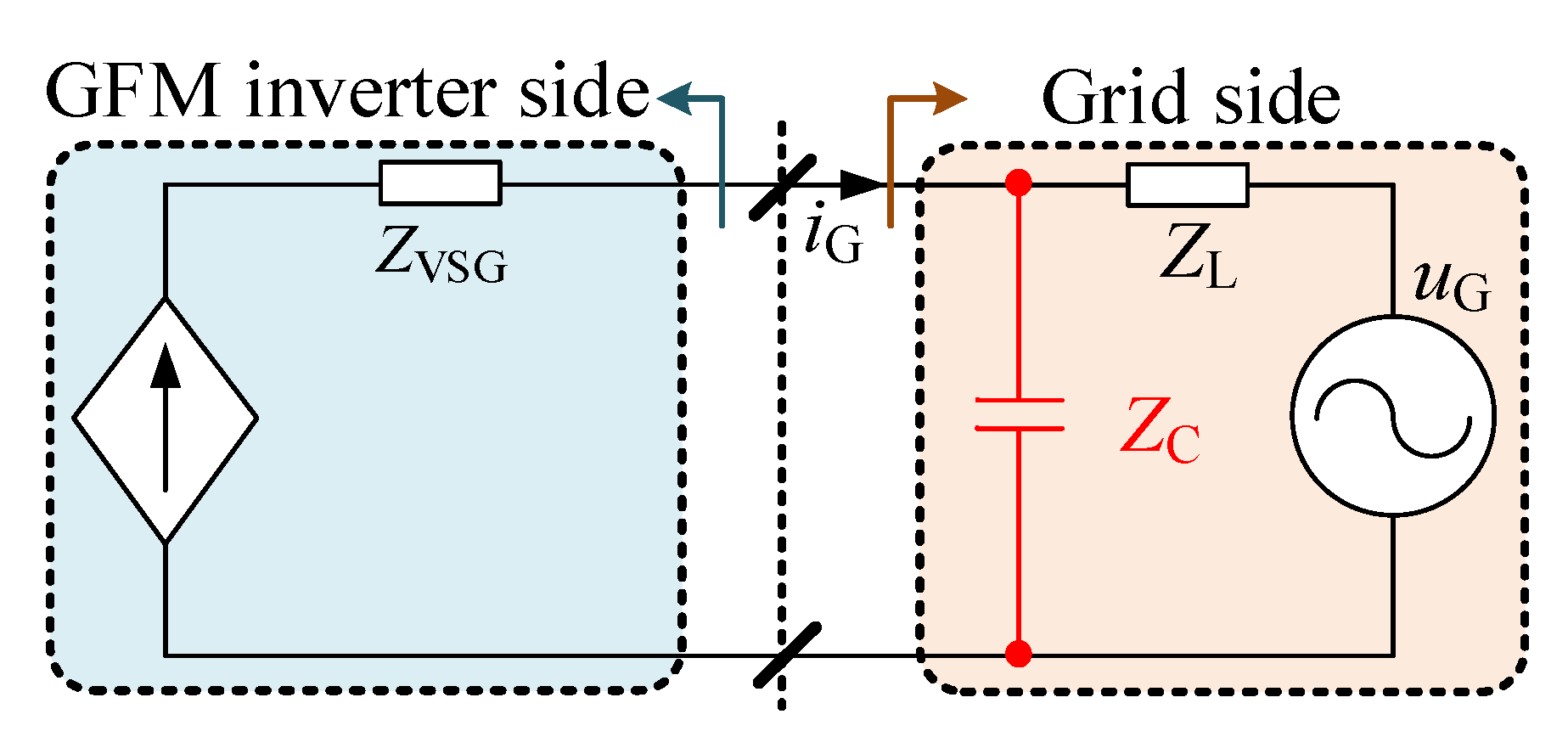
According to impedance analysis theory, grid-connected inverters can be equivalent to a Thevenin model consisting of a controlled voltage source in series with output impedance. The grid side can be equivalent to a Thévenin model consisting of an ideal voltage source in series with the grid’s equivalent impedance. Therefore, the equivalent impedance model for grid-connected inverters connected to distribution networks with reactive power compensation devices is shown in Figure 2.
The grid-side equivalent impedance comprises equivalent inductance and equivalent capacitance. Specifically, the grid-side impedance ZL is equivalent to the long transmission lines and transformer leakage inductance connected to distributed generation sources, while impedance ZC represents the equivalent reactive power compensation device in Figure 1a. The expression for grid-side equivalent impedance ZG is as follows:
Z G = Z L / / Z C
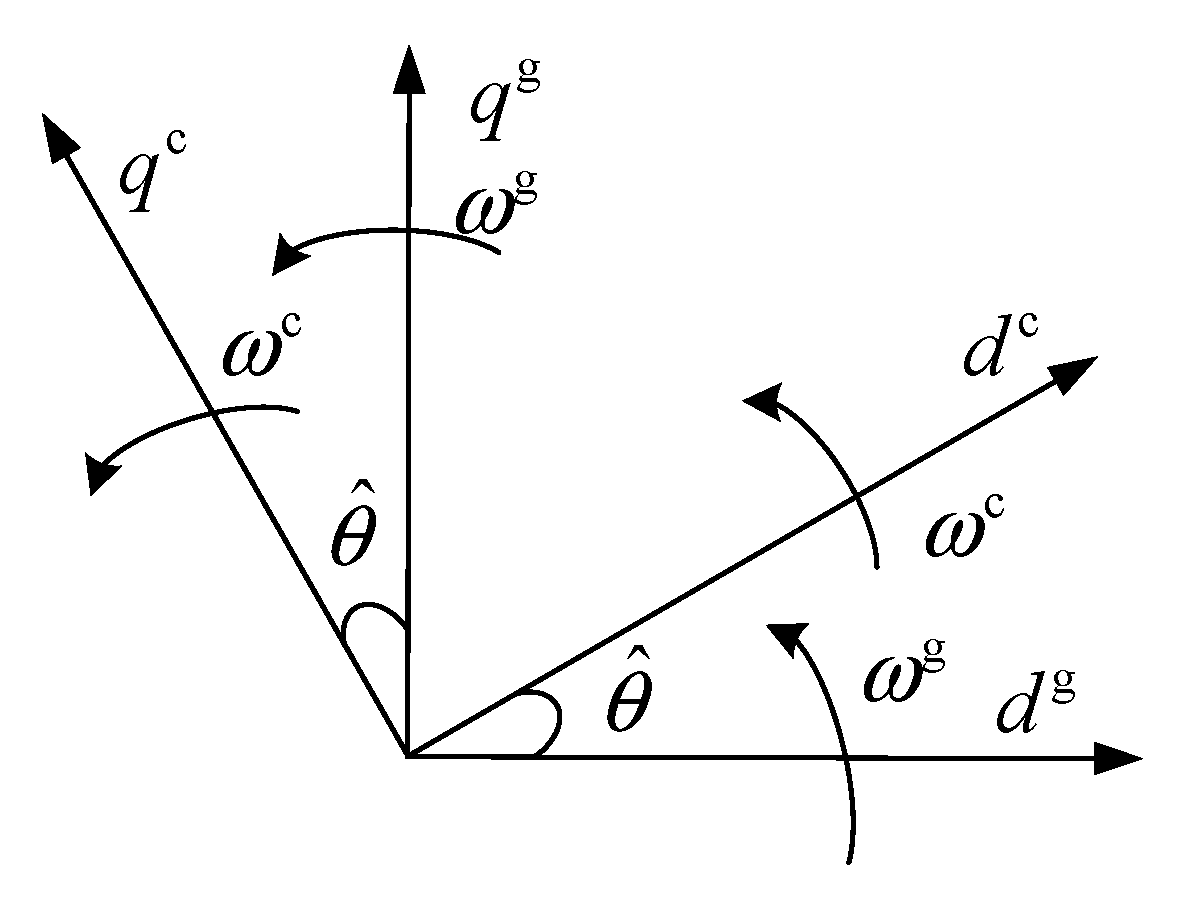
The equivalent impedance on the grid-connected inverter side represents the converter’s output impedance, obtained by applying small-signal perturbations to linearize the steady-state equations of the control loop and main circuit. When the system is stable, no deviation exists between the relative synchronization of the converter’s rotating coordinate system and the grid’s rotating coordinate system. When a small-signal disturbance is applied on the grid side, the angle output from the converter’s power control loop generates a corresponding angular disturbance. This angular disturbance causes a desynchronization deviation between the main circuit dq coordinate system and the control loop dq coordinate system. Therefore, during impedance modeling analysis, the main circuit and control circuit must be analyzed separately and transformed through common coupling quantities. The relationship in the synchronous rotating coordinate system is illustrated in Figure 3.
In Figure 3, d c and q c represent control variables in the control loop coordinate system, while d g and q g represent control variables in the main circuit coordinate system.
As shown in Figure 3, the relationship between the control variables is expressed as follows:
d g q g = cos ( θ ^ ) sin ( θ ^ ) sin ( θ ^ ) cos ( θ ^ ) d c q c
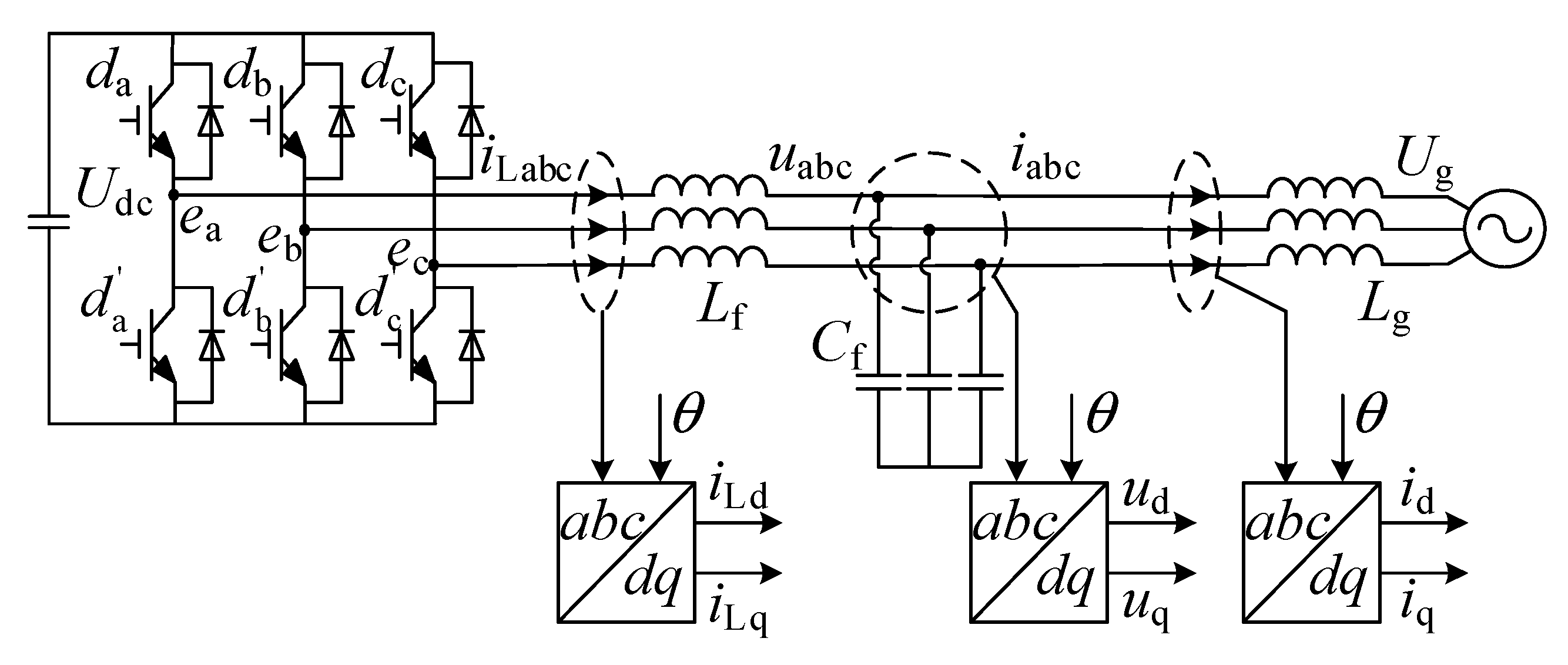
Next, the impact of small-signal disturbances on the main circuit in the dq coordinate system is analyzed as follows. The main circuit structure of the VSG grid-connected system is shown in Figure 4.
In Figure 4, da, db, dc, d a , d b , d c represent the pulse-width modulation duty cycles of the switching. iLa, iLb, iLc denote the currents flowing through the output filter inductors of the converter. ua, ub, uc denote the output voltages of the converter. ia, ib, ic denote the currents flowing into the grid. Lf, Cf, and Lg represent the filter inductor, filter capacitor, and grid impedance, respectively. θ is the converter electrical angle, calculated from the power loop. iLd, iLq, ud, uq, id and iq denote the dq-axis components of the filter inductor current, converter output voltage and grid-inflow current, respectively. Udc is the DC-side voltage. Based on Figure 4, the dq-component expressions for the converter’s current and voltage in the main circuit can be derived.
U dc 2 d g q g = u d g u q g + R f + s L f ω 1 L f ω 1 L f R f + s L f A i L d g i L q g i L d g i L q g i d g i q g = s C f ω 1 C f ω 1 C f s C f B u d g u q g
where ω 1 represents the rated angular power.
When deriving the small-signal impedance of the converter, linearization is performed around its DC operating point. The following signal disturbance can be superimposed on the above equation, yielding:
U dc + U ^ dc 2 d g + d ^ g q g + q ^ g = u d g + u ^ d g u q g + u ^ q g + A i L d g + i ^ L d g i L q g + i ^ L q g i L d g + i ^ L d g i L q g + i ^ L q g i d g + i ^ d g i q g + i ^ q g = B u d g + u ^ d g u q g + u ^ q g
When the inverter’s input is supplied by a DC power source, the dynamic characteristics of the DC input can be neglected. After eliminating higher-order and steady-state components, the small-signal response current expression is obtained as shown in (5).
i ^ d g i ^ q g = A 1 U d c 2 d ^ g q ^ g I + AB u ^ d g u ^ q g
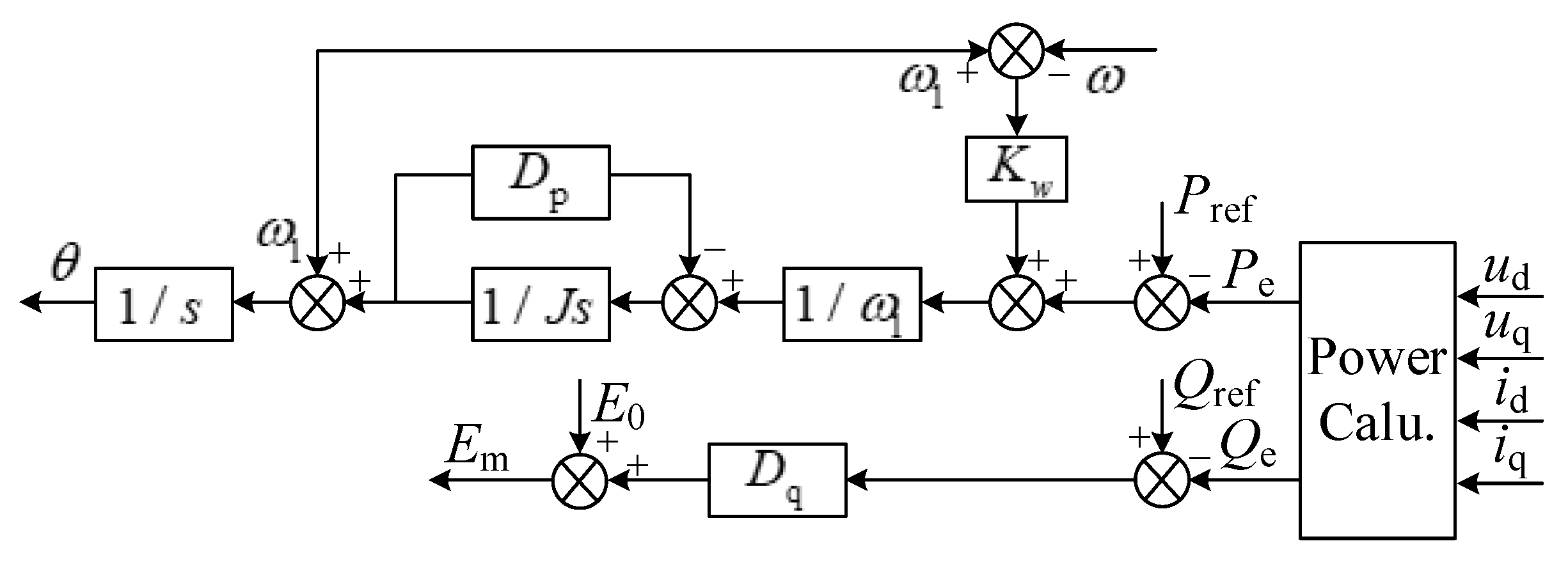
Then the impact of small-signal disturbances on the power loop in the dq coordinate system is analyzed as follows. The power control structure of the VSG grid-connected system is shown in Figure 5. Where Pe and Qe represent the active and reactive power outputs of the converter. Pref and Qref denote the given reference power values. K w is the deviation coefficient. ω is the angular frequency of the VSG internal control loop. D p is the damping coefficient. J is the rotational inertia. D q is the reactive droop coefficient. E0 and Em are the no-load electromotive force and calculated voltage reference magnitude of the VSG.
From Figure 5, the instantaneous power expression in the dq coordinate system is obtained as:
P = 3 2 ( u d g i d g + i q g u q g ) Q = 3 2 ( u q g i d g u d g i q g )
When conducting the small-signal perturbation linearization and neglecting higher-order terms, the small-signal variable expressions for power P and Q are given by (7) as follows:
P ^ = 3 2 ( u d g i ^ d g + u q g i ^ q g + i d g u ^ d g + i q g u ^ q g ) Q ^ = 3 2 ( u q g i ^ d g u d g i ^ q g - i q g u ^ d g + i d g u ^ q g )
With the power loop equation (8), the small-signal variable expressions for Em and θ is obtained in (9).
J s ω = P ref P e + ( ω 1 ω ) K w ω 1 - D p ( ω ω 1 ) E m = E 0 + D q ( Q ref Q e )
θ ^ = 1.5 s ω 1 ( D + J s ) I d I q I d I q G u θ u ^ d u ^ q + 1.5 s ω 1 ( D + J s ) U d U q U d U q G i θ i ^ d i ^ q E ^ m = 1.5 D q I q I d I q I d u ^ d u ^ q 1.5 D q U q U d U q U d i ^ d i ^ q
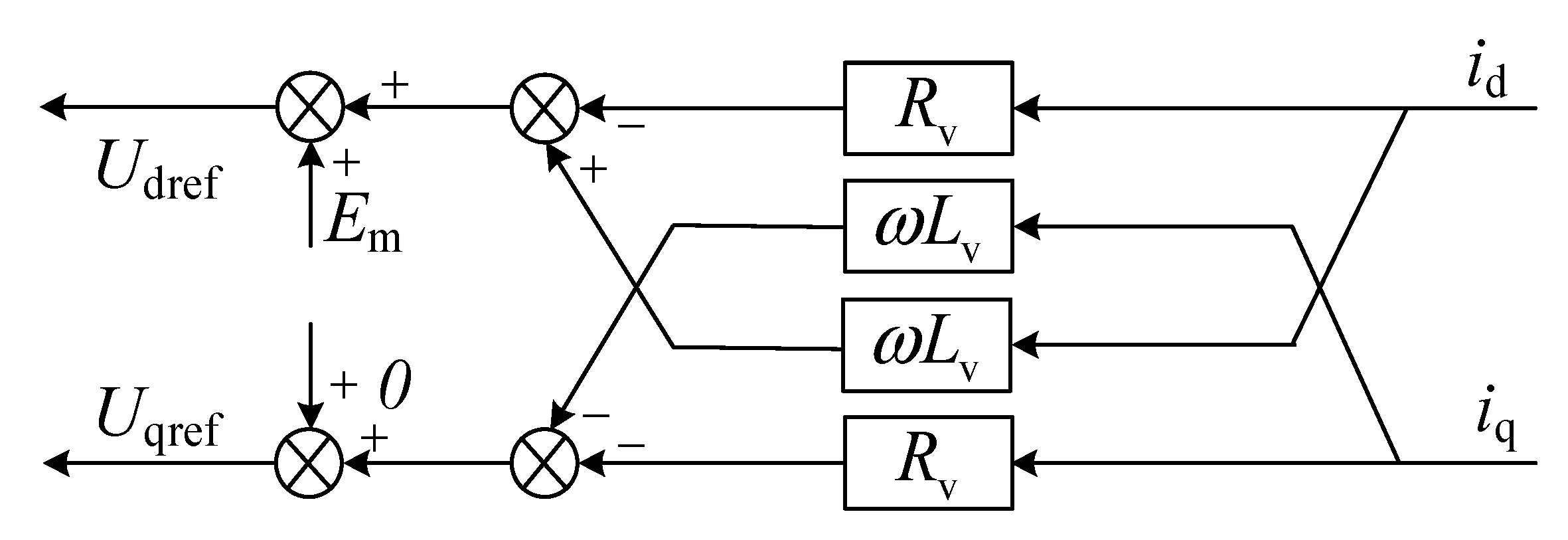
Analyzing the impact of small-signal disturbances on the control loop in the dq coordinate system, the corresponding virtual impedance loop control equation is derived from the virtual impedance loop control block diagram in Figure 6, as shown in Equation (10).
U dr ef = E m R v i d + ω L v i q U qref = 0 ω L v i d R v i q
where R v represents the virtual resistance, and L v represents the virtual inductance.
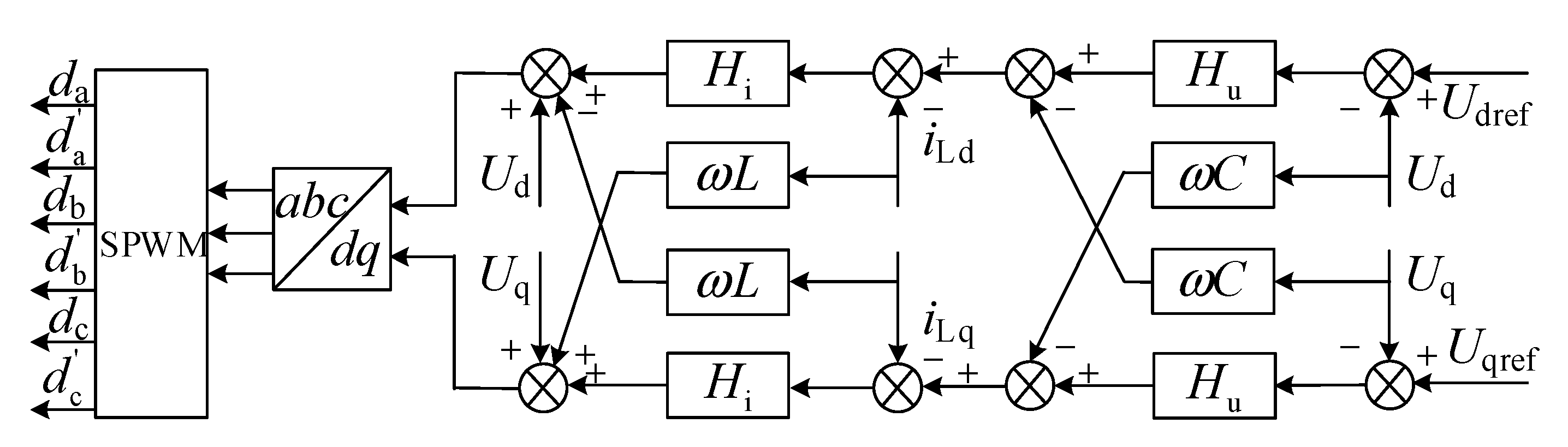
Based on the voltage-current control loop block diagram in Figure 7, the control equations for the voltage-current loop can be derived as shown in (11).
E d r e f = H i [ ( U dr ef U d ) H u U q ω C i L d ] ω L i Lq + U d E q r e f = H i [ ( U q r e f U q ) H u + U d ω C i L q ] + ω L i L d + U q
where H u = K pu + K iu / s represents the proportional-integral controller expression for the voltage loop. H i = K p i + K i i / s represents the proportional-integral controller expression for the current loop. K pu , K iu , K pi and K i i denote the corresponding proportional and integral coefficients for the voltage loop and current loop, respectively.
By combining the expression in (10) with the small-signal linearization of (11), the expression for the modulation voltage’s effect on the converter’s output current and output voltage is obtained as follows:
E ^ d r e f c E ^ q r e f c = G ipwm i ^ d c i ^ q c + G upwm u ^ d c u ^ q c
where G ipwm represents the transfer function from output current to modulating wave, and G upwm represents the transfer function from output voltage to modulating wave. The respective expressions are as follows:
G ipwm = K q u q H u H i R v H i H u H i K q u d H u H i + ω L v H u H i ω L ω L L v H i H u H i R v H i H u
G upwm = K q i q H u H i H i H u s C H i ω 2 L C + 1 K q i d H u H i ω s L C ω s L C H i H u s C H i ω 2 L C + 1
Further yields the following expressions for the small-signal gain d ^ d c and d ^ q c with respect to the converter’s output current and output voltage:
d ^ d c d ^ q c = 2 U dc E ^ d r e f c E ^ q r e f c = 2 G ipwm U dc i ^ d c i ^ q c + 2 G upwm U dc u ^ d c u ^ q c
Considering the phase difference, the relationship between voltage and current in the system coordinate system and the dq-axis small-signal variables in the control coordinate system can be obtained:
u ^ d c u ^ q c = u ^ d g u ^ q g + U q 0 0 U d θ ^ θ ^
i ^ d c i ^ q c = i ^ d g i ^ q g + I q 0 0 I d θ ^ θ ^
where U dq and I dq represent the converter output voltage and grid-connected current at the steady-state operating point. Substituting (9) into (16) and (17) yields the small-signal expressions (18) and (19):
u ^ d c u ^ q c = I + U q 0 0 U d G u θ u ^ d g u ^ q g + G i θ U q 0 0 U d i ^ d g i ^ q g
i ^ d c i ^ q c = G u θ I q 0 0 I d u ^ d g u ^ q g + I + I q 0 0 I d G i θ i ^ d g i ^ q g
Substituting (18) and (19) into (15) yields the duty cycle modulation signal expression in the control coordinate system, as shown in (20):
d ^ d c d ^ q c = 2 U dc G upwm + G ipwm I q 0 0 I d G u θ + G upwm U q 0 0 U d G u θ G u d u ^ d g u ^ q g + 2 U dc G ipwm + G ipwm I q 0 0 I d G i θ + G upwm U q 0 0 U d G i θ G i d i ^ d g i ^ q g
Further converting the duty cycle modulated signal in the control coordinate system to a duty cycle modulated signal in the system coordinate system:
d ^ d g d ^ q g = d ^ d c d ^ q c + d q c 0 0 d d c θ ^ θ ^
From the above equation, it can be seen that the small-signal variables in the system dq coordinate system and the control dq coordinate system are interrelated. Further simplification yields the transfer equation from the system duty cycle small signal to the system voltage small signal and system current small signal, as shown in (22):
d ^ d g d ^ q g = G ud + d q 0 0 d d G u θ G udpwm u ^ d g u ^ q g + G i d + d q 0 0 d d G i θ G idpwm i ^ d g i ^ q g
Combining the above equations, the system output impedance expression can be calculated as shown in Equations (23) and (24).
i ^ d i ^ q = U dc A 1 u ^ d u ^ q + ( A 1 B ) d ^ d g d ^ q g
Z out = ( U dc A 1 + ( A 1 B ) G upwm ) 1 ( I ( A 1 B ) G ipwm )
For Z out , the equivalent impedance magnitude corresponds to the specified current direction from the converter to the grid. For the equivalent impedance of the VSG, its current direction is opposite to the reference current direction of Z out .
To intuitively observe the frequency bands where the converter impedance characteristics affect system oscillations, based on [35], the dq impedance matrix of the GFM inverter established in (24) is transformed into the sequence impedance matrix. The transformation formula is as follows:
Z outpn = Z outpp Z outpn Z outnp Z outnn = A Z Z outdd Z outdq Z outqd Z outqq A Z 1 A Z = 1 2 1 j 1 j
The modified sequence impedance matrix in (25) can be further simplified through order reduction to derive the decoupled sequence impedance matrix.
Z outp = det Z pn s j ω 0 Z nn s j ω 0 Z outn = det Z pn s + j ω 0 Z pp s + j ω 0
Since the inverter investigated in this paper is a three-phase balanced system, the system stability can be evaluated using the Bode criterion by observing only the Bode plot of the positive-sequence impedance Zoutp and ZGp, which is obtained by transforming the dq-axis impedances shown in (1) and (24).
It should be noted that the established impedance model is a small-signal model linearized around the steady-state operating point. While it is highly effective for analyzing low-to-high-frequency oscillations caused by small-signal disturbances under normal grid conditions, it has certain limitations in capturing the system’s dynamic response during large-signal transients.

2.3. Oscillation Mechanism Analysis

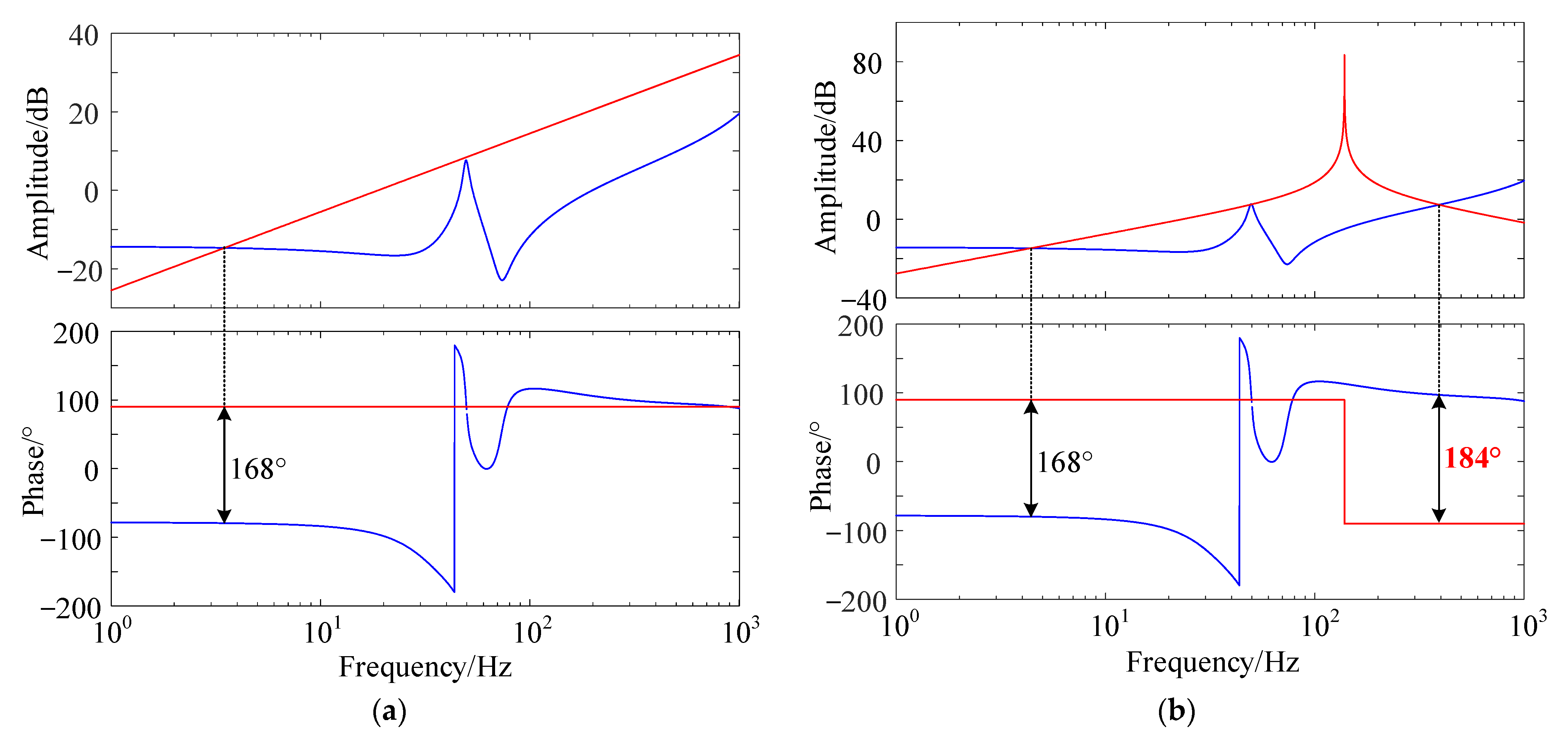
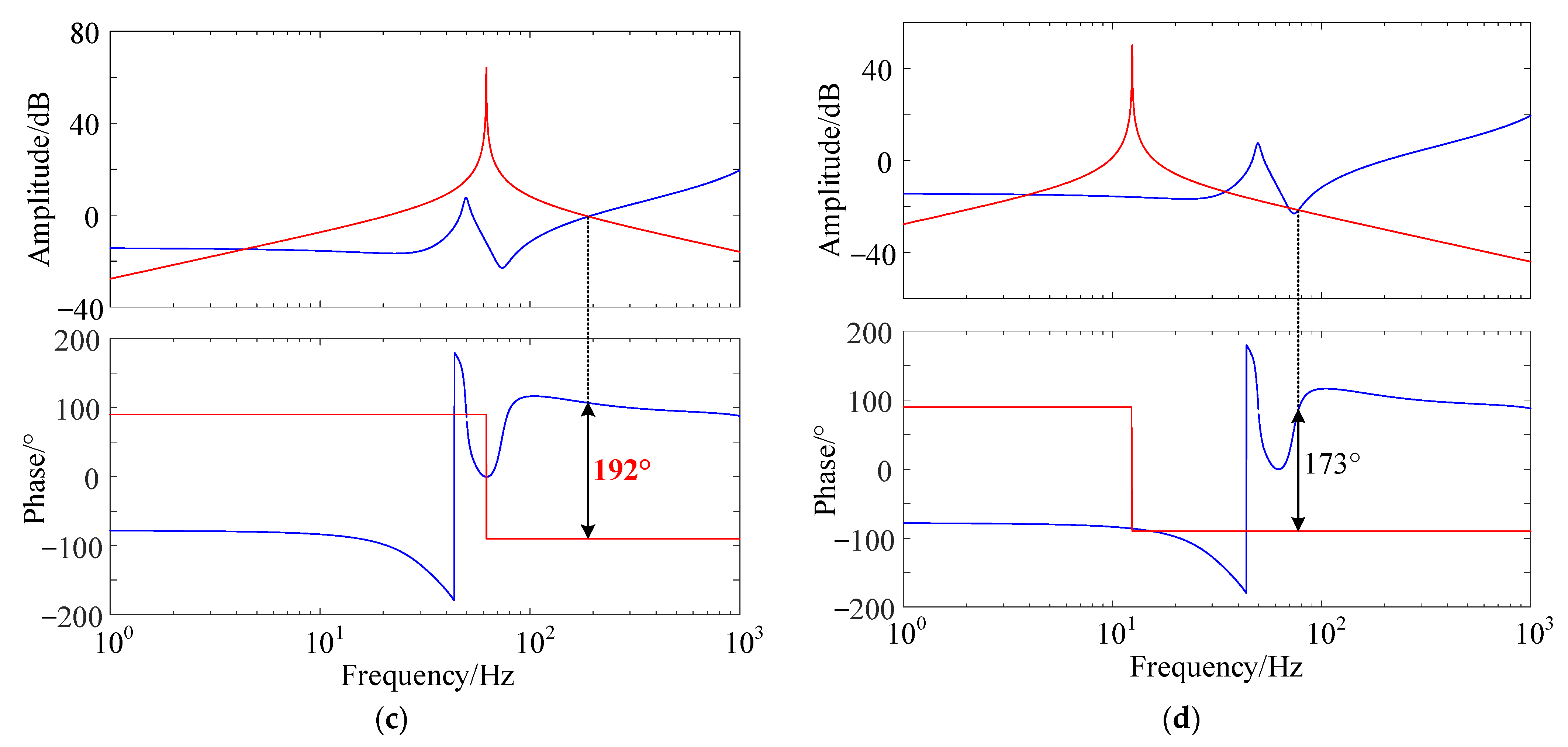
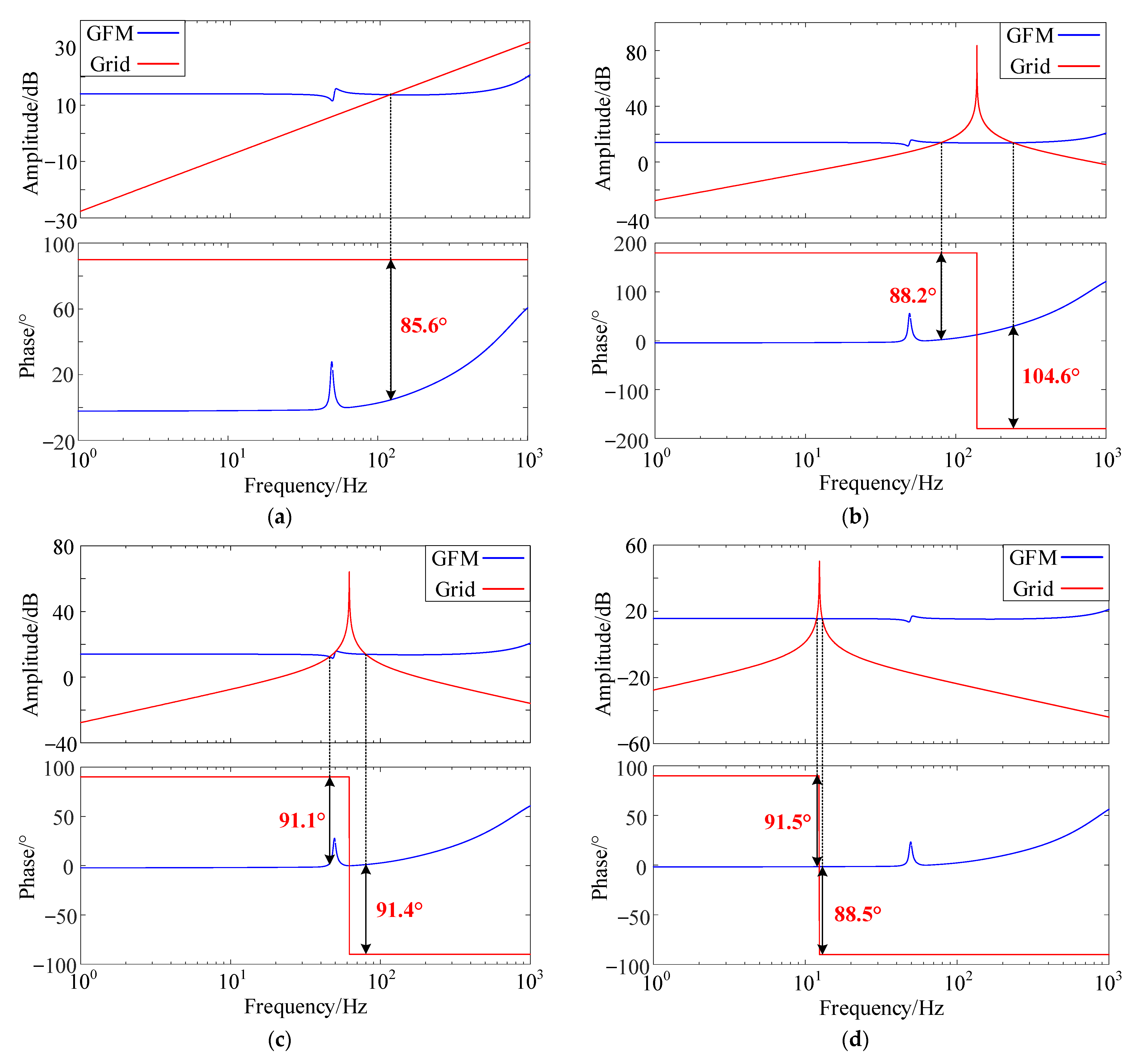
Based on the source-grid equivalent impedance model shown in (1) and (24), Bode diagrams of the source-grid impedance for grid-connected inverters without reactive compensation capacitors and with 100 μF, 500 μF, and 1000 μF reactive compensation capacitors can be plotted in Figure 8.
As shown in Figure 8a, when the GFM inverter is connected to the weak grid, the phase angle difference at the source-grid impedance intersection is less than 180°, indicating stable system operation. After introducing a 100 μF reactive compensation capacitor into the system, comparing Figure 8a with Figure 8b reveals that the source-grid impedance Bode diagram exhibits new amplitude-frequency intersection points in the medium-to-high frequency range of 100–1000 Hz. Furthermore, the phase difference exceeds 180°, indicating that system stability deteriorates following the introduction of the reactive compensation capacitor. As the capacitance value of the reactive compensation capacitor further increases, comparing Figure 8b–d reveals that the resonance peak in the grid-side impedance Bode plot gradually shifts to the left with increasing capacitance value. The high-frequency intersection point in the source-grid impedance gradually disappears. Based on the above analysis, the switching of the reactive compensation capacitor may introduce new oscillation issues into an originally stable grid-forming inverter system, thereby degrading system stability.

3. Negative Capacitive and Virtual Resistive Loop-Based Composite Control Strategy

3.1. Proposal of Control Scheme

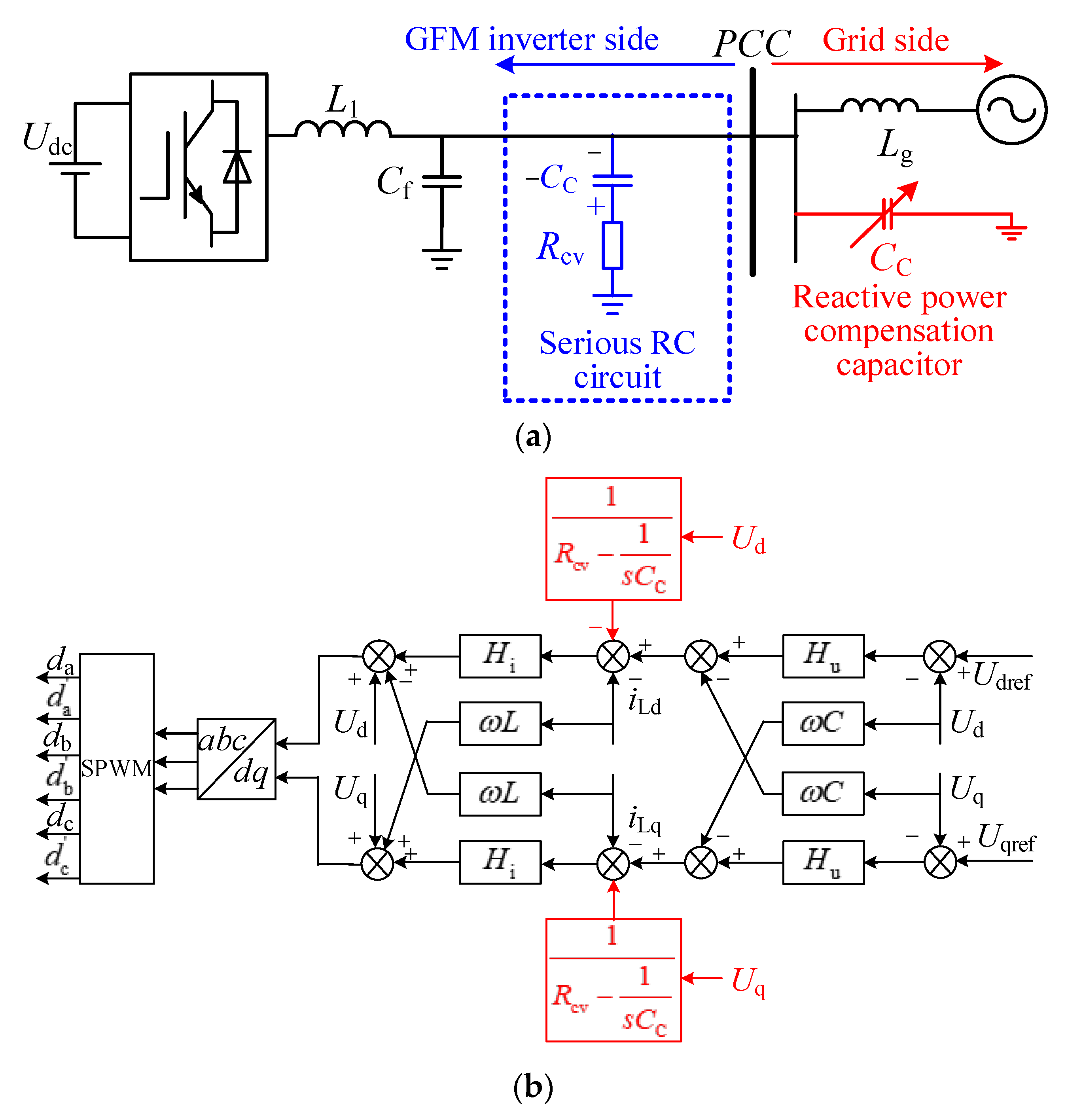
During grid-connected operation of GFM inverters, as analyzed in the preceding section, the switching of reactive compensation capacitors in the dynamic compensation stage often causes significant alterations in grid impedance characteristics. Specifically, the phase of conventional inductive grid impedance undergoes notable migration in the mid-to-high frequency range, manifesting as a gradual transition from the inductive region toward the capacitive region. This leads to the mutual impedance magnitude between the source and grid evolving from zero to a non-zero value, thereby posing potential risks to the stable operation of the system. To address this, this paper proposes a capacitive loop reconstruction and damping enhancement scheme for grid-forming inverters, based on the concepts of capacitive compensation and series resistance enhancement, as illustrated in Figure 9. The design rationale for the control scheme is as follows:
(1) Capacitive cancellation of reactive compensation capacitors. In Figure 9a, the grid-side reactive compensation capacitors are connected in an equivalent parallel configuration at the grid connection point, where the total capacitance equals the sum of individual parallel capacitors. Based on this, the control loop depicted in Figure 9b shows a parallel negative capacitance structure at the grid connection point that is electrically equivalent to the main circuit. Cancellation of the capacitive characteristics of the grid-side reactive compensation capacitors can be achieved.
(2) Parallel virtual resistors enhance converter damping. Resonant circuits may form between the converter and grid-side reactive compensation capacitors, line inductance, and filter components, potentially triggering system oscillations. In Figure 9b, by detecting the grid-connection point voltage signal, the control loop simulates resistive characteristics and a parallel type into the system. When high-frequency resonant components appear in the system, the parallel damping dissipates resonant energy, suppresses the amplitude of resonant currents, and prevents converter instability caused by resonant amplification.
The impedance expression of the inverter under the negative capacitive and virtual resistive loop-based composite control strategy is as follows:
Z outcp = ( U dc A 1 + ( A 1 B + Y comp ) G upwm ) 1 ( I ( A 1 B + Y comp ) G ipwm )
where
Y comp = 1 R cv 1 s C C 0 0 1 R cv 1 s C C
where Rcv represents the parallel compensation damping coefficient, and CC denotes the parallel compensation capacitance coefficient.
By applying the dq-to-sequence impedance transformation defined in (25)~(26), the dq-axis impedance expressions for the composite control strategy based on negative capacitive and virtual resistive loops, as shown in (27), can be transformed into Zoutcp.

3.2. Compensation Parameters Design of Proposed Control Scheme

The selection of compensation parameters for the improved control scheme is crucial for enhancing system stability. Therefore, its corresponding design principles are presented below.
(1) Design of reactive power compensation capacitor coefficient
The control loop based on the inverse superposition and cancellation of capacitive characteristics is employed. Its primary function is inversely injecting capacitive components equivalent to the actual reactive compensation values into the inverter’s control path, thereby neutralizing the impact of switching these capacitors at the PCC on grid-side impedance characteristics. Specifically, the compensation capacitance value CC can be obtained via communication with local devices or through the non-characteristic harmonic current perturbation method shown in Equation (29) [36,37].
C C = v p j ω h i p j ω h
(2) Design of parallel compensation damping coefficient
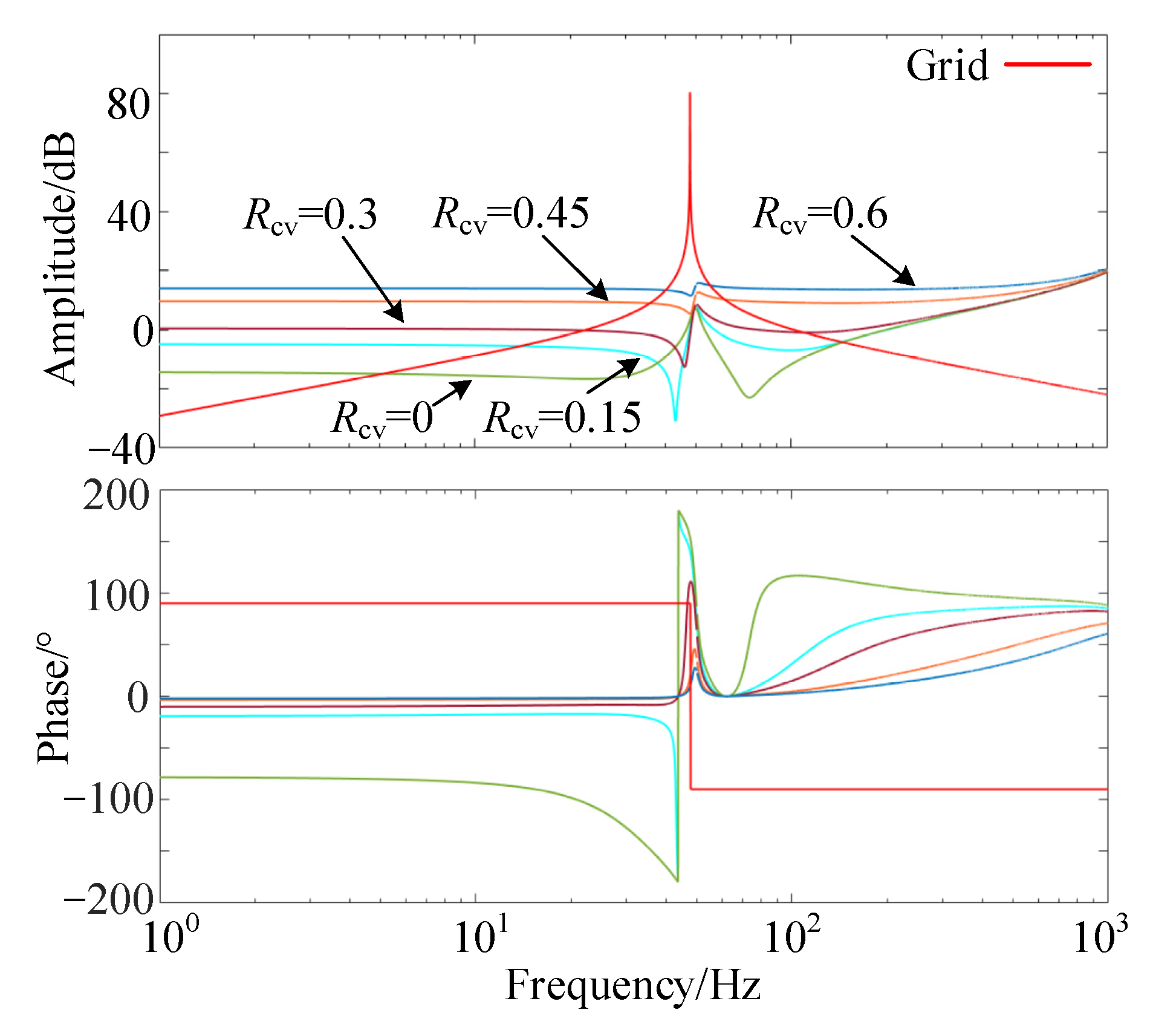
The physical mechanism of the virtual resistive loop is damping enhancement. It acts as a physical resistor connected in series within the system to dissipate oscillation energy and suppress magnitude peaks. By analyzing the Bode plot of the inverter impedance with various Rcv in Figure 10, it is observed that the impedance magnitude increases consistently as Rcv increases, while the phase remains constrained within the −90° to 90°. Since the grid impedance phase, which is indicated by the red line, also varies within −90° to 90°, the phase difference at any intersection of the source-grid impedance magnitudes remains below 180°, thereby ensuring system stability. To achieve optimal damping and maintain robustness under complex conditions, such as short-circuit ratio (SCR) fluctuations and reactive power compensation capacitor variations, the compensation parameter is selected as Rcv = 0.6. At this value, the inverter impedance phase is primarily concentrated around 0°, providing a significant stability margin.

3.3. Oscillation Mechanism Analysis with Improved Control Scheme

From the analysis in Section 3.1, the functions of the negative capacitive loop and the virtual resistive loop in the proposed control scheme are summarized as follows:
A negative capacitive loop is designed to counteract the impact of sudden variations in grid impedance caused by the switching of reactive power compensation capacitors. The sudden variations in the grid impedance will deteriorate the operating state of the inverter, and even cause instability. The virtual resistive loop primarily functions to enhance system damping, ensuring that the grid-forming inverter maintains stable operation under varying SCR. By integrating these two loops, the inverter can essentially achieve oscillation suppression within complex grid environments characterized by fluctuating short-circuit ratios and the switching of reactive power compensation capacitors.
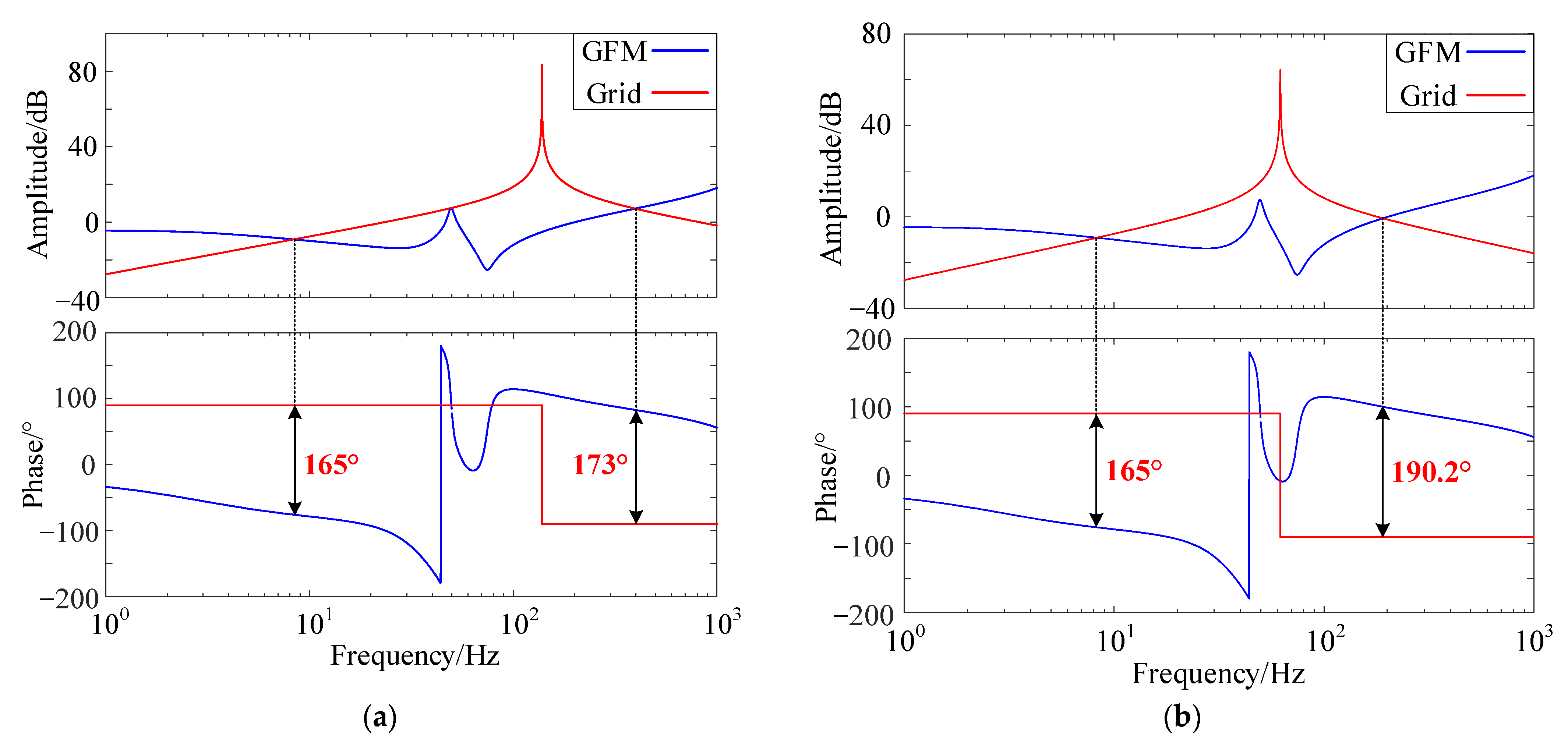
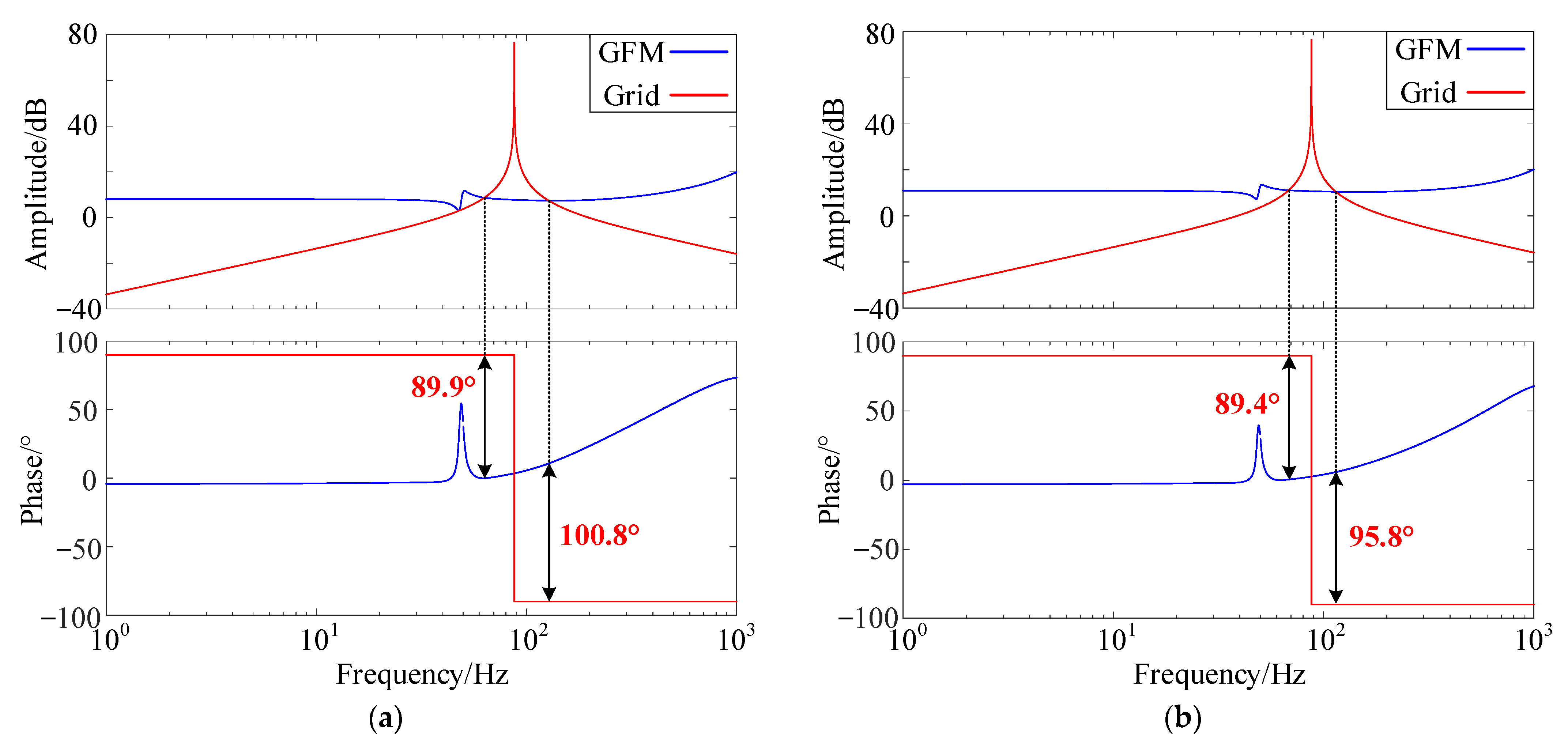
Taking a grid-connected system with three grid-forming inverters as an example, the system stability under different grid conditions is analyzed. Firstly, in order to demonstrate the contribution of each control loop, the source-network impedance Bode diagram for the GFM inverter with a single virtual resistive loop incorporating 100 μF and 500 μF reactive power compensation capacitors is shown in Figure 11. From Figure 11a, it can be seen that the phase angle difference at the source-grid impedance amplitude intersection is less than 180°, which means the system remains stable. When the reactive power compensation capacitor is switched to 500 μF, the phase angle difference at the source-grid impedance amplitude intersection in Figure 11b is increased to 190.2°, and the system becomes unstable. The analysis reveals that while a single virtual resistive loop enhances damping, it is insufficient to ensure stability across all scenarios. Specifically, the inverter can only maintain stable operation under certain operating conditions of reactive power compensation capacitor switching when this loop is operated independently.
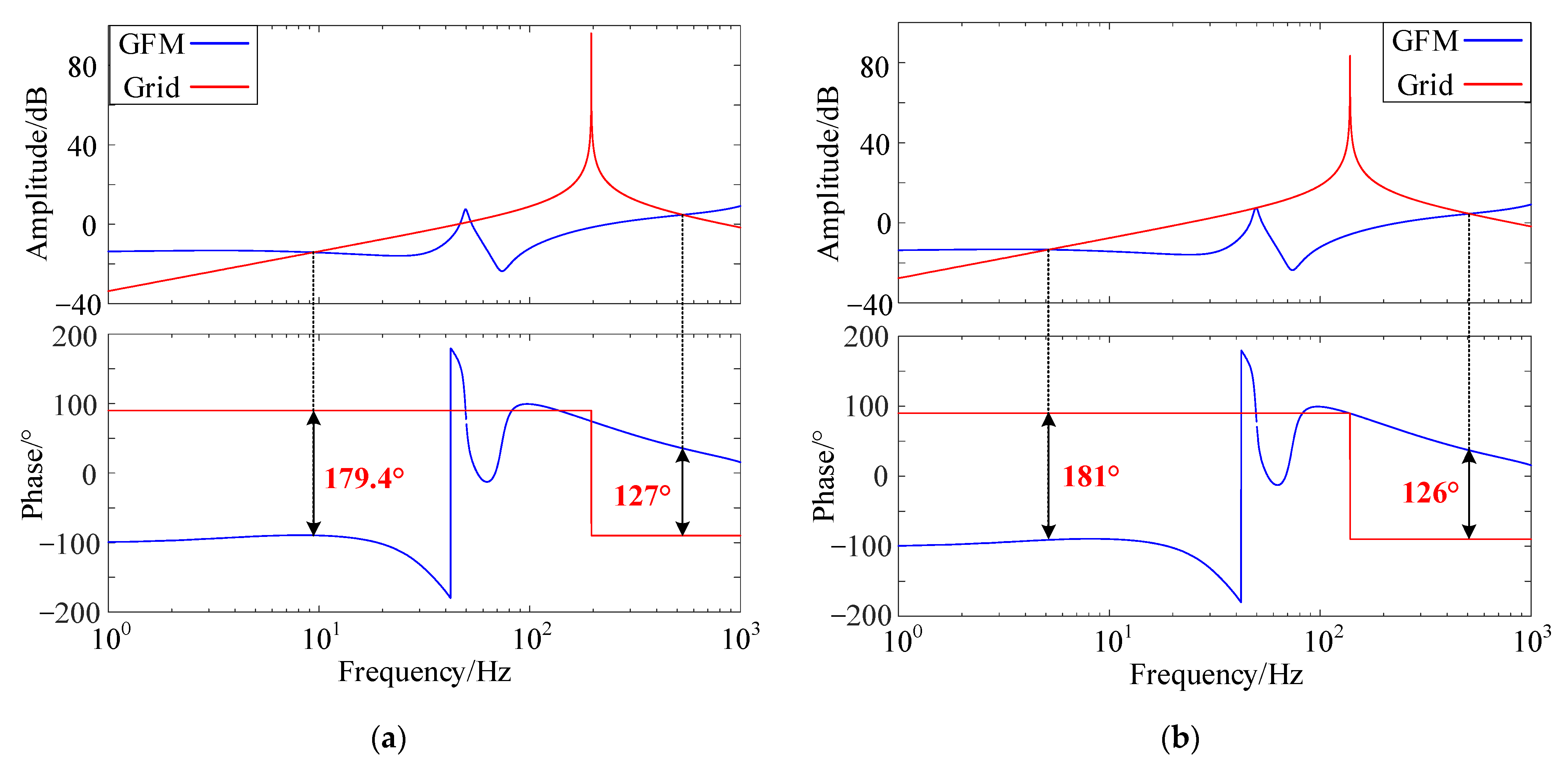
The source-network impedance Bode diagram for the GFM inverter with a single negative capacitive loop incorporating 100 μF reactive power compensation capacitors under different grid strengths is shown in Figure 12. When SCR = 5, it can be seen from Figure 12a that the phase angle difference at the source-grid impedance amplitude intersection is less than 180°, which means the system remains stable. When SCR is changed to 2, the phase angle difference at the source-grid impedance amplitude intersection in Figure 12b is increased to 181°, and the system becomes unstable. According to the above analysis, with only a single negative capacitive loop, the inverter can maintain stable operation under certain grid strengths when reactive power compensation capacitors are connected.
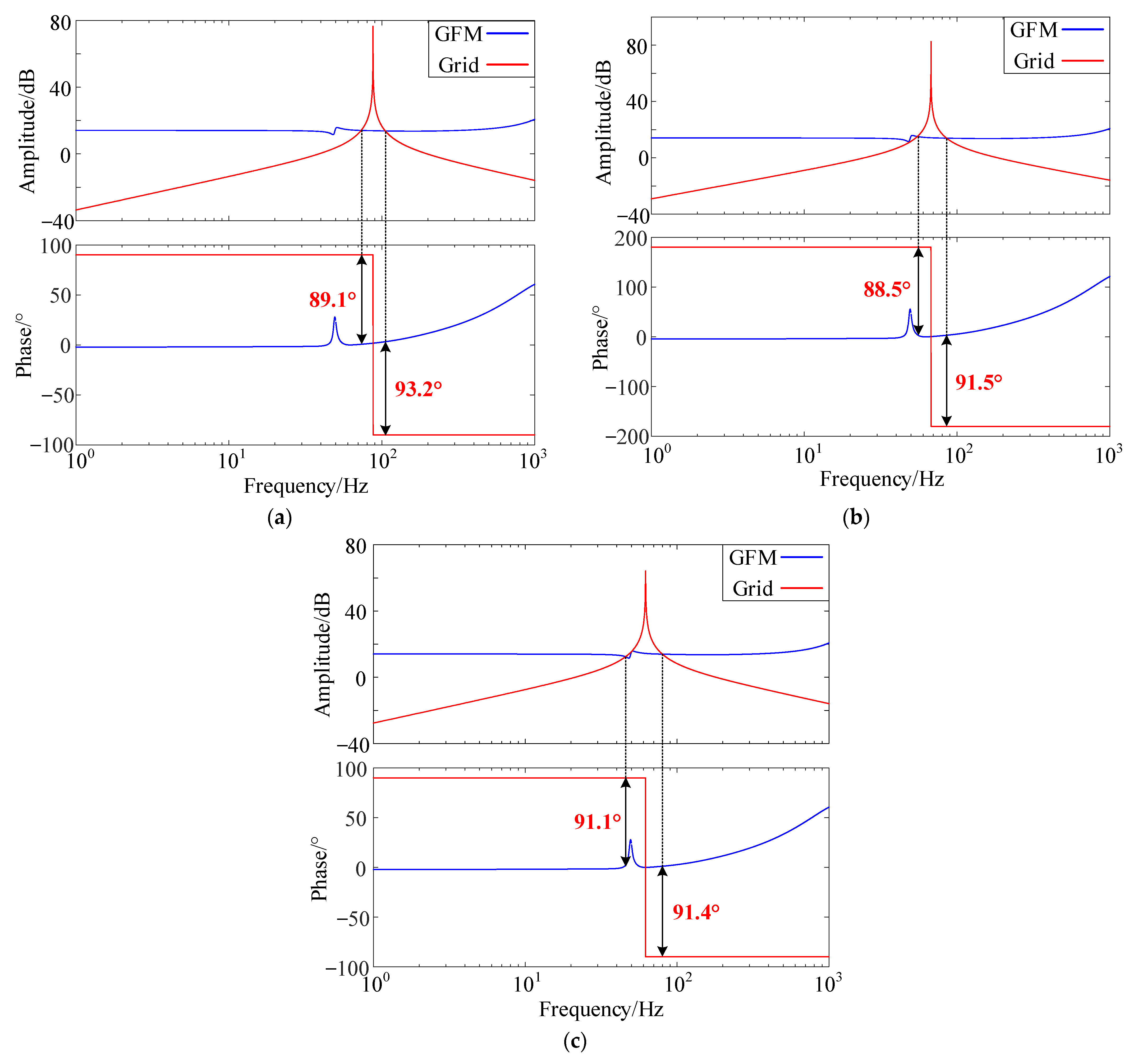
Further, by adopting the improved control scheme and utilizing the source-network equivalent impedance Zoutcp and ZGp, the source-network impedance Bode diagram for the grid-connected inverter system without reactive compensation capacitors and with 100 μF, 500 μF, and 1000 μF reactive compensation capacitors can be plotted in Figure 13.
As shown in Figure 13, by applying the improved control scheme, the phase-frequency characteristics of the GFM inverter are reshaped within the range of −90° to 90°. When 0 μF, 100 μF, 500 μF, and 1000 μF reactive power compensation capacitors are connected to the system, although the source-grid impedance amplitude-frequency characteristics exhibit an intersection point, the phase angle difference at this intersection remains within 180°. It is indicated that, when reactive power compensation capacitors with differentiated capacitance values are switched on and off, the system can maintain stable operation.

3.4. Discussion on Adaptability of the Improved Control Scheme Under Non-Ideal Compensation Parameters and Various Grid Conditions

To further verify the adaptability of the proposed scheme under non-ideal compensation parameters and dynamic grid conditions, the following discussion is conducted in this section.
(1) Adaptability of the improved control scheme under non-ideal compensation parameter conditions
If the compensation capacitor parameters are not identified in time, the compensation capacitance in the inverter’s negative capacitive control loop may enter an over-compensated or under-compensated state. As shown in the impedance Bode plots in Figure 14, where the compensation capacitance is set to 50% and 150% of the actual value (500 μF), parameter mismatch leads to variations in the system stability margin at the crossover frequency. However, the phase angle difference at the source-grid impedance amplitude intersection in Figure 14 is always less than 180°, so the system can remain stable under all conditions when the reactive power compensation capacitor is switched to 500 μF.
(2) Adaptability of the improved control scheme under various grid strength conditions
In actual power systems, the grid strength fluctuates over time with changes in grid operating states and renewable energy output on the grid side. The adaptability of grid-forming inverters under varying grid strengths is critical. Theoretically, as shown in the Bode diagram under different grid impedances in Figure 15, the grid-side inductance (i.e., the grid short-circuit ratio) primarily affects the magnitude of the grid impedance below 100 Hz. At the same time, the phase remains constant at 90°. By implementing the proposed negative-capacitive and virtual-resistive-loop-based composite control strategy, the phase characteristic of the inverter impedance, as shown in Figure 15, is elevated to near 0°. Consequently, even if there are intersection points between the magnitude of the source and grid impedances under varying SCR conditions, the phase difference at these crossover frequencies remains below 180°, thereby ensuring system stability.
(3) Adaptability of the improved control scheme under various grid-connected units
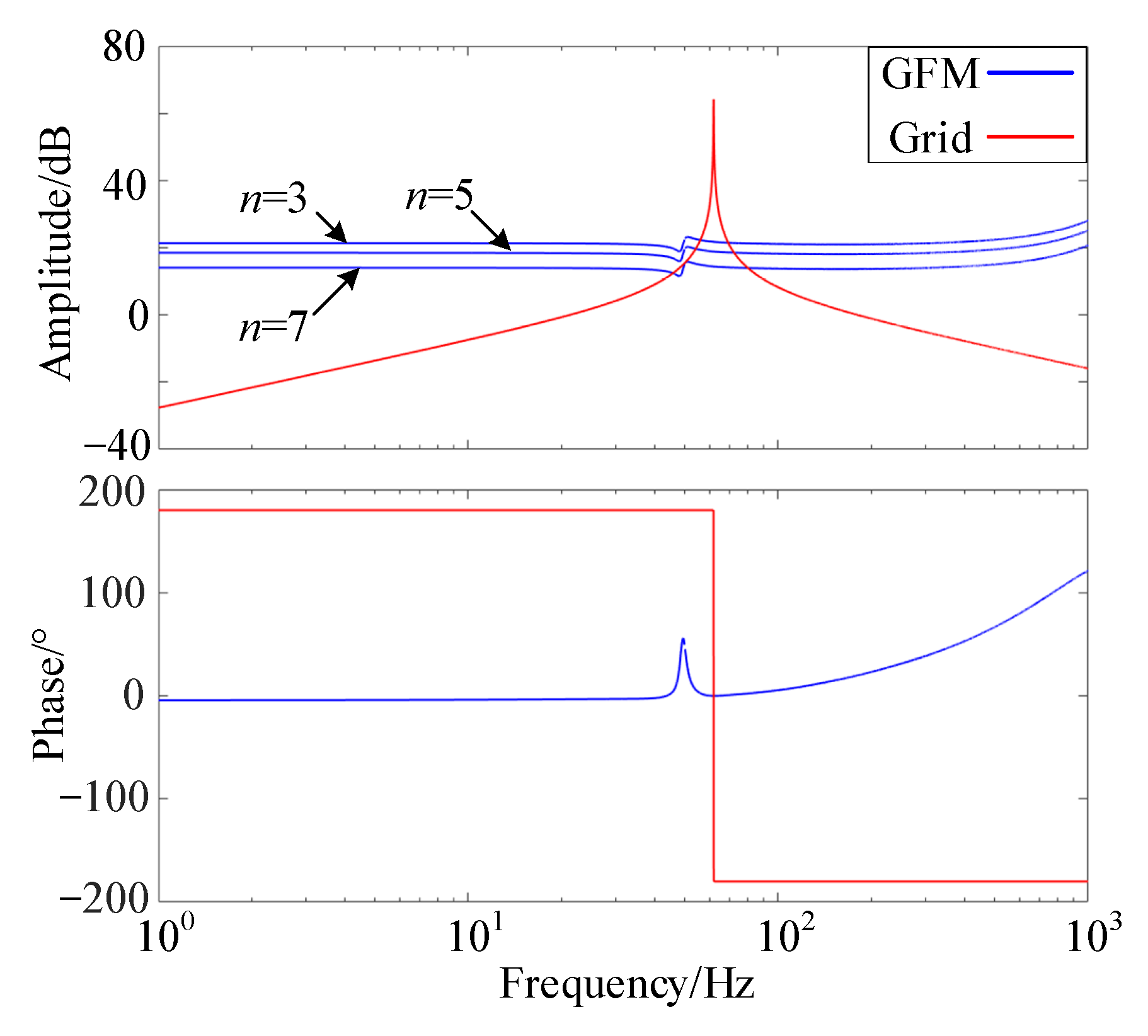
Moreover, to address the demand for large-scale renewable energy integration, the adaptability of the proposed method in larger-scale multi-inverter parallel systems is important. Figure 16 illustrates the source-grid impedance Bode plots for 3, 5, and 7 grid-connected units. As depicted in Figure 16, the grid impedance phase strictly resides within −90°~90°. The parallel number of GFM inverters only affects the impedance magnitude without altering its phase. Due to the impedance reshaping achieved by adopting the proposed method, the phase of the inverter impedance is similarly regulated within −90°~90°. Therefore, the phase difference at the magnitude crossover frequency is less than 180° under various grid-connected units, demonstrating that the system can maintain stable operation in multi-inverter grid-tied scenarios.

4. Hardware-in-the-Loop Validation

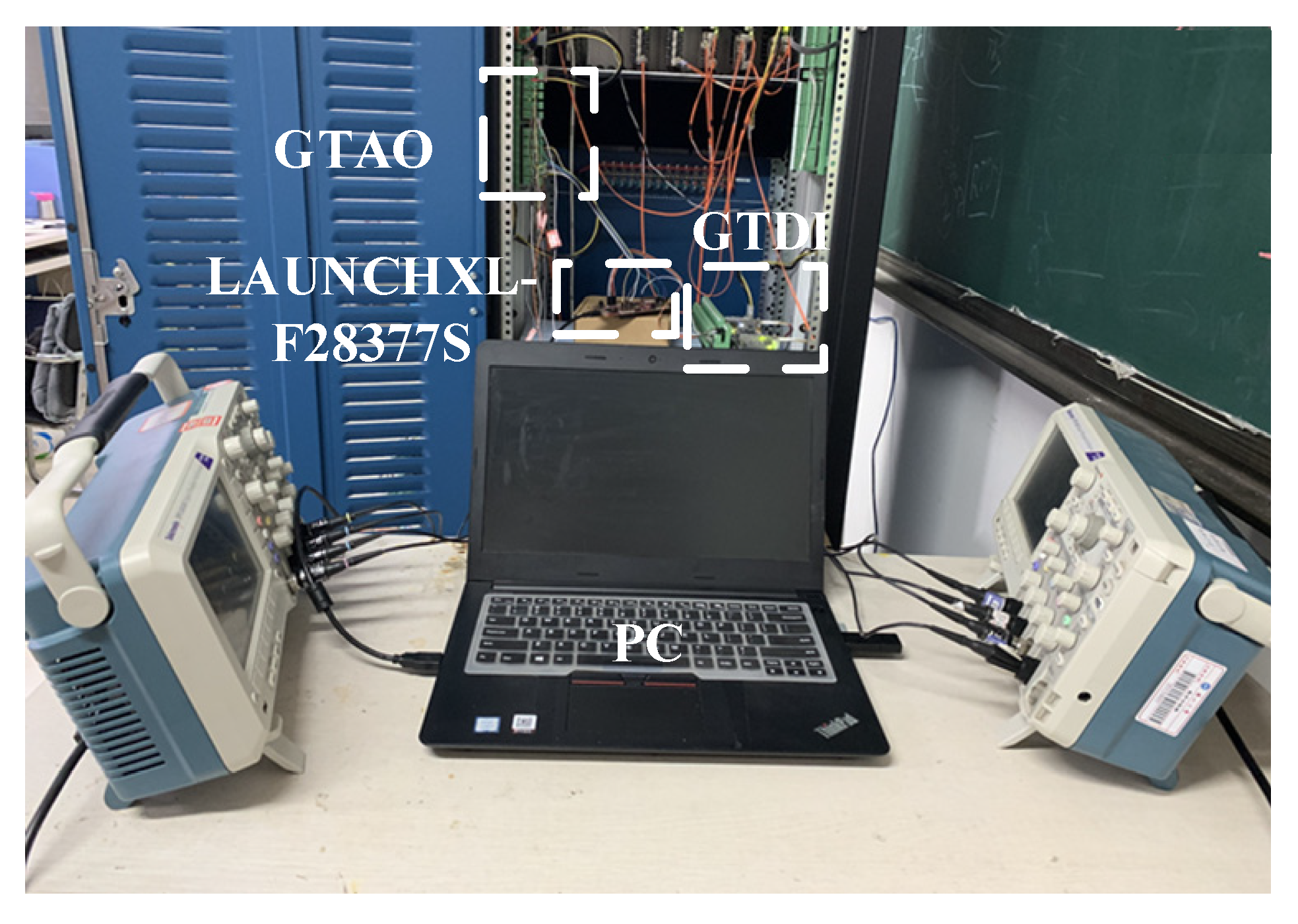
To validate the effectiveness of the proposed capacitive loop reconstruction and damping enhancement scheme for grid-connected inverters, a hardware-in-the-loop test platform based on a Real-Time Digital Simulator (RTDS) was established, as shown in Figure 17.
In this experimental platform, the GFM inverter’s main circuit and the distribution network are emulated in RTDS with a microsecond-level step to capture electromagnetic transients. Various SCRs and different capacities of reactive power compensation capacitors are configured within the RTDS. This simulates the complex impedance fluctuations typical of distribution networks. Further, the proposed control strategy is executed on a physical TMS320F28335 DSP, replicating the execution latency and discrete sampling of industrial-grade controllers. Closed-loop signals are interfaced via GTDI/GTAO boards, introducing inherent communication delays and quantization noise, while the hardwired PWM signals preserve critical hardware-level effects such as dead time and pulse jitter. This setup provides a high-fidelity environment to validate the effectiveness of the proposed control method under complex grid conditions. System parameters are shown in Table 1.

4.1. Experimental Validation of the Improved Control Scheme

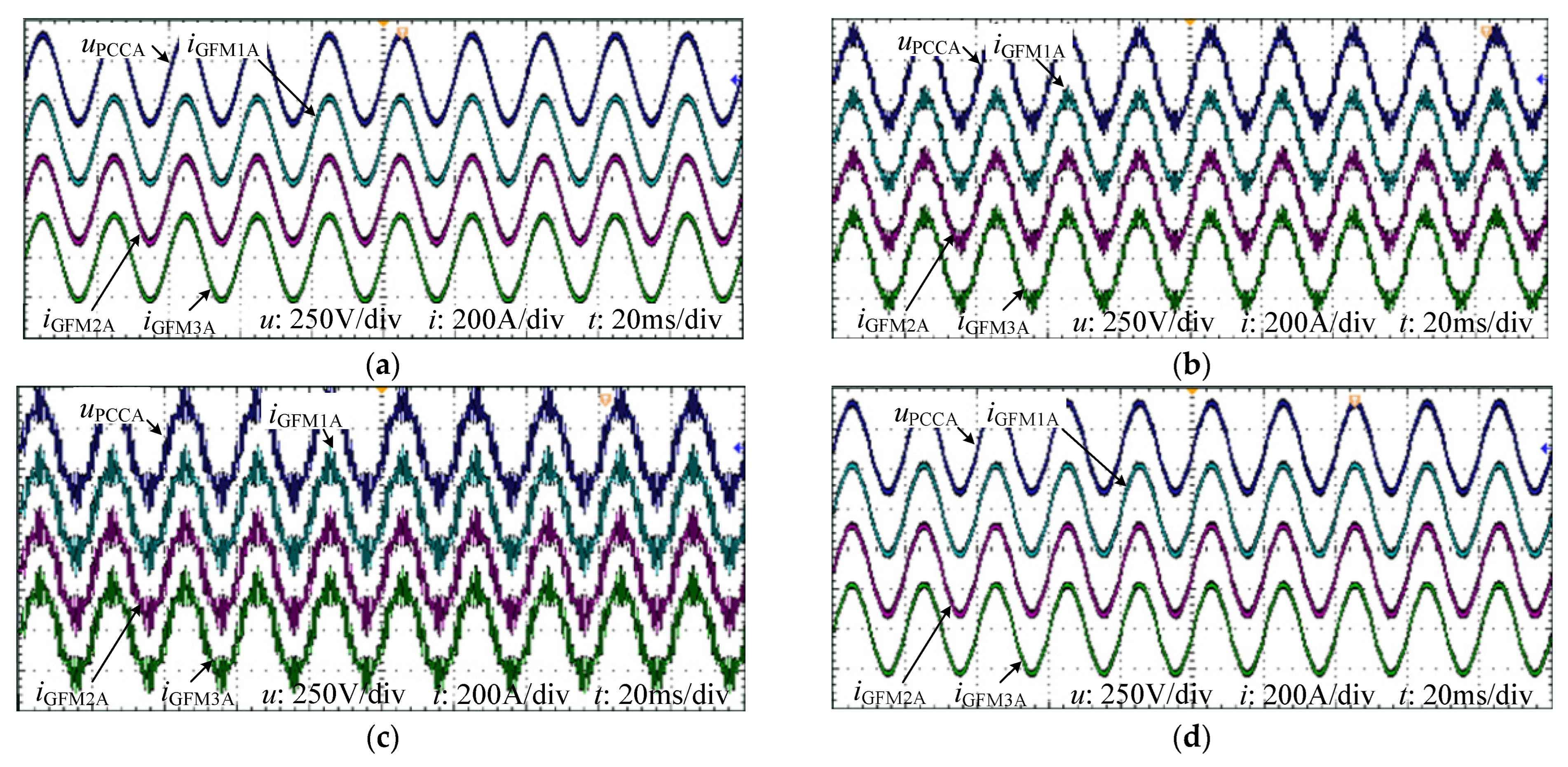
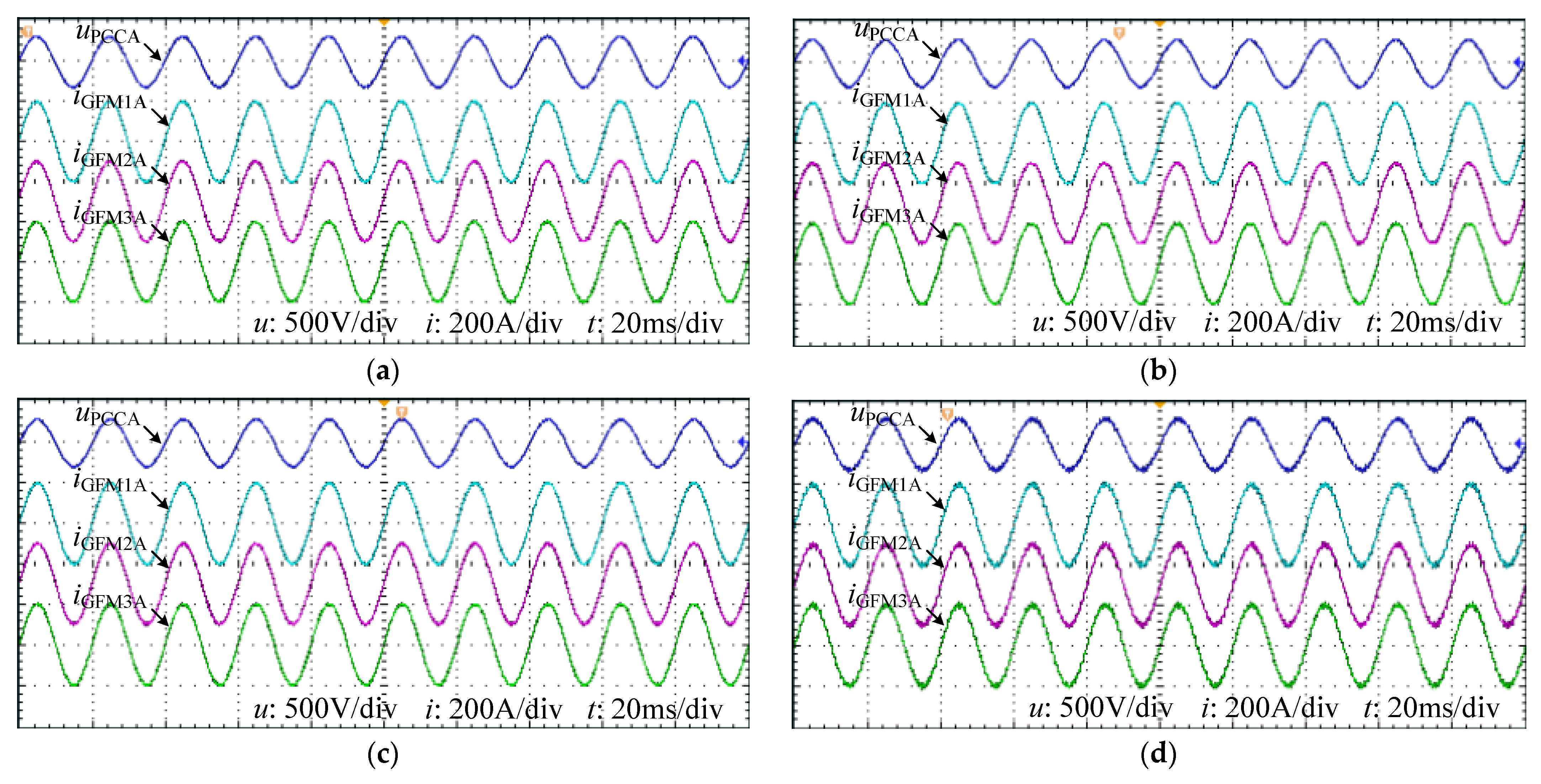
With the conventional control scheme, the output current of each GFM inverter and the grid-connected point voltage waveforms in the system without reactive power compensation capacitors, with 100 μF, 500 μF, and 1000 μF reactive power compensation capacitors, are shown in Figure 18.
As shown in Figure 18a, when grid-forming inverters are connected to the weak grid, the output currents of each inverter and the voltage waveforms at the grid connection point exhibit good sinusoidal quality. After a 100 μF reactive power compensation capacitor is connected to the grid system, compared to Figure 18a, Figure 18b shows that high-frequency oscillations appear in the output currents of each inverter and the voltage waveforms at the grid connection point. After introducing a 500 μF reactive power compensation capacitor into the grid system, the oscillations in the waveforms shown in Figure 18c deteriorate. When the capacitance of the reactive power compensation capacitor is further increased to 1000 μF, the inverter output currents and grid connection point voltage waveforms shown in Figure 18d recover to good sinusoidal quality.
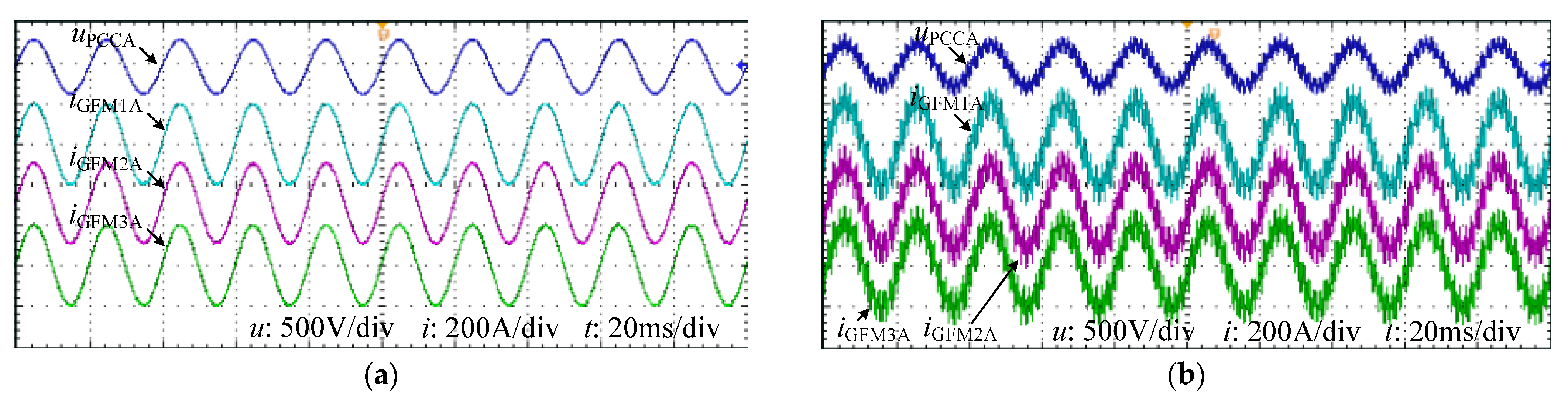
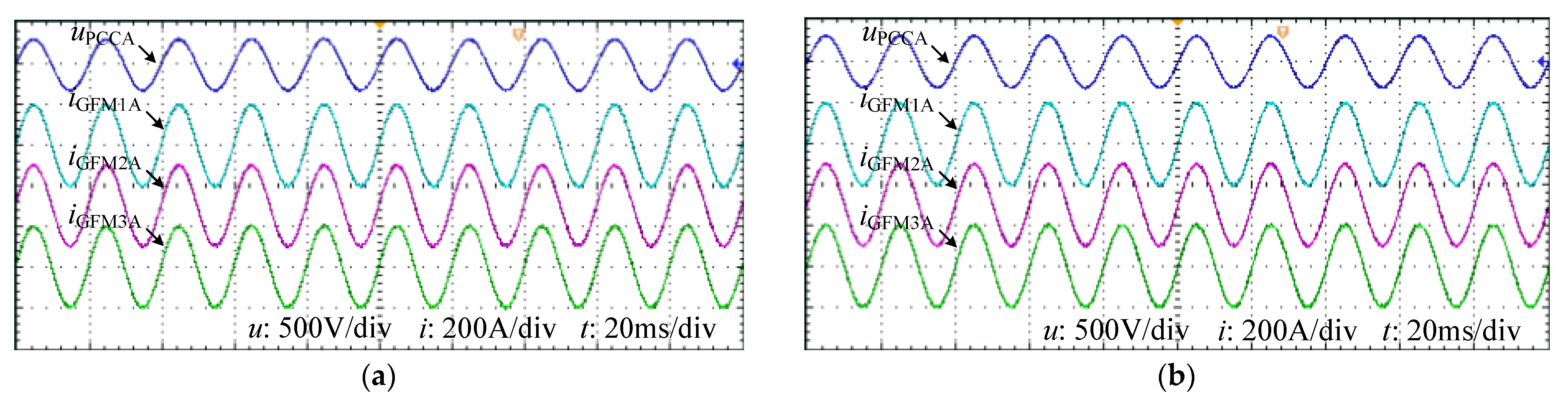
In order to demonstrate the contribution of each control loop, with a single virtual resistive loop, the output current of each GFM inverter and the grid-connected point voltage waveforms in the system with 100 μF and 500 μF reactive power compensation capacitors are shown in Figure 19. As shown in Figure 19a, when the 100 μF reactive-power compensation capacitor is connected to the grid system, the output currents of each inverter and the voltage waveforms at the grid connection point exhibit good sinusoidal quality by adopting a single virtual resistive loop. After introducing a 500 μF reactive-power compensation capacitor into the grid system, Figure 19b shows that high-frequency oscillations appear in the output currents of each inverter and the voltage waveforms at the grid connection point.
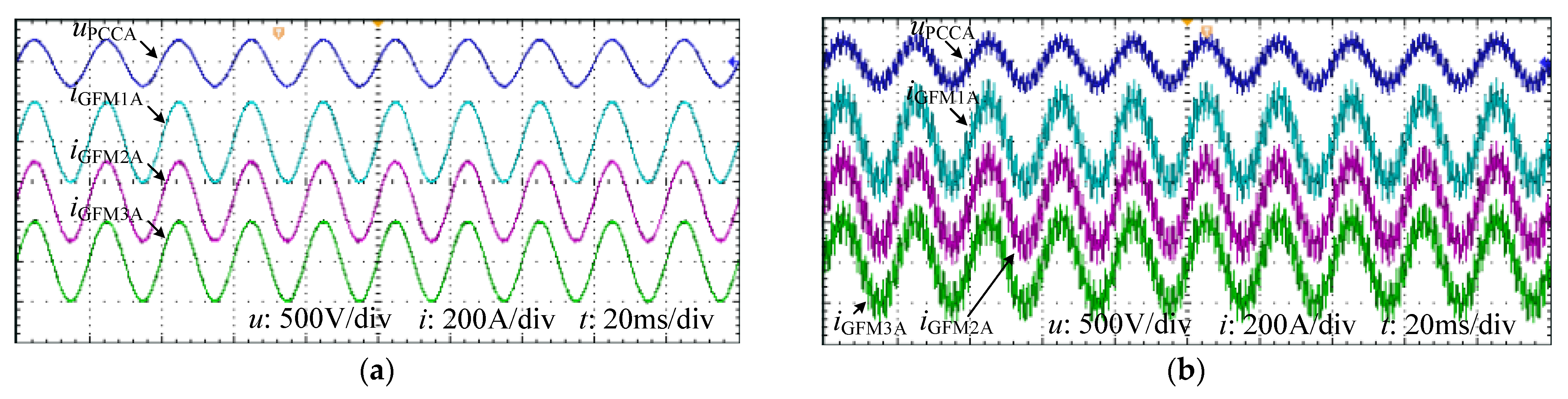
Next, with a single-negative capacitive loop, the output current of each GFM inverter and the grid-connected point voltage waveforms in the system, with 100 μF reactive-power compensation capacitors, under different grid strengths are shown in Figure 20. When SCR = 5, it can be seen from Figure 20a that the output currents of each inverter and the voltage waveforms at the grid connection point exhibit good sinusoidal quality by adopting a single negative capacitive loop. When SCR is changed to 2, Figure 20b shows that high-frequency oscillations appear in the output currents of each inverter and the voltage waveforms at the grid connection point.
Further, by incorporating an improved control scheme, the output currents of each inverter and the grid-connection point voltage waveforms for the grid-connected inverter system without reactive compensation capacitors and with 100 μF, 500 μF, and 1000 μF reactive compensation capacitors are shown in Figure 21.
As shown in Figure 21, after adopting the improved scheme, when 0 μF, 100 μF, 500 μF, and 1000 μF reactive-power compensation capacitors are connected to the system, the output current waveforms of each inverter and the grid-connection point voltage waveforms exhibit significantly improved sinusoidal characteristics compared to Figure 18b,c. The aforementioned hardware-in-the-loop experiments validate the theoretical analysis.
To quantitatively evaluate the performance improvement, the total harmonic distortion (THD) of the output currents in Figure 18 and Figure 21 was analyzed by importing the experimental data into MATLAB 2022b, which is summarized in Table 2. In scenarios where the 100 μF and 500 μF capacitors cause harmonic resonance, the THD under conventional control reaches 8.1% and 15.3%, respectively. However, with the proposed improved control, these values are significantly reduced to 3.4% and 3.7%, respectively. Even under stable conditions without compensation capacitors or with the 1000 μF compensation capacitors, the improved scheme can maintain a low THD of 2.2% and 2.6%. These results prove that the proposed strategy ensures high-quality power output and superior harmonic suppression across diverse reactive-power compensation scenarios.

4.2. Experimental Validation of the Improved Control Scheme Adaptability Under Non-Ideal Compensation Parameters and Various Grid Conditions

When the compensation capacitor parameters are not identified in time, the compensation capacitance in the inverter’s negative capacitive control loop may enter an over-compensated or under-compensated state. When the compensation capacitance is set to 50% and 150% of the actual value (500 μF), the output current of each GFM inverter and the grid-connected point voltage waveforms in the system with 500 μF reactive-power compensation capacitors are shown in Figure 22. It can be seen that the voltage and current waveforms exhibit good sinusoidal quality, which means that the system can remain stable in all conditions.
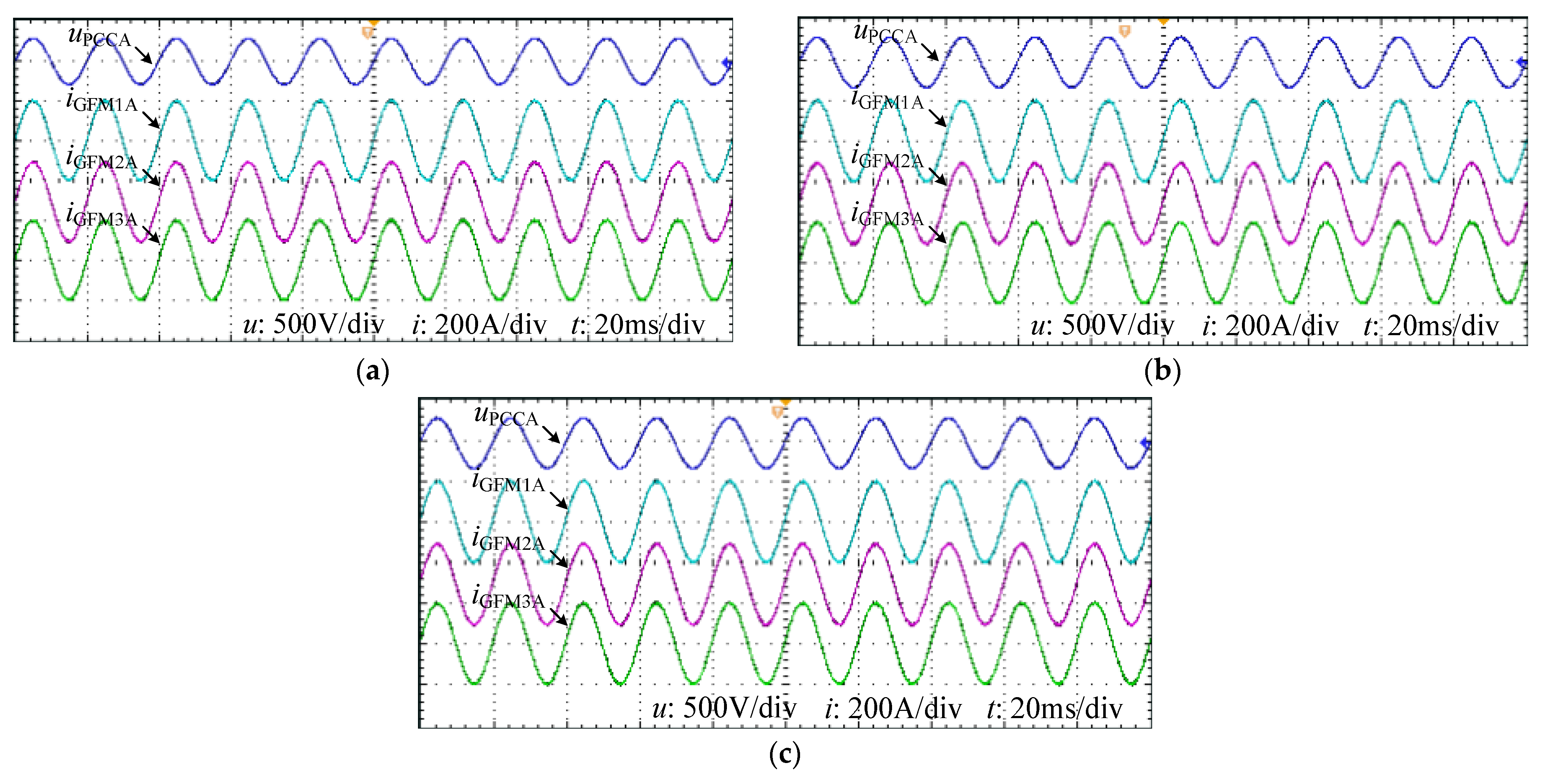
Further, considering the fluctuations of the grid strengths, when 500 μF reactive-power compensation capacitors are connected to the system, PCC voltage and current waveforms with the improved control scheme under SCR = 2, 3, and 5 are shown in Figure 23. By implementing the proposed negative capacitive and virtual resistive loop-based composite control strategy, it can be seen that the voltage and current waveforms exhibit good sinusoidal quality, which means that the system can remain stable in all conditions.
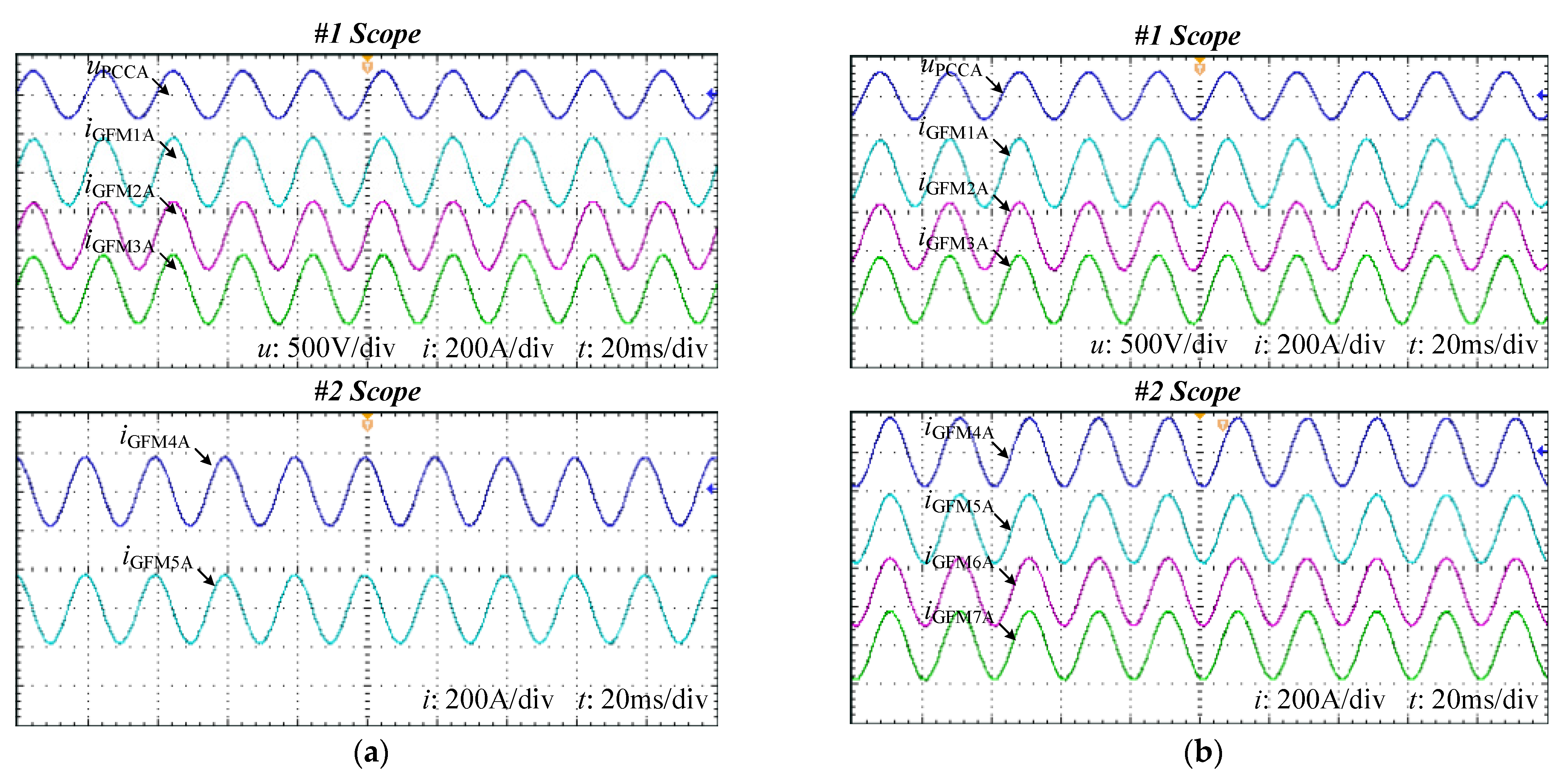
Subsequently, the system stability is validated for the improved scheme under varying numbers of parallel units, with the reactive-power compensation capacitance set to 500 μF. Figure 24 illustrates the grid voltage at the PCC and the output currents for five-unit and seven-unit parallel systems. Combining Figure 21c, which shows three inverters under the same conditions, with Figure 24, it is evident that the proposed scheme ensures high-quality sinusoidal waveforms for both PCC voltage and output currents regardless of the number of parallel inverters. These results confirm the robust adaptability of the proposed method across various grid-connected units.

4.3. Experimental Validation of the Improved Control Scheme Adaptability Under Complex Grid-Connected Conditions

To fully validate the effectiveness of the proposed scheme, experiments under complex grid conditions, including sequential switching of reactive-power compensation capacitors and SCR and capacitor variations, are carried out in this section.
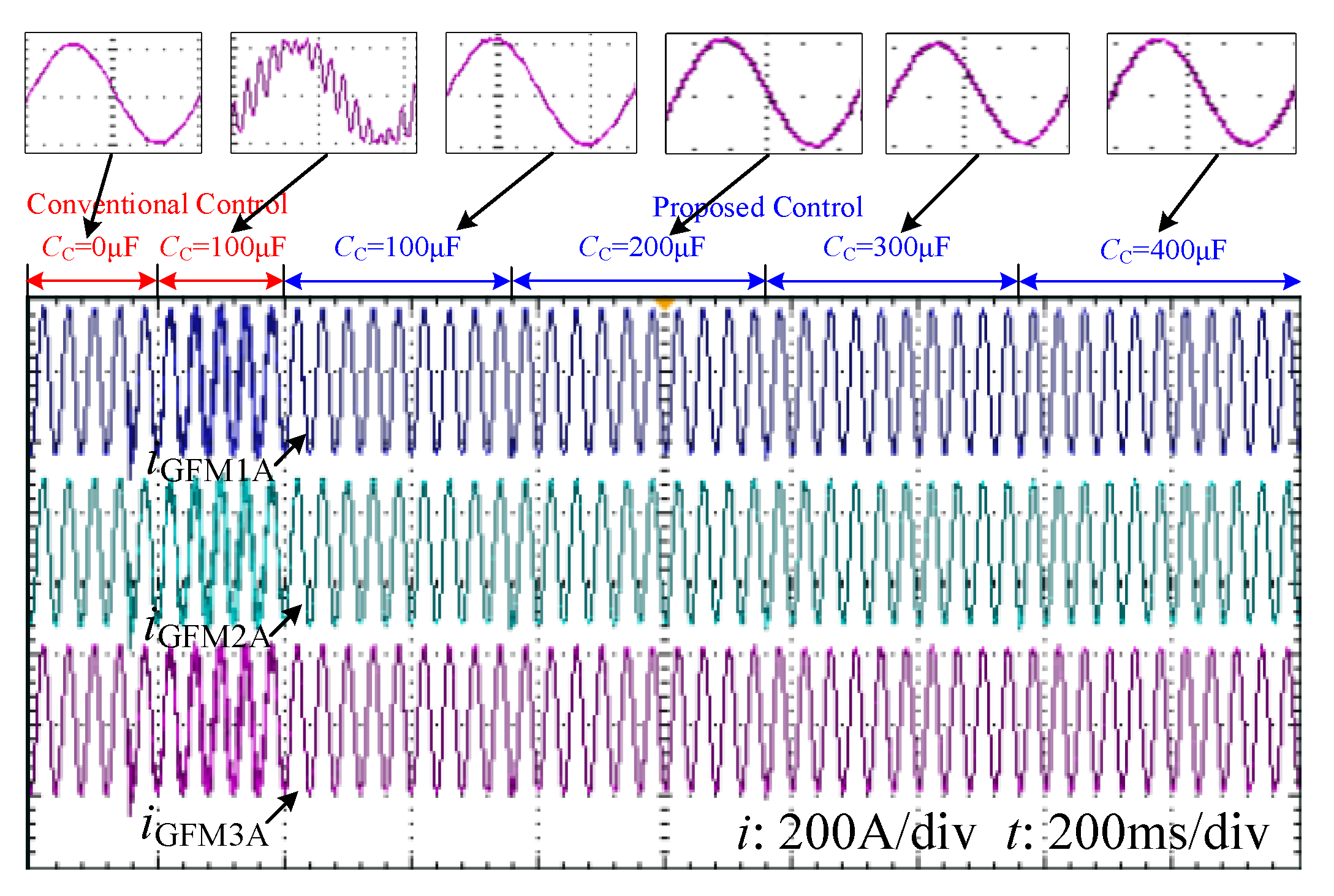
Firstly, the system performance under the sequential switching of reactive-power compensation capacitors is verified by using the improved scheme. The PCC voltage and the output currents of each inverter are shown in Figure 25. When no reactive-power compensation capacitors are switched to the grid, the three inverters under the conventional control scheme operate stably. However, once the 100 μF capacitor is switched in, harmonic resonance occurs in the system. Subsequently, by adopting the proposed control scheme, it can be observed that the PCC voltage and output currents return to a high-quality sinusoidal state. Furthermore, as the compensation capacitance is sequentially increased from 100 μF to 200 μF, 300 μF, and 400 μF, the system consistently maintains stable operation.
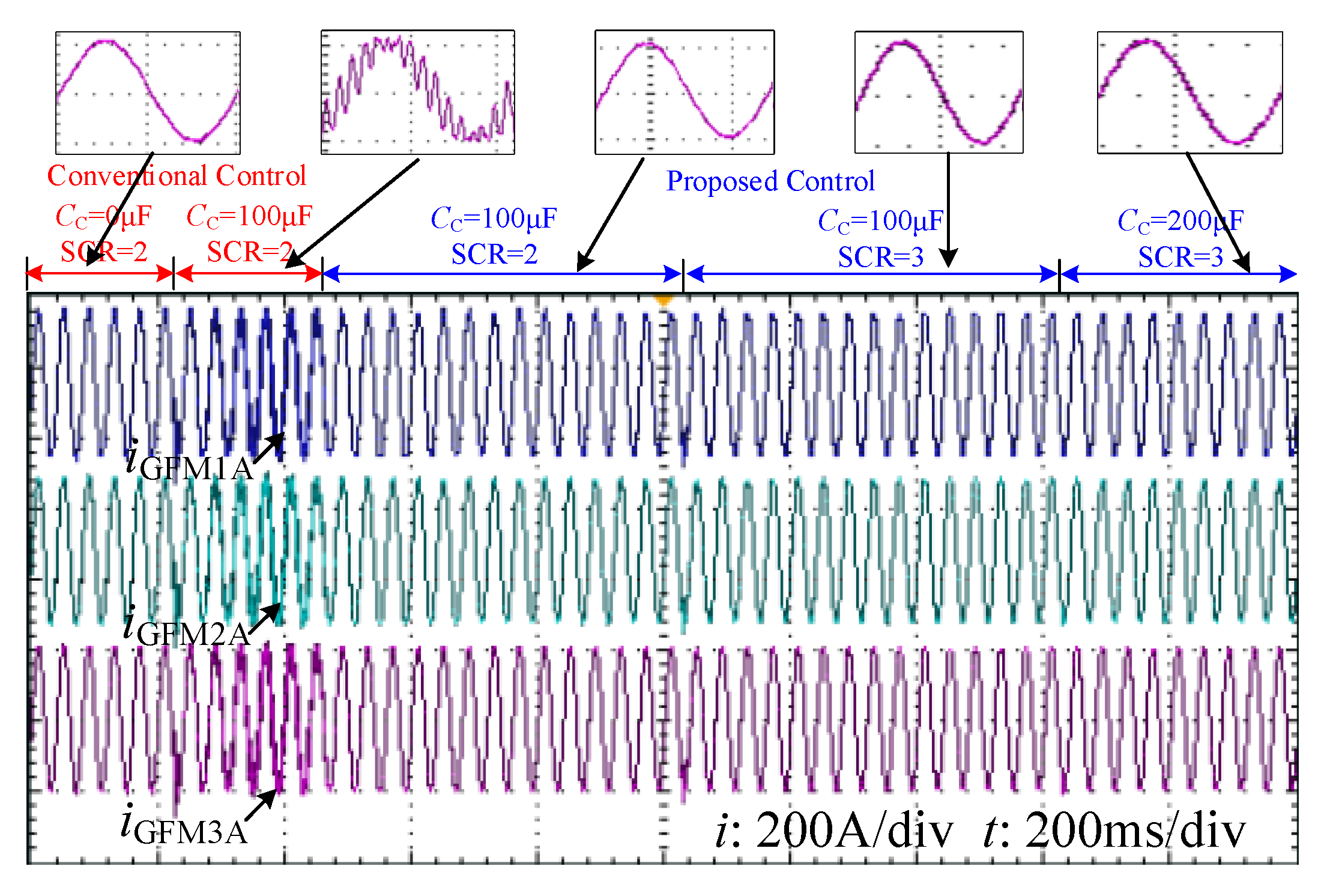
Secondly, the system performance under variations in both the SCR and the compensation capacitors is verified using the improved scheme. The PCC voltage and output currents of each inverter are shown in Figure 26. Under the conventional control scheme, the three-inverter system operates stably when SCR = 2 and no reactive-power compensation capacitors are connected. However, when the 100 μF capacitor is switched on at SCR = 2, harmonic resonance occurs. Subsequently, by adopting the proposed control scheme, the PCC voltage and output currents return to a high-quality sinusoidal state at SCR = 2. As the SCR then changes to 3, the system maintains stable operation. Furthermore, when the compensation capacitance is increased to 200 μF at SCR = 3, the system consistently maintains stable operation.
The proposed scheme can effectively suppress harmonic resonance and ensure stable operation under various grid conditions. It is demonstrated that it has superior adaptability to varying SCR and compensation capacitances.

5. Conclusions

This study investigates the impact of switching reactive-power compensation devices on the stable operation of grid-forming inverters in distribution networks and proposes a composite control strategy based on negative-capacitance and virtual-resistance loops. Theoretical analysis reveals that the connection of reactive-power compensation capacitors modifies the frequency characteristics of the grid impedance. At certain capacitance values, interaction occurs with the inverter output impedance at frequency points where the phase margin is insufficient, leading to high-frequency oscillations in the system. The proposed enhanced control strategy achieves active compensation for the grid-side equivalent capacitive impedance through the use of virtual negative capacitance. Simultaneously, system damping is improved by means of virtual resistance, thereby reshaping the inverter output impedance. Finally, hardware-in-the-loop experiments verify that the proposed approach effectively suppresses oscillations induced by the switching of reactive-power compensation capacitors, restoring stable voltage and current waveforms at the point of common coupling. The strategy demonstrates significant potential for enhancing power quality in complex distribution networks.
Despite these findings, this study focuses on GFM systems with homogeneous parameters. Given the inherent parameter diversity in practical applications, future work will investigate the stability and robustness of the proposed strategy within heterogeneous multi-inverter networks featuring varying manufacturer-specific specifications. Additionally, the trade-off between damping enhancement and overall conversion efficiency requires further quantitative assessment. Subsequent research will also target the integration of this composite control into hierarchical control architectures and the development of distributed coordination schemes to improve the adaptability of GFM inverters in high-penetration renewable energy clusters.

Author Contributions

Conceptualization, X.S.; methodology, K.C.; software, K.C.; validation, K.C. and K.G.; formal analysis, D.S.; investigation, K.C.; resources, K.C.; data curation, L.Q.; writing—original draft preparation, K.G.; writing—review and editing, X.S., K.C. and K.G.; visualization, L.Q.; supervision, X.S. All authors have read and agreed to the published version of the manuscript.

Funding

This research received no external funding.

Data Availability Statement

Dataset available on request from the authors. The raw data supporting the conclusions of this article will be made available by the authors on request.

Conflicts of Interest

Kailong Chen and Dan Sun were employed by the company Nanjing Guodian Nanjing Automation Co., Ltd. The remaining authors declare that the research was conducted in the absence of any commercial or financial relationships that could be construed as a potential conflict of interest.

References

  1. Xie, X.; Liu, Y.; Wang, X.; Han, Y. On constructing new-type power systems in China. CSEE J. Power Energy Syst. 2025, 11, 2710–2728. [Google Scholar] [CrossRef]
  2. Shu, Y.; Tang, Y.; Zhang, Z.; Zhang, F.; Zhong, W.; Shi, H.; Yang, L.; Kong, M.; Gu, Z.; Yu, Y. Pathway for new-type power system in China. CSEE J. Power Energy Syst. 2025, 11, 2684–2695. [Google Scholar]
  3. Shu, Y.B.; Chen, G.P.; He, J.B.; Zhang, F. Building a new electric power system based on new energy sources. Strateg. Study CAE 2021, 23, 61–69. [Google Scholar] [CrossRef]
  4. Maganti, S.; Padhy, N.P. An Advanced Control Strategy for a Weak Grid-Connected DG for Enhancing Voltage Support during Co-occurrence of Sag and Swell. IEEE Trans. Power Electron. 2024, 39, 1644–1655. [Google Scholar] [CrossRef]
  5. Singhal, A.; Vu, T.L.; Du, W. Consensus control for coordinating grid-forming and grid-following inverters in microgrids. IEEE Trans. Smart Grid 2022, 13, 4123–4133. [Google Scholar] [CrossRef]
  6. Askarian, A.; Park, J.; Salapaka, S. Enhanced grid-following (E-GFL) inverter: A unified control framework for stiff and weak grids. IEEE Trans. Power Electron. 2024, 39, 5089–5107. [Google Scholar] [CrossRef]
  7. Cheng, C.; Xie, S.; Xu, J.; Qian, Q. Universal absolute stability criterion for single-phase grid-following inverters equipped with orthogonal-normalization-based grid synchronizer. IEEE Trans. Power Electron. 2023, 38, 9090–9099. [Google Scholar] [CrossRef]
  8. Wang, M.; Guo, J.; Ma, S.; Zhang, X.; Wang, T.; Luo, K. A novel decentralized frequency regulation method of renewable energy stations based on minimum reserve capacity for renewable energy-dominated power systems. IEEE Trans. Power Syst. 2024, 39, 3701–3714. [Google Scholar] [CrossRef]
  9. Du, E.; Zhang, N.; Hodge, B.M.; Wang, Q.; Kang, C.; Kroposki, B.; Xia, Q. The role of concentrating solar power toward high renewable energy penetrated power systems. IEEE Trans. Power Syst. 2018, 33, 6630–6641. [Google Scholar] [CrossRef]
  10. Yu, Y.; Jiang, H.; Zhang, N.; Yong, P.; Teng, F.; Zhang, J.; Wang, Y.; Strbac, G. Revisiting capacity value of variable renewable energy generation in power systems with high renewable energy penetration. J. Mod. Power Syst. Clean Energy 2025, 13, 1593–1603. [Google Scholar]
  11. Shrestha, A.; Pradhan, P.; Yassin, M.A.; Sharma, B.; Gonzalez-Longatt, F. Transitioning to a 100% renewable power grid: Key challenges and opportunities. IEEE Trans. Technol. Soc. 2025, 6, 358–373. [Google Scholar] [CrossRef]
  12. Cheng, Y.; Fan, L.; Rose, J.; Huang, S.H.; Schmall, J.; Wang, X.; Xie, X.; Shair, J.; Ramamurthy, J.R.; Modi, N.; et al. Real-world subsynchronous oscillation events in power grids with high penetrations of inverter-based resources. IEEE Trans. Power Syst. 2023, 38, 316–330. [Google Scholar] [CrossRef]
  13. Sun, J. Impedance-based stability criterion for grid-connected inverters. IEEE Trans. Power Electron. 2011, 26, 3075–3078. [Google Scholar] [CrossRef]
  14. Wen, B.; Boroyevich, D.; Burgos, R.; Mattavelli, P.; Shen, Z. Analysis of D-Q small-signal impedance of grid-tied inverters. IEEE Trans. Power Electron. 2016, 36, 675–687. [Google Scholar] [CrossRef]
  15. Xie, B.; Guo, K.; Mao, M.; Zhou, L.; Liu, T.; Zhang, Q.; Hao, G. Analysis and improved design of phase compensated proportional resonant controllers for grid-connected inverters in weak grid. IEEE Trans. Energy Convers. 2020, 35, 1453–1464. [Google Scholar] [CrossRef]
  16. Hu, Y.; Xu, J.; Qian, H.; Bian, S.; Xie, S. Robustness and harmonics suppression of grid-connected inverters with different grid voltage feedforward compensations in weak grid. In Proceedings of the 2020 IEEE 29th International Symposium on Industrial Electronics (ISIE), Delft, The Netherlands, 17–19 June 2020. [Google Scholar]
  17. Xu, J.; Xie, S.; Qian, Q.; Zhang, B. Adaptive feedforward algorithm without grid impedance estimation for inverters to suppress grid current instabilities and harmonics due to grid impedance and grid voltage distortion. IEEE Trans. Ind. Electron. 2017, 64, 7574–7586. [Google Scholar] [CrossRef]
  18. Lu, M.; Wang, X.; Loh, P.C.; Blaabjerg, F. Resonance interaction of multiparallel grid-connected inverters with LCL filter. IEEE Trans. Power Electron. 2017, 32, 894–899. [Google Scholar] [CrossRef]
  19. Liu, Q.; Caldognetto, T.; Buso, S. Review and comparison of grid-tied inverter controllers in microgrids. IEEE Trans. Power Electron. 2020, 35, 7624–7639. [Google Scholar] [CrossRef]
  20. Wang, J.; Saraswat, G. Study of inverter control strategies on the stability of low-inertia microgrid systems. In Proceedings of the IECON 2022—48th Annual Conference of the IEEE Industrial Electronics Society, Brussels, Belgium, 17–20 October 2022. [Google Scholar]
  21. Lin, Z.; Ruan, X.; Wu, L.; Zhang, H.; Li, W. Multi resonant component-based grid-voltage-weighted feedforward scheme for grid-connected inverter to suppress the injected grid current harmonics under weak grid. IEEE Trans. Power Electron. 2020, 35, 9784–9793. [Google Scholar] [CrossRef]
  22. Akhavan, A.; Vasquez, J.C.; Guerrero, J.M. Stability enhancement of grid-connected inverters using weighted average current control method. IEEE J. Emerg. Sel. Top. Ind. Electron. 2022, 3, 694–703. [Google Scholar] [CrossRef]
  23. Sang, S.; Gao, N.; Cai, X.; Li, R. A novel power-voltage control strategy for the grid-tied inverter to raise the rated power injection level in a weak grid. IEEE J. Emerg. Sel. Top. Power Electron. 2018, 6, 219–232. [Google Scholar] [CrossRef]
  24. Wu, W.; Chen, Y.; Zhou, L.; Luo, A.; Zhou, X.; He, Z.; Yang, L.; Xie, Z.; Liu, J.; Zhang, M. Sequence impedance modeling and stability comparative analysis of voltage-controlled VSGs and current-controlled VSGs. IEEE Trans. Ind. Electron. 2019, 66, 6460–6472. [Google Scholar] [CrossRef]
  25. Li, M.; Zhang, X.; Fu, X.; Geng, H.; Zhao, W. Stability studies on PV grid-connected inverters under weak grid: A review. Chin. J. Elect. Eng. 2024, 10, 1–19. [Google Scholar] [CrossRef]
  26. Mittal, R.; Miao, Z.; Fan, L.; Ramasubramanian, D. Oscillation risks of grid-following and grid-forming inverter-based resources in series-compensated networks. IEEE Trans. Power Del. 2025, 40, 2426–2438. [Google Scholar] [CrossRef]
  27. Mirmohammad, M.; Sahar, S.A. Control and stability of grid-forming inverters: A comprehensive review. Energies 2024, 17, 3186. [Google Scholar] [CrossRef]
  28. Chen, J.; Zhang, X.; Yang, Y.; Chen, X. Impedance modelling and grid integration stability evaluation of three-phase virtual synchronous generator. IET Power Electron. 2022, 15, 3421–3429. [Google Scholar]
  29. Reißner, F.; Weiss, G. Robust and adaptive tuning of PI current controllers for grid-forming inverters. IEEE Open J. Ind. Electron. Soc. 2025, 6, 115–129. [Google Scholar] [CrossRef]
  30. Chi, S.; Zhang, R.; Sun, S.; Yu, P.; Cheng, Y. Interaction stability analysis and oscillation suppression method of hybrid grid-forming and grid-following inverters system with varying power levels. IEEE Trans. Ind. Electron. 2026, 73, 755–766. [Google Scholar] [CrossRef]
  31. Luo, C.; Chen, Y.; Liao, S.; Xie, Z.; Lian, Z.; Wang, Z.; Liu, X.; Gao, M.; Xie, J. Stability region estimation and decentralized transient control for parallel grid-tied grid-forming inverters. IEEE Trans. Sustain. Energy 2025, 16, 2015–2028. [Google Scholar] [CrossRef]
  32. Poh, W.Q.T.; Saifuddin, M.R.; Naayagi, R.T. A novel self-powered dynamic system using a quasi-z-source inverter-based piezoelectric vibration energy harvester. Electronics 2020, 9, 265. [Google Scholar] [CrossRef]
  33. Poh, W.Q.T.; Naayagi, R.T. Modelling and integration of a piezoelectric cantilever beam with quasi-z-Source inverter for self-powered dynamic system application. In Proceedings of the 2020 IEEE Power & Energy Society General Meeting (PESGM), Montreal, QC, Canada, 2–6 August 2020; pp. 1–5. [Google Scholar]
  34. Mustafa, G.I.Y.; Masum, M.D.; Siam, M.D. A new model-free control for load frequency control of interconnected power systems based on nonlinear disturbance observer. Energy Rep. 2024, 12, 4998–5008. [Google Scholar] [CrossRef]
  35. Rygg, A.; Molinas, M.; Zhang, C.; Cai, X. A modified sequence-domain impedance definition and its equivalence to the dq-domain impedance definition for the stability analysis of AC power electronic systems. IEEE J. Emerg. Sel. Top. Power Electron. 2016, 4, 1383–1396. [Google Scholar] [CrossRef]
  36. Roinila, T.; Messo, T.; Santi, E. MIMO-identification techniques for rapid impedance-based stability assessment of three-phase systems in dq domain. IEEE Trans. Power Electron. 2018, 33, 4015–4022. [Google Scholar] [CrossRef]
  37. Huang, J.; Corzine, K.A.; Belkhayat, M. Small-signal impedance measurement of power-electronics-based AC power systems using line-to-line current injection. IEEE Trans. Power Electron. 2009, 24, 445–455. [Google Scholar] [CrossRef]
Figure 1. Diagram for the distributed energy storage inverter connected to the distribution network: (a) Distribution network with reactive power compensation devices; (b) GFM inverter control loop.
Energies 19 02951 g001
Figure 2. Equivalent circuit model for GFM inverter in the distribution network with reactive power compensation.
Energies 19 02951 g002
Figure 3. Rotation angle difference between the power circuit and control loop coordinate frames.
Energies 19 02951 g003
Figure 4. Main circuit model of GFM inverter.
Energies 19 02951 g004
Figure 5. Control block diagram of the power control loop for the GFM inverter.
Energies 19 02951 g005
Figure 6. Control block diagram for the virtual impedance of the GFM inverter.
Energies 19 02951 g006
Figure 7. Control block diagram of the voltage and current loops of the GFM inverter.
Energies 19 02951 g007
Figure 8. Bode plots of the source-grid impedance for different reactive power compensation capacitors: (a) Without reactive compensation capacitors; (b) The capacitance value for switching the reactive power compensation capacitor is 100 μF; (c) The capacitance value for switching the reactive power compensation capacitor is 500 μF; (d) The capacitance value for switching the reactive power compensation capacitor is 1000 μF.
Energies 19 02951 g008aEnergies 19 02951 g008b
Figure 9. Diagram of negative capacitive and virtual resistive loop-based composite control strategy: (a) Electrical schematic block diagram; (b) Control block diagram.
Energies 19 02951 g009
Figure 10. Bode plot of the inverter impedance with various Rcv.
Energies 19 02951 g010
Figure 11. Bode plots of the source-grid impedance with single virtual resistive loop: (a) The capacitance value for switching the reactive power compensation capacitor is 100 μF; (b) The capacitance value for switching the reactive power compensation capacitor is 500 μF.
Energies 19 02951 g011
Figure 12. Bode plots of the source-grid impedance with single negative capacitive loop: (a) The capacitance value for switching the reactive power compensation capacitor is 100 μF and SCR = 5; (b) The capacitance value for switching the reactive power compensation capacitor is 100 μF and SCR = 2.
Energies 19 02951 g012
Figure 13. Bode plots of the source-grid impedance with the improved control scheme: (a) Without reactive compensation capacitors; (b) The capacitance value for switching the reactive power compensation capacitor is 100 μF; (c) The capacitance value for switching the reactive power compensation capacitor is 500 μF; (d) The capacitance value for switching the reactive power compensation capacitor is 1000 μF.
Energies 19 02951 g013
Figure 14. Bode plots of the source-grid impedance with the improved control scheme: (a) The compensation capacitance is set to 250 μF; (b) The compensation capacitance is set to 750 μF.
Energies 19 02951 g014
Figure 15. Bode plots of the source-grid impedance with the improved control scheme under varying SCR conditions: (a) The capacitance value for switching the reactive power compensation capacitor is 500 μF and SCR = 2; (b) The capacitance value for switching the reactive power compensation capacitor is 500 μF and SCR = 3; (c) The capacitance value for switching the reactive power compensation capacitor is 500 μF and SCR = 5.
Energies 19 02951 g015
Figure 16. Bode plot of the inverter impedance with various grid-connected units.
Energies 19 02951 g016
Figure 17. Hardware-in-the-loop experimental test platform.
Energies 19 02951 g017
Figure 18. PCC voltage and current waveforms for different reactive power compensation capacitors: (a) No reactive power compensation capacitor; (b) The capacitance value for switching the reactive power compensation capacitor is 100 μF; (c) The capacitance value for switching the reactive power compensation capacitor is 500 μF; (d) The capacitance value for switching the reactive power compensation capacitor is 1000 μF.
Energies 19 02951 g018
Figure 19. PCC voltage and current waveforms with single virtual resistive loop: (a) The capacitance value for switching the reactive power compensation capacitor is 100 μF; (b) The capacitance value for switching the reactive power compensation capacitor is 500 μF.
Energies 19 02951 g019
Figure 20. PCC voltage and current waveforms with single negative capacitive loop: (a) The capacitance value for switching the reactive power compensation capacitor is 100 μF and SCR = 5; (b) The capacitance value for switching the reactive power compensation capacitor is 100 μF and SCR = 2.
Energies 19 02951 g020
Figure 21. PCC voltage and current waveforms with the improved control scheme: (a) Without reactive compensation capacitors; (b) The capacitance value for switching the reactive-power compensation capacitor is 100 μF; (c) The capacitance value for switching the reactive-power compensation capacitor is 500 μF; (d) The capacitance value for switching the reactive-power compensation capacitor is 1000 μF.
Energies 19 02951 g021
Figure 22. PCC voltage and current waveforms with the improved control scheme: (a) The compensation capacitance is set to 250 μF; (b) The compensation capacitance is set to 750 μF.
Energies 19 02951 g022
Figure 23. PCC voltage and current waveforms with the improved control scheme: (a) The capacitance value for switching the reactive-power compensation capacitor is 500 μF and SCR = 2; (b) The capacitance value for switching the reactive-power compensation capacitor is 500 μF and SCR = 3; (c) The capacitance value for switching the reactive-power compensation capacitor is 500 μF and SCR = 5.
Energies 19 02951 g023
Figure 24. PCC voltage and current waveforms with the improved control scheme: (a) The compensation capacitance is set to 500 μF, and the inverters’ parallel number is 5; (b) The compensation capacitance is set to 750 μF, and the inverters’ parallel number is 7.
Energies 19 02951 g024
Figure 25. PCC voltage and current waveforms with the improved control scheme under the sequential switching of reactive-power compensation capacitors.
Energies 19 02951 g025
Figure 26. PCC voltage and current waveforms with the improved control scheme under variations of both SCR and compensation capacitors.
Energies 19 02951 g026
Table 1. Experimental parameters.
Variable NameValue
L13 mH
L20.5 mH
C114.1 μF
RC2 Ω
Switching Frequency16 kHz
Inverter Set Current200 A
Grid-connected phase voltage311 V
SCR2
Table 2. THD comparison of output current under different cases.
Operating ConditionTHD Under Conventional ControlTHD Under Proposed Control
No reactive power compensation capacitor2.5%2.2%
The switched capacitance value is 100 μF8.1%3.4%
The switched capacitance value is 500 μF15.3%3.7%
The switched capacitance value is 1000 μF3.4%2.6%
Disclaimer/Publisher’s Note: The statements, opinions and data contained in all publications are solely those of the individual author(s) and contributor(s) and not of MDPI and/or the editor(s). MDPI and/or the editor(s) disclaim responsibility for any injury to people or property resulting from any ideas, methods, instructions or products referred to in the content.