Article

Analysis of Barriers and Strategies to the Integration of Renewable Energy in South Africa: A Hybrid Multi-Criteria Decision-Making Framework


by
Pheladi Molepo
,
Tebello Ntsiki Don Mathaba
* and
Khaled Aboalez
Postgraduate School of Engineering Management, Faculty of Engineering and Built Environment, University of Johannesburg, Johannesburg 2006, South Africa
*
Author to whom correspondence should be addressed.
Energies 2026, 19(13), 2954; https://doi.org/10.3390/en19132954 (registering DOI)
Submission received: 5 May 2026 / Revised: 15 June 2026 / Accepted: 17 June 2026 / Published: 23 June 2026

Abstract

Renewable energy sources are fast becoming the most cost-effective option for adding new power generation capacity globally. In South Africa (SA), the transition from fossil fuels to renewable energy has steadily gained momentum over the years. However, this transition is beset by complex and multidimensional barriers. This research study analyses and prioritises renewable energy barriers and mitigation strategies in South Africa. The DEMATEL multi-criteria decision-making technique was employed to rank the barriers and assess their cause-and-effect relationships. The findings reveal the top three barrier categories as Agreement, Market, and Knowledge. The study further employed an integrated hybrid CRITIC-TOPSIS technique to prioritise the proposed mitigation strategies for each barrier in a defined category. The results indicate that strengthening local community engagement is the most suitable solution to the adoption of renewable energy in SA. A sensitivity analysis model was conducted to validate the robustness of the results. The findings validate the consistency of the methods, with the ranking of the barriers and mitigation strategies remaining stable under various scenarios. This study presents a context-specific causal analysis of barriers and an objective prioritisation of mitigation strategies in South Africa using an integrated hybrid DEMATEL and CRITIC–TOPSIS approach, providing policymakers and decision-makers with valuable insights to develop strategic plans and policies that address the identified barriers.

1. Introduction

Renewable energy (RE) technologies are rapidly gaining popularity worldwide as a sustainable alternative for generating electricity. This is because they are environmentally friendly [1] and cost-effective [1,2], and their development has a positive impact on the economic development [3]. South Africa is among the countries that have vowed to adopt renewable energy technologies for electricity generation to lower and ultimately eliminate reliance on fossil fuels for electricity generation [4]. South Africa has set a target to limit its carbon dioxide (MtCO2) emissions to 350–420 million tonnes by 2030 and to achieve net-zero emissions by 2050 [5].
Situated at the southernmost tip of Africa, South Africa is the 25th largest country in the world by land area and has a population of close to 60 million [6]. South Africa is considered an economic hub for Africa due to its industrialised economy and advanced infrastructure. It is not surprising that it is also the largest carbon dioxide emitter on the continent, accounting for at least 33% of the emissions. The burning of coal for electricity generation is the biggest contributor to the country’s CO2 emissions [3].
South Africa is geographically well-positioned to receive abundant wind and solar energy in its Cape provinces [3]. The annual 24 h global solar radiation average is approximately 220 W/m2 [7], coupled with an annual average wind speed of over 4 m/s [8,9]. These conditions collectively position the country well to harness these renewable energy resources for electricity generation, reducing reliance on conventional power generation and mitigating CO2 emissions.
South Africa’s commitments to a diversified and sustainable energy mix date back to the 1998 White Paper for Energy Policy. The policy laid the foundation for restructuring the energy sector by integrating alternative energy sources. This commitment was further advanced through the 2003 White Paper on Renewable Energy policy, developed by the then Department of Minerals and Energy (now the Department of Electricity and Energy (DEE)). The policy defined the government’s targets for renewable energy development, emphasising the optimal use of the country’s abundant renewable energy resources, such as solar, wind, biomass, and hydro, for on-grid and off-grid power generation, as well as for non-electric technologies [10].
By the end of 2024, the country had generated more than 80% of its electricity from Eskom’s coal-fired power plants, while renewable energy accounted for only about 12% of total generation. This renewable share consisted of solar photovoltaic (PV), concentrated solar power (CSP), and onshore wind energy procured through the government-led Renewable Energy Independent Power Producer Procurement Programme (REIPPPP) [11]. The persistent dominance of coal in the electricity mix underscores the need to accelerate the development of utility-scale renewable energy sources. Therefore, this study aims to address the following research problem: the challenges that hinder the development and integration of utility-scale renewable energy into South Africa’s energy mix are rarely analysed and documented in the literature. The research problem is addressed by first analysing how renewable energy barriers are interrelated and assessing their influence in advancing the integration of renewable energy. Secondly, the study evaluates how these barriers can be managed to effectively integrate renewable energy into South Africa’s energy supply.
There has been greater interest in renewable energy studies among policymakers and academics in South Africa. The study by Todd and McCauley analysed key policy barriers hindering the large-scale implementation of renewable energy technologies in South Africa [12]. The study by Mirzania et al. [13] examined the constraints affecting South Africa’s energy transition goals. Baumli and Jamasb [14] evaluated barriers to private participation in renewable energy projects across Africa, including South Africa. However, a significant gap still exists in the literature regarding the identification and analysis of multidimensional barriers to renewable energy in South Africa. Specifically, there are still limited peer-reviewed studies on the prioritisation of renewable energy barriers and ranking of their solutions using multi-criteria decision-making techniques. Much of the literature analyses these barriers in isolation and fails to identify and critically assess the most significant barriers to renewable energy integration, including their possible interrelationships, thereby overlooking their complex, multidimensional, and interdependent nature [8]. Addressing this gap is crucial because, until these substantial barriers to renewable energy adoption are studied, understood, and strategically removed, the pursuit of a clean and sustainable energy transition will not be realised [15].
This study makes a significant contribution to the existing body of knowledge on renewable energy in South Africa in multiple ways. It develops an integrated hybrid multi-criteria decision-making (MCDM) framework to effectively analyse the barriers and their solutions.
  • Firstly, a Decision-Making Trial and Evaluation Laboratory (DEMATEL) MCDM technique is employed to prioritise renewable energy barriers in South Africa, ensuring a more comprehensive and holistic approach to decision-making.
  • Secondly, mitigation strategies are identified and tailored to specifically address each barrier, an approach rarely seen in the literature, where solutions tend to be generalised.
  • Lastly, an integrated CRITIC-TOPSIS framework is developed to objectively assign weights to criteria and prioritise the mitigation strategies for effectively addressing these barriers.
The subsequent sections of this research paper are organised as follows: Section 2 provides the literature review on barriers and multi-criteria decision-making methods. The research methodology for this study is detailed in Section 3. The findings are presented in Section 4. Section 5 presents the sensitivity analysis for DEMATEL and TOPSIS, and Section 6 discusses the findings in the context of South Africa. Lastly, the conclusion and contributions of the study are presented in Section 7.

2. Literature Review

The adoption of renewable energy into the energy system is a global issue. Different countries face unique challenges and barriers [16,17]. Numerous studies across various developing countries have employed multi-criteria decision-making methods to assess and overcome barriers to renewable energy, including those conducted in Malawi [4], China [18], and Spain [19]. The subsequent subsections first discuss various MCDM techniques and their application in assessing renewable energy barriers globally, followed by renewable energy barriers contextualised to the South African market, as examined by Molepo et al. [8], and conclude by outlining mitigation strategies to address each barrier.

2.1. Multi-Criteria Decision-Making

Multi-criteria decision-making is a multidimensional technique applied widely to determine solutions to problems with multiple objectives and conflicting criteria [20]. MCDM is the most applied analysis and decision-making tool suited to solving complex problems with high uncertainty [21,22]. They consider multiple criteria to obtain a more informed, sustainable, and robust decision [20].
A range of MCDM methods and tools with different purposes have been developed to solve real-world problems in different areas [23]. They are applied broadly across various fields, such as energy management [24], finance and business [25], agriculture, and computer science [23], supply chain, engineering, technology, healthcare, and environmental management [26]. There are numerous and varied MCDM methods with different properties, and their selection and application are dependent on the nature of the decision-making problem [27]. Each MCDM method has its own strengths and limitations. The selection of the most suitable method depends on the nature of the decision problem, the application, the level of complexity, the availability of data, and decision-makers’ preferences [28,29].
Various MCDM methods are applied across different research areas. According to da Ponte et al. [21], the most common MCDM methods applied across many research areas are AHP, ELECTRE, PROMETHEE, TOPSIS, and Grey Theory.
The summary of previous studies conducted across the globe to analyse renewable energy barriers using a range of MCDM techniques is presented in Table 1. The data shows an application of a wide range of MCDM methods to analyse renewable energy barriers and solutions. Hybrid and fuzzy AHP are the most applied techniques, followed by hybrid DEMATEL.

2.2. Barriers

The barriers were adopted from a study by Molepo et al. [8], in which interviews were conducted with renewable energy industry experts to contextualise the barriers to the South African market. The list of these barriers is tabulated in Table 2. The barriers are grouped into the following categories: Agreement, Knowledge, Technological, Economic, Social, Political, Market, and Geographical. The barriers are assigned codes based on these categories, along with a corresponding description.

2.3. Proposed Mitigation Strategies

A systematic approach is proposed to address the barriers identified in Table 2 by identifying mitigation strategies from the literature and systematically mapping them to each barrier. The summary of the proposed mitigation strategies and their corresponding codes are presented in Table 3. The mitigation strategies are tailored to address each barrier specifically, a rare approach in the literature where solutions tend to be generalised. This approach enables the formulation of effective and targeted policy interventions that address each individual barrier.

3. Methodology

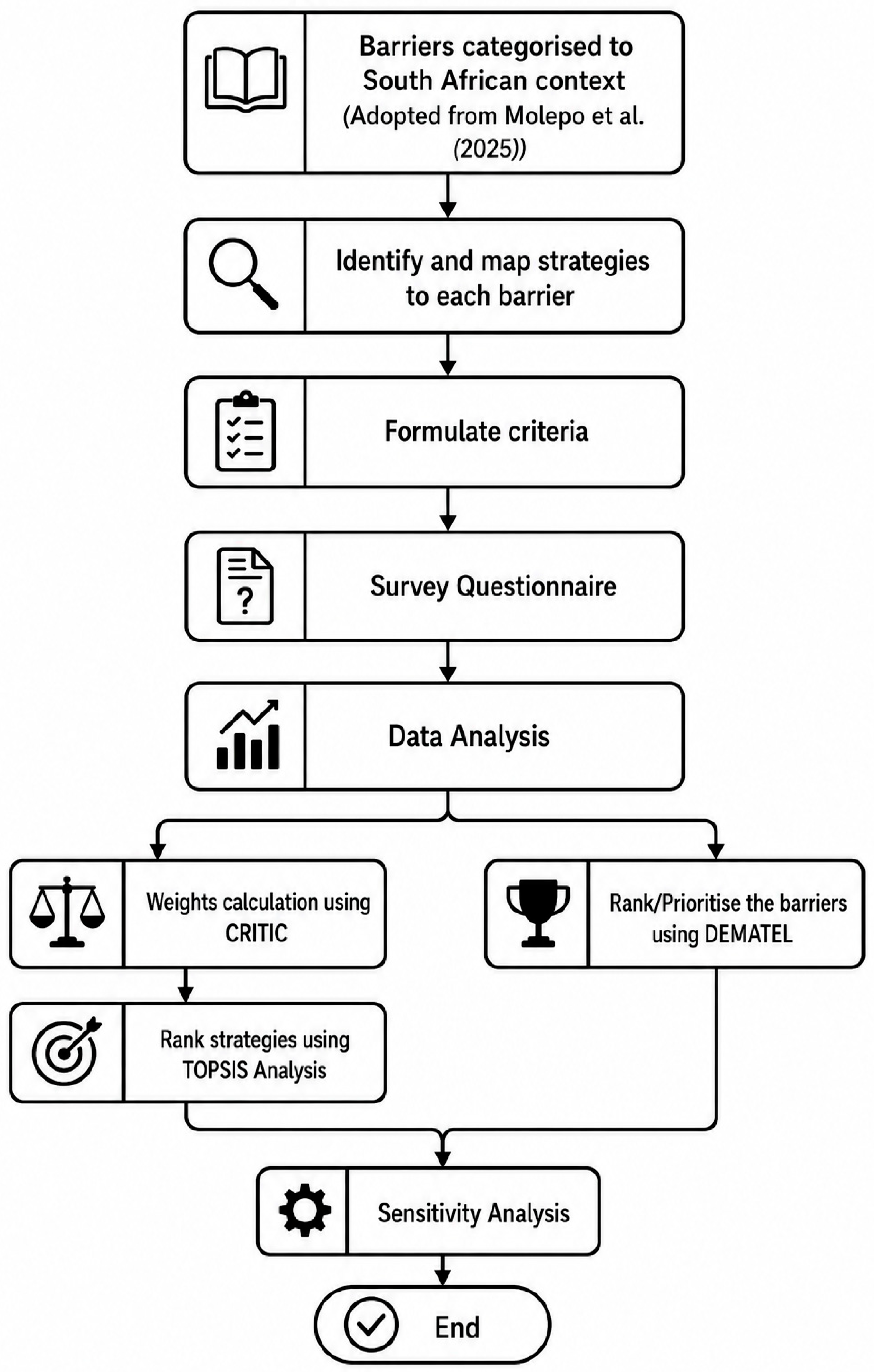
The prioritisation of barriers and mitigation strategies is completed using the DEMATEL AND CRITIC-TOPSIS techniques. The survey questionnaire used to collect data for this research was divided into two sections. The questionnaire was developed based on the barriers in Table 2 and mitigation strategies in Table 3. The questionnaire was shared with the renewable energy industry experts in the South African market. The purpose was to rank the influence of the barriers on each other and rate how each of the proposed mitigation strategies/solutions satisfies the criterion. The sample for this research study was selected using a non-probability, purposive expert sampling technique. This type of sampling technique is based on non-random criteria and factors. In this case, the selection criterion was for renewable energy industry experts with 5 or more years of experience in utility-scale wind and solar PV projects in South Africa. Validation of relevance began with a systematic literature review to identify global renewable energy barriers [57], followed by expert validation through semi-structured interviews to contextualise these barriers for the South African market [8]. Lastly, triangulation with the literature is conducted in this research by comparing the findings with peer-reviewed studies. Presented in Figure 1 is the illustration of the steps taken to analyse the barriers and solutions to renewable energy integration using MCDM techniques.

3.1. DEMATEL Analysis

The Decision-Making Trial and Evaluation Laboratory (DEMATEL) is an MCDM method used to analyse complex interrelationships among factors in multifaceted decision-making problems [58]. Introduced in 1971 at Battelle Memorial Institute of Geneva, the DEMATEL technique is gaining popularity and is widely used to solve many real-world problems [59,60]. It is a vital tool with the ability to visualise causal links and analyse the interdependence among criteria/factors [61]. DEMATEL solves complex decision-making problems by providing a structural model utilising decision-makers’ knowledge [62]. One of the main advantages of DEMATEL compared to other techniques is its potential to yield credible outcomes with minimal data from an expert questionnaire, rather than a public one [62,63]. Its shortcoming is the inability to determine hierarchy and the weights of individual criteria [64]. The DEMATEL method was selected for this study due to its ability to incorporate experts’ judgements [65]. Moreover, as highlighted by Richards et al. [46], renewable energy barriers are highly interdependent and cannot be analysed in isolation. DEMATEL provides an integrated approach to examining such interdependencies and is particularly effective at addressing problems involving causal relationships among multiple factors [65,66].
The rating of the influence of the barriers on each other was done using a 5-point Likert scale ranging from 0 to 4. The ratings were represented as follows: 0 for no influence, 1 for very low influence, 2 for low influence, 3 for strong influence, and 4 for very high influence. A DEMATEL analysis was conducted as follows.
Step 1: Construct the combined/average matrix of all participants’ feedback (A).
The first step is to construct an average matrix (A) of all participants’ responses using Equation (1), where i and j represent the row and column indices, respectively. a i j represents the average factor of index i and j, X i j k represents an integer score k assigned by experts, and H represents the number of experts.
A = a i j = 1 H k = 1 H X i j k
Step 2: Construct the normalised initial direct-relation matrix (D).
The normalised initial direct-relation matrix is calculated through the normalisation of the combined/average matrix (A) using Equations (2) and (3). Normalisation is the crucial step for maintaining consistency and comparability in the analysis.
D = A × S
where S is
S = M i n 1 M a x j = 1 n a i j , 1 M a x i = 1 n a i j
Step 3: Construct the total relation matrix (T).
The next step is the calculation of the total relation matrix using Equation (4), where I denotes the identity matrix. The total relation matrix is vital in visualising the complex interdependencies within the barriers.
T = D I D 1
Step 4: Compute the R and C matrices.
In this step, the sum of the rows (R) and the sum of the columns (C) are calculated from the total relation matrix (T) using Equations (5) and (6), respectively. From this, the computation of R   +   C and R     C is carried out to obtain the prominence and relation. R   +   C indicates the degree of relation between the barriers [67]. The highest value of R   +   C indicates the strongest relation with other barriers, while the lowest value indicates the weakest relation with other barriers. R C indicates the kind of relation between the barriers. The positive value of R     C indicates cause (influence on other barriers), while the negative value indicates effect (influenced by other barriers) [67].
Calculate the sum of elements in a row; R
R = i = 1 n t i j 1 × n
Calculate the sum of elements in a column; C
C = j = 1 n t i j 1 × n
Step 5: Draw a cause-and-effect diagram.
In this step, the DEMATEL causal diagram is developed from   R +   C and R     C calculations to visualise the cause-and-effect relationship between the renewable energy barriers.
Step 6: Calculate the threshold value to obtain the digraph. The threshold limit of influence is obtained using Equation (7), where t i j represents the total direct and indirect influence of barriers in row i on barriers in column j, and n2 represents the number of barriers.
α = i = 1 n j = 1 n t i j n 2

3.2. CRITIC-TOPSIS Analysis

The mitigation strategies are prioritised using the Technique for Order of Preference by Similarity to Ideal Solution (TOPSIS) technique. However, given that weight determination is the most important component of MCDM methods [68], the Criteria Importance Through Inter-criteria Correlation (CRITIC) technique was employed to objectively assign weights to the evaluation criteria.
It is imperative to analytically assess and select the evaluation criteria, ensuring theoretical background and practical relevance [69]. The selection of criteria in this study is supported by previous literature, which consistently demonstrates that decision criteria in renewable energy systems require the consideration of multiple dimensions spanning technical, social, economic, and environmental factors [14,70,71]. The evaluation criteria are presented in Table 4. Experts were asked to rate how each of the strategies in Table 3 satisfies the criteria in Table 4. The results were analysed using a combined CRITIC-TOPSIS technique to determine the weights of the evaluation criteria and then rank the alternatives/strategies. The advantage of the CRITIC method is that it eliminates the need for pairwise comparison in determining weights [72]. This reduces reliance on experts and, therefore, diminishes bias and subjective judgement, increasing the reliability of the decision-making process [69].

3.2.1. Weight Calculation

Criteria Importance Through Inter-criteria Correlation (CRITIC) is one of the several MCDM weighting techniques that compute objective weights for criteria. The CRITIC method determines the relative importance of criteria based on objective values [69]. Proposed in 1995, the CRITIC method establishes criterion weights by assessing the standard deviation and interrelationship between criteria [73].
The survey questionnaire results were aggregated into a single decision matrix X, and the following steps were used to compute the criteria weights using the CRITIC method’s stepwise technique.
X = x 11 x 12 x 1 j x 21 x 22 x 2 j x i 1 x i 2 x i j
Step 1: Normalise the decision matrix X (where i = alternative and j = criterion) using Equation (8) for the benefit criterion and Equation (9) for the cost criterion. In Equations (8) and (9), x j = m i n ( x 1 , x 2 , , x m ) and x j + = m a x ( x 1 , x 2 , , x m ) respectively.
x * i j = x i j x j x j + x j
x * i j = x j + x i j x j + x i
Step 2: Calculate the standard deviation of each criterion using Equation (10). Standard deviation is a statistical measure that shows how much a data point deviates from the mean value [73]. A higher standard deviation value indicates that the criterion has a stronger ability to differentiate between alternatives and therefore is more significant in the decision-making process, while a lower standard deviation value indicates that the criterion is assigned a low priority [69].
σ j = 1 m i = 1 m x i j x ¯ j 2
Step 3: Calculate the correlation matrix using Equation (11). The correlation matrix plays an important role in quantifying the degree of interdependence among every criterion considered in analysing mitigation strategies for renewable energy barriers [73]. It is computed by comparing the performance of each criterion with that of other criteria [69]:
ρ j k = i = 1 m x i j x ¯ j x i k x ¯ k i = 1 m x i j x ¯ j 2 .   i = 1 m x i k x ¯ k 2  
Step 4: Calculate the amount of information using Equation (12). The information content measure represents the degree of redundancy or overlaps between each criterion and all other criteria. The higher the information content value, the less redundant the criterion is with respect to other criteria, and therefore the more important it is in the decision-making process [69].
C j = α j . k = 1 n ( 1 ρ j k )
Step 5: Calculate the criteria weights using Equation (13). The weights are assigned to the criteria considering the criterion determined from the standard deviation and the inter-criterion correlation determined from the information content [69,73].
w j = C J J = 1 n C j

3.2.2. Prioritisation of Mitigation Strategies

Technique for Order of Preference by Similarity to Ideal Solution (TOPSIS) is a multifaceted MCDM method applied to evaluate and determine the best alternatives based on their similarity to the ideal solution and dissimilarity to the worst solution [26]. The TOPSIS method was formulated in the 1980s by Yoon and Hwang and has since gained popularity in solving problems with many criteria for alternatives to be evaluated [28,70]. This method is very efficient, easy to compute, and has been applied broadly to solve MCDM problems in different study areas such as manufacturing, finance, sustainable engineering, supply chain, and education [28,74].
TOPSIS analysis was conducted to rank the proposed mitigation strategies using the following prescribed steps:
Step 1: Construct the normalised decision matrix using Equation (14). Normalisation is critical in the TOPSIS steps; it transforms the original data into unitless values, eliminating unit inconsistencies and ensuring compatibility in the calculation across different alternatives [73].
r i j = x i j j = 1 n x 2 i j
Step 2: The weighted normalised matrix is calculated following Equation (15), where r i j   is the normalised decision matrix calculated in Equation (14) and w j is the weight calculated in Equation (13) using the CRITIC method.
v i j =   r i j   × w j
Step 3: Compute the degree of proximity to the ideal solution, for positive ideal ( A + ) and negative ideal ( A ), using Equations (16) and (17) respectively. A positive ideal represents the best possible performance for each solution, whereas a negative ideal represents the poorest possible performance [69].
A + = v 1 + , , v n + , w h e r e     v j + { max v i j   i f   j   J ; min v i j   i f   j   J }
A = v ,   v , , v n ,   w h e r e   v j { min v i j   i f   j J ; max v i j   i f   j   J }
Step 4: Calculate the separation measures/Euclidean distances for the positive and negative ideal using Equations (18) and (19) respectively. S i + indicates the distance between an alternative and the ideal best solution while S i indicates the distance between an alternative and the ideal worst solution.
S i + = j = 1 n v i j v j + 2
S i = j = 1 n v i j v j 2
Step 5: Calculate the relative closeness to the solution using Equation (20). A higher C i value indicates that the alternative is closest to the ideal solution and therefore considered the best [71].
C i = S i S i + S i +
Step 6: Rank solutions.
The mitigation strategies are ranked based on their relative closeness values. The calculated value of C i ranges between 0 and 1. The higher the C i , the better the solutions.

4. Results

This section presents the results of the survey questionnaire, structured into three subsections: respondents’ profile in Section 4.1, ranking of barriers in Section 4.2 and prioritisation of mitigation strategies in Section 4.3. The survey questionnaires were sent to a diverse group of professionals in the renewable energy industry, representing public and private organisations. Fourteen positive responses were received and analysed. DEMATEL is not statistically based, and a small sample size is required to achieve statistical significance [62]. According to various studies conducted, the following sample sizes are sufficient for the DEMATEL technique: between six and twenty-five [75], between ten and fifteen [76], and at least twelve [77]. Therefore, a sample size of fourteen was deemed sufficient for this study.

4.1. Respondents Profile

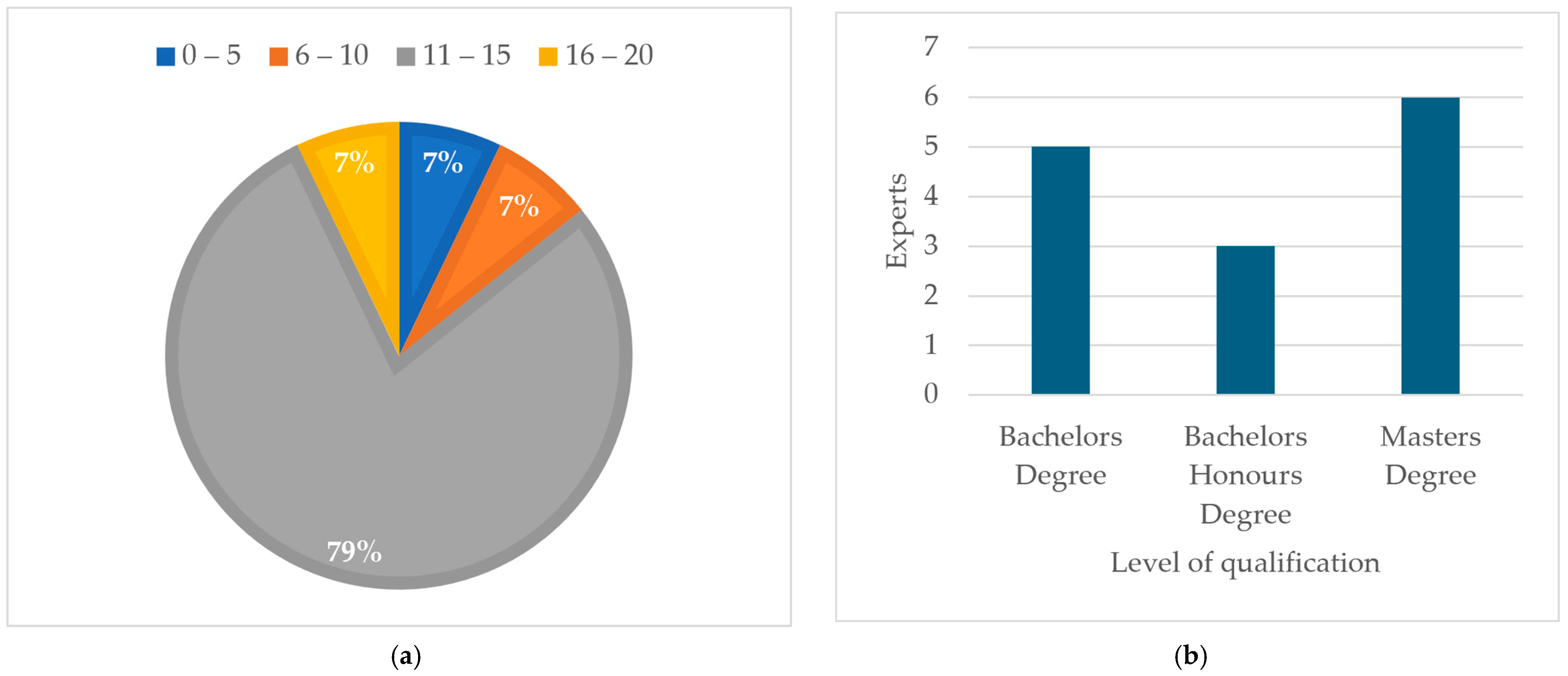
The experts’ profiles were analysed in terms of years of experience and level of qualification. The analysis of the experts’ profiles is depicted in Figure 2a,b. As shown in Figure 2a, the experts’ level of experience ranges from 5 to 20 years, with 79% having 11–20 years of experience. The level of qualifications presented in Figure 2b shows that 64% of experts possess postgraduate degrees, with 43% at the Master’s level. The inclusion of highly experienced experts with high levels of qualifications strengthens the credibility and validity of the study.
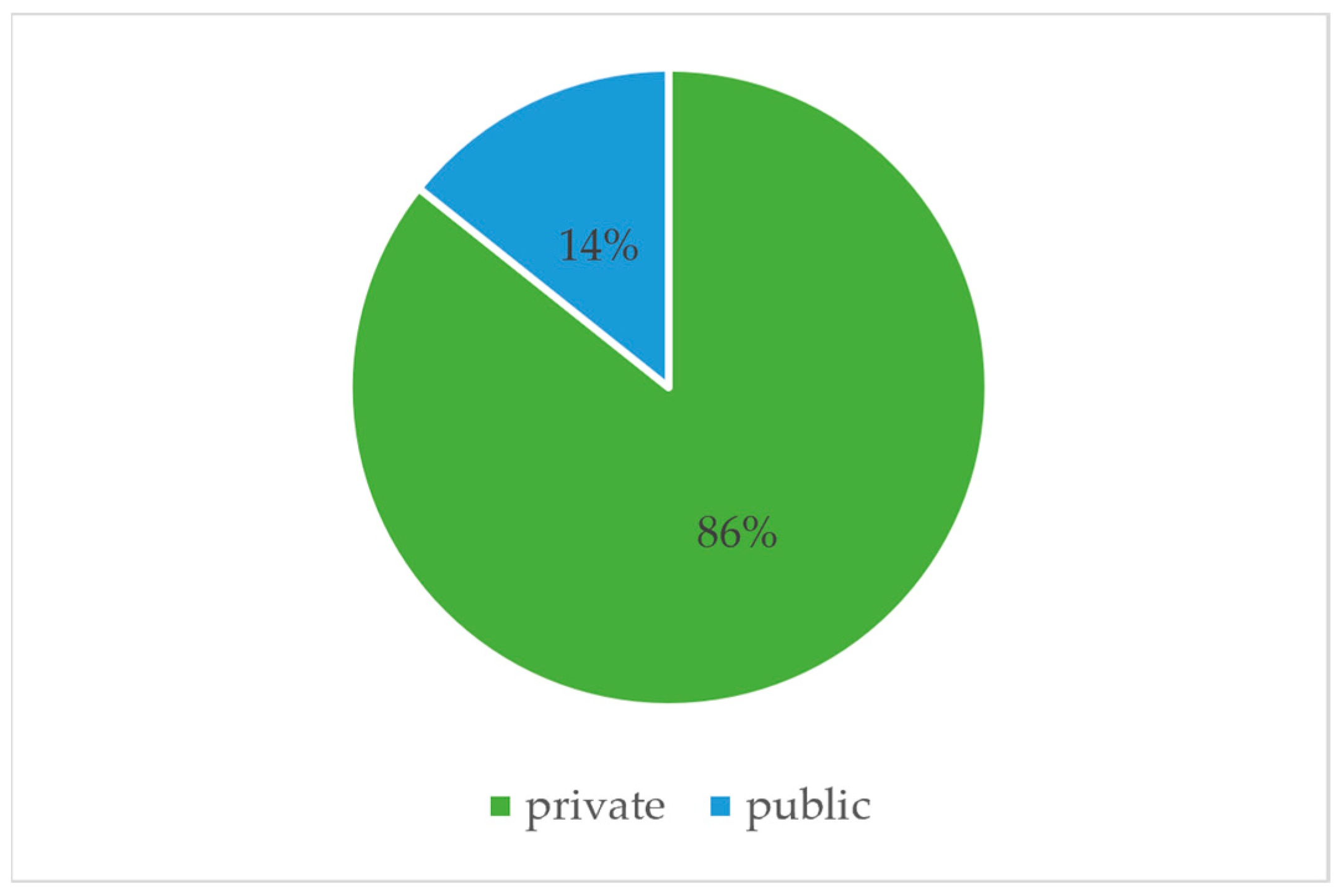
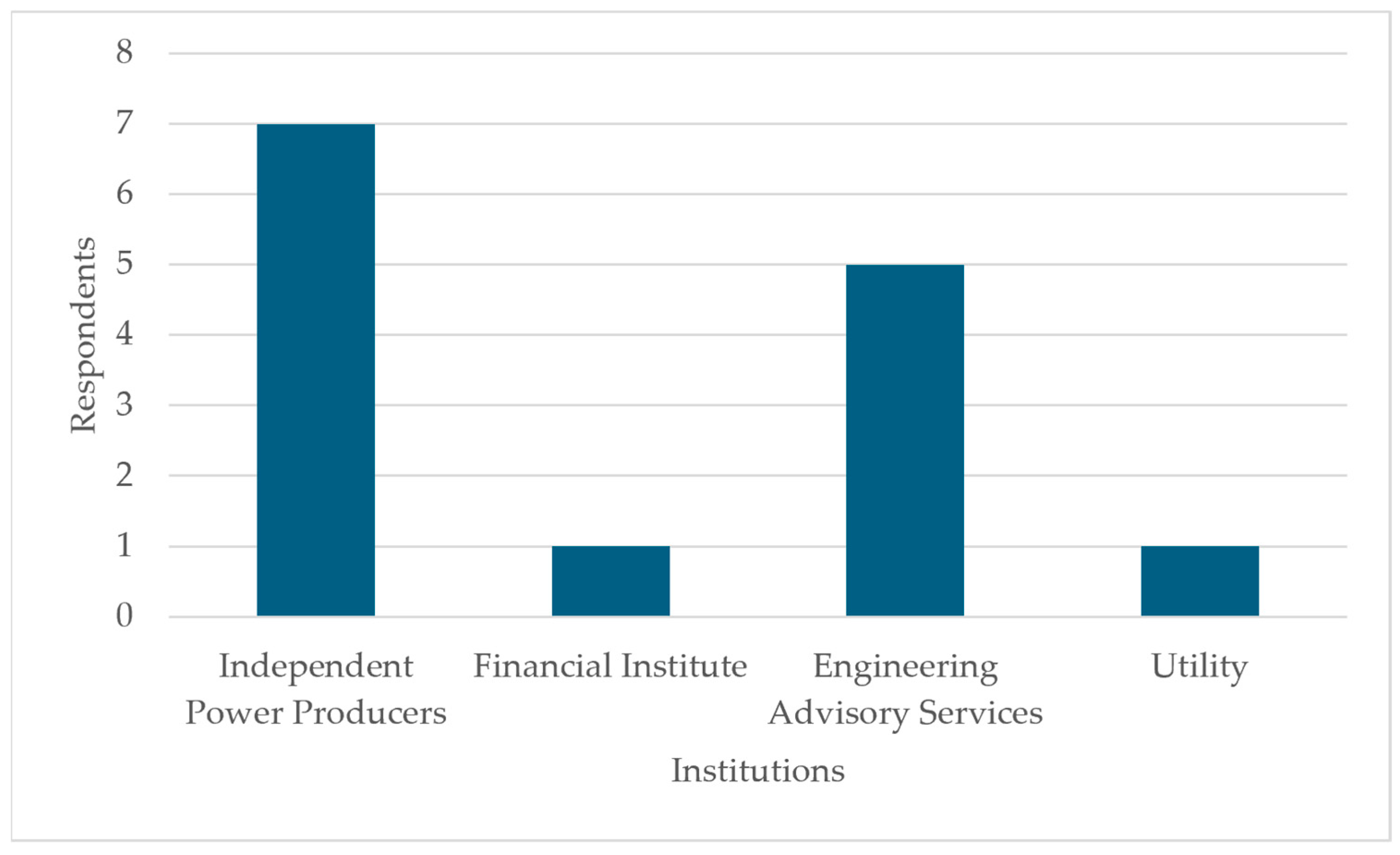
The respondents’ profiles are further analysed based on their institutional distribution. Figure 3 presents the distribution of participants by institutional affiliation, indicating that 86% are from private institutions and 14% from public institutions. Further analysis also considers the distribution based on institutional focus, as illustrated in Figure 4. The experts, drawn from diverse professional backgrounds and experiences, provided valuable insights into the barriers hindering renewable energy integration in South Africa.

4.2. Prioritisation of Barriers Using DEMATEL

This section presents the ranking and prioritisation of the barriers hindering renewable energy integration in South Africa, using the DEMATEL technique. The results of the combined matrix obtained using Equation (1) are presented in Table A1 in Appendix A and the results of the normalised initial direct-relation matrix calculated using Equation (2) are presented in Table A2. The results of the total relation matrix computed using Equation (3) are presented in Table A3. The total relation matrix reflects both the direct and indirect influences among the barriers. The results for R + C and R C are shown in Table 5. The description of the barrier codes is in Table 2 of Section 2.2. The barrier with the highest R + C value is the most prominent barrier, and the one with the lowest R + C value is the least prominent barrier [78].
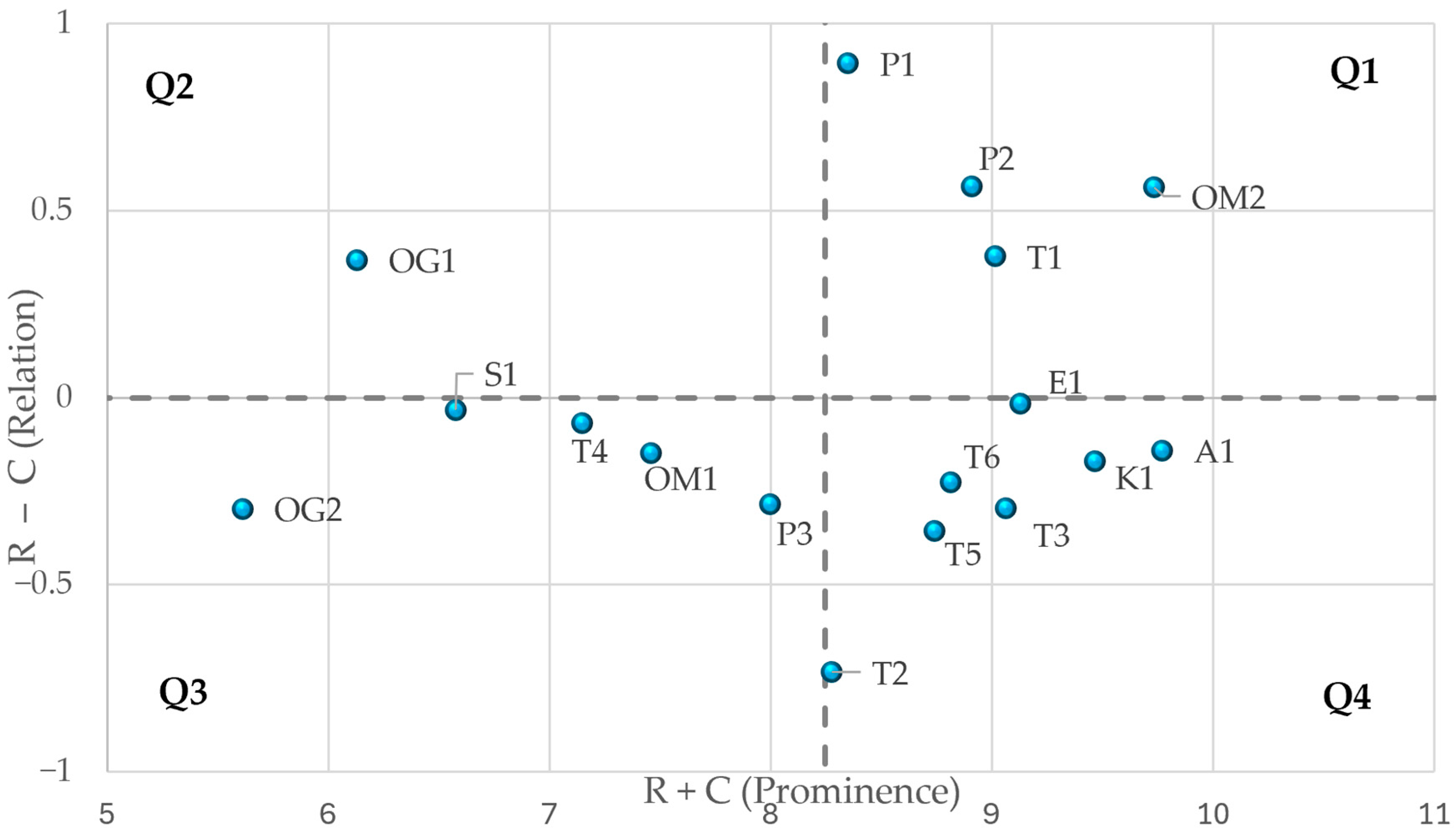
Drawing from the results in Table 5, five barriers (T1, P1, P2, OM2, and OG1) are identified as cause barriers. According to the DEMATEL analysis, these barriers have an influence on other barriers [67]. The remaining twelve barriers (A1, K1, T2, T3, T4, T5, T6, E1, S1, P3, OM1, and OG2) are identified as effect barriers. These are barriers that are influenced by others [67].
The top three critical barriers ranked based on the highest R + C prominence are a lack of agreement between key stakeholders responsible for driving renewable energy projects (A1)—there is no agreement and alignment between key stakeholders in key institutions; market uncertainties (OM2)—global market fluctuations lead to exchange rate/currency instability and price volatility, which discourages investment in renewable energy; and a lack of coordination between public and private institutions (K1)—the lack of coordination, partnership, knowledge-sharing and collaboration between the government and non-government institutions results in poor innovation necessary to advance renewable energy projects.
The visualisation of the causal diagram is shown in Figure 5. Each barrier is plotted in one of the four quadrants. The positive R C values lie above the x-axis, while the negative values lie below the x-axis. Additionally, barriers to the left of the mean line are considered to have less influence, and those to the right of the mean line are considered to have significant influence [79].
The four quadrants are classified as follows: core (Q1), driving (Q2), independent (Q3), and impact barriers (Q4). The barriers in Q1 are identified as cause barriers and are the most influential, with high prominence and high relation [67,80,81]. The barriers in Q2 are also identified as cause barriers, and they are the determinants with low prominence and high relation [80,81,82,83]; however, their existence must not be overlooked. The barriers in Q3 are identified as effect barriers, with low prominence and low interrelations [67,80,81,83]. The barriers in Q4 are also identified as effect barriers, with high prominence but low interrelations [67,80,81,83].
The critical root-cause barriers (placed in the first quadrant) that need focus are market uncertainties (OM2), challenges with grid capacity/connection (T1), nepotism (P2), and lack of policy continuity (P1). South Africa’s heavy reliance on international markets for renewable energy technologies makes it susceptible to global uncertainties. These uncertainties affect project cost and duration. The challenge of grid connection is currently a burning issue in South Africa. The rich resource provinces have no grid availability, which has stalled many projects [3]. The inconsistency of the REIPPPP discourages IPPs and investors from participating in the government procurement programme [84]. South Africa is prone to frequent leadership changes, which affect current policies and commitments. Solving these barriers will, in turn, reduce the severity of several others.
The critical effect barriers placed in the fourth quadrant, include a lack of alignment (A1), a lack of coordination (K1), a lack of access to funding (E1), a lack of technically skilled labour (T2), a lack of Research and Development facilities (T3), a lack of local manufacturing facilities and a shortage of technical training institutes (T6). These barriers are a consequence of the other barriers and do not need to be solved directly. Resources must not be focused on addressing these barriers; however, they should be monitored and managed [67], and if they are reduced, it means the strategy applied to address the critical root-cause barriers is working.
The challenges of acquiring public/communal land (OG2), lack of public awareness and acceptance (S1), intermittent/unreliable supply of renewable energy sources (T4), ineffective bureaucratic permit procedures (P3), and underdeveloped supply chain and logistics (OM1) are placed in the third quadrant and are independent barriers. These barriers have limited relations with other barriers. The challenge with transportation systems/infrastructure (OG1) is the only barrier placed in the second quadrant. This barrier is a driving factor. Its impact is limited; however, it should not be overlooked because if left to operate independently, it is still significant [67].
The threshold limit of influence value of 0.243 is obtained using Equation (7) and all values that are less than this threshold value are removed from the total relation matrix. This is to ensure that all minor effects are eliminated from the total relation matrix, and the significant ones are kept and used to construct the influential network relation map [62,85].
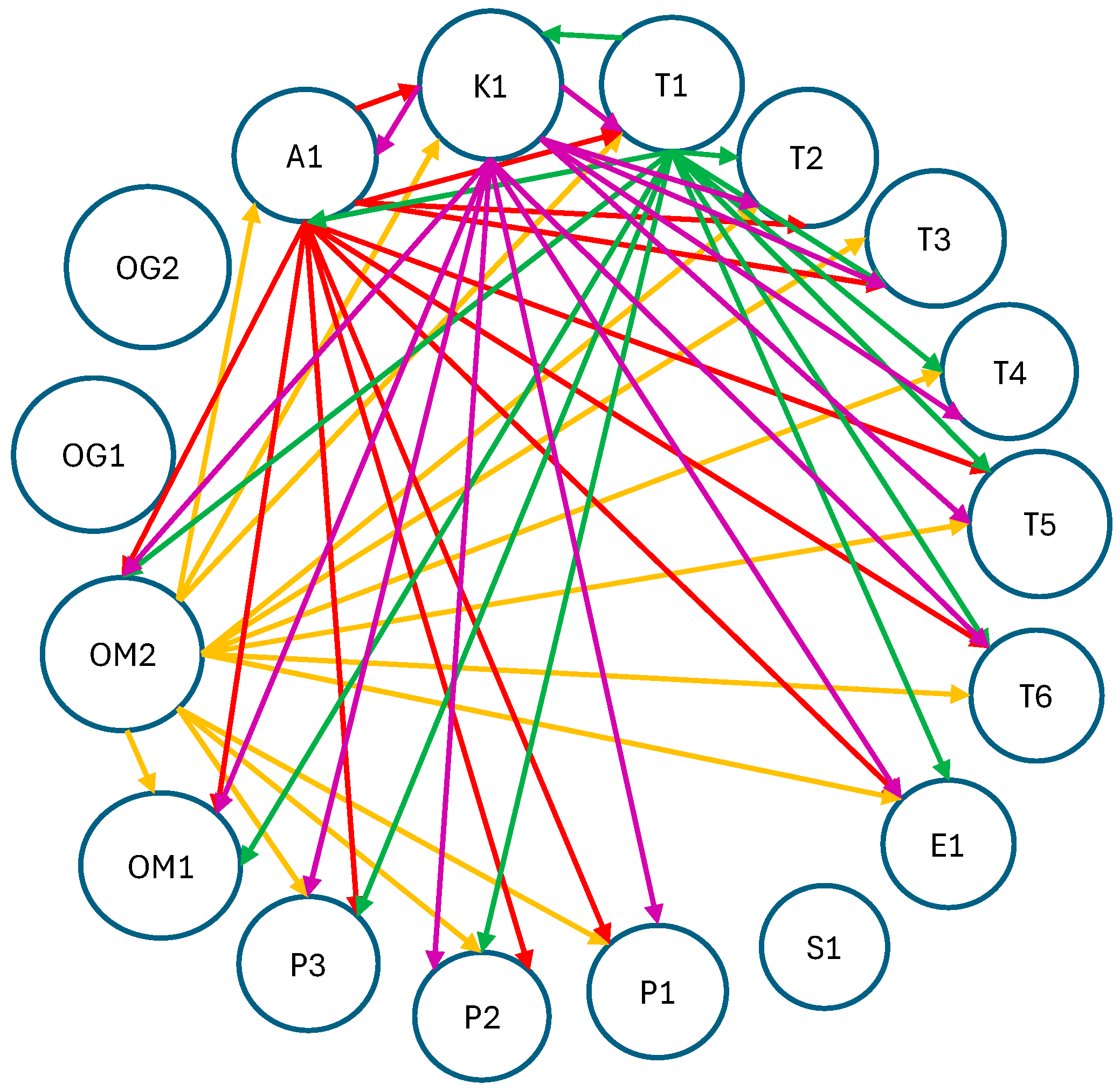
The interrelation diagram for the most influential barriers is shown in Figure 6. The influence of each barrier is represented by an arrow with a different colour. The direction of the arrow represents the influence of the barrier on the other. An incoming arrow represents the direction of the influence from another barrier, while the outgoing arrow represents the direction of the influence to the other barriers. The lack of agreement (A1), a lack of coordination (K1), the challenges of grid capacity/connection (T1), and market uncertainties (OM2) have multiple arrows pointing outwards from them. Furthermore, in Figure 5, A1 and K1 barriers are positioned in Q4, indicating that they are the most influential effect barriers, while T1 and OM2 are positioned in Q1, indicating that they are cause barriers with the most significant relationship with other barriers.

4.3. Prioritisation of Mitigation Strategies Using CRITIC-TOPSIS

This section presents the calculated weights using the CRITIC technique. Each weight represents the relative importance of each criterion. The results of the correlation matrix ( ρ j k ), standard deviation ( σ j ), information content ( C j ), and weights of criteria ( w j ) obtained using the stepwise technique of the CRITIC method are presented in Table 6. The positive and high values of the correlation matrix between criterion (i.e., C1 & C2 and C4 & C5) indicate redundancy, while the low negative correlations (C1 & C3 and C2 & C3) indicate that criteria provide diverse and unique information [73].
Criteria C3 (social acceptance) has the highest information content ( C j ) value indicating its significance in the decision-making process, and it also has the highest weight ( w j ), indicating that it is the most influential factor for evaluating renewable energy strategies. These weights are going to be used in the subsequent steps to evaluate and prioritise mitigation strategies.
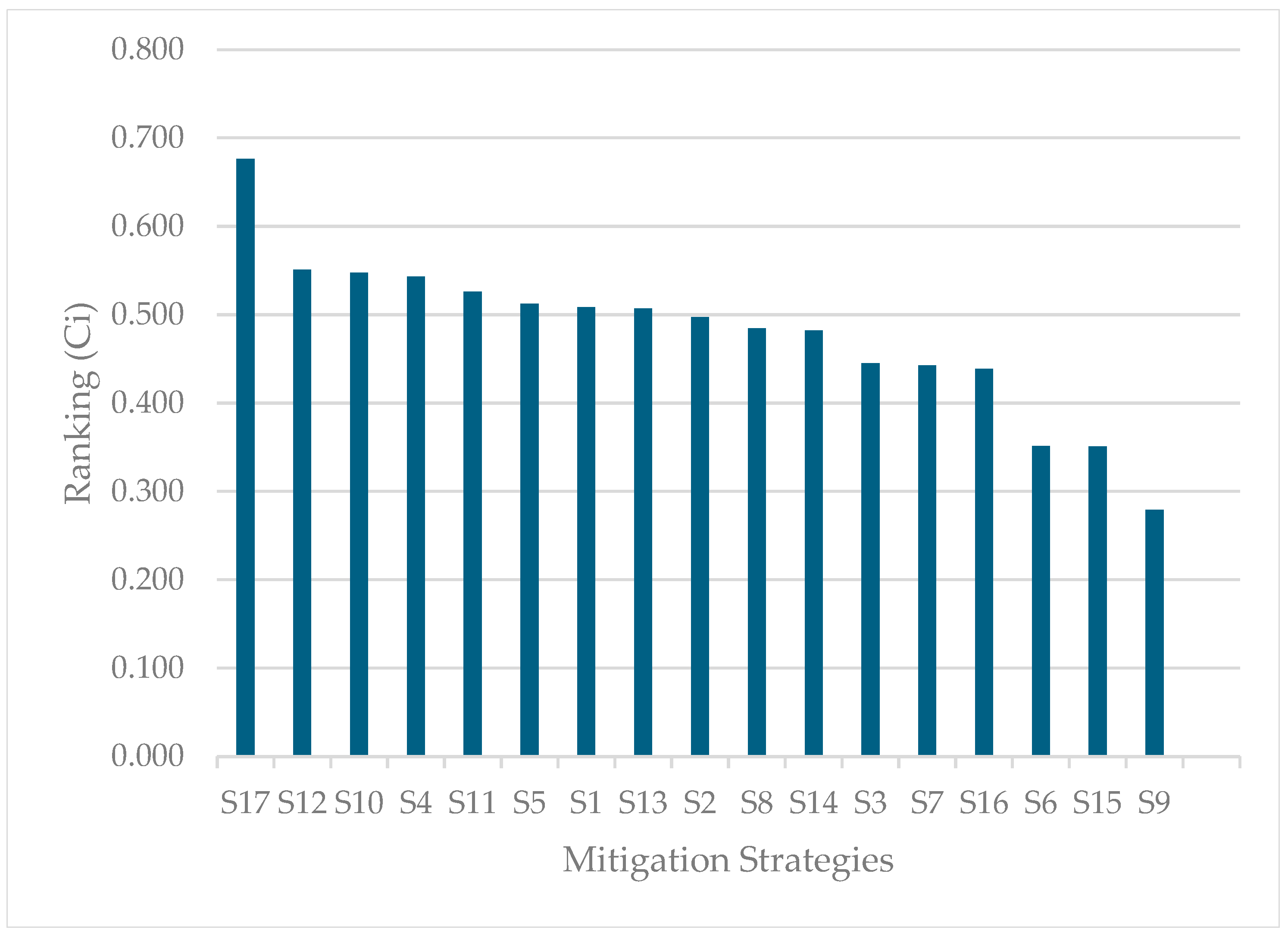
Seventeen mitigation strategies identified in Section 2.3 are ranked and prioritised in this section following the TOPSIS technique. Presented in Table 7 are the results of the weighted normalised matrix ( v i j ) , Euclidean distance ( S i +   &   S i ) and relative closeness ( C i ) obtained using Equations (14)–(20). The weighted normalised matrix represents the integrated performance of each mitigation strategy across all five criteria. Criterion C1 is a cost criterion, and C2–C5 are specified as benefit criteria. In the weighted normalised matrix, the optimal mitigation strategies are characterised by lower weighted values for cost criteria and higher weighted values for benefit criteria, both of which contribute positively to ranking [73]. A lower value of S i + indicates that the mitigation strategy is closer to the best solution, and conversely the higher value of S i indicates that the mitigation strategy is farther from the worst solution. The ranking of the most influential mitigation strategy is based on the highest Ci value. As shown in Table 7, S17 is ranked first with the highest C i value of 0.676, followed by S12 with 0.551 and S10 with 0.548.
The visualisation of the ranking of the mitigation strategies is presented in Figure 7, highlighting the most and least influential strategies based on the Ci value. The results show that strengthening local community engagement (S17) is the most effective strategy for overcoming barriers to renewable energy adoption in the South African market. This emphasises the importance of involving community members in the early stages of renewable energy project development [31]. The engagement will improve community acceptance of these projects.
The enforcement of regulatory frameworks and the use of independent reviewers (S12) is the second most significant strategy, with a Ci value of 0.551. Enforcing regulations and involving independent reviewers is essential for improving and maintaining the credibility of the REIPPPP. Enforcing regulatory frameworks will ensure that frameworks and procedures are properly implemented, thereby reducing delays in appointing preferred bidders. Moreover, the inclusion of independent reviewers will mitigate risks and enforce transparency in the public procurement programme.
Public awareness-raising (S10) ranked third among the most important mitigation strategies for overcoming barriers to renewable energy in South Africa. The government must initiate programmes to promote renewable energy literacy. Campaigns and training programmes must be accessible to the public to raise awareness and encourage acceptance of renewable energy projects. The programmes must be targeted at the young population in institutions of higher learning and the broader public to ensure that no one is left out of the just energy transition. These programmes will eliminate misconceptions about renewable energy and provide a clear understanding of the benefits of adopting these technologies [32].

5. Sensitivity Analysis

A sensitivity analysis was conducted to assess the reliability and robustness of the decision-making results. Reliability is the degree to which the measure of a construct is consistent or dependable [86]. Sensitivity analysis is a popular tool in MCDM, used to validate the robustness of the technique or framework [87]. The analysis examines how variations in input parameters affect the decision-making model’s results [88]. This can be achieved by either varying the weights assigned to experts or by changing the weights of the criteria by a certain percentage [89]. Sensitivity analysis was conducted on the DEMATEL and TOPSIS techniques to determine how variations in weights affect the prioritisation of barriers and strategies. In the DEMATEL technique, the weight of the barrier with the strongest influence is systematically varied across predetermined ranges to assess the sensitivity of the results [88]. This approach helps in evaluating the extent to which the outcome depends on a single influential barrier. For the TOPSIS technique, the weights are systematically varied among the benefit and cost criteria to ensure a balanced and unbiased assignment [69]. This approach enables the analysis to test the stability of the ranking results by observing the sensitivity of the outcomes to changes in each criterion.

5.1. Sensitivity Analysis for Barriers

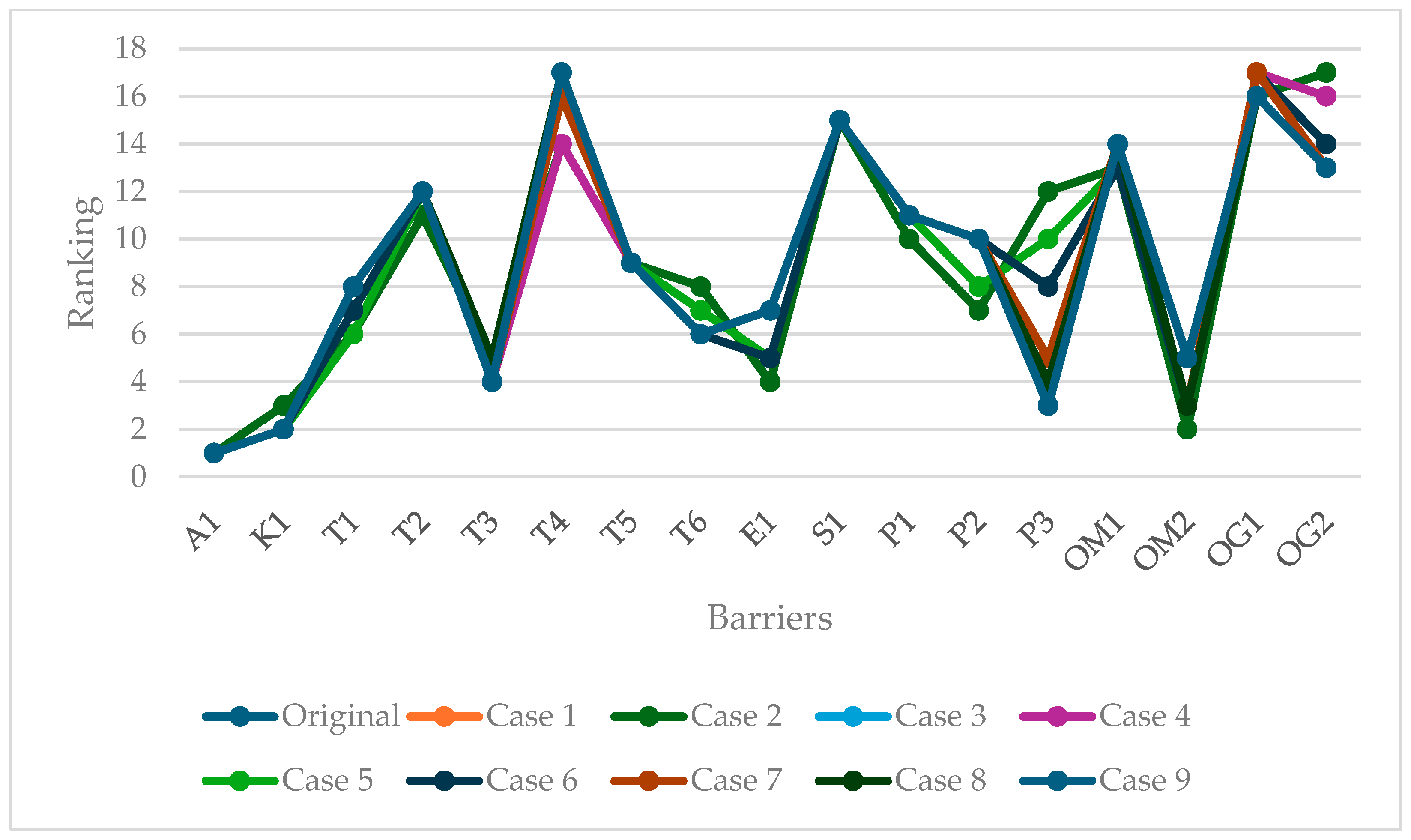
This study conducted a sensitivity analysis to assess the robustness and consistency of the DEMATEL method by varying the top-ranked/most influential barrier. The lack of agreement (A1) barrier was systematically varied from 0.1 to 0.9, to measure its impact on other barriers, while the weights of the other barriers were proportionally adjusted to ensure that the total weight remained equal to 1 [90]. This resulted in the development of nine new cases or scenarios to compare with the original case. This approach enabled the assessment of how changes in the relative importance of barrier A1 impact the overall causal structure and barrier rankings within the DEMATEL technique. The results of the sensitivity analysis, showing all cases, are presented in Figure 8. In all the cases (original and nine new cases), the ranking of the following barriers remained stable: the lack of agreement (A1), a lack of public awareness and acceptance (S1), and a lack of local manufacturing facilities (T5). These findings confirm the consistency and robustness of these barriers across different variations, concluding that the lack of knowledge (A1) is a critical barrier. Therefore, more focus should be placed on addressing this barrier, ensuring that there is agreement among key stakeholders across key institutions. There was minimal variation in the challenges of grid capacity (T1) and market uncertainties (OM2) across all cases, indicating their consistency and low sensitivity to variations in weights. The moderate fluctuations in K1, T2, T3, P1, OM1, and OG1 indicate that their rankings are moderately sensitive to methodological changes. The barriers T4, T6, E1, P2, P3, and OG2 showed significant fluctuations across all scenarios, highlighting their unstable ranking, which is dependent on weight variations.

5.2. Sensitivity Analysis for Mitigation Strategies

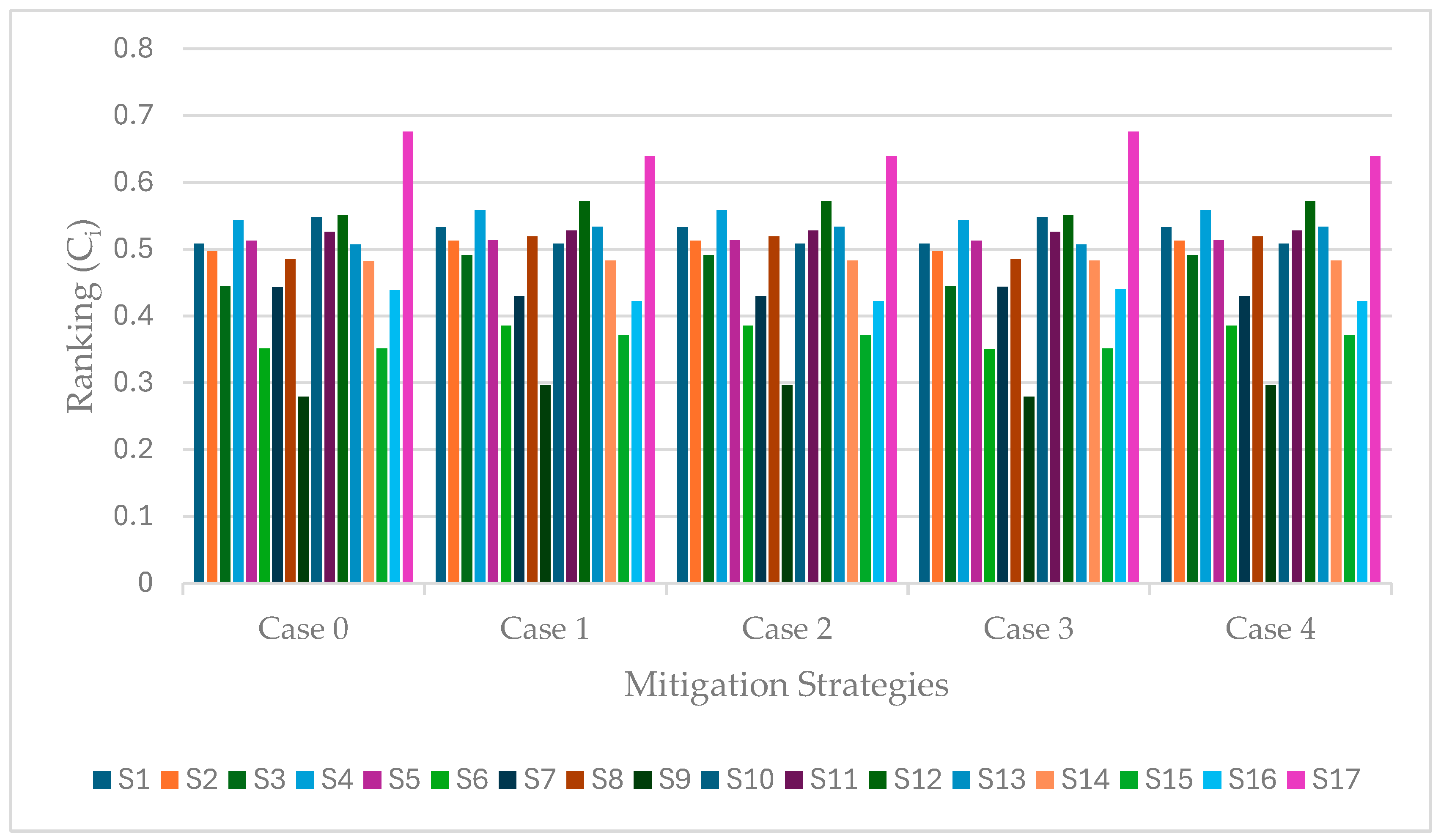
The sensitivity analysis of the TOPSIS technique was performed by varying the weights of the criteria to assess the stability of the prioritised solutions. The following adjustments were made, resulting in four cases/scenarios: In the first case, all criteria were assigned the same or equal weights. In case 2, the cost (C1) criterion was assigned a 20% weight, and the benefit (C2–C5) criteria were assigned an 80% weight. In case 3, only criterion C1 was assigned a 20% weight, and in case 4, only the benefit criteria were assigned a 20% weight. Presented in Figure 9 is the comparison of the ranking for all seventeen mitigation strategies under the different scenarios (case 0 is the original weights calculated by CRITIC in Section 3.2.1). A higher Ci ranking indicates the preferred strategy, while a lower ranking indicates the worst strategy. Strategies S3, S4, S5, S6, and S12 demonstrate stability across various cases, underscoring their robustness in mitigating barriers to renewable energy. There is a noticeable shift in strategies S9, S13, and S14, emphasising their sensitivity to weight adjustment.

6. Discussion

Data analysed through DEMATEL and CRITIC-TOPSIS techniques revealed the most significant barriers and mitigation strategies, respectively. This section interprets these barriers in the context of South Africa, examining the broader theoretical implications for integrating renewable energy in the country.

6.1. Barriers

The study analysed the barriers to renewable energy faced by Independent Power Producers in South Africa. These barriers are categorised into six categories: Agreement, Knowledge, Technological, Economic, Social, and Political. The findings of the MCDM framework and triangulation with the literature reveal the complex, multidisciplinary, and interrelated barriers that collectively hinder the integration of renewable energy into the energy system [91].
These categories of barriers are not mutually exclusive and do not necessarily exist in a linear sequence. Instead, they are often interlinked and overlapping, underpinning one another in complex ways [8].

6.1.1. Lack of Agreement

The agreement barrier, which emerged as the most dominant effect barrier, is rooted in both political and knowledge-related barriers, and its impacts cascade into economic and technological barriers. This was apparent when the lack of agreement between stakeholders (Eskom and the government) resulted in the delay of signing PPAs for the REIPPPP Bid Window (BW) 4 projects [92]. These disruptions, rooted in a lack of policy continuity and coordination between stakeholders (third-ranked barrier), significantly eroded investor confidence, limiting access to financing mechanisms and prompting several technology providers to withdraw from the South African market. Several years later, the impact is still felt and has escalated into the challenges of market uncertainties.

6.1.2. Market Uncertainties

Market uncertainties (second-most prominent barrier), on the other hand, are shaped by landscape-level dynamics, including policy continuity and economic pressures, which create an unstable environment for investment and hinder the acceleration of renewable energy projects. In the South African context, renewable energy development is particularly exposed to external market conditions, as projects rely heavily on imported technologies and equipment. These dependencies increase vulnerability to global currency fluctuations and volatile equipment prices, which can significantly elevate project costs. These uncertainties weaken investor confidence, increase financial risk and may delay project implementation, even in cases where technological feasibility and resource availability are favourable.

6.1.3. Lack of Coordination

The results also highlighted a lack of coordination as the third most prominent barrier, which continues to impede the large-scale integration of renewable energy in South Africa. Firstly, poor collaboration among ESKOM, DMRE, IPPs, and NERSA was evident in the awarding of BW 6 projects, where all wind projects could not proceed due to a lack of grid connection capacity in the Cape provinces [93].
Secondly, weak partnerships among institutions of higher learning, R&D facilities, industry, and government led to limited innovation and inadequate skills transfer. These insufficiencies not only hinder project implementation but also increase reliance on foreign technologies and expertise, reducing the long-term sustainability of renewable initiatives.
These findings highlight that challenges related to grid connection (currently a burning issue in SA’s renewable energy industry), along with policy continuity and financing, are not purely technical or financial but are rooted in institutional weaknesses among key stakeholders. Surprisingly, market uncertainty plays a more influential role than expected, ranking above some structural barriers. This suggests that investor perceptions and regulatory unpredictability are as critical as physical infrastructure constraints in driving renewable energy development and integration in South Africa.
Collectively, these findings reinforce the theoretical argument that a narrow focus on technical or economic constraints is insufficient to understand the dynamics of energy transitions.
The findings of this study vary from those of previous studies. According to the literature, the top three most significant barriers are within the economic/financial, political/policy, and technological/technical categories [52,94,95]. These studies have shown that the primary barriers to renewable energy development in developing countries are largely financial, including high investment costs and limited access to funding due to unstable economic conditions [32,96]. According to Mostafaeipour et al. [96] and James et al. [32], these financial limitations hinder the deployment of renewable energy projects in these countries. In addition, Chisale and Lee [4] and Pathak et al. [16] noted that weak political commitment and high levels of corruption and nepotism further impede the acceleration of renewable energy development. These governance challenges negatively influence policy formulation and implementation, delaying renewable energy expansion. Similarly, inadequate technological capacity and dependence on imported technologies further delay renewable energy projects in many developing countries [87].
These variations reflect the contextual differences in the maturity and structures of renewable energy markets across various regions. In South Africa, the renewable energy sector has evolved through the REIPPPP, attracting private investment and deploying advanced technologies. The primary challenges are rooted in governance and institutional coordination, largely shaped by the country’s centralised electricity system dominated by the state utility, Eskom.
This demonstrates that renewable energy barriers are highly contextual, and their impacts vary across regions depending on the predominant economic, social, political or geographical conditions, etc.

6.2. Mitigation Strategies

The results of the CRITIC-TOPSIS identified mitigation strategies to overcome the barriers to renewable energy faced by Independent Power Producers in South Africa. Although some of these strategies have already been implemented in the country, the renewable energy industry continues to face challenges.

6.2.1. Strengthening Local Community Engagement

The areas abundant in solar and wind resources in South Africa are often located in remote rural regions and on privately owned agricultural land, which, in some cases, is collectively owned by the community. Without the consent of these landowners, these projects become unfeasible. Community engagements should commence in the early stages of project development and be maintained throughout the entire project lifecycle. These engagements should be facilitated through transparent, structured, and legally grounded processes that involve local governance structures, such as community representatives and councillors.
These engagements will ensure that the community understands the socio-economic benefits of these projects, such as job creation, infrastructure development, skill enhancement, and project ownership, thereby fostering trust and transparency between developers and the community [31]. In South Africa, the REIPPPP provides established frameworks to ensure that the socio-economic benefits of these projects are both feasible and effectively implemented.

6.2.2. The Enforcement of Regulatory Frameworks and Independent Reviewers

The enforcement of regulatory frameworks and the involvement of independent reviewers are crucial to mitigating the challenges and inconsistencies experienced in the REIPPPP programme, such as delays in releasing bid windows, the awarding of preferred bidder status, and projects failing to reach financial close.
This will ultimately enhance and maintain the credibility of the REIPPPP, as noted by Kruger and Alao [97], and mitigate risks and delays, thereby enforcing transparency in the public procurement programme [13], which in turn creates a conducive environment for investment and innovation.

6.2.3. Raising Public Awareness

According to Alyamani et al. [36], public awareness is crucial for ensuring the success of renewable energy projects. In South Africa, as coal-fired power stations are gradually phased out and replaced by renewable energy plants [13], it becomes crucial for the government to implement public awareness campaigns that educate the public about the benefits of renewable energy for sustainable development. Such campaigns will not only inform the public about the environmental and economic benefits of clean energy but will also build trust and foster public acceptance of the transition. By ensuring that the public is informed and engaged, the government can strengthen societal support for its vision of transitioning towards renewable energy successfully [98].
These findings are inconsistent with the literature. Previous studies identified the top-ranked mitigation strategies as providing subsidies and incentives to make renewable energy projects more cost-competitive [1,18,38]. The study by Akpahou et al. [53], highlighted the importance of developing comprehensive, consistent policies to support renewable energy development. In addition, improving and strengthening access to funding mechanisms and expanding financing options were identified as critical strategies [36,94,99]. Lastly, investing in and supporting Research and Development (R&D) to drive innovation and address region-specific challenges can lead to technological breakthroughs, improved project efficiency, and significant cost reductions, thereby accelerating renewable energy development and integration [100,101].

7. Conclusions

South Africa has abundant renewable energy resources capable of generating clean, affordable, and sustainable energy. However, despite this potential, the country has not harnessed these resources to their full extent due to various barriers, including Agreement, Knowledge, Technical, Economic, Social, Political, Market, and Geographical constraints. This research proposed a hybrid multi-criteria decision-making framework to prioritise renewable energy barriers and mitigation strategies in South Africa. The prioritisation and cause-and-effect relationship assessment of the barriers hindering the adoption of renewable energy were conducted using the DEMATEL technique. The top three barriers were a lack of agreement, market uncertainties, and a lack of coordination between key institutions. These barriers collectively undermine the acceleration of renewable energy in South Africa. The lack of agreement between NERSA and NTCSA on grid allocation reflects broader policy discontinuity that undermines coordinated decision-making. This misalignment contributes to significant grid connection constraints. These constraints delay project implementation and create market uncertainty, which in turn erodes investor confidence and ultimately limits access to financing. These findings highlight that challenges related to grid connection (currently a burning issue in SA’s renewable energy industry), along with policy continuity and financing, are not purely technical or financial in nature but are rooted in institutional weaknesses among key stakeholders. Therefore, addressing technical barriers alone is insufficient without first addressing underlying coordination issues, which stem from a lack of policy continuity. Surprisingly, market uncertainty plays a more influential role than expected, ranking above some structural barriers. This suggests that investor perceptions and regulatory unpredictability are as critical as physical infrastructure constraints in driving renewable energy development and integration in South Africa.
Furthermore, the study offers a thorough and comprehensive CRITIC-TOPSIS framework for implementing strategies to overcome these barriers. The key strategies include strengthening community engagement, enforcing regulatory frameworks, appointing independent reviewers for the procurement programme, and raising public awareness. Implementing these strategies would enable South Africa to overcome the challenges associated with renewable energy development, thereby accelerating the integration of renewable energy into its energy systems.
This study contributes to the existing body of literature and industry knowledge in multiple ways. Firstly, it enhances the theoretical understanding of the barriers to renewable energy by providing context-specific causal analysis of barriers and objective prioritisation of mitigation strategies in South Africa using an integrated hybrid DEMATEL and CRITIC–TOPSIS approach. While previous studies have applied hybrid MCDM techniques such as DEMATEL-ANP [43] or CRTITIC-TOPSIS [41] in isolation or partial combination, this study advances the methodology by fully integrating causal analysis, objective weighting, and ranking within a single coherent framework.
Secondly, the findings of this research offer valuable insights for stakeholders in both the public and private sectors, enabling them to develop strategic plans and policies that address the identified barriers.
While the experts provided valuable insights into the barriers to renewable energy integration, the composition of the panel may have introduced bias. In particular, the dominance of private-sector perspectives may have led to the underrepresentation of public institutional stakeholders. Future research studies could address this methodological limitation by expanding expert engagement to include a more balanced representation of stakeholders across both the public and private sectors. In addition, the use of expert judgements can introduce bias, despite adopting a comprehensive mixed-methods approach that minimises subjectivity through the CRITIC technique. Therefore, future studies could extend this work by employing iterative consensus-building techniques such as the Delphi method, incorporating fuzzy set theory to handle uncertainty in judgements, using neutrosophic methods to handle ambiguity, or validating results through comparisons across different MCDM methods.

Author Contributions

Conceptualisation, P.M., T.N.D.M. and K.A.; methodology, P.M.; validation, P.M., T.N.D.M. and K.A.; formal analysis, P.M.; investigation, P.M.; data curation, P.M.; writing—original draft preparation, P.M.; writing—review and editing, P.M., T.N.D.M. and K.A.; visualisation, P.M.; supervision, T.N.D.M. and K.A. All authors have read and agreed to the published version of the manuscript.

Funding

This research received no external funding.

Data Availability Statement

The raw data supporting the conclusions of this article will be made available by the authors on request.

Acknowledgments

The authors would like to express their sincere gratitude to all the participants who generously shared their time, knowledge, and experience in support of this research study. During the preparation of this manuscript, the authors used ChatGPT-5 to improve the aesthetic presentation of Figure 1. The authors have reviewed the final figure to ensure accuracy.

Conflicts of Interest

The authors declare no conflicts of interest.

Abbreviations

The following abbreviations are used in this manuscript:
AHPAnalytical Hierarchical Process
ANPAnalytical Network Process
CO2Carbon Dioxide
CRITICCriteria Importance Through Inter-criteria Correlation
CSPConcentrated Solar Power
DEMATELDecision-Making Trail and Evaluating Laboratory
DMREDepartment of Mineral Resources and Energy
ELECTRE Elimination and Choice Expressing the Reality
ESKOMElectricity Supply Commission
IPPsIndependent Power Producer(s)
MCDMMulti-Criteria Decision-Making
MtCO2Million Tonnes of Carbon Dioxide
NERSANational Energy Regulator of South Africa
NTCSANational Transmission Company South Africa
PROMETHEEPreference Ranking Organisation Method for Enrichment of Evaluation
PVPhotovoltaic
R&DResearch and Development
RERenewable Energy
REIPPPPRenewable Energy Independent Power Producer Procurement Programme
SASouth Africa
SWARAStepwise Assessment Ratio Analysis
TOPSISTechnique for Order of Preference by Similarity to Ideal Solution

Appendix A

Table A1. Average matrix (A).
A1K1T1T2T3T4T5T6E1S1P1P2P3OM1OM2OG1OG2
A10.03.52.52.22.71.12.52.72.61.62.22.43.01.82.61.42.4
K13.20.02.82.42.31.02.22.22.41.82.52.13.11.92.71.11.9
T13.12.30.02.12.53.32.42.43.30.91.92.51.91.82.61.41.9
T22.32.31.60.03.02.62.92.91.41.21.41.70.91.41.50.80.7
T32.52.41.93.30.02.73.12.72.01.91.41.61.42.42.21.61.0
T41.21.63.42.21.70.01.61.73.12.21.01.01.11.42.10.61.0
T52.52.41.93.22.42.10.02.62.01.91.41.61.42.42.11.51.0
T62.52.41.93.22.72.12.80.02.01.91.41.61.42.42.21.61.1
E12.52.62.51.62.52.42.72.40.01.51.92.52.11.92.91.31.4
S12.22.00.91.92.11.61.81.91.20.01.31.51.41.21.50.81.9
P12.82.62.71.52.41.02.22.22.11.40.03.42.91.92.91.51.7
P22.62.62.32.32.60.92.42.42.92.12.90.02.71.92.41.81.8
P32.82.82.11.51.61.51.41.51.90.92.02.30.01.52.21.41.7
OM12.22.11.42.32.01.31.91.91.90.91.11.81.90.02.12.40.6
OM22.62.63.02.42.91.92.62.83.11.92.72.62.92.20.02.11.6
OG11.61.41.11.61.50.71.31.41.90.81.61.92.12.62.20.00.9
OG21.71.71.30.70.90.90.60.71.62.51.71.71.80.61.00.70.0
Table A2. Normalised initial direct matrix (D).
A1K1T1T2T3E1E2E3E4S1P1P2P3OM1OM2OG1OG2
A10.0000.0880.0630.0550.0680.0290.0630.0680.0640.0390.0550.0590.0750.0450.0660.0340.059
K10.0810.0000.0700.0610.0570.0250.0550.0550.0610.0450.0630.0540.0770.0480.0680.0270.047
T10.0770.0570.0000.0540.0630.0820.0610.0610.0820.0210.0470.0630.0470.0450.0640.0360.047
T20.0570.0570.0390.0000.0750.0660.0730.0730.0360.0300.0340.0430.0230.0340.0380.0200.018
T30.0630.0590.0470.0820.0000.0680.0770.0680.0500.0480.0360.0410.0340.0590.0550.0390.025
T40.0300.0390.0840.0550.0430.0000.0410.0430.0770.0550.0250.0250.0270.0360.0520.0160.025
T50.0630.0590.0470.0810.0590.0540.0000.0640.0500.0480.0360.0410.0340.0590.0540.0380.025
T60.0630.0590.0470.0810.0680.0540.0710.0000.0500.0480.0360.0410.0340.0590.0550.0390.027
E10.0630.0640.0630.0390.0630.0610.0680.0610.0000.0380.0480.0630.0540.0480.0730.0320.036
S10.0550.0500.0230.0480.0520.0390.0450.0470.0300.0000.0320.0380.0360.0300.0380.0200.047
P10.0700.0640.0680.0380.0610.0250.0550.0550.0520.0360.0000.0840.0730.0470.0730.0380.043
P20.0660.0640.0570.0570.0660.0210.0590.0610.0720.0520.0730.0000.0680.0470.0610.0450.045
P30.0700.0700.0540.0380.0410.0380.0360.0380.0480.0230.0500.0570.0000.0380.0550.0340.043
OM10.0550.0540.0340.0570.0500.0320.0470.0470.0480.0210.0290.0450.0480.0000.0540.0610.016
OM20.0640.0660.0750.0590.0730.0480.0660.0700.0770.0480.0680.0640.0730.0550.0000.0520.039
OG10.0410.0360.0270.0390.0380.0180.0320.0340.0480.0200.0390.0480.0540.0640.0550.0000.023
OG20.0430.0430.0320.0180.0210.0210.0160.0180.0410.0630.0430.0430.0450.0160.0250.0180.000
Table A3. Total relation matrix (T).
A1K1T1T2T3T4T5T6E1S1P1P2P3OM1OM2OG1OG2
A10.280.350.300.310.330.230.310.320.320.220.260.290.300.260.320.190.22
K10.340.260.300.300.310.220.300.300.300.220.260.280.300.250.310.180.21
T10.340.320.240.300.320.280.310.310.330.200.250.290.270.250.310.190.21
T20.270.270.230.200.280.220.270.270.240.180.200.220.200.200.240.150.15
T30.310.300.260.310.240.250.310.300.280.210.220.250.240.250.290.180.17
T40.230.240.260.240.240.150.230.230.260.190.180.200.200.190.240.130.15
T50.300.290.260.300.290.230.220.280.270.210.220.240.230.240.270.180.17
T60.310.300.260.300.300.230.300.230.280.210.220.250.240.250.280.180.17
E10.320.320.290.280.310.250.310.300.240.210.240.280.270.250.310.180.19
S10.240.230.190.220.230.180.220.220.200.130.170.190.190.170.210.130.16
P10.330.320.300.280.310.220.300.300.300.210.200.300.290.250.320.190.20
P20.340.330.290.300.320.220.310.310.320.230.280.230.290.250.310.200.21
P30.290.280.250.240.250.200.240.240.250.170.220.240.190.210.260.160.18
OM10.260.260.220.250.250.180.240.240.240.160.190.220.220.160.250.180.14
OM20.360.350.330.330.350.260.340.340.350.240.290.310.320.280.280.220.21
OG10.230.220.190.210.210.150.200.200.220.140.180.200.210.210.230.110.13
OG20.190.190.160.160.170.130.160.160.180.160.160.170.170.130.170.110.09

References

  1. Lalita, D.; Kumar, S.; Dash, M.K. Breaking down barriers: Strategic approaches and prioritization for renewable energy adoption in MSMEs sector. Kybernetes 2025. epub ahead of printing. [Google Scholar] [CrossRef]
  2. Mustafa, M.; Malik, M.O.F.; Maqsoom, A. Barriers to Solar PV Adoption in Developing Countries: Multiple Regression and Analytical Hierarchy Process Approach. Sustainability 2024, 16, 1032. [Google Scholar] [CrossRef]
  3. Adebiyi, A.A.; Moloi, K. Renewable Energy Source Utilization Progress in South Africa: A Review. Energies 2024, 17, 3487. [Google Scholar] [CrossRef]
  4. Chisale, S.W.; Lee, H.S. Evaluation of barriers and solutions to renewable energy acceleration in Malawi, Africa, using AHP and fuzzy TOPSIS approach. Energy Sustain. Dev. 2023, 76, 101272. [Google Scholar] [CrossRef]
  5. Matenda, F.R.; Raihan, A.; Zhou, H.; Sibanda, M. The influence of economic growth, fossil and renewable energy, technological innovation, and globalisation on carbon dioxide emissions in South Africa. Carbon Res. 2024, 3, 69. [Google Scholar] [CrossRef]
  6. Ukoba, K.; Jen, T.C.; Yusuf, A.A. Transformation of South Africa’s energy landscape: Policy implications, opportunities, and technological innovations in the Fourth Industrial Revolution. Energy Strat. Rev. 2025, 59, 101752. [Google Scholar] [CrossRef]
  7. Anekwe, I.M.S.; Akpasi, S.O.; Mkhize, M.M.; Zhou, H.; Moyo, R.T.; Gaza, L. Renewable energy investments in South Africa: Potentials and challenges for a sustainable transition—A review. Sci. Prog. 2024, 107, 1–16. [Google Scholar] [CrossRef] [PubMed]
  8. Molepo, P.M.; Aboalez, K.; Mathaba, T.N.D. Analysis of Barriers to South Africa’s Energy Transition: Perspectives from industry experts. Energy Sustain. Dev. 2025, 88, 101777. [Google Scholar] [CrossRef]
  9. Akinbami, O.M.; Oke, S.R.; Bodunrin, M.O. The state of renewable energy development in South Africa: An overview. Alex. Eng. J. 2021, 60, 5077–5093. [Google Scholar] [CrossRef]
  10. Department of Minerals and Energy White Paper on the renewable Energy Policy of the Republic of South Africa. November 2003. Available online: https://www.gov.za/documents/white-papers/renewable-energy-policy-south-africa-white-paper-14-may-2004 (accessed on 9 September 2025).
  11. CSIR Energy Research Centre Utility-scale power generation statistics in South Africa. March 2025. Available online: https://www.csir.co.za/what-we-do/natural-environment/energy (accessed on 25 March 2025).
  12. Todd, I.; McCauley, D. Assessing policy barriers to the energy transition in South Africa. Energy Policy 2021, 158, 112529. [Google Scholar] [CrossRef]
  13. Mirzania, P.; Gordon, J.A.; Balta-Ozkan, N.; Sayan, R.C.; Marais, L. Barriers to powering past coal: Implications for a just energy transition in South Africa. Energy Res. Soc. Sci. 2023, 101, 103122. [Google Scholar] [CrossRef]
  14. Baumli, K.; Jamasb, T. Assessing Private Investment in African Renewable Energy Infrastructure: A Multi-Criteria Decision Analysis Approach. Sustainability 2020, 12, 9425. [Google Scholar] [CrossRef]
  15. Asante, D.; He, Z.; Osae, N.; Asante, B. Exploring the barriers to renewable energy adoption utilising MULTIMOORA- EDAS method. Energy Policy 2020, 142, 111479. [Google Scholar] [CrossRef]
  16. Pathak, S.K.; Sharma, V.; Chougule, S.S.; Goel, V. Prioritization of barriers to the development of renewable energy technologies in India using integrated Modified Delphi and AHP method. Sustain. Energy Technol. Assess. 2022, 50, 101818. [Google Scholar] [CrossRef]
  17. Shah, S.A.A.; Solangi, Y.A.; Ikram, M. Analysis of barriers to the adoption of cleaner energy technologies in Pakistan using Modified Delphi and Fuzzy Analytical Hierarchy Process. J. Clean. Prod. 2019, 235, 1037–1050. [Google Scholar] [CrossRef]
  18. Kamdar, I.; Liu, S. Evaluating underlying barriers and development pathways for photovoltaic solar energy in China using the grey analytic hierarchy process. Grey Syst. 2025, 15, 446–461. [Google Scholar] [CrossRef]
  19. Aparisi-Cerdá, I.; Ribó-Pérez, D.; García-Melón, M.; D’Este, P.; Poveda-Bautista, R. Drivers and barriers to the adoption of decentralised renewable energy technologies: A multi-criteria decision analysis. Energy 2024, 305, 132264. [Google Scholar] [CrossRef]
  20. de Oliveira, M.S.; Steffen, V.; de Francisco, A.C.; Trojan, F. Integrated data envelopment analysis, multi-criteria decision making, and cluster analysis methods: Trends and perspectives. Decis. Anal. J. 2023, 8, 100271. [Google Scholar] [CrossRef]
  21. da Ponte, G.P.; Calili, R.F.; Souza, R.C. Energy generation in Brazilian isolated systems: Challenges and proposals for increasing the share of renewables based on a multicriteria analysis. Energy Sustain. Dev. 2021, 61, 74–88. [Google Scholar] [CrossRef]
  22. Wang, J.J.; Jing, Y.Y.; Zhang, C.F.; Zhao, J.H. Review on multi-criteria decision analysis aid in sustainable energy decision-making. Renew. Sustain. Energy Rev. 2009, 13, 2263–2278. [Google Scholar] [CrossRef]
  23. Pramanik, P.K.D.; Biswas, S.; Pal, S.; Marinković, D.; Choudhury, P. A comparative analysis of multi-criteria decision-making methods for resource selection in mobile crowd computing. Symmetry 2021, 13, 1713. [Google Scholar] [CrossRef]
  24. Sitorus, F.; Brito-Parada, P.R. A multiple criteria decision-making method to weight the sustainability criteria of renewable energy technologies under uncertainty. Renew. Sustain. Energy Rev. 2020, 127, 109891. [Google Scholar] [CrossRef]
  25. Aruldoss, M.; Lakshmi, T.M.; Venkatesan, V.P. A Survey on Multi Criteria Decision Making Methods and Its Applications. Am. J. Inf. Syst. 2013, 1, 31–43. [Google Scholar]
  26. Sahoo, S.K.; Goswami, S.S. A Comprehensive Review of Multiple Criteria Decision-Making (MCDM) Methods: Advancements, Applications, and Future Directions. Decis. Mak. Adv. J. 2023, 1, 25–48. [Google Scholar] [CrossRef]
  27. Vassoney, E.; Mochet, A.M.; Desiderio, E.; Negro, G.; Pilloni, M.G.; Comoglio, C. Comparing Multi-Criteria Decision-Making Methods for the Assessment of Flow Release Scenarios from Small Hydropower Plants in the Alpine Area. Front. Environ. Sci. 2021, 9, 635100. [Google Scholar] [CrossRef]
  28. Lee, H.C.; Chang, C.T. Comparative analysis of MCDM methods for ranking renewable energy sources in Taiwan. Renew. Sustain. Energy Rev. 2018, 92, 883–896. [Google Scholar] [CrossRef]
  29. Štilić, A.; Puška, A. Integrating Multi-Criteria Decision-Making Methods with Sustainable Engineering: A Comprehensive Review of Current Practices. Eng 2023, 4, 1536–1549. [Google Scholar] [CrossRef]
  30. Çaloğlu Büyükselçuk, E.; Turan , H. Evaluation of Barriers to the Integration of Renewable Energy Technologies into Industries in Türkiye. Processes 2026, 14, 307. [Google Scholar] [CrossRef]
  31. Solangi, Y.A.; Alyamani, R.; Almakhles, D. Evaluating challenges and policy innovations for renewable energy development in a circular economy: A path to environmental resilience in Saudi Arabia. J. Environ. Manag. 2025, 375, 124124. [Google Scholar] [CrossRef] [PubMed]
  32. James, G.A.; Ahiabor, F.S.; Abalo, E.M. Analysing the barriers to renewable energy adoption in Ghana using Delphi and a fuzzy synthetic evaluation approach. Energy Sustain. Dev. 2025, 85, 101667. [Google Scholar] [CrossRef]
  33. Pandey, V.; Komal; Dincer, H. Evaluating barriers and pathways to implement renewable energy technologies in rural India: An application of Pythagorean fuzzy AHP. OPSEARCH 2025, 63, 818–861. [Google Scholar] [CrossRef]
  34. Ferdoush, M.R.; Al Aziz, R.; Karmaker, C.L.; Debnath, B.; Limon, M.H.; Bari, A.B.M.M. Unraveling the challenges of waste-to-energy transition in emerging economies: Implications for sustainability. Innov. Green Dev. 2024, 3, 100121. [Google Scholar] [CrossRef]
  35. Rekik, S.; El Alimi, S. Prioritizing sustainable renewable energy systems in Tunisia: An integrated approach using hybrid multi-criteria decision analysis. Energy Explor. Exploit. 2024, 42, 1047–1076. [Google Scholar] [CrossRef]
  36. Alyamani, R.; Solangi, Y.A.; Almakhles, D.; Alyami, H.H. Analysis of solution strategies for the transition to renewable energy in Saudi Arabia. Renew. Energy 2024, 235, 121400. [Google Scholar] [CrossRef]
  37. Thakur, A.; Kumar, R.; Dwivedi, A.; Goel, V. Solar cooking technology in India: Identification and prioritization of potential challenges. Renew. Energy 2023, 219, 119437. [Google Scholar] [CrossRef]
  38. Batool, K.; Zhao, Z.Y.; Nureen, N.; Irfan, M. Assessing and prioritizing biogas barriers to alleviate energy poverty in Pakistan: An integrated AHP and G-TOPSIS model. Environ. Sci. Pollut. Res. 2023, 30, 94669–94693. [Google Scholar] [CrossRef] [PubMed]
  39. Abdel-Basset, M.; Gamal, A.; Hezam, I.M.; Sallam, K.M. An effective analysis of risk assessment and mitigation strategies of photovoltaic power plants based on real data: Strategies, challenges, perspectives, and sustainability. Int. J. Energy Res. 2023, 2023, 1–33. [Google Scholar] [CrossRef]
  40. Mekonnen, T.; Bhandari, R.; Ancha, V.R.; Khan, B. Analysis and Ranking of Barriers in Development of Solar Power Using Interpretive Structural Modeling Method: Ethiopian Outlook. Distrib. Gener. Altern. Energy J. 2022, 37, 631–662. [Google Scholar] [CrossRef]
  41. Asante, D.; Ampah, J.D.; Afrane, S.; Adjei-Darko, P.; Asante, B.; Fosu, E.; Dankwah, D.A.; Amoh, P.O. Prioritizing strategies to eliminate barriers to renewable energy adoption and development in Ghana: A CRITIC-fuzzy TOPSIS approach. Renew. Energy 2022, 195, 47–65. [Google Scholar] [CrossRef]
  42. Mehmood, A.; Lin, R.; Zhang, L.; Lee, C.K.M.; Ren, J.Z. Qualitative mapping of barriers to the renewables’ development against energy literacy dimensions: A case study of Pakistan. Energy Rep. 2022, 8, 332–337. [Google Scholar] [CrossRef]
  43. Firoozi, E.; Eghtesadifard, M. Identifying and assessing risks affecting the development of Iranian low- and medium-voltage solar photovoltaic power plants: Using incentive schemes for risk mitigation. Int. J. Ambient Energy 2021, 43, 5484–5500. [Google Scholar] [CrossRef]
  44. Sun, H.; Dang, Y.; Mao, W.; Luo, D. Optimal path for overcoming barriers in developing China’s wind energy industry. Environ. Sci. Pollut. Res. 2021, 28, 35597–35612. [Google Scholar] [CrossRef] [PubMed]
  45. Alizadeh, R.; Soltanisehat, L.; Lund, P.D.; Zamanisabzi, H. Improving renewable energy policy planning and decision-making through a hybrid MCDM method. Energy Policy 2020, 137, 111174. [Google Scholar] [CrossRef]
  46. Richards, G.; Noble, B.; Belcher, K. Barriers to renewable energy development: A case study of large-scale wind energy in Saskatchewan, Canada. Energy Policy 2012, 42, 691–698. [Google Scholar] [CrossRef]
  47. Bahour, M.M.; Alkbir, M.F.M.; Januddi, F.; Bakri, A. Barriers and current challenges facing the renewable energy implementation in Libya: A review. Polityka Energetyczna—Energy Policy J. 2021, 24, 141–160. [Google Scholar] [CrossRef]
  48. Akusta, E.; Ari, A.; Cergibozan, R. Barriers to renewable energy investments in Turkiye: A fuzzy AHP approach. Renew. Energy 2025, 240, 122161. [Google Scholar] [CrossRef]
  49. Shah, S.A.A.; Longsheng, C. Evaluating renewable and sustainable energy impeding factors using an integrated fuzzy-grey decision approach. Sustain. Energy Technol. Assess. 2022, 51, 101905. [Google Scholar] [CrossRef]
  50. Mohseni, S.; Brent, A.C. Long-term planning optimisation of sustainable energy systems: A systematic review and meta-analysis of trends, drivers, barriers, and prospects. Energy Strategy Rev. 2025, 57, 101640. [Google Scholar] [CrossRef]
  51. Abdul, D.; Wenqi, J. Identifying and prioritization barriers to renewable energy diffusion in developing countries: A novel spherical fuzzy AHP approach and application. Energy Effic. 2024, 17, 40. [Google Scholar] [CrossRef]
  52. Shao, B.; Zhang, L.; Shah, S.A.A. Barriers and Opportunities in Implementing Carbon Neutrality Goals in China’s Heavy Industries. Sustainability 2025, 17, 674. [Google Scholar] [CrossRef]
  53. Akpahou, R.; Mensah, L.D.; Quansah, D.A.; Kemausuor, F. Long-term energy demand modeling and optimal evaluation of solutions to renewable energy deployment barriers in Benin: A LEAP-MCDM approach. Energy Rep. 2024, 12, 1888–1904. [Google Scholar] [CrossRef]
  54. Dokyi, K.A.N.; Sharifi, A. Identification and analysis of barriers to the implementation of utility-scale solar photovoltaic technology in Ghana. Energy Sustain. Dev. 2024, 83, 101547. [Google Scholar] [CrossRef]
  55. Mahmud, H.; Roy, J. Barriers to overcome in accelerating renewable energy penetration in Bangladesh. Sustainability 2021, 13, 7694. [Google Scholar] [CrossRef]
  56. Oryani, B.; Koo, Y.; Rezania, S.; Shafiee, A. Barriers to renewable energy technologies penetration: Perspective in Iran. Renew. Energy 2021, 174, 971–983. [Google Scholar] [CrossRef]
  57. Molepo, P.; Mathaba, T.N.D.; Aboalez, K. Barriers to the adoption of solar and wind energy technologies: A systematic literature review. Int. J. Energy Sect. Manag. 2026, 1–28. [Google Scholar] [CrossRef]
  58. Trivedi, A.; Jakhar, S.K.; Sinha, D. Analyzing barriers to inland waterways as a sustainable transportation mode in India: A dematel-ISM based approach. J. Clean. Prod. 2021, 295, 126301. [Google Scholar] [CrossRef]
  59. Alqahtani, F.M.; Noman, M.A.; Alabdulkarim, S.A.; Alharkan, I.; Alhaag, M.H.; Alessa, F.M. A New Model for Determining Factors Affecting Human Errors in Manual Assembly Processes Using Fuzzy Delphi and DEMATEL Methods. Symmetry 2023, 15, 1967. [Google Scholar] [CrossRef]
  60. Shieh, J.I.; Wu, H.H. Measures of consistency for DEMATEL method. Commun. Stat. Simul. Comput. 2016, 45, 781–790. [Google Scholar] [CrossRef]
  61. Debnath, B.; Shakur, M.S.; Siraj, M.T.; Bari, A.B.M.M.; Islam, A.R.M.T. Analyzing the factors influencing the wind energy adoption in Bangladesh: A pathway to sustainability for emerging economies. Energy Strategy Rev. 2023, 50, 101265. [Google Scholar] [CrossRef]
  62. Asadi, S.; Nilashi, M.; Iranmanesh, M.; Ghobakhloo, M.; Samad, S.; Alghamdi, A.; Almulihi, A.; Mohd, S. Drivers and barriers of electric vehicle usage in Malaysia: A DEMATEL approach. Resour. Conserv. Recycl. 2022, 177, 105965. [Google Scholar] [CrossRef]
  63. Zhao, G.; Ahmed, R.I.; Ahmad, N.; Yan, C.; Usmani, M.S. Prioritizing critical success factors for sustainable energy sector in China: A DEMATEL approach. Energy Strategy Rev. 2021, 35, 100635. [Google Scholar] [CrossRef]
  64. Büyüközkan, G.; Güleryüz, S. An integrated DEMATEL-ANP approach for renewable energy resources selection in Turkey. Int. J. Prod. Econ. 2016, 182, 435–448. [Google Scholar] [CrossRef]
  65. Thakkar, J.J. Decision-Making Trial and Evaluation Laboratory (DEMATEL). In Studies in Systems, Decision and Control; Springer Science and Business Media Deutschland GmbH: Berlin, Germany, 2021; Volume 336, pp. 139–159. [Google Scholar] [CrossRef]
  66. Kumar, A.; Dixit, G. Evaluating critical barriers to implementation of WEEE management using DEMATEL approach. Resour. Conserv. Recycl. 2018, 131, 101–121. [Google Scholar] [CrossRef]
  67. Gomes, R.C.; Sigahi, T.F.C.; Pinto, J.d.S.; Rampasso, I.S.; Zanon, L.G.; Serafim, M.P.; Filho, W.L.; Anholon, R. Challenges in adopting energy management systems by Brazilian companies: A fuzzy DEMATEL approach. Int. J. Sustain. Eng. 2024, 17, 21–31. [Google Scholar] [CrossRef]
  68. Chatzifoti, N.; Chountalas, P.T.; Agoraki, K.K.; Georgakellos, D.A. A DEMATEL Based Approach for Evaluating Critical Success Factors for Knowledge Management Implementation: Evidence from the Tourism Accommodation Sector. Knowledge 2025, 5, 2. [Google Scholar] [CrossRef]
  69. Hassan, I.; Alhamrouni, I.; Azhan, N.H. A CRITIC–TOPSIS Multi-Criteria Decision-Making Approach for Optimum Site Selection for Solar PV Farm. Energies 2023, 16, 4245. [Google Scholar] [CrossRef]
  70. Mathebula, J.; Mbuli, N. Application of TOPSIS for Multi-Criteria Decision Analysis (MCDA) in Power Systems: A Systematic Literature Review. Energies 2025, 18, 3478. [Google Scholar] [CrossRef]
  71. Lebepe, P.; Mathaba, T.N.D. Enhancing energy resilience in enterprises: A multi-criteria approach. Sustain. Energy Res. 2025, 12, 7. [Google Scholar] [CrossRef]
  72. Gaur, S.; Dosapati, S.; Tawalare, A. Stakeholder assessment in construction projects using a CRITIC-TOPSIS approach. Built Environ. Proj. Asset Manag. 2023, 13, 217–237. [Google Scholar] [CrossRef]
  73. Rahman, M.H.A.; Mahmud, J.; Jumaidin, R.; Rahman, S.M.A. Integrated CRITIC-TOPSIS and Monte Carlo Sensitivity Analysis for Optimal Various Natural Fibre Selection in Sustainable Building Insulation Composites to Support the Sustainable Development Goals (SDGs). ASEAN J. Sci. Eng. 2025, 5, 231–260. [Google Scholar] [CrossRef]
  74. Chakraborty, S. TOPSIS and Modified TOPSIS—A comparative analysis. Decis. Anal. J. 2022, 2, 100021. [Google Scholar] [CrossRef]
  75. Hogarth, R.M. A Note on Aggregating Opinions. Organ. Behav. Hum. Perfomance 1978, 21, 40–46. [Google Scholar] [CrossRef]
  76. Hung, J.C.; Yen, N.Y.; Li, K.-C. Frontier Computing Theory, Technologies and Applications; Springer: Berlin/Heidelberg, Germany, 2016. [Google Scholar] [CrossRef]
  77. Jena, R.K.; Dwivedi, Y. Prioritizing the barriers to tourism growth in rural India: An integrated multi-criteria decision making (MCDM) approach. J. Tour. Futures 2023, 9, 393–416. [Google Scholar] [CrossRef]
  78. Freire, C.A.R.; Ferreira, F.A.F.; Carayannis, E.G.; Ferreira, J.J.M. Artificial Intelligence and Smart Cities: A DEMATEL Approach to Adaptation Challenges and Initiatives. IEEE Trans. Eng. Manag. 2023, 70, 1881–1899. [Google Scholar] [CrossRef]
  79. Raghuvanshi, J.; Agrawal, R.; Ghosh, P.K. Analysis of Barriers to Women Entrepreneurship: The DEMATEL Approach. J. Entrep. 2017, 26, 220–238. [Google Scholar] [CrossRef]
  80. Braga, I.F.B.; Ferreira, F.A.F.; Ferreira, J.J.M.; Correia, R.J.C.; Pereira, L.F.; Falcão, P.F. A DEMATEL analysis of smart city determinants. Technol. Soc. 2021, 66, 101687. [Google Scholar] [CrossRef]
  81. Khatun, M.; Wagner, F.; Jung, R.; Glaß, M. An application of DEMATEL and fuzzy DEMATEL to evaluate the interaction of safety management system and cybersecurity management system in automated vehicles. Eng. Appl. Artif. Intell. 2023, 124, 106566. [Google Scholar] [CrossRef]
  82. Trevisan, A.H.; Lobo, A.; Guzzo, D.; de Vasconcelos Gomes, L.A.; Mascarenhas, J. Barriers to employing digital technologies for a circular economy: A multi-level perspective. J. Environ. Manag. 2023, 332, 117437. [Google Scholar] [CrossRef] [PubMed]
  83. Ebrahimi, M.; Daneshvar, A.; Valmohammadi, C. Using a comprehensive DEMATEL-ISM-MICMAC and importance–performance analysis to study sustainable service quality features. J. Econ. Adm. Sci. 2025, 41, 2093–2113. [Google Scholar] [CrossRef]
  84. Ting, M.B.; Byrne, R. Eskom and the rise of renewables: Regime-resistance, crisis and the strategy of incumbency in South Africa’s electricity system. Energy Res. Soc. Sci. 2020, 60, 101333. [Google Scholar] [CrossRef]
  85. Kashyap, A.; Kumar, C.; Kumar, V.; Shukla, O.J. A DEMATEL model for identifying the impediments to the implementation of circularity in the aluminum industry. Decis. Anal. J. 2022, 5, 100134. [Google Scholar] [CrossRef]
  86. Kumar, R. Research Methodology: A Step-by-Step Guide for Beginners, 3rd ed.; SAGE Publications Ltd.: London, UK, 2011. [Google Scholar]
  87. Dhingra, T.; Sengar, A.; Sajith, S. A fuzzy analytic hierarchy process-based analysis for prioritization of barriers to offshore wind energy. J. Clean. Prod. 2022, 345, 131111. [Google Scholar] [CrossRef]
  88. Demir, G.; Chatterjee, P.; Pamucar, D. Sensitivity analysis in multi-criteria decision making: A state-of-the-art research perspective using bibliometric analysis. Expert Syst. Appl. 2024, 237, 121660. [Google Scholar] [CrossRef]
  89. Kirkire, M.S.; Rane, S.B. Evaluation of success factors for medical device development using grey DEMATEL approach. J. Model. Manag. 2017, 12, 204–223. [Google Scholar] [CrossRef]
  90. Perçin, S. Identifying barriers to big data analytics adoption in circular agri-food supply chains: A case study in Turkey. Environ. Sci. Pollut. Res. 2023, 30, 52304–52320. [Google Scholar] [CrossRef] [PubMed]
  91. Mercer, N.; Sabau, G.; Klinke, A. ‘Wind energy is not an issue for government’: Barriers to wind energy development in Newfoundland and Labrador, Canada. Energy Policy 2017, 108, 673–683. [Google Scholar] [CrossRef]
  92. Kruger, W.; Nygaard, I.; Kitzing, L. Counteracting market concentration in renewable energy auctions: Lessons learned from South Africa. Energy Policy 2021, 148, 111995. [Google Scholar] [CrossRef]
  93. Department of Mineral Resources and Energy Minerals and Energy on The Sixth Bid Window of the Renewable Energy Independent Power Producer Procurement Programme (REIPPPP BW 6). Available online: https://www.gov.za/news/media-statements/minerals-and-energy-sixth-bid-window-renewable-energy-independent-power (accessed on 17 March 2025).
  94. Dai, Y.; Solangi, Y.A. Evaluating and Prioritizing the Green Infrastructure Finance Risks for Sustainable Development in China. Sustainability 2023, 15, 7068. [Google Scholar] [CrossRef]
  95. Tseng, M.L.; Ardaniah, V.; Sujanto, R.Y.; Fujii, M.; Lim, M.K. Multicriteria assessment of renewable energy sources under uncertainty: Barriers to adoption. Technol. Forecast. Soc. Chang. 2021, 171, 120937. [Google Scholar] [CrossRef]
  96. Mostafaeipour, A.; Alvandimanesh, M.; Najafi, F.; Issakhov, A. Identifying challenges and barriers for development of solar energy by using fuzzy best-worst method: A case study. Energy 2021, 226, 120355. [Google Scholar] [CrossRef]
  97. Kruger, W.; Alao, O. The status of South Africa’s Renewable Energy Independent Power Projects Procurement Progamme. Cape Town, September 2022. Available online: https://powerfutureslab.co.za/research/publications/2022/reports-working-papers (accessed on 28 September 2025).
  98. Solangi, Y.A.; Longsheng, C.; Shah, S.A.A. Assessing and overcoming the renewable energy barriers for sustainable development in Pakistan: An integrated AHP and fuzzy TOPSIS approach. Renew. Energy 2021, 173, 209–222. [Google Scholar] [CrossRef]
  99. Cai, J.; Ahmad, M.; Irfan, M.; Khan, I.; Razzaq, A. Modeling wind energy development barriers: Implications for promoting green energy sector. Energy Sources Part B Econ. Plan. Policy 2022, 17, 2118403. [Google Scholar] [CrossRef]
  100. Irfan, M.; Elavarasan, R.M.; Ahmad, M.; Mohsin, M.; Dagar, V.; Hao, Y. Prioritizing and overcoming biomass energy barriers: Application of AHP and G-TOPSIS approaches. Technol. Forecast. Soc. Chang. 2022, 177, 121524. [Google Scholar] [CrossRef]
  101. Al Asbahi, A.A.M.H.; Fang, Z.G.; Chandio, Z.A.; Tunio, M.K.; Ahmed, J.; Abbas, M. Assessing barriers and solutions for Yemen energy crisis to adopt green and sustainable practices: A fuzzy multi-criteria analysis. Environ. Sci. Pollut. Res. 2020, 27, 36765–36781. [Google Scholar] [CrossRef] [PubMed]
Figure 1. Flowchart of research process. Generative artificial intelligence (GenAI) was used to enhance Figure 1 [8].
Energies 19 02954 g001
Figure 2. (a) Experts’ years of experience; (b) experts’ level of qualification.
Energies 19 02954 g002
Figure 3. Participants’ distribution according to institutions.
Energies 19 02954 g003
Figure 4. Participants’ distribution according to institutional focus.
Energies 19 02954 g004
Figure 5. Causal diagram.
Energies 19 02954 g005
Figure 6. Causal interrelation diagram of the most influential barriers.
Energies 19 02954 g006
Figure 7. Ranking of mitigation strategies.
Energies 19 02954 g007
Figure 8. Sensitivity analysis ranking of barriers under different cases.
Energies 19 02954 g008
Figure 9. Sensitivity analysis ranking of mitigation strategies under different cases.
Energies 19 02954 g009
Table 1. Literature review on barriers that applied MCDM techniques.
CountryYearResearch StudyTop BarriersMCDM MethodReference
Türkiye2026Evaluation of barriers to integration of renewable energy technologiesTechnical and InfrastructuralSingle-Valued
Spherical Fuzzy SWARA
[30]
Saudi Arabia2025Evaluating challenges to renewable energy development Market and FinancialFuzzy DEMATEL[31]
Ghana2025Analysing barriers to the adoption of renewable energyPolicy, Economic/Financial and InstitutionalDelphi & Fuzzy Synthetic Evaluation (FSE)[32]
China2025Assessing underlying barriers and solutions to the development of solar photovoltaicFinancial and TechnologicalGrey-AHP[18]
India2025Evaluating barriers impeding the implementation of renewable energy technologies EconomicInterval-valued Pythagorean fuzzy AHP (IVPyF-AHP)[33]
Bangladesh2024Identifying challenges of the waste-to-energy transition EconomicalBMW[34]
Tunisia2024Assessment of barriers to renewable energy systemsPolitical and Economic Integrated Stepwise Assessment Ratio Analysis and DEMATEL
(SWARA-DEMATEL)
[35]
Saudi Arabia2024Analysis of barriers and solution strategies to the renewable energy transitionPolitical and EconomicFuzzy AHP[36]
Spain2024Identify key factors influencing the adoption of decentralised renewable energy technologiesTechnical and Economic ANP[19]
Malawi2023Evaluation of barriers and solutions to the development of REEconomic and Political-governmentalAHP and Fuzzy TOPSIS[4]
India2023Identify potential challenges hindering the pace of sustainable developmentPolicyDEMATEL[37]
Pakistan2023Assessment and prioritisation of barriers to alleviate energy poverty FinancialAHP[38]
Egypt2023Assessment of risks affecting the deployment of photovoltaic systems EconomicType-2 neutrosophic numbers (T2NN-CRITIC-EDAS)[39]
Ethiopia2022Analyse and rank barriers to the development of solar PVPolicyISM and MICMAC[40]
Ghana2022Assess and prioritise renewable energy barriers and development strategies Technical and Economic CRITIC and Fuzzy TOPSIS[41]
India2022Recognise and rank barriers and their impact on RE technologies development Policy and Political Modified Delphi and AHP[16]
Pakistan2022Mapping barriers of RE development against energy literacy dimensionsTechnicalPESTEL[42]
Iran2022Identifying risks affecting the sustainable development of solar PV plantsDistribution and MarketingDEMATEL-ANP[43]
China2021Exploring the best methods for overcoming barriers to the development of the wind energy industry Institutional (policy and regulatory)DEMATEL-NK[44]
Ghana2020Exploring barriers to renewable energy development Political and Regulatory MULTIMOORA EDAS[15]
Iran2020Identification and removal of barriers preventing the use of renewablesEconomic and Technological BOCR-ANP[45]
Table 2. Renewable energy barriers in South Africa. Adopted from [8].
Barrier CategoryBarrier CodeBarrierBarrier DescriptionReference
AgreementA1Lack of agreementLack of agreement and alignment between key institutions responsible for driving renewable energy projects.[46]
KnowledgeK1Lack of coordinationLack of coordination between public and private institutions.[47]
TechnologicalT1Challenges of grid capacity/connectionLack of grid capacity in areas
where RE resources are abundant halts RE project development.
[18]
T2Lack of technically/technologically skilled labourShortage of technically skilled workforce in the RE industry.[32]
T3Lack of Research and Development facilitiesThe limited research in renewable energy hinders the
opportunities to advance renewable energy projects.
[48]
T4Intermittent/unreliable supply of renewable energy sourcesRenewable energies are intermittent; their generation availability is often compared to that of conventional energy sources, making REs unfavourable.[31]
T5Lack of local manufacturing facilitiesLack of infrastructure, such as local manufacturing facilities, contributes to the slow pace of RE development.[41]
T6Shortage of technical training institutesLack of technical training facilities to upskill human resources.[49]
EconomicE1Lack of access to fundingRenewable energy projects require high capital costs, and there is limited access to funding.[50]
SocialS1Lack of public awareness and acceptanceThe public is unaware of the benefits of renewable energy projects; hence, they do not accept them in their communities.[33]
PoliticalP1Lack of policy continuityChange of government
ministers/political leadership impacts RE targets, policy,
and commitments.
[35]
P2NepotismRE projects and licences are
awarded with favouritism,
reducing interest from investors and other IPPs.
[51]
P3Ineffective bureaucratic permit proceduresThe government’s process of acquiring permits and licences is long and complex,
creating delays to RE projects.
[48]
Others—MarketOM1Underdeveloped supply chain and logisticsUnderdeveloped supply chain and logistics, and challenges with the procurement of renewable energy key components.[52]
OM2Market uncertaintiesThe unstable global
economic markets
have a negative
impact on RE
development.
[52]
Others—Geographical & EnvironmentalOG1Challenges with transportation systems/infrastructurePoor road infrastructure leads to higher transportation and project costs and extended completion timelines.[53]
OG2The challenges of acquiring public/communal landThe process of acquiring land and pre-environmental assessment is challenging.[31]
Table 3. Proposed solutions to the barriers in South Africa.
BarrierSolution Description
A1—Lack of agreement S1—Development of clear regulatory frameworks [32]
K1—Lack of coordinationS2—Coordination, knowledge-sharing, and cooperation among key institutions [1]
T1—Challenges of grid capacity/connection S3—Invest in grid infrastructure upgrade [18]
T2—Lack of technically/technologically skilled labourS4—Training and capacity building [54]
T3—Lack of Research and Development facilitiesS5—Support Research and Development facilities [36]
T4—Intermittent/unreliable supply of renewable energy sourcesS6—Invest in battery energy storage systems [54]
T5—Lack of local manufacturing facilitiesS7—Promoting local production capacity [55]
T6—Shortage of technical training institutes S8—Invest in vocational education and training at the tertiary level [55]
E1—Lack of access to fundingS9—Improved funding mechanisms [33]
S1—Lack of public awareness and acceptance S10—Public awareness-raising [50]
P1—Lack of policy continuityS11—Create stable long-term policies [31]
P2—NepotismS12—Enforcement of regulatory frameworks and independent reviewers [56]
P3—Ineffective bureaucratic permit proceduresS13—Streamline regulatory processes [36]
OM1—Underdeveloped supply chain and logisticsS14—Develop infrastructure to support supply chain and logistics [33]
OM2—Market uncertaintiesS15—Diversify the market [32]
OG1—Challenges with transportation systems/infrastructureS16—Invest in transportation infrastructure [1]
OG2—The challenges of acquiring public/communal land S17—Strengthen local community engagement [18]
Table 4. Evaluation criteria for renewable energy strategies.
CodeEvaluation CriteriaCost/Benefit
C1Cost effectivenessCost
C2Technical feasibilityBenefit
C3Social acceptanceBenefit
C4Implementation timeBenefit
C5Environmental impactBenefit
Table 5. Results of DEMATEL analysis.
Barrier CodeRC R + C R C RankingImpact
A14.8142914.9555289.769819723−0.141236931Effect
K14.6487034.8186139.467316014−0.169910963Effect
T14.6970844.3187569.0158404050.3783284436Cause
T23.7718894.5057848.277673402−0.7338954211Effect
T34.3845994.6798439.064442286−0.295243635Effect
T43.5395153.6080787.147592511−0.0685633814Effect
T54.1920374.5474428.739479149−0.355404389Effect
T64.2944744.5208528.815325913−0.226377648Effect
E14.5559674.5719429.127908501−0.01597534Effect
S13.2704493.303985 6.5744341−0.0335364915Effect
P14.6225183.7280668.3505842280.89445135410Cause
P24.7361794.1719718.9081503660.5642074137Cause
P33.8565954.1416137.998207897−0.285018412Effect
OM13.6555123.8030067.458517846−0.1474938513Effect
OM25.1494224.5859219.7353428060.5635011772Cause
OG13.2499222.8810696.1309915390.36885319116Cause
OG22.6581542.9548395.612992806−0.296685217Effect
Table 6. Calculated weights.
C1 C2 C3 C4C5 σ j C j w j
C11.0000.651−0.652−0.0940.0070.2571.0490.199
C20.6511.000−0.7440.024−0.1390.2300.9670.183
C3−0.652−0.7441.0000.0420.1360.2401.2500.237
C4−0.0940.0240.0421.0000.5040.2640.9290.176
C50.007−0.1390.1360.5041.0000.3101.0820.205
Table 7. Results of TOPSIS analysis.
CodeC1C2C3C4C5 S i + S i C i Ranking
S10.0480.0450.0510.0430.0560.0290.0300.5087
S20.0500.0460.0530.0400.0550.0290.0290.4979
S30.0500.0560.0440.0410.0460.0370.0290.44512
S40.0410.0440.0560.0430.0480.0250.0300.5434
S50.0470.0480.0590.0360.0460.0270.0280.5126
S60.0580.0510.0420.0370.0460.0430.0230.35115
S70.0430.0410.0600.0370.0360.0330.0260.44313
S80.0480.0480.0510.0440.0480.0290.0270.48510
S90.0550.0420.0490.0380.0420.0400.0150.27917
S100.0390.0310.0680.0370.0520.0290.0360.5483
S110.0460.0390.0560.0430.0560.0270.0300.5265
S120.0450.0420.0540.0490.0550.0270.0330.5512
S130.0430.0410.0510.0470.0540.0290.0300.5078
S140.0430.0420.0610.0440.0360.0300.0280.48211
S150.0510.0440.0500.0390.0440.0360.0190.35116
S160.0380.0360.0580.0330.0410.0340.0270.43914
S170.0450.0370.0750.0450.0570.0210.0440.6761
Disclaimer/Publisher’s Note: The statements, opinions and data contained in all publications are solely those of the individual author(s) and contributor(s) and not of MDPI and/or the editor(s). MDPI and/or the editor(s) disclaim responsibility for any injury to people or property resulting from any ideas, methods, instructions or products referred to in the content.