1. Introduction
The energy transition of recent years is increasingly shifting the focus from energy generation itself to the quality and functionality of the sources from which that energy is derived. In this context, pellets and briquettes are not merely a mechanical compaction of dispersed biomass but a form of its technological organisation. They stabilise the properties of the raw material, increase its energy density, and make it more predictable in terms of logistics, storage, and end use. As decarbonisation pressures intensified and renewable solid fuels gained increasing importance, both the market scale and the intensity of scientific research on this subject expanded. Bibliometric analyses show that interest in research into biomass for bioenergy purposes accelerated sharply after 2010, while the literature directly concerning wood pellets shows a steady upward trend, with publications from the last decade predominating. At the same time, global wood pellet production rose from around 18 million tonnes in 2012 to 47.586 million tonnes in 2022, indicating a close link between the development of scientific knowledge and the dynamics of economic practice [
1,
2].
The need for more rational biomass valorisation pathways is also linked to the persistent underutilisation of agricultural residues. In many regions, agricultural biomass remains only partially used for energy or material purposes, whereas some fractions are still left to decompose or are burned under uncontrolled conditions. For example, data reported for Autonomous Province of Vojvodina in Northern Serbia indicate that only 3.15% of the theoretical agricultural biomass potential from crop production is used for energy purposes, whereas approximately 2.64% is burned uncontrolled in fields [
3]. This example illustrates that the challenge is not limited only to biomass availability but also concerns the lack of stable, technically feasible, and locally integrated pathways for converting heterogeneous residues into useful energy, agricultural, or material products.
From the perspective of low-emission systems, it is important not only that biomass is renewable but also that it can be refined into a fuel with more uniform and predictable parameters. Biomass pelletisation improves the handling and energy use of dispersed feedstocks by increasing bulk density, facilitating transport, and enabling more stable feeding into energy systems [
4]. Life-cycle studies further show that the environmental performance of pellet systems depends strongly on feedstock origin, drying energy, transport distance, and the fossil fuel being replaced [
5]. In the case of briquettes, product quality is additionally affected by binder selection, particle-size distribution, and pressing conditions, which influence mechanical strength, fuel behaviour, and practical usability [
6]. As a result, densified biomass materials can be used not only in small-scale heating systems but also in more complex heat, cogeneration, and residue-management chains.
Although the number of publications on pellets and briquettes has increased, the literature remains fragmented across several research streams. Reviews on biomass pellets and densified solid biomass mainly emphasise feedstock preparation, pelletisation conditions, fuel quality, and energy use [
4,
7]. A separate group of studies focuses on briquette production, binder selection, mechanical quality, and the technical or economic aspects of briquetting processes [
6,
8]. Environmental studies and life-cycle assessments, in turn, usually assess pellets and briquettes from the perspective of fuel substitution, greenhouse gas emissions, drying energy, and transport burdens [
5,
9]. More recent work is beginning to shift attention towards higher-value-added pathways, in which densified biomass may serve not only as a fuel but also as an intermediate product for carbon-based materials, sorption systems, or further chemical valorisation. As a result, there is still no single, coherent framework that integrates combustion and non-combustion applications of pellets and briquettes within agro-environmental, environmental, and material systems.
The aim of this article is to bring together two research perspectives that have hitherto been treated separately: the energy applications and the functional non-energy applications of pellets and briquettes. This approach takes the form of a problem-oriented review and aims to demonstrate that concentrated biomass fuels should be analysed not only as energy carriers but also as designable materials with specific environmental, biological, and material properties. In this context, the concepts of functional pellets, integration with agro-energy systems, and the circular economy take on particular significance, as they enable a shift from the simple combustion of biomass to more complex, multifunctional models of its valorisation.
The novelty of this review lies in its comprehensive overview of pellets and briquettes, not only as compacted solid biofuels but also as designable functional materials that can be used in agro-environmental, biological, sorption, and material systems. Unlike the majority of previous studies that primarily concentrate on combustion technology, fuel quality, raw material selection, or individual biomass conversion pathways, this study integrates energy, environmental, and material perspectives within a single analytical model. Particular emphasis has been placed on the “quality-to-function” relationship, according to which the suitability of a pellet or briquette depends not on a single quality parameter but on the alignment of its physicochemical, mechanical, and environmental properties with a specific end use.
For the sake of clarity, this article has been divided into several complementary sections.
Section 2 outlines the methodological framework of this literature review, including its scope, the databases used, and the criteria for selecting publications.
Section 3 focuses on the physicochemical and energy properties of pellets and briquettes, which determine their suitability for various applications.
Section 4 addresses the primary energy applications, encompassing both conventional combustion processes and advanced thermochemical biomass conversion pathways, complemented by considerations of emissions, environmental impact, technological factors, and economic aspects.
Section 5 is devoted to functional non-energy applications, divided into the following areas: agro-environmental, environmental, biological, and materials-related.
Section 6 presents a systems-based approach that emphasises the potential for combining energy and functional aspects within integrated circular economy systems.
Section 7 then analyses the factors determining the effectiveness of these solutions, as well as their key technological, economic, and regulatory constraints, while
Section 8 outlines prospects for future development, with particular emphasis on the design of multifunctional pellets and briquettes. This work concludes with
Section 9 and
Section 10, which synthesise the key findings and present the conclusions along with recommendations for further research.
2. Methodology
This study adopted an integrative narrative review supported by quantitative publication-trend mapping. It aimed to provide a critical and synthesising analysis of the scattered body of research on pellets and briquettes in both energy and non-energy applications. This methodological choice stemmed from the nature of the field under study, which is both interdisciplinary and highly diverse in terms of terminology and encompasses work with varying research objectives, ranging from materials and process research to environmental, agro-engineering, and systems analyses. In such situations, a narrative review not only helps organise the current state of knowledge but also identifies the connections between research strands that are usually treated separately in the literature.
The core database search and publication-trend mapping were conducted using Web of Science, Scopus, and OpenAlex and covered the period from January 2015 to December 2025. This time period was chosen to capture the development of research into compressed biomass fuels while also covering a period of intense growth in interest in low-carbon solutions, the circular economy, and the functionalisation of lignocellulosic materials. Because this manuscript was revised in 2026, a targeted literature update was additionally performed during revision to include the most recent studies directly relevant to selected thematic sections. These 2026 publications were used only in the qualitative synthesis and were not included in the publication-trend mapping because 2026 is an incomplete publication year. The search strategy was based on sets of keywords and combinations thereof, including, among others, the following terms: “pellet”, “briquette”, “densified biomass”, “solid biofuel”, “combustion”, “CHP (combined heat and power)”, “torrefaction”, “pyrolysis”, “gasification”, “hydrothermal processing”, “fertiliser carrier”, “microbial carrier”, “bedding”, “sorbent”, “composite”, “building material”, “water retention”, and “circular economy”. In addition, a supplementary search was conducted by analysing the bibliographies of the most important review articles and experimental studies in order to minimise the risk of overlooking publications relevant to more specialised applications. The inclusion of OpenAlex was intended to complement commercial databases, as the platform serves as an open index of academic works, authors, sources, and concepts, and is therefore useful both for identifying publications and for recognising broader research trends. The search strategy was organised around three thematic groups of keywords: (1) energy applications, including terms related to combustion, cogeneration, torrefaction, pyrolysis, gasification, hydrothermal processing, emissions, life-cycle assessment (LCA), and technical and economic assessment; (2) non-combustion applications, including fertilisers and microbial carriers, sorbents, mulches, water retention, waste management, substrates, composites, and lightweight building materials; and (3) integrated applications, including multifunctional pellets and briquettes, the circular economy, the cascading use of biomass, agro-energy systems, biorefinery concepts, sustainability assessment, and systems integration.
The classification of records for publication-trend mapping was based on the dominant keyword context. Searches containing terms related to combustion, boilers, CHP, torrefaction, pyrolysis, gasification, hydrothermal carbonisation, emissions, life-cycle assessment, or techno-economic assessment were assigned to the energy applications group. Searches containing terms related to fertiliser carriers, microbial carriers, sorbents, bedding materials, mulches, substrates, water retention, composites, or building materials were assigned to the non-combustion applications group. Searches containing terms related to multifunctional pellets or briquettes, the circular economy, the cascading use of biomass, biorefineries, agro-energy systems, sustainability assessment, or systems integration were assigned to the integrated applications group.
The analytical framework primarily comprised selected review articles, techno-economic studies, life-cycle assessments, and publications on agricultural, environmental, and material applications. Where appropriate, relevant institutional reports and standardisation documents were also taken into account, but only when they were necessary to place the results in a broader technological, market, or regulatory context. However, short conference abstracts, promotional materials, publications lacking a sufficiently clear description of methods, and papers only marginally related to the topic of biomass densification or its functional applications were rejected. Particular emphasis was placed on sources that allowed the properties of the raw material, process parameters, and results to be clearly linked to a specific application. The selection of sources for the qualitative synthesis was carried out in two stages. First, titles, abstracts, and keywords were screened to identify publications directly related to biomass densification, pellets, briquettes, solid biofuels, or functional applications of densified lignocellulosic materials. Second, the full texts of thematically relevant papers were assessed in terms of methodological clarity, direct relevance to the review objectives, and usefulness for developing the property–function framework. Publications were excluded when they were only marginally related to biomass densification, concerned loose biomass without a clear link to pelletisation or briquetting, lacked sufficient methodological description, duplicated information already covered by more comprehensive studies, or addressed pelletised products outside the energy, agro-environmental, biological, sorption, or material scope of this review.
The analysis of the selected literature was conducted on a thematic basis rather than strictly chronologically. This means that the publications were organised according to the main thematic areas corresponding to the structure of the article: physicochemical and energy properties, energy applications, non-energy applications, a systems approach, factors determining efficiency, and prospects for further development. Within these parameters, comparisons were made not only of the quantitative results but also of the design logic of the experiments, the type of raw materials used, the densification conditions, the type of functional additives, and the context of the product’s end use. This approach to synthesis is particularly justified in the case of literature that is heterogeneous in terms of materials, technologies, quality indicators, and performance outcomes, where a simple compilation of numerical results could lead to excessive oversimplification in interpretation. In this sense, the methodology adopted was closer to a critical and integrative synthesis of knowledge than to a formal review based on a single, strictly standardised data selection process. The selection of literature was based on the relevance and direct usefulness of the sources for constructing a coherent academic argument.
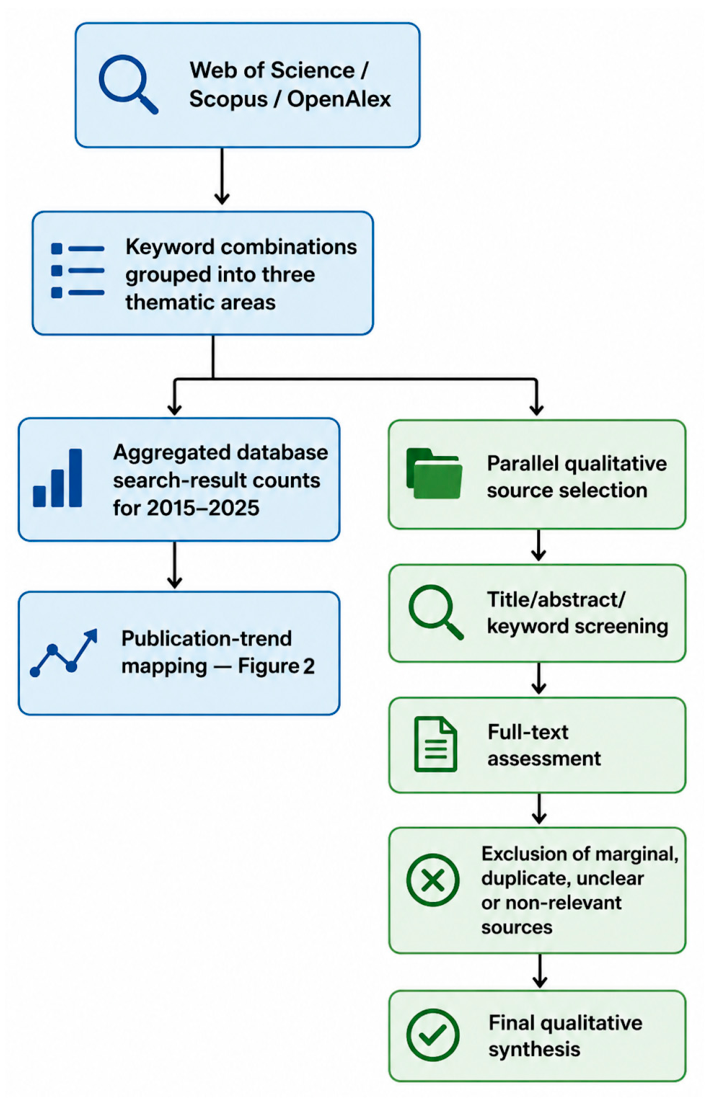
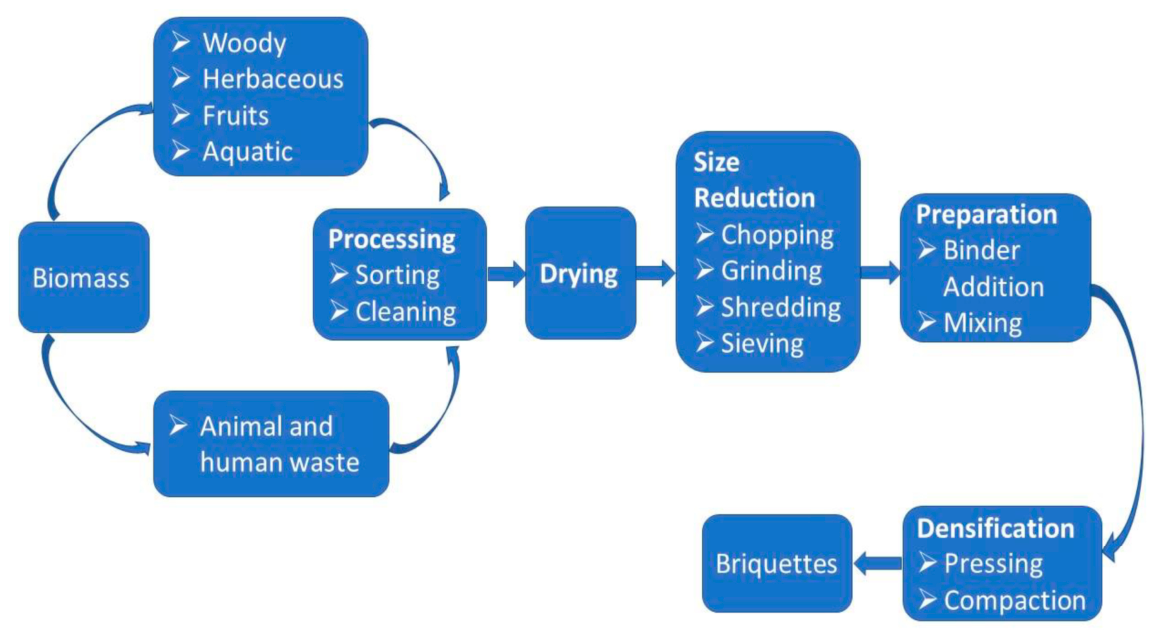
To improve the transparency of the review process and to clarify the relationship between the quantitative publication-trend mapping and the qualitative literature synthesis, the adopted methodological workflow is presented schematically in
Figure 1.
The workflow illustrates that the quantitative mapping shown in
Figure 2 was based on aggregated database search result counts, whereas the qualitative synthesis was developed through relevance-based thematic screening and full-text assessment of sources directly related to the objectives of the review.
Figure 1.
Schematic workflow of the publication-trend mapping and literature selection process used in this integrative narrative review.
Figure 1.
Schematic workflow of the publication-trend mapping and literature selection process used in this integrative narrative review.
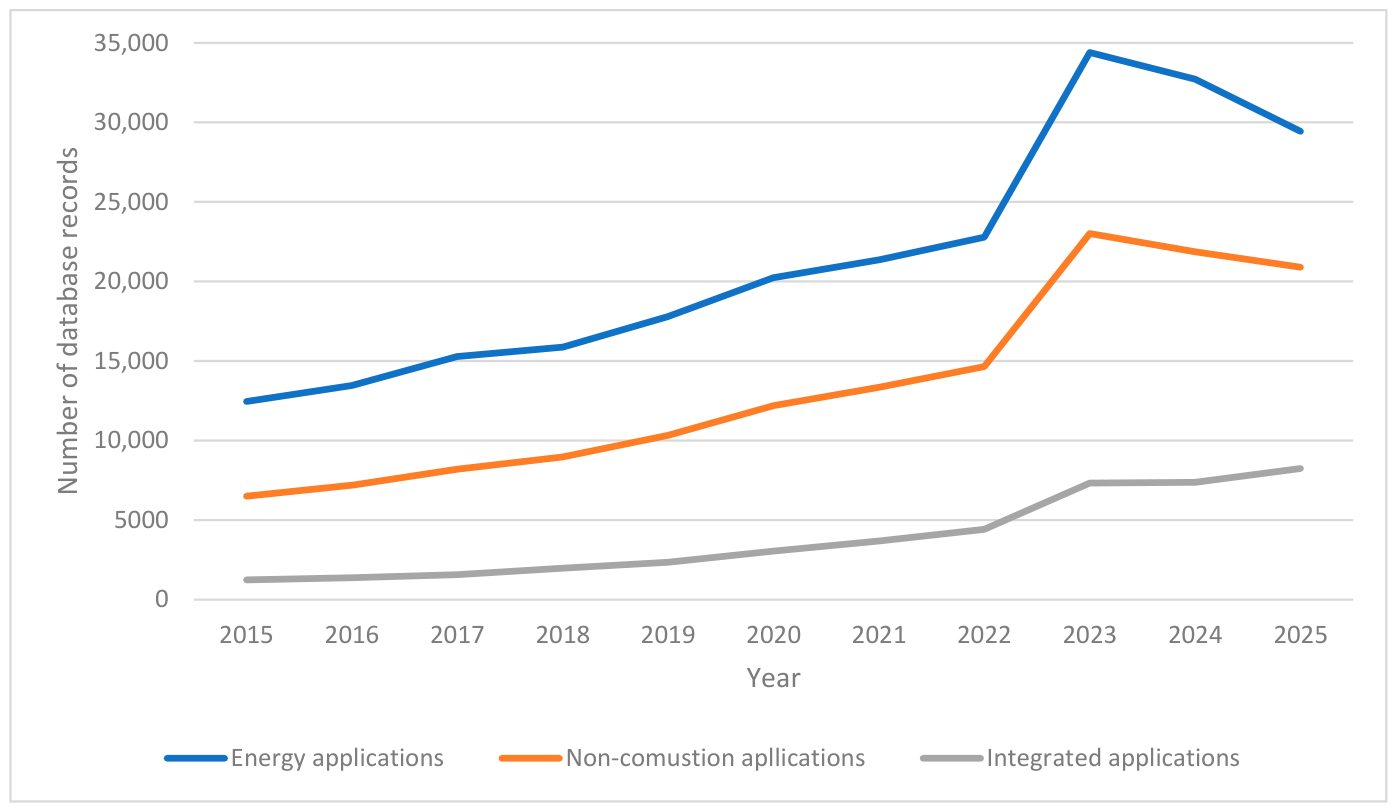
Figure 2.
Publication-trend mapping based on database search result counts for energy, non-combustion, and integrated applications of pellets and briquettes between 2015 and 2025. Source: own elaboration by the authors.
Figure 2.
Publication-trend mapping based on database search result counts for energy, non-combustion, and integrated applications of pellets and briquettes between 2015 and 2025. Source: own elaboration by the authors.
In order to gain an initial understanding of the development trends in the area under analysis, quantitative mapping of database search result counts was carried out across three thematic groups: energy applications, non-combustion applications, and integrated applications. The results obtained were not treated as a formal bibliometric analysis but rather as a supporting tool for determining the level of interest in specific areas of research and for justifying the need to integrate previously separate strands of the literature. For this reason, the values presented in
Figure 2 should be interpreted as database search result counts obtained from predefined keyword combinations, rather than as a fully deduplicated corpus of unique publications. The purpose of this mapping was to identify the relative intensity of research activity in the three thematic areas and to support the rationale for integrating previously separated research strands. Because
Figure 2 was intended to show aggregated search result trends rather than a deduplicated bibliometric corpus, duplicate removal and exclusion counts were not applicable to this mapping stage. The final qualitative synthesis was based on the sources included in the reference list after relevance-based thematic screening. The trends in the number of database records for the three groups analysed are shown in
Figure 2.
Figure 2 shows that the literature on pellets and briquettes continues to be dominated by energy applications; however, the importance of non-energy and systemic applications is growing in parallel. The increase in the number of database records related to integrated approaches, which has been evident since 2020, is particularly significant, as it indicates a growing interest in approaches that combine bioenergy, the circular economy, the cascading use of biomass, and functional material and environmental applications. This trend confirms the validity of this review, which aims to bring together disparate strands of research into a single coherent analytical model.
3. Physicochemical and Energy Properties of Pellets and Briquettes
3.1. Physical and Structural Properties
Density is one of the key parameters used to describe the quality of compacted fuels, as it directly affects logistics, energy density, the behaviour of the material in feeders, and its susceptibility to damage during transport and storage. The densification of biomass in the form of pellets and briquettes addresses the fundamental weakness of loose raw material—namely, its low bulk density—and thereby improves the cost-effectiveness of storing and transporting the fuel. In the case of pellets made from a mixture of woody and non-woody biomass, the average bulk density reported in the meta-analysis was 666.52 kg/m
3, whereas in detailed studies, the relaxed density could reach as high as 1.431 g cm
−3, which clearly demonstrates that the final level of compaction depends not only on the type of biomass but also on the preparation of the feedstock and the pressing conditions. In the case of briquettes, density is equally important, although the literature more often highlights the higher variability of this property, resulting from the larger size of the product, the wider range of raw materials used, and the more frequent use of binding additives [
4,
6,
10,
11].
Moisture content serves a dual purpose: on the one hand, it determines the effectiveness of the densification process itself; on the other, it influences the fuel’s subsequent combustion efficiency, dimensional stability, and resistance to degradation during storage. Excessive moisture reduces the calorific value and promotes deformation and cracking of the material, whereas too little moisture can hinder the formation of bonding bridges between biomass particles. Moisture also contributes to particle bonding during densification because, within an appropriate range, it facilitates heat transfer and supports lignin softening, thereby improving cohesion between biomass particles; however, excessive moisture may reduce durability and calorific value and increase the risk of deformation during storage [
12]. In the meta-analysis by Rupasinghe et al. [
10], the average moisture content of pellets made from biomass blends was 7.48%, although the authors emphasised that this parameter remains highly dependent on the type of raw material and the blend ratio. However, the significance of moisture content extends beyond the production stage itself, as an increase in moisture during storage accelerates structural degradation and mechanical weakening; this has been demonstrated both in controlled studies on pellet degradation and in more recent work on agro-pellets stored under conditions of elevated relative humidity [
4,
10,
13,
14].
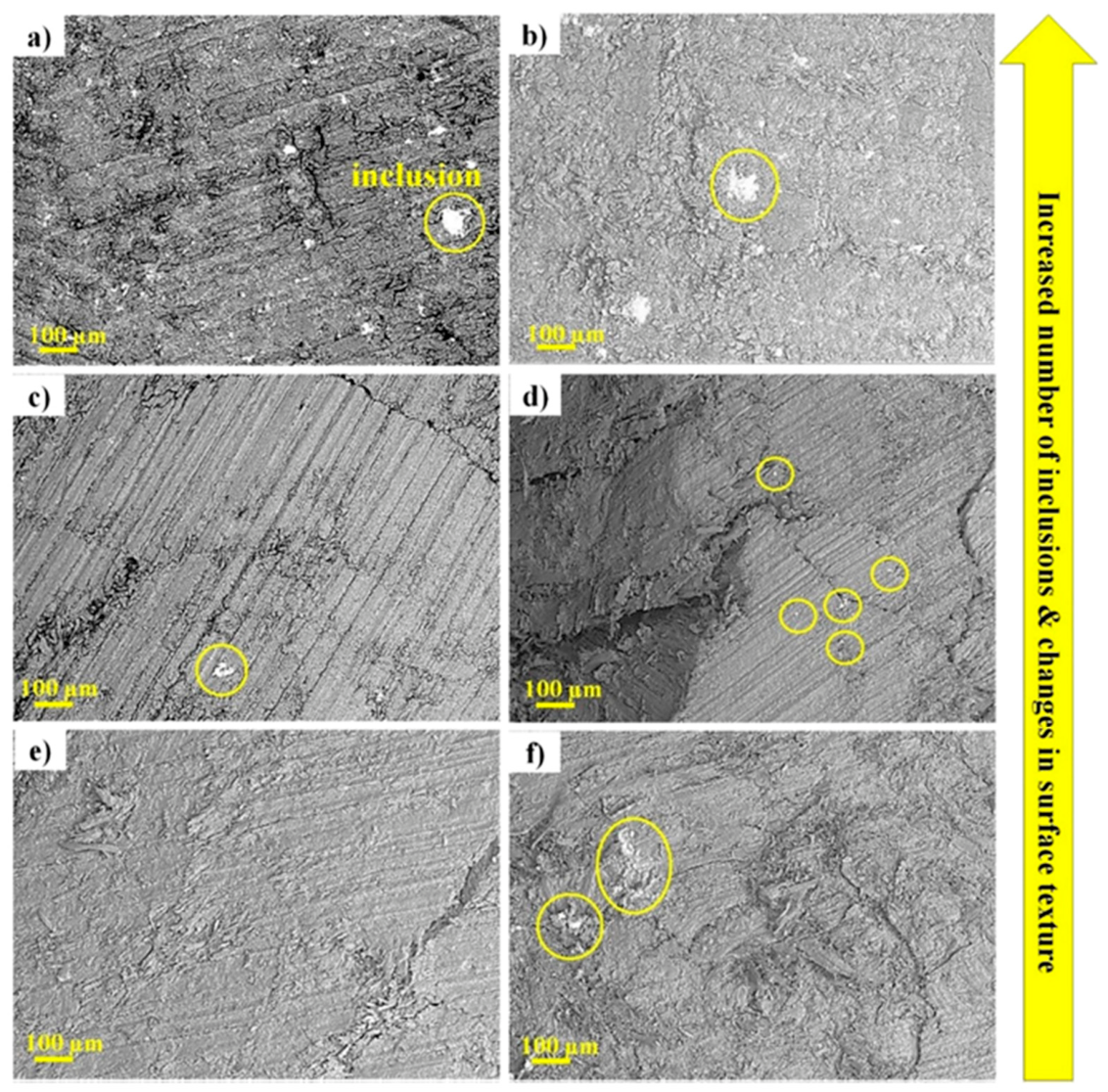
The porosity and, more broadly, the internal structure of compacted fuel determine its susceptibility to moisture absorption, the development of microcracks, and mechanical changes occurring during storage (
Figure 3). This parameter is often given less attention than moisture content or calorific value, but from the point of view of material quality, it is of fundamental importance, as it is the internal structure of the pores and the bonds between the particles that determine whether a pellet or briquette will retain its integrity after leaving the pressing die. In the study conducted by Siyal et al. [
11] on pellets derived from mixtures of furfural residue, sawdust, corn stalks, and sewage sludge, a porosity of 3.42 vol% and water absorption of 7.68% were reported. Additionally, the study by Sadeq et al. [
15] demonstrated that the geometry of the pressing channel affects the radial porosity distribution and the resulting mechanical behaviour of the product. The significance of this characteristic is also confirmed by microstructural observations, which indicate that prolonged exposure to high temperature and humidity promotes an increase in porosity and the development of internal crack networks [
11,
15,
16].
3.2. Mechanical Properties, the Effect of Storage, and Biodegradation
Mechanical strength and mechanical durability determine the fuel’s resistance to abrasion, impact, and disintegration during handling, transport, storage, and feeding into power-generation equipment. In the case of pellets, this parameter is particularly important, as the small size of the product tends to generate fine particles, which complicate logistics, increase the risk of dust formation, and may destabilise the combustion process. In the meta-analysis by Rupasinghe et al. [
10], the average mechanical durability was 89.03%, which was lower than the levels expected for pellets of the highest quality. In the case of briquettes, the literature emphasises that strength is highly dependent on the type of biomass, particle-size distribution, pressing temperature and pressure, and the presence of binders. Obi et al. [
7] demonstrated that binding additives can significantly improve product integrity but at the same time affect other properties, including moisture content, ash content, and combustion characteristics, which means that an improvement in the material’s mechanical properties does not always translate into an improvement in overall quality [
6,
7,
10,
15].
Durability should be understood in a broader context than solely the immediate mechanical resistance following the densification process. In industrial practice, durability refers to the ability of pellets and briquettes to retain their structure, weight, and performance characteristics during storage and transport under varying environmental conditions. Research conducted by Gilvari et al. [
12] demonstrated that temperature, relative humidity, and storage time collectively affect the equilibrium moisture content, higher heating value, and mechanical durability of pellets. Alakoski et al. [
17], on the other hand, pointed out that degradation during storage can lead not only to losses in dry matter and a deterioration in fuel properties but also to gas emissions, self-heating, and safety hazards in confined spaces. This means that the durability of compacted fuel is not solely a material property but also a logistical and operational one [
13,
16,
17].
The biodegradation of concentrated fuels presents a complex and variable nature. From the perspective of the traditional fuel supply chain, this is an undesirable phenomenon, as it leads to a loss of quality, material degradation, and gas emissions during storage. From the perspective of the circular economy, however, this may be a useful feature, provided the material is designed for environmental, agricultural, or sorption applications where controlled structural changes and the potential for further valorisation are desirable. Recent research into the storage of agro-pellets confirms that materials of this type are more susceptible to degradation in high-humidity conditions than wood pellets. At the same time, research into the utilisation of waste biomass suggests that pelletisation can serve as an intermediate step towards further valorisation, including the production of biochar pellets or materials with sorption, environmental, and agricultural applications. In this sense, biodegradation should not be viewed solely in a negative light but rather as a characteristic that depends on the anticipated application scenario [
14,
17,
18].
3.3. Energy Properties, Emission Characteristics, and Elemental Composition
Unless otherwise stated, the heating values discussed in this review refer to higher heating value (HHV; gross calorific value), as reported in the cited sources. Where lower heating value (LHV; net calorific value) was used in the original study, this is indicated explicitly. Because the energy performance of pellets and briquettes is strongly affected by moisture and ash content, heating values are interpreted together with the broader physicochemical properties of the material.
Higher heating value (HHV) remains one of the most important parameters for describing the energy potential of pellets and briquettes, but it cannot be interpreted in isolation from moisture content, ash content, and the organic composition of the biomass. The review by Pradhan et al. [
4] emphasises that the favourable energy profile of pellets results from both material compaction and appropriate feedstock selection. Rupasinghe et al. [
10] reported an average gross calorific value of 17.79 MJ kg
−1 for pellets produced from biomass mixtures, whereas Siyal et al. [
11] showed that, in selected raw-material systems, this value can reach 22.45 MJ kg
−1. These data indicate that waste lignocellulosic materials can, after appropriate preparation, achieve parameters sufficient for effective energy use, although their final suitability depends on the overall configuration of material properties rather than on heating value alone [
4,
10,
11].
Assessing pellets and briquettes solely on the basis of their calorific value would be insufficient, as their true energy quality only becomes apparent when considered in conjunction with their emissions profile during combustion. Biomass as a renewable fuel is not exempt from pollutant emissions, and their levels depend on the type of raw material, combustion technology, mineral content, and the method of process execution. The review conducted by Yao et al. [
19] identified the primary pollutant groups as dust, volatile organic compounds, polycyclic aromatic hydrocarbons, elemental carbon, and carbon monoxide. Furthermore, it demonstrated that advanced combustion technologies can reduce certain toxic emissions by a factor of 2 to 4 compared to simpler devices [
19]. This means that, when assessing pellets and briquettes, the properties of the fuel itself cannot be separated from the conditions of its end use, as the same material can have a significantly different environmental impact depending on the combustion technology and the quality of process control.
The elemental composition of pellets and briquettes is significant from both an energy and an environmental perspective, as elements such as nitrogen (N), sulphur (S), chlorine (Cl), potassium (K), sodium (Na), calcium (Ca), silicon (Si), and phosphorus (P) influence the combustion process, ash formation, corrosion, fouling, the tendency to sinter, and emission levels. Vassilev et al. [
20] demonstrated that the chemical composition of biomass remains highly variable; however, when the data are converted to dry weight, the ranges of many characteristics become more comparable. In the case of pellets made from biomass mixtures, Rupasinghe et al. [
10] reported an average nitrogen content of 1.49% and a sulphur content of 0.08%, confirming that even in compacted fuels derived from non-wood biomass, the elemental composition can still be a limiting factor in terms of environmental quality. Heavy metals are of particular importance; although they do not always determine the combustion process itself, they can accumulate in the ash and limit its further use [
10,
20,
21].
3.4. Property–Function Relationship
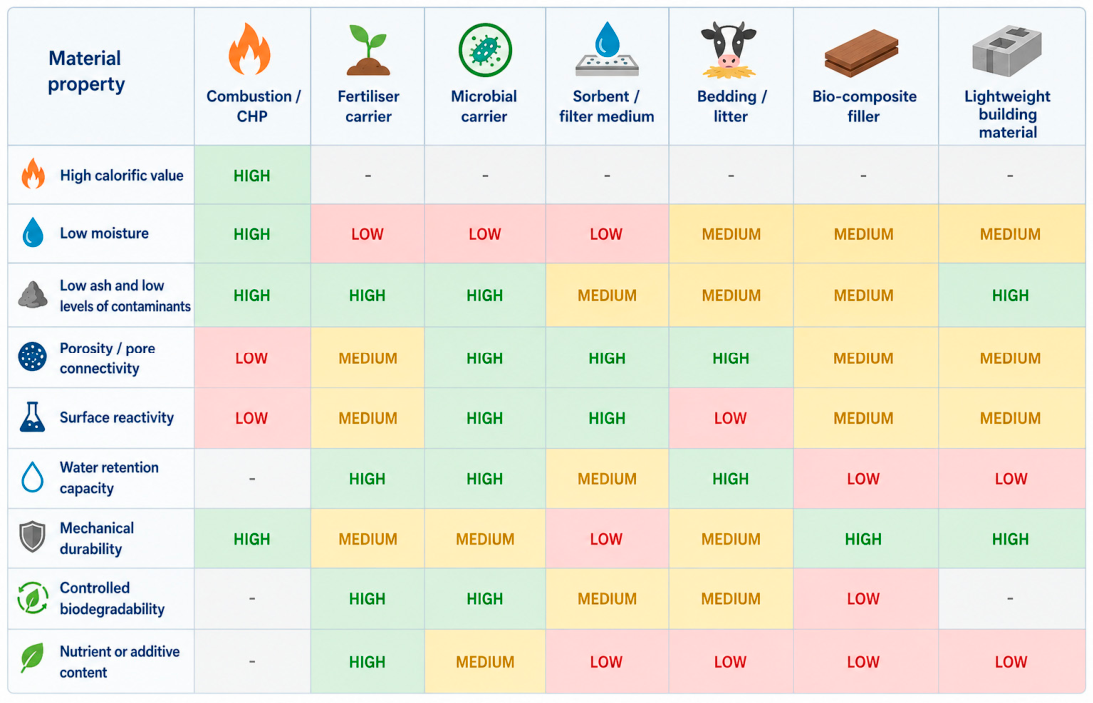
The suitability of pellets and briquettes does not depend on a single parameter but on the overall combination of their physical, mechanical, chemical, and energy properties. In purely energy-related applications, fuels with high density, low moisture content, stable mechanical durability, low ash content, and a favourable elemental composition are preferred. Conversely, in non-energy applications, some of these same characteristics may be interpreted differently: higher porosity, specific surface reactivity, or controlled susceptibility to material transformations can enhance the product’s usefulness as a carrier, sorbent, material additive, or intermediate stage in further processing. Consequently, contemporary literature is increasingly moving away from treating pellets solely as an alternative fuel and is shifting its focus towards their multifunctionality, which encompasses both energy applications and more advanced environmental and material uses. This perspective is particularly significant for the rest of this article, as it serves as a bridge between the traditional assessment of fuel quality and the analysis of its role in integrated systems and the circular economy. A schematic representation of the relationship between raw material properties, process parameters, material characteristics, and the intended function of pellets and briquettes is shown in
Figure 4 [
4,
6,
9,
18].
The quality of pellets and briquettes cannot be considered in isolation, as it is the result of the interaction between physical, mechanical, chemical, and energy properties, which determine the behaviour of the material from the densification stage, through transport and storage, to its final use. In the case of pellets, moisture content, geometric dimensions, bulk and unit density, fine-particle content, mechanical durability, ash content, and higher heating value are of particular importance. These parameters are commonly interpreted with reference to the ISO 17225 (
ISO 17225-2:2021; Solid Biofuels—Fuel Specifications and Classes—Part 2: Graded Wood Pellets. International Organization for Standardization: Geneva, Switzerland, 2021) fuel-quality framework and selected ISO test methods for moisture content, mechanical durability, and pellet dimensions [
22,
23,
24,
25]. From both a utility and market perspective, achieving a high heating value is not sufficient, as it is equally important to meet quality requirements that ensure stable combustion, logistical safety, and product marketability. This is confirmed by a meta-analysis covering pellets made from mixtures of woody and non-woody biomass, in which the average values of several parameters fell within standard limits, whereas mechanical durability was more often identified as the limiting factor for full compliance with quality requirements [
10]. For this reason, the individual properties of pellets and briquettes should be analysed as an interrelated set of characteristics determining their suitability for specific energy and non-energy applications.
Table 1 refers mainly to densified biomass materials intended for fuel use, especially combustion and combined heat and power systems; however, several of the listed properties, such as moisture content, density, porosity, and durability, are also relevant for non-combustion applications.
Globally, commercial pellet production is still primarily associated with woody biomass, especially sawdust and other residues from wood-processing chains [
2,
4]. Non-woody agricultural residues are increasingly investigated as regional feedstocks for densified products because their use can support local biomass valorisation and circular-economy applications [
10,
18].
To provide a clearer picture of the basic properties of pellets and briquettes, their key parameters are summarised in
Table 1.
As shown in
Table 1, pellets are generally characterised by a more uniform and better standardised set of quality parameters, which is due both to the well-established fuel grades and testing methods and to their consistent geometry and performance. Briquettes, on the other hand, generally exhibit higher variability in their physical and energy properties, as their quality depends more heavily on the type of raw material, the choice of binder, the particle-size distribution, and the pressing conditions. The results also show that the suitability of both fuel types is not determined by a single parameter by a combination of characteristics, including moisture content, density, mechanical strength, ash content, and storage stability. In practice, this means that pellets remain the preferable option, where standardisation, automatic dosing, and consistent combustion are key, whereas briquettes retain an advantage in systems that are more flexible in terms of raw materials and technology, particularly when using local, diverse lignocellulosic waste. At the same time, for both groups of materials, high performance requires a trade-off between mechanical, energy, and environmental parameters, as well as control of storage conditions, since even well-compacted solid biofuels remain susceptible to moisture degradation and changes in properties during storage [
4,
6,
7,
10,
13].
4. Energy Applications
From the perspective of energy applications, it is significant that pellets made from biomass blends achieved an average calorific value of approximately 17.79 MJ kg
−1, whereas in selected raw material and process systems this value reached 22.45 MJ kg
−1 [
10,
11]. These parameters confirm that compacted biomass can achieve a quality level sufficient for heat production and further conversion processes, although its suitability also depends on the product’s moisture content, ash content, and mechanical stability.
Energy applications remain the primary and historically most significant use of pellets and briquettes, as the densification of biomass simultaneously addresses several key issues associated with the raw material: low bulk density, difficult transport, inconsistent feeding into equipment, and high sensitivity to storage conditions. In practice, this indicates that densified fuels are suitable not only for basic heating systems but also for more advanced energy conversion configurations, including cogeneration, thermal pre-treatment, gasification systems, and integrated district heating systems. For this reason, assessing their role in the energy sector requires a broader perspective than a mere analysis of fuel parameters and should also take into account conversion efficiency, emissions profiles, system integration, and environmental and economic factors [
4,
30].
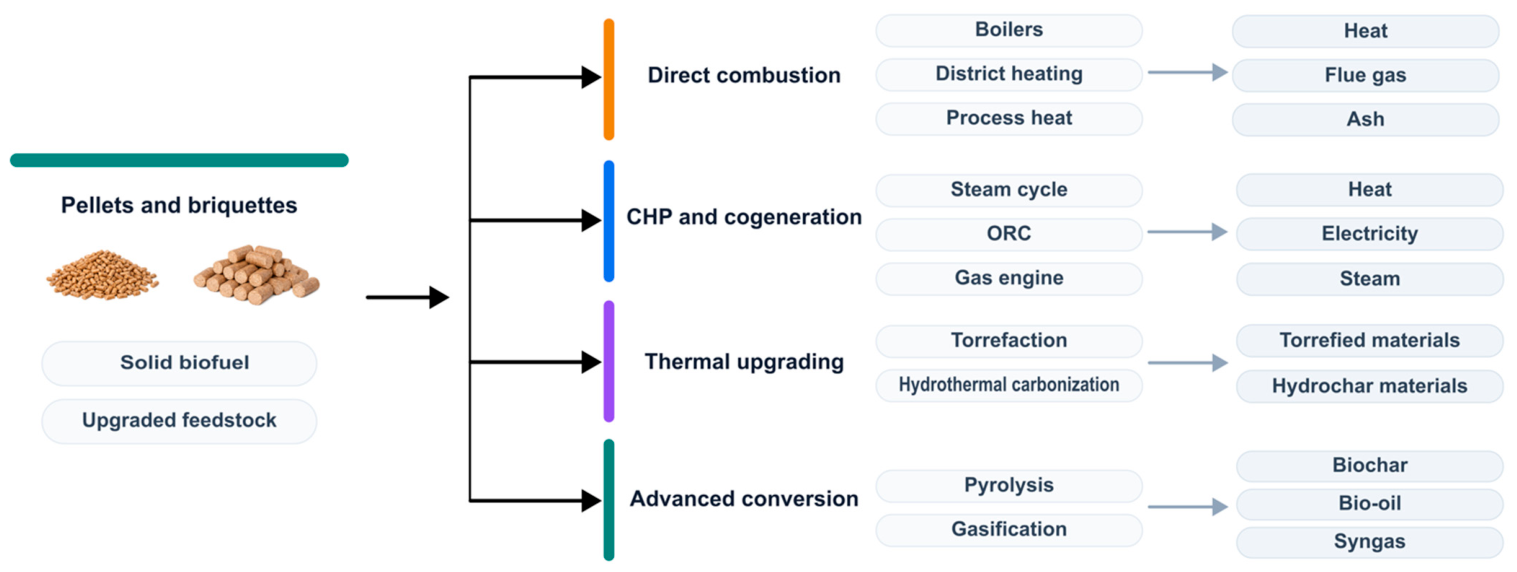
The main applications of pellets and briquettes in the energy sector include direct combustion, heat generation, and combined heat and power, as well as more advanced thermochemical processes such as torrefaction, hydrothermal carbonisation, pyrolysis, and gasification. The general relationships between these conversion pathways are shown in
Figure 5, while a detailed comparison of them, with particular emphasis on the process principles, end products, advantages, limitations, and required fuel properties, is presented in
Table 2.
The overview shows that the energy applications of pellets and briquettes form a technological continuum, from simple heating boilers, through CHP systems, to torrefaction, pyrolysis, and gasification processes. The following sections discuss these approaches in more detail, highlighting their potential and the challenges involved in their implementation.
4.1. Combustion in Boilers and CHP (Combined Heat and Power) Systems
Direct combustion in boilers remains the most technologically mature method of utilising pellets and briquettes, particularly in the municipal sector, small-scale district heating, and industrial installations requiring relatively simple and reliable solutions. The advantage of compacted fuels in this case is not only their higher energy density but also their higher geometric uniformity and the fact that they are easier to feed automatically, which improves process stability and reduces the operational problems typically associated with loose biomass. In more advanced combined heat and power systems, biomass in the form of pellets and other compacted fuels also serves as a controllable renewable energy source capable of simultaneously generating heat and electricity. Reviews of small-scale CHP systems indicate that, alongside conventional steam-based solutions, organic Rankine cycle (ORC) systems, Stirling engines, internal combustion engines fuelled by gas from gasification, and configurations with turbines and fuel cells are also utilised, where the use of waste heat can raise the overall efficiency of the system to levels significantly higher than in electricity generation alone. At the same time, the literature highlights that the practical implementation of such systems is still hampered by issues relating to ash melting, fouling of heat exchange surfaces, process gas cleaning, and maintenance costs for small- and medium-scale equipment [
4,
34].
The choice of combustion technology is also of great importance. Yao et al. [
19] pointed out that modern biomass combustion technologies can reduce emissions of toxic substances by a factor of approximately 2–4 compared to older stoves, which shows that the environmental impact of pellets and briquettes depends not only on the properties of the fuel but also on the design of the appliance, the process temperature, and the quality of combustion control [
19].
4.2. Torrefaction and Hydrothermal Processing
The energy-related utilisation of pellets and briquettes increasingly extends beyond direct combustion and includes pre-treatment routes designed to improve fuel quality before final conversion. Torrefaction and hydrothermal processing are particularly important in this context, as both processes enhance the properties of solid biofuels, although they operate under different technological conditions and are suitable for different feedstock characteristics. Torrefaction, often described as mild pyrolysis, improves grindability, reduces hygroscopicity, and increases calorific value, making torrefied pellets more similar to fossil solid fuels and more suitable for co-firing or advanced thermochemical conversion systems. Hydrothermal processing, in turn, is especially relevant for wet biomass, as it enables conversion without the need for prior energy-intensive drying. Both routes can produce fuels that are more homogeneous, hydrophobic, and energy-dense; however, pelletisation after carbonisation requires careful optimisation of mechanical strength, binder behaviour, and pressing parameters [
32,
36,
37].
The improvement in fuel performance is particularly evident in the case of hydrothermal carbonisation. Kambo and Dutta [
36] demonstrated that miscanthus pellets subjected to hydrothermal carbonisation (HTC) at 260 °C achieved a density of 1036 kg m
−3 and a volumetric energy density of 26.9 GJ m
−3, whereas raw pellets reached 834 kg m
−3 and 15.7 GJ m
−3, respectively, and torrefied pellets reached 820 kg m
−3 and 16.7 GJ m
−3. These results show that the choice of biomass pre-processing route can substantially affect not only calorific value but also the logistical, storage, and system-level usefulness of densified solid biofuels.
4.3. Pyrolysis and Gasification
A further step in the valorisation of pellets and briquettes is their use as intermediate materials in pyrolysis and gasification systems. In this approach, densified biomass is no longer treated only as a final solid fuel for direct combustion but also as a more uniform feedstock for the production of biochar, bio-oil, or combustible gas. Reviews on the pyrolysis of torrefied biomass indicate that feedstock pre-treatment can improve the quality of liquid and solid products, reduce the proportion of undesirable oxygen-containing compounds, and support the formation of more stable carbonaceous materials, although this may occur at the expense of a lower liquid fraction yield. In gasification, the key technological shift is from direct heat generation to the production of syngas, which can subsequently be used in engines, turbines, CHP systems, and, in more advanced configurations, fuel cells. Nevertheless, the successful implementation of these systems still depends on effective tar control, gas cleaning, and proper thermal integration, as these factors strongly influence process efficiency, operational reliability, and commercial maturity [
35,
38,
40].
4.4. Environmental Performance and Greenhouse Gas Emissions
The impact of pellets and briquettes on greenhouse gas (GHG) emissions cannot be assessed solely on the basis of the biogenic origin of the carbon, as the actual climate balance depends on the entire chain: raw material procurement, drying, densification, transport, end use, and the system boundaries adopted. LCA reviews of pellets demonstrate that the outcomes related to global warming potential are significantly influenced by the choice of functional unit, system scope, and allocation method. Furthermore, cradle-to-grave studies are predominantly affected by pellet use scenarios associated with heat production. The drying stage remains a particularly significant environmental concern, with emissions depending on the type of heat source; when fossil fuels are used for drying, the carbon footprint of pellets increases significantly. At the same time, case studies on waste briquettes show that well-designed systems can achieve significantly lower GWP (global warming potential) values than fossil fuels used for heating or cooking. This means that the climate benefits of concentrated fuels are not automatic but conditional and dependent on the organisation of the entire bioenergy system [
5,
41,
42,
43].
Life-cycle analyses play a dual role in research on pellets and briquettes: on the one hand, they enable assessment of the actual environmental costs of producing and using the fuel; on the other, they reveal just how strongly the results depend on methodological choices. The review by Martín-Gamboa et al. [
41] showed that the literature on pellets is heterogeneous in terms of functional units, system boundaries, allocation methods, and impact categories, which makes it significantly more difficult to compare results across studies. Similar conclusions emerge from the review by Muazu et al. [
44] on biomass densification systems, where the key determinants of LCA results were found to be the type of biomass, the drying method, energy consumption during the densification process, and the scale of the plant. In practice, this means that an LCA should not be treated merely as a formal supplement to the description of the technology but as a tool for determining whether a given type of pellet or briquette actually leads to environmental improvements compared to fossil fuels or alternative biomass utilisation pathways [
5,
41,
44].
LCA data confirm that the climate benefits of densified fuels depend heavily on the system boundaries and the fuel being replaced. Ferronato et al. [
43] demonstrated that waste briquettes composed of 80% non-recyclable cardboard and 20% sawdust exhibited a global warming potential (GWP) of 23.9–26.7 g CO
2-eq MJ. After accounting for avoided wood or methane substitution effects, these values decreased to approximately 20.0 and 18.9 g CO
2-eq MJ, respectively. Drying remains a particularly important stage in the pellet production process. Koido et al. [
45] demonstrated that this process accounted for 35–39% of total energy consumption in wood pellet production, while the use of wood-fired boilers or pellet-fired CHP systems for drying reduced primary energy demand by 12–26% and CO
2 emissions by 14–31% compared to the conventional grid-based option [
43,
45].
4.5. System Integration and Technical and Economic Constraints
One of the key advantages of pellets and briquettes in the context of the energy transition is their controllability, storability, and ability to operate in a complementary manner alongside intermittent sources such as solar and wind power. For this reason, bioenergy from compressed fuels can serve not only as a source of heat or electricity but also as a means of enhancing system flexibility, particularly in local district heating networks, decentralised CHP systems, and multi-carrier systems. Reviews on flexible bioenergy emphasise that flexibility services extend beyond the electricity sector alone and also encompass the heating and fuel sectors, as well as integration with energy storage. At the same time, research into district heating systems suggests that biomass can provide an environmentally and economically efficient basis for local heating networks, although the success of such projects depends on the quality of the supply chain, stakeholder acceptance, and appropriate scaling. Importantly, systems analyses also highlight the potential for the co-production of heat, electricity, transport fuels, and the pellets themselves within integrated systems, while more recent reviews on the integration of heat recovery confirm that the use of waste heat can further improve the efficiency and competitiveness of entire bioenergy systems [
40,
46,
47,
48].
In the technical and economic assessment of pellets and briquettes, the key factors are raw material costs, drying intensity, investment expenditure on the densification line, transport costs, production scale, and the quality parameters that determine the market price of the fuel. In the case of briquettes, the literature consistently emphasises that profitability depends heavily on the local availability of waste raw materials and the organisational simplicity of the supply chain; in the case of pellets, however, the plant configuration, distance to the market, and the decision on whether to invest in conventional or torrefied fuels are also becoming increasingly important. Analyses of torrefied wood pellets show that improving the fuel’s properties does not automatically remove the cost barrier, as the additional processing stage increases the complexity of the process and the capital costs. On the other hand, more recent studies combining LCA and economic analysis show that optimising the drying process and increasing the scale of the plant can significantly improve the economic performance of the entire system, including the subsequent use of pellets in CHP systems. Consequently, the competitiveness of densified fuels depends not on a single factor but on the ability to simultaneously reduce process costs, stabilise fuel quality, and integrate production into a well-designed local or regional energy system [
4,
6,
45,
49].
The integration of biomass gasification with power-generation systems significantly improves the efficiency of the entire system. Abouemara et al. [
35] reported that the electrical efficiency of power generation from syngas in internal combustion engines is typically around 20–35%, similar to that in turbine systems, although in certain cases it can reach up to 50%. At the same time, the use of CHP can increase the overall efficiency of the system to as much as 90%, whereas without heat recovery it is usually in the range of 40–60%. The issue of scale also has economic implications. In the analysis by Koido et al. [
45], scaling up the installation improved the financial performance of the pellet and CHP production system, with net income rising by up to 20% and the payback period falling to around 10 years for a plant producing 2.5 tonnes of pellets per hour [
35,
45].
In summary, the use of pellets and briquettes for energy purposes now encompasses a much wider range of solutions than traditional combustion in boilers. Concentrated fuels can serve as stable heat carriers, substrates for CHP systems, feedstocks for torrefaction, pyrolysis, and gasification, as well as components of more complex bioenergy systems linked to life-cycle assessment and technical-economic analysis. Their advantage over loose biomass stems primarily from their higher density, simpler logistics, and more predictable performance parameters; however, their actual energy and environmental efficiency depend on the entire value chain, from the type of raw material, through the drying and densification process, to the end-use technology. At the same time, the very same physical form that enhances the usability of pellets and briquettes as a fuel can also be utilised in other applications. Thanks to their controlled geometry, porosity, mechanical strength, adaptability, and the ability to combine different raw materials, pellets and briquettes can be designed not only as energy carriers but also as functional materials for agriculture, environmental protection, biotechnology, and materials engineering. It is precisely this perspective that serves as the starting point for the next chapter, which focuses on their non-energy-related functional applications [
4,
5,
6,
18,
41].
5. Functional Non-Energy Applications
The results of experimental studies confirm that pelletisation can enable biomass to act as a controlled carrier of fertiliser components. The study by Steiger et al. [
50] demonstrated that bio-composite pellets made from agricultural waste and enriched with ammonium sulphate contained approximately 22 mg NH
4+ g
−1 when the fertiliser was added directly during pellet formation, whereas in systems prepared with the use of the adsorption method, the NH
4+ content reached approximately 40 mg g
−1. At the same time, the release profile was strongly dependent on the composition of the carrier. One formulation released almost 100% of NH
4+ within 3 h, whereas other formulations limited release to around 60%, 40%, 20%, or even 10%, indicating the potential to design pellets as slow-release nutrient delivery systems [
50].
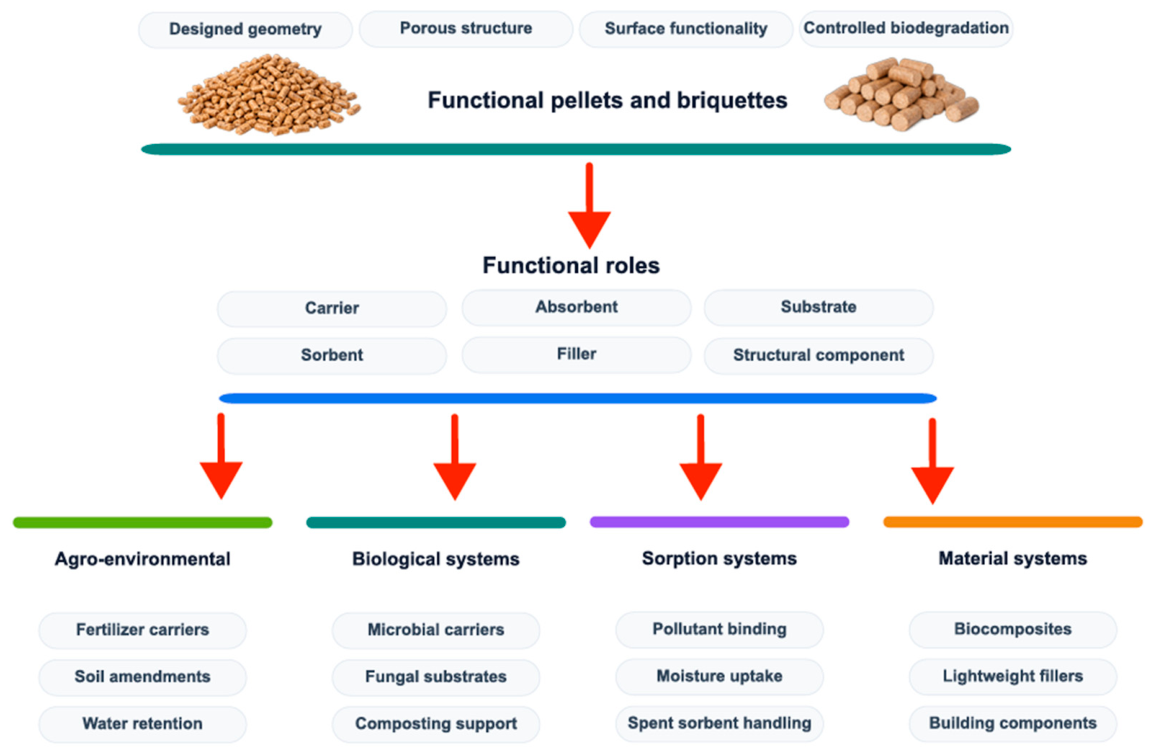
The main categories of non-energy applications for pellets and briquettes are shown schematically in
Figure 6.
The non-energy applications of pellets and briquettes stem from a shift in perspective, from viewing them solely as solid fuels to seeing them as designable functional materials. In this context, it is not only the calorific value, ash content, and mechanical strength that are important but also the porosity, ability to sorb water and pollutants, susceptibility to microbial colonisation, potential for controlled release of components, and stability in soil or material environments. The pellet or briquette form is particularly useful here, as it allows the material to be shaped into a specific form, facilitates dosing, reduces dust formation, improves logistics, and enables different biomass fractions to be combined with mineral, organic, or biological additives. As a result, densification becomes not only a fuel preparation process but also a method for utilising residual biomass in agricultural, environmental, sorption, biological, and materials applications [
18,
50,
51].
5.1. Agro-Environmental Applications
In agro-environmental applications, pellets and briquettes can serve as carriers for fertilisers, soil conditioners, and materials that facilitate the precise application of nutrients. Of particular interest are systems in which residual biomass is combined with mineral components or biopolymers to form granulated controlled-release fertiliser carriers. An example of this approach is agro-waste pellets made from chitosan, torrefied wheat straw, and eggshells, which were used as carriers for ammonium sulphate. Depending on the preparation method, these systems differed in their ammonium content, mechanical stability, and the rate at which the component was released into the water. A similar approach is taken with compost-biochar pellets, in which the addition of biochar improved the material’s functionality, whilst the pelletisation process itself resulted in a product with a high bulk density, suitable for use as a more uniform and easier-to-apply soil amendment [
50,
51,
52].
In the case of soil amendments, it is not only the chemical properties of the material that are important but also its physical properties. In the study by Sung-inthara et al. [
51], soil pellets were produced from various composts, with water added at 20%, 30%, and 40% by weight, and biochar added at 0%, 5%, and 10%. The most favourable technological outcome was achieved with
Albizia saman leaf compost supplemented with 20% water and 5% biochar, demonstrating that even a small proportion of biochar can enhance the functional properties of soil pellets while preserving their role as carriers of organic matter and minerals [
51].
Another important area of research is the use of compacted materials as carriers for microorganisms, particularly in biofertilisation, biostimulation, and soil remediation. Biochar is of particular importance in this area, as its porous structure, moisture-retention capacity, and the presence of functional groups can promote cell adhesion, cell survival, and colonisation of the soil environment. Pelletising such materials can make them easier to apply and reduce losses during transport, but it also introduces a technical limitation: excessive pressure, temperature, or unfavourable moisture levels during the pelletising process can reduce the viability of the inoculated microorganisms. This means that the design of microbiologically active pellets cannot simply involve a direct transfer of fuel technology but requires a balance to be struck between the product’s mechanical requirements and the biological stability of the inoculum [
53,
54].
Lignocellulosic pellets can also be used as bedding material and as additives to aid water retention. In applications of this kind, the desired characteristics differ from those that predominate in traditional fuel assessments: more emphasis is placed on absorbency, stability when exposed to moisture, low dust emission, and the ability to improve the physical properties of the environment in which the material is used. In bedding and absorbent applications, the critical factors are water absorption capacity and the ability to maintain mechanical strength after contact with moisture. In the study conducted by Dittrich et al. [
55], fibres from eight distinct lignocellulosic raw materials were processed into absorbent pellets, and their absorbency was evaluated following immersion in water for 30 s, 300 s, and 1200 s. Poplar pellets exhibited absorption rates of 130%, 172%, and 194%, respectively, along with a mechanical durability of approximately 95%, thereby confirming their potential as mulch materials, absorbents, or retention products derived from local lignocellulosic biomass. In turn, biochar-based soil amendments can improve water retention and soil aggregation properties. The importance of biochar materials as retention aids is also confirmed by research into biochar-based soil conditioners. Kang et al. [
56] applied soil amendments, including biochar, at rates of 0, 2.1, 4.2, and 8.3 g kg
−1 of soil, demonstrating improved aggregate stability and water retention. The available results reported an increase in the weighted average diameter of aggregates of up to 188% and an increase in water retention to approximately 128.9%, indicating that biochar materials can act not only as a carrier of organic carbon but also as a regulator of soil physical properties.
Compost pellets, which combine fertilising, biological, and protective functions, are a particularly interesting area. Juntahum et al. [
57] developed pellets from cattle manure compost enriched with
Trichoderma hamatum and biochar, using by-products from the cassava industry as binders. Depending on the binder used, pellet densities of up to 1298.04 kg m
−3, a forming efficiency of 95.40%, and a durability of 95.88% were achieved. Germination of
T. hamatum from pellets inhibited the growth of
Sclerotium rolfsii by 62.5% in vitro, while the application of pellets in pot experiments reduced disease severity by 77.4% and increased the nitrogen, phosphorus, and potassium content in the soil by 32.2%, 38.9%, and 38.9%, respectively. These data show that functional pellets can be designed not only as nutrient carriers but also as biologically active materials that protect and improve soil fertility [
57].
The main applications, representative raw materials, and expected benefits of pellets and briquettes in agro-environmental systems are summarised in
Table 3.
5.2. Environmental Applications
In environmental applications, sorbents and absorbents derived from biomass or its processed forms are of particular importance, especially when the compacted material combines a favourable geometry with a highly developed porous structure. Biochar, biochar pellets, granules, and fibrous materials can remove organic pollutants, heavy metals, nutrients, and selected micropollutants from water or wastewater. However, their effectiveness depends not only on the specific surface area but also on the chemical composition, surface charge, the presence of functional groups, the pH of the environment, and any activation or modification of the material. Reviews on sorption using biochar indicate that these materials can achieve high efficiency in removing various groups of pollutants from aqueous solutions, while studies on mycelium pellets demonstrate that biologically formed structures may be useful in the biosorption of pollutants due to the easier separation of biomass and the presence of active functional groups in the cell walls [
58,
59].
Another significant area of research involves sorption systems based on biological or biochar-based structures designed to target specific pollutants. Mycelial pellets have been shown to be highly effective at removing polycyclic aromatic hydrocarbons, including pyrene; the mechanism involves both adsorption onto living or dead biomass and the involvement of extracellular polymeric substances, as well as carboxyl and nitrogen groups. The most direct figures for sorption applications relate to mycelium pellets. Zou et al. [
60] demonstrated that live
Penicillium thomii ZJJ pellets removed 93.48% of pyrene from a solution with a concentration of 100 mg/L within 48 h, achieving a maximum adsorption capacity of 285.63 mg/g. Even the thermally inactivated pellets retained significant sorption activity, achieving 65.01% pyrene removal and an adsorption capacity of approximately 199 mg g
−1. These results show that the pellet form may facilitate the practical use of mycelial biomass as an easily separable biosorbent for hydrophobic pollutants, such as polycyclic aromatic hydrocarbons [
60]. In turn, pellets made from residual biomass that have undergone pyrolysis can be regarded as intermediate materials between waste management and sorbent engineering, as their properties depend on the type of waste, the binding additives, and the carbonisation temperature. This approach expands the scope of pelletisation: the material is not merely shaped for ease of transport but is prepared as a carrier for structure, surface properties, and reactivity useful in environmental remediation [
18,
60].
From a waste management perspective, pelleting and briquetting may be regarded as methods for the stabilisation, compaction, and enhanced valorisation of fractions that would otherwise present challenges in transportation or management. This applies to plant residues, sludge, biomass ash, coffee grounds, and used mushroom substrate. A particularly clear example is spent-mushroom substrate, which is produced in large quantities once mushroom cultivation is complete, yet contains organic matter, minerals, and lignocellulosic residues that can be reused. The conversion of such streams into pellets, sorbents, soil amendments, or biochar precursors is consistent with the principles of end-of-waste and the circular economy, as it transforms waste into a product with more predictable characteristics and a clearer practical function [
18,
61,
62].
The main applications of pellets and briquettes in sorption, remediation, and waste-stabilisation systems, together with their environmental functions and benefits, are summarised in
Table 4.
5.3. Biological Applications
The biological applications of pellets and briquettes primarily involve the use of compacted or structured biomass as a growth medium for fungi and microorganisms. In mushroom cultivation, the chemical composition of the substrate, the C/N ratio, the mineral content, water-holding capacity, and susceptibility to colonisation by mycelium are of particular importance. Biological applications can therefore also be considered from this perspective. Hoa et al. [
61] compared seven formulations of lignocellulosic substrates for
Pleurotus ostreatus and
Pleurotus cystidiosus, including sawdust, maize cobs, sugarcane bagasse, and mixtures thereof. In the case of
P. ostreatus, the highest yield was obtained on a substrate consisting of 100% maize cobs, reaching 270.60 g bag
−1, whereas for
P. cystidiosus, the highest yield on the same type of substrate was 201.14 g bag
−1. The biological efficiency of
P. ostreatus was highest for substrates made from maize cobs and sugarcane bagasse, at 66.08% and 65.65%, respectively, demonstrating that concentrated or standardised forms of lignocellulosic biomass can serve as valuable biological substrates [
61].
What is important for this review is that the same properties determining the suitability of a mushroom substrate can be partially controlled through crushing, mixing, and compacting the biomass, i.e., by processes technologically similar to pelleting or briquetting. In this sense, a compacted form may improve the consistency of substrate dosing and transport, but it is essential to maintain the porosity and oxygen availability required for proper biological colonisation [
61,
62].
With regard to microorganisms, pellets can serve two distinct functions: they can act as a carrier for externally introduced cultures, or they can form naturally as biologically formed aggregates, such as mycelial pellets. In the first case, the key factors are cell viability, moisture availability, protection against environmental stress, and the ability to release microorganisms gradually into the soil or the treatment system. In the second case, the essence of the technology lies in the spontaneous or controlled immobilisation of microbial biomass within structures that can be easily separated from the medium, which facilitates their use in biosorption, biotransformation, or bioremediation processes. Both scenarios demonstrate that pellets need not be merely inert technical material; they can also serve as a biological microenvironment, the quality of which depends on the interplay between structure, water, surface area, and the activity of organisms [
53,
54,
59].
However, the biological function of the pellets depends on the process conditions, as densification may limit the lifespan of the microorganisms. In the study conducted by Rubel et al. [
54], a biochar microbial fertiliser, formulated from a 40/60% dry weight mixture of biochar and commercial horticultural substrate, was analysed to evaluate the effects of moisture content ranging from 15 to 35%, matrix temperature between 70 and 180 °C, and an application rate of 75 to 150 lb h
−1. The authors demonstrated that fungal and protozoan populations fell to undetectable levels following drying and pellet coating, while bacterial populations, despite increasing after composting, were significantly reduced following pelletisation and storage. This means that, in the case of biologically active pellets, the process parameters must be selected not only with regard to mechanical durability but also to the survival rate of the inoculum [
54].
The biological use of pellets and briquettes is closely related to their function as structured carriers, substrates, or immobilisation matrices; the main examples of such applications are therefore summarised in
Table 5.
5.4. Material Applications
In terms of material applications, biomass pellets and briquettes can be regarded as a convenient form of raw material for composites, bio-fillers, and construction materials with a reduced proportion of virgin components. In the case of wood-polymer composites, it is particularly important to be able to obtain a homogeneous feedstock with a predictable distribution of particle size and moisture content. Research into polypropylene composites produced from wood flour and ground wood pellets has shown that pellets can serve as a viable alternative raw material to traditional wood flour, with relatively minor differences in many of the material’s final properties. The broader context of this field is defined by research into plant-based bio-fillers, which emphasises not only the reduction in the use of fossil-based raw materials but also the potential for utilising agricultural and forestry residues in materials designed in accordance with the principles of the circular economy [
63,
64].
However, experimental data show that the use of lignocellulosic biomass as a filler in biocomposites involves a clear trade-off between an increase in the material’s stiffness and a decrease in its tensile strength, impact strength, or water resistance. Pokhrel et al. [
63] demonstrated that polypropylene composites incorporating 20 wt.% wood filler can be produced using either wood flour or ground wood pellets. The variations in mechanical properties between these two types of raw materials were generally minimal, ranging from 0.5% to 10%. However, more comprehensive data on bio-fillers derived from agricultural waste indicate that the material properties depend on the type of matrix, the filler content, and the degree of compatibility. Lee et al. [
65] found that polypropylene (PP) composites containing waste sesame oil cake in the range of 0–50 wt.% exhibited a 36.4–37.3% increase in flexural modulus compared to pure PP, accompanied by a 55.1–58.0% decrease in tensile strength. A similar mechanism was observed by Gozdecki et al. [
66] in polylactide (PLA) composites with tall wheatgrass and hemp: the addition of 10 wt.% filler increased the tensile modulus by 17.5–19.7%, 30 wt.% by approximately 34.5%, and 50 wt.% led to an approximately twofold increase in stiffness while reducing tensile strength by 20.6–29.1% and impact strength by approximately 71%. Morcillo et al. [
67] demonstrated in their study on bio-based high-density polyethylene (BioHDPE) composites with pinecone filler that incorporating 20 wt.% pinecone, along with PE-g-MA, resulted in an increase in Young’s modulus from 818 to 1080 MPa. However, the tensile strength decreased from 14.6 to 10.6 MPa, and water absorption after 15 weeks rose from 0.03% for BioHDPE to 0.96% for the composite containing 20 wt.% filler. These data indicate that pellets, briquettes, or their ground fractions can be considered as intermediates for biocomposites, but their design requires simultaneous control of the filler content, particle-size distribution, compatibility, water resistance, and the target mechanical properties of the material [
63,
65,
66,
67].
The second area of focus is lightweight building materials and mineral composites containing biomass, wood waste, or ash from biomass combustion. In this case, it is not only the properties of the pellets or briquettes themselves that are important but also the possibility of utilising by-products from the entire bioenergy chain. Lightweight aggregates produced using the cold-bonding method from sawdust, wood ash, and cement can achieve performance characteristics that make them a viable alternative to some conventional lightweight aggregates. In turn, gypsum composites containing wood biomass ash demonstrated the potential for using ash waste as a secondary raw material, whereas reviews of lignocellulosic ash in cementitious materials highlight its importance in reducing cement content and improving the environmental profile of building materials. At the same time, the literature highlights the variability in ash composition and the influence of specific surface area on the workability of mixtures, meaning that their use requires quality control and adaptation to a specific material matrix [
68,
69,
70].
Experimental data show that the construction applications of biomass, wood waste, and biomass ash can be assessed with the use of specific parameters such as density, thermal conductivity, and mechanical strength. Serpell and Zwicky [
68] demonstrated that lightweight aggregates produced by the cold bonding method from sawdust, wood ash, and cement achieved a particle density of less than 1.850 g cm
−3 and a compressive strength of over 1.5 MPa, which are comparable to those of some commercial lightweight aggregates. In gypsum composites, Pedreño-Rojas et al. [
69] demonstrated that up to 25% of wood biomass ash could be added while maintaining compliance with standard requirements and improving mechanical properties; meanwhile, in a separate study of the same group, the addition of wood ash to gypsum improved the material’s thermal performance by up to 18%. Research into gypsum-based agricultural boards points in a similar direction: Ejaz et al. [
71] used rice husks and wheat straw in quantities of 2.5–10% by weight of the gypsum, achieving a density of 898 kg/m
3 and a thermal conductivity of 0.127 W·(mK)
−1, which is 29% lower than in the reference board; most of the mixtures also retained a flexural strength of over 1 MPa and a compressive strength of over 2 MPa. Soussi et al. [
72], on the other hand, demonstrated that gypsum boards containing 5–30% of wood flour can reduce density, thermal conductivity, and water absorption; furthermore, a simulation of the use of boards containing 30% of wood flour in building partitions indicated energy savings of 29.34 kWh/m
2. The latest findings by Pedreño-Rojas et al. [
73] also confirm that combining gypsum waste with wood waste can result in the production of fully recyclable gypsum boards that are up to 38.3% lighter and have thermal conductivity up to 39.2% lower while meeting minimum mechanical requirements. Such data indicate that biomass waste and bioenergy by-products can be used not only as additives to reduce the weight of materials but also as components to improve the thermal insulation and energy efficiency of building partitions, provided that variations in raw material, water absorption, and the reduction in mechanical strength are controlled [
68,
69,
71,
72,
73].
An overview of non-energy applications shows that pellets and briquettes can be more than just an alternative fuel source. Their utility may stem from their controlled geometry, the ability to combine different components, their sorption properties, water retention, susceptibility to microbial colonisation, or compatibility with composite matrices. At the same time, this approach requires caution when interpreting the results, as characteristics that are desirable in one application may be undesirable in another. For example, high porosity promotes water sorption and retention but may reduce mechanical strength; conversely, susceptibility to biodegradation is a disadvantage in fuel storage but an advantage in certain environmental applications. A high ash content reduces the fuel quality but can be useful in mineral materials. This is precisely why further analysis should move from individual applications to a systems-based approach in which energy, material functionality, and the circular economy are considered together [
18,
51,
63,
70].
Non-energy applications of pellets and briquettes demonstrate that biomass densification can serve a much broader purpose than simply producing fuel. This means that pellets and briquettes can be designed as carriers for fertilisers and microorganisms, soil amendments, sorbents, biological substrates, bio-fillers, or components of building materials. At the same time, individual applications should not be analysed in isolation, as the by-product of one process may serve as a raw material for another, and characteristics that limit a product’s use as a fuel may enhance its value in environmental or material applications. For this reason, further analysis requires a shift from a catalogue of individual applications to a systems-based approach, in which energy, agricultural, environmental, and material functions are considered as components of a single integrated model for the valorisation of biomass within a circular economy [
18,
50,
51,
63].
The diversity of material-oriented applications of pellets and briquettes, including their use in composite products and construction-related systems, is presented in
Table 6.
6. A Systems-Based Approach
A systems approach to pellets and briquettes necessitates shifting from evaluating a single product in isolation to analysing the entire biomass, energy, nutrient, and material flow system. Seen in this light, pellets or briquettes are not merely a final solid fuel but part of a broader bioeconomic framework in which waste, by-products, and biological residues can be channelled into various uses depending on their quality, composition, and local demand. The concepts of industrial symbiosis, biorefineries, the circular economy, and the cascading use of biomass demonstrate that the greatest systemic value of biomass is realised when its use does not end with a single combustion but encompasses a sequence of material, environmental, and energy applications. With regard to pellets and briquettes, this means that compacted forms of biomass can be designed to serve various functions: energy provision, fertiliser supply, sorption, waste stabilisation, soil improvement, or preparation of raw material for further thermochemical conversion [
18,
74,
75].
In practice, an integrated approach involves designing the biomass value chain in such a way that each fraction is directed to where its characteristics yield the greatest utility. Biomass with high purity, low moisture content, and favourable combustion properties can be used to produce solid fuels, while fractions that are richer in minerals, porous, or more difficult to burn, may be more suitable as soil amendments, sorbents, or biochar precursors. This is particularly well illustrated by research into the pelletisation of waste biomass, in which fresh pellets and pyrolysed pellets were assessed not only as fuels but also as materials with potential applications in agriculture, forestry, and environmental remediation. This model shifts the logic of waste management from the question “Can it be combusted?” to the question “At which point in the system can the greatest functional value be derived with the least environmental impact?” [
18,
74].
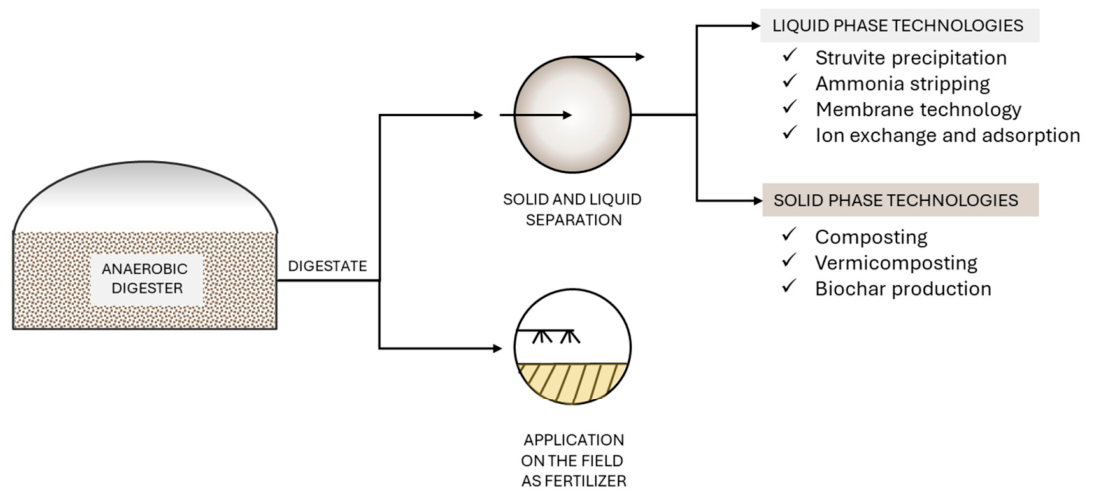
Agro-energy systems and biogas plants are a particularly promising area for integration, as they combine energy production with nutrient recycling and the local utilisation of biomass. In this setup, agricultural raw materials, organic waste, or post-production residues can be used to feed the anaerobic digestion process, and the resulting digestate can be further utilised as a source of fertiliser nutrients, a soil amendment, or a substrate for the recovery of nitrogen and phosphorus. Research into the management of digestate shows that its use as a biofertiliser can improve biomass production on poorer soils while creating a feedback loop between the biogas plant and the local feedstock production system. Furthermore, modern technologies for recovering components from digestate—such as struvite precipitation, ammonia stripping, composting, vermicomposting, the use of microalgae, and pyrolysis to produce biochar—demonstrate that a biogas plant can function not only as an energy generation facility but also as a hub for the recovery of biogenic materials and the production of functional materials. In this context, pellets and briquettes can serve as stabilised, easily transportable and dispensable forms of fertiliser, carrier material, or fuel, combining energy management with nutrient management [
50,
51,
76,
77].
The practical implications of this approach are well illustrated by strategies for recovering valuable products from digestate (
Figure 7), in which waste streams from the biogas sector can be converted into fertilisers, nutrient concentrates, bioproducts, or materials that support the closure of material cycles in agro-environmental systems [
77].
The second aspect of integration involves linking pellets and briquettes to energy systems in which biomass serves as a controllable, storable, and logistically flexible energy carrier. Unlike sources that depend on current weather conditions, concentrated fuels can be stored, transported, and deployed whenever the system requires heat, electricity, or reserve capacity. Analyses of flexible bioenergy indicate that modern bioenergy can provide flexibility services that extend beyond the electricity sector alone to include heat, fuels, and cross-sector integration. Research into the integrated production of district heating, electricity, transport fuels, and pellets shows that polygeneration systems can improve cost and fuel efficiency compared to solutions based solely on heat production. In this sense, pellets or briquettes become not only end products but also means of managing the flexibility, seasonality, and spatial distribution of renewable energy [
4,
46,
48].
However, a systems-based approach requires caution, as integrating multiple functions does not automatically lead to environmental improvements. A product designed for use as a fuel should have low moisture content, high calorific value, good mechanical durability, and low ash content, whereas a product intended for sorption, soil, or biological applications may require higher porosity, absorbency, specific surface reactivity, or controlled susceptibility to transformation. In practice, this means that pellets and briquettes must be designed according to a “function-by-design” approach, rather than based on a single universal definition of quality. Such a design should be supported by life-cycle assessment, techno-economic analysis, and material flow analysis, as only then can it be determined whether a particular application actually reduces emissions, eases pressure on resources, and creates economic value. Previous LCA reviews of pellets and briquettes indicate that the results are highly dependent on system boundaries, the functional unit, the drying method, transport, allocation, and the end-use scenario; therefore, the assessment of integrated models must cover the entire value chain, rather than just the fuel or material production stage [
5,
18,
41,
44].
Consequently, an integrated systems approach allows pellets and briquettes to be viewed not simply as two basic forms of biofuel but as material platforms that can be incorporated into complex agro-energy, environmental, and material systems. Their role depends on whether the system can match the properties of the raw material to the optimal use scenario, minimise logistical losses, recover minerals, utilise by-products, and combine energy production with environmental functions within a single model. This approach leads directly to the next issue: identifying the factors that determine the effectiveness of these solutions, as well as the technological, economic, and regulatory constraints that may hinder their practical implementation.
7. Factors Determining Effectiveness: Technological and Economic Constraints and Prospects
The efficiency of using pellets and briquettes depends on the interplay of many factors, which include not only the product’s characteristics but also the origin of the raw material, densification conditions, logistics, storage stability, quality standards, costs, and the regulatory environment. In practice, this means that fuels and compacted materials cannot be assessed solely on the basis of their calorific value or mechanical durability. Their true value only becomes apparent when viewed across the entire chain, from biomass procurement, through its preparation and processing, to the final energy, environmental, or material application.
This is because the final quality of briquettes depends not only on the properties of the raw material but also on the subsequent stages of biomass preparation, conditioning, and compaction. The briquetting process (
Figure 8) can be viewed as a production chain in which each stage can influence the mechanical strength, production costs, and market potential of the product [
6].
The efficiency of pellets and briquettes therefore depends on a number of interrelated factors that affect both the quality of the product and the performance of the entire system in which it is used. The key technological, logistical, economic, and regulatory factors are summarised in
Table 7.
Taken together, these factors suggest that the efficiency of pellets and briquettes is not solely a result of the densification process. It covers the entire value chain, from biomass quality and production conditions to storage, transport, standardisation, costs, and legal requirements.
The type of raw material is the first and one of the most important factors determining the quality of pellets and briquettes, as it affects how the biomass behaves during grinding, mixing, compaction, cooling, storage, and final use. Woody biomass, agricultural residues, agro-industrial waste, green fractions, sludge, or mixtures of raw materials vary in their content of lignin, cellulose, hemicellulose, extractable organic substances, proteins, fats, ash, and minerals. These differences affect the tendency to form permanent bonds between particles, the energy requirements of the process, the wear of working components, and the mechanical durability and emission profile of the product. Classic studies on densification indicate that the durability and strength of densified products depend on moisture content, chemical composition, particle size, conditioning temperature, binding additives, and equipment parameters, whereas more recent studies on various types of biomass confirm that the chemical composition of the raw material can significantly determine the course of the pelletising process and the quality of the final pellet. For this reason, the choice of raw material should be regarded not as a preliminary stage but as a design decision that determines the product’s subsequent function: energy source, fertiliser, sorption, biological medium, or material [
7,
20,
78,
79].
The densification process determines whether the raw material’s potential will be translated into a product with stable and consistent properties. The key factors here are the initial moisture content, particle size and distribution, pressure, temperature, the residence time of the material in the compression chamber, the length-to-diameter ratio of the die, friction, cooling, and the possible addition of binders or substances that facilitate forming. In the case of pellets, it is particularly important to form stable bonds between the particles, a process in which lignin—which becomes plasticised under the influence of temperature and pressure—plays a major role. In the case of briquettes, the choice of binder may be more important, as the larger size of the product and the more varied composition of the raw materials increase the risk of cracking, delamination, and loss of cohesion. The literature shows that improving a single process parameter does not always improve overall quality: higher pressure may increase density but also raise energy consumption. The addition of a binder may improve strength but at the same time alter ash content and combustion behaviour. Conversely, insufficient moisture content may impede forming, whereas excessive moisture content may compromise durability and calorific value. Densification is therefore a technological trade-off between product quality, energy consumption, equipment durability, and the end use of the material [
4,
7,
14,
78].
Storage and transport conditions can significantly alter the properties of pellets and briquettes once the production process is complete. Compacted materials are hygroscopic; therefore, exposure to high relative humidity, temperature fluctuations, water vapour condensation, or direct contact with water leads to swelling, structural loosening, a loss of mechanical strength, and an increase in the proportion of fine particles. Research into the long-term storage of wood pellets has shown that outdoor storage causes significantly more severe mechanical degradation than storage in sheltered conditions; laboratory experiments confirm that fluctuating temperature and humidity levels are particularly detrimental to the pellets’ structural integrity. Recent studies on agricultural pellets have also indicated that materials derived from agricultural biomass may be more susceptible to degradation than wood pellets. Transport further exacerbates this problem, as vibrations, spillage, impacts, and abrasion increase dust formation and reduce fuel quality at the point of delivery. Therefore, product durability should be assessed not only immediately after production but also following simulation of real-world storage and logistics handling conditions [
13,
14,
80,
81].
Standardisation is one of the prerequisites for the development of the pellet and briquette market, as it enables quality comparison, equipment selection, commercial control, and the mitigation of operational risks. For wood pellets, the ISO 17225-2 (
ISO 17225-2:2021; Solid Biofuels—Fuel Specifications and Classes—Part 2: Graded Wood Pellets. International Organization for Standardization: Geneva, Switzerland, 2021) framework defines quality classes and specifications for pellets intended for non-industrial and industrial use, whereas ISO 17225-6 (
ISO 17225-6:2021; Solid Biofuels—Fuel Specifications and Classes—Part 6: Graded Non-Woody Pellets. International Organization for Standardization: Geneva, Switzerland, 2021) addresses graded non-woody pellets, including fuels derived from herbaceous, fruit, and aquatic biomass, as well as biomass blends [
22,
82]. These standards are particularly important because non-wood biomass often contains higher levels of ash-forming and problematic elements, including chlorine, nitrogen, potassium, and silicon, which may impair combustion performance and increase the risk of deposits, slagging, and corrosion [
7,
10]. In parallel, certification schemes such as ENplus for wood pellets and the Sustainable Biomass Programme for industrial biomass supply chains support product quality assurance and sustainable sourcing [
82]. However, existing fuel standards do not fully address all functional applications of pellets and briquettes. Uses involving sorption, fertiliser carriers, microbial carriers or bio-based materials require additional quality criteria related to durability, environmental safety, biodegradability, surface functionality and application-specific performance. Therefore, the further development of multi-purpose pellets and briquettes will require not only the application of existing fuel standards but also the formulation of more function-oriented criteria for non-combustion uses.
The economic efficiency of pellets and briquettes depends on the balance between the costs of raw materials, drying, grinding, densification, storage, transport, certification, and the final conversion of energy or material. In the wood pellet supply chain, the highest costs are usually those of the raw material and the plant’s operating costs, including the energy required for drying. Visser et al. [
83] showed that scaling up a wood pellet plant can reduce pelletisation and sea freight costs but may simultaneously increase the costs of sourcing and transporting raw materials, illustrating the typical trade-off between economies of scale and biomass logistics. Studies on torrefied pellets have, in turn, shown that improving the fuel’s properties can reduce supply costs throughout the supply chain but only if the process is properly configured, cheap raw materials are available, and logistics are efficient. Koido et al. [
45] combined life-cycle CO
2 emission assessment with techno-economic analysis of wood pellet production and pellet-fired CHP systems and showed that drying accounted for 35–39% of total energy consumption in pellet production. They also demonstrated that the choice of heat source and plant scale significantly affected both environmental and financial outcomes. In practice, this means that the cost-effectiveness of pellets and briquettes should not be assessed solely on the basis of the price per tonne of the product but rather in terms of the cost of useful energy, the cost of the material function, avoided emissions, local availability of raw materials, and the potential for utilising by-products [
4,
45,
49,
83].
Regulatory frameworks are having an increasingly significant impact on the production, certification, and use of pellets and briquettes, particularly when they are introduced into energy systems as renewable fuels. Within the European Union, the key reference points remain the Renewable Energy Directive (RED) II and its amendment, RED III, which strengthen requirements regarding the sustainable sourcing of biomass, the reduction of greenhouse gas emissions, and the cascading use of raw materials. The EUDR is also of significant importance to the wood biomass market, as it covers wood and wood products and links their placing on the market to requirements regarding legality, due diligence, and the absence of any link to deforestation or forest degradation. At the same time, the ecodesign requirements for solid fuel boilers impact the end of the supply chain, as they favour appliances with higher efficiency and lower emissions. Consequently, the future of pellets and briquettes will depend not only on technical specifications but also on manufacturers’ ability to document the origin of raw materials, meet quality criteria, reduce their carbon footprint, and demonstrate that a given use of biomass is consistent with the environmental hierarchy. This is particularly important for multifunctional solutions, as materials that can be used for both energy and non-energy purposes should be directed towards uses where they provide the greatest added value with the least environmental impact [
84,
85,
86,
87].
In summary, the technological and economic efficiency of pellets and briquettes does not depend on a single dominant factor but on the coherence of the entire system: the right raw material, a well-chosen densification process, stable storage, minimal logistical losses, compliance with standards, acceptable costs, and alignment with climate policy. It is therefore not individual products with a high calorific value that offer the greatest potential for development but rather those biomass utilisation models in which material quality, functionality, economic efficiency, and environmental criteria are designed in tandem. This perspective leads directly to considerations regarding the future of multifunctional pellets and briquettes and their role in integrated agro-environmental, energy, and material systems.
8. Areas of Development
The prospects for the development of pellets and briquettes are increasingly moving beyond the traditional view of them as compressed solid fuels. Until now, the development of this sector has largely been driven by efforts to improve energy performance, standardise fuel quality, and enhance the logistical efficiency of biomass. Currently, a broader approach is gaining increasing importance, in which pellets or briquettes are regarded as a material platform capable of further functionalisation, conversion, or integration with other processes. This marks a shift from the simple question of whether a given material is suitable for combustion to the question of how to design its composition, structure, porosity, durability, and reactivity so that it fulfils a specific energy, environmental, biological, or material function. This shift in perspective is consistent with the recent literature, which points to a transition from treating pelletised biomass as an alternative fuel to viewing it as a multifunctional platform for energy, industrial chemicals, sorbents, and higher-value-added materials [
9,
18,
88].
8.1. Multi-Purpose Pellets and Briquettes
One of the most important areas for future development is the design of multi-purpose pellets and briquettes that are not limited to a single application. In practice, this may refer to materials that initially serve as a fertiliser carrier, soil amendment, or sorbent, and which, once their useful life has ended, can be further valorised, for example, through pyrolysis to produce biochar or by being used as material components. Systems in which residual biomass, biochar, mineral additives, biopolymers, or microorganisms are combined into a single compact form with controlled geometry and function are particularly promising. Research into pellets made from waste biomass shows that fresh pellets can be further carbonised to produce biochar pellets, and the resulting materials may prove useful in agriculture, forestry, and environmental remediation. At the same time, research into slow-release fertilisers suggests that biochar can act as a matrix for binding and releasing nutrients, paving the way for the development of pellets that serve fertilising, water-retention, and environmental functions simultaneously [
18,
50,
52].
However, multifunctionality does not simply mean combining as many features as possible in a single product. On the contrary, future development will require a precise definition of the primary and secondary functions, as features that are beneficial for one application may compromise suitability for another. High porosity may improve water sorption and retention but reduce mechanical strength; a high ash content may reduce fuel quality but increase the mineral potential of the soil material, whereas the biological activity of microorganisms may enhance the agronomic value of the product but requires milder pelletising conditions [
53,
54,
88].
8.2. Designing Materials for Specific Applications
Another approach involves moving away from the traditional selection of raw materials towards designing pellets and briquettes as materials with a defined structure and function. In the case of energy applications, this means further optimisation of density, calorific value, mechanical durability, moisture resistance, and mineral composition, particularly for non-wood biomass fuels and multi-feedstock blends. In the context of non-energy applications, the priorities differ: adsorption capacity, active surface area, porosity, binding capacity of components, biological stability, and compatibility with the composite matrix are essential. Pre-treatment techniques such as torrefaction, hydrothermal carbonisation, low-temperature pyrolysis, surface activation, and blending biomass with mineral or biopolymer additives are of particular importance here, as they can alter not only the fuel quality but also the sorption capacity, hydrophobicity, susceptibility to degradation, and the material value of the product [
9,
36,
37].
In this area, the development of rapid quality control methods will be particularly important, as these will enable the properties of pellets and briquettes to be assessed not only in the laboratory but also in real time or on a semi-continuous basis. Traditional methods of determining moisture content, ash content, calorific value, density, and mechanical strength are time-consuming and are often carried out off the production line, which limits the ability to make real-time adjustments to the process. Research into the use of near-infrared (NIR) hyperspectral imaging [
89,
90] and machine learning [
91] shows that it is possible to rapidly predict selected pellet parameters, such as volatile matter content, fixed carbon content, ash content, fuel ratio, bulk density, and combustion properties. In the future, such solutions may support smart pelletising lines, in which process parameters are automatically adjusted according to the quality of the raw material, moisture content, mixture composition, and the intended end use of the product.
8.3. Integration into Agro-Ecosystems and Local Bioeconomy Systems
The most promising scenarios for future development are likely to emerge not in isolated fuel production plants but within local and regional bioeconomy systems. In agroecosystems, pellets and briquettes can act as a link between agricultural production, waste management, bioenergy, nutrient recycling, and soil improvement. Agricultural residues, herbaceous biomass, processing waste, digestate, compost, biochar, and biomass ash can be processed into compacted forms that are easier to store, transport, apply, and further convert. In this model, pelletisation is not merely the final stage of fuel production but a tool for organising material flows on a farm, at a biogas plant, in an agro-food processing facility, or within a local district heating network. Biogas plants are particularly important in this context, as they can combine energy production with the recovery of components from digestate and the subsequent manufacture of fertilisers or soil-improving products [
51,
76,
77].
On a broader scale, such solutions can support the development of a cascading use of biomass, in which the fractions with the highest material value are first directed towards functional applications, and only the residues or end-of-life products are sent for energy recovery. This model is particularly important given the limited availability of biomass, competition for raw materials, and growing demands for sustainably sourced materials. From the perspective of future research, this means that it will be necessary to combine the analysis of product properties with an assessment of material flows, local availability of raw materials, seasonality of supply, logistics costs, and environmental impacts. In this context, pellets and briquettes can serve as stable, standardisable, and easily transportable intermediate forms between the various stages of the bioeconomy, from waste, through functional materials, to final energy [
18,
46,
74].
8.4. Priorities for Further Research and Implementation
Despite their considerable potential, the future development of multi-purpose pellets and briquettes requires the resolution of several methodological and implementation issues. First, it is necessary to develop more comparable methods for assessing products intended for non-energy uses, as current standards are far better established for fuels than for fertiliser, sorbent, bio-based, or material pellets. Second, long-term studies are needed to examine the behaviour of such products in soil, water, composites, and storage conditions, as short-term laboratory tests do not always reflect their actual durability, biodegradability, leaching of components, and functional stability. Third, the development of integrated solutions should be supported by LCA, techno-economic analysis, and environmental risk assessment, in order to avoid a situation where a technologically attractive product proves to be disadvantageous due to drying, transport, chemical additives, or difficulties with end-of-life management. In this sense, the future of pellets and briquettes will depend not only on material innovations but also on the ability to assess them systematically and reliably [
5,
18,
41,
44].
From an implementation perspective, it will be important to better align technological innovation with the realities of the biomass market. Even the most advanced functional pellet will not be competitive if its production requires expensive raw materials, energy-intensive drying, complex logistics, or an unreliable supply chain. Technical and economic studies indicate that the profitability of pellet production is particularly sensitive to the price of biomass but also to its moisture content, the scale of the facility, transport costs, and the process configuration. Future implementation models should therefore prioritise local or regional systems that utilise available waste and by-products, minimise transport, recover process heat, and integrate several value streams: energy, materials, fertiliser components, and environmental services. Only such an approach will enable the full potential of pellets and briquettes to be harnessed as tools not only for decarbonisation but also for the circular economy [
45,
49,
83,
92].
In summary, the future of pellets and briquettes will depend on the transition from simple fuel products to functionally designed materials that are assessed holistically and integrated into local bioeconomy chains. Solutions that combine controlled densification, raw material selection, chemical or biological functionalisation, digital quality control, and environmental assessment throughout the entire life cycle offer the greatest potential for development. Only in this context can pellets and briquettes become not only sources of renewable energy but also tools for recycling materials, reducing waste, improving soil quality, cleaning up the environment, and producing materials with a lower resource footprint.
9. Discussion
The conducted synthesis indicates that the primary advancement in current research on pellets and briquettes lies not merely in the enhancement of solid fuels but in the expanded definition of the product itself. Pellets and briquettes should no longer be regarded solely as the final form of compressed biomass intended for combustion. It is becoming increasingly appropriate to regard them as tangible interfaces between waste management, bioenergy, agriculture, environmental remediation, and materials engineering. This change does not negate their energy function but places it within a broader context in which the value of the product is determined not only by its calorific value but also by the ability to design its geometry, pore structure, mineral composition, surface reactivity, durability, and susceptibility to further conversion. In this sense, the most promising direction for development does not lie in replacing the energy use of biomass with non-energy applications but in establishing a hierarchy of functions in which combustion is one of the possible stages of valorisation but not always the first or default choice [
9,
18,
88].
The key conclusion from the analysis of physicochemical properties is that there is no single universal definition of a “good” pellet or a “good” briquette. A parameter that is advantageous in one scenario may be a limitation in another. High density and mechanical strength are desirable in transport, automated feeding, and combustion; however, in sorption or soil applications, low porosity may limit water retention, the availability of active surface area, and microbial colonisation. A low ash content is beneficial in terms of fuel efficiency, but the mineral fraction may be of value as a fertiliser or construction material. Biodegradability is a drawback in fuel storage, but it can be an advantage in products intended for use in the soil. This means that future assessments of pellets and briquettes should be based not on individual quality parameters but on the suitability of a set of properties for a specific end use. This finding is particularly relevant for non-wood and waste biomass, the variability of which is often regarded as a fuel-related issue but which can become a resource in the design of functional products [
4,
7,
10,
78].
In energy applications, the greatest strength of pellets and briquettes remains their ability to transform scattered, logistically challenging biomass into a fuel with more predictable characteristics. However, this does not mean that compressed biomass is automatically a low-carbon or environmentally friendly fuel. Compressed biomass should not be treated as inherently superior to fossil fuels. Its environmental advantage must be demonstrated for a defined system boundary and depends on feedstock origin, drying energy, transport distance, conversion efficiency, emission control, and the reference fossil fuel being displaced [
41,
44,
45]. This is where one of the key tensions in the area under analysis comes to the fore: densification improves the logistics and usability of biomass but requires energy, infrastructure, and a stable supply chain. In the case of torrefaction, hydrothermal carbonisation, pyrolysis, and gasification, this problem becomes even more pronounced. These technologies can improve fuel quality or enable the production of biochar, gas, and chemicals, but their actual benefits depend on thermal integration, the scale of the facility, the quality of the feedstock, and the potential for utilising by-products. Therefore, the thermochemical approach should be viewed not as a simple modernisation of combustion but as a transition to more complex biomass processing systems [
9,
36,
37,
38].
Non-energy applications appear to be the most innovative aspect of this field, but at the same time, they remain less mature in terms of technology and standardisation than fuel applications. Fertiliser carriers, microorganism carriers, sorbents, biological substrates, and composite components demonstrate clear potential for the functionalisation of biomass, but much of the research remains at the laboratory or pilot scale. Consequently, it is easy to overestimate the readiness of such materials for implementation if they are assessed solely on the basis of their performance in a short-term sorption test, a component release test, or a microorganism growth test. For environmental and agricultural applications, a longer-term perspective is required: stability of function in soil or water, risk of leaching, impact on the microbiome, the potential for the accumulation of contaminants, mechanical durability after transport, and behaviour at the end of the product’s life cycle. This is precisely where a cautious approach to research is required. Functional pellets should not be regarded merely as a “waste product” but as a material introduced into the environment, and therefore one that requires evidence of safety and predictability of behaviour [
50,
51,
53,
54].
A systemic approach therefore seems the most convincing, but it too needs to be clarified. In the literature, the concepts of the circular economy, the cascading use of biomass, and biorefineries are occasionally presented as standalone arguments; however, their true value is contingent upon the specific organisation of material flows. The cascading use of biomass is not automatically beneficial if it involves long-distance transport, intensive drying, additives that impair subsequent processing, or if it results in a product for which there is no stable market. On the other hand, local agro-energy systems, biogas plants, agri-food processing facilities and heating plants can create highly favourable conditions for pellets and briquettes, as they combine raw material availability, energy demand, the potential for component recovery and shorter supply chains. The greatest potential, therefore, lies not in abstract multifunctionality but in tailoring the product’s functions to the local system. This approach avoids two extremes: reducing biomass solely to fuel and uncritically attributing high material value to all waste [
46,
74,
76,
77].
LCA and techno-economic analysis are of particular importance for future development, as they enable us to distinguish between genuine environmental improvements and the shifting of environmental impacts between different stages of the life cycle. In the case of pellets and briquettes, the benefits associated with replacing fossil fuels are most frequently discussed; however, LCA results are heavily dependent on system boundaries, the functional unit, allocation, the energy source used for drying, transport distance, and the end-use scenario. Martín-Gamboa et al. [
41] noted that the LCA literature on pellets is methodologically heterogeneous, which makes it difficult to directly compare results across studies. Conversely, analyses of biomass densification systems show that the production of densified fuel alone can generate significant environmental impacts if it requires intensive drying or the transport of low-density feedstock. Methodological rigour is therefore particularly important in this area of research: clearly defined system boundaries, comparable functional units, sensitivity analysis, and separate assessment of energy and non-energy options. Without this, it is easy to draw conclusions that are too general, which sound good in the rhetoric of the circular economy but are not sufficiently robust from an analytical perspective [
5,
41,
44,
45].
Standardisation appears to be another barrier. There is a well-established quality framework for fuel pellets, whereas the assessment criteria for functional pellets and briquettes remain fragmented. A sorbent product requires different parameters from those of a fuel; a microorganism carrier requires an assessment of survival rates and biological activity, whereas a soil additive requires testing for phytotoxicity, leaching of components, and its impact on soil properties. The composite component, on the other hand, must be assessed for compatibility with the matrix, dimensional stability, and durability. The lack of a consistent assessment framework can make it difficult to compare studies, carry out certification, and implement measures. At the same time, applying fuel standards too rigidly to functional products would be a mistake, as it could rule out valuable materials in non-energy applications. A parallel standardisation process is therefore required: one for fuel quality and the other for functional quality. Only then will it be possible to move from promising laboratory demonstrations to products that can be used safely in agriculture, the environment, and materials [
22,
51,
53,
82].
From the perspective of this review, the most sensible course of action is not to maximise the number of potential applications for pellets and briquettes but to base design decisions on the quality of the raw material. Clean, dry biomass with a low ash content and a good combustion profile should be used for high-efficiency energy applications. Biomass that is more mineral-rich, porous, moist, or difficult to burn may be better utilised as a soil-forming component, sorbent, nutrient carrier, or biochar precursor. Contaminated waste, however, requires careful assessment, as the recovery of waste must not result in the transfer of environmental risk to soil, water, or building materials. This way of thinking leads to a “quality-to-function” model, in which the properties of the raw material and environmental risks determine the optimal path for its use. This approach is more demanding than simply classifying biomass as a fuel, but it better reflects the realities of the circular economy and the limited availability of biological resources [
9,
18,
20,
21].
Ultimately, pellets and briquettes should be recognised as an intermediary technology, rather than as a final solution. Their significance lies in the fact that they give loose biomass a form that can be transported, dispensed, stored, standardised, and further processed. This seemingly simple technological process can pave the way for a wide range of applications: combustion, cogeneration, pyrolysis, fertilisation, sorption, use as a substrate for microorganisms, and the production of composites or building materials. The strength of this solution is found in its flexibility; however, it also possesses certain weaknesses. Without clear specifications for the raw material, functional standards, an environmental assessment, and an economic analysis, this flexibility could lead to a lack of focus in research and overly optimistic claims. Therefore, the primary focus of the discussion is the necessity of transitioning from the descriptive cataloguing of applications to the development of integrated valorisation pathways that evaluate material, process, function, and system collectively. Only then can pellets and briquettes become a viable tool for the bioeconomy, rather than merely another form of compressed fuel [
4,
18,
74,
79].
10. Conclusions
This review shows that pellets and briquettes should be interpreted not only as compacted solid biofuels but also as densified biomass materials with broader functional potential. Their value depends on the relationship between raw material properties, densification conditions, and the intended end use.
First, there is no single universal definition of pellet or briquette quality. In energy applications, high density, low moisture content, high heating value, mechanical durability, and low ash content remain critical. In non-combustion applications, however, properties such as porosity, absorbency, mineral composition, surface reactivity, and controlled biodegradability may be equally or more important.
Second, the environmental performance of densified biomass is conditional rather than automatic. The climate and resource benefits of pellets and briquettes depend on feedstock origin, drying energy, transport distance, end-use technology, system boundaries, and the fossil or biomass alternative being replaced.
Third, non-combustion applications represent an important direction for further development. Pellets and briquettes can serve as fertilisers and microbial carriers, sorbents, soil amendments, biological substrates, bio-fillers, and components of building materials. These applications require additional assessment criteria related to functional stability, leaching risk, environmental safety, biological activity, and long-term behaviour under real-use conditions.
Fourth, the main scientific contribution of this review is the proposed quality-to-function perspective. This approach links material properties with energy, agro-environmental, biological, sorption, and material applications, and supports more rational biomass valorisation within circular bioeconomy systems.
Future research should focus on designing densified biomass materials for clearly defined functions, developing rapid quality control methods, validating long-term environmental safety, and integrating pellets and briquettes into local biomass, biogas, agro-industrial, and material value chains.