Article

Towards 50% Efficiency in Opposed Free-Piston Linear Generators Operating with Natural Gas and HCCI Combustion


ICE Group—Energy Department, Politecnico di Milano, 20156 Milan, Italy
*
Author to whom correspondence should be addressed.
Energies 2026, 19(12), 2833; https://doi.org/10.3390/en19122833 (registering DOI)
Submission received: 6 May 2026 / Revised: 5 June 2026 / Accepted: 12 June 2026 / Published: 14 June 2026

Abstract

Internal combustion engines are a well-established, efficient and dispatchable solution for distributed power generation and they are widely used in various sectors including grid balancing, data centers and combined heat and power systems. Current research efforts focus on further increasing efficiency, enabling decarbonization through renewable fuels and improving responsiveness to electricity demand in the presence of variable renewable energy sources. In this context, the free-piston linear generator (FPLG) stands out as a highly promising technology, as it directly converts piston motion into electricity, offering high efficiency, reduced mechanical complexity and seamless grid integration. Initially explored for its high-efficiency potential with homogeneous charge compression ignition combustion at extreme compression ratios, opposed-piston FPLGs are now commercially available for distributed power generation, delivering global efficiencies exceeding 45%, near-zero emissions and multi-fuel capability. Building on the detailed studies conducted by Svrcek and co-authors, this work investigates the power-generation potential of low-temperature homogeneous combustion using CFD simulations with detailed chemical kinetics. First, rapid compression machine (RCM) experiments with methane were reproduced in simulations to validate the proposed methodology and to consolidate experimental findings on the maximum achievable efficiency. Subsequently, an extensive RCM simulation campaign supported the identification of optimal operating conditions in terms of air–fuel ratio using methane as fuel. The RCM results enabled the definition of a preliminary methane-fueled opposed-piston FPLG configuration. Full-cycle simulations including gas exchange, mixing and combustion demonstrated an indicated efficiency of 58% at an equivalence ratio ϕ = 0.5 and a compression ratio of 50. The key novelties of this study are the development of a novel RCM-2 configuration that more closely reproduces the dynamic behavior of an opposed-piston FPLG including air-spring effects and the introduction of a divided intake port strategy to simultaneously reduce fuel slip and mitigate knocking behaviour through charge stratification. The simulation results for the proposed configuration confirm the potential of opposed-piston FPLGs for high-efficiency power generation and highlight key parameters affecting performance and emissions formation.

1. Introduction

Global electricity consumption is expected to increase steadily over the coming decades, driven by expanding industrial activity, rising demand for air conditioning, accelerating electrification and the rapid growth of data centres worldwide [1]. At the same time, the growing penetration of renewable energy is reshaping the role of internal combustion engines (ICEs) in power generation. Owing to their high efficiency, low emissions and short start-up times, ICEs remain essential for mission-critical, backup, and continuous power supply, as well as for grid stabilization during periods of low renewable availability and in combined heat and power (CHP) installations.
Given the expanding market and the evolving energy landscape, continued technological development is crucial for next-generation genset engines. Priority areas include improving efficiency, enabling operation with low-carbon fuels, reducing emissions, and ensuring seamless integration within microgrids and hybrid systems supported by energy storage. In this context, free-piston linear generators (FPLGs) have emerged as innovative, multi-fuel thermal machines well suited for distributed power generation [2,3,4,5]. In principle, FPLGs are simpler and potentially more efficient than conventional genset ICEs: the linear generator directly converts piston motion into electricity, while the opposed-piston, two-stroke configuration significantly reduces the number of mechanical components [6,7].
Most research on free-piston linear generators has focused on their use in electrified power units for passenger cars and commercial vehicles. Continuous operation of a single-piston FPLG in spark-ignition (SI) mode was successfully demonstrated in [8,9,10] using a 10 kW prototype with a uni-flow scavenging layout, achieving a global efficiency of 36% and showing potential to reach 42% through PCCI combustion. Among the architectures investigated, the opposed-piston configuration currently attracts the most attention due to its superior scavenging characteristics, lower mechanical complexity and higher expected efficiency. Ongoing research addresses several key areas: piston motion control, explored through both lab-scale prototypes and numerical simulations [11,12,13,14]; optimization of the gas-exchange process to improve scavenging, mixture formation, and turbulence generation [12,15,16]; operation with renewable fuels, including hydrogen [17,18].
However, despite these advances, significant challenges remain for automotive applications. Requirements related to transient response, long-term durability, maintenance, vibration resistance and power density are considerably more demanding in vehicles than in stationary systems. As a result, while FPLGs show strong promise for stationary power generation, where their high efficiency and fuel flexibility offer clear advantages, their adoption in transportation remains limited.
The first commercially available FPLG can be traced back to the experimental work of Svrcek and co-authors, who investigated the efficiency limits of ICEs under extreme compression-ratio conditions [19,20,21]. Their investigations directly contributed to the realization of a two-cylinder unit able to run on gaseous fuels and deliver 250 kW with a net efficiency of 46% [5]. This performance is enabled by several technological solutions designed to sustain HCCI combustion with highly diluted mixtures [22,23]. For instance, fuel from the natural gas grid is directly injected into the intake system without requiring additional compression. Air bearings minimize friction between the pistons and the liner, eliminating the risk of oil-induced pre-ignition that could compromise durability and thermal efficiency. Additionally, divided intake ports reduce fuel short-circuiting during scavenging. Because the piston position at top dead centre (TDC) results from the dynamic force balance (including generator load), it is possible to effectively control the compression ratio and adjust operation to different fuels.
Research and development activities consolidated the FPLG technology for power generation in different sectors: microgrids, backup power, biogas plants, EV charging stations and related applications. However, further understanding the full FPLG potential in terms of efficiency and specific power could extend their deployment to a wider range of stationary applications. This work investigates, via CFD simulations, the HCCI combustion process under conditions typical of opposed-piston FPLGs to understand the efficiency limits achievable operating with port-fuel injection and lean mixtures. Simulations were carried out using tabulated kinetics [24,25] to reduce computational time while preserving accuracy, allowing for extensive studies. The rapid compression machine (RCM) configuration presented in [20,21] was first simulated to validate the proposed computational methodology with available experimental data using stoichiometric methane and to evaluate the benefits of lean mixtures in terms of efficiency potential and combustion noise. Such initial assessment supported the definition of a second RCM geometry (RCM-2) configuration whose geometry and operation are closer to existing opposed-piston engines, including the effects of air spring pressure variation. Simulation results identified optimal conditions with ∼60% indicated efficiency for lean methane operation in terms of supercharging level and compression ratio, and also provided a realistic piston displacement profile. Afterwards, a proto-FPLG geometry was designed accordingly also including the intake and exhaust ports. The full-cycle was simulated to verify if RCM-2 efficiency values can be achieved under realistic operation in presence of gas exchange and trapped residuals, but also to investigate the benefits that divided intake ports produce in terms of reduced fuel slip and combustion noise thanks to charge stratification.
The primary contributions of this work are here reported:
  • The proposed computational framework, based on the Flamelet Generated Manifold approach, is validated against experimental RCM data from Svrcek [21] under both motored and fired conditions with stoichiometric methane–air mixtures, consolidating the experimental findings on maximum achievable efficiency.
  • A novel RCM-2 configuration is introduced to better reproduce the dynamic behavior of an opposed-piston FPLG, incorporating an air-spring system and a larger bore diameter representative of commercial prototypes. An extensive parametric study over the equivalence ratio range ϕ = 0.2–0.7 identifies optimal operating conditions in terms of indicated efficiency, ringing intensity and NOx emissions potential, providing a first basis for the subsequent FPLG design.
  • Based on the RCM-2 results, a proto-FPLG configuration is defined, including bore, stroke, port geometry and piston motion profile. A novel divided-port scavenging configuration is proposed and evaluated through full-cycle CFD simulations. The strategy is shown to significantly reduce methane slip and to induce charge stratification that mitigates knocking behavior, while preserving indicated efficiencies above 58% and achieving near-zero NOx emissions, demonstrating a viable path toward next-generation high-efficiency distributed power generation.

2. Computational Models

CFD simulations were performed using the Lib-ICE code, a suite of libraries and solvers for internal combustion engine modeling built on OpenFOAM technology [26,27]. The transport equations were solved for a compressible, turbulent flow using a RANS formulation with the standard k ε model. The Flamelet Generated Manifold (FGM) approach was adopted to incorporate detailed chemical kinetics into the CFD framework, enabling accurate predictions at significantly reduced computational cost. This method made it possible to conduct a large number of simulations in the rapid compression machine configuration and to identify the most promising operating conditions in terms of efficiency, acceptable pressure rise rates and low NOx emissions. In this work, the FGM look-up table stores reaction rates and species compositions obtained from zero-dimensional, homogeneous, constant-pressure reactor simulations spanning a range of oxidizer temperatures T o x , equivalence ratios ϕ and pressures p [28,29,30]. Authors extensively verified the consistency between direct chemistry integration and FGM in [28] and applied it to model kinetically controlled combustion in [24,31]. Reaction rates are computed assuming each cell to be a homogeneous reactor, neglecting sub-grid turbulence–chemistry interaction (TCI) and assuming that combustion is mainly governed by chemical kinetics and thermal stratification. This assumption was extensively verified by the authors in previous works where HCCI combustion was simulated considering different fuels (n-heptane and iso-octane) and validated with experimental data of cylinder pressure, heat release rate, peak-pressure location and maximum pressure rise rate [32,33,34]. To account for TCI, the sub-grid temperature variance T 2 ˜ should be estimated and reaction rates computed according to an assumed probability density function. Another option would be the use of transported PDF combustion models [35]. TCI in HCCI combustion goes beyond the scopes of the present investigation and will be the matter of studies in future works.
The main limitations of the proposed computational methodology are as follows: The RANS k ε turbulence model provides mean-cycle predictions and does not resolve cycle-to-cycle variability; its impact on mixture formation results is considered limited given the low scavenging pressure differential and near-homogeneous charge. In the full-cycle simulations, the piston motion is prescribed rather than computed dynamically, which decouples mechanical dynamics from combustion. The air-spring is modeled as a polytropic process with index n = 1.3, representative of partial heat transfer conditions. Finally, wall temperatures are assumed uniform throughout the cycle, which may underestimate the degree of thermal stratification in the charge. These limitations are consistent with the scope of the present study, which aims at evaluating the thermodynamic potential of the proposed configuration rather than providing a fully predictive model of a specific prototype and will be addressed progressively as the work advances toward experimental validation.

3. HCCI Combustion Assessment in Rapid Compression Machine

3.1. Experimental Validation with Stoichiometric Methane–Air Mixture

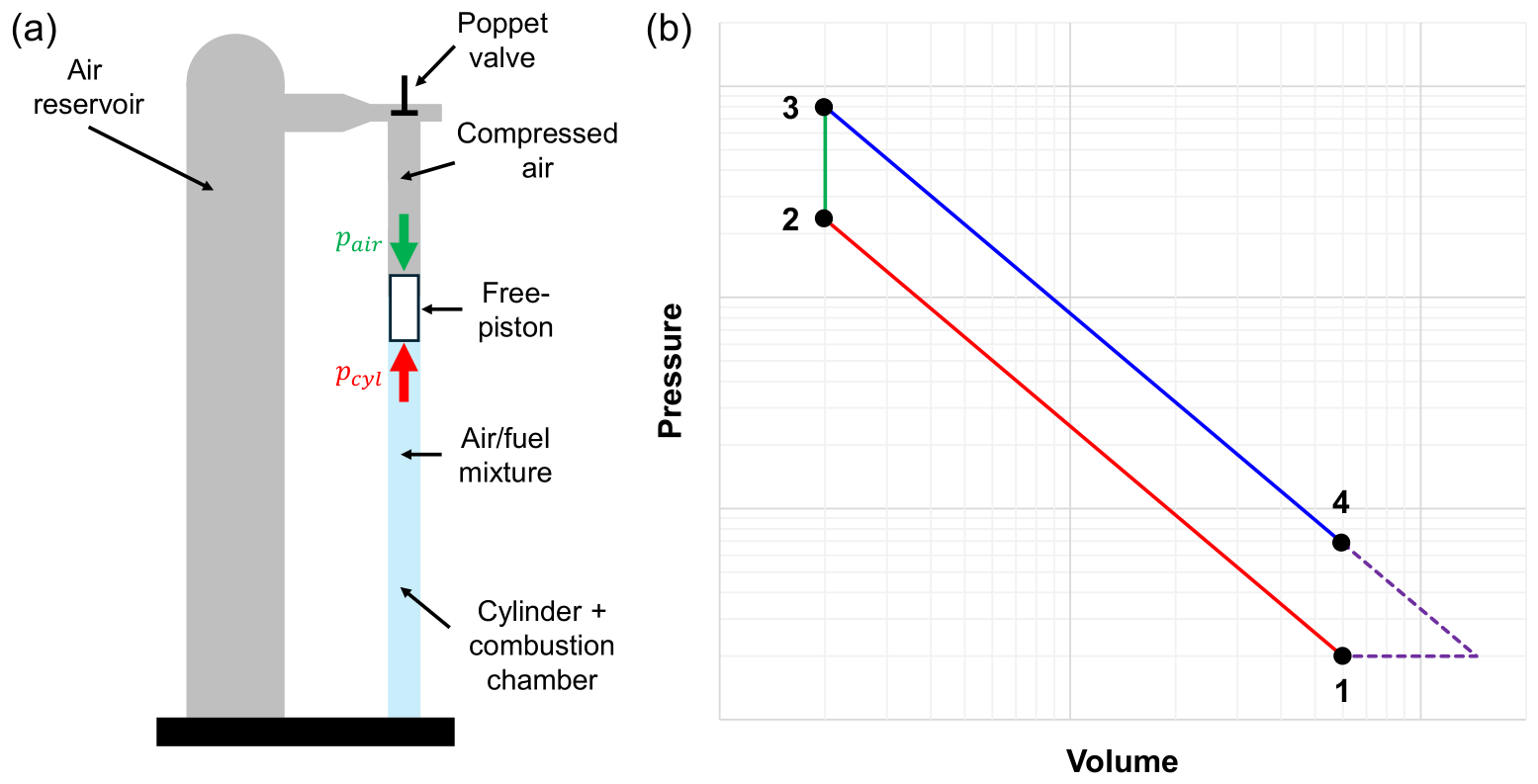
The potential of HCCI combustion for free-piston linear generators was first evaluated using rapid compression machine experiments, building on the work of [20], who investigated the efficiency limits of methane–air combustion under extreme compression ratios. Figure 1a shows a schematic of the RCM configuration, which operates analogously to an FPLG. Each experiment begins with the piston positioned at the top of the cylinder, after which pressurized air is released by opening a poppet valve. The pressure difference between the air reservoir ( p a i r ) and the cylinder ( p c y l ) generates forces on the piston that first induce a compression stroke and subsequently an expansion stroke driven by charge ignition. By varying the initial cylinder pressure, air reservoir pressure and equivalence ratio, ignition can be achieved over a wide range of compression ratios. The cylinder has a bore diameter of 54.1 mm and the total cylinder length of 2.7 m was selected to enable compression ratios of up to 100:1 with a clearance height of 27 mm.
Figure 1b illustrates the reference Otto-cycle used to assess the efficiency potential of HCCI combustion in FPLGs. The cycle consists of a compression phase (1–2), followed by constant-volume combustion (2–3) and an expansion phase (3–4). Gas exchange occurs through blowdown and scavenging from state 4 to state 1. Consistent with [20], it is assumed that the energy contained in the exhaust gases is fully recovered. This assumption represents an upper-bound scenario and is adopted here solely for the purpose of evaluating the thermodynamic potential of HCCI combustion in the RCM configuration. To account for supercharging effects, the effective compression ratio is defined as [20]:
C R e f f = p 1 p a m b V 2 V 1
where V 2 and V 1 denote the cylinder volumes at top dead center (TDC) and at the start of compression, respectively.
The simulations start at conditions 1 and terminates at point 4 along the expansion stroke. An axi-symmetric structured sector mesh is used to represent the cylindrical combustion chamber, while the piston motion is governed by:
m p x ¨ p = p c y l p g a s A c y l F f
where m p is the piston mass, x ¨ p the piston acceleration, and A c y l the piston area. The friction force F f is assumed to be proportional and opposite to the instantaneous piston velocity, i.e., F f = k f x ˙ p . Despite this assumption being rather simplified, the linear viscous friction model is consistent with the use of air bearings in the real system and the parameter k f is calibrated to reproduce the experimental piston trajectories. To maintain an appropriate mesh resolution during piston motion, cell layers are dynamically added or removed as long as the distance between the piston and the cylinder head remains below 20 mm; beyond this distance, mesh deformation is applied instead.
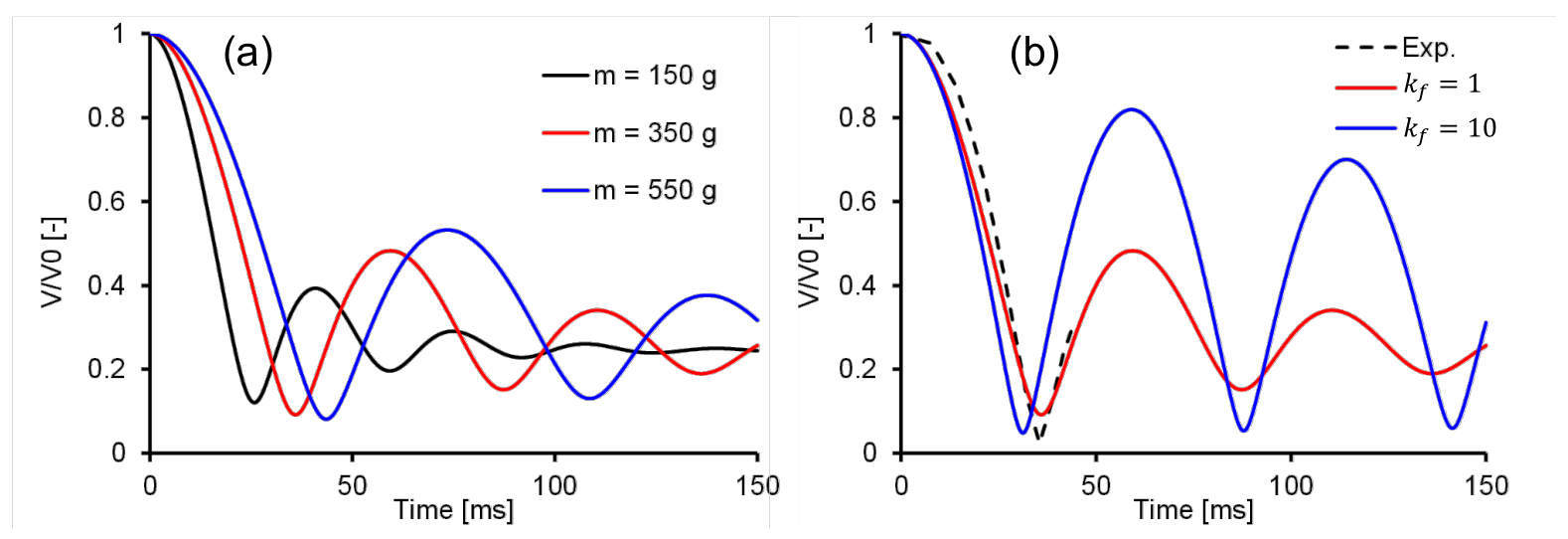
The RCM operation was first validated under motored conditions against the experimental data reported in [36]. Figure 2a shows the temporal evolution of the normalized cylinder volume V / V 0 for different piston masses, indicating that the effective compression ratio C R e f f increases monotonically with m p . The friction coefficient k f was calibrated to reproduce the experimental V / V 0 profiles. In particular, Figure 2b demonstrates that the best agreement under the reference test conditions ( p a i r = 11.6 bar, m p = 300 g, p 0 , c y l = 1 bar) was obtained with k f = 10 . Accurate tuning of the model under motored conditions is a crucial prerequisite for reliable reacting simulations.
The experimental piston trajectory is not directly imposed in the CFD simulations; instead, it is used as a calibration target for the dynamic model. This choice preserves the two-way coupling between piston dynamics and in-cylinder pressure, which is essential for correctly reproducing free-piston behavior and for providing a physically consistent basis for the subsequent FPLG design.
RCM experiments conducted with a stoichiometric methane–air mixture [20] at different compression ratios were used to validate the proposed methodology under reacting conditions. The wall temperature was set equal to the experimental value (350 K), and the FGM look-up table was generated using a C1–C3 chemical mechanism [37,38], which has been experimentally validated against both laminar flame speed and ignition delay measurements over a broad range of temperatures, equivalence ratios and pressures. Different compression ratios and ignition timings were obtained by varying the air reservoir pressure p a i r (9–16 bar), the initial cylinder pressure p 1 (1–2 bar) and the piston mass m p (1–1.4 kg), while the charge temperature was held constant at 310 K, in accordance with the experiments. Temperature wall functions from [39] model heat transfer.
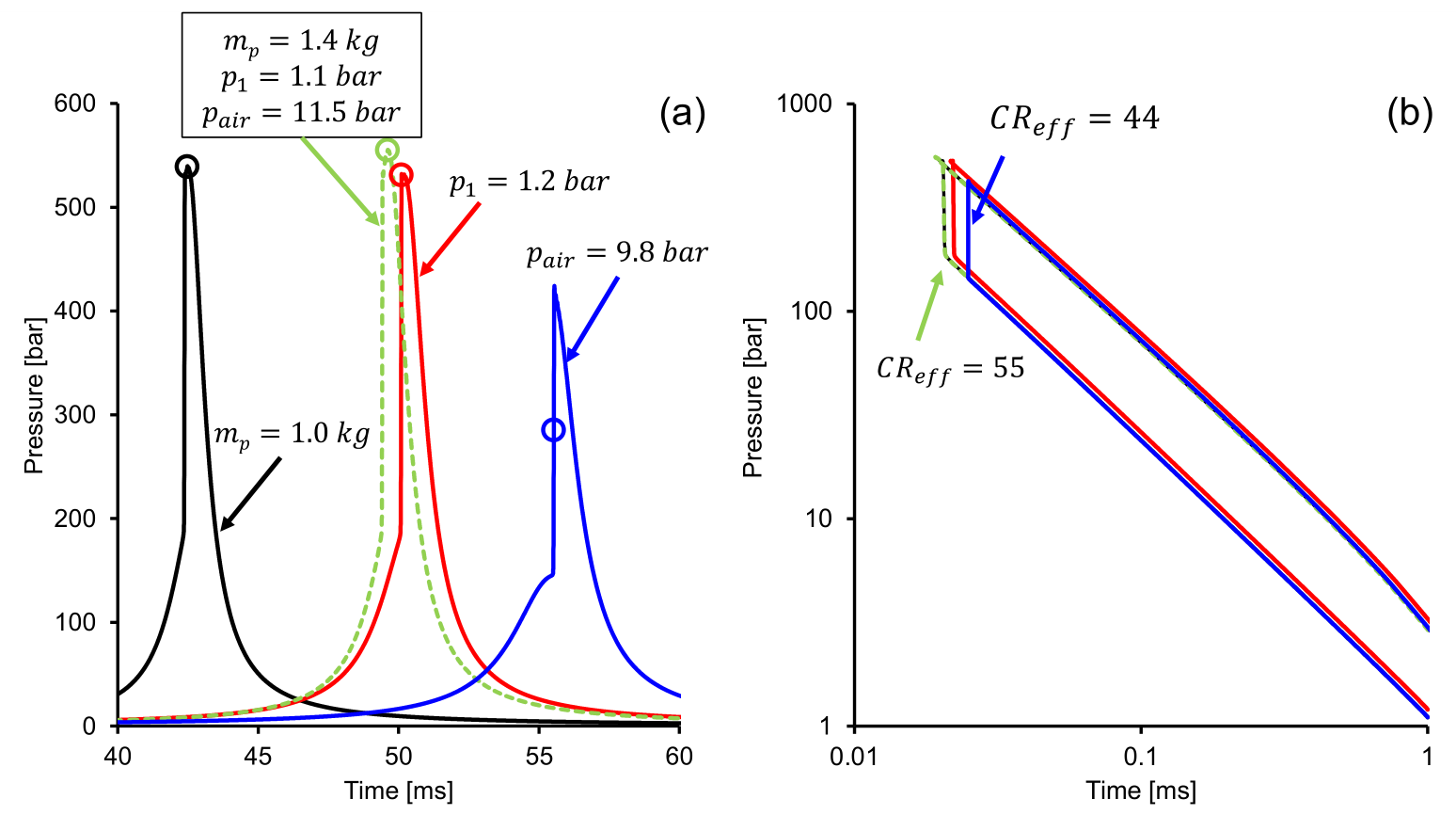
Figure 3a illustrates the dependence of the in-cylinder pressure on p 1 , p a i r and m p , with a baseline configuration defined by p 1 = 1.1 bar, m p = 1.4 kg and p a i r = 11.5 bar. Reducing the piston mass leads to shorter ignition delays, as less time is required for the piston to reach top dead center. As shown in Figure 3b, the effective compression ratio is primarily influenced by the air reservoir pressure. Regarding combustion phasing, the peak cylinder pressure occurs after TDC only for the C R e f f = 44 case. Overall, the predicted peak cylinder pressures significantly exceed the maximum allowable limits for heavy-duty engines, typically around 250 bar.
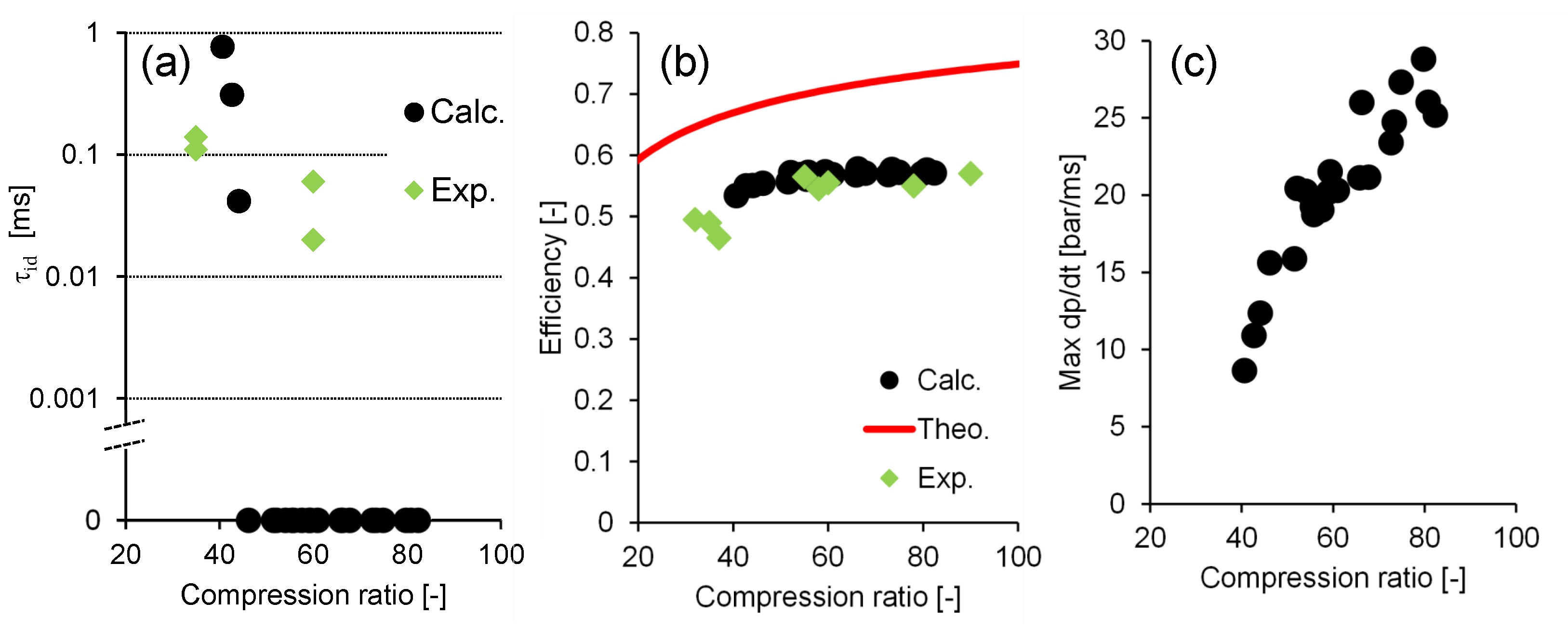
The circles in Figure 3a indicate the ignition timing, defined as the instant at which the cylinder pressure reaches the midpoint between the compression and expansion isentropes [20]. This definition closely approximates the timing corresponding to 50% mass fraction burned. The ignition delay time, τ i d , is computed from the end of the compression stroke, and its dependence on the effective compression ratio is shown in Figure 4a. As C R e f f increases, the temperature at top dead center rises, thereby accelerating the auto-ignition process of the methane–air mixture. The simulations indicate that ignition occurs after TDC only up to C R e f f = 44 , whereas the experiments report positive τ i d values even at higher compression ratios. A possible explanation for the earlier ignition predicted by the CFD simulations is the neglect of blow-by losses. Moreover, to the authors’ experience, the temperature wall functions adopted in this work slightly underestimate heat transfer producing higher temperatures and pressures at TDC. In addition, experimental ignition delay data are unavailable at the extremely high temperatures and pressures encountered in this regime, and the adopted kinetic mechanism may exhibit reduced accuracy under such conditions.
Nevertheless, Figure 3b shows that the predicted ignition events consistently occur in close proximity to TDC and the corresponding indicated efficiencies are in good agreement with the experimental values reported in [36], as shown in Figure 4b. The computed peak indicated efficiency of approximately 58%, which confirms the strong potential of HCCI combustion for free-piston linear generators. However, stoichiometric methane–air operation results in peak cylinder temperatures above 3000 K and pressure rise rates (PRRs) exceeding 10 bar/μs. Such extreme conditions may pose challenges in terms of NOx emissions and mechanical stresses. While NOx emissions could be significantly mitigated through the use of a three-way catalyst, the estimated pressure rise rates correspond to ringing intensities that are well beyond acceptable limits [40,41].

3.2. RCM-2 Configuration Towards HCCI Free-Piston Linear Generator

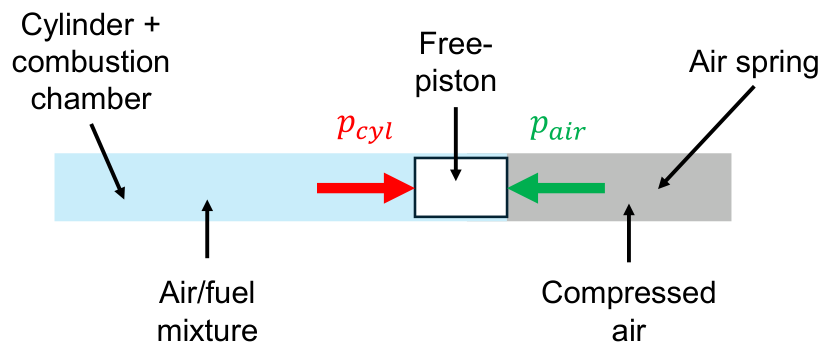
RCM experiments conducted with a stoichiometric methane–air mixture demonstrated the potential of HCCI combustion for FPLGs with opposed-pistons. However, practical implementations require solutions that enable low-emission operation while reducing PRRs. In addition, the original RCM geometry must be adapted to better replicate the dynamic behavior of an FPLG. To this end, a second configuration, referred to as RCM-2, was developed by the authors and is schematically shown in Figure 5. The main features of the new configuration are summarized below:
  • The cylinder bore was increased to 80 mm, approaching the value adopted in modern opposed-piston engine prototypes that have undergone extensive experimental testing [42].
  • The piston mass was increased to 10 kg, representing a more realistic value to achieve an operating frequency of approximately 15 Hz, comparable to that of the first commercial opposed-piston FPLG applications.
  • The pressurized air reservoir was replaced by an air-spring with variable volume and the same combustion chamber displacement. The air-spring undergoes a polytropic expansion–compression process with index n = 1.3, which accounts for heat transfer effects between the gas and the spring walls. This configuration is expected to increase piston acceleration at the start of the expansion stroke, thereby reducing the PRR. At the start of the simulation, the air-spring volume V a s is defined as a fraction of the cylinder volume:
    V a s = k a s V c y l , 1
  • Operation under lean air–fuel conditions is adopted to further reduce pressure rise rates and improve emissions control.
HCCI research has historically focused on conventional fuels, such as gasoline and diesel, as well as alcohol fuels (e.g., ethanol), which are more readily auto-ignited under moderate compression ratios and intake temperatures. In contrast, previous studies have shown that sustained HCCI operation with methane, a fuel of particular interest for power generation, can be achieved either by increasing the intake air temperature [43] or, alternatively, by operating at very high compression ratios, possibly combined with reduced boost pressure [44]. The latter strategy is more consistent with the design targets of FPLGs, as it mitigates knocking propensity, limits the energy consumption of the compressor required for scavenging and preserves the specific power output within acceptable bounds. Based on these considerations, the initial operating conditions for the RCM-2 configuration were set to an intake temperature of T = 300 K and an initial cylinder pressure of p 1 = 1.05 bar, corresponding to near-ambient conditions. This choice deliberately avoids the need for intake air preheating, eliminating the associated heat exchanger and reducing system complexity, a key advantage for distributed power generation applications. Under these constraints, combustion phasing is controlled exclusively through the compression ratio and equivalence ratio, as explored below.
A parametric analysis was then conducted to investigate the combined effects of air-spring pressure and effective compression ratio on indicated efficiency and combustion-induced acoustic response, quantified in terms of ringing intensity (RI). Consistent with [40], the ringing intensity is defined as:
RI = 1 2 γ β d p d t max p max 2 γ R T max
and is used in the following to assess the suitability of lean methane–air HCCI operation under the high compression ratio conditions characteristic of FPLGs.
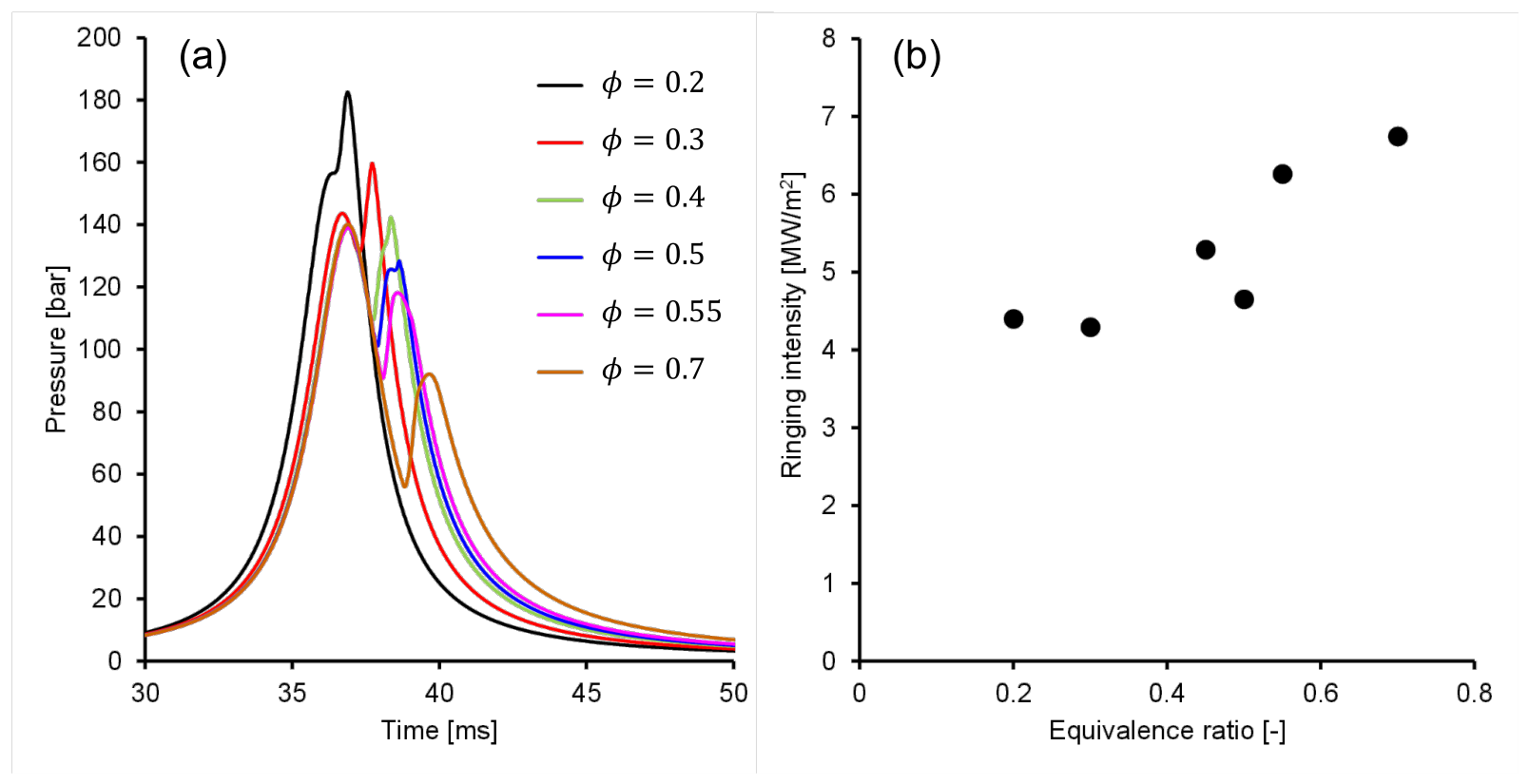
The simulations indicate that maximum indicated efficiency is achieved for an air-spring volume of approximately V a s 0.53 V c y l , 1 and an initial air-spring pressure of 18 bar. For all tested operating conditions, the effective compression ratio remains close to 40. Figure 6a shows the in-cylinder pressure histories obtained at maximum efficiency for different equivalence ratios. The results reveal an increase in ignition delay with increasing equivalence ratio, a trend that may initially appear counter-intuitive, given that ignition delay is typically expected to decrease as ϕ increases. This behavior can be explained by the effect of equivalence ratio on the thermodynamic properties of the working mixture: as ϕ increases, the specific heat ratio decreases, leading to lower pressures and temperatures at top dead center. This effect is further illustrated in Table 1, which shows that increasing the equivalence ratio reduces both the TDC pressure and temperature, thereby delaying ignition. Specifically, increasing ϕ from 0.2 to 0.5 results in a reduction of approximately 15 bar in TDC pressure and about 60 K in TDC temperature. The longer ignition delay associated with higher equivalence ratios contributes to controlling the ringing intensity, as a larger fraction of the fuel is burned when the piston has already traveled further along the expansion stroke and the cylinder volume is larger. As shown in Figure 6b, the ringing intensity remains below the critical threshold R I c r i t = 6 MW/m2 at least up to ϕ = 0.5 . Operation at higher equivalence ratios is unlikely to be advantageous for power-generation applications targeting near-zero emissions, as the associated increase in peak temperatures could promote NOx formation and necessitate the use of dedicated exhaust after-treatment systems. Despite combustion starting at a larger cylinder volume, the ringing intensity increases with equivalence ratio due to the higher amount of fuel mass burning in a very short amount of time.
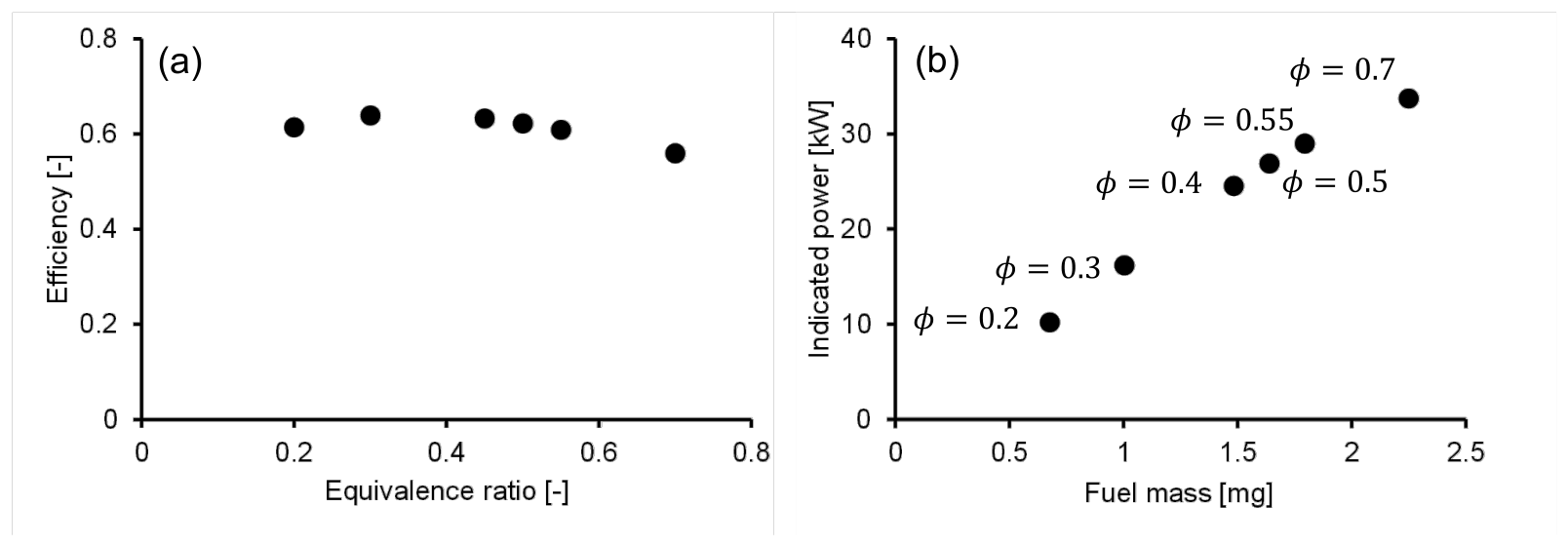
The favorable ringing-intensity levels discussed above are further supported by the corresponding indicated efficiency values, η i n d , reported in Figure 7a. Within the equivalence ratio range ϕ = 0.2 ÷ 0.5 , η i n d remains consistently above 60%, which is higher than the values computed for stoichiometric air–fuel mixtures, thanks to the better combustion efficiency. Figure 7b shows that the indicated power P i increases linearly with the trapped fuel mass. From an engineering standpoint, the ability to vary P i while maintaining nearly constant η i n d highlights the strong potential of HCCI-based FPLGs: power modulation can be achieved simply by varying the fueling rate, without incurring the efficiency penalties typical of conventional part-load operations. This behavior is enabled by the spontaneous adjustment of the effective compression ratio resulting from changes in the thermodynamic properties of the air–fuel mixture, a characteristic feature of free-piston operation.
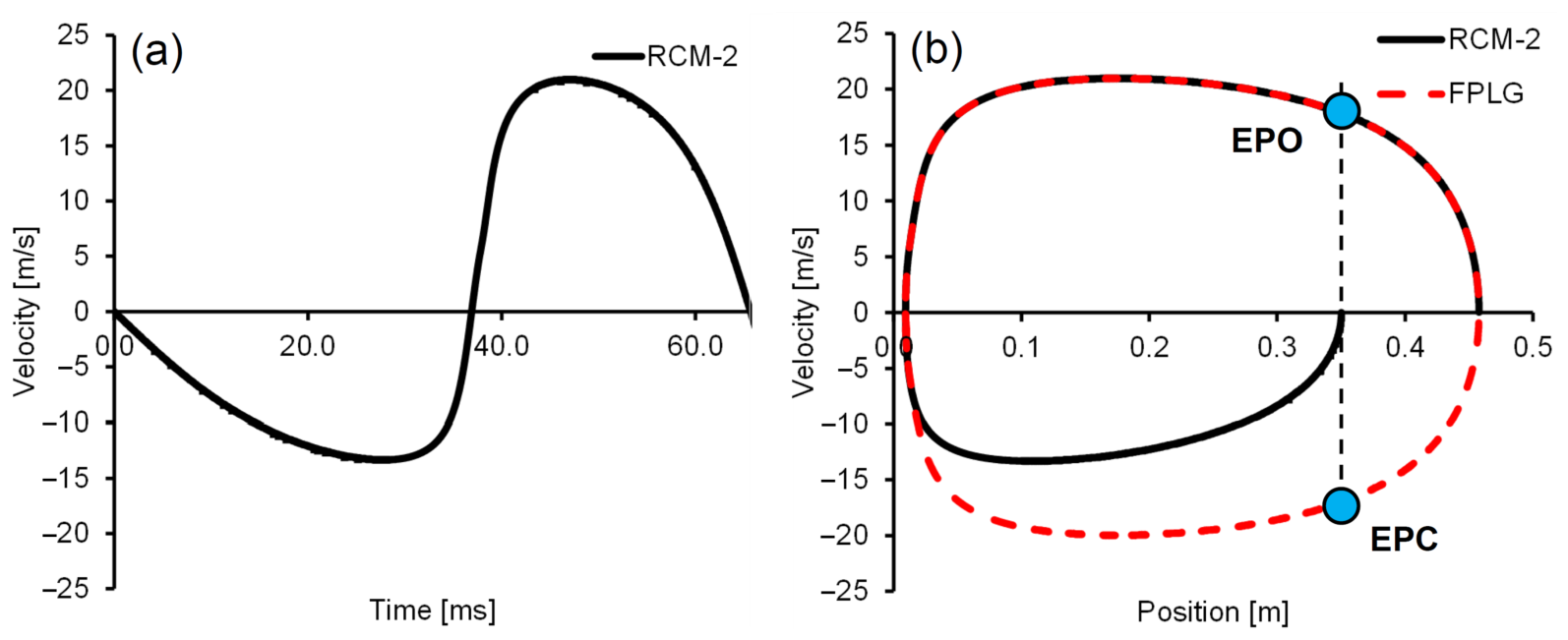
Figure 8a illustrates the piston velocity profile during the compression and expansion strokes for the RCM-2 configuration operating at ϕ = 0.5 . During compression, the air-spring drives the piston toward TDC, resulting in negative velocity, while combustion-induced pressure rise during expansion accelerates the piston in the opposite direction. Consistent with typical FPLG dynamics, the expansion stroke is faster than the compression stroke. Figure 8b shows the piston velocity as a function of position: the expansion stroke terminates at a larger distance from TDC than the starting point of compression, and the velocity profiles during expansion agree well with those reported in the literature for FPLG operation under purely resistive loads [11,13,45,46].

4. Preliminary Assessment of FPLG

The proto-FPLG configuration was designed following a systematic approach in which each key parameter was derived directly from the RCM-2 simulation results, as summarised in Table 2. The piston velocity profile obtained from the RCM-2 expansion stroke (Figure 8b) was adopted as the prescribed motion law for the FPLG, with compression approximately 5% slower. The exhaust port closing position was set to coincide with the start of compression in the RCM-2 simulations. The compression ratio was raised from approximately 40, the optimal value identified in RCM-2, to 50, since the ringing intensity at ϕ = 0.5 remained below the critical threshold, leaving margin for further efficiency improvement. Although the adopted compression ratio of 50 is significantly higher than the one used in conventional engines, the peak in-cylinder pressure remains well below 200 bar, as discussed later, and is consistent with the operating range of modern heavy-duty engines. Material constraints are therefore primarily dictated by peak pressure and pressure rise rate rather than by the compression ratio itself. Both parameters are shown to remain within acceptable limits for the proposed configuration. All remaining geometric and operating parameters follow directly from the RCM-2 results, as detailed in Table 2.

4.1. Baseline and Divided Ports Configurations

Following the promising results obtained with the RCM-2, a preliminary assessment of a free-piston linear generator was carried out. Two different intake port configurations were analyzed to support the initial engine design; both them are based on an opposed-piston architecture with a uniflow scavenging layout. The scavenging system consists of 12 intake ports and eight exhaust ports, similarly to [47], so as to achieve a ratio between the total port width and the cylinder circumference equal to 0.8, as theoretically recommended in [48]. Intake and exhaust port heights are set to 76.3 mm and 107.8 mm, respectively, in order to ensure proper scavenging in accordance with the piston motion law shown in Figure 8.
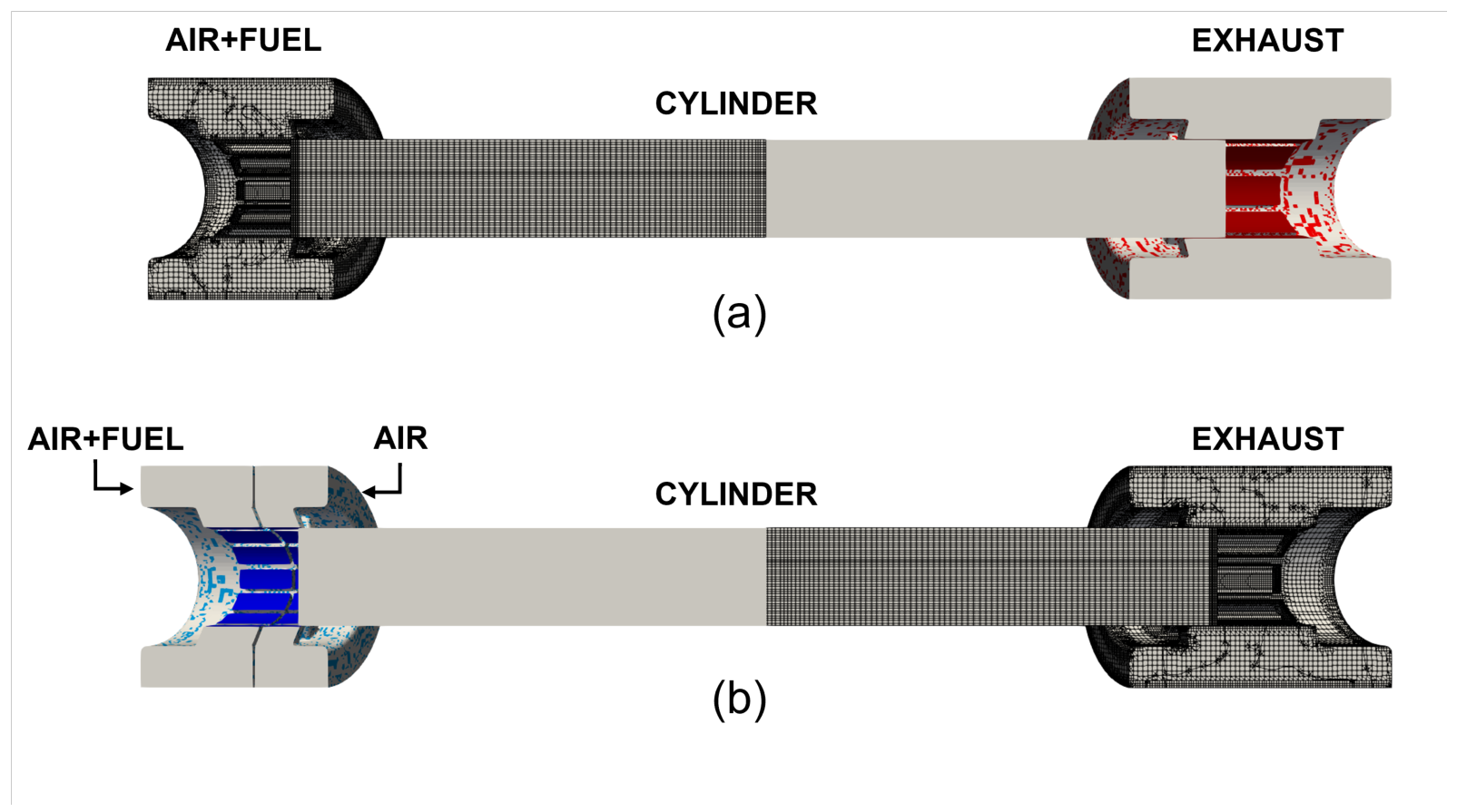
The main difference between the two configurations lies in the way the air–fuel mixture is introduced into the cylinder. As shown in Figure 9, the baseline configuration adopts a conventional intake port design, whereas in the modified configuration the intake manifold is divided into two separate streams, as described as a possible solution in [22]: one supplying pure air and the other delivering an air–fuel mixture. This strategy enables the cylinder to be initially filled with fresh air during the early phase of scavenging, while delaying fuel admission to reduce methane slip, without altering the overall port geometry or scavenging timing. Following a parametric analysis, the intake port height dedicated to the pure-air stream was set to 40% of the baseline configuration, with the remaining 60% assigned to the air–fuel ports. The selected 40%/60% ratio provided the best compromise between methane slip reduction and charge homogeneity at EPC. Deviations from this value have a limited impact on performance: reducing the pure-air fraction weakens the stratification effect, whereas increasing it may lead to excessive charge inhomogeneity and incomplete combustion. While the present study focuses on the thermodynamic and fluid-dynamic assessment of the divided-port strategy, a detailed design and optimization of the control strategy for the divided-port configuration, together with the study of off-design operating condition, is identified as an important direction for future work and will be addressed in the context of prototype development.
3D CFD simulations were performed using a combination of fixed meshes for the intake and exhaust manifolds and moving meshes for the cylinder. The average cell size of approximately 2 mm adopted in the full-cycle FPLG simulations is consistent with mesh resolutions previously validated for CFD simulations of similar engines [24,28] and it was selected as the best compromise between accuracy and CPU time consumption. The maximum cell count of about 615,000 was reached at bottom dead center (BDC). The piston motion is modeled using a layer addition and removal technique [49], whereby new mesh layers are introduced when the local cell size exceeds 2.5 mm and removed when it falls below 2 mm. The coupling between the moving and fixed mesh regions is handled through an arbitrarily coupled mesh interface (ACMI) approach.

4.2. Simulation of the Scavenging Process

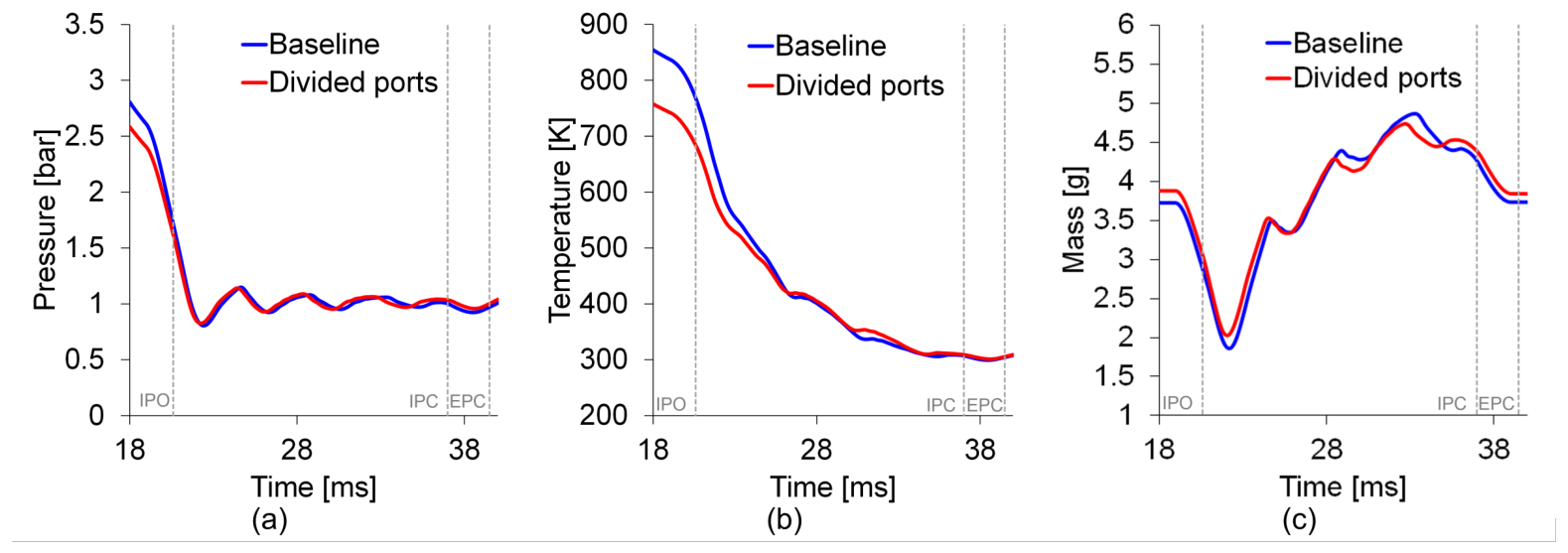
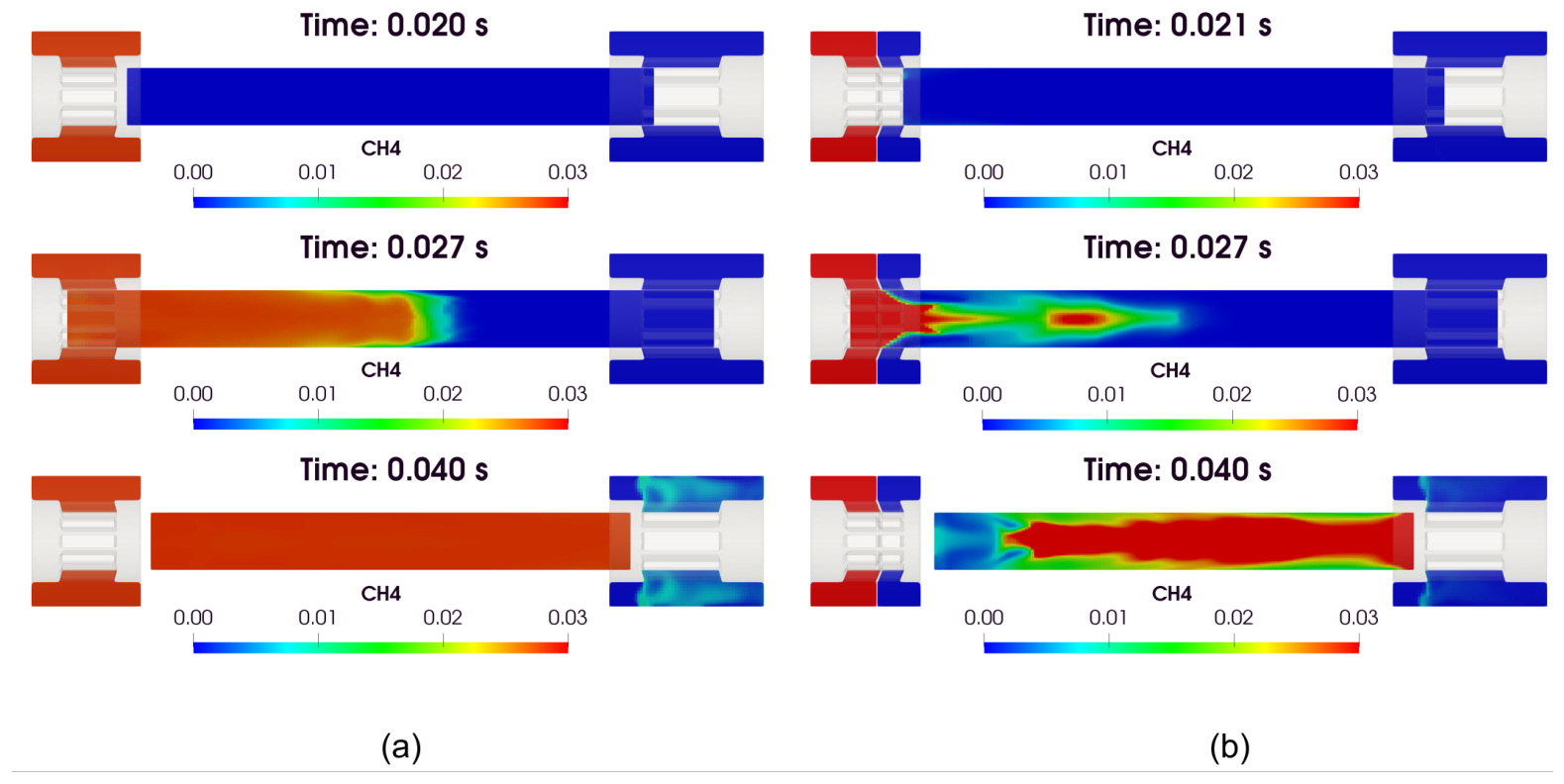
Cold-flow simulations of the scavenging process were performed to assess the proposed configurations. In particular, two consecutive engine cycles were simulated to ensure convergence of the trapped mass. A constant total pressure of 1.05 bar was imposed at the inlet, while atmospheric conditions were prescribed at the outlet. The assumption of constant total pressure and temperature at the intake and exhaust boundaries is consistent with the stationary operating conditions targeted by the proposed FPLG configuration. Figure 10 compares the in-cylinder pressure, temperature and trapped mass evolution for the baseline and modified configurations. Apart from minor differences at the exhaust port opening (EPO), due to variations in the combustion process that will be analyzed later, no significant discrepancies are observed between the two cases. In particular, both configurations exhibit very similar pressure and temperature levels at exhaust port closing (EPC). In contrast, a marked difference is observed in terms of fuel slip, as shown in Figure 11. In the baseline configuration, part of the air–fuel mixture is directly discharged into the exhaust manifolds, resulting in a high level of methane slip (exceeding 5000 ppm). The divided-port configuration, on the other hand, significantly mitigates this effect by delaying methane admission and promoting a more stratified charge within the cylinder.
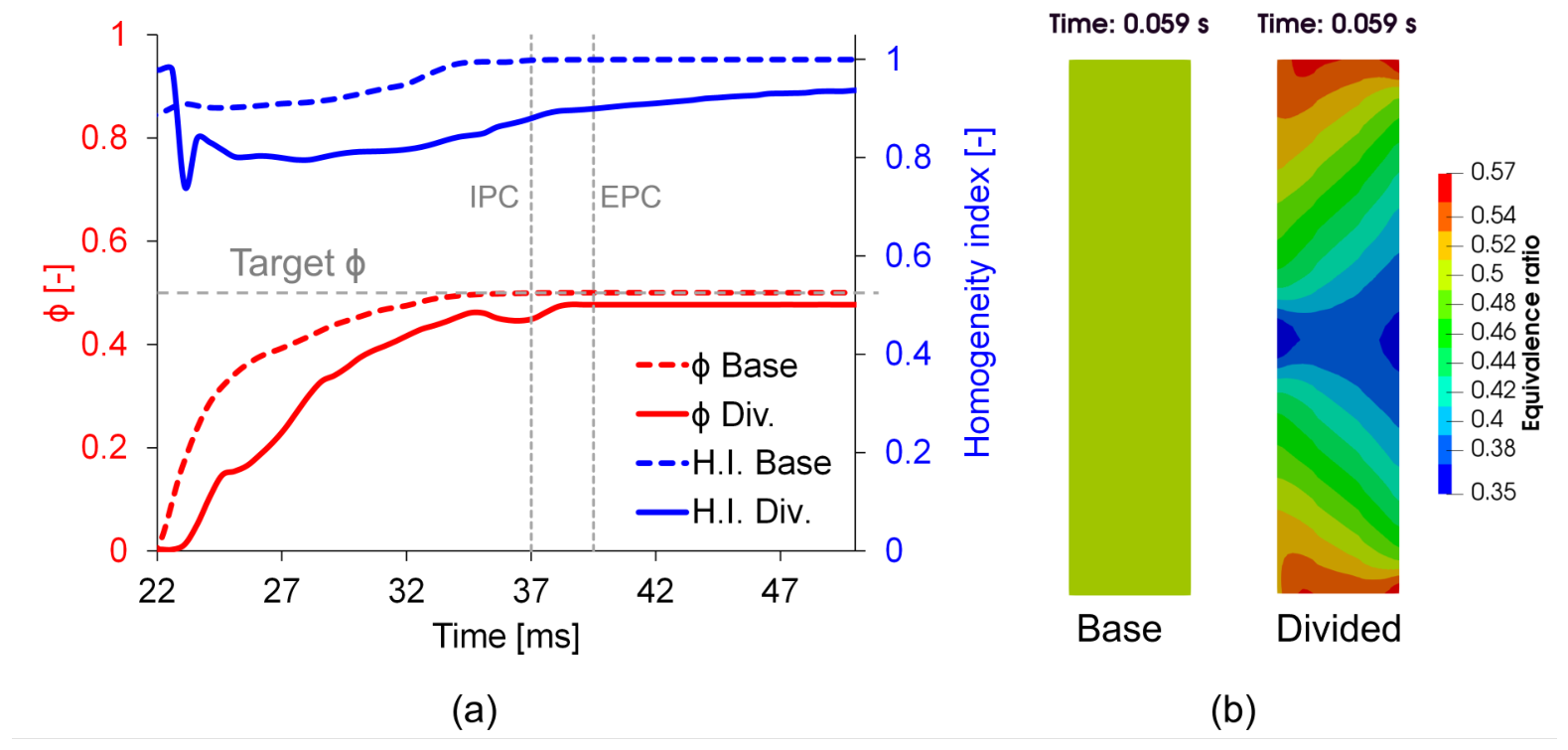
Figure 12a shows the evolution of the equivalence ratio ( ϕ ) and the homogeneity index during the scavenging process for the two configurations. In both cases, the target value of ϕ = 0.5 is achieved at EPC. However, differences arise in terms of mixture uniformity, as indicated by the homogeneity index. The conventional intake configuration leads to an almost perfectly homogeneous mixture already at intake port closing, whereas the divided-port configuration results in a more stratified charge. This behavior is further highlighted in Figure 12b, which presents the equivalence ratio distribution at TDC. With the divided-port configuration, the fuel tends to be concentrated along the liner, where regions with ϕ > 0.5 are observed, while a leaner mixture is found in the central part of the cylinder.

4.3. Combustion Simulation

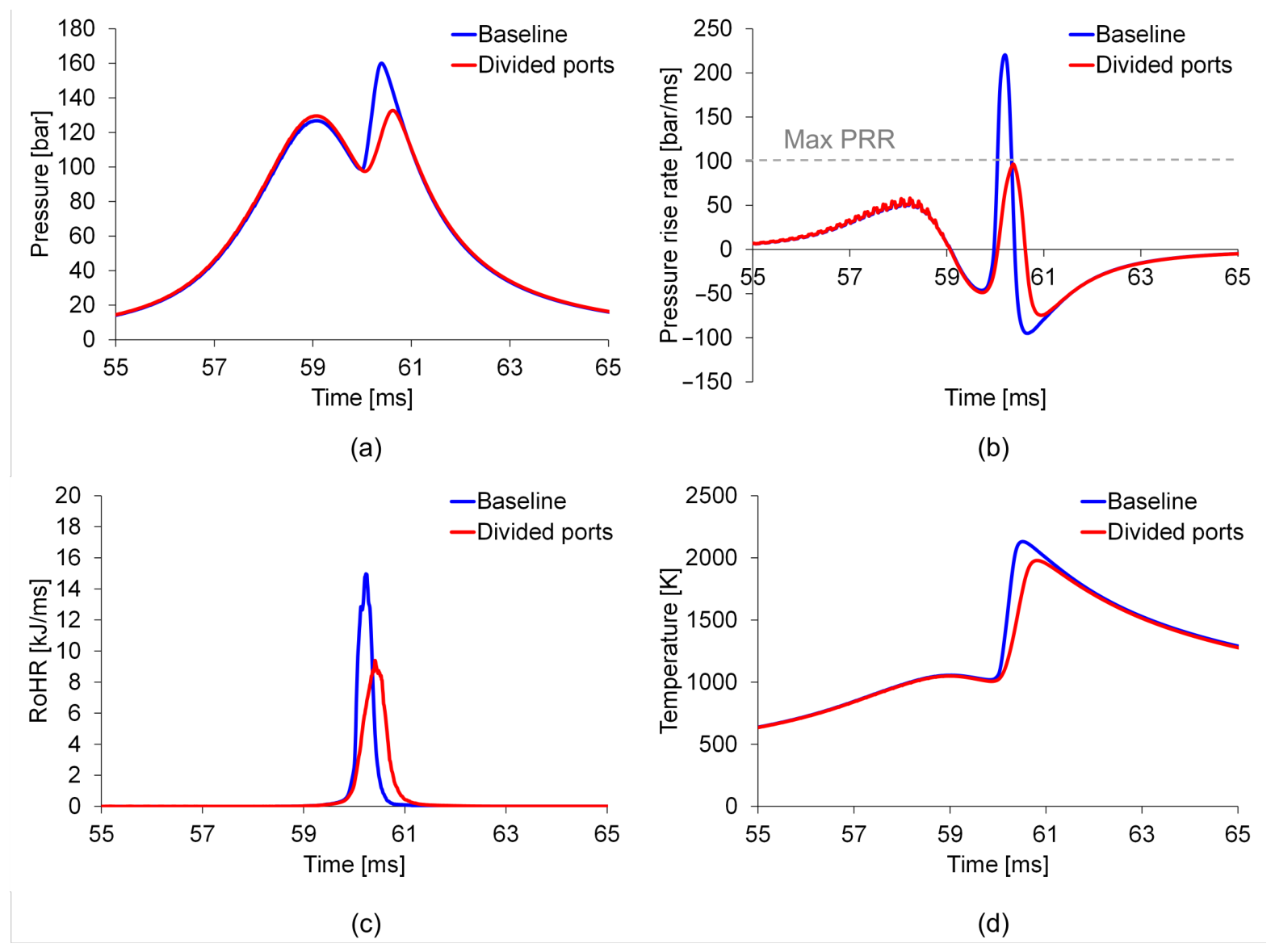
Following the evaluation of the scavenging performance for the two proposed configurations, HCCI combustion simulations were carried out to assess the FPLG performance and to verify the occurrence of excessive pressure rise rates. Figure 13 presents the evolution of in-cylinder pressure, pressure rise rate, rate of heat release (RoHR) and temperature for both configurations. The pressure traces indicate that combustion phasing is delayed with respect to conventional engines, with the start of combustion occurring after TDC. This feature is essential for mitigating knocking behavior, as discussed in [50], and is consistent with the findings obtained from the RCM analysis. The baseline configuration exhibits higher peak pressure levels than the divided-port configuration, with PRRs values exceeding 200 bar/ms and a ringing intensity above 28 MW/m2. In contrast, the increased mixture stratification achieved with the modified intake ports effectively limits the peak pressure to below 140 bar, the PRRs to within 100 bar/ms and the RI to approximately 6 MW/m2. These results suggest that the baseline configuration is not suitable for continuous operation due to the severe knocking behavior. Conversely, the divided ports configuration yields acceptable PRRs and RI levels, although they remain close to the critical limit; therefore, careful attention to knocking phenomena is still required. Finally, the lower RoHR associated with the divided-port configuration contributes to maintaining the average in-cylinder temperature below 2000 K, reducing thermal NOx formation.
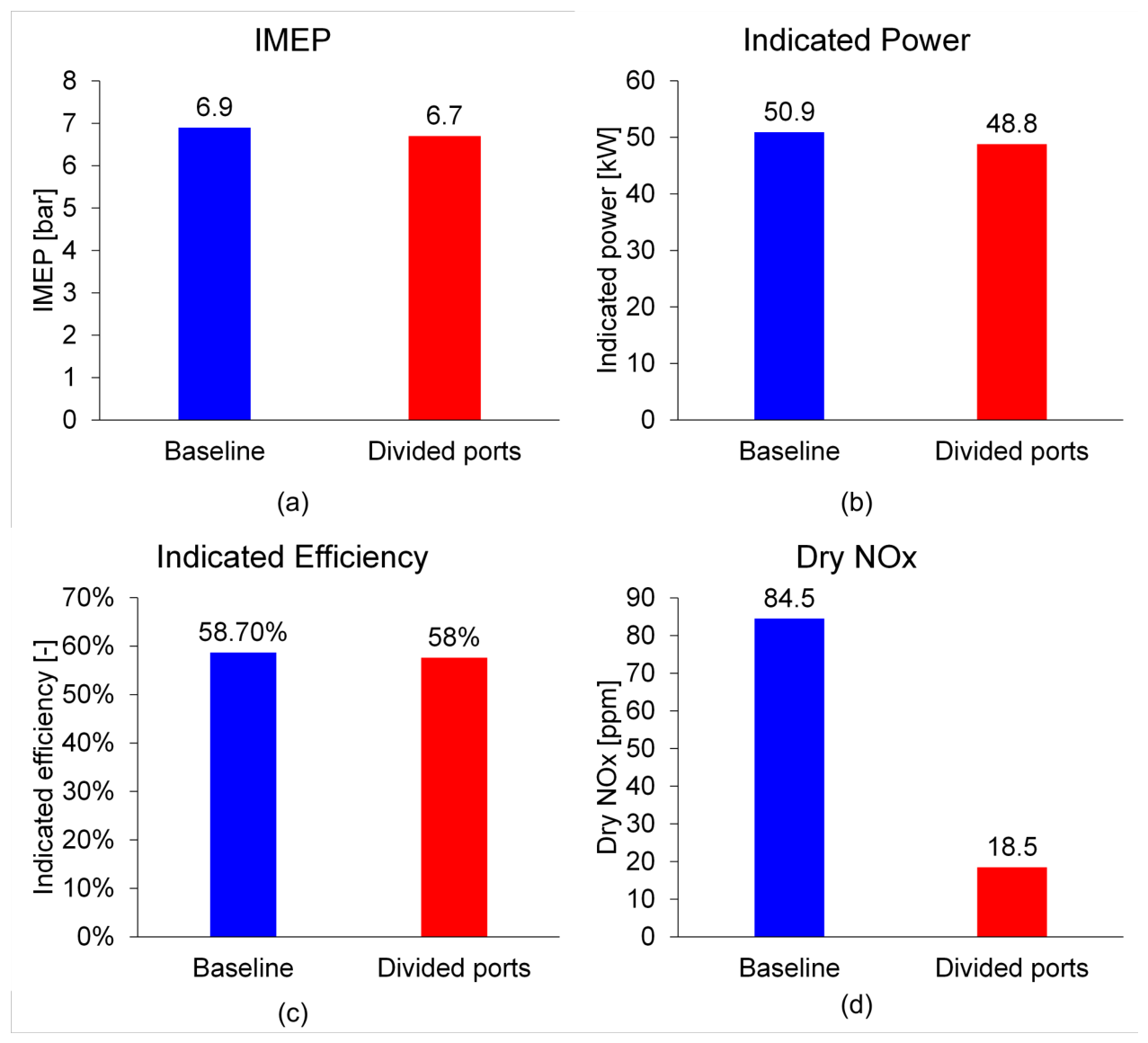
Engine performance results are summarised in Figure 14, which compares indicated mean effective pressure (IMEP), indicated power, indicated efficiency and NOx emissions for the two proposed configurations. In the calculation of indicated power and efficiency, a compressor power consumption of 400 W is taken into account. Both configurations achieve very high indicated efficiencies, exceeding 58%, highlighting the strong potential of opposed-piston FPLGs for high-efficiency power generation. However, these values are expected to decrease toward those reported in the literature when blow-by effects and the efficiency of the linear generator are taken into account. A preliminary estimate of system-level efficiency can be obtained by combining the indicated efficiency with the main loss contributions. The compressor power consumption of 400 W is already accounted for in the efficiency values reported in Figure 14. Regarding additional losses: blow-by is estimated at 1–3% of indicated work; permanent magnet linear generators achieve electrical efficiencies exceeding 90%; cooling and auxiliary losses are estimated at 1–2 percentage points for electrical-only operation, but are largely recoverable in CHP mode. Accounting for these contributions, the projected net electrical efficiency is approximately 50%, consistent with the 46% net efficiency reported for the commercial system [4], which incorporates additional real-world loss mechanisms. A complete system-level energy balance requires experimental validation on a physical prototype and is identified as a priority for future work.
Finally, very low levels of dry NOx are computed from simulations, especially for the divided ports configuration. NOx formation in the proposed configuration is governed almost exclusively by the thermal mechanism, which requires local temperatures above approximately 1800 K. HCCI combustion inherently suppresses NOx formation by operating with lean, premixed mixtures that produce lower peak combustion temperatures compared to conventional spark-ignition or compression-ignition engines. In the baseline configuration, the higher rate of heat release leads to peak mean cylinder temperatures above 2000 K (Figure 13d), resulting in dry NOx levels of 84.5 ppm. In contrast, the divided-port configuration limits the average in-cylinder temperature below 2000 K, consistent with the lower rate of heat release shown in Figure 13c, and reduces NOx to 18.5 ppm. This result is consistent with findings reported in the literature for lean HCCI operation, where at equivalence ratios around ϕ = 0.25–0.4, near-zero NOx levels are achievable. The predicted values are also consistent with the near-zero emission targets of commercial FPLG systems [4], confirming that the divided-port configuration, combined with lean operation at ϕ = 0.5, represents a viable pathway toward ultra-low NOx power generation without requiring exhaust after-treatment systems.

5. Conclusions and Future Work

This work explored the potential of opposed-piston FPLGs running on methane with HCCI combustion. It used RCM-based analysis and full-cycle CFD simulations. The main findings are summarised as follows:
  • RCM simulations validated against experimental data confirmed that indicated efficiencies of 58–60% are attainable under lean operating conditions ( ϕ = 0.2–0.5) and high compression ratios. Stoichiometric operation, in contrast, results in excessive pressure rise rates and unacceptable ringing intensity levels, making it unsuitable for continuous power generation.
  • The RCM-2 configuration, developed to better represent actual FPLG dynamics, demonstrated that lean mixtures are effective in controlling combustion phasing and reducing knocking tendency while maintaining high efficiency. For equivalence ratios up to ϕ = 0.5, ringing intensity remains below the critical threshold of 6 MW/m2 while indicated efficiency consistently exceeds 60%.
  • The linear relationship between indicated power and trapped fuel mass confirmed the suitability of HCCI-based FPLGs as modular power generation systems, enabling flexible load while maintaining nearly constant efficiency.
  • Combustion simulations confirmed that the baseline configuration is unsuitable for continuous operation due to excessive PRR and ringing intensity. The divided-port configuration limits peak pressure below 140 bar, PRR within 100 bar/ms and RI to approximately 6 MW/m2, while achieving an indicated efficiency of 58% and near-zero NOx emissions (18.5 ppm dry), confirming the strong potential of this architecture for high-efficiency, low-emission stationary power generation.
These results have direct practical significance for distributed power generation applications, including microgrids, data centers and backup power installations, where high efficiency, fuel flexibility and near-zero emissions are primary requirements. The projected system-level efficiency of approximately 50% positions the proposed configuration as a compelling next-generation alternative to conventional engines.
Future work will focus on improving the robustness of the proposed solution by accounting for additional loss mechanisms, such as blow-by and real generator efficiency, and by refining the control of mixture stratification to further reduce knocking tendency. In addition to that, multi-cycle reacting simulations under varying load and intake conditions, combined with a formal stability analysis and a coupled control strategy for the linear generator and fuel metering system, are essential next steps. Finally, an experimental validation on prototype systems will be essential to verify the current results and support the development of next-generation FPLG units. Key validation metrics will include in-cylinder pressure traces, pressure rise rate, piston dynamics, electrical power output, methane slip and NOx emissions. Particular attention will be devoted to assessing the effectiveness of the divided-port strategy in reducing fuel short-circuiting and controlling combustion-induced pressure oscillations. Such experiments will provide the basis for a comprehensive validation of both the combustion model and the predicted system-level performance.

Author Contributions

Conceptualization, T.L., G.G.G. and M.F.; methodology, T.L., N.M. and G.G.G.; software, N.M. and T.L.; validation, G.G.G., M.F. and N.M.; formal analysis, T.L. and G.G.G.; investigation, G.G.G., M.F. and N.M.; resources, A.O. and T.L.; data curation, T.L. and A.O.; writing—original draft preparation, T.L. and G.G.G.; writing—review and editing, T.L., G.G.G., A.O. and N.M.; visualization, T.L. and G.G.G.; supervision, A.O. and T.L.; project administration, A.O. and T.L.; funding acquisition, T.L. All authors have read and agreed to the published version of the manuscript.

Funding

We acknowledge financial support under the National Recovery and Resilience Plan (NRRP), Mission 4, Component 2, Investment 1.1, Call for tender No. 104 published on 2 February 2022 by the Italian Ministry of University and Research (MUR), funded by the European Union—NextGenerationEU—Project Title FLEX-GEN—CUP B53D23005670006—Grant Assignment Decree No. 961 adopted on 30 June 2023 by the Italian Ministry of Ministry of University and Research (MUR).

Data Availability Statement

The original contributions presented in the study are included in the article, further inquiries can be directed to the corresponding author.

Acknowledgments

Authors would like to thank Matteo Ferrarini who supported this research work during his MSc thesis.

Conflicts of Interest

The authors declare no conflicts of interest.

Abbreviations

The following abbreviations are used in this manuscript:
ACMIArbitrarily coupled mesh interface
BDCBottom dead center
CFDComputational fluid dynamics
CHPCombined heat and power
C R e f f Effective compression ratio
EVElectric vehicle
EPCExhaust port closing
EPOExhaust port opening
FGMFlamelet generated manifold
FPLGFree-piston linear generator
HCCIHomogeneous charge compression ignition
ICEInternal combustion engine
IMEPIndicated mean effective pressure
NOxNitrogen oxides
PCCIPremixed charge compression ignition
PRRPressure rise rate
RANSReynolds-averaged Navier–Stokes equations
RCMRapid compression machine
RIRinging intensity
RoHRRate of heat release
SISpark-ignition
TDCTop dead center

References

  1. International Energy Agency. Electricity 2025: Analysis and Forecast to 2027, Report, Revised version, February 2025; International Energy Agency: Paris, France, 2025. [Google Scholar]
  2. Roy, D.; Ngwaka, U.; Shivaprasad, K.V.; Zhu, S.; Taghavifar, H.; Williams, R.; Smallbone, A.; Roskilly, A.P. Techno-economic assessment of a fuel flexible free piston engine generator based energy system for cold ironing application. Energy 2025, 332, 136954. [Google Scholar] [CrossRef]
  3. Mostacciuolo, E.; Baccari, S.; Rubino, L.; Iannelli, L.; Beatrice, C.; Capasso, C.; Capuano, F.; Saviano, R.; Veneri, O.; Liuzza, D.; et al. Power Extraction for Free Piston Linear Generator. In Proceedings of the 2025 International Conference on Clean Electrical Power (ICCEP), Villasimius, Italy, 24–26 June 2025; pp. 102–108. [Google Scholar] [CrossRef]
  4. Simpson, A.; Davidson, K.; Energy, M. High-Efficiency and Ultra-Low Emissions Linear Generator Demonstration Project in Southern California; Technical Report CEC-500-2024-037; California Energy Commission: Sacramento, CA, USA, 2024.
  5. Svrcek, M. The Omnivorous Generator: Mainspring’s Linear Generator can Run on Almost any Fuel. IEEE Spectr. 2023, 60, 34–39+46. [Google Scholar] [CrossRef]
  6. Regner, G.; Johnson, D.; Koszewnik, J.; Dion, E.; Redon, F.; Fromm, L. Modernizing the opposed piston, two stroke engine for clean, efficient transportation. In Proceedings of the Symposium on International Automotive Technology 2013, Pune, India, 9 January 2013. [Google Scholar] [CrossRef]
  7. Naik, S.; Johnson, D.; Koszewnik, J.; Fromm, L.; Redon, F.; Regner, G.; Fuqua, K. Practical applications of opposed-piston engine technology to reduce fuel consumption and emissions. In Proceedings of the 8th SAEINDIA International Mobility Conference & Exposition and Commercial Vehicle Engineering Congress 2013 (SIMCOMVEC), Chennai, India, 4 December 2013; Volume 12. [Google Scholar] [CrossRef]
  8. Kosaka, H.; Akita, T.; Moriya, K.; Goto, S.; Hotta, Y.; Umeno, T.; Nakakita, K. Development of free piston engine linear generator system part 1—Investigation of fundamental characteristics. In Proceedings of the SAE 2014 World Congress & Exhibition, Detroit, MI, USA, 8 April 2014. [Google Scholar]
  9. Goto, S.; Moriya, K.; Kosaka, H.; Akita, T.; Hotta, Y.; Umeno, T.; Nakakita, K. Development of free piston engine linear generator system part 2—Investigation of control system for generator. In Proceedings of the SAE 2014 World Congress & Exhibition, Detroit, MI, USA, 8 April 2014. [Google Scholar]
  10. Moriya, K.; Goto, S.; Akita, T.; Kosaka, H.; Hotta, Y.; Nakakita, K. Development of Free Piston Engine Linear Generator System Part 3—Novel Control Method of Linear Generator for to Improve Efficiency and Stability; SAE Technical Papers; SAE: Warrendale, PA, USA, 2016. [Google Scholar]
  11. Wang, J.; Feng, H.; Zhang, Z.; Wu, L.; Yang, F. Development of a coupling model and parametric analysis of an opposed free-piston engine linear generator. Appl. Therm. Eng. 2023, 219, 119205. [Google Scholar] [CrossRef]
  12. Lu, J.; Xu, Z.; Liu, L. Compression Ratio Control of an Opposed-Piston Free-Piston Engine Generator Based on Artificial Neural Networks. IEEE Access 2020, 8, 107865–107875. [Google Scholar] [CrossRef]
  13. Brosnan, P.; Tian, G.; Zhang, H.; Wu, Z.; Jin, Y. Non-linear and multi-domain modelling of a permanent magnet linear synchronous machine for free piston engine generators. Energy Convers. Manag. X 2022, 14, 100195. [Google Scholar] [CrossRef]
  14. Brosnan, P.; Montanaro, U.; Tian, G. Motoring control of a free piston engine and linear electric machine. Appl. Energy 2026, 412, 127649. [Google Scholar] [CrossRef]
  15. Schneider, S.; Chiodi, M.; Friedrich, H.; Bargende, M. Development and Experimental Investigation of a Two-Stroke Opposed-Piston Free-Piston Engine. In Proceedings of the SAE/JSAE 2016 Small Engine Technology Conference & Exhibition, Charleston, SC, USA, 15 November 2016. [Google Scholar]
  16. Zhang, Q.; Xu, Z.; Liu, S.; Liu, L. Effects of injector spray angle on performance of an opposed-piston free-piston engine. Energies 2020, 13, 3735. [Google Scholar] [CrossRef]
  17. Zhang, Z.; Feng, H.; Zuo, Z. Numerical investigation of a free-piston hydrogen-gasoline engine linear generator. Energies 2020, 13, 4685. [Google Scholar] [CrossRef]
  18. Zhang, C.; Xu, Z.; Wang, Y.; Liu, L. Development of a hydrogen free-piston engine generator for range extenders. Sustain. Energy Technol. Assess. 2024, 65, 103788. [Google Scholar] [CrossRef]
  19. Miller, S.; Svrcek, M.; Teh, K.Y.; Edwards, C. Assessing the feasibility of increasing engine efficiency through extreme compression. Int. J. Engine Res. 2011, 12, 293–307. [Google Scholar] [CrossRef]
  20. Svrcek, M.N.; Edwards, C.F. Homogeneous charge compression ignition with nondilute stoichiometric methane-air at extreme compression ratios. Int. J. Engine Res. 2013, 14, 479–495. [Google Scholar] [CrossRef]
  21. Svrcek, M.; Miller, S.; Edwards, C. Diesel spray behavior at compression ratios up to 100:1. At. Sprays 2010, 20, 453–465. [Google Scholar] [CrossRef]
  22. Svrcek, M.; DeGraaff, D.; Walters, K.; Wylie, C.; Powers, J.; Lawler, J.; Sherman, S.; Prudhomme, J.; Coakley, S. Integrated Linear Generator System. United States US 12,027,956 B2, 2 July 2024. [Google Scholar]
  23. Simpson, A.; Miller, S.; Svrcek, M. High-Efficiency Two-Piston Linear Combustion Engine. U.S. Patent 8,413,617 B2, 9 April 2013. [Google Scholar]
  24. Lucchini, T.; Della Torre, A.; D’Errico, G.; Onorati, A. Modeling advanced combustion modes in compression ignition engines with tabulated kinetics. Appl. Energy 2019, 247, 537–548. [Google Scholar] [CrossRef]
  25. Lucchini, T.; Schirru, A.; Mehl, M.; D’Errico, G.; Rorimpandey, P.; Chan, Q.N.; Kook, S.; Hawkes, E.R. Modeling hydrogen–diesel dual direct injection combustion with FGM and transported PDF. Proc. Combust. Inst. 2024, 40, 105213. [Google Scholar] [CrossRef]
  26. Nodi, A.; Sforza, L.; Lucchini, T.; Gianetti, G.G.; Onorati, A.; Buttitta, M.; Lupi, C.; Marmorini, L. Numerical analysis of a high-performance motorbike engine: From conventional to pre-chamber combustion strategy. Int. J. Engine Res. 2025, 26, 1120–1141. [Google Scholar] [CrossRef]
  27. Ramognino, F.; Sforza, L.; Lucchini, T.; Welch, C.; Böhm, B.; Onorati, A. A CFD ignition model to predict average-cycle combustion in SI engines with extreme EGR levels. Int. J. Engine Res. 2024, 25, 911–927. [Google Scholar] [CrossRef]
  28. Lucchini, T.; D’errico, G.; Onorati, A.; Frassoldati, A.; Stagni, A.; Hardy, G. Modeling non-premixed combustion using tabulated kinetics and different fame structure assumptions. SAE Int. J. Engines 2017, 10, 593–607. [Google Scholar] [CrossRef]
  29. D’Errico, G.; Gianetti, G.G.; Lucchini, T.; Heaton, A.G.; Kook, S. CFD Analysis of Diesel Pilot Injection for Dual-Fuel Diesel–Hydrogen Engines. Energies 2026, 19, 380. [Google Scholar] [CrossRef]
  30. Pelosin, M.; Novella, R.; Bracho, G.; Fernandes, C.; Lucchini, T.; Marmorini, L.; Zhou, Q. Combustion Modeling Approach for the Optimization of a Temperature Controlled Reactivity Compression Ignition Engine Fueled with Iso-Octane. Energies 2022, 15, 8216. [Google Scholar] [CrossRef]
  31. Schirru, A.; Lucchini, T.; D’Errico, G.; Mehl, M.; Hilfiker, T.; Soltic, P. Numerical investigation on the use of Dimethyl Ether (DME) as an alternative fuel for compression-ignition engines. Fuel 2023, 354, 129434. [Google Scholar] [CrossRef]
  32. Contino, F.; Jeanmart, H.; Lucchini, T.; D’Errico, G. Coupling of in situ adaptive tabulation and dynamic adaptive chemistry: An effective method for solving combustion in engine simulations. Proc. Combust. Inst. 2011, 33, 3057–3064. [Google Scholar] [CrossRef]
  33. Contino, F.; Masurier, J.B.; Foucher, F.; Lucchini, T.; D’Errico, G.; Dagaut, P. CFD simulations using the TDAC method to model iso-octane combustion for a large range of ozone seeding and temperature conditions in a single cylinder HCCI engine. Fuel 2014, 137, 179–184. [Google Scholar] [CrossRef]
  34. Contino, F.; Foucher, F.; Dagaut, P.; Lucchini, T.; D’Errico, G.; Mounaïm-Rousselle, C. Experimental and numerical analysis of nitric oxide effect on the ignition of iso-octane in a single cylinder HCCI engine. Combust. Flame 2013, 160, 1476–1483. [Google Scholar] [CrossRef]
  35. Valiño, L.V. A field Monte Carlo formulation for calculating the probability density function of a single scalar in a turbulent flow. Flow Turbul. Combust. 1998, 60, 157–172. [Google Scholar] [CrossRef]
  36. Svrcek, M. Exploration of Combustion Strategies for High-Efficiency, Extreme-Compression Engines. Ph.D. Thesis, Standford University, Stanford, CA, USA, 2011. [Google Scholar]
  37. Kéromnès, A.; Metcalfe, W.K.; Heufer, K.A.; Donohoe, N.; Das, A.K.; Sung, C.J.; Herzler, J.; Naumann, C.; Griebel, P.; Mathieu, O.; et al. An experimental and detailed chemical kinetic modeling study of hydrogen and syngas mixture oxidation at elevated pressures. Combust. Flame 2013, 160, 995–1011. [Google Scholar] [CrossRef]
  38. Bagheri, G.; Ranzi, E.; Pelucchi, M.; Parente, A.; Frassoldati, A.; Faravelli, T. Comprehensive kinetic study of combustion technologies for low environmental impact: MILD and OXY-fuel combustion of methane. Combust. Flame 2020, 212, 142–155. [Google Scholar] [CrossRef]
  39. Huh, K.Y.; Chang, I.P.; Martin, J.K. A comparison of boundary layer treatments for heat transfer in IC engines. J. Engines 1990, 99, 558–571. [Google Scholar]
  40. Eng, J. Characterization of Pressure Waves in HCCI Combustion; SAE Technical Papers; SAE: Warrendale, PA, USA, 2002. [Google Scholar]
  41. Gharehghani, A. Load limits of an HCCI engine fueled with natural gas, ethanol, and methanol. Fuel 2019, 239, 1001–1014. [Google Scholar] [CrossRef]
  42. Regner, G.; Herold, R.E.; Wahl, M.H.; Dion, E.; Redon, F.; Johnson, D.; Callahan, B.J.; McIntyre, S. The achates power opposed-piston two-stroke engine: Performance and emissions results in a medium-duty application. SAE Int. J. Engines 2011, 4, 2726–2735. [Google Scholar] [CrossRef]
  43. Soylu, S. Examination of combustion characteristics and phasing strategies of a natural gas HCCI engine. Energy Convers. Manag. 2005, 46, 101–119. [Google Scholar] [CrossRef]
  44. Kobayashi, K.; Sako, T.; Sakaguchi, Y.; Morimoto, S.; Kanematsu, S.; Suzuki, K.; Nakazono, T.; Ohtsubo, H. Development of HCCI natural gas engines. J. Nat. Gas Sci. Eng. 2011, 3, 2066–2080. [Google Scholar] [CrossRef]
  45. Mikalsen, R.; Jones, E.; Roskilly, A. Predictive piston motion control in a free-piston internal combustion engine. Appl. Energy 2010, 87, 1722–1728. [Google Scholar] [CrossRef]
  46. Li, Q.F.; Xiao, J.; Huang, Z. Parametric study of a free piston linear alternator. Int. J. Automot. Technol. 2010, 11, 111–117. [Google Scholar] [CrossRef]
  47. Mattarelli, E.; Cantore, G.; Rinaldini, C.A.; Savioli, T. Combustion System Development of an Opposed Piston 2-Stroke Diesel Engine. Energy Procedia 2017, 126, 1003–1010. [Google Scholar] [CrossRef]
  48. Blair, G.P. Design and Simulation of Two-Stroke Engines; SAE International: Warrendale, PA, USA, 1996. [Google Scholar]
  49. Lucchini, T.; D’Errico, G.; Jasak, H.; Tukovic, Z. Automatic Mesh Motion with Topological Changes for Engine Simulation. In SAE World Congress & Exhibition; SAE Technical: Warrendale, PA, USA, 2007. [Google Scholar]
  50. Brown, A. Boosted HCCI for High Power without Engine Knock and with Ultra-Low NOx Emissions—Using Conventional Gasoline (2010-01-1086). In Green Technologies and the Mobility Industry; SAE: Warrendale, PA, USA, 2011; pp. 235–252. [Google Scholar]
Figure 1. (a) Rapid compression machine configuration to evaluate the potential of HCCI combustion for FPLGs [20,36]; (b) reference ideal thermodynamic cycle to evaluate the potential of HCCI combustion in FPLGs with opposed-pistons. 1–2 (red line) compression, 2–3 (green line) combustion, 3–4 (blue line) expansion.
Energies 19 02833 g001
Figure 2. (a) Evolution of cylinder volume for the RCM configuration at different values of the piston mass; (b) effect of the k f coefficient on cylinder volume evolution vs. time. Dashed line: experimental data from [36].
Energies 19 02833 g002
Figure 3. RCM configuration with stoichiometric methane/air mixture: (a) Evolution of cylinder pressure as function of time. Circles represents the ignition delay time defined following [20]. (b) Computed cylinder pressure as function of volume. Green: baseline condition, black: piston mass variation, red: initial cylinder pressure variation, blue: air reservoir pressure variation.
Energies 19 02833 g003
Figure 4. RCM configuration with stoichiometric methane/air mixture: (a) Computed vs. experimental ignition delay times τ i d ; (b) computed indicated efficiency vs. experimental [36] vs. ideal (assuming specific heat ratio k = 1.3); (c) computed pressure rise rates PRRs.
Energies 19 02833 g004
Figure 5. RCM-2 configuration to reproduce operation of FPLG. Piston motion governed by the air-spring and cylinder pressure.
Energies 19 02833 g005
Figure 6. RCM-2 simulation results with methane in the ϕ = 0.2–0.7 range: (a) cylinder pressure evolution; (b) computed maximum ringing intensity RI.
Energies 19 02833 g006
Figure 7. RCM-2 simulation results with methane in the ϕ = 0.2 ÷ 0.7 range: (a) indicated efficiency as function of the equivalence ratio; (b) indicated power as function of the methane mass.
Energies 19 02833 g007
Figure 8. (a) Piston velocity as function of time for the RCM-2 simulation with ϕ = 0.5 ; (b) piston position–velocity diagram for the RCM-2 simulation with ϕ = 0.5 (black, continuous line), assumed piston position–velocity diagram for the proto-FPLG configuration (red, dashed line).
Energies 19 02833 g008
Figure 9. FPLG configurations: baseline (a) and with divided ports (b). In blue are reported the intake ports whereas in red the exhaust ones.
Energies 19 02833 g009
Figure 10. Comparison between pressure (a), temperature (b) and trapped mass (c) evolution using the baseline configuration (blue) and the one with divided ports (red).
Energies 19 02833 g010
Figure 11. Comparison of methane evolution inside the cylinder between baseline (a) and divided ports (b) configurations.
Energies 19 02833 g011
Figure 12. Evolution of equivalence ratio (red line) and homogeneity index (blue line) inside the cylinder during the scavenging process. Dashed lines refer to baseline configurations whereas solid lines refer to divided ports configuration (a). Equivalence ratio distribution at TDC for the baseline and divided ports configurations (b).
Energies 19 02833 g012
Figure 13. Comparison of cylinder pressure (a), pressure rise rate (b), rate of heat released (c) and temperature (d) using the baseline and divided port configurations.
Energies 19 02833 g013
Figure 14. Comparison of indicated mean effective pressure (a), indicated power (b), indicated efficiency (c) and dry NOx (d) using the baseline and divided port configurations.
Energies 19 02833 g014
Table 1. RCM-2 simulation results with lean methane air-mixture: effects of equivalence ratio on TDC cylinder volume, conditions at the end of compression and maximum cylinder temperature.
Equivalence Ratio ϕ 0.20.30.450.50.550.7
V 1 / V T D C 40.138.037.637.637.738.4
p@TDC [bar]156144139139139140
T@TDC [K]111310811061105610521043
Tmax [K]152516921946200120372284
Table 2. From RCM-2 to FLPG: summary of the design parameters.
RCM-2 ResultFPLG Design ParameterValue
Optimal equivalence ratioTarget equivalence ratio0.5
Effective compression ratioCompression ratio (raised)50
Cylinder boreBore80 mm
Piston stroke from piston-velocity diagramStroke446 mm
Piston velocity profile during expansionPiston motion lawFigure 8b
Operating frequencyFrequency16.5 Hz
Initial cylinder pressureIntake pressure1.05 bar
Initial cylinder temperatureIntake temperature300 K
Disclaimer/Publisher’s Note: The statements, opinions and data contained in all publications are solely those of the individual author(s) and contributor(s) and not of MDPI and/or the editor(s). MDPI and/or the editor(s) disclaim responsibility for any injury to people or property resulting from any ideas, methods, instructions or products referred to in the content.