Article

Transient Stability Preventive Control Based on SCINet and IDBO

1
College of Electrical Engineering and New Energy, China Three Gorges University, Yichang 443002, China
2
Hubei Provincial Collaborative Innovation Center for New Energy Microgrid, China Three Gorges University, Yichang 443002, China
*
Author to whom correspondence should be addressed.
Energies 2026, 19(12), 2824; https://doi.org/10.3390/en19122824 (registering DOI)
Submission received: 19 April 2026 / Revised: 28 May 2026 / Accepted: 1 June 2026 / Published: 12 June 2026
(This article belongs to the Section F1: Electrical Power System)

Abstract

In transient stability preventive control of power systems, time-domain simulation is computationally intensive. In addition, the initial operating feature data often contain abundant redundant and irrelevant information. These factors may adversely affect the assessment performance of machine learning models. To address these issues, a transient stability preventive control method based on the sample convolution and interaction network (SCINet) is proposed. First, a feature selection algorithm based on the orthogonal maximal information coefficient and information gain (OMICIG) is developed to extract the key operating features of the system. Second, the SCINet model is employed to learn the nonlinear mapping relationship between the selected key operating features and the transient stability index (TSI). Then, the trained SCINet model is embedded into the transient stability constrained optimal power flow (TSCOPF) model as a surrogate transient stability constraint. In this way, the complicated computation associated with nonlinear differential-algebraic equations (DAE) in the conventional TSCOPF model is avoided. Furthermore, an improved dung beetle optimizer (IDBO) algorithm is used to iteratively solve the resulting model, thereby deriving a preventive control strategy that ensures transient stability while maintaining system operating economy. Finally, simulation studies on the New England 10-machine 39-bus and the IEEE 118-bus system demonstrate the effectiveness of the proposed method.

1. Introduction

With the continuous growth of load demand and the ongoing transformation of the energy structure, modern power systems have become increasingly complex, and their operating points are moving closer to stability limits [1,2,3]. Under severe fault disturbances, the system may lose transient stability. The resulting cascading instability may even lead to large-scale blackout accidents and cause substantial social and economic losses [4,5]. Therefore, effective preventive control measures are essential for ensuring the secure and stable operation of power systems [6,7].
Transient stability preventive control aims to identify potentially unstable operating points before faults occur. This is achieved through real-time monitoring and analysis of current operating conditions. Then, control variables such as generator active power outputs are adjusted to maintain system security and stability [8]. In essence, this problem can be formulated as a transient stability constrained optimal power flow (TSCOPF) problem, which extends the conventional optimal power flow (OPF) model by incorporating transient stability constraints. However, these constraints are mathematically described by a set of nonlinear differential-algebraic equations (DAE), which makes the solution process extremely difficult [9,10]. Traditional preventive control methods mainly include the trajectory sensitivity method [11], numerical discretization methods [12], and direct methods [13]. Nevertheless, these methods generally suffer from high computational burdens in time-domain simulation and low data-processing efficiency, making them difficult to satisfy the requirements of fast online preventive control applications [14].
In recent years, the large-scale deployment of phasor measurement units (PMUs) has provided abundant operating data for power systems. Advances in communication technologies have also promoted the development of data-driven transient stability preventive control methods. Representative methods include the two-stage support vector machine [15], random forest (RF) [16], and decision tree algorithms [17]. However, shallow machine learning methods are inherently limited in feature extraction capability, making it difficult for them to fully capture the operating characteristics of power systems, while their generalization ability is also relatively weak. By contrast, deep learning algorithms have attracted increasing attention in the field of preventive control due to their strong automatic feature extraction capability and good scalability [18]. Reference [19] integrated the gated recurrent unit with the Kolmogorov–Arnold network and proposed a transient stability preventive control method based on the gated Kolmogorov–Arnold network (GKAN). The golden eagle optimization (GEO) algorithm was further employed to efficiently solve the TSCOPF model, thereby enabling coordinated optimization of transient stability and economic performance in power systems. Reference [20] developed a transient stability evaluator based on the deep belief network (DBN) to accurately predict the transient stability index. The NSGA-II algorithm was further employed to determine the optimal generator active power adjustments and generate a preventive control strategy. Reference [21] constructed a transient stability assessment model based on a stacking ensemble multilayer perceptron to replace the traditional differential–algebraic equation-based transient stability constraints. Furthermore, sensitivity analysis based on the assessment model is introduced to obtain the adjustment direction of generators as prior knowledge. On this basis, the aptenodytes forsteri optimization (AFO) algorithm is employed to solve the TSCOPF model, thereby achieving a coordinated improvement in economic performance and computational efficiency of the power system under transient stability constraints. Reference [22] proposed a physics-informed neural network (PINN)-based physics-augmented auxiliary learning framework for transient stability assessment. By introducing auxiliary rotor-velocity prediction tasks and physics-guided regularization, this method improves the prediction accuracy of stability margins, physical consistency, and generalization capability. In Reference [23], a graph convolutional network (GCN) and transfer deep reinforcement learning are integrated into transient stability preventive control. A GCN-based transient stability assessor is employed to identify key controllable generators and reduce the action space of deep reinforcement learning, thereby improving learning efficiency and control performance. Reference [24] developed a Transformer-based transient stability assessment method with instability pattern-guided model updating. By using attention distribution, the method improves model interpretability and locally revises the assessment rules for specified instability patterns.
However, the aforementioned methods still have some limitations. On the one hand, the initial features collected by PMUs often contain a large amount of irrelevant and redundant information. Most existing methods directly input the raw data into the assessment model, without comprehensively considering the correlation, redundancy, and synergy among features. This not only increases the training difficulty of the assessment model, but also leads to a waste of offline computational resources for preventive control. On the other hand, the transient process contains both short-term abrupt changes caused by fault disturbances and long-term evolution of rotor angle oscillations. Although deep learning models such as DBN, CNN, RNN, and GKAN improve feature learning compared with shallow models, their capabilities are still limited in static feature abstraction, local receptive field modeling, and long-sequence dependency representation. Recent models, such as GCN, Transformer, and PINN, further enhance feature representation for transient stability assessment. However, they still face challenges in online preventive control applications. For example, GCN can use grid topology information to describe spatial coupling relationships, but its performance depends on the correspondence between input features and network topology. Transformer has strong global dependency modeling capability, but it usually incurs a high computational cost. PINN can improve physical consistency and generalization by introducing physical constraints into training, but its performance depends on the balance between data-fitting and physical constraint terms. Moreover, trajectory-prediction-based PINN methods may suffer from cumulative errors under unstable conditions, increasing the risk of misclassifying actually unstable samples as stable. Therefore, capturing local transient details and global dynamic dependencies under a low-complexity framework remains a key issue in transient stability preventive control.
To address the above issues, this paper proposes a transient stability preventive control method based on the sample convolution and interaction network (SCINet) and improved dung beetle optimizer (IDBO). First, a feature selection method based on the orthogonal maximal information coefficient and information gain (OMICIG) is developed to extract a representative key feature subset from the original operating data. Then, a transient stability assessment model based on the SCINet is constructed to capture both short-term abrupt changes and long-term temporal dependencies in the transient process. The trained SCINet model is embedded into the TSCOPF framework to replace the conventional transient stability constraints represented by DAE. In addition, an IDBO, incorporating Tent chaotic initialization and an adaptive t-distribution perturbation strategy, is employed to solve the model. Finally, the effectiveness of the proposed method is validated on the New England 10-machine 39-bus system and the IEEE 118-bus system. The main contributions of this paper are as follows:
  • On the basis of the MIC, an OMICIG-based feature selection method is proposed. By jointly considering feature correlation, redundancy, and synergy, the proposed method can select a more representative key feature subset. This improves the training efficiency and assessment performance of the evaluation model.
  • A transient stability assessment model based on SCINet is constructed. The proposed model can capture both short-term fault-induced abrupt changes and long-term temporal dependencies in power system measurement data. Therefore, it can more accurately characterize the complex dynamic evolution process during transients.
  • The trained SCINet model is embedded into the TSCOPF framework to replace the transient stability constraints traditionally represented by DAE, thereby reducing the computational complexity of the preventive control model.
  • To overcome the limitations of the conventional dung beetle optimizer (DBO), such as poor initial population quality and premature convergence, Tent chaotic mapping and an adaptive t-distribution perturbation strategy are introduced. These strategies improve the convergence speed, solution accuracy, and global search capability of DBO.

2. OMICIG-Based Feature Selection

In the transient stability preventive control of power systems, the original feature data collected by PMUs are usually component-level measurements [25]. These data include generator active/reactive power outputs and transmission line active/reactive power flows. As power grid size continues to expand, the feature dimension increases sharply, which can easily lead to the “curse of dimensionality” in the feature space. This significantly increases the computational complexity and training time of the assessment model, while also introducing a large amount of irrelevant and redundant information that is weakly correlated with transient stability. Therefore, this section proposes an OMICIG-based feature selection algorithm to achieve effective dimensionality reduction of system operating features.

2.1. Transient Stability Index

Transient stability is commonly characterized by the evolution of the relative rotor angles among generators, in which the maximum rotor angle difference serves as a key indicator of the system stability margin. In this paper, the transient stability index (TSI) is adopted as the evaluation index of system stability [26,27], and its calculation formula is given as follows:
TSI = 360 ° Δ δ max 360 ° + Δ δ max × 100
where Δ δ max represents the maximum rotor angle difference between any two generators during the transient process. When TSI > 0, the system remains transiently stable, and a larger TSI value indicates a higher transient stability margin; otherwise, the system is regarded as transiently unstable.

2.2. Principles of OMICIG

2.2.1. Orthogonal Maximum Information Coefficient

MIC is a method based on mutual information for measuring the strength of the relationship between variables, and it is commonly used to explore the intrinsic correlation between variables [28]. The MIC calculation formula is as follows:
MIC ( x , y ) = max a b < B ( N ) I ( x , y ) log 2 min ( a , b )
where x and y are two random variables; a and b are the numbers of grid partitions in the x - and y -directions, respectively; B ( N ) is the upper bound of the grid partition number; N is the number of samples in the dataset; I ( x , y ) is the mutual information value, which is calculated as follows:
I ( x , y ) = p ( x , y ) log 2 p ( x , y ) p ( x ) p ( y ) d x d y
where p ( x , y ) denotes the joint probability distribution of x and y ; p ( x ) and p ( y ) denote the marginal probability distributions of x and y , respectively.
Although MIC can screen out features that are highly correlated with the target variable, relying solely on correlation measures may lead to significant redundancy within the selected feature subset. Therefore, besides the “maximum relevance” criterion, the “minimum redundancy” criterion should also be considered. To this end, the GramSchmidt orthonormalization (GSO) [29] strategy is introduced to indirectly remove irrelevant redundant information among features.
Suppose that at the r -th feature selection step, the selected feature subset is denoted by S = s 1 , s 2 , , s r 1 , the feature selected at the i-th step is denoted by s i , and the target variable is denoted by Y . Then, the orthogonalized variable of s i with respect to the subset S is defined as follows:
v = s i s i , q 1 q 1 , q 1 u 1 s i , q k 1 q k 1 , q k 1 u k 1
where v denotes orthogonalized variable; s i ,   q i denotes the inner product operation between vectors s i and q i ; and q i is the unit vector of s i . By normalizing the orthogonalized vector v , one obtains:
GSO ( s m , S ) = v | | v | |
where GSO ( s i , S ) represents the non-redundant information of the candidate feature s i that is independent of the selected feature subset S ; and | | v | | denotes the norm of the orthogonalized vector v .
The orthogonal maximal information coefficient (OMIC) is defined as the MIC value between the orthogonalized variable GSO ( s i , S ) and the target variable, which is calculated as follows:
OMIC ( s i S , Y ) = MIC [ GSO ( s i , S ) , Y ]  
OMIC ( s i S , Y ) quantifies the independent association strength between the candidate feature s i and the target variable Y given the selected feature. A larger OMIC value indicates that the candidate feature s i can provide more new information about the target variable that is independent of the selected feature, thereby effectively reducing the interference caused by irrelevant redundant information.

2.2.2. Information Gain

In addition to the redundancy among features, the synergistic enhancement effect between features should also be taken into account. Therefore, the synergistic information gain (IG) [30] of features s i and s e with respect to the target variable Y is defined as follows:
IG s i , s e , Y = I s i , s e , Y I s i , Y + I s e , Y
where I s i , Y + I s e , Y represents the sum of the mutual information between s i and Y , when s i and s e act individually; and I s i , s e , Y represents the mutual information with Y when s i and s e act jointly.
When IG s i , s e , Y 0 , a positive synergistic effect exists between s i and s e ; otherwise, information redundancy exists between them. Since redundant information can be removed through the GSO process, the synergy degree is set to 0. The variable interaction (VI) [31] between the candidate feature s i and the subset S with respect to Y is defined as follows:
VI s i , S = max s e S IG s i , s e , Y , max s e S IG s i , s e , Y 0 0 , max s e S IG s i , s e , Y < 0

2.3. OMICIG Feature Selection Procedure

Suppose that the candidate feature set is S c = s 1 , s 2 , , s d , where d denotes the original feature dimension. The selected feature subset after the i-th feature selection step is denoted by S i . I denotes the preset number of selected key features, and N is the number of samples in the dataset. The feature selection procedure of the OMICIG algorithm is described as follows:
(1) Initial feature selection: In the first feature selection step, the MIC value between each candidate feature and the target variable Y is calculated, and the feature with the highest MIC value is selected.
(2) Iterative feature selection: At the i -th feature selection step ( i > 1), the score of each candidate feature s h is defined as follows:
Score s h = OMIC s h S i 1 , Y + α VI ( s h , S i 1 )
where S i 1 represents the selected feature subset obtained after the ( i − 1)-th feature selection step; and α denotes the weighting coefficient used to balance the effects of the orthogonal maximal information coefficient and the synergistic information gain. Its specific value is determined through parameter sensitivity analysis in Section 5.3. The feature with the highest score is then selected from the current candidate feature set:
s i = arg max s h S c S i 1 Score ( s h )
The selected feature s i is added to the previously selected feature subset S i 1 to form the new selected feature subset S i .
(3) Termination condition: Step 2 is repeated for iterative feature selection until the preset number of selected features I is reached, and the final feature subset S I is obtained.
The OMICIG algorithm is used to screen the original operating features of the power system so as to extract key features that are highly related to transient stability while exhibiting low redundancy and high synergy. The selected features are combined with the sample labels TSI to construct a key feature subset. This subset significantly reduces data dimensionality, decreases the interference of irrelevant redundant information, and improves the generalization capability and computational efficiency of the assessment model.
The computational cost of OMICIG mainly consists of three parts: MIC calculation, Gram–Schmidt orthogonalization, and synergistic information gain calculation. Therefore, when G key features are finally selected, the overall computational complexity of OMICIG can be expressed as:
O OMICIG = O ( i = 0 I 1 ( d i ) C MIC ( N ) + ( d i ) i N + ( d i ) i C IG ( N ) )
where C MIC ( N ) denotes the computational complexity of a single MIC calculation; C IG ( N ) denotes the computational complexity of a single information gain calculation.
Compared with conventional feature selection methods, OMICIG integrates nonlinear relevance measurement, orthogonal redundancy suppression, and synergistic information gain into a unified framework. This integration constitutes the main theoretical novelty of the proposed method. MIC is used to characterize the nonlinear correlation between candidate features and the transient stability index. Gram–Schmidt orthogonalization is used to remove the projection component of a candidate feature in the selected feature subspace, thereby highlighting its independent information contribution. The synergistic information gain term measures whether a candidate feature can enhance the representation capability of the selected feature subset with respect to the target variable. Therefore, OMICIG can not only select features highly related to the transient stability index, but also reduce the redundancy within the feature subset and preserve the synergistic representation capability among multiple features. This makes it more suitable for dimensionality reduction of high-dimensional operating features in power systems.

3. Principle of the SCINet Model

3.1. Overall Architecture of SCINet

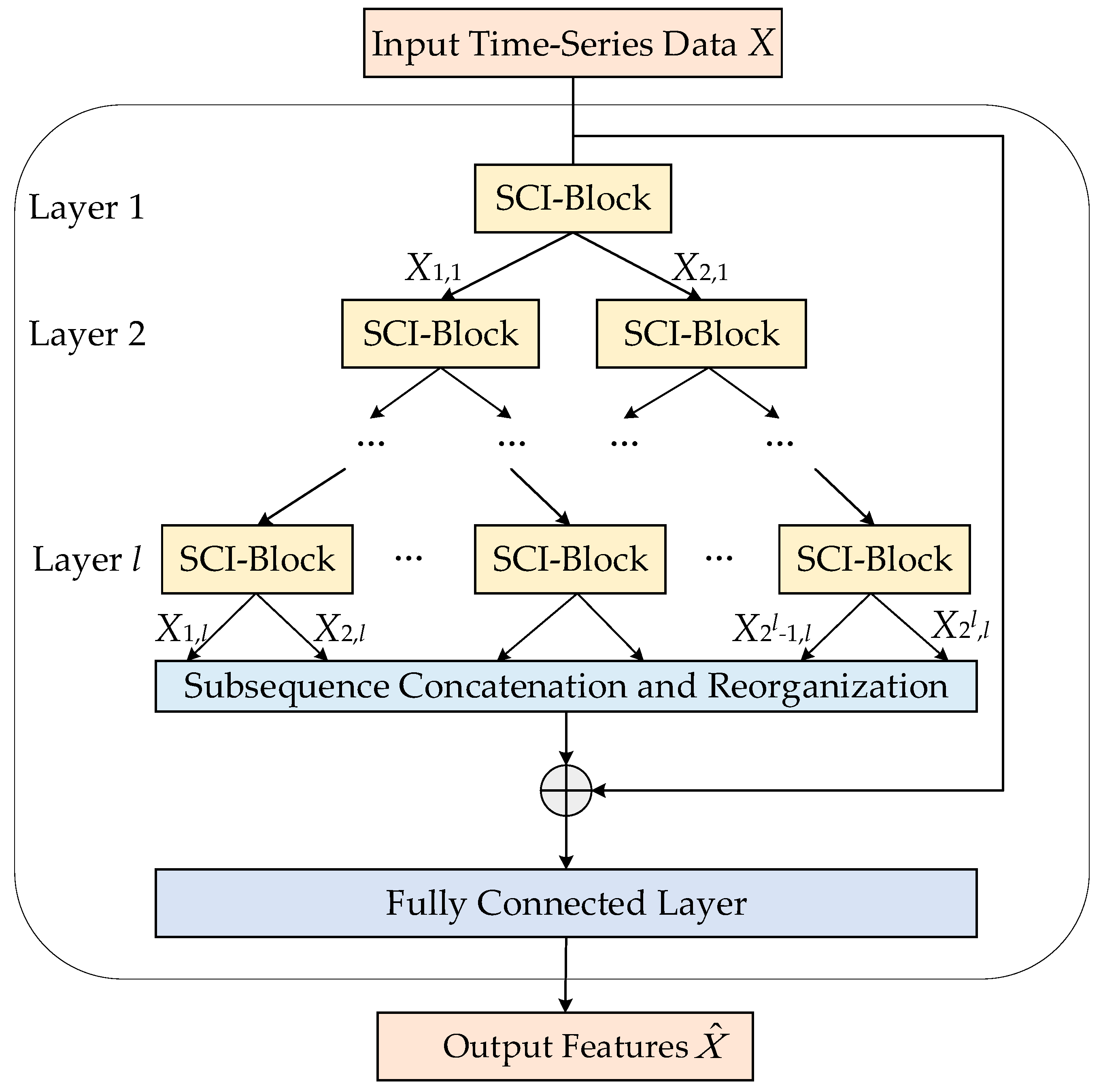
To effectively capture the multi-scale temporal features in the transient evolution process of the power system, SCINet [32] is adopted in this paper as the transient stability assessment model. The overall framework of SCINet consists of SCI-Blocks, a binary tree hierarchical structure, and a residual network, as illustrated in Figure 1.
As shown in Figure 1, the input electrical time-series data are decomposed into odd and even subsequences through the SCI-Blocks at each layer. This process progressively generates subsequence sets with halved temporal resolution. After passing through multiple SCI-Blocks, the model obtains fine-grained feature representations at the bottom layer. Subsequently, the subsequences at different hierarchical levels are concatenated and reorganized in a reverse manner. In this way, multi-scale features are aligned and fused, and the feature representation is finally mapped back to a unified space with the original sequence length. To alleviate potential feature degradation and gradient vanishing problems in the deep binary-tree structure, residual connections are introduced to enhance the fused features. The final transient stability prediction output is then obtained through a fully connected layer. Therefore, this structure enables SCINet to capture local abrupt variations caused by fault disturbances and global temporal dependencies associated with rotor angle evolution. It provides effective multi-scale feature representations for subsequent transient stability assessment under relatively low model complexity. The whole forward propagation process can be expressed as follows:
X ^ = f c X X 1 , l , X 2 , l , , X 2 l , l
where X 2 l , l denotes the 2l-th subsequence obtained from the decomposition of the l -th SCI-Block; f c denotes the mapping of the fully connected layer, and ⊕ represents the residual connection operator.

3.2. Structure of the SCI-Block

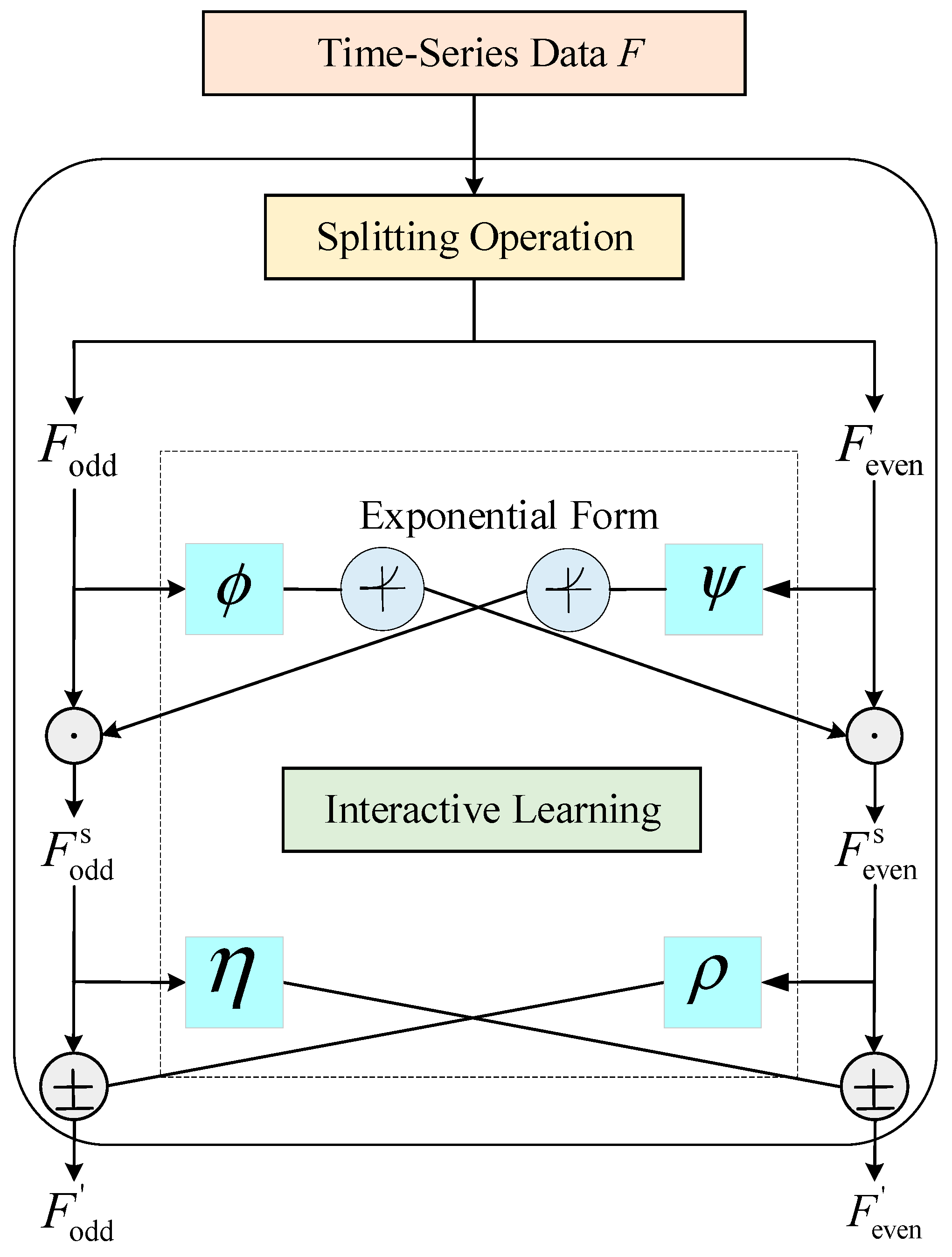
The SCI-Block serves as the core component of SCINet, and its internal structure is shown in Figure 2.
As shown in Figure 2, the SCI-Block first performs a downsampling operation on the input electrical time-series data, decomposing it into an even subsequence and an odd subsequence, as expressed in (13).
F even   = F 0 , F 2 , , F 2 k F odd   = F 1 , F 3 , , F 2 k + 1
where F 2 k and F 2 k + 1 represent the elements at the even-indexed and odd-indexed positions of the original electrical time-series data F , respectively.
The decomposed even subsequence F o d d and odd subsequence F e v e n preserve, to some extent, relatively coarse feature information from the original electrical sequence. However, their resolution is reduced, making it difficult for these features to accurately characterize the transient stability of the system. To enhance the model’s ability to extract fine-grained dynamic features, the SCI-Block introduces two one-dimensional convolution modules with different kernel sizes. These modules, denoted as ϕ ( · ) and ψ ( · ) , perform feature transformations on the even subsequence F e v e n and the odd subsequence F o d d , respectively. The two groups of convolution kernels are independent of each other. They extract diverse and complementary features from different temporal receptive fields, thereby enhancing the multi-scale representation capability of the model.
To alleviate the information loss caused by the downsampling process, an interactive learning mechanism is introduced in this paper. Through bidirectional learning of affine transformation parameters, information compensation between the odd and even subsequences are achieved. Specifically, the odd and even subsequences are first transformed by two one-dimensional convolution modules with different kernel sizes, ϕ ( · ) and ψ ( · ) , respectively. The transformed features are then subjected to an exponential operation and interactively combined with the original subsequences through the Hadamard product. As a result, the scaled sub-features F odd s and F even s are obtained, as shown in (14):
F odd s = F odd exp ϕ F even F even s = F even exp ψ F odd
where e x p ( · ) denotes the exponential operation, and represents the Hadamard product.
Then, two additional one-dimensional convolution modules, ρ ( · ) and η ( · ) , are employed to perform feature transformations on F odd s and F even s . Through a cross-addition operation, the updated odd subsequence F odd and even subsequence F even are obtained, as shown in (15).
F odd = F odd s ± ρ F even s F even = F even s ± η F odd s
Based on the binary-tree hierarchical structure and convolution-based interactive learning mechanism, SCINet expands the temporal receptive field as the number of SCI-Blocks increases. It also refines temporal features progressively based on the feature representations learned in the previous layer.
By progressively aggregating shallow local high-frequency features into deep global low-frequency features, the SCINet model is able to capture both short-term and long-term temporal dependencies across multiple time scales. As a result, it can more accurately characterize the complex internal dynamic evolution of the system during the transient process, thereby providing critical support for subsequent preventive control.

4. Transient Stability Preventive Control Model

The core of transient stability preventive control in power systems lies in solving the TSCOPF model. Unlike the conventional OPF model, the TSCOPF model incorporates a set of DAE as transient stability constraints during the optimization process, and its mathematical formulation is expressed as follows:
d x   d t = f ( x ( t ) , y ( t ) , u )
h ( x ( t ) , y ( t ) , u ) = 0
where x ( t ) and y ( t ) denote the state variables and algebraic variables at time t during transient analysis, respectively; λ denotes the control variables; f ( · ) represents the differential equations describing the transient stability constraints; h ( · ) represents the algebraic equations describing the transient stability constraints.
The transient stability constraints described by (16) and (17) are computationally complex and time-consuming. When multiple contingencies in large-scale power grids are considered, the computational burden becomes even heavier. Therefore, conventional TSCOPF models are difficult to apply to online preventive control. To address this issue, the well-trained SCINet model is embedded into the TSCOPF framework in this paper to replace the original DAE-based transient stability constraints, thereby significantly reducing the computational complexity of the model.

4.1. Objective Function

The objective is to minimize the total active power regulation cost of thermal generators, which is expressed as follows:
min F adjust = min m * C G c G , m * up Δ P G , m * up + c G , m * down Δ P G , m * down
where F adjust denotes the total active power regulation cost of thermal generators; C G denotes the set of generator buses; Δ P G , m * up and Δ P G , m * down denote the upward and downward active power adjustments of generator m * , respectively; c G , m * up and c G , m * down are the corresponding unit adjustment cost coefficients.

4.2. Equational Constraint

To ensure steady-state operation of the system, real-time active and reactive power balance must be satisfied at each bus, and the AC power flow equations can be expressed as follows:
P G k * = P D k * + V k * j * = 1 n V j * G k * j * cos θ k * j * + B k * j * sin θ k * j * Q G k * = Q D k * + V k * j * = 1 n V j * G k * j * sin θ k * j * B k * j * cos θ k * j * , k * C n
where C n denotes the set of all buses; V k * and V j * denote the voltage magnitudes at buses k * and j * , respectively; P G k * and Q G k * denote the active and reactive power outputs at bus k * , respectively; P D k * and Q D k * denote the active and reactive load demands at bus k * , respectively; θ k * j * denotes the phase angle difference between buses k * and j * ; B k * j * and G k * j * denote the susceptance and conductance of the bus admittance matrix.

4.3. Inequational Constraint

To ensure the stable and secure operation of the system, the following inequality constraints must be satisfied:
P G m * min P G m * P G m * max , m * C G Q G m * min Q G m * Q G m * max , m * C G V k * min V k * V k * max , k * C n I o * v * min I o * v * I o * v * max , ( o * , v * ) C l
where C l denotes the set of all transmission lines; P G m * and Q G m * denote the active and reactive power outputs of generator m * , respectively, whose upper and lower bounds are determined by the operating limits of the unit; I o * v * max and I o * v * min denote the upper and lower allowable current limits of line, respectively; and V k * denotes the voltage magnitude at bus k * , which should be maintained within an allowable range to ensure power supply quality.

4.4. Transient Stability Constraints

The solution process for transient stability constraints in the conventional TSCOPF model is complex, making it difficult to satisfy the fast computation requirements of online preventive control. Therefore, SCINet is employed to learn the nonlinear mapping relationship between the system operating features and TSI. In this way, the complex DAE-based solution process is transformed into a fast SCINet-based evaluation. After training is completed, the transient stability constraint constructed by SCINet can be expressed as follows:
Φ ( X op ) > ξ
where X op denotes the system operating feature vector; Φ ( · ) denotes the trained SCINet model; and ξ denotes the threshold of the transient stability margin.

4.5. Improved Dung Beetle Optimization Algorithm

An IDBO is employed in this paper to solve the TSCOPF model. In DBO, the population is divided into four types of individuals: rolling, breeding, small, and stealing dung beetles. These individuals simulate dung-rolling, breeding, foraging, and stealing behaviors, respectively. These individuals collaboratively search the solution space through different position update mechanisms. Specifically, rolling dung beetles are responsible for basic exploration. Breeding and small dung beetles perform exploitation around the local optimum and global optimum regions, respectively. Stealing dung beetles enhance global exploration capability of the population through random perturbations [33]. To further improve convergence performance and optimization accuracy, a Tent chaotic initialization strategy [34] and an adaptive t-distribution perturbation strategy [35] are introduced into the standard DBO. This forms the proposed IDBO-based solution method.

4.5.1. Tent Chaotic Mapping

To improve the quality of the initial population, a Tent chaotic initialization strategy is introduced in this paper to replace the random initialization method used in the standard DBO. The Tent chaotic map has good ergodicity and uniformity, which can enhance the diversity of the initial population distribution and improve the global search capability of the algorithm in the early stage. The Tent mapping can be expressed as follows:
z ˜ m , j = f ( z m , j ) = z m , j μ , z m , j [ 0 , μ ) , 1 z m , j 1 μ , z m , j [ μ , 1 ]
where z m , j and z ˜ m , j denote the chaotic state variables of the j-th dimension of the m-th individual before and after mapping, respectively; μ ( 0 , 1 ) is the control parameter of the Tent map, and μ = 0.499 is adopted in this paper. By mapping the generated chaotic sequence into the search space, the initial positions of the population can be obtained as follows:
X m , j 0 = L j + z ˜ m , j U j L j
where U j and L j denote the upper and lower bounds of the j-th dimension, respectively. By adopting this strategy, the initial population achieves better coverage of the search space, which is beneficial for improving the convergence speed and optimization accuracy of the algorithm.

4.5.2. Adaptive t-Distribution Strategy

After optimizing the initial population, an adaptive t-distribution strategy is further introduced to enhance the search performance of DBO at different iteration stages [36]. The degrees of freedom of the t-distribution vary dynamically with the iteration number. Based on this property, the strategy strengthens global exploration through large-range perturbations in the early stage. It also improves local exploitation accuracy through small-range perturbations in the later stage, thereby balancing convergence speed and solution accuracy.
Let X m , j k denote the current position of the m-th individual in the j-th dimension at the k-th iteration. In each iteration, the population first performs position searching for the four types of individuals according to the standard DBO position update mechanism, thereby obtaining the updated positions. Subsequently, a t-distribution perturbation is applied to a subset of the population, and the corresponding candidate position can be expressed as follows:
X ˜ m , j k = X m , j k + ς k X m , j k
where X m , j k denotes the candidate position after perturbation, and ς k represents a random perturbation term following the t-distribution, whose degrees of freedom are dynamically adjusted with the iteration number. Considering that perturbing all individuals would increase the computational cost and may weaken the original search mechanism of the standard DBO, a dynamic selection probability is further introduced in this paper:
p k = w 1 w 2 × K max k K max
where w 1 is the upper limit of the dynamic selection probability, w 2 is the amplitude of probability variation, and K max denotes the maximum number of iterations. In this paper, w 1 = 0.5 and w 2 = 0.1 . In each iteration, a subset of individuals is selected according to the probability p k to undergo t-distribution perturbation, and the better position is retained based on the greedy criterion. This strategy dynamically balances global exploration and local exploitation while controlling the computational cost, thereby improving the overall optimization performance of the algorithm.

4.5.3. Penalty Function Treatment of the SCINet Constraint

To handle the transient stability constraint, a penalty function method is adopted in this paper. The transient stability constraint is transformed into a penalty term in the fitness function of IDBO. For any candidate solution u generated by IDBO, u represents a set of active power adjustment values of generators in the system. First, the generator active power outputs are updated according to the candidate solution u . Then, power flow calculation is performed to check the power flow equality constraints and operating inequality constraints corresponding to this candidate solution. Meanwhile, the input feature vector X op ( u ) for transient stability assessment is obtained. Next, the feature vector is input into the trained SCINet model, and the predicted transient stability index is obtained as Φ ( X op ( u ) ) . If Φ ( X o p ( u ) ) > ξ , the candidate solution satisfies the transient stability constraint; otherwise, it violates the constraint. Therefore, the penalty function method is used to embed this non-differentiable constraint into the IDBO optimization process. The fitness function is expressed as follows:
F fitness ( u ) = m S G c G , m up Δ P G , m up + c G , m down Δ P G , m down + λ TS max ( 0 , ξ Φ ( X op ( u ) ) )
where F fitness ( u ) is the fitness value of IDBO; λ TS is the penalty factor. In this paper, λ TS is set to 103. When the candidate solution satisfies the transient stability constraint, the penalty term is zero. Otherwise, the penalty term increases with the degree of stability margin violation, so unstable candidate solutions are gradually eliminated during population evolution.

4.6. Framework of the Proposed Transient Stability Preventive Control Method

The core idea of the proposed method is to use the trained SCINet model as a transient stability evaluator. This evaluator replaces the DAE-based transient stability constraints in the conventional TSCOPF model. The resulting model is then solved by IDBO to generate preventive control actions.
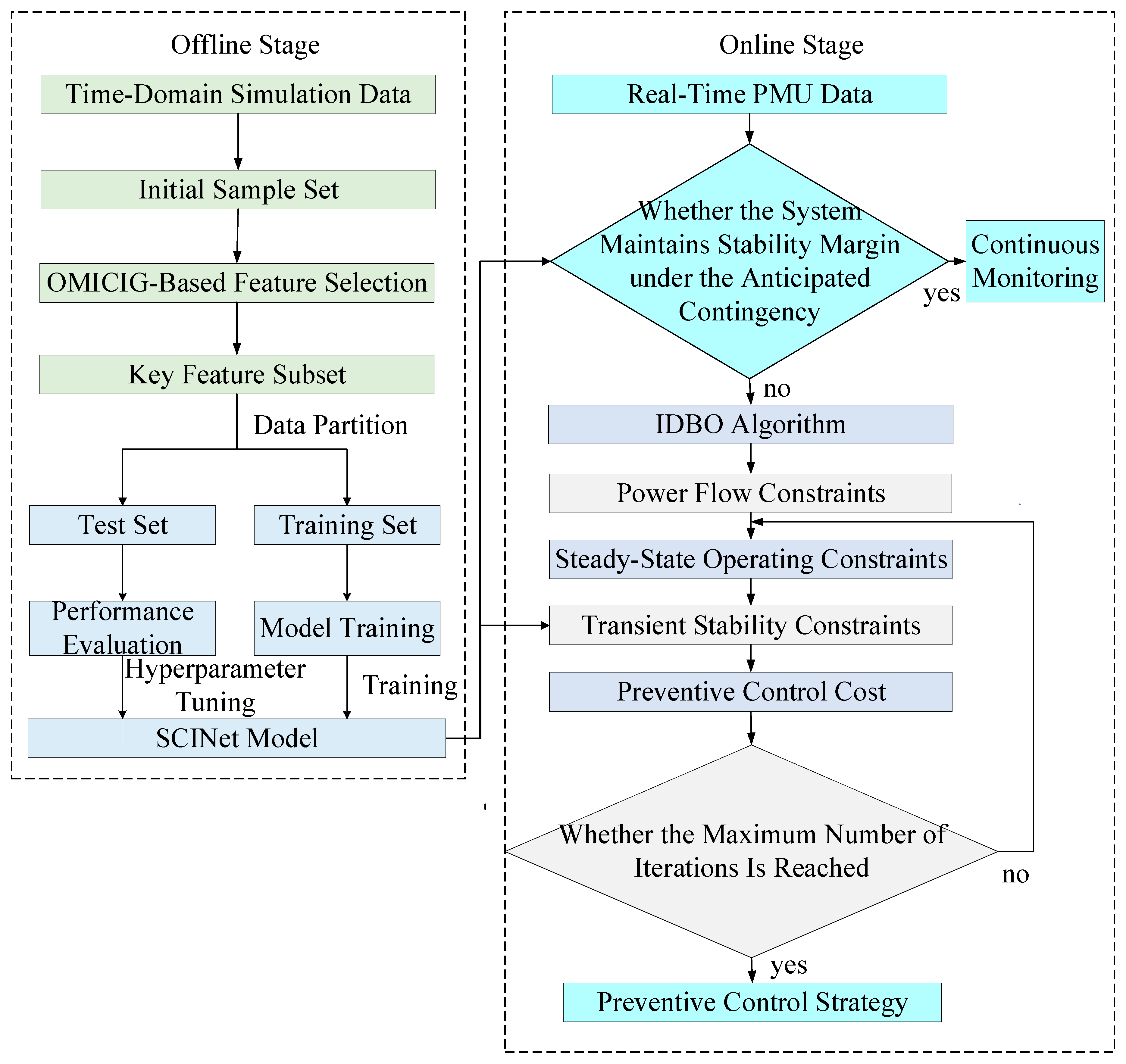
When a prescribed contingency occurs in the system, the system can be guided from an unstable state to a stable operating region by adjusting the active power output of generators, thereby realizing online preventive control. As shown in Figure 3, the overall framework of the proposed preventive control method mainly consists of two parts: the offline stage and the online stage.
As shown in Figure 3, the offline stage is mainly used for sample generation, OMICIG-based feature selection, and SCINet model training. The online stage uses real-time PMUs measurements as input, evaluates the transient stability state through the trained SCINet model, and triggers IDBO-based TSCOPF optimization when an unstable operating point is detected. The detailed procedures of the offline and online stages are as follows:
Figure 3. Offline-online framework of the proposed transient stability preventive control method.
Energies 19 02824 g003

4.6.1. Offline Stage

To improve the training performance and generalization capability of the transient stability assessment model, it is necessary to obtain a large amount of sample data covering diverse operating conditions. Based on the standard test system provided by the PSS/E simulation platform, the initial operating state is taken as the reference. A large number of operating-point samples are then generated under different conditions by varying the system load power distribution. To ensure that the preventive control strategy can withstand the most severe fault scenarios, the transmission lines with relatively serious fault consequences are selected based on historical operating experience to form the contingency set. For each operating-point sample, the TSI under the contingency set is obtained through time-domain simulation, and its minimum value is taken as the label. Together with the corresponding sample, it constitutes the initial sample set of SCINet.
To effectively reduce the training and computational burden of the SCINet model, the feature selection method designed in Section 2.2 is employed to reduce the dimensionality of the initial sample set. The aim is to extract a key feature subset characterized by strong relevance, low redundancy, and high synergy.
The key feature subset obtained after feature selection is randomly divided into training, validation, and test sets at a ratio of 7:1:2. The operating features of the training samples are used as the model input, and the corresponding TSI values are used as the model output to train the SCINet model. In this way, the SCINet model learns the nonlinear mapping relationship between the operating features and TSI. The validation set is used to tune the model parameters, while the test set is used only for the final performance evaluation of the trained SCINet model. Finally, the trained SCINet model is embedded into the TSCOPF model as the transient stability constraint.

4.6.2. Online Stage

The PMUs are used to collect power system measurement data in real time, and the trained SCINet model is employed to determine the state of the system operating point under the prescribed contingencies. If the current operating point is identified as transiently unstable, IDBO is used to solve the TSCOPF model iteratively. The model consists of the objective function, steady-state operating constraints, and transient stability constraints (replaced by the trained SCINet model). The solution provides an optimal operating point that balances system security and economy, thereby providing support for grid operators in formulating corresponding preventive control actions. Otherwise, the operating point remains under continuous monitoring.

5. Case Studies

The IEEE 39-bus system is selected on the PSS/E platform for case analysis to verify the effectiveness of the proposed method. The computer configuration is Intel Core i7-8700 CPU with 16.0 GB RAM.

5.1. Dataset Generation

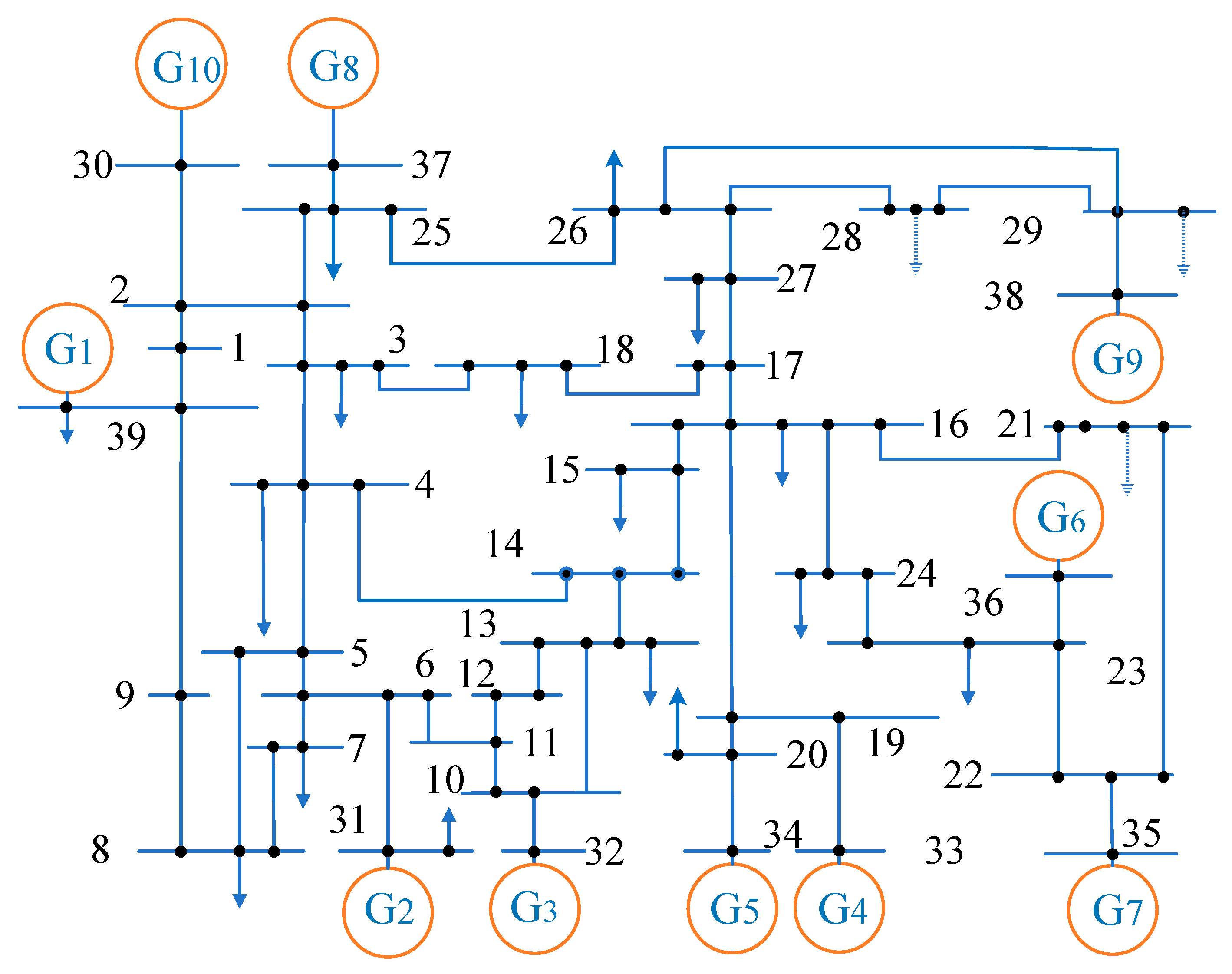
The single-line diagram of the New England 10-machine 39-bus system is shown in Figure 4, which consists of 19 load buses, 46 transmission lines, and 10 generators. During the simulation, the generator voltage magnitudes vary within the range of 0.95–1.05 p.u. The system load fluctuates between 80% and 120%. The active power outputs of generators are adjusted accordingly to maintain power balance.
Considering fault severity, six critical transmission lines are selected to form the contingency set, as listed in Table 1. During data generation, the fault locations are set at 2%, 25%, 50%, 75%, and 98% of the line length from the bus, and the fault type is specified as a three-phase short-circuit fault. The fault is initiated at 1 s, the sampling interval is set to 0.01 s, the fault duration varies from 0.1 s to 0.3 s with an interval of 0.05 s, and the total simulation time is 10 s. Based on the above fault generation scheme, a total of 8160 samples are generated to form the initial dataset. Among them, 4958 samples are stable, accounting for 60.76% of the total samples, while 3202 samples are unstable, accounting for 39.24% of the total samples. The 8160 samples are generated through time-domain simulation under different operating conditions and contingency scenarios, covering different load levels, fault locations, and fault durations. The dataset is randomly divided into training, validation, and test sets at a ratio of 7:1:2. The input features of each sample consist of 205 dimensions in total. These features include bus voltage magnitudes and phase angles, active and reactive load powers, active and reactive generator powers, generator rotor angles, and active and reactive power flows of transmission lines, while the output label is TSI.

5.2. Performance Evaluation Metrics of the Model

In this paper, prediction accuracy A p , mean absolute error (MAE), and the coefficient of determination R2 are selected to evaluate the performance of the SCINet-based transient stability assessment model:
A p = ( 1 | y i y ^ i | | y ^ i | ) × 100 %
R 2 = 1 i = 1 N y ^ i y i 2 i = 1 N y ¯ y i 2
MAE = 1 N i = 1 N y ^ i y i
where N denotes the total number of samples; y i denotes the true value of the i-th sample; y ¯ denotes the mean value of all true values; y ^ i denotes the predicted value of the i-th sample generated by the model. In general, higher A p and R 2 values and a smaller MAE indicate better predictive performance of the model.
To further evaluate the transient stability assessment performance of SCINet, a confusion matrix is constructed from the perspective of classification evaluation, as shown in Table 2.
In Table 2, TP, FN, FP, and TN denote true positive, false negative, false positive, and true negative, respectively. TP denotes the number of unstable samples correctly classified as unstable. FN denotes the number of actually unstable samples misclassified as stable. FP denotes the number of actually stable samples misclassified as unstable. TN denotes the number of stable samples correctly classified as stable. Based on the confusion matrix, three classification metrics are used: recall (Rec), precision (Pre), and F1-score. Rec measures the ability of the model to identify unstable samples. A higher recall indicates a lower risk of missing actually unstable samples. Pre measures the proportion of truly unstable samples among all samples predicted as unstable. A higher precision indicates that the predicted unstable results are more reliable. The expressions are given as follows:
R e c = T P T P + F N × 100 %
P r e = T P T P + F P × 100 %
F 1 = 2 P r e R e c P r e + R e c × 100 %

5.3. Analysis of Feature Selection Results

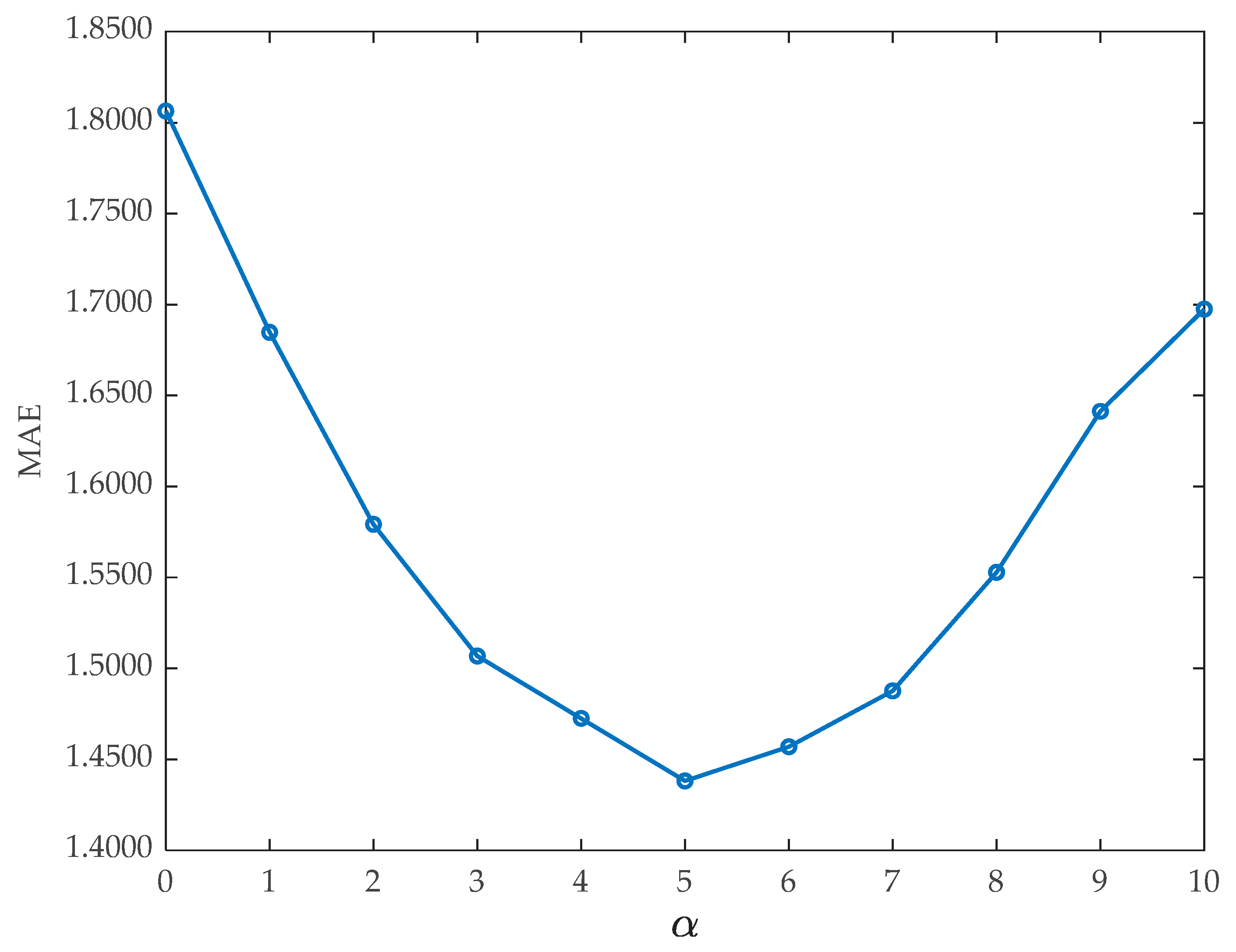
To reduce the subjectivity in selecting the weighting coefficient α in Equation (9), a sensitivity analysis of α is conducted. Its value can be determined by intelligent optimization algorithms or grid search. Considering that intelligent optimization algorithms may introduce a large computational cost, while grid search is simple and computationally efficient, grid search is adopted to optimize α . Specifically, the SCINet structure, training parameters, and number of selected features are kept unchanged. The value of α is set to integers from 0 to 10, and the feature subset corresponding to each value of α is constructed. Then, five-fold cross-validation is performed under the same training conditions, and the average MAE values under different α values are recorded, as shown in Figure 5.
As shown in Figure 5, the MAE first decreases and then increases as α increases. When α increases from 0 to 5, the MAE gradually decreases from 1.8064 to 1.4381. This indicates that an appropriate increase in the weight of the synergistic information gain term helps improve the feature selection effect and enhances the assessment performance of the model. When α continues to increase, the MAE increases again. This suggests that overemphasizing feature synergy may weaken the contribution of the independent relevance of candidate features and introduce redundant information. Overall, the minimum model error is obtained when α = 5 . Therefore, α = 5 is selected as the optimal weighting parameter of the OMICIG feature selection algorithm.
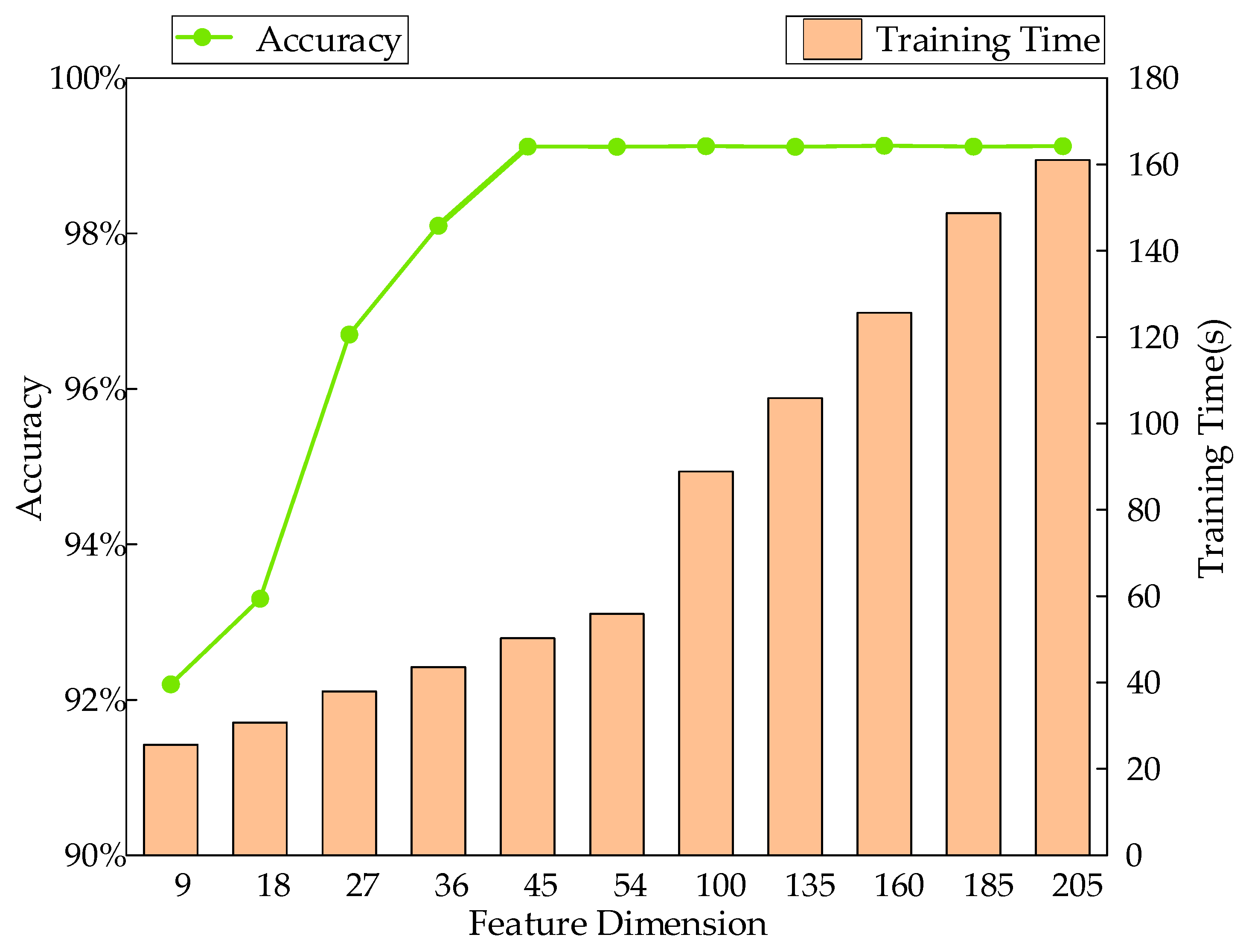
In this paper, the OMICIG method is employed to select the original features. Based on this, the influence of different feature dimensions on the evaluation performance of the SCINet model is systematically investigated, and the corresponding results are shown in Figure 6. It can be observed from Figure 6 that when the feature dimension reaches 45, the evaluation accuracy of the model attains 99.32%. As the feature dimension further increases, the model accuracy exhibits only slight variation.
Considering that reducing the offline training time of the transient stability assessment model can effectively lower the labor and computational costs of preventive control, this advantage becomes even more pronounced in practical large-scale power systems. Therefore, a trade-off between training efficiency and model accuracy is considered in this paper, and 45 features are ultimately selected from the initial feature set to construct the key feature subset.
To verify the superiority of the proposed OMICIG method, comparative tests are conducted against three other feature selection methods, including MIC, joint mutual information (JMI), and maximum relevance minimum redundancy (MRMR). To ensure a fair comparison, all feature selection methods are evaluated using the same number of selected features. Specifically, each method selects 45 features from the original feature set to construct the key feature subset, and their performances are tested under the same SCINet model. The results are presented in Table 3. It can be seen that MIC only measures the pairwise correlation between features and the target variable while ignoring the redundancy among features. Therefore, the model using MIC-selected features shows relatively low evaluation accuracy. JMI considers the correlation between multiple features and the target variable, and thus achieves higher prediction accuracy than MIC. The MRMR method further improves evaluation accuracy by introducing a redundancy measure during feature selection. However, it does not consider the synergistic effect among features. Therefore, its evaluation accuracy is still lower than that of the OMICIG method. Overall, the OMICIG method simultaneously takes into account the relevance between features and the target variable, as well as the redundancy and synergistic effects among features. Therefore, it is able to select a more discriminative key feature subset. This enables the SCINet model to achieve the best evaluation performance.

5.4. Performance Analysis of the Transient Stability Assessment Model

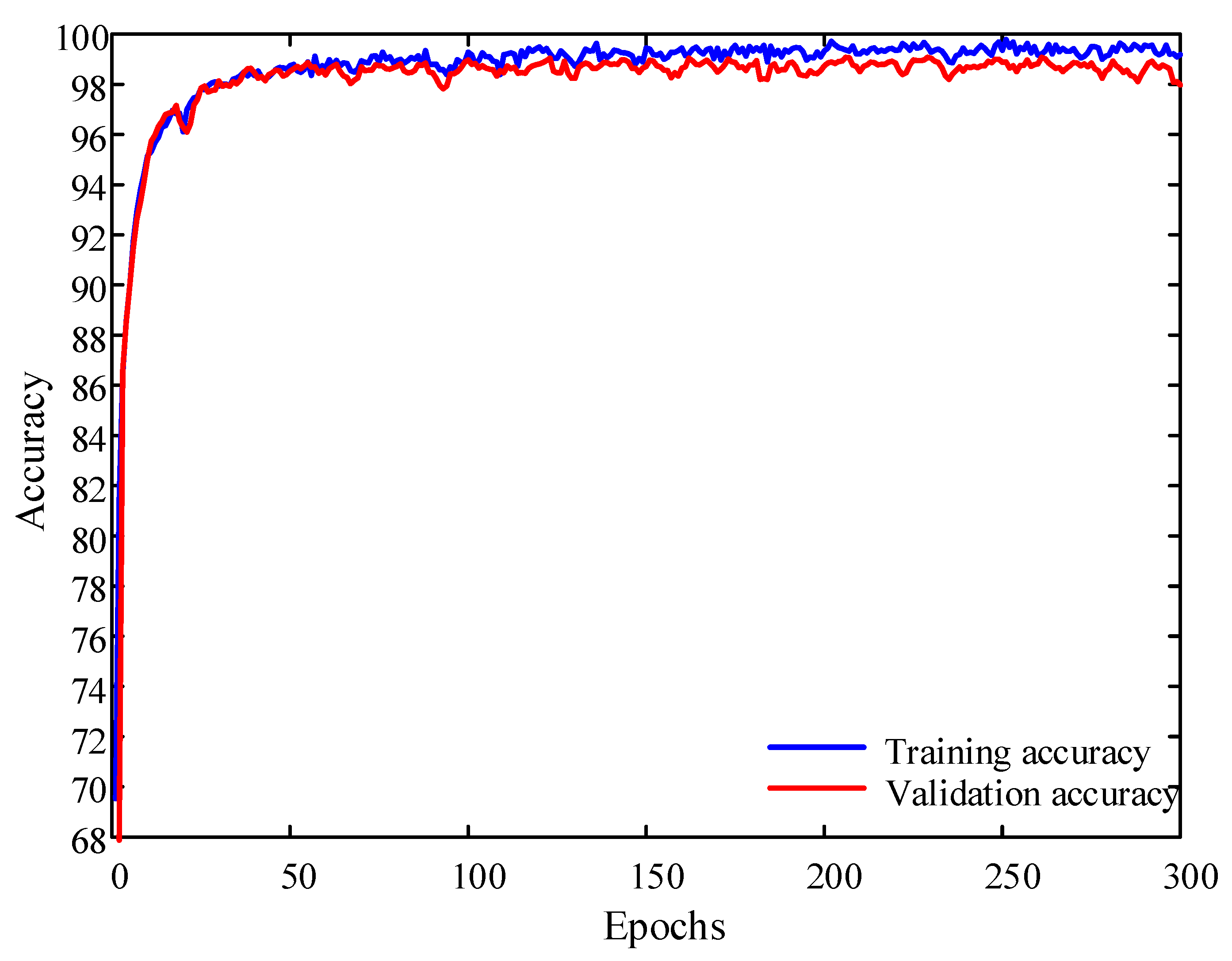
During the training of the SCINet model, the grid search method is employed in this paper to optimize the hyperparameters so as to obtain the best evaluation performance of the model. The final hyperparameter settings are determined as follows: the binary tree depth is 3, the batch size is 128, the learning rate is 10−5, the number of epochs is 300. The Adam optimizer is used for training. A dropout strategy with a dropout rate of 0.5 is introduced to suppress overfitting. The curves of prediction accuracy versus the number of iterations during model training and validation are shown in Figure 7.
As shown in Figure 7, both the training accuracy and validation accuracy increase rapidly in the early training stage and then gradually stabilize. The validation curves remain close to the training curves during the whole training process, and no obvious divergence is observed. This indicates that the SCINet model has stable convergence behavior and does not show obvious overfitting.
To verify the superiority of the proposed SCINet model, comparative tests on transient stability assessment performance are carried out between the SCINet-based assessment model and RF, RNN, DBN, CNN, GKAN, GCN, PINN, and Transformer using the same key feature subset. In the RF model, the number of decision trees is set to 30 and the maximum depth is set to 10. The RNN adopts a two-layer recurrent architecture with 64 hidden units in each layer. The DBN and GKAN both use a four-layer network structure, with 64 neurons in each layer. The CNN is configured with two 5 × 5 convolutional layers and two 2 × 2 pooling layers. GCN adopts a two-layer graph convolutional structure. The numbers of hidden units in the two layers are set to 64 and 32, respectively. The adjacency matrix is constructed according to the power grid topology. The Transformer model adopts two encoder layers, with four attention heads, a hidden dimension of 64, and a feed-forward dimension of 128. PINN adopts a four-layer fully connected network with 64 neurons in each layer. A transient-stability-related physical constraint penalty term is added to the data-fitting loss function. During the testing process, grid search and five-fold cross-validation are used to determine the optimal hyperparameters of each model. The final performance of all assessment models on the test set is presented in Table 4.
As shown in Table 4, the overall performance of different assessment models varies significantly. RF has a simple structure and the shortest assessment time, but its limited feature representation capability leads to lower Ap and R2 values and a higher MAE. Compared with RF, DBN, CNN, and RNN improve the assessment performance due to their stronger feature learning capability. However, their ability to extract multi-scale transient features is still limited. GKAN, GCN, Transformer, and PINN further improve the assessment accuracy. Among them, Transformer and PINN achieve relatively high Ap and R2 values and low MAE values. However, Transformer requires a relatively long assessment time, while PINN has the longest training time because additional physical constraint terms are introduced into the training process. In contrast, SCINet achieves the highest Ap and R2 values and the lowest MAE. Its assessment time is only 0.281 s, which is much shorter than the assessment times of GKAN, GCN, Transformer, and PINN. These results indicate that SCINet can achieve higher assessment accuracy with a lower online computational burden. Therefore, SCINet provides a better balance between assessment accuracy and computational efficiency, making it more suitable for online transient stability preventive control.
To further evaluate the stability classification performance of each model, Rec, Pre, and F1 are calculated based on the confusion matrix. The results are shown in Table 5.
As shown in Table 5, SCINet achieves higher Rec, Pre, and F1 values than the other compared models, indicating its high reliability in stable/unstable state classification. Specifically, the Rec of SCINet reaches 99.09%, corresponding to a missed-detection rate of only 0.91% for unstable samples. This indicates that the probability of predicting an actually unstable sample as stable is low, which helps reduce the security risk caused by missing unstable operating conditions in online preventive control. In addition, the Pre of SCINet reaches 99.34%, corresponding to a false-alarm ratio of only 0.66% among the samples predicted as unstable. This indicates that only a small proportion of the samples predicted as unstable are actually stable, thereby reducing unnecessary preventive control adjustments.
For power system preventive control, the missed detection of unstable samples is the more critical security-related error, because it may prevent the system from taking necessary preventive control actions in time. To further reduce this risk, the stability threshold ξ can be appropriately increased according to the required security level in practical applications. When the predicted TSI is lower than the preset threshold ξ , preventive control can be carried out to reduce the security risk, although the control cost may increase. False alarms for stable samples mainly affect operating economy and usually do not directly reduce system security. Therefore, the stability threshold ξ can be adjusted according to practical operating requirements to achieve a trade-off between system security and operating economy.

5.5. Performance Analysis of Transient Stability Preventive Control

An operating sample that is identified as transiently unstable by the SCINet model under the anticipated fault 1 scenario is selected. The corresponding TSCOPF model is then optimized using IDBO to generate a preventive control strategy. By adjusting the active power outputs of generators, the system is able to restore transient stability even when the above multiple fault scenarios occur. The active power adjustments of generators before and after preventive control are presented in Table 6. The unit adjustment cost is set to $10 for Generators 1–5 and $5 for Generators 6–10. The total adjustment amount is 231.47 MW. Based on Table 6, the total adjustment cost of generator active power is calculated as $1579.45. Furthermore, time-domain simulations are carried out to verify the transient stability before and after preventive control, and the corresponding transient stability index TSI is listed in Table 7.
As shown in Table 7, at this representative unfavorable operating point, the system becomes transiently unstable when anticipated faults 1, 3, 4, and 6 occur. After applying the preventive control strategy generated by IDBO-based TSCOPF optimization, the active power outputs of generators are adjusted. The TSI values of all previously unstable fault scenarios increase significantly from negative to positive. This indicates that the proposed strategy has good robustness against the anticipated fault set.
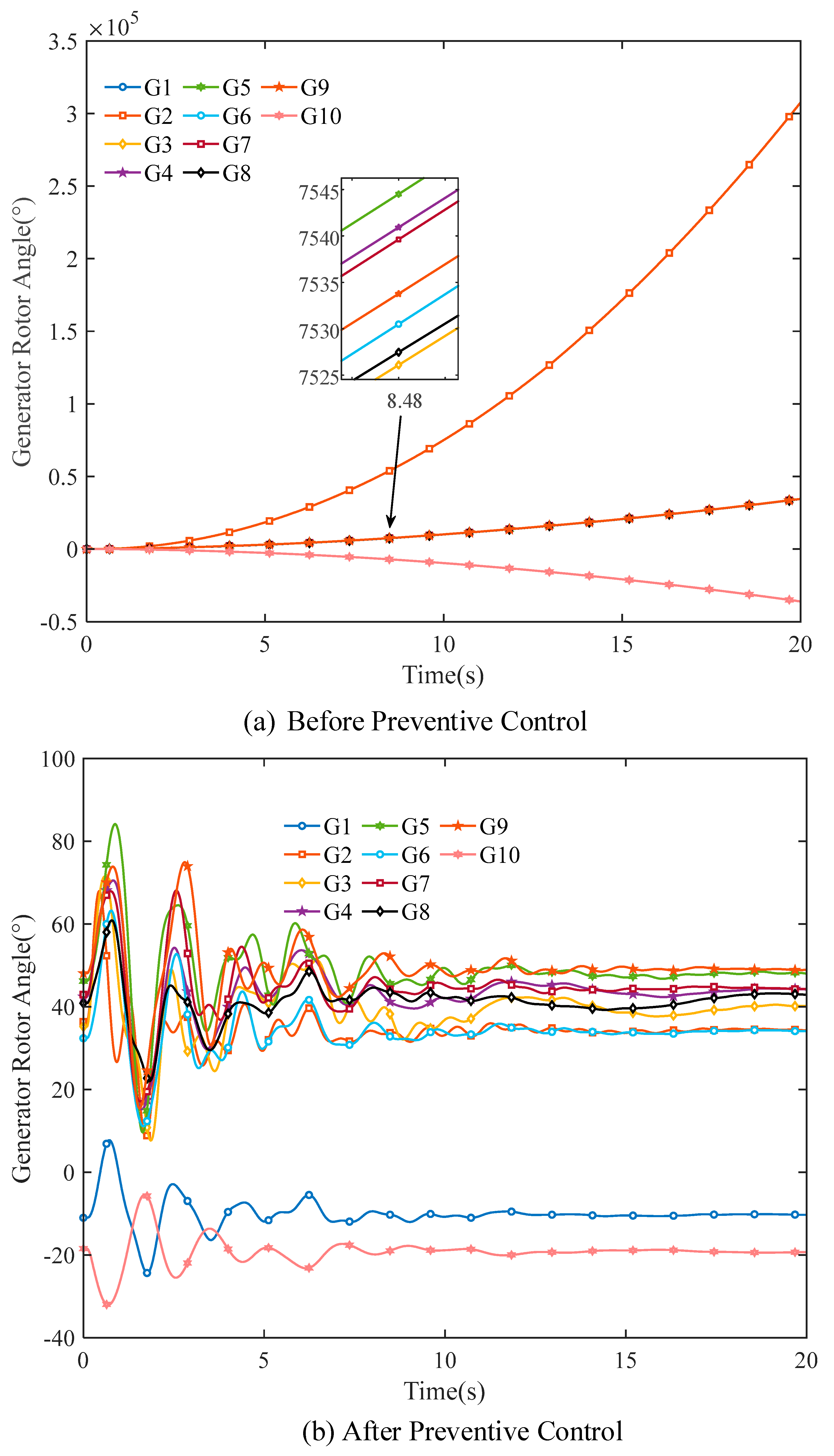
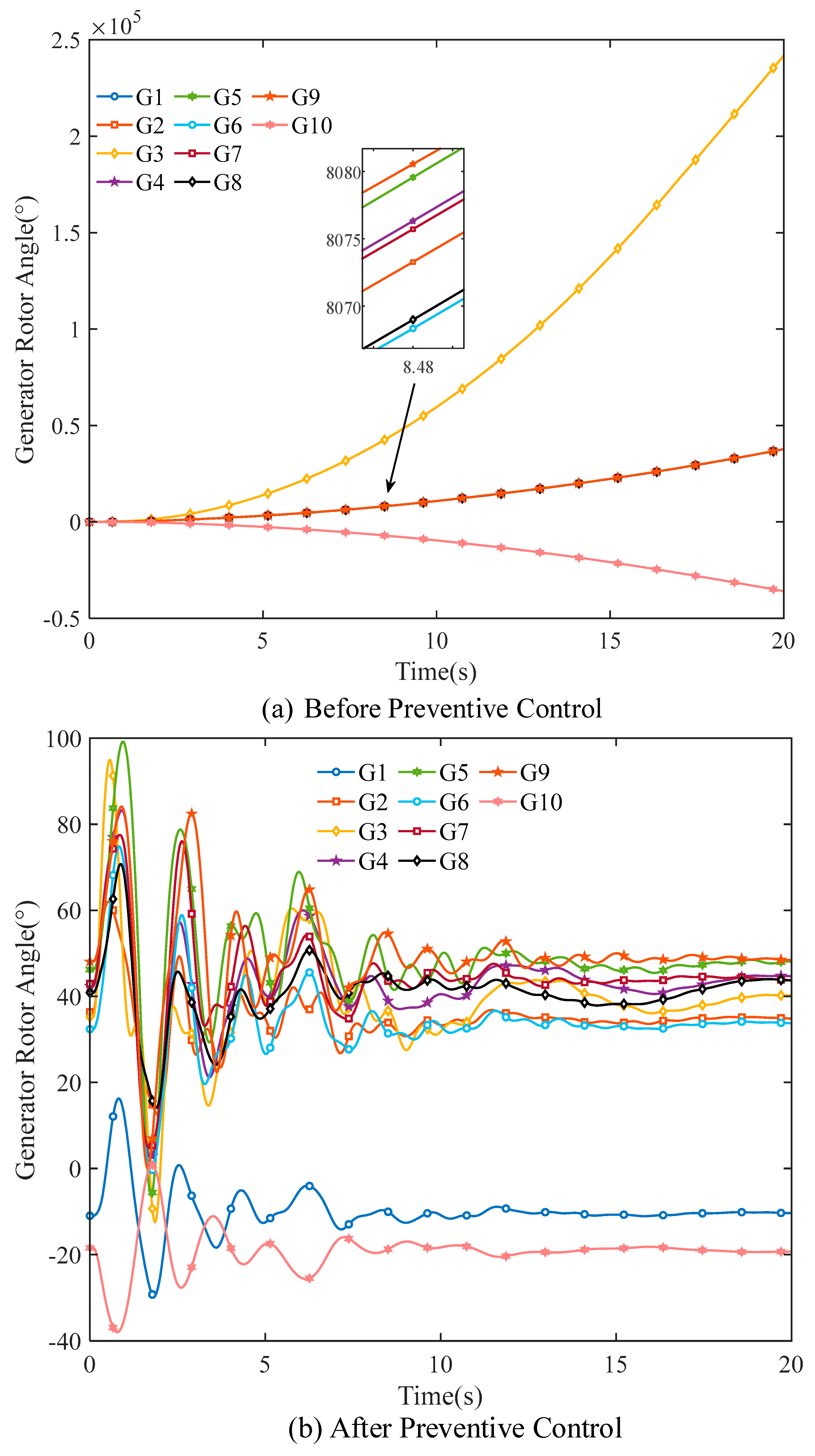
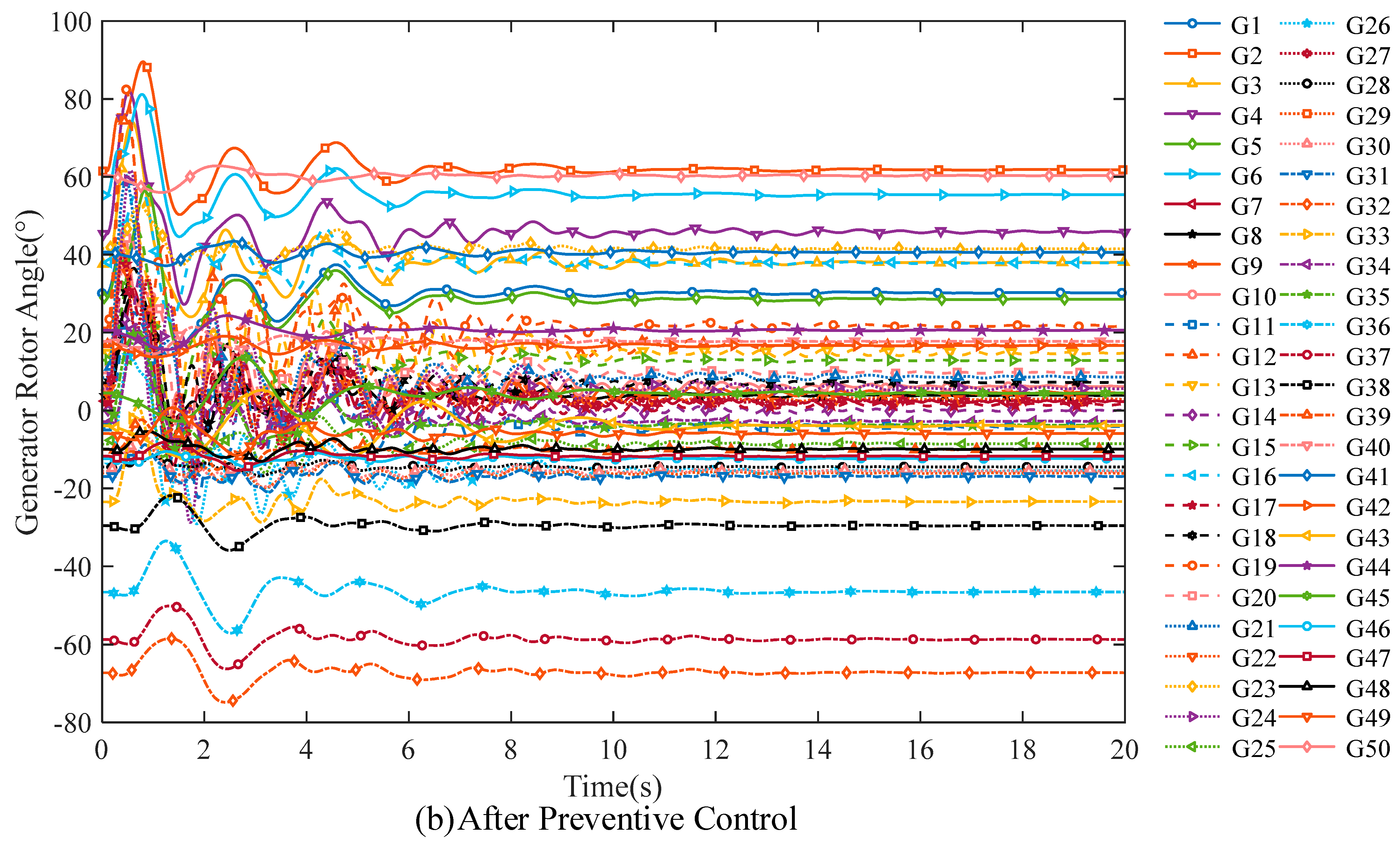
As shown in Figure 8 and Figure 9, when an anticipated fault occurs, the generator rotor angle curves gradually separate. The rotor angle differences among generators continue to increase and eventually exceed the transient stability margin threshold of 360°. This indicates that the system loses transient stability. After the operating condition of the system is optimized through TSCOPF, the generator rotor angle curves gradually become stable and finally converge, indicating that the system is restored to a transiently stable state. These results further demonstrate the effectiveness of the proposed transient stability preventive control method.

5.6. Performance Analysis of Optimization Algorithms

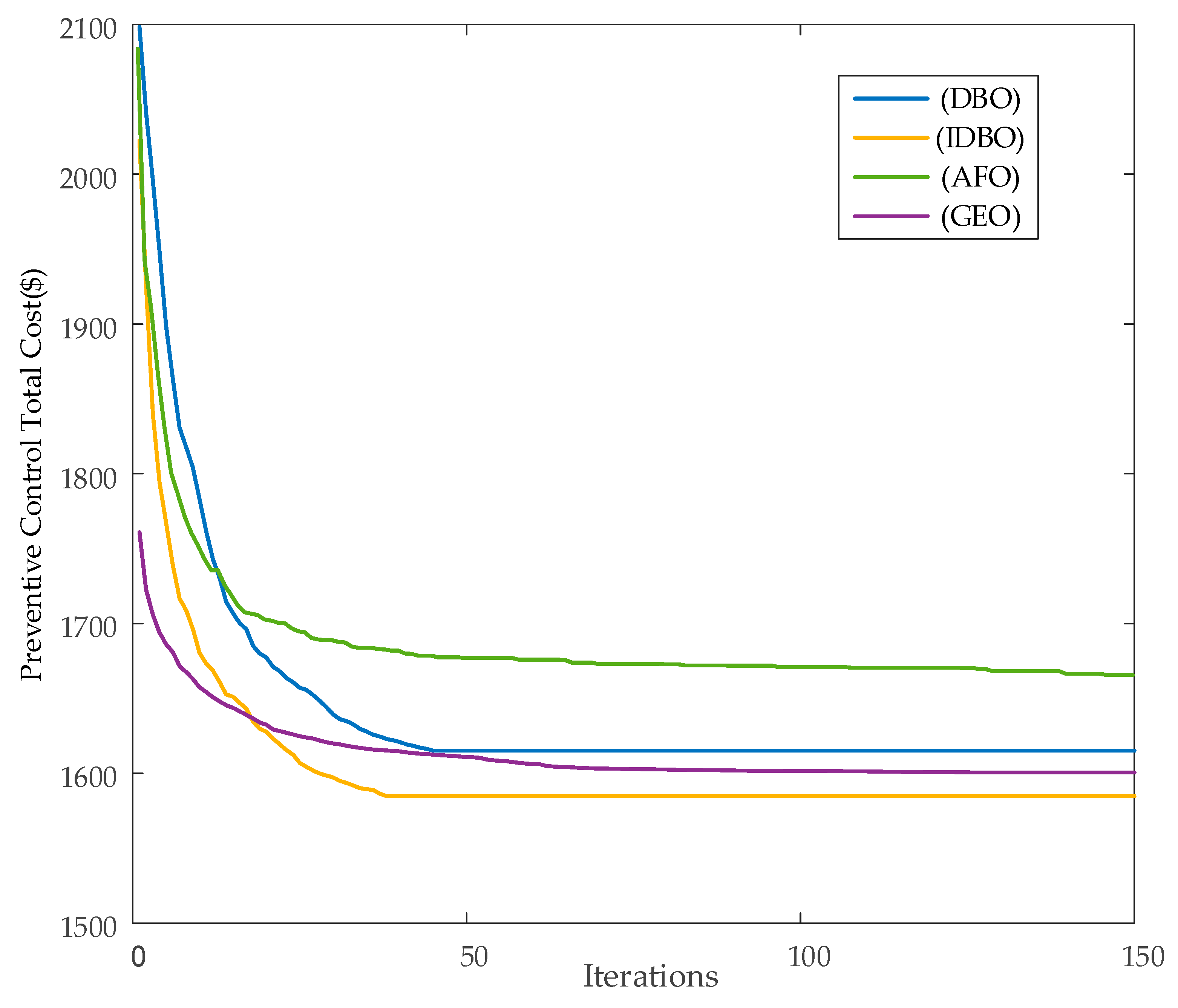
To verify the superiority of the IDBO algorithm used in this paper for solving the TSCOPF problem, comparative experiments are conducted among DBO, GEO, and AFO under the anticipated fault 1 scenario. To ensure the fairness of the comparison, the maximum number of iterations and the population size of all three algorithms are uniformly set to 150 and 50, respectively. Each algorithm is independently run 20 times under the same conditions, and the average results are used to plot the convergence curves, as shown in Figure 10.
As shown in Figure 10, IDBO exhibits the best convergence performance in solving the TSCOPF model. Compared with DBO, GEO, and AFO, IDBO reduces the objective function value more rapidly in the early iterations. It also continues to search for better solutions in the subsequent iterations. Finally, it converges first to the minimum total preventive control cost of $1579.45 after the 35th iteration. Compared with the standard DBO, IDBO shows clear advantages in both convergence speed and solution accuracy, indicating that the proposed improvement strategies can effectively enhance the optimization performance of the TSCOPF model.

5.7. Performance Comparison of Different TSCOPF Methods

To verify the effectiveness of the proposed IDBO algorithm in solving the SCINet-based TSCOPF model, a representative mathematical programming solver, namely the interior point method (IPM), is introduced for comparison. In the comparative method, IDBO is replaced by IPM, while the trained SCINet model is still used as the surrogate transient stability constraint. The two methods are defined as follows:
IPM-SCINet: The trained SCINet model is used to replace the conventional DAE-based transient stability constraint. Then, the TSCOPF model is solved using IPM, which is a representative mathematical programming method, to obtain the preventive control strategy.
IDBO-SCINet: This is the proposed method. The SCINet model is used to replace the transient stability constraint in TSCOPF, and IDBO is used to solve the model.
Under contingency 6, the same operating point is selected for testing. Before preventive control, the TSI of this operating point is −97.81, indicating that the system is transiently unstable. Table 8 presents the comparison results of the two preventive control methods.
As shown in Table 8, both IPM-SCINet and IDBO-SCINet can restore the unstable operating point to a transiently stable state. In IPM-SCINet, the trained SCINet model is used to replace the conventional DAE-based transient stability constraint, and the resulting TSCOPF model is solved by the interior point method. Compared with IPM-SCINet, IDBO-SCINet achieves a lower regulation cost within a shorter computation time while maintaining a positive TSI value. This is mainly because IDBO does not rely on gradient information and has stronger global search capability when dealing with the non-differentiable SCINet-based surrogate constraint. Therefore, the proposed IDBO-SCINet method can ensure transient stability while improving online computational efficiency and operating economy, making it more suitable for online transient stability preventive control.

5.8. Generalization Test on the IEEE 118-Bus System

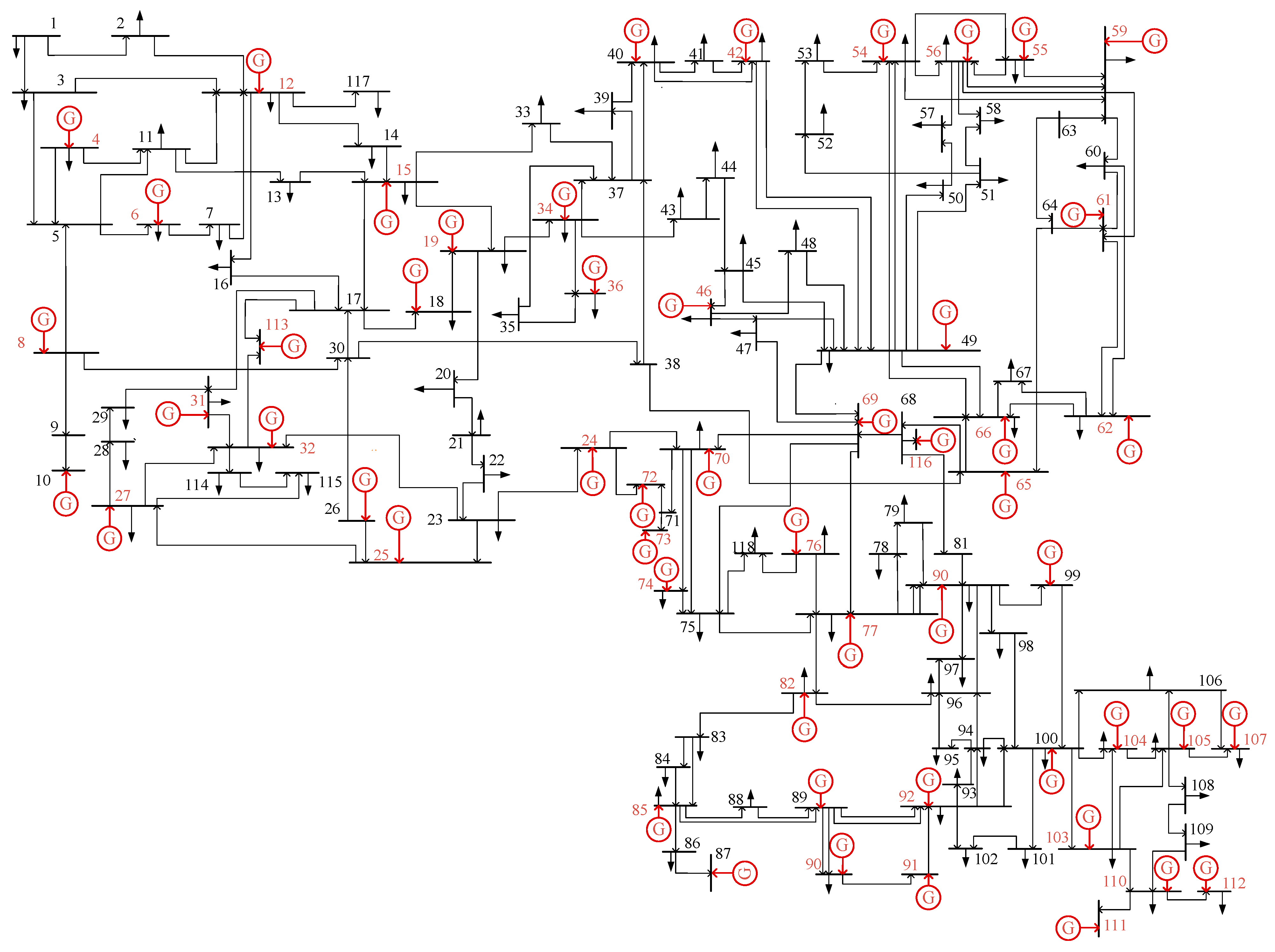
To evaluate the generalization capability and robustness of the proposed preventive control method in a large-scale power system, the IEEE 118-bus system is selected for case study analysis. This system contains 118 buses, 54 conventional generators, 177 AC transmission lines, and 91 loads. Its single-line diagram is shown in Figure 11. The contingency selection principle and data construction procedure are consistent with those in Section 5.1. The selected contingency set is listed in Table 9. A total of 4695 samples are randomly generated through time-domain simulation, including 2748 stable samples and 1947 unstable samples. Each sample contains 816-dimensional initial operating features. To reduce the computational burden caused by high-dimensional features, the OMICIG feature selection algorithm proposed in Section 2 is used for dimensionality reduction. A total of 82 key features are selected, accounting for approximately 10% of the original feature set. To further monitor the generalization performance during training, the selected feature subset is randomly divided into training, validation, and test sets at a ratio of 7:1:2. The other model parameters are kept unchanged.
Based on the above dataset, the performance of the transient stability assessment models described in Section 5.4 is further compared. The hyperparameter settings and network structures of all models are kept unchanged. The test results are shown in Table 10.
As shown in Table 10, although the IEEE 118-bus system has a more complex topology and operating characteristics, SCINet still maintains good assessment performance. Compared with the New England 10-machine 39-bus system, the prediction accuracy of SCINet decreases slightly. However, its Ap remains as high as 98.45%, with a corresponding R2 value of 0.9867 and an MAE of only 1.7246. In addition, the Rec, Pre, and F1 of SCINet reach 98.05%, 98.35%, and 98.20%, respectively. These values are higher than those of the other compared models. The results show that the SCINet-based transient stability assessment model can achieve stable and efficient assessment not only on the New England 10-machine 39-bus system, but also on the larger and more complex IEEE 118-bus system. This demonstrates the good generalization capability of the proposed method.
Furthermore, for the contingency set listed in Table 9, the proposed preventive control framework is used to optimize and solve the TSCOPF model. The effectiveness of the obtained preventive control strategy is then verified through time-domain simulation. The TSI comparison results before and after preventive control are shown in Table 11.
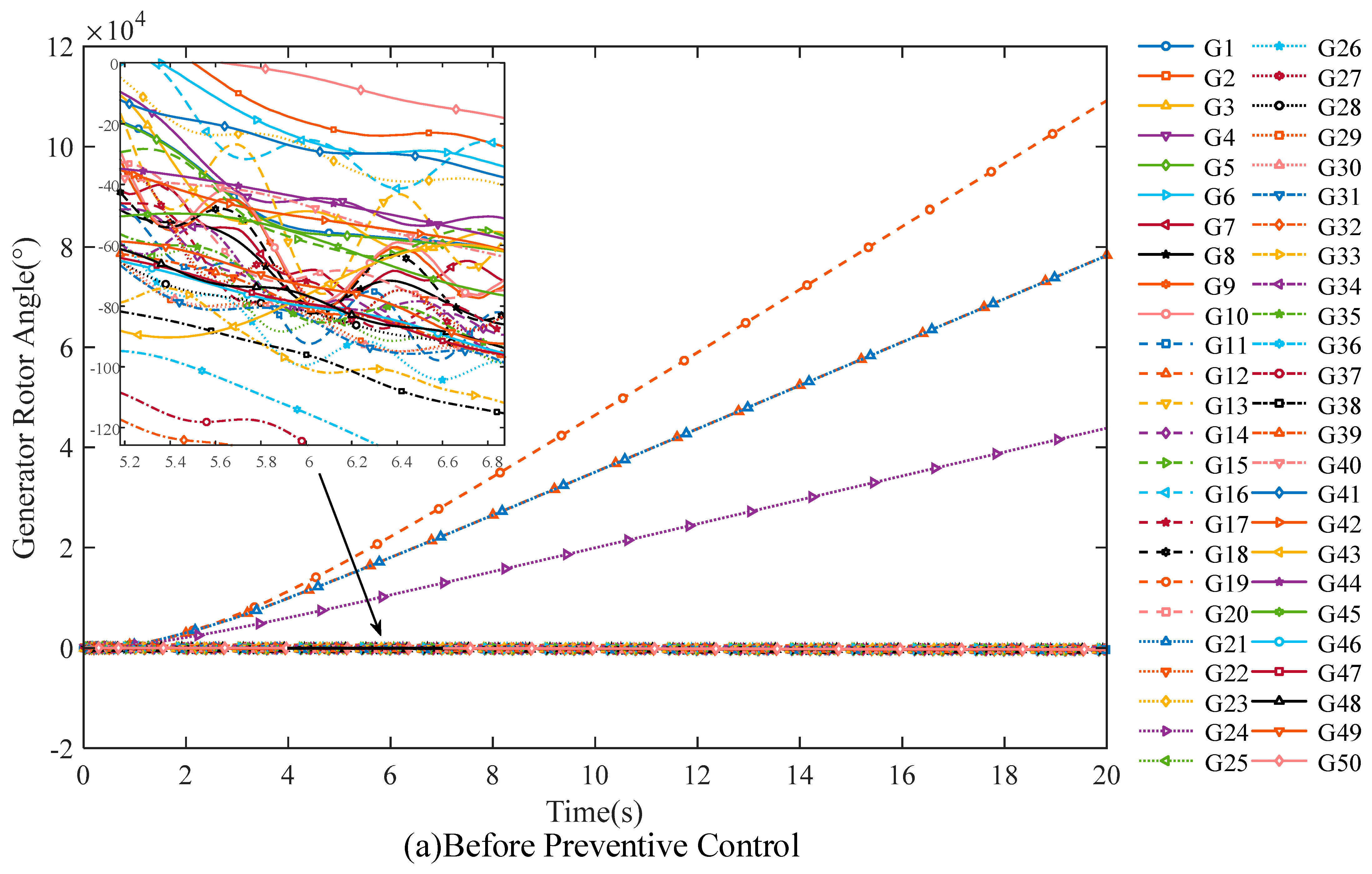
As shown in Table 11, when contingencies 2, 3, 5, and 6 occur, the corresponding TSI values before preventive control are all negative. This indicates that the system suffers from transient instability under these contingencies. After applying the proposed preventive control method, the TSI values of the four unstable scenarios are significantly increased to positive values above 50. The transient stability margin of the system is greatly improved. This indicates that the proposed method has good robustness under multiple contingency scenarios. Taking the severe contingency 3 as an example, Figure 12 shows the rotor angle response curves of generators in the IEEE 118-bus system before and after preventive control.
As shown in Figure 12, without preventive control, the generator rotor angle trajectories show a divergent trend, and the system gradually loses synchronism. After the preventive control strategy is applied, the originally divergent rotor angle trajectories quickly converge and settle at a new equilibrium point. This indicates that the proposed preventive control method can effectively improve transient stability even in a more complex power system.
In summary, although the IEEE 118-bus system has a larger network scale and more complex operating characteristics, the proposed transient stability preventive control framework still maintains high assessment accuracy and effectively improves the transient stability margin under fault scenarios. This further verifies the generalization capability and robustness of the proposed method in larger-scale power systems.

6. Conclusions

To improve the secure and stable operation of power systems after fault disturbances, this paper proposes a transient stability preventive control method based on OMICIG, SCINet, and IDBO. First, the OMICIG feature selection method is proposed to screen high-dimensional operating features. By jointly considering the nonlinear correlation between features and the transient stability index, feature redundancy, and feature synergy, a key feature subset closely related to transient stability is selected. Then, a SCINet-based transient stability assessment model is constructed and embedded into the TSCOPF model as a surrogate transient stability constraint. This reduces the computational burden caused by conventional DAE-based constraints. Finally, IDBO is used to optimize and solve the TSCOPF model, thereby generating preventive control strategies. The scientific originality of this study mainly lies in integrating OMICIG-based feature selection, multi-scale transient stability assessment, surrogate constraint modeling, and optimization-based control into a data-driven TSCOPF framework. In this way, transient stability assessment accuracy, preventive control effectiveness, and online computational efficiency can be jointly considered. Case studies are conducted on the New England 10-machine 39-bus system and the IEEE 118-bus system, leading to the following conclusions:
(1)
Compared with methods such as MIC, JMI, and MRMR, OMICIG is able to select a more representative feature subset by comprehensively considering the correlation, redundancy, and synergy among variables. This improves the computational efficiency of the SCINet model while maintaining high assessment accuracy.
(2)
Compared with RF, DBN, CNN, RNN, GKAN, GCN, PINN, and Transformer, SCINet captures short-term details and long-term dependency information in the post-fault dynamic response of the power system more effectively. This is mainly due to its binary-tree downsampling structure and convolution-based interactive learning mechanism. As a result, SCINet achieves more accurate transient stability assessment within a shorter time.
(3)
By incorporating Tent chaotic mapping and an adaptive t-distribution strategy, IDBO exhibits favorable convergence performance in solving the TSCOPF problem. Compared with other optimization algorithms, it shows clear advantages in both convergence speed and solution accuracy.
(4)
By replacing the transient stability constraints represented in the form of DAE in the TSCOPF model with the SCINet-based assessment model, the computational burden can be effectively reduced. Combined with the rapid optimization capability of IDBO for the TSCOPF model, the proposed framework can generate a fast and effective transient stability preventive control strategy. This helps ensure the safe and reliable operation of the power system.

Author Contributions

Methodology, S.L. and L.L.; software, L.Z., X.X. and J.L.; validation, L.L.; writing—original draft, L.L.; writing—review and editing, S.L. All authors have read and agreed to the published version of the manuscript.

Funding

This research was supported by the National Natural Science Foundation of China (52407118) and the Open Foundation of Hubei Provincial Key Laboratory for Operation and Control of Cascaded Hydropower Station under Grant (2023KJX06).

Data Availability Statement

The original data presented in the study are openly available on GitHub at https://github.com/haolupeng/data (accessed on 19 April 2026).

Conflicts of Interest

The authors declare no conflicts of interest.

Nomenclature

Abbreviations
AFOAptenodytes forsteri optimization
DAEDifferential algebraic equations
DBNDeep Belief Network
DBODung beetle optimizer
GCNGraph convolutional network
GEOGolden eagle optimization
GKANGated Kolmogorov–Arnold network
GSOGram–Schmidt orthonormalization
IDBOImproved dung beetle optimizer
IPMInterior point method
MAEMean absolute error
MICMaximal information coefficient
OMICOrthogonal maximal information coefficient
OMICIGOrthogonal maximal information coefficient and information gain
PINNPhysics-informed neural network
RFRandom forest
SCINetSample convolution and interaction network
TSCOPFTransient stability constrained optimal power flow
TSITransient stability index
IGInformation gain
VIVariable interaction
Variables
α Weighting coefficient in the OMICIG scoring function
B ( N ) Upper bound of the grid partition number
C G Set of generator buses
C n Set of all buses in the power system
C l Set of transmission lines
C IG ( N ) Computational complexity of a single information gain calculation
C MIC ( N ) Computational complexity of a single MIC calculation
c G , m * up Unit cost coefficient of upward active power adjustment for generator m *
c G , m * down Unit cost coefficient of downward active power adjustment for generator m *
d Original feature dimension
F Original electrical time-series data sequence
F adjust Total active power regulation cost of thermal generators
F even Even-indexed subsequence
F odd Odd-indexed subsequence
F 2 k Element at the even-indexed position of the original sequence
F 2 k + 1 Element at the odd-indexed position of the original sequence
F odd s , F even s Scaled odd and even subsequences obtained after exponential transformation and interactive multiplication
F odd , F even Updated odd and even subsequences after cross-addition operation
F fitness ( u ) Fitness function value of IDBO
f ( · ) Differential equations describing the transient dynamic process
f c ( · ) Mapping function of the fully connected layer
G k * j * , B k * j * Conductance and susceptance elements of the bus admittance matrix
GSO ( s i , S ) Normalized orthogonal component of candidate feature s i
h ( · ) algebraic equations
I ( x , y ) Mutual information between random variables x and y
IG s i , s e , Y Synergistic information gain between s i , s e , and Y
K max Maximum number of iterations
L j , U j Lower and upper bounds of the j-th dimension, respectively
N Number of samples in the dataset
nTotal number of buses in the power system
O OMICIG Overall computational complexity of the OMICIG feature selection algorithm
P G k * Active power outputs at bus k *
P D k * Active load demands at bus k *
P G m * min Lower active power limits of generator m *
P G m * max Upper active power limits of generator m *
p k Dynamic probability of selecting individuals for t -distribution perturbation at the k-th iteration
Q G k * Reactive power outputs at bus k *
Q D k * Reactive load demands at bus k *
Q G m * min Lower reactive power limits of generator m *
Q G m * max Upper reactive power limits of generator m *
q i Unit orthogonal vector obtained in the Gram–Schmidt orthogonalization process
S Selected feature subset
S i Selected feature subset obtained after the i-th feature selection step
s h Candidate feature to be evaluated in the iterative selection process
Score ( s h ) Comprehensive score of candidate feature s h
TSI Transient stability index
v Orthogonalized variable obtained by Gram–Schmidt orthogonalization
w 1 , w 2 Adjustment parameters of the dynamic selection probability
X Input electrical time-series feature data of SCINet
X op System operating feature vector
X m , j 0 Initial position of the m-th individual in the j-th dimension
X m , j k Current position of the m-th individual in the j-th dimension at the k-th iteration
X ˜ m , j k Candidate position after t-distribution perturbation
x , y Random variables used in MIC calculation
x ( t ) State variables at time t during transient analysis
y ( t ) Algebraic variables at time t during transient analysis
Y Target variable
z m , j Chaotic state variable of the m-th individual in the j-th dimension before Tent mapping
z ˜ m , j Chaotic state variable after Tent mapping
Δ δ max Maximum rotor angle difference between any two generators during the transient process
ς k Random perturbation term following the t-distribution at the k-th iteration
η ( · ) , ρ ( · ) One-dimensional convolution transformation modules used to update the odd and even subsequences
θ k * j * Voltage phase angle difference between buses k * and j *
λ TS Penalty factor for the SCINet-based transient stability constraint
ξ Transient stability margin threshold
Φ ( · ) Trained SCINet-based transient stability assessment model
ϕ ( · ) , ψ ( · ) One-dimensional convolution modules
e x p ( · ) Exponential operation

References

  1. Shahriyari, M.; Khoshkhoo, H.; Guerrero, J.M. A Novel Fast Transient Stability Assessment of Power Systems Using Fault-On Trajectory. IEEE Syst. J. 2022, 16, 4334–4344. [Google Scholar] [CrossRef]
  2. Cheng, S.; Yu, Z.; Liu, Y.; Zuo, X. Power System Transient Stability Assessment Based on the Multiple Paralleled Convolutional Neural Network and Gated Recurrent Unit. Prot. Control Mod. Power Syst. 2022, 7, 39. [Google Scholar] [CrossRef]
  3. Hamilton, R.I.; Papadopoulos, P.N. Using SHAP Values and Machine Learning to Understand Trends in the Transient Stability Limit. IEEE Trans. Power Syst. 2024, 39, 1384–1397. [Google Scholar] [CrossRef]
  4. Ye, Z.; Zhu, S.; Li, S.; Wu, Y.; Wang, X.; Lin, Z.; Geng, G. Oriented Data Generation for Power System Transient Stability Boundary Exploration Based on Support Vector Machine. Electronics 2025, 14, 1285. [Google Scholar] [CrossRef]
  5. Lamprianidou, I.S.; Hamilton, R.I.; Papadopoulos, P.N. Impact of Active Distribution Network Modeling Approaches on Transient Stability Through Sensitivity Analysis. IEEE Trans. Power Syst. 2026, 41, 572–584. [Google Scholar] [CrossRef]
  6. Zhang, Z.; Qin, B.; Ding, T.; Gao, X.; Zhang, Y. CBAM-CNN Based Transient Overvoltage Preventive Control Considering Piecewise Linear Control Sensitivity. IEEE Trans. Power Syst. 2025, 40, 3645–3656. [Google Scholar] [CrossRef]
  7. Niu, S.; Wu, J.; Li, C.; Duan, C.; Hao, Z. Optimizing Fault-Ride-Through Strategies of Renewable Generation for the Enhancement of Power System Transient Stability and Security. Energies 2025, 18, 5986. [Google Scholar] [CrossRef]
  8. Liu, S.; Zhao, Y.; Zhang, L.; Ai, D.; Ye, B.; Geng, Y. Transient Stability-Constrained Optimal Power Flow Model Based on CatBoost-DF and ISOA. Energies 2025, 18, 6126. [Google Scholar] [CrossRef]
  9. Zhang, S.; Zhang, D.; Qiao, J.; Wang, X.; Zhang, Z. Preventive Control for Power System Transient Security Based on XGBoost and DCOPF with Consideration of Model Interpretability. CSEE J. Power Energy Syst. 2020, 7, 279–294. [Google Scholar] [CrossRef]
  10. Chen, H.; Guan, L.; Lin, B.; Chen, L.; Huang, J.; Li, Y. A Continual Learning Scheme for Data-Driven Transient Stability Assessment via Clustered Memory Replay and Hierarchical Embedding Constraint. Electr. Power Syst. Res. 2025, 247, 111704. [Google Scholar] [CrossRef]
  11. Xu, Y.; Dong, Z.Y.; Zhao, J.; Xue, Y.; Hill, D.J. Trajectory Sensitivity Analysis on the Equivalent One-machine-infinite-bus of Multi-machine Systems for Preventive Transient Stability Control. IET Gener. Transm. Distrib. 2015, 9, 276–286. [Google Scholar] [CrossRef]
  12. Arredondo, F.; Castronuovo, E.D.; Ledesma, P.; Leonowicz, Z. Analysis of Numerical Methods to Include Dynamic Constraints in an Optimal Power Flow Model. Energies 2019, 12, 885. [Google Scholar] [CrossRef]
  13. Xia, S.; Ding, Z.; Shahidehpour, M.; Chan, K.W.; Bu, S.; Li, G. Transient Stability-Constrained Optimal Power Flow Calculation with Extremely Unstable Conditions Using Energy Sensitivity Method. IEEE Trans. Power Syst. 2021, 36, 355–365. [Google Scholar] [CrossRef]
  14. Su, T.; Zhao, J. Neural Network Certification Informed Power System Transient Stability Preventive Control with Renewable Energy. IEEE Trans. Power Syst. 2025, 40, 5398–5409. [Google Scholar] [CrossRef]
  15. Zhou, Y.; Wu, J.; Ji, L.; Yu, Z.; Lin, K.; Hao, L. Transient Stability Preventive Control of Power Systems Using Chaotic Particle Swarm Optimization Combined with Two-Stage Support Vector Machine. Electr. Power Syst. Res. 2018, 155, 111–120. [Google Scholar] [CrossRef]
  16. Ahmad, H.; Yousif, M.; Shah, M.; Ullah, N. Monitoring Transient Stability in Electric Power Systems Using a Hybrid Model of Convolutional Neural Network and Random Forest. Electr. Power Compon. Syst. 2024, 52, 946–958. [Google Scholar] [CrossRef]
  17. Xu, Y.; Dong, Z.Y.; Zhang, R.; Po Wong, K. A Decision Tree-Based on-Line Preventive Control Strategy for Power System Transient Instability Prevention. Int. J. Syst. Sci. 2014, 45, 176–186. [Google Scholar] [CrossRef]
  18. Li, H.; Wang, Z.; Jin, T.; Xu, X.; Shi, L. A Novel Data-Driven Method of Real-Time Transient Stability Assessment for AC/DC Hybrid Power Systems. IEEE Access 2025, 13, 80748–80758. [Google Scholar] [CrossRef]
  19. Yin, L.; Ge, W.; Liu, R. Golden Eagle Optimization Algorithm Embedded in Gated Kolmogorov-Arnold Network for Transient Stability Preventive Control of Power Systems. Energy 2025, 318, 134931. [Google Scholar] [CrossRef]
  20. Su, T.; Liu, Y.; Zhao, J.; Liu, J. Deep Belief Network Enabled Surrogate Modeling for Fast Preventive Control of Power System Transient Stability. IEEE Trans. Ind. Inform. 2022, 18, 315–326. [Google Scholar] [CrossRef]
  21. Xie, Z.; Zhang, D.; Hu, W.; Han, X. Power System Transient Stability Preventive Control via Aptenodytes Forsteri Optimization with an Improved Transient Stability Assessment Model. Energies 2024, 17, 1942. [Google Scholar] [CrossRef]
  22. Shen, C.; Zuo, K.; Sun, M. Physics-Augmented Auxiliary Learning for Power System Transient Stability Assessment. IEEE Trans. Ind. Inform. 2025, 21, 6811–6822. [Google Scholar] [CrossRef]
  23. Wang, T.; Tang, Y. Transient Stability Preventive Control Based on Graph Convolution Neural Network and Transfer Deep Reinforcement Learning. CSEE J. Power Energy Syst. 2023, 11, 136–149. [Google Scholar] [CrossRef]
  24. Wang, H.; Gao, F.; Chen, Q.; Bu, S.; Lei, C. Instability Pattern-Guided Model Updating Method for Data-Driven Transient Stability Assessment. IEEE Trans. Power Syst. 2025, 40, 1214–1227. [Google Scholar] [CrossRef]
  25. Liu, J.; Sun, H.; Li, Y.; Fang, W.; Niu, S. An Improved Power System Transient Stability Prediction Model Based on mRMR Feature Selection and WTA Ensemble Learning. Appl. Sci. 2020, 10, 2255. [Google Scholar] [CrossRef]
  26. Liu, Y.; Su, T.; Qiu, G.; Gao, H.; Liu, J.; Shui, Y. Analytic Deep Learning and Stepwise Integrated Gradients-Based Power System Transient Stability Preventive Control. IEEE Trans. Power Syst. 2024, 39, 863–876. [Google Scholar] [CrossRef]
  27. Wang, T.; Tang, Y. Data-model Driven Rescheduling Considering Both Rotor Angle Stability and Transient Voltage Stability Constraints. IET Renew. Power Gener. 2022, 16, 1509–1521. [Google Scholar] [CrossRef]
  28. Lin, G.; Lin, A.; Gu, D. Using Support Vector Regression and K-Nearest Neighbors for Short-Term Traffic Flow Prediction Based on Maximal Information Coefficient. Inf. Sci. 2022, 608, 517–531. [Google Scholar] [CrossRef]
  29. Li, Y.; Cui, X.; Feng, C.; Wang, H.; Ding, H. Algorithm Improvement for the Surface Morphology Diagnostics Based on the Gram-Schmidt Orthonormalization and the Least Square Ellipse Fitting under the EAST-like Vibrational Environments. Nucl. Mater. Energy 2023, 35, 101397. [Google Scholar] [CrossRef]
  30. Wang, Z.; Deng, G.; Yu, J. Group Feature Screening Based on Information Gain Ratio for Ultrahigh-Dimensional Data. J. Math. 2022, 2022, 1600986. [Google Scholar] [CrossRef]
  31. Inglis, A.; Parnell, A.; Hurley, C.B. Visualizing Variable Importance and Variable Interaction Effects in Machine Learning Models. J. Comput. Graph. Stat. 2022, 31, 766–778. [Google Scholar] [CrossRef]
  32. Cen, Z.; Hu, S.; Hou, Y.; Chen, Z.; Ke, Y. Remaining Useful Life Prediction of Machinery Based on Improved Sample Convolution and Interaction Network. Eng. Appl. Artif. Intell. 2024, 135, 108813. [Google Scholar] [CrossRef]
  33. Ye, M.; Zhou, H.; Yang, H.; Hu, B.; Wang, X. Multi-Strategy Improved Dung Beetle Optimization Algorithm and Its Applications. Biomimetics 2024, 9, 291. [Google Scholar] [CrossRef] [PubMed]
  34. Fan, J.; Li, Y.; Wang, T. An Improved African Vultures Optimization Algorithm Based on Tent Chaotic Mapping and Time-Varying Mechanism. PLoS ONE 2021, 16, e0260725. [Google Scholar] [CrossRef]
  35. Zhao, Y.; Men, L. Group Intelligence Optimization Algorithm of Adaptive Trigonometric Function and T-Distributed Perturbation Strategy. In Proceedings of the 2024 6th International Conference on Communications, Information System and Computer Engineering (CISCE), Guangzhou, China, 10–12 May 2024; IEEE: New York, NY, USA, 2024; pp. 740–744. [Google Scholar]
  36. Hao, L.; Peng, W.; Liu, J.; Zhang, W.; Li, Y.; Qin, K. Competition-Based Two-Stage Evolutionary Algorithm for Constrained Multi-Objective Optimization. Math. Comput. Simul. 2025, 230, 207–226. [Google Scholar] [CrossRef]
Figure 1. Hierarchical architecture of SCINet for transient stability assessment.
Energies 19 02824 g001
Figure 2. The structure of SCI-Block.
Energies 19 02824 g002
Figure 4. Single-line diagram of the New England 10-machine 39-bus system.
Energies 19 02824 g004
Figure 5. Sensitivity analysis of the weighting coefficient α .
Energies 19 02824 g005
Figure 6. Performance evaluation under different feature dimensions.
Energies 19 02824 g006
Figure 7. Training and validation curves of prediction accuracy for SCINet.
Energies 19 02824 g007
Figure 8. Generator rotor angle trajectories under contingency scenario 1.
Energies 19 02824 g008
Figure 9. Generator rotor angle trajectories under contingency scenario 6.
Energies 19 02824 g009
Figure 10. Convergence performance comparison of different solution algorithms.
Energies 19 02824 g010
Figure 11. Single-line diagram of the IEEE 118-bus system.
Energies 19 02824 g011
Figure 12. Generator rotor angle trajectories before and after preventive control under contingency 3 in the IEEE 118-bus system.
Energies 19 02824 g012aEnergies 19 02824 g012b
Table 1. Contingency set for the New England 10-machine 39-bus test system.
Fault No.Fault Line
13–4
24–5
312–13
416–17
526–27
622–35
Table 2. Confusion matrix.
Actual ResultAssessment Result
UnstableStable
UnstableTPFN
StableFPTN
Table 3. Performance comparison of different feature selection methods.
Feature Selection MethodApR2MAE
MIC97.830.98711.7892
JMI98.850.99171.4384
MRMR99.140.99331.2861
OMICIG99.320.99361.2318
Table 4. Performance test results of evaluation models.
ModelApR2MAETraining Time (s)Assessment Time (s)
RF95.680.96732.91747.950.033
DBN97.920.98781.684070.541.026
CNN98.050.98921.572858.610.428
RNN98.360.99001.506275.831.105
GCN98.550.99081.438666.960.824
GKAN98.590.99121.401982.751.878
PINN98.740.99171.3450118.630.961
Transformer99.080.99231.317695.231.926
SCINet99.320.99361.231850.250.281
Table 5. Classification performance comparison of different assessment models.
ModelRecPreF1
RF94.6994.5194.60
DBN97.3897.4797.42
CNN97.6397.7297.67
RNN97.9198.0697.98
GCN97.7598.6898.21
GKAN98.2298.3498.28
PINN98.2599.1298.68
Transformer98.8899.0998.98
SCINet99.0999.3499.22
Table 6. Generator active power adjustment before and after preventive control.
Generator No.Active Power Before Preventive Control (MW)Active Power After Preventive Control (MW)Active Power Adjustment (MW)
1268.97255.60−13.37
2638.10630.88−7.22
3618.43634.8316.40
4672.89653.24−19.65
5545.37573.1527.78
6632.71643.5210.81
7578.26531.74−46.52
8519.84508.91−10.93
9809.87772.79−37.08
10987.231028.9441.71
Table 7. Comparison of TSI before and after preventive control of the IEEE 39-bus system.
Fault No.TSI
Before Preventive ControlAfter Preventive Control
1−98.5463.03
255.3067.19
3−97.4765.39
4−98.8258.68
559.5066.32
6−97.8155.28
Table 8. Comparison of different preventive control methods.
MethodComputation Time/sOptimized TSICost/$
IPM-SCINet68.1454.431683.26
IDBO-SCINet35.2755.281579.45
Table 9. Contingency set for the IEEE 118-bus test system.
Fault No.Fault Line
15–8
232–114
334–36
417–27
552–53
6104–110
Table 10. Performance comparison of different assessment models on the IEEE 118-bus system.
ModelApR2MAERecPreF1
RF94.760.95213.426893.3294.1993.76
DBN96.880.97392.491796.0596.5996.32
CNN97.210.97532.364996.4697.0096.73
RNN97.390.97742.297596.6697.1196.89
GKAN97.830.98112.061397.3397.6397.48
PINN98.060.98261.997896.9798.5997.77
GCN98.210.98351.927297.2898.6597.96
Transformer98.280.98501.873497.8998.2598.07
SCINet98.450.98671.724698.0598.3598.20
Table 11. Comparison of TSI before and after preventive control of the IEEE 118-bus system.
Fault No.TSI
Before Preventive ControlAfter Preventive Control
150.9165.63
2−98.7455.35
3−99.6654.10
451.8166.48
5−98.8755.30
6−96.7958.32
Disclaimer/Publisher’s Note: The statements, opinions and data contained in all publications are solely those of the individual author(s) and contributor(s) and not of MDPI and/or the editor(s). MDPI and/or the editor(s) disclaim responsibility for any injury to people or property resulting from any ideas, methods, instructions or products referred to in the content.