1. Introduction
Technological advancements have firmly established low-voltage electrical apparatus as critical components in a wide array of domains, including power distribution, renewable energy systems, industrial automation, and transportation [
1]. A persistent and significant challenge in the operation of these devices is the inevitable generation of electric arcs during the opening and closing of electrical contacts [
2]. An electric arc is a sustained electrical discharge phenomenon where current flows through an ionized gas channel. This process concentrates immense energy, resulting in an extraordinarily high core temperature that can exceed 10,000 °C [
3]. Under abnormal or persistent conditions, the intense thermal and electromagnetic energy of the arc causes severe localized heating. This leads to pronounced contact erosion, material transfer, and in extreme cases, contact welding [
4]. Consequently, arcing directly degrades electrical performance, increases contact resistance, and ultimately compromises the operational reliability and service life of the apparatus, posing a key concern for safety and maintenance.
Therefore, accurate prediction and control of key arc parameters like arc duration and energy are essential for mitigating these adverse effects and guiding the design of more durable contacts. Traditionally, magnetohydrodynamics (MHD) models have served as the foundational tool for this purpose [
5]. They characterize complex arc behaviors under multi-physics field coupling by simulating the underlying physical processes, thereby enabling the prediction of key arc parameters. Based on MHD theory, researchers have developed various modeling approaches: literature [
6] presents a two-dimensional MHD model to simulate and predict the arc-breaking characteristics of series multi-contact systems in different background atmospheres. Literature [
7] focuses on the arc-contact interaction in a composite-gap DC breaker, employing an MHD model to simulate and predict the arc dynamics under varying conditions. While predictive analysis of key arc parameters is often essential in engineering applications, MHD simulation faces notable limitations. The method is computationally expensive, time-consuming, and offers limited accuracy [
8]. It frequently suffers from poor convergence and may fail due to excessive memory usage, making it difficult to meet the practical demands for fast and reliable prediction and optimization of arc parameters [
9].
With the development of deep learning, new progress has been made in the simulation and prediction of arc parameters. However, there are two major challenges in predicting arc parameters: first, the available data often exhibits significant scatter and variability, making it difficult to use for developing reliable empirical models; second, purely data-driven models may produce physically implausible predictions [
10]. Traditional machine learning techniques have been widely used for arc parameter prediction but have notable drawbacks: shallow ANNs cannot capture the strong nonlinearity of arcs and generalize poorly; LSTM/GRU models require massive labeled data and may generate physically impossible results when extrapolating; CNNs rely on costly high-speed imaging equipment and lack physical constraint integration [
11,
12]. The core limitation of all these purely data-driven methods is that they learn data correlations rather than physical causal relationships, making their predictions unreliable for practical electrical contact design.
The Physics-Informed Neural Network (PINN) offers a promising framework to address these challenges. Its core advantage lies in embedding the governing physical laws, as soft constraints, directly into the loss function. This compels the model to learn solutions that are not only data-consistent but also physically plausible, even with scarce or scattered data [
13,
14]. PINNs have emerged as a transformative paradigm in power system modeling. To address the challenges of dynamic parameter estimation in power systems with limited measurements and high variability, Ref. [
15] proposed a Residual Physics-Informed Neural Network (Res-PINN) that integrates residual connections and normalized time injection into the PINN framework. Literature [
16] proposed a novel algorithm for hybrid transmission lines that integrates a data synchronization technique with a PINN based on a BP neural network, which demonstrates high accuracy and robustness against various fault conditions without requiring extensive fault data. Literature [
17] proposed a bio-inspired algorithm-optimized Physics-Informed Neural Network for load margin estimation. Literature [
18] proposes a PINN framework integrating a fractal-based thermal model to accurately estimate lithium-ion battery cell surface temperature. Despite these significant advances, PINN applications in low-voltage electrical contact arc prediction remain severely limited. Existing arc prediction studies either rely on computationally expensive MHD simulations that cannot meet real-time design requirements, or adopt purely data-driven models that lack physical interpretability and may produce unrealistic results when extrapolating beyond training data. While previous studies have applied PINNs to arc prediction, they typically rely on manually tuned loss weights and lack effective data augmentation strategies [
19]. GMM methods have been used for data augmentation in other engineering fields, but their integration with physics-informed models for arc parameter prediction remains unexplored. Literature [
20] demonstrated that Bayesian optimization can significantly improve the performance of PINN models, but this approach has not yet been applied to electrical contact arc prediction. Most existing arc prediction models use ad hoc hyperparameter selection, leading to inconsistent and suboptimal results.
Beyond standard PINNs, recent research has developed advanced physics-informed frameworks, most notably physics-informed neural operators (PINO) and physics-constrained surrogate models. Literature [
21] proposed a PINO with differential-algebraic constraint loss for dynamic energy flow calculation in integrated electricity and gas systems, demonstrating superior performance in solving high-dimensional PDE systems with large datasets. Other studies have applied physics-constrained surrogate models to power system stability assessment and equipment fault diagnosis. While advanced PINO excel in solving high-dimensional PDEs with large datasets, they are less suited for predicting electrical contact arc parameters due to high data requirements and computational cost; therefore, we propose the lightweight GB-PINN framework, which tailors the physics loss to the governing Mayr ODE and integrates GMM data augmentation for efficient, accurate prediction under extreme data scarcity.
To address the challenges in simulating and predicting electrical contact arc parameters, this paper proposes a Gaussian Mixture-enhanced Bayesian-optimized Physics-Informed Neural Network (GB-PINN) method. First, a multi-physical field coupling simulation model based on MHD was developed for low-voltage DC apparatus contacts and arcs, and its validity was confirmed using measured data of current, voltage, arc duration, and the calculated arc energy. Additionally, a multivariate simulation dataset was generated by varying key parameters, including the diameter and height of the moving and stationary contacts, as well as operational conditions like contact separation speed and breaking time. This dataset was further enhanced through Gaussian Mixture Model (GMM) sampling and modeling. Based on this, a PINN was constructed to optimize the network’s hyperparameters with the Bayesian Optimization and Hyperband (BOHB) algorithm and to predict the contact arc parameters. Finally, the model’s prediction results were compared with those of models like grey prediction model (GM (1, N)) [
22], long short-term memory (LSTM) [
23], and Transformer [
24]. Ablation experiments were conducted to assess how each step in the framework affects prediction accuracy, demonstrating the advantages of this methodology.
The remainder of this paper is organized as follows:
Section 2 presents the construction and experimental validation of the MHD-based multi-physics coupling arc model.
Section 3 details the establishment of the GB-PINN framework, including the loss function design, hyperparameter optimization, and data augmentation strategy.
Section 4 analyzes the prediction performance of the proposed model through comparative experiments, ablation studies, and generalization tests. Finally,
Section 5 summarizes the key findings and outlines future research directions.
2. Construction and Validation of the Arc Simulation Model
2.1. Boundary Condition Control Equations
Circuit and current boundary condition setting: the simulation of the rated voltage and current of the electrical appliances for 36 V, 10 A. A 36 DC voltage source and a 3.6 Ω resistor were connected above the moving contact in the simulation model, other end of the voltage source is connected to the stationary contact within the simulation model. Thus, when the contacts are open, the voltage is 36 V. When the contacts close, the current flowing through the circuit is 10 A. The simulation model obeys the law of conservation of current, as shown in Equations (1)–(3):
where
is the charge density;
is the electrical conductivity;
is the electric field;
is the electric displacement field;
is the current density,
is the current density induced by any external source;
is the potential.
Laminar flow boundary condition setting: arc is a hot plasma and it is based on the equations of motion of the fluid, i.e., the Navier–Stokes equations. The laminar flow module satisfies the mass conservation equation for fluids; the stress tensor in the fluid should also be considered, as shown in Equations (4)–(6):
where
is the fluid density;
is the velocity vector field;
is the fluid pressure;
is the second-order identity tensor;
is the viscous stress tensor;
is the volumetric force acting on the fluid; and
is the dynamic viscosity.
Magnetic field boundary condition setting: the magnetic field simulation is based on Maxwell’s equations, as shown in Equations (7)–(9):
where
is the magnetic field intensity;
is the total electric current density;
is the magnetic field density;
is the magnetic vector potential;
is the electrical conductivity;
is the electric field intensity;
is the velocity field;
is the external current density. Finally, to reduce the simulation calculation, a layer of magnetic insulation boundary is set at the periphery of the simulation model.
Fluid heat transfer model, based on the three fundamental equations of heat transfer—thermal conduction, thermal convection, and thermal radiation—along with the mass conservation equation, as shown in Equations (10) and (11):
where
is the differential length element in space;
is the fluid density;
is the specific heat capacity at constant pressure;
is the fluid temperature;
is the fluid velocity vector;
is the heat flux vector;
is the volumetric heat source term;
is the boundary heat flux;
is the volumetric heat source, pressure-related;
is the volumetric heat source, viscous dissipation;
is the thermal conductivity.
Finally, the energy conservation equation must also be satisfied:
where
is the temperature;
is the specific heat capacity;
is the thermal conductivity of the material;
is the work of the fluid viscous force; and
is the heat source of the arc, which mainly consists of enthalpy transfer, Joule heat, and heat radiation loss.
2.2. Arc Simulation Modeling
A coupled simulation model of the contact arc process was established based on MHD theory, utilizing the corresponding governing equations and boundary conditions. Given the complexity of arc plasma motion, several reasonable assumptions were introduced during modeling to ensure the solvability and computational efficiency of the numerical simulations [
25]:
- (1)
The arc plasma is assumed to be in local thermodynamic equilibrium (LTE);
- (2)
Neglecting the arc initiation process and the metallic phase arcing;
- (3)
The arc plasma is assumed to behave as an incompressible Newtonian fluid exhibiting laminar flow.
The above assumptions effectively reduce the complexity of the model under the premise of ensuring computational accuracy, and the detailed simulation parameters of the simulation model are shown in
Table 1. The contact arc model was simulated using the finite element software COMSOL Multiphysics 6.2 [
26].
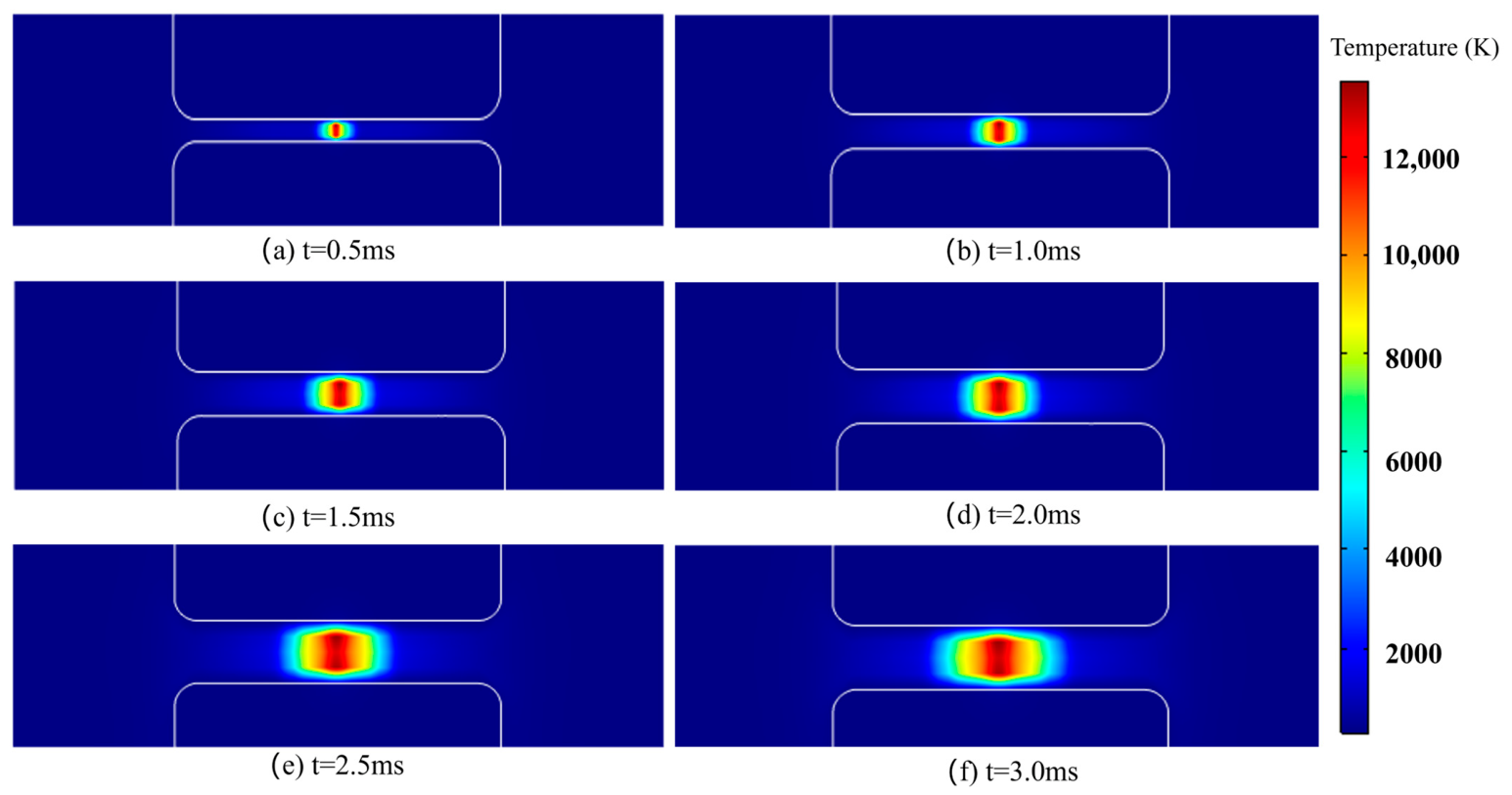
The simulation process of the contact arc is shown in
Figure 1, which visualizes the dynamic evolution of the arc motion in the contact gap through the temperature field distribution cloud diagrams at six consecutive time points from 0.5 ms to 3.0 ms.
At the initial arcing stage (0.5 ms), the high current density at the arc root confined to the contact surface rapidly heats the plasma, forming a concentrated high-temperature arc. The temperature distribution is highly localized, while the temperature drops sharply within a short radial distance. In the corresponding temperature contour plot, this high-temperature core is visually represented as a distinct bright red zone, clearly reflecting the concentrated energy release and the constrained morphology of the high-temperature plasma during this initial stage.
As the arc develops (1.0–2.0 ms), the high-temperature region expands downstream and radially due to combined electromagnetic forces, thermal convection, and fluid dynamics. Energy continuously transfers from the core to the surrounding medium, resulting in significant arc expansion and movement. The temperature distribution broadens, and the color shifts from red to orange-yellow in the central regions.
By the late stage (2.5–3.0 ms), the increased contact gap raises circuit impedance, reducing energy input into the arc while energy dissipation to the surroundings continues. The high-temperature zone further diffuses, leading to a more uniform thermal distribution. The appearance of blue in the edge regions indicates a substantial temperature decrease, marking the final phase of arc decay.
The simulation process clearly maps the complete evolution of the arc, from its initial formation as a high-density, high-temperature plasma channel, through its diffusion and movement driven by multi-field coupling, to its final attenuation as input power declines and energy continuously dissipates. This provides an intuitive and reliable model for predicting key arc parameters.
2.3. Arc Experimental Equipment and Validation
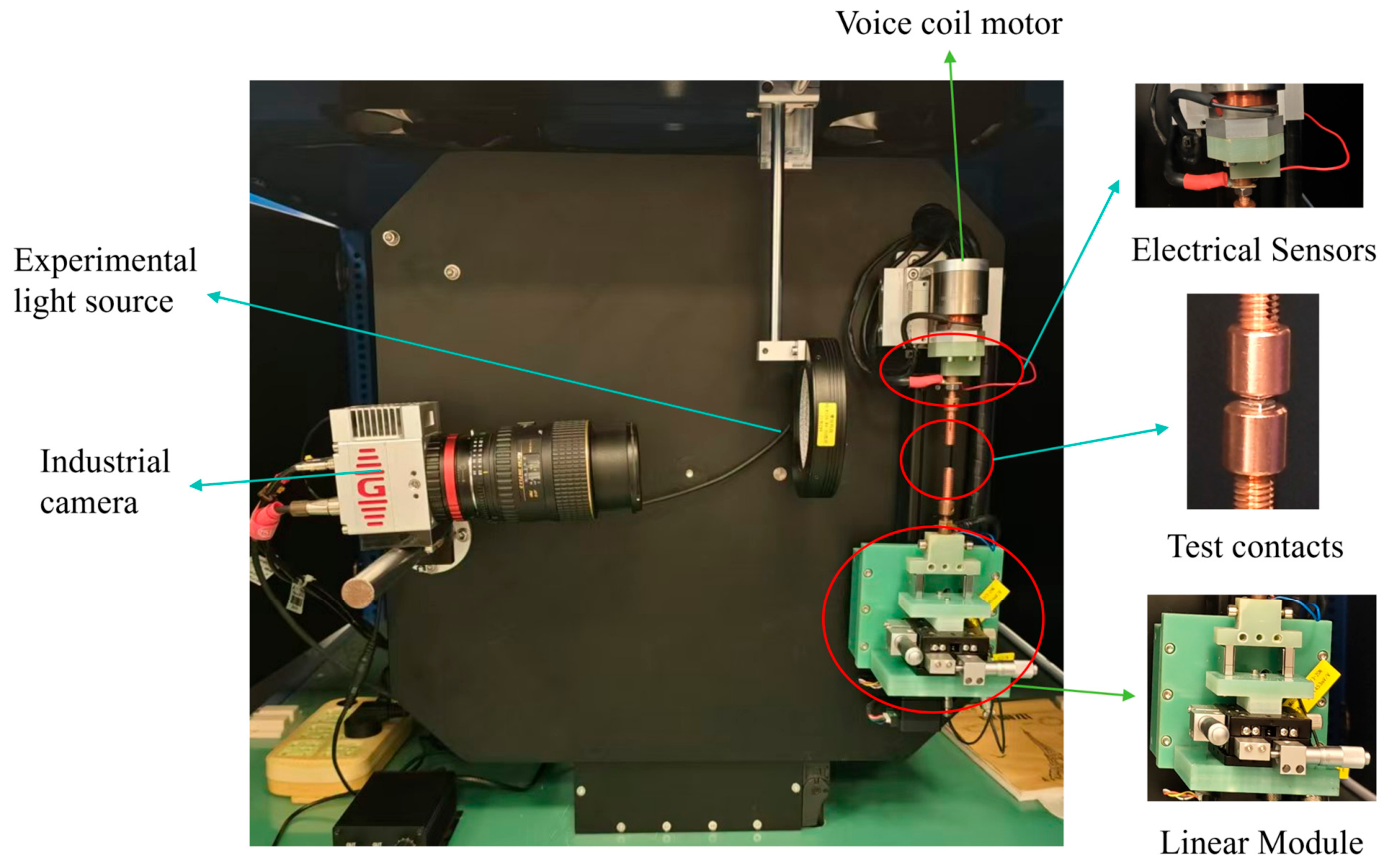
To rigorously verify the accuracy and reliability of the established MHD simulation mode, a complete set of experimental test programs for electrical contacts was designed and implemented, and the experimental setup is shown in
Figure 2.
The experimental setup integrates synchronized data acquisition from multiple sensors. A high-speed industrial camera records the arc dynamics from initiation to extinction. Simultaneously, electrical sensors measure the voltage and circuit current. A central controller ensures microsecond-level synchronization of all measurement channels. All tests are conducted under conditions that precisely match the simulation parameters, enabling a direct and valid comparison.
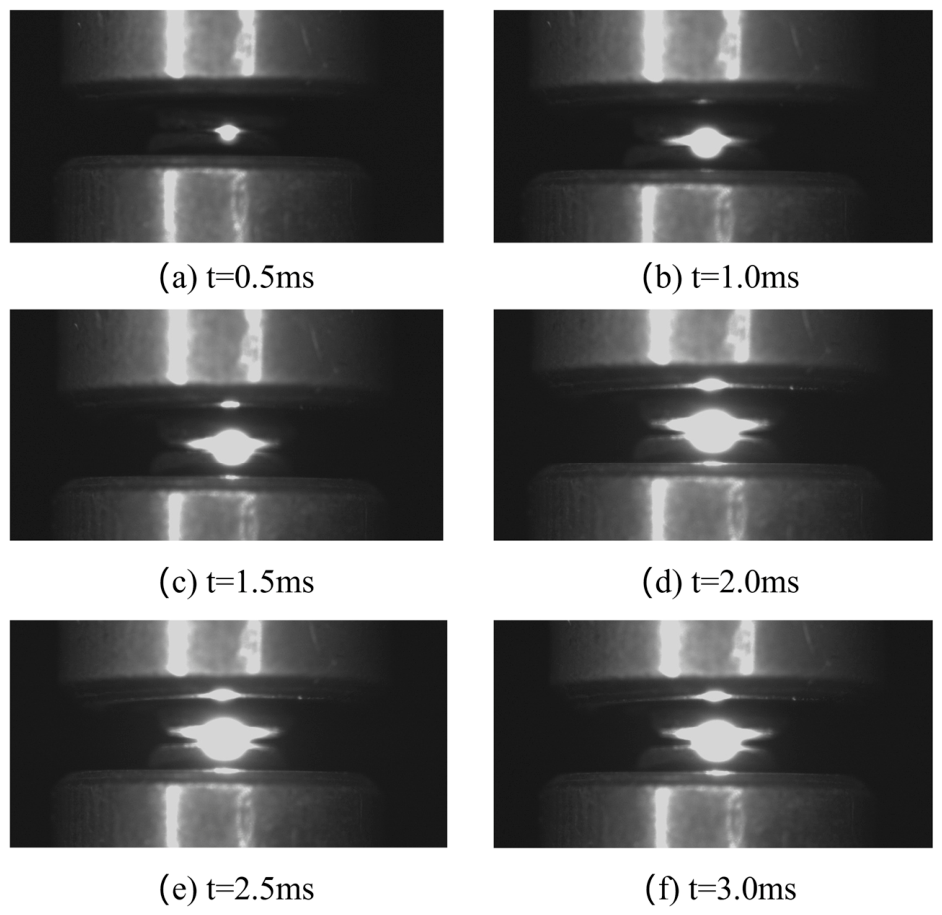
Based on the experimental arc images in
Figure 3, the arcing process can be divided into three distinct phases: In the arc initiation stage (0.5 ms), upon contact separation, a high-temperature plasma channel is rapidly initiated. During the elongation stage (1.0–2.0 ms), driven by electromagnetic forces and thermal expansion, the arc stretches and undergoes significant morphological changes while continuously dissipating energy. In the arc decay stage (2.5–3.0 ms), the widening contact gap leads to a substantial increase in arc resistance, resulting in rapid energy dissipation and eventual extinction. The measured image of the arc is basically consistent with the simulated temperature distribution cloud, which proves that the established MHD multi-field coupling simulation model can reproduce the dynamic evolution of the arc with high fidelity.
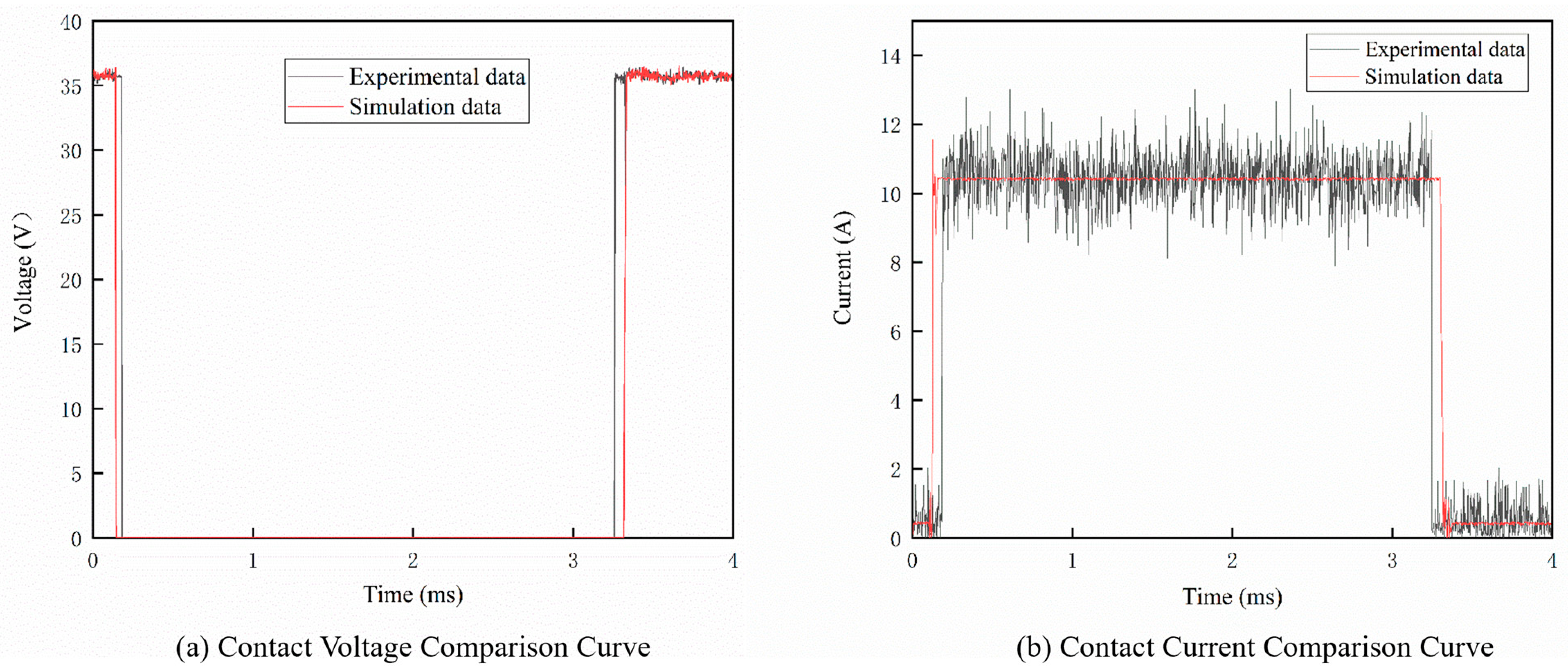
A comparison between the simulated and experimentally measured values of the voltage across the contacts and the current through the circuit is presented in
Figure 4. Excellent agreement is observed in the initial stage of arc formation. This is followed by a rapid decrease in contact voltage to nearly 0 V and a rise in circuit current to about 10 A with pronounced fluctuations, indicating the onset of a sustained arc. Beyond 3 ms, the increase in voltage and concomitant decrease in current signify the arc extinction phase.
Physically, the abrupt drop in contact voltage to near 0 V and the simultaneous surge in circuit current to approximately 10 A (as shown in
Figure 4) can be attributed to the formation of a highly conductive plasma channel during contact separation. The ionized gases and metal vapors between the contacts create a low-resistance path, effectively acting as a momentary short circuit. Consequently, the arc voltage collapses to nearly zero, while the circuit current rapidly rises to around 10 A, driven by the power supply to maintain conduction through the low-impedance arc column. The relative errors for the contact voltage and circuit current are calculated to be 2.78% and 5.69%, respectively.
To further quantify the comparison accuracy, the key arc parameters were statistically analyzed in
Table 2. Through the data comparison, the relative error between the simulation value and the measured average value is 1.63% and 1.82%, both in the low range, indicating that the current arc simulation model is highly consistent with the actual situation. Comprehensive arc morphology, voltage and current waveforms, as well as the arc duration and energy comparison results, fully verified the validity and reliability of the arc MHD model. Consequently, the model is deemed suitable for subsequent analysis and prediction of related arc phenomena.
To verify the accuracy of the MHD model across the entire parameter space, we conducted experimental validation on 12 representative operating conditions covering contact diameter (4–6 mm), separation speed (0.2–0.8 m/s), breaking time (2–4 ms), contact height and gap distance. Each operating condition was tested 5 times independently to ensure statistical repeatability, and the mean and standard deviation of the experimental results were calculated for each condition. The results show that the model maintains high accuracy with average relative errors of 2.21% for arc duration and 2.38% for arc energy. All simulation samples used for neural network training are generated strictly within this validated parameter range, ensuring the physical reliability of the training data.
3. Establishment of the GB-PINN Model
3.1. Establishment of the PINN and Loss Function
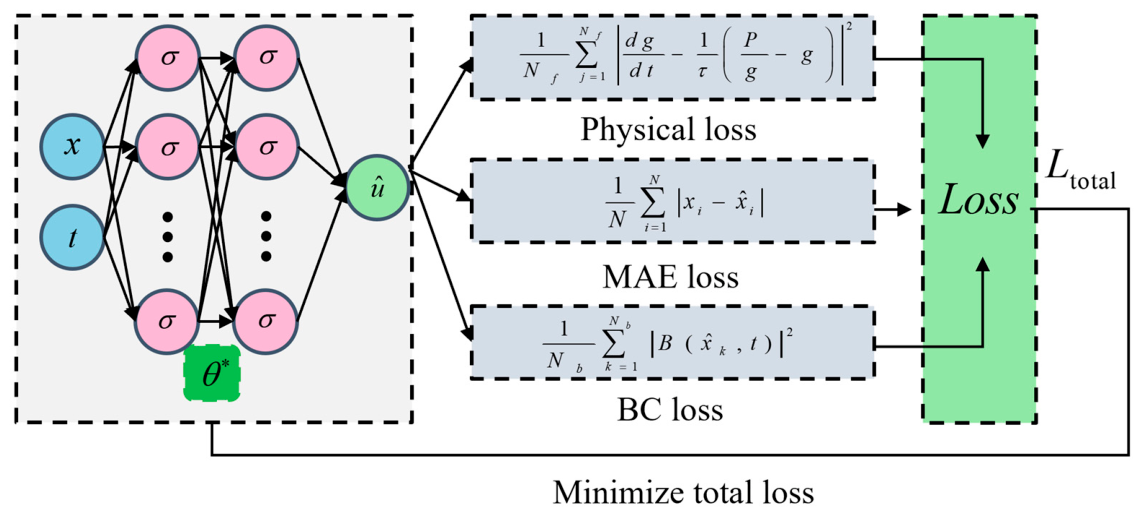
The PINN is constructed based on the Multilayer Perceptron (MLP) [
27]. Physical constraints are the core of PINN that distinguishes it from purely data-driven models, which embed the control equations characterizing the intrinsic physical laws of the system as soft constraints in the loss function, guiding the model learning process to conform to a priori physical knowledge [
28], The PINN workflow is shown in
Figure 5.
In terms of physical losses, the Mayr equation is introduced to describe the transient evolution law of arc conductivity. The selection of the Mayr equation as the physical constraint is based on its established accuracy for low-current arcs. The studied electrical contacts operate under low-voltage DC conditions (36 V, 10 A), for which the Mayr model, derived from energy conservation principles, is specifically validated. In contrast, the Cassie model is suited for high-current arcs, and hybrid models introduce unnecessary complexity and calibration burden [
29]. For arc characteristics, this physical loss term is realized by calculating the residuals of the Mayr equation, which are calculated as:
We implement this as a soft constraint by calculating the mean squared residual of the Mayr equation across a set of collocation points:
where
is the arc conductance;
is the arc duration constant;
is the arc power;
is the physics-informed loss component;
is the number of configuration points.
The arc conductance predicted by the neural network is the fundamental state variable that determines all engineering-relevant arc parameters. The mathematical connections are as follows:
Arc duration: Defined as the time interval during which the arc maintains stable conduction. Based on experimental observations, an arc is considered initiated when the conductance exceeds 0.01 S (the minimum conductance for stable arc burning) and extinguished when it drops below 0.01 S:
where
and
.
Arc energy: Calculated by integrating the instantaneous arc power over the entire arc duration. According to Ohm’s law, arc voltage
, so:
By minimizing the residual of the Mayr equation, we ensure that the predicted follows energy conservation principles. This in turn guarantees that the derived arc duration and energy are physically plausible, eliminating the physically impossible results common in purely data-driven models.
A smaller residual indicates that the predicted arc dynamics are more consistent with energy conservation. This term directly prevents physically implausible predictions such as arc energy decreasing over time or unrealistic conductance changes, which are common failures of purely data-driven models.
The MAE loss measures the difference between the predicted output of the neural network and the actual measured data, providing an accurate supervised signal for model learning. The MAE is used as the loss function for this item, which is calculated as:
where
is the data matching loss;
is the number of samples in the training set;
is the truth value of the
ith sample;
is the prediction of the network for the
ith sample.
This term measures the discrepancy between the model’s predictions and the ground truth data from experiments and validated MHD simulations using Mean Absolute Error (MAE). While this is a standard data-driven loss, it works in synergy with the physical constraints: it allows the model to learn the fine-grained, complex nonlinear relationships between input parameters and output arc parameters that are difficult to capture with purely analytical models.
The boundary loss ensures that the predicted solution of the network satisfies the boundary constraint of the problem, which ensures that the model predicts with its solution strictly conforming to the actual physical constraints on the boundary of the defined domain. This boundary loss is expressed as:
where
is the boundary loss;
is the number of boundary configuration points;
is the differential operator characterizing the boundary conditions.
This term ensures the model’s predictions satisfy the inherent physical boundary conditions of the arc system, which are critical for accurate prediction at the extremes of the input domain. The boundary loss is defined as the mean squared error between the model’s predictions and these physical boundary values. Without this term, the model may produce valid internal dynamics but fail at the start and end of the arcing process, leading to significant errors in arc duration and energy estimation.
The total loss function used in the experiment is the weighted sum of the above terms:
The three loss components work synergistically: ensures the model fits real-world observations, guarantees the internal dynamics follow fundamental energy conservation, and anchors the solution to physically meaningful endpoints. This combination produces predictions that are not only statistically accurate but also physically consistent, which is essential for engineering design applications.
The importance of data fitting, physical constraints, and boundary conditions is balanced by adjusting the hyperparameters. The goal of model training is to seek an optimal set of network parameters by minimizing the total loss through the Adam optimization algorithm [
30], so that the output of the model both highly fits the experimental data and strictly satisfies the physical laws and boundary conditions.
3.2. Prediction Evaluation Criteria
In this study, Mean Absolute Error (MAE), Root Mean Square Error (RMSE), and the Coefficient of Determination (
R2) are used as evaluation metrics for prediction accuracy. MAE represents the average of absolute errors, reflecting the magnitude of prediction error—smaller values indicate better performance. RMSE, also known as the standard error, measures the deviation between predicted and observed values, with smaller values denoting lower prediction bias.
R2 is a statistical measure that indicates the proportion of variance in the dependent variable that is predictable from the independent variables. An R
2 value of 1 indicates a perfect fit between predicted and experimental values, while an R
2 value of 0 indicates that the model does not explain any of the variance. In engineering applications, R
2 values above 0.9 are generally considered to indicate excellent agreement, values between 0.8 and 0.9 indicate good agreement, and values below 0.7 indicate poor agreement. The calculation formulas are provided as follows:
where
is the predicted value of the
ith sample;
is the actual simulation value of the
ith sample, and
is the mean value of the predicted value of the
nth sample point.
3.3. BOHB-Based Hyperparameter Optimization
The performance of the PINN is highly sensitive to its hyperparameters—configurations set prior to training, such as network depth, width, learning rate, dropout rate, and loss weights. Therefore, these key parameters must be optimized to ensure optimal model estimation [
31].
Bayesian optimization (BO) searches for optimal hyperparameters by constructing a posterior probability model, but it requires completing the full training for each configuration, which consumes substantial computational resources and time [
32]. To address this limitation, the BOHB algorithm, which synthesizes BO and Hyperband, is adopted. This approach allocates limited computational resources to multiple hyperparameter configurations in parallel. It continues to invest in configurations that perform well on the validation set while early-stopping poor ones, thereby saving time. BOHB significantly accelerates the hyperparameter search while largely preserving the accuracy of standard BO.
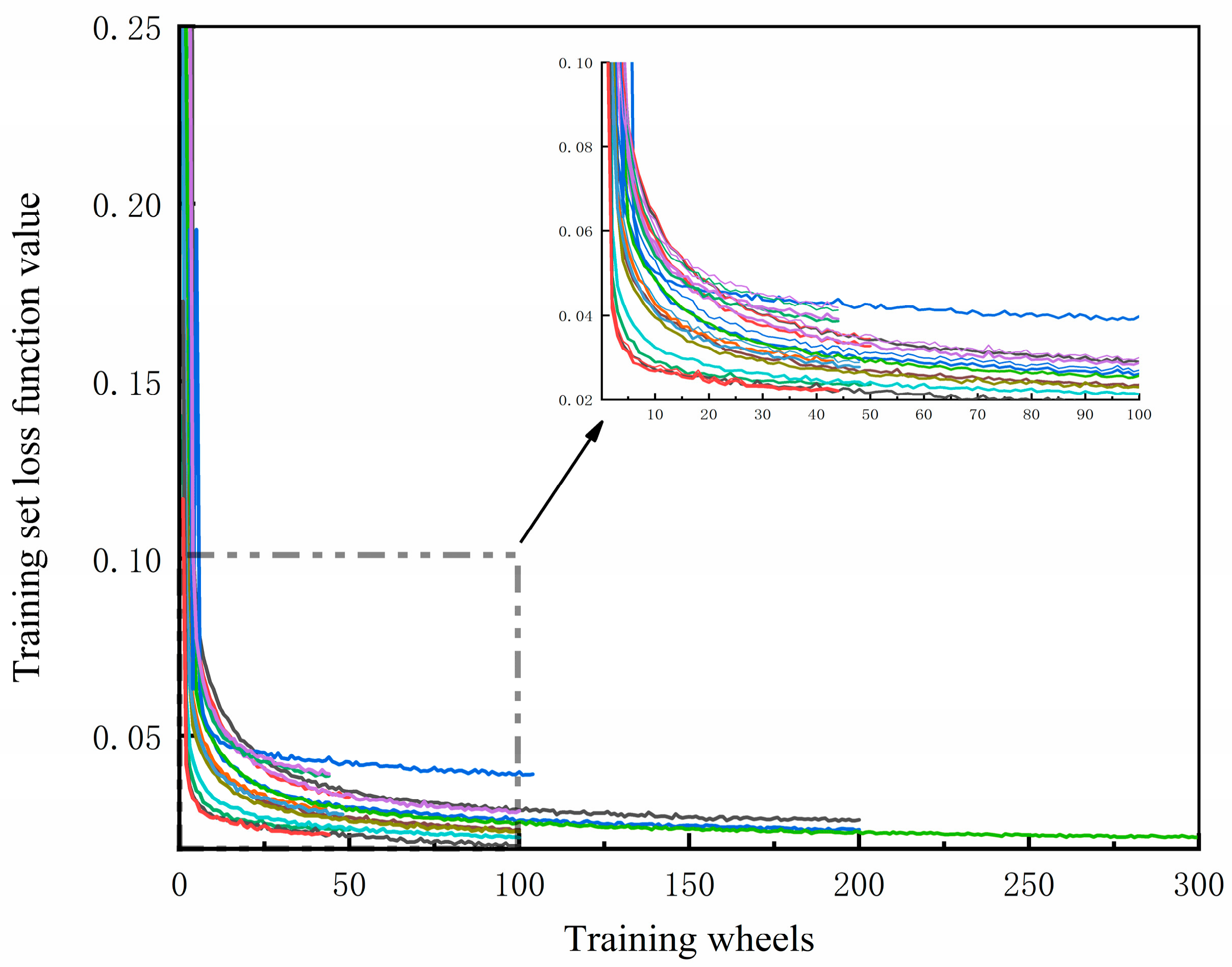
A total of 100 hyperparameter sets were evaluated. The optimal combination identified by BOHB was then compared with that from the standard BO method.
Figure 6 illustrates the BOHB optimization process. As training progresses, the loss function generally decreases. The key mechanism is dynamic resource allocation: only configurations that perform well on the validation set receive additional computational resources to continue training, while underperforming ones are early-stopped and discarded, thereby reducing overall computation time.
The hyperparameter search space and the final optimal combination are detailed in
Table 3. Defining this search space ensures the transparency and reproducibility of the optimization process. The optimal hyperparameter combination is crucial for enhancing PINN efficiency. It directly leads to faster convergence, more stable training, and higher predictive accuracy, maximizing the model’s performance within limited computational resources. The experimental results show that the RMSEs of the arc duration and arc energy values under the BO method are 0.086 and 0.932, while the RMSEs under the BOHB method are 0.082 and 0.958. Although BO shows marginally better accuracy, the difference is negligible. In terms of efficiency, optimizing 100 hyperparameter sets took approximately 8 h for BO but only 90 min for BOHB. Thus, BOHB offers a substantial speed advantage while maintaining comparable estimation accuracy.
The BOHB-optimized weights strike a balanced compromise, enabling the PINN to simultaneously achieve low data-fitting error and low physical residual error. This balance is key to the model’s high accuracy and physical consistency.
3.4. GMM Statistical Modeling and Sampling
To build a high-quality training dataset, key simulation design variables were systematically varied. The entire parameter space is defined as: the moving and static contact diameters [4 mm, 6 mm], contact heights [1 mm, 3 mm], contact gap distance [0.1 mm, 0.5 mm], and breaking time [2 ms, 4 ms] are taken as input variables to predict the resulting arc duration and arc energy. This process aimed to build a high-quality dataset for neural network training. However, the combinatorial explosion of these parameters leads to an exponential increase in the sample space. This significantly escalates the computational load and simulation time for multi-physics analyses, often causing simulations to fail due to excessive memory usage.
To address the issue of data scarcity under small-sample conditions, GMM is introduced for statistical modeling and data augmentation. GMM is a probabilistic clustering and density estimation method based on the premise that the dataset is generated from a weighted combination of multiple Gaussian distributions. Using the Expectation-Maximization (EM) algorithm, GMM learns the parameters and weights of these Gaussian components to accurately approximate complex data distributions [
33].
The data sources are 50 sets of actual measurement data and 950 sets of simulation data, totaling 1000 sets of data. The first 700 data were selected for statistical modeling and neural network training, the 701st–900th data for validation, and the 901st–1000th data for testing. For the GMM model, 10,000 samples were generated by Monte Carlo sampling, and the data were scaled to the interval [0, 1] using the max–min normalization method.
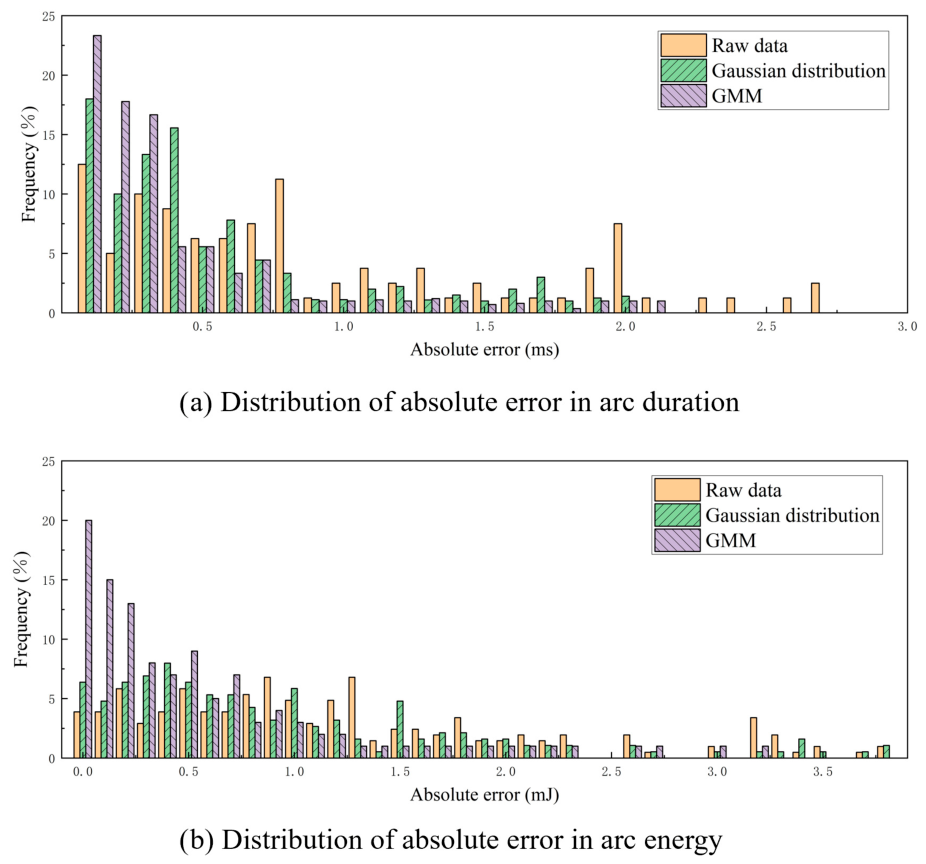
To test the validity of GMM statistical modeling for sampling, the following three scenarios were designed for comparative testing: (1) Using the original dataset as a neural network training sample; (2) Statistical modeling and sampling of the dataset using the Gaussian distribution as the neural network training sample; (3) Statistical modeling and sampling of the dataset using GMM as the neural network training sample.
All three schemes use PINN, and the frequency histogram of absolute errors of the test set is shown in
Figure 7, from which it can be seen that the absolute errors of the arc parameters modeled based on GMM are generally concentrated around 0, with the smallest errors; the absolute errors based on Gaussian distribution are the next largest, and those based on the original measured data are the largest. It can be seen that the use of GMM for statistical modeling and sampling can be sufficient for the neural network to be adequately trained, thereby significantly improving the estimation accuracy.
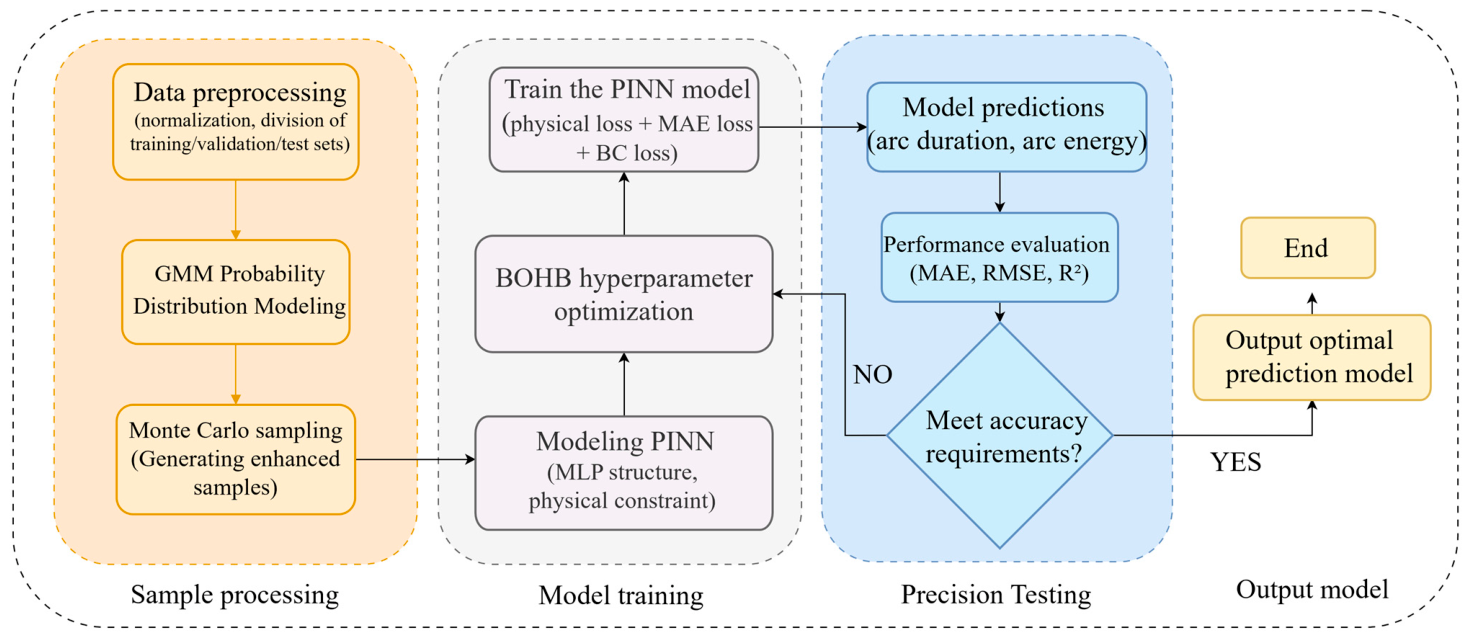
This paper proposes a closed-loop optimization framework. The process starts by generating a multivariate simulation dataset through systematic variation of key design and operational parameters, including the diameters and heights of the moving and stationary contacts, as well as conditions like contact separation speed and breaking time. This dataset then enters the sample processing phase, where it is preprocessed and enhanced via GMM probability distribution modeling and monte carlo Sampling. In the model training phase, a PINN with an MLP structure is constructed, incorporating physical constraints into its composite loss function. Its hyperparameters are optimized using the BOHB algorithm. The framework then proceeds to precision testing, where the model’s predictions for arc duration and energy are evaluated using metrics like MAE, RMSE, and R
2. A decision point checks if accuracy requirements are met. If not, the process iterates back to training; if yes, the output model phase delivers the optimal prediction model. This structure forms a rigorous, self-improving workflow that integrates data augmentation, physics-informed learning, automated hyperparameter tuning, and validation-driven iteration. The complete flowchart is shown in the
Figure 8.
4. Projected Results and Analysis
4.1. Comparison of Projected Effects
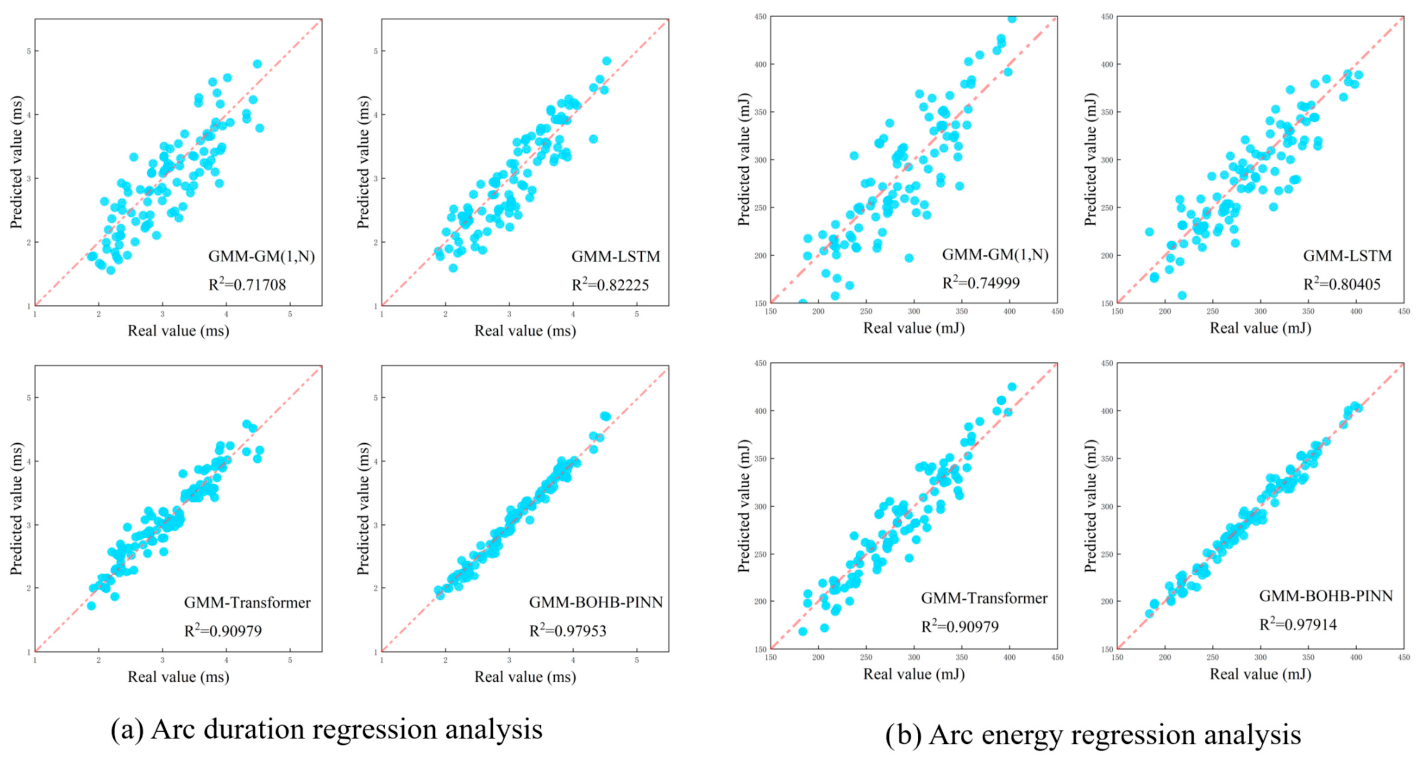
A benchmarking study was conducted to evaluate the proposed GMM-BOHB-PINN model against several established prediction methods, all preprocessed with GMM for a fair comparison. The counterparts include the gray model GM (1, N), LSTM, and Transformer models. The comparative performance on predicting arc duration and arc energy is detailed in
Figure 9,
Table 4 and
Table 5. In regression analysis, the y = x line represents the ideal of perfect prediction. The close clustering of data points around this line for both arc duration and arc energy predictions demonstrates the high accuracy of the proposed GB-PINN model.
All models were trained under identical conditions on an NVIDIA GeForce RTX 4070Ti GPU, using the same training, validation, and test datasets. An early stopping strategy with a patience of 20 epochs was applied to prevent overfitting. Specifically, the GMM-LSTM model consisted of 2 LSTM layers with 128 units each and a dropout rate of 0.2; the GMM-Transformer model included 2 encoder layers with 8 attention heads and a dropout rate of 0.1; and the proposed model. All baseline models were manually tuned to their optimal hyperparameters, ensuring a fair and transparent comparison with the GB-PINN framework.
From the prediction results of arc duration, the average absolute error MAE is 0.07870 ms, and the root mean square error RMSE is 0.09929 ms, which are 50.0% and 50.1% lower than that of the GMM-Transformer model with the second-best performance, respectively. Its coefficient of determination R2 reaches 0.97953; in terms of arc energy, the MAE and RMSE of this paper’s model are 0.62432 mJ and 0.77381 mJ, which are much lower than those of other comparative models, and lower than that of the GMM-Transformer model by 57.9% and 57.8%. Its R2 value reaches 0.97914. The GB-PINN model outperforms the other models in various indexes.
To further verify that the model has learned the underlying physical relationships rather than simply interpolating within the augmented data distribution, we conducted an additional 30% out-of-distribution extrapolation test on parameter combinations that are 30% outside the original training range in all four dimensions:
Contact diameters: [3.7 mm, 3.8 mm]∪[6.2 mm, 6.3 mm]
Contact heights: [0.7 mm, 0.8 mm]∪[3.2 mm, 3.3 mm]
Contact gap distances: [0.07 mm, 0.08 mm]∪[0.52 mm, 0.53 mm]
Breaking times: [1.4 ms, 1.6 ms]∪[4.4 ms, 4.6 ms]
The performance comparison between in-distribution and out-of-distribution predictions is shown in
Table 6:
These results demonstrate that the model maintains high predictive accuracy even for completely unseen operating conditions. The gradual and predictable decrease in performance as we move further outside the training distribution is consistent with physical modeling principles, while the R2 values remaining above 0.89 confirm that the model has learned the fundamental physical laws governing arc behavior rather than just memorizing the training data distribution.
The excellent performance on both the in-distribution test set and the multi-gradient out-of-distribution extrapolation test confirms that the GB-PINN framework achieves a good balance between interpolation accuracy and extrapolation capability. Unlike purely data-driven models that degrade rapidly when extrapolating beyond the training distribution, the physics-informed loss function acts as a strong regularization term that guides the model to produce physically plausible predictions even for unseen conditions. This is a key advantage of our approach over traditional data augmentation methods that only improve interpolation performance within the training distribution.
4.2. Ablation Experiments
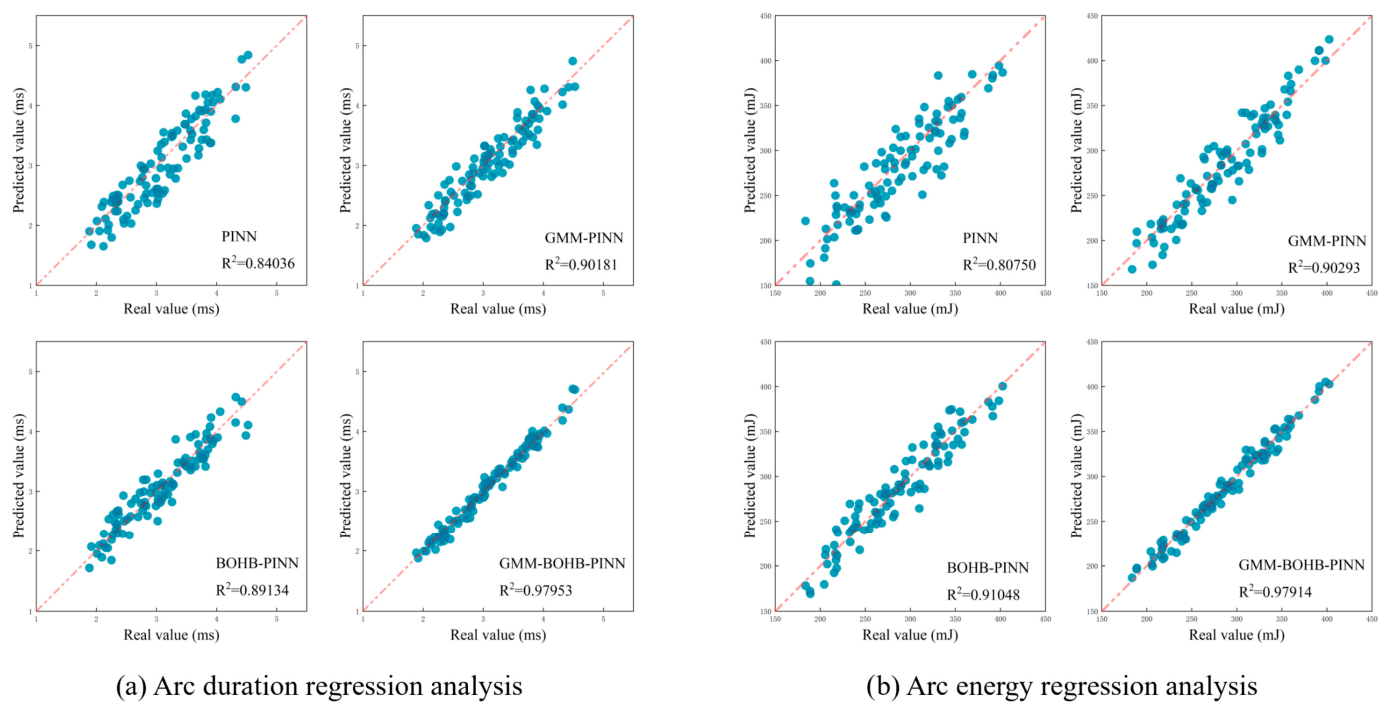
To verify the validity and importance of the relevant modules, a set of ablation experiments is performed, where GMM-BOHB-PINN represents the complete prediction model proposed in this paper, GMM-PINN represents the model with the removal of the BOHB hyperparameter optimization module, BOHB-PINN represents the model with the removal of the GMM data augmentation module, and PINN represents the model that only uses the underlying physical-informed neural network model. The prediction results are shown in
Figure 10, and the corresponding error evaluations are shown in
Table 7 and
Table 8.
From the prediction results shown, it can be seen that the predicted values under different module combinations have basically the same trend with the scatter distribution of the true values, but the predicted values of the GMM-BOHB-PINN model are most concentrated near the y = x reference line, with the highest goodness-of-fit. In the arc duration prediction, the MAE and RMSE of this paper’s method are reduced by 69.3% and 67.2% compared with the base PINN model, and its R2 is 0.97953. In the arc energy prediction, the MAE and RMSE of this paper’s method are reduced by 68.2% and 69.1% compared with the base PINN model, and its R2 reaches 0.97914. The result verifies the effectiveness of the module proposed.
5. Conclusions
This paper introduces a hybrid GB-PINN framework for predicting arc parameters in electrical contacts. The methodology involves constructing an MHD model of arc dynamics, which is first validated against experimental data. A base dataset is then generated through parametric scanning and subsequently enhanced via GMM sampling. The hyperparameters of the PINN are optimized using the BOHB algorithm. Remarkably, with only 1000 base samples, the model achieves high predictive accuracy: for arc duration, MAE = 0.07870 ms, RMSE = 0.09929 ms, R2 = 0.97953; for arc energy, MAE = 0.62432 mJ, RMSE = 0.77381 mJ and R2 = 0.97914.
Furthermore, the proposed GB-PINN is a modular and transferable general prediction framework rather than a fixed model tied to a specific experimental setup. Its modeling logic based on universal physical laws and physics-constrained mechanism ensures strong generalization across diverse arc scenarios. For new contact materials such as copper-tungsten and silver-tin oxide, the framework can be adapted in three steps: updating the material properties (thermal conductivity, electrical resistivity, specific heat) in the MHD model, generating approximately 100 targeted simulation samples covering the relevant parameter range, and fine-tuning only the top two layers of the pre-trained model using 20–30 experimental samples. For higher current levels up to 1000 A, the Mayr equation remains the dominant governing physical law, requiring only minor modifications to the physics-informed loss function to account for additional thermal radiation effects; for currents above 1000 A, the physics loss term can be directly replaced with the Cassie equation residual without retraining the entire network from scratch. This inherent flexibility allows rapid adaptation to new operating conditions via transfer learning with only a limited number of experimental samples.
The key findings are summarized as follows:
- (1)
The validated MHD model accurately replicates the dynamic arcing process, and the close agreement between simulated and experimental metrics establishes a reliable data foundation for deep learning.
- (2)
Embedding physical laws into the PINN ensures prediction consistency, while GMM and BOHB synergistically address data scarcity and computational cost, achieving an efficient and accurate framework.
- (3)
The integrated GB-PINN framework serves as a practical digital tool, enabling fast and accurate arc prediction across varied conditions, which can reduce reliance on costly prototyping and shorten development cycles.
Future work will validate the framework on different contact materials and higher current ratings up to 630 A to further demonstrate its generalizability for industrial electrical contact design.