Transient Stability Preventive Control Based on SCINet and IDBO

Abstract
1. Introduction
- On the basis of the MIC, an OMICIG-based feature selection method is proposed. By jointly considering feature correlation, redundancy, and synergy, the proposed method can select a more representative key feature subset. This improves the training efficiency and assessment performance of the evaluation model.
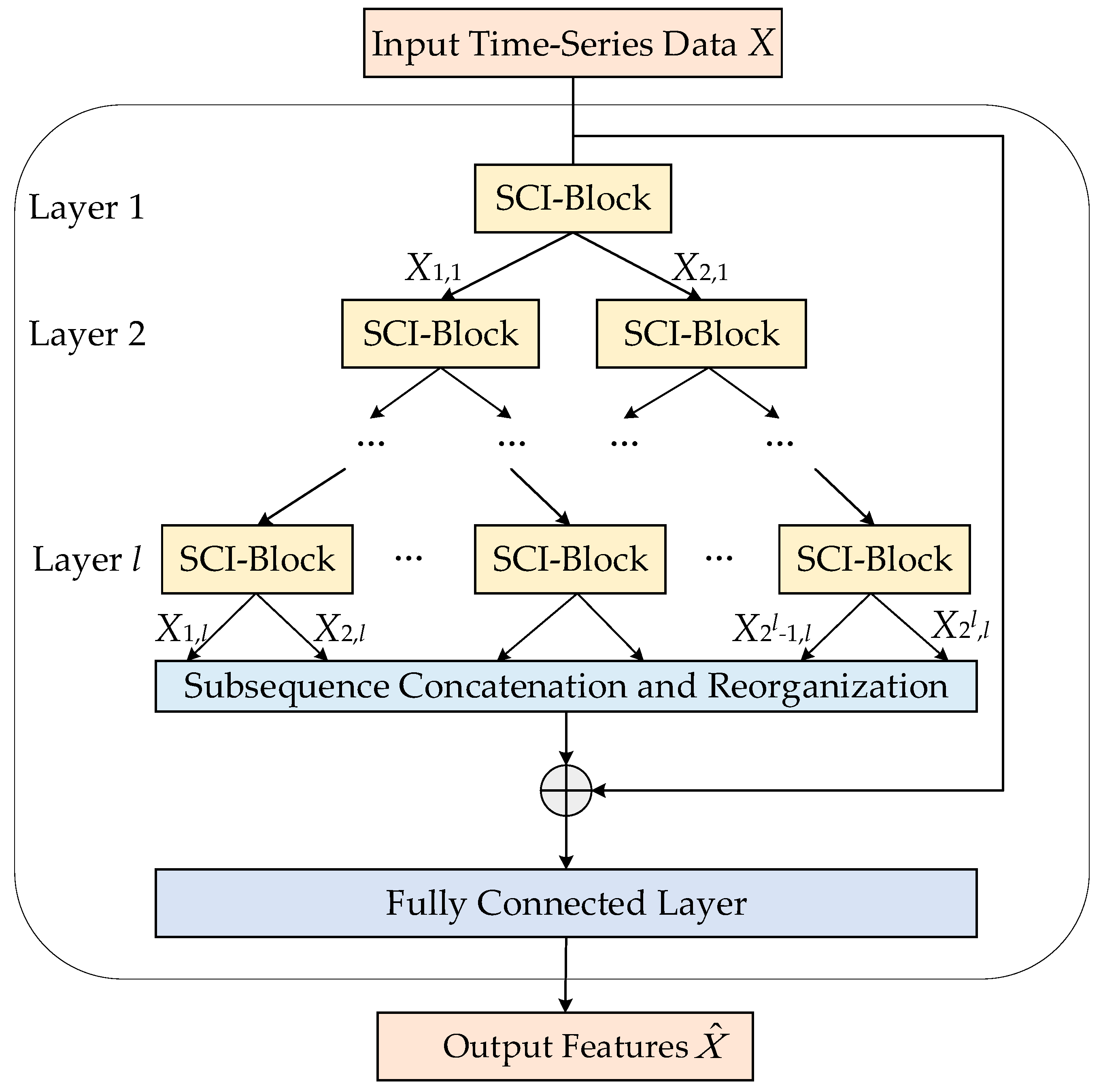
- A transient stability assessment model based on SCINet is constructed. The proposed model can capture both short-term fault-induced abrupt changes and long-term temporal dependencies in power system measurement data. Therefore, it can more accurately characterize the complex dynamic evolution process during transients.
- The trained SCINet model is embedded into the TSCOPF framework to replace the transient stability constraints traditionally represented by DAE, thereby reducing the computational complexity of the preventive control model.
- To overcome the limitations of the conventional dung beetle optimizer (DBO), such as poor initial population quality and premature convergence, Tent chaotic mapping and an adaptive t-distribution perturbation strategy are introduced. These strategies improve the convergence speed, solution accuracy, and global search capability of DBO.
2. OMICIG-Based Feature Selection
2.1. Transient Stability Index
2.2. Principles of OMICIG
2.2.1. Orthogonal Maximum Information Coefficient
2.2.2. Information Gain
2.3. OMICIG Feature Selection Procedure
3. Principle of the SCINet Model
3.1. Overall Architecture of SCINet
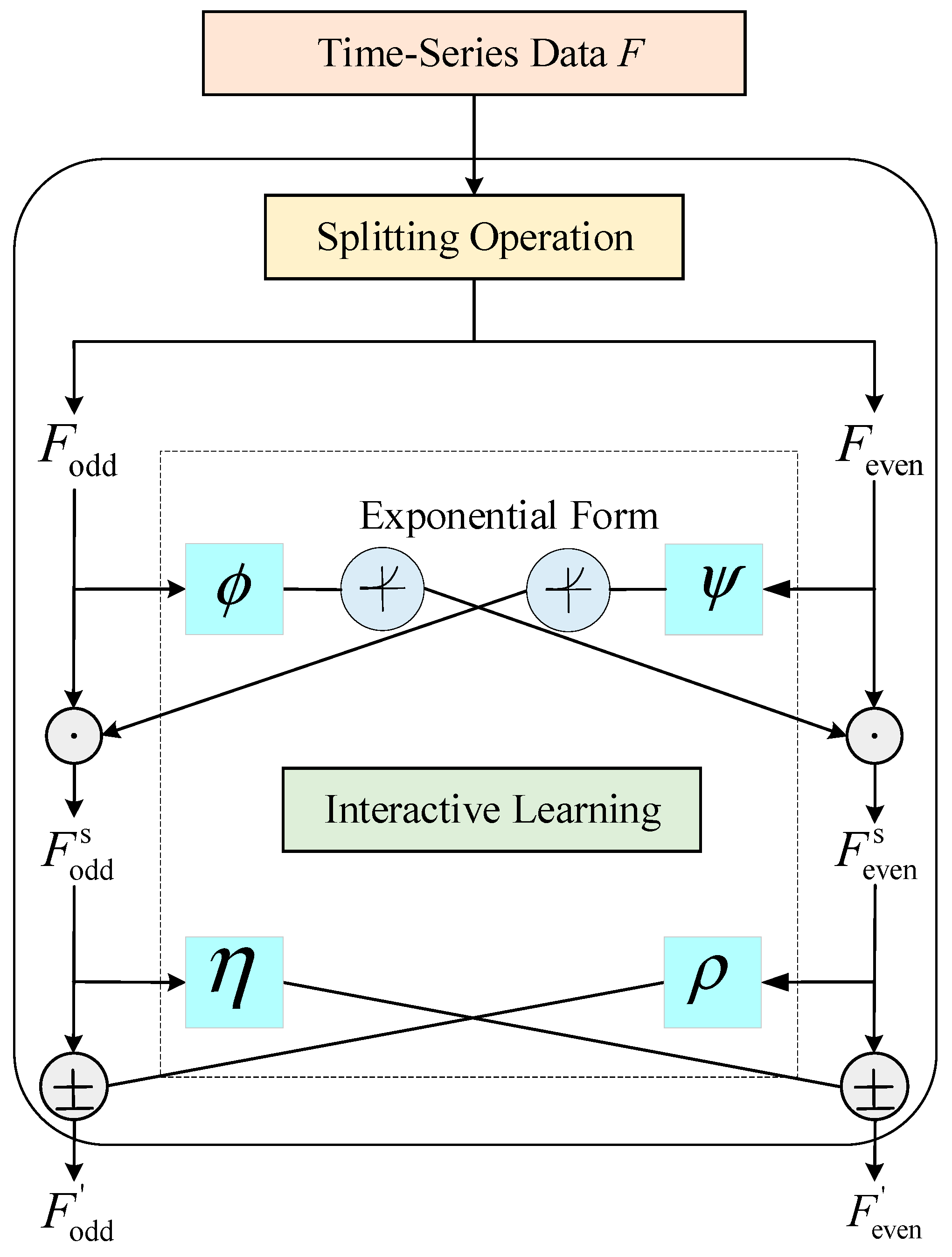
3.2. Structure of the SCI-Block
4. Transient Stability Preventive Control Model
4.1. Objective Function
4.2. Equational Constraint
4.3. Inequational Constraint
4.4. Transient Stability Constraints
4.5. Improved Dung Beetle Optimization Algorithm
4.5.1. Tent Chaotic Mapping
4.5.2. Adaptive t-Distribution Strategy
4.5.3. Penalty Function Treatment of the SCINet Constraint
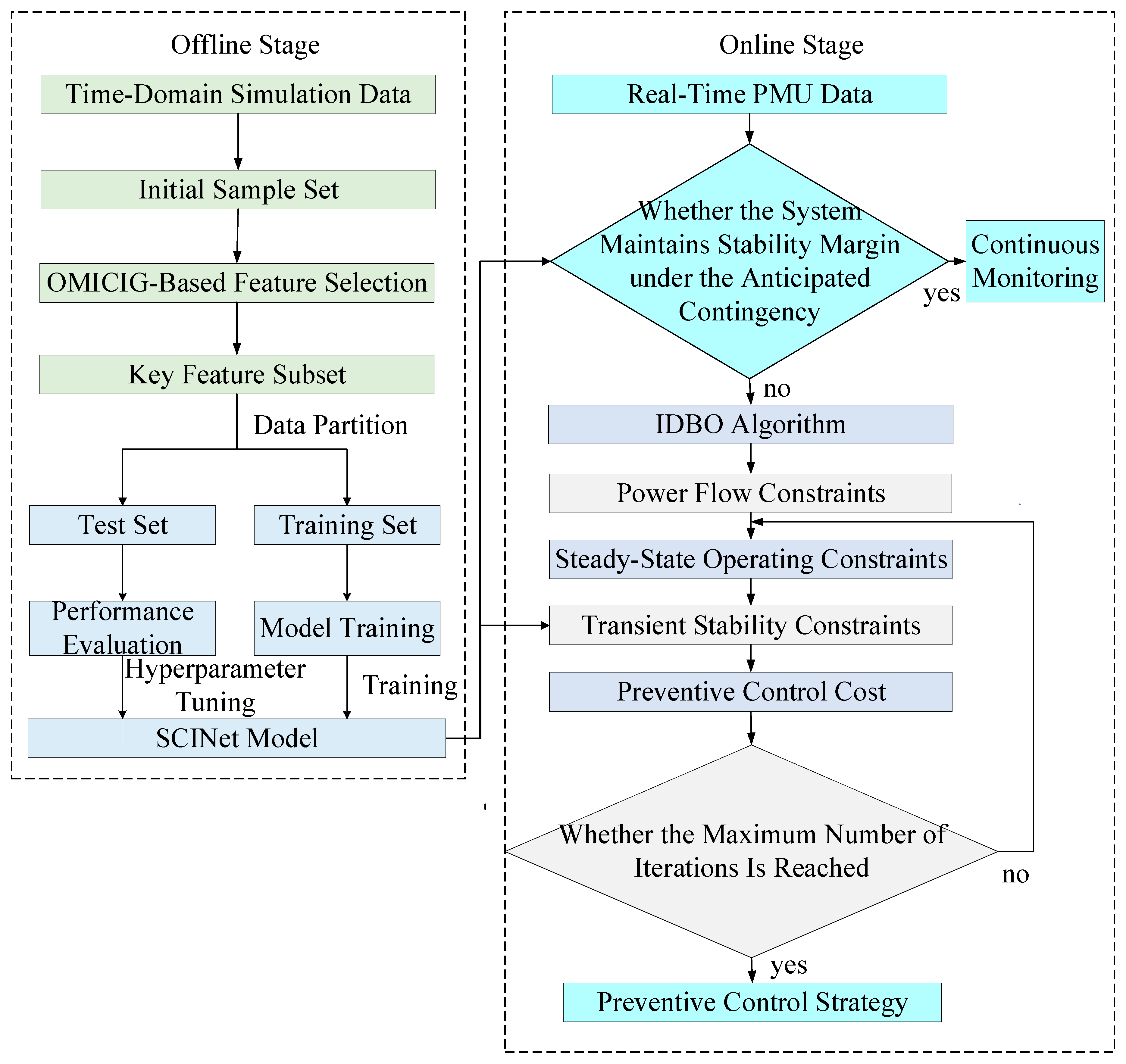
4.6. Framework of the Proposed Transient Stability Preventive Control Method

4.6.1. Offline Stage
4.6.2. Online Stage
5. Case Studies
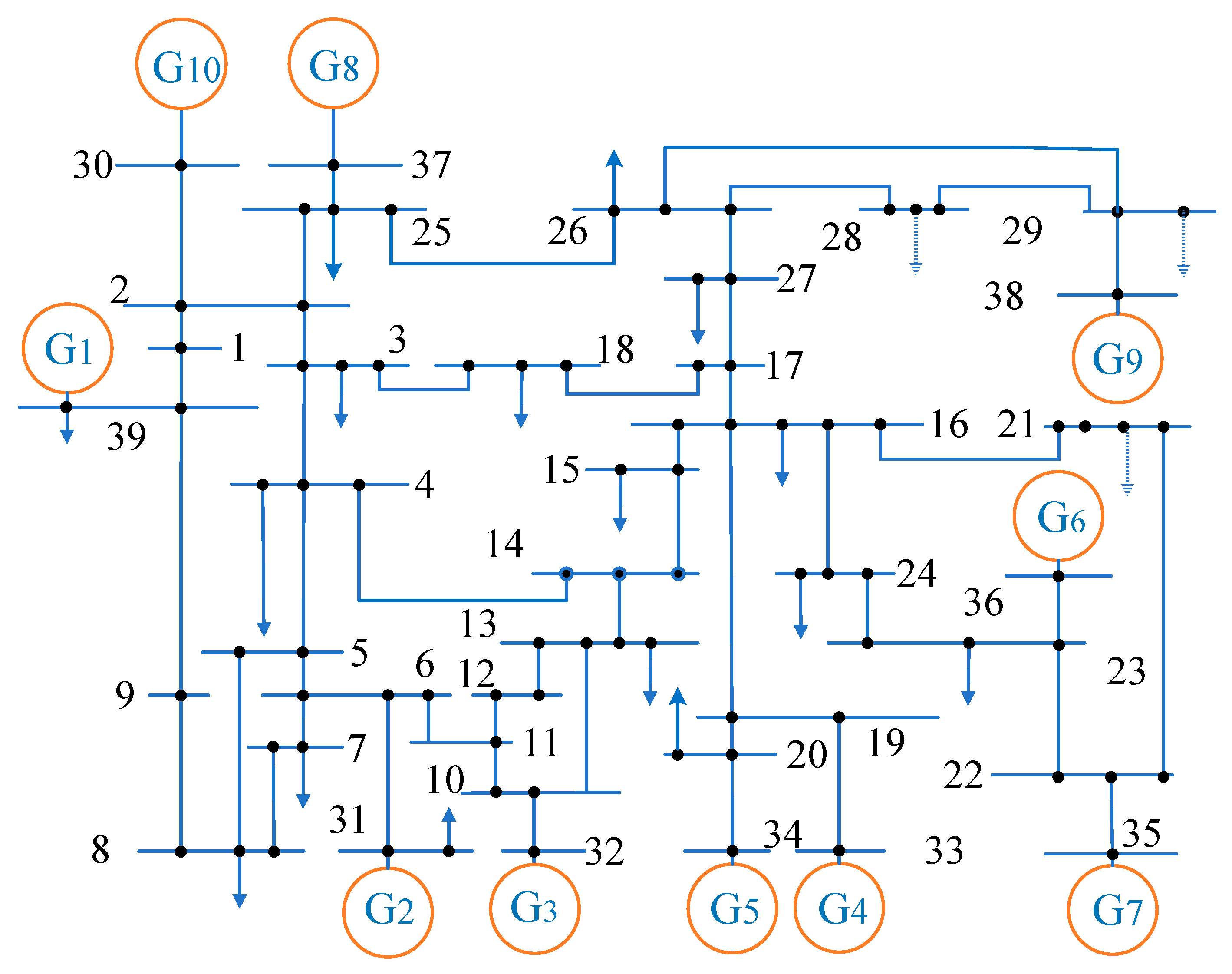
5.1. Dataset Generation
5.2. Performance Evaluation Metrics of the Model
5.3. Analysis of Feature Selection Results
5.4. Performance Analysis of the Transient Stability Assessment Model
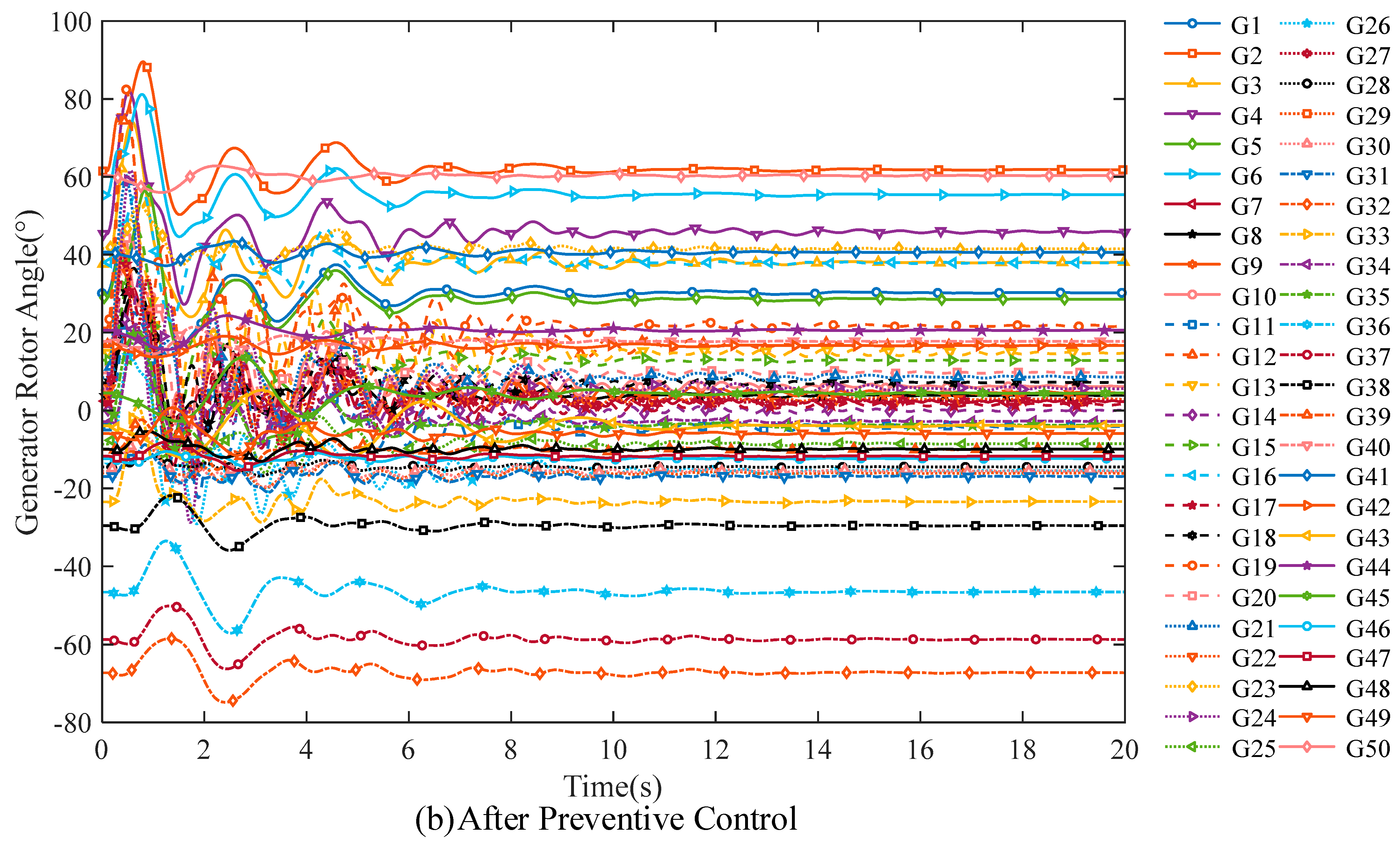
5.5. Performance Analysis of Transient Stability Preventive Control
5.6. Performance Analysis of Optimization Algorithms
5.7. Performance Comparison of Different TSCOPF Methods
5.8. Generalization Test on the IEEE 118-Bus System
6. Conclusions
- (1)
- Compared with methods such as MIC, JMI, and MRMR, OMICIG is able to select a more representative feature subset by comprehensively considering the correlation, redundancy, and synergy among variables. This improves the computational efficiency of the SCINet model while maintaining high assessment accuracy.
- (2)
- Compared with RF, DBN, CNN, RNN, GKAN, GCN, PINN, and Transformer, SCINet captures short-term details and long-term dependency information in the post-fault dynamic response of the power system more effectively. This is mainly due to its binary-tree downsampling structure and convolution-based interactive learning mechanism. As a result, SCINet achieves more accurate transient stability assessment within a shorter time.
- (3)
- By incorporating Tent chaotic mapping and an adaptive t-distribution strategy, IDBO exhibits favorable convergence performance in solving the TSCOPF problem. Compared with other optimization algorithms, it shows clear advantages in both convergence speed and solution accuracy.
- (4)
- By replacing the transient stability constraints represented in the form of DAE in the TSCOPF model with the SCINet-based assessment model, the computational burden can be effectively reduced. Combined with the rapid optimization capability of IDBO for the TSCOPF model, the proposed framework can generate a fast and effective transient stability preventive control strategy. This helps ensure the safe and reliable operation of the power system.
Author Contributions
Funding
Data Availability Statement
Conflicts of Interest
Nomenclature
| Abbreviations | |
| AFO | Aptenodytes forsteri optimization |
| DAE | Differential algebraic equations |
| DBN | Deep Belief Network |
| DBO | Dung beetle optimizer |
| GCN | Graph convolutional network |
| GEO | Golden eagle optimization |
| GKAN | Gated Kolmogorov–Arnold network |
| GSO | Gram–Schmidt orthonormalization |
| IDBO | Improved dung beetle optimizer |
| IPM | Interior point method |
| MAE | Mean absolute error |
| MIC | Maximal information coefficient |
| OMIC | Orthogonal maximal information coefficient |
| OMICIG | Orthogonal maximal information coefficient and information gain |
| PINN | Physics-informed neural network |
| RF | Random forest |
| SCINet | Sample convolution and interaction network |
| TSCOPF | Transient stability constrained optimal power flow |
| TSI | Transient stability index |
| IG | Information gain |
| VI | Variable interaction |
| Variables | |
| Weighting coefficient in the OMICIG scoring function | |
| Upper bound of the grid partition number | |
| Set of generator buses | |
| Set of all buses in the power system | |
| Set of transmission lines | |
| Computational complexity of a single information gain calculation | |
| Computational complexity of a single MIC calculation | |
| Unit cost coefficient of upward active power adjustment for generator | |
| Unit cost coefficient of downward active power adjustment for generator | |
| Original feature dimension | |
| Original electrical time-series data sequence | |
| Total active power regulation cost of thermal generators | |
| Even-indexed subsequence | |
| Odd-indexed subsequence | |
| Element at the even-indexed position of the original sequence | |
| Element at the odd-indexed position of the original sequence | |
| Scaled odd and even subsequences obtained after exponential transformation and interactive multiplication | |
| Updated odd and even subsequences after cross-addition operation | |
| Fitness function value of IDBO | |
| Differential equations describing the transient dynamic process | |
| Mapping function of the fully connected layer | |
| Conductance and susceptance elements of the bus admittance matrix | |
| Normalized orthogonal component of candidate feature | |
| algebraic equations | |
| Mutual information between random variables and | |
| Synergistic information gain between and | |
| Maximum number of iterations | |
| Lower and upper bounds of the j-th dimension, respectively | |
| Number of samples in the dataset | |
| n | Total number of buses in the power system |
| Overall computational complexity of the OMICIG feature selection algorithm | |
| Active power outputs at bus | |
| Active load demands at bus | |
| Lower active power limits of generator | |
| Upper active power limits of generator | |
| Dynamic probability of selecting individuals for -distribution perturbation at the k-th iteration | |
| Reactive power outputs at bus | |
| Reactive load demands at bus | |
| Lower reactive power limits of generator | |
| Upper reactive power limits of generator | |
| Unit orthogonal vector obtained in the Gram–Schmidt orthogonalization process | |
| Selected feature subset | |
| Selected feature subset obtained after the i-th feature selection step | |
| Candidate feature to be evaluated in the iterative selection process | |
| Comprehensive score of candidate feature | |
| Transient stability index | |
| Orthogonalized variable obtained by Gram–Schmidt orthogonalization | |
| Adjustment parameters of the dynamic selection probability | |
| Input electrical time-series feature data of SCINet | |
| System operating feature vector | |
| Initial position of the m-th individual in the j-th dimension | |
| Current position of the m-th individual in the j-th dimension at the k-th iteration | |
| Candidate position after t-distribution perturbation | |
| Random variables used in MIC calculation | |
| State variables at time t during transient analysis | |
| Algebraic variables at time t during transient analysis | |
| Target variable | |
| Chaotic state variable of the m-th individual in the j-th dimension before Tent mapping | |
| Chaotic state variable after Tent mapping | |
| Maximum rotor angle difference between any two generators during the transient process | |
| Random perturbation term following the t-distribution at the k-th iteration | |
| One-dimensional convolution transformation modules used to update the odd and even subsequences | |
| Voltage phase angle difference between buses and | |
| Penalty factor for the SCINet-based transient stability constraint | |
| Transient stability margin threshold | |
| Trained SCINet-based transient stability assessment model | |
| One-dimensional convolution modules | |
| Exponential operation | |
References
- Shahriyari, M.; Khoshkhoo, H.; Guerrero, J.M. A Novel Fast Transient Stability Assessment of Power Systems Using Fault-On Trajectory. IEEE Syst. J. 2022, 16, 4334–4344. [Google Scholar] [CrossRef]
- Cheng, S.; Yu, Z.; Liu, Y.; Zuo, X. Power System Transient Stability Assessment Based on the Multiple Paralleled Convolutional Neural Network and Gated Recurrent Unit. Prot. Control Mod. Power Syst. 2022, 7, 39. [Google Scholar] [CrossRef]
- Hamilton, R.I.; Papadopoulos, P.N. Using SHAP Values and Machine Learning to Understand Trends in the Transient Stability Limit. IEEE Trans. Power Syst. 2024, 39, 1384–1397. [Google Scholar] [CrossRef]
- Ye, Z.; Zhu, S.; Li, S.; Wu, Y.; Wang, X.; Lin, Z.; Geng, G. Oriented Data Generation for Power System Transient Stability Boundary Exploration Based on Support Vector Machine. Electronics 2025, 14, 1285. [Google Scholar] [CrossRef]
- Lamprianidou, I.S.; Hamilton, R.I.; Papadopoulos, P.N. Impact of Active Distribution Network Modeling Approaches on Transient Stability Through Sensitivity Analysis. IEEE Trans. Power Syst. 2026, 41, 572–584. [Google Scholar] [CrossRef]
- Zhang, Z.; Qin, B.; Ding, T.; Gao, X.; Zhang, Y. CBAM-CNN Based Transient Overvoltage Preventive Control Considering Piecewise Linear Control Sensitivity. IEEE Trans. Power Syst. 2025, 40, 3645–3656. [Google Scholar] [CrossRef]
- Niu, S.; Wu, J.; Li, C.; Duan, C.; Hao, Z. Optimizing Fault-Ride-Through Strategies of Renewable Generation for the Enhancement of Power System Transient Stability and Security. Energies 2025, 18, 5986. [Google Scholar] [CrossRef]
- Liu, S.; Zhao, Y.; Zhang, L.; Ai, D.; Ye, B.; Geng, Y. Transient Stability-Constrained Optimal Power Flow Model Based on CatBoost-DF and ISOA. Energies 2025, 18, 6126. [Google Scholar] [CrossRef]
- Zhang, S.; Zhang, D.; Qiao, J.; Wang, X.; Zhang, Z. Preventive Control for Power System Transient Security Based on XGBoost and DCOPF with Consideration of Model Interpretability. CSEE J. Power Energy Syst. 2020, 7, 279–294. [Google Scholar] [CrossRef]
- Chen, H.; Guan, L.; Lin, B.; Chen, L.; Huang, J.; Li, Y. A Continual Learning Scheme for Data-Driven Transient Stability Assessment via Clustered Memory Replay and Hierarchical Embedding Constraint. Electr. Power Syst. Res. 2025, 247, 111704. [Google Scholar] [CrossRef]
- Xu, Y.; Dong, Z.Y.; Zhao, J.; Xue, Y.; Hill, D.J. Trajectory Sensitivity Analysis on the Equivalent One-machine-infinite-bus of Multi-machine Systems for Preventive Transient Stability Control. IET Gener. Transm. Distrib. 2015, 9, 276–286. [Google Scholar] [CrossRef]
- Arredondo, F.; Castronuovo, E.D.; Ledesma, P.; Leonowicz, Z. Analysis of Numerical Methods to Include Dynamic Constraints in an Optimal Power Flow Model. Energies 2019, 12, 885. [Google Scholar] [CrossRef]
- Xia, S.; Ding, Z.; Shahidehpour, M.; Chan, K.W.; Bu, S.; Li, G. Transient Stability-Constrained Optimal Power Flow Calculation with Extremely Unstable Conditions Using Energy Sensitivity Method. IEEE Trans. Power Syst. 2021, 36, 355–365. [Google Scholar] [CrossRef]
- Su, T.; Zhao, J. Neural Network Certification Informed Power System Transient Stability Preventive Control with Renewable Energy. IEEE Trans. Power Syst. 2025, 40, 5398–5409. [Google Scholar] [CrossRef]
- Zhou, Y.; Wu, J.; Ji, L.; Yu, Z.; Lin, K.; Hao, L. Transient Stability Preventive Control of Power Systems Using Chaotic Particle Swarm Optimization Combined with Two-Stage Support Vector Machine. Electr. Power Syst. Res. 2018, 155, 111–120. [Google Scholar] [CrossRef]
- Ahmad, H.; Yousif, M.; Shah, M.; Ullah, N. Monitoring Transient Stability in Electric Power Systems Using a Hybrid Model of Convolutional Neural Network and Random Forest. Electr. Power Compon. Syst. 2024, 52, 946–958. [Google Scholar] [CrossRef]
- Xu, Y.; Dong, Z.Y.; Zhang, R.; Po Wong, K. A Decision Tree-Based on-Line Preventive Control Strategy for Power System Transient Instability Prevention. Int. J. Syst. Sci. 2014, 45, 176–186. [Google Scholar] [CrossRef]
- Li, H.; Wang, Z.; Jin, T.; Xu, X.; Shi, L. A Novel Data-Driven Method of Real-Time Transient Stability Assessment for AC/DC Hybrid Power Systems. IEEE Access 2025, 13, 80748–80758. [Google Scholar] [CrossRef]
- Yin, L.; Ge, W.; Liu, R. Golden Eagle Optimization Algorithm Embedded in Gated Kolmogorov-Arnold Network for Transient Stability Preventive Control of Power Systems. Energy 2025, 318, 134931. [Google Scholar] [CrossRef]
- Su, T.; Liu, Y.; Zhao, J.; Liu, J. Deep Belief Network Enabled Surrogate Modeling for Fast Preventive Control of Power System Transient Stability. IEEE Trans. Ind. Inform. 2022, 18, 315–326. [Google Scholar] [CrossRef]
- Xie, Z.; Zhang, D.; Hu, W.; Han, X. Power System Transient Stability Preventive Control via Aptenodytes Forsteri Optimization with an Improved Transient Stability Assessment Model. Energies 2024, 17, 1942. [Google Scholar] [CrossRef]
- Shen, C.; Zuo, K.; Sun, M. Physics-Augmented Auxiliary Learning for Power System Transient Stability Assessment. IEEE Trans. Ind. Inform. 2025, 21, 6811–6822. [Google Scholar] [CrossRef]
- Wang, T.; Tang, Y. Transient Stability Preventive Control Based on Graph Convolution Neural Network and Transfer Deep Reinforcement Learning. CSEE J. Power Energy Syst. 2023, 11, 136–149. [Google Scholar] [CrossRef]
- Wang, H.; Gao, F.; Chen, Q.; Bu, S.; Lei, C. Instability Pattern-Guided Model Updating Method for Data-Driven Transient Stability Assessment. IEEE Trans. Power Syst. 2025, 40, 1214–1227. [Google Scholar] [CrossRef]
- Liu, J.; Sun, H.; Li, Y.; Fang, W.; Niu, S. An Improved Power System Transient Stability Prediction Model Based on mRMR Feature Selection and WTA Ensemble Learning. Appl. Sci. 2020, 10, 2255. [Google Scholar] [CrossRef]
- Liu, Y.; Su, T.; Qiu, G.; Gao, H.; Liu, J.; Shui, Y. Analytic Deep Learning and Stepwise Integrated Gradients-Based Power System Transient Stability Preventive Control. IEEE Trans. Power Syst. 2024, 39, 863–876. [Google Scholar] [CrossRef]
- Wang, T.; Tang, Y. Data-model Driven Rescheduling Considering Both Rotor Angle Stability and Transient Voltage Stability Constraints. IET Renew. Power Gener. 2022, 16, 1509–1521. [Google Scholar] [CrossRef]
- Lin, G.; Lin, A.; Gu, D. Using Support Vector Regression and K-Nearest Neighbors for Short-Term Traffic Flow Prediction Based on Maximal Information Coefficient. Inf. Sci. 2022, 608, 517–531. [Google Scholar] [CrossRef]
- Li, Y.; Cui, X.; Feng, C.; Wang, H.; Ding, H. Algorithm Improvement for the Surface Morphology Diagnostics Based on the Gram-Schmidt Orthonormalization and the Least Square Ellipse Fitting under the EAST-like Vibrational Environments. Nucl. Mater. Energy 2023, 35, 101397. [Google Scholar] [CrossRef]
- Wang, Z.; Deng, G.; Yu, J. Group Feature Screening Based on Information Gain Ratio for Ultrahigh-Dimensional Data. J. Math. 2022, 2022, 1600986. [Google Scholar] [CrossRef]
- Inglis, A.; Parnell, A.; Hurley, C.B. Visualizing Variable Importance and Variable Interaction Effects in Machine Learning Models. J. Comput. Graph. Stat. 2022, 31, 766–778. [Google Scholar] [CrossRef]
- Cen, Z.; Hu, S.; Hou, Y.; Chen, Z.; Ke, Y. Remaining Useful Life Prediction of Machinery Based on Improved Sample Convolution and Interaction Network. Eng. Appl. Artif. Intell. 2024, 135, 108813. [Google Scholar] [CrossRef]
- Ye, M.; Zhou, H.; Yang, H.; Hu, B.; Wang, X. Multi-Strategy Improved Dung Beetle Optimization Algorithm and Its Applications. Biomimetics 2024, 9, 291. [Google Scholar] [CrossRef] [PubMed]
- Fan, J.; Li, Y.; Wang, T. An Improved African Vultures Optimization Algorithm Based on Tent Chaotic Mapping and Time-Varying Mechanism. PLoS ONE 2021, 16, e0260725. [Google Scholar] [CrossRef]
- Zhao, Y.; Men, L. Group Intelligence Optimization Algorithm of Adaptive Trigonometric Function and T-Distributed Perturbation Strategy. In Proceedings of the 2024 6th International Conference on Communications, Information System and Computer Engineering (CISCE), Guangzhou, China, 10–12 May 2024; IEEE: New York, NY, USA, 2024; pp. 740–744. [Google Scholar]
- Hao, L.; Peng, W.; Liu, J.; Zhang, W.; Li, Y.; Qin, K. Competition-Based Two-Stage Evolutionary Algorithm for Constrained Multi-Objective Optimization. Math. Comput. Simul. 2025, 230, 207–226. [Google Scholar] [CrossRef]



| Fault No. | Fault Line |
|---|---|
| 1 | 3–4 |
| 2 | 4–5 |
| 3 | 12–13 |
| 4 | 16–17 |
| 5 | 26–27 |
| 6 | 22–35 |
| Actual Result | Assessment Result | |
|---|---|---|
| Unstable | Stable | |
| Unstable | TP | FN |
| Stable | FP | TN |
| Feature Selection Method | Ap | R2 | MAE |
|---|---|---|---|
| MIC | 97.83 | 0.9871 | 1.7892 |
| JMI | 98.85 | 0.9917 | 1.4384 |
| MRMR | 99.14 | 0.9933 | 1.2861 |
| OMICIG | 99.32 | 0.9936 | 1.2318 |
| Model | Ap | R2 | MAE | Training Time (s) | Assessment Time (s) |
|---|---|---|---|---|---|
| RF | 95.68 | 0.9673 | 2.9174 | 7.95 | 0.033 |
| DBN | 97.92 | 0.9878 | 1.6840 | 70.54 | 1.026 |
| CNN | 98.05 | 0.9892 | 1.5728 | 58.61 | 0.428 |
| RNN | 98.36 | 0.9900 | 1.5062 | 75.83 | 1.105 |
| GCN | 98.55 | 0.9908 | 1.4386 | 66.96 | 0.824 |
| GKAN | 98.59 | 0.9912 | 1.4019 | 82.75 | 1.878 |
| PINN | 98.74 | 0.9917 | 1.3450 | 118.63 | 0.961 |
| Transformer | 99.08 | 0.9923 | 1.3176 | 95.23 | 1.926 |
| SCINet | 99.32 | 0.9936 | 1.2318 | 50.25 | 0.281 |
| Model | Rec | Pre | F1 |
|---|---|---|---|
| RF | 94.69 | 94.51 | 94.60 |
| DBN | 97.38 | 97.47 | 97.42 |
| CNN | 97.63 | 97.72 | 97.67 |
| RNN | 97.91 | 98.06 | 97.98 |
| GCN | 97.75 | 98.68 | 98.21 |
| GKAN | 98.22 | 98.34 | 98.28 |
| PINN | 98.25 | 99.12 | 98.68 |
| Transformer | 98.88 | 99.09 | 98.98 |
| SCINet | 99.09 | 99.34 | 99.22 |
| Generator No. | Active Power Before Preventive Control (MW) | Active Power After Preventive Control (MW) | Active Power Adjustment (MW) |
|---|---|---|---|
| 1 | 268.97 | 255.60 | −13.37 |
| 2 | 638.10 | 630.88 | −7.22 |
| 3 | 618.43 | 634.83 | 16.40 |
| 4 | 672.89 | 653.24 | −19.65 |
| 5 | 545.37 | 573.15 | 27.78 |
| 6 | 632.71 | 643.52 | 10.81 |
| 7 | 578.26 | 531.74 | −46.52 |
| 8 | 519.84 | 508.91 | −10.93 |
| 9 | 809.87 | 772.79 | −37.08 |
| 10 | 987.23 | 1028.94 | 41.71 |
| Fault No. | TSI | |
|---|---|---|
| Before Preventive Control | After Preventive Control | |
| 1 | −98.54 | 63.03 |
| 2 | 55.30 | 67.19 |
| 3 | −97.47 | 65.39 |
| 4 | −98.82 | 58.68 |
| 5 | 59.50 | 66.32 |
| 6 | −97.81 | 55.28 |
| Method | Computation Time/s | Optimized TSI | Cost/$ |
|---|---|---|---|
| IPM-SCINet | 68.14 | 54.43 | 1683.26 |
| IDBO-SCINet | 35.27 | 55.28 | 1579.45 |
| Fault No. | Fault Line |
|---|---|
| 1 | 5–8 |
| 2 | 32–114 |
| 3 | 34–36 |
| 4 | 17–27 |
| 5 | 52–53 |
| 6 | 104–110 |
| Model | Ap | R2 | MAE | Rec | Pre | F1 |
|---|---|---|---|---|---|---|
| RF | 94.76 | 0.9521 | 3.4268 | 93.32 | 94.19 | 93.76 |
| DBN | 96.88 | 0.9739 | 2.4917 | 96.05 | 96.59 | 96.32 |
| CNN | 97.21 | 0.9753 | 2.3649 | 96.46 | 97.00 | 96.73 |
| RNN | 97.39 | 0.9774 | 2.2975 | 96.66 | 97.11 | 96.89 |
| GKAN | 97.83 | 0.9811 | 2.0613 | 97.33 | 97.63 | 97.48 |
| PINN | 98.06 | 0.9826 | 1.9978 | 96.97 | 98.59 | 97.77 |
| GCN | 98.21 | 0.9835 | 1.9272 | 97.28 | 98.65 | 97.96 |
| Transformer | 98.28 | 0.9850 | 1.8734 | 97.89 | 98.25 | 98.07 |
| SCINet | 98.45 | 0.9867 | 1.7246 | 98.05 | 98.35 | 98.20 |
| Fault No. | TSI | |
|---|---|---|
| Before Preventive Control | After Preventive Control | |
| 1 | 50.91 | 65.63 |
| 2 | −98.74 | 55.35 |
| 3 | −99.66 | 54.10 |
| 4 | 51.81 | 66.48 |
| 5 | −98.87 | 55.30 |
| 6 | −96.79 | 58.32 |
Disclaimer/Publisher’s Note: The statements, opinions and data contained in all publications are solely those of the individual author(s) and contributor(s) and not of MDPI and/or the editor(s). MDPI and/or the editor(s) disclaim responsibility for any injury to people or property resulting from any ideas, methods, instructions or products referred to in the content. |
© 2026 by the authors. Licensee MDPI, Basel, Switzerland. This article is an open access article distributed under the terms and conditions of the Creative Commons Attribution (CC BY) license.
Share and Cite
Liu, S.; Liu, L.; Zhang, L.; Xiong, X.; Liang, J. Transient Stability Preventive Control Based on SCINet and IDBO. Energies 2026, 19, 2824. https://doi.org/10.3390/en19122824
Liu S, Liu L, Zhang L, Xiong X, Liang J. Transient Stability Preventive Control Based on SCINet and IDBO. Energies. 2026; 19(12):2824. https://doi.org/10.3390/en19122824
Chicago/Turabian StyleLiu, Songkai, Lei Liu, Lei Zhang, Xiang Xiong, and Jinbo Liang. 2026. "Transient Stability Preventive Control Based on SCINet and IDBO" Energies 19, no. 12: 2824. https://doi.org/10.3390/en19122824
APA StyleLiu, S., Liu, L., Zhang, L., Xiong, X., & Liang, J. (2026). Transient Stability Preventive Control Based on SCINet and IDBO. Energies, 19(12), 2824. https://doi.org/10.3390/en19122824