1. Introduction
The shift to sustainable and renewable energy systems has accelerated due to the growing worldwide demand for energy as well as the negative environmental effects of reliance on fossil fuels [
1,
2,
3,
4]. Because of its widespread availability, technological maturity and small environmental impact, wind energy has emerged as one of the most economically viable and scalable alternatives. The ongoing growth of wind-generating capacity around the world highlights how important it is for lowering greenhouse gas emissions and promoting long-term energy sustainability plans [
5]. To increase energy conversion efficiency and guarantee dependable performance under a variety of operating conditions, substantial research efforts have been directed toward developing wind turbine technology [
6,
7].
Horizontal axis wind turbines (HAWTs) and vertical axis wind turbines (VAWTs) are the two main types of wind turbines, with each having unique aerodynamic traits and operating benefits. Large-scale energy generation is dominated by HAWTs because of their high efficiency in stable wind conditions, but VAWTs have drawn more interest because of their capacity to function well in areas with low wind speeds and severely turbulent flow conditions. VAWTs also provide benefits including lower structural complexity, omnidirectional wind acceptance, and adaptability for distributed and urban installations. Because of these features, VAWTs are especially appealing for situations with considerable space constraints and fluctuating wind conditions. Among the various VAWT designs, the Archimedes Spiral Wind Turbine (ASWT) has recently attracted notable interest due to its unique helical geometry, which promotes smoother and seamless airflow interaction and enhanced torque output compared to conventional designs [
8,
9,
10,
11].
Despite these improvements, VAWTs’ aerodynamic performance is determined by fundamentally unstable flow events, most notably dynamic stalls. This phenomenon is caused by cyclic variations in the blade angle of attack during rotation, which result in the formation, growth, and shedding of large-scale vortices. Although dynamic stalls might temporarily increase lift, they eventually cause flow separation, greater drag, and large load fluctuations, all of which have a negative influence on efficiency and structural integrity [
12]. In contrast, VAWTs offer notable advantages such as omnidirectional operation and simplified maintenance, making them particularly well suited for deployment in turbulent urban wind environments [
13,
14,
15]. Nevertheless, these systems face inherent drawbacks: their efficiency remains relatively low (20–30%), and they demand higher cut-in wind speeds (>3.5 m/s). Such requirements often exceed the range of typical urban wind conditions, which generally fall between 2 and 8 m/s [
16,
17]. This discrepancy highlights a critical technological gap and reinforces the urgent need for innovative solutions in low-velocity wind energy conversion systems. The complexity of these flow interactions emphasizes the vital requirement for advanced aerodynamic design solutions that can regulate separation and stabilize the flow field to improve overall turbine performance.
In response to these challenges, extensive computational and experimental research has been carried out to characterize the aerodynamic behavior of ASWTs and identify key performance-determining parameters. CFD, using Reynolds-Averaged Navier–Stokes (RANS) formulations and turbulence models like the SST
k-ω model, is a trusted tool for predicting boundary-layer behavior, flow separation, and wake dynamics in wind turbine applications. While simplified methods such as Blade Element Momentum Theory (BEMT) remain useful for preliminary analysis, their accuracy can be limited in cases involving complex aerodynamic interactions and three-dimensional unsteady flow separation, especially when flow turbulence and blade curvature impacts are present. In such conditions, CFD-based approaches have shown improved predictive capability for resolving unsteady aerodynamic behavior [
18]. When supported by grid independence studies and experimental validation, CFD simulations have demonstrated strong capability in accurately capturing the complex aerodynamic interactions governing turbine performance. Previous studies have demonstrated that turbine efficiency is highly sensitive to geometric features such as blade curvature, pitch angle, and overall rotor configuration. Reported results indicate that ASWTs can achieve power coefficient
values in the range of approximately 0.25 to 0.29 at tip speed ratios
between 1.5 and 2.19 [
18,
19,
20,
21,
22], with some optimized configurations reporting
values approaching 0.30 at higher
ranges [
19]. Furthermore, detailed flow field analyses have shown that blade angle variations significantly influence vortex dynamics, wake development, and energy extraction mechanisms, with optimal performance typically observed within
ranges of approximately 1.0 to 2.0 [
20].
Beyond primary geometric design, secondary structural parameters such as aspect ratio and rotor proportions have also been identified as critical determinants of aerodynamic performance. Variations in these parameters directly affect pressure distribution and flow behavior, thereby influencing torque generation and overall efficiency. Optimized configurations have been reported to achieve
values of approximately 0.249 at
values near 1.41, emphasizing the importance of dimensional tuning in turbine design [
23]. In parallel, optimization-based studies have demonstrated that systematic parameter adjustment can significantly enhance both efficiency and operational stability, with peak performance generally occurring at
values between 2 and 2.5 and
values approaching 0.26 [
24].
To further improve aerodynamic performance, a range of passive flow control techniques has been explored. The integration of vortex generators has been shown to enhance boundary-layer attachment and suppress flow separation, resulting in performance improvements of up to approximately 24% under certain operating conditions [
25]. Similarly, advanced trailing-edge modifications, such as slotted deflective flaps, have demonstrated the ability to delay separation and reduce vortex shedding, leading to increases in the power coefficient of up to approximately 27% near optimal
values [
26]. These strategies are particularly effective in mitigating the adverse effects of dynamic stalls and improving the aerodynamic efficiency of rotating blades.
In addition to macro-scale design modifications, micro-scale surface treatments have emerged as an effective approach for improving aerodynamic behavior. Studies on VAWTs, including Savonius-type turbines, have shown that surface features such as dimples and fins can reduce drag and delay flow separation, resulting in performance enhancements of approximately
and improved torque generation, particularly at moderate wind speeds [
27,
28,
29,
30]. More recent investigations focusing on ASWT blades have confirmed that surface modifications can further improve boundary-layer characteristics and reduce wake losses, thereby enhancing energy conversion efficiency [
31]. These findings demonstrate the potential of combining geometric optimization with surface engineering to achieve superior aerodynamic performance.
Moreover, system-level performance enhancements have been investigated through external flow manipulation techniques. The use of flow concentrators has been shown to accelerate incoming airflow and increase local wind velocity at the rotor, leading to improved torque generation and higher power coefficients compared to baseline configurations [
32]. Such approaches highlight the significance of not only blade-level optimization but also the surrounding flow environment in determining overall turbine performance.
Recent advancements in blade profile design have further contributed to improving ASWT efficiency. Experimental and numerical studies have demonstrated that adopting airfoil-based blade profiles, such as NACA configurations, can significantly enhance aerodynamic performance. Power coefficients approaching approximately 0.30 have been achieved at
values around
, with reported efficiency improvements of up to approximately 26.88% relative to conventional blade designs [
33,
34]. These results underscore the substantial impact of blade profile optimization on maximizing energy extraction.
Despite these significant advancements, the majority of existing studies have investigated performance enhancement strategies in isolation, focusing on either geometric optimization, surface modification, or flow control techniques independently. This segmented approach limits the ability to fully exploit the complex aerodynamic interactions governing ASWT performance. Therefore, there remains a critical need for an integrated design framework that simultaneously incorporates geometric optimization and advanced aerodynamic modifications to achieve synergistic performance improvements.
Although previous research has examined passive surface treatments on Savonius-type VAWTs and trailing-edge modifications on conventional wind turbine geometries, the incorporation of a trailing-edge flap developed and assessed specially for the Archimedes Spiral Wind Turbine geometry has not yet been documented in the literature. To close this gap, the main innovative contribution of this work is the introduction and computational evaluation of a trailing-edge flap modification on the ASWT. A thorough assessment of passive blade modification approaches for this turbine type is also provided by methodically assessing spherical dimple variants on the same geometry and directly comparing them against the flap modification and the smooth baseline. This dual-modification strategy, used in a single CFD framework under the same operating conditions, is what sets this study apart from earlier research.
Accordingly, the present study aims to develop and evaluate a modified Archimedes Spiral Wind Turbine through a comprehensive computational fluid dynamics (CFD) analysis. By systematically investigating the combined effects of geometric parameters and surface modifications, this work seeks to enhance energy harvesting efficiency and provide deeper insight into the underlying aerodynamic mechanisms governing ASWT performance under varying operating conditions.
2. Model Description
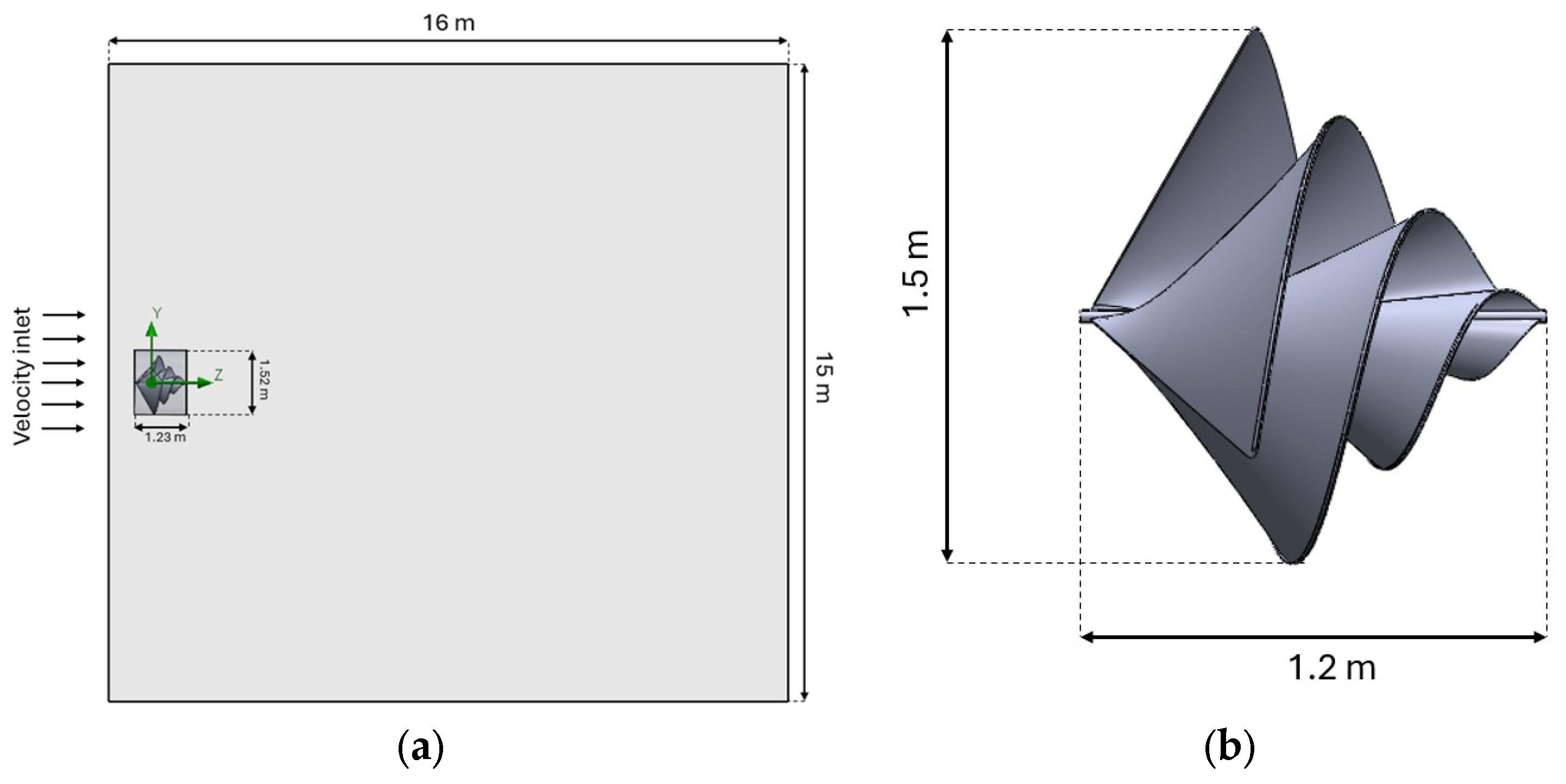
The turbine investigated in this work is an Archimedes wind turbine with a rotor length of 1.2 m, a diameter of 1.5 m, a blade angle
, and a thickness of 5 mm, as shown in
Figure 1.
Multiple simulations were carried out on the ASWT with the smooth blades so the results could be taken as a benchmark for the proposed alterations to the blades, which are meant to boost the overall performance. The two passive blade modifications considered in this study were spherical dimples and a trailing-edge flap.
All simulations were carried out using SolidWorks Flow Simulation 2025 under identical operating conditions to ensure consistent and comparable results. The inlet velocity was kept constant at 12 m/s throughout all simulations, as this was considered the optimal operating velocity, while the rotational speed of the turbine varied from 50 to 500 rpm in increments of 50 rpm. The wind turbine parameters used for the simulation are described in
Table 1.
A rotating region was constructed around the turbine shape within the computational domain to precisely simulate the turbine blades’ rotational motion. While the outer domain stays stable, this rotating region serves as a cylindrical subdomain that encloses the turbine and rotates at the specified angular speed appropriate to each tested RPM. The solver can capture the interaction between the rotating blades and the surrounding airflow because the contact between the rotating and static sections permits the exchange of flow variables across the boundary. This method is crucial for CFD computations of rotating machinery because it guarantees that the pressure distributions, velocity fields, and aerodynamic forces generated around the blades are calculated in accordance with the proper rotational frame of reference, ultimately producing precise torque and power output estimations.
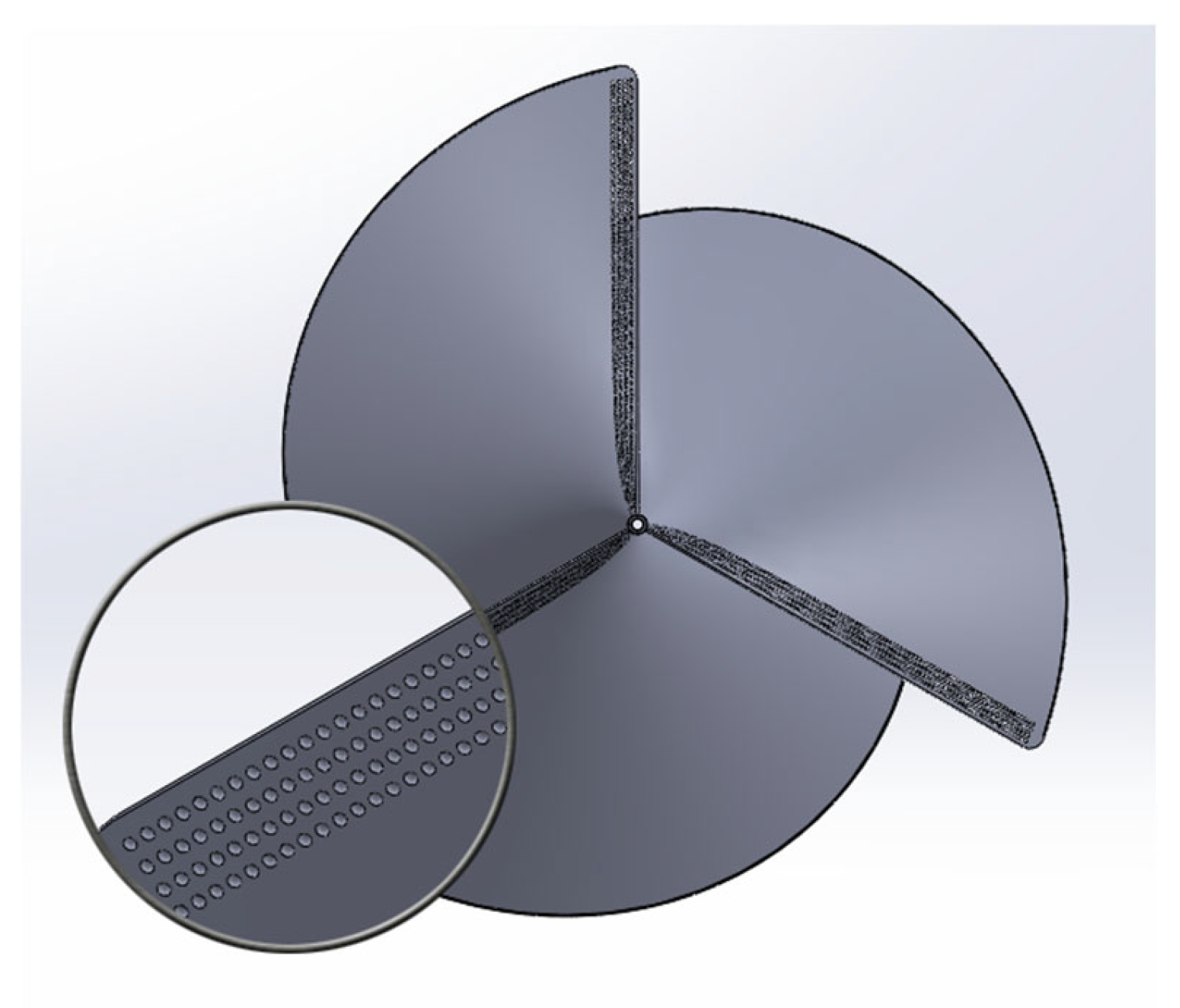
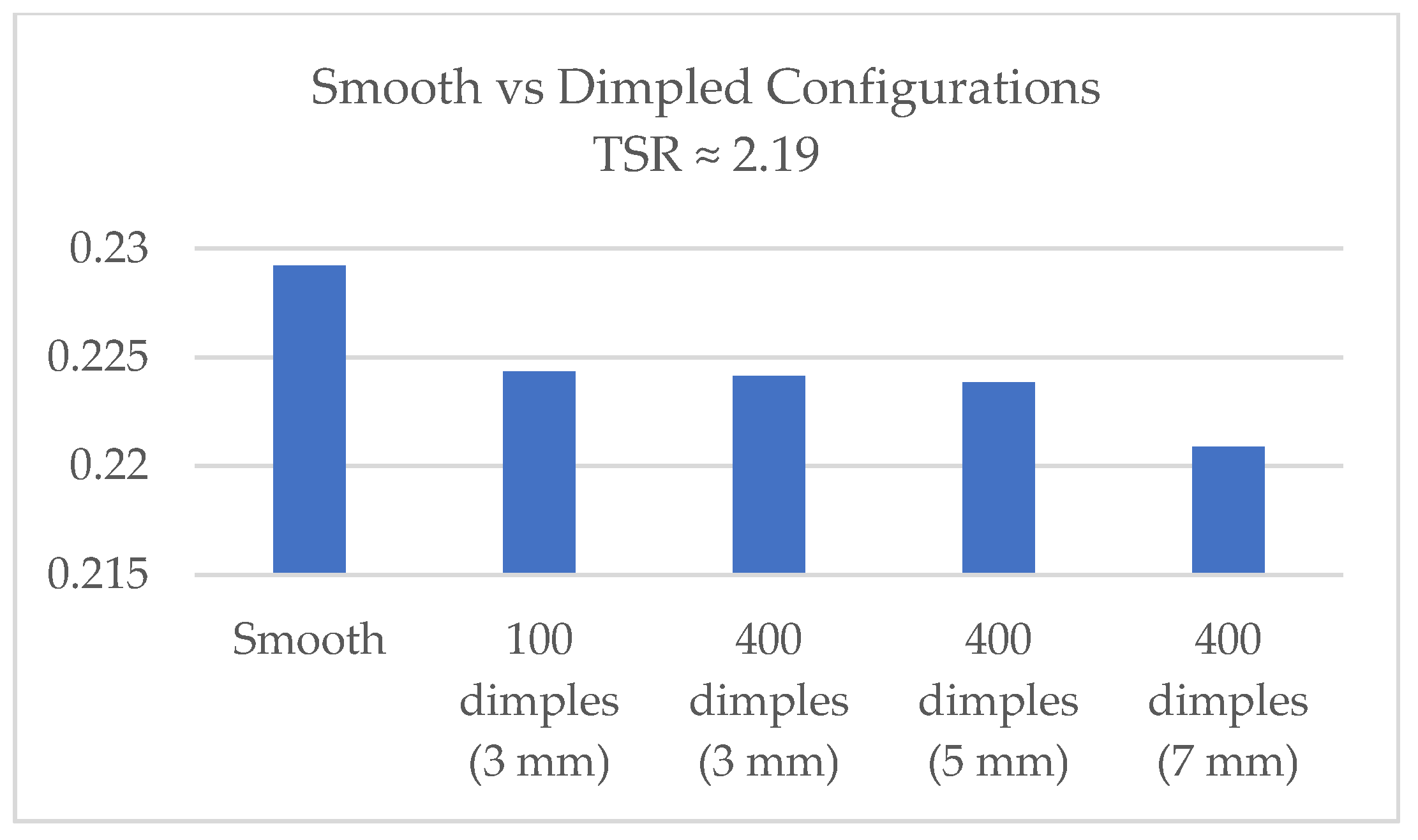
A baseline model was first established and then compared with several modified configurations intended to improve efficiency. The dimples were distributed along the edge region of the turbine blades, where flow behavior was expected to be most sensitive to surface modification. Four dimpled cases were analyzed: 100 dimples of 3 mm diameter, 400 dimples of 3 mm diameter, 400 dimples of 5 mm diameter, and 400 dimples of 7 mm diameter. In a separate configuration, a flap of 2 mm thickness was added at the blade edge. Based on geometric measurements from the CAD model, the flap height was 4.68 mm on the inner edge and 7.04 mm on the outer edge. The performance of all modified cases was evaluated against the baseline configuration using the power coefficient Cp vs. TSR under identical operating conditions.
5. Results and Discussions
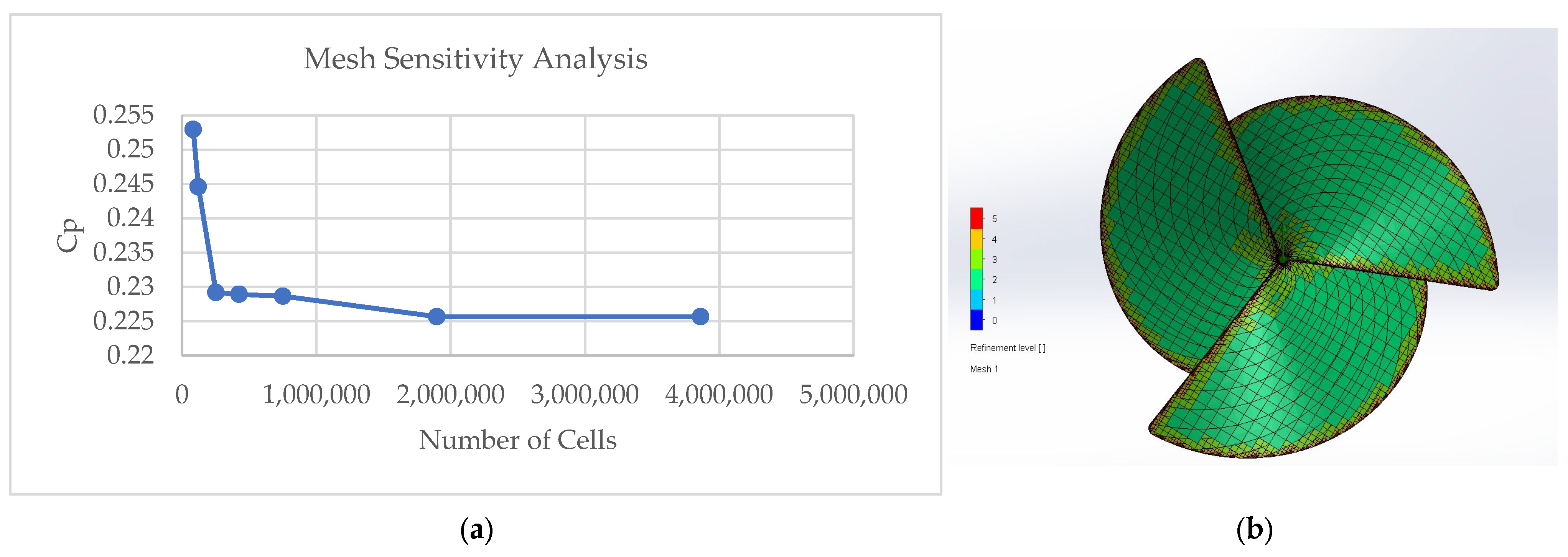
The following are the results of the minimum gap size and mesh sensitivity analysis mentioned above, which took into consideration mesh 1 through 7 and a minimum gap size of to m, with an interval of m.
The mesh sensitivity analysis highlighted in
Figure 3a shows that as the mesh level increases, the variation in
Cp becomes smaller, indicating convergence of the solution. A noticeable change in
Cp is observed between lower mesh levels (1–3), while the variation between higher mesh levels (3–6) becomes minimal. This confirms that mesh level 3 is sufficient to capture the flow physics without excessive computational cost.
Similarly, the minimum gap size sensitivity analysis highlighted in
Figure 3b shows that reducing the gap size improves the resolution of the flow near the blade surface, particularly in regions of high-velocity gradients. The minimum gap size refers to a mesh refinement parameter in SolidWorks Flow Simulation rather than a physical gap within the turbine geometry. This parameter defines the smallest geometric feature or flow passage that the meshing algorithm attempts to resolve. The default minimum gap size generated by SolidWorks 2025 flow simulation was approximately 1.3 m, which is excessively large relative to the dimensions of the turbine blades and would not adequately capture the local flow features. Therefore, the minimum gap size was reduced to 0.02 m to improve mesh resolution around the blade geometry and better resolve the associated velocity gradients and flow structures. Further reduction was considered unnecessary because it would substantially increase the computational cost while producing negligible changes in the calculated aerodynamic performance parameters. Reducing the minimum gap size below 0.02 m resulted in only negligible changes in Cp. Therefore, a minimum gap size of 0.02 m was selected, as it provides a balance between accuracy and computational efficiency.
The values chosen at the end of these studies were a minimum gap size of 0.02 m and mesh 3, as they demonstrate both accuracy and less computational time.
The time step in SolidWorks Flow Simulation is automatically controlled by the solver throughout the computation rather than being fixed. Until the monitored engineering goals meet the specified convergence threshold, the solver runs the simulation by dynamically modifying the time step depending on the local flow conditions and numerical stability criteria. The entire physical simulation duration for the chosen mesh configuration (mesh 3) was 1.17616 s, with a final recorded time step of 0.00397571 s at the point of convergence.
During every simulation, the observed quantities, such as the power coefficient (
), torque coefficient (
), torque, power, tip speed ratio (
), angular velocity and inlet velocity, were studied as engineering objectives. Only when every monitored goal attained 100% of the convergence criterion as provided by the solution was convergence deemed accomplished. Therefore, instead of using immediate current values, the final values presented in this analysis were taken from the averaged value column of the objectives log once convergence was verified. By using this method, the stated aerodynamic quantities are guaranteed to reflect stable, time-averaged behavior rather than fleeting variations in the flow field.
Table 2 provides an overview of the convergence parameters for mesh 3.
In terms of computational cost, each mesh 3 simulation took about 20 min to attain convergence. The overall computational time was substantial due to the testing of ten rotational velocities for each blade configuration and the evaluation of several configurations; however, the results were essentially comparable because the same standardized mesh and uniform convergence specifications were used in all cases.
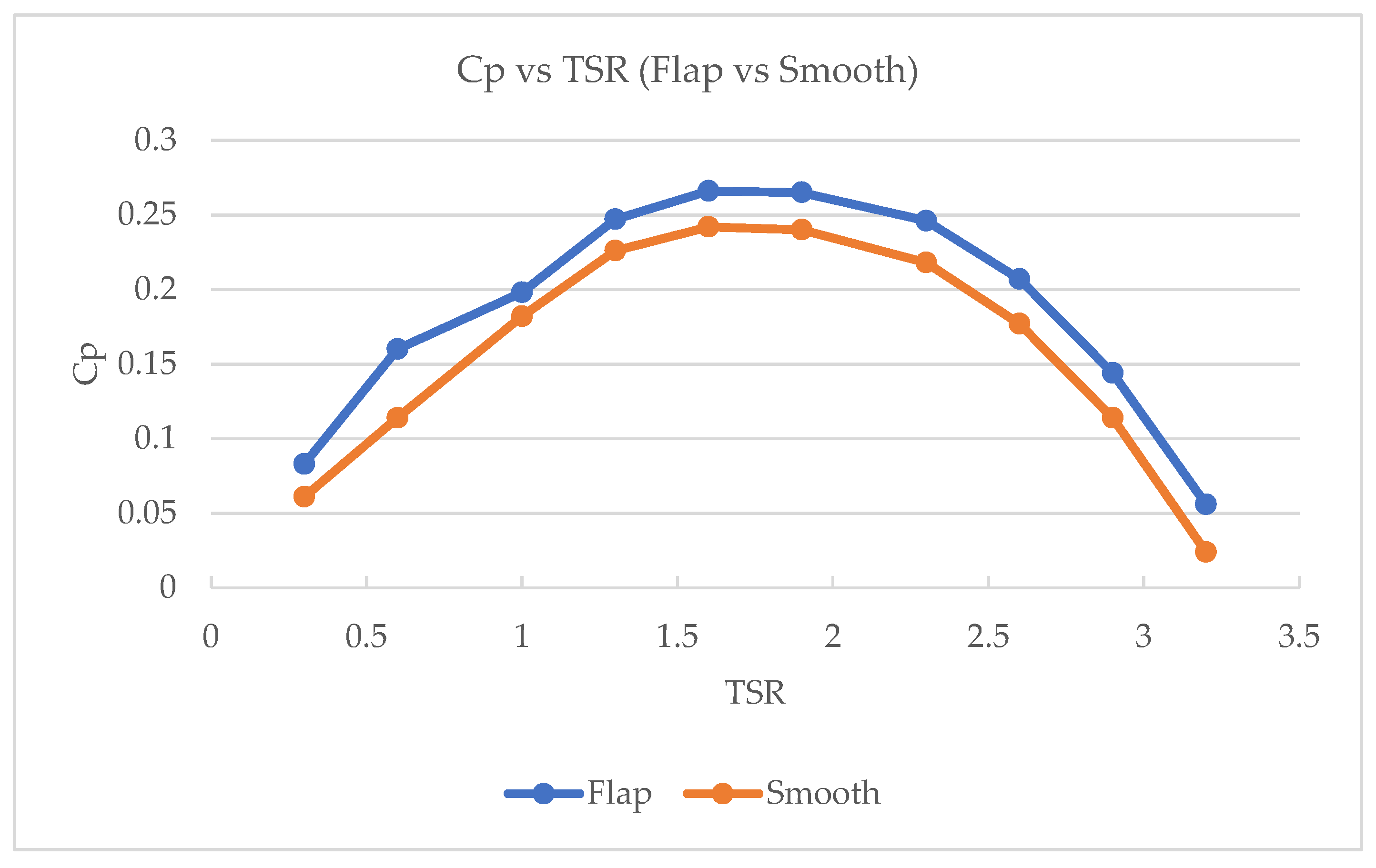
To evaluate the performance of the ASWT, the power coefficient () was plotted as a function of the tip speed ratio for the smooth and flapped blade configurations.
In
Figure 4, the
curves show a behavior consistent with the literature, where
increases with
up to an optimal point and then decreases. This trend reflects the balance between aerodynamic torque generation and increasing drag losses at higher rotational speeds. At low
, the turbine does not extract energy efficiently due to low relative velocity, while at high
, aerodynamic losses dominate, reducing performance.
The smooth blade configuration shows a clear peak within the expected range, confirming that the turbine operates under realistic aerodynamic conditions. The flap configuration consistently produces higher values across the entire range, with the most significant improvement observed near the optimal region.
This improvement indicates that the flap modifies the flow structure around the blade, enhancing lift generation. As a result, the torque produced by the turbine increases, which directly contributes to a higher .
Dimples usually demonstrate improvements in conventional wind turbine blades by delaying flow separation and energizing the boundary layer. Based on this, an analysis of the smooth blade was conducted to identify regions of low velocity and near-zero shear stress, indicating possible flow separation zones.
However, after implementing multiple spherical dimple configurations in these regions, the results showed a consistent decrease in performance, as shown in
Figure 5. While the “spherical dimples” appear round from their top view, their geometry is three-dimensional, with each dimple forming a spherical cap pressed into the blade surface, as shown in
Figure 2.
This suggests that, unlike conventional airfoil-based blades, the flow over the Archimedes turbine is highly three-dimensional and already dominated by complex curvature effects. The introduction of dimples increased surface roughness without effectively controlling separation, leading to higher drag and reduced aerodynamic efficiency. Therefore, the dimple modification was found to be ineffective for this specific turbine geometry.
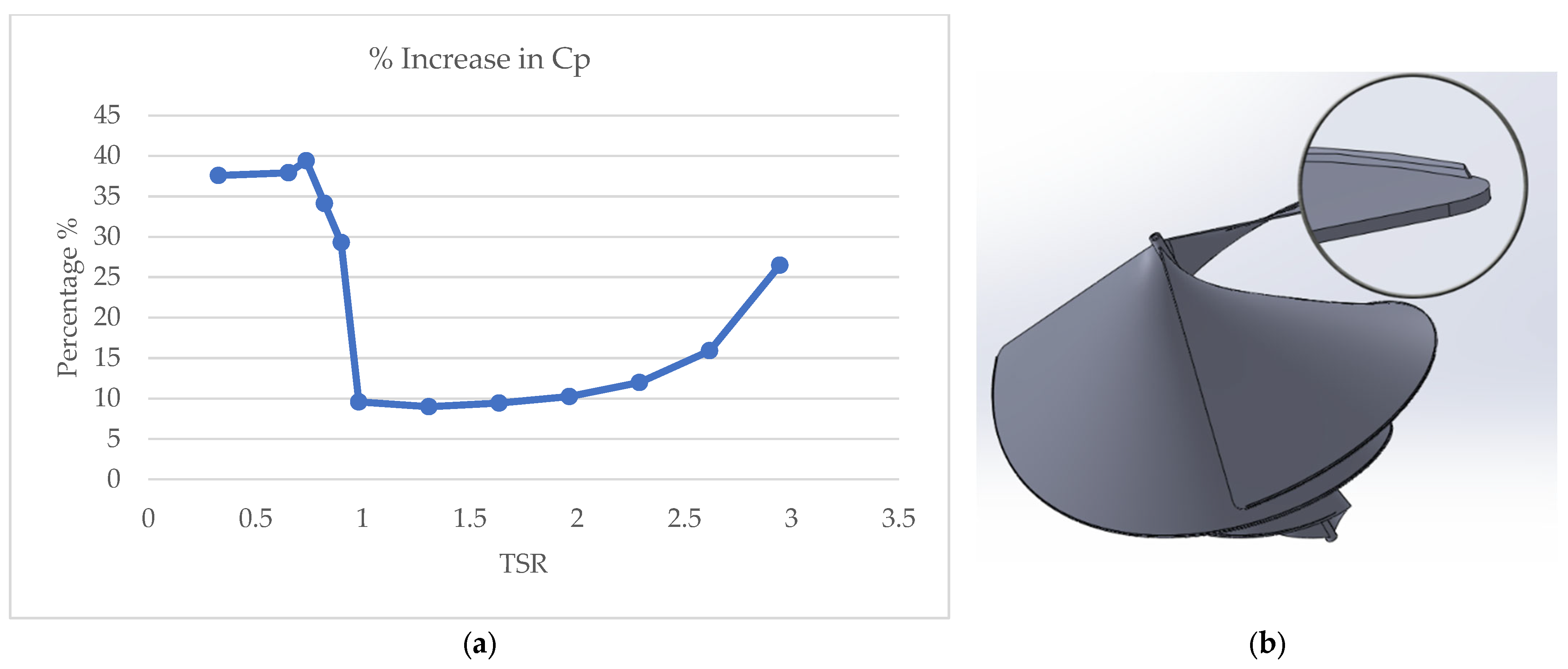
The addition of a trailing-edge flap with a thickness of mm and an outer length of mm and inner length of mm resulted in a noticeable and significant improvement in performance across all operating conditions and variables. The flap dimensions were chosen as a preliminary experimental configuration rather than a result of formal parametric optimization, which were determined using the local blade geometry acquired from the CAD model, guaranteeing that the flap maintained a mathematical compatibility with the blade’s trailing-edge profile. This layout was designed as a proof of concept to see if a trailing-edge flap could provide significant aerodynamic benefits on the turbine in question. A systematic optimization of flap dimensions can be observed as a potential field for future research.
Figure 6 illustrates the percentage increase in
, where the
y-axis origin represents the baseline smooth turbine. The improvement is attributed to the flap modification; although the increase peaks at certain operating points and diminishes at others, it remains a net positive gain throughout.
The detailed numerical values of the power coefficient and the corresponding percentage improvement for the flap configuration are presented in
Table 3.
This behavior can be explained by the better control of the flow separation and improved lift generation produced by this flap.
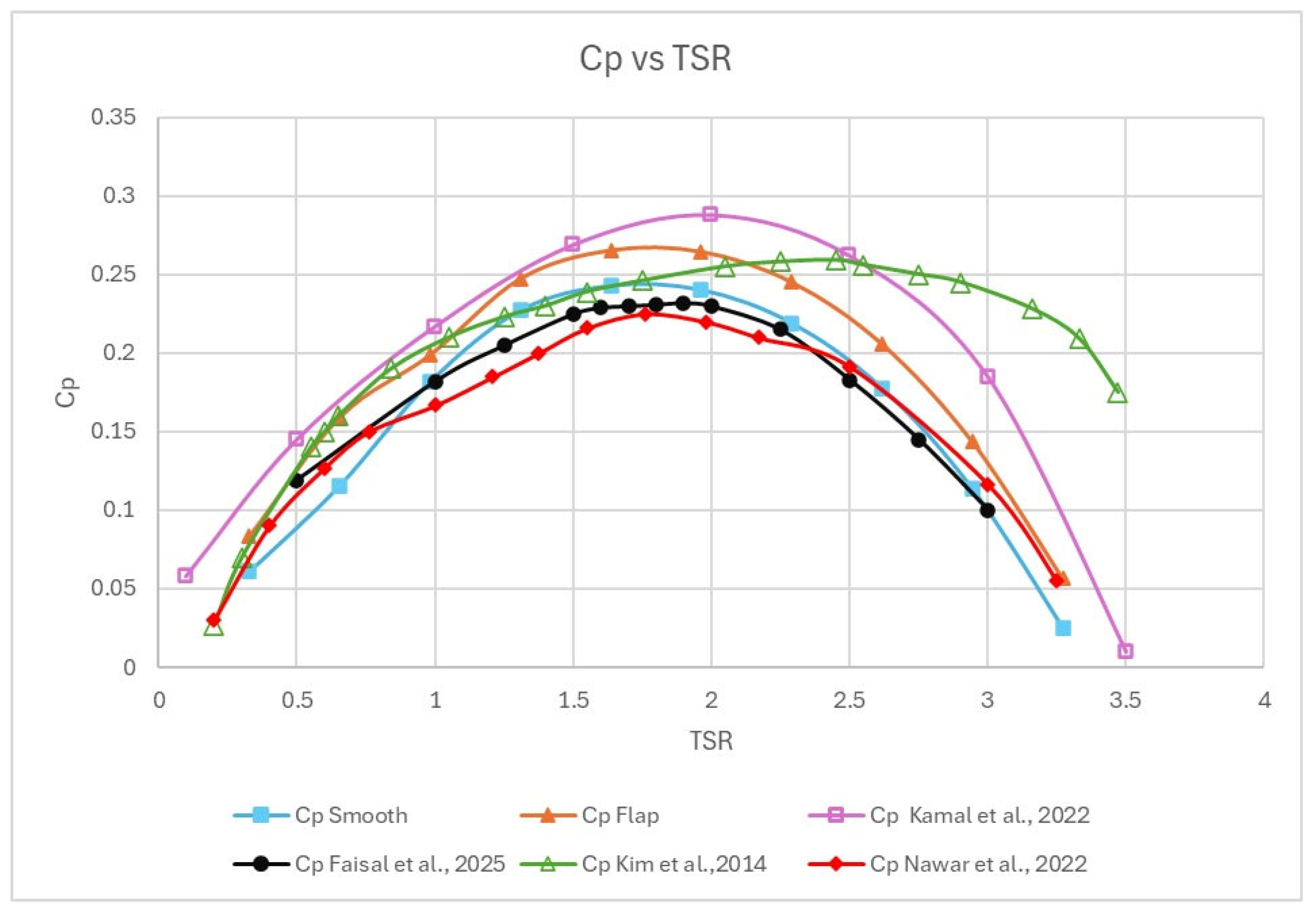
In
Figure 7, the plotted
curves exhibit a common overall pattern across the different ASWT studies and the present work. Visually, each curve begins with a gradual rise in the low-
region, continues upward toward a single dominant peak, and then declines again as
increases further. Although the exact steepness of the rise, the position of the peak region, and the rate of decline differ slightly from one curve to another, the general profile remains very similar throughout. In other words, all curves retain the same characteristic parabolic-like or bell-shaped trend, despite being obtained from different investigations.
This consistent behavior is significant because it shows that the general aerodynamic response of the Archimedes spiral wind turbine remains fundamentally unchanged, even when the studies differ in geometry, scale, blade design, numerical assumptions, experimental procedures, and operating conditions. While such variations may influence the detailed position of the optimum region or slightly shift the curve upward, downward, left, or right, they do not alter the essential shape of the relationship itself. The repeated appearance of this same trend in the literature suggests that it is an inherent performance characteristic of ASWT systems rather than a feature unique to a particular model or simulation setup.
As a result, the curve shape agreement between the current findings and the published research offers helpful qualitative validation. However, because the referred studies differ in terms of geometry, scale, blade design, operating conditions, and experimental or numerical assumptions, this comparison should be viewed as qualitative rather than completely quantitative. Thus, the resemblance in the bell-shaped Cp-TSR trend does not constitute a full quantitative validation against an equivalent experimental or numerical benchmark, but it does verify the realism of the current CFD behavior. Comparison with experimental data or a verified CFD case with comparable geometry, boundary conditions, and operating conditions would be necessary for a more thorough validation. While recognizing the constraints of the validation approach, this validates the interpretation of the information at hand and supports the conclusion that the simulated aerodynamic performance is realistic and consistent with the known features of Archimedes spiral wind turbines.
Overall, during the simulations that were carried out, the ASWT followed the expected trend. The dimpled configurations did not improve the performance of the turbine and instead had a negative effect on all the parameters, indicating that this modification is not suitable for this specific blade geometry, and potentially most geometries of this turbine. In contrast, the trailing-edge flap consistently improved the performance across the tested RPM range. Therefore, among the studied blade alterations, the flap configuration has proven to be the most effective method for enhancing the performance of the ASWT.