Article

Siting and Sizing of Electric Vehicle Charging Stations Considering Distribution Network Flexibility

School of Electrical Engineering, Northeast Electric Power University, Jilin 132012, China
*
Author to whom correspondence should be addressed.
Energies 2026, 19(12), 2821; https://doi.org/10.3390/en19122821 (registering DOI)
Submission received: 19 May 2026 / Revised: 7 June 2026 / Accepted: 10 June 2026 / Published: 12 June 2026
(This article belongs to the Section F1: Electrical Power System)

Abstract

The location and capacity of electric vehicle charging stations (EVCSs) directly determine the capital invested and construction costs while also affecting the travelling convenience and economy of electric vehicle (EV) users. Furthermore, the siting and sizing of EVCSs has an impact on distribution network flexibility. Therefore, a method for the siting and sizing of EVCSs that takes into account distribution network flexibility is proposed. Firstly, based on the definition of distribution network flexibility, the flexibility deficit is analyzed, and five flexibility assessment indicators are established. Secondly, the travel characteristics of EVs are simulated based on urban road topology and a trip probability matrix, and a model incorporating users’ bounded rationality is adopted to predict the temporal and spatial distribution of EV charging requirements. Furthermore, based on charging requirements and distribution network flexibility deficit, this paper establishes a model for the siting and sizing of EVCSs considering distribution network flexibility. Finally, case studies are conducted with a 29-node transportation network and a 33-node distribution network. The results show that the proposed method can formulate a more reasonable siting and sizing scheme for EVCSs, decrease the flexibility deficit of the distribution network, and reduce the annual comprehensive cost by 11.96%.

1. Introduction

As energy crises and transport-related environmental issues worsen globally, electric vehicles (EVs) have attracted widespread attention worldwide. Compared with traditional fuel vehicles, EVs have a lot of advantages, including zero emissions and no air pollutant emissions. Nevertheless, large-scale popularization of EVs relies on sufficient charging station facilities, which has impacts on both the power system and EV users. Unreasonable deployment of EVCSs may cause increased power loss, voltage fluctuation and supply–demand imbalance [1,2]. In addition, insufficient capacity of EVCSs will lead to severe station congestion and longer charging waiting times. With the development of EVs, there is an urgent need to increase the number of EVCSs. In addition to construction costs and operation costs, the siting and sizing of EVCSs are also affected by distribution network operation conditions. The lack of sufficient flexible regulation capability of the distribution network may force EVCSs to reduce charging power or limit the number of simultaneous charging events, thus lowering service levels. In addition, users’ bounded rationality may result in a mismatch between the siting and sizing scheme of EVCSs and practical conditions. Therefore, it is necessary to establish a reasonable method for the siting and sizing of EVCSs that considers investment costs, service level, distribution network flexibility, and users’ bounded rationality.
To achieve more reasonable and efficient siting and sizing of EVCSs, it is essential to clarify the spatiotemporal distribution characteristics of EV charging demands, which has been widely studied. Further integration of EVs may adversely affect the secure operation of a distribution network. Ref. [3] establishes a spatiotemporal transfer framework by adopting travelling route analysis to quantify the uncertainty in the spatial distribution of electric vehicles. On this basis, road conditions, traffic flow, and drivers’ driving habits are further considered to improve the accuracy of charging demand forecasting and improve the risk-resisting capability of distribution networks. In Ref. [4], to address uncertainties in EV charging behaviors, historical charging records are converted into time series data. Combining deep learning and reinforcement learning, Ref. [4] proposes a prediction method suitable for the charging power of EVCSs. This algorithm can precisely capture the uncertainties in EV charging loads. With the rising penetration rate of EVs, the spatiotemporal distribution of their charging loads becomes increasingly stochastic. Ref. [5] proposes a new prediction model to forecast EV charging requirements in different areas and at multiple time scales. The model can intuitively reflect the distribution of EV charging demand. Although the above studies have explored various methods for predicting the charging demands of EVs, they all assume that users are absolutely rational. Users follow fixed charging demand conditions during their driving, without considering the impact of users’ bounded rationality on the prediction results.
As a key facility for daily EV usage, the siting and sizing of EVCSs are closely related to the driving characteristics of EVs and affected by the operating states and topology of the transportation network [6]. Therefore, in the siting and sizing of EVCSs, relevant scholars have considered not only the construction investment of EVCSs but also charging requirements and traffic conditions. Reasonable siting of EVCSs promotes the rapid development of the EV industry. Ref. [7] quantitatively analyzes factors affecting charging station planning, considers land cost and construction cost, and establishes a charging station planning model. This method features easy implementation and low data processing requirements. Ref. [8] constructs a model for siting and sizing, aiming to achieve minimal construction and users’ charging costs. This method provides more reasonable schemes for siting and sizing. To meet the expansion demands of EVCSs, Ref. [9] discusses the growth in dynamic traffic demand caused by social factors and structures a bi-level planning method for EVCSs on expressways. This approach generates more rational construction schemes for charging facilities. To allocate EVCSs for EVs in the early stage of EV development, Ref. [10], using multi-source urban big data, constructs a submodular maximization model to maximize user satisfaction. Finally, a greedy algorithm-based method is adopted to optimize the layout of EVCSs under given budget constraints. The proposed method addresses the optimal siting problem. Unreasonable siting and sizing of EVCSs can exert adverse impacts on the development of EVs. Therefore, Ref. [11] proposes a two-stage method based on regional division and demand distribution for the construction of fast EVCSs in urban transportation networks. The proposed method significantly cuts the capital investment cost of EVCSs. To investigate the optimal siting and sizing of plug-in EVCSs, Ref. [12] investigates the coupling of transportation and power systems under different driving ranges and time-varying demand constraints and establishes a siting and sizing method for EVCSs. Large-scale shared EVs require adequate charging infrastructure to sustain regular operation. Therefore, Ref. [13] analyzes the travel features and the convenience of users. By integrating centralized EVCSs with distributed charging piles, a two-stage planning model is established. The proposed method achieves rational siting-and-sizing schemes for EVCSs and minimizes the annual total cost. Ref. [14] describes the dynamic characteristics of the transportation network and the environmental benefits associated with carbon emissions. It innovatively proposes a planning strategy based on an improved dynamic user equilibrium model. To promote large-scale EV popularization and realize reliable planning of EVCSs, Ref. [15] proposes a multi-objective method for EVCSs. This model considers user charging convenience, economic benefits, distribution networks, and environmental impacts. Queueing theory is applied to optimize the utilization rate of stations and users’ waiting times. Ref. [16] considers the uncertainty in EV arrival rates and service times. A capacity planning model for EVCSs has been established to maximize service quality and improve service quality for customers. The rapid growth of EVs greatly affects power system planning and operation. Ref. [17] considers the market environment and the dual uncertainties in photovoltaic output and load demand. A siting and sizing model integrating photovoltaic systems, energy storage systems and fast EVCSs is established. This method reduces negative impacts from EVs and improves power system operation. The rapid global penetration of electric vehicles requires substantial investment and strategic planning for charging infrastructure. Therefore, Ref. [18] proposes a two-stage optimization framework and develops an efficient hybrid solution algorithm. This approach effectively addresses the complexity of balancing investment cost and user satisfaction, achieving high user satisfaction while maintaining cost-effectiveness. Unreasonable location and capacity of EVCSs impair the economic benefits of station investors and users’ charging satisfaction. Against this background, Ref. [19] puts forward an EV charging station planning approach based on Nash bargaining game theory. Numerical results verify that the proposed method realizes balanced benefits among diverse stakeholders. To promote the penetration of EVs, it is essential to construct supporting charging infrastructure. Ref. [20] balances multiple influencing factors and develops a two-stage optimization algorithm to obtain the optimal siting and sizing scheme for EVCSs. The presented method improves both the utilization of charging facilities and users’ satisfaction. The above literature investigates the impacts of transportation network characteristics and EV driving features on the siting and sizing of EVCSs. However, these studies only examined aspects such as the cost of EVCSs, user costs, and user satisfaction. They did not explore the operational characteristics of the distribution network.
Large-scale EVCSs can significantly affect the operation of distribution networks. Siting and sizing must consider the features of distribution networks to lessen the construction and operational costs of EVCSs while improving the user servicing level [21,22]. Numerous studies have explored siting and sizing with consideration of distribution networks. Reasonable planning of EVCSs and the expansion of distribution networks support steady growth of EVs and conventional loads. Ref. [23] conducts multi-stage planning of distribution networks and implements siting and sizing. This method determines the location and capacity. It also obtains optimal expansion plans for distribution networks. Growing EV popularity drives charging station expansion and large-scale upgrades of power and traffic networks. Therefore, Ref. [24] discusses the simultaneous expansion of transportation networks, EVCSs, and distribution networks. A bi-level model is constructed for coupled networks. Linearized power flow constraints are introduced into the model to ensure the operational safety of distribution networks. EV development needs coordinated charging station planning combining traffic and distribution networks. Ref. [25] integrates the planning of EVCSs and the promotion of distribution network infrastructure. The method considers the load-carrying capacity of the distribution network. Meanwhile, it determines siting and sizing, the expansion of transportation networks, and the capacity enhancement of power lines. To accommodate more EVs and cut fossil fuel emissions, Ref. [26] discusses the practical constraints of power systems in urban environments, including voltage regulation requirements, protection equipment upgrading, and distribution network expansion, and establishes a siting model that achieves a balance between construction costs and power network operation costs. This method is highly applicable and has very little error. The above literature investigates the impacts of distribution network stability and economics on siting and sizing. However, these studies have not considered the influence of distribution network flexibility. During the process of siting and sizing, there may be a significant amount of flexibility control costs due to insufficient flexibility.
In order to present the advantages and limitations of the existing solutions more intuitively, the above-mentioned literature is summarized as follows in Table 1 and Table 2.
To address the drawbacks of existing studies, this paper puts forward a siting and sizing method for EVCSs considering distribution network flexibility and users’ bounded rationality. The proposed method determines the optimal location and capacity of EVCSs. Based on users’ bounded rationality, the proposed method obtains the temporal and spatial distribution of EV charging requirements, and the variations in distribution network flexibility are incorporated into the siting and sizing process. Thus, the optimal siting and sizing scheme can be obtained. This method can solve the current mismatch between the quantity of EVCSs and EVs and reduce the impacts of charging station planning on distribution network flexibility. The main contributions of this paper are:
(1)
Aiming at the prediction accuracy of the spatiotemporal distribution of EV charging demands, a prediction model based on a charging urgency perception function is established. This paper considers the characteristics of transportation networks and users’ travel behaviors. The Monte Carlo method is adopted to simulate the travel transfer process of EVs in the transportation network, and the charging urgency perception function is integrated to achieve accurate prediction of charging demands. It provides data support for the calculation of user costs in charging station siting and sizing.
(2)
Aiming at the insufficient flexibility of distribution networks, an EV charging station siting and sizing model considering distribution network flexibility is proposed. By comprehensively considering distribution network flexibility, charging station construction costs and user travel costs, the model obtains the best siting and sizing scheme for EVCSs and effectively reduces the annual comprehensive cost.
The remainder of this paper is structured in the following way. The framework of EVCS location and sizing is presented in Section 2. Section 3 establishes the model of distribution network flexibility and quantifies the distribution network flexibility deficit. Section 4 predicts the spatiotemporal distribution of EV charging demand considering users’ bounded rationality. Section 5 constructs the siting and sizing model of EVCSs considering distribution network flexibility. Section 6 verifies the effect of this method based on the test systems. Finally, Section 7 concludes the whole paper.

2. Framework for Siting and Sizing for EVCSs

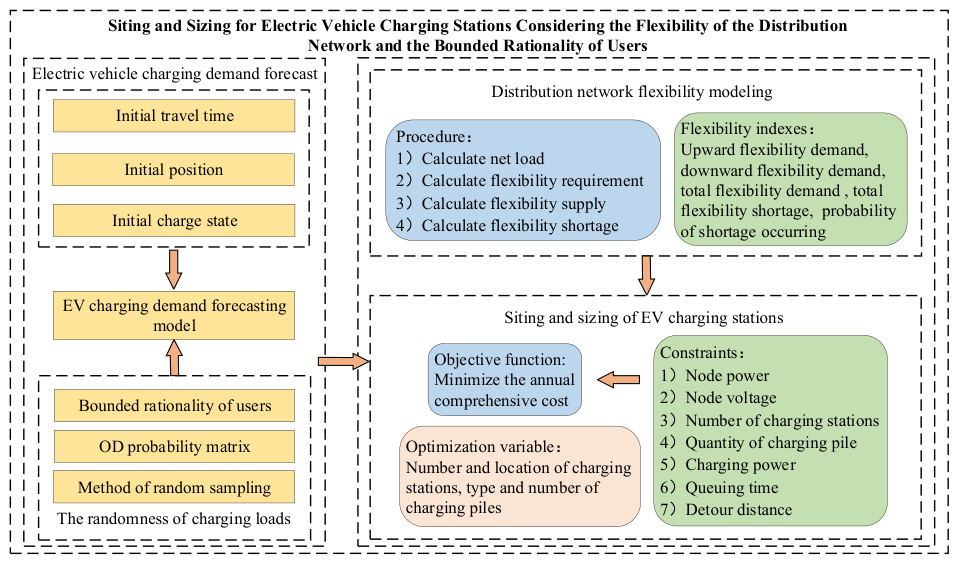
The framework shown in Figure 1 gives a model that could be applied to find and establish the siting and sizing of EVCSs considering the flexibility of the distribution network as well as the bounded rationality of users. The impacts of transportation and distribution network coupling characteristics, distribution network flexibility and users’ bounded rationality are considered for siting and sizing decisions. Siting and sizing are realized through three steps: distribution network flexibility modeling, EV charging demand forecasting, and construction of the siting and sizing optimization model.
In the modeling of distribution network flexibility, this paper defines distribution network flexibility as the maximum additional output or maximum additional power consumption that flexible resources can provide under the current dispatching scheme. Furthermore, this paper establishes evaluation indexes for distribution network flexibility and comprehensively and quantitatively evaluates the flexibility of the distribution network after the integration of EVCSs.
In the stage of charging demand prediction, based on historical travel rules, this paper generates the initial states, including departure time, state of charge (SOC), and location of EVs, in different areas during the EV charging demand forecasting stage. EV travel trajectories are simulated using an origin–destination (OD) probability matrix, random sampling, and the Dijkstra shortest path algorithm. Based on users’ bounded rationality, the travel time and remaining power of EVs are calculated. Finally, the spatiotemporal distribution of charging requirements is obtained, which provides a data foundation for the calculation of users’ travel diversion cost [27,28].
In the stage of siting and sizing, this paper considers the regulation cost of distribution network flexibility and users’ travel diversion cost, focusing on the capital invested and service level of EVCSs. Taking the minimum annual comprehensive cost as the objective, an optimization model for siting and sizing is established to obtain a reasonable siting and sizing scheme.
Based on the above framework, this paper establishes an EV charging station siting and sizing model that considers distribution network flexibility and users’ bounded rationality.

3. Modeling of Distribution Network Flexibility

Upward flexibility demand, downward flexibility demand, total flexibility demand, total flexibility deficit, and deficit occurrence probability are selected as the assessment indexes of flexibility.

3.1. Calculation of Distribution Network Flexibility Deficit

Distribution network flexibility deficit refers to the power gap that occurs when the maximum up- and down-adjustable capacity provided by various flexible resources in the system cannot fully cover the net load fluctuations. Its calculation mainly includes four steps.
(1)
Calculate the net load of distribution network node i at time t.
P n . i . t = P c . i . t + P EV . i . t P re . i . t
where Pn.i.t is the net load of the distribution network i-th node at time t. The variables Pc.i.t, PEV.i.t and Pre.i.t are the user loads, EV charging loads and the renewable generation of the i-th node at time t, respectively.
Assume node i is coupled with the transportation network node m. The EV charging load at distribution network node i can be expressed as follows:
P EV . i . t = x m ( r m lo P c lo + r m fa P c fa ) m n L x m = n EVS
where xm is the 0–1 parameter indicating whether the station is constructed at transportation network node m: the value 1 indicates constructing the charging station, and the value 0 indicates otherwise. The variables r m lo and r m fa , respectively, are the quantity of slow and fast charging piles at node m participating in charging. The parameters P c lo and P c fa represent the rated charging power of slow and fast piles, respectively. The variables nL and nEVS are the quantity of transportation network nodes and EVCSs, respectively.
P re . i . t = P pv . i . t + P wt . i . t
where Ppv.i.t and Pwt.i.t are the photovoltaic power and the wind power generation of distribution network node i at time t, respectively.
(2)
Calculate the flexibility requirements of each node at time t.
X i . t u = P n . i . t + 1 P n . i . t , P n . i . t + 1 > P n . i . t X i . t d = P n . i . t P n . i . t + 1 , P n . i . t + 1 < P n . i . t
where X i . t u and X i . t d are the up and down flexibility requirements, respectively. The parameter Pn.i.t+1 is the net load of node i at time t + 1.
(3)
Calculate the flexible supply of flexible resources at time t.
Considering the fast response capability of distributed gas turbines, this paper takes distributed gas turbines as flexible resources of the distribution network. To quantify the flexibility supply capability, the output characteristics of distributed gas turbines are modeled as shown in Equation (5).
G g . i . t u = min { P g max P g . i . t 1 , R g u } G g . i . t d = min { P g . i . t 1 P g min , R g d }
where G g . i . t u and G g . i . t d are the up and down flexibility supply provided by the gas turbines connected to the i-th node at time t. The variable Pg.i.t−1 refers to the active power generated by the gas turbine. The parameters R g u and R g d stand for the up and down ramping rates of the gas turbine unit. The variables P g min and P g max define the maximum and minimum limits of the gas turbine’s active power output range, respectively.
In addition, the active power of the gas turbine is also restricted by the ramping rate.
P g min P g . i . t P g max P g . i . t P g . i . t 1 R g u P g . i . t 1 P g . i . t R g d
where Pg.i.t is the active power output at node i at time t.
(4)
Calculate the flexibility shortage at time t.
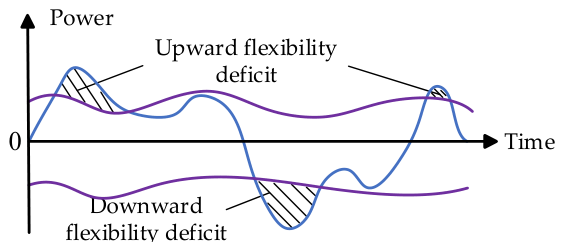
A schematic diagram of the flexibility deficit is shown in Figure 2.
In Figure 2, the blue curve and the purple curve represent the flexibility demand and the flexibility supply, respectively.
F i . t u = X i . t u G g . i . t u , G g . i . t u X i . t u 0 F i . t d = X i . t d G g . i . t d , G g . i . t d X i . t d 0
where F i . t u and F i . t d are the up and down flexibility shortages of node i at time t.

3.2. Distribution Network Flexibility Evaluation Index

To quantify the improvement effect of the proposed method on distribution network flexibility, five flexibility indexes are defined as follows:
(1)
Upward flexibility demand: the total upward flexibility demand generated over T time periods.
X i u = t = 1 T X i . t u
where X i u is the upward flexibility requirement of node i. The parameter T stands for the quantity of time intervals in a day, and this paper takes 24.
(2)
Downward flexibility demand: the total downward flexibility demand generated over T time periods.
X i d = t = 1 T X i . t d
where X i d is the downward flexibility demand of node i.
(3)
Total flexibility demand: the sum of upward flexibility demand and downward flexibility demand.
X i = X i u + X i d
where Xi is the total flexibility demand of node i.
(4)
Total flexibility deficit: the sum of the flexibility shortage that occurs over T time periods.
F i = t = 1 T F i . t u + F i . t d
where Fi is the total flexibility shortage of node i.
(5)
The probability of flexibility deficit: the ratio of the number of time periods with flexibility deficit to the quantity of time periods within T time intervals.
B i = N i T
where Bi is the probability of node i generating a shortage. The parameter Ni is the quantity of time periods in which node i generates a flexibility shortage.

4. EV Charging Demand Forecasting

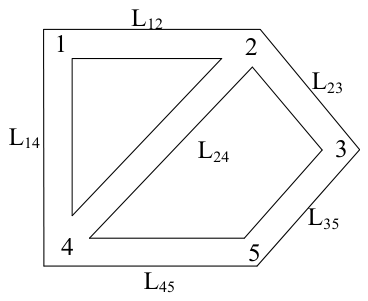
To better analyze the driving characteristics and energy consumption of EVs, a simple transportation network is investigated first. Figure 3 depicts a simple transportation network topology in which it is assumed that all roads in the network are two-way.
The network topology could be described as Equation (13).
G = ( N , L , H , W ) N = { 1 , 2 , 3 , , n } L = { l i j i N , j N , i j } H = { 1 , 2 , 3 , , h } W = { w i j k | l i j L }
where G is defined as the topological map of the traffic network. The variable N is the set of all nodes in the traffic network. The variable n represents the n-th node. The parameter L stands for the full set of roads. The parameters i and j are the starting and ending nodes of this road, respectively. The variable H is used to describe all time intervals that constitute a single day, and h corresponds to the h-th time interval in this set. The parameter W denotes the collection of impedances generated by road congestion conditions and waiting time at network nodes.
The topology of transportation networks, as shown in Figure 3, is based on the use of the adjacent matrix Z to represent the length of all the road segments. The elements Zij of matrix Z are assigned according to Equation (14):
Z i j = w i j , n i j L 0 , n j = n j inf , n i j L
where inf means no direct path between ni and nj.
The adjacent matrix Z is ultimately expressed as shown in Equation (15):
Z = 0 w 12 inf w 14 inf w 21 0 w 23 w 24 inf inf w 32 0 inf w 35 w 41 w 42 inf 0 w 45 inf inf w 53 w 54 0
Combined with the actual development status of EVs, EVs are divided into four categories: taxis, private cars, urban service vehicles, and buses. Meanwhile, the traffic behaviors of EVs are closely related to their initial travel locations and urban areas. According to the main functions and load types, urban areas are divided into residential, working and commercial areas. The relevant assumptions regarding EV travel behavior are given as follows:
(1)
Electric buses follow fixed routes and parking locations; thus, they can be excluded from charging station planning. Private cars mainly travel between residential and working areas. They are generally initially parked in residential areas, and vehicle owners can freely select charging modes. Taxis usually complete shift changes in residential areas, and their initial locations are mostly distributed in residential areas. Urban service vehicles usually depart from working areas.
(2)
EV users exhibit bounded rationality. They will be anxious when the battery power drops. Each user has a reference SOC value. Once the SOC drops below this value, users will deviate from their predetermined route to search for available EVCSs.
Therefore, a charging urgency perception function is introduced. The numerator represents the total energy consumption of the remaining trip, and the denominator denotes the actual available electricity. When the value of the charging urgency perception function exceeds a certain threshold, users will immediately change their travel chains and seek charging piles, thereby generating a charging demand.
η k ( t ) = F i j w i j S O C k ( t ) E cap S O C min E cap
where ηk(t) is the perception function of charging urgency. The parameter Fij is the real-time energy consumption per unit mileage on road ij. The variable ωij is the length of road section ij. The variable SOCk(t) is the SOC of the EV at time t. The parameter SOCmin is the safety threshold of the SOC defined by the user. The parameter Ecap is the EV battery capacity.
Under the premise of the aforementioned assumptions, this study first generates three core daily parameters for the three categories of EVs, including the travel time ts, SOC Cap0, and position Oi. Destination Dj corresponding to time ts is then determined via random sampling, with reference to the OD probability matrix at the same timestamp. On the basis of the preset rule that vehicle drivers select the shortest route toward destination Dj, the Dijkstra shortest path algorithm is utilized to solve the shortest path set R connecting Oi and Dj. Meanwhile, the adjacency matrix is adopted to acquire the road segment distance lOD of each individual route. Ultimately, the charging urgency perception function is applied to confirm the charging demand, and Equation (17) is employed to compute the driving time ΔTij.
The EV travel time is expressed in Equation (17):
Δ T i j = l O D v
where v is the average speed of the EV.
In case a demand charge is levied when reaching the destination, information on the location and time of the demand to charge will be kept in the matrix G. If there is a demand to charge after arriving at the destination, Dj is used as the new starting point Oi, and the probability matrix at that point is called out. The indicated step is repeated in order to recreate the daily driving path of EVs and eventually arrive at the spatial–temporal distribution of charging demand in 24 h.

5. Siting and Sizing for EVCSs

On account of the distribution network flexibility deficit and the forecasting results of EV charging demands, this section constructs a siting and sizing model considering distribution network flexibility. The regulation cost of EVCSs is characterized by quantifying the flexibility deficit of distribution networks. The calculation of the spatiotemporal distribution of charging needs allows us to measure user costs. Also, it is supposed that the least total cost is the optimization goal, which means that the model takes into account both construction and operation costs of EVCSs, user costs, expansion costs of distribution network capacity, and regulation costs of EVCSs since the distribution network is inflexible. On this basis, the optimal siting and sizing are realized for the coupled transportation–distribution network system.

5.1. Objective Function

This paper considers the construction and operational maintenance cost, users’ queuing time cost, users’ annual travel diversion cost, annual distribution network capacity expansion cost, and annual regulation cost of EVCSs caused by the distribution network flexibility deficit. However, a function is defined to achieve minimal total cost in Equation (18).
min F = C H + C EV pd + C EV hs + C P u + C lhx
where F is the annual comprehensive cost. The parameter CH is the annual construction operation and maintenance cost. The parameter C EV pd is the annual user waiting time cost. The variable C EV hs is the annual user travel time cost. The variable C p u is the annual distribution network expansion cost. The parameter Cfle is the annual charging station regulation cost caused by the distribution network flexibility shortage.
(1)
The annual construction and operation cost.
C H = C H js + C P js + C H yw + C P yw
where C H js is the annual construction cost. The variable C P js is the annual construction cost of the piles. The parameters C H yw and C P yw are the annual operation and maintenance costs of EVCSs, respectively.
The annual construction cost of a charging station is
C H js = m = 1 n L [ x m ( C m la S H + C H con + C H ot ) ] R d
where C m la is the cost of land use per unit area of node i. The variable SH represents the fixed area of the charging station. The parameter C H con represents the fixed construction cost of the charging station. The parameter C H ot represents other investment costs. The variable Rd is an auxiliary variable used for annualization.
R d = d ( 1 + d ) y ( 1 + d ) y 1
where d is the discount rate. The depreciation period of the EVCS is the parameter y.
C m la = 1000   ,   m j m 3000   ,   m s y 2000   ,   m g z
where jm is a collection of nodes located in residential areas. The parameter sy is a collection of nodes located in commercial areas. The variable gz is a collection of nodes located in working areas.
The annual construction cost of the charging piles is:
C P js = l = 1 n EVS [ r l lo ( C lo . cp + C l la S P ) + r l fa ( C fa . cp + C l la S P ) ] R d
where nEVS denotes the total quantity EVCSs in the model. The parameters r l lo and r l fa respectively stand for the quantities of slow and fast piles in the l-th charging station. The parameters Clo.cp and Cfa.cp are defined as the unit construction investment cost for slow and fast piles, correspondingly. The variable C l la refers to the unit area land occupancy cost at the node of the l-th charging station. The variable Sp represents the area that needs to be occupied to add one individual pile.
The annual operation cost of the station is:
C H yw = m = 1 n L ( x m C m op . fi )
where C m op . fi is the annual fixed cost of operating and maintenance of the m-node charging station.
The annual operation and maintenance cost of the charging piles is:
C P yw = l = 1 n EVS ( r l lo c lo . yw + r l fa c fa . yw )
where clo.yw and cfa.yw respectively represent the annual operation and maintenance cost of the slow and fast charging piles.
(2)
The annual user waiting time cost.
Assume that the time interval between vehicle arrivals at the charging station follows an exponential distribution. Moreover, the time taken to charge at the charging station has an exponential distribution. To give an example, the average queuing waiting time Tq with fast charging piles is:
T q = c ρ c ρ c ! 1 ρ 2 λ P 0
P 0 = k = 0 c 1 1 k ! ( λ μ ) k + 1 c ! 1 1 ρ ( λ μ ) c 1
ρ = λ c μ
where c means the total number of fast charging piles deployed at the charging station. The variable μ stands for the number of vehicles serviced by one fast charger in unit time. The parameter λ refers to the hourly charging service demands submitted to the charging station. The variable P0 is defined as the reciprocal of EV charging time. The variable ρ characterizes the service strength of the charging pile equipment.
C EV pd = C uat T year l = 1 n EVS j = 1 R l T l . j q
where Cuat is the user’s unit waiting time equivalent economic loss. The number of days in one year is Tyear. The quantity of EVs being charged at the l-th charging station is denoted by Rl. The parameter T l . j q denotes the waiting time of the j-th EV to the l-th charging station.
(3)
The annual user travel time cost.
C EV hs = ( T year l = 1 n EVS j = 1 R l ( D j l / v ) ) C uat
where Djl is the distance from the EV j to the l-th station.
(4)
The annual distribution network expansion cost.
C P u = R d c p l = 1 n EVS ( r l lo P c lo + r l fa P c fa )
where cP is the unit capacity incremental cost.
(5)
The annual charging station regulation cost caused by the distribution network flexibility shortage.
C fle = c fle i = 1 n P t = 1 24 ( F i . t u + F i . t d ) R d
where cfle represents the unit flexibility cost. The parameter nP is the number of nodes.

5.2. Constraints

The flexibility in the distribution network may cause some limitations on the location and capacity of an EVCS, which can be divided into three broad categories: distribution network-related constraints, charging station-related constraints, and EV user-related constraints.

5.2.1. Distribution Network Related Constraints

(1)
Nodal power balance constraints.
The power at nodes of the distribution network shall satisfy power balance.
P i . t = j π ( i ) P j i . t k δ ( i ) P i k . t   ,   i B
Q i . t = j π ( i ) Q j i . t k δ ( i ) Q i k . t   ,   i B
P i . t = P c . i . t + P EV . i . t P re . i . t P g . i . t
Q i . t = Q c . i . t + Q EV . i . t Q re . i . t
where π(i) and δ(i) represent the initial and terminal node sets of the branches that are connected to node i, respectively. The parameter B is the set of all nodes of the power system. The variables Pji.t and Qji.t are the active power and reactive power of branch ji at time t. The variables Pik.t and Qik.t are the active power and reactive power of branch ik at time t. The variables rij and xij are the resistance and reactance of branch ij, respectively. The parameters Pi.t and Qi.t are active and reactive power consumption by node i at time t, respectively. The parameter Pg.i.t is the active power produced by the gas turbine at node i at time t. The variables QEV.i.t, Qc.i.t and Qre.i.t are the reactive load of the EV, loads other than the EV, and renewable generation at node i at time t.
(2)
Voltage constraints.
U i . t = U j . t + ( P j i . t r i j + Q j i . t x i j ) / U N
U min U i U max i Ω N
where Ui.t and Uj.t are the voltages of nodes i and j at time t. The parameter UN is the reference voltage. The variables Umin and Umax are the minimum and maximum voltages.

5.2.2. Charging Station Related Constraints

(1)
The number constraint of EVCSs.
n min n EVS n max
where nmin and nmax are the upper and lower bounds on the quantity of EVCSs.
(2)
The number constraint of charging piles.
r l . min lo r l lo r l . max lo
r l . min fa r l fa r l . max fa
where r l . min lo and r l . max lo denote the least and greatest possible number of slow charging piles at the l-th charging station. The variables r l . min fa and r l . max fa are the least and greatest number of fast charging piles at the l-th charging station.
(3)
Charging power constraints of the charging station.
P l . max EVS = r l lo P c lo + r l fa P c fa
P l EVS = R l lo P c lo + R l fa P c fa
r l lo R l lo r l fa R l fa
where P l . max EVS is the highest possible charging power available at the l-th charging station. Parameter P l EVS indicates the charging capacity of the l-th charging station. The variables R l lo and R l fa are the slow and fast charger demand, respectively, at the l-th EVCS.

5.2.3. EV User Related Constraints

(1)
Queueing time constraint.
The service level is affected by the waiting time of users in queues. Therefore, EV traffic behavior is analyzed based on queuing theory. The siting and sizing of EVCSs must satisfy the constraint on user queuing time.
T j q T max
where Tmax represents the maximum queue waiting time of users.
(2)
Detour distance constraint.
D j l D max
where Dmax represents the user’s maximum detour distance.

6. Case Studies

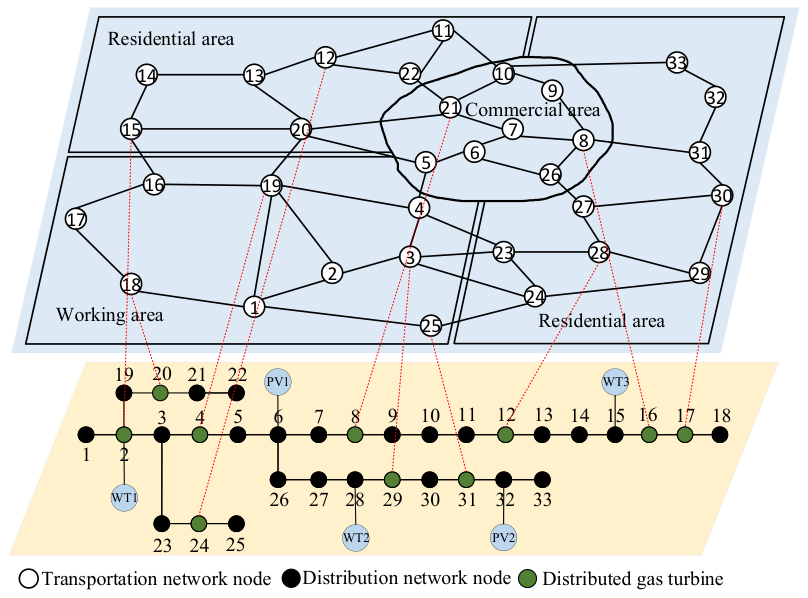
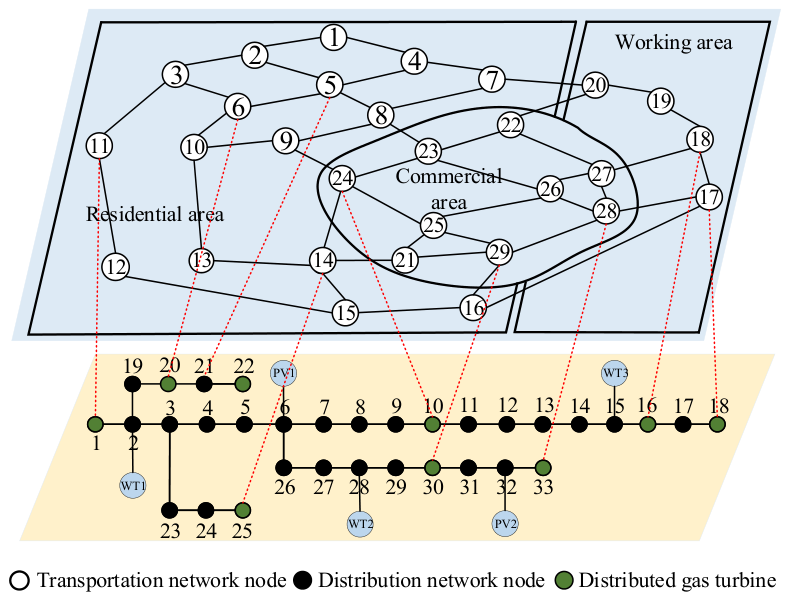
In this section, the proposed siting and sizing method for EVCSs considering distribution network flexibility is analyzed and verified using a test system coupling a 29-node transportation network with a 33-node distribution network (T29-D33 test system).

6.1. Test Case Data

The T29-D33 test system is shown in Figure 4. According to urban land use, the transportation network is divided into three areas, namely, a residential area, a working area, and a commercial area, containing a total of 49 roads. The distribution network is equipped with nine distributed gas turbines, two photovoltaic power sources, and three wind farms.
The parameter settings related to the siting and sizing of charging piles and EVCSs are listed in Table 3 and Table 4.
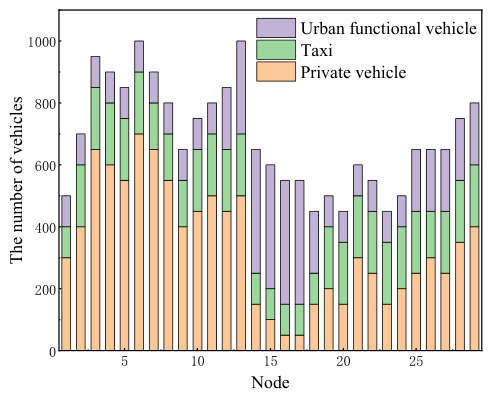
The capacity of the EV battery used in the case study is 70 kWh, with an energy consumption of 20 kWh per 100 km and an average driving speed of 40 km/h. It is assumed that the transportation network contains 10,000 private vehicles, 3500 taxis, and 3000 urban functional vehicles. Based on the travel habits of each type of EV, the distribution of their initial locations is shown in Figure 5. Private cars show the highest travel probability at 7:00 a.m., matching the morning commuting peak for work.

6.2. Charging Demand Forecast

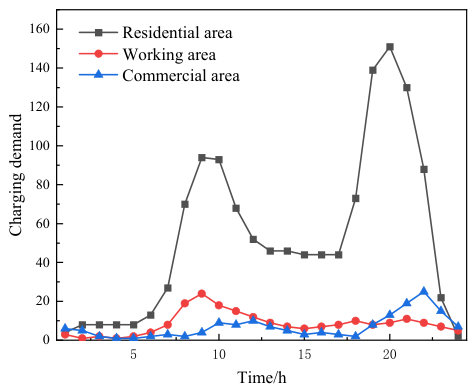
Figure 6 shows the temporal distribution of charging demand in different areas. The charging demand in different areas has significant differences in rising and declining trends. Private cars account for a large proportion in residential and working areas since most private vehicles use the traffic routes within these two areas as their daily commuting paths.
From the perspective of temporal distribution, the demand in the residential area is the highest, with demand peaks occurring in two periods: 8:00–11:00 and 18:00–22:00. The charging demands in the working and commercial areas are lower. Specifically, the demand peaks in the working area appear at 7:00–11:00 and 20:00–23:00, while those in the commercial area occur at 10:00–14:00 and 20:00–23:00.
To explore the influence of users’ bounded rationality on charging requirements, two scenarios are set as follows:
Scenario 1: Bounded rationality of EV users is not considered.
Scenario 2: Bounded rationality of EV users is considered.
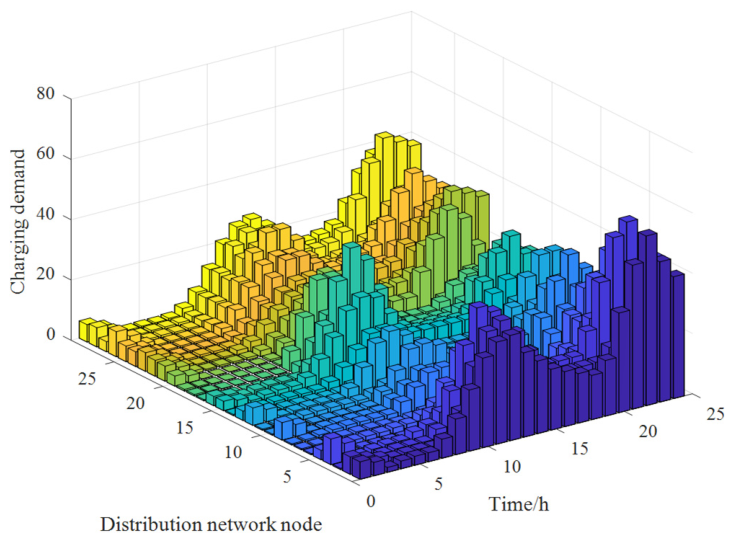
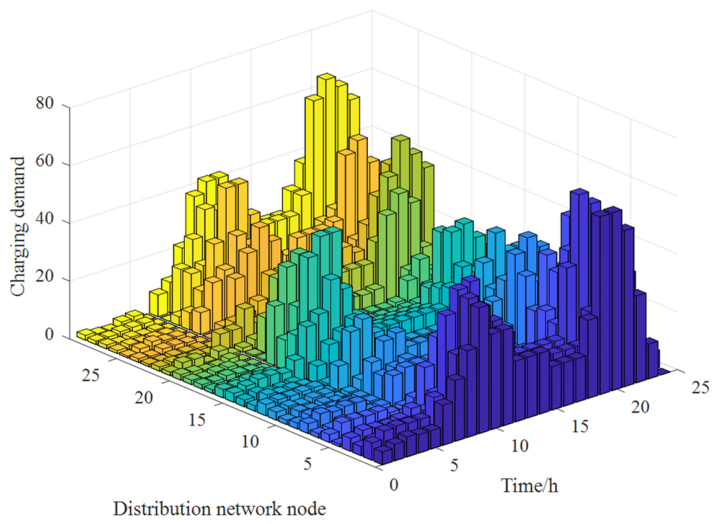
The spatiotemporal distribution of charging demand under the two scenarios is shown in the following Figure 7 and Figure 8.
In scenario 1, users are assumed to be perfectly rational. Their traveling decisions are made strictly according to the optimal path and minimum energy consumption. The distribution of demand is relatively smooth without extreme power peaks. Since users can accurately calculate the travel time of each road, EV charging demand is effectively guided to the locations with the lowest comprehensive cost across the whole area. Users tend to delay charging until the battery power is nearly exhausted, resulting in a relatively late arrival of the load peak.
In scenario 2, users exhibit bounded rationality. The peaks of EV charging demand become more prominent and emerge much earlier. This is because bounded rationality drives more users to generate charging demand within a specific time. Meanwhile, users tend to charge in advance due to the range anxiety caused by bounded rationality.
Compared with scenario 1, the core advantage of scenario 2 lies in the introduction of bounded rationality characteristics, which breaks the perfect rationality assumption of users adopted in traditional models. In scenario 2, the peak hour of morning charging demand shifts from 12:00 to 9:00, while the peak charging demand rises from 39 to 46, representing an increase of 17.95%. The peak hour of evening charging demand shifts from 22:00 to 20:00, while the peak charging demand rises from 57 to 66, representing an increase of 15.79%. Accordingly, it can more realistically capture users’ charging behaviors and provide a larger safety margin for the distribution network.

6.3. Siting and Sizing for EV Charging Stations

EVCSs are limited to a range of eight to 12 sites. Figure 9 shows the annual total cost of charging stations.
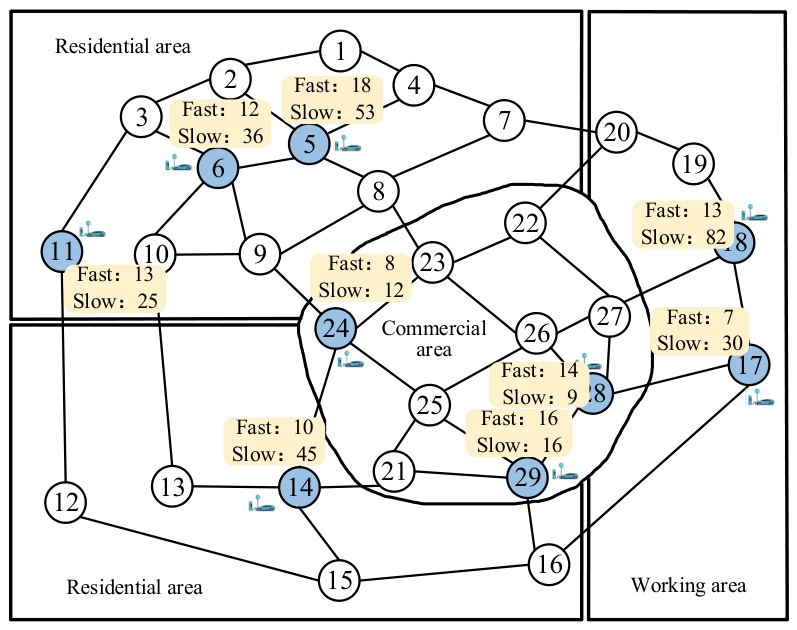
The annual total cost is minimized with nine EVCSs (costing 2.31 million $). Therefore, nine EVCSs are the optimal quantity for this area. These nine EVCSs are deployed at transportation network nodes 5, 6, 11, 14, 17, 18, 24, 28 and 29, which are coupled with distribution network nodes 22, 20, 1, 25, 18, 16, 10, 33 and 30. The layout of EVCSs and the number of piles are presented in Figure 10.

6.4. Analysis of Optimization Results Considering Distribution Network Flexibility

To analyze the impact of flexibility on the siting and sizing of EVCSs, the two scenarios listed in Table 5 are established for comparative analysis.
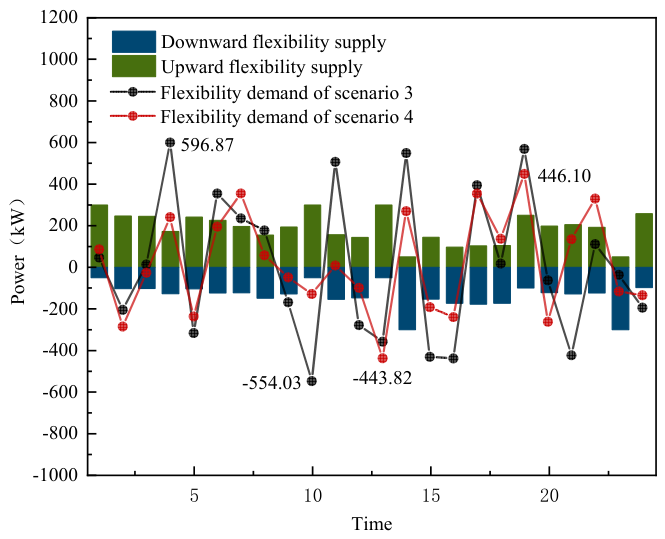
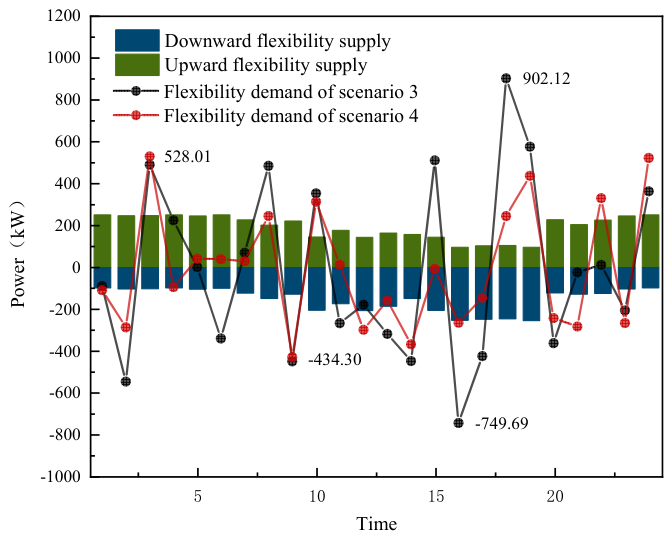
Nodes 5 in the residential area and node 17 in the working area are selected as research objects. These two nodes are coupled with nodes 22 and 18 of the distribution network, respectively. The flexibility supply and demand response characteristics of the above coupled nodes within a 24 h operation cycle are quantitatively analyzed and compared.
As shown in Figure 11 and Figure 12, for distribution network nodes 22 and 18 under scenario 4, the maximum upward flexibility demand decreases by 41.46% and 25.04%, the maximum downward flexibility demand drops by 42.05% and 20.03%, and the maximum flexibility deficit is reduced by 57.59% and 22.02%, respectively. This is because when the influence of distribution network flexibility is considered in the siting and sizing process, the layout of EVCSs and the quantity and capacity configuration of charging piles become more scientific and reasonable. As a result, the flexibility requirements of the two distribution network nodes is reduced, and the deficit is further lowered.
The comparison of five flexibility indexes between the two nodes is presented as follows in Table 6 and Table 7.
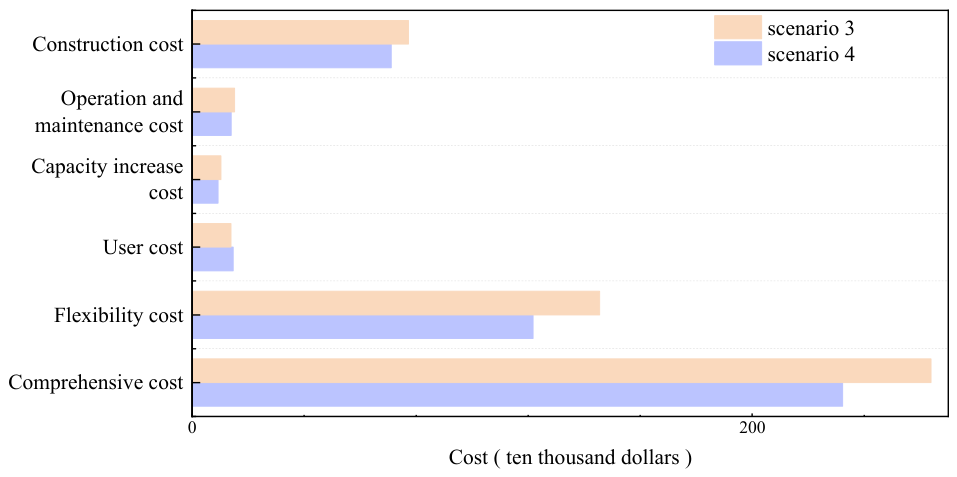
The cost comparison of siting and sizing under the two scenarios is presented in Figure 13.
Considering distribution network flexibility in the siting and sizing of EVCSs can reduce the construction cost, operation and maintenance cost, and capacity expansion cost of EVCSs while increasing user cost. Meanwhile, the reduction in the flexibility deficit under scenario 4 significantly cuts the flexibility cost of the distribution network, resulting in an 11.96% lower annual comprehensive cost compared with scenario 3.

6.5. Analysis of the Influence of Combined Installation of Fast and Slow Piles

Three scenarios have been added in order to examine how the installation of fast and slow charging piles will influence the optimization results.
Scenario 5: Only fast charging piles are installed.
Scenario 6: Only slow charging piles are installed.
Scenario 7: A combination of fast and slow charging piles is installed.
The components of the total annual cost for the three scenarios are shown in Table 8.
By comparing scenario 5 and scenario 7, although the user cost in scenario 5 decreases by 15.77%, the installation and operation costs of EVCSs increase by 34.35%. The reason is that fast charging piles have high charging power and can reduce user costs, while their construction and operation–maintenance costs are much higher than slow charging piles. The above results indicate that scenario 5 significantly raises the construction and operation–maintenance costs of EVCSs compared with scenario 7, which imposes enormous pressure on the initial investment of EV charging station operators.
Compared with scenario 7, the construction and operation costs of EVCSs in scenario 6 decrease by 10.43%, while the user cost rises by 56.29%. This is because slow charging piles have lower construction and operation and maintenance costs but lower charging power, which greatly increases users’ charging time and cost and reduces the service level of EVCSs.
These findings confirm the reality that joint usage of fast and slow charging piles will not only reduce the cost of building a charging station and render them cost-effective but also provide a matching spatial distribution profile of the demand density of chargers. It meets the needs of travel services provided by EV users and is more practical.

6.6. Verification of the Effectiveness of the Proposed Method Under Transportation Networks with Various Scales

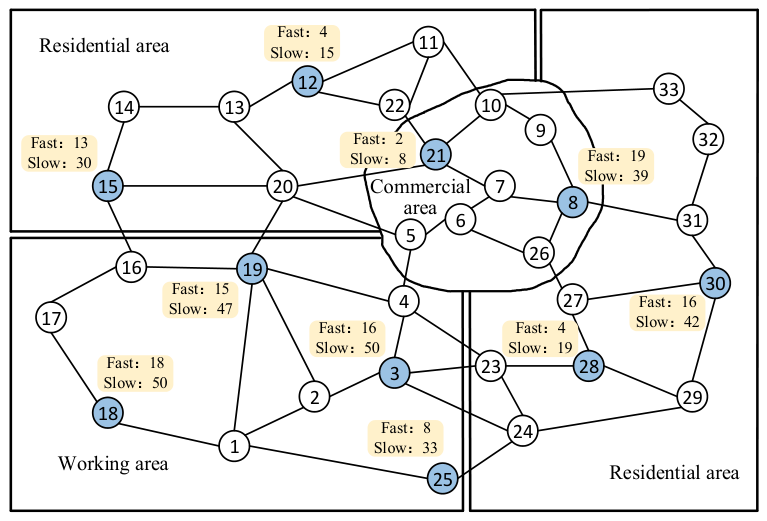
A 33-node transportation network with a 33-node distribution network (T33-D33 test system) is built to verify the method’s adaptability across different transportation systems, as shown in Figure 14.
Based on urban land use, the network splits into three areas, namely, a residential area, a working area and a commercial area, with 49 roads in total. Nodes 11, 12, 13, 14, 15, 20, 22, 23, 24, 27, 28, 29, 30, 31, 32, and 33 belong to the residential area. Nodes 1, 2, 3, 4, 16, 17, 18, 19, and 25 belong to the working area. Nodes 5, 6, 7, 8, 9, 10, 21, and 26 belong to the commercial area. The distribution network is equipped with 10 distributed gas turbines, two photovoltaic power sources, and three wind farms.
The layout of EVCSs and the number of piles are presented in Figure 15.
The minimum annual total cost of 2.38 million dollars is reached with 10 EVCSs for the T33-D33 test system. Therefore, 10 EVCSs are the optimal quantity for this area. These 10 EVCSs are deployed at transportation network nodes 3, 8, 12, 15, 18, 19, 21, 25, 28 and 30, which are coupled with distribution network nodes 29, 16, 24, 2, 20, 4, 8, 31, 12 and 17.
To analyze the impact of distribution network flexibility on the siting and sizing of EVCSs, the two scenarios listed in Table 9 are established for comparative analysis.
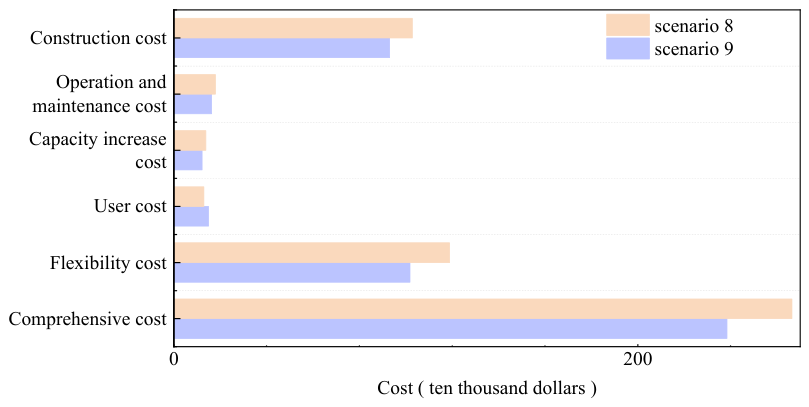
The cost comparison of EVCS siting and sizing under the two scenarios is presented in Figure 16.
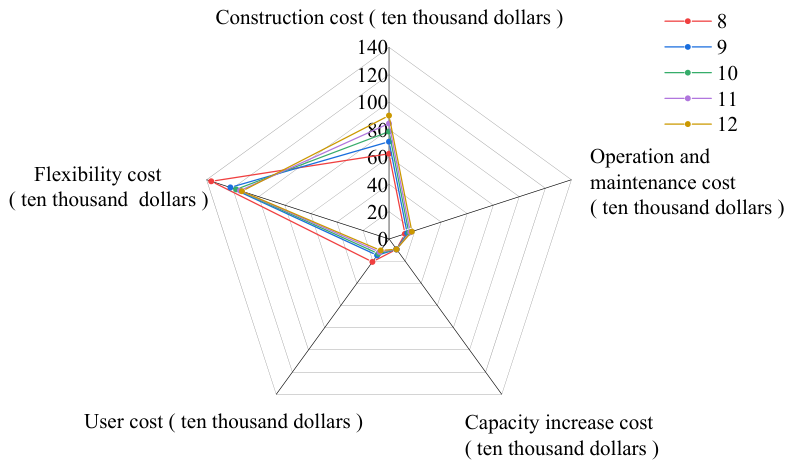
As shown in Figure 16, the reduction in the flexibility deficit under scenario 9 significantly reduces the distribution network’s flexibility cost by 14.32% and decreases the annual comprehensive cost by 10.49%.
The above results verify that the proposed method is applicable to the T33-D33 test system, which demonstrates its universality.


7. Conclusions

This paper plans the siting and sizing of EVCSs considering the flexibility of the distribution network and the limited rationality of the consumer. Case studies are conducted with the coupled system of a 29-node transportation network and a 33-node distribution network. The conclusions are summarized as follows:
(1)
The proposed siting and sizing method for EVCSs can effectively balance economic benefit and service level, achieving the minimization of annual comprehensive cost. Verified by case studies, the proposed model can generate reasonable siting and sizing schemes for EVCSs under given constraints, and the annual comprehensive cost is reduced by 11.96%.
(2)
Compared with traditional siting and sizing methods for EVCSs, the planning results become more practical when considering distribution network flexibility and users’ bounded rationality. Meanwhile, the system flexibility deficit is reduced by 16.38%, and all flexibility indexes of the distribution network are improved by more than 25%.
(3)
Compared with the scheme that adopts a single type of charging piles, the combined deployment of fast and slow charging piles better conforms to the spatiotemporal distribution characteristics of actual charging demand. It reduces construction and operation–maintenance costs while effectively reducing users’ charging waiting time and travel transfer time and improving the service level.
(4)
The given approach is also validated through a combined system of a transportation network with 33 nodes and a distribution network with 33 nodes. These findings suggest that the approach would decrease the distribution network flexibility deficiency by 14.32% and the total annual comprehensive cost of the network by 10.49%. This supports the applicability of the proposed method in general.
However, there remain certain limitations in this study.
(1)
This paper mainly explores the integration impacts of EVs as power loads while ignoring V2G technology. In future research, V2G technology can be utilized to integrate EVs as mobile energy storage resources for unified dispatching. By establishing a two-direction interaction mechanism between EVs and distribution networks, EVs can be guided to participate in the flexibility market. The flexible regulation potential of EVs can be fully exploited, and the regulation capability of EVs on distribution network flexibility can be considered during charging station siting and sizing.
(2)
This study only considers the coupling relationship between EVCSs and distribution networks, without involving other energy sources of EVCSs. It is essential to promote the integrated planning of EVCSs with rooftop photovoltaic systems, on-site energy storage devices and hydrogen energy supply facilities. This can provide references for the siting and sizing of EVCSs under the background of integrated energy systems.
(3)
This paper fails to consider uncertain factors such as extreme weather, increased traffic flow on holidays and temporary transportation network control. Random fluctuations and scenario disturbances could be introduced into the charging station planning model in future research. A self-adaptive siting and sizing method is established to make EVCSs adaptable to complex and changeable external environments.

Author Contributions

J.C.: conceptualization, methodology, original writing, formal analysis, and validation. X.L.: conceptualization and supervision. All authors have read and agreed to the published version of the manuscript.

Funding

This research received no external funding.

Data Availability Statement

The data is available in a publicly accessible repository. The data of the IEEE-33 bus system is openly available at https://matpower.org/docs/ref/matpower6.0/case33bw.html (accessed on 9 December 2025). The data of the transportation network with 29 nodes is from the appendix of the paper “A Spatial-temporal Charging Load Forecast and Impact Analysis Method for Distribution Network Using EVs-Traffic-Distribution Model”, available at http://ntps.epri.sgcc.com.cn/djgcxb/CN/10.13334/j.0258-8013.pcsee.161470 (accessed on 9 December 2025).

Conflicts of Interest

The authors declare no conflicts of interest.

Abbreviations

The following abbreviations are used in this manuscript:
EVCSelectric vehicle charging station
EVelectric vehicle
EVselectric vehicles
SOCstate of charge
ODorigin–destination
Pn.i.tnet load of distribution network node i
Pc.i.tuser load of node i
PEV.i.tEV charging load of node i at time t
Pre.i.trenewable energy output of node i at time t
xm0–1 variable to show whether the station is constructed at transportation network node m
r m lo number of slow charging piles of distribution network node m participating in charging
r m fa number of fast charging piles of distribution network node m participating in charging
P c lo rated charging power of slow piles
P c fa rated charging power of fast piles
nLquantity of transportation network nodes
nEVSnumber of EVCSs
Ppv.i.tphotovoltaic power generation of the distribution network
Pwt.i.twind power generation of the distribution network
X i . t u upward flexibility requirement
X i . t d downward flexibility requirement
Pn.i.t+1net load
G g . i . t u upward flexible supply
G g . i . t d downward flexible supply of the gas turbine at node i of the distribution network
Pg.i.t−1active power output
R g u upward climbing rate
R g d downward climbing rate
P g min minimum active power output
P g max maximum active power output
Pg.i.tactive power output
F i . t u upward flexibility shortage
F i . t d downward flexibility shortage
X i u upward flexibility demand of node i
Tnumber of time periods
X i d downward flexibility demand of node i
Xitotal flexibility demand of node i
Fitotal flexibility shortage of node i
Biprobability of node i generating a shortage
Ninumber of time periods in which node i generates a flexibility shortage
Gtopological map of the transportation network
Nset of all nodes
nthe n-th node
Lset of all roads
istarting nodes of this road
jending nodes of this road
Hset of time intervals in a day
hh-th time interval
Wset of impedances formed by road congestion and nodal waiting time
infno direct path between nodes ni and nj
ηk(t)perception function of charging urgency
Fijreal-time energy consumption per unit mileage on road ij
ωijlength of road section ij
SOCk(t)SOC of the EV
SOCminsafety threshold of the SOC defined by the user
Ecapbattery capacity of the EV
vaverage speed of the EV
Fannual comprehensive cost
CHannual construction operation and maintenance cost
C EV pd annual user waiting time cost
C EV hs annual user travel time cost
C p u annual distribution network expansion cost
Cfleannual charging station regulation cost caused by distribution network flexibility shortage
C H js cost of land use per unit area of node i
SHfixed area
C H con fixed construction cost
C H ot other costs
Rdan auxiliary variable used for annualization
ddiscount rate
ydepreciation period of the charging station
jmcollection of nodes located in residential areas
sycollection of nodes located in commercial areas
gzcollection of nodes located in working areas
r l lo number of slow piles
r l fa number of fast piles
Clo.cpunit construction investment cost of slow charging pile
Cfa.cpunit construction investment cost of fast charging pile
C l la land use cost per unit area
Sparea required to increase a single charging pile
C m op . fi annual fixed operation and maintenance cost
clo.ywannual operation and maintenance cost of slow charging piles
cfa.ywannual operation and maintenance cost
cnumber of fast piles
μquantity of vehicles completed for the unit time service
λquantity of charging requirements per hour to the charging station to receive services
P0reciprocal of EV charging time
ρservice strength of the charging pile
Cuatuser’s unit time equivalent economic loss
Tyearnumber of days in one year
Rlnumber of EVs charging
T l . j q waiting time
Djldistance
cPunit capacity increase cost
cfleunit flexibility cost
nPnumber of nodes
π(i)set of the first nodes
δ(i)set of the last nodes
Bset of nodes in the power grid
Pji.tactive power
Qji.treactive power
Pi.tthe consumed active power
Qi.tthe consumed reactive power
Pg.i.tthe injected active power
QEV.i.treactive load of EV generation
Qc.i.tloads other than EV generation
Qre.i.trenewable generation
Ui.tvoltages of node i
Uj.tvoltages of node j
UNreference voltage
Uminminimum voltages of each node
Umaxmaximum voltages of each node
nminlower limits of the number of EVCSs
nmaxupper limits of the number of EVCSs
r l . min lo minimum number of slow piles
r l . max lo maximum number of slow piles
r l . min fa minimum number of fast piles
r l . max fa maximum number of fast piles
P l . max EVS maximum charging power that the l-th charging station can provide
P l EVS power of the l-th station
R l lo number of requirements for charging with slow charging piles in the l-th charging station
R l fa quantity of charging requirements for charging with fast piles
Tmaxmaximum queue waiting time of users
Dmaxusers’ maximum detour distance

References

  1. Orynycz, O.; Zimakowska-Laskowska, M.; Ruchała, P.; Laskowski, P.; Matijošius, J.; Fidanova, S.; Roeva, O.; Sokolovskij, E.; Menes, M. Method of Evaluation of Potential Location of EV Charging Stations Based on Long-Term Wind Power Density in Poland. Energies 2026, 19, 434. [Google Scholar] [CrossRef]
  2. Colombo, C.G.; Leone, C.; Miraftabzadeh, S.M.; Matera, N.; Longo, M. Location of Charging Stations Considering Services and Power Losses: Case Study. Energies 2025, 18, 4923. [Google Scholar] [CrossRef]
  3. Cheng, S.; Wei, Z.B.; Shang, D.D.; Zhao, Z.K.; Chen, H.M. Charging load prediction and distribution network reliability evaluation considering electric vehicle’s patrial-temporal transfer randomness. IEEE Access 2020, 8, 124084–124096. [Google Scholar] [CrossRef]
  4. Li, Y.Z.; He, S.Y.; Li, Y.; Ge, L.J.; Lou, S.H.; Zeng, Z.G. Probabilistic charging power forecast of EVCS: Reinforcement learning assisted deep learning approach. IEEE Trans. Intell. Veh. 2022, 8, 344–357. [Google Scholar] [CrossRef]
  5. Tang, M.N.; Wang, C.Y.; Li, H.T.; Guo, X.; Zhang, K.Y.; Wang, M.Y.; Liang, X.M. Electric vehicle charging demand forecasting taking into account multiple time scales and dynamic road network information. Electr. Power Syst. Res. 2026, 253, 112499. [Google Scholar] [CrossRef]
  6. Bayram, I.S.; Galloway, S.; Burt, G. A probabilistic capacity planning methodology for plug-in electric vehicle charging lots with on-location energy storage systems. J. Energy Storage 2020, 32, 101730. [Google Scholar] [CrossRef]
  7. Ren, X.Q.; Zhang, H.M.; Hu, R.H.; Qiu, Y.M. Location of electric vehicle charging stations: A perspective using the grey decision-making model. Energy 2019, 173, 548–553. [Google Scholar] [CrossRef]
  8. He, C.K.; Zhu, J.Z.; Lan, J.; Li, S.L.; Wu, W.L.; Zhu, H.H. Optimal Planning of Electric Vehicle Battery Centralized Charging Station Based on EV Load Forecasting. In Proceedings of the 2021 6th International Conference on Power and Renewable Energy (ICPRE), Shanghai, China, 24–27 September 2021. [Google Scholar] [CrossRef]
  9. Wang, W.L.; Liu, Y.K.; Wei, W.; Wu, L. A bilevel EV charging station and DC fast charger planning model for highway network considering dynamic traffic demand and user equilibrium. IEEE Trans. Smart Grid 2024, 15, 714–728. [Google Scholar] [CrossRef]
  10. Sun, C.X.; Li, T.X.; Tang, X.Y. A data-driven approach for optimizing early-stage electric vehicle charging station placement. IEEE Trans. Ind. Inform. 2024, 20, 11500–11510. [Google Scholar] [CrossRef]
  11. Adepu, V.; Nakka, J. A demand-based placement of optimal EV fast charging stations in urban transportation network. IEEE Trans. Intell. Veh. 2025, 10, 4409–4422. [Google Scholar] [CrossRef]
  12. Zhang, H.C.; Scott, J.M.; Hu, Z.C.; Qi, W.; Song, Y.H. A second-order cone programming model for planning PEV fast-charging stations. IEEE Trans. Power Syst. 2018, 33, 2763–2777. [Google Scholar] [CrossRef]
  13. Wang, N.; Wang, C.F.; Niu, Y.F.; Yang, M.; Yu, Y.X. A two-stage charging facilities planning method for electric vehicle sharing systems. IEEE Trans. Ind. Appl. 2021, 57, 149–157. [Google Scholar] [CrossRef]
  14. Wu, T.; Yu, H.J.; Bu, S.Q.; Xia, S.W.; Wang, H.Z. An improved dynamic user equilibrium model-based planning strategy of fast-charging stations for electric vehicles. IEEE Trans. Transp. Electrif. 2025, 11, 1555–1569. [Google Scholar] [CrossRef]
  15. Asna, M.; Shareef, H.; Achikkulath, P.; Mokhlis, H.; Errouissi, R.; Wahyudie, A. Analysis of an optimal planning model for electric vehicle fast-charging stations in AL Ain city, United Arab Emirates. IEEE Access 2021, 10, 73678–73694. [Google Scholar] [CrossRef]
  16. Zhao, Z.H.; Xu, M.; Lee, C.K.M. Capacity planning for an electric vehicle charging station considering fuzzy quality of service and multiple charging options. IEEE Trans. Veh. Technol. 2021, 70, 12529–12541. [Google Scholar] [CrossRef]
  17. Feng, J.Z.; Hu, Z.C.; Duan, X.Y. EV fast charging station planning considering competition based on stochastic dynamic equilibrium. IEEE Trans. Ind. Appl. 2023, 59, 3795–3809. [Google Scholar] [CrossRef]
  18. Meng, Y.F.; Sun, Y.H.; Xie, D.L.; Xiao, M.; Yin, C.X.; Zhao, L. A two-stage optimization framework for EV charging station planning considering investment cost and service satisfaction. Appl. Energy 2025, 402, 126911. [Google Scholar] [CrossRef]
  19. Sun, Z.Y.; He, Y.; Wu, H.B.; Wu, A.Y. Bi-level planning of electric vehicle charging stations considering charging demand: A Nash bargaining game approach. Energy 2025, 332, 137173. [Google Scholar] [CrossRef]
  20. Dosljak, V.; Corovic, V.; Mihailovic, A. A two-layer optimization model for electric vehicle charging station distribution using a custom genetic algorithm: Application to Montenegro. Energy 2025, 330, 136611. [Google Scholar] [CrossRef]
  21. Wang, S.L.; Fang, B.; Zhang, J.Y.; Chen, Z.W.; Wen, M.Z.; Xiao, H.X.; Jiang, M.Y. Joint Planning of Renewable Energy and Electric Vehicle Charging Stations Based on a Carbon Pricing Optimization Mechanism. Energies 2025, 18, 3462. [Google Scholar] [CrossRef]
  22. Hu, D.D.; Yang, D.D.; Liu, Z.W. Data Siting and Capacity Optimization of Photovoltaic–Storage Charging Stations Considering Spatiotemporal Charging Demand. Energies 2025, 18, 3306. [Google Scholar] [CrossRef]
  23. Pal, A.; Bhattacharya, A.; Chakraborty, A.K. Planning of EV charging station with distribution network expansion considering traffic congestion and uncertainties. IEEE Trans. Ind. Appl. 2023, 59, 3810–3825. [Google Scholar] [CrossRef]
  24. Li, K.; Shao, C.C.; Hu, Z.C.; Shahidehpour, M. An MILP method for optimal planning of electric vehicle charging stations in coordinated urban power and transportation networks. IEEE Trans. Power Syst. 2023, 38, 5406–5419. [Google Scholar] [CrossRef]
  25. Wang, X.; Shahidehpour, M.; Jiang, C.W.; Li, Z.Y. Coordinated planning strategy for electric vehicle charging stations and coupled traffic-electric networks. IEEE Trans. Power Syst. 2019, 34, 268–279. [Google Scholar] [CrossRef]
  26. Cui, X.S.; Weng, Y.; Tan, C.W. Electric vehicle charging station placement method for urban areas. IEEE Trans. Smart Grid 2019, 10, 6552–6565. [Google Scholar] [CrossRef]
  27. Zheng, J.Y.; Zhang, J.W.; Jia, R.G.; Song, P.J.; Zhao, S. Demand Prediction of New Electric Vehicle Charging Stations: A Deep Learning Approach. Energies 2026, 19, 378. [Google Scholar] [CrossRef]
  28. Zheng, Y.Q.; Guo, D.H.; Li, Z.L.; Liu, Y.Z.; Li, X.C. Information Mining Based on Seasonal and Trend Decomposition Using Loess for Non-Continuous EV Charging Prediction. Energies 2026, 19, 1556. [Google Scholar] [CrossRef]
Figure 1. The framework of siting and sizing.
Energies 19 02821 g001
Figure 2. Schematic diagram of the distribution network flexibility deficit.
Energies 19 02821 g002
Figure 3. Topology of the simplified transportation network.
Energies 19 02821 g003
Figure 4. T29-D33 test system.
Energies 19 02821 g004
Figure 5. The initial locations of different types of EVs.
Energies 19 02821 g005
Figure 6. Temporal distribution of EV charging demands.
Energies 19 02821 g006
Figure 7. Spatiotemporal distribution of EV charging demand under scenario 1.
Energies 19 02821 g007
Figure 8. Spatiotemporal distribution of EV charging demand under scenario 2.
Energies 19 02821 g008
Figure 9. Charging station annual comprehensive cost structure.
Energies 19 02821 g009
Figure 10. Results of siting and sizing for EVCSs for the T29-D33 test system.
Energies 19 02821 g010
Figure 11. Flexibility demands and supplies at node 22 for scenario 3 and scenario 4.
Energies 19 02821 g011
Figure 12. Flexibility demands and supplies at node 18 for scenario 3 and scenario 4.
Energies 19 02821 g012
Figure 13. Cost comparison between scenario 3 and scenario 4.
Energies 19 02821 g013
Figure 14. T33-D33 test system.
Energies 19 02821 g014
Figure 15. Results of siting and sizing for EVCSs for the T33-D33 test system.
Energies 19 02821 g015
Figure 16. Cost comparison between scenario 8 and scenario 9.
Energies 19 02821 g016
Table 1. Existing solutions for charging demand forecasting and their advantages and limitations.
Existing SolutionAdvantageLimitation
Model-drivenEasy to implement and do not need large amounts of data to support it.Difficult to guarantee prediction accuracy.
Data-drivenIt can capture the complexity of charging behavior and provide highly accurate prediction results.A large amount of high-quality data is required for support.
Table 2. Existing solutions for siting and sizing and their advantages and limitations.
Existing SolutionAdvantageLimitation
Mathematical programming methodThe mathematical logic is rigorous, the optimal solution can be quantified, and the result is theoretically optimal.In the scenario of coupling large-scale transportation networks and distribution networks, there are many variables, and the solution efficiency decreases.
Optimization algorithmSuitable for complex coupling models, with flexible modeling capabilities.There is no guarantee of global optimality, and it is sensitive to parameter variations.
Table 3. Related parameters of charging piles.
ParametersCharging Piles—SlowCharging Piles—Fast
Rated charging power30 kW70 kW
Investment construction cost14,724 $/set22,086 $/set
Maintenance cost294 $/set/year441 $/set/year
Table 4. Related parameters of siting and sizing for EVCSs.
ParametersValuesParametersValues
SZ20 Square metersTyear365 Days
C Z con 1472 $Cuat4.7 $/h
d0.08SP20 Square meters
y20 YearcP53 $/kVA
Table 5. Comparison between scenario 3 and scenario 4 for siting and sizing of EVCSs.
Scenario NumberUser CostCharging Station CostDistribution Network Flexibility Cost
Scenario 3ConsideredConsideredNot considered
Scenario 4ConsideredConsideredConsidered
Table 6. Flexibility index comparison of node 22.
Upward Flexibility Demand/kWDownward Flexibility Demand/kWTotal Flexibility Demand/kWTotal Flexibility Shortage/kWProbability of Generating Shortage
Scenario 339624462842548090.667
Scenario 427133013572620740.5
Improvement31.52%32.47%32.04%56.87%25.4%
Table 7. Flexibility index comparison of node 18.
Upward Flexibility Demand/kWDownward Flexibility Demand/kWTotal Flexibility Demand/kWTotal Flexibility Shortage/kWProbability of Generating Shortage
Scenario 335283528705737920.667
Scenario 425702270484113100.417
Improvement27.15%35.66%31.4%65.37%37.48%
Table 8. Cost comparison of three scenarios.
Scenario NumberScenario 5Scenario 6Scenario 7
Construction cost/$956,076637,379711,620
Operation and maintenance cost/$187,737125,158139,735
Capacity increase cost/$160,61468,83792,911
User cost/$123,744229,613146,906
Flexibility cost/$1,528,5211,144,6091,218,776
Comprehensive cost/$2,940,3802,205,5982,309,965
Table 9. Comparison between scenario 8 and scenario 9 for siting and sizing of EVCSs.
Scenario NumberUser CostCharging Station Cost Distribution Network Flexibility Cost
Scenario 8ConsideredConsideredNot considered
Scenario 9ConsideredConsideredConsidered
Disclaimer/Publisher’s Note: The statements, opinions and data contained in all publications are solely those of the individual author(s) and contributor(s) and not of MDPI and/or the editor(s). MDPI and/or the editor(s) disclaim responsibility for any injury to people or property resulting from any ideas, methods, instructions or products referred to in the content.