1. Introduction
In recent years, significant attention has been directed toward small autonomous surface platforms that harness marine environmental energy for power [
1,
2], leading to the emergence of various types of unmanned surface vehicles (USVs). These small platforms harvest ambient energy to attain long endurance. Though less maneuverable than conventional USVs, they fully meet the needs of marine observation. These platforms provide robust technical support for achieving long-term, large-scale, high-spatiotemporal-resolution observations of the air–sea interface, and thus hold substantial application potential in climate monitoring, defense surveillance, and marine resource exploration [
3].
At present, mature LUSVs rely primarily on solar power, while some platforms utilize wave or wind energy capture devices to provide propulsion power [
4,
5]. Since these small LUSVs are required to perform long-duration marine monitoring missions lasting more than three months, they often encounter harsh maritime environmental conditions. For example, salt deposition on PV panels under such conditions has been shown to reduce power output by 9.69% and 14.52% at coverage ratios of 10% and 20%, respectively [
6]. Factors such as waves, salt spray, and high humidity further exacerbate the operational instability of solar panels. To improve seakeeping and operational stability, some LUSVs have adopted a tapered deck structure instead of a flat deck configuration. The Explorer and Surveyor LUSVs from Saildrone Inc. (USA) are powered by solar energy and propelled by sails, enabling up to one year of marine observations. Their hull design fully accounts for wave and salt spray resistance, featuring a low-angle tapered deck structure with solar panels laid out on both sides of the tapered deck [
7,
8]. The SeaTrac SP-48, developed by SeaTrac Systems, is a solar-powered USV with an endurance of several months [
9]; it employs a high-angle tapered deck configuration, with solar panels arranged on two tapered surfaces [
10]. The Wave Glider from Liquid Robotics Inc. (USA) [
11] adopts a flat deck structure, on which improved solar panels and battery systems are installed, allowing long-duration operation under challenging conditions such as high latitudes and high wave states.
Under large beam waves, flat deck structures suffer from poor hull stress performance. Wave coverage also causes water accumulation on the deck and impairs photovoltaic energy conversion. Conical or trapezoidal decks are proposed to address this issue. Conical or trapezoidal decks improve hull stress distribution under large waves, reduce rolling, and prevent water pooling on PV panels. Considering the layout demands for meteorological, communication and hoisting facilities that require flat surfaces, the trapezoidal structure is the preferred option. However, installing photovoltaic panels on a trapezoidal deck structure constitutes a heterogeneous photovoltaic power generation configuration, where the panels face different orientations. The instantaneous output characteristics of panels with different orientations are inconsistent, thereby posing new challenges to the performance and control of the photovoltaic power generation system.
A. Kasaeian investigated the layout schemes of photovoltaic panels installed on USVs and proposed a multi-objective optimal layout method considering factors such as deck accessibility, solar radiation, economic benefits, and system efficiency [
12]. A. G. Koumentakos studied the structural behavior, design optimization, energy efficiency, and marine exploration applications of solar-powered vessels, making maritime transport more economically feasible and environmentally friendly [
13]. Makhsoos designed the Morvarid USV using a single-axis solar tracking system, which allows the solar panel array to tilt by 60°; this energy system can generate 5.8 kWh of solar energy per day and support an operating duration of up to 7 h per day [
14].
Alaeldin M. Tairab studied a novel hybrid electromagnetic solar harvester (HESH) incorporating a wind energy harvester to power low-power IoT wireless sensors on USVs [
15]. Yue Sun analyzed technologies for converting ocean mechanical energy into electricity and their integration into the Smart Ocean through self-powered and self-sensing applications [
16]. Sining Wei presented a critic-only Q-learning framework for optimal energy management in systems with stochastic renewable energy inputs and dual battery storage, and demonstrated the approach with a wave-powered autonomous surface vehicle [
17]. Moustafa Elkolali presented a prototype of a low-cost USV powered by wave and solar energy; the platform features a trapezoidal deck shape, with three solar panels arranged on three sides of the trapezoid [
18]. Hao Cao proposed a wind energy harvesting system with a double-magnet coupling mechanism based on piezoelectric and electromagnetic effects, which is suitable for providing supplementary electric energy to USVs [
19]. Yuhang Huang studied a method of harvesting wave-induced ship vibration energy using a bistable mechanism and a wave-to-wire dynamic model, which exhibits a wider bandwidth at low frequencies [
20]. S. Das established the technical and economical aspects of applying a stand-alone photovoltaic (PV) system in a sailing boat using a buck converter to enhance power generation and minimize cost [
21,
22]. B. Genet investigated the energy supply technology for a 1.8 m unmanned surface vehicle (USV) and proposed a power generation forecasting method that predicts harvestable electric power by taking into account the vessel’s trajectory, wind conditions, and various other factors affecting ocean voyages [
23]. A. Riccobono proposed a photovoltaic-fuel cell-battery multi-source configuration for zero-emission autonomous surface vehicles, which achieves doubled endurance (extended up to 12 h on the most favorable day) compared to the original battery-powered version while complying with strict payload and size constraints [
24]. D. Berjoza experimentally investigated the effect of a USV’s heading on photovoltaic power generation efficiency, emphasizing the significance of an automatic solar panel angle control and adjustment device [
25]. V. Osadcuks conducted an experimental study on monocrystalline photovoltaic panels at various tilt angles and put forward proposals for an automatically adjustable tilt device to optimize photovoltaic power generation for unmanned surface vehicles [
26]. Juraci Carlos de Castro Nóbrega developed a step-by-step calculation methodology and a design framework for a small solar-powered boat (Nautilus) that accounts for clean energy adoption, minimum weight, and minimum manufacturing costs; this framework can be applied to optimizing automatic tilt adjustment devices for PV power generation on USVs [
27]. A. Friebe developed a single-axis solar tracker that adjusts the solar panel angle based on the USV’s position, heading, and time of day, enhancing photovoltaic power generation for unmanned surface vehicles [
28]. Y. Wang investigated the rapidly varying partial-shading conditions encountered by PV arrays mounted on USVs and proposed a fuzzy neural directed adaptive particle swarm optimization (FN-APSO) approach to achieve the global maximum power point (GMPP) [
29]. A. Makhsoos developed an evaluation method for key parameters affecting the energy efficiency of on-board PV arrays installed on USVs, and showed that PV efficiency can be improved by up to 50% through accurate tracking and proper maintenance [
30]. A. Makhsoos discussed the design and construction of an active sun tracker for a USV and conducted tests and evaluations on the tracker [
31]. Under harsh sea conditions with high instability, an unmanned surface vehicle (USV) experiences high-frequency oscillations; therefore, the applicability of adjustable-tilt solar tracking systems under such conditions remains to be further verified.
R. L. Peng developed a semi-flexible crystalline silicon photovoltaic (SFPV) module for lightweight photovoltaic unmanned surface vehicles (PV-USVs), achieving a 6.05% relative efficiency improvement and a 5.05% power generation increase over land-based systems under dynamic water conditions, while validating its stability for marine renewable energy applications [
32].
Although extensive research has been conducted on energy supply for unmanned surface vehicles (USVs), as discussed above, photovoltaic (PV) power generation remains an effective method for powering these platforms. Most studies on PV power generation for USVs have referenced conventional PV technologies [
33,
34,
35], and some investigations of offshore PV systems have also been based on traditional approaches [
36,
37,
38]. Other research on USVs has primarily focused on navigation, power optimization, and related aspects [
39,
40,
41]. However, research on heterogeneous PV systems remains relatively scarce.
Many studies have explored tilt angle optimization, heading angle characteristics, and tracking systems for USV PV systems. Nevertheless, few studies have addressed heterogeneous PV arrays on trapezoidal decks for wave resistance, or the tilt–heading coupling effect under different electrical connection modes (independent vs. parallel). To fill this gap, this paper proposes a PV power generation technical solution featuring a tapered deck layout. A simulation analysis model for two heterogeneous PV arrays with different orientations is established, and the operational characteristics of the heterogeneous PV system are analyzed through simulation. The power output characteristics under different battery configuration schemes are investigated. Finally, based on the simulation results, we present design recommendations for heterogeneous PV systems on small USVs. These suggestions offer practical guidance for manufacturers regarding system optimization and configuration planning.
2. Models and Methods
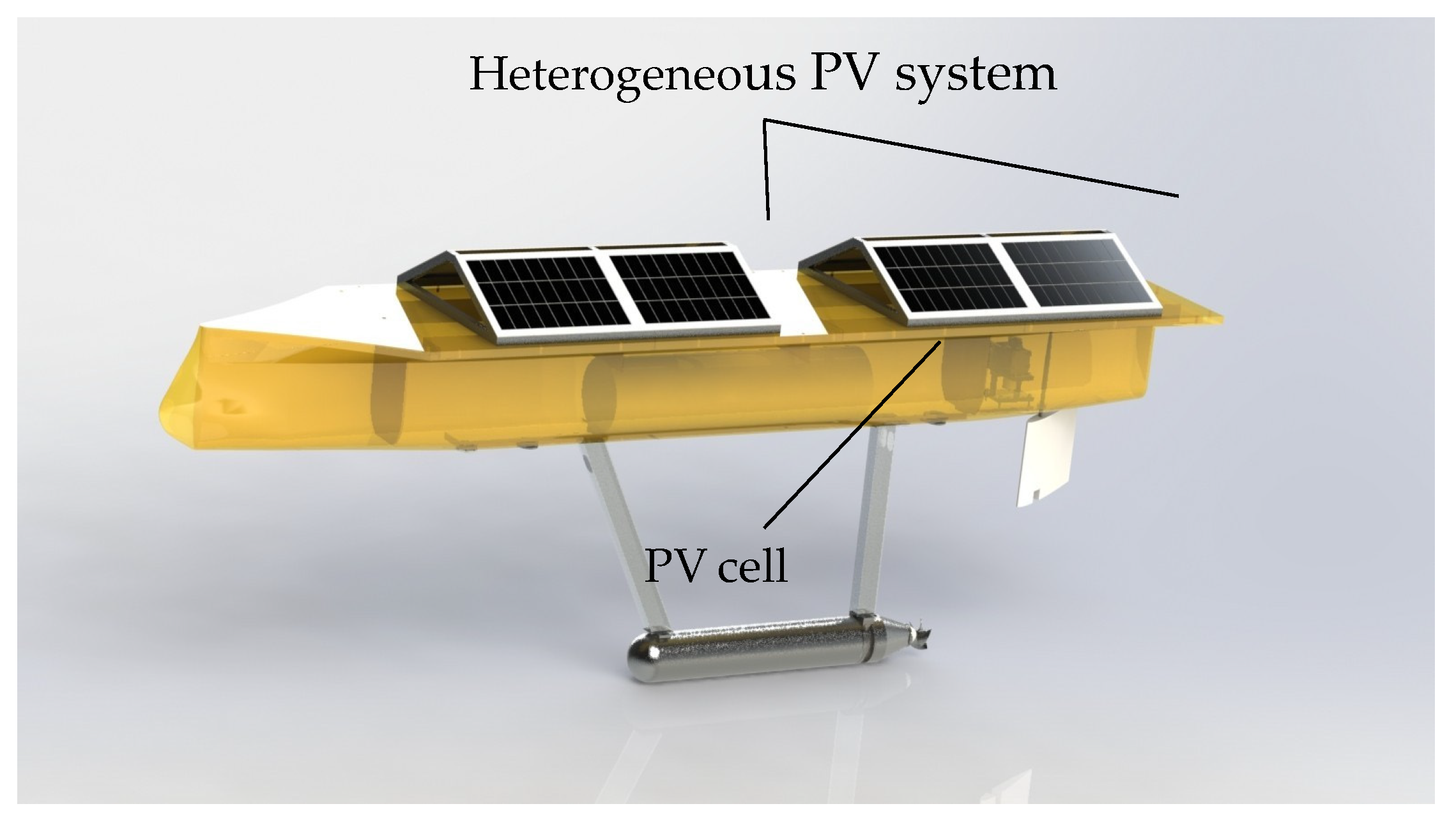
The small long-endurance USV investigated in this study is primarily intended for long-term monitoring of environmental elements at the ocean–atmosphere interface, including wind speed, wind direction, air temperature, air pressure, as well as sea surface temperature and salinity. The platform has a design speed of 2.0 knots, with a hull length of 3.2 m, height of 0.9 m, width of 0.65 m, and a total weight of approximately 105 kg (
Figure 1).
The power supply system of the USV comprises a solar power generation device and lithium-ion batteries. The photovoltaic (PV) panels are mounted on the top deck frame, which is a metal structure with a trapezoidal cross-section made of aluminum alloy 6061-T6. The PV modules are divided into two groups, each consisting of four modules connected in parallel. These two groups are respectively installed on the two inclined surfaces of the trapezoidal cross-section. The angle between each inclined side of the frame and the bottom plane defines the tilt angle of the PV modules, which is 26.6°.
The PV module model is PET20W, a monocrystalline silicon solar panel with a rated power of 20 W per panel. Under standard conditions, the open-circuit voltage is 21.67 V, the short-circuit current is 1.2 A, the maximum power point voltage is 18 V, and the maximum power point current is 1.1 A. The battery is a lithium-ion battery pack with a rated voltage of 24 V and a capacity of 60 Ah, which supplies power to the USV and stores the energy generated by the PV system.
2.1. Model for Photovoltaic Power Generation of USVs
The photovoltaic (PV) power generation system of the small USV consists of a photoelectric conversion subsystem and a charging subsystem. A corresponding simulation analysis model is established, including a photoelectric conversion model and a charging simulation model. The photoelectric conversion model describes the conversion of solar radiation into electrical energy by the PV panels. The charging simulation model represents the physical behavior of the charging control circuit between the PV panels and the lithium-ion battery pack.
The power generation prediction model for the PV system of the small long-endurance USV comprises three components: an attitude calculation model for the PV array, an instantaneous irradiance calculation model for the PV array, and a photoelectric conversion calculation model for the USV.
2.1.1. Calculation Model for the Attitude of the USV Photovoltaic Array
The photovoltaic (PV) array of the small USV is fixed onto the hull deck surface and rigidly connected to the hull as a single rigid body. To establish the relationship between the hull pitch angle, roll angle, and the azimuth and tilt angles of the PV array, a body-fixed coordinate system and an Earth-fixed coordinate system are defined. The body-fixed coordinate system originates at the USV’s center of gravity, with x forward, z upward, and y to port. The pitch angle of the hull is defined as the rotation angle about the y-axis and the roll angle as the rotation angle about the x-axis.
The azimuth angle γ of the PV module is defined as the angle between the projection of the module normal onto the horizontal plane and the south direction, with positive values toward the west and negative values toward the east, ranging from −180° to 180°. The tilt angle β of the PV module is defined as the angle between the module plane and the horizontal plane, taking only positive values ranging from 0° to 90°.
For a given heading, assuming the heading angle, roll angle, and pitch angle of the hull at a certain moment are
Rx,
Ry, and
Rz, respectively, the azimuth angle and tilt angle of the PV array are given by the following:
where
γ is the azimuth angle of the PV array (°) and
β is the tilt angle of the PV array (°).
2.1.2. Calculation Model for Instantaneous Irradiance on Photovoltaic Array
The solar radiation incident on the surface of the small USV photovoltaic array consists of three components: direct radiation
Itb, diffuse radiation
Itd, and reflected radiation
Itr. For a PV module with arbitrary orientation, the total irradiance
It received on the tilted surface is given by [
42,
43]:
where
It is the total solar irradiance on the tilted surface (W/m
2);
Itb is the direct irradiance on the tilted surface (W/m
2);
Itd is the diffuse irradiance on the tilted surface (W/m
2);
Itr is the reflected irradiance on the tilted surface (W/m
2);
I is the total irradiance on the horizontal surface (W/m
2);
Ib is the direct irradiance on the horizontal surface (W/m
2);
Id is the diffuse irradiance on the horizontal surface (W/m
2);
Rb is the radiation factor, defined as the ratio of
Itb to
Ib [
44], which is calculated as:
where
δ is the solar declination angle on the given day (°);
φ is the local latitude (°);
ω is the hour angle, calculated as
ω = ±15°
z, where
z is the time from solar noon (hours);
γ is the azimuth angle of the PV array (°);
β is the tilt angle of the PV array (°);
h* is the solar altitude angle (°);
A is the solar azimuth angle (°); the ground albedo ρ is taken as 0.2.
2.1.3. Calculation Model for Photoelectric Conversion of USVs
Under given conditions of solar irradiance and ambient temperature, an output calculation model for a photovoltaic module can be established using four basic technical parameters: the open-circuit voltage
UOC, short-circuit current
ISC, maximum power point voltage
Um, and current
Im [
45].
where
where
I is the current of the photovoltaic module (A);
U is the voltage of the photovoltaic module (V);
UOC is the open-circuit voltage under standard conditions (V);
ISC is the short-circuit current under standard conditions (A);
Um is the voltage at the maximum power point under standard conditions (V);
Im is the current at the maximum power point under standard conditions (A).
Under non-standard temperature and irradiance conditions, the parameters in the calculation model—such as open-circuit voltage, short-circuit current, voltage at the maximum power point, and current at the maximum power point—need to be replaced with values under the corresponding environmental conditions. The corresponding parameters,
,
,
, and
, are determined by the following method [
46]:
where
a,
b, and
c are compensation coefficients, with typical values
a = 0.0025 °C
−1,
b = 0.0005 m
2·W
−1, and
c = 0.00288 °C
−1;
Sref is the reference irradiance under standard conditions (1000 W·m
−2);
Tref is the reference temperature under standard conditions (25 °C).
2.2. USV Charging Simulation Model
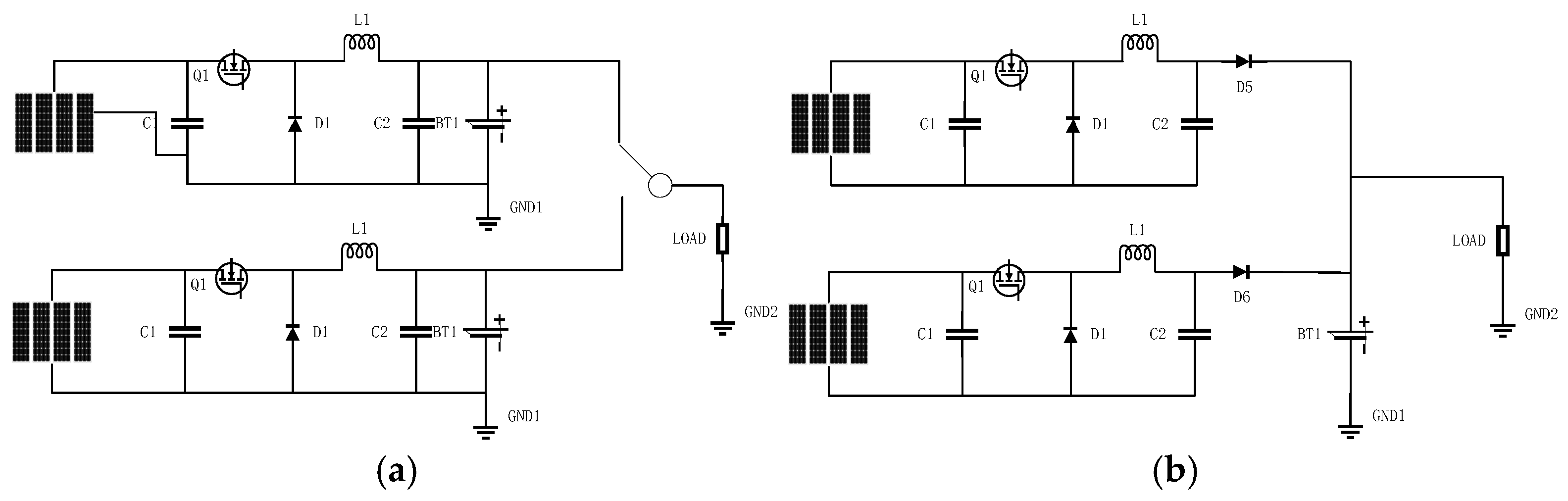
For the heterogeneous photovoltaic (PV) power generation system of the small USV, the two PV panels face different orientations. Consequently, their instantaneous power generation characteristics are completely different, and they cannot reach their respective maximum power points simultaneously. Two charging circuit configurations are considered. In the first configuration, each of the two PV modules is connected to an independent battery bank, and the two battery banks alternately supply power to the USV load under circuit control. In the second configuration, the two PV modules are connected in parallel to charge a single battery bank, which then supplies power to the USV load (
Figure 2).
2.2.1. Independent Charging and Discharging Configuration for Two Channels
For the configuration with two independent charging and discharging channels, each PV module is equipped with a buck converter for maximum power point tracking (MPPT) of that module. Using the photoelectric conversion model described by Equations (13) and (14), the instantaneous maximum power output of each photovoltaic subsystem can be calculated. The instantaneous maximum power output
Pi1 of the overall PV system and the cumulative energy yield
E1 over a period of time are then obtained as follows:
where Δ
t is the sampling time interval, and
i denotes a specific time instant.
2.2.2. Parallel Configuration
For the configuration with two PV modules connected in parallel, the output terminal of each PV module is equipped with a reverse-charging prevention circuit. After the two reverse-charging prevention circuits, the outputs of the two PV modules are connected in parallel. A buck converter is placed between the combined output and the battery bank to realize maximum power point tracking (MPPT) for the entire PV array.
Assume the solar irradiances on the two PV modules are S1 and S2, respectively, and the ambient temperature is T. For the first PV module, with given parameters such as open-circuit voltage UOC1, short-circuit current ISC1, maximum power point voltage Um1, and current Im1, substituting them into Equations (11)–(16) yields the corresponding maximum power point voltage and current under the actual conditions. For the second PV module, with given parameters UOC2, ISC2, Um2, and Im2, substituting them into Equations (11)–(16) yields and .
For this configuration, the instantaneous maximum power output
Pi2 of the overall PV system and the cumulative energy yield
E2 over a period of time are calculated by the following method:
2.3. Experimental Validation
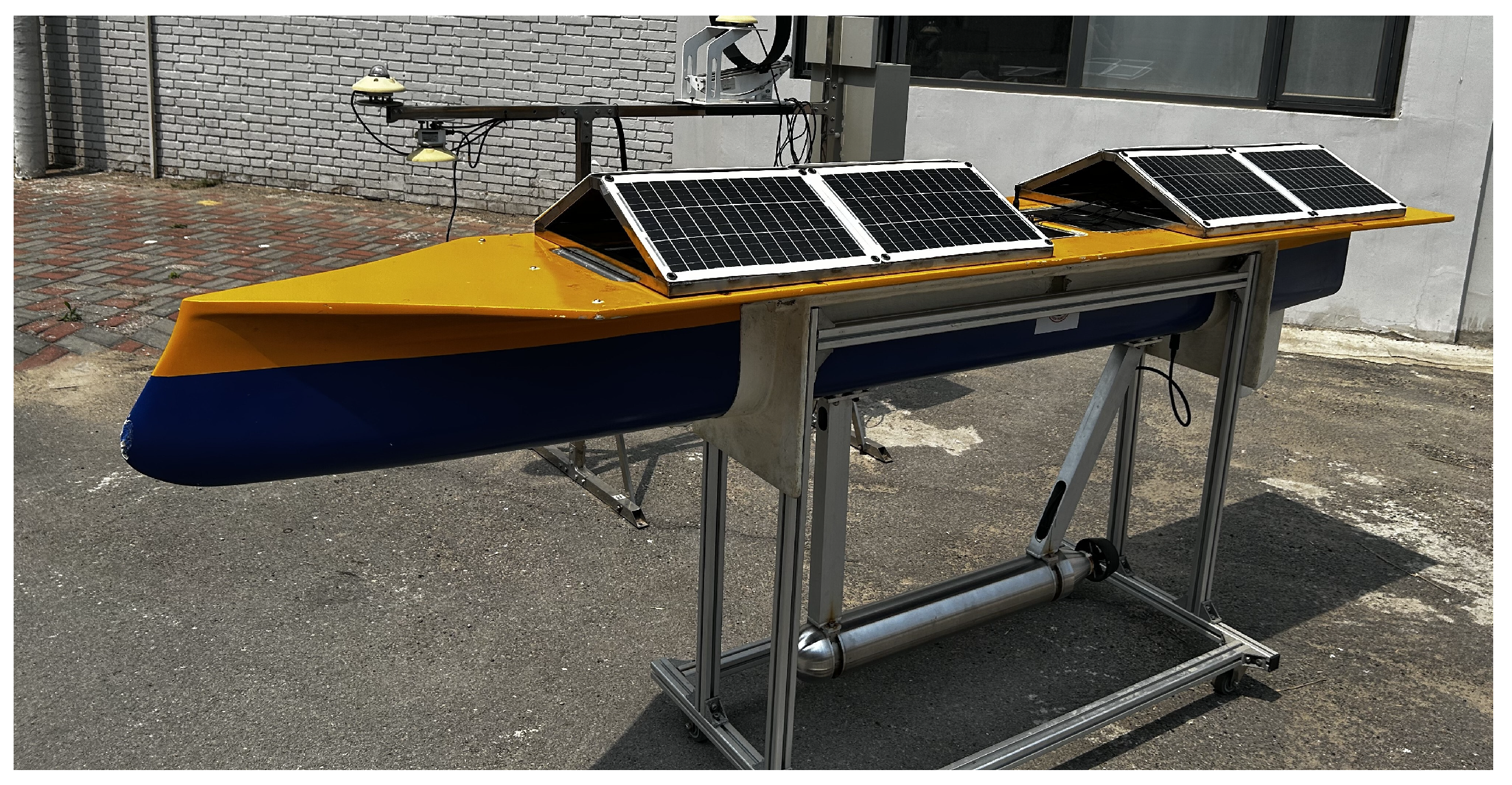
A test setup for the heterogeneous photovoltaic (PV) power generation system of the small USV was developed. Power generation tests were carried out using this setup (
Figure 3). The USV features a deck PV support structure with a trapezoidal cross-section, with two PV modules mounted on the two inclined sides of the trapezoidal frame. The output terminals of the two PV modules are each connected to a resistor, with resistance values of 30.0 Ω and 29.8 Ω, respectively. The values of the two resistors were measured using a DT9205A multimeter, which has a voltage measurement accuracy of ±0.5%.
The tests were conducted in late spring at a location with coordinates 19.136° N, 117.110° E. The ambient temperature was 26.6 °C. Two heading conditions were set: facing south and facing 40° east of south, to investigate the influence of heading angle on the output characteristics of the heterogeneous PV system. Current and voltage were measured every second, and values were collected over 30 s intervals for analysis. The data from 12:45 to 13:15, when solar irradiance was relatively stable and high, were selected for comparison.
Solar irradiance and ambient temperature were measured by the PC-4 environmental monitor. The monitor has a solar irradiance measurement accuracy of ±5% and an ambient temperature measurement accuracy of ±0.2 °C. It acquires data once per minute and transmits the data to the computer via RS232. The instantaneous voltage across the resistors was captured by the DAM3580A data acquisition card. This card features a measurement accuracy of ±0.2% FSR and a sampling frequency up to 10 Hz. Data from the card is transmitted to the computer via the USB interface. The instantaneous power dissipated by the resistor is calculated via the following formula using its measured instantaneous voltage:
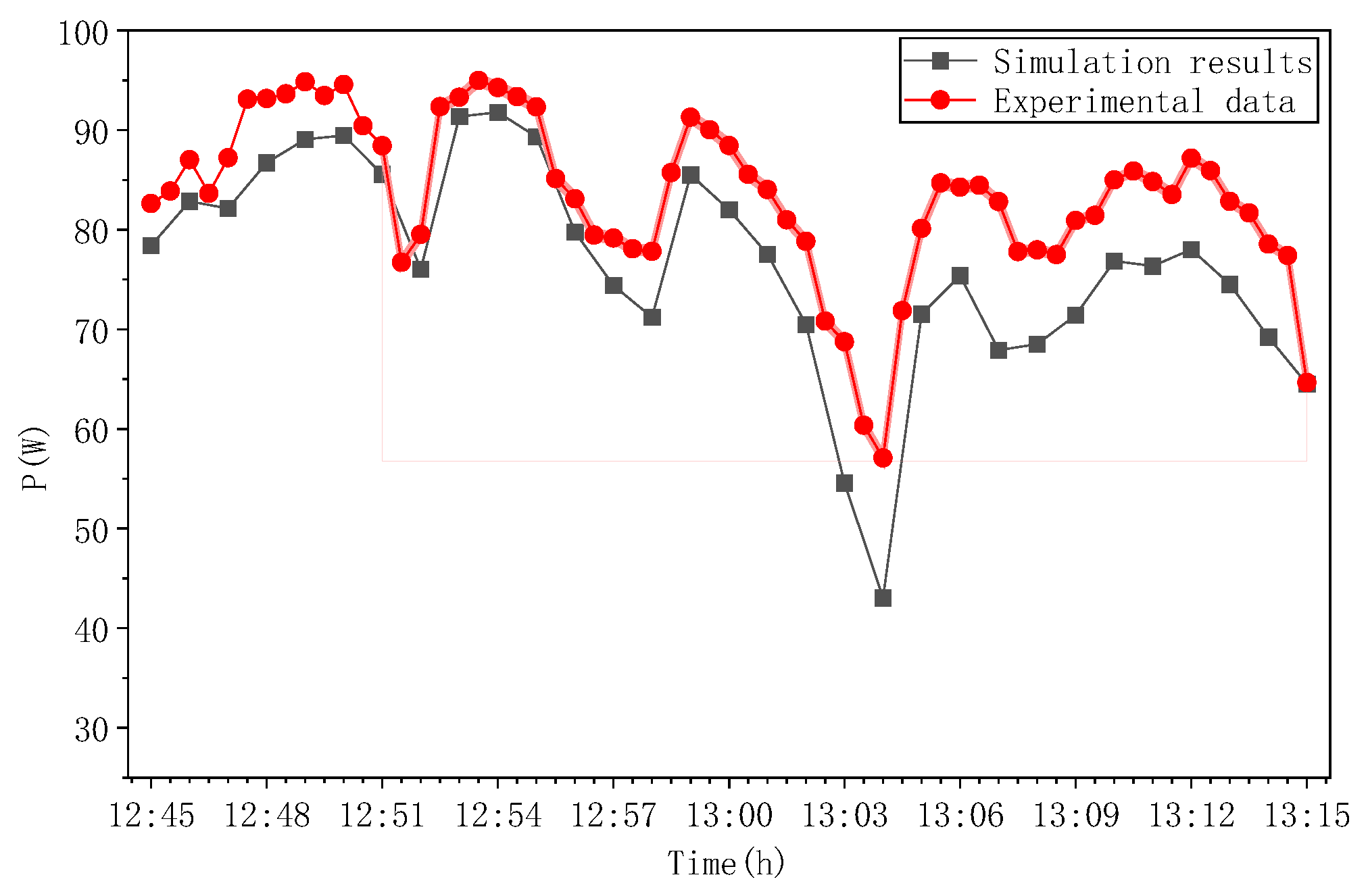
Using the calculation model described above, power generation simulations were performed for the two PV modules. The simulation results, together with the experimental measurements, are presented in
Figure 4.
It can be seen from
Figure 4 that the simulation results of the power output of the two PV modules are in generally consistent with the measured results. The maximum absolute deviation is 14.20 W, corresponding to a relative deviation of approximately 20.65%; the minimum absolute deviation is 0.14 W, corresponding to a relative deviation of approximately 0.22%. Due to instantaneous cloud shading, solar irradiance drops sharply and then recovers abruptly. The solar irradiance monitor has a certain response lag, which leads to considerable measurement errors and thus a large relative deviation during abrupt changes in instantaneous irradiance.
3. Results and Discussion
3.1. Calculation Conditions
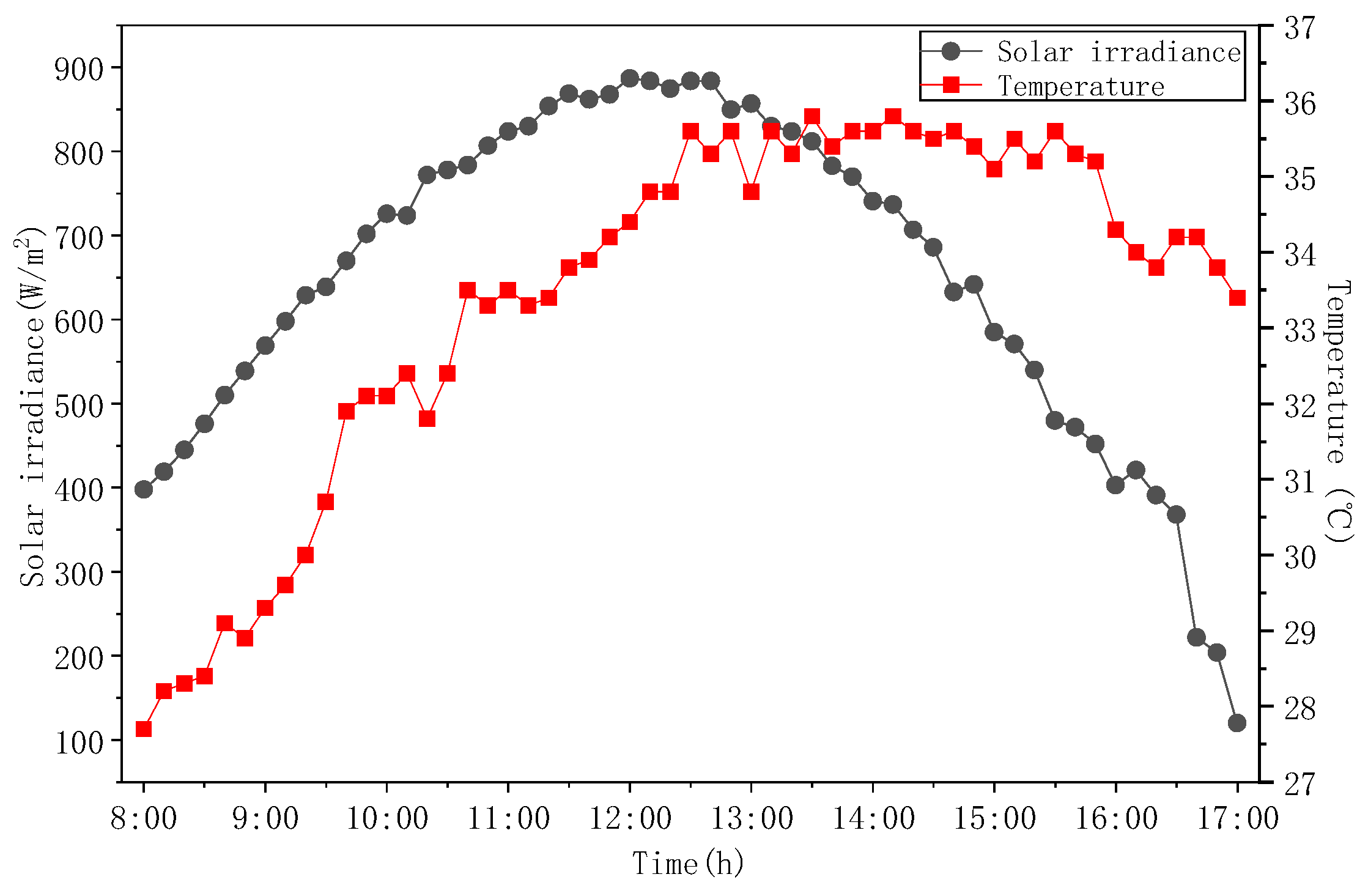
To evaluate the power generation performance of a small long-endurance unmanned surface vehicle (USV) under different tilt angles of the photovoltaic (PV) array, a full-day power generation calculation was performed for a selected daytime. The calculation date is set to 16 May 2023, with the operating period from 08:00 to 17:00 local time and a time resolution of 10 min. The direct horizontal irradiance and ambient temperature are input at 10 min intervals. As shown in
Figure 5, the irradiance reaches its peak around noon, exhibiting a single-peak symmetric distribution. The maximum noon irradiance is 887 W/m
2. The ambient temperature on that day is relatively high, with a minimum of approximately 27.7 °C in the morning and remaining around 35.5 °C in the afternoon.
3.2. Operational Characteristics of the Independent Power Supply Configuration on Both Sides
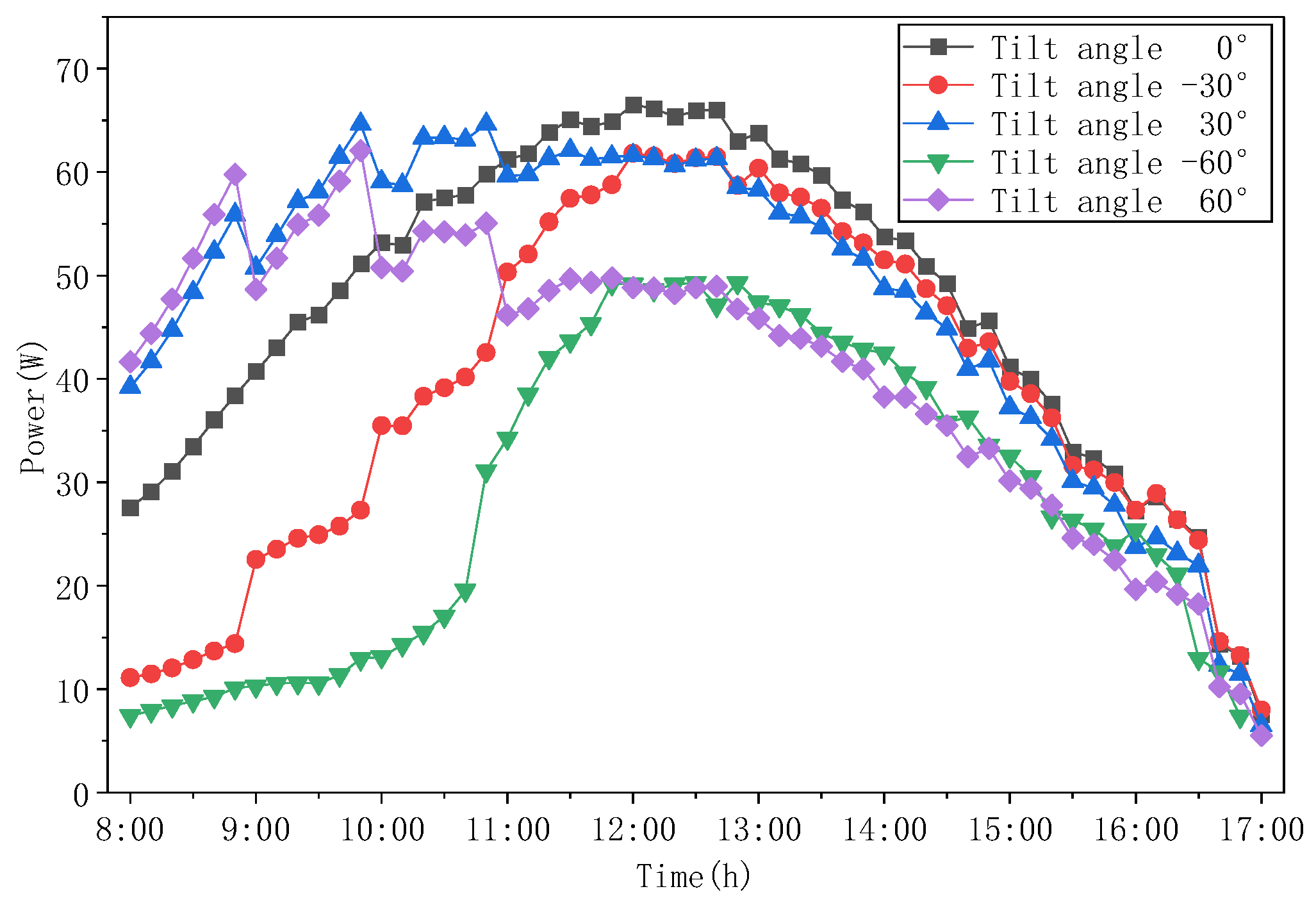
Assuming the USV heading is toward the south (heading angle of 0°), the operational characteristics of the independent power supply configuration on both sides are analyzed. First, the variation in the maximum power output of the two independent PV arrays over time is examined under tilt angles of ±30°, ±60°, and 0° (horizontal layout). The results are shown in
Figure 6.
It can be seen that when the tilt angle is greater than 0°, the maximum power outputs of the two symmetrically distributed PV arrays at the same time are completely different. Near noon, when the solar altitude angle is at its maximum, the maximum power outputs of the two arrays are relatively close. However, at times away from noon, the difference in maximum power output between the left and right arrays becomes large, and the difference increases as morning approaches. Specifically, for the two arrays with tilt angles of ±60°, the maximum difference in maximum power output in the morning reaches 50.71 W; for the ±30° arrays, the maximum difference is approximately 41.44 W. In the afternoon, the difference in maximum power output between the left and right arrays is relatively smaller: for the ±60° arrays, the maximum difference is about 5.01 W; for the ±30° arrays, the maximum difference is about 4.26 W.
This trend is mainly attributed to variations in solar altitude angle. For horizontally placed PV panels (0° tilt), the low solar altitude in the early morning results in a smaller effective receiving area and lower power output compared with panels tilted at 30° and 60°. At noon, the solar altitude peaks. Under the late spring and early summer conditions in this study, the sun is nearly overhead, so horizontal PV panels face directly toward sunlight and produce maximum power. For panels with equal positive and negative tilt angles: east sunlight in the morning allows positively tilted panels to capture more direct radiation and generate far more power. As the sun moves southward, the output difference between the two panels gradually diminishes and nearly disappears at noon. In the afternoon with west sunlight, negatively tilted panels deliver slightly higher power. Since overall solar irradiance drops after noon, this gap is smaller than that observed in the morning.
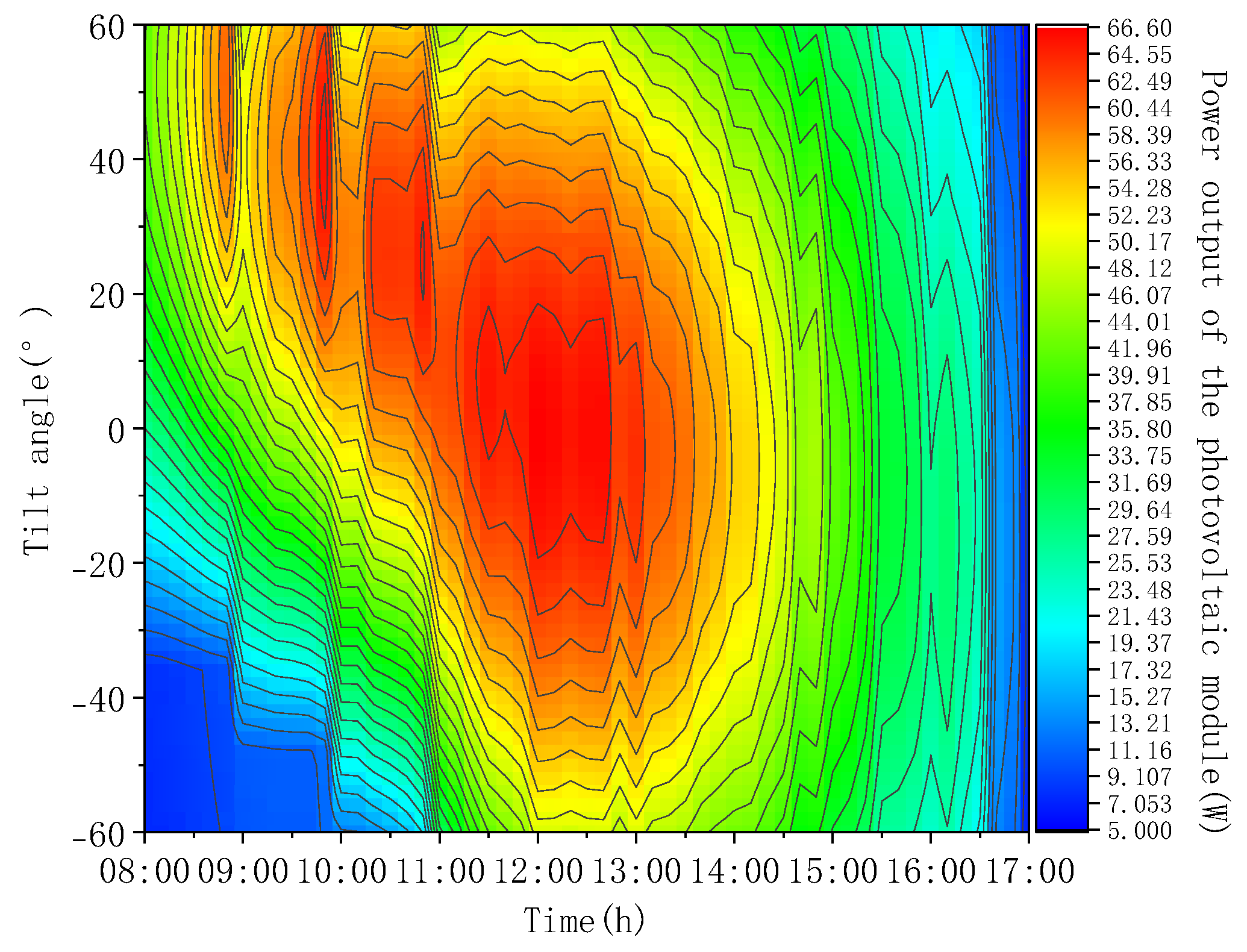
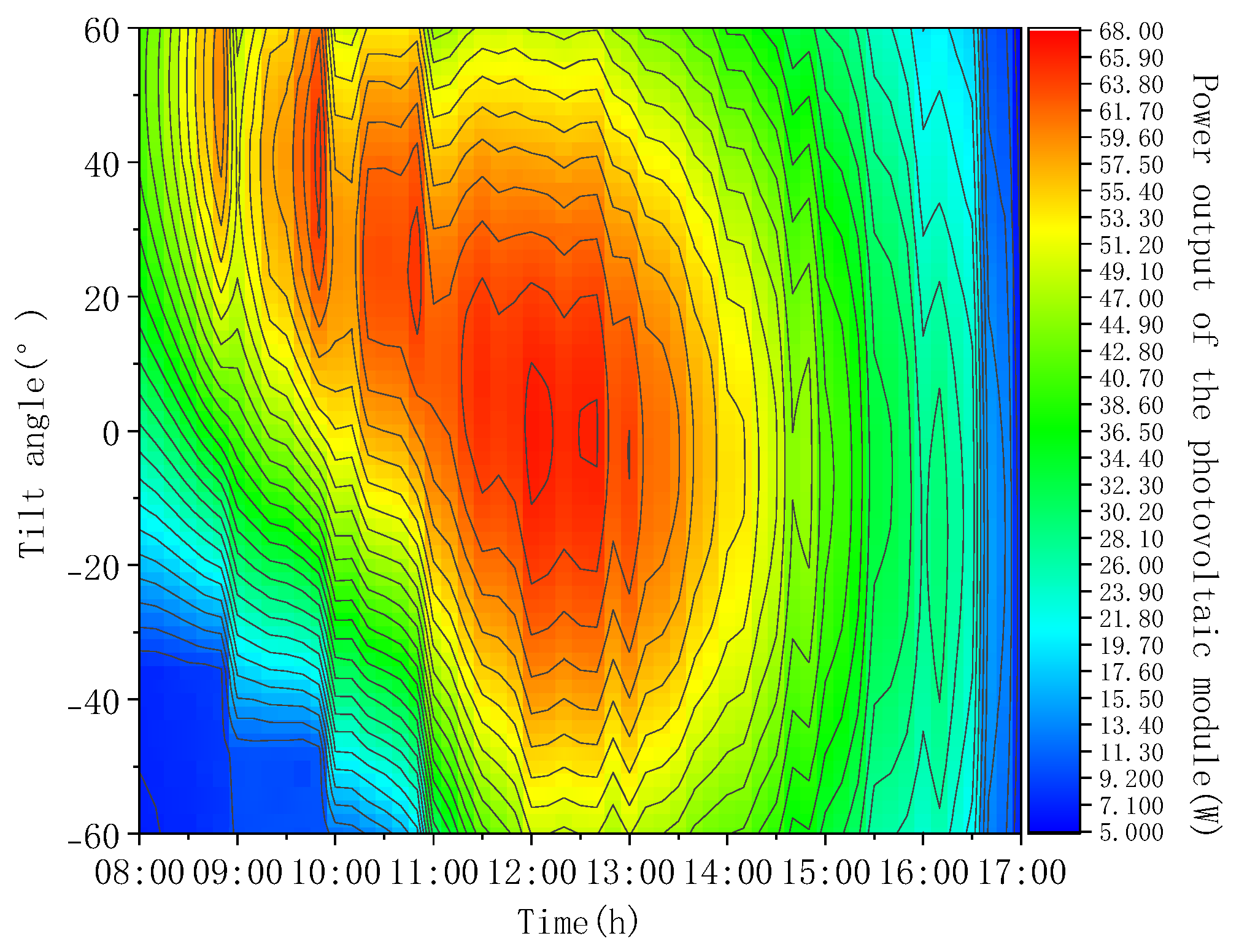
The power generation characteristics of PV modules at other tilt angles between ±60° are further investigated. The relationship between the maximum power point, tilt angle, and time is shown in
Figure 7.
The effect of tilt angle on the power generation efficiency of PV panels mainly depends on the deviation of the panel normal from the direction of incident sunlight. For different fixed tilt angles, the time at which the maximum power point occurs varies. At certain times, the maximum power output of the PV module increases with increasing tilt angle. For a tilt angle of 30°, the maximum power output occurs at 10:50, and the inflection point of the power decay curve appears at 12:40. For a tilt angle of 60°, the maximum power point occurs at 9:50, and the inflection point appears at 11:30. For a tilt angle of 0°, the maximum power point occurs at 12:00, and the power variation is symmetric around the maximum power point.
The influence of time on the amplitude of power fluctuation is positively correlated with the incident radiation intensity. For a tilt angle of 0°, the peak power is highest around noon (12:00) due to the high total radiation, but the instantaneous fluctuation amplitude is also most significant, and the power is most sensitive to the tilt angle. In the morning and evening, when the total radiation is low, the absolute change in power is small. Taking tilt angles of 30° and 60° as examples, the power fluctuation amplitudes at these two tilt angles follow the same rule: the fluctuation amplitude is largest around noon and decreases significantly in the morning and evening, increasing with the incident radiation intensity.
Furthermore, the power outputs corresponding to positive and negative tilt angles are essentially symmetric. Taking 30° and 60° as examples, under symmetric positive and negative tilt angles, due to the east–west symmetry of the solar trajectory, the power outputs at positive and negative tilt angles are largely symmetric, and the times of the maximum power points are also symmetric around noon.
The cumulative energy yield over the full day (08:00–17:00) is calculated for different tilt angles, assuming symmetric superposition of positive and negative tilt angles. The results show that the cumulative energy yield is highest at a tilt angle of 0°. As the absolute tilt angle increases, the cumulative energy yield decreases approximately linearly. When the tilt angle reaches ±26°, the total energy yield decreases by about 6.08% compared with the horizontal case.
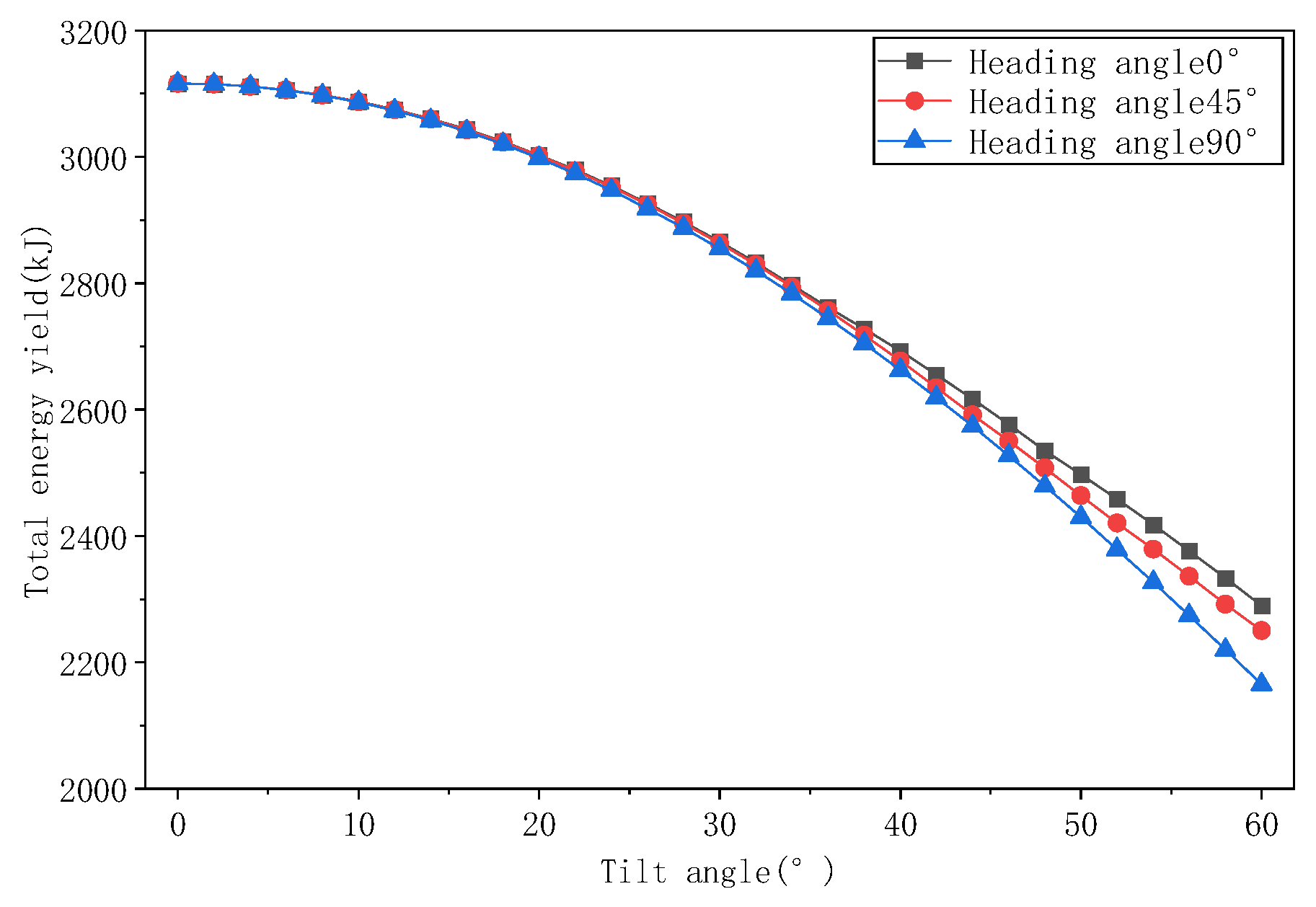
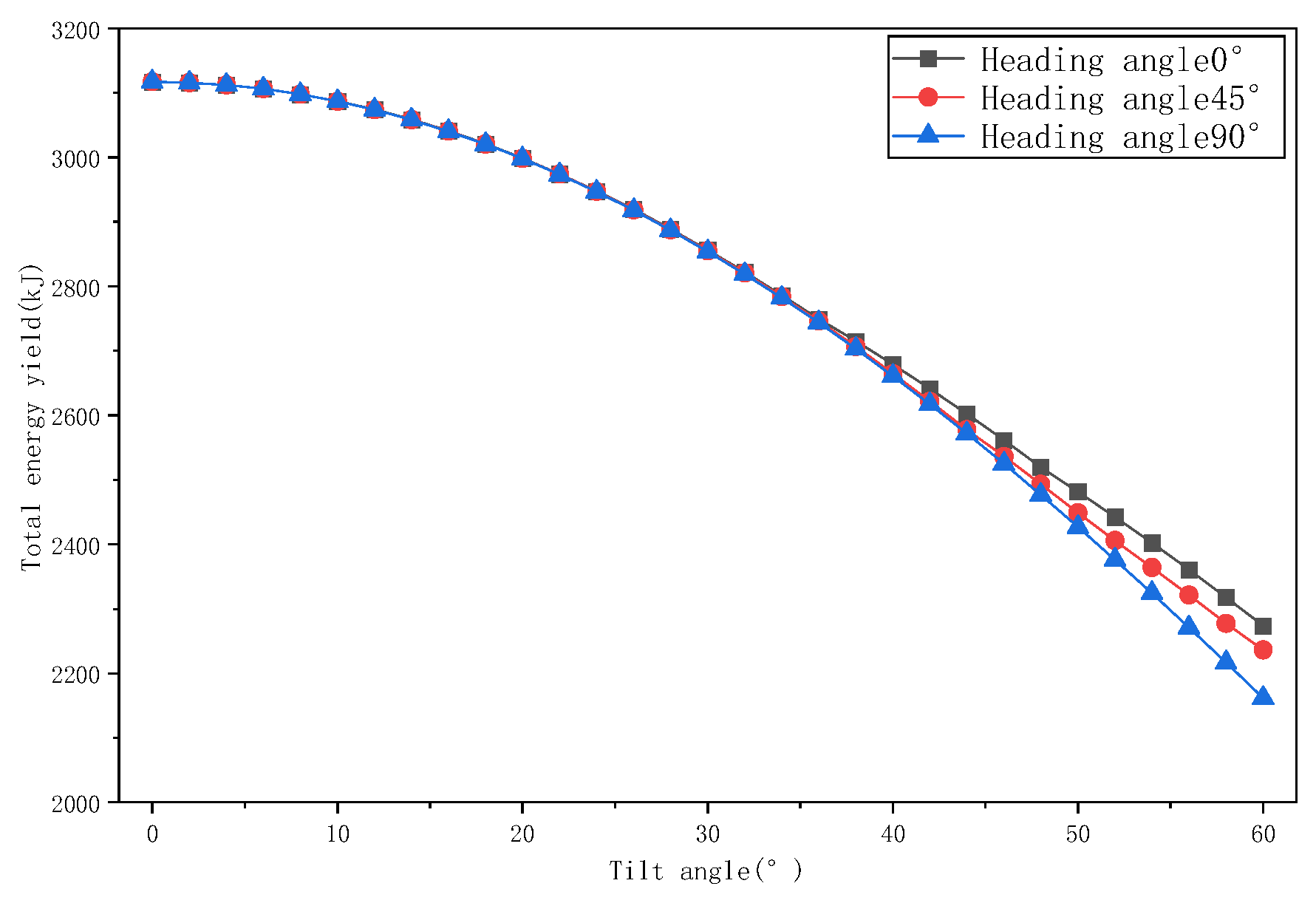
A comparison was made of the daily total energy yield of the PV modules under heading angles of 0°, 45°, and 90° as a function of the absolute tilt angle for the independent configuration (
Figure 8).
The heading angle changes the incident angle of solar radiation on PV panels. Maximum radiant energy is obtained when solar rays strike the panel perpendicularly. The results show that the highest total energy yield occurs at a heading angle of 0° (facing south), and the decrease with increasing tilt angle is the most gradual. When the tilt angle exceeds 24°, the energy yield is approximately 95% of that of the horizontal configuration; when the tilt angle exceeds 34°, the energy yield decreases to 90% of the horizontal level. At a heading angle of 45°, the total energy yield is reduced by 0.44%; at a heading angle of 90° (facing west), the total energy yield is the lowest, with a reduction of 1.06%.
When the tilt angle is small, the heading angle has little influence on the energy yield of the heterogeneous PV system. As the tilt angle increases, the influence of the heading angle becomes more pronounced. At a tilt angle of 30°, the energy yields of the PV modules at heading angles of 0°, 45°, and 90° are 2866 kJ, 2863 kJ, and 2855 kJ, respectively, corresponding to reductions of 8.04%, 8.12%, and 8.40% compared with the horizontal configuration. At a tilt angle of 60°, the energy yields at heading angles of 0°, 45°, and 90° are 2289 kJ, 2250 kJ, and 2165 kJ, respectively, representing reductions of 26.54%, 27.79%, and 30.53%. For the investigated scenarios, the PV panels perform best at a heading angle of 0°. While discrepancies may exist in results across seasons and locations, variations in heading angle exert little influence on the energy output of the USV.
3.3. Operational Characteristics of the Parallel Supply Configuration
The calculations above are based on a topology where a single group (four PV modules in series) directly supplies power to the battery. To further optimize the system output, two configurations are considered in which the two PV arrays (each consisting of four modules in series) are connected in parallel to supply a common battery bank. Assuming a USV heading angle of 0°, the operational characteristics of the parallel supply configuration are analyzed. The calculated maximum power outputs of the PV modules at different tilt angles and times are presented in
Figure 9.
When the tilt angle of the PV modules is 30°, the maximum power occurs at 10:50, and the inflection point of the power curve is at 12:40. When the tilt angle is 60°, the maximum power point appears at 9:50, with an inflection point at 11:30. For a tilt angle of 0°, the maximum power point occurs at 12:00, and the power variation is symmetric about this time.
The operational characteristics of the parallel supply configuration are similar to those of the independent supply configuration. The daily cumulative energy yield over the period from 08:00 to 17:00 was calculated for different tilt angles, assuming symmetric superposition of positive and negative tilt angles. The results show that the maximum cumulative energy yield occurs at a tilt angle of 0°. As the absolute tilt angle increases, the cumulative energy yield decreases approximately linearly. When the tilt angle reaches ±26°, the total energy yield is reduced by approximately 6.35% compared with the horizontal case.
A comparison of the daily total energy yields of the PV modules under heading angles of 0°, 45°, and 90° as a function of the absolute tilt angle is shown in
Figure 10.
The results indicate that the highest daily total energy yield occurs at a heading angle of 0° (facing south), and the decrease with increasing tilt angle is the most gradual. When the tilt angle exceeds 24°, the energy yield is approximately 95% of that of the horizontal configuration; when the tilt angle exceeds 34°, the energy yield decreases to 90% of the horizontal level. At a heading angle of 45°, the daily total energy yield is reduced by 0.41%; at a heading angle of 90° (facing west), the daily total energy yield is the lowest, with a reduction of 0.79%.
When the tilt angle is small, the heading angle has little influence on the energy yield of the heterogeneous PV system. As the tilt angle increases, the influence of the heading angle becomes more pronounced. At a tilt angle of 30°, the daily total energy yields at heading angles of 0°, 45°, and 90° are 2856 kJ, 2855 kJ, and 2854 kJ, respectively, corresponding to reductions of 8.34%, 8.41%, and 8.44% compared with the horizontal configuration. At a tilt angle of 60°, the daily total energy yields at heading angles of 0°, 45°, and 90° are 2274 kJ, 2236 kJ, and 2162 kJ, respectively, representing reductions of 27.05%, 28.27%, and 30.65%.
3.4. Comparison of Different Electrical Connection Schemes
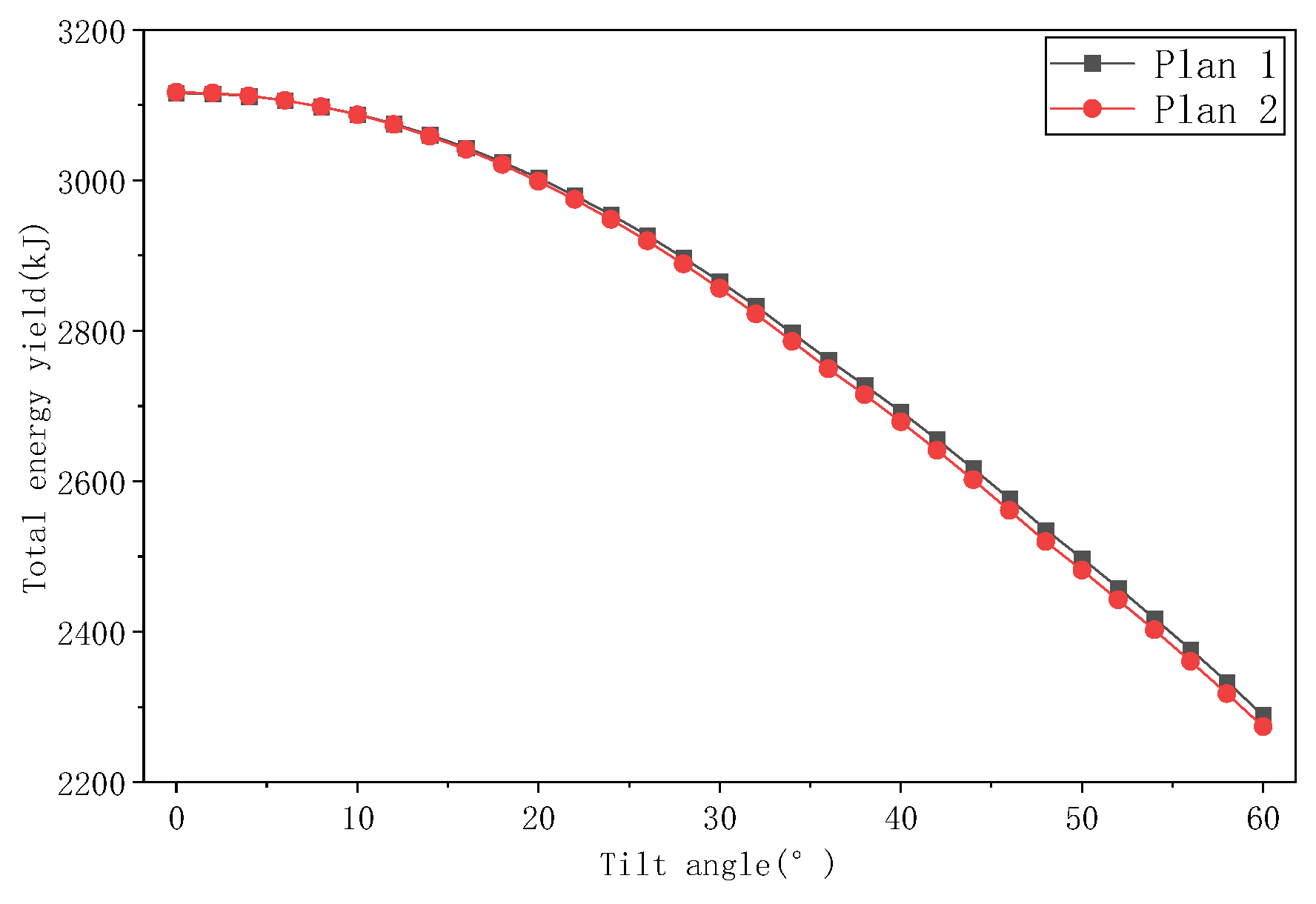
For a small USV PV system with two symmetrically arranged PV modules facing different orientations, two charging configurations are considered. The operational characteristics of the two charging configurations are examined, and the calculated daily total energy yields of both configurations are presented in
Figure 11.
The comparative analysis shows that the power generation characteristics of the two configurations are basically similar. The times at which the maximum power occurs and the trends of the power curves under different tilt angles and times are consistent for both configurations. Regarding the influence of heading angle, the highest daily total energy yield occurs at a heading angle of 0° (facing south) for both configurations, while the lowest occurs at 90° (facing west). However, the parallel configuration exhibits slightly smaller reductions in energy yield at heading angles of 45° and 90° than the independent configuration. Concerning the effect of tilt angle, the energy yield of both configurations decreases approximately linearly with increasing tilt angle, with the parallel configuration yielding slightly lower absolute energy generation than the independent configuration at larger tilt angles. Furthermore, there is a clear coupling effect between heading angle and tilt angle: when the tilt angle is small, the heading angle has no significant effect on the energy yield; as the tilt angle increases, the influence of the heading angle becomes markedly stronger. Overall, the parallel configuration has the advantages of slightly lower energy loss under non-south headings and a more simplified system structure (shared battery bank), although its absolute energy yield is slightly lower than that of the independent configuration under most operating conditions.
4. Conclusions
This study investigated the electrical connection configurations of symmetrically arranged photovoltaic modules on small long-endurance unmanned surface vehicles. Based on an analysis of two topologies—independent power supply from each side and parallel power supply of both sides—the differences in power generation performance were compared under various tilt angles and heading angles. The main findings are as follows.
The simulation results demonstrate that the heterogeneous photovoltaic system composed of two symmetrically distributed arrays exhibits power generation characteristics significantly different from those of a horizontally arranged USV photovoltaic system. As solar altitude and azimuth vary, the maximum power outputs of the two arrays alternate, and the power variation in both arrays is symmetric about noon. The total energy yield of the heterogeneous system is lower than that of the horizontal configuration and decreases approximately linearly with increasing tilt angle: at a tilt angle of 24°, the energy yield is approximately 95% of that of the horizontal layout; at 34°, it decreases to 90%.
The heading angle of the small USV has a relatively minor influence on the total energy yield of the symmetrically distributed heterogeneous photovoltaic system. In the analyzed spring case (117.110° E, 19.136° N), the highest total energy yield occurs at a heading angle of 0° (facing south), while the lowest occurs at 90° (facing west). Compared with a heading angle of 0°, the total energy yields at 45° and 90° are reduced by only 0.44% and 1.06%, respectively, for the independent power supply configuration. Nevertheless, a significant coupling effect exists between heading angle and tilt angle. Taking a tilt angle of 60° as an example, as the heading angle increases from 0° to 90°, the energy yield deficit increases from 26.54% to 30.53% for the independent configuration and from 27.05% to 30.65% for the parallel configuration.
The parallel configuration yields slightly lower absolute energy generation than the independent configuration at larger tilt angles but offers a more simplified system structure. Moreover, the parallel configuration exhibits slightly smaller reductions in energy yield at non-south heading angles, demonstrating marginally better energy retention under such conditions. These findings provide a theoretical basis for the design and optimization of heterogeneous photovoltaic systems on small long-endurance USVs.
From a practical standpoint, for a small USV with a trapezoidal deck, a tilt angle ≤ 24° is recommended to keep >95% of the horizontal yield. The parallel configuration is preferable because of its simplicity and slightly better energy retention at non-south headings, even though it loses a small amount of absolute yield at large tilt angles. Two key limitations exist. First, the simulation assumed ideal MPPT, neglecting actual control circuits that may impact real-world power output. Second, we focused solely on energy harvesting, omitting evaluation of the trapezoidal deck’s structural stability under large waves. Future work should address both aspects to further validate and extend our findings.