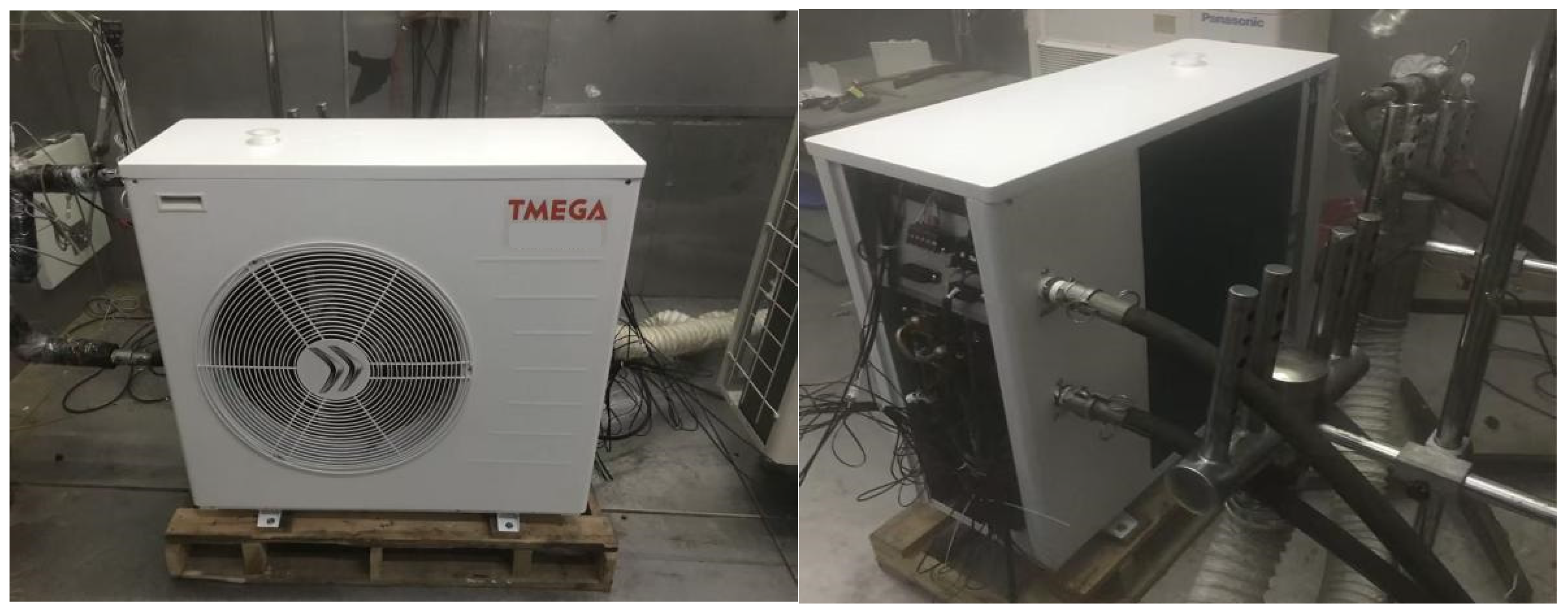
Figure 1.
External view of the experimental prototype.
Figure 1.
External view of the experimental prototype.
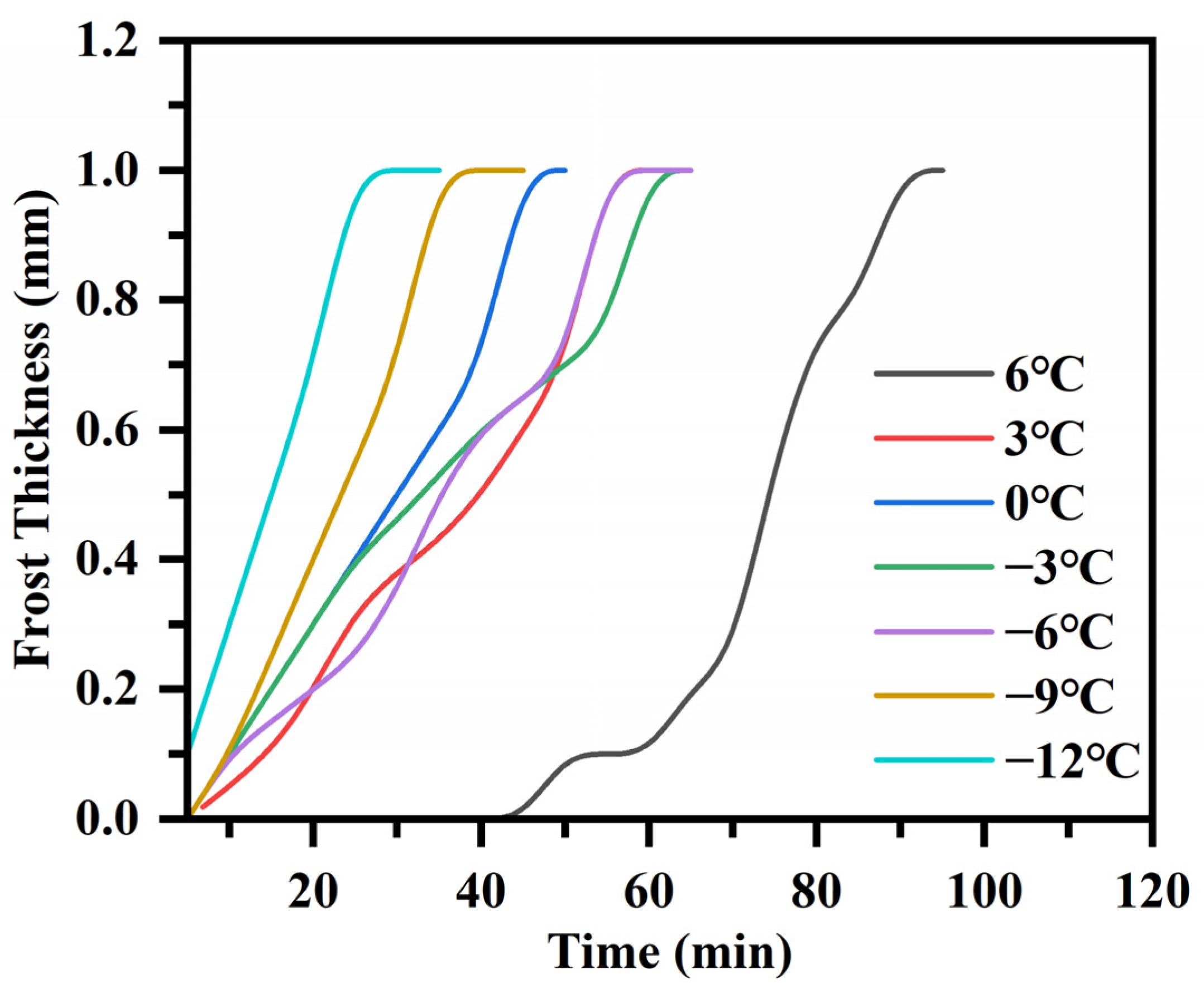
Figure 2.
Changes in frost thickness with operating time under different ambient temperatures. The compressor frequency was 76 Hz, and the relative humidity was 85%.
Figure 2.
Changes in frost thickness with operating time under different ambient temperatures. The compressor frequency was 76 Hz, and the relative humidity was 85%.
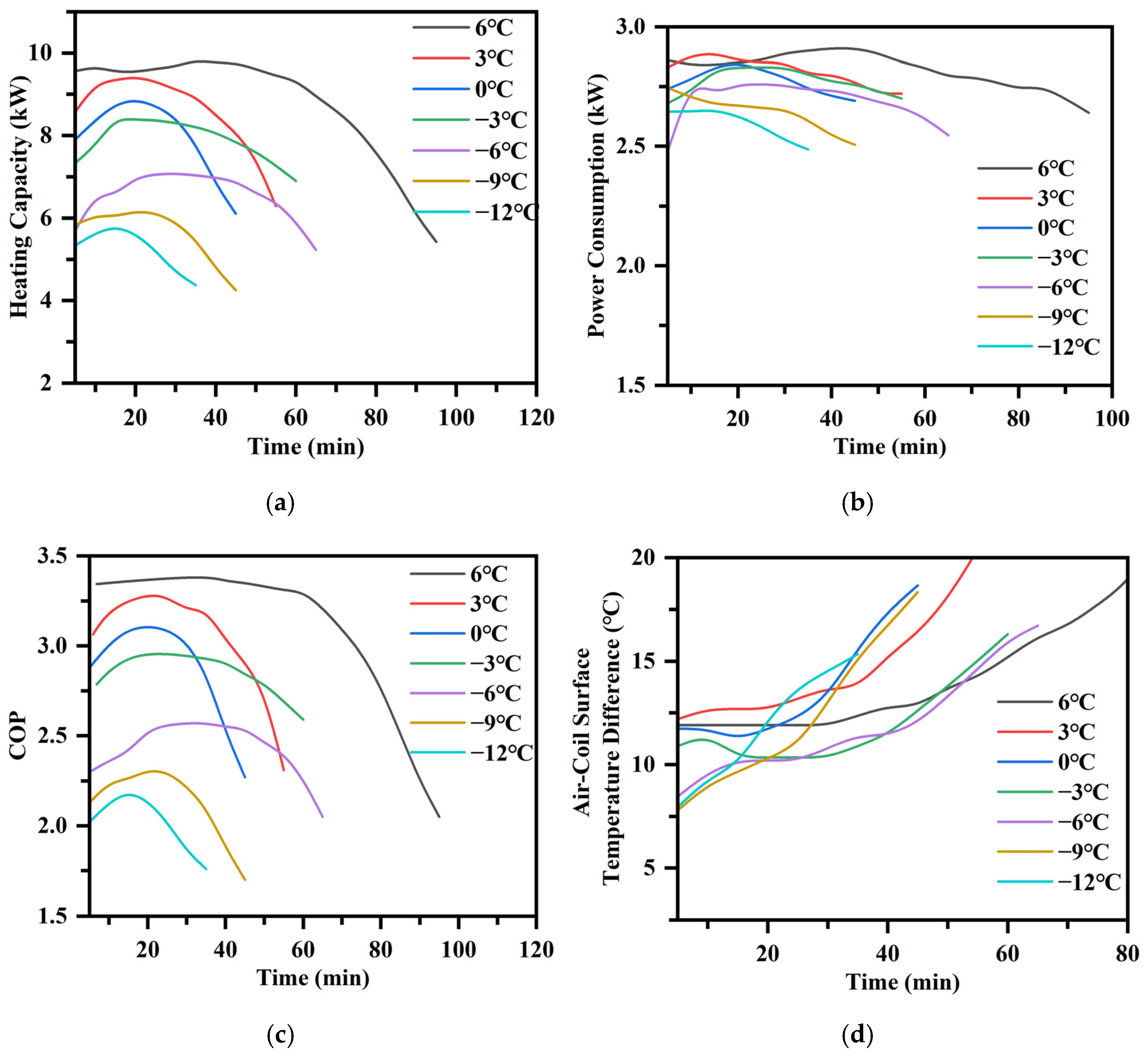
Figure 3.
Changes in (a) unit heating capacity, (b) unit power consumption, (c) COP, and (d) temperature difference between air and coil surface over operating time at different ambient temperatures (6 °C, 3 °C, 0 °C, −3 °C, −6 °C, −9 °C, and −12 °C). The compressor frequency was 76 Hz, and the relative humidity was 85%.
Figure 3.
Changes in (a) unit heating capacity, (b) unit power consumption, (c) COP, and (d) temperature difference between air and coil surface over operating time at different ambient temperatures (6 °C, 3 °C, 0 °C, −3 °C, −6 °C, −9 °C, and −12 °C). The compressor frequency was 76 Hz, and the relative humidity was 85%.
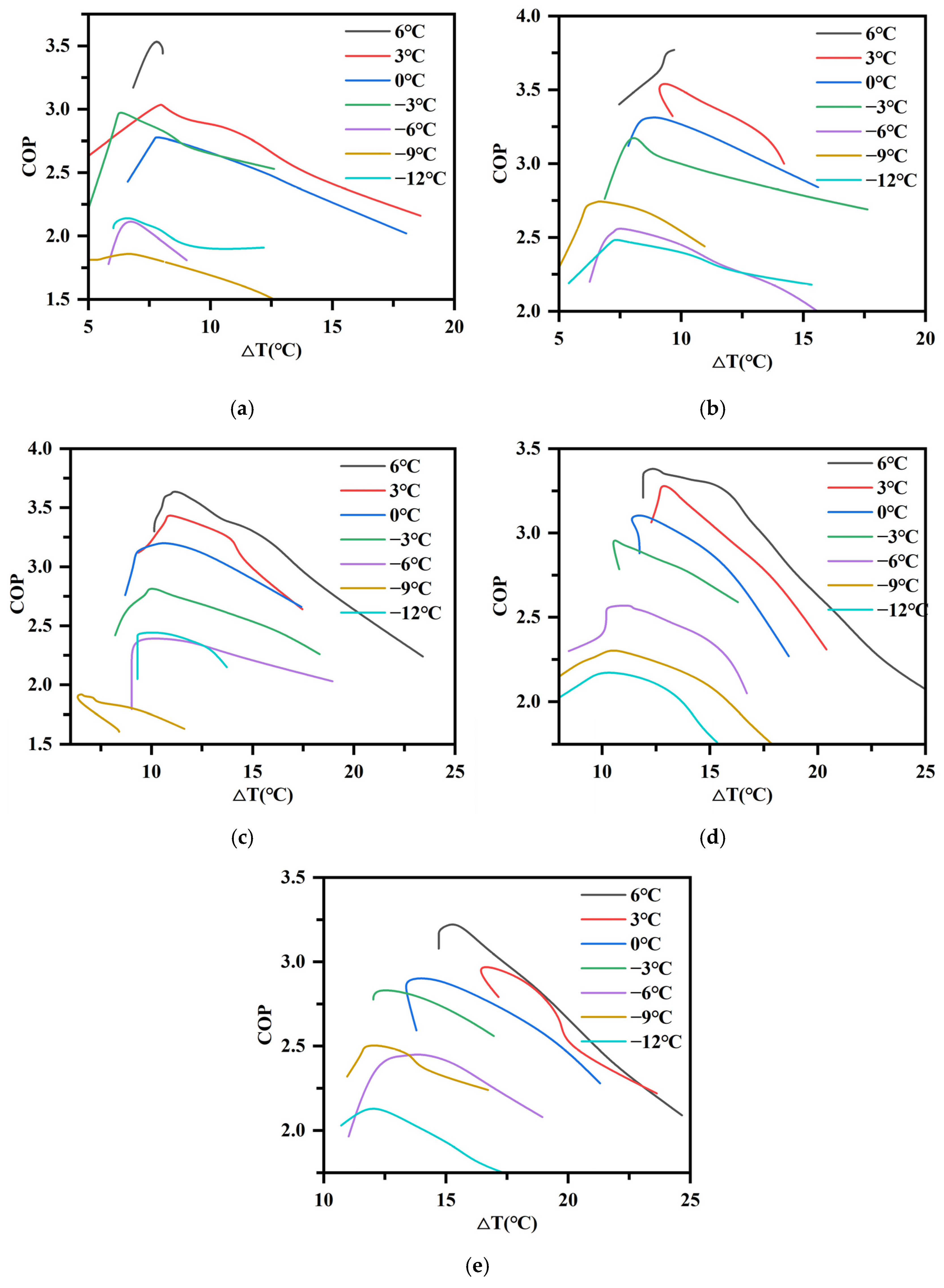
Figure 4.
Changes in COP of the unit with air-to-coil temperature difference (ΔT, temperature difference between the ambient temperature (Ta) and the coil surface temperature (TF) converted from the evaporator outlet pressure) at different ambient temperatures (6 °C, 3 °C, 0 °C, −3 °C, −6 °C, −9 °C, and −12 °C) at a fixed frequency: (a) 30 Hz, (b) 45 Hz, (c) 60 Hz, (d) 76 Hz, (e) 90 Hz.
Figure 4.
Changes in COP of the unit with air-to-coil temperature difference (ΔT, temperature difference between the ambient temperature (Ta) and the coil surface temperature (TF) converted from the evaporator outlet pressure) at different ambient temperatures (6 °C, 3 °C, 0 °C, −3 °C, −6 °C, −9 °C, and −12 °C) at a fixed frequency: (a) 30 Hz, (b) 45 Hz, (c) 60 Hz, (d) 76 Hz, (e) 90 Hz.
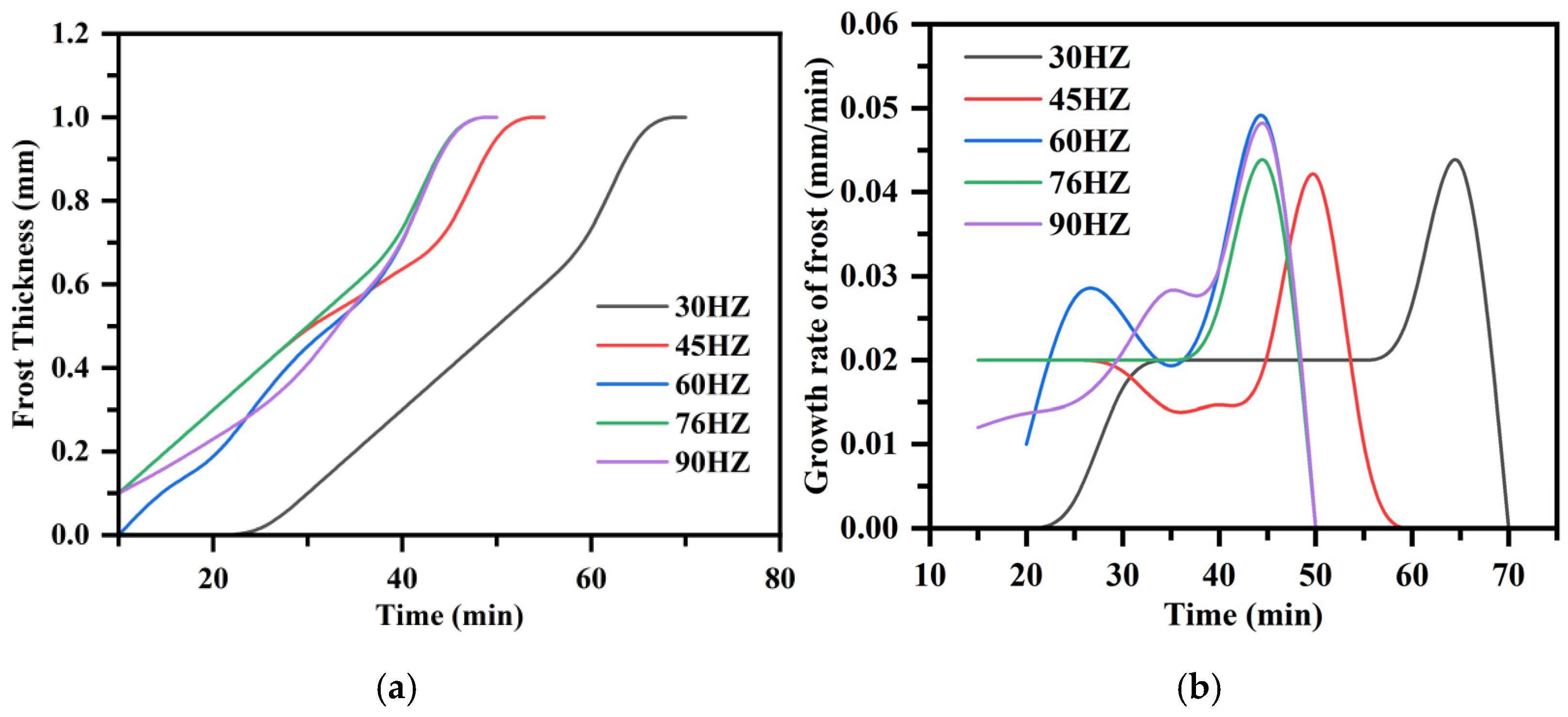
Figure 5.
(a) Changes in frost thickness with running time at different compressor frequencies with an ambient temperature of 0 °C and a relative humidity of 85%. (b) The frost growth rate (mm/min) over time at an ambient temperature of 0 °C under five compressor frequencies (30, 45, 60, 76, and 90 Hz).
Figure 5.
(a) Changes in frost thickness with running time at different compressor frequencies with an ambient temperature of 0 °C and a relative humidity of 85%. (b) The frost growth rate (mm/min) over time at an ambient temperature of 0 °C under five compressor frequencies (30, 45, 60, 76, and 90 Hz).
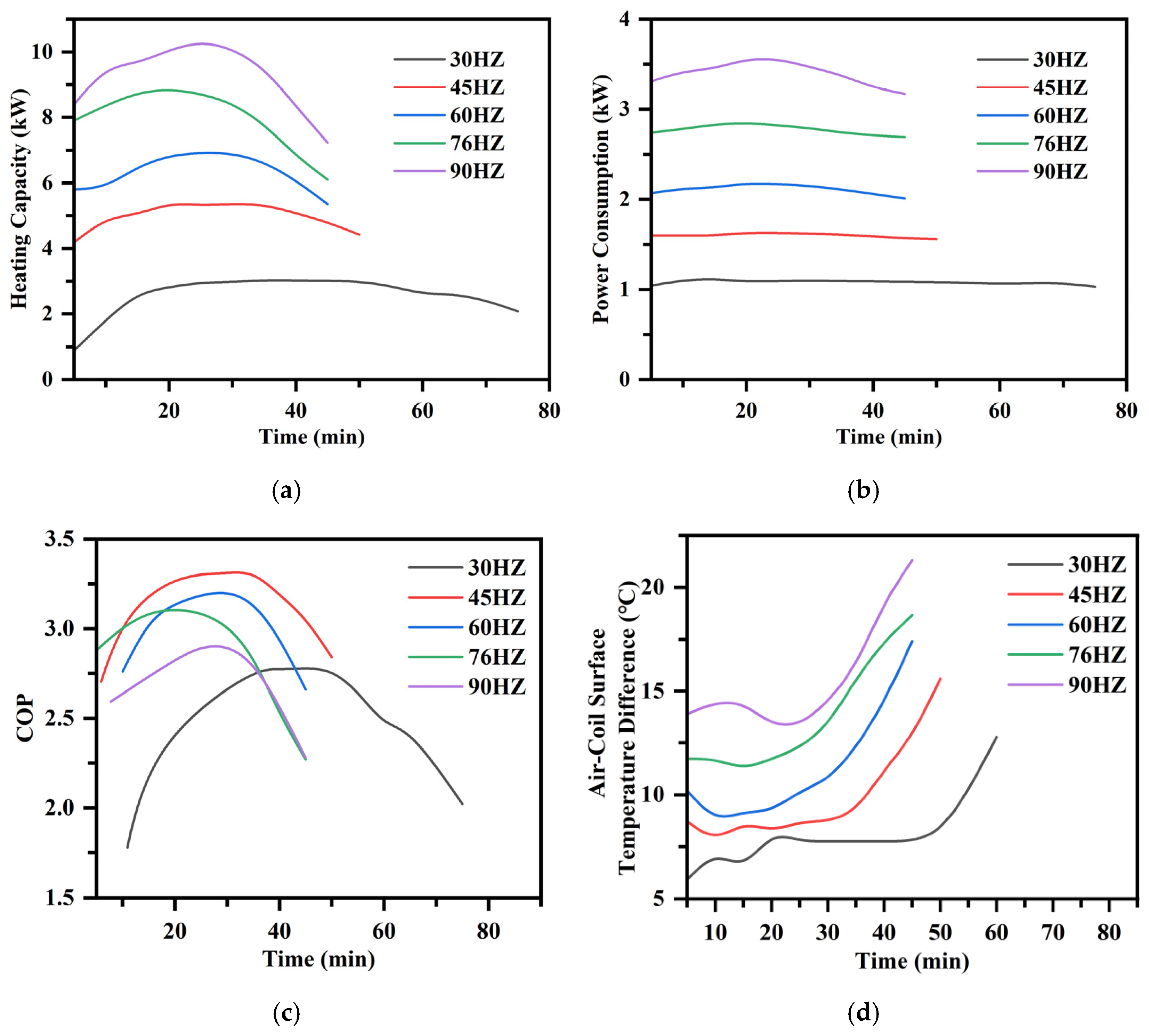
Figure 6.
Changes in (a) unit heating capacity, (b) unit power consumption, (c) COP, and (d) air-coil surface temperature difference over operating time at different compressor frequencies with an ambient temperature of 0 °C and a relative humidity of 85%.
Figure 6.
Changes in (a) unit heating capacity, (b) unit power consumption, (c) COP, and (d) air-coil surface temperature difference over operating time at different compressor frequencies with an ambient temperature of 0 °C and a relative humidity of 85%.
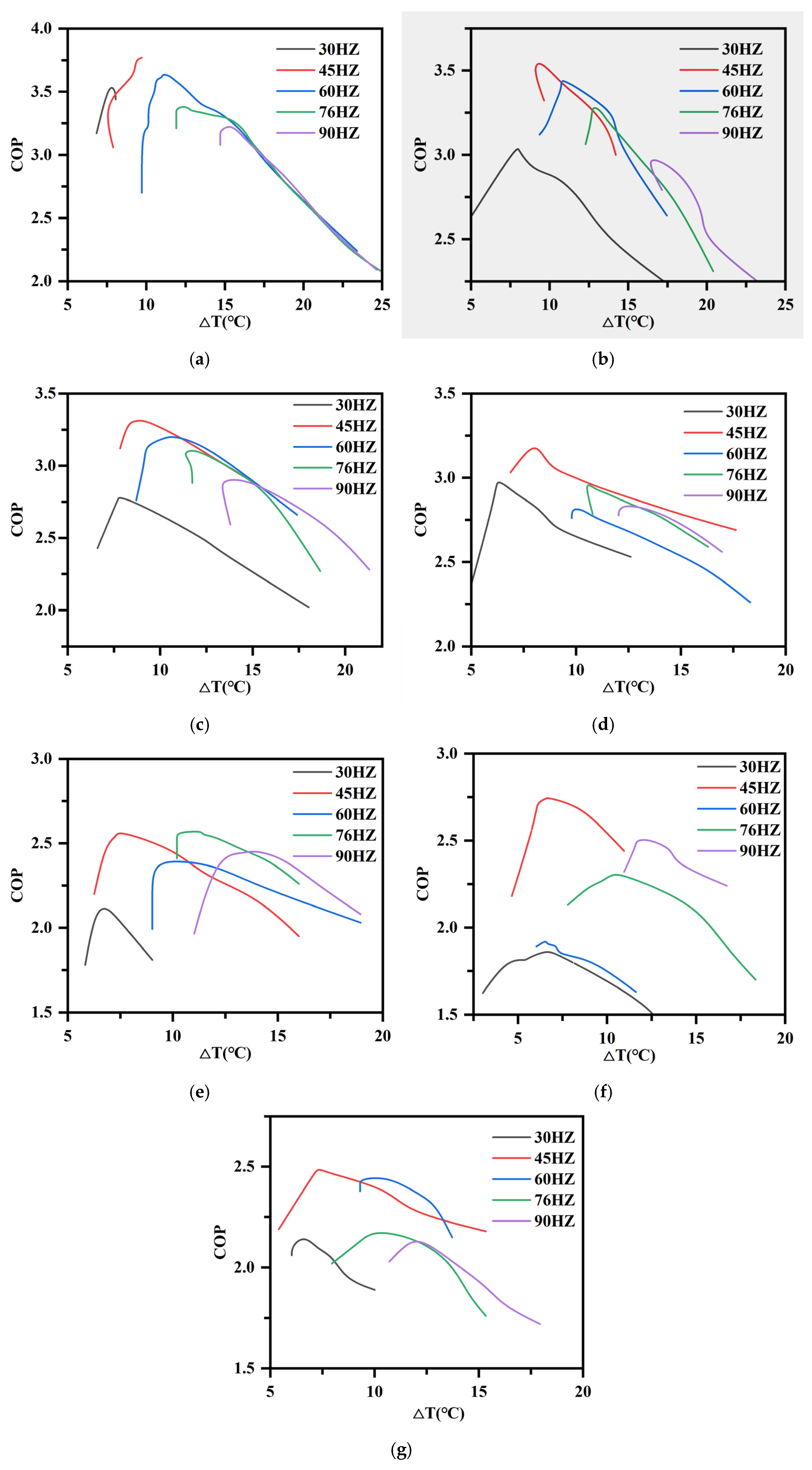
Figure 7.
Changes in COP of the unit with air-to-coil temperature difference at different frequencies at a fixed temperature: (a) 6 °C, (b) 3 °C, (c) 0 °C, (d) −3 °C, (e) −6 °C, (f) −9 °C and (g) −12 °C.
Figure 7.
Changes in COP of the unit with air-to-coil temperature difference at different frequencies at a fixed temperature: (a) 6 °C, (b) 3 °C, (c) 0 °C, (d) −3 °C, (e) −6 °C, (f) −9 °C and (g) −12 °C.
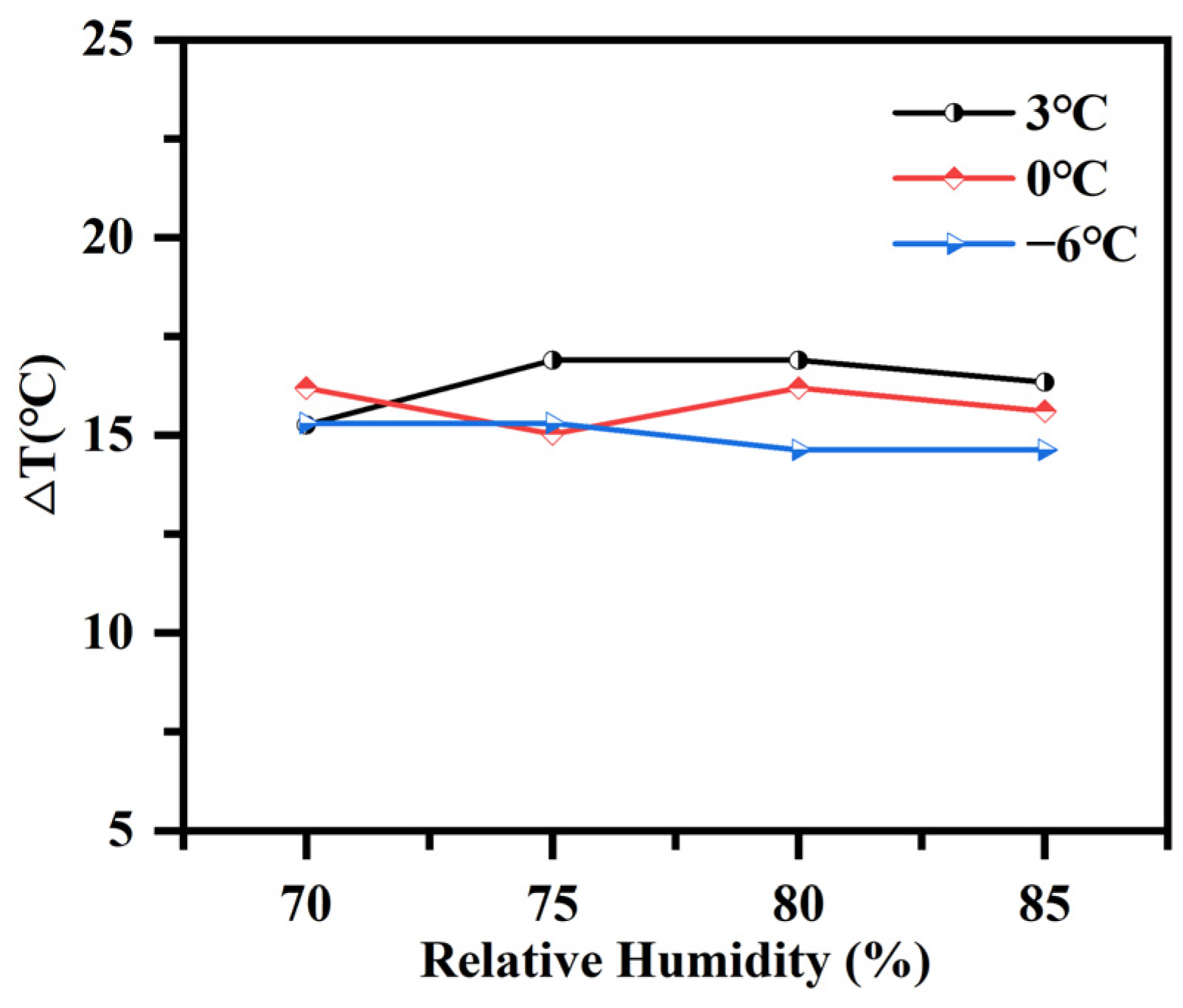
Figure 8.
Air-to-coil temperature difference with relative humidity at a fixed frequency (76 Hz) and different ambient temperatures (3 °C, 0 °C, −6 °C) when the unit’s COP is 10% lower than the initial COP.
Figure 8.
Air-to-coil temperature difference with relative humidity at a fixed frequency (76 Hz) and different ambient temperatures (3 °C, 0 °C, −6 °C) when the unit’s COP is 10% lower than the initial COP.
Figure 9.
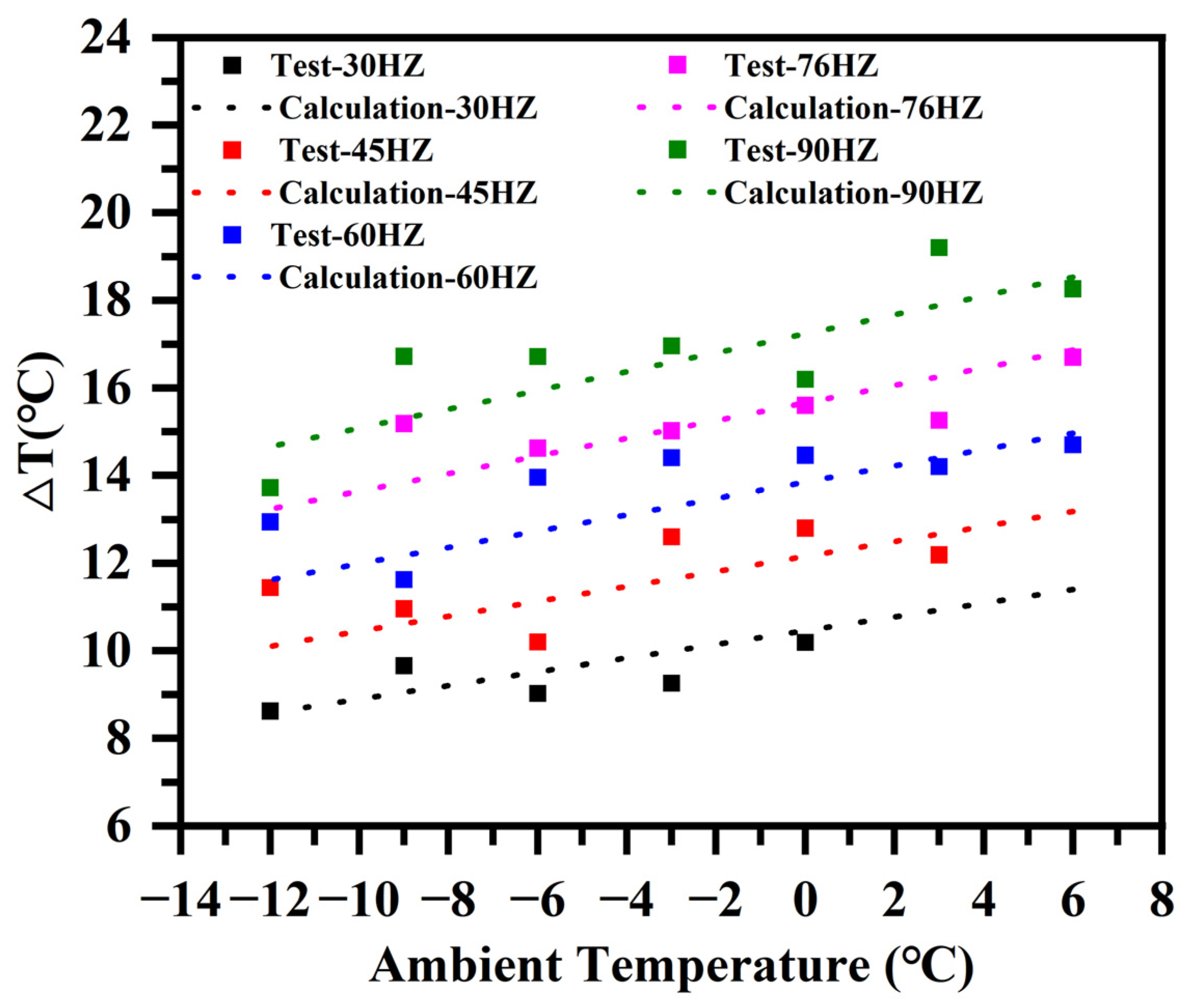
Comparison of measured and calculated values of air-to-coil temperature difference when the unit 10% COP reduction at different frequencies and ambient temperatures (6 °C, 3 °C, 0 °C, −3 °C, −6 °C, −9 °C, and −12 °C).
Figure 9.
Comparison of measured and calculated values of air-to-coil temperature difference when the unit 10% COP reduction at different frequencies and ambient temperatures (6 °C, 3 °C, 0 °C, −3 °C, −6 °C, −9 °C, and −12 °C).
Figure 10.
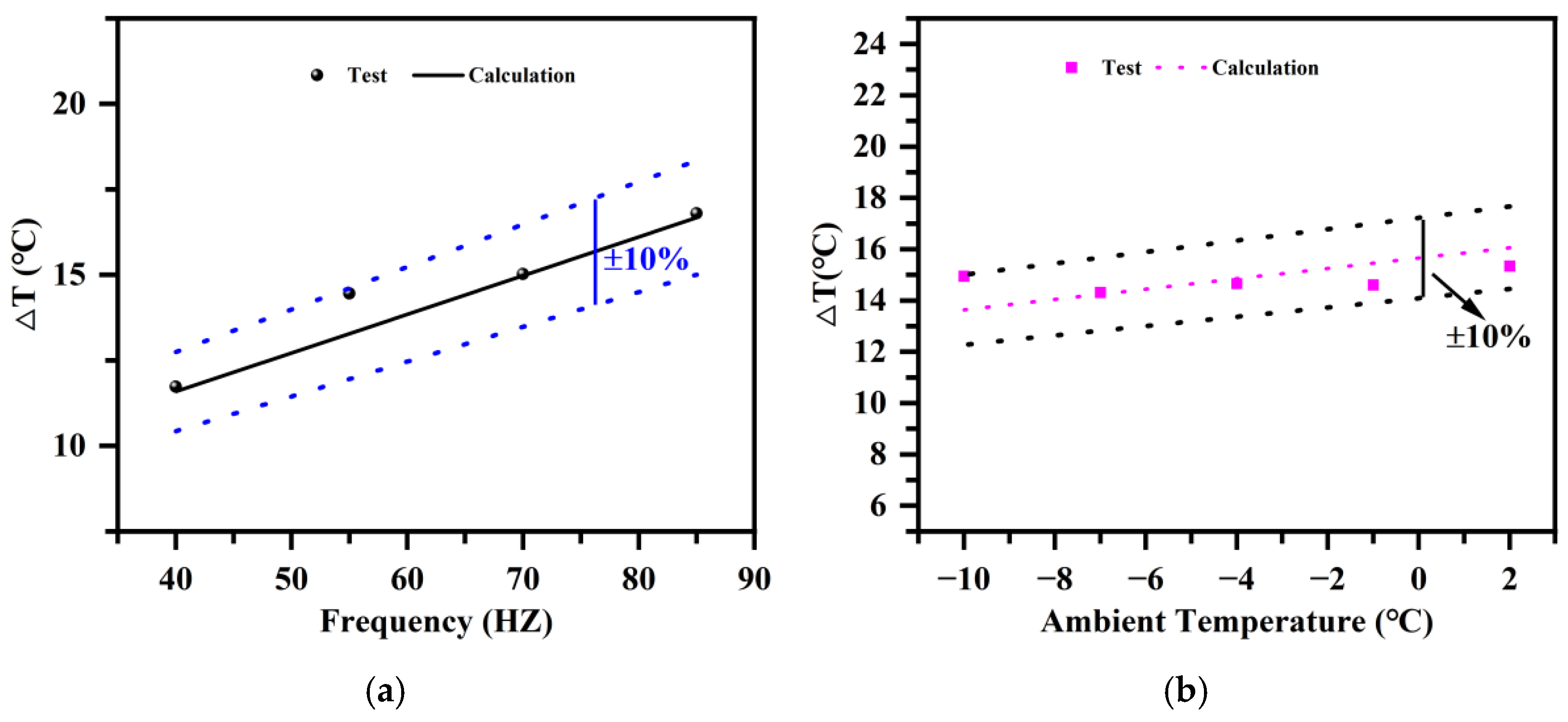
Comparison of measured and calculated values of air-to-coil temperature difference when the unit 10% COP reduction at a fixed ambient temperature of 0 °C (a) and at a fixed frequency of 76 Hz (b).
Figure 10.
Comparison of measured and calculated values of air-to-coil temperature difference when the unit 10% COP reduction at a fixed ambient temperature of 0 °C (a) and at a fixed frequency of 76 Hz (b).
Table 1.
Parameter of air source heat pump unit.
Table 1.
Parameter of air source heat pump unit.
| Parameter | Numerical Values |
|---|
| Unit power supply specifications | 220 V/50 Hz |
| Rated heating capacity (outdoor −12°C, outlet water 55°C) | 6.1 kW |
| Rated heating input power (outdoor −12°C, outlet water 55°C) | 2.52 kW |
| Rated heating current (outdoor −12°C, outlet water 55°C) | 11.45 A |
| Rated outlet water temperature | 41 °C |
| Maximum water temperature | 60 °C |
| Scope of work | −35~45 °C |
| Protection level | IP × 4 |
| Unit noise | ≤62 dB |
| Differential pressure between inlet and outlet water of the unit | 30 kPa |
| Rated circulating water volume | 1.09 m3/h |
| External dimensions | 900 × 365 × 865 mm |
| Main unit control size | DN25 |
| Equipment weight | 110 kg |
Table 2.
Parameters of main data acquisition equipment.
Table 2.
Parameters of main data acquisition equipment.
| Equipment | Model/Type | Measurement Parameters | Accuracy/Range | Sampling Interval |
|---|
| Platinum resistance thermometer | Pt-100 | air temperature and humidity | ±0.1 °C | real time |
| Differential pressure transmitter | — | wind static pressure | 0–300 Pa | real time |
| Turbine flow meter | — | Water flow | 0–3 m3/h, ±0.5% FS | 6 s |
| thermocouple | K type | Coil temperature | −200~260 °C | 6 s |
| Electrical parameter instrument | — | Voltage, current, power | ±0.5% | real time |
| Data acquisition system | Industrial PC + Data Acquisition Card | Multi-channel synchronous acquisition | 16-bit resolution | |
Table 3.
Temperature condition.
Table 3.
Temperature condition.
| Experiment Number | Temperature (°C) | Other Variable Value |
|---|
| 1-1 | 6 | Frequency: All frequency operating conditions
Relative humidity: 85% |
| 1-2 | 3 |
| 1-3 | 0 |
| 1-4 | −3 |
| 1-5 | −6 |
| 1-6 | −9 |
| 1-7 | −12 |
Table 4.
Frequency operating condition.
Table 4.
Frequency operating condition.
| Experiment Number | Frequency Setting (Hz) | Other Variable Value |
|---|
| 2-1 | 30 | Temperature: All temperature conditions
Relative humidity: 85% |
| 2-2 | 45 |
| 2-3 | 60 |
| 2-4 | 76 |
| 2-5 | 90 |
Table 5.
Relative humidity operating condition.
Table 5.
Relative humidity operating condition.
| Experiment Number | Relative Humidity (%) | Other Variable Value |
|---|
| 3-1 | 70 | Temperature: 3 °C, 0 °C, −6 °C
Frequency: 76 Hz |
| 3-2 | 75 |
| 3-3 | 80 |
| 3-4 | 85 |
Table 6.
Time and temperature difference when 10% COP reduction for various frosting temperatures and frequencies.
Table 6.
Time and temperature difference when 10% COP reduction for various frosting temperatures and frequencies.
| Compressor Frequency f (Hz) | Ambient Temperature t (°C) | Time (min) Required for 10% COP Reduction | Air-to-Coil Temperature Difference (ΔT, °C) When 10% COP Reduction |
|---|
| 90 | 6 | 45 | 18.26 |
| 90 | 3 | 30 | 19.20 |
| 90 | 0 | 35 | 16.20 |
| 90 | −3 | 55 | 16.96 |
| 90 | −6 | 40 | 16.71 |
| 90 | −9 | 35 | 16.72 |
| 90 | −12 | 20 | 13.72 |
| 76 | 6 | 70 | 16.70 |
| 76 | 3 | 40 | 15.26 |
| 76 | 0 | 35 | 15.60 |
| 76 | −3 | 55 | 15.02 |
| 76 | −6 | 55 | 14.62 |
| 76 | −9 | 35 | 15.18 |
| 76 | −12 | 25 | 13.72 |
| 60 | 6 | 80 | 14.70 |
| 60 | 3 | 55 | 14.20 |
| 60 | 0 | 40 | 14.46 |
| 60 | −3 | 40 | 14.40 |
| 60 | −6 | 70 | 13.96 |
| 60 | −9 | 65 | 11.62 |
| 60 | −12 | 40 | 12.94 |
| 45 | 6 | 70 | -- |
| 45 | 3 | 60 | 12.19 |
| 45 | 0 | 45 | 12.80 |
| 45 | −3 | 60 | 12.60 |
| 45 | −6 | 60 | 10.20 |
| 45 | −9 | 60 | 10.96 |
| 45 | −12 | 45 | 11.44 |
| 30 | 6 | 30 | -- |
| 30 | 3 | 95 | 12.19 |
| 30 | 0 | 55 | 10.19 |
| 30 | −3 | 100 | 9.26 |
| 30 | −6 | 85 | 9.03 |
| 30 | −9 | 45 | 9.66 |
| 30 | −12 | 80 | 8.62 |
Table 7.
The air-to-coil temperature difference under variable frequency operating conditions with ambient temperature 0 ± 2 °C and relative humidity 85%, compared with model predictions.
Table 7.
The air-to-coil temperature difference under variable frequency operating conditions with ambient temperature 0 ± 2 °C and relative humidity 85%, compared with model predictions.
| Time | Ambient Temperature (°C) | Control Value ΔT (°C) | ΔT (Converted from Measured Pressure) (°C) | Difference from Control Value | Frost Layer Thickness (mm) | COP | COP Decline |
|---|
| 19:33 | −0.45 | 15.56 | 10.76 | −30.87% | | 2.52 | 14.58% |
| 19:38 | −0.14 | 15.63 | 10.56 | −32.45% | micro-hang | 2.68 | 9.15% |
| 19:43 | −1.25 | 15.40 | 11.01 | −28.52% | 0.1 | 2.66 | 9.83% |
| 19:48 | −1.88 | 15.28 | 10.92 | −28.54% | 0.2 | 2.62 | 11.19% |
| 19:53 | 1.32 | 15.92 | 11.51 | −27.72% | 0.3 | 2.85 | 3.39% |
| 19:58 | 1.89 | 16.04 | 12.08 | −24.68% | 0.4 | 2.95 | 0.00% |
| 20:03 | 0.39 | 15.73 | 12.65 | −19.60% | 0.5 | 2.85 | 3.39% |
| 20:08 | −0.03 | 15.65 | 12.77 | −18.42% | 0.6 | 2.7 | 8.47% |
| 20:13 | −0.22 | 15.61 | 14.24 | −8.80% | 0.7 | 2.62 | 11.19% |
| 20:18 | −0.35 | 15.58 | 15.85 | 1.68% | Full | 2.44 | 17.29% |
| 20:23 | 0.1 | 15.67 | 18.12 | 15.63% | | 2.33 | 21.02% |
| 20:28 | 0.01 | 13.85 | 13.90 | 0.40% | | 1.87 | 36.61% |
Table 8.
The air-to-coil temperature difference under variable frequency operating conditions with ambient temperature of −3 ± 2 °C and relative humidity of 85%, compared with model predictions.
Table 8.
The air-to-coil temperature difference under variable frequency operating conditions with ambient temperature of −3 ± 2 °C and relative humidity of 85%, compared with model predictions.
| Time | Frequency | Ambient Temperature (°C) | ΔT Calculation (°C) | ΔT (Pressure Conversion) (°C) | Difference from Control Value | Frost Layer Thickness (mm) | COP | COP Decline |
|---|
| 14:20 | 76 | −3.15 | 15.02 | 10.19 | −32.15% | 0.1 | 2.4 | 13.36% |
| 14:25 | 76 | −3.19 | 15.01 | 10.70 | −28.69% | 0.25 | 2.63 | 5.05% |
| 14:30 | 76 | −4.42 | 14.76 | 10.61 | −28.16% | 0.35 | 2.6 | 6.14% |
| 14:35 | 76 | −1.9 | 15.27 | 9.83 | −35.63% | 0.4 | 2.73 | 1.44% |
| 14:40 | 76 | −2.13 | 15.23 | 11.76 | −22.73% | 0.5 | 2.77 | 0.00% |
| 14:45 | 76 | −3.14 | 15.02 | 10.75 | −28.41% | 0.6 | 2.66 | 3.97% |
| 14:50 | 76 | −2.74 | 15.10 | 12.29 | −18.64% | 0.7 | 2.69 | 2.89% |
| 14:55 | 76 | −3.09 | 15.03 | 13.11 | −12.81% | 0.75 | 2.58 | 6.86% |
| 15:00 | 76 | −2.92 | 15.07 | 14.48 | −3.86% | Full | 2.5 | 9.75% |
| 15:05 | 76 | −2.93 | 15.06 | 15.09 | 0.21% | | 2.35 | 15.16% |
| 15:10 | 76 | −2.77 | 15.10 | 18.54 | 22.79% | | 2.21 | 20.22% |
Table 9.
The air-to-coil temperature difference under variable frequency operating conditions with ambient temperature of −6 ± 2 °C and relative humidity of 85%, compared with model predictions.
Table 9.
The air-to-coil temperature difference under variable frequency operating conditions with ambient temperature of −6 ± 2 °C and relative humidity of 85%, compared with model predictions.
| Time | Frequency | Ambient Temperature (°C) | ΔT Calculation (°C) | ΔT (Pressure Conversion) (°C) | Difference from Control Value | Frost Layer Thickness (mm) | COP | COP Decline |
|---|
| 17:05 | 70 | −6 | 13.80 | 9.61 | −30.40% | micro-hang | 2.08 | 19.69% |
| 17:10 | 76 | −6.47 | 14.35 | 9.14 | −36.34% | 0.1 | 2.33 | 10.04% |
| 17:15 | 76 | −7.39 | 14.16 | 10.01 | −29.30% | 0.2 | 2.32 | 10.42% |
| 17:20 | 76 | −5.12 | 14.62 | 8.77 | −39.99% | 0.3 | 2.53 | 2.32% |
| 17:25 | 76 | −4.87 | 14.67 | 10.74 | −26.83% | 0.4 | 2.59 | 0.00% |
| 17:30 | 76 | −6.41 | 14.36 | 10.38 | −27.70% | 0.5 | 2.49 | 3.86% |
| 17:35 | 76 | −7.17 | 14.21 | 10.23 | −27.97% | 0.6 | 2.43 | 6.18% |
| 17:40 | 76 | −5.82 | 14.48 | 10.38 | −28.35% | 0.65 | 2.5 | 3.47% |
| 17:45 | 76 | −5.98 | 14.45 | 11.42 | −20.93% | 0.7 | 2.52 | 2.70% |
| 17:50 | 76 | −6.09 | 14.43 | 11.93 | −17.27% | 0.75 | 2.5 | 3.47% |
| 17:55 | 76 | −6.06 | 14.43 | 12.60 | −12.72% | Full | 2.45 | 5.41% |
| 18:00 | 76 | −6.01 | 14.44 | 14.61 | 1.19% | | 2.4 | 7.34% |
| 18:05 | 64 | −6.04 | 13.15 | 8.99 | −31.68% | | 1.94 | 25.10% |
| 18:10 | 58 | −5.77 | 12.56 | 11.63 | −7.37% | | 1.57 | 39.38% |
Table 10.
The air-to-coil temperature difference under variable frequency operating conditions with ambient temperature 0 ± 2 °C and relative humidity 75%, compared with model predictions.
Table 10.
The air-to-coil temperature difference under variable frequency operating conditions with ambient temperature 0 ± 2 °C and relative humidity 75%, compared with model predictions.
| Time | Frequency | Ambient Temperature (°C) | ΔT Calculation (°C) | ΔT (Pressure Conversion) (°C) | Difference from Control Value | Frost Layer Thickness (mm) | COP | COP Decline |
|---|
| 12:56 | 76 | −0.33 | 15.59 | 9.86 | −36.76% | | 2.57 | 13.76% |
| 13:01 | 76 | −0.1 | 15.63 | 10.60 | −32.23% | micro-hang | 2.78 | 6.71% |
| 13:06 | 76 | −0.67 | 15.52 | 11.06 | −28.73% | 0.1 | 2.79 | 6.38% |
| 13:11 | 76 | −2.02 | 15.25 | 10.78 | −29.32% | 0.2 | 2.76 | 7.38% |
| 13:16 | 76 | −1.2 | 15.41 | 11.60 | −24.76% | 0.3 | 2.78 | 6.71% |
| 13:21 | 76 | 1.54 | 15.96 | 11.23 | −29.67% | 0.4 | 2.98 | 0.00% |
| 13:26 | 76 | 1.65 | 15.99 | 12.35 | −22.78% | 0.45 | 2.93 | 1.68% |
| 13:31 | 76 | −0.09 | 15.64 | 12.71 | −18.74% | 0.5 | 2.73 | 8.39% |
| 13:36 | 76 | −0.39 | 15.58 | 12.95 | −16.85% | 0.6 | 2.71 | 9.06% |
| 13:41 | 76 | −0.18 | 15.62 | 13.71 | −12.19% | 0.7 | 2.69 | 9.73% |
| 13:46 | 76 | 0.08 | 15.67 | 15.69 | 0.10% | 0.75 | 2.65 | 11.07% |
| 13:51 | 64 | −0.26 | 14.25 | 9.93 | −30.33% | Full | 2.55 | 14.43% |
| 13:56 | 58 | 0.05 | 13.63 | 13.39 | −1.75% | | 1.62 | 45.64% |
Table 11.
The air-to-coil temperature difference under variable frequency operating conditions with ambient temperature of −3 ± 2 °C and relative humidity of 75%, compared with model predictions.
Table 11.
The air-to-coil temperature difference under variable frequency operating conditions with ambient temperature of −3 ± 2 °C and relative humidity of 75%, compared with model predictions.
| Time | Frequency | Ambient Temperature (°C) | ΔT Calculation (°C) | ΔT (Pressure Conversion) (°C) | Difference from Control Value | Frost Layer Thickness (mm) | COP | COP Decline |
|---|
| 15:11 | 76 | −3.08 | 15.03 | 10.81 | −28.07% | | 2.47 | 12.72% |
| 15:16 | 76 | −3.54 | 14.94 | 11.49 | −23.12% | micro-hang | 2.53 | 10.60% |
| 15:21 | 76 | −4.53 | 14.74 | 11.67 | −20.87% | 0.1 | 2.62 | 7.42% |
| 15:26 | 76 | −4.89 | 14.67 | 10.72 | −26.95% | 0.15 | 2.6 | 8.13% |
| 15:31 | 76 | −4.11 | 14.83 | 10.35 | −30.22% | 0.2 | 2.67 | 5.65% |
| 15:36 | 76 | −1.56 | 15.34 | 11.24 | −26.75% | 0.25 | 2.83 | 0.00% |
| 15:41 | 76 | −1.8 | 15.29 | 11.54 | −24.53% | 0.3 | 2.78 | 1.77% |
| 15:46 | 76 | −2.82 | 15.09 | 11.64 | −22.87% | 0.4 | 2.76 | 2.47% |
| 15:51 | 76 | −3.53 | 14.94 | 11.50 | −23.06% | 0.5 | 2.68 | 5.30% |
| 16:06 | 76 | −3.66 | 14.92 | 11.37 | −23.80% | 0.55 | 2.67 | 5.65% |
| 16:01 | 76 | −4.03 | 14.84 | 11.58 | −22.01% | 0.6 | 2.61 | 7.77% |
| 16:06 | 76 | −3.07 | 15.04 | 11.39 | −24.27% | 0.7 | 2.67 | 5.65% |
| 16:11 | 76 | −2.41 | 15.17 | 13.20 | −13.00% | 0.75 | 2.69 | 4.95% |
| 16:16 | 76 | −2.99 | 15.05 | 13.21 | −12.27% | Full | 2.62 | 7.42% |
| 16:21 | 76 | −3.46 | 14.96 | 13.33 | −10.85% | | 2.57 | 9.19% |
| 16:26 | 36 | −3.14 | 10.63 | 6.55 | −38.39% | | 2.54 | 10.25% |
| 16:31 | 58 | −2.97 | 13.08 | 10.37 | −20.68% | | 2.27 | 19.79% |
Table 12.
The air-to-coil temperature difference under variable frequency operating conditions with ambient temperature of −6 ± 2 °C and relative humidity of 75%, compared with model predictions.
Table 12.
The air-to-coil temperature difference under variable frequency operating conditions with ambient temperature of −6 ± 2 °C and relative humidity of 75%, compared with model predictions.
| Time | Frequency | Ambient Temperature (°C) | ΔT Calculation (°C) | ΔT (Pressure Conversion) (°C) | Difference from Control Value | Frost Layer Thickness (mm) | COP | COP Decline |
|---|
| 18:12 | | | | | | | | |
| 18:17 | 70 | −5.72 | 13.86 | 9.31 | −32.84% | | 2.23 | 18.32% |
| 18:22 | 76 | −6.17 | 14.41 | 10.03 | −30.43% | micro-hang | 2.28 | 16.48% |
| 18:27 | 76 | −7.42 | 14.16 | 9.98 | −29.48% | 0.1 | 2.31 | 15.38% |
| 18:32 | 76 | −7.57 | 14.13 | 10.45 | −26.00% | 0.2 | 2.35 | 13.92% |
| 18:37 | 76 | −6.8 | 14.28 | 9.99 | −30.03% | 0.25 | 2.45 | 10.26% |
| 18:42 | 76 | −4.8 | 14.69 | 10.23 | −30.37% | 0.3 | 2.56 | 6.23% |
| 18:47 | 76 | −4.2 | 14.81 | 12.00 | −18.99% | 0.35 | 2.66 | 2.56% |
| 18:52 | 76 | −6.28 | 14.39 | 11.12 | −22.69% | 0.4 | 2.52 | 7.69% |
| 18:57 | 76 | −7.33 | 14.18 | 10.69 | −24.56% | 0.5 | 2.40 | 12.09% |
| 19:02 | 76 | −6.72 | 14.30 | 10.68 | −25.28% | 0.6 | 2.45 | 10.26% |
| 19:07 | 76 | −6.06 | 14.43 | 11.34 | −21.40% | 0.65 | 2.49 | 8.79% |
| 19:12 | 76 | −6.11 | 14.42 | 11.91 | −17.39% | 0.7 | 2.48 | 9.16% |
| 19:17 | 76 | −6.13 | 14.42 | 11.89 | −17.50% | 0.75 | 2.73 | 0.00% |
| 19:22 | 76 | −6.19 | 14.41 | 12.47 | −13.47% | 0.78 | 2.44 | 10.62% |
| 19:27 | 76 | −6.01 | 14.44 | 13.29 | −7.98% | Full | 2.42 | 11.36% |
| 19:32 | 76 | −6.15 | 14.41 | 14.47 | 0.41% | | 2.35 | 13.92% |
| 19:37 | 58 | −5.91 | 12.53 | 9.12 | −27.27% | | 1.99 | 27.11% |
Table 13.
Comparison of the proposed model with traditional defrost strategies.
Table 13.
Comparison of the proposed model with traditional defrost strategies.
| Strategy Type | Representative Study | Key Features/Input Parameters | Advantages | Limitations |
|---|
| Time-based (T-T) | Conventional method (Liu et al., 2017) [16] | Temperature threshold (−3 °C) + fixed time (60 min) | Simple, low cost | Cannot adapt to variable frosting conditions; mal-defrost rate high (68% reported) |
| Pressure-based | Chung et al. (2019) [8] | Differential pressure sensor across evaporator | Directly reflects airflow blockage | Requires additional sensor; prediction error ~5.5% but limited to specific heat exchangers |
| AI-based (deep reinforcement learning) | Klingebiel et al. (2025) [9] | Standard temperature sensors; self-optimizing | Adaptive; improves seasonal efficiency by 7.1–9.1% | Computationally intensive; requires training; black-box model |
| AI-based (image gray recognition) | Wang et al. (2024) [11] | Camera; image grayscale processing | High defrosting accuracy (93.33%); COP +36.6% | Requires camera and image processing hardware; lighting sensitivity |
| Proposed model (this work) | Dual-factor model ΔT = f(t, f) | Ambient temperature (t) and compressor frequency (f) | No extra sensors needed; physically transparent; captures temperature–frequency coupling; prediction error < 10%; R2 = 0.908 | Limited to inverter-driven ASHPs; model constants specific to tested unit |