Pore Structure Characterization, Classification, and Fractal Dimension Analysis of the Yanchang Formation Reservoir in the Ordos Basin—A Cue to Evaluate High-Quality Tight Sandstone Reservoirs


Abstract
1. Introduction
2. Geological Setting
3. Experiments and Methodology
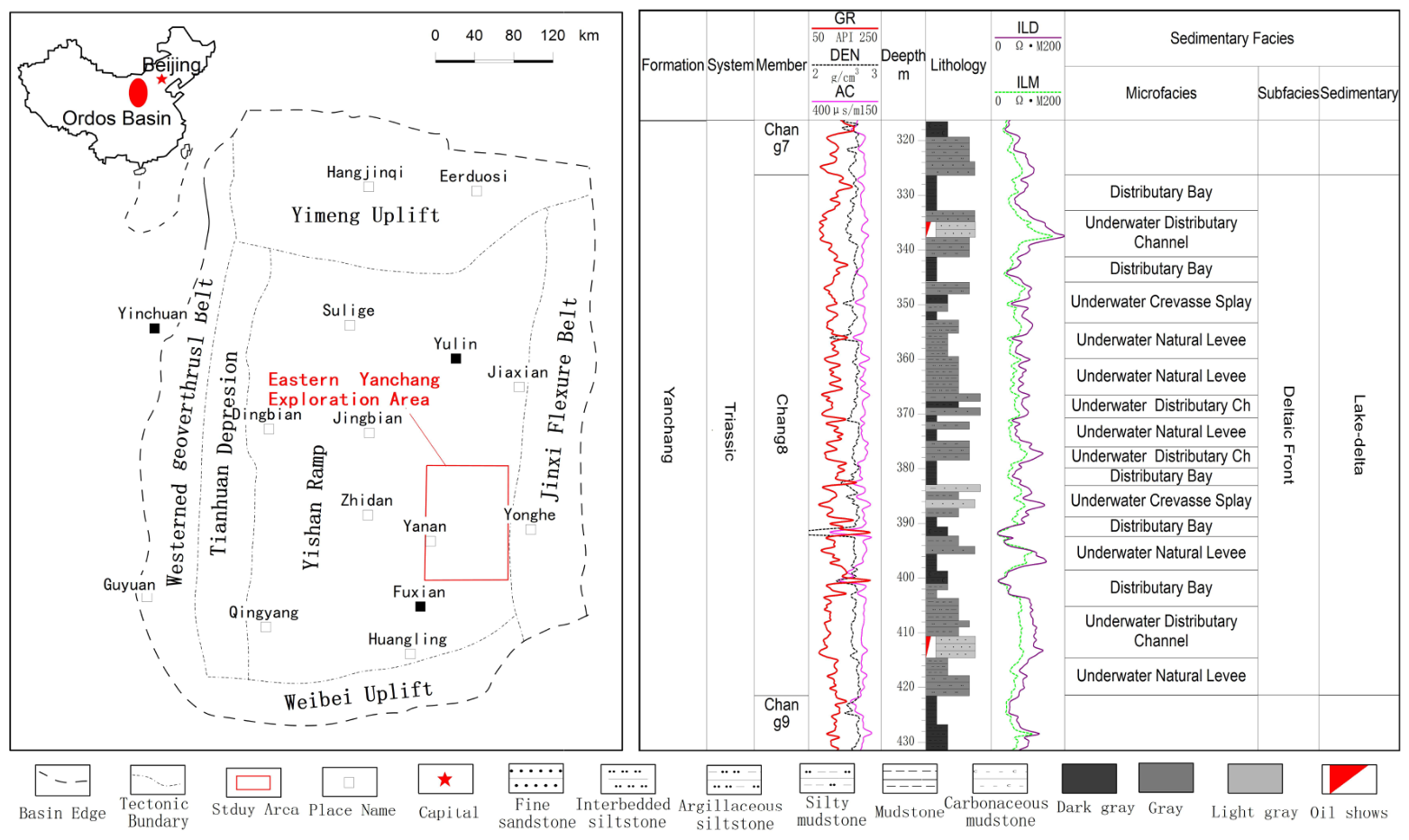
3.1. Sampling
3.2. High Pressure Mercury Intrusion (HPMI) Experiments
- (1)
- Sample pretreatment: Cylindrical samples were cleaned with petroleum ether and ethanol to remove residual oil and salt, then dried in a vacuum oven at 60 °C for 48 h to a constant weight. And the cooled samples were placed in core holders.
- (2)
- Instrument calibration: The porosimeter was calibrated with standard pore-size samples before testing to ensure accuracy of pressure and volume readings.
- (3)
- Vacuum evacuation: The sample chamber and mercury chamber were evacuated to a vacuum degree <50 μm Hg to eliminate air interference.
- (4)
- Mercury injection: The AutoPore IV 9505 automatic mercury porosimeter was used to conduct HPMI experiments on 14 dense sandstone samples. Low-pressure (<0.01 MPa) filling was first completed, then high pressure was applied stepwise up to 400 MPa, with data recorded at each pressure point. The mercury intrusion capillary pressure curve was obtained by measuring mercury injection volume at different mercury pressure increments.
- (5)
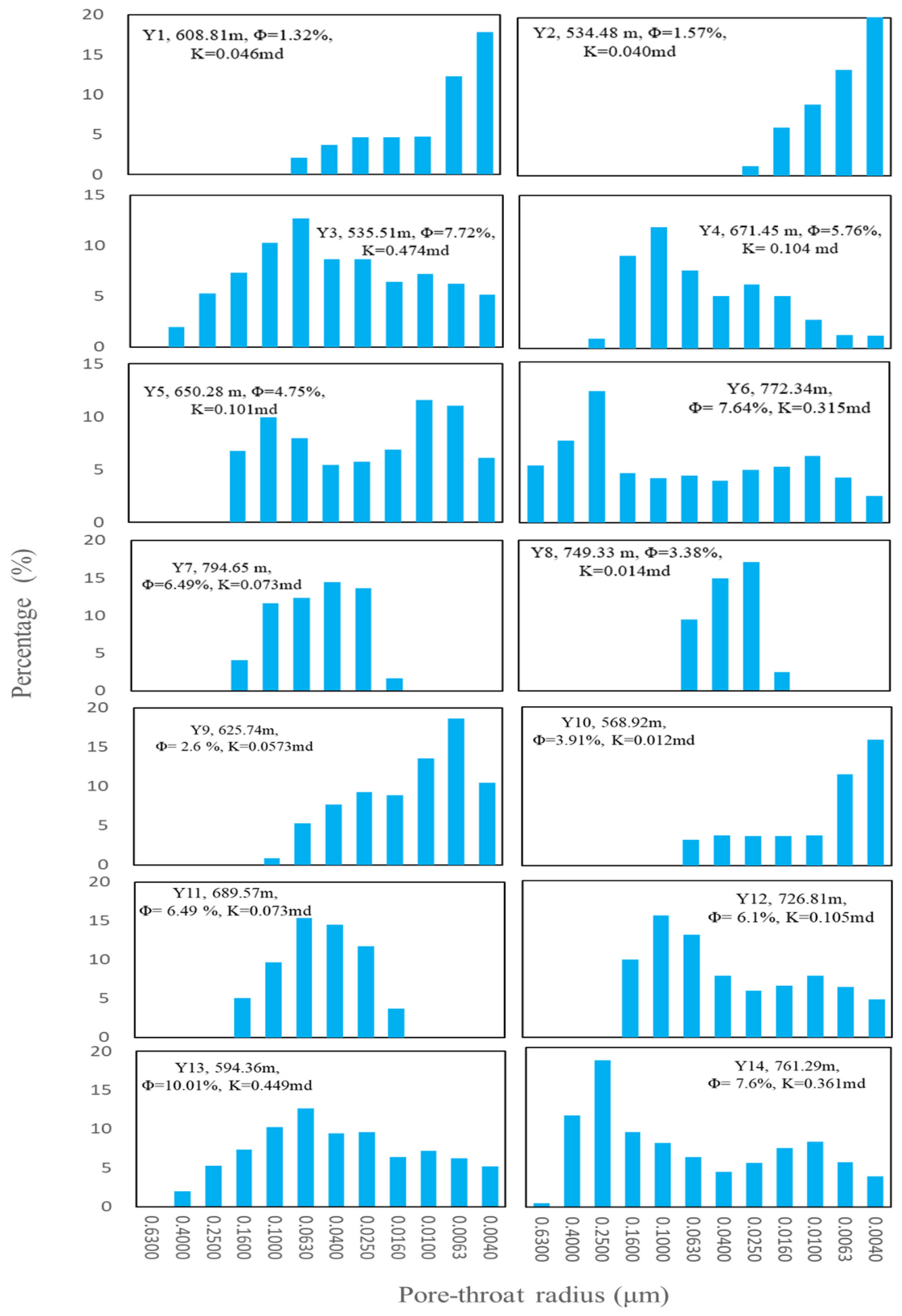
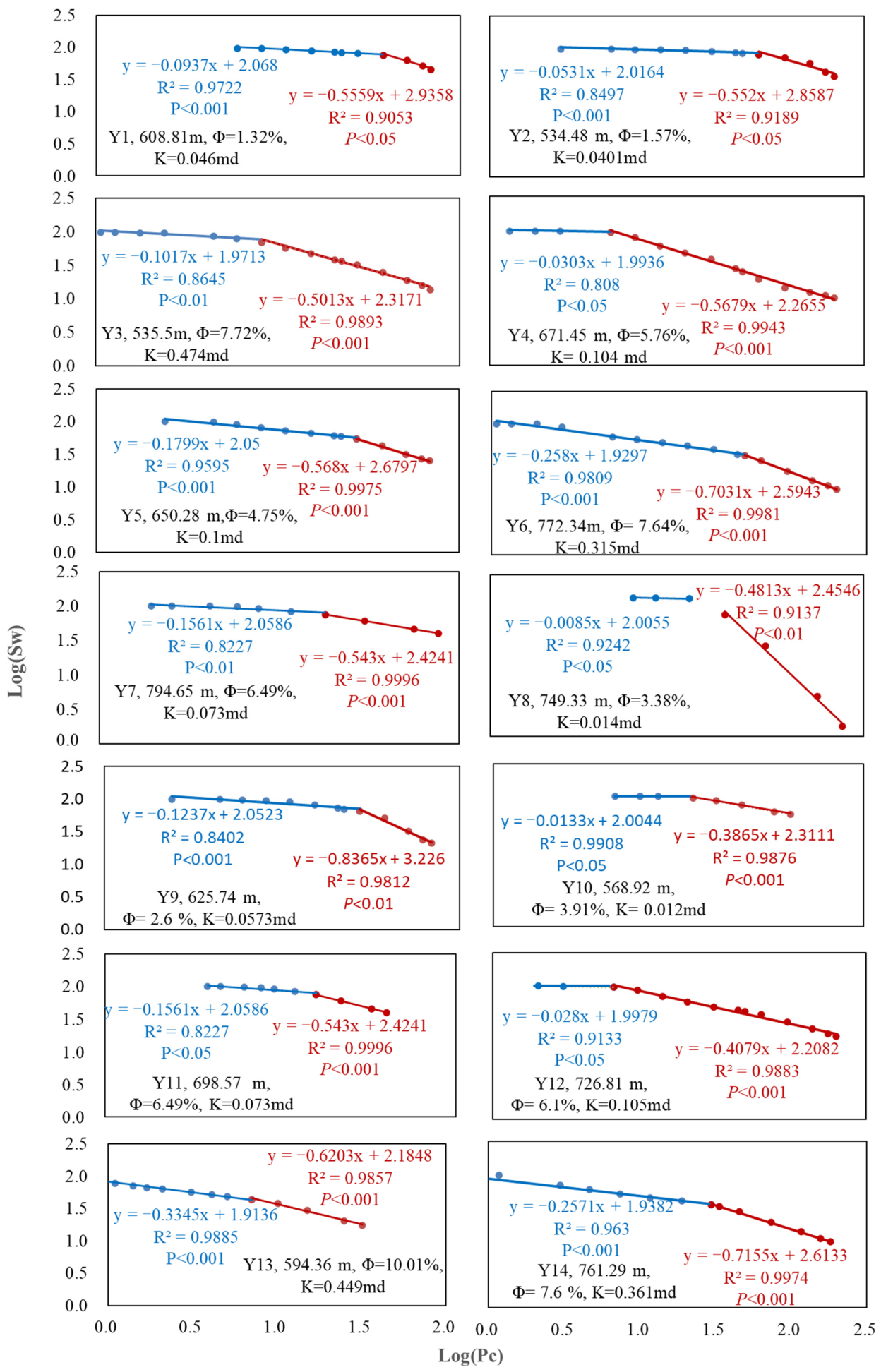
- Data resolution: The mercury volume injected into the pore throat space at a specific pressure reflects the volume of the corresponding pore throat space, which can be calculated based on Laplace’s capillary pressure equation [23]. Pore-throat radius, cumulative intrusion volume and saturation were resolved using the Washburn equation. Ultimately, capillary pressure curves for eight dense sandstone samples were plotted based on the correlation between injection pressure and mercury saturation.
- (6)
- Post-test treatment: Mercury was recovered, and samples were removed and cleaned to avoid contamination.
3.3. Fractal Dimension Calculation Method
4. Results
4.1. Physical Properties
4.2. Characteristics of Pore-Throat Structures
4.3. Fractal Dimension Characteristics of Tight Sandstone from HPMI
4.4. Classification of Tight Sandstones Based on Fractal Dimension
4.5. Special Structural Discrepancies of Reservoirs with Different Fractal Dimensions
5. Discussion
5.1. Low Permeability, Tightness, and Strong Heterogeneity of the Chang 8 Reservoir
5.2. Causes of Multiple Fractals in the Pore Structure
5.3. Mechanism Underlying the Lower Total Fractal Dimension in High-Quality Reservoirs
5.4. Controlling Effect of Diagenesis on Fractal Dimensions
5.5. Implication and Perspective
6. Conclusions
Author Contributions
Funding
Data Availability Statement
Conflicts of Interest
References
- Li, G.X.; Zhu, R.K. Progress, challenges and key issues of unconventional oil and gas development of CNPC. Pet. Explor. Dev. 2020, 25, 1–13. [Google Scholar]
- Tian, W.; Li, J.D.; Fang, Z.W.; Zhao, Y.F.; Xiang, J.; Sun, D.Y. The Genesis and Influence of Pore-Throat Structural Multifractionation in Dense Sandstone Reservoirs as an Example of Chang 8 in Zhenjing Area, Ordos Basin, North China. ACS Omega 2025, 10, 40217–40234. [Google Scholar] [CrossRef]
- Wu, Z.W.; Cui, C.Z.; Jia, P.P.; Wang, Z.; Sui, Y.F. Advances and challenges in hydraulic fracturing of tight reservoirs: A critical review. Energy Geosci. 2022, 3, 427–435. [Google Scholar] [CrossRef]
- Sun, L.D.; Zou, C.N.; Jia, A.L.; Wei, Y.S.; Zhu, R.K.; Wu, S.T.; Guo, Z. Development characteristics and orientation of tight oil and gas in China. Pet. Explor. Dev. 2019, 46, 1015–1026. [Google Scholar] [CrossRef]
- Zou, C.N.; Zhu, R.K.; Liu, K.Y.; Su, L.; Bai, B.; Zhang, X.X.; Yuan, X.J.; Wang, J.H. Tight gas sandstone reservoirs in China: Characteristics and recognition criteria. J. Pet. Sci. Eng. 2012, 88, 82–91. [Google Scholar] [CrossRef]
- Zhu, F.; Hu, W.X.; Cao, J.; Sun, F.N.; Liu, Y.F.; Sun, M. Micro/nanoscale pore structure and fractal characteristics of tight gas sandstone: A case study from the Yuanba area, northeast Sichuan Basin, China. Mar. Pet. Geol. 2018, 98, 116–132. [Google Scholar] [CrossRef]
- Jin, L.; Wang, G.; Yu, C.; Ye, R.; Zhang, X. Depositional and Diagenetic Controls on Pore Structure of Tight Gas Sandstone Reservoirs: Evidence from Lower Cretaceous Bashijiqike Formation in Kelasu Thrust Belts, Kuqa Depression in Tarim Basin of West China. Resour. Geol. 2015, 65, 55–75. [Google Scholar] [CrossRef]
- Zhang, P.F.; Lu, S.F.; Li, J.Q.; Xue, H.T.; Li, W.H.; Zhang, P. Characterization of shale pore system: A case study of Paleogene Xin’gouzui Formation in the Jianghan basin, China. Mar. Pet. Geol. 2016, 79, 321–334. [Google Scholar] [CrossRef]
- Wang, Y.S.; Gao, Y.; Fang, Z.W. Pore throat structure and classification of Paleogene tight reservoirs in Jiyang depression, Bohai Bay Basin, China. Pet. Explor. Dev. 2021, 48, 308–322. [Google Scholar] [CrossRef]
- Daigle, H. Relative permeability to water or gas in the presence of hydrates in porous media from critical path analysis. J. Pet. Sci. Eng. 2016, 146, 526–535. [Google Scholar] [CrossRef]
- Jafari, A.; Babadagli, T. Estimation of equivalent fracture network permeability using fractal and statistical network properties. J. Pet. Sci. Eng. 2012, 92–93, 110–123. [Google Scholar] [CrossRef]
- Zhang, L.; Lu, S.; Xiao, D.; Li, B. Pore structure characteristics of tight sandstones in the northern Songliao Basin, China. Mar. Pet. Geol. 2017, 88, 170–180. [Google Scholar] [CrossRef]
- Huang, W.B.; Lu, S.F.; Hersi, O.S.; Wang, M.; Deng, S.W.; Lu, R.J. Reservoir spaces in tight sandstones: Classification, fractal characters, and heterogeneity. J. Nat. Gas Sci. Eng. 2017, 46, 80–92. [Google Scholar] [CrossRef]
- Mandelbrot, B.B. The Fractal Geometry of Nature, 2nd ed.; WH Freeman: New York, NY, USA, 1982. [Google Scholar]
- Sheng, G.L.; Su, Y.L.; Wang, W.D. A new fractal approach for describing induced-fracture porosity/permeability/compressibility in stimulated unconventional reservoirs. J. Pet. Sci. Eng. 2019, 179, 855–866. [Google Scholar] [CrossRef]
- Wang, X.X.; Hou, J.G.; Song, S.H.; Wang, D.M.; Gong, L.; Ma, K.; Liu, Y.M.; Li, Y.Q.; Yan, L. Combining pressure-controlled porosimetry and rate-controlled porosimetry to investigate the fractal characteristics of full-range pores in tight oil reservoirs. J. Pet. Sci. Eng. 2018, 171, 3535–3561. [Google Scholar] [CrossRef]
- Dai, Q.; Luo, Q.; Zhang, C.; Lu, C.; Zhang, Y.; Lu, S. Pore structure characteristics of tight-oil sandstone reservoir based on a new parameter measured by NMR experiment: A case study of seventh member in Yanchang Formation, Ordos Basin. Acta Pet. Sin. 2016, 37, 887–897. [Google Scholar]
- Zhang, Y.; Changzhen, L.; Wei, S.; Zhang, T.; Fangang, G. Jurassic deformation in and around the Ordos Basin, North China. Front. Earth Sci. 2007, 14, 182–196. [Google Scholar] [CrossRef]
- Liu, H.P.; Zhao, Y.C.; Luo, Y.; Xiao, G.J.; Meng, Y.J.; Zhou, S.B.; Shao, L.K. Origin of the reservoir quality difference between Chang 8 and Chang 9 Member sandstones in the Honghe Oil Field of the Southern Ordos Basin, China. J. Pet. Sci. Eng. 2020, 185, 106668. [Google Scholar] [CrossRef]
- Hanson, A.D.; Ritts, B.D.; Moldowan, J.M. Organic geochemistry of oil and source rock strata of the Ordos Basin, north-central China. AAPG Bull. 2007, 91, 1273–1293. [Google Scholar] [CrossRef]
- Morad, S.; Al-Ramadan, K.; Ketzer, J.M.; De Ros, L.F. The impact of diagenesis on the heterogeneity of sandstone reservoirs: A review of the role of depositional facies and sequence stratigraphy. AAPG Bull. 2010, 94, 1267–1309. [Google Scholar] [CrossRef]
- Xie, D.; Yao, S.; Cao, J.; Hu, W.; Qin, Y. Origin of calcite cements and their impact on reservoir heterogeneity in the Triassic Yanchang Formation, Ordos Basin, China: A combined petrological and geochemical study. Mar. Pet. Geol. 2020, 117, 104376. [Google Scholar] [CrossRef]
- Washburn, E.W. The Dynamics of Capillary Flow. Phys. Rev. 1921, 17, 273–283. [Google Scholar] [CrossRef]
- Xia, Y.X.; Cai, J.C.; Perfect, E.; Wei, W.; Zhang, Q.; Meng, Q.B. Fractal dimension, lacunarity and succolarity analyses on CT images of reservoir rocks for permeability prediction. J. Hydrol. 2019, 579, 124198. [Google Scholar] [CrossRef]
- Nelson, P.H. Pore-throat sizes in sandstones, tight sandstones, and shales. AAPG Bull. 2009, 93, 329–340. [Google Scholar] [CrossRef]
- Gao, Y.; Wang, Y.S.; Li, X.J. Classification method of tight sandstone based on pore throat structure: A case study of Paleogene in Jiyang Depression. Pet. Geol. Rec. 2019, 26, 32–41. [Google Scholar]
- Cao, L.N.; Wang, H.H.; Jiang, L.P.; Zhang, B.; Ganzer, L.; Xie, Y.C.; Luo, J.S.; Wang, X.C. A composite framework model for transient pressure dynamics in tight gas reservoirs incorporating stress sensitivity. Energies 2023, 16, 7175. [Google Scholar] [CrossRef]
- Tang, Y.; Wang, R.F.; Yin, S. Comprehensive Study on Microscopic Pore Structure and Displacement Mechanism of Tight Sandstone Reservoirs: A Case Study of the Chang 3 Member in the Weibei Oilfield, Ordos Basin, China. Energies 2024, 17, 370. [Google Scholar] [CrossRef]
- Liu, H.; Zhao, Y.; Luo, Y.; Chen, Z.; He, S. Diagenetic facies controls on pore structure and rock electrical parameters in tight gas sandstone. J. Geophys. Eng. 2015, 12, 587–600. [Google Scholar] [CrossRef]
- Lai, J.; Wang, G. Fractal analysis of tight gas sandstones using high-pressure mercury intrusion techniques. J. Nat. Gas Sci. Eng. 2015, 24, 185–196. [Google Scholar] [CrossRef]
- Torabi, A.; Fossen, H.; Braathen, A. Insight into petrophysical properties of deformed sandstone reservoirs. AAPG Bull. 2013, 97, 619–637. [Google Scholar] [CrossRef]



| Sample | Well | Depth (m) | Formation | Porosity (%) | Permeability (mD) | Description |
|---|---|---|---|---|---|---|
| #1 | Y1 | 608.81 | Chang 8 | 1.32 | 0.046 | Silt-fine grained sandstone, moderate sorted, subrounded grains. |
| #2 | Y2 | 534.48 | Chang 8 | 1.57 | 0.040 | Silt-grained sandstone, moderate sorted, subangular grains, dark grey. |
| #3 | Y3 | 535.51 | Chang 8 | 7.72 | 0.474 | Silt-grained sandstone, well sorted, subrounded grains, grey. |
| #4 | Y4 | 671.45 | Chang 8 | 5.76 | 0.104 | Silt-fine grained sandstone, moderate sorted, subrounded grains, dark grey. |
| #5 | Y5 | 650.28 | Chang 8 | 4.75 | 0.101 | Silt-fine grained sandstone, moderate sorted, subangular grains, dark grey. |
| #6 | Y6 | 772.34 | Chang 8 | 7.64 | 0.315 | Silt-fine grained sandstone, moderate sorted, subrounded grains, light grey. |
| #7 | Y7 | 794.65 | Chang 8 | 6.49 | 0.073 | Silt-fine grained sandstone, poorly sorted, subangular grains, dark grey. |
| #8 | Y8 | 749.33 | Chang 8 | 3.38 | 0.014 | Silt-fine grained sandstone, poorly sorted, subangular grains, dark grey. |
| #9 | Y9 | 625.74 | Chang 8 | 2.63 | 0.057 | Silt-fine grained sandstone, moderate sorted, subangular grains, grey |
| #10 | Y10 | 568.92 | Chang 8 | 3.91 | 0.012 | Silt-grained sandstone, moderately poorly sorted, subrounded grains, dark grey |
| #11 | Y11 | 698.57 | Chang 8 | 6.49 | 0.073 | Silt-fine grained sandstone, well sorted, subrounded grains, dark grey |
| #12 | Y12 | 726.81 | Chang 8 | 6.15 | 0.105 | Silt grained sandstone, poorly sorted, subangular grains, grey |
| #13 | Y13 | 594.36 | Chang 8 | 10.01 | 0.449 | Silt-fine grained sandstone, well sorted, subangular grains, light grey |
| #14 | Y14 | 761.29 | Chang 8 | 7.62 | 0.361 | Silt-grained sandstone, moderate sorted, subrounded grains, light grey |
| Sample | (%) | (Mpa) | (Mpa) | (μm) | (μm) | (μm) | (μm) | (μm) | (μm) | (μm) |
|---|---|---|---|---|---|---|---|---|---|---|
| #1 | 53.765 | 2.964 | 165.285 | 0.085 | 0.012 | 0.005 | 0.005 | 0.007 | 0.013 | 0.063 |
| #2 | 62.471 | 0.735 | 141.021 | 0.028 | 0.007 | 0.005 | 0.006 | 0.009 | 0.016 | 0.016 |
| #3 | 86.118 | 0.268 | 17.479 | 0.514 | 0.057 | 0.043 | 0.070 | 0.010 | 0.162 | 0.250 |
| #4 | 89.882 | 0.459 | 10.399 | 0.298 | 0.062 | 0.072 | 0.102 | 0.115 | 0.162 | 0.163 |
| #5 | 74.941 | 0.141 | 56.049 | 0.246 | 0.038 | 0.013 | 0.024 | 0.058 | 0.102 | 0.160 |
| #6 | 89.882 | 0.347 | 8.663 | 0.894 | 0.123 | 0.087 | 0.203 | 0.304 | 0.416 | 0.625 |
| #7 | 59.681 | 3.101 | 22.060 | 0.202 | 0.054 | 0.034 | 0.047 | 0.062 | 0.094 | 0.115 |
| #8 | 47.261 | 7.1 | / | 0.091 | 0.032 | / | 0.028 | 0.039 | 0.051 | 0.063 |
| #9 | 78.699 | 2.964 | 75.757 | 0.116 | 0.016 | 0.009 | 0.011 | 0.022 | 0.036 | 0.063 |
| #10 | 46.854 | 3.101 | / | 0.117 | 0.037 | / | 0.033 | 0.042 | 0.057 | 0.063 |
| #11 | 59.681 | 3. 101 | 22.059 | 0.202 | 0.054 | 0.034 | 0.047 | 0.062 | 0.094 | 0.115 |
| #12 | 82.353 | 0.735 | 18.036 | 0.245 | 0.049 | 0.042 | 0.071 | 0.102 | 0.127 | 0.158 |
| #13 | 82.554 | 0.627 | 4.595 | 1.067 | 0.281 | 0.163 | 0.293 | 0.536 | 0.721 | 0.630 |
| #14 | 90.235 | 0.346 | 8.006 | 0.671 | 0.101 | 0.094 | 0.162 | 0.253 | 0.343 | 0.412 |
| No. | Type | Porosity (%) | Permeability (mD) | Break Radius (μm) | Porosity Contribution of Mesopore-Throat (%) | Permeability Contribution of Mesopore-Throat (%) | Mesopore-Throat | Micropore-Throat | Total Pore-Throat | ||
|---|---|---|---|---|---|---|---|---|---|---|---|
| D1 | R21 | D2 | R22 | D | |||||||
| #1 | 2 | 1.32 | 0.046 | 0.01 | 31.2 | 42.1 | 2.936 | 0.972 | 2.444 | 0.965 | 2.544 |
| #2 | 2 | 1.57 | 0.04 | 0.017 | 30.3 | 46.6 | 2.947 | 0.85 | 2.448 | 0.919 | 2.549 |
| #3 | 1 | 7.72 | 0.474 | 0.102 | 54.6 | 90.7 | 2.798 | 0.865 | 2.429 | 0.989 | 2.633 |
| #4 | 1 | 5.76 | 0.104 | 0.253 | 52.7 | 83.2 | 2.87 | 0.808 | 2.432 | 0.994 | 2.614 |
| #5 | 1 | 4.75 | 0.101 | 0.022 | 54.6 | 97.9 | 2.82 | 0.96 | 2.432 | 0.998 | 2.644 |
| #6 | 1 | 7.64 | 0.315 | 0.022 | 75.1 | 97.0 | 2.742 | 0.981 | 2.297 | 0.998 | 2.631 |
| #7 | 1 | 6.49 | 0.073 | 0.074 | 41.4 | 75.1 | 2.844 | 0.823 | 2.457 | 0.999 | 2.617 |
| #8 | 2 | 3.38 | 0.014 | 0.106 | 16.8 | 9.5 | 2.992 | 0.844 | 2.519 | 0.994 | 2.598 |
| #9 | 2 | 2.63 | 0.057 | 0.015 | 34.9 | 42.6 | 2.876 | 0.84 | 2.463 | 0.981 | 2.578 |
| #10 | 2 | 3.91 | 0.012 | 0.147 | 15.2 | 22.6 | 2.986 | 0.99 | 2.613 | 0.987 | 2.569 |
| #11 | 1 | 6.49 | 0.073 | 0.074 | 41.4 | 66.5 | 2.843 | 0.822 | 2.457 | 0.996 | 2.611 |
| #12 | 1 | 6.15 | 0.105 | 0.251 | 39.7 | 69.1 | 2.872 | 0.913 | 2.592 | 0.988 | 2.603 |
| #13 | 1 | 10.01 | 0.449 | 0.106 | 77.4 | 94.4 | 2.665 | 0.988 | 2.379 | 0.985 | 2.628 |
| #14 | 1 | 7.62 | 0.361 | 0.025 | 71.9 | 93.9 | 2.742 | 0.951 | 2.284 | 0.997 | 2.614 |
| Reservoir Type | 1 | 2 |
|---|---|---|
| Spaces | Mesopore-throat spaces dominated | Micropore-throat spaces dominated |
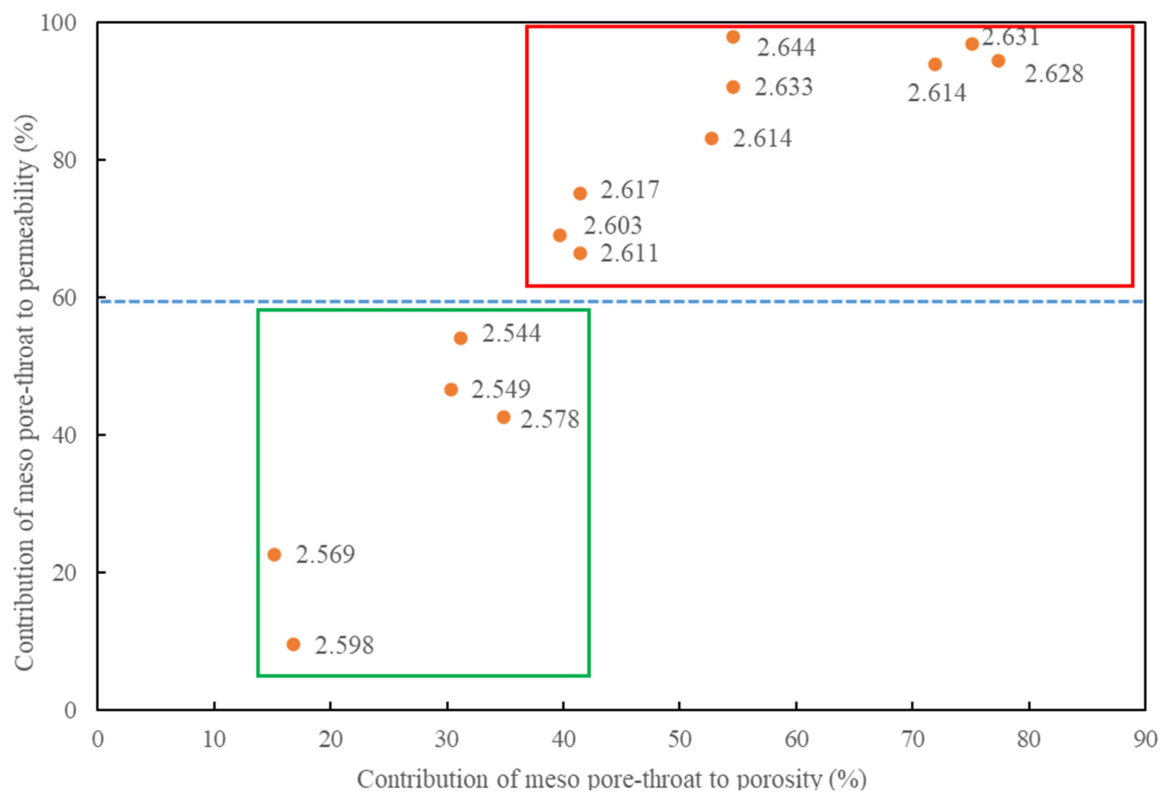
| Samples | #3, #4, #5, #6, #7, #11, #12, #13, and #14 | #1,#2, #8, #9, and #10 |
| Fractal dimensions (D) | 2.603–2.644 | 2.544–2.598 |
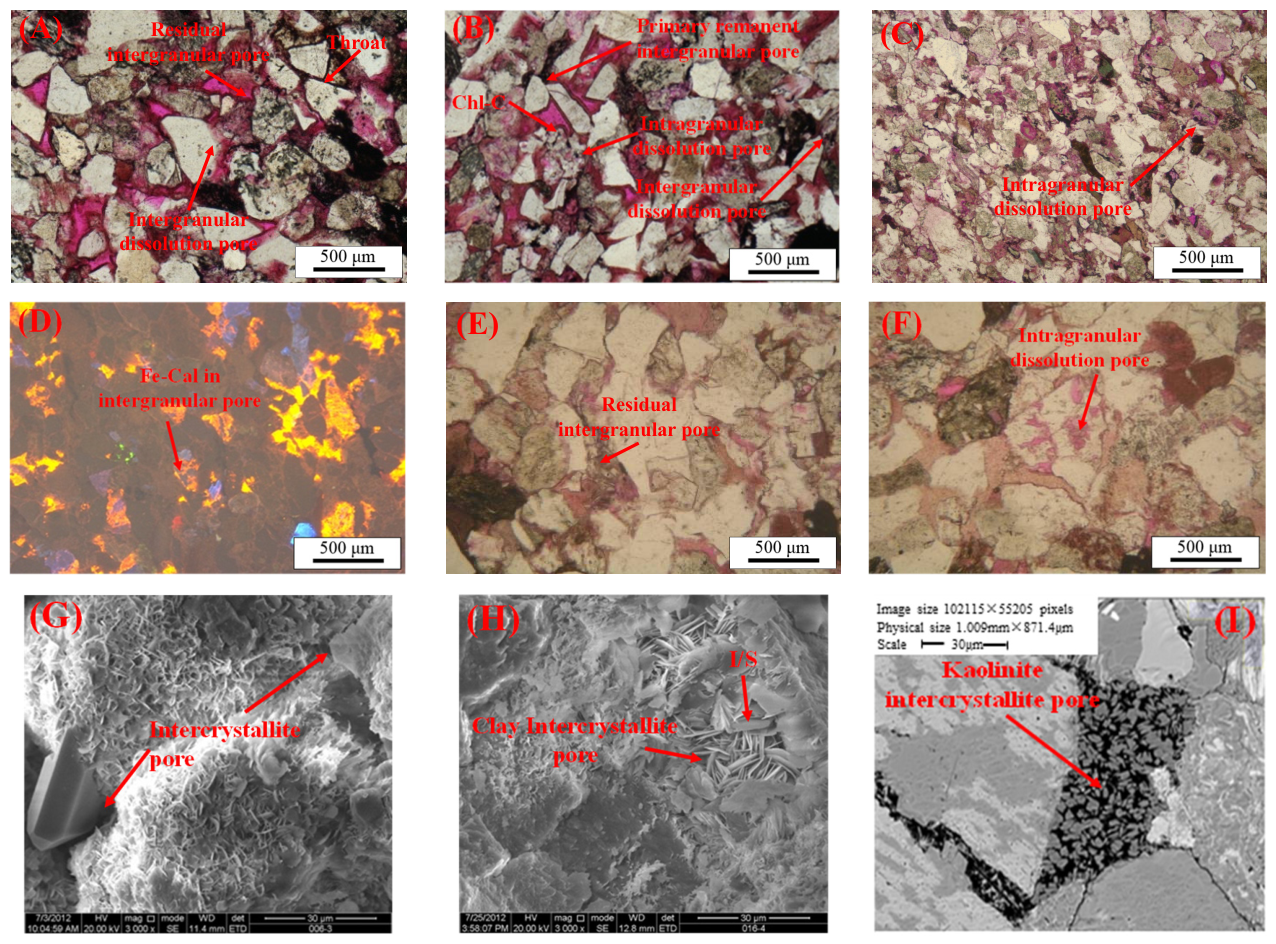
| Primary pore-throat types | Original intergranular pores, residual intergranular pores, and intergranular dissolution pores | Intragranular dissolution pores, intercrystallite pores, and scrobiculate dissolution pores in clay minerals |
| Porosity contribution of mesopore-throat spaces | 39.7–77.4% | 15.2–34.9% |
| Permeability contribution of mesopore-throat spaces | 66.5–97.9% | 9.5–46.6% |
| Pore-throat radius distribution |  |  |
Disclaimer/Publisher’s Note: The statements, opinions and data contained in all publications are solely those of the individual author(s) and contributor(s) and not of MDPI and/or the editor(s). MDPI and/or the editor(s) disclaim responsibility for any injury to people or property resulting from any ideas, methods, instructions or products referred to in the content. |
© 2026 by the authors. Licensee MDPI, Basel, Switzerland. This article is an open access article distributed under the terms and conditions of the Creative Commons Attribution (CC BY) license.
Share and Cite
Wu, F.; Xiao, G.; Yin, X.; Zhou, J.; Cao, J. Pore Structure Characterization, Classification, and Fractal Dimension Analysis of the Yanchang Formation Reservoir in the Ordos Basin—A Cue to Evaluate High-Quality Tight Sandstone Reservoirs. Energies 2026, 19, 2782. https://doi.org/10.3390/en19122782
Wu F, Xiao G, Yin X, Zhou J, Cao J. Pore Structure Characterization, Classification, and Fractal Dimension Analysis of the Yanchang Formation Reservoir in the Ordos Basin—A Cue to Evaluate High-Quality Tight Sandstone Reservoirs. Energies. 2026; 19(12):2782. https://doi.org/10.3390/en19122782
Chicago/Turabian StyleWu, Feng, Gaojian Xiao, Xiao Yin, Jinsong Zhou, and Jun Cao. 2026. "Pore Structure Characterization, Classification, and Fractal Dimension Analysis of the Yanchang Formation Reservoir in the Ordos Basin—A Cue to Evaluate High-Quality Tight Sandstone Reservoirs" Energies 19, no. 12: 2782. https://doi.org/10.3390/en19122782
APA StyleWu, F., Xiao, G., Yin, X., Zhou, J., & Cao, J. (2026). Pore Structure Characterization, Classification, and Fractal Dimension Analysis of the Yanchang Formation Reservoir in the Ordos Basin—A Cue to Evaluate High-Quality Tight Sandstone Reservoirs. Energies, 19(12), 2782. https://doi.org/10.3390/en19122782