1. Introduction
Energy transition has become a strategic priority for hydrocarbon-dependent economies seeking to diversify their energy systems, reduce carbon intensity, and strengthen long-term economic resilience. In GCC countries, this challenge is particularly important because economic activity, fiscal revenues, and industrial structures remain closely linked to oil and gas resources. At the same time, growing international pressure for decarbonization and sustainable development has accelerated regional efforts to expand renewable-energy capacity and reduce dependence on fossil fuels. Recent studies highlight that GCC economies are increasingly integrating renewable-energy transition into broader economic diversification strategies aligned with sustainable-development objectives [
1,
2,
3].
Despite this growing momentum, oil-market instability remains an important challenge for energy transition in oil-exporting economies. Fluctuations in oil prices may influence renewable-energy investment through several channels, including fiscal revenues, energy-sector planning, investor expectations, and macroeconomic uncertainty. In hydrocarbon-based economies, periods of high oil prices may weaken incentives to diversify energy systems, whereas sharp declines in oil revenues may constrain public investment in renewable-energy projects. Previous research shows that oil-price dynamics remain closely connected to energy-transition processes in GCC countries [
4,
5,
6]. Similarly, ref. [
7] argue that GCC economies face increasing tensions between energy-security objectives and net-zero transition strategies under volatile energy-market conditions.
The literature on renewable-energy transition in oil-exporting economies has expanded considerably in recent years. In [
1], the authors discuss both the opportunities and structural challenges associated with renewable-energy deployment in GCC countries, highlighting institutional and financial barriers. In [
2], the authors emphasize the role of renewable-energy expansion in reducing environmental pressure and supporting sustainable-development objectives in the Arabian Gulf region. In [
8], the author further argues that energy transition in the Arabian Peninsula increasingly reflects broader geopolitical and economic transformation processes. In the context of global energy transition, ref. [
9] highlights the growing interdependence between economic diversification and long-term energy-transition strategies in Arab oil-exporting economies.
A parallel stream of research examines the role of financial systems in supporting renewable-energy deployment and sustainable transition. In [
10], the author finds that financial development contributes positively to renewable-energy expansion in MENA countries, particularly when supported by stronger institutional and political conditions. In [
11], the authors show that financial development and institutional quality generate positive spillover effects on renewable-energy deployment and carbon-neutrality objectives in GCC economies. The authors of [
12] likewise underline the importance of financing mechanisms in facilitating renewable-energy investment in the Gulf region. More recently, ref. [
13] highlights the growing role of sustainable finance and green investment strategies in enhancing economic resilience within GCC financial markets. Ref. [
14] similarly emphasizes the importance of innovation, governance quality, and financial development in supporting energy transition in MENA oil-exporting economies.
Several recent studies have also linked oil-market shocks and financial uncertainty to broader energy-transition dynamics. Ref. [
15] shows that renewable-energy expansion is associated with improvements in environmental quality across OECD economies using second-generation panel techniques. Ref. [
16] examines the resilience of GCC economies to oil-price changes, uncertainty, and geopolitical risks, finding that oil-market instability continues to generate substantial macroeconomic effects across the region. Ref. [
17] demonstrates that energy-transition dynamics may affect financial-market volatility during periods of economic turbulence. Similarly, ref. [
18] reports that oil-price volatility, financial stability, and energy efficiency jointly influence sustainable energy production. In the Saudi context, ref. [
19] provides evidence that renewable-energy transition may partially reduce the environmental implications of oil-price fluctuations.
Although the existing literature provides important insights into the links among oil prices, financial development, and renewable-energy transition, several gaps remain. First, most existing studies primarily examine the direct effects of oil prices, financial development, or renewable energy separately, while relatively limited attention has been devoted to analyzing how financial development moderates the relationship between oil-price volatility and renewable-energy transition in hydrocarbon-dependent economies. Existing evidence for GCC and MENA economies largely focuses on environmental quality, carbon emissions, or renewable-energy deployment without explicitly examining the resilience of renewable-energy transition under conditions of oil-market uncertainty. In addition, previous studies generally provide limited discussion of the transmission mechanisms through which financial systems may stabilize renewable-energy investment during periods of oil-market instability, including investment continuity, credit availability, risk diversification, and fiscal-smoothing mechanisms.
Second, GCC economies represent a distinct analytical setting because their economic structures, fiscal systems, and financial sectors remain strongly interconnected with hydrocarbon revenues and global oil-market conditions. Oil-price volatility may therefore influence renewable-energy transition not only through conventional energy-market channels but also through public investment capacity, sovereign financing conditions, and macroeconomic stability. Despite these structural characteristics, many previous studies rely on conventional panel estimation approaches that insufficiently account for cross-sectional dependence and heterogeneous country dynamics, even though GCC economies are highly interconnected through common oil-market exposure, regional investment patterns, and similar economic-diversification strategies.
This study contributes to the literature in several ways. First, it develops an integrated framework linking oil-price volatility, financial development, and renewable-energy transition in GCC economies within a unified empirical setting. Second, the analysis explicitly examines whether financial development may reduce the adverse implications of oil-market uncertainty for renewable-energy transition by supporting financing continuity and investment resilience during periods of heightened market volatility. Third, the study contributes to the growing literature on energy-transition resilience in hydrocarbon-dependent economies by focusing on the moderating role of financial systems rather than only on direct energy or environmental outcomes. Fourth, the empirical analysis employs second-generation panel econometric techniques that explicitly account for cross-sectional dependence and heterogeneous country dynamics, including the Pesaran cross-sectional dependence test, CIPS unit-root tests, Westerlund cointegration, common correlated effects mean group (CCE-MG), augmented mean group (AMG), and error-correction modeling. By focusing on GCC economies over the period 1990–2024, the study provides new evidence on the interaction between oil-market instability, financial-system development, and renewable-energy transition in hydrocarbon-dependent economic systems.
The remainder of the paper is organized as follows.
Section 2 reviews the relevant literature on oil-price volatility, financial development, and renewable-energy transition.
Section 3 presents the data, model specification, and econometric methodology.
Section 4 reports the empirical results and robustness checks. The final section concludes and discusses the main policy implications.
2. Literature Review
2.1. Oil-Market Volatility and Renewable-Energy Transition Dynamics
Existing research suggests that oil-market volatility influences renewable-energy transition through several interconnected channels, including fiscal revenues, investment incentives, energy pricing, and macroeconomic uncertainty. These mechanisms are particularly relevant in hydrocarbon-dependent economies, where public spending, industrial structures, and long-term development strategies remain closely linked to oil and gas revenues. In GCC countries, fluctuations in global oil markets may therefore affect renewable-energy deployment not only through energy-sector profitability but also through broader fiscal and investment conditions.
Several studies highlight the sensitivity of GCC renewable-energy strategies to oil-market dynamics. Ref. [
4] argues that oil-price fluctuations influence renewable-energy development in GCC economies because hydrocarbons continue to dominate regional economic systems and public revenues. Ref. [
5] likewise explains that the global energy transition creates both opportunities and vulnerabilities for oil-exporting economies seeking to reduce dependence on fossil-fuel revenues. In the Gulf region, ref. [
20] argues that the global energy transition is likely to reshape the economic foundations of hydrocarbon-dependent states, creating increasing pressure for diversification and structural reform. Recent contributions additionally highlight the growing interaction between oil-market uncertainty and energy-transition strategies. Ref. [
7] argues that GCC economies increasingly face tensions between energy-security objectives and decarbonization commitments under volatile global energy-market conditions. Ref. [
21] similarly emphasizes that the energy transition generates uncertainty regarding the long-term sustainability of petroleum-dependent economic systems in the MENA region. At the global level, ref. [
22] further argues that green-energy transition itself may progressively reshape future oil-price dynamics through structural changes in global energy demand.
The literature also points to the importance of macroeconomic uncertainty and investment-risk channels. Ref. [
18] shows that oil-price volatility, financial stability, and energy efficiency are jointly associated with sustainable energy production, while [
17] demonstrates that energy-transition dynamics increasingly interact with financial-market volatility during periods of economic turbulence. In the Saudi context, ref. [
19] provides evidence that renewable-energy transition may partially reduce the environmental implications of oil-price fluctuations.
At the same time, several studies suggest that renewable-energy transition can strengthen economic resilience and reduce exposure to fossil-fuel shocks. Ref. [
23] argues that renewable-energy expansion may contribute to greater macroeconomic stability by improving energy diversification and reducing vulnerability to external energy shocks. Ref. [
24] similarly finds that renewable-energy investment and effective natural-resource management are positively associated with economic stability in GCC economies. Earlier evidence from the UAE also highlights the importance of coordinated renewable-energy planning and long-term policy support for facilitating energy-transition strategies in the Gulf region [
25].
Taken together, the literature indicates that oil-market volatility may influence renewable-energy transition through fiscal, investment, and uncertainty channels, particularly in hydrocarbon-dependent economies. However, existing evidence remains largely focused on the direct effects of oil prices or renewable-energy deployment considered separately. Relatively limited attention has been devoted to understanding whether stronger financial systems may reduce the vulnerability of renewable-energy transition to oil-market instability in GCC economies.
2.2. Financial Systems and Renewable-Energy Transition Financing
Financial development is increasingly recognized as an important determinant of renewable-energy transition because large-scale energy transformation requires substantial long-term investment, financial intermediation, and stable financing conditions. Well-developed financial systems may facilitate renewable-energy deployment by improving access to credit, reducing financing constraints, supporting technological innovation, and enhancing investment continuity during periods of macroeconomic uncertainty.
Several studies suggest that financial development contributes positively to renewable-energy expansion and environmental sustainability in emerging and oil-exporting economies. Ref. [
10] finds that financial development promotes renewable-energy deployment in MENA economies, particularly when supported by favorable institutional and political conditions. Ref. [
11] similarly shows that financial development and institutional quality generate positive spillover effects on renewable-energy deployment and carbon-neutrality objectives in GCC countries. Ref. [
26] further reports that financial development is positively associated with renewable-energy use in economies exposed to oil-price fluctuations and energy-market instability.
The importance of financing mechanisms for energy transition is also emphasized in studies focusing on sustainable finance and energy-project investment. Ref. [
12] underlines the strategic role of energy-project financing in accelerating renewable-energy investment in GCC economies. More recently, ref. [
13] argues that sustainable-finance mechanisms contribute to economic resilience and diversification strategies in GCC financial markets undergoing structural transformation. Ref. [
14] likewise emphasizes the importance of financial development, governance quality, and innovation in supporting renewable-energy transition in MENA oil-exporting economies.
The literature also suggests that stronger financial systems may help economies absorb part of the adverse implications of oil-market uncertainty. Ref. [
27] demonstrates that oil-price instability significantly affects banking-sector credit risk and macro-financial conditions across GCC oil exporters. Ref. [
16] likewise shows that oil-price uncertainty and geopolitical tensions continue to influence economic resilience in GCC economies. Together, these findings imply that financial systems may play a stabilizing role by supporting investment continuity and financing access during periods of volatile energy-market conditions.
Despite these contributions, most previous studies primarily focus on the direct relationship between financial development and renewable-energy deployment. Limited attention has been devoted to examining whether financial development moderates the effect of oil-price volatility on renewable-energy transition. In addition, aggregate financial-development indicators may not fully capture the specific financing mechanisms relevant to renewable-energy projects in GCC economies, including sovereign wealth financing, green sukuk, public–private partnerships, and state-supported investment programs.
2.3. Governance, Structural Resilience, and GCC Energy Transition
Institutional quality and governance structures play an important role in shaping renewable-energy transition outcomes in oil-exporting economies. Governance quality influences regulatory stability, investment protection, policy implementation, and the effectiveness of long-term sustainable-development strategies. In GCC countries, institutional arrangements are particularly important because energy-transition policies are often closely linked to state-led diversification programs and public-investment planning.
Several studies emphasize that governance reforms are essential for facilitating energy transition in MENA economies. Ref. [
28] argue that institutional quality influences the capacity of governments to manage structural transformation toward renewable-energy systems. Ref. [
29] similarly shows that governance quality and energy-policy effectiveness significantly affect renewable-energy infrastructure development in MENA economies. Their findings suggest that institutional stability may improve the implementation of sustainable-energy strategies and strengthen investor confidence.
The GCC energy transition is also increasingly linked to broader geopolitical and structural transformation processes. Ref. [
8] explains that renewable-energy transition in the Arabian Peninsula reflects not only environmental objectives but also geopolitical positioning and evolving neo-rentier economic strategies. Ref. [
3] similarly argues that shifts in global energy systems carry important geopolitical implications for Arab Gulf States and may gradually reshape regional economic models. Ref. [
30] further highlights the growing pressure on extractive industries in MENA economies to adapt to global decarbonization objectives and sustainable-development requirements.
Recent evidence indicates that energy transition, financial resilience, and macroeconomic sustainability are becoming increasingly interconnected in GCC economies. Ref. [
31] shows that oil prices, renewable energy, and financial development jointly influence environmental quality in Oman, highlighting the multidimensional nature of sustainable-transition dynamics in hydrocarbon-dependent economies. Ref. [
15] similarly reports that renewable-energy expansion contributes positively to environmental quality under heterogeneous panel frameworks that account for cross-sectional dependence and country-specific dynamics.
Although the literature provides important insights into governance and structural transition dynamics, several limitations remain. Existing studies frequently focus on environmental outcomes, energy policy, or diversification strategies separately, while relatively limited attention has been devoted to examining how financial resilience interacts with oil-market uncertainty to influence renewable-energy transition in GCC economies. In addition, many previous studies rely on conventional panel approaches that may insufficiently account for cross-sectional dependence and heterogeneous country dynamics despite the strong structural interconnections characterizing GCC economies.
2.4. Transmission Mechanisms Linking Oil-Price Volatility, Financial Development, and Renewable-Energy Transition
The relationship between oil-price volatility, financial development, and renewable-energy transition may operate through several interconnected transmission mechanisms. In hydrocarbon-dependent economies, fluctuations in oil prices can directly affect fiscal revenues, public-investment capacity, financial-sector liquidity, and long-term development planning. As a result, oil-market instability may weaken renewable-energy transition by increasing uncertainty surrounding investment continuity and energy-policy implementation [
5,
16].
One important transmission channel operates through fiscal conditions. Because GCC governments remain heavily dependent on hydrocarbon revenues, periods of declining or unstable oil prices may constrain public spending and delay renewable-energy investment projects. Fiscal uncertainty may therefore slow renewable-energy deployment and weaken long-term diversification strategies. Previous studies emphasize that oil-price fluctuations continue to exert substantial macroeconomic and fiscal effects across GCC economies [
6,
27].
A second channel relates to investment uncertainty. Renewable-energy projects typically require substantial long-term financing and stable investment expectations. Elevated oil-price volatility may increase macroeconomic uncertainty, discourage private-sector participation, and reduce investor confidence in transition-related projects. This effect may be particularly important in GCC economies where energy markets and public investment remain closely interconnected [
7,
17].
Financial development may partially reduce these adverse effects through several channels. More developed financial systems may improve access to credit, facilitate long-term project financing, diversify funding sources, and strengthen risk-sharing mechanisms. Financial depth and investment efficiency may therefore support renewable-energy investment continuity during periods of oil-market instability. Existing studies show that financial development contributes positively to renewable-energy deployment and broader transition dynamics in MENA and GCC economies [
10,
11,
26].
In GCC economies, sovereign wealth funds, green-finance initiatives, sustainable-investment instruments, and public–private financing structures may additionally contribute to stabilizing renewable-energy transition under volatile energy-market conditions. Recent evidence increasingly highlights the growing importance of sustainable finance and resilience-oriented investment strategies within GCC financial systems [
12,
13].
These transmission mechanisms suggest that financial development may influence renewable-energy transition not only directly but also conditionally by reducing the vulnerability of transition processes to oil-market uncertainty. Nevertheless, empirical evidence regarding these moderating dynamics remains limited, particularly in GCC economies characterized by strong hydrocarbon dependence, interconnected financial systems, and common exposure to global oil-market shocks. The present study addresses this gap by examining whether financial development may reduce the adverse implications of oil-price volatility for renewable-energy transition using second-generation panel econometric techniques that explicitly account for cross-sectional dependence and heterogeneous country dynamics.
3. Data and Methodology
3.1. Data and Variables
The analysis examines the relationship between oil-price volatility, financial development, and renewable-energy transition in GCC economies using annual panel data for six GCC countries: Saudi Arabia, United Arab Emirates, Qatar, Kuwait, Oman, and Bahrain. The sample period extends from 1990 to 2024, subject to data availability. Renewable-energy consumption (REN) is employed as the dependent variable and is measured as the percentage of total final energy consumption derived from renewable sources. Oil-price volatility (OPV) represents the main explanatory variable and captures uncertainty in international oil markets. Financial development (FD) is incorporated both as an independent variable and as a moderating factor through the interaction term between oil-price volatility and financial development (OPV × FD). The analysis additionally includes several control variables commonly used in the energy-transition literature, namely GDP per capita (GDPpc), trade openness (TRADE), energy use (ENERGY), inflation (INF), and institutional quality (INST). Renewable-energy consumption, GDP per capita, trade openness, energy use, and inflation are obtained from the World Development Indicators (WDIs). Financial development indicators are retrieved from the IMF Financial Development Database. The IMF Financial Development Index is employed because it provides a broad multidimensional measure of financial-system development combining financial institutions and financial markets across dimensions of depth, access, and efficiency. Although the aggregate index may not fully capture renewable-energy-specific financing instruments such as green bonds, green sukuk, sovereign wealth financing, or public–private partnership mechanisms, it offers a consistent macro-financial indicator suitable for cross-country panel analysis over a long time horizon. Institutional quality measures are extracted from the Worldwide Governance Indicators (WGIs). Institutional quality (INST) is constructed as a composite governance indicator based on the Worldwide Governance Indicators (WGIs) database developed by the World Bank. The index is computed as the arithmetic average of six governance dimensions: voice and accountability, political stability and absence of violence, government effectiveness, regulatory quality, rule of law, and control of corruption. Because these governance indicators are highly correlated and jointly capture broader governance quality, the study employs their arithmetic average to construct a composite institutional-quality indicator. Higher values of the composite index indicate stronger institutional quality and governance effectiveness. Oil price data are collected from the World Bank Commodity Price Data.
Oil-price volatility is constructed using the rolling standard deviation of monthly Brent crude oil prices over a 12-month window. Following the macroeconomic uncertainty literature, oil-price volatility is measured using the rolling standard deviation of monthly Brent crude oil prices over a 12-month window:
Oil-price volatility (OPV) is measured using the rolling standard deviation of monthly Brent crude oil prices over a 12-month window and subsequently converted to annual frequency. The rolling window spans across year boundaries in order to capture continuous oil-market uncertainty rather than volatility confined within calendar years. The 12-month specification is selected because it captures medium-term fluctuations in oil-market conditions while smoothing very short-term price noise that may be less relevant for macroeconomic investment and policy decisions. Similar rolling-window approaches are commonly used in the macroeconomic and energy-transition literature examining oil-market uncertainty and investment dynamics.
The baseline specification relies on the volatility of oil-price levels rather than oil returns because the objective of the study is to capture broader macroeconomic and fiscal uncertainty associated with oil-market instability in hydrocarbon-dependent economies. In GCC countries, public revenues, investment planning, and energy-transition strategies remain closely linked to the level and stability of oil prices rather than only short-term financial returns. Nevertheless, to assess the robustness of the results, an alternative volatility measure based on the annual standard deviation of monthly oil-price returns (OPV_ALT) is additionally employed in the robustness analysis.
Although GARCH-type models are widely used in financial-market volatility analysis, they are generally more appropriate for high-frequency financial applications and short-term return dynamics. By contrast, the present study focuses on annual macroeconomic uncertainty transmitted through fiscal, investment, and energy-transition channels in GCC economies. The rolling standard-deviation approach is therefore considered more suitable for capturing medium-term oil-market instability within the context of long-run panel analysis.
Table 1 summarizes the definitions, measurements, and data sources of all variables used in the analysis.
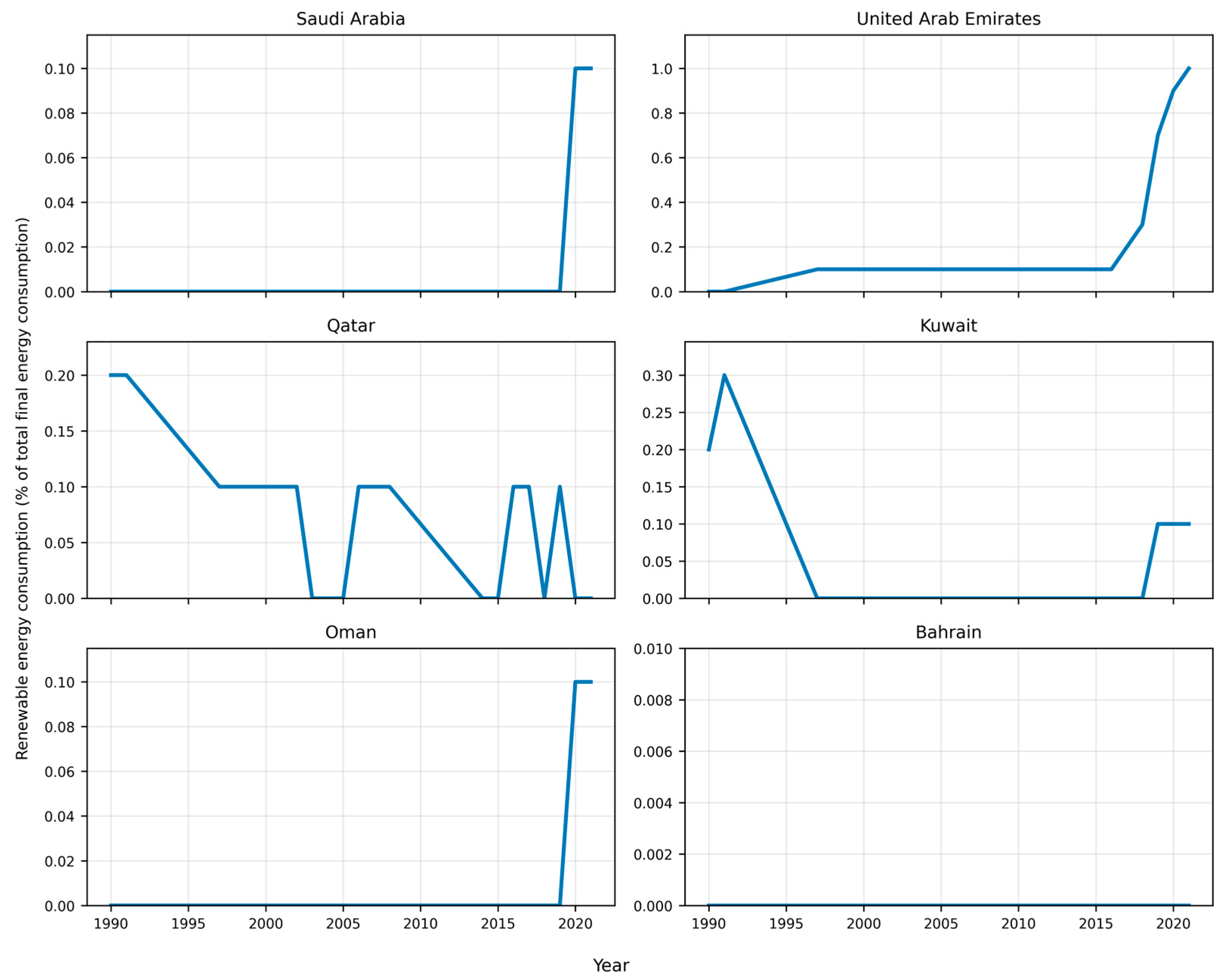
Descriptive inspection of the WDI series indicates that renewable-energy deployment remained highly uneven across GCC economies over the study period. While the United Arab Emirates and Saudi Arabia show more visible increases in recent years, Bahrain, Kuwait, and Qatar display relatively limited variation for much of the sample. This pattern confirms that renewable-energy transition in the GCC has been gradual and heterogeneous, and it reinforces the need to interpret the long-run estimates cautiously, particularly for the pre-2010 period.
Appendix A Figure A1 presents the evolution of renewable-energy consumption across the six GCC countries using the original WDI series.
3.2. Model Specification
To examine the relationship between oil-price volatility and renewable-energy transition, the following baseline specification is estimated:
where
RENᵢₜ represents renewable-energy consumption,
OPVᵢₜ denotes oil-price volatility,
FDᵢₜ refers to financial development,
Xᵢₜ represents the vector of control variables, αᵢ captures country-specific effects, and
εᵢₜ denotes the error term.
To assess whether financial development moderates the effect of oil-price volatility on renewable-energy transition, the interaction term between oil-price volatility and financial development is incorporated into the extended specification as follows:
where (
OPVit ×
FDit) represents the interaction between oil-price volatility and financial development. The interaction coefficient
β3 captures whether financial development mitigates or amplifies the effect of oil-market uncertainty on renewable-energy transition. A positive coefficient suggests that stronger financial systems may reduce the adverse implications of oil-price volatility by improving financing conditions and supporting investment continuity in renewable-energy projects.
3.3. Econometric Methodology
Given the strong economic and structural interconnections among GCC economies, cross-sectional dependence is likely to characterize the panel dataset. Ignoring such dependence may lead to biased and inconsistent estimates in conventional panel estimations. Accordingly, the empirical analysis relies on second-generation panel econometric techniques that explicitly account for cross-sectional dependence and slope heterogeneity.
The analysis begins with the [
32] cross-sectional dependence (CD) test to determine whether shocks are correlated across countries. The stationarity properties of the variables are then examined using the [
33] cross-sectionally augmented IPS (CIPS) panel unit-root test, which accounts for cross-sectional dependence and heterogeneous dynamics across panel members.
Following the unit-root analysis, the [
34] error-correction-based panel cointegration test is employed to examine the existence of a long-run equilibrium relationship among the variables. Unlike conventional residual-based cointegration approaches, the Westerlund methodology relies on structural dynamics and is particularly suitable in the presence of cross-sectional dependence and heterogeneity.
Long-run coefficients are estimated using the common correlated effects mean group (CCE-MG) estimator proposed by [
35]. The estimator controls for unobserved common factors through the inclusion of cross-sectional averages while allowing slope coefficients to vary across countries. CCE-MG is particularly appropriate for GCC economies because it accounts for unobserved common factors and allows heterogeneous slope coefficients across countries exposed to common oil-market shocks. The AMG estimator is additionally employed to verify the robustness of the long-run coefficients under an alternative heterogeneous panel estimation framework.
Short-run dynamics are examined using an error-correction model (ECM), which captures both temporary adjustments and the speed at which the system converges toward long-run equilibrium following short-run disturbances. The ECM specification is expressed as follows:
where Δ denotes first differences,
ECTit−1 represents the lagged error-correction term derived from the long-run cointegration equation, and λ measures the speed of adjustment toward long-run equilibrium. The coefficient
γk captures the short-run effects of the explanatory variables, while
εit denotes the error term. A negative and statistically significant error-correction coefficient confirms the existence of a stable long-run equilibrium relationship among the variables and indicates the extent to which short-run disequilibrium is corrected over time. To ensure the stability of the empirical findings, several robustness checks are additionally conducted, including alternative measures of financial development and oil-price volatility, lagged explanatory variables, Driscoll–Kraay estimations, and leave-one-out country sensitivity analysis. The empirical analysis was conducted using Stata 18. The second-generation panel estimations were implemented using standard Stata routines for heterogeneous panel analysis, including CCE-MG, AMG, and Westerlund cointegration procedures.
Although the empirical framework incorporates lagged explanatory variables and multiple robustness checks to reduce potential simultaneity concerns, the possibility of endogeneity cannot be fully excluded. Reverse causality, omitted-variable bias, and simultaneity may affect the relationship between oil-price volatility, financial development, and renewable-energy transition. Accordingly, the empirical findings should be interpreted primarily as conditional associations rather than strict causal effects. In addition, the relatively small cross-sectional dimension of the GCC sample (n = 6) limits the suitability of highly parameterized estimators such as System GMM, which may generate instrument proliferation and unstable finite-sample properties in small heterogeneous panels. This study therefore relies on second-generation heterogeneous panel estimators specifically designed to account for cross-sectional dependence and heterogeneous country dynamics.
Given the relatively small cross-sectional dimension of the GCC sample (n = 6), additional inference procedures such as bootstrap-based confidence intervals and highly parameterized heterogeneous ECM specifications may produce unstable finite-sample estimates. The baseline ECM specification therefore relies on a parsimonious lag structure selected to preserve degrees of freedom and ensure estimation stability within the second-generation panel framework. In addition, the relatively limited post-2010 renewable-energy transition period constrains the feasibility of extensive lag-selection sensitivity analysis and structural stability procedures. Accordingly, the empirical findings should be interpreted primarily as evidence of stable conditional associations rather than precise country-specific adjustment parameters.
3.4. Descriptive Analysis of the Variables
The descriptive statistics for all variables used in the analysis are presented in
Table 2. The statistics provide preliminary insights into the distributional properties and variability of renewable-energy transition, oil-price volatility, financial development, and the control variables across GCC countries over the sample period.
The maximum renewable-energy-consumption value in the sample is observed for the United Arab Emirates during the later part of the sample period, reflecting the acceleration of large-scale renewable-energy initiatives and diversification strategies across the region.
3.5. Correlation Analysis
Table 3 presents the Pearson correlation matrix and variance inflation factor (VIF) statistics for the variables included in the empirical analysis. The correlation coefficients provide preliminary evidence regarding the direction and strength of the associations among the variables, while the VIF statistics are used to assess potential multicollinearity concerns.
The correlation coefficients in
Table 3 indicate that renewable-energy consumption is negatively associated with oil-price volatility and positively associated with financial development and institutional quality. The relatively moderate correlations among the explanatory variables suggest the absence of severe multicollinearity concerns. This conclusion is further supported by the VIF statistics presented in
Table 4, which remain well below the critical threshold value of 10.
4. Empirical Results
4.1. Cross-Sectional Dependence Test
Given the strong economic integration and common exposure of GCC economies to global energy-market fluctuations, cross-sectional dependence is likely to characterize the panel dataset. Ignoring such dependence may lead to biased and inconsistent estimates in conventional panel estimations. Accordingly, the Pesaran cross-sectional dependence (CD) test is employed to determine whether cross-sectional correlations exist among the variables included in the analysis.
The results of the Pesaran CD test are reported in
Table 5.
The results indicate statistically significant cross-sectional dependence across all variables at the 1% level. These findings suggest that GCC countries are affected by common regional and global shocks, including oil-market dynamics, energy-transition developments, and macroeconomic fluctuations. The presence of cross-sectional dependence justifies the use of second-generation panel econometric techniques that explicitly account for cross-sectional correlations and heterogeneity.
4.2. Panel Unit-Root Tests
Following the confirmation of cross-sectional dependence, the stationarity properties of the variables are examined using the Pesaran cross-sectionally augmented IPS (CIPS) panel unit-root test. Unlike first-generation panel unit-root tests, the CIPS approach explicitly accounts for cross-sectional dependence and heterogeneity across panel members, making it particularly suitable for GCC economies. The test is conducted at both level and first-difference forms to determine the order of integration of the variables.
The results of the Pesaran CIPS panel unit-root test are presented in
Table 6.
The results indicate that most variables are non-stationary at level but become stationary after first differencing, suggesting that they are integrated of order one, I(1). By contrast, oil-price volatility and inflation appear stationary at level, indicating an I(0) process. The mixed integration properties of the variables justify the subsequent application of panel cointegration techniques to investigate the existence of a long-run equilibrium relationship among the variables.
4.3. Westerlund Panel Cointegration Test
Following the unit-root analysis, the Westerlund error-correction-based panel cointegration test is employed to examine the existence of a long-run equilibrium relationship among the variables. The Westerlund approach is particularly suitable in the presence of cross-sectional dependence and heterogeneity, as it relies on structural rather than residual-based dynamics. To improve inference reliability given the relatively small cross-sectional dimension of the GCC sample, the Westerlund cointegration test is implemented using bootstrap-based critical values. The test evaluates whether the variables share a stable long-run relationship across GCC economies.
The results of the Westerlund panel cointegration test are reported in
Table 7.
The results indicate that all Westerlund test statistics remain statistically significant when bootstrap-based inference is employed, leading to the rejection of the null hypothesis of no cointegration. These findings provide evidence of a stable long-run equilibrium relationship among renewable-energy consumption, oil-price volatility, financial development, and the control variables in GCC economies. The use of bootstrap p-values additionally improves the reliability of inference given the relatively small cross-sectional dimension of the GCC panel.
4.4. Long-Run Estimation Results
Following the confirmation of panel cointegration, the long-run relationship among renewable-energy consumption, oil-price volatility, financial development, and the control variables is estimated using the common correlated effects mean group (CCE-MG) estimator. The CCE-MG approach explicitly accounts for cross-sectional dependence through the inclusion of cross-sectional averages and allows slope coefficients to vary across countries. CCE-MG is particularly appropriate for GCC economies because it accounts for unobserved common factors and allows heterogeneous slope coefficients across countries exposed to common oil-market shocks. The AMG estimator is additionally employed to verify the robustness of the long-run coefficients under an alternative heterogeneous panel estimation framework.
Table 8 reports the long-run estimation results obtained from the CCE-MG and AMG estimators.
The estimates indicate a negative and statistically significant association between oil-price volatility and renewable-energy consumption across both estimators. Under the CCE-MG specification, the coefficient of oil-price volatility is approximately −0.214, while the AMG estimate reaches −0.198, suggesting that increased uncertainty in oil markets may weaken renewable-energy transition efforts in GCC economies. Based on the descriptive statistics, a one-standard-deviation increase in oil-price volatility is associated with an approximate 1.5% decline in renewable-energy consumption, suggesting that oil-market uncertainty may exert economically meaningful effects on renewable-energy transition dynamics in GCC economies. Financial development displays a positive and statistically significant association with renewable-energy consumption, with coefficients ranging between 0.163 and 0.176, indicating that deeper financial systems may facilitate investment in renewable-energy infrastructure and transition-related projects.
The interaction term between oil-price volatility and financial development remains positive and statistically significant across the two estimators. The estimated coefficients of approximately 0.094 in the CCE-MG model and 0.087 in the AMG model suggest that stronger financial systems may partially reduce the adverse implications of oil-market instability for renewable-energy transition. This result further suggests that financial development may contribute to improving the resilience of renewable-energy investment during periods of volatile oil-market conditions. At the mean level of financial development (0.472), the net adverse association between oil-price volatility and renewable-energy consumption becomes weaker, suggesting that financial development may offset approximately 21% of the negative relationship between oil-market uncertainty and renewable-energy transition.
The coefficients additionally indicate that GDP per capita and institutional quality are positively associated with renewable-energy consumption. Institutional quality exhibits coefficients of approximately 0.142 and 0.137 in the CCE-MG and AMG estimations, respectively, suggesting that stronger governance structures and regulatory environments may support renewable-energy transition. By contrast, energy use maintains a negative and statistically significant association with renewable-energy consumption, with coefficients close to −0.267 and −0.251, reflecting the continued dependence of GCC economies on conventional energy systems. Trade openness and inflation do not appear statistically significant in the long run. The relatively small differences between the CCE-MG and AMG estimates further support the stability of the long-run empirical relationships.
To further illustrate the economic significance of the interaction term,
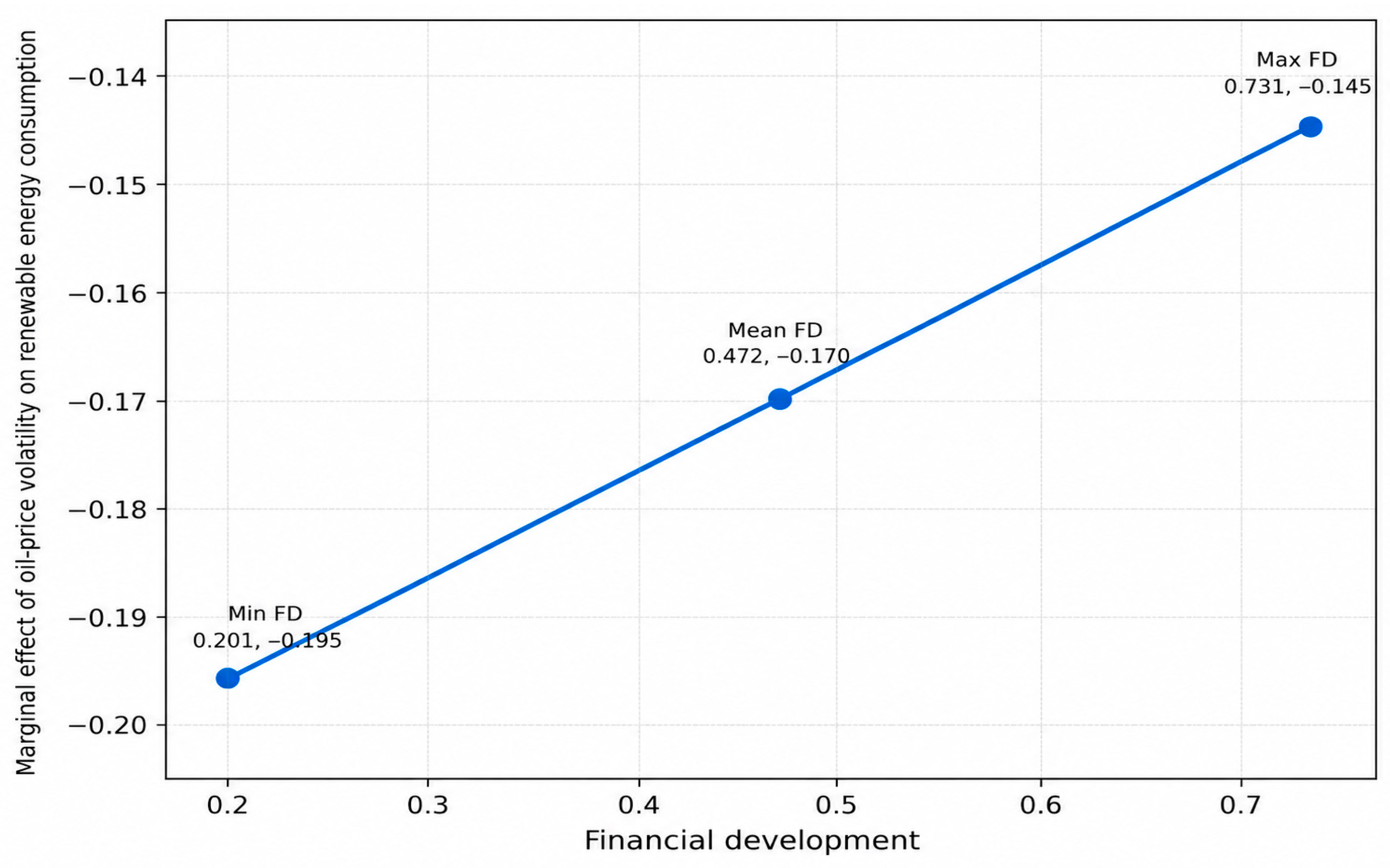
Figure 1 presents the marginal effect of oil-price volatility on renewable-energy consumption across the observed range of financial development.
Figure 1 shows that the marginal effect of oil-price volatility remains negative across the full observed range of financial development. However, the adverse association becomes weaker as financial development increases, moving from approximately −0.195 at the minimum FD level to −0.170 at the mean FD level and −0.145 at the maximum FD level. This pattern suggests that financial development may partially reduce, but does not fully eliminate, the negative relationship between oil-market uncertainty and renewable-energy transition.
The moderating relationship should nevertheless be interpreted cautiously because financial development, renewable-energy transition, and broader diversification strategies may evolve jointly in GCC economies. Countries pursuing more ambitious renewable-energy transition programs may simultaneously expand financial-market reforms, sustainable-finance initiatives, and investment frameworks. Accordingly, the interaction effect identified in the present analysis should be interpreted primarily as evidence of conditional association rather than definitive causal mitigation. In addition, the baseline specification captures the magnitude of oil-market instability rather than distinguishing between positive and negative oil-price shocks, implying that potential asymmetric transition responses remain outside the scope of the present analysis.
Evaluating the marginal effect across representative points of the financial-development distribution indicates that the adverse association between oil-price volatility and renewable-energy consumption becomes progressively weaker as financial development increases. Specifically, the marginal effect equals −0.179 at the 25th percentile of financial development, −0.170 at the median, and −0.160 at the 75th percentile. However, the marginal effect remains negative throughout the distribution of financial development, indicating that stronger financial systems may alleviate, but do not fully offset, the challenges that oil-market instability poses for renewable-energy transition in GCC economies.
4.5. Short-Run Dynamics and Error-Correction Model
To complement the long-run analysis, the short-run dynamics among the variables are examined using an error-correction model (ECM). The ECM framework captures short-run adjustments while incorporating the lagged error-correction term to evaluate the speed of convergence toward long-run equilibrium.
Table 9 presents the short-run dynamics and error-correction estimation results.
The short-run coefficients indicate a negative and statistically significant association between oil-price volatility and renewable-energy consumption in GCC economies. The coefficient of ΔOPV is approximately −0.087, suggesting that short-term instability in oil markets may temporarily weaken renewable-energy transition efforts by increasing uncertainty surrounding energy investment and fiscal planning. Financial development maintains a positive short-run association with renewable-energy consumption, with a coefficient close to 0.064, indicating that more developed financial systems may facilitate short-term financing conditions for renewable-energy projects.
The interaction term between oil-price volatility and financial development remains positive and statistically significant in the short run. The estimated coefficient of approximately 0.041 suggests that financial development may partially offset the adverse implications of oil-market volatility for renewable-energy transition, even during periods of short-term economic uncertainty. This finding is consistent with the long-run estimations and further suggests that stronger financial systems may contribute to improving the resilience of renewable-energy investment under volatile energy-market conditions. The coefficient associated with the first-differenced interaction term should be interpreted as a short-run moderating effect capturing the immediate adjustment of renewable-energy consumption to simultaneous changes in oil-market volatility and financial development. By contrast, the interaction coefficient reported in the long-run estimations reflects the persistent equilibrium relationship between oil-market instability, financial development, and renewable-energy transition. The short-run interaction effect therefore captures temporary adjustment dynamics, whereas the long-run coefficient represents the broader structural relationship.
Among the control variables, energy use displays a negative and statistically significant coefficient of approximately −0.094, reflecting the continued importance of conventional energy systems in GCC economies. Institutional quality remains positively associated with renewable-energy consumption, with a coefficient close to 0.057, suggesting that stronger governance structures may support short-run adjustment processes related to energy transition. By contrast, GDP per capita, trade openness, and inflation do not appear statistically significant in the short run.
The error-correction term is negative and statistically significant at the 1% level, with a coefficient of approximately −0.612. This result supports the existence of a stable long-run equilibrium relationship among the variables. The magnitude of the coefficient indicates that nearly 61% of short-run disequilibrium is corrected within one year, suggesting a relatively rapid adjustment process toward long-run equilibrium following temporary shocks in oil markets or renewable-energy dynamics. The interpretation of the long-run equilibrium relationship should nevertheless be approached cautiously because renewable-energy deployment remained relatively limited in several GCC economies during the earlier part of the sample period.
Although the error-correction coefficient remains negative and statistically significant across alternative specifications, its magnitude should be interpreted cautiously given the relatively small number of countries included in the sample and the structural evolution of renewable-energy deployment across GCC economies. In particular, renewable-energy transition became substantially more pronounced after 2010–2015, implying that the estimated adjustment dynamics may more strongly reflect the recent transition period. While additional procedures such as bootstrap inference, lag-length sensitivity analysis, and country-specific heterogeneous ECM estimations could provide further information regarding parameter stability, these approaches may generate unstable results in small heterogeneous panels characterized by limited time variation during the earlier years of the sample.
4.6. Robustness Checks
To assess the stability of the baseline findings, five robustness checks are conducted. These tests examine whether the main results are sensitive to alternative variable measurement, lag structure, estimation technique, country composition, and the construction of oil-price volatility. The purpose is to verify whether the negative association between oil-price volatility and renewable-energy transition, as well as the mitigating role of financial development, remains consistent across alternative empirical specifications.
4.6.1. Alternative Measure of Financial Development
The first robustness check replaces the IMF Financial Development Index with domestic credit to the private sector as a percentage of GDP. This alternative proxy captures the depth of financial intermediation and the availability of credit for private investment. The results are reported in
Table 10.
The results remain broadly consistent with the baseline estimates. Oil-price volatility retains a negative and statistically significant coefficient, while the alternative financial-development proxy remains positively associated with renewable-energy consumption. The interaction term also remains positive and statistically significant, suggesting that stronger financial intermediation may partially reduce the adverse implications of oil-price volatility for renewable-energy transition. These findings further suggest that the moderating role of financial development is not strongly dependent on the specific financial-development indicator used in the baseline model.
4.6.2. Robustness Check Using Lagged Explanatory Variables
The second robustness check partially addresses potential simultaneity concerns by re-estimating the model using one-period lagged explanatory variables. This specification reduces the likelihood that contemporaneous changes in renewable-energy consumption influence the explanatory variables. The results are presented in
Table 11.
The lagged-variable specification produces results that remain close to the baseline estimates. Oil-price volatility remains negatively associated with renewable-energy consumption, while financial development continues to display a positive coefficient. The interaction term also remains positive and statistically significant, suggesting that financial development may help moderate the adverse implications of oil-price volatility for renewable-energy transition. The similarity between the lagged and baseline results further suggests that the main empirical relationships are less likely to be driven exclusively by contemporaneous simultaneity.
4.6.3. Driscoll–Kraay Fixed-Effects Robustness
The third robustness check applies a fixed-effects estimator with Driscoll–Kraay standard errors. This approach provides standard errors that are robust to heteroskedasticity, serial correlation, and cross-sectional dependence. Although the baseline analysis relies on mean-group estimators, this additional specification provides a useful robustness check based on a different estimation strategy. The results are reported in
Table 12.
The Driscoll–Kraay results remain consistent with the direction and statistical significance of the main variables. Oil-price volatility remains negatively associated with renewable-energy consumption, while financial development and the interaction term remain positive and statistically significant. The persistence of these results under a fixed-effects framework with robust standard errors further supports the stability and reliability of the baseline empirical relationships.
4.6.4. Leave-One-Out Country Sensitivity Analysis
Given the small number of GCC countries included in the sample, a leave-one-out sensitivity analysis is conducted to examine whether the baseline results are driven by any single country. The model is re-estimated six times, each time excluding one GCC country from the sample.
Table 13 reports the coefficients of the three main variables of interest: oil-price volatility, financial development, and their interaction term.
The leave-one-out results indicate that the main conclusions are not driven by a single country. Across all country-exclusion specifications, oil-price volatility remains negative, while financial development and the interaction term remain positive. The coefficients become somewhat weaker when Saudi Arabia is excluded from the sample, which likely reflects both the country’s dominant position within GCC oil markets and the increasing scale of its renewable-energy transition initiatives under Vision 2030. Saudi Arabia has implemented some of the region’s largest renewable-energy and diversification projects, including large-scale solar investments and major public investment programs, which may strengthen the interaction between oil-market dynamics, financial development, and renewable-energy transition within the GCC panel. However, the signs and statistical relevance of the main variables are preserved, supporting the stability of the baseline estimates.
4.6.5. Alternative Measure of Oil-Price Volatility
The fifth robustness check uses an alternative measure of oil-price volatility based on the annual standard deviation of monthly Brent crude oil returns rather than the rolling standard deviation of oil-price levels. This specification verifies whether the results depend on the volatility construction method. The correlation between the baseline and alternative oil-price-volatility measures is positive and relatively strong, indicating that both indicators capture similar patterns of oil-market instability despite differences in construction. The results are shown in
Table 14.
The alternative oil-price-volatility specification remains broadly consistent with the baseline conclusions. The coefficient of OPV_ALT is negative and statistically significant, indicating that oil-market uncertainty remains negatively associated with renewable-energy transition dynamics. The positive and significant interaction term further suggests that the moderating role of financial development is preserved when oil-price volatility is measured using oil returns rather than oil-price levels. This finding further supports the robustness of the central empirical relationships.
Taken together, the five robustness checks provide consistent evidence that the baseline findings remain relatively stable across alternative measurements, lag structures, estimation methods, sample compositions, and volatility constructions. Oil-price volatility remains negatively associated with renewable-energy transition, while financial development retains a positive direct association and continues to suggest a moderating role with respect to the adverse implications of oil-market uncertainty. These results further support the credibility of the empirical evidence and suggest that financial development may play an important role in enhancing energy-transition resilience in GCC economies.
5. Discussion
The empirical results show that oil-price volatility is negatively associated with renewable-energy consumption in GCC economies in both the long run and the short run. This relationship indicates that instability in global oil markets may constrain renewable-energy transition efforts in hydrocarbon-dependent economies. In GCC countries, fluctuations in oil markets can influence fiscal revenues, investment planning, and long-term energy strategies because hydrocarbons continue to occupy a dominant position within regional economic structures.
Periods of elevated oil-market uncertainty may therefore delay renewable-energy projects or weaken incentives for transition-related investment. The observed long-run relationship may reflect more strongly the structural transformation that emerged after 2010, when GCC economies accelerated renewable-energy investment through diversification initiatives such as Saudi Vision 2030 and the UAE Energy Strategy 2050. This interpretation aligns with [
4], which argues that renewable-energy development in GCC economies remains closely linked to oil-price dynamics. The findings also correspond to [
5], which highlights the structural vulnerability of oil-exporting economies during the global energy transition, and to [
7], which emphasizes the tension between energy-security concerns and decarbonization objectives under volatile energy-market conditions.
The estimated coefficients further indicate that the economic magnitude of the relationship is meaningful. Based on the descriptive statistics, a one-standard-deviation increase in oil-price volatility is associated with an approximate 1.5% decline in renewable-energy consumption in the long run. This result highlights the potential importance of oil-market uncertainty for renewable-energy planning and investment continuity in economies where fiscal systems and public investment strategies remain closely connected to hydrocarbon revenues. The analysis nevertheless focuses on the magnitude of oil-market instability without distinguishing between positive and negative oil-price shocks. In hydrocarbon-dependent economies, declining oil prices may constrain fiscal revenues and renewable-energy investment capacity more directly, whereas rising oil prices may weaken diversification incentives by improving hydrocarbon revenues. The estimated relationships should therefore be interpreted as capturing the overall effect of oil-market instability rather than asymmetric responses to oil-price increases and decreases.
Financial development is positively associated with renewable-energy transition across the estimated models. The coefficients indicate that more developed financial systems may improve access to financing and facilitate the implementation of renewable-energy projects. In economies characterized by large-scale infrastructure requirements, financial depth and credit availability appear particularly relevant for supporting long-term energy transformation strategies.
Nevertheless, aggregate financial-development indicators may not fully capture the specific financing structures supporting renewable-energy investment in GCC economies. In practice, renewable-energy projects in the region increasingly rely on mechanisms such as green sukuk issuance, sovereign wealth fund allocations, state-supported investment programs, concessional financing arrangements, and public–private partnerships. For example, large-scale renewable-energy initiatives in Saudi Arabia and the United Arab Emirates have been supported through a combination of sovereign financing, strategic investment funds, and sustainability-oriented financial initiatives. The present analysis therefore captures the broader macro-financial environment rather than individual renewable-energy financing instruments.
This interpretation is consistent with [
10], which reports that financial development contributes positively to renewable-energy expansion in MENA economies. The findings are also compatible with [
11], which shows that financial development and institutional quality support renewable-energy deployment and carbon-neutrality objectives in GCC countries. Ref. [
12] similarly emphasizes the strategic role of financing mechanisms in accelerating renewable-energy investment in the Gulf region.
An important contribution of the study concerns the interaction between oil-price volatility and financial development. The estimated marginal effects additionally indicate that the adverse association between oil-price volatility and renewable-energy transition becomes progressively weaker at higher levels of financial development. Across the observed distribution of financial development, the marginal effect of oil-price volatility remains negative but declines in magnitude as financial systems become more developed. This pattern suggests that stronger financial intermediation, financing diversification, and investment-continuity mechanisms may reduce part of the vulnerability of renewable-energy investment to oil-market instability. The positive and statistically significant interaction term indicates that financial development may enhance the resilience of renewable-energy investment during periods of volatile energy-market conditions rather than completely insulating GCC economies from oil-market shocks.
Recent studies increasingly emphasize the role of financial resilience in supporting structural transformation and sustainable transition. The authors of [
13] argue that sustainable-finance mechanisms contribute to economic resilience and diversification in GCC economies. The authors of [
26] likewise find that financial development positively affects renewable-energy use in economies exposed to oil-market fluctuations. The present analysis extends this literature by indicating that financial systems may also moderate the transmission of oil-market uncertainty to renewable-energy transition dynamics.
Institutional quality also appears positively associated with renewable-energy consumption. Stronger governance structures, regulatory effectiveness, and policy stability may improve investor confidence and facilitate the implementation of renewable-energy initiatives. This interpretation is consistent with [
29], which shows that governance quality significantly influences renewable-energy infrastructure transition in MENA economies. The authors of [
28] likewise emphasize the importance of governance reforms in supporting sustainable energy transformation across the region.
Trade openness does not appear statistically significant in the estimated models. One possible explanation is that the aggregate trade-openness indicator used in the analysis captures overall external trade integration rather than trade specifically related to renewable-energy technologies and equipment. In GCC economies, renewable-energy infrastructure and technology imports may occur largely through state-led investment programs and strategic energy initiatives that are not necessarily proportional to overall trade intensity. In addition, the strong dependence of GCC trade structures on hydrocarbons may reduce the capacity of aggregate trade measures to capture transition-related technology diffusion mechanisms.
By contrast, energy use remains negatively associated with renewable-energy consumption, reflecting the continued reliance of GCC economies on conventional energy systems. Despite increasing renewable-energy initiatives, fossil fuels continue to dominate electricity generation, industrial activity, and transport sectors across the region. These findings are broadly consistent with [
2,
3], which argue that energy transition in GCC economies remains gradual because of long-standing dependence on hydrocarbon-based growth models. This interpretation also corresponds to [
36], which reports that conventional energy dependence remains an important source of environmental pressure despite ongoing sustainability initiatives.
The short-run dynamics indicate that oil-market instability also exerts immediate effects on renewable-energy transition, although the magnitude of these effects appears smaller than in the long run. The coefficient associated with the first-differenced interaction term represents a short-run moderating effect capturing the immediate adjustment of renewable-energy consumption to simultaneous changes in oil-price volatility and financial development. By contrast, the interaction coefficient reported in the long-run estimations reflects the persistent equilibrium relationship among oil-market instability, financial development, and renewable-energy transition. The positive coefficient associated with the short-run interaction term suggests that improvements in financial conditions may partially alleviate the immediate adverse implications of oil-market volatility. Nevertheless, these relationships should be interpreted cautiously because renewable-energy transition and financial development may evolve jointly within broader diversification strategies pursued by GCC economies.
The negative and statistically significant error-correction term supports the existence of a stable adjustment process toward long-run equilibrium. The estimated adjustment speed indicates that GCC economies progressively absorb short-run shocks and gradually realign toward long-run renewable-energy transition dynamics following periods of oil-market turbulence. However, this relationship should be interpreted cautiously because renewable-energy deployment remained relatively limited in several GCC economies during the earlier part of the sample period.
The robustness estimations further support the stability of the main empirical relationships across alternative specifications, estimation techniques, lag structures, and variable measurements. The persistence of the interaction effect across these checks indicates that the moderating role of financial development remains relatively stable under different empirical settings. Nevertheless, the findings should be interpreted as conditional associations rather than definitive causal relationships because reverse causality and omitted-variable bias cannot be fully excluded.
The leave-one-out analysis indicates that the estimated relationships are not driven by a single GCC economy, although the coefficients become somewhat weaker when Saudi Arabia is excluded from the sample. This result may reflect the country’s central position within regional oil markets as well as the growing scale of Saudi renewable-energy and diversification initiatives under Vision 2030 and related large-scale investment programs. The leave-one-out estimations also suggest that financial and energy-transition dynamics may differ across GCC economies characterized by heterogeneous financial structures and diversification strategies. Financial centers such as the United Arab Emirates and Bahrain possess relatively diversified financial systems and stronger international investment linkages, whereas other GCC economies remain more closely connected to hydrocarbon-based fiscal structures. Although the baseline panel framework captures common regional dynamics, some country-specific heterogeneity may remain insufficiently reflected in the aggregate estimations.
In sum, the findings indicate that renewable-energy transition in GCC economies remains closely associated with hydrocarbon dependence, oil-market uncertainty, financial-system capacity, and institutional quality. While stronger financial systems appear to support energy-transition resilience under volatile market conditions, the transition process continues to depend on broader structural transformation and long-term diversification strategies across the region.
6. Conclusions
Renewable-energy transition has become increasingly important for GCC economies seeking to reduce dependence on hydrocarbon revenues and strengthen long-term economic resilience under changing global energy conditions. However, the transition process remains closely connected to developments in international oil markets and the financial capacity of these economies to support large-scale structural transformation. Against this background, the present study examined the relationship between oil-price volatility, financial development, and renewable-energy transition in GCC countries over the period 1990–2024 using second-generation panel econometric techniques that account for cross-sectional dependence and heterogeneous country dynamics.
The empirical results support the existence of a stable long-run relationship among the variables. Oil-price volatility is negatively associated with renewable-energy consumption in both the long run and the short run, indicating that oil-market instability may hinder renewable-energy transition efforts in hydrocarbon-dependent economies. Financial development exhibits a positive association with renewable-energy transition, while the interaction term between oil-price volatility and financial development remains positive and statistically significant across alternative specifications. This finding suggests that stronger financial systems may help reduce part of the adverse pressure associated with oil-market uncertainty by supporting financing continuity and improving investment conditions for renewable-energy projects.
The estimated coefficients also indicate that the economic magnitude of these relationships is meaningful. At the mean level of financial development, the net adverse association between oil-price volatility and renewable-energy consumption becomes weaker, suggesting that financial development may offset approximately 21% of the negative relationship between oil-market instability and renewable-energy transition. Nevertheless, the interaction effect should be interpreted cautiously because renewable-energy transition, financial development, and broader diversification strategies may evolve jointly within GCC economies. Accordingly, the findings are interpreted as conditional associations rather than definitive causal relationships, and potential endogeneity concerns related to reverse causality and omitted-variable bias cannot be fully excluded.
The results further indicate that institutional quality is positively associated with renewable-energy transition, whereas high levels of conventional energy use remain linked to weaker renewable-energy deployment. The robustness checks support the stability of the main relationships across alternative variable measurements, estimation approaches, lag structures, and sample-sensitivity analyses. However, the relatively small cross-sectional dimension of the GCC sample requires cautious interpretation of the findings.
Several policy implications emerge from these results. First, GCC economies may benefit from strengthening financial systems capable of supporting long-term renewable-energy investment during periods of oil-market uncertainty. Expanding sustainable-finance mechanisms, green bonds, green sukuk, renewable-energy investment funds, and climate-related financial instruments may enhance the resilience of transition-related projects when oil revenues become more volatile. Second, improving institutional quality and regulatory stability may help attract private investment into renewable-energy sectors by reducing uncertainty and strengthening policy credibility. Third, GCC governments may benefit from accelerating broader economic diversification strategies that reduce dependence on hydrocarbon revenues and limit the transmission of oil-market instability to renewable-energy transition efforts. These findings are consistent with recent arguments emphasizing the role of diversification and industrial policies in strengthening sustainable economic competitiveness during the energy-transition process in GCC economies [
37].
The findings additionally suggest that renewable-energy policies may be more resilient when coordinated with broader financial-sector development and institutional-reform strategies. In this context, financial development appears not only as a source of investment financing but also as a mechanism that may support energy-transition resilience under volatile energy-market conditions.
Despite these contributions, the study presents several limitations that may provide directions for future research. First, the analysis focuses exclusively on GCC countries, which may limit the generalizability of the findings to other oil-exporting regions characterized by different institutional and economic structures. Second, renewable-energy transition is measured using aggregate renewable-energy consumption and therefore does not distinguish among specific renewable-energy technologies such as solar, wind, or hydrogen investment. Third, renewable-energy deployment remained relatively limited in several GCC economies during the earlier part of the sample period, suggesting that the estimated long-run relationship may reflect more strongly the post-2010 transition period, when renewable-energy investment accelerated across the region. Fourth, although the empirical framework accounts for cross-sectional dependence and heterogeneous country dynamics, potential endogeneity concerns related to reverse causality and omitted-variable bias cannot be fully excluded. In addition, the aggregate financial-development indicator employed in the analysis may not fully capture renewable-energy-specific financing mechanisms such as green sukuk, sovereign wealth financing, or public–private investment structures increasingly used across GCC economies. Furthermore, the analysis captures the magnitude of oil-market instability without distinguishing between positive and negative oil-price shocks. Future research may therefore benefit from examining asymmetric oil-price effects, nonlinear transition dynamics, threshold relationships, and country-specific adjustment mechanisms within GCC economies. Understanding how financial systems interact with oil-market uncertainty may become increasingly important for designing resilient and sustainable energy-transition strategies in hydrocarbon-dependent economies.