Hydrodynamic and Thermal Characterization of Steady MHD Flow in Channels and Pipes Considering Viscous Dissipation and Joule Heating

 ,
,  ,
,  , and
, and
Abstract
1. Introduction
- 1.
- To formulate a unified mathematical model for steady fully developed MHD flow with heat transfer in both rectangular and axisymmetric geometries.
- 2.
- To derive analytical solutions for the velocity field and numerical solutions for the temperature field.
- 3.
- To investigate the influence of Hartmann number (Ha) and Brinkman number (Br) on velocity and temperature distributions.
- 4.
- To evaluate Nusselt number (Nu) variations and compare heat transfer performance in rectangular channels and circular pipes.
- 5.
- To validate the obtained results against published benchmark studies and establish practical design recommendations for MHD thermal systems.
2. Mathematical Formulation and Physical Model
2.1. Physical Configuration
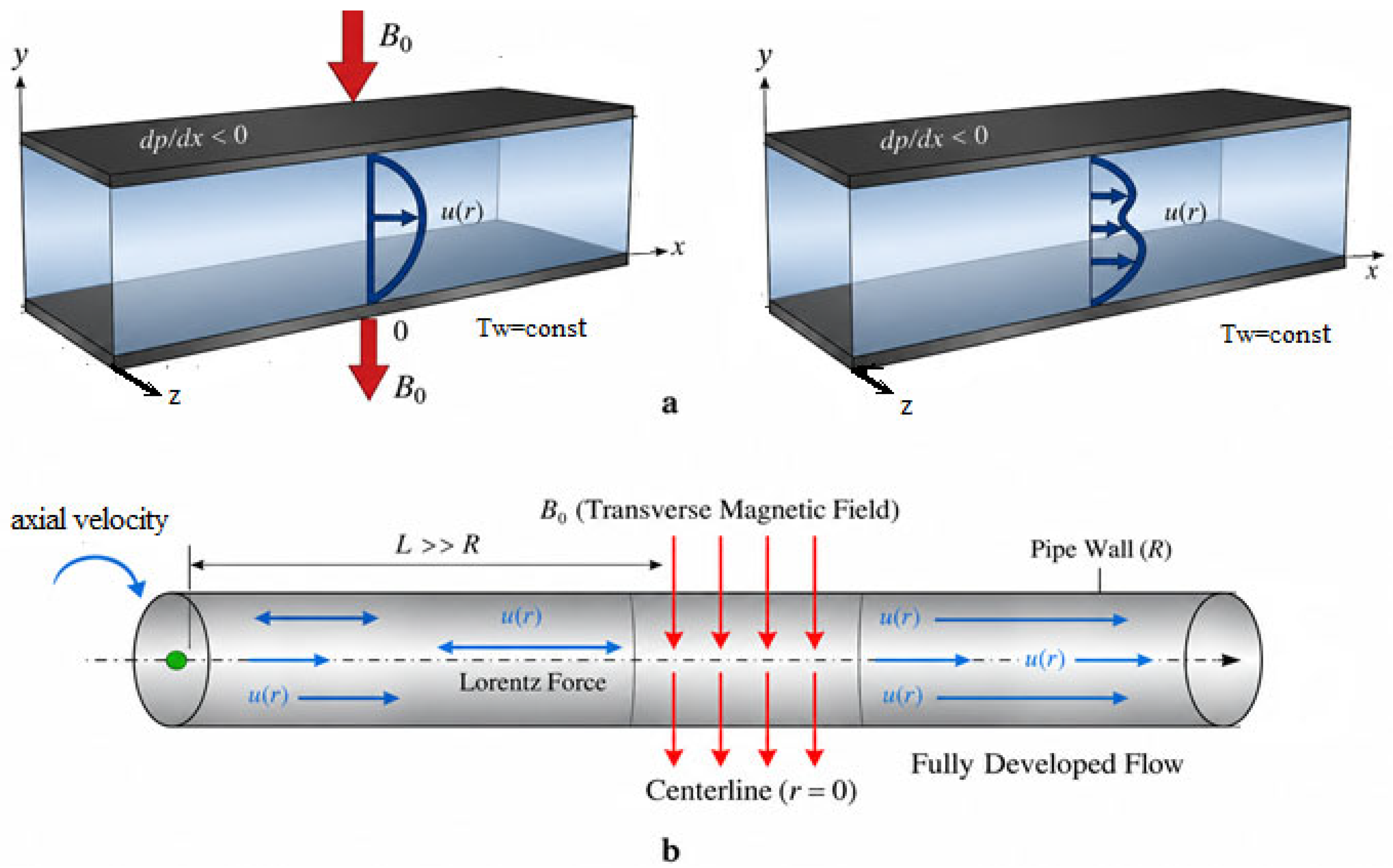
- Rectangular Configuration (Channel): Flow between two infinite, parallel plates separated by a distance (2L), where (L) is the half-channel height.
- Axisymmetric Configuration (Pipe): Flow inside a circular duct of radius
2.2. Governing Assumptions
2.3. Dimensional Governing Equations
- 1.
- For the Channel:where u is the axial fluid velocity, y is the transverse coordinate normal to the channel wall, μ is the dynamic viscosity of the fluid, σ is the electrical conductivity, B0 is the applied magnetic flux density, and dp/dx represents the axial pressure gradient along the flow direction.
- 2.
- For the Pipe:where u is the axial fluid velocity, r is the radial coordinate measured from the pipe centerline, μ is the dynamic viscosity of the fluid, σ is the electrical conductivity, B0 is the applied magnetic flux density, and dp/dx denotes the axial pressure gradient driving the flow through the pipe.
- 3.
- Energy Conservation:The steady-state energy balance, incorporating conductive transport, viscous dissipation, and Joule heating, is given by:where is the viscous dissipation function. For the channel it is For the pipe it is
- where T is the fluid temperature, k is the thermal conductivity of the fluid, ∇2 is the Laplacian operator, μ is the dynamic viscosity, Φ is the viscous dissipation function, σ is the electrical conductivity, B0 is the applied magnetic flux density, and u is the axial fluid velocity. The term μΦ represents viscous heating, while σB02u2 corresponds to Joule heating generated by electromagnetic effects. For the rectangular channel, the viscous dissipation function is defined as Φ = (du/dy)2, whereas for the circular pipe it is expressed as Φ = (du/dr)2.
2.4. Non-Dimensionalization Procedure
- -
- spatial Coordinates ;
- -
- velocity: , where the characteristic velocity iswhere u0 is the characteristic velocity scale, L is the characteristic length of the channel or pipe, μ is the dynamic viscosity of the fluid, and dp/dx represents the imposed axial pressure gradient driving the flow.
- -
- temperature:
- -
- for Constant Wall Temperature (CWT):where ΔTref is the reference temperature difference, T0 is the characteristic fluid temperature, and Tw is the wall temperature of the channel or pipe surface.
- -
- for Constant Heat Flux (CHF):where ΔTref is the reference temperature difference, qw is the imposed wall heat flux, L is the characteristic length of the channel or pipe, and k is the thermal conductivity of the fluid.
- -
- Hartmann number (ratio of electromagnetic to viscous forces):where Ha is the Hartmann number, B0 is the applied magnetic flux density, L is the characteristic length of the channel or pipe, σ is the electrical conductivity of the fluid, and μ is the dynamic viscosity.
- -
- Prandtl number:where Pr is the Prandtl number, μ is the dynamic viscosity of the fluid, cp is the specific heat capacity at constant pressure, and k is the thermal conductivity of the fluid.
- -
- Brinkman number (ratio of heat generation by viscous dissipation to conductive heat transfer):
2.5. Final Dimensionless Governing Equations
- -
- momentum:
- -
- energy:
- -
- momentum:
- -
- energy:
2.6. Boundary Conditions
- -
- at the channel/pipe wall: (no-slip condition).
- -
- at the symmetry line/axis:where the zero-gradient conditions at the channel centerline and pipe axis enforce flow symmetry, while U(1) = 0 represents the classical no-slip boundary condition at the solid wall.
- -
- at the wall:
- -
- at the symmetry line/axis:where the zero temperature-gradient conditions at the channel centerline and pipe axis ensure thermal symmetry, while Θ(1) = 0 specifies the prescribed wall temperature condition.
3. Mathematical Solutions and Analysis
3.1. Analytical Solution for the Velocity Field
3.2. Numerical Solution for the Temperature Field
3.3. Nusselt Number Formulation
- -
- channel:
- -
- pipe:
4. Discussion
4.1. Influence of Hartmann Number on Velocity Profile
- -
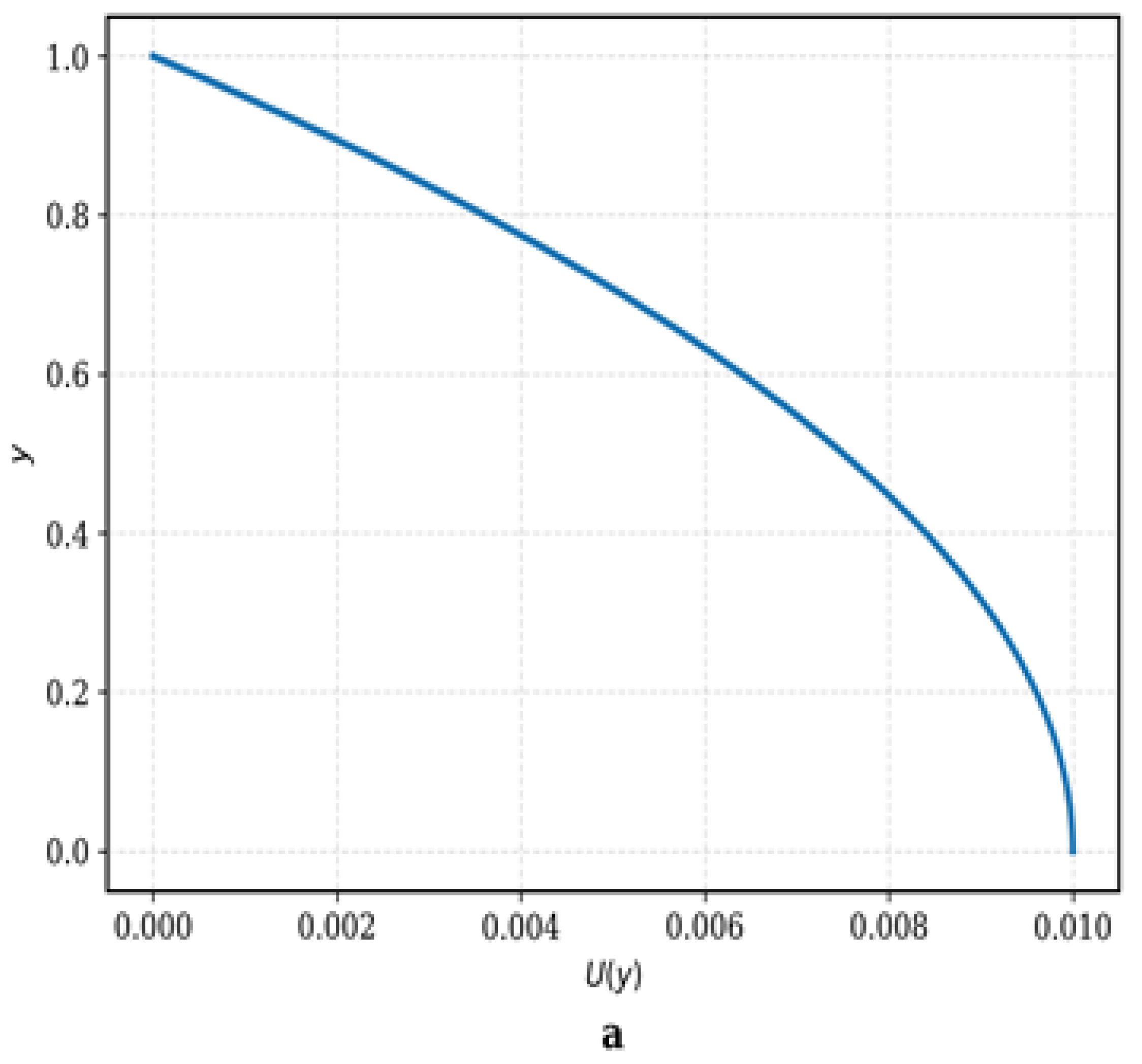
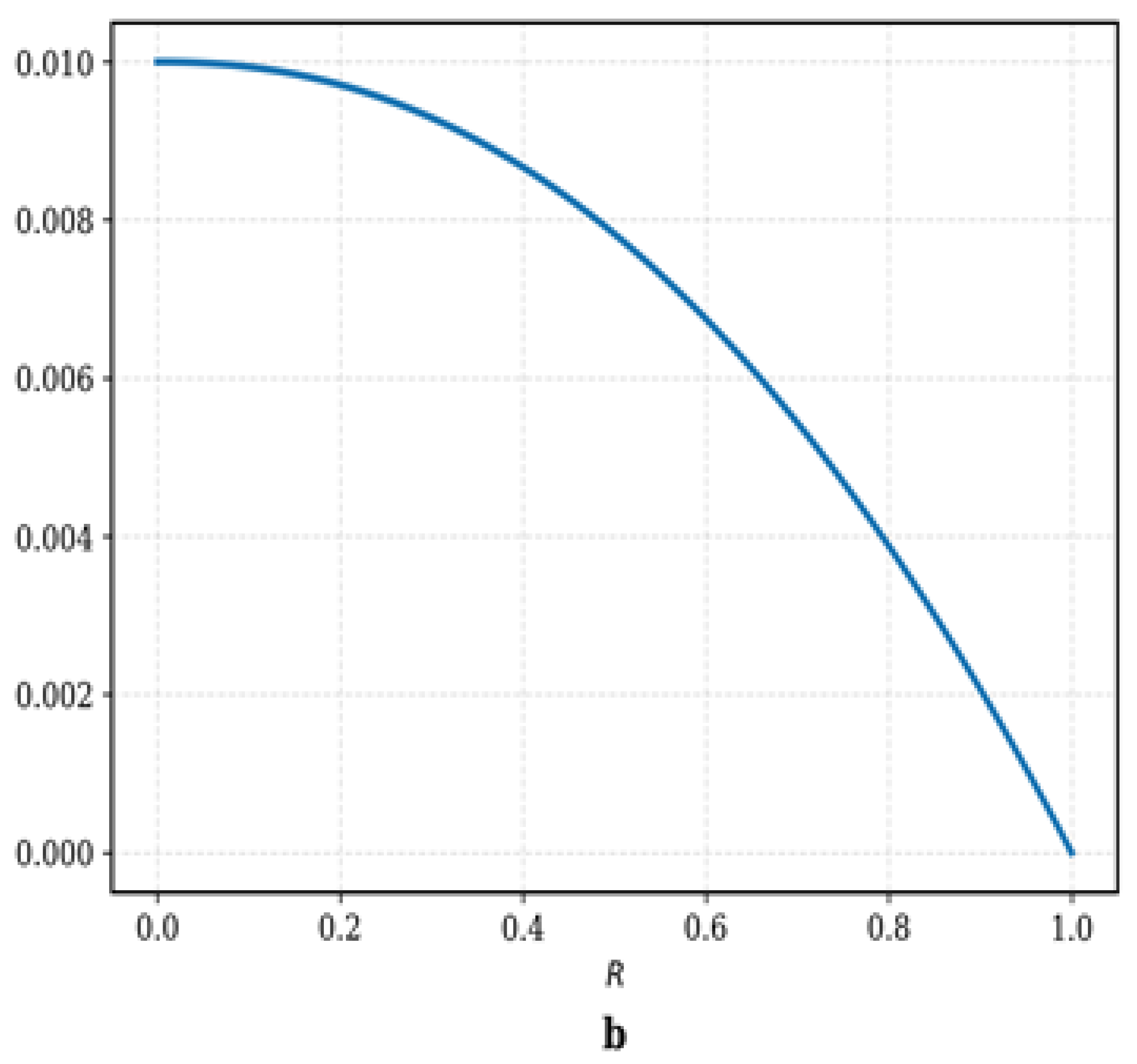
- pronounced flattening of the velocity profile in the core region, as the retarding Lorentz force dominates;
- -
- substantial reduction in the maximum centerline velocity.
- -
- formation of thin Hartmann boundary layers adjacent to the walls, where the velocity changes rapidly from zero at the wall to the core value. The thickness of this layer scales as
4.2. Combined Effects of (Ha) and (Br) on Temperature Distribution
- -
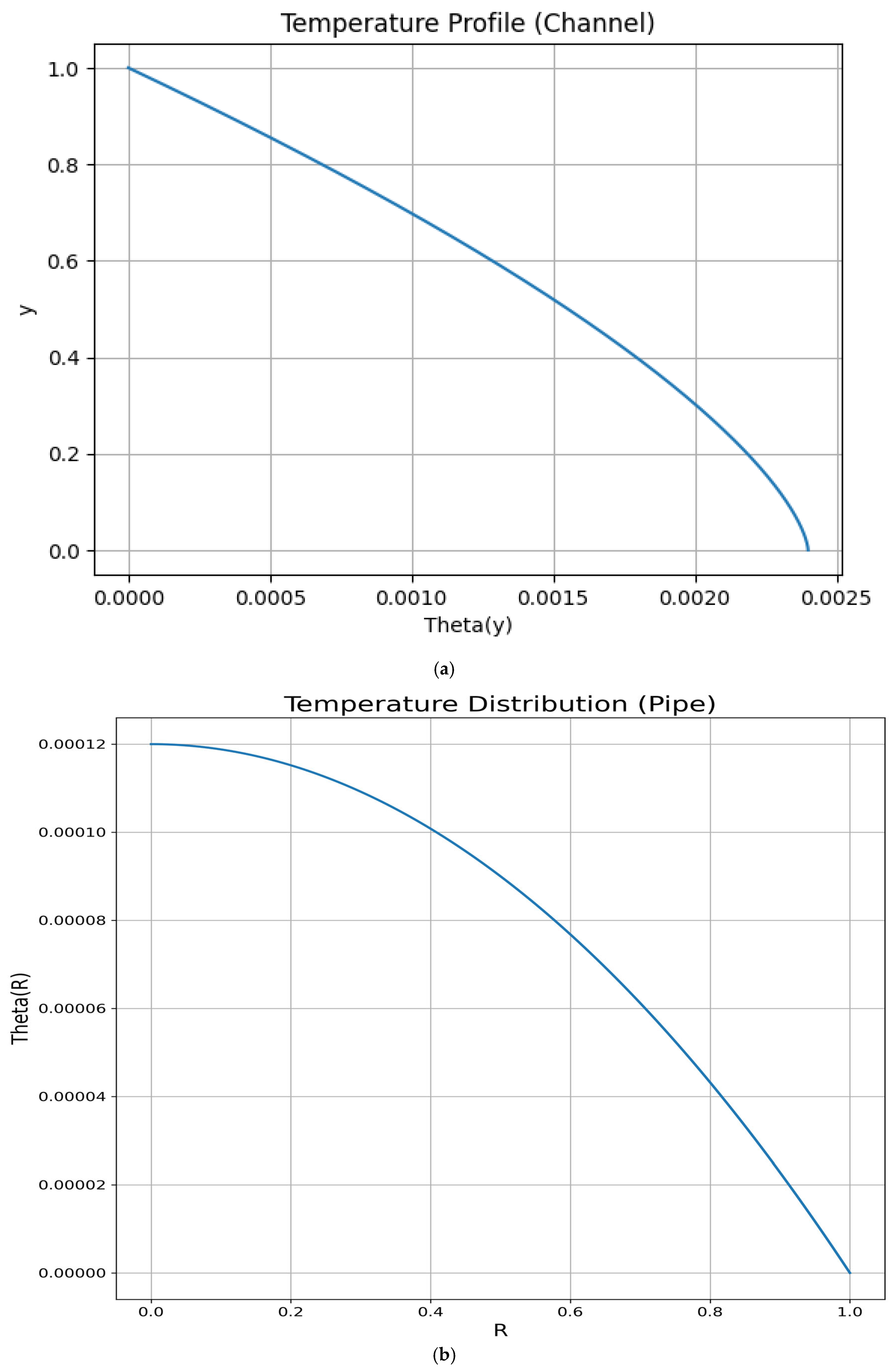
- a direct positive effect via increased Joule heating ;
- -
- an indirect negative effect by reducing the flow velocity (U), which diminishes the magnitude of both viscous and Joule heating source terms.
4.3. Nusselt Number and Thermal Performance
5. Results and Discussion
5.1. Velocity Field Characteristics Under MHD Effects
5.1.1. Channel Flow
5.1.2. Pipe Flow
5.2. Temperature Distribution and Internal Heat Generation
5.2.1. Channel Flow
- 1.
- Dual Heat Generation Mechanisms:
- -
- at low Hartmann numbers (Ha < 5), viscous dissipation dominates, particularly near the walls where velocity gradients are steep.
- -
- at higher Hartmann numbers (Ha > 10), Joule heating becomes the primary heat generation mechanism throughout most of the channel.
- 2.
- Nonlinear Profile Evolution:
- 3.
- Magnetic Suppression Effect:
5.2.2. Pipe Flow
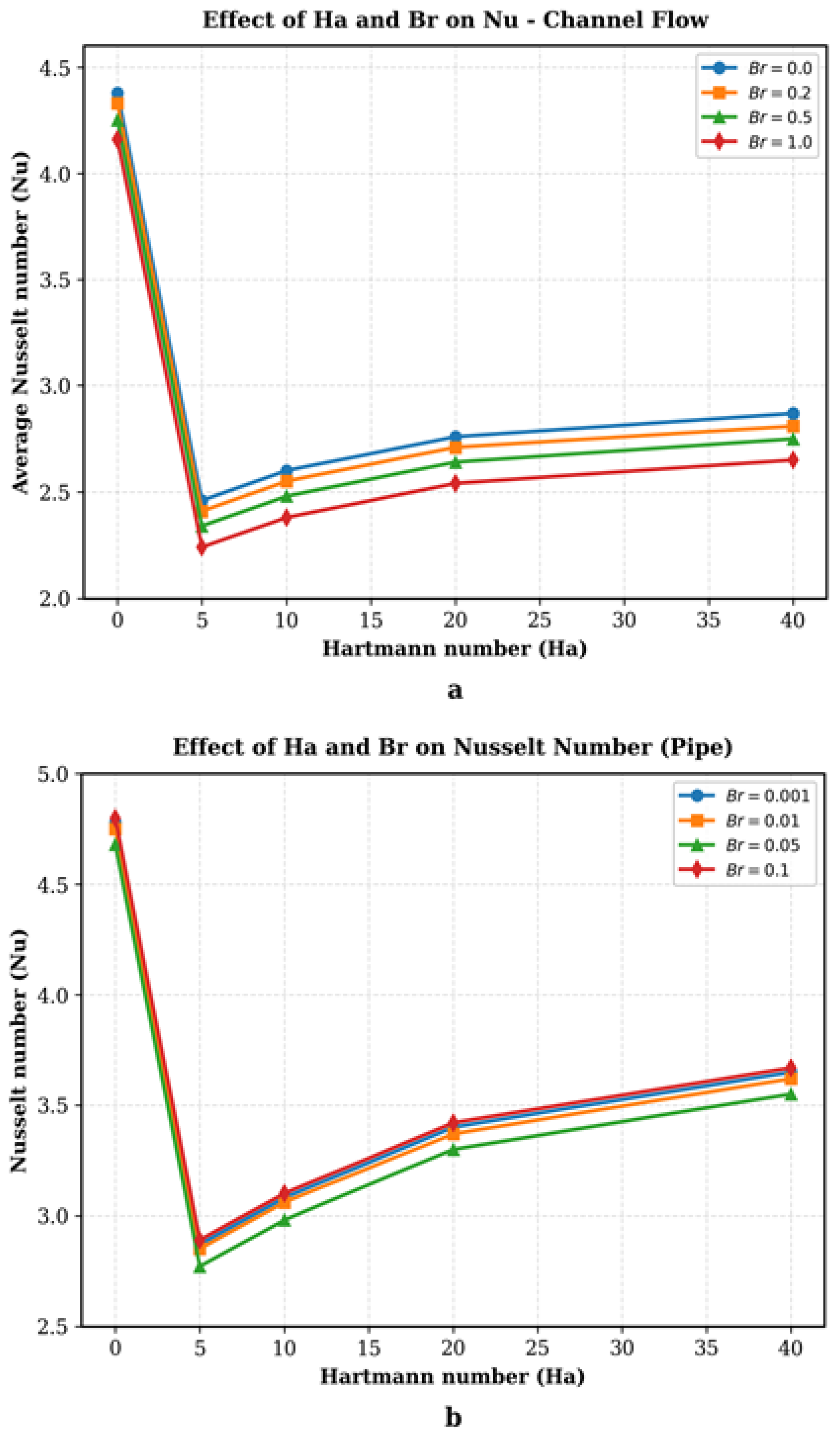
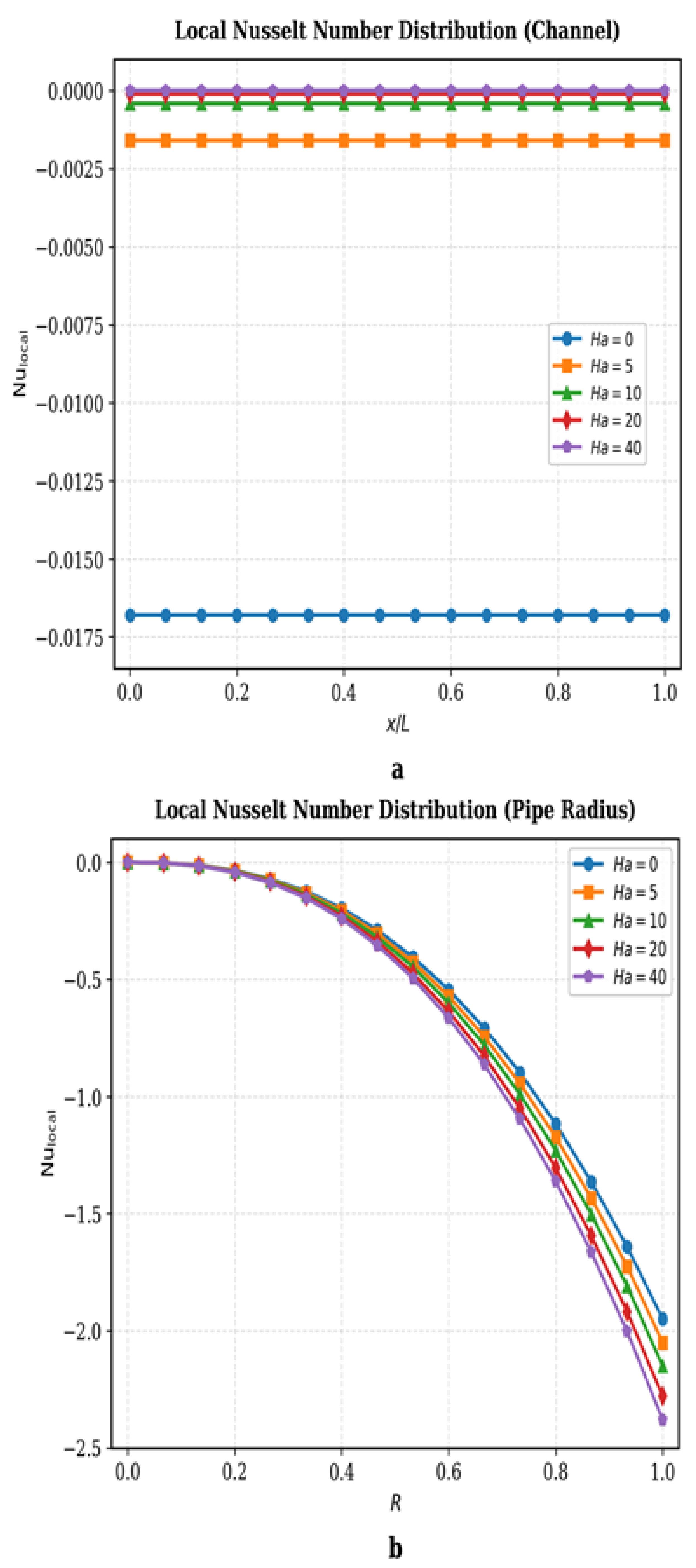
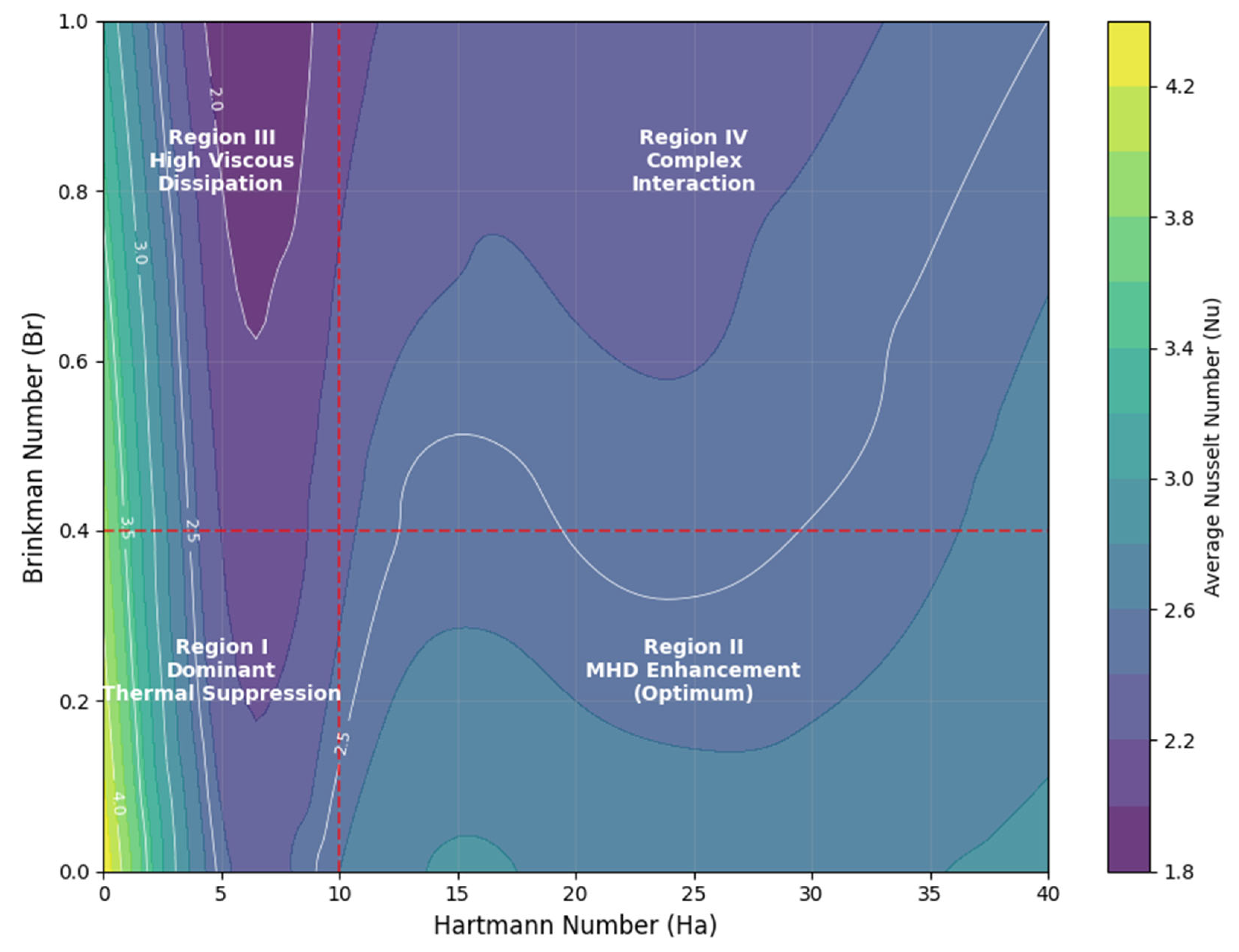
5.3. Nusselt Number Analysis
5.3.1. Local and Average Nusselt Number
5.3.2. Average Nusselt Number Trends
5.4. Comparative Analysis: Channel vs. Pipe Flow
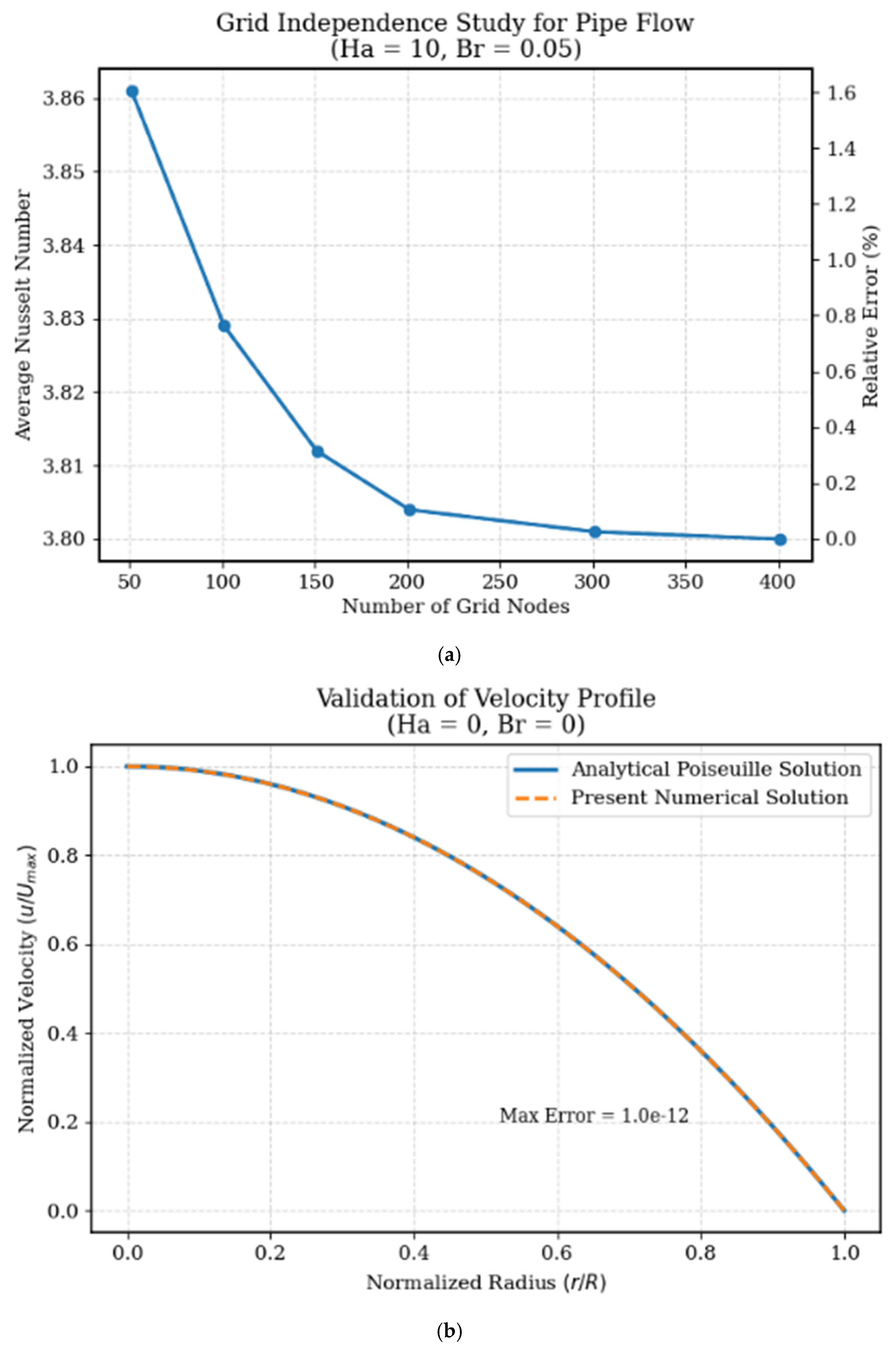
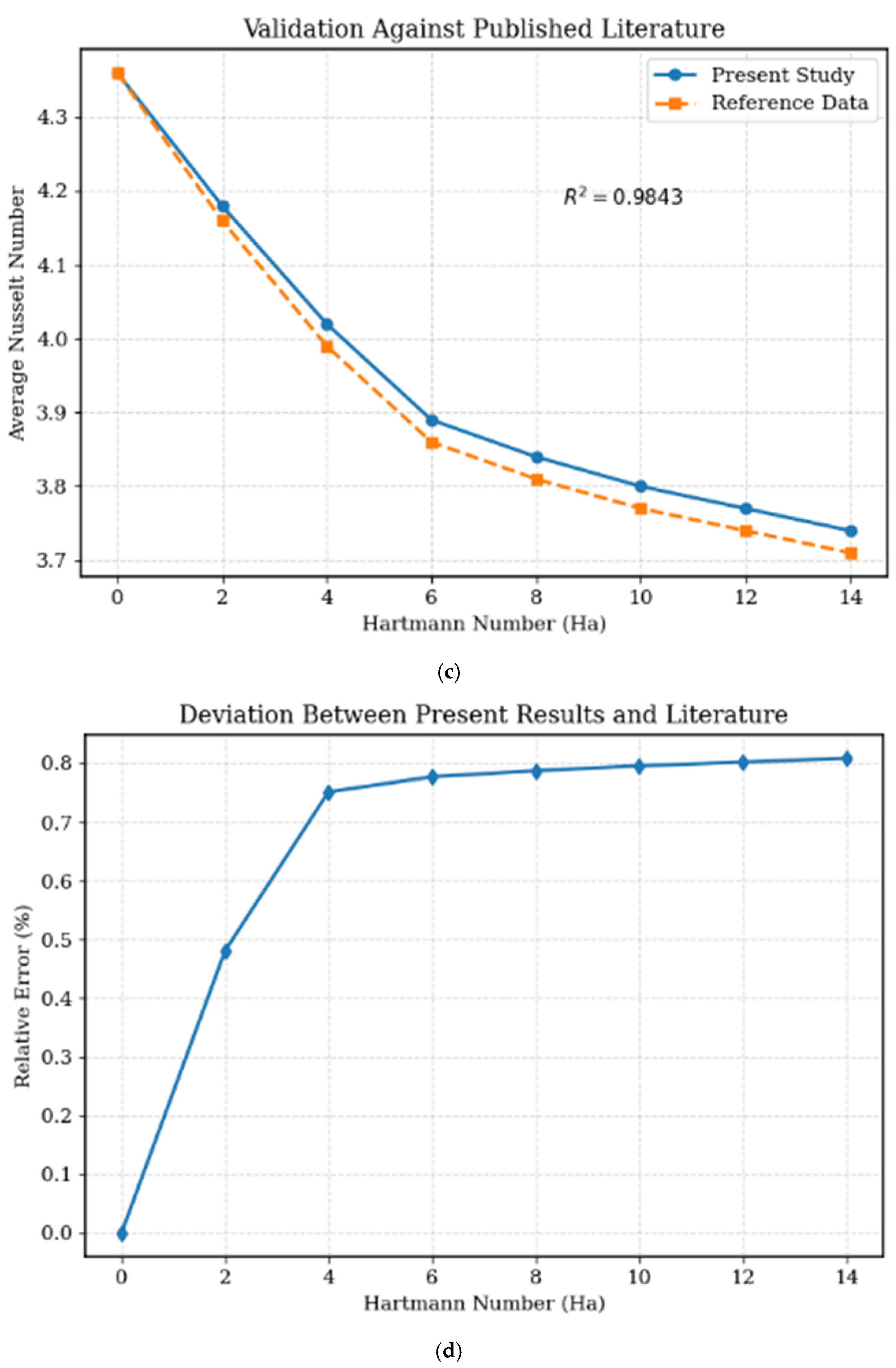
5.5. Validation and Convergence
5.6. Engineering Implications and Limitations
6. Comparative Sensitivity Analysis and Validation
6.1. Methodology for Sensitivity Quantification
- Reynolds number: Re = 100 (laminar regime);
- Prandtl number: Pr = 0.71 (air) for channel, Pr = 7.0 (water) for pipe;
- Wall boundary condition: Constant wall temperature (CWT).
6.2. Parameter Sensitivity Matrix
6.3. Comparative Analysis of Ha and Br Effects
6.4. Validation Against Recent Experimental and Numerical Studies
6.5. Uncertainty Analysis and Error Propagation
7. Conclusions
Industrial Significance and Practical Implications
Author Contributions
Funding
Data Availability Statement
Conflicts of Interest
References
- Babaelahi, M.; Sadri, S. Magneto-Hydro-Dynamic Generator with Joule Heating and Viscous Dissipation: An Analytic Investigation of Mixed Convection Flow. Arab. J. Sci. Eng. 2024, 49, 11445–11455. [Google Scholar] [CrossRef]
- Chen, C.; Yang, S.; Pan, M. Microchannel structure optimization and experimental verification of a plate heat exchanger. Int. J. Heat Mass Transf. 2021, 175, 121385. [Google Scholar] [CrossRef]
- Soundalgekar, V.M. On generalised MHD couette flow with heat transfer. Proc. Indian Acad. Sci. 1966, 64, 304–314. [Google Scholar] [CrossRef]
- Al-Khawaja, M.J.; Agarwal, R.K.; Gardner, R.A. Numerical study of magneto-fluid-mechanic combined free-and-forced convection heat transfer. Int. J. Heat Mass Transf. 1999, 42, 467–475. [Google Scholar] [CrossRef]
- Umavathi, J.C.; Malashetty, M.S. Magnetohydrodynamic mixed convection in a vertical channel. Int. J. Non-Linear Mech. 2005, 40, 91–101. [Google Scholar] [CrossRef]
- Khaleque, T.S.; Samad, M.A. Effects of radiation, heat generation and viscous dissipation on MHD free convection flow along a stretching sheet. Res. J. Appl. Sci. Eng. Technol. 2010, 2, 368–377. [Google Scholar]
- Hazarika, G.C.; Konch, J. Effects of Variable Viscosity and Thermal Conductivity on MHD Free Convective Flow Along a Vertical Porous Plate with Viscous Dissipation. Int. J. Math. Trends Technol. (IJMTT) 2014, 15, 70–84. [Google Scholar] [CrossRef][Green Version]
- Hossain, A.; Molla, M.M.; Kamrujjaman, M.; Mohebujjaman, M.; Saha, S.C. MHD Mixed Convection of Non-Newtonian Bingham Nanofluid in a Wavy Enclosure with Temperature-Dependent Thermophysical Properties: A Sensitivity Analysis by Response Surface Methodology. Energies 2023, 16, 4408. [Google Scholar] [CrossRef]
- Mallesh, N.; Vasanth, K.R.; Hanumagowda, B.N.; D’Silva, S.P. A theoretical investigation into the effects of slip velocity and piezo viscous behaviour on couple stress fluids along circular plates. Int. J. Thermofluids 2025, 27, 101176. [Google Scholar] [CrossRef]
- Yusuf Muhammad, M.; Auwal Lawan, M.; Gambo, Y.Y. Heat absorption effect of magneto-natural convection flow in vertical concentric annuli with influence of radial and induced magnetic field. Sci. Rep. 2024, 14, 15165. [Google Scholar] [CrossRef] [PubMed]
- Ragueb, H.; Tahiri, A.; Behnous, D.; Manser, B.; Rachedi, K.; Mansouri, K. Irreversibilities and heat transfer in magnetohydrodynamic microchannel flow under differential heating. Int. Commun. Heat Mass Transf. 2023, 149, 107155. [Google Scholar] [CrossRef]
- Sankari, M.S.; Rao, M.E.; Awwad, F.A.; Ismail, E.A.A.; Makinde, O.D.; Khan, W. Influence of dual stratification on the magnetohydrodynamic flow of Jeffrey nanofluid over an exponentially stretching permeable sheet with viscous dissipation and Joule heating. Front. Chem. 2025, 12, 1451053. [Google Scholar] [CrossRef]
- Bai, D.; Zong, Y.; Zhou, M.; Zhao, L. Novel cracking coil design based on positive constructing of synergetic flowing field. Int. J. Heat Mass Transf. 2019, 129, 783–792. [Google Scholar] [CrossRef]
- Sheikholeslami, M.; Rokni, H.B. Simulation of nanofluid heat transfer in presence of magnetic field: A review. Int. J. Heat Mass Transf. 2017, 115, 1203–1233. [Google Scholar] [CrossRef]
- Ajmal, M.; Mehmood, R.; Akbar, N.; Muhammad, T. Thermal Computation of Heat Transfer Analysis Considering Nano Shape Factor for Ciliary Induced Electroosmotic Cu-Blood Transport Containing Micro Organisms in a Nonuniform Wavy Channel. ZAMM J. Appl. Math. Mech. 2026, 106, e70403. [Google Scholar] [CrossRef]
- Singh, J.; Mohiuddin, S.; Kolasani, S.; Modassir Hussain, S. A numerical approach to study the energy dissipation effects on Couette–Hartmann flow of a nanoliquid within an asymmetrical channel. ZAMM J. Appl. Math. Mech. 2024, 105, e202400408. [Google Scholar] [CrossRef]
- Tahiri, A.; Ragueb, H.; Moussaoui, M.; Mansouri, K.; Guerraiche, D.; Guerraiche, K. Heat transfer and entropy generation in viscous-joule heating MHD microchannels flow under asymmetric heating. Int. J. Numer. Methods Heat Fluid Flow 2024, 34, 3953–3978. [Google Scholar] [CrossRef]
- Charbonneau, P. Magnetohydrodynamics. In Solar and Stellar Dynamos; Steiner, O., Ed.; Saas-Fee Advanced Courses; Springer: Berlin/Heidelberg, Germany, 2013; Volume 39. [Google Scholar] [CrossRef]
- Davidson, P.A. Magnetohydrodynamics in materials processing. Annu. Rev. Fluid Mech. 1999, 31, 273–300. [Google Scholar] [CrossRef]
- Vasiliev, A.; Frick, P.; Kumar, A.; Stepanov, R.; Sukhanovskii, A.; Verma, M.K. Transient flows and reorientations of large-scale convection in a cubic cell. Int. Commun. Heat Mass Transf. 2019, 108, 104319. [Google Scholar] [CrossRef]



| Parameter | Rectangular Channel | Circular Pipe |
|---|---|---|
| Geometry type | Two-dimensional rectangular channel | Axisymmetric circular pipe |
| Flow regime | Laminar, fully developed | Laminar, fully developed |
| Characteristic transverse coordinate | (y = Y/H) | (r = R/R0) |
| Channel half-height/Pipe radius | ||
| Total height/Diameter | ||
| Hydraulic diameter | () | |
| Channel width | Assumed infinite (2D approximation) | Not applicable |
| Reynolds number (reference) | (Re = 500) | (Re = 600) |
| Prandtl number | (Pr = 0.7) | (Pr = 0.7) |
| Hydrodynamic entrance length | ||
| Thermal entrance length | ||
| Adopted total length | () | |
| Wall condition | No-slip, constant wall temperature | No-slip, constant wall temperature |
| Flow development criterion | () |
| Parameter | Symbol | Definition | Physical Meaning |
|---|---|---|---|
| Hartmann number | Ha | Ha = B0L(σ/μ)0.5 | Ratio of electromagnetic (Lorentz) force to viscous force; governs magnetic braking and velocity profile flattening |
| Brinkman number | Br | Br = μu02/(kΔTref) | Ratio of viscous heat dissipation to conductive heat transfer; controls internal heat generation |
| Reynolds number | Re | Re = ρu0L/μ | Ratio of inertial to viscous forces; confirms laminar flow regime and sets hydrodynamic reference state |
| Prandtl number | Pr | Pr = μcp/k | Ratio of momentum diffusivity to thermal diffusivity; characterizes boundary layer thickness |
| Nusselt number | Nu | Nu = hL/k | Ratio of convective to conductive heat transfer at the wall; key thermal performance metric |
| Dimensionless transverse coordinate | Y | Y = y/H | Normalized wall-normal coordinate (0 = centerline, 1 = wall) |
| Dimensionless radial coordinate | R | R = r/R0 | Normalized radial coordinate (0 = axis, 1 = wall) |
| Dimensionless velocity | U | U = u/u0 | Velocity normalized by characteristic pressure-driven velocity |
| Dimensionless temperature | Θ | Θ = (T − Tw)/ΔTref | Normalized temperature; zero at wall, positive in fluid interior |
| Ha | Nu (Channel) | Nu (Pipe) |
|---|---|---|
| 0 | 2.5981 | 3.0815 |
| 2 | 2.7324 | 3.4520 |
| 5 | 3.1245 | 4.1298 |
| 10 | 3.8910 | 5.2103 |
| Y/L | Ha = 0 | Ha = 5 | Ha = 10 | Ha = 20 | Ha = 40 |
|---|---|---|---|---|---|
| 0.0 | 1.0000 | 0.850 | 0.650 | 0.450 | 0.250 |
| 0.2 | 0.9600 | 0.845 | 0.648 | 0.448 | 0.248 |
| 0.4 | 0.8400 | 0.830 | 0.642 | 0.443 | 0.243 |
| 0.6 | 0.6400 | 0.800 | 0.630 | 0.430 | 0.230 |
| 0.8 | 0.3600 | 0.750 | 0.605 | 0.405 | 0.205 |
| 1.0 | 0.0000 | 0.000 | 0.000 | 0.000 | 0.000 |
| R | Ha = 0 | Ha = 5 | Ha = 10 | Ha = 20 |
|---|---|---|---|---|
| 0.0 | 0.2500 | 0.180 | 0.120 | 0.065 |
| 0.2 | 0.2400 | 0.178 | 0.119 | 0.064 |
| 0.4 | 0.2100 | 0.170 | 0.115 | 0.062 |
| 0.6 | 0.1600 | 0.155 | 0.108 | 0.059 |
| 0.8 | 0.0900 | 0.130 | 0.095 | 0.053 |
| 1.0 | 0.0000 | 0.000 | 0.000 | 0.000 |
| R | Ha = 0 | Ha = 5 | Ha = 10 | Ha = 20 |
|---|---|---|---|---|
| 0.0 | 1.2 × 10⁻⁴ | 1.0 × 10⁻⁴ | 8.0 × 10⁻⁵ | 5.0 × 10⁻⁵ |
| 0.4 | 1.0 × 10⁻⁴ | 8.0 × 10⁻⁵ | 6.0 × 10⁻⁵ | 3.0 × 10⁻⁵ |
| 0.8 | 5.0 × 10⁻⁵ | 3.0 × 10⁻⁵ | 2.0 × 10⁻⁵ | 1.0 × 10⁻⁵ |
| 1.0 | 0.0 | 0.0 | 0.0 | 0.0 |
| Parameter | Pipe | Channel | Ratio |
|---|---|---|---|
| 0.120 | 0.150 | 0.80 | |
| 8.0 × 10⁻⁵ | 1.2 × 10⁻⁴ | 0.67 | |
| 4.5 × 10⁻⁵ | 6.8 × 10⁻⁵ | 0.66 | |
| 3.80 | 2.95 | 1.29 |
| Output Metric (Q) | Parameter (P) | Channel Flow | Pipe Flow | Physical Interpretation |
|---|---|---|---|---|
| Maximum Velocity | Hartmann (Ha) | −0.82 | −0.76 | Stronger velocity suppression in channel due to two boundary layers |
| Centerline Temperature | Hartmann (Ha) | −0.45 | −0.38 | Reduced heating in channel from stronger velocity suppression |
| Centerline Temperature | Brinkman (Br) | +0.92 | +0.88 | Near-linear dependence on internal heating generation |
| Average Nusselt Number | Hartmann (Ha) | +0.31 | +0.42 | Greater enhancement in pipes from geometric factors |
| Average Nusselt Number | Brinkman (Br) | −0.28 | −0.35 | Stronger attenuation in pipes from bulk temperature effects |
| Wall Shear Stress | Hartmann (Ha) | +0.65 | +0.58 | Increased friction from Hartmann layers |
| Thermal Entrance Length | Hartmann (Ha) | −0.52 | −0.61 | Faster thermal development in pipes |
Disclaimer/Publisher’s Note: The statements, opinions and data contained in all publications are solely those of the individual author(s) and contributor(s) and not of MDPI and/or the editor(s). MDPI and/or the editor(s) disclaim responsibility for any injury to people or property resulting from any ideas, methods, instructions or products referred to in the content. |
© 2026 by the authors. Licensee MDPI, Basel, Switzerland. This article is an open access article distributed under the terms and conditions of the Creative Commons Attribution (CC BY) license.
Share and Cite
Al-Haydri, Z.S.; Osintsev, K.V.; Aliukov, S.V.; Drogovoz, P.A.; Solomin, E.V.; Pshenisnov, N.A.; Fedorenko, E.N. Hydrodynamic and Thermal Characterization of Steady MHD Flow in Channels and Pipes Considering Viscous Dissipation and Joule Heating. Energies 2026, 19, 2779. https://doi.org/10.3390/en19122779
Al-Haydri ZS, Osintsev KV, Aliukov SV, Drogovoz PA, Solomin EV, Pshenisnov NA, Fedorenko EN. Hydrodynamic and Thermal Characterization of Steady MHD Flow in Channels and Pipes Considering Viscous Dissipation and Joule Heating. Energies. 2026; 19(12):2779. https://doi.org/10.3390/en19122779
Chicago/Turabian StyleAl-Haydri, Zaid Salah, Konstantin V. Osintsev, Sergei V. Aliukov, Pavel A. Drogovoz, Evgeny V. Solomin, Nikita A. Pshenisnov, and Elena N. Fedorenko. 2026. "Hydrodynamic and Thermal Characterization of Steady MHD Flow in Channels and Pipes Considering Viscous Dissipation and Joule Heating" Energies 19, no. 12: 2779. https://doi.org/10.3390/en19122779
APA StyleAl-Haydri, Z. S., Osintsev, K. V., Aliukov, S. V., Drogovoz, P. A., Solomin, E. V., Pshenisnov, N. A., & Fedorenko, E. N. (2026). Hydrodynamic and Thermal Characterization of Steady MHD Flow in Channels and Pipes Considering Viscous Dissipation and Joule Heating. Energies, 19(12), 2779. https://doi.org/10.3390/en19122779