1. Introduction
In recent years, model predictive control (MPC) has experienced rapid development, emerging as a prominent research hotspot among advanced control algorithms for permanent magnet synchronous motor (PMSM). Owing to its unique capability to explicitly handle multiple constraints, MPC has been extensively investigated in application domains that demand high precision and fast dynamic responses. Specifically, these critical fields encompass aircraft electric propulsion systems [
1], electric vehicle (EV) drives [
2], and industrial servo control [
3]. Nevertheless, the overall performance of conventional MPC strategies is limited by model accuracy and computational capacity [
4,
5,
6]. Specifically, on the one hand, parameter mismatch can severely degrade prediction accuracy, thereby deteriorating control performance. On the other hand, the incorporation of multi-vector techniques and multi-step prediction horizons inevitably triggers an exponential surge in computational complexity.
To alleviate the adverse impacts of the above limitations when applying MPC to motor drives, researchers have conducted extensive studies focusing on parameter identification and disturbance compensation. Regarding parameter identification, Newton’s iteration method is proposed in [
7] to achieve online parameter identification. Meanwhile, a particle swarm optimization (PSO) algorithm is adopted in [
8] to estimate the inductance and flux linkage online. However, such methods incur extra algorithmic parameters while being highly sensitive to initial value selection. In terms of disturbance compensation, parameter mismatch is treated as a component of lumped disturbances in [
9]. Consequently, a neural network (NN) disturbance observer is utilized for compensation. Although this method effectively improves current quality under parameter mismatch, it significantly increases algorithmic complexity. Additionally, by combining parameter identification and disturbance rejection techniques, parameter adaptive laws based on the Lyapunov function are designed in [
10]. This facilitates independent compensation for external load disturbances and parameter mismatches. Nevertheless, this strategy suffers from the coupling effect of identified parameters and entails a heavy computational burden. In response, researchers have proposed model-free predictive control (MFPC), which directly uses the system’s input and output data. This approach fundamentally avoids model mismatch and can simplify the model structure in certain scenarios, thereby reducing computational complexity [
11].
Currently, mainstream MFPC methods applied in motor control primarily encompass algebraic calculation methods based on current sampling [
12], ultra-local mathematical models [
13], dynamic linearization models [
14], and learning-based models [
15]. Nevertheless, such algorithms suffer from inherent limitations in disturbance estimation accuracy, computational burden, and hyperparameter tuning [
16]. Furthermore, time-series models are able to directly capture system dynamics from the temporal features of system input and output data. Consequently, they offer the distinct advantages of a simple structure and high computational efficiency. Nevertheless, existing studies on time-series models are predominantly confined to linear modeling frameworks. As a result, they struggle to adequately capture the inherent strong-coupling and highly nonlinear characteristics of PMSM [
17].
As a classic linear data-driven model, the autoregressive with exogenous input (ARX) model features a simple structure [
18]. Existing studies on the ARX model primarily focus on model-order optimization, online parameter identification, and adaptive correction. For instance, statistical criteria such as the Akaike information criterion (AIC) are utilized in [
19] to select the optimal model order. This effectively resolves the issue of inappropriate order selection inherent in traditional trial-and-error methods. In classic ARX models, the recursive least squares (RLS) algorithm is frequently employed to achieve online parameter identification and adaptive correction. However, this inevitably leads to high algorithmic complexity [
20]. Additionally, the ARX model is innovatively applied as a disturbance estimator in [
21] to compensate for model prediction errors. This framework effectively enhances the overall robustness of the system.
As a classic nonlinear processing technique, fuzzy approximation has been widely applied in the field of motor control. This widespread adoption is primarily due to its distinct advantages, including strong nonlinear fitting capabilities and the elimination of the need for precise mathematical models. Currently, existing research predominantly focuses on two major aspects. The first aspect involves the adaptive updating of controller parameters. The output data is fed back into a well-designed fuzzy logic controller in [
22], enabling online parameter tuning for the sliding mode observer (SMO). Consequently, this method effectively mitigates the inherent chattering problem of the SMO. The second aspect focuses on approximating unknown nonlinear functions. Specifically, the fuzzy approximation method is employed in refs. [
23,
24] to handle unknown nonlinear terms. This strategy successfully resolves the issues of coupling nonlinearities and high computational complexity in discrete-time control systems.
Based on the existing literature, studies on the ARX model are mainly confined to the determination of linear coefficients and the selection of model orders. However, few studies have explored the integration of ARX models with fuzzy approximation methods. To address this gap, this article proposes a novel method that uses fuzzy approximation to estimate the autoregressive term of the ARX model. The remainder of this article is organized as follows.
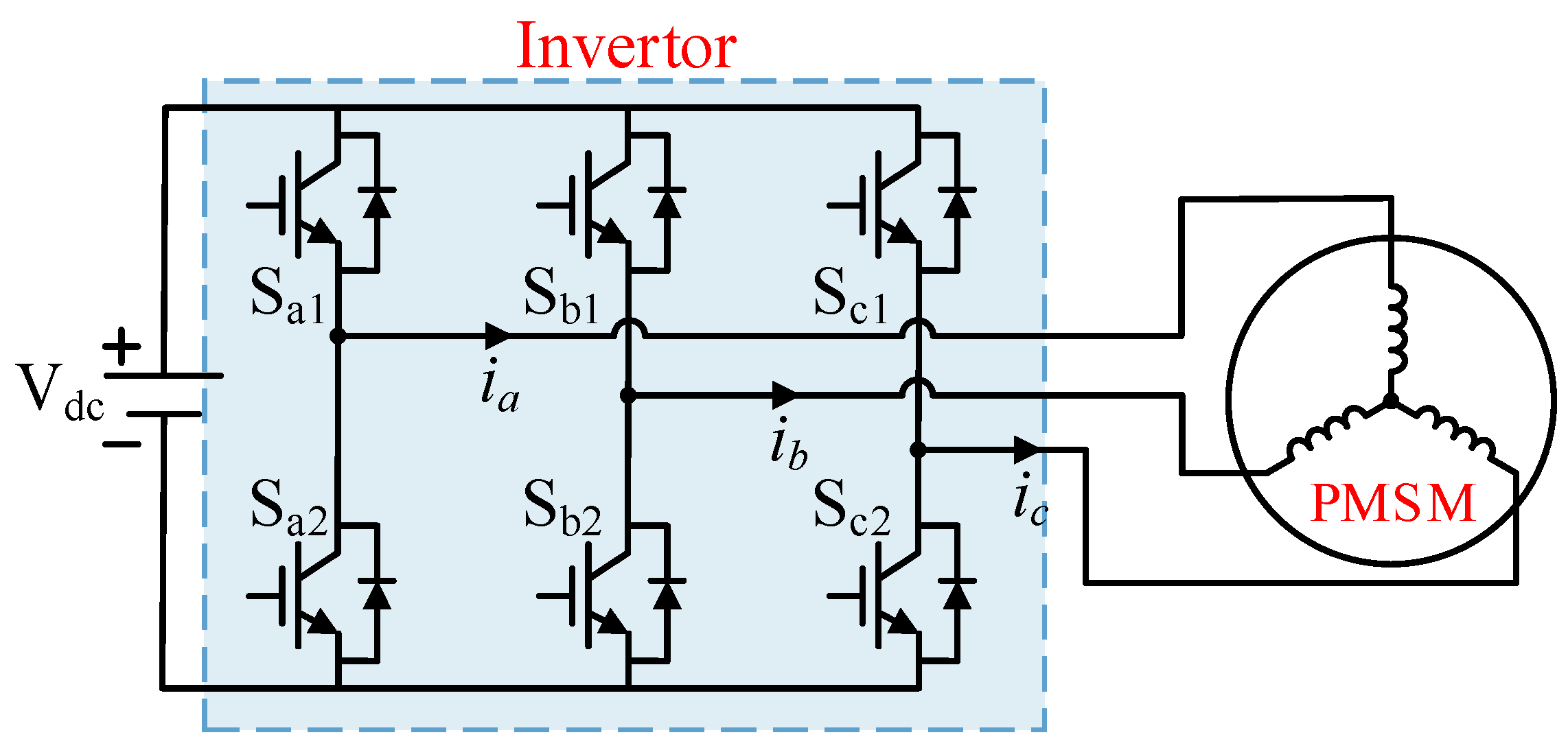
Section 2 briefly introduces the mathematical model of the three-phase PMSM and the structure of the conventional DPCC.
Section 3 elaborates on the proposed MFPC strategy.
Section 4 presents the experimental results.
Section 5 draws the conclusion of this study.
3. Proposed Model-Free Predictive Control Strategy
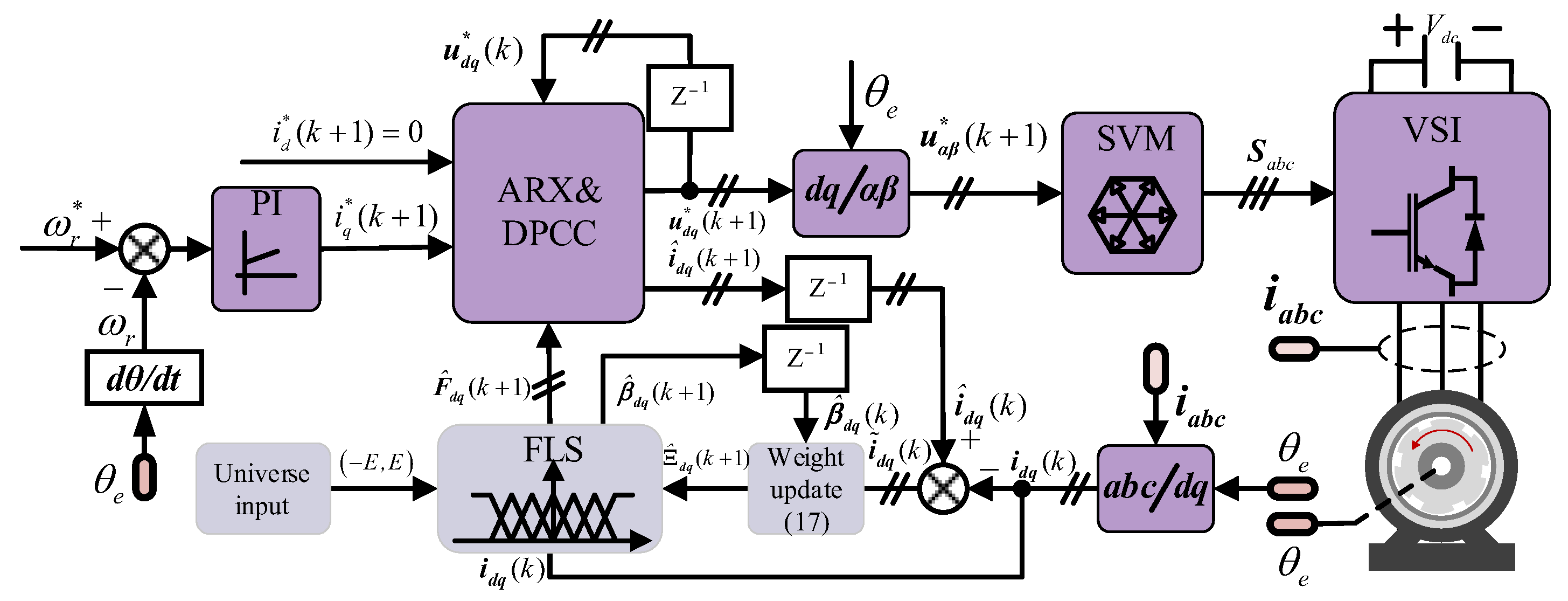
Unlike traditional methods that employ parameter identification and disturbance compensation to handle parameter mismatch and external disturbances in model-based predictive control, this article proposes a predictive control strategy based on a first-order ARX model to fundamentally eliminate the impact of physical motor parameters on control performance. This strategy integrates the simple structure of the first-order ARX model with the superior nonlinear approximation capability of the fuzzy approximation method. The schematic diagram of this MFPC strategy is illustrated in
Figure 2.
3.1. ARX Model
A discrete ARX model based on first-order input-output data is adopted.
where the
i(
k) term represents the autoregressive component, and
Φ reflects the influence of historical current states on the predicted state at the next instant.
u(
k) is the exogenous input term, with
B representing the regulatory effect of the input control voltage on the predicted current.
C denotes the inherent bias term introduced by the back-electromotive force (bace-EMF) of the permanent magnet. By comparing the coefficients in (3) and (10), the specific expressions for each matrix are
Φ = [(
Ld −
TsRs)/
Ld,
TsωeLq/Ld; −
TsωeLd/Lq, (
Lq −
TsRs)/
Lq],
B = [
Ts/
Ld, 0; 0,
Ts/
Lq],
C = [0; −
Tsωeψf/
Lq].
In this work, we treat the combined effect of Φi(k) and C, including speed-dependent coupling and back-EMF terms, as a single unknown nonlinearity to be approximated, rather than using these explicit forms.
Therefore, the control law of the ARX model is expressed as
3.2. Fuzzy Approximation
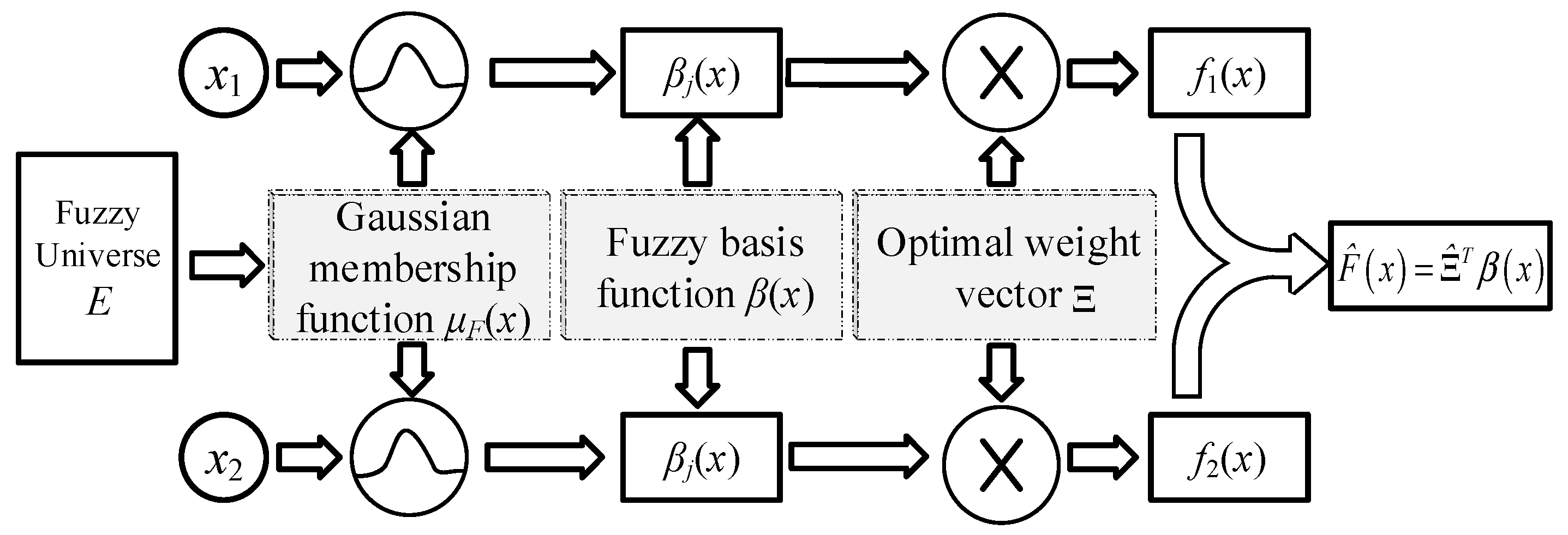
A standard fuzzy logic system (FLS) consists of a fuzzy rule base, a fuzzifier, a fuzzy inference engine, and a defuzzifier. It is worth noting that a Takagi–Sugeno (T-S) fuzzy logic system is adopted in this article, where the consequent of the fuzzy rules is a linear combination of input variables.
According to the universal approximation theorem [
25,
26], for any continuous function
f(
x) defined on a compact set Ω, there exists a fuzzy logic system Ξ
Tβ(
x) such that for any
ε > 0, the following holds:
where
βT(
x) = [
β1(
x),
β2(
x), …,
βm(
x)] is the normalized fuzzy basis function vector, and Ξ
T = [Ξ
1, Ξ
2, …, Ξ
m] is the adaptive optimal weight vector.
Subsequently, the two-input fuzzy basis function is defined as
where
is the designated Gaussian membership function, which reflects the activation degree of the fuzzy rules under different variables.
c and
σ represent the center and width of the input universe of discourse, respectively.
s is the number of input fuzzy universes;
j denotes the
j-th fuzzy rule, with the total number of rules being
s2.
j1 and
j2 are utilized to distinguish the membership function values affected by two different input variables, while
F1 and
F2 represent the distinct membership functions corresponding to the two input universes.
Meanwhile, the optimal fuzzy weight vector is selected as
Therefore, the fuzzy logic system can be formulated as the product of the fuzzy basis function vector and the fuzzy weight vector.
Figure 3 details the internal structure of the T-S fuzzy logic system.
where
ε denotes the fuzzy approximation error. In this work, the input vector
x to the fuzzy approximator is defined as
x = [
id,
iq]
T.
3.3. Model Reconstruction of First-Order ARX
Conventional ARX models frequently employ online parameter identification techniques such as RLS. However, as the model order increases, this inevitably triggers a surge in computational burden. In this work, a first-order ARX model is adopted to model the reconstruction of PMSM. Then, this article utilizes a fuzzy logic system to approximate and handle the nonlinear factors that are difficult to consider within the ARX model.
Based on (10), the autoregressive term in the ARX model is approximated, so the reconstructed predictive model is obtained as
A weight update law is designed based on Lyapunov stability theory:
In this work, while satisfying stability requirements, kwd and kwq are unified into a single parameter to effectively reduce tuning complexity. Thus, we set kwd = kwq = kw.
Finally, the input control law of the ARX model using the fuzzy approximation method is
where
K = [
kwd, 0; 0,
kwq]; Ξ = [Ξ
d(
k), 0; 0, Ξ
q(
k)];
β = [
βd(
k);
βq(
k)]. Notably, the term
Ke(
k) acts only as an auxiliary fine-tuning component, introduced to eliminate the small steady-state tracking error caused by the inherent approximation residual of the finite fuzzy rule set. It does not replace the core nonlinear approximation capability of the fuzzy logic system.
In the following, discrete-time Lyapunov stability theory is employed to rigorously analyze and prove the stability of the proposed control strategy.
Furthermore, the current prediction error and the fuzzy weight estimation error at instant
k are defined as follows:
where Ξ
* denotes the optimal weight matrix.
By combining (10) and (16), and considering the inevitable bounded fuzzy approximation error
ε(
k) (||
ε(
k)||
2 ≤
εM) in practical systems, the discrete error dynamic equation can be derived as
First, a discrete Lyapunov candidate function
V(
k) is constructed as
where Γ = diag(Γ
d, Γ
q) is a positive-definite adaptive learning rate matrix, with Γ
d and Γ
q being 5 × 5 diagonal positive-definite matrices for the
d-axis and
q-axis, respectively; tr(·) denotes the trace of a matrix.
The forward difference in the Lyapunov function, defined as Δ
V(
k) =
V(
k + 1) −
V(
k), is calculated as
First, substitute (20) into the current error term. Then, applying Young’s inequality and using the property that normalized fuzzy basis functions satisfy||
β(
k)||
2 ≤ 1, we obtain:
To ensure that Δ
V(
k) ≤ 0, a discrete adaptive weight update law incorporating a robust leakage term is designed as follows:
where
kw > 0 represents the designated damping coefficient.
Substituting (24) into the weight error terms, applying the property of the trace operation, and using Young’s inequality, the combined weight terms are bounded by
Combining the bounds for the current error and weight error terms, we obtain
Define the attenuation coefficient as
where
ε′ is a dummy positive constant introduced for stability analysis purposes. Accordingly, all parameters involved in the proposed weight update law are constrained by the conditions in (27).
Taking the common decay coefficient
a = min{
a1, a2} > 0, the final form of ∆
V(
k) is given by
where
is a positive constant;
λmax(Γ) is the maximum eigenvalue of Γ. Notably,
a is co-determined by Γ and
kw, satisfying 0 <
a < 1.
Furthermore, from (28), it can be deduced that
As the iteration step k→∞, the term (1 − a)k→0. Consequently, V(k) ultimately converges to the compact set ΩE = {V(k) ≤ C/a}. This rigorously proves that all internal signals of the closed-loop system under the proposed MFPC strategy satisfy uniformly ultimately bounded (UUB) stability.
4. Experimental Results
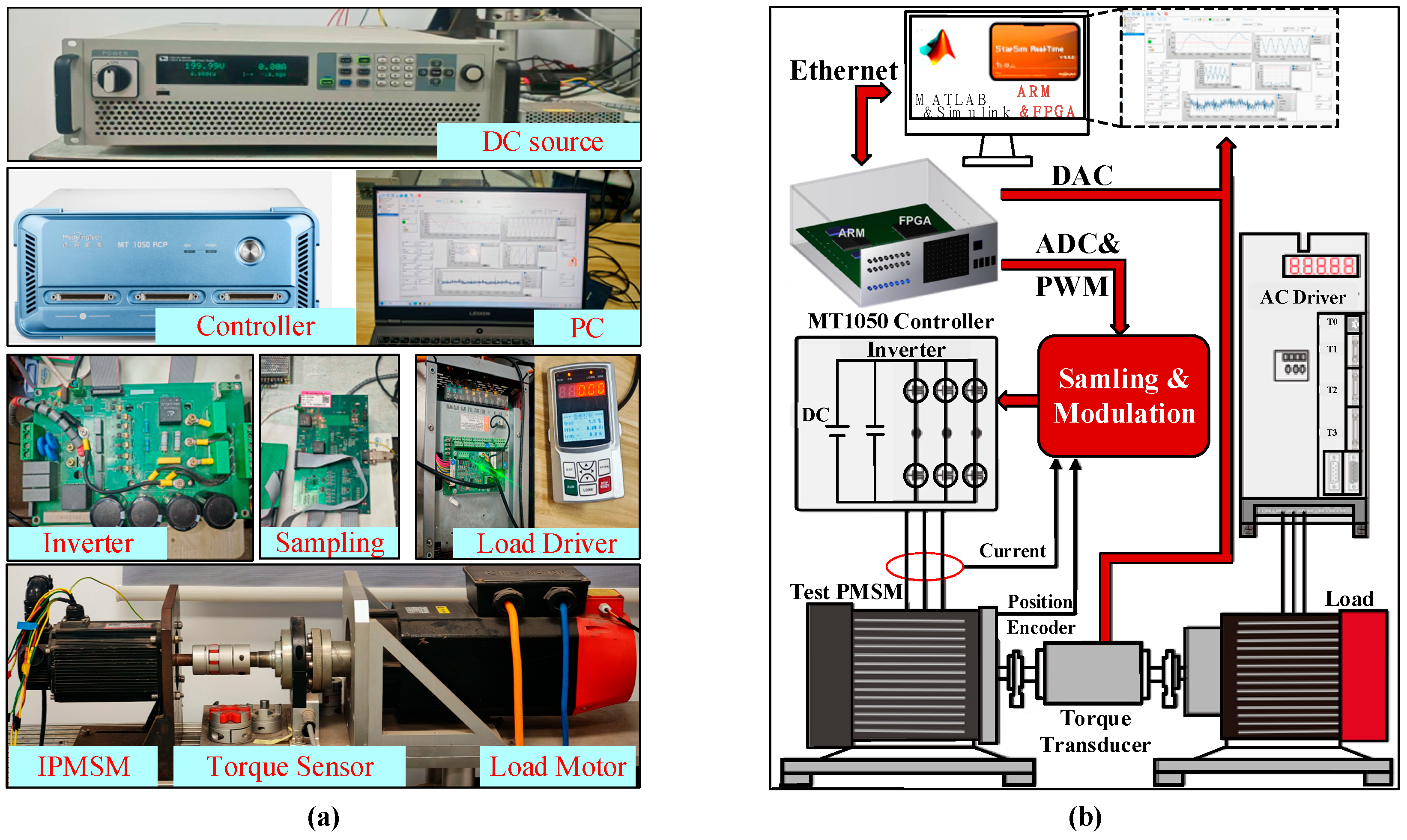
To verify the superiority of the proposed MFPC strategy, comparative experiments are conducted on a motor platform, the configuration of which is illustrated in
Figure 4. Specifically, the platform utilizes an MT1050 Rapid Control Prototyping system developed by Modeling Tech, which seamlessly integrates a CPU and FPGA architecture. Additionally, an induction motor driven by a variable frequency drive is employed to provide the load torque. The motor under test is a 1 kW IPMSM, and the system sampling frequency is set to 10 kHz. The detailed parameters of the motor are listed in
Table 1. In this article, three control schemes are evaluated for comparative analysis: the conventional DPCC, the recursive least squares-based ARX model-free predictive control method (RLS-ARX) [
19], and the proposed fuzzy approximation-based ARX model-free predictive control method (FA-ARX). All three algorithms are implemented on the same experimental platform with identical hardware configurations, eliminating the influence of hardware differences and ensuring the fairness of performance comparison. It is crucial to emphasize that, to comprehensively assess the robustness of the algorithms, all comparative experiments are executed under full-parameter mismatch conditions, defined as
Ld0 = 2
Ld,
Lq0 = 2
Lq,
Rs0 = 0.5
Rs,
ψf0 = 0.5
ψf, where
Ld,
Lq,
Rs, and
ψf are the real value of
d-axis inductance,
q-axis inductance, stator resistance, and permanent magnet flux linkage, respectively.
4.1. Steady-State Performance
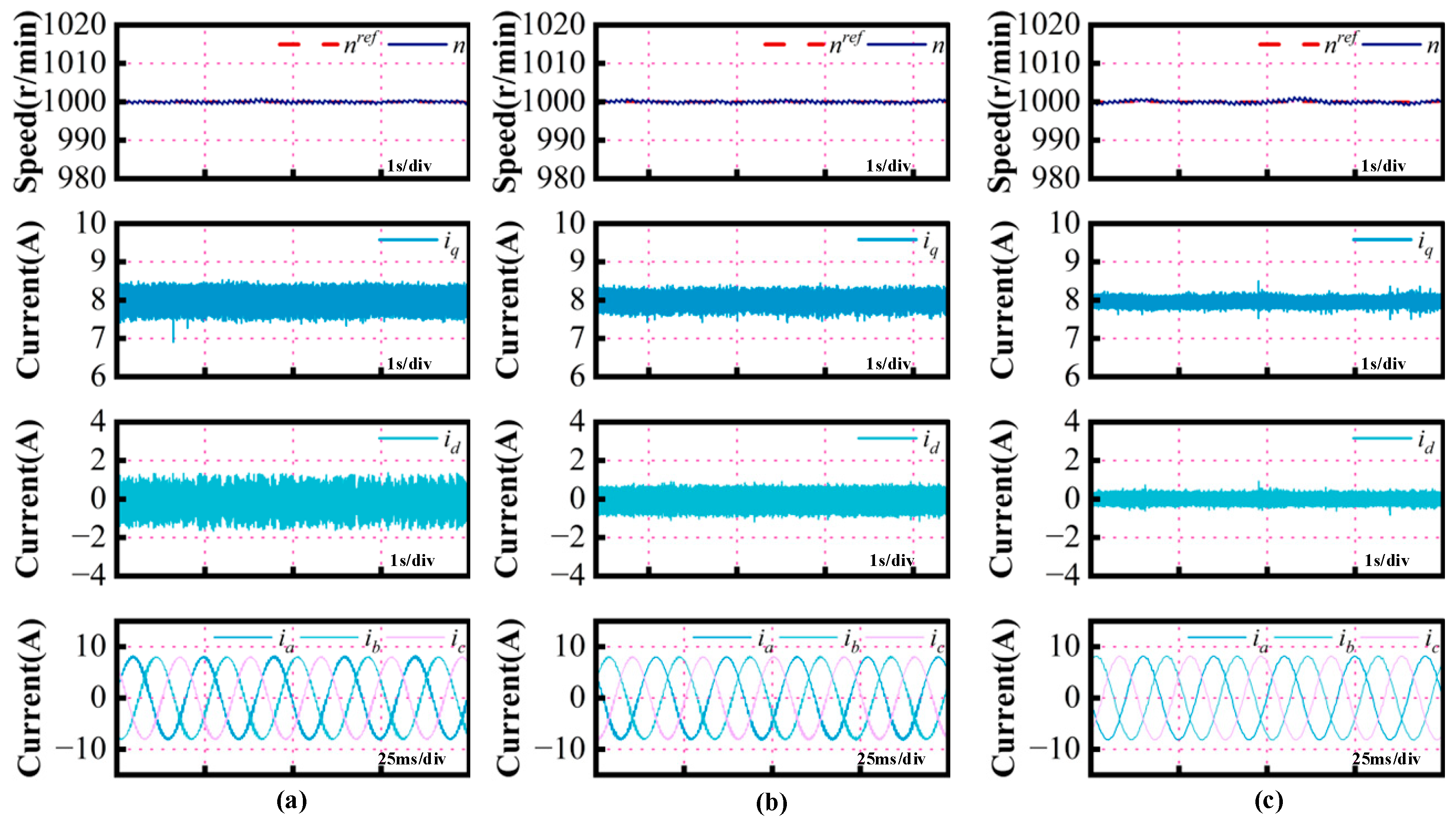
This subsection compares the steady-state performance of three control algorithms (conventional DPCC, RLS-ARX, and FA-ARX) under the rated load condition at a speed of 1000 r/min.
Figure 5 presents the operation waveforms and control performance of the three methods under this steady-state operating condition. All three methods achieve satisfactory speed tracking capability. The speed fluctuation is kept within ±1%.
To quantitatively assess the current control performance of the three methods, the root mean square error (RMSE) is used to reflect the amplitude of
dq-axis current ripples. The total harmonic distortion (THD) is used to assess the quality of phase current waveforms. The specific results are summarized in
Table 2. Both indicators verify that the proposed FA-ARX method has obvious advantages in suppressing
dq-axis current ripples and reducing phase current harmonics, which delivers better current quality. Notably, the steady-state metrics and their standard deviations are obtained from four groups of sampled data under different steady-state operating segments.
In terms of specific data, the d-axis and q-axis current RMSE values of conventional DPCC are 0.5262 ± 0.0075 A and 0.2010 ± 0.0014 A, respectively. By contrast, the corresponding values of the proposed FA-ARX method are greatly reduced to 0.1717 ± 0.0018 A and 0.0821 ± 0.0010 A, which are also far superior to the RLS-ARX method. In addition, the THD value is 5.82% for conventional DPCC and 3.31% for RLS-ARX, while the proposed FA-ARX method reduces the THD to 1.98%.
The significant difference in steady-state current performance originates from two aspects. On the one hand, the proposed FA-ARX strategy completely eliminates the adverse influence of motor parameter mismatch on control performance. On the other hand, benefiting from the strong nonlinear approximation ability of the fuzzy logic system, the proposed algorithm can effectively handle the unknown nonlinear disturbances on the d-axis and q-axis. This greatly improves the robustness of the proposed control algorithm.
4.2. Dynamic Performance
In this subsection, an acceleration test and a disturbance rejection test are conducted to evaluate the dynamic performance of three methods (conventional DPCC, RLS-ARX, and FA-ARX). All dynamic operating conditions are evaluated through three independent repeated experiments.
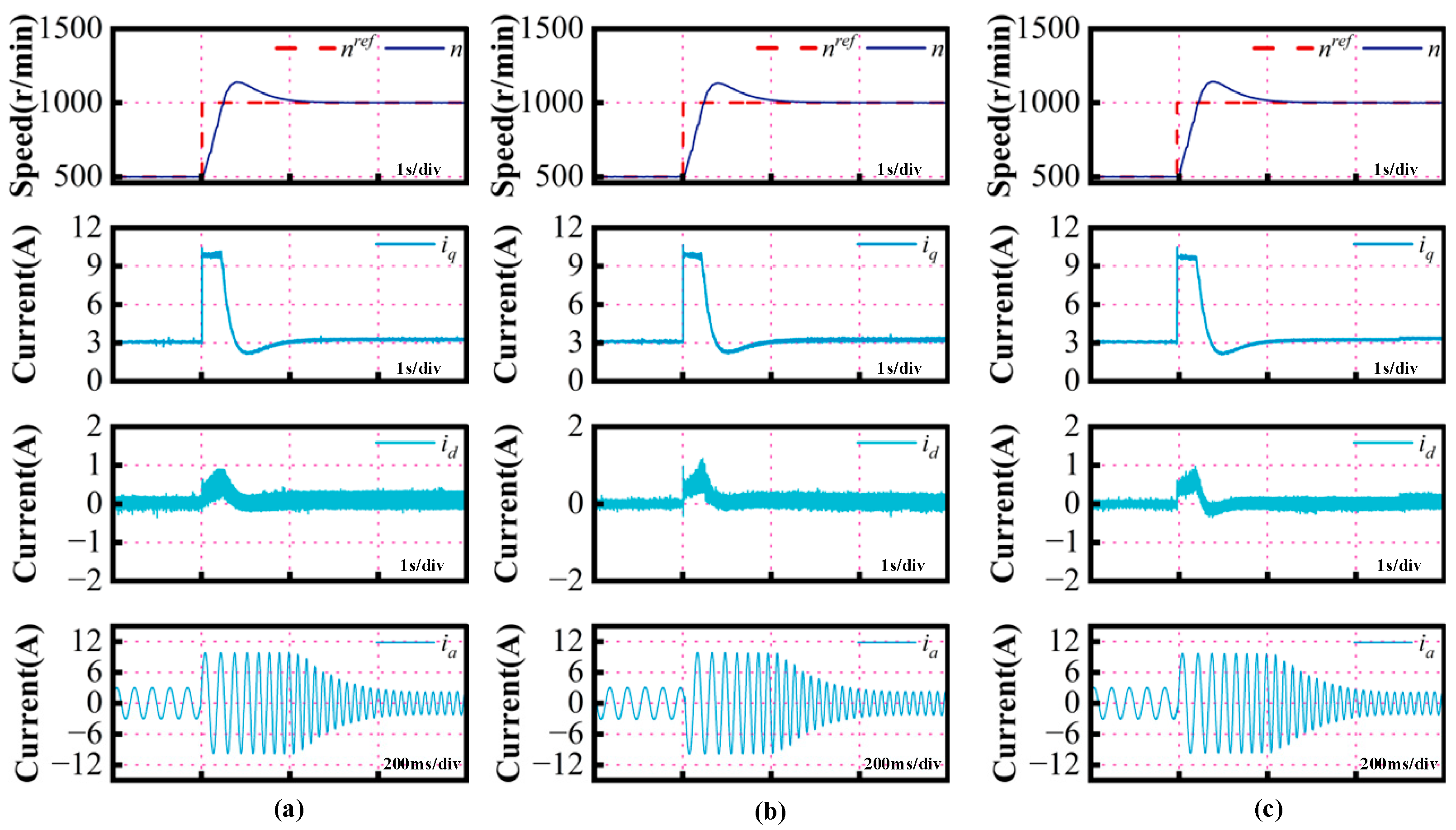
For the acceleration test, the dynamic responses of the two algorithms are evaluated during acceleration from 500 r/min to 1000 r/min under a 2N·m load.
Figure 6 shows the operating conditions of the three methods during the acceleration process. Overall, all three methods achieve smooth speed transition with nearly identical acceleration time of approximately 0.9 s, and the speed overshoot of each method is 132 r/min.
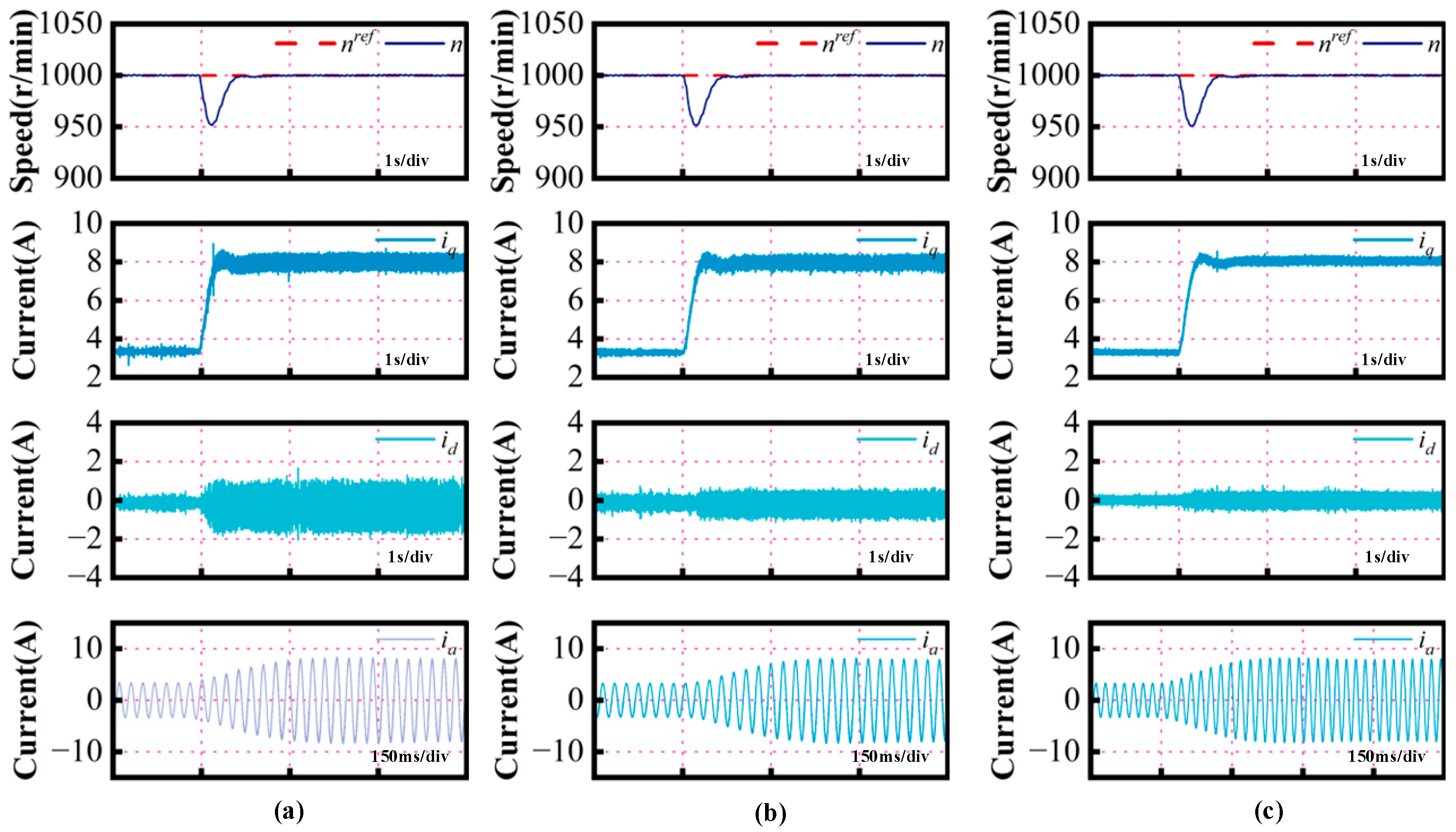
Then, a load disturbance test is carried out to simulate and evaluate the control performance against sudden external disturbances. The motor runs at a reference speed of 1000 r/min, while the load torque suddenly increases from 2 N·m to 5 N·m.
Figure 7 presents the experimental results of load disturbance for the three algorithms. It can be seen that the three methods possess comparable disturbance rejection capability. Specifically, the speed drop of all methods is 48 r/min at the moment of sudden load increase, and the speed can quickly return to the steady state within about 0.35 s.
It is worth noting that the increase in current amplitude caused by load addition will inevitably aggravate the dq-axis current ripples. Nevertheless, the current ripple amplitude of the proposed FA-ARX method is always significantly lower than that of conventional DPCC and RLS-ARX before and after load variation. This finding is highly consistent with the conclusions obtained from the steady-state performance analysis above.
4.3. Comparison of Execution Time
As summarized in
Table 3, the average execution time (AET) of the proposed FA-ARX method is 26.71 μs, which is marginally lower than that of the RLS-ARX method (27.82 μs). Notably, the RLS-ARX model is implemented with the literature-recommended polynomial orders, specifically an autoregressive order of four and an exogenous input order of three, to ensure a fair comparison. Furthermore, as validated in the steady-state performance analysis presented earlier, the proposed method also achieves superior current quality compared to RLS-ARX. This combination of slightly reduced computational burden and improved control performance highlights key advantages of the proposed strategy over the conventional RLS-ARX scheme.
4.4. Comparison of the Three Methods
Table 4 provides a qualitative comparison of DPCC, RLS-ARX, and the proposed FA-ARX method across steady-state behavior, dynamic indices, and computational efficiency, revealing that the proposed method achieves superior steady-state performance while maintaining comparable dynamic response and marginally better computational efficiency than RLS-ARX.
5. Conclusions
This article proposes a novel MFPC strategy based on fuzzy approximation for PMSM. The core innovation of this strategy lies in the use of the universal approximation theorem to accurately estimate the autoregressive term, as well as the unmodeled dynamics within the ARX model online. Distinct from the conventional DPCC method, the proposed MFPC strategy fundamentally circumvents the reliance on physical motor parameters. Furthermore, unlike conventional parameter identification techniques applied to ARX models, the proposed approach fully leverages the superior nonlinear approximation capability of the fuzzy approximation method, thereby effectively enhancing the accuracy of data-driven model establishment. Comprehensive experimental results verify that the proposed FA-ARX method achieves lower phase-current THD and smaller dq-axis-current RMSE than both conventional DPCC and RLS-ARX under full parameter mismatch conditions, delivering superior steady-state current quality. Meanwhile, it maintains excellent dynamic performance comparable to the two comparison methods during speed-acceleration and load-disturbance processes. Additionally, the proposed method exhibits comparable computational complexity to RLS-ARX, ensuring good real-time performance. In summary, the proposed strategy significantly enhances the parameter robustness of PMSM drive systems while preserving outstanding dynamic response, which validates its practical feasibility and superiority for high-performance motor control applications.