Article

Computational Fluid Dynamics Analysis of Battery Immersion Cooling: Impact of Dielectric Fluid Thermophysical Properties

by
Sara El Afia
1,
Francisco Jurado
1,
R. Mazuir Raja Ahsan Shah
2 and
Antonio Cano Ortega
1,*
1
Department of Electrical Engineering, University of Jaen, 23071 Jaen, Spain
2
Centre of Excellence for Sustainable Mobility, University of Doha for Science and Technology, Doha 24449, Qatar
*
Author to whom correspondence should be addressed.
Energies 2026, 19(12), 2770; https://doi.org/10.3390/en19122770 (registering DOI)
Submission received: 6 May 2026 / Revised: 1 June 2026 / Accepted: 2 June 2026 / Published: 9 June 2026

Abstract

The rapid growth in the electric vehicle sector has increased demand for advanced battery thermal management systems (BTMSs) with high heat-dissipation capacity and temperature uniformity. Immersion cooling using dielectric fluids has recently been recognized as a promising alternative technology to conventional indirect liquid cooling methods. This study investigates the thermal and hydrodynamic behaviour of a sixteen-lithium-ion cell battery (LIB) module immersed in low-viscosity dielectric fluids using three-dimensional computational fluid dynamics simulations. In this context, a total of twenty dielectric fluids are evaluated using the ANSYS Fluent solver, with particular emphasis on the effects of key thermophysical properties, including viscosity, density, specific heat capacity, and thermal conductivity. The simulation findings reveal that mineral oil and PAO4 yield the lowest maximum LIB cell temperatures, with a reduction of approximately 4 K compared to the least effective dielectric fluids, such as undecane and cumene. Moreover, in terms of temperature uniformity, mineral oil, Novec 7000, and PAO4 exhibit the most homogeneous temperature distributions among the twenty dielectric fluids. In addition, they show an improvement in the temperature uniformity index of approximately 32.4% compared with the least effective dielectric fluid, cumene. On the other hand, mineral oil and PAO4 generate significantly higher pressure drops because of their relatively high viscosities, which increases hydraulic resistance and pumping power requirements. These findings demonstrate that excellent thermal performance does not necessarily correspond to optimal overall thermo-hydraulic behaviour. Overall, the results confirm that immersion-BTMS performance is governed by a complex interaction between dielectric fluid thermophysical properties and flow behaviour, highlighting the importance of coupled thermo-hydraulic optimization in the selection of dielectric fluids for next-generation immersion-cooled battery systems.

1. Introduction

The rapid expansion of the electric vehicle (EV) sector has increased demand for highly efficient and safe energy storage systems [1]. In modern EVs, lithium-ion batteries (LIBs) are considered the most suitable for various EV applications owing to their high energy density, high efficiency, high power density, and longer cycle life compared with other available technologies such as nickel–metal hydride and lead–acid [2]. Nevertheless, modern LIBs with high energy densities display great sensitivity to heat, as the anisotropy in heat conduction, concentration of heat energy, and even thermal runaways have a significant effect on the battery’s safety, reliability, and performance [3].
To ensure the safe and reliable operation of the LIBs, it is necessary to maintain the operating temperature within a relatively narrow optimal range of 20–40 °C [4]. As such, battery thermal management systems (BTMSs) have emerged as a crucial factor in the overall design of EVs [5]. A BTMS must satisfy the requirements of limiting the maximum operating temperature of the LIBs, providing temperature uniformity in the LIB cells, and minimizing parasitic energy consumption [5]. Beyond lithium-ion battery systems, thermal–hydraulic optimization has also become an important research topic in other new-energy technologies such as proton exchange membrane fuel cells (PEMFCs). Recent studies showed that semi-parallel and semi-interdigitated mixed flow-field configurations can significantly enhance heat transfer and overall system performance in PEMFC applications [6].
Currently, the most widely used BTMS is indirect liquid cooling, owing to its superior cooling capacity and temperature uniformity compared with air cooling, particularly for high-power and high-charging rate applications [7]. However, the main disadvantages of indirect liquid BTMSs are related to thermal resistance between the LIB cells and the coolant, the complex design requirements for the flow channels, and the weight and scalability of LIBs [8]. Consequently, these factors have prompted further exploration of effective BTMSs, with a priority on simplicity and safety [9,10].
Recently, direct liquid cooling, also known as immersion cooling, has received considerable interest as a promising BTMS. In this approach, the LIB cells are immersed in an electrically insulating dielectric liquid, which enables heat dissipation from the cells via natural or forced convection [8]. The advantage of this approach is that it eliminates any intermediate thermal resistance between LIB cells and the coolant [7,8].
However, the dielectric liquid is a critical factor in implementing immersion cooling [11]. Apart from electrical insulation, the liquid must exhibit favourable thermophysical properties, including high specific heat capacity and thermal conductivity, chemical stability, fire safety, and long service life [12]. Furthermore, hydraulic characteristics and pumping power requirements must be considered to ensure whole system efficiency [9].
Recent developments in LIB technology, particularly the adoption of high-nickel cathode, together with silicon–carbon anodes, have significantly increased battery energy density and heat generation during fast charging and high-power operation. These next-generation cells exhibit greater thermal sensitivity and a higher risk of localized thermal runaway propagation, thereby increasing the importance of advanced battery thermal management systems [13]. Therefore, immersion cooling using dielectric coolants has been considered a viable method due to its inherent ability to conduct heat by direct contact and provide better temperature uniformity. According to experimental results, immersion cooling leads to much less increase in the temperature of the batteries when compared with traditional air-cooling techniques [13]. In addition, fully coupled thermo-electrochemical modelling reveals that the process of heat production and chemical reactions in the battery is highly dependent on temperature. The thermophysical characteristics of dielectric fluids have also proven to be highly relevant for determining cooling effectiveness and degradation rate of batteries [14]. Moreover, a combination of immersion cooling with thermal insulation material has also been found to show considerable promise in preventing thermal runaway propagation inside battery modules through peak temperature reduction and control of propagation rate during abuse scenarios. The findings suggest that immersion cooling is indeed a promising BTMS technology for high-energy density LIBs owing to its ability to improve the thermal stability and safety of the system under abusive conditions [15].
Numerous studies have investigated the thermal performance and reliability of immersion cooling for LIBs using both experimental and numerical approaches. Zeng et al. [10] demonstrated that static immersion cooling with dielectric liquids can reduce the LIBs’ peak temperature by 30–35% relative to air cooling while simultaneously improving safety during high-discharge rate. Further studies have also reinforced the importance of flow arrangement and immersion direction in attaining uniform temperatures. Data-driven and machine-learning-based techniques have also been developed to optimize dielectric fluid selection, thereby highlighting the importance of viscosity and thermal conductivity in cooling and power dissipation [16]. Hybrid methods, which combine computational fluid dynamics (CFD) with response surface methods, have been used to investigate the influence of fluid density and specific heat capacity on temperature homogeneity and attenuation of peak temperature [17].
In addition to static immersion cooling, various forced-flow, composite, and hybrid configurations have been examined to improve system performance. Composite immersion cooling systems, which combine static and dynamic convection, have demonstrated significant reductions in peak temperature and improved temperature uniformity [18]. Computer simulations using CFD of forced-flow immersion cooling systems have shown that it is possible to achieve temperature regulation with minimal spacing between the LIB cells with only a slight increase in the pumping power requirements [19,20]. In addition, hybrid configurations have been examined, with particular attention paid to the pressure drop and hydraulic performance of the systems [21,22]. For instance, Yao et al. [23] examined the effects of immersion cooling technology on the thermal behaviour of 21700 LIBs during high C-rate charging. Their findings demonstrated that coolant flow dynamics substantially influence heat transfer and temperature distribution.
In recent studies, various configurations of immersion systems incorporating cooling tubes and fins have been examined, showing promising results in temperature uniformity and system effectiveness in large cylindrical LIB cells and modules subjected to rapid charging and high-load conditions [24,25,26,27,28]. According to Vikram et al. [29], through experimental studies, it has been shown that transformer oil immersion cooling leads to significantly better performance of the heat dissipation of a 3S3P lithium-ion battery module than air natural convection cooling. With complete immersion, there was a decrease of 9 °C in the maximum cell temperature and a decrease in the temperature difference between cells from 4.4 °C to 1.8 °C. In turn, partial immersion at 50% depth provided an optimal compromise between efficiency, volume, and weight of the system, which can be considered as potential in transformer oil immersion cooling. Furthermore, the experimental study by Suhendra et al. [30] demonstrated that static single phase immersion cooling could be utilized effectively to manage thermal behaviour and obtain better temperature uniformity in cylindrical battery modules. It was found that deionized water had the best cooling efficiency among all the dielectric coolants considered, while RT22HC exhibited the best temperature uniformity among the cells. It can be concluded that apart from the thermophysical characteristics, both convection and viscosity effects under the Rayleigh–Prandtl regime affect the thermal performance. Otherwise, Liu et al. [31] have shown that by using single-phase immersion cooling, temperatures inside the batteries can be kept below 40 °C, with temperature variation among modules ranging from 2 to 5 °C, but two-phase cooling techniques offer higher stability by taking advantage of latent heat storage mechanisms. Moreover, the review highlights that cooling effectiveness is highly dependent on the properties of the coolant used and its fluid dynamics.
Although recent studies have demonstrated the effectiveness of immersion cooling for reducing maximum battery temperature and improving thermal uniformity, most investigations have focused on a limited number of dielectric fluids, specific cooling configurations, or individual thermophysical parameters. For example, recent works mainly examined mineral oil, transformer oil, deionized water, RT22HC, HFE7100, FC-40, SF33 or selected fluorinated dielectric fluids under either static or forced-flow conditions, with emphasis primarily placed on thermal performance. However, a systematic thermal–hydraulic comparison involving a broad range of dielectric fluids with significantly different viscosity, density, thermal conductivity, and specific heat capacity remains limited in the literature. In addition, the coupled influence of these thermophysical properties on maximum temperature, temperature uniformity, and pressure-drop behaviour has not been comprehensively clarified. Therefore, the present study addresses this research gap by performing a unified CFD-based comparative analysis of twenty dielectric fluids belonging to different chemical families under identical operating conditions to establish clearer property–performance relationships for immersion-BTMS applications.
A three-dimensional transient CFD model is developed in ANSYS Fluent, and a unified computational framework is established to evaluate the thermal–hydraulic characteristics of a sixteen-cell LIB pack under immersion-BTMS conditions, including thermal performance, temperature uniformity, and pressure drop. The results indicate that dielectric fluids with superior heat-dissipation characteristics do not necessarily provide optimal performance. By simulating a broad range of dielectric fluids, this study provides practical guidelines for selecting dielectric fluids for immersion-BTMS.

2. Methodology

The present study conducts a three-dimensional transient numerical analysis of a single-phase immersion-BTMS with low-viscosity dielectric fluids. The main objective is to comparatively investigate the thermal and hydraulic performances of a wide range of dielectric fluid families under identical operating conditions, with particular emphasis on LIB cell temperature, temperature uniformity, and pressure drop. The numerical simulations were conducted using a commercial finite-volume CFD software, ANSYS Fluent V18 [32], employing a conjugate heat transfer approach to simultaneously model heat conduction within LIB cells and forced convection in the dielectric fluid. Furthermore, the volumetric heat generation inside LIB cells is described using a validated electro-thermal model implemented via a user-defined function.

2.1. Lithium-Ion Cell Electro-Thermal Model and Validation

An 18650 cylindrical LIB cell is used in this study, and its main physical and electrochemical properties are listed in Table 1. The electrothermal response of the LIB cell can be described by a volumetric heat-generation model based on a formulation proposed by Jiaqiang et al. [28]. The total heat generation in the LIB cell can be expressed as the sum of irreversible (Joule) and reversible (entropic) heat.
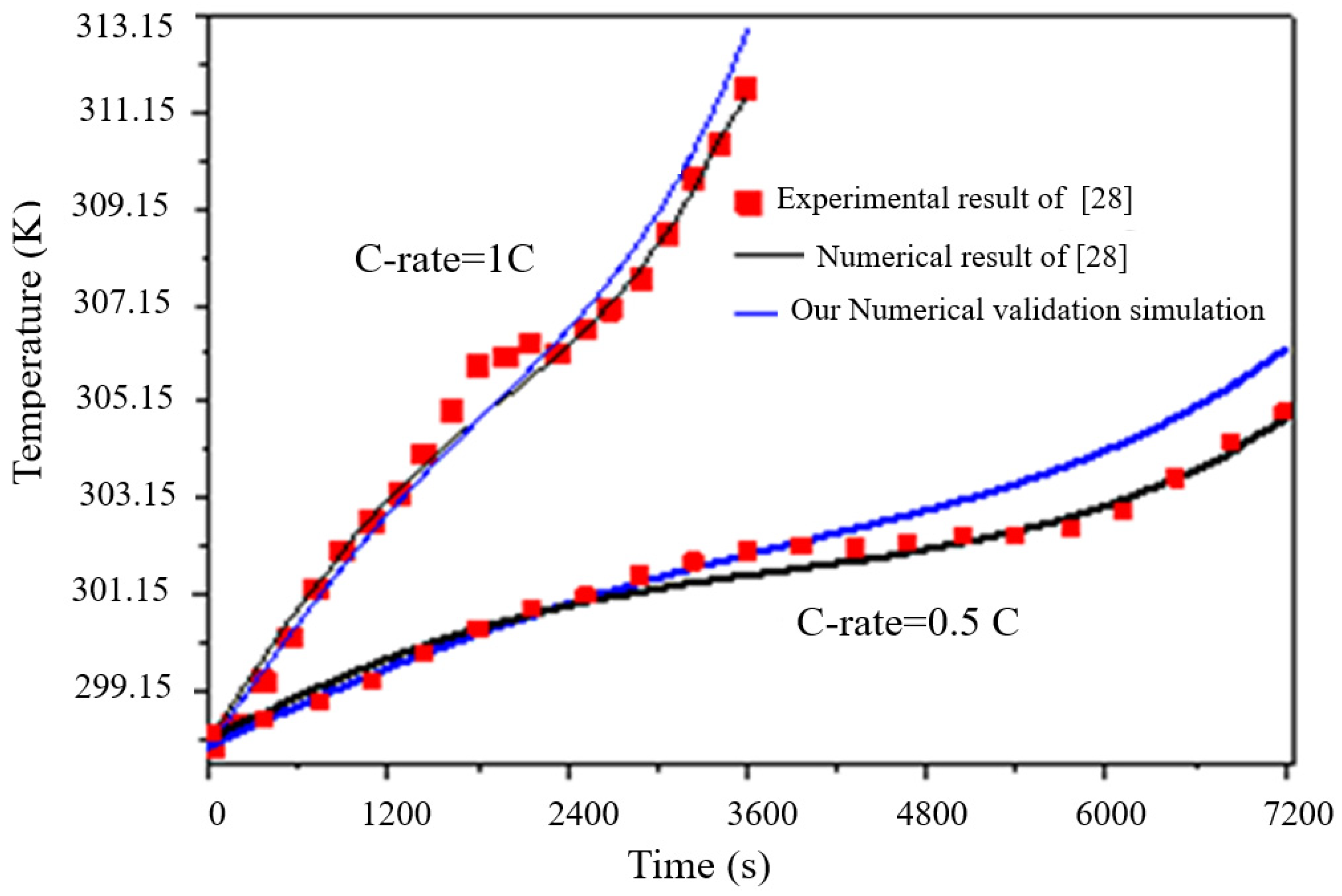
A validation study is conducted to verify the reliability of the numerical model by replicating the operating conditions and assumptions reported in [28]. Transient simulations are performed at discharge rates of 0.5 C and 1 C, with heat generation modelled via a user-defined function (Equation (1)).
Q r = Q i r r + Q r e v
The projected temperature evolution is then compared with the corresponding numerical and experimental data reported in the literature [28]. The results shown in Figure 1 demonstrate good agreement between the present model and the numerical and experimental data reported by Jiaqiang et al. [28], with a maximum discrepancy of about 3% at 1C and approximately 3.3% at 0.5C. Therefore, this validation ensures that the coupled electro-thermal model accurately captures the heat generation behaviour of the LIB cell model and is appropriate for the immersion-BTMS simulations conducted in this study.

2.2. Immersion BTMS Configuration

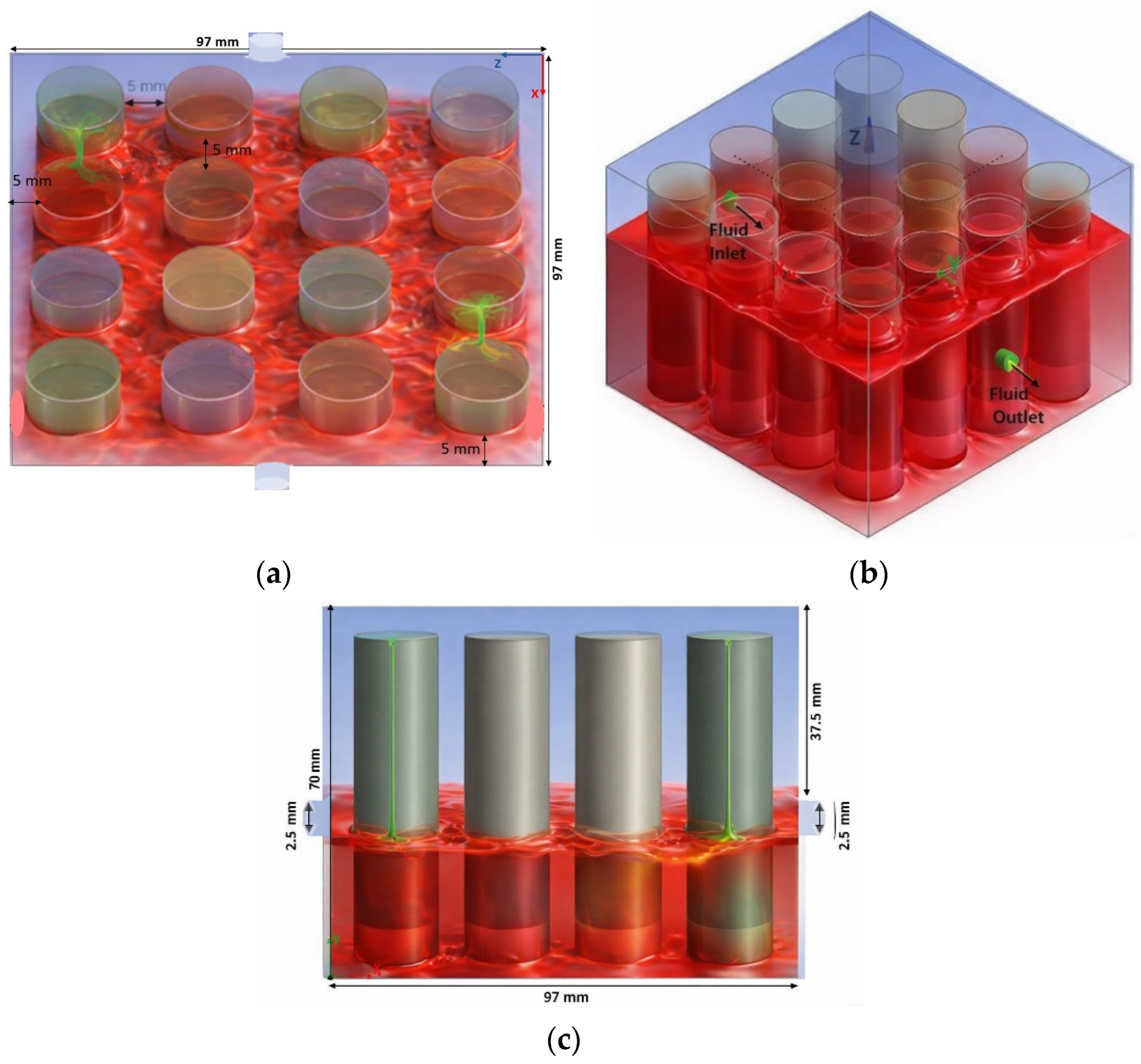
A numerical model is developed to investigate the thermal and hydraulic performance of an immersion-BTMS. The configuration is a sealed rectangular enclosure measuring 97 mm × 97 mm × 70 mm, filled with a dielectric fluid. Inside the enclosure, the LIB module consists of sixteen 18650 LIB cells. The enclosure has fluid inlets and outlets, each 2.5 mm in diameter. Figure 2 shows the architecture of LIB cells with a 4P4S arrangement and spacing of 5 mm. The LIB cells are immersed in the dielectric fluid, enabling direct convective heat transfer between the fluid and the cells’ outer surfaces. The fluid is circulated into the enclosure through the inlet, passes through the LIB module, and is then recirculated back into the system through the outlet. The heat transfer between the enclosure’s outer surface and the environment is modelled using the natural convection boundary condition.

2.3. Mesh Generation and Grid Independence Study

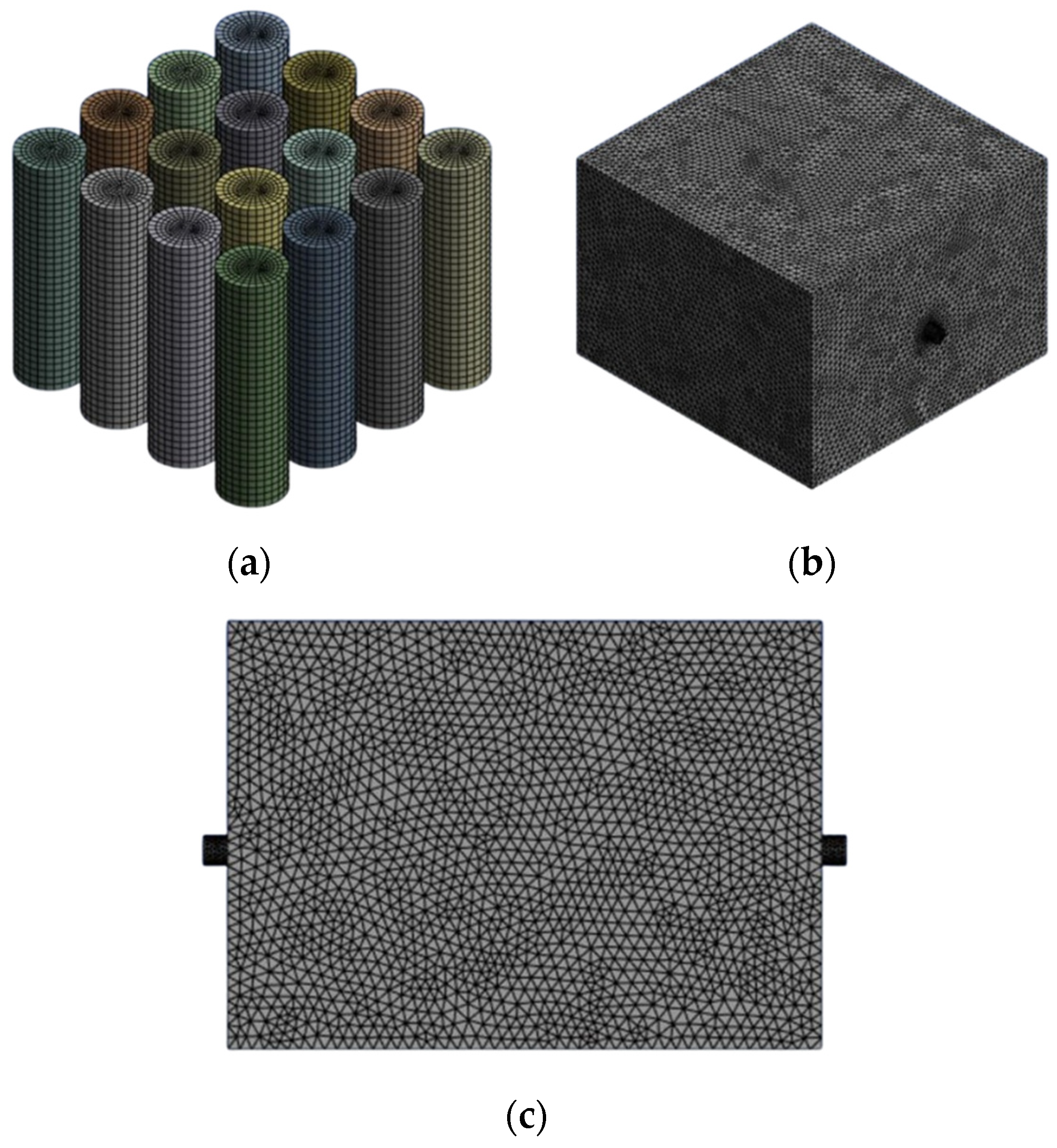
For a proper analysis of the thermal process and the hydraulic phenomena that affect the immersion-BTMS, a high-quality mesh was created prior to the simulations. This mesh allows the domain under investigation to be subdivided into small elements, ensuring an accurate description of the physical phenomena. The mesh strategy was defined to ensure a good compromise between the accuracy of the numerical calculations and computational efficiency. Localized refinement was applied to regions of physical importance, particularly at the cooling fluid’s inlet and outlet, as described in Figure 3. The mesh-independence study was performed using the complete immersion-BTMS CFD model under air-cooling conditions at 1C discharge to evaluate the numerical stability and grid convergence of the thermal-fluid solution with reduced computational cost.
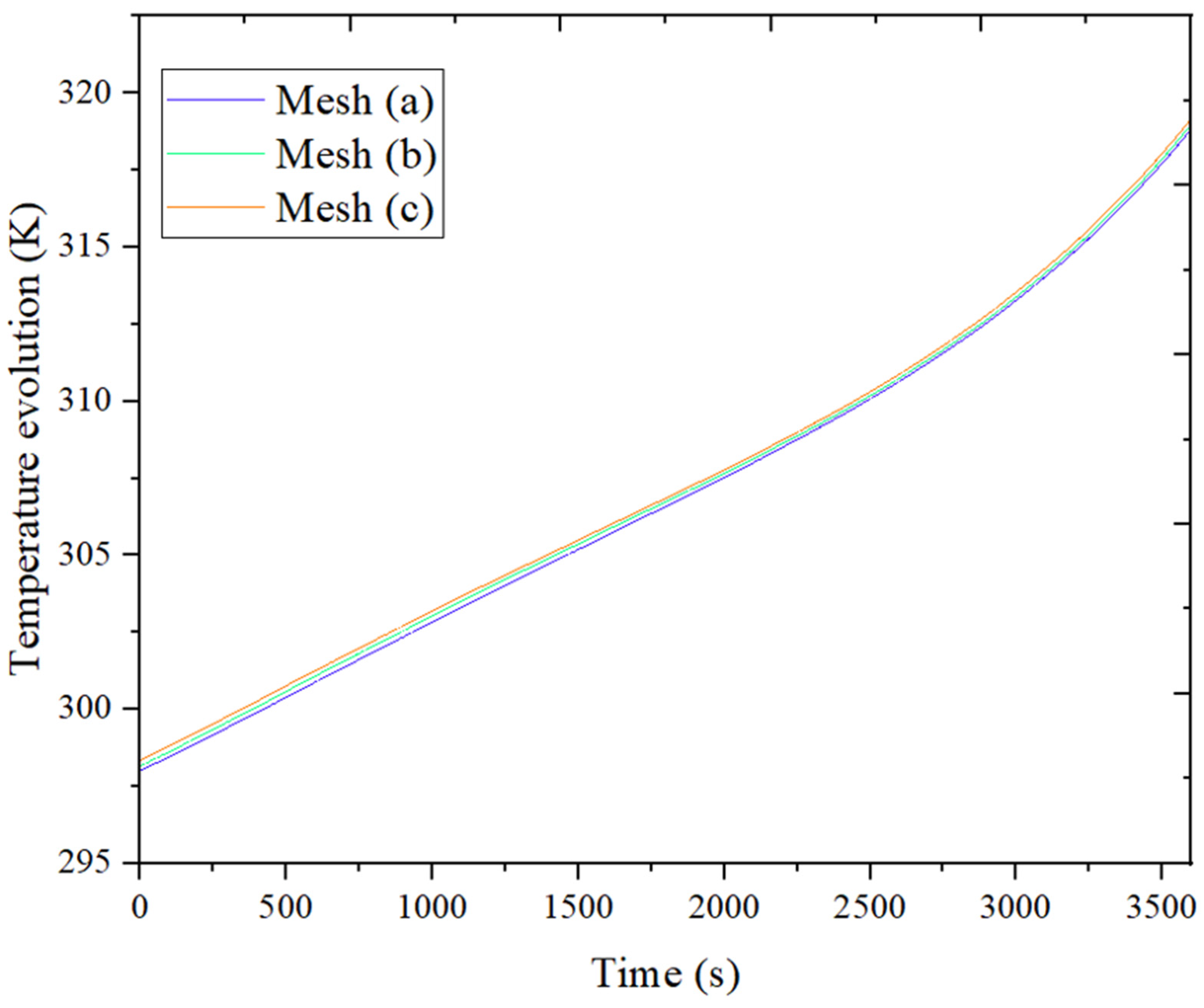
The mesh quality of the studied system was assessed using skewness, orthogonality, and aspect ratio metrics. The results indicate that the maximum skewness is 0.8, the average orthogonal quality is 0.81, and most cells have aspect ratios smaller than 7.9. This is consistent with the indication that the generated mesh is of sufficient quality to accurately simulate the immersion-BTMS. A mesh independence test is also performed to verify the effect of mesh resolution on the simulation results. Three different grid densities were investigated for this purpose: 478,939 elements Mesh (a), 1,017,891 elements Mesh (b), and 1,774,446 elements Mesh (c). The corresponding node counts are listed in Table 2. The three mesh resolutions were selected to perform a systematic grid-independence analysis by progressively increasing the number of elements from coarse to fine meshes. Mesh (a) was designed to minimize computational cost, whereas Mesh (b) and Mesh (c) were used to evaluate the sensitivity of the thermal results to mesh refinement and verify numerical convergence.
Figure 4 presents the LIB cell temperature profiles at a 1C discharge rate, with air as the cooling medium, for the three mesh densities. The results indicate that the differences in peak temperature between Mesh-1 and Mesh-2, and between Mesh-1 and Mesh-3, are only 0.00283% and 0.00194%, respectively. These small deviations confirm that the mesh with approximately 0.47 million elements provides sufficient accuracy for the present study while significantly reducing computational time and resource usage. Therefore, Mesh-1 was selected for all subsequent simulations.

2.4. Governing Equations and Numerical Solution Strategy

To analyze the transient behaviour of the LIB module, a set of fundamental equations has been used, which include heat generation, energy conservation, momentum conservation, and continuity, as listed in Table 3. The governing equations are discretized using the finite volume method. For improved numerical accuracy, all the equations are discretized using second-order spatial discretization.
The electro-thermal equations related to heat generation, internal resistance, and the thermal coefficient of open-circuit voltage (OCV) presented in Table 3 were adopted from the model reported by Jiaqiang et al. [28], while the remaining governing equations were based on the standard conservation equations for mass, momentum, and energy.

2.5. Boundary and Initial Conditions

This numerical study employs various assumptions to ensure efficient calculations while maintaining the accuracy of the simulation results. For example, heat transfer is treated as a three-dimensional, transient phenomenon to account for spatial and temporal variations in temperature throughout the system. Furthermore, the model incorporates thermal conduction between LIB cells and the container, convection between the dielectric fluid and the external surfaces of the LIB cells. Heat transfer by radiation is considered negligible. Convective heat transfer is applied to the container’s outer surfaces to represent interaction with the ambient environment. The heat generation model utilizes a volumetric heat source implemented through a user-defined function, following the electro-thermal model by [28], and accounts for both reversible and irreversible heat generation at a 1C discharge rate. A constant inlet velocity of 0.1 m/s was applied for all dielectric fluids to ensure identical flow conditions and enable a direct comparative evaluation of the influence of fluid thermophysical properties on the thermal–hydraulic performance of the immersion-BTMS.
For clarity and reproducibility, all boundary conditions and operating parameters applied in the presented CFD simulations are summarized in Table 4.

2.6. Dielectric Fluid Selection and Properties

We have conducted a comprehensive thermal and hydraulic study to assess the low-viscosity dielectric cooling fluids for immersion-BTMSs. The objective is to evaluate fluid heat-transfer behaviour, temperature uniformity across LIB cells, and hydraulic performance under pumped immersion conditions. This study presents a unified comparison of four low-viscosity dielectric fluid families: hydrocarbon-based fluids, perfluorocarbon fluids, fluorinated fluids and light hydrocarbon fluids for the immersion-BTMS. Hydrocarbon dielectric fluids have a carbon-hydrogen molecular structure and are commonly used in thermal management applications due to their chemical stability, material compatibility, and satisfactory heat-storage capacity [12]. This group consists of conventional petroleum-derived fluids, like mineral oil, as well as synthetic hydrocarbon fluids, such as PAO4, AmpCool, and S5X, designed with specific, predetermined thermophysical properties. Moreover, perfluorocarbon fluids contain only carbon and fluorine atoms and, because they lack hydrogen atoms, possess excellent chemical inertness and thermal stability, making them well-suited for immersion cooling under high thermal and electrical stress conditions [14]. The perfluorocarbon fluids studied in this investigation include the representative members FC-43, YL-10, FC-72, FC-84, and FC-770. On the other hand, fluorinated fluids are designed to incorporate heteroatoms to tailor their thermophysical properties and achieve high dielectric strength [15]. Accordingly, the specific fluorinated fluids examined in the presented work include Novec 7000, Novec 7300, HFE-347E, TMC-7200, SF-10, and Novec 649. Finally, light n-alkanes (N-heptane), medium-chain n-alkanes (undecane), and aromatic hydrocarbons (cumene) are chosen in the present work and represent specific hydrocarbon dielectric fluid subclasses [10]. The use of these fluids enables systematic investigation of how differences in density, viscosity, specific heat capacity, and thermal conductivity affect convective heat transfer and thermal uniformity in immersion-BTMSs [7].
The thermophysical properties of twenty dielectric fluids, including density, dynamic viscosity, specific heat capacity, and thermal conductivity, are listed in Table 5.

2.7. Turbulence Modelling and Flow Regime Characterization

The flow regime in the LIB module was characterized by the Reynolds number given by the equation
R e = ρ V D h μ
where ρ is the coolant density, μ is the dynamic viscosity of the coolant, V is the imposed inlet velocity, and D h is the hydraulic diameter of the inter-cell passages. For the same geometry, the Reynolds number was calculated for each of the considered dielectric fluids. The Reynolds numbers vary over more than three orders of magnitude from approximately 15 for the most viscous mineral oil to approximately 4.3 × 10⁴ for the least viscous Novec-7000. As is commonly accepted in internal flows, most of the considered dielectric fluids with medium to high viscosity (mineral oil, PAO4, Amp-cool, S5X, poly-alpha-olefins, hydrocarbons) are in the laminar regime since their Reynolds numbers are less than 2300. Some of the considered dielectric fluids with medium viscosity (HFE-347E, TMC-7200, Novec-649, YL-10), namely those that are in or near the transitional flow regime (2300 < Re < 4000), are in the transitional regime. Finally, the lowest-viscosity fluids, such as Novec-7000, are in the turbulent regime because their Reynolds numbers exceed 4000. Given the wide range of flow regimes in the considered dielectric fluids, a unified approach to modelling turbulent flow was employed. The k-ω SST model was chosen in Ansys Fluent for its well-proven ability to simulate internal flows with high shear rates, adverse pressure gradients, and possible local flow separation.

2.8. Time-Step Sensitivity Analysis

A time step sensitivity analysis is performed to ensure temporal convergence of the transient analysis. Three different time steps of 0.005 s, 0.01 s, and 0.02 s have been considered. The difference in maximum LIB cell temperature between time steps of 0.005 s and 0.01 s is less than 0.15%, indicating that a time step of 0.01 s is appropriate for simulating the transient behaviour of the immersion-BTMS.

3. Results and Discussion

The overall performance of the BTMS is typically evaluated using three key performance indicators: the maximum LIB cell temperature, temperature uniformity, and pressure drops.

3.1. Correlation Between Dielectric Fluid Properties and Maximum Cell Temperature

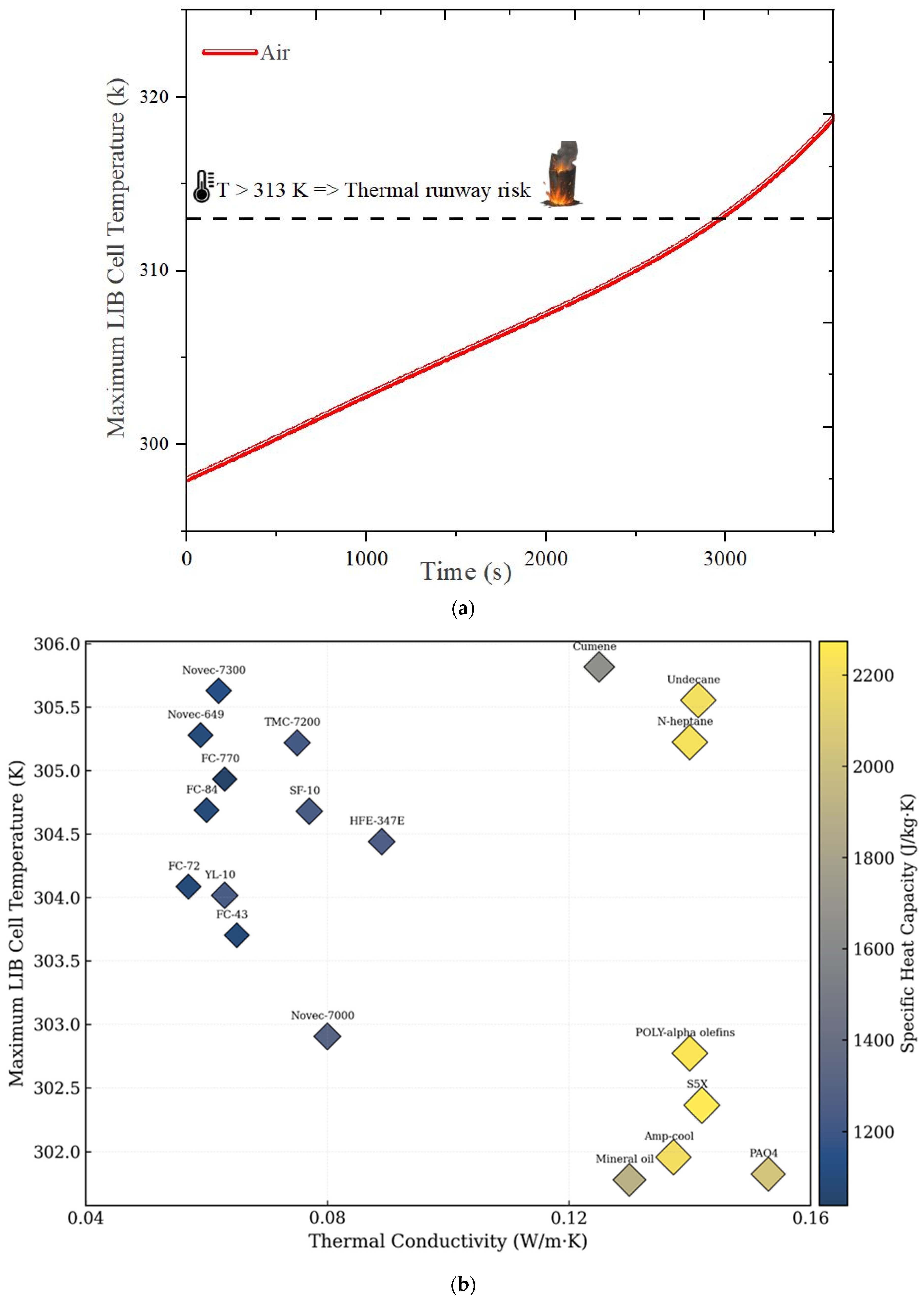
This study selected 20 dielectric fluids and simulated their performance in the LIB module. The inlet temperature is set to 298.15 K, and the discharge rate is defined as 1C (3600 s). In this section, a correlation between the dielectric fluid properties, particularly thermal conductivity and specific heat, is investigated to assess their impact on the system’s maximum LIB cell temperature. In addition, this study identifies the three dielectric fluids that provide the most effective temperature reduction in comparison with convective air cooling.
Figure 5a shows the maximum LIB cell temperature obtained with air as the cooling medium, used as a benchmark. The results indicate that over 3600 s, the LIB cell temperature reaches 318.75 K, highlighting the need for an efficient dielectric fluid to reduce the LIB cell temperature during discharge. Figure 5b presents a two-dimensional plot of the maximum LIB cell temperature for the twenty dielectric fluids as a function of their thermal conductivity and specific heat. The results show that mineral oil, PAO, and AMP-Cool yield maximum LIB cell temperatures of 301.78 K, 301.82 K, and 301.96 K, respectively. These three dielectric fluids are therefore the most efficient for the immersion-BTMS compared with the remaining fluids. Meanwhile, the results confirm that the most effective dielectric fluids are those with high thermal conductivity and high specific heat. On the other hand, the findings clearly demonstrate that the cooling performance cannot be solely determined based on the properties of the thermal conductivity and specific heat capacity. In this regard, for example, both n-heptane and undecane have high levels of thermal conductivity and specific heat capacity compared to PAO4 and Amp-Cool. However, they have a higher temperature value inside the LIB cell. The reason is that both n-heptane and undecane have low density and viscosity. As a result, this increases the speed of the flow but decreases the effect of heat absorption by the cooling fluid. Thus, the cooling effect can be achieved through an integrated effect of all thermophysical properties.

3.2. Comparison Analysis of Temperature Uniformity

The quantitative calculation of thermal homogeneity of the LIB module is performed using the temperature uniformity iIndex (TUI), which is defined as the difference between maximum and minimum temperatures of cells in the battery module and can be presented by:
T U I =   T m a x   T m i n
where T m a x and T m i n denote the maximum and minimum temperatures of the LIB cells. Smaller TUI values correspond to higher thermal homogeneity [36].
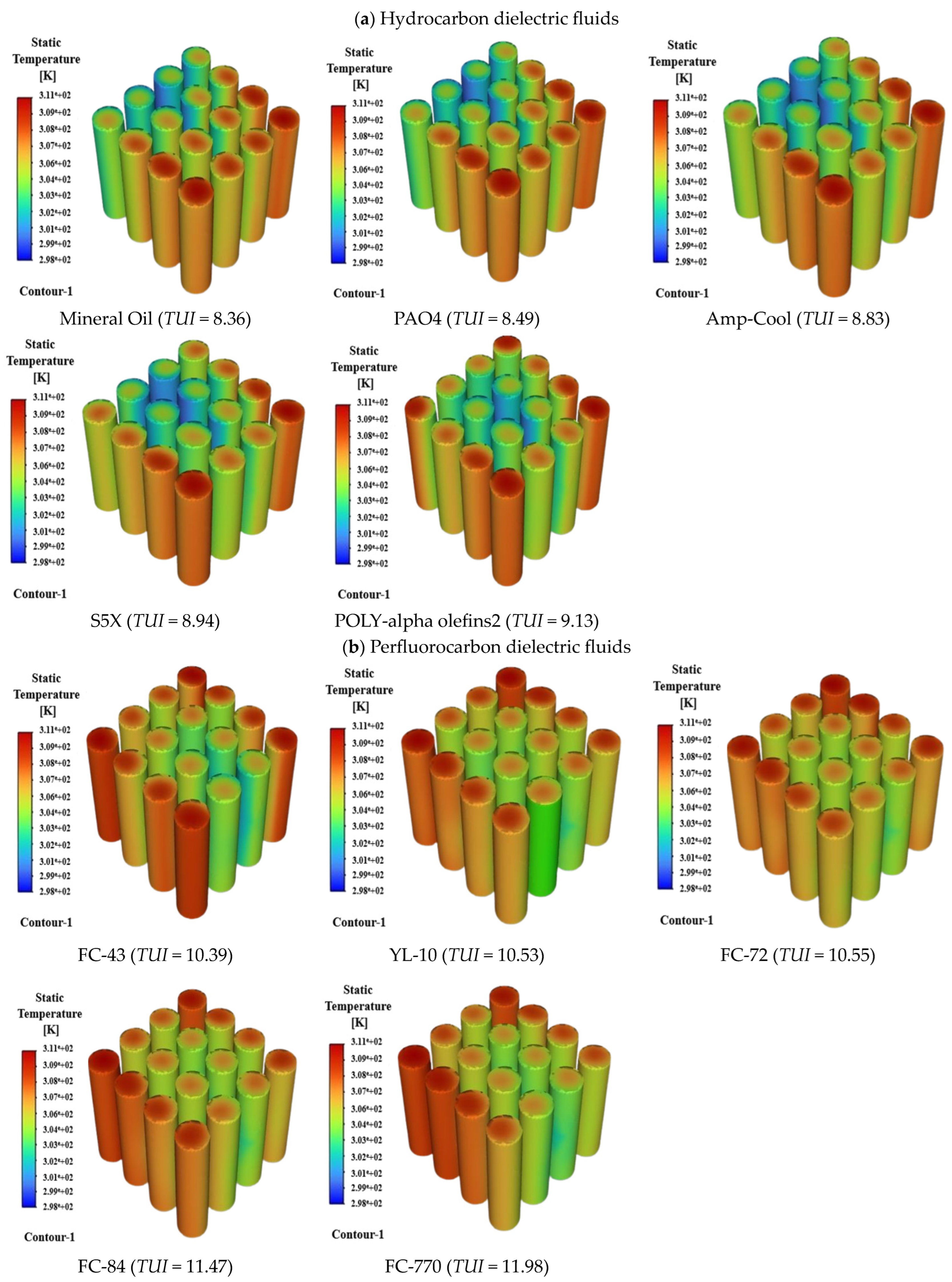
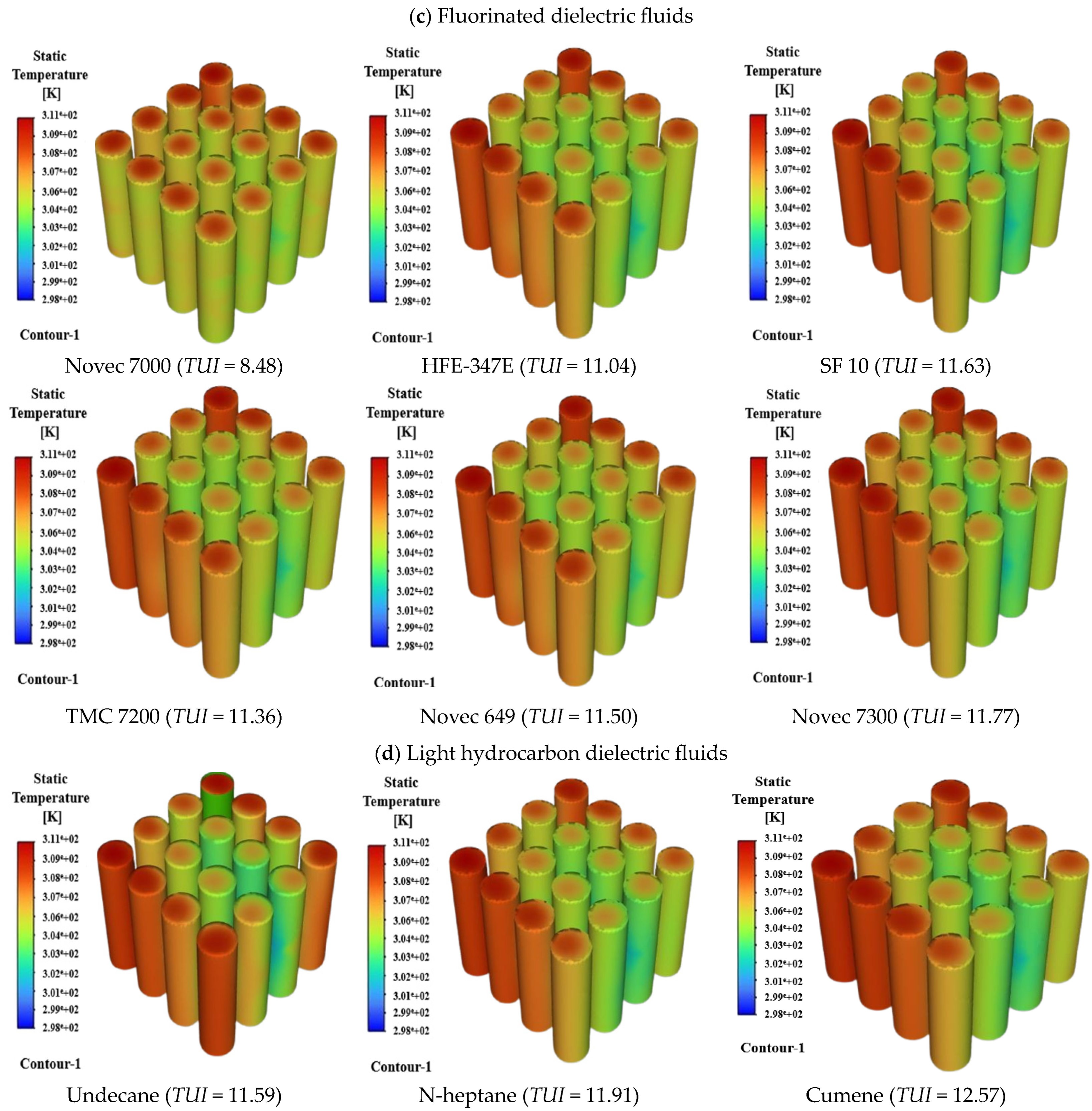
The temperature uniformity of the LIB module using an immersion-BTMS has been investigated for the 20 different dielectric fluids. The results summarized in Figure 6 demonstrate that mineral oil, Novec 7000, and PAO4 delivered the most consistent temperature uniformity and thermal distribution, maintaining uniformity indices below 8.5 K, confirming that dielectric fluids with moderate viscosity and higher specific heat promote greater temperature stability between LIB cells. In contrast, perfluorocarbon dielectric fluids, including FC-43, FC-72, and YL-10, enhanced convective circulation but exhibited uniformity indices above 10.5 K, indicating greater sensitivity to flow-related changes despite improved fluid flow. Moreover, lower-viscosity dielectric fluids such as HFE-347E, TMC-7200, SF-10, and Novec 7300 exhibited even greater variations among individual LIB cells in the module, with uniformity values exceeding 11 K, indicating an imbalance in volumetric heat distribution. In addition, light hydrocarbon dielectric fluids such as cumene and n-heptane exhibited the lowest temperature uniformity index among the fluids studied. Overall, the results confirm that immersion-BTMS performance is governed by a coupled interaction between dielectric fluid properties such as viscosity, heat capacity, and flow behaviour, where extremely low viscosity improves circulation yet increases flow-driven non-uniformity, underscoring the need for dielectric fluid selection strategies that prioritize temperature-gradient suppression in addition to dielectric compatibility. This aspect is particularly crucial when considering the high energy density of the lithium-ion battery, where temperature gradients can lead to rapid lithium plating and uneven degradation.
Otherwise, the temperature distributions presented in Figure 6 can be further interpreted by considering the internal flow behaviour of the dielectric fluids within the LIB module. Although all simulations were performed under the same inlet velocity (0.1 m/s), significant differences in flow behaviour arise from variations in fluid viscosity and density, which directly affect the Reynolds number and convective heat-transfer characteristics. Thus, high-viscosity fluids such as mineral oil and PAO4 exhibit lower Reynolds numbers and more stable coolant circulation through the inter-cell passages, resulting in a more uniform heat removal process and consequently lower temperature gradients between LIB cells. In contrast, lower-viscosity fluids such as cumene, n-heptane, and several fluorinated fluids produce higher Reynolds numbers and stronger local flow acceleration, which can lead to a non-uniform fluid distribution within the LIB module. Therefore, larger temperature differences are observed between LIB cells, leading to higher TUI values. This means that the thermal performance of immersion cooling is governed not only by the thermophysical properties of the dielectric fluid but also by the resulting internal flow-field characteristics and fluid distribution patterns within the LIB module.

3.3. Comparative Analysis of Pressure Drop in Immersion-BTMSs

Pressure drop is considered one of the most critical parameters for immersion-BTMS performance, which directly affects the overall system efficiency. In this section, a comparative analysis is conducted on twenty dielectric fluids to evaluate their hydraulic behaviour. Moreover, the study examined the effects of the dielectric fluid properties and flow direction within the geometry on the hydraulic response of the immersion-BTMS.

3.3.1. Pressure Drop Characteristics as a Function of Dielectric Fluid Properties

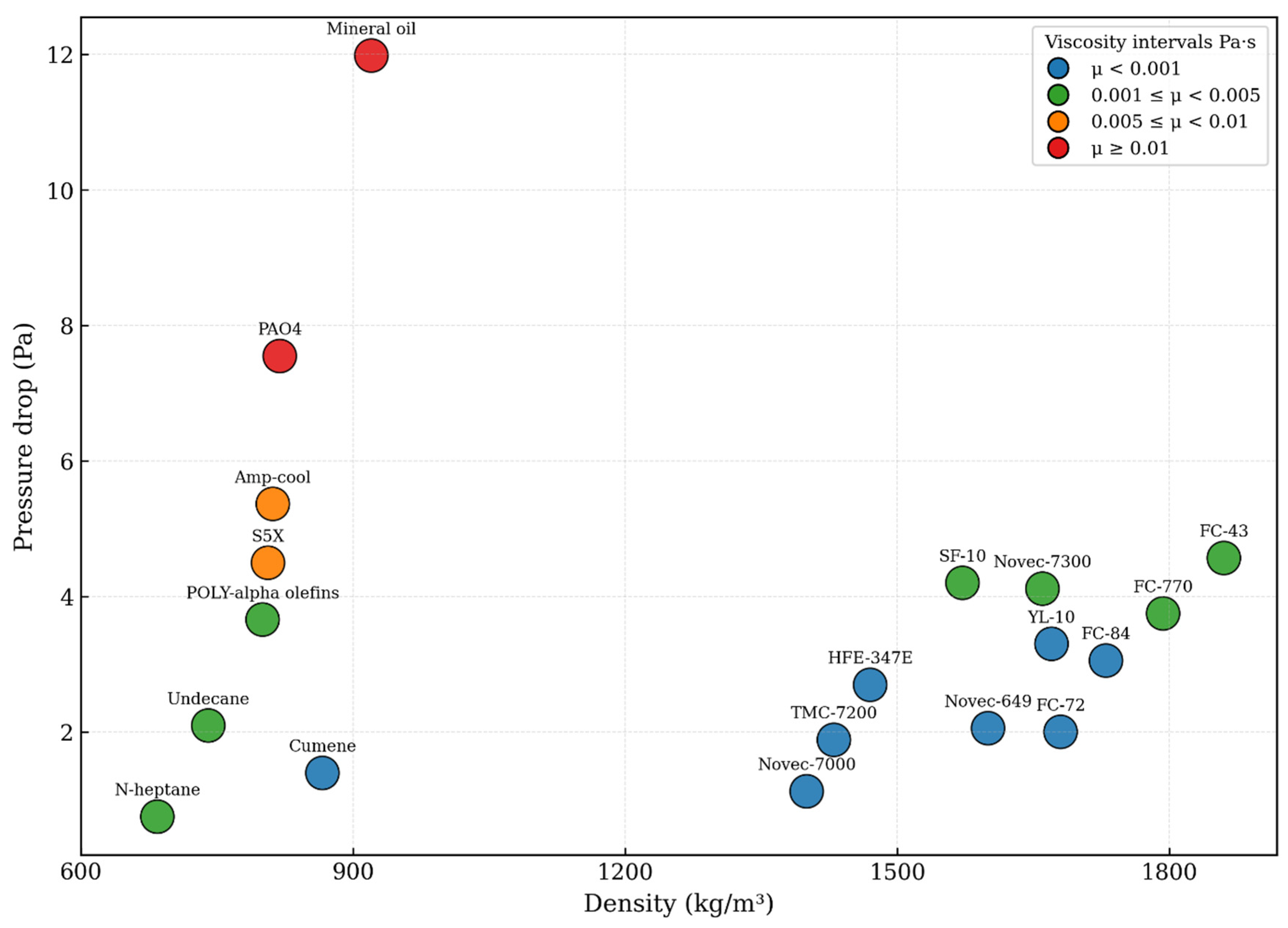
To ensure a consistent hydraulic comparison, the pressure-drop analysis was performed under the same inlet velocity condition for all dielectric fluids, allowing the direct influence of fluid thermophysical properties on hydraulic resistance to be evaluated. Figure 7 illustrates a significant correlation between the pressure drop and the characteristics of different dielectric fluids in the simulated immersion-BTMS. Among the fluids, mineral oil had the highest pressure drop, consistent with its high viscosity. PAO4, Ampcool, and S5X follow suit, having moderate pressure drops consistent with moderate viscosities. However, FC-43 exhibited a pressure drop comparable to that of S5X, suggesting that higher fluid density can also increase inertia-driven pressure losses despite low fluid viscosity. Novec 7300 had a moderate pressure drop despite having low viscosity. On the other hand, N-heptane and Cumene had lower pressure drops than mineral oil, despite viscosities in the range of 10−3 Pa·s. The present results indicate that the pressure drop increases with increasing fluid viscosity. However, dielectric fluid density and compressibility can also contribute to the overall pressure drop.
From an overall thermal–hydraulic performance perspective, an effective immersion-BTMS should simultaneously minimize the maximum LIB cell temperature and pressure-drop penalty. Although mineral oil achieved the lowest maximum temperature, its relatively high viscosity generated the largest pressure drop. On the other hand, the lower-viscosity fluids in this category, like n-heptane and undecane, produced lower hydraulic resistance with poor thermal efficiency. In the group of dielectric fluids investigated, PAO4 proved to be the best compromise between cooling efficiency, uniformity of temperatures, and hydraulic efficiency.

3.3.2. Effect of Flow Direction on Pressure Drop

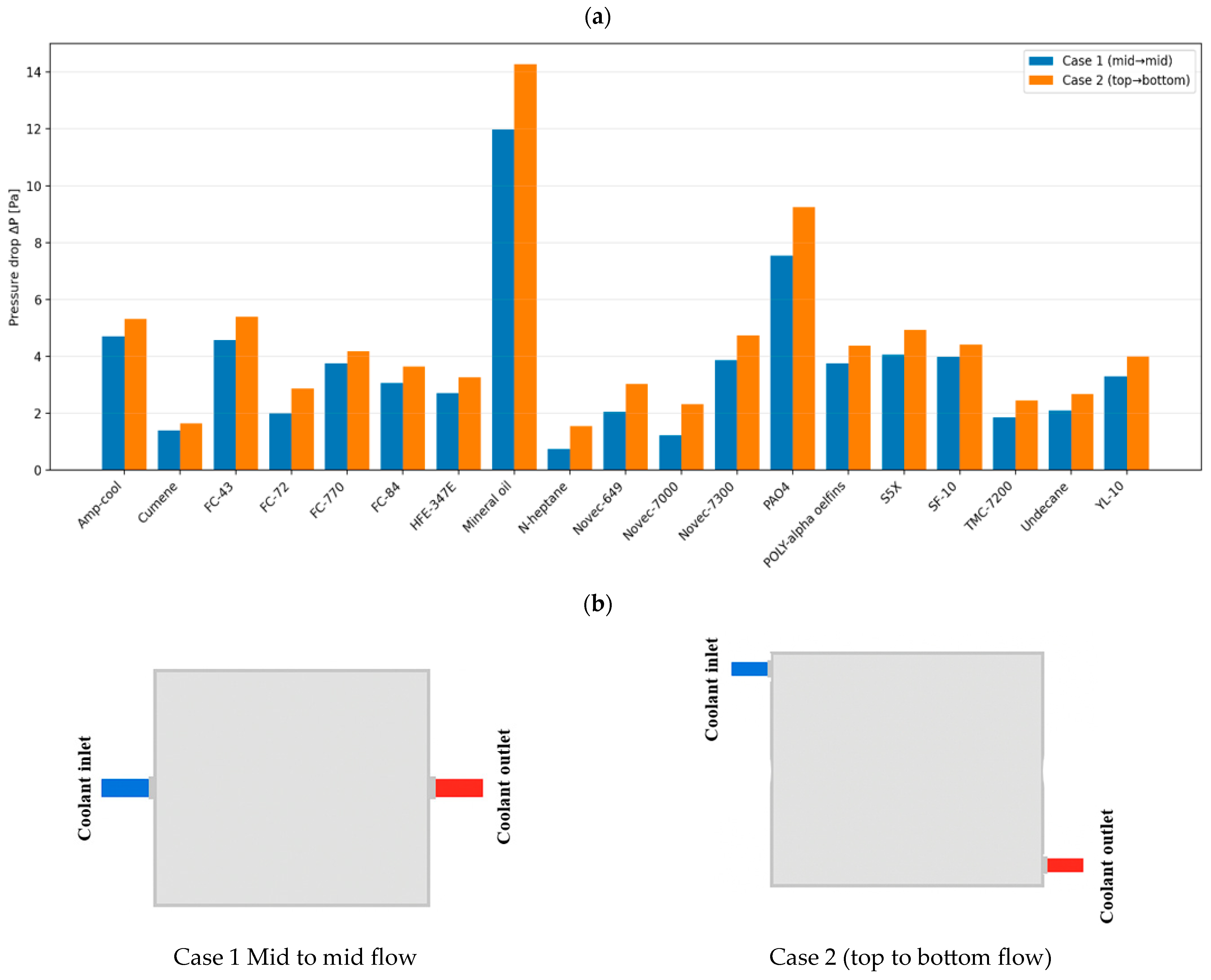
This section investigates the impact of two commonly used inlet–outlet configurations in the immersion-BTMS on the resulting pressure drop across a range of dielectric fluids. The analysis compares two flow configurations, as presented in Figure 8a: Case 1, where the inlet and outlet are positioned at the mid height of the fluid chamber, and Case 2, where the fluid enters from the top and exits from the bottom, forcing a full vertical flow through the cell stack. In Figure 8b, the results show that Case 2 (top-to-bottom flow) consistently produces a higher pressure drop than Case 1 (mid-to-mid flow), and the magnitude of this increase depends strongly on the fluid’s viscosity and density. For hydrocarbon dielectric fluids such as mineral oil, PAO4, and S5X, the pressure drop increase in Case 2 is significant because their relatively high viscosity causes stronger frictional losses when the fluid is forced to travel the full vertical height of the LIB cell stack; this explains why mineral oil rises from 11.98 to 14.28 Pa and PAO4 from 7.55 to 9.25 Pa. Otherwise, perfluorocarbon and fluorinated dielectric fluids, which generally have lower viscosity and higher density, show smaller absolute pressure drops, yet the same trend persists: forcing a vertical flow path in Case 2 intensifies form losses and buoyancy-driven resistance, which raises pressure drop (e.g., Novec 7000 from 1.22 to 2.33 Pa, FC 72 from 2.00 to 2.86 Pa). Light hydrocarbons such as n-heptane and undecane, having the lowest viscosities, show the lowest pressure drops in both cases, but their Case 2 values still nearly double because low viscosity fluids accelerate more easily and therefore experience stronger inertial losses when redirected vertically. To conclude, the consistent increase in pressure drop for Case 2 across all fluid types is explained by the longer flow path, stronger interactions with LIB cell surfaces, and opposing buoyancy effects, whereas Case 1 maintains a shorter, more symmetric horizontal path that reduces hydraulic resistance.

3.4. Thermo-Hydraulic Performance of Immersion Cooling BTMSs

While many dielectric fluids exhibited efficient cooling characteristics, thermal performance alone is insufficient for evaluating the overall effectiveness of battery immersion cooling. In practical applications, dielectric fluids with superior cooling characteristics may simultaneously induce excessive hydraulic losses, resulting in increased pumping power consumption and reduced system efficiency. Therefore, a combined thermo-hydraulic assessment is necessary to identify the most suitable dielectric fluid for immersion-BTMS applications.
To ensure a common ground for comparison, a thermo-hydraulic-based performance index was suggested in the current study. This index incorporates not only the maximum temperature inside LIB cells but also the temperature homogeneity and pressure losses at the same time. It is defined as:
T H P I = 1 T m a x   ×   T U I   ×   Δ P
where T m a x is the highest temperature attained by the LIB cell, and ΔP is the pressure loss through the immersed BTMS. A high value of THPI indicates better thermo-hydraulic behaviour of the system, which means lower maximum temperature, better temperature uniformity, and lower hydraulic resistance.
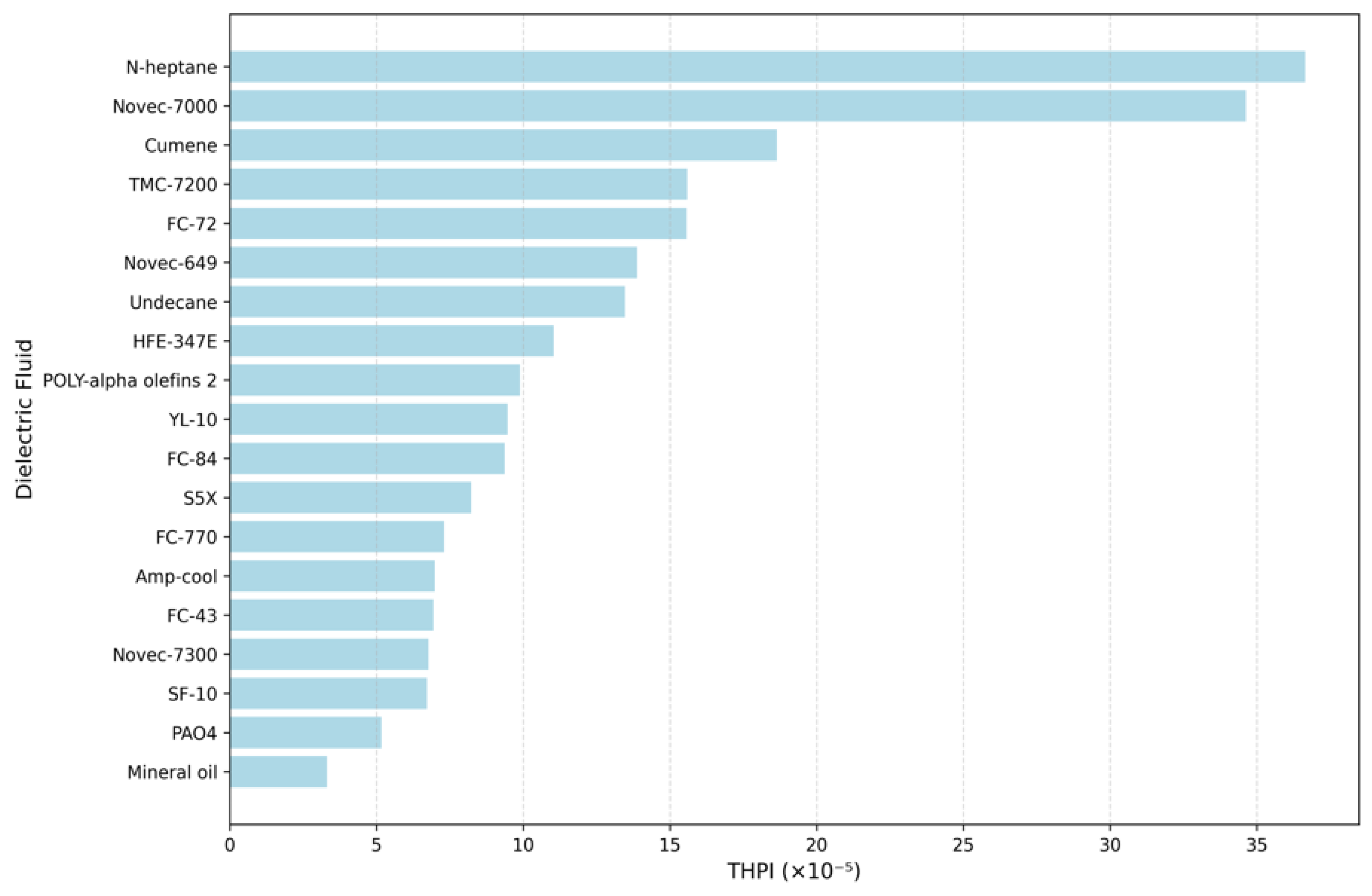
The THPI values for the twenty dielectric fluids are summarized in Figure 9. The results present substantial variations in the combined thermo-hydraulic behaviour among the investigated dielectric fluids. Among all candidates, n-heptane exhibited the highest THPI value, followed by Novec-7000 and cumene. The superior THPI values associated with these fluids are mainly attributed to their extremely low pressure drops, which reduce the hydraulic losses even though they have relatively higher peak temperatures with lower temperature uniformity.
On the other hand, high viscosity fluids, such as mineral oil, demonstrated excellent thermal characteristics, showing one of the lowest maximum temperatures of LIB cells together with superior uniformity. However, the high pressure drops of mineral oil significantly reduced its thermo-hydraulic performance, resulting in a rather low THPI value. The same tendency occurred with PAO4 and Amp-Cool, where improved cooling capability was partially offset by increased hydraulic resistance. This finding confirms that immersion-BTMS performance is governed by a complex interaction between thermal conductivity, specific heat capacity, viscosity, density, and flow behaviour.

4. Conclusions and Future Perspectives

The present study evaluated 20 dielectric fluids for immersion-BMTS, which revealed strong correlations between the fluids’ thermophysical properties and cooling effectiveness. The results demonstrate that dielectric fluids with high thermal conductivity and high specific heat, particularly mineral oil, PAO, and AMP Cool, achieved the lowest maximum LIB cell temperatures (approximately 301.8–302.0 K), and significantly outperform air cooling (318.75 K).
On the other hand, temperature uniformity analysis indicated that mineral oil, Novec 7000, and PAO4 delivered the most stable thermal distribution, maintaining uniformity indices below 8.5 K. In contrast, very low viscosity dielectric fluids such as HFE347E, TMC7200, and Novec 7300 exhibited non-uniform temperature fields, which suggests that excessive flow mobility increases LIB cell-to-cell thermal imbalance.
In addition, the assessment of pressure drops shows that dielectric fluids with higher viscosity, such as mineral oil and PAO4, exhibit greater hydraulic losses, whereas hydrocarbons with lower viscosity, such as n-heptane and undecane, have the lowest pressure drops.
The results clearly demonstrate that BTMS performance through immersion depends on the synergy between both thermal and hydraulic properties of the fluid. Hence, in order to evaluate their performances, a thermo-hydraulic performance index (THPI) involving maximum temperature, temperature uniformity, and pressure drop was formulated to provide a comprehensive evaluation of dielectric-fluid performance. Clear differences were observed among the investigated fluids, highlighting the importance of simultaneously balancing cooling effectiveness, thermal uniformity, and hydraulic resistance in determining the most suitable dielectric fluid for immersion-cooling applications.
The present study was limited to a 1C discharge condition, a fixed inlet velocity of 0.1 m/s, and a 4P4S battery module composed of cylindrical 18650 lithium-ion cells operating under single-phase immersion cooling conditions. Therefore, the obtained thermal–hydraulic behaviour may vary under higher charge–discharge rates, different coolant flow conditions, alternative battery geometries such as prismatic or pouch cells, and two-phase immersion cooling configurations. Future work should focus on extending the present analysis toward broader operating conditions, advanced flow-channel optimization, and coupled thermal–hydraulic performance enhancement strategies for next-generation immersion-BTMS applications.

Author Contributions

Conceptualization, A.C.O. and S.E.A.; methodology, A.C.O. and S.E.A.; software, S.E.A.; validation, A.C.O. and S.E.A.; investigation, S.E.A.; resources, A.C.O. and R.M.R.A.S.; data curation, S.E.A.; writing—original draft preparation, S.E.A.; writing—review and editing, S.E.A. and A.C.O.; visualization, A.C.O. and R.M.R.A.S.; supervision, F.J.; project administration, A.C.O. and F.J.; funding acquisition, A.C.O. All authors have read and agreed to the published version of the manuscript.

Funding

This research received no external funding.

Data Availability Statement

Data is unavailable due to privacy or ethical restrictions.

Conflicts of Interest

The authors declare no conflict of interest.

Nomenclature

T m a x Maximum cell temperature
Δ T Temperature Uniformity
φHeat generation rate
hConvective heat transfer coefficient
VCoolant velocity
D h Hydraulic diameter
R e Reynolds number
Δ P Pressure drop
tTime
CDischarge rate
BTMSBattery Thermal Management System
Li-ionLithium-ion
EVElectric Vehicle
CFDComputational Fluid Dynamics
SOCState of Charge
OCV Open-Circuit Voltage
HFEHydrofluoroether
PFCPerfluorocarbon
PFPEPerfluoropolyether
UDFUser Defined Function
TUITemperature Uniformity Index
ρDensity
μDynamic viscosity
κThermal conductivity
C p Specific heat capacity
ɡGravitational acceleration

References

  1. Waseem, M.; Lakshmi, G.S.; Ahmad, M.; Suhaib, M. Energy storage technology and its impact in electric vehicle: Current progress and future outlook. Next Energy 2024, 6, 100202. [Google Scholar] [CrossRef]
  2. Afia, S.E.; Cano, A.; Arévalo, P.; Jurado, F. Energy Sources and Battery Thermal Energy Management Technologies for Electrical Vehicles: A Technical Comprehensive Review. Energies 2024, 17, 5634. [Google Scholar] [CrossRef]
  3. Paul, D.; Pechancová, V.; Saha, N.; Pavelková, D.; Saha, N.; Motiei, M.; Jamatia, T.; Chaudhuri, M.; Ivanichenko, A.; Venher, M.; et al. Life cycle assessment of lithium-based batteries: Review of sustainability dimensions. Renew. Sustain. Energy Rev. 2024, 206, 114860. [Google Scholar] [CrossRef]
  4. Amalesh, T.; Narasimhan, N.L. Liquid cooling vs hybrid cooling for fast charging lithium-ion batteries: A comparative numerical study. Appl. Therm. Eng. 2022, 208, 118226. [Google Scholar] [CrossRef]
  5. Kabirzadeh, P.; Liu, Z.; Olyaei, M.; Qiu, H.; Gurumukhi, Y.; Tyagi, H.; Jiang, Y.; Garimella, V.S.; Singh, B.P.; Li, Y.; et al. Integrating heat transfer and control optimization: A comprehensive review of battery thermal management systems. J. Energy Storage 2025, 131, 117289. [Google Scholar] [CrossRef]
  6. Rimon, S.T.A.; Shajid, S.R.; Mourshed, M.; Tushar, M.S.H.K. Flow field configurations in PEMFCs: Design, Modeling, and performance insights. Energy Convers. Manag. X 2025, 28, 101263. [Google Scholar] [CrossRef]
  7. Akkuş, F.; Işık, M.Z. A review of thermal management systems of lithium-ion batteries used in electric vehicles. J. Traffic Transp. Eng. 2025, 12, 1763–1783. [Google Scholar] [CrossRef]
  8. Raja Ahsan Shah, R.M.; Al Qubeissi, M.; Youssef, H.; Soyhan, H.S. Battery Thermal Management: An application to petrol hybrid electric vehicles. Sustainability 2023, 15, 5868. [Google Scholar] [CrossRef]
  9. Yaw, C.T.; Rajamony, R.K.; Bhutto, Y.A.; Bakthavatchalam, B.; Kottala, R.K.; Chopra, K.; Paw, J.K.S.; Doroody, C.; Allasi, H.L.; Soudagar, M.E.M. Two phase heat transfer approaches for battery thermal management: Current status. challenges and future outlook. Results Eng. 2025, 27, 105749. [Google Scholar] [CrossRef]
  10. Zeng, S.; Li, J.; Hong, S.; Qiao, Y.; Wu, W. Fundamental Insights into Static Immersion Cooling of Large-Scale Lithium-ion Batteries: Thermal Behavior. Heat Transfer Mechanisms. and Multivariable Analysis. eTransportation 2025, 25, 100436. [Google Scholar] [CrossRef]
  11. Al Qubeissi, M.; Shah, R.M.R.A.; Almshahy, A. Battery thermal management using heavy fuels: An approach to lightweight diesel fuelled hybrid electric vehicles. Alex. Eng. J. 2025, 126, 515–545. [Google Scholar] [CrossRef]
  12. El Afia, S.; Hidki, R.; Jurado, F.; Cano-Ortega, A. Numerical Investigation into 18650 Li-Ion Battery Temperature Control Applying Immersion Cooling with FC-40 Dielectric Fluid. Batteries 2025, 11, 397. [Google Scholar] [CrossRef]
  13. Tripathi, P.M.; Marconnet, A.M. Effect of immersion cooling parameters on thermal and electrochemical response of a Li-ion cell. J. Power Sources 2025, 632, 236285. [Google Scholar] [CrossRef]
  14. Yin, C.; Zhang, Y.; Sheng, L.; Gao, Q.; Zhang, Z.; Liao, Z. Synergistic method of immersion cooling and insulation materials to inhibit thermal runaway propagation in lithium-ion battery modules. Process Saf. Environ. Prot. 2026, 210, 108702. [Google Scholar] [CrossRef]
  15. Hong, H.; Song, X.; Shi, X.; D’Apolito, L.; Xin, Q. Immersion cooling for Lithium-Ion batteries at high discharging rates. SAE Int. J. Electrified Veh. 2025, 14, 219–246. [Google Scholar] [CrossRef]
  16. Zeng, Z.; Yuan, N.; Song, C.; Liu, J.; Liu, Z.; Shi, H. Integrating CFD and data-driven techniques for the optimization of dielectric coolants in EV battery immersion cooling systems. Int. Commun. Heat Mass Transf. 2025, 162, 108591. [Google Scholar] [CrossRef]
  17. Li, W.; Wang, Y.; Wu, W.; Guo, J.; Qiu, Y.; Ju, G.; Liu, T.; Li, L.; Yu, Z.; Jiang, F. Analysis of immersion cooling performance for LiFePO4 battery packs: Coolant effect and optimization. Therm. Sci. Eng. Prog. 2025, 64, 103830. [Google Scholar] [CrossRef]
  18. Bao, R.; Wang, Z.; Gao, Q.; Yang, H.; Zhang, B.; Chen, S. Dynamic-static composite immersion cooling for improving thermal equalization behavior in lithium-ion battery packs. Energy 2025, 330, 136774. [Google Scholar] [CrossRef]
  19. Kim, J.; Choi, H.; Lee, S.; Lee, H. Computational study of single-phase immersion cooling for high-energy density server rack for data centers. Appl. Therm. Eng. 2025, 264, 125476. [Google Scholar] [CrossRef]
  20. Abdel-Hafeez, A.M.; Effat, M.B.; Hassan, O.; Abdel-Shafi, N. Effect of intercell spacing and operating conditions on the performance of prismatic lithium-ion batteries cooled by dielectric immersion Fluids: A numerical study. Int. J. Therm. Sci. 2025, 211, 109680. [Google Scholar] [CrossRef]
  21. Liu, X.; Zhou, Z.; Wu, W.-T.; Wei, L.; Hu, C.; Li, Y.; Huang, H.; Li, Y.; Song, Y. Numerical simulation for comparison of cold plate cooling and HFE-7000 immersion cooling in lithium-ion battery thermal management. J. Energy Storage 2024, 101, 113938. [Google Scholar] [CrossRef]
  22. Wang, Z.; Zhao, R.; Wang, S.; Huang, D. Heat transfer characteristics and influencing factors of immersion coupled direct cooling for battery thermal management. J. Energy Storage 2023, 62, 106821. [Google Scholar] [CrossRef]
  23. Yao, J.; Zhang, T.; Han, Z.; Chen, H.; Chen, H.; Liu, Z.; Huang, H. Study on the effect of immersion thermal management for high-current rate fast charging of 21700 Li-ion batteries. J. Energy Storage 2024, 85, 111061. [Google Scholar] [CrossRef]
  24. Li, C.; Wang, Y.; Sun, Z.; Wen, X.; Wu, J.; Feng, L.; Wang, Y.; Cai, W.; Yu, H.; Wang, M.; et al. Two-phase immersion liquid cooling system for 4680 Li-ion battery thermal management. J. Energy Storage 2024, 97, 112952. [Google Scholar] [CrossRef]
  25. Zou, Z.; Xie, J.; Luo, Y.; Zhang, G.; Yang, X. Numerical study on a novel thermal management system coupling immersion cooling with cooling tubes for power battery modules. J. Energy Storage 2024, 83, 110634. [Google Scholar] [CrossRef]
  26. He, Q.; Li, X.; Shan, W.; Zhang, W.; Wang, J.; Wang, Z.; Zheng, L. Numerical and experimental investigations on heat transfer characteristics and influencing factors of immersion cooling system for high-capacity prismatic lithium-ion battery. J. Energy Storage 2024, 104, 114518. [Google Scholar] [CrossRef]
  27. Hemavathi, S.; Kumaran, A.T.; Srinivas, S.; Prakash, A. Synthetic ester-based forced flow immersion cooling technique for fast discharging lithium-ion battery packs. J. Energy Storage 2024, 97, 112852. [Google Scholar] [CrossRef]
  28. E, J.; Yue, M.; Chen, J.; Zhu, H.; Deng, Y.; Zhu, Y.; Zhang, F.; Wen, M.; Zhang, B.; Kang, S. Effects of the different air-cooling strategies on cooling performance of a lithium-ion battery module with baffle. Appl. Therm. Eng. 2018, 144, 231–241. [Google Scholar] [CrossRef]
  29. Vikram, S.; Sadar, A.; Rakshit, D. Experimental study of dielectric coolant-based immersion cooling technique for lithium-ion battery packs. J. Energy Storage 2025, 144, 119741. [Google Scholar] [CrossRef]
  30. Suhendra, B.; Indratma, N.A.; Kusrini, E.; Putra, N.; Hasanuzzaman, M. Thermal performance and temperature uniformity of battery modules using static single phase immersion cooling with multiple dielectric fluids. Appl. Therm. Eng. 2026, 296, 130774. [Google Scholar] [CrossRef]
  31. Liu, J.; Tao, L.; Yang, Q.; Wang, J. Recent advances in immersion cooling for thermal management of lithium-ion batteries. Renew. Sustain. Energy Rev. 2025, 226, 116492. [Google Scholar] [CrossRef]
  32. ANSYS Inc. ANSYS Fluent User’s Guide, Release 18.0; ANSYS Inc.: Canonsburg, PA, USA, 2017. [Google Scholar]
  33. Tanaka, D.; Yuki, K.; Unno, N.; Yuki, K.; Ide, T.; Ogushi, T.; Murakami, M. Heat Transfer Enhancement in Two-phase Immersion Cooling with FC-72. In Proceedings of the 2023 International Conference on Electronics Packaging, ICEP 2023; Institute of Electrical and Electronics Engineers Inc.: New York, NY, USA, 2023; pp. 179–180. [Google Scholar]
  34. Zhou, W.; Ma, H.; Hu, Y.; Xia, G. Nucleate boiling enhancement of FC-72 on the carbon nanotube buckypaper for two-phase immersion cooling. Int. J. Heat Mass Transf. 2024, 228, 125639. [Google Scholar] [CrossRef]
  35. Banerjee, R.; Nidhul, K. Effect of various dielectric fluids on temperature homogeneity of Li-ion battery pack in an energy efficient novel immersion cooling design. Results Eng. 2025, 26, 104688. [Google Scholar] [CrossRef]
  36. Zhang, Q.; Zhang, W.; Wang, S.; Yang, X.; Liu, G.; Sun, D.; Yu, B. Thermal management of lithium-ion batteries: From single cooling to hybrid cooling. RSC Adv. 2026, 16, 2555–2584. [Google Scholar] [CrossRef]
Figure 1. Temperature-based correlation of the LIB cell model.
Energies 19 02770 g001
Figure 2. Geometry of immersion-BTMS. (a) Top view; (b) three-dimensional view; (c) side view.
Energies 19 02770 g002
Figure 3. Computational mesh of the studied battery immersion cooling system. (a) Detailed mesh of the battery cells. (b) Full 3D computational domain mesh. (c) Cross-sectional (mid-plane) mesh view.
Energies 19 02770 g003
Figure 4. LIB cell temperature evolution for the different mesh resolutions.
Energies 19 02770 g004
Figure 5. (a) Maximum cell temperature of the LIB module under air cooling, (b) maximum cell temperature as a function of dielectric fluid thermal conductivity and specific heat.
Energies 19 02770 g005
Figure 6. Temperature uniformity of LIB module under immersion cooling for different dielectric fluids, grouped by fluid category and ranked from best to worst performance.
Energies 19 02770 g006aEnergies 19 02770 g006b
Figure 7. Pressure drop as a function of dielectric fluid density and dynamic viscosity in immersion-BTMS channels.
Energies 19 02770 g007
Figure 8. (a) Different inlet–outlet configurations in the immersion-BTMS. (b) Impact of inlet and outlet configurations on pressure drop across dielectric fluids.
Energies 19 02770 g008
Figure 9. Thermal–hydraulic performance comparison of dielectric fluids.
Energies 19 02770 g009
Table 1. Lithium-ion battery model properties [28].
PropertySpecification
Cathode substance L i N i x C O y M n z O 2
Anode substanceGraphite
Cell length (mm)65
Cell diameter (mm)18
Nominal voltage (V)3.7
Nominal capacity (Ah)2.6
Specific   heat   capacity   ( J . k g 1 . K 1 )1200
Table 2. Mesh statistics for different grid resolutions.
Mesh (a)Mesh (b)Mesh (c)
Nodes186,808412,637697,421
Elements478,9391,017,8911,774,446
Table 3. Governing equations for the immersion-BTMS model.
PhenomenonEquationDescription
Irreversible heat (Joule heating) Q i r r = I 2 × R e Heat generated due to internal resistance of LIB
Reversible heat
(Electrochemical)
Q r e v = I × ( T × d E d T ) Heat from electrochemical reactions, depends on entropy change.
Internal resistance as function of SOC and T R e = 112 × S O C 3 0.203 × S O C 2 × T + 0.000737 × S O C × T 2 + 0.00000753 × T 3 + 301 × S O C 2 0.144 × S O C × T 0.0061 × T 2 188 × S O C + 1.28 × T + 23.6 × 10 3 Empirical formula for LIB internal resistance based on state of charge and temperature.
Thermal coefficient of OCV d E d T = ( 0.342 + 0.979 × S O C 1.49 × S O C 2 + 0.741 × S O C 3 ) × 10 3 Describes how open-circuit voltage changes with temperature.
LIB energy conservation (3D transient) t ρ c p T = . k T + Q g e n Q s Governs heat transfer inside LIB including generation and surface losses.
Coolant continuity ρ τ + . ρ V = 0 Conservation of mass for the coolant flow.
Coolant momentum ρ V τ + ρ V . V = P + μ 2 V + ρ β g T T r e f + S Describes the forces acting on the coolant including pressure, viscosity, buoyancy, and external sources.
Coolant energy conservation V τ ρ C l i q T = . ( λ T ) Governs heat transfer in the moving dielectric fluid.
Table 4. Operating parameters.
Boundary ConditionSpecification
Inlet temperature298.15 K
Inlet velocity0.1 m·s−1
Convective heat transfer W·m−2·K−1h = 5
Gravity9.81 m/s2
Table 5. Thermophysical properties of dielectric fluid candidates for CFD modelling of immersion-BTMSs.
CategoryDielectric FluidDynamic Viscosity Pa.sDensity kg/m3Specific Heat Capacity J/kg.kThermal Conductivity w/m.K
Hydrocarbon [12,13,15,16]Mineral oil0.05692019000.13
PAO40.01768192042.10.153
Amp-cool0.00958811.32203.20.1373
S5X0.007980622740.142
POLY-alpha olefins 20.004180022410.14
Perfluorocarbon [12,14,15,33,34]FC-430.0047186011000.065
YL-100.00059167012400.063
FC-720.000434168011000.057
FC-840.00091173011000.06
FC-7700.0014179310380.063
Fluorinated [14,15]Novec-70000.00003140013000.08
HFE-347E0.00065147012600.089
SF-100.00131591.812400.077
TMC-72000.0006143012200.075
Novec-6490.00064160011030.059
Novec-73000.0016166011400.062
Light hydrocarbon [10,27]N-heptane0.00375668422190.14
Undecane0.001098740.1722070.1404
Cumene0.0007786616530.125
Gas (Reference) [35]Air0.0000181.22510050.025
Disclaimer/Publisher’s Note: The statements, opinions and data contained in all publications are solely those of the individual author(s) and contributor(s) and not of MDPI and/or the editor(s). MDPI and/or the editor(s) disclaim responsibility for any injury to people or property resulting from any ideas, methods, instructions or products referred to in the content.