Article

Influence of Ionomer Overcoating on the Interfacial Properties and Performance of Gas Diffusion Electrode-Based Proton Exchange Membrane Fuel Cells


by
Ayon Karmakar
,
Mrittunjoy Sarker
,
Zabihollah Najafianashrafi
,
Joy Marie Mora
,
Nitul Kakati
and
Po-Ya Abel Chuang
*
Department of Mechanical and Aerospace Engineering, University of California, Merced, 5200 N Lake Rd., Merced, CA 95343, USA
*
Author to whom correspondence should be addressed.
Energies 2026, 19(11), 2728; https://doi.org/10.3390/en19112728 (registering DOI)
Submission received: 6 April 2026 / Revised: 28 May 2026 / Accepted: 2 June 2026 / Published: 5 June 2026
(This article belongs to the Special Issue Research and Development of Key Materials and Devices for Fuel Cells)

Abstract

Membrane electrode assemblies (MEA) based on gas diffusion electrodes (GDEs) usually suffer from greater ohmic losses and proton transport resistances owing to poor contact at the membrane–catalyst layer (CL) interface. This affects the overall performance of the proton-exchange-membrane fuel cells (PEMFCs). To address this, it is essential to strengthen the interface between the membrane and CL, especially at the cathode side. In this context, the present work is focused on engineering the membrane–CL interface by applying an optimized Nafion ionomer overcoat on top of a Mayer-rod-coated cathode-GDE, within an asymmetric MEA architecture. The role of the Nafion overcoat in improving the membrane–CL interface is inferred from morphological observations and in situ electrochemical characterizations. The electrochemical evaluation indicates the critical role of the ionomer overcoat on GDE, followed by the hot pressing during MEA fabrication, in improving the PEMFC performance. Furthermore, the surface characteristics of the overcoated GDEs have been characterized by profilometry and scanning electron microscopy. The findings suggest progressive smoothening of the CL surface with increasing ionomer overcoat concentration till 10 wt.% and further increase leads to crack generation. The polarization behavior of the overcoated (0–20 wt.%) GDE-MEAs identifies 10 wt.% as the best-performing sample among the discrete cases examined, corresponding to an ~4.8 μm ionomer overlayer (0.86 mg cm−2). This configuration exhibits the lowest ohmic resistance and improved proton and mass transport behavior, suggesting enhanced interfacial interaction based on HFR/EIS trends. In addition, the study of relative humidity (RH) transitions (100% RH → 40% RH) and polarization curves indicate superior performance of the 10 wt.%-overcoated GDE-MEA compared to the catalyst-coated membrane (CCM) type MEA under fully humidified conditions. This study manifests that interfacial engineering is highly effective in fabricating a high-performance GDE-based MEA for PEMFCs.

1. Introduction

Proton exchange membrane fuel cells (PEMFCs) have emerged as highly efficient and promising energy conversion technology in delivering clean energy for transportation as well as stationary applications [1,2,3]. Notably, the membrane electrode assembly (MEA), which is considered the heart of the PEMFC, remains critical in achieving high-performing fuel cells [4,5,6]. The MEA consists of a proton exchange membrane (PEM) along with anode and cathode catalyst layers (CLs), while gas diffusion layers (GDLs) are added on each side to form a complete PEMFC [7,8]. Despite using benchmark Pt/C catalyst, the membrane–CL interface plays a critical role in proton and mass transport for PEMFCs [9,10,11,12]. Thus, fuel cell performance has a strong dependency on the MEA construction.
In general, MEA is fabricated in two ways. One is the catalyst-coated membrane (CCM) technique, where anode and cathode catalyst layers are applied on the opposite sides of the membrane either by direct coating or by transferring from a decal substrate through hot pressing [7,13,14]. Another method is to sandwich the membrane between anode and cathode gas diffusion electrodes (GDEs), which are prepared by coating respective catalyst layers on the microporous layer (MPL) side of the GDLs, to make GDE-based MEA [15,16]. The CCM-type MEAs are usually preferred for high performance in PEMFCs owing to better contact and low ohmic resistance at the membrane–CL interface [17]. However, CCM has certain disadvantages, such as complex fabrication process, membrane swelling during direct coating, and limitations of hot pressing during decal transfer for membranes with high glass transition temperatures (Tg) [18,19]. In this context, GDE-based MEAs could be useful to address the above issues. Also, the strong mechanical properties of the GDLs could be beneficial for scaling up the MEA production through a roll-to-roll process [11,20], although, the poor interfacial contact between the membrane and CL would pose the possibility of performance loss due to increased ohmic resistance. In this context, our earlier research demonstrated that hot pressing played a key role in lowering the thermal as well as electrical contact resistance at the membrane–electrode interface in a GDE-based MEA [21]. Under certain operating conditions, this GDE-based MEA delivered better performance than CCM. In addition, the MEA architecture is also crucial to deliver high energy conversion efficiency in PEMFC. For example, Li et al. [22] reported an asymmetric MEA to outperform conventional symmetric type CCM, whereas the asymmetric MEA was constructed by hot pressing a perfluorosulfonic acid (PFSA) membrane-coated cathode GDE and spray-coated anode CL containing commercial PEM.
There are different strategies reported to minimize the ohmic loss at the membrane–CL interface, such as direct membrane coating or a thin ionomer overlayer on CL. For example, Ding et al. [23] reported a direct slot die coating of a layer of Nafion membrane on top of the GDE which later hot-pressed with another GDE to form the MEA. This configuration showed comparable performance to the traditional MEAs up to 0.8 A cm−2. A glue-functioned Nafion layer with varied loadings were analyzed by Sung et al. [24] to identify the optimized loading of the overlayer for improving the GDE-based MEA performance. However, the optimum 0.3 mg cm−2 Nafion overcoat on GDE failed to outperform the conventional CCM. In contrast, Mauger et al. [25] found quite a low amount of Nafion overlayer (0.045 mg cm−2) on spray-coated GDEs and hot pressing during MEA fabrication to be critical in achieving performance similar to that of CCM architecture at 100% relative humidity (RH). Therefore, it is evident that interfacial engineering is essential in improving the membrane–CL interface to fabricate high-performance GDE-based MEAs as alternatives to the CCMs for PEMFCs.
Inspired by the above-mentioned literature, the present study reports an optimization of the concentration of Nafion overcoat on a Mayer rod-coated cathode-GDE in an asymmetric MEA architecture for PEMFC. Conventional PEMFC catalyst layer fabrication typically incorporates ionomer directly within the catalyst ink during spray coating or decal-transfer processing, thereby coupling catalyst layer formation and ionomer distribution. In this work, a post-deposition Nafion overlayer is introduced onto a pre-formed GDE, allowing independent tuning of the catalyst layer–membrane interface. The Nafion concentrations are varied in the range of 1 to 20 wt.% in the ionomer overcoat to find out the optimum Nafion concentration to achieve comparable or superior performance to CCM. In low-temperature fuel cells, the cathodic oxygen reduction reaction (ORR) is widely recognized as the rate-determining step due to its intrinsically sluggish four-electron transfer kinetics, whereas the hydrogen oxidation reaction (HOR) at the anode is relatively fast and contributes negligibly to activation losses [26,27]. Consequently, performance improvements are often governed by cathode catalyst layer design and interfacial engineering [28,29,30]. Notably, the choice of Mayer rod over spray coating for CL deposition has been made owing to its advantages, such as easy operation, less chance of membrane swelling, faster drying, high catalyst utilization, great thickness control, smooth CL surface, and scalability [20,31]. A more in-depth analysis is presented through an RH-sweep protocol under various humidity conditions in this study, providing improved insight into humidity-dependent interfacial behavior. Further, the effect of ionomer overcoat will also be studied on the surface morphology, roughness, and ohmic resistance. Additionally, systematic experiments have been performed to identify the effect of hot-press conditions on GDE-based MEA with the optimized Nafion overcoat. Notably, the Nafion-overcoated GDE-based MEA demonstrates superior performance compared to the CCM under fully humidified conditions.

2. Materials and Methods

This section outlines detailed methods for CCM fabrication, GDE preparation, and fuel cell testing protocols.

2.1. Catalyst Coated Membrane (CCM) Fabrication

Catalyst inks were prepared with a target total mass of 5 g, maintaining an ionomer-to-carbon (I/C) ratio of 0.85 and an isopropanol-to-water (IPA/W) ratio of 1.5. The carbon-to-solvent ratio was kept at 0.06, and Nafion ionomer (D2020, The Chemours Company, Wilmington, DE, USA) was used as ink binder. Both anode and cathode catalyst layers used a 46.8 wt.% platinum (Pt) catalyst supported on high surface area carbon (TKK TEC10E50E, Tanaka Kikinzoku Kogyo, Tokyo, Japan). The catalyst ink was applied onto a PTFE decal substrate using a Mayer rod (rod# 32), achieving an estimated catalyst loading of ~0.30 mg cm−2.
Subsequently, the catalyst layers were transferred onto a Nafion membrane (NR-211, Ion Power Inc., New Castle, DE, USA) with a thickness of 25 µm via hot pressing. Hot pressing conditions were maintained at 130 °C under a pressure of 300 psi for 5 min. The resulting CCM was assembled into the fuel cell by sandwiching it between the GDLs. The prepared CCM represented the baseline configuration for subsequent comparative analyses.

2.2. Fabrication of Gas Diffusion Electrodes (GDEs) with Ionomer Overcoats

The same catalyst ink formulation, as described in Section 2.1, was employed for preparing the cathode CLs for the GDEs. Unlike the CCM preparation, where the catalyst ink is coated on a relatively non-porous PTFE membrane, the ink was applied directly onto the MPL surface of the GDL using a Mayer rod (rod# 12). Because the porous GDL readily absorbs the ink, even a lower rod number could achieve a catalyst loading of approximately 0.30 ± 0.02 mg cm−2, comparable to the baseline CCM.
For the ionomer overcoats, D2020 Nafion dispersion was diluted with deionized (DI) water and 1-propanol (1-PA) on a weight basis and the detailed compositions are listed in Table 1. Concentrations ranging from 1 wt.% to 20 wt.% were prepared and coated as an additional overlayer onto the earlier-prepared GDE surface using Mayer rod (rod# 12).
To assemble the cell with ionomer-overcoated GDEs, first a standard catalyst layer was transferred only onto the anode side of an NR-211 membrane (creating a half-CCM). The final assembly was arranged as follows: anode-side GDL (MPL facing the catalyst layer of the half-CCM), half-CCM (catalyst layer oriented toward the anode GDL), and cathode-side GDE with the ionomer overcoat (overcoat facing the membrane). These layers were positioned between 4 mil-thick Gylon sheets, with two additional 6 mil PTFE sheets having appropriate cutouts to accommodate the GDL and GDE. The entire layered structure was then hot-pressed at 130 °C under 300 psi for 10 min, which is longer than the CCM fabrication step, to ensure optimal interfacial contact.
To isolate cathode-specific effects, the anode configuration was kept constant across all MEAs, while the cathode was systematically modified using ionomer overcoating. The asymmetric configuration (half-CCM anode and GDE cathode) enables targeted evaluation of cathode interface effects.

2.3. Fuel Cell Experiments

Commercially available Freudenberg H2315 I2 C8 (Freudenberg SE, Weinheim, Germany) gas diffusion media (GDM), wetproofed and coated with an MPL, was used in this study. Cells were assembled using straight parallel flow fields with a total channel area of 4 cm2 and an active area of 2 cm2. These flow fields, machined from POCO graphite plates, were selected for their superior electrical and thermal conductivity, ensuring uniform flow distribution and minimal contact resistance. Further details regarding the GDL and flow field used can be found in our previous publications [32,33,34]. PTFE gaskets (7 mil on the anode side and 8 mil on the cathode side) were employed to achieve a controlled cell compression of approximately 18.5% and to prevent gas leakage. The final assembly was incrementally torqued to 50 in-lb. The hardware also included aluminum alloy end plates to ensure uniform compression and gold-plated copper current collectors to enhance electrical conductivity and minimize contact resistance.
Fuel cell experiments were performed using an automated G20 fuel cell test station (Greenlight Innovation, Burnaby, BC, Canada) for precise parameter control and data acquisition. The HyWareII® software (Version 5.1.63.11) managed electronic load, gas flow rates, temperature, relative humidity, and back pressure. Electrochemical impedance spectroscopy (EIS) was carried out using a Gamry Reference 3000 instrument (Gamry Instruments, Warminster, PA, USA) coupled with a 30 k Booster to evaluate the cell’s ohmic and cathode proton resistances. Ultrahigh purity gases (99.999% purity) including hydrogen, air, and nitrogen were used during testing.
Prior to performance testing, cyclic voltammetry (CV) measurements were conducted to determine the electrochemically active surface area (ECSA). All cells demonstrated an ECSA of approximately 50 m2 gmpt−1, confirming proper electrode integrity. Following CV analysis, cells underwent a break-in procedure consisting of voltage-controlled conditioning sequences, repeated up to six times or until steady-state current density was achieved.
Fuel cell polarization curves were measured potentiostatically under dry (70 °C, 64% RH, 100 kPa) and wet (70 °C, 100% RH, 300 kPa) conditions. Each voltage was held for 10 min to reach steady-state conditions. Subsequently, performance data were recorded and averaged over the final one-minute interval at each setpoint. The variation within this steady-state window was typically small, with a standard deviation ranging from approximately 1.2 to 29.3 mA cm−2 under dry conditions (64% RH) and 1.2 to 40.8 mA cm−2 under fully humidified conditions (100% RH), indicating good measurement stability across the tested voltage-controlled polarization measurements. Additionally, cathode proton resistance was measured via electrochemical impedance spectroscopy (EIS) in a time-sensitive experiment, during which the cathode relative humidity was gradually reduced from 100% to 70%, and then to 40% RH. Each operating condition was evaluated using a single independently fabricated MEA and the error limits represent within-test variability determined from the fluctuations during the steady-state averaging interval. Detailed test conditions and protocols are summarized in Table 2.

2.4. Electrochemical Impedance Spectroscopy (EIS) Modeling

From the H2/N2 EIS experiments, the cell’s ohmic resistance and the proton transport resistance in the catalyst layer can be extracted. To obtain these values, the H2/N2 EIS data were modeled using EC-Lab V11.43 software. The equivalent circuit used consists of an inductor (L), a resistor (R), and a distributed transmission line element (Ma). The effective impedance of the circuit is given by: [35]
Z ω = j ω L + R Ω + R C L c o t h ( τ j ω ) φ / 2 ( τ j ω ) φ / 2
where L is the inductance of wire, RΩ is the ohmic resistance, RCL is the proton transport or sheet resistance of the catalyst layer, τ is the characteristic time constant, and φ is the exponent of the constant phase element used for the real capacitance. The predicted results from the model were compared with the data derived from the experiment.

2.5. Surface Profilometry

Surface roughness measurement of the GDE was performed using Bruker Dektak XT Stylus profilometer (Bruker Corporation, Billerica, MA, USA) equipped with a 2 µm probe traced over the GDE surface. The applied tip weight was 2 mg. The average (Ra) and root mean square (Rq) roughness measurements were calculated to illustrate the overall height variability.

2.6. SEM

The morphology of the GDE surface was characterized by using a scanning electron microscope (Zeiss Field Emission SEM Gemini 500, Carl Zeiss Microscopy GmbH, Jena, Germany) operating at 3 kV.

3. Results and Discussion

3.1. GDE Surface Roughness and Morphology

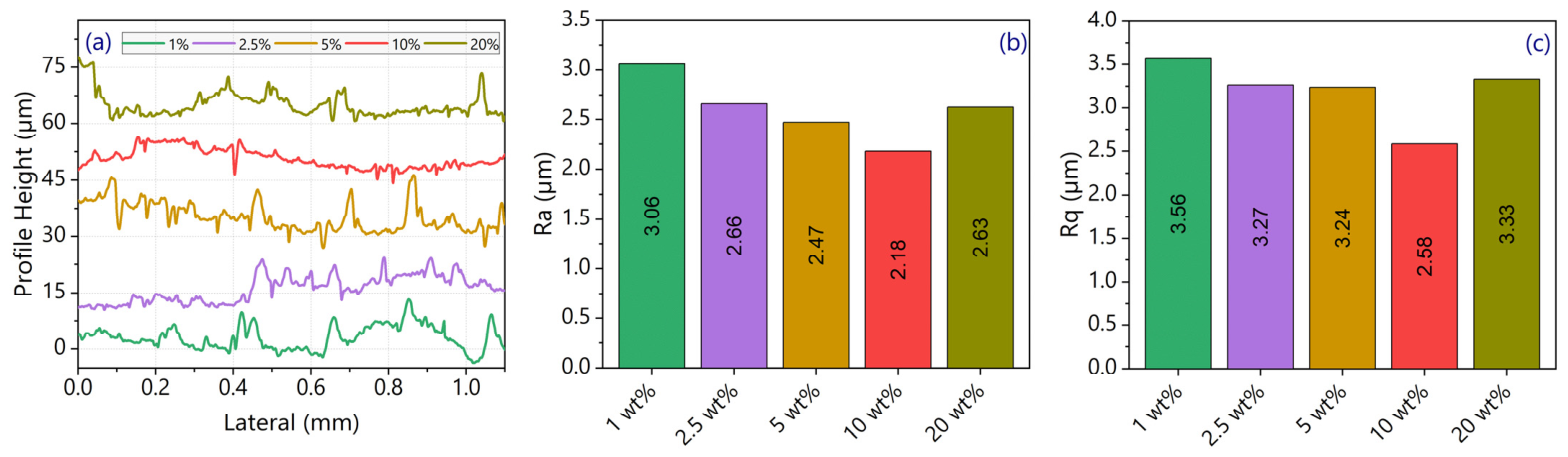
The effect of increasing ionomer overcoat concentration on the surface roughness for the GDE samples was investigated by profilometry. Figure 1 shows the line profiles of the GDE surface with different overcoat concentrations. This plot illustrates the spatial distribution of deep cracks and elevated topographical features on the GDE samples. Except for the sample with a 20 wt.% overcoat, increasing the overcoat loading resulted in a progressive decrease in surface roughness. Specifically, the arithmetic average roughness (Ra) decreased from 3.06 µm at 1 wt.% overcoat to 2.18 µm at 10 wt.% overcoat. Recognizing that reliance on a single roughness metric may yield misleading interpretations, the root mean square roughness (Rq) was also evaluated. Based on both Ra and Rq values, the GDE sample with 10 wt.% overcoat demonstrated the smoothest surface among the samples analyzed. With increasing ionomer overcoat loading, small to intermediate surface protrusions are progressively smoothed out. However, further increasing the overcoat loading to 20 wt.% leads to the formation of larger cracks, which substantially contributes to the overall surface roughness.
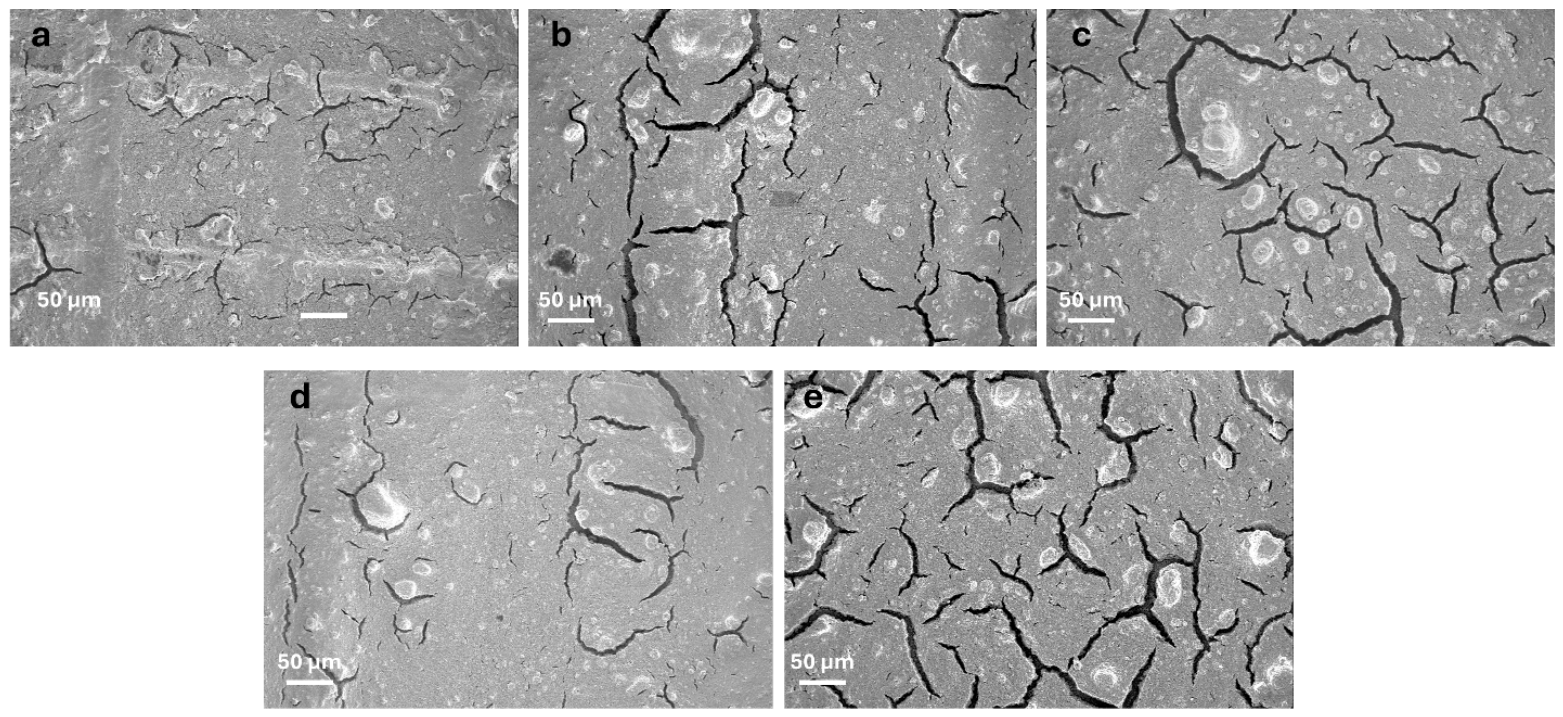
For a better understanding of the surface characteristics of the GDE samples, SEM images of the GDE surfaces were collected (Figure 2). The images show that there are differences among the cracks and bumps on the GDE surfaces in terms of their depth, size, and density. For the 1 wt.% overcoat, there is a significant number of bumps and large hills that extend over a large area of the GDE while there appear to be cracks with small width. This observation is also measured in the height values in the profilometry data. Increasing the ionomer overcoat concentration to 2.5 wt.% and 5 wt.% appear to reduce the cluster of bumps but significantly increase the density and width of cracks. However, these cracks are shallow considering the roughness parameters and the reduction in bumps resulted in smaller mean height datum. Further increasing the overcoat loading to 10 wt.% reduced the bump and crack density which resulted in the smallest measured mean roughness of 2.18 µm. On the contrary, the GDE with 20 wt.% ionomer overcoat has distinctly denser and longer cracks than that of the 10 wt.% overcoat sample. These frequent and relatively large cracks contribute to the increase in mean surface roughness of the sample. The crack formation at 20 wt.% can be attributed to increased ionomer overlayer thickness and drying-induced stresses during solvent evaporation. As the thicker ionomer film dries, volumetric shrinkage occurs, and the mismatch between the ionomer layer and the underlying porous GDE substrate promotes crack initiation and propagation. These cracks disrupt interfacial uniformity and can locally hinder reactant/product transport, contributing to performance degradation at high ionomer loading despite the relatively low proton transport resistance. Note that SEM images of the uncoated bare GDL were not collected in this study. Therefore, the morphology analysis is limited to comparative evaluation among the coated samples and does not allow definitive separation of substrate-intrinsic features from those induced or amplified by ionomer overcoating.

3.2. Fuel Cell Testing

The performance of GDEs with ionomer overcoats was investigated systematically, focusing on three key aspects: the necessity of hot pressing, optimization of ionomer concentration, and performance comparison with traditional CCM.

3.2.1. Effect of Hot Pressing on GDE Performance

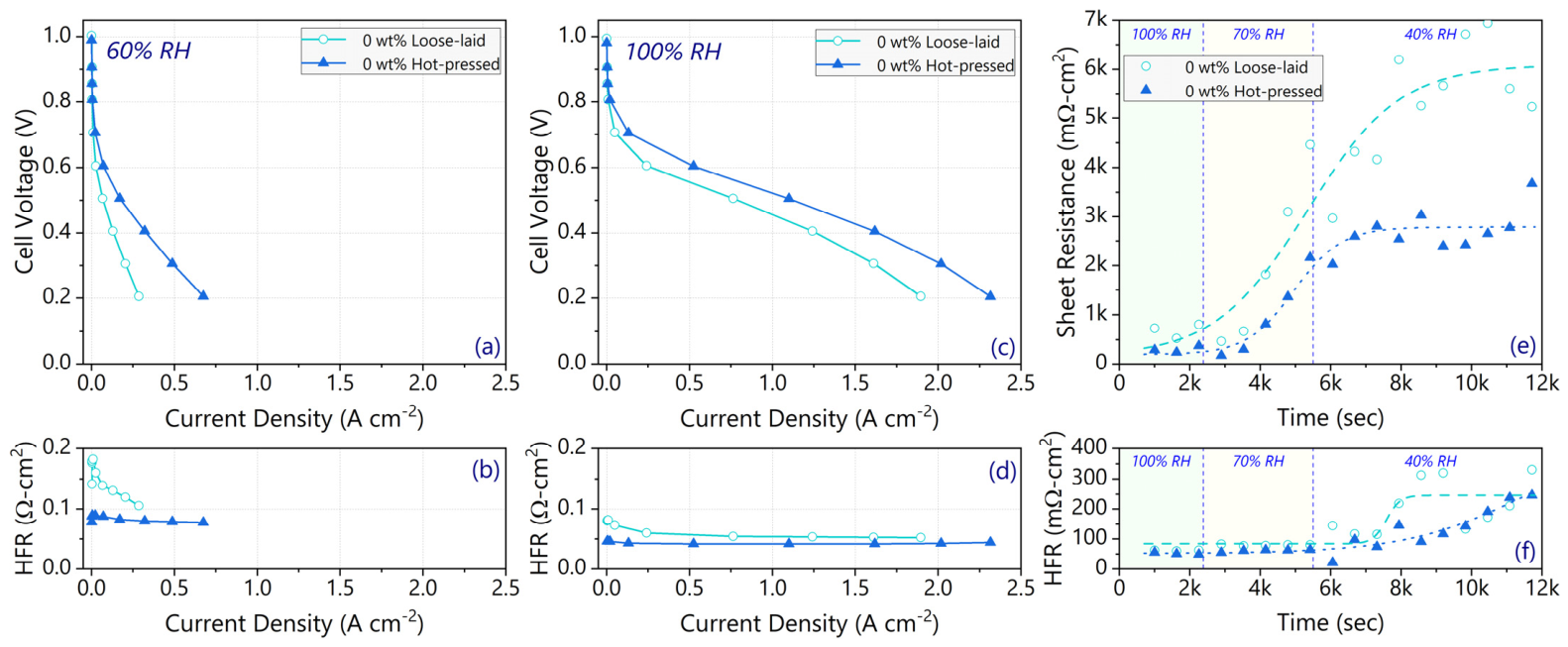
The impact of hot pressing during fabrication of GDEs was systematically investigated to assess its influence on the interfacial contact quality between the CL and the membrane. Similar to the process used in CCM fabrication, hot pressing is anticipated to enhance mechanical and ionic contact at the electrode–membrane interface, thus facilitating proton transport and enhancing electrochemical performance [21,36]. To assess this hypothesis, polarization curves and corresponding high-frequency resistance (HFR) data were collected for GDEs without any ionomer overcoat, comparing hot-pressed and loose-laid assembly configurations under controlled humidity conditions (60% and 100% RH) as shown in Figure 3a–d.
The polarization results in Figure 3a,c clearly illustrate significantly higher cell performance for hot-pressed GDEs compared to loose-laid GDEs under both dry and wet conditions. This enhanced performance can be attributed to improved mechanical and ionic contact at the CL–membrane interface, facilitating more efficient proton conduction pathways [21]. Correspondingly, as shown in Figure 3b,d, the HFR measurements reinforce this interpretation, showing significantly reduced HFR for hot-pressed samples. This reduction in resistance indicates an enhancement in proton transport resulting from improved electrode–membrane adhesion, which directly correlates with the observed performance improvement achieved by hot pressing the GDE and membrane together.
To further elucidate the impact of hot pressing on proton transport characteristics, dynamic electrochemical impedance spectroscopy (EIS) was performed under controlled humidity transitions. Relative humidity was sequentially reduced from 100% to 70%, and finally to 40%, without extended stabilization periods at intermediate RH levels. Specifically, three EIS measurements were performed at 100% RH, five measurements at 70% RH, and ten measurements at 40% RH, spanning roughly 4 hours. Additional measurements at the lowest humidity were conducted due to longer humidifier equilibration times during cooling. Figure 3e presents the time-dependent cathode proton resistance, and Figure 3f shows the corresponding HFR collected under these dynamic humidity conditions. Notably, the loose-laid GDE exhibited substantially higher and more variable cathode proton resistance and HFR values, particularly at lower humidity (40% RH). In contrast, the hot-pressed GDE maintained significantly lower and more stable proton resistance and HFR throughout the RH transitions, demonstrating enhanced interfacial robustness and improved proton conduction stability.
Despite these clear improvements from hot pressing, the overall cell performance for both configurations remained somewhat limited, likely due to the absence of an ionomer overcoat. Without an ionomeric interfacial layer, proton conduction pathways remained incomplete and suboptimal, thus constraining cell performance potential. Consequently, while hot pressing significantly reduces interfacial resistance and enhances performance stability, incorporating an optimized ionomer overcoat is essential to realize the full performance capabilities of GDE-based fuel cells.

3.2.2. Optimization of Ionomer Overcoat Concentration

To further improve the performance of hot-pressed GDE-based MEAs, an overcoat of Nafion ionomer was introduced at varying concentrations (0, 1, 2.5, 5, 10, and 20 wt.%). The corresponding ionomer loadings and overlayer thicknesses of the overcoated GDEs were estimated from the differences before and after applying the Nafion overcoats on GDEs. These values are summarized in Table 3.
Both ionomer loading and overlayer thickness increase systematically with overcoat concentration. As shown in Table 3, the ionomer overcoat loading increases from ~0.11 mg cm−2 at 1 wt.% to ~1.20 mg cm−2 at 20 wt.%, with a corresponding thickness increase from ~0.6 µm to ~6.7 µm, demonstrating a systematic increase in overcoat coverage with concentration. The goal was to establish optimal conditions where proton conduction, mass transport, and interfacial performance are simultaneously optimized.
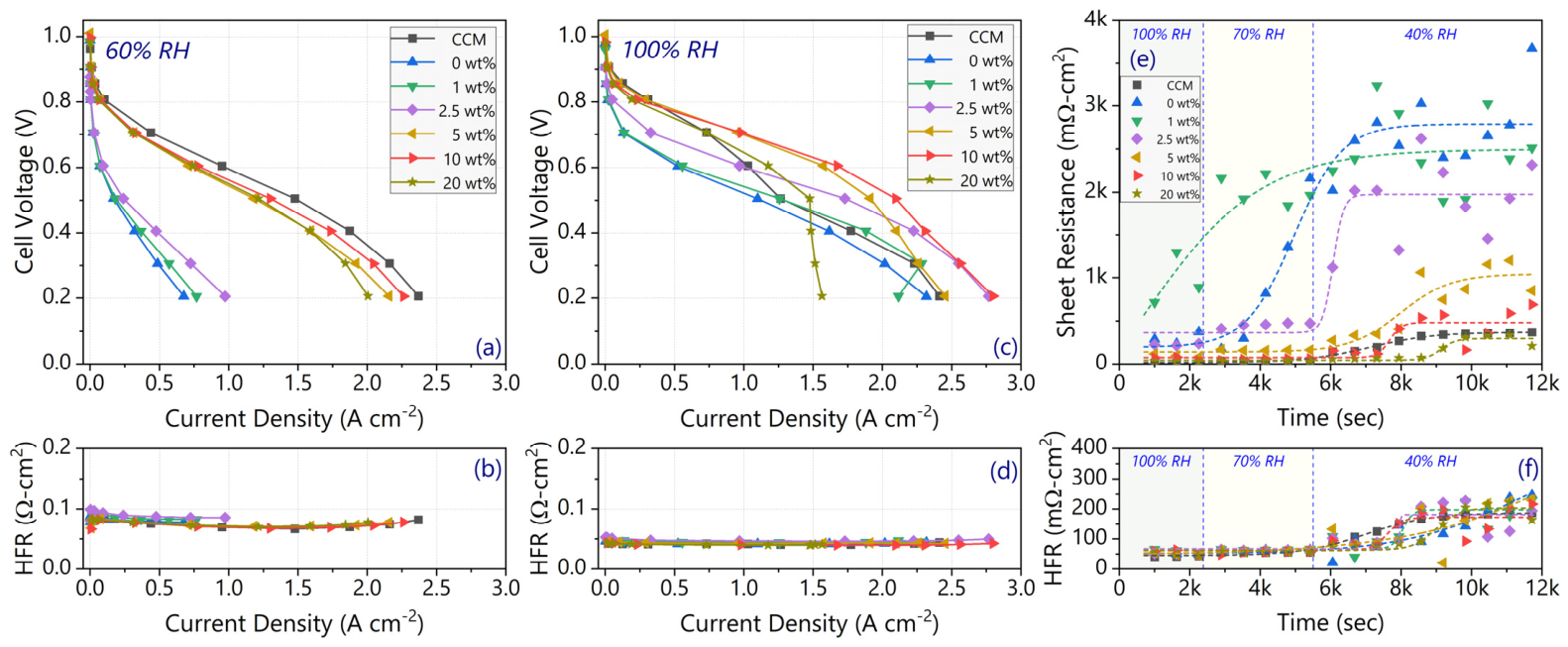
Polarization curves and corresponding HFR under dry (60% RH) and wet (100% RH) conditions are shown in Figure 4a–d. As illustrated in Figure 4a,b, under dry conditions, GDEs with 0, 1, 2.5, and 5 wt.% ionomer loadings exhibited limited performance, clearly reflecting insufficient formation of continuous proton-conducting domains within the CL. The absence or insufficient quantity of ionomer likely led to isolated catalyst regions and poor proton transport pathways [37,38]. In contrast, a significant improvement in cell performance was achieved at 10 wt.% ionomer overcoat, demonstrating optimal proton conduction pathways, reduced ohmic losses, and effective mass transport across all tested conditions. However, performance deteriorated notably at the highest tested loading (20 wt.%), likely due to presence of too much ionomer blocking catalyst active sites and hindering effective reactant and product transport. This behavior is consistent with the crack formation observed at 20 wt.% loading, which disrupts interfacial continuity and contributes to transport limitations.
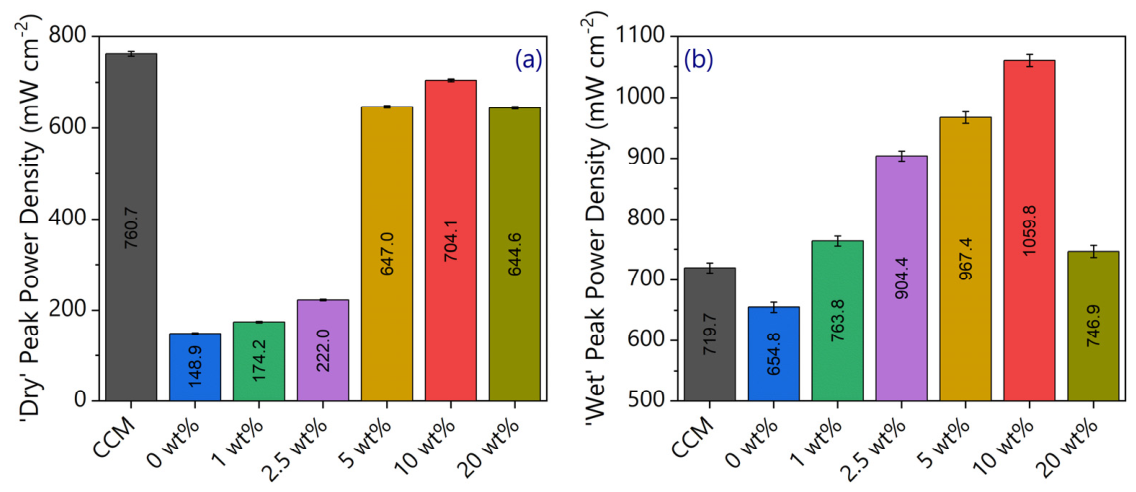
As shown in Figure 4c,d, under fully humidified (100% RH) condition, a similar performance trend was observed. The intermediate ionomer loading (10 wt.%) consistently outperformed other loadings across these conditions, indicating an optimal balance between proton conduction and mass transport. At high current densities, the 20 wt.% ionomer loading exhibited significant mass transport losses, emphasizing the detrimental effect of excess ionomer-blocking catalytic sites and pores. The corresponding power density outputs for the CCM and overcoated GDE-MEAs follow a similar trend, showing remarkable enhancement for the 10 wt.%-overcoated GDE-MEA as displayed in Figure 5. Error bars representing the measurement variability are shown in the peak power density plots.
The GDE with a 10 wt.% ionomer overcoat exhibited the best fuel cell performance under both dry and fully humidified conditions. The corresponding ionomer loading (~0.86 mg cm−2) was identified as optimal within this system, enabling performance that surpasses the conventional CCM under wet conditions. This loading reflects a balance between sufficient interfacial coverage for proton conduction and minimal blockage of reactant transport pathways. It is noted that the absolute ionomer loading in this work may be higher than some literature reports, such as Mauger et al. [25]. This may be attributed to differences in overcoat deposition methodology (spray vs. Mayer-rod coating) and the resulting ionomer distribution. In the present study, the ionomer is applied as a rod-coated overlayer onto a pre-fabricated GDE, whereas in Mauger et al., it is introduced via spray coating. Consequently, a higher nominal ionomer loading is required in this work to ensure sufficient interfacial coverage and to effectively establish continuous triple-phase boundaries at the catalyst layer–membrane interface.
To further benchmark the performance and fabrication approach of the present study against previously reported GDE-based PEMFC architectures, a comparison with representative literature is provided in Table 4. The results demonstrate that the present Mayer-rod-based post-deposition ionomer overlayer approach achieves significantly higher peak power density under fully humidified conditions compared to conventional spray-coated or ink-mixed ionomer strategies, highlighting the advantage of independently tuning the catalyst layer–membrane interface.
Dynamic EIS was conducted during stepwise humidity transitions (100% RH → 70% RH → 40% RH) without stabilization periods, further elucidated the proton transport characteristics under transient humidity conditions as displayed in Figure 4e. At no or low ionomer loadings (0, 1, 2.5, and 5 wt.%), cathode proton resistance increased dramatically, particularly at lower humidity levels (40% RH). These elevated proton resistances indicate inadequate interfacial proton conduction pathways and poor ionic connectivity. Notably, the 10 wt.% ionomer overcoat displayed stable and significantly lower proton resistance throughout the entire humidity range, underscoring effective proton conduction stability and robust interface adhesion. In contrast, the 20 wt.% ionomer overcoat exhibited relatively low proton transport resistance, indicating that increased ionomer content can provide sufficient proton-conducting pathways. However, this did not translate into improved cell performance. The deterioration in performance is attributed to excessive ionomer-blocking catalyst active sites and hindering effective reactant and product transport. In addition, crack formation observed at 20 wt.% loading can disrupt interfacial continuity and introduce local transport limitations. These combined effects indicate that performance loss at high ionomer loading is governed primarily by mass transport and interfacial morphology limitations rather than insufficient proton conduction.
The corresponding HFR measurements shown in Figure 4f further confirmed these trends, exhibiting stable and relatively low HFR for intermediate ionomer loadings (5–10 wt.%) and significantly higher values at both extremes (0 and 20 wt.%). Thus, the overcoat with intermediate ionomer concentration of 10 wt.% clearly represents an optimal condition, stabilizing proton conduction, mass transport, and interfacial adhesion.
While direct structural characterization of the catalyst layer–membrane interface (e.g., cross-sectional SEM/TEM or elemental mapping of the catalyst–ionomer network) was not performed, the observed electrochemical trends provide indirect evidence of improved interfacial properties. It is also important to note that such interfacial features are inherently difficult to characterize reliably using ex-situ techniques, as sample preparation and cell disassembly can disturb or alter the native interface and introduce artifacts. Accordingly, the proposed mechanism is primarily supported by electrochemical insights into interfacial engineering in this work. More detailed structural and interfacial characterization, ideally using advanced or operando approaches, will be the focus of future studies.

3.2.3. H2/N2 EIS Modeling

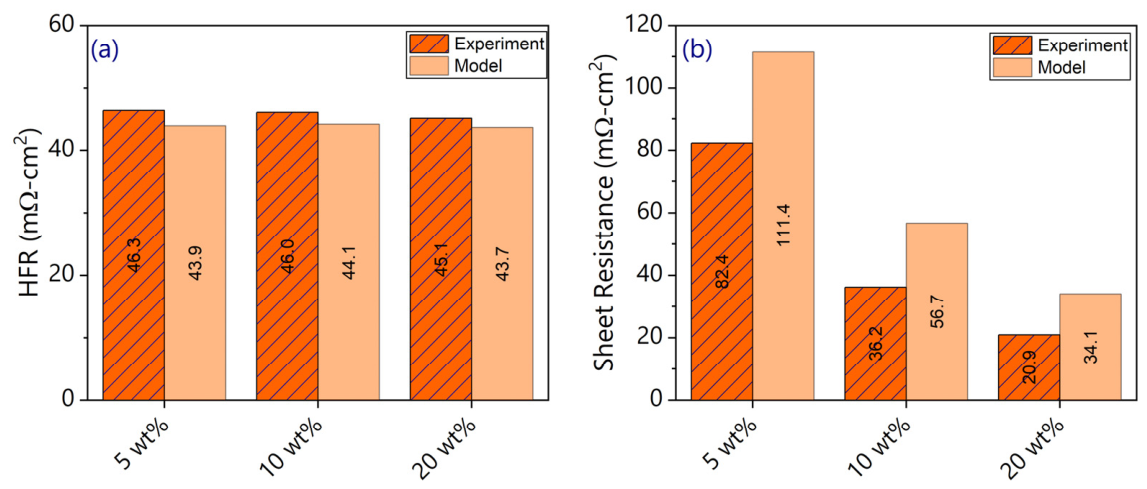
The improved interfacial properties of the membrane–cathode CL interface was evident from the HFR data of the overcoated and hot-pressed GDE-based MEAs. As HFR relates to ohmic and cathode proton resistance, H2/N2 EIS would be helpful to understand the influence on the cathode proton resistance for the overcoated GDE-MEAs [40,41]. In this context, quantification of the involved resistances in these MEAs was performed by modeling the H2/N2 EIS data. The measured data from the H2/N2 EIS test at 100% RH is presented in Figure 6. From the data obtained, it can be seen that estimation of the ohmic resistance (RΩ) values have good agreement with the measured HFR from the experiment. The simulated proton transport resistance (RCL) values of the catalyst layer are greater than the values obtained from conventional 45° visual estimation of the EIS data but nevertheless followed the same trend. The RCL was estimated visually by measuring the length of the 45° region in the Nyquist plot and multiplying this value by three to get the effective cathode CL proton transport resistance [40,42]. To ensure a consistent and physically grounded comparison across samples, the HFR and RCL values used in the succeeding analyses were obtained from the equivalent-circuit model that successfully fitted the EIS spectra. Although visual estimation of proton resistance from the Nyquist plot can provide a reliable basis for comparative analysis when applied consistently and anchored to physically meaningful features, model-based extraction is more systematic and robust and reduces human error. In this study, the model captured the characteristic 45° region associated with proton transport across all samples, providing a physically grounded basis for comparing relative RCL trends.
The EIS parameters calculated using the equivalent circuit described in Section 2.4 are summarized in Table 5 to facilitate quantitative comparison.

3.2.4. Comparison with CCM

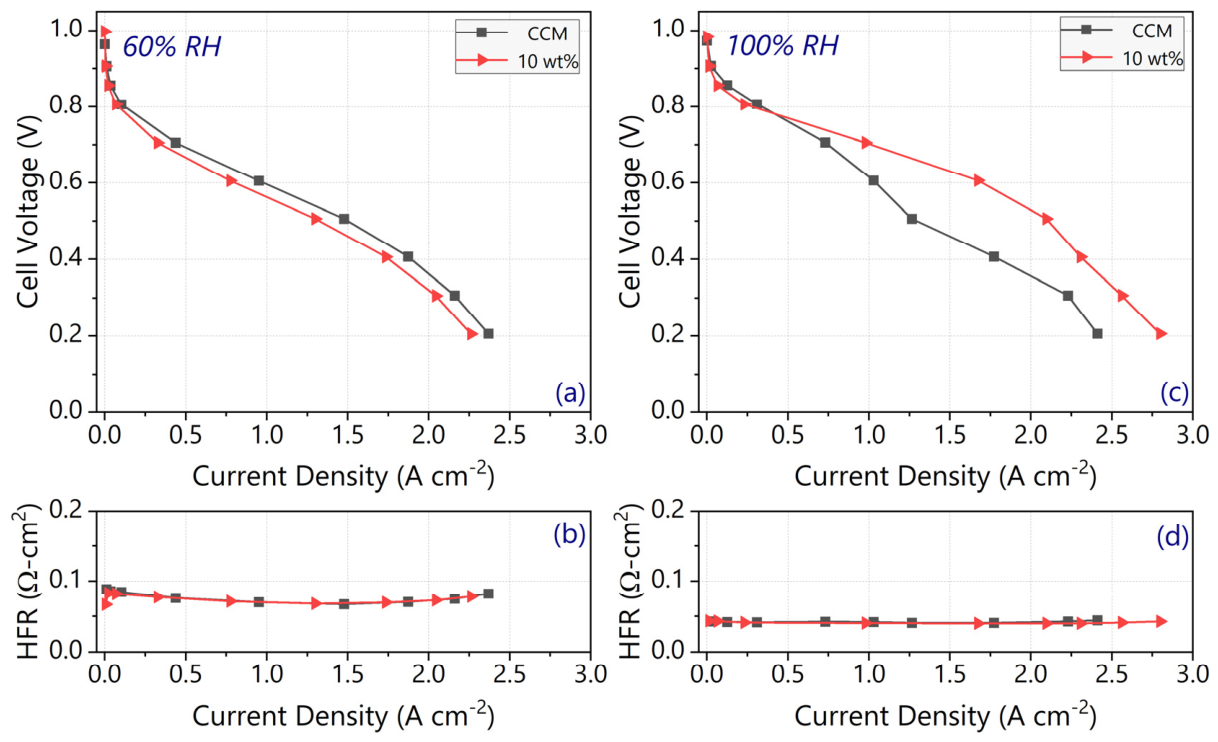
The fuel cell performance of the GDE-based MEA with optimized 10 wt.% overcoat was compared with that of the conventional CCM. Figure 7 shows the comparison of (a) dry (60% RH) and (c) wet (100% RH) polarization curves with corresponding (b,d) HFR for 10 wt.%-overcoated GDE-MEA with the conventional CCM. The 10 wt.%-overcoated GDE-MEA exhibited slightly lower performance compared to the CCM under dry conditions. This minor difference can be attributed to the higher contact resistance at the membrane–CL interface, owing to the added thickness of the ionomer overlayer at the cathode CL. In contrast, the CCM exhibits lower contact resistance under dry conditions, as the CLs are directly adhered to the membrane. However, the polarization curves indicate significant performance enhancement for the 10 wt.%-overcoated GDE-MEA under wet conditions (100% RH), surpassing that of the CCM. The improved performance of the GDE-MEA under fully humidified conditions could be attributed to enhanced interfacial characteristics and enhanced proton conduction, as evidenced earlier from the RH sweep measurements. Therefore, GDE-based MEA with an optimized ionomer overcoat on top of cathode CL could serve as a promising alternative to the conventional CCM, exhibiting improved electrochemical performance and suggesting more favorable water transport behavior under fully humidified conditions.

4. Conclusions

In summary, this work reports the critical role of an ionomer overcoat with optimum concentration on cathode GDE and hot pressing in fabricating a high-performance GDE-based MEA for PEMFCs. The findings highlight that lower loading of ionomer overcoats (1, 2.5, and 5 wt.%) fail to provide sufficient ionic connectivity, while excessive loading (20 wt.%) impedes mass transport and interfacial uniformity despite maintaining relatively low proton transport resistance. The optimum ~10 wt.% Nafion ionomer overcoat is instrumental in improving the membrane–CL interface, lowering interfacial resistance, and stabilizing the proton conduction pathways. Further, the hot-press is also crucial in enhancing the interfacial adhesion between the membrane and catalyst layer. These lead to achieving superior electrochemical performances and improved interfacial characteristics for the optimally overcoated GDE-based MEA compared to the traditional CCM under fully humidified conditions. The present study provides an effective strategy for minimizing ohmic losses in GDE-based MEAs and could be applicable to a wide variety of ionomers, where CCM fabrication is challenging, for fuel cell applications without trading off the performance.
Future work will focus on direct structural and interfacial characterization of the catalyst layer-membrane interface, as the current analysis is primarily based on indirect electrochemical evidence. In particular, advanced techniques such as cross-sectional SEM/TEM and operando or in situ characterization techniques will be employed to directly probe and validate interfacial morphology and ionomer distribution. In addition, further optimization of the ionomer overcoat thickness and spatial distribution, evaluation across a broader range of operating conditions and durability protocols, and extension of this interfacial engineering strategy to alternative ionomer chemistries and electrode architectures will be pursued.

Author Contributions

Conceptualization, methodology, investigation, formal analysis, validation, and writing—original draft, A.K., M.S. and N.K.; data collection and analysis, Z.N. and J.M.M.; conceptualization, visualization, methodology, supervision, project administration, funding acquisition, and writing—review and editing, P.-Y.A.C. All authors have read and agreed to the published version of the manuscript.

Funding

This work was supported by the Million Mile Fuel Cell Truck (M2FCT) consortium, which is funded by the Department of Energy (DoE), US, under contract no. DE-AC02-05CH11231.

Data Availability Statement

The original contributions presented in the study are included in the article, further inquiries can be directed to the corresponding author.

Acknowledgments

The authors gratefully acknowledge Kennedy Nguyen and the Imaging and Microscopy Facility (IMF) at the University of California, Merced, for providing materials characterization support. The authors used ChatGPT-5 (OpenAI, https://openai.com) to assist with grammar and language review during the drafting of this manuscript. The authors have reviewed and edited the output and take full responsibility for the content of this publication.

Conflicts of Interest

The authors declare no conflicts of interest.

References

  1. Larminie, J.; Dicks, A. Fuel Cell Systems Explained, 2nd ed.; John Wiley & Sons Ltd.: Hoboken, NJ, USA, 2013; pp. 1–406. [Google Scholar] [CrossRef]
  2. Sarker, M.; Rahman, M.A.; Mojica, F.; Mehrazi, S.; Kort-Kamp, W.J.M.; Chuang, P.Y.A. Experimental and Computational Study of the Microporous Layer and Hydrophobic Treatment in the Gas Diffusion Layer of a Proton Exchange Membrane Fuel Cell. J. Power Sources 2021, 509, 230350. [Google Scholar] [CrossRef]
  3. Alam Rimon, S.T.; Mourshed, M.; Kibria, M.G. Proton Exchange Membrane Fuel Cells: Advances in Materials Development, Performance Optimization, and Future Outlook. Energy Convers. Manag. X 2025, 27, 101102. [Google Scholar] [CrossRef]
  4. Du, S.; Guan, S.; Mehrazi, S.; Zhou, F.; Pan, M.; Zhang, R.; Chuang, P.-Y.A.; Sui, P.-C. Effect of Dispersion Method and Catalyst on the Crack Morphology and Performance of Catalyst Layer of PEMFC. J. Electrochem. Soc. 2021, 168, 114506. [Google Scholar] [CrossRef]
  5. Grandi, M.; Rohde, S.; Liu, D.J.; Gollas, B.; Hacker, V. Recent Advancements in High Performance Polymer Electrolyte Fuel Cell Electrode Fabrication—Novel Materials and Manufacturing Processes. J. Power Sources 2023, 562, 232734. [Google Scholar] [CrossRef]
  6. Mojarrad, N.R.; Kırlıoğlu, A.C.; Ölmez, B.; Hamedani, A.A.; Buldu-Akturk, M.; Zabara, M.A.; Yürüm, A.; Ozkan, C.S.; Gürsel, S.A.; Kaplan, B.Y.; et al. Advances in Membranes and Electrocatalysts to Optimize Proton-Exchange Membrane Fuel Cells. Cell Rep. Phys. Sci. 2025, 6, 102728. [Google Scholar] [CrossRef]
  7. Yang, B.; Xiang, Z. Nanostructure Engineering of Cathode Layers in Proton Exchange Membrane Fuel Cells: From Catalysts to Membrane Electrode Assembly. ACS Nano 2024, 18, 11598–11630. [Google Scholar] [CrossRef]
  8. Ayoub, M.; Böhm, T.; Bierling, M.; Thiele, S.; Brodt, M. Review—Graded Catalyst Layers in Hydrogen Fuel Cells-A Pathway to Application-Tailored Cells. J. Electrochem. Soc. 2024, 171, 094503. [Google Scholar] [CrossRef]
  9. Breitwieser, M.; Klingele, M.; Vierrath, S.; Zengerle, R.; Thiele, S. Tailoring the Membrane-Electrode Interface in PEM Fuel Cells: A Review and Perspective on Novel Engineering Approaches. Adv. Energy Mater. 2018, 8, 1701257. [Google Scholar] [CrossRef]
  10. Sun, Y.; Polani, S.; Luo, F.; Ott, S.; Strasser, P.; Dionigi, F. Advancements in Cathode Catalyst and Cathode Layer Design for Proton Exchange Membrane Fuel Cells. Nat. Commun. 2021, 12, 5984. [Google Scholar] [CrossRef]
  11. Mo, S.; Du, L.; Huang, Z.; Chen, J.; Zhou, Y.; Wu, P.; Meng, L.; Wang, N.; Xing, L.; Zhao, M.; et al. Recent Advances on PEM Fuel Cells: From Key Materials to Membrane Electrode Assembly. Electrochem. Energy Rev. 2023, 6, 28. [Google Scholar] [CrossRef]
  12. Banham, D.; Ye, S. Current Status and Future Development of Catalyst Materials and Catalyst Layers for Proton Exchange Membrane Fuel Cells: An Industrial Perspective. ACS Energy Lett. 2017, 2, 629–638. [Google Scholar] [CrossRef]
  13. Mitra, D.; Heinrich, K.; Gierse, S.; Zeiner, C.; Siegel, F.; Willert, A.; Zichner, R. Direct Deposition of Catalyst Layers on Polymer Electrolyte Membrane (PEM) for Fuel Cells with Controlled Platinum Distribution by Inkjet Printing. J. Power Sources 2025, 638, 236503. [Google Scholar] [CrossRef]
  14. Indriyati; Irmawati, Y.; Prihandoko, B. Preparation of Catalyst Coated Membrane by Modified Decal Transfer Method for Proton Exchange Membrane Fuel Cell. IOP Conf. Ser. Mater. Sci. Eng. 2017, 223, 012037. [Google Scholar] [CrossRef]
  15. Hack, J.; García-Salaberri, P.A.; Kok, M.D.R.; Jervis, R.; Shearing, P.R.; Brandon, N.; Brett, D.J.L. X-Ray Micro-Computed Tomography of Polymer Electrolyte Fuel Cells: What Is the Representative Elementary Area? J. Electrochem. Soc. 2020, 167, 013545. [Google Scholar] [CrossRef]
  16. Suter, T.A.M.; Smith, K.; Hack, J.; Rasha, L.; Rana, Z.; Angel, G.M.A.; Shearing, P.R.; Miller, T.S.; Brett, D.J.L. Engineering Catalyst Layers for Next-Generation Polymer Electrolyte Fuel Cells: A Review of Design, Materials, and Methods. Adv. Energy Mater. 2021, 11, 2101025. [Google Scholar] [CrossRef]
  17. Tang, H.; Wang, S.; Jiang, S.P.; Pan, M. A Comparative Study of CCM and Hot-Pressed MEAs for PEM Fuel Cells. J. Power Sources 2007, 170, 140–144. [Google Scholar] [CrossRef]
  18. Grebener, L.; Odungat, A.S.; Zhu, Y.; Pasdag, O.; Radev, I.; Nürenberg, E.; Kubina, A.; Peinecke, V.; Kohsakowski, S.; Segets, D.; et al. Investigation of Fuel Cell Catalyst Dispersion Formulations for Indirect Roll-to-Roll Fabrication of Catalyst Coated Membranes for Proton Exchange Membrane Fuel Cells. J. Power Sources 2025, 635, 236457. [Google Scholar] [CrossRef]
  19. Koch, S.; Metzler, L.; Kilian, S.K.; Heizmann, P.A.; Lombeck, F.; Breitwieser, M.; Vierrath, S. Toward Scalable Production: Catalyst-Coated Membranes (CCMs) for Anion-Exchange Membrane Water Electrolysis via Direct Bar Coating. Adv. Sustain. Syst. 2023, 7, 2200332. [Google Scholar] [CrossRef]
  20. Mauger, S.A.; Wang, M.; Cetinbas, F.C.; Dzara, M.J.; Park, J.; Myers, D.J.; Ahluwalia, R.K.; Pylypenko, S.; Hu, L.; Litster, S.; et al. Development of High-Performance Roll-to-Roll-Coated Gas-Diffusion-Electrode-Based Fuel Cells. J. Power Sources 2021, 506, 230039. [Google Scholar] [CrossRef]
  21. Fultz, D.W.; Chuang, P.Y.A. The Property and Performance Differences between Catalyst Coated Membrane and Catalyst Coated Diffusion Media. J. Fuel Cell Sci. Technol. 2011, 8, 041010. [Google Scholar] [CrossRef]
  22. Li, Y.; Liu, L.; Xing, Y.; Zhang, G. An Asymmetric Membrane Electrode Assembly for High-Performance Proton Exchange Membrane Fuel Cells. Int. J. Hydrogen Energy 2024, 55, 357–364. [Google Scholar] [CrossRef]
  23. Ding, X.; Didari, S.; Fuller, T.F.; Harris, T.A.L. Membrane Electrode Assembly Fabrication Process for Directly Coating Catalyzed Gas Diffusion Layers. J. Electrochem. Soc. 2012, 159, B746–B753. [Google Scholar] [CrossRef]
  24. Sung, C.C.; Liu, C.Y.; Cheng, C.C.J. Performance Improvement by a Glue-Functioned Nafion Layer Coating on Gas Diffusion Electrodes in PEM Fuel Cells. Int. J. Hydrogen Energy 2014, 39, 11700–11705. [Google Scholar] [CrossRef]
  25. Mauger, S.A.; Pfeilsticker, J.R.; Wang, M.; Medina, S.; Yang-Neyerlin, A.C.; Neyerlin, K.C.; Stetson, C.; Pylypenko, S.; Ulsh, M. Fabrication of High-Performance Gas-Diffusion-Electrode Based Membrane-Electrode Assemblies. J. Power Sources 2020, 450, 227581. [Google Scholar] [CrossRef]
  26. Kulkarni, A.; Siahrostami, S.; Patel, A.; Nørskov, J.K. Understanding Catalytic Activity Trends in the Oxygen Reduction Reaction. Chem. Rev. 2018, 118, 2302–2312. [Google Scholar] [CrossRef]
  27. Dai, S.; Chou, J.P.; Wang, K.W.; Hsu, Y.Y.; Hu, A.; Pan, X.; Chen, T.Y. Platinum-Trimer Decorated Cobalt-Palladium Core-Shell Nanocatalyst with Promising Performance for Oxygen Reduction Reaction. Nat. Commun. 2019, 10, 440. [Google Scholar] [CrossRef] [PubMed]
  28. Weber, A.Z.; Newman, J. Modeling Transport in Polymer-Electrolyte Fuel Cells. Chem. Rev. 2004, 104, 4679–4726. [Google Scholar] [CrossRef]
  29. Holdcroft, S. Fuel Cell Catalyst Layers: A Polymer Science Perspective. Chem. Mater. 2013, 26, 381–393. [Google Scholar] [CrossRef]
  30. Suzuki, A.; Sen, U.; Hattori, T.; Miura, R.; Nagumo, R.; Tsuboi, H.; Hatakeyama, N.; Endou, A.; Takaba, H.; Williams, M.C.; et al. Ionomer Content in the Catalyst Layer of Polymer Electrolyte Membrane Fuel Cell (PEMFC): Effects on Diffusion and Performance. Int. J. Hydrogen Energy 2011, 36, 2221–2229. [Google Scholar] [CrossRef]
  31. Lim, B.H.; Majlan, E.H.; Tajuddin, A.; Husaini, T.; Wan Daud, W.R.; Mohd Radzuan, N.A.; Haque, M.A. Comparison of Catalyst-Coated Membranes and Catalyst-Coated Substrate for PEMFC Membrane Electrode Assembly: A Review. Chin. J. Chem. Eng. 2021, 33, 1–16. [Google Scholar] [CrossRef]
  32. Mojica, F.; Rahman, M.A.; Mora, J.M.; Ocon, J.D.; Chuang, P.Y.A. Experimental Study of Three Channel Designs with Model Comparison in a PEM Fuel Cell. Fuel Cells 2020, 20, 547–557. [Google Scholar] [CrossRef]
  33. Mojica, F.; Rahman, M.A.; Sarker, M.; Hussey, D.S.; Jacobson, D.L.; LaManna, J.M.; Chuang, P.Y.A. Study of Converging-Diverging Channel Induced Convective Mass Transport in a Proton Exchange Membrane Fuel Cell. Energy Convers. Manag. 2021, 237, 114095. [Google Scholar] [CrossRef]
  34. Chuang, P.Y.A.; Rahman, M.A.; Mojica, F.; Hussey, D.S.; Jacobson, D.L.; LaManna, J.M. The Interactive Effect of Heat and Mass Transport on Water Condensation in the Gas Diffusion Layer of a Proton Exchange Membrane Fuel Cell. J. Power Sources 2020, 480, 229121. [Google Scholar] [CrossRef]
  35. How to Fit Transmission Lines with ZFit (EIS Transmission Lines) Battery—Application Note 43—BioLogic. Available online: https://www.biologic.net/documents/eis-transmission-lines-electrochemsitry-battery-application-note-43/ (accessed on 8 May 2026).
  36. Meyer, Q.; Mansor, N.; Iacoviello, F.; Cullen, P.L.; Jervis, R.; Finegan, D.; Tan, C.; Bailey, J.; Shearing, P.R.; Brett, D.J.L. Investigation of Hot Pressed Polymer Electrolyte Fuel Cell Assemblies via X-Ray Computed Tomography. Electrochim. Acta 2017, 242, 125–136. [Google Scholar] [CrossRef]
  37. Xue, Q.; Zhang, R.; Yang, D.; Li, B.; Ming, P.; Zhang, C. Effect of Ionomer Content on Cathode Catalyst Layer for PEMFC via Molecular Dynamics Simulations and Experiments. Int. J. Hydrogen Energy 2022, 47, 23335–23347. [Google Scholar] [CrossRef]
  38. Wang, M.; Zhang, S.; Wang, H.; Sun, E.; Liu, Y.; Wu, M.; Liu, D.J.; Li, Z. Regulating Catalyst and Ionomer Interactions to Promote Oxygen Transport in Fuel Cells. Appl. Catal. B Environ. Energy 2025, 365, 124894. [Google Scholar] [CrossRef]
  39. Li, Z.; Xing, Y.; Liu, L.; Li, Y.; Fu, Z.; Li, H. Novel Fabrication Approach by Reversely Coating a Nafion Ionomer on Gas Diffusion Electrodes for High-Performance Membrane Electrode Assemblies. Energy Fuels 2022, 36, 13873–13881. [Google Scholar] [CrossRef]
  40. Makharia, R.; Mathias, M.F.; Baker, D.R. Measurement of Catalyst Layer Electrolyte Resistance in PEFCs Using Electrochemical Impedance Spectroscopy. J. Electrochem. Soc. 2005, 152, A970. [Google Scholar] [CrossRef]
  41. Li, G.; Xu, T.; Luo, S.; Wang, Q.; Li, X.; Xing, D.; Ming, P.; Li, B.; Zhang, C. Construction of Interfacial Layer on Microporous Layer for Enhancing Gas Diffusion Electrode Performance. J. Power Sources 2025, 637, 236598. [Google Scholar] [CrossRef]
  42. Neyerlin, K.C.; Gu, W.; Jorne, J.; Clark, A.; Gasteiger, H.A. Cathode Catalyst Utilization for the ORR in a PEMFC: Analytical Model and Experimental Validation. J. Electrochem. Soc. 2007, 154, B279. [Google Scholar] [CrossRef]
Figure 1. (a) Surface roughness profile, and surface roughness parameters: (b) average surface roughness (Ra), and (c) root mean square roughness (Rq) of the Nafion-overcoated GDE samples.
Energies 19 02728 g001
Figure 2. Representative SEM images of the GDE surface with (a) 1 wt.%, (b) 2.5 wt.%, (c) 5 wt.%, (d) 10 wt.%, and (e) 20 wt.% Nafion ionomer overcoats.
Energies 19 02728 g002
Figure 3. Effect of hot pressing on electrochemical performance of GDE-based cells (without ionomer overcoat): (a,c) polarization curves and (b,d) corresponding high-frequency resistances (HFR) under controlled humidity conditions of (a,b) 60% RH and (c,d) 100% RH. (e) Dynamic cathode proton resistance and (f) HFR measured through EIS during stepwise humidity transitions (100% RH → 70% RH → 40% RH).
Energies 19 02728 g003
Figure 4. Polarization curves for the CCM- and GDE-based MEAs with overcoat (0–20 wt.%) under (a) dry (60% RH) and (c) wet (100% RH) conditions along with the corresponding (b,d) HFR measurements, respectively. (e) Cathode proton resistance and (f) HFR recorded under varied humidity conditions (100% RH → 70% RH → 40% RH).
Energies 19 02728 g004
Figure 5. Power density outputs of CCM and overcoated GDE-based MEAs under (a) dry and (b) wet conditions. Error bars represent the standard deviation of steady-state fluctuations during measurement of a single MEA.
Energies 19 02728 g005
Figure 6. Comparison of experimental EIS-derived data at 100% RH: (a) ohmic resistance of the membrane, and (b) proton transport resistance of the catalyst layer.
Energies 19 02728 g006
Figure 7. Comparison of (a) dry (60% RH) and (c) wet (100% RH) polarization curves with corresponding (b,d) HFR for 10 wt.%-overcoated GDE-MEA with the conventional CCM.
Energies 19 02728 g007
Table 1. Mass of 1-PA and DI water used to dilute the D2020 Nafion dispersion for preparing ionomer overcoats with concentrations ranging from 1 to 20 wt.%.
Concentration of Diluted Nafion (wt.%)D2020 Nafion
(g)
1-PA
(g)
DI Water
(g)
10.211.3858.415
2.50.24.4853.315
50.22.1851.615
100.21.0350.765
200.20.4600.340
Table 2. Summary of test protocols for the fuel cell experiments.
Test NameInlet RH
(%)
Temp
(°C)
Reactants
(An|Ca)
Flowrate
(NLPM)
Pressure
(kPaa.)
Load Control
(V)
Break-in10070H2|Airλ = 10150OCV to 0.2 V
(10 m at each voltage)
Dry performance6070H2|Air0.4|2.0100OCV to 0.2 V
(10 m at each voltage)
Wet performance10070H2|Air0.4|2.0300OCV to 0.2 V
(10 m at each voltage)
EIS (Cathode proton resistance)40~10070H2|N20.1|0.13000.20 V DC, 10 mV AC
Table 3. Ionomer loading and thickness of the 0–20 wt.%-overcoated layers.
Cathode
Overcoat
Concentration
Overcoat Ionomer
Loading on GDE
(mg cm−2)
Approximate Nafion Overcoat Thickness
(µm)
0 wt.%No Overcoat0
1 wt.%0.110.6
2.5 wt.%0.241.3
5 wt.%0.643.5
10 wt.%0.864.8
20 wt.%1.206.7
Table 4. Quantitative comparison of representative GDE-based MEA studies for PEMFCs, highlighting fabrication strategies and performance metrics relative to the present work. (PPD—Peak Power Density).
StudyStrategyMethodArchitectureIonomer Loading
(mg cm−2)
ConditionsPPD
(mW cm−2)
Ding et al. [23]Direct membrane coating on GDESlot-dieDirect membrane coating on GDE-80 °C~600
Sung et al. [24]Glue-function Nafion layerSprayGDE|GDE0.3065 °C, 100% RH~543
Mauger et al. [25]Ionomer overlayerSprayHalf-CCM|GDE0.04580 °C, 100% RH-
Li et al. [39]Reverse PFSA coating using PTFE substrateSprayGDE|GDE-80 °C, 100% RH~1270
(higher cell temp.)
This workIonomer overlayerMayer rodHalf-CCM|GDE0.8670 °C, 100% RH~1060
CCM (this work)Conventional CCMMayer rodCCM-70 °C, 100% RH~720
Table 5. EIS parameters estimated by the equivalent circuit described in Section 2.4.
Cathode
Overcoat
Concentration
L
(H)
RΩ
(Ω)
RCL
(Ω)
τ
(s)
φ
(-)
5 wt.%8.49 × 10−90.02190.05570.02060.95
10 wt.%8.32 × 10−90.02210.02830.00770.96
20 wt.%8.72 × 10−90.02180.01710.00410.96
Disclaimer/Publisher’s Note: The statements, opinions and data contained in all publications are solely those of the individual author(s) and contributor(s) and not of MDPI and/or the editor(s). MDPI and/or the editor(s) disclaim responsibility for any injury to people or property resulting from any ideas, methods, instructions or products referred to in the content.