1. Introduction
Solar cooking offers direct health benefits. The World Health Organization [
1] and other international agencies have reported that between one and four million premature deaths annually are attributable to household air pollution. These health impacts are primarily linked to exposure to fine particulate matter (PM2.5) and other combustion-related pollutants (NOx, CO, HCs), generated by the use of firewood and charcoal. The burden of exposure disproportionately affects women and children because they spend longer time near domestic cooking and space heating environments. Although liquid and gaseous fuels reduce particulate emissions, they still release CO, NOx and various hydrocarbons. Furthermore, traditional dwellings that rely on tar-coated wooden beams to deter wood-boring insects do not have chimneys. This further amplifies indoor pollutant accumulation. The inherently low thermal efficiency of primitive cookstoves exacerbates these adverse effects.
The tasks of gathering, carrying and transporting firewood are predominantly performed by women and children. This poses additional and well-documented risks, including physical injuries, abductions and theft. Long-term musculoskeletal disorders are common due to frequent long-distance travel while carrying heavy loads. These activities also require substantial time investment, reducing opportunities for education, income-generating work, childcare and other essential tasks. Travel distances of 10–20 km for daily fuel collection are commonly reported in the literature. Purchasing firewood in local markets represents a significant financial burden and still requires physically demanding transport. Charcoal offers improved handling characteristics and reduced smoke emissions, although at the cost of losing nearly 70% of the original dry wood’s calorific value during carbonization. This exacerbates the deleterious effects of domestic biomass burning.
Replacing firewood and charcoal with alternative energy sources reduces these burdens and mitigates deforestation pressures. Solar cooking offers particular advantages compared to replacement with biological substitutes (e.g., biogas) and fossil-based fuels (e.g., kerosene, LPG). Besides eliminating harmful atmospheric emissions, it also enhances household energy autonomy and contributes to the reduction of carbon emissions associated with fossil fuel use. Nevertheless, the practical feasibility of solar cooking as a stand-alone energy solution is constrained by variability in solar irradiance, particularly under cloudy conditions.
Regarding the scale of the challenge, global estimates indicate that at least one billion people still lack access to modern energy services [
1,
2,
3]. This situation is one of the concerns of the Sustainable Development Goals (SDGs), particularly SDG 7.1.2, which monitors access to clean fuels and technologies for cooking [
4,
5]. The deficit is especially pronounced in several Sub-Saharan nations [
6], where structural barriers, geographic isolation, and economic vulnerability exacerbate energy poverty.
In these locations, dependence on conventional fuel supply to meet the daily requirement of cooking significantly reduces quality of life due to intermittent availability, affordability, and market price fluctuations. Even in settings where fuels are nominally accessible, supply chains often remain unreliable and costs can become prohibitive. Occasionally, the energy expenditure required for cooking surpasses the cost of the food itself.
Electric cookers offer an efficient and easily controllable means for indoor heating, sterilization, and food preparation. They can do so at a potentially affordable cost due to their high thermal efficiency. Their adoption also enables additional household electrical services. Thus, their presence and usage are indicators of progress in residential electrification and a significant improvement compared with the traditional biomass-based practices previously described. However, in the frequently referenced “last-mile regions”, electricity supply often remains unreliable or prohibitively expensive compared with conventional solid fuels. As a result, electric cookers tend to be underutilized or relegated to a secondary cooking option, as seen in studies such as [
7]. Also, the connection of remote and isolated communities to centralized electrical grids is unlikely in the foreseeable future. Mini-grids and micro-grids constitute a technically viable alternative. Their long-term sustainability depends on the presence of trained operation and maintenance personnel. These limitations highlight the need for alternative, more resilient approaches.
Photovoltaic (PV) technology has become a strong ally for off-grid electricity generation. It allows for cleaner cooking than biomass and other solid fuels do. The cost of PV modules has declined sharply in recent years, with retail prices now below €0.15 W
p−1 and wholesale prices below €0.10 W
p−1. This makes PV solutions competitive in many regions of the world, particularly for large rural and peri-urban populations experiencing energy poverty. A comprehensive analysis of these trends is provided by [
8]. The electrical efficiency of photovoltaic cookers is comparable to that of solar cookers [
9].
Direct solar cooking can be achieved using either thermal sun concentrators [
9] or PV systems [
10]. Full day-to-day and meal-to-meal energy supply required for essential cooking needs is not easily met, e.g., [
11]. Nevertheless, even partial use contributes to household resilience, supports the fight against energy poverty, and provides meaningful benefits for sustainable development and decarbonization efforts. The electrical efficiency of photovoltaic cookers is comparable to solar cookers, [
12].
Daytime cooking makes it possible to prepare lunch and keep dinner warm. However, breakfast is normally prepared before sunrise. Short-term (intra-day) electrical storage is generally not feasible in this context. Batteries are expensive, have limited lifetimes and, once abandoned outdoors, represent an environmental hazard. Nevertheless, other solutions exist for energy storage. Cooking does not fundamentally require electricity, but rather heat. This heat can be stored for many hours for low-temperature cooking (slow cooking), even for breakfast the following morning. This is done at barely simmering conditions, even near 70 °C.
Achieving this requires strong thermal insulation to minimize heat losses to the environment. The use of simple insulated containers such as “wonder bags” or “hay baskets” has been widely evaluated, and they have demonstrated successful performance in keeping food warm offline. These can be manufactured locally using materials such as dry leaves, feathers, old clothing, or other residual materials with low heat conductivity. Furthermore, if sufficient solar power is available, it is possible to heat not only the food but also a separate thermal mass that provides additional heat storage. This storage may be sensible heat—by heating rocks, metal, or water without a phase change—but even better options are available, e.g., using latent heat.
There exist phase-change materials (PCMs) that, at sufficiently high temperatures—typically above 100 °C—absorb a large amount of heat during melting, thus maintaining a constant temperature [
13]. This heat is then released reversibly upon solidification at essentially the same temperature. The amount of latent heat involved can be comparable to that of ice, approximately 340 kJ kg
−1. One such material is erythritol, a widely available, non-toxic, low-cost sugar substitute. It has a phase-change temperature of 118 °C. Its use in solar cookers has been studied on numerous occasions [
14]. With PCMs, it becomes possible to store sufficient thermal energy for offline low-temperature cooking, using only a reasonable mass of material (on the order of kilograms). However, certain traditional recipes require high temperatures (e.g., roasting, baking, or frying), which limit the applicability of this thermal-storage technique for some culinary practices.
Another energy storage strategy would be the photovoltaic production of hydrogen using an electrolyzer. This typically yields an overall energy efficiency close to 60%. Nevertheless, the very large volume of hydrogen gas and the specialized management required make it impractical for cooking purposes in the scenario described.
The average primary energy requirement for cooking in low-income households ranges from 1 to 4 kWh per day for three meals [
7,
15]. An open wood fire has an efficiency of only 10–15%, whereas a well-maintained electric cooker can achieve 50–70%, including microwave ovens and induction stoves. Considering that, in the regions of interest, the average daily solar irradiation is about 2–4 kWh m
−2 and assuming a photovoltaic panel efficiency of 20%, 4–6 m
2 of PV modules would be needed on average. Despite obvious geographic, meteorological and seasonal variations, this estimate illustrates the economic and practical feasibility of photovoltaic cooking. PV modules can be firmly mounted on rooftops or poles to reduce the risk of storms and theft, and their life expectancy is typically around 20 years.
Conventional off-grid photovoltaic systems use an electronic maximum power point tracker (MPPT) for the panels. An electronic control unit manages the charging and discharging of a battery and the power supplied to the load, while an inverter converts direct current (DC) into alternating current (AC). Such systems achieve an overall input–output efficiency of around 65–80% (round-trip efficiency). This configuration enables the use of standard AC appliances and, with appropriate additions, can become part of an off-grid distributed smart microgrid. Although highly convenient, this technology entails significant costs and is therefore mainly suitable for collective installations, especially in village schools and hospitals, which are beyond the scope of this paper.
Electric pressure cookers (EPCs) are commonly used to complement PV-powered cooking systems [
16]. Commercial household units equipped with microprocessors are widely available, typically priced between €30 and €90 for the simplest ones. These programmable appliances support both fast and slow cooking under moderate pressure and typically reach boiling temperatures of 115–120 °C through a steam-relief valve. Their maximum power ratings are in the range of 500–1000 W [
16,
17,
18,
19]. EPCs generally provide only limited thermal insulation and lack dedicated insulating materials. Instead, they rely on a simple double-wall structure with an intermediate air gap that also serves as a thermal-radiation barrier. Enhancing insulation is highly advisable for PV operation, given the relatively low power available compared with open-flame stoves. This can be achieved by adding washable insulating materials to the EPC casing.
An additional and attractive possibility is to enhance an EPC with an auxiliary connector suited for direct DC power feeding from PV modules. Besides stand-alone operation, it can work as a supplement to the AC supply from a grid or local source. This hybrid configuration would enable users to complement insufficient solar power and also provide backup heating capacity for an unreliable grid. The DC heating elements may be integrated into the cooker’s existing base internal hot plate.
An inexpensive EPC plus photovoltaic feed system for communities facing energy poverty would complement the previous configurations. This paper is focused on the development of a feasible system that reduces many of the expenses associated with conventional off-grid photovoltaic systems plus EPCs. Such a minimal PV cooker is explained in detail in the following section.
Alternatives to EPCs have been explored, but with limited success. For example, [
20] uses custom arrays of diodes functioning as electricity dissipators due to their non-linear characteristics. A non-pressurized pot with built-in latent heat storage and heavy thermal insulation has been tested on a university campus [
21], suggesting a promising direction for future research. Ref. [
12] compares a battery-equipped photovoltaic cooker with conventional concentrating solar cookers, highlighting advantages during cloudy periods and its reduced sensitivity to wind. Large-scale PV cooking systems using separate thermal storage have been investigated [
22]. These systems are particularly suitable for preparing numerous meals daily, as required in schools and community centers. Overall, these studies remain prospective in nature since photovoltaic cooker designs are still under development and their operation remains limited.
As a premise, to the best of the authors’ knowledge, no previous study has investigated the simplest solar cookers (hereafter referred to as “minimal”) specifically intended for low-income populations living in isolated or remote areas. This paper represents a first step toward the development of such a system by using laboratory experiments to determine the optimal combination of PTCs and solar panels, as well as to evaluate their integrated operation under controlled conditions. To this end, a reduced-order model, together with conventional heating and cooling tests, provides an affordable methodology for streamlining the prototype design and estimating its thermal parameters with a minimum of expenditure. Experimentation has been proposed and performed using a DC constant voltage test bench power source facilitating the characterization. It simulates the PV panel at a lower price, operating at its maximum power point, which incidentally is near the chosen voltage, and remains almost constant when varying the irradiance, as explained in
Section 3.1. To date, no such combined approach has been reported, particularly for PTC-heated cookers. The lack of information on the direct connection of PV panels to PTCs, except for a previous theoretical study that considers the dynamics [
23] makes this article a novelty.
Section 2 describes the “minimal PV cooker” concept, further orienting the reader to the aim and scope of the article, which
Section 3 fully develops.
3. Aim and Scope
The free access literature reviewing solar cooking is extensive. A suitable starting point and guide is the review [
32]. In the present work, the purpose is to illustrate an original and innovative minimal PV cooker technology. A simplified mathematical model is presented in
Section 3.1 and discussed in
Section 3.2,
Section 3.3 and
Section 3.4. Its aim is to facilitate implementation using modest resources. Using this model, a prototype was designed, constructed, and evaluated using simple and widely accessible low-cost materials. This reinforces the simplicity of the construction. The results in
Section 4 indicate that, for individual or household applications, vessels with capacities up to 3 L are appropriate for initial deployment. Although larger capacity pots are much used, these have a reasonable effective cooking load of approximately 1.5 to 2 L, e.g., [
33], as a self-estimation.
Section 4 reports the prototype’s power output, transient temperature evolution, and heat-transfer coefficients. They are characterized using oil as a representative cooking medium, following accepted testing procedures. Oil avoids evaporation losses, which requires more complex evaluation. These results also illustrate the limitations of the simplified model and the way to increase size.
3.1. Theoretical Model
In this section, a simple and accessible two-temperature model is adopted for predesign purposes. Refs. [
23,
34,
35] offer more detailed models that are also used in this work for the experimental tests.
The pot base includes a hot plate. It is usually made of aluminum or ferrous material with a minimum thickness of 4 mm, or it forms the thickened bottom surface of the cooking pot itself.
The temporal evolution of the mean temperature of the cooking load,
, is coupled to the PTC average temperature
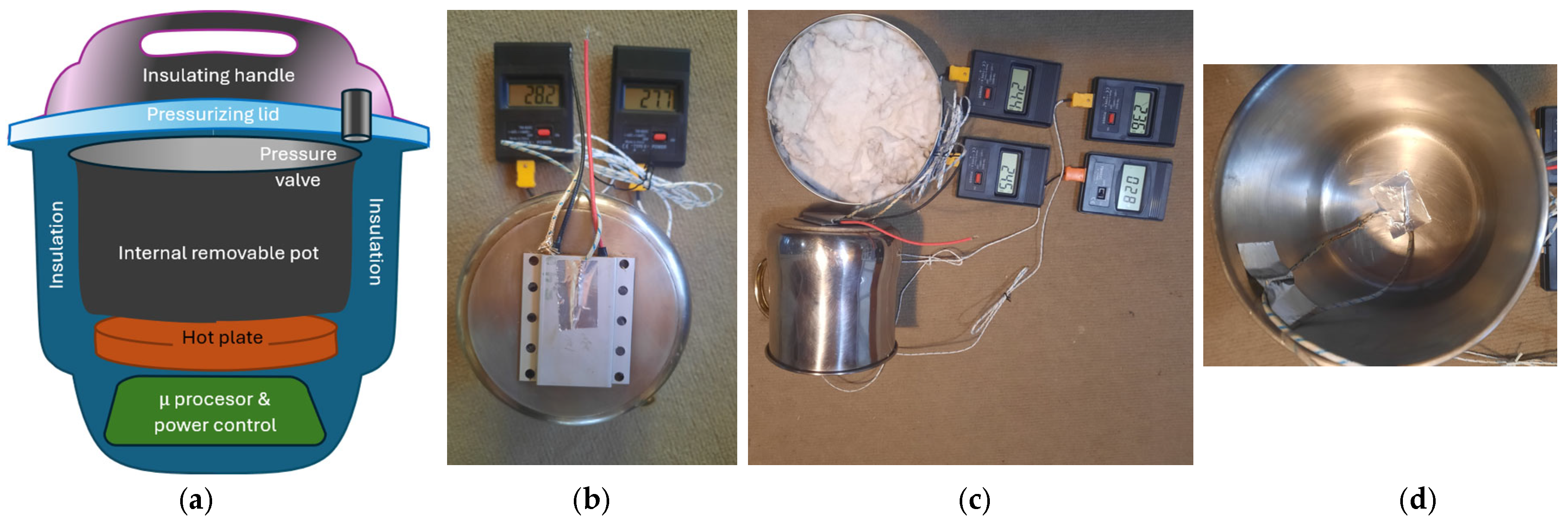
through a lumped-parameter, two-node model. The pot is either exposed to ambient air or can be thermally insulated like common commercial EPCs (
Figure 2). The present numerical model combines the heat capacity of the PTC elements (in our case
) with the pot bottom (in our case
) to which they are attached, summing up to
. This can be considered a negligible value compared with that of the filled pot, which in our case contains 1.0 L of oil representing the food load, with a joint thermal capacity of
. In our case, the pot bottom plate has a base diameter of 12 cm.
We denote by
the heat power transmitted between the PTCs and the inner base of the pot, in contact with the food load, with the subscript
u. The equivalent thermal conductance of each thermal contact, indicated by the subscript
C, can be estimated as
[
23], depending on the flatness, clamping pressure, intermediate material (thickness and conductivity), or gas-gap roughness.
passes through three contact areas,
to
namely PTC element/PTC enclosure, +PTC enclosure/hot plate lower side + plate upper side/pot bottom. The series combination of thermal resistances yields an equivalent resistance
, ignoring conduction temperature drop within the contacts. Neglecting any lateral heat losses, considering a moderate heat-flux density
and assuming the same area,
, the resulting one-dimensional temperature difference between PTCs and the pot estimate is
. The experimental data, of our setup is coherent with this estimate. The PTC contact area is used for simplicity, although the plate or pot bottom area is generally larger and therefore redistributes the heat toward the liquid contents. This analysis highlights the importance of achieving good thermal contact. Higher temperature differences have been reported for similar cases due to the difficulty of obtaining low thermal-contact resistances and due to higher power densities, as observed, for example, in [
36].
In this model, the electrical power,
, is determined by the resistance of the PTCs,
(broken parentheses indicate functional dependence), which is a function of its temperature
. The heat losses from the cooking vessel to the environment are characterized by
, e.g., [
37] among others, and by
for the insulation, with common in-series external area
and typical values
. Here, the lowest limit is for a representative 3 cm of insulating material thickness, and the upper limit is for just an air gap between metal sheets. The direct thermal losses from the PTCs to the ambient,
, may be neglected because the PTCs can be effectively insulated with a thickness of mineral wool. The example in
Figure 2c has a thickness
, yielding
.
Equation (1) formulates the initial model and its simplification, according to the present analysis. Equation (1b) determines the temperature difference between the PTC elements and the cooking content. If
, both temperatures collapse
.
Some standards for evaluating the performance of solar cookers are available (e.g., [
38,
39]). They inspire the discussion that follows. However, the purpose here is not to comply with such standards, but rather to employ a liquid in successive heating and cooling tests, following the standards’ prescriptions and current practice. First, thermal equilibrium is analyzed, followed by heating and cooling.
3.2. Thermal Equilibrium and Its Vicinity
Imposing
in Equation (1) provides the steady state equations, as shown in Equation (2). They correspond to equilibrium state after heating, denoted by the subscript
e.
Equation (2a) dictates that, at constant power input, , the equilibrium temperature is determined by the heat losses. If, as usual, the initial temperature is lower, this is the maximum temperature achieved for such power input. Therefore, it is advisable that the cooking vessel: (i) be thermally insulated on all its surfaces except the one in contact with the hot plate or directly with the PTCs, and (ii) water-evaporation losses be avoided by closing the lid and even allowing the interior to operate under moderate pressure, e.g., EPC. In this latter case, the internal pressure will increase, thereby accelerating cooking reactions. Pressure is automatically limited by the usual safety valve in these devices.
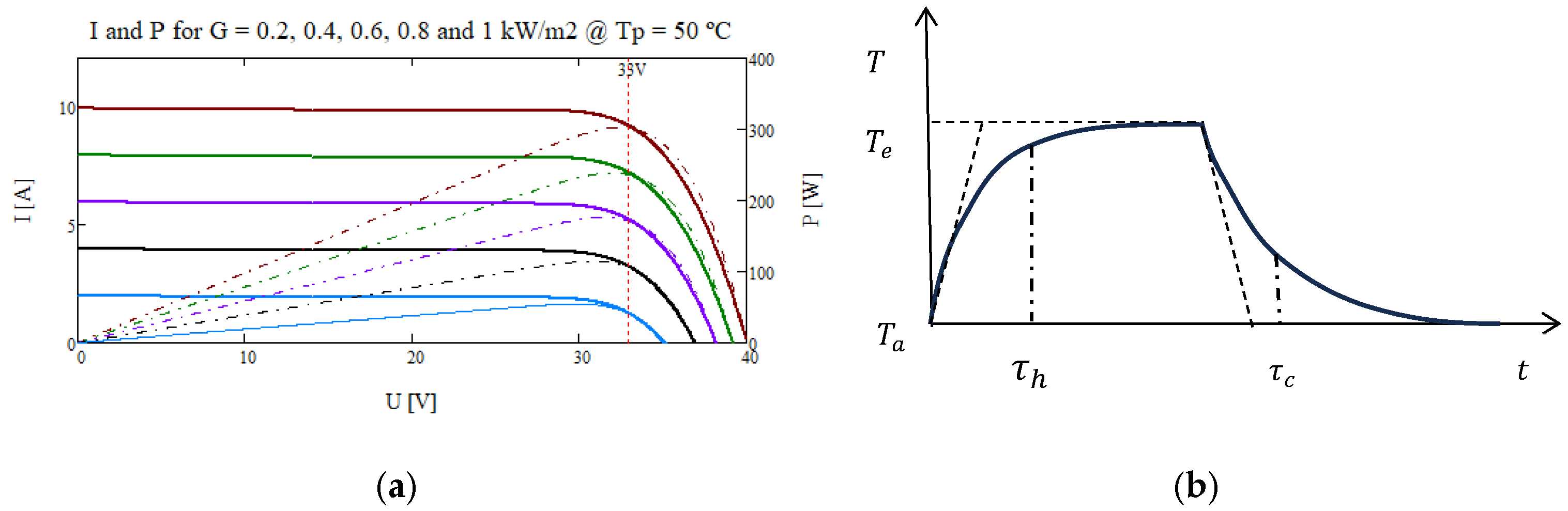
Coupling with the PV panels occurs through their characteristic curves depicted in
Figure 3a. In this figure,
is the solar irradiance perpendicular to the panel. Since approximately
, Equation (2a) also indicates that
is determined by
(i.e.,
). The transmitted power
is mediated by the thermal conductance
, which in turn depends on
near equilibrium. Once the Curie temperature
is approached during heating, equilibrium is attained in its vicinity,
, due to the strong variation in resistance near
, which anchors the operating point near
.
Representative values for our case are at , equal to the heat losses—distributed in approximately equal parts among the lid, the side walls (which amount to about 45 W each), plus an additional due to the lack of a full PTC insulation. For a commercially available EPC today, these data would double.
In order to understand the proposed scheme of parallel-connected PTCs, just for visually apprehending the effect of
parallel identical PTCs on
, the near
, the resistance of a single PTC can be approached as an exponential with empirical coefficients
. Considering the
parallel identical PTCs proposed for the minimal PV cooker and introducing this in Equation (2a,b), Equation (3) is obtained.
Equation (3) shows that for fixed parameters, the value of
increases the value of the left hand of the equation, which increases with
. Thus,
increases with
. Also,
duplicates if two PV panels are connected in series, thus also increasing
. The increase in
is not substantial owing to the steepness of the exponential term (
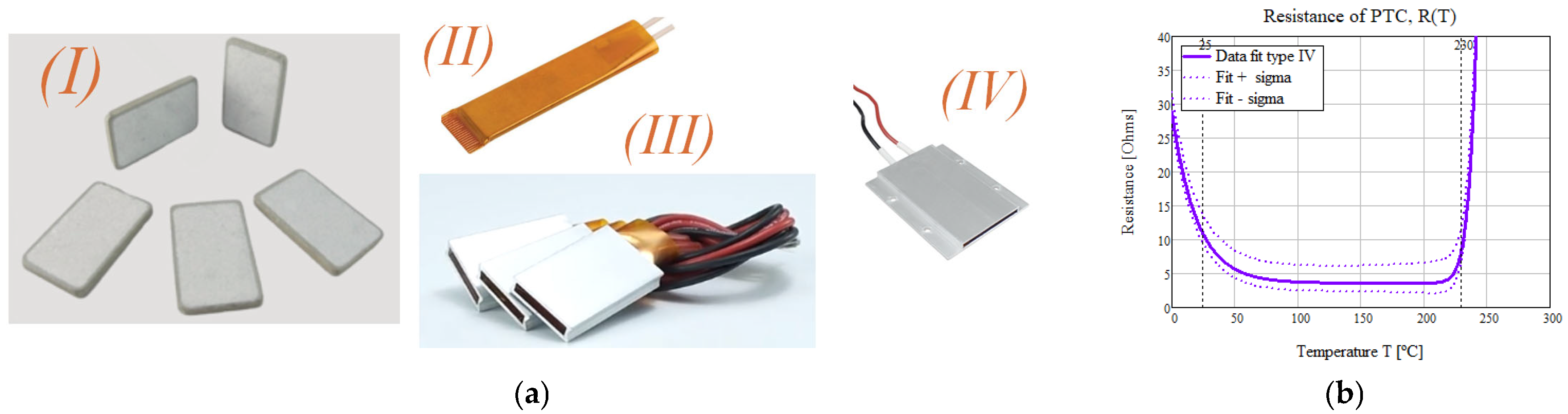
Figure 1b). Typical numerical values are given in
Section 5, where
at
. Actually,
and quite close. Application of Equation (3) using the experimental data described in
Section 4, averaging between
and
, gives a smaller value,
. The discrepancy comes from the model’s low accuracy because of not distinguishing between pot base and oil.
If an MPPT optimizer were installed, its load curves would be required to study the operation of the cooker, anticipating that under normal conditions it would operate very close to the maximum power voltage
Conversely, and according to the minimal PV cooker design, the following discussion assumes the absence of an MPPT optimizer, but it can exist. It is noteworthy that the
curves yield maximum-power points at nearly constant
, as
Figure 3a shows.
For constant
, the panel intensity
remains quasi-constant as
varies, except for a rapid increase in internal panel losses starting at around
for typical domestic panels of 60–72 cells, as
Figure 3a shows, thus steeply reducing
. Consequently, the power
increases until these internal limitations are reached, attaining a maximum, and then decreases to zero. For our case, the maximum
corresponds to
and
, which for a typical panel is around (9 to 16) A under nominal conditions, irradiance
, and
. The lowest values in the indicated ranges are for older panel technologies and/or high panel temperature, while the higher values are for premium quality panels. Thus, the maximum power is
for a single panel of around 2 m
2 area. For a given panel, these values have small variations due to temperature, soiling, and aging. Besides this, the resistance that the PTCs should exhibit to achieve
,
is not constant; rather, it depends on irradiance, yielding
for a single panel. This condition is easily met when connecting several PTC elements in parallel, the fine tuning coming from the exponential rise of the PTC resistance near
. However, if
is too small, the temperature difference
becomes large and the required
for cooking significantly exceeds
, resulting in a low transmitted heat
. Therefore, a sufficiently large
pot base area is required to limit
for a given
. This is especially relevant for oil-based cooking, as this happens for
.
3.3. Heating
Under cold-start conditions, starting from equilibrium with the environment at
, there is an initial short period where the term
is relevant. During this time, the heating is highly localized inside the PTC element, a phenomenon that cannot be captured by the simplified model adopted here. After this brief phase and neglecting heat losses compared with the power supplied by the PTC elements in Equation (2), a useful simplification for analyzing the system transient behavior results in Equation (4).
Equation (4) highlights the strong thermal coupling between the PTC elements and the cooking vessel. During a cold start, the high
at
may yield an operating temperature in the NTC region (
Figure 1b). As the PTC warms up, its resistance decreases, causing the operating point to drift toward the Curie region. This local heating is faster when the thermal conductance between PTC and hot plate + pot is low and/or when the cooking pot is empty or absent, leading to a small value of
. Paradoxically, this condition can be exploited to increase power input
during startup. Under sufficiently low irradiance
—such as during early-morning or cloudy conditions—the effect becomes more pronounced because the load resistance required to reach the maximum-power region is higher than under strong irradiance, as discussed in detail in [
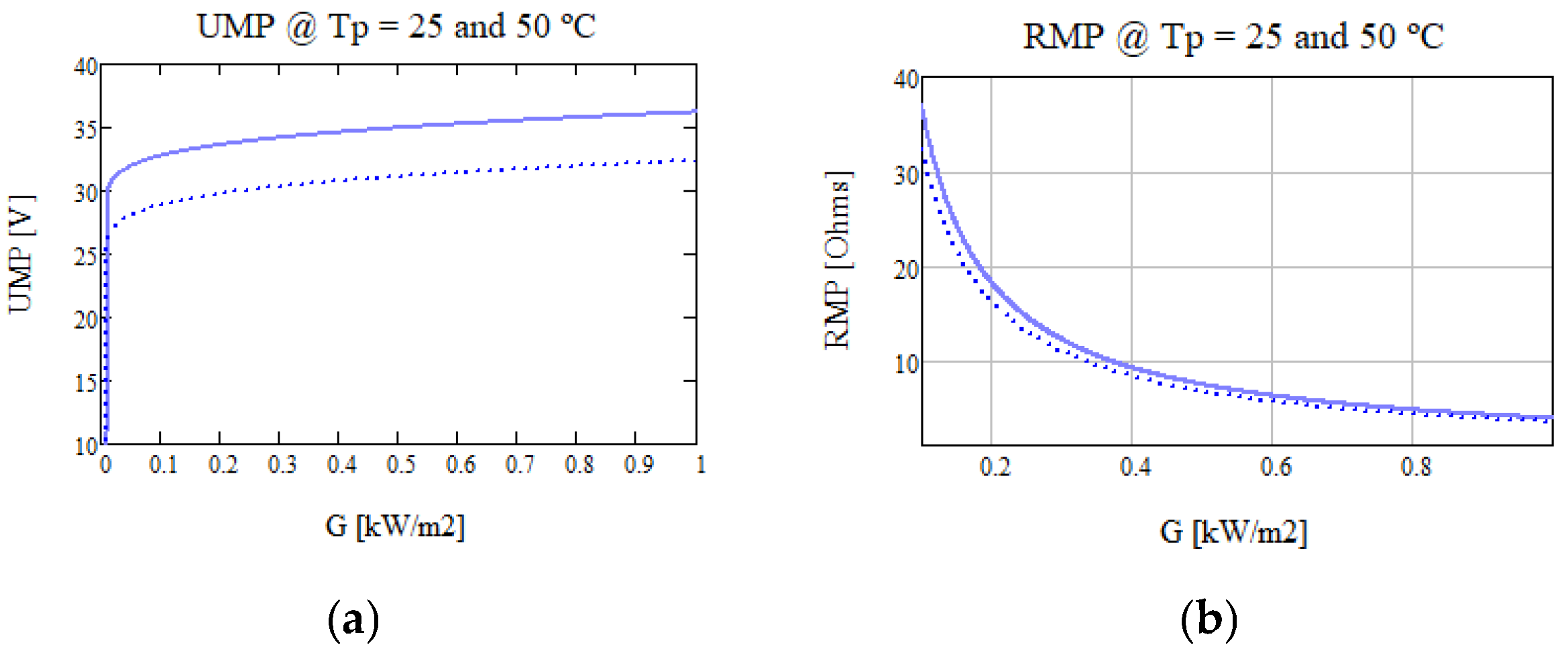
23]. Adapted from this reference,
Figure 4 shows the values of
and
as functions of
for two panel temperatures. The maximum-power voltage
is nearly constant, confirming the trend indicated in
Figure 3a, and the current,
, decreases smoothly. For low
, not operating exactly at
along a day does not imply a major power loss during transient periods or at a cold start. Moreover, low
remains attainable by removing some of the several switchable PTCs arranged in parallel, such as those illustrated in
Figure 1, types II and III. A small digital wattmeter can assist the user in deciding when to disconnect/connect PTCs. These devices are currently available for less than €10, although they introduce undesirable electronics into the “minimal” design proposed here. In any case, thermal inertia must be considered, so waiting a few seconds is necessary before making an appropriate switching decision, as both power and resistance depend strongly on
. A simple microcontroller with MOSFET switches could automate this behavior, effectively acting as a rudimentary MPPT, though at the expense of adding electronics. At the opposite end of the simplicity spectrum is a single general ON/OFF switch, accepting the corresponding loss of performance.
For an idealized heating case, assuming constant parameters and combining the thermal capacities and heat losses of both the hot plate and the cooking vessel into a single equivalent
, even though their temperatures differ—
because
—the solution of this simplified form of Equation (1) becomes Equation (5).
This indicates the parameters that build the characteristic heating time,
(
Figure 3b). In practice, the characteristic cooling time,
, is expected to be of the same order of magnitude as it depends on basic features of the design.
3.4. Cooling
The same procedure is followed for Equation (5), but setting
yields Equation (6).
At the end of heating and after a period that allows temperatures to homogenize, so that
it becomes possible to experimentally determine the time evolution of
. In theory, it follows a decaying exponential toward zero if the remaining parameters are constant, with a characteristic cooling time
in Equation (4), when no offline insulation is added, as shown in
Figure 3b. Increasing
after cooking, typically offline, e.g., with a hay basket, allows the temperature to be maintained for a longer time. This extends low-temperature cooking, and if the internal pot is removable, it leaves the cooker available for other uses. Increasing the thermal capacity
has the same effect, but at the cost of a longer heating time to reach cooking temperatures. This limitation makes it advantageous to have two cookers, each with a different
, one for fast cooking and another for preparing a second dish or heating a thermal-storage mass.
The model of Equation (2) can be easily implemented in Excel™, even with an explicit Euler time-stepping scheme, enabling numerical experimentation and supporting the development of an optimal design prior to construction.
4. Experimental Evaluation
Technology Readiness Levels (TRLs) constitute a nine-level scale used to evaluate the maturity of a technology, ranging from basic principles (TRL 1) to proven operation in real-world environments (TRL 9) [
40,
41]. For this section, a concept and feasibility prototype (TRL 4) has been constructed. Experimental tests are reported in
Section 5. This would allow for constructing a user-ready operational prototype and performing laboratory testing (TRL 6). Subsequent testing of a pre-series unit in field conditions, potentially over several seasons (TRL 9), would complete the development. The simplicity and ease of construction of the proposed design suggest that advancing beyond TRL 4 should not pose significant technical challenges. Experimenting with a constant voltage laboratory power source allows for a fast entry into the development, supported by
Figure 4, which indicates almost constant voltage at the maximum power point of the panel.
The first step after the present work would be to connect the utensil to a PV panel under either a solar simulator or outdoors. This will check the correctness of the design and jump to TRL5 and eventually TRL6.
There are two initial alternatives for a “minimal photovoltaic cooker”:
In this study, option 1 was chosen, opting for a reduced size, although PTC encapsulation includes some heat resistance. The end user performance will depend on the solar panel/s chosen, solar irradiation, and other details. Because of this, it was decided to supply the utensil with a laboratory DC power supply, as it allows for very easy control at a cost not surpassing €100.
The pot is made of stainless steel with a bottom thickness of approximately 6 mm, a base diameter of 12 cm, and a height of 13 cm. No insulation has been added to the sidewall of the pot. Its upper opening was sealed with Mylar
® film, mimicking a lid. A single large PTC element was bonded to the bottom surface using a widely available epoxy adhesive filled with metallic powder, although screwing would be an option. The PTC was thermally insulated on its underside with 10 cm of ceramic fiber cotton (
Figure 2).
To avoid heat loss due to evaporation, 1 L of food-grade already cooked sunflower oil was poured, representing food. Its nominal properties are: and , representing average values between ambient temperature and 100 °C.
The electrical setup consisted of a regulated DC power supply of 0 to 32 V, 10 A maximum, with a display of four-digit resolution for voltage and current . Voltage and current were measured with four-digit multimeters, matching the displayed output of built-in indicators of the power supply, reaching an expanded uncertainty of ±2% (95% probability). Temperature was measured using type-K thermocouples with an exposed junction of ϕ = 1 mm and four-digit indicators.
The time evolution of the signals was recorded with a Pico Technology, Tyler TX 75702 USA, USB TC-08
® A/D converter equipped with a terminal board for current measurement using a calibrated shunt resistor. The manufacturer also provides the Picotech
® 6.1.3 software and a USB link to a PC. The total temperature-measurement expanded uncertainty is estimated at ±3 °C, consistent with the steady-state temperature indicators (
Figure 2), after calibrating with melting ice and boiling water points. A thermocouple was placed at the free surface of the PTC,
; its readings were crosschecked using an infrared thermometer, yielding maximum deviations of ±5 °C. Additional thermocouples were installed on the inner side of the bottom base of the pot
, on its wet sidewall
, and within the oil
. Both the PTC and the instrumentation were sourced from generic Chinese suppliers’ platforms.
A single type-IV PTC (
Figure 1 and
Figure 2) was used. At ambient temperature, its resistance
ranged from 11 to 16 Ω, showing sensitivity to both voltage
and temperature
. Low input levels of
were used for the measurements to minimize self-heating. Under 10 V, the resistance decreased to a minimum of 3.6 Ω at a PTC temperature of 190 °C, whereas it showed
± 5%.
5. Results and Discussion
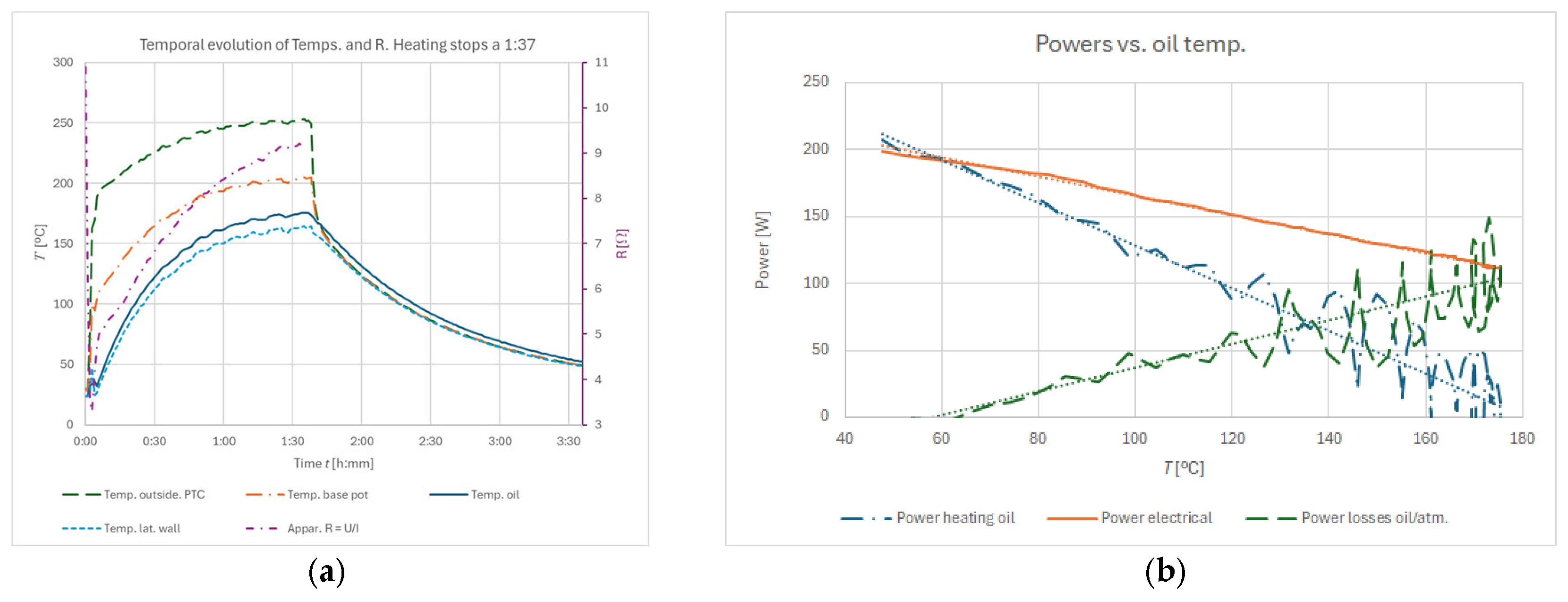
Figure 5a shows experimental temperatures vs. time. The initial fast growth of
and especially
corresponds to the fast self-heating of the PTC using a constant
beginning at ambient temperature. This marginal phenomenon in the first 6 min would behave slightly differently when connected directly to a PV panel because of coupling. Next, the heating of the whole pot proceeds for 1 and a half hours. If any effect from the PV panels is of interest, the behavior can be reproduced with the model in
Section 3. Once the steady state is reached at the end of the heating phase, the external
is approximately 90 °C higher than
and about 50 °C higher than the pot base temperature
, indicating the convenience of a mathematical model that distinguishes these temperatures. The electrical power is modest, even for connecting to a single household market-oriented PV panel, due to the small utensil and PTC size. At the end of the heating, the apparent PTC resistance
is higher than the optimum for
, indicated in
Figure 4b, and matching
Figure 1b. The temperature of the pot sidewall
is only slightly lower than that of the
. This indicates that the natural convection heat transfer of the internal oil is greater than that of the external open air. After shutting off the electrical power, isothermal conditions are reached fast, allowing the determination of an overall heat loss coefficient, referenced to the area of the lateral and top surfaces of the pot, as shown in
Figure 6.
Figure 5b shows derived parameters against
Small temperature oscillations produce strong oscillations in the derived quantities around their respective linear correlations, shown with dotted lines. The electrical power decreases monotonically as
temperature increases, thereby increasing its resistance beyond
. This indicates that the PTC element internally heats for a while up to
proximity. This is a higher temperature than that at the external surface of the PTC,
, which is the temperature measured until heat losses lower it. The oil heating power
has been determined, as indicated in Equation (7), using a moving average numerical derivation algorithm and considering the heat capacity of the oil.
decreases over time until it reaches zero at steady state, while the heat-loss power increases until it almost equals the electrical power , since there is some minor heat loss through the PTC underside. at . This approximates the boiling power if water is used as a load.
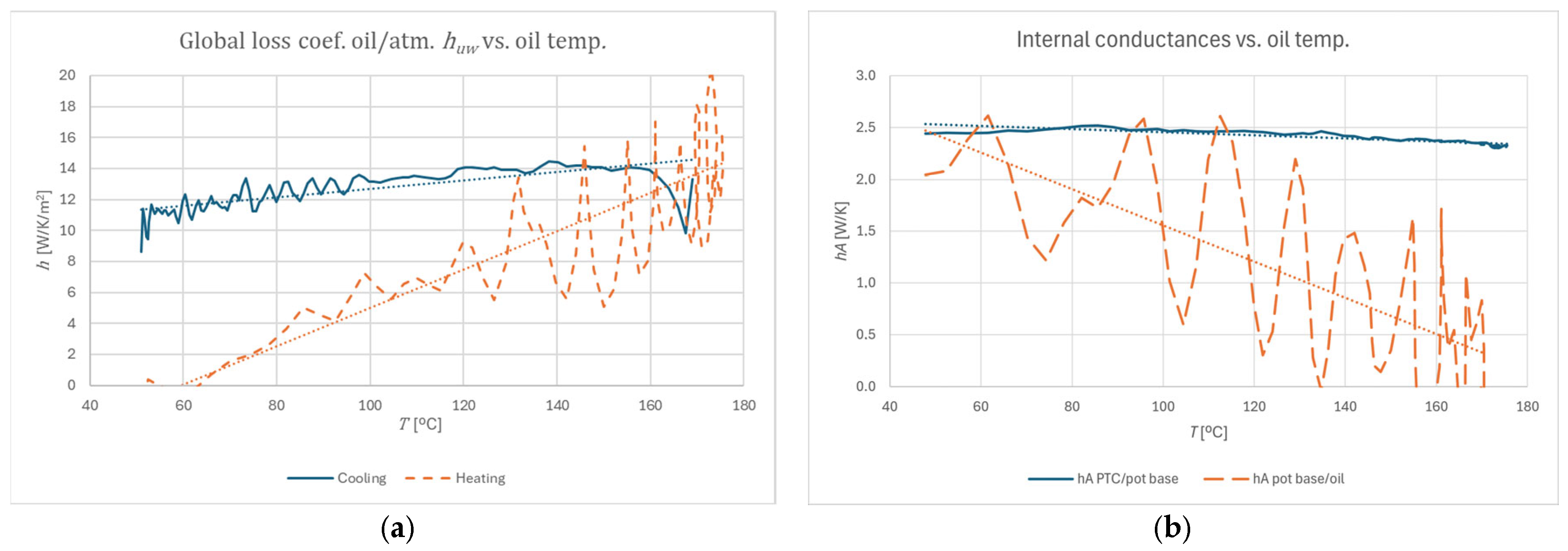
Figure 6a shows the overall heat-loss coefficient during cooling,
. The results show consistency with the theoretical prediction, yielding
. The value obtained during heating oscillates due to temperature non-uniformities and to the relatively large value of the oil heating power, which reduces its significance. It approaches the correct value at high temperatures, near steady state, when the oil-heating power becomes negligible (
Figure 5b), and temperatures are more homogeneous.
Figure 6b indicates the internal thermal conductance
, according to Equation (8), as a function of
, which shows a near-constant value. This is coherent with the fact that it is the series composition of contact resistances and heat conductivity of the solid material layers.
Figure 6b also shows
, indicating a decreasing value with
as the natural convection declines when the temperature difference between the pot base and the oil decreases. This is linked to the reduction in heat released from the PTC, which can be observed in
Figure 5b. The observed conductance decline could be exacerbated by the direct heat conduction from the pot base to its walls. Neither of the curves can give a heat transfer coefficient because of indeterminacy in the transfer surfaces and the associated thermal conductance.
6. Conclusions
This study demonstrates that the proposal of a minimal photovoltaic (PV) cooker constitutes a viable and robust technical option. It enables a first step in indoor cooking while simultaneously contributing to household electrification. The results support the overarching thesis that such minimal systems can be deployed in energy-poor communities as an entry-level technology for vulnerable families. This strategy aims to improve living conditions and supports progress toward sustainable development. The benefits would be particularly relevant in remote and isolated locations.
The analysis confirms that a PV cooker can be simplified to the extent of eliminating both power electronics and batteries, relying instead on thermal storage as a complementary mechanism for continuous cooking and other thermal consumption. This minimal configuration reduces cost, complexity, and maintenance requirements while enabling local manufacturing, repair, and adaptation. Experimental evidence indicates that the proposed laboratory prototype can heat or boil water and cook 1–2 L of food. Its future growth for achieving full functionality and increasing TRL level could be powered by a single commercial 2 m2 PV module.
A subsequent development phase could transform this proof of concept into a practical technology, with a safe design compliant with regulatory standards for household appliances. Such a minimal PV cooker would be capable of overcoming barriers to clean cooking. In doing so, it may serve as a catalytic tool in the broader effort to alleviate energy poverty and accelerate the energy transition.
The theoretical model developed here provides a straightforward framework for predicting thermal behavior and guiding design choices. Combined with the simple, low-cost experimental method proposed here for determining the relevant thermal parameters to feed the theoretical model(s), it offers an accessible pathway for scaling and optimizing cooker designs.
Despite the technical feasibility demonstrated, successful real-world deployment requires parallel action on social, cultural, and economic fronts. Community engagement, training, and local manufacturing capabilities are essential for achieving long-term adoption.
Positive temperature coefficient (PTC) elements, in particular, offer an attractive pathway toward constructing minimal PV cookers that are reliable, safe, and inexpensive. Their practical performance depends primarily on the achievable surface power density and the thermal conductance between the PTC elements and the cooking vessel. Both characteristics are highly sensitive to installation quality. These results provide a foundation for future engineering work aimed at developing improved, fully standardized solar-electric cooking devices based on widely available components.
The economics of the design presented herein include the essential hardware components described in
Section 1 (Concept of Minimal PV Cooker Based on PTC Heaters),
Section 3 and
Section 4. However, additional information is required to quantify the total cost of a complete project. These supplementary costs are complementary in nature but belong to a different category, including on-the-spot availability and overpricing, transportation to the site, roof support structures and cabling, erection and installation, as well as user training and technical follow-up.
Before such a comprehensive assessment can be conducted, an intermediate step is required: evaluating the system performance under real operating conditions in order to achieve an increase in the Technology Readiness Level (TRL), as discussed in
Section 4. Prototypes constructed for real operations would allow us to compare the proposed PV cooker with other alternatives, as well as with thermal and/or biomass units.
Once operational prototypes are available, further research will be necessary to compare the proposed design with competing alternatives and to assess user perceptions and acceptance, as well as economic issues.
The TRL will also increase once a prototype is connected directly to one or several PV panels, thereby validating the preliminary tests presented herein under real solar irradiance and wind speed variations. Of particular importance will be the evolution of the pot and food temperatures during operation.