


Lifecycle Carbon Reduction Potential and Economic Valuation of Pumped Storage in a Multi-Energy Complementary System


Abstract
1. Introduction
- (1)
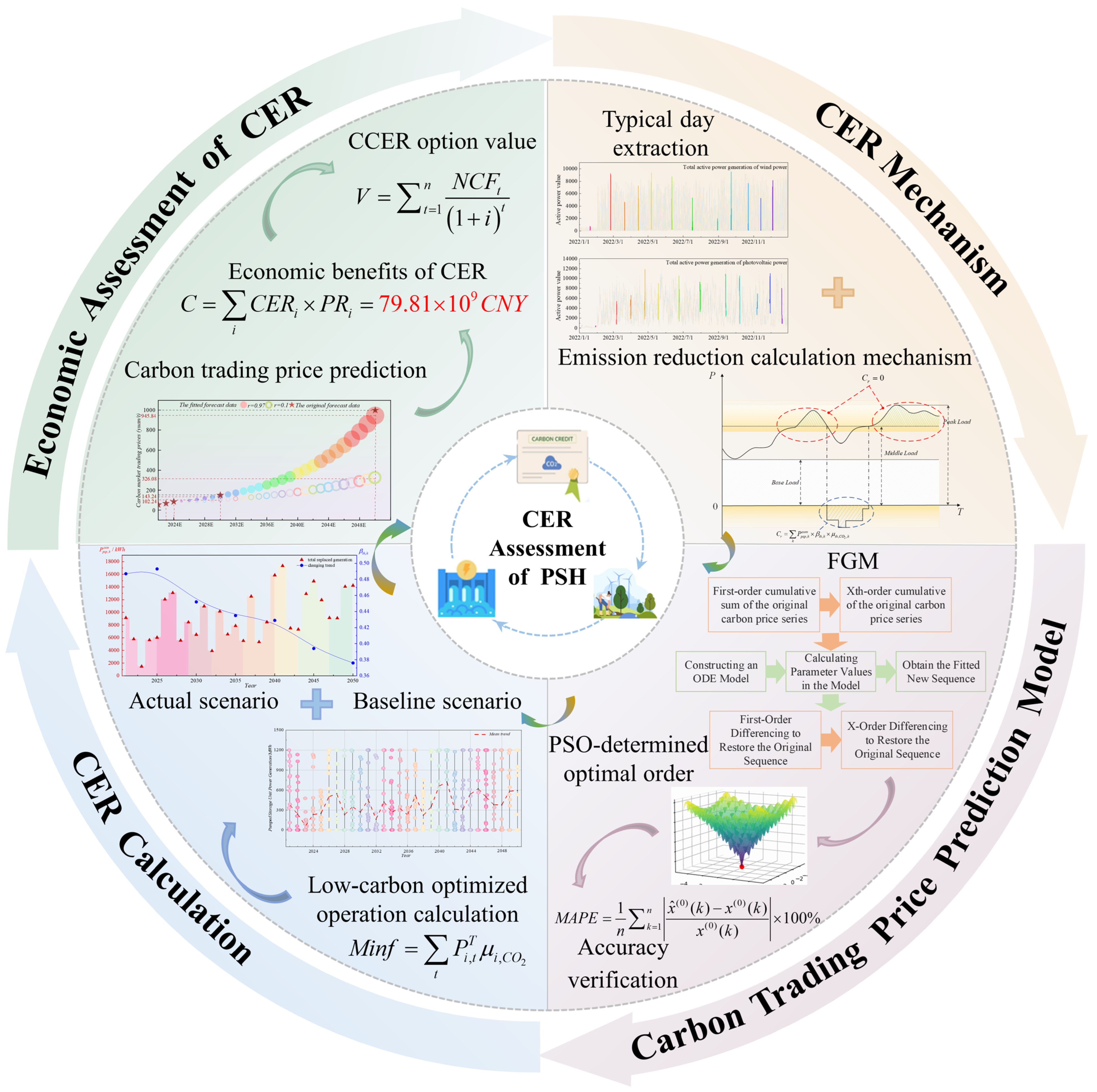
- Based on the CCER mechanism, this study constructs a carbon reduction calculation model.
- (2)
- A carbon trading price prediction model is built using FGM, with the optimal order determined by the PSO optimization algorithm.
- (3)
- Construct a low-carbon optimized operation model to calculate the future annual carbon emission reductions.
- (4)
- Future CCER market carbon emission values are computed to assess substantial emission reduction benefits achievable by pumped storage in the energy base.
2. Methodology
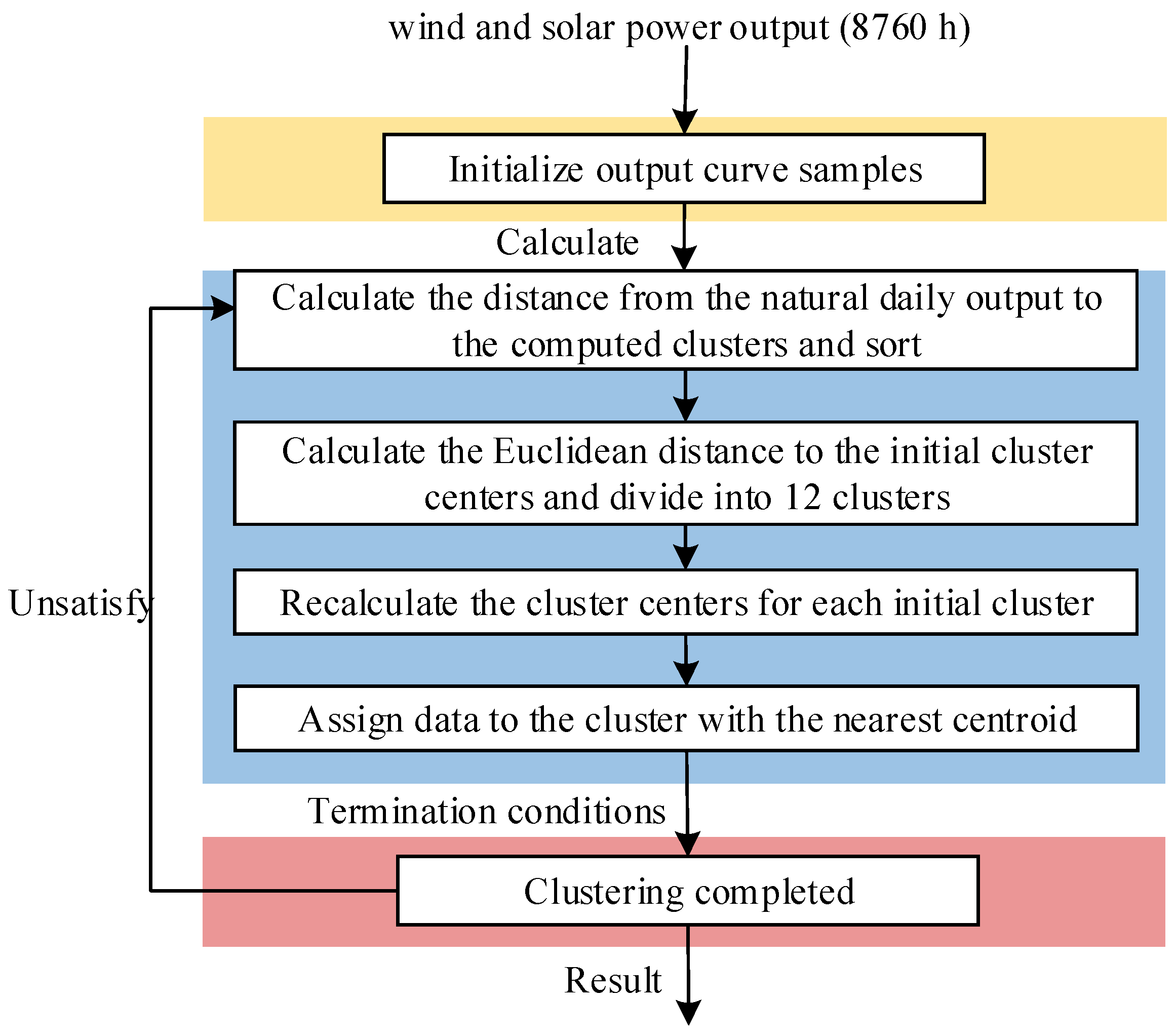
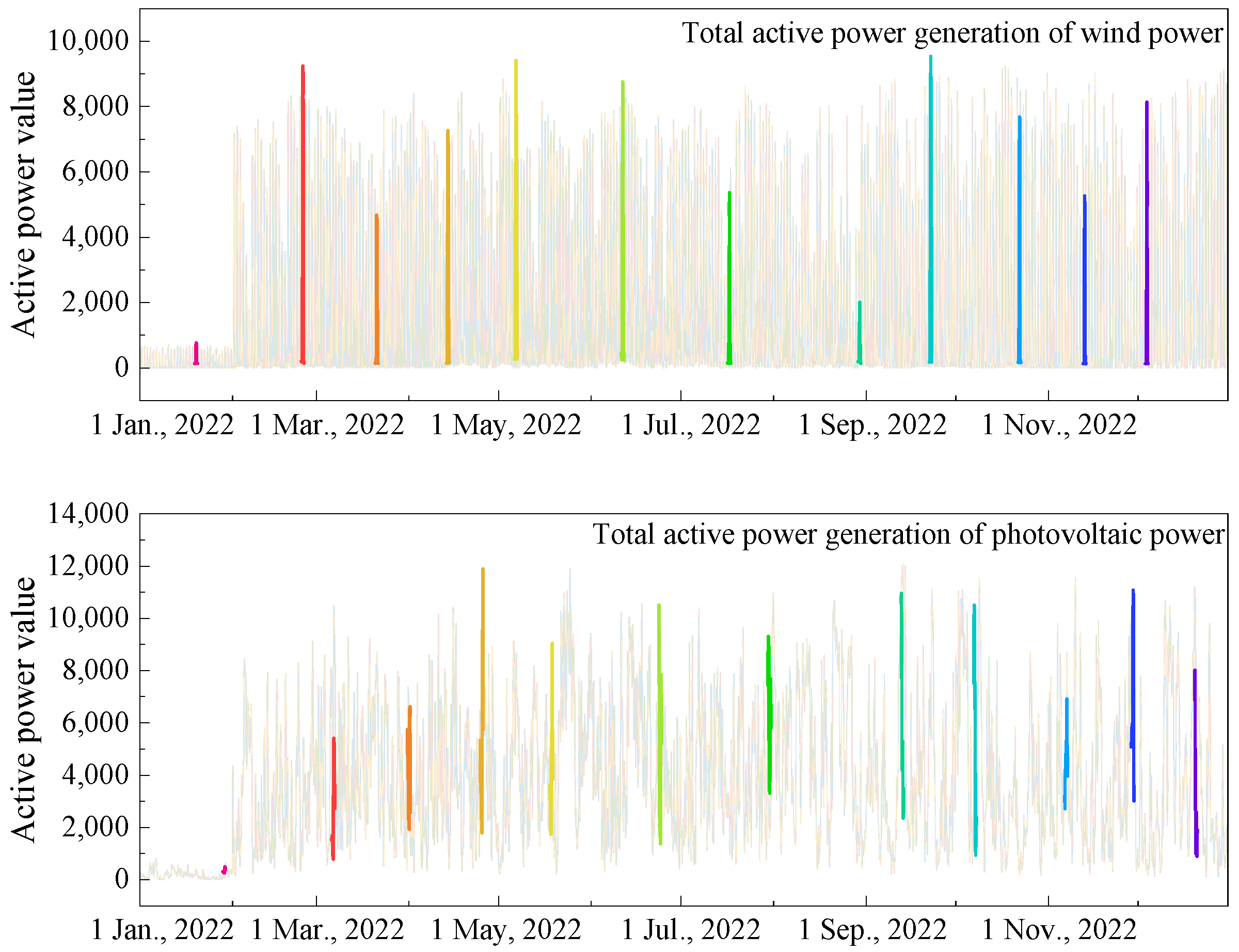
2.1. The 8760 h Data Feature Extraction
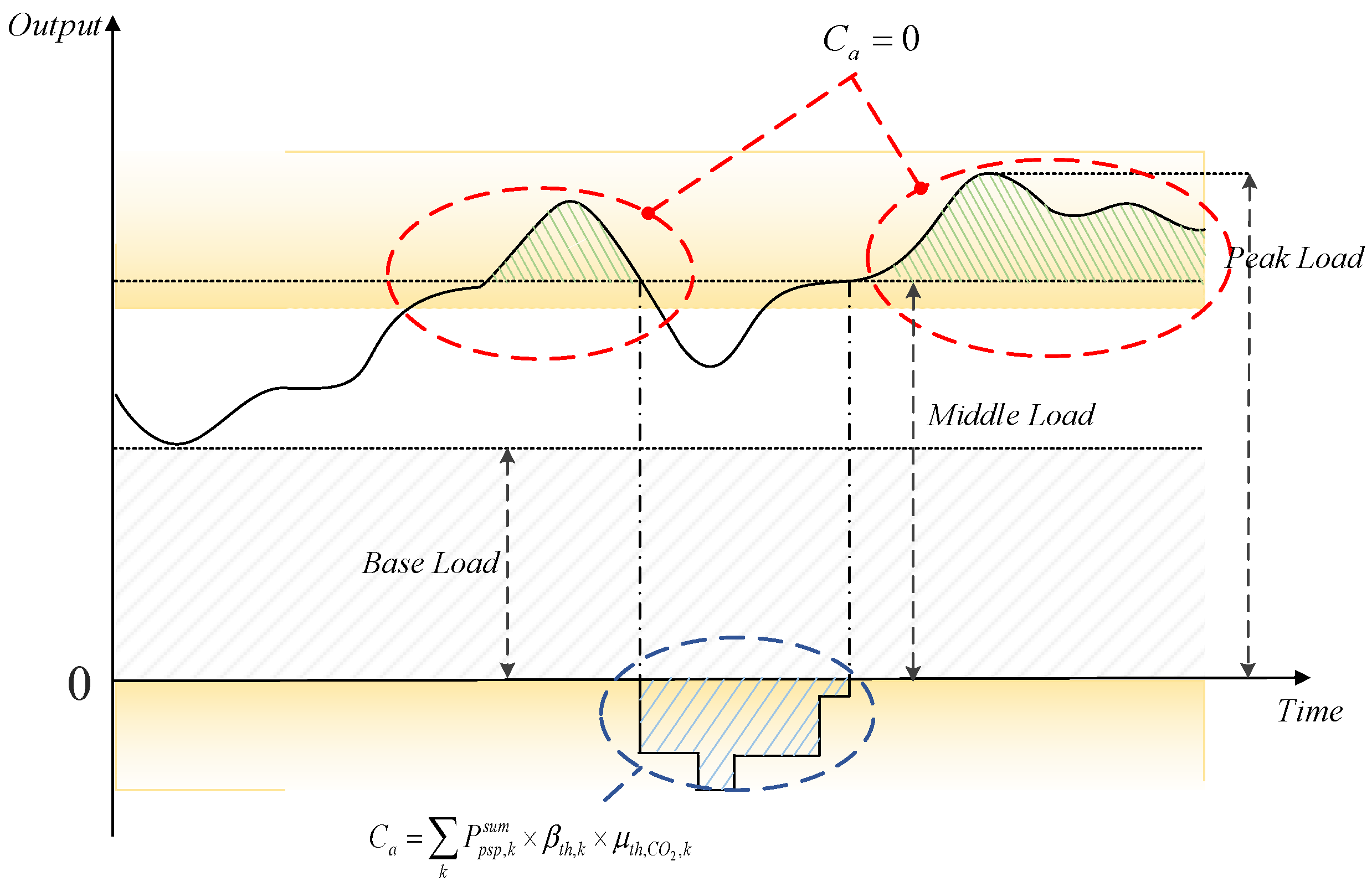
2.2. CCER Mechanism
2.3. Carbon Trading Price Prediction Mechanism
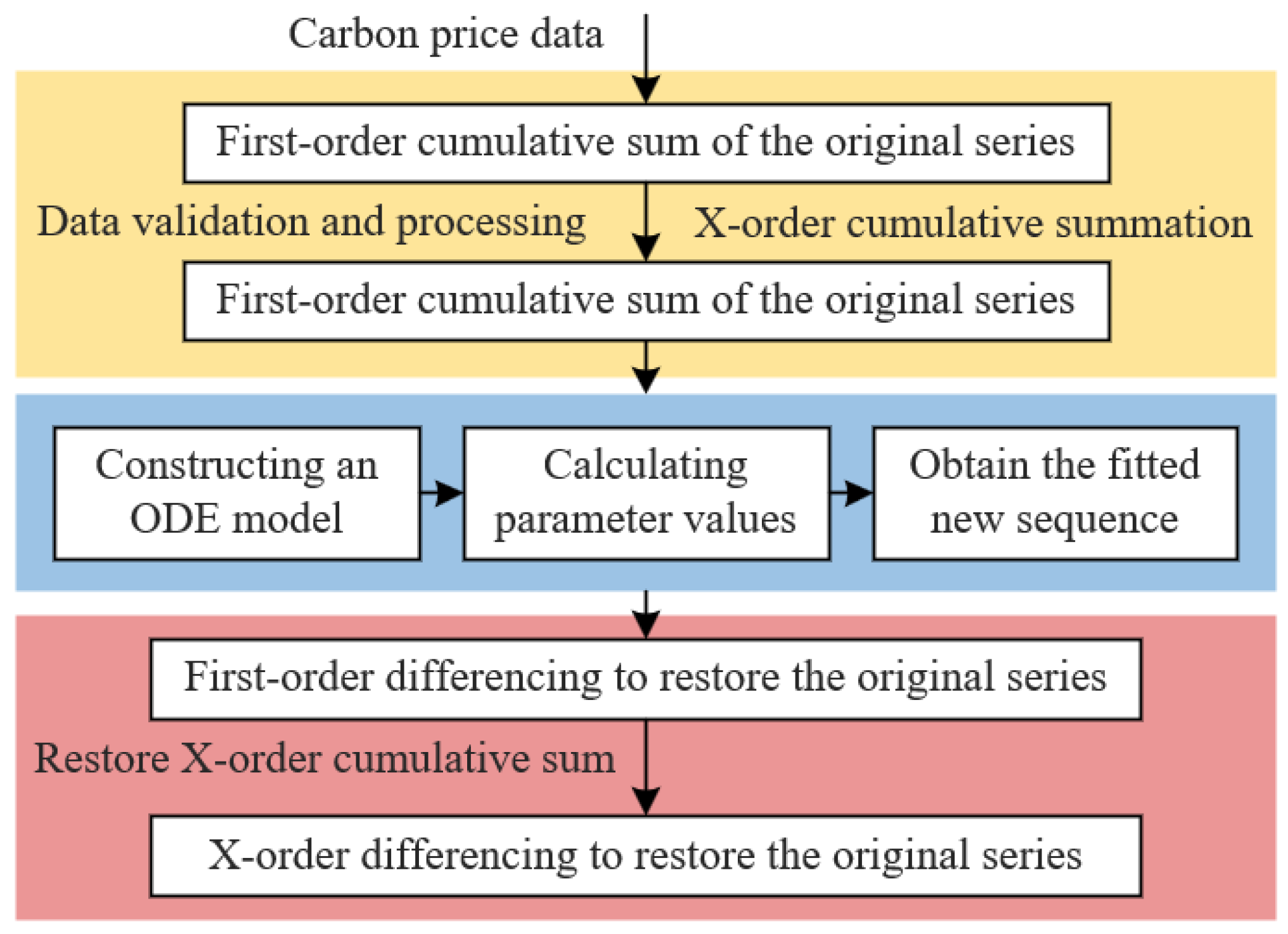
2.3.1. Fractional-Order Gray Model
2.3.2. Optimization of the Fractional Order
3. Modeling
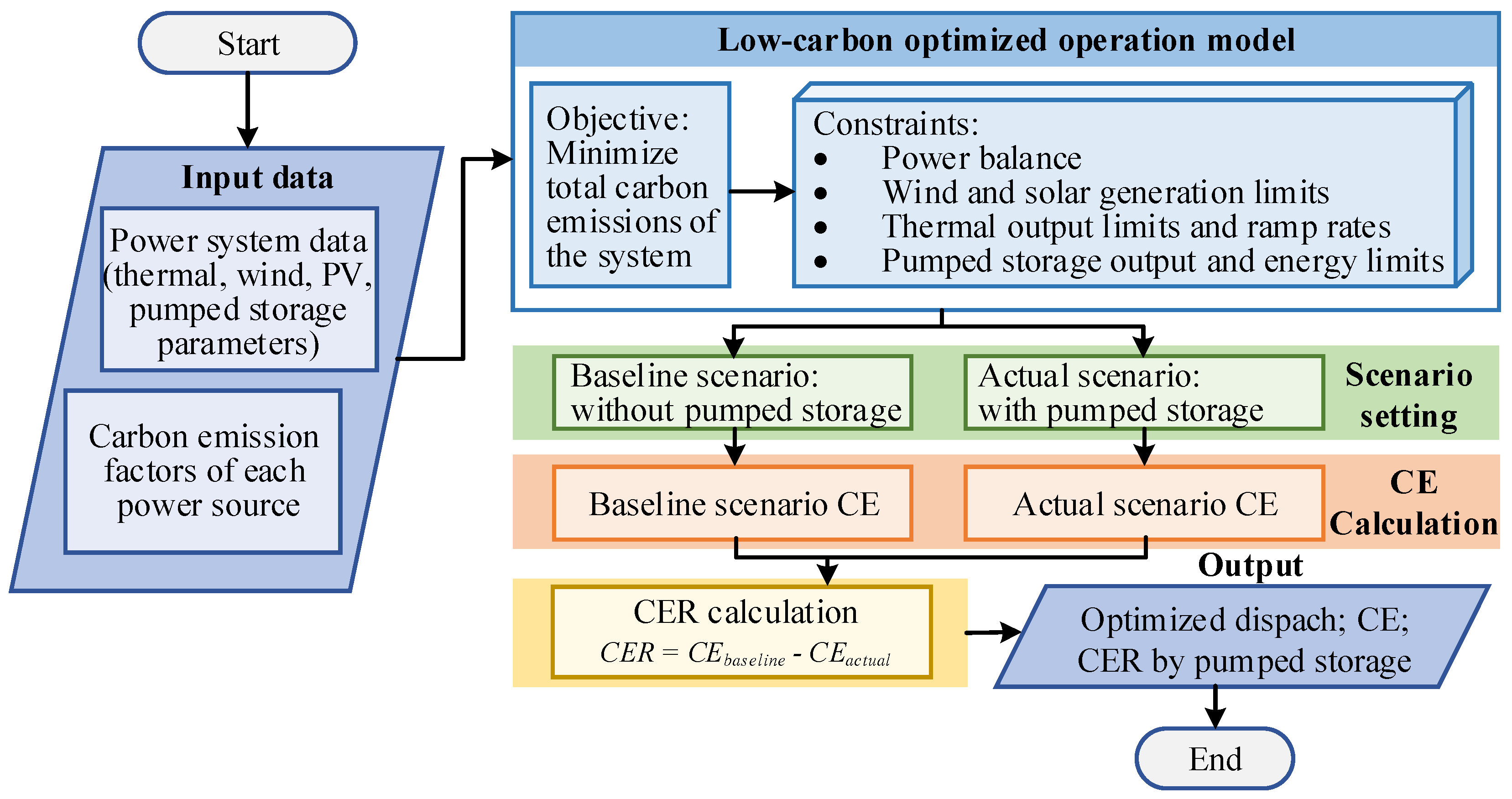
3.1. Low-Carbon Optimization Operation Model
3.1.1. Objective Function
3.1.2. Constraints
- (1)
- Power balance constraint
- (2)
- Thermal power unit constraints
- (3)
- Wind power generation constraint
- (4)
- Photovoltaic generation constraint
- (5)
- Pumped storage power station constraints
3.2. Carbon Emission Reduction Model
- (1)
- Calculation of CE in the baseline scenario:
- (2)
- Calculation of CE in the actual scenario:
- (3)
- Calculation of CERs using Equation (1):
4. Results and Discussion
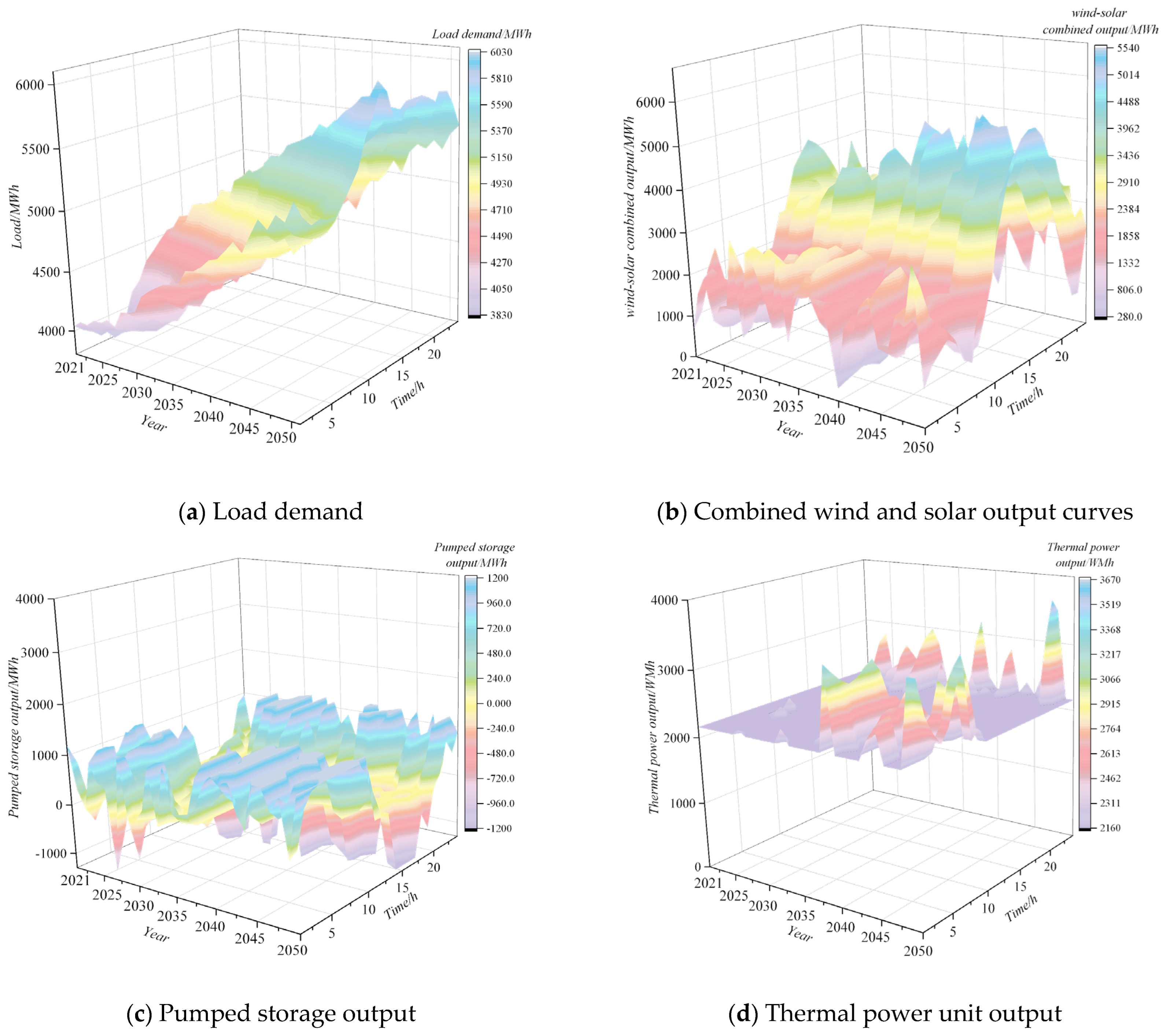
4.1. Basic Data
4.2. CER Calculation
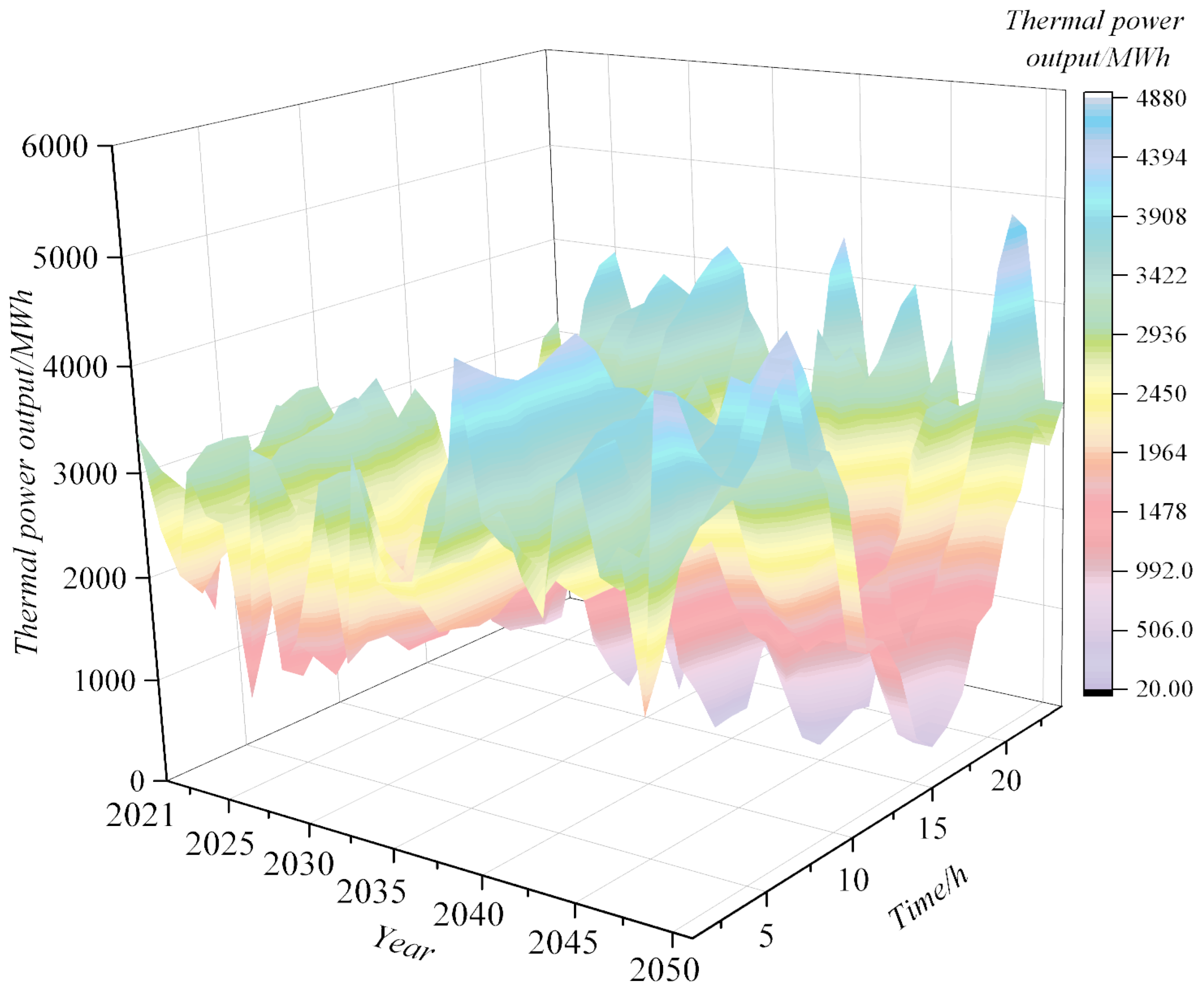
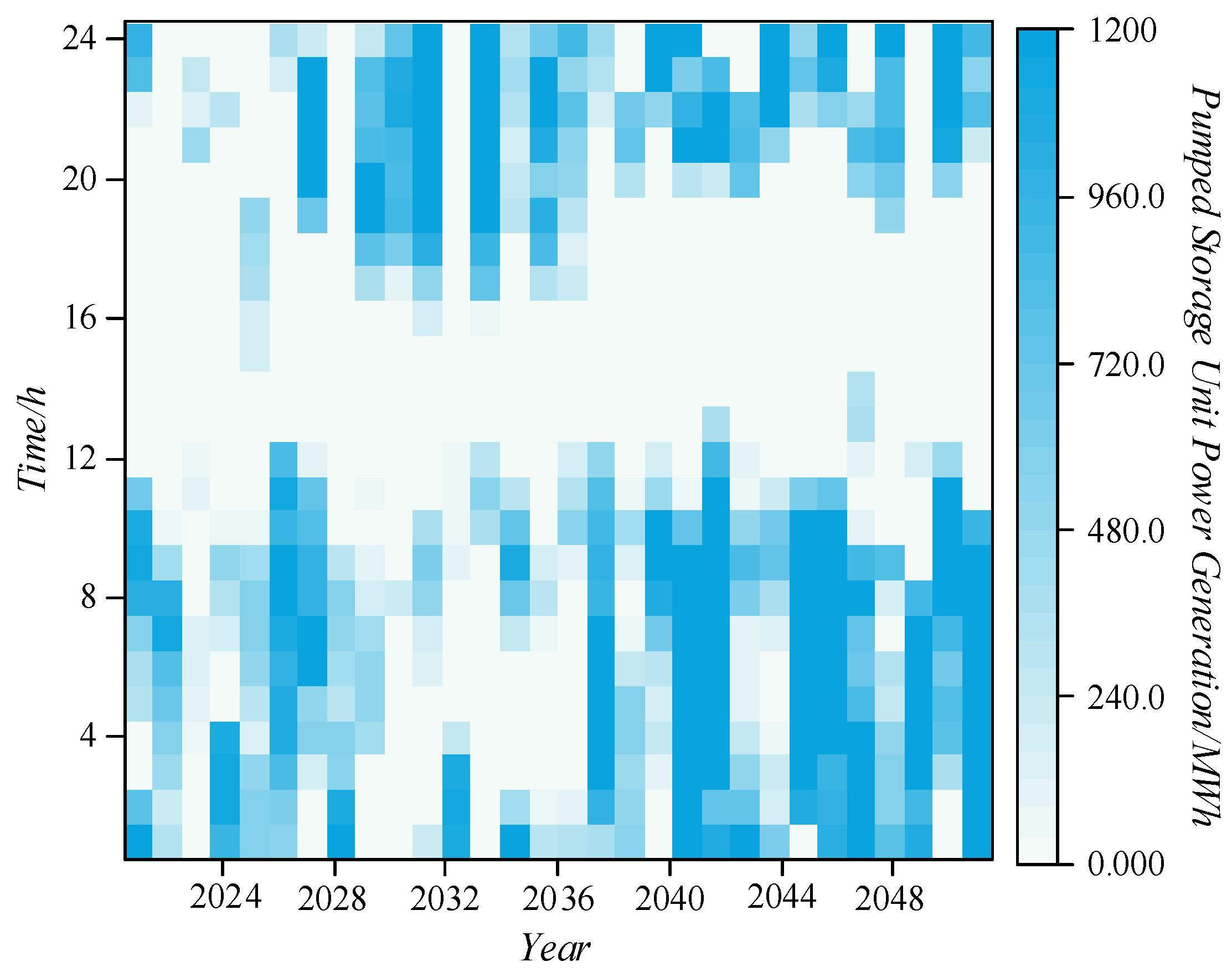
4.2.1. CE in the Actual Scenario
4.2.2. CE in the Baseline Scenario
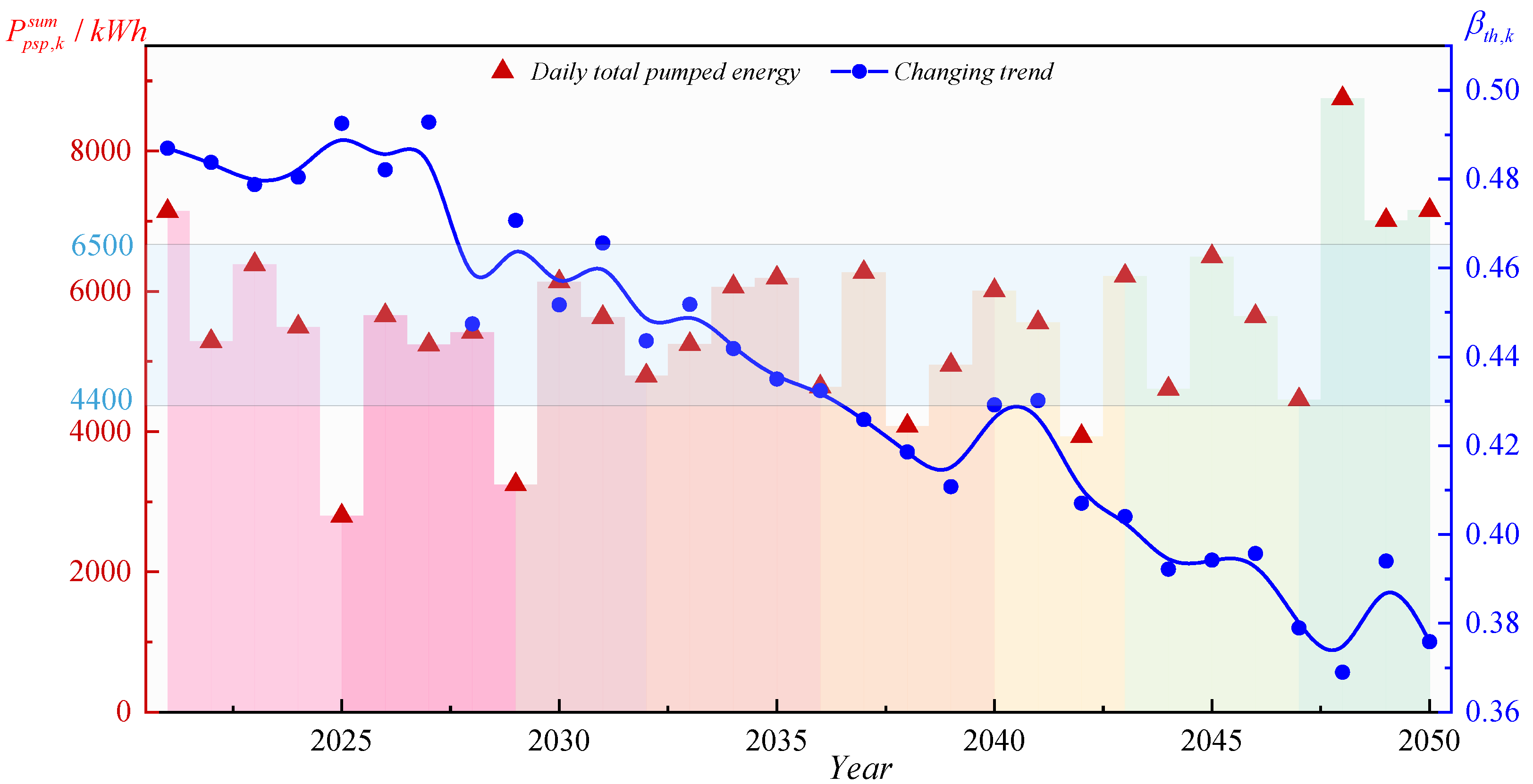
4.2.3. CER of the System
4.3. Carbon Emission Reduction Value Assessment
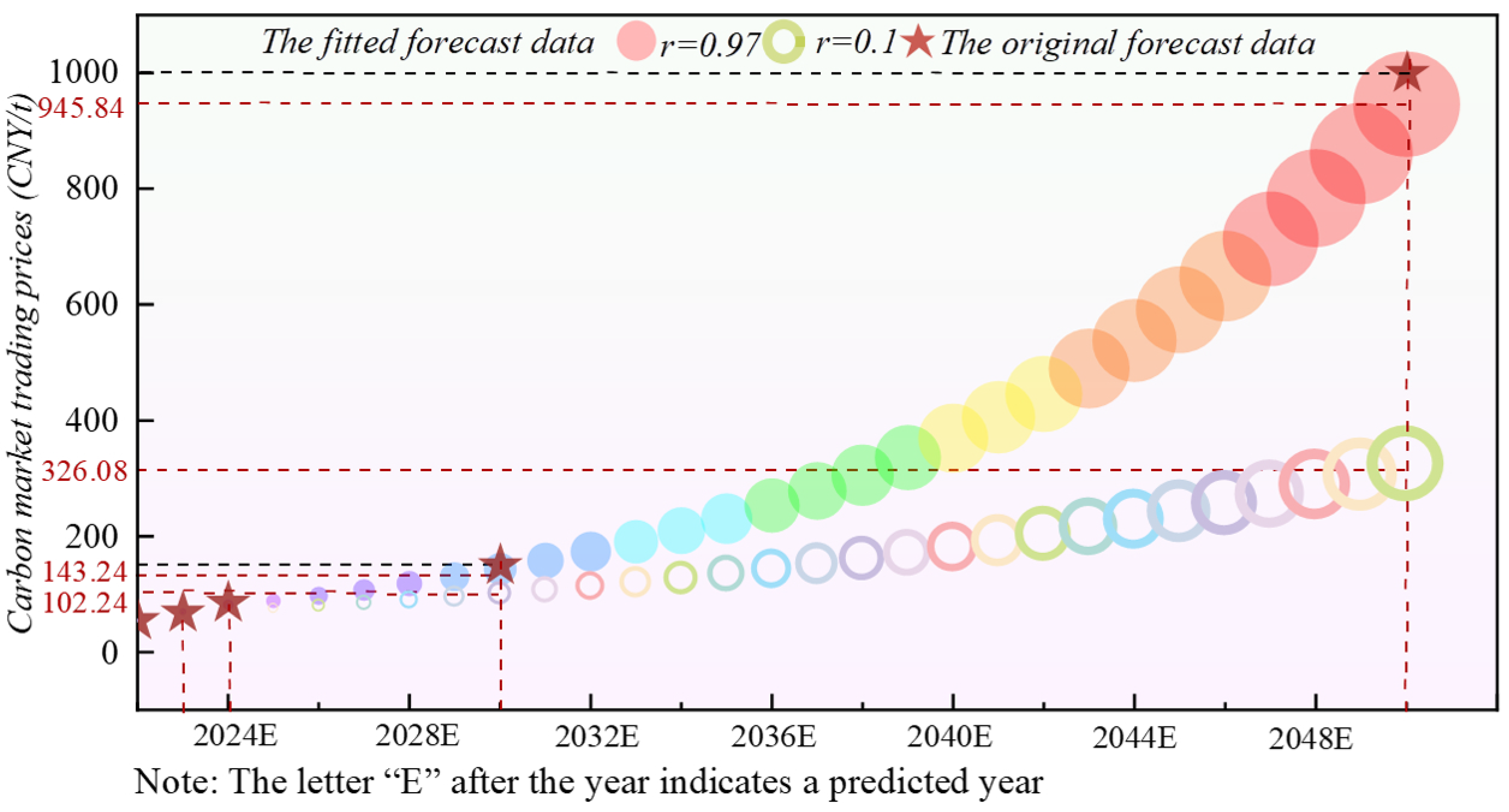
4.3.1. Carbon Trading Price Forecasting
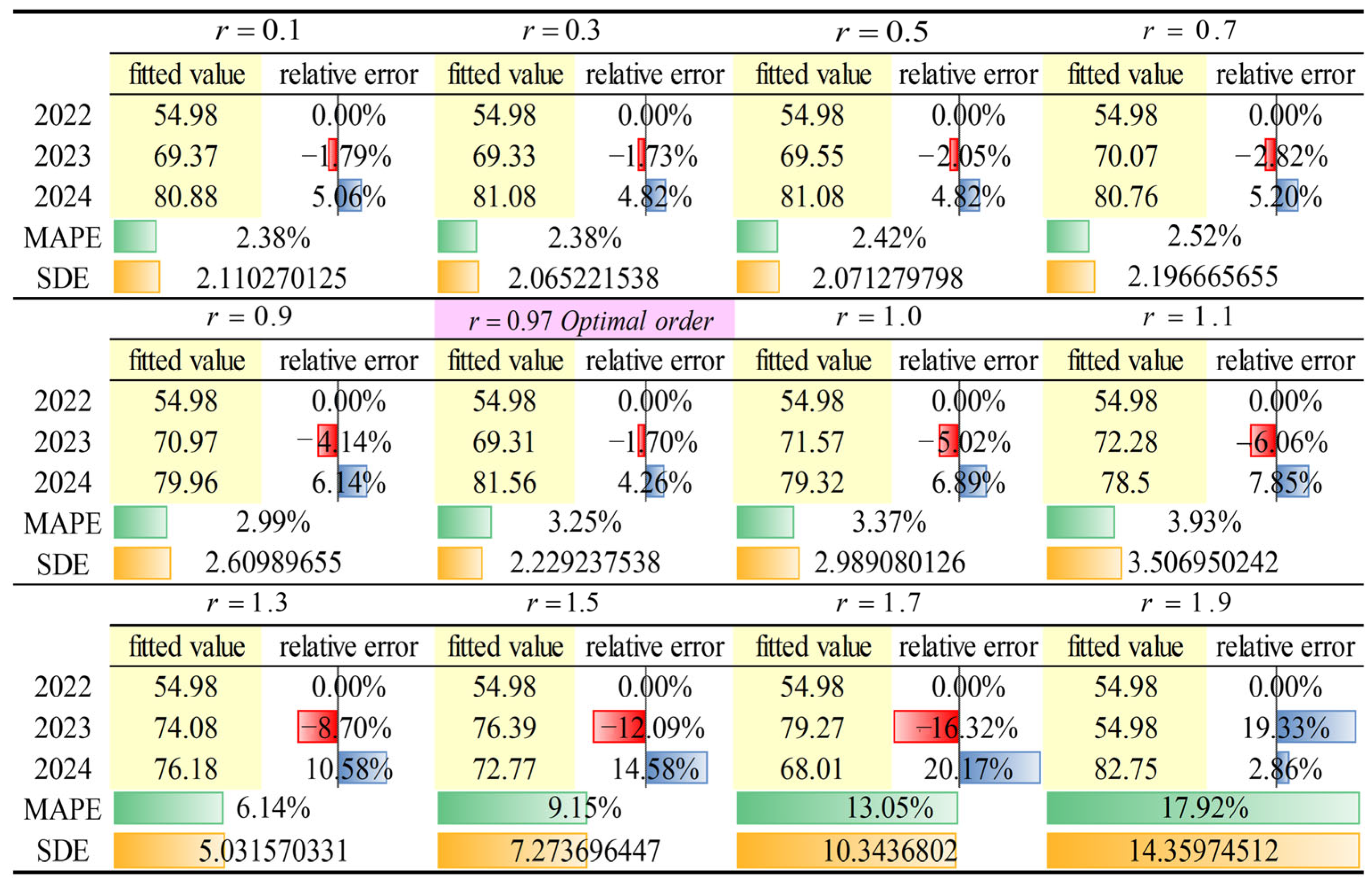
4.3.2. Prediction Accuracy Testing
4.3.3. Economic Benefits of CER
5. Conclusions
Author Contributions
Funding
Data Availability Statement
Conflicts of Interest
References
- Wang, Y.; Wang, R.; Tanaka, K.; Ciais, P.; Penuelas, J.; Balkanski, Y.; Sardans, J.; Hauglustaine, D.; Liu, W.; Xing, X.; et al. Accelerating the energy transition towards photovoltaic and wind in China. Nature 2023, 619, 761–767. [Google Scholar] [CrossRef] [Scilit]
- Ren, Y.; Jin, K.; Gong, C.; Hu, J.; Liu, D.; Jing, X.; Zhang, K. Modelling and capacity allocation optimization of a combined pumped storage/wind/photovoltaic/hydrogen production system based on the consumption of surplus wind and photovoltaics and reduction of hydrogen production cost. Energy Convers. Manag. 2023, 296, 117662. [Google Scholar] [CrossRef] [Scilit]
- Sun, K.; Li, K.-J.; Pan, J.; Liu, Y.; Liu, Y. An optimal combined operation scheme for pumped storage and hybrid wind-photovoltaic complementary power generation system. Appl. Energy 2019, 242, 1155–1163. [Google Scholar] [CrossRef] [Scilit]
- Zhang, C.C.; Lin, B.Q. Impact of introducing Chinese certified emission reduction scheme to the carbon market: Promoting renewable energy. Renew. Energy 2024, 222, 119887. [Google Scholar] [CrossRef] [Scilit]
- Bastin, J.; Haribhaskaran, A.; Boopathi, K.; Krishnan, B.; Kumar, R.V.; Prasad, D.R. Wind characteristics of Tamil Nadu coast towards development of microgrid—A case study for simulation of small scale hybrid wind and solar energy system. Ocean Eng. 2023, 277, 114282. [Google Scholar] [CrossRef] [Scilit]
- Wei, X.; Zhao, R. Evaluation and spatial convergence of carbon emission reduction efficiency in China’s power industry: Based on a three-stage DEA model with game cross-efficiency. Sci. Total Environ. 2024, 906, 167851. [Google Scholar] [CrossRef] [Scilit]
- Wang, Y.; Chi, P.; Nie, R.; Ma, X.; Wu, W.; Guo, B. Self-adaptive discrete grey model based on a novel fractional order reverse accumulation sequence and its application in forecasting clean energy power generation in China. Energy 2022, 253, 124093. [Google Scholar] [CrossRef] [Scilit]
- Min, W.K.; Gyeong, M.K.; Chung, H.J. Low-carbon fuel reburning for CO2 and NOx reduction in pulverized coal firing system. J. Energy Inst. 2024, 114, 101638. [Google Scholar] [CrossRef] [Scilit]
- Wang, R.; Wen, X.; Wang, X.; Fu, Y.; Zhang, Y. Low carbon optimal operation of integrated energy system based on carbon capture technology, LCA carbon emissions and ladder-type carbon trading. Appl. Energy 2022, 311, 118664. [Google Scholar] [CrossRef] [Scilit]
- Terkes, M.; Öztürk, Z.; Demirci, A.; Tercan, S.M. Optimal sizing and feasibility analysis of second-life battery energy storage systems for community microgrids considering carbon reduction. J. Clean. Prod. 2023, 421, 138507. [Google Scholar] [CrossRef] [Scilit]
- Kapila, S.; Oni, A.O.; Gemechu, E.D.; Kumar, A. Development of net energy ratios and life cycle greenhouse gas emissions of large-scale mechanical energy storage systems. Energy 2019, 170, 592–603. [Google Scholar] [CrossRef] [Scilit]
- Liu, D.; Luo, Z.; Qin, J.; Wang, H.; Wang, G.; Li, Z.; Zhao, W.; Shen, X. Low-carbon dispatch of multi-district integrated energy systems considering carbon emission trading and green certificate trading. Renew. Energy 2023, 218, 119312. [Google Scholar] [CrossRef] [Scilit]
- Zhou, X.; Ma, Y.; Wang, H.; Li, Y.; Yu, J.; Yang, J. Optimal scheduling of integrated energy system for low carbon considering combined weights. Energy Rep. 2022, 8, 527–535. [Google Scholar] [CrossRef] [Scilit]
- Mago, P.J.; Luck, R. Potential reduction of carbon dioxide emissions from the use of electric energy storage on a power generation unit/organic Rankine system. Energy Convers. Manag. 2017, 133, 67–75. [Google Scholar] [CrossRef] [Scilit]
- Hu, J.; Wang, Y.; Dong, L. Low carbon-oriented planning of shared energy storage station for multiple integrated energy systems considering energy-carbon flow and carbon emission reduction. Energy 2024, 290, 130139. [Google Scholar] [CrossRef] [Scilit]
- Li, J.; Zhao, Z.; Xu, D.; Li, P.; Liu, Y.; Mahmud, A.; Chen, D. The potential assessment of pump hydro energy storage to reduce renewable curtailment and CO2 emissions in Northwest China. Renew. Energy 2023, 212, 82–96. [Google Scholar] [CrossRef] [Scilit]
- Shang, J.; Xu, Q.; Yang, J.; Guo, M. Study on quantitative estimation method of energy saving and emission reduction of renewable energy system based on fuzzy matter-element method. Sustain. Energy Grids Netw. 2024, 38, 101223. [Google Scholar] [CrossRef] [Scilit]
- Wang, F.; Liao, G.; Su, C.; Wang, F.; Ma, J.; Yang, Y. Carbon emission reduction accounting method for a CCUS-EOR project. Pet. Explor. Dev. 2023, 50, 989–1000. [Google Scholar] [CrossRef] [Scilit]
- Hameed, G.; Nair, P.N.S.B.; Tan, R.R.; Foo, D.C.; Short, M. A novel mathematical model to incorporate carbon trading and other emission reduction techniques within energy planning models. Sustain. Prod. Consum. 2023, 40, 571–589. [Google Scholar] [CrossRef] [Scilit]
- Li, L.; Ye, F.; Li, Y.; Chang, C.-T. How will the Chinese Certified Emission Reduction scheme save cost for the national carbon trading system? J. Environ. Manag. 2019, 244, 99–109. [Google Scholar] [CrossRef] [Scilit]
- He, Y.; Jiang, R.; Liao, N. How to promote the Chinese Certified Emission Reduction scheme in the carbon market? A study based on tripartite evolutionary game model. Energy 2023, 285, 128723. [Google Scholar] [CrossRef] [Scilit]
- Lo, A.Y.; Cong, R. After CDM: Domestic carbon offsetting in China. J. Clean. Prod. 2017, 141, 1391–1399. [Google Scholar] [CrossRef] [Scilit]
- Yang, P.; Yu, L.; Wang, X.; Zheng, P.; Lv, X.; Yue, J. Multi-objective planning and optimization of microgrid lithium iron phosphate battery energy storage system consider power supply status and CCER transactions. Int. J. Hydrogen Energy 2022, 47, 29925–29944. [Google Scholar] [CrossRef] [Scilit]
- Zhao, B.Y.; Sun, L.C.; Qin, L. Optimization of China’s provincial carbon emission transfer structure under the dual constraints of economic development and emission reduction goals. Environ. Sci. Pollut. Res. 2022, 29, 50335–50351. [Google Scholar] [CrossRef] [Scilit]
- Li, K.; Qi, S.Z.; Yan, Y.X.; Zhang, X.-L. China’s ETS pilots: Program design, industry risk, and long-term investment. Adv. Clim. Change Res. 2022, 13, 82–96. [Google Scholar] [CrossRef] [Scilit]
- Xu, S.Q.; Xu, Q. Optimal pricing decision of tradable green certificate for renewable energy power based on carbon-electricity coupling. J. Clean. Prod. 2023, 410, 137111. [Google Scholar] [CrossRef] [Scilit]
- Xu, S.M.; Zhang, G.; Wang, F.; Pu, L. Carbon Emission Reduction Calculation Method for Pumped Storage Based on CCER Rules. Electr. Power 2024, 57, 175–182. [Google Scholar]
- Xu, Y.Z.; Liu, H.M.; Pan, F.Y.; Zhu, J.; Liang, Z.; Jing, T. Research on carbon emission reduction for pumped storage based on emission factor method. Power Demand Side Manag. 2023, 25, 48–54. [Google Scholar]
- Niu, X.; Wang, J.; Wei, D.; Zhang, L. A combined forecasting framework including point prediction and interval prediction for carbon emission trading prices. Renew. Energy 2022, 201, 46–59. [Google Scholar] [CrossRef] [Scilit]
- Cheng, M.; Xu, K.; Geng, G.; Liu, H.; Wang, H. Carbon price prediction based on advanced decomposition and long short-term memory hybrid model. J. Clean. Prod. 2024, 451, 142101. [Google Scholar] [CrossRef] [Scilit]
- Li, D.; Ren, X. Carbon price prediction based on LsOALEO feature selection and time-delay least angle regression. J. Clean. Prod. 2023, 416, 137853. [Google Scholar] [CrossRef] [Scilit]
- Yin, F.; Bo, Z.; Yu, L.; Wang, J. Prediction of carbon dioxide emissions in China using a novel grey model with multi-parameter combination optimization. J. Clean. Prod. 2023, 404, 136889. [Google Scholar] [CrossRef] [Scilit]
- Duan, H.; Jiang, X.; He, X.; Mou, Q.; Li, H. A novel multivariate grey model of energy consumption under carbon trading background and its application. Energy Rep. 2022, 8, 11952–11964. [Google Scholar] [CrossRef] [Scilit]
- Wang, H.; Zhang, Z. Forecasting Chinese provincial carbon emissions using a novel grey prediction model considering spatial correlation. Expert Syst. Appl. 2022, 209, 118261. [Google Scholar] [CrossRef] [Scilit]
- Wang, H.; Li, Y. A novel seasonal grey prediction model with fractional order accumulation for energy forecasting. Heliyon 2024, 10, e29960. [Google Scholar] [CrossRef] [Scilit]
- Ye, L.; Yang, D.; Dang, Y.; Wang, J. An enhanced multivariable dynamic time-delay discrete grey forecasting model for predicting China’s carbon emissions. Energy 2022, 249, 123681. [Google Scholar] [CrossRef] [Scilit]
- Gu, H.; Wu, L. Pulse fractional grey model application in forecasting global carbon emission. Appl. Energy 2024, 358, 122638. [Google Scholar] [CrossRef] [Scilit]
- Zhang, N.; Pang, J. The economic impacts of introducing CCER trading and offset mechanism into the national carbon market of China. Clim. Change Res. 2022, 18, 622–636. [Google Scholar]
- Yang, J.; Zhang, H.; Li, C.; Guo, P.; Ming, B. Quantifying the flexibility regulation potential and economic value of pumped storage in extreme scenarios of multi-energy complementary system. Energy 2025, 329, 136749. [Google Scholar] [CrossRef] [Scilit]
- China Southern Power Grid. The Current Status and Development of China’s Green Electricity, Green Certificates, and Carbon Market; China Southern Power Grid: Guangzhou, China, 2023; Available online: https://www.doc88.com/p-31599686449936.html (accessed on 11 August 2025).



| MAPE/% | <10 | 10~20 | 20~50 | >50 |
|---|---|---|---|---|
| Forecasting accuracy | Excellent | Good | Fair | Poor |
| Scenario | Peak Load Phase | Off-Peak Load Phase |
|---|---|---|
| Baseline scenario (No Pumped Storage) | - | |
| Actual scenario (With Pumped Storage) | - |
| Scenarios | Pumped Storage/MW | Wind/MW | Photovoltaic/MW | Thermal/MW |
|---|---|---|---|---|
| Actual scenario | 1200 | 3000 | 2800 | 7200 |
| Baseline scenario | 0 | 3000 | 2800 | 7200 |
| Representative Year | /kWh |
|---|---|
| 2021 | 3.34 × 10⁹ |
| 2025 | 2.20 × 10⁹ |
| 2030 | 2.37 × 10⁹ |
| 2035 | 2.00 × 10⁹ |
| 2040 | 1.41 × 10⁹ |
| 2045 | 1.94 × 10⁹ |
| 2050 | 3.01 × 10⁹ |
| Representative Year | /kWh |
|---|---|
| 2021 | 2.61 × 10⁹ |
| 2025 | 2.01 × 10⁸ |
| 2030 | 2.24 × 10⁹ |
| 2035 | 2.26 × 10⁹ |
| 2040 | 2.19 × 10⁹ |
| 2045 | 2.37 × 10⁹ |
| 2050 | 2.61 × 10⁹ |
| Representative Year | Price (CNY/t) | |
|---|---|---|
| 2022 | 54.98 | Annual average price |
| 2023 | 68.15 | |
| 2024 | 85.19 | June |
| 2030E | 150 | Predicted value |
| 2050E | 1000 |
| Representative Year | 2022 | 2023 | 2024 | 2025 | 2026 | 2027 | 2028 |
|---|---|---|---|---|---|---|---|
| carbon price (CNY/t) | 54.98 | 68.15 | 81.56 | 88.08 | 97.29 | 107.3 | 118.22 |
| CER (t) | 860,354 | 635,630 | 888,274 | 350,235 | 1,200,294 | 868,198 | 311,420 |
| Net cash flow (ten thousand CNY) | 3947 | 3493 | 6170 | 1809 | 10157 | 7502 | 1521 |
Disclaimer/Publisher’s Note: The statements, opinions and data contained in all publications are solely those of the individual author(s) and contributor(s) and not of MDPI and/or the editor(s). MDPI and/or the editor(s) disclaim responsibility for any injury to people or property resulting from any ideas, methods, instructions or products referred to in the content. |
© 2026 by the authors. Licensee MDPI, Basel, Switzerland. This article is an open access article distributed under the terms and conditions of the Creative Commons Attribution (CC BY) license.
Share and Cite
Wu, J.; Chai, J.; Qin, Y.; Yang, S. Lifecycle Carbon Reduction Potential and Economic Valuation of Pumped Storage in a Multi-Energy Complementary System. Energies 2026, 19, 2713. https://doi.org/10.3390/en19112713
Wu J, Chai J, Qin Y, Yang S. Lifecycle Carbon Reduction Potential and Economic Valuation of Pumped Storage in a Multi-Energy Complementary System. Energies. 2026; 19(11):2713. https://doi.org/10.3390/en19112713
Chicago/Turabian StyleWu, Jiangjiang, Junrui Chai, Yuan Qin, and Shun Yang. 2026. "Lifecycle Carbon Reduction Potential and Economic Valuation of Pumped Storage in a Multi-Energy Complementary System" Energies 19, no. 11: 2713. https://doi.org/10.3390/en19112713
APA StyleWu, J., Chai, J., Qin, Y., & Yang, S. (2026). Lifecycle Carbon Reduction Potential and Economic Valuation of Pumped Storage in a Multi-Energy Complementary System. Energies, 19(11), 2713. https://doi.org/10.3390/en19112713