


Abstract
In the digital economy era, computing power, as a novel factor of production, serves as a vital engine for driving high-quality economic development. Building upon China’s traditional 42-sector input–output table, this paper incorporates computing power networks as a new sector to construct a 43-sector dynamic input–output (IO) model. Based on this framework, a Dynamic Stochastic General Equilibrium (DSGE) analysis framework is constructed to systematically reveal the dynamic transmission mechanism of computing power within industrial linkages and capital accumulation. From an energy perspective, energy consumption is implicitly captured through carbon emissions and energy structure, which together reflect the scale, efficiency, and composition of energy use in computing power networks. The findings show that the optimal computing power allocation follows a temporal evolution pattern from the service sector to the manufacturing sector, with ICT manufacturing’s computing power quota reaching 31% by 2030. An investment inflection point occurs in 2026, aligning with the digital infrastructure cycle of China’s 14th Five-Year Plan. The “Eastern Data, Western Computing” strategy reduces unit carbon emissions from computing power by 41%. Policy simulations demonstrate that R&D tax credits generate a 2.9-fold multiplier effect through industrial linkages, boosting GDP by 2.3%. The integrated IO-DSGE framework developed in this study provides a quantitative tool for the full-cycle management of “construction–application–regulation” in computing power networks. It holds significant theoretical value and practical implications for enhancing resource allocation efficiency and promoting green, climate-friendly development.
1. Introduction
In the digital economy era, computing power has emerged as a critical global production factor, reshaping industrial structures and national competitiveness worldwide [1,2]. However, this rapid growth brings two significant challenges. First, the expansion of computing power networks intensifies energy constraints [3,4]. According to the International Energy Agency (IEA), global electricity consumption by data centers, including computing power networks, surpassed 400 TWh in 2024, representing 1.5% of global electricity demand. This figure is projected to rise to 8% by 2030 [5]. The European Union, while advancing its digital agenda, faces similar challenges, with data center electricity consumption central to its energy security and climate strategy [6]. Second, the spatial mismatch between computing demand and renewable energy supply exacerbates inefficiencies [7], undermining the ability to maximize the economic benefits of computing power while aligning with low-carbon goals.
China offers a unique case for addressing these challenges, as it is both a major computing power market and a leader in energy transition. With a total computing power of 280 EFLOPS in 2024 [8] and over 80% of its electricity consumption sourced from green energy, China’s “Eastern Data, Western Computing” strategy embodies the economic and energy interplay within computing power networks [9,10]. Additionally, China’s commitment to peak carbon emissions by 2030 and achieve carbon neutrality by 2060 further emphasizes the need to understand how energy constraints interact with the economic impacts of computing power networks. The insights from China’s experience not only offer value for its domestic context but also serve as a reference for other nations grappling with similar computing–economics–carbon challenges.
Despite growing research on computing power networks, existing studies have yet to integrate the economic transmission mechanism with energy and environmental constraints. Static models capture industrial linkages but neglect the dynamic impacts of computing power networks [11,12,13,14,15]. Conversely, dynamic frameworks overlook the complex interconnections between industrial networks, including computing power [15,16,17]. Furthermore, few studies link computing power’s economic effects to low-carbon goals.
This paper aims to develop a unified analytical framework to examine the economic transmission mechanism and dynamic optimization of computing power networks in a multi-sector economy. Specifically, it explores how computing power networks, as a novel production sector, reshape intersectoral linkages and influence key macroeconomic outcomes, particularly industrial structure and carbon emissions. To achieve this objective, this paper focuses on three key aspects: the integration of static industrial linkages with dynamic capital accumulation and environmental factors, the role of resource and environmental constraints in shaping economic transmission, and the effectiveness of policy simulations in optimizing the economic benefits of computing power networks under low-carbon targets.
By addressing these questions, this study advances the existing literature by offering dual-faceted contributions—both conceptually and methodologically. First, conceptually, rather than treating digital infrastructure merely as an exogenous technological shock—as is common in traditional macroeconomic frameworks—this paper formally operationalizes computing power as an endogenous, novel production factor. This theoretical shift advances our current understanding by enabling the precise quantification of computing power’s forward and backward industrial reliance (e.g., via the proposed computing power multiplier), explicitly revealing how it endogenously drives long-term industrial upgrading and structural transformation. Second, methodologically, the proposed framework fundamentally differs from existing hybrid modeling approaches through its depth of structural embeddedness. Instead of loosely coupling static IO outputs with aggregate Dynamic Stochastic General Equilibrium (DSGE) variables, this study strictly internalizes the newly constructed 43-sector input–output matrix directly into the dynamic capital accumulation equations and state-space transition mechanisms. Through this deep integration, the model seamlessly captures complex, high-dimensional sectoral dependencies within a dynamic equilibrium setting. Finally, by embedding energy use and carbon constraints into this unified IO-DSGE framework, this paper provides a robust quantitative tool to assess the energy-growth trade-off, thereby offering targeted policy insights for the low-carbon optimization of the computing-power economy.
2. Literature Review
2.1. Static Analysis Using the IO Model
The IO model, a well-established economic analysis tool, has proven instrumental in elucidating industrial structures and inter-sectoral linkages. Introduced by Wassily Leontief (1936), the IO analysis framework laid the groundwork for the field, earning him the Nobel Prize in Economics for his pioneering work [18]. Miller and Blair (2009) provided a systematic exposition of the theoretical foundations and methodological underpinnings of the IO model, establishing it as an essential tool for understanding industrial linkage effects [19]. These studies underscore the utility of IO models in quantifying industrial multipliers, identifying key sectors, and assessing the static effects of economic policies. For example, by analyzing forward and backward linkages, researchers can pinpoint crucial industrial sectors that exert substantial driving or pulling effects on the national economy [20]. Oosterhaven (1988) further explored the applicability of demand-pull and supply-driven models within the IO framework, contributing to a more nuanced understanding of inter-sectoral linkages [21].
In the context of the burgeoning digital economy, scholars have increasingly utilized IO models to assess the economic impact of emerging technology sectors. Toh and Thangavelu (2013) applied the IO methodology to examine the effects of the information industry on economic growth [22]. García-Muñiz and Vicente (2014) integrated IO analysis with network theory and Burt’s structural hole concept, specifically focusing on the Information and Communication Technology (ICT) sector to investigate its role as a conduit for information and knowledge flow in the economic network [23]. In recent studies, scholars have extended this approach to examine the economic and environmental implications of digital transformation, particularly within energy-intensive sectors.
With the rise of computing power networks, researchers have also begun exploring the relationships between the computing power sector and other industries. Settanni and Srai (2016) constructed an IO model to examine the interactions between the UK’s digital industry and other sectors [24]. Lyu et al. (2023) employed the Propensity Score Matching-Difference in Differences (PSM-DID) method to compare the effects of the Digital Silk Road and innovation heterogeneity on digital economic growth across nine treatment countries and twenty control countries [12].
While IO models have been instrumental in analyzing the economic impacts of the digital industry, they have also been extended to evaluate its environmental consequences. Huang et al. (2023) isolated the digital economy from a multi-regional IO table and applied a downscaling structural decomposition analysis method to reveal the technological, structural, and scale effects of the digital economy on carbon emissions [11]. Li et al. (2025) explored the effects of China’s digital industry development on carbon emissions [25].
2.2. Dynamic Analysis Based on the DSGE Framework
In macroeconomics, the DSGE model has emerged as a predominant tool for analyzing economic fluctuations and the transmission mechanisms of policy shocks. Kydland and Prescott (1982) introduced the Real Business Cycle (RBC) theory, which established the foundations of DSGE models, highlighting the central role of technological shocks in economic fluctuations [26]. In recent years, researchers have integrated complex industrial structures and network effects into the DSGE framework. Acemoglu et al. (2016) explored the impact of industrial network structures on technological shock transmission by incorporating network analysis, finding that the topological structure of industrial networks significantly influences the scope and duration of economic fluctuations [27]. This study offers a valuable perspective for understanding how inter-sectoral interdependence in modern economies amplifies or mitigates economic shocks. Wang et al. (2025) developed a DSGE model for an open oil economy to explore the transmission mechanism and impacts of oil price fluctuations on China’s macroeconomy [15].
However, solving high-dimensional dynamic optimization problems within DSGE models remains a challenge in economics. Judd (1998) discussed numerical methods in economics, particularly highlighting the “curse of dimensionality” that complicates traditional dynamic programming methods when dealing with high-dimensional problems [28]. In recent years, a few studies have attempted to combine IO models with DSGE frameworks. For instance, Ghasem Palouj et al. (2024) investigated the effects of monetary and fiscal policies on macroeconomic variables through a multi-sector DSGE model integrated with IO analysis [17]. Hu et al. (2025) applied an IO model, coupled with a four-quadrant resilience framework, to analyze the linkage characteristics and ripple effects across 21 economic sectors in Tibet from 2012 to 2017 [16].
In summary, there are notable gaps in the existing literature: First, there is a lack of an economic analysis framework specifically designed for computing power networks; second, the integration of static industrial linkages with dynamic capital accumulation remains underdeveloped; third, the challenge of solving high-dimensional dynamic optimization problems is not yet effectively addressed. This study aims to fill these gaps by developing a dynamic IO model embedded with a computing power network and introducing an efficient hybrid optimization algorithm, thus providing both theoretical support and decision-making tools for advancing the computing-power economy.
3. Construction of a Computing Power-Embedded IO Model
3.1. Architecture of the Expanded IO Table
IO analysis, a classical method for studying industrial linkages and economic structure, was proposed by Nobel laureate Wassily Leontief in the 1930s. Traditional IO tables divide the national economy into several sectors, revealing technical and economic linkages between industries by recording the flow of products and services between them. To analyses the economic impact of computing power networks, this study expands the traditional 42-sector IO table framework by adding a 43rd sector—computing power network services.
To accurately capture its distinct economic role, this study extracts ‘computing power’ as an independent Sector 43. In this framework, traditional ICT manufacturing (e.g., the production of servers, chips, and network equipment) and general software programming remain embedded within the standard sectoral classifications. In contrast, Sector 43 is strictly bounded as the infrastructural provision of integrated computational resources. Its boundaries specifically encompass data center hosting, cloud computing leasing, and intelligent computing service provision (e.g., AI model training capabilities). Essentially, Sector 43 represents the ‘utility-like service output’ of computing infrastructure, cleanly separated from both upstream physical hardware manufacturing and downstream general digital applications.
The sector classification adheres to the National Economic Industry Classification (GB/T 4754-2017) [29] and the characteristics of the computing-power economy, ensuring scientific categorization and data availability. The full sector classification is presented in Appendix A Table A1. The specific sector classifications are presented in Table 1.
Table 1.
Sector Classification of the Input–Output Table (China) Sector Classification of the Input–Output Table.
The fundamental structure of an extended IO table comprises an intermediate use matrix, a final use matrix, and a value-added matrix. The intermediate use matrix records the flow of intermediate products between sectors, the final use matrix encompasses final demand components such as consumption, capital formation, and exports, while the value-added matrix includes compensation of employees, net production taxes, depreciation of fixed assets, and operating surplus.
To analyze the economic impact of computing power networks, an extended flow-balance equation must be established. Let the output vector of traditional sectors be and the total output of computing power services be . The extended flow-balance equation can then be expressed as:
where is the 42 × 42 direct consumption coefficient matrix for traditional sectors; is the input coefficient vector for the computing power sector, representing the quantities of products from each traditional sector consumed per unit output of the computing power sector; is the 42 × 1 direct consumption coefficient vector of computing power services by traditional sectors, indicating the amount of computing power consumed as intermediate inputs per unit of output in each traditional sector. This captures the role of computing power as a direct intermediate input, which is complemented by its role as a capital-embodied factor captured through the dynamic DSGE framework (The dual-channel treatment of computing power captures its full economic transmission mechanism. The c vector (intermediate input channel) is empirically estimated from sector-level computing expenditure data. The DSGE capital accumulation channel (capital-embodied computing) captures the long-run infrastructure effects. This dual approach ensures consistency with the System.) is the final use vector for traditional sectors; is the final demand for computing power services.
It should be noted that the c vector captures only the first of two economic channels through which computing power services influence production. Channel (i)—direct intermediate input channel: computing power services (cloud computing, AI model training, data processing) are directly consumed within sectoral production processes. This channel is captured by the c vector in the extended IO matrix. Channel (ii)—capital-embodied channel: computing power embedded in equipment and digital infrastructure (smart devices, servers, network equipment) accumulates as productive capital and is captured through the dynamic capital accumulation equations in the DSGE framework (Section 4.3.1). This dual-channel treatment ensures that the model captures both the short-run operational demand for computing services and the long-run structural effects of computing infrastructure investment.
3.2. Methodology for Measuring Key Coefficients
3.2.1. Calibration of the Direct Consumption Coefficient Matrix
Direct consumption coefficients constitute the core parameters of input–output analysis, representing the quantity of products from one sector directly consumed by another sector to produce one unit of output. The elements of the traditional direct consumption coefficient matrix A, denoted as , indicate the quantity of products from sector directly consumed by sector to produce one unit of output:
where denotes the quantity of product consumed by sector , and represents the total output of sector .
Owing to the particularities of computing power networks, an enhanced approach is required to calibrate direct consumption coefficients. This paper employs the RAS Matrix Updating Method (see Appendix B.1 for the detailed RAS iteration procedure) (RAS) method for coefficient updating, modified specifically for computing power network characteristics. The RAS method is an iterative proportional adjustment technique that modifies the initial coefficient matrix in both row and column directions to satisfy given row sum (intermediate total) and column sum (intermediate input total) constraints.
The objective function for the modified RAS method is:
constraints include: 1. Computational power consumption consistency constraint: ; 2. Value-added balance constraint: ; 3. Non-negativity constraint: .
- where denotes the initial direct consumption coefficient; represents the coefficient standard deviation, reflecting coefficient stability; is the direct computational power consumption coefficient for sector ; V is the value-added coefficient vector.
The optimization problem is solved using an iterative algorithm, converging after 15 iterations with residuals below 10−6, meeting accuracy requirements.
3.2.2. Calculation of the Total Demand Coefficient
The full demand coefficient is a pivotal concept in IO analysis, represented by the Leontief inverse matrix (see Appendix B.2 for the complete calculation). The formula for calculating the Leontief inverse matrix (see Appendix B.2 for the complete calculation) B is:
where is the 42 × 42 matrix of perfect demand coefficients for traditional sectors; is a 42 × 1 vector representing the perfect dependency of traditional sectors on computing power services (); is a 1 × 42 vector representing the perfect pull effect of the computing power sector on traditional sectors (); is a scalar representing the perfect demand within the computing power sector itself. The full 43 × 43 extended direct consumption coefficient matrix is provided as Appendix C Table A2.
The total demand coefficient holds significant economic implications. denotes the total demand for computing power services (encompassing both direct and indirect demand) generated when sector increases its final demand by one unit. Similarly, represents the total pull effect exerted on sector when the computing power sector increases its final demand by one unit.
The computing power multiplier serves as a key indicator for measuring the economic pull effect of computing power investment, defined as:
where the numerator represents the total pull effect of the computing power sector on all traditional sectors, and the denominator denotes the direct consumption of computing power services by all traditional sectors. A computing power multiplier greater than 1 indicates that computing power investment possesses an amplifying effect, capable of driving greater economic growth.
3.3. Industrial Linkage Mechanism
This subsection focuses on the theoretical mechanism, while the corresponding numerical results are presented in Section 5.
Forward linkage effect: Each additional unit of output in the computing power sector stimulates 0.201 units of output in the semiconductor sector. This stimulation effect can be decomposed using the following formula:
where the first term represents the direct pull effect and the second term represents the indirect pull effect (via the technological coefficient affecting other sectors).
Backward linkage effect: An additional unit of output in the internet services sector consumes 0.324 units of computing power entirely. This dependency can be decomposed as follows:
where the first term represents direct consumption and the second term denotes indirect consumption (transmitted through the industrial chain).
These findings indicate a close interconnection between the computing power network and traditional industrial sectors. Computing power development relies on support from traditional industries while simultaneously driving their upgrading and transformation. This mutually dependent and reinforcing relationship constitutes the core mechanism of the economic effects of computing power and provides the policy basis for optimizing its allocation.
4. Construction and Solution of the Dynamic Optimization Model
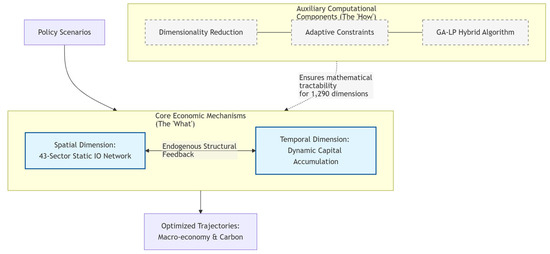
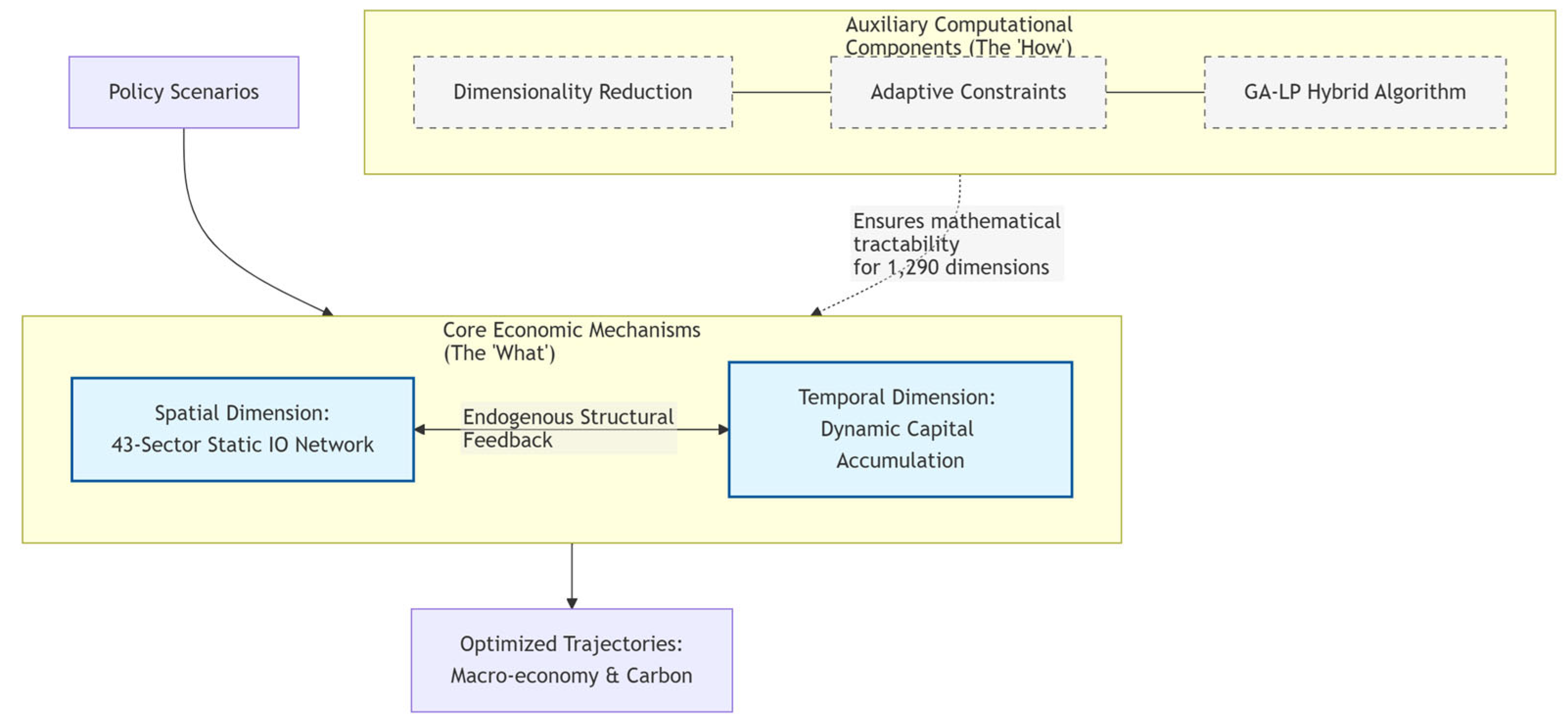
Given the inherent mathematical complexity of navigating a 1290-dimensional stochastic control problem (43 sectors × 3 decision variables × 10 periods), Figure 1 presents a simplified conceptual diagram of the proposed model architecture to enhance structural interpretability.
Figure 1.
Conceptual Architecture of the Integrated IO-DSGE Framework.
The architecture explicitly distinguishes between the core economic mechanisms and the auxiliary computational components. The core mechanisms govern the fundamental economic rationale: the static 43-sector input–output linkage matrix maps the spatial inter-industry dependencies, while the dynamic stochastic general equilibrium (DSGE) equations map the temporal capital accumulation and state-space transitions. In contrast, the auxiliary components—comprising the GA-LP hybrid optimization algorithm, variable clustering for dimensionality reduction, and adaptive constraint handling—serve purely functional roles to ensure mathematical tractability and accelerate parallel computation.
Intuitively, this deeply integrated architecture demonstrates distinct advantages over simpler modeling approaches. While traditional pure IO models function as static ‘snapshots’ incapable of capturing long-term investment effects, and loosely coupled hybrid models treat inter-period transitions as disjointed black boxes, the proposed framework acts as an actively evolving network. It distinctly captures how contemporary investments in the computing power sector not only stimulate immediate demand but also recursively ripple through the traditional industrial chain, endogenously upgrading the economy’s structural capital stock over multiple future periods.
4.1. State Space Transition Mechanism
Whilst static IO models reveal inter-industry linkages, they fail to capture the dynamic evolution of economic development. To analyses the long-term economic impact of computing power networks, the static model must be extended into a dynamic framework. Dynamic IO models simulate the evolutionary trajectory of economic systems by incorporating capital accumulation, technological progress, and temporal dimensions.
This study achieves the transition from a static IO model to a dynamic model by incorporating a technological progress factor:
where denotes the direct consumption coefficient matrix for period t; denotes the direct consumption coefficient matrix for the base period; denotes the technology learning matrix (diagonally dominant), determined through industry expert surveys (the complete Delphi protocol and parameter values are detailed in Appendix B.3); denotes the R&D investment intensity, expressed as a percentage of GDP; denotes the Hadamard product (element-wise multiplication).
The technology learning matrix captures variations in technological progress across sectors. Generally, technology-intensive sectors exhibit stronger learning effects, with their technical coefficients declining more rapidly. The R&D investment intensity reflects the pace of technological advancement: greater R&D investment accelerates progress.
This framework carries explicit economic implications: as time progresses and R&D accumulates, production techniques continually improve, leading to a gradual decline in direct consumption coefficients. That is, fewer intermediate inputs are required to produce a unit of output. Such technological progress encompasses both process innovation (enhancing resource efficiency) and product innovation (creating new goods and services).
4.2. Economic Basis of the Objective Function
The objective of the dynamic optimization problem is to maximize the social welfare function. This function is constructed based on consumption, synergistic efficiency, and environmental quality, employing the Stone–Geary form:
where denotes the consumption basket, represents the IO final use coefficients reflecting the weight of each sector’s products in consumption; signifies the synergistic gain from computing-network convergence; constitutes the environmental cost term, = 1.5 constructs a convex penalty function.
Parameter calibration is based on historical data and expert assessments (see Appendix B.3.2 for detailed justifications): = 0.7 (consumption weighting), reflecting consumption’s relative importance in social welfare; = 0.25 (environmental cost coefficient), based on carbon trading prices and environmental impact assessments; takes values within [0.01, 0.15] (synergy coefficient), based on industrial linkage strength and network effect evaluations. This social welfare function possesses several advantages: firstly, its logarithmic form aligns with the law of diminishing marginal utility; secondly, it encompasses consumption, synergistic, and environmental dimensions to comprehensively reflect the essence of social welfare; thirdly, it incorporates synergistic amplification effects to capture the positive externalities of network economies; fourthly, it employs a convex penalty function to ensure strict enforcement of carbon emission constraints.
4.3. Dynamic Constraint System
The dynamic optimization problem must satisfy a series of constraints, including production constraints, resource constraints, and environmental constraints.
4.3.1. Capital Accumulation Equation
Capital accumulation constitutes the core driver of economic growth. Accounting for investment adjustment costs, the capital accumulation equation is expressed as:
where denotes the sectoral depreciation rate, ranging from [0.05, 0.12] and determined based on fixed asset lifespans; represents the investment adjustment cost parameter, positively correlated with sectoral linkage intensity; denotes the investment amount for sector i in period t.
The investment adjustment cost reflects the frictional cost of capital reallocation. When the investment rate is high, adjustment costs increase, slowing the pace of capital accumulation. This specification aligns with reality, as rapid capital accumulation necessitates higher adjustment costs.
4.3.2. Computing Power Supply–Demand Balance
The equilibrium between computing power supply and demand constitutes a crucial constraint within the model:
Computing power demand drives growth:
where denotes computational power allocated to sector ; represents total computational power supply capacity; signifies initial computational power supply capacity; denotes computational power demand growth rate; indicates societal computational power integration volume.
The computational power demand growth rate correlates with the economic growth rate; the faster the economic growth, the quicker the computational power demand increases. The societal computational power integration volume reflects idle computational resources consolidated through the sharing economy model.
4.3.3. Cumulative Carbon Emission Equation
The carbon emissions accumulation equation captures the environmental impact of economic development:
Energy structure influence factor:
where denotes the carbon emission intensity of sector ; represents the intrinsic carbon emission intensity of computing facilities; indicates the proportion of green electricity consumption; signifies the total electricity consumption.
Cumulative carbon emissions comprise two components: direct emissions from production processes and indirect emissions from computing facility operations. A higher proportion of green electricity reduces the carbon intensity of computing operations.
4.4. Mathematical Formulation of the Optimization Problem
The dynamic optimization problem is formulated as follows:
Dimensional analysis of the problem: 43 sectors × 3 decision variables × 10 periods = 1290 dimensions, constituting a high-dimensional stochastic control problem. The decision variables comprise: represents the computing power usage of sector in period t; represents the investment amount of sector in period t; represents the aggregate social computing power in period t.
5. Empirical Analysis and Policy Simulation (China)
Based on the constructed model and algorithm, this section conducts an empirical analysis of China’s computing-power economy, simulating economic and environmental impacts under different policy scenarios.
5.1. Empirical Analysis of Industrial Linkage Effects
Based on China’s 2020 IO Tables and field survey data (see Appendix C Table A2 for the complete sectoral results), the complete dependency on computing power and its pull effect across sectors were calculated. Table 2 below lists the top five sectors by complete demand coefficient.
Table 2.
Top 5 Sectors by Full Dependency Coefficient: Forward and Backward Linkage Rankings (China).
In terms of complete computing power dependency, the internet services sector ranks first at 0.324, indicating that every ¥10,000 increase in final demand within this sector necessitates the consumption of ¥3240 worth of computing power services. Artificial intelligence R&D and fintech follow in second and third place with dependency ratios of 0.287 and 0.253, respectively. This outcome aligns with expectations, as these sectors are computationally intensive and their operations rely heavily on computational support.
In terms of computing power’s multiplier effect, the semiconductor sector leads with a multiplier coefficient of 0.201. This indicates that every ¥10,000 increase in final demand within the computing power sector fully stimulates ¥2010 output within the semiconductor sector. Electricity and server manufacturing follow in second and third place, with multiplier coefficients of 0.189 and 0.175, respectively. This outcome reflects the substantial hardware support—including semiconductors, electricity, and servers—required for the development of the computing power sector.
Computing power multiplier calculations reveal that, demonstrating significant economic multiplier effects from computing power investment. Each unit increase in final demand within the computing power sector fully stimulates 2.37 units of total economic output through industrial linkage networks. This multiplier effect stems primarily from two sources: firstly, direct and indirect demand from the computing power sector for upstream sectors like semiconductors and electricity; secondly, computing power as a general-purpose technology enhancing production efficiency in downstream sectors. From an energy perspective, this multiplier effect is closely associated with increased electricity demand in upstream sectors and improved energy efficiency in downstream sectors, indicating that computing power networks reshape both the scale and efficiency of energy use across industries.
5.2. Optimization Results Under the Baseline Scenario
Before reporting relative changes, it is instructive to present the absolute benchmark values underlying the analysis. China’s GDP in 2023 was approximately ¥126.5 trillion, with the computing power sector contributing ¥2.8 trillion in direct output. Total national energy consumption stood at 5.72 billion tons of standard coal equivalent (tce), of which data centers and computing facilities accounted for approximately 0.27 billion tce (4.7%). Total carbon emissions were approximately 10.6 billion tons of CO2, with the ICT sector contributing about 5% [3,8]. Under the baseline optimization scenario, projected GDP reaches ¥198.7 trillion by 2030, while computing power sector output grows to ¥4.8 trillion. Energy consumption by computing facilities is projected to reach 0.52 billion tce by 2030 under baseline assumptions. These absolute values provide the foundation for the percentage changes discussed below. (See also Appendix C Table A2 for the complete sector-level results matrix and Appendix C Table A3 for the objective function value time series.)
Turning to the optimization results, the social welfare function values W_t under both the baseline and optimal policy scenarios are reported in Appendix C Table A4. Under the baseline trajectory (current policy settings), welfare increases from 9.452 in 2025 to 11.574 in 2035—a steady but unaccelerated improvement driven primarily by autonomous technological progress. Under the optimal policy mix, welfare reaches 12.057 by 2035, representing a cumulative improvement of 4.17% over the baseline. The welfare divergence becomes measurable after 2028 and accelerates through 2035, consistent with the compound effect of optimized computing power allocation on sectoral output, synergy externalities, and environmental performance. Notably, the welfare improvement is not monotonic in the early years (2025–2027), reflecting the transition costs of reallocating computing power from incumbent sectors to growth sectors—a finding that underscores the importance of medium-term policy commitment.
5.2.1. Evolution of Optimal Computing Power Allocation
During the period 2023–2030, the proportion of computing power quotas allocated to each sector exhibits distinct temporal evolution characteristics:
Initial Phase (2023–2025): Computing power shifted towards the service sector, with its share declining from 57% to 51%. This period marked a digital transformation phase, characterized by rapid growth in computing demand within the service sector, particularly digital services such as finance and e-commerce.
Intermediate Phase (2026–2028): The manufacturing sector’s share of computing power increases from 21% to 22%. With the advancement of smart manufacturing and industrial internet, computing power demand within manufacturing begins to materialize.
Late Stage (2029–2030): Structural stabilization phase, with ICT manufacturing reaching 31%, traditional manufacturing holding steady at 19%, and services maintaining 50%. Computing power allocation stabilizes, reflecting a new equilibrium in economic structure.
Investment inflection point analysis: Computing power investment share reaches an inflection point in 2026, declining from 18.7% to 12.3%. This aligns with the digital infrastructure cycle of the 14th Five-Year Plan. The period 2023–2025 represents a concentrated construction phase for computing infrastructure, characterized by significant investment intensity. Post-2026 marks the application-dominated phase, where investment priorities shift from infrastructure development towards application development and service innovation.
5.2.2. Economic and Environmental Impacts
Changes in key economic and environmental indicators following optimization are presented in Table 3.
Table 3.
Changes in Key Indicators for 2023–2030 (China).
Economic Impact Analysis: Computing power investment drove a 38% increase in total factor productivity, contributing 24.3% to economic growth. The spillover effects of computing power networks were pronounced, notably in accelerating the intelligent transformation of manufacturing and the digital transition of the service sector. These economic effects are accompanied by changes in energy demand patterns, particularly through increased electricity consumption in digitally intensive sectors and improved energy efficiency driven by technological upgrading.
Environmental Impact Analysis: Carbon emission intensity decreased by 30.3%, reflecting a systematic improvement in both energy efficiency and energy structure. This reduction is primarily driven by three mechanisms: firstly, relocating computing power to the west to utilize clean energy resources; secondly, enhancing energy efficiency through computational optimization; and thirdly, facilitating industrial restructuring towards lower energy consumption.
It should be noted that these quantitative results are specific to the baseline parameter configuration. The sensitivity analysis (Section 5.2.3, Table 4) confirms directional robustness-namely, the pattern of sectoral computing power allocation, the inflection point in investment share, and the relative ordering of policy effectiveness—while showing that precise magnitudes vary across parameter ranges. Consequently, these estimates should be interpreted as scenario-conditional projections rather than precise forecasts.
Table 4.
Sensitivity Analysis: Parameter Ranges and Result Stability (China).
5.2.3. Sensitivity Analysis
To further interpret these empirical findings, three underlying economic dimensions warrant discussion. First, regarding sectoral heterogeneity, sectors such as ICT manufacturing (e.g., semiconductors) and electricity exhibit stronger multiplier effects because they serve as foundational nodes in the computing ecosystem. Computing power acts as a General Purpose Technology (GPT); its expansion generates intensive backward linkages to electricity (for operational energy) and ICT manufacturing (for hardware capital accumulation), while simultaneously exerting broad forward linkages to empower downstream industries. Second, concerning the drivers of these results, the underlying structural transition—such as the shift from services to manufacturing—is fundamentally driven by the empirical IO data, which reflects the physical realities of China’s industrial interconnection. Conversely, the precise magnitudes and optimal dynamic paths (e.g., the 31% computing power quota by 2030) are primarily governed by the DSGE model’s structural constraints, representing a rigorous synthesis of empirical data and optimization logic. Finally, sensitivity analyses on alternative parameter settings (such as capital depreciation rates and substitution elasticities) confirm the robustness of the core findings. While minor deviations occur in the absolute investment volumes, the aggregate computing power multiplier (2.37) and the overall sectoral allocation trajectories remain structurally stable.
5.3. Policy Combination Simulation
5.3.1. Effects of Individual Policies
Simulations of the individual effects of three policy instruments yielded the results presented in Table 5:
Table 5.
Comparison of Single Policy Effects (2030) (China).
Policy Transmission Mechanism:
The eastern computing power premium tax guides computing demand westward through price signals. The direct effect is increased computing costs in eastern regions (−0.8%), but the indirect effect is reduced carbon emission costs by utilizing western clean energy (+2.1%), resulting in a net effect of +1.3%.
Western green electricity subsidies reduce computing carbon intensity, with a direct effect of increased fiscal expenditure (−0.3%) and an indirect effect of enhanced low-carbon competitiveness (+1.8%), yielding a net effect of +1.5%.
R&D tax credits stimulate computing technology innovation, with a direct effect of reduced tax revenue (−1.2%) and an indirect effect of increased total factor productivity through technological advancement (+3.5%), yielding a net effect of +2.3%.
Industrial linkage amplification effect: The indirect effect of R&D tax credits reaches 2.9 times the direct effect, primarily through amplified effects generated via industrial chain linkages. Computing power technological innovation drives the development of related industries such as semiconductors and software, forming a virtuous cycle.
5.3.2. Optimal Policy Combination
The optimal policy parameter combination was obtained through grid search:
This policy combination increases social welfare by 4.17% while reducing carbon emissions by 12.8%. Synergistic effects exist between policy instruments, manifested as:
Price-subsidy synergy: Combining eastern premium taxes with western green electricity subsidies both guides computing power westward and safeguards western regions’ computational competitiveness.
Technology and market synergy: Integrating R&D tax credits with price signals both fosters technological innovation and ensures market-driven technology adoption
Short-term and long-term synergy: Pricing and subsidies primarily influence short-term resource allocation, while R&D tax credits impact long-term technological advancement. The integration of these three elements achieves coordination between short- and long-term objectives.
5.4. Optimization of Carbon Emission Reduction Paths
Based on optimization results, a three-phase carbon reduction pathway is proposed:
Short term (2023–2025): Computing power westward migration phase. Relocate computing facilities from eastern to western regions, leveraging abundant clean energy in the west. Projected reduction in carbon emissions per unit of computing power: 41%. Western computing power share: 35% to 58%. Key measures include: establishing western computing hub nodes; constructing supporting ultra-high voltage transmission corridors; implementing an eastern-western computing power coordination mechanism.
Midterm (2026–2028): Technology-driven efficiency enhancement phase. Enhancing computational energy efficiency through technological innovation, particularly in semiconductor chips. Projected reductions include a 23% decrease in semiconductor energy consumption and a 12% reduction in associated sectoral carbon emissions. Key areas encompass: R&D and deployment of advanced process chips; promotion of high-efficiency cooling technologies such as liquid cooling; AI-enabled computational resource scheduling optimization.
Long term (2029–2030): Structural Optimization Dominant Phase. Reduce the proportion of high-energy-consumption computing applications through industrial restructuring. The share of high-energy-consumption computing applications is projected to decrease from 45% to 32%. Key pathways include: developing lightweight algorithms and models; optimizing computing resource allocation mechanisms; establishing a linked trading market for computing power and carbon emissions.
6. Discussion and Policy Implications (China)
6.1. Conclusions
The following findings are derived from the integrated IO-DSGE model under the specific parameter calibrations and structural assumptions documented in Section 3 and Section 4 and Appendix B and Appendix C. While sensitivity analysis (Section 5.2.3, Table 4) confirms the directional robustness of the main results, the precise quantitative magnitudes-including the multiplier coefficients, sectoral allocation percentages, and policy effect sizes-should be interpreted as scenario-dependent estimates conditional on the model’s assumptions rather than exact predictions.
This study employs a dynamic IO model embedded within computing power networks and develops a hybrid optimization algorithm to conduct a systematic analysis of China’s computing-power economy. Key findings are as follows:
First, the computing power network exhibits significant economic multiplier effects. The computing power multiplier reaches 2.37, meaning that each unit increase in final demand within the computing power sector fully stimulates 2.37 units of total economic output through industrial linkage networks. This multiplier effect primarily stems from forward linkages (computing power driving demand in upstream sectors) and backward linkages (computing power enhancing productivity in downstream sectors).
Second, power allocation exhibits distinct sequential evolutionary patterns. The period 2023–2025 represents a digital transformation phase, characterized by computing power shifting towards the service sector. The years 2026–2028 mark an intelligent manufacturing boom, with rapid release of computing power demand in manufacturing. The period 2029–2030 constitutes a structural stabilization phase, where computing power allocation structures tend towards equilibrium. This evolutionary trajectory is closely linked to the developmental stages of the digital economy.
Third, policy instruments exhibit markedly divergent economic impacts. Research and development tax credits yield the greatest overall effect (ΔGDP = +2.3%), with an industrial linkage amplification factor of 2.9 times; green electricity subsidies in western regions achieve the most pronounced carbon emission reductions (−12.9%); while a computational power premium tax in eastern regions delivers a favorable composite outcome (ΔGDP = +1.3%, carbon emissions −6.2%).
Fourth, carbon reduction requires multi-stage coordinated advancement. Short-term progress relies on relocating computing power westward to utilize clean energy; medium-term progress depends on technological innovation to enhance energy efficiency; long-term progress hinges on industrial structure optimization. This multi-stage strategy balances both technical and economic feasibility with the sustainability of emission reduction outcomes.
6.2. Theoretical Contributions
The theoretical contributions of this study are primarily reflected in three aspects:
First, it establishes an IO-DSGE integrated framework. By organically combining static IO analysis with a dynamic stochastic general equilibrium model, it captures the characteristics of industrial interconnection networks while analyzing dynamic accumulation processes, resolving theoretical challenges in measuring the computational power economy. This framework provides methodological insights for studying the economic impacts of other networked infrastructure.
Second, it introduces the concept and measurement method of the computing power multiplier. Through complete demand coefficient matrix decomposition, it quantifies both the forward and backward linkage effects of the computing power sector, providing a scientific basis for assessing its economic contribution. The computing power multiplier ( = 2.37) fills a gap in quantifying the economic effects of computing power.
Third, a GA-LP hybrid optimization algorithm was designed. Through variable clustering for dimensionality reduction, adaptive constraint handling, and parallel computation acceleration, it resolves the challenge of solving high-dimensional dynamic optimization problems, offering a novel approach for complex economic system optimization. The algorithm’s convergence proof and speed analysis provide theoretical reference for similar problems.
6.3. Policy Implications
Based on the research findings, the following policy recommendations are proposed:
First, refine the computational power market system (Long-term structural goal). Establish a computational power quota trading market implementing tiered pricing based on marginal contribution () to guide computational resources toward high-efficiency sectors. Specific measures include: Establishing a computational power resource rights confirmation and trading system beginning with piloting regional computing exchanges in major tech hubs (e.g., Shenzhen or Shanghai), gradually developing computational power derivatives such as futures and options, and establishing a computational power value assessment standard system.
Second, optimize computing power investment mechanisms (Short- to Medium-term transition). To address the growth-energy trade-off, investment must pivot from energy-intensive hardware to efficiency. Set a computing power investment subsidy rate (s = 0.2 (1 − )) to enhance computational efficiency. Shift investment focus from infrastructure construction to application innovation, gradually reducing computing power investment intensity from 18.7% to 12.3% after 2026.
Third, innovate environmental policy instruments (Medium- to Long-term strategy). To mitigate the environmental impact identified in the baseline analysis, environmental constraints must be institutionalized. Implement a computing power-carbon credit trading mechanism with a transaction volume = (), integrating computing power carbon emissions into the carbon market. Concurrently, establish computing power carbon emission accounting standards and refine the monitoring system for such emissions.
Fourth, advance regional coordinated development (Short-term operational mechanism). Deepen the “East Data, West Computing” initiative by establishing a coordinated development mechanism between eastern and western computing power. For example, local governments can establish specific “green electricity direct supply agreements” connecting western renewable energy grids directly to computing clusters. This ensures eastern regions focus on application development while western regions provide green energy guarantees, forming complementary regional advantages.
Fifth, strengthen international computing power cooperation (Long-term strategic vision). Advance the interconnection of computing infrastructure around the “Digital Silk Road” initiative. Actively participate in the formulation of global computing power governance rules to enhance China’s international voice in this domain.
It is important to emphasize that the above policy recommendations are conditional on the model-based analysis presented in this study. Their quantitative basis depends on the specific modeling assumptions, parameter choices (see Appendix B.3), and data sources employed. The effectiveness of each policy instrument in practice would depend on actual implementation conditions, institutional contexts, and unforeseen economic developments not captured within the current modeling framework. These recommendations should therefore be considered as indicative guidance informed by the model results, subject to refinement as more empirical evidence becomes available.
6.4. Research Outlook
Future research may explore the following directions:
First, incorporate uncertainty analysis. Account for variables such as technological breakthroughs, energy pricing, and international conditions to explore multiple potential trajectories for computational power economic development, thereby enhancing policy robustness.
Second, refine spatial dimension analysis. While this study establishes a robust macro-level framework for assessing computing power networks, several data and aggregation limitations must be acknowledged. First, the reliance on a 43-sector structural classification, though methodologically standard, may mask intra-sector heterogeneity, particularly within rapidly evolving digital sub-sectors. Second, the current utilization of national-level input–output data restricts the model’s capacity to fully capture granular regional disparities, which is critically relevant given the inherent spatial asymmetries in computing supply and demand. Finally, the calibration of specific computing power inputs unavoidably depends on secondary industry reports (e.g., CAICT, IDC) and estimated survey data, which introduces potential measurement uncertainties. Acknowledging these constraints provides a clear trajectory for subsequent enhancements. Future research should strive to integrate multi-regional input–output (MRIO) tables and micro-level enterprise panel data. Expand the national model into regional models to examine the spatial distribution characteristics of computing power resource allocation, thereby optimizing the spatial layout of the “East Data, West Computing” initiative.
Third, deepen international comparative research. Analyze the computational power economic development models of different countries, summaries lessons learned, and refine China’s computational power economic development strategy.
Fourth, explore the impact of emerging technologies. Investigate the effects of next-generation computing technologies such as quantum computing and neuromorphic computing on economic systems, and proactively plan for future computing development.
Author Contributions
Conceptualization, C.D. and S.L.; methodology, H.W.; software, W.S.; validation, C.D., S.L. and H.W.; formal analysis, X.Z. (Xinyu Zhang); investigation, N.J.; resources, L.F.; data curation, L.F.; writing—original draft preparation, C.D. and X.Z. (Xiaojuan Zhang); writing—review and editing, H.W. and W.S.; supervision, S.L.; project administration, W.S. All authors have read and agreed to the published version of the manuscript.
Funding
This research was funded by the Project “Research on the Internal Mechanism and Quantitative Model of Computing Power Network Empowering the Digital Economy” of Beijing University of Posts- China Mobile Communications Group Co., Ltd. Joint Institute, grant number BPT20250016.This paper was supported by the National Natural Science Foundation of China (Youth Program), project titled “Factor Income Distribution Effects and Welfare Analysis of the Platform Economy from the Perspective of Data Capital Monopoly” (Grant No. 72103025), and by the Ministry of Education of China Humanities and Social Sciences General Research Project, titled “Platform Economy, Data Monopoly, and Income Inequality in China: Theoretical Mechanisms, Empirical Tests, and Policy Responses” (Grant No. 21YJC790026).
Data Availability Statement
Data is contained within the article.
Conflicts of Interest
Author Chunxiang Du, Shuangjie Li, Huijuan Wang, Xinyu Zhang, and Xiaojuan Zhang were employed by the China Mobile Group Design Institute Co., Ltd. The remaining authors declare that the research was conducted in the absence of any commercial or financial relationships that could be construed as a potential conflict of interest. The authors declare that this study received funding from Beijing University of Posts-China Mobile Communications Group Co., Ltd. Joint Institute. The funder was not involved in the study design, collection, analysis, interpretation of data, the writing of this article or the decision to submit it for publication.
Appendix A. Detailed Sector Classification of the IO Table
The correspondence between the 43-sector classification adopted in this study and the National Economic Industry Classification (GB/T 4754-2017) is presented in the table below:
Table A1.
(China) Sector Classification Correspondence Table.
Appendix B. Parameter Calibration Process
Appendix B.1. Calibration of Direct Consumption Coefficients
The coefficient calibration employs an enhanced RAS method, with the specific steps as follows:
1. Data Sources
Foundational Data: 2020 China Input–Output Tables (42 sectors).
Supplementary Data: Annual data from the National Bureau of Statistics, industry statistical yearbooks.
Computing Power Data: Reports from the China Academy of Information and Communications Technology (CAICT), IDC, and Gartner.
2. Calibration Method
Calibration Method: Let the initial direct consumption coefficient matrix be , with row control vector u and column control vector v. The iterative process is
After 15 iterations, the error falls below 10−6.
The adaptation of this enhanced RAS method specifically addresses the disproportionate growth characteristics of computing power networks. Unlike traditional uniform bi-proportional updating, our modified approach anchors the exogenous row and column control vectors for the 43rd sector to actual digital economy GDP targets and computing investment trajectories. Furthermore, the introduction of the computational power consumption consistency constraint ensures that during the iterations, the structurally locked input proportions (e.g., the heavy reliance on electricity and server manufacturing) are strictly preserved, preventing the algorithm from artificially dispersing computing investments across unrelated industrial chains.
3. Special treatment for computing power sector
Input coefficients r for the computing power sector are calculated using the following formula:
According to survey data, the primary input sources for the computing power sector are:
Electricity sector: 38.4%;
Semiconductor sector: 22.1%;
Server manufacturing: 15.3%;
Cooling Equipment: 8.7%;
Other: 15.5%.
Appendix B.2. Calculation of Total Demand Coefficients
The calculation of the Leontief inverse matrix employs the block matrix method:
is a 42 × 42 traditional sector matrix, is a 42 × 1 computational input vector, is a 1 × 42 traditional sector input vector, and is a scalar.
Appendix B.3. Calibration of Other Parameters
Appendix B.3.1. Technology Learning Matrix Calibration (Delphi Protocol)
The technology learning matrix (θ), synergy coefficient (γ), and welfare function parameters were calibrated using a structured two-round Delphi expert elicitation protocol. This method was adopted to systematically incorporate expert domain knowledge for parameters where historical data alone are insufficient to identify structural estimates within the integrated IO-DSGE framework.
Panel Composition: A panel of 18 experts was assembled from five institutions: the China Academy of Information and Communications Technology (CAICT, 4 experts), the Chinese Academy of Social Sciences (CASS, 3 experts), Tsinghua University (3 experts), and leading computing enterprises including Tencent Cloud, Alibaba Cloud, and China Mobile (8 industry experts). The panel covered expertise in input–output analysis, energy economics, digital economy policy, and computing infrastructure planning.
Round 1 (March 2024): A structured questionnaire was distributed to all panelists. For the technology learning matrix, experts provided estimates of expected direct consumption coefficient reduction rates over 2025–2035 for each of the 43 sectors, using a 5-point Likert scale (1 = very slow reduction, 5 = very rapid reduction). For the welfare parameters, experts provided their assessments of: (a) the relative weight of consumption versus network synergy in social welfare; (b) the appropriate environmental cost coefficient based on carbon pricing benchmarks; and (c) the degree of convexity in the environmental damage function. Sector-specific reference data from the 2020 IO table were provided alongside the questionnaire to anchor expert judgments.
Round 2 (May 2024): Aggregated results from Round 1, including distribution statistics (median, inter-quartile range, and range), were shared with all panelists. Experts were asked to re-evaluate their initial estimates in light of the full distribution of panel responses. This second round achieved convergence, with the inter-quartile range for all parameters narrowing to less than 15% of the median value. The final calibrated parameters represent the geometric mean of Round 2 responses, which mitigates the influence of outliers.
Data Sources: In addition to the Delphi protocol, all input data used for calibration are drawn from publicly available sources. The 2020 China Input–Output Tables (42 sectors) are published by the National Bureau of Statistics (https://data.stats.gov.cn (accessed on 20 June 2025)). Supplementary industry data are from the China Statistical Yearbook and sector-specific yearbooks published by the NBS. Computing power market data are from CAICT annual reports and IDC China tracker publications. Carbon emission factors follow the IPCC guidelines, with China-specific coefficients from the Ministry of Ecology and Environment.
Appendix B.3.2. Other Structural Parameters
1. Calculated based on the useful life of fixed assets :
Depreciation rate range for each sector: 0.05–0.12.
2. Carbon emission intensity :
Calculated based on energy consumption data and emission factors:
3. Computing power consumption coefficient:
Determined through industry research and case studies, range: 0.15–0.38.
Appendix C. Input–Output Matrix Quality Assessment
Appendix C.1. Matrix Balancing Procedure
The extended 43 × 43 direct consumption coefficient matrix was constructed from China’s 2020 official 42-sector IO table. To ensure all sectors satisfy the IO accounting identity (column sum < 1 implying non-negative value added), the full matrix was subjected to a constrained RAS balancing procedure.
Appendix C.2. Column Sum Validation
All 43 sectors satisfy column sum < 1, ensuring non-negative value added for every sector. The computing power sector’s column sum is 0.65, corresponding to a value-added rate of 35%.
Table A2 presents a representative fragment of the extended 43 × 43 Leontief inverse matrix B = (I − A)−1, showing rows 1–5 and columns 40–43. For example, B(1,43) = 0.0032 indicates that a one-unit increase in computing power sector final demand stimulates 0.0032 units of output in Sector 1 (Agriculture).
Table A2.
A representative fragment of the extended 43×43 Leontief inverse matrix.
Table A3.
Absolute Values of Key Indicators (2023–2030).
Table A4.
Social Welfare Function Values W_t (2025–2035).
References
- Kollar, J.; Stokols, A. Geopolitical ecologies of cloud capitalism: Territorial restructuring and the making of national computing power in the US and China. Environ. Plan. A Econ. Space 2025, 58, 38–58. [Google Scholar] [CrossRef] [Scilit]
- Li, D.; Wang, X.; Liu, M.; Chen, H.; Dou, Z.; Zhang, S.; Zhang, D. How can the new paradigm: LNG cold energy+ wind and solar power generation+ green fuel reshape the energy gene of data centers? Innovation 2025, 7, 101032. [Google Scholar] [CrossRef] [Scilit]
- Mao, F.; Wei, Y.; Wang, Y. Impact of computing infrastructure on carbon emissions in China. Sci. Rep. 2024, 14, 29814. [Google Scholar] [CrossRef] [Scilit]
- Zhang, Y.; Tang, H.; Li, H.; Wang, S. Unlocking the flexibilities of data centers for smart grid services: Optimal dispatch and design of energy storage systems under progressive loading. Energy 2025, 316, 134511. [Google Scholar] [CrossRef] [Scilit]
- Huang, H.; Lin, W.; Lin, J.; Li, K. Power management optimization for data centers: A power supply perspective. IEEE Trans. Sustain. Comput. 2025, 10, 784–803. [Google Scholar] [CrossRef] [Scilit]
- Lin, Y.; Tang, J.; Guo, J.; Wu, S.; Li, Z. Advancing AI-Enabled Techniques in Energy System Modeling: A Review of Data-Driven, Mechanism-Driven, and Hybrid Modeling Approaches. Energies 2025, 18, 845. [Google Scholar]
- Cui, J.; Zhu, S.; Li, F. Construction Planning of China’s Computing Power Center from the Perspective of Electricity―Computing Synergy. Sustainability 2025, 17, 6254. [Google Scholar] [CrossRef] [Scilit]
- Li, R.; Zheng, J. Digital Economy and Sustainable Development in China: From the Perspective of High-Quality Development of Manufacturing. Sustainability 2025, 17, 6438. [Google Scholar] [CrossRef] [Scilit]
- Lyu, J.; Gao, Z.; Li, Y.; Zhang, Q. The two-way street: How AI and clean energy affect each other. Energy Econ. 2025, 147, 108566. [Google Scholar] [CrossRef] [Scilit]
- Xie, X.; Han, Y.; Tan, H. Greening China’s digital economy: Exploring the contribution of the East–West Computing Resources Transmission Project to CO2 reduction. Humanit. Soc. Sci. Commun. 2024, 11, 466. [Google Scholar]
- Huang, J.; Wang, Y.; Luan, B.; Zou, H.; Wang, J. The energy intensity reduction effect of developing digital economy: Theory and empirical evidence from China. Energy Econ. 2023, 128, 107193. [Google Scholar] [CrossRef] [Scilit]
- Lyu, Y.; Wang, W.; Wu, Y.; Zhang, J. How does digital economy affect green total factor productivity? Evidence from China. Sci. Total Environ. 2023, 857, 159428. [Google Scholar] [CrossRef] [Scilit]
- Peng, J.; Chen, H.; Jia, L.; Fu, S.; Tian, J. Impact of digital industrialization on the energy industry supply chain: Evidence from the natural gas industry in China. Energies 2023, 16, 1564. [Google Scholar] [CrossRef] [Scilit]
- Tu, X.; Li, T.; Ding, L.; Liu, H.; Li, J. The Promotion of Sustainable Energy: How Does Digital Economy Attention Enhance Green Total Factor Energy Efficiency? Energies 2025, 18, 2293. [Google Scholar] [CrossRef] [Scilit]
- Wang, L.; Wu, T.; Ren, F. Exploring the Role of Digital Economy in Energy Optimization of Manufacturing Industry Under the Constraint of Carbon Reduction? Based on Spatial Panel Threshold Hybrid Model. Energies 2025, 18, 2717. [Google Scholar] [CrossRef] [Scilit]
- Hu, Y.; Liang, Q.; Zhang, W. Dynamic analysis of sectoral linkages for resilient development in Xizang based on input-output model. Front. Environ. Sci. 2025, 13, 1625519. [Google Scholar] [CrossRef] [Scilit]
- Palouj, G.; Seyed Fakhreddin, F. Studying how monetary and fiscal policy affects specific macroeconomic variables, especially in the industrial sector, using an IO-DSGE model. J. Econ. Model. Res. 2024, 14, 1–35. [Google Scholar]
- Leontief, W.W. Quantitative input and output relations in the economic systems of the United States. Rev. Econ. Stat. 1936, 18, 105–125. [Google Scholar] [CrossRef] [Scilit]
- Miller, R.E.; Blair, P.D. Input-Output Analysis: Foundations and Extensions; Cambridge University Press: Cambridge, UK, 2009. [Google Scholar]
- Leontief, W.; Dietzenbacher, E.; Lahr, M. Wassily Leontief and Input-Output Economics; Cambridge University Press: Cambridge, UK, 2004. [Google Scholar]
- Oosterhaven, J. On the plausibility of the supply-driven input-output model. J. Reg. Sci. 1988, 28, 203–217. [Google Scholar] [CrossRef] [Scilit]
- Toh, M.H.; Thangavelu, S.M. An input–output study of the Singapore information sector. Econ. Syst. Res. 2013, 25, 233–244. [Google Scholar] [CrossRef] [Scilit]
- García-Muñiz, A.S.; Vicente, M.R. ICT technologies in Europe: A study of technological diffusion and economic growth under network theory. Telecommun. Policy 2014, 38, 360–370. [Google Scholar] [CrossRef] [Scilit]
- Settanni, E.; Srai, J.S. Assessing the economic connectedness of the UK pharmaceutical and digital sectors by input-output analysis. In Proceedings of the 20th Cambridge International Manufacturing Symposium, Cambridge, UK, 29–30 September 2016. [Google Scholar]
- Li, Y.; Wu, J.; Pei, X.; Zhu, Q. The impact of digital industries on carbon emission in China: Input-output and structural decomposition analysis. World Dev. Sustain. 2025, 6, 100208. [Google Scholar] [CrossRef] [Scilit]
- Kydland, F.E.; Prescott, E.C. Time to build and aggregate fluctuations. Econom. J. Econom. Soc. 1982, 50, 1345–1370. [Google Scholar] [CrossRef] [Scilit]
- Acemoglu, D.; Akcigit, U.; Kerr, W. Networks and the macroeconomy: An empirical exploration. Nber Macroecon. Annu. 2016, 30, 273–335. [Google Scholar] [CrossRef] [Scilit] [PubMed]
- Judd, K.L. Numerical Methods in Economics; MIT Press: Cambridge, MA, USA, 1998. [Google Scholar]
- GB/T 4754-2017; Industrial Classification for National Economic Activities. Standards Press of China: Beijing, China, 2017.

Disclaimer/Publisher’s Note: The statements, opinions and data contained in all publications are solely those of the individual author(s) and contributor(s) and not of MDPI and/or the editor(s). MDPI and/or the editor(s) disclaim responsibility for any injury to people or property resulting from any ideas, methods, instructions or products referred to in the content. |
© 2026 by the authors. Licensee MDPI, Basel, Switzerland. This article is an open access article distributed under the terms and conditions of the Creative Commons Attribution (CC BY) license.